Chapter 2 - 
The Nature and Extent of 
Michelle Palaro 
Criminology 81-220-1 
Fall 2014 
© Copyright Cengage Learning. All Rights Reserved. 
Crime
Primary Sources of Crime Data 
• Official Records: Uniform Crime 
Reports (UCR) 
© Copyright Cengage Learning. All Rights Reserved. 
– Part I Crimes 
– Part II Crimes 
– Cleared Crimes 
– Validity of the UCR
Primary Sources of Crime Data 
• National Incident-Based Reporting 
System (NIBRS) 
– Improvement over UCR 
– 46 specific offenses 
– 22 crime patterns 
– Incident, victim, and offender 
information 
– 20 states have implemented 
– 12 states finalizing data collection 
© Copyright Cengage Learning. All Rights Reserved.
Class Discussion/Activity 
• What are the shortcomings of the UCR? 
• Which advantages does NIBRS have 
compared to the UCR? 
© Copyright Cengage Learning. All Rights Reserved.
Primary Sources of Crime Data 
• National Crime Victimization Survey 
(NCVS) 
– Annual survey of victims 
– Addresses “non-reporting” issue 
– Information regarding victims, 
offenders, and crimes 
– Validity of the NCVS 
– Future of the NCVS 
© Copyright Cengage Learning. All Rights Reserved.
Primary Sources of Crime Data 
© Copyright Cengage Learning. All Rights Reserved. 
• Self-Report Surveys 
• Given in groups 
• Anonymous 
• Additional questions about attitudes, 
values, and behaviors 
– Validity of Self-Reports 
• Honesty of self-reporting participants 
– “Monitoring the Future” Survey 
• Consistent 
• Longitudinal
Primary Sources of Crime 
Data 
© Copyright Cengage Learning. All Rights Reserved. 
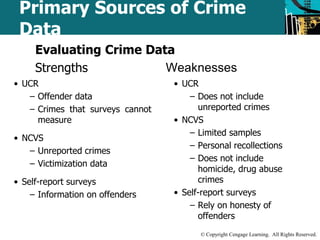
Evaluating Crime Data 
Strengths 
• UCR 
– Offender data 
– Crimes that surveys cannot 
measure 
• NCVS 
– Unreported crimes 
– Victimization data 
• Self-report surveys 
– Information on offenders 
Weaknesses 
• UCR 
– Does not include 
unreported crimes 
• NCVS 
– Limited samples 
– Personal recollections 
– Does not include 
homicide, drug abuse 
crimes 
• Self-report surveys 
– Rely on honesty of 
offenders
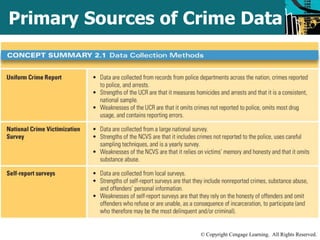
Primary Sources of Crime Data 
© Copyright Cengage Learning. All Rights Reserved.
© Copyright Cengage Learning. All Rights Reserved. 
Crime Trends 
• Contemporary Trends 
– Crime rates are declining from peak in 1991 
– Violent crimes and thefts have declined 
• Trends in Victimization 
– Decrease in victimization across all age groups 
– Significant decrease among teenagers 
• What the Future Holds 
– Increase in numbers of elementary school aged 
children 
– Could indicate a future increase in crime as children 
reach teenage and young adult age
© Copyright Cengage Learning. All Rights Reserved. 
Crime Trends 
• Explaining Trends in Crime Rates 
– Age structure 
– Immigration 
– Economy/Jobs 
– Abortion 
– Gun availability 
– Gang membership 
– Drug use 
– Media 
– Aggressive law enforcement 
– Incarceration 
– Cultural change
© Copyright Cengage Learning. All Rights Reserved. 
Crime Patterns 
• Gender and Crime 
– Trait differences 
• Masculinity hypothesis 
– Socialization differences 
– Cognitive differences 
– Political/Social differences 
• Liberal feminist theory
© Copyright Cengage Learning. All Rights Reserved. 
Crime Patterns 
• Race and Crime 
– Institutional racism 
• Racial threat theory 
• Racial profiling 
– Structural racism
© Copyright Cengage Learning. All Rights Reserved. 
Crime Patterns 
• Ecology of Crime 
– Day, season and climate 
• More crimes are reported during summer 
months 
– Temperature 
• Weather effects may have an impact on 
violent crime rates 
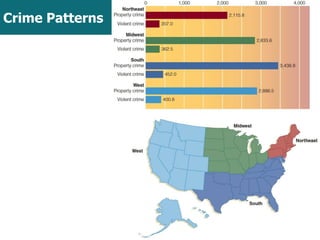
– Regional differences 
• Large urban areas have higher rates of 
violence
© Copyright Cengage Learning. All Rights Reserved. 
Crime Patterns
© Copyright Cengage Learning. All Rights Reserved. 
Crime Patterns 
• Use of Firearms 
– According to the NCVS firearms are 
typically involved in 
• 20% of robberies 
• 10% of assaults 
• 5% of rapes 
– Two-thirds of murders 
• On-going debate about gun control
Crime Patterns 
• Social Class, Socioeconomic 
Conditions, and Crime 
© Copyright Cengage Learning. All Rights Reserved. 
– Instrumental crimes 
– Expressive crimes
© Copyright Cengage Learning. All Rights Reserved. 
Crime Patterns 
• Age and Crime 
– Aging out of crime 
– Age and biology 
•Neurotransmitters
Class Discussion/Activity 
From your perspective, why are teenagers 
more likely to commit crimes? 
What is the aging-out effect? 
© Copyright Cengage Learning. All Rights Reserved.
Chronic Offenders/Criminal Careers 
• Delinquency in a Birth Cohort 
– Wolfgang, Figlio, and Sellin 
• Classic longitudinal study that tracked 
a cohort of boys over an 18 year 
period 
© Copyright Cengage Learning. All Rights Reserved.
Chronic Offenders/Criminal Careers 
• What Causes Chronicity? 
© Copyright Cengage Learning. All Rights Reserved. 
– Early onset 
• Implications of the Chronic Offender 
Concept 
– “Three-strikes” 
– “Truth-in-sentencing”

81-220-1 - Chapter 2

  • 1.
    Chapter 2 - The Nature and Extent of Michelle Palaro Criminology 81-220-1 Fall 2014 © Copyright Cengage Learning. All Rights Reserved. Crime
  • 2.
    Primary Sources ofCrime Data • Official Records: Uniform Crime Reports (UCR) © Copyright Cengage Learning. All Rights Reserved. – Part I Crimes – Part II Crimes – Cleared Crimes – Validity of the UCR
  • 3.
    Primary Sources ofCrime Data • National Incident-Based Reporting System (NIBRS) – Improvement over UCR – 46 specific offenses – 22 crime patterns – Incident, victim, and offender information – 20 states have implemented – 12 states finalizing data collection © Copyright Cengage Learning. All Rights Reserved.
  • 4.
    Class Discussion/Activity •What are the shortcomings of the UCR? • Which advantages does NIBRS have compared to the UCR? © Copyright Cengage Learning. All Rights Reserved.
  • 5.
    Primary Sources ofCrime Data • National Crime Victimization Survey (NCVS) – Annual survey of victims – Addresses “non-reporting” issue – Information regarding victims, offenders, and crimes – Validity of the NCVS – Future of the NCVS © Copyright Cengage Learning. All Rights Reserved.
  • 6.
    Primary Sources ofCrime Data © Copyright Cengage Learning. All Rights Reserved. • Self-Report Surveys • Given in groups • Anonymous • Additional questions about attitudes, values, and behaviors – Validity of Self-Reports • Honesty of self-reporting participants – “Monitoring the Future” Survey • Consistent • Longitudinal
  • 7.
    Primary Sources ofCrime Data © Copyright Cengage Learning. All Rights Reserved. Evaluating Crime Data Strengths • UCR – Offender data – Crimes that surveys cannot measure • NCVS – Unreported crimes – Victimization data • Self-report surveys – Information on offenders Weaknesses • UCR – Does not include unreported crimes • NCVS – Limited samples – Personal recollections – Does not include homicide, drug abuse crimes • Self-report surveys – Rely on honesty of offenders
  • 8.
    Primary Sources ofCrime Data © Copyright Cengage Learning. All Rights Reserved.
  • 9.
    © Copyright CengageLearning. All Rights Reserved. Crime Trends • Contemporary Trends – Crime rates are declining from peak in 1991 – Violent crimes and thefts have declined • Trends in Victimization – Decrease in victimization across all age groups – Significant decrease among teenagers • What the Future Holds – Increase in numbers of elementary school aged children – Could indicate a future increase in crime as children reach teenage and young adult age
  • 10.
    © Copyright CengageLearning. All Rights Reserved. Crime Trends • Explaining Trends in Crime Rates – Age structure – Immigration – Economy/Jobs – Abortion – Gun availability – Gang membership – Drug use – Media – Aggressive law enforcement – Incarceration – Cultural change
  • 11.
    © Copyright CengageLearning. All Rights Reserved. Crime Patterns • Gender and Crime – Trait differences • Masculinity hypothesis – Socialization differences – Cognitive differences – Political/Social differences • Liberal feminist theory
  • 12.
    © Copyright CengageLearning. All Rights Reserved. Crime Patterns • Race and Crime – Institutional racism • Racial threat theory • Racial profiling – Structural racism
  • 13.
    © Copyright CengageLearning. All Rights Reserved. Crime Patterns • Ecology of Crime – Day, season and climate • More crimes are reported during summer months – Temperature • Weather effects may have an impact on violent crime rates – Regional differences • Large urban areas have higher rates of violence
  • 14.
    © Copyright CengageLearning. All Rights Reserved. Crime Patterns
  • 15.
    © Copyright CengageLearning. All Rights Reserved. Crime Patterns • Use of Firearms – According to the NCVS firearms are typically involved in • 20% of robberies • 10% of assaults • 5% of rapes – Two-thirds of murders • On-going debate about gun control
  • 16.
    Crime Patterns •Social Class, Socioeconomic Conditions, and Crime © Copyright Cengage Learning. All Rights Reserved. – Instrumental crimes – Expressive crimes
  • 17.
    © Copyright CengageLearning. All Rights Reserved. Crime Patterns • Age and Crime – Aging out of crime – Age and biology •Neurotransmitters
  • 18.
    Class Discussion/Activity Fromyour perspective, why are teenagers more likely to commit crimes? What is the aging-out effect? © Copyright Cengage Learning. All Rights Reserved.
  • 19.
    Chronic Offenders/Criminal Careers • Delinquency in a Birth Cohort – Wolfgang, Figlio, and Sellin • Classic longitudinal study that tracked a cohort of boys over an 18 year period © Copyright Cengage Learning. All Rights Reserved.
  • 20.
    Chronic Offenders/Criminal Careers • What Causes Chronicity? © Copyright Cengage Learning. All Rights Reserved. – Early onset • Implications of the Chronic Offender Concept – “Three-strikes” – “Truth-in-sentencing”