The Theory of
Consumer Behavior
STANSLOUS K CHULU
DEPT OF ECONOMICS & BUSINESS STUDIES
FACULTY OF HUMANITIES
The Theory of Consumer
Behavior
The principle assumption upon which the
theory of consumer behavior and demand is
built is: a consumer attempts to allocate
his/her limited money income among
available goods and services so as to
maximize his/her utility (satisfaction).
Theory of Consumer Behavior
 Useful for understanding the demand side of
the market.
 Utility - amount of satisfaction derived from the
consumption of a commodity ….measurement
units  utils
Theories of Consumer Choice
 Utility Concepts:
– The Cardinal Utility Theory (CUT)
• Utility is measurable in a cardinal sense
• cardinal utility - assumes that we can assign
values for utility, (Jevons, Walras, and
Marshall). E.g., derive 100 utils from eating a
slice of pizza
– The Ordinal Utility Theory (OUT)
• Utility is measurable in an ordinal sense
• ordinal utility approach - does not assign values,
instead works with a ranking of preferences.
(Pareto, Hicks, Slutsky)
The Cardinal Approach
Nineteenth century economists, such as Jevons,
Menger and Walras, assumed that utility was
measurable in a cardinal sense, which means
that the difference between two measurement is
itself numerically significant.
UX = f (X), UY = f (Y), …..
Utility is maximized when:
MUX / MUY = PX / PY
The Cardinal Approach
 Total utility (TU) - the overall level of
satisfaction derived from consuming a good or
service
 Marginal utility (MU) additional satisfaction
that an individual derives from consuming an
additional unit of a good or service.
Formula :
MU = Change in total utility
Change in quantity
= ∆ TU
∆ Q
The Cardinal Approach
 Law of Diminishing Marginal Utility (Return) = As more
and more of a good are consumed, the process of
consumption will (at some point) yield smaller and
smaller additions to utility
 When the total utility maximum, marginal utility = 0
 When the total utility begins to decrease, the
marginal utility = negative (-ve)
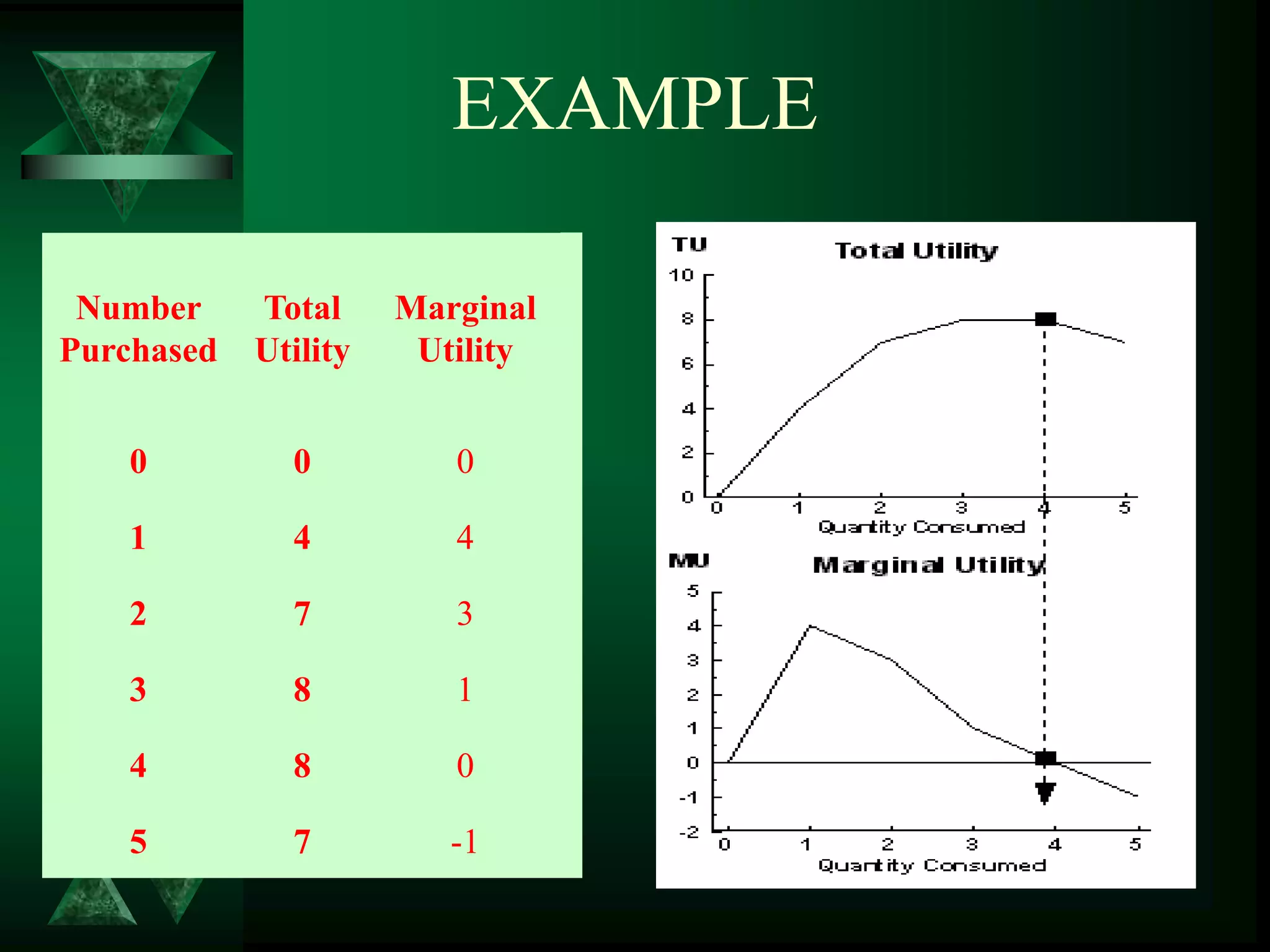
EXAMPLE
Number
Purchased
Total
Utility
Marginal
Utility
0 0 0
1 4 4
2 7 3
3 8 1
4 8 0
5 7 -1
The Cardinal Approach
 TU, in general, increases
with Q
 At some point, TU can start
falling with Q (see Q = 5)
 If TU is increasing, MU > 0
 From Q = 1 onwards, MU is
declining  principle of
diminishing marginal utility
 As more and more of a
good are consumed, the
process of consumption will
(at some point) yield smaller
and smaller additions to
utility
Consumer Equilibrium
 So far, we have assumed that any amount
of goods and services are always
available for consumption
 In reality, consumers face constraints
(income and prices):
– Limited consumers income or budget
– Goods can be obtained at a price
Some simplifying assumptions
 Consumer’s objective: to maximize
his/her utility subject to income
constraint
 2 goods (X, Y)
 Prices Px, Py are fixed
 Consumer’s income (I) is given
Consumer Equilibrium
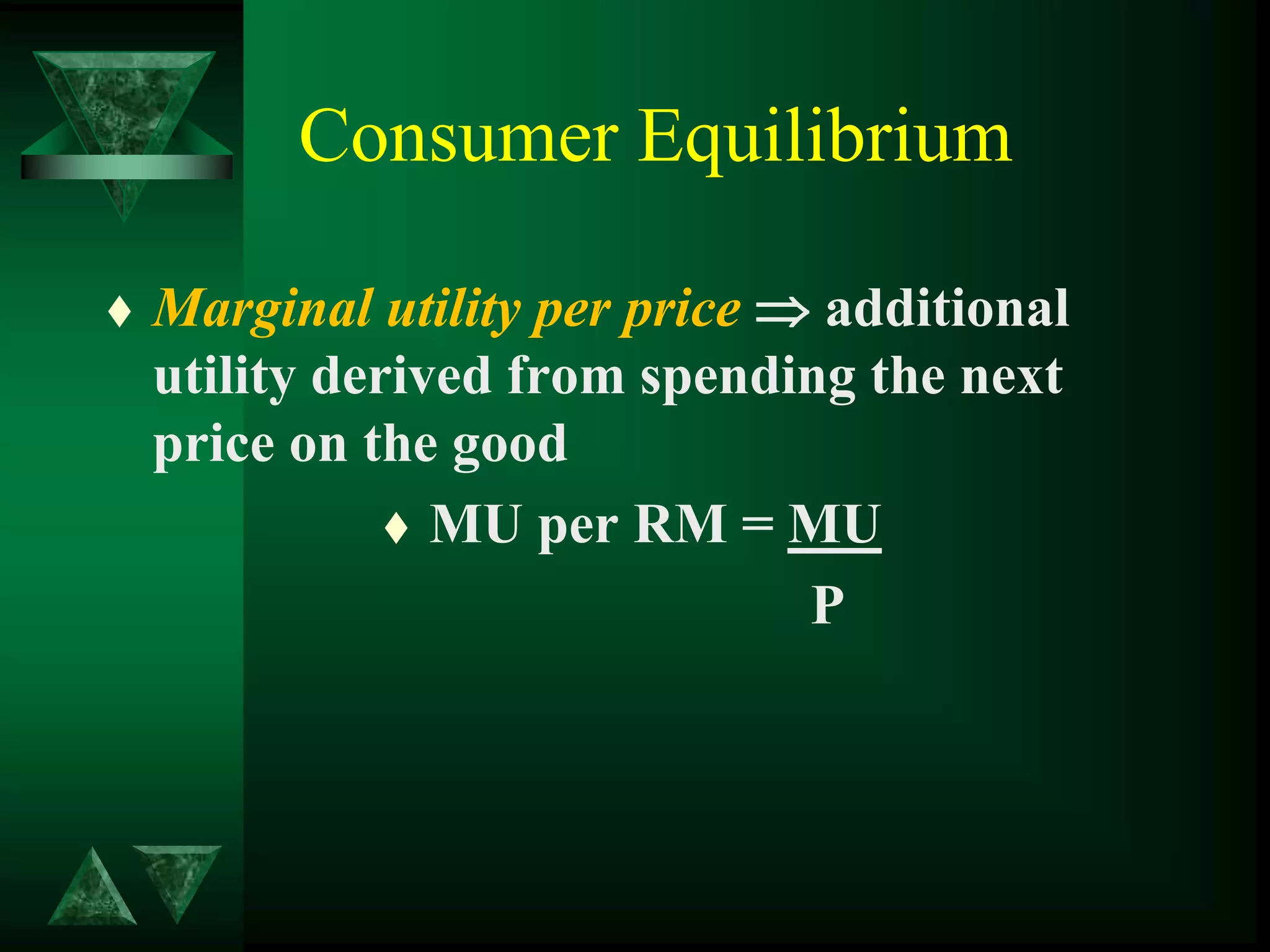
 Marginal utility per price  additional
utility derived from spending the next
price on the good
 MU per RM = MU
P
Consumer Equilibrium
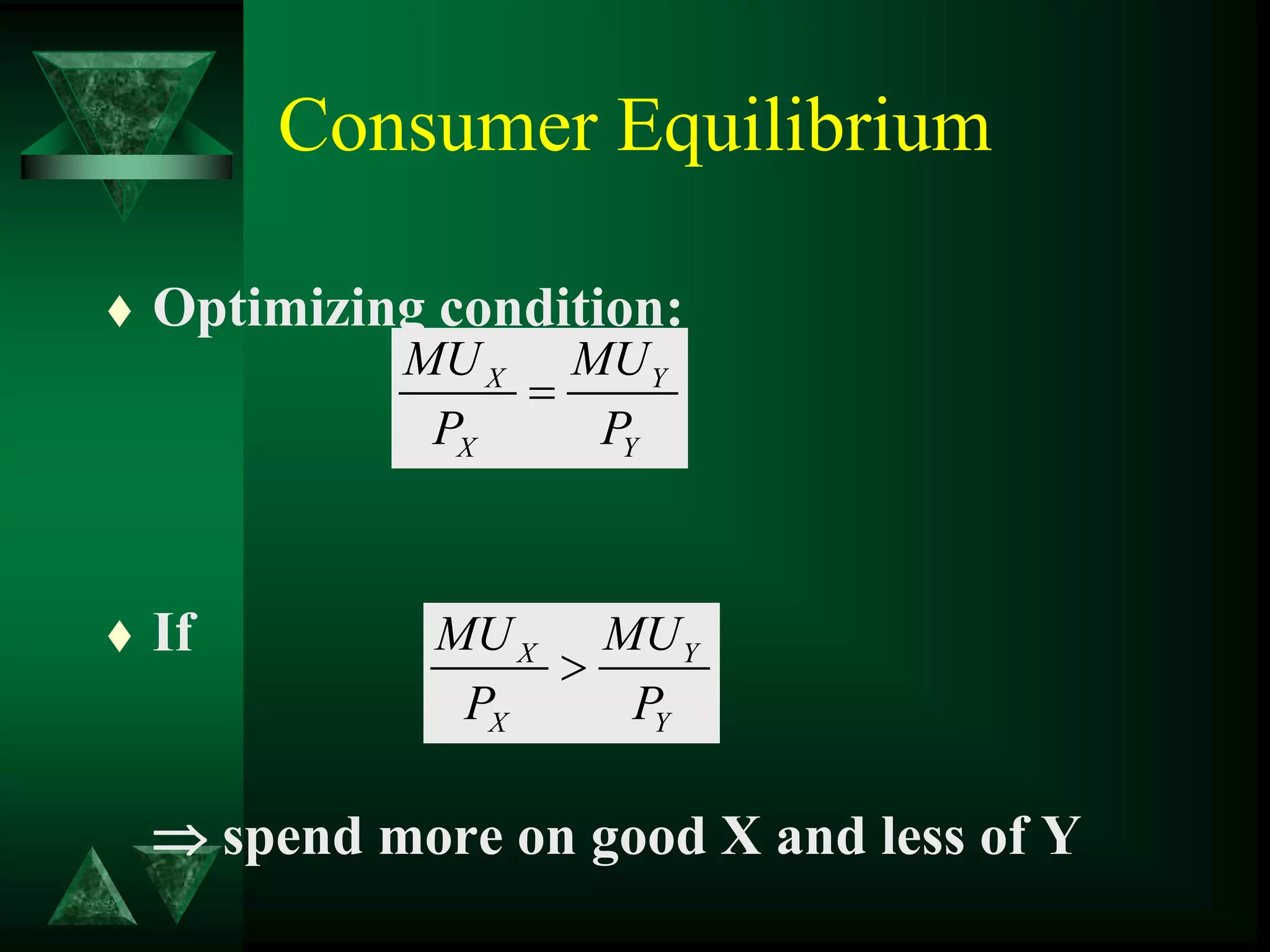
 Optimizing condition:
 If
 spend more on good X and less of Y
X Y
X Y
MU MU
P P

X Y
X Y
MU MU
P P

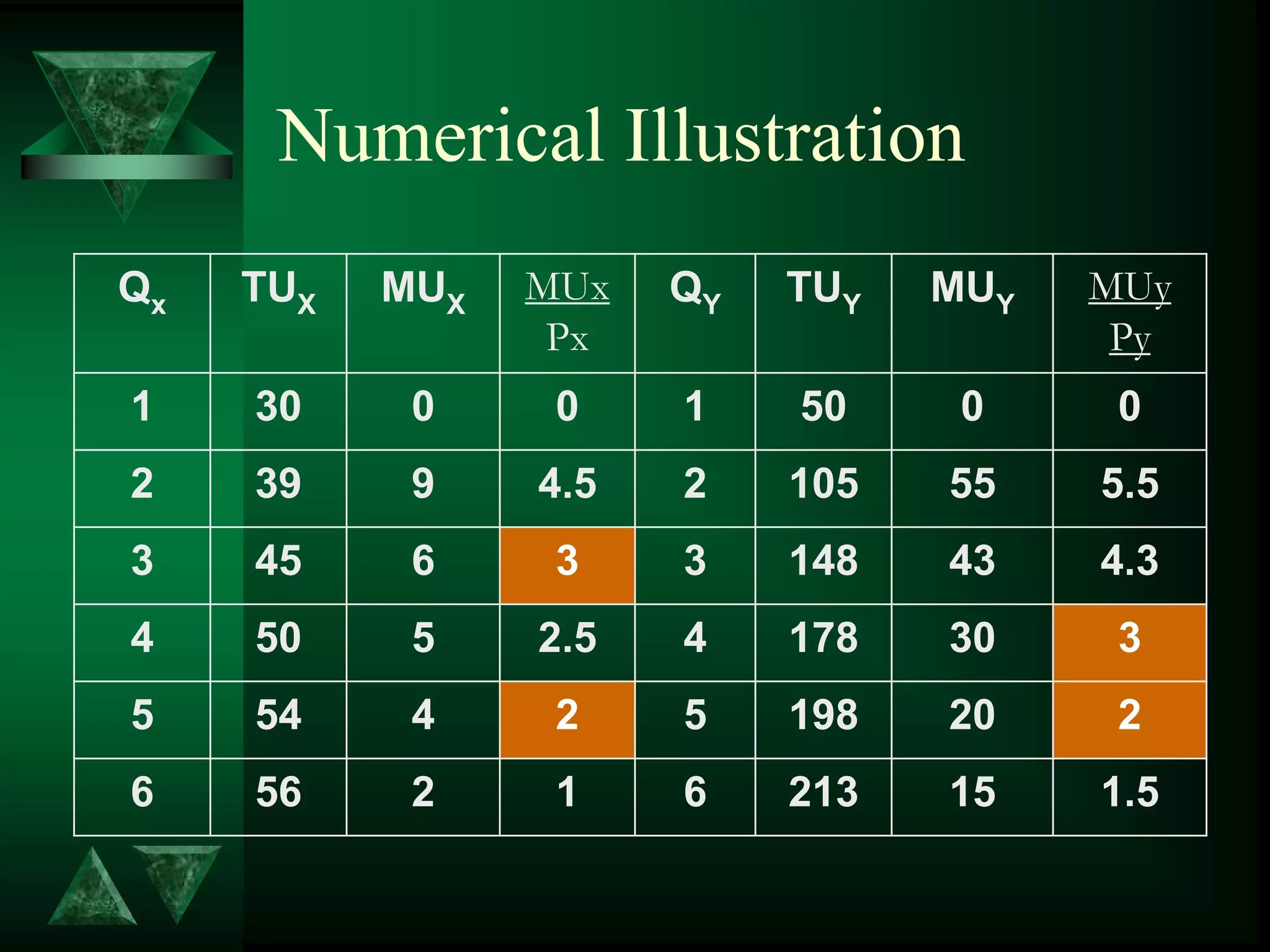
Numerical Illustration
Qx TUX MUX
MUx
Px
QY TUY MUY
MUy
Py
1 30 0 0 1 50 0 0
2 39 9 4.5 2 105 55 5.5
3 45 6 3 3 148 43 4.3
4 50 5 2.5 4 178 30 3
5 54 4 2 5 198 20 2
6 56 2 1 6 213 15 1.5
Simple Illustration
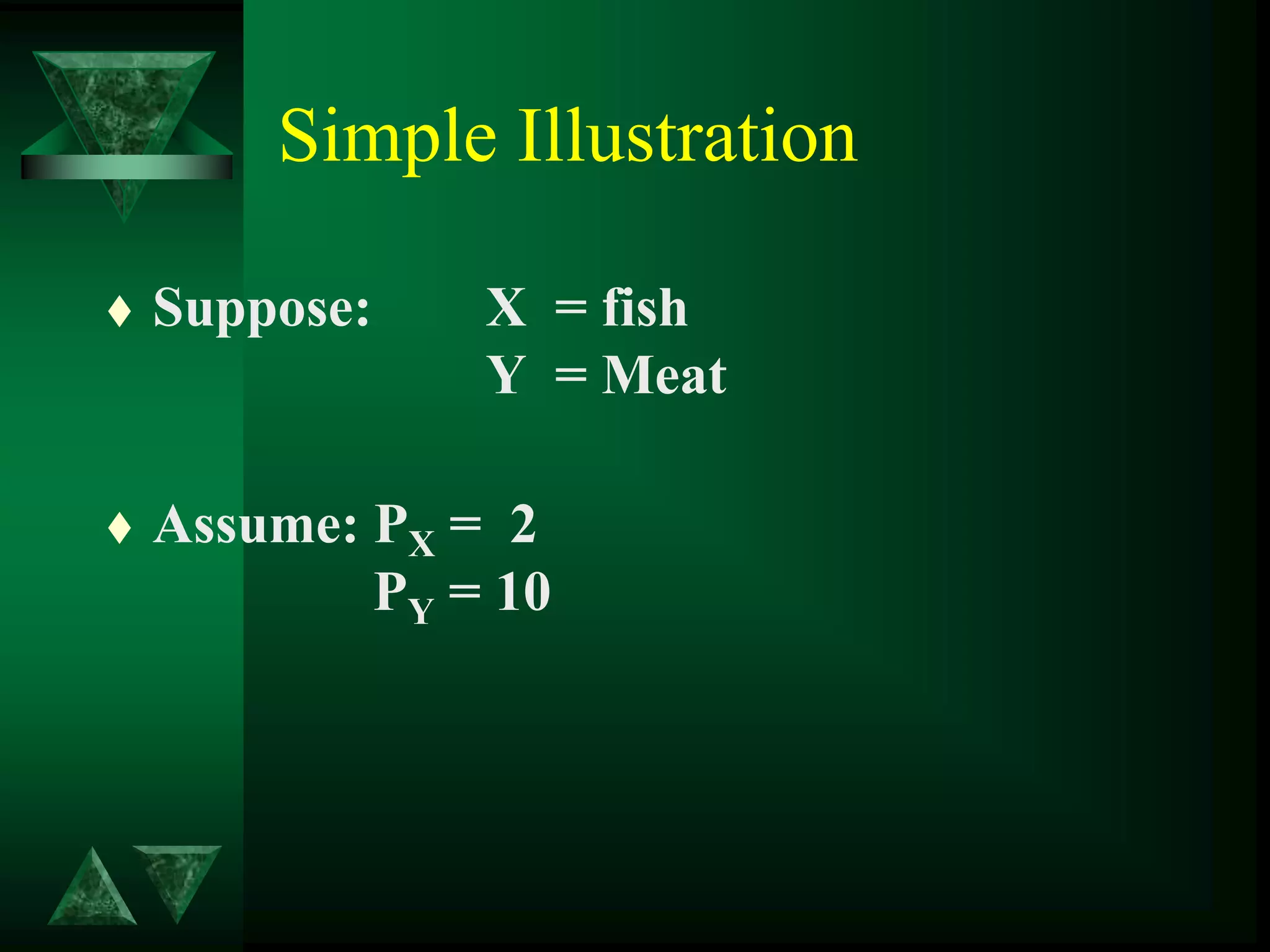
 Suppose: X = fish
Y = Meat
 Assume: PX = 2
PY = 10
Cont.
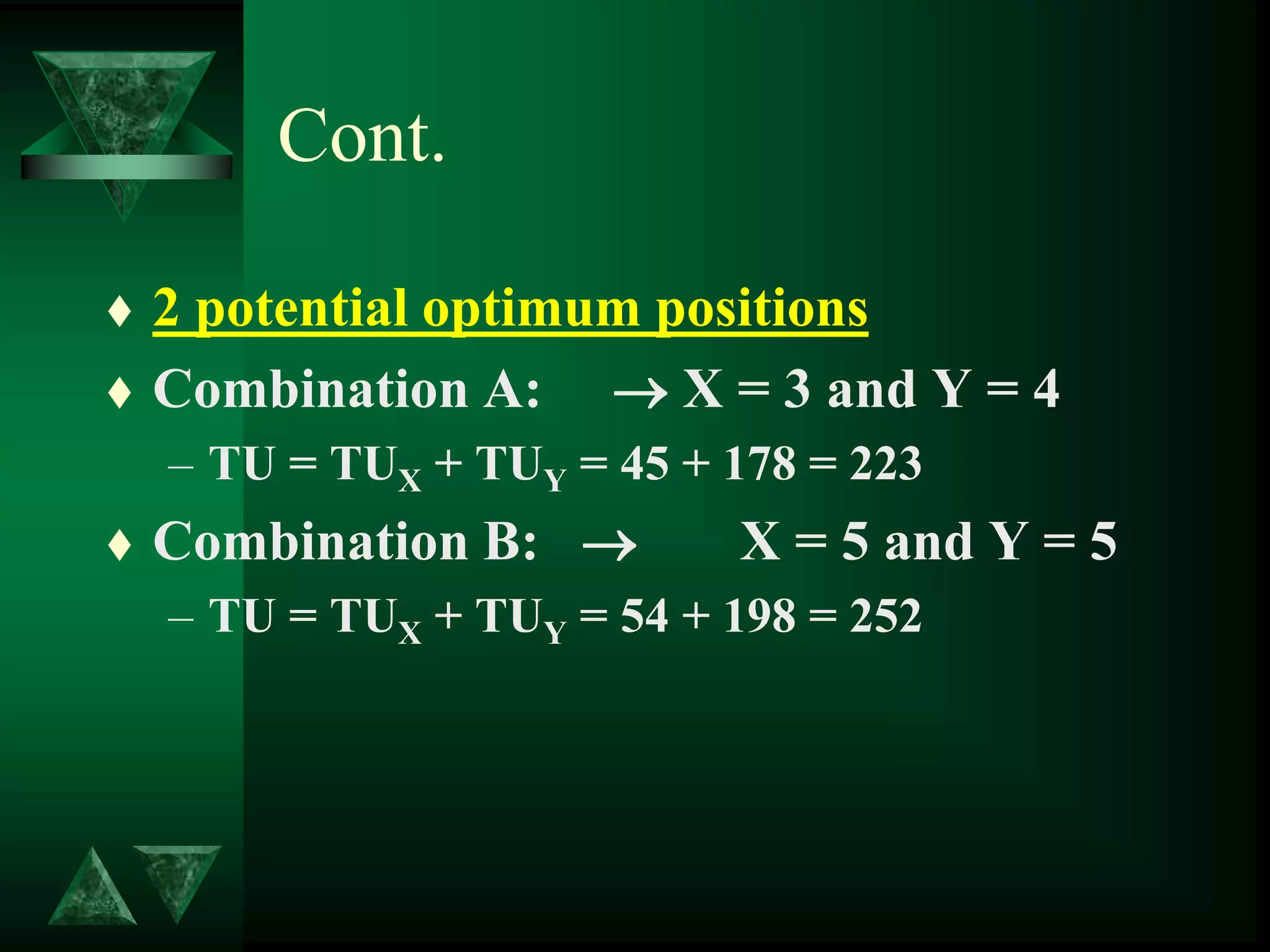
 2 potential optimum positions
 Combination A:  X = 3 and Y = 4
– TU = TUX + TUY = 45 + 178 = 223
 Combination B:  X = 5 and Y = 5
– TU = TUX + TUY = 54 + 198 = 252
Cont.
 Presence of 2 potential equilibrium
positions suggests that we need to
consider income. To do so let us examine
how much each consumer spends for
each combination.
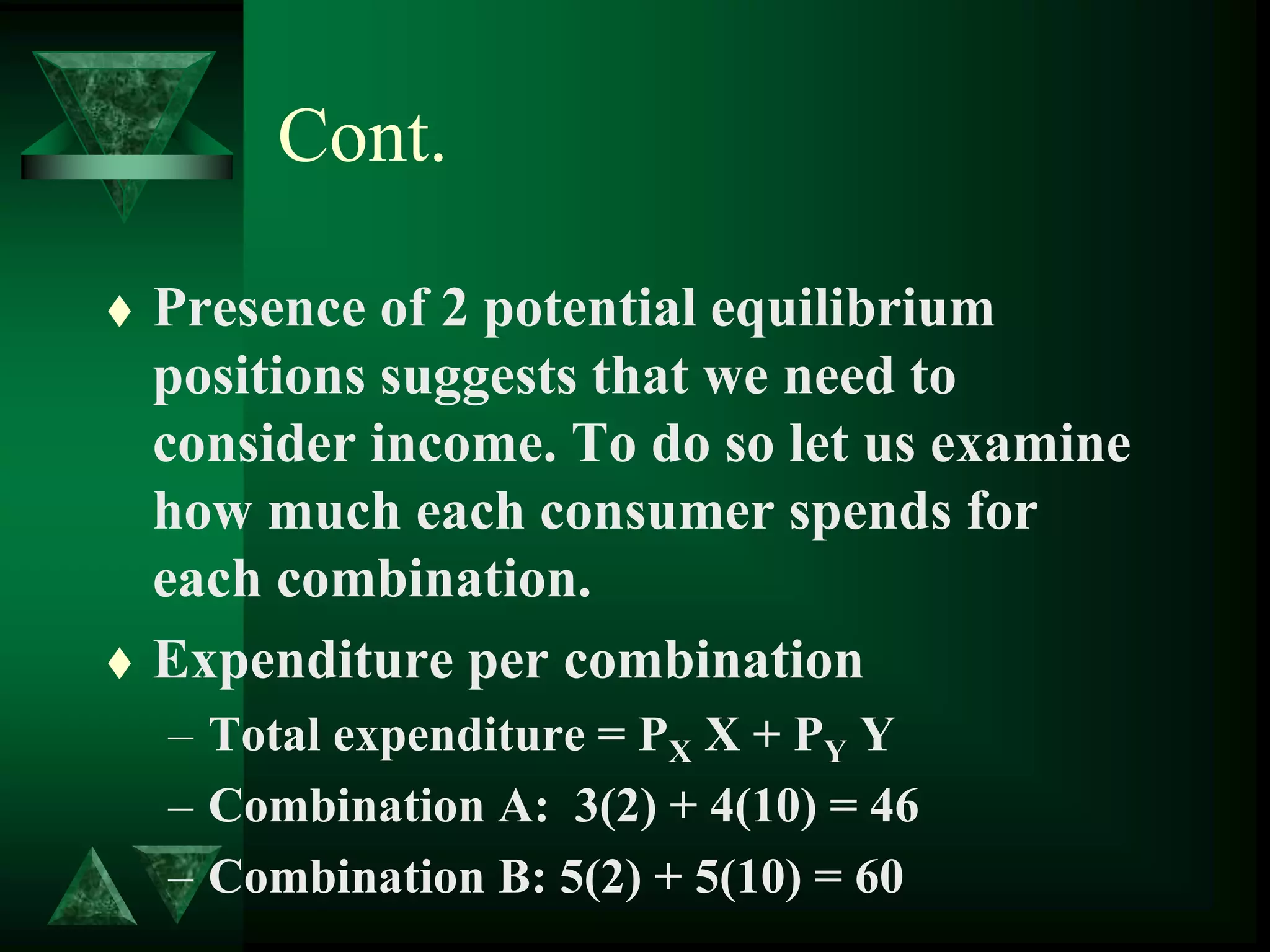
 Expenditure per combination
– Total expenditure = PX X + PY Y
– Combination A: 3(2) + 4(10) = 46
– Combination B: 5(2) + 5(10) = 60
Cont.
 Scenarios:
– If consumer’s income = 46, then the
optimum is given by combination A.
.…Combination B is not affordable
– If the consumer’s income = 60, then the
optimum is given by Combination
B….Combination A is affordable but it
yields a lower level of utility
The Ordinal Approach
Economists following the lead of Hicks,
Slutsky and Pareto believe that utility is
measurable in an ordinal sense--the utility
derived from consuming a good, such as X,
is a function of the quantities of X and Y
consumed by a consumer.
U = f ( X, Y )
Cont.
 Ordinal Utility Theory (TUO)
– Can be measured in qualitative,
not quantitative, but only lists
the main options (indifference curves & budget
line).
 Rational human beings will choose
to maximize the utility by selecting the
highest utility
 Difference consumers, difference utilities.
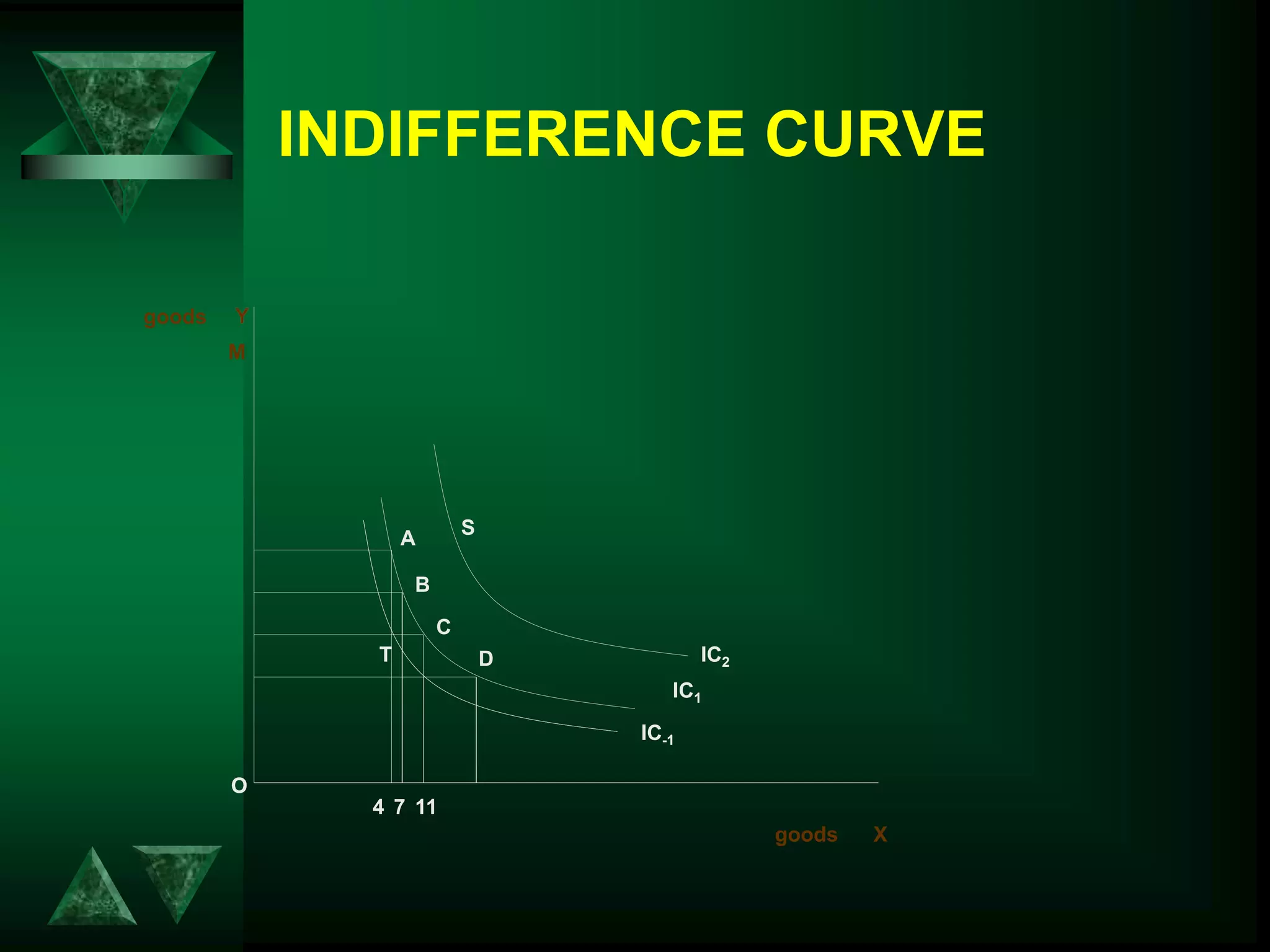
INDIFFERENCE CURVE (IC)
 Curve where the points represent a
combination of items which the
consumer at indifference situation
(satisfaction).
 Indifference Curve = a line showing all
possible combinations of two goods that
provide the same level of utility (satisfaction).
 Axes: both axes refer to the quantity of
goods
 For the combination that produces a
higher level of satisfaction, the
INDIFFERENCE CURVE
Y
O
goods
7
Y
O
X
IC2
IC1
M
IC-1
11
4
goods
S
A
B
C
D
T
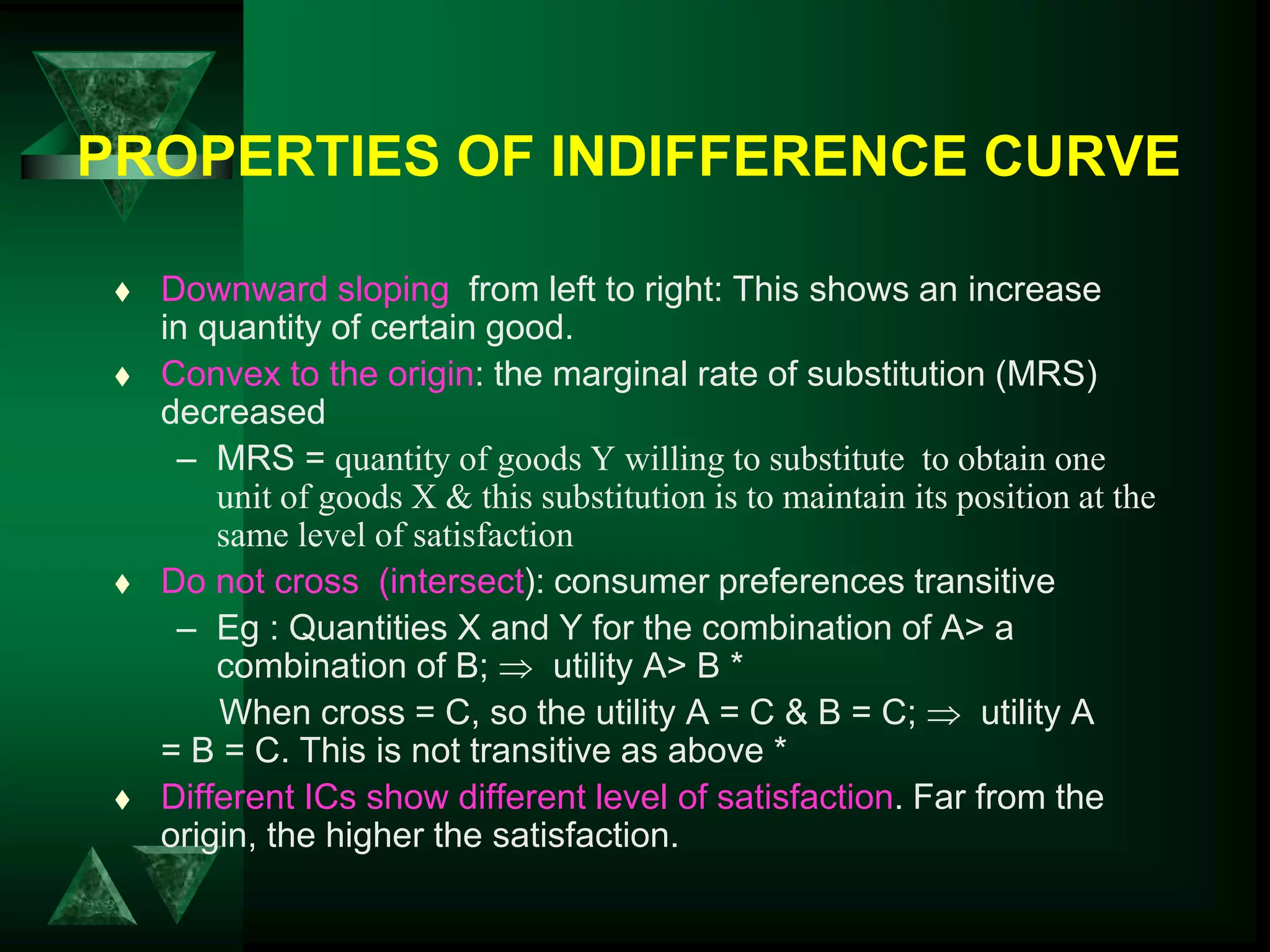
PROPERTIES OF INDIFFERENCE CURVE
 Downward sloping from left to right: This shows an increase
in quantity of certain good.
 Convex to the origin: the marginal rate of substitution (MRS)
decreased
– MRS = quantity of goods Y willing to substitute to obtain one
unit of goods X & this substitution is to maintain its position at the
same level of satisfaction
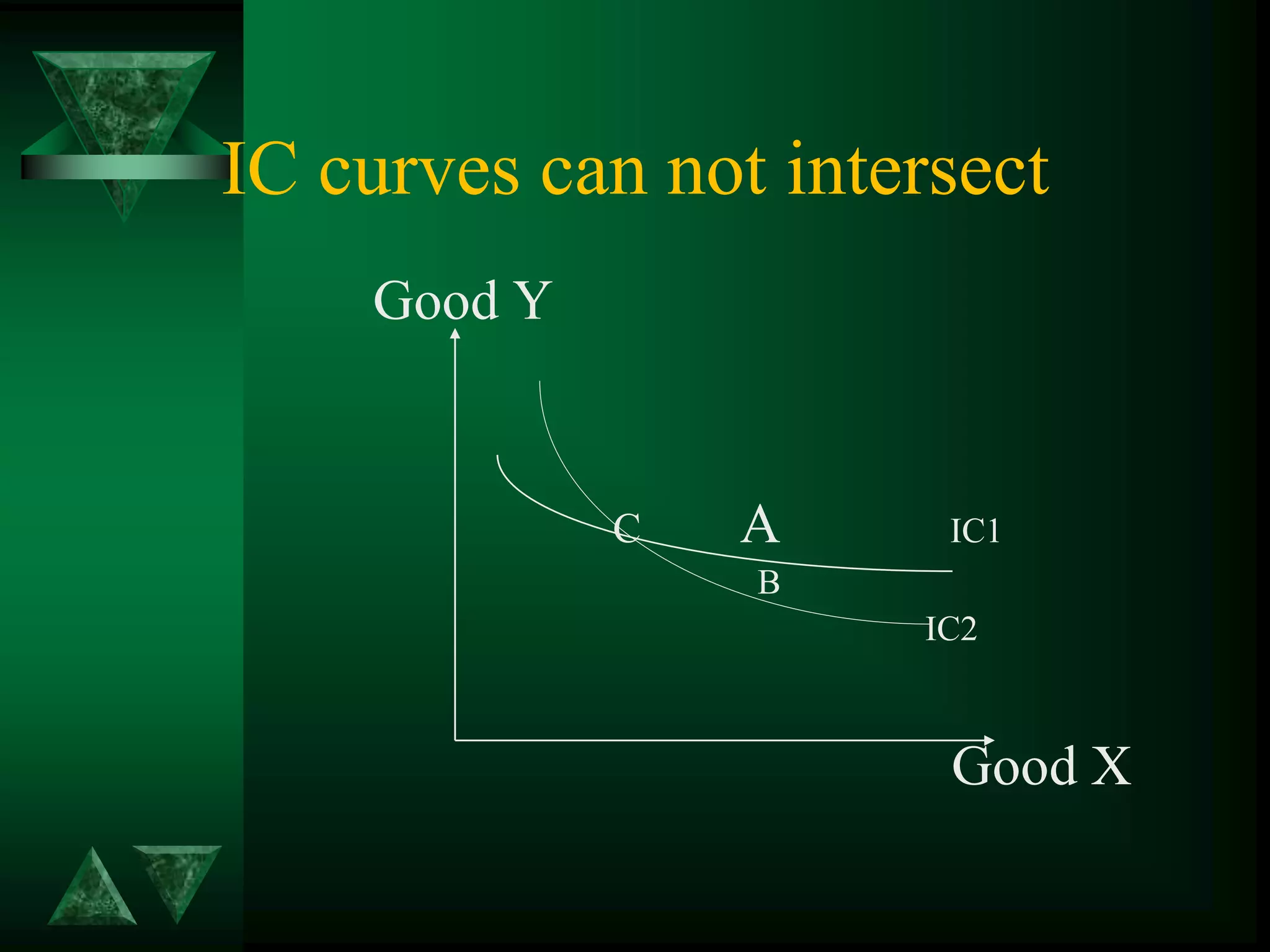
 Do not cross (intersect): consumer preferences transitive
– Eg : Quantities X and Y for the combination of A> a
combination of B;  utility A> B *
When cross = C, so the utility A = C & B = C;  utility A
= B = C. This is not transitive as above *
 Different ICs show different level of satisfaction. Far from the
origin, the higher the satisfaction.
IC curves can not intersect
Good Y
C A IC1
B
IC2
Good X
Budget line (BL)
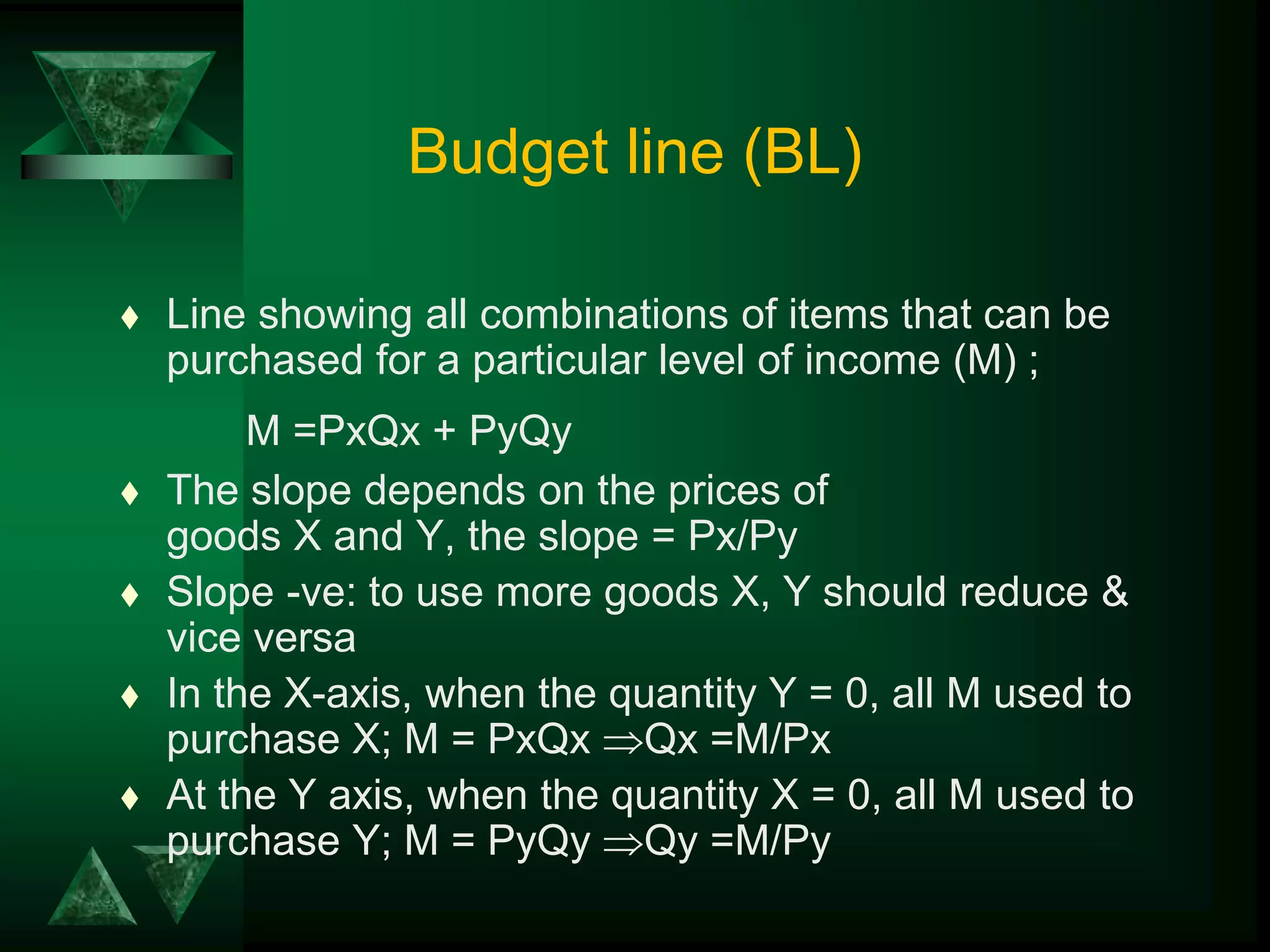
 Line showing all combinations of items that can be
purchased for a particular level of income (M) ;
M =PxQx + PyQy
 The slope depends on the prices of
goods X and Y, the slope = Px/Py
 Slope -ve: to use more goods X, Y should reduce &
vice versa
 In the X-axis, when the quantity Y = 0, all M used to
purchase X; M = PxQx Qx =M/Px
 At the Y axis, when the quantity X = 0, all M used to
purchase Y; M = PyQy Qy =M/Py
FACTORS SHIFT THE BUDGET LINE
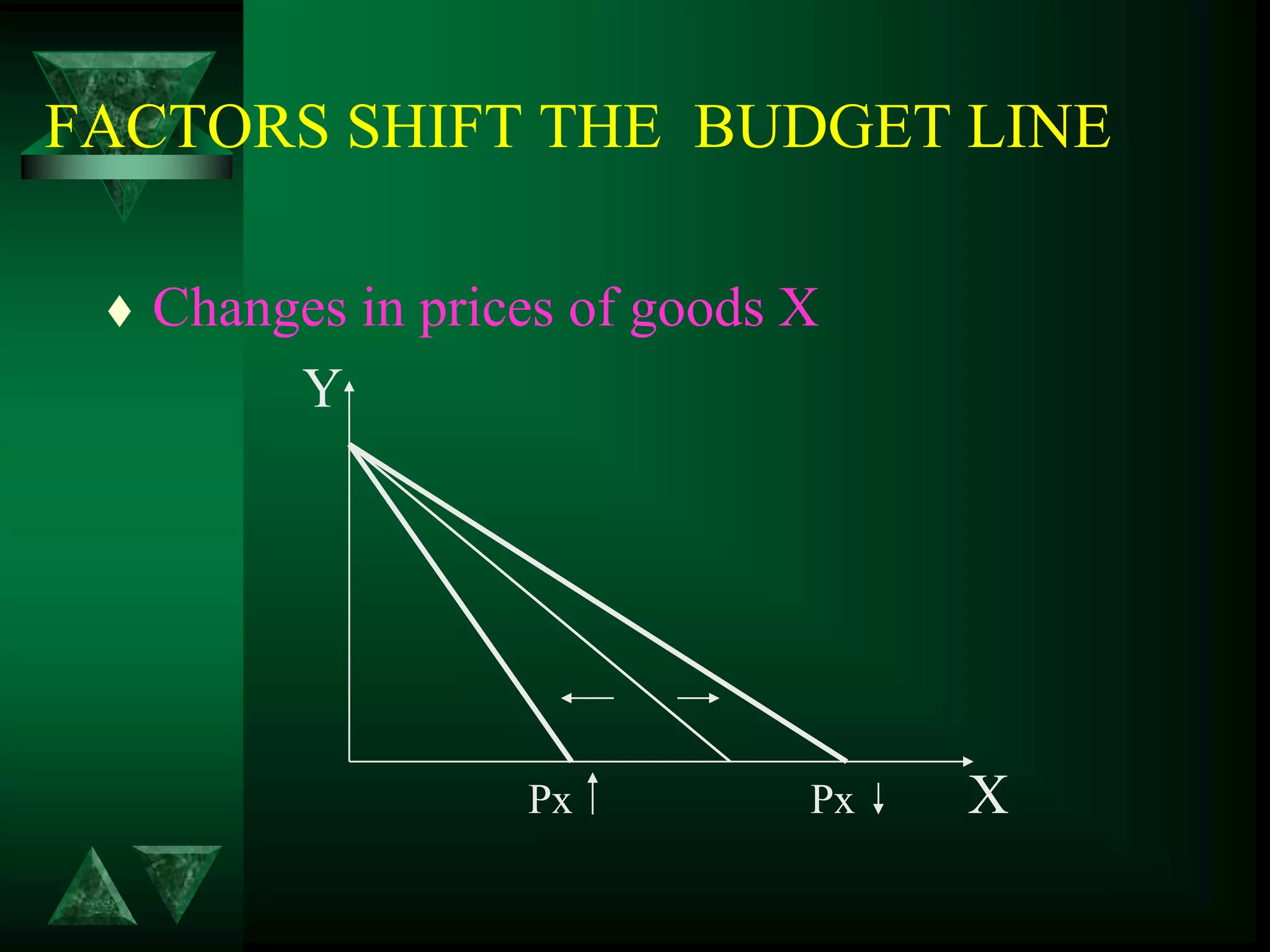
 Changes in prices of goods X
Y
Px Px X
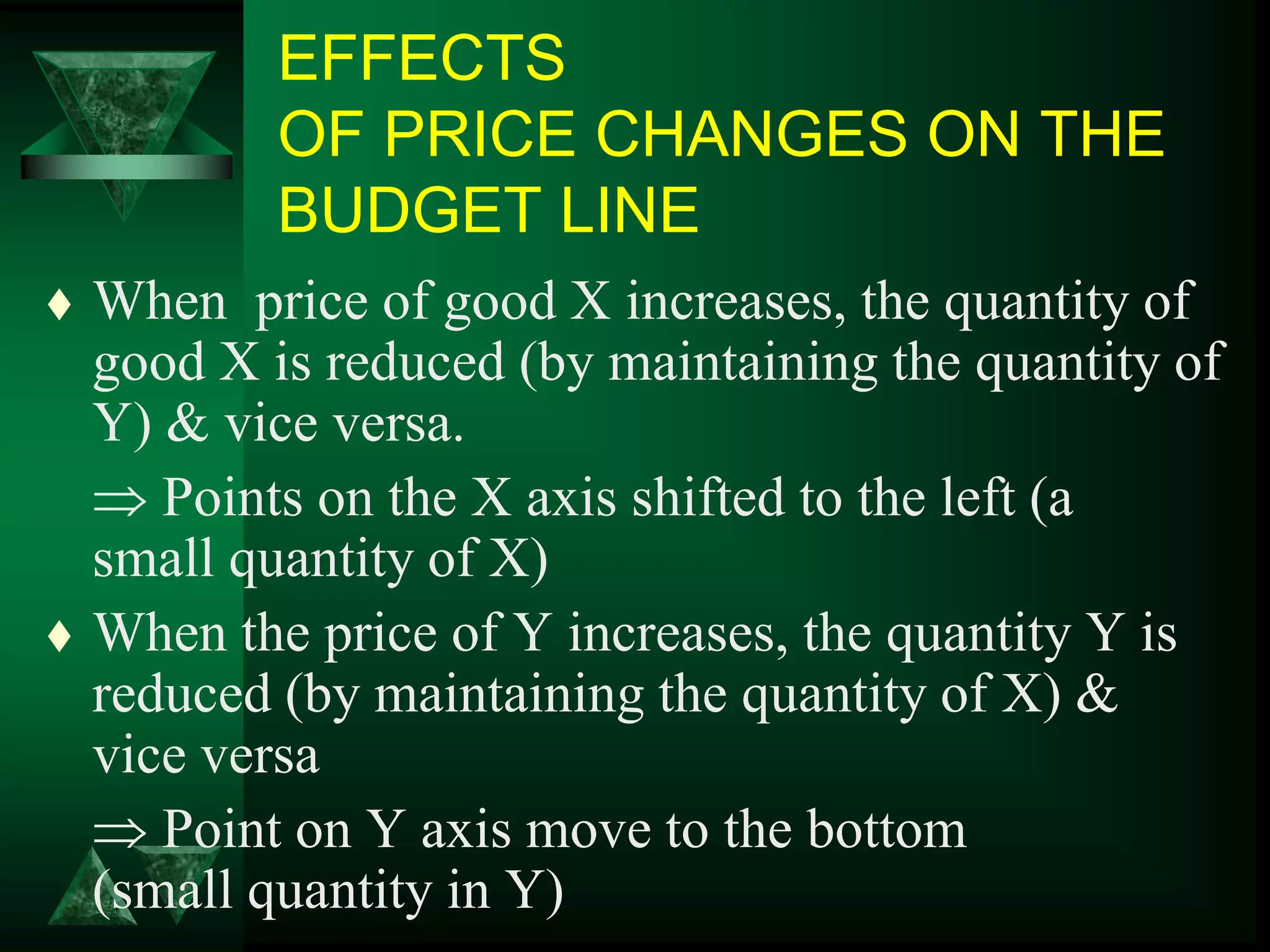
EFFECTS
OF PRICE CHANGES ON THE
BUDGET LINE
 When price of good X increases, the quantity of
good X is reduced (by maintaining the quantity of
Y) & vice versa.
 Points on the X axis shifted to the left (a
small quantity of X)
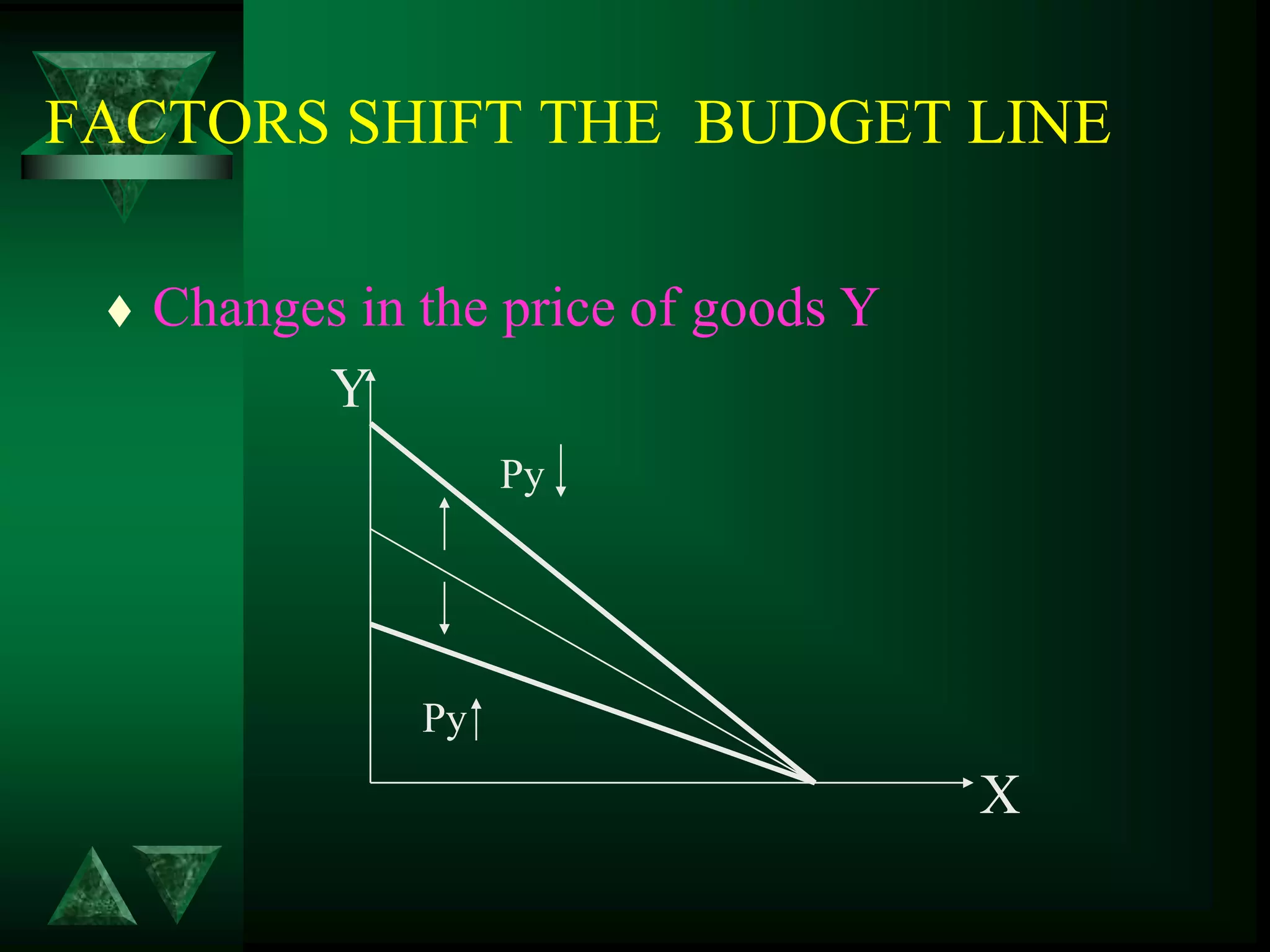
 When the price of Y increases, the quantity Y is
reduced (by maintaining the quantity of X) &
vice versa
 Point on Y axis move to the bottom
(small quantity in Y)
FACTORS SHIFT THE BUDGET LINE
 Changes in the price of goods Y
Y
Py
Py
X
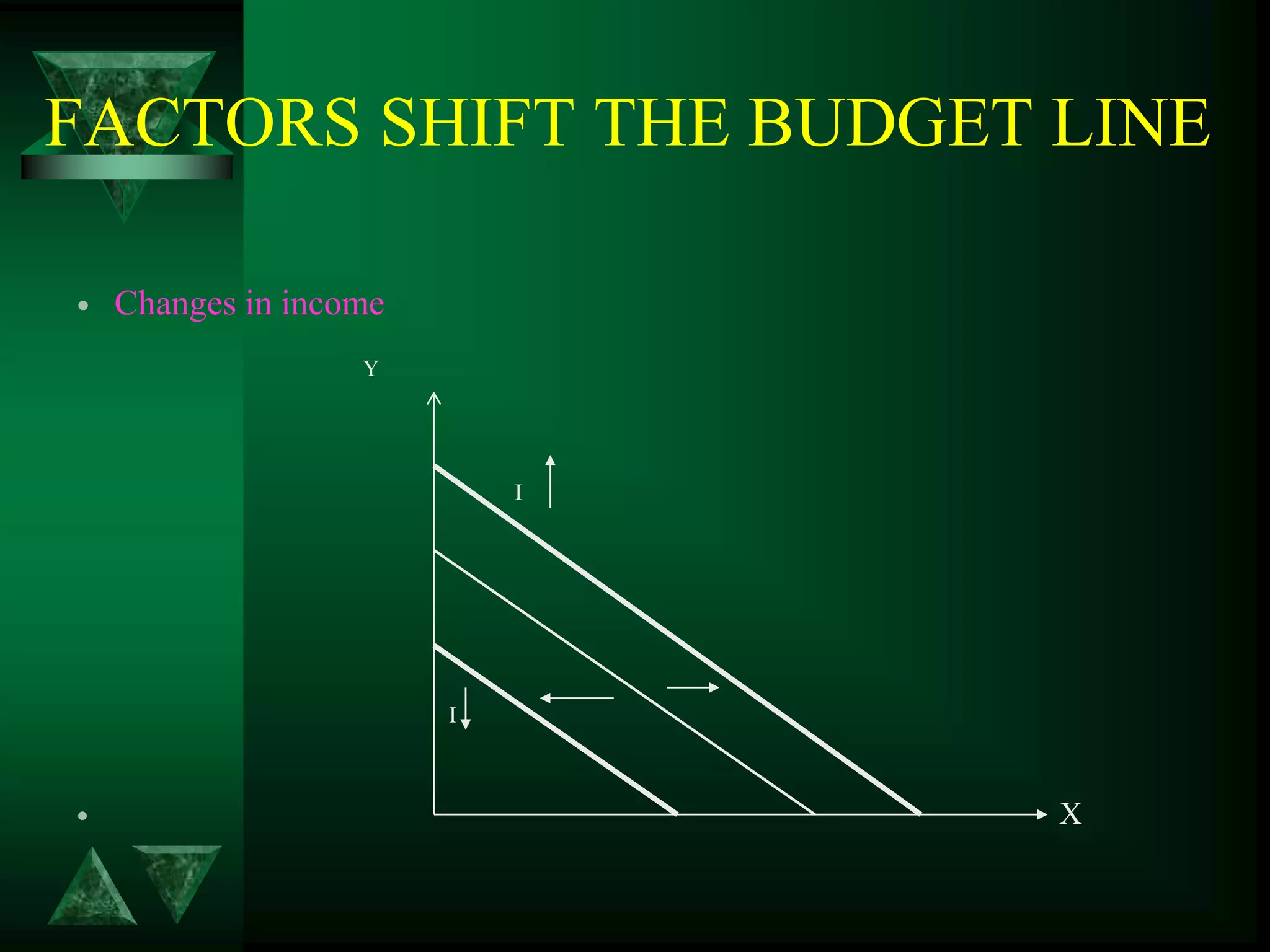
FACTORS SHIFT THE BUDGET LINE
 Changes in income
Y
I
I
 X
EFFECTS OF INCOME
CHANGES ON THE
BUDGET LINE
 When M increases, QX and QY can be
bought even more, a point on the X
axis shifted to the right & a point on
the Y axis move on; & vice
versa when M decreases.
CONSUMER EQUILIBRIUM
 With income (M) some combination
of goods that consumers choose the highest
satisfaction
 Satisfied the
same curves and budget lines are
connected
 The point where the curve IC and
BL tangent
 Slope IC = BL
 Consumer choice influenced by income
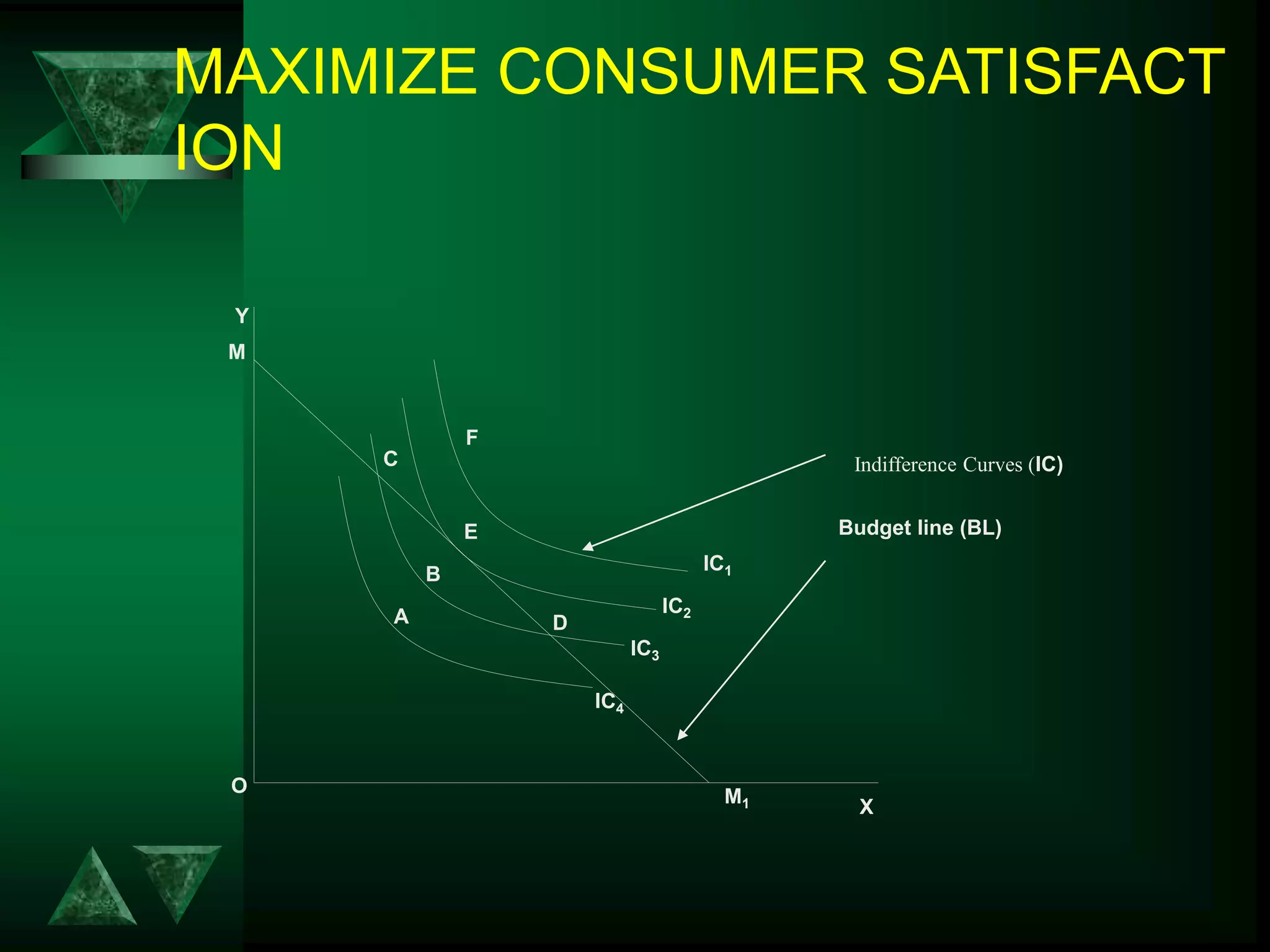
MAXIMIZE CONSUMER SATISFACT
ION
F
E
B
A D
C
Y
O
X
IC1
IC2
IC3
IC4
M1
M
Budget line (BL)
Indifference Curves (IC)
EXAMPLE
a) A consumer spends all her income on food and
clothing. At the current prices of Pf = K10 and Pc = K5,
she maximized her utility by purchasing 20 units of
food and 50 units of clothing.
 i.What is the consumer’s income? [2 marks]
 ii.What is the consumer’s marginal rate of substitution
of food for clothing at the equilibrium position? [2
marks]
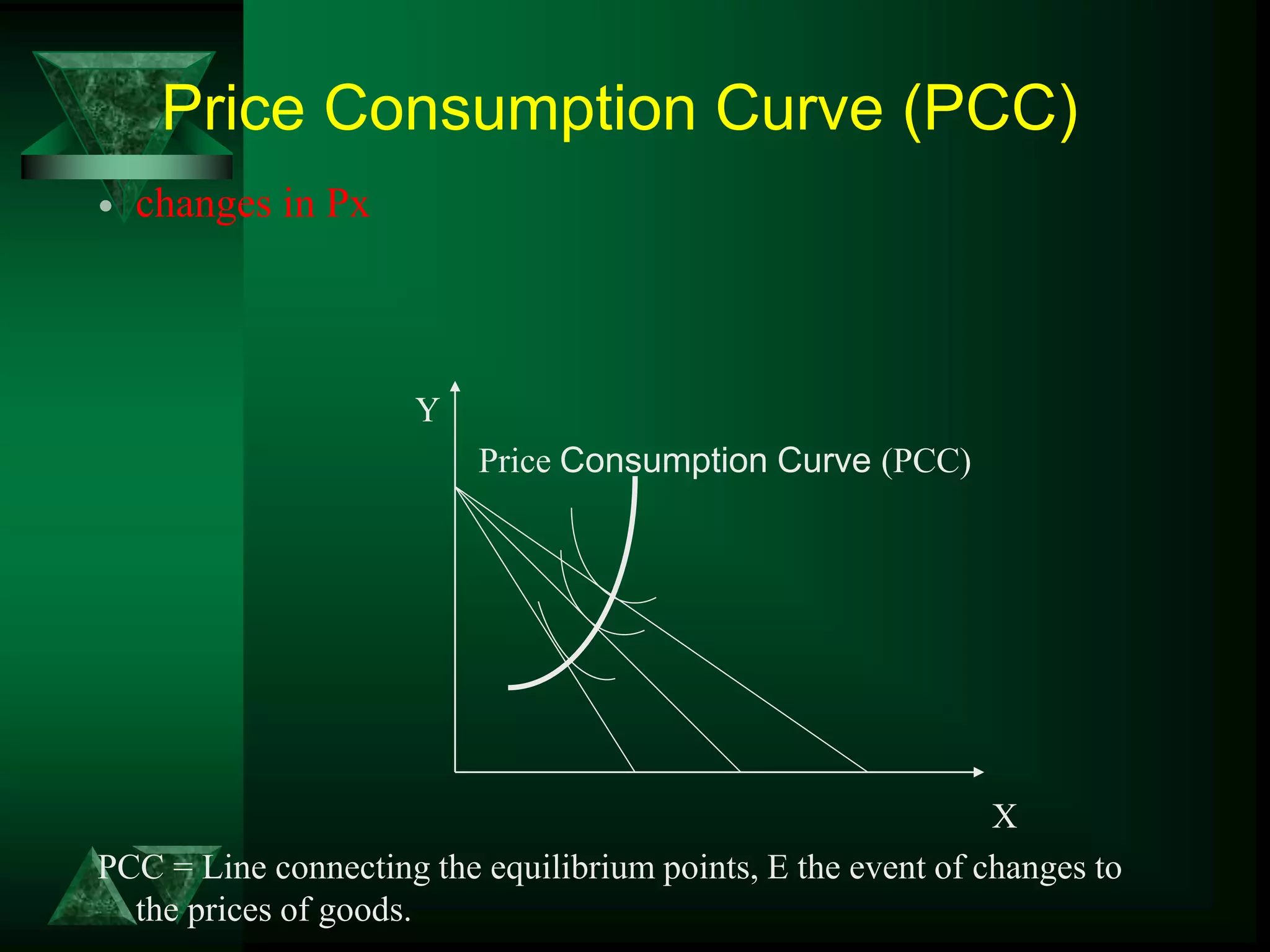
Price Consumption Curve (PCC)
 changes in Px
Y
Price Consumption Curve (PCC)
X
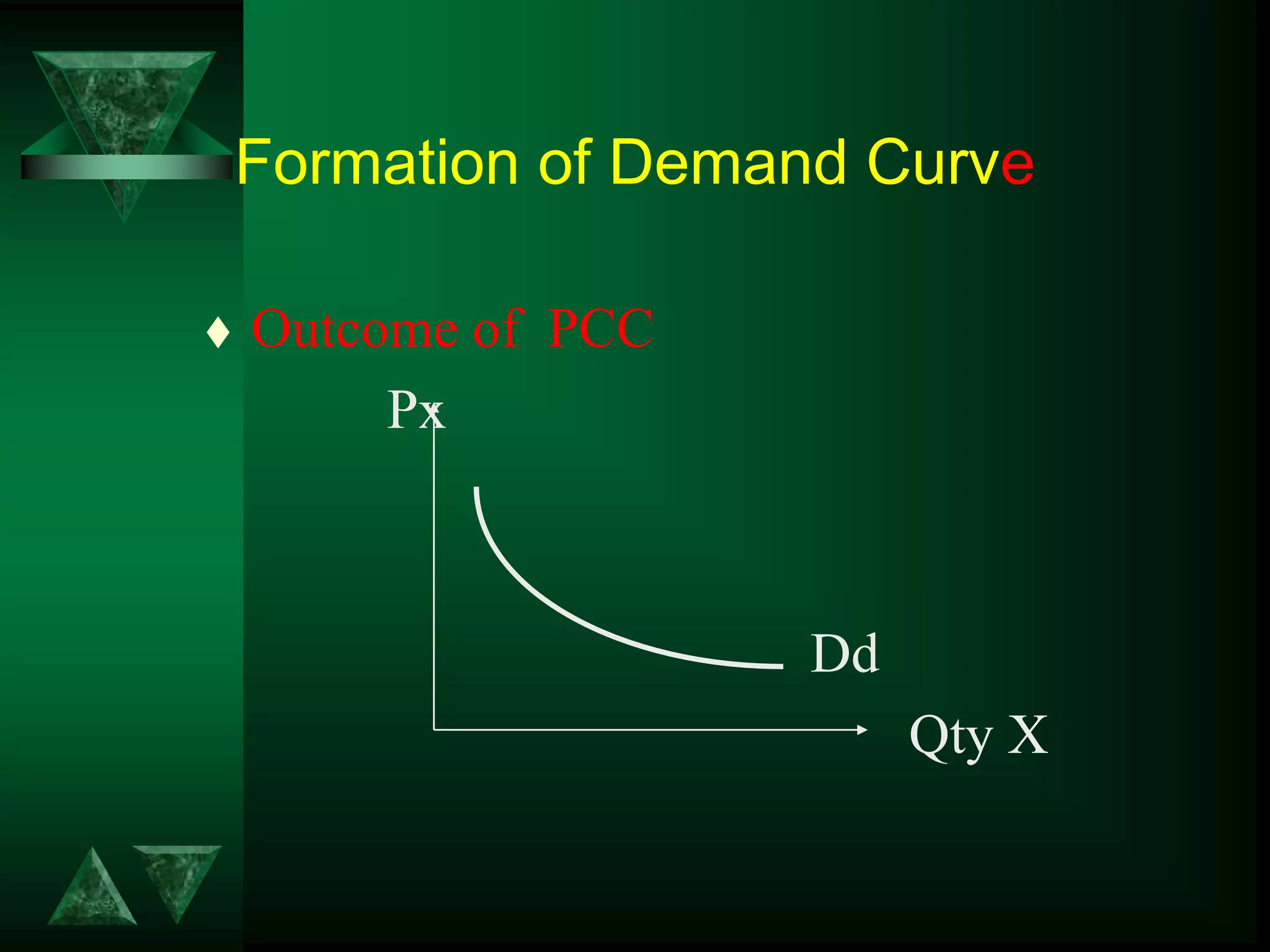
PCC = Line connecting the equilibrium points, E the event of changes to
the prices of goods.
Formation of Demand Curve
 Outcome of PCC
Px
Dd
Qty X
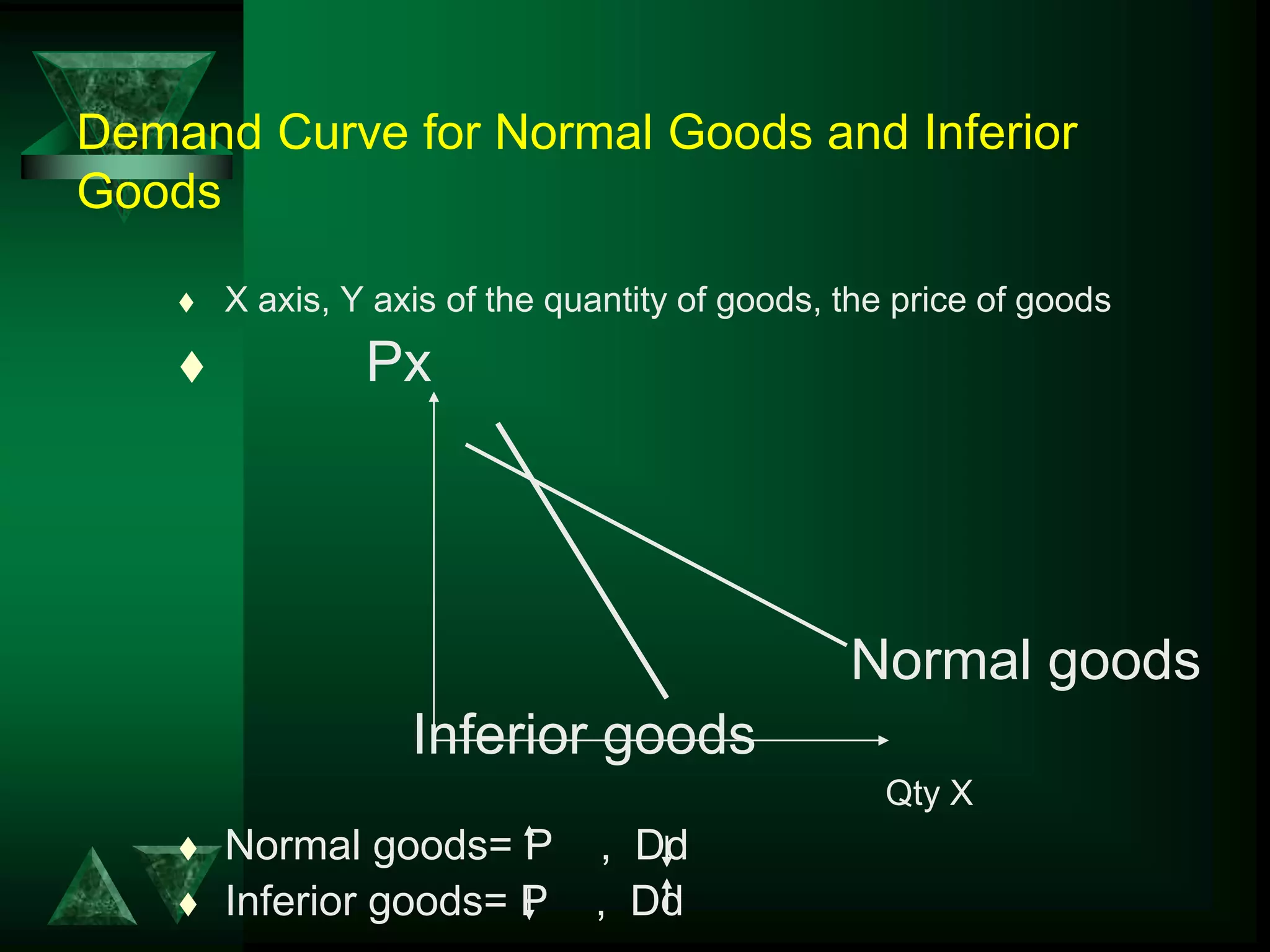
Demand Curve for Normal Goods and Inferior
Goods
 X axis, Y axis of the quantity of goods, the price of goods
 Px
Normal goods
Inferior goods
Qty X
 Normal goods= P , Dd
 Inferior goods= P , Dd
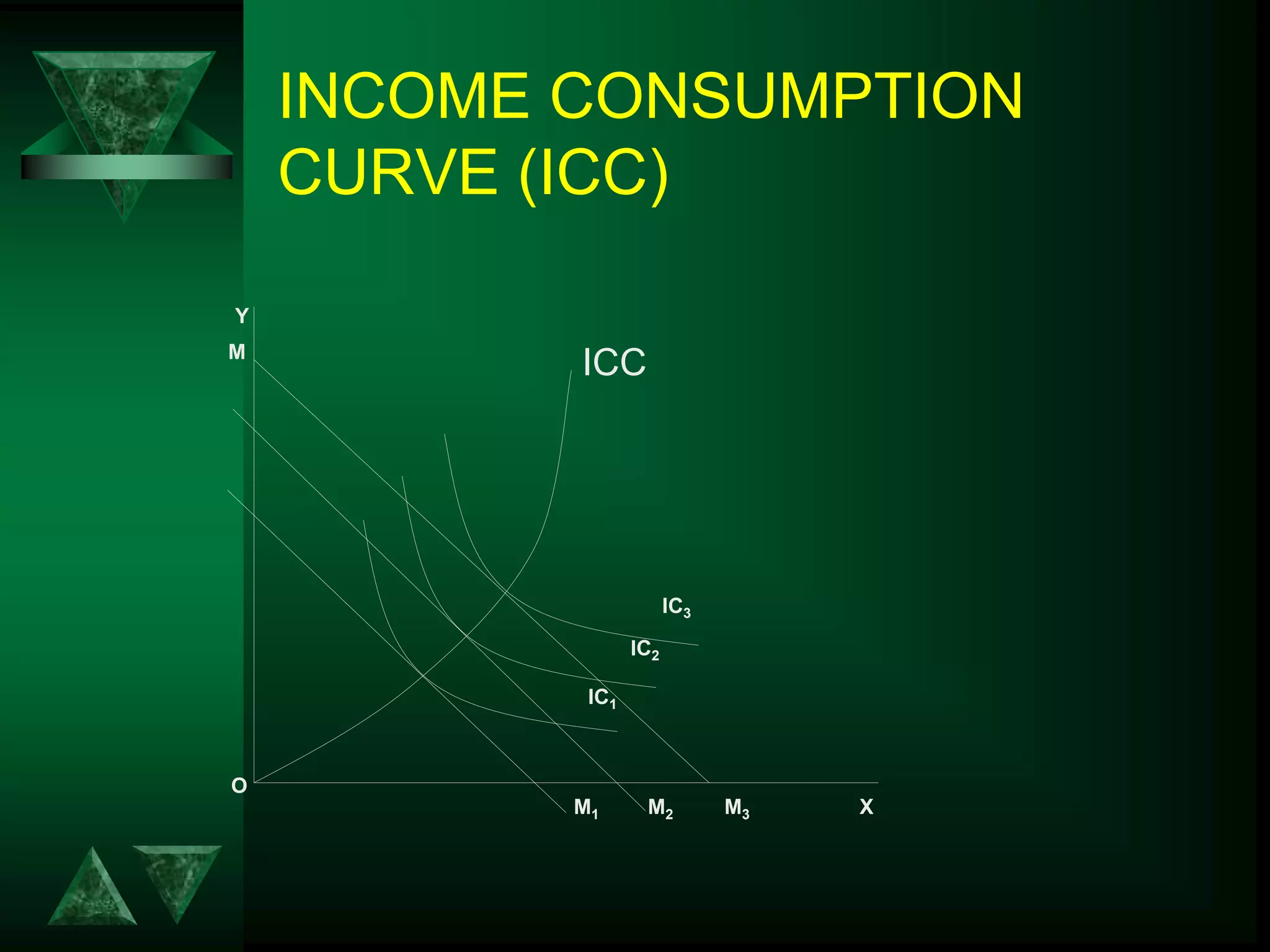
INCOME CONSUMPTION CURVE
(ICC)
 If a fixed price and income increases, the
budget line shifts to the right,
thus shifting the equilibrium point higher.
 Equilibrium point some
income items associated with the line -
can be income consumption curve (ICC).
 ICC shows the points for the combination
of goods that can be purchased when
income change and fixed in price.
INCOME CONSUMPTION
CURVE (ICC)
Y
O
X
IC3
IC2
M3
M
IC1
M2
M1
ICC
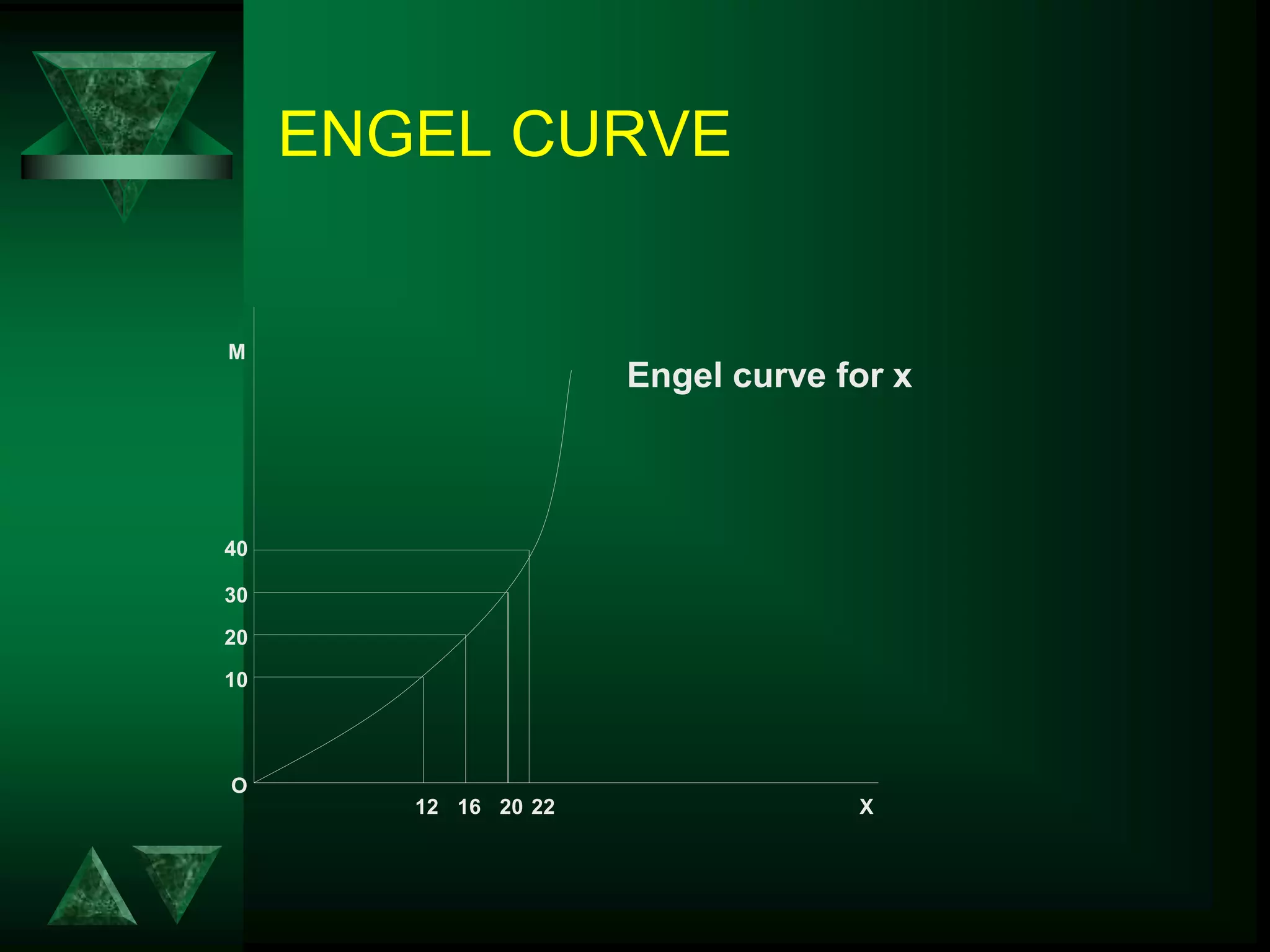
ENGEL CURVE
O
X
20
M
16
12 22
40
Engel curve for x
20
10
30
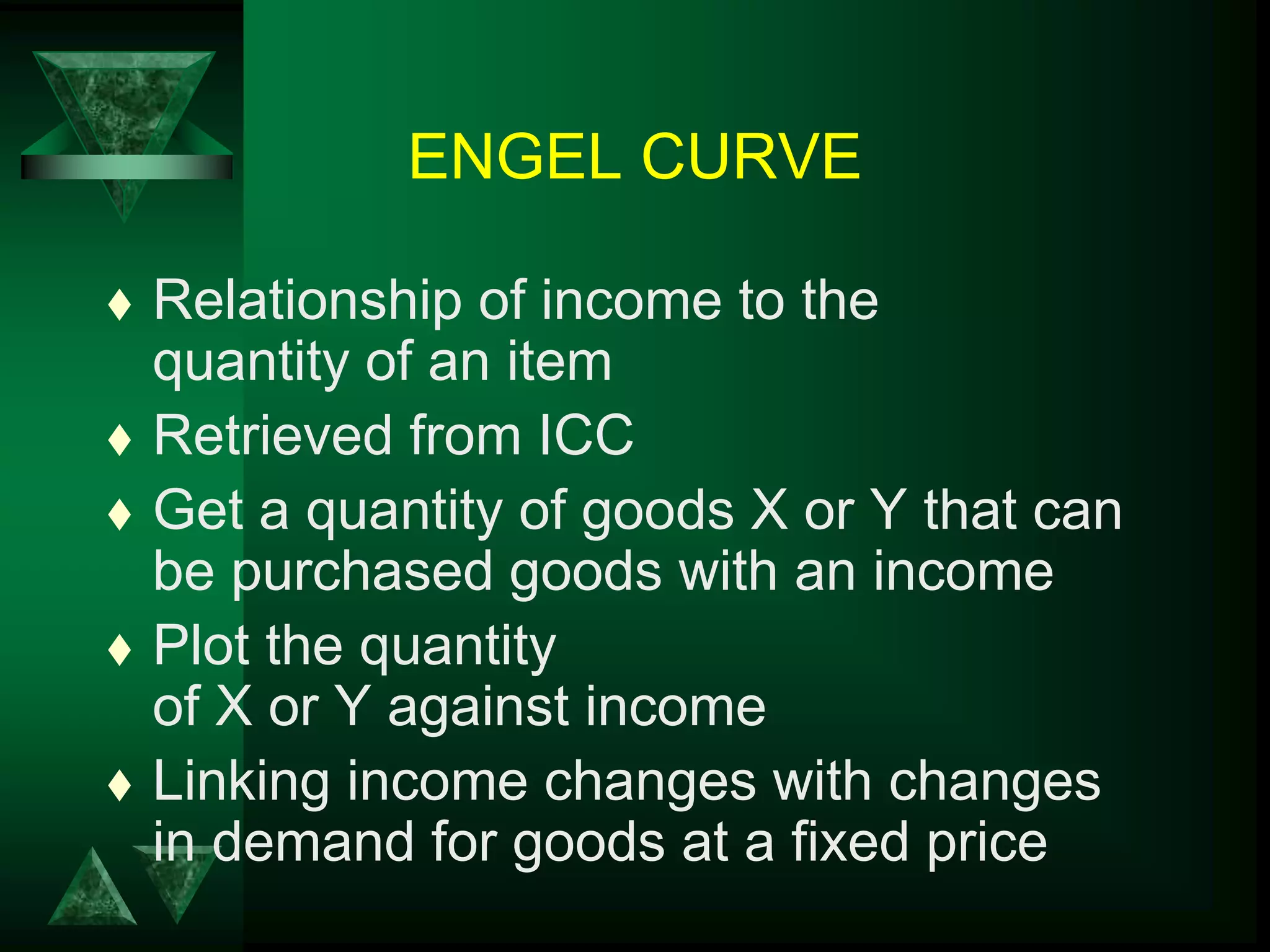
ENGEL CURVE
 Relationship of income to the
quantity of an item
 Retrieved from ICC
 Get a quantity of goods X or Y that can
be purchased goods with an income
 Plot the quantity
of X or Y against income
 Linking income changes with changes
in demand for goods at a fixed price
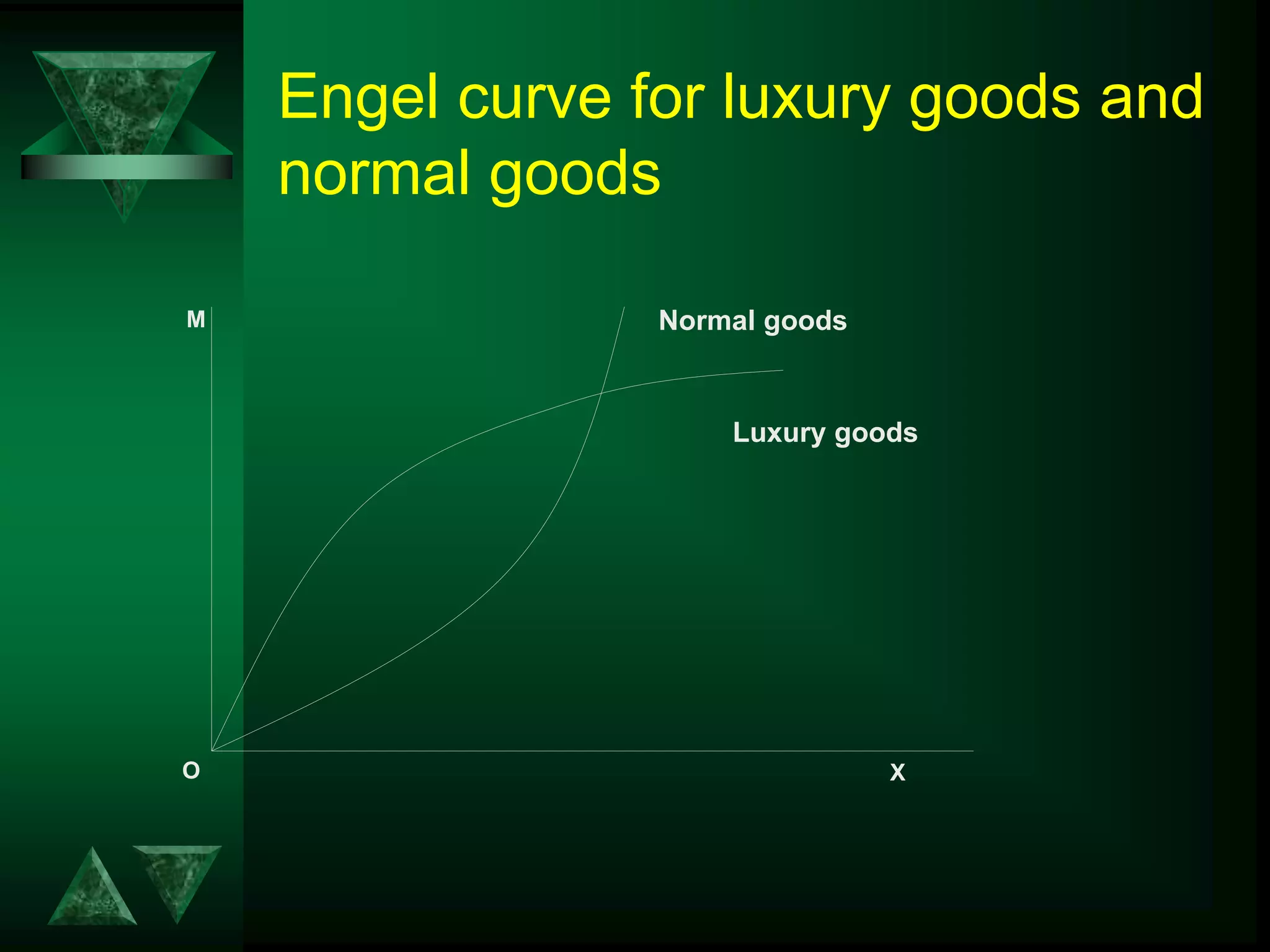
Engel curve for luxury goods and
normal goods
M
X
Normal goods
Luxury goods
O
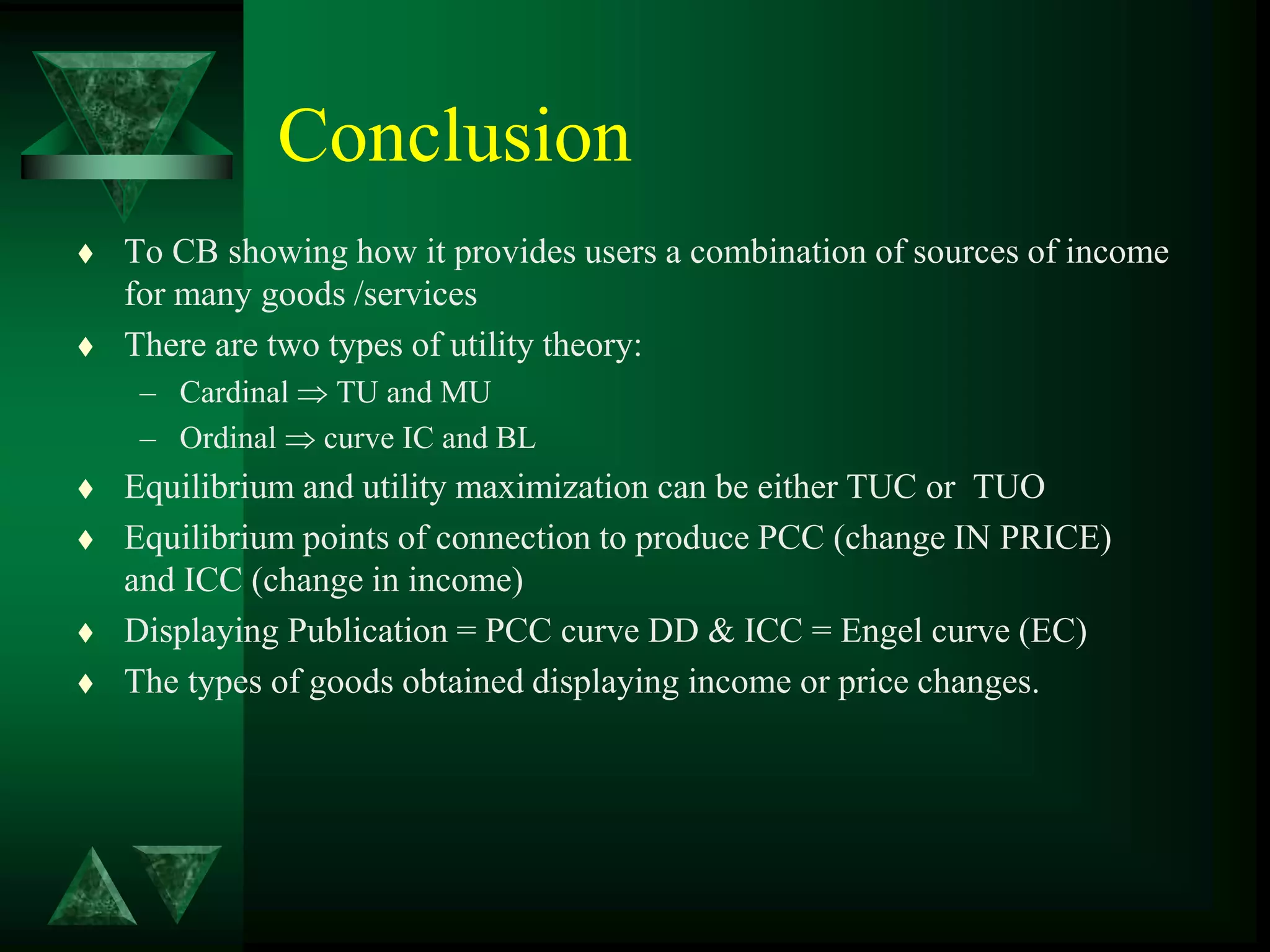
Conclusion
 To CB showing how it provides users a combination of sources of income
for many goods /services
 There are two types of utility theory:
– Cardinal  TU and MU
– Ordinal  curve IC and BL
 Equilibrium and utility maximization can be either TUC or TUO
 Equilibrium points of connection to produce PCC (change IN PRICE)
and ICC (change in income)
 Displaying Publication = PCC curve DD & ICC = Engel curve (EC)
 The types of goods obtained displaying income or price changes.
Thank You

Chapter_1_theory_of_consumer_behavior.ppt

  • 1.
    The Theory of ConsumerBehavior STANSLOUS K CHULU DEPT OF ECONOMICS & BUSINESS STUDIES FACULTY OF HUMANITIES
  • 2.
    The Theory ofConsumer Behavior The principle assumption upon which the theory of consumer behavior and demand is built is: a consumer attempts to allocate his/her limited money income among available goods and services so as to maximize his/her utility (satisfaction).
  • 3.
    Theory of ConsumerBehavior  Useful for understanding the demand side of the market.  Utility - amount of satisfaction derived from the consumption of a commodity ….measurement units  utils
  • 4.
    Theories of ConsumerChoice  Utility Concepts: – The Cardinal Utility Theory (CUT) • Utility is measurable in a cardinal sense • cardinal utility - assumes that we can assign values for utility, (Jevons, Walras, and Marshall). E.g., derive 100 utils from eating a slice of pizza – The Ordinal Utility Theory (OUT) • Utility is measurable in an ordinal sense • ordinal utility approach - does not assign values, instead works with a ranking of preferences. (Pareto, Hicks, Slutsky)
  • 5.
    The Cardinal Approach Nineteenthcentury economists, such as Jevons, Menger and Walras, assumed that utility was measurable in a cardinal sense, which means that the difference between two measurement is itself numerically significant. UX = f (X), UY = f (Y), ….. Utility is maximized when: MUX / MUY = PX / PY
  • 6.
    The Cardinal Approach Total utility (TU) - the overall level of satisfaction derived from consuming a good or service  Marginal utility (MU) additional satisfaction that an individual derives from consuming an additional unit of a good or service. Formula : MU = Change in total utility Change in quantity = ∆ TU ∆ Q
  • 7.
    The Cardinal Approach Law of Diminishing Marginal Utility (Return) = As more and more of a good are consumed, the process of consumption will (at some point) yield smaller and smaller additions to utility  When the total utility maximum, marginal utility = 0  When the total utility begins to decrease, the marginal utility = negative (-ve)
  • 8.
  • 9.
    The Cardinal Approach TU, in general, increases with Q  At some point, TU can start falling with Q (see Q = 5)  If TU is increasing, MU > 0  From Q = 1 onwards, MU is declining  principle of diminishing marginal utility  As more and more of a good are consumed, the process of consumption will (at some point) yield smaller and smaller additions to utility
  • 10.
    Consumer Equilibrium  Sofar, we have assumed that any amount of goods and services are always available for consumption  In reality, consumers face constraints (income and prices): – Limited consumers income or budget – Goods can be obtained at a price
  • 11.
    Some simplifying assumptions Consumer’s objective: to maximize his/her utility subject to income constraint  2 goods (X, Y)  Prices Px, Py are fixed  Consumer’s income (I) is given
  • 12.
    Consumer Equilibrium  Marginalutility per price  additional utility derived from spending the next price on the good  MU per RM = MU P
  • 13.
    Consumer Equilibrium  Optimizingcondition:  If  spend more on good X and less of Y X Y X Y MU MU P P  X Y X Y MU MU P P 
  • 14.
    Numerical Illustration Qx TUXMUX MUx Px QY TUY MUY MUy Py 1 30 0 0 1 50 0 0 2 39 9 4.5 2 105 55 5.5 3 45 6 3 3 148 43 4.3 4 50 5 2.5 4 178 30 3 5 54 4 2 5 198 20 2 6 56 2 1 6 213 15 1.5
  • 15.
    Simple Illustration  Suppose:X = fish Y = Meat  Assume: PX = 2 PY = 10
  • 16.
    Cont.  2 potentialoptimum positions  Combination A:  X = 3 and Y = 4 – TU = TUX + TUY = 45 + 178 = 223  Combination B:  X = 5 and Y = 5 – TU = TUX + TUY = 54 + 198 = 252
  • 17.
    Cont.  Presence of2 potential equilibrium positions suggests that we need to consider income. To do so let us examine how much each consumer spends for each combination.  Expenditure per combination – Total expenditure = PX X + PY Y – Combination A: 3(2) + 4(10) = 46 – Combination B: 5(2) + 5(10) = 60
  • 18.
    Cont.  Scenarios: – Ifconsumer’s income = 46, then the optimum is given by combination A. .…Combination B is not affordable – If the consumer’s income = 60, then the optimum is given by Combination B….Combination A is affordable but it yields a lower level of utility
  • 19.
    The Ordinal Approach Economistsfollowing the lead of Hicks, Slutsky and Pareto believe that utility is measurable in an ordinal sense--the utility derived from consuming a good, such as X, is a function of the quantities of X and Y consumed by a consumer. U = f ( X, Y )
  • 20.
    Cont.  Ordinal UtilityTheory (TUO) – Can be measured in qualitative, not quantitative, but only lists the main options (indifference curves & budget line).  Rational human beings will choose to maximize the utility by selecting the highest utility  Difference consumers, difference utilities.
  • 21.
    INDIFFERENCE CURVE (IC) Curve where the points represent a combination of items which the consumer at indifference situation (satisfaction).  Indifference Curve = a line showing all possible combinations of two goods that provide the same level of utility (satisfaction).  Axes: both axes refer to the quantity of goods  For the combination that produces a higher level of satisfaction, the
  • 22.
  • 23.
    PROPERTIES OF INDIFFERENCECURVE  Downward sloping from left to right: This shows an increase in quantity of certain good.  Convex to the origin: the marginal rate of substitution (MRS) decreased – MRS = quantity of goods Y willing to substitute to obtain one unit of goods X & this substitution is to maintain its position at the same level of satisfaction  Do not cross (intersect): consumer preferences transitive – Eg : Quantities X and Y for the combination of A> a combination of B;  utility A> B * When cross = C, so the utility A = C & B = C;  utility A = B = C. This is not transitive as above *  Different ICs show different level of satisfaction. Far from the origin, the higher the satisfaction.
  • 24.
    IC curves cannot intersect Good Y C A IC1 B IC2 Good X
  • 25.
    Budget line (BL) Line showing all combinations of items that can be purchased for a particular level of income (M) ; M =PxQx + PyQy  The slope depends on the prices of goods X and Y, the slope = Px/Py  Slope -ve: to use more goods X, Y should reduce & vice versa  In the X-axis, when the quantity Y = 0, all M used to purchase X; M = PxQx Qx =M/Px  At the Y axis, when the quantity X = 0, all M used to purchase Y; M = PyQy Qy =M/Py
  • 26.
    FACTORS SHIFT THEBUDGET LINE  Changes in prices of goods X Y Px Px X
  • 27.
    EFFECTS OF PRICE CHANGESON THE BUDGET LINE  When price of good X increases, the quantity of good X is reduced (by maintaining the quantity of Y) & vice versa.  Points on the X axis shifted to the left (a small quantity of X)  When the price of Y increases, the quantity Y is reduced (by maintaining the quantity of X) & vice versa  Point on Y axis move to the bottom (small quantity in Y)
  • 28.
    FACTORS SHIFT THEBUDGET LINE  Changes in the price of goods Y Y Py Py X
  • 29.
    FACTORS SHIFT THEBUDGET LINE  Changes in income Y I I  X
  • 30.
    EFFECTS OF INCOME CHANGESON THE BUDGET LINE  When M increases, QX and QY can be bought even more, a point on the X axis shifted to the right & a point on the Y axis move on; & vice versa when M decreases.
  • 31.
    CONSUMER EQUILIBRIUM  Withincome (M) some combination of goods that consumers choose the highest satisfaction  Satisfied the same curves and budget lines are connected  The point where the curve IC and BL tangent  Slope IC = BL  Consumer choice influenced by income
  • 32.
    MAXIMIZE CONSUMER SATISFACT ION F E B AD C Y O X IC1 IC2 IC3 IC4 M1 M Budget line (BL) Indifference Curves (IC)
  • 33.
    EXAMPLE a) A consumerspends all her income on food and clothing. At the current prices of Pf = K10 and Pc = K5, she maximized her utility by purchasing 20 units of food and 50 units of clothing.  i.What is the consumer’s income? [2 marks]  ii.What is the consumer’s marginal rate of substitution of food for clothing at the equilibrium position? [2 marks]
  • 34.
    Price Consumption Curve(PCC)  changes in Px Y Price Consumption Curve (PCC) X PCC = Line connecting the equilibrium points, E the event of changes to the prices of goods.
  • 35.
    Formation of DemandCurve  Outcome of PCC Px Dd Qty X
  • 36.
    Demand Curve forNormal Goods and Inferior Goods  X axis, Y axis of the quantity of goods, the price of goods  Px Normal goods Inferior goods Qty X  Normal goods= P , Dd  Inferior goods= P , Dd
  • 37.
    INCOME CONSUMPTION CURVE (ICC) If a fixed price and income increases, the budget line shifts to the right, thus shifting the equilibrium point higher.  Equilibrium point some income items associated with the line - can be income consumption curve (ICC).  ICC shows the points for the combination of goods that can be purchased when income change and fixed in price.
  • 38.
  • 39.
  • 40.
    ENGEL CURVE  Relationshipof income to the quantity of an item  Retrieved from ICC  Get a quantity of goods X or Y that can be purchased goods with an income  Plot the quantity of X or Y against income  Linking income changes with changes in demand for goods at a fixed price
  • 41.
    Engel curve forluxury goods and normal goods M X Normal goods Luxury goods O
  • 42.
    Conclusion  To CBshowing how it provides users a combination of sources of income for many goods /services  There are two types of utility theory: – Cardinal  TU and MU – Ordinal  curve IC and BL  Equilibrium and utility maximization can be either TUC or TUO  Equilibrium points of connection to produce PCC (change IN PRICE) and ICC (change in income)  Displaying Publication = PCC curve DD & ICC = Engel curve (EC)  The types of goods obtained displaying income or price changes.
  • 43.