Welcome to
New Era University
Virtual Class
Technical Education Skills and
Development Center
(TESDC)
I am Teacher “Khai Gumatay”
New Era University
Vision
A world-class Institution of learnings with a unique Christian culture
of Excellence, discipline, and service to humanity
Mission
Provide quality education anchored on Christian values with the
prime purpose honor and glory to God
Student Modules
Congratulations on joining this course. This Student Modules is one part of a ‘toolbox’ which
is a resource provided to the students, trainers or teachers to help you become competent in
various areas of your work.
The ‘toolbox’ consists of three elements:
A Student Modules for you to read and study at home or in virtual class
A Teacher’s Guide with Power Point slides to help your Student explain the content of the
training material and provide class activities to help with practice
An Assessment Manual which provides your Instructor with oral and written questions and
other assessment tasks to establish whether or not you have achieved competency.
CHAPTER 1.
HOUSEKEEPING
FUNDAMENTALS
Module 1: Provide Housekeeping Services to
Guest
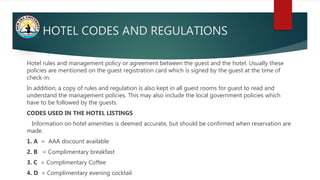
HOTEL CODES AND REGULATIONS
Hotel rules and management policy or agreement between the guest and the hotel. Usually these
policies are mentioned on the guest registration card which is signed by the guest at the time of
check-in.
In addition, a copy of rules and regulation is also kept in all guest rooms for guest to read and
understand the management policies. This may also include the local government policies which
have to be followed by the guests.
CODES USED IN THE HOTEL LISTINGS
Information on hotel amenities is deemed accurate, but should be confirmed when reservation are
made.
1. A = AAA discount available
2. B = Complimentary breakfast
3. C = Complimentary Coffee
4. D = Complimentary evening cocktail
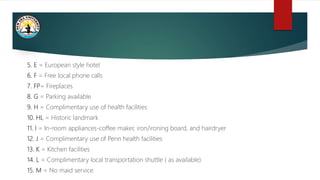
5. E = European style hotel
6. F = Free local phone calls
7. FP= Fireplaces
8. G = Parking available
9. H = Complimentary use of health facilities
10. HL = Historic landmark
11. I = In-room appliances-coffee maker, iron/ironing board, and hairdryer
12. J = Complimentary use of Penn health facilities
13. K = Kitchen facilities
14. L = Complimentary local transportation shuttle ( as available)
15. M = No maid service
16. N = Complimentary daily newspaper
17. NHRP = National Register of Historic Places
18. O = Only accommodations are shared baths
19. P = Indoor Pool
20. Q = Evening Snacks
21. R = Reserved rooms for NWAV 24
22. S = Some accommodations are for shared baths
23. T = Complimentary after tea
24. U = Complimentary center city shuttle service
25. V = Valet parking available
26. W = Complimentary wine and cheese
27. WD = Washer/dryer available
28. X = Free
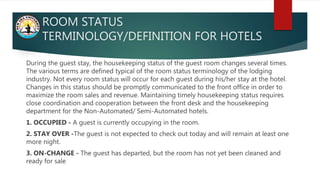
ROOM STATUS
TERMINOLOGY/DEFINITION FOR HOTELS
During the guest stay, the housekeeping status of the guest room changes several times.
The various terms are defined typical of the room status terminology of the lodging
industry. Not every room status will occur for each guest during his/her stay at the hotel.
Changes in this status should be promptly communicated to the front office in order to
maximize the room sales and revenue. Maintaining timely housekeeping status requires
close coordination and cooperation between the front desk and the housekeeping
department for the Non-Automated/ Semi-Automated hotels.
1. OCCUPIED - A guest is currently occupying in the room.
2. STAY OVER -The guest is not expected to check out today and will remain at least one
more night.
3. ON-CHANGE - The guest has departed, but the room has not yet been cleaned and
ready for sale
4. DO NOT DISTURB – the guest has requested not to be disturb.
5. CLEANING IN PROGRESS – Room attendant is currently cleaning the room.
6. SLEEP-OUT – A guest is registered to the room, but the bed has not been used.
7. SKIPPEER – The guest has left the hotel without making arrangements to settle his or her
account.
8. VACANT DIRTY – Unoccupied room needs to be cleaned.
9. OUT OF ORDER (OOO): Rooms kept under out of order are not salable and these rooms are
deducted from the hotels inventory. A room may be out-of-order a variety of reasons.
10. OUT OF SERVICE (OOS): Room kept out under of service are not deducted from the
hotel inventory. This is a temporary blocking and reasons may be bulb fuse, TV remote
working, kettle not working etc.
11. LOCK OUT – The room has been locked so that the guest cannot re-enter until he or
she is cleared by a hotel official.
12. DNCO ( did not check out ) - The guest made arrangements to settle his or her bills (
and thus not a skipper ), but has left without informing the front desk.
13. DUE OUT – The room is expected to become vacant after the following guest checks
out.
14. CHECK-OUT – The guest has settled his or her account returned the room keys, and
left the hotel.
15. LATE CHECK-OUT – The guest has requested and is being allowed to check out later
than the normal / standard departure time of the hotel.
SELF-CHECK 1.1
Make one slide for your answer!!!
Define the following Terminology:
1. Cleaning in Progress
2. Do Not Disturb
3. Sleep-out
4. Vacant and Ready
5. Skipper
NAME: DATE:
TRAINER: YEAR
INTERPERSONAL SKILLS:
COMMUNICATION AND LISTENING
SKILLS
INTRODUCTION: In order to establish yourself as a better housekeeping employee, you
must be fluid in your capabilities interpersonal to communicate, not just to fellow
employees, but more importantly to your guests. The following content will add you to
bridge expound your communication skills to achieve the said goal.
LIST OF INTERPERSONAL SKILLS: 10 Must-Have Attributes
LIST OF INTERPERSONAL SKILLS:
The difference between good employees and great employees is not always
something you can put finger on. If they’re a pleasure to work with, why? If they
exceed every expectation, what are their secrets?
1. Verbal Communication
Yes, as opposed to non-verbal communication, which well address next. Within
verbal communication there are number of other skills that we’ll talk about later, too
such listening and questioning, but for now we are primarily concerned with effective
speaking.
2. Non-Verbal Communication
Is largerly underrated and underestimated. Those who can communicate non-
verbally can almost subliminally reinforce what they are saying verbally. They can also
exude confidence, or any other emotion they feel, not to mention respond tactfully to a
conversation without saying a single word. While controlling body language is no easy
task, with the five-star course you can learn how to interpret the body language of
while learning how to non-verbal communication skills.
3. Listening
This is the only appropriate way to follow two topics on communication. If non-
verbal communication. If non-verbal communication is underrated, the listening isn’t
even the charts. And yet without listening effectively, how can you interpret and
appropriately?
4. Questioning
Questioning is a great way to initiate a conversation. It demonstrate interest and
can instantaneously draw someone into your desire to listen. Smart questions show
you know how to approach problems and how to get the answer you need.
questioning can be learned more easily than other skills on this list.
5. Manners
Good manners tend to make many other interpersonal skills come naturally. With
business becoming increasingly more global, even foe small businesses, manners are
important than ever. A basic understanding of etiquette translates to other cultures and
their expectation.
6. Problem Solving
A rare would be one without problems. What makes this a skill is not necessarily
how quickly you can solve a problem, but how you go about doing it. No plan is a
guarantee so there is always an element of risk. Some people can weigh risk better
than others.
7. Social Awareness
is crucial in identifying opportunities, as well. People with often unconsciously
test someone’s ability to respond to a social situation; for example, A person who is
struggling professionally will be desperate for help but naturally wary on revealing the
fact the facts that he needs it. Being able to identify something like this demonstrates
that you are operating at a higher level of social awareness.
8. Self-Management
Self-management allows us to control our emotions when they are not aligned
with what would be considered appropriate behavior for a given situation. This means
controlling anger, hiding frustration, exuding calmness, etc. Undoubtedly there are
times to show your true colors, but remaining composed is almost always the desired
course of action.
9. Responsibility And Accountability.
Are two reliable indicators of maturity. Saying you are going to do something
then actually doing it is a sign of responsibility, This builds trust between yourself and
those who rely on you and it encourages other to seek your counsel and assistance.
10. Assertiveness
After all this listening and respecting others, there is no denying the
of being assertive. However, this is also where you are most likely to offend or come
off as too aggressive. Being assertive is the only way to get your ideas into a
competitive table.
It also means standing up for what you believe in, defending your ideas with
confidence, instructing others on what needs to be done.
SELF-CHECK 1.2
Make one slide for your Answer!
Define the following terminologies based on the Information Sheet
1. Manners
2. Self-Management
3. Social Awareness
4. Assertiveness
NOTE: See you in next class!!!
NAME: DATE:
TRAINER: YEAR:

Chapter1Housekeeping.pptx

  • 1.
    Welcome to New EraUniversity Virtual Class Technical Education Skills and Development Center (TESDC) I am Teacher “Khai Gumatay”
  • 2.
    New Era University Vision Aworld-class Institution of learnings with a unique Christian culture of Excellence, discipline, and service to humanity Mission Provide quality education anchored on Christian values with the prime purpose honor and glory to God
  • 3.
    Student Modules Congratulations onjoining this course. This Student Modules is one part of a ‘toolbox’ which is a resource provided to the students, trainers or teachers to help you become competent in various areas of your work. The ‘toolbox’ consists of three elements: A Student Modules for you to read and study at home or in virtual class A Teacher’s Guide with Power Point slides to help your Student explain the content of the training material and provide class activities to help with practice An Assessment Manual which provides your Instructor with oral and written questions and other assessment tasks to establish whether or not you have achieved competency.
  • 4.
    CHAPTER 1. HOUSEKEEPING FUNDAMENTALS Module 1:Provide Housekeeping Services to Guest
  • 5.
    HOTEL CODES ANDREGULATIONS Hotel rules and management policy or agreement between the guest and the hotel. Usually these policies are mentioned on the guest registration card which is signed by the guest at the time of check-in. In addition, a copy of rules and regulation is also kept in all guest rooms for guest to read and understand the management policies. This may also include the local government policies which have to be followed by the guests. CODES USED IN THE HOTEL LISTINGS Information on hotel amenities is deemed accurate, but should be confirmed when reservation are made. 1. A = AAA discount available 2. B = Complimentary breakfast 3. C = Complimentary Coffee 4. D = Complimentary evening cocktail
  • 6.
    5. E =European style hotel 6. F = Free local phone calls 7. FP= Fireplaces 8. G = Parking available 9. H = Complimentary use of health facilities 10. HL = Historic landmark 11. I = In-room appliances-coffee maker, iron/ironing board, and hairdryer 12. J = Complimentary use of Penn health facilities 13. K = Kitchen facilities 14. L = Complimentary local transportation shuttle ( as available) 15. M = No maid service
  • 7.
    16. N =Complimentary daily newspaper 17. NHRP = National Register of Historic Places 18. O = Only accommodations are shared baths 19. P = Indoor Pool 20. Q = Evening Snacks 21. R = Reserved rooms for NWAV 24 22. S = Some accommodations are for shared baths 23. T = Complimentary after tea 24. U = Complimentary center city shuttle service 25. V = Valet parking available 26. W = Complimentary wine and cheese 27. WD = Washer/dryer available 28. X = Free
  • 8.
    ROOM STATUS TERMINOLOGY/DEFINITION FORHOTELS During the guest stay, the housekeeping status of the guest room changes several times. The various terms are defined typical of the room status terminology of the lodging industry. Not every room status will occur for each guest during his/her stay at the hotel. Changes in this status should be promptly communicated to the front office in order to maximize the room sales and revenue. Maintaining timely housekeeping status requires close coordination and cooperation between the front desk and the housekeeping department for the Non-Automated/ Semi-Automated hotels. 1. OCCUPIED - A guest is currently occupying in the room. 2. STAY OVER -The guest is not expected to check out today and will remain at least one more night. 3. ON-CHANGE - The guest has departed, but the room has not yet been cleaned and ready for sale
  • 9.
    4. DO NOTDISTURB – the guest has requested not to be disturb. 5. CLEANING IN PROGRESS – Room attendant is currently cleaning the room. 6. SLEEP-OUT – A guest is registered to the room, but the bed has not been used. 7. SKIPPEER – The guest has left the hotel without making arrangements to settle his or her account. 8. VACANT DIRTY – Unoccupied room needs to be cleaned. 9. OUT OF ORDER (OOO): Rooms kept under out of order are not salable and these rooms are deducted from the hotels inventory. A room may be out-of-order a variety of reasons.
  • 10.
    10. OUT OFSERVICE (OOS): Room kept out under of service are not deducted from the hotel inventory. This is a temporary blocking and reasons may be bulb fuse, TV remote working, kettle not working etc. 11. LOCK OUT – The room has been locked so that the guest cannot re-enter until he or she is cleared by a hotel official. 12. DNCO ( did not check out ) - The guest made arrangements to settle his or her bills ( and thus not a skipper ), but has left without informing the front desk. 13. DUE OUT – The room is expected to become vacant after the following guest checks out. 14. CHECK-OUT – The guest has settled his or her account returned the room keys, and left the hotel. 15. LATE CHECK-OUT – The guest has requested and is being allowed to check out later than the normal / standard departure time of the hotel.
  • 11.
    SELF-CHECK 1.1 Make oneslide for your answer!!! Define the following Terminology: 1. Cleaning in Progress 2. Do Not Disturb 3. Sleep-out 4. Vacant and Ready 5. Skipper NAME: DATE: TRAINER: YEAR
  • 12.
    INTERPERSONAL SKILLS: COMMUNICATION ANDLISTENING SKILLS INTRODUCTION: In order to establish yourself as a better housekeeping employee, you must be fluid in your capabilities interpersonal to communicate, not just to fellow employees, but more importantly to your guests. The following content will add you to bridge expound your communication skills to achieve the said goal. LIST OF INTERPERSONAL SKILLS: 10 Must-Have Attributes
  • 13.
    LIST OF INTERPERSONALSKILLS: The difference between good employees and great employees is not always something you can put finger on. If they’re a pleasure to work with, why? If they exceed every expectation, what are their secrets? 1. Verbal Communication Yes, as opposed to non-verbal communication, which well address next. Within verbal communication there are number of other skills that we’ll talk about later, too such listening and questioning, but for now we are primarily concerned with effective speaking.
  • 14.
    2. Non-Verbal Communication Islargerly underrated and underestimated. Those who can communicate non- verbally can almost subliminally reinforce what they are saying verbally. They can also exude confidence, or any other emotion they feel, not to mention respond tactfully to a conversation without saying a single word. While controlling body language is no easy task, with the five-star course you can learn how to interpret the body language of while learning how to non-verbal communication skills. 3. Listening This is the only appropriate way to follow two topics on communication. If non- verbal communication. If non-verbal communication is underrated, the listening isn’t even the charts. And yet without listening effectively, how can you interpret and appropriately?
  • 15.
    4. Questioning Questioning isa great way to initiate a conversation. It demonstrate interest and can instantaneously draw someone into your desire to listen. Smart questions show you know how to approach problems and how to get the answer you need. questioning can be learned more easily than other skills on this list. 5. Manners Good manners tend to make many other interpersonal skills come naturally. With business becoming increasingly more global, even foe small businesses, manners are important than ever. A basic understanding of etiquette translates to other cultures and their expectation.
  • 16.
    6. Problem Solving Arare would be one without problems. What makes this a skill is not necessarily how quickly you can solve a problem, but how you go about doing it. No plan is a guarantee so there is always an element of risk. Some people can weigh risk better than others. 7. Social Awareness is crucial in identifying opportunities, as well. People with often unconsciously test someone’s ability to respond to a social situation; for example, A person who is struggling professionally will be desperate for help but naturally wary on revealing the fact the facts that he needs it. Being able to identify something like this demonstrates that you are operating at a higher level of social awareness.
  • 17.
    8. Self-Management Self-management allowsus to control our emotions when they are not aligned with what would be considered appropriate behavior for a given situation. This means controlling anger, hiding frustration, exuding calmness, etc. Undoubtedly there are times to show your true colors, but remaining composed is almost always the desired course of action. 9. Responsibility And Accountability. Are two reliable indicators of maturity. Saying you are going to do something then actually doing it is a sign of responsibility, This builds trust between yourself and those who rely on you and it encourages other to seek your counsel and assistance.
  • 18.
    10. Assertiveness After allthis listening and respecting others, there is no denying the of being assertive. However, this is also where you are most likely to offend or come off as too aggressive. Being assertive is the only way to get your ideas into a competitive table. It also means standing up for what you believe in, defending your ideas with confidence, instructing others on what needs to be done.
  • 19.
    SELF-CHECK 1.2 Make oneslide for your Answer! Define the following terminologies based on the Information Sheet 1. Manners 2. Self-Management 3. Social Awareness 4. Assertiveness NOTE: See you in next class!!! NAME: DATE: TRAINER: YEAR: