Unit Two: Auditingprofession and GAAS
2.1: Auditing profession
2.2: Generally Accepted Auditing Standards
2.2: Types of Audit reports
2.3: Parts of audit reports
2.4: Conditions for issuing different audit reports
2.5: Materiality and Auditors decisions
2.
Emergence of needfor Audit Reports
The prevalence of great business opportunities created
by growth in technology, improved communication &
transportation and expanding global markets proved owner
manager source of capital to be no more capable of
supporting the speed of entry to new markets internationally
nor the wealth-creating potential of the enterprises.
This lead to the need to pool resources through
savings of the community as a whole and hence
formation of large companies.
The result has been the growth of sophisticated securities
markets and credit-granting institutions serving the
financial needs of these large national, and increasingly
international, corporations.
3.
The flowof investor funds to the corporations and
the whole process of allocation of financial
resources through the securities markets have
become dependent to a very large extent on
financial reports made by company management.
One of the most important characteristics of these
corporations is the fact that their ownership is almost
totally separated from their management
Management has control over the accounting systems.
They are not only responsible for the financial reports to
investors, but they also have the authority to determine
the way in which the information is presented.
Emergence of need for Audit Reports
4.
Investors andcreditors may have different objectives
than management (e.g., management prefers higher
salaries and benefits (expenses), whereas investors
wish higher profits and dividends).
Investors and creditors must depend on fair
reporting of the financial statements.
To give them confidence in the financial
statements, an auditor provides an
independent and expert opinion on the
fairness of the reports, called an audit opinion.
Emergence of need for Audit Reports
5.
User Demand forReliable Information
Today’s information
More complex
Demanded by remote users
Demanded in a more timely manner
Has far reaching consequences
Information risk
The risk that the information disseminated by a
company will be materially false or misleading.
Users demand an independent third party
assessment of the information
Business risk
The risk that an entity will fail to meet its stated
business objectives
1-5
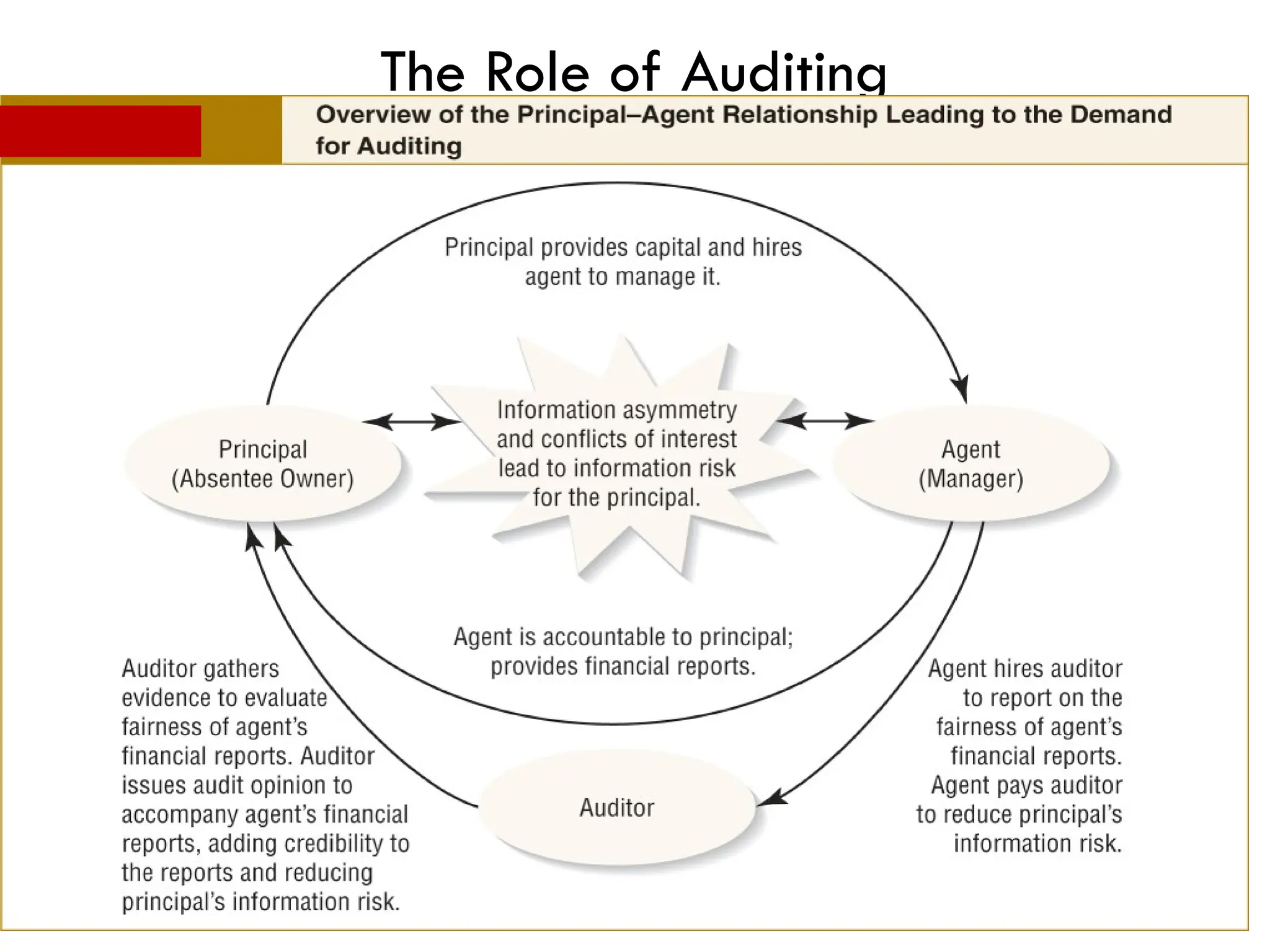
6.
Why Audit ?
Legal and Contractual Requirements
Restrictive Covenants in Debt Agreements
Modern Corporation Setup –
Absentee Stockholders and professional Managers
Principal –Agent Relationships
Lack on information symmetry
Conflicts of Interest
Cost Effective Monitoring Device
7.
The Auditor, Corporationsand Financial
Information
i. Audits Required
• In most countries, audits are now legally required for some
types of companies (statutory audits)
– E.g., listed companies, companies receiving government
money, certain industries
• Major stock exchange centers/ Bourses (including NYSE,
NASDAQ, London Stock Exchange, Tokyo NIKKEI, and
Frankfurt DAX) have listing rules that require all companies
to have an audited annual report.
8.
It canbe said that the function of auditing is to lend
credibility to the financial statements.
The financial statements are the responsibility of
management and the auditor’s responsibility is to lend
them credibility.
By the audit process, the auditor enhances the
usefulness and the value of the financial statements,
but also increases the credibility of other non-audited
information released by management.
The Auditor, Corporations and Financial
Information
ii. The Importance of Auditing
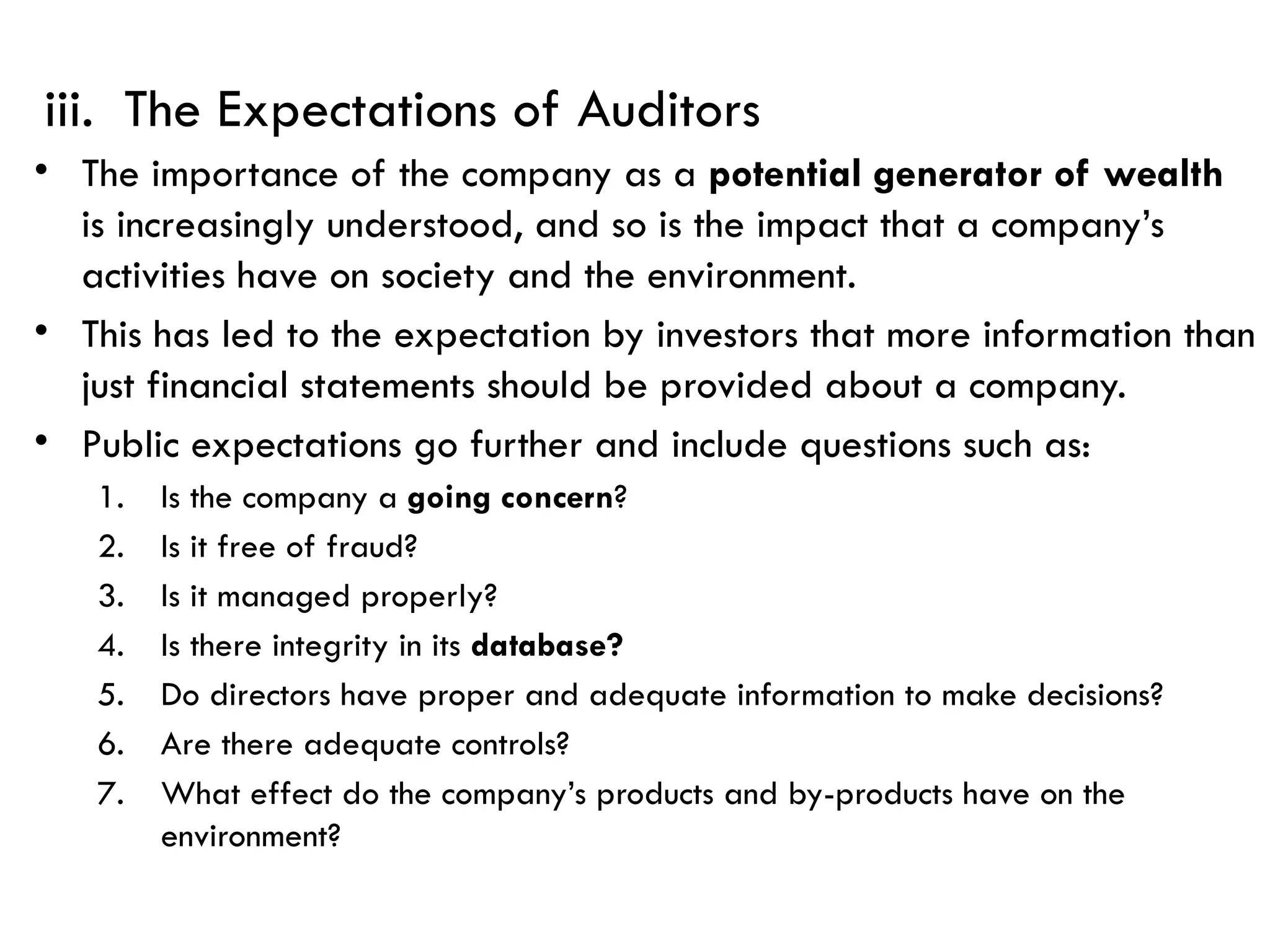
iii. The Expectationsof Auditors
• The importance of the company as a potential generator of wealth
is increasingly understood, and so is the impact that a company’s
activities have on society and the environment.
• This has led to the expectation by investors that more information than
just financial statements should be provided about a company.
• Public expectations go further and include questions such as:
1. Is the company a going concern?
2. Is it free of fraud?
3. Is it managed properly?
4. Is there integrity in its database?
5. Do directors have proper and adequate information to make decisions?
6. Are there adequate controls?
7. What effect do the company’s products and by-products have on the
environment?
11.
THEORIES ON THEDEMAND FOR AUDITING
A theory is defined in Encyclopedia Britannica as follows:
Systematic ideational structure of broad scope,
conceived by the human imagination, that encompasses
a family of empirical (experiential) laws regarding
regularities existing in objects and events, both
observed and posited.
A scientific theory is a structure suggested by these
laws and is devised to explain them in a scientifically
rational manner.
12.
Mautz andSharaf (1961) define the purpose of theory
in the following way: “One reason, then, for a serious
and substantial investigation into the possibility and
nature of auditing theory is the hope that it will provide
us with solutions or, at least, clues to solutions, of
problems which we now find difficult”.
Theories on the demand for auditing provide a general
framework for auditing, or at least for understanding it.
THEORIES ON THE DEMAND FOR
AUDITING
13.
Auditing theory
helps explain why auditing is needed in the first
place
helps explain why some of the postulates and key
concepts of auditing are so important
uncovers some of the laws that govern the audit
process and its activities.
provides us with a framework for understanding
the relationships and interrelationships between
different parties of a firm.
THEORIES ON THE DEMAND FOR AUDITING
14.
There areseveral different theories that may explain
the demand for audit Services.
There are four important audit theories that explain the
demand for audit services:
1. The policeman theory
2. The lending credibility theory
3. The theory of inspired confidence
4. Agency Theory
15.
1. The policemantheory
The policeman theory claims that the auditor is
responsible for searching, discovering and preventing
fraud.
In the early 20th century this was certainly the case.
However, more recently the main focus of auditors has
been to provide reasonable assurance and verify the
truth and fairness of the financial statements.
The detection of fraud is, however, still a hot topic in
the debate on the auditor's responsibilities, and typically
after events where financial statement frauds have been
revealed, the pressure increases on increasing the
responsibilities of auditors in detecting fraud.
16.
The lendingcredibility theory suggests that the primary
function of the audit is to add credibility to the financial
statements.
In this view the service that the auditors are selling to the
clients is credibility.
Audited financial statements are seen to have elements
that increase the financial statement users’ confidence in
the figures presented by management.
Under this it is believed that the quality of investment
decisions will improve when they are based on reliable
and credible information.
2. The lending credibility theory
17.
Addresses boththe demand and the supply for audit
services
States that the demand for audit services is the direct
consequence of the participation of third parties or
outside stakeholders in the company.
These parties demand accountability from the
management, in return for their investments in the
company.
Accountability is realized through the issuance of periodic
financial reports.
3.The theory of inspired confidence or Theory of
rational expectations
18.
Though, informationprovided by the management could
be biased due to conflict of interest, and outside parties
do not have direct means of monitoring, an audit is
required to assure the reliability of this information.
With regard to the supply of audit assurance, Limperg
(1932) suggests that the auditor should always strive to
meet the public expectations.
Theory of rational expectations
19.
Agency theory(Watts and Zimmerman 1978, 1986a,
1986b) suggests that the auditor is appointed in the
interests of both the third parties as well as the
management.
A company is viewed as a web of contracts.
Several groups (suppliers, bankers, customers, employees
etc.) make some kind of contribution to the company for a
given price.
4. Agency theory
20.
The taskof the management is to coordinate these
groups and contracts and try to optimize them by way
of:
low price for purchased supplies,
high price for sold goods,
low interest rates for loans,
high share prices and
low wages for employees.
In these relationships, management is the agent,
which tries to gain contributions from principals
(bankers, shareholders, employees etc).
4. Agency theory
21.
The role ofthe audit
Related, and to some extent overlapping, with the four
theories discussed above, Wallace (1980) proposed
three hypotheses for explaining the role of the audit in
free and regulated markets:
1. the monitoring hypothesis,
2. the information hypothesis and
3. the insurance hypothesis.
22.
1. The monitoringhypothesis
The monitoring hypothesis assumes that when
delegating decision-making power to one party, as
suggested in agency theory, the agent is motivated
to agree to be monitored if the benefits from such
activities exceed the related costs.
This hypothesis is applicable to all co-operative
relationships in any organization, i.e, relationships
between:
owners and managers
employers and employees,
creditors and shareholders,
different levels of management in companies and
Government and taxpayers(Wallace 1980 and 1987).
23.
Beaver (1989)pointed out that the monitoring theory strives
to solve problems that arise due to moral hazard and
information asymmetry between the agent and the principal.
Moral hazard is the problem of the agent possessing superior
information and thus having the opportunity to use it self-
interestedly at the expense of the principal (Beaver 1989).
Arrow (1985) calls the two types of principal-agent problems
hidden action (moral hazard) and hidden information
(information asymmetry).
To monitor and restrict the superior information position of
management, an independent actor called auditor is
contracted to inspect the information
The audit reduces the agent’s chances to withhold
material information from the shareholders (Beaver
1989).
The monitoring hypothesis Cont…
24.
2. The informationhypothesis
Financial reporting was earlier seen to be central to the
monitoring purposes
Since the 1960’s the focus moved towards the need and
the provision of information to enable users to take
economic decisions (Higson 2003) which is the focus of the
information hypothesis
One argument regarding the demand for audited
financial statements is that they provide information
that is useful in investors’ decision-making
25.
Fama andLaffer (1971) discuss three major benefits of
information:
reduction of risk,
improvement of decision-making and
Provide gains from stock trade by investors
The information hypothesis emphasizes that financial
information is needed by investors to determine market
values, which are the basis for rational investment
decisions in the absence of an explicit contract with the
agent (Wallace 1980).
2. The information hypothesis
26.
3. The insurancehypothesis
The third hypothesis on how the demand for audits
evolves relates to management’s liability exposure
(Wallace 1980).
The auditor and the auditee are jointly and severally
liable to third parties for losses attributable to defective
financial statements.
The ability to shift financial responsibility for reported
data to an auditor lowers the expected loss from
litigation or related settlements to managers, creditors
and other professionals involved in the securities market.
The shift made is for high audit premium in exchange for
a guarantee or insurance from the auditor
27.
There arefour explanations why managers and other
professionals look for insurance from auditors rather
than an insurance company
3. The insurance hypothesis
First, the audit function is so firmly established in society
that the decision of management not to hire an auditor
would strongly imply negligence or fraud on the part of
the managers of other professionals.
Second, accounting firms have established in-house
legal departments to defend them in professional
liability suits.
Third, the auditor facing a litigation suit is concerned
about his/her reputation
Fourth, auditors have “deep pockets” relative to a
bankrupt or failing company that cannot pay.
28.
Auditing profession
Tounderstand the importance of a code of ethics to auditors and
other professionals, one must understand the nature of a profession.
Unfortunately there is no universally accepted definition of what
constitutes a profession. Yet for generations, certain types of
activities have been recognized as professions while others have not.
Medicine, law, engineering, theology are examples of disciplines
having long accorded professional status. Auditing is a relatively
newcomer to the ranks of the profession, but it has achieved
widespread recognition in recent times.
A profession is a discipline that involves a responsibility to serve the
public.
29.
Auditing profession
Auditing asa profession and just like other professions has some
common characteristics. The most important of these characteristics
are:
1. Responsibility to serve the public: Certified public accountants or
simply auditors are the representatives of the public -creditors,
stockholders, consumers, employees and other users of financial
reports.
The role of the independent auditor is to assure that financial
statements are fair to all parties and not biased to benefit one
group at the expense of another.
This responsibility to serve the public interest must be a basic
motivation for the professional.
There is a saying in public accounting that “The public is our
only client.”
30.
Auditing profession
Ithas been claimed by public accountants that Auditing is more
responsible to the public than any other professions.
This is because millions of clients might be affected if the
auditor is negligent in his professional act.
Usually one client might be affected if the Physician or attorney
is negligent in his professional act.
That is why public accountants say no profession is more
responsible to the public like auditing.
Public accountant must maintain a high degree of independence
from their client if they are to serve the large community.
31.
Auditing profession
2. ComplexBody of Knowledge: Auditing as a profession has
specialized body of knowledge that every member of the profession
should acquire through formal education.
Auditing like other professions has complex accumulated body of
knowledge.
Any practitioner or student of accounting and auditing has only to look
at the abundance of authoritative pronouncements governing financial
reports to realize that accounting and auditing are complex body of
knowledge.
As the environment changes, accounting and auditing principles and
practices must adapt.
The need for technical competence and familiarity with current
standards of practice is embodied in the code of professional conduct
32.
Auditing profession
3. Standardsof admission to the profession:
Obtaining a license to practice as certified public
accountant requires an individual to meet minimum
standards for education and experience.
The individual must also pass the CPA examination
showing mastery of the body of knowledge.
The admission to practice as public accountant is
restricted by legal and educational requirements so as
to provide quality service to the society.
33.
Auditing profession
4. ProfessionalAssociations: There are a number of
professional associations which are devoted them selves
with the development of auditing principles and standards.
The ten generally accepted auditing standards are the
guidelines developed by AICPA.
5. Need for public confidence: Certified public accountants
must have the confidence of the public to be successful.
The CPAs product is credibility and hence the public
confidence is of special significance. With out public
confidence the attest function serves no useful purpose.
34.
6. Professional Ethics
Ethics can be defined broadly as a set of moral
principles or values.
Each of us has such a set of values.
We may or may not have considered them explicitly.
Need for Ethics
Ethical behavior is necessary for a society to function
in an orderly manner.
The need for ethics in society is sufficiently
important that many commonly held ethical values
are incorporated into laws.
35.
Professional Ethics: professionalethics refers to the basic
principles of right action for the member of a profession.
Professional ethics may be regarded as a mixture of moral and
practical concepts.
Professional ethics in public accounting as in other professions
have been developed gradually and are still in a process of
change as the practice of accounting it self changes.
The fundamental purpose of such codes is to provide
members with guidelines for maintaining a professional
attitude and conducting themselves in a manner that will
enhance the professional status of their discipline.
36.
Ethical Dilemmas
Anethical dilemma is a situation a person faces in
which a decision must be made about appropriate
behavior.
Rationalizing Unethical Behavior
1. Everybody does it.
2. If it’s legal, it’s ethical.
3. Likelihood of discovery and consequences
37.
Special Need forEthical Conduct in Professions
Our society has attached a special meaning to the
term professional.
A professional is expected to conduct himself or
herself at a higher level than most other members
of society.
38.
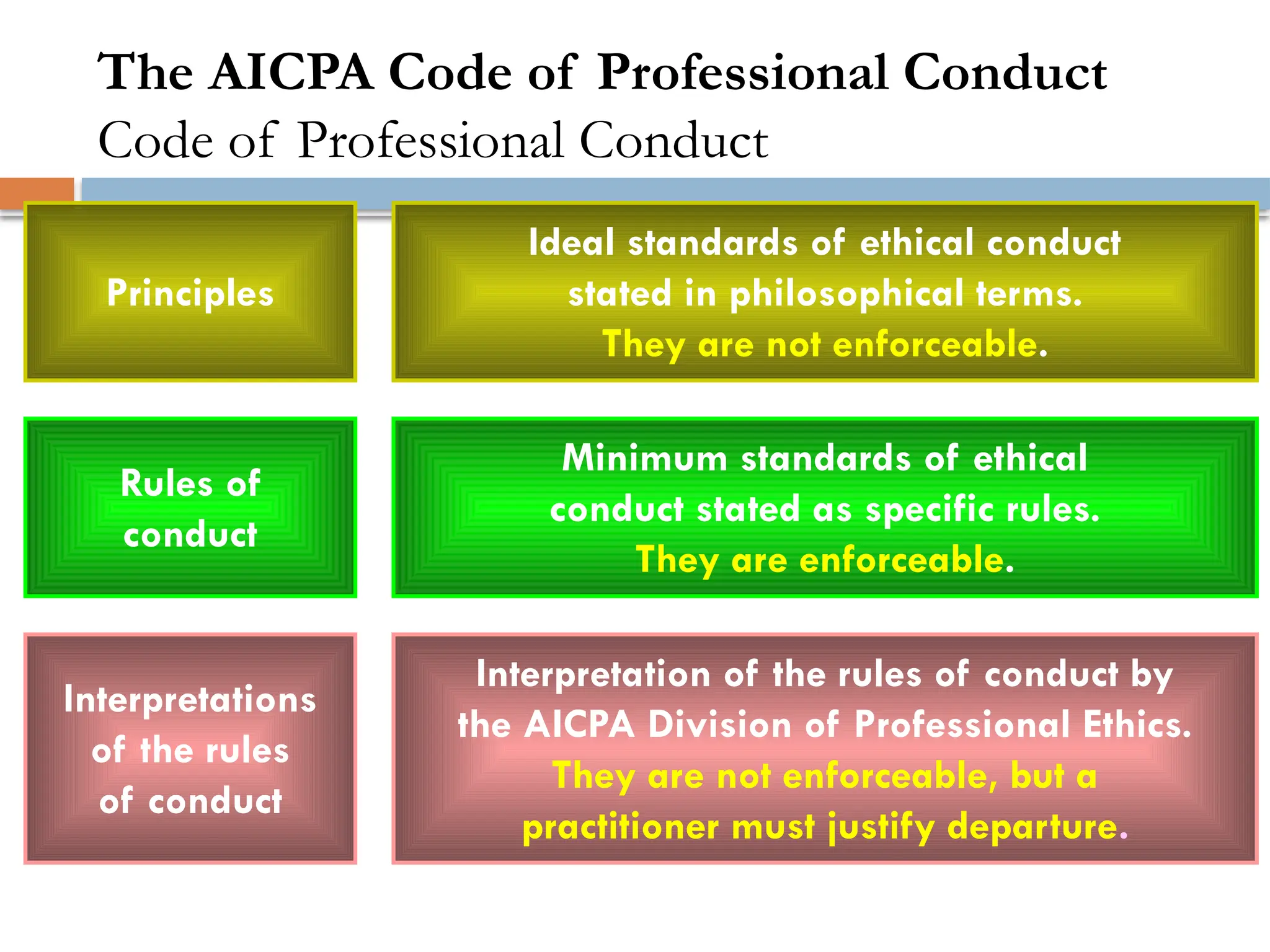
The AICPA Codeof Professional Conduct
Code of Professional Conduct
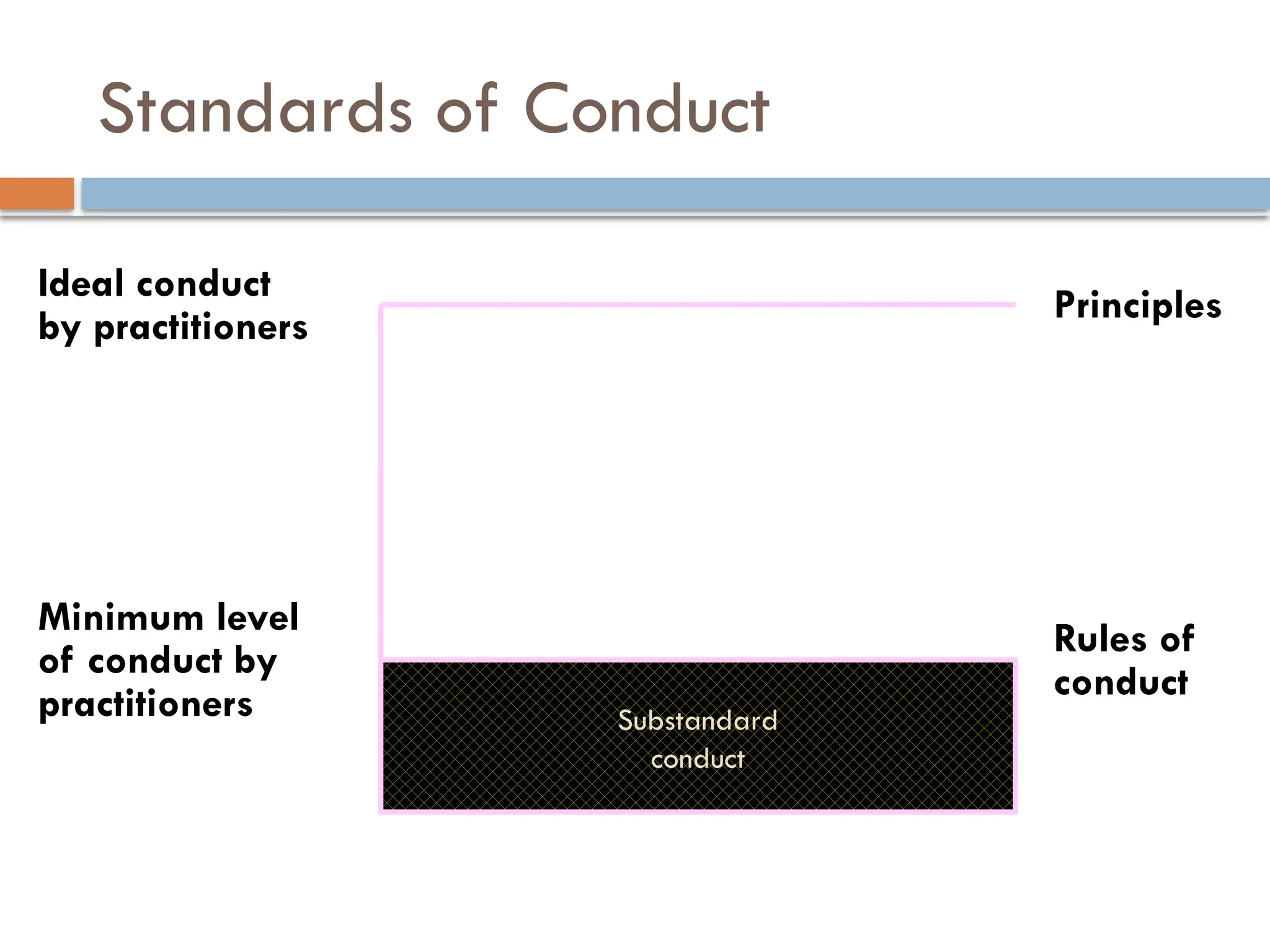
Principles
Ideal standards of ethical conduct
stated in philosophical terms.
They are not enforceable.
Rules of
conduct
Minimum standards of ethical
conduct stated as specific rules.
They are enforceable.
Interpretations
of the rules
of conduct
Interpretation of the rules of conduct by
the AICPA Division of Professional Ethics.
They are not enforceable, but a
practitioner must justify departure.
39.
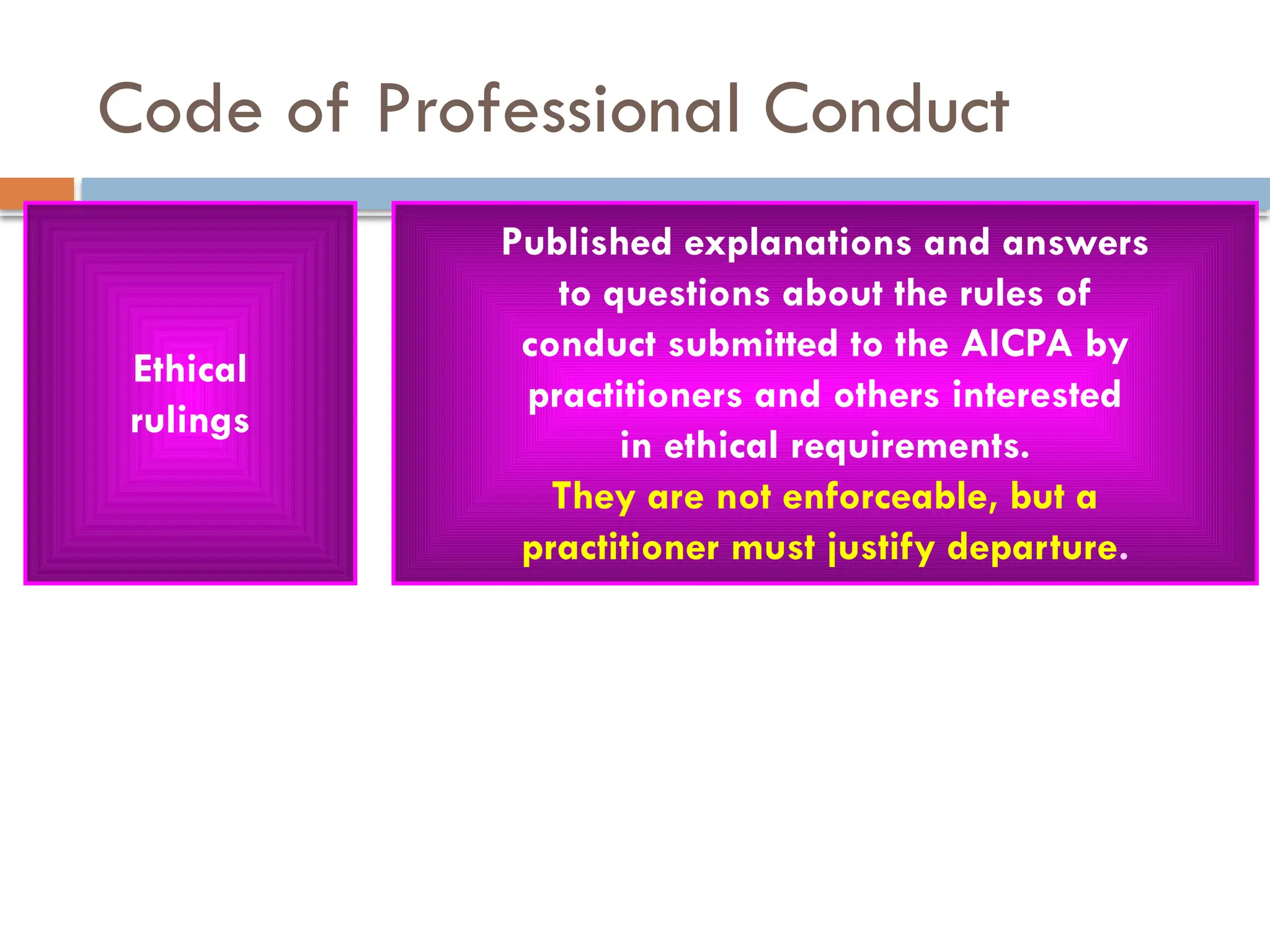
Code of ProfessionalConduct
Ethical
rulings
Published explanations and answers
to questions about the rules of
conduct submitted to the AICPA by
practitioners and others interested
in ethical requirements.
They are not enforceable, but a
practitioner must justify departure.
40.
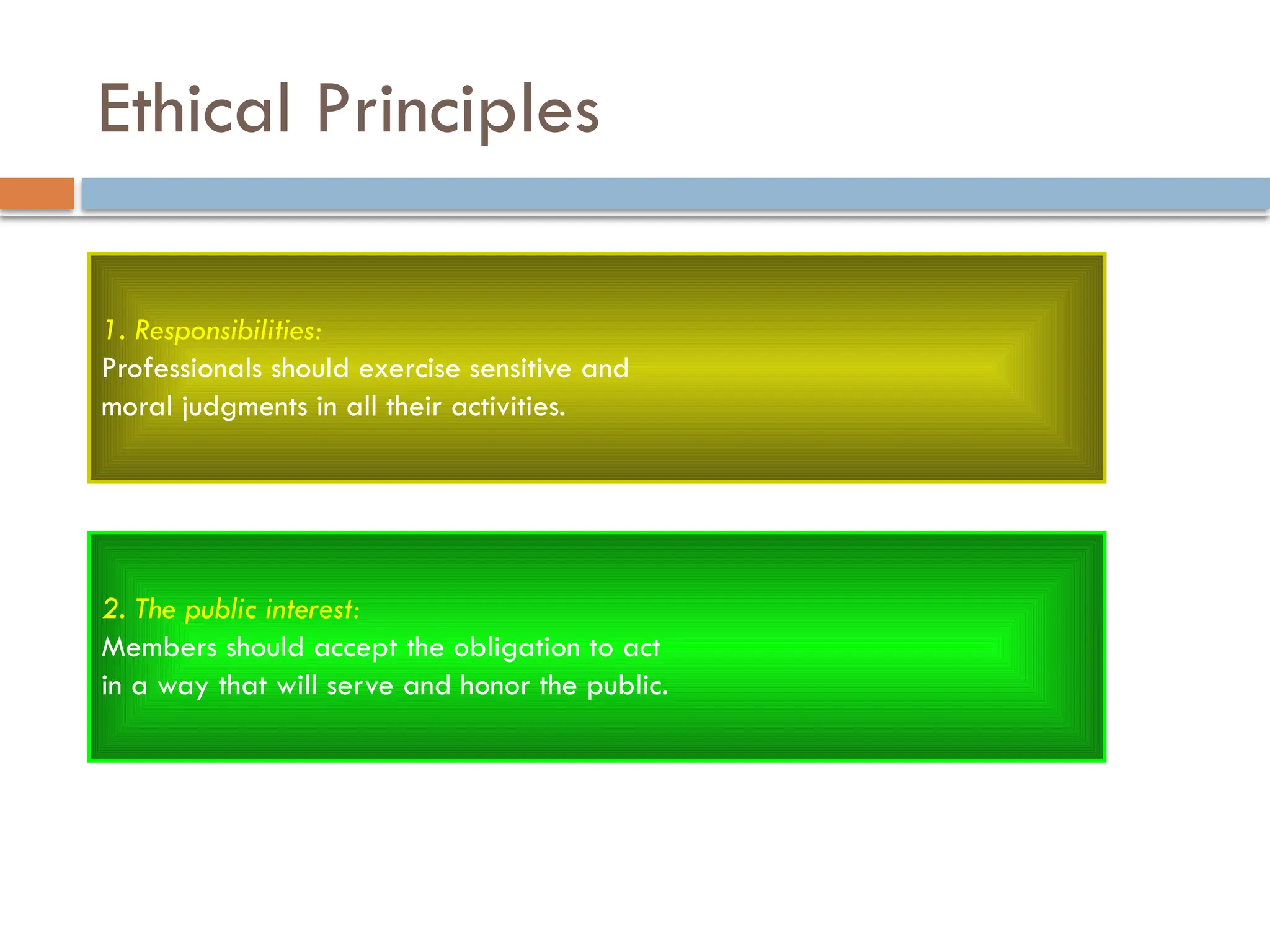
Ethical Principles
1. Responsibilities:
Professionalsshould exercise sensitive and
moral judgments in all their activities.
2. The public interest:
Members should accept the obligation to act
in a way that will serve and honor the public.
41.
Ethical Principles
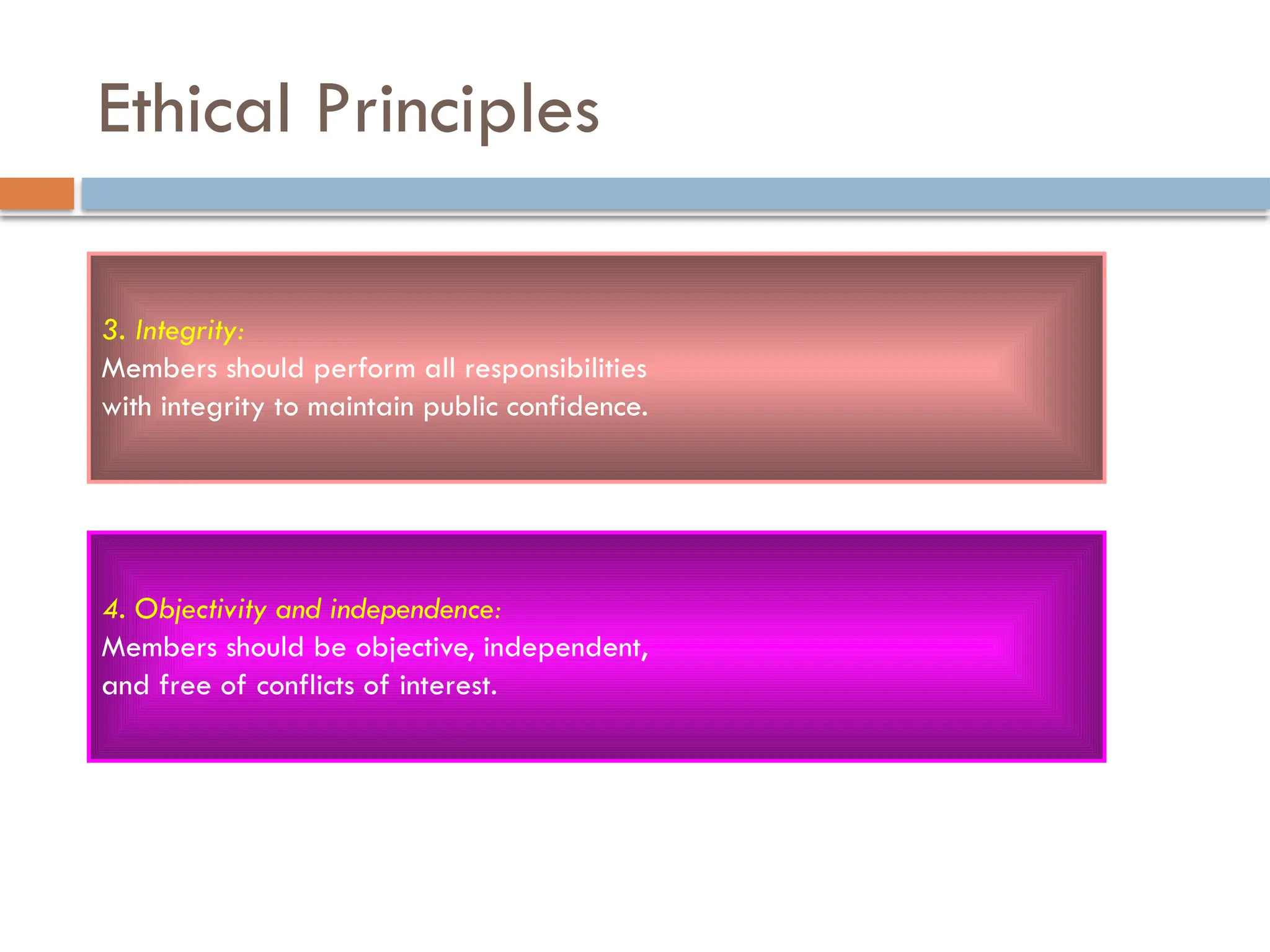
3. Integrity:
Membersshould perform all responsibilities
with integrity to maintain public confidence.
4. Objectivity and independence:
Members should be objective, independent,
and free of conflicts of interest.
42.
Ethical Principles
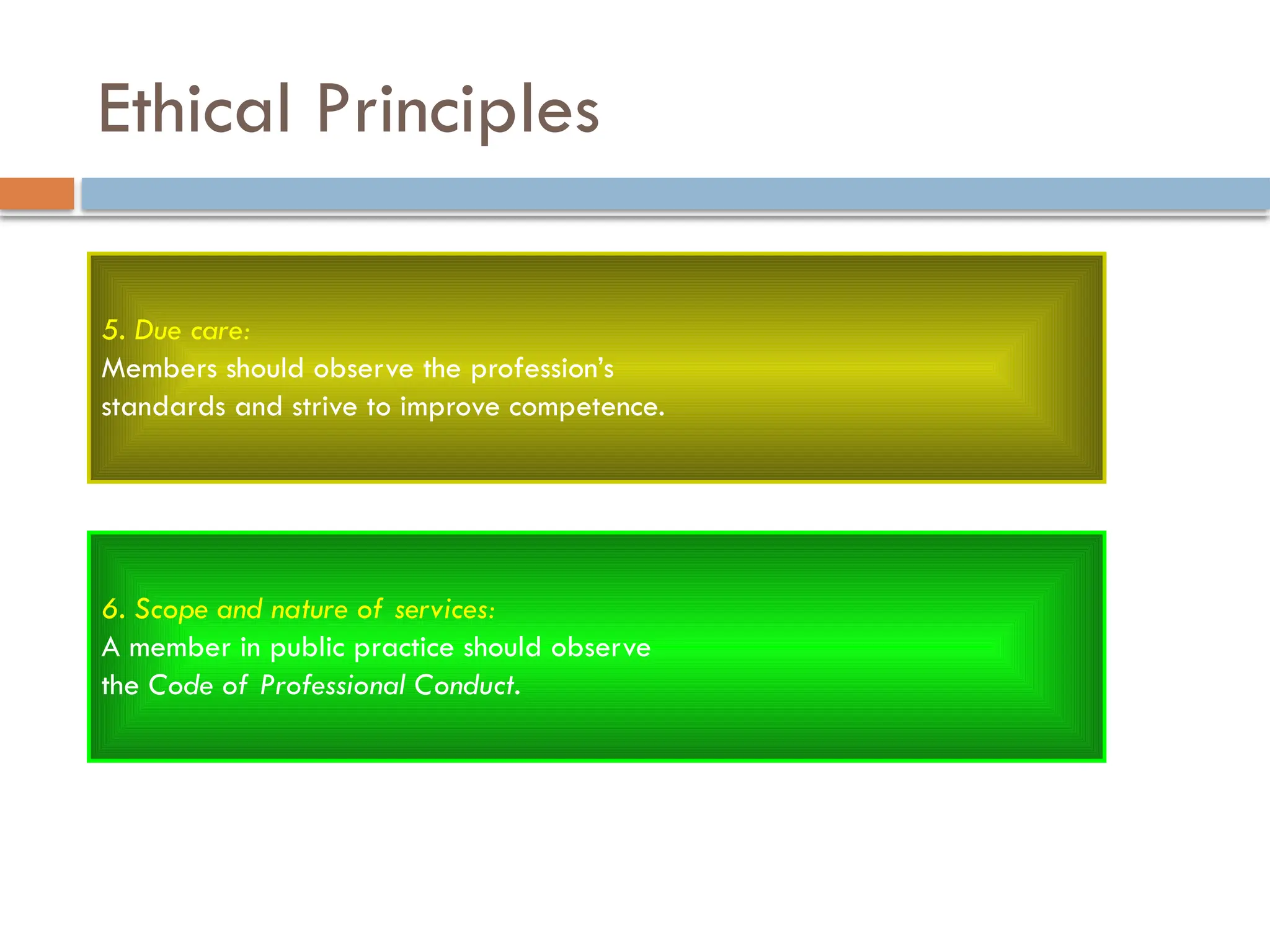
5. Duecare:
Members should observe the profession’s
standards and strive to improve competence.
6. Scope and nature of services:
A member in public practice should observe
the Code of Professional Conduct.
Auditing profession
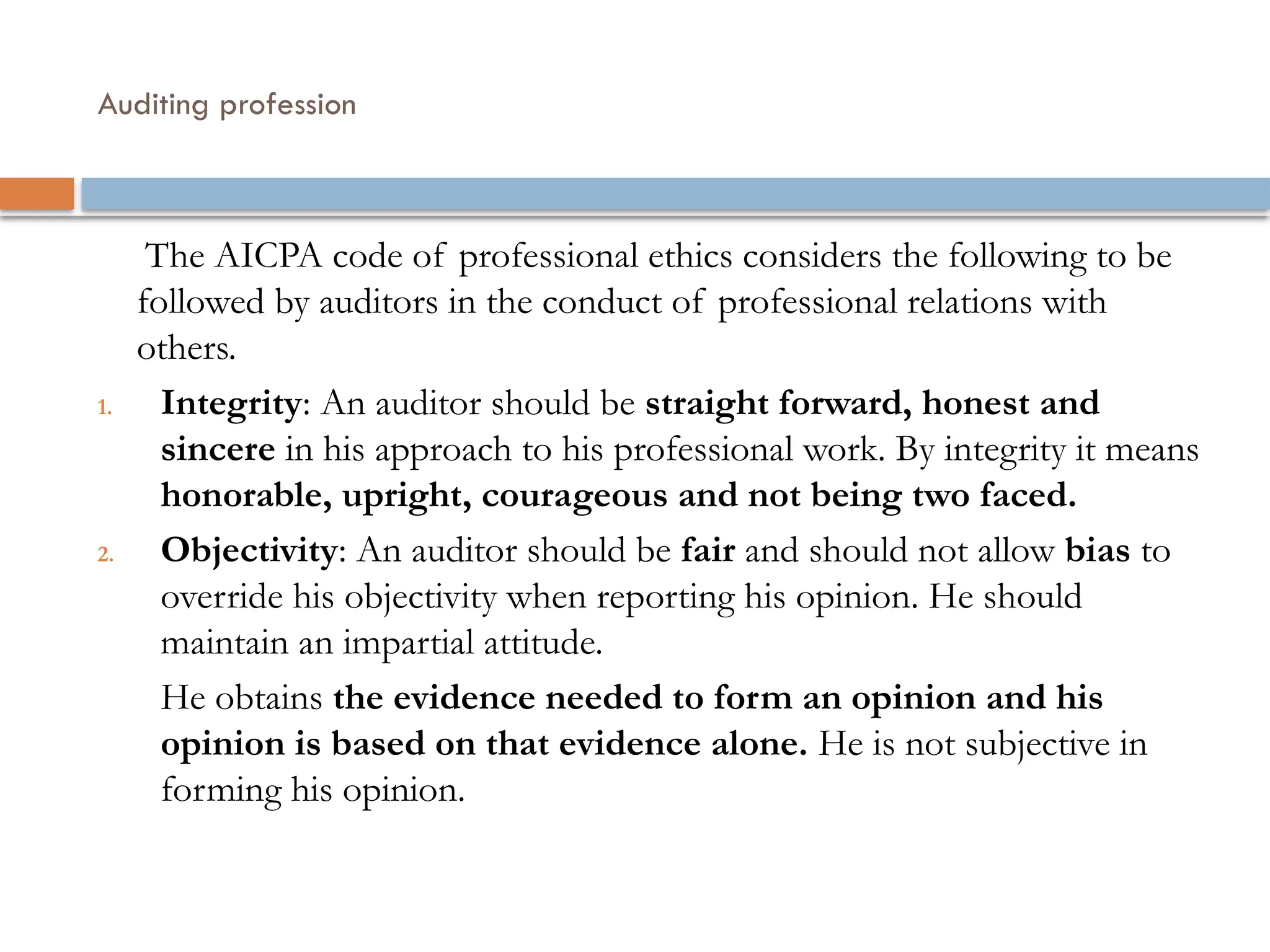
The AICPAcode of professional ethics considers the following to be
followed by auditors in the conduct of professional relations with
others.
1. Integrity: An auditor should be straight forward, honest and
sincere in his approach to his professional work. By integrity it means
honorable, upright, courageous and not being two faced.
2. Objectivity: An auditor should be fair and should not allow bias to
override his objectivity when reporting his opinion. He should
maintain an impartial attitude.
He obtains the evidence needed to form an opinion and his
opinion is based on that evidence alone. He is not subjective in
forming his opinion.
45.
3. Confidentiality: Usuallyauditors have unrestricted access,
even to the confidential documents, of the client while they
are conducting an audit.
Thus an auditor should respect the confidentiality of the
information acquired in the course of his work and should not
disclose any such information to a third party with out specific
authority or unless there is a legal or professional duty to
disclose.
A member acquiring information in the course of professional
work should neither use nor appear to use that information for
his personal advantage or for the advantage of any third party.
46.
Auditing profession
4. Independence:When in public practice, an auditor
should both be and appear to be free of any interest
which might be regarded, what ever its actual effect,
as being incompatible with integrity and objectivity.
Auditor is independent of management i.e. he is not
under the control or influence of management.
5. Caring for others: Be caring, kind and passionate, be
of service to others; help those in need and avoid
harming others.
47.
Auditing profession
6. Accountability:An auditor should be accountable,
accept responsibility for decisions, setting an
example for others.
7. Due care: This requires competence, and diligence.
Competence is the product of education and
experience, and diligence involves steady, earnest and
energetic application and effort in performing
professional services.
48.
Generally Accepted Auditingstandards
In order to maintain high level of quality work,
auditors need to have some standards in accordance
with which they perform their activities.
This section discusses the authoritative rules for
measuring the quality of audit work.
Standards are authoritative rules for measuring
the quality of performance.
49.
Generally Accepted Auditingstandards
The existence of generally accepted auditing standards
is evidence that auditors are very concerned with the
maintenance of a uniformly high quality of audit work
by all independent public accountants
Auditing standards are general guidelines to aid
auditors in fulfilling their professional
responsibilities in the audit of financial statements.
What are the standards developed for the public
accounting profession?
50.
Generally Accepted Auditingstandards
AICPA has set forth ten generally accepted auditing
standards: These ten auditing standards are classified in
to three major groups as general standards, field
work standards and reporting standards.
1. General standards: The general standards relate to
the personal integrity and professional
qualifications of the auditors.
These standards stress on competence,
independence and due professional care by the
auditor. These standards are:
51.
Generally Accepted Auditingstandards
A) Technical Training and proficiency: An audit
examination should be performed by a person or
persons having adequate technical training and
proficiency as an auditor.
This requirement is usually interpreted to mean college
or university education in accounting and auditing,
substantial public accounting experience, ability to use
procedures suitable for computer based systems and
technical knowledge of the industry being audited.
52.
Generally Accepted Auditingstandards
B) Independence: In all matters relating to the assignment;
independence is to be maintained by the auditors.
This is the most important auditing standard.
Independence means avoiding relationships that may
impair the auditor’s objectivity.
It is not enough that auditors are independent in fact but
they have to be also perceived as being independent in
appearance.
Otherwise, the public can loose confidence in the auditor’s
ability to report truthfully on the financial statements.
53.
Generally Accepted Auditingstandards
Independence may be broadly thought of as having four facets: these are:
1. Financial independence: financial independence relates to not having a financial
interest in the client.
2. Independence in mental attitude: Independence in mental attitude is essential to
achieve independence in fact.
3. Investigative independence: this means that the auditor has the time and
resources to obtain competent and sufficient audit evidence and that the auditor
has access to all evidence needed to reach the proper opinion as to the fairness of
the financial statements. Investigative independence will be impaired if there was a
deadline so that the job was rushed
4. Reporting independence: means reporting at a sufficiently high level that the
report will be acted on. If an auditor is accountable to report to the management,
then the auditor would not have reporting independence. On the other hand, if the
auditor is accountable to an audit committee (made up of independent board of
directors) then the auditor would have reporting independence.
54.
Generally Accepted Auditingstandards
Independence has two distinct aspects.
First, the public accountant must in fact be
independent toward any enterprise they audit. Second,
the relationships of public accountants with audit
clients must be such that they will appear independent
to third parties.
Mechanisms to strengthen Independence:
Auditor’s independence may be addressed in statutory
law, professional standards and audit firm policy.
55.
Generally Accepted Auditingstandards
Independence may be addressed by:
prohibiting owners of accounting firms and their staff from
holding shares in, lending to, or otherwise having a beneficial
interest , either directly or indirectly in audit clients
Prohibiting owners and their staff from receiving any benefits
from client organizations, other than through the receiving of
audit fees.
Prohibiting owners and their staff from holding any office,
including the office of director, in client organizations
Prohibiting the undertaking of consulting work such as taxation
and corporate advising work for the existing audit clients.
56.
Generally Accepted Auditingstandards
C) Due professional care: The third general standard
requires due care in the performance of all aspects of
auditing. Simply stated the auditor is professionally responsible
for fulfilling his /her duties diligently and carefully.
Due care includes consideration of the completeness
of the working papers, the sufficiency of the audit
evidence, and the appropriateness of the audit report.
As a professional, the auditor must avoid negligence
and bad faith. This standard requires auditors to carry
out their work in an alert and diligent manner
57.
Generally Accepted Auditingstandards
2- Field work standards: The three standards of field work
relate to accumulation and evaluating evidence sufficient
for the auditors to express an opinion on the financial
statements.
Auditors cannot effectively satisfy the general standards
requiring due professional care if they have not also satisfied
the standards of field work.
The field work standard involves
adequate planning,
sufficient understanding of internal control and
sufficient and competent evidence.
58.
Generally Accepted Auditingstandards
A) Sufficient understanding of internal control: One of the
most widely accepted concepts in the theory and practice of
auditing is the importance of the client’s internal control
structure to generate reliable financial information.
An excellent internal control structure provides strong
assurance that the client’s records are dependable and
that its assets are protected.
A proper understanding of the internal control helps the
auditor to determine the appropriate amount and quality
of evidence.
Thus, the auditor’s assessment of internal control has great
impact on the length and nature of the audit process.
59.
Generally Accepted Auditingstandards
B) Adequate planning and supervision: The first standard
of field work deals with ascertaining that the engagement is
sufficiently planned to ensure an adequate audit and
adequate supervision of assistants.
Proper planning can help to effectively detect material
misstatements on the financial statements and to
complete the audit engagement in a reasonable
amount of time.
Supervision is essential in auditing because a considerable
portion of the field work is done by less experienced staff
members.
60.
Generally Accepted Auditingstandards
C) Sufficient and competent evidence: The third standard
of fieldwork requires that the auditors should gather
sufficient and competent evidence to have a basis for
expressing an opinion on the financial statements.
The decision as to how much evidence to accumulate in a
given set of circumstances requires professional judgment.
The term sufficient refers to the quantity of
information to be gathered while competency refers to
the quality of evidences, as some forms of evidence
are stronger and more convincing than others.
61.
Generally Accepted Auditingstandards
3-Standards of Reporting: The ultimate objective of
independent auditors is to report on the findings of the
audit.
The reporting is guided by reporting standards of
GAAS.
The standards of reporting deals with
Generally accepted accounting principles (GAAP),
consistency,
adequate disclosure and
report content.
62.
Generally Accepted Auditingstandards
These reporting standards can be explained as follows:
1. The report shall state whether the financial statements are
presented in accordance with GAAPs.
2. The report shall identify those circumstances in which such
principles have not been consistently observed in the current
period in relation to the preceding period.
3. Informative disclosures in the financial statements are to be
regarded as reasonably adequate unless otherwise stated in the
report.
4. The report shall either contain an expression of opinion
regarding the financial statements, taken as a whole, or an
assertion to the effect that an opinion can not be expressed.
63.
When anover all opinion can not be expressed, the
reasons should be stated. In all cases where an
auditor’s name is associated with financial statements,
the report shall contain a clear-cut indication of the
extent of the auditor’s examination and the degree of
responsibility he/she is taking.
64.
Generally Accepted Auditingstandards
Case 1: Assume Mr. Dawud, general manager of AB trading,
applied for a bank loan and was informed by the banker that
audited financial statements of the business must be submitted
before the bank could consider the loan application.
Mr.Dawud agreed with Tomas, CPA, to perform an audit.
Mr. Dawud informed Tomas that audited financial statements
were required by the bank and that the audit must be
completed within two weeks and Mr. Dawud promised to pay
Tomas a fixed fee plus a bonus if the audit is completed with
in two weeks and the bank approved the loan. Tomas, CPA,
agreed and accepted the engagement.
65.
Generally Accepted Auditingstandards
The CPA, Tomas, hired two fresh accounting graduates to
conduct the audit and spent several hours telling them exactly
what to do and he told them not to spend time reviewing
internal control but instead, to concentrate on proving the
mathematical accuracy of the ledger accounts and
summarizing the data in the accounting records that support
the company’s financial statements. The audit was completed
with in two weeks and Tomas issued audit report.
Instruction: Exhaustively identify the auditing principles that
were violated By Tomas and support your answer with
justification.
66.
Audit reports
The auditreport is the final step of the audit process.
The financial statements on which you prepare an audit
report are the balance sheet, the income statement, the
statement of retained earnings and the statements of
cash flow.
The auditing profession recognizes the need for
uniformity in reporting as a means of avoiding
confusion.
To avoid confusion and misrepresentation of an audit
report there should be uniformity in reporting.
67.
Audit reports
The AICPAhas developed the following reporting standards.
1. The report shall state whether the financial statements are presented in
conformity with Generally Accepted Accounting Principles.
2. The report shall state whether or not such principles have been consistently
followed or not.
3. Informative disclosures in the financial statements are to be regarded as
reasonably adequate unless otherwise stated in the report.
4. The report shall contain either an expression of an opinion regarding the
financial statements taken as a whole, or an assertion to the effect that an
opinion cannot be expressed.
When an overall opinion cannot be expressed, the reasons should be stated. In
all cases where an auditor’s name is associated with the financial statements, the
report should contain a clear-cut indication of the character of the auditor’s
examination, if any, and the degree of responsibility he/she is taking.
68.
Audit reports
Theprofession recognizes the need for uniformity
in reporting as a means of avoiding confusion.
The professional standards have defined and
enumerated the types of audit reports that should be
included with the financial statements.
The wording of audit reports is reasonably
uniform, but different audit reports are
appropriate for different circumstances.
69.
Components of auditreport
Auditors issue different types of reports based on their
findings. Later, in this chapter, we shall see the types of
reports issued by auditors.
One of the reports auditors issue is the standard unqualified
audit report. The standard audit report (Unqualified)
contains three paragraphs, namely the introductory
paragraph, the scope paragraph, and the opinion
paragraph.
Each part of the auditor report is significant in terms of the
information conveyed to the user and the responsibility
assumed by the auditor.
70.
Components of auditreport
standard unqualified report has seven parts.
Report Title: The auditing standard requires that the report be
titled and that the title include the word Independent. The
appropriate title would be “Independent auditor’s report, or
Report of independent auditors.” The requirement that the title
include the word “independent” is intended to convey to users
that the audit was unbiased in all aspects of the engagement.
Address: The report is usually addressed to the company, its
stockholders or the board of directors or combinations of
these. If you are appointed by the stockholders at the annual
meeting, you have to write the audit report addressing to them.
71.
Components of auditreport
Introductory paragraph: This is the first paragraph of the audit
report and it does three things:
It makes the simple statement that the audit firm has done an audit.
This is intended to distinguish the report from a compilation or
review report.
It lists the financial statements that were audited, including the
balance sheet, income statement, statement of retained earnings
and cash flow statements.
The introductory paragraph states that the statements are the
responsibility of management and that the auditor’s responsibility is
to express an opinion on the financial statements based on an audit.
72.
Components of auditreport
Scope paragraph: The scope paragraph describes what
the auditor has performed during the audit.
Specifically, it states whether the audit was conducted in
accordance with Generally Accepted Auditing Standards
(GAAS). It also states that the GAAS requirement that an
audit be planned to provide reasonable assurance that the
financial statements are free of material misstatement.
The scope paragraph states that the audit is designed to
obtain reasonable assurance about whether the statements
are free of material misstatements.
73.
Components of auditreport
The inclusion of the word “material” conveys that auditors are
responsible only to search for significant misstatements; not
minor errors that do not affect users’ decisions.
The use of the term “reasonable assurance” is intended to
indicate that an audit cannot be expected to eliminate completely
the possibility that a material error or irregularity will exist in the
financial statements. In other words, an audit provides a high
level of assurance, but it is not a guarantee.
The scope paragraph also discusses the audit evidence
accumulated and states that the auditor believes the evidence
accumulated was appropriate for the circumstances to express the
opinion presented.
The word test-basis indicates that sampling was used rather than
an audit of every transaction and amount on the statements.
74.
Components of auditreport
Opinion Paragraph: The final paragraph in the standard report
states the auditor’s conclusions based on the results of the audit
examination.
This paragraph contains the auditor’s opinion on whether the financial
statements are in conformity with GAAP.
Management is responsible for preparing the financial statements. The
responsibility of the auditor is to audit and express an opinion on
their fairness. This paragraph describes the auditor’s findings. These
findings are expressed in terms of whether the financial statements are
presented in accordance with generally accepted accounting principles.
The audit report must contain either an expression of opinion or
an assertion to the effect that an opinion can not be rendered
and the reasons for this.
75.
Components of auditreport
Name of the audit firm and signature: The name and the
signature identify the audit firm or practitioner that has
performed the audit. Typically, the firm’s name is used, since
the entire audit firm has the legal and professional
responsibility to make certain the quality of the audit meets
professional standards.
Date of audit report: The appropriate date of the audit
report is the one on which the field work has been completed.
This date is important because it represents the time limit on
the auditors’ responsibility. The auditor does not have any
responsibility to make any enquiries after this date.
76.
Audit reports
Types ofaudit report: There are four types of audit
reports that might be issued by the auditors.
These are:
1. An unqualified opinion
2. Qualified opinion
3. An adverse opinion
4. Disclaimer opinion
77.
Audit reports
TheUnqualified report: The most common type of
audit report is the standard unqualified audit report.
This report represents a “clean bill of health” and
may be issued when
there are no material departures from generally
accepted accounting principles,
no significant scope limitations preventing the
gathering of necessary evidence and
when no conditions requiring explanatory language
exist.
78.
Audit reports
The unqualifiedreport is issued when the following conditions have been met:
All statements- balance sheet, income statement, statement of retained
earnings and cash flow statements are included in the audited financial
statements
When standards of auditing are applied in all respects of the engagement.
When sufficient evidence has been accumulated and the auditor has
conducted the audit in a manner that enables him to conclude that three
standards of field work have been met.
The financial statements are presented in accordance with generally
accepted accounting principles. This also means that the adequate
disclosures have been included in the footnotes and other parts of the
financial statements.
There are no circumstances requiring the addition of an explanatory
paragraph or modification of the wording of the report.
Audit reports
Qualified opinion:This type of opinion is still a positive
opinion and may result from limitations on the scope of the
audit or failure to follow generally accepted accounting
principles.
Auditors may issue this type of opinion when:
They do not agree with the accounting principles used in
preparing financial statements or when they believe that the
disclosures in the financial statements are inadequate.
A change in accounting principles is not applied properly as per
GAAP and is not adequately disclosed in the financial statements
There are limitations on scope of examination
There is major uncertainty affecting a client’s business.
81.
Audit reports
Ingeneral qualified opinion is issued when the auditors’
examination is restricted as to its scope or the financial
statements depart from generally accepted accounting principles.
A qualified opinion is still a positive opinion; it asserts that the
presentation in the financial statements, viewed as a whole is fair.
The qualified opinion has a separate explanatory paragraph
before the opinion paragraph disclosing the reasons for the
qualification.
When ever the auditor issues a qualified report, he/she must use
the term except for in the opinion paragraph. The implication is
that the auditor is satisfied that the overall financial statements
are fairly stated except for a particular aspect of them
Audit reports
Adverse opinion:this is a negative opinion, asserting that the
financial statements are not fairly presented.
It is issued when the exceptions to the presentations in the
financial statements are so significant that a qualified opinion
would be an inadequate warning to the users of those
statements.
This is a stronger form of except-for opinion – the disagreement
is so material that the financial statements as a whole are
misleading.
This type of statement is used only when the auditor believes the
overall financial statements are so materially or extremely misstated or
misleading that they do not present fairly the financial position or
results of operations and cash flows in conformity with generally
accepted accounting principles.
84.
Audit reports
Theadverse opinion report can arise only when the auditor has the
knowledge, after adequate and satisfactory investigation, of the
absence of conformity.
That is when the auditors express an adverse opinion; they must
have accumulated sufficient appropriate evidence to support their
unfavorable opinion.
Presumably creditors and stockholders would not provide debt or
equity capital to the client if the auditor issues adverse opinion to
the financial statements of the client.
Thus, the client usually will make whatever changes in the financial
statements that the auditors require in order to avoid receiving an
adverse opinion.
85.
Audit reports
Theadverse opinion like the qualified opinion has a
separate explanatory paragraph, before the opinion
paragraph to state the reasons for issuing an adverse
opinion and the principal effect of the adverse
opinion on the client’s financial position and
operating results.
In the opinion paragraph of adverse opinion the
auditors use the negative word “do not present
fairly”.
Audit reports
DisclaimerOpinion: This opinion is also called denial opinion.
This type of audit opinion is issued whenever the auditor has been
unable to satisfy him self or her self that the overall financial
statements are fairly presented.
The necessity for disclaiming an opinion may arise under the
following conditions:
If there has been a severe scope limitation that prevents the
auditor from obtaining sufficient and competent audit evidence;
If the auditor cannot satisfy him self or herself by applying other
procedures;
If the effect of the scope limitation is so significant that the auditor
can not form an opinion as to the fairness of the financial
statements.
88.
Audit reports
Eitherof these situations prevents the auditor from expressing an opinion on
the financial statements as a whole. A very significant scope limitation may be
caused by the client or by the timing of the auditors’ appointment and their
audit work or by the factors beyond the control of the client or the auditors,
rather than by restrictions imposed by the client.
A disclaimer is distinguished from an adverse opinion in that it can arise only
from a lack of knowledge by the auditor, where as to express an adverse
opinion the auditor must have knowledge that the financial statements are not
fairly stated.
When the auditor expresses a disclaimer of opinion, he/she has to make sure
that the following conditions are met:
An introductory paragraph is modified
The scope paragraph is omitted-since the auditor does not undertake auditing.
An explanatory paragraph is included after introductory paragraph
A third paragraph contains a denial of opinion.
89.
Discussion
1. Auditing hasbeen claimed by many as a
profession which is more responsible to the public
than any other professions. Describe the elements
of a profession and explain why auditing is more
responsible to the public
2. List out the Auditing standards governing auditors
(Make a group of four, discuss and present the
results of your group discussion to the class
(Time allowed for discussion 10 min.


![Brennan, Niamh [2003] Accounting in crisis: A story of auditing, accounting, ...](https://cdn.slidesharecdn.com/ss_thumbnails/0414brennanaccountingincrisisastoryofauditingaccountingcorporategovernanceandmarketfailures-121116102706-phpapp02-thumbnail.jpg?width=640&height=640&fit=bounds)


