Chapter 6
Game theory
1
 Life is full of conflict and competition. Numerical examples
involving in conflict include games, military, political,
advertising and marketing by competing business firms and so
forth. A basic feature in many of these situations is that the final
outcome depends primarily upon the combination of strategies
 Game theory is a mathematical theory that deals with the
general features of competitive situations in a formal, abstract
way. It places particular emphasis on the decision-making
processes.
2
 Research on game theory continues to deal with complicated
types of competitive situations. However, we shall be dealing
only with the simplest case, called two-person, zero sum
games.
 As the name implies, these games involve only two players.
They are called zero-sum games because one player wins
whatever the other one loses, so that the sum of their net
winnings is zero.
3
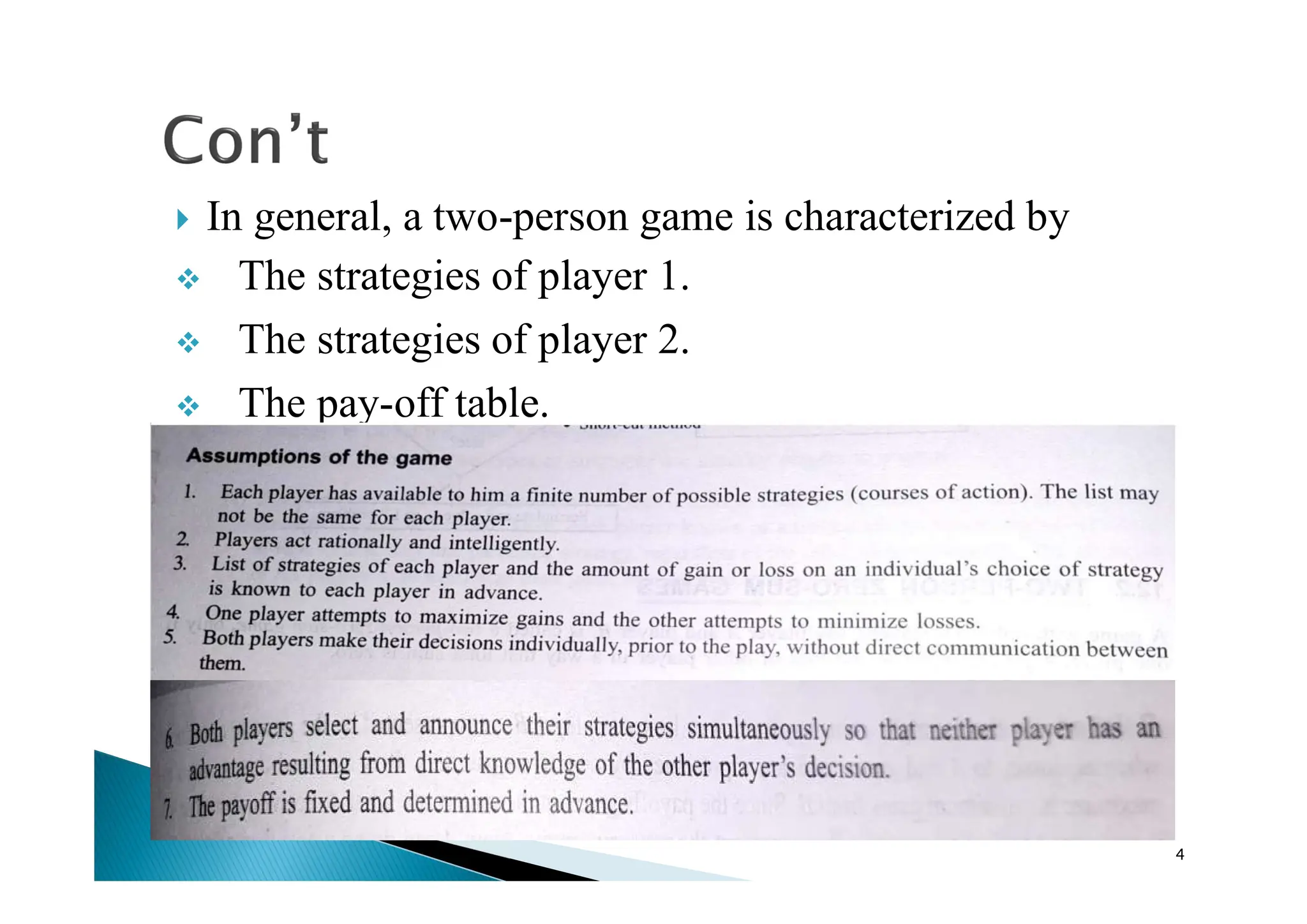
 In general, a two-person game is characterized by
 The strategies of player 1.
 The strategies of player 2.
 The pay-off table.
4
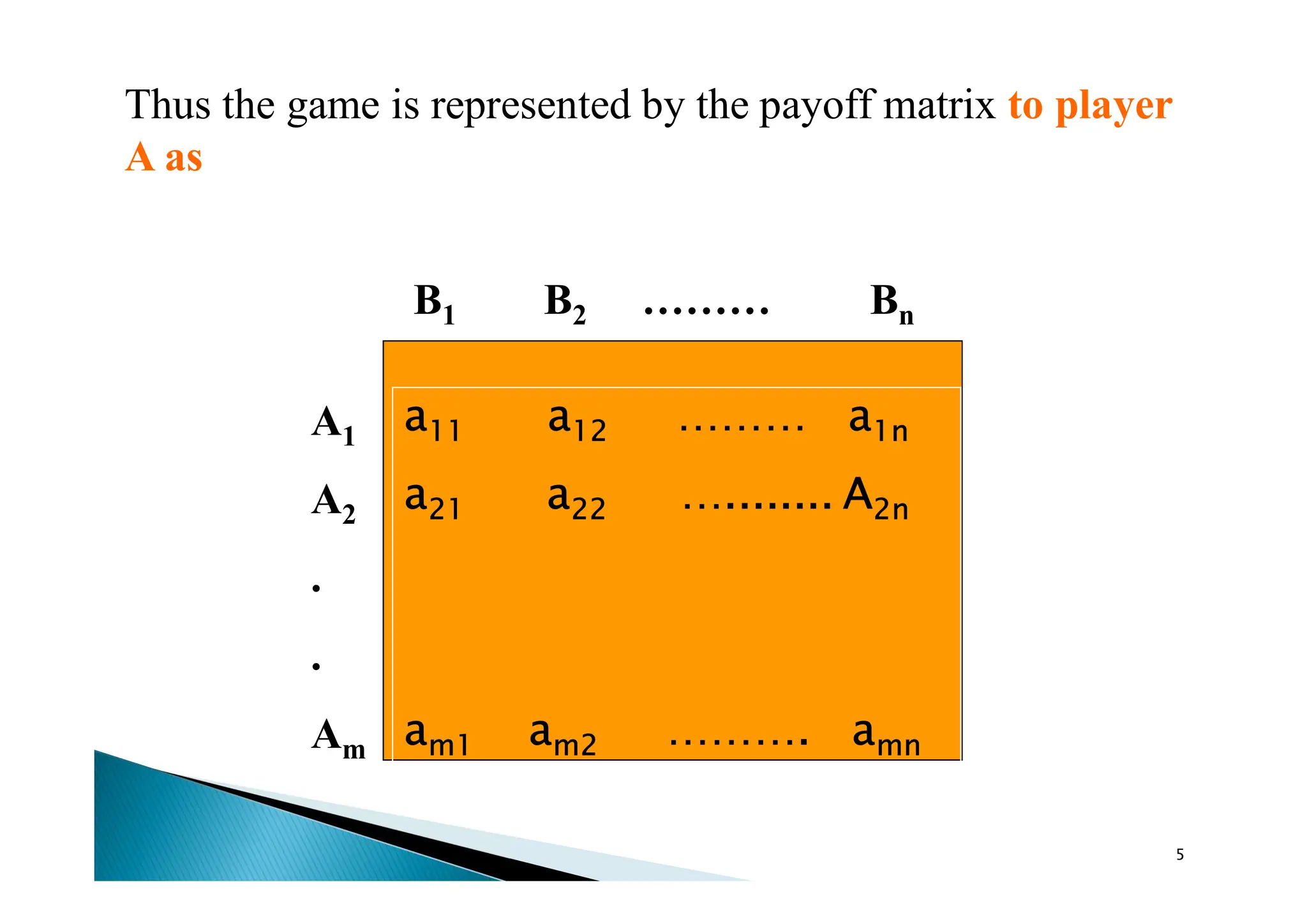
Thus the game is represented by the payoff matrix to player
A as
a11 a12 ……… a1n
a21 a22 …........ A2n
am1 am2 ………. amn
B1 B2 ……… Bn
A1
A2
.
.
Am
5
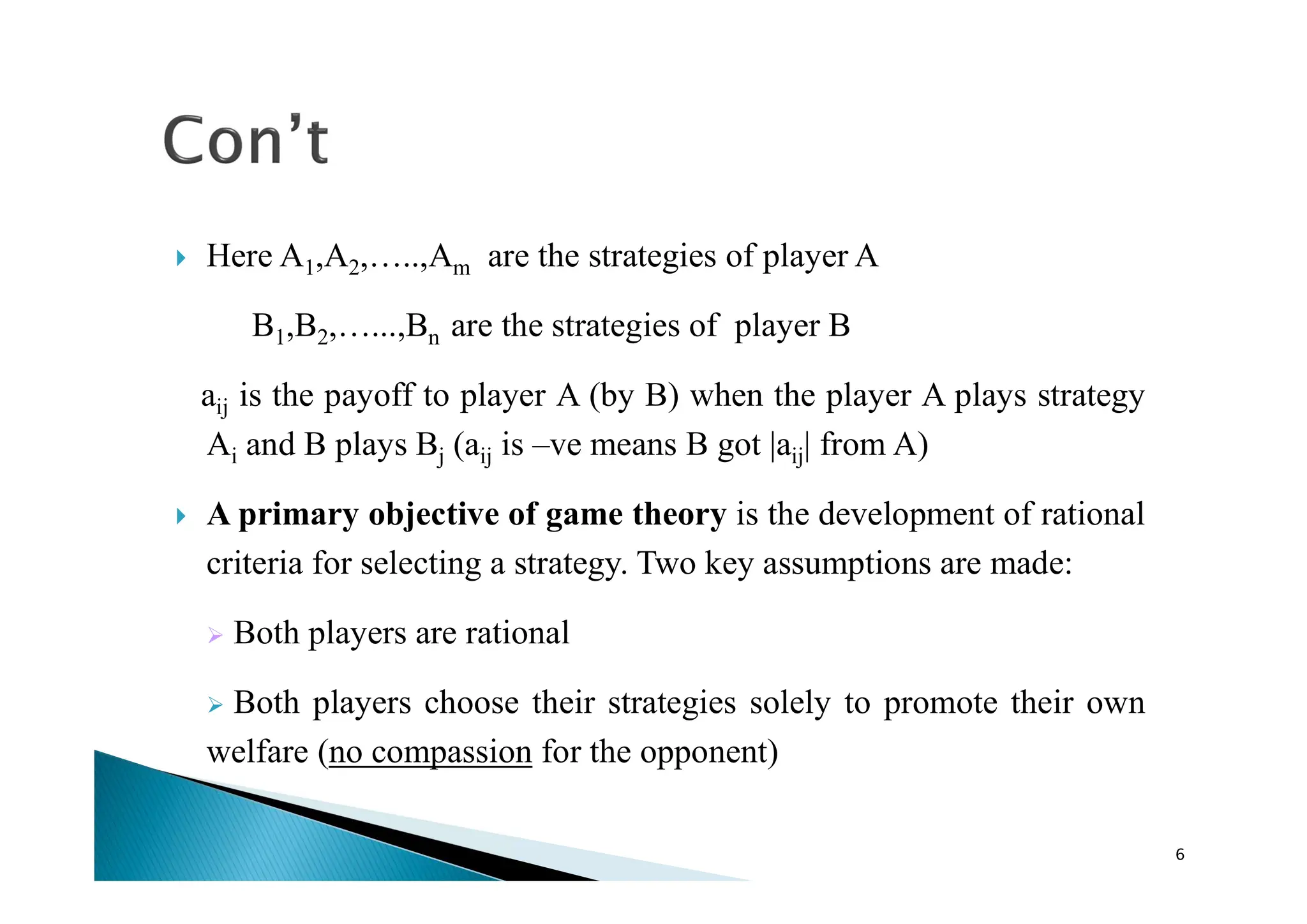
 Here A1,A2,…..,Am are the strategies of player A
B1,B2,…...,Bn are the strategies of player B
aij is the payoff to player A (by B) when the player A plays strategy
Ai and B plays Bj (aij is –ve means B got |aij| from A)
 A primary objective of game theory is the development of rational
criteria for selecting a strategy. Two key assumptions are made:
 Both players are rational
 Both players choose their strategies solely to promote their own
welfare (no compassion for the opponent)
6
7
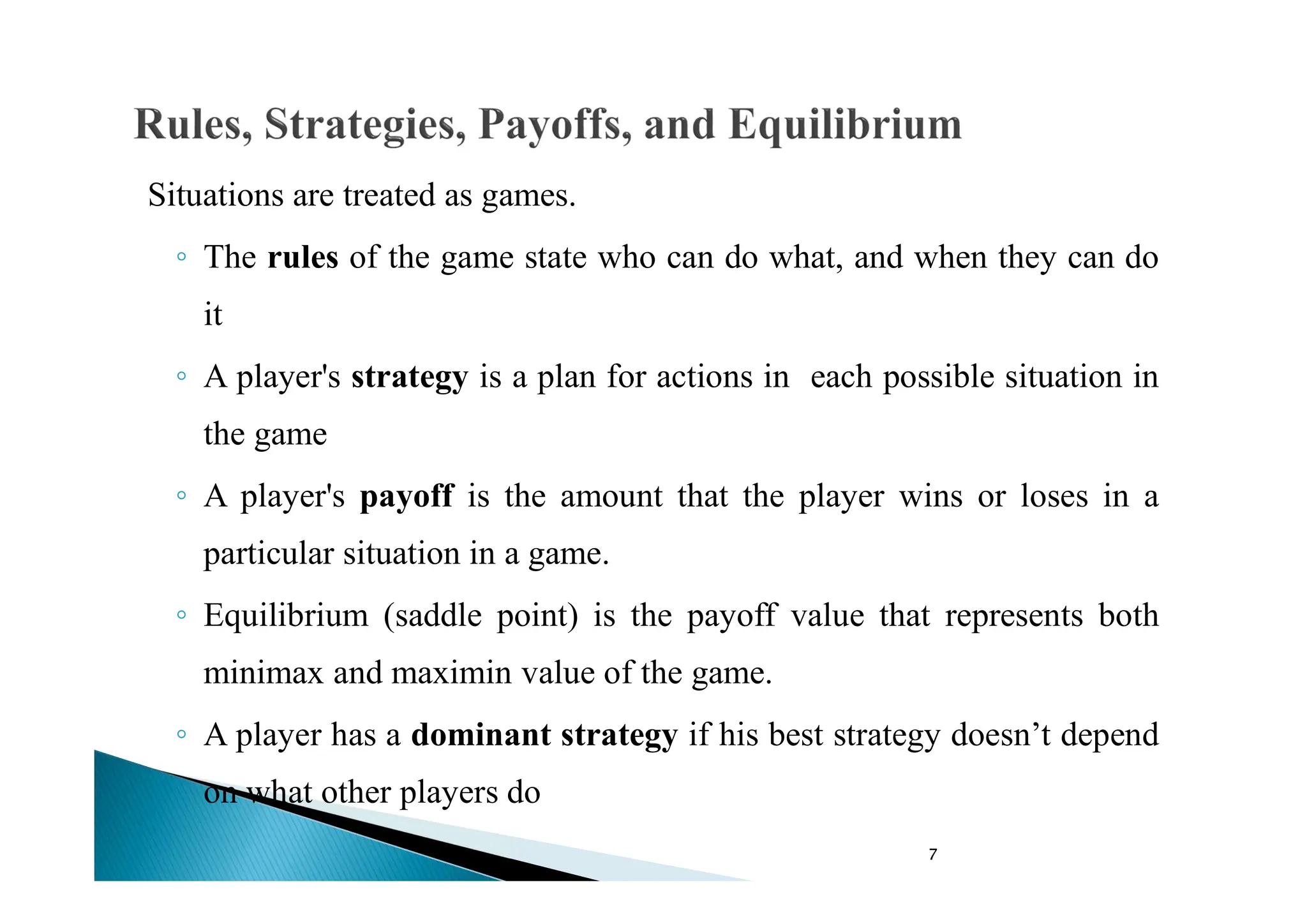
Situations are treated as games.
◦ The rules of the game state who can do what, and when they can do
it
◦ A player's strategy is a plan for actions in each possible situation in
the game
◦ A player's payoff is the amount that the player wins or loses in a
particular situation in a game.
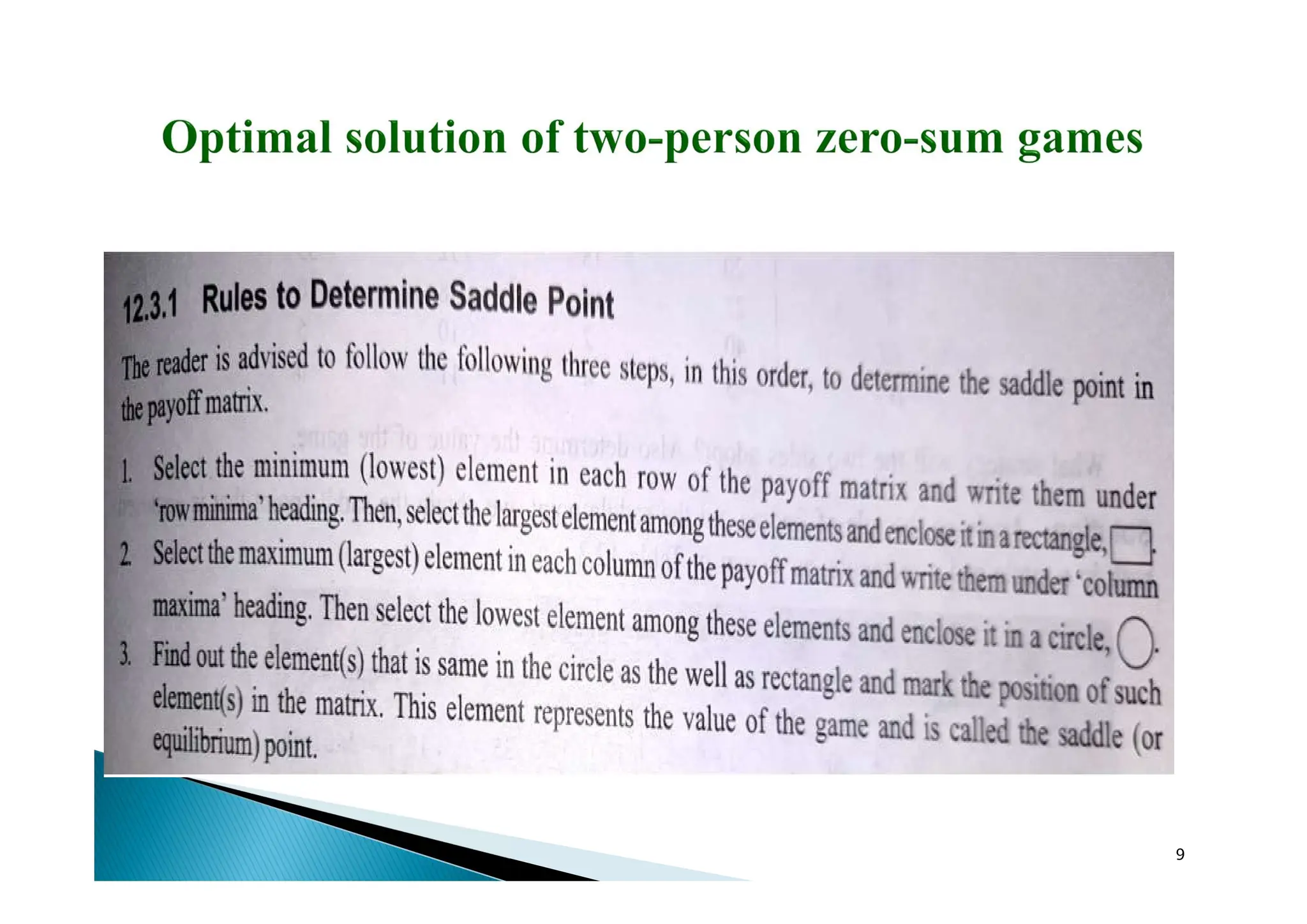
◦ Equilibrium (saddle point) is the payoff value that represents both
minimax and maximin value of the game.
◦ A player has a dominant strategy if his best strategy doesn’t depend
on what other players do
8
9
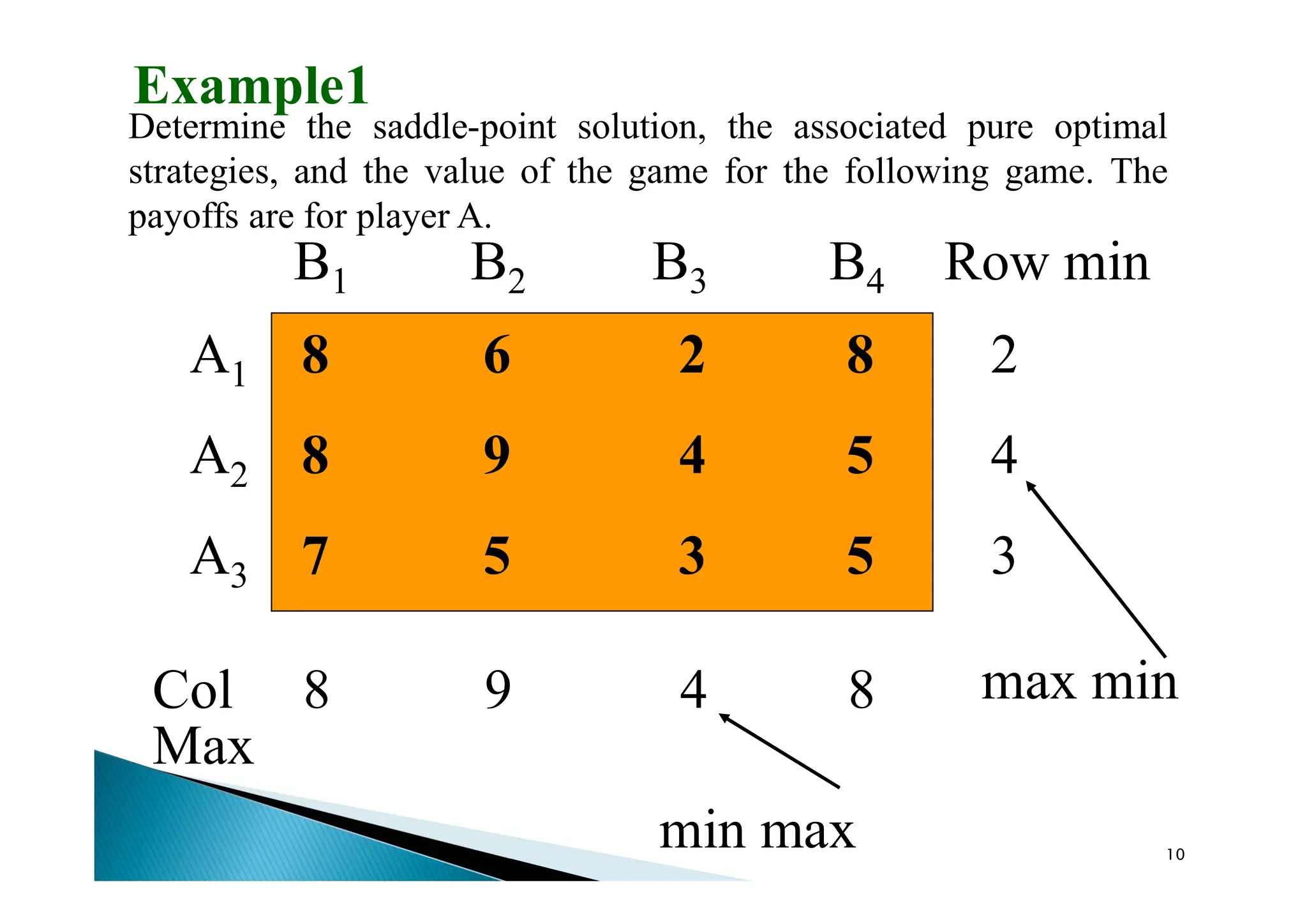
Determine the saddle-point solution, the associated pure optimal
strategies, and the value of the game for the following game. The
payoffs are for player A.
8 6 2 8
8 9 4 5
7 5 3 5
B1 B2 B3 B4
A1
A2
A3
Max
Row min
Col 8 9 4 8
2
4
3
min max
max min
Example1
10
Con’t
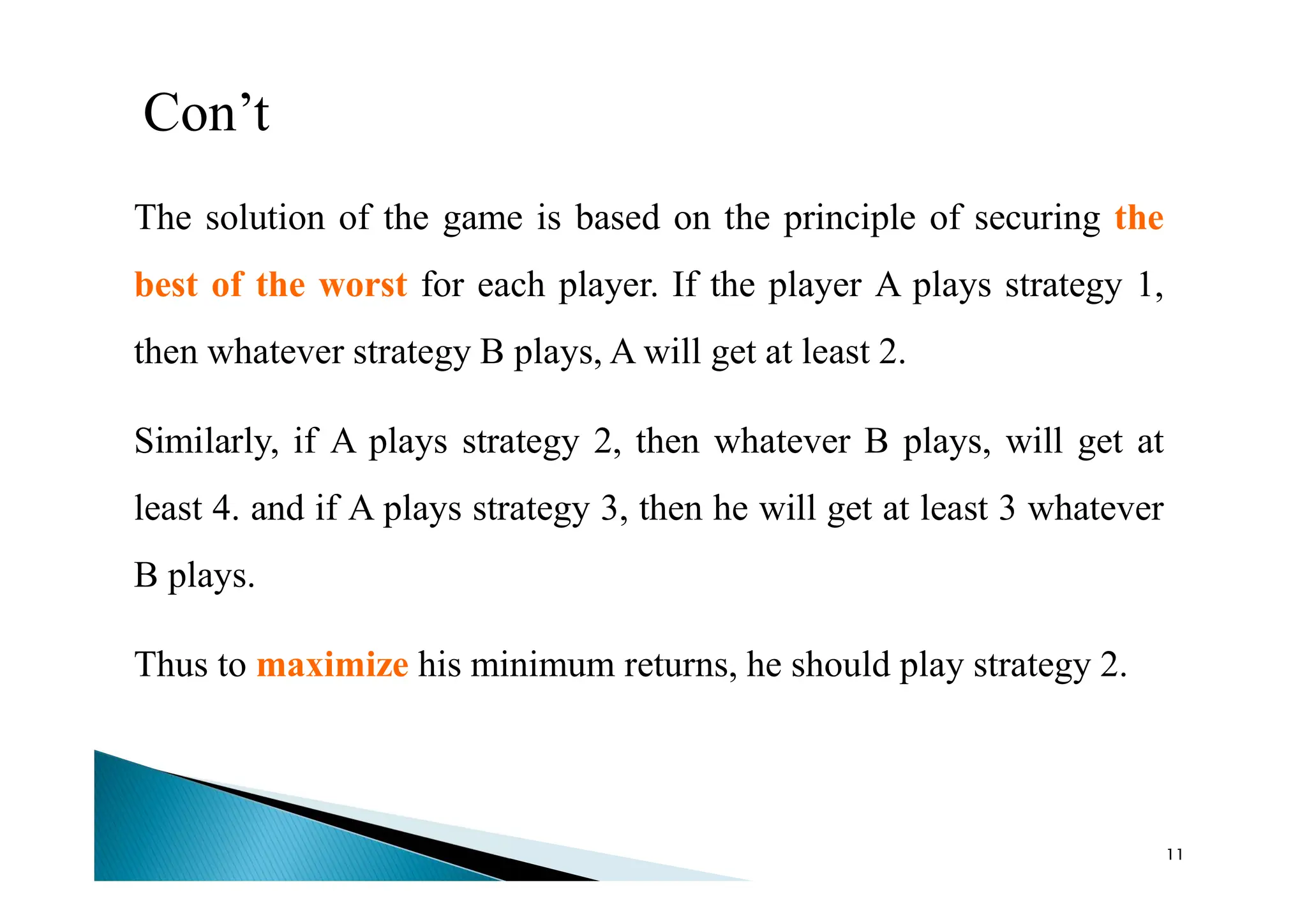
The solution of the game is based on the principle of securing the
best of the worst for each player. If the player A plays strategy 1,
then whatever strategy B plays, A will get at least 2.
Similarly, if A plays strategy 2, then whatever B plays, will get at
least 4. and if A plays strategy 3, then he will get at least 3 whatever
B plays.
Thus to maximize his minimum returns, he should play strategy 2.
11
Con’t
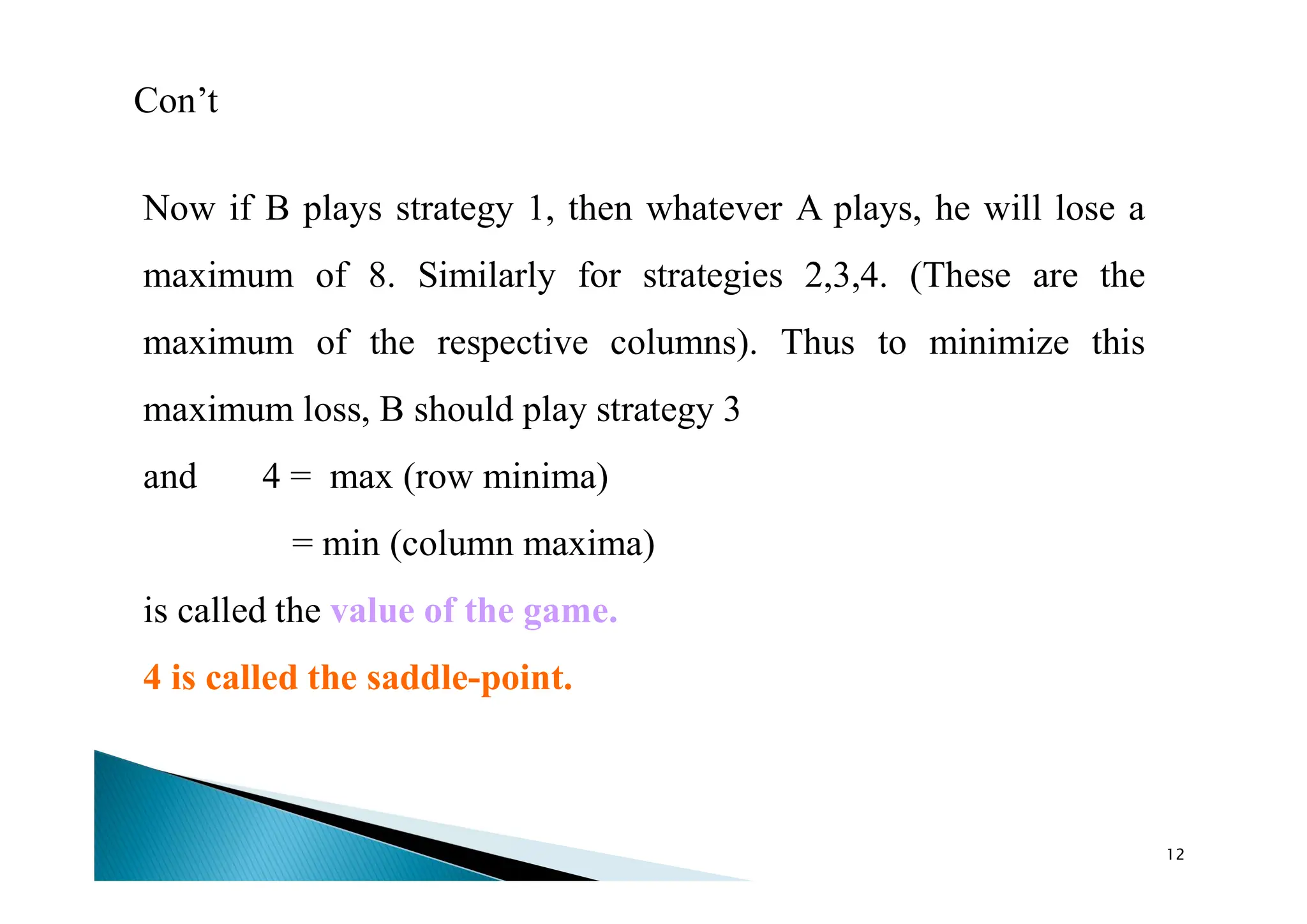
Now if B plays strategy 1, then whatever A plays, he will lose a
maximum of 8. Similarly for strategies 2,3,4. (These are the
maximum of the respective columns). Thus to minimize this
maximum loss, B should play strategy 3
and 4 = max (row minima)
= min (column maxima)
is called the value of the game.
4 is called the saddle-point.
12
13
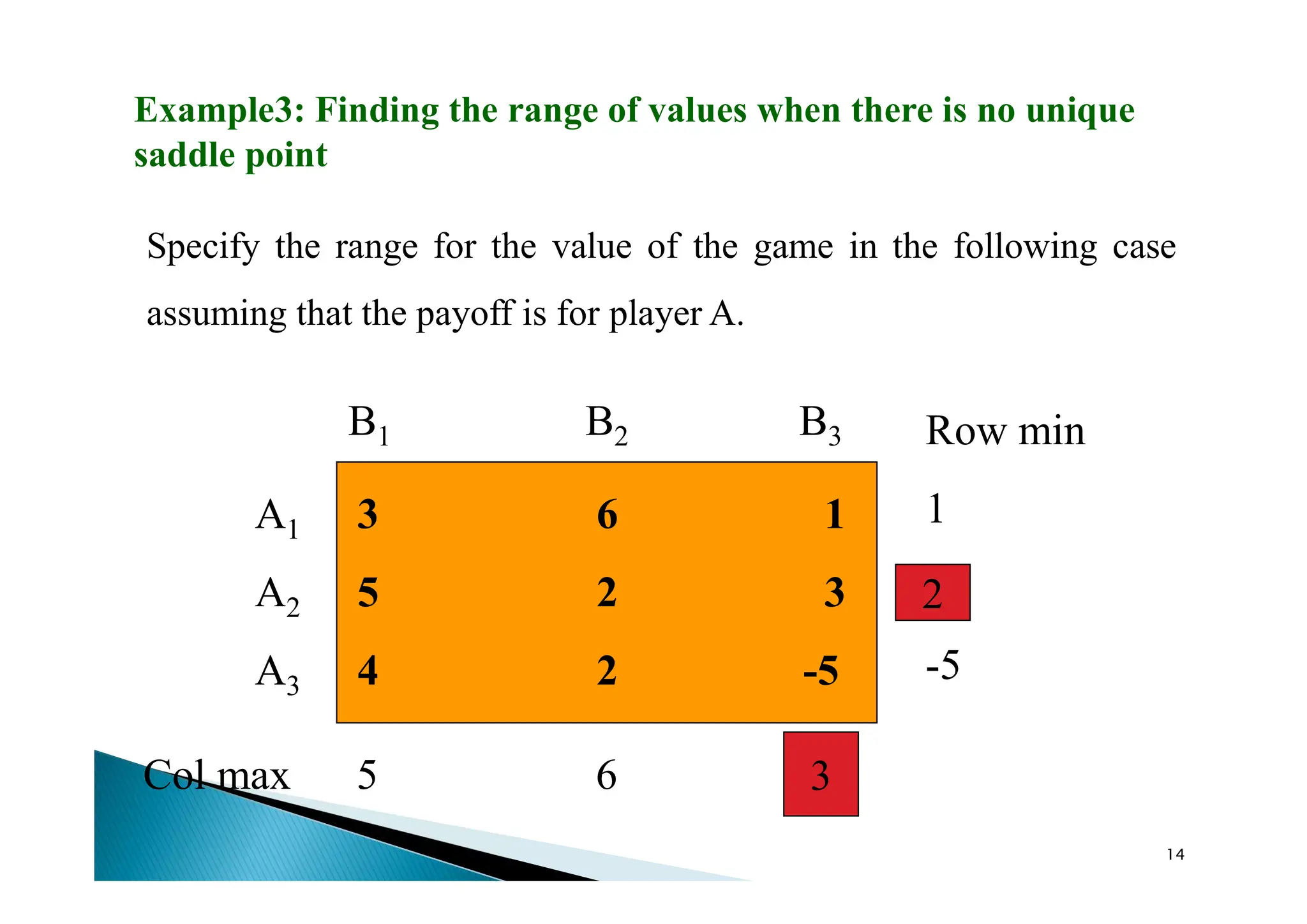
Specify the range for the value of the game in the following case
assuming that the payoff is for player A.
3 6 1
5 2 3
4 2 -5
A1
A2
A3
B1 B2 B3
Col max 5 6
Row min
1
-5
3
2
Example3: Finding the range of values when there is no unique
saddle point
14
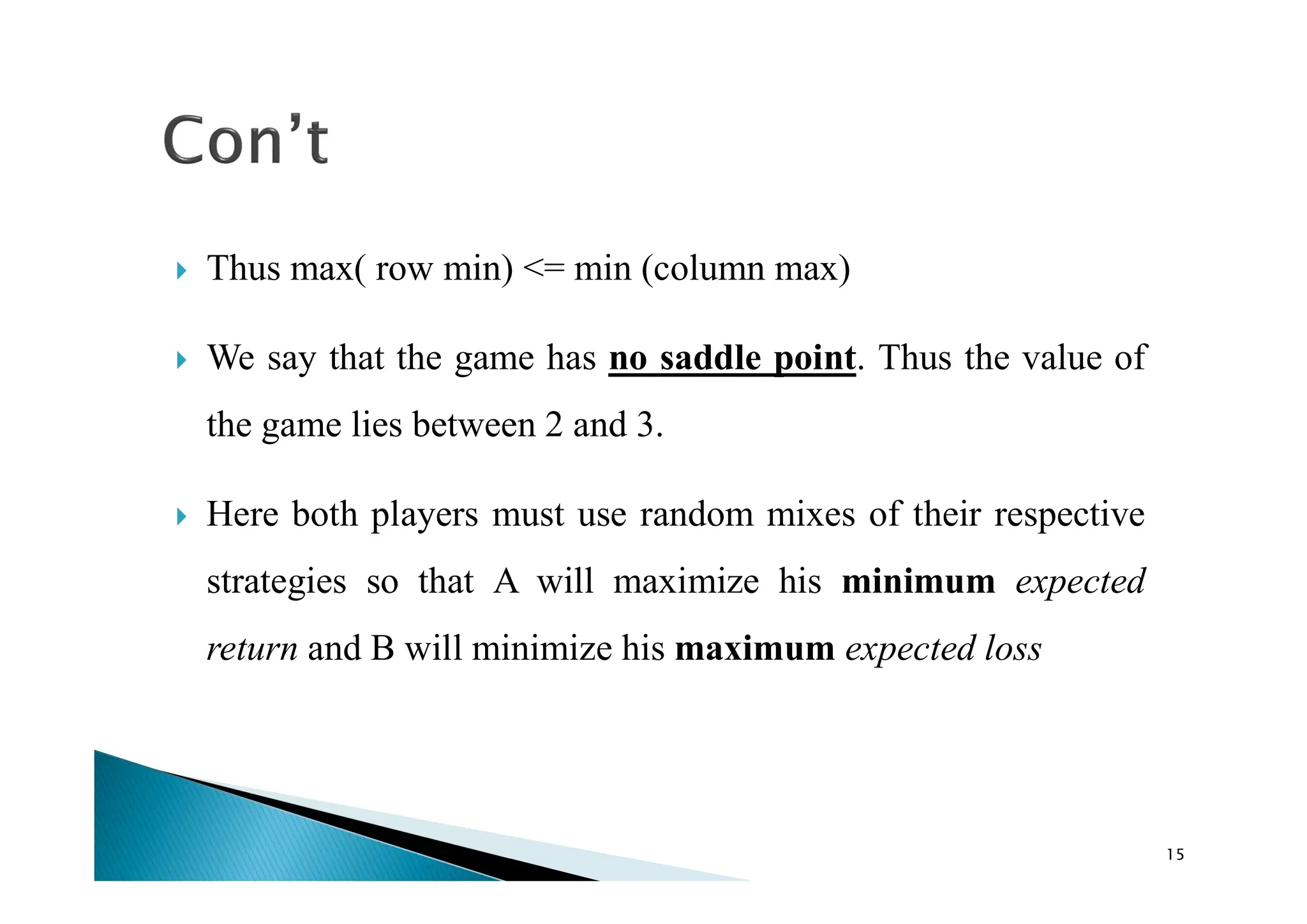
 Thus max( row min) <= min (column max)
 We say that the game has no saddle point. Thus the value of
the game lies between 2 and 3.
 Here both players must use random mixes of their respective
strategies so that A will maximize his minimum expected
return and B will minimize his maximum expected loss
15
 Definition: A strategy S dominates a strategy T if every
outcome in S is at least as good as the corresponding outcome
in T, and at least one outcome in S is strictly better than the
corresponding outcome in T.
 Dominance Principle: A rational player would never play a
dominated strategy.
16

Chapter Six game theory in Operations research .pdf

  • 1.
  • 2.
     Life isfull of conflict and competition. Numerical examples involving in conflict include games, military, political, advertising and marketing by competing business firms and so forth. A basic feature in many of these situations is that the final outcome depends primarily upon the combination of strategies  Game theory is a mathematical theory that deals with the general features of competitive situations in a formal, abstract way. It places particular emphasis on the decision-making processes. 2
  • 3.
     Research ongame theory continues to deal with complicated types of competitive situations. However, we shall be dealing only with the simplest case, called two-person, zero sum games.  As the name implies, these games involve only two players. They are called zero-sum games because one player wins whatever the other one loses, so that the sum of their net winnings is zero. 3
  • 4.
     In general,a two-person game is characterized by  The strategies of player 1.  The strategies of player 2.  The pay-off table. 4
  • 5.
    Thus the gameis represented by the payoff matrix to player A as a11 a12 ……… a1n a21 a22 …........ A2n am1 am2 ………. amn B1 B2 ……… Bn A1 A2 . . Am 5
  • 6.
     Here A1,A2,…..,Amare the strategies of player A B1,B2,…...,Bn are the strategies of player B aij is the payoff to player A (by B) when the player A plays strategy Ai and B plays Bj (aij is –ve means B got |aij| from A)  A primary objective of game theory is the development of rational criteria for selecting a strategy. Two key assumptions are made:  Both players are rational  Both players choose their strategies solely to promote their own welfare (no compassion for the opponent) 6
  • 7.
    7 Situations are treatedas games. ◦ The rules of the game state who can do what, and when they can do it ◦ A player's strategy is a plan for actions in each possible situation in the game ◦ A player's payoff is the amount that the player wins or loses in a particular situation in a game. ◦ Equilibrium (saddle point) is the payoff value that represents both minimax and maximin value of the game. ◦ A player has a dominant strategy if his best strategy doesn’t depend on what other players do
  • 8.
  • 9.
  • 10.
    Determine the saddle-pointsolution, the associated pure optimal strategies, and the value of the game for the following game. The payoffs are for player A. 8 6 2 8 8 9 4 5 7 5 3 5 B1 B2 B3 B4 A1 A2 A3 Max Row min Col 8 9 4 8 2 4 3 min max max min Example1 10
  • 11.
    Con’t The solution ofthe game is based on the principle of securing the best of the worst for each player. If the player A plays strategy 1, then whatever strategy B plays, A will get at least 2. Similarly, if A plays strategy 2, then whatever B plays, will get at least 4. and if A plays strategy 3, then he will get at least 3 whatever B plays. Thus to maximize his minimum returns, he should play strategy 2. 11
  • 12.
    Con’t Now if Bplays strategy 1, then whatever A plays, he will lose a maximum of 8. Similarly for strategies 2,3,4. (These are the maximum of the respective columns). Thus to minimize this maximum loss, B should play strategy 3 and 4 = max (row minima) = min (column maxima) is called the value of the game. 4 is called the saddle-point. 12
  • 13.
  • 14.
    Specify the rangefor the value of the game in the following case assuming that the payoff is for player A. 3 6 1 5 2 3 4 2 -5 A1 A2 A3 B1 B2 B3 Col max 5 6 Row min 1 -5 3 2 Example3: Finding the range of values when there is no unique saddle point 14
  • 15.
     Thus max(row min) <= min (column max)  We say that the game has no saddle point. Thus the value of the game lies between 2 and 3.  Here both players must use random mixes of their respective strategies so that A will maximize his minimum expected return and B will minimize his maximum expected loss 15
  • 16.
     Definition: Astrategy S dominates a strategy T if every outcome in S is at least as good as the corresponding outcome in T, and at least one outcome in S is strictly better than the corresponding outcome in T.  Dominance Principle: A rational player would never play a dominated strategy. 16