© Cengage Learning 2015
Understanding Food Principles and Preparation • Fifth Edition
AMY BROWN
© Cengage Learning 2015
Meat
7
© Cengage Learning 2015
• Beef
– Steers, bulls (rarely used), heifers and cows,
and calves (baby beef, over three months old)
• Veal
– Calves (three weeks to three months)
• Lamb and mutton (sheep)
• Pork (pigs)
Types of Meats
© Cengage Learning 2015
• Structure of meats
– Water
– Muscle
• Main source of meat
• Most protein in animals is in muscle
– Connective tissue
• Collagen and elastin
– Adipose (fatty) tissue
• Cover fat vs. intramuscular (marbling) fat
– Bone
Composition of Meats
© Cengage Learning 2015
Composition of Meats (cont’d.)
© Cengage Learning 2015
Composition of Meats (cont’d.)
© Cengage Learning 2015
• Antibiotics
– Given to ensure health and promote growth
– May contribute to antibiotic-resistant bacteria
development
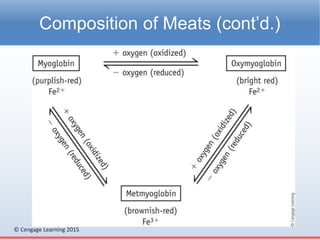
• Pigments
• Extractives
Composition of Meats (cont’d.)
© Cengage Learning 2015
Composition of Meats (cont’d.)
© Cengage Learning 2015
• Inspection
– USDA Food Safety and Inspection Service
– Only guarantees wholesomeness, not quality
or tenderness
– Inspections of meat transported across state
lines or brought into the U.S. from a foreign
country
Purchasing Meats
© Cengage Learning 2015
• Grading
– USDA contracted to grade meat
– Voluntary program
– Quality grade
• Color, grain, surface texture, fat distribution
– Yield grade
Purchasing Meats (cont’d.)
© Cengage Learning 2015
Purchasing Meats (cont’d.)
© Cengage Learning 2015
Purchasing Meats (cont’d.)
© Cengage Learning 2015
Purchasing Meats (cont’d.)
© Cengage Learning 2015
• Tenderness of meats
– Cut
– Animal’s age
– Heredity
– Diet
– Marbling
– Rigor mortis
Purchasing Meats (cont’d.)
© Cengage Learning 2015
• Slaughterhouse conditions
– Dark-cutting meat
– PSE condition
– Thaw rigor
– Cold shortening
– Green meat
Purchasing Meats (cont’d.)
© Cengage Learning 2015
• Aging meat to increase tenderness
– Dry aging
– Fast or wet aging
– Vacuum-packed aging
• Artificial tenderizing
– Enzymes, salts, and acids
– Mechanical tenderization
– Electrical stimulation
Purchasing Meats (cont’d.)
© Cengage Learning 2015
Purchasing Meats (cont’d.)
© Cengage Learning 2015
Purchasing Meats (cont’d.)
© Cengage Learning 2015
Purchasing Meats (cont’d.)
© Cengage Learning 2015
Purchasing Meats (cont’d.)
© Cengage Learning 2015
Purchasing Meats (cont’d.)
© Cengage Learning 2015
• Processing methods
– Curing
– Smoking
– Canning
– Drying
• Additives
Purchasing Meats (cont’d.)
© Cengage Learning 2015
Purchasing Meats (cont’d.)
© Cengage Learning 2015
• Changes during heating
– Tenderness and juiciness
– Searing
– Flavor changes
– Flavor enhancements
Preparation of Meats
© Cengage Learning 2015
• Determining doneness
– Internal temperature
– Time/weight charts
– Color changes (rare, medium, well done)
– Touch
Preparation of Meats (cont’d.)
© Cengage Learning 2015
• Dry heat preparation
– Roasting
– Broiling and grilling
– Pan-broiling
– Frying
– Sautéing
– Pan-frying
– Deep-frying
Preparation of Meats (cont’d.)
© Cengage Learning 2015
• Moist heat preparation
– Braising
– Simmering or stewing
– Steaming
– Microwaving
Preparation of Meats (cont’d.)
© Cengage Learning 2015
Purchasing Meats (cont’d.)
© Cengage Learning 2015
• Refrigeration
– Best refrigerated between 32° and 36° F
– Wrapping guidelines
• Store wrapping for two days; after that, replace
wrapping
– Cook within 3-5 days for regular meats, and
1-2 days for variety meats
Storage of Meats
© Cengage Learning 2015
• Types of packaging
– Polystyrene tray
– Fas-flushed tray
– Vacuum packaging
Storage of Meats (cont’d.)
© Cengage Learning 2015
• Freezing
– Wrap with aluminum foil, heavy plastic, or
freezer paper
– Keep at 0° F or below
• How long can you keep meat frozen?
– Most meats for 6-12 months
– No longer than 3 months for ground beef
Storage of Meats (cont’d.)
© Cengage Learning 2015
Storage of Meats (cont’d.)
© Cengage Learning 2015
• Types of meats
– Beef, veal, lamb, pork
• Important aspects of meat preparation
– Composition
– Purchasing criteria
• Meat inspection
– Preparation techniques
– Storage techniques
Chapter Summary

Chapter 7 - Meat

  • 1.
    © Cengage Learning2015 Understanding Food Principles and Preparation • Fifth Edition AMY BROWN © Cengage Learning 2015 Meat 7
  • 2.
    © Cengage Learning2015 • Beef – Steers, bulls (rarely used), heifers and cows, and calves (baby beef, over three months old) • Veal – Calves (three weeks to three months) • Lamb and mutton (sheep) • Pork (pigs) Types of Meats
  • 3.
    © Cengage Learning2015 • Structure of meats – Water – Muscle • Main source of meat • Most protein in animals is in muscle – Connective tissue • Collagen and elastin – Adipose (fatty) tissue • Cover fat vs. intramuscular (marbling) fat – Bone Composition of Meats
  • 4.
    © Cengage Learning2015 Composition of Meats (cont’d.)
  • 5.
    © Cengage Learning2015 Composition of Meats (cont’d.)
  • 6.
    © Cengage Learning2015 • Antibiotics – Given to ensure health and promote growth – May contribute to antibiotic-resistant bacteria development • Pigments • Extractives Composition of Meats (cont’d.)
  • 7.
    © Cengage Learning2015 Composition of Meats (cont’d.)
  • 8.
    © Cengage Learning2015 • Inspection – USDA Food Safety and Inspection Service – Only guarantees wholesomeness, not quality or tenderness – Inspections of meat transported across state lines or brought into the U.S. from a foreign country Purchasing Meats
  • 9.
    © Cengage Learning2015 • Grading – USDA contracted to grade meat – Voluntary program – Quality grade • Color, grain, surface texture, fat distribution – Yield grade Purchasing Meats (cont’d.)
  • 10.
    © Cengage Learning2015 Purchasing Meats (cont’d.)
  • 11.
    © Cengage Learning2015 Purchasing Meats (cont’d.)
  • 12.
    © Cengage Learning2015 Purchasing Meats (cont’d.)
  • 13.
    © Cengage Learning2015 • Tenderness of meats – Cut – Animal’s age – Heredity – Diet – Marbling – Rigor mortis Purchasing Meats (cont’d.)
  • 14.
    © Cengage Learning2015 • Slaughterhouse conditions – Dark-cutting meat – PSE condition – Thaw rigor – Cold shortening – Green meat Purchasing Meats (cont’d.)
  • 15.
    © Cengage Learning2015 • Aging meat to increase tenderness – Dry aging – Fast or wet aging – Vacuum-packed aging • Artificial tenderizing – Enzymes, salts, and acids – Mechanical tenderization – Electrical stimulation Purchasing Meats (cont’d.)
  • 16.
    © Cengage Learning2015 Purchasing Meats (cont’d.)
  • 17.
    © Cengage Learning2015 Purchasing Meats (cont’d.)
  • 18.
    © Cengage Learning2015 Purchasing Meats (cont’d.)
  • 19.
    © Cengage Learning2015 Purchasing Meats (cont’d.)
  • 20.
    © Cengage Learning2015 Purchasing Meats (cont’d.)
  • 21.
    © Cengage Learning2015 • Processing methods – Curing – Smoking – Canning – Drying • Additives Purchasing Meats (cont’d.)
  • 22.
    © Cengage Learning2015 Purchasing Meats (cont’d.)
  • 23.
    © Cengage Learning2015 • Changes during heating – Tenderness and juiciness – Searing – Flavor changes – Flavor enhancements Preparation of Meats
  • 24.
    © Cengage Learning2015 • Determining doneness – Internal temperature – Time/weight charts – Color changes (rare, medium, well done) – Touch Preparation of Meats (cont’d.)
  • 25.
    © Cengage Learning2015 • Dry heat preparation – Roasting – Broiling and grilling – Pan-broiling – Frying – Sautéing – Pan-frying – Deep-frying Preparation of Meats (cont’d.)
  • 26.
    © Cengage Learning2015 • Moist heat preparation – Braising – Simmering or stewing – Steaming – Microwaving Preparation of Meats (cont’d.)
  • 27.
    © Cengage Learning2015 Purchasing Meats (cont’d.)
  • 28.
    © Cengage Learning2015 • Refrigeration – Best refrigerated between 32° and 36° F – Wrapping guidelines • Store wrapping for two days; after that, replace wrapping – Cook within 3-5 days for regular meats, and 1-2 days for variety meats Storage of Meats
  • 29.
    © Cengage Learning2015 • Types of packaging – Polystyrene tray – Fas-flushed tray – Vacuum packaging Storage of Meats (cont’d.)
  • 30.
    © Cengage Learning2015 • Freezing – Wrap with aluminum foil, heavy plastic, or freezer paper – Keep at 0° F or below • How long can you keep meat frozen? – Most meats for 6-12 months – No longer than 3 months for ground beef Storage of Meats (cont’d.)
  • 31.
    © Cengage Learning2015 Storage of Meats (cont’d.)
  • 32.
    © Cengage Learning2015 • Types of meats – Beef, veal, lamb, pork • Important aspects of meat preparation – Composition – Purchasing criteria • Meat inspection – Preparation techniques – Storage techniques Chapter Summary

Editor's Notes

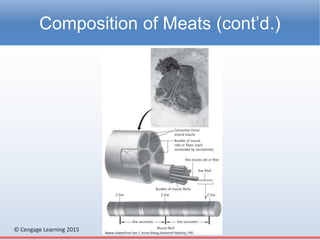
  • #5 Figure 7-1. Muscles are composed of bundles of muscle cells (fibers). Each of these muscle cells (fibers) is a bundle of fibrils. The individual fibrils are responsible for muscle contraction and relaxation.
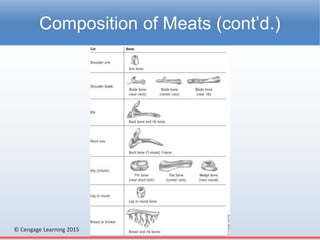
  • #6 Figure 7-5. Bones identify retail cuts of meat.
  • #8 Figure 7-6. Color changes in meats.
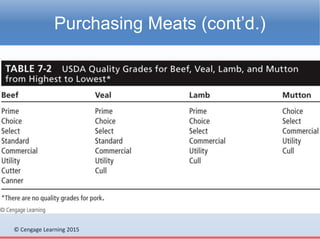
  • #11 Table 7-2. USDA Quality Grades for Beef, Veal, Lamb, and Mutton from Highest to Lowest
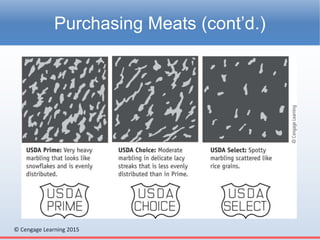
  • #12 Figure 7-8. USDA grades related to marbling.
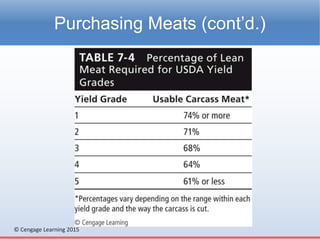
  • #13 Table 7-4. Percentage of Lean Meat Required for USDA Yield Grades
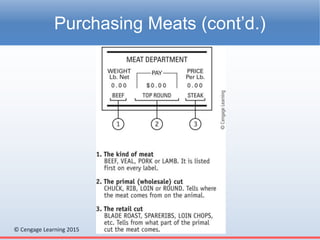
  • #17 Figure 7-11. Meat labeling.
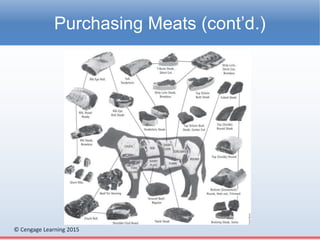
  • #18 Figure 7-12. Wholesale and retail cuts of beef.
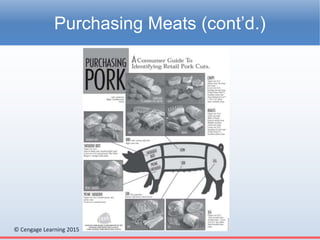
  • #19 Figure 7-13. Wholesale cuts of pork.
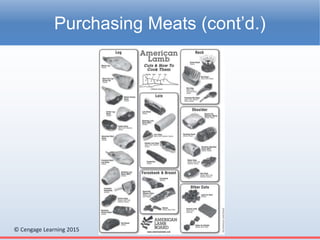
  • #20 Figure 7-14. Wholesale cuts of lamb.
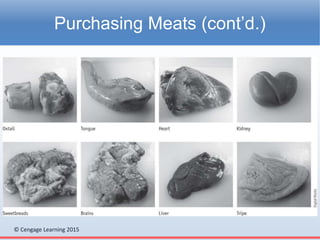
  • #21 Figure 7-15. Variety meats.
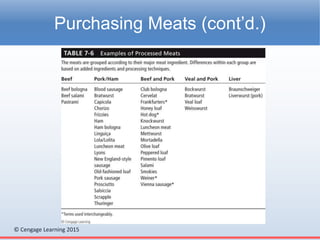
  • #23 Table 7-6. Examples of Processed Meats
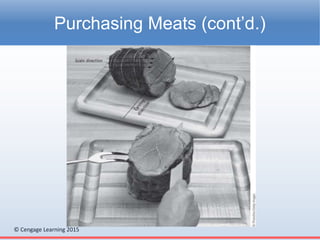
  • #28 Figure 7-24. Carving across the grain.
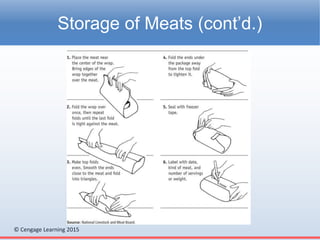
  • #32 Figure 7-25. Wrapping meat for freezing (apothecary or drugstore method).