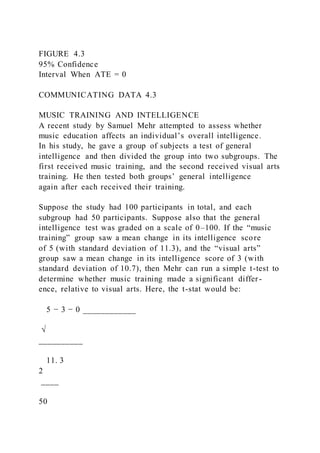
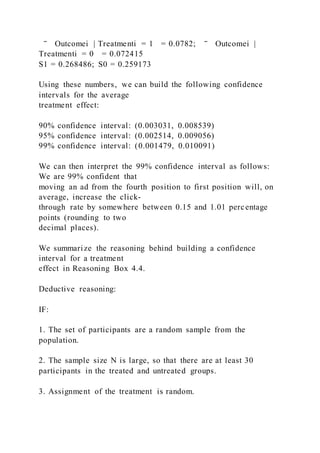
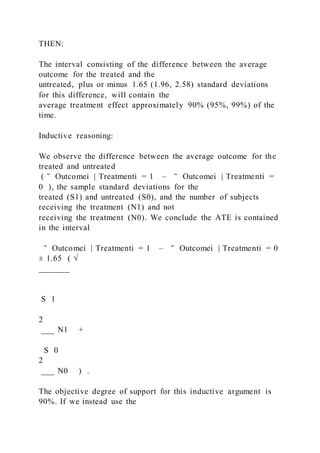
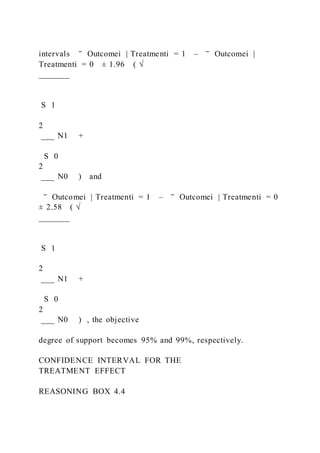
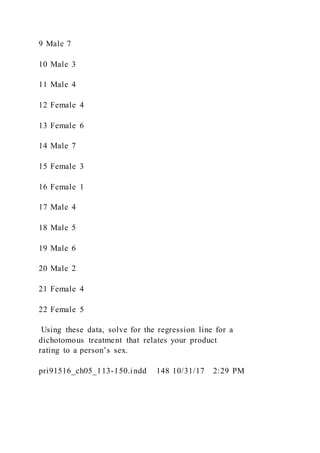
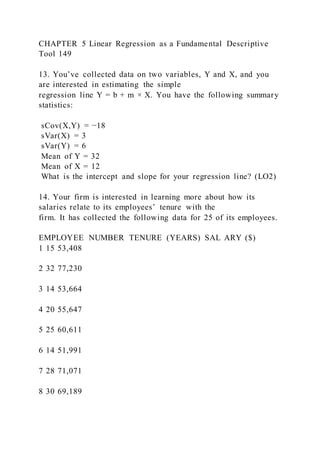
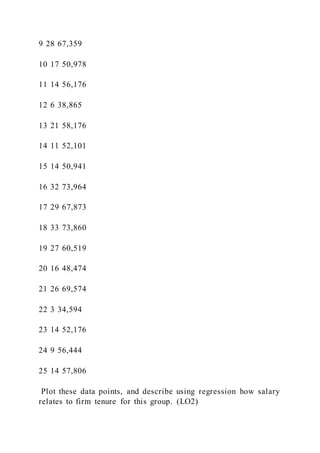
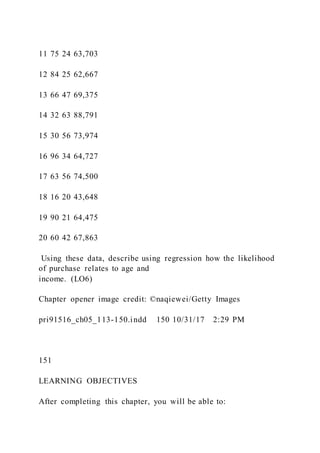
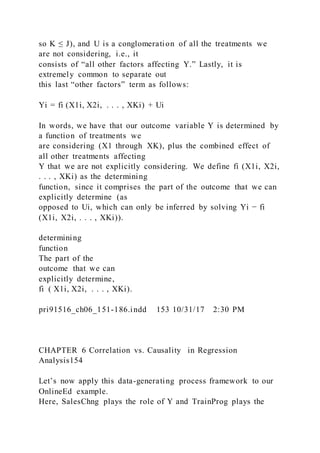
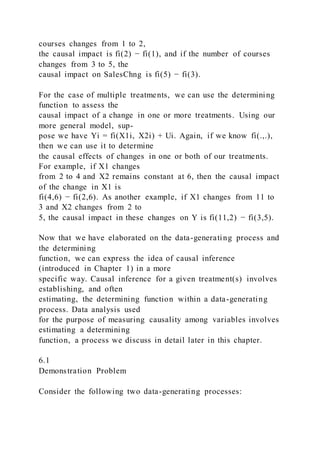
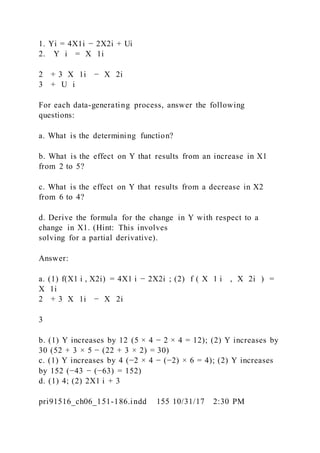
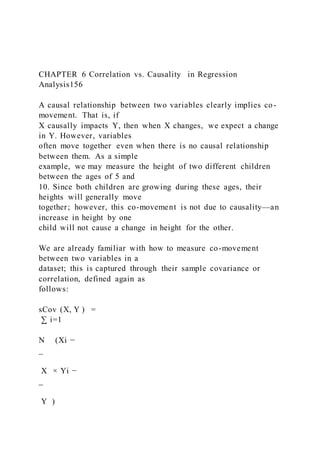
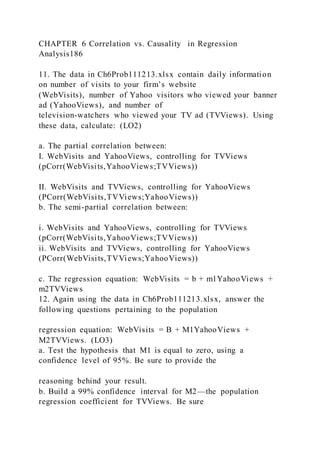
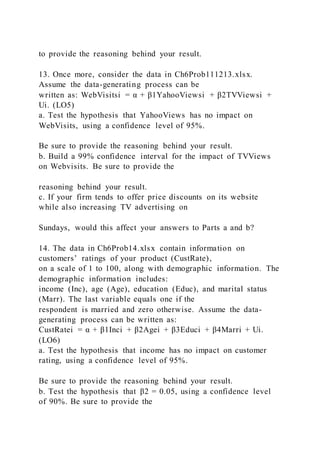
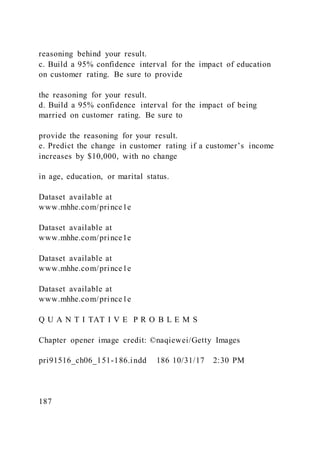
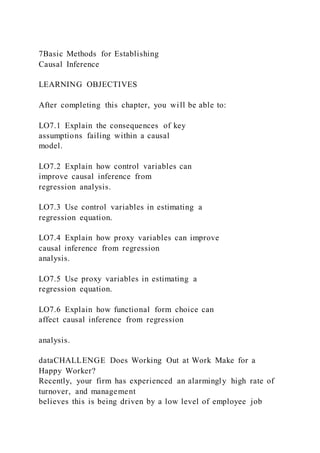
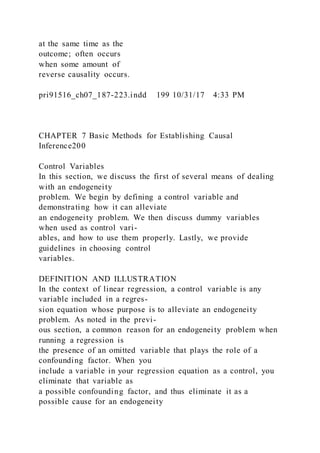
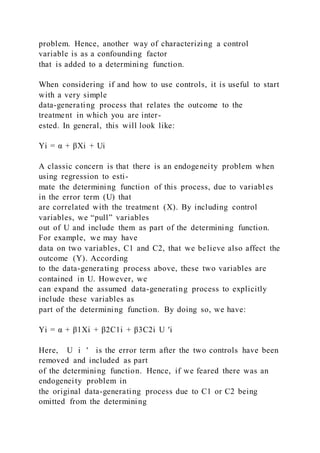
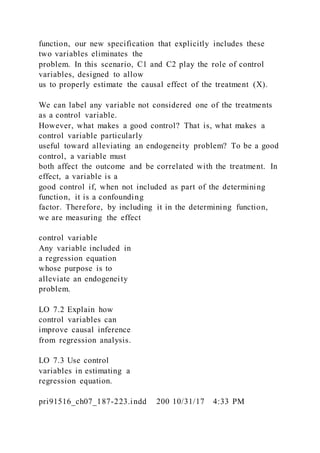
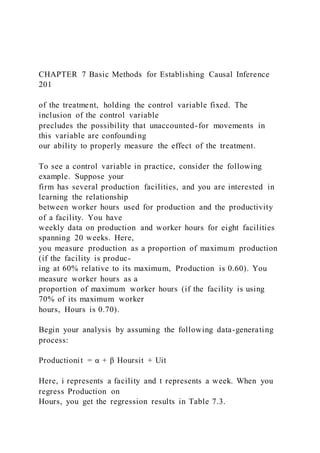
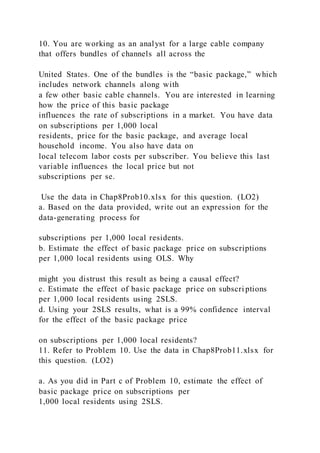
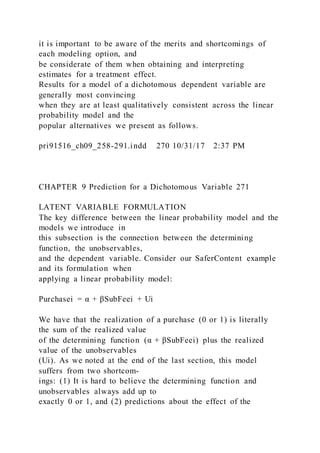
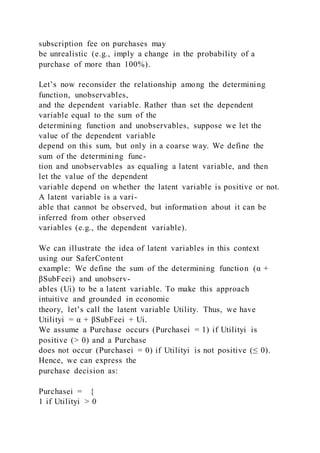
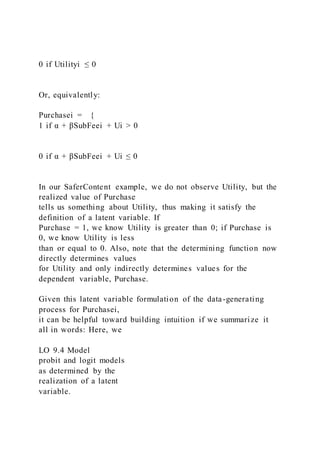
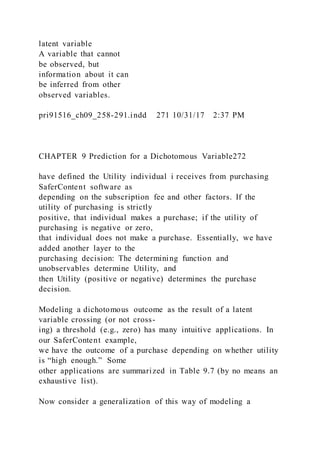
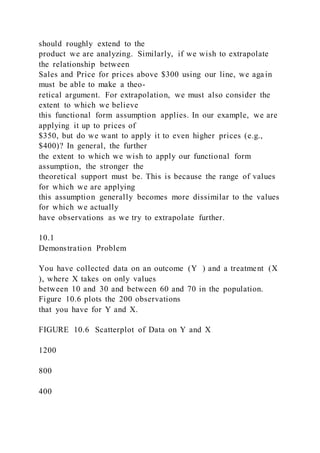
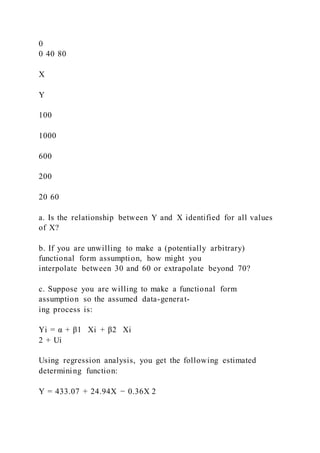
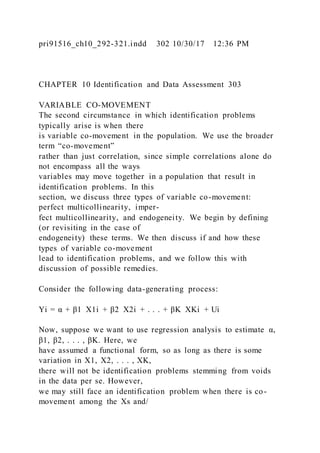
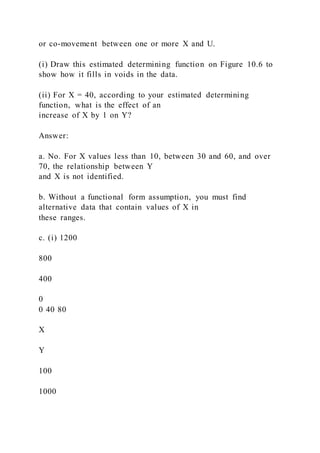
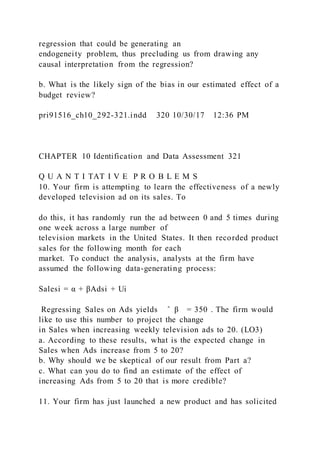
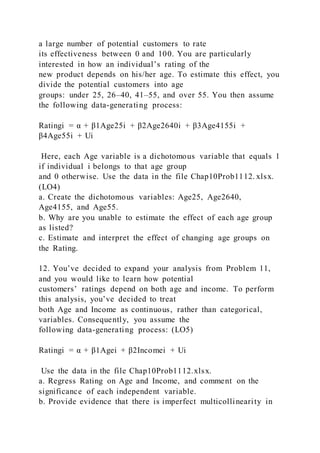
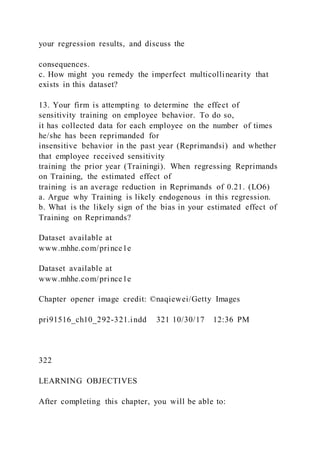
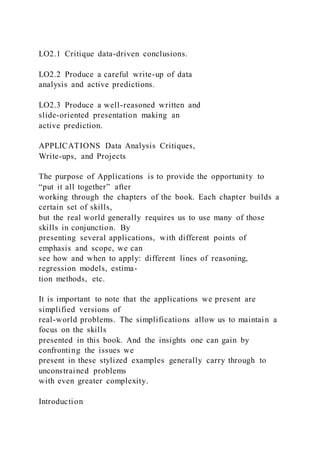
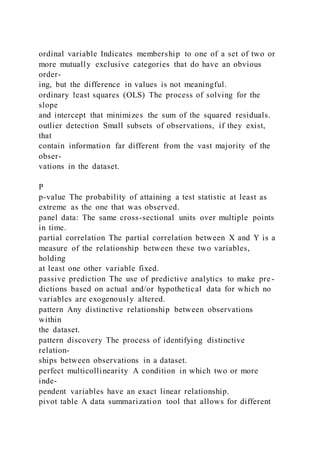
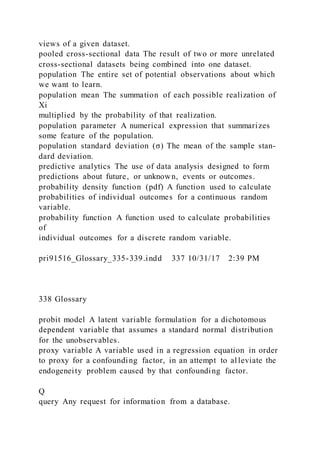
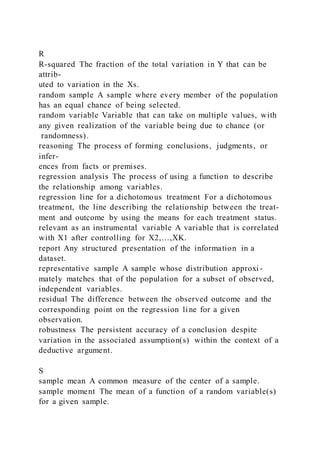
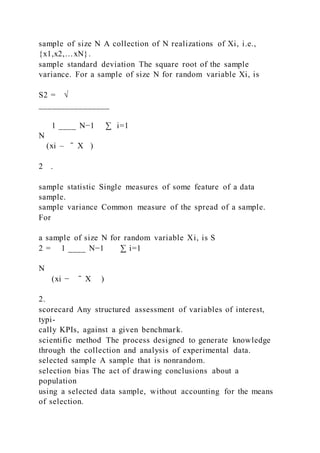
Chapter 7. Basic Methods for Establishing Causal Inference
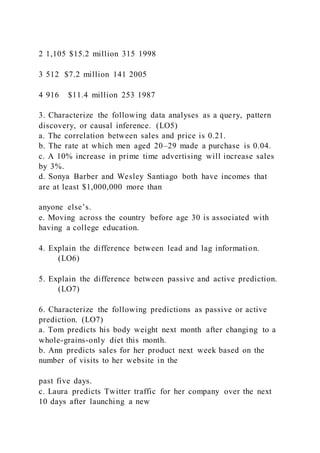
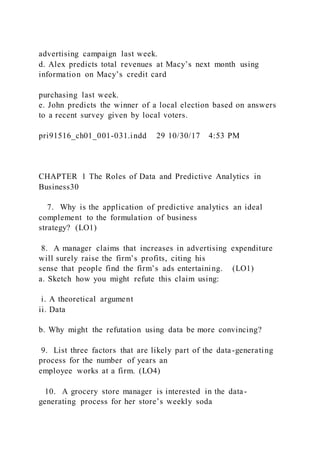
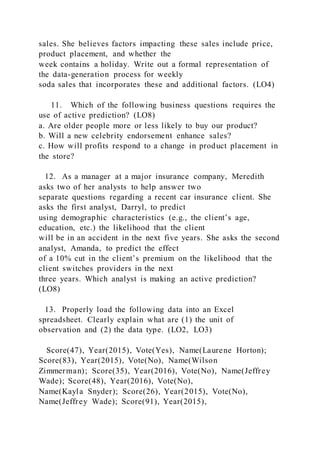
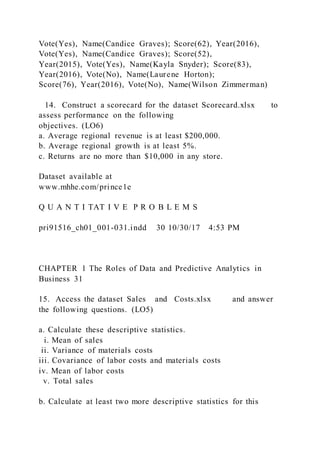
(Textbook attached)
In Chapter 7, there is a discussion about irrelevant variables &
proxy variables. Discuss each type of variable and give an
application of both. Please address each component of the
discussion board. Also, cite examples according to APA
standards. Minimum 450+ words
Sample Letter to Elected Officials
Sample Letter to Representative or Senator
Date
Your Name
Your Address
Your City, State, Zipcode
Your E-mail
Your Phone Number
The Honorable_________________________
House of Representatives or United States Senate
Office Address of Representative or Senator
Dear Representative/Senator ____________________,
(In your first paragraph include personal information) I am very
fortunate to have
been provided with an excellent education that prepared me for
the future. I currently
have children in both elementary and middle school. Recently, I
have become very
concerned about legislative impact on education. As a parent
yourself, I am sure that you
share many of these concerns.
(Include facts) Research has shown that schools with strong
school library media
programs have better rates of success. For example, in Alaska it
was found that schools
with a full time librarian scored higher on standardized tests
than schools with only part
time librarians. These schools were able to have longer hours of
operation, leading to
higher rates of circulation, thus impacting student achievement.
Similar findings have
been made in many other states across our country.
(State what you are asking for) I ask that you support (Insert
name of bill here). In
supporting this bill funding will be provided that will support
school library media
programs. This is a very small price to invest in the futures of
our nations children. All
children should have the opportunity to achieve and develop
skills necessary for the
future. I believe that in supporting this bill you will impact the
lives of countless
children.
Sincerely,
(Signature)
Your Name
Predictive Analytics for
Business Strategy:
R E A S O N I N G F R O M DATA TO AC T I O N A B L E
K N O W L E D G E
pri91516_FM_i-xviii.indd 1 10/31/17 4:41 PM
ESSENTIALS OF ECONOMICS
Brue, McConnell, and Flynn
Essentials of Economics
Fourth Edition
Mandel
Economics: The Basics
Third Edition
Schiller
Essentials of Economics
Tenth Edition
PRINCIPLES OF ECONOMICS
Asarta and Butters
Principles of Economics,
Principles of Microeconomics,
Principles of Macroeconomics
Second Edition
Colander
Economics, Microeconomics, and
Macroeconomics
Tenth Edition
Frank, Bernanke, Antonovics, and Heffetz
Principles of Economics,
Principles of Microeconomics,
Principles of Macroeconomics
Seventh Edition
Frank, Bernanke, Antonovics, and Heffetz
Streamlined Editions: Principles of Economics,
Principles of Microeconomics, Principles of
Macroeconomics
Third Edition
Karlan and Morduch
Economics, Microeconomics, and
Macroeconomics
Second Edition
McConnell, Brue, and Flynn
Economics, Microeconomics, Macroeconomics
Twenty-First Edition
McConnell, Brue, and Flynn
Brief Editions: Microeconomics and
Macroeconomics
Second Edition
Samuelson and Nordhaus
Economics, Microeconomics, and
Macroeconomics
Nineteenth Edition
Schiller
The Economy Today, The Micro Economy Today,
and The Macro Economy Today
Fifteenth Edition
Slavin
Economics, Microeconomics, and
Macroeconomics
Eleventh Edition
ECONOMICS OF SOCIAL ISSUES
Guell
Issues in Economics Today
Eighth Edition
Register and Grimes
Economics of Social Issues
Twenty-First Edition
ECONOMETRICS AND DATA
ANALYSIS
Gujarati and Porter
Basic Econometrics
Fifth Edition
Gujarati and Porter
Essentials of Econometrics
Fourth Edition
Hilmer and Hilmer
Practical Econometrics
First Edition
Prince
Predictive Analytics for Business Strategy
First Edition
MANAGERIAL ECONOMICS
Baye and Prince
Managerial Economics and Business Strategy
Ninth Edition
Brickley, Smith, and Zimmerman
Managerial Economics and Organizational
Architecture
Sixth Edition
Thomas and Maurice
Managerial Economics
Twelfth Edition
INTERMEDIATE ECONOMICS
Bernheim and Whinston
Microeconomics
Second Edition
Dornbusch, Fischer, and Startz
Macroeconomics
Twelfth Edition
Frank
Microeconomics and Behavior
Ninth Edition
ADVANCED ECONOMICS
Romer
Advanced Macroeconomics
Fourth Edition
MONEY AND BANKING
Cecchetti and Schoenholtz
Money, Banking, and Financial Markets
Fifth Edition
URBAN ECONOMICS
O’Sullivan
Urban Economics
Eighth Edition
LABOR ECONOMICS
Borjas
Labor Economics
Seventh Edition
McConnell, Brue, and Macpherson
Contemporary Labor Economics
Eleventh Edition
PUBLIC FINANCE
Rosen and Gayer
Public Finance
Tenth Edition
ENVIRONMENTAL ECONOMICS
Field and Field
Environmental Economics: An Introduction
Seventh Edition
INTERNATIONAL ECONOMICS
Appleyard and Field
International Economics
Ninth Edition
Pugel
International Economics
Sixteenth Edition
THE MCGRAW-HILL SERIES ECONOMICS
pri91516_FM_i-xviii.indd 2 10/31/17 4:41 PM
Predictive Analytics for
Business Strategy:
R E A S O N I N G F R O M DATA TO AC T I O N A B L E
K N O W L E D G E
Jeffrey T. Prince
Professor of Business Economics & Public Policy
Harold A. Poling Chair in Strategic Management
Kelley School of Business
Indiana University
pri91516_FM_i-xviii.indd 3 10/31/17 4:41 PM
PREDICTIVE ANALYTICS FOR BUSINESS STRATEGY:
REASONING FROM DATA
TO ACTIONABLE KNOWLEDGE
Published by McGraw-Hill Education, 2 Penn Plaza, New York,
NY 10121. Copyright © 2019 by McGraw-Hill
Education. All rights reserved. Printed in the United States of
America. No part of this publication may be repro-
duced or distributed in any form or by any means, or stored in a
database or retrieval system, without the prior
written consent of McGraw-Hill Education, including, but not
limited to, in any network or other electronic storage
or transmission, or broadcast for distance learning.
Some ancillaries, including electronic and print components,
may not be available to customers outside the
United States.
This book is printed on acid-free paper.
1 2 3 4 5 6 7 8 9 LCR 21 20 19 18
ISBN 978-1-259-19151-0
MHID 1-259-19151-6
Executive Portfolio Manager: Kathleen Hoenicke
Senior Product Developer: Christina Kouvelis
Marketing Manager: Bobby Pearson
Content Project Managers: Harvey Yep (Core) / Bruce Gin
(Assessment)
Senior Buyer: Sandy Ludovissy
Senior Designer: Matt Diamond
Senior Content Licensing Specialists: Beth Thole (Text and
Image)
Cover Image: ©naqiewei/Getty Images
Compositor: MPS Limited
All credits appearing on page or at the end of the book are
considered to be an extension of the copyright page.
Library of Congress Cataloging-in-Publication Data
Cataloging-in-Publication Data has been requested from the
Library of Congress
The Internet addresses listed in the text were accurate at the
time of publication. The inclusion of a website does not
indicate an endorsement by the authors or McGraw-Hill
Education, and McGraw-Hill Education does not guarantee
the accuracy of the information presented at these sites.
mheducation.com/highered
pri91516_FM_i-xviii.indd 4 10/31/17 4:41 PM
To Mom and Dad
—Jeffrey T. Prince
pri91516_FM_i-xviii.indd 5 10/31/17 4:41 PM
about the author
Jeffrey T. Prince is Professor of Business Economics & Public
Policy and Harold A. Poling Chair in Strategic
Management at Indiana University’s Kelley School of Business.
He received his BA, in economics and BS, in
mathematics and statistics from Miami University in 1998 and
earned a PhD in economics from Northwestern
University in 2004. Prior to joining Indiana University, he
taught graduate and undergraduate courses at
Cornell University.
Jeff has won top teaching honors as a faculty member at both
Indiana University and Cornell, and as a
graduate student at Northwestern. He has a broad research
agenda within applied economics, having written
and published on topics that include demand in technology and
telecommunications markets, Internet diffu-
sion, regulation in health care, risk aversion in insurance
markets, and quality competition among airlines.
He is one of a small number of economists to have published in
both the top journal in economics (American
Economic Review) and the top journal in management
(Academy of Management Journal). Professor Prince
currently is a co-editor at the Journal of Economics and
Management Strategy, and serves on the editorial
board for Information Economics and Policy. In his free time,
Jeff enjoys activities ranging from poker and
bridge to running and racquetball.
vi
pri91516_FM_i-xviii.indd 6 10/31/17 4:41 PM
  vii
This book is meant to teach students how data analysis can
inform
strategy, within a framework centered on logical reasoning and
practical communication.
The inspiration for this project comes from having taught for
more than 20 years at the college level to a wide range of
students
(in mathematics and economics departments, and in business
schools), covering a wide range of quantitative topics. During
that
time, it has become clear to me that the average business stu-
dent recognizes, in principle, that quantitative skills are
valuable.
However, in practice (s)he often finds those skills intimidating
and
esoteric, wondering how exactly they will be useful in the
workforce.
As of this writing, there are many econometrics books and many
operations/data mining/business analytics books in the market.
However, these books are generally geared toward the
specialist,
who needs to know the full methodological details. Hence, they
are
not especially approachable or appealing to the business student
looking for a conceptual, broad-based understanding of the
mate-
rial. And in their design, it can be easy for students—specialists
and
nonspecialists alike—to “lose sight of the forest for the trees.”
As I see it, the problem with regard to data analysis is as fol -
lows: There is a large group of future businesspeople, both
future
analysts and managers, who recognize data analysis can be valu-
able. However, taking a course that is essentially a treatise on
methodology and statistics causes the future managers to narrow
their view toward simply “getting through” the course. In
contrast,
the future analysts may enjoy the material and often emerge
understanding the methods and statistics, but lacking key skills
to
communicate and explain to managers what their results mean.
This book is designed to address the problem of the dual audi -
ence, by focusing on the role of data analysis in forming
business
strategy via predictive analytics. I chose this focus since all
busi-
nesses, and virtually all management-level employees, must be
mindful of the strategies they are following. Assessing the
relative
merit among a set of potential strategic moves generally
requires
one to forecast their future implications, often using data.
Further,
this component of predictive analytics contributes toward
develop-
ment of critical thinking about analytical findings. Both inside
and
outside of business, we are bombarded with statements with the
following flavor: “If you do X, you should expect Y to happen.”
(Commercials about the impact of switching insurance providers
immediately come to mind.) A deep understanding of how data
can
inform strategy through predictive analytics will allow students
to
critically assess such statements.
Given its purpose, I believe this book can be the foundation
of a course that will benefit both future analysts and managers.
The course will give managers a basic understanding of what
data
can do in an important area of business (strategy formation) and
present it in a way that doesn’t feel like a taxonomy of models
and
their statistical properties. Managers will thus develop a deeper
understanding of the fundamental reasoning behind how and
why data analysis can generate actionable knowledge, and be
able to think critically about whether a given analysis has merit
or not. Consequently, this course could provide future managers
some valuable data training without forcing them to take a
highly
technical econometrics or data mining course. It will also serve
as
a natural complement to the strategy courses they take.
This course will give future analysts a bigger-picture under-
standing of what their analysis is trying to accomplish, and the
con-
ditions under which it can be deemed successful. It will also
give
them tools to better reason through these ideas and
communicate
them to others. Hence, it will serve as a valuable complement to
the other, more technically focused, analytics courses they take.
KEY PEDAGOGICAL FEATURES
This text includes many features designed to ease the learning
experience for students and the teaching process for instructors.
Data Challenges Each chapter opens by presenting a challenging
data situation. In order for students to properly and effectively
rise
to the challenge, they must understand the material presented in
that chapter.
At the end of the chapter, a concluding section titled Rising to
the Data Challenge discusses how the challenge can be
confront-
ed and overcome using some of the newly acquired knowledge
and skills that chapter develops.
These challenges, which bookend the chapter, are designed to
motivate the reader to acquire the necessary skills by learning
the
chapter’s material and understanding how to apply it.
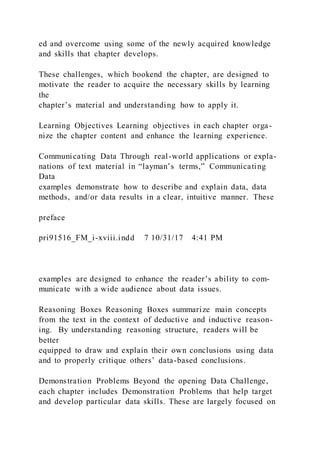
Learning Objectives Learning objectives in each chapter orga-
nize the chapter content and enhance the learning experience.
Communicating Data Through real-world applications or expla-
nations of text material in “layman’s terms,” Communicating
Data
examples demonstrate how to describe and explain data, data
methods, and/or data results in a clear, intuitive manner. These
preface
pri91516_FM_i-xviii.indd 7 10/31/17 4:41 PM
examples are designed to enhance the reader’s ability to com-
municate with a wide audience about data issues.
Reasoning Boxes Reasoning Boxes summarize main concepts
from the text in the context of deductive and inductive reason-
ing. By understanding reasoning structure, readers will be
better
equipped to draw and explain their own conclusions using data
and to properly critique others’ data-based conclusions.
Demonstration Problems Beyond the opening Data Challenge,
each chapter includes Demonstration Problems that help target
and develop particular data skills. These are largely focused on
primary applications of chapter material.
Key Terms and Marginal Definitions Each chapter ends with
a list of key terms and concepts. These provide an easy way for
instructors to assemble material covered in each chapter and
for students to check their mastery of terminology. In addition,
marginal definitions will appear as signposts throughout the
text.
End-of-Chapter Problems Each chapter ends with two types
of problems to test students’ mastery of the material. First are
Conceptual Questions, which test students’ conceptual
understand-
ing of the material and demand pertinent communication and
reasoning skills. Second are Quantitative Problems, which test
stu-
dents’ ability to execute and explain (within a logical
framework) per-
tinent data analytical methods. The Quantitative Problems are
sup-
ported by Excel datasets available through McGraw -Hill
Connect®.
Applications The material in this book is sufficient for any
course
that exclusively uses quizzes, homework, and/or exams for
evalua-
tion. However, to allow for a more enhanced, and applied,
under-
standing of the material, the book concludes with an
Applications
section. This section has three parts. The first is “Critical
Analysis
of Data-Driven Conclusions.” This section presents several
real-
world data applications that explicitly or implicitly lead to
action-
able conclusions, and then challenges students to critically
assess
these conclusions using the reasoning and data knowledge
presented throughout the book. The second section is “Written
Explanations of Data Analysis and Active Predictions.” This
sec-
tion presents students with several mini-cases of data output,
and
challenges them to examine and explain the output in writing
with
appropriate reasoning. The third section is “Projects:
Combining
Analysis with Reason-based Communication.” This last section
pro-
vides three versions of a mini-project, based on projects
Professor
Prince has assigned in his own classes for several years. These
projects require students to work from dataset to conclusions in
a controlled, but realistic, environment. The projects are
accom-
panied by datasets in Excel format, which can be easily tailored
to
instructors’ needs. A key merit of these projects is flexibility, in
that
they can be used for individual- and/or group-level assessment.
ORGANIZED LEARNING
CHAPTER LEARNING OBJECTIVES
The organization of each chapter reflects common themes out-
lined by six to eight learning objectives listed at the beginning
of
each chapter. These objectives, along with AACSB and Bloom’s
taxonomy learning categories, are connected to the end-of-
chapter material and test bank questions to offer a
comprehensive
and thorough teaching and learning experience.
ASSURANCE OF LEARNING READY
Many educational institutions today are focused on the notion of
assurance of learning, an important element of some accredi -
tation standards. Predictive Analytics for Business Strategy is
designed specifically to support your assurance of learning
initia-
tives with a simple, yet powerful solution.
Instructors can use Connect to easily query for learning out-
comes/objectives that directly relate to the learning objectives
of
the course. You can then use the reporting features of Connect
to aggregate student results in similar fashion, making the col -
lection and presentation of assurance of learning data simple
and easy.
AACSB STATEMENT
McGraw-Hill Global Education is a proud corporate member of
AACSB International. Understanding the importance and value
of AACSB accreditation, Predictive Analytics for Business
Strategy
has sought to recognize the curricula guidelines detailed in the
AACSB standards for business accreditation by connecting
ques-
tions in the test bank and end-of-chapter material to the general
knowledge and skill guidelines found in the AACSB standards.
It is important to note that the statements contained in
Predictive Analytics for Business Strategy are provided only as
a
guide for the users of this text. The AACSB leaves content
cover-
age and assessment within the purview of individual schools,
the
mission of the school, and the faculty. While Predictive
Analytics
for Business Strategy and the teaching package make no claim
of
any specific AACSB qualification or evaluation, we have
labeled
questions according to the general knowledge and skill areas.
MCGRAW-HILL CUSTOMER CARE CONTACT
INFORMATION
At McGraw-Hill, we understand that getting the most from new
technology can be challenging. That’s why our services don’t
stop after you purchase our products. You can e-mail our
Product
Specialists 24 hours a day to get product training online. Or you
can search our knowledge bank of Frequently Asked Questions
on
our support website. For Customer Support, call 800-331-5094,
or visit www.mhhe.com/support. One of our Technical Support
Analysts will be able to assist you in a timely fashion.
viii Preface
pri91516_FM_i-xviii.indd 8 10/31/17 4:41 PM
I would like to thank the following reviewers, as well as
hundreds
of students at Indiana University’s Kelley School of Business
and
colleagues who unselfishly gave up their own time to provide
com-
ments and suggestions to improve this book.
acknowledgments
ix
Imam Alam
University of Northern Iowa
Ahmad Bajwa
University of Arkansas at Little
Rock
Steven Bednar
Elon University
Hooshang M. Beheshti
Radford University
Anton Bekkerman
Montana State University
Khurrum S. Bhutta
Ohio University
Gary Black
University of Southern Indiana
Andre Boik
University of California, Davis
Ambarish Chandra
University of Toronto
Richard Cox
Arizona State University
Steven Cuellar
Sonoma State University
Craig Depken
University of North Carolina,
Charlotte
Mark Dobeck
Cleveland State University
Tim Dorr
University of Bridgeport
Neal Duffy
State University of New York at
Plattsburgh
Jerry Dunn
Southwestern Oklahoma State
University
Kathryn Ernstberger
Indiana University Southeast
Ana L. Rosado Feger
Ohio University
Frederick Floss
Buffalo State University
Chris Forman
Georgia Institute of Technology
Avi Goldfarb
University of Toronto
Michael Gordinier
Washington University, St. Louis
Gauri Guha
Arkansas State University
Kuang-Chung Hsu
University of Central Oklahoma
Kyle Huff
Georgia Gwinnett College
Jongsung Kim
Bryant University
Ching-Chung Kuo
University of North Texas
Lirong Liu
Texas A&M University,
Commerce
Stanislav Manonov
Montclair State University
John Mansuy
Wheeling Jesuit University
Ryan McDevitt
Duke University
Alex Meisami
Indiana University South Bend
Ignacio Molina
Arizona State University
Georgette Nicolaides
Syracuse University
Jie Peng
St. Ambrose University
Jeremy Petranka
Duke University
Kameliia Petrova
State University of New York at
Plattsburgh
Claudia Pragman
Minnesota State University,
Mankato
Reza Ramazani
Saint Michael's College
Doug Redington
Elon University
Sunil Sapra
California State University,
Los Angeles
Robert Seamans
New York University
Mary Ann Shifflet
University of Southern Indiana
Timothy Simcoe
Boston University
Shweta Singh
Kean University
John Louis Sparco
Wilmington University
Arun Srinivasan
Indiana University Southeast
Purnima Srinivasan
Kean University
Leonie Stone
State University of New York at
Geneseo
Richard Szal
Northern Arizona University
Vicar Valencia
Indiana University South Bend
Timothy S. Vaughan
University of Wisconsin, Eau Claire
Bindiganavale Vijayaraman
The University of Akron
Padmal Vitharana
Syracuse University
Razvan Vlaicu
University of Maryland
Rubina Vohra
New Jersey City University
Emily Wang
University of Massachusetts,
Amherst
Miao Wang
Marquette University
Matthew Weinberg
Drexel University
Andy Welki
John Carroll University
John Whitehead
Appalachian State University
Peter Wui
University of Arkansas, Pine Bluff
pri91516_FM_i-xviii.indd 9 10/31/17 4:41 PM
▪ Connect content is authored by the world’s best subject
matter experts, and is available to your class through a
simple and intuitive interface.
▪ The Connect eBook makes it easy for students to access
their reading material on smartphones and tablets. They
can study on the go and don’t need internet access to use
the eBook as a reference, with full functionality.
▪ Multimedia content such as videos, simulations, and games
drive student engagement and critical thinking skills.
©McGraw-Hill Education
▪ Connect’s assignments help students
contextualize what they’ve learned through
application, so they can better understand
the material and think critically.
▪ Connect will create a personalized study
path customized to individual student needs
through SmartBook®.
▪ SmartBook helps students study more
efficiently by delivering an interactive reading
experience through adaptive highlighting
and review.
McGraw-Hill Connect® is a highly reliable, easy-to-use
homework and learning management solution that
utilizes learning science and award-winning adaptive
tools to improve student results.
73% of instructors
who use Connect
require it; instructor
satisfaction increases
by 28% when Connect
is required.
Homework and Adaptive Learning
Quality Content and Learning Resources
Over 7 billion questions have been
answered, making McGraw-Hill
Education products more intelligent,
reliable, and precise.
Using Connect improves retention
rates by 19.8%, passing rates by
12.7%, and exam scores by 9.1%.
pri91516_FM_i-xviii.indd 10 10/31/17 4:41 PM
More students earn
As and Bs when they
use Connect.
www.mheducation.com/connect
©Hero Images/Getty Images
▪ Connect Insight® generates easy-to-read reports
on individual students, the class as a whole, and on
specific assignments.
▪ The Connect Insight dashboard delivers data on
performance, study behavior, and effort. Instructors
can quickly identify students who struggle and focus
on material that the class has yet to master.
▪ Connect automatically grades assignments
and quizzes, providing easy-to-read reports
on individual and class performance.
▪ Connect integrates with your LMS to provide single sign-on
and automatic syncing
of grades. Integration with Blackboard®, D2L®, and Canvas
also provides automatic
syncing of the course calendar and assignme nt-level linking.
▪ Connect offers comprehensive service, support, and training
throughout every phase
of your implementation.
▪ If you’re looking for some guidance on how to use Connect, or
want to learn tips and
tricks from super users, you can find tutorials as you work. Our
Digital Faculty
Consultants and Student Ambassadors offer insight into how to
achieve the results
you want with Connect.
Trusted Service and Support
Robust Analytics and Reporting
pri91516_FM_i-xviii.indd 11 10/31/17 4:41 PM
I understand that the reliability and accuracy of the book and
the accompanying supplements are of the utmost importance.
To that end, I have been personally involved in crafting and
accuracy checking each of the supplements. The following
ancillaries are available for quick download and convenient
access via the instructor resource material available through
Connect.
POWERPOINT PRESENTATION
Presentation slides incorporate both the fundamental concepts
of
each chapter and the graphs and figures essential to each topic.
These slides can be edited, printed, or rearranged to fit the
needs
of your course.
SOLUTIONS MANUAL
This manual contains solutions to the end-of-chapter conceptual
questions and quantitative problems.
TEST BANK
A comprehensive test bank offers hundreds of questions catego-
rized by learning objective, AACSB learning category, Bloom’s
taxonomy objectives, and level of difficulty.
COMPUTERIZED TEST BANK
TestGen is a complete, state-of-the-art test generator and edit-
ing application software that allows instructors to quickly and
easily select test items from McGraw Hill’s test bank content.
The instructors can then organize, edit and customize ques-
tions and answers to rapidly generate tests for paper or onli ne
administration. Questions can include stylized text, symbols,
graphics, and equations that are inserted directly into ques-
tions using built-in mathematical templates. TestGen’s random
generator provides the option to display different text or calcu-
lated number values each time questions are used. With both
quick and simple test creation and flexible and robust editing
tools, TestGen is a complete test generator system for today’s
educators.
ONLINE RESOURCES
Student supplements for Predictive Analytics for Business
Strategy
are available online at www.mhhe.com/prince1e. These include
datasets for all Quantitative Problems and sample datasets for
the
Course Project.
xii Acknowledgments
Supplements
pri91516_FM_i-xviii.indd 12 10/31/17 4:41 PM
  xiii
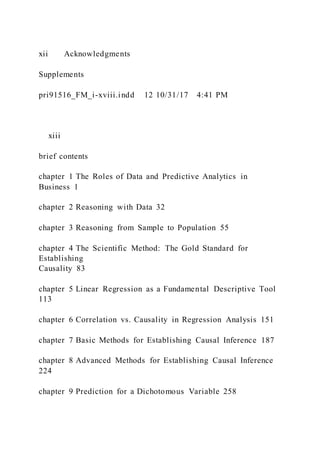
brief contents
chapter 1 The Roles of Data and Predictive Analytics in
Business 1
chapter 2 Reasoning with Data 32
chapter 3 Reasoning from Sample to Population 55
chapter 4 The Scientific Method: The Gold Standard for
Establishing
Causality 83
chapter 5 Linear Regression as a Fundamental Descriptive Tool
113
chapter 6 Correlation vs. Causality in Regression Analysis 151
chapter 7 Basic Methods for Establishing Causal Inference 187
chapter 8 Advanced Methods for Establishing Causal Inference
224
chapter 9 Prediction for a Dichotomous Variable 258
chapter 10 Identification and Data Assessment 292
APPLICATIONS Data Analysis Critiques, Write-ups, and
Projects 322
GLOSSARY 335
pri91516_FM_i-xviii.indd 13 10/31/17 4:41 PM
contents
CHAPTER 1
The Roles of Data and Predictive Analytics
in Business 1
Data Challenge: Navigating a Data Dump 1
Introduction 2
Defining Data and Data Uses in Business 2
Data 3
Predictive Analytics within Business Analytics 3
Business Strategy 4
Predictive Analytics for Business Strategy 4
Data Features 5
Structured vs. Unstructured Data 5
The Unit of Observation 6
Data-generating Process 9
Basic Uses of Data Analysis for Business 12
Queries 12
Pattern Discovery 15
Causal Inference 17
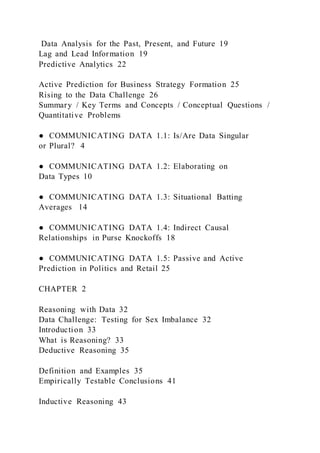
Data Analysis for the Past, Present, and Future 19
Lag and Lead Information 19
Predictive Analytics 22
Active Prediction for Business Strategy Formation 25
Rising to the Data Challenge 26
Summary / Key Terms and Concepts / Conceptual Questions /
Quantitative Problems
● COMMUNICATING DATA 1.1: Is/Are Data Singular
or Plural? 4
● COMMUNICATING DATA 1.2: Elaborating on
Data Types 10
● COMMUNICATING DATA 1.3: Situational Batting
Averages 14
● COMMUNICATING DATA 1.4: Indirect Causal
Relationships in Purse Knockoffs 18
● COMMUNICATING DATA 1.5: Passive and Active
Prediction in Politics and Retail 25
CHAPTER 2
Reasoning with Data 32
Data Challenge: Testing for Sex Imbalance 32
Introduction 33
What is Reasoning? 33
Deductive Reasoning 35
Definition and Examples 35
Empirically Testable Conclusions 41
Inductive Reasoning 43
Definition and Examples 43
Evaluating Assumptions 45
Selection Bias 49
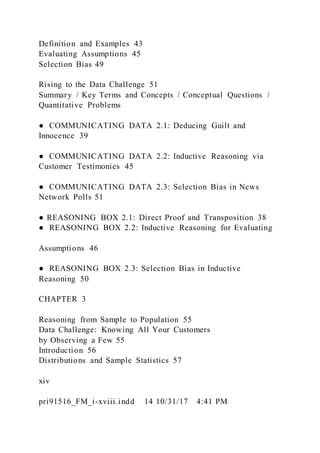
Rising to the Data Challenge 51
Summary / Key Terms and Concepts / Conceptual Questions /
Quantitative Problems
● COMMUNICATING DATA 2.1: Deducing Guilt and
Innocence 39
● COMMUNICATING DATA 2.2: Inductive Reasoning via
Customer Testimonies 45
● COMMUNICATING DATA 2.3: Selection Bias in News
Network Polls 51
● REASONING BOX 2.1: Direct Proof and Transposition 38
● REASONING BOX 2.2: Inductive Reasoning for Evaluating
Assumptions 46
● REASONING BOX 2.3: Selection Bias in Inductive
Reasoning 50
CHAPTER 3
Reasoning from Sample to Population 55
Data Challenge: Knowing All Your Customers
by Observing a Few 55
Introduction 56
Distributions and Sample Statistics 57
xiv
pri91516_FM_i-xviii.indd 14 10/31/17 4:41 PM
Distributions of Random Variables 57
Data Samples and Sample Statistics 61
The Interplay Between Deductive and Inductive
Reasoning in Active Predictions 77
Rising to the Data Challenge 79
Summary / Key Terms and Concepts / Conceptual Questions /
Quantitative Problems
● COMMUNICATING DATA 3.1: What Can Political Polls
Tell Us about the General Population? 70
● COMMUNICATING DATA 3.2: Does Working at Work
Make a Difference? 77
● REASONING BOX 3.1: The Distribution of the Sample
Mean 66
● REASONING BOX 3.2: Confidence Intervals 68
● REASONING BOX 3.3: The Distribution of the Sample
Mean for Hypothesized Population Mean 71
● REASONING BOX 3.4: Hypothesis Testing 76
● REASONING BOX 3.5: Reasoning in Active Predictions 78
CHAPTER 4
The Scientific Method: The Gold Standard
for Establishing Causality 83
Data Challenge: Does Dancing Yield Dollars? 83
Introduction 84
The Scientific Method 84
Definition and Details 84
The Scientific Method and Causal Inference 89
Data Analysis Using the Scientific Method 95
Experimental Data vs. Non-Experimental Data 104
Examples of Nonexperimental Data in Business 105
Consequences of Using Nonexperimental Data to
Estimate Treatment Effects 107
Rising to the Data Challenge 109
Summary / Key Terms and Concepts / Conceptual Questions /
Quantitative Problems
● COMMUNICATING DATA 4.1: Penicillin and the
Scientific Method 88
● COMMUNICATING DATA 4.2: The Effect of Banner Ad
Features 95
● COMMUNICATING DATA 4.3: Music Training and
Intelligence 102
● COMMUNICATING DATA 4.4: Marshmallows and
Reliability 105
● COMMUNICATING DATA 4.5: The Rewards of
Rudeness 108
● REASONING BOX 4.1: The Treatment Effect 94
● REASONING BOX 4.2: The Distribution of Experimental
Outcomes 98
● REASONING BOX 4.3: Hypothesis Test for the
Treatment Effect 100
● REASONING BOX 4.4: Confidence Interval for the
Treatment Effect 103
CHAPTER 5
Linear Regression as a Fundamental
Descriptive Tool 113
Data Challenge: Where to Park Your Truck? 113
Introduction 114
The Regression Line for a Dichotomous Treatment 116
An Intuitive Approach 116
A Formal Approach 119
The Regression Line for a Multi-Level Treatment 124
An Intuitive Approach 124
A Formal Approach 127
Sample Moments and Least Squares 133
Regression for Multiple Treatments 135
Single vs. Multiple Treatments 135
Multiple Regression 139
What Makes Regression Linear? 142
Rising to the Data Challenge 145
Summary / Key Terms and Concepts / Conceptual Questions /
Quantitative Problems
● COMMUNICATING DATA 5.1: Regression Line
Origins 132
● COMMUNICATING DATA 5.2: Least Squares vs. Least
Absolute Deviations 134
● COMMUNICATING DATA 5.3: Regression for
Ratings 144
● REASONING BOX 5.1: The Regression Line for a
Dichotomous Treatment 122
● REASONING BOX 5.2: The Simple Regression Line 132
● REASONING BOX 5.3: Multiple Regression 140
Contents  xv
pri91516_FM_i-xviii.indd 15 10/31/17 4:41 PM
CHAPTER 6
Correlation vs. Causality in Regression
Analysis 151
Data Challenge: Where to Park Your Truck—
Redux 151
Introduction 152
The Difference Between Correlation and Causality 152
Regression Analysis for Correlation 157
Regression and Sample Correlation 157
Regression and Population Correlation 161
Passive Prediction Using Regression 169
Regression Analysis for Causality 170
Regression and Causation 171
Linking Causal Regression to the Experimental Ideal 179
Active Prediction Using Regression 179
The Relevance of Model Fit for Passive and Active
Prediction 182
Rising to the Data Challenge 183
Summary / Key Terms and Concepts / Conceptual Questions /
Quantitative Problems
● COMMUNICATING DATA 6.1: Physical Fitness and
Academic Success 157
● COMMUNICATING DATA 6.2: Experiments vs. Causal
Regression Analysis 180
● COMMUNICATING DATA 6.3: Will Drinking Fatty Milk
Make You Fat? 181
● REASONING BOX 6.1: Consistency of Regression
Estimators for Population Correlations 164
● REASONING BOX 6.2: Confidence Intervals for
Correlational Regression Analysis 166
● REASONING BOX 6.3: Hypothesis Testing for Correlational
Regression Analysis 167
● REASONING BOX 6.4: Equivalence of Population
Regression Equation and Determining Function 174
● REASONING BOX 6.5: Consistency of Regression
Estimators for Determining Functions 175
● REASONING BOX 6.6: Confidence Intervals for
Parameters of a Determining Function 176
● REASONING BOX 6.7: Hypothesis Testing for Parameters
of a Determining Function 176
CHAPTER 7
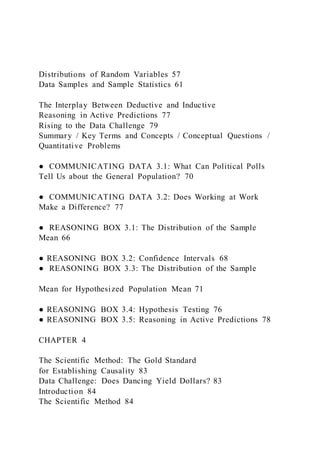
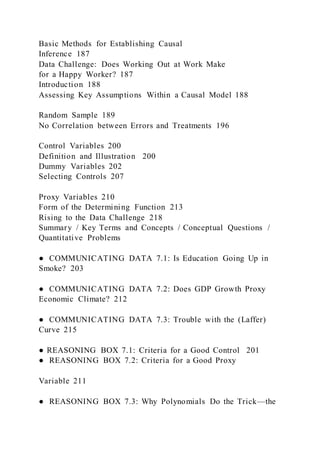
Basic Methods for Establishing Causal
Inference 187
Data Challenge: Does Working Out at Work Make
for a Happy Worker? 187
Introduction 188
Assessing Key Assumptions Within a Causal Model 188
Random Sample 189
No Correlation between Errors and Treatments 196
Control Variables 200
Definition and Illustration 200
Dummy Variables 202
Selecting Controls 207
Proxy Variables 210
Form of the Determining Function 213
Rising to the Data Challenge 218
Summary / Key Terms and Concepts / Conceptual Questions /
Quantitative Problems
● COMMUNICATING DATA 7.1: Is Education Going Up in
Smoke? 203
● COMMUNICATING DATA 7.2: Does GDP Growth Proxy
Economic Climate? 212
● COMMUNICATING DATA 7.3: Trouble with the (Laffer)
Curve 215
● REASONING BOX 7.1: Criteria for a Good Control 201
● REASONING BOX 7.2: Criteria for a Good Proxy
Variable 211
● REASONING BOX 7.3: Why Polynomials Do the Trick—the
Weierstrass Theorem 214
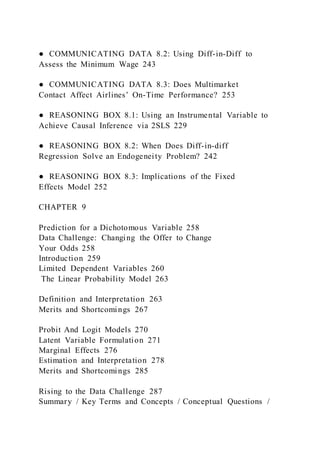
CHAPTER 8
Advanced Methods for Establishing Causal
Inference 224
Data Challenge: Do TV Ads Generate
Web Traffic? 224
Introduction 225
Instrumental Variables 225
Definition and Illustration 225
Two-Stage Least Squares Regression 228
xvi Contents
pri91516_FM_i-xviii.indd 16 10/31/17 4:41 PM
Evaluating Instruments 233
Exogeneity 234
Classic Applications of Instrumental Variables for Business 237
Panel Data Methods 239
Difference-in-Differences 239
The Fixed-Effects Model 242
Practical Applications of Panel Data Methods
for Business 252
Rising to the Data Challenge 254
Summary / Key Terms and Concepts / Conceptual Questions /
Quantitative Problems
● COMMUNICATING DATA 8.1: Measuring the Impact of
Broadband Expansion 238
● COMMUNICATING DATA 8.2: Using Diff-in-Diff to
Assess the Minimum Wage 243
● COMMUNICATING DATA 8.3: Does Multimarket
Contact Affect Airlines’ On-Time Performance? 253
● REASONING BOX 8.1: Using an Instrumental Variable to
Achieve Causal Inference via 2SLS 229
● REASONING BOX 8.2: When Does Diff-in-diff
Regression Solve an Endogeneity Problem? 242
● REASONING BOX 8.3: Implications of the Fixed
Effects Model 252
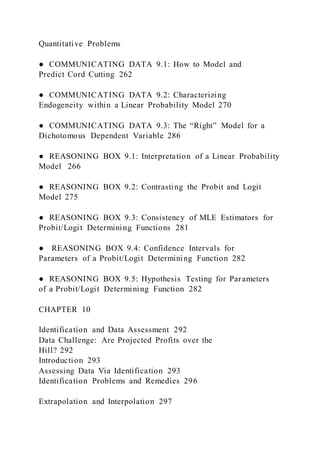
CHAPTER 9
Prediction for a Dichotomous Variable 258
Data Challenge: Changing the Offer to Change
Your Odds 258
Introduction 259
Limited Dependent Variables 260
The Linear Probability Model 263
Definition and Interpretation 263
Merits and Shortcomings 267
Probit And Logit Models 270
Latent Variable Formulation 271
Marginal Effects 276
Estimation and Interpretation 278
Merits and Shortcomings 285
Rising to the Data Challenge 287
Summary / Key Terms and Concepts / Conceptual Questions /
Quantitative Problems
● COMMUNICATING DATA 9.1: How to Model and
Predict Cord Cutting 262
● COMMUNICATING DATA 9.2: Characterizing
Endogeneity within a Linear Probability Model 270
● COMMUNICATING DATA 9.3: The “Right” Model for a
Dichotomous Dependent Variable 286
● REASONING BOX 9.1: Interpretation of a Linear Probability
Model 266
● REASONING BOX 9.2: Contrasting the Probit and Logit
Model 275
● REASONING BOX 9.3: Consistency of MLE Estimators for
Probit/Logit Determining Functions 281
● REASONING BOX 9.4: Confidence Intervals for
Parameters of a Probit/Logit Determining Function 282
● REASONING BOX 9.5: Hypothesis Testing for Parameters
of a Probit/Logit Determining Function 282
CHAPTER 10
Identification and Data Assessment 292
Data Challenge: Are Projected Profits over the
Hill? 292
Introduction 293
Assessing Data Via Identification 293
Identification Problems and Remedies 296
Extrapolation and Interpolation 297
Variable Co-movement 303
Identification Damage Control: Signing The Bias 314
Rising to the Data Challenge 318
Summary / Key Terms and Concepts / Conceptual Questions /
Quantitative Problems
● COMMUNICATING DATA 10.1: Projecting Trends 304
● COMMUNICATING DATA 10.2: Disentangling
Promotion from Financing 313
● COMMUNICATING DATA 10.3: A Distorted View of a
Degree’s Value 317
● REASONING BOX 10.1: Can Data Deliver the (Sufficiently
Precise) Answer? 296
● REASONING BOX 10.2: The Effects of Variable
Co-Movement on Identification 310
● REASONING BOX 10.3: Signing Omitted Variable Bias 316
Contents  xvii
pri91516_FM_i-xviii.indd 17 10/31/17 4:41 PM
APPLICATIONS
Data Analysis Critiques, Write-ups,
and Projects 322
Introduction 322
Critical Analysis of Data-Driven Conclusions 323
Case 1: Tennis Analytics 323
Case 2: Switching Insurance 324
Case 3: Grocery Store Price Promotions 325
Written Explanations of Data Analysis and Active
Predictions 326
Case 1: Insurance Claims and Deductibles 326
Case 2: Wearable Features and Sales 328
Case 3: Ad Duration and Clicks 329
Projects: Combining Analysis with
Reason-Based Communication 331
Project 1: Tablet Price and Profits 331
Project 2: Auto Ad Budget and Revenues 332
Project 3: Machine Maintenance and Quality 333
Glossary 335
Index 340
xviii Contents
pri91516_FM_i-xviii.indd 18 10/31/17 4:41 PM
1
LEARNING OBJECTIVES
After completing this chapter, you will be able to:
LO1.1 Explain how predictive analytics can
help in business strategy formulation.
LO1.2 Distinguish structured from
unstructured data.
LO1.3 Differentiate units of observation.
LO1.4 Outline a data-generating process.
LO1.5 Describe the primary ways that data
analysis is used to aid business
performance.
LO1.6 Discriminate between lead and lag
information.
LO1.7 Discriminate between active and
passive prediction.
LO1.8 Recognize questions pertaining
to business strategy that may
utilize (active) predictive
analytics.
Your boss is interested to know if and how Facebook “Likes”
lead to sales. The question your
boss has posed is clear enough. However, she provides no
guidance beyond the question.
How should you begin?
dataCHALLENGE Navigating a Data Dump
As a newly hired analyst at Papa John’s, your boss comes to you
with a data question. She notes
that the company’s database contains data collected from
Facebook, the company website, and
internal sources. Below is a list of variables from each sourc e
for which the company has data.
FACE BOOK WE BSITE INTE RNAL SOURCES
Number of likes Number of visits Product sales
Age of likers Number of pages per visit Employee salaries
Education of likers Bounce rate Product prices
Income of likers Location of visitors Advertising expenditures
Click-through rate to website Device used by visitors
Production costs
The Roles of Data and Predictive
Analytics in Business
1
pri91516_ch01_001-031.indd 1 10/30/17 4:53 PM
CHAPTER 1 The Roles of Data and Predictive Analytics in
Business2
Defining Data and Data Uses in Business
We begin by defining data and other basic terminology relating
to data. (Be sure to read
Communicating Data 1.1, which addresses the question of
whether data is/are singular or
plural.) We then characterize predictive analytics for business
strategy by breaking it down
into its core components.
Traditionally, data analysis was reserved for a small corner of
the business community,
performed by quantitatively oriented experts, if it was done at
all. With the increasing
digitization of business information, computer and software
power, and information
availability, data analysis has become an integral component of
business. Data analy-
sis can help businesses improve production processes, customer
marketing, and stra-
tegic positioning. The enormous list of applications makes it
impractical to learn about
all of them in just one book or one course.
Why should our focus be on predictive analytics for business
strategy? First, the topic
is relevant for virtually every business discipline. Every
discipline must regularly for-
mulate and evaluate strategic options, and all are affected by
strategies undertaken
by various branches of the firm. Second, predicting the
consequences of a strategic
move stems from perhaps the most fundamental application of
data analysis: gener-
ating knowledge about cause and effect. The use of data to learn
about cause and
effect spans well beyond the business environment into areas
such as medicine,
physics, chemistry, and public policy, to name just a few. The
critical thinking skills one
must acquire to understand predictive analytics for business
strategy have value well
beyond this one area of study.
The first section of the chapter defines data and provides a
concise characterization
of predictive analytics for business strategy—one of many ways
businesses use data.
The next section details data features. For those already familiar
with data, the data
definition and many of the data features will be familiar;
however, a clear understand-
ing of predictive analytics for business strategy and a data-
generating process are
crucial for what follows in the book, and therefore these two
sections merit a review.
The third section gives a broad overview of data uses in
business. The final section
describes different temporal uses of data, i.e., measuring the
past and present versus
predicting the future, and makes a crucial distinction between
two different types of
prediction, passive and active.
The objective of this chapter is to paint a basic picture of the
business analytics landscape
and explain where predictive analytics for business strategy
lives within that landscape. In
doing so, we provide a general description of what this strand of
business analytics does,
and differentiate it from other types of business analytics and
predictive analytics.
Introduction
pri91516_ch01_001-031.indd 2 10/30/17 4:53 PM
CHAPTER 1 The Roles of Data and Predictive Analytics in
Business 3
DATA
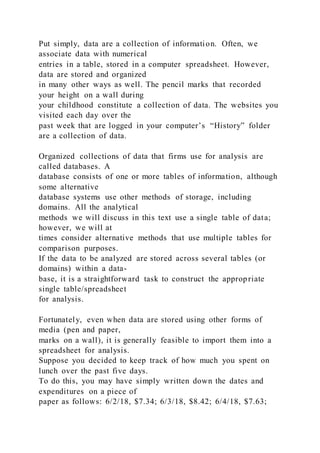
Put simply, data are a collection of information. Often, we
associate data with numerical
entries in a table, stored in a computer spreadsheet. However,
data are stored and organized
in many other ways as well. The pencil marks that recorded
your height on a wall during
your childhood constitute a collection of data. The websites you
visited each day over the
past week that are logged in your computer’s “History” folder
are a collection of data.
Organized collections of data that firms use for analysis are
called databases. A
database consists of one or more tables of information, although
some alternative
database systems use other methods of storage, including
domains. All the analytical
methods we will discuss in this text use a single table of data;
however, we will at
times consider alternative methods that use multiple tables for
comparison purposes.
If the data to be analyzed are stored across several tables (or
domains) within a data-
base, it is a straightforward task to construct the appropriate
single table/spreadsheet
for analysis.
Fortunately, even when data are stored using other forms of
media (pen and paper,
marks on a wall), it is generally feasible to import them into a
spreadsheet for analysis.
Suppose you decided to keep track of how much you spent on
lunch over the past five days.
To do this, you may have simply written down the dates and
expenditures on a piece of
paper as follows: 6/2/18, $7.34; 6/3/18, $8.42; 6/4/18, $7.63;
6/5/18, $5.40; 6/6/18, $9.30.
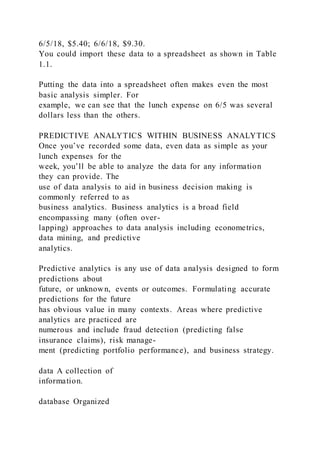
You could import these data to a spreadsheet as shown in Table
1.1.
Putting the data into a spreadsheet often makes even the most
basic analysis simpler. For
example, we can see that the lunch expense on 6/5 was several
dollars less than the others.
PREDICTIVE ANALYTICS WITHIN BUSINESS ANALYTICS
Once you’ve recorded some data, even data as simple as your
lunch expenses for the
week, you’ll be able to analyze the data for any information
they can provide. The
use of data analysis to aid in business decision making is
commonly referred to as
business analytics. Business analytics is a broad field
encompassing many (often over-
lapping) approaches to data analysis including econometrics,
data mining, and predictive
analytics.
Predictive analytics is any use of data analysis designed to form
predictions about
future, or unknown, events or outcomes. Formulating accurate
predictions for the future
has obvious value in many contexts. Areas where predictive
analytics are practiced are
numerous and include fraud detection (predicting false
insurance claims), risk manage-
ment (predicting portfolio performance), and business strategy.
data A collection of
information.
database Organized
collection of data that
firms use for analysis.
business analytics
The use of data analysis
to aid in business
decision making.
predictive analytics
The use of data analysis
designed to form
predictions about future,
or unknown, events or
outcomes.
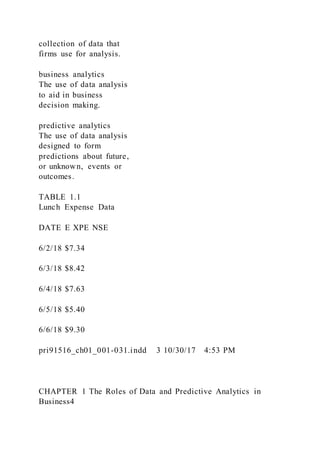
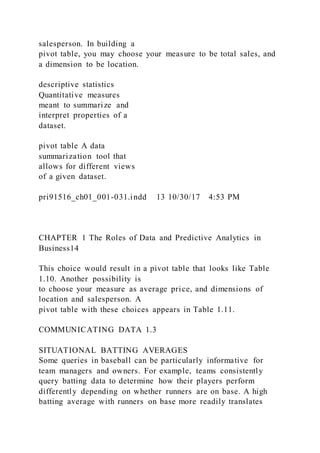
TABLE 1.1
Lunch Expense Data
DATE E XPE NSE
6/2/18 $7.34
6/3/18 $8.42
6/4/18 $7.63
6/5/18 $5.40
6/6/18 $9.30
pri91516_ch01_001-031.indd 3 10/30/17 4:53 PM
CHAPTER 1 The Roles of Data and Predictive Analytics in
Business4
BUSINESS STRATEGY
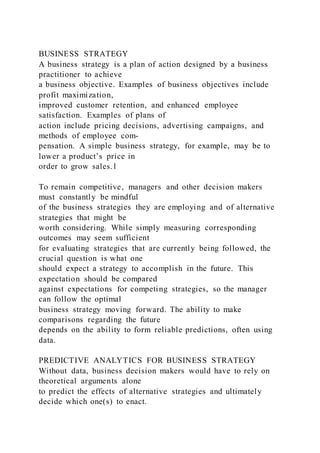
A business strategy is a plan of action designed by a business
practitioner to achieve
a business objective. Examples of business objectives include
profit maximization,
improved customer retention, and enhanced employee
satisfaction. Examples of plans of
action include pricing decisions, advertising campaigns, and
methods of employee com-
pensation. A simple business strategy, for example, may be to
lower a product’s price in
order to grow sales.1
To remain competitive, managers and other decision makers
must constantly be mindful
of the business strategies they are employing and of alternative
strategies that might be
worth considering. While simply measuring corresponding
outcomes may seem sufficient
for evaluating strategies that are currently being followed, the
crucial question is what one
should expect a strategy to accomplish in the future. This
expectation should be compared
against expectations for competing strategies, so the manager
can follow the optimal
business strategy moving forward. The ability to make
comparisons regarding the future
depends on the ability to form reliable predictions, often using
data.
PREDICTIVE ANALYTICS FOR BUSINESS STRATEGY
Without data, business decision makers would have to rely on
theoretical arguments alone
to predict the effects of alternative strategies and ultimately
decide which one(s) to enact.
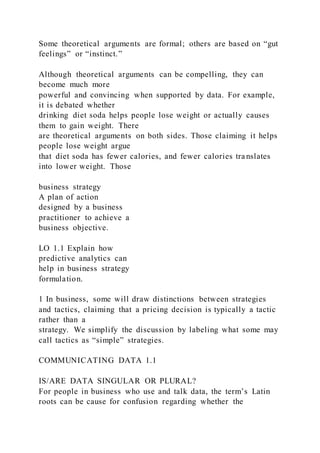
Some theoretical arguments are formal; others are based on “gut
feelings” or “instinct.”
Although theoretical arguments can be compelling, they can
become much more
powerful and convincing when supported by data. For example,
it is debated whether
drinking diet soda helps people lose weight or actually causes
them to gain weight. There
are theoretical arguments on both sides. Those claiming it helps
people lose weight argue
that diet soda has fewer calories, and fewer calories translates
into lower weight. Those
business strategy
A plan of action
designed by a business
practitioner to achieve a
business objective.
LO 1.1 Explain how
predictive analytics can
help in business strategy
formulation.
1 In business, some will draw distinctions between strategies
and tactics, claiming that a pricing decision is typically a tactic
rather than a
strategy. We simplify the discussion by labeling what some may
call tactics as “simple” strategies.
COMMUNICATING DATA 1.1
IS/ARE DATA SINGULAR OR PLURAL?
For people in business who use and talk data, the term’s Latin
roots can be cause for confusion regarding whether the
word data is singular or plural. The answer is it can be either,
depending on the context. Going back to the word’s Latin
origins, data is the plural of datum (meaning a piece of
information). But although plural in Latin, data as an English
word is
treated both as a count noun (multiple items that can be
counted) and as a mass noun (an entity with an amount that
cannot
naturally be counted). Hence, those who treat data as a count
noun will say “The data are, or indicate” and those who treat
data as a mass noun will say “The data is, or indicates.”
Some data-oriented fields are particular about how to
“properly” use the word. For example, in economics, there is a
tendency to use the plural. Other fields tend toward the
singular. Beyond this, it is a matter of preference. As an
economist
and former Latin scholar, I will use the plural version of data
throughout this book; however, this is not to indicate it is more
correct than the oft-used singular version.
pri91516_ch01_001-031.indd 4 10/30/17 4:53 PM
CHAPTER 1 The Roles of Data and Predictive Analytics in
Business 5
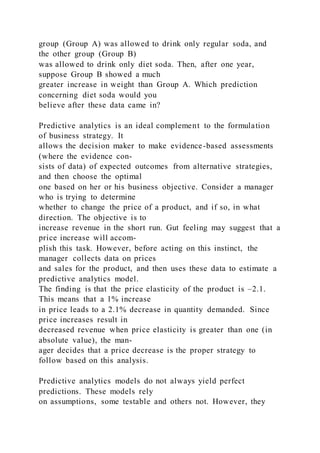
claiming it causes weight gain argue that diet soda’s inability to
quench the body’s crav-
ing for sugar creates even stronger cravings that will be
satisfied by consuming unhealthy
foods. Which claim is correct? With no supporting data, the
decision becomes one based
on “gut feeling.” Now, suppose 1,000 individuals were split into
two groups of 500: One
group (Group A) was allowed to drink only regular soda, and
the other group (Group B)
was allowed to drink only diet soda. Then, after one year,
suppose Group B showed a much
greater increase in weight than Group A. Which prediction
concerning diet soda would you
believe after these data came in?
Predictive analytics is an ideal complement to the formulation
of business strategy. It
allows the decision maker to make evidence-based assessments
(where the evidence con-
sists of data) of expected outcomes from alternative strategies,
and then choose the optimal
one based on her or his business objective. Consider a manager
who is trying to determine
whether to change the price of a product, and if so, in what
direction. The objective is to
increase revenue in the short run. Gut feeling may suggest that a
price increase will accom-
plish this task. However, before acting on this instinct, the
manager collects data on prices
and sales for the product, and then uses these data to estimate a
predictive analytics model.
The finding is that the price elasticity of the product is –2.1.
This means that a 1% increase
in price leads to a 2.1% decrease in quantity demanded. Since
price increases result in
decreased revenue when price elasticity is greater than one (in
absolute value), the man-
ager decides that a price decrease is the proper strategy to
follow based on this analysis.
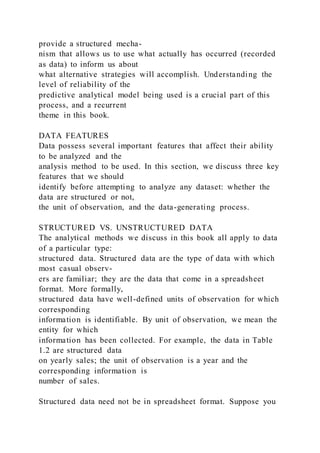
Predictive analytics models do not always yield perfect
predictions. These models rely
on assumptions, some testable and others not. However, they
provide a structured mecha-
nism that allows us to use what actually has occurred (recorded
as data) to inform us about
what alternative strategies will accomplish. Understanding the
level of reliability of the
predictive analytical model being used is a crucial part of this
process, and a recurrent
theme in this book.
DATA FEATURES
Data possess several important features that affect their ability
to be analyzed and the
analysis method to be used. In this section, we discuss three key
features that we should
identify before attempting to analyze any dataset: whether the
data are structured or not,
the unit of observation, and the data-generating process.
STRUCTURED VS. UNSTRUCTURED DATA
The analytical methods we discuss in this book all apply to data
of a particular type:
structured data. Structured data are the type of data with which
most casual observ-
ers are familiar; they are the data that come in a spreadsheet
format. More formally,
structured data have well-defined units of observation for which
corresponding
information is identifiable. By unit of observation, we mean the
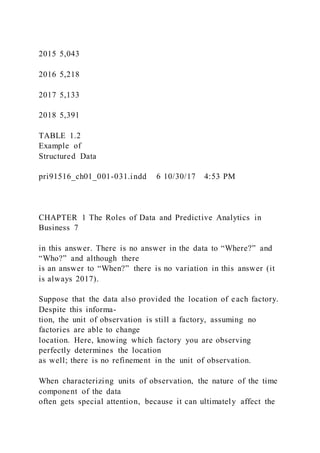
entity for which
information has been collected. For example, the data in Table
1.2 are structured data
on yearly sales; the unit of observation is a year and the
corresponding information is
number of sales.
Structured data need not be in spreadsheet format. Suppose you
found a piece of
paper in your desk, and at the top was written, “Yearly Sales.”
Then, written haphazardly
LO 1.2 Distinguish
structured from
unstructured data.
structured data Data
with well-defined units
of observation for which
corresponding information
is identifiable; they are
the data that come in a
spreadsheet format.
unit of observation
The entity for which
information has been
collected.
pri91516_ch01_001-031.indd 5 10/30/17 4:53 PM
CHAPTER 1 The Roles of Data and Predictive Analytics in
Business6
across the paper you saw the following figures: 4,382(2012);
4,615(2013); 4,184(2014);
5,043(2015); 5,218(2016); 5,133(2017); 5,391(2018). Although
not in spreadsheet format,
these data are structured. As in the spreadsheet, the unit of
observation is well defined (a
year), and the corresponding information (sales) is identifiable.
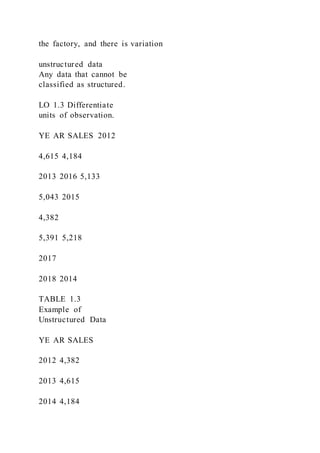
Unstructured data are the complement to structured data; they
are any data that can-
not be classified as structured. A series of images is an example
of unstructured data. The
words in this paragraph are unstructured data. The data in Table
1.3 are unstructured; this
is because, although it seems clear these are yearly data, there
is no way, with the informa-
tion given, to identify the corresponding sales information for
each year.
THE UNIT OF OBSERVATION
The crucial component of structured data is the unit of
observation; we cannot build or analyze
a structured dataset without it. In addition, the unit of
observation tells us the way in which the
information in the data varies. Does the information in the data
vary across people, countries,
time, people and time, etc.? As we will see in later chapters,
understanding how the informa-
tion varies in the data can be a critical factor in choosing and
assessing a method of analysis.
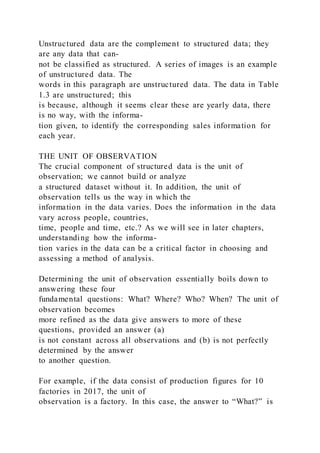
Determining the unit of observation essentially boils down to
answering these four
fundamental questions: What? Where? Who? When? The unit of
observation becomes
more refined as the data give answers to more of these
questions, provided an answer (a)
is not constant across all observations and (b) is not perfectly
determined by the answer
to another question.
For example, if the data consist of production figures for 10
factories in 2017, the unit of
observation is a factory. In this case, the answer to “What?” is
the factory, and there is variation
unstructured data
Any data that cannot be
classified as structured.
LO 1.3 Differentiate
units of observation.
YE AR SALES 2012
4,615 4,184
2013 2016 5,133
5,043 2015
4,382
5,391 5,218
2017
2018 2014
TABLE 1.3
Example of
Unstructured Data
YE AR SALES
2012 4,382
2013 4,615
2014 4,184
2015 5,043
2016 5,218
2017 5,133
2018 5,391
TABLE 1.2
Example of
Structured Data
pri91516_ch01_001-031.indd 6 10/30/17 4:53 PM
CHAPTER 1 The Roles of Data and Predictive Analytics in
Business 7
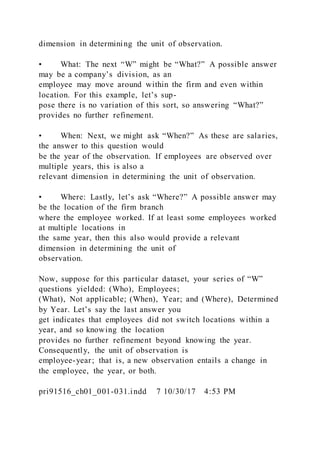
in this answer. There is no answer in the data to “Where?” and
“Who?” and although there
is an answer to “When?” there is no variation in this answer (it
is always 2017).
Suppose that the data also provided the location of each factory.
Despite this informa-
tion, the unit of observation is still a factory, assuming no
factories are able to change
location. Here, knowing which factory you are observing
perfectly determines the location
as well; there is no refinement in the unit of observation.
When characterizing units of observation, the nature of the time
component of the data
often gets special attention, because it can ultimately affect the
proper method of analysis.
The four main groupings of units of observation are cross-
sectional data, pooled cross-
sectional data, time-series data, and panel data.
Cross-sectional Data Cross-sectional data exhibit no variation in
time. When determining
the unit of observation, the answer to “When?” is constant.
Consequently, cross-sectional
data provide a snapshot of information at one fixed point in
time. The point in time need not
be short in duration; it can be an hour, a day, a month, or even a
year. Examples of cross-
sectional data include the following:
• Sales made by each employee on July 12, 2017.
• Visits to the top 100 websites in January 2018.
cross-sectional data
Data that provide a
snapshot of information
at one fixed point in time.
1.1
Demonstration Problem
Your IT group just informed you that it has a new dataset on
employee salaries. Before conducting
analysis on this new dataset, you want to establish the unit of
observation. Consequently, you start
working through the four “W” questions:
• Who: Given these are data on employees, the natural first
“W” is “Who?” In this case the
answer is employees, and as long as there is more than one
employee, this is a relevant
dimension in determining the unit of observation.
• What: The next “W” might be “What?” A possible answer
may be a company’s division, as an
employee may move around within the firm and even within
location. For this example, let’s sup-
pose there is no variation of this sort, so answering “What?”
provides no further refinement.
• When: Next, we might ask “When?” As these are salaries,
the answer to this question would
be the year of the observation. If employees are observed over
multiple years, this is also a
relevant dimension in determining the unit of observation.
• Where: Lastly, let’s ask “Where?” A possible answer may
be the location of the firm branch
where the employee worked. If at least some employees worked
at multiple locations in
the same year, then this also would provide a relevant
dimension in determining the unit of
observation.
Now, suppose for this particular dataset, your series of “W”
questions yielded: (Who), Employees;
(What), Not applicable; (When), Year; and (Where), Determined
by Year. Let’s say the last answer you
get indicates that employees did not switch locations within a
year, and so knowing the location
provides no further refinement beyond knowing the year.
Consequently, the unit of observation is
employee-year; that is, a new observation entails a change in
the employee, the year, or both.
pri91516_ch01_001-031.indd 7 10/30/17 4:53 PM
CHAPTER 1 The Roles of Data and Predictive Analytics in
Business8
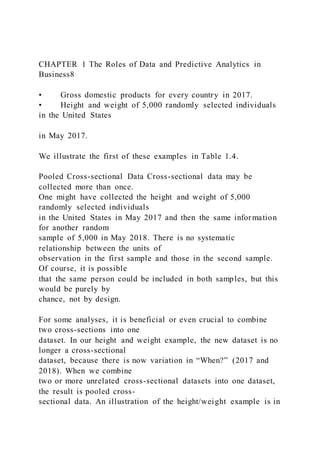
• Gross domestic products for every country in 2017.
• Height and weight of 5,000 randomly selected individuals
in the United States
in May 2017.
We illustrate the first of these examples in Table 1.4.
Pooled Cross-sectional Data Cross-sectional data may be
collected more than once.
One might have collected the height and weight of 5,000
randomly selected individuals
in the United States in May 2017 and then the same information
for another random
sample of 5,000 in May 2018. There is no systematic
relationship between the units of
observation in the first sample and those in the second sample.
Of course, it is possible
that the same person could be included in both samples, but this
would be purely by
chance, not by design.
For some analyses, it is beneficial or even crucial to combine
two cross-sections into one
dataset. In our height and weight example, the new dataset is no
longer a cross-sectional
dataset, because there is now variation in “When?” (2017 and
2018). When we combine
two or more unrelated cross-sectional datasets into one dataset,
the result is pooled cross-
sectional data. An illustration of the height/weight example is in
Table 1.5.
Time-series Data Time-series data exhibit only variation in
time. For these data, the
answers to “What?” “Where?” and “Who?” do not change across
observations, but the
answer to “When?” does. Many macroeconomic datasets are
time-series data. Examples
include annual gross domestic product for the United States
from 1950 to 2018; monthly
Indian interest rates from 2000 to 2017; and monthly
unemployment rates in Mexico from
1990 to 2015. Businesses also collect some time-series data.
Examples include annual
firm profits, 1995–2018; annual CEO compensation, 1991–
2016; and monthly employee
turnover, 1999–2017. An illustration for firm profits is in Table
1.6.
pooled cross-
sectional data The
result of two or more
unrelated cross-sectional
datasets being combined
into one dataset.
time-series data Data
that exhibit only variation
in time.
TABLE 1.4
Example of Cross-
sectional Data
E MPLOYE E SALES DATE
Herbert McDunnough 12 7/12/17
Carl Showalter 10 7/12/17
Marge Gunderson 19 7/12/17
Loretta Bell 7 7/12/17
Walter Sobchak 15 7/12/17
Mattie Ross 12 7/12/17
TABLE 1.5
Example of Pooled
Cross-sectional Data
NAME HE IGHT (INCHES) WE IGHT (POUNDS) MONTH
Angela Hoenikker 56 138 May 2017
Dwayne Hoover 59 172 May 2017
. . . .
. . . .
Paul Lazzaro 63 195 May 2018
Valencia Merble 58 152 May 2018
pri91516_ch01_001-031.indd 8 10/30/17 4:53 PM
CHAPTER 1 The Roles of Data and Predictive Analytics in
Business 9
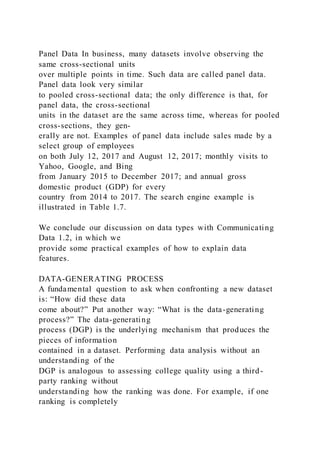
Panel Data In business, many datasets involve observing the
same cross-sectional units
over multiple points in time. Such data are called panel data.
Panel data look very similar
to pooled cross-sectional data; the only difference is that, for
panel data, the cross-sectional
units in the dataset are the same across time, whereas for pooled
cross-sections, they gen-
erally are not. Examples of panel data include sales made by a
select group of employees
on both July 12, 2017 and August 12, 2017; monthly visits to
Yahoo, Google, and Bing
from January 2015 to December 2017; and annual gross
domestic product (GDP) for every
country from 2014 to 2017. The search engine example is
illustrated in Table 1.7.
We conclude our discussion on data types with Communicating
Data 1.2, in which we
provide some practical examples of how to explain data
features.
DATA-GENERATING PROCESS
A fundamental question to ask when confronting a new dataset
is: “How did these data
come about?” Put another way: “What is the data-generating
process?” The data-generating
process (DGP) is the underlying mechanism that produces the
pieces of information
contained in a dataset. Performing data analysis without an
understanding of the
DGP is analogous to assessing college quality using a third-
party ranking without
understanding how the ranking was done. For example, if one
ranking is completely
based on average local temperature and another is based solely
on average rate of
employment after graduation, each has a very different
interpretation with regard to
quality.
panel data The same
cross-sectional units over
multiple points in time.
LO 1.4 Outline a
data-generating process.
data-generating
process (DGP) The
underlying mechanism
that produces the pieces
of information contained
in a dataset.
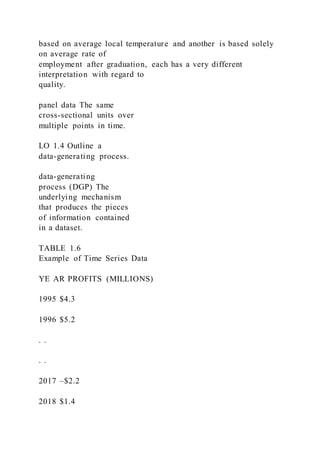
TABLE 1.6
Example of Time Series Data
YE AR PROFITS (MILLIONS)
1995 $4.3
1996 $5.2
. .
. .
2017 –$2.2
2018 $1.4
MONTH SE ARCH E NG INE VISITS (MILLIONS)
January 2015 Yahoo 147
January 2015 Google 183
January 2015 Bing 112
. .
. .
December 2017 Yahoo 171
December 2017 Google 205
December 2017 Bing 148
TABLE 1.7
Example of Panel
Data
pri91516_ch01_001-031.indd 9 10/30/17 4:53 PM
CHAPTER 1 The Roles of Data and Predictive Analytics in
Business10
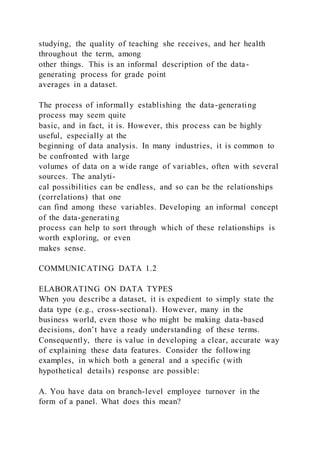
Establishing the data-generating process can be both informal
and formal. Informally, it
involves considering all of the factors that together determine
individual observations. For
example, a student’s grade point average depends on her innate
ability, the time she spends
studying, the quality of teaching she receives, and her health
throughout the term, among
other things. This is an informal description of the data-
generating process for grade point
averages in a dataset.
The process of informally establishing the data-generating
process may seem quite
basic, and in fact, it is. However, this process can be highly
useful, especially at the
beginning of data analysis. In many industries, it is common to
be confronted with large
volumes of data on a wide range of variables, often with several
sources. The analyti-
cal possibilities can be endless, and so can be the relationships
(correlations) that one
can find among these variables. Developing an informal concept
of the data-generating
process can help to sort through which of these relationships is
worth exploring, or even
makes sense.
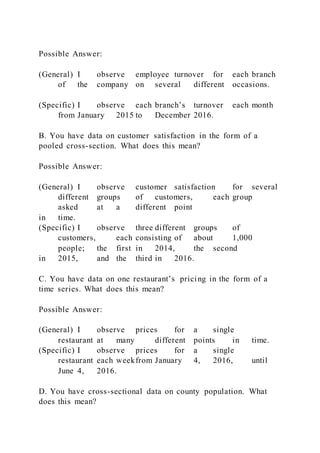
COMMUNICATING DATA 1.2
ELABORATING ON DATA TYPES
When you describe a dataset, it is expedient to simply state the
data type (e.g., cross-sectional). However, many in the
business world, even those who might be making data-based
decisions, don’t have a ready understanding of these terms.
Consequently, there is value in developing a clear, accurate way
of explaining these data features. Consider the following
examples, in which both a general and a specific (with
hypothetical details) response are possible:
A. You have data on branch-level employee turnover in the
form of a panel. What does this mean?
Possible Answer:
(General) I observe employee turnover for each branch
of the company on several different occasions.
(Specific) I observe each branch’s turnover each month
from January 2015 to December 2016.
B. You have data on customer satisfaction in the form of a
pooled cross-section. What does this mean?
Possible Answer:
(General) I observe customer satisfaction for several
different groups of customers, each group
asked at a different point
in time.
(Specific) I observe three different groups of
customers, each consisting of about 1,000
people; the first in 2014, the second
in 2015, and the third in 2016.
C. You have data on one restaurant’s pricing in the form of a
time series. What does this mean?
Possible Answer:
(General) I observe prices for a single
restaurant at many different points in time.
(Specific) I observe prices for a single
restaurant each weekfrom January 4, 2016, until
June 4, 2016.
D. You have cross-sectional data on county population. What
does this mean?
Possible Answer:
(General) I observe county-level population for
many counties at a single point in time.
(Specific) I observe county-level population for all
continental U.S. states on July 31, 2016.
pri91516_ch01_001-031.indd 10 10/30/17 4:53 PM
CHAPTER 1 The Roles of Data and Predictive Analytics in
Business 11
To illustrate this point, consider a firm that has weekly data on
the number and originat-
ing location of visits to its website, as well as productivity
levels (i.e., output per unit of
labor) for one of its factories in Bangalore, India. An analyst
could determine the correla-
tion in the number of visits to the website from the Northeast
United States and productiv-
ity levels in Bangalore. However, what meaning can be drawn
from this correlation? Does
productivity depend on these website visits, or vice versa? Or,
is there another variable
upon which both depend? Without some establishment of the
data-generating process, it
is difficult to find use with this measure, or to justify taking the
time to collect the data.
Clearly, before you decide to collect and analyze data, you need
to spend some time think-
ing what variables will be meaningful .
Formally establishing a data-generating process involves
building a representative sta-
tistical model. Such models typically treat the components of a
dataset as realizations of
random variables. For example, if the attendance at an
amusement park depends entirely
on the temperature that day, a formal representation of the data-
generating process may
look like:
Attendancet = f  (Temperaturet)
In words, this means that the attendance at the amusement park
on day t is a function of
the temperature on day t.
Of course, amusement park attendance on a given day depends
on many other things
beyond that day’s temperature. Perhaps the simplest way to
account for such additional
factors is to extend the above model as follows:
Attendancet = f  (Temperaturet) + Ut
Here, we can think of Ut as “all other factors, besides
temperature, affecting amusement
park attendance.”
Building a formal model of the data-generating process need not
be more complex than
this simple example for amusement parks. It need only provide
sufficient structure upon
which meaningful analysis can be conducted. While it is not
crucial to establish a formal
model at the onset of the analytical process, it becomes
critically important later on. In
fact, every analytical technique discussed in this book utilizes a
formal (often simple)
model of the data-generating process.
1.2
Demonstration Problem
Let Y be the starting salary for a given person’s first job. This
is a random variable that can take on
many different values (e.g., $20,000, $45,000, $82,000).
Suppose you want to informally establish
the data-generating process for Y. What are factors that likely
contribute to the realized values for Y?
(Try this on your own before reading further.)
The possible contributors to Y’s realized value clearly include
age, level of education, industry, loca-
tion, and the unemployment rate. Can you come up with others?
pri91516_ch01_001-031.indd 11 10/30/17 4:53 PM
CHAPTER 1 The Roles of Data and Predictive Analytics in
Business12
Basic Uses of Data Analysis for Business
Data analysis has many uses beyond predictive analytics for
business strategy. Before
diving into the specific focus of this book, it is useful to have
some perspective on the
range of applications of data analysis in the business world. We
can categorize business
uses of data analysis into the following categories: queries,
pattern discovery, and causal
inference. These categories do not encompass all possible uses
of data for business pur-
poses; however, they cover a large proportion and provide an
intuitive way to begin sorting
through this enormous field.
QUERIES
Possibly the most basic and ubiquitous use of data analysis in
business (and virtually every
other field) is for the purpose of informatio n retrieval and
summary. Even relatively small
datasets contain very large amounts of information, consisting
of the information in the
observations themselves, as well as information resulting from
combinations of the obser-
vations. Sorting through all of this information essentially boils
down to asking questions
of the data (e.g., “What are average profits?” “Who had the
most sales last quarter?”). Any
request for information from a database is called a query.
Many software packages are designed to streamline the asking
and answering of queries
via a database. Even for analytics novices, the use of query
software is likely quite familiar.
Anyone who has used a search engine on the Internet already
has experience with query
software. Suppose you entered “Analytics textbooks” in the
Google search bar. Google
treats the universe of web pages as a giant database, and then
treats this search as though
you entered this query: “What are the most relevant web pages
for analytics textbooks?”
The concept of “relevant” is not particularly well defined here;
each search engine formal-
izes relevance in its own way (e.g., a combination of the
number of times the search words
appear on the page, number of links to the page, etc.). Then, the
search simply answers
the query with a ranking of web pages, starting with the most
relevant. Every search you
conduct on Google is a query for the database of web pages.
As a simple example of queries for a firm’s database, consider
the data in Table 1.8.
These are sales data for three employees, who make sales in two
different locations. When
analyzing these data, you may want answers to the questions
“Which city had the most
sales?” or “Which employee had the most sales in Chicago?” or
“How many sales did
Robert Jordan make in New York?” These are all examples of
queries. With such a small
dataset, we can answer these queries by simply looking at the
data (Chicago, Catherine
LO 1.5 Describe the
primary ways that data
analysis is used to aid
business performance.
query Any request
for information from a
database.
TABLE 1.8
Dataset of Sales for
Three Employees
E MPLOYE E LOCATION SALES
Robert Jordan New York 87
Robert Jordan Chicago 63
Catherine Barkley New York 78
Catherine Barkley Chicago 91
Bill Gorton New York 57
Bill Gorton Chicago 71
pri91516_ch01_001-031.indd 12 10/30/17 4:53 PM
CHAPTER 1 The Roles of Data and Predictive Analytics in
Business 13
Barkley, and 87, respectively). Of course, with larger datasets,
this “eyeball” approach is
not possible. Fortunately software is available (just like
Google’s search engine) that can
comb through data to find the answers to a wide array of
queries.
A class of queries worthy of special mention is descriptive
statistics, which are a stan-
dard component of virtually any series of queries in practice.
Descriptive statistics are
broadly defined as quantitative measures meant to summarize
and interpret properties of a
dataset. They typically consist of measures designed to assess
the “center” and “spread” of
variables within a dataset. For analyzing the dataset contained
in Table 1.8, the mean and
variance of sales are both examples of descriptive statistics —
the former serving to locate
the “center,” and the latter serving as a measure of “spread.”
Here, the mean of sales is
74.5 and the variance is 178.3.
While descriptive statistics are standard queries for data
analysis, we can pose many
other queries. Even for small datasets, the number of queries we
can construct is exceed-
ingly large. This raises the question of how to choose
appropriate queries beyond simple
descriptive statistics. In business and elsewhere, a primary
motivator in choosing queries
is performance evaluation. Often just a few queries can provide
valuable insights as to how
well an individual, team, firm, or even country is performing.
One of the most well-known and long-standing applications of
using queries for per-
formance evaluation outside of business is in the sport of
baseball. Throughout the history
of the game, players have been defined by their batting average,
number of home runs,
number of stolen bases, earned run average, and so on. Owners,
managers, and fans have
used many such statistics to evaluate how good players are. As
data have become more
plentiful in baseball, the number and types of queries that can
be answered have increased
dramatically. A manager may want to know a player’s batting
average against left-handed
pitching, with two outs, after the fifth inning, with the bases
loaded, in close games (e.g.,
when the teams are within three runs of each other), and in
other situations. This lets a
manager evaluate whether the player is a good choice to bat in a
given situation, or if there
is another player on the roster who might be better. We provide
more discussion on base-
ball queries in Communicating Data 1.3.
Queries are pervasive in business. Simple descriptive statistics
such as average profit
per sale, average sales per store, the variance in sales across
stores, and average employee
health care costs can all serve as important and insightful
measures for performance evalu-
ation. Which age group spends the most on our product? What
were production levels in
Europe last month? How long does the average employee stay
with our firm? What is the
trend in profits over the past six months? Which salesperson
posted the most sales last
year? Queries such as these can be highly valuable.
In many cases, a manager will determine a class of queries
(e.g., total sales for each
employee), and instead of answering them one at a time as
separate questions, will prefer
to look at a summary of the data to quickly answer and explore
many queries at once.
Then, a pivot table becomes a valuable tool. A pivot table is a
data summarization tool
that allows for different views of a given dataset. These tools
are often used in spreadsheet
software, such as Excel.
To build a pivot table, you need only determine the desired
measure and filtering
dimensions. The measure is represented as a number, while the
dimensions can be num-
bers or text. For example, consider a cross-sectional dataset
where each observation con-
tains information on the following: sales, location, price, and
salesperson. In building a
pivot table, you may choose your measure to be total sales, and
a dimension to be location.
descriptive statistics
Quantitative measures
meant to summarize and
interpret properties of a
dataset.
pivot table A data
summarization tool that
allows for different views
of a given dataset.
pri91516_ch01_001-031.indd 13 10/30/17 4:53 PM
CHAPTER 1 The Roles of Data and Predictive Analytics in
Business14
This choice would result in a pivot table that looks like Table
1.10. Another possibility is
to choose your measure as average price, and dimensions of
location and salesperson. A
pivot table with these choices appears in Table 1.11.
COMMUNICATING DATA 1.3
SITUATIONAL BATTING AVERAGES
Some queries in baseball can be particularly informative for
team managers and owners. For example, teams consistently
query batting data to determine how their players perform
differently depending on whether runners are on base. A high
batting average with runners on base more readily translates
into runs, and ultimately wins.
Consider two prominent Major League batters, Mike Trout and
Bryce Harper. Looking at the data in Table 1.9, you can
see the performance change for the players in each situation
during the 2016 season. Harper’s batting average improves
significantly when there are runners on base as opposed to when
there is no one on base. Mike Trout’s remains almost the
same in both situations.
PL AYE R RUNNE RS ON NONE ON
Mike Trout 0.311 0.318
Bryce Harper 0.266 0.223
TABLE 1.9 Situational Batting Average Data
LOCATION TOTAL SALES
East 107
West 215
North 135
South 281
Grand total: 738
TABLE 1.10
Pivot Table with Sales
by Location
TABLE 1.11
Pivot Table with
Price by Location and
Salesperson
AVERAGE PRICE SALESPERSON
LOCATION JILLIAN THOMA S ANN GR AND TOTAL
East $21.85 $22.16 $24.31 $22.81
West 24.86 27.19 28.14 $26.68
North 20.18 24.91 22.35 $22.27
South 23.84 21.18 24.71 $23.67
Grand total: $22.73 $24.41 $24.27 $23.80
pri91516_ch01_001-031.indd 14 10/30/17 4:53 PM
CHAPTER 1 The Roles of Data and Predictive Analytics in
Business 15
PATTERN DISCOVERY
In addition to queries, businesses also use data analysis for the
purpose of pattern discovery.
A pattern in a dataset is any distinctive relationship between
observations within the dataset.
Pattern discovery is the process of identifying distinctive
relationships between observations in
a dataset. Pattern discovery can be synonymous with data
mining; however, data mining typi-
cally involves pattern discovery in large datasets. Data mining
is a subset of pattern discovery.
The definition of a pattern is quite general, and for good reason.
A wide array of
relationships may be worth discovering, depending on the
purpose of the analysis. For
example, supposing each observation contains information
about variable X (e.g., price)
and Y (e.g., sales), then the correlation between X and Y may
be a pattern that is discov-
ered in the data. Linear regression, in the context of pattern
discovery, is another method
of discovery that looks for partial correlations between
variables. Classification looks
for analogs to partial correlations between variables when at
least one of the variables is
categorical. We’ll discuss linear regression in great detail
throughout the book, and we
will further discuss classification later in this chapter (in the
section Passive Prediction).
Other examples of pattern discovery include association
analysis, cluster analysis, and
outlier detection. Association analysis attempts to discover
dependencies (generally in the
form of conditional probabilities) between two or more
variables in the data. Cluster analysis
groups observations according to some measure of similarity, so
observations in the same
group are more similar than observations in different groups.
Outlier detection finds small
subsets of observations (if they exist) that contain information
far different from the vast
majority of the observations in the dataset.
To see some of these patterns in practice, consider the data
presented in Table 1.12.
Assume this table consists of a sample of individuals that
shopped for product X on that
product’s website in a given month. Here, the dataset is small
enough that we can discover
patterns like those described above through simple formulas or
even by just looking at the
data. For larger datasets, we generally need data mining
software to accomplish these tasks.
In Table 1.12, we can discover the following patterns. First,
individual #7 is a clear
outlier both in the fact that his income is far above anyone
else’s, and the age/income
combination is highly unusual (young and wealthy, unlike
anyone else in the sample).
The correlation between age and income for the entire dataset is
–0.0909. However, after
removing the outlier (individual #7), the correlation is 0.9475.
This shows how important
pattern Any distinctive
relationship between
observations within the
dataset.
pattern discovery The
process of identifying
distinctive relationships
between observations in
a dataset.
data mining Pattern
discovery, typically in
large datasets.
association analysis
Attempts to discover
dependencies, generally
in the form of conditional
probabilities, between
two or more variables in
the data.
cluster analysis
Groups observations
according to some
measure of similarity.
outlier detection Small
subsets of observations,
if they exist, that contain
information far different
from the vast majority of the
observations in the dataset.
OBSE RVATION NO. AGE INCOME PURCHA SE
1 53 $110,000 Yes
2 24 38,000 No
3 42 80,000 Yes
4 60 95,000 Yes
5 28 41,000 Yes
6 30 44,000 No
7 27 430,000 Yes
8 62 140,000 No
TABLE 1.12
Website Shopping
Data
pri91516_ch01_001-031.indd 15 10/30/17 4:53 PM
CHAPTER 1 The Roles of Data and Predictive Analytics in
Business16
outlier detection can be, and that the general relationship (for
all but one observation)
between income and age in these data is a strong, positive one.
In applying association analysis to the data in Table 1.12, we
can establish the follow-
ing association rule: A purchase is associated with income of at
least $80,000. This stems
from the fact that, conditional on having income of at least
$80,000, the probability of a
purchase is 80% (notably higher than the unconditional
probability of a purchase).
Lastly, these data suggest a clustering according to income and
age. We can cluster
individuals 2, 5 and 6 in one group (younger with low income)
and individuals 1, 4 and 8
in another group (older with higher income).
In some instances, pattern discovery may seem no different
from a query. Determining
the correlation between two variables per se is really just a
query of the data (“What is the
correlation between X and Y?”). To conclude that we’ve
actually discovered a pattern in the
dataset, we need some sense of what makes the relationship
we’ve found “distinctive.” We
can impose criteria, or a rule (or rules), to make this
determination. A simple and common
way to do this is to establish a threshold. For example, we may
require that correlation
between two variables qualifies as a pattern only if it is larger
than 0.4. Or, an association
rule (B is associated with A) can be called a pattern only if the
conditional probability is
larger than 0.7. For the candidate patterns we descri bed from
Table 1.12, the correlation
(excluding the outlier) and the association rule we find satisfy
these criteria, respectively.
(Recall that the probability of a purchase given income of at
least $80,000 is 0.8.)
Pattern discovery for outlier detection and cluster analysis often
involves thresholds for
(Euclidean) distance. In determining whether the clusters
(2,5,6) and (1,4,8) and outlier
(7) we found qualify as a pattern, we can incorporate a distance
threshold in Income/Age
space. For the clusters, a simplified approach might involve
setting a radius for a circle
and assessing whether, say, three or more observations can fit
within a circle of that size
in the graph; when they can, that group is a cluster. For an
outlier, we may set a radius for
a circle and assess whether there are any observations that are
the only ones contained in a
circle of that size, when they are at the center of that circle. In
Figure 1.1, we plot all eight
FIGURE 1.1
Example of Outlier
Detection and Cluster
Analysis
$500,000
$450,000
$400,000
$350,000
$300,000
$250,000
$200,000
$150,000
$100,000
$50,000
$0
0 10 20
2 5 6
3
7
1
4
8
30 40 50 60 70
pri91516_ch01_001-031.indd 16 10/30/17 4:53 PM
CHAPTER 1 The Roles of Data and Predictive Analytics in
Business 17
observations. This plotting allows us to see the short distance
between group members;
these two groups are the only groups of three that can fit in the
prescribed circle. It also
allows us to see the long distance between each indivi dual and
individual #7 as illustrated
by the fact that the circle around individual #7 would contain
other individuals if it were
drawn around any other point.
Pattern discovery has many applications in business. When
focusing on the customer,
pattern discovery helps firms construct customer segments,
initiate segment-based pro-
motional campaigns or even pricing, and form predictions about
consumer behavior (will
a customer default on a loan?). Business applications of pattern
discovery go well beyond
enhancing customer relations. Pattern discovery can assist a
firm’s human resources
department to identify common characteristics among its most
and least successful
employees. Such discovery can help the firm build a more
efficient system of employee
recruitment, training, and retention.
Patterns that firms discover in data can even be highly
suggestive of a causal relation-
ship. Suppose an analyst has collected price and profit data
across many markets and plot-
ted these data as in Figure 1.2. What pattern seems most evident
in this scatter plot? Here
we discover that profits tend to be higher when price is higher.
This observation can be
useful toward understanding differences across markets, and it
may be tempting to take it a
bit further. The business may conclude from this pattern that
raising price (e.g., from $20
to $30) would lead to an increase in profit. Of course, if the
firm knew this to be true, it
would be very useful information with regard to pricing
strategy. However, simply discov-
ering this pattern does not necessarily imply a causal
relationship between these variables.
Establishing causality requires the data analyst to approach (and
sometimes construct) the
data in quite particular ways.
CAUSAL INFERENCE
In addition to queries and pattern discovery, businesses use data
analysis for causal infer-
ence. Causal inference is the process of establishing (and often
measuring) a causal rela-
tionship between a variable(s) representing a cause and a
variable(s) representing an effect,
causal inference
The process of
establishing (and often
measuring) a causal
relationship between a
variable(s) representing
a cause and a variable(s)
representing an effect,
where a change in the
cause variable results in
a change in the effect
variable.
FIGURE 1.2
Scatterplot of Data
on Profit and Price
900
800
700
600
500
400
300
200
100
0
0 5 10 15 20
Price
P
ro
fi
t
25 30 35 40
pri91516_ch01_001-031.indd 17 10/30/17 4:53 PM
CHAPTER 1 The Roles of Data and Predictive Analytics in
Business18
where a change in the cause variable results in a change in the
effect variable. Consider
two main types of causal relationship: direct causal
relationships and indirect causal rela-
tionships. A direct causal relationship is one in which a change
in the causal variable (X)
directly causes a change in the effect variable (Y). For example,
a person’s caloric intake
has a direct causal relationship with his weight. In contrast, an
indirect causal relationship
is one in which a change in X causes a change in Y, but only
through its impact on a third
variable. If daily exercise causes you to sleep better, which then
causes you to drink less
coffee, we can say that daily exercise indirectly caused a
reduction in coffee consumption.
We provide a more detailed example of an indirect causal
relationship in Communicating
Data 1.4. Throughout the book, we will focus our causal
discussions on direct causality,
except where otherwise noted.
Causal inference plays an important role in a wide range of
fields in business and
elsewhere. Examples of possible causal relationships that may
be particularly important
include: the effect of a drug on cancer remission, the effect of a
tariff on imports, and
whether combining two chemicals causes a chain reaction.
For business applications, causal inference typically takes place
in one of two ways. The
first is through experimentation. A firm may randomly fluctuate
variables under its control
in order to establish their effects on outcomes it values. By
doing this, the firm is directly
affecting the data-generating process since it is driving the
mechanism that generates at
least one of the variables. For example, suppose a popular
website is wondering whether
visitors are more likely to click on a banner ad if it is placed in
the upper left corner vs. the
upper right corner of the front page. Over several days, that
website may randomly vary
where the ad is placed for each new visitor, and then record the
click-through rate for each
placement. If the click-through rate for “upper left” is 0.05 and
for “upper right” is 0.07,
the website designers may conclude that the effect of moving an
ad from “upper left” to
“upper right” is an increase in the click-through rate of 0.02.
The second way causal inference typically takes place in
business is through econo-
metric models. Broadly speaking, econometric models are
statistical models for economic
and financial data. However, a primary objective of many of
these models is the establish-
ment of causality between variables. Rather than directly
influencing the data-generating
direct causal
relationship
A change in the causal
variable, X, directly
causes a change in the
effect variable, Y.
indirect causal
relationship
A change in X causes
a change in Y, but only
through its impact on a
third variable.
COMMUNICATING DATA 1.4
INDIRECT CAUSAL RELATIONSHIPS IN PURSE
KNOCKOFFS
Indirect causal relationships can be found everywhere,
including street vending in New York City. Consider the
relationship
between rainfall and sales of knockoff (imitation of designer)
purses. Such purses are regularly offered for sale outside
city parks and on the sidewalks by street vendors. It is
reasonable to believe that sales of these purses will depend on
the
weather, but is this dependence direct or indirect?
While we could make a case for both types of dependence, there
is almost certainly a large indirect causal relationship.
Specifically, bad weather (heavy rain) will reduce the number
of pedestrians, which will then reduce the number of purse
sales for the street vendors. Rain does not directly affect
someone’s desire to purchase a purse, but it affects her desire to
linger outdoors, which inhibits her from purchasing from one of
the street vendors. Hence, weather affects sales indirectly
through its effect on street traffic.
pri91516_ch01_001-031.indd 18 10/30/17 4:53 PM
CHAPTER 1 The Roles of Data and Predictive Analytics in
Business 19
process as in experimentation, analysts can use econometric
models, along with important
assumptions about their properties, to model the data-generating
process they observe. If
the model and corresponding assumptions are correct, then
estimating that model using the
data can lead to causal inference. How this works (e.g., the
process, reasoning) is a main
focus of this book, and beyond what can be fully detailed in this
chapter. For illustration
purposes, however, consider the following example.
Suppose you have data on sales and prices for 2-liter bottles of
Pepsi-cola for a large
number of vendors. In this case, you are not directly influencing
the data-generating
process since you are only observing prices and sales rather
than, for example, directly
controlling the prices charged. A standard measure of interest
would be the elasticity of
demand for this product. Given these data, you could easily
calculate this measure by
determining the average percentage change in units sold
associated with a percentage
change in price. However, an elasticity measure is causal in
nature, in that it indicates
the causal effect (in percentage terms) of a percentage change in
price on units sold. To
establish a causal relationship using these data requires you to
model the data-generating
process for prices and sales and make appropriate assumptions
about the model.
Establishing causal relationships is highly important in many
areas of business. Two
particularly valuable areas of application are campaign
evaluation and prediction. For
campaign evaluation, a firm uses causal inference to determine
the level of success or
failure for a campaign it has undertaken. For example, if a firm
engages in a promotional
campaign involving promotional prices and advertising, it can
use causal inference dur-
ing and after the campaign to assess how well it performed with
respect to profits, sales,
etc. For prediction, a firm can use causal inference to predict
the effect(s) of alternative
strategies it may be considering. This application is the primary
focus of the remainder
of the book.
Data Analysis for the Past, Present, and Future
An important means of characterizing data analysis in business
is according to the timing
of the application. Is the analysis designed to assess what
happened? what is happening?
or what is going to happen? Establishing which of these
questions is to be answered is key
in determining the method(s) of analysis, presentation, and
interpretation.
LAG AND LEAD INFORMATION
From a timing perspective, data analysis can provide two
different types of informa-
tion: lag information and lead information. Lag information is
information about past
outcomes. Lag information typically (but not always) contains
information on vari-
ables classified as key performance indicators (KPIs) or
variables that are used to help
measure firm performance. Lag information is designed to
answer the question, “What
happened?” Often, firms want to know this information with
very little delay, ideally
in “real time.” For example, a firm may wish to know the rate at
which people are
visiting its website at a given point in time (e.g., measured as
the number of visits in
the past five minutes). Such information is lag information;
however, if it is delivered
with minimal delay (in seconds or less), it essentially can
answer the question, “What
is happening?”
LO 1.6 Discriminate
between lead and lag
information.
lag information
Information about past
outcomes.
key performance
indicators (KPIs)
Variables that are used
to help measure firm
performance.
pri91516_ch01_001-031.indd 19 10/30/17 4:53 PM
CHAPTER 1 The Roles of Data and Predictive Analytics in
Business20
In contrast, lead information is information that provides
insights about the future. It is
designed to answer the question, “What is going to happen?”
Lead information is generally
used to help firms in the planning process, as they form
expectations about the future and
consider various strategic moves.
Data analysis that is used for queries, pattern discovery, or
causal inference can gener-
ate lag information. For example, a query asking which
employee had the most sales over
the past six months generates lag information that can be used
for employee evaluation.
With regard to pattern discovery, data analysis may lead to a
discovery that web traffic
for a firm’s website is extremely low on Monday afternoons.
This discovery of a segment
of time as an outlier is another form of lag information and can
be used as part of perfor-
mance measurement for the website. For causal inference, a
firm may use data analysis to
establish the impact of a recent advertising campaign on sales,
i.e., how much did sales
change as a result of the campaign? This lag information can be
used to reward or penalize
employees responsible for the campaign design and/or
execution.
Businesses generate a great deal of lag information using
standardized formats.
Examples include reports, dashboards, and scorecards. These
formats generally are used
for presenting lag information for queries, often with built-in
methods for performance
evaluation. A report is the most broadly defined of these
formats; it is any structured pre-
sentation of the information in a dataset. For example, the
output presented in Excel when
you construct a specific pivot table is a report. Reports are
intended to make it easier to
find and process desired information in a dataset. They often
come in the form of a table,
chart, or graph. Figure 1.3 is an example of a report on monthly
vehicle sales in the form
of a chart.
A dashboard is a graphical presentation of the current standing
and historical trends for
variables of interest, typically KPIs. Dashboards derive their
name from the fact that they
are designed to provide some notion of the “speed” of the
company, like a dashboard for a
car. However, they typically do a bit more than this, since they
often provide trend informa-
tion, giving the analyst a sense of the firm’s trajectory.
Dashboards are used as a real-time
monitoring device. By looking at a dashboard, the analyst
should be able to establish how
the firm is currently doing, and has been doing, with respect to
one or more KPIs. Figure
1.4 is an example of a dashboard, again for auto sales.
lead information
Information that provides
insights about the future.
report Any structured
presentation of the
information in a dataset.
dashboard
A graphical presentation
of the current standing
and historical trends
for variables of interest,
typically KPIs.
FIGURE 1.3
Report on Monthly
Vehicle Sales
January
200.0
100.0
400.0
300.0
600.0
500.0
700.0
MONTHLY SALES
0.0
February March April May July AugustJune
Small Vehicles Large Trucks SUV
pri91516_ch01_001-031.indd 20 10/30/17 4:53 PM
CHAPTER 1 The Roles of Data and Predictive Analytics in
Business 21
A scorecard is any structured assessment of variables of
interest, typically KPIs,
against a given benchmark. Scorecards derive their name from
the fact that they help to
“score” how the firm is performing along various dimensions. In
contrast to dashboards
which simply monitor KPIs, scorecards assess and communicate
whether a given KPI level
is good or bad, above average or below average, etc. It is up to
the designer of the scorecard
to determine the benchmarks, e.g., what levels of a given KPI
should be considered “good”
and what levels should be considered “bad.” Figure 1.5 is a
scorecard for a range of KPIs,
again for an automobile firm.
Data analysis used for pattern discovery and causal inference,
but typically not queries, can
generate lead information. Recall that a query is any request for
information from a database.
These requests are not designed to predict the future but rather
to answer questions about what
is and what was. In contrast, discovery of a pattern can
sometimes provide insights about the
future. Suppose you discovered via data mining that visitors to
your website who stayed longer
than five minutes made a purchase 92% of the time. Then, if
you observe a visitor to your
website who has been there for seven minutes, what might you
predict? It would be natural to
predict that this person is highly likely (92% likely) to make a
purchase.
Data analysis used for causal inference often can provide
insights about the future as
well. For example, your data analysis may identify a causal
relationship between the price
you charge and your sales, such that a 1% increase in price
causes a 2% decrease in sales.
scorecard Any
structured assessment
of variables of interest,
typically KPIs, against a
given benchmark.
COMPETITOR SALES
SALES MIX
Comp 3
Comp 2
Comp 1
Our Sales
0 2000 4000 6000 8000 10000 12000
Sales per category Small Vehicles Large Trucks SUV’s
SALES TRENDS
700.0
600.0
500.0
400.0
300.0
200.0
100.0
0.0
Ja
nu
ary
Fe
br
ua
ry
Ma
rch Ap
ril
Ma
y
Ju
ne Ju
ly
Au
gu
st
Small Vehicles Large Trucks SUV
Auto Sales
Tracking
FIGURE 1.4 Dashboard for Auto Sales
pri91516_ch01_001-031.indd 21 10/30/17 4:53 PM
CHAPTER 1 The Roles of Data and Predictive Analytics in
Business22
Knowing this can provide insights about the effect of a future
price change. You can use
this to predict the effect on sales of a proposed 3% price hike:
You would predict this price
increase will lead to a 6% decline in sales.
Unlike lag information, lead information generally is not
presented in some standardized
format. Formulating predictions about the future requires more
than just the information/
data at hand; it typically requires accompanying assumptions
and a line of reasoning,
often along with a formal model of the data-generating process.
Because of its greater
complexity, we do not provide an example of lead information
presentation here. Rather,
in the Applications section at the end of the book, you will have
ample opportunities to
present lead information in the form of causal analysis using the
information presented
in the upcoming chapters.
PREDICTIVE ANALYTICS
Recall that predictive analytics is any use of data analysis
designed to form predictions
about future, or unknow n, events or outcomes. Also recall that
lead information is infor-
mation that provides insights about the future. Consequently,
predictive analytics is data
LO 1.7 Discriminate
between active and
passive prediction.
FIGURE 1.5 Scorecard for Automobile Firm
Goals Measure Follow Up Target Result Performance Initiative
Responsible
Financial Associated Sales
Costs
Monthly $250 per sale $500 Too High Spend less time on paper -
work with each customer
Sales Manager
Customer Customer
Experience
Reviews
Weekly 3 out of 5
points
4 Good Level Spend more time under-
standing customer needs
before sales process
Sales Manager
Process Time between
delivery and
moving vehicles
to lot inventory
Monthly 3 days 2 days Good Level Redesigning detailing and
unpacking process
Inventory Control
Manager
Learning Employee Vehicle
Knowledge
Monthly 85% on manu-
facturer test
80% Nearing
Acceptable
Level
New training program on
vehicles and accessory
packages
Sales Manager
1.3
Demonstration Problem
Characterize the following types of information as lead or lag
information:
1. Information on which customers are most likely to drop their
cable service.
2. The probability that a given employee will leave the company
in the next year.
3. Sales growth in each region during the most recent six
months.
4. Expected number of Facebook Likes for a new product
rollout.
5. Managers who engaged in promotional pricing within the past
fiscal year.
6. Change in the company’s website hits due to the most recent
advertising campaign.
Answers: Lead, Lead, Lag, Lead, Lag, Lag.
pri91516_ch01_001-031.indd 22 10/30/17 4:53 PM
CHAPTER 1 The Roles of Data and Predictive Analytics in
Business 23
analysis designed to provide lead information. There are two
fundamental ways that
predictive analytics can predict the future and thus generate
lead information. They are
passive prediction and active prediction.
Passive Prediction Many attempts by analysts to predict the
future are done as pas-
sive observers. An analyst may wish to predict whether a visitor
to a website will make
a purchase, based on observed browsing behavior within that
website. In making her
prediction, the analyst assesses the relationship between a
purchase and observed infor-
mation only; she does not consider how purchasing behavior
might be affected if the
visitor’s browsing experience were altered or managed. We
define predictive analytics
of this type as passive prediction.
Passive prediction is the use of predictive analytics to make
predictions based on actual
and/or hypothetical data for which no variables are exogenously
altered. That is, the data
are passively observed. To round out this definition, note that a
variable in a dataset is said
to be exogenously altered if it changes due to factors outside the
data-generating process
that are independent of all other variables within the data-
generating process. If instead of
passively observing the data, our analyst alters a visitor’s
browsing experience by changing
a banner ad to an automatic pop-up ad, this change would
constitute an exogenous altera-
tion to that visitor’s ad exposure.
Using the definition for passive prediction, let’s expand our
website visitor example.
The analyst may have data on visits by many individuals, and
then use those data to
establish a relationship between browsing behavior and
purchasing (e.g., by estimating a
regression model). Then, using that established relationship, she
can make predictions for
a given visitor based on his observed browsing behavior, and
she can make predictions for
a generic visitor based on hypothetical browsing behavior (i.e.,
what if a visitor browses
page 2 for 30 seconds, page 5 for 45 seconds, etc.?). This use of
predictive analytics is
passive prediction.
Pattern discovery (also known as data mining for large data),
when used to make predic-
tions, is generally used for passive prediction. Conceptually, if
you discover a distinctive
pattern among a set of variables in a given dataset, it is natural
to expect that this pattern
will emerge again when the same variables are collected without
interference. For exam-
ple, using data on high school student demographics and
graduation outcomes, you may
discover a pattern in which the level of education attained by a
student’s mother relates to
whether that student graduates from high school.
Recognizing this pattern, you may build a model for
classification, in which students
are classified as “graduate” or “not graduate” based on the level
of their mother’s educa-
tion (e.g., those with mother’s education more than 12 years
may be labeled “graduate,”
and “not graduate” otherwise). Of course, it is unlikely that a
classification model as
simple as this one will be sufficient to make good predictions.
However, the key take-away
from this example is that if such a classification model were
used to make predictions, it
would do so in a passive way. You would observe or
hypothesize the level of education for
a student’s mother, and then use the model to make a prediction
about whether that student
will graduate. At no point in this process would you consider
exogenously changing the
level of education the mother attained, and then predicting the
effect of such a change on
graduation.
A highly visible example of passive prediction is weather
forecasting. To pre-
dict the weather, forecasters use predictive analytics models and
techniques that
passive prediction
The use of predictive
analytics to make
predictions based
on actual and/or
hypothetical data for
which no variables are
exogenously altered.
exogenously altered
A variable in a dataset
that changes due to
factors outside the data-
generating process that
are independent of all
other variables within the
data-generating process.
pri91516_ch01_001-031.indd 23 10/30/17 4:53 PM
CHAPTER 1 The Roles of Data and Predictive Analytics in
Business24
discover and utilize patterns in large weather datasets. In
forming predictions, the
forecasters take a passive approach, making predictions based
on the current (and
past) weather they observe. Weather forecasters do not make
predictions for, say,
tomorrow’s temperature if a massive inferno breaks out on the
west end of the city
tonight. This is because the instance of the inferno is an
exogenous alteration to, say,
ground conditions, since it comes from outside the general data-
generating process
for the weather.
Passive prediction is done using a wide range of predictive
analytics models designed
for pattern discovery and data mining. Commonly used are
neural networks and decision
trees, as well as regression. While we will not discuss such
models in detail in this book
(except for regression), the basis on which analysts generally
choose among competing
models for passive prediction is model fit. They seek the model
that can most closely
match the data according to some metric. This criterion is
sensible given the goal of pas-
sive prediction; the analyst simply wants as accurate a
prediction as possible following a
given, unaltered, data-generating process.
Passive prediction has many applications in business, ranging
from predicting
customers most likely to drop service to employees most likely
to be successful in
the company. A famous example of passive prediction uti lized
customer data on pur-
chases. Analysts at Target used credit card purchasing data to
make passive predictions
about whether a woman was pregnant. In one case, a father
visited Target to yell at its
personnel for sending his daughter coupons for baby-related
items. He later learned
that his daughter was, in fact, pregnant but had not yet told him.
He subsequently
apologized to Target.
Active Prediction Often in business and elsewhere, we want to
predict the consequences
of some action on an outcome of interest. A student may want to
predict the impact on
her final grade if she increases her study time by one hour per
week. Here, the action is
the increase in hours studying, and the outcome of interest is
her final grade. This type of
prediction is active prediction. Active prediction is the use of
predictive analytics to make
predictions based on actual and/or hypothetical data for which
one or more variables expe-
rience an exogenous alteration. For the grade example, the data-
generating process has the
final grade depending on study hours and other variables; the
prediction we want involves
exogenously altering the process by changing the number of
hours studied, independent of
all other variables influencing the final grade.
Making active predictions requires establishing a causal
relationship between variables.
If variable X changes exogenously and this change affects our
prediction for variable Y, this
impact must be due to a causal relationship between the two
variables. There is no move-
ment in any other variable that could explain why the prediction
changes with X. Hence,
we must know the causal relationship between Y and X in order
to make active predictions
for Y based on exogenous changes in X.
For example, suppose the outcome you care about is your body
weight two months
from now; call this variable Y. Currently, you do not eat whole
grains, but are considering
switching to a whole-grain-only diet; call this change in diet X.
Then, you may want to
make an active prediction of X on Y. To do this properly, you
must understand the causal
impact of changing to a whole-grain only-diet on future body
weight.
We conclude this section by providing practical examples of
passive and active predic-
tion in Communicating Data 1.5.
active prediction
The use of predictive
analytics to make
predictions based
on actual and/or
hypothetical data for
which one or more
variables experience an
exogenous alteration.
pri91516_ch01_001-031.indd 24 10/30/17 4:53 PM
CHAPTER 1 The Roles of Data and Predictive Analytics in
Business 25
Active Prediction for Business
Strategy Formation
As noted at the start of the chapter, predictive analytics is
highly useful in business strategy
formation: The decision maker can forecast the outcomes of
alternative strategies and then
choose the strategy that is best according to his objectives. We
can clarify this idea further
now that we have distinguished between passive and active
prediction.
Predicting an outcome for alternative strategies requires the
application of active
prediction. This is because a shift in strategy by a firm is
essentially an exogenous shock to
the data-generating process that was determining the outcome
and associated variables.
To accurately predict an outcome(s) for a range of competing
strategies, you must be able to
establish the causal effect of those strategies on that outcome.
To illustrate how predicting the effects of business strategies
relies on active predic-
tion, and ultimately causal inference, let’s consider a pricing
problem. Any firm selling a
product or service must make a strategic decision about the
price it charges; it often will
revisit this decision throughout its existence. Suppose an online
firm is currently selling
its product for $20. Over the past year, it has varied its price
between $10 and $30 due to
changes in demand conditions (e.g., holiday shopping) and
supply conditions (changes in
supplier prices). Under the current demand and supply
conditions, the firm is considering
LO 1.8 Recognize
questions pertaining
to business strategy
that may utilize (active)
predictive analytics.
COMMUNICATING DATA 1.5
PASSIVE AND ACTIVE PREDICTION IN POLITICS AND
RETAIL
One of the most prominent uses of passive prediction is in
political races. Gallup and many other political consulting busi -
nesses spend millions of dollars every year to predict the
outcomes of elections.
One way they can do this is through passive predictions. For
example, we can divide people into different subsets of
the population based on their personal characteristics: gender,
union participation, race, income level, etc. Since we can
observe only an individual’s personal traits (we cannot change a
person’s race, for example), we use passive prediction to
make inferences about which groups might be more likely to
vote for each political party.
To illustrate, in 2009 Gallup conducted a study about the effect
of gender on political preferences. The pollsters found
that in the United States, women are more likely than men to
favor Democratic candidates, regardless of age, race, and
marital status. Using these data, we could predict that a group
of women would be more likely, relative to men, to favor a
Democrat in an upcoming election, and could plan a political
strategy around that information.
An interesting business application of active prediction involves
the background music in retail stores. You might not
notice music playing when you go shopping, but studies show
that it can significantly influence the sales. In a study pub-
lished in the Journal of Marketing, researchers actively
varied music tempo played in stores from very slow to quick,
and
observed the results on shopping behavior and sales. The study
indicated that quick-tempo music influenced store patrons
to move faster through the store; slower music caused patrons to
shop more slowly while in the store. The researchers even
found that playing slow music caused shoppers to move more
slowly than having no music at all. As might be expected, the
researchers also found that slower music resulted in higher
sales, while fast music resulted in lower sales. These findings
suggested that a retail store owner may be able to increase sales
by strategically altering what’s playing in the background.
pri91516_ch01_001-031.indd 25 10/30/17 4:53 PM
raising its price from $20 to $25. However, before doing so, it
wants to predict what this
price hike would do to profits.
Making this prediction requires the firm to understand cause
and effect for price. The
$5 price hike is the cause, and the change in profits is the
effect. To determine this relation-
ship and ultimately make a prediction about the effect of the
price hike, it can be tempting
to simply measure how profits moved with price, using data on
prices and profits. In fact,
there are still many instances in which firms and researchers
make this type of mistake
even to this day. However, the leap from correlation to causality
is a large one, and can
lead to grossly incorrect predictions.
Suppose demand for the firm’s product is particularly high
during the holidays, and price
was set at $15 during that time, motivated by the belief that
shoppers would be particularly
active and price sensitive during that time. Suppose also that
demand for the product is low
in the summer, and price was set at $25 during that time,
motivated by the belief that those
who were interested in the product then were not aggressively
comparing prices. Under this
scenario, the data are likely to show high profits when price was
$15 and low profits when
price was $25. It is tempting to conclude, then, that raising
price lowers profits.
However, is such a conclusion valid for a given set of market
circumstances? For
example, does this conclusion imply that raising price during
the holidays would reduce
profits? Or more generally, does it imply that raising price from
$20 to $25 at a given point
in time will be detrimental to profits? The answer to these
questions is “not necessarily.”
Understanding why and knowing the reasoning and analysis
required in these types of
predictions is where we will focus our attention for the
remainder of the book.
RISING TO THE dataCHALLENGE
Navigating a Data Dump
Let’s return to the Data Challenge posed at the start of the
chapter: navigating a data
dump. To begin this task, you should ascertain two key data
features: the units of obser-
vation and the data-generating process. Different variables from
different sources are
often collected at different rates and levels. That is, their units
of observation are differ-
ent. For example, the Number of Likes may be a time series
with the unit of observation
being a week. In contrast, Product Sales may be a panel with the
unit of observation
being a store-month. Understanding the units of observation is
crucial when trying to
combine these variables into one dataset.
Here, you can add up the weekly “Likes” data for each month,
and keep this figure con-
stant across all stores (since it doesn’t vary by store). Combi ned
data may look as follows:
26 CHAPTER 1 The Roles of Data and Predictive Analytics in
Business
MONTH STORE FACE BOOK LIKES PRODUC T SALES
1 1 2347 28
1 2 2347 19
2 1 2782 33
pri91516_ch01_001-031.indd 26 10/30/17 4:53 PM
CHAPTER 1 The Roles of Data and Predictive Analytics in
Business 27
In establishing the data-generating process, you should begin by
thinking about all the
variables that might influence Product Sales. The first variable
you might want to include
is Facebook “Likes,” as this is the variable whose effect you
want to check. The next vari-
able probably is price, since there is a clear economic
relationship between price and
sales. What other variables might impact sales? For example, do
you think production
costs are part of the data-generating process for sales? It may
seem like a relevant vari-
able since higher costs can lead to higher prices and lower
sales; however, this means
that if we know the price, changes in production costs don’t
have an impact on sales.
Taking time to think about the components of the data-
generating process becomes
especially valuable as the number of variables in your dataset
becomes very large. It
can be very costly and wasteful to analyze relationships across
hundreds, thousands,
or even millions of variables when some simple reasoning can
reduce the analysis to
something much smaller and simpler.
S U M M A R Y
This chapter introduced the relationships among data, predictive
analytics, and business strategy. It dis-
cussed data features by distinguishing structured and
unstructured data, and by explaining unit of obser-
vation and the data-generating process behind the data that are
observed. We then explained how data
analysis is used for business, classifying this use into three
broad categories: queries, pattern discovery,
and causal inference. We discussed how data can provide lag
and lead information, and distinguished
between predictive analytics that provides passive and active
predictions.
A key purpose of this chapter is to provide a strong perspective
on the applications of data analysis
within the very broad category of Business Analytics, and
within the narrower category of Predictive
Analytics. Understanding the difference between active and
passive prediction is crucial to the remainder
of the book, as it sets the foundation of the book’s focus and
highlights how the application of predictive
analytics for business strategy formation requires the use of
active prediction. The remainder of the book
will explore how to conceptualize, execute, and communicate
these types of predictions.
K E Y T E R M S A N D C O N C E P T S
active prediction
association analysis
business analytics
business strategy
causal inference
cluster analysis
cross-sectional data
dashboard
data
database
data-generating process
data mining
descriptive statistics
direct causal relationship
exogenously altered
indirect causal relationship
key performance indicator
lag information
lead information
outlier detection
panel data
passive prediction
pattern
pattern discovery
pivot table
pooled cross-sectional data
predictive analytics
query
report
scorecard
structured data
time series data
unit of observation
unstructured data
pri91516_ch01_001-031.indd 27 10/30/17 4:53 PM
CHAPTER 1 The Roles of Data and Predictive Analytics in
Business28
C O N C E P T U A L Q U E S T I O N S
1. Classify the following datasets as structured or unstructured.
(LO2)
a. Jim: Age(22), Height(70in), Location(USA); Ann: Age(32),
Height(65in), Location(Netherlands);
George: Age(47), Height(73in), Location(UK); Gloria: Age(61),
Height(68in), Location(Switzerland)
b. Texts: “It’s cold today” “Hello?” “Where are you?”; Date:
1/14/15, 4/17/15, 9/25/15; Price: $0.10, $0.22,
$0.28
c.
COLOR
RE D GRE E N VIOLET BLUE
Length
15in 17in 22in 14in
Weight
5lbs 7lbs 2lbs 4lbs
Width
10in 12in 8in 12in
2. For the following datasets, determine the unit of observation
and the data type (cross-sectional, pooled
cross-sectional, time series, or panel). (LO3)
a.
YE AR STORE PROFIT MANAG E R CUSTOME RS
2015 1 $22,810 Anderson 411
2015 2 $32,416 Hietpas 593
2016 1 $25,983 Anderson 460
2016 2 $19,542 Wozniak 384
d.
SALES TIME SALES PRICE SALES
1440 16:45 1992 $8.42 1924
Time Price Store Sales Time
14:17 $4.45 22 1312 10:55
Price Store Time Store Price
$9.99 18 11:14 9 $11.14
Store Time Sales Price Store
16 12:12 2122 $7.18 7
pri91516_ch01_001-031.indd 28 10/30/17 4:53 PM
CHAPTER 1 The Roles of Data and Predictive Analytics in
Business 29
b.
MONTH PC SALES
TABLET
SALES
ACCESSORIES
SALES
WE BSITE
HITS
1 $3.4 million $4.6 million $1.3 million 1.2 million
2 $3.7 million $4.9 million $1.5 million 1.3 million
3 $3.2 million $5.0 million $1.6 million 1.3 million
4 $3.5 million $4.8 million $1.4 million 1.2 million
c.
YE AR NAME SAL ARY TE NURE AGE
2015 Herbert Grant $48,000 4 years 32
2015 Dianne Lawson $53,000 7 years 39
2016 Michael Daniels $67,000 10 years 45
2016 Kelly Harper $72,000 8 years 34
d.
FAC TORY
UNITS
PRODUCE D
PRODUC TION
COSTS
NUMBE R OF
E MPLOYE ES YE AR BUILT
1 832 $12.3 million 210 1993
2 1,105 $15.2 million 315 1998
3 512 $7.2 million 141 2005
4 916    $11.4 million 253 1987
3. Characterize the following data analyses as a query, pattern
discovery, or causal inference. (LO5)
a. The correlation between sales and price is 0.21.
b. The rate at which men aged 20–29 made a purchase is 0.04.
c. A 10% increase in prime time advertising will increase sales
by 3%.
d. Sonya Barber and Wesley Santiago both have incomes that
are at least $1,000,000 more than
anyone else’s.
e. Moving across the country before age 30 is associated with
having a college education.
4. Explain the difference between lead and lag information.
(LO6)
5. Explain the difference between passive and active prediction.
(LO7)
6. Characterize the following predictions as passive or active
prediction. (LO7)
a. Tom predicts his body weight next month after changing to a
whole-grains-only diet this month.
b. Ann predicts sales for her product next week based on the
number of visits to her website in the
past five days.
c. Laura predicts Twitter traffic for her company over the next
10 days after launching a new
advertising campaign last week.
d. Alex predicts total revenues at Macy’s next month using
information on Macy’s credit card
purchasing last week.
e. John predicts the winner of a local election based on answers
to a recent survey given by local voters.
pri91516_ch01_001-031.indd 29 10/30/17 4:53 PM
CHAPTER 1 The Roles of Data and Predictive Analytics in
Business30
   7. Why is the application of predictive analytics an ideal
complement to the formulation of business
strategy? (LO1)
8. A manager claims that increases in advertising expenditure
will surely raise the firm’s profits, citing his
sense that people find the firm’s ads entertaining. (LO1)
a. Sketch how you might refute this claim using:
i. A theoretical argument
ii. Data
b. Why might the refutation using data be more convincing?
9. List three factors that are likely part of the data-generating
process for the number of years an
employee works at a firm. (LO4)
   10. A grocery store manager is interested in the data-
generating process for her store’s weekly soda
sales. She believes factors impacting these sales include price,
product placement, and whether the
week contains a holiday. Write out a formal representation of
the data-generation process for weekly
soda sales that incorporates these and additional factors. (LO4)
      11.   Which of the following business questions requires the
use of active prediction? (LO8)
a. Are older people more or less likely to buy our product?
b. Will a new celebrity endorsement enhance sales?
c. How will profits respond to a change in product placement in
the store?
   12. As a manager at a major insurance company, Meredith
asks two of her analysts to help answer two
separate questions regarding a recent car insurance client. She
asks the first analyst, Darryl, to predict
using demographic characteristics (e.g., the client’s age,
education, etc.) the likelihood that the client
will be in an accident in the next five years. She asks the second
analyst, Amanda, to predict the effect
of a 10% cut in the client’s premium on the likelihood that the
client switches providers in the next
three years. Which analyst is making an active prediction?
(LO8)
   13. Properly load the following data into an Excel
spreadsheet. Clearly explain what are (1) the unit of
observation and (2) the data type. (LO2, LO3)
Score(47), Year(2015), Vote(Yes), Name(Laurene Horton);
Score(83), Year(2015), Vote(No), Name(Wilson
Zimmerman); Score(35), Year(2016), Vote(No), Name(Jeffrey
Wade); Score(48), Year(2016), Vote(No),
Name(Kayla Snyder); Score(26), Year(2015), Vote(No),
Name(Jeffrey Wade); Score(91), Year(2015),
Vote(Yes), Name(Candice Graves); Score(62), Year(2016),
Vote(Yes), Name(Candice Graves); Score(52),
Year(2015), Vote(Yes), Name(Kayla Snyder); Score(83),
Year(2016), Vote(No), Name(Laurene Horton);
Score(76), Year(2016), Vote(No), Name(Wilson Zimmerman)
   14. Construct a scorecard for the dataset Scorecard.xlsx to
assess performance on the following
objectives. (LO6)
a. Average regional revenue is at least $200,000.
b. Average regional growth is at least 5%.
c. Returns are no more than $10,000 in any store.
Dataset available at
www.mhhe.com/prince1e
Q U A N T I TAT I V E P R O B L E M S
pri91516_ch01_001-031.indd 30 10/30/17 4:53 PM
CHAPTER 1 The Roles of Data and Predictive Analytics in
Business 31
15. Access the dataset Sales and Costs.xlsx and answer
the following questions. (LO5)
a. Calculate these descriptive statistics.
i. Mean of sales
ii. Variance of materials costs
iii. Covariance of labor costs and materials costs
iv. Mean of labor costs
 v. Total sales
b. Calculate at least two more descriptive statistics for this
dataset.
16. For the dataset Sales and Costs.xlsx answer the
following queries. (LO5)
a. What are average sales when labor costs exceed $50,000?
b. What are minimum sales when materials costs are less than
$20,000?
c. What region had the highest labor costs?
d. What region had the lowest sales?
e. What was the greatest difference in sales across any two
regions?
            17. Using the dataset Lead and Lag.xlsx, answer the
following questions and explain whether the answers
can be categorized as lag or lead information. (LO6)
a. Which customers are most likely to drop your service?
b. Which region had the most customers last year?
Dataset available at
www.mhhe.com/prince1e
Dataset available at
www.mhhe.com/prince1e
Dataset available at
www.mhhe.com/prince1e
Chapter opener image credit: ©naqiewei/Getty Images
pri91516_ch01_001-031.indd 31 10/30/17 4:53 PM
32
LEARNING OBJECTIVES
After completing this chapter, you will be able to:
LO2.1 Define reasoning.
LO2.2 Execute deductive reasoning.
LO2.3 Explain an empirically testable
conclusion.
LO2.4 Execute inductive reasoning.
LO2.5 Differentiate between deductive and
inductive reasoning.
LO2.6 Explain how inductive reasoning can be
used to evaluate an assumption.
LO2.7 Describe selection bias in inductive
reasoning.
dataCHALLENGE Testing for Sex Imbalance
You have just begun work as an analyst at an online publishing
firm, and it has just
put up for sale a new “Do It Yourself ” (DIY) book. The author
intends to write several
follow-up books, but hopes to learn about the audience of his
first book as he begins
to design the next. After reading the book, one of your
colleagues at the firm claims
the book is heavily tailored to men, and consequently the rate of
purchase among
women viewing the book on the website will be very low,
around 3%. You are skepti-
cal of this claim, but rather than make a theoretical rebuttal,
you believe data are your
best bet to disprove it. Your publishing firm collects data on the
sex of its visitors and
whether they purchased, and the current data sample has the
purchase decisions
of 500 female visitors who viewed the book on the website.
Outline the reasoning
process you might follow that utilizes this data sample to test
your colleague’s claim.
2 Reasoning with Data
pri91516_ch02_032-054.indd 32 10/31/17 2:26 PM
CHAPTER 2 Reasoning with Data 33
What is Reasoning?
When confronted with a new dataset, it is easy and natural to
begin analysis by calculating
classic summary statistics, such as means and standard
deviations. Interpreting these num-
bers is straightforward; they correspond to clear definitions. For
example, if you determine
LO 2.1 Define
reasoning.
This chapter builds the foundation for the use of reasoning
when drawing conclusions
from data analysis. The purpose of the chapter is to build a
general framework for how
one should think about data analysis. By using a framework
centered on reason, we
can effectively answer questions like:
• “What must I believe in order to draw a general conclusion
about what is going on
with my company, based on what I see in a dataset?”
• “How confident am I in the conclusions I have just drawn
based on the data I have seen?”
• “What is the line of reasoning that took us from that number
to that conclusion?”
To build this reasoning “thought structure,” we will define
reasoning and discuss in
detail two key types of reasoning: deductive reasoning and
inductive reasoning. We
will then show how both types of reasoning play a crucial role
when we try to draw
general conclusions based on the data we observed. We will
show how deductive rea-
soning can lead to empirically testable conclusions, and how we
use data and induc-
tive reasoning to test these conclusions. Throughout this chapter
and the remainder of
the book, we will be incorporating Reasoning Boxes. These
summarize the reasoning
behind some of the main concepts in the book.
Some of the concepts we present in this chapter can be a bit
abstract, but they all
ultimately are highly valuable for business application. To help
make the upcoming con-
cepts more concrete, we start with a simple example. Consider a
coin, say, a quarter.
Any quarter has one side we call “heads” with the other side
“tails.” Now, consider a
standard assumption we might make about our quarter: “The
quarter is fair.” We assume
that, upon flipping the quarter in the air, the probability it lands
with heads facing up is
50%, and the probability it lands with tails facing up is 50%.
However, should we take our
assumption that the coin is fair on faith? How could we test this
assumption? One way is
with data—we flip the coin. If we flip the coin five times and
see heads each time, would
we doubt the coin is fair? Intuitively, believing the coin is fair
leads us to expect certain
outcomes when we start flipping the coin; we expect a
“balanced” number of heads and
tails. We flip the coin and see whether or not our expectations
are met, and then decide
whether or not we believe, after flipping the coin several times,
the coin is fair.
We can apply all the reasoning in this chapter to this coin
example. What remains is
to clearly define and describe each component of reasoning
being used. By doing so,
we can explain and debate how we arrive at data-driven
conclusions.
Introduction
pri91516_ch02_032-054.indd 33 10/31/17 2:26 PM
CHAPTER 2 Reasoning with Data34
the mean of X in your sample is 20, this literally means that the
sum of your observed
values for X divided by the number of times you observed X is
20. Mathematically, we
write this as:
X 
–
= ( 1 __ N ) ∑ i=1
N
Xi = 20
If you accept this definition, then arriving at the conclusion that
the mean is 20 is nothing
more than a simple exercise in algebra, typically done by your
computer or calculator.
Data analysis, though, involves more than just calculations
using mathematical and
statistical definitions. It also can involve more powerful
statements and conclusions rooted
in the statistics that are generated. Relevant examples for this
book are statements about
causality—for example, an increase of $1 million in R&D will
generate three new patents.
The three-to-one relationship comes from mathematical and
statistical calculations (e.g.,
through a regression, detailed in Chapter 5); however, their
interpretation as quantifying
a causal effect between R&D and patents requires more than
just calculations. Such an
interpretation requires the use of reasoning.
“Reasoning” is a term with which everyone is familiar. We
could argue that humans’ advanced
ability to reason is the key feature that separates us from every
other creature on Earth. Despite
this, many of us have only a vague notion as to what constitutes
reasoning, and one can find
examples of flawed reasoning almost anywhere. (The Internet is
a good place to start.)
Before developing a more formal understanding of reasoning,
consider the following two
arguments, each relying on your ability to reason in order to
convince you they are correct:
1. The company’s profits are up more than 10% over the past
year. An increase
in profits of 10% is the result of excellent management. You
were the manager
over the past year. Therefore, I conclude that you engaged in
excellent manage-
ment last year.
2. Ten of your 300 employees came to me with complaints about
your manage-
ment. They indicated that you treated them unfairly by not
giving them a raise
they deserved. Therefore, I conclude that all of your employees
are disgruntled
with your management.
In presenting those two examples, the goal is not for you to
make a definitive decision
about which you believe (if either). Rather, the goal is to begin
thinking about, and
distinguishing, different “lines” of reasoning. By the end of this
section, you will be
able to clearly distinguish the types of reasoning used in these
two examples. You will
then be able to carefully establish why you either believe or
question the claims they
are making.
We define reasoning as the process of forming conclusions,
judgments, or inferences
from facts or premises. Reasoning and logic are often used
interchangeably, and the
difference between the two is quite subtle. If a distinction is to
be made, reasoning is a
thought process, while logic is a description of the rules and/or
steps behind the reason-
ing process. Given the similarity in their meaning and
application, we will follow the
common practice of using the terms “reasoning” and “logic” to
mean the same thing in
this book.
The study and use of reasoning have a rich history in
philosophy, dating all the way back
to Aristotle. While some people view reasoning as the only way
to process information
reasoning The process
of forming conclusions,
judgments, or inferences
from facts or premises.
logic A description of
the rules and/or steps
behind the reasoning
process.
pri91516_ch02_032-054.indd 34 10/31/17 2:26 PM
CHAPTER 2 Reasoning with Data 35
and make decisions, others take alternative approaches, such as
following a hunch or
“going with their gut.” The business environment is populated
with both types of people,
at all organizational levels. Nevertheless, when people seek to
communicate information
and conclusions, doing so via reasoning has a much greater
potential for impact and
consensus.
In the context of data analysis, use of reasoning allows all those
processing the infor-
mation to clearly see how you can go from a dataset to a
meaningful conclusion, rather
than rely on one or more people’s instincts or feelings.
Consequently, especially for data
analysis, it is crucial to have a basic understanding of the
fundamental components of rea-
soning and be able to apply them when producing and assessing
data-driven conclusions.
Deductive Reasoning
Broadly speaking, reasoning is divided into two major types,
and all of us engage in both
types. The two types of reasoning are deductive reasoning and
inductive reasoning. They
are fundamentally different, but both play an important role
when properly interpreting,
and drawing conclusions from, data analysis.
DEFINITION AND EXAMPLES
Deductive reasoning goes from the general to the specific. It is
also known as top-down
logic. Deductive reasoning seeks to prove statements of the
form: “If A, then B.” For
example, you may use deductive reasoning to prove the
statement: “If our customers are
very sensitive to price, then a price increase will ultimately
lower our stock price.”
Such reasoning always implies three underlying components:
assumptions (“If A”),
methods of proof (“then”), and conclusions (“B”). The process
conceptually is straightfor-
ward, as illustrated in Figure 2.1.
After understanding the structure of deductive reasoning, the
next task is to understand
how to apply it in practice. That is, in business, how do you
properly support your conclu-
sions using deductive reasoning? The purest applications of
deductive reasoning are in the
field of mathematics; a basic understa nding of how it is used
there can provide a strong
foundation for applying it in business. Two of the most utilized
approaches for proving
“If A, then B” in mathematics are direct proofs and
transposition. These methods are also
particularly useful in business due to their intuitive appeal.
A direct proof literally walks across the flow chart in Figure
2.1, filling in all the details
along the way. To see how this works, consider a simple
mathematics application. Let’s
prove the following statement: “If X and Y are odd numbers,
then their sum (X + Y) is an
even number.”
This statement may seem intuitively obvious; you can pick any
two odd numbers (e.g.,
X = 5 and Y = 9), add them up, and see the sum is always an
even number (X + Y = 14,
which is even).
LO 2.2 Execute
deductive reasoning.
deductive reasoning
Reasoning that goes
from the general to the
specific; also known as
top-down logic.
direct proof Proof that
begins with assump-
tions, explains methods
of proof, and states the
conclusion(s).
Assumptions
Methods of
Proof
Conclusions
FIGURE 2.1
The Deductive
Reasoning Process
pri91516_ch02_032-054.indd 35 10/31/17 2:26 PM
CHAPTER 2 Reasoning with Data36
However, failing to find a contradiction is not the same as
proving a statement is gener-
ally true. How then can we use a direct proof to prove this
statement? Consider the fol-
lowing line of reasoning:
1. X and Y are odd numbers.
2. If X is an odd number, we can always write it as X = 2 × K +
1, where K is an
integer. For example, if X = 13, X = 2 × 6 + 1.
3. If Y is an odd number, we can always write it as Y = 2 × M +
1, where M is
an integer.
4. When we add X and Y, we get: X + Y = 2 × K + 1 + 2 × M +
1 = 2 × K +
2 × M + 2 = 2 × (K + M + 1).
5. K + M + 1 is an integer, so this means X + Y is 2 times an
integer.
6. Any number that is 2 times an integer is divisible by 2.
7. This means X + Y is even.
The above line of reasoning is an acceptable formal proof of the
originating statement that
uses a direct proof. The added details along the way include
definitions (of even and odd
numbers, in steps 2, 3, and 6), simple algebra (step 4), and a
property of integers (a sum
of integers is an integer, in step 5).
As we step outside mathematics, the methods of proof can
become less formal. Rather
than relying on formal definitions or rigid mathematical rules,
they may rely on generally
accepted principles or even common sense. Consider a recent
decision by McDonald’s to
offer breakfast all day. The underlying deductive argument for
this decision may very well
have been: “If our stores offer breakfast all day, revenues will
increase.” A direct proof of
such a claim may look as follows:
1. McDonald’s stores offer breakfast all day.
2. The addition of breakfast during lunch/dinner hours implies
more choices for
customers wanting to eat out during lunch/dinner hours without
losing any
choices previously available.
3. Consumers already choosing McDonald’s during lunch/dinner
hours can continue
to buy the same meals.
4. Consumers not choosing McDonald’s during lunch/dinner
hours may start
eating at McDonald’s with the new food options.
5. By retaining current consumers and adding some new
consumers, McDonald’s
sales will increase overall.
Here, step 2 details what the assumption implies for a given
store’s menu. Steps 3 and 4
appeal to common economic sense, and step 5 implicitly applies
basic algebra.
Our McDonald’s proof is well outside the realm of mathematics,
and so expectedly
suffers from a lack of rigor. In fact, you may disagree with the
line of reasoning presented
(and for good reason). We will revisit this proof below.
While direct proofs often are sufficient to prove a point
logically, it can sometimes
be easier and/or more effective to take an alternative approach.
A popular alternative
is to use transposition. Simply defined, transposition is the
equivalence between the
statements “If A, then B” and “If not B, then not A.” In other
words, it means that any
time a group of assumptions implies a conclusion (A implies B),
then it is also true
transposition Any
time a group of assump-
tions implies a conclu-
sion (A implies B), then it
is also true that any time
the conclusion does not
hold (not B), at least one
of the assumptions must
not hold (not A).
pri91516_ch02_032-054.indd 36 10/31/17 2:26 PM
CHAPTER 2 Reasoning with Data 37
that any time the conclusion does not hold (not B), at least one
of the assumptions
must not hold (not A).
Perhaps the most convincing way to illustrate this idea is
through a picture. In Figure 2.2,
there are two ovals, A and B, with A inside of B. One way to
verbalize what this picture means
is to say that “Anything inside of A is also inside of B,” or in
short, “If A, then B.” However,
notice we could also verbalize what this picture means by
saying “Anything outside of B
is also outside of A,” or in short, “If not B, then not A.”
As we did with a direct proof, we can first see how a proof via
transposition works
through a mathematics application. Let’s now prove the
following statement via transpo-
sition: “If X2 is even, then X is even.” Again, this statement
may seem obvious after just
checking a few numbers. For example, 16 is even and equals 4
squared, and 4 is in fact an
even number. How can we prove this statement generally using
transposition? Consider
the following line of reasoning:
1. Suppose X is not an even number; in that case, it is instead
an odd number.
2. If X is an odd number, we can always write it as X = 2 × K +
1, where K is an integer.
3. X 2 = (2 × K + 1)2 = 4K 2 + 4K + 1.
4. 4K 2 + 4K = 4(K 2 + K), and so is divisible by 2.
5. 4K 2 + 4K is an even number.
6. X 2 = 4K 2 + 4K + 1 is an even number plus 1, meaning it is
an odd number.
The above line of reasoning is an acceptable formal proof of the
originating state-
ment that uses transposition. Here, we start with the opposite of
the conclusion, and
show that it leads to the opposite of the assumption. The added
details along the way
include definitions (of even and odd numbers, in steps 2, 5, and
6) and simple algebra
(steps 3 and 4).
We can again step outside mathematics to see how we can use
transposition to prove
simple “If A, then B” statements. The intuitive appeal of using
transposition rather than
direct proof lies in the fact that it sometimes is easier to prove a
point by showing that dis-
belief of a conclusion requires clear disbelief of an assumption,
rather than walking down
a direct line of reasoning. Transposition can be particularly
effective if an assumption
seems indisputably obvious; it then becomes a powerful
affirmation of the conclusion to
show that, were the conclusion not true, a seemingly obvious
assumption must not be true.
Transposition also can be useful in properly assessing the
validity of a statement, since it
invites consideration of other, unstated assumptions that may
also need to be true in order
for the conclusion to hold.
FIGURE 2.2
Illustration of “If A,
then B,” and equiva-
lently, “If not B, then
not A”
Assumptions
(A)
Conclusions
(B)
pri91516_ch02_032-054.indd 37 10/31/17 2:26 PM
CHAPTER 2 Reasoning with Data38
To see these points, consider again the claim for McDonald’s:
“If our stores offer break-
fast all day, revenues will increase.” A proof via transposition
for the above statement may
look as follows:
1. McDonald’s stores revenues will not increase.
2. This means total revenues from current and new consumers
will not increase.
3. This means either there will be no new consumers or revenue
from current
consumers will decrease.
4. This means there could not have been an expansion in the
menu.
5. McDonald’s stores do not offer breakfast all day.
In the above transpositional proof, there are two key take-
aways. First, it takes the approach
of showing that, if the conclusion does not hold, the assumption
clearly cannot either. In
short: “If McDonald’s revenues do not increase, then the
company could not have been
offering breakfast all day.” As another example, a teacher may
claim: “If you adequately
study for the test, you will pass.” Then, she may casually
“prove” this statement by saying
“If you fail the test, it is obvious you did not adequately study
for it.”
The second take-away from the above proof is that the presence
of unstated assumptions
can be clearer in this form. Following the transposition
highlights the loose link between
menu expansion and revenues from new and current consumers,
most glaringly the latter.
Is it a certainty that people will continue to buy the same meals
when the menu expands?
McDonald’s should not lose these customers, since they can
still buy the meals they
bought before; but they may choose to buy some of the new
breakfast options instead of the
traditional lunch/dinner meals. And if the breakfast options are
less expensive, revenues
could go down. Hence, the implicit assumption is that current
consumers will not switch
to the breakfast offerings. At least early into this strategy shift
by McDonald’s, franchisees
were finding this implicit assumption to be false, resulting in
declining revenue.
If an implicit assumption is discovered, and it is possible it may
not always hold, it
is advisable to then add it to the original statement. For the
McDonald’s example, the
statement should then read: “If our stores offer breakfast all day
and current lunch/dinner
consumers do not switch to breakfast options, revenues will
increase.”
We summarize direct proofs and transposition in Reasoning Box
2.1.
DIRECT PROOF AND TRANSPOSITION
Two key methods for making deductive arguments, direct proof
and transposition, are as follows.
Direct proof:
1. State assumptions
2. Explain methods of proof: These include definitions,
formulas, generally accepted principles,
common sense, etc.
3. State conclusions
Transposition:
1. Assume the opposite of the conclusion (not B)
2. Explain methods of proof: These include definitions,
formulas, generally accepted principles,
common sense, etc.
3. State assumption(s) that is (are) violated (not A)
REASONING BOX 2.1
pri91516_ch02_032-054.indd 38 10/31/17 2:26 PM
CHAPTER 2 Reasoning with Data 39
COMMUNICATING DATA 2.1
DEDUCING GUILT AND INNOCENCE
One of the most prevalent uses of deductive reasoning is in the
application of law. Lawyers representing a defendant will
often call upon a fundamental deductive argument to argue their
client “didn’t do it.” The argument is: “If the person com-
mitted the crime, then he or she must have been present at the
crime scene when the crime was committed.” Of course,
such a statement applies only to physical crimes (murder,
robbery), and not necessarily other types of crimes (identity
theft).
The transposition of this statement is familiar to many, and can
be stated as, “If the person was not present at the crime
scene when the crime was committed, then he or she must not
have committed the crime.” This is the basis of an alibi,
where a defendant claims to be elsewhere when the crime
occurred in order to claim innocence. If the defense can provide
sufficient evidence that the defendant was elsewhere (if it can
provide a convincing alibi), then using simple deductive
reasoning, the defendant has an extremely strong case for
innocence. Figure 2.3 illustrates this concept.
FIGURE 2.3
Visualization of the Alibi
Person who
committed the
crime
Alibi:
Defendant is
here
People at the crime
scene when crime
committed
2.1
Demonstration Problem
Consider the following claim: “Firms that consistently attract
top talent will inevitably be profitable in
the long run.” Restate this in the form of a deductive argument.
Then, show how a proof by transposi-
tion will likely fail due to at least one missing assumption.
Answers:
Deductive argument: If a firm consistently attracts top talent,
then it will be profitable in the long run.
Transposition: If a firm is not profitable in the long run, it does
not consistently attract top talent.
Missing assumption (example): The firm must also retain top
talent. Thus, a firm may be unprofit-
able in the long run and consistently attract top talent, because
it is not able to keep that talent.
pri91516_ch02_032-054.indd 39 10/31/17 2:26 PM
CHAPTER 2 Reasoning with Data40
Regardless of the approach used to prove a deductive statement,
the appeal of using
deductive reasoning to make an argument is in its concreteness.
If there is disagreement
with a conclusion, then there are only two possible sources: the
method(s) of proof or the
assumption(s). Consequently, a deductive argument that clearly
lays out the assumptions,
methods of proof, and conclusions allows for clear lines of
assent and disagreement for
those assessing the argument. To further see its value in a
business environment, consider
two different ways of arguing in favor of sales growth over the
next year:
Method 1: “Suppose we continue investing in advertising online
to the 18–34 demo-
graphic, and we see just a slight uptick in the effectiveness of
our advertising to that
group. Further, assume there are no notable drop-offs among
other demographic groups.
This means we would have stable sales in some areas and
improved sales in others, and
consequently, I expect sales to grow over the next year.”
Method 2: “The young demographic loves our product, and we
have been pushing our
online advertising toward that group. My daughter is in that
group, and she is excited about
our upcoming product line; I’m excited about our upcoming
product line! I firmly believe
sales will grow over the next year.”
Although there is always a place in business for inspirational
speeches (Method 2), they
are not well suited for supporting a stated forecast. Within
Method 1, we can see a clear
set of assumptions, and the speaker is arguing that these
assumptions lead to the conclu-
sion. If an audience member believes sales will not grow over
the next year, he must either
disagree with the idea that the proposed assumptions lead to the
conclusion or disagree
with one of the assumptions. For example, he may argue that he
does expect notable drop-
offs among other demographi c groups, and these drop-offs will
ultimately hurt sales. For
Method 2, there is no clear line of reasoning that leads to the
conclusion. (Ask yourself:
What are the key assumptions that lead to the sales forecast?)
We conclude this section on deductive reasoning by considering
ways to resolve dis-
agreements about a conclusion. As noted above, if deductive
reasoning was used, such dis-
agreements must be rooted in the method(s) of proof or the
assumption(s). How are such
disagreements settled? Often, methods of proof in business call
upon obvious statements/
definitions and generally accepted ideas (e.g., if price goes up,
quantity sold will decline).
Of course, this need not always be the case, and so
disagreement about a definition or sup-
posedly accepted idea may occur. However, disagreement about
a method of proof is more
likely to be due to an unstated but necessary assumption. As we
did in the McDonald’s
example, the way to resolve such a disagreement is to simply
add this assumption in the
claim (e.g., “If A1 and A2, then B.”). Once this is done, the
potential for disagreement
moves from methods of proof to just the assumptions.
If disagreement about a conclusion stems from disagreement
about one or more
assumptions, how can this disagreement be settled? That is, how
can we evaluate assump-
tions that are disputable? Consider the claim: “If our city’s
population increases by 2%,
then sales will increase by at least 1%.” Suppose you agree with
the methods of proof
associated with that statement, but you do not believe the
conclusion because you do not
believe the assumption. You do not believe your city’s
population will increase by 2%.
There are two main ways of resolving disputes about
assumptions: (1) show robustness,
and (2) assess consistency with a collected dataset.
Robustness in the context of a deductive argument is the
persistent accuracy of a conclu-
sion despite variation in the associated assumption(s). Put
another way, a conclusion reached
via deductive reasoning is robust if we are able to vary some or
all of the assumptions that
robustness The
persistent accuracy of a
conclusion despite varia-
tion in the associated
assumption(s) within the
context of a deductive
argument.
pri91516_ch02_032-054.indd 40 10/31/17 2:26 PM
CHAPTER 2 Reasoning with Data 41
led to that conclusion and still reach the same conclusion.
Perhaps you do not believe sales
will increase by 1% because you believe your city’s population
will increase by only 1.2%,
not 2%. Such a disagreement can be resolved if it can be shown
that the conclusion is robust
to variations in the assumption. For example, the conclusion
may be true for population
increases ranging from 0.7% and up. If so, we say the
conclusion is robust to population
increases all the way down to 0.7%.
Showing a conclusion is robust to a wide range of assumptions
can be highly effective
toward gaining consensus about its accuracy. However, many
conclusions reached via deduc-
tive reasoning are not robust to certain variations in the
associated assumptions. In such
cases, one set of assumptions ({A1, . . . , AN}) might lead to
one conclusion (C1) while an
alternative set of assumptions ({A′ 1, . . . , A′ M}) might lead to
a different conclusion (C2). Here,
the conclusion C1 clearly is not robust at least to some
alternative assumptions. How then do
we decide whether to make assumptions ({A1, . . . , AN})
instead of ({A′ 1, . . . , A′ M}), and thus
believe conclusion C1 instead of conclusion C2? The answer is
to assess each conclusion’s
consistency with a collected dataset, which we detail further
next.
EMPIRICALLY TESTABLE CONCLUSIONS
Consider the following example. Suppose Chiquita Bananas is
negotiating with a major
grocery store chain, Kroger, about its product placement in the
store. Chiquita’s bananas
are currently in a standard location among the produce, but the
company is considering
purchasing a premium location in the front of the store.
Managers within Chiquita have
two opposing points of view about such a move. Manager Group
1 believes that a pre-
mium location in the front of the store will make the average
consumer more likely to
take notice of Chiquita bananas, compared to their current
location in produce. This group
purports that the up-front location is sure to grab attention.
Manager Group 2 believes that
a premium location in the front of the store will make the
average consumer less likely to
take notice of Chiquita bananas, compared to their current
location in produce. This group
purports that most consumers aren’t looking to make produce
selections when they first
walk into the store, and so will ignore a featured produce
product; and when they do enter
the produce section, they will not see Chiquita bananas.
Let’s now map our Chiquita Bananas example into a basic
deductive reasoning frame-
work. Let’s call Manager Group 1’s belief that moving the
product to the front of the store
will make consumers take more notice Assumption 1 (A1), and
let’s call Manager Group
2’s belief that moving the product to the front of the store will
make consumers take less
notice Assumption 2 (A2). Suppose also that both groups agree
that greater notice will lead
to greater sales. Then, we have two basic, competing arguments:
“If A1, then C1” vs. “If
A2, then C2.” Here, C1 is the conclusion that sales will
increase, and C2 is the conclusion
that sales will decrease. These alternative conclusions (C1 and
C2) are both examples of an
empirically testable conclusion.
An empirically testable conclusion is a conclusion whose
validity can be meaningfully
tested using observable data. Conclusions C1 and C2 in our
Chiquita Bananas example are
both empirically testable. Suppose we have data on Chiquita
Bananas sales in the current
location. Then, suppose the company chooses to move their
bananas to the new up-front
location and collects sales data for that new location. With data
on sales while the bananas
are displayed in produce and in the front of the store, it should
at least be conceptually clear
that we can meaningfully test the validity of our competing
conclusions. At first glance, we
empirically testable
conclusion A conclu-
sion whose validity can
be meaningfully tested
using observable data.
LO 2.3 Explain an
empirically testable
conclusion.
pri91516_ch02_032-054.indd 41 10/31/17 2:26 PM
CHAPTER 2 Reasoning with Data42
might argue that an increase in sales after the location change is
consistent with conclu-
sion C1 being valid and conclusion C2 being invalid. By making
this distinction, we are
effectively sorting between assumptions A1 and A2. The
invalidity of C2 implies A2 cannot
be correct (using transposition: “Not C2 implies Not A2”).
Hence, we would argue that A2
is not consistent with the data. While this example is only
conceptual (and quite informal),
we formalize this process of testing conclusions and ultimately
assessing assumptions later
in this chapter, and in the chapters that follow.
Many conclusions pertaining to business outcomes are
empirically testable.
Examples include: (1) “If consumers are price sensitive, higher
prices lead to lower
revenues” and (2) “If consumers ignore all ads on web pages,
changes in ad placement
on a web page will not alter sales.” We can attempt to test the
conclusions in both of
these statements using data on prices and revenues, and data on
ad placement and sales,
respectively. In contrast, consider the statement: “If firms
underestimate future profits,
they will sometimes exit markets that would have proven highly
profitable for them in
the future.” Notice that the conclusion is difficult to empirically
test; to do so, we’d
have to know how profitable a firm would have been had it not
exited a market. We
may learn something about this by looking at other firms;
however, the only data that
speak directly to this conclusion would be data on firm
profitability after exiting, and
such data cannot exist.
Thus far, our discussion of empirically testable conclusions has
been rather abstract,
relying on conceptual explanations of how testing occurs as
opposed to statistical methods.
Although we don’t discuss statistical methods until the next
chapter, we can begin building
a more concrete foundation for the process of testing
conclusions by focusing our attention
on a particular subset of conclusions. Many of the practical
conclusions we will test in this
book concern outcome probabilities.
As illustration, consider again a quarter, and again suppose we
assume “The quarter is
fair.” The probability it lands with heads facing up is 50%, and
the probability it lands with
tails facing up is 50%. This assumption leads to many
empirically testable conclusions.
One is that, when flipping the quarter five times, “If the quarter
is fair, the probability of
seeing any number of heads (0–5) is as described in Table 2.1.”
How we might empirically test our conclusion is
straightforward. We flip the quarter
five times and record the heads that occur. The number of heads
in our observed data
serves as a test of our deductive conclusion (the probabilities in
Table 2.1). If we observe
a very high (5) or very low (0) number of heads in our five
flips, we may question whether
the probabilities in Table 2.1 actually apply to the quarter we
flipped, and thus whether our
empirically testable conclusion is correct. If we decide our
conclusion passes the test, then
we have no reason to dispute the assumptions leading to that
conclusion, but if we decide
it does not pass, we must reconsider or reject at least some of
the assumptions leading to
that conclusion.
Making the actual decision about the validity of an empirically
testable conclusion
based on observable data is an application of inductive
reasoning.
# OF HE ADS 0 1 2 3 4 5
Probability 3.125% 15.625% 31.25% 31.25% 15.625% 3.125%
TABLE 2.1
Probabilities for
Varying # of Heads
When Flipping a
Quarter Five Times
pri91516_ch02_032-054.indd 42 10/31/17 2:26 PM
CHAPTER 2 Reasoning with Data 43
Inductive Reasoning
For the remainder of this chapter, we discuss the second major
type of reasoning, inductive
reasoning. Inductive reasoning plays an important role in
distinguishing among competing
sets of assumptions. We will explain inductive reasoning and its
applications generally;
how it can be used to sort through assumptions leading to
empirically testable conclusions;
and how it can be, and often is, improperly used.
DEFINITION AND EXAMPLES
Inductive reasoning is reasoning that goes from the specific to
the general. It is also known
as bottom-up logic. Broadly speaking, inductive reasoning is
used to generalize based on
what is observed. Most inductive arguments have the following
basic form: “Based on
observing X, I believe that Y is generally true.”
While other types of reasoning can be classified as inductive
reasoning, the process
of making a general statement based on specific observations is
certainly the most well-
known use of inductive reasoning. It will be the version we use
throughout this book.
In contrast to deductive reasoning, inductive reasoning does not
involve a proof. We
cannot prove the general from the specific. We can only support
or fail to support the
general from the specific. Observing that 20 polar bears are
white does not prove all polar
bears are white; rather, it supports the claim that the entire
polar bear population is white.
Inductive arguments stemming from business data analysis
almost exclusively use
information about a data sample to draw conclusions about a
general population. The
population is the entire set of potential observations (e.g.,
customers, sales in a month)
about which we want to learn. A data sample is a subset of a
population that is collected
and observed. For example, a survey of 1,000 Americans that
contains information on their
age and income is a data sample of the population of all
Americans. As a less obvious
example, consider a data sample consisting of Apple’s monthly
iPhone sales. The corre-
sponding population for this sample may seem less obvious
since there isn’t a larger set of
monthly sales for iPhones from which we are sampling; there is
one sales figure for each
month, and we are observing it. However, we can conceptualize
a larger set of potential
monthly sales for iPhones (i.e., monthly sales that could have
happened under different
circumstances), and the sales we observed are drawn from this
population.
Inductive reasoning fits intuitively with data samples and
populations. A data sample
is the “specific,” which we observe, and the population is the
“general,” about which we
form conclusions. In business, it can be beneficial to understand
key features concerning a
wide range of populations, including current customers,
potential customers, profits over
time, sales regions, and so on. Businesses regularly collect data
samples and apply induc-
tive reasoning to draw conclusions about these populations.
Suppose a firm that conducts all its business over the Internet
wants to know the aver-
age age of its customers. It would like to get this information
with minimal intrusion on
its customers’ time. Consequently, over the period of a month,
it sends one out of every
twenty customers a brief questionnaire asking his/her age after a
purchase is made. Let’s
assume this process results in 872 observations (purchasers
whose age the firm observes),
and the average age of these 872 people is 43.61. From here, the
inductive reasoning is
straightforward: “Based on observing an average age of 43.61
for my customers in my
sample, I believe the average age of my customers in general i s
43.61.”
LO 2.4 Execute
inductive reasoning.
LO 2.5 Differentiate
between deductive and
inductive reasoning.
inductive reasoning
Reasoning that goes
from the specific to the
general; also known as
bottom-up logic.
population The entire
set of potential observa-
tions about which we
want to learn.
data sample A subset
of a population that is
collected and observed.
pri91516_ch02_032-054.indd 43 10/31/17 2:26 PM
CHAPTER 2 Reasoning with Data44
Inductive reasoning using data may seem simple. However, the
given argument has an
apparent weakness. Concluding that the sample average is the
exact population average is
a bold step; it invites the question: “How sure are you of that
conclusion?” The answer
requires knowledge of the degree of support for the conclusion.
The degree of support
(also called inductive probability) for an inductive argument is
the degree of confidence in
the conclusion resulting from the stated observation(s). In
shorthand, it is often called the
strength of the inductive argument. For the customer age
example, you may state you are
50% confident in your conclusion; your degree of support is
50%. This means you believe
there is a probability of 50% that the conclusion you’ve drawn
is accurate.
Where does the degree of support come from? In the customer
age example, we pro-
vided no basis; it was simply a subjective number. In fact,
inductive arguments are often
accompanied by subjective degrees of support—degrees of
support based on opinion and
lacking a statistical foundation. For example, a manager may
claim: “Based on the strong
sales of our office, I believe the entire company has higher
sales.” When asked how sure
she is of this statement, she may say that she is 98% sure.
However, this again is just a
subjective number, rooted in that person’s perceived level of
confidence.
The degree of support need not be subjective. Adding some
basic assumptions to the observed
information, and applying some well-known statistical formulas
and theorems, will generate an
objective degree of support. An objective degree of support has
a statistical foundation, making it
more credible as compared to a subjective degree of support.
All inductive arguments throughout
the remainder of this book will be accompanied by an objective
degree of support.
degree of support
(also called inductive
probability) The degree
of confidence in the con-
clusion resulting from the
stated observation(s) for
an inductive argument.
strength The degree
of confidence in the
conclusion.
subjective degrees
of support Degrees
of support based on
opinion and lacking a
statistical foundation.
objective degree
of support A degree
of support that has a
statistical foundation,
making it more credible
as compared to a subjec-
tive degree of support.
2.2
Demonstration Problem
Classify the following arguments as examples of deductive or
inductive reasoning:
1. If I leave for work at 7:30 and my commute to work is
exactly one hour, I will arrive at work at 8:30.
2. Suppose the probability a customer will complete a follow -up
survey is 25%. Then, the probability
that all of the next four customers requested to complete the
survey is 0.39%.
3. All divisions of the firm on the West Coast have shown a
profit. Therefore, the firm as a whole
is profitable.
4. The average rating given by a random group of respondents
for the new product design was 9
out of 10. Therefore, the general public thinks favorably of the
new product design.
Answers:
1. Deductive reasoning. We are setting assumptions (leave work
at 7:30; commute is one hour),
and arriving at a conclusion. The implied method(s) of proof is
little more than simple algebra.
2. Deductive reasoning. We are making an assumption about the
probability of completing the
survey, and that assumption leads to a (empirically testable)
conclusion about the next four
customers. Note that, if we tried to prove this statement by
transposition, we would quickly
realize that an implicit additional assumption is that there is no
selection bias (defined later in
the chapter) inherent in the “next four customers.”
3. Inductive reasoning. We are taking observed outcomes for a
subset of the firm and making a
general conclusion about the firm as a whole.
4. Inductive reasoning. We are taking observed ratings for a
subgroup of the population and
reaching a general conclusion about the entire population.
pri91516_ch02_032-054.indd 44 10/31/17 2:26 PM
CHAPTER 2 Reasoning with Data 45
COMMUNICATING DATA 2.2
INDUCTIVE REASONING VIA CUSTOMER TESTIMONIES
Many firms sell what are known as “experience goods.”
Characteristics, such as quality, for these goods can only be
fully
ascertained after purchase and consumption. For example, wine
and skin care products are experience goods, since the
flavor of the wine and the effectiveness of the product,
respectively, can only be fully known after personal use.
Recognizing
that potential customers who have never purchased them before
face uncertainty about “experience goods,” firms produc-
ing such goods often assemble customer testimonies
highlighting their merits and encourage current customers to
leave
positive online reviews. The hope is that potential customers
will use the observed data from current customers to draw
conclusions (via inductive reasoning) about product quality. An
individual considering a purchase of an unfamiliar skin care
product may reason, based on mostly positive testimonies about
the product’s effectiveness, that the product is effective
and decide to make a purchase. But while firms may hope
potential customers will make such an inductive argument, some
potential customers may be reluctant to draw such a clean
conclusion. Some may worry that those giving testimonies are a
“special” or “select” group based on their prior willingness to
buy the product or willingness to give a testimony. How might
such “selection” lead to errant conclusions? We discuss the
issue of selection bias in greater detail later in this chapter.
We next will demonstrate how to evaluate assumptions using
inductive reasoning along
with an objective degree of support. In Chapter 3, we expand on
these ideas, detailing in
general terms how to form a conclusion about a population
using a data sample, and how
to calculate an objective degree of support.
EVALUATING ASSUMPTIONS
Now that we have defined inductive reasoning, we can turn to a
key point of interplay
between deductive and inductive reasoning. We finished our
discussion of deductive
reasoning by defining empirically testable conclusions, noting
that we can use induc-
tive reasoning when “testing” these conclusions and ultimately
evaluate the assumptions
leading to them. Now we will provide a more concrete
discussion of this process of evalu-
ating assumptions, building a basic theoretical framework on
which we will expand in the
next chapter.
The basic process of evaluating assumptions is as follows. First,
consider a deductive
argument where an assumption(s) leads to an empirically
testable conclusion, and sup-
pose that conclusion concerns an outcome probability (or
probabilities). Next, suppose we
have a data sample for the outcome. We can then “test” our
conclusion by comparing the
observed outcomes in the data sample to their corresponding
probabilities. After making
this comparison, we decide whether the conclusion “passes” the
test or fails; this decision is
an application of inductive reasoning, as we are using the
specific (the data sample) to say
something about the general (our empirically testable
conclusion). If the empirically test-
able conclusion fails the test, a simple application of
transposition (Not B implies Not A)
implies we must reject/reconsider at least one of the
assumptions leading to this conclusion;
if it passes, then the data sample does not give reason to
reject/reconsider the assumption(s).
Reasoning Box 2.2 summarizes the process of evaluating
assumptions, and Figure 2.4
illustrates it.
LO 2.6 Explain how
inductive reasoning can
be used to evaluate an
assumption.
pri91516_ch02_032-054.indd 45 10/31/17 2:26 PM
CHAPTER 2 Reasoning with Data46
Now that we have the basic framework for evaluating
assumptions, let’s consider some
simple ways of applying it by revisiting our example of flipping
a quarter. Supposing again
we assume the quarter is fair (probability of heads equals
probability of tails, 50%), we can
apply some basic algebra and probability theory to arrive at an
empirically testable conclu-
sion: the probability of seeing any number of heads (0–5) for
five coin flips is as described
in Table 2.1 (re-created below). This line of reasoning
represents the first step in Figure 2.4.
Next, we collect a data sample to test our conclusion. For
example, the data sample
may consist of five coin flips, recorded in Table 2.2. Using
these data, we see that the total
number of heads for these five flips was 5.
INDUCTIVE REASONING FOR
EVALUATING ASSUMPTIONS
REASONING BOX 2.2
1. Suppose through deductive reasoning, we have arrived at an
empirically testable conclusion.
2. Collect a data sample. Using the data sample and inductive
reasoning, test the empirically test-
able conclusion and decide either to reject the conclusion or
affirm that the data are sufficiently
consistent with the conclusion.
3. If the decision is to reject the empirically testable
conclusion, through transposition reject at least
one of the assumptions that led to the empirically testable
conclusion you rejected.
Assumption(s)
1. Deductive reasoning generates empirically testable
conclusion.
2. Inductive reasoning tests empirically testable conclusion.
?
Methods of
Proof
Empirically
Testable
Conclusion(s)
Data Sample
Empirically Testable
Conclusion(s)
Empirically
Testable
Conclusion(s)
3. If test fails, transposition leads to rejection/reconsideration
of assumption(s).
Methods of
Proof
Assumption(s)
FIGURE 2.4
Evaluating
Assumptions via
Testing Empirically
Testable Conclusions
# OF HE ADS 0 1 2 3 4 5
Probability 3.125% 15.625% 31.25% 31.25% 15.625% 3.125%
TABLE 2.1
Probabilities for
Varying # of Heads
When Flipping a
Quarter Five Times
pri91516_ch02_032-054.indd 46 10/31/17 2:26 PM
CHAPTER 2 Reasoning with Data 47
We can use the number of heads we observe in our data sample
to test our conclusion, the
second step of Figure 2.4. It is in this phase where we apply
inductive reasoning: We must
conclude something about the general (the probabilities in Table
2.1) from the specific (our
data sample in Table 2.2). In our data sample we had five heads
out of five flips. Speaking
loosely, we may view such an outcome as “extreme” or highly
unlikely, and devise the fol-
lowing rule: If I observe an “extreme” outcome, I will conclude
the probability distribution
in Table 2.1 is incorrect; otherwise, I will consider the
distribution sufficiently consistent
with the data sample. Two outcomes stand out as candidates for
the label of “extreme”—five
heads and five tails, each of which has probability of 3.125%.
Hence, if we label the outcome
of five heads or five tails as “extreme” and apply our rule, we
would reject the probabilities
in Table 2.1 (our empirically testable conclusion). All of this is
an application of inductive
reasoning. Further, we know that our rule leads to an incorrect
rejection (i.e., rejecting the
probabilities in Table 2.1 when they are in fact correct) 6.25%
of the time (= 2 × 3.125%).
We calculate the objective degree of support for rejections
resulting from this rule as 100%
minus the rate of incorrect rejections, so in this case, 100% −
6.25% = 93.75%.
Once we have decided whether our empirically testable
conclusion passes the test, we
can evaluate our assumption (the quarter is fair), thus moving to
the third step of Figure 2.4.
In our example, we decided to reject the conclusion. Therefore,
assuming the methods of
proof that led to the conclusion are sound (easily verified by
algebra and a statistics book),
we must reject our assumption of a fair quarter. In contrast, had
we observed, say, three
heads in five flips, we would not have rejected our conclusion,
and so would not have
rejected the assumption of the quarter being fair.
In summary, for our quarter example, we executed the three
steps toward evaluating our
assumption (that the quarter is fair). First, we generated an
empirically testable conclusion
using deductive reasoning in the form of a probability table.
Second, we collected a data
sample and used inductive reasoning to determine whether or
not to reject the probability
table implied by our assumption. Third, upon rejecting the
probability table, we applied
transposition to reject our assumption of a fair quarter.
Many business applications of this reasoning process are even
simpler than our quarter
example. As an illustration, consider the Microsoft Surface, a
laptop with a touch screen.
Suppose some employees at Microsoft believe consumers did
not place any value on the
touch-screen feature of the product. That is, they would be
willing to pay the exact same
amount for a Surface whether or not it has a touch screen. How
might we evaluate this claim?
We would begin by assuming it’s true and deriving an
empirically testable conclusion. For
example, if the claim is true, we might conclude that sales in
two comparable towns will
look similar, even if Town A is offered a Surface with a touch
screen and Town B is offered
a Surface with no touch screen. Next, we could find two
comparable towns, and offer one
TABLE 2.2
Outcomes for Five
Coin Flips
FLIP OUTCOME
1 Heads
2 Heads
3 Heads
4 Heads
5 Heads
pri91516_ch02_032-054.indd 47 10/31/17 2:26 PM
CHAPTER 2 Reasoning with Data48
(Town A) the typical Surface and offer the other (Town B) a
Surface with no touch screen at
the same price. We would then collect data on sales for both
towns and compare. Lastly, if
sales in Town B are much lower than Town A, we reject the
conclusion that sales of the two
Surface versions are similar, and reject the claim that
consumers don’t value the touch screen.
We conclude by highlighting an apparent asymmetry in our
inductive reasoning pertaining
to empirically testable conclusions. Notice that, after observing
our data sample, we either
reject the testable conclusion or we do not reject; we never
confirm the testable conclusion.
Our inability to confirm the testable conclusion stems from our
inability to prove the general
from the specific, an inherent feature of inductive reasoning, as
noted at the beginning of
this section. We can easily illustrate this limitation through our
quarter example. Suppose we
flipped the quarter 1,000 times and observed 500 heads. Would
this be sufficient evidence
to definitively state the quarter is fair? Such a data sample is
certainly consistent with the
quarter being fair, but it is still possible that it is not a fair coin
(e.g., an “unfair” quarter with
probability of flipping heads of 51% could conceivably generate
this data sample).
2.3
Demonstration Problem
Suppose you have a common six-sided die, and you assume it is
a fair die. That is, you assume there
is equal probability of rolling any of the six numbers on it.
Given this assumption, using some basic
probability theory, you are able to show the probabilities in
Table 2.3 hold for the sum total of ten
rolls. For example, ten rolls comprised of {3, 1, 3, 5, 4, 6, 2, 1,
4, 5} would have a total of 34.
1. What is the empirically testable conclusion in the above
description?
2. How would you test the empirically testable conclusion?
3. Outline the deductive and inductive reasoning you could use
to evaluate the assumption that
the die is fair.
Answers:
1. The empirically testable conclusion is the set of probabilities
in Table 2.3. These are probabili-
ties for the sum of ten rolls in general.
2. You can take the die and roll it ten times, and use the sum
total of the rolls to test whether you
believe the probabilities in Table 2.3 are correct in general.
3. Roll the die ten times, and observe the total sum of the
numbers rolled. Using inductive reasoning,
if you observe an “extreme” outcome (which you might deem to
be a total less than 31 or more
than 39), you will conclude the probability distribution in Table
2.3 is incorrect. Otherwise, you will
consider the total sum you observed sufficiently consistent with
the data sample. We know that
this rule leads to an incorrect rejection (i.e., rejecting the
probabilities in Table 2.3 when they are in
fact correct) 9.7% of the time (= 2 × 4.85%). Consequently, our
objective degree of support when
making this inductive argument is 90.3% (= 100% – 9.7%).
Lastly, if you observe a total sum that
leads you to reject Table 2.3, using transposition, you reject at
least one assumption leading to
Table 2.3. Here, the clear candidate assumption to reject is the
die being fair.
PROB. (TOTAL < 31) PROB. (31 ≤ TOTAL ≤ 39) PROB.
(TOTAL > 39)
0.0485 0.903 0.0485
TABLE 2.3 Probabilities for Sum Total of Ten Rolls of a Die
pri91516_ch02_032-054.indd 48 10/31/17 2:26 PM
CHAPTER 2 Reasoning with Data 49
SELECTION BIAS
As we have seen, inductive reasoning in the form of moving
from the specific to the general is
a crucial component in using data to evaluate empirically
testable predictions, and ultimately
our assumptions. However, there are many circumstances where
the improper use of inductive
reasoning can lead to inaccurate, or biased, conclusions. The
sources of bias typically stem
from an incomplete/inaccurate characterization of the data-
generating process. Some of these
sources of bias have foundations in psychology. For example,
confirmation bias is the tendency
to confirm a claim, and often occurs when survey questions are
constructed in a leading way.
Consider two alternative survey questions seeking the same
information: “Brand X is currently
the leading brand of cookie in the market; what is your favorite
brand?” vs. “Please indicate
your favorite brand of cookie in the market.” Use of the first
question is likely to lead to an
overestimate of the popularity of Brand X, as respondents have
a tendency to confirm the lead-
ing statement. As another example of a source of bias,
predictable-world bias is the tendency to
find order when none exists, and often occurs when people
“read too much” into perceived pat-
terns from random data. This type of bias is common in almost
any casino, as some gamblers
fallaciously “discover” predictable patterns in decks of cards
and roulette wheels.
Confirmation bias and predictable-world bias are just two types
of bias that can occur
when using inductive reasoning. We conclude this chapter by
focusing our attention on one
additional source of bias, which will be most relevant for the
inductive reasoning we will be
using in this book. Selection bias is the act of drawing
conclusions about a population using
a selected data sample, without accounting for the means of
selection. Intuitively, selection
bias occurs when data are collected so as to create a “select”
subgroup of the population, and
observed characteristics of this subgroup may not generally
apply to the entire population.
There are myriad types of selection bias. However, it is useful
to highlight two common
types: (1) collector selection bias, and (2) member selection
bias. Collector selection bias
occurs when the collector selects the members of the data
sample in a systematic way. For
example, suppose we wanted to learn the average income of all
households in Chicago,
Illinois, and collected a data sample of household incomes, but
only from a particular
region of Chicago, say, the neighborhood of Lincoln Park.
Would the average income of
households in this neighborhood necessarily be informative
about the average income of
households in Chicago overall? As is the case with almost every
city, Chicago consists
of widely heterogeneous neighborhoods according to income.
Our location selection, an
affluent neighborhood, Lincoln Park, could lead us to draw very
inaccurate conclusions
about Chicago as a whole. We might conclude from our data
sample that Chicago house-
holds have much higher incomes, on average, than is actually
the case.
Why might we collect data only from Lincoln Park, and not
Chicago as a whole? Often,
because of inconvenience or unobtainability, additional data
collection is costly or impossible.
Such instances can generate a particular form of collector
selection bias, called availability
bias, which occurs when the collector of the data sample selects
the members of the data
sample according to what is most readily available. A classic
example of availability bias is
the act of drawing conclusions about national sentiment on an
issue (e.g., public education) by
learning the opinions of one’s friends. Here, the friends are
most readily available, and their
select status as friends may imply a skewed sentiment on this
issue relative to the population.
Another familiar example of collector selection bias is the
news. Critics of the media
cite political ideology as a biased selection mechanism.
However, the most egregious bias
is sensationalism. News stories that professional media
organizations disseminate are often
selection bias The act
of drawing conclusions
about a population using
a selected data sample,
without accounting for
the means of selection.
LO 2.7 Describe
selection bias in
inductive reasoning.
pri91516_ch02_032-054.indd 49 10/31/17 2:26 PM
CHAPTER 2 Reasoning with Data50
selected according to their sensational aspects. When forming
opinions about society as a
whole, people often rely on the news they consume, as it is
readily available, and hence,
availability bias compounds the emphasis on sensational events.
To see how things can go wrong in the news example, suppose
we wanted to learn the
relative likelihood of dying from a tornado versus diabetes
using a data sample. Perhaps the
most convenient sample one could collect is a sample of news
stories on tornado deaths and
diabetes deaths. But it is likely that a large proportion of
tornado deaths are made into news
stories while only a small proportion of diabetes deaths are,
since the former are sensational
and attract viewers. As a consequence, we may conclude from
our sample of news stories that
there is greater risk of dying from a tornado than from diabetes,
when it is the opposite (by
far). By failing to account for the collector selection bias, our
inductive reasoning goes wrong.
Member selection bias occurs when potential members of the
data sample self-select
into, or out of, the sample. To learn about household Internet
content consumption at
very high data speeds, we may seek data on Internet content
consumption of households
who have purchased high-speed Internet data subscriptions. The
potential bias in the data
sample is at least partially due to household self-selection; each
household in the sample
chose to purchase a high-speed data subscription. This self-
selection may be indicative of
different preferences among the subgroup that chose a high-
speed data subscription com-
pared to those who did not. Consequently, generalizing about
the entire population using
just this self-selected subgroup likely will lead to inaccurate
conclusions.
As another example of member selection bias, suppose a car
dealership sends out a ques-
tionnaire to each of its customers over the past year, seeking
feedback on the performance of
its employees. The dealership cannot force its customers to
complete the survey, so inevitably
there will be a response rate of less than 100%, very possibly
20% or 30%. Here there is self-
selection according to willingness to complete and return the
questionnaire. This willingness
could be indicative of the type of car purchased,
harshness/kindness when reviewing others,
time of day of the car purchase, etc. The sentiment among the
subgroup who responds may
not be very indicative of the sentiment of the entire population
of customers.
As we’ve shown, there are many ways selection bias can be an
issue when using
inductive reasoning to go from a data sample to a population.
How can selection bias be
avoided? An intuitive solution is to collect the data sample by
randomly choosing members
from the population. In fact, we will show in the next chapter
that this random method of
data collection is extremely useful in finding accurate
relationships between sample fea-
tures and features of the population.
SELECTION BIAS IN INDUCTIVE REASONING
Suppose that:
1. Through deductive reasoning, you have arrived at an
empirically testable conclusion.
2. You have collected a data sample to test this conclusion.
If the members of a data sample are “select” in some way,
particularly if the selection impacts the
measurements used to test the conclusion, inductive reasoning
based on this data sample generally
will suffer from bias.
REASONING BOX 2.3
pri91516_ch02_032-054.indd 50 10/31/17 2:26 PM
COMMUNICATING DATA 2.3
SELECTION BIAS IN NEWS NETWORK POLLS
The United States has several major news networks providing
24-hour news coverage, including CNN, Fox News, and
MSNBC. These networks often conduct polls of their viewers to
gauge sentiment on key political issues. For example, each
network might conduct a poll asking whether the minimum wage
should be increased. Suppose MSNBC conducts this poll,
and the results for 5,000 respondents are:
MSNBC
YES NO
68% 32%
Based on these results, we may use inductive reasoning to
generalize that, for the entire United States, citizens believe
the minimum wage should be increased by nearly a 2-1 margin.
However, there is a clear concern when trying to draw
such a conclusion—the viewers of MSNBC are a select sample.
In fact, MSNBC viewers tend to vote for the Democratic
Party, which often is in favor of minimum wage increases.
Consequently, using this poll to draw conclusions about the
general population will almost certainly suffer from selection
bias. It is entirely possible that, were the poll administered
to Fox News viewers instead, the percentages would be flipped.
This is because Fox News viewers tend to vote for
the Republican Party, which often is against minimum wage
increases. Polls administered to viewers of any of these
networks generally suffer from selection bias, and one should
use severe caution in trying to use them to draw general
conclusions about the population.
51CHAPTER 2 Reasoning with Data
RISING TO THE dataCHALLENGE
Testing for Sex Imbalance
Broadly speaking, the reasoning process you might follow to
test your colleague’s
claim of a 3% purchase rate among women would follow Figure
2.4. You would begin
by deductively reasoning from the assumption of a 3% purchase
rate to an empirically
testable conclusion. You would then use a data sample to test
the conclusion, and
using inductive reasoning decide whether or not to reject the
conclusion. Lastly, if you
reject the conclusion, you would reject the original assumption
of the 3% purchase rate
among women.
For this particular problem, you could show that a purchase rate
of 3% implies the fol-
lowing probabilities for total purchases out of 500 as shown in
Table 2.4. Hence, these
probabilities serve as an empirically testable conclusion.
PROB (TOTAL < 7) PROB (7 ≤ TOTAL ≤ 25) PROB (TOTAL >
25)
0.007 0.988 0.005
TABLE 2.4 Probabilities for Total Purchases out of 500
pri91516_ch02_032-054.indd 51 10/31/17 2:26 PM
CHAPTER 2 Reasoning with Data52
You may then choose to reject these probabilities as being
correct if there are fewer
than 7 or more than 25 purchases among the 500 women in the
data sample. For exam-
ple, if you observe, say, 41 purchases in the data sample, you
would reject the probabilities.
You would then use transposition to reject that the rate of
purchase among females in the
population is 3%. It is important to note, though, that arriving at
this final conclusion relies
on accepting additional, implicit assumptions, e.g., there is no
selection bias in our sample.
In the next chapter, we show how to make these additional
assumptions explicit.
S U M M A R Y
This chapter introduced basic principles of reasoning in the
form of deductive and inductive reasoning. It
showed how we can go from general assumptions to specific
conclusions (deductive reasoning), and how
deductive reasoning can lead to empirically testable
conclusions. We then showed how we can go from spe-
cific observations to general assertions (inductive reasoning), a
process that can be used to test empirically
testable conclusions, and ultimately the assumptions that lead to
them. Lastly, this chapter highlighted some
important sources of bias in inductive reasoning, with a focus
on selection bias.
The reasoning framework developed in this chapter, and its
application to data samples and popula-
tions, is a foundation for virtually every topic that follows in
this book. The conclusions we will try to draw
about general populations will become more formal and more
intricate beginning with the next chapter;
consequently, the path from data sample to conclusions about a
population will be more detailed and com-
plex. However, the underlying structure will follow very closely
the framework described in this chapter.
K E Y T E R M S A N D C O N C E P T S
data sample
deductive reasoning
degree of support
direct proof
empirically testable conclusion
inductive reasoning
logic
objective degree of support
population
reasoning
robustness
selection bias
strength (of an inductive argument)
subjective degrees of support
transposition
C O N C E P T U A L Q U E S T I O N S
1. Provide a concise definition of reasoning. (LO1)
2. Classify the following arguments as examples of deductive or
inductive reasoning: (LO5)
a. Most of the northern Europeans whom I have met were tall.
Therefore, I believe northern Europeans
tend to be tall in general.
b. If overeating causes weight gain, then I will weigh more after
binge-eating on a cruise.
c. The statement “All dogs go to heaven” implies my dog will
go to heaven.
d. Last year, firms in my business sector grew by 40% on
average. Therefore, I believe the mean
growth for this sector in general is 40%.
pri91516_ch02_032-054.indd 52 10/31/17 2:26 PM
CHAPTER 2 Reasoning with Data 53
3. Consider the following statement: If demand curves are
always downward-sloping and we have 4,000 sales
when charging $20 for our product, then increasing our price to
$25 will result in sales less than 4,000. (LO2)
a. Prove this statement using a direct proof.
b. Prove this statement by transposition.
4. Identify what is wrong with the following inductive
argument: “Early polling for the election is in,
and we are losing by 4 points to our opponent. Based on these
numbers, there is no more than a 1%
chance that we win this election.” (LO4)
5. Consider the following claim: “If we target our advertising
to a younger audience, our margins will
increase.” Suppose that separate analyses have convincingly
shown younger customers are less price
sensitive with regard to the product being sold. Explain why the
ability to reason is important when
assessing data-driven conclusions such as this one. (LO1)
6. Refer to the claim made in Question 5. Regardless of
whether you believe the claim to be true, identify
which of the following can be classified as a direct proof,
transposition, or neither. (LO2)
a. If our margins increase, we must be selling to a less price-
sensitive audience. Younger customers
tend to be less price sensitive with regard to our product, so it
must be that our advertising was
targeting to this group.
b. If our margins do not increase, we must not be targeting our
product to a group with lower price
sensitivity. Given younger customers tend to be less price
sensitive with regard to our product, we
must not be targeting our advertising to a younger audience.
c. If we target our advertising to a younger audience, we will
have more customers with lower price
sensitivity, since younger customers tend to be less price
sensitive with regard to our product.
Consequently, we should see our margins increase.
7. Suppose a colleague is trying to convince you that the claim
in Question 5 is true. (LO2)
a. Which method of proof is generally more effective at
identifying hidden assumptions?
b. List one hidden assumption for the above claim.
8. Suppose your friend claims to be a faster sprinter than you
are. If we assume this claim to be true,
what is an empirically testable conclusion that would follow
from this assumption? (LO3)
9. You are a sales manager, and you want to measure the
average sales performance for new hires
at your firm. To do this, you collect sales figures for each
month over two years for every new hire
that started in September 2015 and remained with the firm until
September 2017. Explain why using
inductive reasoning to draw conclusions about the average
monthly sales for new hires using these
data might suffer from selection bias? (LO7)
10. Explain the difference between a subjective degree of
support and an objective degree of support for
an argument made via inductive reasoning. (LO4)
1    1. Which type of reasoning (deductive or inductive): (LO5)
a. Requires use of observation?
b. Requires assumptions?
c. Can vary in degree of support?
12. Which of the following is an empirically testable
conclusion: (LO3)
a. The probability that Team A defeats Team B in a game of
soccer is 65%.
b. The probability Bruce Lee (the late, famous martial artist)
would have won the U.S. national karate
championships in 1970 was 83%. (Note: Bruce Lee did not
compete in any karate tournaments
during his lifetime.)
c. The probability that store-level profits rise next year is 75%.
pri91516_ch02_032-054.indd 53 10/31/17 2:26 PM
CHAPTER 2 Reasoning with Data54
14. Suppose you receive an e-mail from a stock broker who
claims to be able to accurately predict
whether any given stock will rise or fall in price during the
subsequent month. To “prove” her claim,
she makes a prediction about performance (higher price or
lower price) for ten stocks over the next
month. You are skeptical of the broker’s claim, and assume she
simply guesses which stocks will
improve or worsen in price over any given month. Put another
way, you assume she has a 50% chance
of being correct in her prediction for any given stock. Based on
this assumption, you derive the
following probabilities concerning her ten picks: (LO6)
Number of
correct picks
0 1 2 3 4 5 6 7 8 9 10
Probability 0.001 0.010 0.044 0.117 0.205 0.246 0.205 0.117
0.044 0.010 0.001
a. What is the empirically testable conclusion resulting from
your deductive reasoning?
b. How could you test your empirically testable conclusion
using a data sample?
c. Outline the inductive and deductive reasoning you could use
to evaluate whether or not the broker
is simply guessing in her stock picks.
15. List two ways by which the inductive reasoning you
utilized in Problem 14 could suffer from selection
bias. (LO7)
Chapter opener image credit: ©naqiewei/Getty Images
13.               A used car salesman claims to be so good at his job
that he has a 50/50 chance of selling a car to
any person that walks on the lot. You note that, if this is true,
the probability of making no sales to
the next five customers is just 3%. Explain how you can use
inductive reasoning to evaluate the car
salesman’s claim. (LO6)
Q U A N T I TAT I V E P R O B L E M S
pri91516_ch02_032-054.indd 54 10/31/17 2:26 PM
55
LEARNING OBJECTIVES
After completing this chapter, you will be able to:
LO3.1 Calculate standard summary statistics
for a given data sample.
LO3.2 Explain the reasoning inherent in a
confidence interval.
LO3.3 Construct a confidence interval.
LO3.4 Explain the reasoning inherent in a
hypothesis test.
LO3.5 Execute a hypothesis test.
LO3.6 Outline the roles of deductive and inductive
reasoning in making active predictions.
dataCHALLENGE Knowing All Your Customers
by Observing a Few
Congratulations! You just developed and launched a new app
that has been heavily downloaded
by smartphone users. You are offering the app for free, but plan
to ultimately monetize the prod-
uct by selling advertising spots. Potential advertisers are
interested in the demographics of the
people who download your app, to be sure they will be able to
hit their desired audience. One
demographic feature they care about is the mean income of your
user base, and they request
that you provide information about mean income to them.
In response, you ask a random subset of people downloading
your app to provide their
annual income. Your request results in the following dataset
(Table 3.1):
Reasoning from Sample
to Population
3
pri91516_ch03_055-082.indd 55 10/31/17 3:10 PM
CHAPTER 3 Reasoning from Sample to Population56
Using these data, what can you tell your potential advertisers
about the mean income of the
full group of people downloading your app? If an advertiser
claims the mean income of your
user base is only $38,000, can you refute this?
Within the reasoning framework established in the prior
chapter, this chapter describes
how we can use information contained in a data sample to draw
general conclusions
about a population. To do so, we first introduce some basic
statistical terms and con-
cepts. Then, we describe in detail confidence intervals and
hypothesis tests, highlighting
how deductive and inductive reasoning play a crucial role when
we try to draw general
conclusions based on the data we observed. More broadly, by
using a framework cen-
tered on reason, we can clearly and effectively answer questions
like:
∙ “What must I believe in order for me to draw a general
conclusion about what is
going on with my company, based on what I see in a dataset?”
∙ “How confident am I in the conclusions I have just drawn
based on the data I have seen?”
∙ “What is the line of reasoning that took us from this number
to that conclusion?”
Introduction
USE R ID INCOME USE R ID INCOME
1 $45,711 20 $39,684
2 $43,840 21 $43,765
3 $49,810 22 $43,333
4 $36,382 23 $41,591
5 $40,192 24 $37,194
6 $44,712 25 $38,004
7 $39,497 26 $42,380
8 $35,921 27 $40,881
9 $44,189 28 $40,344
10 $36,614 29 $43,025
11 $44,520 30 $36,976
12 $40,269 31 $46,013
13 $44,689 32 $33,448
14 $53,520 33 $40,061
15 $43,830 34 $37,455
16 $40,593 35 $48,375
17 $44,831 36 $41,791
18 $36,692 37 $34,148
19 $47,117
TABLE 3.1
Users’ Reported
Incomes
pri91516_ch03_055-082.indd 56 10/31/17 3:10 PM
CHAPTER 3 Reasoning from Sample to Population 57
Distributions and Sample Statistics
When attempting to draw a conclusion about a population using
a data sample, it is com-
mon practice to do so by drawing a conclusion about a
population parameter, defined as
a numerical expression that summarizes some feature of the
population. For example, we
may want to learn about the mean income of all people in the
United States. In this case,
all people in the United States constitute the population, and
mean income is the popula-
tion parameter. As highlighted in the previous chapter, we want
our conclusion(s) about
this population parameter to have an objective degree of
support, meaning we must utilize
both inductive and deductive reasoning. Why deductive
reasoning? Because calculating
the objective degree of support relies on assumptions and
methods of proof (e.g., statistical
theory). The two most prominent applications of reasoning
(with objective degree of sup-
port) to learn about population parameters are: (1) construction
of a confidence interval and
(2) hypothesis testing. However, before detailing these two
methods, we present some basic
information about distributions of random variables and
summary statistics for data samples.
DISTRIBUTIONS OF RANDOM VARIABLES
For a given population consisting of numerical values, define Xi
as a random variable con-
stituting a single draw (denoted “draw i”) from that population.
As a random variable, Xi
can take on multiple values, with any given realization of the
variable being due to chance
(or randomness). In contrast, a deterministic variable is one
whose value can be predicted
with certainty. For example, define Ai as the area of any square
i with side length of three
centimeters. Then, we can perfectly predict that Ai will always
be nine centimeters squared,
meaning Ai is a deterministic variable.
A random variable can be discrete or continuous. A discrete
random variable can take
on only a countable number of values (e.g., 2, 6, 15, 24, . . .),
while a continuous random
variable takes on an (uncountable) infinite number of values
(e.g., all the numbers, to any
decimal place, between 0 and 1). The probabilities of individual
outcomes for a discrete
random variable are represented by a probability function; for a
continuous random vari-
able, they are represented by a probability density function
(pdf).
To illustrate these and subsequent definitions pertaining to
random variables (and later
pertaining to samples), consider the following two random
variables. First, consider the
ages for a group of 10 people. Suppose three of the people are
25, four are 30, two are 40,
and one is 45. Then, we can define Yi as the age for a single
draw from these 10 people;
thus, Yi is a discrete random variable. Further, we write the
probability function for Yi as
the probabilities for each possible outcome, i.e., the
probabilities for an age of 25, 30, 40,
and 45. For example, the probability that Yi is 25 is three
people out of ten (3/10 = 0.3), and
we write this as p (25) = 0.3. Following this approach for all
four possible outcomes, we
have: p (25) = 0.3; p (30) = 0.4; p (40) = 0.2; p (45) = 0.1.
Figure 3.1 provides a graphical
representation of this random variable.
Next, consider the height of every adult male in the United
States. We can define Zi as a
random variable consisting of the height (in inches) for a single
draw from this population.
Technically, Zi is also a discrete random variable, since there
are a finite number of adult
males in the United States. However, since this population is so
large, and height can take
on many values (particularly when measured with high
precision), it is common practice
to treat Zi as a continuous random variable. In fact, we can treat
Zi as a specific type of
random variable
Variable that can take on
multiple values, with any
given realization of the
variable being due to
chance (or randomness).
deterministic vari-
able Variable whose
value can be predicted
with certainty.
discrete random
variable A variable that
can take on only a count-
able number of values.
continuous random
variable A variable that
takes on an (uncountable)
infinite number of values.
probability function A
function used to calculate
probabilities of individual
outcomes for a discrete
random variable.
probability density
function (pdf) A func-
tion used to calculate
probabilities of individual
outcomes for a continu-
ous random variable.
LO 3.1 Calculate
standard summary
statistics for a given
data sample.
population parameter
A numerical expression
that summarizes some
feature of the population.
pri91516_ch03_055-082.indd 57 10/31/17 3:10 PM
CHAPTER 3 Reasoning from Sample to Population58
continuous random variable, called a normal random variable. A
normal random variable
has a “bell shaped” pdf, as illustrated in Figure 3.2. The
formula for the pdf shown there is:
f  (z) =
e
– (z – 70)2
______
2 × 22
________
2 √
___
2π
This formula may look a bit ugly, but it is a special case of the
general pdf formula for
normal random variables, which we will present shortly.
For a normal random variable, and any other continuous random
variable, the pdf
allows us to calculate the probabilities that the random variable
falls in various ranges.
In particular, the probability that a random variable falls
between two numbers A and B
is the area under the pdf curve between A and B. In Figure 3.3,
we highlight the region
representing the probability that Zi falls between 66 and 71.
Unfortunately, the process of
calculating these areas under the pdf is complicated by the fact
that there are no simple
formulas for them; however, we can calculate all these
probabilities using numerical meth-
ods, which even the most basic of today’s computers can
implement. We explain how to
do this calculation using Excel in Demonstration Problem 3.1.
normal random
variable A specific type
of continuous random
variable with a bell-
shaped pdf.
0.45
0.35
0.25
0. 1 5
0.05
0.40
0.30
0.20
0. 1 0
0
25
y
p(
y)
30 40 45
FIGURE 3.1
Probability Function
for Y (Age)
0.25
0. 1 5
0.05
0.20
0. 1 0
0
56
z
f(
z)
61 66 71 76 81 86
FIGURE 3.2
A Normally
Distributed Random
Variable
pri91516_ch03_055-082.indd 58 10/31/17 3:10 PM
CHAPTER 3 Reasoning from Sample to Population 59
FIGURE 3.3
Probability of Z
Falling between
66 and 71
0.25
Prob(66 < Z < 71)
0. 1 5
0.05
0.20
0. 1 0
0
56
z
f(
z)
61 66 71 76 81 86
3.1
Demonstration Problem
Suppose the number of daily visitors to a website is normally
distributed with expected value of 2,087
and standard deviation of 316. What is the probability that the
number of visitors is between 1,500
and 2,000?
Answer:
This probability is the area under the pdf for this distribution
between 1,500 and 2,000. If we define Xi
as a random variable representing the number of visitors for a
given day for this website, then given
the expected value and standard deviation of Xi, we know the
pdf is:
f (x) =
e
– (x – 2087)2
______
2 × 3162
________
316 √
___
2π
Although we know the pdf, calculating the area under it
between 1,500 and 2,000 is not a simple
formula we can solve by hand; we need to call on a computer
for the calculation. In Excel, we
can use the formula “norm.dist.” This formula is able to
calculate the area under a pdf up to a
specified value for the random variable. For example,
norm.dist(2000,2087,316,TRUE) will provide
the probability that a normal random variable with mean 2087
and standard deviation of 316 is
less than or equal to 2000. We illustrate this concept in Figure
3.4. Note that “TRUE” indicates
we want this cumulative probability; if we instead type
“FALSE,” it will provide the value of the
pdf when x = 2000. To solve our problem, we can calculate the
probability that Xi is less than
2,000 and subtract the probability that Xi is less than 1,500.
This will give us the probability that
Xi is between 1,500 and 2,000. So, in Excel, we would use the
following formula in a cell: norm.
dist(2000,2087,316,TRUE) – norm.dist(1500,2087,316,TRUE).
If you type this in, you will find it
equals approximately 0.3599, i.e., nearly 36%.
continued
pri91516_ch03_055-082.indd 59 10/31/17 3:10 PM
CHAPTER 3 Reasoning from Sample to Population60
For any given distribution of a random variable, we are often
interested in two key
features—its center and its spread. Roughly speaking, we may
ask what, on average, is
the value we should expect to observe when taking a single
draw for a random variable.
And we may ask how varied (or spread out) we should expect
the observed values to be
when we take multiple draws for a random variable. A common
measure for the center of
a distribution is the expected value. We denote the expected
value of Xi (also called the
population mean) as E[Xi] and define it as the summation of
each possible realization of
Xi multiplied by the probability of that realization.
A common measure for the spread of a distribution is the
variance. We define the
variance of Xi as Var[Xi] = E[(Xi – E[Xi])
2]. Another common measure of spread is the
standard deviation. The standard deviation of Xi is si mply the
square root of the variance:
s.d.[Xi] = √
_______
Var [Xi] . As can be seen from these formulas, the variance
and standard devia-
tion are very similar measures of spread, so why do we bother
to construct both of them?
The short answer is that each plays a useful role in constructing
different statistics that are
commonly used for data analysis. The statistics we will be using
in this book generally
rely on standard deviation.
All three of the above features for a distribution—the expected
value, variance, and
standard deviation—are examples of population parameters, as
each summarizes a feature
of the population. Using our definitions, we can calculate each
parameter for our random
variables Yi and Zi. For Yi, we have:
E [Yi] = 0.3 × 25 + 0.4 × 30 + 0.2 × 40 + 0.1 × 45 = 32
Var [Yi] = 0.3 × (25 – 32)
2 + 0.4 × (30 – 32)2 + 0.2 × (40 – 32)2 + 0.1 × (45 – 32)2 = 46
s.d.[Yi] = √
__
46 = 6.78
For Zi, the calculations are analogous, but a bit more
complicated. Both the expected
value and variance involve solving integrals using the pdf (i.e.,
calculating the area
expected value
(population mean)
The summation of each
possible realization
of Xi multiplied by
the probability of that
realization.
variance A common
measure for the spread
of a distribution.
standard deviation
The square root of the
variance.
norm.dist
(2000, 2087, 316, TRUE)
0.0006
0.0008
0.00 1 0
0.00 1 2
0.00 1 4
0.0002
0.0004
0
1000
x
f(
x)
1500 2000 2500 3000 3500
FIGURE 3.4 Calculation of Cumulative Probability for X
pri91516_ch03_055-082.indd 60 10/31/17 3:11 PM
CHAPTER 3 Reasoning from Sample to Population 61
under the pdf). Rather than work through these formulas, we
will take a more practical
approach. For discrete random variables, it is common to
describe the probability func-
tion and then calculate the expected value, variance, and
standard deviation using the
probability function as we did previously. In contrast, for
continuous random variables, it
is instead common to identify the distribution (e.g., normal) and
state some key popula-
tion parameters (e.g., expected value, variance). Given this
information, we can calculate
the pdf using the population parameters. For the normal
distribution, the general formula
for the pdf is:
f (x) =
e
– (x – μ)2
______
2 × σ2
________
σ √
___
2π
Here, μ is E[Xi] and σ is s.d.[Xi]. Therefore, if we specify the
expected value and stan-
dard deviation, we also know the pdf for any normal
distribution. Consequently, we often
see normal random variables represented as their distribution
type (normal), along with
their expected value and standard deviation, e.g., Xi ∼ N (μ, σ).
For Zi, the expected value
is 70 and the standard deviation is 2, and so we can write it as:
Zi ∼ N (70, 2). Using this
information, we were able to derive the pdf—f (z), which we
wrote out above—and use it
to calculate probabilities.
DATA SAMPLES AND SAMPLE STATISTICS
Now that we have described some fundamental characteristics
of distributions, we turn to
features of samples. For a random variable Xi, we define a
sample of size N as a collection of
N realizations of Xi, i.e., {x1, x2,…xN}. For example, consider
again our random variable Zi,
the height of a man in the United States, which is normally
distributed with expected value of
70 and standard deviation of 2. Suppose now we measure the
heights of five American men.
In this case, we have a sample size of five (i.e., N = 5) for the
random variable Zi. We may
represent these five measurements as a set of five numbers, e.g.,
{65,73,70,62,79}.
Once we have a sample, we can calculate several sample
statistics, defined as single
measures of some feature of a data sample. As with
distributions of random variables, we
are often interested in the center and spread of a sample. A
common measure of the center
of a sample is the sample mean. The sample mean of a sample
of size N for random vari-
able Xi is X
–
= 1 __
N
[x1 + x2 + . . . + xN] =
1 __
N
∑
i = 1
N
xi. The sample mean for our sample size
of five for Zi is: Z
–
= 1 __ 5 ∑ i = 1
5
zi =
1 __ 5 [65 + 73 + 70 + 62 + 79] = 69.8.
Common measures of the spread of a sample are the sample
variance and sample
standard deviation. The sample variance of a sample of size N
for random variable Xi is
S2 = 1 __
N–1 ∑ i = 1
N
(xi – X
–
)2. The sample standard deviation of a sample of size N for ran-
dom variable Xi is the square root of the sample variance: S =
√
__________________
1 __
N – 1 ∑ i = 1
N (xi – X
–)2 .
Using our sample of size five for Zi again, we can calculate the
sample variance as
S2 = 1 __ 5 – 1 ∑ i = 1
5
(zi – Z
–
)2 = 1 __ 4 . [65 – 69.8)
2 + . . . + (79 – 69.8)2] = 44.7. Also, the sample
standard deviation for this sample is √
____
44.7 = 6.69.
Note that these sample statistics are clear analogs to their
distributional counterparts.
In particular, the way we calculate the sample mean is exactly
how we would calculate
sample of size
N A collection of N
realizations of Xi, i.e.,
{x1, x2,…xN}.
sample statistics
Single measures of some
feature of a data sample.
sample mean A
common measure of the
center of a sample.
sample variance
Common measure of the
spread of a sample. For
a sample of size N for
random variable Xi, is
S2 = 1 __ N – 1 ∑ i = 1
N
(xi – X 
– 
)2.
sample standard
deviation The square
root of the sample
variance. For a sample
of size N for random
variable Xi, is S =
√
____________________
1 __ N – 1 ∑ i = 1
N
(xi –
_
X )2
pri91516_ch03_055-082.indd 61 10/31/17 3:11 PM
CHAPTER 3 Reasoning from Sample to Population62
expected value for a discrete random variable whose possible
values are the elements of
the sample, each occurring with probability 1 __
N
. For our example with Zi, the sample mean
for our sample of five is exactly the same as the expected value
we would calculate for
a discrete random variable, call it Wi, that takes on values
{65,73,70,62,79}, each with
probability 1 __ 5 . The calculations for the sample variance
and sample standard deviation
have the exact same intuitive link to variance and standard
deviation, but for one adjust-
ment. Rather than use 1 __
N
, each sample formula uses 1 ____
N − 1 . This adjustment ensures that
the sample variance and sample standard deviation are unbiased
estimates for the variance
and standard deviation of the sampled random variable—a
concept we describe further in
the next section.
3.2
Demonstration Problem
Suppose we take a sample of 12 Google employees and collect
information on their annual salaries.
The data are in Table 3.2. Calculate the sample mean, sample
variance, and sample standard devia-
tion for this sample.
Answer:
Let Salaryi be the salary for employee i. The sample mean is
1 __ 11 ∑ 1
   12 Salaryi = $115, 020 . The
sample variance is 1 __ 11 ∑ 1
12
(Salaryi – 115, 020)
2 = 1,145,312,577 . The sample standard deviation is
√
_____________________
1 __
11
∑
1
12
(  Salary i − 115, 020 ) 2 = 33, 842 . 47 .
E MPLOYE E NUMBE R SAL ARY
1 $126,971
2 $52,895
3 $160,888
4 $97,278
5 $82,866
6 $152,594
7 $93,694
8 $128,556
9 $97,875
10 $116,972
11 $166,538
12 $103,109
TABLE 3.2 Salaries of Google Employees
pri91516_ch03_055-082.indd 62 10/31/17 3:11 PM
CHAPTER 3 Reasoning from Sample to Population 63
Confidence Interval Building on an example from Chapter 2,
suppose a firm wants
to know the average age of all its customers, and believes it is
too costly to collect this
information for each and every one. Instead, it distributes to a
subset of its customers a
questionnaire asking their age, and ultimately collects a data
sample containing the ages
of 872 of its customers. Hence, we have a sample of size N =
872. Using this example, we
can define the following:
Agei = a random variable defined as the age of a single
customer
agei = the observed age of customer i in the sample
‾ Age = 1 ___ 872 ∑ i=1
872
age i = the sample mean
S age = √
___________________
1 ___ 871 ∑ i=1
872
( age i − ‾ Age ) 2 = the sample standard deviation
μ age =
1 ___
Pop
∑
i=1
Pop
Age i = the population mean (the mean age of all the
firm’s
customers, where Pop is the total number of customers)
Suppose the data are such that the sample mean is 43.61, and
the sample standard devia-
tion is 12.72.
If we use this sample to make a best guess for the mean age of
all the firm’s customers
(the population mean), it seems obvious we should use the
sample mean (43.61). In fact,
the sample mean is an example of an estimator—a calculation
using sample data that is
used to provide information about a population parameter. Here,
the sample mean is an
estimator for the population mean. Consequently, we might
inductively reason that the
mean age of all the firm’s customers is 43.61, based on the
mean age of the sample we
observed.
While this may seem like sound reasoning, it relies on a crucial
assumption. To see this,
suppose we learned that the sample we observed consisted of
the firm’s 872 youngest cus-
tomers. In that case, would 43.61 be a good guess for the
population mean? Certainly not.
It must be the case that the population mean is larger than
43.61, and perhaps much larger.
This hypothetical scenario highlights the fact that we are
making an implicit assumption
when we use the sample mean as a best guess for the population
mean. In essence, we
are assuming our inductive reasoning does not suffer from
selection bias (introduced in
Chapter 2). In practice, the standard assumption we make is that
the data sample is a ran-
dom sample from the population. A random sample is one where
every member of the
population has an equal chance of being selected.
Throughout the remainder of the book, we will be working with
random samples. However,
it can be instructive to consider ways a data sample may not be
random. For our customer-age
example, suppose the firm administers the questionnaire only
between 11: 00 p.m. and 1: 00 a.m.
in customers’ time zones. This feature of the questionnaire
alone implies we do not have a
random sample of customers; those who are purchasing between
these two times are a select
group. The consequence of this selection is intuitive; if it is
mostly younger people who are
awake and buying products online during that time, then the
sample mean age will tend to
underestimate the population mean age. There are ways to
“correct” for situations where the
data sample is not random, as in the previous example; however,
those methods are outside the
scope of this book and require additional sets of assumptions.
LO 3.3 Construct a
confidence interval.
LO 3.2 Explain the
reasoning inherent in a
confidence interval.
estimator A calculation
using sample data
that is used to provide
information about a
population parameter.
random sample
A sample where
every member of the
population has an
equal chance of being
selected.
pri91516_ch03_055-082.indd 63 10/31/17 3:11 PM
CHAPTER 3 Reasoning from Sample to Population64
By simply assuming we have a random sample in our customer-
age example, we already
can see intuitively the interplay between deductive and
inductive reasoning when moving
from our sample to the population. In particular, we have the
deductive argument that: “If
we have a random sample, the sample mean is a “reasonable
guess”—or more formally,
an unbiased estimate (detailed below)—for the population
mean.” Then, we inductively
reason that the population mean is 43.61 after observing this
value for the sample mean.
We support this inductive argument by noting that we are using
an unbiased estimate.
While showing that an inductive argument is without bias does
constitute support for
the argument, it still falls short of providing an objective degree
of support. How sure are
we that 43.61 is the population mean: 80% sure . . . 50% sure . .
. 10% sure? In fact, we
generally will have very little certainty if we try to pin down
the population mean to a
single number. The likelihood that a sample mean exactly
equals its corresponding popula-
tion mean is virtually zero in almost any application.
To see this, consider a simple example. Suppose the full
population of a firm’s custom-
ers consists of 60 people whose ages are 20, 21, 22 . . . , 77, 78,
79. Then, we know the
population mean is 49.5 (taking the sum and dividing by 60).
Suppose now that we take
a sample of size 10 from this population; one such sample might
consist of ages (22, 29,
30, 37, 48, 52, 55, 61, 65, 74), meaning the sample mean is 47.3
≠ 49.5. If we take many
more samples of size 10, their sample means will almost
certainly be something other than
49.5. (Feel free to give this a try, to check the conclusion for
yourself.)
Since inductive arguments about population parameters that use
a single number
almost certainly have little strength, we should instead consider
using a range of numbers.
Specifically, we can make arguments that look like: “Based on
observing a sample mean
of A, we conclude the population mean is between B and C.” By
using a range of numbers,
rather than one specific number, we need only have the
population parameter fall in that
range for our argument to be correct, rather than get the
population parameter exactly right.
In our example using customer ages, we might make the
following inductive argument:
“Based on observing a sample with 872 observations, a sample
mean of 43.61, and a sam-
ple standard deviation of 12.72, we conclude that the population
mean is between 42.77
and 44.45.” The range of 42.77– 44.45 is called a confidence
interval, defined as a range
of values such that there is a specified probability that they
contain a population parameter.
In our example, by simply assuming we have a random sample,
we can show that there is
approximately a 95% probability that the range of 42.77– 44.45
contains the mean age of
all the firm’s customers. Hence, the objective degree of support
for this inductive argument
is 95%, and we call this a 95% confidence interval.
How do we build confidence intervals and determine their
objective degree of support?
In what follows, we will show that by simply assuming we have
a random sample that is
“reasonably large” (clarified below), we can build a confidence
interval for the population
mean using just the sample mean, sample standard deviation,
and sample size. Further, we
can determine the objective degree of support for the confidence
interval.
For a given sample of size N, assume it is a random sample.
This implies X1, . . ., XN,
whose realizations constitute the sample, all have distributions
mirroring the population
distribution. Consequently, each has a mean of μ and standard
deviation of σ, and all are
identically distributed. The assumption of a random sample also
implies that each ran-
dom variable is independent, meaning the distribution of one
random variable does not
depend on the realization of another. Hence, we say that X1, . .
., XN are independent and
identically distributed, or i.i.d.
confidence interval
A range of values such
that there is a specified
probability that they
contain a population
parameter.
independent The
distribution of one
random variable does
not depend on the
realization of another.
independent
and identically
distributed (i.i.d)
The distribution of one
random variable does
not depend on the
realization of another
and each has identical
distribution.
pri91516_ch03_055-082.indd 64 10/31/17 3:11 PM
CHAPTER 3 Reasoning from Sample to Population 65
Still assuming a random sample, it can be shown that the mean
of X ̅ (that is, the mean
of the sample mean) is the population mean, μ. Mathematically,
we have: E [ X ̅ ] = μ . Rather
than provide a formal proof, consider the following intuition.
Let Xi be the weight of an
adult American, and suppose we weigh two Americans. Hence,
we observe a value for X1
and X2. Suppose we knew E[Xi] = 180 pounds. In words, we
know the mean weight of all
American adults is 180 pounds. If we then randomly pick and
weigh two American adults,
and average their weights, what should we expect that average
to be? If, on average, the
first measurement is 180 and the second measurement is 180,
then we should expect the
average of these two measures to be 180 (i.e., 180 + 180
_______ 2 = 180).
An estimator whose mean is equal to the population parameter it
is used to estimate is
known as an unbiased estimator. Since the mean of X ̅ is
equal to the population mean,
we say that the sample mean is an unbiased estimator for the
population mean. This justi-
fies using the sample mean as a “best guess” for the population
mean and the center for
any confidence interval we will use. One could also formally
show that the mean of the
sample variance is the variance you would calculate if you
collected the entire population,
i.e., the population variance formally, ( E [ S 2 ] = σ 2 ). In
addition, the mean of the sample
standard deviation is the population standard deviation, the
square root of the population
variance formally, ( E [S] = σ ) . Hence, each sample measure
is an unbiased estimator of
its population counterpart.
In order to construct a confidence interval for the population
mean and know its objec-
tive degree of support, we must learn more about the
distribution of the sample mean
beyond just its expected value. In particular, we must know
something about its standard
deviation and its type of distribution. Regarding the former, the
assumption that a data
sample is a random sample implies the standard deviation of the
sample mean is σ __
√
__
N
.
More succinctly, we have: s . d. [ X ̅ ] = σ __
√
__
N
. Intuitively, this simply means that the spread of
the sample mean gets smaller as the sample size increases. One
can verify this property
of the standard deviation of the sample mean in practice via a
simple exercise. Randomly
draw two whole numbers between 0 and 100 and average them;
repeat this process twenty
times. Then, randomly draw ten whole numbers between 0 and
100 and average them, and
repeat this process twenty times. Inevitably, you will find the
second set of averages more
closely centered around 50 than the first; thus, the mean of the
larger sample (N = 10) has
less spread than the mean of the smaller sample (N = 2).
Regarding the distribution type of the sample mean, if we
assume a random sample, and
that the sample is “reasonably large” (described below), we can
actually deduce that the
sample mean has a normal distribution. Arriving at this
conclusion depends on the use of
the central limit theorem. The central limit theorem states that,
for a large enough sample,
often assumed to be at least N = 30, the mean of i.i.d. random
variables is normally dis-
tributed. The central limit theorem applies to a wider range of
cases than just means of
a single random variable (as we will discuss later in the book),
but for now, this simple
application is enough to tell us that the sample mean is normal.
Thus far, we know that assuming a random sample with
reasonably large N ( > 30) implies
that the sample mean is normally distributed with mean of μ and
standard deviation
of σ __
√
__
N
. We can write this simply as:
X ̅ ∼ N (μ, 
σ
__
√
__
N
)
We summarize this deductive reasoning in Reasoning Box 3.1.
unbiased estimator
An estimator whose
mean is equal to the
population parameter it
is used to estimate.
population standard
deviation The square
root of the population
variance.
population variance
The variance of a random
variable over the entire
population.
pri91516_ch03_055-082.indd 65 10/31/17 3:11 PM
CHAPTER 3 Reasoning from Sample to Population66
How does Reasoning Box 3.1 help us to build confidence
intervals for the population
mean, µ? By knowing the distribution of the sample mean, we
can (using the probabilities
for a normal distribution) calculate the probability that the
sample mean falls within any
given distance from its mean, μ. In this context, distance is
generally measured in terms of
standard deviations. For example, we might measure the
probability that a random variable
falls within 2.7 standard deviations of its mean.
As mentioned previously, calculating probabilities for normal
random variables can be
complicated (e.g., requiring computer calculations). However,
there are a few probabilities
worth committing to memory, given their high level of
utilization. Specifically, we know
that for any normal random variable, it will:
• Fall within 1.65 standard deviations of its mean
approximately 90% of the time.
• Fall within 1.96 standard deviations of its mean
approximately 95% of the time.
• Fall within 2.58 standard deviations of its mean
approximately 99% of the time.
The above cutoffs are worth committing to memory. However, it
is useful to note that they
are reasonably close to cutoffs of 1.5, 2, and 2.5, respectively.
Although these rougher
cutoff values are less precise and should not be used in general,
they can be helpful when
quickly and roughly assessing statistical outputs if the more
precise cutoffs do not imme-
diately come to mind.
Since the sample mean is normally distributed when there is a
large, random sample,
the above probabilities apply. We can write these probabilities
more formally and suc-
cinctly for the sample mean as follows.
For a random data sample of size N > 30,
Pr ( X ̅ ∈ [μ ± 1.65 (
σ __
√
__
N
) ] ) ≈ 0.9
Pr ( X ̅ ∈ [μ ± 1.96 (
σ __
√
__
N
) ] ) ≈ 0.95
Pr ( X ̅ ∈ [μ ± 2.58 (
σ __
√
__
N
) ] ) ≈ 0.99
This idea is illustrated in Figure 3.5 for the case of 95%
probability. (For 90%, the range is
narrower, and for 99% the range is wider.)
For the above probabilities, we are taking the population mean
and creating an interval
around it to capture a certain percentage (e.g., 90%, 95%) of all
possible draws for the
sample mean. For example, we have that, given a population
mean of, say, 10, the sample
mean will fall within 1.96 standard deviations of 10 about 95%
of the time.
Although we now have substantial information about the sample
mean, our objective is
not to predict where the sample mean will fall; we observe the
sample mean when we col-
lect a data sample. Instead, we want to take an observed sample
mean and create an interval
THE DISTRIBUTION OF THE SAMPLE MEAN
If a sample of size N is a random sample and N is “large” (>
30), then X ̅ ∼ N (μ, 
σ __
√
__
N
) .
REASONING BOX 3.1
pri91516_ch03_055-082.indd 66 10/31/17 3:11 PM
CHAPTER 3 Reasoning from Sample to Population 67
around it that will capture the population mean with some
known probability. For example,
we want to find a number K such that, given a sample mean of,
say, 15, the interval of
(15 ± K standard deviations) will capture the population mean
about 95% of the time.
Fortunately, using some simple algebra, we can show the given
rule implies the following:
• The sample mean plus or minus 1.65 standard deviations
will contain the
population mean approximately 90% of the time.
• The sample mean plus or minus 1.96 standard deviations
will contain the
population mean approximately 95% of the time.
• The sample mean plus or minus 2.58 standard deviations
will contain the
population mean approximately 99% of the time.
We summarize this rule as follows. For a random sample of size
N > 30,
Pr (μ ∈ [ X ̅ ± 1.65 (
σ __
√
__
N
) ] ) ≈ 0.9
Pr (μ ∈ [ X ̅ ± 1.96 (
σ __
√
__
N
) ] ) ≈ 0.95
Pr (μ ∈ [ X ̅ ± 2.58 (
σ __
√
__
N
) ] ) ≈ 0.99
At this point, we now have formulas for confidence intervals
that have objective degrees of
support. For example, if we take the sample mean and then add
and subtract 1.96 standard
deviations, we know this will contain the population mean
approximately 95% of the time.
Or, put another way, we are 95% confident this interval will
contain the population mean.
There remains but one problem: These formulas use the
population standard deviation
(σ), and we do not observe this in our data. The solution, as
might be guessed, is to replace
the population standard deviation with the sample standard
deviation (S) in the formulas.
As noted, the sample standard deviation is an unbiased
estimator for the population stan-
dard deviation, justifying it as a “best guess” for σ.
Does replacing σ with S have any consequence for our
confidence interval formulas? Our
use of 1.65, 1.96, and 2.58 standard deviations when
constructing these confidence intervals
was based on probabilities for the normal distribution. When we
replace σ with S, these num-
bers must instead be based on what’s known as a t-distribution.
The t-distribution generally
95%
µ – 1.96 N√
σ
µ + 1.96µ N√
σ
X
FIGURE 3.5
Probability Sample
Mean within 1.96
Standard Deviations
of Population Mean
pri91516_ch03_055-082.indd 67 10/31/17 3:11 PM
CHAPTER 3 Reasoning from Sample to Population68
looks like a normal distribution but requires larger numbers of
standard deviations to
achieve the same probabilities as the normal distribution (e.g.,
2, 2.5, and 4 standard
deviations might be necessary to attain 90%, 95%, and 99%
probabilities, respectively).
However, when N > 30 (which we already are assuming in order
to apply the central limit
theorem), the difference between a t-distribution and normal
distribution becomes trivial,
and so the same probability formulas apply. Consequently, the
confidence interval formu-
las become as follows. For a random sample of size N > 30,
Pr (μ ∈ [ X ̅ ± 1.65 (
S __
√
__
N
) ] ) ≈ 0.9
Pr (μ ∈ [ X ̅ ± 1.96 (
S __
√
__
N
) ] ) ≈ 0.95
Pr (μ ∈ [ X ̅ ± 2.58 (
S __
√
__
N
) ] ) ≈ 0.99
Revisiting our initial example involving mean customer ages,
we can construct all three
confidence intervals immediately using the provided sample
information. Therefore, using
the sample mean of 43.61, sample standard deviation of 12.72,
and sample size of 872,
we have the following confidence intervals for the mean age of
all the firm’s customers:
90% confidence interval: (43.61 ± 1.65 ( 12.72 _____ √ ____
872 ) ) = (42.90, 44.32)
95% confidence interval: (43.61 ± 1.96 ( 12.72 _____ √ ____
872 ) ) = (42.77, 44.45)
99% confidence interval: (43.61 ± 2.58 ( 12.72 _____ √ ____
872 ) ) = (42.50, 44.72)
We summarize the reasoning associated with confidence
intervals in Reasoning Box 3.2.
CONFIDENCE INTERVALS
Deductive reasoning:
IF:
1. A data sample is random.
2. The size of the data sample is greater than 30.
THEN:
The interval consisting of the sample mean plus or minus 1.65
(1.96, 2.58) standard deviations of the
sample mean will contain the population mean approximately
90% (95%, 99%) of the time.
Inductive reasoning: Based on the observation of the sample
mean, X ̅ , the sample standard devia-
tion, S, and the sample size, N, the population mean is
contained in the interval ( X ̅ ± 1 . 65 (
S
__
√
__
N
) ) .
The objective degree of support for this inductive argument is
90%. If we instead use the intervals
( X ̅ ± 1 . 96 ( S __ √ __ N ) ) and ( X ̅ ± 2 . 58 (
S
__
√
__
N
) ), the objective degree of support becomes 95% and
99%, respectively.
REASONING BOX 3.2
pri91516_ch03_055-082.indd 68 10/31/17 3:11 PM
CHAPTER 3 Reasoning from Sample to Population 69
3.3
Demonstration Problem
Your employer, who sells used cars, asks you to assess the
average age of cars currently being driven
in your neighborhood. To do this, you observe cars in the
parking lot of a large company in your
neighborhood, noting the age of each one. The data you collect
are shown in Table 3.3.
Build a confidence interval for the mean age of all cars in your
neighborhood using these data. Supply
the necessary reasoning that leads to your confidence interval.
Do you believe the assumption(s) used
to build your confidence interval hold in this case?
Answer:
You are 90% confident that the mean age of all cars in your
neighborhood is between 7.22 and 9.37 years.
You are 95% confident that the mean age of all cars in your
neighborhood is between 7.01 and 9.57 years.
You are 99% confident that the mean age of all cars in your
neighborhood is between 6.61 and 9.98 years.
The reasoning is as follows: Assuming the data are a random
sample, and given the sample size is
more than 30, you conclude, with 90/95/99% confidence that the
mean age of all cars in the neigh-
borhood is within 1.65/1.96/2.58 standard deviations of the
sample mean.
A concern with this argument may be whether the data sample is
a random sample. You should ask whether
cars in the lot you observed may tend to be older or younger
than the cars in the neighborhood, on average.
CAR NUMBE R AGE CAR NUMBE R AGE CAR NUMBE R
AGE
1 15 21 6 41 13
2 5 22 14 42 11
3 7 23 8 43 0
4 3 24 15 44 8
5 4 25 1 45 1
6 8 26 4 46 16
7 16 27 4 47 10
8 11 28 7 48 7
9 14 29 7 49 13
10 13 30 15 50 16
11 8 31 0 51 0
12 11 32 15 52 4
13 11 33 8 53 13
14 3 34 10 54 2
15 14 35 12 55 11
16 8 36 13 56 7
17 5 37 7 57 0
18 14 38 1 58 4
19 10 39 12
20 0 40 6
TABLE 3.3 Age of Cars in Parking Lot
pri91516_ch03_055-082.indd 69 10/31/17 3:11 PM
CHAPTER 3 Reasoning from Sample to Population70
Hypothesis Testing Consider again our example where a firm
wants to know the average
age of all its customers. By building a confidence interval, we
have a range of plausible
values for this population parameter. However, this is not the
only way to provide infor-
mation about a population parameter using a data sample. On
many occasions, we have
in mind a value for the population parameter, and we wish to
see if this value is plausible
given the data we observe.
For example, a manager at the firm may believe the average age
of the firm’s customers
is 44.5. How do we decide whether or not to believe this claim?
To make our decision,
we can use the ages of the customers whom we observe in our
data sample to determine
whether this claim is reasonable. Here, the proposal that the
average age of all customers
is 44.5 constitutes a hypothesis, and we wish to test this
hypothesis using a data sample.
A hypothesis test is the process of using sample data to assess
the credibility of a
hypothesis about a population. Suppose again that we have a
data sample with 872 cus-
tomers’ ages, where the sample mean is 43.61 and the sample
standard deviation is 12.72.
Based on this information, is the hypothesis that the mean age
in the population is 44.5
credible, or should we reject this idea? We know that if the data
sample is a random sam-
ple, then the sample mean is an unbiased estimator of the
population mean. Consequently,
43.61 is our best guess for the population mean. However, we
know the sample mean
almost never exactly equals the actual population mean, so no
matter how close the sample
mean is to the hypothesized population mean, a small difference
between the two will not
be sufficient for us to conclude the hypothesized value is
correct.
In contrast, we can ask whether 43.61, our best guess for the
population mean,
is “too far” from 44.5, and hence too unlikely to occur, for us to
believe that 44.5 is
a credible value for the population mean. Conducting a
hypothesis test consists of
making such an assessment—that is, choosing between (1)
rejecting a hypothesis as
LO 3.4 Explain the
reasoning inherent in a
hypothesis test.
LO 3.5 Execute a
hypothesis test.
hypothesis test The
process of using sample
data to assess the cred-
ibility of a hypothesis
about a population.
COMMUNICATING DATA 3.1
WHAT CAN POLITICAL POLLS TELL US ABOUT THE
GENERAL POPULATION?
During any election year, voters are inundated with political
polls attempting to determine which candidate is currently in
the
lead, and by how much. For example, a polling agency may
claim that a given candidate—say, Kate Sciarra—is supported
by
62% of the population. To get this figure, the agency did not
ask every person in the voting population whom they support.
Rather, they collected a data sample and calculated the sample
mean and sample standard deviation.
While often ignored when reported in the media, the validity of
the sample mean as an unbiased guess for the popu-
lation mean relies on us making the implicit assumption that the
sample is random. Further, we know that 62% almost
certainly is not an exactly correct guess for the population
mean. Consequently, we use the sample to build a confidence
interval. In practice, you will often see the sample mean
reported with a “margin of error,” meaning the amount this
figure
may differ from the population mean in either direction. Since
the standard confidence level is 95%, this margin of error is
an approximate calculation of 1.96 times the standard deviation
of the samplemean ( 1 . 96 ( S __ √ __ N ) ) . For our
example, the margin of
error might be 3%, meaning we are 95% confident that the
proportion of voters supporting Kate Sciarra is between 59%
and
65%. This information is often conveyed in short-hand as:
“Support is 62% with a 3% margin of error.”
pri91516_ch03_055-082.indd 70 10/31/17 3:11 PM
CHAPTER 3 Reasoning from Sample to Population 71
noncredible, or (2) failing to reject the hypothesis. In our
example, we must choose
between rejecting 44.5 as a noncredible value for the population
mean, or failing to
reject 44.5 as noncredible. If we reject, then we are concluding
that 44.5 is not the
population mean; if we fail to reject, we believe it is plausible
for 44.5 to be the popu-
lation mean but isn’t necessarily correct.
To see how a hypothesis test works, consider again the case
where we have
a sample of size N, consisting of N realizations of the random
variable Xi, i.e.,
{x1, x2, . . . xN}. The sample mean is X ̅ , and the sample
standard deviation is S.
Further, the population mean is μ and the population standard
deviation is σ. From
Reasoning Box 3.1, we know:
If a sample of size N is a random sample and N is “large” (>
30), then X ̅ ∼ N (μ, 
σ __
√
__
N
) .
For a hypothesis test, we hypothesize a value for a population
parameter; in our setting, we are
hypothesizing a value for the population mean. This hypothesis
about the population param-
eter’s value is called the null hypothesis, defined as the
hypothesis to be tested using a data
sample. We write this as follows, where K is the hypothesized
value for the population mean:
H0 : μ = K
Our objective then is to determine whether we believe this null
hypothesis is credible
given the data we observe.
When building a confidence interval, we take what we observe
in the sample (e.g.,
sample mean, sample size, sample standard deviation) and
determine what we believe is
feasible for a population parameter (e.g., population mean). In
contrast, when conducting
a hypothesis test, we make an assumption about the population
(null hypothesis), and use
what we observe in the sample to assess whether this
assumption is credible. Therefore,
we add the null hypothesis to our set of assumptions. Doing so
yields a simple expansion
of Reasoning Box 3.1 as shown in Reasoning Box 3.3.
By assuming the null hypothesis, we know the center of the
distribution for the sample
mean—it is centered at K. Because the sample mean is normally
distributed, we know that
it will:
• Fall within 1.65 standard deviations of K approximately
90% of the time.
• Fall within 1.96 standard deviations of K approximately
95% of the time.
• Fall within 2.58 standard deviations of K approximately
99% of the time.
We can again write this rule more formally and succinctly for
the sample mean with
hypothesized population mean of K as follows.
null hypothesis The
hypothesis to be tested
using a data sample.
THE DISTRIBUTION OF THE SAMPLE MEAN
FOR HYPOTHESIZED POPULATION MEAN
REASONING BOX 3.3
If a sample of size N is a random sample, N is “large” (> 30),
and μ = K, then X ̅ ∼ N (K, 
σ __
√
__
N
) .
pri91516_ch03_055-082.indd 71 10/31/17 3:11 PM
CHAPTER 3 Reasoning from Sample to Population72
For a random data sample of size N > 30, and population mean
= K,
Pr ( X ̅ ∈ [K ± 1.65 (
σ __
√
__
N
) ] ) ≈ 0.9
Pr ( X ̅ ∈ [K ± 1.96 (
σ __
√
__
N
) ] ) ≈ 0.95
Pr ( X ̅ ∈ [K ± 2.58 (
σ __
√
__
N
) ] ) ≈ 0.99
This idea is illustrated in Figure 3.6 for the case of 95%. In
contrast to Figure 3.5, the
sample mean centers on an assumed value of K, rather than an
unknown value of μ.
Notice that, by assuming our null hypothesis along with a large
random sample, we
have arrived at an empirically testable conclusion, i.e., a
random variable with known
distribution and consequently known probabilities for various
outcomes. In fact, hypoth-
esis tests fall exactly into the reasoning framework described in
Chapter 2 for evaluating
assumptions. Here, the null hypothesis is the assumption we
would like to evaluate. Recall
that the general process for evaluating assumptions is to: (1)
Use deductive reasoning to
arrive at an empirically testable conclusion, (2) Collect a data
sample and use inductive
reasoning to decide whether or not to reject the empirically
testable conclusion, and (3)
If you reject, use transposition to reject at least one assumption.
To this point, we have
accomplished the first step, as we have an empirically testable
conclusion in the form of
the distribution of the sample mean. The remainder of this
section details how to execute
the remaining two steps.
The next step in conducting our hypothesis test is to collect a
data sample and calcu-
late the sample mean. Upon observing the sample mean, we then
must decide whether
or not to reject our deduced distribution for the sample mean
from Reasoning Box 3.3
( X ̅ ∼ N (K,
σ __
√
__
N
) ). This decision hinges on whether we deem the observed
sample mean
as “reasonably likely,” and the probabilities we calculated
above give us exactly what we
95%
KK – 1.96 N√
σ
K + 1.96 N√
σ
X
FIGURE 3.6
Probability Sample
Mean within 1.96
Standard Deviations
of Hypothesized
Population Mean (K)
pri91516_ch03_055-082.indd 72 10/31/17 3:11 PM
CHAPTER 3 Reasoning from Sample to Population 73
need to make that decision. Specifically, we can use those
probabilities to make the fol-
lowing inductive arguments:
1. Reject the distribution if the sample mean is more than 1.65
standard devia-
tions from K; fail to reject otherwise. This generates a degree of
support of
approximately 90%.
2. Reject the distribution if the sample mean is more than 1.96
standard deviations from
K; fail to reject otherwise. This generates a degree of support of
approximately 95%.
3. Reject the distribution if the sample mean is more than 2.58
standard deviations from
K; fail to reject otherwise. This generates a degree of support of
approximately 99%.
Note that all three arguments are valid; changes in the criterion
for rejecting the distribu-
tion are accompanied by changes in the degree of support. So, if
you want very strong
support when you reject, you must have a very strict criterion
for rejecting, and vice versa.
A common degree of support expected for such tests is 95%,
and so the criterion of 1.96
standard deviations is often used.
Executing the inductive argument requires two basic steps.
First, you must choose the
desired degree of support (e.g., 90%, 95%, or 99%) for your
inductive argument. Once
you have made this choice, the criterion for rejection
immediately follows using the above
figures (1.65, 1.96, or 2.58 standard deviations). The second
step in executing the argu-
ment simply involves measuring how many standard deviations
the sample mean is from
the hypothesized population mean. If we call this difference z,
we can write it as follows:
z = X ̅ − K _____
σ ⁄ √
__
N
Note that, to calculate z, we take the difference between the
sample mean and the hypoth-
esized population mean ( X ̅ − K ). Then, we take that
difference and divide it by the stan-
dard deviation of the sample mean (σ/ √
__
N ). For example, suppose X ̅ = 11 , K = 6, σ = 20,
and N = 100. Then, the sample mean differs from the
hypothesized population mean by
5 (11 – 6). And this difference is 2.5 standard deviations ( 5
____ 20 ⁄ √ ____ 100 =
5 __ 2 = 2 . 5 ). If we
choose degree of support 90%, we have |2.5| > 1.65, so we
reject. In contrast, if we choose
degree of support 99%, we have |2.5| < 2.58, meaning we fail to
reject.
Unfortunately, we cannot calculate z using our sample. We
observe X ̅ and N, and have
assumed a value for K, but we do not know σ. However, just as
with the confidence inter-
val, we can replace the population standard deviation (σ) with
the sample standard devia-
tion (S). By making this substitution, we can rename the
difference to be t, also called the
t-stat, with the following formula:
t = X ̅ − K _____
S ⁄ √
__
N
Here, the t-stat is an example of a test statistic, defined as any
single value derived from
a sample that can be used to perform a hypothesis test.
Does replacing σ with S affect our cutoff rules? That is, does
using a cutoff of 1.65, 1.96,
and 2.58 still correspond to a degree of support of 90%, 95%,
and 99%, respectively? While
these cutoffs were determined using the normal distribution, the
appropriate cutoffs using the
t-stat The difference
between the sample
mean and the hypoth-
esized population mean
( X    ̅ − K ) divided by the
sample standard devia-
tion ( S ⁄ √
__
N ).
test statistic Any
single value derived
from a sample that can
be used to perform a
hypothesis test.
pri91516_ch03_055-082.indd 73 10/31/17 3:11 PM
CHAPTER 3 Reasoning from Sample to Population74
t-stat come from the t-distribution. However, for a given degree
of support, the cutoffs for the
t-distribution closely resemble those for the normal distribution
when N > 30. Consequently,
we can simply calculate the t-stat using our sample, and
compare to the same cutoffs, depend-
ing on the degree of support we’ve chosen. For our customer
age example, the t-stat is:
t = 43.61 − 44.5 __________
12.72/ √
____
872
= − 2.07 .
Here, |t| > 1.96, so we reject our empirically testable
conclusion, i.e., we reject that
X ̅ ∼ N (44.5,
12.72 _____
√
____
872
) with 95% confidence. Had we required 99% confidence in
our induc-
tive argument, then we would fail to reject, since |t| < 2.58.
Upon observing an “unlikely” t-stat, it can be tempting to jump
right to rejecting the
null hypothesis. In fact, it is common to see this done in
practice. However, to do so is
to skip the last step of the reasoning process when evaluating an
assumption: It is to skip
transposition. Our unlikely t-stat only leads us to reject our
deduced distribution for the
sample mean, and recall that we arrived at this distribution by
assuming our null hypoth-
esis and a large random sample. Hence, our rejection of this
distribution means only that
we must reject at least one of these assumptions. Of course, it is
easy to verify whether the
sample is “large,” so we are left with our null and the sample
being random as the assump-
tions we might reject. Consequently, it is only when we are
confident that we have a ran-
dom sample that we can ultimately reject the null (through
transposition) when we observe
an unlikely t-stat. In such cases, it is not necessary to explicitly
spell out this last step in
rejecting the null. However, if we are not confident the sample
is random, it could be that
the null is in fact true but there was some form of selection
when collecting the sample.
We conclude this section by presenting a common alternative
method for executing the
inductive argument for a hypothesis test. For the above
approach, we first chose a degree of
support from among 90%, 95%, and 99%, then determined the
corresponding cutoff, and
finally calculated the t-stat, which would ultimately be
compared to a cutoff of 1.65, 1.96,
or 2.58, respectively. As an alternative, we again choose a
degree of support from among
90%, 95%, and 99% and calculate the t-stat. However, rather
than compare the t-stat to
one of our cutoffs, we instead calculate its p-value, defined as
the probability of attaining
a test statistic at least as extreme as the one that was observed.
In our case, the p-value is
the probability of seeing a t-stat at least as large (in absolute
value) as the one we actually
observed. This concept is illustrated in Figure 3.7 for the case
of a positive t-stat.
p-value The probability
of attaining a test
statistic at least as
extreme as the one that
was observed.
–t–stat t–stat0
p-value
t
FIGURE 3.7
Graphical Illustration
of a P-value
pri91516_ch03_055-082.indd 74 10/31/17 3:11 PM
CHAPTER 3 Reasoning from Sample to Population 75
The t-stat is just an observed value from a t-distribution, a well-
known distribution that
resembles a normal distribution and is centered at zero. In fact,
for N > 30, the difference
between a t-distribution and standard normal distribution
becomes small. Consequently,
using probability tables for the standard normal distribution, or
more commonly algo-
rithms executed by a computer, we can calculate the p-value for
any t-stat. For example,
in Excel we can calculate a p-value using the formula: 2 × (1-
norm.s.dist(|t-stat|, true)).
This formula calculates the probability of being in the right tail
(see Figure 3.7) and
simply doubles it, since the distribution is symmetric. Using
this approach for our
customer age example means we use the formula 2 × (1-
norm.s.dist(2.06, true)), which
equals 0.039. This means that the probability of observing a t-
stat greater than 2.06
(in absolute value) is 0.039.
How unlikely our observed t-stat is if the deduced distribution
for the sample mean
is accurate. So, if the observed t-stat is very unlikely (i.e., has a
low p-value), then
we should be inclined to reject this distribution, and vice versa.
This process again
involves a comparison to a cutoff. Here, the cutoff indicates
what we deem “unlikely
enough” for us to reject: If the p-value is less than the cutoff,
we reject, and fail to
reject otherwise.
The cutoffs using p-values directly correspond to the degree of
support you have chosen
for your inductive argument. If your chosen degree of support is
D%, then the cutoff is 100 –
D%, or in decimal form, 1 – D/100. The reasoning behind this
relationship is as follows.
Suppose your degree of support is 95%. Then, the rule is to
reject when the p-value is less
than 5%, or 0.05 (1 – 95/100), and fail to reject otherwise.
Notice that rejections will be
incorrect 5% of the time using this rule. This is because 5% of
the time you will observe
a p-value less than 0.05 even though the deduced distribution
for the sample mean is cor-
rect. Consequently, you should have 95% confidence in your
inductive argument when
following this rule.
Since the standard degrees of confidence used are 90%, 95%,
and 99%, the standard
cutoffs using p-values are 0.10, 0.05, and 0.01. Then, we can
summarize the inductive
arguments as follows:
1. Reject the distribution if the p-value is less than 0.10; fail to
reject otherwise.
This generates a degree of support of 90%.
2. Reject the distribution if the p-value is less than 0.05; fail to
reject otherwise.
This generates a degree of support of 95%.
3. Reject the distribution if the p-value is less than 0.01; fail to
reject otherwise.
This generates a degree of support of 99%.
A convenient feature of p-values is that they allow us to choose
alternative degrees of
support, and easily calculate new cutoffs. For example, if we
want a degree of support
of 92%, then the cutoff for the p-value is 1 – 92/100 = 0.08. In
fact, the p-value tells
us explicitly the degree of support we have if we choose to
reject. If the p-value is
0.12, we know a rejection has degree of support 88%; if the p-
value is 0.16, we know
a rejection has degree of support 84%. Primarily for this reason,
the use of p-value cut-
offs rather than t-stat cutoffs is typically preferred when making
inductive arguments
in practice.
pri91516_ch03_055-082.indd 75 10/31/17 3:11 PM
CHAPTER 3 Reasoning from Sample to Population76
HYPOTHESIS TESTING
Deductive reasoning:
IF:
1. A data sample is random.
2.       The size of the data sample is greater than 30.
3.       The population mean is K.
THEN:
The sample mean is distributed as X   ̅ ∼ N(K, σ __ √ __ N
), and will fall within 1.65 (1.96, 2.58) standard
deviations of K approximately 90% (95%, 99%) of the time.
This also means that the sample mean
will differ by more than 1.65 (1.96, 2.58) standard deviations
from K (in absolute value) approximately
10% (5%, 1%) of the time. This constitutes an empirically
testable conclusion.
Inductive reasoning:
Using t-stats. If the absolute value of the t-stat (= | X ̅ − K
_______ S ⁄ √ __ N | ) is greater than 1.65 (1.96, 2.58),
reject
the deduced (above) distribution for the sample mean.
Otherwise, fail to reject. The objective degree
of support for this inductive argument is 90% (95%, 99%).
Using p-values. If the p-value for this t-stat is 0.0000005, reject
the deduced (above) distribution
for the sample mean. Otherwise, fail to reject. The objective
degree of support for this inductive
argument is 90% (95%, 99%).
Transposition:
If inductive reasoning leads to a rejection of the distribution for
the sample mean, reject at least one of
the assumptions (1, 2, or 3 above) leading to that distribution. If
the sample is large, and there is confi-
dence in a random sample, this means rejection of the null
hypothesis.
REASONING BOX 3.4
3.4
Demonstration Problem
You have purchased a dataset that tracks Internet usage of 2,000
randomly chosen U.S. adults for
an entire week. Among the information collected is the amount
of time spent on the Internet for the
week by each person. Your boss believes Internet usage
averages two hours per day, or 14 hours per
week. Using the following sample statistics from your data,
what can you say about this claim?
Sample mean hours per week: 13.8
Sample standard deviation of hours per week: 4.8
Answer:
Using these data, the associated t-stat is –1.86. This exceeds
1.65 (in absolute value), and so (assuming a
random sample) you reject 14 as the mean hours per week for
all U.S. adults with 90% confidence. Note
that if you required a 95% confidence level to reject, you would
fail to reject 14 as the mean weekly usage
of all U.S. adults. Alternatively, the p-value for the t-stat of –
1.86 is 0.063. This is less than 0.10, so you reject
14 as the mean hours per week for all U.S. adults with 90%
confidence. Again, note that 0.063 > 0.05, so
you fail to reject 14 as the mean weekly usage of all U.S. adults
if you required a 95% confidence level.
pri91516_ch03_055-082.indd 76 10/31/17 3:11 PM
CHAPTER 3 Reasoning from Sample to Population 77
The Interplay Between Deductive and
Inductive Reasoning in Active Predictions
We conclude this chapter by considering an overview of the
roles of deductive and
inductive reasoning in forming active predictions. As we
discussed in Chapter 1, active
predictions rely on a (measured) causal relationship between
two variables (i.e., a change
in X causes a change in Y). For example, we may believe the
causal relationship between
two variables, X and Y, is such that a one unit increase in X
causes a 0.5 unit increase in
Y. Assuming this relationship holds, we can then make various
predictions concerning
possible strategic changes in X. In particular, we may make
predictions for Y when, for
LO 3.6 Outline the
roles of deductive and
inductive reasoning in
making active predictions.
COMMUNICATING DATA 3.2
DOES WORKING AT WORK MAKE A DIFFERENCE?
In 2013, the CEO of Yahoo!, Marissa Mayer, issued an order for
the company banning the practice of working from home.
This was a controversial move, instigating a great deal of
theoretical debate about its consequences for various outcomes,
including productivity. Measuring productivity at Yahoo! is a
complicated matter, but suppose a smaller company, Cincy
Sales, is focused on sales and is considering following Mayer’s
plan. Cincy Sales contacts a consulting firm, EVConsulting,
to gain insights on the possible consequences of this policy on
sales. EVConsulting has collected sales data from a random
subset of employees at sales firms that implemented the “no
working at home” rule starting in 2017. EVConsulting creates
a random variable defined as:
Dif  f i = Sales 2017i – Sales 2016i
In words, Diffi is the change in sales for employee i between
2016 and 2017. EVConsulting has a sample of 2,000 employees,
and for that sample, it calculates the sample mean (  ‾ Diff )
and sample standard deviation (S). What is the hypothesis test
that
EVConsulting could run using these data that might be useful to
Cincy Sales?
With these data, EVConsulting could learn about the population
mean of Diffi —call this µ. That is, for all sales employees
experiencing this policy change, what was their average change
in sales? The hypothesis test would look as follows. The
null hypothesis is that there is no change:
H0: µ = 0
The t-stat using the sample is:
t = | ̄ Diff – 0 ________ S/ √ _____     2000 |
Hence, if   ‾ Diff = 500 and and S = 22,000, then t = 1.02.
The p-value is 0.31. Therefore, with these sample statistics,
we would fail to reject that the sales difference in the
population between 2016 and 2017 for sales firms adopting the
new policy is zero. We would reach this conclusion using any of
the standard degrees of support (90%, 95%, and 99%).
Note that this test tells us something about the change in sales
for the population of sales firms that adopted this policy.
This is an interesting insight, but does knowing the mean
change in sales for this population tell us the causal effect of
this
policy? The next several chapters will help us to think carefully
about such a question.
pri91516_ch03_055-082.indd 77 10/31/17 3:11 PM
CHAPTER 3 Reasoning from Sample to Population78
example, X is increased by 8 units or when X is decreased by 6
units. These predictions
rely on simple deductive reasoning:
• “If a one unit increase in X causes a 0.5 unit increase in
Y, then increasing X by
8 units will increase Y by 4 units.”
• “If a one unit increase in X causes a 0.5 unit increase in
Y, then decreasing X by
6 units will decrease Y by 3 units.”
To add context, suppose X is advertising expenditure (in
millions) and Y is sales units (in
thousands). Then, our reasoning may be: “If a $1 million
increase in advertising expendi-
ture leads to an increase in sales units of 500, then increasing
advertising expenditure by
$8 million will increase sales units by 4,000.”
For these deductive arguments, we are assuming the causal
relationship between X
and Y, and then making a prediction. Since the conclusion
essentially follows from the
definition of a causal relationship, disagreement with the
conclusion requires disagree-
ment with the assumed causality. Using our advertising
example, if you disagree that an
$8 million increase in advertising expenditure will increase
sales units by 4,000, then you
must disagree with the general (assumed) causal relationship of
$1 million in advertising
generating 500 sales units.
To resolve a disagreement about an assumption, we must either
show robustness or invoke
inductive reasoning. Since our prediction is unlikely to be
robust to alternative causal rela-
tionships (e.g., $1 million in advertising generating 900 sales
units will lead to a clearly dif-
ferent prediction when advertising increases by $8 million), we
turn to inductive arguments
based on data. Just as we demonstrated for a population mean in
this chapter, the process
involves a combination of deductive and inductive reasoning to
build a confidence interval
and/or conduct a hypothesis test for the “true”/population-level
causal relationship between X
and Y. Specifically, we make a set of assumptions that imply
causality between X and Y, and
the distribution of an estimator for the magnitude. Then, based
on a set of sample statistics
we observe in our sample data, we formulate inductive
arguments about the population-level
relationship between X and Y using a confidence interval and/or
hypothesis test.
Reasoning Box 3.5 summarizes this basic paradigm.
REASONING IN ACTIVE PREDICTIONS
The underlying reasoning for active predictions is as follows.
Forming the prediction uses deductive reasoning.
Assume the causal relationship, which then implies the
prediction.
Estimating the causal relationship uses deductive and inductive
reasoning.
Deductive reasoning: Make assumptions that imply: causality
between X and Y and the distribution
of an estimator for the magnitude of this causality in the
population.
Inductive reasoning: Using an observed data sample, build a
confidence interval and/or determine
whether to reject a null hypothesis for the magnitude of the
population-level causality.
REASONING BOX 3.5
pri91516_ch03_055-082.indd 78 10/31/17 3:11 PM
In this chapter, we have provided the details for constructing
confidence intervals and
conducting hypothesis tests for a given estimator (e.g., the
sample mean). What remains is
how to establish causality and construct an estimator for the
causal relationship. Filling in
these pieces is the basis of the next several chapters.
RISING TO THE dataCHALLENGE
Knowing All Your Customers by Observing a Few
Let’s return to the Data Challenge posed at the start of the
chapter: knowing all your
customers by observing a few. The dataset you have is sample
data of size N = 37. The
sample mean is $41,659, and the sample standard deviation is
4428.35. Therefore, if
we assume this is a random sample from the full population of
people who have down-
loaded the app, we can build a confidence interval and conduct
a hypothesis test using
the reasoning presented in this chapter.
For example, we are 99% confident that the mean income for
the entire set of people
downloading this app is within approximately 2.58 standard
deviations of the sample
mean, i.e., between 41, 659 − 2 . 58 × (
4428 . 35 _______
√
___
37
) and 41, 659 + 2 . 58 × (
4428 . 35 _______
√
___
37
) .
Simplifying, we are 99% confident that the mean income for the
entire set of people
downloading this app is between $39,780.72 and $43,537.28.
Regarding the possibility that the mean income of the entire set
of downloaders (i.e.,
population mean) is $38,000, we note the following. The
observation of a sample mean
of $41,659 with a population mean of $38,000 generates a t-stat
of 5.027. This exceeds
2.58, and so if we stand by our assumption of a random sample,
we reject $38,000 as
the population mean with 99% confidence.
Taking an alternative approach, we note that the p-value for this
t-stat is 0.000013.
Since this is less than 0.01, it is less than 1% likely to observe
$41,659 as our sample
mean when the population mean is $38,000. Again, this leads to
99% confidence that
the mean income of the entire set of downloaders is not
$38,000.
79CHAPTER 3 Reasoning from Sample to Population
S U M M A R Y
This chapter introduced random variables and their
distributions, as well as basic sample statistics for data samples.
It showed how to build confidence intervals and conduct
hypothesis tests for population parameters. Throughout
the chapter, we illustrated how to incorporate both types of
reasoning, deductive and inductive, when drawing
conclusions about a general population using a data sample
from that population. Lastly, we showed in general
terms how to utilize reasoning, along with confidence intervals
and/or hypothesis tests, to make active predictions.
The application of basic reasoning to data analysis is a
foundation for virtually every topic that follows
in this book. The conclusions we will try to draw about general
populations will become more intricate, and
so the path from sample to population will be more complex.
However, the underlying structure will follow
very closely the format described here.
pri91516_ch03_055-082.indd 79 10/31/17 3:11 PM
CHAPTER 3 Reasoning from Sample to Population80
K E Y T E R M S A N D C O N C E P T S
confidence interval
continuous random variable
deterministic variable
discrete random variable
estimator
expected value
hypothesis test
independent (random variable)
independent and identically
distributed (i.i.d.)
normal random variable
null hypothesis
p-value
population mean
population parameter
population standard deviation (σ)
population variance
probability density function (pdf)
probability function
random sample
random variable
sample mean
sample of size N
sample standard deviation
sample statistic
sample variance
standard deviation
t-stat
test statistic
unbiased estimator
variance
C O N C E P T U A L Q U E S T I O N S
1. Consider the following data sample for a variable X: (LO1)
23 15
8 41
32 9
25 48
37 11
29 30
18 36
4 19
a. Calculate the sample mean for X
b. Calculate the sample standard deviation for X
c. The sample mean and sample standard deviation are
estimators. What are they estimators for?
d. Explain what it means to be an unbiased estimator in both
formal and informal terms.
2. Suppose a shoe manufacturer randomly selects 1,000 of its
customers and asks them their income.
Of the 1,000 customers questioned, 472 answer the question and
the remainder decline. For those
472, you construct a 99% confidence interval for the income of
all of your customers equal to ($52,817,
$61,247) using the sample mean and standard deviation as
described in Reasoning Box 3.2. One of your
colleagues challenges your confidence interval, claiming your
confidence is too high and the actual
mean income is almost certainly below your lower bound.
Where is the potential flaw in your reasoning
that would generate this critique of your conclusion? (LO2)
3. The click-through rate for an advertisement on a web page is
the percentage of visitors to that web
page who click the link for the advertisement. Suppose you have
sample data on the click-through rate
for a website consisting of a random sample of visitors to that
website. For each visitor i, you observe
pri91516_ch03_055-082.indd 80 10/31/17 3:11 PM
CHAPTER 3 Reasoning from Sample to Population 81
Ci which equals 1 if they clicked on the advertisement and 0 if
they did not. Defined this way, C ̅ is the
sample mean and represents the click-through rate for the
sample. Suppose the sample size is 2,271,
the sample mean is 0.12, and the sample standard deviation is
0.325. (LO3)
a. Calculate a 90% confidence interval for the population mean,
i.e., the click-through rate for the
entire population of visitors to this website.
b. Explain what this confidence interval means.
c. Suppose your sample consists of 17 people instead of 2,271.
How does this affect your ability to use
a confidence interval?
4. Refer to the information given in Question 3. Now suppose
the sample size is 341, the sample mean is
0.07, and the sample standard deviation is 0.256. The advertiser
was hoping for a click-through rate of
7.5%. (LO5)
a. What is the t-stat if the advertiser’s hoped-for rate is correct
for the full set of web page visitors?
b. Explain what this t-stat is.
c. What is the p-value for this t-stat?
d. Explain what this p-value is.
5. You have a random sample of 1,627 for the random variable
Xi. The sample mean is 26.2 and the
sample standard deviation is 39.1. Define µ as the population
mean for Xi. Assume that µ = 20. (LO4)
a. Sketch the distribution of X ̅ .
b. Graphically illustrate the p-value associated with X ̅ =
26.2.
6. You have a random sample of 1,627 for the random variable
Xi. The sample mean is 26.2 and the
sample standard deviation is 39.1. Define µ as the population
mean for Xi. (LO2)
a. Suppose you have generated a 90% confidence interval and a
95% confidence interval for µ.
Without doing the calculation, which confidence interval will be
wider (i.e., which confidence interval
will have a larger difference between its upper and lower
bounds)?
b. Calculate a 100% confidence interval for µ.
7. Refer to Question 5. Now assume that µ = 26.2. (LO5)
a. Without using a computer, what is the p-value associated
with X ̅ = 26.2?
b. Is there any degree of support for which you would reject the
null that µ = 26.2?
8. Your top analyst informs you that he is 95% confident that a
$1 increase in the price of your product
will result in somewhere between a $200,000 and $215,000 loss
in revenue. Using this information,
he then predicts that your proposed $2 increase in price will
lower revenues somewhere between
$400,000 and $430,000, with his best guess being a decline of
$415,000. Speaking conceptually,
where does deductive reasoning play a role in this prediction?
(LO6)
Q U A N T I TAT I V E P R O B L E M S
9. You have just opened a restaurant in a large city, and you are
deciding what you should charge for a
regular-sized soda. You’d like to charge a price equal to the
average of your competitors, which you
believe is $2.58. To inform your decision, you want to learn
more about the average price charged by
competing restaurants in the area. You know you won’t be able
to get prices for every restaurant, so
you randomly sample 35 and collect their soda prices. These
data are in Soda.xlsx. (LO4)
a. You are assuming the mean soda price is $2.58 for all of your
competitors. When conducting data
analysis to test this belief, what is this assumption called?
b. Calculate the t-statistic assuming the mean soda price for all
of your competitors is $2.58.
Dataset available at
www.mhhe.com/prince1e
pri91516_ch03_055-082.indd 81 10/31/17 3:11 PM
CHAPTER 3 Reasoning from Sample to Population82
c. Calculate the p-value for your t-statistic.
d. Using a confidence level of 90%, test whether the mean soda
price of all your competitors is $2.58
using the t-stat.
e. Using a confidence level of 90%, test whether the mean soda
price of all your competitors is $2.58
using the p-value.
f. Is it possible that your answers to parts d and e would yield
different conclusions?
10. To help make decisions about advertising potential for your
website, you are interested in learning the
average amount of time visitors to your website spend on the
site. You manage to collect a month’s worth
of data that includes 9,872 website visits and their duration. The
data are in WebVisits.xlsx. (LO3)
a. Build a 90% confidence interval for the mean visit duration
for all visitors to your website. Explain
what this confidence interval means.
b. Build a 95% confidence interval for the mean visit duration
for all visitors to your website. Explain
what this confidence interval means.
c. Build a 99% confidence interval for the mean visit duration
for all visitors to your website. Explain
what this confidence interval means.
d. Is there reason to believe your confidence levels are
inaccurate? If so, what assumption(s) may be
inaccurate?
11.      To better assess your willingness-to-pay for advertising
on others’ websites, you want to learn the mean
profit per visit for all visits to your website. To accomplish this,
you have collected a random sample of
4,738 visits to your website over the past six months. This
sample includes information on visit duration
and profits. The data are contained in WebProfits.xlsx. Using
the data in WebProfits.xlsx: (LO1)
a. Build a 99% confidence interval for the mean profit per visit
for all of your visitors.
b. Let the null hypothesis be that mean profit per visit for all of
your visitors is $11.50.
i. Calculate the corresponding t-stat for this null hypothesis.
ii. Calculate the corresponding p-value for this null hypothesis.
iii. With strength of 95%, decide whether or not to reject this
null hypothesis.
iv. Detail the reasoning behind your decision.
12. Refer to Problem 11 and use the data in WebProfits.xlsx.
Let the null hypothesis be that mean profit per
visit for all your visitors is $9.00. (LO6)
a. Calculate the corresponding t-stat for this null hypothesis.
b. Calculate the corresponding p-value for this null hypothesis.
c. With strength of 99%, decide whether or not to reject this
null hypothesis.
d. Detail the reasoning behind your decision.
Dataset available at
www.mhhe.com/prince1e
Dataset available at
www.mhhe.com/prince1e
Dataset available at
www.mhhe.com/prince1e
Chapter opener image credit: ©naqiewei/Getty Images
pri91516_ch03_055-082.indd 82 10/31/17 3:11 PM
83
LEARNING OBJECTIVES
After completing this chapter, you will be able to:
LO4.1 Recall the elements of the scientific
method.
LO4.2 Explain how experiments can be used to
measure treatment effects.
LO4.3 Execute a hypothesis test concerning
a treatment effect using experimental
data.
LO4.4 Construct a confidence interval for a
treatment effect using experimental data.
LO4.5 Differentiate experimental from
nonexperimental data.
LO4.6 Explain why using nonexperimental
data presents challenges when trying to
measure treatment effects.
dataCHALLENGE Does Dancing Yield Dollars?
While you are working as a manager at Chipotle, your store
owner wonders aloud whether
his practice of hiring college-age adults to dance outside his
restaurant with store signs to
grab commuters’ attention is really worth the investment. Do
they really draw more custom-
ers to the store, and if so, how many? He then laments that
there’s no way to really “know,”
and so deciding whether to keep hiring dancers is just a matter
of theory and guess work.
Seeing a golden opportunity to demonstrate your analytical
skills, you assure him there is a
way to get a good measurement of these dancers’ effectiveness.
You go on to explain how
it can be done.
What approach would you suggest to the owner?
The Scientific Method: The Gold
Standard for Establishing Causality
4
pri91516_ch04_083-112.indd 83 10/30/17 12:03 PM
CHAPTER 4 The Scientific Method: The Gold Standard for
Establishing Causality84
The Scientific Method
The “scientific method” is often presented and discussed in the
context of “hard” sci-
ences, e.g., physics, chemistry, and medicine. It is often used to
establish causal relationships
between variables. In fact, as we will show shortly, the simple
and elegant reasoning structure
embedded within the scientific method makes it an ideal means
of accomplishing this goal.
Even if you have never seen a formal description of the
scientific method, it is likely
you are familiar with some of its basic features and
applications. (If not, you will be
soon!) A classic application is in medicine, where researchers
run clinical trials to learn
the impact of a new drug on patients’ health outcomes. In such a
trial, participants are
randomly assigned into two groups, with one group given the
new drug and the other given
a placebo (e.g., a pill filled with water). Researchers then
compare the health outcomes
between the two groups to learn about the drug’s impact.
In what follows, we’ll explain how clinical trials like the above
drug example, along
with some experiments in business, are classic applications of
the scientific method. We
will also provide a framework that clearly illustrates how and
why the scientific method
so effectively establishes causality.
DEFINITION AND DETAILS
Put concisely, the scientific method is a process designed to
generate knowledge through
the collection and analysis of experimental data. The full
process for the scientific method
consists of the following six parts:
1. Ask a question.
2. Do background research.
3. Formulate a hypothesis.
scientific method
The process designed
to generate knowledge
through the collection
and analysis of experi-
mental data.
This chapter describes the scientific method and how it can
generate knowledge
about causality. As the chapter subtitle indicates, the scientific
method is essentially
the “gold standard” when it comes to establishing causality with
data. Ideally, we would
establish all causal relationships using the scientific method,
but unfortunately that is
often not possible due to data limitations. Nevertheless, it is
useful to understand how
causality is established under ideal conditions, and then
consider issues that arise
when these ideal conditions are not met. As you progress
through subsequent chap-
ters, it is useful to always have the scientific method and the
basic reasoning behind it
firmly in mind. Questions like, “How do these data differ from
what would be collected
using the scientific method?” and “What is the line of reasoning
that took us from that
sample statistic to concluding there is a causal relationship?”
will apply throughout the
book and beyond. We conclude this chapter by drawing basic
distinctions between
data that are generated via the scientific method and data that
are typically available
in the business world for analysis.
Introduction
LO 4.1 Recall the
elements of the scientific
method.
pri91516_ch04_083-112.indd 84 10/30/17 12:03 PM
CHAPTER 4 The Scientific Method: The Gold Standard for
Establishing Causality 85
4. Conduct an experiment to test the hypothesis.
5. Analyze the data from the experiment and draw conclusions.
6. Communicate the findings.
We describe this process graphically in Figure 4.1.
Let’s consider these steps in more detail; in doing so, we will
put them in context using
examples involving questions of causality in both medicine and
business. For our medicine
example, we will attempt to measure the effect of a new drug on
the incidence of cancer.
For our business example, we will attempt to measure, for a
given firm’s website, the effect
of increasing the size of a banner ad on the click-through rate
for the advertiser. A banner
ad is an advertisement embedded into a web page that allows
visitors to that page to click
on it and move to the web page of the advertiser. The click-
through rate is the number of
times an ad is clicked divided by the number of times it is
shown (e.g., if the ad is shown
50 times and clicked once, the click-through rate is 1/50 = 2%).
STEP 1. The first step of the scientific method is to ask a
question. Deciding which
question to ask can be an organic process, motivated by various
observations
of the surrounding environment. For example, after observing
different objects
falling at the same speed, one may ask whether the force of
gravity is constant.
Often the formulation of a question is quite straightforward,
motivated by inter-
est in a particular outcome.
• For our medicine example, the initial question is of the
form: “What can reduce
the likelihood of cancer?” This question is motivated by our
interest in being
healthy by avoiding a cancer outcome.
• For our business example, the initial question is of the
form: “What can
improve the click-through rate for a banner ad?” This question
is motivated by
our interest in generating more revenue by increasing click-
through rates.
FIGURE 4.1
The Scientific Method
Process
Question
Research
Hypothesis
Experiment
Analysis & Conclusions
Dissemination
pri91516_ch04_083-112.indd 85 10/30/17 12:03 PM
CHAPTER 4 The Scientific Method: The Gold Standard for
Establishing Causality86
STEP 2. The second step of the scientific method (Do
background research)
involves learning more about the issues surrounding the posed
question. The
purpose is to find information that will help identify a possible
answer to your
question, which you will ultimately test.
• For our medicine example, background research may
consist of learning about
various different chemicals and compounds that have shown
some impact on the
outbreak of cancer cells.
• For our business example, background research may
consist of consumer sur-
veys aiming to identify what ad features gain their attention.
STEP 3. The third step of the scientific method (Formulate a
hypothesis) involves
hypothesizing a possible answer to the posed question. In
general, a hypothesis
is a proposed idea based on limited evidence that leads to
further investigation.
Within the scientific method, the hypothesis is typically
grounded in the back-
ground research that was done and involves a positive statement
about causality
(i.e., X causes Y).
• For our medicine example, background research may lead
to the formulation of
a new drug believed to reduce the outbreak of cancer cells. The
corresponding
hypothesis then would be that taking this new drug causes a
reduced risk of
cancer.
• For our business example, background research may
indicate that larger banner
ads are more likely to catch the attention of website visitors.
This observation
may lead to a hypothesis that doubling the size of a banner ad
will increase the
click-through rate for that ad.
STEP 4. The fourth step of the scientific method involves
running an experiment.
In the context of the scientific method, an experiment is a test
within a con-
trolled environment designed to examine the validity of a
hypothesis. Data that
result from an experiment are called experimental data. For
hypotheses about
causality, the experiment generally involves allocating a binary
treatment, or
treatment levels, across two or more groups. A treatment within
an experiment
is something that is administered to members of at least one
participating group.
The treatment is based upon the causal factor (X) in the
hypothesis, and the
treatment effect is the change in the outcome (Y) resulting from
variation in the
treatment.
• For our medicine example, the (binary) treatment might be
the drug itself,
where one group receives the drug and another group does not.
Alternatively,
there may be different levels of treatment, where one group
receives nothing,
another group receives a small drug dose, another a larger dose,
and so on.
• For our business example, the treatment would be the
doubling of the banner ad
size. One group of website visitors would see the normal -sized
banner ad (i.e.,
no treatment), while another group of website visitors would see
the double-sized
banner ad (i.e., treatment).
STEP 5. The fifth step of the scientific method involves
analyzing the data from
the experiment and drawing conclusions. For the analysis, we
compare the
hypothesis A pro-
posed idea based on lim-
ited evidence that leads
to further investigation.
experiment A test
within a controlled
environment designed to
examine the validity of a
hypothesis.
experimental data
Data that result from an
experiment.
treatment Something
that is administered to
members of at least one
participating group.
treatment effect The
change in the outcome
resulting from variation
in the treatment.
pri91516_ch04_083-112.indd 86 10/30/17 12:03 PM
CHAPTER 4 The Scientific Method: The Gold Standard for
Establishing Causality 87
measured outcomes between the group receiving the treatment
and the group
that did not (or across groups with differing treatment levels).
In doing so, we
typically build a confidence interval for the treatment effect
and/or conduct a
hypothesis test concerning the size of the treatment effect.
Based on such analy-
sis, we draw conclusions about the existence and magnitude of
the treatment
effect—that is, whether there is a causal relationship and if so,
how big it is. Of
course, these conclusions will depend on both the numbers
resulting from the
experiment and a clear line of reasoning.
• For our medicine example, a comparison of cancer rates
for those who took the
drug versus those who didn’t, along with assumptions and a line
of reasoning,
may lead us to conclude the drug does reduce the incidence of
cancer.
• For our business example, analysis of the click-through
rates for the two differ-
ent banner ad sizes, along with assumptions and a line of
reasoning, may lead to
the construction of a confidence interval for the effect of
doubling the size of a
banner ad.
We discuss the full details of this process below.
STEP 6. The final, sixth step in the scientific method is to
communicate the find-
ings. This requires the researcher to explain both the
methodology and findings.
For those conducting experiments with business applications, it
is especially
important to be able to communicate the statistical analysis and
underlying rea-
soning in a way that a nonexpert will understand. This point
holds true both for
experimental findings and for analysis involving any of the
methods we discuss
throughout this book. A full communication of the findings
typically consists of
a main conclusion, a confidence level, description of the
experiment, reasoning
leading to the conclusion, and summary of the statistics used.
• For our medicine example, the main conclusion and
confidence level may read:
“Scientists 99% confident new drug reduces cancer.”
• For our business example, they may read: “Researchers
95% confident doubling
of banner ad size increases click-through rate between 0.6% and
0.9%.”
Both would follow with descriptions of the experiment, relevant
reasoning, and
the statistics used. We summarize the components of the
scientific method for
both examples in Table 4.1.
As we have seen, the scientific method generally is used to
learn about causal relation-
ships. Why is it so effective at doing this? The intuition for why
it works is something
you may already have used without realizing it. Suppose you
own a dog, and one day
you notice he has developed a rash with no apparent cause.
While you plan to take
him to the veterinarian to be treated, you would like to learn
what caused the rash in
order to avoid your dog getting another one in the future. To
establish the cause, you
may ask yourself a simple question: “What is different?” That
is, you want to estab-
lish whether anything has changed recently for your dog.
Ultimately, if you identify
a single, notable change concerning your dog, you are likely to
pin that change as the
cause for the rash. For example, if you purchased a different
dog food the prior week
but everything else concerning your dog has remained the same,
then you may con-
clude the new dog food is causing the rash.
pri91516_ch04_083-112.indd 87 10/30/17 12:03 PM
CHAPTER 4 The Scientific Method: The Gold Standard for
Establishing Causality88
Experiments used in the scientific method take the above
intuition to the extreme. In run-
ning an experiment, you do everything you can to ensure there
is a single, controlled differ-
ence (i.e., treatment) across participating groups. Then, if the
treated group’s outcome is, say,
better than the untreated group’s, we feel confident attributing
this improvement as the effect
of the treatment, since the treatment was the only thing that
differed between the two groups.
That is the intuition behind how experiments establish causality.
Next, we will develop and
analyze a framework that helps formalize the reasoning behind
why this is the case.
CANCE R DRUG (ME DICINE) BANNE R AD SIZE
(BUSINESS)
Question What can reduce the likelihood
of cancer?
What can improve the click-through rate
for a banner ad?
Research Chemical research Consumer surveys
Hypothesis New drug reduces risk of cancer. Doubling a banner
ad’s size will increase
its click-through rate.
Experiment Give drug to one group and not
to another.
Double the banner ad size for some
website visitors and not for others.
Analysis/
Conclusion
Compare cancer rates across
two groups. Conclude there is
an effect.
Compare click-through rates across
two groups. Conclude the effect lies
in a certain range.
Dissemination “Scientists 99% confident new
drug reduces cancer.”
Description of experiment,
reasoning, statistics.
“Researchers 95% confident doubling of
banner ad size increases click-through
rate between 0.6% and 0.9%.”
Description of experiment, reasoning,
statistics.
TABLE 4.1
Summaries of
Scientific Method
for Medicine and
Business Examples
COMMUNICATING DATA 4.1
PENICILLIN AND THE SCIENTIFIC METHOD
One classic example of the scientific method appears in the
story of Alexander Fleming’s discovery of penicillin from mold
spores. Fleming worked at St. Mary’s Hospital in London as a
bacteriologist. He left on vacation in 1928, and when he
returned, he discovered a mold growing in one of the bacteria
cultures he’d accidentally left open. The culture was the
staphylococcus bacteria, and in the middle of it was growing a
strain of mold called Penicillium notatum. He observed that
the staphylococcus developed throughout the petri dish, except
for an area around the mold, which remained clear of bac-
teria. This observation was where Fleming began the process of
refining an antibiotic that would save thousands of lives.
Fleming observed that bacteria would not grow in the area
directly surrounding the Penicillium mold, and he questioned
what was inhibiting the growth. Upon researching the mold, he
hypothesized that it secreted something that hampered
bacterial growth. To test this hypothesis, Fleming began
conducting experiments, using the mold as the treatment and the
level of bacterial growth as his outcome of interest. After
analyzing the results of the experiments, he concluded that the
compound the mold secreted was capable of killing a variety of
bacterial strains.
Upon Fleming’s confirmation that the mold would prevent the
growth of other bacteria, other scientists began attempt-
ing to purify the Penicillium byproduct. The breakthrough came
in the 1930s and 1940s during World War II, when scientists
finally managed to refine and test the new Penicillin from
Oxford University. Afterwards a variety of drug manufacturers
began production to supply soldiers and citizens during the war.
pri91516_ch04_083-112.indd 88 10/30/17 12:03 PM
CHAPTER 4 The Scientific Method: The Gold Standard for
Establishing Causality 89
THE SCIENTIFIC METHOD AND CAUSAL INFERENCE
In this section, we develop a simple framework to help us
understand the difference
between what we hope to measure using an experiment, and
what the experiment is actu-
ally able to measure. We then lay out the basic assumptions and
reasoning necessary for
us to believe the latter equals the former. Along the way, we
will highlight classic reasons
why improper experiments can lead to biased conclusions about
causality.
A Simple Treatment Framework The basic goal when running an
experiment is to
measure a treatment effect. As previously defined, the treatment
effect is the change in the
outcome resulting from variation in the treatment. Put another
way, the treatment effect
solves the following dilemma: For a given individual, measure
his outcome when he does
not receive the treatment. Then, for the exact same person,
measure his outcome when he
does receive the treatment. The difference then is the treatment
effect.
Thinking again about clinical trials, consider the treatment
effect for a new drug on
a person’s cholesterol level. Then, for a given individual —say,
Mike—we’d like to mea-
sure Mike’s cholesterol level when he doesn’t take the drug and
see what the difference
is in the exact-same Mike’s cholesterol level when he does take
the drug. Of course, this
comparison applies beyond just people. Following our banner ad
example, we would like
to take a single banner ad and compare its click-through rate at
its normal size versus the
click-through rate for the exact same banner ad at double its
size.
We can formalize this idea as follows, using a paradigm
sometimes called the potential out-
comes framework. Consider a group of subjects who will
participate in an experiment. We can
index these subjects with the letter i. Thus, i = 1 refers to the
first subject, i = 2 the second, and
so on. Now, for any given subject i, consider the outcome
realized by that subject if it receives
the treatment (T). We denote this as Outcome i
T . Similarly, consider the outcome realized by that
subject if it does not receive the treatment (NT). We denote this
as Outcome i
NT . Then, the treat-
ment effect for subject i is simply the difference:
Treatment Effecti = Outcome i
T – Outcome i
NT
Given this characterization of the treatment effect, the process
of measuring it for a
given subject (person or banner ad) may seem straightforward.
We should (1) choose
one subject, (2) measure its outcome without the treatment, (3)
give it the treatment,
(4) measure its outcome with the treatment, and (5) take the
difference. Unfortunately,
though, such an approach will not reliably measure the
treatment effect for that
subject. The reason is that when a given subject shifts from not
having the treat-
ment to having the treatment, it is no longer the “exact same.”
For example, during
the time between when Mike is untreated (isn’t taking the drug)
and when he is treated
(is taking the drug), he may have changed his diet, fallen ill,
began exercising, or some
such change. There is no guarantee that the untreated Mike is
the “exact same” as the treat-
ed Mike. In fact, it is virtually guaranteed that there will be at
least some subtle difference
in any subject between the time it does not receive the treatment
and the time that it does.
Consequently, we cannot confidently attribute differences in the
cholesterol level between
the treated Mike and untreated Mike as the effect of the drug,
since other changes besides
the administration of the drug almost certainly occurred during
the same time period.
The problem we face in trying to measure a treatment effect is
that our subjects cannot
be both untreated and treated at the same time. Hence, we must
choose a single treatment
LO 4.2 Explain
how experiments can
be used to measure
treatment effects.
pri91516_ch04_083-112.indd 89 10/30/17 12:03 PM
CHAPTER 4 The Scientific Method: The Gold Standard for
Establishing Causality90
status at the time of the experiment for any given subject. This
means we now need at least
two subjects in order to observe an outcome with the treatment
and an outcome without the
treatment. One subject gets the treatment and the other subject
does not get the treatment.
Could we simply take the difference in the outcome between the
treated subject and the
untreated subject ( Outcome i
T – Outcome j
NT ) and use that as an estimate of the treatment
effect? No, because with two subjects involved, there no longer
is a single treatment effect.
The treatment effect for one subject may be (and often is)
different from the treatment
effect for another. For example, the effect of a cholesterol drug
on one person’s cholesterol
level may be a reduction of 30 points, while its effect on
another person may be a reduc-
tion of just 5 points. Taking the difference in outcomes between
a treated subject and an
untreated subject measures neither subject’s treatment effect.
To see this, note that:
Outcome i
T – Outcome j
NT ≠ Outcome i
T – Outcome i
NT = Treatment Effecti
and
Outcome i
T – Outcome j
NT ≠ Outcome j
T – Outcome j
NT = Treatment Effectj
Since we are unable to measure treatment effects for individual
subjects, we instead attempt
to estimate the mean, or average, treatment effect (often written
as ATE) across the entire
population of subjects who may receive the treatment. The
average treatment effect (ATE) is
the average difference in the treated and untreated outcome
across all subjects in a popula-
tion. In measuring the ATE, we consider each subject’s
treatment effect as a draw from
the population of treatment effects across all possible subjects.
Consequently, Treatment
Effect i is a random variable whose distribution mirrors the
distribution of treatment effects
across the entire population of possible subjects.
To make this more concrete, consider again the cholesterol
drug. The effect of the drug
will vary across individuals, and for the entire population of
potential users of the drug, the
effect (measured as number of points reduced in one’s
cholesterol level) may have a nor-
mal distribution with mean of 20 and variance of 15, i.e.,
Treatment Effecti ∽ N(20, 15).
For this example, the ATE would then be 20, and this is the
number we would hope to
accurately measure using a sample of subjects.
The average treatment effect is simply the expected value of the
treatment effect for a
randomly drawn subject from the population, written as
E[Treatment Effecti]. Expanding
on this, we have:
ATE = E [Treatment Effecti] = E [ Outcome i
T – Outcome i
NT ]
With the estimation of the ATE for a given treatment as our
objective, we now turn to how
experiments can help up accomplish this goal.
From Experiments to Treatment Effects How can an experiment
provide us with an
estimate of the average treatment effect? The answer to this
question is best understood by
considering an experiment with a dichotomous treatment—that
is, a treatment in which
participants are split into two groups where one receives the
treatment (takes a drug) and
the other does not (takes a placebo).
To begin, we define two more variables, whose values are
determined by the experi-
ment. The first is a dichotomous variable, Treatedi. This
variable equals 1 if subject i actu-
average treatment
effect (ATE) The
average difference in the
treated and untreated
outcome across all sub-
jects in a population.
pri91516_ch04_083-112.indd 90 10/30/17 12:03 PM
CHAPTER 4 The Scientific Method: The Gold Standard for
Establishing Causality 91
ally received the treatment during the experiment, and 0 if the
subject did not receive the
treatment. The second is Outcomei. This variable equals the
outcome actually experienced
by subject i after the experiment. With these definitions, note
that:
Outcomei = Outcome i
T if Treatedi = 1
Outcomei = Outcome i
NT if Treatedi = 0
Given this close relationship among the Outcome variables, it
may seem unnecessary to
create the variable Outcomei. However, the values for
Outcome i
T and Outcome i
NT do not
depend on which group the subject was assigned to (treated
group or untreated group).
Rather, they are the outcomes that the subject would realize
when treated or untreated,
respectively, regardless of the group to which the subject was
actually assigned. In con-
trast, Outcomei does depend on the group assignment; it is the
outcome actually realized,
which may depend on whether the treatment was actually
received or not.
To solidify your understanding of this difference, suppose
Mike’s cholesterol level falls
21 points if he takes the drug but remains unchanged if he does
not take the drug. Further, sup-
pose Mike was given the drug (i.e., he was assigned to the
treatment group). Then, Treatedi = 1,
Outcome i
T = –21, Outcome i
NT = 0, and Outcomei = –21. If, instead, Mike was not given
the drug,
we then would have Treatedi = 0 and Outcomei = 0; the other
two variables would not change.
When we run an experiment, it will generate sample data
consisting of realizations for
Outcomei and Treatedi for all the subjects. Using these data, we
can calculate the mean
outcome for those in the treated group ( ‾ Outcomei | Treatedi
= 1 ) and the mean outcome
for those in the untreated group ( ‾ Outcomei | Treatedi = 0 ).
For our drug example, we can
calculate the average change in cholesterol level for those
receiving the drug, and then the
average change in cholesterol level for those who did not
receive the drug. If we take the
difference in these two measures, it may seem intuitive that it
will represent the average
treatment effect. In particular, if those taking the drug have an
average change in choles-
terol levels of –18 and those who don’t have an average change
in cholesterol levels of –3,
then we may conclude the ATE = –18 – (–3) = –15.
However, would we arrive at such a conclusion if we were told
all of the subjects were
men? Or, what if the drug were administered only to people
weighing over 230 pounds?
If either case were true, we may have serious doubt as to
whether –15 is a good estimate
of the true ATE. The key question then emerges: When does the
difference in the mean
outcomes across the treated and untreated groups yield an
unbiased estimate of the ATE?
Or, when does the following relationship hold?
E [ ‾ Outcomei | Treatedi = 1 – ‾ Outcomei | Treatedi = 0
] = ATE
We propose that this relationship holds for a given experiment
when two conditions are
satisfied by that experiment:
1. Participants are a random sample of the population.
2. Assignment into the treated group is random.
As we showed in Chapter 3, if participants are a random sample
of the population, then
means for the data sample are unbiased estimators for their
population counterparts. This
relationship is true for conditional means as well. Thus, in our
case, we have:
E [ ‾ Outcomei | Treatedi = 1 ] = E [Outcomei | Treatedi = 1]
pri91516_ch04_083-112.indd 91 10/30/17 12:03 PM
CHAPTER 4 The Scientific Method: The Gold Standard for
Establishing Causality92
and
E [ ‾ Outcomei | Treatedi = 0 ] = E [Outcomei | Treatedi = 0].
In words, the mean outcomes for those assigned the treatment
and those that weren’t
in the experiment are unbiased estimates of the mean outcomes
in the population
for those that would have received the treatment and those that
wouldn’t. Hence, our
first condition is straightforward. It ensures that the sample
averages we collect are
good estimates of the population parameters to which they
naturally correspond. It
also leads to the following result: If participants are a random
sample of the popula-
tion, then
E [ ‾ Outcomei | Treatedi = 1 – ‾ Outcomei | Treatedi = 0 ]
=
E  [Outcomei | Treatedi = 1] – E [Outcomei | Treatedi = 0]
That is, the expected difference in the mean outcome for the
treated and untreated groups
(top part) equals the difference in the mean outcome in the
population between those that
would have received the treatment and those that wouldn’t
(bottom part).
Based on our result from condition #1, we now just need
condition #2 to ensure that
E [Outcomei | Treatedi = 1] – E[Outcomei | Treatedi = 0] = ATE
in order for the two con-
ditions to imply E [ ‾ Outcomei | Treatedi = 1 – ‾ Outcomei
| Treatedi = 0 ] = ATE. In other
words, we need random treatment assignment to ensure that the
difference in expected
outcome between those who are treated and untreated equals the
expected difference in
outcome when a given individual goes from being untreated to
treated (ATE).
To assess whether this is the case, let’s consider reasons why
the mean outcome for
those who received the treatment might differ from the mean
outcome for those who did
not receive the treatment. In fact, there are two reasons this
might be the case. First, those
receiving the treatment may respond to it; that is, there is a non-
zero average treatment effect
at least for the group who were given the treatment. This non-
zero average treatment effect
for the group given the treatment is called the effect of the
treatment on the treated (ETT).
Using our notation, and this definition, we have:
ETT = E [ Outcome i T – Outcome i NT | Treatedi = 1]
If an ETT exists, then even if both groups have the same mean
outcome when not given
the treatment, a difference emerges once the group chosen to get
the treatment receives it.
Second, the treated and untreated groups may be starting from
different places. In par-
ticular, the mean outcome for the treated group may be different
from the mean outcome for
the untreated group, even if neither actually received the
treatment. In such a situation, we
say there is a selection bias in the experiment. Again using our
notation and this definition,
we have: Selection Bias = E [ Outcome i
NT | Treatedi = 1] – E [ Outcome i
NT | Treatedi = 0].
If a selection bias exists, then even if the treated group showed
no response to the treat-
ment, their mean outcomes would differ due to differences in
their mean outcomes before
any treatment was received.
To further illustrate these points, consider again our experiment
with the cholesterol
drug. Suppose we have 500 subjects who receive the drug and
500 subjects who do not
receive the drug. Suppose again that the average change in
cholesterol level for those who
took the drug was –18, and the average change in cholesterol
level for those who did not
effect of the treat-
ment on the treated
(ETT) Average treat-
ment effect for the group
given the treatment.
selection bias The
mean outcome for the
treated group would
differ from the mean out-
come for the untreated
group in the case where
neither receives the
treatment.
pri91516_ch04_083-112.indd 92 10/30/17 12:03 PM
CHAPTER 4 The Scientific Method: The Gold Standard for
Establishing Causality 93
take the drug was –3. Let’s now revisit our two possible reasons
for why this difference
exists—ETT and selection bias—one at a time.
First, suppose there is no selection bias, meaning both groups
would experience an
average decline in cholesterol levels of 3 when not given the
drug. Then, the difference
we observe is due to the drug reducing cholesterol levels for
those receiving it by 15 on
average. That is, the ETT of –15 explains the difference.
Second, suppose there is no effect of the drug on the cholesterol
levels of those
who took it—that is, ETT = 0. Then, the difference we observe
is due to a differ-
ence in how each group’s cholesterol level changes when not
taking the drug. It
must be that those taking the drug would have seen their
cholesterol 18 points lower
without taking the drug (since ETT = 0). Further, we saw that
those who did not
take the drug had their cholesterol go down by just 3 points.
Hence, the selection bias is –15.
Of course, the difference between the two groups could also be
a combination of the
ETT and selection bias. For example, the drug may lower
cholesterol by 7 for the treated
group, and their cholesterol would have gone down by 11 even
without the drug. In that
case, the ETT is –7, and selection bias is –8 (–11 – (–3)).
We can now express the difference in mean outcomes for treated
and untreated subjects
as follows:
E [Outcomei ∣ Treatedi = 1] – E [Outcomei ∣ Treatedi = 0] =
ETT + Selection Bias
Consequently, we must determine whether random treatment
assignment implies ETT +
Selection Bias = ATE. To answer this question, we highlight the
key implication of ran-
dom treatment assignment. If treatment is assigned randomly,
then the group to which a
participant is assigned will provide no information about (1)
how he responds to the treat-
ment, or (2) his outcome if he were not to get the treatment. To
make this more concrete,
suppose group assignment for our cholesterol example is
determined by the flip of a coin,
and all those who land heads get the treatment and those who
land tails do not. Under such
a system, should we expect those who land heads to respond to
the treatment differently?
Or, should we expect those who land heads to have different
untreated cholesterol levels
than those who land tails? The answer to both questions is
certainly “No.” The result of a
coin toss has nothing to do with either of these measures.
Let’s now consider the implication of random treatment
assignment for ETT and
Selection Bias in turn. To begin, we know ETT = E [ Outcome
i
T – Outcome i
NT | Treatedi = 1].
However, with random treatment assignment, we know
assignment to the treatment group
provides no information about a subject’s response to the
treatment. Hence, conditioning
on group assignment is completely uninformative, and so we
have:
ETT = E [ Outcome i T – Outcome i NT | Treatedi = 1] =
E [ Outcome i T – Outcome i NT ] = ATE
That is, with random treatment assignment, the effect of the
treatment on the treated is
equal to the average treatment effect.
Next, recall that:
Selection Bias = E [ Outcome i
NT | Treatedi = 1] – E [ Outcome i NT | Treatedi = 0]
Again, with random treatment assignment, we know assignment
to either group (treated
or untreated) provides no information about a subject’s outcome
were he not to receive
pri91516_ch04_083-112.indd 93 10/30/17 12:03 PM
CHAPTER 4 The Scientific Method: The Gold Standard for
Establishing Causality94
the treatment. Consequently, it is again the case that
conditioning on group assignment is
completely uninformative, meaning we have:
Selection Bias = E [ Outcome i
NT | Treatedi = 1] – E [ Outcome i NT | Treatedi = 0]
= E [ Outcome i
NT ] – E [ Outcome i NT ] = 0
In short, random treatment assignment means there is not
selection bias. Putting both of
these results together, we have that ETT + Selection Bias =
ATE + 0 = ATE.
In Reasoning Box 4.1, we detail the reasoning that leads us
from an experiment to ulti-
mately measuring a treatment effect.
THE TREATMENT EFFECT
If experiment participants are a random sample from the
population and the treatment is randomly
assigned, then the difference in the mean outcomes for the
treated group and untreated group is an
unbiased estimate of the average treatment effect.
REASONING BOX 4.1
4.1
Demonstration Problem
Suppose a grocery store is interested in learning the effect of
promoting (via a standing sign) a candy
bar available in the checkout line on the incidence of its being
purchased. To do so, over the course
of two weeks, each hour the store randomly chooses whether to
display the sign. It also tracks sales
of the candy bar during that time. At the end of the two weeks,
the candy bar had been promoted for
168 hours and was not promoted for the other 168 hours. The
number of purchases during promotion
was 210, and the number of purchases when there was no
promotion was 126.
1. What are the “subjects” in this experiment?
2. What is the treatment?
3. What is the relevant outcome for this experiment?
4. Calculate an estimate for the average treatment effect, and
explain why you believe it to be unbiased.
5. Suppose the promotion was done only during the hours just
preceding traditional lunch and
dinner times. Explain why this nonrandom treatment assignment
will likely result in:
a. ETT ≠ ATE
b. Selection Bias ≠ 0
Answer:
1. The subjects are each hour during the two-week period; half
received the treatment and half did not.
2. The treatment is placing the standing sign in the checkout
line.
3. There were 168 hours that received the treatment and 168
hours that did not. The relevant out-
come is the number of purchases made in each hour.
4. Although we don’t see the number of purchases for each
hour, we need only calculate the
average for each group to get the ATE. Consequently, the
average purchase per hour for the
treated group is 210/168 = 1.25, and the average purchase per
hour for the untreated group is
pri91516_ch04_083-112.indd 94 10/30/17 12:03 PM
CHAPTER 4 The Scientific Method: The Gold Standard for
Establishing Causality 95
DATA ANALYSIS USING THE SCIENTIFIC METHOD
In this section, we will present an example of the scientific
method in practice, detailing
the accompanying data analysis. In particular, we will describe
the reasoning and analysis
that lead to confidence intervals and hypothesis tests for the
treatment effect.
Suppose a major search engine company, SearchIt, also
produces and sells tablets.
The company is currently trying to gain critical market share in
the tablet market and is con-
sidering various options to make that happen. Its initial question
is, “What simple strategies
can our company employ to gain more attention and ultimately
market share for our tablets?”
   126/168 = 0.75. Then, the estimate for ATE = 1.25 – 0.75
= 0.5. In short, the promotion
appears to raise the average number of purchases in an hour by
0.5. As long as the two
weeks chosen weren't unusual for candy sales, this should be an
unbiased estimate of ATE,
given treatment was randomly assigned.
5.    a. Customers are likely hungry during the times right
before lunch and dinner, so they may
be more prone to respond to a suggestion to purchase a candy
bar compared to other
times when they are less hungry.
        b. Even without a suggestion to buy a candy bar, hungry
customers may be more likely to
purchase a candy bar in general than when they are less hungry.
COMMUNICATING DATA 4.2
THE EFFECT OF BANNER AD FEATURES
What features of a banner ad get website visitors to click it?
Given the immense size of the market for web advertis-
ing, answers to this question can be quite valuable. Certainly
many firms have conducted their own internal, proprietary
research toward this endeavor, but there is also a substantial
amount of academic research on the same topic. For example,
Lees and Healey (2005)* sought to measure whether adding the
image of a mouse clicker arrow next to a “Click here”
statement at the bottom of an ad increased the click-through rate
for that ad. They conducted their analysis by following the
principles of the scientific method. In particular, they took a
given ad and made an identical version with the mouse-clicker
arrow added. Then, for a group of websites, they randomly
determined which ad each visitor would see. Hence, the group
seeing the original ad is the untreated group, and the group
seeing the altered ad (with the arrow) is the treated group.
They conducted this (field) experiment over a four-week period
for three websites.
Knowing this information, what does any difference in click-
through rate between the treated and untreated groups tell
us? This experiment clearly satisfies the requirement of a
random treatment; therefore, we just need to ascertain whether
it is a random sample from the population. If the population is
“visitors to the three websites used in the experiment,” then
as long as there is nothing unusual about the four weeks
observed, the difference between the two groups is a reasonable
measure of the ATE for the population, i.e., visitors of those
websites. If the population is “visitors to any website,” then it
is less reasonable to treat the difference in click-through rates
between the two groups as the ATE of the population. This
is because the three websites chosen are unlikely a random
sample of websites (making their visitors a nonrandom sample
of website visitors), and even if it were, the sample of websites
is too small to represent all websites.
*Lees, G. & Healey, B. “A Test of the Effectiveness of a Mouse
Pointer Image in Increasing Click through for a Web Banner
Advertisement,” Marketing Bulletin, 2005,
16, Research Note 1.
pri91516_ch04_083-112.indd 95 10/30/17 12:03 PM
CHAPTER 4 The Scientific Method: The Gold Standard for
Establishing Causality96
While researching various options, SearchIt’s research team
notes that advertising
through its own search engine may increase visits to its tablet
website and, ultimately,
sales. Currently, SearchIt sells the top four search results for
the word “tablet” via an auc-
tion to any company wanting to advertise its tablets. However,
SearchIt is able to reserve
one of its advertised slots to promote its own tablet. Companies
are typically willing to
pay more to have a higher position on the search results, so
reserving the top spot for its
tablet generally will be more costly than reserving, say, the
fourth spot. In deciding which
advertising spot to reserve for its own tablet, the company must
weigh this cost against
the benefit in the form of higher click-through rate of having a
higher spot on the search
results. Consequently, the hypothesis the company would like to
test is: Higher position-
ing among the advertised search results leads to higher click-
through rates. In addition, if
evidence of such an effect is found, SearchIt would like to be
able to quantify it.
To gain knowledge about this hypothesis, SearchIt decides to
capitalize on its unique
position spanning the search and tablet markets by conducting
an experiment. For its next
100,000 searches for the word “tablet,” it randomly alters the
placement of the ad for its
tablet between the top spot and the fourth position among its ad
results. For each of these
searches, the company records the positioning of its ad and
whether the searcher clicked
on it. The data may look as shown in Table 4.2.
With data from the experiment in hand, SearchIt’s researchers
want to analyze these
data, arrive at appropriate conclusions, and communicate their
findings to their managers.
To do so, they conduct both a hypothesis test and build a
confidence interval for the impact
of ad positioning. We describe both next.
Hypothesis Testing for the Treatment Effect When attempting to
measure the effect of
one variable on another, it is common practice to first establish
that an effect exists (via a hy-
pothesis test), and then determine a reasonable range for its
actual magnitude (via a confidence
interval). In this section, we describe how to establish an effect
exists using a hypothesis test.
As we have seen in Chapter 3, the process of conducting a
hypothesis test requires us to
state a null hypothesis to be tested. We’d like to determine
whether an effect exists, so it may
seem obvious that the null should be something like: A change
in ad position from fourth to
first affects click-through rates. However, when we use data to
inductively reason whether or
not the null is true, we can only make strong statements when
the data cause us to reject the
null—e.g., “We reject the null with 95% confidence.” In
contrast, if we instead fail to reject
the null, we merely fail to find evidence against it, which is
only weak support of it.
We can make a much stronger inductive argument that there is
an effect of ad position-
ing by rejecting the claim that there is not an effect, as opposed
to failing to reject that there
LO 4.3 Execute a
hypothesis test concerning
a treatment effect using
experimental data.
TABLE 4.2
Sample of Position
and Click-through
Data for SearchIt
Tablet Ad
SE ARCH POSITION AD CLICKE D
1 Top 1
2 Fourth 0
3 Top 0
4 Top 0
5 Fourth 1
6 Fourth 0
. . . . . . . . .
pri91516_ch04_083-112.indd 96 10/30/17 12:03 PM
CHAPTER 4 The Scientific Method: The Gold Standard for
Establishing Causality 97
is one. Given this asymmetry, to be able to make a strong
statement about there being an
impact of ad placement on click-through rates, our null
hypothesis should be:
H0: Changing an ad’s placement from fourth to first position
has (on average)
no impact on click-through rates.
If we define the incidence of a click (= 0 or 1) as the outcome
and the movement of an
ad from fourth to first position as the treatment, then we have
the standard null hypothesis
when testing for a treatment effect, namely, that the average
treatment effect is zero:
H0: ATE = E [ Outcome i T – Outcome i NT ] = 0
The data from our experiment will provide us with the average
incidence of a click
(the click-through rate) for ads in top position and the click-
through rate for ads
in fourth position. Hence, the data provide us with ‾
Outcomei | Treatmenti = 1 and
‾ Outcomei | Treatmenti = 0 .
Following Reasoning Box 3.1, we know that, for a large,
random sample (as we have
here), these sample means have the following distributions:
‾ Outcomei | Treatmenti = 1 ~ N (
μ1,
σ1 ____
√
___
N1
)
‾ Outcomei | Treatmenti = 0 ~ N (
μ0,
σ0 ____
√
___
N0
)
Here we define: μ1 = E [Outcomei | Treatmenti = 1], μ0 = E
[Outcomei | Treatmenti = 0],
σ1 = √
__________________________
Var [Outcomei | Treatmenti = 1] , σ0 = √
__________________________
Var [Outcomei | Treatmenti = 0] , N1 = the
number of treated observations, and N0 = the number of
untreated observations.
A well-known property in statistics is that the sum, or
difference, of normal random variables
is also a normal random variable—adding or subtracting does
not change the shape of the dis-
tribution. As a result, we know that the difference in the click-
through rates between the treated
and untreated observations is normally distributed, since each
click-through rate is normally dis-
tributed. Using this fact along with basic formulas for expected
value and variance, we now have:
‾ Outcomei | Treatmenti = 1 – ‾ Outcomei | Treatmenti =
0 ~ N
⎛
⎜
⎝
μ1 – μ0, √
_______
σ 1
2
___
N1
+
σ 0
2
___
N0
⎞
⎟
⎠
Lastly, as we proved earlier in this chapter, we know that
random treatment assignment
implies E [Outcomei ∣ Treatmenti = 1] – E [Outcomei ∣
Treatmenti = 0] = ATE. Thus, given
our definitions for μ1 and μ0, we have μ1 – μ0 = ATE and
‾ Outcomei | Treatmenti = 1 – ‾ Outcomei | Treatmenti =
0 ~ N
⎛
⎜
⎝
ATE, √
_______
σ 1
2
___
N1
+
σ 0
2
___
N0
⎞
⎟
⎠
Following Reasoning Box 4.2, if we add our null hypothesis
that ATE = 0 to our set of
assumptions, this means we now have that:
‾ Outcome i   |   Treatment i = 1 − ‾ Outcome i  |  
Treatment i = 0 ~ N
⎛
⎜
⎝
0, √
_______
σ 1
2
___ N1
+
σ 0
2
___ N0
⎞
⎟
⎠
pri91516_ch04_083-112.indd 97 10/30/17 12:03 PM
CHAPTER 4 The Scientific Method: The Gold Standard for
Establishing Causality98
Notice that Reasoning Box 4.2, along with our null that the ATE
is zero, leads us to an
empirically testable conclusion. As described in Chapter 3, we
can now calculate our test
statistic, which we ultimately will use to assess whether our
null hypothesis of the ATE
being zero seems credible. Recall that our test statistic simply
measures, for a single draw
of a random variable, the number of standard deviations that
draw is from the mean. Here,
our test statistic then is:
t = (
‾ Outcomei | Treatmenti = 1 – ‾ Outcomei | Treatmenti = 0
– 0
_____________________________________________
√
______
S 1
2
__ N1
+
S 0
2
__ N0
)
where we have replaced the population standard deviations (σ)
with sample standard
deviations (S). Then, using this value directly, we can compare
it to 1.65, 1.96, or 2.58
in order to reject or fail to reject the null hypothesis, depending
on whether we choose a
confidence level of 90%, 95%, or 99%, respectively.
Alternatively, we may calculate the
p-value of our test statistic and compare this to 10%, 5%, or
1%, depending on our desired
confidence level (90%, 95%, or 99%, respectively).
To see how this works for SearchIt, suppose the company’s
experiment produced the
sample statistics reported in Table 4.3.
Using these numbers, we have:
N1 = 49,872; N0 = 50,128
‾ Outcomei | Treatmenti = 1 = 0.0782; ‾ Outcomei |
Treatmenti = 0 = 0.072415
S1 = 0.268486; S0 = 0.259173
For a given experiment with N participants and a single, binary
treatment:
IF:
1. The set of participants is a random sample from the
population.
2. The number of subjects (N) is large, such that there are more
than 30 in the treated and untreated
groups.
3. The assignment of the treatment is random.
THEN:
The difference in the average outcome for the treated group and
the average outcome for the
untreated group is normally distributed with a mean equal to the
ATE and standard deviation of
√
_______
σ 1
2
___ N1 +
σ 0
2
___ N0 . In short, we have:
‾ Outcomei | Treatmenti = 1 – ‾ Outcomei | Treatmenti =
0 ~ N (
ATE, √
_______
σ 1
2
___ N1
+
σ 0
2
___ N0
)
THE DISTRIBUTION OF EXPERIMENTAL
OUTCOMES
REASONING BOX 4.2
pri91516_ch04_083-112.indd 98 10/30/17 12:03 PM
CHAPTER 4 The Scientific Method: The Gold Standard for
Establishing Causality 99
Plugging these numbers into our test statistic gives us:
t =
⎛ ⎜
⎝
(0 . 0782 – 0 . 072415) – 0
_______________________
√
______________________
(0 . 268486)2
__________ 49, 872 +
(0 . 259173)2
__________ 50, 128
⎞ ⎟
⎠
= 3 . 466
This test statistic exceeds our cutoff of 2.58, and so we reject
the null hypothesis of a zero
average treatment effect with 99% confidence.
Alternatively, we can calculate the p-value of this test statistic
(using 2 × (1-norm.s.dist(3.466,
true) in Excel). This p-value is approximately 0.000528, which
is extremely close to zero, and
easily less than 1%, again leading us to reject the null of ATE =
0. We illustrate this result in
Figure 4.2.
We summarize the general reasoning behind a hypothesis test
for a treatment effect in
Reasoning Box 4.3.
Confidence Interval for the Treatment Effect Using a hypothesis
test, we are able to
find evidence against, or consistent with, a specific value of the
average treatment effect.
As detailed above, the natural choice for a specific value to test
is zero, since evidence
against will establish that the treatment does have an effect.
After accomplishing this, we
often want to determine the range of plausible values for the
average treatment effect. We
do this by using a confidence interval with an objective degree
of support.
LO 4.4 Construct a
confidence interval for
a treatment effect using
experimental data.
Probability of 0.000528 that the
di�erence is further than these points
–6 –4
Di�erence in average outcome between treated and untreated
–2 0 2 643.466–3.466
FIGURE 4.2
P-value for T-stat of
3.466
TABLE 4.3
Sample Statistics for
SearchIT
YE AR PROFITS (MILLIONS)
Number of searches with ad in top position 49,872
Number of searches with ad in fourth position 50,128
Click-through rate for top position ad 0.0782
Click-through rate for fourth position ad 0.072415
Standard deviation of clicks for ad in top position 0.268486
Standard deviation of clicks for ad in fourth position 0.259173
pri91516_ch04_083-112.indd 99 10/30/17 12:03 PM
CHAPTER 4 The Scientific Method: The Gold Standard for
Establishing Causality100
From Reasoning Box 4.2, we know that with a large, random
sample of participants and
random treatment assignment, we have:
‾ Outcomei | Treatmenti = 1 – ‾ Outcomei | Treatmenti =
0 ~ N (
ATE, √
_______
σ 1
2
___ N1
+
σ 0
2
___ N0
)
From Chapter 3, we know that a normal random variable falls
within 1.65 (1.96, 2.58)
standard deviations of its mean approximately 90% (95%, 99%)
of the time. Applying this
to the difference in mean outcomes for the treated and
untreated, we have:
Pr
⎛
⎜
⎝
‾ Outcomei | Treatmenti = 1 – ‾ Outcomei | Treatmenti = 0
∈
⎡
⎢
⎣
ATE ± 1.65
(
√
_______
σ 1
2
___ N1
+
σ 0
2
___ N0
)
⎤
⎥
⎦
⎞
⎟
⎠
≈ 0.9
Pr
⎛
⎜
⎝
‾ Outcomei | Treatmenti = 1 – ‾ Outcomei | Treatmenti = 0
∈
⎡
⎢
⎣
ATE ± 1.96
(
√
_______
σ 1
2
___ N1
+
σ 0
2
___ N0
)
⎤
⎥
⎦
⎞
⎟
⎠
≈ 0.95
Deductive reasoning:
For a given experiment with N participants and a single, binary
treatment:
IF:
1. The set of participants is a random sample from the
population.
2. The sample size N is large, so that there are at least 30
participants in the treated and untreated groups.
3. Assignment of the treatment is random.
4. The average treatment effect is zero (ATE = 0).
THEN:
The difference in the average outcome for the treated and
untreated groups is distributed as:
‾ Outcomei | Treatmenti = 1 – ‾ Outcomei | Treatmenti = 0
~ N (0, √
_______
σ 1
2
___ N1 +
σ 0
2
___ N0 ) .This difference will
fall within 1.65 (1.96, 2.58) standard deviations of 0
approximately 90% (95%, 99%) of the time.
Inductive reasoning:
Using t-stats. If the absolute value of the t-stat is greater than
1.65 (1.96, 2.58), reject the deduced
(above) distribution for the difference in sample means.
Otherwise, fail to reject. The objective
degree of support for this inductive argument is 90% (95%,
99%).
Using p-values. If the p-value of the t-stat is less than 0.10
(0.05, 0.01), reject the deduced (above)
distribution for the difference in the sample means. Otherwise,
fail to reject. The objective degree of
support for this inductive argument is 90% (95%, 99%).
Transposition:
If inductive reasoning leads to a rejection of the distribution for
the difference in sample means, reject at least
one of the assumptions (1, 2, 3, or 4 above) leading to that
distribution. If the sample is large, and there is confi -
dence in a random sample and random treatment assignment,
this means rejection of the null hypothesis.
HYPOTHESIS TEST FOR THE
TREATMENT EFFECT
REASONING BOX 4.3
pri91516_ch04_083-112.indd 100 10/30/17 12:03 PM
CHAPTER 4 The Scientific Method: The Gold Standard for
Establishing Causality 101
Pr
⎛
⎜
⎝
‾ Outcomei | Treatmenti = 1 – ‾ Outcomei | Treatmenti = 0
∈
⎡
⎢
⎣
ATE ± 2.58
(
√
_______
σ 1
2
___ N1
+
σ 0
2
___ N0
)
⎤
⎥
⎦
⎞
⎟
⎠
≈ 0.99
In Figure 4.3, we illustrate this idea for the case of 1.96
standard deviations when ATE = 0.
As we did in Chapter 3, we can use some algebra, along with
the fact that replacing the
population standard deviation (σ) with the sample standard
deviation (S) has little impact
for large samples, to arrive at the following:
Pr
⎛
⎜
⎝
ATE ∈
⎡
⎢
⎣
‾ Outcomei | Treatmenti = 1 – ‾ Outcomei | Treatmenti = 0
± 1.65 (
√
_______
S 1
2
___ N1
+
S 0
2
___ N0
)
⎤
⎥
⎦
⎞
⎟
⎠
≈ 0.9
Pr
⎛
⎜
⎝
ATE ∈
⎡
⎢
⎣
‾ Outcomei | Treatmenti = 1 – ‾ Outcomei | Treatmenti = 0
± 1.96 (
√
_______
S 1
2
___ N1
+
S 0
2
___ N0
)
⎤
⎥
⎦
⎞
⎟
⎠
≈ 0.95
4.2
Demonstration Problem
Suppose a yogurt manufacturer is attempting to learn the
effectiveness of its latest television adver-
tisement on its sales. It decides to run an experiment where it
randomly selects 108 of its 216 markets
in which it will run the ad locally. It then records sales for each
market. After the experiment is com-
pleted, the manufacturer has collected the following sample
statistics:
Average sales in markets with the ad: 214,191
Average sales in markets without the ad: 211,382
Standard deviation of sales in markets with the ad: 32,852
Standard deviation of sales in markets without the ad: 31,739
Is there evidence that the ad was effective?
Answer:
In order to get convincing evidence that there is an effect, we
must be able to strongly reject the hypothesis
that the ad has no effect. Thus, our null hypothesis is: H0: ATE
= 0. To test this, we must construct our t-stat:
This is the number of standard deviations the observed
difference in average sales lies from the mean of zero.
Hence, the t-stat is:
t =
⎛
⎜
⎝
(214191 – 211382) – 0
_____________
√
________________
(32852)2
_______ 108 +
(31739)2
_______  108
⎞
⎟
⎠
= 0 .639
This t-stat is less than even our lowest cutoff of 1.65. Hence,
we would fail to reject the hypothesis
that the ad was ineffective in bolstering sales.
We arrive at the same conclusion if we instead use p-values.
Here, we have that the p-value for our
t-stat is 0.523. This is more than 0.10, so we again fail to reject
that the ad was ineffective.
Overall, despite finding higher average sales in markets with
the ad, our analysis shows that this dif-
ference could very easily have occurred if the ad had no real
impact.
pri91516_ch04_083-112.indd 101 10/30/17 12:03 PM
CHAPTER 4 The Scientific Method: The Gold Standard for
Establishing Causality102
Pr
⎛
⎜
⎝
ATE ∈
⎡
⎢
⎣
‾ Outcomei | Treatmenti = 1 – ‾ Outcomei | Treatmenti = 0
± 2.58 (
√
_______
S 1
2
___ N1
+
S 0
2
___ N0
)
⎤
⎥
⎦
⎞
⎟
⎠
≈ 0.99
In words, we can take the difference between the mean outcome
for the treated and
untreated, and be 95% confident that the true average treatment
effect is somewhere within
1.96 standard deviations of that number.
–3 –2.5 –1.5 –0.5–1
Di�erence in average outcome between treated and untreated,
measured in standard
deviations, when ATE = 0
–2 0 0.5
95%
1.5 2.51 32
FIGURE 4.3
95% Confidence
Interval When ATE = 0
COMMUNICATING DATA 4.3
MUSIC TRAINING AND INTELLIGENCE
A recent study by Samuel Mehr attempted to assess whether
music education affects an individual’s overall intelligence.
In his study, he gave a group of subjects a test of general
intelligence and then divided the group into two subgroups. The
first received music training, and the second received visual arts
training. He then tested both groups’ general intelligence
again after each received their training.
Suppose the study had 100 participants in total, and each
subgroup had 50 participants. Suppose also that the general
intelligence test was graded on a scale of 0–100. If the “music
training” group saw a mean change in its intelligence score
of 5 (with standard deviation of 11.3), and the “visual arts”
group saw a mean change in its intelligence score of 3 (with
standard deviation of 10.7), then Mehr can run a simple t-test to
determine whether music training made a significant differ-
ence, relative to visual arts. Here, the t-stat would be:
5 − 3 − 0 ____________
√
__________
11. 3
2
____
50
+ 10. 7
2
____
50
= 0 . 909
From this t-stat, we fail to reject the claim that both groups had
the same change in intelligence.
The numbers we used for this study were hypothetical, but the
design as described is the design used by Mehr. It is
useful to note that, with this design, the analysis is relevant for
the effect of music training relative to visual arts training;
there is no true placebo/untreated group. Consequently, our
finding of no difference could be due to music training having
no effect, but it also could have been the case that both types of
training improved intelligence by a comparable amount.
In this latter scenario, there is an effect of music training, but
it’s not distinguishable from the effect of visual arts training.
pri91516_ch04_083-112.indd 102 10/30/17 12:03 PM
CHAPTER 4 The Scientific Method: The Gold Standard for
Establishing Causality 103
Knowing this, let’s build confidence intervals for our SearchIt
example. Using the
figures from Table 4.3 again, we have:
N1 = 49,872; N0 = 50,128
‾ Outcomei | Treatmenti = 1 = 0.0782; ‾ Outcomei |
Treatmenti = 0 = 0.072415
S1 = 0.268486; S0 = 0.259173
Using these numbers, we can build the following confidence
intervals for the average
treatment effect:
90% confidence interval: (0.003031, 0.008539)
95% confidence interval: (0.002514, 0.009056)
99% confidence interval: (0.001479, 0.010091)
We can then interpret the 99% confidence interval as follows:
We are 99% confident that
moving an ad from the fourth position to first position will, on
average, increase the click-
through rate by somewhere between 0.15 and 1.01 percentage
points (rounding to two
decimal places).
We summarize the reasoning behind building a confidence
interval for a treatment
effect in Reasoning Box 4.4.
Deductive reasoning:
IF:
1. The set of participants are a random sample from the
population.
2. The sample size N is large, so that there are at least 30
participants in the treated and untreated groups.
3. Assignment of the treatment is random.
THEN:
The interval consisting of the difference between the average
outcome for the treated and the
untreated, plus or minus 1.65 (1.96, 2.58) standard deviations
for this difference, will contain the
average treatment effect approximately 90% (95%, 99%) of the
time.
Inductive reasoning:
We observe the difference between the average outcome for the
treated and untreated
( ‾ Outcomei | Treatmenti = 1 – ‾ Outcomei | Treatmenti =
0 ), the sample standard deviations for the
treated (S1) and untreated (S0), and the number of subjects
receiving the treatment (N1) and not
receiving the treatment (N0). We conclude the ATE is contained
in the interval
‾ Outcomei | Treatmenti = 1 – ‾ Outcomei | Treatmenti = 0
± 1.65 ( √
_______
S 1
2
___ N1 +
S 0
2
___ N0 ) .
The objective degree of support for this inductive argument is
90%. If we instead use the
intervals ‾ Outcomei | Treatmenti = 1 – ‾ Outcomei |
Treatmenti = 0 ± 1.96 ( √
_______
S 1
2
___ N1 +
S 0
2
___ N0 ) and
‾ Outcomei | Treatmenti = 1 – ‾ Outcomei | Treatmenti = 0
± 2.58 ( √
_______
S 1
2
___ N1 +
S 0
2
___ N0 ) , the objective
degree of support becomes 95% and 99%, respectively.
CONFIDENCE INTERVAL FOR THE
TREATMENT EFFECT
REASONING BOX 4.4
pri91516_ch04_083-112.indd 103 10/30/17 12:03 PM
CHAPTER 4 The Scientific Method: The Gold Standard for
Establishing Causality104
Experimental Data vs. Non-Exerimental Data
As we’ve highlighted throughout this chapter, experimental data
are well-suited toward
measuring causal effects of treatments. However, most data that
are available to businesses
are nonexperimental data—data that were not produced using an
experiment.
When data are produced outside of an experimental setting, we
are no longer able to
control how the treatment is administered. Consequently, the
treatment is very seldom
nonexperimental
data Data that were
not produced using an
experiment.
4.3
Demonstration Problem
Consider again the yogurt manufacturer from Demonstration
Problem 4.2. Suppose after seeing the
disappointing results for its television ad, the firm decides to
hire a new advertising team that ulti-
mately produces a new ad. To determine the effectiveness of the
new ad, the manufacturer decides
to run another experiment. Like before, it randomly selects 108
of its 216 markets in which it will run
the new ad locally. It then records sales for each market. After
this new experiment is completed, the
manufacturer has collected the following sample statistics:
Average sales in markets with the new ad: 288,307
Average sales in markets without the new ad: 205,191
Standard deviation of sales in markets with the new ad: 34,518
Standard deviation of sales in markets without the new ad:
31,433
Is there evidence that the ad was effective?
Provide a plausible range for the effectiveness of the ad, and
provide a corresponding confidence level.
Answer:
As in Demonstration Problem 4.2, in order to get convincing
evidence that there is an effect, we
must be able to strongly reject the hypothesis that the ad has no
effect. Thus, our null hypothesis is:
H0: ATE = 0. To test this, we construct our t-stat:
t =
⎛
⎜
⎝
(288307 – 205191) – 0
________________
√
___________
(34518)2
______ 108 +
(31433)2
____  108
⎞
⎟
⎠
= 18 .502
This number far exceeds our highest cutoff of 2.58. Hence, we
reject the hypothesis that the ad was
ineffective, and do so with 99% confidence.
If we instead use p-values, we see that the p-value for our t-stat
is essentially zero. This is clearly less than
0.01, so we again reject that the ad was ineffective with 99%
confidence.
Now that we have established the ad was effective, we can
determine a range of values for the level
of its effectiveness. Suppose we want to build a range in which
we have 95% confidence. Then, fol-
lowing Reasoning Box 4.3, the range must be:
(288, 307 − 205, 191) ± 1 . 96
⎛
⎜
⎝
√
_________
34518
2
_____ 108 +
314332 _____ 108
⎞
⎟
⎠
= (74, 311, 91, 921)
Summarizing, we are 95% confident that the ad increased sales
by somewhere between 74,311 and 91,921.
pri91516_ch04_083-112.indd 104 10/30/17 12:03 PM
CHAPTER 4 The Scientific Method: The Gold Standard for
Establishing Causality 105
randomly assigned, which can confound our ability to properly
estimate a treatment effect.
For example, if we view price as the treatment and sales as the
outcome, it is almost
certainly the case that the treatment was not randomly assigned
across markets. In this
section, we discuss some common examples of nonexperimental
data that are used in busi-
ness, and then discuss the consequences of using such data to
estimate treatment effects
without accounting for their nonexperimental features.
EXAMPLES OF NONEXPERIMENTAL DATA IN BUSINESS
In business, there are many cases where we want to know the
effect of a treatment but
have access only to nonexperimental data in order to measure it.
Table 4.4 presents a few
examples.
All of the examples in Table 4.4 involve a strategic variable a
firm may choose to alter
(i.e., treatment) and an outcome it believes may be affected by
the corresponding treatment.
Now, suppose a firm collects data on these treatment/outcome
combinations in order to
identify the effect(s) of the treatment(s). For example, a firm
may wish to know how a change
in price will affect its sales, and it proceeds to collect data on
prices and sales across all
regions where it has operated for the past year. To simplify the
exposition, suppose the firm
price-discriminates (that is, it charges different prices) across
32 regions and may change
its prices on a monthly basis. To further simplify, suppose the
firm chooses among just two
price options: a “regular” price of $25 and a “sale” price of $15.
In this simplified scenario,
LO 4.5 Differentiate
experimental from
nonexperimental data.
COMMUNICATING DATA 4.4
MARSHMALLOWS AND RELIABILITY
In a recent study, researchers Celeste Kidd, Holly Palmeri, and
Richard Aslin sought to determine whether the reliability
of one’s environment substantially affected a child’s
willingness to delay gratification. To do so, they revisited the
famous
marshmallow test, where children are given one marshmallow
but promised a second marshmallow if they can refrain from
eating the first until the second arrives.
Kidd et al. altered this test by dividing a group of children into
a group facing a reliable environment and a group facing
an unreliable environment. Here, the reliable environment was
established by promising other desirable things (e.g., cray-
ons, stickers) and delivering; the unreliable environment was
established by promising these same things but not delivering.
Once (un)reliability was established, the researchers conducted
the marshmallow test—giving the child a marshmallow but
promising a second will arrive if she can hold off on eating the
first.
For this experiment, the treatment is the difference in
reliability, and the outcome is the amount of time the child
waits
before losing patience and eating the marshmallow. Suppose we
ran this experiment with 80 children, randomly assigning
them into the reliable and unreliable environments. Suppose
also that the mean waiting time for the unreliable group was
3 minutes (with standard deviation of 4.6), and the mean
waiting time for the reliable group was 12 minutes (with
standard
deviation of 6.1). Then, our 95% confidence interval for the
difference between the unreliable and reliable groups would be
(12 – 3) ± 1 . 96 × ( √
_______
4. 6
2
___ 40 +
6. 12
___ 40 ) = (6 . 63, 11 . 37).
Consequently, we would be 95% confident that the difference in
time a child is willing to wait for an extra marshmallow
before consuming one she already has in a reliable environment
vs. an unreliable environment is 6.63 to 11.37 minutes.
pri91516_ch04_083-112.indd 105 10/30/17 12:03 PM
CHAPTER 4 The Scientific Method: The Gold Standard for
Establishing Causality106
we have a single treatment, which is the price decrease from
$25 to $15, and the firm wishes
to know the effect of this treatment on sales. The firm collects
data over the past 12 months
across all 32 different regions. Table 4.5 contains a subset of
these panel data.
If these were experimental data to be used to measure a
treatment effect, we would have
randomly varied price across regions and time. However, these
are nonexperimental data,
and there are plenty of reasons to believe that they were
generated in a way where price
was not randomly assigned. In fact, we should fully expect that
they were set in a very
nonrandom way. Prices are generally set by a management team
that is trained to set prices
in an optimal way according to the market conditions they
observe. For example, if Region
A has a customer base that is largely wealthier than Region B,
management may assume
customers in Region A are less price-sensitive and may
consequently charge higher prices
there relative to Region B. This assumption creates a correlation
between price levels and
customer wealth, which means we do not have random treatment
assignment.
TABLE 4.4
Examples of
Nonexperimental
Business Treatments
and Outcomes
TRE ATME NT OUTCOME
Price Profits
Price Sales
Salary Longevity
Advertising expenditure Sales
Search engine placement Website hits
Quality investment Customer complaints
Employee training Productivity
REG ION MONTH PRICE SALES
1 1 15 212
1 2 25 187
1 3 15 230
1 4 15 192
1 5 25 201
1 6 25 172
1 7 15 251
1 8 15 233
1 9 15 195
1 10 25 180
1 11 25 207
1 12 15 219
2 1 25 332
2 2 15 351
TABLE 4.5
Panel Data on Price
and Sales
pri91516_ch04_083-112.indd 106 10/30/17 12:03 PM
CHAPTER 4 The Scientific Method: The Gold Standard for
Establishing Causality 107
CONSEQUENCES OF USING NONEXPERIMENTAL
DATA TO ESTIMATE TREATMENT EFFECTS
With nonexperimental data, there is a high likelihood that the
treatment is not randomly
assigned. Earlier in this chapter, we showed that:
E [Outcomei | Treatedi = 1] – E [Outcomei | Treatedi = 0] =
ETT + Selection Bias
This means that, by finding the difference in the mean outcome
for the treated and untreat-
ed in our random sample, we get an estimator for ETT +
Selection Bias. Further, we know
random treatment assignment ensures that the effect of the
treatment on the treated (ETT)
equals the average treatment effect (ATE), and the selection
bias equals zero. Thus, the dif-
ference in the mean outcomes between the treated and untreated
serves as an estimator for the
ATE. If treatment assignment is nonrandom, then we risk the
possibility that ETT ≠ ATE,
Selection Bias ≠ 0, or both. If this is the case, comparing the
means between the treated
and untreated groups is no longer a proper estimator for the
ATE.
Consider again our pricing example. Here, price assignment is
nonrandom in that it
is correlated with the wealth of the regions. In particular, we
tend to see higher prices
in wealthier regions. How can this nonrandom assignment of
price cause ETT ≠ ATE or
Selection Bias ≠ 0? First, suppose wealthier customers are, in
fact, less price-sensitive than
customers who are poorer. Then, a price decrease from $25 to
$15 will have a larger impact
on sales for poorer regions. Further, poorer regions experienced
the lower price of $15
more often than wealthy regions. Consequently, the effect of the
treatment (price decrease
from $25 to $15) on the treated (consisting mostly of poorer
regions) is not the same as
the average treatment effect (ETT ≠ ATE). In fact, the ETT is
likely more than the ATE.
Second, suppose wealthier customers, all else equal, buy more
of the product. This
means that, for a given price, we will see higher sales in a
market with wealthy custom-
ers than one with customers who are less wealthy.
Consequently, when the price is $25,
we expect to have higher sales in wealthy regions. Hence, on
average, the treated group
(consisting mostly of poorer regions) would have lower sales
than the untreated group
(consisting mostly of wealthy regions) when neither receives
the treatment (i.e., each has
price of $25). This conclusion implies there is a non-zero
selection bias. In fact, it suggests
we have a negative selection bias.
To summarize, the fact that higher prices tended to occur in
regions with wealthier cus-
tomers resulted in both ETT > ATE and Selection Bias < 0.
Consequently, we have no way
of knowing whether ETT + Selection Bias = ATE anymore; we
could have ETT + Selection
Bias > ATE, ETT + Selection Bias < ATE, or ETT + Selection
Bias = ATE. The bottom
line: Comparing the mean outcomes for the treated and
untreated no longer gives us a reli-
able estimate of the average treatment effect, due to the
nonrandom treatment assignment.
We conclude this section by revisiting our SearchIt example.
Rather than run an experi-
ment, SearchIt could have simply collected data for 100,000
searches for “tablet,” record-
ing the firm that was in the top ad position and the firm in the
fourth ad position, and
whether they were clicked. In this case, treatment assignment
(i.e., being in top position
rather than fourth position) is not random; rather, it is
determined by the outcome of firms
bidding in an auction. Consequently, firms who were willing to
pay more for ad position
are the ones that end up with the treatment.
Suppose for our nonrandom SearchIt example, it is small firms
with little brand recog-
nition who generally are willing to pay the most to be in a high
ad position. How can this
LO 4.6 Explain why
using nonexperimental
data presents challenges
when trying to measure
treatment effects.
pri91516_ch04_083-112.indd 107 10/30/17 12:03 PM
CHAPTER 4 The Scientific Method: The Gold Standard for
Establishing Causality108
nonrandom assignment of ad position cause ETT ≠ ATE or
Selection Bias ≠ 0? First, firms
with little brand recognition may benefit the most from having a
high ad position. Were
they lower on the scale, their less-familiar status with customers
might cause them to be
overlooked. In contrast, a highly recognizable firm may garner
attention (and hence a click)
regardless of its ad position. If this is so, the effect of the
treatment (moving from fourth to
top ad position) on the treated (consisting largely of small -
presence firms) is not the same as
the average treatment effect (i.e., ETT ≠ ATE). In fact, the ETT
is likely more than the ATE.
Second, firms with little brand recognition likely garner fewer
clicks, all else equal,
than firms with high brand recognition. This means that, for a
given ad position, we
will see a higher likelihood of a click for a firm with high brand
recognition than one
with low brand recognition. Consequently, when in the fourth
ad position, we expect
a higher likelihood of a click for firms with high brand
recognition. This means that,
on average, the treated group (mostly of low-brand-recognition
firms) would have
lower likelihood of a click than the untreated group (consisting
mostly of high-brand-
recognition firms) when neither receives the treatment (i.e.,
they are in fourth ad
position). This implies there is a non-zero selection bias. In
fact, it suggests we have
a negative selection bias.
To summarize the SearchIt example, the fact that low -brand-
recognition firms tended
to have higher ad placement resulted in both ETT > ATE and
Selection Bias < 0.
Consequently, we again have no way of knowing whether ETT +
Selection Bias = ATE
anymore; we could have ETT + Selection Bias > ATE, ETT +
Selection Bias < ATE, or
ETT + Selection Bias = ATE. The bottom line: Comparing the
mean outcomes for the
treated and untreated no longer gives us a reliable estimate of
the average treatment effect,
and this again is due to the nonrandom treatment assignment.
COMMUNICATING DATA 4.5
THE REWARDS OF RUDENESS
Do rude sales clerks make more sales than polite ones? It may
seem counterintuitive at first that rudeness might pay off
with sales. However, it is not difficult to conjure theories why
this might be the case. For example, customers may respond
to rudeness with big purchases to “impress” the snobby clerk.
Researchers at the University of British Columbia have
attempted to tackle this question in an experimental setting.
Many businesses may want to learn about this question for
their own products but do not have the luxury of conducting an
experiment. Instead, they may gain access to customer
surveys (including information on clerk rudeness) along with
sales for a large number of clothing retailers. They then could
compare the mean sales for stores with rude clerks against the
mean sales for stores with polite clerks.
Unfortunately, comparing these two figures falls short of the
experimental ideal. In particular, there is no guarantee that
clerk rudeness is randomly assigned across stores. Stores with
rude clerks may generally have more sales even if they had
polite clerks (Selection Bias ≠ 0) or have customers who
respond to rudeness differently than those of stores with polite
clerks (ETT ≠ ATE). So, while this comparison may be
interesting, it is not a reliable estimator of the true ATE from
using rude
clerks as opposed to polite clerks.
Interestingly, in the study that actually used an experimental
setting (with randomized treatment), the researchers found
that rude clerks do in fact land more big-ticket sales.
pri91516_ch04_083-112.indd 108 10/30/17 12:03 PM
CHAPTER 4 The Scientific Method: The Gold Standard for
Establishing Causality 109
RISING TO THE dataCHALLENGE
Does Dancing Yield Dollars?
Let’s return to the Data Challenge posed at the start of the
chapter: finding a way
to measure the effectiveness of the dancers outside the fast-food
restaurant.
Understanding the ability of a properly run experiment to
measure an average treat-
ment effect, you recommend the following course of action.
You randomly pick 10
weeks out of the year. Then, across those 70 days, you randomly
choose whether
to have dancers in front of the store or not, and record the sales
of the store for all
70 days. Lastly, you take the difference between the mean sales
during the “dancing
days” and the mean sales during the “nondancing days.” From
Reasoning Box 4.1, you
know that this difference is an unbiased estimate of the actual
ATE of having danc-
ers in front of the store. You could then run a t-test to determine
whether the ATE
is significantly different from zero, and build a confidence
interval to determine the
plausible range of actual ATEs.
To illustrate, suppose mean sales on days with dancers was
$12,974, with stan-
dard deviation of $1,316. Also, mean sales on days without
dancers was $12,439,
with standard deviation of $1,237. Lastly, suppose your random
allocation resulted
in an even split of 35 days with dancers and 35 days without
dancers. You would
then conclude that an unbiased estimate of the effect of the
dancers is $12,974 –
$12,439 = $535. Your t-stat is 1.75 (> 1.65), so you are 90%
confident there is an
effect from the dancers. Lastly, you are 90% confident that
effect is between $31
and $1,039.
S U M M A R Y
This chapter introduced the scientific method and detailed each
of its components. It showed how,
through experiments with random treatment assignment, we are
able to reliably use the data from
those experiments to measure the average treatment effect
(ATE). It went on to demonstrate how to
test hypotheses about the ATE and build confidence intervals
for the ATE using experimental data.
Lastly, it contrasted experimental and nonexperimental data,
illustrating the potential consequences
of using nonexperimental data in the same way as experimental
data to measure an ATE.
As the title of this chapter indicates, the scientific method is the
gold standard for establishing causality.
Throughout the rest of the book, we will be dealing with
nonexperimental data, since this is what is typi-
cally found in business environments. Despite the data being
nonexperimental, we will be attempting to
establish causal relationships. To this end, the scientific method
and experimental data serve as a bench-
mark for the analyses we will be discussing henceforth. The
goal is to apply methods and reasoning that
ensure our results using nonexperimental data produce estimates
of causal relationships that we would
have found had we been able to run an experiment.
pri91516_ch04_083-112.indd 109 10/30/17 12:03 PM
CHAPTER 4 The Scientific Method: The Gold Standard for
Establishing Causality110
K E Y T E R M S A N D C O N C E P T S
average treatment effect (ATE)
effect of the treatment on the
treated (ETT)
experiment
experimental data
hypothesis
nonexperimental data
scientific method
selection bias
treatment
treatment effect
1. Which of the following is not an element of the scientific
method: (LO1)
a. Formulate a hypothesis
b. Do background research
c. Collect market data
d. Communicate the findings
2. Generate a question of causality in business, i.e., a question
comparable to the one we discussed
in the text: “what is the effect of increasing the size of a banner
ad on the click-through rate for the
advertiser?” In doing so, you will have executed the first step in
the scientific method. Then, explain
how you would execute the remaining five steps of the
scientific method for your question. (LO1)
3. Explain the difference between the average treatment effect
(ATE) and the effect of the treatment on
the treated (ETT). (LO2)
4. A local store manager is pondering implementing a 10%
across-the-board price increase for her store
the following day but wonders what the effect on her profits
will be. To answer this, she uses data
from two prior days, where one had prices as they are now and
the other had the 10% price increase.
She notes that profits were $1,532 on the day with current
prices, and $1,787 on the day with the 10%
higher prices. She then determines that increasing price
tomorrow by 10% will raise profits by $255
(1,787–1,532). (LO2)
a. Explain why her method of measuring the effect of the price
increase is flawed.
b. If she wanted an accurate measurement of the effect of the
price increase on tomorrow’s profits,
what information would she need? (Hint: It’s not physically
possible to get it.)
5. Which of the following is an example of selection bias
equaling zero? (LO2)
a. Older men respond more strongly to a new drug than younger
men.
b. When considering making a price change on Wednesday, a
manager notes that at the current price
of $10, sales on Monday are, on average, the same as sales on
Wednesday.
c. Customers who receive a coupon buy your product at the
same rate as customers who do not.
6. Which of the following is an example where ETT ≠ ATE?
(LO2)
a. Customers who receive a coupon are more price-sensitive
than customers who do not.
b. Patients who received a drug were more likely to get sick
than those who didn’t, if neither group
were to receive the drug.
c. At the current price of $10, sales on Monday are, on average,
the same as sales on Wednesday.
7. What is the primary reason that using nonexperimental data
to measure a treatment effect can be
problematic? (LO5)
8. Concisely explain why business data typically involves
nonrandom assignment of strategic variables.
(LO5)
C O N C E P T U A L Q U E S T I O N S
pri91516_ch04_083-112.indd 110 10/30/17 12:03 PM
CHAPTER 4 The Scientific Method: The Gold Standard for
Establishing Causality 111
     9. Suppose you have data on 200 firms, and half advertise
on Google. If the advertising firms had higher
sales than nonadvertising firms before they started advertising
on Google, does this fact impact your
ability to measure the effect of Google advertising on sales
using these data? (LO6)
10. Should we expect firms to selectively advertise in a way
that makes ETT > ATE, ETT = ATE, or ETT <
ATE? (LO6)
Q U A N T I TAT I V E P R O B L E M S
11. To date, you have staunchly avoided placing any
advertisements on your website. However, with
revenues declining, you are considering relenting on this
position. Before making a full commitment,
you decide to try to determine whether the presence of ads has
any negative impacts on your sales.
Therefore, you make a deal with an advertiser to show a 10-
second pop-up ad (that pops up and plays
when the site is first visited and then becomes a banner ad on
the page) intermittently over a period of
one month. Suppose you’ve decided to show the ad during
business hours (9:00 a.m.– 5:00 p.m.), and
not show the ad any other time during the month. (LO2)
a. What are the “subjects” in this (field) experiment?
b. What is the treatment?
c. What is the relevant outcome?
d. Is treatment assignment random?
e. Given the way treatment is assigned, is there reason to
believe:
i. ETT ≠ ATE?
ii. Selection Bias ≠ 0?
12. Refer to Problem 11, and suppose for each visitor to your
site, whether the visitor sees the ad is
determined randomly. After the month is completed, you have
the following information:
Mean sales when ad was shown: $27.67
Standard deviation of sales when ad was shown: $19.13
Number of times ad was shown: 8,172
Mean sales when ad was not shown: $28.21
Standard deviation of sales when ad was not shown: $19.82
Number of time ad was not shown: 10,437
Does showing the ad affect your sales? Explain your reasoning.
(LO3)
13. Using the data from Problem 12, the advertiser claims there
is evidence that running the ads may
actually improve your sales. Is there evidence for this? Explain
your reasoning, why or why not. (LO4)
14. Suppose you have run an experiment and afterward came to
realize that your treatment assignment
was not random. You had 200 participants, 100 receiving the
treatment and 100 not receiving the
treatment. You have the following figures from the experiment:
(LO2)
‾ Outcome | Treatment = 1 = 7 . 2
‾ Outcome | Treatment = 0 = 6 . 3
If you are confident there is no selection bias, what can these
figures estimate for you? Provide the estimate.
pri91516_ch04_083-112.indd 111 10/30/17 12:03 PM
CHAPTER 4 The Scientific Method: The Gold Standard for
Establishing Causality112
15. Jim owns his own burger restaurant. On some days he posts
a sign that advertises his special
Jimbuger, and on other days he does not. Jim has been
collecting data on Jimburger sales for the past
70 days, with the following results: (LO3)
• For 38 of those days, Jim posted his Jimburger advertisement;
the mean unit sales were 89 with a
standard deviation of 17.
• For 32 of those days, Jim did not post the advertisement; the
mean unit sales were 77 with a
standard deviation of 15.
a. If we treat the 70 days Jim collected data as a random sample,
and if Jim randomly chose when
to advertise, what is the distribution of the difference between
mean unit sales when advertising
and mean unit sales when not advertising?
b. Suppose Jim believed that the advertisement was responsible
for an increase in sales of
Jimburgers by 20 burgers. Do these data support or reject this
hypothesis?
16. A regional Internet service provider (ISP) is interested in
whether a 15% discount on its price for
its highest-speed service will notably impact customer
retention. To answer this question, the ISP
randomly chooses 75 of the 150 markets it serves to receive the
15% discount, and keeps prices the
same in the remaining 75 markets. After six months, the ISP
observes the following: (LO4)
• For the markets receiving the discount, the average retention
rate was 0.93 (i.e., 93%), with a
standard deviation of 0.255.
• For the markets not receiving the discount, the average
retention rate was 0.88, with a standard
deviation of 0.325.
Using a 95% confidence interval, determine whether you can
state with 95% confidence that the
discount improved the six-month retention rate.
Chapter opener image credit: ©naqiewei/Getty Images
pri91516_ch04_083-112.indd 112 10/30/17 12:03 PM
113
LEARNING OBJECTIVES
After completing this chapter, you will be able to:
LO5.1 Construct a regression line for a
dichotomous treatment.
LO5.2 Construct a regression line for a multi-
level treatment.
LO5.3 Explain both intuitively and formally the
formulas generating a regression line
for a single treatment.
LO5.4 Distinguish the use of sample moment
equations from estimation via least
squares.
LO5.5 Distinguish regression equations for
single and multiple treatments.
LO5.6 Describe a dataset with multiple
treatments using multiple
regression.
LO5.7 Explain the difference between linear
regression and a regression line.
Linear Regression as a
Fundamental Descriptive Tool
5
dataCHALLENGE Where to Park Your Truck?
You just purchased a food truck, and have begun selling in a
large college town. As you are
learning the market, you have been changing location every few
days to get a sense of local
demand. In doing so, you’ve decided to collect some data. In
particular, you collect data on
your revenues and the distance of the truck location from the
center of the local university.
The hope is to get a sense as to whether demand notably varies
depending on your proxim-
ity to the university. The data you collected thus far are shown
in Table 5.1.
pri91516_ch05_113-150.indd 113 10/31/17 2:29 PM
CHAPTER 5 Linear Regression as a Fundamental Descriptive
Tool114
Using these data, describe the relationship between revenue and
distance
to the university.
TABLE 5.1
Food Truck Data on
Revenue and Distance
to University
DATE RE VE NUE ($) DISTANCE (MILES)
9/13 750 1.2
9/14 835 1.2
9/15 694 2.4
9/16 558 2.4
9/17 732 2.4
9/20 906 3.3
9/21 632 3.3
9/22 817 0.4
9/23 916 0.4
9/24 688 0.4
9/27 801 0.8
9/28 582 0.8
9/29 733 1.7
9/30 940 1.4
10/1 608 2.7
10/4 816 0.5
10/5 775 0.5
10/6 590 2.0
10/7 765 2.0
10/8 782 1.1
Introduction
In Chapter 4, we described the scientific method primarily in
terms of a dichotomous
treatment, in that experiment participants either receive the
treatment or they do not.
However, treatments can take different forms (dichotomous and
multi-level), and it is
also possible to experience more than one treatment at a time.
While our ultimate goal
is to establish causal effects of treatments, to achieve that goal
we must first establish
a general way of describing the relationship between an
outcome and treatment(s) of
any kind. In this chapter, we introduce linear regression as a
ubiquitous analytical tool
for accomplishing this task. Then, in Chapter 6, we distinguish
when linear regression
serves only as a descriptor and when it is informative about
causal effects.
pri91516_ch05_113-150.indd 114 10/31/17 2:29 PM
CHAPTER 5 Linear Regression as a Fundamental Descriptive
Tool 115
When describing the linear regression model, most books jump
straight to what’s
known as ordinary least squares (OLS) as the estimation
method, and also defer
discussion of dichotomous treatments/variables until much later
in the text. We
deviate from those approaches here, and for important reasons
rooted in our goal
of establishing causal relationships. By starting with a
dichotomous treatment, we
are able to build the regression line using exactly the same
measurements we
used for the scientific method; thus, we establish a natural link
to our foundational
discussion in Chapter 4 and a highly intuitive basis for the
regression line’s con-
struction. In addition, we introduce moment conditions, rather
than OLS, as the
foundation for estimating linear regression models. We use
moment conditions
because they greatly simplify the reasoning process for
establishing causality,
which we discuss in detail in Chapter 6. For those who have
seen regression before
with a focus on OLS, we note that the material here is not at
odds with what you’ve
seen. We show that using moment conditions leads to the same
solutions as OLS,
but with much stronger conceptual ties to the scientific method
and the process of
establishing causality.
To get a sense of what we mean by describing a relationship,
consider the following
example. Suppose we have data on price and sales for a given
firm. Here, sales is the
outcome and price takes the form of a multi-level treatment,
detailed further later in
the chapter. For now, suppose Figure 5.1 is a scatterplot of our
price and sales data.
With this graph in hand, how do we summarize the relationship
between these two
variables? As we move along the X-axis (as price increases), we
tend to move down the
Y-axis (sales fall). So, we may summarize the relationship as a
negative one. But can
we say more? On average, how much do sales appear to fall
when price is one dollar
80
70
60
50
40
30
20
10
0
0 5 10 15
Price
S
a
le
s
20
FIGURE 5.1 Scatterplot of Price and Sales
continued
pri91516_ch05_113-150.indd 115 10/31/17 2:29 PM
CHAPTER 5 Linear Regression as a Fundamental Descriptive
Tool116
The Regression Line for a Dichotomous
Treatment
AN INTUITIVE APPROACH
To begin, let’s consider a simplified business scenario. Suppose
Jill sells corn at the local
farmers’ market each Saturday. Each week, she considers
exactly two prices for an ear of
corn at her booth: $1.00 and $1.50. At the end of each Saturday,
she records the price she
charged and the profits she made for that day. After six weeks,
her data look as in Table 5.2.
For our example with Jill, there are only two treatment statuses:
a price of $1.00 and a
price of $1.50. Consequently, we can consider the weeks where
price was $1.00 as being
untreated and weeks where price was $1.50 as being treated.
Characterizing the pricing
difference this way implies that the “treatment” is a price
increase of $0.50. (Of course, we
could have taken the reverse approach, where weeks when price
was $1.50 are untreated
and weeks when price was $1.00 are treated; this would simply
give a mirror image of our
results and not qualitatively affect our findings.)
LO 5.1 Construct
a regression line for a
dichotomous treatment.
higher? Or, in other words, what is the average rate of change in
the outcome with a
change in the treatment?
Answering such a question really just requires us to know
something about the slope
of the relationship between Y and X. The simplest way to get
this measure is to draw,
and solve for, a line that we believe best describes the data we
observe. In this chap-
ter, we will detail how to solve for lines (and other functions)
that best describe the data
for two-dimensional cases as in Figure 5.1, and for multi-
dimensional cases as well.
It is important to note that our objective in this chapter is to
describe the relationship
between a treatment(s) and an outcome. While accomplishing
this objective can be
informative and even enlightening, it is not equivalent to
measuring treatment effects
or characterizing causal relationships between variables. To
take that additional step,
we will need to integrate some assumptions and reasoning,
which we will do in the
next chapter.
TABLE 5.2
Price and Profits for
Jill’s Corn
PRICE PROFITS
$1.00 $240
$1.00 $200
$1.00 $185
$1.50 $205
$1.50 $170
$1.50 $190
pri91516_ch05_113-150.indd 116 10/31/17 2:29 PM
CHAPTER 5 Linear Regression as a Fundamental Descriptive
Tool 117
Since there are just two treatment statuses—treated and
untreated—this is an example
of a dichotomous treatment. Our discussion of experiments in
Chapter 4 focused on
these types of treatments, e.g., participants either receive a drug
that treats cancer or they
do not. We use this type of treatment as our starting point for
building a general method
of describing the relationship between an outcome and a
treatment(s). We will consider
alternative treatment types later in this chapter.
Letting weeks where price is $1.00 be untreated (Treatment = 0,
meaning the treat-
ment of a $0.50 price increase was not given) and weeks where
price is $1.50 be treated
(Treatment = 1, meaning the treatment of a $0.50 price increase
was given), we can plot
the data from Table 5.2, as presented in Figure 5.2.
Suppose now that we want to draw a line through these data that
we believe best
describes the relationship between Profits and Treatment
implied by the data points
in Figure 5.2. To do so is to engage in what’s known as
regression analysis, the pro-
cess of using a function to describe the relationship among
variables. For our simple
example, the function we seek is a line that describes the
relationship between Profits
and Treatment.
Is there an intuitive way to construct this line? In general, the
formula for a line is:
Y = f  (X) = b + mX
Here, b is the intercept and m is the slope of the line. In this
simplified scenario, construct-
ing our “best” line essentially comes down to plotting two
points in the graph—f (0) and
f (1)—and then connecting those two points. This is because
there are data points for only
two values on the X-axis: 0 and 1.
Let’s start by choosing a value for f (0). For our example, this
means we must choose a
value of Profits that best describes the data points we observed
when the treatment was not
given. Perhaps the most intuitive choice is the mean of profits
when the Treatment was not
given. Here, the mean of profits for the untreated weeks was
$208.33, and so we set f (0) =
208.33. Applying the same reasoning for f (1) leads us to
choose the mean of profits when
the Treatment was given; hence, f (1) = $188.33. We then plot
these two points and connect
them. This gives us a line that describes the relationship
between Profits and Price in our
data. We show this line in Figure 5.3.
dichotomous
treatment Two
treatment statuses—
treated and untreated.
regression analysis
The process of using
a function to describe
the relationship among
variables.
300
250
200
150
100
50
0
0 0.2 0.4 0.6 0.8
Treatment
P
ro
fi
ts
1
FIGURE 5.2
Scatterplot of Profits
and Treatment Status
pri91516_ch05_113-150.indd 117 10/31/17 2:29 PM
CHAPTER 5 Linear Regression as a Fundamental Descriptive
Tool118
What is the equation for the line we have drawn in Figure 5.3?
We know f (0) and f (1),
but what are m and b? First, b is simply the Y-intercept, which
is defined as f (0). Hence, b =
208.33. We can find the slope, m, by taking any two points on
the line and dividing the
difference in their Y values by the difference in their X values
(that is, take “rise over run”).
Here, we have just two points, f (0) and f (1), so we can take
188.33 − 208.33 (difference
in Y values) and divide by 1 − 0 (difference in X values). Thus,
m = 188.33 − 208.33 ____________
1 − 0
= − 20 .
Putting everything together, the equation of the line that
describes our corn profit data is:
Profits = 208.33 − 20 × Treatment
While linking the outcome to the treatment in the form of a line
is the most basic approach
we can take, it is often more practical to restate the line in
terms of the treatment’s units.
In our example, we can restate the line in terms of price levels.
In doing so, we can again
graph our data, but replace Treatment with Price on the X-axis,
as in Figure 5.4. With this
formulation, we again have two points, but they are f (1.00) and
f (1.50), where f (1.00) =
208.33 and f (1.50) = 188.33. We connect these points to get
our line relating Profits to
Price, as shown in Figure 5.4.
FIGURE 5.3
Line Describing the
Relationship Between
Profits and Treatment
300
250
200
150
100
50
0
0 0.2 0.4 0.6 0.8
Treatment
P
ro
fi
ts
1
300
250
200
150
100
50
0
0.6 0.8 1 1.2 1.4
Price
P
ro
fi
ts
1.6
$188.33$208.33
FIGURE 5.4
Line Describing
Relationship Between
Profits and Price
pri91516_ch05_113-150.indd 118 10/31/17 2:29 PM
CHAPTER 5 Linear Regression as a Fundamental Descriptive
Tool 119
Knowing these two points on our Profits/Price line, we solve for
the slope and inter-
cept. The slope again is rise over run, i.e., m = 188.33 −
208.33 ____________
1.50 − 1.00
= − 40 . The intercept, b, is f (0).
For this formulation, we don’t have f (0) directly, as we did
when Treatment was on the
X-axis; however, solving for f (0) involves moving one unit
(dollar) backward on our line
from f (1.00). Therefore, f (0) = f (1.00) + (−1) × m = 208.33 +
40 = 248.33. Putting this all
together, our line relating Profits to Price is:
Profits = 248.33 − 40 × Price
To conclude this subsection, we can generalize the approach we
took with our Profits/
Price corn example. Whenever there is a dichotomous
treatment—meaning that every
observation either received the treatment (Treatment = 1) or did
not (Treatment = 0)—
we can build a line describing the relationship between the
treatment and outcome by
using the means for each treatment status. In particular, we
calculate the mean outcome
for the treated group ( ‾ Outcome | Treated = 1 ) and the mean
outcome for the untreated
group ( ‾ Outcome | Treated = 0 ). Then, to construct our line,
we start by setting f (0) =
‾ Outcome | Treated = 0 and f (1) = ‾ Outcome | Treated = 1
. The equation for the line is:
Outcome = ‾ Outcome | Treated = 0
+ (   ‾ Outcome | Treated = 1 − ‾  Outcome | Treated = 0    )
× Treatment
The above equation is the regression line for a dichotomous
treatment. This is a special
case, and the simplest case, of the simple regression line,
detailed below.
Note how the regression line for a dichotomous treatment
naturally links to our formula
for measuring the treatment effect from Chapter 4. The slope of
this line is the differ-
ence in mean outcomes between the treated and untreated. As
we know from Reasoning
Box 4.1, this difference is an unbiased estimate of the treatment
effect when participants
(in this case, weeks) are a random sample and the treatment is
randomly assigned. Hence,
if we are willing to make these assumptions, the slope of the
regression line provides an
unbiased estimate of the treatment effect. Without these
assumptions, the regression line
serves only as a descriptive tool, describing how the outcome
and treatment status move
together in the data.
A FORMAL APPROACH
Rather than relying just on intuition (i.e., use the natural choice
of the mean outcome to
plot the points for each treatment status), we can follow a more
formal approach toward
constructing the regression line for a dichotomous treatment.
Adding some rigor to the
process will facilitate our ability to conduct, and reason with,
regression analysis for more
complex treatments, where it is more difficult for us to directly
build on intuition per se.
As before, we can construct the line for our Profits/Price
example by choosing f (1.00) and
f (1.50)—the points on the line corresponding to being
untreated and treated, respectively—
and then solving for the slope (m) and intercept (b). Before we
make our choices for f (1.00)
and f (1.50), let’s define our observed outcomes in terms of
these two points on the line.
Profiti = f (1.00) + ei if Pricei = 1.00
Profiti = f (1.50) + ei if Pricei = 1.50
regression line
for a dichotomous
treatment For a
dichotomous treatment,
the line describing the
relationship between the
treatment and outcome
by using the means for
each treatment status.
pri91516_ch05_113-150.indd 119 10/31/17 2:29 PM
CHAPTER 5 Linear Regression as a Fundamental Descriptive
Tool120
5.1
Demonstration Problem
Suppose you are interested in the relationship between a
person’s annual salary and whether they
have a college degree. You have collected data for 16
individuals, shown in Table 5.3. Letting the
acquisition of a college degree be the Treatment, solve for the
“regression line for a dichotomous
treatment” for these data.
TABLE 5.3 Salary and Indicator of College Degree for 16
Individuals
INDIVIDUAL NUMBE R SAL ARY COLLEGE DEGRE E
1 $28,000 No
2 $42,000 No
3 $59,000 Yes
4 $37,000 No
5 $81,000 Yes
6 $106,000 Yes
7 $72,000 No
8 $23,000 No
9 $41,000 No
10 $38,000 Yes
11 $35,000 No
12 $62,000 Yes
13 $49,000 No
14 $30,000 No
15 $56,000 Yes
16 $27,000 No
Answer:
For this problem, salary is the Outcome and the acquisition of a
college degree is the Treatment. To
solve for the regression line, we must calculate the average
salary for individuals without a college
degree ( ‾ Outcome | Treated = 0 ) and the average salary for
individuals with a college degree
( ‾ Outcome | Treated = 1 ). These calculations are $38,400
and $67,000, respectively. Therefore, the
equation of the corresponding regression line is:
Salary = 38,400 + $28,600 × Degree
where Degree equals one if the individual acquired a college
degree and zero otherwise.
Here, the subscript i simply delineates different observations.
So, for our pricing example,
i takes on the values one through six ( i ∈ {1, 2, …, 6} ), since
there are six observations.
pri91516_ch05_113-150.indd 120 10/31/17 2:29 PM
CHAPTER 5 Linear Regression as a Fundamental Descriptive
Tool 121
In the above formulations, ei is the residual for observation i.
The residual is defined as
the difference between the observed outcome and the
corresponding point on the regres-
sion line for a given observation. In general terms, for a given
Xi, the residual is:
ei = Yi − f (Xi)
Within our Profit/Price example then, for a given Pricei, ei =
Profiti − f (Pricei).
Using the above framework with residuals, let’s choose values
for f (1.00) and f (1.50)
that we believe best describe the data. Consider an arbitrary
guess for f (1.00). Suppose we
choose f (1.00) = 220. That is, for a price of $1.00, our line
indicates that profit of $220 best
describes the data for that price point. This choice implies three
residuals, since we have three
observations when price is $1.00. From Table 5.2, we observe:
(1.00, 200), (1.00, 240), and
(1.00, 185). The three residuals are as calculated in Table 5.4
and illustrated in Figure 5.5.
Looking at these residuals, does it appear that f (1.00) = $220
best describes the data?
To answer that question, consider each residual for the
observations when price is $1.00:
• As we see in Figure 5.5, the first residual is 20. This means
that the actual profits
we observed (240) were 20 higher than the point on our line
(220) for this obser-
vation. Thus, the point on our line “undershoots” the actual
profits in this case.
• The second residual is −20. This means the actual profits we
observed (200)
were 20 lower than the point on our line (220) for this second
observation.
Thus, the point on our line “overshoots” the actual profits in
this case.
• Lastly, our third residual is −35. This means the actual profits
we observed
(185) were 35 lower than the point on our line (220) for this
final observation.
Thus, the point on our line again overshoots the actual profits.
residual The difference
between the observed
outcome and the
corresponding point on
the regression line for a
given observation.
TABLE 5.4
Residuals for Price of $1.00
when f (1.00) = $220
PRICE PROFITS f  (1.00) RESIDUAL
$1.00 $240 $220 20
$1.00 $200 $220 −20
$1.00 $185 $220 −35
FIGURE 5.5
Scatterplot of
Residuals for Price
of $1.00 when
f (1.00) = $220
250
240
230
220
210
200
190
180
170
160
150
0.8 0.85 0.9 0.95 1 1.05 1.1 1.15
Price
P
ro
fi
ts
1.2
f (1.00) = 220
e1 = 20
e2 = –20
e3 = –35
pri91516_ch05_113-150.indd 121 10/31/17 2:29 PM
CHAPTER 5 Linear Regression as a Fundamental Descriptive
Tool122
We can see from Table 5.4 that if f (1.00) = 220, then the
average residual is [20 + (−20) +
(−35)]/3 = −11.67. This implies that, on average, the point
we’ve chosen for the line tends
to overshoot the data. For this reason, we may conclude that it
is not our best choice to
describe the data when price is $1.00.
But what choice for f (1.00) would best describe the data?
Intuitively, a choice for
f (1.00) is best if it tends to neither overshoot nor undershoot
the observed outcomes. More
formally, a choice for f (1.00) is best if its corresponding
residuals are, on average, zero.
Using this definition of “best” for a point on our line, let’s
solve for the best choice for
f (1.00) in our example. For the residuals to average zero, this
means:
(Profits1 − f  (1.00)) + (Profits2 − f   (1.00)) + (Profits3 −
f   (1.00))
_____________________________________________ 3
= 0
Plugging in for the observed values of Profits and solving for f
(1.00), we have:
f   (1.00) = 200 + 240 + 185 __________ 3 = 208.33
Hence, our best choice for f (1.00) is the average of Profits
when Price is $1.00, which
equals 208.33. Similarly, our best choice for f (1.50) is the
average of Profits when Price is
$1.50, which equals (205 + 170 + 190)/3 = 188.33.
In general terms, for a given outcome and a dichotomous
treatment, we can define
“best” as having residuals that average zero both for the treated
and untreated observa-
tions. Then, the best choices for the points on our line
corresponding to being untreated
and treated are their corresponding average outcomes, i.e., ‾
Outcome | Treatment = 0 and
‾ Outcome | Treatment = 1 , respectively.
Notice that these choices are exactly the ones we made
following only an intuitive
approach in the prior subsection. Consequently, they again lead
us to the same regression
line for a dichotomous treatment:
Outcome = ‾ Outcome | Treated = 0
+ (   ‾ Outcome | Treated = 1 − ‾ Outcome | Treated = 0   )
× Treatment
We summarize the basic reasoning of this section in Reasoning
Box 5.1.
THE REGRESSION LINE FOR A
DICHOTOMOUS TREATMENT
REASONING BOX 5.1
For the case of a dichotomous treatment, define a line as best
describing the data if it generates
residuals that average zero for both the untreated and treated
observations. Then, this line will
contain the points: (0, ‾ Outcome | Treatment = 0   ) and (1,
‾ Outcome | Treatment = 1   ) . The full equation
for the line best describing the data is:
Outcome = ‾ Outcome | Treated = 0
+ (   ‾ Outcome | Treated = 1 − ‾ Outcome | Treated = 0   )
× Treatment
This is defined as the regression line for a dichotomous
treatment.
pri91516_ch05_113-150.indd 122 10/31/17 2:29 PM
CHAPTER 5 Linear Regression as a Fundamental Descriptive
Tool 123
5.2
Demonstration Problem
Consider the following dataset in Table 5.5 containing
information on a Treatment and Outcome. Next,
consider two possible lines describing these data. Line 1 passes
through the points (0, 20) and (1, 32),
and Line 2 passes through the points (0, 36) and (1, 40). Explain
both formally and intuitively why
neither Line 1 nor Line 2 best describes these data. Then, solve
for the line that does best describe
these data.
TRE ATM E NT 0 1 1 0 1 0 0 1 0 1
OUTCOME 20 30 50 10 60 20 40 70 50 30
TABLE 5.5 Treatment and Outcome Data
Answer:
For Line 1, the residuals for the untreated observations have an
average value of:
0 − 10 + 0 + 20 + 30
____________ 5 = 8
The residuals for the treated observations have an average value
of:
− 2 + 18 + 28 + 38 − 2
_____________ 5 = 16
Intuitively, the proposed points for the untreated and the treated
both undershoot the data. The
residuals for neither choice average zero, ensuring these choices
are not best.
For Line 2, the residuals for the untreated observations have an
average value of:
− 16 − 26 − 16 + 4 + 14
_____________ 5 = − 8
The residuals for the treated observations have an average value
of:
− 10 + 10 + 20 + 30 − 10
______________ 5 = 8
Intuitively, the proposed point for the untreated overshoots the
data, and the proposed point for the
treated undershoots the data. Again the residuals for neither
choice average zero, ensuring these
choices are not best.
The best line generates residuals that average zero for both the
treated and untreated observations. The
average outcome for the untreated is 28, and the average
outcome for the treated is 48. Therefore, the
best line passes through the points (0, 28) and (1, 48). The
equation for this line is:
Outcome = 28 + 20 × Treatment
pri91516_ch05_113-150.indd 123 10/31/17 2:29 PM
CHAPTER 5 Linear Regression as a Fundamental Descriptive
Tool124
The Regression Line for
a Multi-Level Treatment
AN INTUITIVE APPROACH
Many treatments in business, medicine, and beyond come in
more than just one level. For
example, in medicine, we may consider not only the effect on
health outcomes from taking
a drug versus not; we may also consider the effect on heal th
outcomes from taking differ-
ent dosage levels of the drug. Analogously, in business, we
generally consider not just the
effect on profits from charging a single high price versus a
single low price; instead, we
are interested in the effect on profits from charging various
different prices. When a treat-
ment can be administered in more than one quantity, we say it is
a multi-level treatment.
Let’s again consider our example of Jill selling corn at the local
farmers’ market, but this
time let’s extend her pricing possibilities. Now, Jill can charge
one of three prices in a given
week: $1.00, $1.50, or $2.00. This simple addition of $2.00 as
another price point means
price is no longer a dichotomous treatment; instead, it is a
multi-level treatment. As in the
dichotomous example, we could characterize the price of $1.00
as being untreated and a
$0.50 price increase as the treatment. Then, charging a price of
$1.50 is the equivalent of
administering one “dose” of the treatment, and charging a price
of $2.00 is the equivalent
of administering two “doses” of the treatment. Thus, we could
create a Treatment variable
that is 0 when price is $1.00, 1 when price is $1.50, and 2 when
price is $2.00. In practice,
though, the treatment variable is seldom explicitly converted
into treatment doses for multi-
level treatments; rather, the unit of measurement for the
treatment variable implicitly is the
dosage. In our Price/Profits example, dosage is measured in
dollars.
Consider now a new dataset for Jill with nine weeks of data,
presented in Table 5.6. We
plot these data in Figure 5.6.
Suppose we again want to draw a line that we believe best
describes the relationship
between Profits and Price implied by the data points in Figure
5.6. Can we follow the
approach we used for a dichotomous treatment? If we follow
that approach, we would
plot f (1.00), f (1.50), and f (2.00). And if we force the
residuals to average zero for each
price, we would choose the average profits when price was
$1.00 for f (1.00), the average
profits when price was $1.50 for f (1.50), and the average
profits when price was $2.00 for
LO 5.2 Construct
a regression line for a
multi-level treatment.
LO 5.3 Explain both
intuitively and formally
the formulas generating
a regression line for a
single treatment.
multi-level treatment
A treatment that can be
administered in more
than one quantity.
TABLE 5.6
Price and Profits for Jill’s Corn
with Three Price Levels
PRICE PROFITS
$1.00 $240
$1.00 $200
$1.00 $185
$1.50 $205
$1.50 $170
$1.50 $190
$2.00 $195
$2.00 $150
$2.00 $135
pri91516_ch05_113-150.indd 124 10/31/17 2:29 PM
CHAPTER 5 Linear Regression as a Fundamental Descriptive
Tool 125
f (2.00). We then connect these three points to form a line, and
solve for the slope (m) and
intercept (b) of that line.
Unfortunately, the approach we used for the dichotomous
treatment generally does
not work for a multi-level treatment. The problem is that, when
we plot three or more
points on a graph, it is generally the case that they will not fall
on the same line. For our
Price/Profits example, if we plot our three points using average
profits, we have f (1.00) =
208.33, f (1.50) = 188.33, and f (2.00) = 160. We plot these
three points (in red) in Figure
5.7, in addition to the nine data points on Price and Profits.
Notice that it is not possible to connect all three points on a
single line; we provide one
attempt in Figure 5.7. In fact, using the average outcome to plot
the points for each treatment
level generally will result in this problem when there are more
than two treatment levels. The
reason lies in the fundamentals of linear algebra. If we have the
coordinates for points on a
line, we can solve for the slope and intercept by plugging in the
coordinates to the general
linear equation. In our example, we have three points, resulting
in three equations:
f (1.00) = b + m × 1.00
f (1.50) = b + m × 1.50
f (2.00) = b + m × 2.00
FIGURE 5.6
Scatterplot of Profits
and Price for Jill’s
Corn with Three
Price Levels
300
250
200
150
100
50
0
0 0.5 1 1.5 2
Price
P
ro
fi
ts
2.5
FIGURE 5.7
Line Attempting
to Connect Average
Profits for Three
Price Levels
300
250
200
150
100
50
0
0 0.5 1 1.5 2
Price
P
ro
fi
ts
2.5
pri91516_ch05_113-150.indd 125 10/31/17 2:29 PM
CHAPTER 5 Linear Regression as a Fundamental Descriptive
Tool126
Plugging in the average profits for each price, we have:
208.33 = b + m × 1.00
188.33 = b + m × 1.50
160 = b + m × 2.00
Unfortunately, we cannot solve for m and b. This is because we
have three equations to
solve but only two “unknowns” with which to do it. For
example, we know m = −40 and
b = 248.33 solves the first two equations; however, when we
plug these values into the
third, the equality does not hold. In general, except in very rare
cases, we will not be able to
find a solution when there are more equations than unknowns.
And this will be the case
whenever we have a multi-level treatment and attempt to build
the line in the same way we
did for a dichotomous treatment.
The upshot of the above discussion is that, for a multi -level
treatment, we can no longer
hope to build a line describing the data that has residuals
averaging zero for each treatment
level. Consequently, we must consider a different approach.
Rather than plot an “ideal”
point for each treatment level and then solve for the
corresponding slope and intercept, we
can try to directly solve for the slope and intercept of the line
we believe best describes
the data. To do this, we must have an understanding of what
makes a line “best.” While
the generally accepted notion of how to determine the “best”
line to describe the data has
formal underpinnings (detailed in the next subsection), it is also
highly intuitive. The intu-
ition is perhaps best conveyed visually.
In Figure 5.8, we again plot the data from our Price/Profits
example with three price
points. In addition, we include two candidate lines to describe
these data: Line A and Line B.
If you were forced to choose from just these two lines to best
describe these data, which line
would you choose?
Consider the following intuitive case explaining why Line B is
“better” than Line A:
Notice that, for Line A, most of the data points lie above the
line; only a few lie below it.
In contrast, for Line B, the data points are reasonably balanced
above and below the line.
In short, Line A tends to undershoot the data on average. Put
another way, if we randomly
FIGURE 5.8
Two Candidate Lines
for Describing Profits
and Price Data
260
240
220
200
180
160
140
120
100
0 0.5 1 1.5 2
Price
P
ro
fi
ts
2.5
Line B
Line A
pri91516_ch05_113-150.indd 126 10/31/17 2:29 PM
CHAPTER 5 Linear Regression as a Fundamental Descriptive
Tool 127
selected an observed Price/Profit combination in the data, it is
likely the observed profit
is higher than the corresponding point on Line A for that Price.
This is not the case for
Line B. It neither tends to overshoot nor undershoot the data. In
sum, one way of ranking
candidate lines is whether they have a tendency to generally
overshoot or undershoot the
data, preferring one that does neither.
In Figure 5.9, we again plot the data from our Price/Profits
example with three price
levels, and present two new candidate lines to describe these
data: Line C and Line D. If
you were forced to choose from just these two lines to best
describe these data, which line
would you choose?
Consider the following intuitive case explaining why Line D is
“better” than Line C:
First, notice that, unlike the case for Line A in Figure 5.8,
neither Line C nor Line D
tends to overshoot or undershoot the data. For both lines, the
data are reasonably bal-
anced above and below. However, we can make the case that
Line C has an overstated
slope. That is, it suggests that profits fall with price at a greater
rate than the data points
themselves do.
What is the source of this overstated slope? Notice that for the
lowest price ($1.00),
Line C tends to overshoot the data, and at the same time, for
the highest price ($2.00),
Line C tends to undershoot the data. If profits are overstated
when price is low and
understated when price is high, this will exaggerate the rate at
which profits fall with price
relative to what we saw in the data; hence, the slope is
overstated (it is too steep). In con-
trast, for Line D, there is no obvious relationship between that
line’s tendency to over- or
undershoot the data and the price level. This precludes it from
exaggerating or understating
the rate at which profits fall with price relative to what we saw
in the data.
In sum, another way of ranking candidate lines is whether their
tendency to over- or
undershoot the data depends on the level of the treatment (e.g.,
price), preferring one
where this is not the case.
Thus, we have just constructed two intuitive criteria for a line
to best describe the data:
(1) It should not generally overshoot or undershoot the data, and
(2) its tendency to over- or
undershoot the data across specific price levels should not
depend on the price level. Next,
we formalize these criteria.
A FORMAL APPROACH
We can build on this intuition to formally establish what makes
a line best describe the data,
and then solve for its slope and intercept. As we did in the
previous section, let’s define
our observed outcomes in terms of their corresponding points on
the line and residuals.
FIGURE 5.9
Two More Candidate
Lines for Describing
Profits and Price Data
250
200
150
100
0 1 2
Price
P
ro
fi
ts
3
Line D
Line C
pri91516_ch05_113-150.indd 127 10/31/17 2:29 PM
CHAPTER 5 Linear Regression as a Fundamental Descriptive
Tool128
For our multi-level Price/Profit example, we have three price
points and nine observations.
If we express points on the line in terms of the slope and
intercept, this gives us:
Profiti = b + m × 1.00 + ei if Pricei = 1.00
Profiti = b + m × 1.50 + ei if Pricei = 1.50
Profiti = b + m × 2.00 + ei if Pricei = 2.00
Here, i takes on the values one through nine ( i ∈ {1, 2, …, 9}
), since there are nine
observations. Note again that the residuals are the difference
between the observed Profit
and the corresponding point on the line for a given observation.
Using our above formula-
tion, then, we can write the residual for a given observation as
follows:
ei = Profiti − b − m × Pricei
If we followed the approach we used for a dichotomous
treatment, then we would solve
for the “best” line by finding a slope and intercept that makes
the residuals average zero
for each price point. Formally, we would find m and b such
that:
∑ i=1
3   e i
______ 3 =
∑ i=1
3 ( Profit i − b − m × 1.00)
____________________ 3 = 0
∑ i=4
6   e i
______ 3 =
∑ i=4
6 ( Profit i − b − m × 1.50)
____________________ 3 = 0
∑ i=7
9   e i
______ 3 =
∑ i=7
9 ( Profit i − b − m × 2.00)
____________________ 3 = 0
This again gives us three equations with two unknowns, which
generally cannot be
solved. Consequently, we must think of an alternative way of
defining what makes a line
best describe the data. To do so, we can interpret it in terms of
the residuals, as we did in
the dichotomous treatment case. The two intuitive criteria we
established by making visual
comparisons of lines (Line A vs. Line B and Line C vs. Line D)
were:
1. The regression line should not generally tend to overshoot or
undershoot the
data.
2. The regression line’s tendency to over- or undershoot the
data should not
depend on the level of the treatment (e.g., price).
If we translate these criteria in terms of the residuals, we have:
1. The residuals for all data points average to zero.
2. The size of the residuals is not correlated with the treatment
level.
Let’s now express those two criteria in equation form. For our
Price/Profit example, this
gives us:
∑ i=1
9   e i
______ 9 =
∑ i=1
9 ( Profit i − b − m × Price i )
____________________ 9 = 0
∑ i=1
9   e i × Price i
____________ 9 =
∑ i=1
9 ( Profit i − b − m × Price i ) × Price i
__________________________ 9 = 0
pri91516_ch05_113-150.indd 128 10/31/17 2:29 PM
CHAPTER 5 Linear Regression as a Fundamental Descriptive
Tool 129
The first equation ensures our residuals average zero across all
observations, and the sec-
ond equation ensures the size of the residuals is not related to
the Price level. We now have
two equations and two unknowns (m and b), which will
generally give us a single solution
for our slope and intercept. Solving these two equations for our
Price/Profit example yields:
m = − 48.33
b = 258.06
Therefore, the line that best fits the data, where “best” implies
residuals that average
zero and are not correlated with the treatment, is:
Profit = 258.06 − 48.33 × Price
Let’s now generalize the criteria we established for our
Price/Profit example to any
multi-level treatment. To do so, define X as the treatment,
which can take on multiple
(2 or more) levels, and define Y as the outcome. Then, for a
sample of size N, the simple
regression line is defined as:
Y = b + m × X
where b and m are the solution to:
∑ i=1
N   e i
_______ N =
∑ i=1
N ( Y i − b − m × X i )
________________ N = 0
∑ i=1
N   e i × X i
__________ N =
∑ i=1
N ( Y i − b − m × X i ) × X i
___________________ N = 0
Generically solving for m and b using these two equations
yields the following formulas
for the slope and intercept of a simple regression line:
m =
sCov (X, Y)
________
sVar (X)
b =
_
Y − m ×
_
X
where:
_
Y = 1 __
N
∑ i=1
N
Y i ,
_
X = 1 __
N
∑ i=1
N
X i ,
sCov (X, Y) =
∑ i=1
N ( X i −
_
X ) × ( Y i −
_
Y )
_____________________
N − 1 ,
sVar (X) =
∑ i=1
N ( X i −
_
X )
2
_____________
N − 1
In words, for a simple regression line, the slope is the sample
covariance of the treat-
ment and outcome divided by the sample variance of the
treatment. The intercept is the
mean value of the outcome minus the slope times the mean
value of the treatment.
simple regression line
The slope is the sample
covariance of the
treatment and outcome
divided by the sample
variance of the treatment.
The intercept is the mean
value of the outcome
minus the slope times
the mean value of the
treatment.
pri91516_ch05_113-150.indd 129 10/31/17 2:29 PM
CHAPTER 5 Linear Regression as a Fundamental Descriptive
Tool130
For those less statistically inclined, these formulas might seem
a bit cryptic. However,
our intent in presenting them is not to imply they should be
committed to memory. Rather,
they concretely illustrate a simple point: our two equations lead
to formulas for the slope
and intercept that require nothing more than plugging in
summary statistics from our data
sample, the four listed previously. In practice, a computer will
make these calculations for
us, but it is important to recognize and understand at a basic
level what the computer is
solving and why it makes sense. Demonstration Problem 5.3
provides an opportunity for
you to see how to make these calculations directly.
5.3
Demonstration Problem
You are an analyst for FlowersNY, which sells flowers via its
website to 18 local markets across upstate
New York. Your firm allocates its advertising budget toward
local television advertising in those markets.
You’ve been internally keeping data on your advertising
expenditures and the number and location of
visits to your website over the past three months. For each
location, you have data on the aggregate
advertising expenditure and number of visits over the past three
months, as displayed in Table 5.7.
Solve for the simple regression line that has website visits as a
function of advertising expenditure.
TABLE 5.7 Data on Website Visits and Ad Expenditure for 18
Locations
LOCATION NUMBE R WE BSITE VISITS AD E XPE
NDITURE
1 617 32284
2 786 22657
3 493 25024
4 737 41907
5 683 21996
6 622 49047
7 669 26111
8 632 35375
9 1062 52335
10 576 55240
11 992 55269
12 702 42959
13 728 28780
14 229 13796
15 697 39622
16 810 59066
17 517 28398
18 525 19496
continued
pri91516_ch05_113-150.indd 130 10/31/17 2:29 PM
CHAPTER 5 Linear Regression as a Fundamental Descriptive
Tool 131
The simple regression line is the line we use to best describe the
data for any single
treatment. While we solved for the simple regression line in the
context of a multi-level
treatment, it applies to a dichotomous treatment as well. This is
because the regression line
for a dichotomous treatment is a special case of the simple
regression line. The mathemat-
ics that prove this are straightforward but not particularly
enlightening. However, to illus-
trate this point, let’s revisit the dichotomous version of the
Price/Profit example, and solve
for the slope and intercept using the formulas for the simple
regression line. We recreate
the data for the dichotomous example in Table 5.8.
Answer:
We know for the simple regression line that the formula for the
slope is:
m =
sCov (Ad Exp, Visits)
_______________
sVar (Ad Exp)
Plugging in for these values, we get m = 0.00836. We also know
that b = ‾ Visits − m × ‾ Ad Exp .
Plugging in for these values, we get b = 369.4. Therefore, the
simple regression line for these data
for Visits as a function of Ad Expenditure is: Visits = 369.4 +
0.00836 × Ad Exp.
TABLE 5.8
Price and Profits for Jill’s
Corn with Two Price Levels
PRICE PROFITS
$1.00 $240
$1.00 $200
$1.00 $185
$1.50 $205
$1.50 $170
$1.50 $190
Using the formulas for variance and covariance, we have s
Cov(Profit, Price) = −3 and
sVar(Price) = 0.075. We also have ‾ Price = 1.25 and ‾
Profit = 198.33 . Plugging these into our
formulas for slope and intercept, we have m = −3/0.075 = −40,
and b = 198.33 − (−40) ×
1.25 = 248.33. Note that these are exactly the same slope and
intercept we arrived at
before.
Looking ahead, when solving for the slope and intercept of the
regression line for a
single treatment, we will generally use the formulas we
established for the simple regres-
sion line, whether the treatment is dichotomous or multi-level.
However, the dichotomous
case builds a useful bridge back to the fundamentals of the
scientific method, and it will
prove useful in illustrating the difference between correlation
and causality, a topic we
discuss in detail in Chapter 6.
We summarize the reasoning for the simple regression line in
Reasoning Box 5.2.
pri91516_ch05_113-150.indd 131 10/31/17 2:29 PM
CHAPTER 5 Linear Regression as a Fundamental Descriptive
Tool132
THE SIMPLE REGRESSION LINE
For the case of any single treatment (dichotomous or multi -
level), let Y = b + mX be a line describing
a given dataset with N observations, where Y is the outcome
and X is the treatment. Define a line as
best describing the data if:
1. The residuals for all data points average to zero.
Mathematically:
∑ i=1
N   e i
______ N =
∑ i=1
N ( Y i − b − m × X i )
________________ N = 0
2. The size of the residuals is not correlated with the treatment
level. Mathematically:
∑ i=1
N   e i × X i
__________ N =
∑ i=1
N ( Y i − b − m × X i ) × X i
___________________ N = 0
Then, the slope and intercept for this line are:
m =
sCov (X, Y)
________
sVar (X)
b =
_
Y − m ×
_
X
Consequently, we can write the line best describing the data as:
Y i = (
_
Y −
sCov (X, Y)
________
sVar (X) ×
_
X ) +
sCov (X, Y)
________
sVar (X)
× X i
This is defined as the simple regression line.
REASONING BOX 5.2
COMMUNICATING DATA 5.1
REGRESSION LINE ORIGINS
A natural question after defining regression lines is to ask:
“Why is it called regression?” The origin of the regression
moniker for these
lines comes from Sir Francis Galton. He took on the task of
collecting data on parents’ and their children’s heights. He then
plotted
these data and attempted to fit a line through them to describe
the relationship between these measures, where the child’s
height
plays the role of the Outcome and the parent’s height plays the
role of the Treatment. For simplicity, we can consider a version
of this
exercise where we relate a son’s height to his father’s height as
Son = b + m × Father. When fitting a line to such data, Galton
found
a slope that was less than one. To be concrete, let’s suppose he
found a slope of 0.8. What can we infer from this measurement?
Suppose the average height of a man is 70 inches. Our line
suggests that if a father is five inches above average
(75 inches), then his son tends to retain only 80% of this extra
height along our line—that is, he is four inches above average
(74 inches). And, if a father is five inches below average (65
inches), again his son tends to retain only 80% of this lost
height
along our line—he is four inches below average (66 inches). In
sum, this line implies a regression to the mean for height;
along the line, tall fathers have tall, but less tall sons, and short
fathers have short, but less short sons.
It was from this early application that the regression line was
born, despite the fact that Galton’s method of fitting the line did
not exactly match the method we described in Reasoning Box
5.2. The next natural question is to ask whether the regression
line
serves as an appropriate prediction tool for the general
population of fathers and sons, a topic we discuss in detail in
Chapter 6.
pri91516_ch05_113-150.indd 132 10/31/17 2:29 PM
CHAPTER 5 Linear Regression as a Fundamental Descriptive
Tool 133
Sample Moments and Least Squares
The two criteria we established toward constructing a simple
regression line centered on
the residuals and the product of the residuals and the treatment.
We imposed conditions
on 1 __
N
∑ i=1
N
e i and
1
__
N
∑ i=1
N
e i × X i , setting both equal to zero. These two
expressions are exam-
ples of sample moments. Broadly speaking, a sample moment is
the mean of a function of
a random variable(s) for a given sample. For example, if we
have a sample of size 20 that
contains information on salaries, 1 __ 20 ∑ i=1
20 Salary i
3 is a sample moment, where Salaryi is the
random variable and the function is generically defined as f (a)
= a3.
In short, the approach we used to solve for a line that best
describes a given dataset
with a single treatment involved setting two sample moments
equal to zero. While we have
presented intuitive arguments why imposing these two
conditions will yield a “good” line,
there are other perspectives concerning how one should
determine what line is “best.” By
far, the most utilized is simply known as the method of linear
least squares, or ordinary
least squares (OLS).
To determine a line that best describes the data, OLS establishes
an objective and then
deems the line that accomplishes the objective as the line that
best describes the data. As
with our sample moments, OLS centers on the residuals. OLS
defines its objective to be
the minimization of the sum of the squared residuals. Formally,
ordinary least squares
solves:
Min b,m   ∑ i=1
N   e i
2 = ∑ i=1
N   ( Y i − b − m × X i ) 2
Ordinary least squares says that the slope and intercept that
solve the above minimization
problem correspond to the line that best describes the data.
As was the case with our sample moments, OLS has a strong
intuitive motivation. Recall
that the residual is the difference between the observed outcome
and the corresponding point
on the regression line for a given observation. OLS seeks the
line that makes these differences
small, since small residuals imply the line is generally close to
the observed data points. It
does so by establishing an objective function, a function we
ultimately wish to maximize
or minimize (minimize in this case). For ordinary least squares,
the objective function is the
sum of squared residuals ( ∑ i=1 N e i 2 ) —a function
that is increasing in the residuals—and then
the OLS method attempts to find the slope and intercept that
minimize it, resulting in small
residuals.
While there are intuitive arguments for using the sum of
squared residuals as our
objective function when seeking a line that best describes the
data, it is not the only
plausible choice. We could instead use the sum of the absolute
value of the residuals as
our objective function, i.e., ∑ i=1
N
| e i | , and solve for the slope and intercept that minimize
it. This objective function is used regularly to construct lines to
describe datasets, and
this method is known as least absolute deviations (LAD). Other
methods with alternative
objective functions also exist, and each generally will produce a
different line to describe
the data.
LO 5-4 Distinguish
the use of sample
moment equations from
estimation via least
squares.
sample moment
The mean of a function
of a random variable(s)
for a given sample.
ordinary least
squares The process of
solving for the slope and
intercept that minimize
the sum of the squared
residuals.
objective function
A function ultimately
wished to be maximized
or minimized.
least absolute
deviations (LAD)
Use the sum of the
absolute value of the
residuals as the objective
function and solve for the
slope and intercept that
minimize it.
pri91516_ch05_113-150.indd 133 10/31/17 2:29 PM
CHAPTER 5 Linear Regression as a Fundamental Descriptive
Tool134
Why then is OLS the dominant method in practice? There are
some technical rea-
sons, e.g., it always has a unique solution while LAD may not.
However, an appealing
property of OLS is that it exactly lines up with the intuition that
led us to construct the
simple regression line using only intuitive arguments.
Specifically, the solution to the
COMMUNICATING DATA 5.2
LEAST SQUARES VS. LEAST ABSOLUTE DEVIATIONS
Least squares is often taken for granted as THE way to fit a
function through a dataset. However, there are other ways to do
it, including least absolute deviations. This is important to
understand, because it’s a reminder that using least squares to
solve for our function describing the data is a choice, with
consequences for the estimates that differ from other
alternatives.
For example, let’s compare least squares to least absolute
deviations. Rather than doing so with technical equations, let’s
consider a conceptual comparison for the simple case of using a
line to describe a dataset.
Suppose our dataset looks like what is shown in Figure 5.10,
where there appears to be a clear, positive relationship
between Y and X. In the figure, we present two candidate lines
to describe the data. Can you guess which comes from OLS
and which from LAD?
FIGURE 5.10
OLS vs. LAD for
Describing a Dataset
100
80
60
40
20
0
–20
0 2 4 6 8 10
X
Y
12
Line A
Line B
The key lies in the clear outlier, the point that looks very unlike
the others, with a Y value near 100 (colored green). This
outlier is going to inevitably generate a very large residual (e),
which has a big negative impact on the objective function for
both OLS (sum of squared residuals) and LAD (sum of absolute
value of residuals), since our objective is to minimize.
However,
it’s easy to see the impact will be greater in OLS, since this
large value is squared (e.g., if it is 80, it contributes 6400 in
OLS
and just 80 in LAD to the objective function). Therefore, the
line we solve for in OLS will try to “accommodate” this outlier,
by
getting closer to it, more than the line we solve for in LAD. It’s
as if the outlier is pulling the line toward it with more force in
OLS than in LAD.
Consequently, the answer to our question is that Line A is from
OLS and Line B is from LAD, as evidenced by the fact
that Line A gets closer to the outlier. This simple example
illustrates a key difference between OLS and LAD: OLS is more
sensitive to outliers than LAD.
pri91516_ch05_113-150.indd 134 10/31/17 2:29 PM
CHAPTER 5 Linear Regression as a Fundamental Descriptive
Tool 135
OLS problem results in exactly the same sample moment
equations we derived directly
in the previous section, and hence the same solution for the
slope and intercept.
Solving Min b,m ∑ i=1
N
e i
2 results in the same b and m you get when you solve 1 __
N
∑ i=1
N
e i =
0 and 1 __
N
∑ i=1
N e i × X i = 0 . Whether we specify that we are using
OLS or imposing that
these two sample moments are zero, we end up with the same
line, the simple regression
line.
m =
sCov (X, Y)
________
sVar (X)
b =
_
Y − m ×
_
X
In practice, when an analyst produces the simple regression line
to describe a data-
set, she will state that she used OLS to do so. Of course, this is
correct, since OLS does
produce the simple regression line. However, there are good
reasons to conceptualize
the simple regression line (and multiple regression line,
discussed below) in terms of
the sample moments rather than the minimization of the sum of
squared residuals. First,
sample moments give you the conditions that ultimately produce
the slope and intercept
directly, rather than just specifying the minimization problem to
be solved (as in OLS).
This focuses attention on the criteria we are imposing on the
residuals (how the line relates
to the observed data points) to produce the line, which are not
readily obvious when
just considering an objective function. Second, as w ill be clear
in Chapter 6, thinking
in terms of the sample moments facilitates our ability to assess
whether or not our OLS
line describes a causal relationship between the treatment and
outcome (are we getting an
unbiased estimate of the treatment effect?). Lastly, thinking in
terms of sample moments
simplifies the process of extending regression analysis into the
case of multiple treatments,
to which we now turn.
Regression for Multiple Treatments
SINGLE VS. MULTIPLE TREATMENTS
To this point, our discussion has focused on finding a line to
describe data that involve
a single treatment, resulting in the formula for the simple
regression line. However,
there are many instances in business and beyond where more
than one treatment is
involved.
As a simple example, let’s revisit the medical field, where we
are interested in
the relationship between two separate drugs and individuals’
health outcomes. The
health outcome of interest is a person’s cholesterol level,
measured in milligrams
(mg), and we have two drugs, Drug A and Drug B, also
measured in mg. We have data
on the cholesterol levels, and dosages taken for each drug, for
15 individuals at a
given time. Let the cholesterol level be the measurement taken
by a doctor on
January 1, and the dosages be the average dosage per week over
the prior six weeks.
See Table 5.9.
LO 5.5 Distinguish
regression equations
for single and multiple
treatments.
pri91516_ch05_113-150.indd 135 10/31/17 2:29 PM
CHAPTER 5 Linear Regression as a Fundamental Descriptive
Tool136
With these data, we could consider the relationship between
cholesterol and each drug
individually, and estimate the simple regression line for each,
arriving at:
Cholesterol = 235.17 − 0.997 × Drug A
Cholesterol = 205.83 − 0.107 × Drug B
These simple regression lines are effective at showing us the
pairwise relationships
between each treatment and the outcome. However, it can be
beneficial to describe the
relationship between both treatments and the outcome with a
single expression, important
when we utilize regression models to make predictions.
When we had a single treatment, we used a line to associate a
value for the outcome
with any given value for the treatment. For example, when we
restrict ourselves to just
Drug A as the single treatment, then the corresponding simple
regression line assigns a
value for cholesterol to each dosage level of Drug A. When we
have two treatments, we
want an expression that associates a value for the outcome with
any given combination of
values for the treatments. For our example, we want a value for
cholesterol to be associated
with any combination of dosages for Drug A and Drug B. This
requires something other
than a line—it requires a plane. In general, the expression for a
plane can be written as
Y = b + m1X1 + m2X2. For our example, this translates into:
Cholesterol = b + m1 Drug A +
m2 Drug B. Notice two things: It is a natural extension of a line
for three dimensions, and
it allows us to associate a value for Cholesterol for any
combination of dosages for Drug A
and Drug B.
TABLE 5.9
Cholesterol Level
and Drug Dosages
for 15 Individuals
INDIVIDUAL CHOLESTE ROL DRUG A DOSAG E DRUG B
DOSAGE
1 207 35 2
2 224 31 8
3 192 42 44
4 163 41 8
5 186 27 34
6 230 48 1
7 222 5 35
8 218 15 42
9 182 34 43
10 224 33 24
11 236 15 41
12 224 20 12
13 177 49 16
14 182 39 46
15 181 47 13
pri91516_ch05_113-150.indd 136 10/31/17 2:29 PM
CHAPTER 5 Linear Regression as a Fundamental Descriptive
Tool 137
As we are seeking a plane to describe the data, the question is
what plane best describes
the data? In principle, we could extend the intuition we used
when visually comparing
lines (Line A vs. Line B) for a single multi-level treatment to
visually compare planes.
However, such an approach can become complicated quickly,
thus compromising any
intuition it may try to provide. Instead, we turn to the residuals
and extend the approach
presented there from the case of a single treatment to that of
two treatments. For our cho-
lesterol example, we write each cholesterol outcome as follows:
Cholesteroli = b + m1 Drug Ai + m2 Drug Bi + ei
As before, ei is the residual, the difference between the
observed outcome and the corre-
sponding point on the plane for a given observation.
Recall that our criteria for the residuals to establish a “best”
line were:
1. The residuals for all data points average to zero.
2. The size of the residuals is not correlated with the treatment
level.
Conveniently, these criteria very simply extend to our criteria
for a best plane. We need
only make a minor change to the second criterion to arrive at
these modified criteria for a
plane to best describe the data:
1. The residuals for all data points average to zero.
2. The size of the residuals is not correlated with the treatment
level for any treatment.
Note that all we have done is added the stipulation that
residuals are not correlated with
the treatment level for any treatment. This means the residuals
are not correlated with
the dosage level for Drug A or Drug B. This naturally and easily
extends to any number
of treatments; if there are K treatments, then our second
criterion implies the residu-
als are not correlated with the treatment level for Treatment 1,
Treatment 2, . . ., and
Treatment K.
As we did with a single treatment, let’s now express these
criteria in equation form. For
our cholesterol example, this gives us:
∑ i=1
15   e i
______ 15 =
∑ i=1
15 ( Cholesterol i − b − m 1 × Drug A i − m 2   Drug
B i )
__________________________________ 15 = 0
∑ i=1
15   e i × Drug A i
_____________ 15 =
∑ i=1
15 ( Cholesterol i − b − m 1 × Drug A i − m 2   Drug
B i ) × Drug A i
_________________________________________ 15 = 0
∑ i=1
15   e i × Drug B i
_____________ 15 =
∑ i=1
15 ( Cholesterol i − b − m 1 × Drug A i − m 2   Drug
B i ) × Drug B i
_________________________________________ 15 = 0
We could use these three equations to derive formulas for b,
m1, and m2, but unfortu-
nately, these formulas are a bit more complex compared to those
for the simple regression
line. However, we can use the Regression capability for any
statistical software to have a
computer produce the solution for b, m1, and m2 using these
three equations. For example,
if we regress Cholesterol on Drug A and Drug B using the data
in Table 5.9 in Excel, the
output will look as in Table 5.10.
Table 5.10 contains a substantial amount of information, much
of which we will discuss
throughout this book. For our cholesterol example, we need
only focus on the highlighted
pri91516_ch05_113-150.indd 137 10/31/17 2:29 PM
CHAPTER 5 Linear Regression as a Fundamental Descriptive
Tool138
cells. Here, we have the values for b (256.20), m1(−1.259), and
m2(−0.514) that the
computer generated when solving the three previous equations.
Hence, we have the equa-
tion for our regression plane: Cholesterol = 256.20 − 1.259 ×
Drug A − 0.514 × Drug B.
We graph this equation in Figure 5.11.
TABLE 5.10 Regression Output in Excel for Cholesterol
Regressed on Drug A and Drug B
Regression Statistics
Multiple R 0.65475068
R Square 0.428698454
Adjusted R
Square 0.333481529
Standard Error 19.26342124
Observations 15
ANOVA
df SS MS F Significance F
Regression 2 3341.447227 1670.723613 4.502334604
0.034769016
Residual 12 4452.952773 371.0793978
Total 14 7794.4
Coefficients Standard Error t Stat P-value Lower 95% Upper
95%
Intercept 256.2033683 19.17165912 13.36365135 1.44509E-08
214.4319115 297.9748252
Drug A −1.258763673 0.422324237 −2.980562239 0.011473758
−2.178929138 −0.338598207
Drug B −0.513781026 0.336328316 −1.527617516 0.15252717
−1.246577476 0.219015423
FIGURE 5.11
Regression Plane
for Cholesterol
Regressed on Drug A
and Drug B
250
200
150
100
50
0
5
C
ho
le
st
er
ol
Drug A
D
ru
g
B
10 15 20 25 30 35 40 45 50
5
25
45
200–250
150–200
100–150
50–100
0–50
pri91516_ch05_113-150.indd 138 10/31/17 2:29 PM
CHAPTER 5 Linear Regression as a Fundamental Descriptive
Tool 139
MULTIPLE REGRESSION
For the case of a single treatment, we used a regression line to
describe the relationship
between the outcome and treatment for a given dataset. We
extended this approach to the
case of two treatments, where we used a plane to describe the
relationship between the
outcome and our two treatments for a given dataset. Now, we
extend the analysis to any
number of treatments.
Suppose we have K treatments, where K ≥ 2. We extend our
cholesterol example to the
case where there are K drugs, now labeled as Drug 1, Drug 2, . .
., Drug K, rather than just
two. Just as we did with one or two treatments, we want an
expression that associates a value
for the outcome with any given combination of values for the
treatments. For our extended
cholesterol example, we want a value for cholesterol to be
associated with any combination
of dosages for Drug 1, Drug 2, . . . and Drug K.
When we have more than two treatments, accomplishing this
task requires us to solve
for a hyperplane. While this may sound technical, it is actually
a simple extension of our
plane for the case of two treatments. We can write the
expression for a hyperplane when
there are K treatments as Y = b + m1X1 + m2X2 + . . . +
mKXK. For our example, this
translates into: Cholesterol = b + m1 Drug 1 + m2 Drug 2 + . . .
+ mK Drug K. As the
regression plane was a simple extension of the regression line,
the regression hyperplane
is a natural extension of the regression plane. Notice that this
equation again allows us
to associate a value for Cholesterol for any combination of
dosages for Drug 1 through
Drug K.
As we did with one and two treatments, we’d like to determine
the hyperplane that best
describes the data for K treatments. We can again express our
observations as outcomes written
in terms of the treatments and a residual. For our extended
cholesterol example, we can write
each cholesterol outcome as follows: Cholesteroli = b + m1
Drug 1i + m2 Drug 2i + . . . +
mK Drug Ki + ei. It is for this general case of K treatments that
we can see one of the benefits
of thinking in terms of sample moments. In fact, we needn’t
make any change to the criteria
we used to find the “best” regression plane when we extend to
the more general case of a
hyperplane. The criteria remain as:
1. The residuals for all data points average to zero.
2. The size of the residuals is not correlated with the treatment
level for any treatment.
For the case of K treatments, the second criterion means that the
residuals are not corre-
lated with the dosage level for any of the drugs, Drug 1 through
Drug K.
Then, for a sample of size N with K treatments, the associated
equations for these
criteria are:
∑ i=1
N   e i
______ N =
∑ i=1
N ( Cholesterol i − b − m 1 × Drug  1 i − . . . − m K
  Drug   K i )
_____________________________________ N = 0
∑ i=1
N   e i × Drug  1 i
_____________ N =
∑ i=1
N ( Cholesterol i − b − m 1 × Drug   1 i − . . . − m K
 Drug   K i ) × Drug   1 i
____________________________________________ N
= 0
. . .
∑ i=1
N   e i × Drug   K i
_____________ N =
∑ i=1
N ( Cholesterol i − b − m 1 × Drug   1 i − . . . − m K
 Drug  K i ) × Drug  K i
____________________________________________ N
= 0
LO 5.6 Describe a
dataset with multiple
treatments using
multiple regression.
pri91516_ch05_113-150.indd 139 10/31/17 2:29 PM
CHAPTER 5 Linear Regression as a Fundamental Descriptive
Tool140
As with the case of two treatments, we could use these
equations to derive formulas for
b, m1, m2, . . ., mK, but since these formulas are a bit messy,
we generally use a computer
to solve them (in Excel as illustrated in Demonstration Problem
5.4).
In this section, we have extended the case of one treatment, for
which we utilize the
simple regression line, to the case of multiple treatments. Any
(hyper)plane that we use
to describe the data can be characterized as a multiple
regression (hyper)plane. As was
the case for a single treatment, the regression (hyper)plane that
satisfies the given sample
moment equations is the same as the regression (hyper)plane
that you would solve for
using OLS. Consequently, it is convention to call this
(hyper)plane the OLS multiple
regression (hyper)plane. However, we seldom use this specific
expression in practice.
Instead, we typically refer to the process that generates this
(hyper)plane—solving the
above equations involving sample moments, or equivalently
solving OLS—as “OLS
multiple regression.”
Note however that, although there are many other ways to solve
for a function that best
describes the data (e.g., LAD), the expression multiple
regression by itself is understood
to imply the use of OLS (or equivalently, the sample moment
equations). Analogously,
the process that produces the simple regression line for a single
treatment (solving the two
sample moment equations) is called simple regression.
multiple regression
Solving for a function
that best describes the
data that implies the use
of OLS (or equivalently,
the sample moment
equations).
simple regression
The process that
produces the simple
regression line for a
single treatment.
MULTIPLE REGRESSION
For the case of multiple treatments, let Y = b + m1X1 + . . . +
mKXK be a line describing a given
dataset with N observations and K treatments. Here, Y is the
outcome and X1,. . .,   XK describe the K
different treatments. Define a line as best describing the data if:
1. The residuals for all data points average to zero.
Mathematically:
∑ i=1
N   e i
______
N
=
∑ i=1
N ( Y i − b − m 1 × X 1i − . . . − m K   X Ki )
_________________________
N
= 0
2. The size of the residuals is not correlated with the treatment
level for any treatment.
Mathematically:
∑ i=1
N   e i × X 1i
___________
N
=
∑ i=1
N ( Y i − b − m 1 × X 1i − . . . − m K   X Ki ) ×
X 1i
_____________________________
N
= 0
. . .
∑ i=1
N   e i × X Ki
___________
N
=
∑ i=1
N ( Y i − b − m 1 × X 1i − . . . − m K   X Ki ) ×
X Ki
______________________________
N
= 0
The process of solving this system of equations for b, m1, . . .,
mK (typically done using a computer) is
technically called OLS multiple regression (and often shortened
to multiple regression). It results in a
multiple regression plane (when K = 2) or multiple regression
hyperplane (when K > 2).
REASONING BOX 5.3
pri91516_ch05_113-150.indd 140 10/31/17 2:29 PM
CHAPTER 5 Linear Regression as a Fundamental Descriptive
Tool 141
5.4
Demonstration Problem
Suppose you are working with the dataset contained in Table
5.11, composed of an outcome (Y) and
five treatments (X1, . . ., X5). You are seeking to describe these
data with the following function: Y = b +
m1X1 + m2X2 + m3X3 + m4X4 + m5X5. Use (OLS) multiple
regression to find the values for b, m1, . . ., m5.
Y X1 X2 X3 X4 X5
423 167 294 44 107 234
474 179 251 103        97 206
463 84 283 204 234 176
289 79 10 281 213 94
834 191 217 230 30 180
724 175 126 228 89 45
315 165 176 105 182 253
161 39 39 128 147 2
488 26 215 160 66 292
494 170 221 88 18 78
922 175 299 229 33 22
1044 49 294 271 173        7
103 173 44 83 267 135
776 102 253 257 148 54
TABLE 5.11 Data on an Outcome Y and Five Treatments, X1–
X5
Answer:
Using the Regression tool in Excel, and regressing Y on the
block of data X1 through X5, produces the
values in Table 5.12. Therefore, our estimated regression
equation, using OLS (i.e., solving six sample
moment equations) is: Y = −35.65 + 0.67 × X1 + 1.59 × X2 +
2.06 × X3 − 0.84 × X4 − 0.54 × X5.
INTE RCE PT −35.652328 4 4
X1 0.670315371
X2 1.588934631
X3 2.059616134
X4 −0.83639557
X5 −0.541037022
TABLE 5.12 Estimates from Multiple Regression of
Y on X1–X5
pri91516_ch05_113-150.indd 141 10/31/17 2:29 PM
CHAPTER 5 Linear Regression as a Fundamental Descriptive
Tool142
What Makes Regression Linear?
Throughout this chapter, we have presented and discussed
examples of regression lines
and regression planes and hyperplanes. However, despite the
title of the chapter including
the term “linear regression,” we have yet to use that term in our
discussion. This omission
until now was, of course, deliberate, as the term “linear
regression” can be the cause of
confusion when utilizing and explaining these models. In
particular, it is not uncommon
for “linear regression” to be used interchangeably with (simple)
“regression line.” After
all, both terms have the word “regression,” and a version of the
word “line” in them, so
why are they different?
The processes of simple regression and multiple regression, as
we’ve discussed in
this chapter, actually both fall under the general category of
linear regression. Linear
regression is the process of fitting a function that is linear in its
parameters to a given
dataset. Technically speaking, this means the parameters all
enter the function in the first
degree (i.e., they all have exponents of one). Practically
speaking, it means we can write
the function we use to fit the data generically as:
Y = b + m1X1 + m2X2 + . . . + mKXK
Here, {b, m1, . . ., mK} are the parameters for this function, and
note that they all have an
exponent of one.
As a point of contrast, if we used the following function to fit a
given dataset, we would
not be using linear regression (in fact, this would be nonlinear
regression, a topic outside
the scope of this book):
Y = b + m 1   X 1
m 2 + m 3
2   X 2
In this contrasting example, both m2 and m3 enter the equation
in a nonlinear way.
Defined this way, it is easy to see that both the simple and
multiple regression we’ve
defined fit into the category of linear regression. In fact, unless
explicitly specified other-
wise, the terms “simple regression” and “multiple regression”
implicitly contain the word
“linear.” That is, “simple regression” implies “simple linear
regression” and “multiple
regression” implies “multiple linear regression.”
To conclude, we aim to resolve a common confusion with linear
regression. The
use of linear regression does not at all imply we necessarily will
be constructing a
line to fit the data. Linear regression is linear in the parameters
but not necessarily
the treatment(s). For example, consider the following generic
multiple linear regres-
sion equation for two treatments: Y = b + m1X1 + m2X2. Now,
suppose we defined
Y = Cholesterol, X1 = Drug 1, and X2 = Drug 1
2. Here, we technically have two treat-
ments, but the second is just a function of the first.
Consequently, although this is a
multiple regression equation, we can graph the relationship in a
two-dimensional graph
(Cholesterol graphed against Drug 1).
The fact that some of the Xs in multiple regression can simply
be functions of other
Xs makes linear regression quite versatile. It allows for an
unlimited number of pos-
sible “shapes” for the relationship between the outcome and any
particular treatment.
We go into much greater detail about modeling the shape of the
relationship between
LO 5-7 Explain the
difference between
linear regression and a
regression line.
linear regression
The process of fitting a
function that is linear in
its parameters to a given
dataset.
pri91516_ch05_113-150.indd 142 10/31/17 2:29 PM
CHAPTER 5 Linear Regression as a Fundamental Descriptive
Tool 143
outcome and treatment in Chapter 7, when we discuss functional
form issues. However,
we present a simple example here to illustrate how linear
regression can produce
much more than just lines (and hyperplanes) to describe the
relationship between a
treatment(s) and outcome.
Consider the data in Table 5.13, where we have information on
cholesterol and just a
single drug, Drug A. With just a single treatment, we could
utilize simple linear regression
to model the relationship between Cholesterol and Drug A in the
data. Here, we estimate
the equation Cholesterol = b + m × Drug A. Using this
approach, we are applying linear
regression—since the model is linear in the parameters—and
also estimating a line, since
the equation we are estimating is linear in the treatment (Drug
A). When we solve for the
intercept and slope, we get the estimated relationship of:
Cholesterol = 249.02 − 1.47 ×
Drug A.
Estimating a linear relationship between Cholesterol and Drug
A is far from our only
option when applying linear regression. For instance, we may
want to estimate a quadratic
relationship, or a cubic relationship. For the former, we want to
fit the equation Cholesterol =
b + m1 Drug A + m2 Drug A
2, and for the latter, we want to fit the equation Cholesterol =
b + m1 Drug A + m2 Drug A
2 + m3 Drug A
3. In both cases, we are now utilizing mul-
tiple (linear) regression. Each model is linear in the parameters,
but now neither is linear
in the treatment (Drug A). When we solve for the parameters for
these models, we get:
Cholesterol = 278.24 − 5.73 × Drug A + 0.09 × Drug A2 and
Cholesterol = 285.37 − 7.67 ×
Drug A + 0.19 × Drug A2 + 0.001 × Drug A3, respectively.
TABLE 5.13
Data on Cholesterol
Level and Dosage of
Drug A
CHOLESTE ROL DRUG A
206 50
219 40
286 1
244 9
201 29
216 14
202 44
234 15
216 7
184 34
268 4
193 29
247 3
139 25
203 29
181 37
pri91516_ch05_113-150.indd 143 10/31/17 2:29 PM
CHAPTER 5 Linear Regression as a Fundamental Descriptive
Tool144
In sum, linear regression encapsulates a wide range of models
for the relation-
ship between an outcome and treatment(s). These can involve
any number of different
treatments, and the outcome being either a linear or nonlinear
function of any of these
treatments. The only restriction for linear regression is that the
equation we fit to the data
be linear in the parameters. Fortunately, this requirement
typically is met for a large pro-
portion of functions used to fit datasets in business and beyond.
5.5
Demonstration Problem
Which of the following are linear regression models?
1. Y = b + m1 × X1 − m2 × X2
2. Sales = b + m1 × Price + m2 × Price
2
3. Production = b × Labor m 1
4. Y = b + m1X1 + m2X2 + m3X2
2
Answer:
1. Linear regression
2. Linear regression
3. Not linear regression
4. Linear regression
COMMUNICATING DATA 5.3
REGRESSION FOR RATINGS
Your firm has launched a new yogurt product, called Jogurt,
named for its founder (Joe). You are hoping to learn more about
what types of consumers prefer this new product, so you offer
free samples in grocery stores to interested customers in
exchange for some basic consumer information. In particular,
you collect information on their rating of the product (on a
scale from 1 to 7), their age, and their household size.
You run two regressions. One uses the simple regression line:
Rating = b + m × Age. The other uses multiple regression
to find the version of Rating = b + m1 × Age + m2 × HHSize
that best describes the data. Your estimates yield Rating =
5.1 − 0.03 × Age and Rating = 5.4 − 0.05 × Age + 0.4 ×
HHSize.
With just this information, what can you correctly communicate
about your analysis? On the more technical side, you
know the estimated parameters for both equations yield the
line/plane that best describes the data, where best implies
satisfaction of the sample moment equations (i. e., residuals
average zero and are uncorrelated with the Treatment(s)/X(s )).
On the conceptual side, both describe how your outcome
(Rating) moves with your treatment(s) (Age, Age and HHSize).
Looking at the first equation, it appears that, in your data,
Rating tends to decline (slightly) with Age. From the second
equation, it appears that, when moving up the Age dimension,
Rating tends to slightly decline while at the same time, Rating
tends to increase when moving up the Household Size
dimension. The sizes of the estimates give a sense of how
“steep”
the data are in any given direction (Age, Household Size).
To say more, we need to make some assumptions, which we
discuss in detail in the next chapter.
pri91516_ch05_113-150.indd 144 10/31/17 2:29 PM
RISING TO THE dataCHALLENGE
Where to Park Your Truck?
Let’s return to the Data Challenge posed at the start of the
chapter: where to park your
food truck in a large college town. We can describe the
relationship between revenue
and distance from the university by using a simple regression
line. In this case, the
line’s equation is Revenue = b + m × Distance, and we can
define each individual data
point as Revenuei = b + m × Distancei + ei, where ei—the
residual—is the difference
between the observed Revenue and the corresponding point on
the regression line. If
we define a line as best describing the data if the residuals are
zero on average and are
uncorrelated with Distance, then the line that best describes
these data has equation:
Revenue = 803.97 − 37.52 × Distance
We plot this regression line along with the data points in Figure
5.12.
FIGURE 5.12 Scatterplot of Revenue and Distance along with
Regression Line
1000
800
900
600
700
500
400
300
200
100
0
0 0.5 1 1.5 2
Distance
R
e
ve
n
u
e
3.52.5 3
Here we see that the line best describing the data has Revenue
declining with Distance
but at a relatively modest rate.
S U M M A R Y
This chapter presented regression analysis as a descriptive tool
for a given dataset. It began with the simplest
case, describing data consisting of an outcome and a
dichotomous treatment. It then expanded into multi-
level treatments and multiple treatments. In doing so, we started
by detailing the regression line, and then
explained how regression can use many other functions besides
a line (e.g., quadratic, cubic) to describe a
dataset. All of the regression analysis discussed in this chapter
falls into the category of linear regression,
where the functions used to describe the data are linear in their
parameters, but not necessarily the treat-
ments (allowing the use of nonlinear functions like quadratics
and cubics).
CHAPTER 5 Linear Regression as a Fundamental Descriptive
Tool 145
pri91516_ch05_113-150.indd 145 10/31/17 2:29 PM
CHAPTER 5 Linear Regression as a Fundamental Descriptive
Tool146
It is important to highlight that every discussion and every
example in this chapter has dealt with
regression analysis as a descriptive tool. None of the functions
we fit to the data were claimed to measure
treatment effects; they simply describe how the outcome
“moved” with the treatment(s) for the given
datasets. Regression analysis can be highly useful toward
measuring treatment effects, but it takes more
than simply solving sample moment equations; it requires a line
of reasoning. We turn to this topic in the
next chapter.
K E Y T E R M S A N D C O N C E P T S
dichotomous treatment
least absolute deviations (LAD)
linear regression
multi-level treatment
multiple regression
objective function
ordinary least squares (OLS)
regression analysis
regression line for a dichotomous treatment
residual
sample moment
simple regression
simple regression line
C O N C E P T U A L Q U E S T I O N S
1. Your software firm just finished developing an upgrade for
one of its popular applications. It began by
offering the product in select markets and then recorded sales in
markets with the old version (V1.0)
and the new version (V2.0). Thus far, mean sales per 100,000
(annualized) for V1.0 were 125, and for
the new version were 187. Solve for the regression line for a
dichotomous treatment that describes the
relationship between sales and the version of your application.
(LO1)
2. Suppose you have given your research analyst data on an
outcome (Y) and treatment (X) and asked her
to estimate the simple regression line. She does this and
produces the following table, containing your
data points for Y, X, and the residuals generated from the
regression line she estimated. Unfortunately,
there are some missing values in the table, and she did not give
you the equation of the regression line.
However, with your knowledge of regression, you are able to
determine the regression line equation
with just this information. What is the equation of the
regression line? (LO2)
Y X RESIDUAL
27 −2.645
16 0.376
32 −2.903
19 −0.129
25 −1.140
37 5 −1.408
41 8
pri91516_ch05_113-150.indd 146 10/31/17 2:29 PM
CHAPTER 5 Linear Regression as a Fundamental Descriptive
Tool 147
3. Explain the difference between linear regression and a
regression line. (LO7)
4. You would like to describe the relationship between
customers’ ratings of your product and their
income and education, using the regression equation: Rating = b
+ m1 × Income + m2 × Education.
What are the sample moment equations you would use to solve
for b, m1, and m2, expressed using
only the terms: Rating, Income, Education, b, m1, and m2 and N
(the number of observations)? (LO6)
5. Which of the following are linear regression models? (LO7)
a. Salary = b + Tenure m 1
b. Salary = b + m 1   Tenure
2
c. Production = m 1   √
_____
Labor
d. Production =   m 1   Labor × m 2   √
______
Capital
6. Suppose you are trying to estimate the regression equation
Y = b + m × X for a dataset containing
information on Y and X. You decide to use OLS to get your
estimates. Compare and contrast the
estimates you get using OLS to what you would have gotten,
had you used the sample moment
equations. (LO4)
7. Explain intuitively why the line presented in the following
figure cannot be the corresponding
regression line for the data points in the figure. (LO3)
14
12
10
8
6
4
2
0
0 0.5 1 1.5 2
X
Y
43.52.5 3
8. Suppose sCov(X,Y) < 0. If we regress Y on X, will the
slope of the regression line be positive, zero,
negative, or is it impossible to tell? Explain. (LO3)
9. In general, if you solve for a regression line using least
absolute deviations (LAD), will this produce the
same line as the one you would get solving the sample moment
equations? Why or why not? (LO4)
10. Suppose you have data on three separate variables: Y, X,
and Z. Suppose further that you have
estimated the following two regression equations:
Y = 15 − 2.7 × X
Y = 21 + 3.4 × Z
Rather than have two separate simple regressions, you w ant a
single regression of Y on X and Z,
written as Y = b + m1X + m2Z. If you estimate b, m1, and m2
using the same data you used to get your
pri91516_ch05_113-150.indd 147 10/31/17 2:29 PM
CHAPTER 5 Linear Regression as a Fundamental Descriptive
Tool148
two simple regressions, what will the values of b, m1 and m2
be? Do you need further information to
solve for any of those three values? (LO5)
11. Suppose you are estimating the following regression
equation: Y = b + m1X1 + . . . + mKXK (LO5)
a. How many sample moment equations must you solve if:
i. K = 1
ii. K = 5
iii. K = 30
b. Supposing K = 30, summarize in two sentences the criteria
that the associated sample moment
conditions used to solve the regression equation satisfy.
Q U A N T I TAT I V E P R O B L E M S
12. You are curious as to whether men tend to like your product
more than women do. To learn about this,
you collected 22 surveys, asking respondents to rate your
product on a scale of one to seven. (LO1)
INDIVIDUAL NUMBE R SE X R ATING
1 Male 2
2 Male 4
3 Female 2
4 Female 2
5 Female 5
6 Male 1
7 Female 3
8 Female 3
9 Male 7
10 Male 3
11 Male 4
12 Female 4
13 Female 6
14 Male 7
15 Female 3
16 Female 1
17 Male 4
18 Male 5
19 Male 6
20 Male 2
21 Female 4
22 Female 5
Using these data, solve for the regression line for a
dichotomous treatment that relates your product
rating to a person’s sex.
pri91516_ch05_113-150.indd 148 10/31/17 2:29 PM
CHAPTER 5 Linear Regression as a Fundamental Descriptive
Tool 149
13. You’ve collected data on two variables, Y and X, and you
are interested in estimating the simple
regression line Y = b + m × X. You have the following summary
statistics:
sCov(X,Y) = −18
sVar(X) = 3
sVar(Y) = 6
Mean of Y = 32
Mean of X = 12
What is the intercept and slope for your regression line? (LO2)
14. Your firm is interested in learning more about how its
salaries relate to its employees’ tenure with the
firm. It has collected the following data for 25 of its employees.
EMPLOYEE NUMBER TENURE (YEARS) SAL ARY ($)
1 15 53,408
2 32 77,230
3 14 53,664
4 20 55,647
5 25 60,611
6 14 51,991
7 28 71,071
8 30 69,189
9 28 67,359
10 17 50,978
11 14 56,176
12 6 38,865
13 21 58,176
14 11 52,101
15 14 50,941
16 32 73,964
17 29 67,873
18 33 73,860
19 27 60,519
20 16 48,474
21 26 69,574
22 3 34,594
23 14 52,176
24 9 56,444
25 14 57,806
Plot these data points, and describe using regression how salary
relates to firm tenure for this group. (LO2)
pri91516_ch05_113-150.indd 149 10/31/17 2:29 PM
CHAPTER 5 Linear Regression as a Fundamental Descriptive
Tool150
15. Apple is interested in learning how potential customers view
its newest product rollout. To do this, it
collected surveys gauging respondents’ perceived likelihood of
purchase (out of 100), along with their
age and income levels.
RESPONDENT
NUMBER LIKELIHOOD AGE (YEARS) INCOME ($)
1 13 70 96,345
2 30 51 73,096
3 74 34 74,180
4 74 61 78,325
5 54 64 95,851
6 61 62 119,116
7 43 70 98,425
8 4 27 69,385
9 52 69 80,768
10 46 50 57,102
11 75 24 63,703
12 84 25 62,667
13 66 47 69,375
14 32 63 88,791
15 30 56 73,974
16 96 34 64,727
17 63 56 74,500
18 16 20 43,648
19 90 21 64,475
20 60 42 67,863
Using these data, describe using regression how the likelihood
of purchase relates to age and
income. (LO6)
Chapter opener image credit: ©naqiewei/Getty Images
pri91516_ch05_113-150.indd 150 10/31/17 2:29 PM
151
LEARNING OBJECTIVES
After completing this chapter, you will be able to:
LO6.1 Differentiate between correlation
and causality in general and in the
regression environment.
LO6.2 Calculate partial and semi-partial
correlations.
LO6.3 Execute inference for correlational
regression analysis.
LO6.4 Execute passive prediction using
regression analysis.
LO6.5 Execute inference for determining
functions.
LO6.6 Execute active prediction using
regression analysis.
LO6.7 Distinguish the relevance of
model fit between passive and
active prediction.
Correlation vs. Causality
in Regression Analysis
6
dataCHALLENGE Where to Park Your Truck—Redux
For our data challenge in Chapter 5, we considered the case in
which you just purchased a
food truck and have begun selling in a large college town. You
have been changing location
every few days to get a sense of local demand, and you’ve
decided to collect some data.
You collect data each day on your revenues and distance (in
miles) from the center of the
local university.
Suppose you have daily data covering a time span of nine
weeks, and you have estimated
the following regression equation using data on Revenue and
Distance:
Revenue = 918.32 − 56.18 × Distance
Tomorrow you are considering two different locations, one two
miles from the center of the
local university, and another that is one mile farther.
Can you use your estimated regression equation to predict how
revenues will differ between these two locations, and if so,
how?
pri91516_ch06_151-186.indd 151 10/31/17 2:30 PM
CHAPTER 6 Correlation vs. Causality in Regression
Analysis152
The Difference Between Correlation
and Causality
Consider the following scenario. You are the head of the sales
division of your firm, and
you recently received information from an online professional
university, OnlineEd, adver-
tising its sales training program. When emphasizing the benefits
of the program, OnlineEd
notes that firms utilizing the program had, on average, 15%
higher sales the following year
than peer firms that did not utilize the program. How should a
statistic such as this factor
into your assessment of the program’s value?
To assess this claim, we should begin by establishing the two
variables about which
information is being provided. The first is the one-year change
in sales for a given firm;
call this variable SalesChng. The second is the training
program; call this variable
TrainProg. SalesChng can take on a range of numerical values
(e.g., 10.2, −8.7, etc.),
representing the percentage change in sales for a given year.
TrainProg can take on the
values zero and one, indicating whether or not the firm
participated in the program the
previous year.
The information provided by OnlineEd, in terms of our newly
defined random variables,
is: ‾ SalesChng | TrainProg = 1 − ‾ SalesChng | TrainProg
= 0 = 15 . That is, the difference in
LO 6.1 Differentiate
between correlation
and causality in general
and in the regression
environment.
At the end of Chapter 1, we made the distinction between
passive and active predic-
tion. As a reminder, prediction is passive when done with no
exogenous alteration
of variables, as in making a weather prediction following a
given weather pattern.
Prediction is active when done with exogenous alteration of
variables, as in making a
profit prediction for a chosen price point. In this chapter, we
elaborate on this distinc-
tion in general and within the regression framework. We explain
how passive predic-
tion is rooted in correlation, and we provide the reasoning that
allows one to properly
utilize a regression model to make a passive prediction. We then
analogously explain
how active prediction is rooted in causation, and we provide the
reasoning that allows
one to properly utilize a regression model to make an active
prediction.
A deep understanding of the difference between correlation and
causality is immense-
ly important in business and well beyond. The news is teeming
with stories about
studies conducted in medicine, education, psychology, and
elsewhere that loosely
interpret the implications of the analysis that was conducted. By
developing and
understanding the assumptions requisite for different types of
prediction, this chapter
will help you to critically assess such studies. You will be able
to determine whether
they are appropriate for active prediction, passive prediction, or
neither. Improper use
of data analysis for making predictions in business can have
significant consequences
for the health and even survival of a firm. This chapter is
designed to provide the rea-
soning tools to ensure such errors do not take place under your
watch.
Introduction
pri91516_ch06_151-186.indd 152 10/31/17 2:30 PM
CHAPTER 6 Correlation vs. Causality in Regression Analysis
153
the average change in sales for those who used the program and
the average change in
sales for those who did not use the program is 15%. As a
potential client of OnlineEd, we
are likely to be interested in whether there is a causal impact of
the training program on a
firm’s subsequent sales. Here, SalesChng is the outcome,
TrainProg is the treatment, and
we would like to measure the average treatment effect (ATE) of
TrainProg on SalesChng,
where A TE = E [ SalesChng i T − SalesChng i NT ] , as
we discussed in Chapter 4. That is, we
would like to know, for a given firm, what is the expected
difference in its sales growth
between receiving the treatment (sales training) and not
receiving the treatment. We know
from Chapter 4 that assuming a random sample of firms from
the population and random
treatment assignment allows us to use the statistic given to us,
‾ SalesChng | TrainProg = 1 −
‾ SalesChng | TrainProg = 0 , as an unbiased estimate of the
ATE.
Thus far, our discussion of causality (from Chapter 4) has been
entirely in the context
of a single, dichotomous treatment, for which we measure the
ATE. However, as we dis-
cussed in Chapter 5, treatments can take on many levels and
dimensions. Therefore, as we
consider causality more generally in this chapter and beyond,
we need a broader frame-
work for modeling it. In fact, the framework is quite
straightforward and builds on a topic
we briefly introduced in Chapter 1: the data-generating process.
Recall that the data-generating process is defined as the
underlying mechanism that
produced the pieces of information contained in a dataset. The
data-generating process, as
defined, expresses a causal relationship among variables. In
particular, we write one vari-
able as a function of one or more other variables, implying that
its realized values depend
on, that is, are caused by, these other variables.
We can express a data-generating process in general terms as
follows:
Yi = fi ( X1i, X2i, . . . , XJi)
Here, Y plays the role of the outcome, and X1, . . . , XJ play the
roles of treatments. In
practice, we seldom explicitly consider, or even observe, all of
the treatments that causally
determine the outcome. Consequently, it is common practice to
separate out the treat-
ments we explicitly consider and those we don’t, resulting in a
formulation for the data-
generating process as follows:
Yi = fi (X1i, X2i, . . . , XKi,Ui)
Within this formulation, X1 through XK is the subset of
treatments we are considering (and
so K ≤ J), and U is a conglomeration of all the treatments we
are not considering, i.e., it
consists of “all other factors affecting Y.” Lastly, it is
extremely common to separate out
this last “other factors” term as follows:
Yi = fi (X1i, X2i, . . . , XKi) + Ui
In words, we have that our outcome variable Y is determined by
a function of treatments we
are considering (X1 through XK), plus the combined effect of
all other treatments affecting
Y that we are not explicitly considering. We define fi (X1i, X2i,
. . . , XKi) as the determining
function, since it comprises the part of the outcome that we can
explicitly determine (as
opposed to Ui, which can only be inferred by solving Yi − fi
(X1i, X2i, . . . , XKi)).
determining
function
The part of the
outcome that we can
explicitly determine,
fi  ( X1i, X2i, . . . , XKi).
pri91516_ch06_151-186.indd 153 10/31/17 2:30 PM
CHAPTER 6 Correlation vs. Causality in Regression
Analysis154
Let’s now apply this data-generating process framework to our
OnlineEd example.
Here, SalesChng plays the role of Y and TrainProg plays the
role of X. So, we have the
following data-generating process for the change in sales:
SalesChngi = fi(TrainProgi) + Ui
This formulation indicates that a firm i’s change in sales for a
given year is equal to a func-
tion of whether it used the sales training program, plus the
combined effect of all other
factors influencing its change in sales. The causal effect of the
training program for a given
firm is the difference in its sales growth when TrainProg
changes from 0 to 1. Using our
framework for the data-generating process, the causal effect of
the training program is:
fi(1) + Ui − (fi(0) + Ui) = fi(1) − fi(0)
Hence, when working with the data-generating process, the
causal effect for a given vari-
able on the outcome boils down to its impact on the determining
function.
There are two noteworthy features of our data-generating
process as a framework for
modeling causality. First, note that the reasoning we established
to measure an average
treatment effect using sample means easily maps into this
framework. For the OnlineEd
example, consider the following:
1. ATE = E [ SalesChng i T − SalesChng i NT ] = E [ f i
(1) + U i − ( f i (0) + U i ) ] =
E [ f i (1) − f i (0) ] . Hence, the average treatment effect
is just the expected change in
the determining function (across all individuals) when changing
the treatment status.
2. If we assume a random sample, we know ‾ SalesChng |
TrainProg = 1 is an
unbiased estimator for E[SalesChng|TrainProg=1], which equals
E[ fi(1)] +
E[Ui|TrainProg=1] after some simple substitution and algebra.
3. If we assume a random sample, we also know ‾ SalesChng
| TrainProg = 0 is an
unbiased estimator for E[SalesChng|TrainProg=0], which equals
E[ fi(0)] +
E[Ui|TrainProg=0] again after some simple substitution and
algebra.
4. Combining 2 and 3 above, we have that ‾ SalesChng |
TrainProg = 1 −
‾ SalesChng | TrainProg = 0 is an unbiased estimator of E[
fi(1)] +
E[Ui|TrainProg=1] − E[ fi(0)] − E[Ui|TrainProg=0].
5. If we assume random treatment assignment, then conditioning
on whether the
training program was used has no impact. Consequently,
E[Ui|TrainProg=1] =
E[Ui] and E[Ui|TrainProg=0] = E[Ui]. Combining this fact with
some simple
substitution and algebra, we have E[ fi(1)] + E[Ui|TrainProg=1]
− E[ fi(0)] −
E[Ui|TrainProg=0] = E[ fi(1) − fi(0)].
6. Combining points 1–5, assuming a random sample and
random treatment
assignment implies that ‾ SalesChng | TrainProg = 1 − ‾
SalesChng | TrainProg = 0
is an unbiased estimator of the expected difference in the
determining function
(E[ fi(1) − fi(0)]), which is the average treatment effect (ATE).
The second noteworthy feature of our data-generating process as
a framework for causal
analysis is that this framework easily extends into modeling
causality for multi-level treat-
ments and multiple treatments. If, for example, TrainProg
instead measured the number of
sales training courses taken, and so took on values of 0, 1, 2,
etc., we no longer can utilize
pri91516_ch06_151-186.indd 154 10/31/17 2:30 PM
CHAPTER 6 Correlation vs. Causality in Regression Analysis
155
the idea of the average treatment effect to measure the causal
effect of the program. In
this scenario, we have a multi-level treatment, and must then
consider the causal impacts
of different dosage levels (number of courses taken), not just
the effect of a single dose
(whether a course was taken).
However, we can easily model the causal effect of a multi -level
treatment with a
determining function in a data-generating process. Here, the
model looks just as before:
SalesChngi = fi(TrainProgi) + Ui. The causal effect of the
training program is completely
captured by fi(.); if we know this function, we can assess the
causal impact on SalesChng
for any change in TrainProg. For example, if the number of
courses changes from 1 to 2,
the causal impact is fi(2) − fi(1), and if the number of courses
changes from 3 to 5, the
causal impact on SalesChng is fi(5) − fi(3).
For the case of multiple treatments, we can use the determining
function to assess the
causal impact of a change in one or more treatments. Using our
more general model, sup-
pose we have Yi = fi(X1i, X2i) + Ui. Again, if we know fi(.,.),
then we can use it to determine
the causal effects of changes in one or both of our treatments.
For example, if X1 changes
from 2 to 4 and X2 remains constant at 6, then the causal impact
of the change in X1 is
fi(4,6) − fi(2,6). As another example, if X1 changes from 11 to
3 and X2 changes from 2 to
5, the causal impact in these changes on Y is fi(11,2) − fi(3,5).
Now that we have elaborated on the data-generating process and
the determining
function, we can express the idea of causal inference
(introduced in Chapter 1) in a more
specific way. Causal inference for a given treatment(s) involves
establishing, and often
estimating, the determining function within a data-generating
process. Data analysis used
for the purpose of measuring causality among variables involves
estimating a determining
function, a process we discuss in detail later in this chapter.
6.1
Demonstration Problem
Consider the following two data-generating processes:
1. Yi = 4X1i − 2X2i + Ui
2. Y i = X 1i
2 + 3  X 1i − X 2i
3 + U i
For each data-generating process, answer the following
questions:
a. What is the determining function?
b. What is the effect on Y that results from an increase in X1
from 2 to 5?
c. What is the effect on Y that results from a decrease in X2
from 6 to 4?
d. Derive the formula for the change in Y with respect to a
change in X1. (Hint: This involves
solving for a partial derivative).
Answer:
a. (1) f(X1 i , X2i) = 4X1 i − 2X2i ; (2) f ( X 1 i  ,  X 2i ) =
X 1i
2 + 3  X 1i − X 2i
3
b. (1) Y increases by 12 (5 × 4 − 2 × 4 = 12); (2) Y increases by
30 (52 + 3 × 5 − (22 + 3 × 2) = 30)
c. (1) Y increases by 4 (−2 × 4 − (−2) × 6 = 4); (2) Y increases
by 152 (−43 − (−63) = 152)
d. (1) 4; (2) 2X1 i + 3
pri91516_ch06_151-186.indd 155 10/31/17 2:30 PM
CHAPTER 6 Correlation vs. Causality in Regression
Analysis156
A causal relationship between two variables clearly implies co-
movement. That is, if
X causally impacts Y, then when X changes, we expect a change
in Y. However, variables
often move together even when there is no causal relationship
between them. As a simple
example, we may measure the height of two different children
between the ages of 5 and
10. Since both children are growing during these ages, their
heights will generally move
together; however, this co-movement is not due to causality—an
increase in height by one
child will not cause a change in height for the other.
We are already familiar with how to measure co-movement
between two variables in a
dataset; this is captured through their sample covariance or
correlation, defined again as
follows:
sCov (X, Y ) =
∑ i=1
N (Xi −
_
X × Yi −
_
Y  )
_________________ N − 1
sCorr (X, Y ) =
sCov (X, Y )
______________
√
______________
sVar ( X ) × sVar (Y )
Note that, since the denominator of the sample correlation is
always positive, these two
measures always have the same sign. Therefore, if we say X and
Y are positively correlated,
this means they also have positive covariance, and vice versa.
When there are more than two variables, e.g., Y, X1, and X2,
we can also measure
what’s called the partial correlation between two of the
variables, which is the correla-
tion between the two variables after controlling for at least one
other variable. The partial
correlation between two variables is their correlation after
holding one or more other
variables fixed. The partial correlation between Y and X1
controlling for X2 is written as
pCorr(Y, X1; X2) and measures the correlation between Y and
X1 if we hold X2 fixed. We
will revisit partial correlation in the next section, and provide a
formal description of how
it is calculated there.
For any two variables, no matter how seemingly unrelated, their
correlation is seldom
zero. For example, the correlation between monthly mean global
temperature anomalies
(the difference between the actual temperature and the mean for
each day) and monthly
U.S. population between December 2012 and November 2013 is
−0.081. However, it is
difficult to imagine a causal relationship between these
variables, and by no means does
the non-zero correlation we find imply there is a causal
relationship.
In fact, we can both have correlation without causation and even
have causation without
correlation. To see how the latter could occur, consider the
following. For a given city, an
increase in tax revenue will cause the city’s deficit to decline,
and vice versa. However,
suppose the city council behaved in such a way that every time
tax revenue changed, it
adjusted spending in the same direction by the same amount. In
this scenario, tax revenue
causally impacts the deficit, but there would be zero sample
correlation between them.
So, what is the difference between causality and correlation?
Fundamentally, causality
implies that a change in one variable or variables causes a
change in another, while cor-
relation implies that variables move together. Another way of
making a distinction centers
on the data-generating process. Data analysis attempting to
measure causality gener-
ally involves an attempt to measure the determining function
within the data-generating
process. Data analysis attempting to measure correlation is not
concerned about the data-
generating process and determining function, and instead uses
standard statistical formulas
(sample correlation, partial correlation) to assess how variables
move together.
pri91516_ch06_151-186.indd 156 10/31/17 2:30 PM
CHAPTER 6 Correlation vs. Causality in Regression Analysis
157
As we’ll see in the next two sections, we can use regression to
measure correlations
and causality. And depending on its purpose and ability to
provide a proper measurement,
we can use the estimated regression equations for different
types of prediction. We turn to
this topic and distinction next.
Regression Analysis for Correlation
In Chapter 5, we introduced regression analysis as a means of
establishing a line, or other
function, that “best” describes a given data set. In this section,
we explain when and how
the function used to describe the data sample can be used to
describe the population
from which the sample was taken. When it is believed that a
regression equation “best”
describes the population, it is a popular, and can be a highly
effective, tool for perform-
ing passive prediction, as we describe below. However, a
regression equation that best
describes the population is not necessarily a good tool for
making active predictions, a
point on which we elaborate in the next section.
REGRESSION AND SAMPLE CORRELATION
Suppose you are working at Kellogg’s, and the company is
launching its newest breakfast
cereal, Honey Wheat Crunch. To date, the launch has been
limited to a handful of major
cities, but Kellogg’s is interested in rolling out the product on a
larger scale. To aid in its
LO 6.2 Calculate
partial and semi-partial
correlations.
COMMUNICATING DATA 6.1
PHYSICAL FITNESS AND ACADEMIC SUCCESS
A recent study of Kansas elementary and middle school students
found that students who were able to attain fitness goals
in five areas scored notably higher on mathematics and reading
tests compared to students who were not physically fit.
What does this finding tell us? First, it tells us that physical
fitness and academic performance are positively correlated.
Consequently, if we come across a student who is physically fit,
chances are he or she performs relatively well in mathematics
and reading.
Does this finding mean physical fitness causally impacts
academic performance? If we were able to express the data-
generating process for academic performance as: APi =
fi (PFi, X2  i, . . . , XKi) + Ui, where AP is academic
performance and PF
is physical fitness, then we can conclude there is a causal
impact of physical fitness on academic performance. However,
the findings of this study speak only to correlation. The positive
correlation the researchers found does not necessarily imply
AP is increasing in PF in the context of the data-generating
process.
How could we have a positive correlation between physical
fitness and academic performance but have no causal
relationship (or even a negative causal relationship) between
physical fitness and academic performance? As an example,
suppose students who are physically fit tend to come from
families that create a regimented environment, where time is
set aside both for physical activities and for studying. Suppose
also that a regimented studying environment leads to higher
academic performance. Then, a positive correlation between
physical fitness and academic performance could be due to
their mutual relationship with regimented studying, despite
there being no causal impact of physical fitness on academic
performance.
pri91516_ch06_151-186.indd 157 10/31/17 2:30 PM
CHAPTER 6 Correlation vs. Causality in Regression
Analysis158
decision, it has been analyzing grocery store data containing
information about its sales,
prices, and customer demographics. The dataset is a cross-
section of 230 stores, illustrated
(in part) in Table 6.1.
Here, Sales is the number of boxes of Honey Wheat Crunch sold
in a given month,
AvgPrice is the average price for a box of Honey Wheat Crunch
for that store during the
observed month, and AvgHHSize is the average size of the
households for customers at
that grocery store.
As we discussed in Chapter 5, we can use regression analysis to
describe these data.
For example, we might want to describe the relationship
between Sales and the other two
variables, and a standard choice of function to describe this
relationship takes the form:
Sales = b + m1AvgPrice + m2AvgHHSize
After solving the sample moment equations for the full dataset
(available through
Connect), we get the following equation:
Sales = 1591.54 − 181.66 × AvgPrice + 128.09 × AvgHHSize
To this point, we have considered this solution to the sample
moment equations as only
providing us the equation that best describes the data. However,
it tells us more than this.
To begin, it provides information about how the variables in the
equation are correlated
within our sample. Before explaining the specific information
the regression provides in
this regard, let’s briefly consider different ways one can
measure correlation between two
variables.
The standard measure of correlation is the unconditional
correlation between two
variables X and Y. This is simply a scaled version of the sample
covariance, with the for-
mula: Corr (X, Y) = sCov (X, Y ) _______
SX × SY
. Here, SX is the sample standard deviation for X and SY is
the
sample standard deviation for Y. The unconditional correlation
is always between −1 and 1.
If it is positive, it implies X and Y generally move in the same
direction (if X increases, Y
tends to increase); if it is negative, it implies X and Y generally
move in opposite directions.
TABLE 6.1
Honey Wheat Crunch
Store Data
STORE SALES (BOXES) AVG. PRICE ($) AVG. HH SIZE
1 1085 4.56 2.72
2 564 5.42 2.97
3 1495 3.87 3.42
4 592 4.99 1.6
5 989 3.92 2.98
6 544 5.61 3.47
7 837 4.76 1.8
8 1163 4.44 3.26
9 1027 4.32 2.89
10 947 5.14 1.92
… … … …
unconditional
correlation
The standard measure of
correlation.
pri91516_ch06_151-186.indd 158 10/31/17 2:30 PM
CHAPTER 6 Correlation vs. Causality in Regression Analysis
159
Often it is the case that two variables move together because
they are both strongly
related to a third variable. For example, we may want to know,
for flights going from
Chicago to Atlanta, the correlation between the departure delays
for United (X ) and the
departure delays for American Airlines (Y ). However, we may
not be interested in cor-
relation that is due to weather, measured as rainfall in Chicago
on the day of the flight
(Z ). Therefore, we may instead measure a partial correlation
between X and Y, briefly
introduced in the previous section.
Informally, the partial correlation between X and Y is a measure
of the relationship
between these two variables, holding at least one other variable
fixed. More formally,
the partial correlation between X and Y, controlling for Z, is the
unconditional correla-
tion between the residuals from regressing X on Z and from
regressing Y on Z. We have
pCorr(X, Y; Z ) = Corr (eX,Z, eY,Z ) , where eX,Z are the
residuals when regressing X on Z and
eY,Z are the residuals when regressing Y on Z.
For our airline example, suppose regressing X on Z yields: X =
2.4 + 1.6 × Z. And,
regressing Y on Z yields 1.9 + 2.1 × Z. Table 6.2 contains eight
observations of delays
for United and American, along with the weather (rainfall). The
residuals are simply the
difference between the observed delay and the corresponding
point on the regression line
for that airline (e.g., the first United residual is 5 − (2.4 + 1.6 ×
(0.5)) = 1.8). We then
calculate the unconditional correlation between these residuals,
and this is the correlation
between X and Y, controlling for Z.
A measure of correlation that is closely related to partial
correlation is semi-partial
correlation. While partial correlation holds another vari able(s),
Z, fixed for both X and Y,
sometimes we want to hold Z fixed for only X or only Y. When
we do this, we are measur-
ing semi-partial correlation between X and Y, which we write as
spCorr(Y, X(Z)) when we
hold Z constant just for X. To calculate semi-partial correlation
between Y and X, holding Z
constant for X, we calculate the unconditional correlation
between Y and the residuals from
regressing X on Z. This means we would calculate the
unconditional correlation between
United delays (the first column of Table 6.2) and the American
residuals (the last column
of Table 6.2).
How do the correlations detailed above relate to regression
analysis? Very closely, it
turns out. For the general regression equation Y = b + m1X1 + .
. . + mKXK, the solutions
partial correlation
The partial correlation
between X and Y is a
measure of the relation-
ship between these two
variables, holding at least
one other variable fixed.
semi-partial
correlation
The semi-partial
correlation between X
and Y is a measure of
the relationship between
these two variables,
holding at least one
other variable fixed for
only X or Y.
TABLE 6.2
Airline Delays and
Regression Residuals
UNITE D DE L AY
(MINS.)
AME RICAN
DE L AY (MINS.)
WE ATHE R
(INCHES
OF R AIN)
UNITE D
RESIDUAL
AME RICAN
RESIDUAL
5 0 0.5 1.8 −2.95
25 19 1.8 19.72 13.32
0 8 0 −2.4 6.1
2 0 0.3 −0.88 −2.53
14 21 1.5 9.2 15.95
0 7 0.4 −3.04 4.26
3 6 0 0.6 4.1
11 8 1.1 6.84 3.79
pri91516_ch06_151-186.indd 159 10/31/17 2:30 PM
CHAPTER 6 Correlation vs. Causality in Regression
Analysis160
we get for m1 through mK when solving the sample moment
equations are proportional to
the partial and semi-partial correlation between Y and the
respective Xs. For example, the
solution for m1 is: m1 = c × spCorr(Y, X1(X2, . . . , XK)),
where c is a positive constant.
Consequently, regression analysis provides direct information
about partial correlations,
and immediately allows us to determine whether they are
positive or negative. Returni ng to
our Honey Wheat Crunch example, our regression equation of
Sales = 1591.54 − 181.66 ×
AvgPrice + 128.09 × AvgHHSize implies that the (semi-)partial
correlation between Sales
and AvgAge is negative and the (semi-)partial correlation
between Sales and AvgHHSize
is positive.
6.2
Demonstration Problem
For the data in Table 6.3, solve for:
a. The partial correlation between:
i. Y and X1, controlling for X2 and X3 (pCorr(Y, X1;X2, X3))
ii. Y and X2, controlling for X1 and X3 (pCorr(Y, X2;X1, X3))
iii. Y and X3, controlling for X1 and X2 (pCorr(Y, X3;X1, X2))
b. The semi-partial correlation between:
i. Y and X1, controlling for X2 and X3 (spCorr(Y, X1(X2, X3))
ii. Y and X2, controlling for X1 and X3 (spCorr(Y, X2(X1, X3))
iii. Y and X3, controlling for X1 and X2
(spCorr(Y, X3(X1, X2))
c. The regression equation: Y = b + m1 X1 + m2 X2 + m3 X3
TABLE 6.3 Data for Y, X1, X2, and X3
Y X1 X2 X3
507 10 44 83
151 2 9 20
412 8 35 67
284 4 19 41
411 8 36 67
537 10 48 87
455 8 36 71
421 8 36 68
215 2 13 30
147 3 8 18
364 6 31 59
638 12 53 102
375 5 29 58
continued
pri91516_ch06_151-186.indd 160 10/31/17 2:30 PM
CHAPTER 6 Correlation vs. Causality in Regression Analysis
161
REGRESSION AND POPULATION CORRELATION
Besides providing information on (partial) correlation in our
sample, the regression equa-
tion we’ve solved for our sample can also provide information
about a broader population.
Consider again our earlier Honey Wheat Crunch example. As we
noted, the sample con-
tains information for 230 different stores at a given point in
time (a single month). This
sample comes from a population that we might care about. We
might want to learn about
the population in a way that allows us to make meaningful
predictions.
Before we can start making predictions for members of our
population, we must first
define the population. We may define the population as the set
of all grocery stores in
LO 6-3 Execute
inference for correlational
regression analysis.
Answer:
a. Partial correlations:
i. Regress Y on X2 and X3 and collect the residuals. Regress X1
on X2 and X3 and collect the
residuals. The correlation between these residuals is 0.279.
ii. Regress Y on X1 and X3 and collect the residuals. Regress
X2 on X1 and X3 and collect the
residuals. The correlation between these residuals is −0.787.
iii. Regress Y on X1 and X2 and collect the residuals. Regress
X3 on X1 and X2 and collect the
residuals. The correlation between these residuals is 0.956.
b. Semi-partial correlations:
i. Regress X1 on X2 and X3 and collect the residuals. The
correlation between Y and the
residuals is 0.017.
ii. Regress X2 on X1 and X3 and collect the residuals. The
correlation between Y and the
residuals is −0.074.
iii. Regress X3 on X1 and X2 and collect the residuals. The
correlation between Y and the
residuals is 0.187.
c. The estimated regression equation is: Y = 24.12 + 3.25X1 −
8.41X2 + 9.97X3
Note that the partial correlations and the regression coefficients
all have the same sign for each com-
bination of Y and the X ’s.
275 6 29 49
604 12 56 102
505 10 43 81
404 6 34 65
408 8 33 63
233 4 19 36
449 11 44 77
395 9 37 64
217 2 14 30
263 4 20 39
232 3 16 32
pri91516_ch06_151-186.indd 161 10/31/17 2:30 PM
CHAPTER 6 Correlation vs. Causality in Regression
Analysis162
the United States during that month, or the set of all grocery
store/month combinations
over a two-year span. As we will see below, how we define the
population from which
our sample was drawn will impact how and when we can apply
our analysis of the sample
(e.g., regression results).
Suppose we define the population as all grocery stores in the
United States during the
month of our sample. Now, imagine we had data for this entire
population; that is, we
observed the Sales, AvgPrice and AvgHHSize for each grocery
store in the United States
during this single month. Then, just as in our sample, we could
use a regression equation
to describe the entire population.
Sales = B + M1AvgPrice + M2AvgHHSize
Here, we use capital letters to indicate that these are the
intercept and slopes for the popu-
lation, rather than a sample.
If we had data for the entire population, we could simply solve
for B, M1, and M2 by solv-
ing the sample moment equations using the entire population of
data. Our solution would
yield the equation that best describes the entire population. Of
course, we generally do not
have the entire population of data; we only have a sample. In
Chapter 5, we used regression
analysis as a tool to describe the sample. However, we can also
use regression analysis on
our sample to learn about the corresponding regression equation
for the entire population.
The challenge we face is a specific case of our discussion on
population parameters and
estimators in Chapter 3. Here, the population parameters are B,
M1, and M2; they are the
intercept and slopes for the regression equation that best
describes the population, and we
cannot directly solve for them since we do not have access to
the entire population of data.
However, we do have a sample of data, and we can solve for the
intercept and slopes for
the regression equation that best describes our sample. We write
the regression equation
for the sample as Sales = b + m1AvgAge + m2AvgHHSize, and
solve for b, m1, and m2.
Just as the sample mean is an estimator for the population mean
for a random variable, the
intercept and slope(s) of the regression equation describing a
sample are estimators for the
intercept and slope(s) of the corresponding regression equation
describing the population.
For our breakfast cereal example, b, m1, and m2 are the
estimators and B, M1, and M2 are
the population parameters they are used to estimate,
respectively.
Let’s now generalize this idea. Suppose we have a population of
data consisting of Y, X1,
X2, . . . , XK. Suppose also that (B, M1, . . . , MK) are the
population parameters such that Y =
B + M1X1 + . . . + MKXK best describes the population among
all regression equations of this
form (i.e., linear combinations of X1 through XK). This implies
that (B, M1, . . . , MK) solve
∑ i=1
Pop   e i
_______ Pop =
∑ i=1
Pop ( Y i − B − M 1 × X 1i − . . . − M K   X Ki )
___________________________ Pop = 0
∑ i=1
Pop   e i × X 1i
___________ Pop =
∑ i=1
Pop ( Y i − B − M 1 × X 1i − . . . − M K   X Ki )
× X 1i
_______________________________ Pop = 0
. . .
∑ i=1
Pop   e i × X Ki
___________ Pop =
∑ i=1
Pop ( Y i − B − M 1 × X 1i − . . . − M K   X Ki ) ×
X Ki
_______________________________ Pop = 0
where Pop is the size of the entire population.
pri91516_ch06_151-186.indd 162 10/31/17 2:30 PM
CHAPTER 6 Correlation vs. Causality in Regression Analysis
163
Suppose now that we have a sample of size N from this
population. Then, we can analo-
gously solve for the values (b, m1, . . . , mK) such that Y = b +
m1X1 + . . . + mKXK best describes
this data sample among all regression equations of this form.
Hence, (b, m1, . . . , mK) solve
∑ i=1
N   e i
_______ N =
∑ i=1
N ( Y i − b − m 1     ×   X 1i − . . . − m K   X Ki )
__________________________ N = 0
∑ i=1
N   e i × X 1i
___________ N =
∑ i=1
N ( Y i − b − m 1 ×   X 1i − . . . − m K   X Ki ) ×
X 1i
______________________________ N = 0
. . .
∑ i=1
N   e i × X Ki
___________ N =
∑ i=1
N ( Y i − b − m 1 × X 1i − . . . − m K   X Ki ) × X
Ki
______________________________ N = 0
Then, (b, m1, . . . , mK) are estimators for (B, M1, . . . , MK).
Put another way, the regres-
sion equation we estimate that best describes our sample is an
estimator for the regression
equation that best describes the population.
While the intercept and slope(s) that best describe our sample
may serve as estimators for
the intercept and slope(s) that best describe the population, are
they “reliable” estimators?
Would they be “reasonable” guesses for their corresponding
population parameters? To
answer this question, we first note that the regression intercept
and slope(s) (b, m1, . . . , mK)
for a given sample are random variables. Their values depend
on the values of Y and the
Xs in the sample, and since these change each time we take a
different sample, so will the
corresponding intercept and slope(s) we estimate. Recognizing
(b, m1, . . . , mK) as random
variables, one way to characterize them as reasonable guesses
for their corresponding
population parameters is for them to be unbiased. That is, E(b)
= B, E(m1) = M1, etc. This
is the criterion we used in Chapter 3 to argue that the sample
mean is a reasonable guess
for the population mean of a random variable.
A similar feature to being unbiased is to be consistent. A
random variable is a
consistent estimator of a population parameter if its realized
value tends to get very close
to the population parameter as the sample size gets large. For
example, our estimator for
the intercept, b, is a consistent estimator for the population
intercept, B, if the absolute
value of the difference between b and B (|b-B|) tends to get very
small as the sample size
(N) gets big. If this is the case, we write this property as b→B
(b “approaches” B). As
we summarize in Reasoning Box 6.1, if we have a random
sample, our estimators will in
fact be consistent.
From Reasoning Box 6.1, we know that our sample being
random allows us to make
a good guess about the population regression equation using our
estimated sample
regression equation, particularly when the sample size is large.
We illustrate this idea in
Figures 6.1a–6.1c. Figure 6.1a plots a full population of data for
two variables, Y and X,
where the population size is 200. The blue line is the population
regression equation for
these data; here B = 15.78 and M = 0.86. The graphs in Figure
6.1b plot three random
samples of size 10 from the population. The associated
regression lines are in orange, and
the blue line is a recreation of the population regression line.
The graphs in Figure 6.1c plot
three random samples of size 30 from the population. The
associated regression lines are in
green, and again the blue line is a recreation of the population
regression line. Notice that the
green lines more closely resemble the blue (population) line
compared to the orange lines.
This is a simple illustration of consistency for the regression
estimators—as the random
consistent estimator
An estimator whose
realized value gets close
to its corresponding
population parameter
as the sample size gets
large.
pri91516_ch06_151-186.indd 163 10/31/17 2:30 PM
CHAPTER 6 Correlation vs. Causality in Regression
Analysis164
sample gets larger, the estimated regression line more closely
resembles the population
regression line.
Returning to our breakfast cereal example, we have our
estimated regression equa-
tion as Sales = 1591.54 − 181.66 × AvgPrice + 128.09 ×
AvgHHSize. This implies
that if we move along the dimension of AvgPrice (hold
AvgHHSize fixed), the slope
of Sales with respect to AvgPrice is −181.66. If we hold
AvgHHSize fixed, the
points along our estimated regression plane have Sales
decreasing 181.66 for every
unit increase in AvgPrice. Similarly, if we hold AvgPrice fixed,
the points along our
estimated regression plane have Sales increasing 128.09 for
every unit increase in
AvgHHSize. We know these are good guesses for their
corresponding population
parameters from Reasoning Box 6.1. However, we often want to
do more than just
make a good guess; we often want to test hypotheses and/or
build confidence intervals
for the population parameters.
CONSISTENCY OF REGRESSION
ESTIMATORS FOR POPULATION
CORRELATIONS
For a population of all possible realizations of Y, X1, . . . , XK,
let (B, M1, . . . , MK) be the population
parameters such that Y = B + M1X1 + . . . + MKXK best
describes the population among all
regression equations of this form, and so solve the sample
moment equations using the entire
population. Let { Y i  , X 1i  , . . . , X Ki } i=1
N be a sample of size N from this population, and let (b, m1, .
. . , mK)
be such that Y = b + m1X1 + . . . + mKXK best describes this
data sample among all regression
equations of this form (i.e., they solve the sample moment
equations). If { Y i  , X 1i  , . . . , X Ki } i=1
N is a
random sample, then (b, m1, . . . , mK) are consistent estimators
of their corresponding population
parameters, (B, M1, . . . , MK). We write this result as:
b→B
m1→M1
. . .
mK→MK
REASONING BOX 6.1
FIGURE 6.1A
Regression Line for
Full Population
–75
–25
25
75
125
175
225
Y
X
50 1000
pri91516_ch06_151-186.indd 164 10/31/17 2:30 PM
CHAPTER 6 Correlation vs. Causality in Regression Analysis
165
Just as it was with a population mean in Chapter 3, in order to
conduct hypothesis tests
or build confidence intervals for the population parameters of a
regression equation, we
need to know the distribution of our estimators. From Reasoning
Box 6.1, we know each
estimator becomes very close to its corresponding population
parameter for a large sample.
Further, just as was the case for our sample mean in Chapter 3,
when we have a random
sample, the central limit theorem also applies to our regression
estimators. Consequently,
for a large sample, these estimators are normally distributed.
Recall that “large” implied
more than 30 observations when we were analyzing the sample
mean; however, since we
have K + 1 estimators when conducting regression analysis,
“large” implies at least 30
observations per estimator. Therefore, a “large” sample for
regression analysis has at least
30 × (K + 1) observations.
Thus far, we have that a large, random sample implies that:
b~N (B,  σ b )
m 1  ~N ( M 1  ,  σ m 1 )
. . .
m K  ~N ( M K  ,  σ m K )
Just as the solution to the sample moment equations provides us
with the formulas for
(b, m1, . . . , mK) for a given sample, it also provides us with
the formulas for the standard
FIGURE 6.1B Regression Lines for Three Samples of Size 10
FIGURE 6.1C Regression Lines for Three Samples of Size 30
–75
–25
25
75
125
175
225
0 50 100
Y
X
–75
–25
25
75
125
175
225
0 50 100
Y
X
–75
–25
25
75
125
175
225
100
Y
X
0 50
50 100
X
–75
–25
25
75
125
175
225
Y
0 50 100
X
–75
–25
25
75
125
175
225
Y
0
–75
–25
25
75
125
175
225
0 50 100
Y
X
pri91516_ch06_151-186.indd 165 10/31/17 2:30 PM
CHAPTER 6 Correlation vs. Causality in Regression
Analysis166
deviations of these random variables (σb, σm1, . . . , σmK).
These formulas are not particu-
larly instructive, and are almost always solved via computer, so
we do not present them.
However, it is useful to note that they generally depend on the
Xs and the conditional vari-
ance of Y given X, i.e., Var(Y | X). This latter component
simply captures how much Y varies
around its corresponding point on the regression equation. If we
write each element in the
population as Yi = B + M1X1i + . . . + MKXK + Ei, where Ei is
the residual, then Var(Y | X)
is simply equal to Var(E | X). To simplify the analysis, it is a
common assumption that this
variance is constant across all values of X; that is, Var(Y | X) =
Var(E | X)=Var(E ) = σ2. This
constancy of variance is called homoscedasticity.
In practice, we observe the Xs but we do not observe Var(E).
However, we can estimate
Var(E) by calculating the sample variance for the residuals in
our sample; call this Var(e).
Var(e) serves as an estimator for Var(E) in the same way that S
served as an estimator
for σ when working with sample means in Chapter 3. Making
this substitution, we have
S b , S m 1 , . . . , S m K (calculated from the data
using the observed Xs and Var(e)) as estimators
of σ b , σ m 1 , . . . , σ m K , respectively.
Now that we know the (normal) distribution of our estimators
and can estimate their
standard deviations using our data sample, we can build
confidence intervals and conduct
hypothesis tests for their corresponding population parameters,
in exactly the same way
we did for the population mean of a random variable i n Chapter
3. To see this, we recreate
here Reasoning Boxes 3.2 and 3.4, and apply them to regression
analysis for population
correlations. This results in Reasoning Boxes 6.2 and 6.3,
respectively.
homoscedasticity
Variance constant across
all values of X.
CONFIDENCE INTERVALS FOR
CORRELATIONAL REGRESSION
ANALYSIS
For a population of all possible realizations of Y, X1, . . . , XK,
let (B, M1, . . . , MK) be the population
parameters such that Y = B + M1X1 + . . . + MKXK best
describes the population among all linear
regression equations using X1, . . . , XK, and so solve the
sample moment equations using the entire
population. Let { Y i  ,   X 1i  , . . . , X Ki } i=1
N be a sample of size N from this population, and let (b, m1, .
. . , mK)
be such that Y = b + m1X1 + . . . + mKXK best describes this
data sample among all linear regression
equations using X1, . . . , XK (i.e., they solve the sample
moment equations).
Deductive reasoning:
IF:
1. { Y i  ,  X 1i  , . . .,  X Ki } i=1
N is a random sample
2. The size of the sample is at least 30 × (K + 1)
3. Var(Y |X) = σ2
THEN:
The interval consisting of b plus or minus 1.65 (1.96, 2.58)
times Sb will contain B approximately
90% (95%, 99%) of the time. The same holds true for m1 , . . . ,
mK.
REASONING BOX 6.2
pri91516_ch06_151-186.indd 166 10/31/17 2:30 PM
CHAPTER 6 Correlation vs. Causality in Regression Analysis
167
HYPOTHESIS TESTING FOR
CORRELATIONAL REGRESSION ANALYSIS
For a population of all possible realizations of Y, X1, . . . , XK,
let (B, M1, . . . , MK) be the population
parameters such that Y = B + M1X1 + . . . + MKXK best
describes the population among all linear
regression equations using X1, . . . , XK , and so solve the
sample moment equations using the entire
population. Let { Y i  ,   X 1i  , . . . , X Ki } i=1
N be a sample of size N from this population, and let (b, m1, .
. . , mK)
be such that Y = b + m1X1 + . . . + mKXK best describes this
data sample among all linear regression
equations using X1, . . . ,  XK (i.e., they solve the sample
moment equations).
Deductive reasoning:
IF:
1. { Y i  , X 1i  , . . . , X Ki } i=1
N is a random sample
2. The size of the sample is at least 30 × (K + 1)
3. Var(Y | X) = σ2
4. B = c0
THEN:
We have b~N ( c 0  ,  σ b ) , and b will fall within 1.65
(1.96, 2.58) standard deviations of c0 approximately
90% (95%, 99%) of the time. This also means that b will differ
by more than 1.65 (1.96, 2.58) standard
deviations from c0 (in absolute value) approximately 10% (5%,
1%) of the time.
The same holds true for each of m1 , . . . , mK when assuming,
e.g., Mj = cj.
Inductive reasoning:
Using t-stats. If the absolute value of the t-stat for b ( = | b −
c0 _____ Sb | ) is greater than 1.65 (1.96, 2.58), reject
the deduced (above) distribution for b. Otherwise, fail to reject.
The objective degree of support for
this inductive argument is 90% (95%, 99%).
The same holds true for m1 , . . . , mK when testing, e.g., Mj =
cj.
Using p-values. If the p-value of the t-stat for b is less than 0.10
(0.05, 0.01), reject the deduced
(above) distribution for b. Otherwise, fail to reject. The
objective degree of support for this inductive
argument is 90% (95%, 99%).
The same holds true for m1 , . . . , mK when testing, e.g., Mj =
cj.
Transposition:
If inductive reasoning leads to a rejection of the distribution for
b, reject at least one of the assump-
tions (1, 2, 3, or 4 above) leading to that distribution. If the
sample is large, and there is confidence
in a random sample and homoscedasticity, this means rejection
of the null hypothesis.
REASONING BOX 6.3
Inductive reasoning:
Based on the observation of b, Sb, and N, B is contained in the
interval (b ± 1.65 ( S b ) ) . The objective
degree of support for this inductive argument is 90%. If we
instead use the intervals ( b ± 1.96(  S b  ) )
and ( b ± 2.58(  S b  ) ), the objective degree of support
becomes 95% and 99%, respectively. The same
holds true for m1, . . . , mK.
pri91516_ch06_151-186.indd 167 10/31/17 2:30 PM
CHAPTER 6 Correlation vs. Causality in Regression
Analysis168
We illustrate how to apply this reasoning in practice in
Demonstration Problem 6.3.
6.3
Demonstration Problem
Using data on Y, X1, and X2 in the file Demo6-34.xlsx,
available at www.mhhe.com/prince1e or via
Connect, you estimate the following regression equation:
Y = b + m1X1 + m2X2
The results are presented in Table 6.4. Using the regression
results in Table 6.4, answer the following
questions:
1. Test the hypothesis that the intercept is equal to zero, using a
confidence level of 90%. Be
sure to provide the reasoning behind your result.
2. Build a 95% confidence interval for M1—the population
regression coefficient for X1. Be sure to
provide the reasoning behind your result.
TABLE 6.4 Regression Output for Regression of Y on X1 and
X2
SUMMARY
OUTPUT
Regression Statistics
Multiple R 0.801606194
R Square 0.64257249
Adjusted R
Square 0.63563215
Standard Error 35.49731246
Observations 106
ANOVA
df SS MS F Significance F
Regression 2 233325.5636 116662.7818 92.58515996 9.75396E-
24
Residual 103 129786.0967 1260.059192
Total 105 363111.6604
Coefficients Standard Error t Stat P-value Lower 95% Upper
95%
Intercept −5.929551533 6.862006432 −0.864113374
0.389533502 −19.53872285 7.679619786
X1 −1.575541513 0.51167844 −3.079163373 0.002661187
−2.590335017 −0.560748008
X2 5.808291356 0.451934097 12.85207598 3.93246E-23
4.911986665 6.704596047
Answer:
1. We assume that: we have a random sample, the sample size is
at least (2 + 1) × 30 = 90,
there is homoscedasticity. Note that our second assumption is
immediately verified since N =
106. Given these assumptions, using a 90% confidence level, we
fail to reject the hypothesis
that the intercept is equal to zero, since the p-value is above
0.10 (it is 0.3895).
2. We assume that: we have a random sample, the sample size is
at least (2 + 1) × 30 = 90,
there is homoscedasticity. Note that our second assumption is
immediately verified since N =
106. Given these assumptions, we are 95% confident that M1 is
between −2.59 and −0.56.
pri91516_ch06_151-186.indd 168 10/31/17 2:30 PM
CHAPTER 6 Correlation vs. Causality in Regression Analysis
169
PASSIVE PREDICTION USING REGRESSION
Now that we know how to get reliable estimates for how
variables move together in the popu-
lation, we can use this information to make predictions.
Consider again a population consist-
ing of information on variables: Y, X1, . . . , XK. As we’ve
done previously, let (B, M1, . . . , MK)
be the population parameters such that Y = B + M1X1 + . . . +
MKXK best describes the
population among all regression equations of this form. Then,
for a given set of values for
X1 through XK (call them x1, . . . , xK), we can use our
consistent estimate of the population
regression equation to predict how Y will move with a change
in the Xs.
To see how such a prediction works in general, let { Y i , X
1i , . . . , X Ki } i=1 N be a random
sample of size N from the population (where N is “large”), and
let (b, m1, . . . , mK) be
such that Y = b + m1X1 + . . . + mKXK best describes this data
sample. Then, define Δ x k
as the observed change in Xk and ̂ ΔY as the predicted
change in Y, given changes in the Xs
of Δ x 1 , . . . , Δ x k . Given these definitions, we
have: ̂ ΔY = m 1 Δ x 1 + . . . + m K Δ x K as the
predicted change in Y when we observe changes in the Xs of of
Δ x 1 , . . . , Δ x k .
Let’s now see how such predictions work using our breakfast
cereal example. Recall our
population was all grocery stores in the United States in a
given month, and our estimated
regression equation was Sales = 1591.54 − 181.66 × AvgPrice +
128.09 × AvgHHSize.
Suppose we are considering two stores (Store A and Store B)
outside our sample, and want
to predict the difference in their Sales in a given month.
Further, we know Store A has an
average price that is $0.50 higher than Store B, and Store A has
an average household size
that is 0.4 lower than Store B. Using this information, we
predict the difference in Sales
between the two stores is: ̂ ΔSales = − 181.66 × 0.50 +
128.09 × (− 0.4) = − 142 . That is,
we predict Store A will have 142 fewer Sales than Store B.
Our previous example involved making sales predictions for
out-of-sample stores dur-
ing the same month. However, prediction using regression often
involves looking into the
future, e.g., what will sales be next month, or three months from
now? The process of
using regression to make predictions about future outcomes is
exactly the same as before.
Suppose next month we observe, for a given store, a change in
the average price for Honey
Wheat Crunch of $0.45 and a change in average household size
of 0.2. Then, we predict
sales for that store next month will differ by ̂ ΔSales = −
181.66 × 0.45 + 128.09 × 0.2 =
− 56 . That is, we predict sales for that store will be lower by
56.
When making predictions about the future, note that our
predictions generally apply
to unobserved elements of the population, since we are using
consistent estimators of the
regression equation that best describes that population. If the
population consists of all
U.S. stores in a single month, then it is not appropriate to use
our estimates to make predic-
tions about other months; those other months are outside of our
population. Consequently,
when using correlational regression analysis to make
predictions about the future, we
must be considering a population that spans across time (e.g.,
store/months). In addition,
we must make another assumption regarding our population
regression equation. We must
assume the population regression equation that best describes
our population also best
describes the population for the future time periods we will be
predicting. That is, we
must assume the partial correlations among the variables in our
equation are stable over
time. For our breakfast cereal example, suppose the current
month is June 2017. If we wish
to make predictions about future months (e.g., July–December
2017), we must assume
the population regression equation that best describes the
population for June 2017 also
best describes the population for July–December of 2017. By
doing so, we could use our
regression equation to make predictions about stores during
these future months.
LO 6.4 Execute
passive prediction using
regression analysis.
pri91516_ch06_151-186.indd 169 10/31/17 2:30 PM
CHAPTER 6 Correlation vs. Causality in Regression
Analysis170
We conclude this section by noting that the predictions we
described are passive pre-
dictions, as introduced in Chapter 1. We take an observed (or
hypothetically observed)
set of values for the X variables as given, and then use our
estimated regression equation
to make a prediction about Y. The equation we use to make our
prediction simply fits
the population well; it is not necessarily the determining
function of the data-generating
process. Therefore, it is not necessarily appropriate for making
predictions when the Xs
are exogenously altered. For this reason, it is not appropriate to
refer to Y as the outcome
and the Xs as treatments in the context of passive predicti on or
regression for correlational
analysis, as these labels imply a role within a data-generating
process where Y has a causal
relationship with the Xs. Instead, we generically refer to Y as
the dependent variable and
the Xs as the independent variables. These labels are general, in
that they apply to regres-
sion equations measuring correlation or causality, while the
label of Y as the outcome and
Xs as treatments is appropriate only for causal analysis.
In the context of our breakfast cereal example, we are making
predictions about sales
using information on average price and average household size,
treating these two inde-
pendent variables as outside our control. According to our
estimated regression equation
(Sales = 1591.54 − 181.66 × AvgPrice + 128.09 × AvgHHSize),
if we observe the average
price for a store increase by a dollar while average household
size remains the same, our
prediction for the sales of that store will decrease by 181.66.
It is important to understand that if we are utilizing
correlational regression analysis
and consequently making a passive prediction, the coefficient
on average price is not nec-
essarily the causal effect of price on sales. The figure −181.66
is essentially the partial
correlation between Sales and Average Price (the correlation
holding average household
size constant); this correlation could be due to a causal
relationship and/or a mutual rela-
tionship to one or more other variables. For example, the
average age of a store’s customers
may impact the sales and average price for that store, and thus
may be correlated with both
of these variables. In such a case, our estimate of 181.66 may be
picking up the causal
impact of price and customer age. If we are passively observing
a dollar increase in price,
then this change in price likely was accompanied by a change in
average customer age as
well (since these variables are correlated); therefore, a good
prediction will account for the
effects of both variables changing, as is the case for our
estimate of 181.66.
In contrast, if we take a given store and raise its price by a
dollar with all other factors
unaltered (i.e., we exogenously alter price by a dollar), we want
to know the causal effect
of just a change in price; and our measure of 181.66 does not
necessarily provide this. In
order to get a proper measure of this latter effect, we must take
a different approach with
our underlying reasoning, which we discuss in the next section.
REGRESSION ANALYSIS FOR CAUSALITY
As noted previously, regressions for correlation can be highly
effective tools for perform-
ing passive prediction, with many applications. However, such
regressions are not nec-
essarily good tools for making active predictions. To make
active predictions, we must
perform regression analysis that is suitable for establishing
causality. Such regressions rely
on a more extensive reasoning process, with additional,
carefully considered assumptions.
The additional assumptions have conceptual appeal, as they
closely resemble the assump-
tions relied upon in the scientific method from Chapter 4. After
fully describing regression
pri91516_ch06_151-186.indd 170 10/31/17 2:30 PM
CHAPTER 6 Correlation vs. Causality in Regression Analysis
171
analysis for causality, we will illustrate why it is the
appropriate approach toward evaluat-
ing strategic options in business.
REGRESSION AND CAUSATION
When we attempt to use regression to measure a causal
relationship(s), we can again think
of our variables in terms of treatments and outcomes.
Establishing the causal impact of a
treatment(s) on an outcome generally involves the estimation of
the determining function for
a data-generating process. This process begins by making an
assumption about the structure of
the data-generating process. As we touched on earlier in this
chapter, it is generally assumed that
the data-generating process for an outcome, Y, can be written as
Yi = fi(X1i, X2i, . . . , XKi) + Ui.
In addition, we assume that the determining function can be
written as follows:
fi(X1i, X2i, . . . , XKi) = α + β1 X1i + β2 X2i + . . . + βK XKi
We can combine these assumptions into a single assumption; the
data-generating process
can be written as:
Yi = α + β1 X1i + β2 X2i + . . . + βK XKi + Ui
What does this assumption imply? First, it implies that the
determining function can be
written as a linear combination of the parameters α, β1, . . . ,
βK. This is a rather benign
assumption, which makes the determining function amenable to
linear regression analysis
(since linear regression is for equations that are linear in the
parameters). Note that, as
we discussed in Chapter 5, this assumption does not force the
determining function to
be linear in the treatments. For example, we could have X1 be
Price and then have X2 be
Price2—such a function is clearly not linear in one of the
treatments, Price.
Our assumed form for the data-generating process also implies
that the causal effect of
each treatment is constant across observations; this is captured
by the fact that none of the
parameters has the subscript i, which would indicate variation
across observations. This
may seem like a strong assumption, but it actually links very
closely to our discussion in
Chapter 4 on average treatment effects. Specifically, the data
we analyze generally will not
allow us to measure the causal effect of a treatment on the
outcome for a single observation
(e.g., individual). However, by observing outcomes and
treatments for many observations
(and making crucial assumptions), we can measure the average
causal effect of a treatment
on the outcome, analogous to the average treatment effect
(ATE) we try to estimate for
experiments. Consequently, even if we don’t necessarily believe
our assumption that the
causal effects of our treatments are exactly the same across
observations, it will still be the
case that the average causal effect is the same across
observations, and this is all the data
would allow us to measure anyway (absent further
assumptions).
It is important to emphasize that, for this assumed form for the
data-generating process,
the final term, Ui, is a conglomerate of all other factors, besides
X1 through XK, that deter-
mine the outcome, Y. For example, we may express Ui as:
Ui = βK+1 XK+1 + . . . + βJ XJ
It need not take this exact form, but envisioning it this way will
simplify our discussion of
several topics later in the book. If we view this term as
representing “unobserved” factors,
LO 6.5 Execute
inference for determining
functions.
pri91516_ch06_151-186.indd 171 10/31/17 2:30 PM
CHAPTER 6 Correlation vs. Causality in Regression
Analysis172
often called the error term, in this manner, it helps to illustrate
how we can write the data-
generating process in multiple ways. For example, we could
write the data-generating pro-
cess as Yi = α + β1X1i + β2X2i + . . . + βKXKi + Ui, or we
could write it as Yi = α + β1X1i +
β2X2i + . . . + βKXKi + βK+1XK+1 + Vi, where Vi =
βK+2XK+2 + . . . + βJXJ. The way we
ultimately express the data-generating process when conducting
our regression analysis for
causality will depend on the variables we observe, the causal
effects we want to estimate,
and whether we believe it satisfies important assumptions
needed to establish causality.
We will detail this process later in this section, and revisit this
issue on several occasions
in subsequent chapters.
With our assumed form for the data-generating process, it may
seem that it is no differ-
ent than the population regression equation. Comparing the two,
for independent variables
X1 through XK, we write the observations as:
Yi = B + M1X1i + . . . + MKXK + Ei (Correlation Model)
Yi = α + β1X1i + . . . + βKXKi + Ui (Causality Model)
These two equations look exactly the same; we simply have
different names for the
parameters and the last term (residual vs. error term). However,
there is an important
difference between the Correlation Model (based on the
population regression equation)
and the Causality Model (based on the data-generating process)
because of what each
equation represents. The Correlation Model has residuals (Ei)
that satisfy the sample
moment equations, meaning they have a mean of zero and are
uncorrelated with each
of the Xs. For this model, we simply plot all the data points in
the population and write
each observation in terms of the equation that best describes
those points. In contrast,
for the Causality Model, the data-generating process is the
process that actually gener-
ates the data we observe, and the determining function need not
be the equation that best
describes the data; that is, it need not be the case that the error
term satisfies the sample
moment equations. For example, there could be an additional
treatment, XK+1, that affects
the outcome but is also correlated with one of the other
treatments in our determining
function, say X1. Hence, we can write Ui = βK+1XK+1 + Vi. In
such a case, the causal effect
of X1 is still β1 as we can see from the determining function.
However, the outcome (Y)
will be (partially) correlated with X1 both because of X1’s
causal impact on Y, and because
X1 is correlated with another variable (XK+1) that also impacts
Y. In essence, the partial
correlation we estimate between Y and X1 would capture the
causal effects of both X1 and
XK+1, meaning the regression equation (based on partial
correlations) would not align
with the determining function.
A simple example can help illustrate the distinction between the
Correlation Model
and the Causality Model. Consider the data in Table 6.5, and
assume these comprise
the entire population of data on Y, X, and U. Here, we have an
outcome Y, an observ-
able treatment X and an unobservable treatment U. These data
were generated using the
data-generating process of Yi = 5 + 3.2Xi + Ui, meaning we
have a determining function
of f(X) = 5 + 3.2X. In Figure 6.2, we plot Y and X along with
the determining function
(blue line) and the population regression equation (orange line).
This simple example
shows the essence of the difference between the Correlation
Model and Causality
Model. The former describes the data best but need not coincide
with the causal mecha-
nism generating the data; the latter provides the causal
mechanism but need not describe
error term
Represents “unobserved”
factors that determine
the outcome.
pri91516_ch06_151-186.indd 172 10/31/17 2:30 PM
CHAPTER 6 Correlation vs. Causality in Regression Analysis
173
the data best. This distinction is crucial when it comes time for
prediction, as we discuss
further below.
To further illustrate how the data-generating process and
population regression equa-
tion may differ, we revisit our breakfast cereal example.
Suppose, as before, we observe
sales, average price, and average household size. And suppose
we are interested in the
causal effect of price on sales for our product. We express the
data-generating process as:
Salesi = α + β1AvgPricei + β2AvgHHSizei + Ui
Now, suppose the average age of the customer base also
impacted sales, and that store
managers took the average age of their customers into account
when setting their prices.
Then, we have Ui = β3AvgAge + Vi, and AvgPrice and AvgAge
would be correlated. In
such a scenario, the causal effect of price is β1, as expressed
through the determining func-
tion. However, the partial correlation between sales and average
price (holding average
household size fixed) will be a hybrid of the causal effect of
average price and the causal
effect of average customer age.
To take this further, suppose we observed a store’s manager
lower average price by one
dollar. The causal effect on sales would be for sales to change
by −β1. However, because
price and customer age are correlated, it is likely that the
lowered price happened in con-
junction with a change in average customer age; say it went
down as well, by 1 year. Then,
TABLE 6.5
Data on Outcome (Y),
Observed Treatment
(X) and Unobserved
Treatment (U)
Y X U
14.2 4 −3.6
−1.4 2 −12.8
46 10 9
23.8 1 15.6
55 10 18
27.2 4 9.4
FIGURE 6.2
Scatterplot,
Regression Line, and
Determining Function
for Y and X
120
100
80
60
40
20
0
0 5 10 15
X
Y
2520
pri91516_ch06_151-186.indd 173 10/31/17 2:30 PM
CHAPTER 6 Correlation vs. Causality in Regression
Analysis174
the observed change in sales will be the result of the
combination of these two changes:
−β1 − β3. This means sales will be correlated with price in a
way that differs from their
causal relationship. As we will discuss later in the book, there
are ways to assess how
partial correlations differ from causal effects, but for now it is
sufficient to recognize that
they may, and often do, differ.
Now that we have a sense how our population regression
equation (measuring correla-
tions) and data-generating process (measuring causation) may
differ, we can ask under
what circumstances, or assumptions, they are the same. Then, if
these assumptions hold,
we can simply estimate the population regression equation, and
this will provide us the
determining function, and thus causal relationship, among our
variables. We provide these
assumptions in Reasoning Box 6.4.
Reasoning Box 6.4 simply assumes that the data-generating
process can be written in
the same way as a linear regression equation and that “other
factors” besides X1 through
XK that affect Y have mean zero and are uncorrelated with X1
through XK. Then, if we
believe these assumptions, the regression equation that has the
same form as our deter-
mining function, and that best describes the population, is
equivalent to that determining
function. Reasoning Box 6.4 is highly intuitive. The population
regression equation that
best fits the data is defined by the fact that its residuals have
mean zero and are uncor-
related with the Xs. When assumption #2 holds, this means that
this feature mirrors that
of the data-generating process—the equation that best describes
the data concerning how
variables move together (correlations) also best describes the
data-generating process
(causation).
It is now practical to combine Reasoning Box 6.1 and
Reasoning Box 6.4 in order to
summarize how we can use a sample to estimate a data-
generating process. We do this in
Reasoning Box 6.5.
EQUIVALENCE OF POPULATION
REGRESSION EQUATION AND
DETERMINING FUNCTION
IF:
1. The data-generating process for an outcome, Y, can be
expressed as:
Yi = α + β1X1i + . . . + βKXKi + Ui
2. E    [U ] = E  [U × X1] = . . . = E  [U × XK ] = 0
THEN:
The population parameters (B, M1, . . . , MK), such that Y = B
+ M1X1 + . . . + MKXK best describes
the population among all regression equations of this form (i.e.,
solve the sample moment equations
using the entire population) are equal to (α, β1, . . . , βK). In
other words, the population regression
equation is equal to the determining function of the data-
generating process.
REASONING BOX 6.4
pri91516_ch06_151-186.indd 174 10/31/17 2:30 PM
CHAPTER 6 Correlation vs. Causality in Regression Analysis
175
CONSISTENCY OF REGRESSION
ESTIMATORS FOR DETERMINING
FUNCTIONS
For a population of all possible realizations of Y, X1, . . . , XK,
let { Y i  , X 1i  , . . . , X Ki } i=1
N be a sample of
size N from this population. Further, let ( α ̂ , ̂ β 1 , . . .
, ̂ β K ) be such that Y = α ̂ + ̂ β 1 X1 + . . . + ̂
β K XK best
describes this data sample among all regression equations of
this form (i.e., they solve the sample
moment equations).
IF:
1. The data-generating process for an outcome, Y, can be
expressed as:
Yi = α + β1 X1i + . . . + βKXKi + Ui
2. { Y i  , X 1i  , . . . , X Ki } i=1
N is a random sample
3. E  [U  ] = E  [U × X1] = . . . = E [U × XK] = 0
THEN
( α ̂ , ̂ β 1 , . . . , ̂ β K ) are consistent estimators
of their corresponding parameters for the determining
function, (α, β1, . . . , βK). We write this result as:
α ̂ →α
̂ β 1 →β1
. . .
̂ β K →βK
REASONING BOX 6.5
Note that we have made one notational change within Reasoning
Box 6.5, in that we
now label the estimators from our sample as ( α ̂ , ̂ β 1 ,
. . . , ̂ β K ) rather than (b, m1, . . . , mK).
This is to highlight that, when conducting analyses of causality,
they are estimating the
parameters of a determining function, and not just the
parameters of the population regres-
sion equation. Consequently, we will use this notation for these
estimators for most of what
follows, since our focus will be on estimating causal
relationships.
If our assumptions establishing the equivalence between the
population regression
equation and determining function hold, then all our reasoning
pertaining to inference
for the parameters of the population regression equation will
apply to the determining
function. Under the proper assumptions, our hypothesis tests
and confidence intervals for
the parameters of the population regression equation will also
apply to the parameters of
the determining function. Therefore, we present expanded
versions of Reasoning Box 6.2
and Reasoning Box 6.3 in Reasoning Box 6.6 and Reasoning
Box 6.7, respectively. These
allow us to make inference about causal relationships.
pri91516_ch06_151-186.indd 175 10/31/17 2:30 PM
CHAPTER 6 Correlation vs. Causality in Regression
Analysis176
HYPOTHESIS TESTING FOR PARAMETERS
OF A DETERMINING FUNCTION
For a population of all possible realizations of Y, X1, . . . , XK,
let { Y i  , X 1i  , . . . , X Ki } i=1
N be a sample of
size N from this population. Further, let ( α ̂ , ̂ β 1 , . . .
, ̂ β K ) be such that Y = α ̂ + ̂ β 1   X1 + . . . + ̂
β K XK best
describes this data sample among all linear regression equations
using X1, . . . , XK (i.e., they solve
the sample moment equations).
Deductive reasoning:
IF:
1. The data-generating process for an outcome, Y, can be
expressed as:
Yi = α + β1X1i + . . . + βKXKi + Ui
REASONING BOX 6.7
CONFIDENCE INTERVALS FOR
PARAMETERS OF A DETERMINING
FUNCTION
For a population of all possible realizations of Y, X1, . . . , XK,
let { Y i  , X 1i  , . . . , X Ki } i=1
N be a sample of
size N from this population. Further, let ( α ̂ , ̂ β 1 , . . .
, ̂ β K ) be such that Y = α ̂ + ̂ β 1 X1 + . . . + ̂
β K XK best
describes this data sample among all linear regression equations
using X1, . . . , XK (i.e., they solve
the sample moment equations).
Deductive reasoning:
IF:
1. The data-generating process for an outcome, Y, can be
expressed as:
Yi = α + β1X1i + . . . + βKXKi + Ui
2. { Y i  , X 1i  , . . . , X Ki } i=1
N is a random sample
3. E  [U  ] = E  [U × X1] = . . . = E  [U × XK ] = 0
4. The size of the sample is at least 30 × (K + 1)
5. Var(Y |X) = σ2
THEN:
The interval consisting of α ̂ plus or minus 1.65 (1.96, 2.58)
times S α ̂ will contain α approximately 90%
(95%, 99%) of the time. The same holds true for ̂ β 1 , . . .
, ̂ β K .
Inductive reasoning: Based on the observation of α ̂ , S α ̂
, and N, α is contained in the interval
( α ̂ ± 1.65 ( S α ̂ ) ) . The objective degree of support for
this inductive argument is 90%. If we instead
use the intervals ( α ̂ ± 1.96(  S α ̂  ) ) and ( α ̂ ± 2.58(  S
α ̂  ) ), the objective degree of support becomes 95%
and 99%, respectively.
The same holds true for ̂ β   1 , . . . , ̂ β   K
REASONING BOX 6.6
pri91516_ch06_151-186.indd 176 10/31/17 2:30 PM
CHAPTER 6 Correlation vs. Causality in Regression Analysis
177
We illustrate how to practically apply this reasoning pertaining
to causal relationships in
Demonstration Problem 6.4.
2. { Y i  , X 1i  , . . . , X Ki } i=1
N is a random sample
3. E  [U  ] = E  [U × X1] = . . . = E  [U × XK] = 0
4. The size of the sample is at least 30 × (K + 1)
5. Var(Y  | X  ) = σ2
6. α = c0
THEN:
We have α ̂ ~N ( c 0  ,  σ α ) and α ̂ will fall within
1.65 (1.96, 2.58) standard deviations of c0 approximately
90% (95%, 99%) of the time. This also means that α ̂ will
differ by more than 1.65 (1.96, 2.58) stan-
dard deviations from c0 (in absolute value) approximately 10%
(5%, 1%) of the time.
The same holds true for each of ̂ β 1  , . . . , ̂ β K
when assuming, e.g., βj = cj.
Inductive reasoning:
Using t-stats. If the absolute value of the t-stat for α ̂ ( = |
α − c0 ____ S α ̂ | ) is greater than 1.65 (1.96, 2.58), reject
the deduced (above) distribution for α ̂ . Otherwise, fail to
reject. The objective degree of support for
this inductive argument is 90% (95%, 99%).
The same holds true for ̂ β 1  , . . . , ̂ β K when
assuming, e.g., βj = cj.
Using p-values. If the p-value of the t-stat for α ̂ is less than
0.10 (0.05, 0.01), reject the deduced
(above) distribution for α ̂ . Otherwise, fail to reject. The
objective degree of support for this inductive
argument is 90% (95%, 99%).
The same holds true for ̂ β 1  , . . . , ̂ β K when
assuming, e.g., βj = cj.
Transposition:
If inductive reasoning leads to a rejection of the distribution for
α ̂ , reject at least one of the assump-
tions (1, 2, 3, 4, 5, or 6 above) leading to that distribution. If
there is confidence in assumptions 1–5,
this means rejection of the null hypothesis.
6.4
Demonstration Problem
Again using data on Y, X1, and X2 in the file Demo6.34.xlsx,
available at www.mhhe.com/prince1e or
via Connect, you estimate the following regression equation:
Y = α ̂ + ̂ β 1 X1 + ̂ β 2 X2
The results are presented in Table 6.5 (replicating Table 6.4).
Using the regression results in Table 6.5,
answer the following questions:
1. Test the hypothesis that X1 has no impact on Y (i.e., a
change in X1 will not cause a change in
Y), using a confidence level of 99% and a determining function
that corresponds to the regres-
sion equation above. Be sure to provide the reasoning behind
your result.
continued
pri91516_ch06_151-186.indd 177 10/31/17 2:30 PM
CHAPTER 6 Correlation vs. Causality in Regression
Analysis178
2. Build a 95% confidence interval for the causal impact of X2
on Y, again using a determining
function that corresponds to the regression equation given. Be
sure to provide the reasoning
behind your result.
SUMMARY
OUTPUT
Regression Statistics
Multiple R 0.801606194
R Square 0.64257249
Adjusted R
Square 0.63563215
Standard Error 35.49731246
Observations 106
ANOVA
df SS MS F Significance F
Regression 2 233325.5636 116662.7818 92.58515996 9.75396E-
24
Residual 103 129786.0967 1260.059192
Total 105 363111.6604
Coefficients Standard Error t Stat P-value Lower 95% Upper
95%
Intercept −5.929551533 6.862006432 −0.864113374
0.389533502 −19.53872285 7.679619786
X1 −1.575541513 0.51167844 −3.079163373 0.002661187
−2.590335017 −0.560748008
X2 5.808291356 0.451934097 12.85207598 3.93246E-23
4.911986665 6.704596047
TABLE 6.5 Regression Output
Answer:
1. We assume that: the data-generating process for Y can be
expressed as: Yi = α + β 1        X1   i +
β2X2i + Ui, we have a random sample, E  [U  ] = E  [U × X1] = .
. . = E  [U × XK ] = 0, the sample
size is at least (2 + 1) × 30 = 90, there is homoscedasticity.
Note that our fourth assumption
is immediately verified since N = 106. Note also that the first
and third assumptions are key to
ensuring our regression estimates pertain to causality rather
than correlation only. Given these
assumptions, using a 99% confidence level, we reject the
hypothesis that X1 has no impact on Y,
since the p-value is below 0.01 (it is 0.00266).
2. We assume that: the data-generating process for Y can be
expressed as: Yi = α + β 1X 1   i +
β2X2i + Ui, we have a random sample, E  [U  ] = E  [U × X1] = .
. . = E  [U × XK] = 0, the sample
size is at least (2 + 1) × 30 = 90, there is homoscedasticity.
Note that our fourth assumption
is immediately verified since N = 106. Note also that the first
and third assumptions are key to
ensuring our regression estimates pertain to causality rather
than correlation only. Given these
assumptions, we are 95% confident that β2 is between 4.91 and
6.70.
pri91516_ch06_151-186.indd 178 10/31/17 2:30 PM
CHAPTER 6 Correlation vs. Causality in Regression Analysis
179
LINKING CAUSAL REGRESSION TO THE EXPERIMENTAL
IDEAL
Now that we have established the assumptions that allow us to
estimate the parameters of a
determining function, we can draw parallels between regression
analysis establishing cau-
sality and the experimental ideal. In Chapter 4, we showed that
having a random sample
and random treatment assignment allowed us to use differences
in mean outcomes between
the treated and untreated to measure the average treatment
effect. Put more simply, a ran-
dom sample and random treatment assignment allowed us to
effectively use our data to
measure the causal effect of a treatment. From Reasoning Box
6.5, notice that our use of
regression analysis to measure causality relies on two similar
assumptions: (1) We have a
random sample, and (2) the error terms (U) are uncorrel ated
with the treatments (Xs). The
first assumptions are identical; and the assumption that the
errors are uncorrelated with the
treatment is analogous to random treatment assignment.
To see the similarity in these two assumptions, recall that
random treatment assign-
ment for an experiment implied that the treated group was not
“special” compared to the
untreated group. This, in essence, means that we wouldn’t
expect the group who received
the treatment to have different outcomes, on average, if they
hadn’t been treated, compared
to the untreated group (i.e., no selection bias). It also means
that we wouldn’t expect the
group who received the treatment to have a systematically
different response to the treat-
ment compared to the group who did not receive the treatment
(i.e., the effect of the treat-
ment on the treated equals the average treatment effect). While
not identical, our assump-
tion of no correlation between the error term (U) and
treatment(s) (Xs) is similar to the
assumption of random treatment assignment. In essence, this
assumption also implies that
an observation’s treatment status is not “special,” since it is not
related to other factors that
influence the outcome (U). Consequently, when we observe
differences in the outcome
that are correlated with changes in treatment status, we can
conclude that these differences
are because of the changes in treatment status, since other
factors affecting the outcome
don’t systematically move along with treatment status. We
summarize this comparison in
Table 6.6, and further illustrate these ideas in Communicating
Data 6.2.
ACTIVE PREDICTION USING REGRESSION
Once we have estimated the determining function for a data-
generating process, we can use
it to make active predictions. While the determining function
can be used to predict a value
of Y that corresponds to a given set of values for X, it is most
often (and arguably most
appropriately) used to predict a change in Y that will
accompany an exogenous alteration
in X. Recall from Chapter 1 that a variable in a dataset is said
to be exogenously altered
if it changes due to factors outside the data-generating process
that are independent of all
other variables within the data-generating process.
Within the context of our breakfast cereal example, we may
want to know what will
be the change in sales when the store manager exogenously
decreases price by one dollar.
Here, the “factor outside the data-generating process” is the
manager’s decision to alter her
LO 6.6 Execute
active prediction using
regression analysis.
TABLE 6.6
Key Assumptions
Allowing for
Measurement of
Causal Relationships
E XPE RIM E NT REGRESSION
Random sample Random sample
Random treatment assignment Treatment(s) and error term
uncorrelated
pri91516_ch06_151-186.indd 179 10/31/17 2:30 PM
CHAPTER 6 Correlation vs. Causality in Regression
Analysis180
pricing strategy. Contrast this with the passive predictions we
discussed using correlational
regression analysis, where we treated the values of our
independent variables as being
outside our control, and so occurring naturally within the data-
generating process.
When we strategically change a single variable affecting an
outcome, the effect of that
change is the difference in the outcome with and without the
change for a given unit of
observation. Suppose the determining function is Yi = α +
β1X1i + β2X2i + Ui. Next, sup-
pose we increase X2 by 1. Then, the change in the outcome
caused by this change is:
α + β1X1i + β2(X2i + 1) + . . . + βKXKi + Ui − (α + β1X1i +
β2X2i + . . . + βKXKi + Ui) = β2
Recall for our breakfast cereal example that our estimated
regression equation was Sales
= 1591.54 − 181.66 × AvgPrice + 128.09 × AvgHHSize. If we
treat this as an estimate of
the determining function for Sales, then we would predict that a
decrease in average price
of one dollar would result in an increase in sales of 181.66.
To make the above prediction, note that we again need to define
the population, as we
did with passive prediction. Recall that defining the population
was important for passive
prediction in order to establish the range of heretofore
unobserved population elements
(grocery stores or grocery-store months) for which we can
plausibly make a prediction.
In contrast, defining the population is important for active
prediction in order to establish
the range of population elements for which the data-generating
process applies. For active
prediction, we may be making predictions concerning elements
of the population we
already observed, since we are typically trying to predict how
the outcome will change
COMMUNICATING DATA 6.2
EXPERIMENTS VS. CAUSAL REGRESSION ANALYSIS
Recently, Facebook was heavily criticized for running an
experiment analyzing the effect of the tone of their news feed
postings on the tone of users’ statuses. In particular, the
company wanted to learn whether showing users news postings
that tended to be more positive led to more positive postings
and vice versa.
A simplified version of this experiment would involve
developing a rating system indicating whether a news feed was
positive or not (e.g., PosFeed = 1 if news feed is positive and 0
if negative), and indicating whether an individual’s status
was positive or not (e.g., PosStat = 1 if status is positive and 0
if negative). For the experiment, we can randomly assign
news feeds with different positivity ratings across individuals
(treatment) and observe the positivity rating of the individuals’
statuses (outcome). Then, we know that if we assume the
individuals in the study are a random sample and treatment was
randomly assigned, the difference in the positivity in status
across the two groups is a reliable measure of the causal effect
of news feed positivity.
Consider the same analysis within a regression framework for
estimating causality. Here, we assume the data-generat-
ing process is PosStati = α + β PosFeedi + Ui. We’ve already
assumed we have a random sample, and random treatment
assignment ensures no correlation between unobserved factors
affecting status (U ) and the news feed (PosFeed). If we
further assume that E  [U] = 0 (easily satisfied when there is a
constant term, i.e., α, in the data-generating process), then
from Reasoning Box 6.5, we know α ̂ and β ̂ —the
intercept and slope that best describe the sample data—are
consistent
estimators for the parameters of the determining function.
Hence, we see again how running an experiment with random
treatment assignment allows us to measure causal relationships.
pri91516_ch06_151-186.indd 180 10/31/17 2:30 PM
CHAPTER 6 Correlation vs. Causality in Regression Analysis
181
with a change in a treatment—something we did not directly
observe for any element of
the population, even those in the sample.
For our prediction that sales will increase by 181.66 when
average price declines by one
dollar to be accurate, we must believe that our estimated
regression equation is a consis-
tent estimate of the determining function. A key assumption for
this to be true is that our
independent variables are uncorrelated with the error term. This
means that average price
must be uncorrelated with other factors that influence sales.
In the previous section, we conjectured that average age of a
store’s customers may impact
sales and the average price for that store. When conducting
passive prediction, this rela-
tionship among average age, average price, and sales is not
consequential—our estimated
regression equation still provides a consistent estimate of
partial correlations, which is all
we are seeking for passive prediction. However, when
conducting active prediction, this
relationship is highly consequential. It implies that, within our
assumed data-generating
process (Sales = α + β1AvgPrice + β2AvgHHSize + U), we have
E[AvgPrice × U] ≠ 0.
As a result, ̂ β 1 is not a consistent estimator for β1,
meaning an increase of 181.66 is not a
consistent prediction for the change in sales when price
exogenously declines by one dollar.
This is because ̂ β 1 captures a combination of the causal
effect of price and the causal effect
of average age. Conceptually, stores with a high price are
“special” relative to stores with
a low price in terms of average age, precluding us from using
their differences in sales to
determine the causal effect of price on sales.
Of course, we need all of the assumptions in Reasoning Box 6.5
to hold in order for our
estimated regression equation to be a consistent estimator for
the determining function, and
to ultimately engage in active prediction. However, as we
discussed in the previous sub-
COMMUNICATING DATA 6.3
WILL DRINKING FATTY MILK MAKE YOU FAT?
It can be tempting to assume that consuming low-fat foods will
result in less body fat. However, the analytics on this question
tend to suggest otherwise. For example, a study by Swedish
experts indicated that, over a 12-year period, middle-aged men
who consumed whole milk, cream, and butter had a lower
incidence of obesity compared to peers who avoided fattier
dairy
products. In addition, a European review of 16 studies found the
majority to show a lower risk of obesity among people con-
suming dairy products high in fat. And, on top of this, a recent
study showed more weight gain in kids who drank low-fat milk.
Do all these findings imply that consuming fattier dairy
products causes a reduction in obesity risk? Perhaps. To be
more
concrete, we could collect data on individuals, noting whether
they were obese (Obesei = 0 if not obese; Obesei = 1 if
obese) and whether they consumed fattier dairy products
(FatDairyi = 0 if low-fat dairy; FatDairyi = 1 if fatty dairy).
Then,
these findings suggest that, if we estimated the regression
equation Obese = b + m × FatDairy for these data, we would
get a negative estimate for m, indicating that obesity and
consumption of fatty dairy products are negatively correlated.
However, for this relationship to be causal, we have to consider
the data-generating process. We may write the data-
generating process as Obesei = α + βFatDairyi + Ui. Key to
determining whether our estimate of the regression equation
represents a causal relationship is correlation between Ui and
FatDairyi. In short, do we think other factors affecting obesity
are correlated with a person’s consumption of fatty dairy
products? If so, we should be wary of drawing any conclusions
about causality. If not, then the negative correlation we found
with our regression may be causal. We need only check the
other assumptions in Reasoning Box 6.5.
pri91516_ch06_151-186.indd 181 10/31/17 2:30 PM
CHAPTER 6 Correlation vs. Causality in Regression
Analysis182
section, it is our assumptions of a random sample and zero
correlation between the error
term and treatment(s) that are key toward establishing causality.
In the next chapter, and
subsequent chapters, we will further discuss the consequences
when these assumptions do
not hold; we will also discuss remedies, particularly for
violations of the latter assumption.
THE RELEVANCE OF MODEL FIT FOR PASSIVE
AND ACTIVE PREDICTION
We conclude this chapter by making one final comparison
between correlational regres-
sion analysis for passive prediction and causal regression
analysis for active prediction.
When we estimate a regression equation of the form Y = b +
m1X1 + . . . + mKXK, we find
the values of (b, m1, . . . , mK) that solve the sample moment
equations, and argue that this
gives us the equation that best describes the data. However, our
solution is best among
only equations of this form, i.e., those that are linear
combinations of X1, . . . , XK. Suppose
instead we wanted to estimate a regression equation using a
different set of variables, of
the form Y = c + n1Z1 + . . . + nLZL. For this alternative
regression equation, suppose we
found the values of (c, n1, . . . , nL) that solve the sample
moment equations. In both cases,
we found the best equation of its type, but between them, which
describes the data better?
A simple way of measuring the “fit” of a regression equation,
i.e., how well it describes
the data, is to calculate its R-squared. Calculating a regression’s
R-squared requires two
intermediate calculations. First, we calculate the total sum of
squares (TSS), defined as:
TSS = ∑ i=1
N
  ( Y i − Y ̅ ) 2
The TSS is the sum of the squared difference between each
observation of Y and the aver-
age value for Y. In essence, it is a measure of how much the
dependent variable varies.
Second, we calculate the sum of squared residuals (SSRes),
defined as:
SS Res = ∑ i=1
N
  e i
2
The sum of squared residuals should look familiar—this is the
expression that is being
minimized when we solve the sample moment equations, the
equivalent of engaging in
ordinary least squares (OLS). Given our definitions for TSS and
SSRes, R-squared is
defined as:
R 2 = 1 −
SS Res _____ TSS
In words, R-squared is the fraction of the total variation in Y
that can be attributed to
variation in the X’s. In contrast, the second term in the formula,
SSRes ____ TSS , is the fraction of the
total variation in Y that is attributable to the residuals, and thus
not attributable to the Xs.
Defined this way, R-squared gives us a sense of how well the
Xs we have in our regres-
sion equation describe, or fit, the realizations for Y. A high R-
squared implies a good fit,
meaning the points on the regression equation tend to be close
to the actual Y values. For
example, if our estimated regression equation is Y = 10 + 5 × X
and the R-squared is 0.95,
LO 6.7 Distinguish
the relevance of model
fit between passive and
active prediction.
total sum of squares
(TSS)
The sum of the squared
difference between each
observation of Y and the
average value for Y.
sum of squared
residuals (SSRes)
The sum of the squared
residuals.
R-squared
The fraction of the total
variation in Y that can be
attributed to variation in
the Xs.
pri91516_ch06_151-186.indd 182 10/31/17 2:30 PM
this implies only 5% of the variation in Y is attributable to the
residuals. Consequently,
when, say, X = 2, the observed value for Y will tend to be
something closer to 20 (=10 +
5 × 2), compared to if the R-squared was instead something
smaller, such as 0.4.
The relevance of R-squared for passive and active prediction is
quite different. For pas-
sive prediction, finding a regression equation with a high R-
squared is particularly mean-
ingful. Since we are passively observing the realizations of the
independent variable(s) and
making a prediction about the dependent variable, we want a
regression equation that tends
to be close to the realized values of the dependent variable, i.e.,
has a high R-squared. For
such an equation, we expect its predictions to be close to
reality.
In contrast, for active prediction, R-squared is less meaningful.
To see why, suppose
again that our estimated regression equation is Y = 10 + 5 × X
and the R-squared is 0.95.
However, suppose we also believe that X was correlated with
the error term in the data-
generating process. That is, we assume the data-generating
process is Y = α + βX + U, but
believe that X and U are correlated. In such a scenario, we
would not be able to conclude
that 5 is the causal impact on Y from a unit increase in X, and
so we could not use this fig-
ure to make active predictions about how Y will change when X
changes. Therefore, despite
a very good fit (R-squared = 0.95), this estimated regression
equation is not particularly
useful toward active prediction. The strong fit in this case is
due to the fact that Y and X
are strongly correlated, and this strong correlation is due both
to X’s causal effect on Y and
due to X’s correlation with other factors (U) that also causally
impact Y. Consequently,
this equation is well suited for predictions that rely on measures
of correlation (passive
prediction), but not well suited for predictions that rely on
measures of causality (active
prediction). For this reason, R-squared is not a primary
consideration when evaluating
active predictions.
RISING TO THE dataCHALLENGE
Where to Park Your Truck—Redux
Let’s return again to the Data Challenge posed at the start of the
chapter: where to park
your food truck in a large college town. Note that measuring the
effect of changing the
distance of the truck from the university requires the use of
active prediction—you are
actively changing the value of one of the Xs, rather than
observing it as it happens.
Consequently, predicting the effect of a change in distance
requires us to understand
its causal relationship with revenues. We have the estimated
regression equation for
the sample:
Revenue = 918.32 − 56.18 × Distance
From what we learned in this chapter, we know the estimate of
−56.18 only represents
the causal effect of distance on revenue when certain
assumptions hold. In particular,
we need to assume:
1. The data-generating process for Revenue can be expressed as:
Revenuei = α + β1Distancei + Ui
183CHAPTER 6 Correlation vs. Causality in Regression
Analysis
pri91516_ch06_151-186.indd 183 10/31/17 2:30 PM
CHAPTER 6 Correlation vs. Causality in Regression
Analysis184
S U M M A R Y
In this chapter, we have contrasted correlation and causation,
and their roles in passive and active predic-
tion. In doing so, we have illustrated the distinction in the
necessary assumptions that allow us to learn
about population-level correlations vs. causal relationships
among variables. Of particular importance toward
establishing causality is lack of correlation between “other
factors” influencing the outcome/dependent vari-
able and the treatments/independent variables whose effects we
are attempting to measure. In subsequent
chapters, our focus will be on issues surrounding causal
regression analysis and active prediction, and we
will discuss myriad ways of dealing with situations where this
assumption may not hold.
K E Y T E R M S A N D C O N C E P T S
consistent estimator
determining function
error term
homoscedasticity
partial correlation
R-squared
semi-partial correlation
sum of squared residuals
total sum of squares
unconditional correlation
C O N C E P T U A L Q U E S T I O N S
1. The unconditional correlation between Y and X1 is 0.72, but
the semi-partial correlation between Y and
X1 controlling for X2 is 0.03. What does this imply about the
unconditional correlation between: (LO2)
a. Y and X2?
b. X1 and X2?
c. Given the above information, does the sign of the
unconditional correlation between Y and X2 have
any relationship with the sign of the unconditional correlation
between X1 and X2? (If Corr(Y, X2) > 0,
does this tell us that Corr(X1, X2) > 0?)
2. What additional assumptions are needed to conclude that the
regression estimators are consistent
estimates of the parameters of a determining function, beyond
those needed to conclude they are
consistent estimators of the parameters of a population
regression equation? (LO5)
2. { Revenue i  ,  Distance i } i=1
N is a random sample
3. E  [U] = E  [U × Distance] = 0
If these assumptions hold, −56.18 is a consistent estimate of the
causal effect of distance on
revenues, and as such, we should expect revenue to decline by
$56.18 when moving the
truck one mile further away. It is crucial to note that assumption
3 implies that “other factors”
affecting revenue and the truck’s distance from the campus
center are not correlated in
the data. This may or may not be true, depending on how
location was chosen for the data
points in the sample. We investigate issues like this more
deeply in the subsequent chapters.
pri91516_ch06_151-186.indd 184 10/31/17 2:30 PM
CHAPTER 6 Correlation vs. Causality in Regression Analysis
185
3. A dataset on an outcome (Y) and treatment (X) is collected
via an experiment, where the treatment is
randomly assigned. If we write the data-generating process for
Y as: Yi = α + βXi + Ui, what can we
say about the correlation between X and U? (LO1)
4. Suppose you estimate the following regression equation: Y =
14 − 3X1 + 6X2. You are willing to
assume that you have a random sample and the sample size is at
least 90. Given these assumptions
and these estimates, would you predict that Y will decrease by 3
when X1 is exogenously increased by
1? Why or why not? (LO1)
5. Suppose you estimate the following regression equation for
your firm’s Sales and Advertising
Expenditures for a given month across many regions: Sales =
87,142 + 0.12AdExp. You are willing to
assume that you have a random sample (from a population of
region-months spanning the past year
into the subsequent year), and the sample size is at least 60.
Given these assumptions and these
estimates: (LO4)
a. Predict the Sales next month if a region is observed to have
$100,000 in advertising expenditure.
b. If Region A is observed to spend $50,000 more than Region
B in advertising expenditure, predict
the difference in their sales.
c. How would your answer to Part b change if we instead asked
for a prediction for the increase in
Region B’s sales if that region increased its advertising
expenditure by $50,000?
6. Regarding R-squared: (LO7)
a. What does it measure?
b. Why is its magnitude of little relevance when estimating
determining functions?
7. Suppose you have a large, random sample of the variables Y
and X. You then regress Y on X and get
the following results (with standard errors in parentheses):
(LO3)
Y = 15.2 − 3.7X
(4.3) (1.2)
a. The numbers 15.2 and −3.7 are the realized values for the
intercept and slope (respectively) of the
regression equation describing the sample, which are consistent
estimators for what population
parameters?
b. Provide a 99% confidence interval for each estimator’s
corresponding population parameter.
8. Refer to Question 7. (LO4)
a. Provide an example of a passive prediction using the above
regression results.
b. Provide an example of an active prediction using the above
regression results.
c. Is this regression suitable for passive prediction, active
prediction, both, or neither?
9. Suppose you have regressed your firm’s weekly sales on the
number of weekly television ads you’ve
placed for your product. The regression results are as follows:
(LO6)
Sales = 11,032 + 821Ads
a. Make an active prediction using these results.
b. Provide a critique as to why it may be inappropriate to rely
on active predictions using these results.
10. Suppose you have regressed Y on X, and the results indicate
an R-squared of 0.02. An analyst
examining the results claims that, with such a low R-squared,
this regression is unsuitable for making
any predictions. Is this claim correct? Why or why not? (LO7)
pri91516_ch06_151-186.indd 185 10/31/17 2:30 PM
CHAPTER 6 Correlation vs. Causality in Regression
Analysis186
11. The data in Ch6Prob111213.xlsx contain daily information
on number of visits to your firm’s website
(WebVisits), number of Yahoo visitors who viewed your banner
ad (YahooViews), and number of
television-watchers who viewed your TV ad (TVViews). Using
these data, calculate: (LO2)
a. The partial correlation between:
I. WebVisits and YahooViews, controlling for TVViews
(pCorr(WebVisits,YahooViews;TVViews))
II. WebVisits and TVViews, controlling for YahooViews
(PCorr(WebVisits,TVViews;YahooViews))
b. The semi-partial correlation between:
i. WebVisits and YahooViews, controlling for TVViews
(pCorr(WebVisits,YahooViews;TVViews))
ii. WebVisits and TVViews, controlling for YahooViews
(PCorr(WebVisits,TVViews;YahooViews))
c. The regression equation: WebVisits = b + m1YahooViews +
m2TVViews
12. Again using the data in Ch6Prob111213.xlsx, answer the
following questions pertaining to the population
regression equation: WebVisits = B + M1YahooViews +
M2TVViews. (LO3)
a. Test the hypothesis that M1 is equal to zero, using a
confidence level of 95%. Be sure to provide the
reasoning behind your result.
b. Build a 99% confidence interval for M2—the population
regression coefficient for TVViews. Be sure
to provide the reasoning behind your result.
13. Once more, consider the data in Ch6Prob111213.xlsx.
Assume the data-generating process can be
written as: WebVisitsi = α + β1YahooViewsi + β2TVViewsi +
Ui. (LO5)
a. Test the hypothesis that YahooViews has no impact on
WebVisits, using a confidence level of 95%.
Be sure to provide the reasoning behind your result.
b. Build a 99% confidence interval for the impact of TVViews
on Webvisits. Be sure to provide the
reasoning behind your result.
c. If your firm tends to offer price discounts on its website
while also increasing TV advertising on
Sundays, would this affect your answers to Parts a and b?
14. The data in Ch6Prob14.xlsx contain information on
customers’ ratings of your product (CustRate),
on a scale of 1 to 100, along with demographic information. The
demographic information includes:
income (Inc), age (Age), education (Educ), and marital status
(Marr). The last variable equals one if the
respondent is married and zero otherwise. Assume the data-
generating process can be written as:
CustRatei = α + β1Inci + β2Agei + β3Educi + β4Marri + Ui.
(LO6)
a. Test the hypothesis that income has no impact on customer
rating, using a confidence level of 95%.
Be sure to provide the reasoning behind your result.
b. Test the hypothesis that β2 = 0.05, using a confidence level
of 90%. Be sure to provide the
reasoning behind your result.
c. Build a 95% confidence interval for the impact of education
on customer rating. Be sure to provide
the reasoning for your result.
d. Build a 95% confidence interval for the impact of being
married on customer rating. Be sure to
provide the reasoning for your result.
e. Predict the change in customer rating if a customer’s income
increases by $10,000, with no change
in age, education, or marital status.
Dataset available at
www.mhhe.com/prince1e
Dataset available at
www.mhhe.com/prince1e
Dataset available at
www.mhhe.com/prince1e
Dataset available at
www.mhhe.com/prince1e
Q U A N T I TAT I V E P R O B L E M S
Chapter opener image credit: ©naqiewei/Getty Images
pri91516_ch06_151-186.indd 186 10/31/17 2:30 PM
187
7Basic Methods for Establishing
Causal Inference
LEARNING OBJECTIVES
After completing this chapter, you will be able to:
LO7.1 Explain the consequences of key
assumptions failing within a causal
model.
LO7.2 Explain how control variables can
improve causal inference from
regression analysis.
LO7.3 Use control variables in estimating a
regression equation.
LO7.4 Explain how proxy variables can improve
causal inference from regression
analysis.
LO7.5 Use proxy variables in estimating a
regression equation.
LO7.6 Explain how functional form choice can
affect causal inference from regression
analysis.
dataCHALLENGE Does Working Out at Work Make for a
Happy Worker?
Recently, your firm has experienced an alarmingly high rate of
turnover, and management
believes this is being driven by a low level of employee job
satisfaction. In an attempt to
improve job satisfaction, you have conducted a survey of all
employees, collecting informa-
tion on: job satisfaction (0–100), years of education, sex, hours
per week at the company
gym, and pay grade (1–5). Management is considering providing
incentives for employees
to exercise more during work hours, but is unsure whether doing
so is likely to make a
difference in employee job satisfaction.
How can you use your survey to inform this decision?
pri91516_ch07_187-223.indd 187 10/31/17 4:33 PM
CHAPTER 7 Basic Methods for Establishing Causal
Inference188
Assessing Key Assumptions Within
a Causal Model
Recall from Reasoning Box 6.5 the assumptions that imply our
regression estimators con-
sistently estimate the parameters of a determining function.
These assumptions are:
1. The data-generating process for an outcome, Y, can be
expressed as:
Yi = α + β1X1i + . . . + βKXKi + Ui
2. {Yi, X1i, . . . , XKi} i=1
N is a random sample.
3. E[U] = E[U × X1] = . . . = E[U × XK] = 0
If these assumptions hold, then we can use our regression
equation estimates as “good
guesses” for the parameters of the corresponding determining
function, and thus use them
for causal analysis (active prediction). However, there is no
guarantee that these assump-
tions will hold for a given dataset and population. In this
section, we assess assumptions
2 and 3, describing circumstances where they are, and are not,
satisfied, and explaining
the consequences when they do not hold. As noted in Chapter 6,
these two assumptions
line up closely with the two key assumptions implying causality
in an experimental setting
(random sample and random treatment assignment).
Why don’t we assess assumption 1? This assumption may seem
the most problematic,
as it may appear we are simply assuming the thing we hope to
estimate. However, this
assumption only places mild limits on the features of the data-
generating process; it leaves
plenty of room for the data to tell us what it looks like. In
particular, it states that the
determining function is linear in the parameters, and that other
factors—in the form of the
error term—are additive (they simply add on at the end). In
business, economic theory, and
LO 7.1 Explain the
consequences of key
assumptions failing
within a causal model.
In the previous chapter, we detailed the set of assumptions that
will allow us to use
regression analysis to assess causal relationships between
variables. If these assump-
tions hold, the process of establishing causality and making
active predictions is
easy—simply estimate the regression model and apply it.
However, just because we choose to assume something doesn’t
make it true. There
are many instances with business data, and many other data
types, where the assump-
tions that lead to causality do not hold for the model we are
estimating. Which assump-
tions are most susceptible to criticism? What are the
consequences when they don’t
hold true? And perhaps most importantly, what can we do to
remedy the problem
when one or more of these assumptions doesn’t hold true? In
this chapter, we address
these questions, with a focus on providing some basic, and
easily implemented, solu-
tions for the last.
Introduction
pri91516_ch07_187-223.indd 188 10/31/17 4:33 PM
CHAPTER 7 Basic Methods for Establishing Causal Inference
189
basic accounting, well-known formulas often dictate how we
express the data-generating
process, and fortunately, our assumed structure is typically
consistent with these formulas.
As a simple example, the total costs of production that a firm
faces can be written as:
Total Costs = Fixed Costs + f1Factor1 + . . . + fKFactorJ
Here, Factorj represents a factor of production and fj its price.
If we have data on Factor1
through FactorK, where K < J, then we can write the total costs
for a given firm i as:
Total Costsi = α + β1Factor1i + . . . + βKFactorKi + Ui
This is a way of representing the data-generating process for
total costs and is consistent
with assumption 1.
Of course, there are cases where assumption 1 does not hold—
that is, there can be
actual data-generating processes that do not have the assumed
structure in assumption 1.
For example, if the data-generating process is or Yi = α + β1 X
i
β2 + Ui or Yi = α + β1 Xi × Ui,
assumption 1 does not hold. Methods of estimating the
parameters of the determining
function in such cases do exist; however, these methods lie well
outside the scope of this
book. Although there can be cases where it may not hold,
assumption 1 is reasonably
defensible in a vast number of business applications.
Consequently, we proceed with no
further critique of assumption 1 and move to assessing the
remaining two.
RANDOM SAMPLE
The second assumption we make to ensure our regression
estimates are good guesses for
the parameters of the determining function is that our sample is
random. Here, we consider
how to draw a random sample, differentiate between random
and representative samples,
and then consider the consequences of using nonrandom
samples.
Drawing a Random Sample There are many ways to collect a
random sample, but all
start with first defining the population. For example, we may
define the population as
all individuals in the United States, and then randomly draw
Social Security numbers to
build our sample. Or, we may define the population as all
possible realizations for region-
months over a five-year span, and treat the realizations for the
region-month combinations
we observed as a random sample from this population.
To elaborate further on this second example, suppose your firm
operates in eight
regions, and you have monthly data for all eight regions
spanning five years. Hence, you
have 480 observations in your sample (12 months × 5 years × 8
regions = 480 region-
months). Given we are observing every region for every month
during the five years, how
is this a random sample, and not the entire population? The
answer lies in our understand-
ing of “possible realizations” for these region-months.
When dealing with populations that span multiple periods of
time (e.g., minutes, days,
months), we generally treat what was observed for a given
period of time as a realization
from a broader set of possibilities (what might have been). This
understanding is common
in sports, where we may claim that Team A would defeat Team
B nine times out of ten.
Here, winning and losing are possible for Team A during the
period it plays Team B, but
we see only one or the other actually occur. For our business
example, we may be collect-
ing information on sales for each region and month over five
years. Following this same
line of reasoning then, if we observed sales were 1,200 for
August 2017, we would treat
pri91516_ch07_187-223.indd 189 10/31/17 4:33 PM
CHAPTER 7 Basic Methods for Establishing Causal
Inference190
this as a realization from a broader set of sales that were
possible for August 2017 (e.g.,
sales could have been anywhere between 700 and 2,000 in
August 2017).
Viewed in this light, assuming a random sample from data
spanning multiple periods
implies that data we observe for each period are random draws
from what we might have
observed for those periods. This is a bit of an abstract concept,
but its practical application
is straightforward. For data spanning multiple periods, assuming
a random sample implies
the realizations we observe for each period are not consistently
“special” relative to what
we believe might have been observed.
To further illustrate this idea, consider U.S. airline data during
the year following
September 11, 2001. If we collect data at the airline-month
level around this time, it is not
reasonable to assume the realizations of the variables we collect
(of airline revenue) are
random draws from what might have occurred during those
months. Rather, they likely
consist of a series of extreme draws from a hypothetical
population.
Random vs. Representative Sample A key merit of drawing a
random sample is that,
on average, it should look like a smaller version of the
population from which we are
drawing. We expect the information in a random sample to
“represent” the information
contained in its corresponding population. However, for any
given sample of data, the fact
that it was drawn randomly does not guarantee that it represents
the population well.
Suppose your firm is interested in the relationship between an
individual’s age and his
or her rating of the firm’s newest product (on a scale of 1–100),
among those visiting the
firm’s website. To measure this relationship, you may randomly
survey 35 people on the
website, asking their age and their rating of the product. In
doing so, you may end up with
a dataset like that in Table 7.1.
Suppose from prior sampling of your customers, you were
confident that approximately
30% of your customers were over the age of 40. Then, although
you chose the individuals
for your sample randomly (e.g., using a random number
generator on your server), you may
not be especially pleased with the sample that resulted. In
particular, you have information
on very few individuals over the age of 40 in the sample,
precluding you from learning
much about a significant portion of your customer base. The
problem: The random sample
you drew, by simple chance, is not very representative of the
population. As a result, we
may worry that we can’t learn very much about the preferences
of our “over-40” customers.
To avoid situations like that occurring in Table 7.1, it is
common practice to take
measures to collect a representative sample. A representative
sample is a sample whose
distribution approximately matches that of the population for a
subset of observed, inde-
pendent variables.
The typical method for constructing a representative sample is
as follows:
STEP 1: Choose the independent variables whose distribution
you want to be
representative.
STEP 2: Use information about the population to stratify
(categorize) each of the
chosen variables.
STEP 3: Use information about the population to pre-set the
proportion of the
sample that will be selected from each stratum.
STEP 4: Collect the sample by randomly sampling from each
stratum, where the
number of random draws from each stratum is set according to
the proportions
determined in Step 3.
representative
sample
A sample whose
distribution
approximately matches
that of the population
for a subset of observed,
independent variables.
constructing
a representative
sample
The four steps that are to
be followed in building a
representative sample.
pri91516_ch07_187-223.indd 190 10/31/17 4:33 PM
CHAPTER 7 Basic Methods for Establishing Causal Inference
191
TABLE 7.1
Age and Rating Data
for a New Product
INDIVIDUAL NUMBE R AGE R ATING
1 37 59
2 21 42
3 27 47
4 33 50
5 30 59
6 23 56
7 34 57
8 22 58
9 36 53
10 30 65
11 31 54
12 20 51
13 48 63
14 22 54
15 29 49
16 38 55
17 28 51
18 26 63
19 33 57
20 34 52
21 29 50
22 20 41
23 53 68
24 30 60
25 25 55
26 39 62
27 23 44
28 30 55
29 38 57
30 31 60
31 26 44
32 34 53
33 26 59
34 38 63
35 30 58
pri91516_ch07_187-223.indd 191 10/31/17 4:33 PM
CHAPTER 7 Basic Methods for Establishing Causal
Inference192
Let’s consider this process for our age/rating example. Here, we
are interested in how
ratings depend on age, so we have age in the role of an
independent variable. Applying
the steps:
STEP 1: With just one independent variable, step 1 is trivial —
we want a represen-
tative sample according to age.
STEP 2: For step 2, we need to utilize information we have
about the population.
Here, we know that 30% of the population is over the age of 40.
Therefore, we
can stratify the data into two groups: over 40, and 40 and under.
STEP 3: For step 3, we again use our knowledge of the
population to determine
the proportion of our sample coming from these two strata: 30%
of our sample
should be over 40, and 70% should be 40 and under. Thus, if
our sample size is
N = 1,000, we will have 300 who are over 40 and 700 who are
40 and under.
STEP 4: Lastly, for step 4, we may collect a random sample
larger than N = 1,000
to ensure there are at least 300 who are over 40 and at least 700
who are 40 and
under. Then, randomly select 300 from the subgroup who are
over 40, and ran-
domly select 700 from the subgroup who are 40 and under.
It is important to note that the concepts of random and
representative are not mutually
exclusive when it comes to data samples. For example, a sample
can be both random and
representative. This will happen if we have a random sample,
and by the luck of the draw,
it happens to be representative along one or more observed,
independent variables.
However, if we construct a representative sample, then by
construction, it is not truly
a random sample. The question then becomes whether having a
constructed representa-
tive sample, rather than a random sample, precludes us from
using all of the results we’ve
established (e.g., consistent estimators) that relied on assuming
a random sample. More
specifically, in constructing a representative sample, we are
collecting data in a way that
is not random with respect to one or more observed,
independent variables. Does this type
of nonrandomness confound our findings relying on the
assumption of a random sample?
Fortunately, as we elaborate below, the answer is “No.”
Constructing a representative sample also provides valuable
benefits when conducting
data analysis. It ensures that we observe the pertinent range of
our independent variables.
As we’ll discuss further in Chapter 10, observing this pertinent
range makes those esti-
mates more broadly applicable, since it broadens the values of
Xs that were observed (older
customers in our example).
In addition, constructing a representative sample often ensures
that we have substantial
variation in the independent variables. While we have not
explicitly detailed the calcula-
tion of the variance of our parameter estimators in regression,
we note here that they are
decreasing in the sample variance of the independent variables.
In other words, as an inde-
pendent variable, say X1, increases in variance in our data, the
variance of our estimator
for the coefficient of X1, ̂ β1 , gets smaller. This means that
our inference (hypothesis tests
and confidence intervals) becomes more precise.
Because constructing a representative sample has notable
benefits and allows for the
same basic analyses as would a random sample, it is a common
and often desired practice.
However, note that implementation depends on prior knowledge
of the population and the
ability to sample in a way that mimics the known distribution of
independent variables.
Hence, constructing a representative sample is not always an
option in practice.
pri91516_ch07_187-223.indd 192 10/31/17 4:33 PM
CHAPTER 7 Basic Methods for Establishing Causal Inference
193
Consequences of Nonrandom Samples The construction of a
representative sample
generally results in a nonrandom sample. In fact, many samples
utilized in business and
beyond are nonrandom in one way or another. A sample that is
nonrandom is also known
as a selected sample. In this subsection, we consider two
fundamental ways in which a
sample can be nonrandom, or selected. It can be selected
according to: (1) the independent
variables (Xs) or (2) the dependent variable (Y). Here, we
explain the consequences of each
type of nonrandomness.
Selection by Independent Variable. Consider first a data sample
that is selected accord-
ing to the Xs. As we already noted, if we construct a
representative sample as we did with
our previous age/rating example, this is not random according
to the Xs. Or, again revisit-
ing our age/rating example, consider a more extreme case where
the program collecting
the surveys retained data only on respondents under 30 years
old. In both cases, we have
data that are selected according to the Xs—one selects 30% of
the sample to have age over
40 while the other selects all of the sample to have age less than
30. Fortunately, when
selected sample
A sample that is
nonrandom.
7.1
Demonstration Problem
Suppose your firm is interested in identifyi ng determinants of
its employees’ job satisfaction. It wants
to conduct this analysis by collecting data on a sample of its
entire employee population. It has speci-
fied that it wants the sample to be representative according to
employee sex and salary. The salary
classification consists of just two groups: those making more
than $50,000 and those making less
than $50,000. The firm currently has 10,000 employees, of
which: 3,200 are male with salary over
$50,000; 2,700 are female with salary over $50,000; 2,300 are
male with salary under $50,000; and
1,800 are female with salary under $50,000. The firm has a
database where this information is avail-
able for each employee.
You’d like to collect a sample of 100 employees. Explain how
to collect this sample so that it is repre-
sentative according to sex and salary.
Answer:
Using the distribution of sex and salary for all employees, we
know what percentage of our sample
should come from each of the four strata: 32% should be male
with salary over $50,000; 27% should
be female with salary over $50,000; 23% should be male with
salary under $50,000; and 18% should
be female with salary under $50,000.
Consequently, after dividing the full set of employees into these
four strata (using the firm’s data-
base), you should randomly sample: 32 people from the 3,200
who are male with salary over
$50,000; 27 people from the 2,700 who are female with salary
over $50,000; 23 people from the
2,300 who are male with salary under $50,000; and 18 people
from the 1,800 who are female with
salary under $50,000.
Note that, unlike the age/rating example in the text, the ability
to pre-sort the population from which
we are sampling into strata before sampling allows you to
sample exactly N (=100) individuals. In
contrast, for the age/rating example, we knew the distribution
across strata for the population but
could not pre-sort the population in advance. Therefore, we had
to collect a sample that was likely
larger than our desired sample size in order to make sure we had
the proper number of observations
in each stratum.
pri91516_ch07_187-223.indd 193 10/31/17 4:33 PM
CHAPTER 7 Basic Methods for Establishing Causal
Inference194
estimating a regression equation of the form Y = α + β1X1 + . .
. + βKXK, utilizing a sample
that is selected only with respect to a subset of X1 through XK
is not consequential with
regard to the consistency of the parameter estimators,
hypothesis testing, or confidence
intervals. In short, all reasoning boxes from Chapter 6 still
apply if we replace our assump-
tion of a random sample with an assumption that the sample is
selected only with respect
to the independent variables (Xs).
Rather than provide a formal proof of this claim, we instead
provide a conceptual expla-
nation as to why this is true. In Figure 7.1, we present a
scatterplot of age and rating data
where N = 150 and we have a random sample. Now, consider
the more extreme case where
we instead observe only individuals who are under 30 years old.
In this case, we truncate
the data at Age = 30, and observe only the data points to the left
of the vertical (red) line in
the figure. However, using just these data points does not, per
se, skew our estimate for the
regression equation—in this case, a regression line. Instead, it
simply limits where, along the
line, we are observing data. In Figure 7.1, the determining
function is Rating = 40 + 0.5Age.
With a sufficient sample size, we can “see” this relationship
using only data where Age is
less than 30, just as we can using data with a wider Age range;
if the relationship between
Rating and Age is a line, we only need to see part of the line to
estimate it. This same rea-
soning applies for the case where we force 30% of our sample to
be over 40. In this case,
we are altering how much data we have for different sections of
the line, but this does not
preclude us from properly estimating it.
We note here that, particularly in the case where we are
truncating the data along X
values (only observing age less than 30), this approach can have
drawbacks. We may
worry that the relationship between Rating and Age is different
for individuals under 30
compared to those over 30. If so, by observing only ages less
than 30, we could never tell
whether this is the case. In short, cutoffs for the values we
observe for the independent
variables create what’s known as an extrapolation problem, a
topic we discuss in detail in
Chapter 10.
Selection by Dependent Variable. Now, consider a data sample
that is selected accord-
ing to the Ys. Unlike selection on the independent variables,
selection according to the
dependent variable does have consequence. Left unaddressed, it
generally breaks the con-
nection between the estimated regression equation and the
population regression equation
FIGURE 7.1
Age/Rating
Data Scatterplot
90
80
60
40
10
0
0 20 40 50
Age
R
a
ti
n
g
70
70
50
20
30
10 30 60
pri91516_ch07_187-223.indd 194 10/31/17 4:33 PM
CHAPTER 7 Basic Methods for Establishing Causal Inference
195
or determining function. Considering our focus on determining
functions in this book,
selection on the outcome implies we generally cannot use the
estimated regression equa-
tion to learn about the causal effects of the treatments.
Again, rather than provide a formal proof that selection on the
dependent variable is prob-
lematic, we instead provide a conceptual explanation as to why
this is true. In Figure 7.2,
we replicate the scatterplot of age and rating data from Figure
7.1. However, we now pro-
vide a vertical cutoff. In particular, we consider the case where
the sample is selected such
that only observations where the rating was above 60 (above the
green line) are included.
In addition to the vertical cutoff at 60, we also include the
actual determining function
for the data-generating process that produced these data (the
black line). In fact, the data-
generating process that produced these data is: Ratingi = 40 +
0.5Agei + Ui, where each
Ui is independent (of all other Us and Age) and normal with
mean zero and variance of
25. Hence this data-generating process has E[Ui] = E[AgeiUi] =
0, and so with a random
sample, the estimated regression line is a consistent estimator of
the determining function.
We’ll now show how selection on rating (the dependent
variable) can cause a problem
when attempting to use these data to estimate a determining
function (conduct causal anal-
ysis). We’ll show how selection on the dependent variable tends
to create a situation where
E[Ui] = E[XiUi] = 0 may hold true for the full population, but
E[Ui] ≠ 0 and E[XiUi] ≠ 0
for the selected subset of the population. That is, the errors do
not have mean zero or
zero correlation with the independent variables for the selected
subset of the population.
Consequently, when we solve the moment equations by forcing
the residuals to have zero
mean and zero correlation with the independent variables for the
selected sample, these
conditions do not match what is happening for the
corresponding selected subset of the
population from which the sample was drawn. Hence, our
estimators no longer consis-
tently estimate the parameters of the determining function,
meaning they are no longer
reliable for causal analysis.
To make this idea more concrete, consider it in the context of
our rating/age example.
In Figure 7.2, consider the data points that lie above the cutoff
of 60 for the rating but have
relatively low ages (age less than 40). What do these data points
all have in common? The
answer is that they all have positive values for U, as can be seen
from the fact that they all
lie above the determining function. However, as we move to
higher age levels, we can see
FIGURE 7.2
Age/Rating Data
Scatterplot, with
Vertical Cutoff
90
80
60
40
10
0
0 20 40 50
Age
R
a
ti
n
g
70
70
50
20
30
10 30 60
pri91516_ch07_187-223.indd 195 10/31/17 4:33 PM
CHAPTER 7 Basic Methods for Establishing Causal
Inference196
that the values for U are balanced between being positive and
negative. The reason for this
is straightforward—the cutoff at 60 is consequential for
relatively lower age levels, since
these tend to have lower ratings; however, it generally is not
consequential for relatively
higher age levels, since these tend to have ratings that exceed
the cutoff anyway.
From these insights, we can see that the cutoff at 60 has two
important consequences:
1. The mean value of the errors is positive for the selected
subset.
2. The errors and age are negatively correlated.
We know consequence 1 is true since the errors have mean zero
for relatively high ages but
tend to be positive for relatively low ages. We know
consequence 2 is true since relatively
low ages tend to correspond to relatively high errors.
We conclude by noting there are corrective measures one can
take to address selection
issues, particularly the highly problematic issue of selection on
outcomes. For example,
we can make assumptions about the method of selection and
adjust our estimation
procedure(s) accordingly. Such estimation techniques are
outside the scope of this book,
but for our purposes, it is an important step to be aware of
whether a sample is selected
and whether the type of selection is consequential toward your
findings.
NO CORRELATION BETWEEN ERRORS AND
TREATMENTS
The third assumption we make to ensure our regression
estimates are good guesses for
the parameters of the determining function is that E[Ui] =
E[X1iUi] = . . . = E[XKiUi] = 0
for the data-generating process Yi = α + β1X1i + . . . + βKXKi
+ Ui. That is, we assume the
errors have mean zero and are not correlated with the treatments
in the population. As we
noted when first presenting this assumption, the part that
assumes the errors have zero mean
is generally satisfied when there is an intercept term in the
determining function. In some
special cases (e.g., when there is a selected sample on the
dependent variable), this part of
the assumption can be violated, but we will not encounter these
cases in this book.
The part of our third assumption that often comes into question
is the lack of correlation
between the errors and the treatments. Violation of this
assumption, meaning there exists
correlation between the errors and at least one treatment, is
known as an endogeneity
problem. Recall from Chapter 6 that this assumption plays an
analogous role in regression
analysis to the assumption of random treatment assignment
when conducting experiments.
As is the case when there is not random treatment assignment,
the existence of an endoge-
neity problem compromises our ability to disentangle the causal
effect of a given treatment
on the outcome from the effects of other, unobserved factors.
We define the component(s)
of the error (Ui) that are correlated with a treatment(s) (X) as
confounding factors. This
label is highly intuitive—the existence of such factors
confounds our ability to measure the
causal effect(s) of one or more treatments.
How is it that confounding factors preclude us from properly
measuring causal rela-
tionships between treatments and outcomes? Intuitively, the
reason is that unobserved
factors affecting the outcome move along with a treatment(s),
and we cannot disentangle
whether it is movement in the treatment(s) or these “other
factors” that are causing cor-
responding changes to the outcome. A bit more formally, the
reason links to our discus-
sion pertaining to selection on the dependent variable. When the
error and a treatment(s)
are correlated in the data-generating process, then the moment
equations do not mimic
what is happening with the population. That is, the moment
conditions force the residuals
endogeneity
problem
Correlation exists
between the errors and
at least one treatment.
confounding factors
The component(s)
of the error, Ui, that
are correlated with a
treatment(s), X.
pri91516_ch07_187-223.indd 196 10/31/17 4:33 PM
CHAPTER 7 Basic Methods for Establishing Causal Inference
197
to be uncorrelated with the treatment(s) in the data, but when
there is an endogeneity
problem, this feature of the estimated regression equation does
not correspond to what is
happening in the population. Consequently, we cannot expect
the solution to the moment
equations to produce “reliable” estimates for the actual
parameters of the determining
function.
To see how an endogeneity problem can impede one’s ability to
conduct causal analy-
sis, consider the following example. Suppose you have been
brought in as a consultant
for a health and fitness company called FitU. Their primary
product is the FitMaker.
The company, which currently has 37 small stores throughout
the United States, wants
to understand how changes in price affect sales of the FitMaker.
Each store manager has
control over the price she charges, so there is a notable range in
the price for the FitMaker
across locations. FitU provides you with a cross-section of data,
which includes the aver-
age price and total sales for each location in a given month. The
data are in the first three
columns of Table 7.2 (we’ll consider the third column shortly).
Suppose we assume the following data-generating process:
Quantityi = α + β Pricei + Ui.
Then, we regress Quantity on Price to get our estimate for the
determining function:
Quantity = 355.88 + 0.25 × Price. Here, we see a common
problem when trying to
estimate a demand equation (how quantity demanded depends
on price) when the neces-
sary assumptions do not hold. Note that our estimate implies
quantity is increasing in
price. This means, if we increase price on the FitMaker, our
estimate predicts sales will
go up. Of course, it is highly doubtful that this is the case; it
violates one of the most fun-
damental laws in economics, the law of demand. This law states
that quantity demanded
is always decreasing in price (other things held constant); it
makes good sense since we
expect fewer people to buy a product as its price rises.
So, how is it that our estimates violate the law of demand,
rendering them clearly inaccu-
rate? Here, we likely have a violation of assumption 3; it is
likely the case that unobserved
factors affecting quantity demanded are correlated with Price
(i.e., E[PriceiUi] ≠ 0).
There are many possible confounding factors: one candidate
would be local income levels.
In particular, we don’t expect managers to set prices for their
products randomly. Instead,
they observe the local demand conditions and try to set a price
they believe will be most
profitable. One local demand condition on which they may base
their price decision is
local income levels. They may choose to set a higher price when
local income is high and
a lower price when local income is low. If this is the case, we
then have our violation,
since local income likely affects quantity demanded (it is part
of U), and it is correlated
with the price, meaning we have E[PriceiUi] ≠ 0. The presence
of this other factor gives
the illusion that customers like higher prices. When local
demand is “good” (local income
levels are high), people tend to buy more of the product and the
price tends to be higher,
and vice versa.
Consider an alternative version of this example where we also
have data on local income
levels (measured as average income among households in the
region); that is, we now have
the data in the fourth column of Table 7.2 as well. We can then
assume a data-generating
process of Quantityi = α + β1Pricei + β2Incomei + Ui. Then, we
regress Quantity on Price
and Income to get our estimate for the determining function to
be: Quantity = 13.06 − 0.40 ×
Price + 0.014 × Income. Here, we have evidence that Income
was a confounding factor.
By including it in the determining function, and thus moving it
out of U, it is no longer
definite that our regression estimates are unreliable, as our
estimates now at least satisfy
the law of demand.
pri91516_ch07_187-223.indd 197 10/31/17 4:33 PM
CHAPTER 7 Basic Methods for Establishing Causal
Inference198
STORE NUMBE R TOTAL SALES AVE R AGE PRICE
LOCAL INCOME
1 456 588 49,499
2 583 517 56,903
3 657 764 69,066
4 480 694 53,068
5 319 364 34,390
6 382 711 45,951
7 617 576 61,721
8 642 647 63,541
9 463 516 46,257
10 414 468 41,804
11 389 498 43,052
12 331 428 35,579
13 671 661 64,894
14 445 396 40,044
15 728 554 63,723
16 559 647 58,137
17 324 278 30,724
18 356 683 43,648
19 551 481 54,456
20 424 202 35,020
21 497 536 54,428
22 433 720 52,909
23 641 503 63,337
24 409 354 41,029
25 480 215 38,342
26 340 246 32,455
27 446 271 39,936
28 553 587 58,498
29 381 493 40,216
30 498 332 42,221
31 439 491 46,356
32 502 538 52,033
33 372 615 43,983
34 438 286 39,830
35 602 419 54,892
36 515 406 46,449
37 352 566 45,642
TABLE 7.2
Data for FitMaker
pri91516_ch07_187-223.indd 198 10/31/17 4:33 PM
CHAPTER 7 Basic Methods for Establishing Causal Inference
199
We conclude by detailing the three main forms in which
endogeneity problems gener-
ally materialize. These forms are not mutually exclusive—that
is, an endogeneity problem
can come in more than one of these forms. The three forms are:
1. Omitted variable(s)
2. Measurement error
3. Simultaneity
An endogeneity problem due to an omitted variable(s) follows
the discussion of our
FitU example. An omitted variable is any variable contained in
the error term of a data-
generating process, due to lack of data or simply a decision not
to include it. If an omitted
variable is also a confounding factor—i.e., it both affects the
outcome and is correlated
with a treatment(s)—then this creates an endogeneity problem.
In our FitU example, we
omitted local income, which was a confounding factor that
affected both quantity demand-
ed and the price. Consequently, we had an endogeneity problem
due to an omitted variable.
An endogeneity problem due to measurement error can arise
when one or more of the
variables in the determining function (typically at least one of
the treatments) is measured
with error. For example, suppose we want to estimate the
relationship between body mass
index (BMI) and daily calorie intake. We believe the data-
generating process is: BMIi =
α + βActCali + Ui, where ActCal is the actual average calorie
intake for person i.
To estimate this equation, we have data on individuals’ BMIs
and their reported calo-
ries: RepCal. Note that reported calories may be inaccurate and
thus may not equal actual
calories. Hence, we can write reported calories as: RepCali =
ActCali + Vi. Here, Vi rep-
resents measurement error with regard to actual calories. Using
this formulation, we can
rewrite our data-generating process as: BMIi = α + β(ActCali +
Vi) + (Ui − βVi) = α +
β(RepCali) + (Ui − βVi). Since we observe RepCal and not
ActCal, it is the determining
function for this data-generating process that we must try to
estimate. Note that our error
term (Ui − βVi) is generally correlated with our treatment
(RepCali = ActCali + Vi) since
both contain the measurement error (Vi). As a result, we
generally have an endogeneity
problem in this instance.
The third form of an endogeneity problem is simultaneity. An
endogeneity problem due
to simultaneity can arise when one or more of the treatments is
determined at the same
time as the outcome. Simultaneity often occurs when there
exists some amount of reverse
causality, where the level of the treatment depends to some
extent on the realization of
the outcome.
For example, we may be interested in whether giving an
employee a raise lowers the
likelihood of his leaving the following year. To assess this, we
may assume a data-generat-
ing process of Leavei = α + β Raisei + Ui. Why might such a
data-generating process suffer
from an endogeneity problem? For instance, suppose the
employee is planning to move
out of the country the following year, and his boss was aware of
this. In this case, she may
refrain from giving a significant raise, knowing it will go to
waste. Here, the planned move
is in the error term (U) and is correlated with Raise, generating
an endogeneity problem.
Endogeneity problems are pervasive. The remainder of this
chapter and the entirety of
the next are dedicated to dealing with endogeneity problems,
particularly the omitted vari-
able form of the endogeneity problem. However, some of the
solutions we present will also
be useful for endogeneity problems due to measurement error
and/or simultaneity (e.g.,
instrumental variables).
omitted variable
Any variable contained in
the error term of a data-
generating process, due
to lack of data or simply a
decision not to include it.
measurement error
When one or more of
the variables in the
determining function
(typically at least one
of the treatments) is
measured with error.
simultaneity
This can arise when
one or more of the
treatments is determined
at the same time as the
outcome; often occurs
when some amount of
reverse causality occurs.
pri91516_ch07_187-223.indd 199 10/31/17 4:33 PM
CHAPTER 7 Basic Methods for Establishing Causal
Inference200
Control Variables
In this section, we discuss the first of several means of dealing
with an endogeneity
problem. We begin by defining a control variable and
demonstrating how it can alleviate
an endogeneity problem. We then discuss dummy variables
when used as control vari-
ables, and how to use them properly. Lastly, we provide
guidelines in choosing control
variables.
DEFINITION AND ILLUSTRATION
In the context of linear regression, a control variable is any
variable included in a regres-
sion equation whose purpose is to alleviate an endogeneity
problem. As noted in the previ-
ous section, a common reason for an endogeneity problem when
running a regression is
the presence of an omitted variable that plays the role of a
confounding factor. When you
include a variable in your regression equation as a control, you
eliminate that variable as
a possible confounding factor, and thus eliminate it as a
possible cause for an endogeneity
problem. Hence, another way of characterizing a control
variable is as a confounding factor
that is added to a determining function.
When considering if and how to use controls, it is useful to start
with a very simple
data-generating process that relates the outcome to the
treatment in which you are inter-
ested. In general, this will look like:
Yi = α + βXi + Ui
A classic concern is that there is an endogeneity problem when
using regression to esti-
mate the determining function of this process, due to variabl es
in the error term (U) that
are correlated with the treatment (X). By including control
variables, we “pull” variables
out of U and include them as part of the determining function.
For example, we may have
data on two variables, C1 and C2, that we believe also affect the
outcome (Y). According
to the data-generating process above, these two variables are
contained in U. However, we
can expand the assumed data-generating process to explicitly
include these variables as
part of the determining function. By doing so, we have:
Yi = α + β1Xi + β2C1i + β3C2i U ′i
Here, U i ′ is the error term after the two controls have been
removed and included as part
of the determining function. Hence, if we feared there was an
endogeneity problem in
the original data-generating process due to C1 or C2 being
omitted from the determining
function, our new specification that explicitly includes these
two variables eliminates the
problem. In this scenario, C1 and C2 play the role of control
variables, designed to allow
us to properly estimate the causal effect of the treatment (X).
We can label any variable not considered one of the treatments
as a control variable.
However, what makes a good control? That is, what makes a
control variable particularly
useful toward alleviating an endogeneity problem? To be a good
control, a variable must
both affect the outcome and be correlated with the treatment. In
effect, a variable is a
good control if, when not included as part of the determining
function, it is a confounding
factor. Therefore, by including it in the determining function,
we are measuring the effect
control variable
Any variable included in
a regression equation
whose purpose is to
alleviate an endogeneity
problem.
LO 7.2 Explain how
control variables can
improve causal inference
from regression analysis.
LO 7.3 Use control
variables in estimating a
regression equation.
pri91516_ch07_187-223.indd 200 10/31/17 4:33 PM
CHAPTER 7 Basic Methods for Establishing Causal Inference
201
of the treatment, holding the control variable fixed. The
inclusion of the control variable
precludes the possibility that unaccounted-for movements in
this variable are confounding
our ability to properly measure the effect of the treatment.
To see a control variable in practice, consider the following
example. Suppose your
firm has several production facilities, and you are interested in
learning the relationship
between worker hours used for production and the productivity
of a facility. You have
weekly data on production and worker hours for eight facilities
spanning 20 weeks. Here,
you measure production as a proportion of maximum production
(if the facility is produc-
ing at 60% relative to its maximum, Production is 0.60). You
measure worker hours as a
proportion of maximum worker hours (if the facility is using
70% of its maximum worker
hours, Hours is 0.70).
Begin your analysis by assuming the following data-generating
process:
Productionit = α + β Hoursit + Uit
Here, i represents a facility and t represents a week. When you
regress Production on
Hours, you get the regression results in Table 7.3.
According to these results, increasing worker hours by 10% of
the maximum (from
50% to 60%) will increase production by 1 percentage point (10
× 0.10 = 1) of the
maximum. However, you are concerned that there may be an
endogeneity problem
using this specification for the determining function. You
believe that facility manag-
ers tend to increase worker hours when experiencing
malfunctions with their facility’s
machinery, and you believe that the proportion of machinery
used affects productiv-
ity. Consequently, you believe that a facility’s proportion of
functional machinery is
a confounding factor in your regression equation. If you have
data on this variable,
CRITERIA FOR A GOOD CONTROL
Suppose we have assumed the following data-generating
process:
Yi = α + β1 X1i + . . . + βKi    XKi + Ui
If the variable C is a confounding factor within the data-
generating process, then C is a good con-
trol—that is, including it as part of the determining function
helps mitigate an endogeneity problem.
Stated more explicitly, for a variable C,
IF:
1. C affects the outcome, Y,
2.        C is correlated with at least one treatment (Xj).
THEN:
C is a good control, and its inclusion as part of the determining
function can help mitigate an endo-
geneity problem.
REASONING BOX 7.1
pri91516_ch07_187-223.indd 201 10/31/17 4:33 PM
CHAPTER 7 Basic Methods for Establishing Causal
Inference202
you can add it as a control in your regression equation. Your
assumed data-generating
process becomes:
Productionit = α + β1Hoursit + β2Machineit + Uit
Here, Machine is the proportion of machinery that is functional.
The results of this new
regression are in Table 7.4.
From the results in Table 7.4, it appears that leaving out the
functionality of machinery
affected the findings. In particular, it caused us to
underestimate the importance of worker
hours toward productivity. Controlling for this variable
eliminated it as a potential con-
founding factor. Is this the only control we should add? This is
a complex question, which
we will revisit shortly.
DUMMY VARIABLES
When including controls for a regression equation, it is common
to make use of different
types of dummy variables. A dummy variable is a dichotomous
variable (one that takes
on values 0 or 1) that is used to indicate the presence or absence
of a given characteristic.
We utilized dummy variables earlier in this book. For example,
if a dataset contains
information on whether an individual is married or not, it can
do so using a variable
Married, equaling 0 if not married and 1 if married.
dummy variable
A dichotomous variable
(one that takes on values
0 or 1) that is used to
indicate the presence
or absence of a given
characteristic.
SUMMARY OUTPUT
Regression Statistics
Multiple R 0.107074189
R Square 0.011464882
Adjusted R Square 0.00597302
Standard Error 0.106981733
Observations 182
ANOVA
df SS MS F Significance F
Regression 1 0.023892921 0.023892921 2.08761297
0.150236507
Residual 180 2.06011642 0.011445091
Total 181 2.084009341
Coefficients Standard Error t Stat P-value Lower 95% Upper
95%
Intercept 0.567283312 0.041322773 13.72810351 8.24787E-30
0.485743941 0.648822682
Hours 0.103317548 0.071507089 1.444857422 0.150236507 -
0.037782444 0.244417539
TABLE 7.3 Regression Output for Production Regressed on
Hours
pri91516_ch07_187-223.indd 202 10/31/17 4:33 PM
CHAPTER 7 Basic Methods for Establishing Causal Inference
203
TABLE 7.4 Regression Output for Production Regressed on
Hours and Machine
SUMMARY OUTPUT
Regression Statistics
Multiple R 0.408573898
R Square 0.16693263
Adjusted R Square 0.157624615
Standard Error 0.098483478
Observations 182
ANOVA
df SS MS F Significance F
Regression 2 0.34788916 0.17394458 17.93428831 7.95923E-08
Residual 179 1.73612018 0.009698995
Total 181 2.084009341
Coefficients Standard Error t Stat P-value Lower 95% Upper
95%
Intercept 0.27086966 0.063853158 4.242071484 3.54703E-05
0.144867877 0.396871444
Hours 0.248824879 0.070476775 3.530593973 0.00052723
0.109752675 0.387897082
Machine 0.337828845 0.058450754 5.779717447 3.2631E-08
0.222487654 0.453170037
COMMUNICATING DATA 7.1
IS EDUCATION GOING UP IN SMOKE?
A recent research study found that young people who regularly
smoke pot are substantially less likely to graduate from
high school compared to those who do not. While the study did
not provide formal regression results, we can conjec-
ture as to what those may look like. For example, we may have
data for many people on the years of education they
completed and the average number of days per week they
smoked pot as teenagers. After running a regression, we
may get the following result: Education = 15 − 0.3 × PotUse. If
this was the finding, we might be tempted to conclude
that smoking pot three more days per week will lead to
approximately one year less in completed education. However,
what are some confounding factors here? Could they potentially
be added as controls? If so, what might be the effect
on our conclusions?
As an example, the quality of local education may be a
confounding factor. Suppose you could measure local education
quality and include it as a control. What do you think inclusion
of this variable will do to your regression results? What other
confounding factors might you be able to control for?
pri91516_ch07_187-223.indd 203 10/31/17 4:33 PM
CHAPTER 7 Basic Methods for Establishing Causal
Inference204
Dummy variables are useful when controlling for many other,
non-dichotomous char-
acteristics as well. In particular, we typically utilize dummy
variables in our regression
equations in lieu of categorical, ordinal, or interval variables.
We first define these types
of variables, and then explain how and why dummy variables
are used in their place when
conducting analysis.
A categorical variable indicates membership to one of a set of
two or more mutually
exclusive categories that do not have an obvious ordering. For
example, a dataset on
employees may contain a variable entitled “Location,” which
takes on the values “New
York,” “Los Angeles,” and “Chicago.” This variable indicates
where, among the firm’s
three offices, a given employee works.
An ordinal variable indicates membership to one of a set of two
or more mutually
exclusive categories that do have an obvious ordering, but the
difference in values is
not meaningful. For example, a dataset on individuals may
contain a variable entitled
“Education.” This variable may take on values 1 through 5,
where: 1 means less than
high school, 2 means a high school degree, 3 means some
college, 4 means a college
degree, and 5 means a postgraduate degree. Here, there is a
clear ordering, but the fact
that a college degree implies a value that is two higher than a
high school degree is not
meaningful per se.
Lastly, an interval variable indicates membership to one of a set
of two or more mutually
exclusive categories that have an obvious ordering, and the
difference in values is meaning-
ful. For example, a dataset on individuals may contain a
variable entitled “Income.” This
variable may take on values 1 through 11, where: 1 means
income less than $10,000; 2
means income between $10,000 and $20,000; . . . ; 9 means
income between $80,000 and
$90,000; 10 means income between $90,000 and $100,000; and
11 means income over
$100,000. Here, we have a clear ordering, and the difference is
meaningful. For example,
a value of 7 implies income about $30,000 higher than a value
of 4.
Even when recorded in a numerical form, categorical, ordinal,
and interval variables
are seldom included in a regression equation as is. Instead, the
analyst creates dummy
variables for each category and uses these dummy variables in
the regression. Consider
again the categorical variable Location. In order to control for
location in a regression, we
create dummy variables, one for each category. Specifically, we
create a dummy variable
“New York,” which equals 1 if the employee works in New
York and 0 otherwise. We
also create dummy variables “Los Angeles” and “Chicago” with
analogous definitions.
As another example, consider again the ordinal variable
“Education.” Here, we create five
dummy variables: “Less than H.S.” which equals 1 if Education
equals 1 and 0 otherwise,
“H.S.” which equals 1 if Education equals 2 and 0 otherwise, . .
. , “Postgrad” which equals 1
if Education equals 5 and 0 otherwise.
We now show how dummy variables are utilized in a regression
equation and why they
provide a more meaningful interpretation for a variable’s effect
on the outcome than the
original variables they represent. Suppose we have a dataset on
a firm’s employees that
contains information on the employees’ Sales, their Commission
rate, and their Location,
where Location is defined as above (New York, Los Angeles,
Chicago). We are interested
in the effect of an employee’s commission rate on that
employee’s sales. Hence, we assume
a data-generating process of:
Salesi = α + βCommissioni + Ui
categorical variable
Indicates membership
to one of a set of two or
more mutually exclusive
categories that do not
have an obvious ordering.
ordinal variable
Indicates membership
to one of a set of two or
more mutually exclusive
categories that do have
an obvious ordering, but
the difference in values
is not meaningful.
interval variable
Indicates membership
to one of a set of two or
more mutually exclusive
categories that have an
obvious ordering, and
the difference in values
is meaningful.
pri91516_ch07_187-223.indd 204 10/31/17 4:33 PM
CHAPTER 7 Basic Methods for Establishing Causal Inference
205
However, we are concerned that Location is a confounding
factor, as it may affect an
employee’s sales and the commission rate he or she is offered.
Therefore, given that we
have data on location, we want to include it as a control.
At first, we may think to adjust our data-generating process as:
Salesi = α + β1Commissioni + β2Locationi + Ui
However, in this case, we cannot regress Sales on Commission
and Location, since
Location does not take on numerical values. Instead, we include
the dummy variables we
created for Location as part of the determining function, rather
than the Location variable
itself. Specifically, we assume the data-generating process to
be:
Salesi = α + β1Commissioni + β2LosAngelesi + β3Chicagoi +
Ui
Alternatively, suppose we wished to control for the education of
the employee and had data
on education in the form of an Education variable, as defined
previously. In this case, we
may assume the data-generating process to be:
Salesi = α + β1Commissioni + β2HSi + β3SomeCollegei +
β4Collegei + β5PostCollegei + Ui
Notice that, for both examples (controlling for location and
education), we excluded
one of the categories for which we created a dummy variable:
New York in the first case
and LessThanHS in the second. The excluded dummy variable
among a set of dummy
variables representing a categorical, ordinal, or interval variable
is called the base group.
We exclude one of the groups for two reasons. The first is
technical, as including all of
the groups generates multicollinearity. We defer discussion of
multicollinearity issues to
Chapter 10, where we discuss them in the context of
identification problems. For now,
we simply note that including all of the dummy variables will
make it impossible to get
regression estimates.
The second reason for excluding one group is more conceptual.
When we control for
being in a particular group, we are interested in the effect of
being in one group versus
another. For example, we are interested in the effect on Sales of
being in Los Angeles ver-
sus being in New York. By choosing a base group, the
regression coefficients for the other
groups have this “relative” interpretation. For the data-
generating process Salesi = α +
β1Commissioni + β2LosAngelesi + β3Chicagoi + Ui, β2
represents the difference in Sales
(for a given Commission) between Los Angeles and New York.
Similarly, β3 represents
the difference in Sales between Chicago and New York, and if
we want to compare Los
Angeles to Chicago, we simply take the difference in their
coefficients: β2 − β3.
In summary, using dummy variables in place of categorical,
ordinal, or interval vari-
ables accomplishes (at least one of) two important tasks. First,
dummy variables allow us
to control for non-numerical variables (e.g., Location). Second,
they free us from imposing
an often unrealistic constant effect of moving “up” groups.
To further illustrate, consider again our Sales example, and
suppose we wanted to
control for education. Rather than create dummies for each
education group, we instead
include the Education variable as is, resulting in the following
data-generating process:
Salesi = α + β1Commissioni + β2Educationi + Ui
base group
The excluded dummy
variable among a set
of dummy variables
representing a
categorical, ordinal, or
interval variable.
pri91516_ch07_187-223.indd 205 10/31/17 4:33 PM
CHAPTER 7 Basic Methods for Establishing Causal
Inference206
Since Education is a numerical variable, we could run the
corresponding regression and
get an estimate for β2. However, consider what β2 implies. If,
say, β2 were equal to 15, it
implies that an increase in education from high school to
college would increase sales by
30 (15 × (4 − 2)); it also implies that an increase in education
from some college to a post-
graduate degree would increase sales by 30 (15 × (5 − 3)). Here,
we are forcing two very
different changes in education to have the same effect on the
outcome, which is difficult
to believe in many instances, including this one. In contrast, by
using dummy variables for
each education category, we allow for the (likely) possibility
that a change in education
from a high school degree to a college degree has a different
effect on sales compared to
a change in education from some college to a postgraduate
degree.
To conclude, we note that dummy variables, while often used as
controls, need not be
used exclusively in this role. In some cases, the categorical,
ordinal, or interval variable
they represent is the treatment whose effect we wish to measure.
In such cases, the process
and interpretation is still just as we described. In fact, as we
elaborate further, all controls
must be able to be interpreted as treatments themselves, even if
they are not treatments in
which we are particularly interested.
7.2
Demonstration Problem
Suppose you own a chain of bars across the United States and
want to get a sense for how your bars’
revenues relate to your beer prices. To do so, you collect daily
data on your revenues and average
beer prices. Instead of just regressing revenues on prices, you
decide to control for the day of week,
as this is likely correlated with demand for beer and the prices
you chose to charge. Consequently,
you assume the data-generating process:
Revenueit = α + βPriceit + δ1Mondayit + δ2Tuesdayit +
δ3Wednesdayit
+ δ4Thursdayit + δ5Fridayit + δ6Saturdayit + Uit
In estimating the corresponding regression equation, you get the
following results:
Revenue = 3124 − 512 × Price − 317 × Monday − 716 ×
Tuesday − 612 × Wednesday
+ 218 × Thursday + 952 × Friday + 1,116 × Saturday
How would you interpret the coefficients on Monday through
Saturday? What is the predicted effect on
revenues from taking a given bar with a given price and
changing the day from Tuesday to Thursday?
Answer:
The coefficients on Monday through Saturday represent the
effect of taking a given bar with a given
price and changing the day from Sunday to one of those
respective days. For example, the coefficient
of −716 on Tuesday implies that for a given bar with a given
beer price, moving from Sunday to
Tuesday lowers revenue by $716. Here, Sunday is playing the
role of our base day. If we take a
given bar with a given price and change the day from Tuesday
to Thursday, revenue changes by
218 − (−716) = $934.
pri91516_ch07_187-223.indd 206 10/31/17 4:33 PM
CHAPTER 7 Basic Methods for Establishing Causal Inference
207
SELECTING CONTROLS
The use of controls can be crucially important when trying to
eliminate endogeneity prob-
lems. However, it is common to be confronted with datasets
containing many variables
that might serve as controls, and be forced to decide which
variables to actually utilize
as controls. There is no universally accepted, algorithmic
approach for selecting controls
when estimating treatment effects, but there are important
guidelines one should consider
in doing so. We outline these guidelines and their underlying
reasoning here.
The first guideline in selecting controls is theory. Any control
you may consider adding
to the assumed data-generating process should have a
reasonable theoretical relationship
with the dependent variable. If sales for U.S. McDonald’s
restaurants is the dependent
variable, we would not include weather in Tanzania as a control
even if we had such data.
This is because any explanation as to why weather in Tanzania
would, in theory, affect
sales at U.S. McDonald’s restaurants would strain credulity. In
contrast, local income is a
control one may consider adding, as there are strong theoretical
(economic) reasons why
local income might influence the sales of a product.
Using theory as a basis for selecting controls is highly
important, since it helps avoid
fishing for results. If we conduct our analysis by trying
unrestrained combinations of all
variables at our disposal from a given dataset, it is often the
case that we can attain widely
varying estimates for the effect of the treatment(s). Given this,
it can be tempting to simply
try different combinations until a desired result is found. The
requirement of a theoretical
justification for adding a control can help prevent this type of
fishing and thus add cred-
ibility to the findings.
In practice, when using theory as a guide, there will be two
groups of variables that
can be considered as possible controls: those that should affect
the outcome, and those
that might affect the outcome. The former group consists of
variables for which theory
clearly suggests a relationship between the variable and the
outcome. In our McDonald’s
example, local income would fall in the “should” group:
Individuals’ incomes should, in
theory, affect their demand for a given product, either by
providing more spending power
to buy more of that product (for normal goods) or providing
more spending power to buy
substitutes (for inferior goods). In contrast, the percentage of
the local population that is
male may fall in the “might” group: We could make a
theoretical case as to why this would
affect sales, but it would not be definitive.
As a general rule, the variables that theory says should affect
the outcome should all
be included in the regression. The reason is twofold: First,
theory strongly suggests all
these variables belong as part of the data-generating process.
Second, these variables
also can serve as valuable data sanity checks. A data sanity
check for a regression is a
comparison between the estimated coefficient for an
independent variable in a regres-
sion and the value for that coefficient as predicted by theory. If
we were estimating the
effect of price on quantity demanded for gasoline, the inclusion
of an income variable
can serve as a simple sanity check. We know gasoline is a
normal good, so as income
goes up, demand for gasoline should increase. Failure to find a
positive relationship
between income and quantity demanded for gasoline would raise
red flags about the
data and/or the analysis being conducted. In contrast, finding a
positive relationship
between these variables gives some reassurance for the quality
of the dataset and
analysis.
data sanity check
for a regression
A comparison between
the estimated coefficient
for an independent
variable in a regression
and the value for that
coefficient as predicted
by theory.
pri91516_ch07_187-223.indd 207 10/31/17 4:33 PM
CHAPTER 7 Basic Methods for Establishing Causal
Inference208
For the variables that theory says might affect the outcome, how
do we decide which
to include and which to discard? Also, is there any reason not to
include all of them? For
this set of variables, we must weigh the value of their inclusion
versus the value of their
exclusion. For starters, we certainly want to include “good”
controls (as described in
Reasoning Box 7.1). That is, we want to include controls that
affect the outcome and are
correlated with at least one treatment. As we’ve discussed, these
controls help alleviate
endogeneity problems.
However, we should not limit our control selection to just those
that can help with endo-
geneity. In fact, there is value in including any variable that
proves to affect the outcome (any
variable that has a non-zero coefficient in the determining
function). Including variables that
affect the outcome tends to improve the precision of our
estimates for other parameters of the
determining function. This can be shown using the mathematical
formulas for the variance of
the estimators; however, a conceptual understanding is perhaps
more useful. If a variable affects
the outcome, its inclusion reduces the number of unknown
factors (in the error) that affect the
outcome. With fewer unknown factors, we can estimate the
effects of the observed factors with
less uncertainty, since the data-generating process overall has
less “noise.”
Checking whether a variable affects the outcome is something
we’ve already illustrated
in Chapter 6. This process simply involves testing whether a
variable’s coefficient in the
determining function is zero. If we reject the coefficient being
zero, then we conclude that
variable does affect the outcome and should include it as a
control.
While including variables that affect the outcome as controls
may alleviate endogene-
ity problems and likely improve precision, including variables
that do not affect the out-
come—called irrelevant variables—can be detrimental, in the
form of lost precision. This
again can be shown using the mathematical formulas for the
variance of the estimators;
however, a conceptual understanding again is perhaps more
useful. Including irrelevant
variables as part of the determining function is costly to
precision particularly when they
are correlated with a treatment(s). In this case, the co-movement
between the irrelevant
variables and the treatment(s) makes it more difficult to pin
down the actual effect of
the treatment(s) and disentangle this from the noneffect of the
irrelevant variables. The
estimators for the treatment will still be consistent even with
irrelevant variables included,
but confidence intervals for their associated parameters will be
wider (i.e., less precise).
To summarize, when selecting controls:
1. Identify variables that theoretically should or might affect the
outcome.
2. Include variables that theoretically should affect the
outcome.
3. For variables that theoretically might affect the outcome,
include those that
prove to affect the outcome empirically through a hypothesis
test.
4. For variables that theoretically might affect the outcome,
discard those that
prove irrelevant through a hypothesis test.
One cautionary note is in order when choosing to discard
seemingly irrelevant variables.
Even if a variable appears not to affect the outcome after a
hypothesis test (i.e., you cannot
reject that its effect is zero), it is good practice to check
whether the estimated effect(s)
of the treatment(s) notably change when removing it from the
determining function. It is
possible that a variable has little relevance toward the outcome
(small enough that you fail
to reject that it’s zero) but is so strongly correlated with the
treatment(s) that it manages to
still create a notable endogeneity problem.
irrelevant variables
Variables that do not
affect the outcome.
pri91516_ch07_187-223.indd 208 10/31/17 4:33 PM
CHAPTER 7 Basic Methods for Establishing Causal Inference
209
7.3
Demonstration Problem
Consider the regression results in Table 7.5 for the general case
where you are trying to measure the
effect of a treatment on an outcome. Given these results, which
controls would you include when
performing a final analysis and why?
TABLE 7.5 Regression Output for Y Regressed on a Treatment,
X1, X2, and X3
SUMMARY OUTPUT
Regression Statistics
Multiple R 0.479985911
R Square 0.230386474
Adjusted R Square 0.222651665
Standard Error 103.486047
Observations 403
ANOVA
df SS MS F Significance F
Regression 4 1275942.062 318985.5156 29.7856696 1.09382E-
21
Residual 398 4262326.042 10709.36191
Total 402 5538268.104
Coefficients Standard Error t Stat P-value Lower 95% Upper
95%
Intercept 221.3238596 26.25795869 8.428829606 6.46688E-16
169.7022273 272.945492
Treatment 4.040862782 0.450382353 8.972071735 1.15913E-17
3.155437052 4.926288512
X1 −2.216821634 0.38749154 −5.720954921 2.08487E-08
−2.978607654 −1.455035615
X2 2.190661356 0.635192856 3.448812964 0.000623202
0.941908837 3.439413876
X3 −0.027136379 0.077946126 −0.348142754 0.727917042
−0.180373968 0.12610121
Answer:
The three candidate controls are variables X1, X2, and X3.
Presumably all three have been included
because they at least may have a theoretical effect on the
outcome. Of these, we should certainly
retain X1 and X2, as both appear to have a strong relationship
with the Outcome for virtually any
level of confidence (90%, 95%, 99%), as both p-values are
below 0.01. We may want to exclude the
variable X3, as its p-value is 0.728. This means we would not
reject its coefficient being zero for any
realistic confidence level.
It may seem obvious to exclude X3; however, there are two
important considerations before finalizing
this decision. First, we must ask whether theory indicates X3
should have an effect on the Outcome;
if so, we should leave it in regardless of its minimal effect.
Second, we should observe any changes
in the coefficient for the Treatment after re-estimating the
model with X3 excluded. If the estimated
effect of the Treatment is notably changed with X3’s removal,
we should keep it in.
pri91516_ch07_187-223.indd 209 10/31/17 4:33 PM
CHAPTER 7 Basic Methods for Establishing Causal
Inference210
Proxy Variables
Often when conducting regression analysis, we are concerned
that there exists a confound-
ing factor, but we do not have data on it. Consequently,
including the confounding factor
as a control to alleviate an endogeneity problem is not an
option. In such a circumstance,
another remedy to consider is the use of a proxy variable. A
proxy variable is a variable
used in a regression equation in order to proxy for a
confounding factor, in an attempt to
alleviate the endogeneity problem caused by that confounding
factor.
For example, suppose you own a firm that has many employees
engaged in sales. You
are interested in establishing whether the number of years of
education an employee has
affects his or her sales performance. To answer this question,
you may collect data on
Sales and years of Education for your employees and assume the
following data-generating
process:
Salesi = α + β Educationi + Ui
However, you are concerned that this data-generating process
does not satisfy a critical
assumption toward establishing causality. In particular, you
worry that Education is cor-
related with the error term. A likely source of this correlation is
through cognitive ability.
That is, people with higher cognitive ability may generate more
sales and also attain more
years of education. In this case, cognitive ability is part of the
error term, playing the role
of a confounding factor.
Since cognitive ability also affects Sales, we can update our
assumed data-generating
process to be:
Salesi = α + β1 Educationi + β2 CogAbili + Ui
where CogAbil is employee i’s cognitive ability. Ideally, we
would simply regress Sales
on Education and CogAbil, using CogAbil as a control variable,
thus eliminating the
endogneity problem. However, we likely do not have data on
employees’ cognitive ability.
Nevertheless, we may have data on another variable that could
proxy for cognitive abil-
ity. In this case, we may have data on, say, employees’ scores
on a cognitive test the firm
administers to all applicants. These scores certainly are not
perfect measures of cognitive
ability; however, they could proxy for it.
What makes a variable a “good” proxy variable? There are
several considerations:
• First and foremost, the proxy variable must be correlated with
the variable for
which it is proxying.
• Second, the variables in the determining function (which
includes the
variable(s) being proxied) and the proxy variable are
uncorrelated with the error
term. This means that, if we had information on all the variables
in the deter-
mining function, and thus did not need a proxy variable, then
there would not
be an endogeneity problem. It also means that the proxy
variable provides no
further information about the dependent variable beyond what is
contained in
the specified determining function.
• Last, the proxy variable and all other observed independent
variables are uncor-
related with other factors, besides the proxy variable, that
determine the proxied
proxy variable
A variable used in a
regression equation
in order to proxy for a
confounding factor, in
an attempt to alleviate
the endogeneity
problem caused by that
confounding factor.
LO 7.4 Explain how
proxy variables can
improve causal inference
from regression analysis.
LO 7.5 Use proxy
variables in estimating a
regression equation.
pri91516_ch07_187-223.indd 210 10/31/17 4:33 PM
CHAPTER 7 Basic Methods for Establishing Causal Inference
211
variable. This means that the proxy variable “captures” all of
the correlation
between the proxied variable and the treatment, and thus is able
to alleviate the
endogeneity problem.
The criteria for a good proxy variable can seem a bit technical,
so it can be particularly
helpful to assess these criteria, and then illustrate how to use a
proxy variable, through our
example. We want to use Score as a proxy variable for
CogAbil—that is, we want to use
employees’ test scores as a proxy for their cognitive ability.
Let’s look at Score as a proxy
variable using the three considerations cited previously:
• For Score to be a good proxy for CogAbil, we need them first
to be correlated.
That is, if we estimated the parameters of the data-generating
process CogAbili =
γ + δScorei + Vi using regression, we would get a non-zero
estimate for δ.
• Second, we need Education, CogAbil, and Score all to be
uncorrelated with U.
That is, education, cognitive ability, and test score must all be
uncorrelated with
other factors that determine sales.
• Last, we need Score and Education to be uncorrelated with V;
we need each
employee’s test score and education to be uncorrelated with
other factors
(besides test score) that determine their cognitive ability.
Suppose we believe all three criteria hold. Then, we can revisit
the data-generating
process, plugging in for CogAbil:
Sales i = α + β 1   Education i + β 2   CogAbil i + U
i
And,
CogAbil i = γ + δ  Score i + V i
So,
Sales i = (α + β 2  γ) + β 1   Education i + β 2  δ 
Score i + (  U i + β 2   V i  )
Notice that, by satisfying the criteria, Score and Education are
not correlated with U or V,
meaning there is not an endogeneity problem when substituting
Score for CogAbil. Hence,
by using Score in place of CogAbil, we are able to get a
consistent estimate for the effect
of Education, making Score a “good” proxy variable for
cognitive ability. We summarize
this reasoning in Reasoning Box 7.2.
CRITERIA FOR A GOOD PROXY VARIABLE
Assume the following data-generating process:
Y i = α + β 1   X 1i + β 2   X 2i + . . . + β K   X
Ki + U i
Suppose you observe Y, X1, X3, . . . , XK, but do not observe
X2. Suppose also you observe another
variable, P.
REASONING BOX 7.2
continued
pri91516_ch07_187-223.indd 211 10/31/17 4:33 PM
CHAPTER 7 Basic Methods for Establishing Causal
Inference212
IF:
1. X2i = γ + δPi + Vi has a non-zero value for δ (i.e., X2 and P
are correlated)
2. X1, X2, . . . , XK, P are all uncorrelated with U
3. X1, X3, . . . , XK, P are all uncorrelated with V
THEN:
The estimators for the coefficients for the independent variables
X1, X3, . . . , XK that are calculated
when regressing Y on X1, P, X3, . . . , XK are consistent
estimators for β1, β3, . . . , βK, respectively.
In words, if the three criteria for P to be a proxy variable for X2
hold, then we get consistent
estimates for the causal effects of X1, X3, . . . , XK by
regressing Y on X1, P, X3, . . . , XK.
COMMUNICATING DATA 7.2
DOES GDP GROWTH PROXY ECONOMIC CLIMATE?
When trying to estimate the demand for a given product, a
rather abstract factor that likely affects both quantity demanded
and price(s) charged can be called “economic climate.” We
might believe the true data-generating process for a product
looks as follows:
Qit = α +β1Priceit + β2EconomicClimateit + Uit
Here, the unit of observation might be a state-month in the
United States. Of course, there generally isn’t going to be a
variable we can collect that fully measures “economic climate”
in a satisfying way. However, it is quite common to use
proxy variables instead. A popular choice for a proxy variable
for economic climate involves information about local gross
domestic product (GDP). In this case, we may use information
about the state’s GDP in that month as a proxy for the eco-
nomic climate of that state. In particular, we may include GDP
growth as a proxy variable, thus regressing quantity on price
and GDP growth.
When does using GDP growth as a proxy for Economic Climate
allow us to get a consistent estimate for the effect of
price? We need:
• GDP growth to be correlated with Economic Climate.
• Price, Economic Climate and GDP growth to be
uncorrelated with “other factors” (besides Price and Economic
Climate) affecting quantity demanded for the product.
• Price and GDP growth to be uncorrelated with “other
factors” (besides Price) affecting Economic Climate.
We may worry that not all of these conditions hold. Price may
still be correlated with other factors affecting quantity
demanded such as number of local competitors. Does this mean
we should not use GDP growth as a proxy? Not necessarily;
rather, it suggests we may want to look for additional controls
that will allow the above conditions to hold. For instance, we
may try to collect data about local competition, and include a
control for local competitors.
pri91516_ch07_187-223.indd 212 10/31/17 4:33 PM
CHAPTER 7 Basic Methods for Establishing Causal Inference
213
Form of the Determining Function
Thus far, all of the examples we have analyzed have assumed
determining functions that
are not only linear in the parameters but also linear in the
independent variables. By this,
we mean that each independent variable included in the
determining function enters as the
variable itself and nothing more, implying the rate of change of
the dependent variable
with a change in any one independent variable (holding the
others fixed) is constant.
Suppose your firm is training new salespeople and is trying to
determine how much
additional training translates into additional sales. You collect
sales data for each employ-
ee’s first year with the firm along with the amount of training
they received (measured in
hours). You begin by assuming the following data-generating
process:
Sales i = α + β  Hours i + U i
Here, the assumed form for the determining function implies
that Sales change with
Hours at a constant rate of β. So, if β = 12, then each increase
in Hours by one causes an
increase in Sales of 12. We may be concerned that this assumed
structure of the relation-
ship between Sales and Hours (it’s linear) does not reflect well
the true nature of how
these variables relate. We may suspect that Hours affect Sales
in a nonlinear way, such
that they have a notably large effect for the first few Hours, but
the effect diminishes as
Hours becomes large. A linear determining function is unable to
capture such a change in
the effect of Hours on Sales, but a quadratic determining
function can.
We may believe the true causal relationship between Sales and
Hours looks as follows:
Sales i = α + β 1   Hours i + β 2   Hours i
2 + U i
Assuming this relationship still allows us to use linear
regression, since Sales is still linear
in the parameters. We can simply set Hours = X1 and Hours
2 = X2, and it looks like a
generic multiple regression equation.
What are the consequences of assuming a linear relationship
(Sales = α + βHours)
when the true causal relationship is quadratic (Sales = α +
β1Hours + β2Hours
2)? The
key issue is that, by assuming a linear relationship between
Sales and Hours, we constrain
the “shape” of the relationship between Sales and Hours. In
Figure 7.3, we illustrate this
point: The curve represents a quadratic relationship, and it is
clear to see that this cannot
be captured well by any line.
By assuming the relationship between Y and X is linear, we are
assuming the coeffi-
cients on any other functions of X (e.g., X2) are zero. In our
Sales/Hours example, assuming
the relationship is linear means that we are assuming the
coefficient on Hours2 is zero.
This assumption can greatly affect how we characterize the
relationship between Sales and
Hours. If we assume it is linear, the effect is constant (β); if we
assume it is quadratic, the
effect is not constant—simple calculus will show it is β1 +
2β2Hours. Thus, for a quadratic
determining function, the effect of increasing Hours by one on
Sales depends on the num-
ber of Hours from which you are increasing. For example,
suppose we knew β1 = 10 and
β2 = −0.5. Then, the effect of increasing Hours by one on Sales
is 5 if we are starting at
5 Hours (10 + 2(−0.5)5) and −10 if we are starting at 20 Hours
(10 + 2(−0.5)20). This is a
big difference, and one we could not measure if we assumed a
linear determining function.
LO 7.6 Explain
how functional form
choice can affect
causal inference from
regression analysis.
pri91516_ch07_187-223.indd 213 10/31/17 4:33 PM
CHAPTER 7 Basic Methods for Establishing Causal
Inference214
Our Sales/Hours example is a very simple version of a general
challenge: choosing the
form of the determining function. Even when we add a quadratic
term like Hours2, we
are still assuming the coefficients on Hours3, Hours4, etc. are
all zero. So, for any given
variable we’d like to include as part of the determining
function, how do we decide what
functions of that variable to include (X, X2, X3, etc.)? To
answer this, we must consider
three features of the determining function: flexibility, precision,
and exposition.
Consider again our Sales/Hours example. By including Hours2
in the determining
function, we effectively increased the flexibility of the
determining function. As we see in
Figure 7.3, the quadratic function of Hours allows for a curved
relationship, whereas the
linear function of Hours allows for only straight lines. In short,
by adding more versions
of Hours as part of the determining function, we are allowing
for a wider range of possible
shapes that the relationship between Sales and Hours can take—
that is, we are making the
function more flexible in Hours. In Reasoning Box 7.3 we
explain in greater detail how
adding more versions of a variable can create unlimited
flexibility.
12
8
2
0
0 2 4
X
Y
5
10
4
6
1 3
FIGURE 7.3
Quadratic Relationship
between Y and X
WHY POLYNOMIALS DO THE TRICK—
THE WEIERSTRASS THEOREM
A polynomial is a function that consists of constants and
variables, where the variables’ exponents
are whole numbers. For example, the function f   (X) = 5 + X +
X2 + 3X 4 is a polynomial, while
f    (Y   ) = 4/Y + Y  3/2 is not.
One reason polynomials are a popular choice for a determining
function is their simplicity combined
with their ability to generate unlimited flexibility. What does it
mean to be able to generate unlimited
flexibility? To answer this, we turn to the Weierstrass
approximation theorem. A simplified character-
ization of the theorem can be stated: If a function is continuous,
it can be approximated as closely
as desired with a polynomial function.
REASONING BOX 7.3
pri91516_ch07_187-223.indd 214 10/31/17 4:33 PM
CHAPTER 7 Basic Methods for Establishing Causal Inference
215
Consider the determining function in Figure 7.4. This function
clearly cannot be well approximated by
a line or even a quadratic function. However, the Weierstrass
theorem tells us that there is a polyno-
mial that can get extremel y close to even this highly irregular
function—it just may need to contain
many different powers for X (X, X2, X 3, etc.). Few
determining functions are as irregular as the one
portrayed in Figure 7.4, so large polynomials with many powers
for the Xs are seldom necessary to
get a close approximation. This is why we seldom see
polynomials with degree higher than three
utilized in practice.
Y
X
FIGURE 7.4 Example of a Continuous but Highly
Irregular Function
COMMUNICATING DATA 7.3
TROUBLE WITH THE (LAFFER) CURVE
A famous hypothesized determining function between tax rates
and tax revenues is commonly known as the Laffer curve.
The Laffer curve is based on the idea that tax revenue will be
zero both with a zero tax rate and a 100% tax rate, but is
positive for tax rates in between. A simple way of capturing
these features is with a quadratic function, whose maximum is
somewhere between 0 and 100. While there is no widely
accepted estimate for the Laffer curve, it has been used to
justify
claims that lowering tax rates may actually increase tax revenue
(and vice versa). A possible version of the Laffer curve is
in Figure 7.5.
Suppose you were able to collect data containing tax rates and
tax revenues across an extended period of time. If the
determining function is as in Figure 7.5, the data points you
collect might look like those in Figure 7.6.
Now, suppose you assumed a determining function of: Revenue
= α + βRate. In this case, you are forcing a linear
relationship when the relationship clearly is not linear—there is
insufficient flexibility. Here, your estimates using a linear
determining function will be especially misleading because you
are likely to estimate a flat line, implying revenues do not
change with tax rates. This clearly is not the case. By adding a
squared version of the tax rate in the assumed determining
function, you allow for the possibility of a relationship with
curvature as in Figure 7.5—such flexibility is clearly crucial
toward
properly measuring the Laffer curve.
continued
pri91516_ch07_187-223.indd 215 10/31/17 4:33 PM
CHAPTER 7 Basic Methods for Establishing Causal
Inference216
Rate
R
e
v
1000
FIGURE 7.5
Possible Shape of the Laffer Curve
4500
4000
3000
2000
500
0
0 20 40 60
Rate
R
e
ve
n
u
e
100
3500
2500
1000
1500
80
FIGURE 7.6
Possible Data on Revenue
and Tax Rate
Increasing flexibility can be quite important, as we illustrated in
our Sales/Hours
example and in Communicating Data 7.3. Consequently, it can
be tempting to choose a
form for the determining function that is highly flexible,
including many versions of each
variable (X, X2, X3, etc.). For our Sales/Hours example, we
could assume, for example, the
following form:
Sales = α + β1Hours + β2Hours
2 + β3Hours
3 + β4Hours
4 + β5Hours
5
This form for the determining function is highly flexible and
allows for a wide range of
shapes for the relationship between Sales and Hours. However,
this high level of flexibility
comes at a cost. As we add more versions of a variable to the
determining function, it can
reduce the precision of our estimates for each version. This
issue is comparable to the case
of including irrelevant variables. In our example, it is unlikely
that Hours5 notably affects
pri91516_ch07_187-223.indd 216 10/31/17 4:33 PM
CHAPTER 7 Basic Methods for Establishing Causal Inference
217
Sales beyond the combined effects of Hours, Hours2, Hours3,
and Hours4 (meaning it is
essentially irrelevant). And Hours5 is almost certainly
correlated in some way with these
other four versions. Consequently, including Hours5 will reduce
the precision of our esti-
mates for the effects of Hours, Hours2, Hours3, and Hours4 in
the same way the inclusion
of any other irrelevant variable would.
Adding more versions of a variable not only can be costly in
terms of precision, it can
also adversely affect the exposition of the analysis. When we
assume a linear relationship,
explaining the relationship between the variables is
straightforward—we simply report the
slope of the line. To illustrate, if we assume Sales = α + βHours
and get an estimate for β
of 4.6, then we would say our analysis indicates that each extra
hour of training results
in 4.6 more sales. In contrast, if we instead assume the
determining function Sales = α +
β1Hours + β2Hours
2 + β3Hours
3 + β4Hours
4 + β5Hours
5, describing how Sales change
with Hours is far more complex. In fact, the effect of an
additional hour on Sales assum-
ing this functional form is: β1 + 2β2Hours + 3β3Hours
2 + 4β4Hours
3 + 5β5Hours
4. Even
assuming the simpler quadratic relationship of Sales = α +
β1Hours + β2Hours
2 is notably
more complicated to exposit, as the effect of an additional hour
depends on the current
number of hours (it is β1 + 2β2Hours).
There is no universal answer to how to choose the “right”
functional form. One can
always choose one with many versions of the variables in it, and
then test whether their
coefficients are equal to zero. However, as inclusion of many
versions (e.g., X, X2, X3,
X4, X5) typically reduces precision, it is not unusual to find
that you cannot reject any of
the coefficients equaling zero, making it difficult to decide what
to include and what to
exclude. Common choices for the form of the determining
function are linear, quadratic,
and log. The first two we have already discussed; choosing
between them generally comes
down to whether there is ample reason to believe the effect of a
variable is not constant. In
what follows, we elaborate on the log functional form.
When using the log functional form, we mean that in the
determining function, the depen-
dent variable, an independent variable, or both are in logged
form. Note that in this context,
our use of log refers to the natural log, where log(X) is the
exponent on the number e (=
2.71828. . .) that equals X. For example, log(5) = 1.609 because
e1.609 = 5. The log functional
form is a popular assumption for the determining function
because it allows the measured
effects to be interpreted as percentages. In business and
elsewhere, we are often interested
in the percentage change of a variable (percentage increase in
sales, percentage change in
profits) rather than just level changes (number of increased
sales, dollar change in profits).
To see how to use log in the determining function, let’s
consider the three basic pos-
sibilities for using a log functional form: level-log, log-level,
and log-log:
• For level-log, the dependent variable is not in log form but an
independent vari-
able is—for example, Y = α + βlog(X).
• For log-level, the dependent variable is in log form but the
independent vari-
ables are not—for example, log(Y) = α + βX.
• For log-log, both the dependent variable and an independent
variable are in log
form—for example, log(Y) = α + βlog(X).
All three choices for incorporating log in the form of the
determining function allow for
percentage interpretations, but in different ways. We summarize
how these interpretations
work in Table 7.6. (Note: Δ is shorthand for “change.”)
pri91516_ch07_187-223.indd 217 10/31/17 4:33 PM
To help clarify these interpretations for log, consider again our
Sales/Hours example, and
the three possible ways we could incorporate log in the
determining function:
• First, we may assume the determining function to be level-
log, i.e.: Sales =
α + βlog(Hours). For this model, if our estimate for β is, say,
400, then a 1%
increase in training hours will cause an increase in sales of 4 (=
(400/100) × 1).
• Second, we may assume the determining function to be log-
level, i.e., log(Sales)
= α + βHours. For this model, if our estimate for β is, say, 0.02,
then an
increase in training hours by one will cause an increase in sales
by 2% (= (0.02
× 100) × 1).
• Third, we may assume the determining function to be log-log,
i.e., log(Sales)
= α + βlog(Hours). For this model, if our estimate for β is, say,
0.3, then a 1%
increase in training hours will cause an increase in sales by
0.3%.
This last model (log-log) is a particularly popular choice for
many analyses since it mea-
sures elasticity, the percentage change in one variable with a
percentage change in another.
elasticity
The percentage change
in one variable with a
percentage change in
another.
TABLE 7.6
Interpretations of
β for Different Log
Functional Forms
MODE L DE PE NDE NT VARIABLE
INDE PE NDE NT
VARIABLE INTE RPRETING β
Level-log Y Log(X  ) ΔY=(β/100)%ΔX
Log-level Log(Y) X %ΔY=(100β)ΔX
Log-log Log(Y) Log(X  ) %ΔY=β%ΔX
RISING TO THE dataCHALLENGE
Does Working Out at Work Make for a Happy Worker?
Let’s return again to the Data Challenge posed at the start of the
chapter: to determine
if exercise hours at work affect employee satisfaction. The
natural starting point is to
assume the simplest data-generating process possible:
Satisfactioni = α + βHoursi + Ui
However, before conducting regression analysis based on this
model, we should ask
whether our two key assumptions for causality are satisfied. We
aren’t worried about
the sample, since we are surveying all employees in this case.
But we should be wor-
ried about endogeneity—it is likely there are factors that affect
employee satisfaction
that are also correlated with the number of hours they exercise
during work.
A basic step to address the endogeneity issue is to add controls.
Our candidates
within this dataset include: Years of Education, Sex, and Pay
Grade. While it’s difficult to
make a conclusive argument that any of these variables should
affect Satisfaction, it’s
CHAPTER 7 Basic Methods for Establishing Causal
Inference218
pri91516_ch07_187-223.indd 218 10/31/17 4:33 PM
CHAPTER 7 Basic Methods for Establishing Causal Inference
219
easy to argue that all of them might affect Satisfaction.
Therefore, we should consider
assuming the following, more complete, data-generating
process:
Satisfactioni = α + β1Hoursi + β2Educationi + β3Sexi +
β4PayGradei + Ui
Before settling on this assumed data-generating process, we
should consider two
more things. First, we may ask whether we believe the
relationship between Hours and
Satisfaction is linear—whether the effect of a change in Hours
on Satisfaction is con-
stant. For example, we may think the effect of exercise is
declining, or perhaps it actu-
ally increases. Consequently, we may want to include a
quadratic term for Hours as well:
Satisfactioni = α + β1Hoursi + β2Hoursi
2 + β3Educationi + β4Sexi + β5PayGradei + Ui
Second, note that PayGrade is an ordinal variable, taking on the
values one through
five. Therefore, we should consider using dummy variables for
each pay level as part of
the determining function, where:
PayGrade1 = 1 if PayGrade = 1, and 0 otherwise
PayGrade2 = 1 if PayGrade = 2, and 0 otherwise
. . .
PayGrade5 = 1 if PayGrade = 5, and 0 otherwise
We must designate one of the dummy variables as the base level
(PayGrade1), leaving
us with the following assumed data-generating process:
Satisfactioni = α + β1Hoursi + β2Hoursi
2 + β3Educationi + β4Sexi + β5PayGrade2i +
β6PayGrade3i + β7PayGrade4i + β8PayGrade5i + Ui
While including these added variables and added versions of
variables may increase
our confidence that we are able to measure a causal effect of
exercise at work, we
still must believe that there are not further factors influencing
satisfaction that are cor-
related with exercise hours. If we are satisfied this is true, we
are ready to generate
regression estimates with causal interpretations using this
model. If not, we may need
to consider other methods, some of which we discuss in the next
chapter.
S U M M A R Y
In this chapter we outlined the fundamental approaches within
regression analysis that one should master in
order to establish causal inference. Our focus was on the
possible existence and consequences of confound-
ing factors, which limit or even eliminate our ability to
determine the effect of a given treatment on an out-
come. We explained the value of using control variables, and
how to utilize dummy variables as controls. We
further detailed a simple approach toward selecting the controls
to add to, and remove from, the determining
function. We also explained how to use proxy variables to
mitigate concerns about confounding factors. We
closed the chapter discussing important considerations when
choosing the form of the determining function.
pri91516_ch07_187-223.indd 219 10/31/17 4:33 PM
CHAPTER 7 Basic Methods for Establishing Causal
Inference220
We label the topics in this chapter as “basic” not just because
they are relatively easy to implement, but
also because they should be understood and considered in
virtually every regression analysis intended to
establish causality. In the next chapter, we will discuss some
relatively more advanced methods for estab-
lishing causality. These methods are a bit more complex than
those discussed in this chapter, and may not
be applicable in every instance. Nevertheless, they are widely
applicable and can be crucial particularly
when the methods discussed in this chapter are insufficient.
K E Y T E R M S A N D C O N C E P T S
base group
categorical variable
confounding factor
constructing a representative sample
control variable
data sanity check for a regression
dummy variable
elasticity
endogeneity problem
interval variable
irrelevant variable
measurement error
omitted variable
ordinal variable
proxy variable
representative sample
selected sample
simultaneity
C O N C E P T U A L Q U E S T I O N S
1. Suppose you have assumed the following data-generating
process: Yi = α + β1  X1i + β2  X2i + Ui. You
further assume that U is uncorrelated with X1 and X2. For each
of the four possibilities below, determine
whether you can get consistent estimates of the parameters for
the determining function using
regression if your sample of Y, X1, and X2 is selected
according to: (LO1)
a. X1 > 100
b. 80 < X1 < 150 and 40 < X2 < 205
c. Y < 200
d. 50 < X1 < 150 and Y > 75
2. Suppose you assumed the following data-generating process
for Y:
Yi = α + β1Ti + β2  X1i + β3  X2i + β4  X3i + Ui
Suppose further that the population regression equation for T
is:
Ti = A + B1  X1i + B2  X2i + B3  Zi + Vi
where A, B1, B2, B3 are all > 0. If you regressed Y on T only,
which of the variables X1, X2, X3, and Z are
likely to be confounding factors in your attempt to measure the
effect of T on Y? (LO1)
3. List and define the three main forms in which endogeneity
problems generally materialize. (LO1)
4. Indicate whether each of the following variables is a
categorical variable, ordinal variable, or interval
variable: (LO2)
pri91516_ch07_187-223.indd 220 10/31/17 4:33 PM
CHAPTER 7 Basic Methods for Establishing Causal Inference
221
a. COLOR
Red
Yellow
Red
Blue
b.
PURCHA SE AMOUNT
$50–$100
<$50
>$100
$50–$100
c.
SATISFAC TION R ATING
(1=UNSATISFIE D,
10 = HIGHLY SATISFIE D)
2
4
8
5
d.
DIVISION
Electronics
Clothing
Grocery
Clothing
5. Suppose you’ve regressed Y on X1, X2, X3, and X4 with the
intent of measuring the causal effect of X1
on Y. The variables X2, X3, and X4 were included as controls.
After running this regression, you find that
the p-value for the coefficient on X2 is 0.23. What are reasons
for keeping X2 as a control (rather than
removing it from the regression) despite this high p-value?
(LO2)
6. For the following questions, suppose you’ve assumed the
following data-generating process: Yi = α +
β1X1i + β2X2i + Ui. Complete the following statements. (LO4)
a. If Z1 is correlated with X2, uncorrelated with U, and
uncorrelated with other factors (besides Z1) that
affect X2, then Z1 may serve as a . . . .
b. If Z2 is correlated with X1 and is a component of U, then if
we regress Y on X1 and X2 to learn the
effect of X1 on Y, Z2 is a . . . .
c. If Z3 is correlated with X1 and is a component of U, then if
we regress Y on X1, X2, and Z3 to learn the
effect of X1 on Y, Z3 serves as a . . . .
pri91516_ch07_187-223.indd 221 10/31/17 4:33 PM
7. You are interested in the causal effect of a variable X on an
outcome Y. You regress Y on X and get the
following regression result: Y = 4.3 − 8.1X. A colleague
criticizes the lack of flexibility of your functional
form choice, and insists you add X 2, X 3, X   4, and X   5 in
your regression equation. While such additions may
be warranted, provide two reasons why adding these additional
powers of X could be problematic. (LO6)
8. Suppose you are an employer for a large firm that hires only
candidates with undergraduate college degrees.
You are interested in measuring the effect of an undergraduate
degree at a top-tier university (vs. an
undergraduate degree elsewhere) on first-year performance with
your firm. You have data for several years
on new hires’ degree institutions and first-year performances.
However, you believe the data-generating
process for first-year performance looks like: Performancei = α
+ β1TopDegreei + β2Extroverti + Ui.
Here, TopDegree is a variable that equals one if the new hire
got a degree from a top-tier university, and
Extrovert is a measure how extroverted the new hire is; it is
believed greater extroversion leads to greater
performance for this particular job. You worry that Extrovert
may then be a confounding factor in a regression
of Performance on TopDegree. How might you use a proxy
variable to address this concern? (LO4)
9. Consider and answer the following questions. (LO5)
a. What is the difference between a proxy variable and a
control?
b. Suppose you have data on Y, X1, andX2, and you are
interested in the causal effect of X1 on Y. What
is the difference, if any, in the regression you would run to
measure X1’s effect on Y if you treated X2
as a control, versus if you treated X2 as a proxy variable?
10. Should you add more or fewer “versions” of a variable X
(e.g., X2, log(X), etc.) as part of the assumed
functional form for a regression equation if you want improved:
a. Flexibility
b. Precision
c. Exposition
Explain each answer. (LO6)
Q U A N T I TAT I V E P R O B L E M S
11. Suppose you have collected the data in the file Chap7
Prob11.xlsx. These data contain information
on 1,000 of your online customers pertaining to their income,
household size, and the size of their
purchase from your site. While the sample you collected was
random, you’d like it to be representative
according to income and household size. From previous surveys,
you believe the distribution of the
entire population of your customers to consist of: 40% with
income over $60,000 and household size
less than 5; 32% with income $60,000 or less and household
size less than 5; 4% with income over
$60,000 and household size more than 4; and 24% with income
$60,000 or less and household size
more than 4. Generate a sample of 200 that is representative
along these income and household size
categories using this sample of 1,000. Explain how you got your
new sample. (LO1)
12. The data in the file Chap7 Prob12.xlsx contain information
on your firm’s sales per capita, advertising
expenditure per capita, and average local income. (LO3)
a. Regress sales per capita on advertising expenditure per
capita, controlling for local income as
an interval variable, where intervals are <$35,000, $35,000–
$44,999, $45,000–$54,999, and
$55,000+, and <$35,000 is the base group.
For the remainder of the question, assume the data-generating
process is SalesperCapitai = α
+ β1AdExpperCapitai + β2Inc35-45i + β3Inc45-55i + β4Inc55i
+ Ui and that all other necessary
assumptions toward establishing causality and performing
inference hold.
Dataset available at
www.mhhe.com/prince1e
Dataset available at
www.mhhe.com/prince1e
222 CHAPTER 7 Basic Methods for Establishing Causal
Inference
pri91516_ch07_187-223.indd 222 10/31/17 4:33 PM
b. Interpret the coefficients for the income intervals from your
regression.
c. According to this regression, what is the effect on sales per
capita when average local income
increases from $35,000−$44,999 to $55,000+?
d. Test whether there is evidence of a quadratic relationship
between sales per capita and advertising
expenditure per capita.
13. The data in the file Chap7 Prob13.xlsx contain information
on an Outcome, a Treatment, and several
other variables. Before analyzing the data, you note that strong
theoretical arguments can be made
that X1 and X2 affect the Outcome. Theoretical arguments also
can be made that X3, X4, and X5 affect
the Outcome, but these are arguments are notably weaker.
Determine the regression equation you
ultimately should use to measure the effect of the Treatment on
the Outcome. (LO3)
14. Last year, your firm collected data on each of its 107
division managers. The data contain growth
figures for each manager’s division, the manager’s tenure with
the firm, and the manager’s score on a
leadership test, which was administered firmwide. These data
are contained in the file Chap7 Prob14.
xlsx. (LO5)
a. Run a regression designed to determine the effect of manager
tenure on division growth.
b. What role, if any, can the manager’s leadership test score
play in the regression you ran for Part a?
Explain.
Dataset available at
www.mhhe.com/prince1e
Dataset available at
www.mhhe.com/prince1e
Chapter opener image credit: ©naqiewei/Getty Images
223CHAPTER 7 Basic Methods for Establishing Causal
Inference
pri91516_ch07_187-223.indd 223 10/31/17 4:33 PM
224
LEARNING OBJECTIVES
After completing this chapter, you will be able to:
LO8.1 Explain how instrumental variables can
improve causal inference in regression
analysis.
LO8.2 Execute two-stage least squares
regression.
LO8.3 Judge which type of variables may be
used as instrumental variables.
LO8.4 Identify a difference-in-difference
regression.
LO8.5 Execute regression incorporating fixed
effects.
LO8.6 Distinguish the dummy variable
approach from a within estimator for a
fixed-effects regression model.
dataCHALLENGE Do TV Ads Generate Web Traffic?
You have just signed on as an analyst for upstart comedy site
FunnyHa.com. In an attempt
to increase traffic to the website, the advertising department of
FunnyHa.com has been run-
ning ads in select counties across the United States. For each
targeted county, it runs the
ad 9 days per month.
FunnyHa’s analytics department has purchased data on web
browsing behavior for Internet
users for each county across the United States. These data
contain information on the coun-
ty, aggregate visits for each website for each day, and average
demographic information for
the users in each county. The advertising department has data
on when and where the ads
were run, and both datasets span a 4-month period.
How can you utilize these data to determine the effect of
running the ad
in a county on the number of visits to the FunnyHa.com
website?
8 Advanced Methods for
Establishing Causal Inference
pri91516_ch08_224-257.indd 224 10/30/17 12:28 PM
CHAPTER 8 Advanced Methods for Establishing Causal
Inference 225
dataCHALLENGE Do TV Ads Generate Web Traffic?
You have just signed on as an analyst for upstart comedy site
FunnyHa.com. In an attempt
to increase traffic to the website, the advertising department of
FunnyHa.com has been run-
ning ads in select counties across the United States. For each
targeted county, it runs the
ad 9 days per month.
FunnyHa’s analytics department has purchased data on web
browsing behavior for Internet
users for each county across the United States. These data
contain information on the coun-
ty, aggregate visits for each website for each day, and average
demographic information for
the users in each county. The advertising department has data
on when and where the ads
were run, and both datasets span a 4-month period.
How can you utilize these data to determine the effect of
running the ad
in a county on the number of visits to the FunnyHa.com
website?
In the previous chapter, we outlined methods for establishing
causal inference to
be considered when conducting virtually any regression
analysis. The methods we
discussed were relatively simple and generally applicable—
hence the label “basic.” In
this chapter, we will introduce additional methods for
establishing causal inference that
we label as “advanced.” The methods we introduce involve the
use of instrumental
variables and methods tailored for panel datasets, focusing on
fixed-effects models.
These methods are generally a bit more complex both in
application and explanation
relative to the basic methods in the previous chapter—hence the
label “advanced.”
Mastering these techniques is important, because the use of
basic techniques such as
control variables and/or proxy variables may not be enough to
establish a convincing
causal link between treatment and outcome. We note that these
advanced methods
are not applicable in every situation. Nevertheless, they warrant
detailed discussion
because they can be highly effective toward establishing
causality and do apply in a
wide range of settings.
Introduction
Instrumental Variables
We begin this chapter with a detailed discussion of instrumental
variables (defined below).
It is often the case that, when attempting to establish the causal
effect of one variable on
another using regression, we simply do not have sufficient
controls (or proxies) to accom-
plish the task. Rather than concede defeat, we must consider
alternative ways of establishing
causality using available data. Instrumental variables are almost
certainly the most utilized
and straightforward alternative to controls (and proxies) for
establishing causality, and so
they lead our discussion of advanced methods for establishing
causality.
DEFINITION AND ILLUSTRATION
To better understand what instrumental variables are, it will be
useful to highlight, via
an example, the dilemma they are designed to solve. Consider
the classic case of a firm
attempting to determine how its (unit) sales depend on the price
it charges for its product.
Suppose this firm has many retail stores throughout the United
States, and the manager of
each store is given the authority to charge whatever price he or
she sees fit. To estimate the
effect of price on sales for this firm, you may have at your
disposal a cross-sectional data-
set containing information for a random sample of the firm’s
stores on sales and (average)
price for a given quarter (e.g., July–September).
To conduct your analysis, you may begin by assuming a simple
data-generating process:
Salesi = α + βPricei + Ui
If we believe we have a random sample and that the
unobservable factors affecting Sales
are uncorrelated with Price, then we know the estimators ̂ α
and ̂ β from regressing Sales
LO 8.1 Explain how
instrumental variables
can improve causal
inference in regression
analysis.
pri91516_ch08_224-257.indd 225 10/30/17 12:28 PM
CHAPTER 8 Advanced Methods for Establishing Causal
Inference226
on Price are consistent estimates of α and β. We have a random
sample of stores, so we
need be concerned only about the relationship between
unobservables (U) and price. In
general, as discussed in our FitMaker example in Chapter 7, it is
unlikely that price would
be uncorrelated with other factors affecting sales, since we
don’t expect managers to set
prices for their products randomly. Rather, they observe the
local demand conditions and
try to set a price they believe will be most profitable.
In our FitMaker example, we highlighted local income as a local
demand condition on
which managers may base their price decision. If this is the case
for the firm in our current
example, then assuming our simple Sales/Price data-generating
process, local income is
a confounding factor that would cause an endogeneity problem.
We may collect data on
local income and add it as a control in the determining functio n,
resulting in an assumed
data-generating process of:
Salesi = α + β1Pricei + β2Incomei + Ui
Including income in the model removes local income as a
confounding factor. However,
does its inclusion ensure that no other confounding factors still
exist? That is, are there
any other factors, other than local income, that are correlated
with Price and affect Sales?
Many possibilities may come to mind, including local
competition, market size, and mar-
ket growth rate.
This leads us to our dilemma: It may be the case that we are
unable to collect data
on all confounding factors or find suitable proxies. Hence, we
are unable to remove the
endogeneity problem by simply including controls and/or proxy
variables. Fortunately, not
all is lost in such a situation, and a widely used method for
measuring causality that can
circumvent this problem involves instrumental variables.
In defining an instrumental variable, we begin by taking a
practical but somewhat infor-
mal approach. An instrumental variable in the context of
regression analysis is a variable
that allows us to isolate the causal effect of a treatment on an
outcome due to its correlation
with the treatment and lack of correlation with the outcome.
Before expanding this definition into something more formal, it
can be helpful to dis-
cuss the intuition for why instrumental variables can be
effective in establishing causality
between variables. To build this intuition, consider again our
Sales/Price example. As
noted above, a possible confounding factor—even after
controlling for local income—is
local competition. The local manager may have a good sense of
the amount of local
competition and set price accordingly (generating a correlation
between local competi-
tion and price), and the amount of local competition is almost
certain to affect the firm’s
sales. Further, it may be difficult, as an analyst, to collect a
satisfying measure for the
amount of local competition in a given market. For example,
counting the number of local
competitors may not be enough, since this may not capture the
intensity of competition,
proximity, etc.
Our inability to control for local competition precludes us from
attributing movements
in Sales with Price (holding local income fixed) as the causal
effect of Price on Sales.
Intuitively, our problem rests in the fact that, with our current
model, we are unable to
observe movements in Price that do not correspond with
movements in at least one other
variable that also affects Sales; hence, we cannot isolate the
effect of Price on Sales.
However, what if we were able separate out movements in Price
in the data that
were unrelated to local competition, or other (unobserved)
variables that affect Sales?
instrumental
variable
In the context of regres-
sion analysis, a variable
that allows us to isolate
the causal effect of a
treatment on an outcome
due to its correlation
with the treatment and
lack of correlation with
the outcome.
pri91516_ch08_224-257.indd 226 10/30/17 12:28 PM
CHAPTER 8 Advanced Methods for Establishing Causal
Inference 227
To illustrate, suppose we knew price differences across some of
the stores were due solely
to differences in fuel costs, which by themselves do not affect
Sales. Then, if we analyzed
how Sales moved with those particular Price differences, we
might be willing to attribute
this movement as the causal effect of Price; given the source of
the Price variation, there
is no reason to believe that other variables that affect Sales are
systematically moving with
these Price differences.
In our example, fuel costs can help us measure the causal effect
of price because they
are correlated with Price but uncorrelated with Sales. In other
words, fuel costs fit our
informal definition of an instrumental variable. Broadly
speaking, when we have a situa-
tion where the treatment is correlated with confounding factors,
finding an instrumental
variable allows us to use a subset of the variation of the
treatment that is not related to
confounding factors to measure the causal effect of the
treatment on the outcome. In our
example, when two locations have different prices, we generally
cannot attribute differ-
ences in Sales to Price differences (after controlling for
Income), since these two locations
likely differ in local competition. Consequently, rather than use
all of the variation in Price
across the stores to measure the effect of Price on Sales, we
focus on the subset of Price
movements due to variation in fuel costs. By focusing on this
subset of Price movements,
when two locations have different Prices only because their fuel
costs differ, any difference
in Sales can be attributed to Price, since fuel costs don’t impact
Sales per se. We illustrate
this idea in Figure 8.1.
Consider now a more formal characterization of instrumental
variables. Suppose you’ve
assumed the following data-generating process:
Yi = α + β1  X1i + β2  X2i + . . . + βK  XKi + Ui
Then, a variable, Z, is a valid instrument for X1 if Z is both
exogenous and relevant, defined
as follows:
• For the assumed data-generating process, Z is exogenous as
an instrumental
variable if it has no effect on the outcome variable beyond the
combined effects
exogenous as
an instrumental
variable
A variable that has no
effect on the outcome
variable beyond the
combined effects of
all the variables in the
determining function
(X1, . . . , XK).
FIGURE 8.1
Sources of Variation
in Price
All Price Variation
Price Variation due to
Fuel Cost Variation
pri91516_ch08_224-257.indd 227 10/30/17 12:28 PM
CHAPTER 8 Advanced Methods for Establishing Causal
Inference228
of all the variables in the determining function (X1, . . . , XK).
Put another way,
Z is exogenous if the correlation between Z and the
unobservables (U) is zero:
Corr(Z,U) = 0.
• For the assumed data-generating process, Z is relevant as an
instrumental
variable if it is correlated with X1 after controlling for X2, . . . ,
XK. Put another
way, Z is relevant if the semi-partial correlation between Z and
X1, holding
X2, . . . , XK constant for X1, is not zero: spCorr(Z, X1(X2, . . .
, XK)) ≠ 0.
TWO-STAGE LEAST SQUARES REGRESSION
In the previous section, we both informally and formally
characterized an instrumental
variable. In addition, we provided some intuition as to how an
instrumental variable cre-
ates the opportunity to measure the causal effect of an
endogenous variable. In this section,
we detail how to perform proper analysis that allows us to
utilize an instrumental variable
toward measuring causal effects.
The most standard means of utilizing an instrumental variable is
through two-stage
least squares regression (2SLS), the process of using two
regressions to measure the
causal effect of a variable while utilizing an instrumental
variable. The conceptual under-
pinnings of 2SLS closely follow the intuition as to why an
instrumental variable can help
in measuring causal effects. Consider again our Sales/Price
example, where we assumed
the following data-generating process:
Salesi = α + β1Pricei + β2Incomei + Ui
As noted before, we are concerned that Price is an endogenous
variable and believe fuel
costs possess the necessary characteristics (exogenous and
relevant) to serve as an instru-
ment for price. Within this framework, conceptually the first
stage of 2SLS determines
the subset of variation in Price that can be attributed to changes
in fuel costs; we can call
the variable that tracks this variation ̂ Price . Then, the
second stage determines how Sales
change with movements in ̂ Price . We interpret the
relationship between Sales and ̂ Price as
causal since, by construction, there are no other factors
influencing Sales that systemati-
cally move with ̂ Price . This means that if we see Sales
correlate with ̂ Price , there is reason
to interpret this co-movement as the causal effect of Price.
Now that we have laid the conceptual framework for 2SLS, we
next discuss the full
details of its execution. For an assumed data-generating process
Yi = α + β1  X1i + β2  X2i + . . . + βK  XKi + Ui
suppose we believe that X1 is endogenous and that Z is a valid
instrument for X1. We
execute 2SLS as follows. In the first stage, we assume the data-
generating process:
X1i = γ + δ1 Zi + δ2 X2i + . . . + δK  XKi + Vi
We then regress X1 on Z, X2, . . . , XK and calculate predicted
values for X1, defined as
̂ X 1 = ̂ γ + ̂ δ 1  Z + ̂ δ 2    X 2 + . . . + ̂ δ K
  X K
In the second stage, we regress Y on ̂ X 1 , X2, . . . , XK.
From the second stage regression, the
estimated coefficient for ̂ X 1 is a consistent estimate for
β1 (the causal effect of X1 on Y).
relevant as an
instrumental
variable
A variable that is
correlated with X1 after
controlling for X2, . . . , XK.
LO 8.2 Execute
two-stage least squares
regression.
two-stage least
squares regression
(2SLS)
The process of using two
regressions to measure
the causal effect of a
variable while utilizing
an instrumental variable.
pri91516_ch08_224-257.indd 228 10/30/17 12:28 PM
CHAPTER 8 Advanced Methods for Establishing Causal
Inference 229
The estimators for the coefficients on all other variables in the
second-stage regression
are also consistent estimators for their corresponding
parameters in the data-generating
process for Y (e.g., the estimated coefficient on X2 is a
consistent estimate for β2).
We now apply our general discussion of executing 2SLS to our
Sales/Price example. In our
example, we want to instrument for Price using fuel costs
assuming the data-generating process:
Salesi = α + β1Pricei + β2Incomei + Ui
To do this, we first regress Price on fuel costs and Income,
assuming Pricei = γ +
δ1FuelCostsi + δ2Incomei + Vi. We then calculate predicted
values for price from this
regression, where each prediction is: ̂ Price i = ̂ γ + ̂
δ 1 FuelCosts i + ̂ δ 2 Income i . This con-
cludes the first stage.
In the second stage, we regress Sales on ̂ Price and Income.
The estimated coefficient on
ˆ Price is a consistent estimate for β1 (the causal effect of
Price on Sales), and the estimated
coefficient on Income is a consistent estimate for β2 (the causal
effect of Income on Sales).
We summarize the reasoning behind 2SLS leading to causal
estimates in Reasoning Box 8.1.
As described above, the execution of 2SLS is quite
straightforward—simply run two
consecutive regressions, using the predictions from the first as
an independent variable
in the second. In practice, we seldom see analysts run each
regression separately, for two
reasons: (1) Virtually all statistical software combines this
process into a single com-
mand. (2) 2SLS, as described in Reasoning Box 8.1, provides
only consistent estimates; it
does not ensure our ability to run hypothesis tests and build
confidence intervals. It may
be tempting to simply use the p-values, t-stats, etc., from the
second-stage regression to
perform these tasks; however, these will tend to be inaccurately
measured unless corrective
procedures are taken.
USING AN INSTRUMENTAL VARIABLE TO
ACHIEVE CAUSAL INFERENCE VIA 2SLS
IF:
1. The data-generating process for an outcome, Y, can be
expressed as:
Yi = α + β1 X1i + . . . + βK XKi + Ui
2. { Y i  , X 1i  , . . . , X Ki  , Z i } i=1
N is a random sample
3. E  [U] = E  [U × X2] = . . . = E  [U × XK] = 0
4. The size of the sample is at least 30 × (K + 1)
5. Z is a valid instrument for X1 (meaning it is both exogenous
and relevant)
THEN:
Using Z as an instrument for X1, the estimated coefficients
from the second stage of 2SLS are
consistent estimates for α, β1, . . . , βK. More specifically, let ̂
X 1 = ̂ γ + ̂ δ 1   Z + ̂ δ 2     X 2 + . . . + ̂ δ K
    X K
be predicted values for X1 after regressing X1 on Z, X2, . . . ,
XK (first stage). Then, regressing Y on
̂ X 1 , X2, . . . , XK generates consistent estimates for α,
β1, . . . , βK.
REASONING BOX 8.1
pri91516_ch08_224-257.indd 229 10/30/17 12:28 PM
CHAPTER 8 Advanced Methods for Establishing Causal
Inference230
The reason that p-values and t-stats from the second stage of
2SLS are not suitable for
hypothesis tests and confidence intervals is actually quite
intuitive. To see this, consider
again our Sales/Price example. In the second stage, we regress
Sales on Price and Income,
and this regression produces a p-value and t-stat associated with
β1 (the coefficient on
Price). The p-value and t-stat were produced using predicted
values for Price given fuel
costs and Income, ̂ Price . However, they do not account for
the fact that predicted values
are not the same as actual values (the computer doesn’t know
we are using predicted val-
ues when we run the regression). Using predicted values
generally comes at the expense
of precision; the correct standard errors for our estimators are
generally larger than the
second-stage regression would report, resulting in smaller t-
stats and larger p-values.
Fortunately, there is a simple solution to this problem, and as
might be expected, it
is to simply make a formulaic correction to the standard errors
calculated in the second
stage. The actual formulas are outside the scope of this book
and do not provide any addi-
tional intuitive understanding of this issue. Further, they are
generally embedded in the
2SLS estimation routine for virtually any statistical software.
We provide an illustration
of 2SLS execution, along with subsequent hypothesis testing
and confidence intervals, in
Demonstration Problem 8.1.
8.1
Demonstration Problem
Suppose we have assumed the following data-generating
process:
Yi = α + β1  X1i + β2  X2i + β3  X3i + Ui
We are concerned that X1 is endogenous in this equation but
have found an instrumental variable Z.
We execute 2SLS to get estimates for the parameters of the
determining function. Note that we can
do this using the “Two-stage least squares” option in the
“Modeling data” toolbar in XLSTAT (an add-
on for Excel), or by running the command “ivreg Y X2 X3 (X1
= Z)” in STATA. (Comparable commands
can be used in SAS, R, etc.)
The results of 2SLS are presented in Table 8.1 below. Test
whether these parameters differ from zero
using 95% confidence.
TABLE 8.1 2SLS Estimates for Y Regressed on X1, X2, and
X3
DE P VA R: Y CO E F. STD. E RR. t -STAT P > |t | 95% CO N
F. I NTE RVA L
X1 −0.452253 0.2177574 −2.08 0.038 −0.8803071, −0.0241989
X2 0.9424757 0.3443027 2.74 0.006 0.2656666, 1.619285
X3 −1.173935 0.1723476 −6.81 0.000 −1.512725, −0.8351444
Constant 117.6513 19.10515 6.16 0.000 80.09556, 155.207
Answer:
The p-values are all less than 0.05 (= 1 − 0.95), indicating each
of the parameters is significantly
different from zero with 95% confidence. Consistent with this
conclusion, none of the confidence
intervals contains the number zero.
pri91516_ch08_224-257.indd 230 10/30/17 12:28 PM
CHAPTER 8 Advanced Methods for Establishing Causal
Inference 231
The method of 2SLS has intuitive appeal and is almost certainly
the most widely under-
stood and implemented method for utilizing instrumental
variables. However, it is worth
noting both as a unifying theme with our discussion of OLS and
as the foundation for more
advanced analysis (beyond the scope of this book but briefly
introduced below) that 2SLS
is just the solution to a series of sample moment equations. To
illustrate, recall that, for a
data-generating process Yi = α + β1X1i + . . . + βKXKi + Ui,
the associated sample moment
equations for multiple regression of Y on X1, . . . , XK are:
∑ i=1
N   e i
________ N =
∑ i=1
N ( Y i − ̂ α − ̂ β 1   X 1i − . . . − ̂ β K   X Ki
)
__________________________ N = 0
∑ i=1
N   e i × X 1i
____________ N =
∑ i=1
N ( Y i − ̂ α − ̂ β 1   X 1i − . . . − ̂ β K   X Ki
) × X 1i
______________________________ N = 0
∑ i=1
N   e i × X 2i
____________ N =
∑ i=1
N ( Y i − ̂ α − ̂ β 1   X 1i − . . . − ̂ β K   X Ki
) × X 2 i
______________________________ N = 0
. . .
∑ i=1
N   e i × X Ki
____________ N =
∑ i=1
N ( Y i − ̂ α − ̂ β 1   X 1i − . . . − ̂ β K   X Ki
) × X Ki
______________________________ N = 0
If we instead want to execute 2SLS where we instrument for X1
using instrument Z, we
solve the following sample moment equations:
∑ i=1
N   e i
________ N =
∑ i=1
N ( Y i − ̂ α − ̂ β 1   X 1i − . . . − ̂ β K   X Ki
)
__________________________ N = 0
∑ i=1
N   e i × Z i
___________ N =
∑ i=1
N ( Y i − ̂ α − ̂ β 1   X 1i − . . . − ̂ β K   X Ki
) × Z i
_____________________________ N = 0
∑ i=1
N   e i × X 2i
____________ N =
∑ i=1
N ( Y i − ̂ α − ̂ β 1   X 1i − . . . − ̂ β K   X Ki
) × X 2 i
______________________________ N = 0
. . .
∑ i=1
N   e i × X Ki
____________ N =
∑ i=1
N ( Y i − ̂ α − ̂ β 1   X 1i − . . . − ̂ β K   X Ki
) × X Ki
______________________________ N = 0
Notice that we have simply replaced the sample moment
equation that generates zero cor-
relation in the sample between the residuals and X1 with a
sample moment equation that
generates zero correlation between the residuals and Z. By
doing this switch, our sample
moment equations now mimic what we assume is happening in
the data-generating pro-
cess, allowing us to infer causality (i.e., X2, . . . , XK, and Z
are all uncorrelated with U).
These new sample moment equations yield the same solution
that we get when executing
2SLS as described previously.
Thus far, our discussion of instrumental variables and 2SLS has
focused on just one
endogenous variable and one instrumental variable. However,
this discussion easily
extends into situations involving more than one of either, or
both. First, consider the case
where there is more than one endogenous variable in the
assumed data-generating process.
To be concrete, suppose that, for the data-generating process
Yi = α + β1   X1i + β2   X2 + . . . + βK   XKi + Ui
pri91516_ch08_224-257.indd 231 10/30/17 12:28 PM
CHAPTER 8 Advanced Methods for Establishing Causal
Inference232
we believe X1 and X2 are endogenous. Then, finding a single
instrument—say, Z—is
not enough to solve the problem. This is easy to see if we think
in terms of the sample
moment equations. Specifically, we can replace one of the
sample moment equations,
e.g.,
∑ i=1
N ei × X1i
________
N
= 0, with the sample moment equation involving Z (
∑ i=1
N
ei × Zi
_______
N
= 0). However,
this requires us to retain an equation involving an endogenous
variable, or else remove it
and have fewer equations than estimators. Either choice is
unacceptable: The first gener-
ally means our estimators are not consistent, and the second
generally means we cannot
find a solution.
Broadly speaking, when we have multiple endogenous variables,
we need multiple
instruments. If there are J endogenous variables in the
determining function, we need
at least J instruments. This allows us to replace every sample
moment condition forc-
ing the sample correlation between an endogenous variable and
the residuals to be zero
(e.g .,
∑ i=1
N ei × X1i
________
N
= 0) with one that forces the sample correlation between an
instrumental
variable and the residuals to be zero (
∑ i=1
N ei × Z1i _______
N
= 0). Further, it must be the case that the
instruments are “fully correlated” with the endogenous
variables. Rather than detail what
this means technically, we simply note that, roughly speaking,
this means it cannot be the
case that an endogenous variable is uncorrelated with any of the
instrumental variables.
To see how we deal with multiple endogenous variables using
2SLS, consider again the
data-generating process:
Yi = α + β1  X1i + β2  X2 + . . . + βK  XKi + Ui
where we believe X1 and X2 are endogenous. In this case, we
need at least two instrumental
variables in order to get consistent estimates for β1 and β2.
Suppose we have identified two
instruments, Z1 and Z2, that we believe are uncorrelated with
U, and are “fully correlated”
with X1 and X2. Then, in the first stage, we regress X1 on Z1,
Z2, X3, . . . , XK and use this
regression to get predicted values for X1, ̂ X 1 . We do the
same for X2 by regressing X2 on Z1,
Z2, X3, . . . , XK and use this regression to get predicted values
for X2, ̂ X 2 . In the second stage,
we regress Y on ̂ X 1 , ̂ X 2 , X3, . . . , XK, which
will yield consistent estimates for α, β1, . . . , βK.
As before, the solution for ̂ α , ̂ β 1 , . . . , ̂ β K
when executing 2SLS is the same one we get
when solving the sample moment conditions that incorporate the
instrumental variables:
∑ i=1
N   e i
________ N =
∑ i=1
N ( Y i − ̂ α − ̂ β 1   X 1i − . . . − ̂ β K   X Ki
)
__________________________ N = 0
∑ i=1
N   e i × Z 1i
____________ N =
∑ i=1
N ( Y i − ̂ α − ̂ β 1   X 1i − . . . − ̂ β K   X Ki
) × Z 1i
______________________________ N = 0
∑ i=1
N   e i × Z 2i
____________ N =
∑ i=1
N ( Y i − ̂ α − ̂ β 1   X 1i − . . . − ̂ β K   X Ki
) × Z 2i
______________________________ N = 0
∑ i=1
N   e i × X 3i
____________ N =
∑ i=1
N ( Y i − ̂ α − ̂ β 1   X 1i − . . . − ̂ β K   X Ki
) × X 3i
______________________________ N = 0
. . .
∑ i=1
N   e i × X Ki
____________ N =
∑ i=1
N ( Y i − ̂ α − ̂ β 1   X 1i − . . . − ̂ β K   X Ki
) × X Ki
______________________________ N = 0
pri91516_ch08_224-257.indd 232 10/30/17 12:28 PM
CHAPTER 8 Advanced Methods for Establishing Causal
Inference 233
We now consider cases where we have more instrumental
variables than endogenous
variables, first focusing on the case where we have one
endogenous variable and multiple
instrumental variables. In our Sales/Price example, suppose in
addition to fuel costs, we
believed local minimum wage was related to the Price (higher
wage costs lead to higher
prices charged) but was unrelated to Sales. Then, we have two
instrumental variables for our
single endogenous variable, Price. More broadly, for an
assumed data-generating process
Yi = α + β1   X1i + β2  X2i + . . . + βK  XKi + Ui
suppose we believe that X1 is endogenous and that Z1 and Z2
are valid instruments for X1.
In executing 2SLS, in the first stage, we regress X1 on Z1, Z2,
X2, . . . , XK and calculate
predicted values for X1, ̂ X 1 . In the second stage, we
regress Y on ̂ X 1 , X2, . . . , XK.
We note that 2SLS is not the most efficient means of estimation
when there are more instru-
mental variables than endogenous variables; that is, we could
get consistent estimates that are
more precise (i.e., have smaller standard errors) using
alternative methods. When we have more
instruments than endogenous variables, we have more moment
conditions than parameters for
which we must solve (because we replace the moment
conditions involving correlation with
endogenous variables with moment conditions involving
correlation with the instruments).
When implementing 2SLS in this case, rather than solve all of
the moment conditions (which
we generally cannot do), it solves a simple minimization
problem that combines all of the
sample moment conditions. In particular, the solution to 2SLS is
the same we get if we square
each sample moment, add them up, and find the estimates that
minimize this sum.
For this approach, each sample moment is treated equally, but
this needn’t be the case. A
more advanced and efficient estimation method, called the
generalized method of moments
(often shortened to GMM) recognizes this and efficiently
combines these equations (typi-
cally weighing some sample moments more than others) to
reach a solution. In short, when
instruments outnumber endogenous variables, 2SLS is
effective—it yields consistent
estimates—but alternative methods (e.g., GMM) can improve
precision.
We conclude this section with a simple summary of 2SLS for
the general case, where
we have J endogenous variables and L ≥ J instrumental
variables. For an assumed data-
generating process
Yi = α + β1   X1i + β2   X2i + . . . + βK   XKi + Ui
suppose we believe that X1, . . . , XJ are endogenous and that
Z1, . . . , ZL are valid instru-
ments for X1, . . . , XJ. Execution of 2SLS proceeds as follows:
1. Regress X1, . . . , XJ on Z1, . . . , ZK, XJ+1, . . . , XK in J
separate regressions.
2. Obtain predicted values ̂ X 1 , . . . , ̂ X J using the
corresponding estimated regression
equations in Step 1. This concludes “Stage 1.”
3. Regress Y on ̂ X 1 , . . . , ̂ X J , XJ+1, . . . , XK,
which yields consistent estimates for
α, β1, . . . , βK. This is “Stage 2.”
EVALUATING INSTRUMENTS
Thus far, we have detailed the key characteristics of
instrumental variables and how to use
them in practice. We know an instrumental variable must be
exogenous and relevant, and
if so, we can use 2SLS to get consistent estimates for the
parameters of the determining
LO 8.3 Judge which
type of variables may
be used as instrumental
variables.
pri91516_ch08_224-257.indd 233 10/30/17 12:28 PM
CHAPTER 8 Advanced Methods for Establishing Causal
Inference234
function. But for any given candidate instrumental variable, can
we assess whether it
actually possesses these two characteristics? The remainder of
this section aims to answer
this question.
EXOGENEITY
Recall that an instrumental variable is exogenous if it is
uncorrelated with unobservables
affecting the dependent variable. This means, for a data-
generating process Yi = α + β1X1i
+ . . . + βKXKi + Ui, an instrumental variable Z must have
Corr(Z,U) = 0. We’d like to be
able to verify that there is no correlation between Z and U, but
is there a way to test this?
Before answering this question, we start by highlighting an
approach that may seem
capable of answering the question, but in fact is completely
ineffective. In particular, we
could regress Y on X1, . . . , XK, and calculate the residuals as:
ei = Yi − ̂ α − ̂ β 1   X 1i − . . . − ̂ β K   X Ki
We could then calculate the sample correlation between Z and
the residuals, believing this
to be an estimator for the correlation between Z and U. The
problem with this approach is
that the residuals were calculated using a regression with an
endogenous variable (if not,
then there is no need for an instrumental variable).
Consequently, our parameter estimates
are not consistent (we cannot trust them to be close to the actual
parameters), meaning the
sample correlation between Z and the residuals generally is not
an estimator for the cor-
relation between Z and U.
Unfortunately, when it comes to testing for exogeneity of
instrumental variables, there
are significant limitations. If the number of instrumental
variables is equal to the number
of endogenous variables, there is no way to test for exogeneity.
For example, in our Sales/
Price example where fuel costs are an instrumental variable for
Price, there is no way to
test whether fuel costs are exogenous. If the number of
instrumental variables is greater
than the number of endogenous variables, there are tests one can
perform to find evidence
that at least some instrumental variables are not exogenous, but
there is still no way to test
that all the instruments are exogenous.
With no tests to definitively establish exogeneity for our
instrumental variables, we are
left to make theoretical arguments. In our Sales/Price example,
exogeneity of fuel costs
implies that, after controlling for price and local income, fuel
costs do not affect Sales.
We cannot prove this to be true using the data. However, we can
utilize knowledge of the
industry, economics, and so on to make the case that this
assumption likely holds. For
example, suppose the product was breakfast cereal. We could
argue, rather convincingly,
that consumers will not take into account, in any significant
way, the price they pay to fill
up their cars when making cereal purchases. Higher fuel costs
may affect a family’s bud-
get, but cereal is not likely to be strongly affected as compared
to other more discretionary
purchases, such as dining out. Fuel costs may affect the price
consumers pay for cereal, but
controlling for this effect (by controlling for Price), fuel costs
likely have no other discern-
able effect on cereal-purchasing behavior.
Of course, there can always be counterarguments to any
theoretical claim of exogeneity
for an instrumental variable(s). However, this situation maps
well into our discussion of
deductive reasoning in Chapter 2. In particular, exogeneity of
the instrumental variable(s)
is an untested assumption that helps lead to consistent
estimators. If someone does not
believe the results of a 2SLS regression, then that person must
disagree with at least one
pri91516_ch08_224-257.indd 234 10/30/17 12:28 PM
CHAPTER 8 Advanced Methods for Establishing Causal
Inference 235
of the assumptions leading to consistency of the estimates—and
exogeneity of the instru-
ments is often a disputed assumption. Unless there are
alternative instrumental variables
available on whose validity all can agree, it is left to theoretical
debate as to whether the
instrumental variables used are, in fact, exogenous.
Relevance Unlike exogeneity, testing for the relevance of an
instrumental variable is not
only possible but quite simple. In fact, we can seamlessly add a
test for relevance when
conducting 2SLS. Recall that, for the data-generating process
Yi = α + β1   X1i + . . . + βK  XKi + Ui
where X1 is endogenous, Z is relevant if it is correlated with X1
after controlling for X2, . . . , XK.
We can assess whether this is true by regressing X1 on Z, X2, .
. . , XK —exactly what we
do in the first stage of 2SLS.
To illustrate, let’s revisit our Sales/Price example, where we’ve
assumed Salesi = α +
β1Pricei + β2Incomei + Ui, and we want to use fuel costs as an
instrumental variable for
Price. When executing 2SLS, in the first stage we regress Price
on Income and fuel costs.
Suppose the regression results are as shown in Table 8.2. To
test for relevance of our
instrumental variable (fuel costs), we want to test whether the
coefficient on fuel costs
differs from zero. Using a significance level of 5%, we see
(e.g., using the p-value) that
we can reject the coefficient on fuel costs being zero in the
population, and would thus
conclude it is relevant.
It is important to note that, when testing for relevance of an
instrument in the first stage
of 2SLS, we are not testing for a causal effect of the
instrumental variable (Z) on the out-
come (Y). An instrument, Z, is still relevant even if the
relationship with the endogenous
variable, say X1, is purely correlational and not causal.
Consequently, as was noted in
Reasoning Boxes 6.2 and 6.3, we can build confidence intervals
and run hypothesis tests
concerning partial correlations by just assuming: (1) a random
sample, (2) a large sample
[30 × (K + 1)], and (3) homoscedasticity (Var(Y | X) = σ2). We
then test for relevance just
as we test for population correlations with regression.
Testing for relevance when there are multiple instrumental
variables is similar to the
case with just one. For simplicity, consider a data-generating
process
Yi = α + β1X1i + . . . + βKXKi + Ui
where X1 is endogenous and we are considering Z1 and Z2 as
instrumental variables for X1.
Again, we test for relevance using the first-stage regression,
where we’ve regressed X1 on
Z1, Z2, X2, . . . , XK. Just as with a single instrumental
variable, we can test whether either of
the coefficients on Z1 and Z2 differs from zero by, for instance,
looking at their p-values. In
TABLE 8.2 Regression Output for Price Regressed on Income
and Fuel Costs
CO E FFI CI E NTS
STA N DA RD
E RRO R t STAT P -VA LU E LOWE R 95% U PPE R 95%
Intercept 47.4377936 17.77488713 2.668809835 0.007853104
12.51726742 82.35831978
Income −0.239175653 0.274559067 −0.871126403 0.384092613
−0.778574133 0.300222827
Fuel Costs 0.414024394 0.109815985 3.77016508 0.000182116
0.198280014 0.629768773
pri91516_ch08_224-257.indd 235 10/30/17 12:28 PM
CHAPTER 8 Advanced Methods for Establishing Causal
Inference236
principle, we could establish that at least one of Z1 and Z2 has
a non-zero partial correlation
with X1 by using what’s known as a joint test of significance.
However, using a joint test
allows for the possibility that we conclude at least one of Z1
and Z2 has a non-zero partial
correlation with X1 despite neither indicating a non-zero
correlation when tested individu-
ally. Such an approach is valid but less convincing.
In general, it is important to establish convincing evidence that
an instrumental
variable(s) is relevant, as doing so avoids common criticisms of
instrumental variables
centered on the usage of weak instruments. A weak instrument
is an instrumental variable
that has little partial correlation with the endogenous variable
whose causal effect on an
outcome it is meant to help measure. For an instrument to be
deemed weak, it need not
have zero partial correlation with its associated endogenous
variable. But it typically has
a small enough partial correlation so as to fail to reject a zero
partial correlation when
testing for relevance. Using a weak instrumental variable(s)
generally results in very poor
precision in the second-stage estimates of 2SLS. This is to be
expected, since it is move-
ment of the endogenous variable (X1) with the instrumental
variable (Z) that we are using
to measure the effect of the endogenous variable on the outcome
(Y). If X1 and Z have very
little co-movement, we are left with little variation in X1 to
learn its effect on Y.
weak instrument
An instrumental variable
that has little partial
correlation with the
endogenous variable
whose causal effect on
an outcome it is meant
to help measure.
8.2
Demonstration Problem
Suppose we have assumed the following data-generating
process:
Yi = α + β1  X1i + β2  X2i + β3  X3i + Ui
We are concerned that X1 is endogenous in this equation, but
have found two instrumental variables
Z1 and Z2. We execute 2SLS to get estimates for the parameters
of the determining function. Note
again that we can do this using the “Two-stage least squares”
option in the “Modeling data” toolbar
in XLSTAT (an add-on for Excel), or by running the command
“ivreg Y X2 X3 (X1 = Z), first” in STATA.
The addition of “first” in STATA will present the results of the
first and second stage regressions.
The results of the first stage of 2SLS are presented in Table 8.3,
and the results of the second stage of
2SLS are presented in Table 8.4. Test whether either of the

instruments is individually relevant using
a confidence level of 95%. Then, comment on how your
findings for relevance relate to your estimate
for the effect of X1 in the second stage.
TABLE 8.3 Regression Results for X1 Regressed on X2, X3,
Z1, and Z2
DE P VA R: X1 CO E F. STD. E RR. t -STAT P > |t | 95% CO
N F. I NTE RVA L
X2 0.006838 0.1185558 0.06 0.954 −0.2260519, 0.239728
X3 0.0507664 0.1008174 0.50 0.615 −0.1472785, 0.2488113
Z1 −0.106104 0.1604313 −0.66 0.509 −0.421254, 0.2090459
Z2 −0.1465518 0.1128026 −1.30 0.194 −0.3681401, 0.0750366
Constant 19.22488 6.617677 2.91 0.004 6.225176, 32.22459
pri91516_ch08_224-257.indd 236 10/30/17 12:28 PM
CHAPTER 8 Advanced Methods for Establishing Causal
Inference 237
CLASSIC APPLICATIONS OF INSTRUMENTAL VARIABLES
FOR BUSINESS
When facing the prospect of an endogenous variable in
regression analysis, the implemen-
tation of instrumental variables techniques (with the exception
of establishing exogeneity)
is a matter of following procedure. However, identifying
variables that may be effective
instrumental variables often requires at least a touch of
creativity. While it is not plausible
for us to provide a general, step-by-step process for discovering
valid instruments, we can
highlight some good types of variables to consider for common
business applications. To
this end, we highlight two variable types: cost variables and
policy changes.
Cost variables are popular choices as instrumental variables,
particularly in demand
estimations. Firms often want to learn the determinants of the
number of units sold (or
services demanded), including price and other factors. They will
assume a data-generating
process that looks like:
Quantityi = α + β1Pricei + β2  X1i + . . . + βK+1   XKi + Ui
In general, this formulation raises the concern that Price is
correlated with unobservables
affecting Quantity and so is endogenous.
If we choose to address this issue using instrumental variables,
cost variables often
prove valid. In particular, any variable that affects the costs of
producing the good or ser-
vice (input prices, cost per unit, etc.) can prove to be a valid
instrument for Price. This is
because prices charged typically depend on costs—almost
always for per-unit costs, and
even sometimes for fixed costs—and costs typically do not
affect the demand for a product
or service outside their impact on price. Hence, cost variables
are often both relevant and
exogenous when used to instrument for price in a demand
equation.
TABLE 8.4 Regression Results for Y Regressed on ̂ X 1 ,
X2, and X3
DE P VA R: Y CO E F. STD. E RR. t -STAT P > |t | 95% CO N
F. I NTE RVA L
X1 −0.9102377 0.4883163 −1.86 0.063 −1.869478, 0.0490026
X2 1.224836 0.0846242 14.47 0.000 1.058602, 1.39107
X3 1.777996 0.0761058 23.36 0.000 1.628495, 1.927497
Constant 38.61527 5.744695 6.72 0.000 27.33049, 49.90006
Answer:
Using the p-values in the first stage (Table 8.3), we see that
both are well above 0.05 (0.509 and
0.194, respectively). Therefore, we fail to reject that the partial
correlation between X1 and Z1, and
between X1 and Z2, is zero.
The weak correlation in the first stage manifests in the second.
Here, we see that, while we are able
to measure the effects of X2 and X3 on Y very precisely, we
have a rather wide confidence interval for
the effect of X1 by comparison. The effect of X1 appears to be
similar in magnitude (in absolute value)
compared to the effects of X2 and X3, but because it is
measured noisily, we cannot reject (with 95%
confidence) the possibility that its effect in the population is
actually zero (p-value of 0.063 > 0.05).
pri91516_ch08_224-257.indd 237 10/30/17 12:28 PM
CHAPTER 8 Advanced Methods for Establishing Causal
Inference238
Another popular choice as an instrumental variable is a policy
change. States and
municipalities frequently impose and change taxes and
regulations that affect businesses.
While these impositions can sometimes be a headache for
businesses, they also can be
useful when trying to measure causal relationships. For
example, local sales taxes and/or
price regulations can serve as instrumental variables for price in
a demand equation. Or
local labor laws (e.g., minimum wage) can serve as instrumental
variables for wages when
seeking to measure the effect of wages on productivity.
Broadly speaking, policy changes have strong potential as
instrumental variables
because they often affect business decisions (making them
relevant) but often occur for
reasons not related to business outcomes (making them
exogenous). Typically, the ability
to use a policy change as an instrumental variable will hinge on
one’s understanding of
why the policy change occurred. If local sales tax rates are
changing in response to retail
demand conditions, then they cannot be used as an instrumental
variable for a demand
equation whose outcome is retail sales. In contrast, if local sales
tax rates are fluctuating
due to budget issues driven by pensions for public employees,
they likely are valid instru-
ments, at least with regard to their exogenei ty.
COMMUNICATING DATA 8.1
MEASURING THE IMPACT OF BROADBAND EXPANSION
Historically, a common point of interest among businesses and
government is the impact of expanding broadband Internet
access on economic development. In fact, in 2009 the U.S.
government allocated $7.2 billion toward broadband investment,
at least in part with an expectation that it will have an economic
impact. How can we tell whether broadband actually has
such an impact?
The natural starting point is to collect data across regions in the
U.S. on broadband availability along with economic
measures (employment, productivity). We may express a
proposed relationship (data-generating process) of the general
form: EconVari = α + βBBi + Ui, where EconVar is an
economic variable of interest and BB is broadband availability
in the
region. Within this formulation, it is highly likely that other
factors influencing economic performance of a region would be
correlated with broadband availability, precluding our ability to
measure the effect of broadband availability on economic
performance by running the corresponding regression. Adding
controls may help this problem, but we may not have suf-
ficient controls to solve it. Consequently, we may consider
trying to find an instrumental variable for broadband
availability.
Such a variable must be relevant (correlated with broadband
availability) and exogenous (not related to the economic
variable of interest).
Following the intuition of the previous section, it can often be
useful to consider variables that affect the cost of the
treatment but do not affect the outcome per se. For our
broadband problem, it has been proposed to use a measure of
the
slope of the local terrain as an instrumental variable, as steeper
landscapes can be more costly for broadband provision but
likely not influential on economic outcomes per se. We could
then perform 2SLS where we regress broadband availability
on other controls along with a measure of slope in the first
stage. Here, we can test whether slope is, in fact, relevant. The
second stage uses the predicted values for broadband
availability from the first stage and ultimately provides
estimates
and (properly adjusted for the fact that we are using predicted
values) standard errors for the parameters of our assumed
data-generating process. If the first stage shows slope to be
relevant, and we are convinced via theoretical arguments that
slope, per se, does not affect our economic variable of interest,
2SLS as described will provide us with a consistent estimate
of the effect of broadband availability on an economic outcome.
pri91516_ch08_224-257.indd 238 10/30/17 12:28 PM
CHAPTER 8 Advanced Methods for Establishing Causal
Inference 239
Panel Data Methods
Panel data provide a unique opportunity for addressing
endogeneity problems, rooted in
the fact that, with panel data, we are able to observe the same
cross-sectional unit (person,
firm, etc.) multiple times at different points in time. The panel
data methods we detail
below are, in essence, an extension of the use of control
variables to mitigate endogeneity.
However, they warrant special mention due to the specific ways
they are implemented and
the interpretation of the associated estimates. We begin with the
simplest application in the
form of difference-in-difference regression, and then extend
into more general applications
using dummy variables and a within estimator.
DIFFERENCE-IN-DIFFERENCES
We begin our discussion of panel data methods by considering
the case where we want to
measure the effect of a dichotomous treatment. As an example,
consider an individual who
owns a large number of liquor stores in the states of Indiana and
Michigan. Now suppose
the Indiana state government decided to increase the sales tax
on liquor sales by 3% begin-
ning in January 2017. The store owner may want to learn the
effect of this tax increase on
her profits not only to “assess the damage” but also to form
predictions about (and perhaps
lobby against) possible future tax hikes in either state. To
answer this question, the store
owner may collect data on Profits each year for each store over
a 2-year period spanning,
say, 2016 and 2017. For each observation, she would also
include whether that store expe-
rienced the tax hike imposed by the Indiana legislature. Table
8.5 includes a hypothetical
listing of the first few observations in such data.
To assess the effect of the tax hike on profits, the store owner
may assume the following
data-generating process:
Profitsit = α + β TaxHikeit + Uit
Here, Profitsit is the profit of store i during Year t, and
TaxHikeit equals 1 if the 3% tax
hike was in place for store i during Year t and 0 otherwise. We
could regress Profits on
TaxHike, but it would be difficult to argue that TaxHike is not
endogenous in such a
regression. In particular, TaxHike equals 1 for a specific group
of stores (in Indiana) at a
specific time (2017), and this method of administering the
treatment may be correlated
with unobserved factors affecting Profits.
Why might observations receiving the treatment systematically
have different profits
(due to unobserved factors) than those not receiving the
treatment? There are two clear
LO 8.4 Identify a
difference-in-difference
regression.
TABLE 8.5
Subsample of Profits
for Liquor Stores in
Indiana and Michigan
in 2016 and 2017
STORE NUMBE R YE AR STATE PROFITS
1 2016 Indiana $65,000
1 2017 Indiana 81,000
2 2016 Michigan 47,000
2 2017 Michigan 32,000
3 2016 Indiana 35,000
3 2017 Indiana 51,000
pri91516_ch08_224-257.indd 239 10/30/17 12:28 PM
CHAPTER 8 Advanced Methods for Establishing Causal
Inference240
reasons why this might be the case. First, all treated stores are
in Indiana. People in Indiana
may have different tastes for liquor, different income levels,
different liquor regulations,
etc., relative to Michigan; any of these factors could affect the
profitability of a liquor
store. For example, if people in Indiana generally have much
stronger tastes for liquor
than those in Michigan, we’d expect profits to be higher in
Indiana whether those stores
received the treatment or not. In this case, taste for liquor
would be correlated with the
tax hike, thus compromising our ability to measure the effect of
the tax hike accurately.
The second reason treated observations may have different
profits than untreated
observations due to unobserved factors is that all treated
observations were observed in
2017. Every time we observed a store that received the tax hike,
we observed that store
in 2017 (and not 2016). Liquor stores in 2017 may have
different market conditions
(unemployment rate), different liquor regulations, different
competing products, etc.,
relative to liquor stores in 2016; any of these factors could
affect the profitability of a
liquor store at a given point in time. For example, if a federal
law prohibiting marijuana
is lifted in 2017, we might expect liquor-store profits to be
lower in 2017 relative to
2016 if marijuana is a substitute for liquor. In this case, the
lifting of the ban would be
correlated with the tax hike, again compromising our ability to
measure the effect of the
tax hike accurately.
Fortunately, the panel nature of our data allows us to address
endogeneity problems
arising from unobservables that vary across the states and
unobservables that vary across
time. In essence, the solution is simply to add controls, but here
the controls have a specific
form. Specifically, the controls mirror the structure of the panel
data—we control for a
cross-sectional group (g = Indiana, Michigan) and for time (t =
2016, 2017). In our tax
example, this means we now assume the following data-
generating process:
Profitsigt = α + β1Indianag + β2Yeart + β3TaxHikegt + Uigt
Here, i varies by store, g varies by state, and t varies by year.
Further, Indianag equals 1 if
the store is in Indiana and 0 otherwise, and Yeart equals 1 if the
year is 2017 and 0 oth-
erwise. In addition, TaxHikegt equals 1 if both Indiana and
Year equal 1 and 0 otherwise.
Consequently, we can equivalently write the data-generating
process as:
Profitsigt = α + β1Indianag + β2Yeart + β3Indianag × Yeart +
Uigt
since Indiana × Year always equals TaxHike (they are both 1
when a store is in Indiana in
2017 and 0 otherwise).
With Indiana × Year indicating whether an observation received
the treatment of the
tax hike, the literal interpretation of β3 is the effect of the tax
hike, controlling for the
state the store is in and the year in which it was observed.
However, with these particular
controls (for the cross-sectional unit and time), there is another
way of interpreting β3. In
particular, β3 is the difference-in-differences for profits (or
diff-in-diff, defined in general
as follows) between years across states. Put another way, β3 is
the difference in the tempo-
ral change in profits between the treated state (Indiana) and the
untreated state (Michigan).
Restated once more, β3 is the difference in how profits change
over time between Indiana
and Michigan.
We can use the assumed data-generating process from our
example to help illustrate
why β3 is the diff-in-diff for profits in our example. For a given
store, suppose we took
pri91516_ch08_224-257.indd 240 10/30/17 12:28 PM
CHAPTER 8 Advanced Methods for Establishing Causal
Inference 241
the difference in its profits between 2017 and 2016 for the case
when it is in Indiana. This
difference is:
α + β1 + β2 + β3 + Uigt – (α + β1 + Uigt) = β2 + β3
We can then make the same calculation for Michigan,
comparing profits for a given store
between 2017 and 2016:
α + β2 + Uigt – (α + Uigt) = β2
Lastly, we can take the difference between the change in profits
in Indiana and the change
in profits in Michigan to get the diff-in-diff:
β2 + β3 − β2 = β3
We illustrate this idea in Figure 8.2.
Now that we’ve seen difference-in-differences in our specific
example, let’s generalize
the concept. Consider a general case where we have two groups
and two time periods—one
group receives a treatment during the second time period. We
assume the following data
generating process for the outcome:
Outcomeigt = α + β1Treatedg + β2Period2t + β3Treatedg ×
Period2t + Uigt
Here, Treatedg equals 1 if cross-sectional unit i is in the treated
group (g) and 0 otherwise,

and Period2t equals 1 if the time period (t) is period 2 and 0
otherwise. Given this gener-
alized data-generating process, the difference-in-differences
(diff-in-diff) is defined as the
difference in the temporal change for the outcome between the
treated and untreated group.
Again, the diff-in-diff is represented by β3 in our data-
generating process.
By controlling for the group (treated vs. untreated) and the
period (period 1 vs. period 2),
we eliminate many possible confounding factors in the data-
generating process. In particu-
lar, the control for the group controls for any factors affecting
the outcome that differ across
the groups but persist over time. For our tax example, we might
believe, for example, that
taste for liquor differs across the two states, but this difference
is roughly persistent across
2016 and 2017. In contrast, the control for the period controls
for any factors affecting the
outcome that differ across time but are common across the
groups. For our tax example,
difference-in-
differences
(diff-in-diff)
The difference in the
temporal change for the
outcome between the
treated and untreated
group.
FIGURE 8.2
Illustration of
Difference-in-
Differences for Liquor
Profits in Indiana and
Michigan
Profits in
Indiana in
2017
Profits in
Indiana in
2016
Di�erence = β2 + β3
Profits in
Michigan in
2017
Profits in
Michigan in
2016
Di�erence = β2
Di�erence-in-
Di�erences = β3
pri91516_ch08_224-257.indd 241 10/30/17 12:28 PM
CHAPTER 8 Advanced Methods for Establishing Causal
Inference242
we might believe, for example, that labor-market conditions
change over time from 2016
to 2017, but these changes are largely common to both states.
While the controls for the group and the time period eliminate a
great deal of possible
confounding factors in our analysis, they do not eliminate all
possible confounding fac-
tors. In our tax example, suppose there was a change to the
legal drinking age in Indiana
that took effect in January 2017. This policy change almost
certainly would affect liquor
profits and is clearly correlated with the treatment (the change
in liquor taxes in Indiana).
Hence, the change in drinking age is a confounding factor, and
unfortunately, controlling
for the group and time period will not eliminate it. The reason
is that this confounding
factor represents neither a persistent difference between Indiana
and Michigan (and so the
control for Indiana does not eliminate it), nor a difference
across time that is common to
both states (and so the control for the Year does not eliminate
it). In Reasoning Box 8.2
we summarize, in general, the circumstances in which diff-in-
diff regression solves an
endogeneity problem and those in which it does not.
THE FIXED-EFFECTS MODEL
The diff-in-diff model is highly effective, and applies for
dichotomous treatments spanning
two periods. However, many treatments in business and
elsewhere are multi-level treat-
ments and span multiple levels over several periods of time. The
diff-in-diff model does
LO 8.6 Distinguish
the dummy variable
approach from a within
estimator for a fixed-
effects regression
model.
LO 8.5 Execute
regression incorporating
fixed effects.
WHEN DOES DIFF-IN-DIFF REGRESSION
SOLVE AN ENDOGENEITY PROBLEM?
Consider a population with two groups spanning two periods,
where exactly one group receives a
treatment in the second period. Assume the data-generating
process: Outcomeigt = α + βTreatedg ×
Period2t + Uigt, where i varies across N cross-sectional units, t
varies between two periods,
Treatmentg equals 1 if cross-sectional unit i is in the group (g)
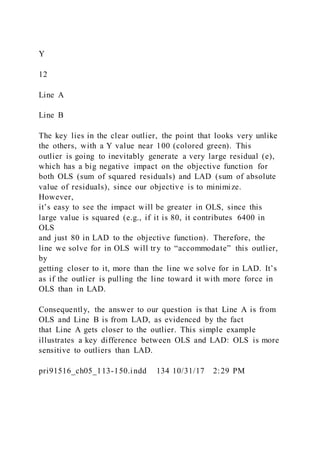
that received the treatment (and 0 oth-
erwise), and Period2 equals 1 if t = 2 (and 0 otherwise). By
construction, Treated × Period2 equals 1
if the treatment was received and 0 otherwise.
IF:
Confounding factors in U are all either fixed over time or
common among the treated and untreated
groups
THEN:
Adding the controls Treatedg and Period2t will eliminate
endogeneity problems in measuring the
effect of the treatment. In other words, we can assume the
expanded data-generating process
Outcomeigt = α + β1Treatedg + β2Period2t + β3Treatedg ×
Period2t + Uigt
and running the corresponding diff-in-diff regression will yield
a consistent estimate for β3.
In contrast, if confounding factors in U are changing over time
in ways not common across the
treated and untreated groups, then we cannot be assured the
estimate for β3 (the estimated effect
of the treatment) is consistent.
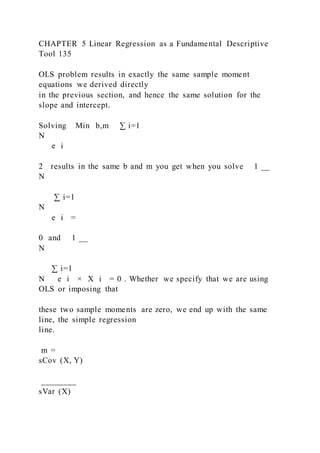
REASONING BOX 8.2
pri91516_ch08_224-257.indd 242 10/30/17 12:28 PM
CHAPTER 8 Advanced Methods for Establishing Causal
Inference 243
not directly apply to such cases, but it provides valuable
intuition for a more general model
that does —the fixed-effects regression model.
To illustrate, consider again our tax example, but now suppose
we are interested in the
effect of any change in the liquor tax on store profits—not just
the effect of a single change
(of 3%) in the tax rate. Further, suppose our store owner has
stores across all states in the
United States, and tax rates vary across the states and time.
Table 8.6 includes a hypotheti-
cal listing of the first few observations in such data. Here, we
see tax rates vary across
many levels (e.g., 3.5%, 6.2%, 7.5%), and the rates vary across
the states and across time.
Hence, there is not a dichotomous treatment (instead there are
treatment levels), and there
is no treatment period (treatment levels vary across multiple
periods of time).
To assess the effect of a change in the liquor tax rate on profits,
the store owner may
assume the following data-generating process:
Profitsit = α + β TaxRateit + Uit
Here, Profitsit is again the profit of store i during Year t, and
TaxRateit is the liquor tax
rate for store i during Year t. We could regress Profits on
TaxRate, but it again would be
difficult to argue that TaxRate is not endogenous in such a
regression.
COMMUNICATING DATA 8.2
USING DIFF-IN-DIFF TO ASSESS THE MINIMUM WAGE
A famous application of difference-in-differences was
conducted by David Card and Alan Krueger in 1994. They
attempted
to measure the effect of a rise in the minimum wage on
employment at fast-food restaurants. They used data on employ-
ment and the minimum wage in New Jersey (which raised its
minimum wage from $4.25 to $5.05 in April 1992) and eastern
Pennsylvania (which did not change its minimum wage around
that time). Hence, all fast-food restaurants in New Jersey
can be classified as “treated” stores, and all fast-food
restaurants in eastern Pennsylvania can be classified as
“untreated”
stores. To simplify exposition, let’s assume the researchers had
data spanning the year before April 1992 and the year fol -
lowing April 1992. We could represent the data-generating
process as:
Employmentigt = α + β1NewJerseyg + β2Year2t +
β3NewJerseyg × Year2t + Uigt
Here, g is either New Jersey or Pennsylvania, and t is either
Year 1 (the year prior to the change) or Year 2 (the year after
the change). Written this way, β3 represents the difference-in-
differences in employment between New Jersey and (eastern)
Pennsylvania between Year 1 and Year 2.
We’d like to regress employment on an indicator for the state
and an indicator for the year, along with their interaction,
to get a consistent estimate for the effect of the minimum-wage
increase on employment at fast-food restaurants. Put
simply, if unobserved factors affecting employment are fixed
over time or common across states, this regression will give
us a consistent estimate. On the other hand, if there are factors
changing over time in, say, New Jersey only, that affect
employment, we cannot be confident that our estimate for β3
really measures the effect of the minimum-wage change on
employment. For example, if New Jersey also changes some of
its regulations on fast-food restaurants (e.g., changes food-
quality controls) during this time, we could not distinguish
whether the change in employment (relative to Pennsylvania)
was
due to the minimum wage change or the regulations change.
pri91516_ch08_224-257.indd 243 10/30/17 12:28 PM
CHAPTER 8 Advanced Methods for Establishing Causal
Inference244
In the same vein as our diff-in-diff discussion, there are two
clear reasons (but possibly
more) why TaxRate might be correlated with unobservables
affecting Profits. First, states
likely differ in tastes for liquor, income levels, liquor
regulations, etc., and any of these
factors could affect the profitability of a liquor store. These
differences also may affect
the tax rates state legislators impose on liquor sales (high-
income states may have higher
taxes), generating an endogeneity problem. Second, there may
be countrywide changes in
market conditions, liquor regulations, competing products, etc.,
over time, and any of these
factors could affect the profitability of liquor stores. These
changes also may affect the tax
rates state legislators impose on liquor sales (e.g., federal
legalization of marijuana may
generally result in lower liquor taxes), again generating an
endogeneity problem.
As with our difference-in-differences version of the tax
example, the panel nature of
our data allows us to address endogeneity problems arising from
unobservables that vary
across the states and unobservables that vary across time.
Again, the solution is simply to
add controls. The controls we add when there are multiple states
and multiple time periods
are just an extension of the controls we added in the diff-in-diff
model. Specifically, we
add a dummy variable for each state (except one, which is the
“base state”), and a dummy
variable for each year (except one, which is the “base year”). In
our tax example, this means
we now assume the following data-generating process when
there are G states and T years:
Profitsigt = α + δ2State2g + . . . + δGStateGg + γ2Period2t + . .
. + γTPeriodTt + β TaxRategt + Uigt
For the above data-generating process, the literal interpretation
of β is the effect of a
change in the tax rate, controlling for the state the store is in
and the year in which it was
observed.
An alternative interpretation is not quite as simple as in the
diff-in-diff model, but it is
similar in spirit. Specifically, β measures the effect of a
temporal change in the tax rate with-
in a given state on store profits, relative to the overall trend in
profits over that time period.
TABLE 8.6
Subsample of Tax
Rate and Profits Data
across States and
Years
STORE NUMBE R YE AR STATE TA X R ATE PROFITS
1 2013 Indiana 3.2% $45,000
1 2014 Indiana 3.2% 31,000
1 2015 Indiana 4.1% 48,000
1 2016 Indiana 4.1% 52,000
1 2017 Indiana 5.0% 35,000
2 2013 Michigan 3.8% 51,000
2 2014 Michigan 4.5% 38,000
2 2015 Michigan 4.8% 41,000
2 2016 Michigan 5.0% 37,000
2 2017 Michigan 4.2% 43,000
3 2013 Ohio 6.1% 45,000
3 2014 Ohio 5.8% 49,000
3 2015 Ohio 6.1% 50,000
pri91516_ch08_224-257.indd 244 10/30/17 12:28 PM
CHAPTER 8 Advanced Methods for Establishing Causal
Inference 245
To elaborate, by controlling for states and time periods, β
represents how profits for a given
state move around its mean, relative to the overall trend of
states’ profits, when there is a
change in the tax rate. As an example, suppose mean profits
over the T years in New York
were $100,000, and the overall trend in profits was an increase
of $1,000 per period. Then,
if T were 5, we’d expect profits in New York, absent any
change in the tax rate, to look
like: $98,000 in Year 1, $99,000 in Year 2, …, and $102,000 in
Year 5. Here, β measures
how much New York profits would deviate from this trend when
the tax rate changes—for
example, how much different profits would be compared to
$99,000 for a change in the
tax rate in Year 2.
Let’s now generalize the concept of our extended tax example.
Consider a general case
where we have G groups and T time periods, and a treatment
(dichotomous or multi-level)
that varies across groups and across time. We assume the
following data-generating pro-
cess for the outcome:
Outcomeigt = α + δ2Group2g + . . . + δGGroupGg + γ2Period2t
+ . . . + γTPeriodTt + β Treatmentgt + Uigt
Here, we have dummy variables for each group (except for the
base group, generically cho-
sen to be Group1) and dummy variables for each time period
(except for the base period,
generically chosen to be Period1). Outcomeigt is the observed
outcome for observation i in
group g at time t, and Treatmentgt is the level of treatment
experienced by cross-sectional
group g in period t. The above generalized data-generating
process is an example of a fixed
effects model, defined as a data-generating process for panel
data that includes controls
for cross-sectional groups. The controls for cross-sectional
groups are called fixed effects.
We conclude this section by making several important points
concerning the general
fixed effects model. First, for a data-generating process to be
characterized as a fixed effects
model, it need have only controls for the cross-sectional groups;
it need not have controls
for the time periods. However, we present the model with
controls for time periods, as their
inclusion is generally advisable in practice. If controls for time
are excluded, this runs the
risk of, for example, the treatment and outcome trending over
time for all cross-sectional
groups, and mistaking this co-movement as the effect of the
treatment. In our tax example,
this type of problem would manifest if tax rates and profits were
both trending up over time
everywhere (likely for differing reasons). Without controls for
time, it will appear as though
profits were increasing over time because of the increase in tax
rates, when it was instead
trending market-level factors (generally worsening state budgets
and enhanced tastes for
liquor for the taxes and profits, respectively) that were behind
each trend separately.
A second point concerning our general fixed effects model
concerns the structure of the
time controls. In the model we present, there is a separate
dummy variable for each time
period. This is the most flexible way to control for time, as it
puts no restrictions on how
profits change period-to-period for all the cross-sectional units.
However, it is common to
instead control for time periods by including a time trend. By
doing so, the data-generating
process is:
Outcomeigt = α + δ2Group2g + . . . + δGGroupGg + γTimet + β
Treatmentgt + Uigt
Here, Timet is equal to the time period (e.g., it equals one in
period 1, two in period 2,
and so on). This alternative formulation forces the effect on
profits of moving from one
fixed effects model
A data-generating
process for panel data
that includes controls for
cross-sectional groups.
fixed effects
The controls for cross-
sectional groups.
pri91516_ch08_224-257.indd 245 10/30/17 12:28 PM
CHAPTER 8 Advanced Methods for Establishing Causal
Inference246
period to the next to be constant (equal to γ). This restriction is
sensible in many applica-
tions, where variables are likely to be generally trending
upward or downward over time,
and requires us to estimate fewer parameters. In contrast, it is
inappropriate to make this
simplification when the outcome is trending in uneven ways
(e.g., up and then down, or
up but by a notably differing rate).
Thirdly, as in the diff-in-diff model, by controlling for the
groups (adding fixed effects)
and the periods, we eliminate many possible confounding
factors in the data-generating
process. Again, the controls for the groups control for any
factors affecting the outcome
that differ across the groups but persist over time. And the
controls for the periods control
for any factors affecting the outcome that differ across time but
are common across the
groups. However, as in the diff-in-diff model, these controls do
not eliminate all possible
confounding factors. In particular, these controls do not
eliminate endogeneity problems
arising from unobserved factors affecting the outcome that
change over time for only a
subset of groups in a way that is correlated with the treatment.
In our tax example, sup-
pose New York and New Jersey uniquely experienced an
increase in residents’ tastes for
liquor over time concurrent with declines in their liquor tax
rates. Given the change in
tastes would likely generate higher profits for liquor stores, we
would be unable to deter-
mine whether any changes we observe in store profits are due to
the change in tastes or the
lowering of taxes, despite our controls.
Lastly, we note that we can always add controls (Xigt’s) beyond
the fixed effects and
time dummies to help eliminate some of the remaining
confounding factors. Such con-
trols are able to help with endogeneity problems only if they
vary over time in different
ways for the different cross-sectional groups; otherwise, they
are collinear with the fixed
effects or the time dummies and therefore must be dropped from
the model. To illustrate,
in our tax example, we may have data on the number of
competing liquor stores in each
state; however, if this variable is fixed over time, it will be
perfectly collinear with our
fixed effects and thus must be dropped from the model. In
contrast, if the number of
competing liquor stores not only differs across states but also
evolves over time differ-
ently across states, adding a variable (e.g., Competitorsgt) could
help mitigate remaining
endogeneity concerns, as it may eliminate a confounding factor
that varies across states
and years.
Now that we have defined and described the fixed-effects
model, we detail two alterna-
tive ways of estimating it.
Dummy Variable Estimation Recall our formulation of a general
fixed-effects model as:
Outcomeigt = α + δ2Group2g + . . . + δGGroupGg + γ2Period2t
+ . . . + γT PeriodTt + β Treatmentgt + Uigt
The first method we consider for estimating this model is known
as the dummy vari-
able method, or dummy variable estimation, for a fixed effects
model. Dummy variable
estimation uses regression analysis to estimate all of the
parameters in the fixed effects
data-generating process. Dummy variable estimation involves
performing regression
analysis exactly as the data-generating process would suggest—
regress the Outcome on
dummy variables for each cross-sectional group (except the base
unit), dummy variables
for each period (except the base period), and the treatment.
dummy variable
estimation
Uses regression analysis
to estimate all of the
parameters in the fixed
effects data-generating
process.
pri91516_ch08_224-257.indd 246 10/30/17 12:28 PM
CHAPTER 8 Advanced Methods for Establishing Causal
Inference 247
In Table 8.7 we present a subset of regression results for our
generalized tax example.
Here, we have parameter estimates for each state (except State
1), each year (except Year 1),
and the Tax Rate. Proper interpretation of these results is as
important as proper modeling,
so let’s carefully interpret each type of coefficient (state, year,
tax rate) in turn.
We start with the state coefficients. Each state coefficient
measures the effect on a
store’s profits of moving the store from the base state (State 1)
to that alternative state,
for a given year and tax rate. For example, the coefficient on
State 2 implies that moving
a store from State 1 to State 2 will increase profits by about
$5,327, holding the year and
tax rate constant.
Interpretation is similar for the year coefficients. Each year
coefficient measures the
effect on a store’s profits of moving the store from the base
year (Year 1) to that alterna-
tive year, for a given state and tax rate. For example, the
coefficient on Year 2 implies that
moving a store from Year 1 to Year 2 will increase profits by
about $1,159, holding the
state and tax rate constant.
Lastly, the coefficient on Tax Rate measures the effect on a
store’s profits of changing
the Tax Rate, for a given state and year. The coefficient on Tax
Rate in Table 8.7 implies
that increasing the Tax Rate by 1 percentage point will decrease
profits by about $926,
holding the state and year constant.
Returning to our general fixed effects model:
Outcomeigt = α + δ2Group2g + . . . + δGGroupGg + γ2Period2t
+ . . .
+ γTPeriodTt + β Treatmentgt + Uigt
we can again detail how to interpret each type of parameter
estimate (group, period, treat-
ment). An estimate for δj measures the effect of moving from
Group 1 to Group j for a
given Period and Treatment level. Note also that we can
measure the effect of moving from
Group j to Group k (holding Period and Treatment constant) by
taking the difference in their
estimated coefficients: ̂ δ k − ̂ δ j . Similarly, an
estimate for γq measures the effect of moving
from Period 1 to Period q for a given Group and Treatment
level. Lastly, β measures the
effect of the Treatment on the Outcome for a given Group and
given Period. Notice how
this last interpretation clearly highlights the type of
confounding factors that cannot bias
the estimate—factors that are fixed across periods for the
groups or fixed across groups for
a period do not pose endogeneity problems, as the model
controls for them.
TABLE 8.7
Subset of Dummy
Variable Estimation
Results for Sales
Regressed on TaxRate
COE FFICIE NTS STANDARD E RROR t STAT
Intercept 38147.38615 1079.619121 35.33411497
State2 5327.21415 712.7437924 7.474234369
State3 1903.641928 721.1620734 2.639686692
State4 −3703.480692 749.339573 −4.942326317
Year2 1158.939473 750.0000243 1.54525258
Year3 2284.199776 734.0625504 3.111723619
Year4 3162.033836 721.4070438 4.383147992
TaxRate −925.6772431 170.4044168 −5.432237383
pri91516_ch08_224-257.indd 247 10/30/17 12:28 PM
CHAPTER 8 Advanced Methods for Establishing Causal
Inference248
Within Estimation A notable issue with using dummy variable
estimation to estimate a
fixed effects model is that it may require us to estimate a very
large number of parameters.
For example, suppose we have data on individuals over time and
want to include fixed
effects for each individual. If we have 100,000 different
individuals, we must then estimate
the coefficients on 99,999 fixed effects. This can be time-
consuming, even for fast comput-
ers. Further, it is often the case that we are not interested in the
effect of changing groups
per se, but care only about the effect of the treatment. To
illustrate, in our tax example, we
likely do not care about the effect on profits of moving a store
from one state to another
if the analysis is focused on measuring the impact of the tax.
The purpose is not to assess
where to open or move stores but rather to evaluate the tax. In
such a circumstance, we’d
like to estimate the effect of the tax, controlling for groups and
time periods, but without
having to estimate the effects of what may be a very large
number of groups.
Fortunately, there is a simple alternative method of estimating a
fixed effects model
that eliminates the need to estimate the coefficient for each
fixed effect. Within estimation
uses regression analysis of within-group differences in variables
to estimate the parameters
in the fixed effects data-generating process, except for those
corresponding to the fixed
effects (and the constant). Perhaps the best way to understand
exactly how and why within
estimation works is to see it in practice.
Consider again our expanded tax example, where we’ve
assumed the following data-
generating process:
Profitsigt = α + δ2State2g + . . . + δGStateGg + γ2Year2t + . . .
+ γTYearTt + β TaxRategt + Uigt
within estimation
Uses regression analysis
of within-group differences
in variables to estimate
the parameters in the fixed
effects data-generating
process, except for those
corresponding to the fixed
effects (and the constant).
8.3
Demonstration Problem
Suppose you have data on an outcome variable, Y, that varies
by month and by employee for a fixed
(over time) group of employees. Each employee works in one of
six designated regions in the United
States, recorded as the variable “Region” and taking on the
values 1 through 6. The data span 8
months; they also contain information on a treatment, which
ranges from 0 to 10 and varies across
regions and months.
a. Write out the fixed effects model you would assume in trying
to determine the effect of the
treatment on the outcome.
b. Interpret the coefficient on the treatment within your fixed
effects model.
c. Explain the role of the fixed effects within your fixed effects
model.
Answer:
a. Y igt = α + δ 2  Region  2 g + . . . + δ 6  Region  6
g + γ 2  Month  2 t + . . . + γ 8  Month  8 t + β  
Treatment gt
+ U igt . Here, i varies by employee, g varies by region (1 to
6), and t varies by month (1 to 8).
b. The coefficient on the treatment (β) represents the effect of a
change in the treatment on the
outcome for a given region during a given month. For example,
if an employee experiences an
increase in the treatment by one during, say, month 3, and stays
in, say, region 5, her outcome
will change by β.
c. The fixed effects (Region2 . . . Region6) control for time-
invariant factors affecting the outcome
within each Region.
pri91516_ch08_224-257.indd 248 10/30/17 12:28 PM
CHAPTER 8 Advanced Methods for Establishing Causal
Inference 249
If we have data spanning all 50 states, we have 49 δ’s to
estimate for the fixed effects if
we use dummy variable estimation. Consider now the following
alternative: For each state
(group), we add up the data-generating process for each store
and each year, and then
divide by Ng × T to get the state average, where Ng is the
number of stores in state g. For
a state (group) g, this calculation looks as follows:
1 ____ NgT
  ∑ i=1
Ng
  ∑ t=1
T
 Profitsigt = ̄ Profits g
Equivalently:
1 ____ NgT
  ∑ i=1
Ng
  ∑ t=1
T
 α + δ 2  State  2 g + . . . + δ G  State  G g + γ 2
 Year  2 t + . . . + γ T  Year  T t + β  TaxRate gt
= α + δ 2  State  2 g + . . . + δ G  State  G g + γ 2 (
1 __ T ) +
. . . + γ T (
1 __ T ) + β ‾ TaxRate g +
_
U g
Notice that the group-level average for the State dummies is
equal to their values for each
observation in the group; this is because they are constant
within a group. For example, all
observations in State 2 have State2 = 1 for each store and each
year; thus, its average is 1.
Also, notice that the year dummies always average to 1/T, since
each equals 1 in exactly
one period and 0 for all others within a group.
Next, we take each observation in our data and subtract its
group-level average. This
calculation looks as follows:
Profits igt = α + δ 2  State  2 g + . . . + δ G  State  G g
+ γ 2  Year  2 t
+ . . . + γ T  Year  T t + β  TaxRate gt + U igt
– ‾ Profits g = α + δ 2  State  2 g + . . . + δ G  State 
G g + γ 2 (
1 __ T )
+ . . . + γ T (
1 __ T ) + β ‾ TaxRate g + ‾ U g
( Profits igt − ‾ Profits g ) = (
1 __ T ) ( γ 2 + . . . + γ T ) + γ 2  Year  2 t +
. . . + γ T  Year  T t
+ β ( TaxRate gt − ‾ TaxRate g ) + ( U igt − ‾ U g )
Let’s now define a few new variables as follows:
Profits igt
* = Profits igt − ‾ Profits g ,
TaxRate gt
* = TaxRate gt − ‾ TaxRate g
and
U igt
* = U igt − ‾ U g
Further, define
α * = (
1 __ T ) ( γ 2 +
. . . + γ T )
With these definitions and the calculations above, we have
identified a derivative data-
generating process involving these new variables as follows:
Profits igt
* = α * + γ 2  Year  2 t + . . . + γ T  Year  T t + β 
TaxRate gt
* + U igt
*
pri91516_ch08_224-257.indd 249 10/30/17 12:28 PM
CHAPTER 8 Advanced Methods for Establishing Causal
Inference250
This newly defined data-generating process expresses profits
relative to the group mean
as depending on: the year, the Tax Rate relative to its group
mean, and unobservables rela-
tive to their group mean. This formulation focuses on relative
performance of the treatment
and outcome within each group; consequently, it ignores any
relationship between tax rates
and profits due to differences across groups. By ignoring cross -
group differences in the
treatment and outcome, we eliminate the possibility that the
relationship we find between
the treatment and outcome is due to differences in cross-group
unobservables (e.g., market
conditions) rather than a causal effect of the tax rate on profits.
Notice that, with our new formulation, we retain nearly all of
the same parameters as
our original formulation; γ2, . . . , γT, β are all the same.
Therefore, attaining a consistent
estimate of β (the causal effect of the treatment) by regressing
Profits* on TaxRate* and
the Year dummies essentially depends on whether we believe
there exists an endogene-
ity problem within this newly defined data-generating process.
In particular, we must ask
whether U* is uncorrelated with TaxRate*. In words, we must
believe that differences in
unobservables (e.g., state-level market conditions) from their
state-level means (across
stores and years in that state) are not correlated with differences
in Tax Rates from their
state-level means. This assumption would fail, for example, if
we believed state-level tax
rates were dependent on state-level unemployment and this
latter variable affected state-
level liquor store profits.
We conclude by laying out the within estimation steps for a
general fixed effects model.
Consider a general fixed effects model:
Outcomeigt = α + δ2Group2g + . . . + δGGroupGg + γ2Period2t
+ . . . + γTPeriodTt + β Treatmentgt + Uigt
We estimate the parameters γ2, . . . , γT, β via within estimation
by executing the following
steps:
1. Determine the cross-sectional groups (e.g., states) and
calculate group-level
means: ‾ Outcome g = 1 ____ N g T
∑ i=1
Ng ∑ t=1
T Outcome igt and ‾ Treatment g = 1 ____ N g T
∑ i=1
Ng ∑ t=1
T
Treatment igt .
2. Create new variables: Outcome igt
* = Outcome igt − ‾ Outcome g , Treatment igt * =
Treatment igt − ‾ Treatment g . (Note: if the assumed
model includes controls (Xs),
for each X, create X igt
* = X igt −
_
X g .)
3. Regress Outcome* on Treatment* and the Period dummy
variables. (Again, if
the assumed model includes controls (Xs), include X*s in the
regression.)
Comparing Estimation Methods For a fixed effects model, we
can utilize either
dummy variable estimation or within estimation to estimate the
parameters of the model.
In this section, we briefly compare these two options. First,
note that both methods yield
exactly the same estimates for the effect of the treatment (β)
and time periods (γ2, . . . , γT).
The two estimation methods differ in their estimates for the
constant, but this is typically
inconsequential. Next, dummy variable estimation provides
estimates for the fixed effects
(the effect of switching groups on the outcome) , whereas within
estimation does not. If
the effect of group switching is of interest, then dummy variable
estimation is clearly
preferred. If not, within estimation is likely preferred as it
provides an estimate for the
effect of the treatment without wasting computation time on the
fixed effects.
pri91516_ch08_224-257.indd 250 10/30/17 12:28 PM
CHAPTER 8 Advanced Methods for Establishing Causal
Inference 251
Another point of comparison between these two estimation
methods pertains to
R-squared. As noted in Chapter 6, we should not place much
weight on R-squared in
assessing a model of causality that is suitable for active
predictions. However, even in
this context, it is sometimes used to get a sense of how strongly
the model fits the data.
For dummy variable estimation, the R-squared is often
misleadingly high, suggesting a
very strong fit. This is because, for dummy variable estimation,
we are trying to explain
variation in the Outcome, and much of this variation may be
explained by the fixed effects
(differences across groups). Hence, the R-squared may be high
because of inclusion of
fixed effects and not because variation in the Treatment
explains much of the variation
in the Outcome. In contrast, for within estimation, we are trying
to explain variation in
the Outcome relative to its group-level mean. Here, the fixed
effects are dropped, so a
high R-squared is more indicative that variation in the
Treatment (relative to its mean) is
explaining variation in the Outcome (relative to its mean).
Lastly, we note that whether we use dummy variable estimation
or within estimation
to estimate the parameters of a given fixed effects model, we
are susceptible to the same
concerns about endogeneity. Specifically, both estimation
methods eliminate confounding
factors that are fixed across periods for the groups or are fixed
across groups over time.
8.4
Demonstration Problem
As in Demonstration Problem 8.3, suppose you have data on an
outcome variable, Y, that varies by
month and by employee for a fixed (over time) group of
employees. Each employee works in one of
six designated regions in the United States, recorded as the
variable “Region” and taking on the val-
ues 1 through 6. The data span 8 months and also contain
information on a treatment, which ranges
from 0 to 10 and varies across regions and months.
Write out the data-generating process suitable for within
estimation in trying to determine the effect
of the treatment on the outcome. Be sure to define each variable
in the expression you compose.
Answer:
The data-generating process suitable for within estimation is:
Y igt −
_
Y g = (
1 __ 8 ) ( γ 2 +
. . . + γ 8 ) + γ 2  Month  2 t + . . . + γ 8  Month  8 t
+ β(  Treatment gt − ‾ Treatment g ) + ( U igt − ‾ U
g )
Here, the dependent variable is the difference in the outcome of
employee i in region g during month
t from the average for that region across all employees in that
region and all 8 months.
The independent variables consist of dummy variables for each
month, and the difference in the
treatment for region g during month t (which is the same for all
employees in that region during
that month) from the average treatment for that region across all
employees in that region and all
8 months.
Lastly, the new term for the unobservables is the difference in
the unobservables for employee i in
region g during month t from the average unobservables for that
region across all employees in that
region and all 8 months.
pri91516_ch08_224-257.indd 251 10/30/17 12:28 PM
CHAPTER 8 Advanced Methods for Establishing Causal
Inference252
And both estimation methods could yield inaccurate
(inconsistent) estimates if there exist
unobserved factors that vary within a group over time.
We conclude by summarizing some basic implications of the
fixed effects model that can
aid in interpretation regardless of the estimation method as
shown in Reasoning Box 8.3.
PRACTICAL APPLICATIONS OF PANEL DATA METHODS
FOR BUSINESS
In this section, we discuss practical applications of panel data
methods for business along
two dimensions. First, we highlight the types of panel data one
is likely to encounter in
business settings. We then discuss the process of grouping these
data, which ultimately
determines the fixed effects to include in the assumed data-
generating process.
For a given firm, panel data typically have cross-sectional units
that are either individu-
als/households or divisions/branches. A firm may conduct or
purchase a survey that ques-
tions a set of individuals at multiple points in time. The survey
may ask about purchases
the individual made or preferences for different products. Using
such data, analysts can
apply panel data methods to learn about things like the effect of
advertising on preferences
or the effect of new product introductions on demand for
existing products. As another
example, a firm may collect information on production and
defects at multiple points in
time from multiple production facilities. These panel data could
be used to learn about the
effect of new maintenance programs on the incidence of
defective products. Lastly, firms
are able to collect a wealth of panel data via their websites by
asking customers to register
and log in whenever they make a purchase. This allows for the
use of panel data methods,
as they observe many individuals on many separate occasions.
In our tax example, the panel data were such that the cross-
sectional unit was a store
and the time period was a year. We chose to group these data by
state rather than store.
However, we could have grouped these data by store instead.
What dictates the decision
of how to form groups (and thus construct the corresponding
fixed effects) in a fixed
IMPLICATIONS OF THE FIXED
EFFECTS MODEL
IF:
We assume the following data-generating process:
Outcomeigt = α + δ2Group2g + . . . + δGGroupGg + γ2Period2t
+ . . . + γT PeriodTt + β Treatmentgt + Uigt
THEN:
1. β is the effect of the Treatment on the Outcome for a given
Group during a given Period.
2. No factors in U that are fixed across periods for the groups or
are fixed across groups over time
can generate an endogeneity problem in this model.
3. Estimation using dummy variable estimation or within
estimation yields the same estimate for β
(and γ2, . . . , γT).
REASONING BOX 8.3
pri91516_ch08_224-257.indd 252 10/30/17 12:28 PM
CHAPTER 8 Advanced Methods for Establishing Causal
Inference 253
effects model? In the tax example, notice that the treatme nt
(Tax Rate) varies only across
states and years; for example, stores in New York in 2015 all
face the same tax rate.
Consequently, unobservables affecting profits that vary across
stores within a given state
and year cannot create an endogeneity problem for the tax rate,
since they cannot be cor-
related with the tax rate (the tax rate is the same for all of
them). The upshot from this
example is that there is no value in adding fixed effects that
vary at a finer level in the
cross-section than the treatment (i.e., stores vs. states).
Following the intuition of our tax example, we now make two
general points on the
grouping process for fixed effects models:
• First, when building a fixed effects model, the groupings
should be no finer than
the cross-sectional groups along which the treatment varies.
Grouping at too fine a
level places more demands on the data (more parameters to
estimate or less varia-
tion in the redefined variables) without helping mitigate an
endogeneity problem.
• Second, there are occasions when it might be optimal or
necessary to choose
groupings that are coarser than the cross-sectional groups along
which the treat-
ment varies. It may be optimal to choose coarser groupings if
you are convinced
that confounding factors vary only across coarse cross-sectional
groups. In our tax
example, we could have created groups according to geographic
region (Northeast,
Southwest, etc.) rather than states if we believed confounding
factors varied only at
that level. It may be necessary to choose coarser groupings if
the data are relatively
small. Again, in our tax example, we may need to group
according to geographic
region rather than states if, say, we had only 150 observations.
In such a circum-
stance, there would likely be too little information left in the
data after controlling
for each state to measure the effect of the tax rate, and so fewer
fixed effects must
be used. Carrying through with the analysis using coarser
groupings (and thus
fewer fixed effects) must be weighed against the risk of having
an inconsistent esti-
mate if regional fixed effects are not sufficient to deal with
endogeneity problems.
COMMUNICATING DATA 8.3
DOES MULTIMARKET CONTACT AFFECT AIRLINES’ ON-
TIME PERFORMANCE?
A pervasive question relevant to business strategy is whether
contact across many markets facilitates firms’ ability to soften
competition. Along with Daniel Simon, I have investigated this
question for airlines, seeking to establish whether contact
across many different routes leads to poorer on-time
performance (suggestive of softer competition) by airlines. To
tackle this
question, we collected data on travel time and multimarket
contact for millions of flights spanning many airlines, routes,
and
quarters. Here, multimarket contact measures the number of
times the carrier for a given flight interacts with other airlines
serving the same route during that quarter across other routes. A
simplified version of our assumed data-generating process is:
TravelTime irt = α + δ 2  CarrRoute  2 ir + . . . + δ IR
 CarrRouteI  R IR
+ γ 2  Quarter  2 t + . . . + γ T  Quarter  T t + β  MMC
irt + U irt
In this formulation, we created cross-sectional groups of
carrier-routes, where there are I carriers and R routes. For
example, one group consists of all flights by United between
Chicago and Atlanta; thus, the carrier-route is United on
continued
pri91516_ch08_224-257.indd 253 10/30/17 12:28 PM
Chicago-Atlanta. The variable MMCirt is a variable that
measures the amount of times carrier i interacts with the other
carri-
ers on route r during quarter t on other routes.
We regress travel time on our fixed effects, quarter dummy
variables, and multimarket contact. This formulation ensures
that our estimate for the effect of multimarket contact is
immune from endogeneity issues arising from time-invariant
factors
affecting travel time for each carrier-route combination and
from general trends in travel time over time. For example, sup-
pose travel time for United on the Chicago-Atlanta route tends
to be long due to congestion problems, but these problems
persist over time. Then, our fixed effect for United on the
Chicago-Atlanta route will control for these congestion factors,
thus eliminating them as possible confounding factors in the
regression.
Interestingly, our analysis showed that multimarket contact did
in fact worsen on-time performance, and the strength
of this conclusion is bolstered by the fact that our fixed-effects
analysis removed many potential confounding factors. This
finding suggests softer competition—at least on on-time
performance—when firms come in contact across many markets.
RISING TO THE dataCHALLENGE
Do TV Ads Generate Web Traffic?
The goal for this challenge is to measure the effect on website
visits of running an ad in
a county. We may want to know the immediate effect of the
ad—that is, the change in
website visits on the day the ad is run. We have data on
counties on a daily basis, mean-
ing we have panel data at the county-day level. The simplest
model we may consider
to ultimately measure the effect would be:
Visits it = α + βA  d it + U it
Here, Visitsit is the number of visits to the website in county i
on day t and Adit equals
1 if the ad was run in county i on day t and 0 otherwise. Given
the ads were deliberately
targeted to specific counties, we should be worried that there
are characteristics of the
counties receiving the ad that also influence the number of
visits to the FunnyHa.com
website.
Since we have panel data, we can control for time-invariant
county-level differences
using county fixed effects, and we can control for factors
varying over time that are
common to all counties. After we include these controls, our
assumed data-generating
process becomes:
Visits it = α + δ 2  County  2 i + . . . + δ G  County  G
i
+ γ 2  Day  2 t + . . . + γ T  Day  T t + βA  d it + U it
We can estimate this model using dummy variable estimation or
within estimation.
Either way, the estimate for β will be the same. It can be
interpreted as the effect on
website visits of running the ad that day for a given county on a
given day.
254 CHAPTER 8 Advanced Methods for Establishing Causal
Inference
pri91516_ch08_224-257.indd 254 10/30/17 12:28 PM
CHAPTER 8 Advanced Methods for Establishing Causal
Inference 255
Note that an endogeneity problem may still exist. This will be
the case if there are
unobserved factors influencing website visits that vary
differently in the counties over
time in a way that is correlated with the timing of the ad being
run in the county. If this
concern is substantial enough, you may want to attempt to find
an instrumental variable
for Ad (a variable that is correlated with where and when an ad
was run, but not related
to the number of visits to the website).
S U M M A R Y
In this chapter we presented two relatively advanced methods
for establishing causal inference—use of
instrumental variables and panel data methods. We defined
instrumental variables and illustrated how they
can aid in measuring causal effects. We went on to explain how
to utilize instrumental variables via two-
stage least squares regression, and then discussed how to
evaluate the validity of instruments in terms of
exogeneity and relevance. We concluded our discussion of
instrumental variables by highlighting some of
their classic practical applications.
We opened our discussion of panel data methods by detailing
difference-in-differences and how it
applies to circumstances where there is a dichotomous treatment
and just two time periods. We built on
these ideas as we presented the fixed effects model and
illustrated how fixed effects (and time controls)
can help mitigate endogeneity problems. Next, we showed how
to estimate a fixed effects model using
dummy variable estimation and within estimation, and compared
and contrasted the two approaches. We
concluded by highlighting some practical business applications
of panel data methods.
K E Y T E R M S A N D C O N C E P T S
difference-in-differences (diff-in-diff)
dummy variable estimation
exogeneity of an instrumental variable
fixed effects
fixed effects model
instrumental variable
relevant as an instrumental variable
two stage least squares (2sls) regression
weak instrument
within estimation
C O N C E P T U A L Q U E S T I O N S
1. Suppose you have assumed the following data-generating
process:
Y i = α + β 1   X 1i + β 2   X 2i + β 3   X 3i + U
i
Suppose also that you believe X2 is endogenous in this model.
Which of the following variables would
be valid instruments for X2? (LO3)
a. Z1, where spCorr(Z1,  X1( X2,  X3)) = 0 & Corr(Z1,U) = 0
b. Z2, where spCorr(Z2,  X2( X1,  X3)) ≠ 0 & Corr(Z2,U) ≠ 0
c. Z3, where spCorr(Z3,  X2( X1,  X3)) ≠ 0 & Corr(Z3,U) = 0
d. Z4, where spCorr(Z4,  X3(X1,  X2)) ≠ 0 &
spCorr(Z4,  X1( X2,  X3)) ≠ 0
pri91516_ch08_224-257.indd 255 10/30/17 12:28 PM
CHAPTER 8 Advanced Methods for Establishing Causal
Inference256
2. Refer to Question 1. Suppose you have a valid instrument, Z,
for X2. (LO2)
a. What are the steps that would be taken as part of the first
stage of 2SLS estimation?
b. What are the steps that would be taken as part of the second
stage of 2SLS estimation?
3. Again, refer to Question 1. Suppose you have a candidate
instrument, Z, for X2. (LO3)
a. Explain how you can test whether Z is exogenous in this
model.
b. Explain how you can test whether Z is relevant in this model.
4. Suppose you are interested in learning the effect of an
increase in commission rates on sales for your
workforce. On July 1 of last year, your East Coast managers
implemented an increase in commission
rates, while your West Coast managers chose not to give the
increase. You have sales data for all of last
year for each employee on each coast. (LO4)
a. We can use difference-in-differences to measure the effect of
the increase in commission rate on
sales using these data. What is the difference-in-differences for
this problem?
b. Write out a data-generating process that allows for a
measurement of difference-in-differences.
c. What are some possible confounding factors within the data-
generating process you constructed for
Part b?
5. Assume the following data-generating process: Yigt = α +
δ2Group2g + δ3Group3g + δ4Group4g +
γ2Period2t + γ3Period3t + γ4Period4t + γ5Period5t + βXgt +
Uigt (LO5)
a. Interpret δ3.
b. Interpret γ4.
c. Interpret β.
d. What is the effect of moving from Group 2 to Group 4,
holding all other factors constant?
6. Refer to Question 5. Construct a new data-generating process
that is suitable for within estimation. (LO6)
7. Suppose you are interested in the causal effect of price on
your product’s sales. However, you
recognize that simply regressing sales on price will almost
certainly suffer from an endogeneity
problem. Your manager asks how to deal with this problem, and
you suggest finding an instrumental
variable, Z. Explain in nontechnical terms: (LO1)
a. The properties Z must possess in order to be a valid
instrument for this particular problem.
b. How, if Z is a valid instrument, it can allow us to measure
the causal effect of price on sales.
8. You are interested in estimating the effect of X on Y in the
following assumed data-generating process:
Yi = α + βXi + Ui. You are concerned that there is an
endogeneity problem if you simply regressed
Y on X and are considering using a variable, Z, as an
instrument. Explain in nontechnical terms why Z
cannot help in establishing causality for X if Z is: (LO1)
a. Not relevant.
b. Not exogenous.
9. Suppose you have panel data that span two time periods and
two groups, where Group 2 received
a treatment in Period 2 and Group 1 never received a treatment.
Suppose also that you assume the
following data-generating process for Y: Yigt = α + δGroup2g +
γPeriod2t + βGroup2gPeriod2t + Uigt.
Here, Group2g equals 1 if the observation is from Group 2 and
0 otherwise, and Period2t equals 1 if the
observation is from Period 2 and 0 otherwise. (LO4)
a. Interpret β.
b. Explain carefully the potential consequence of excluding the
variable Group2 when running a
regression designed to measure the average treatment effect.
c. Explain carefully the potential consequence of excluding the
variable Period2 when running a
regression designed to measure the average treatment effect.
pri91516_ch08_224-257.indd 256 10/30/17 12:28 PM
CHAPTER 8 Advanced Methods for Establishing Causal
Inference 257
Q U A N T I TAT I V E P R O B L E M S
10. You are working as an analyst for a large cable company
that offers bundles of channels all across the
United States. One of the bundles is the “basic package,” which
includes network channels along with
a few other basic cable channels. You are interested in learning
how the price of this basic package
influences the rate of subscriptions in a market. You have data
on subscriptions per 1,000 local
residents, price for the basic package, and average local
household income. You also have data on
local telecom labor costs per subscriber. You believe this last
variable influences the local price but not
subscriptions per se.
Use the data in Chap8Prob10.xlsx for this question. (LO2)
a. Based on the data provided, write out an expression for the
data-generating process for
subscriptions per 1,000 local residents.
b. Estimate the effect of basic package price on subscriptions
per 1,000 local residents using OLS. Why
might you distrust this result as being a causal effect?
c. Estimate the effect of basic package price on subscri ptions
per 1,000 local residents using 2SLS.
d. Using your 2SLS results, what is a 99% confidence interval
for the effect of the basic package price
on subscriptions per 1,000 local residents?
11. Refer to Problem 10. Use the data in Chap8Prob11.xlsx for
this question. (LO2)
a. As you did in Part c of Problem 10, estimate the effect of
basic package price on subscriptions per
1,000 local residents using 2SLS.
b. Using your 2SLS results, what is a 99% confidence interval
for the effect of the basic package price
on subscriptions per 1,000 local residents?
c. Is there reason for concern about a weak instrument? Explain.
12. You are working as an analyst for a chain grocery store. The
store uses “member cards” to keep track
of customer purchases and sends coupons periodically to
customers via e-mail. The chain is seeking to
learn the impact of sending coupons for its generic-brand cereal
on customer demand for that product.
You have data for many customers spanning many weeks on
number of generic-brand cereal boxes
purchased and whether the customer received a coupon that
week. Use the data in Chap8Prob1213.
xlsx for this question. (LO5)
a. Based on the data provided, write out an expression for the
fixed effects model for the number of
generic-brand cereal boxes purchased.
b. Estimate your fixed effects model using dummy variable
estimation.
c. Interpret the coefficient estimate for the variable indicating
whether a coupon was received.
d. Why might excluding the fixed effects in your regression lead
to a biased estimate for the effect of
the coupon?
13. Refer to Problem 12. Again use the data in
Chap8Prob1213.xlsx for this question. (LO6)
a. Write out a reformulation of your fixed effects model using
variables allowing for within estimation.
b. Estimate your reformulated fixed effects model using within
estimation.
c. Build a 99% confidence interval for the effect of sending
coupons on sales of generic-brand cereal
boxes.
Dataset available at
www.mhhe.com/prince1e
Dataset available at
www.mhhe.com/prince1e
Dataset available at
www.mhhe.com/prince1e
Dataset available at
www.mhhe.com/prince1e
Chapter opener image credit: ©naqiewei/Getty Images
pri91516_ch08_224-257.indd 257 10/30/17 12:28 PM
258
LEARNING OBJECTIVES
After completing this chapter, you will be able to:
LO9.1 Identify a limited dependent variable
and its applications.
LO9.2 Describe the linear probability model.
LO9.3 Identify merits and shortcomings of the
linear probability model in practice.
LO9.4 Model probit and logit models as
determined by the realization of a latent
variable.
LO9.5 Calculate marginal effects for logit and
probit models.
LO9.6 Execute estimation of a probit and logit
model via maximum likelihood.
LO9.7 Identify the merits and shortcomings of
probit and logit models in practice.
dataCHALLENGE Changing the Offer to Change Your Odds
Last year, a large accounting firm in Chicago, Northwest
Accounting, made 38 entry-level
accountant offers. Table 9.1 below contains information on the
salaries offered and whether
the applicant accepted the offer.
9 Prediction for
a Dichotomous Variable
OFFE R AMOUNT ACCE PT ? OFFE R AMOUNT ACCE PT ?
$66,780 Accept $91,925 Accept
66,722 Accept 84,810 Accept
85,633 Decline 69,647 Accept
94,684 Decline 78,864 Decline
72,207 Accept 56,625 Decline
59,519 Decline 80,904 Decline
53,468 Accept 56,372 Accept
54,309 Decline 77,469 Accept
TABLE 9.1 Employment Offers and Acceptances for Northwest
Accounting
pri91516_ch09_258-291.indd 258 10/31/17 2:37 PM
CHAPTER 9 Prediction for a Dichotomous Variable 259
To this point in the book, every model we’ve studied has
implicitly assumed that the
dependent variable (or outcome) can take on essentially any
value. Or at the very least,
we have assumed that, even if our dependent variable does have
limitations, they are
not binding in practice. For example, when we use Sales as our
dependent variable,
we know it cannot be less than zero. However, our data never
contained Sales figures
at or very near zero, so this limitation was not consequential to
our analysis.
In this chapter, we consider situations in which the dependent
variable has limitations
that are consequential. We discuss limited dependent variables
in general, and then
focus our attention on the most extreme form of limitation for a
dependent variable
(a dichotomy). We then detail alternative, highly utilized
models for dependent vari-
ables that can take on only two values. The first is the linear
probability model, which
directly follows the regression models we’ve considered thus
far in the book. The
second and third models—the probit and logit models—are
closely related. Both
take a different approach toward modeling and estimation that
specifically caters to
dependent variables that are dichotomous. In describing these
models, we highlight
their merits and shortcomings, as pertains to making meaningful
predictions about the
effect of treatments on outcomes.
Introduction
76,772 Decline 69,452 Accept
54,443 Decline 69,692 Decline
93,211 Accept 54,569 Decline
84,494 Accept 77,722 Decline
66,468 Decline 68,964 Accept
77,855 Accept 85,541 Accept
80,815 Decline 72,424 Decline
85,011 Accept 64,298 Accept
50,112 Decline 68,712 Accept
91,487 Decline 65,817 Decline
81,492 Accept 53,725 Decline
Northwest has hired you to learn if and how changes in the
salaries it offers affect the likeli-
hood of an applicant accepting the offered position. For
example, the company would like
to know how much more likely it would be that an applicant
will accept the position when
the offer is increased by $5,000.
How could these data be used to estimate such a relationship?
pri91516_ch09_258-291.indd 259 10/31/17 2:37 PM
CHAPTER 9 Prediction for a Dichotomous Variable260
Limited Dependent Variables
A limited dependent variable is a dependent variable whose
range of possible values has
consequential constraints. Put another way, a limited dependent
variable is unable to take
on at least some values, and this limitation has “consequence.”
Fully detailing exactly when a constraint on a dependent
variable has consequence and
when it does not can be a daunting, and tedious, task. Instead,
we can provide the intuition
as to when this is the case via two contrasting examples—one in
which the dependent vari-
able’s constraints are not consequential and the other in which
they are. First, consider a
random variable Profitsi, representing the profits for firm i in a
given year. Given no other
information, Profitsi could take on a wide range of (both
positive and negative) values.
However, it is reasonable to believe there are bounds on these
values: It is unimaginable
for a firm’s profits to exceed the entire GDP of the United
States, as a gain or loss.
Consequently, it is reasonable to impose a limitation on the
variable Profitsi that it cannot
exceed, say, $20 trillion in absolute value. That would mean we
have $20 trillion as an
upper bound and −$20 trillion as a lower bound on Profitsi.
These bounds are constraints
on our Profitsi variable, but here we would argue these
constraints have no apparent, mean-
ingful consequence. These bounds could be consequential only
if we observed Profits that
approached them or if we tried to make predictions about
Profits that came near them.
Neither occurrence is at all realistic in practice.
In contrast to our Profits example, consider a random variable
Spendit representing
the amount of money spent buying products online by household
i in week t. Products
essentially always have non-negative prices, so this random
variable is constrained to be at
least zero. Further, this constraint could be consequential.
Consider the hypothetical data
on Spendit contained in Table 9.2. Here, we see several
observations with Spendit values
exactly equal to the constraint of zero. This suggests that the
constraint is meaningful
in some way, because we see many instances of households
choosing its exact value. A
common way of incorporating the meaning of this constraint
when modeling Spendit as a
dependent variable is to treat the realization of Spendit as the
result of two decisions: (1)
The decision whether to buy anything online this week, and (2)
if the household chooses
to buy online this week, the decision of how much to spend. By
building a model that
incorporates this constraint at zero, we can better understand
and predict the clustering of
zeros we observe (and are likely to continue to observe) in the
data.
There are many types of limited dependent variables, with
various types of constraints.
Some standard constraints include upper and/or lower bounds—
for example, our Spendit
variable had a lower bound. Some constraints include the ability
to take on only (typically
highly limited) discrete values. As an example of that type of
constraint, consider the vari-
able Transiti, which indicates person i’s primary method of
commuting to and from work.
Define Transiti to be a discrete random variable limited to just
five values: 1 if by car, 2 if
by train, 3 if by bus, 4 if by walking, and 5 if other. If we
attempted to model Transiti as
our dependent variable, it would certainly fall in the class of
limited dependent variables
since its constraints are clearly “consequential.”
Thus far in this section, we have provided a high-level overview
of limited dependent
variables. Ideally, we would detail each different type of limited
dependent variable and
associated models that can account for their limitations. Such a
task would be quite long
and often tedious; it could even warrant its own separate book.
While we cannot detail
LO 9.1 Identify a
limited dependent
variable and its
applications.
limited dependent
variable
A dependent variable
whose range of possible
values has consequential
constraints.
pri91516_ch09_258-291.indd 260 10/31/17 2:37 PM
CHAPTER 9 Prediction for a Dichotomous Variable 261
all limited dependent variables, we focus the remainder of this
chapter on one in particu-
lar that is the most limited and also likely the most utilized—a
dichotomous (or binary)
dependent variable.
A dichotomous (or binary) dependent variable is a limited
dependent variable that can
take on just two values, typically recorded as 0 and 1. You may
also sometimes see the
term “dummy dependent variable” used as synonymous with a
dichotomous dependent
variable. We refrain from using these terms interchangeably
here, as dummy variables
are often referenced in the context of independent (rather than
dependent) variables. As a
prime example, dummy variable estimation, detailed in Chapter
8, refers to dummy vari-
ables being used as independent variables in the form of fixed
effects.
Dichotomous dependent variables measure many different types
of outcomes. Among
many other outcomes, they can measure, for example:
purchase/don’t purchase, project
success/project failure, employed/unemployed, bankrupt/not
bankrupt, approve/disap-
prove. To add further context, consider the following simple
example. Suppose an upstart
firm, called SaferContent, has developed new proprietary
software designed to effectively
protect clients’ digital content on all of their devices (computer,
smartphone, etc.). The
software is available only through the firm’s website, and
purchase is in the form of a
monthly subscription. An outcome variable of particular interest
to SaferContent is the
dichotomous (or
binary) dependent
variable
A limited dependent
variable that can take on
just two values, typically
recorded as 0 and 1.
TABLE 9.2
Household Weekly
Online Expenditures
HOUSE HOLD WE E K SPE ND
1 1 $214.87
1 2 0
1 3 103.95
1 4 0
2 1 0
2 2 47.88
2 3 32.19
2 4 85.32
3 1 152.34
3 2 0
3 3 105.58
3 4 0
4 1 243.11
4 2 65.48
4 3 0
4 4 172.45
5 1 56.78
5 2 0
5 3 0
5 4 172.67
pri91516_ch09_258-291.indd 261 10/31/17 2:37 PM
CHAPTER 9 Prediction for a Dichotomous Variable262
purchase decision of individuals who visit the website.
Specifically, they would like to
gain a better understanding of the factors that influence whether
a visitor to the website
ultimately makes a purchase. The goal is to make sound
predictions about the effects of
changing strategic variables (e.g., price) on the purchase
outcome.
Because the purchase decision is dichotomous (purchase/don’t
purchase) rather than
quantitative (how much to purchase), the analysis conducted to
gain this understanding
will require the use of a dichotomous dependent variable.
Specifically, SaferContent may
collect data over the course of one day on visitors to its website
along with the website’s
features (including price charged). In doing so, it can define the
dichotomous dependent
variable, Purchasei, as:
Purchasei = {
1
0
if visitor i makes a purchase
if visitor i does not make a purchase
In the context of this dichotomous dependent variable,
SaferContent would like to learn
about factors that cause it to change from a 0 to a 1. For
example, it may want to ask what
COMMUNICATING DATA 9.1
HOW TO MODEL AND PREDICT CORD CUTTING
A phenomenon of keen interest to those working in the
television industry is that of “cord cutting,” in which
subscribers to
multichannel video programming distributors (“MVPDs,” such
as distributors of cable and satellite television) discontinue
their subscriptions. Industry analysts are interested in modeling
and predicting the decision of households to cord cut. This
process begins by defining the dependent variable and
recognizing its limitations. Here, the dependent variable is the
act
of cord cutting, which we can define as a dichotomous
dependent variable as follows:
CordCuti = {
1
0
if household i discontinues its subscription television
if household i does not discontinue its subscriptin television
Analysts may collect data on CordCut for a sample of
households who had subscription television service in, say,
2017, by
then observing whether those households had subscription
television service in 2018 as well.
Having established the dependent variable/outcome they’d like
to predict, analysts may then consider factors that might
influence the realized outcome for CordCut. One such factor
might be availability of on-demand television provided by the
MVPDs. If we had a measure of on-demand availability, call it
OnDemand, and it varied perhaps across time and regions, we
could try to measure its impact on cord cutting. However,
similar to our SaferContent example in the text, doing so raises
several questions, such as:
• How do we model the relationship between CordCut and
OnDemand?
• How do we interpret predictions that involve a fractional
change in CordCut, or do we somehow force those not to
occur?
• Can we be sure predicted effects of OnDemand will not
lead to unrealistic predictions for values of CordCut, such
as those falling outside of 0 and 1?
We address these and other questions throughout the remainder
of the chapter.
pri91516_ch09_258-291.indd 262 10/31/17 2:37 PM
CHAPTER 9 Prediction for a Dichotomous Variable 263
is the response of Purchase to a $10 decrease in the monthly
subscription fee for its soft-
ware. Even from just posing this simple question, it becomes
apparent that the limitation of
Purchase to being just 0 or 1 is consequential: Since Purchase
can only take on two values,
is the effect of a price change limited to being just 0 or 1? If
not, how do we interpret a
fractional response (e.g., 0.3)? And, is there an interpretation
for a response that is bigger
than one in absolute value (e.g., 1.4 or −1.7)?
Answering questions about factors affecting Purchase will
require us to assume a data-
generating process, as we’ve done for similar problems
throughout the book. No matter the
model we choose for the data-generating process of a
dichotomous dependent variable, rec-
ognizing the variable’s limitations is always important for
interpretation of the corresponding
estimates. Also, it is often important to specifically tailor our
model to the limitations of the
dependent variable in order to get sensible predictions,
particularly around the constraint(s).
In the next section, we discuss the case in which we do not
tailor our model of the data-
generating process to account for the dichotomous nature of the
dependent variable—that
is, we proceed with a standard regression model with no
constraints, as in the prior chap-
ters. We then highlight how to properly interpret the findings,
the merits of taking this
“standard” approach, and situations in which this approach risks
nonsensical predictions
(among other issues). Then, in the final section, we discuss
models of the data-generating
process that specifically account for dichotomy in the dependent
variable. For these mod-
els, we again highlight how to interpret their findings properly,
the merits of taking these
alternative approaches, and some of their shortcomings.
The Linear Probability Model
In this section, we define and interpret the linear probability
model—a widely utilized
model for dichotomous dependent variables. We detail the
merits of this model in practice,
but then conclude by discussing its shortcomings and when they
are particularly likely
to be consequential. The next section introduces alternative
models for a dichotomous
dependent variable, which can overcome some of the
shortcomings of the linear prob-
ability model.
DEFINITION AND INTERPRETATION
Consider again our SaferContent example: Suppose we are
interested in measuring the
effect of the subscription fee on the decision to make a
purchase. The purchase decision
is our dependent variable, and we know it is dichotomous.
However, suppose we ignore
the fact that Purchase is dichotomous and treat it like all other
dependent variables we’ve
analyzed in prior chapters. In that case, we would simply
assume a data-generating pro-
cess for Purchase, and use regression analysis to estimate the
parameters for that process.
Specifically, we might assume the following data-generating
process for the purchase of a
SaferContent subscription:
Purchasei = α + βSubFeei + Ui
Here, SubFeei is the subscription fee faced by individual i.
Suppose we attempt to estimate the parameters of our assumed
data-generating pro-
cess using regression analysis. We would be utilizing a linear
probability model, defined
LO 9.2 Describe the
linear probability model.
linear probability
model
Regression analysis
applied to a dichotomous
dependent variable.
pri91516_ch09_258-291.indd 263 10/31/17 2:37 PM
CHAPTER 9 Prediction for a Dichotomous Variable264
as regression analysis applied to a dichotomous dependent
variable. Our definition of a
linear probability model, per se, does not require an
interpretation of causality. The act of
fitting the equation Purchase = α + βSubFee to the data by
solving the moment condi-
tions is an application of a linear probability model, and as we
know from Chapter 6, this
process alone does not imply causality. However, when we
make the necessary additional
assumptions for causality (the function we fit to the data is a
determining function in a
data-generating process, etc.), we can make causal inferences as
we did for regression
analysis with unrestrained dependent variables.
To better understand the linear probability model, consider an
associated dataset and
the estimates from a simple regression. In Table 9.3, we present
data for our SaferContent
example, and in Table 9.4, we present regression estimates that
fit the function Purchase
= α + βSubFee to the data.
TABLE 9.3 Data on Subscription Fees and Purchase Decisions
for SaferContent
I N D I V I DUA L PU RCH A SE SU B FE E I N D I V I DUA
L PU RCH A S E SU B FE E I N D I V I DUA L PU RCH A S E
SU B FE E
1 0 19.08 26 0 25.87 51 1 23.27
2 0 21.19 27 0 16.6 52 1 19.34
3 1 20.87 28 0 27.41 53 1 23.36
4 0 27.62 29 0 29.28 54 1 19.72
5 1 26.95 30 0 16.33 55 1 28.21
6 0 26.44 31 0 15.94 56 1 15.48
7 1 16.65 32 1 19.66 57 0 23.11
8 0 23.89 33 0 26.26 58 0 25.24
9 1 19.29 34 1 28.92 59 1 24.81
10 0 22.84 35 1 21.11 60 1 19.75
11 0 28.87 36 1 17.62 61 0 24.13
12 1 22.39 37 0 20.27 62 1 18.06
13 1 15.6 38 0 20.89 63 0 26.12
14 0 23.85 39 1 20.51 64 1 21.69
15 0 20.16 40 1 17.14 65 1 24.73
16 0 21.89 41 1 17.54 66 1 18.36
17 1 21.68 42 0 20.22 67 0 27.5
18 0 25.14 43 0 18.16 68 1 15.06
19 1 24.44 44 0 20.13 69 0 28.11
20 1 16.36 45 1 18.82 70 0 29.15
21 1 18.09 46 1 21.07 71 0 25.17
22 1 16.77 47 1 25.08 72 0 28.05
23 1 18.87 48 0 23.55 73 0 25.52
24 0 22.37 49 0 29.87 74 0 26.75
25 0 29.29 50 1 21.35 75 0 23.96
pri91516_ch09_258-291.indd 264 10/31/17 2:37 PM
CHAPTER 9 Prediction for a Dichotomous Variable 265
Based on the estimates in Table 9.4, our best guess for the
determining function for
Purchase would be: Purchasei = 1.65 − 0.05 × SubFeei. If
Purchase were not a limited
dependent variable, interpreting this determining function
would be straightforward. If we
made the assumptions that establish causality (see Reasoning
Box 6.5), we would simply
interpret this result as indicating that a $1 increase in
subscription fee reduces Purchase
by 0.05, on average.
Because Purchase is a dichotomous dependent variable, our
interpretation of the effect
of SubFee differs from the “standard” (unlimited dependent
variable) case. To see how,
first note that Purchase can take on only the values of 0 and 1,
so no single realization can
change by this average effect. We can never see an individual’s
realization for Purchase
change by 0.05—it could increase or decrease only by one.
Contrast this with examples
where the dependent variable is not limited—e.g., where we
regress stores’ monthly
Profits on Price. In such a regression, we might find that Profits
decline by $5,238.41 with
a $1 increase in Price, on average. For this contrasting Profits
example, it makes sense to
consider a single store’s monthly profits changing by the
average effect of a $1 increase in
Price, whereas this is not possible for our SaferContent
example.
Given this restriction on our interpretation of the effect of
SubFee, how do we interpret
this effect for an individual? The answer to this question stems
from how this effect is
calculated in practice. Consider an alternative SaferContent
dataset with just two values
for SubFee ($20 and $19), as in Table 9.5. We have four
purchases (out of 20, i.e., 20%)
at the price of $19 and three purchases (out of 20, i.e., 15%) at
the price of $20. If we
regress Purchase on SubFee, we again get a coefficient of −0.05
on SubFee. However, for
this simplified dataset, it is clear exactly what this value
represents: It captures that when
price increased by $1, the fraction of individuals purchasing
declined by 5% (from 20% to
15%). When considering a single individual, we can interpret
this as the probability of a
purchase declining by 5% when the price increases by $1.
Hence, we can view 0.05 as an
average change in the probability of a purchase with a $1 price
change.
We can extend our interpretation for the SaferContent example
to general models with
dichotomous dependent variables. Suppose we’ve assumed a
data-generating process of
Yi = α + β1   X1i + . . . + βK   XKi + Ui
and Y is a dichotomous dependent variable. We can interpret
the βs as changes in the prob-
ability of Y taking on a value of 1. We express this a bit more
formally, e.g., for β1, as:
β1 = Pr(Y = 1|  X1 + 1,  X2, . . . , XK) − Pr(Y = 1| X1, X2, . . . ,
XK)
In words, each β represents the change in probability of Y
equaling 1 when its correspond-
ing X increases by 1, holding all the other Xs constant. It is this
interpretation that moti-
vates the name we apply to such analysis: the linear probability
model. We summarize
these general points in Reasoning Box 9.1.
TABLE 9.4 Regression Results for Purchase Regressed on
Subscription Fee
CO E FFI CI E NTS STA N DA RD E RRO R t STAT P -VA LU
E LOWE R 95% U PPE R 95%
Intercept 1.65429339 0.294751275 5.612506305 3.38971E-07
1.066854946 2.241731834
SubFee −0.052585324 0.012985261 −4.049616232 0.000126414
−0.078464912 −0.026705736
pri91516_ch09_258-291.indd 265 10/31/17 2:37 PM
CHAPTER 9 Prediction for a Dichotomous Variable266
PURCHA SE SUBFE E PURCHA SE SUBFE E
0 20 0 19
0 20 1 19
0 20 0 19
1 20 0 19
0 20 0 19
0 20 1 19
0 20 0 19
0 20 0 19
0 20 0 19
0 20 0 19
1 20 0 19
0 20 1 19
0 20 0 19
0 20 0 19
0 20 0 19
0 20 0 19
0 20 0 19
0 20 1 19
1 20 0 19
0 20 0 19
TABLE 9.5
SaferContent Data
with Subscription Fees
of only $19 and $20
INTERPRETATION OF A LINEAR
PROBABILITY MODEL
IF:
1. We assume the data-generating process for Y to be:
Yi = α + β1  X1i + . . . + βK  XKi + Ui
2. Y is a dichotomous dependent variable
THEN:
β1, . . . , βK represent the change in the probability of Y
equaling one with a one unit increase in
X1, . . . , XK (respectively), holding all other Xs constant. For
example, we can express β1 as: β1 =
Pr(Y = 1|  X1 + 1, X2, . . . , XK) − Pr(Y = 1|  X1, X2, . . . ,
XK ).
REASONING BOX 9.1
pri91516_ch09_258-291.indd 266 10/31/17 2:37 PM
CHAPTER 9 Prediction for a Dichotomous Variable 267
MERITS AND SHORTCOMINGS
The linear probability model represents one approach we may
employ when attempting to
make predictions for dichotomous dependent variables. In the
next section, we consider
some alternative approaches, but before doing so, it is useful to
highlight the merits and
shortcomings of the linear probability model. The latter will
help motivate our subsequent
consideration of alternatives.
The merits of the linear probability model are easy to
summarize. The linear prob-
ability model imposes no restrictions on the associated
regression analysis, so all methods
discussed in Chapters 7 and 8 (use of dummy variables,
selecting controls, instrumental
variables, panel data methods) seamlessly apply. As we’ve
noted, the interpretation of the
estimates will differ (they represent changes in probabilities),
but all else is identical.
The merits of the linear probability model stem from the fact
that, other than through
interpretation, it ignores the limitation of the dependent
variable. However, ignoring that
the dependent variable can take on only values of 0 and 1 can be
consequential, and in such
cases, represents important shortcomings of the linear
probability model.
The first shortcoming has to do with interpretation of the data-
generating process as
a whole. Consider again our SaferContent example and the
associated data-generating
process:
Purchasei = α + β SubFeei + Ui
Suppose we knew that α = 0.8 and β = −0.02, so the data-
generating process is
Purchasei = 0.8 − 0.02SubFeei + Ui
Notice that the fact Purchase can be only 0 or 1 has very stark
implications about the
distribution of the unobservables (U). To see this, consider the
possible values of U when
the subscription fee is $20. Here, we have Purchase = 0.8 −
0.02(20) + U = 0.4 + U.
Therefore, since Purchase can be only 0 or 1, U can be only 0.6
or −0.4. Broadly speaking,
for any given subscription fee, there are only two values for the
unobservables that produce
a feasible value for Purchase.
This severe limitation on the inferred distribution of U has two
key implications. The
first is technical: It is not possible for the unobservables to be
homoscedastic (have con-
stant variance). Recall from Chapter 6 that homoscedasticity
was one of the assumptions
allowing us to build confidence intervals and conduct
hypothesis tests using our regression
results. Proving the unobservables cannot be homoscedastic is
outside the scope of this
book; however, we note here that one can make relatively easy
corrections to the standard
errors when this assumption is violated. Therefore, this
implication has minimal conse-
quence and so is not a very serious shortcoming of the linear
probability model in practice.
The second implication centers on our conceptualization of the
unobservables. Recall
that the unobservables (U) represent all other factors that affect
the outcome. For our
SaferContent example, these factors may comprise of the
individual’s age, education,
income, etc. Conceptually, the effects of all these factors
combine to generate a realization
of U; however, it is difficult to envision how, for a given
subscription fee, the combination
of these factors would always result in only one of two net
effects. Consider again the sce-
nario where Purchasei = 0.8 − 0.02SubFeei + Ui, and now we
have a group of individuals
facing a subscription fee of $20. All of these individuals may
vary extensively in their ages,
LO 9.3 Identify
merits and shortcomings
of the linear probability
model in practice.
pri91516_ch09_258-291.indd 267 10/31/17 2:37 PM
CHAPTER 9 Prediction for a Dichotomous Variable268
education, income, etc., but according to our data-generating
process, the combined effects
of these variables is always equal to 0.6 or −0.4. This limitation
on the combined effects
of unobserved factors does not compromise our ability to get
consistent estimates for
the parameters of the determining function. However, it does
represent a shortcoming of
the linear probability model whenever we try to make
theoretical claims about the unob-
servables and their combined effects. For example, suppose we
believed income was
the only unobserved factor affecting a Purchase (U = f
(Income). Then, according to our
model, the effect of Income on Purchase is always 0.6 or −0.4
when the subscription fee
is $20, always 0.4 or −0.6 when the subscription fee is $30, etc.
While technically pos-
sible, it is difficult to conjure a sound rationale as to why the
unobservables would work
in this way.
The second shortcoming of the linear probability model that we
highlight has to do
with the lack of restrictions on the range of predicted values for
the outcome. In our
SaferContent example, using the data in Table 9.2, we estimated
the determining func-
tion to be: Purchasei = 1.65 − 0.05 × SubFeei. Now, suppose the
current subscription
fee is $25 and the observed subscription rate at that price is
32%. We might ask what
would happen if we tried increasing the price by $10 to $35.
According to our estimates,
we would predict that a $10 price increase would lower the
probability of a purchase by
0.05 × 10 = 0.50, or 50%. This means we’d predict the purchase
rate would drop from
32% to −18%. Of course, it is not possible for a probability to
be outside of 0–100%; but
because no restrictions were placed on our model, it is capable
of making impossible pre-
dictions, such as a negative probability.
The above prediction for a $10 increase in subscription fee
illustrates how linear prob-
ability models are capable of making a limit-violating
prediction, defined as a predicted
value for a limited dependent variable that does not fall within
that variable’s limits.
Hence, the second, and most glaring, shortcoming of the linear
probability model is that it
can lead to limit-violating predictions.
We conclude by elaborating on the extent to which limit-
violating predictions are a
problem for the linear probability model. Consider the general
formulation of a linear
probability model, where Yi takes on the values of 0 or 1:
Yi = α + β1  X1i + . . . + βK  XKi + Ui
First note that, for many applications, limit-violating
predictions may not be a problem in
practice. This is because there are often practically imposed
limitations on the Xs that pre-
clude predictions for Y outside of the range 0–1. In our
SaferContent example, the observed
subscription fees all ranged between $15 and $30. Given our
estimated determining function
of Purchasei = 1.65 − 0.05 × SubFeei, we generally will not
have predictions for the prob-
ability of a purchase that fall outside of 0.15 (1.65 − 0.05 × 30)
and 0.90 (1.65 − 0.05 × 15)
if we limit our predictions to be for subscription fees in the
observed range. Of course, we
will certainly encounter limit-violating predictions if we
consider subscription fees outside of
$15–$30, but we should be wary of making such predictions for
reasons beyond just the pos-
sibility of violating limits of our model (as we detail in Chapter
10).
Our second key point with regard to limit-violating predictions
concerns whether we
could engineer the Xs in such a way as to preclude predictions
for Y outside of 0–1. Recall
that for linear regression, which includes the linear probability
model, the Xs could be dif-
ferent functions of the same variable (X1 = Price, X2 = Price
2, etc.). In our SaferContent
limit-violating
prediction
A predicted value for
a limited dependent
variable that does not
fall within that variable’s
limits.
pri91516_ch09_258-291.indd 268 10/31/17 2:37 PM
CHAPTER 9 Prediction for a Dichotomous Variable 269
example, we could try to include different functions of the
subscription fee in an attempt
to limit the range of values for Purchase the determining
function might produce. We may
start with a simple approach by assuming
Purchasei = α + β (
1 _______ SubFeei
) + Ui
This alternative functional form may seem helpful toward
limiting the associated values
for Purchase, since 1 _____ SubFee will be between 0 and 1
for any subscription fee more than $1.
However, there is no restriction on β (or α), so we could still
end up with limit-violating
predictions, e.g., predictions above 1 for Purchase if β is a large
number.
9.1
Demonstration Problem
An outcome variable, Y, can take on only the values 0 or 1. In
attempting to measure the effects of X1 and
X2 on Y, you’ve collected a sample of size 200 on these three
variables, and assumed the following:
A. The data-generating process for Y is: Yi = α + β1X1i +
β2X2i + Ui
B. {Yi, X1i, X2i} i=1
200 is a random sample
C. E  [U  ] = E  [U × X1] = E  [U × X2] = 0
You regress Y on X1 and X2, which yields the results in Table
9.6.
TABLE 9.6 Regression Results for Y Regressed on X1 and X2
CO E F F I C I E NT S
S TA N DA R D
E R R O R t S TAT P -VA LU E LOW E R 9 5% U PPE R 9 5%
Intercept −0.02100635 0.052861193 −0.397386983 0.691512341
−0.1252528 0.0832401
X1 0.027106899 0.003688685 7.34866151 5.2088E-12
0.019832521 0.034381278
X2 0.030375547 0.004368002 6.954106077 5.10106E-11
0.021761502 0.038989591
a. Interpret the estimates for β1 and β2.
b. Why are the p-values and confidence intervals associated
with β1 and β2 invalid?
c. If we believe values for X1 will always be between 10 and 20
and values for X2 will always be
between 3 and 8, is there reason for concern about limit-
violating predictions?
Answer:
a. The estimate for β1 implies that, when X1 increases by one
unit and X2 is held constant, the
probability of Y equaling 1 increases by 2.7 percentage points.
The estimate for β2 implies that,
when X2 increases by one unit and X1 is held constant, the
probability of Y equaling 1 increases
by 3.0 percentage points.
b. These statistics are invalid because the assumption of
homoscedasticity is violated for the
linear probability model. We must make corrections to the
standard errors of the estimators in
order to conduct hypothesis tests and/or build confidence
intervals.
c. No. The range of values for the determini ng function is
approximately 0.34 (= −0.021 + 0.027
× 10 + 0.030 × 3) and 0.76 (= −0.021 + 0.027 × 20 + 0.030 × 8),
which is within the range
of 0 to 1. Consequently, there should not be concern about
limit-violating predictions for this
model with these data.
pri91516_ch09_258-291.indd 269 10/31/17 2:37 PM
CHAPTER 9 Prediction for a Dichotomous Variable270
There is no way to construct the determining function to ensure
the dependent variable
always will be between 0 and 1 using the linear probability
model. However, if we are will-
ing to consider alternative models—models that are not linear in
the parameters—we can
effectively impose this constraint. We introduce the two most
common of these alternative
models in the next section.
COMMUNICATING DATA 9.2
CHARACTERIZING ENDOGENEITY WITHIN A LINEAR
PROBABILITY MODEL
Let’s revisit our cord-cutting example from Communicating
Data 9.1. Suppose we assume the following data-generating
process for the decision to cord the cut:
CordCuti = α + β OnDemandi + Ui
Recall that CordCuti equals 1 if household i discontinues its
subscription television between 2017 and 2018, and 0 otherwise.
Further, suppose that OnDemandi is the number of hours of
television that is available to household i from its subscription
television provider entering 2018.
We know from our previous discussion that the unobservables
(U) can take on only two values (the value that makes
CordCut equal 1 and the value that makes CordCut equal 0) for
any given value of OnDemand. This severe limitation on
the possible values for U affects how we characterize an
endogeneity problem, if one exists. In our CordCut example, an
endogeneity problem exists if the unobservables are correlated
with OnDemand. If α + βOnDemand generally lies between
0 and 1, then each realization of U is either positive (which
makes CordCut equal 1) or negative (which makes CordCut
equal 0). Hence, an important component of endogeneity within
the linear probability model is the frequency of “good”
versus “bad” draws for the unobserved factors. For example, we
might worry that our estimate for β will suffer from an
endogeneity problem if factors leading to cord cutting (e.g., job
loss) are particularly likely for individuals with high amounts
of OnDemand hours available.
Probit And Logit Models
Motivated by the limitations of the linear probability model,
this section presents two
closely related alternative models for dichotomous dependent
variables. Both are designed
to overcome the limitations of the linear probability model. We
explain in detail how both
models are formulated and estimated, and we discuss their
merits and shortcomings. We
note that the choice between a linear probability model and the
alternative models we pres-
ent in this section is not an obvious one—there is no universally
“right” model. Rather,
it is important to be aware of the merits and shortcomings of
each modeling option, and
be considerate of them when obtaining and interpreting
estimates for a treatment effect.
Results for a model of a dichotomous dependent variable are
generally most convincing
when they are at least qualitatively consistent across the linear
probability model and the
popular alternatives we present as follows.
pri91516_ch09_258-291.indd 270 10/31/17 2:37 PM
CHAPTER 9 Prediction for a Dichotomous Variable 271
LATENT VARIABLE FORMULATION
The key difference between the linear probability model and the
models we introduce in
this subsection is the connection between the determining
function, the unobservables,
and the dependent variable. Consider our SaferContent example
and its formulation when
applying a linear probability model:
Purchasei = α + βSubFeei + Ui
We have that the realization of a purchase (0 or 1) is literally
the sum of the realized value
of the determining function (α + βSubFeei) plus the realized
value of the unobservables
(Ui). As we noted at the end of the last section, this model
suffers from two shortcom-
ings: (1) It is hard to believe the determining function and
unobservables always add up to
exactly 0 or 1, and (2) predictions about the effect of the
subscription fee on purchases may
be unrealistic (e.g., imply a change in the probability of a
purchase of more than 100%).
Let’s now reconsider the relationship among the determining
function, unobservables,
and the dependent variable. Rather than set the dependent
variable equal to the sum of the
determining function and unobservables, suppose we let the
value of the dependent variable
depend on this sum, but only in a coarse way. We define the
sum of the determining func-
tion and unobservables as equaling a latent variable, and then
let the value of the dependent
variable depend on whether the latent variable is positive or not.
A latent variable is a vari-
able that cannot be observed, but information about it can be
inferred from other observed
variables (e.g., the dependent variable).
We can illustrate the idea of latent variables in this context
using our SaferContent
example: We define the sum of the determining function (α +
βSubFeei) and unobserv-
ables (Ui) to be a latent variable. To make this approach
intuitive and grounded in economic
theory, let’s call the latent variable Utility. Thus, we have
Utilityi = α + βSubFeei + Ui.
We assume a Purchase occurs (Purchasei = 1) if Utilityi is
positive (> 0) and a Purchase
does not occur (Purchasei = 0) if Utilityi is not positive (≤ 0).
Hence, we can express the
purchase decision as:
Purchasei = {
1 if Utilityi > 0
0 if Utilityi ≤ 0
Or, equivalently:
Purchasei = {
1 if α + βSubFeei + Ui > 0
0 if α + βSubFeei + Ui ≤ 0
In our SaferContent example, we do not observe Utility, but the
realized value of Purchase
tells us something about Utility, thus making it satisfy the
definition of a latent variable. If
Purchase = 1, we know Utility is greater than 0; if Purchase is
0, we know Utility is less
than or equal to 0. Also, note that the determining function now
directly determines values
for Utility and only indirectly determines values for the
dependent variable, Purchase.
Given this latent variable formulation of the data-generating
process for Purchasei,
it can be helpful toward building intuition if we summarize it
all in words: Here, we
LO 9.4 Model
probit and logit models
as determined by the
realization of a latent
variable.
latent variable
A variable that cannot
be observed, but
information about it can
be inferred from other
observed variables.
pri91516_ch09_258-291.indd 271 10/31/17 2:37 PM
CHAPTER 9 Prediction for a Dichotomous Variable272
have defined the Utility individual i receives from purchasing
SaferContent software as
depending on the subscription fee and other factors. If the
utility of purchasing is strictly
positive, that individual makes a purchase; if the utility of
purchasing is negative or zero,
that individual does not make a purchase. Essentially, we have
added another layer to the
purchasing decision: The determining function and
unobservables determine Utility, and
then Utility (positive or negative) determines the purchase
decision.
Modeling a dichotomous outcome as the result of a latent
variable crossing (or not cross-
ing) a threshold (e.g., zero) has many intuitive applications. In
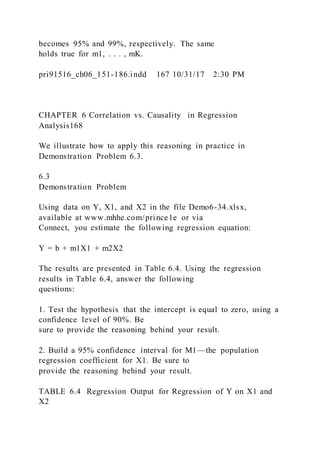
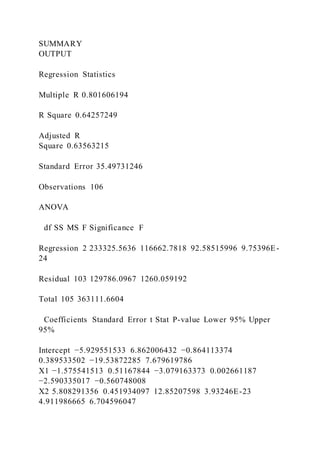
our SaferContent example,
we have the outcome of a purchase depending on whether utility
is “high enough.” Some
other applications are summarized in Table 9.7 (by no means an
exhaustive list).
Now consider a generalization of this way of modeling a
dichotomous dependent variable.
Define our latent variable, Y i * , as the sum of the
determining function and the unobservables:
Y i
* = α + β1   X1i + . . . + βK   XKi + Ui
Then, we define the realization of our dependent variable, Yi, to
be 1 if the latent variable
exceeds 0, and 0 otherwise:
Yi = {
1 if Y i
* > 0
0 if Y i
* ≤ 0
Notice that the latent variable formulation for Y overcomes our
first criticism for the lin-
ear probability model. Expressed this way, we do not need the
determining function and
unobservables to always add up exactly to 0 or 1. We’ve placed
no restriction on this sum,
and by simply comparing it to 0, we always get a value for Y of
0 or 1.
The latent variable formulation for Y also prevents
unreasonable predictions about the
probability of Y equaling 1 (our second criticism of the linear
probability model). To see
this, first note that we can easily express the probability of Y
equaling 1 for any given
values for the Xs:
Pr (Yi = 1|  X1i, . . . , XKi) = Pr ( Y i * > 0|  X1i, . . . , XKi)
This equation states that the probability the outcome (Y ) equals
1, given the values for the
Xs, is equal to the probability that the latent variable (Y *) is
greater than 0, given the values
for the Xs. Next, if we plug in our formula for the latent
variable, we have:
Pr (Yi = 1|  X1i, . . . , XKi) = Pr(α + β1  X1i + . . . + βK  XKi +
Ui > 0|  X1i, . . . , XKi)
TABLE 9.7
Examples of
Dichotomous
Dependent Variables
Coupled with Latent
Variables
DE PE NDE NT VARIABLE L ATE NT VARIABLE
Make a Purchase Utility
Open a New Business Profits
Hire a New Employee Net Revenues
Terminate Subscription Utility
Acquire a Competing Firm Profits
pri91516_ch09_258-291.indd 272 10/31/17 2:37 PM
CHAPTER 9 Prediction for a Dichotomous Variable 273
Lastly, note that with the values of the Xs given, uncertainty
about Y is completely due to
uncertainty about U. Hence, it makes sense to isolate U within
our probability function:
Pr (Yi = 1|  X1i, . . . , XKi) = Pr(Ui > −α − β1  X1i − . . . −
βK  XKi |  X1i, . . . , XKi)
We can see how this latent variable formulation for Y
overcomes the second criticism
of the linear probability model. While the determining function
is unconstrained, the
probability that Y equals 1 is explicitly defined to be a
probability in terms of U, and so
constrained to be between 0 and 1. Hence, even if the
determining function becomes very
large for some values of the Xs, the probability of Y equaling 1
will just approach 1, and
vice versa.
Since we have repurposed the determining function as directly
determining a latent
variable rather than the outcome itself, the parameters of the
determining function (the βs)
represent the change in the latent variable (Y *)—not the
outcome—when their correspond-
ing Xs increase by one, holding all the other Xs constant. In our
SaferContent example, β is
the change in Utility when the subscription fee increases by $1,
and does not by itself tell
us how the likelihood of a Purchase changes with the
subscription fee. Often it is not our
primary interest to assess the effect of an independent variable
on the latent variable. We
may have limited interest in how subscription fees affect
Utility. Rather, we’d like to know
the effect of the independent variables on the likelihood of the
outcome.
Before assessing how independent variables affect the
likelihood of an outcome using
our latent variable formulation, we first must make an
assumption about the distribution
of U. There are two highly popular assumed distributions for U:
The first is familiar—the
standard normal distribution. We assume Ui is distributed as a
normal random variable
with mean 0 and standard deviation of 1, written as Ui ~N(0,1).
A latent variable formula-
tion for a dichotomous dependent variable that assumes a
standard normal distribution for
the unobservables is defined as a probit model.
Probabilities for the probit model simply utilize our knowledge
of the normal distribu-
tion. In Figure 9.1, we illustrate the probability that Y equals 1
for given values of the Xs
using the formula:
Pr (Yi = 1|  X1i, . . . , XKi) = Pr (Ui > −α − β1  X1i − . . . −
βK  XKi |  X1i, . . . , XKi)
Note in the graph that φ(U) is the probability density function
(pdf), for the standard nor-
mal distribution (discussed in Chapter 3).
probit model
A latent variable formula-
tion for a dichotomous
dependent variable that
assumes a standard
normal distribution for
the unobservables.
–α – β1 X1 – … – βK XK i
Pr(Yi = 1|X1i ,..., XK i)
0 U
ϕ(U )
FIGURE 9.1
Probability Y Equals
1 for Given Xs,
Assuming Standard
Normal Distribution
for U
pri91516_ch09_258-291.indd 273 10/31/17 2:37 PM
CHAPTER 9 Prediction for a Dichotomous Variable274
Since we know Ui is a standard normal random variable, we can
simplify the previous
expression for Pr (Yi = 1| X1i, . . . , XKi) using using this
knowledge. First, we know the nor-
mal distribution is symmetric around its mean (which is 0 for U
). Therefore, we know that:
Pr (Ui > −α − β1  X1i − . . . − βK  XKi |  X1i, . . . , XKi) =
Pr (Ui < α + β1  X1i + . . . + βK  XKi |  X1i, . . . , XKi)
Next, define Φ(.) as the cumulative distribution function (cdf)
for a standard normal ran-
dom variable U, where Φ(m) = Pr (U < m). Then, for the probit
model, we have:
Pr (Yi = 1| X1i, . . . , XKi) = Φ(α + β1  X1i + . . . + βK  XKi)
We illustrate this idea in Figure 9.2. Notice that this generates
an identical probability
(same area under the standard normal distribution) as in Figure
9.1.
The second popular assumption for the distribution of U is the
logistic distribution.
Just like the normal, there are many variations of the logistic
distribution, but the typical
assumption is that Ui ~Logistic(0,1). This distribution has a pdf
of:
f (z) = e
−z
_______
(1 + e−z)2
A latent variable formulation for a dichotomous dependent
variable that assumes a
Logistic(0,1) distribution for the unobservables is defined as a
logit model.
The logistic distribution is not nearly as well known as the
normal distribution, so why
is it a popular choice for the distribution of the unobservables?
The answer is that the logis-
tic distribution generates a simple formula for the probability of
Y equaling 1 for a given set
of Xs. Contrast this feature with the probit model, where we
rely on a computer to generate
various probabilities for the normal distribution. When we
assume that Ui~Logistic(0,1),
the probability that Y equals one for given values of the Xs can
be expressed as:
Pr (Yi = 1| X1i, . . . , XKi) =
1 __________________
1 + e−α − β1  X1i − . . . − βK  XKi
The logistic distribution looks very similar to the normal (bell -
shaped, covering the whole real
line), so it is not a huge departure from the normal assumption
and will result in similar prob-
ability calculations. However, its simplified formula for
probabilities can facilitate exposition
logit model
A latent variable formula-
tion for a dichotomous
dependent variable that
assumes a Logistic(0,1)
distribution for the unob-
servables.
FIGURE 9.2
Probability Y Equals
1 for Given Xs,
Assuming Standard
Normal Distribution
for U and Using cdf
for U
Pr(Yi = 1|X1i ,..., XK i)
0
α + β1 X1 + … + βK XK i
U
ϕ(U )
pri91516_ch09_258-291.indd 274 10/31/17 2:37 PM
CHAPTER 9 Prediction for a Dichotomous Variable 275
and more complex analyses beyond simple probability
calculations. For the remainder of the
chapter, we will present results using both models, and the
similarities will be apparent.
Why do analysts choose one model over the other? It is difficult
to give an exhaustive
answer. However, a simplified answer is the probit model
assumes a familiar distribution
that is known to often occur “naturally” in many settings,
whereas the logit model assumes
a distribution that resembles the normal but has more desirable
formulaic features (e.g.,
probability formulas). We summarize the key differences
between the probit and logit
model in Reasoning Box 9.2.
CONTRASTING THE PROBIT AND LOGIT
MODEL
Define a latent variable, Y i
* , as the sum of a determining function and unobservables:
Y i
* = α + β1   X1i + . . . + βK   XKi + Ui
Define a dichotomous dependent variable, Yi, to be 1 if the
latent variable exceeds 0, and 0 other-
wise:
Yi = {
1 if Y i
* > 0
0 if Y i
* ≤ 0
IF:
The unobservables, Ui, are distributed standard normal, i.e.,
Ui ~N(0,1)
THEN:
1. The distribution of Yi satisfies the assumptions of the probit
model.
2. The probability that Yi equals 1, given the values for X1, . . .
, XK, can be expressed as:
Pr (Yi = 1| X1i, . . . , XKi) = Φ(α + β1  X1i + . . . + βK  XKi)
where Φ(.) is the cumulative distribution function for a standard
normal random variable.
Alternatively,
IF:
The unobservables, Ui, are distributed Logistic(0,1)
THEN:
1. The distribution of Yi satisfies the assumptions of the logit
model.
2. The probability that Yi equals 1, given the values for X1, . . .
, XK, can be expressed as:
Pr (Yi = 1| X1i, . . . , XKi) =
1
__________________
1 + e−α − β1  X1i − . . . − βK  XKi
REASONING BOX 9.2
pri91516_ch09_258-291.indd 275 10/31/17 2:37 PM
CHAPTER 9 Prediction for a Dichotomous Variable276
MARGINAL EFFECTS
We have established how to calculate the probability of the
outcome equaling 1 for both
the probit and logit models. Such calculations were a means to
an end, as our ultimate goal
is to establish how changes in the independent variables affect
the probability of the out-
come equaling 1. For the linear probability model, the
parameters of the determining func-
tion (the βs) directly measure this relationship—each represents
the change in probability
of the outcome equaling 1 when its corresponding Xs increase
by 1, holding all the other
Xs constant. Unfortunately, when we utilize a latent variable
formulation, the parameters
of the determining function do not have such a simple
interpretation.
Before attempting to analyze how probabilities change with
independent variables in
probit and logit models, it is useful to establish a more general
definition of this concept.
Roughly speaking, we can define the rate of change in the
probability of a dichotomous
dependent variable equaling 1 with a one-unit increase in an
independent variable (holding
all other independent variables constant) as a marginal effect.
Notice that for the linear prob-
ability model, the βs in the determining function measure
marginal effects (see Reasoning
Box 9.1). However, for the probit and logit models, the βs no
longer have this interpretation.
To see how we calculate marginal effects for probit and logit
models, consider again a
general latent variable model. Let
Y i
* = α + β1   X1i + . . . + βK   XKi + Ui
be the latent variable, and Yi be 1 if the latent variable exceeds
0, and 0 otherwise. Then,
according to our definition, the marginal effect of Xj is
MargEffxj = Pr (Yi = 1|  X1i, . . . , Xji + 1, . . . , XK) − Pr (Yi =
1|  X1i, . . . , Xji, . . . , XKi)
If we apply this definition specifically to the probit and logit
models, we have the following.
For probit:
MargEffxj = Φ(α + β1X1i + . . . βj(Xji + 1) + . . . + βK XKi)
− Φ(α + β1X1i + . . . + βj Xji + . . . + βK XKi)
For logit:
MargEffxj =
1 _____________________________
1 + e
−α − β 1
X 1i
− . . . − β j
( X ji
+ 1) − . . . − β K
X Ki
− 1 _____________________________
1 + e
−α − β 1
X 1i
− . . . − β j
X ji
− . . . − β K
X Ki
Notice that in neither case does the marginal effect simplify to
βj, meaning we generally get
different marginal effects for probit and logit models compared
to the linear probability model.
We can easily illustrate the calculation of marginal effects using
our SaferContent
example. Suppose the subscription fee is $22, and we increase
the subscription fee by $1.
The change in the probability of a Purchase (the marginal
effect) is:
Pr(Purchasei = 1|SubFeei = $23) − Pr(Purchasei = 1|SubFeei =
$22)
To calculate the marginal effect, we must know the values for α
and β, and we must assume
a logit or probit model. Suppose we knew α = 10 and β = −0.5
and assumed a probit model.
LO 9.5 Calculate
marginal effects for logit
and probit models.
marginal effect
The rate of change
in the probability of a
dichotomous dependent
variable equaling 1 with
a one-unit increase in
an independent variable
(holding all other
independent variables
constant).
pri91516_ch09_258-291.indd 276 10/31/17 2:37 PM
CHAPTER 9 Prediction for a Dichotomous Variable 277
When the subscription fee is $22, our probit model would
calculate the probability of a
purchase as Φ(10 − 0.5 × 22) = Φ(−1) = 0.159. We get the value
of 0.159 using a standard
spreadsheet formula for the normal distribution, as we cannot
calculate it manually. For
example, we can use NORM.S.DIST(−1,TRUE) in Excel to
make this calculation for us.
When we raise the price to $23, the probability of a purchase
falls to Φ(−1.5) = 0.067.
Hence, the effect of raising the subscription fee from $22 to $23
is to lower the probability
of a purchase by 0.092 (0.067 − 0.159 = −0.092).
In contrast, suppose instead we knew α = 8 and β = −0.4, and
assumed a logit model.
Consider now the same marginal effect calculation for a change
in price from $22 to $23.
When the subscription fee is $22, our logit model would
calculate the probability of a pur-
chase as 1 ________
1 + e
−8 + 0.4 × 22
= 1 _____
1 + e0.8
= 0.310. When we raise the price to $23, the probability of
a purchase falls to 1 _____
1 + e1.2
= 0.231. Thus, the effect of raising the subscription fee from
$22
to $23 is to lower the probability of purchase by 0.079 (0.231 −
0.310 = −0.079).
We conclude by highlighting two additional features of
marginal effects for probit
and logit models that lie in contrast to the linear probability
model. The first is that
probit and logit marginal effects generally depend on the
magnitude of the change in
the independent variable that we consider. To simplify intuition
and exposition, our
“rough” definition centers on one-unit increases in the Xs. For
the linear probability
model, whose marginal effects are constant for a given X, this
simplification is not par-
ticularly consequential. However, for probit and logit models,
we may arrive at notably
different calculations for a marginal effect when we consider
the rate of change in
Pr(Y = 1) for an increase in X by 1 versus, say, an increase in X
by 0.1. Consequently,
if we are interested in the effect of a fractional change in X (a
marginal change that is
notably less than one unit), we should adjust our formula for the
marginal effect accord-
ingly. Specifically, if we want to know the marginal effect of an
increase in X by c, we
can calculate it as:
MargEff x j
  ,c =
 Pr (Yi = 1|  X1i, . . . , Xji + c, . . . , XK) − Pr (Yi = 1|  X1i, . . .
, Xji, . . . , XKi)
_________________________________________________
c
To illustrate with our SaferContent example, suppose again that
we knew α = 10 and
β = −0.5, and we assume a probit model. In addition, suppose
we wanted to measure the
marginal effect of a $0.10 increase in price from our original
price of $22. As before, when
the subscription fee is $22, our probit model would calculate the
probability of a purchase
as Φ(10 − 0.5 × 22) = Φ(−1) = 0.159. When we raise price to
$22.10, the probability of
a purchase falls to Φ(−1.05) = 0.147. The marginal effect of this
$0.10 price increase then
is: 0.147 − 0.159 _________ 0.1 = −0.12. It is important to
note that this measure is the rate of change in
the probability of a subscription. If we wanted to predict the
actual change in subscription
probability when price increases from $22 to $22.10, we simply
calculate the difference in
the respective probabilities: 0.147 − 0.159 = −0.012.
When computers automatically report marginal effects for
continuous variables, they
generally use the above formula for an infinitesimally small
value of c, applying some
basics of calculus. While the full details of this calculation are
beyond the scope of this
book, note that we can calculate the rate of change in Pr(Y = 1)
for any change, c, in X using
the above formula. Our “rough” approach to measuring the rate
of change in Pr(Y = 1),
using one-unit increases in X, is appropriate for most
applications.
pri91516_ch09_258-291.indd 277 10/31/17 2:37 PM
CHAPTER 9 Prediction for a Dichotomous Variable278
The second feature of probit and logit model marginal effects
that notably differs from
the linear probability model is related to the first. Just as both
models’ marginal effects can
differ depending on the size of the change in X we are
considering, their marginal effects
also generally differ depending on the level of X from which we
are considering a change.
In our SaferContent example, this means that the marginal
effect we would measure for a $1
increase in price from $22 to $23 is generally not the same as
the marginal effect we would
measure for a $1 increase in price from $18 to $19. To see this,
consider once more the case
where α = 10 and β = −0.5, and we assume a probit model. We
know from our earlier cal-
culations that the marginal effect of increasing price from $22
to $23 is −0.092. The mar-
ginal effect of increasing price from $18 to $19 is: Φ(0.5) −
Φ(1) = 0.691 − 0.841 = −0.15.
Notice that these marginal effects notably differ. In contrast, for
the linear probability
model, the marginal effect is constant and so will not depend on
the price from which we
make a change.
Because the marginal effects we measure depend on the starting
point for X, there
is not an obvious, single number to report as the marginal effect
of X. Nevertheless,
in practice, it is common to attempt to summarize the marginal
effect of X for a probit
or logit model using a single number. A typical way to do this is
to calculate the mar-
ginal effect of X when starting from its mean value and setting
all other Xs to be their
mean values. Within a general model, we would summarize the
marginal effect of Xj
by calculating:
MargEff x j
  = Pr (Yi = 1|   ̄ X1i , . . . , ̄ Xji + 1, . . . , ̄ XK  ) −
Pr (Yi = 1|   ̄ X1i , . . . , ̄ Xji , . . . , ̄ XKi )
Thus, as the average subscription price in our SaferContent
example (from Table 9.2) is
$22.33, the single marginal effect we would calculate is:
Pr(Purchasei = 1|SubFeei = $23.33) − Pr (Purchasei = 1|SubFeei
= $22.33)
ESTIMATION AND INTERPRETATION
In our discussion of marginal effects for probit and logit
models, we have taken the param-
eters (e.g., α, β) as given. In practice we must get estimates for
these parameters using the
data. For the linear probability model, this process is exactly
the same as for our regression
model—that is, solve for the parameters using the sample
moment equations. In essence,
solving the moment conditions for a regression model intends to
make our predicted values
for the outcome (i.e., ̂ Y i = ̂ α + ̂ β1 X1i + . . .
+ ̂ βK XKi) best describe the actual outcomes
(Yi). However, our probit and logit models do not give
predicted values for the outcomes
but rather probabilities that the outcome equals 1. Hence, we
cannot simply extend the use
of sample moment equations to get estimates for the parameters
of the determining func-
tion for our latent variable (α, β1, . . . , βK).
Before laying out the details of an alternative approach to
solving sample moment
equations, we build some basic intuition. Suppose you are the
coach of a youth basketball
team, and a new player, Annie, has just joined the team. You
want to get a sense of Annie’s
skill level before you start coaching her, and one skill you’d
like to learn about is her abil-
ity to make free throws. To do this, you conjecture that as of
joining the team, Annie’s
LO 9.6 Execute
estimation of a probit
and logit model via
maximum likelihood.
pri91516_ch09_258-291.indd 278 10/31/17 2:37 PM
CHAPTER 9 Prediction for a Dichotomous Variable 279
probability of making any given free throw is some constant—
say, ρ. With no knowledge
of Annie, ρ could be anything between 0 and 1—she could miss
everything, make every-
thing, or anything in between.
How might you learn more about ρ? The simplest and most
intuitive way is to have
Annie shoot free throws. Suppose she shoots ten free throws,
and makes three, or 30% of
her free throws—that is, she makes free throws at a rate of 0.3.
A natural guess for Annie’s
likelihood of making any given free throw is ρ = 0.3.
Consider now an alternative calculation we could make using
the data on Annie’s ten
free throws. We could ask, for a given probability of making a
free throw (ρ), what is
the probability that Annie makes three out of ten free throws—
that is, what is the prob-
ability of observing the data we just collected? Such a
calculation is straightforward. If
we treat each shot as being independent, then the probability of
a sequence of ten shots
is just the product of the probability of each individual shot.
Therefore, the probability
of three makes and seven misses is: ρ3 × (1 −ρ)7. In words, we
have the product of three
makes, each with probability ρ, times the product of seven
misses, each with probability
(1 − ρ). Suppose we asked what value of ρ maximizes the
probability of three makes and
seven misses—what value of ρ makes a sequence of ten shots,
with three makes and seven
misses—most likely. It turns out that the solution to this
problem yields our “natural”
guess for ρ: 0.3!
We can even generalize the insight we just gained from Annie’s
free throws. Suppose
we have a dichotomous variable, Y, that equals either 0 or 1.
We observe N independent
realizations of Y in a dataset, of which M realizations equal 1
(meaning N − M realizations
equal 0). Let ρ be the probability Y equals 1 for any given
realization. Then, the value of
ρ that maximizes ρM × (1 − ρ)(N − M) is simply ρ = M/N. The
value of ρ that maximizes
the probability of what we observed is the rate at which Y
equals 1 in the sample (M/N).
Hence, the value for ρ that maximizes the likelihood of what we
saw leads us to our natural
guess for ρ, the number of times Y equals 1 divided by the
number of observations of Y in
the data. Linking this back to the free throw example, for Annie
N = 10 and M = 3, and
our solution for ρ is 0.3 (= 3/10).
The intuition underlying our example of Annie’s free throws
guides how we get our param-
eter estimates in probit and logit. The key difference for the
probit and logit models is that they
generally allow for different probabilities of Y equaling 1 for
different values of X, whereas for
Annie there was just a single probability, ρ. For given
parameters of the determining function,
the probit and logit models give us the probability of Y equaling
one for each different possible
value of X (according to the formulas in Reasoning Box 9.2).
Consequently, solving for the
parameters of the determining function using a dataset isn’t as
simple as calculating the rate
at which Y equals 1 in the data—such a calculation yields just
one number, and we need to
solve for all the parameters of the determining function (α, β1, .
. . , βK).
Fortunately, we can utilize the alternative approach we
introduced for Annie’s free
throws to get around this problem. We can ask what values for
(α, β1, . . . , βK) within a
probit or logit model make the observed values for Y (a set of
0s and 1s) as likely as pos-
sible. The solution, just as in our example with Annie, will give
us a best guess for the
true parameters of the determining function. This approach,
where we estimate population-
level parameters using values that make the observed outcomes
as likely as possible for a
given model, is known as maximum likelihood estimation
(MLE).
maximum likelihood
estimation (MLE)
Population-level
parameters are estimated
using values that make
the observed outcomes
as likely as possible for a
given model.
pri91516_ch09_258-291.indd 279 10/31/17 2:37 PM
CHAPTER 9 Prediction for a Dichotomous Variable280
To see how maximum likelihood estimation works for logit and
probit models, consider
once again a general latent variable model. Let
Y i
* = α + β1   X1i + . . . + βK   XKi + Ui
be the latent variable, and Yi be 1 if the latent variable exceeds
0, and 0 if otherwise.
Suppose now we assume a probit model, so we have
Pr (Yi = 1| X1i, . . . , XKi) = Φ(α + β1  X1i + . . . + βK  XKi)
To get estimates for our parameters, we collect a sample of Ys
and Xs of size N. Using
maximum likelihood estimation, for probit we solve:
Max
(α, β1, . . . , βK)
∏ i=1
N Φ(α + β1  X1i + . . . + βK  XKi)
Y i
× (1 − Φ(α + β1  X1i + . . . + βK  XKi))
(1− Y i
)
The above expression may look complex, but it nicely lines up
with the intuition from Annie’s
free throws. First, note that ∏ i=1 N means we are
multiplying N different expressions—one for
each observation in our data. Note that if a given observation
has Yi = 1, the first half of the
expression has an exponent of 1 and the second half has an
exponent of 0 (thus making that
term equal 1). This formulation captures that the probability of
this observation is
Φ(α + β1  X1i + . . . + βK  XKi)
that is, the probability that Yi = 1, given the values of the
corresponding Xs. In contrast, if
a given observation has Yi = 0, the first half of the expression
has an exponent of 0 (thus
making that term equal 1) and the second half has an exponent
of 1. Again, we see that
this formulation captures that the probability of this observation
is
1 − Φ(α + β1  X1i + . . . + βK  XKi)
that is, the probability that Yi = 0, given the values of the
corresponding Xs.
For logit, everything is exactly the same, except the probability
formulas. Maximum
likelihood estimation for logit solves:
Max
(α, β1, . . . , βK)
∏ i=1
N  
(
1 __________________
1 + e−α − β1  X1i − . . . − βK  XKi
)
Y i
× (1 −
1 __________________
1 + e−α − β1  X1i − . . . − βK  XKi
)
(1 − Y i
 
)
Deriving the solution to these maximization problems requires a
bit of calculus and is
outside the scope of this book. Even if we derived the solution,
it generally takes a com-
puter to do the calculation. Fortunately, most statistical
software will easily solve it with a
single command (e.g., the commands “probit” or “logit” in
STATA).
Just as with our regression model, we want to know that the
MLE estimators we
use for probit and logit models have “desirable” properties. We
want to know if and
when they are consistent and we can use them to build
confidence intervals and con-
duct hypothesis tests. Reasoning Boxes 9.3, 9.4, and 9.5
establish the basic conditions
that lead to these properties. It is important to note that for
simplicity some technical,
pri91516_ch09_258-291.indd 280 10/31/17 2:37 PM
CHAPTER 9 Prediction for a Dichotomous Variable 281
“regularity” conditions (which are nearly always met) have been
omitted, and as with
the regression model, we do not present the formulas for the
standard errors of the esti-
mators (e.g., S ̂ α ). In addition, note that we assume the
unobservables are independent of
the Xs. Recall from Chapter 3 that this means the distribution of
U is not affected by
the value(s) of the Xs. This assumption implies the
unobservables and the Xs are uncor-
related (thus mimicking the moment equations for the standard
linear regression model).
We must make this stronger assumption of independence for the
probit and logit models
because of their more complicated structure relative to the
linear regression model (they
are both nonlinear).
Just as with the regression model, building confidence intervals
and conducting hypoth-
esis tests for probit and logit models requires us to expand our
assumptions beyond those
needed to establish consistency. As before, we need a “big
enough” sample. However,
unlike for the regression model, we do not need to make an
explicit assumption about
homoscedasticity. This is because, for both the probit and logit,
the corresponding assump-
tion about the unobservables—that Ui~N(0,1) or
Ui~Logistic(0,1)—already imposes
homoscedasticity; both models have unobservables with
constant variance. We need not
restate this assumption.
CONSISTENCY OF MLE ESTIMATORS FOR
PROBIT/LOGIT DETERMINING FUNCTIONS
For a population of all possible realizations of Y, X1, . . . , XK,
let {Yi, X1i, . . . , XKi} i=1
N be a sample of size N
from this population, where Y is a dichotomous variable.
Further, let ( ̂ α , ̂ β , . . . , ̂ β K) be the result of
maximum likelihood estimation after assuming Ui conforms to
the probit or logit model.
IF:
1. The data-generating process for an outcome, Y, can be
expressed using a latent variable formu-
lation with latent variable Y i
* = α + β1   X1i + . . . + βK   XKi + Ui and:
Yi = {
1 if Y i
* > 0
0 if Y i
* ≤ 0
2. {Yi, X1i, . . . , XKi} i=1
N is a random sample
3. Ui is independent of X1i, . . . , XKi
THEN:
( ̂ α , ̂ β , . . . , ̂ β K) are consistent estimators of
their corresponding parameters for the determining func-
tion, (α, β1, . . . , βK). We write this result as:
̂ α →α
̂ β1 → β1
. . .
̂ β → βK
REASONING BOX 9.3
pri91516_ch09_258-291.indd 281 10/31/17 2:37 PM
CHAPTER 9 Prediction for a Dichotomous Variable282
CONFIDENCE INTERVALS FOR
PARAMETERS OF A PROBIT/LOGIT
DETERMINING FUNCTION
For a population of all possible realizations of Y, X1, . . . , XK,
let {Yi, X1i, . . . , XKi} i=1
N be a sample of size N
from this population, where Y is a dichotomous variable.
Further, let ( ̂ α , ̂ β1 , . . . , ̂ βK  ) be the result of
maximum likelihood estimation after assuming Ui conforms to
the probit or logit model.
IF:
1. The data-generating process for an outcome, Y, can be
expressed using a latent variable formu-
lation with latent variable Y i
* = α + β1   X1i + . . . + βK   XKi + Ui and:
Yi = {
1 if Y i
* > 0
0 if Y i
* ≤ 0
2. {Yi, X1i, . . . , XKi} i=1
N is a random sample
3. Ui is independent of X1i, . . . , XKi
4. The size of the sample is at least 30 × (K + 1)
THEN:
The interval consisting of ̂ α plus or minus 1.65 (1.96,
2.58) times S ̂ α will contain α approximately 90%
(95%, 99%) of the time. The same holds true for ̂ β1 , . . .
, ̂ βK .
Inductive reasoning: Based on the observation of ̂ α , S ̂ α
, and N, α is contained in the interval ( ̂ α ± 1.65(S ̂ α )).
The objective degree of support for this inductive argument is
90%. If we instead use the intervals
( ̂ α ± 1.96(S ̂ α )) and ( ̂ α ± 2.58(S ̂ α )), the
objective degree of support becomes 95% and 99%,
respectively.
The same holds true for ̂ β1 , . . . , ̂ βK .
REASONING BOX 9.4
HYPOTHESIS TESTING FOR
PARAMETERS OF A PROBIT/LOGIT
DETERMINING FUNCTION
For a population of all possible realizations of Y, X1, . . . , XK,
let {Yi, X1i, . . . , XKi} i=1
N be a sample of size N
from this population, where Y is a dichotomous variable.
Further, let ( ̂ α , ̂ β1 , . . . , ̂ βK ) be the result of
maximum likelihood estimation after assuming Ui conforms to
the probit or logit model.
IF:
1. The data-generating process for an outcome, Y, can be
expressed using a latent variable formu-
lation with latent variable Y i
* = α + β1   X1i + . . . + βK   XKi + Ui and:
Yi = {
1 if Y i
* > 0
0 if Y i
* ≤ 0
REASONING BOX 9.5
continued
pri91516_ch09_258-291.indd 282 10/31/17 2:37 PM
CHAPTER 9 Prediction for a Dichotomous Variable 283
Now that we have stated the general properties of MLE
estimators for probit and
logit models, we conclude by showing probit and logit
estimations for our SaferContent
example. Consider again our original data for the SaferContent
example from Table 9.3.
Suppose we want to estimate the relationship between
subscription fee and the probability
of a purchase using a probit or logit model, rather than a linear
probability model.
For both the probit and logit models, we assume Utilityi = α +
βSubFeei + Ui. The
data-generating process is such that:
Purchasei = {
1 if α + βSubFeei + Ui > 0
0 if α + βSubFeei + Ui ≤ 0
For probit, we assume Ui ~N(0,1). With this assumption, we can
estimate α and β using
maximum likelihood. We present the results in Table 9.8
(calculated using, e.g., STATA’s
“probit” command).
From these estimates, we see that an increase in the subscription
fee of $1 reduces
Utility by 0.146, on average. Further, from the p-value, we see
that we reject the hypothesis
that β = 0 with very high confidence, and from the confidence
interval, we see that we
2. {Yi, X1i, . . . , XKi} i=1
N is a random sample
3. Ui is independent of X1i, . . . , XKi
4. The size of the sample is at least 30 × (K + 1)
5. α = c0
THEN:
We have ̂ α ~N(c0, σα) and ̂ α will fall within 1.65
(1.96, 2.58) standard deviations of c0 approximately
90% (95%, 99%) of the time. This also means that ̂ α will
differ by more than 1.65 (1.96, 2.58) stan-
dard deviations from c0 (in absolute value) approximately 10%
(5%, 1%) of the time.
The same holds true for each of ̂ β1 , . . . , ̂ βK when
assuming, e.g., βj = cj.
Inductive reasoning:
Using t-stats. If the absolute value of the t-stat for ̂ α (=
| ̂ α − c0 _____ S ̂ α | ) is greater than 1.65 (1.96,
2.58), reject
the deduced (above) distribution for ̂ α . Otherwise, fail to
reject. The objective degree of support for
this inductive argument is 90% (95%, 99%).
The same holds true for ̂ β1 , . . . , ̂ βK when assuming,
e.g., βj = cj.
Using p-values. If the p-value of the t-stat for ̂ α is less
than 0.10 (0.05, 0.01), reject the deduced
(above) distribution for ̂ α . Otherwise, fail to reject. The
objective degree of support for this inductive
argument is 90% (95%, 99%).
The same holds true for ̂ β1 , . . . , ̂ βK when assuming,
e.g., βj = cj.
Transposition:
If inductive reasoning leads to a rejection of the distribution
for ̂ α , reject at least one of the assump-
tions (1, 2, 3, 4, or 5) leading to that distribution. If there is
confidence in assumptions 1–4, this
means rejection of the null hypothesis.
pri91516_ch09_258-291.indd 283 10/31/17 2:37 PM
CHAPTER 9 Prediction for a Dichotomous Variable284
are 95% confident that an increase in subscription fee will
reduce Utility by somewhere
between 0.068 and 0.225.
Of course, changes in Utility are not generally our primary
interest. Rather, we want to
know how a change in subscription fee will affect purchase
decisions via the probability of
a purchase. That is, we want to know the marginal effect for the
subscription fee. If there
is not a specific subscription fee for which we want to know the
marginal effect, then we
can calculate it for the average subscription fee, as is typical. In
our sample, the average
subscription fee is $22.33, so we can calculate the marginal
effect as:
Φ(3.204 − 0.146 × 23.33) − Φ(3.204 − 0.146 × 22.33) = 0.420 −
0.478 = −0.058
Thus, a simple summary of the effect of raising subscription fee
by $1 is that it lowers the
probability of purchase by nearly 6%. Note, though, that this
relationship likely will differ
if we start at a different subscription fee (e.g., $25).
If we instead use the logit model, we assume Ui~Logistic(0,1).
With this assumption, we
again can estimate α and β using maximum likelihood. We
present the results in Table 9.9
(calculated using, e.g., STATA’s “logit” command).
From these estimates, we see that an increase in the subscription
fee of $1 reduces
Utility by 0.242, on average. Further, from the p-value, we see
that we reject the hypothesis
that β = 0 with very high confidence. Also, from the confidence
interval, we see that we
are 95% confident that an increase in subscription fee will
reduce Utility by somewhere
between 0.105 and 0.379. The marginal effect is:
1 ________________
1 + e  
−5.295  + 0.242    × 23.33
− 1 ________________
1 + e  
−5.295  + 0.242    × 22.33
= 0.413 − 0.473 = − 0.060
Thus, a simple summary of the effect of raising subscription fee
by $1 is that it lowers
the probability of purchase by about 6%. As with probit, this
relationship likely will dif-
fer if we start at a different subscription fee (e.g., $25).
However, notice that we arrived
at very similar marginal effects for probit and logit, reflecting
the general similarities in
the two models.
TABLE 9.8 Probit Results for SaferContent Data
COE FFICIE NTS STANDARD E RROR Z SCORE1 P -VALUE
LOWE R 95% UPPE R 95%
Intercept 3.204304 0.901809 3.55 0.000 1.436791 4.971817
SubFee −0.1463224 0.0400753 −3.65 0.000 −0.2248685
−0.0677763
1Note that these tables use a z score rather than a t-statistic.
This distinction is meaningful for small samples, but since we
are assuming sufficiently large sample sizes, the
difference is merely semantic, as the p-values are calculated in
the same way.
TABLE 9.9 Logit Results for SaferContent Data
COE FFICIE NTS STANDARD E RROR Z SCORE P -VALUE
LOWE R 95% UPPE R 95%
Intercept 5.29481 1.566023 3.38 0.001 2.225461 8.364159
SubFee −0.2417501 0.0698248 −3.46 0.001 −0.3786043
−0.104896
pri91516_ch09_258-291.indd 284 10/31/17 2:37 PM
CHAPTER 9 Prediction for a Dichotomous Variable 285
MERITS AND SHORTCOMINGS
We conclude our discussion of probit and logit models with a
brief summary of their
merits and shortcomings. The key merits link back to the linear
probability model, in that
probit and logit models help to overcome shortcomings of the
linear probability model.
Recall that the linear probability model is such that: (1) The
determining function and
LO 9.7 Identify the
merits and shortcomings
of probit and logit
models in practice.
9.2
Demonstration Problem
An outcome variable, Y, can only take on the values zero or
one. In attempting to measure the effects of X1
and X2 on Y, you’ve collected a sample of size 200 on these
three variables, and assumed the following:
A. The data generating process for Y is:
Yi = {
1 if Y i
* > 0
0 if Y i
* ≤ 0
where Y i
* = α + β1   X1i + β2   X2i + Ui
B. {Yi, X1i, X2i} i=1
N is a random sample
C. Ui is independent of X1i, X2i
You further assume a probit model, and get the following
parameter estimates using maximum likeli-
hood estimation (e.g., using the command “probit” in STATA):
TABLE 9.10 Probit Results for Data on Y, X1, and X2
CO E F F I C I E NT S S TA N DA R D E R RO R Z S CO R E
P -VA LU E LOW E R 9 5% U PPE R 9 5%
Intercept −9.7721 1.2720 −7.68 0.000 −12.2652 −7.2790
X1 0.2493 0.0360 6.93 0.000 0.1788 0.3198
X2 0.7269 0.1019 7.14 0.000 0.5273 0.9266
a. Interpret the estimates for β1 and β2.
b. What is the marginal effect of X1 when X1 = 5 and X2 = 9?
c. What is the marginal effect of X2 when X1 = 5 and X2 = 9?
d. Are there any values for X1 and X2 that could generate a
limit-violating prediction?
Answer:
a. The estimate for β1 implies that, when X1 increases by one
unit and X2 is held constant, Y  *
increases by 0.2493. The estimate for β2 implies that, when X2
increases by one unit and X1 is
held constant, Y  * increases by 0.7269. If, for example, Y  *
represents utility, these changes are
in utils. However, we are seldom interested in the changes to
Y  * in a probit (or logit) model.
b. The marginal effect at these X1 and X2 values is: Φ(−9.7721
+ 0.2493 × 6 + 0.7269 × 9) −
Φ(−9.7721 + 0.2493 × 5 + 0.7269 × 9 = 0.0178.
c. The marginal effect at these X1 and X2 values is: Φ(−9.7721
+ 0.2493 × 5 + 0.7269 × 10) −
Φ(−9.7721 + 0.2493 × 5 + 0.7269 × 9) = 0.0808.
d. No. This is one of the merits of the probit (and logit) model.
By construction, probabilities must
always be between 0 and 1.
pri91516_ch09_258-291.indd 285 10/31/17 2:37 PM
CHAPTER 9 Prediction for a Dichotomous Variable286
unobservables always add up to exactly 0 or 1, and (2) limit-
violating predictions are
possible.
Probit and logit models overcome these shortcomings by
construction. As noted above,
the latent variable formulation places no restrictions per se on
the relationship between
the determining function and unobservables, thus avoiding
shortcoming (1). Further, both
models predict probabilities rather than the actual value (0 or 1)
for the dependent vari-
able. Since the prediction is already a probability and forced to
be between 0 and 1 by
construction, there is no risk of limit-violating predictions when
considering a change in
an independent variable. Hence, both models avoid shortcoming
(2).
While probit and logit models do overcome some of the key
shortcomings of the linear
probability model, they aren’t without their own shortcomings.
To conclude, we highlight
some notable shortcomings of these models.
First, note that the probabilities implied by the probit and logit
models directly depend
on the assumption of a normal or logistic distribution for the
unobservables, respectively.
Hence, our estimates for the parameters of the determining
function, and also the marginal
effects, will be inconsistent if this assumption is incorrect, no
matter the sample size.
In contrast, estimates for the linear probability model are not
materially affected by the
distribution of the unobservables, as long as the sample is large.
While this criticism may
be important in some special cases, the assumption of normally
or logistically distributed
unobservables (which are very similar in shape) is often a
reasonable one, and so this
shortcoming often is not especially problematic in practice.
A second shortcoming of probit and logit models is the added
complexity of calculat-
ing marginal effects, relative to the linear probability model.
Recall that marginal effects
for probit and logit depend on the levels of all of the Xs,
whereas marginal effects for
the linear probability model are constant. Of course, the linear
probability model may be
oversimplifying these effects, but exposition and interpretation
are substantially simpler.
A final shortcoming of probit and logit models concerns the use
of instrumental vari-
ables and fixed effects. Just as in the standard regression model,
we may be worried about
endogeneity within a probit or logit model. And we may want to
utilize an instrumental
variable(s) and/or fixed effects to address this issue.
Unfortunately, utilizing these methods
within a probit or logit model is a bit more complicated than it
is for a linear probability
model, and typically requires additional assumptions. The
details of how to employ instru-
mental variables and fixed effects using probit and logit are
beyond the scope of this book.
COMMUNICATING DATA 9.3
THE “RIGHT” MODEL FOR A DICHOTOMOUS DEPENDENT
VARIABLE
Throughout the text of this chapter, notice we give no indication
of which model (linear probability, probit, logit) is “right,”
but just their merits and shortcomings. We conclude this chapter
using a Communicating Data discussion in order to finish
with more global points concerning model selection for a
dichotomous dependent variable. First, note that there is little
practical difference between the probit and logit models, so the
key choice is between probit/logit and the linear probability
model. Second, we are generally interested in marginal effects,
so differences in estimated marginal effects will be the key
distinctions across the models. Third, the models will give, by
construction, different estimates for marginal effects across
continued
pri91516_ch09_258-291.indd 286 10/31/17 2:37 PM
different starting values for the Xs. However, it is not unusual
for data to be concentrated around a relatively small range of
X values with a relatively small range of corresponding
probabilities for Y. In such cases, the estimated marginal effects
for
the two different types of models generally won’t be very
different when starting from X values in the observed range,
and
so the choice between models is not particularly crucial.
For cases where the data are more expansive and/or we want
marginal effects for notably varying X levels, the differ -
ences in estimated marginal effects across the models can be
large. For these cases, there is no consensus on the “right”
model to use. Hashing out the full set of arguments in either
direction is too large an issue to fully tackle here, but we
conclude by noting both rely on assumptions that are difficult to
test. Thus, predictions in such cases should recognize this
fact and carry appropriate caveats.
RISING TO THE dataCHALLENGE
Changing the Offer to Change Your Odds
The decision to accept or decline an offer is a dichotomous one,
so we can relabel
Accept as 1 and Decline as 0. We would like to know the effect
of raising salary by
$5,000 on the likelihood of acceptance. After working through
this chapter, we know
the most commonly utilized models for measuring such an
effect are the linear prob-
ability model and the probit/logit models. Suppose we choose to
assume a logit model.
Hence, we assume the data-generating process for Y is:
Yi = {
1 if α + βOfferi + Ui > 0
0 if α + βOfferi + Ui ≤ 0
where Ui  ~Logistic(0,1).
Using maximum likelihood estimation (e.g., “logit” in STATA),
we get the estimates for
α and β shown in Table 9.11.
TABLE 9.11 Logit Results for Offer and Acceptance
Employment Data
CO E FFI CI E NTS S TA N DA R D E R RO R Z SCORE P -
VALUE LOW E R 95% U PPE R 95%
Intercept −2.3373 1.9751 −1.18 0.237 −6.2085 1.5338
Offer (in '000s) 0.0324 0.0270 1.20 0.230 −0.0205 0.0852
Given we are using the logit model, measuring the effect of a
$5,000 increase in the
offer depends on the starting point. For example, we may want
to know the effect of
a $5,000 increase in the offer from a base level of $60,000.
Using our estimates, we
have the measured effect:
1 ________________
1 + e  
2.3373−0.0324    × 65
− 1 ________________
1 + e  
2.3373−0.0324    × 60
= 0.0395
CHAPTER 9 Prediction for a Dichotomous Variable 287
pri91516_ch09_258-291.indd 287 10/31/17 2:37 PM
CHAPTER 9 Prediction for a Dichotomous Variable288
From this calculation, our model implies that raising an offer
from $60,000 to $65,000
should, on average, raise the likelihood of an acceptance by
about 4%.
However, there are important caveats to this conclusion. First,
the coefficient on the
offer was not statistically significant. Consequently, we cannot
reject the hypothesis
that acceptance was unaffected by the offer amount, and so our
measured effect of a
$5,000 increase in the offer—while a best guess—may be an
overstatement. However,
it seems intuitively hard to believe that offering more money
would not raise the likeli-
hood of acceptance.
Perhaps the relatively small size of the dataset simply led to a
particularly uncertain
estimate for β, but we should be wary of another potential issue.
In particular, we might
worry that offers are endogenous within this model. That is, it
may be the case that
candidates with strong alternative employment options were
given larger offers. Within
the model, this means those with low values for U
(unobservables making it less likely
they will accept) were given high values for Offer. This clearly
violates the assumption
of U being independent of the Offer, meaning we cannot count
on getting a consistent
estimate for β. In this case, we likely are underestimating the
effect of the Offer on
Acceptance. Addressing this latter issue generally will require
some of the remedies
we’ve described in prior chapters, e.g., more controls, fixed
effects, and/or the use of
an instrumental variable.
S U M M A R Y
In this chapter we defined a limited dependent variable. We
focused our attention on a specific type of limited
dependent variable, the dichotomous dependent variable, which
takes on just two values. We presented
the linear probability model and explained how it applies
regression analysis to dichotomous dependent
variables to predict outcome probabilities. We then detailed
important merits and shortcomings of the linear
probability model.
We next described probit and logit models, which build upon
latent variables, as alternatives to the linear
probability model. We explained how to calculate changes in
outcome probabilities, called marginal effects,
using these more complex models. We went on to detail how to
estimate a probit and logit model and inter-
pret the results from each. We concluded by listing the merits
and shortcomings of the probit and logit, and
contrasting them with the linear probability model.
K E Y T E R M S A N D C O N C E P T S
dichotomous dependent variable
latent variable
limit-violating prediction
limited dependent variable
linear probability model
logit model
marginal effect
maximum likelihood estimation (MLE)
probit model
pri91516_ch09_258-291.indd 288 10/31/17 2:37 PM
CHAPTER 9 Prediction for a Dichotomous Variable 289
C O N C E P T U A L Q U E S T I O N S
1. Which of the following could reasonably be categorized as a
limited dependent variable? (LO1)
a. Firm revenue
b. Number of automobiles owned by a household
c. Number of firm employees
d. Whether an individual is unemployed
e. Whether an employee was promoted last year
2. Which of the following could be categorized as a
dichotomous dependent variable? (LO1)
a. Firm revenue
b. Whether an individual is unemployed
c. Number of automobiles owned by a household
d. If a household viewed a new shoe ad
e. Firm profits
3. Suppose Y is a dichotomous dependent variable, and the data-
generating process for Y can be
expressed as:
Yi = 0.1 + 0.03 X1i − 0.02 X2i + Ui
Interpret the coefficients on X1 and X2. (LO2)
4. Suppose you are trying to learn the relationship between the
price you charge for your product and the
likelihood of purchase by individuals offered that price. You
offer your product online and for one month
have randomly posted prices between $10 and $30. Using data
on purchases and prices, you get the
following estimates for a linear probability model:
Purchasei = 1.7 − 0.06 × Pricei
You are interested in the effect of a $20 price increase (i.e.,
moving from the lowest price to the highest)
on the likelihood of Purchase. Why is answering this question
problematic using this model? (LO3)
5. You are interested in learning how the size of your website
ad affects the likelihood of visitors to that
website clicking the ad. Express the relationship between the
incidence of a click and the size of the ad
using a latent variable formulation. (LO4)
6. Suppose a latent variable, Y  *, can be expressed as Y i
* = α + β1   X1i + β2   X2i + Ui. Suppose also that Y
equals 1 when Y  * > 0 and Y equals 0 otherwise. (LO4)
a. What other features must this data-generating process possess
for us to label it as:
i. A logit model?
ii. A probit model?
b. Name a reason for:
i. Assuming a logit model instead of a probit model
ii. Assuming a probit model instead of a logit model
7. Which of the following are shortcomings of the linear
probability model? (LO3)
a. They can generate limit-violating predictions
b. Marginal effects depend on the starting point
c. They can rely on often unrealistic distributions for the
unobservables
d. Use of instrumental variables requires additional assumptions
that generally are not needed for OLS
pri91516_ch09_258-291.indd 289 10/31/17 2:37 PM
CHAPTER 9 Prediction for a Dichotomous Variable290
8. Which of the following are shortcomings of probit and logit
models? (LO7)
a. They can generate limit-violating predictions
b. Marginal effects depend on the starting point
c. They can rely on often unrealistic distributions for the
unobservables
d. Use of instrumental variables requires additional assumptions
that generally are not needed for OLS
9. Assume a latent variable, Y  *, can be expressed as Y i
* = 4 + 6  Xi + Ui, where Ui is independent of Xi.
Suppose also that Y equals 1 when Y* > 0 and Y equals 0
otherwise. Calculate the marginal effect of X
when: (LO5)
a. X = −0.5 and we assume this is a logit model.
b. X = −1.2 and we assume this is a probit model.
c. X = −0.2 and we assume this is a logit model.
10. Assume a latent variable, Y*, can be expressed as:
Y i
* = α + β1   X1i + β2   X2i + Ui
where Ui is independent of X1i and X2i.
Suppose also that Y equals 1 when Y   * > 0 and Y equals 0
otherwise. Using a random sample of
{Yi,X1i,X2i}, you get the following maximum likelihood
estimates: (LO5)
̂ α = 2.3
̂ β = 1.2
̂ β1 = −0.4
a. What is the marginal effect of X1 when X1 = 0 and X2 = 5 if
we assume this is a probit model?
b. What is the marginal effect of X2 when X1 = 0.2 and X2 = 6
if we assume this is a logit model?
11. Refer to Question 10. Suppose the actual distribution for U
can be expressed as follows: (LO7)
Pr(Ui = − 2) = 0.3
Pr(Ui = 0) = 0.4
Pr(Ui = 2) = 0.3
a. Why should you be concerned about using your above
estimates if you assumed a probit model to
get them?
b. Would this concern diminish if you had assumed a logit
model instead?
c. Would this concern diminish if you tripled the sample size?
Q U A N T I TAT I V E P R O B L E M S
12. You have begun consulting for Yummy Yogurt, and they are
interested in learning the impact of a digital
discount campaign the company recently began. The campaign
consists of sending a price discount
to prior customers on an infrequent basis—some weeks
customers receive the discount while in other
weeks they do not. Yummy Yogurt has collected data on the
incidence of receiving the discount and
whether a purchase was made for 1,000 customers over 16
weeks. The data are in Chap9Prob1213, and
the unit of observation is an individual-week. Here, Purchase
equals 1 if a purchase of Yummy Yogurt
Dataset available at
www.mhhe.com/prince1e
pri91516_ch09_258-291.indd 290 10/31/17 2:37 PM
CHAPTER 9 Prediction for a Dichotomous Variable 291
was made in a given week, and 0 otherwise; Discount equals 1
if a discount was offered in a given
week, and 0 otherwise.
Assume the following data-generating process: Purchaseit = α
+ β Discountit + Uit. Hence, you are
assuming a linear probability model. Also, assume these data
are a random sample and there is no
correlation between unobservables and Discount. (LO2)
a. Using OLS, get estimates for α and β.
b. Interpret your estimate for β.
c. At a 95% confidence level, can you reject the hypothesis that
the discount has no effect on the
likelihood of purchase?
d. Is there reason for concern about limit-violating predictions
for this linear probability model?
13. Refer to Problem 12. (LO2)
a. What type of data are in Chap9Prob1213?
b. Why might it be important to include fixed effects in your
estimation?
c. Write out the data-generating process for these data with
fixed effects included.
d. Use a within estimator to get estimates for α and β.
e. Interpret your estimate for β.
14. Your firm has begun advertising on YouTube, placing video
ads at the beginning of popular music
videos. You have many different versions of your ad, ranging
from 15 seconds to 2 minutes in length.
YouTube varies the length of the ads presented to viewers of its
music videos, and you have data
detailing which ad was viewed and whether that individual
ultimately visited your website during that
session online. The data are in Chap9Prob1415. Here, Visit
equals 1 if your website was visited during
an online session, and Ad Length is the length, in seconds, of
the ad that individual viewed from your
firm. As can be seen in the dataset, you also have information
on the individual’s age. You would like to
learn the effect of ad length on the likelihood of visiting your
website. You start by assuming there is a
latent variable: (LO5)
Y i
* = α + β 1
 
Ad Lengthi + β 2
 
Agei + Ui
a. Suppose you want to estimate a probit model. Detail the
assumptions you must make, in addition to
the latent variable definition above, in order to estimate the
effect of ad length on the likelihood of
a visit.
b. Assume a probit model, and use maximum likelihood
estimation to estimate α, β1, and β2.
c. Using your estimates from Part b, what is the effect on the
likelihood of a visit to your website from
increasing ad length from 30 seconds to one minute for an
individual who is 25 years old?
15. Refer to Problem 14. (LO6)
a. Suppose you want to estimate a logit model instead. How do
your assumptions differ from those in
Part a of Problem 14 if you again want to estimate the effect of
ad length on the likelihood of a visit?
b. Assume a logit model, and use maximum likelihood
estimation to estimate α, β1, and β2.
c. Using your estimates from Part b, what is the effect on the
likelihood of a visit to your website from
increasing ad length from 30 seconds to one minute for an
individual who is 25 years old?
d. Suppose you believe the effect of ad length on the latent
variable is not constant—for example,
the effect of increasing ad length from 30 seconds to 45 seconds
is not the same as increasing ad
length from 1:30 to 1:45. How could you alter the determining
function for Y   * to allow these effects
to differ?
Dataset available at
www.mhhe.com/prince1e
Dataset available at
www.mhhe.com/prince1e
Dataset available at
www.mhhe.com/prince1e
Chapter opener image credit: ©naqiewei/Getty Images
pri91516_ch09_258-291.indd 291 10/31/17 2:37 PM
292
LEARNING OBJECTIVES
After completing this chapter, you will be able to:
LO10.1 Explain what it means for a variable’s
effect to be identified in a model.
LO10.2 Explain extrapolation and interpolation
and how each inherently suffers from an
identification problem.
LO10.3 Distinguish between functional form
assumptions and enhanced data
coverage as remedies for identification
problems stemming from extrapolation
and interpolation.
LO10.4 Differentiate between endogeneity
and types of multicollinearity as
identification problems due to variable
co-movement.
LO10.5 Articulate remedies for identification
problems and inference challenges due
to variable co-movement.
LO10.6 Solve for the direction of bias in cases
of variable co-movement.
dataCHALLENGE Are Projected Profits over the Hill?
As an analyst for BabyWear—an online vendor of diapers—you
have been given a rare oppor-
tunity to experiment with online prices in order to determine the
relationship between profits
and price. Over a large number of zip codes, you randomly vary
the price of BabyWear’s
standard package of newborn diapers between $34.99 and
$38.99 and maintain these ran-
dom prices for one month. You then record variable profits
(equal to revenues minus variable
costs) at each randomly chosen price. To conduct your analysis
of the relationship between
Profits and Price, you assume the following data-generating
process:
Profitsi = α + βPricei + Ui
You then regress Profits on Price and get the estimates reported
in Table 10.1.
10 Identification and
Data Assessment
TABLE 10.1 Regression Results for Regression of BabyWear
Profits on Price
CO E FFI CI E NTS STA N DA RD E RRO R t STAT P -VA LU
E LOWE R 95% U PPE R 95%
Intercept 716.1734129 22730.01617 0.031507827 0.974901295
−44151.37728 45583.72411
Price 1503.742314 616.4179959 2.439484772 0.015729687
286.9739022 2720.510726
pri91516_ch10_292-321.indd 292 10/30/17 12:35 PM
CHAPTER 10 Identification and Data Assessment 293
Given the randomness of your price assignment, you believe the
relationship from your
regression is causal, and you present it as such to BabyWear
management. Based on these
findings, management concludes profits would be decidedly
higher if the company raised
its usual price of $36.99 to $49.99.
Would you endorse this conclusion?
In the prior chapters, a key point of emphasis has been the
consequences of, and
remedies for, endogeneity problems. When the treatme nt
variable is endogenous
within our assumed data-generating process, we are unable to
consistently estimate
its effect on the outcome. However, endogeneity is not the only
reason we may be
unable to estimate a treatment effect. In this chapter, we “widen
the lens” with regard
to challenges toward estimating a treatment effect. We discuss
the range of dataset
characteristics, including those leading to endogeneity, that
would preclude us from
estimating a treatment effect, regardless of the size of the
dataset. We then detail
remedies for such data limitations in the form of assumptions
and/or changes to the
data. We also discuss ways to bound the direction and
magnitude of the inaccuracy in
treatment-effect estimation when remedies are not sufficient or
possible.
A broad understanding of data features that allows us to
estimate a treatment effect
in general is crucially important. It aids two audiences: It helps
the analyst in collecting
proper data and making appropriate assumptions, and it also
helps consumers of the
analysis assess whether the data being used are capable of
estimating the treatment
effect in which they are interested.
Introduction
Assessing Data Via Identification
Suppose you are working for a craft furniture designer who has
his own website. He is
interested in how sensitive his consumers are to price for his
hand-crafted rocking chairs.
He charges the same price to everyone for the chairs themselves
($200), but shipping costs
from his production facility in central Wisconsin vary
depending on the location of the
customer. Thus, the total price to customers varies by customer
location. Shipping costs
make a discrete jump when the customer is outside Wisconsin.
They are between $10 and
$25 in-state and between $75 and $100 out-of-state. The
designer provides you with a
cross-sectional dataset with observations that vary by location.
In particular, the data con-
tain information on locations (zip codes), the full price charged
for a chair to be delivered
to that location, and the total sales for that location over a one-
year period. The first few
observations are presented in Table 10.2.
Your goal is to estimate the average treatment effect of price on
sales. On average,
when price increases by, say, $1, what is the effect on sales of
rocking chairs? As we have
LO 10.1 Explain what
it means for a variable’s
effect to be identified in
a model.
pri91516_ch10_292-321.indd 293 10/30/17 12:35 PM
CHAPTER 10 Identification and Data Assessment294
indicated in prior chapters, a natural concern when trying to
answer this question is that
price is correlated with other (unobserved) factors that
influence sales, creating an endo-
geneity problem. However, before attempting to address this
specific concern, we can ask
whether a broader problem exists with the data we have—
whether the effect of price on
sales is identified.
In statistics, the definition of “identified” can be rather formal
and complex. Here,
we take a less formal, practically oriented, approach tow ard
defining the concept of
“identified”—an approach that is tailored to the idea of
estimating causal effects of
variables on outcomes. In our analysis of sales and price for
rocking chairs, suppose we
assumed the following data-generating process:
Salesi = α + βPricei + Ui
Within this model, we are interested in accurately estimating β.
We say that a parameter
(e.g., β) is identified within a given model if it can be estimated
with any level of preci-
sion given a large enough sample from the population. A bit
more formally, a parameter
is identified if, for a given confidence level K (< 100%) and a
given “length” L, we can
build a confidence interval that contains β with length less than
L and confidence level
of K, given a large enough sample of data. For example,
suppose we want to estimate a
parameter with a confidence level of 99% and a confidence
interval whose upper and lower
bounds differ by only 0.1. If that parameter is identified, we can
generate such a confidence
interval given enough data.
While our ultimate goal is to assess when and how parameters
of an assumed data-
generating process (like the one assumed above) are identified,
it is best to start within a
simpler framework to build our understanding of identification.
Consider a simple die—a
cube with the numbers 1 through 6 on its faces and with exactly
one number on each face.
Suppose we want to know the probability of rolling the number
3 for that die. If it is a
“fair” die, that probability is 1/6. However, suppose we aren’t
sure it is a fair die—perhaps
it is lopsided in some way affecting the probability each number
is rolled (a trick often
used by cheats in the game of craps at casinos). We’d like to be
able to determine what the
“true” probability of rolling a 3 is for that die with a high level
of precision. How could we
do it? An attractive option is to do it empirically, using data on
rolls for that die.
To begin, define p as the probability of rolling a 3 on any single
roll of the die. Then, if
we define X to be the number of 3s we observe on a single roll
of the die (X = 1 if we roll
a 3 and X = 0 if we roll any other number), we have E[X ] = p.
Some additional math would
identified Can be
estimated with any
level of precision given
a large enough sample
from the population.
IP LOCATION ZIP CODE PRICE SALES
90006 $297.32 8
32042 283.75 9
45233 275.35 7
07018 280.25 11
53082 223.50 17
53039 214.10 12
37055 292.90 8
TABLE 10.2
Subsample of Rocking
Chair Data
pri91516_ch10_292-321.indd 294 10/30/17 12:35 PM
CHAPTER 10 Identification and Data Assessment 295
show that Var[X ] = p(1 − p). Within this simple framework, the
parameter p is identified.
In other words, we can estimate p as precisely as we want given
enough data on the die
(given enough rolls of the die).
The fact that p is identified follows directly from the central
limit theorem (discussed in
Chapter 3). Suppose we roll the die N times. Define x1 as the
observed value of X for the first
roll, x2 for the second, and so on. Then, define ‾ X N =
1 __ N [x1 + x2 + . . . +xN] =
1
__
N
∑ i=1
N
xi, i.e., the
sample mean for X, or equivalently, the proportion of the N
rolls that showed a 3. Given these
definitions, the central limit theorem states that ‾ X N ∼ N
(p,
√
_______
p(1 − p)
_______
√
__
N
) as N gets large.
Rather than dive into a formal proof from here, consider what
this statement about the
distribution of ‾ X N implies both visually and
conceptually. Visually, we present two distri-
butions for ‾ X N in Figure 10.1—both have p = 1/6, but
one has N = 50 and the other has
N = 5,000. We can see that the distribution “collapses” around
the value for p. As N gets
FIGURE 10.1
Distribution of Mean
of X for N = 50 and
N = 5,000
8
6
4
1
0
0 0.2
Mean of X
N = 50
f(
.)
0.4
7
5
2
3
0.1 0.3
80
60
40
10
0
0 0.2
Mean of X
N = 5,000
f(
.)
0.4
70
50
20
30
0.1 0.3
pri91516_ch10_292-321.indd 295 10/30/17 12:35 PM
CHAPTER 10 Identification and Data Assessment296
larger, any realized value for ‾ X N is almost certainly
very close to p (= 1/6). Put another
way, as we build confidence intervals for p using these samples,
the confidence intervals
tend to get smaller and smaller for the same level of confidence.
Conceptually, the idea
is quite simple: the mean of a sample will not stray far from the
population mean as the
sample keeps getting larger. More data—sampled randomly—
will get us an estimate as
close to p as we want.
When considering questions concerning the effect of a strategic
variable on a particular
outcome, we want to be sure the data we’ve collected are
capable of providing a useful
answer. For this to be true, we must be able to find an
acceptable model of the data-
generating process (whose accompanying assumptions are
believable) within which the
effect we are trying to estimate is identified using the
population of data to which we have
access. If so, our only remaining concern is the level of
precision we hope to attain. If the
data in hand do not provide sufficient precision, the fact that the
effect is identified in our
model tells us that we need only collect more of the same data.
We summarize this point
in Reasoning Box 10.1.
Identification Problems and Remedies
Let’s return now to our hand-crafted rocking chair example. It
may be tempting to extend
the reasoning we presented for identifying the probability of
rolling a 3 for a die to our
initial example concerning the rocking chairs. Just as
confidence intervals “collapse”
around p as the sample size increases, we may believe that
confidence intervals will also
“collapse” around β as we get more data on Sales and Price.
While it is true that confidence
intervals will generally shrink as the sample size increases, it is
not necessarily true that
they can or will close in on the right number in all cases.
Sometimes, the data are such that,
no matter how large a sample we take from the population, we
can close in on the right
number only by making a crucial assumption(s) about the data-
generating process and/or
by sampling from an expanded or alternative population.
CAN DATA DELIVER THE (SUFFICIENTLY
PRECISE) ANSWER?
Suppose we have determined a population of data from which
we are able to sample, and a treat-
ment effect we would like to estimate. If there is an acceptable
model of the data-generating
process (one whose accompanying assumptions are believable)
within which the treatment effect is
identified using samples from the population, then the treatment
effect can be estimated with any
level of precision given a large enough sample of these data.
Under these circumstances, an analyst
can estimate the desired treatment effect without seeking
alternative data populations.
In contrast, if there is not an acceptable model of the data-
generating process within which
the treatment effect is identified using samples from the
population, the analyst should consider
alternative data populations (e.g., additional variables) before
attempting to estimate the effect.
REASONING BOX 10.1
pri91516_ch10_292-321.indd 296 10/30/17 12:35 PM
CHAPTER 10 Identification and Data Assessment 297
In this section, we discuss two primary circumstances in which
identification problems
typically arise: when attempting to extrapolate and/or
interpolate, and when there is vari-
able co-movement in the population.
EXTRAPOLATION AND INTERPOLATION
In our rocking chair example, note that given the structure of
shipping charges, there are
two ranges of prices that consumers ever experience. If the
designer posts a price of $200
for a chair, the end price will be either between $210 and $225,
or between $275 and $300,
depending on whether or not the customer lives in Wisconsin. A
scatterplot for a data
sample of Sales and Prices would look something like Figure
10.2.
Suppose we wanted to learn how Sales change with a change in
Price. Looking at
Figure 10.2, the data paint a pretty clear picture as to how these
variables move together
in the price range of $210 to $225 and in the price range of
$275 to $300. However,
we might want to know how Sales move with Prices in other
price ranges. Suppose the
designer was considering an increase in the base price of $200
to a price of $235. In that
case, he would first be interested in how Sales move with price
in the price range of $245
to $260. Given that he does not observe these prices with his
existing data, the only way
he can form predictions about the relationship between Sales
and Price in that range is
to interpolate. Interpolation involves drawing conclusions where
there are “gaps” in the
data. Here, a data gap is any place where there are missing data
for a variable over an
interval of values, but data are not missing for at least some
values on both ends of the
interval. In our example, there is a data gap for prices between
$225 and $275. Hence,
to draw any conclusions about how Sales change with Price for
prices in that range, we
must interpolate.
A closely related issue to interpolation is that of extrapolation.
We define extrapolation
as drawing conclusions beyond the extent of the data. In our
example, prices are never
below $210 and never above $300. Consequently, to draw
conclusions about how Sales
relate to Price for prices below $210 (below the lower extent of
Price) or above $300
(above the upper extent of Price) is to extrapolate.
LO 10.2 Explain
extrapolation and
interpolation and how
each inherently suffers
from an identification
problem.
interpolation Drawing
conclusions where there
are “gaps” in the data.
data gap Any place
where there are missing
data for a variable over
an interval of values, but
data are not missing for
at least some values on
both ends of the interval.
extrapolation Drawing
conclusions beyond the
extent of the data.
FIGURE 10.2
Example of Possible
Scatterplot of Sales/
Price Data for
Rocking Chairs
35
30
20
10
0
190 230 270 290
Price
S
a
le
s
350
25
15
5
210 250 310 330
pri91516_ch10_292-321.indd 297 10/30/17 12:35 PM
CHAPTER 10 Identification and Data Assessment298
Identification Problems Identification problems are always
something to consider when
engaging in interpolation and/or extrapolation. The determining
factor is whether the
gap(s) in, or extent of, the data are due to random limitations in
the sample or limitations in
the population. If it is the former, there may be no identification
problem—a larger sample
of the same population may fill in the gap and/or increase the
extent of the data. If it is the
latter, then there is an identification problem that must be
addressed.
We can illustrate these points in our rocking chair example. To
begin, suppose we
want to make predictions about how Sales move with Price
when Price varies between
$210 and $225 and when Price varies between $275 and $300.
For both of these price
ranges, let’s make minimal assumptions about the data-
generating process by assuming
Salesi = f (Pricei) + Ui for Price between $210 and $225, and
Salesi = g(Pricei) + Vi for Price
between $275 and $300. Here, we are not imposing any
functional form for the relationship
between Sales and Price, and we are allowing the functional
form of this relationship to be
different across the two price ranges. We do not detail how to
conduct nonparametric esti-
mation techniques in this book, which is what would be required
if we wanted to estimate
f (.) and g(.) without further assumptions. However, intuitively,
the solutions we would get for
f (.) and g(.) were we to utilize such methods are essentially
what we get if, to the best of our
ability, we draw freehand a curve that “best” fits the data—that
is, generates residuals with
mean zero and that are not correlated with Price. In Figure 10.3,
we recreate Figure 10.2,
but with attempts to draw f (.) and g(.) without any
mathematical formulas.
Our attempt to draw f (.) and g(.) generates an important
insight. If any two people were
asked to draw f (.) and g(.) freehand within this scatterplot, the
curves may not be exactly
the same, but they will likely be similar. And if we added yet
more data for each Price
range, it will become even more likely that the curves separate
people would draw look
almost identical. This is the essence of f (.) and g(.) being
identified within this population
of data—as we get more data, their shape becomes less
ambiguous. Even without assum-
ing the shape of f (.) or g(.), we can estimate exactly what they
look like given enough data.
Now, suppose we want to make predictions about how Sales
move with Price when Price
varies between $225 and $275 and when Price exceeds $300.
For both of these price rang-
es, let’s again make minimal assumptions about the data-
generating process by assuming
FIGURE 10.3
“Freehand” Drawings
of the Functional
Relationship between
Sales and Price
35
30
20
10
0
190 230 270 290
Price
S
a
le
s
350
25
15
5
210 250 310 330
f (.)
g(.)
h(.)???
k(.)???
pri91516_ch10_292-321.indd 298 10/30/17 12:35 PM
CHAPTER 10 Identification and Data Assessment 299
Salesi = h(Pricei) + Wi for Price between $225 and $275, and
Salesi = k(Pricei) + Ai
for Price above $300. Suppose we asked different people to
draw freehand curves esti-
mating h(.) and k(.) that “best” fit the data, just as we did for
the ranges ($210,$225) and
($275,$300). Both data ranges lack any data. Therefore, when
drawing the curve estimat-
ing h(.), we are attempting to interpolate (fill in a data gap), and
when drawing the curve
estimating k(.), we are attempti ng to extrapolate (extend beyond
the data’s range). In both
cases, there is much more room for debate as to what curve best
fits the data, since there
are no data in either range for us to fit—only a starting and
ending point. In Figure 10.3, we
present just a few of the many possible options (as dashed
lines). Importantly, this problem
is not due to our randomly having no data points in these
ranges; even if we collected more
and more data, the problem would not go away. No matter how
much data we collect, it
would still be the case that we have no data points in these
ranges if we are sampling from
the same population. Interpolation and extrapolation over
ranges where no data are avail-
able in the population inherently suffer from an identification
problem. Even just looking
at our candidate curves in Figure 10.3, there is no data-driven
argument for one over the
other, and collecting more of the same data will not change this
fact.
To summarize, when interpolation or extrapolation is used to
fill in gaps or limited
extent of the data sample, but not the population, there is not an
identification problem. In
the example, suppose our lack of data on prices between $225
and $275 were due only to
the chance draw of our data, and not because prices between
$225 and $275 never happen
in the population. Then we have reason to believe that
collecting more data would allow
us to converge on the determining function relating Sales to
Price over this range, since we
will eventually have observations with prices between $225 and
$275. In contrast, when
interpolation or extrapolation is used to fill gaps or limited
extent of the population, there is
an identification problem. No matter how much data is collected
from the population, it will
not help us to draw any conclusions about what is happening in
the unobserved range(s).
Remedies Suppose we wish to engage in interpolation and/or
extrapolation when there
exists an identification problem. We know then for a general
model of the data-generating
process, where no assumptions are made about the determining
function, we cannot “close
in” on features of the determining function by simply sampling
more data from the popu-
lation. There are two key approaches toward solving this type of
identification problem:
changes in the population, and a functional form assumption.
Certainly the most straightforward way of remedying an
identification problem for
interpolation and/or extrapolation is to change the population
from which you are sam-
pling. To follow this remedy, you must find a way to alter the
population so that there
exist elements of the population where there were data gaps (for
interpolation) or limits
to the extent of the data (for extrapolation). For our rocking
chair example, to solve the
identification problem when trying to interpolate Sales for
Prices between $225 and
$275, we may request the designer to try different base prices.
If he charges a base price
of $150, he will observe Sales for Prices between $225 and
$250 for out-of-state zip
codes (after adding the $75 to $100 for shipping). And if he also
tries a base price of
$175, he will observe Sales for Prices between $250 and $275.
The original population
consisted of Location, Sales, and Prices for a fixed base price of
$200 and varying ship-
ping costs. Here, we can change the population by altering the
base price, allowing us
to attain data that fill in the gap in the original dataset.
Similarly, a change in the base
price to something higher than $200 (say, $220) will allow us to
address identification
LO 10.3 Distinguish
between functional-
form assumptions
and enhanced data
coverage as remedies
for identification
problems stemming
from extrapolation and
interpolation.
pri91516_ch10_292-321.indd 299 10/30/17 12:35 PM
CHAPTER 10 Identification and Data Assessment300
problems from extrapolation, by allowing us to observe Sales
that correspond to prices
above $300.
To further illustrate the applicability and potential importance
of changing the popula-
tion to alleviate an identification problem, suppose a new pop
singer is just starting her
career and has been promoting her music by selling physical
copies of her music at vari-
ous high schools. She charges the same price to everyone, and
has been taking note of
differences in sales across high school classes. She finds that
seniors buy the most often,
freshman the least, and sophomores and juniors are in between.
Just this fact alone tells her
that her sales appear to be increasing by age of customer s.
Seeing this, she would like to
extrapolate this relationship beyond just high school–aged kids.
However, using only data
from high schools, she has an identification problem. It may be
tempting to believe sales
will be even higher for an older crowd, but there is no support
from the data for this belief,
and continuing to sample from high schools cannot provide any.
Figure 10.4 illustrates
possible ways we might extrapolate past age 18, but there are no
data to sort through the
options. A clear solution to this identification problem would be
to try selling her music at
colleges and collect data on her sales performance among this
group. Hence, this simple
expansion of the population will alleviate the identification
problem she faced when trying
to extrapolate beyond high school student ages.
The second approach toward remedying an identification
problem for interpolation and/
or extrapolation is to impose a functional form assumption. At
the end of Chapter 7, we
noted that by assuming the form for the determining function,
we impose a shape on the
relationship between the outcome and treatment(s). We then
discussed considerations in
deciding which form to assume. Here, we note that an assumed
functional form actually
can do more than just impose a shape on variables’
relationships—it can be used to fill in
data gaps and/or extend beyond the limits of the data.
In our rocking chair example, as discussed previously, if we
make no assumption about
the form of the determining function in the regions where there
are missing data, then
virtually any curve we can draw (that is at least downward
sloping) is a viable candidate as
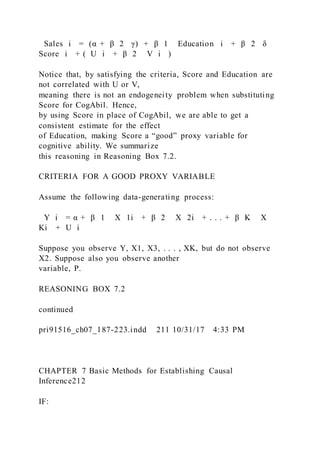
to how Sales relate to Price in those regions. However, standard
practice in business (and
all applications in this book) is to assume a functional form of
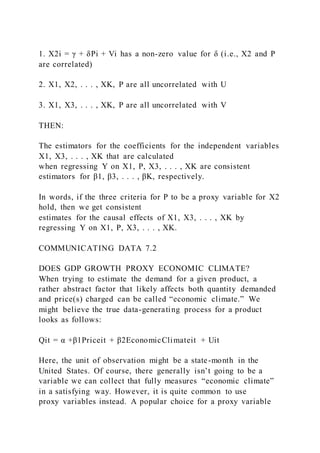
the determining function
FIGURE 10.4
Music Sales by Class
Standing
100
90
50
10
0
0 2 4 5
Class Standing (1 = High School Freshman...4 = High School
Senior, 5 = One Year Past High School...)
S
a
le
s
8
40
80
70
60
30
20
1 3 6 7
???
pri91516_ch10_292-321.indd 300 10/30/17 12:35 PM
CHAPTER 10 Identification and Data Assessment 301
that applies for all relevant Price levels. As a simple example,
we might assume a data-
generating process with a linear functional form for the
determining function:
Salesi = α + βPricei + Ui
This assumption not only imposes the shape of the relationship
between Sales and Price
to be linear, but also dictates how to interpolate and/or
extrapolate. In Figure 10.5, we
recreate the data for this example (from Figures 10.2 and 10.3),
along with the estimated
regression equation if we assume a linear determining function.
Here, we are estimating
α and β using only data with Price in the ranges ($210,$225)
and ($275,$300), but as can be
seen in the figure, we are applying these estimated values across
many other Price levels.
We are using these values to interpolate between $225 and $275
and to extrapolate all the
way to $350.
As can be seen in Figure 10.5, we can use the assumed form for
the determining func-
tion to characterize the relationship between Sales and Price for
price ranges we never
observe. Hence, by assuming the form of the relationship
between Sales and Price for
all prices (at least between $200 and $350 in the graph), we
eliminate the identification
problem for the prices we cannot observe. The data for prices in
the ranges ($210,$225)
and ($275,$300) can identify α and β, and through our
functional form assumption, these
values also apply for the price ranges of ($225,$275) and
($300,$350).
Unlike our first remedy (changing the population), particular
care should be taken when
using a functional form assumption as the sole basis for
interpolation and/or extrapolation.
While changing the population uses new or different data to fill
in voids, and thus lets
what we observe guide how we infer relationships between
variables, a functional form
assumption is just that—an assumption. We cannot use data to
assess the applicability of
this assumption for ranges where we have no data, and so we
are left with theoretical argu-
ments as to whether it is applicable for the voids we wish to fill.
For our rocking chair example, if we wish to interpolate the
relationship between Sales
and Price for prices between $225 and $275 by filling this gap
with our assumed line, we
must be prepared with theoretical arguments as to why this is
reasonable. We might refer-
ence other demand studies indicating a linear relationship over a
wide range of prices for
FIGURE 10.5
Regression Line for
Rocking Chair Sales
and Price Data
35
30
20
10
0
190 230 270 290
Price
S
a
le
s
350
25
15
5
210 250 310 330
pri91516_ch10_292-321.indd 301 10/30/17 12:35 PM
CHAPTER 10 Identification and Data Assessment302
a similar product and argue (in theory) that this relationship
should roughly extend to the
product we are analyzing. Similarly, if we wish to extrapolate
the relationship between
Sales and Price for prices above $300 using our line, we aga in
must be able to make a theo-
retical argument. For extrapolation, we must also consider the
extent to which we believe
this functional form assumption applies. In our example, we are
applying it up to prices of
$350, but do we want to apply it to even higher prices (e.g.,
$400)? In general, the further
the extent to which we wish to apply our functional form
assumption, the stronger the
theoretical support must be. This is because the range of values
for which we are applying
this assumption generally becomes more dissimilar to the values
for which we actually
have observations as we try to extrapolate further.
10.1
Demonstration Problem
You have collected data on an outcome (Y  ) and a treatment (X 
), where X takes on only values
between 10 and 30 and between 60 and 70 in the population.
Figure 10.6 plots the 200 observations
that you have for Y and X.
FIGURE 10.6 Scatterplot of Data on Y and X
1200
800
400
0
0 40 80
X
Y
100
1000
600
200
20 60
a. Is the relationship between Y and X identified for all values
of X?
b. If you are unwilling to make a (potentially arbitrary)
functional form assumption, how might you
interpolate between 30 and 60 or extrapolate beyond 70?
c. Suppose you are willing to make a functional form
assumption so the assumed data-generat-
ing process is:
Yi = α + β1   Xi + β2   Xi
2 + Ui
Using regression analysis, you get the following estimated
determining function:
Y = 433.07 + 24.94X − 0.36X 2
pri91516_ch10_292-321.indd 302 10/30/17 12:36 PM
CHAPTER 10 Identification and Data Assessment 303
VARIABLE CO-MOVEMENT
The second circumstance in which identification problems
typically arise is when there
is variable co-movement in the population. We use the broader
term “co-movement”
rather than just correlation, since simple correlations alone do
not encompass all the ways
variables may move together in a population that result in
identification problems. In this
section, we discuss three types of variable co-movement:
perfect multicollinearity, imper-
fect multicollinearity, and endogeneity. We begin by defining
(or revisiting in the case of
endogeneity) these terms. We then discuss if and how these
types of variable co-movement
lead to identification problems, and we follow this with
discussion of possible remedies.
Consider the following data-generating process:
Yi = α + β1  X1i + β2  X2i + . . . + βK  XKi + Ui
Now, suppose we want to use regression analysis to estimate α,
β1, β2, . . . , βK. Here, we
have assumed a functional form, so as long as there is some
variation in X1, X2, . . . , XK,
there will not be identification problems stemming from voids
in the data per se. However,
we may still face an identification problem when there is co-
movement among the Xs and/
or co-movement between one or more X and U.
(i) Draw this estimated determining function on Figure 10.6 to
show how it fills in voids in the data.
(ii) For X = 40, according to your estimated determining
function, what is the effect of an
increase of X by 1 on Y?
Answer:
a. No. For X values less than 10, between 30 and 60, and over
70, the relationship between Y
and X is not identified.
b. Without a functional form assumption, you must find
alternative data that contain values of X in
these ranges.
c. (i) 1200
800
400
0
0 40 80
X
Y
100
1000
600
200
20 60
(ii) The effect is 24.94 − 0.72 × 40 = −3.86. Note that this
effect is in the interpolated range,
and so we only have this number because of our functional form
assumption (which we
used to get it).
pri91516_ch10_292-321.indd 303 10/30/17 12:36 PM
CHAPTER 10 Identification and Data Assessment304
A particularly problematic type of co-movement among the
independent variables (Xs)
is called perfect multicollinearity. Perfect multicollinearity is a
condition in which two or
more independent variables have an exact linear relationship.
For example, if we can write
X1i = c + dX2i, there is perfect multicollinearity in our model.
More generally, perfect multi-
collinearity in our model is equivalent to being able to express
d1X1i + d2X2i + . . . + dKXKi = c
for all i in the population. Viewed a different way, perfect
multicollinearity implies a
special type of correlation among two or more independent
variables. Perfect multicol-
linearity among a set of Xs—say, X1, . . . , XJ —implies that
the semi-partial correlation
between at least one pair of Xs within this group, controlling
for the other Xs in the group,
is equal to 1. So, if J = 3, perfect multicollinearity implies we
have spCorr(X1,X2(X3)) = 1,
spCorr(X2,X3(X1)) = 1, or spCorr(X1,X3(X2)) = 1.
A second type of co-movement among the independent variables
(Xs) is called imper-
fect multicollinearity. Imperfect multicollinearity is a condition
in which two or more
perfect
multicollinearity A
condition in which two
or more independent
variables have an exact
linear relationship.
imperfect
multicollinearity A
condition in which two
or more independent
variables have nearly an
exact linear relationship.
COMMUNICATING DATA 10.1
PROJECTING TRENDS
While time series data are not the focal point of this book, some
of the key insights and pitfalls pertaining to extrapolation
often apply to time series data. It is often tempting to make
projections based on current and past trends for an outcome
of interest, but the simple fact is that predictions for any
variable into the future require extrapolation and thus suffer
from
identification problems. For example, a firm may plot its profits
over the past 10 quarters and arrive at Figure 10.7.
30000
20000
10000
0
0 4 14
Quarter
P
ro
fi
ts
16
25000
15000
5000
2 6 8 10 12
FIGURE 10.7 Scatterplot and Regression Line for Firm Profits
by Quarter
Figure 10.7 clearly shows a positive relationship between
Profits and Time. However, even if we somehow believed Time
per se improved Profits, any prediction we make about Profits
beyond the present would completely rely on a functional
form assumption. Each dashed line represents a possible future
relationship between Profits and Time, and we have no
choice but to wait for future data to sort between them with
something other than theoretical arguments.
pri91516_ch10_292-321.indd 304 10/30/17 12:36 PM
CHAPTER 10 Identification and Data Assessment 305
independent variables have nearly an exact linear relationship.
When this condition exists
for a data-generating process, we cannot express d1X1i + d2X2i
+ . . . + dKXKi = c for all i in the
population. However, imperfect multicollinearity is equivalent
to there being at least one
semi-partial correlation that is “high”—nearly equal to 1. While
there is no official cutoff for
correlation being “high,” it is common to characterize a
correlation above 0.8 as “high.” Thus,
for the previous data-generating process, if we have, say,
spCorr(X1, X2(X3 . . . XK)) = 0.92,
we would say there is imperfect multicollinearity. As we will
elaborate in the next section,
in practice we seldom directly calculate semi-partial
correlations to detect imperfect mul-
ticollinearity. Rather, we can make alternative calculations that
are indicative of imperfect
multicollinearity and are more intuitively linked to the problems
imperfect multicollinear-
ity can cause.
The third type of variable co-movement we consider in the
context of identification
problems involves co-movement between an independent
variable(s) and the error term
(unobservables) in a data-generating process. We consider the
already-familiar concept of
endogeneity, defined in Chapter 7 as correlation between at
least one X and U.
Identification Problems Now that we have defined (or
redefined) perfect multicol-
linearity, imperfect multicollinearity, and endogeneity, we
detail if and how each type
of variable co-movement can lead to an identification problem.
We begin with perfect
multicollinearity. Put simply, perfect multicollinearity always
leads to an identification
problem in regression analysis. To see how, consider a slightly
revised version of our
rocking chair example. Suppose the shipping costs are
completely determined by the
distance from the designer’s production facility and the
customer’s zip code, and in a
linear way. Specifically, suppose shipping costs (in dollars) are:
Shipi = 0.04 × Distancei.
Consequently, if the base price for a rocking chair is $200, the
final price will be Pricei =
200 + 0.04 × Distancei. Now, suppose we believe Sales of the
rocking chairs depend not
only on Price but also on Distance from the designer’s location.
We allow for dependence
on distance since preferences for rocking chairs in general, or
rocking chairs from our
designer, may differ across customer locations, depending on
how far they are from the
designer’s location.
Given the above insights, we assume the following data-
generating process for rocking
chair sales:
Salesi = α + β1Pricei + β2Distancei + Ui
We’d like to use our data to estimate α, β1, and β2.
Unfortunately, the population from
which we are drawing suffers from perfect multicollinearity,
creating an identification
problem, particularly for β1, and β2. The presence of perfect
multicollinearity is clear, since
we can write one independent variable as a linear function of
another for every element in
the population: Pricei = 200 + 0.04 × Distancei. The
identification problem comes from
the fact that we cannot separately estimate β1 and β2—the
marginal effect of Price and
Distance on Sales, respectively—because of the perfect linear
relationship between Price
and Distance. To see this, let’s revisit the data-generating
process, but plug in our expres-
sion for Price in terms of Distance. By doing so, we get:
Salesi = α + β1(200+0.04 × Distancei) + β2Distancei + Ui
Salesi = (α + β1200) + (0.04β1 + β2)Distancei + Ui
LO 10.4
Differentiate between
endogeneity and types
of multicollinearity as
identification problems
due to variable
co-movement.
pri91516_ch10_292-321.indd 305 10/30/17 12:36 PM
CHAPTER 10 Identification and Data Assessment306
This simple substitution highlights the identification problem.
Since Price is a linear
function of Distance, the data-generating process that appeared
to depend on two variables
really depends on only one, Distance. Through regression, we
can see how Sales move
with Distance, but this will inform us only about 0.04β1 + β2, a
combination of the mar-
ginal effects of Price and Distance, and will not allow us to
estimate β1 and β2 separately.
Viewed another way, if we regress Sales on Distance, we solve
two sample moment equa-
tions (residuals have mean of zero, and residuals are
uncorrelated with Distance); however,
there are three parameters we’d like to estimate in the original
determining function. This
leaves us with two equations and three unknowns, which
generally has an infinite number
of solutions. Ultimately, our inability to separate β1 and β2
constitutes an identification
problem, as no increase in this type of data will allow us to
estimate these parameters
separately.
In our modified rocking chair example, it was relatively easy to
detect the presence of
perfect multicollinearity since we knew the method for
calculating Price linearly depended
on Distance due to shipping costs. More generally, there are
essentially three ways to detect
perfect multicollinearity for a given data-generating process and
population. The first, and
most straightforward, is via a known linear relationship among
two or more independent
variables. This was the situation for our modified rocking chair
example—we knew the
base price was constant and shipping costs were a linear
function of Distance, so Price
linearly depended on Distance.
The second way of detecting perfect multicollinearity is by
recognizing misuse of
dummy variables. As noted in Chapter 7, failure to choose a
base group when using
dummy variables to represent a categorical, ordinal, or interval
variable generates perfect
multicollinearity. In our rocking chair example, suppose we
want to control for regional
preferences. To do so, we create a categorical variable, Regioni,
that takes on exactly one
of the values North, South, East, or West, depending on the
location of observation i. To
control for the categorical variable Region, we create dummy
variables for each of its
possible values, call them Northi, Southi, Easti, and Westi,
where, for example, Northi =
1 if Regioni = North, and 0 otherwise. Now, suppose we tried to
include all the dummy
variables in our determining function, resulting in the following
assumed data-generating
process:
Salesi = α + β1Pricei + β2Northi + β3Southi + β4Easti +
β5Westi + Ui
Here we have perfect multicollinearity among the variables
Northi, Southi, Easti, and Westi.
This is because we can write each dummy variable as a linear
function of the others, e.g.,
Northi = 1 − Southi − Easti − Westi (when each of Southi,
Easti, and Westi is 0, Northi = 1,
and when any of Southi, Easti, and Westi is 1, Northi = 0).
Consequently, including all four
dummy variables leads to an identification problem, as it is
impossible, no matter how
much data we collect, to separately estimate β2, β3, β4, and β5.
For this reason, we must
choose one of the dummy variables to represent the base group
and exclude it from the
determining function. Dropping one of the dummies breaks the
perfect multicollinearity
and allows for identification of all the remaining parameters.
The third way of detecting perfect multicollinearity is simply to
let the data reveal it. If
perfect multicollinearity exists and we attempt to execute
multiple regression, the computer
will be unable to produce estimates for all parameters no matter
what statistical package we
are using. In Excel, for example, perfect multicollinearity is
readily apparent in regression
pri91516_ch10_292-321.indd 306 10/30/17 12:36 PM
CHAPTER 10 Identification and Data Assessment 307
output. Suppose for our modified rocking chair example, where
Price linearly depends on
Distance, we ignore the fact that there is perfect
multicollinearity. Thus, assuming Salesi =
α + β1Pricei + β2Distancei + Ui, we regress Sales on Price and
Distance. Table 10.3 con-
tains a representative version of the output we would see from
such a regression in Excel.
The clear “red flag” that there is perfect multicollinearity in our
model is the exact zero
coefficient estimate for one of our parameters (Price in this
case). Excel is unable to provide
an estimate for all the parameters due to perfect
multicollinearity, so it simply sets one of
them to zero, effectively dropping its corresponding variable
(Price in this case) from the
determining function. In contrast, other statistical packages will
drop one of the perfectly
multicollinear variables before presenting results, but will
effectively produce the same
final outcome. We discuss dropping of multicollinear variables
further in the next section.
Another potentially problematic type of co-movement among
the independent variables
(Xs) is imperfect multicollinearity. However, there is an
important distinction between
perfect multicollinearity and imperfect multicollinearity when it
comes to identification.
While perfect multicollinearity creates an identification
problem, imperfect multicol-
linearity does not. As long as there is not an exact linear
relationship among independent
variables (and thus all semi-partial correlations are less than 1),
it is possible to separately
estimate the effects of each independent variable with enough
data.
Although imperfect multicollinearity does not cause an
identification problem, it can
create challenges with inference. That is, imperfect
multicollinearity can generate inflated
p-values and confidence intervals, making it difficult to make
any strong inductive argu-
ments about population parameters. Because there is not an
identification problem, these
challenges go away with enough data; however, it is not a given
in practice that we can
collect enough data to overcome them just by increased volume.
To illustrate imperfect multicollinearity and the challenges it
presents, in our modified
rocking chair example, suppose that rather than Price having a
perfect linear relationship
with Distance, Price has a near-perfect linear relationship with
Distance. Suppose we have
Pricei = 200 + 0.04 × Distancei + Vi
where Vi contains other factors affecting shipping costs, such as
local fuel prices, etc.
Lastly, suppose the variance of Vi is relatively small (say, 2).
This means that the Price for a
given customer is mostly determined by Distance, and the value
for V (which mainly ranges
between −4 and 4) has a relatively small impact on Price. A
customer at a Distance of 2,000
miles might have a value for V of 3 and so face a Price of 200 +
0.04 × 2,000 + 3 = $283.
Another customer at a Distance of 400 miles might have a value
for V of −2 and so face a
Price of 200 + 0.04 × 400 − 2 = $214. Here, the difference in
their Prices is $69, and the
vast majority of that difference ($64) is due to their difference
in Distance. In this example,
Price and Distance have imperfect multicollinearity.
COE FFICIE NTS STANDARD E RROR t STAT P -VALUE
LOWE R 95% UPPE R 95%
Intercept 119.4606254 2.046683426 58.36790581 1.5741E-58
115.3742901 123.5469607
Price 0 0 65535 #NUM! 0 0
Distance −0.024964948 0.001224936 −20.38061682 #NUM!
−0.027410611 −0.022519285
TABLE 10.3 Regression Results with Perfect Multicollinearity
between Price and Distance
pri91516_ch10_292-321.indd 307 10/30/17 12:36 PM
CHAPTER 10 Identification and Data Assessment308
Suppose we again want to determine the effect of Price and
Distance on Sales, and so
we assume the following data-generating process:
Salesi = α + β1Pricei + β2Distancei + Ui
There is not perfect multicollinearity, so unlike in Table 10.3,
we will be able to get esti-
mates for all our parameters when regressing Sales on Price and
Distance. In Table 10.4, we
present the results of a regression of Sales on Price and
Distance for a hypothetical sample
of 200 observations, where Price and Distance suffer from
imperfect multicollinearity.
The first thing to notice in Table 10.4 is that both Price and
Distance have high p-values
and confidence intervals that include 0. Hence, we would fail to
reject that β1 = 0, meaning
we would fail to reject that Price has no effect on Sales.
Similarly, we would fail to reject
that β2 = 0, meaning we would fail to reject that Distance has
no effect on Sales. Of course,
it could simply be the case that, despite what theory might tell
us at least with regard to
Price, we get these results because neither Price nor Distance
affects Sales. However, it is
also possible that the high p-values and wide confidence
intervals for Price and Distance
are due to their imperfect multicollinearity. When independent
variables are imperfectly
multicollinear, their close co-movement makes it difficult to
distinguish the effect of one
independent variable from another. In our example, the close
co-movement between Price
and Distance makes it difficult to determine whether movements
in Sales are due to move-
ments in one or the other. This difficulty manifests in greater
uncertainty in our estimates;
thus, our estimators have higher standard errors, leading to
higher p-values and wider
confidence intervals.
Fortunately, there are simple ways to check whether there is
imperfect multicollinear-
ity in a model, and thus the possibility that this condition is
inflating our p-values and
confidence intervals. As noted in the definition of imperfect
multicollinearity, we could
calculate semi-partial correlations among the independent
variables and check whether
they are close to 1. However, in practice, an alternative
approach, known as the variance
inflation factor (VIF), is more commonly used. The VIF for an
independent variable—say,
X1— is equal to
1
_____
1 − R X 1
2
, where R X 1
2 is the R-squared from regressing that independent vari-
able (X1) on all other independent variables (X2, . . . , XK) for
a given determining function.
Recall from Chapter 6 that R-squared is the fraction of the total
variation of X1 that can be
attributed to variation in the other Xs (X2, . . . , XK).
We note here that, for any X, R X
2 by itself is an appropriate measure of imperfect multi -
collinearity—as R X
2 increases, there is a stronger linear relationship among the
independent
variables. In the extreme, as R X
2 approaches 1, the relationship between the independent
variables approaches a perfectly linear one and thus moves from
imperfect multicollinear-
ity to perfect multicollinearity. VIF is a simple function of R
X
2 , which also increases as the
linear relationship among the independent variables strengthens.
variance inflation
factor (VIF) For an
independent variable—
say, X1— is equal
to 1 _____
1 − R X 1  
2
, where R X 1  
2
is the
R-squared from regress-
ing that independent
variable (X1) on all other
independent variables
(X2, . . . , XK) for a given
determining function.
TABLE 10.4 Regression Results with Imperfect
Multicollinearity between Price and Distance
COE FFICIE NTS STANDARD E RROR t STAT P -VALUE
LOWE R 95% UPPE R 95% VIF
Intercept 442.3147 285.6049 1.548694 0.126311 −128.0776
1012.707 N/A
Price −1.611633 1.428392 −1.128285 0.263347 −4.464329
1.241062 1361.41
Distance 0.03873 0.057373 0.675131 0.501987 −0.075848
0.153317 1361.41
pri91516_ch10_292-321.indd 308 10/30/17 12:36 PM
CHAPTER 10 Identification and Data Assessment 309
However, in practice we use VIF as a measure for imperfect
multicollinearity instead of
R X
2 because, while we have not explicitly presented the
formulas for the standard errors of
the regression estimators, it can be shown that each is a
multiple of its VIF. Consequently,
a doubling of an independent variable’s VIF amounts to a
doubling of the standard error
of its coefficient estimator. A higher VIF for a given variable
implies more noise (less
certainty) in its coefficient estimator. Consequently, the VIF not
only provides us informa-
tion about the strength of the linear relationship among the
independent variables, but also
tells us how much uncertainty this co-movement in the Xs is
injecting into our estimators.
The last column of Table 10.4 contains the VIF for both Price
and Distance in our
hypothetical dataset. Notice that the VIF for Price (and Distance
since there are only two
Xs) is 1361.41. Simple algebra tells us that R Price
2 = 0.999265. Hence, there is a strong lin-
ear relationship between the independent variables in our
regression, leading to imperfect
multicollinearity. While there is no definitive cutoff for
designating a VIF to be “high,” and
thus indicative of imperfect multicollinearity, a popular choice
of cutoff is 10. Thus, if a
variable’s VIF is greater than 10, it suggests there is imperfect
multicollinearity, which may
lead to substantial uncertainty when estimating its coefficient.
For the example in Table
10.4, we have a rather extreme case of imperfect
multicollinearity given our very high VIF.
The third potentially problematic type of variable co-movement
is the familiar condi-
tion of endogeneity. To this point, we’ve viewed endogeneity as
problematic because it can
lead to estimators that are not consistent. Here, we simply view
this issue through a differ-
ent lens. In fact, a model generating inconsistent estimators
generally has an identification
problem. Suppose we assume the data-generating process
Yi = α + β1  X1i + . . . + βK  XKi + Ui
and there is non-zero correlation between X1 and U. We know
that this correlation means ̂ β 1
from a regression of Y on X1, . . . , XK need not be consistent,
meaning its realized value
need not get very close to β1 as the sample size gets large. The
inconsistency of ̂ β 1 due to
endogeneity amounts to endogeneity as an identification
problem. The fact that ̂ β 1 might
“close in” on something other than β1 as the sample gets large
due to endogeneity means
that increasing the sample does not necessarily give us a more
precise estimate of β1. We
illustrate this point in Figure 10.8 where we have ̂ β 1
approach a number C ≠ β1 as the sam-
endogeneity as
an identification
problem Inconsistency
of an estimator due to
endogeneity
FIGURE 10.8
Example of
Inconsistent
Estimator
50
30
10
0
C β1
f(
.)
35
40
45
15
20
25
5
N = 2000
N = 1000
N = 200
pri91516_ch10_292-321.indd 309 10/30/17 12:36 PM
CHAPTER 10 Identification and Data Assessment310
ple gets large. As can be seen in the figure, the confidence
interval generated by ̂ β 1 gets
smaller as N gets larger, but it is providing a more precise
estimate of the wrong number.
To summarize, note that both perfect multicollinearity and
endogeneity create an iden-
tification problem, while imperfect multicollinearity does not.
Imperfect multicollinearity
creates challenges similar to an identification problem, since it
makes it challenging to get
precise parameter estimates. The difference is that imperfect
multicollinearity makes get-
ting precise estimates hard, while perfect multicollinearity and
endogeneity make it impos-
sible. Perfect multicollinearity and endogeneity also have an
important distinction, since
the former requires an exact linear relationship, while the latter
requires only correlation.
We summarize the discussion of this section in Reasoning Box
10.2.
Remedies From Reasoning Box 10.2, we know that perfect
multicollinearity and endo-
geneity both create identification problems. In this section, we
consider ways to overcome
identification problems from each of these two sources.
We begin with perfect multicollinearity. Suppose we have
assumed the following data-
generating process:
Yi = α + β1   X1i + β2  X2i + β3  X3i + . . . + βK  XKi + Ui
Suppose further that X1 is the treatment, while X2, . . . , XK all
play the role of controls.
If our determining function suffers from perfect
multicollinearity, the remedy depends
on whether the exact linear relationship among the Xs involves
the treatment (X1) or not.
Consider first the case where the linear relationship involves
only the controls (a subset
of X2, . . . , XK). As a simple example, suppose we have X2i =
5X3i for all i. In this case,
we are unable to distinguish the effect on the outcome (Y) of
X2 from X3. The solution to
this problem is quite straightforward: simply drop X2 or X3
from the model. In general, the
remedy for perfect multicollinearity involving only controls is
to drop one of the variables
comprising the exact linear relationship. To see why this is
effective, let’s substitute for X2
in our assumed data-generating process to get:
Yi = α + β1   X1i + β2(5 X3i) + β3  X3i + . . . + βKXKi + Ui
LO 10.5 Articulate
remedies for identification
problems and inference
challenges due to
variable co-movement.
THE EFFECTS OF VARIABLE
CO-MOVEMENT ON IDENTIFICATION
REASONING BOX 10.2
For the data-generating process Yi = α + β1      X1  i + . . . +
βK   XK  i + U i  : If there exists an exact
linear relationship between at least two of the independent
variables (Xs), defined as perfect
multicollinearity, then there is an identification problem.
In contrast, if there is no exact linear relationship among the
Xs, it is always possible to distinguish
the effects of the independent variables on the outcome (Y  )
with any level of precision with
sufficient data, even if some Xs exhibit imperfect
multicollinearity.
If there is correlation between any independent variable and the
error term, defined as endogeneity,
then there is an identification problem, no matter whether the
correlation is via an exact linear
relationship or not.
pri91516_ch10_292-321.indd 310 10/30/17 12:36 PM
CHAPTER 10 Identification and Data Assessment 311
Combining terms, we have:
Yi = α + β1  X1i + (5β2 + β3)X3i + . . . + βK  XKi + Ui
We see that, if we regress Y on X1, X3, . . . , XK the coefficient
estimate for X3 will serve
as an estimator for 5β2 + β3. Thus, we can only estimate a
(linear) combination of the
effects of X2 and X3 on Y. However, the coefficient estimate
for X1 in this regression
(where X2 is dropped) still serves as an estimator for β1.
Consequently, we can still get
a consistent estimate for the effect of the treatment (β1) after
dropping one of the vari-
ables contributing to perfect multicollinearity. In sum, as long
as our goal is to estimate
the treatment effect and we have no particular interest in
distinguishing the effects of
controls, dropping one of the control variables contributing to
perfect multicollinearity
is an effective remedy.
Consider now our second case of perfect multicollinearity, in
which the linear relation-
ship involves the treatment (X1 in our assumed data-generating
process above). As another
simple example, suppose we have X1i = 4X2i. The solution is
not as simple as dropping
one of the variables comprising the exact linear relationship.
Assuming we are interested
in the effect of the treatment, we cannot drop X1. We also
cannot drop X2 or else we create
an endogeneity problem—dropping X2 would move it to the
error term, and X2 is clearly
correlated with X1. The only viable remedy when the treatment
contributes to a perfect
multicollinearity problem is to change the population from
which you are sampling. You
must find a way to alter the population so that the treatment
varies in ways that are not an
10.2
Demonstration Problem
Congratulations! You have just finished publishing your latest
novel. To sell it, your publisher has
entered an exclusive relationship with an online vendor. To
learn a bit more about demand, the ven-
dor has decided to choose a set of select locations to promote
your book with a front-page ad and
also will offer the book at a $10 discount in those locations.
Hence, in some locations the book is
offered at a price of $39.99 with no promotion; in other
locations, the book is offered at a price of
$29.99 with a promotional ad. The vendor then collects data on
the first-week sales across all loca-
tions. Assuming the data-generating process of
Salesi = α + β1Pricei + β2Promotioni + Ui,
the vendor would like to estimate the effects of Price and
Promotion on Sales. Note that Price takes
on the values $29.99 and $39.99 in the data, and Promotion
equals 1 if there was an ad and 0
otherwise.
a. Using the data described above, what will happen if you
regress Sales on Price and Promotion?
b. If you drop Price from the regression, what will your
coefficient estimate for Promotion actually
be estimating?
c. What can you do to separately identify the effects of Price
and Promotion?
continued
pri91516_ch10_292-321.indd 311 10/30/17 12:36 PM
CHAPTER 10 Identification and Data Assessment312
exact linear function of other variables affecting the outcome.
In our example, we need a
population such that there are instances where X1i ≠ 4X2i.
As we noted in the previous section, imperfect multicollinearity
does not create an iden-
tification problem. Hence, if data are suffering from noisy
estimates and VIF calculations
suggest imperfect multicollinearity, the simple solution is to
gather more data. However,
depending on whether the imperfect multicollinearity involves
just the controls (a sub-
set of X2, . . . , XK in our example) or the controls and the
treatment (X1 and a subset of
X2, . . . , XK), gathering more data to address it may or may not
be worthwhile. If the imper-
fect multicollinearity involves only the controls, and there is no
interest in estimating the
effects of the controls per se, then collecting more data will not
necessarily be worthwhile.
In this case, the estimated effect of the treatment is not being
made noisier due to imperfect
multicollinearity (since it is not part of the near-linear
relationship), and so it is reasonable
to stick with the data in hand, recognizing that imperfect
multicollinearity is causing noisy
estimates for the controls only. In contrast, if the imperfect
multicollinearity involves the
treatment, collecting more data likely will be worthwhile. More
data will allow us more
opportunities to observe the treatment move in ways different
from the controls, and thus
allow us to get a more precise estimate of the treatment’s effect
despite its imperfect mul-
ticollinearity with some (or all) of the controls.
We now turn to remedies for the other type of variable co-
movement causing identifi-
cation problems—endogeneity. The only viable remedy for
endogeneity is to change the
population from which you are sampling. And unlike the case of
perfect multicollinearity,
it does not matter whether the endogeneity involves the
treatment or not. This is because
correlation between any of the Xs (treatment or control) and the
error (U) compromises
Answer:
a. For such a regression, you will be unable to get estimates for
both β1 and β2, since there is
an exact linear relationship between these two variables.
Specifically, we can write Pricei =
39.99 − 10 × Promotioni for all i, meaning our data suffer from
perfect multicollinearity.
Consequently, your statistical software will either drop one of
these two variables or produce a
result as in Table 10.3.
b. Using the exact linear relationship between Price and
Promotion, we can substitute for Price
to get:
Salesi = α + β1(39.99 − 10Promotioni) + β2Promotioni + Ui
= (α + 39.99β1) + (−10β1 + β2)Promotioni + Ui
Consequently, regressing Sales on Promotion gives us an
estimate of −10β1 + β2. In words,
the coefficient estimate for Promotion would be an estimate of
negative 10 times the effect
of Price (the effect of a $10 decline in Price) plus the effect of
the Promotion.
c. Dropping one of the variables will not allow us to separately
identify the effect of Price and
Promotion. Instead, we must try to acquire alternative data. For
example, the vendor may
try choosing some locations where it promotes the book without
a price cut or vice versa.
Alternatively, the vendor could vary the amount of the price cut
for the locations that get a
price cut and promotion.
pri91516_ch10_292-321.indd 312 10/30/17 12:36 PM
CHAPTER 10 Identification and Data Assessment 313
the consistency of all the estimators ( ̂ α , ̂ β 1 , . . . , ̂
β K ). Consequently, we cannot count on the
collection of more of the same data to help us “close in” on the
corresponding parameters,
no matter which Xs are correlated with U.
The types of additional or alternative data we might collect are
already familiar,
as we’ve already discussed several ways of addressing
endogeneity in prior chap-
ters. Options include: collecting controls, finding a proxy
variable(s), finding an
instrument(s), and/or transforming cross-sectional data to
become a panel. As can be
seen from the discussion in this chapter, endogeneity essentially
creates an identification
problem, and all of these remedies for endogeneity serve to
remedy this corresponding
identification problem.
COMMUNICATING DATA 10.2
DISENTANGLING PROMOTION FROM FINANCING
A national chain of car dealerships is attempting to determine
the effect on Profits of both television Promotion and the
offer of 0 percent Financing for its vehicles. It collects cross -
sectional data, covering one month, across all its dealerships on
Profits, whether there was television Promotion of its vehicles
and whether 0 percent Financing was available. You assume
the data-generating process is
Profitsi = α + β1Promotioni + β2Financingi + Ui
and the results of a regression of Profits on Promotion and
Financing are shown in Table 10.5:
TABLE 10.5 Regression Results for Profits Regressed on
Promotion and Financing
CO E FFI CI E NTS S TA N DA RD E RRO R t S TAT P -VA
LU E LOW E R 95% U PPE R 95%
Intercept 116188.8344 1866.47432 62.25043288 3.38787E-81
112485.3444 119892.3244
Promotion 14802.88434 9964.246184 1.485600021 0.140562467
−4968.341848 34574.11053
Financing 1569.335538 10003.01772 0.15688621 0.875654035
−18278.82178 21417.49286
At first glance, it appears neither strategic variable (Promotion
nor Financing) has a (statistically significant) impact on
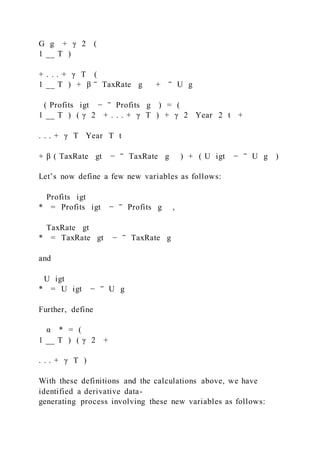
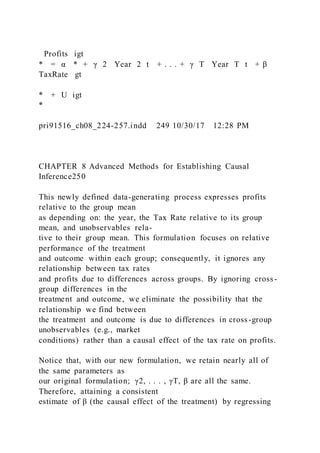
Profits. However, before arriving at this conclusion, you might
ask whether these two variables are highly correlated—
whether there is an imperfect multicollinearity issue with the
data. Upon further examination, you find that the VIF for
Promotion and Financing (which are the same, since there are
only two independent variables) is 13.13. This is quite high
(higher than 10), suggesting imperfect multicollinearity. It
appears, then, that the car dealerships are very often engaging
in
Promotion at the same time they offer 0 percent Financing. This
strong co-movement makes it difficult to disentangle each
variable’s individual effect on Profits.
One solution is to simply collect more data, which would allow
for more instances in which Promotions and Financing
offers don’t occur at the same time. Another solution is to try to
collect different data; the chain may try to randomly vary
Promotions and Financing offers in a subsequent month across
dealerships. This temporary policy change would greatly
reduce the co-movement between Promotions and Financing and
provide a good opportunity to disentangle their effects
with relatively less data.
pri91516_ch10_292-321.indd 313 10/30/17 12:36 PM
CHAPTER 10 Identification and Data Assessment314
Identification Damage Control:
Signing The Bias
In some instances, we may recognize there is an identification
problem that requires a
change in the sampled population but be unable to acquire the
necessary alternative data
to address the problem. This leaves us in the difficult position
of being forced to make
use of what we know to be an inconsistent, or even inestimable,
estimate of our treat-
ment’s effect on the outcome. Unfortunately, if there is perfect
multicollinearity involv-
ing the treatment and alternative data are not accessible,
nothing can be done—there is
simply no way to gain meaningful insight as to how the
treatment, by itself, affects the
outcome. However, if there is endogeneity and alternative data
are not accessible, it is
still possible to learn something about the treatment’s effect on
the outcome under some
circumstances.
Recall from Chapter 7 that endogeneity is due to one of the
following (potentially
overlapping) causes: omitted variable(s), measurement error,
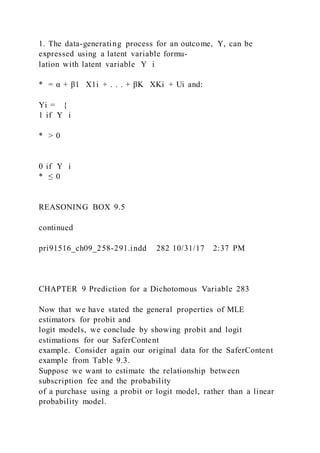
and/or simultaneity. Recall
also that the focus of our discussion of endogeneity has been on
the omitted variable form
of endogeneity (though much still applies to measurement error
and/or simultaneity).
Continuing our focus on omitted variables, in this section we
explain how, in some cases,
it is possible to assess the direction of the inconsistency of our
estimators in the presence
of omitted variables.
To ground our discussion, consider a classic model of demand,
where we assume unit
sales depend on price in our data-generating process:
Salesi = α + βPricei + Ui
Here, β represents the causal effect of a change in Price on the
number of units sold
(Sales). As we’ve highlighted in previous examples of demand
estimation, we should be
wary of simply regressing Sales on Price to get an estimate for
β—the estimator for β ( ̂ β ) is
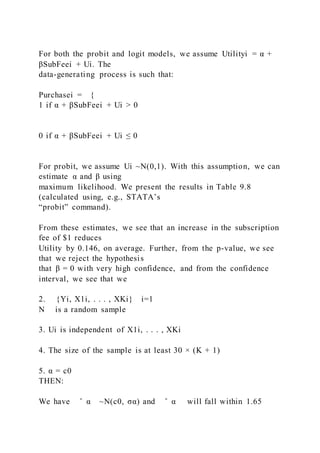
very likely to be inconsistent. The primary reason for concern
with this simple regression
is the high likelihood that there is at least one omitted variable
that serves as a confounding
factor (a variable in the error term that is correlated with Price).
If we are able to get only Sales and Price data, then w e are
stuck with an inconsistent
estimator, which leaves us unable to draw meaningful
conclusions about the effect of
Price on Sales based solely on our regression estimates.
However, suppose we know the
source of the endogeneity is an omitted variable that serves as a
confounding factor, and
we have some knowledge about that omitted variable. In our
simple demand example, let
the product we are selling be rain boots, and we believe the
omitted variable serving as a
confounding factor is local rainfall. We believe local rainfall
both influences the Sales of
our rain boots, and relates to the Price we charge for the boots.
Now that we have a sense of what the confounding factor is in
our model, we can try
to go one step further by characterizing its relationship with
both the outcome and the
treatment. In our example, we can first ask how local rainfall
likely affects Sales for rain
boots. More formally, we can ask what the sign of β2 would be
if we explicitly included
local rainfall in our assumed data-generating process:
Salesi = α + β1Pricei + β2LocalRaini + Vi
LO 10.6 Solve for
the direction of bias
in cases of variable
co-movement.
pri91516_ch10_292-321.indd 314 10/30/17 12:36 PM
CHAPTER 10 Identification and Data Assessment 315
Since we do not have data on local rainfall, we cannot estimate
β2 using data; however,
we can use basic theory to guide our assessment of the sign of
β2. For our example, the
theoretical argument is very straightforward: If there is more
rain locally, there is likely
more need for rain boots, so holding Price constant, more rain
should lead to higher Sales
of rain boots. Based on this reasoning, we would conclude that
sign(β2) > 0.
Next, we can ask how local rainfall relates to allocation of the
treatment, Price. For this
relationship, we are interested in how the treatment was
allocated in our sample, not the
population (we explain this further, momentarily). More
formally, we can ask what is the
sign of ̂ δ for the estimated regression equation: Price i
= ̂ γ + ̂ δ LocalRain i . Again, without
data on local rainfall, we cannot use data to determine the sign
of ̂ δ . However, we again can
make a straightforward theoretical argument: If there is more
rain locally, there is likely more
need for rain boots and thus a higher willingness-to-pay for rain
boots; therefore, a firm can
and will charge a higher Price. Based on this reasoning, we
would conclude that sign( ̂ δ ) > 0.
Before translating the above insights into a conclusion about β1,
it is useful to link our
example back to our original discussions of nonrandom
treatments in Chapter 4. Recall
that inability to estimate an average treatment effect essentially
stems from nonrandom
treatment assignment, and in particular, treatment assignment
that is correlated with other
factors affecting the outcome. Hence, misestimating the
treatment effect largely depends
on another factor(s) affecting the outcome besides the treatment
(for which we do not con-
trol) and this factor being correlated with the treatment
assignment. Linking this reasoning
to our example, β2 represents how our “other factor” (local
rainfall) affects the outcome,
and ̂ δ represents how this factor correlates with the
treatment assignment.
How does knowing the sign of β2 and the sign of ̂ δ help us
to know more about β
(the effect of Price on Sales)? This information tells us whether
our estimate for β, ̂ β ,
from regressing Sales on Price tends to overshoot or undershoot
β. When Price is higher,
there tends to be more local rainfall (sign( ̂ δ ) > 0), and
more local rainfall tends to gener-
ate more Sales of rain boots (sign(β2) > 0); thus, the presence
of more local rainfall with
higher Prices generates more Sales than there otherwise would
be with the Price increase.
Therefore the presence of local rainfall as an omitted variable
causes our regression esti-
mate for the effect of Price ( ̂ β ) to overshoot its true value
(β).
Let’s now generalize the intuition of our example. Suppose we
have assumed the fol-
lowing data-generating process:
Yi = α + β1  X1i + . . . + βK  XKi + Ui
Let X1 be the treatment and X2, . . . , XK be controls. Suppose
also that there is an omitted
variable, XK+1, that affects Y (and so is part of U) and is
correlated with X1. Consequently,
an expanded version of the data-generating process can be
written as:
Yi = α + β1  X1i + . . . + βK  XKi + βK+1XK+ 1i + Vi
Lastly, let X K+1i = ̂ γ + ̂ δ 1 X 1i + . . . + ̂ δ
K X Ki be the estimated regression equation we get
if we were to regress XK+1 on X1, . . . , XK. Within this
framework, define βK+1 × ̂ δ 1 as the
omitted variable bias. The omitted variable bias is the product
of the effect of the omit-
ted variable on the outcome (βK+1) and the (semi-partial)
correlation between the omitted
variable and the treatment ( ̂ δ 1 ). This product represents
the difference between β1 and the
value that ̂ β 1 (from regressing Y on X1, . . . , XK)
consistently estimates. Put another way,
omitted variable bias
The product of the effect
of the omitted variable
on the outcome (βK+1)
and the (semi-partial)
correlation between the
omitted variable and the
treatment ( ̂ δ1 ).
pri91516_ch10_292-321.indd 315 10/30/17 12:36 PM
CHAPTER 10 Identification and Data Assessment316
the omitted variable bias tells us how far “off” our estimate for
the effect of X1 tends to be
from X1’s true effect.
Since we do not observe the omitted variable, we cannot
estimate either of the compo-
nents of omitted variable bias. However, as was the case in our
simple demand example,
we often can use theory to guide us with regard to the sign of
each component. And if we
know the sign of each component, we know the sign of the
omitted variable bias—that is,
we know if ̂ β 1 tends to overshoot or undershoot β1. The
basic relationship is:
sign(  βK+1 × ̂ δ1 ) = sign( βK+1) × sign( ̂ δ1 )
In words, we have that the sign of the omitted variable bias is
the product of the sign of
the effect of the omitted variable on the outcome and the sign of
the (semi-partial) correla-
tion between the omitted variable and the treatment. We
summarize the four possibilities
for the sign of omitted variable bias in Table 10.6, and the basic
reasoning behind signing
omitted variable bias in Reasoning Box 10.3.
TABLE 10.6
Four Possibilities for
the Sign of Omitted
Variable Bias
Sign of effect of omitted variable on the
outcome
+ −
Sign of the (semi-partial) correlation between
the omitted variable and treatment
+ + −
− − +
SIGNING OMITTED VARIABLE BIAS
Suppose we have the following data-generating process:
Yi = α + β1  X1i + . . . + βKXKi + Ui
where X1 represents the treatment whose effect we are trying to
estimate.
IF:
1. There is a single omitted variable contained in U (call it
XK+1) that is correlated with the
treatment (X1).
2. We can theoretically determine the sign of the (semi-partial)
correlation between the omitted
variable and the treatment—that is, we know sign( ̂ δ 1 )
where ̂ δ 1 is the estimated coefficient on X1
when we regress XK+1 on X1, . . . , XK.
3. We can theoretically determine the sign of the effect of the
omitted variable on the outcome—
that is, we know sign(βK+1) where βK+1 is the effect of XK+1
on Y.
THEN:
When regressing Y on X1, . . . , XK, the bias for our estimated
effect of X1 is βK+1 × ̂ δ 1 , and we know
the sign of the bias is sign(βK+1) × sign( ̂ δ 1 ).
REASONING BOX 10.3
pri91516_ch10_292-321.indd 316 10/30/17 12:36 PM
CHAPTER 10 Identification and Data Assessment 317
10.3
Demonstration Problem
Suppose you are consulting a large collective of farmers who
sell corn across a large number of
farmers’ markets. These farmers have collected data on Profits
and Prices for their corn for a given
Saturday across many markets, and they wish to learn the
(average) effect of Price on Profits across
these markets. To conduct your analysis, you assume:
Profitsi = α + βPricei + Ui
and regress Profits on Price. In doing so, you estimate the effect
of a $1 increase in Price on Profits
is −$500. However, you are suspicious of this estimate, as you
fear Price is endogenous. To address
this concern, you ask the farmers how they set Prices, and they
indicate that weather is the key
determinant: When weather is good, they Price higher, and
when weather is bad, they Price lower.
a. Based on this information, assess whether your estimate for β
is likely too high or too low.
b. Clearly explain why your estimate for β is biased in the
direction it is when regressing
Profits on Price.
Answer:
a. In the problem description, it is clear that Weather is the
omitted variable causing an
endogeneity problem, where we might define Weather as a
dichotomous variable, equaling
1 if weather is good and 0 if it is bad. We also know that
Weather and Price are positively
correlated. Lastly, it is reasonable to assume that, for a given
Price, Profits will be higher when
Weather is good and lower when Weather is bad. Combining
this information, we can conclude
we are in the upper left box of Table 10.6, and so have a
positive bias in our Price coefficient.
Hence, the actual coefficient on Price is something small er than
−$500 (i.e., Price’s effect on
Profits is more negative).
b. Conceptually, the reason for the positive bias in our Price
coefficient is as follows. When Price
is higher, we know Weather is likely better (since Price and
Weather are positively correlated).
Further, we know that when Weather is better, Profits are
higher. Putting these two facts
together, an increase in Price generally corresponds with an
increase in another variable that
improves Profits. Since that other variable (Weather) is
unaccounted for (it is in the error term),
our estimate for the effect of Price will include the actual effect
of Price along with this addi-
tional positive effect on Profits from Weather.
COMMUNICATING DATA 10.3
A DISTORTED VIEW OF A DEGREE’S VALUE
Through clever measurement and accounting, suppose analysts
at your firm were able to determine the marginal revenue
product (MRP) of each employee—that is, the amount each
employee adds to firm revenues each year. The analysts also
have information on the institution from which each employee
received his/her college degree. Using these data, they run
a simple regression of MRP on Ivy, where Ivy is a dichotomous
variable equaling 1 if the employee received a degree from
an Ivy League school and 0 otherwise. The results of this
regression show that an Ivy League degree increases MRP by
$23,000 on average.
continued
pri91516_ch10_292-321.indd 317 10/30/17 12:36 PM
However, with a deep understanding of endogeneity problems,
you note that this regression result is almost certainly
an inaccurate estimate of the causal effect of an Ivy League
degree on an employee’s productivity. However, you can do
more than just discredit this result; you can explain the likely
direction in which it is “off.” Specifically, employees with an
Ivy
League education likely have higher (unaccounted-for) raw
intellect, and higher raw intellect likely results in greater MRP.
Consequently, the estimated effect of an Ivy League education
on MRP is likely overstated—it combines the true effect of
an Ivy League education on MRP with the (positive) effect of
raw intellect, which positively correlates with an Ivy League
education.
RISING TO THE dataCHALLENGE
Are Projected Profits over the Hill?
The data you used to get your regression results in Table 10.1
had only prices between
$34.99 and $38.99. Therefore, assessing the effect of raising
price to $49.99 requires
extrapolation from the current range of data. Based on the
regression results, it would
appear that raising price from $36.99 to $49.99 would raise
profits by $19,548.62
(= 1503.74 × 13). However, this prediction is not well grounded
in the data since we
never observed a price above $38.99. Instead, it was our
functional form assumption
(that Profits are a linear function of Prices) that allowed us to
predict how Profits would
change for Prices above $38.99. However, it is possible, and
even likely, that Profits
have a quadratic, or “hill-shaped,” relationship with Prices. For
example, the relationship
between Profits and Price may look like the shape in Figure
10.9.
CHAPTER 10 Identification and Data Assessment318
FIGURE 10.9 Hill-Shaped Relationship between Profits and
Price
64000
60000
50000
30 40
Price
P
ro
fi
ts
55
62000
58000
56000
54000
52000
35 45 50
Suppose the true relationship between Profits and Price does in
fact look as it does
in Figure 10.9. Since we can identify only the segment between
$34.99 and $38.99
pri91516_ch10_292-321.indd 318 10/30/17 12:36 PM
CHAPTER 10 Identification and Data Assessment 319
using our data, we likely would be unable to determine where is
the “top of the hill”—
where profits peak and then subsequently turn lower.
The prior discussion highlights the fact that any projection as to
how profits will
change with an increase in price to $49.99 depends entirely on
our functional form
assumption. Thus, unless we are completely confident in this
assumption, we should
be cautious in making such predictions. As we’ve seen in this
chapter, the other rem-
edy besides the functional form assumption is to get data over a
broader range. In this
case, we would want to conduct our experiment using prices
ranging at least as high
as $49.99.
S U M M A R Y
This chapter introduced the concept of identification and
explained how to assess data through the lens of
its ability to identify a parameter(s) of interest. We explained
that an understanding of identification is crucial
when trying to estimate the effect of a treatment on an
outcome—there is no point in undertaking the analysis
if the effect is not identified. We next highlighted two common
situations in which identification problems
often arise—attempts toward extrapolation/interpolation, and
data with variable co-movement. For each of
these circumstances, we discussed alternatives for remedying
the corresponding identification problem.
Lastly, we addressed the unfortunate case in which an
identification problem exists in the form of endoge-
neity and cannot be remedied. We explained that under some
circumstances, it is possible to ascertain the
direction in which the treatment effect is misestimated.
K E Y T E R M S A N D C O N C E P T S
data gap
endogeneity as an identification problem
extrapolation
identified
imperfect multicollineari ty
interpolation
omitted variable bias
perfect multicollinearity
variance inflation factor (VIF)
C O N C E P T U A L Q U E S T I O N S
1. Suppose you’ve assumed the following data-generating
process:
Yi = α + β1X1i + β2X2i + Ui
Describe what it means for β1 to be identified in this model for
a given population of data. (LO1)
2. Your firm has just developed a new product, and you would
like to learn the average rating, R, this
product would receive from the population of U.S. adults (on a
scale of 1 to 7). To estimate R, you plan
to collect random samples from the population of U.S. adults.
(LO1)
a. Let Xi be a random variable equal to the rating given to the
product by U.S. adult i. Also, define
the sample mean for a sample of size N as: ̄ X N
 
= 1 __ N   ∑ i=1
N
  X i
 
. Show that, for a given confidence level
pri91516_ch10_292-321.indd 319 10/30/17 12:36 PM
CHAPTER 10 Identification and Data Assessment320
(e.g., 95%), the length of the confidence interval for R using a
sample of N observations of Xi is
decreasing with N.
b. Is R identified if we sample from this population?
3. Suppose you have data containing values for Y and X that
was sampled from a population where X < 50.
When regressing Y on X assuming a linear functional form, you
get a slope of 7.2. You are willing to
make the assumptions that will allow for a causal interpretation,
so you conclude that an increase
in X from 30 to 70 would, on average, increase Y by 288 (= 40
× 7.2). (LO3)
a. By making a prediction for a change in X beyond 50, what
are you attempting to do?
b. Why should you be skeptical of predictions for Y for X
values above 50?
c. On what are you relying to make a prediction for Y for an X
value above 50?
d. Suggest an alternative approach toward estimating how Y
would change when X increases
from 30 to 70.
4. What is the difference between extrapolation and
interpolation? (LO2)
5. True or False: “Interpolation does not suffer from an
identification problem since there exist data in the
population both above and below the range over which we are
trying to estimate an effect.” (LO2)
6. Why does imperfect multicollinearity not create an
identification problem, but perfect multicollinearity
does create an identification problem? (LO4)
7. Suppose you’ve assumed the following data-generating
process:
Yi = α + β1  X1i + β2  X2i + β3  X3i + β4  X4i + Ui
You have collected a dataset, and you are also willing to
assume that you have a random sample and
that the errors are not correlated with the Xs. Below are the
regression results when regressing Y on
the Xs: (LO5)
CO E F F I C I E NT S S TA N DA R D E R RO R t S TAT P -
VA LU E LOW E R 9 5% U PPE R 9 5% V I F
Intercept 415.59 212.44 1.96 0.051 −2.66 833.83 N/A
X1 77.03 30.53 2.52 0.012 16.93 137.13 412.02
X2 −67.57 60.78 −1.11 0.267 −187.23 52.10 196.15
X3 −71.76 108.35 −0.66 0.508 −285.07 141.55 149.46
X4 58.18 46.03 1.26 0.207 −32.45 148.81 66.37
a. According to these results, is there evidence that any of the
Xs affects Y?
b. Why might collection of more data be particularly useful for
this analysis?
8. Explain the difference between perfect multicollinearity and
endogeneity, and how each leads to an
identification problem. (LO4)
9. In an effort to determine the effect of internal budget reviews
on profit performance, your firm has
collected data across many branches on whether the branch went
through a careful budget review last
year (year 1) and its profit per unit produced this year (year 2).
Your estimated regression equation is: (LO6)
Profit-per-Uniti2 = 27 + 1.8 × Reviewi1
a. What are some possible omitted variables from this
regression that could be generating an
endogeneity problem, thus precluding us from drawing any
causal interpretation from the regression?
b. What is the likely sign of the bias in our estimated effect of a
budget review?
pri91516_ch10_292-321.indd 320 10/30/17 12:36 PM
CHAPTER 10 Identification and Data Assessment 321
Q U A N T I TAT I V E P R O B L E M S
10. Your firm is attempting to learn the effectiveness of a newly
developed television ad on its sales. To
do this, it has randomly run the ad between 0 and 5 times during
one week across a large number of
television markets in the United States. It then recorded product
sales for the following month for each
market. To conduct the analysis, analysts at the firm have
assumed the following data-generating process:
Salesi = α + βAdsi + Ui
Regressing Sales on Ads yields ̂ β = 350 . The firm would
like to use this number to project the change
in Sales when increasing weekly television ads to 20. (LO3)
a. According to these results, what is the expected change in
Sales when Ads increase from 5 to 20?
b. Why should we be skeptical of our result from Part a?
c. What can you do to find an estimate of the effect of
increasing Ads from 5 to 20 that is more credible?
11. Your firm has just launched a new product and has solicited
a large number of potential customers to rate
its effectiveness between 0 and 100. You are particularly
interested in how an individual’s rating of the
new product depends on his/her age. To estimate this effect, you
divide the potential customers into age
groups: under 25, 26–40, 41–55, and over 55. You then assume
the following data-generating process:
Ratingi = α + β1Age25i + β2Age2640i + β3Age4155i +
β4Age55i + Ui
Here, each Age variable is a dichotomous variable that equals 1
if individual i belongs to that age group
and 0 otherwise. Use the data in the file Chap10Prob1112. xlsx.
(LO4)
a. Create the dichotomous variables: Age25, Age2640,
Age4155, and Age55.
b. Why are you unable to estimate the effect of each age group
as listed?
c. Estimate and interpret the effect of changing age groups on
the Rating.
12. You’ve decided to expand your analysis from Problem 11,
and you would like to learn how potential
customers’ ratings depend on both age and income. To perform
this analysis, you’ve decided to treat
both Age and Income as continuous, rather than categorical,
variables. Consequently, you assume the
following data-generating process: (LO5)
Ratingi = α + β1Agei + β2Incomei + Ui
Use the data in the file Chap10Prob1112.xlsx.
a. Regress Rating on Age and Income, and comment on the
significance of each independent variable.
b. Provide evidence that there is imperfect multicollinearity in
your regression results, and discuss the
consequences.
c. How might you remedy the imperfect multicollinearity that
exists in this dataset?
13. Your firm is attempting to determine the effect of
sensitivity training on employee behavior. To do so,
it has collected data for each employee on the number of times
he/she has been reprimanded for
insensitive behavior in the past year (Reprimandsi) and whether
that employee received sensitivity
training the prior year (Trainingi). When regressing Reprimands
on Training, the estimated effect of
training is an average reduction in Reprimands of 0.21. (LO6)
a. Argue why Training is likely endogenous in this regression.
b. What is the likely sign of the bias in your estimated effect of
Training on Reprimands?
Dataset available at
www.mhhe.com/prince1e
Dataset available at
www.mhhe.com/prince1e
Chapter opener image credit: ©naqiewei/Getty Images
pri91516_ch10_292-321.indd 321 10/30/17 12:36 PM
322
LEARNING OBJECTIVES
After completing this chapter, you will be able to:
LO2.1 Critique data-driven conclusions.
LO2.2 Produce a careful write-up of data
analysis and active predictions.
LO2.3 Produce a well-reasoned written and
slide-oriented presentation making an
active prediction.
APPLICATIONS Data Analysis Critiques,
Write-ups, and Projects
The purpose of Applications is to provide the opportunity to
“put it all together” after
working through the chapters of the book. Each chapter builds a
certain set of skills,
but the real world generally requires us to use many of those
skills in conjunction. By
presenting several applications, with different points of
emphasis and scope, we can
see how and when to apply: different lines of reasoning,
regression models, estima-
tion methods, etc.
It is important to note that the applications we present are
simplified versions of
real-world problems. The simplifications allow us to maintain a
focus on the skills
presented in this book. And the insights one can gain by
confronting the issues we
present in these stylized examples generally carry through to
unconstrained problems
with even greater complexity.
Introduction
pri91516_Application_322-334.indd 322 10/30/17 1:58 PM
ApplicAtions Data Analysis Critiques, Write-ups, and Projects
323
Critical Analysis of Data-Driven Conclusions
In this section, we present three examples of real-world
conclusions driven by data analy-
sis. We follow each presentation with a series of questions that
probe the underlying rea-
soning when moving from the data to the conclusion.
CASE 1: TENNIS ANALYTICS
Tennis is a well-known game involving one-on-one competition.
As with any competition,
competitors choose their strategies of play, with each seeking
strategies that will maximize
the likelihood of winning. For tennis, a competitor has many
strategies from which to
choose. She must consider the placement of her serves, whether
to concentrate her ground
strokes toward her competitor’s forehand or backhand, whether
to play at the net or the
baseline, etc.
In the run-up to a match, analysts commonly report various
statistics for each competi-
tor that might be informative toward the outcome of the match.
For example, we might be
given statistics such as those in Table A.1 for one of the
players—let’s call her Serena—
before the match.
The entries in Table A.1 provide two measures and associated
winning percentages.
The first measure concerns the first serve percentage. In tennis,
players alternate who
serves the ball into play from one game to the next. For each
point in a game, the server
has two opportunities to serve the ball in the court, and if she
fails on both occasions, she
loses the point. Given she has two chances at success, the server
typically is more aggres-
sive on her first serve attempt, by hitting the ball harder and/or
hitting it in a location that
is tough for her opponent to reach. In Table A.1, we see that
when Serena is successful on
at least 75% of her first serve attempts in a match, she wins the
match 93% of the time;
otherwise, she wins the match 76% of the time.
The second measure in Table A.1 concerns the number of times
Serena approaches
the net in a point. At any time during a point, one (or both) of
the players may come
in close to the net in order to press her advantage and/or end the
point quickly. The
effectiveness of such a move can depend on the skill sets of
both players, the element
of surprise, etc. In Table A.1, we see that when Serena
approaches the net on more than
30 points in a match, she wins the match 91% of the time;
otherwise, she wins the match
78% of the time.
After presenting Table A.1, television tennis commentators
typically voice their opin-
ion on optimal strategy for the player in question, in this case
Serena. Using these figures,
LO A-1 Critique data-
driven conclusions.
TABLE A.1
Winning Percentages
Associated with
Performance
Statistics
ME A sURE WinninG %
First serve percentage > 75% 93
First serve percentage ≤ 75% 76
Number of times at net > 30 91
Number of times at net ≤ 30 78
pri91516_Application_322-334.indd 323 10/30/17 1:58 PM
ApplicAtions Data Analysis Critiques, Write-ups, and Projects
324
the likely suggestions are clear. Key strategies for Serena are to
(1) keep her first serves in
play and (2) approach the net frequently.
1. The commentators are implicitly making two active
predictions.
a. What are the active predictions they are implying?
b. What are the two treatments and associated outcome for these
predictions?
c. Construct a simple expression for the data-generating process
for the out-
come for each treatment, where the outcome is a linear function
of the
treatment plus some unobservables.
2. Regarding assumptions:
a. What assumptions might we make that, if true, the
commentators’ claims
about these two strategies would be valid?
b. How might these assumptions be violated for a given match?
c. Would your answer to 2a change if we knew the statistics in
Table A.1
were specific to her upcoming opponent (i.e., these figures were
generated
using only past matches between Serena and her upcoming
opponent)?
3. If the commentators used the figures in Table A.1 as a guide
for people betting on the
match, rather than to suggest strategy to Serena, would you
view them differently?
4. Can you describe a set of circumstances where the
information in Table A.1
would lead to the predictions of the commentators? If so, detail
the correspond-
ing reasoning.
CASE 2: SWITCHING INSURANCE
In various advertising campaigns, insurance agencies commonly
cite average savings
among those who switched to their services. For example, we
see claims such as: “People
who switched saved $582 on average.” Suppose this figure is
for Grade-A Insurance, a
national car insurance company, and was calculated using all
12,832 people who switched
to Grade-A in the past six months. Grade-A’s intent in
providing this statistic concerning
switchers is apparent. It wants viewers of the advertisement to
expect to save $582 by
switching to Grade-A, and so find it worthwhile to take the time
and effort to investigate
purchasing a Grade-A policy.
1. Grade-A’s claim clearly intends for viewers of the
advertisement to believe the
ATE = $582. What is the treatment and what is the outcome in
this context?
2. Explain why treatment assignment is unlikely to be random in
this example.
3. With random treatment assignment, we know ATE = ETT and
Selection Bias =
0; hence ATE = ETT + Selection Bias. In this example wi th
likely nonrandom
treatment assignment:
a. Should we expect ATE = ETT? Why or why not?
b. Should we expect Selection Bias = 0? Why or why not?
4. Construct a simple expression for the data-generating process
for the outcome,
where the outcome is a linear function of the treatment plus
some unobservables.
a. What must be the value of the intercept in this expression?
b. Based on the information given in the example, what will be
the estimated
value of the slope in this expression?
pri91516_Application_322-334.indd 324 10/30/17 1:58 PM
ApplicAtions Data Analysis Critiques, Write-ups, and Projects
325
c. Explain why the estimated value of the slope is likely a
biased estimate for
the causal effect of the treatment (i.e., the ATE).
d. What is the likely sign of the bias (positive or negative)?
Explain.
CASE 3: GROCERY STORE PRICE PROMOTIONS
Salmond’s is a chain of grocery stores operating in several
states within the United
States Over the past two years, its stores have routinely used
temporary price promo-
tions to help boost product sales, particularly for their breakfast
cereals. For example,
stores typically have a “regular” price for their breakfast
cereals, but then reduce the
price by, say, 20% on occasion. Salmond’s is interested i n
determining the effects of
these price promotions on revenues, and to do so, it hires a
consulting firm, EKA
Consulting, to help. It provides EKA with weekly data from 50
stores in Ohio and 56
stores in Texas on breakfast cereal sales and prices over a two-
year period. Using the
data it was given, EKA generates the following summary
statistics in Table A.2 (Note
that Promotion equals one if cereal was on promotion in the
observed store during the
observed week).
ECM adds to these summary statistics by running a simple
regression of Revenues on
Price for the full sample. In particular, EKA assumes the
following data-generating pro-
cess for Revenues in store i during week t:
Revenuesit = α + β Priceit + Ui
The regression results are in Table A.3.
TABLE A.2
Summary Statistics
for Salmond’s
Breakfast Cereals
sAMplE VARiABlE ME An stD. DE V. Min MA X
Full sample
Revenues 9,997.34 4,145.28 196.59 23,519.05
Average Price 3.06 0.34 2.19 4.12
Promotion 0.49 0.50 0 1
Ohio only
Revenues 6,945.63 2,363.85 196.59 14,849.77
Average Price 3.29 0.28 2.56 4.12
Promotion 0.49 0.50 0 1
Texas only
Revenues 12,935.26 3,278.41 1,775.84 23,519.05
Average Price 2.84 0.24 2.19 3.55
Promotion 0.50 0.50 0 1
coE FFiciE nts
stAnDARD
E RRoR t stAt P -VAlUE
loWE R
95%
UppE R
95%
Intercept 36643.90 773.98 47.34 0.00 35125.33 38162.47
Price −8705.08 251.31 −34.64 0.00 −9198.15 −8212.01
TABLE A.3
Regression Results
for Revenues on
Price for Salmond’s
Breakfast Cereals
pri91516_Application_322-334.indd 325 10/30/17 1:58 PM
ApplicAtions Data Analysis Critiques, Write-ups, and Projects
326
Based on the results in Table A.2 and A.3, EKA notes that
Salmond’s could notably
boost its revenues in Ohio if it charged prices in Ohio that were
similar to those it was
already charging in Texas.
1. With respect to EKA’s claim, what is the treatment and what
is the outcome?
2. It is highly unlikely that the difference in prices charged in
Ohio versus Texas is
due to a random pricing strategy. Although price is continuous,
and not dichoto-
mous, explain why differences in pricing strategy across states
likely result in:
a. Selection Bias ≠ 0.
b. ETT ≠ ATE.
(Hint: Simplify the analysis by thinking of “high” prices vs.
“low” prices.)
3. A team member at EKA recognizes the problems highlighted
in Problem 2, and
suggests you limit the analyses to the state level. For example,
you can regress
Revenues on Price only for Ohio. Again, although price is
continuous, and not
dichotomous, explain why differences in pricing strategy across
time (within a
state) likely result in:
a. Selection Bias ≠ 0.
b. ETT ≠ ATE.
(Hint: Simplify the analysis by thinking of “high” prices vs.
“low” prices.)
4. Regarding prediction:
a. Make a valid passive prediction using the results in Table
A.3, including
the necessary assumptions.
b. Suggest changes to the assumed data-generating process and
corresponding
regression analysis that might produce results suitable for an
active prediction.
Written Explanations of Data Analysis
and Active Predictions
In this section, we present three examples of regression results
for mock data that are
intended to answer real-world questions. We follow each set of
results with a series of
questions that require careful communication of what the results
mean and their implica-
tions for active prediction.
CASE 1: INSURANCE CLAIMS AND DEDUCTIBLES
Advanced Auto offers baseline automobile coverage across
several states of the Midwestern
United States. The company generally offers a single pol icy
option in all regions where it
operates, but allows local managers to adjust the deductible for
the policy they sell. Note
that the deductible for a given policy represents the amount the
policyholder must pay out
of pocket before the insurance company begins paying a claim.
For example, if a policy-
holder files a claim for $1,500 and holds a policy with a $400
deductible, the policyholder
must pay $400 and the insurance company pays $1,100.
Advanced Auto is interested in learning how the choice of
deductible for the policy it
offers in a region affects the rate of claims filed by
policyholders. To accomplish this task,
LO A-2 Produce a
careful write-up of data
analysis and active
predictions.
pri91516_Application_322-334.indd 326 10/30/17 1:58 PM
ApplicAtions Data Analysis Critiques, Write-ups, and Projects
327
the company collected data from 500 separate markets that it
serves at a given point in
time. Table A.4 provides summary statistics for the variables
Advanced Auto collected.
The variables in Table A.4 are as follows. “Claims per 100” is
the number of claims
per 100 policyholders that were filed the previous year in that
market. “Deductible” is the
deductible chosen by the local manager for the policy offered in
that market. “% Local Pop.
25–65” is the percentage of the local population aged 25 to 65
years old. “% Local Pop.
Married” is the percentage of the local population that is
married. “Local Traffic Index”
is a rating between 1 and 10 of the level of traffic on the roads
in the local market, where
10 is a very high level of traffic and 1 is a very low level of
traffic. “Local Wealth Index”
is a rating between 1 and 10 of the wealth level of residents in
the local market, where 10
is a very high level of wealth and 1 is a very low level of
wealth.
To learn the effect of the policy’s deductible on the claim rate,
analysts at Advanced
Auto assumed the following data-generating process for the
claim rate in market i:
Claimsi = α + β1Deducti + β2Age25_26i + β3Marriedi +
β4Traffici + β5Wealthi + Ui
The analysts then regressed the claim rate on the deductible and
the other variables in
the assumed determining function. The results of this regression
are in Table A.5.
1. Describe the results in Table A.4.
a. Is variation in Deductible important? If so, why?
2. Explain the results for Deductible in Table A.5.
a. What does the point estimate mean?
b. What does the p-value mean?
c. What do the upper and lower bounds for the 95% confidence
interval mean?
VARiABlE ME An stD. DE V. Min MA X
Claims per 100 10.864 9.408 0 34.61
Deductible 496.4 282.961 0 1000
% Local Pop. 25–65 60.342 8.925 45 75
% Local Pop. Married 62.99 10.509 45 80
Local Traffic Index 5.638 2.866 1 10
Local Wealth Index 5.522 2.949 1 10
TABLE A.4
Summary Statistics
for Advanced Auto
Variables
coE FFiciE nts
stAnDARD
E RRoR t stAt P -VAlUE loWE R 95% UppE R 95%
Intercept 29.1421 1.7911 16.2704 0.0000 25.6229 32.6612
Deductible −0.0323 0.0007 −44.0612 0.0000 −0.0337 −0.0309
% Between 25–65 0.0028 0.0170 0.1631 0.8705 −0.0307 0.0362
% Married −0.0352 0.0145 −2.4286 0.0155 −0.0636 −0.0067
Traffic Index 0.0340 0.0574 0.5927 0.5537 −0.0788 0.1468
Wealth Index −0.0710 0.0541 −1.3112 0.1904 −0.1774 0.0354
TABLE A.5
Regression Results
for Claim Rate
Regressed on
Deductible and Other
Variables
pri91516_Application_322-334.indd 327 10/30/17 1:58 PM
ApplicAtions Data Analysis Critiques, Write-ups, and Projects
328
3. What purpose does including variables besides Deductible in
the regression serve?
4. Are the variables besides Deductible that are in the
regression all controls, or do
any play the role of a proxy variable? What is the difference?
5. Predict the effect of raising the policy deductible by $200 on
claim rates.
6. Detail the line of reasoning necessary to make your
prediction in Question 5.
7. Identify at least one argument why your estimates may not be
suitable for mak-
ing the active prediction you made in Question 5. Be sure to
highlight where
your line of reasoning breaks down if this opposing argument is
correct.
CASE 2: WEARABLE FEATURES AND SALES
WearRight recently released multiple models of its new
wearable, the WristWrap, across
a wide range of urban markets. Each model of the WristWrap
tracks physical activity and
monitors heart rate, among many other tracking and alert
features; the key distinction
across models is the battery life. For normal activity, the battery
life across the different
models ranges from 1 to 7 days.
Following the advice of EKA consulting, WearRight charged
varying prices among
battery-life models across many different markets. Table A.6
provides summary statistics
for the WristWrap’s pricing and battery life across all models
and markets. Here, Unit
Sales/1,000 is wearable unit sales per 1,000 in the observed
market.
WearRight wants to understand how unit sales depend on price
and battery life, as well
as the trade-off between these two product features. To address
these issues, it asks EKA
consulting to run an analysis. EKA assumes the following data-
generating process for the
unit sales in market i:
UnitSalesi = α + β1Pricei + β2BatteryLifei + Ui
EKA analysts then regressed Unit Sales (per 1,000) on the Price
and Battery Life; the
results of this regression are in Table A.7.
VARiABlE ME An stD. DE V. Min MA X
Price 131.84 18.06 103.53 161.42
Battery Life 4 2.24 1 7
Unit Sales/1,000 40.26 3.97 29 52
TABLE A.6
Summary Statistics
for the WristWrap
coE FFiciE nts
stAnDARD
E RRoR t stAt P -VAlUE
loWE R
95%
UppER
95%
Intercept 75.60 11.56 6.54 5.18E-10 52.80 98.40
Price −0.36 0.12 −3.11 0.002 −0.59 −0.13
Battery Life 3.01 0.93 3.23 0.001 1.18 4.85
TABLE A.7
Regression Results
for Unit Sales (per
1,000) on Price and
Battery Life
pri91516_Application_322-334.indd 328 10/30/17 1:58 PM
ApplicAtions Data Analysis Critiques, Write-ups, and Projects
329
1. Describe the results in Table A.6.
a. Is variation in Price for each model across markets
important? If so, why?
b. Suppose instead that WearRight simply charged $10 more for
each 1-day
increase in battery life in every market. How would that affect
the regres-
sion results in Table A.7?
2. Explain the results for Battery Life in Table A.7.
a. What does the point estimate mean?
b. What does the p-value mean?
c. What do the upper and lower bounds for the 95% confidence
interval
mean?
3. Explain the results for Price in Table A.7.
a. What does the point estimate mean?
b. What does the p-value mean?
c. What do the upper and lower bounds for the 95% confidence
interval
mean?
4. Predict the effect of raising the Battery Life by 1 day on Unit
Sales per 1,000.
5. Detail the line of reasoning necessary to make your
prediction in Question 4.
6. On average, how much is an extra day of Battery Life worth?
(Hint: Determine
how much the Price could increase along with a 1-day increase
in Battery Life
without reducing Unit Sales per 1,000.)
7. Suppose WearRight is concerned that there are inherent
differences in market
performance for the WristWrap, and the price/battery life
combinations offered
across markets are determined at least in part based on those
differences.
a. How would this data feature damage the line of reasoning you
presented in
Question 5?
b. How might you append the data and the assumed data-
generating process
to remedy this problem?
CASE 3: AD DURATION AND CLICKS
Terricorps released its latest line of footwear and has been
advertising its products on
YouTube. In doing so, it has created two video ads with similar
content but varying in
duration. The two ad durations are 15 seconds and one minute.
Terricorps is interested
in whether, and how, the duration of the ad it shows affects the
likelihood that the
viewer clicks on the ad, taking the viewer to their website. To
answer this question,
Terricorps has hired EKA consulting and provided their analysts
with data on individu-
als who viewed their ads, including whether the individual
clicked the ad (Click), the
duration of the ad viewed (Duration), the time of day (TOD),
and whether there was
congestion on the network used to view the ad (Congestion). All
variables except TOD
are binary.
To generate summary statistics, EKA converted ad duration into
two dummy variables,
one for each length (15 seconds and one minute). It also
converted time of day into dummy
variables for each category (Morning, Afternoon, Evening, and
Night). Summary statistics
for all the variables are in Table A.8.
pri91516_Application_322-334.indd 329 10/30/17 1:58 PM
ApplicAtions Data Analysis Critiques, Write-ups, and Projects
330
To conduct its analysis, EKA assumes the following data-
generating process for the
binary variable Click:
Clicki = α + βDuration60i + δ1Morningi + δ2Eveningi +
δ3Nighti + Ui
In constructing this equation, EKA omitted the dummy variable
for 15 seconds and the
dummy variable for Afternoon, using these as base groups for
ad duration and time of day,
respectively.
Before running the corresponding regression, EKA analysts
recognized a possible
problem. They noted that, using web tracking technology (e.g.,
cookies), longer ads were
being shown to individuals who were more prone to buy
Terricorps footwear based on
their web browsing behavior. However, the analysts also noted
that the level of congestion,
even after controlling for time of day, affected the length of ad
shown. Consequently, they
ran a two-stage least squares analysis, using Congestion as an
instrument for Duration60.
Table A.9 contains the first stage and second stage results.
VARiABlE ME An stD. DE V. Min MA X
Click 0.199 0.400 0 1
Duration15 0.447 0.497 0 1
Duration60 0.553 0.497 0 1
Morning 0.207 0.405 0 1
Afternoon 0.294 0.455 0 1
Evening 0.403 0.490 0 1
Night 0.097 0.296 0 1
Congestion 0.542 0.498 0 1
TABLE A.8
Summary Statistics
for Viewers of
Terricorps Ad
coE FFiciE nts
stAnDARD
E RRoR t stAt P -VAlUE
loWE R
95%
UppE R
95%
First Stage
Intercept 75.60 11.56 6.54 5.18E-10 52.80 98.40
Morning −0.032 0.020 −1.58 0.115 −0.071 0.008
Evening −0.014 0.018 −0.75 0.456 −0.050 0.022
Night −0.036 0.025 −1.42 0.156 −0.085 0.014
Congestion −0.374 0.021 −18.06 0.000 −0.414 −0.333
Second Stage
Intercept 0.089 0.027 3.25 0.001 0.035 0.143
Morning −0.019 0.015 −1.24 0.216 −0.049 0.011
Evening 0.014 0.015 0.94 0.347 −0.015 0.043
Night −0.025 0.019 −1.27 0.205 −0.063 0.013
Duration60 0.201 0.044 4.59 0.000 0.115 0.286
TABLE A.9
2SLS Results for
Click on Ad Duration
and Time of Day
(Congestion as
Instrument)
pri91516_Application_322-334.indd 330 10/30/17 1:58 PM
ApplicAtions Data Analysis Critiques, Write-ups, and Projects
331
1. Explain the results for Duration60 in Table A.9.
a. What does the point estimate mean?
b. What does the p-value mean?
c. What do the upper and lower bounds for the 95% confidence
interval mean?
2. Explain the point estimates for the different times of day
(Morning, Evening,
Night).
3. Is Congestion a valid instrument for Duration60?
4. Predict the effect of using the one-minute ad versus the 15-
second ad on the
likelihood of a click.
5. Detail the line of reasoning necessary to make your
prediction in Question 4.
6. Suppose EKA ran this analysis without using an instrument.
That is, they sim-
ply regressed Click on the times of day and Duration60. Given
just the infor-
mation provided, what is the expected sign of the bias for
Duration60 in this
regression?
Projects: Combining Analysis with
Reason-Based Communication
In this section, we present three projects requiring data analysis
to provide active predic-
tions for business strategy. For each project, we provide some
basic background infor-
mation and data, and then ask the analyst to predict the effect of
a strategy change. It is
then up to the analyst to make the prediction and support it with
clear reasoning and data
analysis, producing a report in written and slide-show format.
The intended audience for
the report is a firm manager with limited training in data
analysis.
For each project, note the following:
1. The data are designed to be as realistic as possible. However,
some features
(e.g., variation of demographic measures) may seem unlikely to
fully mirror
what one would find if real data were collected. Such
discrepancies exist
only to facilitate the analysis in the more controlled
environment we have
created.
2. The instructions for each project are rather minimal, and the
accompanying
questions are very open-ended. This design is deliberate, as it
provides the
opportunity to explore various analytical approaches and lines
of reasoning
with minimal guidance—a scenario more closely tied to real-
world problems.
PROJECT 1: TABLET PRICE AND PROFITS
TabletCo is experiencing lagging profits of late, and looking to
make a strategic shift. One
of the shifts the company is considering is a change in its
pricing. TabletCo only sells its
product online, but the firm has been engaging in regional
pricing, where it pegs the price
it charges to the location of the buyer. To aid in its pricing
decision, the company has col-
lected monthly data on its tablets for the eight separate regions
in which it sells them over
the past four years. The data are in the file Project1.xlsm. The
variables in the data file are
listed and described in Table A.10.
LO A-3 Produce a
well-reasoned written
and slide-oriented
presentation making an
active prediction.
Dataset available at
www.mhhe.com/prince1e
pri91516_Application_322-334.indd 331 10/30/17 1:58 PM
ApplicAtions Data Analysis Critiques, Write-ups, and Projects
332
In your report and presentation:
1. Predict what will happen if TabletCo raises or lowers its
price.
2. Detail the data-generating process you assumed to arrive at
your results.
Explain how you chose features of the determining function,
e.g., its functional
form and the variables in it.
3. Explain the estimation method you used to arrive at your
estimates for the data-
generating process.
4. After applying your estimation method, explain:
a. What do the point estimates mean?
b. What do the p-values mean?
c. What do the upper and lower bounds for the 95% confidence
intervals mean?
5. Detail the line of reasoning necessary to make your
prediction in Question 1.
6. Identify at least one argument why your estimates may not be
suitable for mak-
ing the active prediction you made in Question 1. Be sure to
highlight where
your line of reasoning breaks down if this opposing argument is
correct.
PROJECT 2: AUTO AD BUDGET AND REVENUES
Universal Motors (UM) is hoping to both assess the
effectiveness of its television ad cam-
paigns and plan for future ad budgeting. UM has been running
local ads in 400 different
regions. The firm has collected cross-sectional data across all
400 regions, containing
regional advertising expenditure, revenue per capita, and
several other variables. The
data are in the file Project2.xlsm. The variables in the data file
are listed and described
in Table A.11.
VARiABlE DEscRiption
Month Month during which observation was recorded
Region Geographic region where observation was recorded
Population
(in thousands)
Number of people living in the Region during the Month
Avg. Education Average education level of people living in the
Region during
the Month
Avg. Income
(in thousands)
Average income level of people living in the Region during the
Month
Avg. Age Average age level of people living in the Region
during the Month
Avg. Household Size Average size of all households in the
Region during the Month
Unemployment Unemployment rate in the Region during the
Month
Rainfall Recorded rainfall in the Region during the Month
Price Average price charged for TabletCo tablet in the Region
during
the Month
Profit per capita Profit per capita for TabletCo tablets in the
Region during the Month
TABLE A.10
Description of
Variables in Project1
.xlsm
Dataset available at
www.mhhe.com/prince1e
pri91516_Application_322-334.indd 332 10/30/17 1:58 PM
ApplicAtions Data Analysis Critiques, Write-ups, and Projects
333
In your report and presentation:
1. Predict what will happen if UM raises or lowers its budget
per capita.
2. Detail the data-generating process you assumed to arrive at
your results.
Explain how you chose features of the determining function,
e.g., its functional
form and the variables in it.
3. Explain the estimation method you used to arrive at your
estimates for the data-
generating process.
4. After applying your estimation method, explain:
a. What do the point estimates mean?
b. What do the p-values mean?
c. What do the upper and lower bounds for the 95% confidence
intervals
mean?
5. Detail the line of reasoning necessary to make your
prediction in Question 1.
6. Identify at least one argument why your estimates may not be
suitable for mak-
ing the active prediction you made in Question 1. Be sure to
highlight where
your line of reasoning breaks down if this opposing argument is
correct.
PROJECT 3: MACHINE MAINTENANCE AND QUALITY
Lawner, Inc., produces affordable lawn mowers in facilities
across the United States, but
due to some highly publicized defect incidents, its reputation
has been taking a hit. One
approach Lawner is considering to help reduce defects and
therefore hopefully improve
its reputation is increased machine maintenance in its
production facilities. Of course,
VARiABlE DEscRiption
Region Geographic region where observation was recorded
Population Number of people living in the Region during the
Month (in thou-
sands) in the past year
Avg. Education Average education level of people living in the
Region over the
past year
Avg. Income Average income level of people living in the
Region (in thousands)
over the past year
Avg. Age Average age level of people living in the Region over
the past year
Coast Binary variable indicating whether the Region is on the
East or
West Coast (equals one if Yes and 0 if No)
Avg. Household Size Average household size in the Region over
the past year
Avg. Unemployment Average unemployment rate in the Region
over the past year
Avg. Rainfall Average monthly rainfall in the Region
Ad Price Index Index for the price of advertising in the Region
in the past year
Budget per Capita Advertising budget per capita in the Region
in the past year
Revenue per Capita Revenue per capita in the Region in the past
year
TABLE A.11
Description of
Variables in Project2
.xlsm
pri91516_Application_322-334.indd 333 10/30/17 1:58 PM
ApplicAtions Data Analysis Critiques, Write-ups, and Projects
334
maintenance is costly, so Lawner wants to quantify the impact
of increased maintenance
before committing the resources to do it. To make this
assessment, Lanwer has collected
monthly data on its 12 production facilities over the past eight
years. The data are in the
file Project3.xlsm. The variables in the data file are listed and
described in Table A.12.
In your report and presentation:
1. Predict what will happen if Lawner raises or lowers its
machine maintenance
rate.
2. Detail the data-generating process you assumed to arrive at
your results.
Explain how you chose features of the determining function,
e.g., its functional
form and the variables in it.
3. Explain the estimation method you used to arrive at your
estimates for the data-
generating process.
4. After applying your estimation method, explain:
a. What do the point estimates mean?
b. What do the p-values mean?
c. What do the upper and lower bounds for the 95% confidence
intervals
mean?
5. Detail the line of reasoning necessary to make your
prediction in Question 1.
6. Identify at least one argument why your estimates may not be
suitable for mak-
ing the active prediction you made in Question 1. Be sure to
highlight where
your line of reasoning breaks down if this opposing argument is
correct.
VARiABlE DEscRiption
Month Month during which observation was recorded
Facility Facility where observation was recorded
Output Units of output produced in the Facility during the
Month
Avg. Machine Age Average age of machines in use in the
Facility during the Month
Avg. Daily Production Hours Average number of hours during
which production occurred in
the Facility during the Month
Avg. Workers per Machine Average number of workers per
machine in use in the Facility
during the Month
Avg. Worker Education Average worker education in the
Facility during the Month
Avg. Worker Age Average worker age in the Facility during the
Month
Avg. Worker Salary Average worker salary in the Facility
during the Month
Rainfall Recorded rainfall in the area surrounding the Facility
during
the Month
Machine Maintenance Rate Proportion of machines in the
Facility receiving maintenance
during the Month
Faulty Units (per 1,000) Number of faulty units (per 1,000)
produced in the Facility during
the Month
TABLE A.12
Description of
Variables in Project3
.xlsm
Dataset available at
www.mhhe.com/prince1e
pri91516_Application_322-334.indd 334 10/30/17 1:58 PM
335
G L O S S A R Y
A
active prediction The use of predictive analytics to make predic -
tions based on actual and/or hypothetical data for which one or
more variables experience an exogenous alteration.
association analysis Attempts to discover dependencies, gener-
ally in the form of conditional probabilities, between two or
more
variables in the data.
average treatment effect (ATE) The average difference in the
treated and untreated outcome across all subjects in a
population.
B
base group The excluded dummy variable among a set of
dummy
variables representing a categorical, ordinal, or interval
variable.
business analytics The use of data analysis to aid in business
decision making.
business strategy A plan of action designed by a business
practi-
tioner to achieve a business objective.
C
categorical variable Indicates membership to one of a set of two
or more mutually exclusive categories that do not have an
obvious
ordering.
causal inference The process of establishing (and often measur -
ing) a causal relationship between a variable(s) representing a
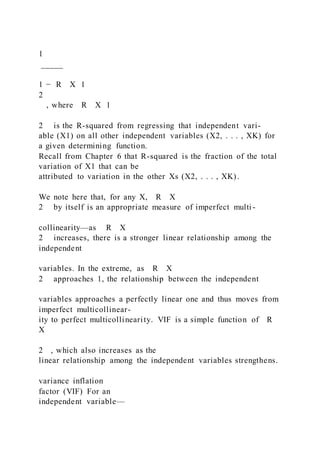
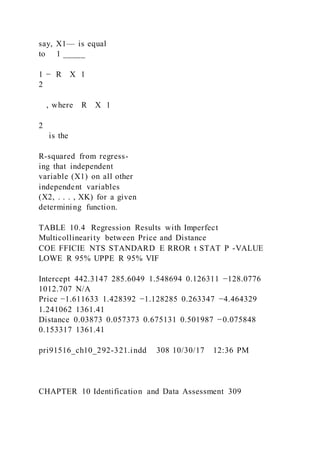
cause and a variable(s) representing an effect, where a change
in
the cause variable results in a change in the effect variable.
cluster analysis Groups observations according to some measure
of similarity.
confidence interval A range of values such that there is a
specified
probability that they contain a population parameter.
confounding factor The component(s) of the error, Ui, that are
cor-
related with a treatment(s), X.
consistent estimator An estimator whose realized value gets
close
to its corresponding population parameter as the sample size
gets
large.
constructing a representative sample The four steps that are to
be followed in building a representative sample.
continuous random variable A variable that takes on an
(uncount-
able) infinite number of values.
control variable Any variable included in a regression equation
whose purpose is to alleviate an endogeneity problem.
cross-sectional data Data that provides a snapshot of
information
at one fixed point in time.
D
dashboard A graphical presentation of the current standing and
historical trends for variables of interest, typically KPIs.
data A collection of information.
database Organized collection of data that firms use for
analysis.
data gap Any place where there are missing data for a variable
over an interval of values, but data are not missing for at least
some
values on both ends of the interval.
data-generating process (DGP) The underlying mechanism that
produces the pieces of information contained in a dataset.
data mining Pattern discovery, typically in large datasets.
data sample A subset of a population that is collected and
observed.
data sanity check for a regression A comparison between the
estimated coefficient for an independent variable in a regression
and the value for that coefficient as predicted by theory.
deductive reasoning Reasoning that goes from the general to the
specific; also known as top-down logic.
degree of support (also called inductive probability) The
degree of confidence in the conclusion resulting from the stated
observation(s) for an inductive argument.
descriptive statistics Quantitative measures meant to summarize
and interpret properties of a dataset.
determining function The part of the outcome that we can
explic-
itly determine, fi  (X1 i,  X2 i,…, XK i).
deterministic variable Variable whose value can be predicted
with certainty.
dichotomous (or binary) dependent variable A limited depen-
dent variable that can take on just two values, typically
recorded
as 0 and 1.
dichotomous treatment Two treatment statuses—treated and
untreated.
difference-in-differences (diff-in-diff) The difference in the
tem-
poral change for the outcome between the treated and untreated
group.
direct causal relationship A change in the causal variable, X,
directly causes a change in the effect variable, Y.
direct proof Proof that begins with assumptions, explains
methods
of proof, and states the conclusion(s).
discrete random variable A variable that can take on only a
count-
able number of values.
dummy variable A dichotomous variable (one that takes on
values
0 or 1) that is used to indicate the presence or absence of a
given
characteristic.
pri91516_Glossary_335-339.indd 335 10/31/17 2:39 PM
336 Glossary
dummy variable estimation Uses regression analysis to esti -
mate all of the parameters in the fixed effects data-generating
process.
E
effect of the treatment on the treated (ETT) Treatment effect for
the group given the treatment.
elasticity The percentage change in one variable with a percent-
age change in another.
empirically testable conclusion A conclusion whose validity can
be meaningfully tested using observable data.
endogeneity problem Correlation exists between the errors and
at least one treatment.
endogeneity as an identification problem Inconsistency of an
estimator due to endogeneity.
error term Represents “unobserved” factors that determine the
outcome.
estimator A calculation using sample data that is used to
provide
information about a population parameter.
exogeneity as an instrumental variable A variable that has no
effect on the outcome variable beyond the combined effects of
all
the variables in the determining function (X1,…,XK ).
exogenously altered A variable in a dataset that changes due to
factors outside the data-generating process that are independent
of all other variables within the data-generating process.
expected value (or population mean) The summation of each
possible realization of Xi multiplied by the probability of that
realization.
experiment A test within a controlled environment designed to
examine the validity of a hypothesis.
experimental data Data that result from an experiment.
extrapolation Drawing conclusions beyond the extent of the
data.
F
fixed effects The controls for cross-sectional groups.
fixed effects model A data-generating process for panel data
that
includes controls for cross- sectional groups.
H
homoscedasticity Variance constant across all values of X.
hypothesis A proposed idea based on limited evidence that leads
to further investigation.
hypothesis test The process of using sample data to assess the
credibility of a hypothesis about a population.
I
identified Can be estimated with any level of precision given a
large enough sample from the population.
imperfect multicollinearity A condition in which two or more
inde-
pendent variables have nearly an exact linear relationship.
independent (random variable) The distribution of one random
variable does not depend on the realization of another.
independent and identically distributed (i.i.d.) The distribution
of
one random variable does not depend on the realization of
another
and each has identical distribution.
indirect causal relationship A change in X causes a change in Y,
but only through its impact on a third variable.
inductive reasoning Reasoning that goes from the specific to the
general; also known as bottom-up logic.
instrumental variable In the context of regression analysis, a
vari-
able that allows us to isolate the causal effect of a treatment on
an outcome due to its correlation with the treatment and lack of
correlation with the outcome.
interpolation Drawing conclusions where there are “gaps” in the
data.
interval variable Indicates membership to one of a set of two or
more mutually exclusive categories that have an obvious
ordering,
and the difference in values is meaningful.
irrelevant variable Variables that do not affect the outcome.
K
key performance indicators (KPIs) Variables that are used to
help
measure firm performance.
L
lag information Information about past outcomes.
latent variable A variable that cannot be observed, but
information
about it can be inferred from other observed variables.
lead information Information that provides insights about the
future.
least absolute deviations (LAD) Use the sum of the absolute
value
of the residuals as the objective function and solve for the slope
and intercept that minimize it.
limit-violating prediction A predicted value for a limited depen-
dent variable that does not fall within that variable’s limits.
limited dependent model A dependent variable whose range of
possible values has consequential constraints.
linear probability model Regression analysis applied to a
dichoto-
mous dependent variable.
pri91516_Glossary_335-339.indd 336 10/31/17 2:39 PM
337Glossary
linear regression The process of fitting a function that is linear
in
its parameters to a given dataset.
logic A description of the rules and/or steps behind the
reasoning
process.
logit model A latent variable formulation for a dichotomous
dependent variable that assumes a Logistic(0,1) distribution for
the
unobservables.
M
marginal effect The rate of change in the probability of a
dichoto-
mous dependent variable equaling 1 with a one-unit increase in
an independent variable (holding all other independent variables
constant).
maximum likelihood estimation (MLE) Population-level param-
eters are estimated using values that make the observed
outcomes
as likely as possible for a given model.
measurement error When one or more of the variables in the
determining function (typically at least one of the treatments) is
measured with error.
multi-level treatment When a treatment can be administered in
more than one quantity.
multiple regression Solving for a function that best describes
the data that implies the use of OLS (or equivalently, the
sample
moment equations).
N
nonexperimental data Data that were not produced using an
experiment.
normal random variable A specific type of continuous random
variable with a bell-shaped pdf.
null hypothesis The hypothesis to be tested using a data sample.
O
objective degree of support A degree of support that has a
statistical foundation, making it more credible as compared to a
subjective degree of support.
objective function A function ultimately wished to be
maximized
or minimized.
omitted variable Any variable contained in the error term of a
data-generating process, due to lack of data or simply a decisi on
not to include it.
omitted variable bias The product of the effect of the omitted
variable on the outcome (βK+1) and the (semi-partial)
correlation
between the omitted variable and the treatment (δ̂1).
ordinal variable Indicates membership to one of a set of two or
more mutually exclusive categories that do have an obvious
order-
ing, but the difference in values is not meaningful.
ordinary least squares (OLS) The process of solving for the
slope
and intercept that minimizes the sum of the squared residuals.
outlier detection Small subsets of observations, if they exist,
that
contain information far different from the vast majority of the
obser-
vations in the dataset.
P
p-value The probability of attaining a test statistic at least as
extreme as the one that was observed.
panel data: The same cross-sectional units over multiple points
in time.
partial correlation The partial correlation between X and Y is a
measure of the relationship between these two variables,
holding
at least one other variable fixed.
passive prediction The use of predictive analytics to make pre -
dictions based on actual and/or hypothetical data for which no
variables are exogenously altered.
pattern Any distinctive relationship between observations
within
the dataset.
pattern discovery The process of identifying distinctive
relation-
ships between observations in a dataset.
perfect multicollinearity A condition in which two or more
inde-
pendent variables have an exact linear relationship.
pivot table A data summarization tool that allows for different
views of a given dataset.
pooled cross-sectional data The result of two or more unrelated
cross-sectional datasets being combined into one dataset.
population The entire set of potential observations about which
we want to learn.
population mean The summation of each possible realization of
Xi
multiplied by the probability of that realization.
population parameter A numerical expression that summarizes
some feature of the population.
population standard deviation (σ) The mean of the sample stan-
dard deviation.
predictive analytics The use of data analysis designed to form
predictions about future, or unknown, events or outcomes.
probability density function (pdf) A function used to calculate
probabilities of individual outcomes for a continuous random
variable.
probability function A function used to calculate probabilities
of
individual outcomes for a discrete random variable.
pri91516_Glossary_335-339.indd 337 10/31/17 2:39 PM
338 Glossary
probit model A latent variable formulation for a dichotomous
dependent variable that assumes a standard normal distribution
for the unobservables.
proxy variable A variable used in a regression equation in order
to proxy for a confounding factor, in an attempt to alleviate the
endogeneity problem caused by that confounding factor.
Q
query Any request for information from a database.
R
R-squared The fraction of the total variation in Y that can be
attrib-
uted to variation in the Xs.
random sample A sample where every member of the population
has an equal chance of being selected.
random variable Variable that can take on multiple values, with
any given realization of the variable being due to chance (or
randomness).
reasoning The process of forming conclusions, judgments, or
infer-
ences from facts or premises.
regression analysis The process of using a function to describe
the relationship among variables.
regression line for a dichotomous treatment For a dichotomous
treatment, the line describing the relationship between the treat-
ment and outcome by using the means for each treatment status.
relevant as an instrumental variable A variable that is correlated
with X1 after controlling for X2,…,XK.
report Any structured presentation of the information in a
dataset.
representative sample A sample whose distribution approxi -
mately matches that of the population for a subset of observed,
independent variables.
residual The difference between the observed outcome and the
corresponding point on the regression line for a given
observation.
robustness The persistent accuracy of a conclusion despite
variation in the associated assumption(s) within the context of a
deductive argument.
S
sample mean A common measure of the center of a sample.
sample moment The mean of a function of a random variable(s)
for a given sample.
sample of size N A collection of N realizations of Xi, i.e.,
{x1,x2,…xN}.
sample standard deviation The square root of the sample
variance. For a sample of size N for random variable Xi, is
S2 = √
________________
1 ____ N−1 ∑ i=1
N
(xi – ̄ X   )
2 .
sample statistic Single measures of some feature of a data
sample.
sample variance Common measure of the spread of a sample.
For
a sample of size N for random variable Xi, is S
2 = 1 ____ N−1 ∑ i=1
N
(xi − ̄ X   )
2.
scorecard Any structured assessment of variables of interest,
typi-
cally KPIs, against a given benchmark.
scientific method The process designed to generate knowledge
through the collection and analysis of experimental data.
selected sample A sample that is nonrandom.
selection bias The act of drawing conclusions about a
population
using a selected data sample, without accounting for the means
of selection.
semi-partial correlation The semi-partial correlation between X
and Y is a measure of the relationship between these two vari -
ables, holding at least one other variable fixed for only X or Y.
simple regression The process that produces the simple regres -
sion line for a single treatment.
simple regression line The slope is the sample covariance of the
treatment and outcome divided by the sample variance of the
treat-
ment. The intercept is the mean value of the outcome minus the
slope times the mean value of the treatment.
simultaneity This can arise when one or more of the treatments
is
determined at the same time as the outcome; often occurs when
some amount of reverse causality occurs.
standard deviation The square root of the variance.
strength (of an inductive argument) The degree of confidence in
the conclusion.
structured data Data with well-defined units of observation for
which corresponding information is identifiable; they are the
data
that come in a spreadsheet format.
subjective degrees of support Degrees of support based on opin-
ion and lacking a statistical foundation.
sum of squared residuals (SSRes) The sum of the squared
residuals.
T
t-statistic (t-stat) The difference between the sample mean and
the hypothesized population mean ( ̄ X − K) divided by the
sample
standard deviation (S/ √
__
N  ) .
test statistic Any single value derived from a sample that can be
used to perform a hypothesis test.
time-series data Data that exhibit only variation in time.
total sum of squares (TSS) The sum of the squared difference
between each observation of Y and the average value for Y.
transposition Any time a group of assumptions implies a conclu-
sion (A implies B), then it is also true that any time the
conclusion
pri91516_Glossary_335-339.indd 338 10/31/17 2:39 PM
339Glossary
does not hold (not B), at least one of the assumptions must not
hold (not A).
treatment Something that is administered to members of at least
one participating group.
treatment effect The change in the outcome resulting from
varia-
tion in the treatment.
two stage least squares (2SLS) regression The process of using
two regressions to measure the causal effect of a variable while
utilizing an instrumental variable.
U
unbiased estimator An estimator whose mean is equal to the
population parameter it is used to estimate.
unconditional correlation The standard measure of correlation.
unit of observation The entity for which information has been
collected.
unstructured data Any data that cannot be classified as
structured.
V
variance A common measure for the spread of a distribution.
variance inflation factor (VIF) For an independent variable—
say,
X1— is equal to
1 ______
1 — R X 1  
2
, where R X 1
2
is the R-squared from regressing
that independent variable (X1) on all other independent
variables
(X2,…,XK) for a given determining function.
W
weak instrument An instrumental variable that has little partial
correlation with the endogenous variable whose causal effect on
an outcome it is meant to help measure.
within estimation Uses regression analysis of within-group
differ-
ences in variables to estimate the parameters in the fixed effects
data-generating process, except for those corresponding to the
fixed effects (and the constant).
pri91516_Glossary_335-339.indd 339 10/31/17 2:39 PM
340
A
Active prediction
background music in retail stores, 25
business strategy formation, 25–26
causal regression analysis, 179–181
deductive/inductive reasoning, 77–78
defined, 24
explanations, 326–331
R-squared, 183
Ad duration and clicks, 329–331
Airlines’ on-time performance and multimarket
contact, 253–254
Alibi, 39
Alternative data populations, 296
Applications (real-world problems), 322–334
ad duration and clicks, 329–331
auto ad budget and revenues, 332–333
data-driven conclusions, 323–326
explanations for data analysis and active
predictions, 326–331
grocery store price promotions, 325–326
insurance claims and deductibles, 326–328
machine maintenance and quality, 333–334
projects, 331–334
switching insurance, 324–325
tablet price and profits, 331–332
tennis analytics, 323–324
wearable features and sales, 328–329
Aristotle, 34
Aslin, Richard, 105
Association analysis, 15, 16
ATE. See Average treatment effect (ATE)
Auto ad budget and revenues, 332–333
Availability bias, 49
Average treatment effect (ATE), 90
B
Banner ads, 85, 95
Base group, 205
Baseball queries, 13, 14
Bias
availability, 49
confirmation, 49
omitted variable, 314–317
predictable-world, 49
selection. See Selection bias
Binary dependent variable, 261
Bottom-up logic, 43. See also Inductive reasoning
Broadband availability, 238
Business analytics, 3
Business strategy, 4
Business strategy formation, 25–26
C
Campaign evaluation, 19
Card, David, 243
Categorical variable, 204
Causal inference. See also Causality
advanced methods, 224–257
assumptions, 188–199
business applications, 18–19
campaign evaluation, 19
confounding factors, 196
control variables, 200–209
defined, 17
determining function. See Determining function
direct/indirect causal relationship, 18
endogeneity. See Endogeneity problem
form of determining function, 213–218
fundamental approaches, 187–223
instrumental variable. See Instrumental variable
nonrandom samples, 193–196
panel data methods. See Panel data methods
prediction, 19
proxy variable, 210–212
scientific method, 89–94
Causality. See also Causal inference
correlation, contrasted, 156
experiments vs. causal regression analysis, 180
lack of correlation between “other factors,” 184
regression analysis, 170–182
Causality model, 172
Center
distribution, 60
sample, 61
Changing the offer to change the odds, 258–259,
287–288
Chapter-opening challenges. See dataCHALLENGE
Classification, 15
Click-through rate, 85, 95
Cluster analysis, 15, 16, 16f
CNN, 50
Coin flips, 46–47
Collector selection bias, 49
Confidence interval
correlational regression analysis, 166–167
deductive reasoning, 68
I N D E X
pri91516_idx_340-350.indd 340 10/31/17 2:44 PM
Index 341
defined, 64
determining function, 176
imperfect multicollinearity, 308
90%, 66, 67
95%, 64, 66, 67
99%, 66, 67
probit and logit models, 282
scientific method, 99–103
treatment effect, 103
Confirmation bias, 49
Confounding factors, 196
Consistency of regression estimators
determining functions, 175
population correlations, 164
Consistent estimator, 163
Constructing a representative sample,
190–192
Continuous random variable, 57, 61
Control variables, 200–209
Cord cutting, 262
Correlation
causality, contrasted, 156
partial, 156, 159
positively correlated, 156
regression analysis, 157–170
sample, 156
semi-partial, 159
unconditional, 158
Correlation model, 172
Correlation vs. causality, 156
Cost variables, 237
Cross-sectional data, 7–8, 8t, 10
Customer testimonies, 45
Cutoff values
p-values, 75
standard deviations, 66, 67
D
Dancers with store signs outside restaurant,
83, 109
Dashboard, 20, 21f
Data
cross-sectional, 7–8, 8t, 10
defined, 3
experimental, 86
nonexperimental, 104–108
panel, 9, 9t, 10
singular/plural, 4
structured, 5–6, 6t
time-series, 8, 9t, 10, 304
unstructured, 6, 6t
Data analysis, 95–104, 326–331
Data-driven conclusions, 323–326
Data dump, 1, 26–27
Data gap, 297
Data-generating process (DGP)
broadband availability, 238
causal analysis, 154
causality model, 172
causality vs. correlation, 156
controls, 200
defined, 9, 153
formal model, 11
general formulation, 153
informal concept, 10–11
linear probability model, 267
obesity and fatty milk, 181
OnlineEd example, 154
outcome Y, 174, 188
population regression equation, contrasted, 173
profits, promotion, and financing, 313
relationship between profits and price, 292
tax hike on profits, 239
where to park your truck (revenue), 183
within estimation, 251
Data mining, 15, 23
Data sample, 43
Data sanity check for a regression, 207
Data types
cross-sectional data, 7–8, 8t, 10
panel data, 9, 9t, 10
pooled cross-sectional data, 8, 8t, 10
time-series data, 8, 9t, 10
Database, 3
dataCHALLENGE
changing the offer to change the odds, 258–259,
287–288
dancers with store signs outside restaurant, 83, 109
data dump, 1, 26–27
knowing all customers by observing a few, 55, 79
parking food truck in college town, 113, 145, 151,
183–184
relationship between profits and price, 292–293, 318–319
sex imbalance, 32, 51–52
TV ads and web traffic, 224, 254–255
working out at work, 187, 218–219
Datum, 4
Decision trees, 24
pri91516_idx_340-350.indd 341 10/31/17 2:44 PM
342 Index
Deductive reasoning
active predictions, 77–78
concreteness, 40
confidence interval, 68, 166–167
confidence interval (correlational regression
analysis), 166
confidence interval (determining function), 176
confidence interval (treatment effect), 103
defined, 35
direct proof, 35–36, 38
disagreement about a conclusion, 40
hypothesis testing, 76
hypothesis testing (correlational regression
analysis), 167
hypothesis testing (determining function), 176–177
hypothesis testing (treatment effect), 100
inductive reasoning, contrasted, 43
legal applications, 39
robustness, 40–41
schematic illustration, 35f
transposition, 36–37, 38
Deductive reasoning process, 35f
Degree of support, 44
Descriptive statistics, 13
Determining function
confidence interval, 176
consistency of regression estimator, 175
defined, 153
form of, 213–218
hypothesis testing, 176–177
linear functional form, 213
log functional form, 217–218
multiple treatments, 155
probit/logit models, 281–283
quadratic functional form, 213
Deterministic variable, 57
DGP. See Data-generating process (DGP)
Dichotomous dependent variable, 261–263, 272t. See also
Prediction for a dichotomous variable
Dichotomous treatment, 117
Difference-in-differences (diff-in-diff), 239–242
defined, 241
endogeneity problem, 242
minimum wage, 243
Direct causal relationship, 18
Direct proof, 35–36, 38
Disagreement about a conclusion, 40
Discovery of penicillin, 88
Discrete random variable, 57, 61
Distribution of random variables, 57–61
Distribution of sample mean for hypothesized population
mean, 71–72
Dummy variable, 202–206, 306
Dummy variable estimation, 246–247
E
Econometric models, 18
Economic climate, 212
Effect of the treatment on the treated (ETT), 92
Elasticity, 217
Empirically testable conclusion, 41–42
Employment offers and prospective employee acceptances,
258–259, 287–288
Endogeneity problem, 196–199
control variables, 200
defined, 196
diff-in-diff, 240, 242
fixed-effects model, 246, 251–252
forms, 199, 314
identification problem, 309, 312–313
linear probability model, 270
measurement error, 199
omitted variable, 199
probit and logit models, 286
proxy variable, 210–212
signing omitted variable bias, 314–317
simultaneity, 199
variable co-movement, 309, 312–313
Error term, 172
Estimator, 63
ETT. See Effect of the treatment on the treated (ETT)
Evaluating assumptions, 45–48
Excel. See Microsoft Excel
Exogenous and relevant, 227–228, 234–236
Exogenous as an instrumental variable, 227–228
Exogenously altered, 23
Expected value, 60
Experience goods, 45
Experiment, 86
Experimental data, 86
Extrapolation and interpolation, 297–303
changing the population, 299–300
definitions, 297
functional form assumption, 300–302
identification problems, 298–299
remedying the identification problems, 299–302
time-series data, 304
pri91516_idx_340-350.indd 342 10/31/17 2:44 PM
Index 343
F
Facebook, 180
Fatty milk and obesity, 181
“Fit” of regression equation, 182
Fixed effects, 245
Fixed-effects model, 242–253
basic implications (Reasoning Box 8.3), 252
comparing estimation methods, 250–252
controls beyond fixed effects and time dummies, 246
controls for the groups, 246
data-generating process, 245
defined, 245
dummy variable estimation, 246–247
endogeneity problem, 246, 251–252
within estimation, 248–250, 251
group switching, 250
grouping process, 252–253
R-squared, 251
time controls, 245–246
Fleming, Alexander, 88
Four “W” questions, 7
Fox News, 50
Fraud detection, 3
Functional form
determining function (causal inference), 213–218
extrapolation and interpolation, 300–302
G
Galton, Francis, 132
GDP. See Gross domestic product (GDP)
Generalized method of moments (GMM), 233
GMM. See Generalized method of moments (GMM)
Good control, 201
Good proxy variable, 211–212
Google search, 12
Grocery store price promotions, 325–326
Gross domestic product (GDP), 212
Guilt and innocence, 39
H
Harper, Bryce, 14
Healey, Ben, 95
Homoscedasticity, 166
Hypothesis, 86
Hypothesis test, 70
Hypothesis testing, 70–76
correlational regression analysis, 167
deductive reasoning, 76
determining function, 176–177
inductive reasoning, 76
p-value, 74
probit and logit models, 282–283
scientific method, 96–99, 100
treatment effect, 100
I
Identification and data assessment, 292–321
endogeneity, 309, 312–313
extrapolation and interpolation, 297–303
identified, defined, 294
signing omitted variable bias, 314–317
variable co-movement. See Variable co-movement
Identified, 294
i.i.d. See Independent and identically distributed (i.i.d.)
Imperfect multicollinearity
defined, 304–305
identification problems, 307–309
profits, promotion, and financing, 313
remedies, 312
variance inflation factor (VIF), 308–309, 313
Inconsistent estimator, 309f
Independent, 64
Independent and identically distributed (i.i.d.), 64
Indirect causal relationship, 18
Inductive probability, 44
Inductive reasoning
active predictions, 77–78
basic form, 43
confidence interval (correlational regression analysis), 167
confidence interval (determining function), 176
confidence interval (probit/logit determining function), 282
confidence interval (treatment effect), 103
customer testimonies, 45
deductive reasoning, contrasted, 43
defined, 43
degree of support, 44
evaluating assumptions, 45–48
hypothesis testing, 76
hypothesis testing (correlational regression analysis), 167
hypothesis testing (determining function), 177
hypothesis testing (probit/logit determining function), 283
hypothesis testing (treatment effect), 100
making general statement based on specific
observations, 43
population parameters, 64
selection bias, 50
strength, 44
pri91516_idx_340-350.indd 343 10/31/17 2:44 PM
344 Index
Inspirational speeches, 40
Instrumental variable, 225–238
business applications, 237–238
cost variables, 237
defined, 226
exogenous and relevant, 227–228, 234–236
policy change, 238
two-stage least squares regression (2SLS), 228–233
weak instrument, 236
Insurance claims and deductibles, 326–328
Intercept, simple regression line, 129
Interpolation, 297. See also Extrapolation and interpolation
Interval variable, 204
Irrelevant variable, 208
Ivy League degree and marginal revenue product of
employees, 317–318
K
Key performance indicators (KPIs), 19
Kidd, Celeste, 105
Knockoff purses, 18
Knowing all customers by observing a few, 55, 79
KPIs. See Key performance indicators (KPIs)
Krueger, Alan, 243
L
LAD. See Least absolute deviations (LAD)
Laffer curve, 215–216
Lag information, 19, 20
Latent variable, 271, 272t
Lead information, 20, 22
Least absolute deviations (LAD), 133, 134
Least squares
ordinary least squares (OLS), 133–135
two-stage least squares regression (2SLS),
228–233
Lees, Gavin, 95
Level-log, 217, 218t
Limit-violating prediction, 268–269
Limited dependent variable, 260–263
Linear determining function, 213
Linear probability model, 263–270
data-generating process, 267
defined, 263
endogeneity problem, 270
interpretation, 266
limit-violating prediction, 268–269
merits/advantages, 267
probit and logit models, 286
shortcomings/limitations, 267–269,
285–286
Linear regression, 15, 142–144
Local labor laws, 238
Local sales tax, 238
Log functional form, 217–218
Log-level, 217, 218t
Log-log, 217, 218t
Logic, 34
Logistic distribution, 274
Logit model, 274. See also Probit and logit models
M
Machine maintenance and quality, 333–334
Margin of error, 70
Marginal effects, 276–278, 286
Marijuana and educational attainment, 203
Marshmallow test (marshmallows and
reliability), 105
Maximum likelihood estimation (MLE), 279–281
Mayer, Marissa, 77
Measurement error, 199
Mehr, Samuel, 102
Member selection bias, 50
Method of linear least squares, 133
Microsoft Excel
norm.dist, 59
NORM.S.DIST(-1, TRUE), 277
p-value, 75
perfect multicollinearity, 306–307, 307t
regression output, 138t
Microsoft Surface, 47
Minimum wage, 238, 243
MLE. See Maximum likelihood estimation (MLE)
Model fit, 24
Moment conditions, 115, 278. See also Sample moment
MSNBC, 50
Multi-level treatment, 124
Multichannel video programming distributors
(MVPDs), 262
Multicollinearity. See Imperfect multicollinearity; Perfect
multicollinearity
Multimarket contact and airlines’ on-time performance,
253–254
Multiple regression, 140
Multiple regression hyperplane, 140
Multiple regression plane, 140
Music
background music in retail stores, 25
pri91516_idx_340-350.indd 344 10/31/17 2:44 PM
Index 345
music training and intelligence, 102
MVPDs. See Multichannel video programming distributors
(MVPDs)
N
Neural networks, 24
News and sensationalism, 49–50
News network polls, 50
90% confidence interval, 66, 67
95% confidence interval, 64, 66, 67
99% confidence interval, 66, 67
Non-zero average treatment effect, 92
Nonexperimental data, 104–108
Nonrandom samples, 193–196
Normal random variable, 58, 58f
norm.dist, 59
NORM.S.DIST(-1, TRUE), 277
Null hypothesis, 71
O
Obesity and fatty milk, 181
Objective degree of support, 44, 57
Objective function, 133
OLS. See Ordinary least squares (OLS)
OLS multiple regression, 140
OLS multiple regression (hyper)plane, 140
Omitted variable, 199
Omitted variable bias, 314–317
Ordinal variable, 204
Ordinary least squares (OLS), 133–135
“Other factors,” 153, 174, 184, 196
Outcome probabilities, 42
Outlier detection, 15, 16, 16f
P
p-value, 74, 74f, 75, 308
Palmeri, Holly, 105
Panel data, 9, 9t, 10, 239
Panel data methods, 239–253
business applications, 252–253
difference-in-differences (diff-in-diff), 239–242
fixed-effects model. See Fixed-effects model
grouping process, 252–253
types of panel data, 252
Parking food truck in college town, 113, 145, 151,
183–184
Partial correlation, 156, 159
Passive prediction
applications in business, 24
correlational regression analysis, 169–170
defined, 23
model fit, 24, 182–183
neural networks/decision trees, 24
political races, 25
R-squared, 183
weather forecasting, 23–24
Pattern, 15
Pattern discovery, 15–17, 23
Penicillium notatum, 88
Perfect multicollinearity
defined, 304–305
dummy variable, 306
identification problems, 305–307
remedies to identification problems, 310–312
Physical fitness and academic success, 157
Pivot table, 13, 14t
Policy change, 238
Political polls, 25, 70
Polynomial, 214
Pooled cross-sectional data, 8, 8t, 10
Population, 43
Population mean, 60
Population parameter, 57, 60
Population regression equation, 163, 169,
172–175
Positively correlated, 156
Predictable-world bias, 49
Prediction, 19
Prediction for a dichotomous variable, 258–291
dichotomous dependent variable, 261–263, 272t
limited dependent variable, 260–263
linear probability model. See Linear probability model
model selection (choosing the “right” model), 270,
286–287
probit/logit models. See Probit and logit models
Predictive analytics, 22–24
active prediction. See Active prediction
business strategy, 4–5, 25–26
defined, 3
models, 5
passive prediction. See Passive prediction
Predictive analytics models, 5
Price regulations, 238
Price variation, 227f
Price vs. profit (dataCHALLENGE), 292–293, 318–319
Prince, Jeffrey, 253
Probability density function (pdf), 57
Probability function, 57
pri91516_idx_340-350.indd 345 10/31/17 2:44 PM
346 Index
Probit and logit models, 270–286
assumptions, 280–281
complexity of calculating marginal effects, 286
confidence intervals, 282
endogeneity, 286
estimation and interpretation, 278–284
hypothesis testing, 282–283
instrumental variables and/or fixed effects, 286
latent variable, 271, 272t
logit model, defined, 274
marginal effects, 276–278, 286
maximum likelihood estimation (MLE), 279–281
merits and shortcomings, 285–286
overcoming shortcomings of linear probability model, 286
probit/logit model, compared, 275
probit model, defined, 273
STATA “logit” command, 284, 284t
STATA “probit” command, 283, 284t
Profits, promotion, and financing, 313
Projecting trends, 304
Projects
auto ad budget and revenues, 332–333
machine maintenance and quality, 333–334
tablet price and profits, 331–332
Proxy variable, 210–212
Purse knockoffs, 18
Q
Quadratic determining function, 213
Quadratic relationship, 214f
Quarter example (flipping a quarter), 46–47
Query, 12–14
Query software, 12
R
R-squared
active prediction, 183
defined, 182
fixed-effects model, 251
passive prediction, 183
Random sample, 63, 189–190
Random variable, 57
Ratings, 144
Real-world problems. See Applications (real-world problems)
Reasoning
deductive. See Deductive reasoning
defined, 34
inductive. See Inductive reasoning
Regression analysis, 113–186
causality, 170–182
correlation, 157–170
data-generating process. See Data-generating process (DGP)
data sanity check, 207
defined, 117
determining function. See Determining function
experiments vs. causal regression analysis, 180
“fit” of regression equation, 182
least absolute deviations (LAD), 133, 134
least squares, 133–135
linear regression, 142–144
multiple regression, 140
multiple regression plane/hyperplane, 140
multiple treatments, 135–141
ordinary least squares (OLS), 133–135
“other factors,” 153, 174, 184
population regression equation, 163, 169, 172–175
R-squared, 182–183
ratings, 144
regression line (dichotomous treatment), 116–123
regression line (multi-level treatment), 124–132
regression plane/hyperplane, 138, 139
sample moment equations, 133–135
simple regression, 140
simple regression line, 129–132
two-stage least squares regression (2SLS), 228–233
Regression hyperplane, 139
Regression line
dichotomous treatment, 116–123
full population, 164f
multi-level treatment, 124–132
rocking chair example, 301f
Regression line for a dichotomous treatment, 119, 122
Regression plane, 138, 138f, 139
Relevant as an instrumental variable, 228, 235–236
Report, 20
Representative sample, 190–192
Residual, 121
Retail stores, background music, 25
Risk management, 3
Robustness, 40–41
Rude sales clerks and sales volume, 108
S
Salary offers and prospective employee acceptances, 258–259,
287–288
Sales tax, 238
Sample correlation, 156
Sample covariance, 156
pri91516_idx_340-350.indd 346 10/31/17 2:44 PM
Index 347
Sample mean, 61
Sample moment, 133
Sample moment equations, 133–135, 278
Sample of size N, 61
Sample standard deviation, 61
Sample statistics, 61
Sample variance, 61
Scatterplot, 17f
Scientific method, 83–112
analysis and conclusions, 86–87
asking a question, 85
average treatment effect (ATE), 90
background research, 86
causal inference, 89–94
confidence interval, 99–103
data analysis, 95–104
defined, 84
discovery of penicillin, 88
effect of the treatment on the treated (ETT), 92
experiment, 86
experimental vs. non-experimental data, 86, 104–108
formulating a hypothesis, 86
hypothesis testing, 96–99, 100
overview, 88t
reporting the findings, 87
steps in process, 85f
uses, 87
Scorecard, 21, 22f
Selected sample, 193–196
Selection bias
collector, 49
defined, 49, 92
inductive reasoning, 50
member, 50
news network polls, 51
treatment effect, 93, 94
Semi-partial correlation, 159, 308
Sensationalism in the news, 49–50
Sex imbalance, 32, 51–52
Signing omitted variable bias, 314–317
Simon, Daniel, 253
Simple regression, 140
Simple regression line, 129–132
Simultaneity, 199
Situational batting averages, 14
Slope, simple regression line, 129
Spread
distribution, 60
sample, 61
SSRes. See Sum of squared residuals (SSRes)
Standard deviation, 60
STATA
“logit” command, 284, 284t
“probit” command, 283, 284t
Strategies vs. tactics, 4n
Strength, 44
Structured data, 5–6, 6t
Stylized examples, 322. See also Applications (real-world
problems)
Subjective degrees of support, 44
Sum of squared residuals (SSRes), 182
Switching insurance, 324–325
T
t-distribution, 67–68, 75
t-stat, 73, 75
Tablet price and profits, 331–332
Tactics vs. strategies, 4n
Target, 24
Telecommuting (working from home), 77
Tennis analytics, 323–324
Test statistic, 73
Time-series data, 8, 9t, 10, 304
Top-down logic, 35. See also Deductive reasoning
Total sum of squares (TSS), 182
Transposition, 36–37, 38
Treatment, 86
Treatment effect, 86
Trout, Mike, 14
TSS. See Total sum of squares (TSS)
TV ads and web traffic, 224, 254–255
Two-stage least squares regression (2SLS), 228–233
U
Unbiased estimator, 65
Unconditional correlation, 158
Unit of observation, 5, 6–7. See also Data types
Unstructured data, 6, 6f
Uses of data analysis
causal inference, 17–19
pattern discovery, 15–17
queries, 12–14
V
Variable
categorical, 204
continuous random, 57, 61
control, 200–209
pri91516_idx_340-350.indd 347 10/31/17 2:44 PM
348 Index
cost, 237
deterministic, 57
dichotomous dependent, 261–263, 272t
discrete random, 57, 61
dummy, 202–206
instrumental. See Instrumental variable
interval, 204
irrelevant, 208
latent, 271, 272t
limited dependent, 260–263
normal random, 58, 58f
omitted, 199
ordinal, 204
proxy, 210–212
random, 57
Variable co-movement, 303–317
endogeneity, 309, 312–313
identification problems, 305–310
imperfect multicollinearity. See Imperfect multicollinearity
perfect multicollinearity. See Perfect multicollinearity
remedies to identification problems, 310–313
signing omitted variable bias, 314–317
variance inflation factor (VIF), 308–309, 313
Variance, 60
Variance inflation factor (VIF), 308–309, 313
VIF. See Variance inflation factor (VIF)
W
“W” questions, 7
Weak instrument, 236
Wearable features and sales, 328–329
Weather forecasting, 23–24
Weierstrass theorem, 214–215
Within estimation, 248–250, 251
Working from home (telecommuting), 77
Working out at work, 187, 218–219
Z
Z score, 284t
pri91516_idx_340-350.indd 348 10/31/17 2:44 PM
CoverTitleCopyrightBrief ContentsContentCHAPTER 1 The
Roles of Data and Predictive Analytics in BusinessData
Challenge: Navigating a Data DumpIntroductionDefining Data
and Data Uses in BusinessDataPredictive Analytics within
Business AnalyticsBusiness StrategyPredictive Analytics for
Business StrategyData FeaturesStructured vs Unstructured
DataThe Unit of ObservationData-generating ProcessBasic Uses
of Data Analysis for BusinessQueriesPattern DiscoveryCausal
InferenceData Analysis for the Past, Present, and FutureLag and
Lead InformationPredictive AnalyticsActive Prediction for
Business Strategy FormationRising to the Data
ChallengeSummary Key Terms and ConceptsConceptual
QuestionsQuantitative ProblemsCOMMUNICATING DATA 1.1:
Is/Are Data Singular or Plural?COMMUNICATING DATA 1.2:
Elaborating on Data TypesCOMMUNICATING DATA 1.3:
Situational Batting AveragesCOMMUNICATING DATA 1.4:
Indirect Causal Relationships in Purse
KnockoffsCOMMUNICATING DATA 1.5: Passive and Active
Prediction in Politics and RetailCHAPTER 2 Reasoning with
DataData Challenge: Testing for Sex
ImbalanceIntroductionWhat is Reasoning?Deductive
ReasoningDefinition and ExamplesEmpirically Testable
ConclusionsInductive ReasoningDefinition and
ExamplesEvaluating AssumptionsSelection BiasRising to the
Data ChallengeSummaryKey Terms and ConceptsConceptual
Quest
Chapter 7. Basic Methods for Establishing Causal Inference (Text

Chapter 7. Basic Methods for Establishing Causal Inference (Text

  • 1.
    Chapter 7. BasicMethods for Establishing Causal Inference (Textbook attached) In Chapter 7, there is a discussion about irrelevant variables & proxy variables. Discuss each type of variable and give an application of both. Please address each component of the discussion board. Also, cite examples according to APA standards. Minimum 450+ words Sample Letter to Elected Officials
  • 2.
    Sample Letter toRepresentative or Senator Date Your Name Your Address Your City, State, Zipcode Your E-mail Your Phone Number The Honorable_________________________ House of Representatives or United States Senate Office Address of Representative or Senator Dear Representative/Senator ____________________, (In your first paragraph include personal information) I am very fortunate to have been provided with an excellent education that prepared me for the future. I currently have children in both elementary and middle school. Recently, I have become very concerned about legislative impact on education. As a parent yourself, I am sure that you share many of these concerns. (Include facts) Research has shown that schools with strong school library media programs have better rates of success. For example, in Alaska it was found that schools with a full time librarian scored higher on standardized tests than schools with only part time librarians. These schools were able to have longer hours of operation, leading to higher rates of circulation, thus impacting student achievement. Similar findings have
  • 3.
    been made inmany other states across our country. (State what you are asking for) I ask that you support (Insert name of bill here). In supporting this bill funding will be provided that will support school library media programs. This is a very small price to invest in the futures of our nations children. All children should have the opportunity to achieve and develop skills necessary for the future. I believe that in supporting this bill you will impact the lives of countless children. Sincerely, (Signature) Your Name Predictive Analytics for Business Strategy: R E A S O N I N G F R O M DATA TO AC T I O N A B L E K N O W L E D G E pri91516_FM_i-xviii.indd 1 10/31/17 4:41 PM ESSENTIALS OF ECONOMICS Brue, McConnell, and Flynn
  • 4.
    Essentials of Economics FourthEdition Mandel Economics: The Basics Third Edition Schiller Essentials of Economics Tenth Edition PRINCIPLES OF ECONOMICS Asarta and Butters Principles of Economics, Principles of Microeconomics, Principles of Macroeconomics Second Edition Colander Economics, Microeconomics, and Macroeconomics Tenth Edition Frank, Bernanke, Antonovics, and Heffetz Principles of Economics, Principles of Microeconomics, Principles of Macroeconomics Seventh Edition Frank, Bernanke, Antonovics, and Heffetz Streamlined Editions: Principles of Economics, Principles of Microeconomics, Principles of Macroeconomics Third Edition Karlan and Morduch
  • 5.
    Economics, Microeconomics, and Macroeconomics SecondEdition McConnell, Brue, and Flynn Economics, Microeconomics, Macroeconomics Twenty-First Edition McConnell, Brue, and Flynn Brief Editions: Microeconomics and Macroeconomics Second Edition Samuelson and Nordhaus Economics, Microeconomics, and Macroeconomics Nineteenth Edition Schiller The Economy Today, The Micro Economy Today, and The Macro Economy Today Fifteenth Edition Slavin Economics, Microeconomics, and Macroeconomics Eleventh Edition ECONOMICS OF SOCIAL ISSUES Guell Issues in Economics Today Eighth Edition Register and Grimes Economics of Social Issues Twenty-First Edition
  • 6.
    ECONOMETRICS AND DATA ANALYSIS Gujaratiand Porter Basic Econometrics Fifth Edition Gujarati and Porter Essentials of Econometrics Fourth Edition Hilmer and Hilmer Practical Econometrics First Edition Prince Predictive Analytics for Business Strategy First Edition MANAGERIAL ECONOMICS Baye and Prince Managerial Economics and Business Strategy Ninth Edition Brickley, Smith, and Zimmerman Managerial Economics and Organizational Architecture Sixth Edition Thomas and Maurice Managerial Economics Twelfth Edition INTERMEDIATE ECONOMICS Bernheim and Whinston Microeconomics
  • 7.
    Second Edition Dornbusch, Fischer,and Startz Macroeconomics Twelfth Edition Frank Microeconomics and Behavior Ninth Edition ADVANCED ECONOMICS Romer Advanced Macroeconomics Fourth Edition MONEY AND BANKING Cecchetti and Schoenholtz Money, Banking, and Financial Markets Fifth Edition URBAN ECONOMICS O’Sullivan Urban Economics Eighth Edition LABOR ECONOMICS Borjas Labor Economics Seventh Edition McConnell, Brue, and Macpherson Contemporary Labor Economics Eleventh Edition PUBLIC FINANCE Rosen and Gayer
  • 8.
    Public Finance Tenth Edition ENVIRONMENTALECONOMICS Field and Field Environmental Economics: An Introduction Seventh Edition INTERNATIONAL ECONOMICS Appleyard and Field International Economics Ninth Edition Pugel International Economics Sixteenth Edition THE MCGRAW-HILL SERIES ECONOMICS pri91516_FM_i-xviii.indd 2 10/31/17 4:41 PM Predictive Analytics for Business Strategy: R E A S O N I N G F R O M DATA TO AC T I O N A B L E K N O W L E D G E Jeffrey T. Prince Professor of Business Economics & Public Policy Harold A. Poling Chair in Strategic Management Kelley School of Business Indiana University pri91516_FM_i-xviii.indd 3 10/31/17 4:41 PM
  • 9.
    PREDICTIVE ANALYTICS FORBUSINESS STRATEGY: REASONING FROM DATA TO ACTIONABLE KNOWLEDGE Published by McGraw-Hill Education, 2 Penn Plaza, New York, NY 10121. Copyright © 2019 by McGraw-Hill Education. All rights reserved. Printed in the United States of America. No part of this publication may be repro- duced or distributed in any form or by any means, or stored in a database or retrieval system, without the prior written consent of McGraw-Hill Education, including, but not limited to, in any network or other electronic storage or transmission, or broadcast for distance learning. Some ancillaries, including electronic and print components, may not be available to customers outside the United States. This book is printed on acid-free paper. 1 2 3 4 5 6 7 8 9 LCR 21 20 19 18 ISBN 978-1-259-19151-0 MHID 1-259-19151-6 Executive Portfolio Manager: Kathleen Hoenicke Senior Product Developer: Christina Kouvelis Marketing Manager: Bobby Pearson Content Project Managers: Harvey Yep (Core) / Bruce Gin (Assessment) Senior Buyer: Sandy Ludovissy Senior Designer: Matt Diamond Senior Content Licensing Specialists: Beth Thole (Text and Image)
  • 10.
    Cover Image: ©naqiewei/GettyImages Compositor: MPS Limited All credits appearing on page or at the end of the book are considered to be an extension of the copyright page. Library of Congress Cataloging-in-Publication Data Cataloging-in-Publication Data has been requested from the Library of Congress The Internet addresses listed in the text were accurate at the time of publication. The inclusion of a website does not indicate an endorsement by the authors or McGraw-Hill Education, and McGraw-Hill Education does not guarantee the accuracy of the information presented at these sites. mheducation.com/highered pri91516_FM_i-xviii.indd 4 10/31/17 4:41 PM To Mom and Dad —Jeffrey T. Prince pri91516_FM_i-xviii.indd 5 10/31/17 4:41 PM about the author Jeffrey T. Prince is Professor of Business Economics & Public Policy and Harold A. Poling Chair in Strategic Management at Indiana University’s Kelley School of Business.
  • 11.
    He received hisBA, in economics and BS, in mathematics and statistics from Miami University in 1998 and earned a PhD in economics from Northwestern University in 2004. Prior to joining Indiana University, he taught graduate and undergraduate courses at Cornell University. Jeff has won top teaching honors as a faculty member at both Indiana University and Cornell, and as a graduate student at Northwestern. He has a broad research agenda within applied economics, having written and published on topics that include demand in technology and telecommunications markets, Internet diffu- sion, regulation in health care, risk aversion in insurance markets, and quality competition among airlines. He is one of a small number of economists to have published in both the top journal in economics (American Economic Review) and the top journal in management (Academy of Management Journal). Professor Prince currently is a co-editor at the Journal of Economics and Management Strategy, and serves on the editorial board for Information Economics and Policy. In his free time, Jeff enjoys activities ranging from poker and bridge to running and racquetball. vi pri91516_FM_i-xviii.indd 6 10/31/17 4:41 PM   vii This book is meant to teach students how data analysis can inform strategy, within a framework centered on logical reasoning and
  • 12.
    practical communication. The inspirationfor this project comes from having taught for more than 20 years at the college level to a wide range of students (in mathematics and economics departments, and in business schools), covering a wide range of quantitative topics. During that time, it has become clear to me that the average business stu- dent recognizes, in principle, that quantitative skills are valuable. However, in practice (s)he often finds those skills intimidating and esoteric, wondering how exactly they will be useful in the workforce. As of this writing, there are many econometrics books and many operations/data mining/business analytics books in the market. However, these books are generally geared toward the specialist, who needs to know the full methodological details. Hence, they are not especially approachable or appealing to the business student looking for a conceptual, broad-based understanding of the mate- rial. And in their design, it can be easy for students—specialists and nonspecialists alike—to “lose sight of the forest for the trees.” As I see it, the problem with regard to data analysis is as fol - lows: There is a large group of future businesspeople, both future analysts and managers, who recognize data analysis can be valu- able. However, taking a course that is essentially a treatise on methodology and statistics causes the future managers to narrow their view toward simply “getting through” the course. In
  • 13.
    contrast, the future analystsmay enjoy the material and often emerge understanding the methods and statistics, but lacking key skills to communicate and explain to managers what their results mean. This book is designed to address the problem of the dual audi - ence, by focusing on the role of data analysis in forming business strategy via predictive analytics. I chose this focus since all busi- nesses, and virtually all management-level employees, must be mindful of the strategies they are following. Assessing the relative merit among a set of potential strategic moves generally requires one to forecast their future implications, often using data. Further, this component of predictive analytics contributes toward develop- ment of critical thinking about analytical findings. Both inside and outside of business, we are bombarded with statements with the following flavor: “If you do X, you should expect Y to happen.” (Commercials about the impact of switching insurance providers immediately come to mind.) A deep understanding of how data can inform strategy through predictive analytics will allow students to critically assess such statements. Given its purpose, I believe this book can be the foundation of a course that will benefit both future analysts and managers. The course will give managers a basic understanding of what data can do in an important area of business (strategy formation) and
  • 14.
    present it ina way that doesn’t feel like a taxonomy of models and their statistical properties. Managers will thus develop a deeper understanding of the fundamental reasoning behind how and why data analysis can generate actionable knowledge, and be able to think critically about whether a given analysis has merit or not. Consequently, this course could provide future managers some valuable data training without forcing them to take a highly technical econometrics or data mining course. It will also serve as a natural complement to the strategy courses they take. This course will give future analysts a bigger-picture under- standing of what their analysis is trying to accomplish, and the con- ditions under which it can be deemed successful. It will also give them tools to better reason through these ideas and communicate them to others. Hence, it will serve as a valuable complement to the other, more technically focused, analytics courses they take. KEY PEDAGOGICAL FEATURES This text includes many features designed to ease the learning experience for students and the teaching process for instructors. Data Challenges Each chapter opens by presenting a challenging data situation. In order for students to properly and effectively rise to the challenge, they must understand the material presented in that chapter. At the end of the chapter, a concluding section titled Rising to the Data Challenge discusses how the challenge can be confront-
  • 15.
    ed and overcomeusing some of the newly acquired knowledge and skills that chapter develops. These challenges, which bookend the chapter, are designed to motivate the reader to acquire the necessary skills by learning the chapter’s material and understanding how to apply it. Learning Objectives Learning objectives in each chapter orga- nize the chapter content and enhance the learning experience. Communicating Data Through real-world applications or expla- nations of text material in “layman’s terms,” Communicating Data examples demonstrate how to describe and explain data, data methods, and/or data results in a clear, intuitive manner. These preface pri91516_FM_i-xviii.indd 7 10/31/17 4:41 PM examples are designed to enhance the reader’s ability to com- municate with a wide audience about data issues. Reasoning Boxes Reasoning Boxes summarize main concepts from the text in the context of deductive and inductive reason- ing. By understanding reasoning structure, readers will be better equipped to draw and explain their own conclusions using data and to properly critique others’ data-based conclusions. Demonstration Problems Beyond the opening Data Challenge, each chapter includes Demonstration Problems that help target and develop particular data skills. These are largely focused on
  • 16.
    primary applications ofchapter material. Key Terms and Marginal Definitions Each chapter ends with a list of key terms and concepts. These provide an easy way for instructors to assemble material covered in each chapter and for students to check their mastery of terminology. In addition, marginal definitions will appear as signposts throughout the text. End-of-Chapter Problems Each chapter ends with two types of problems to test students’ mastery of the material. First are Conceptual Questions, which test students’ conceptual understand- ing of the material and demand pertinent communication and reasoning skills. Second are Quantitative Problems, which test stu- dents’ ability to execute and explain (within a logical framework) per- tinent data analytical methods. The Quantitative Problems are sup- ported by Excel datasets available through McGraw -Hill Connect®. Applications The material in this book is sufficient for any course that exclusively uses quizzes, homework, and/or exams for evalua- tion. However, to allow for a more enhanced, and applied, under- standing of the material, the book concludes with an Applications section. This section has three parts. The first is “Critical Analysis of Data-Driven Conclusions.” This section presents several real- world data applications that explicitly or implicitly lead to
  • 17.
    action- able conclusions, andthen challenges students to critically assess these conclusions using the reasoning and data knowledge presented throughout the book. The second section is “Written Explanations of Data Analysis and Active Predictions.” This sec- tion presents students with several mini-cases of data output, and challenges them to examine and explain the output in writing with appropriate reasoning. The third section is “Projects: Combining Analysis with Reason-based Communication.” This last section pro- vides three versions of a mini-project, based on projects Professor Prince has assigned in his own classes for several years. These projects require students to work from dataset to conclusions in a controlled, but realistic, environment. The projects are accom- panied by datasets in Excel format, which can be easily tailored to instructors’ needs. A key merit of these projects is flexibility, in that they can be used for individual- and/or group-level assessment. ORGANIZED LEARNING CHAPTER LEARNING OBJECTIVES The organization of each chapter reflects common themes out- lined by six to eight learning objectives listed at the beginning of each chapter. These objectives, along with AACSB and Bloom’s taxonomy learning categories, are connected to the end-of- chapter material and test bank questions to offer a
  • 18.
    comprehensive and thorough teachingand learning experience. ASSURANCE OF LEARNING READY Many educational institutions today are focused on the notion of assurance of learning, an important element of some accredi - tation standards. Predictive Analytics for Business Strategy is designed specifically to support your assurance of learning initia- tives with a simple, yet powerful solution. Instructors can use Connect to easily query for learning out- comes/objectives that directly relate to the learning objectives of the course. You can then use the reporting features of Connect to aggregate student results in similar fashion, making the col - lection and presentation of assurance of learning data simple and easy. AACSB STATEMENT McGraw-Hill Global Education is a proud corporate member of AACSB International. Understanding the importance and value of AACSB accreditation, Predictive Analytics for Business Strategy has sought to recognize the curricula guidelines detailed in the AACSB standards for business accreditation by connecting ques- tions in the test bank and end-of-chapter material to the general knowledge and skill guidelines found in the AACSB standards. It is important to note that the statements contained in Predictive Analytics for Business Strategy are provided only as a guide for the users of this text. The AACSB leaves content cover- age and assessment within the purview of individual schools,
  • 19.
    the mission of theschool, and the faculty. While Predictive Analytics for Business Strategy and the teaching package make no claim of any specific AACSB qualification or evaluation, we have labeled questions according to the general knowledge and skill areas. MCGRAW-HILL CUSTOMER CARE CONTACT INFORMATION At McGraw-Hill, we understand that getting the most from new technology can be challenging. That’s why our services don’t stop after you purchase our products. You can e-mail our Product Specialists 24 hours a day to get product training online. Or you can search our knowledge bank of Frequently Asked Questions on our support website. For Customer Support, call 800-331-5094, or visit www.mhhe.com/support. One of our Technical Support Analysts will be able to assist you in a timely fashion. viii Preface pri91516_FM_i-xviii.indd 8 10/31/17 4:41 PM I would like to thank the following reviewers, as well as hundreds of students at Indiana University’s Kelley School of Business and colleagues who unselfishly gave up their own time to provide com- ments and suggestions to improve this book.
  • 20.
    acknowledgments ix Imam Alam University ofNorthern Iowa Ahmad Bajwa University of Arkansas at Little Rock Steven Bednar Elon University Hooshang M. Beheshti Radford University Anton Bekkerman Montana State University Khurrum S. Bhutta Ohio University Gary Black University of Southern Indiana Andre Boik University of California, Davis Ambarish Chandra University of Toronto Richard Cox Arizona State University
  • 21.
    Steven Cuellar Sonoma StateUniversity Craig Depken University of North Carolina, Charlotte Mark Dobeck Cleveland State University Tim Dorr University of Bridgeport Neal Duffy State University of New York at Plattsburgh Jerry Dunn Southwestern Oklahoma State University Kathryn Ernstberger Indiana University Southeast Ana L. Rosado Feger Ohio University Frederick Floss Buffalo State University Chris Forman Georgia Institute of Technology Avi Goldfarb University of Toronto
  • 22.
    Michael Gordinier Washington University,St. Louis Gauri Guha Arkansas State University Kuang-Chung Hsu University of Central Oklahoma Kyle Huff Georgia Gwinnett College Jongsung Kim Bryant University Ching-Chung Kuo University of North Texas Lirong Liu Texas A&M University, Commerce Stanislav Manonov Montclair State University John Mansuy Wheeling Jesuit University Ryan McDevitt Duke University Alex Meisami Indiana University South Bend Ignacio Molina Arizona State University
  • 23.
    Georgette Nicolaides Syracuse University JiePeng St. Ambrose University Jeremy Petranka Duke University Kameliia Petrova State University of New York at Plattsburgh Claudia Pragman Minnesota State University, Mankato Reza Ramazani Saint Michael's College Doug Redington Elon University Sunil Sapra California State University, Los Angeles Robert Seamans New York University Mary Ann Shifflet University of Southern Indiana Timothy Simcoe Boston University
  • 24.
    Shweta Singh Kean University JohnLouis Sparco Wilmington University Arun Srinivasan Indiana University Southeast Purnima Srinivasan Kean University Leonie Stone State University of New York at Geneseo Richard Szal Northern Arizona University Vicar Valencia Indiana University South Bend Timothy S. Vaughan University of Wisconsin, Eau Claire Bindiganavale Vijayaraman The University of Akron Padmal Vitharana Syracuse University Razvan Vlaicu University of Maryland Rubina Vohra
  • 25.
    New Jersey CityUniversity Emily Wang University of Massachusetts, Amherst Miao Wang Marquette University Matthew Weinberg Drexel University Andy Welki John Carroll University John Whitehead Appalachian State University Peter Wui University of Arkansas, Pine Bluff pri91516_FM_i-xviii.indd 9 10/31/17 4:41 PM ▪ Connect content is authored by the world’s best subject matter experts, and is available to your class through a simple and intuitive interface. ▪ The Connect eBook makes it easy for students to access their reading material on smartphones and tablets. They can study on the go and don’t need internet access to use the eBook as a reference, with full functionality. ▪ Multimedia content such as videos, simulations, and games drive student engagement and critical thinking skills.
  • 26.
    ©McGraw-Hill Education ▪ Connect’sassignments help students contextualize what they’ve learned through application, so they can better understand the material and think critically. ▪ Connect will create a personalized study path customized to individual student needs through SmartBook®. ▪ SmartBook helps students study more efficiently by delivering an interactive reading experience through adaptive highlighting and review. McGraw-Hill Connect® is a highly reliable, easy-to-use homework and learning management solution that utilizes learning science and award-winning adaptive tools to improve student results. 73% of instructors who use Connect require it; instructor satisfaction increases by 28% when Connect is required. Homework and Adaptive Learning Quality Content and Learning Resources Over 7 billion questions have been
  • 27.
    answered, making McGraw-Hill Educationproducts more intelligent, reliable, and precise. Using Connect improves retention rates by 19.8%, passing rates by 12.7%, and exam scores by 9.1%. pri91516_FM_i-xviii.indd 10 10/31/17 4:41 PM More students earn As and Bs when they use Connect. www.mheducation.com/connect ©Hero Images/Getty Images ▪ Connect Insight® generates easy-to-read reports on individual students, the class as a whole, and on specific assignments. ▪ The Connect Insight dashboard delivers data on performance, study behavior, and effort. Instructors can quickly identify students who struggle and focus on material that the class has yet to master. ▪ Connect automatically grades assignments and quizzes, providing easy-to-read reports on individual and class performance. ▪ Connect integrates with your LMS to provide single sign-on
  • 28.
    and automatic syncing ofgrades. Integration with Blackboard®, D2L®, and Canvas also provides automatic syncing of the course calendar and assignme nt-level linking. ▪ Connect offers comprehensive service, support, and training throughout every phase of your implementation. ▪ If you’re looking for some guidance on how to use Connect, or want to learn tips and tricks from super users, you can find tutorials as you work. Our Digital Faculty Consultants and Student Ambassadors offer insight into how to achieve the results you want with Connect. Trusted Service and Support Robust Analytics and Reporting pri91516_FM_i-xviii.indd 11 10/31/17 4:41 PM I understand that the reliability and accuracy of the book and the accompanying supplements are of the utmost importance. To that end, I have been personally involved in crafting and accuracy checking each of the supplements. The following ancillaries are available for quick download and convenient access via the instructor resource material available through Connect. POWERPOINT PRESENTATION Presentation slides incorporate both the fundamental concepts of
  • 29.
    each chapter andthe graphs and figures essential to each topic. These slides can be edited, printed, or rearranged to fit the needs of your course. SOLUTIONS MANUAL This manual contains solutions to the end-of-chapter conceptual questions and quantitative problems. TEST BANK A comprehensive test bank offers hundreds of questions catego- rized by learning objective, AACSB learning category, Bloom’s taxonomy objectives, and level of difficulty. COMPUTERIZED TEST BANK TestGen is a complete, state-of-the-art test generator and edit- ing application software that allows instructors to quickly and easily select test items from McGraw Hill’s test bank content. The instructors can then organize, edit and customize ques- tions and answers to rapidly generate tests for paper or onli ne administration. Questions can include stylized text, symbols, graphics, and equations that are inserted directly into ques- tions using built-in mathematical templates. TestGen’s random generator provides the option to display different text or calcu- lated number values each time questions are used. With both quick and simple test creation and flexible and robust editing tools, TestGen is a complete test generator system for today’s educators. ONLINE RESOURCES Student supplements for Predictive Analytics for Business Strategy are available online at www.mhhe.com/prince1e. These include datasets for all Quantitative Problems and sample datasets for the Course Project.
  • 30.
    xii Acknowledgments Supplements pri91516_FM_i-xviii.indd 1210/31/17 4:41 PM   xiii brief contents chapter 1 The Roles of Data and Predictive Analytics in Business 1 chapter 2 Reasoning with Data 32 chapter 3 Reasoning from Sample to Population 55 chapter 4 The Scientific Method: The Gold Standard for Establishing Causality 83 chapter 5 Linear Regression as a Fundamental Descriptive Tool 113 chapter 6 Correlation vs. Causality in Regression Analysis 151 chapter 7 Basic Methods for Establishing Causal Inference 187 chapter 8 Advanced Methods for Establishing Causal Inference 224 chapter 9 Prediction for a Dichotomous Variable 258
  • 31.
    chapter 10 Identificationand Data Assessment 292 APPLICATIONS Data Analysis Critiques, Write-ups, and Projects 322 GLOSSARY 335 pri91516_FM_i-xviii.indd 13 10/31/17 4:41 PM contents CHAPTER 1 The Roles of Data and Predictive Analytics in Business 1 Data Challenge: Navigating a Data Dump 1 Introduction 2 Defining Data and Data Uses in Business 2 Data 3 Predictive Analytics within Business Analytics 3 Business Strategy 4 Predictive Analytics for Business Strategy 4 Data Features 5 Structured vs. Unstructured Data 5 The Unit of Observation 6 Data-generating Process 9 Basic Uses of Data Analysis for Business 12 Queries 12 Pattern Discovery 15 Causal Inference 17
  • 32.
    Data Analysis forthe Past, Present, and Future 19 Lag and Lead Information 19 Predictive Analytics 22 Active Prediction for Business Strategy Formation 25 Rising to the Data Challenge 26 Summary / Key Terms and Concepts / Conceptual Questions / Quantitative Problems ● COMMUNICATING DATA 1.1: Is/Are Data Singular or Plural? 4 ● COMMUNICATING DATA 1.2: Elaborating on Data Types 10 ● COMMUNICATING DATA 1.3: Situational Batting Averages 14 ● COMMUNICATING DATA 1.4: Indirect Causal Relationships in Purse Knockoffs 18 ● COMMUNICATING DATA 1.5: Passive and Active Prediction in Politics and Retail 25 CHAPTER 2 Reasoning with Data 32 Data Challenge: Testing for Sex Imbalance 32 Introduction 33 What is Reasoning? 33 Deductive Reasoning 35 Definition and Examples 35 Empirically Testable Conclusions 41 Inductive Reasoning 43
  • 33.
    Definition and Examples43 Evaluating Assumptions 45 Selection Bias 49 Rising to the Data Challenge 51 Summary / Key Terms and Concepts / Conceptual Questions / Quantitative Problems ● COMMUNICATING DATA 2.1: Deducing Guilt and Innocence 39 ● COMMUNICATING DATA 2.2: Inductive Reasoning via Customer Testimonies 45 ● COMMUNICATING DATA 2.3: Selection Bias in News Network Polls 51 ● REASONING BOX 2.1: Direct Proof and Transposition 38 ● REASONING BOX 2.2: Inductive Reasoning for Evaluating Assumptions 46 ● REASONING BOX 2.3: Selection Bias in Inductive Reasoning 50 CHAPTER 3 Reasoning from Sample to Population 55 Data Challenge: Knowing All Your Customers by Observing a Few 55 Introduction 56 Distributions and Sample Statistics 57 xiv pri91516_FM_i-xviii.indd 14 10/31/17 4:41 PM
  • 34.
    Distributions of RandomVariables 57 Data Samples and Sample Statistics 61 The Interplay Between Deductive and Inductive Reasoning in Active Predictions 77 Rising to the Data Challenge 79 Summary / Key Terms and Concepts / Conceptual Questions / Quantitative Problems ● COMMUNICATING DATA 3.1: What Can Political Polls Tell Us about the General Population? 70 ● COMMUNICATING DATA 3.2: Does Working at Work Make a Difference? 77 ● REASONING BOX 3.1: The Distribution of the Sample Mean 66 ● REASONING BOX 3.2: Confidence Intervals 68 ● REASONING BOX 3.3: The Distribution of the Sample Mean for Hypothesized Population Mean 71 ● REASONING BOX 3.4: Hypothesis Testing 76 ● REASONING BOX 3.5: Reasoning in Active Predictions 78 CHAPTER 4 The Scientific Method: The Gold Standard for Establishing Causality 83 Data Challenge: Does Dancing Yield Dollars? 83 Introduction 84 The Scientific Method 84
  • 35.
    Definition and Details84 The Scientific Method and Causal Inference 89 Data Analysis Using the Scientific Method 95 Experimental Data vs. Non-Experimental Data 104 Examples of Nonexperimental Data in Business 105 Consequences of Using Nonexperimental Data to Estimate Treatment Effects 107 Rising to the Data Challenge 109 Summary / Key Terms and Concepts / Conceptual Questions / Quantitative Problems ● COMMUNICATING DATA 4.1: Penicillin and the Scientific Method 88 ● COMMUNICATING DATA 4.2: The Effect of Banner Ad Features 95 ● COMMUNICATING DATA 4.3: Music Training and Intelligence 102 ● COMMUNICATING DATA 4.4: Marshmallows and Reliability 105 ● COMMUNICATING DATA 4.5: The Rewards of Rudeness 108 ● REASONING BOX 4.1: The Treatment Effect 94 ● REASONING BOX 4.2: The Distribution of Experimental Outcomes 98 ● REASONING BOX 4.3: Hypothesis Test for the Treatment Effect 100
  • 36.
    ● REASONING BOX4.4: Confidence Interval for the Treatment Effect 103 CHAPTER 5 Linear Regression as a Fundamental Descriptive Tool 113 Data Challenge: Where to Park Your Truck? 113 Introduction 114 The Regression Line for a Dichotomous Treatment 116 An Intuitive Approach 116 A Formal Approach 119 The Regression Line for a Multi-Level Treatment 124 An Intuitive Approach 124 A Formal Approach 127 Sample Moments and Least Squares 133 Regression for Multiple Treatments 135 Single vs. Multiple Treatments 135 Multiple Regression 139 What Makes Regression Linear? 142 Rising to the Data Challenge 145 Summary / Key Terms and Concepts / Conceptual Questions / Quantitative Problems ● COMMUNICATING DATA 5.1: Regression Line Origins 132 ● COMMUNICATING DATA 5.2: Least Squares vs. Least Absolute Deviations 134
  • 37.
    ● COMMUNICATING DATA5.3: Regression for Ratings 144 ● REASONING BOX 5.1: The Regression Line for a Dichotomous Treatment 122 ● REASONING BOX 5.2: The Simple Regression Line 132 ● REASONING BOX 5.3: Multiple Regression 140 Contents  xv pri91516_FM_i-xviii.indd 15 10/31/17 4:41 PM CHAPTER 6 Correlation vs. Causality in Regression Analysis 151 Data Challenge: Where to Park Your Truck— Redux 151 Introduction 152 The Difference Between Correlation and Causality 152 Regression Analysis for Correlation 157 Regression and Sample Correlation 157 Regression and Population Correlation 161 Passive Prediction Using Regression 169 Regression Analysis for Causality 170 Regression and Causation 171 Linking Causal Regression to the Experimental Ideal 179 Active Prediction Using Regression 179 The Relevance of Model Fit for Passive and Active Prediction 182
  • 38.
    Rising to theData Challenge 183 Summary / Key Terms and Concepts / Conceptual Questions / Quantitative Problems ● COMMUNICATING DATA 6.1: Physical Fitness and Academic Success 157 ● COMMUNICATING DATA 6.2: Experiments vs. Causal Regression Analysis 180 ● COMMUNICATING DATA 6.3: Will Drinking Fatty Milk Make You Fat? 181 ● REASONING BOX 6.1: Consistency of Regression Estimators for Population Correlations 164 ● REASONING BOX 6.2: Confidence Intervals for Correlational Regression Analysis 166 ● REASONING BOX 6.3: Hypothesis Testing for Correlational Regression Analysis 167 ● REASONING BOX 6.4: Equivalence of Population Regression Equation and Determining Function 174 ● REASONING BOX 6.5: Consistency of Regression Estimators for Determining Functions 175 ● REASONING BOX 6.6: Confidence Intervals for Parameters of a Determining Function 176 ● REASONING BOX 6.7: Hypothesis Testing for Parameters of a Determining Function 176 CHAPTER 7
  • 39.
    Basic Methods forEstablishing Causal Inference 187 Data Challenge: Does Working Out at Work Make for a Happy Worker? 187 Introduction 188 Assessing Key Assumptions Within a Causal Model 188 Random Sample 189 No Correlation between Errors and Treatments 196 Control Variables 200 Definition and Illustration 200 Dummy Variables 202 Selecting Controls 207 Proxy Variables 210 Form of the Determining Function 213 Rising to the Data Challenge 218 Summary / Key Terms and Concepts / Conceptual Questions / Quantitative Problems ● COMMUNICATING DATA 7.1: Is Education Going Up in Smoke? 203 ● COMMUNICATING DATA 7.2: Does GDP Growth Proxy Economic Climate? 212 ● COMMUNICATING DATA 7.3: Trouble with the (Laffer) Curve 215 ● REASONING BOX 7.1: Criteria for a Good Control 201 ● REASONING BOX 7.2: Criteria for a Good Proxy Variable 211 ● REASONING BOX 7.3: Why Polynomials Do the Trick—the
  • 40.
    Weierstrass Theorem 214 CHAPTER8 Advanced Methods for Establishing Causal Inference 224 Data Challenge: Do TV Ads Generate Web Traffic? 224 Introduction 225 Instrumental Variables 225 Definition and Illustration 225 Two-Stage Least Squares Regression 228 xvi Contents pri91516_FM_i-xviii.indd 16 10/31/17 4:41 PM Evaluating Instruments 233 Exogeneity 234 Classic Applications of Instrumental Variables for Business 237 Panel Data Methods 239 Difference-in-Differences 239 The Fixed-Effects Model 242 Practical Applications of Panel Data Methods for Business 252 Rising to the Data Challenge 254 Summary / Key Terms and Concepts / Conceptual Questions / Quantitative Problems ● COMMUNICATING DATA 8.1: Measuring the Impact of Broadband Expansion 238
  • 41.
    ● COMMUNICATING DATA8.2: Using Diff-in-Diff to Assess the Minimum Wage 243 ● COMMUNICATING DATA 8.3: Does Multimarket Contact Affect Airlines’ On-Time Performance? 253 ● REASONING BOX 8.1: Using an Instrumental Variable to Achieve Causal Inference via 2SLS 229 ● REASONING BOX 8.2: When Does Diff-in-diff Regression Solve an Endogeneity Problem? 242 ● REASONING BOX 8.3: Implications of the Fixed Effects Model 252 CHAPTER 9 Prediction for a Dichotomous Variable 258 Data Challenge: Changing the Offer to Change Your Odds 258 Introduction 259 Limited Dependent Variables 260 The Linear Probability Model 263 Definition and Interpretation 263 Merits and Shortcomings 267 Probit And Logit Models 270 Latent Variable Formulation 271 Marginal Effects 276 Estimation and Interpretation 278 Merits and Shortcomings 285 Rising to the Data Challenge 287 Summary / Key Terms and Concepts / Conceptual Questions /
  • 42.
    Quantitative Problems ● COMMUNICATINGDATA 9.1: How to Model and Predict Cord Cutting 262 ● COMMUNICATING DATA 9.2: Characterizing Endogeneity within a Linear Probability Model 270 ● COMMUNICATING DATA 9.3: The “Right” Model for a Dichotomous Dependent Variable 286 ● REASONING BOX 9.1: Interpretation of a Linear Probability Model 266 ● REASONING BOX 9.2: Contrasting the Probit and Logit Model 275 ● REASONING BOX 9.3: Consistency of MLE Estimators for Probit/Logit Determining Functions 281 ● REASONING BOX 9.4: Confidence Intervals for Parameters of a Probit/Logit Determining Function 282 ● REASONING BOX 9.5: Hypothesis Testing for Parameters of a Probit/Logit Determining Function 282 CHAPTER 10 Identification and Data Assessment 292 Data Challenge: Are Projected Profits over the Hill? 292 Introduction 293 Assessing Data Via Identification 293 Identification Problems and Remedies 296 Extrapolation and Interpolation 297
  • 43.
    Variable Co-movement 303 IdentificationDamage Control: Signing The Bias 314 Rising to the Data Challenge 318 Summary / Key Terms and Concepts / Conceptual Questions / Quantitative Problems ● COMMUNICATING DATA 10.1: Projecting Trends 304 ● COMMUNICATING DATA 10.2: Disentangling Promotion from Financing 313 ● COMMUNICATING DATA 10.3: A Distorted View of a Degree’s Value 317 ● REASONING BOX 10.1: Can Data Deliver the (Sufficiently Precise) Answer? 296 ● REASONING BOX 10.2: The Effects of Variable Co-Movement on Identification 310 ● REASONING BOX 10.3: Signing Omitted Variable Bias 316 Contents  xvii pri91516_FM_i-xviii.indd 17 10/31/17 4:41 PM APPLICATIONS Data Analysis Critiques, Write-ups, and Projects 322 Introduction 322 Critical Analysis of Data-Driven Conclusions 323
  • 44.
    Case 1: TennisAnalytics 323 Case 2: Switching Insurance 324 Case 3: Grocery Store Price Promotions 325 Written Explanations of Data Analysis and Active Predictions 326 Case 1: Insurance Claims and Deductibles 326 Case 2: Wearable Features and Sales 328 Case 3: Ad Duration and Clicks 329 Projects: Combining Analysis with Reason-Based Communication 331 Project 1: Tablet Price and Profits 331 Project 2: Auto Ad Budget and Revenues 332 Project 3: Machine Maintenance and Quality 333 Glossary 335 Index 340 xviii Contents pri91516_FM_i-xviii.indd 18 10/31/17 4:41 PM 1 LEARNING OBJECTIVES After completing this chapter, you will be able to: LO1.1 Explain how predictive analytics can help in business strategy formulation.
  • 45.
    LO1.2 Distinguish structuredfrom unstructured data. LO1.3 Differentiate units of observation. LO1.4 Outline a data-generating process. LO1.5 Describe the primary ways that data analysis is used to aid business performance. LO1.6 Discriminate between lead and lag information. LO1.7 Discriminate between active and passive prediction. LO1.8 Recognize questions pertaining to business strategy that may utilize (active) predictive analytics. Your boss is interested to know if and how Facebook “Likes” lead to sales. The question your boss has posed is clear enough. However, she provides no guidance beyond the question. How should you begin? dataCHALLENGE Navigating a Data Dump As a newly hired analyst at Papa John’s, your boss comes to you with a data question. She notes that the company’s database contains data collected from Facebook, the company website, and internal sources. Below is a list of variables from each sourc e for which the company has data.
  • 46.
    FACE BOOK WEBSITE INTE RNAL SOURCES Number of likes Number of visits Product sales Age of likers Number of pages per visit Employee salaries Education of likers Bounce rate Product prices Income of likers Location of visitors Advertising expenditures Click-through rate to website Device used by visitors Production costs The Roles of Data and Predictive Analytics in Business 1 pri91516_ch01_001-031.indd 1 10/30/17 4:53 PM CHAPTER 1 The Roles of Data and Predictive Analytics in Business2 Defining Data and Data Uses in Business We begin by defining data and other basic terminology relating to data. (Be sure to read Communicating Data 1.1, which addresses the question of whether data is/are singular or plural.) We then characterize predictive analytics for business strategy by breaking it down into its core components. Traditionally, data analysis was reserved for a small corner of
  • 47.
    the business community, performedby quantitatively oriented experts, if it was done at all. With the increasing digitization of business information, computer and software power, and information availability, data analysis has become an integral component of business. Data analy- sis can help businesses improve production processes, customer marketing, and stra- tegic positioning. The enormous list of applications makes it impractical to learn about all of them in just one book or one course. Why should our focus be on predictive analytics for business strategy? First, the topic is relevant for virtually every business discipline. Every discipline must regularly for- mulate and evaluate strategic options, and all are affected by strategies undertaken by various branches of the firm. Second, predicting the consequences of a strategic move stems from perhaps the most fundamental application of data analysis: gener- ating knowledge about cause and effect. The use of data to learn about cause and effect spans well beyond the business environment into areas such as medicine, physics, chemistry, and public policy, to name just a few. The critical thinking skills one must acquire to understand predictive analytics for business strategy have value well beyond this one area of study. The first section of the chapter defines data and provides a concise characterization of predictive analytics for business strategy—one of many ways
  • 48.
    businesses use data. Thenext section details data features. For those already familiar with data, the data definition and many of the data features will be familiar; however, a clear understand- ing of predictive analytics for business strategy and a data- generating process are crucial for what follows in the book, and therefore these two sections merit a review. The third section gives a broad overview of data uses in business. The final section describes different temporal uses of data, i.e., measuring the past and present versus predicting the future, and makes a crucial distinction between two different types of prediction, passive and active. The objective of this chapter is to paint a basic picture of the business analytics landscape and explain where predictive analytics for business strategy lives within that landscape. In doing so, we provide a general description of what this strand of business analytics does, and differentiate it from other types of business analytics and predictive analytics. Introduction pri91516_ch01_001-031.indd 2 10/30/17 4:53 PM CHAPTER 1 The Roles of Data and Predictive Analytics in Business 3 DATA
  • 49.
    Put simply, dataare a collection of information. Often, we associate data with numerical entries in a table, stored in a computer spreadsheet. However, data are stored and organized in many other ways as well. The pencil marks that recorded your height on a wall during your childhood constitute a collection of data. The websites you visited each day over the past week that are logged in your computer’s “History” folder are a collection of data. Organized collections of data that firms use for analysis are called databases. A database consists of one or more tables of information, although some alternative database systems use other methods of storage, including domains. All the analytical methods we will discuss in this text use a single table of data; however, we will at times consider alternative methods that use multiple tables for comparison purposes. If the data to be analyzed are stored across several tables (or domains) within a data- base, it is a straightforward task to construct the appropriate single table/spreadsheet for analysis. Fortunately, even when data are stored using other forms of media (pen and paper, marks on a wall), it is generally feasible to import them into a spreadsheet for analysis. Suppose you decided to keep track of how much you spent on lunch over the past five days. To do this, you may have simply written down the dates and expenditures on a piece of paper as follows: 6/2/18, $7.34; 6/3/18, $8.42; 6/4/18, $7.63;
  • 50.
    6/5/18, $5.40; 6/6/18,$9.30. You could import these data to a spreadsheet as shown in Table 1.1. Putting the data into a spreadsheet often makes even the most basic analysis simpler. For example, we can see that the lunch expense on 6/5 was several dollars less than the others. PREDICTIVE ANALYTICS WITHIN BUSINESS ANALYTICS Once you’ve recorded some data, even data as simple as your lunch expenses for the week, you’ll be able to analyze the data for any information they can provide. The use of data analysis to aid in business decision making is commonly referred to as business analytics. Business analytics is a broad field encompassing many (often over- lapping) approaches to data analysis including econometrics, data mining, and predictive analytics. Predictive analytics is any use of data analysis designed to form predictions about future, or unknown, events or outcomes. Formulating accurate predictions for the future has obvious value in many contexts. Areas where predictive analytics are practiced are numerous and include fraud detection (predicting false insurance claims), risk manage- ment (predicting portfolio performance), and business strategy. data A collection of information. database Organized

  • 51.
    collection of datathat firms use for analysis. business analytics The use of data analysis to aid in business decision making. predictive analytics The use of data analysis designed to form predictions about future, or unknown, events or outcomes. TABLE 1.1 Lunch Expense Data DATE E XPE NSE 6/2/18 $7.34 6/3/18 $8.42 6/4/18 $7.63 6/5/18 $5.40 6/6/18 $9.30 pri91516_ch01_001-031.indd 3 10/30/17 4:53 PM CHAPTER 1 The Roles of Data and Predictive Analytics in Business4
  • 52.
    BUSINESS STRATEGY A businessstrategy is a plan of action designed by a business practitioner to achieve a business objective. Examples of business objectives include profit maximization, improved customer retention, and enhanced employee satisfaction. Examples of plans of action include pricing decisions, advertising campaigns, and methods of employee com- pensation. A simple business strategy, for example, may be to lower a product’s price in order to grow sales.1 To remain competitive, managers and other decision makers must constantly be mindful of the business strategies they are employing and of alternative strategies that might be worth considering. While simply measuring corresponding outcomes may seem sufficient for evaluating strategies that are currently being followed, the crucial question is what one should expect a strategy to accomplish in the future. This expectation should be compared against expectations for competing strategies, so the manager can follow the optimal business strategy moving forward. The ability to make comparisons regarding the future depends on the ability to form reliable predictions, often using data. PREDICTIVE ANALYTICS FOR BUSINESS STRATEGY Without data, business decision makers would have to rely on theoretical arguments alone to predict the effects of alternative strategies and ultimately decide which one(s) to enact.

  • 53.
    Some theoretical argumentsare formal; others are based on “gut feelings” or “instinct.” Although theoretical arguments can be compelling, they can become much more powerful and convincing when supported by data. For example, it is debated whether drinking diet soda helps people lose weight or actually causes them to gain weight. There are theoretical arguments on both sides. Those claiming it helps people lose weight argue that diet soda has fewer calories, and fewer calories translates into lower weight. Those business strategy A plan of action designed by a business practitioner to achieve a business objective. LO 1.1 Explain how predictive analytics can help in business strategy formulation. 1 In business, some will draw distinctions between strategies and tactics, claiming that a pricing decision is typically a tactic rather than a strategy. We simplify the discussion by labeling what some may call tactics as “simple” strategies. COMMUNICATING DATA 1.1 IS/ARE DATA SINGULAR OR PLURAL? For people in business who use and talk data, the term’s Latin roots can be cause for confusion regarding whether the
  • 54.
    word data issingular or plural. The answer is it can be either, depending on the context. Going back to the word’s Latin origins, data is the plural of datum (meaning a piece of information). But although plural in Latin, data as an English word is treated both as a count noun (multiple items that can be counted) and as a mass noun (an entity with an amount that cannot naturally be counted). Hence, those who treat data as a count noun will say “The data are, or indicate” and those who treat data as a mass noun will say “The data is, or indicates.” Some data-oriented fields are particular about how to “properly” use the word. For example, in economics, there is a tendency to use the plural. Other fields tend toward the singular. Beyond this, it is a matter of preference. As an economist and former Latin scholar, I will use the plural version of data throughout this book; however, this is not to indicate it is more correct than the oft-used singular version. pri91516_ch01_001-031.indd 4 10/30/17 4:53 PM CHAPTER 1 The Roles of Data and Predictive Analytics in Business 5 claiming it causes weight gain argue that diet soda’s inability to quench the body’s crav- ing for sugar creates even stronger cravings that will be satisfied by consuming unhealthy foods. Which claim is correct? With no supporting data, the decision becomes one based on “gut feeling.” Now, suppose 1,000 individuals were split into two groups of 500: One
  • 55.
    group (Group A)was allowed to drink only regular soda, and the other group (Group B) was allowed to drink only diet soda. Then, after one year, suppose Group B showed a much greater increase in weight than Group A. Which prediction concerning diet soda would you believe after these data came in? Predictive analytics is an ideal complement to the formulation of business strategy. It allows the decision maker to make evidence-based assessments (where the evidence con- sists of data) of expected outcomes from alternative strategies, and then choose the optimal one based on her or his business objective. Consider a manager who is trying to determine whether to change the price of a product, and if so, in what direction. The objective is to increase revenue in the short run. Gut feeling may suggest that a price increase will accom- plish this task. However, before acting on this instinct, the manager collects data on prices and sales for the product, and then uses these data to estimate a predictive analytics model. The finding is that the price elasticity of the product is –2.1. This means that a 1% increase in price leads to a 2.1% decrease in quantity demanded. Since price increases result in decreased revenue when price elasticity is greater than one (in absolute value), the man- ager decides that a price decrease is the proper strategy to follow based on this analysis. Predictive analytics models do not always yield perfect predictions. These models rely on assumptions, some testable and others not. However, they
  • 56.
    provide a structuredmecha- nism that allows us to use what actually has occurred (recorded as data) to inform us about what alternative strategies will accomplish. Understanding the level of reliability of the predictive analytical model being used is a crucial part of this process, and a recurrent theme in this book. DATA FEATURES Data possess several important features that affect their ability to be analyzed and the analysis method to be used. In this section, we discuss three key features that we should identify before attempting to analyze any dataset: whether the data are structured or not, the unit of observation, and the data-generating process. STRUCTURED VS. UNSTRUCTURED DATA The analytical methods we discuss in this book all apply to data of a particular type: structured data. Structured data are the type of data with which most casual observ- ers are familiar; they are the data that come in a spreadsheet format. More formally, structured data have well-defined units of observation for which corresponding information is identifiable. By unit of observation, we mean the entity for which information has been collected. For example, the data in Table 1.2 are structured data on yearly sales; the unit of observation is a year and the corresponding information is number of sales. Structured data need not be in spreadsheet format. Suppose you
  • 57.
    found a pieceof paper in your desk, and at the top was written, “Yearly Sales.” Then, written haphazardly LO 1.2 Distinguish structured from unstructured data. structured data Data with well-defined units of observation for which corresponding information is identifiable; they are the data that come in a spreadsheet format. unit of observation The entity for which information has been collected. pri91516_ch01_001-031.indd 5 10/30/17 4:53 PM CHAPTER 1 The Roles of Data and Predictive Analytics in Business6 across the paper you saw the following figures: 4,382(2012); 4,615(2013); 4,184(2014); 5,043(2015); 5,218(2016); 5,133(2017); 5,391(2018). Although not in spreadsheet format, these data are structured. As in the spreadsheet, the unit of observation is well defined (a year), and the corresponding information (sales) is identifiable.
  • 58.
    Unstructured data arethe complement to structured data; they are any data that can- not be classified as structured. A series of images is an example of unstructured data. The words in this paragraph are unstructured data. The data in Table 1.3 are unstructured; this is because, although it seems clear these are yearly data, there is no way, with the informa- tion given, to identify the corresponding sales information for each year. THE UNIT OF OBSERVATION The crucial component of structured data is the unit of observation; we cannot build or analyze a structured dataset without it. In addition, the unit of observation tells us the way in which the information in the data varies. Does the information in the data vary across people, countries, time, people and time, etc.? As we will see in later chapters, understanding how the informa- tion varies in the data can be a critical factor in choosing and assessing a method of analysis. Determining the unit of observation essentially boils down to answering these four fundamental questions: What? Where? Who? When? The unit of observation becomes more refined as the data give answers to more of these questions, provided an answer (a) is not constant across all observations and (b) is not perfectly determined by the answer to another question. For example, if the data consist of production figures for 10 factories in 2017, the unit of observation is a factory. In this case, the answer to “What?” is
  • 59.
    the factory, andthere is variation unstructured data Any data that cannot be classified as structured. LO 1.3 Differentiate units of observation. YE AR SALES 2012 4,615 4,184 2013 2016 5,133 5,043 2015 4,382 5,391 5,218 2017 2018 2014 TABLE 1.3 Example of Unstructured Data YE AR SALES 2012 4,382 2013 4,615 2014 4,184
  • 60.
    2015 5,043 2016 5,218 20175,133 2018 5,391 TABLE 1.2 Example of Structured Data pri91516_ch01_001-031.indd 6 10/30/17 4:53 PM CHAPTER 1 The Roles of Data and Predictive Analytics in Business 7 in this answer. There is no answer in the data to “Where?” and “Who?” and although there is an answer to “When?” there is no variation in this answer (it is always 2017). Suppose that the data also provided the location of each factory. Despite this informa- tion, the unit of observation is still a factory, assuming no factories are able to change location. Here, knowing which factory you are observing perfectly determines the location as well; there is no refinement in the unit of observation. When characterizing units of observation, the nature of the time component of the data often gets special attention, because it can ultimately affect the
  • 61.
    proper method ofanalysis. The four main groupings of units of observation are cross- sectional data, pooled cross- sectional data, time-series data, and panel data. Cross-sectional Data Cross-sectional data exhibit no variation in time. When determining the unit of observation, the answer to “When?” is constant. Consequently, cross-sectional data provide a snapshot of information at one fixed point in time. The point in time need not be short in duration; it can be an hour, a day, a month, or even a year. Examples of cross- sectional data include the following: • Sales made by each employee on July 12, 2017. • Visits to the top 100 websites in January 2018. cross-sectional data Data that provide a snapshot of information at one fixed point in time. 1.1 Demonstration Problem Your IT group just informed you that it has a new dataset on employee salaries. Before conducting analysis on this new dataset, you want to establish the unit of observation. Consequently, you start working through the four “W” questions: • Who: Given these are data on employees, the natural first “W” is “Who?” In this case the answer is employees, and as long as there is more than one employee, this is a relevant
  • 62.
    dimension in determiningthe unit of observation. • What: The next “W” might be “What?” A possible answer may be a company’s division, as an employee may move around within the firm and even within location. For this example, let’s sup- pose there is no variation of this sort, so answering “What?” provides no further refinement. • When: Next, we might ask “When?” As these are salaries, the answer to this question would be the year of the observation. If employees are observed over multiple years, this is also a relevant dimension in determining the unit of observation. • Where: Lastly, let’s ask “Where?” A possible answer may be the location of the firm branch where the employee worked. If at least some employees worked at multiple locations in the same year, then this also would provide a relevant dimension in determining the unit of observation. Now, suppose for this particular dataset, your series of “W” questions yielded: (Who), Employees; (What), Not applicable; (When), Year; and (Where), Determined by Year. Let’s say the last answer you get indicates that employees did not switch locations within a year, and so knowing the location provides no further refinement beyond knowing the year. Consequently, the unit of observation is employee-year; that is, a new observation entails a change in the employee, the year, or both. pri91516_ch01_001-031.indd 7 10/30/17 4:53 PM
  • 63.
    CHAPTER 1 TheRoles of Data and Predictive Analytics in Business8 • Gross domestic products for every country in 2017. • Height and weight of 5,000 randomly selected individuals in the United States in May 2017. We illustrate the first of these examples in Table 1.4. Pooled Cross-sectional Data Cross-sectional data may be collected more than once. One might have collected the height and weight of 5,000 randomly selected individuals in the United States in May 2017 and then the same information for another random sample of 5,000 in May 2018. There is no systematic relationship between the units of observation in the first sample and those in the second sample. Of course, it is possible that the same person could be included in both samples, but this would be purely by chance, not by design. For some analyses, it is beneficial or even crucial to combine two cross-sections into one dataset. In our height and weight example, the new dataset is no longer a cross-sectional dataset, because there is now variation in “When?” (2017 and 2018). When we combine two or more unrelated cross-sectional datasets into one dataset, the result is pooled cross- sectional data. An illustration of the height/weight example is in
  • 64.
    Table 1.5. Time-series DataTime-series data exhibit only variation in time. For these data, the answers to “What?” “Where?” and “Who?” do not change across observations, but the answer to “When?” does. Many macroeconomic datasets are time-series data. Examples include annual gross domestic product for the United States from 1950 to 2018; monthly Indian interest rates from 2000 to 2017; and monthly unemployment rates in Mexico from 1990 to 2015. Businesses also collect some time-series data. Examples include annual firm profits, 1995–2018; annual CEO compensation, 1991– 2016; and monthly employee turnover, 1999–2017. An illustration for firm profits is in Table 1.6. pooled cross- sectional data The result of two or more unrelated cross-sectional datasets being combined into one dataset. time-series data Data that exhibit only variation in time. TABLE 1.4 Example of Cross- sectional Data E MPLOYE E SALES DATE
  • 65.
    Herbert McDunnough 127/12/17 Carl Showalter 10 7/12/17 Marge Gunderson 19 7/12/17 Loretta Bell 7 7/12/17 Walter Sobchak 15 7/12/17 Mattie Ross 12 7/12/17 TABLE 1.5 Example of Pooled Cross-sectional Data NAME HE IGHT (INCHES) WE IGHT (POUNDS) MONTH Angela Hoenikker 56 138 May 2017 Dwayne Hoover 59 172 May 2017 . . . . . . . . Paul Lazzaro 63 195 May 2018 Valencia Merble 58 152 May 2018 pri91516_ch01_001-031.indd 8 10/30/17 4:53 PM CHAPTER 1 The Roles of Data and Predictive Analytics in Business 9
  • 66.
    Panel Data Inbusiness, many datasets involve observing the same cross-sectional units over multiple points in time. Such data are called panel data. Panel data look very similar to pooled cross-sectional data; the only difference is that, for panel data, the cross-sectional units in the dataset are the same across time, whereas for pooled cross-sections, they gen- erally are not. Examples of panel data include sales made by a select group of employees on both July 12, 2017 and August 12, 2017; monthly visits to Yahoo, Google, and Bing from January 2015 to December 2017; and annual gross domestic product (GDP) for every country from 2014 to 2017. The search engine example is illustrated in Table 1.7. We conclude our discussion on data types with Communicating Data 1.2, in which we provide some practical examples of how to explain data features. DATA-GENERATING PROCESS A fundamental question to ask when confronting a new dataset is: “How did these data come about?” Put another way: “What is the data-generating process?” The data-generating process (DGP) is the underlying mechanism that produces the pieces of information contained in a dataset. Performing data analysis without an understanding of the DGP is analogous to assessing college quality using a third- party ranking without understanding how the ranking was done. For example, if one ranking is completely
  • 67.
    based on averagelocal temperature and another is based solely on average rate of employment after graduation, each has a very different interpretation with regard to quality. panel data The same cross-sectional units over multiple points in time. LO 1.4 Outline a data-generating process. data-generating process (DGP) The underlying mechanism that produces the pieces of information contained in a dataset. TABLE 1.6 Example of Time Series Data YE AR PROFITS (MILLIONS) 1995 $4.3 1996 $5.2 . . . . 2017 –$2.2 2018 $1.4
  • 68.
    MONTH SE ARCHE NG INE VISITS (MILLIONS) January 2015 Yahoo 147 January 2015 Google 183 January 2015 Bing 112 . . . . December 2017 Yahoo 171 December 2017 Google 205 December 2017 Bing 148 TABLE 1.7 Example of Panel Data pri91516_ch01_001-031.indd 9 10/30/17 4:53 PM CHAPTER 1 The Roles of Data and Predictive Analytics in Business10 Establishing the data-generating process can be both informal and formal. Informally, it involves considering all of the factors that together determine individual observations. For example, a student’s grade point average depends on her innate ability, the time she spends
  • 69.
    studying, the qualityof teaching she receives, and her health throughout the term, among other things. This is an informal description of the data- generating process for grade point averages in a dataset. The process of informally establishing the data-generating process may seem quite basic, and in fact, it is. However, this process can be highly useful, especially at the beginning of data analysis. In many industries, it is common to be confronted with large volumes of data on a wide range of variables, often with several sources. The analyti- cal possibilities can be endless, and so can be the relationships (correlations) that one can find among these variables. Developing an informal concept of the data-generating process can help to sort through which of these relationships is worth exploring, or even makes sense. COMMUNICATING DATA 1.2 ELABORATING ON DATA TYPES When you describe a dataset, it is expedient to simply state the data type (e.g., cross-sectional). However, many in the business world, even those who might be making data-based decisions, don’t have a ready understanding of these terms. Consequently, there is value in developing a clear, accurate way of explaining these data features. Consider the following examples, in which both a general and a specific (with hypothetical details) response are possible: A. You have data on branch-level employee turnover in the form of a panel. What does this mean?
  • 70.
    Possible Answer: (General) Iobserve employee turnover for each branch of the company on several different occasions. (Specific) I observe each branch’s turnover each month from January 2015 to December 2016. B. You have data on customer satisfaction in the form of a pooled cross-section. What does this mean? Possible Answer: (General) I observe customer satisfaction for several different groups of customers, each group asked at a different point in time. (Specific) I observe three different groups of customers, each consisting of about 1,000 people; the first in 2014, the second in 2015, and the third in 2016. C. You have data on one restaurant’s pricing in the form of a time series. What does this mean? Possible Answer: (General) I observe prices for a single restaurant at many different points in time. (Specific) I observe prices for a single restaurant each weekfrom January 4, 2016, until June 4, 2016. D. You have cross-sectional data on county population. What does this mean?
  • 71.
    Possible Answer: (General) Iobserve county-level population for many counties at a single point in time. (Specific) I observe county-level population for all continental U.S. states on July 31, 2016. pri91516_ch01_001-031.indd 10 10/30/17 4:53 PM CHAPTER 1 The Roles of Data and Predictive Analytics in Business 11 To illustrate this point, consider a firm that has weekly data on the number and originat- ing location of visits to its website, as well as productivity levels (i.e., output per unit of labor) for one of its factories in Bangalore, India. An analyst could determine the correla- tion in the number of visits to the website from the Northeast United States and productiv- ity levels in Bangalore. However, what meaning can be drawn from this correlation? Does productivity depend on these website visits, or vice versa? Or, is there another variable upon which both depend? Without some establishment of the data-generating process, it is difficult to find use with this measure, or to justify taking the time to collect the data. Clearly, before you decide to collect and analyze data, you need to spend some time think- ing what variables will be meaningful . Formally establishing a data-generating process involves
  • 72.
    building a representativesta- tistical model. Such models typically treat the components of a dataset as realizations of random variables. For example, if the attendance at an amusement park depends entirely on the temperature that day, a formal representation of the data- generating process may look like: Attendancet = f  (Temperaturet) In words, this means that the attendance at the amusement park on day t is a function of the temperature on day t. Of course, amusement park attendance on a given day depends on many other things beyond that day’s temperature. Perhaps the simplest way to account for such additional factors is to extend the above model as follows: Attendancet = f  (Temperaturet) + Ut Here, we can think of Ut as “all other factors, besides temperature, affecting amusement park attendance.” Building a formal model of the data-generating process need not be more complex than this simple example for amusement parks. It need only provide sufficient structure upon which meaningful analysis can be conducted. While it is not crucial to establish a formal model at the onset of the analytical process, it becomes critically important later on. In fact, every analytical technique discussed in this book utilizes a
  • 73.
    formal (often simple) modelof the data-generating process. 1.2 Demonstration Problem Let Y be the starting salary for a given person’s first job. This is a random variable that can take on many different values (e.g., $20,000, $45,000, $82,000). Suppose you want to informally establish the data-generating process for Y. What are factors that likely contribute to the realized values for Y? (Try this on your own before reading further.) The possible contributors to Y’s realized value clearly include age, level of education, industry, loca- tion, and the unemployment rate. Can you come up with others? pri91516_ch01_001-031.indd 11 10/30/17 4:53 PM CHAPTER 1 The Roles of Data and Predictive Analytics in Business12 Basic Uses of Data Analysis for Business Data analysis has many uses beyond predictive analytics for business strategy. Before diving into the specific focus of this book, it is useful to have some perspective on the range of applications of data analysis in the business world. We can categorize business uses of data analysis into the following categories: queries, pattern discovery, and causal inference. These categories do not encompass all possible uses of data for business pur-
  • 74.
    poses; however, theycover a large proportion and provide an intuitive way to begin sorting through this enormous field. QUERIES Possibly the most basic and ubiquitous use of data analysis in business (and virtually every other field) is for the purpose of informatio n retrieval and summary. Even relatively small datasets contain very large amounts of information, consisting of the information in the observations themselves, as well as information resulting from combinations of the obser- vations. Sorting through all of this information essentially boils down to asking questions of the data (e.g., “What are average profits?” “Who had the most sales last quarter?”). Any request for information from a database is called a query. Many software packages are designed to streamline the asking and answering of queries via a database. Even for analytics novices, the use of query software is likely quite familiar. Anyone who has used a search engine on the Internet already has experience with query software. Suppose you entered “Analytics textbooks” in the Google search bar. Google treats the universe of web pages as a giant database, and then treats this search as though you entered this query: “What are the most relevant web pages for analytics textbooks?” The concept of “relevant” is not particularly well defined here; each search engine formal- izes relevance in its own way (e.g., a combination of the number of times the search words appear on the page, number of links to the page, etc.). Then, the
  • 75.
    search simply answers thequery with a ranking of web pages, starting with the most relevant. Every search you conduct on Google is a query for the database of web pages. As a simple example of queries for a firm’s database, consider the data in Table 1.8. These are sales data for three employees, who make sales in two different locations. When analyzing these data, you may want answers to the questions “Which city had the most sales?” or “Which employee had the most sales in Chicago?” or “How many sales did Robert Jordan make in New York?” These are all examples of queries. With such a small dataset, we can answer these queries by simply looking at the data (Chicago, Catherine LO 1.5 Describe the primary ways that data analysis is used to aid business performance. query Any request for information from a database. TABLE 1.8 Dataset of Sales for Three Employees E MPLOYE E LOCATION SALES Robert Jordan New York 87 Robert Jordan Chicago 63
  • 76.
    Catherine Barkley NewYork 78 Catherine Barkley Chicago 91 Bill Gorton New York 57 Bill Gorton Chicago 71 pri91516_ch01_001-031.indd 12 10/30/17 4:53 PM CHAPTER 1 The Roles of Data and Predictive Analytics in Business 13 Barkley, and 87, respectively). Of course, with larger datasets, this “eyeball” approach is not possible. Fortunately software is available (just like Google’s search engine) that can comb through data to find the answers to a wide array of queries. A class of queries worthy of special mention is descriptive statistics, which are a stan- dard component of virtually any series of queries in practice. Descriptive statistics are broadly defined as quantitative measures meant to summarize and interpret properties of a dataset. They typically consist of measures designed to assess the “center” and “spread” of variables within a dataset. For analyzing the dataset contained in Table 1.8, the mean and variance of sales are both examples of descriptive statistics — the former serving to locate the “center,” and the latter serving as a measure of “spread.”
  • 77.
    Here, the meanof sales is 74.5 and the variance is 178.3. While descriptive statistics are standard queries for data analysis, we can pose many other queries. Even for small datasets, the number of queries we can construct is exceed- ingly large. This raises the question of how to choose appropriate queries beyond simple descriptive statistics. In business and elsewhere, a primary motivator in choosing queries is performance evaluation. Often just a few queries can provide valuable insights as to how well an individual, team, firm, or even country is performing. One of the most well-known and long-standing applications of using queries for per- formance evaluation outside of business is in the sport of baseball. Throughout the history of the game, players have been defined by their batting average, number of home runs, number of stolen bases, earned run average, and so on. Owners, managers, and fans have used many such statistics to evaluate how good players are. As data have become more plentiful in baseball, the number and types of queries that can be answered have increased dramatically. A manager may want to know a player’s batting average against left-handed pitching, with two outs, after the fifth inning, with the bases loaded, in close games (e.g., when the teams are within three runs of each other), and in other situations. This lets a manager evaluate whether the player is a good choice to bat in a given situation, or if there is another player on the roster who might be better. We provide
  • 78.
    more discussion onbase- ball queries in Communicating Data 1.3. Queries are pervasive in business. Simple descriptive statistics such as average profit per sale, average sales per store, the variance in sales across stores, and average employee health care costs can all serve as important and insightful measures for performance evalu- ation. Which age group spends the most on our product? What were production levels in Europe last month? How long does the average employee stay with our firm? What is the trend in profits over the past six months? Which salesperson posted the most sales last year? Queries such as these can be highly valuable. In many cases, a manager will determine a class of queries (e.g., total sales for each employee), and instead of answering them one at a time as separate questions, will prefer to look at a summary of the data to quickly answer and explore many queries at once. Then, a pivot table becomes a valuable tool. A pivot table is a data summarization tool that allows for different views of a given dataset. These tools are often used in spreadsheet software, such as Excel. To build a pivot table, you need only determine the desired measure and filtering dimensions. The measure is represented as a number, while the dimensions can be num- bers or text. For example, consider a cross-sectional dataset where each observation con- tains information on the following: sales, location, price, and
  • 79.
    salesperson. In buildinga pivot table, you may choose your measure to be total sales, and a dimension to be location. descriptive statistics Quantitative measures meant to summarize and interpret properties of a dataset. pivot table A data summarization tool that allows for different views of a given dataset. pri91516_ch01_001-031.indd 13 10/30/17 4:53 PM CHAPTER 1 The Roles of Data and Predictive Analytics in Business14 This choice would result in a pivot table that looks like Table 1.10. Another possibility is to choose your measure as average price, and dimensions of location and salesperson. A pivot table with these choices appears in Table 1.11. COMMUNICATING DATA 1.3 SITUATIONAL BATTING AVERAGES Some queries in baseball can be particularly informative for team managers and owners. For example, teams consistently query batting data to determine how their players perform differently depending on whether runners are on base. A high batting average with runners on base more readily translates
  • 80.
    into runs, andultimately wins. Consider two prominent Major League batters, Mike Trout and Bryce Harper. Looking at the data in Table 1.9, you can see the performance change for the players in each situation during the 2016 season. Harper’s batting average improves significantly when there are runners on base as opposed to when there is no one on base. Mike Trout’s remains almost the same in both situations. PL AYE R RUNNE RS ON NONE ON Mike Trout 0.311 0.318 Bryce Harper 0.266 0.223 TABLE 1.9 Situational Batting Average Data LOCATION TOTAL SALES East 107 West 215 North 135 South 281 Grand total: 738 TABLE 1.10 Pivot Table with Sales by Location TABLE 1.11 Pivot Table with
  • 81.
    Price by Locationand Salesperson AVERAGE PRICE SALESPERSON LOCATION JILLIAN THOMA S ANN GR AND TOTAL East $21.85 $22.16 $24.31 $22.81 West 24.86 27.19 28.14 $26.68 North 20.18 24.91 22.35 $22.27 South 23.84 21.18 24.71 $23.67 Grand total: $22.73 $24.41 $24.27 $23.80 pri91516_ch01_001-031.indd 14 10/30/17 4:53 PM CHAPTER 1 The Roles of Data and Predictive Analytics in Business 15 PATTERN DISCOVERY In addition to queries, businesses also use data analysis for the purpose of pattern discovery. A pattern in a dataset is any distinctive relationship between observations within the dataset. Pattern discovery is the process of identifying distinctive relationships between observations in a dataset. Pattern discovery can be synonymous with data mining; however, data mining typi- cally involves pattern discovery in large datasets. Data mining is a subset of pattern discovery.
  • 82.
    The definition ofa pattern is quite general, and for good reason. A wide array of relationships may be worth discovering, depending on the purpose of the analysis. For example, supposing each observation contains information about variable X (e.g., price) and Y (e.g., sales), then the correlation between X and Y may be a pattern that is discov- ered in the data. Linear regression, in the context of pattern discovery, is another method of discovery that looks for partial correlations between variables. Classification looks for analogs to partial correlations between variables when at least one of the variables is categorical. We’ll discuss linear regression in great detail throughout the book, and we will further discuss classification later in this chapter (in the section Passive Prediction). Other examples of pattern discovery include association analysis, cluster analysis, and outlier detection. Association analysis attempts to discover dependencies (generally in the form of conditional probabilities) between two or more variables in the data. Cluster analysis groups observations according to some measure of similarity, so observations in the same group are more similar than observations in different groups. Outlier detection finds small subsets of observations (if they exist) that contain information far different from the vast majority of the observations in the dataset. To see some of these patterns in practice, consider the data presented in Table 1.12. Assume this table consists of a sample of individuals that
  • 83.
    shopped for productX on that product’s website in a given month. Here, the dataset is small enough that we can discover patterns like those described above through simple formulas or even by just looking at the data. For larger datasets, we generally need data mining software to accomplish these tasks. In Table 1.12, we can discover the following patterns. First, individual #7 is a clear outlier both in the fact that his income is far above anyone else’s, and the age/income combination is highly unusual (young and wealthy, unlike anyone else in the sample). The correlation between age and income for the entire dataset is –0.0909. However, after removing the outlier (individual #7), the correlation is 0.9475. This shows how important pattern Any distinctive relationship between observations within the dataset. pattern discovery The process of identifying distinctive relationships between observations in a dataset. data mining Pattern discovery, typically in large datasets. association analysis Attempts to discover
  • 84.
    dependencies, generally in theform of conditional probabilities, between two or more variables in the data. cluster analysis Groups observations according to some measure of similarity. outlier detection Small subsets of observations, if they exist, that contain information far different from the vast majority of the observations in the dataset. OBSE RVATION NO. AGE INCOME PURCHA SE 1 53 $110,000 Yes 2 24 38,000 No 3 42 80,000 Yes 4 60 95,000 Yes 5 28 41,000 Yes 6 30 44,000 No 7 27 430,000 Yes 8 62 140,000 No
  • 85.
    TABLE 1.12 Website Shopping Data pri91516_ch01_001-031.indd15 10/30/17 4:53 PM CHAPTER 1 The Roles of Data and Predictive Analytics in Business16 outlier detection can be, and that the general relationship (for all but one observation) between income and age in these data is a strong, positive one. In applying association analysis to the data in Table 1.12, we can establish the follow- ing association rule: A purchase is associated with income of at least $80,000. This stems from the fact that, conditional on having income of at least $80,000, the probability of a purchase is 80% (notably higher than the unconditional probability of a purchase). Lastly, these data suggest a clustering according to income and age. We can cluster individuals 2, 5 and 6 in one group (younger with low income) and individuals 1, 4 and 8 in another group (older with higher income). In some instances, pattern discovery may seem no different from a query. Determining the correlation between two variables per se is really just a query of the data (“What is the correlation between X and Y?”). To conclude that we’ve actually discovered a pattern in the
  • 86.
    dataset, we needsome sense of what makes the relationship we’ve found “distinctive.” We can impose criteria, or a rule (or rules), to make this determination. A simple and common way to do this is to establish a threshold. For example, we may require that correlation between two variables qualifies as a pattern only if it is larger than 0.4. Or, an association rule (B is associated with A) can be called a pattern only if the conditional probability is larger than 0.7. For the candidate patterns we descri bed from Table 1.12, the correlation (excluding the outlier) and the association rule we find satisfy these criteria, respectively. (Recall that the probability of a purchase given income of at least $80,000 is 0.8.) Pattern discovery for outlier detection and cluster analysis often involves thresholds for (Euclidean) distance. In determining whether the clusters (2,5,6) and (1,4,8) and outlier (7) we found qualify as a pattern, we can incorporate a distance threshold in Income/Age space. For the clusters, a simplified approach might involve setting a radius for a circle and assessing whether, say, three or more observations can fit within a circle of that size in the graph; when they can, that group is a cluster. For an outlier, we may set a radius for a circle and assess whether there are any observations that are the only ones contained in a circle of that size, when they are at the center of that circle. In Figure 1.1, we plot all eight FIGURE 1.1 Example of Outlier
  • 87.
  • 88.
    pri91516_ch01_001-031.indd 16 10/30/174:53 PM CHAPTER 1 The Roles of Data and Predictive Analytics in Business 17 observations. This plotting allows us to see the short distance between group members; these two groups are the only groups of three that can fit in the prescribed circle. It also allows us to see the long distance between each indivi dual and individual #7 as illustrated by the fact that the circle around individual #7 would contain other individuals if it were drawn around any other point. Pattern discovery has many applications in business. When focusing on the customer, pattern discovery helps firms construct customer segments, initiate segment-based pro- motional campaigns or even pricing, and form predictions about consumer behavior (will a customer default on a loan?). Business applications of pattern discovery go well beyond enhancing customer relations. Pattern discovery can assist a firm’s human resources department to identify common characteristics among its most and least successful employees. Such discovery can help the firm build a more efficient system of employee recruitment, training, and retention. Patterns that firms discover in data can even be highly suggestive of a causal relation-
  • 89.
    ship. Suppose ananalyst has collected price and profit data across many markets and plot- ted these data as in Figure 1.2. What pattern seems most evident in this scatter plot? Here we discover that profits tend to be higher when price is higher. This observation can be useful toward understanding differences across markets, and it may be tempting to take it a bit further. The business may conclude from this pattern that raising price (e.g., from $20 to $30) would lead to an increase in profit. Of course, if the firm knew this to be true, it would be very useful information with regard to pricing strategy. However, simply discov- ering this pattern does not necessarily imply a causal relationship between these variables. Establishing causality requires the data analyst to approach (and sometimes construct) the data in quite particular ways. CAUSAL INFERENCE In addition to queries and pattern discovery, businesses use data analysis for causal infer- ence. Causal inference is the process of establishing (and often measuring) a causal rela- tionship between a variable(s) representing a cause and a variable(s) representing an effect, causal inference The process of establishing (and often measuring) a causal relationship between a variable(s) representing a cause and a variable(s) representing an effect,
  • 90.
    where a changein the cause variable results in a change in the effect variable. FIGURE 1.2 Scatterplot of Data on Profit and Price 900 800 700 600 500 400 300 200 100 0 0 5 10 15 20 Price P ro fi
  • 91.
    t 25 30 3540 pri91516_ch01_001-031.indd 17 10/30/17 4:53 PM CHAPTER 1 The Roles of Data and Predictive Analytics in Business18 where a change in the cause variable results in a change in the effect variable. Consider two main types of causal relationship: direct causal relationships and indirect causal rela- tionships. A direct causal relationship is one in which a change in the causal variable (X) directly causes a change in the effect variable (Y). For example, a person’s caloric intake has a direct causal relationship with his weight. In contrast, an indirect causal relationship is one in which a change in X causes a change in Y, but only through its impact on a third variable. If daily exercise causes you to sleep better, which then causes you to drink less coffee, we can say that daily exercise indirectly caused a reduction in coffee consumption. We provide a more detailed example of an indirect causal relationship in Communicating Data 1.4. Throughout the book, we will focus our causal discussions on direct causality, except where otherwise noted. Causal inference plays an important role in a wide range of fields in business and elsewhere. Examples of possible causal relationships that may
  • 92.
    be particularly important include:the effect of a drug on cancer remission, the effect of a tariff on imports, and whether combining two chemicals causes a chain reaction. For business applications, causal inference typically takes place in one of two ways. The first is through experimentation. A firm may randomly fluctuate variables under its control in order to establish their effects on outcomes it values. By doing this, the firm is directly affecting the data-generating process since it is driving the mechanism that generates at least one of the variables. For example, suppose a popular website is wondering whether visitors are more likely to click on a banner ad if it is placed in the upper left corner vs. the upper right corner of the front page. Over several days, that website may randomly vary where the ad is placed for each new visitor, and then record the click-through rate for each placement. If the click-through rate for “upper left” is 0.05 and for “upper right” is 0.07, the website designers may conclude that the effect of moving an ad from “upper left” to “upper right” is an increase in the click-through rate of 0.02. The second way causal inference typically takes place in business is through econo- metric models. Broadly speaking, econometric models are statistical models for economic and financial data. However, a primary objective of many of these models is the establish- ment of causality between variables. Rather than directly influencing the data-generating
  • 93.
    direct causal relationship A changein the causal variable, X, directly causes a change in the effect variable, Y. indirect causal relationship A change in X causes a change in Y, but only through its impact on a third variable. COMMUNICATING DATA 1.4 INDIRECT CAUSAL RELATIONSHIPS IN PURSE KNOCKOFFS Indirect causal relationships can be found everywhere, including street vending in New York City. Consider the relationship between rainfall and sales of knockoff (imitation of designer) purses. Such purses are regularly offered for sale outside city parks and on the sidewalks by street vendors. It is reasonable to believe that sales of these purses will depend on the weather, but is this dependence direct or indirect? While we could make a case for both types of dependence, there is almost certainly a large indirect causal relationship. Specifically, bad weather (heavy rain) will reduce the number of pedestrians, which will then reduce the number of purse sales for the street vendors. Rain does not directly affect someone’s desire to purchase a purse, but it affects her desire to linger outdoors, which inhibits her from purchasing from one of the street vendors. Hence, weather affects sales indirectly
  • 94.
    through its effecton street traffic. pri91516_ch01_001-031.indd 18 10/30/17 4:53 PM CHAPTER 1 The Roles of Data and Predictive Analytics in Business 19 process as in experimentation, analysts can use econometric models, along with important assumptions about their properties, to model the data-generating process they observe. If the model and corresponding assumptions are correct, then estimating that model using the data can lead to causal inference. How this works (e.g., the process, reasoning) is a main focus of this book, and beyond what can be fully detailed in this chapter. For illustration purposes, however, consider the following example. Suppose you have data on sales and prices for 2-liter bottles of Pepsi-cola for a large number of vendors. In this case, you are not directly influencing the data-generating process since you are only observing prices and sales rather than, for example, directly controlling the prices charged. A standard measure of interest would be the elasticity of demand for this product. Given these data, you could easily calculate this measure by determining the average percentage change in units sold associated with a percentage change in price. However, an elasticity measure is causal in nature, in that it indicates the causal effect (in percentage terms) of a percentage change in
  • 95.
    price on unitssold. To establish a causal relationship using these data requires you to model the data-generating process for prices and sales and make appropriate assumptions about the model. Establishing causal relationships is highly important in many areas of business. Two particularly valuable areas of application are campaign evaluation and prediction. For campaign evaluation, a firm uses causal inference to determine the level of success or failure for a campaign it has undertaken. For example, if a firm engages in a promotional campaign involving promotional prices and advertising, it can use causal inference dur- ing and after the campaign to assess how well it performed with respect to profits, sales, etc. For prediction, a firm can use causal inference to predict the effect(s) of alternative strategies it may be considering. This application is the primary focus of the remainder of the book. Data Analysis for the Past, Present, and Future An important means of characterizing data analysis in business is according to the timing of the application. Is the analysis designed to assess what happened? what is happening? or what is going to happen? Establishing which of these questions is to be answered is key in determining the method(s) of analysis, presentation, and interpretation. LAG AND LEAD INFORMATION From a timing perspective, data analysis can provide two
  • 96.
    different types ofinforma- tion: lag information and lead information. Lag information is information about past outcomes. Lag information typically (but not always) contains information on vari- ables classified as key performance indicators (KPIs) or variables that are used to help measure firm performance. Lag information is designed to answer the question, “What happened?” Often, firms want to know this information with very little delay, ideally in “real time.” For example, a firm may wish to know the rate at which people are visiting its website at a given point in time (e.g., measured as the number of visits in the past five minutes). Such information is lag information; however, if it is delivered with minimal delay (in seconds or less), it essentially can answer the question, “What is happening?” LO 1.6 Discriminate between lead and lag information. lag information Information about past outcomes. key performance indicators (KPIs) Variables that are used to help measure firm performance. pri91516_ch01_001-031.indd 19 10/30/17 4:53 PM
  • 97.
    CHAPTER 1 TheRoles of Data and Predictive Analytics in Business20 In contrast, lead information is information that provides insights about the future. It is designed to answer the question, “What is going to happen?” Lead information is generally used to help firms in the planning process, as they form expectations about the future and consider various strategic moves. Data analysis that is used for queries, pattern discovery, or causal inference can gener- ate lag information. For example, a query asking which employee had the most sales over the past six months generates lag information that can be used for employee evaluation. With regard to pattern discovery, data analysis may lead to a discovery that web traffic for a firm’s website is extremely low on Monday afternoons. This discovery of a segment of time as an outlier is another form of lag information and can be used as part of perfor- mance measurement for the website. For causal inference, a firm may use data analysis to establish the impact of a recent advertising campaign on sales, i.e., how much did sales change as a result of the campaign? This lag information can be used to reward or penalize employees responsible for the campaign design and/or execution. Businesses generate a great deal of lag information using
  • 98.
    standardized formats. Examples includereports, dashboards, and scorecards. These formats generally are used for presenting lag information for queries, often with built-in methods for performance evaluation. A report is the most broadly defined of these formats; it is any structured pre- sentation of the information in a dataset. For example, the output presented in Excel when you construct a specific pivot table is a report. Reports are intended to make it easier to find and process desired information in a dataset. They often come in the form of a table, chart, or graph. Figure 1.3 is an example of a report on monthly vehicle sales in the form of a chart. A dashboard is a graphical presentation of the current standing and historical trends for variables of interest, typically KPIs. Dashboards derive their name from the fact that they are designed to provide some notion of the “speed” of the company, like a dashboard for a car. However, they typically do a bit more than this, since they often provide trend informa- tion, giving the analyst a sense of the firm’s trajectory. Dashboards are used as a real-time monitoring device. By looking at a dashboard, the analyst should be able to establish how the firm is currently doing, and has been doing, with respect to one or more KPIs. Figure 1.4 is an example of a dashboard, again for auto sales. lead information Information that provides insights about the future.
  • 99.
    report Any structured presentationof the information in a dataset. dashboard A graphical presentation of the current standing and historical trends for variables of interest, typically KPIs. FIGURE 1.3 Report on Monthly Vehicle Sales January 200.0 100.0 400.0 300.0 600.0 500.0 700.0 MONTHLY SALES 0.0
  • 100.
    February March AprilMay July AugustJune Small Vehicles Large Trucks SUV pri91516_ch01_001-031.indd 20 10/30/17 4:53 PM CHAPTER 1 The Roles of Data and Predictive Analytics in Business 21 A scorecard is any structured assessment of variables of interest, typically KPIs, against a given benchmark. Scorecards derive their name from the fact that they help to “score” how the firm is performing along various dimensions. In contrast to dashboards which simply monitor KPIs, scorecards assess and communicate whether a given KPI level is good or bad, above average or below average, etc. It is up to the designer of the scorecard to determine the benchmarks, e.g., what levels of a given KPI should be considered “good” and what levels should be considered “bad.” Figure 1.5 is a scorecard for a range of KPIs, again for an automobile firm. Data analysis used for pattern discovery and causal inference, but typically not queries, can generate lead information. Recall that a query is any request for information from a database. These requests are not designed to predict the future but rather to answer questions about what is and what was. In contrast, discovery of a pattern can sometimes provide insights about the future. Suppose you discovered via data mining that visitors to
  • 101.
    your website whostayed longer than five minutes made a purchase 92% of the time. Then, if you observe a visitor to your website who has been there for seven minutes, what might you predict? It would be natural to predict that this person is highly likely (92% likely) to make a purchase. Data analysis used for causal inference often can provide insights about the future as well. For example, your data analysis may identify a causal relationship between the price you charge and your sales, such that a 1% increase in price causes a 2% decrease in sales. scorecard Any structured assessment of variables of interest, typically KPIs, against a given benchmark. COMPETITOR SALES SALES MIX Comp 3 Comp 2 Comp 1 Our Sales 0 2000 4000 6000 8000 10000 12000 Sales per category Small Vehicles Large Trucks SUV’s
  • 102.
  • 103.
    gu st Small Vehicles LargeTrucks SUV Auto Sales Tracking FIGURE 1.4 Dashboard for Auto Sales pri91516_ch01_001-031.indd 21 10/30/17 4:53 PM CHAPTER 1 The Roles of Data and Predictive Analytics in Business22 Knowing this can provide insights about the effect of a future price change. You can use this to predict the effect on sales of a proposed 3% price hike: You would predict this price increase will lead to a 6% decline in sales. Unlike lag information, lead information generally is not presented in some standardized format. Formulating predictions about the future requires more than just the information/ data at hand; it typically requires accompanying assumptions and a line of reasoning, often along with a formal model of the data-generating process. Because of its greater complexity, we do not provide an example of lead information presentation here. Rather, in the Applications section at the end of the book, you will have ample opportunities to
  • 104.
    present lead informationin the form of causal analysis using the information presented in the upcoming chapters. PREDICTIVE ANALYTICS Recall that predictive analytics is any use of data analysis designed to form predictions about future, or unknow n, events or outcomes. Also recall that lead information is infor- mation that provides insights about the future. Consequently, predictive analytics is data LO 1.7 Discriminate between active and passive prediction. FIGURE 1.5 Scorecard for Automobile Firm Goals Measure Follow Up Target Result Performance Initiative Responsible Financial Associated Sales Costs Monthly $250 per sale $500 Too High Spend less time on paper - work with each customer Sales Manager Customer Customer Experience Reviews Weekly 3 out of 5 points
  • 105.
    4 Good LevelSpend more time under- standing customer needs before sales process Sales Manager Process Time between delivery and moving vehicles to lot inventory Monthly 3 days 2 days Good Level Redesigning detailing and unpacking process Inventory Control Manager Learning Employee Vehicle Knowledge Monthly 85% on manu- facturer test 80% Nearing Acceptable Level New training program on vehicles and accessory packages
  • 106.
    Sales Manager 1.3 Demonstration Problem Characterizethe following types of information as lead or lag information: 1. Information on which customers are most likely to drop their cable service. 2. The probability that a given employee will leave the company in the next year. 3. Sales growth in each region during the most recent six months. 4. Expected number of Facebook Likes for a new product rollout. 5. Managers who engaged in promotional pricing within the past fiscal year. 6. Change in the company’s website hits due to the most recent advertising campaign. Answers: Lead, Lead, Lag, Lead, Lag, Lag. pri91516_ch01_001-031.indd 22 10/30/17 4:53 PM CHAPTER 1 The Roles of Data and Predictive Analytics in Business 23 analysis designed to provide lead information. There are two
  • 107.
    fundamental ways that predictiveanalytics can predict the future and thus generate lead information. They are passive prediction and active prediction. Passive Prediction Many attempts by analysts to predict the future are done as pas- sive observers. An analyst may wish to predict whether a visitor to a website will make a purchase, based on observed browsing behavior within that website. In making her prediction, the analyst assesses the relationship between a purchase and observed infor- mation only; she does not consider how purchasing behavior might be affected if the visitor’s browsing experience were altered or managed. We define predictive analytics of this type as passive prediction. Passive prediction is the use of predictive analytics to make predictions based on actual and/or hypothetical data for which no variables are exogenously altered. That is, the data are passively observed. To round out this definition, note that a variable in a dataset is said to be exogenously altered if it changes due to factors outside the data-generating process that are independent of all other variables within the data- generating process. If instead of passively observing the data, our analyst alters a visitor’s browsing experience by changing a banner ad to an automatic pop-up ad, this change would constitute an exogenous altera- tion to that visitor’s ad exposure. Using the definition for passive prediction, let’s expand our
  • 108.
    website visitor example. Theanalyst may have data on visits by many individuals, and then use those data to establish a relationship between browsing behavior and purchasing (e.g., by estimating a regression model). Then, using that established relationship, she can make predictions for a given visitor based on his observed browsing behavior, and she can make predictions for a generic visitor based on hypothetical browsing behavior (i.e., what if a visitor browses page 2 for 30 seconds, page 5 for 45 seconds, etc.?). This use of predictive analytics is passive prediction. Pattern discovery (also known as data mining for large data), when used to make predic- tions, is generally used for passive prediction. Conceptually, if you discover a distinctive pattern among a set of variables in a given dataset, it is natural to expect that this pattern will emerge again when the same variables are collected without interference. For exam- ple, using data on high school student demographics and graduation outcomes, you may discover a pattern in which the level of education attained by a student’s mother relates to whether that student graduates from high school. Recognizing this pattern, you may build a model for classification, in which students are classified as “graduate” or “not graduate” based on the level of their mother’s educa- tion (e.g., those with mother’s education more than 12 years may be labeled “graduate,” and “not graduate” otherwise). Of course, it is unlikely that a
  • 109.
    classification model as simpleas this one will be sufficient to make good predictions. However, the key take-away from this example is that if such a classification model were used to make predictions, it would do so in a passive way. You would observe or hypothesize the level of education for a student’s mother, and then use the model to make a prediction about whether that student will graduate. At no point in this process would you consider exogenously changing the level of education the mother attained, and then predicting the effect of such a change on graduation. A highly visible example of passive prediction is weather forecasting. To pre- dict the weather, forecasters use predictive analytics models and techniques that passive prediction The use of predictive analytics to make predictions based on actual and/or hypothetical data for which no variables are exogenously altered. exogenously altered A variable in a dataset that changes due to factors outside the data- generating process that are independent of all other variables within the
  • 110.
    data-generating process. pri91516_ch01_001-031.indd 2310/30/17 4:53 PM CHAPTER 1 The Roles of Data and Predictive Analytics in Business24 discover and utilize patterns in large weather datasets. In forming predictions, the forecasters take a passive approach, making predictions based on the current (and past) weather they observe. Weather forecasters do not make predictions for, say, tomorrow’s temperature if a massive inferno breaks out on the west end of the city tonight. This is because the instance of the inferno is an exogenous alteration to, say, ground conditions, since it comes from outside the general data- generating process for the weather. Passive prediction is done using a wide range of predictive analytics models designed for pattern discovery and data mining. Commonly used are neural networks and decision trees, as well as regression. While we will not discuss such models in detail in this book (except for regression), the basis on which analysts generally choose among competing models for passive prediction is model fit. They seek the model that can most closely match the data according to some metric. This criterion is sensible given the goal of pas- sive prediction; the analyst simply wants as accurate a
  • 111.
    prediction as possiblefollowing a given, unaltered, data-generating process. Passive prediction has many applications in business, ranging from predicting customers most likely to drop service to employees most likely to be successful in the company. A famous example of passive prediction uti lized customer data on pur- chases. Analysts at Target used credit card purchasing data to make passive predictions about whether a woman was pregnant. In one case, a father visited Target to yell at its personnel for sending his daughter coupons for baby-related items. He later learned that his daughter was, in fact, pregnant but had not yet told him. He subsequently apologized to Target. Active Prediction Often in business and elsewhere, we want to predict the consequences of some action on an outcome of interest. A student may want to predict the impact on her final grade if she increases her study time by one hour per week. Here, the action is the increase in hours studying, and the outcome of interest is her final grade. This type of prediction is active prediction. Active prediction is the use of predictive analytics to make predictions based on actual and/or hypothetical data for which one or more variables expe- rience an exogenous alteration. For the grade example, the data- generating process has the final grade depending on study hours and other variables; the prediction we want involves exogenously altering the process by changing the number of
  • 112.
    hours studied, independentof all other variables influencing the final grade. Making active predictions requires establishing a causal relationship between variables. If variable X changes exogenously and this change affects our prediction for variable Y, this impact must be due to a causal relationship between the two variables. There is no move- ment in any other variable that could explain why the prediction changes with X. Hence, we must know the causal relationship between Y and X in order to make active predictions for Y based on exogenous changes in X. For example, suppose the outcome you care about is your body weight two months from now; call this variable Y. Currently, you do not eat whole grains, but are considering switching to a whole-grain-only diet; call this change in diet X. Then, you may want to make an active prediction of X on Y. To do this properly, you must understand the causal impact of changing to a whole-grain only-diet on future body weight. We conclude this section by providing practical examples of passive and active predic- tion in Communicating Data 1.5. active prediction The use of predictive analytics to make predictions based on actual and/or hypothetical data for
  • 113.
    which one ormore variables experience an exogenous alteration. pri91516_ch01_001-031.indd 24 10/30/17 4:53 PM CHAPTER 1 The Roles of Data and Predictive Analytics in Business 25 Active Prediction for Business Strategy Formation As noted at the start of the chapter, predictive analytics is highly useful in business strategy formation: The decision maker can forecast the outcomes of alternative strategies and then choose the strategy that is best according to his objectives. We can clarify this idea further now that we have distinguished between passive and active prediction. Predicting an outcome for alternative strategies requires the application of active prediction. This is because a shift in strategy by a firm is essentially an exogenous shock to the data-generating process that was determining the outcome and associated variables. To accurately predict an outcome(s) for a range of competing strategies, you must be able to establish the causal effect of those strategies on that outcome. To illustrate how predicting the effects of business strategies relies on active predic- tion, and ultimately causal inference, let’s consider a pricing problem. Any firm selling a
  • 114.
    product or servicemust make a strategic decision about the price it charges; it often will revisit this decision throughout its existence. Suppose an online firm is currently selling its product for $20. Over the past year, it has varied its price between $10 and $30 due to changes in demand conditions (e.g., holiday shopping) and supply conditions (changes in supplier prices). Under the current demand and supply conditions, the firm is considering LO 1.8 Recognize questions pertaining to business strategy that may utilize (active) predictive analytics. COMMUNICATING DATA 1.5 PASSIVE AND ACTIVE PREDICTION IN POLITICS AND RETAIL One of the most prominent uses of passive prediction is in political races. Gallup and many other political consulting busi - nesses spend millions of dollars every year to predict the outcomes of elections. One way they can do this is through passive predictions. For example, we can divide people into different subsets of the population based on their personal characteristics: gender, union participation, race, income level, etc. Since we can observe only an individual’s personal traits (we cannot change a person’s race, for example), we use passive prediction to make inferences about which groups might be more likely to vote for each political party. To illustrate, in 2009 Gallup conducted a study about the effect
  • 115.
    of gender onpolitical preferences. The pollsters found that in the United States, women are more likely than men to favor Democratic candidates, regardless of age, race, and marital status. Using these data, we could predict that a group of women would be more likely, relative to men, to favor a Democrat in an upcoming election, and could plan a political strategy around that information. An interesting business application of active prediction involves the background music in retail stores. You might not notice music playing when you go shopping, but studies show that it can significantly influence the sales. In a study pub- lished in the Journal of Marketing, researchers actively varied music tempo played in stores from very slow to quick, and observed the results on shopping behavior and sales. The study indicated that quick-tempo music influenced store patrons to move faster through the store; slower music caused patrons to shop more slowly while in the store. The researchers even found that playing slow music caused shoppers to move more slowly than having no music at all. As might be expected, the researchers also found that slower music resulted in higher sales, while fast music resulted in lower sales. These findings suggested that a retail store owner may be able to increase sales by strategically altering what’s playing in the background. pri91516_ch01_001-031.indd 25 10/30/17 4:53 PM raising its price from $20 to $25. However, before doing so, it wants to predict what this price hike would do to profits. Making this prediction requires the firm to understand cause and effect for price. The
  • 116.
    $5 price hikeis the cause, and the change in profits is the effect. To determine this relation- ship and ultimately make a prediction about the effect of the price hike, it can be tempting to simply measure how profits moved with price, using data on prices and profits. In fact, there are still many instances in which firms and researchers make this type of mistake even to this day. However, the leap from correlation to causality is a large one, and can lead to grossly incorrect predictions. Suppose demand for the firm’s product is particularly high during the holidays, and price was set at $15 during that time, motivated by the belief that shoppers would be particularly active and price sensitive during that time. Suppose also that demand for the product is low in the summer, and price was set at $25 during that time, motivated by the belief that those who were interested in the product then were not aggressively comparing prices. Under this scenario, the data are likely to show high profits when price was $15 and low profits when price was $25. It is tempting to conclude, then, that raising price lowers profits. However, is such a conclusion valid for a given set of market circumstances? For example, does this conclusion imply that raising price during the holidays would reduce profits? Or more generally, does it imply that raising price from $20 to $25 at a given point in time will be detrimental to profits? The answer to these questions is “not necessarily.” Understanding why and knowing the reasoning and analysis
  • 117.
    required in thesetypes of predictions is where we will focus our attention for the remainder of the book. RISING TO THE dataCHALLENGE Navigating a Data Dump Let’s return to the Data Challenge posed at the start of the chapter: navigating a data dump. To begin this task, you should ascertain two key data features: the units of obser- vation and the data-generating process. Different variables from different sources are often collected at different rates and levels. That is, their units of observation are differ- ent. For example, the Number of Likes may be a time series with the unit of observation being a week. In contrast, Product Sales may be a panel with the unit of observation being a store-month. Understanding the units of observation is crucial when trying to combine these variables into one dataset. Here, you can add up the weekly “Likes” data for each month, and keep this figure con- stant across all stores (since it doesn’t vary by store). Combi ned data may look as follows: 26 CHAPTER 1 The Roles of Data and Predictive Analytics in Business MONTH STORE FACE BOOK LIKES PRODUC T SALES 1 1 2347 28 1 2 2347 19
  • 118.
    2 1 278233 pri91516_ch01_001-031.indd 26 10/30/17 4:53 PM CHAPTER 1 The Roles of Data and Predictive Analytics in Business 27 In establishing the data-generating process, you should begin by thinking about all the variables that might influence Product Sales. The first variable you might want to include is Facebook “Likes,” as this is the variable whose effect you want to check. The next vari- able probably is price, since there is a clear economic relationship between price and sales. What other variables might impact sales? For example, do you think production costs are part of the data-generating process for sales? It may seem like a relevant vari- able since higher costs can lead to higher prices and lower sales; however, this means that if we know the price, changes in production costs don’t have an impact on sales. Taking time to think about the components of the data- generating process becomes especially valuable as the number of variables in your dataset becomes very large. It can be very costly and wasteful to analyze relationships across hundreds, thousands, or even millions of variables when some simple reasoning can reduce the analysis to something much smaller and simpler.
  • 119.
    S U MM A R Y This chapter introduced the relationships among data, predictive analytics, and business strategy. It dis- cussed data features by distinguishing structured and unstructured data, and by explaining unit of obser- vation and the data-generating process behind the data that are observed. We then explained how data analysis is used for business, classifying this use into three broad categories: queries, pattern discovery, and causal inference. We discussed how data can provide lag and lead information, and distinguished between predictive analytics that provides passive and active predictions. A key purpose of this chapter is to provide a strong perspective on the applications of data analysis within the very broad category of Business Analytics, and within the narrower category of Predictive Analytics. Understanding the difference between active and passive prediction is crucial to the remainder of the book, as it sets the foundation of the book’s focus and highlights how the application of predictive analytics for business strategy formation requires the use of active prediction. The remainder of the book will explore how to conceptualize, execute, and communicate these types of predictions. K E Y T E R M S A N D C O N C E P T S active prediction association analysis business analytics business strategy
  • 120.
    causal inference cluster analysis cross-sectionaldata dashboard data database data-generating process data mining descriptive statistics direct causal relationship exogenously altered indirect causal relationship key performance indicator lag information lead information outlier detection panel data passive prediction
  • 121.
    pattern pattern discovery pivot table pooledcross-sectional data predictive analytics query report scorecard structured data time series data unit of observation unstructured data pri91516_ch01_001-031.indd 27 10/30/17 4:53 PM CHAPTER 1 The Roles of Data and Predictive Analytics in Business28 C O N C E P T U A L Q U E S T I O N S 1. Classify the following datasets as structured or unstructured. (LO2) a. Jim: Age(22), Height(70in), Location(USA); Ann: Age(32),
  • 122.
    Height(65in), Location(Netherlands); George: Age(47),Height(73in), Location(UK); Gloria: Age(61), Height(68in), Location(Switzerland) b. Texts: “It’s cold today” “Hello?” “Where are you?”; Date: 1/14/15, 4/17/15, 9/25/15; Price: $0.10, $0.22, $0.28 c. COLOR RE D GRE E N VIOLET BLUE Length 15in 17in 22in 14in Weight 5lbs 7lbs 2lbs 4lbs Width 10in 12in 8in 12in 2. For the following datasets, determine the unit of observation and the data type (cross-sectional, pooled cross-sectional, time series, or panel). (LO3) a. YE AR STORE PROFIT MANAG E R CUSTOME RS 2015 1 $22,810 Anderson 411 2015 2 $32,416 Hietpas 593
  • 123.
    2016 1 $25,983Anderson 460 2016 2 $19,542 Wozniak 384 d. SALES TIME SALES PRICE SALES 1440 16:45 1992 $8.42 1924 Time Price Store Sales Time 14:17 $4.45 22 1312 10:55 Price Store Time Store Price $9.99 18 11:14 9 $11.14 Store Time Sales Price Store 16 12:12 2122 $7.18 7 pri91516_ch01_001-031.indd 28 10/30/17 4:53 PM CHAPTER 1 The Roles of Data and Predictive Analytics in Business 29 b. MONTH PC SALES TABLET SALES ACCESSORIES SALES
  • 124.
    WE BSITE HITS 1 $3.4million $4.6 million $1.3 million 1.2 million 2 $3.7 million $4.9 million $1.5 million 1.3 million 3 $3.2 million $5.0 million $1.6 million 1.3 million 4 $3.5 million $4.8 million $1.4 million 1.2 million c. YE AR NAME SAL ARY TE NURE AGE 2015 Herbert Grant $48,000 4 years 32 2015 Dianne Lawson $53,000 7 years 39 2016 Michael Daniels $67,000 10 years 45 2016 Kelly Harper $72,000 8 years 34 d. FAC TORY UNITS PRODUCE D PRODUC TION COSTS NUMBE R OF E MPLOYE ES YE AR BUILT 1 832 $12.3 million 210 1993
  • 125.
    2 1,105 $15.2million 315 1998 3 512 $7.2 million 141 2005 4 916    $11.4 million 253 1987 3. Characterize the following data analyses as a query, pattern discovery, or causal inference. (LO5) a. The correlation between sales and price is 0.21. b. The rate at which men aged 20–29 made a purchase is 0.04. c. A 10% increase in prime time advertising will increase sales by 3%. d. Sonya Barber and Wesley Santiago both have incomes that are at least $1,000,000 more than anyone else’s. e. Moving across the country before age 30 is associated with having a college education. 4. Explain the difference between lead and lag information. (LO6) 5. Explain the difference between passive and active prediction. (LO7) 6. Characterize the following predictions as passive or active prediction. (LO7) a. Tom predicts his body weight next month after changing to a whole-grains-only diet this month. b. Ann predicts sales for her product next week based on the number of visits to her website in the past five days. c. Laura predicts Twitter traffic for her company over the next 10 days after launching a new
  • 126.
    advertising campaign lastweek. d. Alex predicts total revenues at Macy’s next month using information on Macy’s credit card purchasing last week. e. John predicts the winner of a local election based on answers to a recent survey given by local voters. pri91516_ch01_001-031.indd 29 10/30/17 4:53 PM CHAPTER 1 The Roles of Data and Predictive Analytics in Business30    7. Why is the application of predictive analytics an ideal complement to the formulation of business strategy? (LO1) 8. A manager claims that increases in advertising expenditure will surely raise the firm’s profits, citing his sense that people find the firm’s ads entertaining. (LO1) a. Sketch how you might refute this claim using: i. A theoretical argument ii. Data b. Why might the refutation using data be more convincing? 9. List three factors that are likely part of the data-generating process for the number of years an employee works at a firm. (LO4)    10. A grocery store manager is interested in the data- generating process for her store’s weekly soda
  • 127.
    sales. She believesfactors impacting these sales include price, product placement, and whether the week contains a holiday. Write out a formal representation of the data-generation process for weekly soda sales that incorporates these and additional factors. (LO4)       11.   Which of the following business questions requires the use of active prediction? (LO8) a. Are older people more or less likely to buy our product? b. Will a new celebrity endorsement enhance sales? c. How will profits respond to a change in product placement in the store?    12. As a manager at a major insurance company, Meredith asks two of her analysts to help answer two separate questions regarding a recent car insurance client. She asks the first analyst, Darryl, to predict using demographic characteristics (e.g., the client’s age, education, etc.) the likelihood that the client will be in an accident in the next five years. She asks the second analyst, Amanda, to predict the effect of a 10% cut in the client’s premium on the likelihood that the client switches providers in the next three years. Which analyst is making an active prediction? (LO8)    13. Properly load the following data into an Excel spreadsheet. Clearly explain what are (1) the unit of observation and (2) the data type. (LO2, LO3) Score(47), Year(2015), Vote(Yes), Name(Laurene Horton); Score(83), Year(2015), Vote(No), Name(Wilson Zimmerman); Score(35), Year(2016), Vote(No), Name(Jeffrey Wade); Score(48), Year(2016), Vote(No), Name(Kayla Snyder); Score(26), Year(2015), Vote(No), Name(Jeffrey Wade); Score(91), Year(2015),
  • 128.
    Vote(Yes), Name(Candice Graves);Score(62), Year(2016), Vote(Yes), Name(Candice Graves); Score(52), Year(2015), Vote(Yes), Name(Kayla Snyder); Score(83), Year(2016), Vote(No), Name(Laurene Horton); Score(76), Year(2016), Vote(No), Name(Wilson Zimmerman)    14. Construct a scorecard for the dataset Scorecard.xlsx to assess performance on the following objectives. (LO6) a. Average regional revenue is at least $200,000. b. Average regional growth is at least 5%. c. Returns are no more than $10,000 in any store. Dataset available at www.mhhe.com/prince1e Q U A N T I TAT I V E P R O B L E M S pri91516_ch01_001-031.indd 30 10/30/17 4:53 PM CHAPTER 1 The Roles of Data and Predictive Analytics in Business 31 15. Access the dataset Sales and Costs.xlsx and answer the following questions. (LO5) a. Calculate these descriptive statistics. i. Mean of sales ii. Variance of materials costs iii. Covariance of labor costs and materials costs iv. Mean of labor costs  v. Total sales b. Calculate at least two more descriptive statistics for this
  • 129.
    dataset. 16. For thedataset Sales and Costs.xlsx answer the following queries. (LO5) a. What are average sales when labor costs exceed $50,000? b. What are minimum sales when materials costs are less than $20,000? c. What region had the highest labor costs? d. What region had the lowest sales? e. What was the greatest difference in sales across any two regions?             17. Using the dataset Lead and Lag.xlsx, answer the following questions and explain whether the answers can be categorized as lag or lead information. (LO6) a. Which customers are most likely to drop your service? b. Which region had the most customers last year? Dataset available at www.mhhe.com/prince1e Dataset available at www.mhhe.com/prince1e Dataset available at www.mhhe.com/prince1e Chapter opener image credit: ©naqiewei/Getty Images pri91516_ch01_001-031.indd 31 10/30/17 4:53 PM 32 LEARNING OBJECTIVES
  • 130.
    After completing thischapter, you will be able to: LO2.1 Define reasoning. LO2.2 Execute deductive reasoning. LO2.3 Explain an empirically testable conclusion. LO2.4 Execute inductive reasoning. LO2.5 Differentiate between deductive and inductive reasoning. LO2.6 Explain how inductive reasoning can be used to evaluate an assumption. LO2.7 Describe selection bias in inductive reasoning. dataCHALLENGE Testing for Sex Imbalance You have just begun work as an analyst at an online publishing firm, and it has just put up for sale a new “Do It Yourself ” (DIY) book. The author intends to write several follow-up books, but hopes to learn about the audience of his first book as he begins to design the next. After reading the book, one of your colleagues at the firm claims the book is heavily tailored to men, and consequently the rate of purchase among women viewing the book on the website will be very low, around 3%. You are skepti- cal of this claim, but rather than make a theoretical rebuttal, you believe data are your
  • 131.
    best bet todisprove it. Your publishing firm collects data on the sex of its visitors and whether they purchased, and the current data sample has the purchase decisions of 500 female visitors who viewed the book on the website. Outline the reasoning process you might follow that utilizes this data sample to test your colleague’s claim. 2 Reasoning with Data pri91516_ch02_032-054.indd 32 10/31/17 2:26 PM CHAPTER 2 Reasoning with Data 33 What is Reasoning? When confronted with a new dataset, it is easy and natural to begin analysis by calculating classic summary statistics, such as means and standard deviations. Interpreting these num- bers is straightforward; they correspond to clear definitions. For example, if you determine LO 2.1 Define reasoning. This chapter builds the foundation for the use of reasoning when drawing conclusions from data analysis. The purpose of the chapter is to build a general framework for how one should think about data analysis. By using a framework centered on reason, we can effectively answer questions like:
  • 132.
    • “What mustI believe in order to draw a general conclusion about what is going on with my company, based on what I see in a dataset?” • “How confident am I in the conclusions I have just drawn based on the data I have seen?” • “What is the line of reasoning that took us from that number to that conclusion?” To build this reasoning “thought structure,” we will define reasoning and discuss in detail two key types of reasoning: deductive reasoning and inductive reasoning. We will then show how both types of reasoning play a crucial role when we try to draw general conclusions based on the data we observed. We will show how deductive rea- soning can lead to empirically testable conclusions, and how we use data and induc- tive reasoning to test these conclusions. Throughout this chapter and the remainder of the book, we will be incorporating Reasoning Boxes. These summarize the reasoning behind some of the main concepts in the book. Some of the concepts we present in this chapter can be a bit abstract, but they all ultimately are highly valuable for business application. To help make the upcoming con- cepts more concrete, we start with a simple example. Consider a coin, say, a quarter. Any quarter has one side we call “heads” with the other side “tails.” Now, consider a standard assumption we might make about our quarter: “The quarter is fair.” We assume that, upon flipping the quarter in the air, the probability it lands
  • 133.
    with heads facingup is 50%, and the probability it lands with tails facing up is 50%. However, should we take our assumption that the coin is fair on faith? How could we test this assumption? One way is with data—we flip the coin. If we flip the coin five times and see heads each time, would we doubt the coin is fair? Intuitively, believing the coin is fair leads us to expect certain outcomes when we start flipping the coin; we expect a “balanced” number of heads and tails. We flip the coin and see whether or not our expectations are met, and then decide whether or not we believe, after flipping the coin several times, the coin is fair. We can apply all the reasoning in this chapter to this coin example. What remains is to clearly define and describe each component of reasoning being used. By doing so, we can explain and debate how we arrive at data-driven conclusions. Introduction pri91516_ch02_032-054.indd 33 10/31/17 2:26 PM CHAPTER 2 Reasoning with Data34 the mean of X in your sample is 20, this literally means that the sum of your observed values for X divided by the number of times you observed X is 20. Mathematically, we write this as:
  • 134.
    X  – = ( 1__ N ) ∑ i=1 N Xi = 20 If you accept this definition, then arriving at the conclusion that the mean is 20 is nothing more than a simple exercise in algebra, typically done by your computer or calculator. Data analysis, though, involves more than just calculations using mathematical and statistical definitions. It also can involve more powerful statements and conclusions rooted in the statistics that are generated. Relevant examples for this book are statements about causality—for example, an increase of $1 million in R&D will generate three new patents. The three-to-one relationship comes from mathematical and statistical calculations (e.g., through a regression, detailed in Chapter 5); however, their interpretation as quantifying a causal effect between R&D and patents requires more than just calculations. Such an interpretation requires the use of reasoning. “Reasoning” is a term with which everyone is familiar. We could argue that humans’ advanced ability to reason is the key feature that separates us from every other creature on Earth. Despite this, many of us have only a vague notion as to what constitutes reasoning, and one can find examples of flawed reasoning almost anywhere. (The Internet is
  • 135.
    a good placeto start.) Before developing a more formal understanding of reasoning, consider the following two arguments, each relying on your ability to reason in order to convince you they are correct: 1. The company’s profits are up more than 10% over the past year. An increase in profits of 10% is the result of excellent management. You were the manager over the past year. Therefore, I conclude that you engaged in excellent manage- ment last year. 2. Ten of your 300 employees came to me with complaints about your manage- ment. They indicated that you treated them unfairly by not giving them a raise they deserved. Therefore, I conclude that all of your employees are disgruntled with your management. In presenting those two examples, the goal is not for you to make a definitive decision about which you believe (if either). Rather, the goal is to begin thinking about, and distinguishing, different “lines” of reasoning. By the end of this section, you will be able to clearly distinguish the types of reasoning used in these two examples. You will then be able to carefully establish why you either believe or question the claims they are making. We define reasoning as the process of forming conclusions,
  • 136.
    judgments, or inferences fromfacts or premises. Reasoning and logic are often used interchangeably, and the difference between the two is quite subtle. If a distinction is to be made, reasoning is a thought process, while logic is a description of the rules and/or steps behind the reason- ing process. Given the similarity in their meaning and application, we will follow the common practice of using the terms “reasoning” and “logic” to mean the same thing in this book. The study and use of reasoning have a rich history in philosophy, dating all the way back to Aristotle. While some people view reasoning as the only way to process information reasoning The process of forming conclusions, judgments, or inferences from facts or premises. logic A description of the rules and/or steps behind the reasoning process. pri91516_ch02_032-054.indd 34 10/31/17 2:26 PM CHAPTER 2 Reasoning with Data 35 and make decisions, others take alternative approaches, such as following a hunch or
  • 137.
    “going with theirgut.” The business environment is populated with both types of people, at all organizational levels. Nevertheless, when people seek to communicate information and conclusions, doing so via reasoning has a much greater potential for impact and consensus. In the context of data analysis, use of reasoning allows all those processing the infor- mation to clearly see how you can go from a dataset to a meaningful conclusion, rather than rely on one or more people’s instincts or feelings. Consequently, especially for data analysis, it is crucial to have a basic understanding of the fundamental components of rea- soning and be able to apply them when producing and assessing data-driven conclusions. Deductive Reasoning Broadly speaking, reasoning is divided into two major types, and all of us engage in both types. The two types of reasoning are deductive reasoning and inductive reasoning. They are fundamentally different, but both play an important role when properly interpreting, and drawing conclusions from, data analysis. DEFINITION AND EXAMPLES Deductive reasoning goes from the general to the specific. It is also known as top-down logic. Deductive reasoning seeks to prove statements of the form: “If A, then B.” For example, you may use deductive reasoning to prove the statement: “If our customers are very sensitive to price, then a price increase will ultimately
  • 138.
    lower our stockprice.” Such reasoning always implies three underlying components: assumptions (“If A”), methods of proof (“then”), and conclusions (“B”). The process conceptually is straightfor- ward, as illustrated in Figure 2.1. After understanding the structure of deductive reasoning, the next task is to understand how to apply it in practice. That is, in business, how do you properly support your conclu- sions using deductive reasoning? The purest applications of deductive reasoning are in the field of mathematics; a basic understa nding of how it is used there can provide a strong foundation for applying it in business. Two of the most utilized approaches for proving “If A, then B” in mathematics are direct proofs and transposition. These methods are also particularly useful in business due to their intuitive appeal. A direct proof literally walks across the flow chart in Figure 2.1, filling in all the details along the way. To see how this works, consider a simple mathematics application. Let’s prove the following statement: “If X and Y are odd numbers, then their sum (X + Y) is an even number.” This statement may seem intuitively obvious; you can pick any two odd numbers (e.g., X = 5 and Y = 9), add them up, and see the sum is always an even number (X + Y = 14, which is even).
  • 139.
    LO 2.2 Execute deductivereasoning. deductive reasoning Reasoning that goes from the general to the specific; also known as top-down logic. direct proof Proof that begins with assump- tions, explains methods of proof, and states the conclusion(s). Assumptions Methods of Proof Conclusions FIGURE 2.1 The Deductive Reasoning Process pri91516_ch02_032-054.indd 35 10/31/17 2:26 PM CHAPTER 2 Reasoning with Data36 However, failing to find a contradiction is not the same as proving a statement is gener- ally true. How then can we use a direct proof to prove this statement? Consider the fol- lowing line of reasoning:
  • 140.
    1. X andY are odd numbers. 2. If X is an odd number, we can always write it as X = 2 × K + 1, where K is an integer. For example, if X = 13, X = 2 × 6 + 1. 3. If Y is an odd number, we can always write it as Y = 2 × M + 1, where M is an integer. 4. When we add X and Y, we get: X + Y = 2 × K + 1 + 2 × M + 1 = 2 × K + 2 × M + 2 = 2 × (K + M + 1). 5. K + M + 1 is an integer, so this means X + Y is 2 times an integer. 6. Any number that is 2 times an integer is divisible by 2. 7. This means X + Y is even. The above line of reasoning is an acceptable formal proof of the originating statement that uses a direct proof. The added details along the way include definitions (of even and odd numbers, in steps 2, 3, and 6), simple algebra (step 4), and a property of integers (a sum of integers is an integer, in step 5). As we step outside mathematics, the methods of proof can become less formal. Rather than relying on formal definitions or rigid mathematical rules, they may rely on generally accepted principles or even common sense. Consider a recent decision by McDonald’s to offer breakfast all day. The underlying deductive argument for this decision may very well have been: “If our stores offer breakfast all day, revenues will
  • 141.
    increase.” A directproof of such a claim may look as follows: 1. McDonald’s stores offer breakfast all day. 2. The addition of breakfast during lunch/dinner hours implies more choices for customers wanting to eat out during lunch/dinner hours without losing any choices previously available. 3. Consumers already choosing McDonald’s during lunch/dinner hours can continue to buy the same meals. 4. Consumers not choosing McDonald’s during lunch/dinner hours may start eating at McDonald’s with the new food options. 5. By retaining current consumers and adding some new consumers, McDonald’s sales will increase overall. Here, step 2 details what the assumption implies for a given store’s menu. Steps 3 and 4 appeal to common economic sense, and step 5 implicitly applies basic algebra. Our McDonald’s proof is well outside the realm of mathematics, and so expectedly suffers from a lack of rigor. In fact, you may disagree with the line of reasoning presented (and for good reason). We will revisit this proof below. While direct proofs often are sufficient to prove a point logically, it can sometimes
  • 142.
    be easier and/ormore effective to take an alternative approach. A popular alternative is to use transposition. Simply defined, transposition is the equivalence between the statements “If A, then B” and “If not B, then not A.” In other words, it means that any time a group of assumptions implies a conclusion (A implies B), then it is also true transposition Any time a group of assump- tions implies a conclu- sion (A implies B), then it is also true that any time the conclusion does not hold (not B), at least one of the assumptions must not hold (not A). pri91516_ch02_032-054.indd 36 10/31/17 2:26 PM CHAPTER 2 Reasoning with Data 37 that any time the conclusion does not hold (not B), at least one of the assumptions must not hold (not A). Perhaps the most convincing way to illustrate this idea is through a picture. In Figure 2.2, there are two ovals, A and B, with A inside of B. One way to verbalize what this picture means is to say that “Anything inside of A is also inside of B,” or in short, “If A, then B.” However, notice we could also verbalize what this picture means by
  • 143.
    saying “Anything outsideof B is also outside of A,” or in short, “If not B, then not A.” As we did with a direct proof, we can first see how a proof via transposition works through a mathematics application. Let’s now prove the following statement via transpo- sition: “If X2 is even, then X is even.” Again, this statement may seem obvious after just checking a few numbers. For example, 16 is even and equals 4 squared, and 4 is in fact an even number. How can we prove this statement generally using transposition? Consider the following line of reasoning: 1. Suppose X is not an even number; in that case, it is instead an odd number. 2. If X is an odd number, we can always write it as X = 2 × K + 1, where K is an integer. 3. X 2 = (2 × K + 1)2 = 4K 2 + 4K + 1. 4. 4K 2 + 4K = 4(K 2 + K), and so is divisible by 2. 5. 4K 2 + 4K is an even number. 6. X 2 = 4K 2 + 4K + 1 is an even number plus 1, meaning it is an odd number. The above line of reasoning is an acceptable formal proof of the originating state- ment that uses transposition. Here, we start with the opposite of the conclusion, and show that it leads to the opposite of the assumption. The added details along the way include definitions (of even and odd numbers, in steps 2, 5, and 6) and simple algebra (steps 3 and 4). We can again step outside mathematics to see how we can use
  • 144.
    transposition to prove simple“If A, then B” statements. The intuitive appeal of using transposition rather than direct proof lies in the fact that it sometimes is easier to prove a point by showing that dis- belief of a conclusion requires clear disbelief of an assumption, rather than walking down a direct line of reasoning. Transposition can be particularly effective if an assumption seems indisputably obvious; it then becomes a powerful affirmation of the conclusion to show that, were the conclusion not true, a seemingly obvious assumption must not be true. Transposition also can be useful in properly assessing the validity of a statement, since it invites consideration of other, unstated assumptions that may also need to be true in order for the conclusion to hold. FIGURE 2.2 Illustration of “If A, then B,” and equiva- lently, “If not B, then not A” Assumptions (A) Conclusions (B) pri91516_ch02_032-054.indd 37 10/31/17 2:26 PM CHAPTER 2 Reasoning with Data38
  • 145.
    To see thesepoints, consider again the claim for McDonald’s: “If our stores offer break- fast all day, revenues will increase.” A proof via transposition for the above statement may look as follows: 1. McDonald’s stores revenues will not increase. 2. This means total revenues from current and new consumers will not increase. 3. This means either there will be no new consumers or revenue from current consumers will decrease. 4. This means there could not have been an expansion in the menu. 5. McDonald’s stores do not offer breakfast all day. In the above transpositional proof, there are two key take- aways. First, it takes the approach of showing that, if the conclusion does not hold, the assumption clearly cannot either. In short: “If McDonald’s revenues do not increase, then the company could not have been offering breakfast all day.” As another example, a teacher may claim: “If you adequately study for the test, you will pass.” Then, she may casually “prove” this statement by saying “If you fail the test, it is obvious you did not adequately study for it.” The second take-away from the above proof is that the presence of unstated assumptions can be clearer in this form. Following the transposition highlights the loose link between menu expansion and revenues from new and current consumers,
  • 146.
    most glaringly thelatter. Is it a certainty that people will continue to buy the same meals when the menu expands? McDonald’s should not lose these customers, since they can still buy the meals they bought before; but they may choose to buy some of the new breakfast options instead of the traditional lunch/dinner meals. And if the breakfast options are less expensive, revenues could go down. Hence, the implicit assumption is that current consumers will not switch to the breakfast offerings. At least early into this strategy shift by McDonald’s, franchisees were finding this implicit assumption to be false, resulting in declining revenue. If an implicit assumption is discovered, and it is possible it may not always hold, it is advisable to then add it to the original statement. For the McDonald’s example, the statement should then read: “If our stores offer breakfast all day and current lunch/dinner consumers do not switch to breakfast options, revenues will increase.” We summarize direct proofs and transposition in Reasoning Box 2.1. DIRECT PROOF AND TRANSPOSITION Two key methods for making deductive arguments, direct proof and transposition, are as follows. Direct proof: 1. State assumptions
  • 147.
    2. Explain methodsof proof: These include definitions, formulas, generally accepted principles, common sense, etc. 3. State conclusions Transposition: 1. Assume the opposite of the conclusion (not B) 2. Explain methods of proof: These include definitions, formulas, generally accepted principles, common sense, etc. 3. State assumption(s) that is (are) violated (not A) REASONING BOX 2.1 pri91516_ch02_032-054.indd 38 10/31/17 2:26 PM CHAPTER 2 Reasoning with Data 39 COMMUNICATING DATA 2.1 DEDUCING GUILT AND INNOCENCE One of the most prevalent uses of deductive reasoning is in the application of law. Lawyers representing a defendant will often call upon a fundamental deductive argument to argue their client “didn’t do it.” The argument is: “If the person com- mitted the crime, then he or she must have been present at the crime scene when the crime was committed.” Of course, such a statement applies only to physical crimes (murder, robbery), and not necessarily other types of crimes (identity
  • 148.
    theft). The transposition ofthis statement is familiar to many, and can be stated as, “If the person was not present at the crime scene when the crime was committed, then he or she must not have committed the crime.” This is the basis of an alibi, where a defendant claims to be elsewhere when the crime occurred in order to claim innocence. If the defense can provide sufficient evidence that the defendant was elsewhere (if it can provide a convincing alibi), then using simple deductive reasoning, the defendant has an extremely strong case for innocence. Figure 2.3 illustrates this concept. FIGURE 2.3 Visualization of the Alibi Person who committed the crime Alibi: Defendant is here People at the crime scene when crime committed 2.1 Demonstration Problem Consider the following claim: “Firms that consistently attract top talent will inevitably be profitable in the long run.” Restate this in the form of a deductive argument.
  • 149.
    Then, show howa proof by transposi- tion will likely fail due to at least one missing assumption. Answers: Deductive argument: If a firm consistently attracts top talent, then it will be profitable in the long run. Transposition: If a firm is not profitable in the long run, it does not consistently attract top talent. Missing assumption (example): The firm must also retain top talent. Thus, a firm may be unprofit- able in the long run and consistently attract top talent, because it is not able to keep that talent. pri91516_ch02_032-054.indd 39 10/31/17 2:26 PM CHAPTER 2 Reasoning with Data40 Regardless of the approach used to prove a deductive statement, the appeal of using deductive reasoning to make an argument is in its concreteness. If there is disagreement with a conclusion, then there are only two possible sources: the method(s) of proof or the assumption(s). Consequently, a deductive argument that clearly lays out the assumptions, methods of proof, and conclusions allows for clear lines of assent and disagreement for those assessing the argument. To further see its value in a business environment, consider two different ways of arguing in favor of sales growth over the next year:
  • 150.
    Method 1: “Supposewe continue investing in advertising online to the 18–34 demo- graphic, and we see just a slight uptick in the effectiveness of our advertising to that group. Further, assume there are no notable drop-offs among other demographic groups. This means we would have stable sales in some areas and improved sales in others, and consequently, I expect sales to grow over the next year.” Method 2: “The young demographic loves our product, and we have been pushing our online advertising toward that group. My daughter is in that group, and she is excited about our upcoming product line; I’m excited about our upcoming product line! I firmly believe sales will grow over the next year.” Although there is always a place in business for inspirational speeches (Method 2), they are not well suited for supporting a stated forecast. Within Method 1, we can see a clear set of assumptions, and the speaker is arguing that these assumptions lead to the conclu- sion. If an audience member believes sales will not grow over the next year, he must either disagree with the idea that the proposed assumptions lead to the conclusion or disagree with one of the assumptions. For example, he may argue that he does expect notable drop- offs among other demographi c groups, and these drop-offs will ultimately hurt sales. For Method 2, there is no clear line of reasoning that leads to the conclusion. (Ask yourself: What are the key assumptions that lead to the sales forecast?)
  • 151.
    We conclude thissection on deductive reasoning by considering ways to resolve dis- agreements about a conclusion. As noted above, if deductive reasoning was used, such dis- agreements must be rooted in the method(s) of proof or the assumption(s). How are such disagreements settled? Often, methods of proof in business call upon obvious statements/ definitions and generally accepted ideas (e.g., if price goes up, quantity sold will decline). Of course, this need not always be the case, and so disagreement about a definition or sup- posedly accepted idea may occur. However, disagreement about a method of proof is more likely to be due to an unstated but necessary assumption. As we did in the McDonald’s example, the way to resolve such a disagreement is to simply add this assumption in the claim (e.g., “If A1 and A2, then B.”). Once this is done, the potential for disagreement moves from methods of proof to just the assumptions. If disagreement about a conclusion stems from disagreement about one or more assumptions, how can this disagreement be settled? That is, how can we evaluate assump- tions that are disputable? Consider the claim: “If our city’s population increases by 2%, then sales will increase by at least 1%.” Suppose you agree with the methods of proof associated with that statement, but you do not believe the conclusion because you do not believe the assumption. You do not believe your city’s population will increase by 2%. There are two main ways of resolving disputes about
  • 152.
    assumptions: (1) showrobustness, and (2) assess consistency with a collected dataset. Robustness in the context of a deductive argument is the persistent accuracy of a conclu- sion despite variation in the associated assumption(s). Put another way, a conclusion reached via deductive reasoning is robust if we are able to vary some or all of the assumptions that robustness The persistent accuracy of a conclusion despite varia- tion in the associated assumption(s) within the context of a deductive argument. pri91516_ch02_032-054.indd 40 10/31/17 2:26 PM CHAPTER 2 Reasoning with Data 41 led to that conclusion and still reach the same conclusion. Perhaps you do not believe sales will increase by 1% because you believe your city’s population will increase by only 1.2%, not 2%. Such a disagreement can be resolved if it can be shown that the conclusion is robust to variations in the assumption. For example, the conclusion may be true for population increases ranging from 0.7% and up. If so, we say the conclusion is robust to population increases all the way down to 0.7%.
  • 153.
    Showing a conclusionis robust to a wide range of assumptions can be highly effective toward gaining consensus about its accuracy. However, many conclusions reached via deduc- tive reasoning are not robust to certain variations in the associated assumptions. In such cases, one set of assumptions ({A1, . . . , AN}) might lead to one conclusion (C1) while an alternative set of assumptions ({A′ 1, . . . , A′ M}) might lead to a different conclusion (C2). Here, the conclusion C1 clearly is not robust at least to some alternative assumptions. How then do we decide whether to make assumptions ({A1, . . . , AN}) instead of ({A′ 1, . . . , A′ M}), and thus believe conclusion C1 instead of conclusion C2? The answer is to assess each conclusion’s consistency with a collected dataset, which we detail further next. EMPIRICALLY TESTABLE CONCLUSIONS Consider the following example. Suppose Chiquita Bananas is negotiating with a major grocery store chain, Kroger, about its product placement in the store. Chiquita’s bananas are currently in a standard location among the produce, but the company is considering purchasing a premium location in the front of the store. Managers within Chiquita have two opposing points of view about such a move. Manager Group 1 believes that a pre- mium location in the front of the store will make the average consumer more likely to take notice of Chiquita bananas, compared to their current location in produce. This group purports that the up-front location is sure to grab attention. Manager Group 2 believes that
  • 154.
    a premium locationin the front of the store will make the average consumer less likely to take notice of Chiquita bananas, compared to their current location in produce. This group purports that most consumers aren’t looking to make produce selections when they first walk into the store, and so will ignore a featured produce product; and when they do enter the produce section, they will not see Chiquita bananas. Let’s now map our Chiquita Bananas example into a basic deductive reasoning frame- work. Let’s call Manager Group 1’s belief that moving the product to the front of the store will make consumers take more notice Assumption 1 (A1), and let’s call Manager Group 2’s belief that moving the product to the front of the store will make consumers take less notice Assumption 2 (A2). Suppose also that both groups agree that greater notice will lead to greater sales. Then, we have two basic, competing arguments: “If A1, then C1” vs. “If A2, then C2.” Here, C1 is the conclusion that sales will increase, and C2 is the conclusion that sales will decrease. These alternative conclusions (C1 and C2) are both examples of an empirically testable conclusion. An empirically testable conclusion is a conclusion whose validity can be meaningfully tested using observable data. Conclusions C1 and C2 in our Chiquita Bananas example are both empirically testable. Suppose we have data on Chiquita Bananas sales in the current location. Then, suppose the company chooses to move their bananas to the new up-front
  • 155.
    location and collectssales data for that new location. With data on sales while the bananas are displayed in produce and in the front of the store, it should at least be conceptually clear that we can meaningfully test the validity of our competing conclusions. At first glance, we empirically testable conclusion A conclu- sion whose validity can be meaningfully tested using observable data. LO 2.3 Explain an empirically testable conclusion. pri91516_ch02_032-054.indd 41 10/31/17 2:26 PM CHAPTER 2 Reasoning with Data42 might argue that an increase in sales after the location change is consistent with conclu- sion C1 being valid and conclusion C2 being invalid. By making this distinction, we are effectively sorting between assumptions A1 and A2. The invalidity of C2 implies A2 cannot be correct (using transposition: “Not C2 implies Not A2”). Hence, we would argue that A2 is not consistent with the data. While this example is only conceptual (and quite informal), we formalize this process of testing conclusions and ultimately assessing assumptions later in this chapter, and in the chapters that follow.
  • 156.
    Many conclusions pertainingto business outcomes are empirically testable. Examples include: (1) “If consumers are price sensitive, higher prices lead to lower revenues” and (2) “If consumers ignore all ads on web pages, changes in ad placement on a web page will not alter sales.” We can attempt to test the conclusions in both of these statements using data on prices and revenues, and data on ad placement and sales, respectively. In contrast, consider the statement: “If firms underestimate future profits, they will sometimes exit markets that would have proven highly profitable for them in the future.” Notice that the conclusion is difficult to empirically test; to do so, we’d have to know how profitable a firm would have been had it not exited a market. We may learn something about this by looking at other firms; however, the only data that speak directly to this conclusion would be data on firm profitability after exiting, and such data cannot exist. Thus far, our discussion of empirically testable conclusions has been rather abstract, relying on conceptual explanations of how testing occurs as opposed to statistical methods. Although we don’t discuss statistical methods until the next chapter, we can begin building a more concrete foundation for the process of testing conclusions by focusing our attention on a particular subset of conclusions. Many of the practical conclusions we will test in this book concern outcome probabilities.
  • 157.
    As illustration, consideragain a quarter, and again suppose we assume “The quarter is fair.” The probability it lands with heads facing up is 50%, and the probability it lands with tails facing up is 50%. This assumption leads to many empirically testable conclusions. One is that, when flipping the quarter five times, “If the quarter is fair, the probability of seeing any number of heads (0–5) is as described in Table 2.1.” How we might empirically test our conclusion is straightforward. We flip the quarter five times and record the heads that occur. The number of heads in our observed data serves as a test of our deductive conclusion (the probabilities in Table 2.1). If we observe a very high (5) or very low (0) number of heads in our five flips, we may question whether the probabilities in Table 2.1 actually apply to the quarter we flipped, and thus whether our empirically testable conclusion is correct. If we decide our conclusion passes the test, then we have no reason to dispute the assumptions leading to that conclusion, but if we decide it does not pass, we must reconsider or reject at least some of the assumptions leading to that conclusion. Making the actual decision about the validity of an empirically testable conclusion based on observable data is an application of inductive reasoning. # OF HE ADS 0 1 2 3 4 5
  • 158.
    Probability 3.125% 15.625%31.25% 31.25% 15.625% 3.125% TABLE 2.1 Probabilities for Varying # of Heads When Flipping a Quarter Five Times pri91516_ch02_032-054.indd 42 10/31/17 2:26 PM CHAPTER 2 Reasoning with Data 43 Inductive Reasoning For the remainder of this chapter, we discuss the second major type of reasoning, inductive reasoning. Inductive reasoning plays an important role in distinguishing among competing sets of assumptions. We will explain inductive reasoning and its applications generally; how it can be used to sort through assumptions leading to empirically testable conclusions; and how it can be, and often is, improperly used. DEFINITION AND EXAMPLES Inductive reasoning is reasoning that goes from the specific to the general. It is also known as bottom-up logic. Broadly speaking, inductive reasoning is used to generalize based on what is observed. Most inductive arguments have the following basic form: “Based on observing X, I believe that Y is generally true.” While other types of reasoning can be classified as inductive reasoning, the process
  • 159.
    of making ageneral statement based on specific observations is certainly the most well- known use of inductive reasoning. It will be the version we use throughout this book. In contrast to deductive reasoning, inductive reasoning does not involve a proof. We cannot prove the general from the specific. We can only support or fail to support the general from the specific. Observing that 20 polar bears are white does not prove all polar bears are white; rather, it supports the claim that the entire polar bear population is white. Inductive arguments stemming from business data analysis almost exclusively use information about a data sample to draw conclusions about a general population. The population is the entire set of potential observations (e.g., customers, sales in a month) about which we want to learn. A data sample is a subset of a population that is collected and observed. For example, a survey of 1,000 Americans that contains information on their age and income is a data sample of the population of all Americans. As a less obvious example, consider a data sample consisting of Apple’s monthly iPhone sales. The corre- sponding population for this sample may seem less obvious since there isn’t a larger set of monthly sales for iPhones from which we are sampling; there is one sales figure for each month, and we are observing it. However, we can conceptualize a larger set of potential monthly sales for iPhones (i.e., monthly sales that could have happened under different
  • 160.
    circumstances), and thesales we observed are drawn from this population. Inductive reasoning fits intuitively with data samples and populations. A data sample is the “specific,” which we observe, and the population is the “general,” about which we form conclusions. In business, it can be beneficial to understand key features concerning a wide range of populations, including current customers, potential customers, profits over time, sales regions, and so on. Businesses regularly collect data samples and apply induc- tive reasoning to draw conclusions about these populations. Suppose a firm that conducts all its business over the Internet wants to know the aver- age age of its customers. It would like to get this information with minimal intrusion on its customers’ time. Consequently, over the period of a month, it sends one out of every twenty customers a brief questionnaire asking his/her age after a purchase is made. Let’s assume this process results in 872 observations (purchasers whose age the firm observes), and the average age of these 872 people is 43.61. From here, the inductive reasoning is straightforward: “Based on observing an average age of 43.61 for my customers in my sample, I believe the average age of my customers in general i s 43.61.” LO 2.4 Execute inductive reasoning. LO 2.5 Differentiate
  • 161.
    between deductive and inductivereasoning. inductive reasoning Reasoning that goes from the specific to the general; also known as bottom-up logic. population The entire set of potential observa- tions about which we want to learn. data sample A subset of a population that is collected and observed. pri91516_ch02_032-054.indd 43 10/31/17 2:26 PM CHAPTER 2 Reasoning with Data44 Inductive reasoning using data may seem simple. However, the given argument has an apparent weakness. Concluding that the sample average is the exact population average is a bold step; it invites the question: “How sure are you of that conclusion?” The answer requires knowledge of the degree of support for the conclusion. The degree of support (also called inductive probability) for an inductive argument is the degree of confidence in the conclusion resulting from the stated observation(s). In shorthand, it is often called the
  • 162.
    strength of theinductive argument. For the customer age example, you may state you are 50% confident in your conclusion; your degree of support is 50%. This means you believe there is a probability of 50% that the conclusion you’ve drawn is accurate. Where does the degree of support come from? In the customer age example, we pro- vided no basis; it was simply a subjective number. In fact, inductive arguments are often accompanied by subjective degrees of support—degrees of support based on opinion and lacking a statistical foundation. For example, a manager may claim: “Based on the strong sales of our office, I believe the entire company has higher sales.” When asked how sure she is of this statement, she may say that she is 98% sure. However, this again is just a subjective number, rooted in that person’s perceived level of confidence. The degree of support need not be subjective. Adding some basic assumptions to the observed information, and applying some well-known statistical formulas and theorems, will generate an objective degree of support. An objective degree of support has a statistical foundation, making it more credible as compared to a subjective degree of support. All inductive arguments throughout the remainder of this book will be accompanied by an objective degree of support. degree of support (also called inductive probability) The degree
  • 163.
    of confidence inthe con- clusion resulting from the stated observation(s) for an inductive argument. strength The degree of confidence in the conclusion. subjective degrees of support Degrees of support based on opinion and lacking a statistical foundation. objective degree of support A degree of support that has a statistical foundation, making it more credible as compared to a subjec- tive degree of support. 2.2 Demonstration Problem Classify the following arguments as examples of deductive or inductive reasoning: 1. If I leave for work at 7:30 and my commute to work is exactly one hour, I will arrive at work at 8:30. 2. Suppose the probability a customer will complete a follow -up survey is 25%. Then, the probability that all of the next four customers requested to complete the survey is 0.39%.
  • 164.
    3. All divisionsof the firm on the West Coast have shown a profit. Therefore, the firm as a whole is profitable. 4. The average rating given by a random group of respondents for the new product design was 9 out of 10. Therefore, the general public thinks favorably of the new product design. Answers: 1. Deductive reasoning. We are setting assumptions (leave work at 7:30; commute is one hour), and arriving at a conclusion. The implied method(s) of proof is little more than simple algebra. 2. Deductive reasoning. We are making an assumption about the probability of completing the survey, and that assumption leads to a (empirically testable) conclusion about the next four customers. Note that, if we tried to prove this statement by transposition, we would quickly realize that an implicit additional assumption is that there is no selection bias (defined later in the chapter) inherent in the “next four customers.” 3. Inductive reasoning. We are taking observed outcomes for a subset of the firm and making a general conclusion about the firm as a whole. 4. Inductive reasoning. We are taking observed ratings for a subgroup of the population and reaching a general conclusion about the entire population. pri91516_ch02_032-054.indd 44 10/31/17 2:26 PM
  • 165.
    CHAPTER 2 Reasoningwith Data 45 COMMUNICATING DATA 2.2 INDUCTIVE REASONING VIA CUSTOMER TESTIMONIES Many firms sell what are known as “experience goods.” Characteristics, such as quality, for these goods can only be fully ascertained after purchase and consumption. For example, wine and skin care products are experience goods, since the flavor of the wine and the effectiveness of the product, respectively, can only be fully known after personal use. Recognizing that potential customers who have never purchased them before face uncertainty about “experience goods,” firms produc- ing such goods often assemble customer testimonies highlighting their merits and encourage current customers to leave positive online reviews. The hope is that potential customers will use the observed data from current customers to draw conclusions (via inductive reasoning) about product quality. An individual considering a purchase of an unfamiliar skin care product may reason, based on mostly positive testimonies about the product’s effectiveness, that the product is effective and decide to make a purchase. But while firms may hope potential customers will make such an inductive argument, some potential customers may be reluctant to draw such a clean conclusion. Some may worry that those giving testimonies are a “special” or “select” group based on their prior willingness to buy the product or willingness to give a testimony. How might such “selection” lead to errant conclusions? We discuss the issue of selection bias in greater detail later in this chapter.
  • 166.
    We next willdemonstrate how to evaluate assumptions using inductive reasoning along with an objective degree of support. In Chapter 3, we expand on these ideas, detailing in general terms how to form a conclusion about a population using a data sample, and how to calculate an objective degree of support. EVALUATING ASSUMPTIONS Now that we have defined inductive reasoning, we can turn to a key point of interplay between deductive and inductive reasoning. We finished our discussion of deductive reasoning by defining empirically testable conclusions, noting that we can use induc- tive reasoning when “testing” these conclusions and ultimately evaluate the assumptions leading to them. Now we will provide a more concrete discussion of this process of evalu- ating assumptions, building a basic theoretical framework on which we will expand in the next chapter. The basic process of evaluating assumptions is as follows. First, consider a deductive argument where an assumption(s) leads to an empirically testable conclusion, and sup- pose that conclusion concerns an outcome probability (or probabilities). Next, suppose we have a data sample for the outcome. We can then “test” our conclusion by comparing the observed outcomes in the data sample to their corresponding probabilities. After making this comparison, we decide whether the conclusion “passes” the test or fails; this decision is an application of inductive reasoning, as we are using the
  • 167.
    specific (the datasample) to say something about the general (our empirically testable conclusion). If the empirically test- able conclusion fails the test, a simple application of transposition (Not B implies Not A) implies we must reject/reconsider at least one of the assumptions leading to this conclusion; if it passes, then the data sample does not give reason to reject/reconsider the assumption(s). Reasoning Box 2.2 summarizes the process of evaluating assumptions, and Figure 2.4 illustrates it. LO 2.6 Explain how inductive reasoning can be used to evaluate an assumption. pri91516_ch02_032-054.indd 45 10/31/17 2:26 PM CHAPTER 2 Reasoning with Data46 Now that we have the basic framework for evaluating assumptions, let’s consider some simple ways of applying it by revisiting our example of flipping a quarter. Supposing again we assume the quarter is fair (probability of heads equals probability of tails, 50%), we can apply some basic algebra and probability theory to arrive at an empirically testable conclu- sion: the probability of seeing any number of heads (0–5) for five coin flips is as described in Table 2.1 (re-created below). This line of reasoning
  • 168.
    represents the firststep in Figure 2.4. Next, we collect a data sample to test our conclusion. For example, the data sample may consist of five coin flips, recorded in Table 2.2. Using these data, we see that the total number of heads for these five flips was 5. INDUCTIVE REASONING FOR EVALUATING ASSUMPTIONS REASONING BOX 2.2 1. Suppose through deductive reasoning, we have arrived at an empirically testable conclusion. 2. Collect a data sample. Using the data sample and inductive reasoning, test the empirically test- able conclusion and decide either to reject the conclusion or affirm that the data are sufficiently consistent with the conclusion. 3. If the decision is to reject the empirically testable conclusion, through transposition reject at least one of the assumptions that led to the empirically testable conclusion you rejected. Assumption(s) 1. Deductive reasoning generates empirically testable conclusion. 2. Inductive reasoning tests empirically testable conclusion. ?
  • 169.
    Methods of Proof Empirically Testable Conclusion(s) Data Sample EmpiricallyTestable Conclusion(s) Empirically Testable Conclusion(s) 3. If test fails, transposition leads to rejection/reconsideration of assumption(s). Methods of Proof Assumption(s) FIGURE 2.4 Evaluating Assumptions via Testing Empirically Testable Conclusions # OF HE ADS 0 1 2 3 4 5 Probability 3.125% 15.625% 31.25% 31.25% 15.625% 3.125%
  • 170.
    TABLE 2.1 Probabilities for Varying# of Heads When Flipping a Quarter Five Times pri91516_ch02_032-054.indd 46 10/31/17 2:26 PM CHAPTER 2 Reasoning with Data 47 We can use the number of heads we observe in our data sample to test our conclusion, the second step of Figure 2.4. It is in this phase where we apply inductive reasoning: We must conclude something about the general (the probabilities in Table 2.1) from the specific (our data sample in Table 2.2). In our data sample we had five heads out of five flips. Speaking loosely, we may view such an outcome as “extreme” or highly unlikely, and devise the fol- lowing rule: If I observe an “extreme” outcome, I will conclude the probability distribution in Table 2.1 is incorrect; otherwise, I will consider the distribution sufficiently consistent with the data sample. Two outcomes stand out as candidates for the label of “extreme”—five heads and five tails, each of which has probability of 3.125%. Hence, if we label the outcome of five heads or five tails as “extreme” and apply our rule, we would reject the probabilities in Table 2.1 (our empirically testable conclusion). All of this is an application of inductive reasoning. Further, we know that our rule leads to an incorrect rejection (i.e., rejecting the
  • 171.
    probabilities in Table2.1 when they are in fact correct) 6.25% of the time (= 2 × 3.125%). We calculate the objective degree of support for rejections resulting from this rule as 100% minus the rate of incorrect rejections, so in this case, 100% − 6.25% = 93.75%. Once we have decided whether our empirically testable conclusion passes the test, we can evaluate our assumption (the quarter is fair), thus moving to the third step of Figure 2.4. In our example, we decided to reject the conclusion. Therefore, assuming the methods of proof that led to the conclusion are sound (easily verified by algebra and a statistics book), we must reject our assumption of a fair quarter. In contrast, had we observed, say, three heads in five flips, we would not have rejected our conclusion, and so would not have rejected the assumption of the quarter being fair. In summary, for our quarter example, we executed the three steps toward evaluating our assumption (that the quarter is fair). First, we generated an empirically testable conclusion using deductive reasoning in the form of a probability table. Second, we collected a data sample and used inductive reasoning to determine whether or not to reject the probability table implied by our assumption. Third, upon rejecting the probability table, we applied transposition to reject our assumption of a fair quarter. Many business applications of this reasoning process are even simpler than our quarter example. As an illustration, consider the Microsoft Surface, a
  • 172.
    laptop with atouch screen. Suppose some employees at Microsoft believe consumers did not place any value on the touch-screen feature of the product. That is, they would be willing to pay the exact same amount for a Surface whether or not it has a touch screen. How might we evaluate this claim? We would begin by assuming it’s true and deriving an empirically testable conclusion. For example, if the claim is true, we might conclude that sales in two comparable towns will look similar, even if Town A is offered a Surface with a touch screen and Town B is offered a Surface with no touch screen. Next, we could find two comparable towns, and offer one TABLE 2.2 Outcomes for Five Coin Flips FLIP OUTCOME 1 Heads 2 Heads 3 Heads 4 Heads 5 Heads pri91516_ch02_032-054.indd 47 10/31/17 2:26 PM
  • 173.
    CHAPTER 2 Reasoningwith Data48 (Town A) the typical Surface and offer the other (Town B) a Surface with no touch screen at the same price. We would then collect data on sales for both towns and compare. Lastly, if sales in Town B are much lower than Town A, we reject the conclusion that sales of the two Surface versions are similar, and reject the claim that consumers don’t value the touch screen. We conclude by highlighting an apparent asymmetry in our inductive reasoning pertaining to empirically testable conclusions. Notice that, after observing our data sample, we either reject the testable conclusion or we do not reject; we never confirm the testable conclusion. Our inability to confirm the testable conclusion stems from our inability to prove the general from the specific, an inherent feature of inductive reasoning, as noted at the beginning of this section. We can easily illustrate this limitation through our quarter example. Suppose we flipped the quarter 1,000 times and observed 500 heads. Would this be sufficient evidence to definitively state the quarter is fair? Such a data sample is certainly consistent with the quarter being fair, but it is still possible that it is not a fair coin (e.g., an “unfair” quarter with probability of flipping heads of 51% could conceivably generate this data sample). 2.3 Demonstration Problem Suppose you have a common six-sided die, and you assume it is
  • 174.
    a fair die.That is, you assume there is equal probability of rolling any of the six numbers on it. Given this assumption, using some basic probability theory, you are able to show the probabilities in Table 2.3 hold for the sum total of ten rolls. For example, ten rolls comprised of {3, 1, 3, 5, 4, 6, 2, 1, 4, 5} would have a total of 34. 1. What is the empirically testable conclusion in the above description? 2. How would you test the empirically testable conclusion? 3. Outline the deductive and inductive reasoning you could use to evaluate the assumption that the die is fair. Answers: 1. The empirically testable conclusion is the set of probabilities in Table 2.3. These are probabili- ties for the sum of ten rolls in general. 2. You can take the die and roll it ten times, and use the sum total of the rolls to test whether you believe the probabilities in Table 2.3 are correct in general. 3. Roll the die ten times, and observe the total sum of the numbers rolled. Using inductive reasoning, if you observe an “extreme” outcome (which you might deem to be a total less than 31 or more than 39), you will conclude the probability distribution in Table 2.3 is incorrect. Otherwise, you will consider the total sum you observed sufficiently consistent with the data sample. We know that this rule leads to an incorrect rejection (i.e., rejecting the
  • 175.
    probabilities in Table2.3 when they are in fact correct) 9.7% of the time (= 2 × 4.85%). Consequently, our objective degree of support when making this inductive argument is 90.3% (= 100% – 9.7%). Lastly, if you observe a total sum that leads you to reject Table 2.3, using transposition, you reject at least one assumption leading to Table 2.3. Here, the clear candidate assumption to reject is the die being fair. PROB. (TOTAL < 31) PROB. (31 ≤ TOTAL ≤ 39) PROB. (TOTAL > 39) 0.0485 0.903 0.0485 TABLE 2.3 Probabilities for Sum Total of Ten Rolls of a Die pri91516_ch02_032-054.indd 48 10/31/17 2:26 PM CHAPTER 2 Reasoning with Data 49 SELECTION BIAS As we have seen, inductive reasoning in the form of moving from the specific to the general is a crucial component in using data to evaluate empirically testable predictions, and ultimately our assumptions. However, there are many circumstances where the improper use of inductive reasoning can lead to inaccurate, or biased, conclusions. The sources of bias typically stem from an incomplete/inaccurate characterization of the data- generating process. Some of these sources of bias have foundations in psychology. For example, confirmation bias is the tendency to confirm a claim, and often occurs when survey questions are
  • 176.
    constructed in aleading way. Consider two alternative survey questions seeking the same information: “Brand X is currently the leading brand of cookie in the market; what is your favorite brand?” vs. “Please indicate your favorite brand of cookie in the market.” Use of the first question is likely to lead to an overestimate of the popularity of Brand X, as respondents have a tendency to confirm the lead- ing statement. As another example of a source of bias, predictable-world bias is the tendency to find order when none exists, and often occurs when people “read too much” into perceived pat- terns from random data. This type of bias is common in almost any casino, as some gamblers fallaciously “discover” predictable patterns in decks of cards and roulette wheels. Confirmation bias and predictable-world bias are just two types of bias that can occur when using inductive reasoning. We conclude this chapter by focusing our attention on one additional source of bias, which will be most relevant for the inductive reasoning we will be using in this book. Selection bias is the act of drawing conclusions about a population using a selected data sample, without accounting for the means of selection. Intuitively, selection bias occurs when data are collected so as to create a “select” subgroup of the population, and observed characteristics of this subgroup may not generally apply to the entire population. There are myriad types of selection bias. However, it is useful to highlight two common types: (1) collector selection bias, and (2) member selection
  • 177.
    bias. Collector selectionbias occurs when the collector selects the members of the data sample in a systematic way. For example, suppose we wanted to learn the average income of all households in Chicago, Illinois, and collected a data sample of household incomes, but only from a particular region of Chicago, say, the neighborhood of Lincoln Park. Would the average income of households in this neighborhood necessarily be informative about the average income of households in Chicago overall? As is the case with almost every city, Chicago consists of widely heterogeneous neighborhoods according to income. Our location selection, an affluent neighborhood, Lincoln Park, could lead us to draw very inaccurate conclusions about Chicago as a whole. We might conclude from our data sample that Chicago house- holds have much higher incomes, on average, than is actually the case. Why might we collect data only from Lincoln Park, and not Chicago as a whole? Often, because of inconvenience or unobtainability, additional data collection is costly or impossible. Such instances can generate a particular form of collector selection bias, called availability bias, which occurs when the collector of the data sample selects the members of the data sample according to what is most readily available. A classic example of availability bias is the act of drawing conclusions about national sentiment on an issue (e.g., public education) by learning the opinions of one’s friends. Here, the friends are most readily available, and their
  • 178.
    select status asfriends may imply a skewed sentiment on this issue relative to the population. Another familiar example of collector selection bias is the news. Critics of the media cite political ideology as a biased selection mechanism. However, the most egregious bias is sensationalism. News stories that professional media organizations disseminate are often selection bias The act of drawing conclusions about a population using a selected data sample, without accounting for the means of selection. LO 2.7 Describe selection bias in inductive reasoning. pri91516_ch02_032-054.indd 49 10/31/17 2:26 PM CHAPTER 2 Reasoning with Data50 selected according to their sensational aspects. When forming opinions about society as a whole, people often rely on the news they consume, as it is readily available, and hence, availability bias compounds the emphasis on sensational events. To see how things can go wrong in the news example, suppose we wanted to learn the relative likelihood of dying from a tornado versus diabetes
  • 179.
    using a datasample. Perhaps the most convenient sample one could collect is a sample of news stories on tornado deaths and diabetes deaths. But it is likely that a large proportion of tornado deaths are made into news stories while only a small proportion of diabetes deaths are, since the former are sensational and attract viewers. As a consequence, we may conclude from our sample of news stories that there is greater risk of dying from a tornado than from diabetes, when it is the opposite (by far). By failing to account for the collector selection bias, our inductive reasoning goes wrong. Member selection bias occurs when potential members of the data sample self-select into, or out of, the sample. To learn about household Internet content consumption at very high data speeds, we may seek data on Internet content consumption of households who have purchased high-speed Internet data subscriptions. The potential bias in the data sample is at least partially due to household self-selection; each household in the sample chose to purchase a high-speed data subscription. This self- selection may be indicative of different preferences among the subgroup that chose a high- speed data subscription com- pared to those who did not. Consequently, generalizing about the entire population using just this self-selected subgroup likely will lead to inaccurate conclusions. As another example of member selection bias, suppose a car dealership sends out a ques- tionnaire to each of its customers over the past year, seeking
  • 180.
    feedback on theperformance of its employees. The dealership cannot force its customers to complete the survey, so inevitably there will be a response rate of less than 100%, very possibly 20% or 30%. Here there is self- selection according to willingness to complete and return the questionnaire. This willingness could be indicative of the type of car purchased, harshness/kindness when reviewing others, time of day of the car purchase, etc. The sentiment among the subgroup who responds may not be very indicative of the sentiment of the entire population of customers. As we’ve shown, there are many ways selection bias can be an issue when using inductive reasoning to go from a data sample to a population. How can selection bias be avoided? An intuitive solution is to collect the data sample by randomly choosing members from the population. In fact, we will show in the next chapter that this random method of data collection is extremely useful in finding accurate relationships between sample fea- tures and features of the population. SELECTION BIAS IN INDUCTIVE REASONING Suppose that: 1. Through deductive reasoning, you have arrived at an empirically testable conclusion. 2. You have collected a data sample to test this conclusion. If the members of a data sample are “select” in some way,
  • 181.
    particularly if theselection impacts the measurements used to test the conclusion, inductive reasoning based on this data sample generally will suffer from bias. REASONING BOX 2.3 pri91516_ch02_032-054.indd 50 10/31/17 2:26 PM COMMUNICATING DATA 2.3 SELECTION BIAS IN NEWS NETWORK POLLS The United States has several major news networks providing 24-hour news coverage, including CNN, Fox News, and MSNBC. These networks often conduct polls of their viewers to gauge sentiment on key political issues. For example, each network might conduct a poll asking whether the minimum wage should be increased. Suppose MSNBC conducts this poll, and the results for 5,000 respondents are: MSNBC YES NO 68% 32% Based on these results, we may use inductive reasoning to generalize that, for the entire United States, citizens believe the minimum wage should be increased by nearly a 2-1 margin. However, there is a clear concern when trying to draw such a conclusion—the viewers of MSNBC are a select sample. In fact, MSNBC viewers tend to vote for the Democratic Party, which often is in favor of minimum wage increases. Consequently, using this poll to draw conclusions about the
  • 182.
    general population willalmost certainly suffer from selection bias. It is entirely possible that, were the poll administered to Fox News viewers instead, the percentages would be flipped. This is because Fox News viewers tend to vote for the Republican Party, which often is against minimum wage increases. Polls administered to viewers of any of these networks generally suffer from selection bias, and one should use severe caution in trying to use them to draw general conclusions about the population. 51CHAPTER 2 Reasoning with Data RISING TO THE dataCHALLENGE Testing for Sex Imbalance Broadly speaking, the reasoning process you might follow to test your colleague’s claim of a 3% purchase rate among women would follow Figure 2.4. You would begin by deductively reasoning from the assumption of a 3% purchase rate to an empirically testable conclusion. You would then use a data sample to test the conclusion, and using inductive reasoning decide whether or not to reject the conclusion. Lastly, if you reject the conclusion, you would reject the original assumption of the 3% purchase rate among women. For this particular problem, you could show that a purchase rate of 3% implies the fol- lowing probabilities for total purchases out of 500 as shown in Table 2.4. Hence, these probabilities serve as an empirically testable conclusion. PROB (TOTAL < 7) PROB (7 ≤ TOTAL ≤ 25) PROB (TOTAL > 25)
  • 183.
    0.007 0.988 0.005 TABLE2.4 Probabilities for Total Purchases out of 500 pri91516_ch02_032-054.indd 51 10/31/17 2:26 PM CHAPTER 2 Reasoning with Data52 You may then choose to reject these probabilities as being correct if there are fewer than 7 or more than 25 purchases among the 500 women in the data sample. For exam- ple, if you observe, say, 41 purchases in the data sample, you would reject the probabilities. You would then use transposition to reject that the rate of purchase among females in the population is 3%. It is important to note, though, that arriving at this final conclusion relies on accepting additional, implicit assumptions, e.g., there is no selection bias in our sample. In the next chapter, we show how to make these additional assumptions explicit. S U M M A R Y This chapter introduced basic principles of reasoning in the form of deductive and inductive reasoning. It showed how we can go from general assumptions to specific conclusions (deductive reasoning), and how deductive reasoning can lead to empirically testable conclusions. We then showed how we can go from spe- cific observations to general assertions (inductive reasoning), a process that can be used to test empirically testable conclusions, and ultimately the assumptions that lead to them. Lastly, this chapter highlighted some
  • 184.
    important sources ofbias in inductive reasoning, with a focus on selection bias. The reasoning framework developed in this chapter, and its application to data samples and popula- tions, is a foundation for virtually every topic that follows in this book. The conclusions we will try to draw about general populations will become more formal and more intricate beginning with the next chapter; consequently, the path from data sample to conclusions about a population will be more detailed and com- plex. However, the underlying structure will follow very closely the framework described in this chapter. K E Y T E R M S A N D C O N C E P T S data sample deductive reasoning degree of support direct proof empirically testable conclusion inductive reasoning logic objective degree of support population reasoning robustness
  • 185.
    selection bias strength (ofan inductive argument) subjective degrees of support transposition C O N C E P T U A L Q U E S T I O N S 1. Provide a concise definition of reasoning. (LO1) 2. Classify the following arguments as examples of deductive or inductive reasoning: (LO5) a. Most of the northern Europeans whom I have met were tall. Therefore, I believe northern Europeans tend to be tall in general. b. If overeating causes weight gain, then I will weigh more after binge-eating on a cruise. c. The statement “All dogs go to heaven” implies my dog will go to heaven. d. Last year, firms in my business sector grew by 40% on average. Therefore, I believe the mean growth for this sector in general is 40%. pri91516_ch02_032-054.indd 52 10/31/17 2:26 PM CHAPTER 2 Reasoning with Data 53 3. Consider the following statement: If demand curves are always downward-sloping and we have 4,000 sales when charging $20 for our product, then increasing our price to
  • 186.
    $25 will resultin sales less than 4,000. (LO2) a. Prove this statement using a direct proof. b. Prove this statement by transposition. 4. Identify what is wrong with the following inductive argument: “Early polling for the election is in, and we are losing by 4 points to our opponent. Based on these numbers, there is no more than a 1% chance that we win this election.” (LO4) 5. Consider the following claim: “If we target our advertising to a younger audience, our margins will increase.” Suppose that separate analyses have convincingly shown younger customers are less price sensitive with regard to the product being sold. Explain why the ability to reason is important when assessing data-driven conclusions such as this one. (LO1) 6. Refer to the claim made in Question 5. Regardless of whether you believe the claim to be true, identify which of the following can be classified as a direct proof, transposition, or neither. (LO2) a. If our margins increase, we must be selling to a less price- sensitive audience. Younger customers tend to be less price sensitive with regard to our product, so it must be that our advertising was targeting to this group. b. If our margins do not increase, we must not be targeting our product to a group with lower price sensitivity. Given younger customers tend to be less price sensitive with regard to our product, we must not be targeting our advertising to a younger audience. c. If we target our advertising to a younger audience, we will
  • 187.
    have more customerswith lower price sensitivity, since younger customers tend to be less price sensitive with regard to our product. Consequently, we should see our margins increase. 7. Suppose a colleague is trying to convince you that the claim in Question 5 is true. (LO2) a. Which method of proof is generally more effective at identifying hidden assumptions? b. List one hidden assumption for the above claim. 8. Suppose your friend claims to be a faster sprinter than you are. If we assume this claim to be true, what is an empirically testable conclusion that would follow from this assumption? (LO3) 9. You are a sales manager, and you want to measure the average sales performance for new hires at your firm. To do this, you collect sales figures for each month over two years for every new hire that started in September 2015 and remained with the firm until September 2017. Explain why using inductive reasoning to draw conclusions about the average monthly sales for new hires using these data might suffer from selection bias? (LO7) 10. Explain the difference between a subjective degree of support and an objective degree of support for an argument made via inductive reasoning. (LO4) 1    1. Which type of reasoning (deductive or inductive): (LO5) a. Requires use of observation? b. Requires assumptions? c. Can vary in degree of support? 12. Which of the following is an empirically testable
  • 188.
    conclusion: (LO3) a. Theprobability that Team A defeats Team B in a game of soccer is 65%. b. The probability Bruce Lee (the late, famous martial artist) would have won the U.S. national karate championships in 1970 was 83%. (Note: Bruce Lee did not compete in any karate tournaments during his lifetime.) c. The probability that store-level profits rise next year is 75%. pri91516_ch02_032-054.indd 53 10/31/17 2:26 PM CHAPTER 2 Reasoning with Data54 14. Suppose you receive an e-mail from a stock broker who claims to be able to accurately predict whether any given stock will rise or fall in price during the subsequent month. To “prove” her claim, she makes a prediction about performance (higher price or lower price) for ten stocks over the next month. You are skeptical of the broker’s claim, and assume she simply guesses which stocks will improve or worsen in price over any given month. Put another way, you assume she has a 50% chance of being correct in her prediction for any given stock. Based on this assumption, you derive the following probabilities concerning her ten picks: (LO6) Number of correct picks 0 1 2 3 4 5 6 7 8 9 10
  • 189.
    Probability 0.001 0.0100.044 0.117 0.205 0.246 0.205 0.117 0.044 0.010 0.001 a. What is the empirically testable conclusion resulting from your deductive reasoning? b. How could you test your empirically testable conclusion using a data sample? c. Outline the inductive and deductive reasoning you could use to evaluate whether or not the broker is simply guessing in her stock picks. 15. List two ways by which the inductive reasoning you utilized in Problem 14 could suffer from selection bias. (LO7) Chapter opener image credit: ©naqiewei/Getty Images 13.               A used car salesman claims to be so good at his job that he has a 50/50 chance of selling a car to any person that walks on the lot. You note that, if this is true, the probability of making no sales to the next five customers is just 3%. Explain how you can use inductive reasoning to evaluate the car salesman’s claim. (LO6) Q U A N T I TAT I V E P R O B L E M S pri91516_ch02_032-054.indd 54 10/31/17 2:26 PM 55 LEARNING OBJECTIVES
  • 190.
    After completing thischapter, you will be able to: LO3.1 Calculate standard summary statistics for a given data sample. LO3.2 Explain the reasoning inherent in a confidence interval. LO3.3 Construct a confidence interval. LO3.4 Explain the reasoning inherent in a hypothesis test. LO3.5 Execute a hypothesis test. LO3.6 Outline the roles of deductive and inductive reasoning in making active predictions. dataCHALLENGE Knowing All Your Customers by Observing a Few Congratulations! You just developed and launched a new app that has been heavily downloaded by smartphone users. You are offering the app for free, but plan to ultimately monetize the prod- uct by selling advertising spots. Potential advertisers are interested in the demographics of the people who download your app, to be sure they will be able to hit their desired audience. One demographic feature they care about is the mean income of your user base, and they request that you provide information about mean income to them. In response, you ask a random subset of people downloading your app to provide their annual income. Your request results in the following dataset
  • 191.
    (Table 3.1): Reasoning fromSample to Population 3 pri91516_ch03_055-082.indd 55 10/31/17 3:10 PM CHAPTER 3 Reasoning from Sample to Population56 Using these data, what can you tell your potential advertisers about the mean income of the full group of people downloading your app? If an advertiser claims the mean income of your user base is only $38,000, can you refute this? Within the reasoning framework established in the prior chapter, this chapter describes how we can use information contained in a data sample to draw general conclusions about a population. To do so, we first introduce some basic statistical terms and con- cepts. Then, we describe in detail confidence intervals and hypothesis tests, highlighting how deductive and inductive reasoning play a crucial role when we try to draw general conclusions based on the data we observed. More broadly, by using a framework cen- tered on reason, we can clearly and effectively answer questions like: ∙ “What must I believe in order for me to draw a general conclusion about what is
  • 192.
    going on withmy company, based on what I see in a dataset?” ∙ “How confident am I in the conclusions I have just drawn based on the data I have seen?” ∙ “What is the line of reasoning that took us from this number to that conclusion?” Introduction USE R ID INCOME USE R ID INCOME 1 $45,711 20 $39,684 2 $43,840 21 $43,765 3 $49,810 22 $43,333 4 $36,382 23 $41,591 5 $40,192 24 $37,194 6 $44,712 25 $38,004 7 $39,497 26 $42,380 8 $35,921 27 $40,881 9 $44,189 28 $40,344 10 $36,614 29 $43,025 11 $44,520 30 $36,976 12 $40,269 31 $46,013 13 $44,689 32 $33,448
  • 193.
    14 $53,520 33$40,061 15 $43,830 34 $37,455 16 $40,593 35 $48,375 17 $44,831 36 $41,791 18 $36,692 37 $34,148 19 $47,117 TABLE 3.1 Users’ Reported Incomes pri91516_ch03_055-082.indd 56 10/31/17 3:10 PM CHAPTER 3 Reasoning from Sample to Population 57 Distributions and Sample Statistics When attempting to draw a conclusion about a population using a data sample, it is com- mon practice to do so by drawing a conclusion about a population parameter, defined as a numerical expression that summarizes some feature of the population. For example, we may want to learn about the mean income of all people in the United States. In this case, all people in the United States constitute the population, and mean income is the popula- tion parameter. As highlighted in the previous chapter, we want our conclusion(s) about
  • 194.
    this population parameterto have an objective degree of support, meaning we must utilize both inductive and deductive reasoning. Why deductive reasoning? Because calculating the objective degree of support relies on assumptions and methods of proof (e.g., statistical theory). The two most prominent applications of reasoning (with objective degree of sup- port) to learn about population parameters are: (1) construction of a confidence interval and (2) hypothesis testing. However, before detailing these two methods, we present some basic information about distributions of random variables and summary statistics for data samples. DISTRIBUTIONS OF RANDOM VARIABLES For a given population consisting of numerical values, define Xi as a random variable con- stituting a single draw (denoted “draw i”) from that population. As a random variable, Xi can take on multiple values, with any given realization of the variable being due to chance (or randomness). In contrast, a deterministic variable is one whose value can be predicted with certainty. For example, define Ai as the area of any square i with side length of three centimeters. Then, we can perfectly predict that Ai will always be nine centimeters squared, meaning Ai is a deterministic variable. A random variable can be discrete or continuous. A discrete random variable can take on only a countable number of values (e.g., 2, 6, 15, 24, . . .), while a continuous random variable takes on an (uncountable) infinite number of values (e.g., all the numbers, to any
  • 195.
    decimal place, between0 and 1). The probabilities of individual outcomes for a discrete random variable are represented by a probability function; for a continuous random vari- able, they are represented by a probability density function (pdf). To illustrate these and subsequent definitions pertaining to random variables (and later pertaining to samples), consider the following two random variables. First, consider the ages for a group of 10 people. Suppose three of the people are 25, four are 30, two are 40, and one is 45. Then, we can define Yi as the age for a single draw from these 10 people; thus, Yi is a discrete random variable. Further, we write the probability function for Yi as the probabilities for each possible outcome, i.e., the probabilities for an age of 25, 30, 40, and 45. For example, the probability that Yi is 25 is three people out of ten (3/10 = 0.3), and we write this as p (25) = 0.3. Following this approach for all four possible outcomes, we have: p (25) = 0.3; p (30) = 0.4; p (40) = 0.2; p (45) = 0.1. Figure 3.1 provides a graphical representation of this random variable. Next, consider the height of every adult male in the United States. We can define Zi as a random variable consisting of the height (in inches) for a single draw from this population. Technically, Zi is also a discrete random variable, since there are a finite number of adult males in the United States. However, since this population is so large, and height can take on many values (particularly when measured with high
  • 196.
    precision), it iscommon practice to treat Zi as a continuous random variable. In fact, we can treat Zi as a specific type of random variable Variable that can take on multiple values, with any given realization of the variable being due to chance (or randomness). deterministic vari- able Variable whose value can be predicted with certainty. discrete random variable A variable that can take on only a count- able number of values. continuous random variable A variable that takes on an (uncountable) infinite number of values. probability function A function used to calculate probabilities of individual outcomes for a discrete random variable. probability density function (pdf) A func- tion used to calculate probabilities of individual
  • 197.
    outcomes for acontinu- ous random variable. LO 3.1 Calculate standard summary statistics for a given data sample. population parameter A numerical expression that summarizes some feature of the population. pri91516_ch03_055-082.indd 57 10/31/17 3:10 PM CHAPTER 3 Reasoning from Sample to Population58 continuous random variable, called a normal random variable. A normal random variable has a “bell shaped” pdf, as illustrated in Figure 3.2. The formula for the pdf shown there is: f  (z) = e – (z – 70)2 ______ 2 × 22 ________ 2 √ ___
  • 198.
    2π This formula maylook a bit ugly, but it is a special case of the general pdf formula for normal random variables, which we will present shortly. For a normal random variable, and any other continuous random variable, the pdf allows us to calculate the probabilities that the random variable falls in various ranges. In particular, the probability that a random variable falls between two numbers A and B is the area under the pdf curve between A and B. In Figure 3.3, we highlight the region representing the probability that Zi falls between 66 and 71. Unfortunately, the process of calculating these areas under the pdf is complicated by the fact that there are no simple formulas for them; however, we can calculate all these probabilities using numerical meth- ods, which even the most basic of today’s computers can implement. We explain how to do this calculation using Excel in Demonstration Problem 3.1. normal random variable A specific type of continuous random variable with a bell- shaped pdf. 0.45 0.35
  • 199.
    0.25 0. 1 5 0.05 0.40 0.30 0.20 0.1 0 0 25 y p( y) 30 40 45 FIGURE 3.1 Probability Function for Y (Age) 0.25 0. 1 5 0.05 0.20
  • 200.
    0. 1 0 0 56 z f( z) 6166 71 76 81 86 FIGURE 3.2 A Normally Distributed Random Variable pri91516_ch03_055-082.indd 58 10/31/17 3:10 PM CHAPTER 3 Reasoning from Sample to Population 59 FIGURE 3.3 Probability of Z Falling between 66 and 71 0.25 Prob(66 < Z < 71) 0. 1 5 0.05 0.20
  • 201.
    0. 1 0 0 56 z f( z) 6166 71 76 81 86 3.1 Demonstration Problem Suppose the number of daily visitors to a website is normally distributed with expected value of 2,087 and standard deviation of 316. What is the probability that the number of visitors is between 1,500 and 2,000? Answer: This probability is the area under the pdf for this distribution between 1,500 and 2,000. If we define Xi as a random variable representing the number of visitors for a given day for this website, then given the expected value and standard deviation of Xi, we know the pdf is: f (x) = e – (x – 2087)2 ______
  • 202.
    2 × 3162 ________ 316√ ___ 2π Although we know the pdf, calculating the area under it between 1,500 and 2,000 is not a simple formula we can solve by hand; we need to call on a computer for the calculation. In Excel, we can use the formula “norm.dist.” This formula is able to calculate the area under a pdf up to a specified value for the random variable. For example, norm.dist(2000,2087,316,TRUE) will provide the probability that a normal random variable with mean 2087 and standard deviation of 316 is less than or equal to 2000. We illustrate this concept in Figure 3.4. Note that “TRUE” indicates we want this cumulative probability; if we instead type “FALSE,” it will provide the value of the pdf when x = 2000. To solve our problem, we can calculate the probability that Xi is less than 2,000 and subtract the probability that Xi is less than 1,500. This will give us the probability that Xi is between 1,500 and 2,000. So, in Excel, we would use the following formula in a cell: norm. dist(2000,2087,316,TRUE) – norm.dist(1500,2087,316,TRUE). If you type this in, you will find it equals approximately 0.3599, i.e., nearly 36%. continued
  • 203.
    pri91516_ch03_055-082.indd 59 10/31/173:10 PM CHAPTER 3 Reasoning from Sample to Population60 For any given distribution of a random variable, we are often interested in two key features—its center and its spread. Roughly speaking, we may ask what, on average, is the value we should expect to observe when taking a single draw for a random variable. And we may ask how varied (or spread out) we should expect the observed values to be when we take multiple draws for a random variable. A common measure for the center of a distribution is the expected value. We denote the expected value of Xi (also called the population mean) as E[Xi] and define it as the summation of each possible realization of Xi multiplied by the probability of that realization. A common measure for the spread of a distribution is the variance. We define the variance of Xi as Var[Xi] = E[(Xi – E[Xi]) 2]. Another common measure of spread is the standard deviation. The standard deviation of Xi is si mply the square root of the variance: s.d.[Xi] = √ _______ Var [Xi] . As can be seen from these formulas, the variance and standard devia-
  • 204.
    tion are verysimilar measures of spread, so why do we bother to construct both of them? The short answer is that each plays a useful role in constructing different statistics that are commonly used for data analysis. The statistics we will be using in this book generally rely on standard deviation. All three of the above features for a distribution—the expected value, variance, and standard deviation—are examples of population parameters, as each summarizes a feature of the population. Using our definitions, we can calculate each parameter for our random variables Yi and Zi. For Yi, we have: E [Yi] = 0.3 × 25 + 0.4 × 30 + 0.2 × 40 + 0.1 × 45 = 32 Var [Yi] = 0.3 × (25 – 32) 2 + 0.4 × (30 – 32)2 + 0.2 × (40 – 32)2 + 0.1 × (45 – 32)2 = 46 s.d.[Yi] = √ __ 46 = 6.78 For Zi, the calculations are analogous, but a bit more complicated. Both the expected value and variance involve solving integrals using the pdf (i.e., calculating the area expected value (population mean) The summation of each possible realization of Xi multiplied by
  • 205.
    the probability ofthat realization. variance A common measure for the spread of a distribution. standard deviation The square root of the variance. norm.dist (2000, 2087, 316, TRUE) 0.0006 0.0008 0.00 1 0 0.00 1 2 0.00 1 4 0.0002 0.0004 0 1000 x f( x)
  • 206.
    1500 2000 25003000 3500 FIGURE 3.4 Calculation of Cumulative Probability for X pri91516_ch03_055-082.indd 60 10/31/17 3:11 PM CHAPTER 3 Reasoning from Sample to Population 61 under the pdf). Rather than work through these formulas, we will take a more practical approach. For discrete random variables, it is common to describe the probability func- tion and then calculate the expected value, variance, and standard deviation using the probability function as we did previously. In contrast, for continuous random variables, it is instead common to identify the distribution (e.g., normal) and state some key popula- tion parameters (e.g., expected value, variance). Given this information, we can calculate the pdf using the population parameters. For the normal distribution, the general formula for the pdf is: f (x) = e – (x – μ)2 ______ 2 × σ2 ________
  • 207.
    σ √ ___ 2π Here, μis E[Xi] and σ is s.d.[Xi]. Therefore, if we specify the expected value and stan- dard deviation, we also know the pdf for any normal distribution. Consequently, we often see normal random variables represented as their distribution type (normal), along with their expected value and standard deviation, e.g., Xi ∼ N (μ, σ). For Zi, the expected value is 70 and the standard deviation is 2, and so we can write it as: Zi ∼ N (70, 2). Using this information, we were able to derive the pdf—f (z), which we wrote out above—and use it to calculate probabilities. DATA SAMPLES AND SAMPLE STATISTICS Now that we have described some fundamental characteristics of distributions, we turn to features of samples. For a random variable Xi, we define a sample of size N as a collection of N realizations of Xi, i.e., {x1, x2,…xN}. For example, consider again our random variable Zi, the height of a man in the United States, which is normally distributed with expected value of 70 and standard deviation of 2. Suppose now we measure the heights of five American men. In this case, we have a sample size of five (i.e., N = 5) for the random variable Zi. We may represent these five measurements as a set of five numbers, e.g., {65,73,70,62,79}.
  • 208.
    Once we havea sample, we can calculate several sample statistics, defined as single measures of some feature of a data sample. As with distributions of random variables, we are often interested in the center and spread of a sample. A common measure of the center of a sample is the sample mean. The sample mean of a sample of size N for random vari- able Xi is X – = 1 __ N [x1 + x2 + . . . + xN] = 1 __ N ∑ i = 1 N xi. The sample mean for our sample size of five for Zi is: Z – = 1 __ 5 ∑ i = 1 5 zi = 1 __ 5 [65 + 73 + 70 + 62 + 79] = 69.8. Common measures of the spread of a sample are the sample
  • 209.
    variance and sample standarddeviation. The sample variance of a sample of size N for random variable Xi is S2 = 1 __ N–1 ∑ i = 1 N (xi – X – )2. The sample standard deviation of a sample of size N for ran- dom variable Xi is the square root of the sample variance: S = √ __________________ 1 __ N – 1 ∑ i = 1 N (xi – X –)2 . Using our sample of size five for Zi again, we can calculate the sample variance as S2 = 1 __ 5 – 1 ∑ i = 1 5 (zi – Z – )2 = 1 __ 4 . [65 – 69.8) 2 + . . . + (79 – 69.8)2] = 44.7. Also, the sample standard deviation for this sample is √
  • 210.
    ____ 44.7 = 6.69. Notethat these sample statistics are clear analogs to their distributional counterparts. In particular, the way we calculate the sample mean is exactly how we would calculate sample of size N A collection of N realizations of Xi, i.e., {x1, x2,…xN}. sample statistics Single measures of some feature of a data sample. sample mean A common measure of the center of a sample. sample variance Common measure of the spread of a sample. For a sample of size N for random variable Xi, is S2 = 1 __ N – 1 ∑ i = 1 N (xi – X  –  )2.
  • 211.
    sample standard deviation Thesquare root of the sample variance. For a sample of size N for random variable Xi, is S = √ ____________________ 1 __ N – 1 ∑ i = 1 N (xi – _ X )2 pri91516_ch03_055-082.indd 61 10/31/17 3:11 PM CHAPTER 3 Reasoning from Sample to Population62 expected value for a discrete random variable whose possible values are the elements of the sample, each occurring with probability 1 __ N . For our example with Zi, the sample mean for our sample of five is exactly the same as the expected value we would calculate for a discrete random variable, call it Wi, that takes on values {65,73,70,62,79}, each with probability 1 __ 5 . The calculations for the sample variance
  • 212.
    and sample standarddeviation have the exact same intuitive link to variance and standard deviation, but for one adjust- ment. Rather than use 1 __ N , each sample formula uses 1 ____ N − 1 . This adjustment ensures that the sample variance and sample standard deviation are unbiased estimates for the variance and standard deviation of the sampled random variable—a concept we describe further in the next section. 3.2 Demonstration Problem Suppose we take a sample of 12 Google employees and collect information on their annual salaries. The data are in Table 3.2. Calculate the sample mean, sample variance, and sample standard devia- tion for this sample. Answer: Let Salaryi be the salary for employee i. The sample mean is 1 __ 11 ∑ 1    12 Salaryi = $115, 020 . The sample variance is 1 __ 11 ∑ 1 12 (Salaryi – 115, 020) 2 = 1,145,312,577 . The sample standard deviation is
  • 213.
    √ _____________________ 1 __ 11 ∑ 1 12 (  Salaryi − 115, 020 ) 2 = 33, 842 . 47 . E MPLOYE E NUMBE R SAL ARY 1 $126,971 2 $52,895 3 $160,888 4 $97,278 5 $82,866 6 $152,594 7 $93,694 8 $128,556 9 $97,875 10 $116,972
  • 214.
    11 $166,538 12 $103,109 TABLE3.2 Salaries of Google Employees pri91516_ch03_055-082.indd 62 10/31/17 3:11 PM CHAPTER 3 Reasoning from Sample to Population 63 Confidence Interval Building on an example from Chapter 2, suppose a firm wants to know the average age of all its customers, and believes it is too costly to collect this information for each and every one. Instead, it distributes to a subset of its customers a questionnaire asking their age, and ultimately collects a data sample containing the ages of 872 of its customers. Hence, we have a sample of size N = 872. Using this example, we can define the following: Agei = a random variable defined as the age of a single customer agei = the observed age of customer i in the sample ‾ Age = 1 ___ 872 ∑ i=1 872 age i = the sample mean S age = √ ___________________
  • 215.
    1 ___ 871∑ i=1 872 ( age i − ‾ Age ) 2 = the sample standard deviation μ age = 1 ___ Pop ∑ i=1 Pop Age i = the population mean (the mean age of all the firm’s customers, where Pop is the total number of customers) Suppose the data are such that the sample mean is 43.61, and the sample standard devia- tion is 12.72. If we use this sample to make a best guess for the mean age of all the firm’s customers (the population mean), it seems obvious we should use the sample mean (43.61). In fact, the sample mean is an example of an estimator—a calculation using sample data that is used to provide information about a population parameter. Here, the sample mean is an estimator for the population mean. Consequently, we might inductively reason that the mean age of all the firm’s customers is 43.61, based on the mean age of the sample we
  • 216.
    observed. While this mayseem like sound reasoning, it relies on a crucial assumption. To see this, suppose we learned that the sample we observed consisted of the firm’s 872 youngest cus- tomers. In that case, would 43.61 be a good guess for the population mean? Certainly not. It must be the case that the population mean is larger than 43.61, and perhaps much larger. This hypothetical scenario highlights the fact that we are making an implicit assumption when we use the sample mean as a best guess for the population mean. In essence, we are assuming our inductive reasoning does not suffer from selection bias (introduced in Chapter 2). In practice, the standard assumption we make is that the data sample is a ran- dom sample from the population. A random sample is one where every member of the population has an equal chance of being selected. Throughout the remainder of the book, we will be working with random samples. However, it can be instructive to consider ways a data sample may not be random. For our customer-age example, suppose the firm administers the questionnaire only between 11: 00 p.m. and 1: 00 a.m. in customers’ time zones. This feature of the questionnaire alone implies we do not have a random sample of customers; those who are purchasing between these two times are a select group. The consequence of this selection is intuitive; if it is mostly younger people who are awake and buying products online during that time, then the sample mean age will tend to
  • 217.
    underestimate the populationmean age. There are ways to “correct” for situations where the data sample is not random, as in the previous example; however, those methods are outside the scope of this book and require additional sets of assumptions. LO 3.3 Construct a confidence interval. LO 3.2 Explain the reasoning inherent in a confidence interval. estimator A calculation using sample data that is used to provide information about a population parameter. random sample A sample where every member of the population has an equal chance of being selected. pri91516_ch03_055-082.indd 63 10/31/17 3:11 PM CHAPTER 3 Reasoning from Sample to Population64 By simply assuming we have a random sample in our customer- age example, we already can see intuitively the interplay between deductive and inductive reasoning when moving
  • 218.
    from our sampleto the population. In particular, we have the deductive argument that: “If we have a random sample, the sample mean is a “reasonable guess”—or more formally, an unbiased estimate (detailed below)—for the population mean.” Then, we inductively reason that the population mean is 43.61 after observing this value for the sample mean. We support this inductive argument by noting that we are using an unbiased estimate. While showing that an inductive argument is without bias does constitute support for the argument, it still falls short of providing an objective degree of support. How sure are we that 43.61 is the population mean: 80% sure . . . 50% sure . . . 10% sure? In fact, we generally will have very little certainty if we try to pin down the population mean to a single number. The likelihood that a sample mean exactly equals its corresponding popula- tion mean is virtually zero in almost any application. To see this, consider a simple example. Suppose the full population of a firm’s custom- ers consists of 60 people whose ages are 20, 21, 22 . . . , 77, 78, 79. Then, we know the population mean is 49.5 (taking the sum and dividing by 60). Suppose now that we take a sample of size 10 from this population; one such sample might consist of ages (22, 29, 30, 37, 48, 52, 55, 61, 65, 74), meaning the sample mean is 47.3 ≠ 49.5. If we take many more samples of size 10, their sample means will almost certainly be something other than 49.5. (Feel free to give this a try, to check the conclusion for
  • 219.
    yourself.) Since inductive argumentsabout population parameters that use a single number almost certainly have little strength, we should instead consider using a range of numbers. Specifically, we can make arguments that look like: “Based on observing a sample mean of A, we conclude the population mean is between B and C.” By using a range of numbers, rather than one specific number, we need only have the population parameter fall in that range for our argument to be correct, rather than get the population parameter exactly right. In our example using customer ages, we might make the following inductive argument: “Based on observing a sample with 872 observations, a sample mean of 43.61, and a sam- ple standard deviation of 12.72, we conclude that the population mean is between 42.77 and 44.45.” The range of 42.77– 44.45 is called a confidence interval, defined as a range of values such that there is a specified probability that they contain a population parameter. In our example, by simply assuming we have a random sample, we can show that there is approximately a 95% probability that the range of 42.77– 44.45 contains the mean age of all the firm’s customers. Hence, the objective degree of support for this inductive argument is 95%, and we call this a 95% confidence interval. How do we build confidence intervals and determine their objective degree of support? In what follows, we will show that by simply assuming we have
  • 220.
    a random samplethat is “reasonably large” (clarified below), we can build a confidence interval for the population mean using just the sample mean, sample standard deviation, and sample size. Further, we can determine the objective degree of support for the confidence interval. For a given sample of size N, assume it is a random sample. This implies X1, . . ., XN, whose realizations constitute the sample, all have distributions mirroring the population distribution. Consequently, each has a mean of μ and standard deviation of σ, and all are identically distributed. The assumption of a random sample also implies that each ran- dom variable is independent, meaning the distribution of one random variable does not depend on the realization of another. Hence, we say that X1, . . ., XN are independent and identically distributed, or i.i.d. confidence interval A range of values such that there is a specified probability that they contain a population parameter. independent The distribution of one random variable does not depend on the realization of another. independent
  • 221.
    and identically distributed (i.i.d) Thedistribution of one random variable does not depend on the realization of another and each has identical distribution. pri91516_ch03_055-082.indd 64 10/31/17 3:11 PM CHAPTER 3 Reasoning from Sample to Population 65 Still assuming a random sample, it can be shown that the mean of X ̅ (that is, the mean of the sample mean) is the population mean, μ. Mathematically, we have: E [ X ̅ ] = μ . Rather than provide a formal proof, consider the following intuition. Let Xi be the weight of an adult American, and suppose we weigh two Americans. Hence, we observe a value for X1 and X2. Suppose we knew E[Xi] = 180 pounds. In words, we know the mean weight of all American adults is 180 pounds. If we then randomly pick and weigh two American adults, and average their weights, what should we expect that average to be? If, on average, the first measurement is 180 and the second measurement is 180, then we should expect the average of these two measures to be 180 (i.e., 180 + 180 _______ 2 = 180). An estimator whose mean is equal to the population parameter it is used to estimate is
  • 222.
    known as anunbiased estimator. Since the mean of X ̅ is equal to the population mean, we say that the sample mean is an unbiased estimator for the population mean. This justi- fies using the sample mean as a “best guess” for the population mean and the center for any confidence interval we will use. One could also formally show that the mean of the sample variance is the variance you would calculate if you collected the entire population, i.e., the population variance formally, ( E [ S 2 ] = σ 2 ). In addition, the mean of the sample standard deviation is the population standard deviation, the square root of the population variance formally, ( E [S] = σ ) . Hence, each sample measure is an unbiased estimator of its population counterpart. In order to construct a confidence interval for the population mean and know its objec- tive degree of support, we must learn more about the distribution of the sample mean beyond just its expected value. In particular, we must know something about its standard deviation and its type of distribution. Regarding the former, the assumption that a data sample is a random sample implies the standard deviation of the sample mean is σ __ √ __ N . More succinctly, we have: s . d. [ X ̅ ] = σ __
  • 223.
    √ __ N . Intuitively, thissimply means that the spread of the sample mean gets smaller as the sample size increases. One can verify this property of the standard deviation of the sample mean in practice via a simple exercise. Randomly draw two whole numbers between 0 and 100 and average them; repeat this process twenty times. Then, randomly draw ten whole numbers between 0 and 100 and average them, and repeat this process twenty times. Inevitably, you will find the second set of averages more closely centered around 50 than the first; thus, the mean of the larger sample (N = 10) has less spread than the mean of the smaller sample (N = 2). Regarding the distribution type of the sample mean, if we assume a random sample, and that the sample is “reasonably large” (described below), we can actually deduce that the sample mean has a normal distribution. Arriving at this conclusion depends on the use of the central limit theorem. The central limit theorem states that, for a large enough sample, often assumed to be at least N = 30, the mean of i.i.d. random variables is normally dis- tributed. The central limit theorem applies to a wider range of cases than just means of a single random variable (as we will discuss later in the book), but for now, this simple application is enough to tell us that the sample mean is normal.
  • 224.
    Thus far, weknow that assuming a random sample with reasonably large N ( > 30) implies that the sample mean is normally distributed with mean of μ and standard deviation of σ __ √ __ N . We can write this simply as: X ̅ ∼ N (μ,  σ __ √ __ N ) We summarize this deductive reasoning in Reasoning Box 3.1. unbiased estimator An estimator whose mean is equal to the population parameter it is used to estimate. population standard deviation The square root of the population variance. population variance
  • 225.
    The variance ofa random variable over the entire population. pri91516_ch03_055-082.indd 65 10/31/17 3:11 PM CHAPTER 3 Reasoning from Sample to Population66 How does Reasoning Box 3.1 help us to build confidence intervals for the population mean, µ? By knowing the distribution of the sample mean, we can (using the probabilities for a normal distribution) calculate the probability that the sample mean falls within any given distance from its mean, μ. In this context, distance is generally measured in terms of standard deviations. For example, we might measure the probability that a random variable falls within 2.7 standard deviations of its mean. As mentioned previously, calculating probabilities for normal random variables can be complicated (e.g., requiring computer calculations). However, there are a few probabilities worth committing to memory, given their high level of utilization. Specifically, we know that for any normal random variable, it will: • Fall within 1.65 standard deviations of its mean approximately 90% of the time. • Fall within 1.96 standard deviations of its mean approximately 95% of the time. • Fall within 2.58 standard deviations of its mean approximately 99% of the time.
  • 226.
    The above cutoffsare worth committing to memory. However, it is useful to note that they are reasonably close to cutoffs of 1.5, 2, and 2.5, respectively. Although these rougher cutoff values are less precise and should not be used in general, they can be helpful when quickly and roughly assessing statistical outputs if the more precise cutoffs do not imme- diately come to mind. Since the sample mean is normally distributed when there is a large, random sample, the above probabilities apply. We can write these probabilities more formally and suc- cinctly for the sample mean as follows. For a random data sample of size N > 30, Pr ( X ̅ ∈ [μ ± 1.65 ( σ __ √ __ N ) ] ) ≈ 0.9 Pr ( X ̅ ∈ [μ ± 1.96 ( σ __ √ __ N ) ] ) ≈ 0.95
  • 227.
    Pr ( X̅ ∈ [μ ± 2.58 ( σ __ √ __ N ) ] ) ≈ 0.99 This idea is illustrated in Figure 3.5 for the case of 95% probability. (For 90%, the range is narrower, and for 99% the range is wider.) For the above probabilities, we are taking the population mean and creating an interval around it to capture a certain percentage (e.g., 90%, 95%) of all possible draws for the sample mean. For example, we have that, given a population mean of, say, 10, the sample mean will fall within 1.96 standard deviations of 10 about 95% of the time. Although we now have substantial information about the sample mean, our objective is not to predict where the sample mean will fall; we observe the sample mean when we col- lect a data sample. Instead, we want to take an observed sample mean and create an interval THE DISTRIBUTION OF THE SAMPLE MEAN If a sample of size N is a random sample and N is “large” (> 30), then X ̅ ∼ N (μ,  σ __
  • 228.
    √ __ N ) . REASONING BOX3.1 pri91516_ch03_055-082.indd 66 10/31/17 3:11 PM CHAPTER 3 Reasoning from Sample to Population 67 around it that will capture the population mean with some known probability. For example, we want to find a number K such that, given a sample mean of, say, 15, the interval of (15 ± K standard deviations) will capture the population mean about 95% of the time. Fortunately, using some simple algebra, we can show the given rule implies the following: • The sample mean plus or minus 1.65 standard deviations will contain the population mean approximately 90% of the time. • The sample mean plus or minus 1.96 standard deviations will contain the population mean approximately 95% of the time. • The sample mean plus or minus 2.58 standard deviations will contain the population mean approximately 99% of the time. We summarize this rule as follows. For a random sample of size
  • 229.
    N > 30, Pr(μ ∈ [ X ̅ ± 1.65 ( σ __ √ __ N ) ] ) ≈ 0.9 Pr (μ ∈ [ X ̅ ± 1.96 ( σ __ √ __ N ) ] ) ≈ 0.95 Pr (μ ∈ [ X ̅ ± 2.58 ( σ __ √ __ N ) ] ) ≈ 0.99 At this point, we now have formulas for confidence intervals that have objective degrees of support. For example, if we take the sample mean and then add and subtract 1.96 standard deviations, we know this will contain the population mean approximately 95% of the time. Or, put another way, we are 95% confident this interval will
  • 230.
    contain the populationmean. There remains but one problem: These formulas use the population standard deviation (σ), and we do not observe this in our data. The solution, as might be guessed, is to replace the population standard deviation with the sample standard deviation (S) in the formulas. As noted, the sample standard deviation is an unbiased estimator for the population stan- dard deviation, justifying it as a “best guess” for σ. Does replacing σ with S have any consequence for our confidence interval formulas? Our use of 1.65, 1.96, and 2.58 standard deviations when constructing these confidence intervals was based on probabilities for the normal distribution. When we replace σ with S, these num- bers must instead be based on what’s known as a t-distribution. The t-distribution generally 95% µ – 1.96 N√ σ µ + 1.96µ N√ σ X FIGURE 3.5 Probability Sample Mean within 1.96 Standard Deviations of Population Mean
  • 231.
    pri91516_ch03_055-082.indd 67 10/31/173:11 PM CHAPTER 3 Reasoning from Sample to Population68 looks like a normal distribution but requires larger numbers of standard deviations to achieve the same probabilities as the normal distribution (e.g., 2, 2.5, and 4 standard deviations might be necessary to attain 90%, 95%, and 99% probabilities, respectively). However, when N > 30 (which we already are assuming in order to apply the central limit theorem), the difference between a t-distribution and normal distribution becomes trivial, and so the same probability formulas apply. Consequently, the confidence interval formu- las become as follows. For a random sample of size N > 30, Pr (μ ∈ [ X ̅ ± 1.65 ( S __ √ __ N ) ] ) ≈ 0.9 Pr (μ ∈ [ X ̅ ± 1.96 ( S __ √ __
  • 232.
    N ) ] )≈ 0.95 Pr (μ ∈ [ X ̅ ± 2.58 ( S __ √ __ N ) ] ) ≈ 0.99 Revisiting our initial example involving mean customer ages, we can construct all three confidence intervals immediately using the provided sample information. Therefore, using the sample mean of 43.61, sample standard deviation of 12.72, and sample size of 872, we have the following confidence intervals for the mean age of all the firm’s customers: 90% confidence interval: (43.61 ± 1.65 ( 12.72 _____ √ ____ 872 ) ) = (42.90, 44.32) 95% confidence interval: (43.61 ± 1.96 ( 12.72 _____ √ ____ 872 ) ) = (42.77, 44.45) 99% confidence interval: (43.61 ± 2.58 ( 12.72 _____ √ ____ 872 ) ) = (42.50, 44.72) We summarize the reasoning associated with confidence intervals in Reasoning Box 3.2. CONFIDENCE INTERVALS Deductive reasoning: IF:
  • 233.
    1. A datasample is random. 2. The size of the data sample is greater than 30. THEN: The interval consisting of the sample mean plus or minus 1.65 (1.96, 2.58) standard deviations of the sample mean will contain the population mean approximately 90% (95%, 99%) of the time. Inductive reasoning: Based on the observation of the sample mean, X ̅ , the sample standard devia- tion, S, and the sample size, N, the population mean is contained in the interval ( X ̅ ± 1 . 65 ( S __ √ __ N ) ) . The objective degree of support for this inductive argument is 90%. If we instead use the intervals ( X ̅ ± 1 . 96 ( S __ √ __ N ) ) and ( X ̅ ± 2 . 58 ( S __ √ __
  • 234.
    N ) ), theobjective degree of support becomes 95% and 99%, respectively. REASONING BOX 3.2 pri91516_ch03_055-082.indd 68 10/31/17 3:11 PM CHAPTER 3 Reasoning from Sample to Population 69 3.3 Demonstration Problem Your employer, who sells used cars, asks you to assess the average age of cars currently being driven in your neighborhood. To do this, you observe cars in the parking lot of a large company in your neighborhood, noting the age of each one. The data you collect are shown in Table 3.3. Build a confidence interval for the mean age of all cars in your neighborhood using these data. Supply the necessary reasoning that leads to your confidence interval. Do you believe the assumption(s) used to build your confidence interval hold in this case? Answer: You are 90% confident that the mean age of all cars in your neighborhood is between 7.22 and 9.37 years. You are 95% confident that the mean age of all cars in your neighborhood is between 7.01 and 9.57 years. You are 99% confident that the mean age of all cars in your
  • 235.
    neighborhood is between6.61 and 9.98 years. The reasoning is as follows: Assuming the data are a random sample, and given the sample size is more than 30, you conclude, with 90/95/99% confidence that the mean age of all cars in the neigh- borhood is within 1.65/1.96/2.58 standard deviations of the sample mean. A concern with this argument may be whether the data sample is a random sample. You should ask whether cars in the lot you observed may tend to be older or younger than the cars in the neighborhood, on average. CAR NUMBE R AGE CAR NUMBE R AGE CAR NUMBE R AGE 1 15 21 6 41 13 2 5 22 14 42 11 3 7 23 8 43 0 4 3 24 15 44 8 5 4 25 1 45 1 6 8 26 4 46 16 7 16 27 4 47 10 8 11 28 7 48 7 9 14 29 7 49 13 10 13 30 15 50 16
  • 236.
    11 8 310 51 0 12 11 32 15 52 4 13 11 33 8 53 13 14 3 34 10 54 2 15 14 35 12 55 11 16 8 36 13 56 7 17 5 37 7 57 0 18 14 38 1 58 4 19 10 39 12 20 0 40 6 TABLE 3.3 Age of Cars in Parking Lot pri91516_ch03_055-082.indd 69 10/31/17 3:11 PM CHAPTER 3 Reasoning from Sample to Population70 Hypothesis Testing Consider again our example where a firm wants to know the average age of all its customers. By building a confidence interval, we have a range of plausible values for this population parameter. However, this is not the only way to provide infor- mation about a population parameter using a data sample. On
  • 237.
    many occasions, wehave in mind a value for the population parameter, and we wish to see if this value is plausible given the data we observe. For example, a manager at the firm may believe the average age of the firm’s customers is 44.5. How do we decide whether or not to believe this claim? To make our decision, we can use the ages of the customers whom we observe in our data sample to determine whether this claim is reasonable. Here, the proposal that the average age of all customers is 44.5 constitutes a hypothesis, and we wish to test this hypothesis using a data sample. A hypothesis test is the process of using sample data to assess the credibility of a hypothesis about a population. Suppose again that we have a data sample with 872 cus- tomers’ ages, where the sample mean is 43.61 and the sample standard deviation is 12.72. Based on this information, is the hypothesis that the mean age in the population is 44.5 credible, or should we reject this idea? We know that if the data sample is a random sam- ple, then the sample mean is an unbiased estimator of the population mean. Consequently, 43.61 is our best guess for the population mean. However, we know the sample mean almost never exactly equals the actual population mean, so no matter how close the sample mean is to the hypothesized population mean, a small difference between the two will not be sufficient for us to conclude the hypothesized value is correct.
  • 238.
    In contrast, wecan ask whether 43.61, our best guess for the population mean, is “too far” from 44.5, and hence too unlikely to occur, for us to believe that 44.5 is a credible value for the population mean. Conducting a hypothesis test consists of making such an assessment—that is, choosing between (1) rejecting a hypothesis as LO 3.4 Explain the reasoning inherent in a hypothesis test. LO 3.5 Execute a hypothesis test. hypothesis test The process of using sample data to assess the cred- ibility of a hypothesis about a population. COMMUNICATING DATA 3.1 WHAT CAN POLITICAL POLLS TELL US ABOUT THE GENERAL POPULATION? During any election year, voters are inundated with political polls attempting to determine which candidate is currently in the lead, and by how much. For example, a polling agency may claim that a given candidate—say, Kate Sciarra—is supported by 62% of the population. To get this figure, the agency did not ask every person in the voting population whom they support. Rather, they collected a data sample and calculated the sample
  • 239.
    mean and samplestandard deviation. While often ignored when reported in the media, the validity of the sample mean as an unbiased guess for the popu- lation mean relies on us making the implicit assumption that the sample is random. Further, we know that 62% almost certainly is not an exactly correct guess for the population mean. Consequently, we use the sample to build a confidence interval. In practice, you will often see the sample mean reported with a “margin of error,” meaning the amount this figure may differ from the population mean in either direction. Since the standard confidence level is 95%, this margin of error is an approximate calculation of 1.96 times the standard deviation of the samplemean ( 1 . 96 ( S __ √ __ N ) ) . For our example, the margin of error might be 3%, meaning we are 95% confident that the proportion of voters supporting Kate Sciarra is between 59% and 65%. This information is often conveyed in short-hand as: “Support is 62% with a 3% margin of error.” pri91516_ch03_055-082.indd 70 10/31/17 3:11 PM CHAPTER 3 Reasoning from Sample to Population 71 noncredible, or (2) failing to reject the hypothesis. In our example, we must choose between rejecting 44.5 as a noncredible value for the population mean, or failing to reject 44.5 as noncredible. If we reject, then we are concluding that 44.5 is not the population mean; if we fail to reject, we believe it is plausible
  • 240.
    for 44.5 tobe the popu- lation mean but isn’t necessarily correct. To see how a hypothesis test works, consider again the case where we have a sample of size N, consisting of N realizations of the random variable Xi, i.e., {x1, x2, . . . xN}. The sample mean is X ̅ , and the sample standard deviation is S. Further, the population mean is μ and the population standard deviation is σ. From Reasoning Box 3.1, we know: If a sample of size N is a random sample and N is “large” (> 30), then X ̅ ∼ N (μ,  σ __ √ __ N ) . For a hypothesis test, we hypothesize a value for a population parameter; in our setting, we are hypothesizing a value for the population mean. This hypothesis about the population param- eter’s value is called the null hypothesis, defined as the hypothesis to be tested using a data sample. We write this as follows, where K is the hypothesized value for the population mean: H0 : μ = K Our objective then is to determine whether we believe this null hypothesis is credible
  • 241.
    given the datawe observe. When building a confidence interval, we take what we observe in the sample (e.g., sample mean, sample size, sample standard deviation) and determine what we believe is feasible for a population parameter (e.g., population mean). In contrast, when conducting a hypothesis test, we make an assumption about the population (null hypothesis), and use what we observe in the sample to assess whether this assumption is credible. Therefore, we add the null hypothesis to our set of assumptions. Doing so yields a simple expansion of Reasoning Box 3.1 as shown in Reasoning Box 3.3. By assuming the null hypothesis, we know the center of the distribution for the sample mean—it is centered at K. Because the sample mean is normally distributed, we know that it will: • Fall within 1.65 standard deviations of K approximately 90% of the time. • Fall within 1.96 standard deviations of K approximately 95% of the time. • Fall within 2.58 standard deviations of K approximately 99% of the time. We can again write this rule more formally and succinctly for the sample mean with hypothesized population mean of K as follows. null hypothesis The hypothesis to be tested using a data sample.
  • 242.
    THE DISTRIBUTION OFTHE SAMPLE MEAN FOR HYPOTHESIZED POPULATION MEAN REASONING BOX 3.3 If a sample of size N is a random sample, N is “large” (> 30), and μ = K, then X ̅ ∼ N (K,  σ __ √ __ N ) . pri91516_ch03_055-082.indd 71 10/31/17 3:11 PM CHAPTER 3 Reasoning from Sample to Population72 For a random data sample of size N > 30, and population mean = K, Pr ( X ̅ ∈ [K ± 1.65 ( σ __ √ __ N ) ] ) ≈ 0.9 Pr ( X ̅ ∈ [K ± 1.96 ( σ __
  • 243.
    √ __ N ) ] )≈ 0.95 Pr ( X ̅ ∈ [K ± 2.58 ( σ __ √ __ N ) ] ) ≈ 0.99 This idea is illustrated in Figure 3.6 for the case of 95%. In contrast to Figure 3.5, the sample mean centers on an assumed value of K, rather than an unknown value of μ. Notice that, by assuming our null hypothesis along with a large random sample, we have arrived at an empirically testable conclusion, i.e., a random variable with known distribution and consequently known probabilities for various outcomes. In fact, hypoth- esis tests fall exactly into the reasoning framework described in Chapter 2 for evaluating assumptions. Here, the null hypothesis is the assumption we would like to evaluate. Recall that the general process for evaluating assumptions is to: (1) Use deductive reasoning to arrive at an empirically testable conclusion, (2) Collect a data sample and use inductive reasoning to decide whether or not to reject the empirically
  • 244.
    testable conclusion, and(3) If you reject, use transposition to reject at least one assumption. To this point, we have accomplished the first step, as we have an empirically testable conclusion in the form of the distribution of the sample mean. The remainder of this section details how to execute the remaining two steps. The next step in conducting our hypothesis test is to collect a data sample and calcu- late the sample mean. Upon observing the sample mean, we then must decide whether or not to reject our deduced distribution for the sample mean from Reasoning Box 3.3 ( X ̅ ∼ N (K, σ __ √ __ N ) ). This decision hinges on whether we deem the observed sample mean as “reasonably likely,” and the probabilities we calculated above give us exactly what we 95% KK – 1.96 N√ σ K + 1.96 N√ σ
  • 245.
    X FIGURE 3.6 Probability Sample Meanwithin 1.96 Standard Deviations of Hypothesized Population Mean (K) pri91516_ch03_055-082.indd 72 10/31/17 3:11 PM CHAPTER 3 Reasoning from Sample to Population 73 need to make that decision. Specifically, we can use those probabilities to make the fol- lowing inductive arguments: 1. Reject the distribution if the sample mean is more than 1.65 standard devia- tions from K; fail to reject otherwise. This generates a degree of support of approximately 90%. 2. Reject the distribution if the sample mean is more than 1.96 standard deviations from K; fail to reject otherwise. This generates a degree of support of approximately 95%. 3. Reject the distribution if the sample mean is more than 2.58 standard deviations from K; fail to reject otherwise. This generates a degree of support of approximately 99%.
  • 246.
    Note that allthree arguments are valid; changes in the criterion for rejecting the distribu- tion are accompanied by changes in the degree of support. So, if you want very strong support when you reject, you must have a very strict criterion for rejecting, and vice versa. A common degree of support expected for such tests is 95%, and so the criterion of 1.96 standard deviations is often used. Executing the inductive argument requires two basic steps. First, you must choose the desired degree of support (e.g., 90%, 95%, or 99%) for your inductive argument. Once you have made this choice, the criterion for rejection immediately follows using the above figures (1.65, 1.96, or 2.58 standard deviations). The second step in executing the argu- ment simply involves measuring how many standard deviations the sample mean is from the hypothesized population mean. If we call this difference z, we can write it as follows: z = X ̅ − K _____ σ ⁄ √ __ N Note that, to calculate z, we take the difference between the sample mean and the hypoth- esized population mean ( X ̅ − K ). Then, we take that difference and divide it by the stan- dard deviation of the sample mean (σ/ √
  • 247.
    __ N ). Forexample, suppose X ̅ = 11 , K = 6, σ = 20, and N = 100. Then, the sample mean differs from the hypothesized population mean by 5 (11 – 6). And this difference is 2.5 standard deviations ( 5 ____ 20 ⁄ √ ____ 100 = 5 __ 2 = 2 . 5 ). If we choose degree of support 90%, we have |2.5| > 1.65, so we reject. In contrast, if we choose degree of support 99%, we have |2.5| < 2.58, meaning we fail to reject. Unfortunately, we cannot calculate z using our sample. We observe X ̅ and N, and have assumed a value for K, but we do not know σ. However, just as with the confidence inter- val, we can replace the population standard deviation (σ) with the sample standard devia- tion (S). By making this substitution, we can rename the difference to be t, also called the t-stat, with the following formula: t = X ̅ − K _____ S ⁄ √ __ N Here, the t-stat is an example of a test statistic, defined as any single value derived from a sample that can be used to perform a hypothesis test. Does replacing σ with S affect our cutoff rules? That is, does
  • 248.
    using a cutoffof 1.65, 1.96, and 2.58 still correspond to a degree of support of 90%, 95%, and 99%, respectively? While these cutoffs were determined using the normal distribution, the appropriate cutoffs using the t-stat The difference between the sample mean and the hypoth- esized population mean ( X    ̅ − K ) divided by the sample standard devia- tion ( S ⁄ √ __ N ). test statistic Any single value derived from a sample that can be used to perform a hypothesis test. pri91516_ch03_055-082.indd 73 10/31/17 3:11 PM CHAPTER 3 Reasoning from Sample to Population74 t-stat come from the t-distribution. However, for a given degree of support, the cutoffs for the t-distribution closely resemble those for the normal distribution when N > 30. Consequently, we can simply calculate the t-stat using our sample, and compare to the same cutoffs, depend- ing on the degree of support we’ve chosen. For our customer
  • 249.
    age example, thet-stat is: t = 43.61 − 44.5 __________ 12.72/ √ ____ 872 = − 2.07 . Here, |t| > 1.96, so we reject our empirically testable conclusion, i.e., we reject that X ̅ ∼ N (44.5, 12.72 _____ √ ____ 872 ) with 95% confidence. Had we required 99% confidence in our induc- tive argument, then we would fail to reject, since |t| < 2.58. Upon observing an “unlikely” t-stat, it can be tempting to jump right to rejecting the null hypothesis. In fact, it is common to see this done in practice. However, to do so is to skip the last step of the reasoning process when evaluating an assumption: It is to skip transposition. Our unlikely t-stat only leads us to reject our deduced distribution for the sample mean, and recall that we arrived at this distribution by assuming our null hypoth- esis and a large random sample. Hence, our rejection of this distribution means only that we must reject at least one of these assumptions. Of course, it is
  • 250.
    easy to verifywhether the sample is “large,” so we are left with our null and the sample being random as the assump- tions we might reject. Consequently, it is only when we are confident that we have a ran- dom sample that we can ultimately reject the null (through transposition) when we observe an unlikely t-stat. In such cases, it is not necessary to explicitly spell out this last step in rejecting the null. However, if we are not confident the sample is random, it could be that the null is in fact true but there was some form of selection when collecting the sample. We conclude this section by presenting a common alternative method for executing the inductive argument for a hypothesis test. For the above approach, we first chose a degree of support from among 90%, 95%, and 99%, then determined the corresponding cutoff, and finally calculated the t-stat, which would ultimately be compared to a cutoff of 1.65, 1.96, or 2.58, respectively. As an alternative, we again choose a degree of support from among 90%, 95%, and 99% and calculate the t-stat. However, rather than compare the t-stat to one of our cutoffs, we instead calculate its p-value, defined as the probability of attaining a test statistic at least as extreme as the one that was observed. In our case, the p-value is the probability of seeing a t-stat at least as large (in absolute value) as the one we actually observed. This concept is illustrated in Figure 3.7 for the case of a positive t-stat. p-value The probability
  • 251.
    of attaining atest statistic at least as extreme as the one that was observed. –t–stat t–stat0 p-value t FIGURE 3.7 Graphical Illustration of a P-value pri91516_ch03_055-082.indd 74 10/31/17 3:11 PM CHAPTER 3 Reasoning from Sample to Population 75 The t-stat is just an observed value from a t-distribution, a well- known distribution that resembles a normal distribution and is centered at zero. In fact, for N > 30, the difference between a t-distribution and standard normal distribution becomes small. Consequently, using probability tables for the standard normal distribution, or more commonly algo- rithms executed by a computer, we can calculate the p-value for any t-stat. For example, in Excel we can calculate a p-value using the formula: 2 × (1- norm.s.dist(|t-stat|, true)). This formula calculates the probability of being in the right tail (see Figure 3.7) and simply doubles it, since the distribution is symmetric. Using
  • 252.
    this approach forour customer age example means we use the formula 2 × (1- norm.s.dist(2.06, true)), which equals 0.039. This means that the probability of observing a t- stat greater than 2.06 (in absolute value) is 0.039. How unlikely our observed t-stat is if the deduced distribution for the sample mean is accurate. So, if the observed t-stat is very unlikely (i.e., has a low p-value), then we should be inclined to reject this distribution, and vice versa. This process again involves a comparison to a cutoff. Here, the cutoff indicates what we deem “unlikely enough” for us to reject: If the p-value is less than the cutoff, we reject, and fail to reject otherwise. The cutoffs using p-values directly correspond to the degree of support you have chosen for your inductive argument. If your chosen degree of support is D%, then the cutoff is 100 – D%, or in decimal form, 1 – D/100. The reasoning behind this relationship is as follows. Suppose your degree of support is 95%. Then, the rule is to reject when the p-value is less than 5%, or 0.05 (1 – 95/100), and fail to reject otherwise. Notice that rejections will be incorrect 5% of the time using this rule. This is because 5% of the time you will observe a p-value less than 0.05 even though the deduced distribution for the sample mean is cor- rect. Consequently, you should have 95% confidence in your inductive argument when following this rule.
  • 253.
    Since the standarddegrees of confidence used are 90%, 95%, and 99%, the standard cutoffs using p-values are 0.10, 0.05, and 0.01. Then, we can summarize the inductive arguments as follows: 1. Reject the distribution if the p-value is less than 0.10; fail to reject otherwise. This generates a degree of support of 90%. 2. Reject the distribution if the p-value is less than 0.05; fail to reject otherwise. This generates a degree of support of 95%. 3. Reject the distribution if the p-value is less than 0.01; fail to reject otherwise. This generates a degree of support of 99%. A convenient feature of p-values is that they allow us to choose alternative degrees of support, and easily calculate new cutoffs. For example, if we want a degree of support of 92%, then the cutoff for the p-value is 1 – 92/100 = 0.08. In fact, the p-value tells us explicitly the degree of support we have if we choose to reject. If the p-value is 0.12, we know a rejection has degree of support 88%; if the p- value is 0.16, we know a rejection has degree of support 84%. Primarily for this reason, the use of p-value cut- offs rather than t-stat cutoffs is typically preferred when making inductive arguments in practice. pri91516_ch03_055-082.indd 75 10/31/17 3:11 PM
  • 254.
    CHAPTER 3 Reasoningfrom Sample to Population76 HYPOTHESIS TESTING Deductive reasoning: IF: 1. A data sample is random. 2.       The size of the data sample is greater than 30. 3.       The population mean is K. THEN: The sample mean is distributed as X   ̅ ∼ N(K, σ __ √ __ N ), and will fall within 1.65 (1.96, 2.58) standard deviations of K approximately 90% (95%, 99%) of the time. This also means that the sample mean will differ by more than 1.65 (1.96, 2.58) standard deviations from K (in absolute value) approximately 10% (5%, 1%) of the time. This constitutes an empirically testable conclusion. Inductive reasoning: Using t-stats. If the absolute value of the t-stat (= | X ̅ − K _______ S ⁄ √ __ N | ) is greater than 1.65 (1.96, 2.58), reject the deduced (above) distribution for the sample mean. Otherwise, fail to reject. The objective degree of support for this inductive argument is 90% (95%, 99%).
  • 255.
    Using p-values. Ifthe p-value for this t-stat is 0.0000005, reject the deduced (above) distribution for the sample mean. Otherwise, fail to reject. The objective degree of support for this inductive argument is 90% (95%, 99%). Transposition: If inductive reasoning leads to a rejection of the distribution for the sample mean, reject at least one of the assumptions (1, 2, or 3 above) leading to that distribution. If the sample is large, and there is confi- dence in a random sample, this means rejection of the null hypothesis. REASONING BOX 3.4 3.4 Demonstration Problem You have purchased a dataset that tracks Internet usage of 2,000 randomly chosen U.S. adults for an entire week. Among the information collected is the amount of time spent on the Internet for the week by each person. Your boss believes Internet usage averages two hours per day, or 14 hours per week. Using the following sample statistics from your data, what can you say about this claim? Sample mean hours per week: 13.8 Sample standard deviation of hours per week: 4.8 Answer:
  • 256.
    Using these data,the associated t-stat is –1.86. This exceeds 1.65 (in absolute value), and so (assuming a random sample) you reject 14 as the mean hours per week for all U.S. adults with 90% confidence. Note that if you required a 95% confidence level to reject, you would fail to reject 14 as the mean weekly usage of all U.S. adults. Alternatively, the p-value for the t-stat of – 1.86 is 0.063. This is less than 0.10, so you reject 14 as the mean hours per week for all U.S. adults with 90% confidence. Again, note that 0.063 > 0.05, so you fail to reject 14 as the mean weekly usage of all U.S. adults if you required a 95% confidence level. pri91516_ch03_055-082.indd 76 10/31/17 3:11 PM CHAPTER 3 Reasoning from Sample to Population 77 The Interplay Between Deductive and Inductive Reasoning in Active Predictions We conclude this chapter by considering an overview of the roles of deductive and inductive reasoning in forming active predictions. As we discussed in Chapter 1, active predictions rely on a (measured) causal relationship between two variables (i.e., a change in X causes a change in Y). For example, we may believe the causal relationship between two variables, X and Y, is such that a one unit increase in X causes a 0.5 unit increase in Y. Assuming this relationship holds, we can then make various predictions concerning possible strategic changes in X. In particular, we may make predictions for Y when, for
  • 257.
    LO 3.6 Outlinethe roles of deductive and inductive reasoning in making active predictions. COMMUNICATING DATA 3.2 DOES WORKING AT WORK MAKE A DIFFERENCE? In 2013, the CEO of Yahoo!, Marissa Mayer, issued an order for the company banning the practice of working from home. This was a controversial move, instigating a great deal of theoretical debate about its consequences for various outcomes, including productivity. Measuring productivity at Yahoo! is a complicated matter, but suppose a smaller company, Cincy Sales, is focused on sales and is considering following Mayer’s plan. Cincy Sales contacts a consulting firm, EVConsulting, to gain insights on the possible consequences of this policy on sales. EVConsulting has collected sales data from a random subset of employees at sales firms that implemented the “no working at home” rule starting in 2017. EVConsulting creates a random variable defined as: Dif  f i = Sales 2017i – Sales 2016i In words, Diffi is the change in sales for employee i between 2016 and 2017. EVConsulting has a sample of 2,000 employees, and for that sample, it calculates the sample mean (  ‾ Diff ) and sample standard deviation (S). What is the hypothesis test that EVConsulting could run using these data that might be useful to Cincy Sales? With these data, EVConsulting could learn about the population mean of Diffi —call this µ. That is, for all sales employees experiencing this policy change, what was their average change in sales? The hypothesis test would look as follows. The
  • 258.
    null hypothesis isthat there is no change: H0: µ = 0 The t-stat using the sample is: t = | ̄ Diff – 0 ________ S/ √ _____     2000 | Hence, if   ‾ Diff = 500 and and S = 22,000, then t = 1.02. The p-value is 0.31. Therefore, with these sample statistics, we would fail to reject that the sales difference in the population between 2016 and 2017 for sales firms adopting the new policy is zero. We would reach this conclusion using any of the standard degrees of support (90%, 95%, and 99%). Note that this test tells us something about the change in sales for the population of sales firms that adopted this policy. This is an interesting insight, but does knowing the mean change in sales for this population tell us the causal effect of this policy? The next several chapters will help us to think carefully about such a question. pri91516_ch03_055-082.indd 77 10/31/17 3:11 PM CHAPTER 3 Reasoning from Sample to Population78 example, X is increased by 8 units or when X is decreased by 6 units. These predictions rely on simple deductive reasoning: • “If a one unit increase in X causes a 0.5 unit increase in Y, then increasing X by 8 units will increase Y by 4 units.”
  • 259.
    • “If aone unit increase in X causes a 0.5 unit increase in Y, then decreasing X by 6 units will decrease Y by 3 units.” To add context, suppose X is advertising expenditure (in millions) and Y is sales units (in thousands). Then, our reasoning may be: “If a $1 million increase in advertising expendi- ture leads to an increase in sales units of 500, then increasing advertising expenditure by $8 million will increase sales units by 4,000.” For these deductive arguments, we are assuming the causal relationship between X and Y, and then making a prediction. Since the conclusion essentially follows from the definition of a causal relationship, disagreement with the conclusion requires disagree- ment with the assumed causality. Using our advertising example, if you disagree that an $8 million increase in advertising expenditure will increase sales units by 4,000, then you must disagree with the general (assumed) causal relationship of $1 million in advertising generating 500 sales units. To resolve a disagreement about an assumption, we must either show robustness or invoke inductive reasoning. Since our prediction is unlikely to be robust to alternative causal rela- tionships (e.g., $1 million in advertising generating 900 sales units will lead to a clearly dif- ferent prediction when advertising increases by $8 million), we turn to inductive arguments based on data. Just as we demonstrated for a population mean in this chapter, the process
  • 260.
    involves a combinationof deductive and inductive reasoning to build a confidence interval and/or conduct a hypothesis test for the “true”/population-level causal relationship between X and Y. Specifically, we make a set of assumptions that imply causality between X and Y, and the distribution of an estimator for the magnitude. Then, based on a set of sample statistics we observe in our sample data, we formulate inductive arguments about the population-level relationship between X and Y using a confidence interval and/or hypothesis test. Reasoning Box 3.5 summarizes this basic paradigm. REASONING IN ACTIVE PREDICTIONS The underlying reasoning for active predictions is as follows. Forming the prediction uses deductive reasoning. Assume the causal relationship, which then implies the prediction. Estimating the causal relationship uses deductive and inductive reasoning. Deductive reasoning: Make assumptions that imply: causality between X and Y and the distribution of an estimator for the magnitude of this causality in the population. Inductive reasoning: Using an observed data sample, build a confidence interval and/or determine whether to reject a null hypothesis for the magnitude of the population-level causality.
  • 261.
    REASONING BOX 3.5 pri91516_ch03_055-082.indd78 10/31/17 3:11 PM In this chapter, we have provided the details for constructing confidence intervals and conducting hypothesis tests for a given estimator (e.g., the sample mean). What remains is how to establish causality and construct an estimator for the causal relationship. Filling in these pieces is the basis of the next several chapters. RISING TO THE dataCHALLENGE Knowing All Your Customers by Observing a Few Let’s return to the Data Challenge posed at the start of the chapter: knowing all your customers by observing a few. The dataset you have is sample data of size N = 37. The sample mean is $41,659, and the sample standard deviation is 4428.35. Therefore, if we assume this is a random sample from the full population of people who have down- loaded the app, we can build a confidence interval and conduct a hypothesis test using the reasoning presented in this chapter. For example, we are 99% confident that the mean income for the entire set of people downloading this app is within approximately 2.58 standard deviations of the sample mean, i.e., between 41, 659 − 2 . 58 × ( 4428 . 35 _______
  • 262.
    √ ___ 37 ) and 41, 659+ 2 . 58 × ( 4428 . 35 _______ √ ___ 37 ) . Simplifying, we are 99% confident that the mean income for the entire set of people downloading this app is between $39,780.72 and $43,537.28. Regarding the possibility that the mean income of the entire set of downloaders (i.e., population mean) is $38,000, we note the following. The observation of a sample mean of $41,659 with a population mean of $38,000 generates a t-stat of 5.027. This exceeds 2.58, and so if we stand by our assumption of a random sample, we reject $38,000 as the population mean with 99% confidence. Taking an alternative approach, we note that the p-value for this t-stat is 0.000013. Since this is less than 0.01, it is less than 1% likely to observe $41,659 as our sample mean when the population mean is $38,000. Again, this leads to 99% confidence that the mean income of the entire set of downloaders is not $38,000.
  • 263.
    79CHAPTER 3 Reasoningfrom Sample to Population S U M M A R Y This chapter introduced random variables and their distributions, as well as basic sample statistics for data samples. It showed how to build confidence intervals and conduct hypothesis tests for population parameters. Throughout the chapter, we illustrated how to incorporate both types of reasoning, deductive and inductive, when drawing conclusions about a general population using a data sample from that population. Lastly, we showed in general terms how to utilize reasoning, along with confidence intervals and/or hypothesis tests, to make active predictions. The application of basic reasoning to data analysis is a foundation for virtually every topic that follows in this book. The conclusions we will try to draw about general populations will become more intricate, and so the path from sample to population will be more complex. However, the underlying structure will follow very closely the format described here. pri91516_ch03_055-082.indd 79 10/31/17 3:11 PM CHAPTER 3 Reasoning from Sample to Population80 K E Y T E R M S A N D C O N C E P T S confidence interval continuous random variable deterministic variable
  • 264.
    discrete random variable estimator expectedvalue hypothesis test independent (random variable) independent and identically distributed (i.i.d.) normal random variable null hypothesis p-value population mean population parameter population standard deviation (σ) population variance probability density function (pdf) probability function random sample random variable sample mean
  • 265.
    sample of sizeN sample standard deviation sample statistic sample variance standard deviation t-stat test statistic unbiased estimator variance C O N C E P T U A L Q U E S T I O N S 1. Consider the following data sample for a variable X: (LO1) 23 15 8 41 32 9 25 48 37 11 29 30 18 36
  • 266.
    4 19 a. Calculatethe sample mean for X b. Calculate the sample standard deviation for X c. The sample mean and sample standard deviation are estimators. What are they estimators for? d. Explain what it means to be an unbiased estimator in both formal and informal terms. 2. Suppose a shoe manufacturer randomly selects 1,000 of its customers and asks them their income. Of the 1,000 customers questioned, 472 answer the question and the remainder decline. For those 472, you construct a 99% confidence interval for the income of all of your customers equal to ($52,817, $61,247) using the sample mean and standard deviation as described in Reasoning Box 3.2. One of your colleagues challenges your confidence interval, claiming your confidence is too high and the actual mean income is almost certainly below your lower bound. Where is the potential flaw in your reasoning that would generate this critique of your conclusion? (LO2) 3. The click-through rate for an advertisement on a web page is the percentage of visitors to that web page who click the link for the advertisement. Suppose you have sample data on the click-through rate for a website consisting of a random sample of visitors to that website. For each visitor i, you observe pri91516_ch03_055-082.indd 80 10/31/17 3:11 PM CHAPTER 3 Reasoning from Sample to Population 81
  • 267.
    Ci which equals1 if they clicked on the advertisement and 0 if they did not. Defined this way, C ̅ is the sample mean and represents the click-through rate for the sample. Suppose the sample size is 2,271, the sample mean is 0.12, and the sample standard deviation is 0.325. (LO3) a. Calculate a 90% confidence interval for the population mean, i.e., the click-through rate for the entire population of visitors to this website. b. Explain what this confidence interval means. c. Suppose your sample consists of 17 people instead of 2,271. How does this affect your ability to use a confidence interval? 4. Refer to the information given in Question 3. Now suppose the sample size is 341, the sample mean is 0.07, and the sample standard deviation is 0.256. The advertiser was hoping for a click-through rate of 7.5%. (LO5) a. What is the t-stat if the advertiser’s hoped-for rate is correct for the full set of web page visitors? b. Explain what this t-stat is. c. What is the p-value for this t-stat? d. Explain what this p-value is. 5. You have a random sample of 1,627 for the random variable Xi. The sample mean is 26.2 and the sample standard deviation is 39.1. Define µ as the population mean for Xi. Assume that µ = 20. (LO4) a. Sketch the distribution of X ̅ . b. Graphically illustrate the p-value associated with X ̅ = 26.2.
  • 268.
    6. You havea random sample of 1,627 for the random variable Xi. The sample mean is 26.2 and the sample standard deviation is 39.1. Define µ as the population mean for Xi. (LO2) a. Suppose you have generated a 90% confidence interval and a 95% confidence interval for µ. Without doing the calculation, which confidence interval will be wider (i.e., which confidence interval will have a larger difference between its upper and lower bounds)? b. Calculate a 100% confidence interval for µ. 7. Refer to Question 5. Now assume that µ = 26.2. (LO5) a. Without using a computer, what is the p-value associated with X ̅ = 26.2? b. Is there any degree of support for which you would reject the null that µ = 26.2? 8. Your top analyst informs you that he is 95% confident that a $1 increase in the price of your product will result in somewhere between a $200,000 and $215,000 loss in revenue. Using this information, he then predicts that your proposed $2 increase in price will lower revenues somewhere between $400,000 and $430,000, with his best guess being a decline of $415,000. Speaking conceptually, where does deductive reasoning play a role in this prediction? (LO6) Q U A N T I TAT I V E P R O B L E M S 9. You have just opened a restaurant in a large city, and you are deciding what you should charge for a regular-sized soda. You’d like to charge a price equal to the
  • 269.
    average of yourcompetitors, which you believe is $2.58. To inform your decision, you want to learn more about the average price charged by competing restaurants in the area. You know you won’t be able to get prices for every restaurant, so you randomly sample 35 and collect their soda prices. These data are in Soda.xlsx. (LO4) a. You are assuming the mean soda price is $2.58 for all of your competitors. When conducting data analysis to test this belief, what is this assumption called? b. Calculate the t-statistic assuming the mean soda price for all of your competitors is $2.58. Dataset available at www.mhhe.com/prince1e pri91516_ch03_055-082.indd 81 10/31/17 3:11 PM CHAPTER 3 Reasoning from Sample to Population82 c. Calculate the p-value for your t-statistic. d. Using a confidence level of 90%, test whether the mean soda price of all your competitors is $2.58 using the t-stat. e. Using a confidence level of 90%, test whether the mean soda price of all your competitors is $2.58 using the p-value. f. Is it possible that your answers to parts d and e would yield different conclusions? 10. To help make decisions about advertising potential for your
  • 270.
    website, you areinterested in learning the average amount of time visitors to your website spend on the site. You manage to collect a month’s worth of data that includes 9,872 website visits and their duration. The data are in WebVisits.xlsx. (LO3) a. Build a 90% confidence interval for the mean visit duration for all visitors to your website. Explain what this confidence interval means. b. Build a 95% confidence interval for the mean visit duration for all visitors to your website. Explain what this confidence interval means. c. Build a 99% confidence interval for the mean visit duration for all visitors to your website. Explain what this confidence interval means. d. Is there reason to believe your confidence levels are inaccurate? If so, what assumption(s) may be inaccurate? 11.      To better assess your willingness-to-pay for advertising on others’ websites, you want to learn the mean profit per visit for all visits to your website. To accomplish this, you have collected a random sample of 4,738 visits to your website over the past six months. This sample includes information on visit duration and profits. The data are contained in WebProfits.xlsx. Using the data in WebProfits.xlsx: (LO1) a. Build a 99% confidence interval for the mean profit per visit for all of your visitors. b. Let the null hypothesis be that mean profit per visit for all of your visitors is $11.50. i. Calculate the corresponding t-stat for this null hypothesis.
  • 271.
    ii. Calculate thecorresponding p-value for this null hypothesis. iii. With strength of 95%, decide whether or not to reject this null hypothesis. iv. Detail the reasoning behind your decision. 12. Refer to Problem 11 and use the data in WebProfits.xlsx. Let the null hypothesis be that mean profit per visit for all your visitors is $9.00. (LO6) a. Calculate the corresponding t-stat for this null hypothesis. b. Calculate the corresponding p-value for this null hypothesis. c. With strength of 99%, decide whether or not to reject this null hypothesis. d. Detail the reasoning behind your decision. Dataset available at www.mhhe.com/prince1e Dataset available at www.mhhe.com/prince1e Dataset available at www.mhhe.com/prince1e Chapter opener image credit: ©naqiewei/Getty Images pri91516_ch03_055-082.indd 82 10/31/17 3:11 PM 83 LEARNING OBJECTIVES After completing this chapter, you will be able to: LO4.1 Recall the elements of the scientific
  • 272.
    method. LO4.2 Explain howexperiments can be used to measure treatment effects. LO4.3 Execute a hypothesis test concerning a treatment effect using experimental data. LO4.4 Construct a confidence interval for a treatment effect using experimental data. LO4.5 Differentiate experimental from nonexperimental data. LO4.6 Explain why using nonexperimental data presents challenges when trying to measure treatment effects. dataCHALLENGE Does Dancing Yield Dollars? While you are working as a manager at Chipotle, your store owner wonders aloud whether his practice of hiring college-age adults to dance outside his restaurant with store signs to grab commuters’ attention is really worth the investment. Do they really draw more custom- ers to the store, and if so, how many? He then laments that there’s no way to really “know,” and so deciding whether to keep hiring dancers is just a matter of theory and guess work. Seeing a golden opportunity to demonstrate your analytical skills, you assure him there is a way to get a good measurement of these dancers’ effectiveness. You go on to explain how it can be done.
  • 273.
    What approach wouldyou suggest to the owner? The Scientific Method: The Gold Standard for Establishing Causality 4 pri91516_ch04_083-112.indd 83 10/30/17 12:03 PM CHAPTER 4 The Scientific Method: The Gold Standard for Establishing Causality84 The Scientific Method The “scientific method” is often presented and discussed in the context of “hard” sci- ences, e.g., physics, chemistry, and medicine. It is often used to establish causal relationships between variables. In fact, as we will show shortly, the simple and elegant reasoning structure embedded within the scientific method makes it an ideal means of accomplishing this goal. Even if you have never seen a formal description of the scientific method, it is likely you are familiar with some of its basic features and applications. (If not, you will be soon!) A classic application is in medicine, where researchers run clinical trials to learn the impact of a new drug on patients’ health outcomes. In such a trial, participants are randomly assigned into two groups, with one group given the new drug and the other given a placebo (e.g., a pill filled with water). Researchers then
  • 274.
    compare the healthoutcomes between the two groups to learn about the drug’s impact. In what follows, we’ll explain how clinical trials like the above drug example, along with some experiments in business, are classic applications of the scientific method. We will also provide a framework that clearly illustrates how and why the scientific method so effectively establishes causality. DEFINITION AND DETAILS Put concisely, the scientific method is a process designed to generate knowledge through the collection and analysis of experimental data. The full process for the scientific method consists of the following six parts: 1. Ask a question. 2. Do background research. 3. Formulate a hypothesis. scientific method The process designed to generate knowledge through the collection and analysis of experi- mental data. This chapter describes the scientific method and how it can generate knowledge about causality. As the chapter subtitle indicates, the scientific method is essentially the “gold standard” when it comes to establishing causality with data. Ideally, we would establish all causal relationships using the scientific method,
  • 275.
    but unfortunately thatis often not possible due to data limitations. Nevertheless, it is useful to understand how causality is established under ideal conditions, and then consider issues that arise when these ideal conditions are not met. As you progress through subsequent chap- ters, it is useful to always have the scientific method and the basic reasoning behind it firmly in mind. Questions like, “How do these data differ from what would be collected using the scientific method?” and “What is the line of reasoning that took us from that sample statistic to concluding there is a causal relationship?” will apply throughout the book and beyond. We conclude this chapter by drawing basic distinctions between data that are generated via the scientific method and data that are typically available in the business world for analysis. Introduction LO 4.1 Recall the elements of the scientific method. pri91516_ch04_083-112.indd 84 10/30/17 12:03 PM CHAPTER 4 The Scientific Method: The Gold Standard for Establishing Causality 85 4. Conduct an experiment to test the hypothesis. 5. Analyze the data from the experiment and draw conclusions.
  • 276.
    6. Communicate thefindings. We describe this process graphically in Figure 4.1. Let’s consider these steps in more detail; in doing so, we will put them in context using examples involving questions of causality in both medicine and business. For our medicine example, we will attempt to measure the effect of a new drug on the incidence of cancer. For our business example, we will attempt to measure, for a given firm’s website, the effect of increasing the size of a banner ad on the click-through rate for the advertiser. A banner ad is an advertisement embedded into a web page that allows visitors to that page to click on it and move to the web page of the advertiser. The click- through rate is the number of times an ad is clicked divided by the number of times it is shown (e.g., if the ad is shown 50 times and clicked once, the click-through rate is 1/50 = 2%). STEP 1. The first step of the scientific method is to ask a question. Deciding which question to ask can be an organic process, motivated by various observations of the surrounding environment. For example, after observing different objects falling at the same speed, one may ask whether the force of gravity is constant. Often the formulation of a question is quite straightforward, motivated by inter- est in a particular outcome. • For our medicine example, the initial question is of the form: “What can reduce
  • 277.
    the likelihood ofcancer?” This question is motivated by our interest in being healthy by avoiding a cancer outcome. • For our business example, the initial question is of the form: “What can improve the click-through rate for a banner ad?” This question is motivated by our interest in generating more revenue by increasing click- through rates. FIGURE 4.1 The Scientific Method Process Question Research Hypothesis Experiment Analysis & Conclusions Dissemination pri91516_ch04_083-112.indd 85 10/30/17 12:03 PM CHAPTER 4 The Scientific Method: The Gold Standard for Establishing Causality86 STEP 2. The second step of the scientific method (Do background research)
  • 278.
    involves learning moreabout the issues surrounding the posed question. The purpose is to find information that will help identify a possible answer to your question, which you will ultimately test. • For our medicine example, background research may consist of learning about various different chemicals and compounds that have shown some impact on the outbreak of cancer cells. • For our business example, background research may consist of consumer sur- veys aiming to identify what ad features gain their attention. STEP 3. The third step of the scientific method (Formulate a hypothesis) involves hypothesizing a possible answer to the posed question. In general, a hypothesis is a proposed idea based on limited evidence that leads to further investigation. Within the scientific method, the hypothesis is typically grounded in the back- ground research that was done and involves a positive statement about causality (i.e., X causes Y). • For our medicine example, background research may lead to the formulation of a new drug believed to reduce the outbreak of cancer cells. The corresponding hypothesis then would be that taking this new drug causes a reduced risk of cancer.
  • 279.
    • For ourbusiness example, background research may indicate that larger banner ads are more likely to catch the attention of website visitors. This observation may lead to a hypothesis that doubling the size of a banner ad will increase the click-through rate for that ad. STEP 4. The fourth step of the scientific method involves running an experiment. In the context of the scientific method, an experiment is a test within a con- trolled environment designed to examine the validity of a hypothesis. Data that result from an experiment are called experimental data. For hypotheses about causality, the experiment generally involves allocating a binary treatment, or treatment levels, across two or more groups. A treatment within an experiment is something that is administered to members of at least one participating group. The treatment is based upon the causal factor (X) in the hypothesis, and the treatment effect is the change in the outcome (Y) resulting from variation in the treatment. • For our medicine example, the (binary) treatment might be the drug itself, where one group receives the drug and another group does not. Alternatively, there may be different levels of treatment, where one group receives nothing, another group receives a small drug dose, another a larger dose, and so on.
  • 280.
    • For ourbusiness example, the treatment would be the doubling of the banner ad size. One group of website visitors would see the normal -sized banner ad (i.e., no treatment), while another group of website visitors would see the double-sized banner ad (i.e., treatment). STEP 5. The fifth step of the scientific method involves analyzing the data from the experiment and drawing conclusions. For the analysis, we compare the hypothesis A pro- posed idea based on lim- ited evidence that leads to further investigation. experiment A test within a controlled environment designed to examine the validity of a hypothesis. experimental data Data that result from an experiment. treatment Something that is administered to members of at least one participating group. treatment effect The change in the outcome
  • 281.
    resulting from variation inthe treatment. pri91516_ch04_083-112.indd 86 10/30/17 12:03 PM CHAPTER 4 The Scientific Method: The Gold Standard for Establishing Causality 87 measured outcomes between the group receiving the treatment and the group that did not (or across groups with differing treatment levels). In doing so, we typically build a confidence interval for the treatment effect and/or conduct a hypothesis test concerning the size of the treatment effect. Based on such analy- sis, we draw conclusions about the existence and magnitude of the treatment effect—that is, whether there is a causal relationship and if so, how big it is. Of course, these conclusions will depend on both the numbers resulting from the experiment and a clear line of reasoning. • For our medicine example, a comparison of cancer rates for those who took the drug versus those who didn’t, along with assumptions and a line of reasoning, may lead us to conclude the drug does reduce the incidence of cancer. • For our business example, analysis of the click-through rates for the two differ- ent banner ad sizes, along with assumptions and a line of
  • 282.
    reasoning, may leadto the construction of a confidence interval for the effect of doubling the size of a banner ad. We discuss the full details of this process below. STEP 6. The final, sixth step in the scientific method is to communicate the find- ings. This requires the researcher to explain both the methodology and findings. For those conducting experiments with business applications, it is especially important to be able to communicate the statistical analysis and underlying rea- soning in a way that a nonexpert will understand. This point holds true both for experimental findings and for analysis involving any of the methods we discuss throughout this book. A full communication of the findings typically consists of a main conclusion, a confidence level, description of the experiment, reasoning leading to the conclusion, and summary of the statistics used. • For our medicine example, the main conclusion and confidence level may read: “Scientists 99% confident new drug reduces cancer.” • For our business example, they may read: “Researchers 95% confident doubling of banner ad size increases click-through rate between 0.6% and 0.9%.” Both would follow with descriptions of the experiment, relevant reasoning, and the statistics used. We summarize the components of the
  • 283.
    scientific method for bothexamples in Table 4.1. As we have seen, the scientific method generally is used to learn about causal relation- ships. Why is it so effective at doing this? The intuition for why it works is something you may already have used without realizing it. Suppose you own a dog, and one day you notice he has developed a rash with no apparent cause. While you plan to take him to the veterinarian to be treated, you would like to learn what caused the rash in order to avoid your dog getting another one in the future. To establish the cause, you may ask yourself a simple question: “What is different?” That is, you want to estab- lish whether anything has changed recently for your dog. Ultimately, if you identify a single, notable change concerning your dog, you are likely to pin that change as the cause for the rash. For example, if you purchased a different dog food the prior week but everything else concerning your dog has remained the same, then you may con- clude the new dog food is causing the rash. pri91516_ch04_083-112.indd 87 10/30/17 12:03 PM CHAPTER 4 The Scientific Method: The Gold Standard for Establishing Causality88 Experiments used in the scientific method take the above intuition to the extreme. In run-
  • 284.
    ning an experiment,you do everything you can to ensure there is a single, controlled differ- ence (i.e., treatment) across participating groups. Then, if the treated group’s outcome is, say, better than the untreated group’s, we feel confident attributing this improvement as the effect of the treatment, since the treatment was the only thing that differed between the two groups. That is the intuition behind how experiments establish causality. Next, we will develop and analyze a framework that helps formalize the reasoning behind why this is the case. CANCE R DRUG (ME DICINE) BANNE R AD SIZE (BUSINESS) Question What can reduce the likelihood of cancer? What can improve the click-through rate for a banner ad? Research Chemical research Consumer surveys Hypothesis New drug reduces risk of cancer. Doubling a banner ad’s size will increase its click-through rate. Experiment Give drug to one group and not to another. Double the banner ad size for some website visitors and not for others. Analysis/ Conclusion
  • 285.
    Compare cancer ratesacross two groups. Conclude there is an effect. Compare click-through rates across two groups. Conclude the effect lies in a certain range. Dissemination “Scientists 99% confident new drug reduces cancer.” Description of experiment, reasoning, statistics. “Researchers 95% confident doubling of banner ad size increases click-through rate between 0.6% and 0.9%.” Description of experiment, reasoning, statistics. TABLE 4.1 Summaries of Scientific Method for Medicine and Business Examples COMMUNICATING DATA 4.1 PENICILLIN AND THE SCIENTIFIC METHOD One classic example of the scientific method appears in the story of Alexander Fleming’s discovery of penicillin from mold spores. Fleming worked at St. Mary’s Hospital in London as a bacteriologist. He left on vacation in 1928, and when he returned, he discovered a mold growing in one of the bacteria cultures he’d accidentally left open. The culture was the staphylococcus bacteria, and in the middle of it was growing a
  • 286.
    strain of moldcalled Penicillium notatum. He observed that the staphylococcus developed throughout the petri dish, except for an area around the mold, which remained clear of bac- teria. This observation was where Fleming began the process of refining an antibiotic that would save thousands of lives. Fleming observed that bacteria would not grow in the area directly surrounding the Penicillium mold, and he questioned what was inhibiting the growth. Upon researching the mold, he hypothesized that it secreted something that hampered bacterial growth. To test this hypothesis, Fleming began conducting experiments, using the mold as the treatment and the level of bacterial growth as his outcome of interest. After analyzing the results of the experiments, he concluded that the compound the mold secreted was capable of killing a variety of bacterial strains. Upon Fleming’s confirmation that the mold would prevent the growth of other bacteria, other scientists began attempt- ing to purify the Penicillium byproduct. The breakthrough came in the 1930s and 1940s during World War II, when scientists finally managed to refine and test the new Penicillin from Oxford University. Afterwards a variety of drug manufacturers began production to supply soldiers and citizens during the war. pri91516_ch04_083-112.indd 88 10/30/17 12:03 PM CHAPTER 4 The Scientific Method: The Gold Standard for Establishing Causality 89 THE SCIENTIFIC METHOD AND CAUSAL INFERENCE In this section, we develop a simple framework to help us understand the difference between what we hope to measure using an experiment, and
  • 287.
    what the experimentis actu- ally able to measure. We then lay out the basic assumptions and reasoning necessary for us to believe the latter equals the former. Along the way, we will highlight classic reasons why improper experiments can lead to biased conclusions about causality. A Simple Treatment Framework The basic goal when running an experiment is to measure a treatment effect. As previously defined, the treatment effect is the change in the outcome resulting from variation in the treatment. Put another way, the treatment effect solves the following dilemma: For a given individual, measure his outcome when he does not receive the treatment. Then, for the exact same person, measure his outcome when he does receive the treatment. The difference then is the treatment effect. Thinking again about clinical trials, consider the treatment effect for a new drug on a person’s cholesterol level. Then, for a given individual —say, Mike—we’d like to mea- sure Mike’s cholesterol level when he doesn’t take the drug and see what the difference is in the exact-same Mike’s cholesterol level when he does take the drug. Of course, this comparison applies beyond just people. Following our banner ad example, we would like to take a single banner ad and compare its click-through rate at its normal size versus the click-through rate for the exact same banner ad at double its size.
  • 288.
    We can formalizethis idea as follows, using a paradigm sometimes called the potential out- comes framework. Consider a group of subjects who will participate in an experiment. We can index these subjects with the letter i. Thus, i = 1 refers to the first subject, i = 2 the second, and so on. Now, for any given subject i, consider the outcome realized by that subject if it receives the treatment (T). We denote this as Outcome i T . Similarly, consider the outcome realized by that subject if it does not receive the treatment (NT). We denote this as Outcome i NT . Then, the treat- ment effect for subject i is simply the difference: Treatment Effecti = Outcome i T – Outcome i NT Given this characterization of the treatment effect, the process of measuring it for a given subject (person or banner ad) may seem straightforward. We should (1) choose one subject, (2) measure its outcome without the treatment, (3) give it the treatment, (4) measure its outcome with the treatment, and (5) take the difference. Unfortunately, though, such an approach will not reliably measure the treatment effect for that subject. The reason is that when a given subject shifts from not having the treat- ment to having the treatment, it is no longer the “exact same.” For example, during
  • 289.
    the time betweenwhen Mike is untreated (isn’t taking the drug) and when he is treated (is taking the drug), he may have changed his diet, fallen ill, began exercising, or some such change. There is no guarantee that the untreated Mike is the “exact same” as the treat- ed Mike. In fact, it is virtually guaranteed that there will be at least some subtle difference in any subject between the time it does not receive the treatment and the time that it does. Consequently, we cannot confidently attribute differences in the cholesterol level between the treated Mike and untreated Mike as the effect of the drug, since other changes besides the administration of the drug almost certainly occurred during the same time period. The problem we face in trying to measure a treatment effect is that our subjects cannot be both untreated and treated at the same time. Hence, we must choose a single treatment LO 4.2 Explain how experiments can be used to measure treatment effects. pri91516_ch04_083-112.indd 89 10/30/17 12:03 PM CHAPTER 4 The Scientific Method: The Gold Standard for Establishing Causality90 status at the time of the experiment for any given subject. This means we now need at least
  • 290.
    two subjects inorder to observe an outcome with the treatment and an outcome without the treatment. One subject gets the treatment and the other subject does not get the treatment. Could we simply take the difference in the outcome between the treated subject and the untreated subject ( Outcome i T – Outcome j NT ) and use that as an estimate of the treatment effect? No, because with two subjects involved, there no longer is a single treatment effect. The treatment effect for one subject may be (and often is) different from the treatment effect for another. For example, the effect of a cholesterol drug on one person’s cholesterol level may be a reduction of 30 points, while its effect on another person may be a reduc- tion of just 5 points. Taking the difference in outcomes between a treated subject and an untreated subject measures neither subject’s treatment effect. To see this, note that: Outcome i T – Outcome j NT ≠ Outcome i T – Outcome i NT = Treatment Effecti and Outcome i
  • 291.
    T – Outcomej NT ≠ Outcome j T – Outcome j NT = Treatment Effectj Since we are unable to measure treatment effects for individual subjects, we instead attempt to estimate the mean, or average, treatment effect (often written as ATE) across the entire population of subjects who may receive the treatment. The average treatment effect (ATE) is the average difference in the treated and untreated outcome across all subjects in a popula- tion. In measuring the ATE, we consider each subject’s treatment effect as a draw from the population of treatment effects across all possible subjects. Consequently, Treatment Effect i is a random variable whose distribution mirrors the distribution of treatment effects across the entire population of possible subjects. To make this more concrete, consider again the cholesterol drug. The effect of the drug will vary across individuals, and for the entire population of potential users of the drug, the effect (measured as number of points reduced in one’s cholesterol level) may have a nor- mal distribution with mean of 20 and variance of 15, i.e., Treatment Effecti ∽ N(20, 15). For this example, the ATE would then be 20, and this is the number we would hope to accurately measure using a sample of subjects. The average treatment effect is simply the expected value of the
  • 292.
    treatment effect fora randomly drawn subject from the population, written as E[Treatment Effecti]. Expanding on this, we have: ATE = E [Treatment Effecti] = E [ Outcome i T – Outcome i NT ] With the estimation of the ATE for a given treatment as our objective, we now turn to how experiments can help up accomplish this goal. From Experiments to Treatment Effects How can an experiment provide us with an estimate of the average treatment effect? The answer to this question is best understood by considering an experiment with a dichotomous treatment—that is, a treatment in which participants are split into two groups where one receives the treatment (takes a drug) and the other does not (takes a placebo). To begin, we define two more variables, whose values are determined by the experi- ment. The first is a dichotomous variable, Treatedi. This variable equals 1 if subject i actu- average treatment effect (ATE) The average difference in the treated and untreated outcome across all sub- jects in a population.
  • 293.
    pri91516_ch04_083-112.indd 90 10/30/1712:03 PM CHAPTER 4 The Scientific Method: The Gold Standard for Establishing Causality 91 ally received the treatment during the experiment, and 0 if the subject did not receive the treatment. The second is Outcomei. This variable equals the outcome actually experienced by subject i after the experiment. With these definitions, note that: Outcomei = Outcome i T if Treatedi = 1 Outcomei = Outcome i NT if Treatedi = 0 Given this close relationship among the Outcome variables, it may seem unnecessary to create the variable Outcomei. However, the values for Outcome i T and Outcome i NT do not depend on which group the subject was assigned to (treated group or untreated group). Rather, they are the outcomes that the subject would realize when treated or untreated, respectively, regardless of the group to which the subject was actually assigned. In con- trast, Outcomei does depend on the group assignment; it is the outcome actually realized,
  • 294.
    which may dependon whether the treatment was actually received or not. To solidify your understanding of this difference, suppose Mike’s cholesterol level falls 21 points if he takes the drug but remains unchanged if he does not take the drug. Further, sup- pose Mike was given the drug (i.e., he was assigned to the treatment group). Then, Treatedi = 1, Outcome i T = –21, Outcome i NT = 0, and Outcomei = –21. If, instead, Mike was not given the drug, we then would have Treatedi = 0 and Outcomei = 0; the other two variables would not change. When we run an experiment, it will generate sample data consisting of realizations for Outcomei and Treatedi for all the subjects. Using these data, we can calculate the mean outcome for those in the treated group ( ‾ Outcomei | Treatedi = 1 ) and the mean outcome for those in the untreated group ( ‾ Outcomei | Treatedi = 0 ). For our drug example, we can calculate the average change in cholesterol level for those receiving the drug, and then the average change in cholesterol level for those who did not receive the drug. If we take the difference in these two measures, it may seem intuitive that it will represent the average treatment effect. In particular, if those taking the drug have an average change in choles- terol levels of –18 and those who don’t have an average change in cholesterol levels of –3,
  • 295.
    then we mayconclude the ATE = –18 – (–3) = –15. However, would we arrive at such a conclusion if we were told all of the subjects were men? Or, what if the drug were administered only to people weighing over 230 pounds? If either case were true, we may have serious doubt as to whether –15 is a good estimate of the true ATE. The key question then emerges: When does the difference in the mean outcomes across the treated and untreated groups yield an unbiased estimate of the ATE? Or, when does the following relationship hold? E [ ‾ Outcomei | Treatedi = 1 – ‾ Outcomei | Treatedi = 0 ] = ATE We propose that this relationship holds for a given experiment when two conditions are satisfied by that experiment: 1. Participants are a random sample of the population. 2. Assignment into the treated group is random. As we showed in Chapter 3, if participants are a random sample of the population, then means for the data sample are unbiased estimators for their population counterparts. This relationship is true for conditional means as well. Thus, in our case, we have: E [ ‾ Outcomei | Treatedi = 1 ] = E [Outcomei | Treatedi = 1] pri91516_ch04_083-112.indd 91 10/30/17 12:03 PM
  • 296.
    CHAPTER 4 TheScientific Method: The Gold Standard for Establishing Causality92 and E [ ‾ Outcomei | Treatedi = 0 ] = E [Outcomei | Treatedi = 0]. In words, the mean outcomes for those assigned the treatment and those that weren’t in the experiment are unbiased estimates of the mean outcomes in the population for those that would have received the treatment and those that wouldn’t. Hence, our first condition is straightforward. It ensures that the sample averages we collect are good estimates of the population parameters to which they naturally correspond. It also leads to the following result: If participants are a random sample of the popula- tion, then E [ ‾ Outcomei | Treatedi = 1 – ‾ Outcomei | Treatedi = 0 ] = E  [Outcomei | Treatedi = 1] – E [Outcomei | Treatedi = 0] That is, the expected difference in the mean outcome for the treated and untreated groups (top part) equals the difference in the mean outcome in the population between those that would have received the treatment and those that wouldn’t (bottom part). Based on our result from condition #1, we now just need condition #2 to ensure that E [Outcomei | Treatedi = 1] – E[Outcomei | Treatedi = 0] = ATE
  • 297.
    in order forthe two con- ditions to imply E [ ‾ Outcomei | Treatedi = 1 – ‾ Outcomei | Treatedi = 0 ] = ATE. In other words, we need random treatment assignment to ensure that the difference in expected outcome between those who are treated and untreated equals the expected difference in outcome when a given individual goes from being untreated to treated (ATE). To assess whether this is the case, let’s consider reasons why the mean outcome for those who received the treatment might differ from the mean outcome for those who did not receive the treatment. In fact, there are two reasons this might be the case. First, those receiving the treatment may respond to it; that is, there is a non- zero average treatment effect at least for the group who were given the treatment. This non- zero average treatment effect for the group given the treatment is called the effect of the treatment on the treated (ETT). Using our notation, and this definition, we have: ETT = E [ Outcome i T – Outcome i NT | Treatedi = 1] If an ETT exists, then even if both groups have the same mean outcome when not given the treatment, a difference emerges once the group chosen to get the treatment receives it. Second, the treated and untreated groups may be starting from different places. In par- ticular, the mean outcome for the treated group may be different from the mean outcome for the untreated group, even if neither actually received the
  • 298.
    treatment. In sucha situation, we say there is a selection bias in the experiment. Again using our notation and this definition, we have: Selection Bias = E [ Outcome i NT | Treatedi = 1] – E [ Outcome i NT | Treatedi = 0]. If a selection bias exists, then even if the treated group showed no response to the treat- ment, their mean outcomes would differ due to differences in their mean outcomes before any treatment was received. To further illustrate these points, consider again our experiment with the cholesterol drug. Suppose we have 500 subjects who receive the drug and 500 subjects who do not receive the drug. Suppose again that the average change in cholesterol level for those who took the drug was –18, and the average change in cholesterol level for those who did not effect of the treat- ment on the treated (ETT) Average treat- ment effect for the group given the treatment. selection bias The mean outcome for the treated group would differ from the mean out- come for the untreated group in the case where neither receives the
  • 299.
    treatment. pri91516_ch04_083-112.indd 92 10/30/1712:03 PM CHAPTER 4 The Scientific Method: The Gold Standard for Establishing Causality 93 take the drug was –3. Let’s now revisit our two possible reasons for why this difference exists—ETT and selection bias—one at a time. First, suppose there is no selection bias, meaning both groups would experience an average decline in cholesterol levels of 3 when not given the drug. Then, the difference we observe is due to the drug reducing cholesterol levels for those receiving it by 15 on average. That is, the ETT of –15 explains the difference. Second, suppose there is no effect of the drug on the cholesterol levels of those who took it—that is, ETT = 0. Then, the difference we observe is due to a differ- ence in how each group’s cholesterol level changes when not taking the drug. It must be that those taking the drug would have seen their cholesterol 18 points lower without taking the drug (since ETT = 0). Further, we saw that those who did not take the drug had their cholesterol go down by just 3 points. Hence, the selection bias is –15. Of course, the difference between the two groups could also be a combination of the
  • 300.
    ETT and selectionbias. For example, the drug may lower cholesterol by 7 for the treated group, and their cholesterol would have gone down by 11 even without the drug. In that case, the ETT is –7, and selection bias is –8 (–11 – (–3)). We can now express the difference in mean outcomes for treated and untreated subjects as follows: E [Outcomei ∣ Treatedi = 1] – E [Outcomei ∣ Treatedi = 0] = ETT + Selection Bias Consequently, we must determine whether random treatment assignment implies ETT + Selection Bias = ATE. To answer this question, we highlight the key implication of ran- dom treatment assignment. If treatment is assigned randomly, then the group to which a participant is assigned will provide no information about (1) how he responds to the treat- ment, or (2) his outcome if he were not to get the treatment. To make this more concrete, suppose group assignment for our cholesterol example is determined by the flip of a coin, and all those who land heads get the treatment and those who land tails do not. Under such a system, should we expect those who land heads to respond to the treatment differently? Or, should we expect those who land heads to have different untreated cholesterol levels than those who land tails? The answer to both questions is certainly “No.” The result of a coin toss has nothing to do with either of these measures. Let’s now consider the implication of random treatment
  • 301.
    assignment for ETTand Selection Bias in turn. To begin, we know ETT = E [ Outcome i T – Outcome i NT | Treatedi = 1]. However, with random treatment assignment, we know assignment to the treatment group provides no information about a subject’s response to the treatment. Hence, conditioning on group assignment is completely uninformative, and so we have: ETT = E [ Outcome i T – Outcome i NT | Treatedi = 1] = E [ Outcome i T – Outcome i NT ] = ATE That is, with random treatment assignment, the effect of the treatment on the treated is equal to the average treatment effect. Next, recall that: Selection Bias = E [ Outcome i NT | Treatedi = 1] – E [ Outcome i NT | Treatedi = 0] Again, with random treatment assignment, we know assignment to either group (treated or untreated) provides no information about a subject’s outcome were he not to receive pri91516_ch04_083-112.indd 93 10/30/17 12:03 PM CHAPTER 4 The Scientific Method: The Gold Standard for
  • 302.
    Establishing Causality94 the treatment.Consequently, it is again the case that conditioning on group assignment is completely uninformative, meaning we have: Selection Bias = E [ Outcome i NT | Treatedi = 1] – E [ Outcome i NT | Treatedi = 0] = E [ Outcome i NT ] – E [ Outcome i NT ] = 0 In short, random treatment assignment means there is not selection bias. Putting both of these results together, we have that ETT + Selection Bias = ATE + 0 = ATE. In Reasoning Box 4.1, we detail the reasoning that leads us from an experiment to ulti- mately measuring a treatment effect. THE TREATMENT EFFECT If experiment participants are a random sample from the population and the treatment is randomly assigned, then the difference in the mean outcomes for the treated group and untreated group is an unbiased estimate of the average treatment effect. REASONING BOX 4.1 4.1 Demonstration Problem Suppose a grocery store is interested in learning the effect of promoting (via a standing sign) a candy
  • 303.
    bar available inthe checkout line on the incidence of its being purchased. To do so, over the course of two weeks, each hour the store randomly chooses whether to display the sign. It also tracks sales of the candy bar during that time. At the end of the two weeks, the candy bar had been promoted for 168 hours and was not promoted for the other 168 hours. The number of purchases during promotion was 210, and the number of purchases when there was no promotion was 126. 1. What are the “subjects” in this experiment? 2. What is the treatment? 3. What is the relevant outcome for this experiment? 4. Calculate an estimate for the average treatment effect, and explain why you believe it to be unbiased. 5. Suppose the promotion was done only during the hours just preceding traditional lunch and dinner times. Explain why this nonrandom treatment assignment will likely result in: a. ETT ≠ ATE b. Selection Bias ≠ 0 Answer: 1. The subjects are each hour during the two-week period; half received the treatment and half did not. 2. The treatment is placing the standing sign in the checkout line.
  • 304.
    3. There were168 hours that received the treatment and 168 hours that did not. The relevant out- come is the number of purchases made in each hour. 4. Although we don’t see the number of purchases for each hour, we need only calculate the average for each group to get the ATE. Consequently, the average purchase per hour for the treated group is 210/168 = 1.25, and the average purchase per hour for the untreated group is pri91516_ch04_083-112.indd 94 10/30/17 12:03 PM CHAPTER 4 The Scientific Method: The Gold Standard for Establishing Causality 95 DATA ANALYSIS USING THE SCIENTIFIC METHOD In this section, we will present an example of the scientific method in practice, detailing the accompanying data analysis. In particular, we will describe the reasoning and analysis that lead to confidence intervals and hypothesis tests for the treatment effect. Suppose a major search engine company, SearchIt, also produces and sells tablets. The company is currently trying to gain critical market share in the tablet market and is con- sidering various options to make that happen. Its initial question is, “What simple strategies can our company employ to gain more attention and ultimately market share for our tablets?”    126/168 = 0.75. Then, the estimate for ATE = 1.25 – 0.75
  • 305.
    = 0.5. Inshort, the promotion appears to raise the average number of purchases in an hour by 0.5. As long as the two weeks chosen weren't unusual for candy sales, this should be an unbiased estimate of ATE, given treatment was randomly assigned. 5.    a. Customers are likely hungry during the times right before lunch and dinner, so they may be more prone to respond to a suggestion to purchase a candy bar compared to other times when they are less hungry.         b. Even without a suggestion to buy a candy bar, hungry customers may be more likely to purchase a candy bar in general than when they are less hungry. COMMUNICATING DATA 4.2 THE EFFECT OF BANNER AD FEATURES What features of a banner ad get website visitors to click it? Given the immense size of the market for web advertis- ing, answers to this question can be quite valuable. Certainly many firms have conducted their own internal, proprietary research toward this endeavor, but there is also a substantial amount of academic research on the same topic. For example, Lees and Healey (2005)* sought to measure whether adding the image of a mouse clicker arrow next to a “Click here” statement at the bottom of an ad increased the click-through rate for that ad. They conducted their analysis by following the principles of the scientific method. In particular, they took a given ad and made an identical version with the mouse-clicker arrow added. Then, for a group of websites, they randomly determined which ad each visitor would see. Hence, the group seeing the original ad is the untreated group, and the group seeing the altered ad (with the arrow) is the treated group.
  • 306.
    They conducted this(field) experiment over a four-week period for three websites. Knowing this information, what does any difference in click- through rate between the treated and untreated groups tell us? This experiment clearly satisfies the requirement of a random treatment; therefore, we just need to ascertain whether it is a random sample from the population. If the population is “visitors to the three websites used in the experiment,” then as long as there is nothing unusual about the four weeks observed, the difference between the two groups is a reasonable measure of the ATE for the population, i.e., visitors of those websites. If the population is “visitors to any website,” then it is less reasonable to treat the difference in click-through rates between the two groups as the ATE of the population. This is because the three websites chosen are unlikely a random sample of websites (making their visitors a nonrandom sample of website visitors), and even if it were, the sample of websites is too small to represent all websites. *Lees, G. & Healey, B. “A Test of the Effectiveness of a Mouse Pointer Image in Increasing Click through for a Web Banner Advertisement,” Marketing Bulletin, 2005, 16, Research Note 1. pri91516_ch04_083-112.indd 95 10/30/17 12:03 PM CHAPTER 4 The Scientific Method: The Gold Standard for Establishing Causality96 While researching various options, SearchIt’s research team notes that advertising through its own search engine may increase visits to its tablet website and, ultimately,
  • 307.
    sales. Currently, SearchItsells the top four search results for the word “tablet” via an auc- tion to any company wanting to advertise its tablets. However, SearchIt is able to reserve one of its advertised slots to promote its own tablet. Companies are typically willing to pay more to have a higher position on the search results, so reserving the top spot for its tablet generally will be more costly than reserving, say, the fourth spot. In deciding which advertising spot to reserve for its own tablet, the company must weigh this cost against the benefit in the form of higher click-through rate of having a higher spot on the search results. Consequently, the hypothesis the company would like to test is: Higher position- ing among the advertised search results leads to higher click- through rates. In addition, if evidence of such an effect is found, SearchIt would like to be able to quantify it. To gain knowledge about this hypothesis, SearchIt decides to capitalize on its unique position spanning the search and tablet markets by conducting an experiment. For its next 100,000 searches for the word “tablet,” it randomly alters the placement of the ad for its tablet between the top spot and the fourth position among its ad results. For each of these searches, the company records the positioning of its ad and whether the searcher clicked on it. The data may look as shown in Table 4.2. With data from the experiment in hand, SearchIt’s researchers want to analyze these data, arrive at appropriate conclusions, and communicate their
  • 308.
    findings to theirmanagers. To do so, they conduct both a hypothesis test and build a confidence interval for the impact of ad positioning. We describe both next. Hypothesis Testing for the Treatment Effect When attempting to measure the effect of one variable on another, it is common practice to first establish that an effect exists (via a hy- pothesis test), and then determine a reasonable range for its actual magnitude (via a confidence interval). In this section, we describe how to establish an effect exists using a hypothesis test. As we have seen in Chapter 3, the process of conducting a hypothesis test requires us to state a null hypothesis to be tested. We’d like to determine whether an effect exists, so it may seem obvious that the null should be something like: A change in ad position from fourth to first affects click-through rates. However, when we use data to inductively reason whether or not the null is true, we can only make strong statements when the data cause us to reject the null—e.g., “We reject the null with 95% confidence.” In contrast, if we instead fail to reject the null, we merely fail to find evidence against it, which is only weak support of it. We can make a much stronger inductive argument that there is an effect of ad position- ing by rejecting the claim that there is not an effect, as opposed to failing to reject that there LO 4.3 Execute a hypothesis test concerning
  • 309.
    a treatment effectusing experimental data. TABLE 4.2 Sample of Position and Click-through Data for SearchIt Tablet Ad SE ARCH POSITION AD CLICKE D 1 Top 1 2 Fourth 0 3 Top 0 4 Top 0 5 Fourth 1 6 Fourth 0 . . . . . . . . . pri91516_ch04_083-112.indd 96 10/30/17 12:03 PM CHAPTER 4 The Scientific Method: The Gold Standard for Establishing Causality 97 is one. Given this asymmetry, to be able to make a strong statement about there being an impact of ad placement on click-through rates, our null hypothesis should be:
  • 310.
    H0: Changing anad’s placement from fourth to first position has (on average) no impact on click-through rates. If we define the incidence of a click (= 0 or 1) as the outcome and the movement of an ad from fourth to first position as the treatment, then we have the standard null hypothesis when testing for a treatment effect, namely, that the average treatment effect is zero: H0: ATE = E [ Outcome i T – Outcome i NT ] = 0 The data from our experiment will provide us with the average incidence of a click (the click-through rate) for ads in top position and the click- through rate for ads in fourth position. Hence, the data provide us with ‾ Outcomei | Treatmenti = 1 and ‾ Outcomei | Treatmenti = 0 . Following Reasoning Box 3.1, we know that, for a large, random sample (as we have here), these sample means have the following distributions: ‾ Outcomei | Treatmenti = 1 ~ N ( μ1, σ1 ____ √ ___ N1 )
  • 311.
    ‾ Outcomei |Treatmenti = 0 ~ N ( μ0, σ0 ____ √ ___ N0 ) Here we define: μ1 = E [Outcomei | Treatmenti = 1], μ0 = E [Outcomei | Treatmenti = 0], σ1 = √ __________________________ Var [Outcomei | Treatmenti = 1] , σ0 = √ __________________________ Var [Outcomei | Treatmenti = 0] , N1 = the number of treated observations, and N0 = the number of untreated observations. A well-known property in statistics is that the sum, or difference, of normal random variables is also a normal random variable—adding or subtracting does not change the shape of the dis- tribution. As a result, we know that the difference in the click- through rates between the treated and untreated observations is normally distributed, since each click-through rate is normally dis- tributed. Using this fact along with basic formulas for expected
  • 312.
    value and variance,we now have: ‾ Outcomei | Treatmenti = 1 – ‾ Outcomei | Treatmenti = 0 ~ N ⎛ ⎜ ⎝ μ1 – μ0, √ _______ σ 1 2 ___ N1 + σ 0 2 ___ N0 ⎞ ⎟ ⎠ Lastly, as we proved earlier in this chapter, we know that random treatment assignment implies E [Outcomei ∣ Treatmenti = 1] – E [Outcomei ∣
  • 313.
    Treatmenti = 0]= ATE. Thus, given our definitions for μ1 and μ0, we have μ1 – μ0 = ATE and ‾ Outcomei | Treatmenti = 1 – ‾ Outcomei | Treatmenti = 0 ~ N ⎛ ⎜ ⎝ ATE, √ _______ σ 1 2 ___ N1 + σ 0 2 ___ N0 ⎞ ⎟ ⎠ Following Reasoning Box 4.2, if we add our null hypothesis that ATE = 0 to our set of
  • 314.
    assumptions, this meanswe now have that: ‾ Outcome i   |   Treatment i = 1 − ‾ Outcome i  |   Treatment i = 0 ~ N ⎛ ⎜ ⎝ 0, √ _______ σ 1 2 ___ N1 + σ 0 2 ___ N0 ⎞ ⎟ ⎠ pri91516_ch04_083-112.indd 97 10/30/17 12:03 PM CHAPTER 4 The Scientific Method: The Gold Standard for Establishing Causality98
  • 315.
    Notice that ReasoningBox 4.2, along with our null that the ATE is zero, leads us to an empirically testable conclusion. As described in Chapter 3, we can now calculate our test statistic, which we ultimately will use to assess whether our null hypothesis of the ATE being zero seems credible. Recall that our test statistic simply measures, for a single draw of a random variable, the number of standard deviations that draw is from the mean. Here, our test statistic then is: t = ( ‾ Outcomei | Treatmenti = 1 – ‾ Outcomei | Treatmenti = 0 – 0 _____________________________________________ √ ______ S 1 2 __ N1 + S 0 2 __ N0 )
  • 316.
    where we havereplaced the population standard deviations (σ) with sample standard deviations (S). Then, using this value directly, we can compare it to 1.65, 1.96, or 2.58 in order to reject or fail to reject the null hypothesis, depending on whether we choose a confidence level of 90%, 95%, or 99%, respectively. Alternatively, we may calculate the p-value of our test statistic and compare this to 10%, 5%, or 1%, depending on our desired confidence level (90%, 95%, or 99%, respectively). To see how this works for SearchIt, suppose the company’s experiment produced the sample statistics reported in Table 4.3. Using these numbers, we have: N1 = 49,872; N0 = 50,128 ‾ Outcomei | Treatmenti = 1 = 0.0782; ‾ Outcomei | Treatmenti = 0 = 0.072415 S1 = 0.268486; S0 = 0.259173 For a given experiment with N participants and a single, binary treatment: IF: 1. The set of participants is a random sample from the population. 2. The number of subjects (N) is large, such that there are more than 30 in the treated and untreated groups. 3. The assignment of the treatment is random.
  • 317.
    THEN: The difference inthe average outcome for the treated group and the average outcome for the untreated group is normally distributed with a mean equal to the ATE and standard deviation of √ _______ σ 1 2 ___ N1 + σ 0 2 ___ N0 . In short, we have: ‾ Outcomei | Treatmenti = 1 – ‾ Outcomei | Treatmenti = 0 ~ N ( ATE, √ _______ σ 1 2 ___ N1 + σ 0 2
  • 318.
    ___ N0 ) THE DISTRIBUTIONOF EXPERIMENTAL OUTCOMES REASONING BOX 4.2 pri91516_ch04_083-112.indd 98 10/30/17 12:03 PM CHAPTER 4 The Scientific Method: The Gold Standard for Establishing Causality 99 Plugging these numbers into our test statistic gives us: t = ⎛ ⎜ ⎝ (0 . 0782 – 0 . 072415) – 0 _______________________ √ ______________________ (0 . 268486)2 __________ 49, 872 + (0 . 259173)2
  • 319.
    __________ 50, 128 ⎞ ⎟ ⎠ =3 . 466 This test statistic exceeds our cutoff of 2.58, and so we reject the null hypothesis of a zero average treatment effect with 99% confidence. Alternatively, we can calculate the p-value of this test statistic (using 2 × (1-norm.s.dist(3.466, true) in Excel). This p-value is approximately 0.000528, which is extremely close to zero, and easily less than 1%, again leading us to reject the null of ATE = 0. We illustrate this result in Figure 4.2. We summarize the general reasoning behind a hypothesis test for a treatment effect in Reasoning Box 4.3. Confidence Interval for the Treatment Effect Using a hypothesis test, we are able to find evidence against, or consistent with, a specific value of the average treatment effect. As detailed above, the natural choice for a specific value to test is zero, since evidence against will establish that the treatment does have an effect. After accomplishing this, we often want to determine the range of plausible values for the average treatment effect. We do this by using a confidence interval with an objective degree
  • 320.
    of support. LO 4.4Construct a confidence interval for a treatment effect using experimental data. Probability of 0.000528 that the di�erence is further than these points –6 –4 Di�erence in average outcome between treated and untreated –2 0 2 643.466–3.466 FIGURE 4.2 P-value for T-stat of 3.466 TABLE 4.3 Sample Statistics for SearchIT YE AR PROFITS (MILLIONS) Number of searches with ad in top position 49,872 Number of searches with ad in fourth position 50,128 Click-through rate for top position ad 0.0782 Click-through rate for fourth position ad 0.072415 Standard deviation of clicks for ad in top position 0.268486 Standard deviation of clicks for ad in fourth position 0.259173
  • 321.
    pri91516_ch04_083-112.indd 99 10/30/1712:03 PM CHAPTER 4 The Scientific Method: The Gold Standard for Establishing Causality100 From Reasoning Box 4.2, we know that with a large, random sample of participants and random treatment assignment, we have: ‾ Outcomei | Treatmenti = 1 – ‾ Outcomei | Treatmenti = 0 ~ N ( ATE, √ _______ σ 1 2 ___ N1 + σ 0 2 ___ N0 ) From Chapter 3, we know that a normal random variable falls within 1.65 (1.96, 2.58) standard deviations of its mean approximately 90% (95%, 99%) of the time. Applying this
  • 322.
    to the differencein mean outcomes for the treated and untreated, we have: Pr ⎛ ⎜ ⎝ ‾ Outcomei | Treatmenti = 1 – ‾ Outcomei | Treatmenti = 0 ∈ ⎡ ⎢ ⎣ ATE ± 1.65 ( √ _______ σ 1 2 ___ N1 + σ 0 2 ___ N0 )
  • 323.
    ⎤ ⎥ ⎦ ⎞ ⎟ ⎠ ≈ 0.9 Pr ⎛ ⎜ ⎝ ‾ Outcomei| Treatmenti = 1 – ‾ Outcomei | Treatmenti = 0 ∈ ⎡ ⎢ ⎣ ATE ± 1.96 ( √ _______ σ 1
  • 324.
    2 ___ N1 + σ 0 2 ___N0 ) ⎤ ⎥ ⎦ ⎞ ⎟ ⎠ ≈ 0.95 Deductive reasoning: For a given experiment with N participants and a single, binary treatment: IF: 1. The set of participants is a random sample from the population.
  • 325.
    2. The samplesize N is large, so that there are at least 30 participants in the treated and untreated groups. 3. Assignment of the treatment is random. 4. The average treatment effect is zero (ATE = 0). THEN: The difference in the average outcome for the treated and untreated groups is distributed as: ‾ Outcomei | Treatmenti = 1 – ‾ Outcomei | Treatmenti = 0 ~ N (0, √ _______ σ 1 2 ___ N1 + σ 0 2 ___ N0 ) .This difference will fall within 1.65 (1.96, 2.58) standard deviations of 0 approximately 90% (95%, 99%) of the time. Inductive reasoning: Using t-stats. If the absolute value of the t-stat is greater than 1.65 (1.96, 2.58), reject the deduced (above) distribution for the difference in sample means. Otherwise, fail to reject. The objective
  • 326.
    degree of supportfor this inductive argument is 90% (95%, 99%). Using p-values. If the p-value of the t-stat is less than 0.10 (0.05, 0.01), reject the deduced (above) distribution for the difference in the sample means. Otherwise, fail to reject. The objective degree of support for this inductive argument is 90% (95%, 99%). Transposition: If inductive reasoning leads to a rejection of the distribution for the difference in sample means, reject at least one of the assumptions (1, 2, 3, or 4 above) leading to that distribution. If the sample is large, and there is confi - dence in a random sample and random treatment assignment, this means rejection of the null hypothesis. HYPOTHESIS TEST FOR THE TREATMENT EFFECT REASONING BOX 4.3 pri91516_ch04_083-112.indd 100 10/30/17 12:03 PM CHAPTER 4 The Scientific Method: The Gold Standard for Establishing Causality 101 Pr ⎛ ⎜ ⎝
  • 327.
    ‾ Outcomei |Treatmenti = 1 – ‾ Outcomei | Treatmenti = 0 ∈ ⎡ ⎢ ⎣ ATE ± 2.58 ( √ _______ σ 1 2 ___ N1 + σ 0 2 ___ N0 ) ⎤ ⎥ ⎦ ⎞
  • 328.
    ⎟ ⎠ ≈ 0.99 In Figure4.3, we illustrate this idea for the case of 1.96 standard deviations when ATE = 0. As we did in Chapter 3, we can use some algebra, along with the fact that replacing the population standard deviation (σ) with the sample standard deviation (S) has little impact for large samples, to arrive at the following: Pr ⎛ ⎜ ⎝ ATE ∈ ⎡ ⎢ ⎣ ‾ Outcomei | Treatmenti = 1 – ‾ Outcomei | Treatmenti = 0 ± 1.65 ( √ _______ S 1
  • 329.
    2 ___ N1 + S 0 2 ___N0 ) ⎤ ⎥ ⎦ ⎞ ⎟ ⎠ ≈ 0.9 Pr ⎛ ⎜ ⎝ ATE ∈ ⎡ ⎢ ⎣
  • 330.
    ‾ Outcomei |Treatmenti = 1 – ‾ Outcomei | Treatmenti = 0 ± 1.96 ( √ _______ S 1 2 ___ N1 + S 0 2 ___ N0 ) ⎤ ⎥ ⎦ ⎞ ⎟ ⎠ ≈ 0.95 4.2 Demonstration Problem
  • 331.
    Suppose a yogurtmanufacturer is attempting to learn the effectiveness of its latest television adver- tisement on its sales. It decides to run an experiment where it randomly selects 108 of its 216 markets in which it will run the ad locally. It then records sales for each market. After the experiment is com- pleted, the manufacturer has collected the following sample statistics: Average sales in markets with the ad: 214,191 Average sales in markets without the ad: 211,382 Standard deviation of sales in markets with the ad: 32,852 Standard deviation of sales in markets without the ad: 31,739 Is there evidence that the ad was effective? Answer: In order to get convincing evidence that there is an effect, we must be able to strongly reject the hypothesis that the ad has no effect. Thus, our null hypothesis is: H0: ATE = 0. To test this, we must construct our t-stat: This is the number of standard deviations the observed difference in average sales lies from the mean of zero. Hence, the t-stat is: t = ⎛ ⎜ ⎝
  • 332.
    (214191 – 211382)– 0 _____________ √ ________________ (32852)2 _______ 108 + (31739)2 _______  108 ⎞ ⎟ ⎠ = 0 .639 This t-stat is less than even our lowest cutoff of 1.65. Hence, we would fail to reject the hypothesis that the ad was ineffective in bolstering sales. We arrive at the same conclusion if we instead use p-values. Here, we have that the p-value for our t-stat is 0.523. This is more than 0.10, so we again fail to reject that the ad was ineffective. Overall, despite finding higher average sales in markets with the ad, our analysis shows that this dif- ference could very easily have occurred if the ad had no real
  • 333.
    impact. pri91516_ch04_083-112.indd 101 10/30/1712:03 PM CHAPTER 4 The Scientific Method: The Gold Standard for Establishing Causality102 Pr ⎛ ⎜ ⎝ ATE ∈ ⎡ ⎢ ⎣ ‾ Outcomei | Treatmenti = 1 – ‾ Outcomei | Treatmenti = 0 ± 2.58 ( √ _______ S 1 2 ___ N1 + S 0
  • 334.
    2 ___ N0 ) ⎤ ⎥ ⎦ ⎞ ⎟ ⎠ ≈ 0.99 Inwords, we can take the difference between the mean outcome for the treated and untreated, and be 95% confident that the true average treatment effect is somewhere within 1.96 standard deviations of that number. –3 –2.5 –1.5 –0.5–1 Di�erence in average outcome between treated and untreated, measured in standard deviations, when ATE = 0 –2 0 0.5 95% 1.5 2.51 32
  • 335.
    FIGURE 4.3 95% Confidence IntervalWhen ATE = 0 COMMUNICATING DATA 4.3 MUSIC TRAINING AND INTELLIGENCE A recent study by Samuel Mehr attempted to assess whether music education affects an individual’s overall intelligence. In his study, he gave a group of subjects a test of general intelligence and then divided the group into two subgroups. The first received music training, and the second received visual arts training. He then tested both groups’ general intelligence again after each received their training. Suppose the study had 100 participants in total, and each subgroup had 50 participants. Suppose also that the general intelligence test was graded on a scale of 0–100. If the “music training” group saw a mean change in its intelligence score of 5 (with standard deviation of 11.3), and the “visual arts” group saw a mean change in its intelligence score of 3 (with standard deviation of 10.7), then Mehr can run a simple t-test to determine whether music training made a significant differ- ence, relative to visual arts. Here, the t-stat would be: 5 − 3 − 0 ____________ √ __________ 11. 3 2 ____ 50
  • 336.
    + 10. 7 2 ____ 50 = 0 . 909 Fromthis t-stat, we fail to reject the claim that both groups had the same change in intelligence. The numbers we used for this study were hypothetical, but the design as described is the design used by Mehr. It is useful to note that, with this design, the analysis is relevant for the effect of music training relative to visual arts training; there is no true placebo/untreated group. Consequently, our finding of no difference could be due to music training having no effect, but it also could have been the case that both types of training improved intelligence by a comparable amount. In this latter scenario, there is an effect of music training, but it’s not distinguishable from the effect of visual arts training. pri91516_ch04_083-112.indd 102 10/30/17 12:03 PM CHAPTER 4 The Scientific Method: The Gold Standard for Establishing Causality 103 Knowing this, let’s build confidence intervals for our SearchIt example. Using the figures from Table 4.3 again, we have: N1 = 49,872; N0 = 50,128
  • 337.
    ‾ Outcomei |Treatmenti = 1 = 0.0782; ‾ Outcomei | Treatmenti = 0 = 0.072415 S1 = 0.268486; S0 = 0.259173 Using these numbers, we can build the following confidence intervals for the average treatment effect: 90% confidence interval: (0.003031, 0.008539) 95% confidence interval: (0.002514, 0.009056) 99% confidence interval: (0.001479, 0.010091) We can then interpret the 99% confidence interval as follows: We are 99% confident that moving an ad from the fourth position to first position will, on average, increase the click- through rate by somewhere between 0.15 and 1.01 percentage points (rounding to two decimal places). We summarize the reasoning behind building a confidence interval for a treatment effect in Reasoning Box 4.4. Deductive reasoning: IF: 1. The set of participants are a random sample from the population. 2. The sample size N is large, so that there are at least 30 participants in the treated and untreated groups. 3. Assignment of the treatment is random.
  • 338.
    THEN: The interval consistingof the difference between the average outcome for the treated and the untreated, plus or minus 1.65 (1.96, 2.58) standard deviations for this difference, will contain the average treatment effect approximately 90% (95%, 99%) of the time. Inductive reasoning: We observe the difference between the average outcome for the treated and untreated ( ‾ Outcomei | Treatmenti = 1 – ‾ Outcomei | Treatmenti = 0 ), the sample standard deviations for the treated (S1) and untreated (S0), and the number of subjects receiving the treatment (N1) and not receiving the treatment (N0). We conclude the ATE is contained in the interval ‾ Outcomei | Treatmenti = 1 – ‾ Outcomei | Treatmenti = 0 ± 1.65 ( √ _______ S 1 2 ___ N1 + S 0 2 ___ N0 ) . The objective degree of support for this inductive argument is 90%. If we instead use the
  • 339.
    intervals ‾ Outcomei| Treatmenti = 1 – ‾ Outcomei | Treatmenti = 0 ± 1.96 ( √ _______ S 1 2 ___ N1 + S 0 2 ___ N0 ) and ‾ Outcomei | Treatmenti = 1 – ‾ Outcomei | Treatmenti = 0 ± 2.58 ( √ _______ S 1 2 ___ N1 + S 0 2 ___ N0 ) , the objective degree of support becomes 95% and 99%, respectively. CONFIDENCE INTERVAL FOR THE TREATMENT EFFECT REASONING BOX 4.4
  • 340.
    pri91516_ch04_083-112.indd 103 10/30/1712:03 PM CHAPTER 4 The Scientific Method: The Gold Standard for Establishing Causality104 Experimental Data vs. Non-Exerimental Data As we’ve highlighted throughout this chapter, experimental data are well-suited toward measuring causal effects of treatments. However, most data that are available to businesses are nonexperimental data—data that were not produced using an experiment. When data are produced outside of an experimental setting, we are no longer able to control how the treatment is administered. Consequently, the treatment is very seldom nonexperimental data Data that were not produced using an experiment. 4.3 Demonstration Problem Consider again the yogurt manufacturer from Demonstration Problem 4.2. Suppose after seeing the disappointing results for its television ad, the firm decides to hire a new advertising team that ulti- mately produces a new ad. To determine the effectiveness of the new ad, the manufacturer decides to run another experiment. Like before, it randomly selects 108 of its 216 markets in which it will run
  • 341.
    the new adlocally. It then records sales for each market. After this new experiment is completed, the manufacturer has collected the following sample statistics: Average sales in markets with the new ad: 288,307 Average sales in markets without the new ad: 205,191 Standard deviation of sales in markets with the new ad: 34,518 Standard deviation of sales in markets without the new ad: 31,433 Is there evidence that the ad was effective? Provide a plausible range for the effectiveness of the ad, and provide a corresponding confidence level. Answer: As in Demonstration Problem 4.2, in order to get convincing evidence that there is an effect, we must be able to strongly reject the hypothesis that the ad has no effect. Thus, our null hypothesis is: H0: ATE = 0. To test this, we construct our t-stat: t = ⎛ ⎜ ⎝ (288307 – 205191) – 0 ________________
  • 342.
    √ ___________ (34518)2 ______ 108 + (31433)2 ____ 108 ⎞ ⎟ ⎠ = 18 .502 This number far exceeds our highest cutoff of 2.58. Hence, we reject the hypothesis that the ad was ineffective, and do so with 99% confidence. If we instead use p-values, we see that the p-value for our t-stat is essentially zero. This is clearly less than 0.01, so we again reject that the ad was ineffective with 99% confidence. Now that we have established the ad was effective, we can determine a range of values for the level of its effectiveness. Suppose we want to build a range in which we have 95% confidence. Then, fol- lowing Reasoning Box 4.3, the range must be: (288, 307 − 205, 191) ± 1 . 96
  • 343.
    ⎛ ⎜ ⎝ √ _________ 34518 2 _____ 108 + 314332_____ 108 ⎞ ⎟ ⎠ = (74, 311, 91, 921) Summarizing, we are 95% confident that the ad increased sales by somewhere between 74,311 and 91,921. pri91516_ch04_083-112.indd 104 10/30/17 12:03 PM CHAPTER 4 The Scientific Method: The Gold Standard for Establishing Causality 105 randomly assigned, which can confound our ability to properly estimate a treatment effect. For example, if we view price as the treatment and sales as the outcome, it is almost
  • 344.
    certainly the casethat the treatment was not randomly assigned across markets. In this section, we discuss some common examples of nonexperimental data that are used in busi- ness, and then discuss the consequences of using such data to estimate treatment effects without accounting for their nonexperimental features. EXAMPLES OF NONEXPERIMENTAL DATA IN BUSINESS In business, there are many cases where we want to know the effect of a treatment but have access only to nonexperimental data in order to measure it. Table 4.4 presents a few examples. All of the examples in Table 4.4 involve a strategic variable a firm may choose to alter (i.e., treatment) and an outcome it believes may be affected by the corresponding treatment. Now, suppose a firm collects data on these treatment/outcome combinations in order to identify the effect(s) of the treatment(s). For example, a firm may wish to know how a change in price will affect its sales, and it proceeds to collect data on prices and sales across all regions where it has operated for the past year. To simplify the exposition, suppose the firm price-discriminates (that is, it charges different prices) across 32 regions and may change its prices on a monthly basis. To further simplify, suppose the firm chooses among just two price options: a “regular” price of $25 and a “sale” price of $15. In this simplified scenario, LO 4.5 Differentiate
  • 345.
    experimental from nonexperimental data. COMMUNICATINGDATA 4.4 MARSHMALLOWS AND RELIABILITY In a recent study, researchers Celeste Kidd, Holly Palmeri, and Richard Aslin sought to determine whether the reliability of one’s environment substantially affected a child’s willingness to delay gratification. To do so, they revisited the famous marshmallow test, where children are given one marshmallow but promised a second marshmallow if they can refrain from eating the first until the second arrives. Kidd et al. altered this test by dividing a group of children into a group facing a reliable environment and a group facing an unreliable environment. Here, the reliable environment was established by promising other desirable things (e.g., cray- ons, stickers) and delivering; the unreliable environment was established by promising these same things but not delivering. Once (un)reliability was established, the researchers conducted the marshmallow test—giving the child a marshmallow but promising a second will arrive if she can hold off on eating the first. For this experiment, the treatment is the difference in reliability, and the outcome is the amount of time the child waits before losing patience and eating the marshmallow. Suppose we ran this experiment with 80 children, randomly assigning them into the reliable and unreliable environments. Suppose also that the mean waiting time for the unreliable group was 3 minutes (with standard deviation of 4.6), and the mean waiting time for the reliable group was 12 minutes (with standard
  • 346.
    deviation of 6.1).Then, our 95% confidence interval for the difference between the unreliable and reliable groups would be (12 – 3) ± 1 . 96 × ( √ _______ 4. 6 2 ___ 40 + 6. 12 ___ 40 ) = (6 . 63, 11 . 37). Consequently, we would be 95% confident that the difference in time a child is willing to wait for an extra marshmallow before consuming one she already has in a reliable environment vs. an unreliable environment is 6.63 to 11.37 minutes. pri91516_ch04_083-112.indd 105 10/30/17 12:03 PM CHAPTER 4 The Scientific Method: The Gold Standard for Establishing Causality106 we have a single treatment, which is the price decrease from $25 to $15, and the firm wishes to know the effect of this treatment on sales. The firm collects data over the past 12 months across all 32 different regions. Table 4.5 contains a subset of these panel data. If these were experimental data to be used to measure a treatment effect, we would have randomly varied price across regions and time. However, these
  • 347.
    are nonexperimental data, andthere are plenty of reasons to believe that they were generated in a way where price was not randomly assigned. In fact, we should fully expect that they were set in a very nonrandom way. Prices are generally set by a management team that is trained to set prices in an optimal way according to the market conditions they observe. For example, if Region A has a customer base that is largely wealthier than Region B, management may assume customers in Region A are less price-sensitive and may consequently charge higher prices there relative to Region B. This assumption creates a correlation between price levels and customer wealth, which means we do not have random treatment assignment. TABLE 4.4 Examples of Nonexperimental Business Treatments and Outcomes TRE ATME NT OUTCOME Price Profits Price Sales Salary Longevity Advertising expenditure Sales Search engine placement Website hits
  • 348.
    Quality investment Customercomplaints Employee training Productivity REG ION MONTH PRICE SALES 1 1 15 212 1 2 25 187 1 3 15 230 1 4 15 192 1 5 25 201 1 6 25 172 1 7 15 251 1 8 15 233 1 9 15 195 1 10 25 180 1 11 25 207 1 12 15 219 2 1 25 332 2 2 15 351 TABLE 4.5 Panel Data on Price
  • 349.
    and Sales pri91516_ch04_083-112.indd 10610/30/17 12:03 PM CHAPTER 4 The Scientific Method: The Gold Standard for Establishing Causality 107 CONSEQUENCES OF USING NONEXPERIMENTAL DATA TO ESTIMATE TREATMENT EFFECTS With nonexperimental data, there is a high likelihood that the treatment is not randomly assigned. Earlier in this chapter, we showed that: E [Outcomei | Treatedi = 1] – E [Outcomei | Treatedi = 0] = ETT + Selection Bias This means that, by finding the difference in the mean outcome for the treated and untreat- ed in our random sample, we get an estimator for ETT + Selection Bias. Further, we know random treatment assignment ensures that the effect of the treatment on the treated (ETT) equals the average treatment effect (ATE), and the selection bias equals zero. Thus, the dif- ference in the mean outcomes between the treated and untreated serves as an estimator for the ATE. If treatment assignment is nonrandom, then we risk the possibility that ETT ≠ ATE, Selection Bias ≠ 0, or both. If this is the case, comparing the means between the treated and untreated groups is no longer a proper estimator for the ATE. Consider again our pricing example. Here, price assignment is
  • 350.
    nonrandom in thatit is correlated with the wealth of the regions. In particular, we tend to see higher prices in wealthier regions. How can this nonrandom assignment of price cause ETT ≠ ATE or Selection Bias ≠ 0? First, suppose wealthier customers are, in fact, less price-sensitive than customers who are poorer. Then, a price decrease from $25 to $15 will have a larger impact on sales for poorer regions. Further, poorer regions experienced the lower price of $15 more often than wealthy regions. Consequently, the effect of the treatment (price decrease from $25 to $15) on the treated (consisting mostly of poorer regions) is not the same as the average treatment effect (ETT ≠ ATE). In fact, the ETT is likely more than the ATE. Second, suppose wealthier customers, all else equal, buy more of the product. This means that, for a given price, we will see higher sales in a market with wealthy custom- ers than one with customers who are less wealthy. Consequently, when the price is $25, we expect to have higher sales in wealthy regions. Hence, on average, the treated group (consisting mostly of poorer regions) would have lower sales than the untreated group (consisting mostly of wealthy regions) when neither receives the treatment (i.e., each has price of $25). This conclusion implies there is a non-zero selection bias. In fact, it suggests we have a negative selection bias. To summarize, the fact that higher prices tended to occur in regions with wealthier cus-
  • 351.
    tomers resulted inboth ETT > ATE and Selection Bias < 0. Consequently, we have no way of knowing whether ETT + Selection Bias = ATE anymore; we could have ETT + Selection Bias > ATE, ETT + Selection Bias < ATE, or ETT + Selection Bias = ATE. The bottom line: Comparing the mean outcomes for the treated and untreated no longer gives us a reli- able estimate of the average treatment effect, due to the nonrandom treatment assignment. We conclude this section by revisiting our SearchIt example. Rather than run an experi- ment, SearchIt could have simply collected data for 100,000 searches for “tablet,” record- ing the firm that was in the top ad position and the firm in the fourth ad position, and whether they were clicked. In this case, treatment assignment (i.e., being in top position rather than fourth position) is not random; rather, it is determined by the outcome of firms bidding in an auction. Consequently, firms who were willing to pay more for ad position are the ones that end up with the treatment. Suppose for our nonrandom SearchIt example, it is small firms with little brand recog- nition who generally are willing to pay the most to be in a high ad position. How can this LO 4.6 Explain why using nonexperimental data presents challenges when trying to measure treatment effects.
  • 352.
    pri91516_ch04_083-112.indd 107 10/30/1712:03 PM CHAPTER 4 The Scientific Method: The Gold Standard for Establishing Causality108 nonrandom assignment of ad position cause ETT ≠ ATE or Selection Bias ≠ 0? First, firms with little brand recognition may benefit the most from having a high ad position. Were they lower on the scale, their less-familiar status with customers might cause them to be overlooked. In contrast, a highly recognizable firm may garner attention (and hence a click) regardless of its ad position. If this is so, the effect of the treatment (moving from fourth to top ad position) on the treated (consisting largely of small - presence firms) is not the same as the average treatment effect (i.e., ETT ≠ ATE). In fact, the ETT is likely more than the ATE. Second, firms with little brand recognition likely garner fewer clicks, all else equal, than firms with high brand recognition. This means that, for a given ad position, we will see a higher likelihood of a click for a firm with high brand recognition than one with low brand recognition. Consequently, when in the fourth ad position, we expect a higher likelihood of a click for firms with high brand recognition. This means that, on average, the treated group (mostly of low-brand-recognition firms) would have lower likelihood of a click than the untreated group (consisting mostly of high-brand-
  • 353.
    recognition firms) whenneither receives the treatment (i.e., they are in fourth ad position). This implies there is a non-zero selection bias. In fact, it suggests we have a negative selection bias. To summarize the SearchIt example, the fact that low -brand- recognition firms tended to have higher ad placement resulted in both ETT > ATE and Selection Bias < 0. Consequently, we again have no way of knowing whether ETT + Selection Bias = ATE anymore; we could have ETT + Selection Bias > ATE, ETT + Selection Bias < ATE, or ETT + Selection Bias = ATE. The bottom line: Comparing the mean outcomes for the treated and untreated no longer gives us a reliable estimate of the average treatment effect, and this again is due to the nonrandom treatment assignment. COMMUNICATING DATA 4.5 THE REWARDS OF RUDENESS Do rude sales clerks make more sales than polite ones? It may seem counterintuitive at first that rudeness might pay off with sales. However, it is not difficult to conjure theories why this might be the case. For example, customers may respond to rudeness with big purchases to “impress” the snobby clerk. Researchers at the University of British Columbia have attempted to tackle this question in an experimental setting. Many businesses may want to learn about this question for their own products but do not have the luxury of conducting an experiment. Instead, they may gain access to customer surveys (including information on clerk rudeness) along with sales for a large number of clothing retailers. They then could compare the mean sales for stores with rude clerks against the
  • 354.
    mean sales forstores with polite clerks. Unfortunately, comparing these two figures falls short of the experimental ideal. In particular, there is no guarantee that clerk rudeness is randomly assigned across stores. Stores with rude clerks may generally have more sales even if they had polite clerks (Selection Bias ≠ 0) or have customers who respond to rudeness differently than those of stores with polite clerks (ETT ≠ ATE). So, while this comparison may be interesting, it is not a reliable estimator of the true ATE from using rude clerks as opposed to polite clerks. Interestingly, in the study that actually used an experimental setting (with randomized treatment), the researchers found that rude clerks do in fact land more big-ticket sales. pri91516_ch04_083-112.indd 108 10/30/17 12:03 PM CHAPTER 4 The Scientific Method: The Gold Standard for Establishing Causality 109 RISING TO THE dataCHALLENGE Does Dancing Yield Dollars? Let’s return to the Data Challenge posed at the start of the chapter: finding a way to measure the effectiveness of the dancers outside the fast-food restaurant. Understanding the ability of a properly run experiment to measure an average treat- ment effect, you recommend the following course of action. You randomly pick 10 weeks out of the year. Then, across those 70 days, you randomly choose whether
  • 355.
    to have dancersin front of the store or not, and record the sales of the store for all 70 days. Lastly, you take the difference between the mean sales during the “dancing days” and the mean sales during the “nondancing days.” From Reasoning Box 4.1, you know that this difference is an unbiased estimate of the actual ATE of having danc- ers in front of the store. You could then run a t-test to determine whether the ATE is significantly different from zero, and build a confidence interval to determine the plausible range of actual ATEs. To illustrate, suppose mean sales on days with dancers was $12,974, with stan- dard deviation of $1,316. Also, mean sales on days without dancers was $12,439, with standard deviation of $1,237. Lastly, suppose your random allocation resulted in an even split of 35 days with dancers and 35 days without dancers. You would then conclude that an unbiased estimate of the effect of the dancers is $12,974 – $12,439 = $535. Your t-stat is 1.75 (> 1.65), so you are 90% confident there is an effect from the dancers. Lastly, you are 90% confident that effect is between $31 and $1,039. S U M M A R Y This chapter introduced the scientific method and detailed each of its components. It showed how, through experiments with random treatment assignment, we are able to reliably use the data from those experiments to measure the average treatment effect
  • 356.
    (ATE). It wenton to demonstrate how to test hypotheses about the ATE and build confidence intervals for the ATE using experimental data. Lastly, it contrasted experimental and nonexperimental data, illustrating the potential consequences of using nonexperimental data in the same way as experimental data to measure an ATE. As the title of this chapter indicates, the scientific method is the gold standard for establishing causality. Throughout the rest of the book, we will be dealing with nonexperimental data, since this is what is typi- cally found in business environments. Despite the data being nonexperimental, we will be attempting to establish causal relationships. To this end, the scientific method and experimental data serve as a bench- mark for the analyses we will be discussing henceforth. The goal is to apply methods and reasoning that ensure our results using nonexperimental data produce estimates of causal relationships that we would have found had we been able to run an experiment. pri91516_ch04_083-112.indd 109 10/30/17 12:03 PM CHAPTER 4 The Scientific Method: The Gold Standard for Establishing Causality110 K E Y T E R M S A N D C O N C E P T S average treatment effect (ATE) effect of the treatment on the treated (ETT) experiment
  • 357.
    experimental data hypothesis nonexperimental data scientificmethod selection bias treatment treatment effect 1. Which of the following is not an element of the scientific method: (LO1) a. Formulate a hypothesis b. Do background research c. Collect market data d. Communicate the findings 2. Generate a question of causality in business, i.e., a question comparable to the one we discussed in the text: “what is the effect of increasing the size of a banner ad on the click-through rate for the advertiser?” In doing so, you will have executed the first step in the scientific method. Then, explain how you would execute the remaining five steps of the scientific method for your question. (LO1) 3. Explain the difference between the average treatment effect (ATE) and the effect of the treatment on the treated (ETT). (LO2) 4. A local store manager is pondering implementing a 10%
  • 358.
    across-the-board price increasefor her store the following day but wonders what the effect on her profits will be. To answer this, she uses data from two prior days, where one had prices as they are now and the other had the 10% price increase. She notes that profits were $1,532 on the day with current prices, and $1,787 on the day with the 10% higher prices. She then determines that increasing price tomorrow by 10% will raise profits by $255 (1,787–1,532). (LO2) a. Explain why her method of measuring the effect of the price increase is flawed. b. If she wanted an accurate measurement of the effect of the price increase on tomorrow’s profits, what information would she need? (Hint: It’s not physically possible to get it.) 5. Which of the following is an example of selection bias equaling zero? (LO2) a. Older men respond more strongly to a new drug than younger men. b. When considering making a price change on Wednesday, a manager notes that at the current price of $10, sales on Monday are, on average, the same as sales on Wednesday. c. Customers who receive a coupon buy your product at the same rate as customers who do not. 6. Which of the following is an example where ETT ≠ ATE? (LO2) a. Customers who receive a coupon are more price-sensitive than customers who do not. b. Patients who received a drug were more likely to get sick than those who didn’t, if neither group
  • 359.
    were to receivethe drug. c. At the current price of $10, sales on Monday are, on average, the same as sales on Wednesday. 7. What is the primary reason that using nonexperimental data to measure a treatment effect can be problematic? (LO5) 8. Concisely explain why business data typically involves nonrandom assignment of strategic variables. (LO5) C O N C E P T U A L Q U E S T I O N S pri91516_ch04_083-112.indd 110 10/30/17 12:03 PM CHAPTER 4 The Scientific Method: The Gold Standard for Establishing Causality 111      9. Suppose you have data on 200 firms, and half advertise on Google. If the advertising firms had higher sales than nonadvertising firms before they started advertising on Google, does this fact impact your ability to measure the effect of Google advertising on sales using these data? (LO6) 10. Should we expect firms to selectively advertise in a way that makes ETT > ATE, ETT = ATE, or ETT < ATE? (LO6) Q U A N T I TAT I V E P R O B L E M S 11. To date, you have staunchly avoided placing any advertisements on your website. However, with
  • 360.
    revenues declining, youare considering relenting on this position. Before making a full commitment, you decide to try to determine whether the presence of ads has any negative impacts on your sales. Therefore, you make a deal with an advertiser to show a 10- second pop-up ad (that pops up and plays when the site is first visited and then becomes a banner ad on the page) intermittently over a period of one month. Suppose you’ve decided to show the ad during business hours (9:00 a.m.– 5:00 p.m.), and not show the ad any other time during the month. (LO2) a. What are the “subjects” in this (field) experiment? b. What is the treatment? c. What is the relevant outcome? d. Is treatment assignment random? e. Given the way treatment is assigned, is there reason to believe: i. ETT ≠ ATE? ii. Selection Bias ≠ 0? 12. Refer to Problem 11, and suppose for each visitor to your site, whether the visitor sees the ad is determined randomly. After the month is completed, you have the following information: Mean sales when ad was shown: $27.67 Standard deviation of sales when ad was shown: $19.13 Number of times ad was shown: 8,172 Mean sales when ad was not shown: $28.21 Standard deviation of sales when ad was not shown: $19.82 Number of time ad was not shown: 10,437 Does showing the ad affect your sales? Explain your reasoning.
  • 361.
    (LO3) 13. Using thedata from Problem 12, the advertiser claims there is evidence that running the ads may actually improve your sales. Is there evidence for this? Explain your reasoning, why or why not. (LO4) 14. Suppose you have run an experiment and afterward came to realize that your treatment assignment was not random. You had 200 participants, 100 receiving the treatment and 100 not receiving the treatment. You have the following figures from the experiment: (LO2) ‾ Outcome | Treatment = 1 = 7 . 2 ‾ Outcome | Treatment = 0 = 6 . 3 If you are confident there is no selection bias, what can these figures estimate for you? Provide the estimate. pri91516_ch04_083-112.indd 111 10/30/17 12:03 PM CHAPTER 4 The Scientific Method: The Gold Standard for Establishing Causality112 15. Jim owns his own burger restaurant. On some days he posts a sign that advertises his special Jimbuger, and on other days he does not. Jim has been collecting data on Jimburger sales for the past 70 days, with the following results: (LO3) • For 38 of those days, Jim posted his Jimburger advertisement; the mean unit sales were 89 with a standard deviation of 17.
  • 362.
    • For 32of those days, Jim did not post the advertisement; the mean unit sales were 77 with a standard deviation of 15. a. If we treat the 70 days Jim collected data as a random sample, and if Jim randomly chose when to advertise, what is the distribution of the difference between mean unit sales when advertising and mean unit sales when not advertising? b. Suppose Jim believed that the advertisement was responsible for an increase in sales of Jimburgers by 20 burgers. Do these data support or reject this hypothesis? 16. A regional Internet service provider (ISP) is interested in whether a 15% discount on its price for its highest-speed service will notably impact customer retention. To answer this question, the ISP randomly chooses 75 of the 150 markets it serves to receive the 15% discount, and keeps prices the same in the remaining 75 markets. After six months, the ISP observes the following: (LO4) • For the markets receiving the discount, the average retention rate was 0.93 (i.e., 93%), with a standard deviation of 0.255. • For the markets not receiving the discount, the average retention rate was 0.88, with a standard deviation of 0.325. Using a 95% confidence interval, determine whether you can state with 95% confidence that the discount improved the six-month retention rate.
  • 363.
    Chapter opener imagecredit: ©naqiewei/Getty Images pri91516_ch04_083-112.indd 112 10/30/17 12:03 PM 113 LEARNING OBJECTIVES After completing this chapter, you will be able to: LO5.1 Construct a regression line for a dichotomous treatment. LO5.2 Construct a regression line for a multi- level treatment. LO5.3 Explain both intuitively and formally the formulas generating a regression line for a single treatment. LO5.4 Distinguish the use of sample moment equations from estimation via least squares. LO5.5 Distinguish regression equations for single and multiple treatments. LO5.6 Describe a dataset with multiple treatments using multiple regression. LO5.7 Explain the difference between linear regression and a regression line.
  • 364.
    Linear Regression asa Fundamental Descriptive Tool 5 dataCHALLENGE Where to Park Your Truck? You just purchased a food truck, and have begun selling in a large college town. As you are learning the market, you have been changing location every few days to get a sense of local demand. In doing so, you’ve decided to collect some data. In particular, you collect data on your revenues and the distance of the truck location from the center of the local university. The hope is to get a sense as to whether demand notably varies depending on your proxim- ity to the university. The data you collected thus far are shown in Table 5.1. pri91516_ch05_113-150.indd 113 10/31/17 2:29 PM CHAPTER 5 Linear Regression as a Fundamental Descriptive Tool114 Using these data, describe the relationship between revenue and distance to the university. TABLE 5.1 Food Truck Data on Revenue and Distance to University
  • 365.
    DATE RE VENUE ($) DISTANCE (MILES) 9/13 750 1.2 9/14 835 1.2 9/15 694 2.4 9/16 558 2.4 9/17 732 2.4 9/20 906 3.3 9/21 632 3.3 9/22 817 0.4 9/23 916 0.4 9/24 688 0.4 9/27 801 0.8 9/28 582 0.8 9/29 733 1.7 9/30 940 1.4 10/1 608 2.7 10/4 816 0.5 10/5 775 0.5
  • 366.
    10/6 590 2.0 10/7765 2.0 10/8 782 1.1 Introduction In Chapter 4, we described the scientific method primarily in terms of a dichotomous treatment, in that experiment participants either receive the treatment or they do not. However, treatments can take different forms (dichotomous and multi-level), and it is also possible to experience more than one treatment at a time. While our ultimate goal is to establish causal effects of treatments, to achieve that goal we must first establish a general way of describing the relationship between an outcome and treatment(s) of any kind. In this chapter, we introduce linear regression as a ubiquitous analytical tool for accomplishing this task. Then, in Chapter 6, we distinguish when linear regression serves only as a descriptor and when it is informative about causal effects. pri91516_ch05_113-150.indd 114 10/31/17 2:29 PM CHAPTER 5 Linear Regression as a Fundamental Descriptive Tool 115 When describing the linear regression model, most books jump straight to what’s known as ordinary least squares (OLS) as the estimation
  • 367.
    method, and alsodefer discussion of dichotomous treatments/variables until much later in the text. We deviate from those approaches here, and for important reasons rooted in our goal of establishing causal relationships. By starting with a dichotomous treatment, we are able to build the regression line using exactly the same measurements we used for the scientific method; thus, we establish a natural link to our foundational discussion in Chapter 4 and a highly intuitive basis for the regression line’s con- struction. In addition, we introduce moment conditions, rather than OLS, as the foundation for estimating linear regression models. We use moment conditions because they greatly simplify the reasoning process for establishing causality, which we discuss in detail in Chapter 6. For those who have seen regression before with a focus on OLS, we note that the material here is not at odds with what you’ve seen. We show that using moment conditions leads to the same solutions as OLS, but with much stronger conceptual ties to the scientific method and the process of establishing causality. To get a sense of what we mean by describing a relationship, consider the following example. Suppose we have data on price and sales for a given firm. Here, sales is the outcome and price takes the form of a multi-level treatment, detailed further later in the chapter. For now, suppose Figure 5.1 is a scatterplot of our
  • 368.
    price and salesdata. With this graph in hand, how do we summarize the relationship between these two variables? As we move along the X-axis (as price increases), we tend to move down the Y-axis (sales fall). So, we may summarize the relationship as a negative one. But can we say more? On average, how much do sales appear to fall when price is one dollar 80 70 60 50 40 30 20 10 0 0 5 10 15 Price S a le
  • 369.
    s 20 FIGURE 5.1 Scatterplotof Price and Sales continued pri91516_ch05_113-150.indd 115 10/31/17 2:29 PM CHAPTER 5 Linear Regression as a Fundamental Descriptive Tool116 The Regression Line for a Dichotomous Treatment AN INTUITIVE APPROACH To begin, let’s consider a simplified business scenario. Suppose Jill sells corn at the local farmers’ market each Saturday. Each week, she considers exactly two prices for an ear of corn at her booth: $1.00 and $1.50. At the end of each Saturday, she records the price she charged and the profits she made for that day. After six weeks, her data look as in Table 5.2. For our example with Jill, there are only two treatment statuses: a price of $1.00 and a price of $1.50. Consequently, we can consider the weeks where price was $1.00 as being untreated and weeks where price was $1.50 as being treated. Characterizing the pricing difference this way implies that the “treatment” is a price increase of $0.50. (Of course, we could have taken the reverse approach, where weeks when price
  • 370.
    was $1.50 areuntreated and weeks when price was $1.00 are treated; this would simply give a mirror image of our results and not qualitatively affect our findings.) LO 5.1 Construct a regression line for a dichotomous treatment. higher? Or, in other words, what is the average rate of change in the outcome with a change in the treatment? Answering such a question really just requires us to know something about the slope of the relationship between Y and X. The simplest way to get this measure is to draw, and solve for, a line that we believe best describes the data we observe. In this chap- ter, we will detail how to solve for lines (and other functions) that best describe the data for two-dimensional cases as in Figure 5.1, and for multi- dimensional cases as well. It is important to note that our objective in this chapter is to describe the relationship between a treatment(s) and an outcome. While accomplishing this objective can be informative and even enlightening, it is not equivalent to measuring treatment effects or characterizing causal relationships between variables. To take that additional step, we will need to integrate some assumptions and reasoning, which we will do in the next chapter.
  • 371.
    TABLE 5.2 Price andProfits for Jill’s Corn PRICE PROFITS $1.00 $240 $1.00 $200 $1.00 $185 $1.50 $205 $1.50 $170 $1.50 $190 pri91516_ch05_113-150.indd 116 10/31/17 2:29 PM CHAPTER 5 Linear Regression as a Fundamental Descriptive Tool 117 Since there are just two treatment statuses—treated and untreated—this is an example of a dichotomous treatment. Our discussion of experiments in Chapter 4 focused on these types of treatments, e.g., participants either receive a drug that treats cancer or they do not. We use this type of treatment as our starting point for building a general method of describing the relationship between an outcome and a treatment(s). We will consider alternative treatment types later in this chapter.
  • 372.
    Letting weeks whereprice is $1.00 be untreated (Treatment = 0, meaning the treat- ment of a $0.50 price increase was not given) and weeks where price is $1.50 be treated (Treatment = 1, meaning the treatment of a $0.50 price increase was given), we can plot the data from Table 5.2, as presented in Figure 5.2. Suppose now that we want to draw a line through these data that we believe best describes the relationship between Profits and Treatment implied by the data points in Figure 5.2. To do so is to engage in what’s known as regression analysis, the pro- cess of using a function to describe the relationship among variables. For our simple example, the function we seek is a line that describes the relationship between Profits and Treatment. Is there an intuitive way to construct this line? In general, the formula for a line is: Y = f  (X) = b + mX Here, b is the intercept and m is the slope of the line. In this simplified scenario, construct- ing our “best” line essentially comes down to plotting two points in the graph—f (0) and f (1)—and then connecting those two points. This is because there are data points for only two values on the X-axis: 0 and 1. Let’s start by choosing a value for f (0). For our example, this means we must choose a
  • 373.
    value of Profitsthat best describes the data points we observed when the treatment was not given. Perhaps the most intuitive choice is the mean of profits when the Treatment was not given. Here, the mean of profits for the untreated weeks was $208.33, and so we set f (0) = 208.33. Applying the same reasoning for f (1) leads us to choose the mean of profits when the Treatment was given; hence, f (1) = $188.33. We then plot these two points and connect them. This gives us a line that describes the relationship between Profits and Price in our data. We show this line in Figure 5.3. dichotomous treatment Two treatment statuses— treated and untreated. regression analysis The process of using a function to describe the relationship among variables. 300 250 200 150 100 50
  • 374.
    0 0 0.2 0.40.6 0.8 Treatment P ro fi ts 1 FIGURE 5.2 Scatterplot of Profits and Treatment Status pri91516_ch05_113-150.indd 117 10/31/17 2:29 PM CHAPTER 5 Linear Regression as a Fundamental Descriptive Tool118 What is the equation for the line we have drawn in Figure 5.3? We know f (0) and f (1), but what are m and b? First, b is simply the Y-intercept, which is defined as f (0). Hence, b = 208.33. We can find the slope, m, by taking any two points on the line and dividing the difference in their Y values by the difference in their X values (that is, take “rise over run”). Here, we have just two points, f (0) and f (1), so we can take 188.33 − 208.33 (difference in Y values) and divide by 1 − 0 (difference in X values). Thus,
  • 375.
    m = 188.33− 208.33 ____________ 1 − 0 = − 20 . Putting everything together, the equation of the line that describes our corn profit data is: Profits = 208.33 − 20 × Treatment While linking the outcome to the treatment in the form of a line is the most basic approach we can take, it is often more practical to restate the line in terms of the treatment’s units. In our example, we can restate the line in terms of price levels. In doing so, we can again graph our data, but replace Treatment with Price on the X-axis, as in Figure 5.4. With this formulation, we again have two points, but they are f (1.00) and f (1.50), where f (1.00) = 208.33 and f (1.50) = 188.33. We connect these points to get our line relating Profits to Price, as shown in Figure 5.4. FIGURE 5.3 Line Describing the Relationship Between Profits and Treatment 300 250 200 150
  • 376.
    100 50 0 0 0.2 0.40.6 0.8 Treatment P ro fi ts 1 300 250 200 150 100 50 0 0.6 0.8 1 1.2 1.4 Price P
  • 377.
    ro fi ts 1.6 $188.33$208.33 FIGURE 5.4 Line Describing RelationshipBetween Profits and Price pri91516_ch05_113-150.indd 118 10/31/17 2:29 PM CHAPTER 5 Linear Regression as a Fundamental Descriptive Tool 119 Knowing these two points on our Profits/Price line, we solve for the slope and inter- cept. The slope again is rise over run, i.e., m = 188.33 − 208.33 ____________ 1.50 − 1.00 = − 40 . The intercept, b, is f (0). For this formulation, we don’t have f (0) directly, as we did when Treatment was on the X-axis; however, solving for f (0) involves moving one unit (dollar) backward on our line from f (1.00). Therefore, f (0) = f (1.00) + (−1) × m = 208.33 + 40 = 248.33. Putting this all together, our line relating Profits to Price is:
  • 378.
    Profits = 248.33− 40 × Price To conclude this subsection, we can generalize the approach we took with our Profits/ Price corn example. Whenever there is a dichotomous treatment—meaning that every observation either received the treatment (Treatment = 1) or did not (Treatment = 0)— we can build a line describing the relationship between the treatment and outcome by using the means for each treatment status. In particular, we calculate the mean outcome for the treated group ( ‾ Outcome | Treated = 1 ) and the mean outcome for the untreated group ( ‾ Outcome | Treated = 0 ). Then, to construct our line, we start by setting f (0) = ‾ Outcome | Treated = 0 and f (1) = ‾ Outcome | Treated = 1 . The equation for the line is: Outcome = ‾ Outcome | Treated = 0 + (   ‾ Outcome | Treated = 1 − ‾  Outcome | Treated = 0    ) × Treatment The above equation is the regression line for a dichotomous treatment. This is a special case, and the simplest case, of the simple regression line, detailed below. Note how the regression line for a dichotomous treatment naturally links to our formula for measuring the treatment effect from Chapter 4. The slope of this line is the differ- ence in mean outcomes between the treated and untreated. As we know from Reasoning Box 4.1, this difference is an unbiased estimate of the treatment
  • 379.
    effect when participants (inthis case, weeks) are a random sample and the treatment is randomly assigned. Hence, if we are willing to make these assumptions, the slope of the regression line provides an unbiased estimate of the treatment effect. Without these assumptions, the regression line serves only as a descriptive tool, describing how the outcome and treatment status move together in the data. A FORMAL APPROACH Rather than relying just on intuition (i.e., use the natural choice of the mean outcome to plot the points for each treatment status), we can follow a more formal approach toward constructing the regression line for a dichotomous treatment. Adding some rigor to the process will facilitate our ability to conduct, and reason with, regression analysis for more complex treatments, where it is more difficult for us to directly build on intuition per se. As before, we can construct the line for our Profits/Price example by choosing f (1.00) and f (1.50)—the points on the line corresponding to being untreated and treated, respectively— and then solving for the slope (m) and intercept (b). Before we make our choices for f (1.00) and f (1.50), let’s define our observed outcomes in terms of these two points on the line. Profiti = f (1.00) + ei if Pricei = 1.00 Profiti = f (1.50) + ei if Pricei = 1.50
  • 380.
    regression line for adichotomous treatment For a dichotomous treatment, the line describing the relationship between the treatment and outcome by using the means for each treatment status. pri91516_ch05_113-150.indd 119 10/31/17 2:29 PM CHAPTER 5 Linear Regression as a Fundamental Descriptive Tool120 5.1 Demonstration Problem Suppose you are interested in the relationship between a person’s annual salary and whether they have a college degree. You have collected data for 16 individuals, shown in Table 5.3. Letting the acquisition of a college degree be the Treatment, solve for the “regression line for a dichotomous treatment” for these data. TABLE 5.3 Salary and Indicator of College Degree for 16 Individuals INDIVIDUAL NUMBE R SAL ARY COLLEGE DEGRE E 1 $28,000 No 2 $42,000 No
  • 381.
    3 $59,000 Yes 4$37,000 No 5 $81,000 Yes 6 $106,000 Yes 7 $72,000 No 8 $23,000 No 9 $41,000 No 10 $38,000 Yes 11 $35,000 No 12 $62,000 Yes 13 $49,000 No 14 $30,000 No 15 $56,000 Yes 16 $27,000 No Answer: For this problem, salary is the Outcome and the acquisition of a college degree is the Treatment. To solve for the regression line, we must calculate the average salary for individuals without a college degree ( ‾ Outcome | Treated = 0 ) and the average salary for individuals with a college degree
  • 382.
    ( ‾ Outcome| Treated = 1 ). These calculations are $38,400 and $67,000, respectively. Therefore, the equation of the corresponding regression line is: Salary = 38,400 + $28,600 × Degree where Degree equals one if the individual acquired a college degree and zero otherwise. Here, the subscript i simply delineates different observations. So, for our pricing example, i takes on the values one through six ( i ∈ {1, 2, …, 6} ), since there are six observations. pri91516_ch05_113-150.indd 120 10/31/17 2:29 PM CHAPTER 5 Linear Regression as a Fundamental Descriptive Tool 121 In the above formulations, ei is the residual for observation i. The residual is defined as the difference between the observed outcome and the corresponding point on the regres- sion line for a given observation. In general terms, for a given Xi, the residual is: ei = Yi − f (Xi) Within our Profit/Price example then, for a given Pricei, ei = Profiti − f (Pricei). Using the above framework with residuals, let’s choose values for f (1.00) and f (1.50) that we believe best describe the data. Consider an arbitrary
  • 383.
    guess for f(1.00). Suppose we choose f (1.00) = 220. That is, for a price of $1.00, our line indicates that profit of $220 best describes the data for that price point. This choice implies three residuals, since we have three observations when price is $1.00. From Table 5.2, we observe: (1.00, 200), (1.00, 240), and (1.00, 185). The three residuals are as calculated in Table 5.4 and illustrated in Figure 5.5. Looking at these residuals, does it appear that f (1.00) = $220 best describes the data? To answer that question, consider each residual for the observations when price is $1.00: • As we see in Figure 5.5, the first residual is 20. This means that the actual profits we observed (240) were 20 higher than the point on our line (220) for this obser- vation. Thus, the point on our line “undershoots” the actual profits in this case. • The second residual is −20. This means the actual profits we observed (200) were 20 lower than the point on our line (220) for this second observation. Thus, the point on our line “overshoots” the actual profits in this case. • Lastly, our third residual is −35. This means the actual profits we observed (185) were 35 lower than the point on our line (220) for this final observation. Thus, the point on our line again overshoots the actual profits. residual The difference
  • 384.
    between the observed outcomeand the corresponding point on the regression line for a given observation. TABLE 5.4 Residuals for Price of $1.00 when f (1.00) = $220 PRICE PROFITS f  (1.00) RESIDUAL $1.00 $240 $220 20 $1.00 $200 $220 −20 $1.00 $185 $220 −35 FIGURE 5.5 Scatterplot of Residuals for Price of $1.00 when f (1.00) = $220 250 240 230 220 210 200 190
  • 385.
    180 170 160 150 0.8 0.85 0.90.95 1 1.05 1.1 1.15 Price P ro fi ts 1.2 f (1.00) = 220 e1 = 20 e2 = –20 e3 = –35 pri91516_ch05_113-150.indd 121 10/31/17 2:29 PM CHAPTER 5 Linear Regression as a Fundamental Descriptive Tool122 We can see from Table 5.4 that if f (1.00) = 220, then the average residual is [20 + (−20) + (−35)]/3 = −11.67. This implies that, on average, the point we’ve chosen for the line tends
  • 386.
    to overshoot thedata. For this reason, we may conclude that it is not our best choice to describe the data when price is $1.00. But what choice for f (1.00) would best describe the data? Intuitively, a choice for f (1.00) is best if it tends to neither overshoot nor undershoot the observed outcomes. More formally, a choice for f (1.00) is best if its corresponding residuals are, on average, zero. Using this definition of “best” for a point on our line, let’s solve for the best choice for f (1.00) in our example. For the residuals to average zero, this means: (Profits1 − f  (1.00)) + (Profits2 − f   (1.00)) + (Profits3 − f   (1.00)) _____________________________________________ 3 = 0 Plugging in for the observed values of Profits and solving for f (1.00), we have: f   (1.00) = 200 + 240 + 185 __________ 3 = 208.33 Hence, our best choice for f (1.00) is the average of Profits when Price is $1.00, which equals 208.33. Similarly, our best choice for f (1.50) is the average of Profits when Price is $1.50, which equals (205 + 170 + 190)/3 = 188.33. In general terms, for a given outcome and a dichotomous treatment, we can define
  • 387.
    “best” as havingresiduals that average zero both for the treated and untreated observa- tions. Then, the best choices for the points on our line corresponding to being untreated and treated are their corresponding average outcomes, i.e., ‾ Outcome | Treatment = 0 and ‾ Outcome | Treatment = 1 , respectively. Notice that these choices are exactly the ones we made following only an intuitive approach in the prior subsection. Consequently, they again lead us to the same regression line for a dichotomous treatment: Outcome = ‾ Outcome | Treated = 0 + (   ‾ Outcome | Treated = 1 − ‾ Outcome | Treated = 0   ) × Treatment We summarize the basic reasoning of this section in Reasoning Box 5.1. THE REGRESSION LINE FOR A DICHOTOMOUS TREATMENT REASONING BOX 5.1 For the case of a dichotomous treatment, define a line as best describing the data if it generates residuals that average zero for both the untreated and treated observations. Then, this line will contain the points: (0, ‾ Outcome | Treatment = 0   ) and (1, ‾ Outcome | Treatment = 1   ) . The full equation for the line best describing the data is: Outcome = ‾ Outcome | Treated = 0 + (   ‾ Outcome | Treated = 1 − ‾ Outcome | Treated = 0   )
  • 388.
    × Treatment This isdefined as the regression line for a dichotomous treatment. pri91516_ch05_113-150.indd 122 10/31/17 2:29 PM CHAPTER 5 Linear Regression as a Fundamental Descriptive Tool 123 5.2 Demonstration Problem Consider the following dataset in Table 5.5 containing information on a Treatment and Outcome. Next, consider two possible lines describing these data. Line 1 passes through the points (0, 20) and (1, 32), and Line 2 passes through the points (0, 36) and (1, 40). Explain both formally and intuitively why neither Line 1 nor Line 2 best describes these data. Then, solve for the line that does best describe these data. TRE ATM E NT 0 1 1 0 1 0 0 1 0 1 OUTCOME 20 30 50 10 60 20 40 70 50 30 TABLE 5.5 Treatment and Outcome Data Answer: For Line 1, the residuals for the untreated observations have an average value of:
  • 389.
    0 − 10+ 0 + 20 + 30 ____________ 5 = 8 The residuals for the treated observations have an average value of: − 2 + 18 + 28 + 38 − 2 _____________ 5 = 16 Intuitively, the proposed points for the untreated and the treated both undershoot the data. The residuals for neither choice average zero, ensuring these choices are not best. For Line 2, the residuals for the untreated observations have an average value of: − 16 − 26 − 16 + 4 + 14 _____________ 5 = − 8 The residuals for the treated observations have an average value of: − 10 + 10 + 20 + 30 − 10 ______________ 5 = 8 Intuitively, the proposed point for the untreated overshoots the data, and the proposed point for the
  • 390.
    treated undershoots thedata. Again the residuals for neither choice average zero, ensuring these choices are not best. The best line generates residuals that average zero for both the treated and untreated observations. The average outcome for the untreated is 28, and the average outcome for the treated is 48. Therefore, the best line passes through the points (0, 28) and (1, 48). The equation for this line is: Outcome = 28 + 20 × Treatment pri91516_ch05_113-150.indd 123 10/31/17 2:29 PM CHAPTER 5 Linear Regression as a Fundamental Descriptive Tool124 The Regression Line for a Multi-Level Treatment AN INTUITIVE APPROACH Many treatments in business, medicine, and beyond come in more than just one level. For example, in medicine, we may consider not only the effect on health outcomes from taking a drug versus not; we may also consider the effect on heal th outcomes from taking differ- ent dosage levels of the drug. Analogously, in business, we generally consider not just the effect on profits from charging a single high price versus a single low price; instead, we are interested in the effect on profits from charging various different prices. When a treat- ment can be administered in more than one quantity, we say it is
  • 391.
    a multi-level treatment. Let’sagain consider our example of Jill selling corn at the local farmers’ market, but this time let’s extend her pricing possibilities. Now, Jill can charge one of three prices in a given week: $1.00, $1.50, or $2.00. This simple addition of $2.00 as another price point means price is no longer a dichotomous treatment; instead, it is a multi-level treatment. As in the dichotomous example, we could characterize the price of $1.00 as being untreated and a $0.50 price increase as the treatment. Then, charging a price of $1.50 is the equivalent of administering one “dose” of the treatment, and charging a price of $2.00 is the equivalent of administering two “doses” of the treatment. Thus, we could create a Treatment variable that is 0 when price is $1.00, 1 when price is $1.50, and 2 when price is $2.00. In practice, though, the treatment variable is seldom explicitly converted into treatment doses for multi- level treatments; rather, the unit of measurement for the treatment variable implicitly is the dosage. In our Price/Profits example, dosage is measured in dollars. Consider now a new dataset for Jill with nine weeks of data, presented in Table 5.6. We plot these data in Figure 5.6. Suppose we again want to draw a line that we believe best describes the relationship between Profits and Price implied by the data points in Figure 5.6. Can we follow the approach we used for a dichotomous treatment? If we follow
  • 392.
    that approach, wewould plot f (1.00), f (1.50), and f (2.00). And if we force the residuals to average zero for each price, we would choose the average profits when price was $1.00 for f (1.00), the average profits when price was $1.50 for f (1.50), and the average profits when price was $2.00 for LO 5.2 Construct a regression line for a multi-level treatment. LO 5.3 Explain both intuitively and formally the formulas generating a regression line for a single treatment. multi-level treatment A treatment that can be administered in more than one quantity. TABLE 5.6 Price and Profits for Jill’s Corn with Three Price Levels PRICE PROFITS $1.00 $240 $1.00 $200 $1.00 $185 $1.50 $205
  • 393.
    $1.50 $170 $1.50 $190 $2.00$195 $2.00 $150 $2.00 $135 pri91516_ch05_113-150.indd 124 10/31/17 2:29 PM CHAPTER 5 Linear Regression as a Fundamental Descriptive Tool 125 f (2.00). We then connect these three points to form a line, and solve for the slope (m) and intercept (b) of that line. Unfortunately, the approach we used for the dichotomous treatment generally does not work for a multi-level treatment. The problem is that, when we plot three or more points on a graph, it is generally the case that they will not fall on the same line. For our Price/Profits example, if we plot our three points using average profits, we have f (1.00) = 208.33, f (1.50) = 188.33, and f (2.00) = 160. We plot these three points (in red) in Figure 5.7, in addition to the nine data points on Price and Profits. Notice that it is not possible to connect all three points on a single line; we provide one
  • 394.
    attempt in Figure5.7. In fact, using the average outcome to plot the points for each treatment level generally will result in this problem when there are more than two treatment levels. The reason lies in the fundamentals of linear algebra. If we have the coordinates for points on a line, we can solve for the slope and intercept by plugging in the coordinates to the general linear equation. In our example, we have three points, resulting in three equations: f (1.00) = b + m × 1.00 f (1.50) = b + m × 1.50 f (2.00) = b + m × 2.00 FIGURE 5.6 Scatterplot of Profits and Price for Jill’s Corn with Three Price Levels 300 250 200 150 100 50 0
  • 395.
    0 0.5 11.5 2 Price P ro fi ts 2.5 FIGURE 5.7 Line Attempting to Connect Average Profits for Three Price Levels 300 250 200 150 100 50 0 0 0.5 1 1.5 2 Price P
  • 396.
    ro fi ts 2.5 pri91516_ch05_113-150.indd 125 10/31/172:29 PM CHAPTER 5 Linear Regression as a Fundamental Descriptive Tool126 Plugging in the average profits for each price, we have: 208.33 = b + m × 1.00 188.33 = b + m × 1.50 160 = b + m × 2.00 Unfortunately, we cannot solve for m and b. This is because we have three equations to solve but only two “unknowns” with which to do it. For example, we know m = −40 and b = 248.33 solves the first two equations; however, when we plug these values into the third, the equality does not hold. In general, except in very rare cases, we will not be able to find a solution when there are more equations than unknowns. And this will be the case whenever we have a multi-level treatment and attempt to build the line in the same way we did for a dichotomous treatment.
  • 397.
    The upshot ofthe above discussion is that, for a multi -level treatment, we can no longer hope to build a line describing the data that has residuals averaging zero for each treatment level. Consequently, we must consider a different approach. Rather than plot an “ideal” point for each treatment level and then solve for the corresponding slope and intercept, we can try to directly solve for the slope and intercept of the line we believe best describes the data. To do this, we must have an understanding of what makes a line “best.” While the generally accepted notion of how to determine the “best” line to describe the data has formal underpinnings (detailed in the next subsection), it is also highly intuitive. The intu- ition is perhaps best conveyed visually. In Figure 5.8, we again plot the data from our Price/Profits example with three price points. In addition, we include two candidate lines to describe these data: Line A and Line B. If you were forced to choose from just these two lines to best describe these data, which line would you choose? Consider the following intuitive case explaining why Line B is “better” than Line A: Notice that, for Line A, most of the data points lie above the line; only a few lie below it. In contrast, for Line B, the data points are reasonably balanced above and below the line. In short, Line A tends to undershoot the data on average. Put another way, if we randomly FIGURE 5.8
  • 398.
    Two Candidate Lines forDescribing Profits and Price Data 260 240 220 200 180 160 140 120 100 0 0.5 1 1.5 2 Price P ro fi ts 2.5 Line B Line A
  • 399.
    pri91516_ch05_113-150.indd 126 10/31/172:29 PM CHAPTER 5 Linear Regression as a Fundamental Descriptive Tool 127 selected an observed Price/Profit combination in the data, it is likely the observed profit is higher than the corresponding point on Line A for that Price. This is not the case for Line B. It neither tends to overshoot nor undershoot the data. In sum, one way of ranking candidate lines is whether they have a tendency to generally overshoot or undershoot the data, preferring one that does neither. In Figure 5.9, we again plot the data from our Price/Profits example with three price levels, and present two new candidate lines to describe these data: Line C and Line D. If you were forced to choose from just these two lines to best describe these data, which line would you choose? Consider the following intuitive case explaining why Line D is “better” than Line C: First, notice that, unlike the case for Line A in Figure 5.8, neither Line C nor Line D tends to overshoot or undershoot the data. For both lines, the data are reasonably bal- anced above and below. However, we can make the case that Line C has an overstated slope. That is, it suggests that profits fall with price at a greater rate than the data points
  • 400.
    themselves do. What isthe source of this overstated slope? Notice that for the lowest price ($1.00), Line C tends to overshoot the data, and at the same time, for the highest price ($2.00), Line C tends to undershoot the data. If profits are overstated when price is low and understated when price is high, this will exaggerate the rate at which profits fall with price relative to what we saw in the data; hence, the slope is overstated (it is too steep). In con- trast, for Line D, there is no obvious relationship between that line’s tendency to over- or undershoot the data and the price level. This precludes it from exaggerating or understating the rate at which profits fall with price relative to what we saw in the data. In sum, another way of ranking candidate lines is whether their tendency to over- or undershoot the data depends on the level of the treatment (e.g., price), preferring one where this is not the case. Thus, we have just constructed two intuitive criteria for a line to best describe the data: (1) It should not generally overshoot or undershoot the data, and (2) its tendency to over- or undershoot the data across specific price levels should not depend on the price level. Next, we formalize these criteria. A FORMAL APPROACH We can build on this intuition to formally establish what makes a line best describe the data,
  • 401.
    and then solvefor its slope and intercept. As we did in the previous section, let’s define our observed outcomes in terms of their corresponding points on the line and residuals. FIGURE 5.9 Two More Candidate Lines for Describing Profits and Price Data 250 200 150 100 0 1 2 Price P ro fi ts 3 Line D Line C pri91516_ch05_113-150.indd 127 10/31/17 2:29 PM
  • 402.
    CHAPTER 5 LinearRegression as a Fundamental Descriptive Tool128 For our multi-level Price/Profit example, we have three price points and nine observations. If we express points on the line in terms of the slope and intercept, this gives us: Profiti = b + m × 1.00 + ei if Pricei = 1.00 Profiti = b + m × 1.50 + ei if Pricei = 1.50 Profiti = b + m × 2.00 + ei if Pricei = 2.00 Here, i takes on the values one through nine ( i ∈ {1, 2, …, 9} ), since there are nine observations. Note again that the residuals are the difference between the observed Profit and the corresponding point on the line for a given observation. Using our above formula- tion, then, we can write the residual for a given observation as follows: ei = Profiti − b − m × Pricei If we followed the approach we used for a dichotomous treatment, then we would solve for the “best” line by finding a slope and intercept that makes the residuals average zero for each price point. Formally, we would find m and b such that: ∑ i=1
  • 403.
    3   ei ______ 3 = ∑ i=1 3 ( Profit i − b − m × 1.00) ____________________ 3 = 0 ∑ i=4 6   e i ______ 3 = ∑ i=4 6 ( Profit i − b − m × 1.50) ____________________ 3 = 0 ∑ i=7 9   e i ______ 3 = ∑ i=7 9 ( Profit i − b − m × 2.00) ____________________ 3 = 0 This again gives us three equations with two unknowns, which generally cannot be solved. Consequently, we must think of an alternative way of defining what makes a line best describe the data. To do so, we can interpret it in terms of the residuals, as we did in
  • 404.
    the dichotomous treatmentcase. The two intuitive criteria we established by making visual comparisons of lines (Line A vs. Line B and Line C vs. Line D) were: 1. The regression line should not generally tend to overshoot or undershoot the data. 2. The regression line’s tendency to over- or undershoot the data should not depend on the level of the treatment (e.g., price). If we translate these criteria in terms of the residuals, we have: 1. The residuals for all data points average to zero. 2. The size of the residuals is not correlated with the treatment level. Let’s now express those two criteria in equation form. For our Price/Profit example, this gives us: ∑ i=1 9   e i ______ 9 = ∑ i=1 9 ( Profit i − b − m × Price i ) ____________________ 9 = 0 ∑ i=1
  • 405.
    9   ei × Price i ____________ 9 = ∑ i=1 9 ( Profit i − b − m × Price i ) × Price i __________________________ 9 = 0 pri91516_ch05_113-150.indd 128 10/31/17 2:29 PM CHAPTER 5 Linear Regression as a Fundamental Descriptive Tool 129 The first equation ensures our residuals average zero across all observations, and the sec- ond equation ensures the size of the residuals is not related to the Price level. We now have two equations and two unknowns (m and b), which will generally give us a single solution for our slope and intercept. Solving these two equations for our Price/Profit example yields: m = − 48.33 b = 258.06 Therefore, the line that best fits the data, where “best” implies residuals that average zero and are not correlated with the treatment, is: Profit = 258.06 − 48.33 × Price Let’s now generalize the criteria we established for our
  • 406.
    Price/Profit example toany multi-level treatment. To do so, define X as the treatment, which can take on multiple (2 or more) levels, and define Y as the outcome. Then, for a sample of size N, the simple regression line is defined as: Y = b + m × X where b and m are the solution to: ∑ i=1 N   e i _______ N = ∑ i=1 N ( Y i − b − m × X i ) ________________ N = 0 ∑ i=1 N   e i × X i __________ N = ∑ i=1 N ( Y i − b − m × X i ) × X i ___________________ N = 0 Generically solving for m and b using these two equations yields the following formulas for the slope and intercept of a simple regression line:
  • 407.
    m = sCov (X, Y) ________ sVar(X) b = _ Y − m × _ X where: _ Y = 1 __ N ∑ i=1 N Y i , _ X = 1 __ N ∑ i=1 N
  • 408.
    X i , sCov(X, Y) = ∑ i=1 N ( X i − _ X ) × ( Y i − _ Y ) _____________________ N − 1 , sVar (X) = ∑ i=1 N ( X i − _ X ) 2 _____________ N − 1 In words, for a simple regression line, the slope is the sample covariance of the treat- ment and outcome divided by the sample variance of the treatment. The intercept is the mean value of the outcome minus the slope times the mean value of the treatment.
  • 409.
    simple regression line Theslope is the sample covariance of the treatment and outcome divided by the sample variance of the treatment. The intercept is the mean value of the outcome minus the slope times the mean value of the treatment. pri91516_ch05_113-150.indd 129 10/31/17 2:29 PM CHAPTER 5 Linear Regression as a Fundamental Descriptive Tool130 For those less statistically inclined, these formulas might seem a bit cryptic. However, our intent in presenting them is not to imply they should be committed to memory. Rather, they concretely illustrate a simple point: our two equations lead to formulas for the slope and intercept that require nothing more than plugging in summary statistics from our data sample, the four listed previously. In practice, a computer will make these calculations for us, but it is important to recognize and understand at a basic level what the computer is solving and why it makes sense. Demonstration Problem 5.3 provides an opportunity for you to see how to make these calculations directly. 5.3
  • 410.
    Demonstration Problem You arean analyst for FlowersNY, which sells flowers via its website to 18 local markets across upstate New York. Your firm allocates its advertising budget toward local television advertising in those markets. You’ve been internally keeping data on your advertising expenditures and the number and location of visits to your website over the past three months. For each location, you have data on the aggregate advertising expenditure and number of visits over the past three months, as displayed in Table 5.7. Solve for the simple regression line that has website visits as a function of advertising expenditure. TABLE 5.7 Data on Website Visits and Ad Expenditure for 18 Locations LOCATION NUMBE R WE BSITE VISITS AD E XPE NDITURE 1 617 32284 2 786 22657 3 493 25024 4 737 41907 5 683 21996 6 622 49047 7 669 26111 8 632 35375
  • 411.
    9 1062 52335 10576 55240 11 992 55269 12 702 42959 13 728 28780 14 229 13796 15 697 39622 16 810 59066 17 517 28398 18 525 19496 continued pri91516_ch05_113-150.indd 130 10/31/17 2:29 PM CHAPTER 5 Linear Regression as a Fundamental Descriptive Tool 131 The simple regression line is the line we use to best describe the data for any single treatment. While we solved for the simple regression line in the context of a multi-level treatment, it applies to a dichotomous treatment as well. This is because the regression line
  • 412.
    for a dichotomoustreatment is a special case of the simple regression line. The mathemat- ics that prove this are straightforward but not particularly enlightening. However, to illus- trate this point, let’s revisit the dichotomous version of the Price/Profit example, and solve for the slope and intercept using the formulas for the simple regression line. We recreate the data for the dichotomous example in Table 5.8. Answer: We know for the simple regression line that the formula for the slope is: m = sCov (Ad Exp, Visits) _______________ sVar (Ad Exp) Plugging in for these values, we get m = 0.00836. We also know that b = ‾ Visits − m × ‾ Ad Exp . Plugging in for these values, we get b = 369.4. Therefore, the simple regression line for these data for Visits as a function of Ad Expenditure is: Visits = 369.4 + 0.00836 × Ad Exp. TABLE 5.8 Price and Profits for Jill’s Corn with Two Price Levels PRICE PROFITS $1.00 $240
  • 413.
    $1.00 $200 $1.00 $185 $1.50$205 $1.50 $170 $1.50 $190 Using the formulas for variance and covariance, we have s Cov(Profit, Price) = −3 and sVar(Price) = 0.075. We also have ‾ Price = 1.25 and ‾ Profit = 198.33 . Plugging these into our formulas for slope and intercept, we have m = −3/0.075 = −40, and b = 198.33 − (−40) × 1.25 = 248.33. Note that these are exactly the same slope and intercept we arrived at before. Looking ahead, when solving for the slope and intercept of the regression line for a single treatment, we will generally use the formulas we established for the simple regres- sion line, whether the treatment is dichotomous or multi-level. However, the dichotomous case builds a useful bridge back to the fundamentals of the scientific method, and it will prove useful in illustrating the difference between correlation and causality, a topic we discuss in detail in Chapter 6. We summarize the reasoning for the simple regression line in Reasoning Box 5.2. pri91516_ch05_113-150.indd 131 10/31/17 2:29 PM
  • 414.
    CHAPTER 5 LinearRegression as a Fundamental Descriptive Tool132 THE SIMPLE REGRESSION LINE For the case of any single treatment (dichotomous or multi - level), let Y = b + mX be a line describing a given dataset with N observations, where Y is the outcome and X is the treatment. Define a line as best describing the data if: 1. The residuals for all data points average to zero. Mathematically: ∑ i=1 N   e i ______ N = ∑ i=1 N ( Y i − b − m × X i ) ________________ N = 0 2. The size of the residuals is not correlated with the treatment level. Mathematically: ∑ i=1 N   e i × X i __________ N =
  • 415.
    ∑ i=1 N (Y i − b − m × X i ) × X i ___________________ N = 0 Then, the slope and intercept for this line are: m = sCov (X, Y) ________ sVar (X) b = _ Y − m × _ X Consequently, we can write the line best describing the data as: Y i = ( _ Y − sCov (X, Y) ________ sVar (X) × _ X ) +
  • 416.
    sCov (X, Y) ________ sVar (X) ×X i This is defined as the simple regression line. REASONING BOX 5.2 COMMUNICATING DATA 5.1 REGRESSION LINE ORIGINS A natural question after defining regression lines is to ask: “Why is it called regression?” The origin of the regression moniker for these lines comes from Sir Francis Galton. He took on the task of collecting data on parents’ and their children’s heights. He then plotted these data and attempted to fit a line through them to describe the relationship between these measures, where the child’s height plays the role of the Outcome and the parent’s height plays the role of the Treatment. For simplicity, we can consider a version of this exercise where we relate a son’s height to his father’s height as Son = b + m × Father. When fitting a line to such data, Galton found a slope that was less than one. To be concrete, let’s suppose he found a slope of 0.8. What can we infer from this measurement? Suppose the average height of a man is 70 inches. Our line suggests that if a father is five inches above average (75 inches), then his son tends to retain only 80% of this extra height along our line—that is, he is four inches above average (74 inches). And, if a father is five inches below average (65
  • 417.
    inches), again hisson tends to retain only 80% of this lost height along our line—he is four inches below average (66 inches). In sum, this line implies a regression to the mean for height; along the line, tall fathers have tall, but less tall sons, and short fathers have short, but less short sons. It was from this early application that the regression line was born, despite the fact that Galton’s method of fitting the line did not exactly match the method we described in Reasoning Box 5.2. The next natural question is to ask whether the regression line serves as an appropriate prediction tool for the general population of fathers and sons, a topic we discuss in detail in Chapter 6. pri91516_ch05_113-150.indd 132 10/31/17 2:29 PM CHAPTER 5 Linear Regression as a Fundamental Descriptive Tool 133 Sample Moments and Least Squares The two criteria we established toward constructing a simple regression line centered on the residuals and the product of the residuals and the treatment. We imposed conditions on 1 __ N ∑ i=1 N e i and
  • 418.
    1 __ N ∑ i=1 N e i× X i , setting both equal to zero. These two expressions are exam- ples of sample moments. Broadly speaking, a sample moment is the mean of a function of a random variable(s) for a given sample. For example, if we have a sample of size 20 that contains information on salaries, 1 __ 20 ∑ i=1 20 Salary i 3 is a sample moment, where Salaryi is the random variable and the function is generically defined as f (a) = a3. In short, the approach we used to solve for a line that best describes a given dataset with a single treatment involved setting two sample moments equal to zero. While we have presented intuitive arguments why imposing these two conditions will yield a “good” line, there are other perspectives concerning how one should determine what line is “best.” By far, the most utilized is simply known as the method of linear least squares, or ordinary least squares (OLS). To determine a line that best describes the data, OLS establishes an objective and then
  • 419.
    deems the linethat accomplishes the objective as the line that best describes the data. As with our sample moments, OLS centers on the residuals. OLS defines its objective to be the minimization of the sum of the squared residuals. Formally, ordinary least squares solves: Min b,m   ∑ i=1 N   e i 2 = ∑ i=1 N   ( Y i − b − m × X i ) 2 Ordinary least squares says that the slope and intercept that solve the above minimization problem correspond to the line that best describes the data. As was the case with our sample moments, OLS has a strong intuitive motivation. Recall that the residual is the difference between the observed outcome and the corresponding point on the regression line for a given observation. OLS seeks the line that makes these differences small, since small residuals imply the line is generally close to the observed data points. It does so by establishing an objective function, a function we ultimately wish to maximize or minimize (minimize in this case). For ordinary least squares, the objective function is the sum of squared residuals ( ∑ i=1 N e i 2 ) —a function that is increasing in the residuals—and then the OLS method attempts to find the slope and intercept that minimize it, resulting in small residuals.
  • 420.
    While there areintuitive arguments for using the sum of squared residuals as our objective function when seeking a line that best describes the data, it is not the only plausible choice. We could instead use the sum of the absolute value of the residuals as our objective function, i.e., ∑ i=1 N | e i | , and solve for the slope and intercept that minimize it. This objective function is used regularly to construct lines to describe datasets, and this method is known as least absolute deviations (LAD). Other methods with alternative objective functions also exist, and each generally will produce a different line to describe the data. LO 5-4 Distinguish the use of sample moment equations from estimation via least squares. sample moment The mean of a function of a random variable(s) for a given sample. ordinary least squares The process of solving for the slope and intercept that minimize the sum of the squared residuals.
  • 421.
    objective function A functionultimately wished to be maximized or minimized. least absolute deviations (LAD) Use the sum of the absolute value of the residuals as the objective function and solve for the slope and intercept that minimize it. pri91516_ch05_113-150.indd 133 10/31/17 2:29 PM CHAPTER 5 Linear Regression as a Fundamental Descriptive Tool134 Why then is OLS the dominant method in practice? There are some technical rea- sons, e.g., it always has a unique solution while LAD may not. However, an appealing property of OLS is that it exactly lines up with the intuition that led us to construct the simple regression line using only intuitive arguments. Specifically, the solution to the COMMUNICATING DATA 5.2 LEAST SQUARES VS. LEAST ABSOLUTE DEVIATIONS Least squares is often taken for granted as THE way to fit a function through a dataset. However, there are other ways to do
  • 422.
    it, including leastabsolute deviations. This is important to understand, because it’s a reminder that using least squares to solve for our function describing the data is a choice, with consequences for the estimates that differ from other alternatives. For example, let’s compare least squares to least absolute deviations. Rather than doing so with technical equations, let’s consider a conceptual comparison for the simple case of using a line to describe a dataset. Suppose our dataset looks like what is shown in Figure 5.10, where there appears to be a clear, positive relationship between Y and X. In the figure, we present two candidate lines to describe the data. Can you guess which comes from OLS and which from LAD? FIGURE 5.10 OLS vs. LAD for Describing a Dataset 100 80 60 40 20 0 –20 0 2 4 6 8 10 X
  • 423.
    Y 12 Line A Line B Thekey lies in the clear outlier, the point that looks very unlike the others, with a Y value near 100 (colored green). This outlier is going to inevitably generate a very large residual (e), which has a big negative impact on the objective function for both OLS (sum of squared residuals) and LAD (sum of absolute value of residuals), since our objective is to minimize. However, it’s easy to see the impact will be greater in OLS, since this large value is squared (e.g., if it is 80, it contributes 6400 in OLS and just 80 in LAD to the objective function). Therefore, the line we solve for in OLS will try to “accommodate” this outlier, by getting closer to it, more than the line we solve for in LAD. It’s as if the outlier is pulling the line toward it with more force in OLS than in LAD. Consequently, the answer to our question is that Line A is from OLS and Line B is from LAD, as evidenced by the fact that Line A gets closer to the outlier. This simple example illustrates a key difference between OLS and LAD: OLS is more sensitive to outliers than LAD. pri91516_ch05_113-150.indd 134 10/31/17 2:29 PM
  • 424.
    CHAPTER 5 LinearRegression as a Fundamental Descriptive Tool 135 OLS problem results in exactly the same sample moment equations we derived directly in the previous section, and hence the same solution for the slope and intercept. Solving Min b,m ∑ i=1 N e i 2 results in the same b and m you get when you solve 1 __ N ∑ i=1 N e i = 0 and 1 __ N ∑ i=1 N e i × X i = 0 . Whether we specify that we are using OLS or imposing that these two sample moments are zero, we end up with the same line, the simple regression line. m = sCov (X, Y) ________ sVar (X)
  • 425.
    b = _ Y −m × _ X In practice, when an analyst produces the simple regression line to describe a data- set, she will state that she used OLS to do so. Of course, this is correct, since OLS does produce the simple regression line. However, there are good reasons to conceptualize the simple regression line (and multiple regression line, discussed below) in terms of the sample moments rather than the minimization of the sum of squared residuals. First, sample moments give you the conditions that ultimately produce the slope and intercept directly, rather than just specifying the minimization problem to be solved (as in OLS). This focuses attention on the criteria we are imposing on the residuals (how the line relates to the observed data points) to produce the line, which are not readily obvious when just considering an objective function. Second, as w ill be clear in Chapter 6, thinking in terms of the sample moments facilitates our ability to assess whether or not our OLS line describes a causal relationship between the treatment and outcome (are we getting an unbiased estimate of the treatment effect?). Lastly, thinking in terms of sample moments simplifies the process of extending regression analysis into the
  • 426.
    case of multipletreatments, to which we now turn. Regression for Multiple Treatments SINGLE VS. MULTIPLE TREATMENTS To this point, our discussion has focused on finding a line to describe data that involve a single treatment, resulting in the formula for the simple regression line. However, there are many instances in business and beyond where more than one treatment is involved. As a simple example, let’s revisit the medical field, where we are interested in the relationship between two separate drugs and individuals’ health outcomes. The health outcome of interest is a person’s cholesterol level, measured in milligrams (mg), and we have two drugs, Drug A and Drug B, also measured in mg. We have data on the cholesterol levels, and dosages taken for each drug, for 15 individuals at a given time. Let the cholesterol level be the measurement taken by a doctor on January 1, and the dosages be the average dosage per week over the prior six weeks. See Table 5.9. LO 5.5 Distinguish regression equations for single and multiple treatments. pri91516_ch05_113-150.indd 135 10/31/17 2:29 PM
  • 427.
    CHAPTER 5 LinearRegression as a Fundamental Descriptive Tool136 With these data, we could consider the relationship between cholesterol and each drug individually, and estimate the simple regression line for each, arriving at: Cholesterol = 235.17 − 0.997 × Drug A Cholesterol = 205.83 − 0.107 × Drug B These simple regression lines are effective at showing us the pairwise relationships between each treatment and the outcome. However, it can be beneficial to describe the relationship between both treatments and the outcome with a single expression, important when we utilize regression models to make predictions. When we had a single treatment, we used a line to associate a value for the outcome with any given value for the treatment. For example, when we restrict ourselves to just Drug A as the single treatment, then the corresponding simple regression line assigns a value for cholesterol to each dosage level of Drug A. When we have two treatments, we want an expression that associates a value for the outcome with any given combination of values for the treatments. For our example, we want a value for cholesterol to be associated with any combination of dosages for Drug A and Drug B. This requires something other
  • 428.
    than a line—itrequires a plane. In general, the expression for a plane can be written as Y = b + m1X1 + m2X2. For our example, this translates into: Cholesterol = b + m1 Drug A + m2 Drug B. Notice two things: It is a natural extension of a line for three dimensions, and it allows us to associate a value for Cholesterol for any combination of dosages for Drug A and Drug B. TABLE 5.9 Cholesterol Level and Drug Dosages for 15 Individuals INDIVIDUAL CHOLESTE ROL DRUG A DOSAG E DRUG B DOSAGE 1 207 35 2 2 224 31 8 3 192 42 44 4 163 41 8 5 186 27 34 6 230 48 1 7 222 5 35 8 218 15 42 9 182 34 43
  • 429.
    10 224 3324 11 236 15 41 12 224 20 12 13 177 49 16 14 182 39 46 15 181 47 13 pri91516_ch05_113-150.indd 136 10/31/17 2:29 PM CHAPTER 5 Linear Regression as a Fundamental Descriptive Tool 137 As we are seeking a plane to describe the data, the question is what plane best describes the data? In principle, we could extend the intuition we used when visually comparing lines (Line A vs. Line B) for a single multi-level treatment to visually compare planes. However, such an approach can become complicated quickly, thus compromising any intuition it may try to provide. Instead, we turn to the residuals and extend the approach presented there from the case of a single treatment to that of two treatments. For our cho- lesterol example, we write each cholesterol outcome as follows: Cholesteroli = b + m1 Drug Ai + m2 Drug Bi + ei As before, ei is the residual, the difference between the
  • 430.
    observed outcome andthe corre- sponding point on the plane for a given observation. Recall that our criteria for the residuals to establish a “best” line were: 1. The residuals for all data points average to zero. 2. The size of the residuals is not correlated with the treatment level. Conveniently, these criteria very simply extend to our criteria for a best plane. We need only make a minor change to the second criterion to arrive at these modified criteria for a plane to best describe the data: 1. The residuals for all data points average to zero. 2. The size of the residuals is not correlated with the treatment level for any treatment. Note that all we have done is added the stipulation that residuals are not correlated with the treatment level for any treatment. This means the residuals are not correlated with the dosage level for Drug A or Drug B. This naturally and easily extends to any number of treatments; if there are K treatments, then our second criterion implies the residu- als are not correlated with the treatment level for Treatment 1, Treatment 2, . . ., and Treatment K. As we did with a single treatment, let’s now express these criteria in equation form. For our cholesterol example, this gives us:
  • 431.
    ∑ i=1 15  e i ______ 15 = ∑ i=1 15 ( Cholesterol i − b − m 1 × Drug A i − m 2   Drug B i ) __________________________________ 15 = 0 ∑ i=1 15   e i × Drug A i _____________ 15 = ∑ i=1 15 ( Cholesterol i − b − m 1 × Drug A i − m 2   Drug B i ) × Drug A i _________________________________________ 15 = 0 ∑ i=1 15   e i × Drug B i _____________ 15 = ∑ i=1 15 ( Cholesterol i − b − m 1 × Drug A i − m 2   Drug B i ) × Drug B i _________________________________________ 15 = 0
  • 432.
    We could usethese three equations to derive formulas for b, m1, and m2, but unfortu- nately, these formulas are a bit more complex compared to those for the simple regression line. However, we can use the Regression capability for any statistical software to have a computer produce the solution for b, m1, and m2 using these three equations. For example, if we regress Cholesterol on Drug A and Drug B using the data in Table 5.9 in Excel, the output will look as in Table 5.10. Table 5.10 contains a substantial amount of information, much of which we will discuss throughout this book. For our cholesterol example, we need only focus on the highlighted pri91516_ch05_113-150.indd 137 10/31/17 2:29 PM CHAPTER 5 Linear Regression as a Fundamental Descriptive Tool138 cells. Here, we have the values for b (256.20), m1(−1.259), and m2(−0.514) that the computer generated when solving the three previous equations. Hence, we have the equa- tion for our regression plane: Cholesterol = 256.20 − 1.259 × Drug A − 0.514 × Drug B. We graph this equation in Figure 5.11. TABLE 5.10 Regression Output in Excel for Cholesterol Regressed on Drug A and Drug B Regression Statistics
  • 433.
    Multiple R 0.65475068 RSquare 0.428698454 Adjusted R Square 0.333481529 Standard Error 19.26342124 Observations 15 ANOVA df SS MS F Significance F Regression 2 3341.447227 1670.723613 4.502334604 0.034769016 Residual 12 4452.952773 371.0793978 Total 14 7794.4 Coefficients Standard Error t Stat P-value Lower 95% Upper 95% Intercept 256.2033683 19.17165912 13.36365135 1.44509E-08 214.4319115 297.9748252 Drug A −1.258763673 0.422324237 −2.980562239 0.011473758 −2.178929138 −0.338598207 Drug B −0.513781026 0.336328316 −1.527617516 0.15252717 −1.246577476 0.219015423 FIGURE 5.11
  • 434.
    Regression Plane for Cholesterol Regressedon Drug A and Drug B 250 200 150 100 50 0 5 C ho le st er ol Drug A D ru g B 10 15 20 25 30 35 40 45 50
  • 435.
    5 25 45 200–250 150–200 100–150 50–100 0–50 pri91516_ch05_113-150.indd 138 10/31/172:29 PM CHAPTER 5 Linear Regression as a Fundamental Descriptive Tool 139 MULTIPLE REGRESSION For the case of a single treatment, we used a regression line to describe the relationship between the outcome and treatment for a given dataset. We extended this approach to the case of two treatments, where we used a plane to describe the relationship between the outcome and our two treatments for a given dataset. Now, we extend the analysis to any number of treatments. Suppose we have K treatments, where K ≥ 2. We extend our cholesterol example to the case where there are K drugs, now labeled as Drug 1, Drug 2, . . ., Drug K, rather than just two. Just as we did with one or two treatments, we want an expression that associates a value
  • 436.
    for the outcomewith any given combination of values for the treatments. For our extended cholesterol example, we want a value for cholesterol to be associated with any combination of dosages for Drug 1, Drug 2, . . . and Drug K. When we have more than two treatments, accomplishing this task requires us to solve for a hyperplane. While this may sound technical, it is actually a simple extension of our plane for the case of two treatments. We can write the expression for a hyperplane when there are K treatments as Y = b + m1X1 + m2X2 + . . . + mKXK. For our example, this translates into: Cholesterol = b + m1 Drug 1 + m2 Drug 2 + . . . + mK Drug K. As the regression plane was a simple extension of the regression line, the regression hyperplane is a natural extension of the regression plane. Notice that this equation again allows us to associate a value for Cholesterol for any combination of dosages for Drug 1 through Drug K. As we did with one and two treatments, we’d like to determine the hyperplane that best describes the data for K treatments. We can again express our observations as outcomes written in terms of the treatments and a residual. For our extended cholesterol example, we can write each cholesterol outcome as follows: Cholesteroli = b + m1 Drug 1i + m2 Drug 2i + . . . + mK Drug Ki + ei. It is for this general case of K treatments that we can see one of the benefits of thinking in terms of sample moments. In fact, we needn’t make any change to the criteria
  • 437.
    we used tofind the “best” regression plane when we extend to the more general case of a hyperplane. The criteria remain as: 1. The residuals for all data points average to zero. 2. The size of the residuals is not correlated with the treatment level for any treatment. For the case of K treatments, the second criterion means that the residuals are not corre- lated with the dosage level for any of the drugs, Drug 1 through Drug K. Then, for a sample of size N with K treatments, the associated equations for these criteria are: ∑ i=1 N   e i ______ N = ∑ i=1 N ( Cholesterol i − b − m 1 × Drug  1 i − . . . − m K   Drug   K i ) _____________________________________ N = 0 ∑ i=1 N   e i × Drug  1 i _____________ N = ∑ i=1
  • 438.
    N ( Cholesteroli − b − m 1 × Drug   1 i − . . . − m K  Drug   K i ) × Drug   1 i ____________________________________________ N = 0 . . . ∑ i=1 N   e i × Drug   K i _____________ N = ∑ i=1 N ( Cholesterol i − b − m 1 × Drug   1 i − . . . − m K  Drug  K i ) × Drug  K i ____________________________________________ N = 0 LO 5.6 Describe a dataset with multiple treatments using multiple regression. pri91516_ch05_113-150.indd 139 10/31/17 2:29 PM CHAPTER 5 Linear Regression as a Fundamental Descriptive Tool140 As with the case of two treatments, we could use these equations to derive formulas for b, m1, m2, . . ., mK, but since these formulas are a bit messy,
  • 439.
    we generally usea computer to solve them (in Excel as illustrated in Demonstration Problem 5.4). In this section, we have extended the case of one treatment, for which we utilize the simple regression line, to the case of multiple treatments. Any (hyper)plane that we use to describe the data can be characterized as a multiple regression (hyper)plane. As was the case for a single treatment, the regression (hyper)plane that satisfies the given sample moment equations is the same as the regression (hyper)plane that you would solve for using OLS. Consequently, it is convention to call this (hyper)plane the OLS multiple regression (hyper)plane. However, we seldom use this specific expression in practice. Instead, we typically refer to the process that generates this (hyper)plane—solving the above equations involving sample moments, or equivalently solving OLS—as “OLS multiple regression.” Note however that, although there are many other ways to solve for a function that best describes the data (e.g., LAD), the expression multiple regression by itself is understood to imply the use of OLS (or equivalently, the sample moment equations). Analogously, the process that produces the simple regression line for a single treatment (solving the two sample moment equations) is called simple regression. multiple regression Solving for a function
  • 440.
    that best describesthe data that implies the use of OLS (or equivalently, the sample moment equations). simple regression The process that produces the simple regression line for a single treatment. MULTIPLE REGRESSION For the case of multiple treatments, let Y = b + m1X1 + . . . + mKXK be a line describing a given dataset with N observations and K treatments. Here, Y is the outcome and X1,. . .,   XK describe the K different treatments. Define a line as best describing the data if: 1. The residuals for all data points average to zero. Mathematically: ∑ i=1 N   e i ______ N = ∑ i=1 N ( Y i − b − m 1 × X 1i − . . . − m K   X Ki ) _________________________
  • 441.
    N = 0 2. Thesize of the residuals is not correlated with the treatment level for any treatment. Mathematically: ∑ i=1 N   e i × X 1i ___________ N = ∑ i=1 N ( Y i − b − m 1 × X 1i − . . . − m K   X Ki ) × X 1i _____________________________ N = 0 . . . ∑ i=1 N   e i × X Ki ___________ N =
  • 442.
    ∑ i=1 N (Y i − b − m 1 × X 1i − . . . − m K   X Ki ) × X Ki ______________________________ N = 0 The process of solving this system of equations for b, m1, . . ., mK (typically done using a computer) is technically called OLS multiple regression (and often shortened to multiple regression). It results in a multiple regression plane (when K = 2) or multiple regression hyperplane (when K > 2). REASONING BOX 5.3 pri91516_ch05_113-150.indd 140 10/31/17 2:29 PM CHAPTER 5 Linear Regression as a Fundamental Descriptive Tool 141 5.4 Demonstration Problem Suppose you are working with the dataset contained in Table 5.11, composed of an outcome (Y) and five treatments (X1, . . ., X5). You are seeking to describe these data with the following function: Y = b + m1X1 + m2X2 + m3X3 + m4X4 + m5X5. Use (OLS) multiple regression to find the values for b, m1, . . ., m5. Y X1 X2 X3 X4 X5
  • 443.
    423 167 29444 107 234 474 179 251 103        97 206 463 84 283 204 234 176 289 79 10 281 213 94 834 191 217 230 30 180 724 175 126 228 89 45 315 165 176 105 182 253 161 39 39 128 147 2 488 26 215 160 66 292 494 170 221 88 18 78 922 175 299 229 33 22 1044 49 294 271 173        7 103 173 44 83 267 135 776 102 253 257 148 54 TABLE 5.11 Data on an Outcome Y and Five Treatments, X1– X5 Answer: Using the Regression tool in Excel, and regressing Y on the block of data X1 through X5, produces the values in Table 5.12. Therefore, our estimated regression
  • 444.
    equation, using OLS(i.e., solving six sample moment equations) is: Y = −35.65 + 0.67 × X1 + 1.59 × X2 + 2.06 × X3 − 0.84 × X4 − 0.54 × X5. INTE RCE PT −35.652328 4 4 X1 0.670315371 X2 1.588934631 X3 2.059616134 X4 −0.83639557 X5 −0.541037022 TABLE 5.12 Estimates from Multiple Regression of Y on X1–X5 pri91516_ch05_113-150.indd 141 10/31/17 2:29 PM CHAPTER 5 Linear Regression as a Fundamental Descriptive Tool142 What Makes Regression Linear? Throughout this chapter, we have presented and discussed examples of regression lines and regression planes and hyperplanes. However, despite the title of the chapter including the term “linear regression,” we have yet to use that term in our discussion. This omission until now was, of course, deliberate, as the term “linear regression” can be the cause of confusion when utilizing and explaining these models. In particular, it is not uncommon for “linear regression” to be used interchangeably with (simple)
  • 445.
    “regression line.” After all,both terms have the word “regression,” and a version of the word “line” in them, so why are they different? The processes of simple regression and multiple regression, as we’ve discussed in this chapter, actually both fall under the general category of linear regression. Linear regression is the process of fitting a function that is linear in its parameters to a given dataset. Technically speaking, this means the parameters all enter the function in the first degree (i.e., they all have exponents of one). Practically speaking, it means we can write the function we use to fit the data generically as: Y = b + m1X1 + m2X2 + . . . + mKXK Here, {b, m1, . . ., mK} are the parameters for this function, and note that they all have an exponent of one. As a point of contrast, if we used the following function to fit a given dataset, we would not be using linear regression (in fact, this would be nonlinear regression, a topic outside the scope of this book): Y = b + m 1   X 1 m 2 + m 3 2   X 2 In this contrasting example, both m2 and m3 enter the equation in a nonlinear way.
  • 446.
    Defined this way,it is easy to see that both the simple and multiple regression we’ve defined fit into the category of linear regression. In fact, unless explicitly specified other- wise, the terms “simple regression” and “multiple regression” implicitly contain the word “linear.” That is, “simple regression” implies “simple linear regression” and “multiple regression” implies “multiple linear regression.” To conclude, we aim to resolve a common confusion with linear regression. The use of linear regression does not at all imply we necessarily will be constructing a line to fit the data. Linear regression is linear in the parameters but not necessarily the treatment(s). For example, consider the following generic multiple linear regres- sion equation for two treatments: Y = b + m1X1 + m2X2. Now, suppose we defined Y = Cholesterol, X1 = Drug 1, and X2 = Drug 1 2. Here, we technically have two treat- ments, but the second is just a function of the first. Consequently, although this is a multiple regression equation, we can graph the relationship in a two-dimensional graph (Cholesterol graphed against Drug 1). The fact that some of the Xs in multiple regression can simply be functions of other Xs makes linear regression quite versatile. It allows for an unlimited number of pos- sible “shapes” for the relationship between the outcome and any particular treatment.
  • 447.
    We go intomuch greater detail about modeling the shape of the relationship between LO 5-7 Explain the difference between linear regression and a regression line. linear regression The process of fitting a function that is linear in its parameters to a given dataset. pri91516_ch05_113-150.indd 142 10/31/17 2:29 PM CHAPTER 5 Linear Regression as a Fundamental Descriptive Tool 143 outcome and treatment in Chapter 7, when we discuss functional form issues. However, we present a simple example here to illustrate how linear regression can produce much more than just lines (and hyperplanes) to describe the relationship between a treatment(s) and outcome. Consider the data in Table 5.13, where we have information on cholesterol and just a single drug, Drug A. With just a single treatment, we could utilize simple linear regression to model the relationship between Cholesterol and Drug A in the data. Here, we estimate the equation Cholesterol = b + m × Drug A. Using this
  • 448.
    approach, we areapplying linear regression—since the model is linear in the parameters—and also estimating a line, since the equation we are estimating is linear in the treatment (Drug A). When we solve for the intercept and slope, we get the estimated relationship of: Cholesterol = 249.02 − 1.47 × Drug A. Estimating a linear relationship between Cholesterol and Drug A is far from our only option when applying linear regression. For instance, we may want to estimate a quadratic relationship, or a cubic relationship. For the former, we want to fit the equation Cholesterol = b + m1 Drug A + m2 Drug A 2, and for the latter, we want to fit the equation Cholesterol = b + m1 Drug A + m2 Drug A 2 + m3 Drug A 3. In both cases, we are now utilizing mul- tiple (linear) regression. Each model is linear in the parameters, but now neither is linear in the treatment (Drug A). When we solve for the parameters for these models, we get: Cholesterol = 278.24 − 5.73 × Drug A + 0.09 × Drug A2 and Cholesterol = 285.37 − 7.67 × Drug A + 0.19 × Drug A2 + 0.001 × Drug A3, respectively. TABLE 5.13 Data on Cholesterol Level and Dosage of Drug A
  • 449.
    CHOLESTE ROL DRUGA 206 50 219 40 286 1 244 9 201 29 216 14 202 44 234 15 216 7 184 34 268 4 193 29 247 3 139 25 203 29 181 37 pri91516_ch05_113-150.indd 143 10/31/17 2:29 PM
  • 450.
    CHAPTER 5 LinearRegression as a Fundamental Descriptive Tool144 In sum, linear regression encapsulates a wide range of models for the relation- ship between an outcome and treatment(s). These can involve any number of different treatments, and the outcome being either a linear or nonlinear function of any of these treatments. The only restriction for linear regression is that the equation we fit to the data be linear in the parameters. Fortunately, this requirement typically is met for a large pro- portion of functions used to fit datasets in business and beyond. 5.5 Demonstration Problem Which of the following are linear regression models? 1. Y = b + m1 × X1 − m2 × X2 2. Sales = b + m1 × Price + m2 × Price 2 3. Production = b × Labor m 1 4. Y = b + m1X1 + m2X2 + m3X2 2 Answer: 1. Linear regression
  • 451.
    2. Linear regression 3.Not linear regression 4. Linear regression COMMUNICATING DATA 5.3 REGRESSION FOR RATINGS Your firm has launched a new yogurt product, called Jogurt, named for its founder (Joe). You are hoping to learn more about what types of consumers prefer this new product, so you offer free samples in grocery stores to interested customers in exchange for some basic consumer information. In particular, you collect information on their rating of the product (on a scale from 1 to 7), their age, and their household size. You run two regressions. One uses the simple regression line: Rating = b + m × Age. The other uses multiple regression to find the version of Rating = b + m1 × Age + m2 × HHSize that best describes the data. Your estimates yield Rating = 5.1 − 0.03 × Age and Rating = 5.4 − 0.05 × Age + 0.4 × HHSize. With just this information, what can you correctly communicate about your analysis? On the more technical side, you know the estimated parameters for both equations yield the line/plane that best describes the data, where best implies satisfaction of the sample moment equations (i. e., residuals average zero and are uncorrelated with the Treatment(s)/X(s )). On the conceptual side, both describe how your outcome (Rating) moves with your treatment(s) (Age, Age and HHSize). Looking at the first equation, it appears that, in your data, Rating tends to decline (slightly) with Age. From the second equation, it appears that, when moving up the Age dimension,
  • 452.
    Rating tends toslightly decline while at the same time, Rating tends to increase when moving up the Household Size dimension. The sizes of the estimates give a sense of how “steep” the data are in any given direction (Age, Household Size). To say more, we need to make some assumptions, which we discuss in detail in the next chapter. pri91516_ch05_113-150.indd 144 10/31/17 2:29 PM RISING TO THE dataCHALLENGE Where to Park Your Truck? Let’s return to the Data Challenge posed at the start of the chapter: where to park your food truck in a large college town. We can describe the relationship between revenue and distance from the university by using a simple regression line. In this case, the line’s equation is Revenue = b + m × Distance, and we can define each individual data point as Revenuei = b + m × Distancei + ei, where ei—the residual—is the difference between the observed Revenue and the corresponding point on the regression line. If we define a line as best describing the data if the residuals are zero on average and are uncorrelated with Distance, then the line that best describes these data has equation: Revenue = 803.97 − 37.52 × Distance We plot this regression line along with the data points in Figure 5.12.
  • 453.
    FIGURE 5.12 Scatterplotof Revenue and Distance along with Regression Line 1000 800 900 600 700 500 400 300 200 100 0 0 0.5 1 1.5 2 Distance R e ve n u
  • 454.
    e 3.52.5 3 Here wesee that the line best describing the data has Revenue declining with Distance but at a relatively modest rate. S U M M A R Y This chapter presented regression analysis as a descriptive tool for a given dataset. It began with the simplest case, describing data consisting of an outcome and a dichotomous treatment. It then expanded into multi- level treatments and multiple treatments. In doing so, we started by detailing the regression line, and then explained how regression can use many other functions besides a line (e.g., quadratic, cubic) to describe a dataset. All of the regression analysis discussed in this chapter falls into the category of linear regression, where the functions used to describe the data are linear in their parameters, but not necessarily the treat- ments (allowing the use of nonlinear functions like quadratics and cubics). CHAPTER 5 Linear Regression as a Fundamental Descriptive Tool 145 pri91516_ch05_113-150.indd 145 10/31/17 2:29 PM CHAPTER 5 Linear Regression as a Fundamental Descriptive Tool146 It is important to highlight that every discussion and every example in this chapter has dealt with
  • 455.
    regression analysis asa descriptive tool. None of the functions we fit to the data were claimed to measure treatment effects; they simply describe how the outcome “moved” with the treatment(s) for the given datasets. Regression analysis can be highly useful toward measuring treatment effects, but it takes more than simply solving sample moment equations; it requires a line of reasoning. We turn to this topic in the next chapter. K E Y T E R M S A N D C O N C E P T S dichotomous treatment least absolute deviations (LAD) linear regression multi-level treatment multiple regression objective function ordinary least squares (OLS) regression analysis regression line for a dichotomous treatment residual sample moment simple regression simple regression line
  • 456.
    C O NC E P T U A L Q U E S T I O N S 1. Your software firm just finished developing an upgrade for one of its popular applications. It began by offering the product in select markets and then recorded sales in markets with the old version (V1.0) and the new version (V2.0). Thus far, mean sales per 100,000 (annualized) for V1.0 were 125, and for the new version were 187. Solve for the regression line for a dichotomous treatment that describes the relationship between sales and the version of your application. (LO1) 2. Suppose you have given your research analyst data on an outcome (Y) and treatment (X) and asked her to estimate the simple regression line. She does this and produces the following table, containing your data points for Y, X, and the residuals generated from the regression line she estimated. Unfortunately, there are some missing values in the table, and she did not give you the equation of the regression line. However, with your knowledge of regression, you are able to determine the regression line equation with just this information. What is the equation of the regression line? (LO2) Y X RESIDUAL 27 −2.645 16 0.376 32 −2.903 19 −0.129
  • 457.
    25 −1.140 37 5−1.408 41 8 pri91516_ch05_113-150.indd 146 10/31/17 2:29 PM CHAPTER 5 Linear Regression as a Fundamental Descriptive Tool 147 3. Explain the difference between linear regression and a regression line. (LO7) 4. You would like to describe the relationship between customers’ ratings of your product and their income and education, using the regression equation: Rating = b + m1 × Income + m2 × Education. What are the sample moment equations you would use to solve for b, m1, and m2, expressed using only the terms: Rating, Income, Education, b, m1, and m2 and N (the number of observations)? (LO6) 5. Which of the following are linear regression models? (LO7) a. Salary = b + Tenure m 1 b. Salary = b + m 1   Tenure 2 c. Production = m 1   √ _____ Labor
  • 458.
    d. Production =  m 1   Labor × m 2   √ ______ Capital 6. Suppose you are trying to estimate the regression equation Y = b + m × X for a dataset containing information on Y and X. You decide to use OLS to get your estimates. Compare and contrast the estimates you get using OLS to what you would have gotten, had you used the sample moment equations. (LO4) 7. Explain intuitively why the line presented in the following figure cannot be the corresponding regression line for the data points in the figure. (LO3) 14 12 10 8 6 4 2 0 0 0.5 1 1.5 2 X
  • 459.
    Y 43.52.5 3 8. SupposesCov(X,Y) < 0. If we regress Y on X, will the slope of the regression line be positive, zero, negative, or is it impossible to tell? Explain. (LO3) 9. In general, if you solve for a regression line using least absolute deviations (LAD), will this produce the same line as the one you would get solving the sample moment equations? Why or why not? (LO4) 10. Suppose you have data on three separate variables: Y, X, and Z. Suppose further that you have estimated the following two regression equations: Y = 15 − 2.7 × X Y = 21 + 3.4 × Z Rather than have two separate simple regressions, you w ant a single regression of Y on X and Z, written as Y = b + m1X + m2Z. If you estimate b, m1, and m2 using the same data you used to get your pri91516_ch05_113-150.indd 147 10/31/17 2:29 PM CHAPTER 5 Linear Regression as a Fundamental Descriptive Tool148 two simple regressions, what will the values of b, m1 and m2 be? Do you need further information to solve for any of those three values? (LO5)
  • 460.
    11. Suppose youare estimating the following regression equation: Y = b + m1X1 + . . . + mKXK (LO5) a. How many sample moment equations must you solve if: i. K = 1 ii. K = 5 iii. K = 30 b. Supposing K = 30, summarize in two sentences the criteria that the associated sample moment conditions used to solve the regression equation satisfy. Q U A N T I TAT I V E P R O B L E M S 12. You are curious as to whether men tend to like your product more than women do. To learn about this, you collected 22 surveys, asking respondents to rate your product on a scale of one to seven. (LO1) INDIVIDUAL NUMBE R SE X R ATING 1 Male 2 2 Male 4 3 Female 2 4 Female 2 5 Female 5 6 Male 1 7 Female 3 8 Female 3
  • 461.
    9 Male 7 10Male 3 11 Male 4 12 Female 4 13 Female 6 14 Male 7 15 Female 3 16 Female 1 17 Male 4 18 Male 5 19 Male 6 20 Male 2 21 Female 4 22 Female 5 Using these data, solve for the regression line for a dichotomous treatment that relates your product rating to a person’s sex. pri91516_ch05_113-150.indd 148 10/31/17 2:29 PM
  • 462.
    CHAPTER 5 LinearRegression as a Fundamental Descriptive Tool 149 13. You’ve collected data on two variables, Y and X, and you are interested in estimating the simple regression line Y = b + m × X. You have the following summary statistics: sCov(X,Y) = −18 sVar(X) = 3 sVar(Y) = 6 Mean of Y = 32 Mean of X = 12 What is the intercept and slope for your regression line? (LO2) 14. Your firm is interested in learning more about how its salaries relate to its employees’ tenure with the firm. It has collected the following data for 25 of its employees. EMPLOYEE NUMBER TENURE (YEARS) SAL ARY ($) 1 15 53,408 2 32 77,230 3 14 53,664 4 20 55,647 5 25 60,611 6 14 51,991 7 28 71,071 8 30 69,189
  • 463.
    9 28 67,359 1017 50,978 11 14 56,176 12 6 38,865 13 21 58,176 14 11 52,101 15 14 50,941 16 32 73,964 17 29 67,873 18 33 73,860 19 27 60,519 20 16 48,474 21 26 69,574 22 3 34,594 23 14 52,176 24 9 56,444 25 14 57,806 Plot these data points, and describe using regression how salary relates to firm tenure for this group. (LO2)
  • 464.
    pri91516_ch05_113-150.indd 149 10/31/172:29 PM CHAPTER 5 Linear Regression as a Fundamental Descriptive Tool150 15. Apple is interested in learning how potential customers view its newest product rollout. To do this, it collected surveys gauging respondents’ perceived likelihood of purchase (out of 100), along with their age and income levels. RESPONDENT NUMBER LIKELIHOOD AGE (YEARS) INCOME ($) 1 13 70 96,345 2 30 51 73,096 3 74 34 74,180 4 74 61 78,325 5 54 64 95,851 6 61 62 119,116 7 43 70 98,425 8 4 27 69,385 9 52 69 80,768 10 46 50 57,102
  • 465.
    11 75 2463,703 12 84 25 62,667 13 66 47 69,375 14 32 63 88,791 15 30 56 73,974 16 96 34 64,727 17 63 56 74,500 18 16 20 43,648 19 90 21 64,475 20 60 42 67,863 Using these data, describe using regression how the likelihood of purchase relates to age and income. (LO6) Chapter opener image credit: ©naqiewei/Getty Images pri91516_ch05_113-150.indd 150 10/31/17 2:29 PM 151 LEARNING OBJECTIVES After completing this chapter, you will be able to:
  • 466.
    LO6.1 Differentiate betweencorrelation and causality in general and in the regression environment. LO6.2 Calculate partial and semi-partial correlations. LO6.3 Execute inference for correlational regression analysis. LO6.4 Execute passive prediction using regression analysis. LO6.5 Execute inference for determining functions. LO6.6 Execute active prediction using regression analysis. LO6.7 Distinguish the relevance of model fit between passive and active prediction. Correlation vs. Causality in Regression Analysis 6 dataCHALLENGE Where to Park Your Truck—Redux For our data challenge in Chapter 5, we considered the case in which you just purchased a food truck and have begun selling in a large college town. You have been changing location every few days to get a sense of local demand, and you’ve decided to collect some data.
  • 467.
    You collect dataeach day on your revenues and distance (in miles) from the center of the local university. Suppose you have daily data covering a time span of nine weeks, and you have estimated the following regression equation using data on Revenue and Distance: Revenue = 918.32 − 56.18 × Distance Tomorrow you are considering two different locations, one two miles from the center of the local university, and another that is one mile farther. Can you use your estimated regression equation to predict how revenues will differ between these two locations, and if so, how? pri91516_ch06_151-186.indd 151 10/31/17 2:30 PM CHAPTER 6 Correlation vs. Causality in Regression Analysis152 The Difference Between Correlation and Causality Consider the following scenario. You are the head of the sales division of your firm, and you recently received information from an online professional university, OnlineEd, adver- tising its sales training program. When emphasizing the benefits of the program, OnlineEd notes that firms utilizing the program had, on average, 15% higher sales the following year
  • 468.
    than peer firmsthat did not utilize the program. How should a statistic such as this factor into your assessment of the program’s value? To assess this claim, we should begin by establishing the two variables about which information is being provided. The first is the one-year change in sales for a given firm; call this variable SalesChng. The second is the training program; call this variable TrainProg. SalesChng can take on a range of numerical values (e.g., 10.2, −8.7, etc.), representing the percentage change in sales for a given year. TrainProg can take on the values zero and one, indicating whether or not the firm participated in the program the previous year. The information provided by OnlineEd, in terms of our newly defined random variables, is: ‾ SalesChng | TrainProg = 1 − ‾ SalesChng | TrainProg = 0 = 15 . That is, the difference in LO 6.1 Differentiate between correlation and causality in general and in the regression environment. At the end of Chapter 1, we made the distinction between passive and active predic- tion. As a reminder, prediction is passive when done with no exogenous alteration of variables, as in making a weather prediction following a given weather pattern. Prediction is active when done with exogenous alteration of
  • 469.
    variables, as inmaking a profit prediction for a chosen price point. In this chapter, we elaborate on this distinc- tion in general and within the regression framework. We explain how passive predic- tion is rooted in correlation, and we provide the reasoning that allows one to properly utilize a regression model to make a passive prediction. We then analogously explain how active prediction is rooted in causation, and we provide the reasoning that allows one to properly utilize a regression model to make an active prediction. A deep understanding of the difference between correlation and causality is immense- ly important in business and well beyond. The news is teeming with stories about studies conducted in medicine, education, psychology, and elsewhere that loosely interpret the implications of the analysis that was conducted. By developing and understanding the assumptions requisite for different types of prediction, this chapter will help you to critically assess such studies. You will be able to determine whether they are appropriate for active prediction, passive prediction, or neither. Improper use of data analysis for making predictions in business can have significant consequences for the health and even survival of a firm. This chapter is designed to provide the rea- soning tools to ensure such errors do not take place under your watch. Introduction
  • 470.
    pri91516_ch06_151-186.indd 152 10/31/172:30 PM CHAPTER 6 Correlation vs. Causality in Regression Analysis 153 the average change in sales for those who used the program and the average change in sales for those who did not use the program is 15%. As a potential client of OnlineEd, we are likely to be interested in whether there is a causal impact of the training program on a firm’s subsequent sales. Here, SalesChng is the outcome, TrainProg is the treatment, and we would like to measure the average treatment effect (ATE) of TrainProg on SalesChng, where A TE = E [ SalesChng i T − SalesChng i NT ] , as we discussed in Chapter 4. That is, we would like to know, for a given firm, what is the expected difference in its sales growth between receiving the treatment (sales training) and not receiving the treatment. We know from Chapter 4 that assuming a random sample of firms from the population and random treatment assignment allows us to use the statistic given to us, ‾ SalesChng | TrainProg = 1 − ‾ SalesChng | TrainProg = 0 , as an unbiased estimate of the ATE. Thus far, our discussion of causality (from Chapter 4) has been entirely in the context of a single, dichotomous treatment, for which we measure the ATE. However, as we dis- cussed in Chapter 5, treatments can take on many levels and
  • 471.
    dimensions. Therefore, aswe consider causality more generally in this chapter and beyond, we need a broader frame- work for modeling it. In fact, the framework is quite straightforward and builds on a topic we briefly introduced in Chapter 1: the data-generating process. Recall that the data-generating process is defined as the underlying mechanism that produced the pieces of information contained in a dataset. The data-generating process, as defined, expresses a causal relationship among variables. In particular, we write one vari- able as a function of one or more other variables, implying that its realized values depend on, that is, are caused by, these other variables. We can express a data-generating process in general terms as follows: Yi = fi ( X1i, X2i, . . . , XJi) Here, Y plays the role of the outcome, and X1, . . . , XJ play the roles of treatments. In practice, we seldom explicitly consider, or even observe, all of the treatments that causally determine the outcome. Consequently, it is common practice to separate out the treat- ments we explicitly consider and those we don’t, resulting in a formulation for the data- generating process as follows: Yi = fi (X1i, X2i, . . . , XKi,Ui) Within this formulation, X1 through XK is the subset of treatments we are considering (and
  • 472.
    so K ≤J), and U is a conglomeration of all the treatments we are not considering, i.e., it consists of “all other factors affecting Y.” Lastly, it is extremely common to separate out this last “other factors” term as follows: Yi = fi (X1i, X2i, . . . , XKi) + Ui In words, we have that our outcome variable Y is determined by a function of treatments we are considering (X1 through XK), plus the combined effect of all other treatments affecting Y that we are not explicitly considering. We define fi (X1i, X2i, . . . , XKi) as the determining function, since it comprises the part of the outcome that we can explicitly determine (as opposed to Ui, which can only be inferred by solving Yi − fi (X1i, X2i, . . . , XKi)). determining function The part of the outcome that we can explicitly determine, fi  ( X1i, X2i, . . . , XKi). pri91516_ch06_151-186.indd 153 10/31/17 2:30 PM CHAPTER 6 Correlation vs. Causality in Regression Analysis154 Let’s now apply this data-generating process framework to our OnlineEd example. Here, SalesChng plays the role of Y and TrainProg plays the
  • 473.
    role of X.So, we have the following data-generating process for the change in sales: SalesChngi = fi(TrainProgi) + Ui This formulation indicates that a firm i’s change in sales for a given year is equal to a func- tion of whether it used the sales training program, plus the combined effect of all other factors influencing its change in sales. The causal effect of the training program for a given firm is the difference in its sales growth when TrainProg changes from 0 to 1. Using our framework for the data-generating process, the causal effect of the training program is: fi(1) + Ui − (fi(0) + Ui) = fi(1) − fi(0) Hence, when working with the data-generating process, the causal effect for a given vari- able on the outcome boils down to its impact on the determining function. There are two noteworthy features of our data-generating process as a framework for modeling causality. First, note that the reasoning we established to measure an average treatment effect using sample means easily maps into this framework. For the OnlineEd example, consider the following: 1. ATE = E [ SalesChng i T − SalesChng i NT ] = E [ f i (1) + U i − ( f i (0) + U i ) ] = E [ f i (1) − f i (0) ] . Hence, the average treatment effect is just the expected change in the determining function (across all individuals) when changing
  • 474.
    the treatment status. 2.If we assume a random sample, we know ‾ SalesChng | TrainProg = 1 is an unbiased estimator for E[SalesChng|TrainProg=1], which equals E[ fi(1)] + E[Ui|TrainProg=1] after some simple substitution and algebra. 3. If we assume a random sample, we also know ‾ SalesChng | TrainProg = 0 is an unbiased estimator for E[SalesChng|TrainProg=0], which equals E[ fi(0)] + E[Ui|TrainProg=0] again after some simple substitution and algebra. 4. Combining 2 and 3 above, we have that ‾ SalesChng | TrainProg = 1 − ‾ SalesChng | TrainProg = 0 is an unbiased estimator of E[ fi(1)] + E[Ui|TrainProg=1] − E[ fi(0)] − E[Ui|TrainProg=0]. 5. If we assume random treatment assignment, then conditioning on whether the training program was used has no impact. Consequently, E[Ui|TrainProg=1] = E[Ui] and E[Ui|TrainProg=0] = E[Ui]. Combining this fact with some simple substitution and algebra, we have E[ fi(1)] + E[Ui|TrainProg=1] − E[ fi(0)] − E[Ui|TrainProg=0] = E[ fi(1) − fi(0)]. 6. Combining points 1–5, assuming a random sample and random treatment assignment implies that ‾ SalesChng | TrainProg = 1 − ‾ SalesChng | TrainProg = 0 is an unbiased estimator of the expected difference in the
  • 475.
    determining function (E[ fi(1)− fi(0)]), which is the average treatment effect (ATE). The second noteworthy feature of our data-generating process as a framework for causal analysis is that this framework easily extends into modeling causality for multi-level treat- ments and multiple treatments. If, for example, TrainProg instead measured the number of sales training courses taken, and so took on values of 0, 1, 2, etc., we no longer can utilize pri91516_ch06_151-186.indd 154 10/31/17 2:30 PM CHAPTER 6 Correlation vs. Causality in Regression Analysis 155 the idea of the average treatment effect to measure the causal effect of the program. In this scenario, we have a multi-level treatment, and must then consider the causal impacts of different dosage levels (number of courses taken), not just the effect of a single dose (whether a course was taken). However, we can easily model the causal effect of a multi -level treatment with a determining function in a data-generating process. Here, the model looks just as before: SalesChngi = fi(TrainProgi) + Ui. The causal effect of the training program is completely captured by fi(.); if we know this function, we can assess the causal impact on SalesChng for any change in TrainProg. For example, if the number of
  • 476.
    courses changes from1 to 2, the causal impact is fi(2) − fi(1), and if the number of courses changes from 3 to 5, the causal impact on SalesChng is fi(5) − fi(3). For the case of multiple treatments, we can use the determining function to assess the causal impact of a change in one or more treatments. Using our more general model, sup- pose we have Yi = fi(X1i, X2i) + Ui. Again, if we know fi(.,.), then we can use it to determine the causal effects of changes in one or both of our treatments. For example, if X1 changes from 2 to 4 and X2 remains constant at 6, then the causal impact of the change in X1 is fi(4,6) − fi(2,6). As another example, if X1 changes from 11 to 3 and X2 changes from 2 to 5, the causal impact in these changes on Y is fi(11,2) − fi(3,5). Now that we have elaborated on the data-generating process and the determining function, we can express the idea of causal inference (introduced in Chapter 1) in a more specific way. Causal inference for a given treatment(s) involves establishing, and often estimating, the determining function within a data-generating process. Data analysis used for the purpose of measuring causality among variables involves estimating a determining function, a process we discuss in detail later in this chapter. 6.1 Demonstration Problem Consider the following two data-generating processes:
  • 477.
    1. Yi =4X1i − 2X2i + Ui 2. Y i = X 1i 2 + 3  X 1i − X 2i 3 + U i For each data-generating process, answer the following questions: a. What is the determining function? b. What is the effect on Y that results from an increase in X1 from 2 to 5? c. What is the effect on Y that results from a decrease in X2 from 6 to 4? d. Derive the formula for the change in Y with respect to a change in X1. (Hint: This involves solving for a partial derivative). Answer: a. (1) f(X1 i , X2i) = 4X1 i − 2X2i ; (2) f ( X 1 i  ,  X 2i ) = X 1i 2 + 3  X 1i − X 2i 3 b. (1) Y increases by 12 (5 × 4 − 2 × 4 = 12); (2) Y increases by 30 (52 + 3 × 5 − (22 + 3 × 2) = 30) c. (1) Y increases by 4 (−2 × 4 − (−2) × 6 = 4); (2) Y increases by 152 (−43 − (−63) = 152) d. (1) 4; (2) 2X1 i + 3 pri91516_ch06_151-186.indd 155 10/31/17 2:30 PM
  • 478.
    CHAPTER 6 Correlationvs. Causality in Regression Analysis156 A causal relationship between two variables clearly implies co- movement. That is, if X causally impacts Y, then when X changes, we expect a change in Y. However, variables often move together even when there is no causal relationship between them. As a simple example, we may measure the height of two different children between the ages of 5 and 10. Since both children are growing during these ages, their heights will generally move together; however, this co-movement is not due to causality—an increase in height by one child will not cause a change in height for the other. We are already familiar with how to measure co-movement between two variables in a dataset; this is captured through their sample covariance or correlation, defined again as follows: sCov (X, Y ) = ∑ i=1 N (Xi − _ X × Yi − _ Y  )
  • 479.
    _________________ N −1 sCorr (X, Y ) = sCov (X, Y ) ______________ √ ______________ sVar ( X ) × sVar (Y ) Note that, since the denominator of the sample correlation is always positive, these two measures always have the same sign. Therefore, if we say X and Y are positively correlated, this means they also have positive covariance, and vice versa. When there are more than two variables, e.g., Y, X1, and X2, we can also measure what’s called the partial correlation between two of the variables, which is the correla- tion between the two variables after controlling for at least one other variable. The partial correlation between two variables is their correlation after holding one or more other variables fixed. The partial correlation between Y and X1 controlling for X2 is written as pCorr(Y, X1; X2) and measures the correlation between Y and X1 if we hold X2 fixed. We will revisit partial correlation in the next section, and provide a formal description of how it is calculated there. For any two variables, no matter how seemingly unrelated, their correlation is seldom
  • 480.
    zero. For example,the correlation between monthly mean global temperature anomalies (the difference between the actual temperature and the mean for each day) and monthly U.S. population between December 2012 and November 2013 is −0.081. However, it is difficult to imagine a causal relationship between these variables, and by no means does the non-zero correlation we find imply there is a causal relationship. In fact, we can both have correlation without causation and even have causation without correlation. To see how the latter could occur, consider the following. For a given city, an increase in tax revenue will cause the city’s deficit to decline, and vice versa. However, suppose the city council behaved in such a way that every time tax revenue changed, it adjusted spending in the same direction by the same amount. In this scenario, tax revenue causally impacts the deficit, but there would be zero sample correlation between them. So, what is the difference between causality and correlation? Fundamentally, causality implies that a change in one variable or variables causes a change in another, while cor- relation implies that variables move together. Another way of making a distinction centers on the data-generating process. Data analysis attempting to measure causality gener- ally involves an attempt to measure the determining function within the data-generating process. Data analysis attempting to measure correlation is not concerned about the data-
  • 481.
    generating process anddetermining function, and instead uses standard statistical formulas (sample correlation, partial correlation) to assess how variables move together. pri91516_ch06_151-186.indd 156 10/31/17 2:30 PM CHAPTER 6 Correlation vs. Causality in Regression Analysis 157 As we’ll see in the next two sections, we can use regression to measure correlations and causality. And depending on its purpose and ability to provide a proper measurement, we can use the estimated regression equations for different types of prediction. We turn to this topic and distinction next. Regression Analysis for Correlation In Chapter 5, we introduced regression analysis as a means of establishing a line, or other function, that “best” describes a given data set. In this section, we explain when and how the function used to describe the data sample can be used to describe the population from which the sample was taken. When it is believed that a regression equation “best” describes the population, it is a popular, and can be a highly effective, tool for perform- ing passive prediction, as we describe below. However, a regression equation that best describes the population is not necessarily a good tool for making active predictions, a point on which we elaborate in the next section.
  • 482.
    REGRESSION AND SAMPLECORRELATION Suppose you are working at Kellogg’s, and the company is launching its newest breakfast cereal, Honey Wheat Crunch. To date, the launch has been limited to a handful of major cities, but Kellogg’s is interested in rolling out the product on a larger scale. To aid in its LO 6.2 Calculate partial and semi-partial correlations. COMMUNICATING DATA 6.1 PHYSICAL FITNESS AND ACADEMIC SUCCESS A recent study of Kansas elementary and middle school students found that students who were able to attain fitness goals in five areas scored notably higher on mathematics and reading tests compared to students who were not physically fit. What does this finding tell us? First, it tells us that physical fitness and academic performance are positively correlated. Consequently, if we come across a student who is physically fit, chances are he or she performs relatively well in mathematics and reading. Does this finding mean physical fitness causally impacts academic performance? If we were able to express the data- generating process for academic performance as: APi = fi (PFi, X2  i, . . . , XKi) + Ui, where AP is academic performance and PF is physical fitness, then we can conclude there is a causal impact of physical fitness on academic performance. However, the findings of this study speak only to correlation. The positive correlation the researchers found does not necessarily imply AP is increasing in PF in the context of the data-generating
  • 483.
    process. How could wehave a positive correlation between physical fitness and academic performance but have no causal relationship (or even a negative causal relationship) between physical fitness and academic performance? As an example, suppose students who are physically fit tend to come from families that create a regimented environment, where time is set aside both for physical activities and for studying. Suppose also that a regimented studying environment leads to higher academic performance. Then, a positive correlation between physical fitness and academic performance could be due to their mutual relationship with regimented studying, despite there being no causal impact of physical fitness on academic performance. pri91516_ch06_151-186.indd 157 10/31/17 2:30 PM CHAPTER 6 Correlation vs. Causality in Regression Analysis158 decision, it has been analyzing grocery store data containing information about its sales, prices, and customer demographics. The dataset is a cross- section of 230 stores, illustrated (in part) in Table 6.1. Here, Sales is the number of boxes of Honey Wheat Crunch sold in a given month, AvgPrice is the average price for a box of Honey Wheat Crunch for that store during the observed month, and AvgHHSize is the average size of the households for customers at that grocery store.
  • 484.
    As we discussedin Chapter 5, we can use regression analysis to describe these data. For example, we might want to describe the relationship between Sales and the other two variables, and a standard choice of function to describe this relationship takes the form: Sales = b + m1AvgPrice + m2AvgHHSize After solving the sample moment equations for the full dataset (available through Connect), we get the following equation: Sales = 1591.54 − 181.66 × AvgPrice + 128.09 × AvgHHSize To this point, we have considered this solution to the sample moment equations as only providing us the equation that best describes the data. However, it tells us more than this. To begin, it provides information about how the variables in the equation are correlated within our sample. Before explaining the specific information the regression provides in this regard, let’s briefly consider different ways one can measure correlation between two variables. The standard measure of correlation is the unconditional correlation between two variables X and Y. This is simply a scaled version of the sample covariance, with the for- mula: Corr (X, Y) = sCov (X, Y ) _______ SX × SY . Here, SX is the sample standard deviation for X and SY is
  • 485.
    the sample standard deviationfor Y. The unconditional correlation is always between −1 and 1. If it is positive, it implies X and Y generally move in the same direction (if X increases, Y tends to increase); if it is negative, it implies X and Y generally move in opposite directions. TABLE 6.1 Honey Wheat Crunch Store Data STORE SALES (BOXES) AVG. PRICE ($) AVG. HH SIZE 1 1085 4.56 2.72 2 564 5.42 2.97 3 1495 3.87 3.42 4 592 4.99 1.6 5 989 3.92 2.98 6 544 5.61 3.47 7 837 4.76 1.8 8 1163 4.44 3.26 9 1027 4.32 2.89 10 947 5.14 1.92 … … … …
  • 486.
    unconditional correlation The standard measureof correlation. pri91516_ch06_151-186.indd 158 10/31/17 2:30 PM CHAPTER 6 Correlation vs. Causality in Regression Analysis 159 Often it is the case that two variables move together because they are both strongly related to a third variable. For example, we may want to know, for flights going from Chicago to Atlanta, the correlation between the departure delays for United (X ) and the departure delays for American Airlines (Y ). However, we may not be interested in cor- relation that is due to weather, measured as rainfall in Chicago on the day of the flight (Z ). Therefore, we may instead measure a partial correlation between X and Y, briefly introduced in the previous section. Informally, the partial correlation between X and Y is a measure of the relationship between these two variables, holding at least one other variable fixed. More formally, the partial correlation between X and Y, controlling for Z, is the unconditional correla- tion between the residuals from regressing X on Z and from regressing Y on Z. We have pCorr(X, Y; Z ) = Corr (eX,Z, eY,Z ) , where eX,Z are the residuals when regressing X on Z and
  • 487.
    eY,Z are theresiduals when regressing Y on Z. For our airline example, suppose regressing X on Z yields: X = 2.4 + 1.6 × Z. And, regressing Y on Z yields 1.9 + 2.1 × Z. Table 6.2 contains eight observations of delays for United and American, along with the weather (rainfall). The residuals are simply the difference between the observed delay and the corresponding point on the regression line for that airline (e.g., the first United residual is 5 − (2.4 + 1.6 × (0.5)) = 1.8). We then calculate the unconditional correlation between these residuals, and this is the correlation between X and Y, controlling for Z. A measure of correlation that is closely related to partial correlation is semi-partial correlation. While partial correlation holds another vari able(s), Z, fixed for both X and Y, sometimes we want to hold Z fixed for only X or only Y. When we do this, we are measur- ing semi-partial correlation between X and Y, which we write as spCorr(Y, X(Z)) when we hold Z constant just for X. To calculate semi-partial correlation between Y and X, holding Z constant for X, we calculate the unconditional correlation between Y and the residuals from regressing X on Z. This means we would calculate the unconditional correlation between United delays (the first column of Table 6.2) and the American residuals (the last column of Table 6.2). How do the correlations detailed above relate to regression analysis? Very closely, it
  • 488.
    turns out. Forthe general regression equation Y = b + m1X1 + . . . + mKXK, the solutions partial correlation The partial correlation between X and Y is a measure of the relation- ship between these two variables, holding at least one other variable fixed. semi-partial correlation The semi-partial correlation between X and Y is a measure of the relationship between these two variables, holding at least one other variable fixed for only X or Y. TABLE 6.2 Airline Delays and Regression Residuals UNITE D DE L AY (MINS.) AME RICAN DE L AY (MINS.) WE ATHE R (INCHES OF R AIN)
  • 489.
    UNITE D RESIDUAL AME RICAN RESIDUAL 50 0.5 1.8 −2.95 25 19 1.8 19.72 13.32 0 8 0 −2.4 6.1 2 0 0.3 −0.88 −2.53 14 21 1.5 9.2 15.95 0 7 0.4 −3.04 4.26 3 6 0 0.6 4.1 11 8 1.1 6.84 3.79 pri91516_ch06_151-186.indd 159 10/31/17 2:30 PM CHAPTER 6 Correlation vs. Causality in Regression Analysis160 we get for m1 through mK when solving the sample moment equations are proportional to the partial and semi-partial correlation between Y and the respective Xs. For example, the solution for m1 is: m1 = c × spCorr(Y, X1(X2, . . . , XK)), where c is a positive constant. Consequently, regression analysis provides direct information about partial correlations, and immediately allows us to determine whether they are positive or negative. Returni ng to our Honey Wheat Crunch example, our regression equation of
  • 490.
    Sales = 1591.54− 181.66 × AvgPrice + 128.09 × AvgHHSize implies that the (semi-)partial correlation between Sales and AvgAge is negative and the (semi-)partial correlation between Sales and AvgHHSize is positive. 6.2 Demonstration Problem For the data in Table 6.3, solve for: a. The partial correlation between: i. Y and X1, controlling for X2 and X3 (pCorr(Y, X1;X2, X3)) ii. Y and X2, controlling for X1 and X3 (pCorr(Y, X2;X1, X3)) iii. Y and X3, controlling for X1 and X2 (pCorr(Y, X3;X1, X2)) b. The semi-partial correlation between: i. Y and X1, controlling for X2 and X3 (spCorr(Y, X1(X2, X3)) ii. Y and X2, controlling for X1 and X3 (spCorr(Y, X2(X1, X3)) iii. Y and X3, controlling for X1 and X2 (spCorr(Y, X3(X1, X2)) c. The regression equation: Y = b + m1 X1 + m2 X2 + m3 X3 TABLE 6.3 Data for Y, X1, X2, and X3 Y X1 X2 X3 507 10 44 83
  • 491.
    151 2 920 412 8 35 67 284 4 19 41 411 8 36 67 537 10 48 87 455 8 36 71 421 8 36 68 215 2 13 30 147 3 8 18 364 6 31 59 638 12 53 102 375 5 29 58 continued pri91516_ch06_151-186.indd 160 10/31/17 2:30 PM CHAPTER 6 Correlation vs. Causality in Regression Analysis 161 REGRESSION AND POPULATION CORRELATION Besides providing information on (partial) correlation in our sample, the regression equa-
  • 492.
    tion we’ve solvedfor our sample can also provide information about a broader population. Consider again our earlier Honey Wheat Crunch example. As we noted, the sample con- tains information for 230 different stores at a given point in time (a single month). This sample comes from a population that we might care about. We might want to learn about the population in a way that allows us to make meaningful predictions. Before we can start making predictions for members of our population, we must first define the population. We may define the population as the set of all grocery stores in LO 6-3 Execute inference for correlational regression analysis. Answer: a. Partial correlations: i. Regress Y on X2 and X3 and collect the residuals. Regress X1 on X2 and X3 and collect the residuals. The correlation between these residuals is 0.279. ii. Regress Y on X1 and X3 and collect the residuals. Regress X2 on X1 and X3 and collect the residuals. The correlation between these residuals is −0.787. iii. Regress Y on X1 and X2 and collect the residuals. Regress X3 on X1 and X2 and collect the residuals. The correlation between these residuals is 0.956.
  • 493.
    b. Semi-partial correlations: i.Regress X1 on X2 and X3 and collect the residuals. The correlation between Y and the residuals is 0.017. ii. Regress X2 on X1 and X3 and collect the residuals. The correlation between Y and the residuals is −0.074. iii. Regress X3 on X1 and X2 and collect the residuals. The correlation between Y and the residuals is 0.187. c. The estimated regression equation is: Y = 24.12 + 3.25X1 − 8.41X2 + 9.97X3 Note that the partial correlations and the regression coefficients all have the same sign for each com- bination of Y and the X ’s. 275 6 29 49 604 12 56 102 505 10 43 81 404 6 34 65 408 8 33 63 233 4 19 36 449 11 44 77 395 9 37 64
  • 494.
    217 2 1430 263 4 20 39 232 3 16 32 pri91516_ch06_151-186.indd 161 10/31/17 2:30 PM CHAPTER 6 Correlation vs. Causality in Regression Analysis162 the United States during that month, or the set of all grocery store/month combinations over a two-year span. As we will see below, how we define the population from which our sample was drawn will impact how and when we can apply our analysis of the sample (e.g., regression results). Suppose we define the population as all grocery stores in the United States during the month of our sample. Now, imagine we had data for this entire population; that is, we observed the Sales, AvgPrice and AvgHHSize for each grocery store in the United States during this single month. Then, just as in our sample, we could use a regression equation to describe the entire population. Sales = B + M1AvgPrice + M2AvgHHSize Here, we use capital letters to indicate that these are the intercept and slopes for the popu- lation, rather than a sample.
  • 495.
    If we haddata for the entire population, we could simply solve for B, M1, and M2 by solv- ing the sample moment equations using the entire population of data. Our solution would yield the equation that best describes the entire population. Of course, we generally do not have the entire population of data; we only have a sample. In Chapter 5, we used regression analysis as a tool to describe the sample. However, we can also use regression analysis on our sample to learn about the corresponding regression equation for the entire population. The challenge we face is a specific case of our discussion on population parameters and estimators in Chapter 3. Here, the population parameters are B, M1, and M2; they are the intercept and slopes for the regression equation that best describes the population, and we cannot directly solve for them since we do not have access to the entire population of data. However, we do have a sample of data, and we can solve for the intercept and slopes for the regression equation that best describes our sample. We write the regression equation for the sample as Sales = b + m1AvgAge + m2AvgHHSize, and solve for b, m1, and m2. Just as the sample mean is an estimator for the population mean for a random variable, the intercept and slope(s) of the regression equation describing a sample are estimators for the intercept and slope(s) of the corresponding regression equation describing the population. For our breakfast cereal example, b, m1, and m2 are the estimators and B, M1, and M2 are
  • 496.
    the population parametersthey are used to estimate, respectively. Let’s now generalize this idea. Suppose we have a population of data consisting of Y, X1, X2, . . . , XK. Suppose also that (B, M1, . . . , MK) are the population parameters such that Y = B + M1X1 + . . . + MKXK best describes the population among all regression equations of this form (i.e., linear combinations of X1 through XK). This implies that (B, M1, . . . , MK) solve ∑ i=1 Pop   e i _______ Pop = ∑ i=1 Pop ( Y i − B − M 1 × X 1i − . . . − M K   X Ki ) ___________________________ Pop = 0 ∑ i=1 Pop   e i × X 1i ___________ Pop = ∑ i=1 Pop ( Y i − B − M 1 × X 1i − . . . − M K   X Ki ) × X 1i _______________________________ Pop = 0 . . .
  • 497.
    ∑ i=1 Pop  e i × X Ki ___________ Pop = ∑ i=1 Pop ( Y i − B − M 1 × X 1i − . . . − M K   X Ki ) × X Ki _______________________________ Pop = 0 where Pop is the size of the entire population. pri91516_ch06_151-186.indd 162 10/31/17 2:30 PM CHAPTER 6 Correlation vs. Causality in Regression Analysis 163 Suppose now that we have a sample of size N from this population. Then, we can analo- gously solve for the values (b, m1, . . . , mK) such that Y = b + m1X1 + . . . + mKXK best describes this data sample among all regression equations of this form. Hence, (b, m1, . . . , mK) solve ∑ i=1 N   e i _______ N = ∑ i=1
  • 498.
    N ( Yi − b − m 1     ×   X 1i − . . . − m K   X Ki ) __________________________ N = 0 ∑ i=1 N   e i × X 1i ___________ N = ∑ i=1 N ( Y i − b − m 1 ×   X 1i − . . . − m K   X Ki ) × X 1i ______________________________ N = 0 . . . ∑ i=1 N   e i × X Ki ___________ N = ∑ i=1 N ( Y i − b − m 1 × X 1i − . . . − m K   X Ki ) × X Ki ______________________________ N = 0 Then, (b, m1, . . . , mK) are estimators for (B, M1, . . . , MK). Put another way, the regres- sion equation we estimate that best describes our sample is an estimator for the regression equation that best describes the population. While the intercept and slope(s) that best describe our sample
  • 499.
    may serve asestimators for the intercept and slope(s) that best describe the population, are they “reliable” estimators? Would they be “reasonable” guesses for their corresponding population parameters? To answer this question, we first note that the regression intercept and slope(s) (b, m1, . . . , mK) for a given sample are random variables. Their values depend on the values of Y and the Xs in the sample, and since these change each time we take a different sample, so will the corresponding intercept and slope(s) we estimate. Recognizing (b, m1, . . . , mK) as random variables, one way to characterize them as reasonable guesses for their corresponding population parameters is for them to be unbiased. That is, E(b) = B, E(m1) = M1, etc. This is the criterion we used in Chapter 3 to argue that the sample mean is a reasonable guess for the population mean of a random variable. A similar feature to being unbiased is to be consistent. A random variable is a consistent estimator of a population parameter if its realized value tends to get very close to the population parameter as the sample size gets large. For example, our estimator for the intercept, b, is a consistent estimator for the population intercept, B, if the absolute value of the difference between b and B (|b-B|) tends to get very small as the sample size (N) gets big. If this is the case, we write this property as b→B (b “approaches” B). As we summarize in Reasoning Box 6.1, if we have a random sample, our estimators will in fact be consistent.
  • 500.
    From Reasoning Box6.1, we know that our sample being random allows us to make a good guess about the population regression equation using our estimated sample regression equation, particularly when the sample size is large. We illustrate this idea in Figures 6.1a–6.1c. Figure 6.1a plots a full population of data for two variables, Y and X, where the population size is 200. The blue line is the population regression equation for these data; here B = 15.78 and M = 0.86. The graphs in Figure 6.1b plot three random samples of size 10 from the population. The associated regression lines are in orange, and the blue line is a recreation of the population regression line. The graphs in Figure 6.1c plot three random samples of size 30 from the population. The associated regression lines are in green, and again the blue line is a recreation of the population regression line. Notice that the green lines more closely resemble the blue (population) line compared to the orange lines. This is a simple illustration of consistency for the regression estimators—as the random consistent estimator An estimator whose realized value gets close to its corresponding population parameter as the sample size gets large. pri91516_ch06_151-186.indd 163 10/31/17 2:30 PM
  • 501.
    CHAPTER 6 Correlationvs. Causality in Regression Analysis164 sample gets larger, the estimated regression line more closely resembles the population regression line. Returning to our breakfast cereal example, we have our estimated regression equa- tion as Sales = 1591.54 − 181.66 × AvgPrice + 128.09 × AvgHHSize. This implies that if we move along the dimension of AvgPrice (hold AvgHHSize fixed), the slope of Sales with respect to AvgPrice is −181.66. If we hold AvgHHSize fixed, the points along our estimated regression plane have Sales decreasing 181.66 for every unit increase in AvgPrice. Similarly, if we hold AvgPrice fixed, the points along our estimated regression plane have Sales increasing 128.09 for every unit increase in AvgHHSize. We know these are good guesses for their corresponding population parameters from Reasoning Box 6.1. However, we often want to do more than just make a good guess; we often want to test hypotheses and/or build confidence intervals for the population parameters. CONSISTENCY OF REGRESSION ESTIMATORS FOR POPULATION CORRELATIONS For a population of all possible realizations of Y, X1, . . . , XK,
  • 502.
    let (B, M1,. . . , MK) be the population parameters such that Y = B + M1X1 + . . . + MKXK best describes the population among all regression equations of this form, and so solve the sample moment equations using the entire population. Let { Y i  , X 1i  , . . . , X Ki } i=1 N be a sample of size N from this population, and let (b, m1, . . . , mK) be such that Y = b + m1X1 + . . . + mKXK best describes this data sample among all regression equations of this form (i.e., they solve the sample moment equations). If { Y i  , X 1i  , . . . , X Ki } i=1 N is a random sample, then (b, m1, . . . , mK) are consistent estimators of their corresponding population parameters, (B, M1, . . . , MK). We write this result as: b→B m1→M1 . . . mK→MK REASONING BOX 6.1 FIGURE 6.1A Regression Line for Full Population –75 –25 25
  • 503.
    75 125 175 225 Y X 50 1000 pri91516_ch06_151-186.indd 16410/31/17 2:30 PM CHAPTER 6 Correlation vs. Causality in Regression Analysis 165 Just as it was with a population mean in Chapter 3, in order to conduct hypothesis tests or build confidence intervals for the population parameters of a regression equation, we need to know the distribution of our estimators. From Reasoning Box 6.1, we know each estimator becomes very close to its corresponding population parameter for a large sample. Further, just as was the case for our sample mean in Chapter 3, when we have a random sample, the central limit theorem also applies to our regression estimators. Consequently, for a large sample, these estimators are normally distributed. Recall that “large” implied
  • 504.
    more than 30observations when we were analyzing the sample mean; however, since we have K + 1 estimators when conducting regression analysis, “large” implies at least 30 observations per estimator. Therefore, a “large” sample for regression analysis has at least 30 × (K + 1) observations. Thus far, we have that a large, random sample implies that: b~N (B,  σ b ) m 1  ~N ( M 1  ,  σ m 1 ) . . . m K  ~N ( M K  ,  σ m K ) Just as the solution to the sample moment equations provides us with the formulas for (b, m1, . . . , mK) for a given sample, it also provides us with the formulas for the standard FIGURE 6.1B Regression Lines for Three Samples of Size 10 FIGURE 6.1C Regression Lines for Three Samples of Size 30 –75 –25 25 75 125
  • 505.
  • 506.
  • 507.
  • 508.
    pri91516_ch06_151-186.indd 165 10/31/172:30 PM CHAPTER 6 Correlation vs. Causality in Regression Analysis166 deviations of these random variables (σb, σm1, . . . , σmK). These formulas are not particu- larly instructive, and are almost always solved via computer, so we do not present them. However, it is useful to note that they generally depend on the Xs and the conditional vari- ance of Y given X, i.e., Var(Y | X). This latter component simply captures how much Y varies around its corresponding point on the regression equation. If we write each element in the population as Yi = B + M1X1i + . . . + MKXK + Ei, where Ei is the residual, then Var(Y | X) is simply equal to Var(E | X). To simplify the analysis, it is a common assumption that this variance is constant across all values of X; that is, Var(Y | X) = Var(E | X)=Var(E ) = σ2. This constancy of variance is called homoscedasticity. In practice, we observe the Xs but we do not observe Var(E). However, we can estimate Var(E) by calculating the sample variance for the residuals in our sample; call this Var(e). Var(e) serves as an estimator for Var(E) in the same way that S served as an estimator for σ when working with sample means in Chapter 3. Making this substitution, we have S b , S m 1 , . . . , S m K (calculated from the data using the observed Xs and Var(e)) as estimators of σ b , σ m 1 , . . . , σ m K , respectively.
  • 509.
    Now that weknow the (normal) distribution of our estimators and can estimate their standard deviations using our data sample, we can build confidence intervals and conduct hypothesis tests for their corresponding population parameters, in exactly the same way we did for the population mean of a random variable i n Chapter 3. To see this, we recreate here Reasoning Boxes 3.2 and 3.4, and apply them to regression analysis for population correlations. This results in Reasoning Boxes 6.2 and 6.3, respectively. homoscedasticity Variance constant across all values of X. CONFIDENCE INTERVALS FOR CORRELATIONAL REGRESSION ANALYSIS For a population of all possible realizations of Y, X1, . . . , XK, let (B, M1, . . . , MK) be the population parameters such that Y = B + M1X1 + . . . + MKXK best describes the population among all linear regression equations using X1, . . . , XK, and so solve the sample moment equations using the entire population. Let { Y i  ,   X 1i  , . . . , X Ki } i=1 N be a sample of size N from this population, and let (b, m1, . . . , mK) be such that Y = b + m1X1 + . . . + mKXK best describes this data sample among all linear regression equations using X1, . . . , XK (i.e., they solve the sample moment equations).
  • 510.
    Deductive reasoning: IF: 1. {Y i  ,  X 1i  , . . .,  X Ki } i=1 N is a random sample 2. The size of the sample is at least 30 × (K + 1) 3. Var(Y |X) = σ2 THEN: The interval consisting of b plus or minus 1.65 (1.96, 2.58) times Sb will contain B approximately 90% (95%, 99%) of the time. The same holds true for m1 , . . . , mK. REASONING BOX 6.2 pri91516_ch06_151-186.indd 166 10/31/17 2:30 PM CHAPTER 6 Correlation vs. Causality in Regression Analysis 167 HYPOTHESIS TESTING FOR CORRELATIONAL REGRESSION ANALYSIS For a population of all possible realizations of Y, X1, . . . , XK, let (B, M1, . . . , MK) be the population parameters such that Y = B + M1X1 + . . . + MKXK best describes the population among all linear regression equations using X1, . . . , XK , and so solve the
  • 511.
    sample moment equationsusing the entire population. Let { Y i  ,   X 1i  , . . . , X Ki } i=1 N be a sample of size N from this population, and let (b, m1, . . . , mK) be such that Y = b + m1X1 + . . . + mKXK best describes this data sample among all linear regression equations using X1, . . . ,  XK (i.e., they solve the sample moment equations). Deductive reasoning: IF: 1. { Y i  , X 1i  , . . . , X Ki } i=1 N is a random sample 2. The size of the sample is at least 30 × (K + 1) 3. Var(Y | X) = σ2 4. B = c0 THEN: We have b~N ( c 0  ,  σ b ) , and b will fall within 1.65 (1.96, 2.58) standard deviations of c0 approximately 90% (95%, 99%) of the time. This also means that b will differ by more than 1.65 (1.96, 2.58) standard deviations from c0 (in absolute value) approximately 10% (5%, 1%) of the time. The same holds true for each of m1 , . . . , mK when assuming, e.g., Mj = cj. Inductive reasoning:
  • 512.
    Using t-stats. Ifthe absolute value of the t-stat for b ( = | b − c0 _____ Sb | ) is greater than 1.65 (1.96, 2.58), reject the deduced (above) distribution for b. Otherwise, fail to reject. The objective degree of support for this inductive argument is 90% (95%, 99%). The same holds true for m1 , . . . , mK when testing, e.g., Mj = cj. Using p-values. If the p-value of the t-stat for b is less than 0.10 (0.05, 0.01), reject the deduced (above) distribution for b. Otherwise, fail to reject. The objective degree of support for this inductive argument is 90% (95%, 99%). The same holds true for m1 , . . . , mK when testing, e.g., Mj = cj. Transposition: If inductive reasoning leads to a rejection of the distribution for b, reject at least one of the assump- tions (1, 2, 3, or 4 above) leading to that distribution. If the sample is large, and there is confidence in a random sample and homoscedasticity, this means rejection of the null hypothesis. REASONING BOX 6.3 Inductive reasoning: Based on the observation of b, Sb, and N, B is contained in the interval (b ± 1.65 ( S b ) ) . The objective degree of support for this inductive argument is 90%. If we instead use the intervals ( b ± 1.96(  S b  ) ) and ( b ± 2.58(  S b  ) ), the objective degree of support
  • 513.
    becomes 95% and99%, respectively. The same holds true for m1, . . . , mK. pri91516_ch06_151-186.indd 167 10/31/17 2:30 PM CHAPTER 6 Correlation vs. Causality in Regression Analysis168 We illustrate how to apply this reasoning in practice in Demonstration Problem 6.3. 6.3 Demonstration Problem Using data on Y, X1, and X2 in the file Demo6-34.xlsx, available at www.mhhe.com/prince1e or via Connect, you estimate the following regression equation: Y = b + m1X1 + m2X2 The results are presented in Table 6.4. Using the regression results in Table 6.4, answer the following questions: 1. Test the hypothesis that the intercept is equal to zero, using a confidence level of 90%. Be sure to provide the reasoning behind your result. 2. Build a 95% confidence interval for M1—the population regression coefficient for X1. Be sure to provide the reasoning behind your result. TABLE 6.4 Regression Output for Regression of Y on X1 and X2
  • 514.
    SUMMARY OUTPUT Regression Statistics Multiple R0.801606194 R Square 0.64257249 Adjusted R Square 0.63563215 Standard Error 35.49731246 Observations 106 ANOVA df SS MS F Significance F Regression 2 233325.5636 116662.7818 92.58515996 9.75396E- 24 Residual 103 129786.0967 1260.059192 Total 105 363111.6604 Coefficients Standard Error t Stat P-value Lower 95% Upper 95% Intercept −5.929551533 6.862006432 −0.864113374 0.389533502 −19.53872285 7.679619786 X1 −1.575541513 0.51167844 −3.079163373 0.002661187 −2.590335017 −0.560748008 X2 5.808291356 0.451934097 12.85207598 3.93246E-23 4.911986665 6.704596047
  • 515.
    Answer: 1. We assumethat: we have a random sample, the sample size is at least (2 + 1) × 30 = 90, there is homoscedasticity. Note that our second assumption is immediately verified since N = 106. Given these assumptions, using a 90% confidence level, we fail to reject the hypothesis that the intercept is equal to zero, since the p-value is above 0.10 (it is 0.3895). 2. We assume that: we have a random sample, the sample size is at least (2 + 1) × 30 = 90, there is homoscedasticity. Note that our second assumption is immediately verified since N = 106. Given these assumptions, we are 95% confident that M1 is between −2.59 and −0.56. pri91516_ch06_151-186.indd 168 10/31/17 2:30 PM CHAPTER 6 Correlation vs. Causality in Regression Analysis 169 PASSIVE PREDICTION USING REGRESSION Now that we know how to get reliable estimates for how variables move together in the popu- lation, we can use this information to make predictions. Consider again a population consist- ing of information on variables: Y, X1, . . . , XK. As we’ve done previously, let (B, M1, . . . , MK) be the population parameters such that Y = B + M1X1 + . . . + MKXK best describes the population among all regression equations of this form. Then,
  • 516.
    for a givenset of values for X1 through XK (call them x1, . . . , xK), we can use our consistent estimate of the population regression equation to predict how Y will move with a change in the Xs. To see how such a prediction works in general, let { Y i , X 1i , . . . , X Ki } i=1 N be a random sample of size N from the population (where N is “large”), and let (b, m1, . . . , mK) be such that Y = b + m1X1 + . . . + mKXK best describes this data sample. Then, define Δ x k as the observed change in Xk and ̂ ΔY as the predicted change in Y, given changes in the Xs of Δ x 1 , . . . , Δ x k . Given these definitions, we have: ̂ ΔY = m 1 Δ x 1 + . . . + m K Δ x K as the predicted change in Y when we observe changes in the Xs of of Δ x 1 , . . . , Δ x k . Let’s now see how such predictions work using our breakfast cereal example. Recall our population was all grocery stores in the United States in a given month, and our estimated regression equation was Sales = 1591.54 − 181.66 × AvgPrice + 128.09 × AvgHHSize. Suppose we are considering two stores (Store A and Store B) outside our sample, and want to predict the difference in their Sales in a given month. Further, we know Store A has an average price that is $0.50 higher than Store B, and Store A has an average household size that is 0.4 lower than Store B. Using this information, we predict the difference in Sales between the two stores is: ̂ ΔSales = − 181.66 × 0.50 + 128.09 × (− 0.4) = − 142 . That is, we predict Store A will have 142 fewer Sales than Store B.
  • 517.
    Our previous exampleinvolved making sales predictions for out-of-sample stores dur- ing the same month. However, prediction using regression often involves looking into the future, e.g., what will sales be next month, or three months from now? The process of using regression to make predictions about future outcomes is exactly the same as before. Suppose next month we observe, for a given store, a change in the average price for Honey Wheat Crunch of $0.45 and a change in average household size of 0.2. Then, we predict sales for that store next month will differ by ̂ ΔSales = − 181.66 × 0.45 + 128.09 × 0.2 = − 56 . That is, we predict sales for that store will be lower by 56. When making predictions about the future, note that our predictions generally apply to unobserved elements of the population, since we are using consistent estimators of the regression equation that best describes that population. If the population consists of all U.S. stores in a single month, then it is not appropriate to use our estimates to make predic- tions about other months; those other months are outside of our population. Consequently, when using correlational regression analysis to make predictions about the future, we must be considering a population that spans across time (e.g., store/months). In addition, we must make another assumption regarding our population regression equation. We must assume the population regression equation that best describes our population also best
  • 518.
    describes the populationfor the future time periods we will be predicting. That is, we must assume the partial correlations among the variables in our equation are stable over time. For our breakfast cereal example, suppose the current month is June 2017. If we wish to make predictions about future months (e.g., July–December 2017), we must assume the population regression equation that best describes the population for June 2017 also best describes the population for July–December of 2017. By doing so, we could use our regression equation to make predictions about stores during these future months. LO 6.4 Execute passive prediction using regression analysis. pri91516_ch06_151-186.indd 169 10/31/17 2:30 PM CHAPTER 6 Correlation vs. Causality in Regression Analysis170 We conclude this section by noting that the predictions we described are passive pre- dictions, as introduced in Chapter 1. We take an observed (or hypothetically observed) set of values for the X variables as given, and then use our estimated regression equation to make a prediction about Y. The equation we use to make our prediction simply fits the population well; it is not necessarily the determining function of the data-generating
  • 519.
    process. Therefore, itis not necessarily appropriate for making predictions when the Xs are exogenously altered. For this reason, it is not appropriate to refer to Y as the outcome and the Xs as treatments in the context of passive predicti on or regression for correlational analysis, as these labels imply a role within a data-generating process where Y has a causal relationship with the Xs. Instead, we generically refer to Y as the dependent variable and the Xs as the independent variables. These labels are general, in that they apply to regres- sion equations measuring correlation or causality, while the label of Y as the outcome and Xs as treatments is appropriate only for causal analysis. In the context of our breakfast cereal example, we are making predictions about sales using information on average price and average household size, treating these two inde- pendent variables as outside our control. According to our estimated regression equation (Sales = 1591.54 − 181.66 × AvgPrice + 128.09 × AvgHHSize), if we observe the average price for a store increase by a dollar while average household size remains the same, our prediction for the sales of that store will decrease by 181.66. It is important to understand that if we are utilizing correlational regression analysis and consequently making a passive prediction, the coefficient on average price is not nec- essarily the causal effect of price on sales. The figure −181.66 is essentially the partial correlation between Sales and Average Price (the correlation holding average household
  • 520.
    size constant); thiscorrelation could be due to a causal relationship and/or a mutual rela- tionship to one or more other variables. For example, the average age of a store’s customers may impact the sales and average price for that store, and thus may be correlated with both of these variables. In such a case, our estimate of 181.66 may be picking up the causal impact of price and customer age. If we are passively observing a dollar increase in price, then this change in price likely was accompanied by a change in average customer age as well (since these variables are correlated); therefore, a good prediction will account for the effects of both variables changing, as is the case for our estimate of 181.66. In contrast, if we take a given store and raise its price by a dollar with all other factors unaltered (i.e., we exogenously alter price by a dollar), we want to know the causal effect of just a change in price; and our measure of 181.66 does not necessarily provide this. In order to get a proper measure of this latter effect, we must take a different approach with our underlying reasoning, which we discuss in the next section. REGRESSION ANALYSIS FOR CAUSALITY As noted previously, regressions for correlation can be highly effective tools for perform- ing passive prediction, with many applications. However, such regressions are not nec- essarily good tools for making active predictions. To make active predictions, we must perform regression analysis that is suitable for establishing causality. Such regressions rely
  • 521.
    on a moreextensive reasoning process, with additional, carefully considered assumptions. The additional assumptions have conceptual appeal, as they closely resemble the assump- tions relied upon in the scientific method from Chapter 4. After fully describing regression pri91516_ch06_151-186.indd 170 10/31/17 2:30 PM CHAPTER 6 Correlation vs. Causality in Regression Analysis 171 analysis for causality, we will illustrate why it is the appropriate approach toward evaluat- ing strategic options in business. REGRESSION AND CAUSATION When we attempt to use regression to measure a causal relationship(s), we can again think of our variables in terms of treatments and outcomes. Establishing the causal impact of a treatment(s) on an outcome generally involves the estimation of the determining function for a data-generating process. This process begins by making an assumption about the structure of the data-generating process. As we touched on earlier in this chapter, it is generally assumed that the data-generating process for an outcome, Y, can be written as Yi = fi(X1i, X2i, . . . , XKi) + Ui. In addition, we assume that the determining function can be written as follows: fi(X1i, X2i, . . . , XKi) = α + β1 X1i + β2 X2i + . . . + βK XKi
  • 522.
    We can combinethese assumptions into a single assumption; the data-generating process can be written as: Yi = α + β1 X1i + β2 X2i + . . . + βK XKi + Ui What does this assumption imply? First, it implies that the determining function can be written as a linear combination of the parameters α, β1, . . . , βK. This is a rather benign assumption, which makes the determining function amenable to linear regression analysis (since linear regression is for equations that are linear in the parameters). Note that, as we discussed in Chapter 5, this assumption does not force the determining function to be linear in the treatments. For example, we could have X1 be Price and then have X2 be Price2—such a function is clearly not linear in one of the treatments, Price. Our assumed form for the data-generating process also implies that the causal effect of each treatment is constant across observations; this is captured by the fact that none of the parameters has the subscript i, which would indicate variation across observations. This may seem like a strong assumption, but it actually links very closely to our discussion in Chapter 4 on average treatment effects. Specifically, the data we analyze generally will not allow us to measure the causal effect of a treatment on the outcome for a single observation (e.g., individual). However, by observing outcomes and treatments for many observations (and making crucial assumptions), we can measure the average
  • 523.
    causal effect ofa treatment on the outcome, analogous to the average treatment effect (ATE) we try to estimate for experiments. Consequently, even if we don’t necessarily believe our assumption that the causal effects of our treatments are exactly the same across observations, it will still be the case that the average causal effect is the same across observations, and this is all the data would allow us to measure anyway (absent further assumptions). It is important to emphasize that, for this assumed form for the data-generating process, the final term, Ui, is a conglomerate of all other factors, besides X1 through XK, that deter- mine the outcome, Y. For example, we may express Ui as: Ui = βK+1 XK+1 + . . . + βJ XJ It need not take this exact form, but envisioning it this way will simplify our discussion of several topics later in the book. If we view this term as representing “unobserved” factors, LO 6.5 Execute inference for determining functions. pri91516_ch06_151-186.indd 171 10/31/17 2:30 PM CHAPTER 6 Correlation vs. Causality in Regression Analysis172
  • 524.
    often called theerror term, in this manner, it helps to illustrate how we can write the data- generating process in multiple ways. For example, we could write the data-generating pro- cess as Yi = α + β1X1i + β2X2i + . . . + βKXKi + Ui, or we could write it as Yi = α + β1X1i + β2X2i + . . . + βKXKi + βK+1XK+1 + Vi, where Vi = βK+2XK+2 + . . . + βJXJ. The way we ultimately express the data-generating process when conducting our regression analysis for causality will depend on the variables we observe, the causal effects we want to estimate, and whether we believe it satisfies important assumptions needed to establish causality. We will detail this process later in this section, and revisit this issue on several occasions in subsequent chapters. With our assumed form for the data-generating process, it may seem that it is no differ- ent than the population regression equation. Comparing the two, for independent variables X1 through XK, we write the observations as: Yi = B + M1X1i + . . . + MKXK + Ei (Correlation Model) Yi = α + β1X1i + . . . + βKXKi + Ui (Causality Model) These two equations look exactly the same; we simply have different names for the parameters and the last term (residual vs. error term). However, there is an important difference between the Correlation Model (based on the population regression equation) and the Causality Model (based on the data-generating process) because of what each equation represents. The Correlation Model has residuals (Ei)
  • 525.
    that satisfy thesample moment equations, meaning they have a mean of zero and are uncorrelated with each of the Xs. For this model, we simply plot all the data points in the population and write each observation in terms of the equation that best describes those points. In contrast, for the Causality Model, the data-generating process is the process that actually gener- ates the data we observe, and the determining function need not be the equation that best describes the data; that is, it need not be the case that the error term satisfies the sample moment equations. For example, there could be an additional treatment, XK+1, that affects the outcome but is also correlated with one of the other treatments in our determining function, say X1. Hence, we can write Ui = βK+1XK+1 + Vi. In such a case, the causal effect of X1 is still β1 as we can see from the determining function. However, the outcome (Y) will be (partially) correlated with X1 both because of X1’s causal impact on Y, and because X1 is correlated with another variable (XK+1) that also impacts Y. In essence, the partial correlation we estimate between Y and X1 would capture the causal effects of both X1 and XK+1, meaning the regression equation (based on partial correlations) would not align with the determining function. A simple example can help illustrate the distinction between the Correlation Model and the Causality Model. Consider the data in Table 6.5, and assume these comprise the entire population of data on Y, X, and U. Here, we have an
  • 526.
    outcome Y, anobserv- able treatment X and an unobservable treatment U. These data were generated using the data-generating process of Yi = 5 + 3.2Xi + Ui, meaning we have a determining function of f(X) = 5 + 3.2X. In Figure 6.2, we plot Y and X along with the determining function (blue line) and the population regression equation (orange line). This simple example shows the essence of the difference between the Correlation Model and Causality Model. The former describes the data best but need not coincide with the causal mecha- nism generating the data; the latter provides the causal mechanism but need not describe error term Represents “unobserved” factors that determine the outcome. pri91516_ch06_151-186.indd 172 10/31/17 2:30 PM CHAPTER 6 Correlation vs. Causality in Regression Analysis 173 the data best. This distinction is crucial when it comes time for prediction, as we discuss further below. To further illustrate how the data-generating process and population regression equa- tion may differ, we revisit our breakfast cereal example. Suppose, as before, we observe
  • 527.
    sales, average price,and average household size. And suppose we are interested in the causal effect of price on sales for our product. We express the data-generating process as: Salesi = α + β1AvgPricei + β2AvgHHSizei + Ui Now, suppose the average age of the customer base also impacted sales, and that store managers took the average age of their customers into account when setting their prices. Then, we have Ui = β3AvgAge + Vi, and AvgPrice and AvgAge would be correlated. In such a scenario, the causal effect of price is β1, as expressed through the determining func- tion. However, the partial correlation between sales and average price (holding average household size fixed) will be a hybrid of the causal effect of average price and the causal effect of average customer age. To take this further, suppose we observed a store’s manager lower average price by one dollar. The causal effect on sales would be for sales to change by −β1. However, because price and customer age are correlated, it is likely that the lowered price happened in con- junction with a change in average customer age; say it went down as well, by 1 year. Then, TABLE 6.5 Data on Outcome (Y), Observed Treatment (X) and Unobserved Treatment (U)
  • 528.
    Y X U 14.24 −3.6 −1.4 2 −12.8 46 10 9 23.8 1 15.6 55 10 18 27.2 4 9.4 FIGURE 6.2 Scatterplot, Regression Line, and Determining Function for Y and X 120 100 80 60 40 20 0 0 5 10 15 X Y
  • 529.
    2520 pri91516_ch06_151-186.indd 173 10/31/172:30 PM CHAPTER 6 Correlation vs. Causality in Regression Analysis174 the observed change in sales will be the result of the combination of these two changes: −β1 − β3. This means sales will be correlated with price in a way that differs from their causal relationship. As we will discuss later in the book, there are ways to assess how partial correlations differ from causal effects, but for now it is sufficient to recognize that they may, and often do, differ. Now that we have a sense how our population regression equation (measuring correla- tions) and data-generating process (measuring causation) may differ, we can ask under what circumstances, or assumptions, they are the same. Then, if these assumptions hold, we can simply estimate the population regression equation, and this will provide us the determining function, and thus causal relationship, among our variables. We provide these assumptions in Reasoning Box 6.4. Reasoning Box 6.4 simply assumes that the data-generating process can be written in the same way as a linear regression equation and that “other factors” besides X1 through
  • 530.
    XK that affectY have mean zero and are uncorrelated with X1 through XK. Then, if we believe these assumptions, the regression equation that has the same form as our deter- mining function, and that best describes the population, is equivalent to that determining function. Reasoning Box 6.4 is highly intuitive. The population regression equation that best fits the data is defined by the fact that its residuals have mean zero and are uncor- related with the Xs. When assumption #2 holds, this means that this feature mirrors that of the data-generating process—the equation that best describes the data concerning how variables move together (correlations) also best describes the data-generating process (causation). It is now practical to combine Reasoning Box 6.1 and Reasoning Box 6.4 in order to summarize how we can use a sample to estimate a data- generating process. We do this in Reasoning Box 6.5. EQUIVALENCE OF POPULATION REGRESSION EQUATION AND DETERMINING FUNCTION IF: 1. The data-generating process for an outcome, Y, can be expressed as: Yi = α + β1X1i + . . . + βKXKi + Ui 2. E    [U ] = E  [U × X1] = . . . = E  [U × XK ] = 0
  • 531.
    THEN: The population parameters(B, M1, . . . , MK), such that Y = B + M1X1 + . . . + MKXK best describes the population among all regression equations of this form (i.e., solve the sample moment equations using the entire population) are equal to (α, β1, . . . , βK). In other words, the population regression equation is equal to the determining function of the data- generating process. REASONING BOX 6.4 pri91516_ch06_151-186.indd 174 10/31/17 2:30 PM CHAPTER 6 Correlation vs. Causality in Regression Analysis 175 CONSISTENCY OF REGRESSION ESTIMATORS FOR DETERMINING FUNCTIONS For a population of all possible realizations of Y, X1, . . . , XK, let { Y i  , X 1i  , . . . , X Ki } i=1 N be a sample of size N from this population. Further, let ( α ̂ , ̂ β 1 , . . . , ̂ β K ) be such that Y = α ̂ + ̂ β 1 X1 + . . . + ̂ β K XK best describes this data sample among all regression equations of this form (i.e., they solve the sample moment equations).
  • 532.
    IF: 1. The data-generatingprocess for an outcome, Y, can be expressed as: Yi = α + β1 X1i + . . . + βKXKi + Ui 2. { Y i  , X 1i  , . . . , X Ki } i=1 N is a random sample 3. E  [U  ] = E  [U × X1] = . . . = E [U × XK] = 0 THEN ( α ̂ , ̂ β 1 , . . . , ̂ β K ) are consistent estimators of their corresponding parameters for the determining function, (α, β1, . . . , βK). We write this result as: α ̂ →α ̂ β 1 →β1 . . . ̂ β K →βK REASONING BOX 6.5 Note that we have made one notational change within Reasoning Box 6.5, in that we now label the estimators from our sample as ( α ̂ , ̂ β 1 , . . . , ̂ β K ) rather than (b, m1, . . . , mK). This is to highlight that, when conducting analyses of causality, they are estimating the parameters of a determining function, and not just the parameters of the population regres- sion equation. Consequently, we will use this notation for these
  • 533.
    estimators for mostof what follows, since our focus will be on estimating causal relationships. If our assumptions establishing the equivalence between the population regression equation and determining function hold, then all our reasoning pertaining to inference for the parameters of the population regression equation will apply to the determining function. Under the proper assumptions, our hypothesis tests and confidence intervals for the parameters of the population regression equation will also apply to the parameters of the determining function. Therefore, we present expanded versions of Reasoning Box 6.2 and Reasoning Box 6.3 in Reasoning Box 6.6 and Reasoning Box 6.7, respectively. These allow us to make inference about causal relationships. pri91516_ch06_151-186.indd 175 10/31/17 2:30 PM CHAPTER 6 Correlation vs. Causality in Regression Analysis176 HYPOTHESIS TESTING FOR PARAMETERS OF A DETERMINING FUNCTION For a population of all possible realizations of Y, X1, . . . , XK, let { Y i  , X 1i  , . . . , X Ki } i=1 N be a sample of size N from this population. Further, let ( α ̂ , ̂ β 1 , . . . , ̂ β K ) be such that Y = α ̂ + ̂ β 1   X1 + . . . + ̂
  • 534.
    β K XKbest describes this data sample among all linear regression equations using X1, . . . , XK (i.e., they solve the sample moment equations). Deductive reasoning: IF: 1. The data-generating process for an outcome, Y, can be expressed as: Yi = α + β1X1i + . . . + βKXKi + Ui REASONING BOX 6.7 CONFIDENCE INTERVALS FOR PARAMETERS OF A DETERMINING FUNCTION For a population of all possible realizations of Y, X1, . . . , XK, let { Y i  , X 1i  , . . . , X Ki } i=1 N be a sample of size N from this population. Further, let ( α ̂ , ̂ β 1 , . . . , ̂ β K ) be such that Y = α ̂ + ̂ β 1 X1 + . . . + ̂ β K XK best describes this data sample among all linear regression equations using X1, . . . , XK (i.e., they solve the sample moment equations). Deductive reasoning: IF: 1. The data-generating process for an outcome, Y, can be
  • 535.
    expressed as: Yi =α + β1X1i + . . . + βKXKi + Ui 2. { Y i  , X 1i  , . . . , X Ki } i=1 N is a random sample 3. E  [U  ] = E  [U × X1] = . . . = E  [U × XK ] = 0 4. The size of the sample is at least 30 × (K + 1) 5. Var(Y |X) = σ2 THEN: The interval consisting of α ̂ plus or minus 1.65 (1.96, 2.58) times S α ̂ will contain α approximately 90% (95%, 99%) of the time. The same holds true for ̂ β 1 , . . . , ̂ β K . Inductive reasoning: Based on the observation of α ̂ , S α ̂ , and N, α is contained in the interval ( α ̂ ± 1.65 ( S α ̂ ) ) . The objective degree of support for this inductive argument is 90%. If we instead use the intervals ( α ̂ ± 1.96(  S α ̂  ) ) and ( α ̂ ± 2.58(  S α ̂  ) ), the objective degree of support becomes 95% and 99%, respectively. The same holds true for ̂ β   1 , . . . , ̂ β   K REASONING BOX 6.6 pri91516_ch06_151-186.indd 176 10/31/17 2:30 PM
  • 536.
    CHAPTER 6 Correlationvs. Causality in Regression Analysis 177 We illustrate how to practically apply this reasoning pertaining to causal relationships in Demonstration Problem 6.4. 2. { Y i  , X 1i  , . . . , X Ki } i=1 N is a random sample 3. E  [U  ] = E  [U × X1] = . . . = E  [U × XK] = 0 4. The size of the sample is at least 30 × (K + 1) 5. Var(Y  | X  ) = σ2 6. α = c0 THEN: We have α ̂ ~N ( c 0  ,  σ α ) and α ̂ will fall within 1.65 (1.96, 2.58) standard deviations of c0 approximately 90% (95%, 99%) of the time. This also means that α ̂ will differ by more than 1.65 (1.96, 2.58) stan- dard deviations from c0 (in absolute value) approximately 10% (5%, 1%) of the time. The same holds true for each of ̂ β 1  , . . . , ̂ β K when assuming, e.g., βj = cj. Inductive reasoning: Using t-stats. If the absolute value of the t-stat for α ̂ ( = | α − c0 ____ S α ̂ | ) is greater than 1.65 (1.96, 2.58), reject the deduced (above) distribution for α ̂ . Otherwise, fail to reject. The objective degree of support for this inductive argument is 90% (95%, 99%).
  • 537.
    The same holdstrue for ̂ β 1  , . . . , ̂ β K when assuming, e.g., βj = cj. Using p-values. If the p-value of the t-stat for α ̂ is less than 0.10 (0.05, 0.01), reject the deduced (above) distribution for α ̂ . Otherwise, fail to reject. The objective degree of support for this inductive argument is 90% (95%, 99%). The same holds true for ̂ β 1  , . . . , ̂ β K when assuming, e.g., βj = cj. Transposition: If inductive reasoning leads to a rejection of the distribution for α ̂ , reject at least one of the assump- tions (1, 2, 3, 4, 5, or 6 above) leading to that distribution. If there is confidence in assumptions 1–5, this means rejection of the null hypothesis. 6.4 Demonstration Problem Again using data on Y, X1, and X2 in the file Demo6.34.xlsx, available at www.mhhe.com/prince1e or via Connect, you estimate the following regression equation: Y = α ̂ + ̂ β 1 X1 + ̂ β 2 X2 The results are presented in Table 6.5 (replicating Table 6.4). Using the regression results in Table 6.5, answer the following questions: 1. Test the hypothesis that X1 has no impact on Y (i.e., a change in X1 will not cause a change in
  • 538.
    Y), using aconfidence level of 99% and a determining function that corresponds to the regres- sion equation above. Be sure to provide the reasoning behind your result. continued pri91516_ch06_151-186.indd 177 10/31/17 2:30 PM CHAPTER 6 Correlation vs. Causality in Regression Analysis178 2. Build a 95% confidence interval for the causal impact of X2 on Y, again using a determining function that corresponds to the regression equation given. Be sure to provide the reasoning behind your result. SUMMARY OUTPUT Regression Statistics Multiple R 0.801606194 R Square 0.64257249 Adjusted R Square 0.63563215 Standard Error 35.49731246 Observations 106
  • 539.
    ANOVA df SS MSF Significance F Regression 2 233325.5636 116662.7818 92.58515996 9.75396E- 24 Residual 103 129786.0967 1260.059192 Total 105 363111.6604 Coefficients Standard Error t Stat P-value Lower 95% Upper 95% Intercept −5.929551533 6.862006432 −0.864113374 0.389533502 −19.53872285 7.679619786 X1 −1.575541513 0.51167844 −3.079163373 0.002661187 −2.590335017 −0.560748008 X2 5.808291356 0.451934097 12.85207598 3.93246E-23 4.911986665 6.704596047 TABLE 6.5 Regression Output Answer: 1. We assume that: the data-generating process for Y can be expressed as: Yi = α + β 1        X1   i + β2X2i + Ui, we have a random sample, E  [U  ] = E  [U × X1] = . . . = E  [U × XK ] = 0, the sample size is at least (2 + 1) × 30 = 90, there is homoscedasticity. Note that our fourth assumption is immediately verified since N = 106. Note also that the first and third assumptions are key to ensuring our regression estimates pertain to causality rather
  • 540.
    than correlation only.Given these assumptions, using a 99% confidence level, we reject the hypothesis that X1 has no impact on Y, since the p-value is below 0.01 (it is 0.00266). 2. We assume that: the data-generating process for Y can be expressed as: Yi = α + β 1X 1   i + β2X2i + Ui, we have a random sample, E  [U  ] = E  [U × X1] = . . . = E  [U × XK] = 0, the sample size is at least (2 + 1) × 30 = 90, there is homoscedasticity. Note that our fourth assumption is immediately verified since N = 106. Note also that the first and third assumptions are key to ensuring our regression estimates pertain to causality rather than correlation only. Given these assumptions, we are 95% confident that β2 is between 4.91 and 6.70. pri91516_ch06_151-186.indd 178 10/31/17 2:30 PM CHAPTER 6 Correlation vs. Causality in Regression Analysis 179 LINKING CAUSAL REGRESSION TO THE EXPERIMENTAL IDEAL Now that we have established the assumptions that allow us to estimate the parameters of a determining function, we can draw parallels between regression analysis establishing cau- sality and the experimental ideal. In Chapter 4, we showed that having a random sample and random treatment assignment allowed us to use differences in mean outcomes between the treated and untreated to measure the average treatment
  • 541.
    effect. Put moresimply, a ran- dom sample and random treatment assignment allowed us to effectively use our data to measure the causal effect of a treatment. From Reasoning Box 6.5, notice that our use of regression analysis to measure causality relies on two similar assumptions: (1) We have a random sample, and (2) the error terms (U) are uncorrel ated with the treatments (Xs). The first assumptions are identical; and the assumption that the errors are uncorrelated with the treatment is analogous to random treatment assignment. To see the similarity in these two assumptions, recall that random treatment assign- ment for an experiment implied that the treated group was not “special” compared to the untreated group. This, in essence, means that we wouldn’t expect the group who received the treatment to have different outcomes, on average, if they hadn’t been treated, compared to the untreated group (i.e., no selection bias). It also means that we wouldn’t expect the group who received the treatment to have a systematically different response to the treat- ment compared to the group who did not receive the treatment (i.e., the effect of the treat- ment on the treated equals the average treatment effect). While not identical, our assump- tion of no correlation between the error term (U) and treatment(s) (Xs) is similar to the assumption of random treatment assignment. In essence, this assumption also implies that an observation’s treatment status is not “special,” since it is not related to other factors that influence the outcome (U). Consequently, when we observe
  • 542.
    differences in theoutcome that are correlated with changes in treatment status, we can conclude that these differences are because of the changes in treatment status, since other factors affecting the outcome don’t systematically move along with treatment status. We summarize this comparison in Table 6.6, and further illustrate these ideas in Communicating Data 6.2. ACTIVE PREDICTION USING REGRESSION Once we have estimated the determining function for a data- generating process, we can use it to make active predictions. While the determining function can be used to predict a value of Y that corresponds to a given set of values for X, it is most often (and arguably most appropriately) used to predict a change in Y that will accompany an exogenous alteration in X. Recall from Chapter 1 that a variable in a dataset is said to be exogenously altered if it changes due to factors outside the data-generating process that are independent of all other variables within the data-generating process. Within the context of our breakfast cereal example, we may want to know what will be the change in sales when the store manager exogenously decreases price by one dollar. Here, the “factor outside the data-generating process” is the manager’s decision to alter her LO 6.6 Execute active prediction using regression analysis.
  • 543.
    TABLE 6.6 Key Assumptions Allowingfor Measurement of Causal Relationships E XPE RIM E NT REGRESSION Random sample Random sample Random treatment assignment Treatment(s) and error term uncorrelated pri91516_ch06_151-186.indd 179 10/31/17 2:30 PM CHAPTER 6 Correlation vs. Causality in Regression Analysis180 pricing strategy. Contrast this with the passive predictions we discussed using correlational regression analysis, where we treated the values of our independent variables as being outside our control, and so occurring naturally within the data- generating process. When we strategically change a single variable affecting an outcome, the effect of that change is the difference in the outcome with and without the change for a given unit of observation. Suppose the determining function is Yi = α + β1X1i + β2X2i + Ui. Next, sup- pose we increase X2 by 1. Then, the change in the outcome caused by this change is:
  • 544.
    α + β1X1i+ β2(X2i + 1) + . . . + βKXKi + Ui − (α + β1X1i + β2X2i + . . . + βKXKi + Ui) = β2 Recall for our breakfast cereal example that our estimated regression equation was Sales = 1591.54 − 181.66 × AvgPrice + 128.09 × AvgHHSize. If we treat this as an estimate of the determining function for Sales, then we would predict that a decrease in average price of one dollar would result in an increase in sales of 181.66. To make the above prediction, note that we again need to define the population, as we did with passive prediction. Recall that defining the population was important for passive prediction in order to establish the range of heretofore unobserved population elements (grocery stores or grocery-store months) for which we can plausibly make a prediction. In contrast, defining the population is important for active prediction in order to establish the range of population elements for which the data-generating process applies. For active prediction, we may be making predictions concerning elements of the population we already observed, since we are typically trying to predict how the outcome will change COMMUNICATING DATA 6.2 EXPERIMENTS VS. CAUSAL REGRESSION ANALYSIS Recently, Facebook was heavily criticized for running an experiment analyzing the effect of the tone of their news feed postings on the tone of users’ statuses. In particular, the company wanted to learn whether showing users news postings that tended to be more positive led to more positive postings
  • 545.
    and vice versa. Asimplified version of this experiment would involve developing a rating system indicating whether a news feed was positive or not (e.g., PosFeed = 1 if news feed is positive and 0 if negative), and indicating whether an individual’s status was positive or not (e.g., PosStat = 1 if status is positive and 0 if negative). For the experiment, we can randomly assign news feeds with different positivity ratings across individuals (treatment) and observe the positivity rating of the individuals’ statuses (outcome). Then, we know that if we assume the individuals in the study are a random sample and treatment was randomly assigned, the difference in the positivity in status across the two groups is a reliable measure of the causal effect of news feed positivity. Consider the same analysis within a regression framework for estimating causality. Here, we assume the data-generat- ing process is PosStati = α + β PosFeedi + Ui. We’ve already assumed we have a random sample, and random treatment assignment ensures no correlation between unobserved factors affecting status (U ) and the news feed (PosFeed). If we further assume that E  [U] = 0 (easily satisfied when there is a constant term, i.e., α, in the data-generating process), then from Reasoning Box 6.5, we know α ̂ and β ̂ —the intercept and slope that best describe the sample data—are consistent estimators for the parameters of the determining function. Hence, we see again how running an experiment with random treatment assignment allows us to measure causal relationships. pri91516_ch06_151-186.indd 180 10/31/17 2:30 PM CHAPTER 6 Correlation vs. Causality in Regression Analysis
  • 546.
    181 with a changein a treatment—something we did not directly observe for any element of the population, even those in the sample. For our prediction that sales will increase by 181.66 when average price declines by one dollar to be accurate, we must believe that our estimated regression equation is a consis- tent estimate of the determining function. A key assumption for this to be true is that our independent variables are uncorrelated with the error term. This means that average price must be uncorrelated with other factors that influence sales. In the previous section, we conjectured that average age of a store’s customers may impact sales and the average price for that store. When conducting passive prediction, this rela- tionship among average age, average price, and sales is not consequential—our estimated regression equation still provides a consistent estimate of partial correlations, which is all we are seeking for passive prediction. However, when conducting active prediction, this relationship is highly consequential. It implies that, within our assumed data-generating process (Sales = α + β1AvgPrice + β2AvgHHSize + U), we have E[AvgPrice × U] ≠ 0. As a result, ̂ β 1 is not a consistent estimator for β1, meaning an increase of 181.66 is not a consistent prediction for the change in sales when price exogenously declines by one dollar. This is because ̂ β 1 captures a combination of the causal effect of price and the causal effect
  • 547.
    of average age.Conceptually, stores with a high price are “special” relative to stores with a low price in terms of average age, precluding us from using their differences in sales to determine the causal effect of price on sales. Of course, we need all of the assumptions in Reasoning Box 6.5 to hold in order for our estimated regression equation to be a consistent estimator for the determining function, and to ultimately engage in active prediction. However, as we discussed in the previous sub- COMMUNICATING DATA 6.3 WILL DRINKING FATTY MILK MAKE YOU FAT? It can be tempting to assume that consuming low-fat foods will result in less body fat. However, the analytics on this question tend to suggest otherwise. For example, a study by Swedish experts indicated that, over a 12-year period, middle-aged men who consumed whole milk, cream, and butter had a lower incidence of obesity compared to peers who avoided fattier dairy products. In addition, a European review of 16 studies found the majority to show a lower risk of obesity among people con- suming dairy products high in fat. And, on top of this, a recent study showed more weight gain in kids who drank low-fat milk. Do all these findings imply that consuming fattier dairy products causes a reduction in obesity risk? Perhaps. To be more concrete, we could collect data on individuals, noting whether they were obese (Obesei = 0 if not obese; Obesei = 1 if obese) and whether they consumed fattier dairy products (FatDairyi = 0 if low-fat dairy; FatDairyi = 1 if fatty dairy). Then,
  • 548.
    these findings suggestthat, if we estimated the regression equation Obese = b + m × FatDairy for these data, we would get a negative estimate for m, indicating that obesity and consumption of fatty dairy products are negatively correlated. However, for this relationship to be causal, we have to consider the data-generating process. We may write the data- generating process as Obesei = α + βFatDairyi + Ui. Key to determining whether our estimate of the regression equation represents a causal relationship is correlation between Ui and FatDairyi. In short, do we think other factors affecting obesity are correlated with a person’s consumption of fatty dairy products? If so, we should be wary of drawing any conclusions about causality. If not, then the negative correlation we found with our regression may be causal. We need only check the other assumptions in Reasoning Box 6.5. pri91516_ch06_151-186.indd 181 10/31/17 2:30 PM CHAPTER 6 Correlation vs. Causality in Regression Analysis182 section, it is our assumptions of a random sample and zero correlation between the error term and treatment(s) that are key toward establishing causality. In the next chapter, and subsequent chapters, we will further discuss the consequences when these assumptions do not hold; we will also discuss remedies, particularly for violations of the latter assumption. THE RELEVANCE OF MODEL FIT FOR PASSIVE AND ACTIVE PREDICTION We conclude this chapter by making one final comparison
  • 549.
    between correlational regres- sionanalysis for passive prediction and causal regression analysis for active prediction. When we estimate a regression equation of the form Y = b + m1X1 + . . . + mKXK, we find the values of (b, m1, . . . , mK) that solve the sample moment equations, and argue that this gives us the equation that best describes the data. However, our solution is best among only equations of this form, i.e., those that are linear combinations of X1, . . . , XK. Suppose instead we wanted to estimate a regression equation using a different set of variables, of the form Y = c + n1Z1 + . . . + nLZL. For this alternative regression equation, suppose we found the values of (c, n1, . . . , nL) that solve the sample moment equations. In both cases, we found the best equation of its type, but between them, which describes the data better? A simple way of measuring the “fit” of a regression equation, i.e., how well it describes the data, is to calculate its R-squared. Calculating a regression’s R-squared requires two intermediate calculations. First, we calculate the total sum of squares (TSS), defined as: TSS = ∑ i=1 N   ( Y i − Y ̅ ) 2 The TSS is the sum of the squared difference between each observation of Y and the aver- age value for Y. In essence, it is a measure of how much the dependent variable varies. Second, we calculate the sum of squared residuals (SSRes),
  • 550.
    defined as: SS Res= ∑ i=1 N   e i 2 The sum of squared residuals should look familiar—this is the expression that is being minimized when we solve the sample moment equations, the equivalent of engaging in ordinary least squares (OLS). Given our definitions for TSS and SSRes, R-squared is defined as: R 2 = 1 − SS Res _____ TSS In words, R-squared is the fraction of the total variation in Y that can be attributed to variation in the X’s. In contrast, the second term in the formula, SSRes ____ TSS , is the fraction of the total variation in Y that is attributable to the residuals, and thus not attributable to the Xs. Defined this way, R-squared gives us a sense of how well the Xs we have in our regres- sion equation describe, or fit, the realizations for Y. A high R- squared implies a good fit, meaning the points on the regression equation tend to be close to the actual Y values. For example, if our estimated regression equation is Y = 10 + 5 × X and the R-squared is 0.95, LO 6.7 Distinguish
  • 551.
    the relevance ofmodel fit between passive and active prediction. total sum of squares (TSS) The sum of the squared difference between each observation of Y and the average value for Y. sum of squared residuals (SSRes) The sum of the squared residuals. R-squared The fraction of the total variation in Y that can be attributed to variation in the Xs. pri91516_ch06_151-186.indd 182 10/31/17 2:30 PM this implies only 5% of the variation in Y is attributable to the residuals. Consequently, when, say, X = 2, the observed value for Y will tend to be something closer to 20 (=10 + 5 × 2), compared to if the R-squared was instead something smaller, such as 0.4. The relevance of R-squared for passive and active prediction is quite different. For pas- sive prediction, finding a regression equation with a high R-
  • 552.
    squared is particularlymean- ingful. Since we are passively observing the realizations of the independent variable(s) and making a prediction about the dependent variable, we want a regression equation that tends to be close to the realized values of the dependent variable, i.e., has a high R-squared. For such an equation, we expect its predictions to be close to reality. In contrast, for active prediction, R-squared is less meaningful. To see why, suppose again that our estimated regression equation is Y = 10 + 5 × X and the R-squared is 0.95. However, suppose we also believe that X was correlated with the error term in the data- generating process. That is, we assume the data-generating process is Y = α + βX + U, but believe that X and U are correlated. In such a scenario, we would not be able to conclude that 5 is the causal impact on Y from a unit increase in X, and so we could not use this fig- ure to make active predictions about how Y will change when X changes. Therefore, despite a very good fit (R-squared = 0.95), this estimated regression equation is not particularly useful toward active prediction. The strong fit in this case is due to the fact that Y and X are strongly correlated, and this strong correlation is due both to X’s causal effect on Y and due to X’s correlation with other factors (U) that also causally impact Y. Consequently, this equation is well suited for predictions that rely on measures of correlation (passive prediction), but not well suited for predictions that rely on measures of causality (active
  • 553.
    prediction). For thisreason, R-squared is not a primary consideration when evaluating active predictions. RISING TO THE dataCHALLENGE Where to Park Your Truck—Redux Let’s return again to the Data Challenge posed at the start of the chapter: where to park your food truck in a large college town. Note that measuring the effect of changing the distance of the truck from the university requires the use of active prediction—you are actively changing the value of one of the Xs, rather than observing it as it happens. Consequently, predicting the effect of a change in distance requires us to understand its causal relationship with revenues. We have the estimated regression equation for the sample: Revenue = 918.32 − 56.18 × Distance From what we learned in this chapter, we know the estimate of −56.18 only represents the causal effect of distance on revenue when certain assumptions hold. In particular, we need to assume: 1. The data-generating process for Revenue can be expressed as: Revenuei = α + β1Distancei + Ui 183CHAPTER 6 Correlation vs. Causality in Regression Analysis pri91516_ch06_151-186.indd 183 10/31/17 2:30 PM
  • 554.
    CHAPTER 6 Correlationvs. Causality in Regression Analysis184 S U M M A R Y In this chapter, we have contrasted correlation and causation, and their roles in passive and active predic- tion. In doing so, we have illustrated the distinction in the necessary assumptions that allow us to learn about population-level correlations vs. causal relationships among variables. Of particular importance toward establishing causality is lack of correlation between “other factors” influencing the outcome/dependent vari- able and the treatments/independent variables whose effects we are attempting to measure. In subsequent chapters, our focus will be on issues surrounding causal regression analysis and active prediction, and we will discuss myriad ways of dealing with situations where this assumption may not hold. K E Y T E R M S A N D C O N C E P T S consistent estimator determining function error term homoscedasticity partial correlation R-squared semi-partial correlation
  • 555.
    sum of squaredresiduals total sum of squares unconditional correlation C O N C E P T U A L Q U E S T I O N S 1. The unconditional correlation between Y and X1 is 0.72, but the semi-partial correlation between Y and X1 controlling for X2 is 0.03. What does this imply about the unconditional correlation between: (LO2) a. Y and X2? b. X1 and X2? c. Given the above information, does the sign of the unconditional correlation between Y and X2 have any relationship with the sign of the unconditional correlation between X1 and X2? (If Corr(Y, X2) > 0, does this tell us that Corr(X1, X2) > 0?) 2. What additional assumptions are needed to conclude that the regression estimators are consistent estimates of the parameters of a determining function, beyond those needed to conclude they are consistent estimators of the parameters of a population regression equation? (LO5) 2. { Revenue i  ,  Distance i } i=1 N is a random sample 3. E  [U] = E  [U × Distance] = 0 If these assumptions hold, −56.18 is a consistent estimate of the
  • 556.
    causal effect ofdistance on revenues, and as such, we should expect revenue to decline by $56.18 when moving the truck one mile further away. It is crucial to note that assumption 3 implies that “other factors” affecting revenue and the truck’s distance from the campus center are not correlated in the data. This may or may not be true, depending on how location was chosen for the data points in the sample. We investigate issues like this more deeply in the subsequent chapters. pri91516_ch06_151-186.indd 184 10/31/17 2:30 PM CHAPTER 6 Correlation vs. Causality in Regression Analysis 185 3. A dataset on an outcome (Y) and treatment (X) is collected via an experiment, where the treatment is randomly assigned. If we write the data-generating process for Y as: Yi = α + βXi + Ui, what can we say about the correlation between X and U? (LO1) 4. Suppose you estimate the following regression equation: Y = 14 − 3X1 + 6X2. You are willing to assume that you have a random sample and the sample size is at least 90. Given these assumptions and these estimates, would you predict that Y will decrease by 3 when X1 is exogenously increased by 1? Why or why not? (LO1) 5. Suppose you estimate the following regression equation for your firm’s Sales and Advertising Expenditures for a given month across many regions: Sales =
  • 557.
    87,142 + 0.12AdExp.You are willing to assume that you have a random sample (from a population of region-months spanning the past year into the subsequent year), and the sample size is at least 60. Given these assumptions and these estimates: (LO4) a. Predict the Sales next month if a region is observed to have $100,000 in advertising expenditure. b. If Region A is observed to spend $50,000 more than Region B in advertising expenditure, predict the difference in their sales. c. How would your answer to Part b change if we instead asked for a prediction for the increase in Region B’s sales if that region increased its advertising expenditure by $50,000? 6. Regarding R-squared: (LO7) a. What does it measure? b. Why is its magnitude of little relevance when estimating determining functions? 7. Suppose you have a large, random sample of the variables Y and X. You then regress Y on X and get the following results (with standard errors in parentheses): (LO3) Y = 15.2 − 3.7X (4.3) (1.2) a. The numbers 15.2 and −3.7 are the realized values for the intercept and slope (respectively) of the regression equation describing the sample, which are consistent
  • 558.
    estimators for whatpopulation parameters? b. Provide a 99% confidence interval for each estimator’s corresponding population parameter. 8. Refer to Question 7. (LO4) a. Provide an example of a passive prediction using the above regression results. b. Provide an example of an active prediction using the above regression results. c. Is this regression suitable for passive prediction, active prediction, both, or neither? 9. Suppose you have regressed your firm’s weekly sales on the number of weekly television ads you’ve placed for your product. The regression results are as follows: (LO6) Sales = 11,032 + 821Ads a. Make an active prediction using these results. b. Provide a critique as to why it may be inappropriate to rely on active predictions using these results. 10. Suppose you have regressed Y on X, and the results indicate an R-squared of 0.02. An analyst examining the results claims that, with such a low R-squared, this regression is unsuitable for making any predictions. Is this claim correct? Why or why not? (LO7) pri91516_ch06_151-186.indd 185 10/31/17 2:30 PM
  • 559.
    CHAPTER 6 Correlationvs. Causality in Regression Analysis186 11. The data in Ch6Prob111213.xlsx contain daily information on number of visits to your firm’s website (WebVisits), number of Yahoo visitors who viewed your banner ad (YahooViews), and number of television-watchers who viewed your TV ad (TVViews). Using these data, calculate: (LO2) a. The partial correlation between: I. WebVisits and YahooViews, controlling for TVViews (pCorr(WebVisits,YahooViews;TVViews)) II. WebVisits and TVViews, controlling for YahooViews (PCorr(WebVisits,TVViews;YahooViews)) b. The semi-partial correlation between: i. WebVisits and YahooViews, controlling for TVViews (pCorr(WebVisits,YahooViews;TVViews)) ii. WebVisits and TVViews, controlling for YahooViews (PCorr(WebVisits,TVViews;YahooViews)) c. The regression equation: WebVisits = b + m1YahooViews + m2TVViews 12. Again using the data in Ch6Prob111213.xlsx, answer the following questions pertaining to the population regression equation: WebVisits = B + M1YahooViews + M2TVViews. (LO3) a. Test the hypothesis that M1 is equal to zero, using a confidence level of 95%. Be sure to provide the reasoning behind your result. b. Build a 99% confidence interval for M2—the population regression coefficient for TVViews. Be sure
  • 560.
    to provide thereasoning behind your result. 13. Once more, consider the data in Ch6Prob111213.xlsx. Assume the data-generating process can be written as: WebVisitsi = α + β1YahooViewsi + β2TVViewsi + Ui. (LO5) a. Test the hypothesis that YahooViews has no impact on WebVisits, using a confidence level of 95%. Be sure to provide the reasoning behind your result. b. Build a 99% confidence interval for the impact of TVViews on Webvisits. Be sure to provide the reasoning behind your result. c. If your firm tends to offer price discounts on its website while also increasing TV advertising on Sundays, would this affect your answers to Parts a and b? 14. The data in Ch6Prob14.xlsx contain information on customers’ ratings of your product (CustRate), on a scale of 1 to 100, along with demographic information. The demographic information includes: income (Inc), age (Age), education (Educ), and marital status (Marr). The last variable equals one if the respondent is married and zero otherwise. Assume the data- generating process can be written as: CustRatei = α + β1Inci + β2Agei + β3Educi + β4Marri + Ui. (LO6) a. Test the hypothesis that income has no impact on customer rating, using a confidence level of 95%. Be sure to provide the reasoning behind your result. b. Test the hypothesis that β2 = 0.05, using a confidence level of 90%. Be sure to provide the
  • 561.
    reasoning behind yourresult. c. Build a 95% confidence interval for the impact of education on customer rating. Be sure to provide the reasoning for your result. d. Build a 95% confidence interval for the impact of being married on customer rating. Be sure to provide the reasoning for your result. e. Predict the change in customer rating if a customer’s income increases by $10,000, with no change in age, education, or marital status. Dataset available at www.mhhe.com/prince1e Dataset available at www.mhhe.com/prince1e Dataset available at www.mhhe.com/prince1e Dataset available at www.mhhe.com/prince1e Q U A N T I TAT I V E P R O B L E M S Chapter opener image credit: ©naqiewei/Getty Images pri91516_ch06_151-186.indd 186 10/31/17 2:30 PM 187
  • 562.
    7Basic Methods forEstablishing Causal Inference LEARNING OBJECTIVES After completing this chapter, you will be able to: LO7.1 Explain the consequences of key assumptions failing within a causal model. LO7.2 Explain how control variables can improve causal inference from regression analysis. LO7.3 Use control variables in estimating a regression equation. LO7.4 Explain how proxy variables can improve causal inference from regression analysis. LO7.5 Use proxy variables in estimating a regression equation. LO7.6 Explain how functional form choice can affect causal inference from regression analysis. dataCHALLENGE Does Working Out at Work Make for a Happy Worker? Recently, your firm has experienced an alarmingly high rate of turnover, and management believes this is being driven by a low level of employee job
  • 563.
    satisfaction. In anattempt to improve job satisfaction, you have conducted a survey of all employees, collecting informa- tion on: job satisfaction (0–100), years of education, sex, hours per week at the company gym, and pay grade (1–5). Management is considering providing incentives for employees to exercise more during work hours, but is unsure whether doing so is likely to make a difference in employee job satisfaction. How can you use your survey to inform this decision? pri91516_ch07_187-223.indd 187 10/31/17 4:33 PM CHAPTER 7 Basic Methods for Establishing Causal Inference188 Assessing Key Assumptions Within a Causal Model Recall from Reasoning Box 6.5 the assumptions that imply our regression estimators con- sistently estimate the parameters of a determining function. These assumptions are: 1. The data-generating process for an outcome, Y, can be expressed as: Yi = α + β1X1i + . . . + βKXKi + Ui 2. {Yi, X1i, . . . , XKi} i=1 N is a random sample. 3. E[U] = E[U × X1] = . . . = E[U × XK] = 0
  • 564.
    If these assumptionshold, then we can use our regression equation estimates as “good guesses” for the parameters of the corresponding determining function, and thus use them for causal analysis (active prediction). However, there is no guarantee that these assump- tions will hold for a given dataset and population. In this section, we assess assumptions 2 and 3, describing circumstances where they are, and are not, satisfied, and explaining the consequences when they do not hold. As noted in Chapter 6, these two assumptions line up closely with the two key assumptions implying causality in an experimental setting (random sample and random treatment assignment). Why don’t we assess assumption 1? This assumption may seem the most problematic, as it may appear we are simply assuming the thing we hope to estimate. However, this assumption only places mild limits on the features of the data- generating process; it leaves plenty of room for the data to tell us what it looks like. In particular, it states that the determining function is linear in the parameters, and that other factors—in the form of the error term—are additive (they simply add on at the end). In business, economic theory, and LO 7.1 Explain the consequences of key assumptions failing within a causal model. In the previous chapter, we detailed the set of assumptions that
  • 565.
    will allow usto use regression analysis to assess causal relationships between variables. If these assump- tions hold, the process of establishing causality and making active predictions is easy—simply estimate the regression model and apply it. However, just because we choose to assume something doesn’t make it true. There are many instances with business data, and many other data types, where the assump- tions that lead to causality do not hold for the model we are estimating. Which assump- tions are most susceptible to criticism? What are the consequences when they don’t hold true? And perhaps most importantly, what can we do to remedy the problem when one or more of these assumptions doesn’t hold true? In this chapter, we address these questions, with a focus on providing some basic, and easily implemented, solu- tions for the last. Introduction pri91516_ch07_187-223.indd 188 10/31/17 4:33 PM CHAPTER 7 Basic Methods for Establishing Causal Inference 189 basic accounting, well-known formulas often dictate how we express the data-generating process, and fortunately, our assumed structure is typically consistent with these formulas.
  • 566.
    As a simpleexample, the total costs of production that a firm faces can be written as: Total Costs = Fixed Costs + f1Factor1 + . . . + fKFactorJ Here, Factorj represents a factor of production and fj its price. If we have data on Factor1 through FactorK, where K < J, then we can write the total costs for a given firm i as: Total Costsi = α + β1Factor1i + . . . + βKFactorKi + Ui This is a way of representing the data-generating process for total costs and is consistent with assumption 1. Of course, there are cases where assumption 1 does not hold— that is, there can be actual data-generating processes that do not have the assumed structure in assumption 1. For example, if the data-generating process is or Yi = α + β1 X i β2 + Ui or Yi = α + β1 Xi × Ui, assumption 1 does not hold. Methods of estimating the parameters of the determining function in such cases do exist; however, these methods lie well outside the scope of this book. Although there can be cases where it may not hold, assumption 1 is reasonably defensible in a vast number of business applications. Consequently, we proceed with no further critique of assumption 1 and move to assessing the remaining two. RANDOM SAMPLE
  • 567.
    The second assumptionwe make to ensure our regression estimates are good guesses for the parameters of the determining function is that our sample is random. Here, we consider how to draw a random sample, differentiate between random and representative samples, and then consider the consequences of using nonrandom samples. Drawing a Random Sample There are many ways to collect a random sample, but all start with first defining the population. For example, we may define the population as all individuals in the United States, and then randomly draw Social Security numbers to build our sample. Or, we may define the population as all possible realizations for region- months over a five-year span, and treat the realizations for the region-month combinations we observed as a random sample from this population. To elaborate further on this second example, suppose your firm operates in eight regions, and you have monthly data for all eight regions spanning five years. Hence, you have 480 observations in your sample (12 months × 5 years × 8 regions = 480 region- months). Given we are observing every region for every month during the five years, how is this a random sample, and not the entire population? The answer lies in our understand- ing of “possible realizations” for these region-months. When dealing with populations that span multiple periods of time (e.g., minutes, days, months), we generally treat what was observed for a given period of time as a realization
  • 568.
    from a broaderset of possibilities (what might have been). This understanding is common in sports, where we may claim that Team A would defeat Team B nine times out of ten. Here, winning and losing are possible for Team A during the period it plays Team B, but we see only one or the other actually occur. For our business example, we may be collect- ing information on sales for each region and month over five years. Following this same line of reasoning then, if we observed sales were 1,200 for August 2017, we would treat pri91516_ch07_187-223.indd 189 10/31/17 4:33 PM CHAPTER 7 Basic Methods for Establishing Causal Inference190 this as a realization from a broader set of sales that were possible for August 2017 (e.g., sales could have been anywhere between 700 and 2,000 in August 2017). Viewed in this light, assuming a random sample from data spanning multiple periods implies that data we observe for each period are random draws from what we might have observed for those periods. This is a bit of an abstract concept, but its practical application is straightforward. For data spanning multiple periods, assuming a random sample implies the realizations we observe for each period are not consistently “special” relative to what we believe might have been observed.
  • 569.
    To further illustratethis idea, consider U.S. airline data during the year following September 11, 2001. If we collect data at the airline-month level around this time, it is not reasonable to assume the realizations of the variables we collect (of airline revenue) are random draws from what might have occurred during those months. Rather, they likely consist of a series of extreme draws from a hypothetical population. Random vs. Representative Sample A key merit of drawing a random sample is that, on average, it should look like a smaller version of the population from which we are drawing. We expect the information in a random sample to “represent” the information contained in its corresponding population. However, for any given sample of data, the fact that it was drawn randomly does not guarantee that it represents the population well. Suppose your firm is interested in the relationship between an individual’s age and his or her rating of the firm’s newest product (on a scale of 1–100), among those visiting the firm’s website. To measure this relationship, you may randomly survey 35 people on the website, asking their age and their rating of the product. In doing so, you may end up with a dataset like that in Table 7.1. Suppose from prior sampling of your customers, you were confident that approximately 30% of your customers were over the age of 40. Then, although
  • 570.
    you chose theindividuals for your sample randomly (e.g., using a random number generator on your server), you may not be especially pleased with the sample that resulted. In particular, you have information on very few individuals over the age of 40 in the sample, precluding you from learning much about a significant portion of your customer base. The problem: The random sample you drew, by simple chance, is not very representative of the population. As a result, we may worry that we can’t learn very much about the preferences of our “over-40” customers. To avoid situations like that occurring in Table 7.1, it is common practice to take measures to collect a representative sample. A representative sample is a sample whose distribution approximately matches that of the population for a subset of observed, inde- pendent variables. The typical method for constructing a representative sample is as follows: STEP 1: Choose the independent variables whose distribution you want to be representative. STEP 2: Use information about the population to stratify (categorize) each of the chosen variables. STEP 3: Use information about the population to pre-set the proportion of the sample that will be selected from each stratum.
  • 571.
    STEP 4: Collectthe sample by randomly sampling from each stratum, where the number of random draws from each stratum is set according to the proportions determined in Step 3. representative sample A sample whose distribution approximately matches that of the population for a subset of observed, independent variables. constructing a representative sample The four steps that are to be followed in building a representative sample. pri91516_ch07_187-223.indd 190 10/31/17 4:33 PM CHAPTER 7 Basic Methods for Establishing Causal Inference 191 TABLE 7.1 Age and Rating Data for a New Product INDIVIDUAL NUMBE R AGE R ATING
  • 572.
    1 37 59 221 42 3 27 47 4 33 50 5 30 59 6 23 56 7 34 57 8 22 58 9 36 53 10 30 65 11 31 54 12 20 51 13 48 63 14 22 54 15 29 49 16 38 55 17 28 51 18 26 63
  • 573.
    19 33 57 2034 52 21 29 50 22 20 41 23 53 68 24 30 60 25 25 55 26 39 62 27 23 44 28 30 55 29 38 57 30 31 60 31 26 44 32 34 53 33 26 59 34 38 63 35 30 58 pri91516_ch07_187-223.indd 191 10/31/17 4:33 PM
  • 574.
    CHAPTER 7 BasicMethods for Establishing Causal Inference192 Let’s consider this process for our age/rating example. Here, we are interested in how ratings depend on age, so we have age in the role of an independent variable. Applying the steps: STEP 1: With just one independent variable, step 1 is trivial — we want a represen- tative sample according to age. STEP 2: For step 2, we need to utilize information we have about the population. Here, we know that 30% of the population is over the age of 40. Therefore, we can stratify the data into two groups: over 40, and 40 and under. STEP 3: For step 3, we again use our knowledge of the population to determine the proportion of our sample coming from these two strata: 30% of our sample should be over 40, and 70% should be 40 and under. Thus, if our sample size is N = 1,000, we will have 300 who are over 40 and 700 who are 40 and under. STEP 4: Lastly, for step 4, we may collect a random sample larger than N = 1,000 to ensure there are at least 300 who are over 40 and at least 700 who are 40 and under. Then, randomly select 300 from the subgroup who are over 40, and ran-
  • 575.
    domly select 700from the subgroup who are 40 and under. It is important to note that the concepts of random and representative are not mutually exclusive when it comes to data samples. For example, a sample can be both random and representative. This will happen if we have a random sample, and by the luck of the draw, it happens to be representative along one or more observed, independent variables. However, if we construct a representative sample, then by construction, it is not truly a random sample. The question then becomes whether having a constructed representa- tive sample, rather than a random sample, precludes us from using all of the results we’ve established (e.g., consistent estimators) that relied on assuming a random sample. More specifically, in constructing a representative sample, we are collecting data in a way that is not random with respect to one or more observed, independent variables. Does this type of nonrandomness confound our findings relying on the assumption of a random sample? Fortunately, as we elaborate below, the answer is “No.” Constructing a representative sample also provides valuable benefits when conducting data analysis. It ensures that we observe the pertinent range of our independent variables. As we’ll discuss further in Chapter 10, observing this pertinent range makes those esti- mates more broadly applicable, since it broadens the values of Xs that were observed (older customers in our example).
  • 576.
    In addition, constructinga representative sample often ensures that we have substantial variation in the independent variables. While we have not explicitly detailed the calcula- tion of the variance of our parameter estimators in regression, we note here that they are decreasing in the sample variance of the independent variables. In other words, as an inde- pendent variable, say X1, increases in variance in our data, the variance of our estimator for the coefficient of X1, ̂ β1 , gets smaller. This means that our inference (hypothesis tests and confidence intervals) becomes more precise. Because constructing a representative sample has notable benefits and allows for the same basic analyses as would a random sample, it is a common and often desired practice. However, note that implementation depends on prior knowledge of the population and the ability to sample in a way that mimics the known distribution of independent variables. Hence, constructing a representative sample is not always an option in practice. pri91516_ch07_187-223.indd 192 10/31/17 4:33 PM CHAPTER 7 Basic Methods for Establishing Causal Inference 193 Consequences of Nonrandom Samples The construction of a representative sample generally results in a nonrandom sample. In fact, many samples
  • 577.
    utilized in businessand beyond are nonrandom in one way or another. A sample that is nonrandom is also known as a selected sample. In this subsection, we consider two fundamental ways in which a sample can be nonrandom, or selected. It can be selected according to: (1) the independent variables (Xs) or (2) the dependent variable (Y). Here, we explain the consequences of each type of nonrandomness. Selection by Independent Variable. Consider first a data sample that is selected accord- ing to the Xs. As we already noted, if we construct a representative sample as we did with our previous age/rating example, this is not random according to the Xs. Or, again revisit- ing our age/rating example, consider a more extreme case where the program collecting the surveys retained data only on respondents under 30 years old. In both cases, we have data that are selected according to the Xs—one selects 30% of the sample to have age over 40 while the other selects all of the sample to have age less than 30. Fortunately, when selected sample A sample that is nonrandom. 7.1 Demonstration Problem Suppose your firm is interested in identifyi ng determinants of its employees’ job satisfaction. It wants to conduct this analysis by collecting data on a sample of its
  • 578.
    entire employee population.It has speci- fied that it wants the sample to be representative according to employee sex and salary. The salary classification consists of just two groups: those making more than $50,000 and those making less than $50,000. The firm currently has 10,000 employees, of which: 3,200 are male with salary over $50,000; 2,700 are female with salary over $50,000; 2,300 are male with salary under $50,000; and 1,800 are female with salary under $50,000. The firm has a database where this information is avail- able for each employee. You’d like to collect a sample of 100 employees. Explain how to collect this sample so that it is repre- sentative according to sex and salary. Answer: Using the distribution of sex and salary for all employees, we know what percentage of our sample should come from each of the four strata: 32% should be male with salary over $50,000; 27% should be female with salary over $50,000; 23% should be male with salary under $50,000; and 18% should be female with salary under $50,000. Consequently, after dividing the full set of employees into these four strata (using the firm’s data- base), you should randomly sample: 32 people from the 3,200 who are male with salary over $50,000; 27 people from the 2,700 who are female with salary over $50,000; 23 people from the 2,300 who are male with salary under $50,000; and 18 people from the 1,800 who are female with salary under $50,000.
  • 579.
    Note that, unlikethe age/rating example in the text, the ability to pre-sort the population from which we are sampling into strata before sampling allows you to sample exactly N (=100) individuals. In contrast, for the age/rating example, we knew the distribution across strata for the population but could not pre-sort the population in advance. Therefore, we had to collect a sample that was likely larger than our desired sample size in order to make sure we had the proper number of observations in each stratum. pri91516_ch07_187-223.indd 193 10/31/17 4:33 PM CHAPTER 7 Basic Methods for Establishing Causal Inference194 estimating a regression equation of the form Y = α + β1X1 + . . . + βKXK, utilizing a sample that is selected only with respect to a subset of X1 through XK is not consequential with regard to the consistency of the parameter estimators, hypothesis testing, or confidence intervals. In short, all reasoning boxes from Chapter 6 still apply if we replace our assump- tion of a random sample with an assumption that the sample is selected only with respect to the independent variables (Xs). Rather than provide a formal proof of this claim, we instead provide a conceptual expla- nation as to why this is true. In Figure 7.1, we present a scatterplot of age and rating data
  • 580.
    where N =150 and we have a random sample. Now, consider the more extreme case where we instead observe only individuals who are under 30 years old. In this case, we truncate the data at Age = 30, and observe only the data points to the left of the vertical (red) line in the figure. However, using just these data points does not, per se, skew our estimate for the regression equation—in this case, a regression line. Instead, it simply limits where, along the line, we are observing data. In Figure 7.1, the determining function is Rating = 40 + 0.5Age. With a sufficient sample size, we can “see” this relationship using only data where Age is less than 30, just as we can using data with a wider Age range; if the relationship between Rating and Age is a line, we only need to see part of the line to estimate it. This same rea- soning applies for the case where we force 30% of our sample to be over 40. In this case, we are altering how much data we have for different sections of the line, but this does not preclude us from properly estimating it. We note here that, particularly in the case where we are truncating the data along X values (only observing age less than 30), this approach can have drawbacks. We may worry that the relationship between Rating and Age is different for individuals under 30 compared to those over 30. If so, by observing only ages less than 30, we could never tell whether this is the case. In short, cutoffs for the values we observe for the independent variables create what’s known as an extrapolation problem, a topic we discuss in detail in
  • 581.
    Chapter 10. Selection byDependent Variable. Now, consider a data sample that is selected accord- ing to the Ys. Unlike selection on the independent variables, selection according to the dependent variable does have consequence. Left unaddressed, it generally breaks the con- nection between the estimated regression equation and the population regression equation FIGURE 7.1 Age/Rating Data Scatterplot 90 80 60 40 10 0 0 20 40 50 Age R a ti n g
  • 582.
    70 70 50 20 30 10 30 60 pri91516_ch07_187-223.indd194 10/31/17 4:33 PM CHAPTER 7 Basic Methods for Establishing Causal Inference 195 or determining function. Considering our focus on determining functions in this book, selection on the outcome implies we generally cannot use the estimated regression equa- tion to learn about the causal effects of the treatments. Again, rather than provide a formal proof that selection on the dependent variable is prob- lematic, we instead provide a conceptual explanation as to why this is true. In Figure 7.2, we replicate the scatterplot of age and rating data from Figure 7.1. However, we now pro- vide a vertical cutoff. In particular, we consider the case where the sample is selected such that only observations where the rating was above 60 (above the green line) are included.
  • 583.
    In addition tothe vertical cutoff at 60, we also include the actual determining function for the data-generating process that produced these data (the black line). In fact, the data- generating process that produced these data is: Ratingi = 40 + 0.5Agei + Ui, where each Ui is independent (of all other Us and Age) and normal with mean zero and variance of 25. Hence this data-generating process has E[Ui] = E[AgeiUi] = 0, and so with a random sample, the estimated regression line is a consistent estimator of the determining function. We’ll now show how selection on rating (the dependent variable) can cause a problem when attempting to use these data to estimate a determining function (conduct causal anal- ysis). We’ll show how selection on the dependent variable tends to create a situation where E[Ui] = E[XiUi] = 0 may hold true for the full population, but E[Ui] ≠ 0 and E[XiUi] ≠ 0 for the selected subset of the population. That is, the errors do not have mean zero or zero correlation with the independent variables for the selected subset of the population. Consequently, when we solve the moment equations by forcing the residuals to have zero mean and zero correlation with the independent variables for the selected sample, these conditions do not match what is happening for the corresponding selected subset of the population from which the sample was drawn. Hence, our estimators no longer consis- tently estimate the parameters of the determining function, meaning they are no longer reliable for causal analysis.
  • 584.
    To make thisidea more concrete, consider it in the context of our rating/age example. In Figure 7.2, consider the data points that lie above the cutoff of 60 for the rating but have relatively low ages (age less than 40). What do these data points all have in common? The answer is that they all have positive values for U, as can be seen from the fact that they all lie above the determining function. However, as we move to higher age levels, we can see FIGURE 7.2 Age/Rating Data Scatterplot, with Vertical Cutoff 90 80 60 40 10 0 0 20 40 50 Age R a ti
  • 585.
    n g 70 70 50 20 30 10 30 60 pri91516_ch07_187-223.indd195 10/31/17 4:33 PM CHAPTER 7 Basic Methods for Establishing Causal Inference196 that the values for U are balanced between being positive and negative. The reason for this is straightforward—the cutoff at 60 is consequential for relatively lower age levels, since these tend to have lower ratings; however, it generally is not consequential for relatively higher age levels, since these tend to have ratings that exceed the cutoff anyway. From these insights, we can see that the cutoff at 60 has two important consequences: 1. The mean value of the errors is positive for the selected
  • 586.
    subset. 2. The errorsand age are negatively correlated. We know consequence 1 is true since the errors have mean zero for relatively high ages but tend to be positive for relatively low ages. We know consequence 2 is true since relatively low ages tend to correspond to relatively high errors. We conclude by noting there are corrective measures one can take to address selection issues, particularly the highly problematic issue of selection on outcomes. For example, we can make assumptions about the method of selection and adjust our estimation procedure(s) accordingly. Such estimation techniques are outside the scope of this book, but for our purposes, it is an important step to be aware of whether a sample is selected and whether the type of selection is consequential toward your findings. NO CORRELATION BETWEEN ERRORS AND TREATMENTS The third assumption we make to ensure our regression estimates are good guesses for the parameters of the determining function is that E[Ui] = E[X1iUi] = . . . = E[XKiUi] = 0 for the data-generating process Yi = α + β1X1i + . . . + βKXKi + Ui. That is, we assume the errors have mean zero and are not correlated with the treatments in the population. As we noted when first presenting this assumption, the part that assumes the errors have zero mean is generally satisfied when there is an intercept term in the determining function. In some
  • 587.
    special cases (e.g.,when there is a selected sample on the dependent variable), this part of the assumption can be violated, but we will not encounter these cases in this book. The part of our third assumption that often comes into question is the lack of correlation between the errors and the treatments. Violation of this assumption, meaning there exists correlation between the errors and at least one treatment, is known as an endogeneity problem. Recall from Chapter 6 that this assumption plays an analogous role in regression analysis to the assumption of random treatment assignment when conducting experiments. As is the case when there is not random treatment assignment, the existence of an endoge- neity problem compromises our ability to disentangle the causal effect of a given treatment on the outcome from the effects of other, unobserved factors. We define the component(s) of the error (Ui) that are correlated with a treatment(s) (X) as confounding factors. This label is highly intuitive—the existence of such factors confounds our ability to measure the causal effect(s) of one or more treatments. How is it that confounding factors preclude us from properly measuring causal rela- tionships between treatments and outcomes? Intuitively, the reason is that unobserved factors affecting the outcome move along with a treatment(s), and we cannot disentangle whether it is movement in the treatment(s) or these “other factors” that are causing cor- responding changes to the outcome. A bit more formally, the
  • 588.
    reason links toour discus- sion pertaining to selection on the dependent variable. When the error and a treatment(s) are correlated in the data-generating process, then the moment equations do not mimic what is happening with the population. That is, the moment conditions force the residuals endogeneity problem Correlation exists between the errors and at least one treatment. confounding factors The component(s) of the error, Ui, that are correlated with a treatment(s), X. pri91516_ch07_187-223.indd 196 10/31/17 4:33 PM CHAPTER 7 Basic Methods for Establishing Causal Inference 197 to be uncorrelated with the treatment(s) in the data, but when there is an endogeneity problem, this feature of the estimated regression equation does not correspond to what is happening in the population. Consequently, we cannot expect the solution to the moment equations to produce “reliable” estimates for the actual parameters of the determining function.
  • 589.
    To see howan endogeneity problem can impede one’s ability to conduct causal analy- sis, consider the following example. Suppose you have been brought in as a consultant for a health and fitness company called FitU. Their primary product is the FitMaker. The company, which currently has 37 small stores throughout the United States, wants to understand how changes in price affect sales of the FitMaker. Each store manager has control over the price she charges, so there is a notable range in the price for the FitMaker across locations. FitU provides you with a cross-section of data, which includes the aver- age price and total sales for each location in a given month. The data are in the first three columns of Table 7.2 (we’ll consider the third column shortly). Suppose we assume the following data-generating process: Quantityi = α + β Pricei + Ui. Then, we regress Quantity on Price to get our estimate for the determining function: Quantity = 355.88 + 0.25 × Price. Here, we see a common problem when trying to estimate a demand equation (how quantity demanded depends on price) when the neces- sary assumptions do not hold. Note that our estimate implies quantity is increasing in price. This means, if we increase price on the FitMaker, our estimate predicts sales will go up. Of course, it is highly doubtful that this is the case; it violates one of the most fun- damental laws in economics, the law of demand. This law states that quantity demanded is always decreasing in price (other things held constant); it
  • 590.
    makes good sensesince we expect fewer people to buy a product as its price rises. So, how is it that our estimates violate the law of demand, rendering them clearly inaccu- rate? Here, we likely have a violation of assumption 3; it is likely the case that unobserved factors affecting quantity demanded are correlated with Price (i.e., E[PriceiUi] ≠ 0). There are many possible confounding factors: one candidate would be local income levels. In particular, we don’t expect managers to set prices for their products randomly. Instead, they observe the local demand conditions and try to set a price they believe will be most profitable. One local demand condition on which they may base their price decision is local income levels. They may choose to set a higher price when local income is high and a lower price when local income is low. If this is the case, we then have our violation, since local income likely affects quantity demanded (it is part of U), and it is correlated with the price, meaning we have E[PriceiUi] ≠ 0. The presence of this other factor gives the illusion that customers like higher prices. When local demand is “good” (local income levels are high), people tend to buy more of the product and the price tends to be higher, and vice versa. Consider an alternative version of this example where we also have data on local income levels (measured as average income among households in the region); that is, we now have the data in the fourth column of Table 7.2 as well. We can then
  • 591.
    assume a data-generating processof Quantityi = α + β1Pricei + β2Incomei + Ui. Then, we regress Quantity on Price and Income to get our estimate for the determining function to be: Quantity = 13.06 − 0.40 × Price + 0.014 × Income. Here, we have evidence that Income was a confounding factor. By including it in the determining function, and thus moving it out of U, it is no longer definite that our regression estimates are unreliable, as our estimates now at least satisfy the law of demand. pri91516_ch07_187-223.indd 197 10/31/17 4:33 PM CHAPTER 7 Basic Methods for Establishing Causal Inference198 STORE NUMBE R TOTAL SALES AVE R AGE PRICE LOCAL INCOME 1 456 588 49,499 2 583 517 56,903 3 657 764 69,066 4 480 694 53,068 5 319 364 34,390 6 382 711 45,951 7 617 576 61,721
  • 592.
    8 642 64763,541 9 463 516 46,257 10 414 468 41,804 11 389 498 43,052 12 331 428 35,579 13 671 661 64,894 14 445 396 40,044 15 728 554 63,723 16 559 647 58,137 17 324 278 30,724 18 356 683 43,648 19 551 481 54,456 20 424 202 35,020 21 497 536 54,428 22 433 720 52,909 23 641 503 63,337 24 409 354 41,029 25 480 215 38,342
  • 593.
    26 340 24632,455 27 446 271 39,936 28 553 587 58,498 29 381 493 40,216 30 498 332 42,221 31 439 491 46,356 32 502 538 52,033 33 372 615 43,983 34 438 286 39,830 35 602 419 54,892 36 515 406 46,449 37 352 566 45,642 TABLE 7.2 Data for FitMaker pri91516_ch07_187-223.indd 198 10/31/17 4:33 PM CHAPTER 7 Basic Methods for Establishing Causal Inference 199 We conclude by detailing the three main forms in which endogeneity problems gener-
  • 594.
    ally materialize. Theseforms are not mutually exclusive—that is, an endogeneity problem can come in more than one of these forms. The three forms are: 1. Omitted variable(s) 2. Measurement error 3. Simultaneity An endogeneity problem due to an omitted variable(s) follows the discussion of our FitU example. An omitted variable is any variable contained in the error term of a data- generating process, due to lack of data or simply a decision not to include it. If an omitted variable is also a confounding factor—i.e., it both affects the outcome and is correlated with a treatment(s)—then this creates an endogeneity problem. In our FitU example, we omitted local income, which was a confounding factor that affected both quantity demand- ed and the price. Consequently, we had an endogeneity problem due to an omitted variable. An endogeneity problem due to measurement error can arise when one or more of the variables in the determining function (typically at least one of the treatments) is measured with error. For example, suppose we want to estimate the relationship between body mass index (BMI) and daily calorie intake. We believe the data- generating process is: BMIi = α + βActCali + Ui, where ActCal is the actual average calorie intake for person i. To estimate this equation, we have data on individuals’ BMIs and their reported calo-
  • 595.
    ries: RepCal. Notethat reported calories may be inaccurate and thus may not equal actual calories. Hence, we can write reported calories as: RepCali = ActCali + Vi. Here, Vi rep- resents measurement error with regard to actual calories. Using this formulation, we can rewrite our data-generating process as: BMIi = α + β(ActCali + Vi) + (Ui − βVi) = α + β(RepCali) + (Ui − βVi). Since we observe RepCal and not ActCal, it is the determining function for this data-generating process that we must try to estimate. Note that our error term (Ui − βVi) is generally correlated with our treatment (RepCali = ActCali + Vi) since both contain the measurement error (Vi). As a result, we generally have an endogeneity problem in this instance. The third form of an endogeneity problem is simultaneity. An endogeneity problem due to simultaneity can arise when one or more of the treatments is determined at the same time as the outcome. Simultaneity often occurs when there exists some amount of reverse causality, where the level of the treatment depends to some extent on the realization of the outcome. For example, we may be interested in whether giving an employee a raise lowers the likelihood of his leaving the following year. To assess this, we may assume a data-generat- ing process of Leavei = α + β Raisei + Ui. Why might such a data-generating process suffer from an endogeneity problem? For instance, suppose the employee is planning to move
  • 596.
    out of thecountry the following year, and his boss was aware of this. In this case, she may refrain from giving a significant raise, knowing it will go to waste. Here, the planned move is in the error term (U) and is correlated with Raise, generating an endogeneity problem. Endogeneity problems are pervasive. The remainder of this chapter and the entirety of the next are dedicated to dealing with endogeneity problems, particularly the omitted vari- able form of the endogeneity problem. However, some of the solutions we present will also be useful for endogeneity problems due to measurement error and/or simultaneity (e.g., instrumental variables). omitted variable Any variable contained in the error term of a data- generating process, due to lack of data or simply a decision not to include it. measurement error When one or more of the variables in the determining function (typically at least one of the treatments) is measured with error. simultaneity This can arise when one or more of the treatments is determined
  • 597.
    at the sametime as the outcome; often occurs when some amount of reverse causality occurs. pri91516_ch07_187-223.indd 199 10/31/17 4:33 PM CHAPTER 7 Basic Methods for Establishing Causal Inference200 Control Variables In this section, we discuss the first of several means of dealing with an endogeneity problem. We begin by defining a control variable and demonstrating how it can alleviate an endogeneity problem. We then discuss dummy variables when used as control vari- ables, and how to use them properly. Lastly, we provide guidelines in choosing control variables. DEFINITION AND ILLUSTRATION In the context of linear regression, a control variable is any variable included in a regres- sion equation whose purpose is to alleviate an endogeneity problem. As noted in the previ- ous section, a common reason for an endogeneity problem when running a regression is the presence of an omitted variable that plays the role of a confounding factor. When you include a variable in your regression equation as a control, you eliminate that variable as a possible confounding factor, and thus eliminate it as a possible cause for an endogeneity
  • 598.
    problem. Hence, anotherway of characterizing a control variable is as a confounding factor that is added to a determining function. When considering if and how to use controls, it is useful to start with a very simple data-generating process that relates the outcome to the treatment in which you are inter- ested. In general, this will look like: Yi = α + βXi + Ui A classic concern is that there is an endogeneity problem when using regression to esti- mate the determining function of this process, due to variabl es in the error term (U) that are correlated with the treatment (X). By including control variables, we “pull” variables out of U and include them as part of the determining function. For example, we may have data on two variables, C1 and C2, that we believe also affect the outcome (Y). According to the data-generating process above, these two variables are contained in U. However, we can expand the assumed data-generating process to explicitly include these variables as part of the determining function. By doing so, we have: Yi = α + β1Xi + β2C1i + β3C2i U ′i Here, U i ′ is the error term after the two controls have been removed and included as part of the determining function. Hence, if we feared there was an endogeneity problem in the original data-generating process due to C1 or C2 being omitted from the determining
  • 599.
    function, our newspecification that explicitly includes these two variables eliminates the problem. In this scenario, C1 and C2 play the role of control variables, designed to allow us to properly estimate the causal effect of the treatment (X). We can label any variable not considered one of the treatments as a control variable. However, what makes a good control? That is, what makes a control variable particularly useful toward alleviating an endogeneity problem? To be a good control, a variable must both affect the outcome and be correlated with the treatment. In effect, a variable is a good control if, when not included as part of the determining function, it is a confounding factor. Therefore, by including it in the determining function, we are measuring the effect control variable Any variable included in a regression equation whose purpose is to alleviate an endogeneity problem. LO 7.2 Explain how control variables can improve causal inference from regression analysis. LO 7.3 Use control variables in estimating a regression equation. pri91516_ch07_187-223.indd 200 10/31/17 4:33 PM
  • 600.
    CHAPTER 7 BasicMethods for Establishing Causal Inference 201 of the treatment, holding the control variable fixed. The inclusion of the control variable precludes the possibility that unaccounted-for movements in this variable are confounding our ability to properly measure the effect of the treatment. To see a control variable in practice, consider the following example. Suppose your firm has several production facilities, and you are interested in learning the relationship between worker hours used for production and the productivity of a facility. You have weekly data on production and worker hours for eight facilities spanning 20 weeks. Here, you measure production as a proportion of maximum production (if the facility is produc- ing at 60% relative to its maximum, Production is 0.60). You measure worker hours as a proportion of maximum worker hours (if the facility is using 70% of its maximum worker hours, Hours is 0.70). Begin your analysis by assuming the following data-generating process: Productionit = α + β Hoursit + Uit Here, i represents a facility and t represents a week. When you regress Production on Hours, you get the regression results in Table 7.3.
  • 601.
    According to theseresults, increasing worker hours by 10% of the maximum (from 50% to 60%) will increase production by 1 percentage point (10 × 0.10 = 1) of the maximum. However, you are concerned that there may be an endogeneity problem using this specification for the determining function. You believe that facility manag- ers tend to increase worker hours when experiencing malfunctions with their facility’s machinery, and you believe that the proportion of machinery used affects productiv- ity. Consequently, you believe that a facility’s proportion of functional machinery is a confounding factor in your regression equation. If you have data on this variable, CRITERIA FOR A GOOD CONTROL Suppose we have assumed the following data-generating process: Yi = α + β1 X1i + . . . + βKi    XKi + Ui If the variable C is a confounding factor within the data- generating process, then C is a good con- trol—that is, including it as part of the determining function helps mitigate an endogeneity problem. Stated more explicitly, for a variable C, IF: 1. C affects the outcome, Y,
  • 602.
    2.        C iscorrelated with at least one treatment (Xj). THEN: C is a good control, and its inclusion as part of the determining function can help mitigate an endo- geneity problem. REASONING BOX 7.1 pri91516_ch07_187-223.indd 201 10/31/17 4:33 PM CHAPTER 7 Basic Methods for Establishing Causal Inference202 you can add it as a control in your regression equation. Your assumed data-generating process becomes: Productionit = α + β1Hoursit + β2Machineit + Uit Here, Machine is the proportion of machinery that is functional. The results of this new regression are in Table 7.4. From the results in Table 7.4, it appears that leaving out the functionality of machinery affected the findings. In particular, it caused us to underestimate the importance of worker hours toward productivity. Controlling for this variable eliminated it as a potential con- founding factor. Is this the only control we should add? This is a complex question, which we will revisit shortly.
  • 603.
    DUMMY VARIABLES When includingcontrols for a regression equation, it is common to make use of different types of dummy variables. A dummy variable is a dichotomous variable (one that takes on values 0 or 1) that is used to indicate the presence or absence of a given characteristic. We utilized dummy variables earlier in this book. For example, if a dataset contains information on whether an individual is married or not, it can do so using a variable Married, equaling 0 if not married and 1 if married. dummy variable A dichotomous variable (one that takes on values 0 or 1) that is used to indicate the presence or absence of a given characteristic. SUMMARY OUTPUT Regression Statistics Multiple R 0.107074189 R Square 0.011464882 Adjusted R Square 0.00597302 Standard Error 0.106981733 Observations 182
  • 604.
    ANOVA df SS MSF Significance F Regression 1 0.023892921 0.023892921 2.08761297 0.150236507 Residual 180 2.06011642 0.011445091 Total 181 2.084009341 Coefficients Standard Error t Stat P-value Lower 95% Upper 95% Intercept 0.567283312 0.041322773 13.72810351 8.24787E-30 0.485743941 0.648822682 Hours 0.103317548 0.071507089 1.444857422 0.150236507 - 0.037782444 0.244417539 TABLE 7.3 Regression Output for Production Regressed on Hours pri91516_ch07_187-223.indd 202 10/31/17 4:33 PM CHAPTER 7 Basic Methods for Establishing Causal Inference 203 TABLE 7.4 Regression Output for Production Regressed on Hours and Machine SUMMARY OUTPUT Regression Statistics
  • 605.
    Multiple R 0.408573898 RSquare 0.16693263 Adjusted R Square 0.157624615 Standard Error 0.098483478 Observations 182 ANOVA df SS MS F Significance F Regression 2 0.34788916 0.17394458 17.93428831 7.95923E-08 Residual 179 1.73612018 0.009698995 Total 181 2.084009341 Coefficients Standard Error t Stat P-value Lower 95% Upper 95% Intercept 0.27086966 0.063853158 4.242071484 3.54703E-05 0.144867877 0.396871444 Hours 0.248824879 0.070476775 3.530593973 0.00052723 0.109752675 0.387897082 Machine 0.337828845 0.058450754 5.779717447 3.2631E-08 0.222487654 0.453170037 COMMUNICATING DATA 7.1 IS EDUCATION GOING UP IN SMOKE?
  • 606.
    A recent researchstudy found that young people who regularly smoke pot are substantially less likely to graduate from high school compared to those who do not. While the study did not provide formal regression results, we can conjec- ture as to what those may look like. For example, we may have data for many people on the years of education they completed and the average number of days per week they smoked pot as teenagers. After running a regression, we may get the following result: Education = 15 − 0.3 × PotUse. If this was the finding, we might be tempted to conclude that smoking pot three more days per week will lead to approximately one year less in completed education. However, what are some confounding factors here? Could they potentially be added as controls? If so, what might be the effect on our conclusions? As an example, the quality of local education may be a confounding factor. Suppose you could measure local education quality and include it as a control. What do you think inclusion of this variable will do to your regression results? What other confounding factors might you be able to control for? pri91516_ch07_187-223.indd 203 10/31/17 4:33 PM CHAPTER 7 Basic Methods for Establishing Causal Inference204 Dummy variables are useful when controlling for many other, non-dichotomous char- acteristics as well. In particular, we typically utilize dummy variables in our regression equations in lieu of categorical, ordinal, or interval variables. We first define these types of variables, and then explain how and why dummy variables
  • 607.
    are used intheir place when conducting analysis. A categorical variable indicates membership to one of a set of two or more mutually exclusive categories that do not have an obvious ordering. For example, a dataset on employees may contain a variable entitled “Location,” which takes on the values “New York,” “Los Angeles,” and “Chicago.” This variable indicates where, among the firm’s three offices, a given employee works. An ordinal variable indicates membership to one of a set of two or more mutually exclusive categories that do have an obvious ordering, but the difference in values is not meaningful. For example, a dataset on individuals may contain a variable entitled “Education.” This variable may take on values 1 through 5, where: 1 means less than high school, 2 means a high school degree, 3 means some college, 4 means a college degree, and 5 means a postgraduate degree. Here, there is a clear ordering, but the fact that a college degree implies a value that is two higher than a high school degree is not meaningful per se. Lastly, an interval variable indicates membership to one of a set of two or more mutually exclusive categories that have an obvious ordering, and the difference in values is meaning- ful. For example, a dataset on individuals may contain a variable entitled “Income.” This variable may take on values 1 through 11, where: 1 means
  • 608.
    income less than$10,000; 2 means income between $10,000 and $20,000; . . . ; 9 means income between $80,000 and $90,000; 10 means income between $90,000 and $100,000; and 11 means income over $100,000. Here, we have a clear ordering, and the difference is meaningful. For example, a value of 7 implies income about $30,000 higher than a value of 4. Even when recorded in a numerical form, categorical, ordinal, and interval variables are seldom included in a regression equation as is. Instead, the analyst creates dummy variables for each category and uses these dummy variables in the regression. Consider again the categorical variable Location. In order to control for location in a regression, we create dummy variables, one for each category. Specifically, we create a dummy variable “New York,” which equals 1 if the employee works in New York and 0 otherwise. We also create dummy variables “Los Angeles” and “Chicago” with analogous definitions. As another example, consider again the ordinal variable “Education.” Here, we create five dummy variables: “Less than H.S.” which equals 1 if Education equals 1 and 0 otherwise, “H.S.” which equals 1 if Education equals 2 and 0 otherwise, . . . , “Postgrad” which equals 1 if Education equals 5 and 0 otherwise. We now show how dummy variables are utilized in a regression equation and why they provide a more meaningful interpretation for a variable’s effect on the outcome than the
  • 609.
    original variables theyrepresent. Suppose we have a dataset on a firm’s employees that contains information on the employees’ Sales, their Commission rate, and their Location, where Location is defined as above (New York, Los Angeles, Chicago). We are interested in the effect of an employee’s commission rate on that employee’s sales. Hence, we assume a data-generating process of: Salesi = α + βCommissioni + Ui categorical variable Indicates membership to one of a set of two or more mutually exclusive categories that do not have an obvious ordering. ordinal variable Indicates membership to one of a set of two or more mutually exclusive categories that do have an obvious ordering, but the difference in values is not meaningful. interval variable Indicates membership to one of a set of two or more mutually exclusive categories that have an obvious ordering, and the difference in values is meaningful.
  • 610.
    pri91516_ch07_187-223.indd 204 10/31/174:33 PM CHAPTER 7 Basic Methods for Establishing Causal Inference 205 However, we are concerned that Location is a confounding factor, as it may affect an employee’s sales and the commission rate he or she is offered. Therefore, given that we have data on location, we want to include it as a control. At first, we may think to adjust our data-generating process as: Salesi = α + β1Commissioni + β2Locationi + Ui However, in this case, we cannot regress Sales on Commission and Location, since Location does not take on numerical values. Instead, we include the dummy variables we created for Location as part of the determining function, rather than the Location variable itself. Specifically, we assume the data-generating process to be: Salesi = α + β1Commissioni + β2LosAngelesi + β3Chicagoi + Ui Alternatively, suppose we wished to control for the education of the employee and had data on education in the form of an Education variable, as defined previously. In this case, we may assume the data-generating process to be:
  • 611.
    Salesi = α+ β1Commissioni + β2HSi + β3SomeCollegei + β4Collegei + β5PostCollegei + Ui Notice that, for both examples (controlling for location and education), we excluded one of the categories for which we created a dummy variable: New York in the first case and LessThanHS in the second. The excluded dummy variable among a set of dummy variables representing a categorical, ordinal, or interval variable is called the base group. We exclude one of the groups for two reasons. The first is technical, as including all of the groups generates multicollinearity. We defer discussion of multicollinearity issues to Chapter 10, where we discuss them in the context of identification problems. For now, we simply note that including all of the dummy variables will make it impossible to get regression estimates. The second reason for excluding one group is more conceptual. When we control for being in a particular group, we are interested in the effect of being in one group versus another. For example, we are interested in the effect on Sales of being in Los Angeles ver- sus being in New York. By choosing a base group, the regression coefficients for the other groups have this “relative” interpretation. For the data- generating process Salesi = α + β1Commissioni + β2LosAngelesi + β3Chicagoi + Ui, β2 represents the difference in Sales (for a given Commission) between Los Angeles and New York. Similarly, β3 represents the difference in Sales between Chicago and New York, and if
  • 612.
    we want tocompare Los Angeles to Chicago, we simply take the difference in their coefficients: β2 − β3. In summary, using dummy variables in place of categorical, ordinal, or interval vari- ables accomplishes (at least one of) two important tasks. First, dummy variables allow us to control for non-numerical variables (e.g., Location). Second, they free us from imposing an often unrealistic constant effect of moving “up” groups. To further illustrate, consider again our Sales example, and suppose we wanted to control for education. Rather than create dummies for each education group, we instead include the Education variable as is, resulting in the following data-generating process: Salesi = α + β1Commissioni + β2Educationi + Ui base group The excluded dummy variable among a set of dummy variables representing a categorical, ordinal, or interval variable. pri91516_ch07_187-223.indd 205 10/31/17 4:33 PM CHAPTER 7 Basic Methods for Establishing Causal Inference206
  • 613.
    Since Education isa numerical variable, we could run the corresponding regression and get an estimate for β2. However, consider what β2 implies. If, say, β2 were equal to 15, it implies that an increase in education from high school to college would increase sales by 30 (15 × (4 − 2)); it also implies that an increase in education from some college to a post- graduate degree would increase sales by 30 (15 × (5 − 3)). Here, we are forcing two very different changes in education to have the same effect on the outcome, which is difficult to believe in many instances, including this one. In contrast, by using dummy variables for each education category, we allow for the (likely) possibility that a change in education from a high school degree to a college degree has a different effect on sales compared to a change in education from some college to a postgraduate degree. To conclude, we note that dummy variables, while often used as controls, need not be used exclusively in this role. In some cases, the categorical, ordinal, or interval variable they represent is the treatment whose effect we wish to measure. In such cases, the process and interpretation is still just as we described. In fact, as we elaborate further, all controls must be able to be interpreted as treatments themselves, even if they are not treatments in which we are particularly interested. 7.2 Demonstration Problem
  • 614.
    Suppose you owna chain of bars across the United States and want to get a sense for how your bars’ revenues relate to your beer prices. To do so, you collect daily data on your revenues and average beer prices. Instead of just regressing revenues on prices, you decide to control for the day of week, as this is likely correlated with demand for beer and the prices you chose to charge. Consequently, you assume the data-generating process: Revenueit = α + βPriceit + δ1Mondayit + δ2Tuesdayit + δ3Wednesdayit + δ4Thursdayit + δ5Fridayit + δ6Saturdayit + Uit In estimating the corresponding regression equation, you get the following results: Revenue = 3124 − 512 × Price − 317 × Monday − 716 × Tuesday − 612 × Wednesday + 218 × Thursday + 952 × Friday + 1,116 × Saturday How would you interpret the coefficients on Monday through Saturday? What is the predicted effect on revenues from taking a given bar with a given price and changing the day from Tuesday to Thursday? Answer: The coefficients on Monday through Saturday represent the effect of taking a given bar with a given price and changing the day from Sunday to one of those respective days. For example, the coefficient of −716 on Tuesday implies that for a given bar with a given beer price, moving from Sunday to Tuesday lowers revenue by $716. Here, Sunday is playing the role of our base day. If we take a
  • 615.
    given bar witha given price and change the day from Tuesday to Thursday, revenue changes by 218 − (−716) = $934. pri91516_ch07_187-223.indd 206 10/31/17 4:33 PM CHAPTER 7 Basic Methods for Establishing Causal Inference 207 SELECTING CONTROLS The use of controls can be crucially important when trying to eliminate endogeneity prob- lems. However, it is common to be confronted with datasets containing many variables that might serve as controls, and be forced to decide which variables to actually utilize as controls. There is no universally accepted, algorithmic approach for selecting controls when estimating treatment effects, but there are important guidelines one should consider in doing so. We outline these guidelines and their underlying reasoning here. The first guideline in selecting controls is theory. Any control you may consider adding to the assumed data-generating process should have a reasonable theoretical relationship with the dependent variable. If sales for U.S. McDonald’s restaurants is the dependent variable, we would not include weather in Tanzania as a control even if we had such data. This is because any explanation as to why weather in Tanzania would, in theory, affect sales at U.S. McDonald’s restaurants would strain credulity. In
  • 616.
    contrast, local incomeis a control one may consider adding, as there are strong theoretical (economic) reasons why local income might influence the sales of a product. Using theory as a basis for selecting controls is highly important, since it helps avoid fishing for results. If we conduct our analysis by trying unrestrained combinations of all variables at our disposal from a given dataset, it is often the case that we can attain widely varying estimates for the effect of the treatment(s). Given this, it can be tempting to simply try different combinations until a desired result is found. The requirement of a theoretical justification for adding a control can help prevent this type of fishing and thus add cred- ibility to the findings. In practice, when using theory as a guide, there will be two groups of variables that can be considered as possible controls: those that should affect the outcome, and those that might affect the outcome. The former group consists of variables for which theory clearly suggests a relationship between the variable and the outcome. In our McDonald’s example, local income would fall in the “should” group: Individuals’ incomes should, in theory, affect their demand for a given product, either by providing more spending power to buy more of that product (for normal goods) or providing more spending power to buy substitutes (for inferior goods). In contrast, the percentage of the local population that is male may fall in the “might” group: We could make a
  • 617.
    theoretical case asto why this would affect sales, but it would not be definitive. As a general rule, the variables that theory says should affect the outcome should all be included in the regression. The reason is twofold: First, theory strongly suggests all these variables belong as part of the data-generating process. Second, these variables also can serve as valuable data sanity checks. A data sanity check for a regression is a comparison between the estimated coefficient for an independent variable in a regres- sion and the value for that coefficient as predicted by theory. If we were estimating the effect of price on quantity demanded for gasoline, the inclusion of an income variable can serve as a simple sanity check. We know gasoline is a normal good, so as income goes up, demand for gasoline should increase. Failure to find a positive relationship between income and quantity demanded for gasoline would raise red flags about the data and/or the analysis being conducted. In contrast, finding a positive relationship between these variables gives some reassurance for the quality of the dataset and analysis. data sanity check for a regression A comparison between the estimated coefficient for an independent variable in a regression and the value for that
  • 618.
    coefficient as predicted bytheory. pri91516_ch07_187-223.indd 207 10/31/17 4:33 PM CHAPTER 7 Basic Methods for Establishing Causal Inference208 For the variables that theory says might affect the outcome, how do we decide which to include and which to discard? Also, is there any reason not to include all of them? For this set of variables, we must weigh the value of their inclusion versus the value of their exclusion. For starters, we certainly want to include “good” controls (as described in Reasoning Box 7.1). That is, we want to include controls that affect the outcome and are correlated with at least one treatment. As we’ve discussed, these controls help alleviate endogeneity problems. However, we should not limit our control selection to just those that can help with endo- geneity. In fact, there is value in including any variable that proves to affect the outcome (any variable that has a non-zero coefficient in the determining function). Including variables that affect the outcome tends to improve the precision of our estimates for other parameters of the determining function. This can be shown using the mathematical formulas for the variance of the estimators; however, a conceptual understanding is perhaps more useful. If a variable affects
  • 619.
    the outcome, itsinclusion reduces the number of unknown factors (in the error) that affect the outcome. With fewer unknown factors, we can estimate the effects of the observed factors with less uncertainty, since the data-generating process overall has less “noise.” Checking whether a variable affects the outcome is something we’ve already illustrated in Chapter 6. This process simply involves testing whether a variable’s coefficient in the determining function is zero. If we reject the coefficient being zero, then we conclude that variable does affect the outcome and should include it as a control. While including variables that affect the outcome as controls may alleviate endogene- ity problems and likely improve precision, including variables that do not affect the out- come—called irrelevant variables—can be detrimental, in the form of lost precision. This again can be shown using the mathematical formulas for the variance of the estimators; however, a conceptual understanding again is perhaps more useful. Including irrelevant variables as part of the determining function is costly to precision particularly when they are correlated with a treatment(s). In this case, the co-movement between the irrelevant variables and the treatment(s) makes it more difficult to pin down the actual effect of the treatment(s) and disentangle this from the noneffect of the irrelevant variables. The estimators for the treatment will still be consistent even with irrelevant variables included,
  • 620.
    but confidence intervalsfor their associated parameters will be wider (i.e., less precise). To summarize, when selecting controls: 1. Identify variables that theoretically should or might affect the outcome. 2. Include variables that theoretically should affect the outcome. 3. For variables that theoretically might affect the outcome, include those that prove to affect the outcome empirically through a hypothesis test. 4. For variables that theoretically might affect the outcome, discard those that prove irrelevant through a hypothesis test. One cautionary note is in order when choosing to discard seemingly irrelevant variables. Even if a variable appears not to affect the outcome after a hypothesis test (i.e., you cannot reject that its effect is zero), it is good practice to check whether the estimated effect(s) of the treatment(s) notably change when removing it from the determining function. It is possible that a variable has little relevance toward the outcome (small enough that you fail to reject that it’s zero) but is so strongly correlated with the treatment(s) that it manages to still create a notable endogeneity problem. irrelevant variables Variables that do not affect the outcome.
  • 621.
    pri91516_ch07_187-223.indd 208 10/31/174:33 PM CHAPTER 7 Basic Methods for Establishing Causal Inference 209 7.3 Demonstration Problem Consider the regression results in Table 7.5 for the general case where you are trying to measure the effect of a treatment on an outcome. Given these results, which controls would you include when performing a final analysis and why? TABLE 7.5 Regression Output for Y Regressed on a Treatment, X1, X2, and X3 SUMMARY OUTPUT Regression Statistics Multiple R 0.479985911 R Square 0.230386474 Adjusted R Square 0.222651665 Standard Error 103.486047 Observations 403 ANOVA df SS MS F Significance F
  • 622.
    Regression 4 1275942.062318985.5156 29.7856696 1.09382E- 21 Residual 398 4262326.042 10709.36191 Total 402 5538268.104 Coefficients Standard Error t Stat P-value Lower 95% Upper 95% Intercept 221.3238596 26.25795869 8.428829606 6.46688E-16 169.7022273 272.945492 Treatment 4.040862782 0.450382353 8.972071735 1.15913E-17 3.155437052 4.926288512 X1 −2.216821634 0.38749154 −5.720954921 2.08487E-08 −2.978607654 −1.455035615 X2 2.190661356 0.635192856 3.448812964 0.000623202 0.941908837 3.439413876 X3 −0.027136379 0.077946126 −0.348142754 0.727917042 −0.180373968 0.12610121 Answer: The three candidate controls are variables X1, X2, and X3. Presumably all three have been included because they at least may have a theoretical effect on the outcome. Of these, we should certainly retain X1 and X2, as both appear to have a strong relationship with the Outcome for virtually any level of confidence (90%, 95%, 99%), as both p-values are below 0.01. We may want to exclude the
  • 623.
    variable X3, asits p-value is 0.728. This means we would not reject its coefficient being zero for any realistic confidence level. It may seem obvious to exclude X3; however, there are two important considerations before finalizing this decision. First, we must ask whether theory indicates X3 should have an effect on the Outcome; if so, we should leave it in regardless of its minimal effect. Second, we should observe any changes in the coefficient for the Treatment after re-estimating the model with X3 excluded. If the estimated effect of the Treatment is notably changed with X3’s removal, we should keep it in. pri91516_ch07_187-223.indd 209 10/31/17 4:33 PM CHAPTER 7 Basic Methods for Establishing Causal Inference210 Proxy Variables Often when conducting regression analysis, we are concerned that there exists a confound- ing factor, but we do not have data on it. Consequently, including the confounding factor as a control to alleviate an endogeneity problem is not an option. In such a circumstance, another remedy to consider is the use of a proxy variable. A proxy variable is a variable used in a regression equation in order to proxy for a confounding factor, in an attempt to alleviate the endogeneity problem caused by that confounding factor.
  • 624.
    For example, supposeyou own a firm that has many employees engaged in sales. You are interested in establishing whether the number of years of education an employee has affects his or her sales performance. To answer this question, you may collect data on Sales and years of Education for your employees and assume the following data-generating process: Salesi = α + β Educationi + Ui However, you are concerned that this data-generating process does not satisfy a critical assumption toward establishing causality. In particular, you worry that Education is cor- related with the error term. A likely source of this correlation is through cognitive ability. That is, people with higher cognitive ability may generate more sales and also attain more years of education. In this case, cognitive ability is part of the error term, playing the role of a confounding factor. Since cognitive ability also affects Sales, we can update our assumed data-generating process to be: Salesi = α + β1 Educationi + β2 CogAbili + Ui where CogAbil is employee i’s cognitive ability. Ideally, we would simply regress Sales on Education and CogAbil, using CogAbil as a control variable, thus eliminating the endogneity problem. However, we likely do not have data on employees’ cognitive ability.
  • 625.
    Nevertheless, we mayhave data on another variable that could proxy for cognitive abil- ity. In this case, we may have data on, say, employees’ scores on a cognitive test the firm administers to all applicants. These scores certainly are not perfect measures of cognitive ability; however, they could proxy for it. What makes a variable a “good” proxy variable? There are several considerations: • First and foremost, the proxy variable must be correlated with the variable for which it is proxying. • Second, the variables in the determining function (which includes the variable(s) being proxied) and the proxy variable are uncorrelated with the error term. This means that, if we had information on all the variables in the deter- mining function, and thus did not need a proxy variable, then there would not be an endogeneity problem. It also means that the proxy variable provides no further information about the dependent variable beyond what is contained in the specified determining function. • Last, the proxy variable and all other observed independent variables are uncor- related with other factors, besides the proxy variable, that determine the proxied proxy variable A variable used in a
  • 626.
    regression equation in orderto proxy for a confounding factor, in an attempt to alleviate the endogeneity problem caused by that confounding factor. LO 7.4 Explain how proxy variables can improve causal inference from regression analysis. LO 7.5 Use proxy variables in estimating a regression equation. pri91516_ch07_187-223.indd 210 10/31/17 4:33 PM CHAPTER 7 Basic Methods for Establishing Causal Inference 211 variable. This means that the proxy variable “captures” all of the correlation between the proxied variable and the treatment, and thus is able to alleviate the endogeneity problem. The criteria for a good proxy variable can seem a bit technical, so it can be particularly helpful to assess these criteria, and then illustrate how to use a proxy variable, through our example. We want to use Score as a proxy variable for CogAbil—that is, we want to use
  • 627.
    employees’ test scoresas a proxy for their cognitive ability. Let’s look at Score as a proxy variable using the three considerations cited previously: • For Score to be a good proxy for CogAbil, we need them first to be correlated. That is, if we estimated the parameters of the data-generating process CogAbili = γ + δScorei + Vi using regression, we would get a non-zero estimate for δ. • Second, we need Education, CogAbil, and Score all to be uncorrelated with U. That is, education, cognitive ability, and test score must all be uncorrelated with other factors that determine sales. • Last, we need Score and Education to be uncorrelated with V; we need each employee’s test score and education to be uncorrelated with other factors (besides test score) that determine their cognitive ability. Suppose we believe all three criteria hold. Then, we can revisit the data-generating process, plugging in for CogAbil: Sales i = α + β 1   Education i + β 2   CogAbil i + U i And, CogAbil i = γ + δ  Score i + V i So,
  • 628.
    Sales i =(α + β 2  γ) + β 1   Education i + β 2  δ  Score i + (  U i + β 2   V i  ) Notice that, by satisfying the criteria, Score and Education are not correlated with U or V, meaning there is not an endogeneity problem when substituting Score for CogAbil. Hence, by using Score in place of CogAbil, we are able to get a consistent estimate for the effect of Education, making Score a “good” proxy variable for cognitive ability. We summarize this reasoning in Reasoning Box 7.2. CRITERIA FOR A GOOD PROXY VARIABLE Assume the following data-generating process: Y i = α + β 1   X 1i + β 2   X 2i + . . . + β K   X Ki + U i Suppose you observe Y, X1, X3, . . . , XK, but do not observe X2. Suppose also you observe another variable, P. REASONING BOX 7.2 continued pri91516_ch07_187-223.indd 211 10/31/17 4:33 PM CHAPTER 7 Basic Methods for Establishing Causal Inference212 IF:
  • 629.
    1. X2i =γ + δPi + Vi has a non-zero value for δ (i.e., X2 and P are correlated) 2. X1, X2, . . . , XK, P are all uncorrelated with U 3. X1, X3, . . . , XK, P are all uncorrelated with V THEN: The estimators for the coefficients for the independent variables X1, X3, . . . , XK that are calculated when regressing Y on X1, P, X3, . . . , XK are consistent estimators for β1, β3, . . . , βK, respectively. In words, if the three criteria for P to be a proxy variable for X2 hold, then we get consistent estimates for the causal effects of X1, X3, . . . , XK by regressing Y on X1, P, X3, . . . , XK. COMMUNICATING DATA 7.2 DOES GDP GROWTH PROXY ECONOMIC CLIMATE? When trying to estimate the demand for a given product, a rather abstract factor that likely affects both quantity demanded and price(s) charged can be called “economic climate.” We might believe the true data-generating process for a product looks as follows: Qit = α +β1Priceit + β2EconomicClimateit + Uit Here, the unit of observation might be a state-month in the United States. Of course, there generally isn’t going to be a variable we can collect that fully measures “economic climate” in a satisfying way. However, it is quite common to use proxy variables instead. A popular choice for a proxy variable
  • 630.
    for economic climateinvolves information about local gross domestic product (GDP). In this case, we may use information about the state’s GDP in that month as a proxy for the eco- nomic climate of that state. In particular, we may include GDP growth as a proxy variable, thus regressing quantity on price and GDP growth. When does using GDP growth as a proxy for Economic Climate allow us to get a consistent estimate for the effect of price? We need: • GDP growth to be correlated with Economic Climate. • Price, Economic Climate and GDP growth to be uncorrelated with “other factors” (besides Price and Economic Climate) affecting quantity demanded for the product. • Price and GDP growth to be uncorrelated with “other factors” (besides Price) affecting Economic Climate. We may worry that not all of these conditions hold. Price may still be correlated with other factors affecting quantity demanded such as number of local competitors. Does this mean we should not use GDP growth as a proxy? Not necessarily; rather, it suggests we may want to look for additional controls that will allow the above conditions to hold. For instance, we may try to collect data about local competition, and include a control for local competitors. pri91516_ch07_187-223.indd 212 10/31/17 4:33 PM CHAPTER 7 Basic Methods for Establishing Causal Inference 213
  • 631.
    Form of theDetermining Function Thus far, all of the examples we have analyzed have assumed determining functions that are not only linear in the parameters but also linear in the independent variables. By this, we mean that each independent variable included in the determining function enters as the variable itself and nothing more, implying the rate of change of the dependent variable with a change in any one independent variable (holding the others fixed) is constant. Suppose your firm is training new salespeople and is trying to determine how much additional training translates into additional sales. You collect sales data for each employ- ee’s first year with the firm along with the amount of training they received (measured in hours). You begin by assuming the following data-generating process: Sales i = α + β  Hours i + U i Here, the assumed form for the determining function implies that Sales change with Hours at a constant rate of β. So, if β = 12, then each increase in Hours by one causes an increase in Sales of 12. We may be concerned that this assumed structure of the relation- ship between Sales and Hours (it’s linear) does not reflect well the true nature of how these variables relate. We may suspect that Hours affect Sales in a nonlinear way, such that they have a notably large effect for the first few Hours, but the effect diminishes as Hours becomes large. A linear determining function is unable to
  • 632.
    capture such achange in the effect of Hours on Sales, but a quadratic determining function can. We may believe the true causal relationship between Sales and Hours looks as follows: Sales i = α + β 1   Hours i + β 2   Hours i 2 + U i Assuming this relationship still allows us to use linear regression, since Sales is still linear in the parameters. We can simply set Hours = X1 and Hours 2 = X2, and it looks like a generic multiple regression equation. What are the consequences of assuming a linear relationship (Sales = α + βHours) when the true causal relationship is quadratic (Sales = α + β1Hours + β2Hours 2)? The key issue is that, by assuming a linear relationship between Sales and Hours, we constrain the “shape” of the relationship between Sales and Hours. In Figure 7.3, we illustrate this point: The curve represents a quadratic relationship, and it is clear to see that this cannot be captured well by any line. By assuming the relationship between Y and X is linear, we are assuming the coeffi- cients on any other functions of X (e.g., X2) are zero. In our Sales/Hours example, assuming the relationship is linear means that we are assuming the
  • 633.
    coefficient on Hours2is zero. This assumption can greatly affect how we characterize the relationship between Sales and Hours. If we assume it is linear, the effect is constant (β); if we assume it is quadratic, the effect is not constant—simple calculus will show it is β1 + 2β2Hours. Thus, for a quadratic determining function, the effect of increasing Hours by one on Sales depends on the num- ber of Hours from which you are increasing. For example, suppose we knew β1 = 10 and β2 = −0.5. Then, the effect of increasing Hours by one on Sales is 5 if we are starting at 5 Hours (10 + 2(−0.5)5) and −10 if we are starting at 20 Hours (10 + 2(−0.5)20). This is a big difference, and one we could not measure if we assumed a linear determining function. LO 7.6 Explain how functional form choice can affect causal inference from regression analysis. pri91516_ch07_187-223.indd 213 10/31/17 4:33 PM CHAPTER 7 Basic Methods for Establishing Causal Inference214 Our Sales/Hours example is a very simple version of a general challenge: choosing the form of the determining function. Even when we add a quadratic term like Hours2, we are still assuming the coefficients on Hours3, Hours4, etc. are
  • 634.
    all zero. So,for any given variable we’d like to include as part of the determining function, how do we decide what functions of that variable to include (X, X2, X3, etc.)? To answer this, we must consider three features of the determining function: flexibility, precision, and exposition. Consider again our Sales/Hours example. By including Hours2 in the determining function, we effectively increased the flexibility of the determining function. As we see in Figure 7.3, the quadratic function of Hours allows for a curved relationship, whereas the linear function of Hours allows for only straight lines. In short, by adding more versions of Hours as part of the determining function, we are allowing for a wider range of possible shapes that the relationship between Sales and Hours can take— that is, we are making the function more flexible in Hours. In Reasoning Box 7.3 we explain in greater detail how adding more versions of a variable can create unlimited flexibility. 12 8 2 0 0 2 4 X Y
  • 635.
    5 10 4 6 1 3 FIGURE 7.3 QuadraticRelationship between Y and X WHY POLYNOMIALS DO THE TRICK— THE WEIERSTRASS THEOREM A polynomial is a function that consists of constants and variables, where the variables’ exponents are whole numbers. For example, the function f   (X) = 5 + X + X2 + 3X 4 is a polynomial, while f    (Y   ) = 4/Y + Y  3/2 is not. One reason polynomials are a popular choice for a determining function is their simplicity combined with their ability to generate unlimited flexibility. What does it mean to be able to generate unlimited flexibility? To answer this, we turn to the Weierstrass approximation theorem. A simplified character- ization of the theorem can be stated: If a function is continuous, it can be approximated as closely as desired with a polynomial function. REASONING BOX 7.3
  • 636.
    pri91516_ch07_187-223.indd 214 10/31/174:33 PM CHAPTER 7 Basic Methods for Establishing Causal Inference 215 Consider the determining function in Figure 7.4. This function clearly cannot be well approximated by a line or even a quadratic function. However, the Weierstrass theorem tells us that there is a polyno- mial that can get extremel y close to even this highly irregular function—it just may need to contain many different powers for X (X, X2, X 3, etc.). Few determining functions are as irregular as the one portrayed in Figure 7.4, so large polynomials with many powers for the Xs are seldom necessary to get a close approximation. This is why we seldom see polynomials with degree higher than three utilized in practice. Y X FIGURE 7.4 Example of a Continuous but Highly Irregular Function COMMUNICATING DATA 7.3 TROUBLE WITH THE (LAFFER) CURVE A famous hypothesized determining function between tax rates and tax revenues is commonly known as the Laffer curve. The Laffer curve is based on the idea that tax revenue will be zero both with a zero tax rate and a 100% tax rate, but is positive for tax rates in between. A simple way of capturing
  • 637.
    these features iswith a quadratic function, whose maximum is somewhere between 0 and 100. While there is no widely accepted estimate for the Laffer curve, it has been used to justify claims that lowering tax rates may actually increase tax revenue (and vice versa). A possible version of the Laffer curve is in Figure 7.5. Suppose you were able to collect data containing tax rates and tax revenues across an extended period of time. If the determining function is as in Figure 7.5, the data points you collect might look like those in Figure 7.6. Now, suppose you assumed a determining function of: Revenue = α + βRate. In this case, you are forcing a linear relationship when the relationship clearly is not linear—there is insufficient flexibility. Here, your estimates using a linear determining function will be especially misleading because you are likely to estimate a flat line, implying revenues do not change with tax rates. This clearly is not the case. By adding a squared version of the tax rate in the assumed determining function, you allow for the possibility of a relationship with curvature as in Figure 7.5—such flexibility is clearly crucial toward properly measuring the Laffer curve. continued pri91516_ch07_187-223.indd 215 10/31/17 4:33 PM CHAPTER 7 Basic Methods for Establishing Causal Inference216 Rate
  • 638.
    R e v 1000 FIGURE 7.5 Possible Shapeof the Laffer Curve 4500 4000 3000 2000 500 0 0 20 40 60 Rate R e ve n u e 100
  • 639.
    3500 2500 1000 1500 80 FIGURE 7.6 Possible Dataon Revenue and Tax Rate Increasing flexibility can be quite important, as we illustrated in our Sales/Hours example and in Communicating Data 7.3. Consequently, it can be tempting to choose a form for the determining function that is highly flexible, including many versions of each variable (X, X2, X3, etc.). For our Sales/Hours example, we could assume, for example, the following form: Sales = α + β1Hours + β2Hours 2 + β3Hours 3 + β4Hours 4 + β5Hours 5 This form for the determining function is highly flexible and allows for a wide range of shapes for the relationship between Sales and Hours. However,
  • 640.
    this high levelof flexibility comes at a cost. As we add more versions of a variable to the determining function, it can reduce the precision of our estimates for each version. This issue is comparable to the case of including irrelevant variables. In our example, it is unlikely that Hours5 notably affects pri91516_ch07_187-223.indd 216 10/31/17 4:33 PM CHAPTER 7 Basic Methods for Establishing Causal Inference 217 Sales beyond the combined effects of Hours, Hours2, Hours3, and Hours4 (meaning it is essentially irrelevant). And Hours5 is almost certainly correlated in some way with these other four versions. Consequently, including Hours5 will reduce the precision of our esti- mates for the effects of Hours, Hours2, Hours3, and Hours4 in the same way the inclusion of any other irrelevant variable would. Adding more versions of a variable not only can be costly in terms of precision, it can also adversely affect the exposition of the analysis. When we assume a linear relationship, explaining the relationship between the variables is straightforward—we simply report the slope of the line. To illustrate, if we assume Sales = α + βHours and get an estimate for β of 4.6, then we would say our analysis indicates that each extra hour of training results in 4.6 more sales. In contrast, if we instead assume the
  • 641.
    determining function Sales= α + β1Hours + β2Hours 2 + β3Hours 3 + β4Hours 4 + β5Hours 5, describing how Sales change with Hours is far more complex. In fact, the effect of an additional hour on Sales assum- ing this functional form is: β1 + 2β2Hours + 3β3Hours 2 + 4β4Hours 3 + 5β5Hours 4. Even assuming the simpler quadratic relationship of Sales = α + β1Hours + β2Hours 2 is notably more complicated to exposit, as the effect of an additional hour depends on the current number of hours (it is β1 + 2β2Hours). There is no universal answer to how to choose the “right” functional form. One can always choose one with many versions of the variables in it, and then test whether their coefficients are equal to zero. However, as inclusion of many versions (e.g., X, X2, X3, X4, X5) typically reduces precision, it is not unusual to find that you cannot reject any of the coefficients equaling zero, making it difficult to decide what to include and what to exclude. Common choices for the form of the determining
  • 642.
    function are linear,quadratic, and log. The first two we have already discussed; choosing between them generally comes down to whether there is ample reason to believe the effect of a variable is not constant. In what follows, we elaborate on the log functional form. When using the log functional form, we mean that in the determining function, the depen- dent variable, an independent variable, or both are in logged form. Note that in this context, our use of log refers to the natural log, where log(X) is the exponent on the number e (= 2.71828. . .) that equals X. For example, log(5) = 1.609 because e1.609 = 5. The log functional form is a popular assumption for the determining function because it allows the measured effects to be interpreted as percentages. In business and elsewhere, we are often interested in the percentage change of a variable (percentage increase in sales, percentage change in profits) rather than just level changes (number of increased sales, dollar change in profits). To see how to use log in the determining function, let’s consider the three basic pos- sibilities for using a log functional form: level-log, log-level, and log-log: • For level-log, the dependent variable is not in log form but an independent vari- able is—for example, Y = α + βlog(X). • For log-level, the dependent variable is in log form but the independent vari- ables are not—for example, log(Y) = α + βX.
  • 643.
    • For log-log,both the dependent variable and an independent variable are in log form—for example, log(Y) = α + βlog(X). All three choices for incorporating log in the form of the determining function allow for percentage interpretations, but in different ways. We summarize how these interpretations work in Table 7.6. (Note: Δ is shorthand for “change.”) pri91516_ch07_187-223.indd 217 10/31/17 4:33 PM To help clarify these interpretations for log, consider again our Sales/Hours example, and the three possible ways we could incorporate log in the determining function: • First, we may assume the determining function to be level- log, i.e.: Sales = α + βlog(Hours). For this model, if our estimate for β is, say, 400, then a 1% increase in training hours will cause an increase in sales of 4 (= (400/100) × 1). • Second, we may assume the determining function to be log- level, i.e., log(Sales) = α + βHours. For this model, if our estimate for β is, say, 0.02, then an increase in training hours by one will cause an increase in sales by 2% (= (0.02 × 100) × 1). • Third, we may assume the determining function to be log-log,
  • 644.
    i.e., log(Sales) = α+ βlog(Hours). For this model, if our estimate for β is, say, 0.3, then a 1% increase in training hours will cause an increase in sales by 0.3%. This last model (log-log) is a particularly popular choice for many analyses since it mea- sures elasticity, the percentage change in one variable with a percentage change in another. elasticity The percentage change in one variable with a percentage change in another. TABLE 7.6 Interpretations of β for Different Log Functional Forms MODE L DE PE NDE NT VARIABLE INDE PE NDE NT VARIABLE INTE RPRETING β Level-log Y Log(X  ) ΔY=(β/100)%ΔX Log-level Log(Y) X %ΔY=(100β)ΔX Log-log Log(Y) Log(X  ) %ΔY=β%ΔX RISING TO THE dataCHALLENGE Does Working Out at Work Make for a Happy Worker? Let’s return again to the Data Challenge posed at the start of the chapter: to determine if exercise hours at work affect employee satisfaction. The
  • 645.
    natural starting pointis to assume the simplest data-generating process possible: Satisfactioni = α + βHoursi + Ui However, before conducting regression analysis based on this model, we should ask whether our two key assumptions for causality are satisfied. We aren’t worried about the sample, since we are surveying all employees in this case. But we should be wor- ried about endogeneity—it is likely there are factors that affect employee satisfaction that are also correlated with the number of hours they exercise during work. A basic step to address the endogeneity issue is to add controls. Our candidates within this dataset include: Years of Education, Sex, and Pay Grade. While it’s difficult to make a conclusive argument that any of these variables should affect Satisfaction, it’s CHAPTER 7 Basic Methods for Establishing Causal Inference218 pri91516_ch07_187-223.indd 218 10/31/17 4:33 PM CHAPTER 7 Basic Methods for Establishing Causal Inference 219 easy to argue that all of them might affect Satisfaction. Therefore, we should consider assuming the following, more complete, data-generating
  • 646.
    process: Satisfactioni = α+ β1Hoursi + β2Educationi + β3Sexi + β4PayGradei + Ui Before settling on this assumed data-generating process, we should consider two more things. First, we may ask whether we believe the relationship between Hours and Satisfaction is linear—whether the effect of a change in Hours on Satisfaction is con- stant. For example, we may think the effect of exercise is declining, or perhaps it actu- ally increases. Consequently, we may want to include a quadratic term for Hours as well: Satisfactioni = α + β1Hoursi + β2Hoursi 2 + β3Educationi + β4Sexi + β5PayGradei + Ui Second, note that PayGrade is an ordinal variable, taking on the values one through five. Therefore, we should consider using dummy variables for each pay level as part of the determining function, where: PayGrade1 = 1 if PayGrade = 1, and 0 otherwise PayGrade2 = 1 if PayGrade = 2, and 0 otherwise . . . PayGrade5 = 1 if PayGrade = 5, and 0 otherwise We must designate one of the dummy variables as the base level (PayGrade1), leaving us with the following assumed data-generating process:
  • 647.
    Satisfactioni = α+ β1Hoursi + β2Hoursi 2 + β3Educationi + β4Sexi + β5PayGrade2i + β6PayGrade3i + β7PayGrade4i + β8PayGrade5i + Ui While including these added variables and added versions of variables may increase our confidence that we are able to measure a causal effect of exercise at work, we still must believe that there are not further factors influencing satisfaction that are cor- related with exercise hours. If we are satisfied this is true, we are ready to generate regression estimates with causal interpretations using this model. If not, we may need to consider other methods, some of which we discuss in the next chapter. S U M M A R Y In this chapter we outlined the fundamental approaches within regression analysis that one should master in order to establish causal inference. Our focus was on the possible existence and consequences of confound- ing factors, which limit or even eliminate our ability to determine the effect of a given treatment on an out- come. We explained the value of using control variables, and how to utilize dummy variables as controls. We further detailed a simple approach toward selecting the controls to add to, and remove from, the determining function. We also explained how to use proxy variables to mitigate concerns about confounding factors. We closed the chapter discussing important considerations when choosing the form of the determining function. pri91516_ch07_187-223.indd 219 10/31/17 4:33 PM
  • 648.
    CHAPTER 7 BasicMethods for Establishing Causal Inference220 We label the topics in this chapter as “basic” not just because they are relatively easy to implement, but also because they should be understood and considered in virtually every regression analysis intended to establish causality. In the next chapter, we will discuss some relatively more advanced methods for estab- lishing causality. These methods are a bit more complex than those discussed in this chapter, and may not be applicable in every instance. Nevertheless, they are widely applicable and can be crucial particularly when the methods discussed in this chapter are insufficient. K E Y T E R M S A N D C O N C E P T S base group categorical variable confounding factor constructing a representative sample control variable data sanity check for a regression dummy variable elasticity endogeneity problem
  • 649.
    interval variable irrelevant variable measurementerror omitted variable ordinal variable proxy variable representative sample selected sample simultaneity C O N C E P T U A L Q U E S T I O N S 1. Suppose you have assumed the following data-generating process: Yi = α + β1  X1i + β2  X2i + Ui. You further assume that U is uncorrelated with X1 and X2. For each of the four possibilities below, determine whether you can get consistent estimates of the parameters for the determining function using regression if your sample of Y, X1, and X2 is selected according to: (LO1) a. X1 > 100 b. 80 < X1 < 150 and 40 < X2 < 205 c. Y < 200 d. 50 < X1 < 150 and Y > 75 2. Suppose you assumed the following data-generating process for Y:
  • 650.
    Yi = α+ β1Ti + β2  X1i + β3  X2i + β4  X3i + Ui Suppose further that the population regression equation for T is: Ti = A + B1  X1i + B2  X2i + B3  Zi + Vi where A, B1, B2, B3 are all > 0. If you regressed Y on T only, which of the variables X1, X2, X3, and Z are likely to be confounding factors in your attempt to measure the effect of T on Y? (LO1) 3. List and define the three main forms in which endogeneity problems generally materialize. (LO1) 4. Indicate whether each of the following variables is a categorical variable, ordinal variable, or interval variable: (LO2) pri91516_ch07_187-223.indd 220 10/31/17 4:33 PM CHAPTER 7 Basic Methods for Establishing Causal Inference 221 a. COLOR Red Yellow Red Blue
  • 651.
    b. PURCHA SE AMOUNT $50–$100 <$50 >$100 $50–$100 c. SATISFACTION R ATING (1=UNSATISFIE D, 10 = HIGHLY SATISFIE D) 2 4 8 5 d. DIVISION Electronics Clothing Grocery Clothing
  • 652.
    5. Suppose you’veregressed Y on X1, X2, X3, and X4 with the intent of measuring the causal effect of X1 on Y. The variables X2, X3, and X4 were included as controls. After running this regression, you find that the p-value for the coefficient on X2 is 0.23. What are reasons for keeping X2 as a control (rather than removing it from the regression) despite this high p-value? (LO2) 6. For the following questions, suppose you’ve assumed the following data-generating process: Yi = α + β1X1i + β2X2i + Ui. Complete the following statements. (LO4) a. If Z1 is correlated with X2, uncorrelated with U, and uncorrelated with other factors (besides Z1) that affect X2, then Z1 may serve as a . . . . b. If Z2 is correlated with X1 and is a component of U, then if we regress Y on X1 and X2 to learn the effect of X1 on Y, Z2 is a . . . . c. If Z3 is correlated with X1 and is a component of U, then if we regress Y on X1, X2, and Z3 to learn the effect of X1 on Y, Z3 serves as a . . . . pri91516_ch07_187-223.indd 221 10/31/17 4:33 PM 7. You are interested in the causal effect of a variable X on an outcome Y. You regress Y on X and get the following regression result: Y = 4.3 − 8.1X. A colleague criticizes the lack of flexibility of your functional form choice, and insists you add X 2, X 3, X   4, and X   5 in your regression equation. While such additions may
  • 653.
    be warranted, providetwo reasons why adding these additional powers of X could be problematic. (LO6) 8. Suppose you are an employer for a large firm that hires only candidates with undergraduate college degrees. You are interested in measuring the effect of an undergraduate degree at a top-tier university (vs. an undergraduate degree elsewhere) on first-year performance with your firm. You have data for several years on new hires’ degree institutions and first-year performances. However, you believe the data-generating process for first-year performance looks like: Performancei = α + β1TopDegreei + β2Extroverti + Ui. Here, TopDegree is a variable that equals one if the new hire got a degree from a top-tier university, and Extrovert is a measure how extroverted the new hire is; it is believed greater extroversion leads to greater performance for this particular job. You worry that Extrovert may then be a confounding factor in a regression of Performance on TopDegree. How might you use a proxy variable to address this concern? (LO4) 9. Consider and answer the following questions. (LO5) a. What is the difference between a proxy variable and a control? b. Suppose you have data on Y, X1, andX2, and you are interested in the causal effect of X1 on Y. What is the difference, if any, in the regression you would run to measure X1’s effect on Y if you treated X2 as a control, versus if you treated X2 as a proxy variable? 10. Should you add more or fewer “versions” of a variable X (e.g., X2, log(X), etc.) as part of the assumed functional form for a regression equation if you want improved:
  • 654.
    a. Flexibility b. Precision c.Exposition Explain each answer. (LO6) Q U A N T I TAT I V E P R O B L E M S 11. Suppose you have collected the data in the file Chap7 Prob11.xlsx. These data contain information on 1,000 of your online customers pertaining to their income, household size, and the size of their purchase from your site. While the sample you collected was random, you’d like it to be representative according to income and household size. From previous surveys, you believe the distribution of the entire population of your customers to consist of: 40% with income over $60,000 and household size less than 5; 32% with income $60,000 or less and household size less than 5; 4% with income over $60,000 and household size more than 4; and 24% with income $60,000 or less and household size more than 4. Generate a sample of 200 that is representative along these income and household size categories using this sample of 1,000. Explain how you got your new sample. (LO1) 12. The data in the file Chap7 Prob12.xlsx contain information on your firm’s sales per capita, advertising expenditure per capita, and average local income. (LO3) a. Regress sales per capita on advertising expenditure per capita, controlling for local income as an interval variable, where intervals are <$35,000, $35,000– $44,999, $45,000–$54,999, and
  • 655.
    $55,000+, and <$35,000is the base group. For the remainder of the question, assume the data-generating process is SalesperCapitai = α + β1AdExpperCapitai + β2Inc35-45i + β3Inc45-55i + β4Inc55i + Ui and that all other necessary assumptions toward establishing causality and performing inference hold. Dataset available at www.mhhe.com/prince1e Dataset available at www.mhhe.com/prince1e 222 CHAPTER 7 Basic Methods for Establishing Causal Inference pri91516_ch07_187-223.indd 222 10/31/17 4:33 PM b. Interpret the coefficients for the income intervals from your regression. c. According to this regression, what is the effect on sales per capita when average local income increases from $35,000−$44,999 to $55,000+? d. Test whether there is evidence of a quadratic relationship between sales per capita and advertising expenditure per capita. 13. The data in the file Chap7 Prob13.xlsx contain information on an Outcome, a Treatment, and several other variables. Before analyzing the data, you note that strong
  • 656.
    theoretical arguments canbe made that X1 and X2 affect the Outcome. Theoretical arguments also can be made that X3, X4, and X5 affect the Outcome, but these are arguments are notably weaker. Determine the regression equation you ultimately should use to measure the effect of the Treatment on the Outcome. (LO3) 14. Last year, your firm collected data on each of its 107 division managers. The data contain growth figures for each manager’s division, the manager’s tenure with the firm, and the manager’s score on a leadership test, which was administered firmwide. These data are contained in the file Chap7 Prob14. xlsx. (LO5) a. Run a regression designed to determine the effect of manager tenure on division growth. b. What role, if any, can the manager’s leadership test score play in the regression you ran for Part a? Explain. Dataset available at www.mhhe.com/prince1e Dataset available at www.mhhe.com/prince1e Chapter opener image credit: ©naqiewei/Getty Images 223CHAPTER 7 Basic Methods for Establishing Causal Inference pri91516_ch07_187-223.indd 223 10/31/17 4:33 PM
  • 657.
    224 LEARNING OBJECTIVES After completingthis chapter, you will be able to: LO8.1 Explain how instrumental variables can improve causal inference in regression analysis. LO8.2 Execute two-stage least squares regression. LO8.3 Judge which type of variables may be used as instrumental variables. LO8.4 Identify a difference-in-difference regression. LO8.5 Execute regression incorporating fixed effects. LO8.6 Distinguish the dummy variable approach from a within estimator for a fixed-effects regression model. dataCHALLENGE Do TV Ads Generate Web Traffic? You have just signed on as an analyst for upstart comedy site FunnyHa.com. In an attempt to increase traffic to the website, the advertising department of FunnyHa.com has been run- ning ads in select counties across the United States. For each targeted county, it runs the ad 9 days per month.
  • 658.
    FunnyHa’s analytics departmenthas purchased data on web browsing behavior for Internet users for each county across the United States. These data contain information on the coun- ty, aggregate visits for each website for each day, and average demographic information for the users in each county. The advertising department has data on when and where the ads were run, and both datasets span a 4-month period. How can you utilize these data to determine the effect of running the ad in a county on the number of visits to the FunnyHa.com website? 8 Advanced Methods for Establishing Causal Inference pri91516_ch08_224-257.indd 224 10/30/17 12:28 PM CHAPTER 8 Advanced Methods for Establishing Causal Inference 225 dataCHALLENGE Do TV Ads Generate Web Traffic? You have just signed on as an analyst for upstart comedy site FunnyHa.com. In an attempt to increase traffic to the website, the advertising department of FunnyHa.com has been run- ning ads in select counties across the United States. For each targeted county, it runs the ad 9 days per month. FunnyHa’s analytics department has purchased data on web
  • 659.
    browsing behavior forInternet users for each county across the United States. These data contain information on the coun- ty, aggregate visits for each website for each day, and average demographic information for the users in each county. The advertising department has data on when and where the ads were run, and both datasets span a 4-month period. How can you utilize these data to determine the effect of running the ad in a county on the number of visits to the FunnyHa.com website? In the previous chapter, we outlined methods for establishing causal inference to be considered when conducting virtually any regression analysis. The methods we discussed were relatively simple and generally applicable— hence the label “basic.” In this chapter, we will introduce additional methods for establishing causal inference that we label as “advanced.” The methods we introduce involve the use of instrumental variables and methods tailored for panel datasets, focusing on fixed-effects models. These methods are generally a bit more complex both in application and explanation relative to the basic methods in the previous chapter—hence the label “advanced.” Mastering these techniques is important, because the use of basic techniques such as control variables and/or proxy variables may not be enough to establish a convincing causal link between treatment and outcome. We note that these advanced methods
  • 660.
    are not applicablein every situation. Nevertheless, they warrant detailed discussion because they can be highly effective toward establishing causality and do apply in a wide range of settings. Introduction Instrumental Variables We begin this chapter with a detailed discussion of instrumental variables (defined below). It is often the case that, when attempting to establish the causal effect of one variable on another using regression, we simply do not have sufficient controls (or proxies) to accom- plish the task. Rather than concede defeat, we must consider alternative ways of establishing causality using available data. Instrumental variables are almost certainly the most utilized and straightforward alternative to controls (and proxies) for establishing causality, and so they lead our discussion of advanced methods for establishing causality. DEFINITION AND ILLUSTRATION To better understand what instrumental variables are, it will be useful to highlight, via an example, the dilemma they are designed to solve. Consider the classic case of a firm attempting to determine how its (unit) sales depend on the price it charges for its product. Suppose this firm has many retail stores throughout the United States, and the manager of each store is given the authority to charge whatever price he or she sees fit. To estimate the effect of price on sales for this firm, you may have at your
  • 661.
    disposal a cross-sectionaldata- set containing information for a random sample of the firm’s stores on sales and (average) price for a given quarter (e.g., July–September). To conduct your analysis, you may begin by assuming a simple data-generating process: Salesi = α + βPricei + Ui If we believe we have a random sample and that the unobservable factors affecting Sales are uncorrelated with Price, then we know the estimators ̂ α and ̂ β from regressing Sales LO 8.1 Explain how instrumental variables can improve causal inference in regression analysis. pri91516_ch08_224-257.indd 225 10/30/17 12:28 PM CHAPTER 8 Advanced Methods for Establishing Causal Inference226 on Price are consistent estimates of α and β. We have a random sample of stores, so we need be concerned only about the relationship between unobservables (U) and price. In general, as discussed in our FitMaker example in Chapter 7, it is unlikely that price would be uncorrelated with other factors affecting sales, since we don’t expect managers to set
  • 662.
    prices for theirproducts randomly. Rather, they observe the local demand conditions and try to set a price they believe will be most profitable. In our FitMaker example, we highlighted local income as a local demand condition on which managers may base their price decision. If this is the case for the firm in our current example, then assuming our simple Sales/Price data-generating process, local income is a confounding factor that would cause an endogeneity problem. We may collect data on local income and add it as a control in the determining functio n, resulting in an assumed data-generating process of: Salesi = α + β1Pricei + β2Incomei + Ui Including income in the model removes local income as a confounding factor. However, does its inclusion ensure that no other confounding factors still exist? That is, are there any other factors, other than local income, that are correlated with Price and affect Sales? Many possibilities may come to mind, including local competition, market size, and mar- ket growth rate. This leads us to our dilemma: It may be the case that we are unable to collect data on all confounding factors or find suitable proxies. Hence, we are unable to remove the endogeneity problem by simply including controls and/or proxy variables. Fortunately, not all is lost in such a situation, and a widely used method for measuring causality that can
  • 663.
    circumvent this probleminvolves instrumental variables. In defining an instrumental variable, we begin by taking a practical but somewhat infor- mal approach. An instrumental variable in the context of regression analysis is a variable that allows us to isolate the causal effect of a treatment on an outcome due to its correlation with the treatment and lack of correlation with the outcome. Before expanding this definition into something more formal, it can be helpful to dis- cuss the intuition for why instrumental variables can be effective in establishing causality between variables. To build this intuition, consider again our Sales/Price example. As noted above, a possible confounding factor—even after controlling for local income—is local competition. The local manager may have a good sense of the amount of local competition and set price accordingly (generating a correlation between local competi- tion and price), and the amount of local competition is almost certain to affect the firm’s sales. Further, it may be difficult, as an analyst, to collect a satisfying measure for the amount of local competition in a given market. For example, counting the number of local competitors may not be enough, since this may not capture the intensity of competition, proximity, etc. Our inability to control for local competition precludes us from attributing movements in Sales with Price (holding local income fixed) as the causal effect of Price on Sales.
  • 664.
    Intuitively, our problemrests in the fact that, with our current model, we are unable to observe movements in Price that do not correspond with movements in at least one other variable that also affects Sales; hence, we cannot isolate the effect of Price on Sales. However, what if we were able separate out movements in Price in the data that were unrelated to local competition, or other (unobserved) variables that affect Sales? instrumental variable In the context of regres- sion analysis, a variable that allows us to isolate the causal effect of a treatment on an outcome due to its correlation with the treatment and lack of correlation with the outcome. pri91516_ch08_224-257.indd 226 10/30/17 12:28 PM CHAPTER 8 Advanced Methods for Establishing Causal Inference 227 To illustrate, suppose we knew price differences across some of the stores were due solely to differences in fuel costs, which by themselves do not affect Sales. Then, if we analyzed how Sales moved with those particular Price differences, we
  • 665.
    might be willingto attribute this movement as the causal effect of Price; given the source of the Price variation, there is no reason to believe that other variables that affect Sales are systematically moving with these Price differences. In our example, fuel costs can help us measure the causal effect of price because they are correlated with Price but uncorrelated with Sales. In other words, fuel costs fit our informal definition of an instrumental variable. Broadly speaking, when we have a situa- tion where the treatment is correlated with confounding factors, finding an instrumental variable allows us to use a subset of the variation of the treatment that is not related to confounding factors to measure the causal effect of the treatment on the outcome. In our example, when two locations have different prices, we generally cannot attribute differ- ences in Sales to Price differences (after controlling for Income), since these two locations likely differ in local competition. Consequently, rather than use all of the variation in Price across the stores to measure the effect of Price on Sales, we focus on the subset of Price movements due to variation in fuel costs. By focusing on this subset of Price movements, when two locations have different Prices only because their fuel costs differ, any difference in Sales can be attributed to Price, since fuel costs don’t impact Sales per se. We illustrate this idea in Figure 8.1. Consider now a more formal characterization of instrumental
  • 666.
    variables. Suppose you’ve assumedthe following data-generating process: Yi = α + β1  X1i + β2  X2i + . . . + βK  XKi + Ui Then, a variable, Z, is a valid instrument for X1 if Z is both exogenous and relevant, defined as follows: • For the assumed data-generating process, Z is exogenous as an instrumental variable if it has no effect on the outcome variable beyond the combined effects exogenous as an instrumental variable A variable that has no effect on the outcome variable beyond the combined effects of all the variables in the determining function (X1, . . . , XK). FIGURE 8.1 Sources of Variation in Price All Price Variation Price Variation due to Fuel Cost Variation pri91516_ch08_224-257.indd 227 10/30/17 12:28 PM
  • 667.
    CHAPTER 8 AdvancedMethods for Establishing Causal Inference228 of all the variables in the determining function (X1, . . . , XK). Put another way, Z is exogenous if the correlation between Z and the unobservables (U) is zero: Corr(Z,U) = 0. • For the assumed data-generating process, Z is relevant as an instrumental variable if it is correlated with X1 after controlling for X2, . . . , XK. Put another way, Z is relevant if the semi-partial correlation between Z and X1, holding X2, . . . , XK constant for X1, is not zero: spCorr(Z, X1(X2, . . . , XK)) ≠ 0. TWO-STAGE LEAST SQUARES REGRESSION In the previous section, we both informally and formally characterized an instrumental variable. In addition, we provided some intuition as to how an instrumental variable cre- ates the opportunity to measure the causal effect of an endogenous variable. In this section, we detail how to perform proper analysis that allows us to utilize an instrumental variable toward measuring causal effects. The most standard means of utilizing an instrumental variable is through two-stage least squares regression (2SLS), the process of using two regressions to measure the causal effect of a variable while utilizing an instrumental
  • 668.
    variable. The conceptualunder- pinnings of 2SLS closely follow the intuition as to why an instrumental variable can help in measuring causal effects. Consider again our Sales/Price example, where we assumed the following data-generating process: Salesi = α + β1Pricei + β2Incomei + Ui As noted before, we are concerned that Price is an endogenous variable and believe fuel costs possess the necessary characteristics (exogenous and relevant) to serve as an instru- ment for price. Within this framework, conceptually the first stage of 2SLS determines the subset of variation in Price that can be attributed to changes in fuel costs; we can call the variable that tracks this variation ̂ Price . Then, the second stage determines how Sales change with movements in ̂ Price . We interpret the relationship between Sales and ̂ Price as causal since, by construction, there are no other factors influencing Sales that systemati- cally move with ̂ Price . This means that if we see Sales correlate with ̂ Price , there is reason to interpret this co-movement as the causal effect of Price. Now that we have laid the conceptual framework for 2SLS, we next discuss the full details of its execution. For an assumed data-generating process Yi = α + β1  X1i + β2  X2i + . . . + βK  XKi + Ui suppose we believe that X1 is endogenous and that Z is a valid instrument for X1. We execute 2SLS as follows. In the first stage, we assume the data-
  • 669.
    generating process: X1i =γ + δ1 Zi + δ2 X2i + . . . + δK  XKi + Vi We then regress X1 on Z, X2, . . . , XK and calculate predicted values for X1, defined as ̂ X 1 = ̂ γ + ̂ δ 1  Z + ̂ δ 2    X 2 + . . . + ̂ δ K   X K In the second stage, we regress Y on ̂ X 1 , X2, . . . , XK. From the second stage regression, the estimated coefficient for ̂ X 1 is a consistent estimate for β1 (the causal effect of X1 on Y). relevant as an instrumental variable A variable that is correlated with X1 after controlling for X2, . . . , XK. LO 8.2 Execute two-stage least squares regression. two-stage least squares regression (2SLS) The process of using two regressions to measure the causal effect of a variable while utilizing an instrumental variable. pri91516_ch08_224-257.indd 228 10/30/17 12:28 PM
  • 670.
    CHAPTER 8 AdvancedMethods for Establishing Causal Inference 229 The estimators for the coefficients on all other variables in the second-stage regression are also consistent estimators for their corresponding parameters in the data-generating process for Y (e.g., the estimated coefficient on X2 is a consistent estimate for β2). We now apply our general discussion of executing 2SLS to our Sales/Price example. In our example, we want to instrument for Price using fuel costs assuming the data-generating process: Salesi = α + β1Pricei + β2Incomei + Ui To do this, we first regress Price on fuel costs and Income, assuming Pricei = γ + δ1FuelCostsi + δ2Incomei + Vi. We then calculate predicted values for price from this regression, where each prediction is: ̂ Price i = ̂ γ + ̂ δ 1 FuelCosts i + ̂ δ 2 Income i . This con- cludes the first stage. In the second stage, we regress Sales on ̂ Price and Income. The estimated coefficient on ˆ Price is a consistent estimate for β1 (the causal effect of Price on Sales), and the estimated coefficient on Income is a consistent estimate for β2 (the causal effect of Income on Sales). We summarize the reasoning behind 2SLS leading to causal estimates in Reasoning Box 8.1.
  • 671.
    As described above,the execution of 2SLS is quite straightforward—simply run two consecutive regressions, using the predictions from the first as an independent variable in the second. In practice, we seldom see analysts run each regression separately, for two reasons: (1) Virtually all statistical software combines this process into a single com- mand. (2) 2SLS, as described in Reasoning Box 8.1, provides only consistent estimates; it does not ensure our ability to run hypothesis tests and build confidence intervals. It may be tempting to simply use the p-values, t-stats, etc., from the second-stage regression to perform these tasks; however, these will tend to be inaccurately measured unless corrective procedures are taken. USING AN INSTRUMENTAL VARIABLE TO ACHIEVE CAUSAL INFERENCE VIA 2SLS IF: 1. The data-generating process for an outcome, Y, can be expressed as: Yi = α + β1 X1i + . . . + βK XKi + Ui 2. { Y i  , X 1i  , . . . , X Ki  , Z i } i=1 N is a random sample 3. E  [U] = E  [U × X2] = . . . = E  [U × XK] = 0 4. The size of the sample is at least 30 × (K + 1)
  • 672.
    5. Z isa valid instrument for X1 (meaning it is both exogenous and relevant) THEN: Using Z as an instrument for X1, the estimated coefficients from the second stage of 2SLS are consistent estimates for α, β1, . . . , βK. More specifically, let ̂ X 1 = ̂ γ + ̂ δ 1   Z + ̂ δ 2     X 2 + . . . + ̂ δ K     X K be predicted values for X1 after regressing X1 on Z, X2, . . . , XK (first stage). Then, regressing Y on ̂ X 1 , X2, . . . , XK generates consistent estimates for α, β1, . . . , βK. REASONING BOX 8.1 pri91516_ch08_224-257.indd 229 10/30/17 12:28 PM CHAPTER 8 Advanced Methods for Establishing Causal Inference230 The reason that p-values and t-stats from the second stage of 2SLS are not suitable for hypothesis tests and confidence intervals is actually quite intuitive. To see this, consider again our Sales/Price example. In the second stage, we regress Sales on Price and Income, and this regression produces a p-value and t-stat associated with β1 (the coefficient on Price). The p-value and t-stat were produced using predicted values for Price given fuel costs and Income, ̂ Price . However, they do not account for the fact that predicted values
  • 673.
    are not thesame as actual values (the computer doesn’t know we are using predicted val- ues when we run the regression). Using predicted values generally comes at the expense of precision; the correct standard errors for our estimators are generally larger than the second-stage regression would report, resulting in smaller t- stats and larger p-values. Fortunately, there is a simple solution to this problem, and as might be expected, it is to simply make a formulaic correction to the standard errors calculated in the second stage. The actual formulas are outside the scope of this book and do not provide any addi- tional intuitive understanding of this issue. Further, they are generally embedded in the 2SLS estimation routine for virtually any statistical software. We provide an illustration of 2SLS execution, along with subsequent hypothesis testing and confidence intervals, in Demonstration Problem 8.1. 8.1 Demonstration Problem Suppose we have assumed the following data-generating process: Yi = α + β1  X1i + β2  X2i + β3  X3i + Ui We are concerned that X1 is endogenous in this equation but have found an instrumental variable Z. We execute 2SLS to get estimates for the parameters of the determining function. Note that we can do this using the “Two-stage least squares” option in the
  • 674.
    “Modeling data” toolbarin XLSTAT (an add- on for Excel), or by running the command “ivreg Y X2 X3 (X1 = Z)” in STATA. (Comparable commands can be used in SAS, R, etc.) The results of 2SLS are presented in Table 8.1 below. Test whether these parameters differ from zero using 95% confidence. TABLE 8.1 2SLS Estimates for Y Regressed on X1, X2, and X3 DE P VA R: Y CO E F. STD. E RR. t -STAT P > |t | 95% CO N F. I NTE RVA L X1 −0.452253 0.2177574 −2.08 0.038 −0.8803071, −0.0241989 X2 0.9424757 0.3443027 2.74 0.006 0.2656666, 1.619285 X3 −1.173935 0.1723476 −6.81 0.000 −1.512725, −0.8351444 Constant 117.6513 19.10515 6.16 0.000 80.09556, 155.207 Answer: The p-values are all less than 0.05 (= 1 − 0.95), indicating each of the parameters is significantly different from zero with 95% confidence. Consistent with this conclusion, none of the confidence intervals contains the number zero. pri91516_ch08_224-257.indd 230 10/30/17 12:28 PM CHAPTER 8 Advanced Methods for Establishing Causal Inference 231
  • 675.
    The method of2SLS has intuitive appeal and is almost certainly the most widely under- stood and implemented method for utilizing instrumental variables. However, it is worth noting both as a unifying theme with our discussion of OLS and as the foundation for more advanced analysis (beyond the scope of this book but briefly introduced below) that 2SLS is just the solution to a series of sample moment equations. To illustrate, recall that, for a data-generating process Yi = α + β1X1i + . . . + βKXKi + Ui, the associated sample moment equations for multiple regression of Y on X1, . . . , XK are: ∑ i=1 N   e i ________ N = ∑ i=1 N ( Y i − ̂ α − ̂ β 1   X 1i − . . . − ̂ β K   X Ki ) __________________________ N = 0 ∑ i=1 N   e i × X 1i ____________ N = ∑ i=1 N ( Y i − ̂ α − ̂ β 1   X 1i − . . . − ̂ β K   X Ki ) × X 1i
  • 676.
    ______________________________ N =0 ∑ i=1 N   e i × X 2i ____________ N = ∑ i=1 N ( Y i − ̂ α − ̂ β 1   X 1i − . . . − ̂ β K   X Ki ) × X 2 i ______________________________ N = 0 . . . ∑ i=1 N   e i × X Ki ____________ N = ∑ i=1 N ( Y i − ̂ α − ̂ β 1   X 1i − . . . − ̂ β K   X Ki ) × X Ki ______________________________ N = 0 If we instead want to execute 2SLS where we instrument for X1 using instrument Z, we solve the following sample moment equations: ∑ i=1
  • 677.
    N   ei ________ N = ∑ i=1 N ( Y i − ̂ α − ̂ β 1   X 1i − . . . − ̂ β K   X Ki ) __________________________ N = 0 ∑ i=1 N   e i × Z i ___________ N = ∑ i=1 N ( Y i − ̂ α − ̂ β 1   X 1i − . . . − ̂ β K   X Ki ) × Z i _____________________________ N = 0 ∑ i=1 N   e i × X 2i ____________ N = ∑ i=1 N ( Y i − ̂ α − ̂ β 1   X 1i − . . . − ̂ β K   X Ki ) × X 2 i ______________________________ N = 0 . . .
  • 678.
    ∑ i=1 N  e i × X Ki ____________ N = ∑ i=1 N ( Y i − ̂ α − ̂ β 1   X 1i − . . . − ̂ β K   X Ki ) × X Ki ______________________________ N = 0 Notice that we have simply replaced the sample moment equation that generates zero cor- relation in the sample between the residuals and X1 with a sample moment equation that generates zero correlation between the residuals and Z. By doing this switch, our sample moment equations now mimic what we assume is happening in the data-generating pro- cess, allowing us to infer causality (i.e., X2, . . . , XK, and Z are all uncorrelated with U). These new sample moment equations yield the same solution that we get when executing 2SLS as described previously. Thus far, our discussion of instrumental variables and 2SLS has focused on just one endogenous variable and one instrumental variable. However, this discussion easily extends into situations involving more than one of either, or both. First, consider the case where there is more than one endogenous variable in the assumed data-generating process. To be concrete, suppose that, for the data-generating process Yi = α + β1   X1i + β2   X2 + . . . + βK   XKi + Ui
  • 679.
    pri91516_ch08_224-257.indd 231 10/30/1712:28 PM CHAPTER 8 Advanced Methods for Establishing Causal Inference232 we believe X1 and X2 are endogenous. Then, finding a single instrument—say, Z—is not enough to solve the problem. This is easy to see if we think in terms of the sample moment equations. Specifically, we can replace one of the sample moment equations, e.g., ∑ i=1 N ei × X1i ________ N = 0, with the sample moment equation involving Z ( ∑ i=1 N ei × Zi _______ N = 0). However, this requires us to retain an equation involving an endogenous variable, or else remove it and have fewer equations than estimators. Either choice is unacceptable: The first gener- ally means our estimators are not consistent, and the second
  • 680.
    generally means wecannot find a solution. Broadly speaking, when we have multiple endogenous variables, we need multiple instruments. If there are J endogenous variables in the determining function, we need at least J instruments. This allows us to replace every sample moment condition forc- ing the sample correlation between an endogenous variable and the residuals to be zero (e.g ., ∑ i=1 N ei × X1i ________ N = 0) with one that forces the sample correlation between an instrumental variable and the residuals to be zero ( ∑ i=1 N ei × Z1i _______ N = 0). Further, it must be the case that the instruments are “fully correlated” with the endogenous variables. Rather than detail what this means technically, we simply note that, roughly speaking, this means it cannot be the case that an endogenous variable is uncorrelated with any of the instrumental variables. To see how we deal with multiple endogenous variables using
  • 681.
    2SLS, consider againthe data-generating process: Yi = α + β1  X1i + β2  X2 + . . . + βK  XKi + Ui where we believe X1 and X2 are endogenous. In this case, we need at least two instrumental variables in order to get consistent estimates for β1 and β2. Suppose we have identified two instruments, Z1 and Z2, that we believe are uncorrelated with U, and are “fully correlated” with X1 and X2. Then, in the first stage, we regress X1 on Z1, Z2, X3, . . . , XK and use this regression to get predicted values for X1, ̂ X 1 . We do the same for X2 by regressing X2 on Z1, Z2, X3, . . . , XK and use this regression to get predicted values for X2, ̂ X 2 . In the second stage, we regress Y on ̂ X 1 , ̂ X 2 , X3, . . . , XK, which will yield consistent estimates for α, β1, . . . , βK. As before, the solution for ̂ α , ̂ β 1 , . . . , ̂ β K when executing 2SLS is the same one we get when solving the sample moment conditions that incorporate the instrumental variables: ∑ i=1 N   e i ________ N = ∑ i=1 N ( Y i − ̂ α − ̂ β 1   X 1i − . . . − ̂ β K   X Ki ) __________________________ N = 0
  • 682.
    ∑ i=1 N  e i × Z 1i ____________ N = ∑ i=1 N ( Y i − ̂ α − ̂ β 1   X 1i − . . . − ̂ β K   X Ki ) × Z 1i ______________________________ N = 0 ∑ i=1 N   e i × Z 2i ____________ N = ∑ i=1 N ( Y i − ̂ α − ̂ β 1   X 1i − . . . − ̂ β K   X Ki ) × Z 2i ______________________________ N = 0 ∑ i=1 N   e i × X 3i ____________ N = ∑ i=1 N ( Y i − ̂ α − ̂ β 1   X 1i − . . . − ̂ β K   X Ki ) × X 3i ______________________________ N = 0
  • 683.
    . . . ∑i=1 N   e i × X Ki ____________ N = ∑ i=1 N ( Y i − ̂ α − ̂ β 1   X 1i − . . . − ̂ β K   X Ki ) × X Ki ______________________________ N = 0 pri91516_ch08_224-257.indd 232 10/30/17 12:28 PM CHAPTER 8 Advanced Methods for Establishing Causal Inference 233 We now consider cases where we have more instrumental variables than endogenous variables, first focusing on the case where we have one endogenous variable and multiple instrumental variables. In our Sales/Price example, suppose in addition to fuel costs, we believed local minimum wage was related to the Price (higher wage costs lead to higher prices charged) but was unrelated to Sales. Then, we have two instrumental variables for our single endogenous variable, Price. More broadly, for an assumed data-generating process Yi = α + β1   X1i + β2  X2i + . . . + βK  XKi + Ui
  • 684.
    suppose we believethat X1 is endogenous and that Z1 and Z2 are valid instruments for X1. In executing 2SLS, in the first stage, we regress X1 on Z1, Z2, X2, . . . , XK and calculate predicted values for X1, ̂ X 1 . In the second stage, we regress Y on ̂ X 1 , X2, . . . , XK. We note that 2SLS is not the most efficient means of estimation when there are more instru- mental variables than endogenous variables; that is, we could get consistent estimates that are more precise (i.e., have smaller standard errors) using alternative methods. When we have more instruments than endogenous variables, we have more moment conditions than parameters for which we must solve (because we replace the moment conditions involving correlation with endogenous variables with moment conditions involving correlation with the instruments). When implementing 2SLS in this case, rather than solve all of the moment conditions (which we generally cannot do), it solves a simple minimization problem that combines all of the sample moment conditions. In particular, the solution to 2SLS is the same we get if we square each sample moment, add them up, and find the estimates that minimize this sum. For this approach, each sample moment is treated equally, but this needn’t be the case. A more advanced and efficient estimation method, called the generalized method of moments (often shortened to GMM) recognizes this and efficiently combines these equations (typi- cally weighing some sample moments more than others) to reach a solution. In short, when
  • 685.
    instruments outnumber endogenousvariables, 2SLS is effective—it yields consistent estimates—but alternative methods (e.g., GMM) can improve precision. We conclude this section with a simple summary of 2SLS for the general case, where we have J endogenous variables and L ≥ J instrumental variables. For an assumed data- generating process Yi = α + β1   X1i + β2   X2i + . . . + βK   XKi + Ui suppose we believe that X1, . . . , XJ are endogenous and that Z1, . . . , ZL are valid instru- ments for X1, . . . , XJ. Execution of 2SLS proceeds as follows: 1. Regress X1, . . . , XJ on Z1, . . . , ZK, XJ+1, . . . , XK in J separate regressions. 2. Obtain predicted values ̂ X 1 , . . . , ̂ X J using the corresponding estimated regression equations in Step 1. This concludes “Stage 1.” 3. Regress Y on ̂ X 1 , . . . , ̂ X J , XJ+1, . . . , XK, which yields consistent estimates for α, β1, . . . , βK. This is “Stage 2.” EVALUATING INSTRUMENTS Thus far, we have detailed the key characteristics of instrumental variables and how to use them in practice. We know an instrumental variable must be exogenous and relevant, and if so, we can use 2SLS to get consistent estimates for the parameters of the determining
  • 686.
    LO 8.3 Judgewhich type of variables may be used as instrumental variables. pri91516_ch08_224-257.indd 233 10/30/17 12:28 PM CHAPTER 8 Advanced Methods for Establishing Causal Inference234 function. But for any given candidate instrumental variable, can we assess whether it actually possesses these two characteristics? The remainder of this section aims to answer this question. EXOGENEITY Recall that an instrumental variable is exogenous if it is uncorrelated with unobservables affecting the dependent variable. This means, for a data- generating process Yi = α + β1X1i + . . . + βKXKi + Ui, an instrumental variable Z must have Corr(Z,U) = 0. We’d like to be able to verify that there is no correlation between Z and U, but is there a way to test this? Before answering this question, we start by highlighting an approach that may seem capable of answering the question, but in fact is completely ineffective. In particular, we could regress Y on X1, . . . , XK, and calculate the residuals as: ei = Yi − ̂ α − ̂ β 1   X 1i − . . . − ̂ β K   X Ki
  • 687.
    We could thencalculate the sample correlation between Z and the residuals, believing this to be an estimator for the correlation between Z and U. The problem with this approach is that the residuals were calculated using a regression with an endogenous variable (if not, then there is no need for an instrumental variable). Consequently, our parameter estimates are not consistent (we cannot trust them to be close to the actual parameters), meaning the sample correlation between Z and the residuals generally is not an estimator for the cor- relation between Z and U. Unfortunately, when it comes to testing for exogeneity of instrumental variables, there are significant limitations. If the number of instrumental variables is equal to the number of endogenous variables, there is no way to test for exogeneity. For example, in our Sales/ Price example where fuel costs are an instrumental variable for Price, there is no way to test whether fuel costs are exogenous. If the number of instrumental variables is greater than the number of endogenous variables, there are tests one can perform to find evidence that at least some instrumental variables are not exogenous, but there is still no way to test that all the instruments are exogenous. With no tests to definitively establish exogeneity for our instrumental variables, we are left to make theoretical arguments. In our Sales/Price example, exogeneity of fuel costs implies that, after controlling for price and local income, fuel costs do not affect Sales.
  • 688.
    We cannot provethis to be true using the data. However, we can utilize knowledge of the industry, economics, and so on to make the case that this assumption likely holds. For example, suppose the product was breakfast cereal. We could argue, rather convincingly, that consumers will not take into account, in any significant way, the price they pay to fill up their cars when making cereal purchases. Higher fuel costs may affect a family’s bud- get, but cereal is not likely to be strongly affected as compared to other more discretionary purchases, such as dining out. Fuel costs may affect the price consumers pay for cereal, but controlling for this effect (by controlling for Price), fuel costs likely have no other discern- able effect on cereal-purchasing behavior. Of course, there can always be counterarguments to any theoretical claim of exogeneity for an instrumental variable(s). However, this situation maps well into our discussion of deductive reasoning in Chapter 2. In particular, exogeneity of the instrumental variable(s) is an untested assumption that helps lead to consistent estimators. If someone does not believe the results of a 2SLS regression, then that person must disagree with at least one pri91516_ch08_224-257.indd 234 10/30/17 12:28 PM CHAPTER 8 Advanced Methods for Establishing Causal Inference 235
  • 689.
    of the assumptionsleading to consistency of the estimates—and exogeneity of the instru- ments is often a disputed assumption. Unless there are alternative instrumental variables available on whose validity all can agree, it is left to theoretical debate as to whether the instrumental variables used are, in fact, exogenous. Relevance Unlike exogeneity, testing for the relevance of an instrumental variable is not only possible but quite simple. In fact, we can seamlessly add a test for relevance when conducting 2SLS. Recall that, for the data-generating process Yi = α + β1   X1i + . . . + βK  XKi + Ui where X1 is endogenous, Z is relevant if it is correlated with X1 after controlling for X2, . . . , XK. We can assess whether this is true by regressing X1 on Z, X2, . . . , XK —exactly what we do in the first stage of 2SLS. To illustrate, let’s revisit our Sales/Price example, where we’ve assumed Salesi = α + β1Pricei + β2Incomei + Ui, and we want to use fuel costs as an instrumental variable for Price. When executing 2SLS, in the first stage we regress Price on Income and fuel costs. Suppose the regression results are as shown in Table 8.2. To test for relevance of our instrumental variable (fuel costs), we want to test whether the coefficient on fuel costs differs from zero. Using a significance level of 5%, we see (e.g., using the p-value) that we can reject the coefficient on fuel costs being zero in the population, and would thus
  • 690.
    conclude it isrelevant. It is important to note that, when testing for relevance of an instrument in the first stage of 2SLS, we are not testing for a causal effect of the instrumental variable (Z) on the out- come (Y). An instrument, Z, is still relevant even if the relationship with the endogenous variable, say X1, is purely correlational and not causal. Consequently, as was noted in Reasoning Boxes 6.2 and 6.3, we can build confidence intervals and run hypothesis tests concerning partial correlations by just assuming: (1) a random sample, (2) a large sample [30 × (K + 1)], and (3) homoscedasticity (Var(Y | X) = σ2). We then test for relevance just as we test for population correlations with regression. Testing for relevance when there are multiple instrumental variables is similar to the case with just one. For simplicity, consider a data-generating process Yi = α + β1X1i + . . . + βKXKi + Ui where X1 is endogenous and we are considering Z1 and Z2 as instrumental variables for X1. Again, we test for relevance using the first-stage regression, where we’ve regressed X1 on Z1, Z2, X2, . . . , XK. Just as with a single instrumental variable, we can test whether either of the coefficients on Z1 and Z2 differs from zero by, for instance, looking at their p-values. In TABLE 8.2 Regression Output for Price Regressed on Income and Fuel Costs
  • 691.
    CO E FFICI E NTS STA N DA RD E RRO R t STAT P -VA LU E LOWE R 95% U PPE R 95% Intercept 47.4377936 17.77488713 2.668809835 0.007853104 12.51726742 82.35831978 Income −0.239175653 0.274559067 −0.871126403 0.384092613 −0.778574133 0.300222827 Fuel Costs 0.414024394 0.109815985 3.77016508 0.000182116 0.198280014 0.629768773 pri91516_ch08_224-257.indd 235 10/30/17 12:28 PM CHAPTER 8 Advanced Methods for Establishing Causal Inference236 principle, we could establish that at least one of Z1 and Z2 has a non-zero partial correlation with X1 by using what’s known as a joint test of significance. However, using a joint test allows for the possibility that we conclude at least one of Z1 and Z2 has a non-zero partial correlation with X1 despite neither indicating a non-zero correlation when tested individu- ally. Such an approach is valid but less convincing. In general, it is important to establish convincing evidence that an instrumental variable(s) is relevant, as doing so avoids common criticisms of instrumental variables
  • 692.
    centered on theusage of weak instruments. A weak instrument is an instrumental variable that has little partial correlation with the endogenous variable whose causal effect on an outcome it is meant to help measure. For an instrument to be deemed weak, it need not have zero partial correlation with its associated endogenous variable. But it typically has a small enough partial correlation so as to fail to reject a zero partial correlation when testing for relevance. Using a weak instrumental variable(s) generally results in very poor precision in the second-stage estimates of 2SLS. This is to be expected, since it is move- ment of the endogenous variable (X1) with the instrumental variable (Z) that we are using to measure the effect of the endogenous variable on the outcome (Y). If X1 and Z have very little co-movement, we are left with little variation in X1 to learn its effect on Y. weak instrument An instrumental variable that has little partial correlation with the endogenous variable whose causal effect on an outcome it is meant to help measure. 8.2 Demonstration Problem Suppose we have assumed the following data-generating process:
  • 693.
    Yi = α+ β1  X1i + β2  X2i + β3  X3i + Ui We are concerned that X1 is endogenous in this equation, but have found two instrumental variables Z1 and Z2. We execute 2SLS to get estimates for the parameters of the determining function. Note again that we can do this using the “Two-stage least squares” option in the “Modeling data” toolbar in XLSTAT (an add-on for Excel), or by running the command “ivreg Y X2 X3 (X1 = Z), first” in STATA. The addition of “first” in STATA will present the results of the first and second stage regressions. The results of the first stage of 2SLS are presented in Table 8.3, and the results of the second stage of 2SLS are presented in Table 8.4. Test whether either of the instruments is individually relevant using a confidence level of 95%. Then, comment on how your findings for relevance relate to your estimate for the effect of X1 in the second stage. TABLE 8.3 Regression Results for X1 Regressed on X2, X3, Z1, and Z2 DE P VA R: X1 CO E F. STD. E RR. t -STAT P > |t | 95% CO N F. I NTE RVA L X2 0.006838 0.1185558 0.06 0.954 −0.2260519, 0.239728 X3 0.0507664 0.1008174 0.50 0.615 −0.1472785, 0.2488113 Z1 −0.106104 0.1604313 −0.66 0.509 −0.421254, 0.2090459 Z2 −0.1465518 0.1128026 −1.30 0.194 −0.3681401, 0.0750366 Constant 19.22488 6.617677 2.91 0.004 6.225176, 32.22459
  • 694.
    pri91516_ch08_224-257.indd 236 10/30/1712:28 PM CHAPTER 8 Advanced Methods for Establishing Causal Inference 237 CLASSIC APPLICATIONS OF INSTRUMENTAL VARIABLES FOR BUSINESS When facing the prospect of an endogenous variable in regression analysis, the implemen- tation of instrumental variables techniques (with the exception of establishing exogeneity) is a matter of following procedure. However, identifying variables that may be effective instrumental variables often requires at least a touch of creativity. While it is not plausible for us to provide a general, step-by-step process for discovering valid instruments, we can highlight some good types of variables to consider for common business applications. To this end, we highlight two variable types: cost variables and policy changes. Cost variables are popular choices as instrumental variables, particularly in demand estimations. Firms often want to learn the determinants of the number of units sold (or services demanded), including price and other factors. They will assume a data-generating process that looks like: Quantityi = α + β1Pricei + β2  X1i + . . . + βK+1   XKi + Ui In general, this formulation raises the concern that Price is correlated with unobservables
  • 695.
    affecting Quantity andso is endogenous. If we choose to address this issue using instrumental variables, cost variables often prove valid. In particular, any variable that affects the costs of producing the good or ser- vice (input prices, cost per unit, etc.) can prove to be a valid instrument for Price. This is because prices charged typically depend on costs—almost always for per-unit costs, and even sometimes for fixed costs—and costs typically do not affect the demand for a product or service outside their impact on price. Hence, cost variables are often both relevant and exogenous when used to instrument for price in a demand equation. TABLE 8.4 Regression Results for Y Regressed on ̂ X 1 , X2, and X3 DE P VA R: Y CO E F. STD. E RR. t -STAT P > |t | 95% CO N F. I NTE RVA L X1 −0.9102377 0.4883163 −1.86 0.063 −1.869478, 0.0490026 X2 1.224836 0.0846242 14.47 0.000 1.058602, 1.39107 X3 1.777996 0.0761058 23.36 0.000 1.628495, 1.927497 Constant 38.61527 5.744695 6.72 0.000 27.33049, 49.90006 Answer: Using the p-values in the first stage (Table 8.3), we see that both are well above 0.05 (0.509 and 0.194, respectively). Therefore, we fail to reject that the partial correlation between X1 and Z1, and
  • 696.
    between X1 andZ2, is zero. The weak correlation in the first stage manifests in the second. Here, we see that, while we are able to measure the effects of X2 and X3 on Y very precisely, we have a rather wide confidence interval for the effect of X1 by comparison. The effect of X1 appears to be similar in magnitude (in absolute value) compared to the effects of X2 and X3, but because it is measured noisily, we cannot reject (with 95% confidence) the possibility that its effect in the population is actually zero (p-value of 0.063 > 0.05). pri91516_ch08_224-257.indd 237 10/30/17 12:28 PM CHAPTER 8 Advanced Methods for Establishing Causal Inference238 Another popular choice as an instrumental variable is a policy change. States and municipalities frequently impose and change taxes and regulations that affect businesses. While these impositions can sometimes be a headache for businesses, they also can be useful when trying to measure causal relationships. For example, local sales taxes and/or price regulations can serve as instrumental variables for price in a demand equation. Or local labor laws (e.g., minimum wage) can serve as instrumental variables for wages when seeking to measure the effect of wages on productivity. Broadly speaking, policy changes have strong potential as instrumental variables
  • 697.
    because they oftenaffect business decisions (making them relevant) but often occur for reasons not related to business outcomes (making them exogenous). Typically, the ability to use a policy change as an instrumental variable will hinge on one’s understanding of why the policy change occurred. If local sales tax rates are changing in response to retail demand conditions, then they cannot be used as an instrumental variable for a demand equation whose outcome is retail sales. In contrast, if local sales tax rates are fluctuating due to budget issues driven by pensions for public employees, they likely are valid instru- ments, at least with regard to their exogenei ty. COMMUNICATING DATA 8.1 MEASURING THE IMPACT OF BROADBAND EXPANSION Historically, a common point of interest among businesses and government is the impact of expanding broadband Internet access on economic development. In fact, in 2009 the U.S. government allocated $7.2 billion toward broadband investment, at least in part with an expectation that it will have an economic impact. How can we tell whether broadband actually has such an impact? The natural starting point is to collect data across regions in the U.S. on broadband availability along with economic measures (employment, productivity). We may express a proposed relationship (data-generating process) of the general form: EconVari = α + βBBi + Ui, where EconVar is an economic variable of interest and BB is broadband availability in the region. Within this formulation, it is highly likely that other factors influencing economic performance of a region would be
  • 698.
    correlated with broadbandavailability, precluding our ability to measure the effect of broadband availability on economic performance by running the corresponding regression. Adding controls may help this problem, but we may not have suf- ficient controls to solve it. Consequently, we may consider trying to find an instrumental variable for broadband availability. Such a variable must be relevant (correlated with broadband availability) and exogenous (not related to the economic variable of interest). Following the intuition of the previous section, it can often be useful to consider variables that affect the cost of the treatment but do not affect the outcome per se. For our broadband problem, it has been proposed to use a measure of the slope of the local terrain as an instrumental variable, as steeper landscapes can be more costly for broadband provision but likely not influential on economic outcomes per se. We could then perform 2SLS where we regress broadband availability on other controls along with a measure of slope in the first stage. Here, we can test whether slope is, in fact, relevant. The second stage uses the predicted values for broadband availability from the first stage and ultimately provides estimates and (properly adjusted for the fact that we are using predicted values) standard errors for the parameters of our assumed data-generating process. If the first stage shows slope to be relevant, and we are convinced via theoretical arguments that slope, per se, does not affect our economic variable of interest, 2SLS as described will provide us with a consistent estimate of the effect of broadband availability on an economic outcome. pri91516_ch08_224-257.indd 238 10/30/17 12:28 PM
  • 699.
    CHAPTER 8 AdvancedMethods for Establishing Causal Inference 239 Panel Data Methods Panel data provide a unique opportunity for addressing endogeneity problems, rooted in the fact that, with panel data, we are able to observe the same cross-sectional unit (person, firm, etc.) multiple times at different points in time. The panel data methods we detail below are, in essence, an extension of the use of control variables to mitigate endogeneity. However, they warrant special mention due to the specific ways they are implemented and the interpretation of the associated estimates. We begin with the simplest application in the form of difference-in-difference regression, and then extend into more general applications using dummy variables and a within estimator. DIFFERENCE-IN-DIFFERENCES We begin our discussion of panel data methods by considering the case where we want to measure the effect of a dichotomous treatment. As an example, consider an individual who owns a large number of liquor stores in the states of Indiana and Michigan. Now suppose the Indiana state government decided to increase the sales tax on liquor sales by 3% begin- ning in January 2017. The store owner may want to learn the effect of this tax increase on her profits not only to “assess the damage” but also to form predictions about (and perhaps lobby against) possible future tax hikes in either state. To answer this question, the store
  • 700.
    owner may collectdata on Profits each year for each store over a 2-year period spanning, say, 2016 and 2017. For each observation, she would also include whether that store expe- rienced the tax hike imposed by the Indiana legislature. Table 8.5 includes a hypothetical listing of the first few observations in such data. To assess the effect of the tax hike on profits, the store owner may assume the following data-generating process: Profitsit = α + β TaxHikeit + Uit Here, Profitsit is the profit of store i during Year t, and TaxHikeit equals 1 if the 3% tax hike was in place for store i during Year t and 0 otherwise. We could regress Profits on TaxHike, but it would be difficult to argue that TaxHike is not endogenous in such a regression. In particular, TaxHike equals 1 for a specific group of stores (in Indiana) at a specific time (2017), and this method of administering the treatment may be correlated with unobserved factors affecting Profits. Why might observations receiving the treatment systematically have different profits (due to unobserved factors) than those not receiving the treatment? There are two clear LO 8.4 Identify a difference-in-difference regression. TABLE 8.5
  • 701.
    Subsample of Profits forLiquor Stores in Indiana and Michigan in 2016 and 2017 STORE NUMBE R YE AR STATE PROFITS 1 2016 Indiana $65,000 1 2017 Indiana 81,000 2 2016 Michigan 47,000 2 2017 Michigan 32,000 3 2016 Indiana 35,000 3 2017 Indiana 51,000 pri91516_ch08_224-257.indd 239 10/30/17 12:28 PM CHAPTER 8 Advanced Methods for Establishing Causal Inference240 reasons why this might be the case. First, all treated stores are in Indiana. People in Indiana may have different tastes for liquor, different income levels, different liquor regulations, etc., relative to Michigan; any of these factors could affect the profitability of a liquor store. For example, if people in Indiana generally have much stronger tastes for liquor than those in Michigan, we’d expect profits to be higher in Indiana whether those stores
  • 702.
    received the treatmentor not. In this case, taste for liquor would be correlated with the tax hike, thus compromising our ability to measure the effect of the tax hike accurately. The second reason treated observations may have different profits than untreated observations due to unobserved factors is that all treated observations were observed in 2017. Every time we observed a store that received the tax hike, we observed that store in 2017 (and not 2016). Liquor stores in 2017 may have different market conditions (unemployment rate), different liquor regulations, different competing products, etc., relative to liquor stores in 2016; any of these factors could affect the profitability of a liquor store at a given point in time. For example, if a federal law prohibiting marijuana is lifted in 2017, we might expect liquor-store profits to be lower in 2017 relative to 2016 if marijuana is a substitute for liquor. In this case, the lifting of the ban would be correlated with the tax hike, again compromising our ability to measure the effect of the tax hike accurately. Fortunately, the panel nature of our data allows us to address endogeneity problems arising from unobservables that vary across the states and unobservables that vary across time. In essence, the solution is simply to add controls, but here the controls have a specific form. Specifically, the controls mirror the structure of the panel data—we control for a cross-sectional group (g = Indiana, Michigan) and for time (t =
  • 703.
    2016, 2017). Inour tax example, this means we now assume the following data- generating process: Profitsigt = α + β1Indianag + β2Yeart + β3TaxHikegt + Uigt Here, i varies by store, g varies by state, and t varies by year. Further, Indianag equals 1 if the store is in Indiana and 0 otherwise, and Yeart equals 1 if the year is 2017 and 0 oth- erwise. In addition, TaxHikegt equals 1 if both Indiana and Year equal 1 and 0 otherwise. Consequently, we can equivalently write the data-generating process as: Profitsigt = α + β1Indianag + β2Yeart + β3Indianag × Yeart + Uigt since Indiana × Year always equals TaxHike (they are both 1 when a store is in Indiana in 2017 and 0 otherwise). With Indiana × Year indicating whether an observation received the treatment of the tax hike, the literal interpretation of β3 is the effect of the tax hike, controlling for the state the store is in and the year in which it was observed. However, with these particular controls (for the cross-sectional unit and time), there is another way of interpreting β3. In particular, β3 is the difference-in-differences for profits (or diff-in-diff, defined in general as follows) between years across states. Put another way, β3 is the difference in the tempo- ral change in profits between the treated state (Indiana) and the untreated state (Michigan).
  • 704.
    Restated once more,β3 is the difference in how profits change over time between Indiana and Michigan. We can use the assumed data-generating process from our example to help illustrate why β3 is the diff-in-diff for profits in our example. For a given store, suppose we took pri91516_ch08_224-257.indd 240 10/30/17 12:28 PM CHAPTER 8 Advanced Methods for Establishing Causal Inference 241 the difference in its profits between 2017 and 2016 for the case when it is in Indiana. This difference is: α + β1 + β2 + β3 + Uigt – (α + β1 + Uigt) = β2 + β3 We can then make the same calculation for Michigan, comparing profits for a given store between 2017 and 2016: α + β2 + Uigt – (α + Uigt) = β2 Lastly, we can take the difference between the change in profits in Indiana and the change in profits in Michigan to get the diff-in-diff: β2 + β3 − β2 = β3 We illustrate this idea in Figure 8.2. Now that we’ve seen difference-in-differences in our specific
  • 705.
    example, let’s generalize theconcept. Consider a general case where we have two groups and two time periods—one group receives a treatment during the second time period. We assume the following data generating process for the outcome: Outcomeigt = α + β1Treatedg + β2Period2t + β3Treatedg × Period2t + Uigt Here, Treatedg equals 1 if cross-sectional unit i is in the treated group (g) and 0 otherwise, and Period2t equals 1 if the time period (t) is period 2 and 0 otherwise. Given this gener- alized data-generating process, the difference-in-differences (diff-in-diff) is defined as the difference in the temporal change for the outcome between the treated and untreated group. Again, the diff-in-diff is represented by β3 in our data- generating process. By controlling for the group (treated vs. untreated) and the period (period 1 vs. period 2), we eliminate many possible confounding factors in the data- generating process. In particu- lar, the control for the group controls for any factors affecting the outcome that differ across the groups but persist over time. For our tax example, we might believe, for example, that taste for liquor differs across the two states, but this difference is roughly persistent across 2016 and 2017. In contrast, the control for the period controls for any factors affecting the outcome that differ across time but are common across the groups. For our tax example,
  • 706.
    difference-in- differences (diff-in-diff) The difference inthe temporal change for the outcome between the treated and untreated group. FIGURE 8.2 Illustration of Difference-in- Differences for Liquor Profits in Indiana and Michigan Profits in Indiana in 2017 Profits in Indiana in 2016 Di�erence = β2 + β3 Profits in Michigan in 2017 Profits in Michigan in
  • 707.
    2016 Di�erence = β2 Di�erence-in- Di�erences= β3 pri91516_ch08_224-257.indd 241 10/30/17 12:28 PM CHAPTER 8 Advanced Methods for Establishing Causal Inference242 we might believe, for example, that labor-market conditions change over time from 2016 to 2017, but these changes are largely common to both states. While the controls for the group and the time period eliminate a great deal of possible confounding factors in our analysis, they do not eliminate all possible confounding fac- tors. In our tax example, suppose there was a change to the legal drinking age in Indiana that took effect in January 2017. This policy change almost certainly would affect liquor profits and is clearly correlated with the treatment (the change in liquor taxes in Indiana). Hence, the change in drinking age is a confounding factor, and unfortunately, controlling for the group and time period will not eliminate it. The reason is that this confounding factor represents neither a persistent difference between Indiana and Michigan (and so the control for Indiana does not eliminate it), nor a difference across time that is common to both states (and so the control for the Year does not eliminate
  • 708.
    it). In ReasoningBox 8.2 we summarize, in general, the circumstances in which diff-in- diff regression solves an endogeneity problem and those in which it does not. THE FIXED-EFFECTS MODEL The diff-in-diff model is highly effective, and applies for dichotomous treatments spanning two periods. However, many treatments in business and elsewhere are multi-level treat- ments and span multiple levels over several periods of time. The diff-in-diff model does LO 8.6 Distinguish the dummy variable approach from a within estimator for a fixed- effects regression model. LO 8.5 Execute regression incorporating fixed effects. WHEN DOES DIFF-IN-DIFF REGRESSION SOLVE AN ENDOGENEITY PROBLEM? Consider a population with two groups spanning two periods, where exactly one group receives a treatment in the second period. Assume the data-generating process: Outcomeigt = α + βTreatedg × Period2t + Uigt, where i varies across N cross-sectional units, t varies between two periods, Treatmentg equals 1 if cross-sectional unit i is in the group (g) that received the treatment (and 0 oth- erwise), and Period2 equals 1 if t = 2 (and 0 otherwise). By
  • 709.
    construction, Treated ×Period2 equals 1 if the treatment was received and 0 otherwise. IF: Confounding factors in U are all either fixed over time or common among the treated and untreated groups THEN: Adding the controls Treatedg and Period2t will eliminate endogeneity problems in measuring the effect of the treatment. In other words, we can assume the expanded data-generating process Outcomeigt = α + β1Treatedg + β2Period2t + β3Treatedg × Period2t + Uigt and running the corresponding diff-in-diff regression will yield a consistent estimate for β3. In contrast, if confounding factors in U are changing over time in ways not common across the treated and untreated groups, then we cannot be assured the estimate for β3 (the estimated effect of the treatment) is consistent. REASONING BOX 8.2 pri91516_ch08_224-257.indd 242 10/30/17 12:28 PM CHAPTER 8 Advanced Methods for Establishing Causal Inference 243
  • 710.
    not directly applyto such cases, but it provides valuable intuition for a more general model that does —the fixed-effects regression model. To illustrate, consider again our tax example, but now suppose we are interested in the effect of any change in the liquor tax on store profits—not just the effect of a single change (of 3%) in the tax rate. Further, suppose our store owner has stores across all states in the United States, and tax rates vary across the states and time. Table 8.6 includes a hypotheti- cal listing of the first few observations in such data. Here, we see tax rates vary across many levels (e.g., 3.5%, 6.2%, 7.5%), and the rates vary across the states and across time. Hence, there is not a dichotomous treatment (instead there are treatment levels), and there is no treatment period (treatment levels vary across multiple periods of time). To assess the effect of a change in the liquor tax rate on profits, the store owner may assume the following data-generating process: Profitsit = α + β TaxRateit + Uit Here, Profitsit is again the profit of store i during Year t, and TaxRateit is the liquor tax rate for store i during Year t. We could regress Profits on TaxRate, but it again would be difficult to argue that TaxRate is not endogenous in such a regression. COMMUNICATING DATA 8.2
  • 711.
    USING DIFF-IN-DIFF TOASSESS THE MINIMUM WAGE A famous application of difference-in-differences was conducted by David Card and Alan Krueger in 1994. They attempted to measure the effect of a rise in the minimum wage on employment at fast-food restaurants. They used data on employ- ment and the minimum wage in New Jersey (which raised its minimum wage from $4.25 to $5.05 in April 1992) and eastern Pennsylvania (which did not change its minimum wage around that time). Hence, all fast-food restaurants in New Jersey can be classified as “treated” stores, and all fast-food restaurants in eastern Pennsylvania can be classified as “untreated” stores. To simplify exposition, let’s assume the researchers had data spanning the year before April 1992 and the year fol - lowing April 1992. We could represent the data-generating process as: Employmentigt = α + β1NewJerseyg + β2Year2t + β3NewJerseyg × Year2t + Uigt Here, g is either New Jersey or Pennsylvania, and t is either Year 1 (the year prior to the change) or Year 2 (the year after the change). Written this way, β3 represents the difference-in- differences in employment between New Jersey and (eastern) Pennsylvania between Year 1 and Year 2. We’d like to regress employment on an indicator for the state and an indicator for the year, along with their interaction, to get a consistent estimate for the effect of the minimum-wage increase on employment at fast-food restaurants. Put simply, if unobserved factors affecting employment are fixed over time or common across states, this regression will give us a consistent estimate. On the other hand, if there are factors changing over time in, say, New Jersey only, that affect
  • 712.
    employment, we cannotbe confident that our estimate for β3 really measures the effect of the minimum-wage change on employment. For example, if New Jersey also changes some of its regulations on fast-food restaurants (e.g., changes food- quality controls) during this time, we could not distinguish whether the change in employment (relative to Pennsylvania) was due to the minimum wage change or the regulations change. pri91516_ch08_224-257.indd 243 10/30/17 12:28 PM CHAPTER 8 Advanced Methods for Establishing Causal Inference244 In the same vein as our diff-in-diff discussion, there are two clear reasons (but possibly more) why TaxRate might be correlated with unobservables affecting Profits. First, states likely differ in tastes for liquor, income levels, liquor regulations, etc., and any of these factors could affect the profitability of a liquor store. These differences also may affect the tax rates state legislators impose on liquor sales (high- income states may have higher taxes), generating an endogeneity problem. Second, there may be countrywide changes in market conditions, liquor regulations, competing products, etc., over time, and any of these factors could affect the profitability of liquor stores. These changes also may affect the tax rates state legislators impose on liquor sales (e.g., federal legalization of marijuana may generally result in lower liquor taxes), again generating an endogeneity problem.
  • 713.
    As with ourdifference-in-differences version of the tax example, the panel nature of our data allows us to address endogeneity problems arising from unobservables that vary across the states and unobservables that vary across time. Again, the solution is simply to add controls. The controls we add when there are multiple states and multiple time periods are just an extension of the controls we added in the diff-in-diff model. Specifically, we add a dummy variable for each state (except one, which is the “base state”), and a dummy variable for each year (except one, which is the “base year”). In our tax example, this means we now assume the following data-generating process when there are G states and T years: Profitsigt = α + δ2State2g + . . . + δGStateGg + γ2Period2t + . . . + γTPeriodTt + β TaxRategt + Uigt For the above data-generating process, the literal interpretation of β is the effect of a change in the tax rate, controlling for the state the store is in and the year in which it was observed. An alternative interpretation is not quite as simple as in the diff-in-diff model, but it is similar in spirit. Specifically, β measures the effect of a temporal change in the tax rate with- in a given state on store profits, relative to the overall trend in profits over that time period. TABLE 8.6 Subsample of Tax
  • 714.
    Rate and ProfitsData across States and Years STORE NUMBE R YE AR STATE TA X R ATE PROFITS 1 2013 Indiana 3.2% $45,000 1 2014 Indiana 3.2% 31,000 1 2015 Indiana 4.1% 48,000 1 2016 Indiana 4.1% 52,000 1 2017 Indiana 5.0% 35,000 2 2013 Michigan 3.8% 51,000 2 2014 Michigan 4.5% 38,000 2 2015 Michigan 4.8% 41,000 2 2016 Michigan 5.0% 37,000 2 2017 Michigan 4.2% 43,000 3 2013 Ohio 6.1% 45,000 3 2014 Ohio 5.8% 49,000 3 2015 Ohio 6.1% 50,000 pri91516_ch08_224-257.indd 244 10/30/17 12:28 PM
  • 715.
    CHAPTER 8 AdvancedMethods for Establishing Causal Inference 245 To elaborate, by controlling for states and time periods, β represents how profits for a given state move around its mean, relative to the overall trend of states’ profits, when there is a change in the tax rate. As an example, suppose mean profits over the T years in New York were $100,000, and the overall trend in profits was an increase of $1,000 per period. Then, if T were 5, we’d expect profits in New York, absent any change in the tax rate, to look like: $98,000 in Year 1, $99,000 in Year 2, …, and $102,000 in Year 5. Here, β measures how much New York profits would deviate from this trend when the tax rate changes—for example, how much different profits would be compared to $99,000 for a change in the tax rate in Year 2. Let’s now generalize the concept of our extended tax example. Consider a general case where we have G groups and T time periods, and a treatment (dichotomous or multi-level) that varies across groups and across time. We assume the following data-generating pro- cess for the outcome: Outcomeigt = α + δ2Group2g + . . . + δGGroupGg + γ2Period2t + . . . + γTPeriodTt + β Treatmentgt + Uigt Here, we have dummy variables for each group (except for the base group, generically cho- sen to be Group1) and dummy variables for each time period (except for the base period,
  • 716.
    generically chosen tobe Period1). Outcomeigt is the observed outcome for observation i in group g at time t, and Treatmentgt is the level of treatment experienced by cross-sectional group g in period t. The above generalized data-generating process is an example of a fixed effects model, defined as a data-generating process for panel data that includes controls for cross-sectional groups. The controls for cross-sectional groups are called fixed effects. We conclude this section by making several important points concerning the general fixed effects model. First, for a data-generating process to be characterized as a fixed effects model, it need have only controls for the cross-sectional groups; it need not have controls for the time periods. However, we present the model with controls for time periods, as their inclusion is generally advisable in practice. If controls for time are excluded, this runs the risk of, for example, the treatment and outcome trending over time for all cross-sectional groups, and mistaking this co-movement as the effect of the treatment. In our tax example, this type of problem would manifest if tax rates and profits were both trending up over time everywhere (likely for differing reasons). Without controls for time, it will appear as though profits were increasing over time because of the increase in tax rates, when it was instead trending market-level factors (generally worsening state budgets and enhanced tastes for liquor for the taxes and profits, respectively) that were behind each trend separately.
  • 717.
    A second pointconcerning our general fixed effects model concerns the structure of the time controls. In the model we present, there is a separate dummy variable for each time period. This is the most flexible way to control for time, as it puts no restrictions on how profits change period-to-period for all the cross-sectional units. However, it is common to instead control for time periods by including a time trend. By doing so, the data-generating process is: Outcomeigt = α + δ2Group2g + . . . + δGGroupGg + γTimet + β Treatmentgt + Uigt Here, Timet is equal to the time period (e.g., it equals one in period 1, two in period 2, and so on). This alternative formulation forces the effect on profits of moving from one fixed effects model A data-generating process for panel data that includes controls for cross-sectional groups. fixed effects The controls for cross- sectional groups. pri91516_ch08_224-257.indd 245 10/30/17 12:28 PM CHAPTER 8 Advanced Methods for Establishing Causal Inference246
  • 718.
    period to thenext to be constant (equal to γ). This restriction is sensible in many applica- tions, where variables are likely to be generally trending upward or downward over time, and requires us to estimate fewer parameters. In contrast, it is inappropriate to make this simplification when the outcome is trending in uneven ways (e.g., up and then down, or up but by a notably differing rate). Thirdly, as in the diff-in-diff model, by controlling for the groups (adding fixed effects) and the periods, we eliminate many possible confounding factors in the data-generating process. Again, the controls for the groups control for any factors affecting the outcome that differ across the groups but persist over time. And the controls for the periods control for any factors affecting the outcome that differ across time but are common across the groups. However, as in the diff-in-diff model, these controls do not eliminate all possible confounding factors. In particular, these controls do not eliminate endogeneity problems arising from unobserved factors affecting the outcome that change over time for only a subset of groups in a way that is correlated with the treatment. In our tax example, sup- pose New York and New Jersey uniquely experienced an increase in residents’ tastes for liquor over time concurrent with declines in their liquor tax rates. Given the change in tastes would likely generate higher profits for liquor stores, we would be unable to deter- mine whether any changes we observe in store profits are due to
  • 719.
    the change intastes or the lowering of taxes, despite our controls. Lastly, we note that we can always add controls (Xigt’s) beyond the fixed effects and time dummies to help eliminate some of the remaining confounding factors. Such con- trols are able to help with endogeneity problems only if they vary over time in different ways for the different cross-sectional groups; otherwise, they are collinear with the fixed effects or the time dummies and therefore must be dropped from the model. To illustrate, in our tax example, we may have data on the number of competing liquor stores in each state; however, if this variable is fixed over time, it will be perfectly collinear with our fixed effects and thus must be dropped from the model. In contrast, if the number of competing liquor stores not only differs across states but also evolves over time differ- ently across states, adding a variable (e.g., Competitorsgt) could help mitigate remaining endogeneity concerns, as it may eliminate a confounding factor that varies across states and years. Now that we have defined and described the fixed-effects model, we detail two alterna- tive ways of estimating it. Dummy Variable Estimation Recall our formulation of a general fixed-effects model as: Outcomeigt = α + δ2Group2g + . . . + δGGroupGg + γ2Period2t + . . . + γT PeriodTt + β Treatmentgt + Uigt
  • 720.
    The first methodwe consider for estimating this model is known as the dummy vari- able method, or dummy variable estimation, for a fixed effects model. Dummy variable estimation uses regression analysis to estimate all of the parameters in the fixed effects data-generating process. Dummy variable estimation involves performing regression analysis exactly as the data-generating process would suggest— regress the Outcome on dummy variables for each cross-sectional group (except the base unit), dummy variables for each period (except the base period), and the treatment. dummy variable estimation Uses regression analysis to estimate all of the parameters in the fixed effects data-generating process. pri91516_ch08_224-257.indd 246 10/30/17 12:28 PM CHAPTER 8 Advanced Methods for Establishing Causal Inference 247 In Table 8.7 we present a subset of regression results for our generalized tax example. Here, we have parameter estimates for each state (except State 1), each year (except Year 1), and the Tax Rate. Proper interpretation of these results is as important as proper modeling,
  • 721.
    so let’s carefullyinterpret each type of coefficient (state, year, tax rate) in turn. We start with the state coefficients. Each state coefficient measures the effect on a store’s profits of moving the store from the base state (State 1) to that alternative state, for a given year and tax rate. For example, the coefficient on State 2 implies that moving a store from State 1 to State 2 will increase profits by about $5,327, holding the year and tax rate constant. Interpretation is similar for the year coefficients. Each year coefficient measures the effect on a store’s profits of moving the store from the base year (Year 1) to that alterna- tive year, for a given state and tax rate. For example, the coefficient on Year 2 implies that moving a store from Year 1 to Year 2 will increase profits by about $1,159, holding the state and tax rate constant. Lastly, the coefficient on Tax Rate measures the effect on a store’s profits of changing the Tax Rate, for a given state and year. The coefficient on Tax Rate in Table 8.7 implies that increasing the Tax Rate by 1 percentage point will decrease profits by about $926, holding the state and year constant. Returning to our general fixed effects model: Outcomeigt = α + δ2Group2g + . . . + δGGroupGg + γ2Period2t + . . . + γTPeriodTt + β Treatmentgt + Uigt
  • 722.
    we can againdetail how to interpret each type of parameter estimate (group, period, treat- ment). An estimate for δj measures the effect of moving from Group 1 to Group j for a given Period and Treatment level. Note also that we can measure the effect of moving from Group j to Group k (holding Period and Treatment constant) by taking the difference in their estimated coefficients: ̂ δ k − ̂ δ j . Similarly, an estimate for γq measures the effect of moving from Period 1 to Period q for a given Group and Treatment level. Lastly, β measures the effect of the Treatment on the Outcome for a given Group and given Period. Notice how this last interpretation clearly highlights the type of confounding factors that cannot bias the estimate—factors that are fixed across periods for the groups or fixed across groups for a period do not pose endogeneity problems, as the model controls for them. TABLE 8.7 Subset of Dummy Variable Estimation Results for Sales Regressed on TaxRate COE FFICIE NTS STANDARD E RROR t STAT Intercept 38147.38615 1079.619121 35.33411497 State2 5327.21415 712.7437924 7.474234369 State3 1903.641928 721.1620734 2.639686692
  • 723.
    State4 −3703.480692 749.339573−4.942326317 Year2 1158.939473 750.0000243 1.54525258 Year3 2284.199776 734.0625504 3.111723619 Year4 3162.033836 721.4070438 4.383147992 TaxRate −925.6772431 170.4044168 −5.432237383 pri91516_ch08_224-257.indd 247 10/30/17 12:28 PM CHAPTER 8 Advanced Methods for Establishing Causal Inference248 Within Estimation A notable issue with using dummy variable estimation to estimate a fixed effects model is that it may require us to estimate a very large number of parameters. For example, suppose we have data on individuals over time and want to include fixed effects for each individual. If we have 100,000 different individuals, we must then estimate the coefficients on 99,999 fixed effects. This can be time- consuming, even for fast comput- ers. Further, it is often the case that we are not interested in the effect of changing groups per se, but care only about the effect of the treatment. To illustrate, in our tax example, we likely do not care about the effect on profits of moving a store from one state to another if the analysis is focused on measuring the impact of the tax. The purpose is not to assess where to open or move stores but rather to evaluate the tax. In such a circumstance, we’d
  • 724.
    like to estimatethe effect of the tax, controlling for groups and time periods, but without having to estimate the effects of what may be a very large number of groups. Fortunately, there is a simple alternative method of estimating a fixed effects model that eliminates the need to estimate the coefficient for each fixed effect. Within estimation uses regression analysis of within-group differences in variables to estimate the parameters in the fixed effects data-generating process, except for those corresponding to the fixed effects (and the constant). Perhaps the best way to understand exactly how and why within estimation works is to see it in practice. Consider again our expanded tax example, where we’ve assumed the following data- generating process: Profitsigt = α + δ2State2g + . . . + δGStateGg + γ2Year2t + . . . + γTYearTt + β TaxRategt + Uigt within estimation Uses regression analysis of within-group differences in variables to estimate the parameters in the fixed effects data-generating process, except for those corresponding to the fixed effects (and the constant). 8.3 Demonstration Problem
  • 725.
    Suppose you havedata on an outcome variable, Y, that varies by month and by employee for a fixed (over time) group of employees. Each employee works in one of six designated regions in the United States, recorded as the variable “Region” and taking on the values 1 through 6. The data span 8 months; they also contain information on a treatment, which ranges from 0 to 10 and varies across regions and months. a. Write out the fixed effects model you would assume in trying to determine the effect of the treatment on the outcome. b. Interpret the coefficient on the treatment within your fixed effects model. c. Explain the role of the fixed effects within your fixed effects model. Answer: a. Y igt = α + δ 2  Region  2 g + . . . + δ 6  Region  6 g + γ 2  Month  2 t + . . . + γ 8  Month  8 t + β   Treatment gt + U igt . Here, i varies by employee, g varies by region (1 to 6), and t varies by month (1 to 8). b. The coefficient on the treatment (β) represents the effect of a change in the treatment on the outcome for a given region during a given month. For example, if an employee experiences an increase in the treatment by one during, say, month 3, and stays in, say, region 5, her outcome will change by β.
  • 726.
    c. The fixedeffects (Region2 . . . Region6) control for time- invariant factors affecting the outcome within each Region. pri91516_ch08_224-257.indd 248 10/30/17 12:28 PM CHAPTER 8 Advanced Methods for Establishing Causal Inference 249 If we have data spanning all 50 states, we have 49 δ’s to estimate for the fixed effects if we use dummy variable estimation. Consider now the following alternative: For each state (group), we add up the data-generating process for each store and each year, and then divide by Ng × T to get the state average, where Ng is the number of stores in state g. For a state (group) g, this calculation looks as follows: 1 ____ NgT   ∑ i=1 Ng   ∑ t=1 T  Profitsigt = ̄ Profits g Equivalently: 1 ____ NgT   ∑ i=1
  • 727.
    Ng   ∑ t=1 T  α+ δ 2  State  2 g + . . . + δ G  State  G g + γ 2  Year  2 t + . . . + γ T  Year  T t + β  TaxRate gt = α + δ 2  State  2 g + . . . + δ G  State  G g + γ 2 ( 1 __ T ) + . . . + γ T ( 1 __ T ) + β ‾ TaxRate g + _ U g Notice that the group-level average for the State dummies is equal to their values for each observation in the group; this is because they are constant within a group. For example, all observations in State 2 have State2 = 1 for each store and each year; thus, its average is 1. Also, notice that the year dummies always average to 1/T, since each equals 1 in exactly one period and 0 for all others within a group. Next, we take each observation in our data and subtract its group-level average. This calculation looks as follows: Profits igt = α + δ 2  State  2 g + . . . + δ G  State  G g + γ 2  Year  2 t + . . . + γ T  Year  T t + β  TaxRate gt + U igt – ‾ Profits g = α + δ 2  State  2 g + . . . + δ G  State 
  • 728.
    G g +γ 2 ( 1 __ T ) + . . . + γ T ( 1 __ T ) + β ‾ TaxRate g + ‾ U g ( Profits igt − ‾ Profits g ) = ( 1 __ T ) ( γ 2 + . . . + γ T ) + γ 2  Year  2 t + . . . + γ T  Year  T t + β ( TaxRate gt − ‾ TaxRate g ) + ( U igt − ‾ U g ) Let’s now define a few new variables as follows: Profits igt * = Profits igt − ‾ Profits g , TaxRate gt * = TaxRate gt − ‾ TaxRate g and U igt * = U igt − ‾ U g Further, define α * = ( 1 __ T ) ( γ 2 + . . . + γ T ) With these definitions and the calculations above, we have identified a derivative data- generating process involving these new variables as follows:
  • 729.
    Profits igt * =α * + γ 2  Year  2 t + . . . + γ T  Year  T t + β  TaxRate gt * + U igt * pri91516_ch08_224-257.indd 249 10/30/17 12:28 PM CHAPTER 8 Advanced Methods for Establishing Causal Inference250 This newly defined data-generating process expresses profits relative to the group mean as depending on: the year, the Tax Rate relative to its group mean, and unobservables rela- tive to their group mean. This formulation focuses on relative performance of the treatment and outcome within each group; consequently, it ignores any relationship between tax rates and profits due to differences across groups. By ignoring cross - group differences in the treatment and outcome, we eliminate the possibility that the relationship we find between the treatment and outcome is due to differences in cross-group unobservables (e.g., market conditions) rather than a causal effect of the tax rate on profits. Notice that, with our new formulation, we retain nearly all of the same parameters as our original formulation; γ2, . . . , γT, β are all the same. Therefore, attaining a consistent estimate of β (the causal effect of the treatment) by regressing
  • 730.
    Profits* on TaxRate*and the Year dummies essentially depends on whether we believe there exists an endogene- ity problem within this newly defined data-generating process. In particular, we must ask whether U* is uncorrelated with TaxRate*. In words, we must believe that differences in unobservables (e.g., state-level market conditions) from their state-level means (across stores and years in that state) are not correlated with differences in Tax Rates from their state-level means. This assumption would fail, for example, if we believed state-level tax rates were dependent on state-level unemployment and this latter variable affected state- level liquor store profits. We conclude by laying out the within estimation steps for a general fixed effects model. Consider a general fixed effects model: Outcomeigt = α + δ2Group2g + . . . + δGGroupGg + γ2Period2t + . . . + γTPeriodTt + β Treatmentgt + Uigt We estimate the parameters γ2, . . . , γT, β via within estimation by executing the following steps: 1. Determine the cross-sectional groups (e.g., states) and calculate group-level means: ‾ Outcome g = 1 ____ N g T ∑ i=1 Ng ∑ t=1 T Outcome igt and ‾ Treatment g = 1 ____ N g T
  • 731.
    ∑ i=1 Ng ∑t=1 T Treatment igt . 2. Create new variables: Outcome igt * = Outcome igt − ‾ Outcome g , Treatment igt * = Treatment igt − ‾ Treatment g . (Note: if the assumed model includes controls (Xs), for each X, create X igt * = X igt − _ X g .) 3. Regress Outcome* on Treatment* and the Period dummy variables. (Again, if the assumed model includes controls (Xs), include X*s in the regression.) Comparing Estimation Methods For a fixed effects model, we can utilize either dummy variable estimation or within estimation to estimate the parameters of the model. In this section, we briefly compare these two options. First, note that both methods yield exactly the same estimates for the effect of the treatment (β) and time periods (γ2, . . . , γT). The two estimation methods differ in their estimates for the constant, but this is typically inconsequential. Next, dummy variable estimation provides estimates for the fixed effects (the effect of switching groups on the outcome) , whereas within
  • 732.
    estimation does not.If the effect of group switching is of interest, then dummy variable estimation is clearly preferred. If not, within estimation is likely preferred as it provides an estimate for the effect of the treatment without wasting computation time on the fixed effects. pri91516_ch08_224-257.indd 250 10/30/17 12:28 PM CHAPTER 8 Advanced Methods for Establishing Causal Inference 251 Another point of comparison between these two estimation methods pertains to R-squared. As noted in Chapter 6, we should not place much weight on R-squared in assessing a model of causality that is suitable for active predictions. However, even in this context, it is sometimes used to get a sense of how strongly the model fits the data. For dummy variable estimation, the R-squared is often misleadingly high, suggesting a very strong fit. This is because, for dummy variable estimation, we are trying to explain variation in the Outcome, and much of this variation may be explained by the fixed effects (differences across groups). Hence, the R-squared may be high because of inclusion of fixed effects and not because variation in the Treatment explains much of the variation in the Outcome. In contrast, for within estimation, we are trying to explain variation in the Outcome relative to its group-level mean. Here, the fixed
  • 733.
    effects are dropped,so a high R-squared is more indicative that variation in the Treatment (relative to its mean) is explaining variation in the Outcome (relative to its mean). Lastly, we note that whether we use dummy variable estimation or within estimation to estimate the parameters of a given fixed effects model, we are susceptible to the same concerns about endogeneity. Specifically, both estimation methods eliminate confounding factors that are fixed across periods for the groups or are fixed across groups over time. 8.4 Demonstration Problem As in Demonstration Problem 8.3, suppose you have data on an outcome variable, Y, that varies by month and by employee for a fixed (over time) group of employees. Each employee works in one of six designated regions in the United States, recorded as the variable “Region” and taking on the val- ues 1 through 6. The data span 8 months and also contain information on a treatment, which ranges from 0 to 10 and varies across regions and months. Write out the data-generating process suitable for within estimation in trying to determine the effect of the treatment on the outcome. Be sure to define each variable in the expression you compose. Answer: The data-generating process suitable for within estimation is:
  • 734.
    Y igt − _ Yg = ( 1 __ 8 ) ( γ 2 + . . . + γ 8 ) + γ 2  Month  2 t + . . . + γ 8  Month  8 t + β(  Treatment gt − ‾ Treatment g ) + ( U igt − ‾ U g ) Here, the dependent variable is the difference in the outcome of employee i in region g during month t from the average for that region across all employees in that region and all 8 months. The independent variables consist of dummy variables for each month, and the difference in the treatment for region g during month t (which is the same for all employees in that region during that month) from the average treatment for that region across all employees in that region and all 8 months. Lastly, the new term for the unobservables is the difference in the unobservables for employee i in region g during month t from the average unobservables for that region across all employees in that region and all 8 months. pri91516_ch08_224-257.indd 251 10/30/17 12:28 PM CHAPTER 8 Advanced Methods for Establishing Causal Inference252
  • 735.
    And both estimationmethods could yield inaccurate (inconsistent) estimates if there exist unobserved factors that vary within a group over time. We conclude by summarizing some basic implications of the fixed effects model that can aid in interpretation regardless of the estimation method as shown in Reasoning Box 8.3. PRACTICAL APPLICATIONS OF PANEL DATA METHODS FOR BUSINESS In this section, we discuss practical applications of panel data methods for business along two dimensions. First, we highlight the types of panel data one is likely to encounter in business settings. We then discuss the process of grouping these data, which ultimately determines the fixed effects to include in the assumed data- generating process. For a given firm, panel data typically have cross-sectional units that are either individu- als/households or divisions/branches. A firm may conduct or purchase a survey that ques- tions a set of individuals at multiple points in time. The survey may ask about purchases the individual made or preferences for different products. Using such data, analysts can apply panel data methods to learn about things like the effect of advertising on preferences or the effect of new product introductions on demand for existing products. As another example, a firm may collect information on production and defects at multiple points in time from multiple production facilities. These panel data could be used to learn about the
  • 736.
    effect of newmaintenance programs on the incidence of defective products. Lastly, firms are able to collect a wealth of panel data via their websites by asking customers to register and log in whenever they make a purchase. This allows for the use of panel data methods, as they observe many individuals on many separate occasions. In our tax example, the panel data were such that the cross- sectional unit was a store and the time period was a year. We chose to group these data by state rather than store. However, we could have grouped these data by store instead. What dictates the decision of how to form groups (and thus construct the corresponding fixed effects) in a fixed IMPLICATIONS OF THE FIXED EFFECTS MODEL IF: We assume the following data-generating process: Outcomeigt = α + δ2Group2g + . . . + δGGroupGg + γ2Period2t + . . . + γT PeriodTt + β Treatmentgt + Uigt THEN: 1. β is the effect of the Treatment on the Outcome for a given Group during a given Period. 2. No factors in U that are fixed across periods for the groups or are fixed across groups over time can generate an endogeneity problem in this model.
  • 737.
    3. Estimation usingdummy variable estimation or within estimation yields the same estimate for β (and γ2, . . . , γT). REASONING BOX 8.3 pri91516_ch08_224-257.indd 252 10/30/17 12:28 PM CHAPTER 8 Advanced Methods for Establishing Causal Inference 253 effects model? In the tax example, notice that the treatme nt (Tax Rate) varies only across states and years; for example, stores in New York in 2015 all face the same tax rate. Consequently, unobservables affecting profits that vary across stores within a given state and year cannot create an endogeneity problem for the tax rate, since they cannot be cor- related with the tax rate (the tax rate is the same for all of them). The upshot from this example is that there is no value in adding fixed effects that vary at a finer level in the cross-section than the treatment (i.e., stores vs. states). Following the intuition of our tax example, we now make two general points on the grouping process for fixed effects models: • First, when building a fixed effects model, the groupings should be no finer than the cross-sectional groups along which the treatment varies. Grouping at too fine a level places more demands on the data (more parameters to
  • 738.
    estimate or lessvaria- tion in the redefined variables) without helping mitigate an endogeneity problem. • Second, there are occasions when it might be optimal or necessary to choose groupings that are coarser than the cross-sectional groups along which the treat- ment varies. It may be optimal to choose coarser groupings if you are convinced that confounding factors vary only across coarse cross-sectional groups. In our tax example, we could have created groups according to geographic region (Northeast, Southwest, etc.) rather than states if we believed confounding factors varied only at that level. It may be necessary to choose coarser groupings if the data are relatively small. Again, in our tax example, we may need to group according to geographic region rather than states if, say, we had only 150 observations. In such a circum- stance, there would likely be too little information left in the data after controlling for each state to measure the effect of the tax rate, and so fewer fixed effects must be used. Carrying through with the analysis using coarser groupings (and thus fewer fixed effects) must be weighed against the risk of having an inconsistent esti- mate if regional fixed effects are not sufficient to deal with endogeneity problems. COMMUNICATING DATA 8.3 DOES MULTIMARKET CONTACT AFFECT AIRLINES’ ON-
  • 739.
    TIME PERFORMANCE? A pervasivequestion relevant to business strategy is whether contact across many markets facilitates firms’ ability to soften competition. Along with Daniel Simon, I have investigated this question for airlines, seeking to establish whether contact across many different routes leads to poorer on-time performance (suggestive of softer competition) by airlines. To tackle this question, we collected data on travel time and multimarket contact for millions of flights spanning many airlines, routes, and quarters. Here, multimarket contact measures the number of times the carrier for a given flight interacts with other airlines serving the same route during that quarter across other routes. A simplified version of our assumed data-generating process is: TravelTime irt = α + δ 2  CarrRoute  2 ir + . . . + δ IR  CarrRouteI  R IR + γ 2  Quarter  2 t + . . . + γ T  Quarter  T t + β  MMC irt + U irt In this formulation, we created cross-sectional groups of carrier-routes, where there are I carriers and R routes. For example, one group consists of all flights by United between Chicago and Atlanta; thus, the carrier-route is United on continued pri91516_ch08_224-257.indd 253 10/30/17 12:28 PM Chicago-Atlanta. The variable MMCirt is a variable that measures the amount of times carrier i interacts with the other carri- ers on route r during quarter t on other routes.
  • 740.
    We regress traveltime on our fixed effects, quarter dummy variables, and multimarket contact. This formulation ensures that our estimate for the effect of multimarket contact is immune from endogeneity issues arising from time-invariant factors affecting travel time for each carrier-route combination and from general trends in travel time over time. For example, sup- pose travel time for United on the Chicago-Atlanta route tends to be long due to congestion problems, but these problems persist over time. Then, our fixed effect for United on the Chicago-Atlanta route will control for these congestion factors, thus eliminating them as possible confounding factors in the regression. Interestingly, our analysis showed that multimarket contact did in fact worsen on-time performance, and the strength of this conclusion is bolstered by the fact that our fixed-effects analysis removed many potential confounding factors. This finding suggests softer competition—at least on on-time performance—when firms come in contact across many markets. RISING TO THE dataCHALLENGE Do TV Ads Generate Web Traffic? The goal for this challenge is to measure the effect on website visits of running an ad in a county. We may want to know the immediate effect of the ad—that is, the change in website visits on the day the ad is run. We have data on counties on a daily basis, mean- ing we have panel data at the county-day level. The simplest model we may consider to ultimately measure the effect would be: Visits it = α + βA  d it + U it
  • 741.
    Here, Visitsit isthe number of visits to the website in county i on day t and Adit equals 1 if the ad was run in county i on day t and 0 otherwise. Given the ads were deliberately targeted to specific counties, we should be worried that there are characteristics of the counties receiving the ad that also influence the number of visits to the FunnyHa.com website. Since we have panel data, we can control for time-invariant county-level differences using county fixed effects, and we can control for factors varying over time that are common to all counties. After we include these controls, our assumed data-generating process becomes: Visits it = α + δ 2  County  2 i + . . . + δ G  County  G i + γ 2  Day  2 t + . . . + γ T  Day  T t + βA  d it + U it We can estimate this model using dummy variable estimation or within estimation. Either way, the estimate for β will be the same. It can be interpreted as the effect on website visits of running the ad that day for a given county on a given day. 254 CHAPTER 8 Advanced Methods for Establishing Causal Inference pri91516_ch08_224-257.indd 254 10/30/17 12:28 PM
  • 742.
    CHAPTER 8 AdvancedMethods for Establishing Causal Inference 255 Note that an endogeneity problem may still exist. This will be the case if there are unobserved factors influencing website visits that vary differently in the counties over time in a way that is correlated with the timing of the ad being run in the county. If this concern is substantial enough, you may want to attempt to find an instrumental variable for Ad (a variable that is correlated with where and when an ad was run, but not related to the number of visits to the website). S U M M A R Y In this chapter we presented two relatively advanced methods for establishing causal inference—use of instrumental variables and panel data methods. We defined instrumental variables and illustrated how they can aid in measuring causal effects. We went on to explain how to utilize instrumental variables via two- stage least squares regression, and then discussed how to evaluate the validity of instruments in terms of exogeneity and relevance. We concluded our discussion of instrumental variables by highlighting some of their classic practical applications. We opened our discussion of panel data methods by detailing difference-in-differences and how it applies to circumstances where there is a dichotomous treatment and just two time periods. We built on these ideas as we presented the fixed effects model and illustrated how fixed effects (and time controls) can help mitigate endogeneity problems. Next, we showed how to estimate a fixed effects model using
  • 743.
    dummy variable estimationand within estimation, and compared and contrasted the two approaches. We concluded by highlighting some practical business applications of panel data methods. K E Y T E R M S A N D C O N C E P T S difference-in-differences (diff-in-diff) dummy variable estimation exogeneity of an instrumental variable fixed effects fixed effects model instrumental variable relevant as an instrumental variable two stage least squares (2sls) regression weak instrument within estimation C O N C E P T U A L Q U E S T I O N S 1. Suppose you have assumed the following data-generating process: Y i = α + β 1   X 1i + β 2   X 2i + β 3   X 3i + U i Suppose also that you believe X2 is endogenous in this model. Which of the following variables would
  • 744.
    be valid instrumentsfor X2? (LO3) a. Z1, where spCorr(Z1,  X1( X2,  X3)) = 0 & Corr(Z1,U) = 0 b. Z2, where spCorr(Z2,  X2( X1,  X3)) ≠ 0 & Corr(Z2,U) ≠ 0 c. Z3, where spCorr(Z3,  X2( X1,  X3)) ≠ 0 & Corr(Z3,U) = 0 d. Z4, where spCorr(Z4,  X3(X1,  X2)) ≠ 0 & spCorr(Z4,  X1( X2,  X3)) ≠ 0 pri91516_ch08_224-257.indd 255 10/30/17 12:28 PM CHAPTER 8 Advanced Methods for Establishing Causal Inference256 2. Refer to Question 1. Suppose you have a valid instrument, Z, for X2. (LO2) a. What are the steps that would be taken as part of the first stage of 2SLS estimation? b. What are the steps that would be taken as part of the second stage of 2SLS estimation? 3. Again, refer to Question 1. Suppose you have a candidate instrument, Z, for X2. (LO3) a. Explain how you can test whether Z is exogenous in this model. b. Explain how you can test whether Z is relevant in this model. 4. Suppose you are interested in learning the effect of an increase in commission rates on sales for your workforce. On July 1 of last year, your East Coast managers implemented an increase in commission rates, while your West Coast managers chose not to give the increase. You have sales data for all of last year for each employee on each coast. (LO4) a. We can use difference-in-differences to measure the effect of the increase in commission rate on
  • 745.
    sales using thesedata. What is the difference-in-differences for this problem? b. Write out a data-generating process that allows for a measurement of difference-in-differences. c. What are some possible confounding factors within the data- generating process you constructed for Part b? 5. Assume the following data-generating process: Yigt = α + δ2Group2g + δ3Group3g + δ4Group4g + γ2Period2t + γ3Period3t + γ4Period4t + γ5Period5t + βXgt + Uigt (LO5) a. Interpret δ3. b. Interpret γ4. c. Interpret β. d. What is the effect of moving from Group 2 to Group 4, holding all other factors constant? 6. Refer to Question 5. Construct a new data-generating process that is suitable for within estimation. (LO6) 7. Suppose you are interested in the causal effect of price on your product’s sales. However, you recognize that simply regressing sales on price will almost certainly suffer from an endogeneity problem. Your manager asks how to deal with this problem, and you suggest finding an instrumental variable, Z. Explain in nontechnical terms: (LO1) a. The properties Z must possess in order to be a valid instrument for this particular problem. b. How, if Z is a valid instrument, it can allow us to measure the causal effect of price on sales. 8. You are interested in estimating the effect of X on Y in the
  • 746.
    following assumed data-generatingprocess: Yi = α + βXi + Ui. You are concerned that there is an endogeneity problem if you simply regressed Y on X and are considering using a variable, Z, as an instrument. Explain in nontechnical terms why Z cannot help in establishing causality for X if Z is: (LO1) a. Not relevant. b. Not exogenous. 9. Suppose you have panel data that span two time periods and two groups, where Group 2 received a treatment in Period 2 and Group 1 never received a treatment. Suppose also that you assume the following data-generating process for Y: Yigt = α + δGroup2g + γPeriod2t + βGroup2gPeriod2t + Uigt. Here, Group2g equals 1 if the observation is from Group 2 and 0 otherwise, and Period2t equals 1 if the observation is from Period 2 and 0 otherwise. (LO4) a. Interpret β. b. Explain carefully the potential consequence of excluding the variable Group2 when running a regression designed to measure the average treatment effect. c. Explain carefully the potential consequence of excluding the variable Period2 when running a regression designed to measure the average treatment effect. pri91516_ch08_224-257.indd 256 10/30/17 12:28 PM CHAPTER 8 Advanced Methods for Establishing Causal Inference 257 Q U A N T I TAT I V E P R O B L E M S
  • 747.
    10. You areworking as an analyst for a large cable company that offers bundles of channels all across the United States. One of the bundles is the “basic package,” which includes network channels along with a few other basic cable channels. You are interested in learning how the price of this basic package influences the rate of subscriptions in a market. You have data on subscriptions per 1,000 local residents, price for the basic package, and average local household income. You also have data on local telecom labor costs per subscriber. You believe this last variable influences the local price but not subscriptions per se. Use the data in Chap8Prob10.xlsx for this question. (LO2) a. Based on the data provided, write out an expression for the data-generating process for subscriptions per 1,000 local residents. b. Estimate the effect of basic package price on subscriptions per 1,000 local residents using OLS. Why might you distrust this result as being a causal effect? c. Estimate the effect of basic package price on subscri ptions per 1,000 local residents using 2SLS. d. Using your 2SLS results, what is a 99% confidence interval for the effect of the basic package price on subscriptions per 1,000 local residents? 11. Refer to Problem 10. Use the data in Chap8Prob11.xlsx for this question. (LO2) a. As you did in Part c of Problem 10, estimate the effect of basic package price on subscriptions per 1,000 local residents using 2SLS.
  • 748.
    b. Using your2SLS results, what is a 99% confidence interval for the effect of the basic package price on subscriptions per 1,000 local residents? c. Is there reason for concern about a weak instrument? Explain. 12. You are working as an analyst for a chain grocery store. The store uses “member cards” to keep track of customer purchases and sends coupons periodically to customers via e-mail. The chain is seeking to learn the impact of sending coupons for its generic-brand cereal on customer demand for that product. You have data for many customers spanning many weeks on number of generic-brand cereal boxes purchased and whether the customer received a coupon that week. Use the data in Chap8Prob1213. xlsx for this question. (LO5) a. Based on the data provided, write out an expression for the fixed effects model for the number of generic-brand cereal boxes purchased. b. Estimate your fixed effects model using dummy variable estimation. c. Interpret the coefficient estimate for the variable indicating whether a coupon was received. d. Why might excluding the fixed effects in your regression lead to a biased estimate for the effect of the coupon? 13. Refer to Problem 12. Again use the data in Chap8Prob1213.xlsx for this question. (LO6) a. Write out a reformulation of your fixed effects model using variables allowing for within estimation. b. Estimate your reformulated fixed effects model using within
  • 749.
    estimation. c. Build a99% confidence interval for the effect of sending coupons on sales of generic-brand cereal boxes. Dataset available at www.mhhe.com/prince1e Dataset available at www.mhhe.com/prince1e Dataset available at www.mhhe.com/prince1e Dataset available at www.mhhe.com/prince1e Chapter opener image credit: ©naqiewei/Getty Images pri91516_ch08_224-257.indd 257 10/30/17 12:28 PM 258 LEARNING OBJECTIVES After completing this chapter, you will be able to: LO9.1 Identify a limited dependent variable and its applications. LO9.2 Describe the linear probability model. LO9.3 Identify merits and shortcomings of the
  • 750.
    linear probability modelin practice. LO9.4 Model probit and logit models as determined by the realization of a latent variable. LO9.5 Calculate marginal effects for logit and probit models. LO9.6 Execute estimation of a probit and logit model via maximum likelihood. LO9.7 Identify the merits and shortcomings of probit and logit models in practice. dataCHALLENGE Changing the Offer to Change Your Odds Last year, a large accounting firm in Chicago, Northwest Accounting, made 38 entry-level accountant offers. Table 9.1 below contains information on the salaries offered and whether the applicant accepted the offer. 9 Prediction for a Dichotomous Variable OFFE R AMOUNT ACCE PT ? OFFE R AMOUNT ACCE PT ? $66,780 Accept $91,925 Accept 66,722 Accept 84,810 Accept 85,633 Decline 69,647 Accept 94,684 Decline 78,864 Decline 72,207 Accept 56,625 Decline
  • 751.
    59,519 Decline 80,904Decline 53,468 Accept 56,372 Accept 54,309 Decline 77,469 Accept TABLE 9.1 Employment Offers and Acceptances for Northwest Accounting pri91516_ch09_258-291.indd 258 10/31/17 2:37 PM CHAPTER 9 Prediction for a Dichotomous Variable 259 To this point in the book, every model we’ve studied has implicitly assumed that the dependent variable (or outcome) can take on essentially any value. Or at the very least, we have assumed that, even if our dependent variable does have limitations, they are not binding in practice. For example, when we use Sales as our dependent variable, we know it cannot be less than zero. However, our data never contained Sales figures at or very near zero, so this limitation was not consequential to our analysis. In this chapter, we consider situations in which the dependent variable has limitations that are consequential. We discuss limited dependent variables in general, and then focus our attention on the most extreme form of limitation for a dependent variable (a dichotomy). We then detail alternative, highly utilized
  • 752.
    models for dependentvari- ables that can take on only two values. The first is the linear probability model, which directly follows the regression models we’ve considered thus far in the book. The second and third models—the probit and logit models—are closely related. Both take a different approach toward modeling and estimation that specifically caters to dependent variables that are dichotomous. In describing these models, we highlight their merits and shortcomings, as pertains to making meaningful predictions about the effect of treatments on outcomes. Introduction 76,772 Decline 69,452 Accept 54,443 Decline 69,692 Decline 93,211 Accept 54,569 Decline 84,494 Accept 77,722 Decline 66,468 Decline 68,964 Accept 77,855 Accept 85,541 Accept 80,815 Decline 72,424 Decline 85,011 Accept 64,298 Accept 50,112 Decline 68,712 Accept 91,487 Decline 65,817 Decline
  • 753.
    81,492 Accept 53,725Decline Northwest has hired you to learn if and how changes in the salaries it offers affect the likeli- hood of an applicant accepting the offered position. For example, the company would like to know how much more likely it would be that an applicant will accept the position when the offer is increased by $5,000. How could these data be used to estimate such a relationship? pri91516_ch09_258-291.indd 259 10/31/17 2:37 PM CHAPTER 9 Prediction for a Dichotomous Variable260 Limited Dependent Variables A limited dependent variable is a dependent variable whose range of possible values has consequential constraints. Put another way, a limited dependent variable is unable to take on at least some values, and this limitation has “consequence.” Fully detailing exactly when a constraint on a dependent variable has consequence and when it does not can be a daunting, and tedious, task. Instead, we can provide the intuition as to when this is the case via two contrasting examples—one in which the dependent vari- able’s constraints are not consequential and the other in which they are. First, consider a random variable Profitsi, representing the profits for firm i in a given year. Given no other
  • 754.
    information, Profitsi couldtake on a wide range of (both positive and negative) values. However, it is reasonable to believe there are bounds on these values: It is unimaginable for a firm’s profits to exceed the entire GDP of the United States, as a gain or loss. Consequently, it is reasonable to impose a limitation on the variable Profitsi that it cannot exceed, say, $20 trillion in absolute value. That would mean we have $20 trillion as an upper bound and −$20 trillion as a lower bound on Profitsi. These bounds are constraints on our Profitsi variable, but here we would argue these constraints have no apparent, mean- ingful consequence. These bounds could be consequential only if we observed Profits that approached them or if we tried to make predictions about Profits that came near them. Neither occurrence is at all realistic in practice. In contrast to our Profits example, consider a random variable Spendit representing the amount of money spent buying products online by household i in week t. Products essentially always have non-negative prices, so this random variable is constrained to be at least zero. Further, this constraint could be consequential. Consider the hypothetical data on Spendit contained in Table 9.2. Here, we see several observations with Spendit values exactly equal to the constraint of zero. This suggests that the constraint is meaningful in some way, because we see many instances of households choosing its exact value. A common way of incorporating the meaning of this constraint when modeling Spendit as a
  • 755.
    dependent variable isto treat the realization of Spendit as the result of two decisions: (1) The decision whether to buy anything online this week, and (2) if the household chooses to buy online this week, the decision of how much to spend. By building a model that incorporates this constraint at zero, we can better understand and predict the clustering of zeros we observe (and are likely to continue to observe) in the data. There are many types of limited dependent variables, with various types of constraints. Some standard constraints include upper and/or lower bounds— for example, our Spendit variable had a lower bound. Some constraints include the ability to take on only (typically highly limited) discrete values. As an example of that type of constraint, consider the vari- able Transiti, which indicates person i’s primary method of commuting to and from work. Define Transiti to be a discrete random variable limited to just five values: 1 if by car, 2 if by train, 3 if by bus, 4 if by walking, and 5 if other. If we attempted to model Transiti as our dependent variable, it would certainly fall in the class of limited dependent variables since its constraints are clearly “consequential.” Thus far in this section, we have provided a high-level overview of limited dependent variables. Ideally, we would detail each different type of limited dependent variable and associated models that can account for their limitations. Such a task would be quite long and often tedious; it could even warrant its own separate book.
  • 756.
    While we cannotdetail LO 9.1 Identify a limited dependent variable and its applications. limited dependent variable A dependent variable whose range of possible values has consequential constraints. pri91516_ch09_258-291.indd 260 10/31/17 2:37 PM CHAPTER 9 Prediction for a Dichotomous Variable 261 all limited dependent variables, we focus the remainder of this chapter on one in particu- lar that is the most limited and also likely the most utilized—a dichotomous (or binary) dependent variable. A dichotomous (or binary) dependent variable is a limited dependent variable that can take on just two values, typically recorded as 0 and 1. You may also sometimes see the term “dummy dependent variable” used as synonymous with a dichotomous dependent variable. We refrain from using these terms interchangeably here, as dummy variables are often referenced in the context of independent (rather than dependent) variables. As a
  • 757.
    prime example, dummyvariable estimation, detailed in Chapter 8, refers to dummy vari- ables being used as independent variables in the form of fixed effects. Dichotomous dependent variables measure many different types of outcomes. Among many other outcomes, they can measure, for example: purchase/don’t purchase, project success/project failure, employed/unemployed, bankrupt/not bankrupt, approve/disap- prove. To add further context, consider the following simple example. Suppose an upstart firm, called SaferContent, has developed new proprietary software designed to effectively protect clients’ digital content on all of their devices (computer, smartphone, etc.). The software is available only through the firm’s website, and purchase is in the form of a monthly subscription. An outcome variable of particular interest to SaferContent is the dichotomous (or binary) dependent variable A limited dependent variable that can take on just two values, typically recorded as 0 and 1. TABLE 9.2 Household Weekly Online Expenditures HOUSE HOLD WE E K SPE ND
  • 758.
    1 1 $214.87 12 0 1 3 103.95 1 4 0 2 1 0 2 2 47.88 2 3 32.19 2 4 85.32 3 1 152.34 3 2 0 3 3 105.58 3 4 0 4 1 243.11 4 2 65.48 4 3 0 4 4 172.45 5 1 56.78 5 2 0
  • 759.
    5 3 0 54 172.67 pri91516_ch09_258-291.indd 261 10/31/17 2:37 PM CHAPTER 9 Prediction for a Dichotomous Variable262 purchase decision of individuals who visit the website. Specifically, they would like to gain a better understanding of the factors that influence whether a visitor to the website ultimately makes a purchase. The goal is to make sound predictions about the effects of changing strategic variables (e.g., price) on the purchase outcome. Because the purchase decision is dichotomous (purchase/don’t purchase) rather than quantitative (how much to purchase), the analysis conducted to gain this understanding will require the use of a dichotomous dependent variable. Specifically, SaferContent may collect data over the course of one day on visitors to its website along with the website’s features (including price charged). In doing so, it can define the dichotomous dependent variable, Purchasei, as: Purchasei = { 1 0
  • 760.
    if visitor imakes a purchase if visitor i does not make a purchase In the context of this dichotomous dependent variable, SaferContent would like to learn about factors that cause it to change from a 0 to a 1. For example, it may want to ask what COMMUNICATING DATA 9.1 HOW TO MODEL AND PREDICT CORD CUTTING A phenomenon of keen interest to those working in the television industry is that of “cord cutting,” in which subscribers to multichannel video programming distributors (“MVPDs,” such as distributors of cable and satellite television) discontinue their subscriptions. Industry analysts are interested in modeling and predicting the decision of households to cord cut. This process begins by defining the dependent variable and recognizing its limitations. Here, the dependent variable is the act of cord cutting, which we can define as a dichotomous dependent variable as follows: CordCuti = { 1 0 if household i discontinues its subscription television
  • 761.
    if household idoes not discontinue its subscriptin television Analysts may collect data on CordCut for a sample of households who had subscription television service in, say, 2017, by then observing whether those households had subscription television service in 2018 as well. Having established the dependent variable/outcome they’d like to predict, analysts may then consider factors that might influence the realized outcome for CordCut. One such factor might be availability of on-demand television provided by the MVPDs. If we had a measure of on-demand availability, call it OnDemand, and it varied perhaps across time and regions, we could try to measure its impact on cord cutting. However, similar to our SaferContent example in the text, doing so raises several questions, such as: • How do we model the relationship between CordCut and OnDemand? • How do we interpret predictions that involve a fractional change in CordCut, or do we somehow force those not to occur? • Can we be sure predicted effects of OnDemand will not lead to unrealistic predictions for values of CordCut, such as those falling outside of 0 and 1? We address these and other questions throughout the remainder of the chapter. pri91516_ch09_258-291.indd 262 10/31/17 2:37 PM
  • 762.
    CHAPTER 9 Predictionfor a Dichotomous Variable 263 is the response of Purchase to a $10 decrease in the monthly subscription fee for its soft- ware. Even from just posing this simple question, it becomes apparent that the limitation of Purchase to being just 0 or 1 is consequential: Since Purchase can only take on two values, is the effect of a price change limited to being just 0 or 1? If not, how do we interpret a fractional response (e.g., 0.3)? And, is there an interpretation for a response that is bigger than one in absolute value (e.g., 1.4 or −1.7)? Answering questions about factors affecting Purchase will require us to assume a data- generating process, as we’ve done for similar problems throughout the book. No matter the model we choose for the data-generating process of a dichotomous dependent variable, rec- ognizing the variable’s limitations is always important for interpretation of the corresponding estimates. Also, it is often important to specifically tailor our model to the limitations of the dependent variable in order to get sensible predictions, particularly around the constraint(s). In the next section, we discuss the case in which we do not tailor our model of the data- generating process to account for the dichotomous nature of the dependent variable—that is, we proceed with a standard regression model with no constraints, as in the prior chap- ters. We then highlight how to properly interpret the findings,
  • 763.
    the merits oftaking this “standard” approach, and situations in which this approach risks nonsensical predictions (among other issues). Then, in the final section, we discuss models of the data-generating process that specifically account for dichotomy in the dependent variable. For these mod- els, we again highlight how to interpret their findings properly, the merits of taking these alternative approaches, and some of their shortcomings. The Linear Probability Model In this section, we define and interpret the linear probability model—a widely utilized model for dichotomous dependent variables. We detail the merits of this model in practice, but then conclude by discussing its shortcomings and when they are particularly likely to be consequential. The next section introduces alternative models for a dichotomous dependent variable, which can overcome some of the shortcomings of the linear prob- ability model. DEFINITION AND INTERPRETATION Consider again our SaferContent example: Suppose we are interested in measuring the effect of the subscription fee on the decision to make a purchase. The purchase decision is our dependent variable, and we know it is dichotomous. However, suppose we ignore the fact that Purchase is dichotomous and treat it like all other dependent variables we’ve analyzed in prior chapters. In that case, we would simply assume a data-generating pro- cess for Purchase, and use regression analysis to estimate the
  • 764.
    parameters for thatprocess. Specifically, we might assume the following data-generating process for the purchase of a SaferContent subscription: Purchasei = α + βSubFeei + Ui Here, SubFeei is the subscription fee faced by individual i. Suppose we attempt to estimate the parameters of our assumed data-generating pro- cess using regression analysis. We would be utilizing a linear probability model, defined LO 9.2 Describe the linear probability model. linear probability model Regression analysis applied to a dichotomous dependent variable. pri91516_ch09_258-291.indd 263 10/31/17 2:37 PM CHAPTER 9 Prediction for a Dichotomous Variable264 as regression analysis applied to a dichotomous dependent variable. Our definition of a linear probability model, per se, does not require an interpretation of causality. The act of fitting the equation Purchase = α + βSubFee to the data by solving the moment condi- tions is an application of a linear probability model, and as we
  • 765.
    know from Chapter6, this process alone does not imply causality. However, when we make the necessary additional assumptions for causality (the function we fit to the data is a determining function in a data-generating process, etc.), we can make causal inferences as we did for regression analysis with unrestrained dependent variables. To better understand the linear probability model, consider an associated dataset and the estimates from a simple regression. In Table 9.3, we present data for our SaferContent example, and in Table 9.4, we present regression estimates that fit the function Purchase = α + βSubFee to the data. TABLE 9.3 Data on Subscription Fees and Purchase Decisions for SaferContent I N D I V I DUA L PU RCH A SE SU B FE E I N D I V I DUA L PU RCH A S E SU B FE E I N D I V I DUA L PU RCH A S E SU B FE E 1 0 19.08 26 0 25.87 51 1 23.27 2 0 21.19 27 0 16.6 52 1 19.34 3 1 20.87 28 0 27.41 53 1 23.36 4 0 27.62 29 0 29.28 54 1 19.72 5 1 26.95 30 0 16.33 55 1 28.21 6 0 26.44 31 0 15.94 56 1 15.48
  • 766.
    7 1 16.6532 1 19.66 57 0 23.11 8 0 23.89 33 0 26.26 58 0 25.24 9 1 19.29 34 1 28.92 59 1 24.81 10 0 22.84 35 1 21.11 60 1 19.75 11 0 28.87 36 1 17.62 61 0 24.13 12 1 22.39 37 0 20.27 62 1 18.06 13 1 15.6 38 0 20.89 63 0 26.12 14 0 23.85 39 1 20.51 64 1 21.69 15 0 20.16 40 1 17.14 65 1 24.73 16 0 21.89 41 1 17.54 66 1 18.36 17 1 21.68 42 0 20.22 67 0 27.5 18 0 25.14 43 0 18.16 68 1 15.06 19 1 24.44 44 0 20.13 69 0 28.11 20 1 16.36 45 1 18.82 70 0 29.15 21 1 18.09 46 1 21.07 71 0 25.17 22 1 16.77 47 1 25.08 72 0 28.05 23 1 18.87 48 0 23.55 73 0 25.52 24 0 22.37 49 0 29.87 74 0 26.75
  • 767.
    25 0 29.2950 1 21.35 75 0 23.96 pri91516_ch09_258-291.indd 264 10/31/17 2:37 PM CHAPTER 9 Prediction for a Dichotomous Variable 265 Based on the estimates in Table 9.4, our best guess for the determining function for Purchase would be: Purchasei = 1.65 − 0.05 × SubFeei. If Purchase were not a limited dependent variable, interpreting this determining function would be straightforward. If we made the assumptions that establish causality (see Reasoning Box 6.5), we would simply interpret this result as indicating that a $1 increase in subscription fee reduces Purchase by 0.05, on average. Because Purchase is a dichotomous dependent variable, our interpretation of the effect of SubFee differs from the “standard” (unlimited dependent variable) case. To see how, first note that Purchase can take on only the values of 0 and 1, so no single realization can change by this average effect. We can never see an individual’s realization for Purchase change by 0.05—it could increase or decrease only by one. Contrast this with examples where the dependent variable is not limited—e.g., where we regress stores’ monthly Profits on Price. In such a regression, we might find that Profits decline by $5,238.41 with a $1 increase in Price, on average. For this contrasting Profits example, it makes sense to
  • 768.
    consider a singlestore’s monthly profits changing by the average effect of a $1 increase in Price, whereas this is not possible for our SaferContent example. Given this restriction on our interpretation of the effect of SubFee, how do we interpret this effect for an individual? The answer to this question stems from how this effect is calculated in practice. Consider an alternative SaferContent dataset with just two values for SubFee ($20 and $19), as in Table 9.5. We have four purchases (out of 20, i.e., 20%) at the price of $19 and three purchases (out of 20, i.e., 15%) at the price of $20. If we regress Purchase on SubFee, we again get a coefficient of −0.05 on SubFee. However, for this simplified dataset, it is clear exactly what this value represents: It captures that when price increased by $1, the fraction of individuals purchasing declined by 5% (from 20% to 15%). When considering a single individual, we can interpret this as the probability of a purchase declining by 5% when the price increases by $1. Hence, we can view 0.05 as an average change in the probability of a purchase with a $1 price change. We can extend our interpretation for the SaferContent example to general models with dichotomous dependent variables. Suppose we’ve assumed a data-generating process of Yi = α + β1   X1i + . . . + βK   XKi + Ui and Y is a dichotomous dependent variable. We can interpret
  • 769.
    the βs aschanges in the prob- ability of Y taking on a value of 1. We express this a bit more formally, e.g., for β1, as: β1 = Pr(Y = 1|  X1 + 1,  X2, . . . , XK) − Pr(Y = 1| X1, X2, . . . , XK) In words, each β represents the change in probability of Y equaling 1 when its correspond- ing X increases by 1, holding all the other Xs constant. It is this interpretation that moti- vates the name we apply to such analysis: the linear probability model. We summarize these general points in Reasoning Box 9.1. TABLE 9.4 Regression Results for Purchase Regressed on Subscription Fee CO E FFI CI E NTS STA N DA RD E RRO R t STAT P -VA LU E LOWE R 95% U PPE R 95% Intercept 1.65429339 0.294751275 5.612506305 3.38971E-07 1.066854946 2.241731834 SubFee −0.052585324 0.012985261 −4.049616232 0.000126414 −0.078464912 −0.026705736 pri91516_ch09_258-291.indd 265 10/31/17 2:37 PM CHAPTER 9 Prediction for a Dichotomous Variable266 PURCHA SE SUBFE E PURCHA SE SUBFE E 0 20 0 19
  • 770.
    0 20 119 0 20 0 19 1 20 0 19 0 20 0 19 0 20 1 19 0 20 0 19 0 20 0 19 0 20 0 19 0 20 0 19 1 20 0 19 0 20 1 19 0 20 0 19 0 20 0 19 0 20 0 19 0 20 0 19 0 20 0 19 0 20 1 19 1 20 0 19
  • 771.
    0 20 019 TABLE 9.5 SaferContent Data with Subscription Fees of only $19 and $20 INTERPRETATION OF A LINEAR PROBABILITY MODEL IF: 1. We assume the data-generating process for Y to be: Yi = α + β1  X1i + . . . + βK  XKi + Ui 2. Y is a dichotomous dependent variable THEN: β1, . . . , βK represent the change in the probability of Y equaling one with a one unit increase in X1, . . . , XK (respectively), holding all other Xs constant. For example, we can express β1 as: β1 = Pr(Y = 1|  X1 + 1, X2, . . . , XK) − Pr(Y = 1|  X1, X2, . . . , XK ). REASONING BOX 9.1 pri91516_ch09_258-291.indd 266 10/31/17 2:37 PM CHAPTER 9 Prediction for a Dichotomous Variable 267
  • 772.
    MERITS AND SHORTCOMINGS Thelinear probability model represents one approach we may employ when attempting to make predictions for dichotomous dependent variables. In the next section, we consider some alternative approaches, but before doing so, it is useful to highlight the merits and shortcomings of the linear probability model. The latter will help motivate our subsequent consideration of alternatives. The merits of the linear probability model are easy to summarize. The linear prob- ability model imposes no restrictions on the associated regression analysis, so all methods discussed in Chapters 7 and 8 (use of dummy variables, selecting controls, instrumental variables, panel data methods) seamlessly apply. As we’ve noted, the interpretation of the estimates will differ (they represent changes in probabilities), but all else is identical. The merits of the linear probability model stem from the fact that, other than through interpretation, it ignores the limitation of the dependent variable. However, ignoring that the dependent variable can take on only values of 0 and 1 can be consequential, and in such cases, represents important shortcomings of the linear probability model. The first shortcoming has to do with interpretation of the data- generating process as a whole. Consider again our SaferContent example and the associated data-generating process:
  • 773.
    Purchasei = α+ β SubFeei + Ui Suppose we knew that α = 0.8 and β = −0.02, so the data- generating process is Purchasei = 0.8 − 0.02SubFeei + Ui Notice that the fact Purchase can be only 0 or 1 has very stark implications about the distribution of the unobservables (U). To see this, consider the possible values of U when the subscription fee is $20. Here, we have Purchase = 0.8 − 0.02(20) + U = 0.4 + U. Therefore, since Purchase can be only 0 or 1, U can be only 0.6 or −0.4. Broadly speaking, for any given subscription fee, there are only two values for the unobservables that produce a feasible value for Purchase. This severe limitation on the inferred distribution of U has two key implications. The first is technical: It is not possible for the unobservables to be homoscedastic (have con- stant variance). Recall from Chapter 6 that homoscedasticity was one of the assumptions allowing us to build confidence intervals and conduct hypothesis tests using our regression results. Proving the unobservables cannot be homoscedastic is outside the scope of this book; however, we note here that one can make relatively easy corrections to the standard errors when this assumption is violated. Therefore, this implication has minimal conse- quence and so is not a very serious shortcoming of the linear probability model in practice.
  • 774.
    The second implicationcenters on our conceptualization of the unobservables. Recall that the unobservables (U) represent all other factors that affect the outcome. For our SaferContent example, these factors may comprise of the individual’s age, education, income, etc. Conceptually, the effects of all these factors combine to generate a realization of U; however, it is difficult to envision how, for a given subscription fee, the combination of these factors would always result in only one of two net effects. Consider again the sce- nario where Purchasei = 0.8 − 0.02SubFeei + Ui, and now we have a group of individuals facing a subscription fee of $20. All of these individuals may vary extensively in their ages, LO 9.3 Identify merits and shortcomings of the linear probability model in practice. pri91516_ch09_258-291.indd 267 10/31/17 2:37 PM CHAPTER 9 Prediction for a Dichotomous Variable268 education, income, etc., but according to our data-generating process, the combined effects of these variables is always equal to 0.6 or −0.4. This limitation on the combined effects of unobserved factors does not compromise our ability to get consistent estimates for the parameters of the determining function. However, it does
  • 775.
    represent a shortcomingof the linear probability model whenever we try to make theoretical claims about the unob- servables and their combined effects. For example, suppose we believed income was the only unobserved factor affecting a Purchase (U = f (Income). Then, according to our model, the effect of Income on Purchase is always 0.6 or −0.4 when the subscription fee is $20, always 0.4 or −0.6 when the subscription fee is $30, etc. While technically pos- sible, it is difficult to conjure a sound rationale as to why the unobservables would work in this way. The second shortcoming of the linear probability model that we highlight has to do with the lack of restrictions on the range of predicted values for the outcome. In our SaferContent example, using the data in Table 9.2, we estimated the determining func- tion to be: Purchasei = 1.65 − 0.05 × SubFeei. Now, suppose the current subscription fee is $25 and the observed subscription rate at that price is 32%. We might ask what would happen if we tried increasing the price by $10 to $35. According to our estimates, we would predict that a $10 price increase would lower the probability of a purchase by 0.05 × 10 = 0.50, or 50%. This means we’d predict the purchase rate would drop from 32% to −18%. Of course, it is not possible for a probability to be outside of 0–100%; but because no restrictions were placed on our model, it is capable of making impossible pre- dictions, such as a negative probability.
  • 776.
    The above predictionfor a $10 increase in subscription fee illustrates how linear prob- ability models are capable of making a limit-violating prediction, defined as a predicted value for a limited dependent variable that does not fall within that variable’s limits. Hence, the second, and most glaring, shortcoming of the linear probability model is that it can lead to limit-violating predictions. We conclude by elaborating on the extent to which limit- violating predictions are a problem for the linear probability model. Consider the general formulation of a linear probability model, where Yi takes on the values of 0 or 1: Yi = α + β1  X1i + . . . + βK  XKi + Ui First note that, for many applications, limit-violating predictions may not be a problem in practice. This is because there are often practically imposed limitations on the Xs that pre- clude predictions for Y outside of the range 0–1. In our SaferContent example, the observed subscription fees all ranged between $15 and $30. Given our estimated determining function of Purchasei = 1.65 − 0.05 × SubFeei, we generally will not have predictions for the prob- ability of a purchase that fall outside of 0.15 (1.65 − 0.05 × 30) and 0.90 (1.65 − 0.05 × 15) if we limit our predictions to be for subscription fees in the observed range. Of course, we will certainly encounter limit-violating predictions if we consider subscription fees outside of $15–$30, but we should be wary of making such predictions for
  • 777.
    reasons beyond justthe pos- sibility of violating limits of our model (as we detail in Chapter 10). Our second key point with regard to limit-violating predictions concerns whether we could engineer the Xs in such a way as to preclude predictions for Y outside of 0–1. Recall that for linear regression, which includes the linear probability model, the Xs could be dif- ferent functions of the same variable (X1 = Price, X2 = Price 2, etc.). In our SaferContent limit-violating prediction A predicted value for a limited dependent variable that does not fall within that variable’s limits. pri91516_ch09_258-291.indd 268 10/31/17 2:37 PM CHAPTER 9 Prediction for a Dichotomous Variable 269 example, we could try to include different functions of the subscription fee in an attempt to limit the range of values for Purchase the determining function might produce. We may start with a simple approach by assuming Purchasei = α + β ( 1 _______ SubFeei
  • 778.
    ) + Ui Thisalternative functional form may seem helpful toward limiting the associated values for Purchase, since 1 _____ SubFee will be between 0 and 1 for any subscription fee more than $1. However, there is no restriction on β (or α), so we could still end up with limit-violating predictions, e.g., predictions above 1 for Purchase if β is a large number. 9.1 Demonstration Problem An outcome variable, Y, can take on only the values 0 or 1. In attempting to measure the effects of X1 and X2 on Y, you’ve collected a sample of size 200 on these three variables, and assumed the following: A. The data-generating process for Y is: Yi = α + β1X1i + β2X2i + Ui B. {Yi, X1i, X2i} i=1 200 is a random sample C. E  [U  ] = E  [U × X1] = E  [U × X2] = 0 You regress Y on X1 and X2, which yields the results in Table 9.6. TABLE 9.6 Regression Results for Y Regressed on X1 and X2 CO E F F I C I E NT S S TA N DA R D E R R O R t S TAT P -VA LU E LOW E R 9 5% U PPE R 9 5%
  • 779.
    Intercept −0.02100635 0.052861193−0.397386983 0.691512341 −0.1252528 0.0832401 X1 0.027106899 0.003688685 7.34866151 5.2088E-12 0.019832521 0.034381278 X2 0.030375547 0.004368002 6.954106077 5.10106E-11 0.021761502 0.038989591 a. Interpret the estimates for β1 and β2. b. Why are the p-values and confidence intervals associated with β1 and β2 invalid? c. If we believe values for X1 will always be between 10 and 20 and values for X2 will always be between 3 and 8, is there reason for concern about limit- violating predictions? Answer: a. The estimate for β1 implies that, when X1 increases by one unit and X2 is held constant, the probability of Y equaling 1 increases by 2.7 percentage points. The estimate for β2 implies that, when X2 increases by one unit and X1 is held constant, the probability of Y equaling 1 increases by 3.0 percentage points. b. These statistics are invalid because the assumption of homoscedasticity is violated for the linear probability model. We must make corrections to the standard errors of the estimators in order to conduct hypothesis tests and/or build confidence intervals.
  • 780.
    c. No. Therange of values for the determini ng function is approximately 0.34 (= −0.021 + 0.027 × 10 + 0.030 × 3) and 0.76 (= −0.021 + 0.027 × 20 + 0.030 × 8), which is within the range of 0 to 1. Consequently, there should not be concern about limit-violating predictions for this model with these data. pri91516_ch09_258-291.indd 269 10/31/17 2:37 PM CHAPTER 9 Prediction for a Dichotomous Variable270 There is no way to construct the determining function to ensure the dependent variable always will be between 0 and 1 using the linear probability model. However, if we are will- ing to consider alternative models—models that are not linear in the parameters—we can effectively impose this constraint. We introduce the two most common of these alternative models in the next section. COMMUNICATING DATA 9.2 CHARACTERIZING ENDOGENEITY WITHIN A LINEAR PROBABILITY MODEL Let’s revisit our cord-cutting example from Communicating Data 9.1. Suppose we assume the following data-generating process for the decision to cord the cut: CordCuti = α + β OnDemandi + Ui Recall that CordCuti equals 1 if household i discontinues its
  • 781.
    subscription television between2017 and 2018, and 0 otherwise. Further, suppose that OnDemandi is the number of hours of television that is available to household i from its subscription television provider entering 2018. We know from our previous discussion that the unobservables (U) can take on only two values (the value that makes CordCut equal 1 and the value that makes CordCut equal 0) for any given value of OnDemand. This severe limitation on the possible values for U affects how we characterize an endogeneity problem, if one exists. In our CordCut example, an endogeneity problem exists if the unobservables are correlated with OnDemand. If α + βOnDemand generally lies between 0 and 1, then each realization of U is either positive (which makes CordCut equal 1) or negative (which makes CordCut equal 0). Hence, an important component of endogeneity within the linear probability model is the frequency of “good” versus “bad” draws for the unobserved factors. For example, we might worry that our estimate for β will suffer from an endogeneity problem if factors leading to cord cutting (e.g., job loss) are particularly likely for individuals with high amounts of OnDemand hours available. Probit And Logit Models Motivated by the limitations of the linear probability model, this section presents two closely related alternative models for dichotomous dependent variables. Both are designed to overcome the limitations of the linear probability model. We explain in detail how both models are formulated and estimated, and we discuss their merits and shortcomings. We note that the choice between a linear probability model and the alternative models we pres- ent in this section is not an obvious one—there is no universally “right” model. Rather,
  • 782.
    it is importantto be aware of the merits and shortcomings of each modeling option, and be considerate of them when obtaining and interpreting estimates for a treatment effect. Results for a model of a dichotomous dependent variable are generally most convincing when they are at least qualitatively consistent across the linear probability model and the popular alternatives we present as follows. pri91516_ch09_258-291.indd 270 10/31/17 2:37 PM CHAPTER 9 Prediction for a Dichotomous Variable 271 LATENT VARIABLE FORMULATION The key difference between the linear probability model and the models we introduce in this subsection is the connection between the determining function, the unobservables, and the dependent variable. Consider our SaferContent example and its formulation when applying a linear probability model: Purchasei = α + βSubFeei + Ui We have that the realization of a purchase (0 or 1) is literally the sum of the realized value of the determining function (α + βSubFeei) plus the realized value of the unobservables (Ui). As we noted at the end of the last section, this model suffers from two shortcom- ings: (1) It is hard to believe the determining function and unobservables always add up to exactly 0 or 1, and (2) predictions about the effect of the
  • 783.
    subscription fee onpurchases may be unrealistic (e.g., imply a change in the probability of a purchase of more than 100%). Let’s now reconsider the relationship among the determining function, unobservables, and the dependent variable. Rather than set the dependent variable equal to the sum of the determining function and unobservables, suppose we let the value of the dependent variable depend on this sum, but only in a coarse way. We define the sum of the determining func- tion and unobservables as equaling a latent variable, and then let the value of the dependent variable depend on whether the latent variable is positive or not. A latent variable is a vari- able that cannot be observed, but information about it can be inferred from other observed variables (e.g., the dependent variable). We can illustrate the idea of latent variables in this context using our SaferContent example: We define the sum of the determining function (α + βSubFeei) and unobserv- ables (Ui) to be a latent variable. To make this approach intuitive and grounded in economic theory, let’s call the latent variable Utility. Thus, we have Utilityi = α + βSubFeei + Ui. We assume a Purchase occurs (Purchasei = 1) if Utilityi is positive (> 0) and a Purchase does not occur (Purchasei = 0) if Utilityi is not positive (≤ 0). Hence, we can express the purchase decision as: Purchasei = { 1 if Utilityi > 0
  • 784.
    0 if Utilityi≤ 0 Or, equivalently: Purchasei = { 1 if α + βSubFeei + Ui > 0 0 if α + βSubFeei + Ui ≤ 0 In our SaferContent example, we do not observe Utility, but the realized value of Purchase tells us something about Utility, thus making it satisfy the definition of a latent variable. If Purchase = 1, we know Utility is greater than 0; if Purchase is 0, we know Utility is less than or equal to 0. Also, note that the determining function now directly determines values for Utility and only indirectly determines values for the dependent variable, Purchase. Given this latent variable formulation of the data-generating process for Purchasei, it can be helpful toward building intuition if we summarize it all in words: Here, we LO 9.4 Model probit and logit models as determined by the realization of a latent variable.
  • 785.
    latent variable A variablethat cannot be observed, but information about it can be inferred from other observed variables. pri91516_ch09_258-291.indd 271 10/31/17 2:37 PM CHAPTER 9 Prediction for a Dichotomous Variable272 have defined the Utility individual i receives from purchasing SaferContent software as depending on the subscription fee and other factors. If the utility of purchasing is strictly positive, that individual makes a purchase; if the utility of purchasing is negative or zero, that individual does not make a purchase. Essentially, we have added another layer to the purchasing decision: The determining function and unobservables determine Utility, and then Utility (positive or negative) determines the purchase decision. Modeling a dichotomous outcome as the result of a latent variable crossing (or not cross- ing) a threshold (e.g., zero) has many intuitive applications. In our SaferContent example, we have the outcome of a purchase depending on whether utility is “high enough.” Some other applications are summarized in Table 9.7 (by no means an exhaustive list). Now consider a generalization of this way of modeling a
  • 786.
    dichotomous dependent variable. Defineour latent variable, Y i * , as the sum of the determining function and the unobservables: Y i * = α + β1   X1i + . . . + βK   XKi + Ui Then, we define the realization of our dependent variable, Yi, to be 1 if the latent variable exceeds 0, and 0 otherwise: Yi = { 1 if Y i * > 0 0 if Y i * ≤ 0 Notice that the latent variable formulation for Y overcomes our first criticism for the lin- ear probability model. Expressed this way, we do not need the determining function and unobservables to always add up exactly to 0 or 1. We’ve placed no restriction on this sum, and by simply comparing it to 0, we always get a value for Y of 0 or 1. The latent variable formulation for Y also prevents unreasonable predictions about the probability of Y equaling 1 (our second criticism of the linear probability model). To see this, first note that we can easily express the probability of Y equaling 1 for any given
  • 787.
    values for theXs: Pr (Yi = 1|  X1i, . . . , XKi) = Pr ( Y i * > 0|  X1i, . . . , XKi) This equation states that the probability the outcome (Y ) equals 1, given the values for the Xs, is equal to the probability that the latent variable (Y *) is greater than 0, given the values for the Xs. Next, if we plug in our formula for the latent variable, we have: Pr (Yi = 1|  X1i, . . . , XKi) = Pr(α + β1  X1i + . . . + βK  XKi + Ui > 0|  X1i, . . . , XKi) TABLE 9.7 Examples of Dichotomous Dependent Variables Coupled with Latent Variables DE PE NDE NT VARIABLE L ATE NT VARIABLE Make a Purchase Utility Open a New Business Profits Hire a New Employee Net Revenues Terminate Subscription Utility Acquire a Competing Firm Profits pri91516_ch09_258-291.indd 272 10/31/17 2:37 PM
  • 788.
    CHAPTER 9 Predictionfor a Dichotomous Variable 273 Lastly, note that with the values of the Xs given, uncertainty about Y is completely due to uncertainty about U. Hence, it makes sense to isolate U within our probability function: Pr (Yi = 1|  X1i, . . . , XKi) = Pr(Ui > −α − β1  X1i − . . . − βK  XKi |  X1i, . . . , XKi) We can see how this latent variable formulation for Y overcomes the second criticism of the linear probability model. While the determining function is unconstrained, the probability that Y equals 1 is explicitly defined to be a probability in terms of U, and so constrained to be between 0 and 1. Hence, even if the determining function becomes very large for some values of the Xs, the probability of Y equaling 1 will just approach 1, and vice versa. Since we have repurposed the determining function as directly determining a latent variable rather than the outcome itself, the parameters of the determining function (the βs) represent the change in the latent variable (Y *)—not the outcome—when their correspond- ing Xs increase by one, holding all the other Xs constant. In our SaferContent example, β is the change in Utility when the subscription fee increases by $1, and does not by itself tell us how the likelihood of a Purchase changes with the subscription fee. Often it is not our primary interest to assess the effect of an independent variable
  • 789.
    on the latentvariable. We may have limited interest in how subscription fees affect Utility. Rather, we’d like to know the effect of the independent variables on the likelihood of the outcome. Before assessing how independent variables affect the likelihood of an outcome using our latent variable formulation, we first must make an assumption about the distribution of U. There are two highly popular assumed distributions for U: The first is familiar—the standard normal distribution. We assume Ui is distributed as a normal random variable with mean 0 and standard deviation of 1, written as Ui ~N(0,1). A latent variable formula- tion for a dichotomous dependent variable that assumes a standard normal distribution for the unobservables is defined as a probit model. Probabilities for the probit model simply utilize our knowledge of the normal distribu- tion. In Figure 9.1, we illustrate the probability that Y equals 1 for given values of the Xs using the formula: Pr (Yi = 1|  X1i, . . . , XKi) = Pr (Ui > −α − β1  X1i − . . . − βK  XKi |  X1i, . . . , XKi) Note in the graph that φ(U) is the probability density function (pdf), for the standard nor- mal distribution (discussed in Chapter 3). probit model A latent variable formula- tion for a dichotomous
  • 790.
    dependent variable that assumesa standard normal distribution for the unobservables. –α – β1 X1 – … – βK XK i Pr(Yi = 1|X1i ,..., XK i) 0 U ϕ(U ) FIGURE 9.1 Probability Y Equals 1 for Given Xs, Assuming Standard Normal Distribution for U pri91516_ch09_258-291.indd 273 10/31/17 2:37 PM CHAPTER 9 Prediction for a Dichotomous Variable274 Since we know Ui is a standard normal random variable, we can simplify the previous expression for Pr (Yi = 1| X1i, . . . , XKi) using using this knowledge. First, we know the nor- mal distribution is symmetric around its mean (which is 0 for U ). Therefore, we know that: Pr (Ui > −α − β1  X1i − . . . − βK  XKi |  X1i, . . . , XKi) = Pr (Ui < α + β1  X1i + . . . + βK  XKi |  X1i, . . . , XKi) Next, define Φ(.) as the cumulative distribution function (cdf)
  • 791.
    for a standardnormal ran- dom variable U, where Φ(m) = Pr (U < m). Then, for the probit model, we have: Pr (Yi = 1| X1i, . . . , XKi) = Φ(α + β1  X1i + . . . + βK  XKi) We illustrate this idea in Figure 9.2. Notice that this generates an identical probability (same area under the standard normal distribution) as in Figure 9.1. The second popular assumption for the distribution of U is the logistic distribution. Just like the normal, there are many variations of the logistic distribution, but the typical assumption is that Ui ~Logistic(0,1). This distribution has a pdf of: f (z) = e −z _______ (1 + e−z)2 A latent variable formulation for a dichotomous dependent variable that assumes a Logistic(0,1) distribution for the unobservables is defined as a logit model. The logistic distribution is not nearly as well known as the normal distribution, so why is it a popular choice for the distribution of the unobservables? The answer is that the logis- tic distribution generates a simple formula for the probability of Y equaling 1 for a given set
  • 792.
    of Xs. Contrastthis feature with the probit model, where we rely on a computer to generate various probabilities for the normal distribution. When we assume that Ui~Logistic(0,1), the probability that Y equals one for given values of the Xs can be expressed as: Pr (Yi = 1| X1i, . . . , XKi) = 1 __________________ 1 + e−α − β1  X1i − . . . − βK  XKi The logistic distribution looks very similar to the normal (bell - shaped, covering the whole real line), so it is not a huge departure from the normal assumption and will result in similar prob- ability calculations. However, its simplified formula for probabilities can facilitate exposition logit model A latent variable formula- tion for a dichotomous dependent variable that assumes a Logistic(0,1) distribution for the unob- servables. FIGURE 9.2 Probability Y Equals 1 for Given Xs, Assuming Standard Normal Distribution for U and Using cdf for U
  • 793.
    Pr(Yi = 1|X1i,..., XK i) 0 α + β1 X1 + … + βK XK i U ϕ(U ) pri91516_ch09_258-291.indd 274 10/31/17 2:37 PM CHAPTER 9 Prediction for a Dichotomous Variable 275 and more complex analyses beyond simple probability calculations. For the remainder of the chapter, we will present results using both models, and the similarities will be apparent. Why do analysts choose one model over the other? It is difficult to give an exhaustive answer. However, a simplified answer is the probit model assumes a familiar distribution that is known to often occur “naturally” in many settings, whereas the logit model assumes a distribution that resembles the normal but has more desirable formulaic features (e.g., probability formulas). We summarize the key differences between the probit and logit model in Reasoning Box 9.2. CONTRASTING THE PROBIT AND LOGIT MODEL
  • 794.
    Define a latentvariable, Y i * , as the sum of a determining function and unobservables: Y i * = α + β1   X1i + . . . + βK   XKi + Ui Define a dichotomous dependent variable, Yi, to be 1 if the latent variable exceeds 0, and 0 other- wise: Yi = { 1 if Y i * > 0 0 if Y i * ≤ 0 IF: The unobservables, Ui, are distributed standard normal, i.e., Ui ~N(0,1) THEN: 1. The distribution of Yi satisfies the assumptions of the probit model. 2. The probability that Yi equals 1, given the values for X1, . . . , XK, can be expressed as: Pr (Yi = 1| X1i, . . . , XKi) = Φ(α + β1  X1i + . . . + βK  XKi) where Φ(.) is the cumulative distribution function for a standard
  • 795.
    normal random variable. Alternatively, IF: Theunobservables, Ui, are distributed Logistic(0,1) THEN: 1. The distribution of Yi satisfies the assumptions of the logit model. 2. The probability that Yi equals 1, given the values for X1, . . . , XK, can be expressed as: Pr (Yi = 1| X1i, . . . , XKi) = 1 __________________ 1 + e−α − β1  X1i − . . . − βK  XKi REASONING BOX 9.2 pri91516_ch09_258-291.indd 275 10/31/17 2:37 PM CHAPTER 9 Prediction for a Dichotomous Variable276 MARGINAL EFFECTS We have established how to calculate the probability of the outcome equaling 1 for both the probit and logit models. Such calculations were a means to an end, as our ultimate goal is to establish how changes in the independent variables affect
  • 796.
    the probability ofthe out- come equaling 1. For the linear probability model, the parameters of the determining func- tion (the βs) directly measure this relationship—each represents the change in probability of the outcome equaling 1 when its corresponding Xs increase by 1, holding all the other Xs constant. Unfortunately, when we utilize a latent variable formulation, the parameters of the determining function do not have such a simple interpretation. Before attempting to analyze how probabilities change with independent variables in probit and logit models, it is useful to establish a more general definition of this concept. Roughly speaking, we can define the rate of change in the probability of a dichotomous dependent variable equaling 1 with a one-unit increase in an independent variable (holding all other independent variables constant) as a marginal effect. Notice that for the linear prob- ability model, the βs in the determining function measure marginal effects (see Reasoning Box 9.1). However, for the probit and logit models, the βs no longer have this interpretation. To see how we calculate marginal effects for probit and logit models, consider again a general latent variable model. Let Y i * = α + β1   X1i + . . . + βK   XKi + Ui be the latent variable, and Yi be 1 if the latent variable exceeds 0, and 0 otherwise. Then,
  • 797.
    according to ourdefinition, the marginal effect of Xj is MargEffxj = Pr (Yi = 1|  X1i, . . . , Xji + 1, . . . , XK) − Pr (Yi = 1|  X1i, . . . , Xji, . . . , XKi) If we apply this definition specifically to the probit and logit models, we have the following. For probit: MargEffxj = Φ(α + β1X1i + . . . βj(Xji + 1) + . . . + βK XKi) − Φ(α + β1X1i + . . . + βj Xji + . . . + βK XKi) For logit: MargEffxj = 1 _____________________________ 1 + e −α − β 1 X 1i − . . . − β j ( X ji + 1) − . . . − β K X Ki − 1 _____________________________ 1 + e −α − β 1 X 1i
  • 798.
    − . .. − β j X ji − . . . − β K X Ki Notice that in neither case does the marginal effect simplify to βj, meaning we generally get different marginal effects for probit and logit models compared to the linear probability model. We can easily illustrate the calculation of marginal effects using our SaferContent example. Suppose the subscription fee is $22, and we increase the subscription fee by $1. The change in the probability of a Purchase (the marginal effect) is: Pr(Purchasei = 1|SubFeei = $23) − Pr(Purchasei = 1|SubFeei = $22) To calculate the marginal effect, we must know the values for α and β, and we must assume a logit or probit model. Suppose we knew α = 10 and β = −0.5 and assumed a probit model. LO 9.5 Calculate marginal effects for logit and probit models. marginal effect The rate of change in the probability of a dichotomous dependent
  • 799.
    variable equaling 1with a one-unit increase in an independent variable (holding all other independent variables constant). pri91516_ch09_258-291.indd 276 10/31/17 2:37 PM CHAPTER 9 Prediction for a Dichotomous Variable 277 When the subscription fee is $22, our probit model would calculate the probability of a purchase as Φ(10 − 0.5 × 22) = Φ(−1) = 0.159. We get the value of 0.159 using a standard spreadsheet formula for the normal distribution, as we cannot calculate it manually. For example, we can use NORM.S.DIST(−1,TRUE) in Excel to make this calculation for us. When we raise the price to $23, the probability of a purchase falls to Φ(−1.5) = 0.067. Hence, the effect of raising the subscription fee from $22 to $23 is to lower the probability of a purchase by 0.092 (0.067 − 0.159 = −0.092). In contrast, suppose instead we knew α = 8 and β = −0.4, and assumed a logit model. Consider now the same marginal effect calculation for a change in price from $22 to $23. When the subscription fee is $22, our logit model would calculate the probability of a pur- chase as 1 ________ 1 + e
  • 800.
    −8 + 0.4× 22 = 1 _____ 1 + e0.8 = 0.310. When we raise the price to $23, the probability of a purchase falls to 1 _____ 1 + e1.2 = 0.231. Thus, the effect of raising the subscription fee from $22 to $23 is to lower the probability of purchase by 0.079 (0.231 − 0.310 = −0.079). We conclude by highlighting two additional features of marginal effects for probit and logit models that lie in contrast to the linear probability model. The first is that probit and logit marginal effects generally depend on the magnitude of the change in the independent variable that we consider. To simplify intuition and exposition, our “rough” definition centers on one-unit increases in the Xs. For the linear probability model, whose marginal effects are constant for a given X, this simplification is not par- ticularly consequential. However, for probit and logit models, we may arrive at notably different calculations for a marginal effect when we consider the rate of change in Pr(Y = 1) for an increase in X by 1 versus, say, an increase in X by 0.1. Consequently, if we are interested in the effect of a fractional change in X (a marginal change that is notably less than one unit), we should adjust our formula for the
  • 801.
    marginal effect accord- ingly.Specifically, if we want to know the marginal effect of an increase in X by c, we can calculate it as: MargEff x j   ,c =  Pr (Yi = 1|  X1i, . . . , Xji + c, . . . , XK) − Pr (Yi = 1|  X1i, . . . , Xji, . . . , XKi) _________________________________________________ c To illustrate with our SaferContent example, suppose again that we knew α = 10 and β = −0.5, and we assume a probit model. In addition, suppose we wanted to measure the marginal effect of a $0.10 increase in price from our original price of $22. As before, when the subscription fee is $22, our probit model would calculate the probability of a purchase as Φ(10 − 0.5 × 22) = Φ(−1) = 0.159. When we raise price to $22.10, the probability of a purchase falls to Φ(−1.05) = 0.147. The marginal effect of this $0.10 price increase then is: 0.147 − 0.159 _________ 0.1 = −0.12. It is important to note that this measure is the rate of change in the probability of a subscription. If we wanted to predict the actual change in subscription probability when price increases from $22 to $22.10, we simply calculate the difference in the respective probabilities: 0.147 − 0.159 = −0.012. When computers automatically report marginal effects for continuous variables, they generally use the above formula for an infinitesimally small
  • 802.
    value of c,applying some basics of calculus. While the full details of this calculation are beyond the scope of this book, note that we can calculate the rate of change in Pr(Y = 1) for any change, c, in X using the above formula. Our “rough” approach to measuring the rate of change in Pr(Y = 1), using one-unit increases in X, is appropriate for most applications. pri91516_ch09_258-291.indd 277 10/31/17 2:37 PM CHAPTER 9 Prediction for a Dichotomous Variable278 The second feature of probit and logit model marginal effects that notably differs from the linear probability model is related to the first. Just as both models’ marginal effects can differ depending on the size of the change in X we are considering, their marginal effects also generally differ depending on the level of X from which we are considering a change. In our SaferContent example, this means that the marginal effect we would measure for a $1 increase in price from $22 to $23 is generally not the same as the marginal effect we would measure for a $1 increase in price from $18 to $19. To see this, consider once more the case where α = 10 and β = −0.5, and we assume a probit model. We know from our earlier cal- culations that the marginal effect of increasing price from $22 to $23 is −0.092. The mar- ginal effect of increasing price from $18 to $19 is: Φ(0.5) − Φ(1) = 0.691 − 0.841 = −0.15.
  • 803.
    Notice that thesemarginal effects notably differ. In contrast, for the linear probability model, the marginal effect is constant and so will not depend on the price from which we make a change. Because the marginal effects we measure depend on the starting point for X, there is not an obvious, single number to report as the marginal effect of X. Nevertheless, in practice, it is common to attempt to summarize the marginal effect of X for a probit or logit model using a single number. A typical way to do this is to calculate the mar- ginal effect of X when starting from its mean value and setting all other Xs to be their mean values. Within a general model, we would summarize the marginal effect of Xj by calculating: MargEff x j   = Pr (Yi = 1|   ̄ X1i , . . . , ̄ Xji + 1, . . . , ̄ XK  ) − Pr (Yi = 1|   ̄ X1i , . . . , ̄ Xji , . . . , ̄ XKi ) Thus, as the average subscription price in our SaferContent example (from Table 9.2) is $22.33, the single marginal effect we would calculate is: Pr(Purchasei = 1|SubFeei = $23.33) − Pr (Purchasei = 1|SubFeei = $22.33) ESTIMATION AND INTERPRETATION In our discussion of marginal effects for probit and logit models, we have taken the param- eters (e.g., α, β) as given. In practice we must get estimates for these parameters using the
  • 804.
    data. For thelinear probability model, this process is exactly the same as for our regression model—that is, solve for the parameters using the sample moment equations. In essence, solving the moment conditions for a regression model intends to make our predicted values for the outcome (i.e., ̂ Y i = ̂ α + ̂ β1 X1i + . . . + ̂ βK XKi) best describe the actual outcomes (Yi). However, our probit and logit models do not give predicted values for the outcomes but rather probabilities that the outcome equals 1. Hence, we cannot simply extend the use of sample moment equations to get estimates for the parameters of the determining func- tion for our latent variable (α, β1, . . . , βK). Before laying out the details of an alternative approach to solving sample moment equations, we build some basic intuition. Suppose you are the coach of a youth basketball team, and a new player, Annie, has just joined the team. You want to get a sense of Annie’s skill level before you start coaching her, and one skill you’d like to learn about is her abil- ity to make free throws. To do this, you conjecture that as of joining the team, Annie’s LO 9.6 Execute estimation of a probit and logit model via maximum likelihood. pri91516_ch09_258-291.indd 278 10/31/17 2:37 PM
  • 805.
    CHAPTER 9 Predictionfor a Dichotomous Variable 279 probability of making any given free throw is some constant— say, ρ. With no knowledge of Annie, ρ could be anything between 0 and 1—she could miss everything, make every- thing, or anything in between. How might you learn more about ρ? The simplest and most intuitive way is to have Annie shoot free throws. Suppose she shoots ten free throws, and makes three, or 30% of her free throws—that is, she makes free throws at a rate of 0.3. A natural guess for Annie’s likelihood of making any given free throw is ρ = 0.3. Consider now an alternative calculation we could make using the data on Annie’s ten free throws. We could ask, for a given probability of making a free throw (ρ), what is the probability that Annie makes three out of ten free throws— that is, what is the prob- ability of observing the data we just collected? Such a calculation is straightforward. If we treat each shot as being independent, then the probability of a sequence of ten shots is just the product of the probability of each individual shot. Therefore, the probability of three makes and seven misses is: ρ3 × (1 −ρ)7. In words, we have the product of three makes, each with probability ρ, times the product of seven misses, each with probability (1 − ρ). Suppose we asked what value of ρ maximizes the probability of three makes and seven misses—what value of ρ makes a sequence of ten shots, with three makes and seven
  • 806.
    misses—most likely. Itturns out that the solution to this problem yields our “natural” guess for ρ: 0.3! We can even generalize the insight we just gained from Annie’s free throws. Suppose we have a dichotomous variable, Y, that equals either 0 or 1. We observe N independent realizations of Y in a dataset, of which M realizations equal 1 (meaning N − M realizations equal 0). Let ρ be the probability Y equals 1 for any given realization. Then, the value of ρ that maximizes ρM × (1 − ρ)(N − M) is simply ρ = M/N. The value of ρ that maximizes the probability of what we observed is the rate at which Y equals 1 in the sample (M/N). Hence, the value for ρ that maximizes the likelihood of what we saw leads us to our natural guess for ρ, the number of times Y equals 1 divided by the number of observations of Y in the data. Linking this back to the free throw example, for Annie N = 10 and M = 3, and our solution for ρ is 0.3 (= 3/10). The intuition underlying our example of Annie’s free throws guides how we get our param- eter estimates in probit and logit. The key difference for the probit and logit models is that they generally allow for different probabilities of Y equaling 1 for different values of X, whereas for Annie there was just a single probability, ρ. For given parameters of the determining function, the probit and logit models give us the probability of Y equaling one for each different possible value of X (according to the formulas in Reasoning Box 9.2). Consequently, solving for the
  • 807.
    parameters of thedetermining function using a dataset isn’t as simple as calculating the rate at which Y equals 1 in the data—such a calculation yields just one number, and we need to solve for all the parameters of the determining function (α, β1, . . . , βK). Fortunately, we can utilize the alternative approach we introduced for Annie’s free throws to get around this problem. We can ask what values for (α, β1, . . . , βK) within a probit or logit model make the observed values for Y (a set of 0s and 1s) as likely as pos- sible. The solution, just as in our example with Annie, will give us a best guess for the true parameters of the determining function. This approach, where we estimate population- level parameters using values that make the observed outcomes as likely as possible for a given model, is known as maximum likelihood estimation (MLE). maximum likelihood estimation (MLE) Population-level parameters are estimated using values that make the observed outcomes as likely as possible for a given model. pri91516_ch09_258-291.indd 279 10/31/17 2:37 PM CHAPTER 9 Prediction for a Dichotomous Variable280
  • 808.
    To see howmaximum likelihood estimation works for logit and probit models, consider once again a general latent variable model. Let Y i * = α + β1   X1i + . . . + βK   XKi + Ui be the latent variable, and Yi be 1 if the latent variable exceeds 0, and 0 if otherwise. Suppose now we assume a probit model, so we have Pr (Yi = 1| X1i, . . . , XKi) = Φ(α + β1  X1i + . . . + βK  XKi) To get estimates for our parameters, we collect a sample of Ys and Xs of size N. Using maximum likelihood estimation, for probit we solve: Max (α, β1, . . . , βK) ∏ i=1 N Φ(α + β1  X1i + . . . + βK  XKi) Y i × (1 − Φ(α + β1  X1i + . . . + βK  XKi)) (1− Y i ) The above expression may look complex, but it nicely lines up with the intuition from Annie’s
  • 809.
    free throws. First,note that ∏ i=1 N means we are multiplying N different expressions—one for each observation in our data. Note that if a given observation has Yi = 1, the first half of the expression has an exponent of 1 and the second half has an exponent of 0 (thus making that term equal 1). This formulation captures that the probability of this observation is Φ(α + β1  X1i + . . . + βK  XKi) that is, the probability that Yi = 1, given the values of the corresponding Xs. In contrast, if a given observation has Yi = 0, the first half of the expression has an exponent of 0 (thus making that term equal 1) and the second half has an exponent of 1. Again, we see that this formulation captures that the probability of this observation is 1 − Φ(α + β1  X1i + . . . + βK  XKi) that is, the probability that Yi = 0, given the values of the corresponding Xs. For logit, everything is exactly the same, except the probability formulas. Maximum likelihood estimation for logit solves: Max (α, β1, . . . , βK) ∏ i=1 N  
  • 810.
    ( 1 __________________ 1 +e−α − β1  X1i − . . . − βK  XKi ) Y i × (1 − 1 __________________ 1 + e−α − β1  X1i − . . . − βK  XKi ) (1 − Y i   ) Deriving the solution to these maximization problems requires a bit of calculus and is outside the scope of this book. Even if we derived the solution, it generally takes a com- puter to do the calculation. Fortunately, most statistical software will easily solve it with a single command (e.g., the commands “probit” or “logit” in STATA).
  • 811.
    Just as withour regression model, we want to know that the MLE estimators we use for probit and logit models have “desirable” properties. We want to know if and when they are consistent and we can use them to build confidence intervals and con- duct hypothesis tests. Reasoning Boxes 9.3, 9.4, and 9.5 establish the basic conditions that lead to these properties. It is important to note that for simplicity some technical, pri91516_ch09_258-291.indd 280 10/31/17 2:37 PM CHAPTER 9 Prediction for a Dichotomous Variable 281 “regularity” conditions (which are nearly always met) have been omitted, and as with the regression model, we do not present the formulas for the standard errors of the esti- mators (e.g., S ̂ α ). In addition, note that we assume the unobservables are independent of the Xs. Recall from Chapter 3 that this means the distribution of U is not affected by the value(s) of the Xs. This assumption implies the unobservables and the Xs are uncor- related (thus mimicking the moment equations for the standard linear regression model). We must make this stronger assumption of independence for the probit and logit models because of their more complicated structure relative to the linear regression model (they are both nonlinear).
  • 812.
    Just as withthe regression model, building confidence intervals and conducting hypoth- esis tests for probit and logit models requires us to expand our assumptions beyond those needed to establish consistency. As before, we need a “big enough” sample. However, unlike for the regression model, we do not need to make an explicit assumption about homoscedasticity. This is because, for both the probit and logit, the corresponding assump- tion about the unobservables—that Ui~N(0,1) or Ui~Logistic(0,1)—already imposes homoscedasticity; both models have unobservables with constant variance. We need not restate this assumption. CONSISTENCY OF MLE ESTIMATORS FOR PROBIT/LOGIT DETERMINING FUNCTIONS For a population of all possible realizations of Y, X1, . . . , XK, let {Yi, X1i, . . . , XKi} i=1 N be a sample of size N from this population, where Y is a dichotomous variable. Further, let ( ̂ α , ̂ β , . . . , ̂ β K) be the result of maximum likelihood estimation after assuming Ui conforms to the probit or logit model. IF: 1. The data-generating process for an outcome, Y, can be expressed using a latent variable formu- lation with latent variable Y i * = α + β1   X1i + . . . + βK   XKi + Ui and:
  • 813.
    Yi = { 1if Y i * > 0 0 if Y i * ≤ 0 2. {Yi, X1i, . . . , XKi} i=1 N is a random sample 3. Ui is independent of X1i, . . . , XKi THEN: ( ̂ α , ̂ β , . . . , ̂ β K) are consistent estimators of their corresponding parameters for the determining func- tion, (α, β1, . . . , βK). We write this result as: ̂ α →α ̂ β1 → β1 . . . ̂ β → βK REASONING BOX 9.3 pri91516_ch09_258-291.indd 281 10/31/17 2:37 PM CHAPTER 9 Prediction for a Dichotomous Variable282
  • 814.
    CONFIDENCE INTERVALS FOR PARAMETERSOF A PROBIT/LOGIT DETERMINING FUNCTION For a population of all possible realizations of Y, X1, . . . , XK, let {Yi, X1i, . . . , XKi} i=1 N be a sample of size N from this population, where Y is a dichotomous variable. Further, let ( ̂ α , ̂ β1 , . . . , ̂ βK  ) be the result of maximum likelihood estimation after assuming Ui conforms to the probit or logit model. IF: 1. The data-generating process for an outcome, Y, can be expressed using a latent variable formu- lation with latent variable Y i * = α + β1   X1i + . . . + βK   XKi + Ui and: Yi = { 1 if Y i * > 0 0 if Y i * ≤ 0 2. {Yi, X1i, . . . , XKi} i=1 N is a random sample 3. Ui is independent of X1i, . . . , XKi
  • 815.
    4. The sizeof the sample is at least 30 × (K + 1) THEN: The interval consisting of ̂ α plus or minus 1.65 (1.96, 2.58) times S ̂ α will contain α approximately 90% (95%, 99%) of the time. The same holds true for ̂ β1 , . . . , ̂ βK . Inductive reasoning: Based on the observation of ̂ α , S ̂ α , and N, α is contained in the interval ( ̂ α ± 1.65(S ̂ α )). The objective degree of support for this inductive argument is 90%. If we instead use the intervals ( ̂ α ± 1.96(S ̂ α )) and ( ̂ α ± 2.58(S ̂ α )), the objective degree of support becomes 95% and 99%, respectively. The same holds true for ̂ β1 , . . . , ̂ βK . REASONING BOX 9.4 HYPOTHESIS TESTING FOR PARAMETERS OF A PROBIT/LOGIT DETERMINING FUNCTION For a population of all possible realizations of Y, X1, . . . , XK, let {Yi, X1i, . . . , XKi} i=1 N be a sample of size N from this population, where Y is a dichotomous variable. Further, let ( ̂ α , ̂ β1 , . . . , ̂ βK ) be the result of maximum likelihood estimation after assuming Ui conforms to the probit or logit model. IF:
  • 816.
    1. The data-generatingprocess for an outcome, Y, can be expressed using a latent variable formu- lation with latent variable Y i * = α + β1   X1i + . . . + βK   XKi + Ui and: Yi = { 1 if Y i * > 0 0 if Y i * ≤ 0 REASONING BOX 9.5 continued pri91516_ch09_258-291.indd 282 10/31/17 2:37 PM CHAPTER 9 Prediction for a Dichotomous Variable 283 Now that we have stated the general properties of MLE estimators for probit and logit models, we conclude by showing probit and logit estimations for our SaferContent example. Consider again our original data for the SaferContent example from Table 9.3. Suppose we want to estimate the relationship between subscription fee and the probability of a purchase using a probit or logit model, rather than a linear probability model.
  • 817.
    For both theprobit and logit models, we assume Utilityi = α + βSubFeei + Ui. The data-generating process is such that: Purchasei = { 1 if α + βSubFeei + Ui > 0 0 if α + βSubFeei + Ui ≤ 0 For probit, we assume Ui ~N(0,1). With this assumption, we can estimate α and β using maximum likelihood. We present the results in Table 9.8 (calculated using, e.g., STATA’s “probit” command). From these estimates, we see that an increase in the subscription fee of $1 reduces Utility by 0.146, on average. Further, from the p-value, we see that we reject the hypothesis that β = 0 with very high confidence, and from the confidence interval, we see that we 2. {Yi, X1i, . . . , XKi} i=1 N is a random sample 3. Ui is independent of X1i, . . . , XKi 4. The size of the sample is at least 30 × (K + 1) 5. α = c0 THEN: We have ̂ α ~N(c0, σα) and ̂ α will fall within 1.65
  • 818.
    (1.96, 2.58) standarddeviations of c0 approximately 90% (95%, 99%) of the time. This also means that ̂ α will differ by more than 1.65 (1.96, 2.58) stan- dard deviations from c0 (in absolute value) approximately 10% (5%, 1%) of the time. The same holds true for each of ̂ β1 , . . . , ̂ βK when assuming, e.g., βj = cj. Inductive reasoning: Using t-stats. If the absolute value of the t-stat for ̂ α (= | ̂ α − c0 _____ S ̂ α | ) is greater than 1.65 (1.96, 2.58), reject the deduced (above) distribution for ̂ α . Otherwise, fail to reject. The objective degree of support for this inductive argument is 90% (95%, 99%). The same holds true for ̂ β1 , . . . , ̂ βK when assuming, e.g., βj = cj. Using p-values. If the p-value of the t-stat for ̂ α is less than 0.10 (0.05, 0.01), reject the deduced (above) distribution for ̂ α . Otherwise, fail to reject. The objective degree of support for this inductive argument is 90% (95%, 99%). The same holds true for ̂ β1 , . . . , ̂ βK when assuming, e.g., βj = cj. Transposition: If inductive reasoning leads to a rejection of the distribution for ̂ α , reject at least one of the assump- tions (1, 2, 3, 4, or 5) leading to that distribution. If there is confidence in assumptions 1–4, this
  • 819.
    means rejection ofthe null hypothesis. pri91516_ch09_258-291.indd 283 10/31/17 2:37 PM CHAPTER 9 Prediction for a Dichotomous Variable284 are 95% confident that an increase in subscription fee will reduce Utility by somewhere between 0.068 and 0.225. Of course, changes in Utility are not generally our primary interest. Rather, we want to know how a change in subscription fee will affect purchase decisions via the probability of a purchase. That is, we want to know the marginal effect for the subscription fee. If there is not a specific subscription fee for which we want to know the marginal effect, then we can calculate it for the average subscription fee, as is typical. In our sample, the average subscription fee is $22.33, so we can calculate the marginal effect as: Φ(3.204 − 0.146 × 23.33) − Φ(3.204 − 0.146 × 22.33) = 0.420 − 0.478 = −0.058 Thus, a simple summary of the effect of raising subscription fee by $1 is that it lowers the probability of purchase by nearly 6%. Note, though, that this relationship likely will differ if we start at a different subscription fee (e.g., $25). If we instead use the logit model, we assume Ui~Logistic(0,1). With this assumption, we
  • 820.
    again can estimateα and β using maximum likelihood. We present the results in Table 9.9 (calculated using, e.g., STATA’s “logit” command). From these estimates, we see that an increase in the subscription fee of $1 reduces Utility by 0.242, on average. Further, from the p-value, we see that we reject the hypothesis that β = 0 with very high confidence. Also, from the confidence interval, we see that we are 95% confident that an increase in subscription fee will reduce Utility by somewhere between 0.105 and 0.379. The marginal effect is: 1 ________________ 1 + e   −5.295  + 0.242    × 23.33 − 1 ________________ 1 + e   −5.295  + 0.242    × 22.33 = 0.413 − 0.473 = − 0.060 Thus, a simple summary of the effect of raising subscription fee by $1 is that it lowers the probability of purchase by about 6%. As with probit, this relationship likely will dif- fer if we start at a different subscription fee (e.g., $25). However, notice that we arrived at very similar marginal effects for probit and logit, reflecting the general similarities in the two models. TABLE 9.8 Probit Results for SaferContent Data
  • 821.
    COE FFICIE NTSSTANDARD E RROR Z SCORE1 P -VALUE LOWE R 95% UPPE R 95% Intercept 3.204304 0.901809 3.55 0.000 1.436791 4.971817 SubFee −0.1463224 0.0400753 −3.65 0.000 −0.2248685 −0.0677763 1Note that these tables use a z score rather than a t-statistic. This distinction is meaningful for small samples, but since we are assuming sufficiently large sample sizes, the difference is merely semantic, as the p-values are calculated in the same way. TABLE 9.9 Logit Results for SaferContent Data COE FFICIE NTS STANDARD E RROR Z SCORE P -VALUE LOWE R 95% UPPE R 95% Intercept 5.29481 1.566023 3.38 0.001 2.225461 8.364159 SubFee −0.2417501 0.0698248 −3.46 0.001 −0.3786043 −0.104896 pri91516_ch09_258-291.indd 284 10/31/17 2:37 PM CHAPTER 9 Prediction for a Dichotomous Variable 285 MERITS AND SHORTCOMINGS We conclude our discussion of probit and logit models with a brief summary of their merits and shortcomings. The key merits link back to the linear probability model, in that probit and logit models help to overcome shortcomings of the
  • 822.
    linear probability model. Recallthat the linear probability model is such that: (1) The determining function and LO 9.7 Identify the merits and shortcomings of probit and logit models in practice. 9.2 Demonstration Problem An outcome variable, Y, can only take on the values zero or one. In attempting to measure the effects of X1 and X2 on Y, you’ve collected a sample of size 200 on these three variables, and assumed the following: A. The data generating process for Y is: Yi = { 1 if Y i * > 0 0 if Y i * ≤ 0 where Y i * = α + β1   X1i + β2   X2i + Ui B. {Yi, X1i, X2i} i=1 N is a random sample C. Ui is independent of X1i, X2i
  • 823.
    You further assumea probit model, and get the following parameter estimates using maximum likeli- hood estimation (e.g., using the command “probit” in STATA): TABLE 9.10 Probit Results for Data on Y, X1, and X2 CO E F F I C I E NT S S TA N DA R D E R RO R Z S CO R E P -VA LU E LOW E R 9 5% U PPE R 9 5% Intercept −9.7721 1.2720 −7.68 0.000 −12.2652 −7.2790 X1 0.2493 0.0360 6.93 0.000 0.1788 0.3198 X2 0.7269 0.1019 7.14 0.000 0.5273 0.9266 a. Interpret the estimates for β1 and β2. b. What is the marginal effect of X1 when X1 = 5 and X2 = 9? c. What is the marginal effect of X2 when X1 = 5 and X2 = 9? d. Are there any values for X1 and X2 that could generate a limit-violating prediction? Answer: a. The estimate for β1 implies that, when X1 increases by one unit and X2 is held constant, Y  * increases by 0.2493. The estimate for β2 implies that, when X2 increases by one unit and X1 is held constant, Y  * increases by 0.7269. If, for example, Y  * represents utility, these changes are in utils. However, we are seldom interested in the changes to Y  * in a probit (or logit) model. b. The marginal effect at these X1 and X2 values is: Φ(−9.7721 + 0.2493 × 6 + 0.7269 × 9) − Φ(−9.7721 + 0.2493 × 5 + 0.7269 × 9 = 0.0178.
  • 824.
    c. The marginaleffect at these X1 and X2 values is: Φ(−9.7721 + 0.2493 × 5 + 0.7269 × 10) − Φ(−9.7721 + 0.2493 × 5 + 0.7269 × 9) = 0.0808. d. No. This is one of the merits of the probit (and logit) model. By construction, probabilities must always be between 0 and 1. pri91516_ch09_258-291.indd 285 10/31/17 2:37 PM CHAPTER 9 Prediction for a Dichotomous Variable286 unobservables always add up to exactly 0 or 1, and (2) limit- violating predictions are possible. Probit and logit models overcome these shortcomings by construction. As noted above, the latent variable formulation places no restrictions per se on the relationship between the determining function and unobservables, thus avoiding shortcoming (1). Further, both models predict probabilities rather than the actual value (0 or 1) for the dependent vari- able. Since the prediction is already a probability and forced to be between 0 and 1 by construction, there is no risk of limit-violating predictions when considering a change in an independent variable. Hence, both models avoid shortcoming (2). While probit and logit models do overcome some of the key shortcomings of the linear probability model, they aren’t without their own shortcomings.
  • 825.
    To conclude, wehighlight some notable shortcomings of these models. First, note that the probabilities implied by the probit and logit models directly depend on the assumption of a normal or logistic distribution for the unobservables, respectively. Hence, our estimates for the parameters of the determining function, and also the marginal effects, will be inconsistent if this assumption is incorrect, no matter the sample size. In contrast, estimates for the linear probability model are not materially affected by the distribution of the unobservables, as long as the sample is large. While this criticism may be important in some special cases, the assumption of normally or logistically distributed unobservables (which are very similar in shape) is often a reasonable one, and so this shortcoming often is not especially problematic in practice. A second shortcoming of probit and logit models is the added complexity of calculat- ing marginal effects, relative to the linear probability model. Recall that marginal effects for probit and logit depend on the levels of all of the Xs, whereas marginal effects for the linear probability model are constant. Of course, the linear probability model may be oversimplifying these effects, but exposition and interpretation are substantially simpler. A final shortcoming of probit and logit models concerns the use of instrumental vari- ables and fixed effects. Just as in the standard regression model, we may be worried about
  • 826.
    endogeneity within aprobit or logit model. And we may want to utilize an instrumental variable(s) and/or fixed effects to address this issue. Unfortunately, utilizing these methods within a probit or logit model is a bit more complicated than it is for a linear probability model, and typically requires additional assumptions. The details of how to employ instru- mental variables and fixed effects using probit and logit are beyond the scope of this book. COMMUNICATING DATA 9.3 THE “RIGHT” MODEL FOR A DICHOTOMOUS DEPENDENT VARIABLE Throughout the text of this chapter, notice we give no indication of which model (linear probability, probit, logit) is “right,” but just their merits and shortcomings. We conclude this chapter using a Communicating Data discussion in order to finish with more global points concerning model selection for a dichotomous dependent variable. First, note that there is little practical difference between the probit and logit models, so the key choice is between probit/logit and the linear probability model. Second, we are generally interested in marginal effects, so differences in estimated marginal effects will be the key distinctions across the models. Third, the models will give, by construction, different estimates for marginal effects across continued pri91516_ch09_258-291.indd 286 10/31/17 2:37 PM different starting values for the Xs. However, it is not unusual for data to be concentrated around a relatively small range of
  • 827.
    X values witha relatively small range of corresponding probabilities for Y. In such cases, the estimated marginal effects for the two different types of models generally won’t be very different when starting from X values in the observed range, and so the choice between models is not particularly crucial. For cases where the data are more expansive and/or we want marginal effects for notably varying X levels, the differ - ences in estimated marginal effects across the models can be large. For these cases, there is no consensus on the “right” model to use. Hashing out the full set of arguments in either direction is too large an issue to fully tackle here, but we conclude by noting both rely on assumptions that are difficult to test. Thus, predictions in such cases should recognize this fact and carry appropriate caveats. RISING TO THE dataCHALLENGE Changing the Offer to Change Your Odds The decision to accept or decline an offer is a dichotomous one, so we can relabel Accept as 1 and Decline as 0. We would like to know the effect of raising salary by $5,000 on the likelihood of acceptance. After working through this chapter, we know the most commonly utilized models for measuring such an effect are the linear prob- ability model and the probit/logit models. Suppose we choose to assume a logit model. Hence, we assume the data-generating process for Y is: Yi = { 1 if α + βOfferi + Ui > 0
  • 828.
    0 if α+ βOfferi + Ui ≤ 0 where Ui  ~Logistic(0,1). Using maximum likelihood estimation (e.g., “logit” in STATA), we get the estimates for α and β shown in Table 9.11. TABLE 9.11 Logit Results for Offer and Acceptance Employment Data CO E FFI CI E NTS S TA N DA R D E R RO R Z SCORE P - VALUE LOW E R 95% U PPE R 95% Intercept −2.3373 1.9751 −1.18 0.237 −6.2085 1.5338 Offer (in '000s) 0.0324 0.0270 1.20 0.230 −0.0205 0.0852 Given we are using the logit model, measuring the effect of a $5,000 increase in the offer depends on the starting point. For example, we may want to know the effect of a $5,000 increase in the offer from a base level of $60,000. Using our estimates, we have the measured effect: 1 ________________ 1 + e   2.3373−0.0324    × 65 − 1 ________________ 1 + e   2.3373−0.0324    × 60 = 0.0395
  • 829.
    CHAPTER 9 Predictionfor a Dichotomous Variable 287 pri91516_ch09_258-291.indd 287 10/31/17 2:37 PM CHAPTER 9 Prediction for a Dichotomous Variable288 From this calculation, our model implies that raising an offer from $60,000 to $65,000 should, on average, raise the likelihood of an acceptance by about 4%. However, there are important caveats to this conclusion. First, the coefficient on the offer was not statistically significant. Consequently, we cannot reject the hypothesis that acceptance was unaffected by the offer amount, and so our measured effect of a $5,000 increase in the offer—while a best guess—may be an overstatement. However, it seems intuitively hard to believe that offering more money would not raise the likeli- hood of acceptance. Perhaps the relatively small size of the dataset simply led to a particularly uncertain estimate for β, but we should be wary of another potential issue. In particular, we might worry that offers are endogenous within this model. That is, it may be the case that candidates with strong alternative employment options were given larger offers. Within the model, this means those with low values for U (unobservables making it less likely
  • 830.
    they will accept)were given high values for Offer. This clearly violates the assumption of U being independent of the Offer, meaning we cannot count on getting a consistent estimate for β. In this case, we likely are underestimating the effect of the Offer on Acceptance. Addressing this latter issue generally will require some of the remedies we’ve described in prior chapters, e.g., more controls, fixed effects, and/or the use of an instrumental variable. S U M M A R Y In this chapter we defined a limited dependent variable. We focused our attention on a specific type of limited dependent variable, the dichotomous dependent variable, which takes on just two values. We presented the linear probability model and explained how it applies regression analysis to dichotomous dependent variables to predict outcome probabilities. We then detailed important merits and shortcomings of the linear probability model. We next described probit and logit models, which build upon latent variables, as alternatives to the linear probability model. We explained how to calculate changes in outcome probabilities, called marginal effects, using these more complex models. We went on to detail how to estimate a probit and logit model and inter- pret the results from each. We concluded by listing the merits and shortcomings of the probit and logit, and contrasting them with the linear probability model. K E Y T E R M S A N D C O N C E P T S dichotomous dependent variable
  • 831.
    latent variable limit-violating prediction limiteddependent variable linear probability model logit model marginal effect maximum likelihood estimation (MLE) probit model pri91516_ch09_258-291.indd 288 10/31/17 2:37 PM CHAPTER 9 Prediction for a Dichotomous Variable 289 C O N C E P T U A L Q U E S T I O N S 1. Which of the following could reasonably be categorized as a limited dependent variable? (LO1) a. Firm revenue b. Number of automobiles owned by a household c. Number of firm employees d. Whether an individual is unemployed e. Whether an employee was promoted last year 2. Which of the following could be categorized as a dichotomous dependent variable? (LO1) a. Firm revenue b. Whether an individual is unemployed
  • 832.
    c. Number ofautomobiles owned by a household d. If a household viewed a new shoe ad e. Firm profits 3. Suppose Y is a dichotomous dependent variable, and the data- generating process for Y can be expressed as: Yi = 0.1 + 0.03 X1i − 0.02 X2i + Ui Interpret the coefficients on X1 and X2. (LO2) 4. Suppose you are trying to learn the relationship between the price you charge for your product and the likelihood of purchase by individuals offered that price. You offer your product online and for one month have randomly posted prices between $10 and $30. Using data on purchases and prices, you get the following estimates for a linear probability model: Purchasei = 1.7 − 0.06 × Pricei You are interested in the effect of a $20 price increase (i.e., moving from the lowest price to the highest) on the likelihood of Purchase. Why is answering this question problematic using this model? (LO3) 5. You are interested in learning how the size of your website ad affects the likelihood of visitors to that website clicking the ad. Express the relationship between the incidence of a click and the size of the ad using a latent variable formulation. (LO4) 6. Suppose a latent variable, Y  *, can be expressed as Y i * = α + β1   X1i + β2   X2i + Ui. Suppose also that Y
  • 833.
    equals 1 whenY  * > 0 and Y equals 0 otherwise. (LO4) a. What other features must this data-generating process possess for us to label it as: i. A logit model? ii. A probit model? b. Name a reason for: i. Assuming a logit model instead of a probit model ii. Assuming a probit model instead of a logit model 7. Which of the following are shortcomings of the linear probability model? (LO3) a. They can generate limit-violating predictions b. Marginal effects depend on the starting point c. They can rely on often unrealistic distributions for the unobservables d. Use of instrumental variables requires additional assumptions that generally are not needed for OLS pri91516_ch09_258-291.indd 289 10/31/17 2:37 PM CHAPTER 9 Prediction for a Dichotomous Variable290 8. Which of the following are shortcomings of probit and logit models? (LO7) a. They can generate limit-violating predictions b. Marginal effects depend on the starting point c. They can rely on often unrealistic distributions for the unobservables d. Use of instrumental variables requires additional assumptions that generally are not needed for OLS
  • 834.
    9. Assume alatent variable, Y  *, can be expressed as Y i * = 4 + 6  Xi + Ui, where Ui is independent of Xi. Suppose also that Y equals 1 when Y* > 0 and Y equals 0 otherwise. Calculate the marginal effect of X when: (LO5) a. X = −0.5 and we assume this is a logit model. b. X = −1.2 and we assume this is a probit model. c. X = −0.2 and we assume this is a logit model. 10. Assume a latent variable, Y*, can be expressed as: Y i * = α + β1   X1i + β2   X2i + Ui where Ui is independent of X1i and X2i. Suppose also that Y equals 1 when Y   * > 0 and Y equals 0 otherwise. Using a random sample of {Yi,X1i,X2i}, you get the following maximum likelihood estimates: (LO5) ̂ α = 2.3 ̂ β = 1.2 ̂ β1 = −0.4 a. What is the marginal effect of X1 when X1 = 0 and X2 = 5 if we assume this is a probit model? b. What is the marginal effect of X2 when X1 = 0.2 and X2 = 6 if we assume this is a logit model? 11. Refer to Question 10. Suppose the actual distribution for U can be expressed as follows: (LO7) Pr(Ui = − 2) = 0.3
  • 835.
    Pr(Ui = 0)= 0.4 Pr(Ui = 2) = 0.3 a. Why should you be concerned about using your above estimates if you assumed a probit model to get them? b. Would this concern diminish if you had assumed a logit model instead? c. Would this concern diminish if you tripled the sample size? Q U A N T I TAT I V E P R O B L E M S 12. You have begun consulting for Yummy Yogurt, and they are interested in learning the impact of a digital discount campaign the company recently began. The campaign consists of sending a price discount to prior customers on an infrequent basis—some weeks customers receive the discount while in other weeks they do not. Yummy Yogurt has collected data on the incidence of receiving the discount and whether a purchase was made for 1,000 customers over 16 weeks. The data are in Chap9Prob1213, and the unit of observation is an individual-week. Here, Purchase equals 1 if a purchase of Yummy Yogurt Dataset available at www.mhhe.com/prince1e pri91516_ch09_258-291.indd 290 10/31/17 2:37 PM CHAPTER 9 Prediction for a Dichotomous Variable 291 was made in a given week, and 0 otherwise; Discount equals 1
  • 836.
    if a discountwas offered in a given week, and 0 otherwise. Assume the following data-generating process: Purchaseit = α + β Discountit + Uit. Hence, you are assuming a linear probability model. Also, assume these data are a random sample and there is no correlation between unobservables and Discount. (LO2) a. Using OLS, get estimates for α and β. b. Interpret your estimate for β. c. At a 95% confidence level, can you reject the hypothesis that the discount has no effect on the likelihood of purchase? d. Is there reason for concern about limit-violating predictions for this linear probability model? 13. Refer to Problem 12. (LO2) a. What type of data are in Chap9Prob1213? b. Why might it be important to include fixed effects in your estimation? c. Write out the data-generating process for these data with fixed effects included. d. Use a within estimator to get estimates for α and β. e. Interpret your estimate for β. 14. Your firm has begun advertising on YouTube, placing video ads at the beginning of popular music videos. You have many different versions of your ad, ranging from 15 seconds to 2 minutes in length. YouTube varies the length of the ads presented to viewers of its music videos, and you have data detailing which ad was viewed and whether that individual ultimately visited your website during that session online. The data are in Chap9Prob1415. Here, Visit equals 1 if your website was visited during
  • 837.
    an online session,and Ad Length is the length, in seconds, of the ad that individual viewed from your firm. As can be seen in the dataset, you also have information on the individual’s age. You would like to learn the effect of ad length on the likelihood of visiting your website. You start by assuming there is a latent variable: (LO5) Y i * = α + β 1   Ad Lengthi + β 2   Agei + Ui a. Suppose you want to estimate a probit model. Detail the assumptions you must make, in addition to the latent variable definition above, in order to estimate the effect of ad length on the likelihood of a visit. b. Assume a probit model, and use maximum likelihood estimation to estimate α, β1, and β2. c. Using your estimates from Part b, what is the effect on the likelihood of a visit to your website from increasing ad length from 30 seconds to one minute for an individual who is 25 years old? 15. Refer to Problem 14. (LO6) a. Suppose you want to estimate a logit model instead. How do your assumptions differ from those in Part a of Problem 14 if you again want to estimate the effect of ad length on the likelihood of a visit?
  • 838.
    b. Assume alogit model, and use maximum likelihood estimation to estimate α, β1, and β2. c. Using your estimates from Part b, what is the effect on the likelihood of a visit to your website from increasing ad length from 30 seconds to one minute for an individual who is 25 years old? d. Suppose you believe the effect of ad length on the latent variable is not constant—for example, the effect of increasing ad length from 30 seconds to 45 seconds is not the same as increasing ad length from 1:30 to 1:45. How could you alter the determining function for Y   * to allow these effects to differ? Dataset available at www.mhhe.com/prince1e Dataset available at www.mhhe.com/prince1e Dataset available at www.mhhe.com/prince1e Chapter opener image credit: ©naqiewei/Getty Images pri91516_ch09_258-291.indd 291 10/31/17 2:37 PM 292 LEARNING OBJECTIVES
  • 839.
    After completing thischapter, you will be able to: LO10.1 Explain what it means for a variable’s effect to be identified in a model. LO10.2 Explain extrapolation and interpolation and how each inherently suffers from an identification problem. LO10.3 Distinguish between functional form assumptions and enhanced data coverage as remedies for identification problems stemming from extrapolation and interpolation. LO10.4 Differentiate between endogeneity and types of multicollinearity as identification problems due to variable co-movement. LO10.5 Articulate remedies for identification problems and inference challenges due to variable co-movement. LO10.6 Solve for the direction of bias in cases of variable co-movement. dataCHALLENGE Are Projected Profits over the Hill? As an analyst for BabyWear—an online vendor of diapers—you have been given a rare oppor- tunity to experiment with online prices in order to determine the relationship between profits and price. Over a large number of zip codes, you randomly vary the price of BabyWear’s standard package of newborn diapers between $34.99 and $38.99 and maintain these ran-
  • 840.
    dom prices forone month. You then record variable profits (equal to revenues minus variable costs) at each randomly chosen price. To conduct your analysis of the relationship between Profits and Price, you assume the following data-generating process: Profitsi = α + βPricei + Ui You then regress Profits on Price and get the estimates reported in Table 10.1. 10 Identification and Data Assessment TABLE 10.1 Regression Results for Regression of BabyWear Profits on Price CO E FFI CI E NTS STA N DA RD E RRO R t STAT P -VA LU E LOWE R 95% U PPE R 95% Intercept 716.1734129 22730.01617 0.031507827 0.974901295 −44151.37728 45583.72411 Price 1503.742314 616.4179959 2.439484772 0.015729687 286.9739022 2720.510726 pri91516_ch10_292-321.indd 292 10/30/17 12:35 PM CHAPTER 10 Identification and Data Assessment 293 Given the randomness of your price assignment, you believe the relationship from your regression is causal, and you present it as such to BabyWear
  • 841.
    management. Based onthese findings, management concludes profits would be decidedly higher if the company raised its usual price of $36.99 to $49.99. Would you endorse this conclusion? In the prior chapters, a key point of emphasis has been the consequences of, and remedies for, endogeneity problems. When the treatme nt variable is endogenous within our assumed data-generating process, we are unable to consistently estimate its effect on the outcome. However, endogeneity is not the only reason we may be unable to estimate a treatment effect. In this chapter, we “widen the lens” with regard to challenges toward estimating a treatment effect. We discuss the range of dataset characteristics, including those leading to endogeneity, that would preclude us from estimating a treatment effect, regardless of the size of the dataset. We then detail remedies for such data limitations in the form of assumptions and/or changes to the data. We also discuss ways to bound the direction and magnitude of the inaccuracy in treatment-effect estimation when remedies are not sufficient or possible. A broad understanding of data features that allows us to estimate a treatment effect in general is crucially important. It aids two audiences: It helps the analyst in collecting proper data and making appropriate assumptions, and it also helps consumers of the
  • 842.
    analysis assess whetherthe data being used are capable of estimating the treatment effect in which they are interested. Introduction Assessing Data Via Identification Suppose you are working for a craft furniture designer who has his own website. He is interested in how sensitive his consumers are to price for his hand-crafted rocking chairs. He charges the same price to everyone for the chairs themselves ($200), but shipping costs from his production facility in central Wisconsin vary depending on the location of the customer. Thus, the total price to customers varies by customer location. Shipping costs make a discrete jump when the customer is outside Wisconsin. They are between $10 and $25 in-state and between $75 and $100 out-of-state. The designer provides you with a cross-sectional dataset with observations that vary by location. In particular, the data con- tain information on locations (zip codes), the full price charged for a chair to be delivered to that location, and the total sales for that location over a one- year period. The first few observations are presented in Table 10.2. Your goal is to estimate the average treatment effect of price on sales. On average, when price increases by, say, $1, what is the effect on sales of rocking chairs? As we have LO 10.1 Explain what it means for a variable’s
  • 843.
    effect to beidentified in a model. pri91516_ch10_292-321.indd 293 10/30/17 12:35 PM CHAPTER 10 Identification and Data Assessment294 indicated in prior chapters, a natural concern when trying to answer this question is that price is correlated with other (unobserved) factors that influence sales, creating an endo- geneity problem. However, before attempting to address this specific concern, we can ask whether a broader problem exists with the data we have— whether the effect of price on sales is identified. In statistics, the definition of “identified” can be rather formal and complex. Here, we take a less formal, practically oriented, approach tow ard defining the concept of “identified”—an approach that is tailored to the idea of estimating causal effects of variables on outcomes. In our analysis of sales and price for rocking chairs, suppose we assumed the following data-generating process: Salesi = α + βPricei + Ui Within this model, we are interested in accurately estimating β. We say that a parameter (e.g., β) is identified within a given model if it can be estimated with any level of preci- sion given a large enough sample from the population. A bit
  • 844.
    more formally, aparameter is identified if, for a given confidence level K (< 100%) and a given “length” L, we can build a confidence interval that contains β with length less than L and confidence level of K, given a large enough sample of data. For example, suppose we want to estimate a parameter with a confidence level of 99% and a confidence interval whose upper and lower bounds differ by only 0.1. If that parameter is identified, we can generate such a confidence interval given enough data. While our ultimate goal is to assess when and how parameters of an assumed data- generating process (like the one assumed above) are identified, it is best to start within a simpler framework to build our understanding of identification. Consider a simple die—a cube with the numbers 1 through 6 on its faces and with exactly one number on each face. Suppose we want to know the probability of rolling the number 3 for that die. If it is a “fair” die, that probability is 1/6. However, suppose we aren’t sure it is a fair die—perhaps it is lopsided in some way affecting the probability each number is rolled (a trick often used by cheats in the game of craps at casinos). We’d like to be able to determine what the “true” probability of rolling a 3 is for that die with a high level of precision. How could we do it? An attractive option is to do it empirically, using data on rolls for that die. To begin, define p as the probability of rolling a 3 on any single roll of the die. Then, if
  • 845.
    we define Xto be the number of 3s we observe on a single roll of the die (X = 1 if we roll a 3 and X = 0 if we roll any other number), we have E[X ] = p. Some additional math would identified Can be estimated with any level of precision given a large enough sample from the population. IP LOCATION ZIP CODE PRICE SALES 90006 $297.32 8 32042 283.75 9 45233 275.35 7 07018 280.25 11 53082 223.50 17 53039 214.10 12 37055 292.90 8 TABLE 10.2 Subsample of Rocking Chair Data pri91516_ch10_292-321.indd 294 10/30/17 12:35 PM CHAPTER 10 Identification and Data Assessment 295
  • 846.
    show that Var[X] = p(1 − p). Within this simple framework, the parameter p is identified. In other words, we can estimate p as precisely as we want given enough data on the die (given enough rolls of the die). The fact that p is identified follows directly from the central limit theorem (discussed in Chapter 3). Suppose we roll the die N times. Define x1 as the observed value of X for the first roll, x2 for the second, and so on. Then, define ‾ X N = 1 __ N [x1 + x2 + . . . +xN] = 1 __ N ∑ i=1 N xi, i.e., the sample mean for X, or equivalently, the proportion of the N rolls that showed a 3. Given these definitions, the central limit theorem states that ‾ X N ∼ N (p, √ _______ p(1 − p) _______ √ __
  • 847.
    N ) as Ngets large. Rather than dive into a formal proof from here, consider what this statement about the distribution of ‾ X N implies both visually and conceptually. Visually, we present two distri- butions for ‾ X N in Figure 10.1—both have p = 1/6, but one has N = 50 and the other has N = 5,000. We can see that the distribution “collapses” around the value for p. As N gets FIGURE 10.1 Distribution of Mean of X for N = 50 and N = 5,000 8 6 4 1 0 0 0.2 Mean of X N = 50 f( .)
  • 848.
    0.4 7 5 2 3 0.1 0.3 80 60 40 10 0 0 0.2 Meanof X N = 5,000 f( .) 0.4 70 50
  • 849.
    20 30 0.1 0.3 pri91516_ch10_292-321.indd 29510/30/17 12:35 PM CHAPTER 10 Identification and Data Assessment296 larger, any realized value for ‾ X N is almost certainly very close to p (= 1/6). Put another way, as we build confidence intervals for p using these samples, the confidence intervals tend to get smaller and smaller for the same level of confidence. Conceptually, the idea is quite simple: the mean of a sample will not stray far from the population mean as the sample keeps getting larger. More data—sampled randomly— will get us an estimate as close to p as we want. When considering questions concerning the effect of a strategic variable on a particular outcome, we want to be sure the data we’ve collected are capable of providing a useful answer. For this to be true, we must be able to find an acceptable model of the data- generating process (whose accompanying assumptions are believable) within which the effect we are trying to estimate is identified using the population of data to which we have access. If so, our only remaining concern is the level of precision we hope to attain. If the
  • 850.
    data in handdo not provide sufficient precision, the fact that the effect is identified in our model tells us that we need only collect more of the same data. We summarize this point in Reasoning Box 10.1. Identification Problems and Remedies Let’s return now to our hand-crafted rocking chair example. It may be tempting to extend the reasoning we presented for identifying the probability of rolling a 3 for a die to our initial example concerning the rocking chairs. Just as confidence intervals “collapse” around p as the sample size increases, we may believe that confidence intervals will also “collapse” around β as we get more data on Sales and Price. While it is true that confidence intervals will generally shrink as the sample size increases, it is not necessarily true that they can or will close in on the right number in all cases. Sometimes, the data are such that, no matter how large a sample we take from the population, we can close in on the right number only by making a crucial assumption(s) about the data- generating process and/or by sampling from an expanded or alternative population. CAN DATA DELIVER THE (SUFFICIENTLY PRECISE) ANSWER? Suppose we have determined a population of data from which we are able to sample, and a treat- ment effect we would like to estimate. If there is an acceptable model of the data-generating process (one whose accompanying assumptions are believable) within which the treatment effect is
  • 851.
    identified using samplesfrom the population, then the treatment effect can be estimated with any level of precision given a large enough sample of these data. Under these circumstances, an analyst can estimate the desired treatment effect without seeking alternative data populations. In contrast, if there is not an acceptable model of the data- generating process within which the treatment effect is identified using samples from the population, the analyst should consider alternative data populations (e.g., additional variables) before attempting to estimate the effect. REASONING BOX 10.1 pri91516_ch10_292-321.indd 296 10/30/17 12:35 PM CHAPTER 10 Identification and Data Assessment 297 In this section, we discuss two primary circumstances in which identification problems typically arise: when attempting to extrapolate and/or interpolate, and when there is vari- able co-movement in the population. EXTRAPOLATION AND INTERPOLATION In our rocking chair example, note that given the structure of shipping charges, there are two ranges of prices that consumers ever experience. If the designer posts a price of $200 for a chair, the end price will be either between $210 and $225, or between $275 and $300, depending on whether or not the customer lives in Wisconsin. A
  • 852.
    scatterplot for adata sample of Sales and Prices would look something like Figure 10.2. Suppose we wanted to learn how Sales change with a change in Price. Looking at Figure 10.2, the data paint a pretty clear picture as to how these variables move together in the price range of $210 to $225 and in the price range of $275 to $300. However, we might want to know how Sales move with Prices in other price ranges. Suppose the designer was considering an increase in the base price of $200 to a price of $235. In that case, he would first be interested in how Sales move with price in the price range of $245 to $260. Given that he does not observe these prices with his existing data, the only way he can form predictions about the relationship between Sales and Price in that range is to interpolate. Interpolation involves drawing conclusions where there are “gaps” in the data. Here, a data gap is any place where there are missing data for a variable over an interval of values, but data are not missing for at least some values on both ends of the interval. In our example, there is a data gap for prices between $225 and $275. Hence, to draw any conclusions about how Sales change with Price for prices in that range, we must interpolate. A closely related issue to interpolation is that of extrapolation. We define extrapolation as drawing conclusions beyond the extent of the data. In our example, prices are never
  • 853.
    below $210 andnever above $300. Consequently, to draw conclusions about how Sales relate to Price for prices below $210 (below the lower extent of Price) or above $300 (above the upper extent of Price) is to extrapolate. LO 10.2 Explain extrapolation and interpolation and how each inherently suffers from an identification problem. interpolation Drawing conclusions where there are “gaps” in the data. data gap Any place where there are missing data for a variable over an interval of values, but data are not missing for at least some values on both ends of the interval. extrapolation Drawing conclusions beyond the extent of the data. FIGURE 10.2 Example of Possible Scatterplot of Sales/ Price Data for Rocking Chairs 35
  • 854.
    30 20 10 0 190 230 270290 Price S a le s 350 25 15 5 210 250 310 330 pri91516_ch10_292-321.indd 297 10/30/17 12:35 PM CHAPTER 10 Identification and Data Assessment298 Identification Problems Identification problems are always something to consider when
  • 855.
    engaging in interpolationand/or extrapolation. The determining factor is whether the gap(s) in, or extent of, the data are due to random limitations in the sample or limitations in the population. If it is the former, there may be no identification problem—a larger sample of the same population may fill in the gap and/or increase the extent of the data. If it is the latter, then there is an identification problem that must be addressed. We can illustrate these points in our rocking chair example. To begin, suppose we want to make predictions about how Sales move with Price when Price varies between $210 and $225 and when Price varies between $275 and $300. For both of these price ranges, let’s make minimal assumptions about the data- generating process by assuming Salesi = f (Pricei) + Ui for Price between $210 and $225, and Salesi = g(Pricei) + Vi for Price between $275 and $300. Here, we are not imposing any functional form for the relationship between Sales and Price, and we are allowing the functional form of this relationship to be different across the two price ranges. We do not detail how to conduct nonparametric esti- mation techniques in this book, which is what would be required if we wanted to estimate f (.) and g(.) without further assumptions. However, intuitively, the solutions we would get for f (.) and g(.) were we to utilize such methods are essentially what we get if, to the best of our ability, we draw freehand a curve that “best” fits the data—that is, generates residuals with mean zero and that are not correlated with Price. In Figure 10.3,
  • 856.
    we recreate Figure10.2, but with attempts to draw f (.) and g(.) without any mathematical formulas. Our attempt to draw f (.) and g(.) generates an important insight. If any two people were asked to draw f (.) and g(.) freehand within this scatterplot, the curves may not be exactly the same, but they will likely be similar. And if we added yet more data for each Price range, it will become even more likely that the curves separate people would draw look almost identical. This is the essence of f (.) and g(.) being identified within this population of data—as we get more data, their shape becomes less ambiguous. Even without assum- ing the shape of f (.) or g(.), we can estimate exactly what they look like given enough data. Now, suppose we want to make predictions about how Sales move with Price when Price varies between $225 and $275 and when Price exceeds $300. For both of these price rang- es, let’s again make minimal assumptions about the data- generating process by assuming FIGURE 10.3 “Freehand” Drawings of the Functional Relationship between Sales and Price 35 30
  • 857.
    20 10 0 190 230 270290 Price S a le s 350 25 15 5 210 250 310 330 f (.) g(.) h(.)??? k(.)??? pri91516_ch10_292-321.indd 298 10/30/17 12:35 PM
  • 858.
    CHAPTER 10 Identificationand Data Assessment 299 Salesi = h(Pricei) + Wi for Price between $225 and $275, and Salesi = k(Pricei) + Ai for Price above $300. Suppose we asked different people to draw freehand curves esti- mating h(.) and k(.) that “best” fit the data, just as we did for the ranges ($210,$225) and ($275,$300). Both data ranges lack any data. Therefore, when drawing the curve estimat- ing h(.), we are attempting to interpolate (fill in a data gap), and when drawing the curve estimating k(.), we are attempti ng to extrapolate (extend beyond the data’s range). In both cases, there is much more room for debate as to what curve best fits the data, since there are no data in either range for us to fit—only a starting and ending point. In Figure 10.3, we present just a few of the many possible options (as dashed lines). Importantly, this problem is not due to our randomly having no data points in these ranges; even if we collected more and more data, the problem would not go away. No matter how much data we collect, it would still be the case that we have no data points in these ranges if we are sampling from the same population. Interpolation and extrapolation over ranges where no data are avail- able in the population inherently suffer from an identification problem. Even just looking at our candidate curves in Figure 10.3, there is no data-driven argument for one over the other, and collecting more of the same data will not change this fact. To summarize, when interpolation or extrapolation is used to
  • 859.
    fill in gapsor limited extent of the data sample, but not the population, there is not an identification problem. In the example, suppose our lack of data on prices between $225 and $275 were due only to the chance draw of our data, and not because prices between $225 and $275 never happen in the population. Then we have reason to believe that collecting more data would allow us to converge on the determining function relating Sales to Price over this range, since we will eventually have observations with prices between $225 and $275. In contrast, when interpolation or extrapolation is used to fill gaps or limited extent of the population, there is an identification problem. No matter how much data is collected from the population, it will not help us to draw any conclusions about what is happening in the unobserved range(s). Remedies Suppose we wish to engage in interpolation and/or extrapolation when there exists an identification problem. We know then for a general model of the data-generating process, where no assumptions are made about the determining function, we cannot “close in” on features of the determining function by simply sampling more data from the popu- lation. There are two key approaches toward solving this type of identification problem: changes in the population, and a functional form assumption. Certainly the most straightforward way of remedying an identification problem for interpolation and/or extrapolation is to change the population from which you are sam-
  • 860.
    pling. To followthis remedy, you must find a way to alter the population so that there exist elements of the population where there were data gaps (for interpolation) or limits to the extent of the data (for extrapolation). For our rocking chair example, to solve the identification problem when trying to interpolate Sales for Prices between $225 and $275, we may request the designer to try different base prices. If he charges a base price of $150, he will observe Sales for Prices between $225 and $250 for out-of-state zip codes (after adding the $75 to $100 for shipping). And if he also tries a base price of $175, he will observe Sales for Prices between $250 and $275. The original population consisted of Location, Sales, and Prices for a fixed base price of $200 and varying ship- ping costs. Here, we can change the population by altering the base price, allowing us to attain data that fill in the gap in the original dataset. Similarly, a change in the base price to something higher than $200 (say, $220) will allow us to address identification LO 10.3 Distinguish between functional- form assumptions and enhanced data coverage as remedies for identification problems stemming from extrapolation and interpolation. pri91516_ch10_292-321.indd 299 10/30/17 12:35 PM
  • 861.
    CHAPTER 10 Identificationand Data Assessment300 problems from extrapolation, by allowing us to observe Sales that correspond to prices above $300. To further illustrate the applicability and potential importance of changing the popula- tion to alleviate an identification problem, suppose a new pop singer is just starting her career and has been promoting her music by selling physical copies of her music at vari- ous high schools. She charges the same price to everyone, and has been taking note of differences in sales across high school classes. She finds that seniors buy the most often, freshman the least, and sophomores and juniors are in between. Just this fact alone tells her that her sales appear to be increasing by age of customer s. Seeing this, she would like to extrapolate this relationship beyond just high school–aged kids. However, using only data from high schools, she has an identification problem. It may be tempting to believe sales will be even higher for an older crowd, but there is no support from the data for this belief, and continuing to sample from high schools cannot provide any. Figure 10.4 illustrates possible ways we might extrapolate past age 18, but there are no data to sort through the options. A clear solution to this identification problem would be to try selling her music at colleges and collect data on her sales performance among this
  • 862.
    group. Hence, thissimple expansion of the population will alleviate the identification problem she faced when trying to extrapolate beyond high school student ages. The second approach toward remedying an identification problem for interpolation and/ or extrapolation is to impose a functional form assumption. At the end of Chapter 7, we noted that by assuming the form for the determining function, we impose a shape on the relationship between the outcome and treatment(s). We then discussed considerations in deciding which form to assume. Here, we note that an assumed functional form actually can do more than just impose a shape on variables’ relationships—it can be used to fill in data gaps and/or extend beyond the limits of the data. In our rocking chair example, as discussed previously, if we make no assumption about the form of the determining function in the regions where there are missing data, then virtually any curve we can draw (that is at least downward sloping) is a viable candidate as to how Sales relate to Price in those regions. However, standard practice in business (and all applications in this book) is to assume a functional form of the determining function FIGURE 10.4 Music Sales by Class Standing 100
  • 863.
    90 50 10 0 0 2 45 Class Standing (1 = High School Freshman...4 = High School Senior, 5 = One Year Past High School...) S a le s 8 40 80 70 60 30 20 1 3 6 7 ???
  • 864.
    pri91516_ch10_292-321.indd 300 10/30/1712:35 PM CHAPTER 10 Identification and Data Assessment 301 that applies for all relevant Price levels. As a simple example, we might assume a data- generating process with a linear functional form for the determining function: Salesi = α + βPricei + Ui This assumption not only imposes the shape of the relationship between Sales and Price to be linear, but also dictates how to interpolate and/or extrapolate. In Figure 10.5, we recreate the data for this example (from Figures 10.2 and 10.3), along with the estimated regression equation if we assume a linear determining function. Here, we are estimating α and β using only data with Price in the ranges ($210,$225) and ($275,$300), but as can be seen in the figure, we are applying these estimated values across many other Price levels. We are using these values to interpolate between $225 and $275 and to extrapolate all the way to $350. As can be seen in Figure 10.5, we can use the assumed form for the determining func- tion to characterize the relationship between Sales and Price for price ranges we never observe. Hence, by assuming the form of the relationship between Sales and Price for all prices (at least between $200 and $350 in the graph), we
  • 865.
    eliminate the identification problemfor the prices we cannot observe. The data for prices in the ranges ($210,$225) and ($275,$300) can identify α and β, and through our functional form assumption, these values also apply for the price ranges of ($225,$275) and ($300,$350). Unlike our first remedy (changing the population), particular care should be taken when using a functional form assumption as the sole basis for interpolation and/or extrapolation. While changing the population uses new or different data to fill in voids, and thus lets what we observe guide how we infer relationships between variables, a functional form assumption is just that—an assumption. We cannot use data to assess the applicability of this assumption for ranges where we have no data, and so we are left with theoretical argu- ments as to whether it is applicable for the voids we wish to fill. For our rocking chair example, if we wish to interpolate the relationship between Sales and Price for prices between $225 and $275 by filling this gap with our assumed line, we must be prepared with theoretical arguments as to why this is reasonable. We might refer- ence other demand studies indicating a linear relationship over a wide range of prices for FIGURE 10.5 Regression Line for Rocking Chair Sales and Price Data
  • 866.
    35 30 20 10 0 190 230 270290 Price S a le s 350 25 15 5 210 250 310 330 pri91516_ch10_292-321.indd 301 10/30/17 12:35 PM CHAPTER 10 Identification and Data Assessment302 a similar product and argue (in theory) that this relationship
  • 867.
    should roughly extendto the product we are analyzing. Similarly, if we wish to extrapolate the relationship between Sales and Price for prices above $300 using our line, we aga in must be able to make a theo- retical argument. For extrapolation, we must also consider the extent to which we believe this functional form assumption applies. In our example, we are applying it up to prices of $350, but do we want to apply it to even higher prices (e.g., $400)? In general, the further the extent to which we wish to apply our functional form assumption, the stronger the theoretical support must be. This is because the range of values for which we are applying this assumption generally becomes more dissimilar to the values for which we actually have observations as we try to extrapolate further. 10.1 Demonstration Problem You have collected data on an outcome (Y  ) and a treatment (X  ), where X takes on only values between 10 and 30 and between 60 and 70 in the population. Figure 10.6 plots the 200 observations that you have for Y and X. FIGURE 10.6 Scatterplot of Data on Y and X 1200 800 400
  • 868.
    0 0 40 80 X Y 100 1000 600 200 2060 a. Is the relationship between Y and X identified for all values of X? b. If you are unwilling to make a (potentially arbitrary) functional form assumption, how might you interpolate between 30 and 60 or extrapolate beyond 70? c. Suppose you are willing to make a functional form assumption so the assumed data-generat- ing process is: Yi = α + β1   Xi + β2   Xi 2 + Ui Using regression analysis, you get the following estimated determining function: Y = 433.07 + 24.94X − 0.36X 2
  • 869.
    pri91516_ch10_292-321.indd 302 10/30/1712:36 PM CHAPTER 10 Identification and Data Assessment 303 VARIABLE CO-MOVEMENT The second circumstance in which identification problems typically arise is when there is variable co-movement in the population. We use the broader term “co-movement” rather than just correlation, since simple correlations alone do not encompass all the ways variables may move together in a population that result in identification problems. In this section, we discuss three types of variable co-movement: perfect multicollinearity, imper- fect multicollinearity, and endogeneity. We begin by defining (or revisiting in the case of endogeneity) these terms. We then discuss if and how these types of variable co-movement lead to identification problems, and we follow this with discussion of possible remedies. Consider the following data-generating process: Yi = α + β1  X1i + β2  X2i + . . . + βK  XKi + Ui Now, suppose we want to use regression analysis to estimate α, β1, β2, . . . , βK. Here, we have assumed a functional form, so as long as there is some variation in X1, X2, . . . , XK, there will not be identification problems stemming from voids in the data per se. However, we may still face an identification problem when there is co- movement among the Xs and/
  • 870.
    or co-movement betweenone or more X and U. (i) Draw this estimated determining function on Figure 10.6 to show how it fills in voids in the data. (ii) For X = 40, according to your estimated determining function, what is the effect of an increase of X by 1 on Y? Answer: a. No. For X values less than 10, between 30 and 60, and over 70, the relationship between Y and X is not identified. b. Without a functional form assumption, you must find alternative data that contain values of X in these ranges. c. (i) 1200 800 400 0 0 40 80 X Y 100 1000
  • 871.
    600 200 20 60 (ii) Theeffect is 24.94 − 0.72 × 40 = −3.86. Note that this effect is in the interpolated range, and so we only have this number because of our functional form assumption (which we used to get it). pri91516_ch10_292-321.indd 303 10/30/17 12:36 PM CHAPTER 10 Identification and Data Assessment304 A particularly problematic type of co-movement among the independent variables (Xs) is called perfect multicollinearity. Perfect multicollinearity is a condition in which two or more independent variables have an exact linear relationship. For example, if we can write X1i = c + dX2i, there is perfect multicollinearity in our model. More generally, perfect multi- collinearity in our model is equivalent to being able to express d1X1i + d2X2i + . . . + dKXKi = c for all i in the population. Viewed a different way, perfect multicollinearity implies a special type of correlation among two or more independent variables. Perfect multicol- linearity among a set of Xs—say, X1, . . . , XJ —implies that the semi-partial correlation between at least one pair of Xs within this group, controlling for the other Xs in the group,
  • 872.
    is equal to1. So, if J = 3, perfect multicollinearity implies we have spCorr(X1,X2(X3)) = 1, spCorr(X2,X3(X1)) = 1, or spCorr(X1,X3(X2)) = 1. A second type of co-movement among the independent variables (Xs) is called imper- fect multicollinearity. Imperfect multicollinearity is a condition in which two or more perfect multicollinearity A condition in which two or more independent variables have an exact linear relationship. imperfect multicollinearity A condition in which two or more independent variables have nearly an exact linear relationship. COMMUNICATING DATA 10.1 PROJECTING TRENDS While time series data are not the focal point of this book, some of the key insights and pitfalls pertaining to extrapolation often apply to time series data. It is often tempting to make projections based on current and past trends for an outcome of interest, but the simple fact is that predictions for any variable into the future require extrapolation and thus suffer from identification problems. For example, a firm may plot its profits over the past 10 quarters and arrive at Figure 10.7.
  • 873.
    30000 20000 10000 0 0 4 14 Quarter P ro fi ts 16 25000 15000 5000 26 8 10 12 FIGURE 10.7 Scatterplot and Regression Line for Firm Profits by Quarter Figure 10.7 clearly shows a positive relationship between Profits and Time. However, even if we somehow believed Time per se improved Profits, any prediction we make about Profits beyond the present would completely rely on a functional form assumption. Each dashed line represents a possible future relationship between Profits and Time, and we have no
  • 874.
    choice but towait for future data to sort between them with something other than theoretical arguments. pri91516_ch10_292-321.indd 304 10/30/17 12:36 PM CHAPTER 10 Identification and Data Assessment 305 independent variables have nearly an exact linear relationship. When this condition exists for a data-generating process, we cannot express d1X1i + d2X2i + . . . + dKXKi = c for all i in the population. However, imperfect multicollinearity is equivalent to there being at least one semi-partial correlation that is “high”—nearly equal to 1. While there is no official cutoff for correlation being “high,” it is common to characterize a correlation above 0.8 as “high.” Thus, for the previous data-generating process, if we have, say, spCorr(X1, X2(X3 . . . XK)) = 0.92, we would say there is imperfect multicollinearity. As we will elaborate in the next section, in practice we seldom directly calculate semi-partial correlations to detect imperfect mul- ticollinearity. Rather, we can make alternative calculations that are indicative of imperfect multicollinearity and are more intuitively linked to the problems imperfect multicollinear- ity can cause. The third type of variable co-movement we consider in the context of identification problems involves co-movement between an independent variable(s) and the error term (unobservables) in a data-generating process. We consider the
  • 875.
    already-familiar concept of endogeneity,defined in Chapter 7 as correlation between at least one X and U. Identification Problems Now that we have defined (or redefined) perfect multicol- linearity, imperfect multicollinearity, and endogeneity, we detail if and how each type of variable co-movement can lead to an identification problem. We begin with perfect multicollinearity. Put simply, perfect multicollinearity always leads to an identification problem in regression analysis. To see how, consider a slightly revised version of our rocking chair example. Suppose the shipping costs are completely determined by the distance from the designer’s production facility and the customer’s zip code, and in a linear way. Specifically, suppose shipping costs (in dollars) are: Shipi = 0.04 × Distancei. Consequently, if the base price for a rocking chair is $200, the final price will be Pricei = 200 + 0.04 × Distancei. Now, suppose we believe Sales of the rocking chairs depend not only on Price but also on Distance from the designer’s location. We allow for dependence on distance since preferences for rocking chairs in general, or rocking chairs from our designer, may differ across customer locations, depending on how far they are from the designer’s location. Given the above insights, we assume the following data- generating process for rocking chair sales:
  • 876.
    Salesi = α+ β1Pricei + β2Distancei + Ui We’d like to use our data to estimate α, β1, and β2. Unfortunately, the population from which we are drawing suffers from perfect multicollinearity, creating an identification problem, particularly for β1, and β2. The presence of perfect multicollinearity is clear, since we can write one independent variable as a linear function of another for every element in the population: Pricei = 200 + 0.04 × Distancei. The identification problem comes from the fact that we cannot separately estimate β1 and β2—the marginal effect of Price and Distance on Sales, respectively—because of the perfect linear relationship between Price and Distance. To see this, let’s revisit the data-generating process, but plug in our expres- sion for Price in terms of Distance. By doing so, we get: Salesi = α + β1(200+0.04 × Distancei) + β2Distancei + Ui Salesi = (α + β1200) + (0.04β1 + β2)Distancei + Ui LO 10.4 Differentiate between endogeneity and types of multicollinearity as identification problems due to variable co-movement. pri91516_ch10_292-321.indd 305 10/30/17 12:36 PM CHAPTER 10 Identification and Data Assessment306
  • 877.
    This simple substitutionhighlights the identification problem. Since Price is a linear function of Distance, the data-generating process that appeared to depend on two variables really depends on only one, Distance. Through regression, we can see how Sales move with Distance, but this will inform us only about 0.04β1 + β2, a combination of the mar- ginal effects of Price and Distance, and will not allow us to estimate β1 and β2 separately. Viewed another way, if we regress Sales on Distance, we solve two sample moment equa- tions (residuals have mean of zero, and residuals are uncorrelated with Distance); however, there are three parameters we’d like to estimate in the original determining function. This leaves us with two equations and three unknowns, which generally has an infinite number of solutions. Ultimately, our inability to separate β1 and β2 constitutes an identification problem, as no increase in this type of data will allow us to estimate these parameters separately. In our modified rocking chair example, it was relatively easy to detect the presence of perfect multicollinearity since we knew the method for calculating Price linearly depended on Distance due to shipping costs. More generally, there are essentially three ways to detect perfect multicollinearity for a given data-generating process and population. The first, and most straightforward, is via a known linear relationship among two or more independent variables. This was the situation for our modified rocking chair
  • 878.
    example—we knew the baseprice was constant and shipping costs were a linear function of Distance, so Price linearly depended on Distance. The second way of detecting perfect multicollinearity is by recognizing misuse of dummy variables. As noted in Chapter 7, failure to choose a base group when using dummy variables to represent a categorical, ordinal, or interval variable generates perfect multicollinearity. In our rocking chair example, suppose we want to control for regional preferences. To do so, we create a categorical variable, Regioni, that takes on exactly one of the values North, South, East, or West, depending on the location of observation i. To control for the categorical variable Region, we create dummy variables for each of its possible values, call them Northi, Southi, Easti, and Westi, where, for example, Northi = 1 if Regioni = North, and 0 otherwise. Now, suppose we tried to include all the dummy variables in our determining function, resulting in the following assumed data-generating process: Salesi = α + β1Pricei + β2Northi + β3Southi + β4Easti + β5Westi + Ui Here we have perfect multicollinearity among the variables Northi, Southi, Easti, and Westi. This is because we can write each dummy variable as a linear function of the others, e.g., Northi = 1 − Southi − Easti − Westi (when each of Southi, Easti, and Westi is 0, Northi = 1,
  • 879.
    and when anyof Southi, Easti, and Westi is 1, Northi = 0). Consequently, including all four dummy variables leads to an identification problem, as it is impossible, no matter how much data we collect, to separately estimate β2, β3, β4, and β5. For this reason, we must choose one of the dummy variables to represent the base group and exclude it from the determining function. Dropping one of the dummies breaks the perfect multicollinearity and allows for identification of all the remaining parameters. The third way of detecting perfect multicollinearity is simply to let the data reveal it. If perfect multicollinearity exists and we attempt to execute multiple regression, the computer will be unable to produce estimates for all parameters no matter what statistical package we are using. In Excel, for example, perfect multicollinearity is readily apparent in regression pri91516_ch10_292-321.indd 306 10/30/17 12:36 PM CHAPTER 10 Identification and Data Assessment 307 output. Suppose for our modified rocking chair example, where Price linearly depends on Distance, we ignore the fact that there is perfect multicollinearity. Thus, assuming Salesi = α + β1Pricei + β2Distancei + Ui, we regress Sales on Price and Distance. Table 10.3 con- tains a representative version of the output we would see from such a regression in Excel. The clear “red flag” that there is perfect multicollinearity in our
  • 880.
    model is theexact zero coefficient estimate for one of our parameters (Price in this case). Excel is unable to provide an estimate for all the parameters due to perfect multicollinearity, so it simply sets one of them to zero, effectively dropping its corresponding variable (Price in this case) from the determining function. In contrast, other statistical packages will drop one of the perfectly multicollinear variables before presenting results, but will effectively produce the same final outcome. We discuss dropping of multicollinear variables further in the next section. Another potentially problematic type of co-movement among the independent variables (Xs) is imperfect multicollinearity. However, there is an important distinction between perfect multicollinearity and imperfect multicollinearity when it comes to identification. While perfect multicollinearity creates an identification problem, imperfect multicol- linearity does not. As long as there is not an exact linear relationship among independent variables (and thus all semi-partial correlations are less than 1), it is possible to separately estimate the effects of each independent variable with enough data. Although imperfect multicollinearity does not cause an identification problem, it can create challenges with inference. That is, imperfect multicollinearity can generate inflated p-values and confidence intervals, making it difficult to make any strong inductive argu- ments about population parameters. Because there is not an
  • 881.
    identification problem, these challengesgo away with enough data; however, it is not a given in practice that we can collect enough data to overcome them just by increased volume. To illustrate imperfect multicollinearity and the challenges it presents, in our modified rocking chair example, suppose that rather than Price having a perfect linear relationship with Distance, Price has a near-perfect linear relationship with Distance. Suppose we have Pricei = 200 + 0.04 × Distancei + Vi where Vi contains other factors affecting shipping costs, such as local fuel prices, etc. Lastly, suppose the variance of Vi is relatively small (say, 2). This means that the Price for a given customer is mostly determined by Distance, and the value for V (which mainly ranges between −4 and 4) has a relatively small impact on Price. A customer at a Distance of 2,000 miles might have a value for V of 3 and so face a Price of 200 + 0.04 × 2,000 + 3 = $283. Another customer at a Distance of 400 miles might have a value for V of −2 and so face a Price of 200 + 0.04 × 400 − 2 = $214. Here, the difference in their Prices is $69, and the vast majority of that difference ($64) is due to their difference in Distance. In this example, Price and Distance have imperfect multicollinearity. COE FFICIE NTS STANDARD E RROR t STAT P -VALUE LOWE R 95% UPPE R 95% Intercept 119.4606254 2.046683426 58.36790581 1.5741E-58
  • 882.
    115.3742901 123.5469607 Price 00 65535 #NUM! 0 0 Distance −0.024964948 0.001224936 −20.38061682 #NUM! −0.027410611 −0.022519285 TABLE 10.3 Regression Results with Perfect Multicollinearity between Price and Distance pri91516_ch10_292-321.indd 307 10/30/17 12:36 PM CHAPTER 10 Identification and Data Assessment308 Suppose we again want to determine the effect of Price and Distance on Sales, and so we assume the following data-generating process: Salesi = α + β1Pricei + β2Distancei + Ui There is not perfect multicollinearity, so unlike in Table 10.3, we will be able to get esti- mates for all our parameters when regressing Sales on Price and Distance. In Table 10.4, we present the results of a regression of Sales on Price and Distance for a hypothetical sample of 200 observations, where Price and Distance suffer from imperfect multicollinearity. The first thing to notice in Table 10.4 is that both Price and Distance have high p-values and confidence intervals that include 0. Hence, we would fail to reject that β1 = 0, meaning we would fail to reject that Price has no effect on Sales.
  • 883.
    Similarly, we wouldfail to reject that β2 = 0, meaning we would fail to reject that Distance has no effect on Sales. Of course, it could simply be the case that, despite what theory might tell us at least with regard to Price, we get these results because neither Price nor Distance affects Sales. However, it is also possible that the high p-values and wide confidence intervals for Price and Distance are due to their imperfect multicollinearity. When independent variables are imperfectly multicollinear, their close co-movement makes it difficult to distinguish the effect of one independent variable from another. In our example, the close co-movement between Price and Distance makes it difficult to determine whether movements in Sales are due to move- ments in one or the other. This difficulty manifests in greater uncertainty in our estimates; thus, our estimators have higher standard errors, leading to higher p-values and wider confidence intervals. Fortunately, there are simple ways to check whether there is imperfect multicollinear- ity in a model, and thus the possibility that this condition is inflating our p-values and confidence intervals. As noted in the definition of imperfect multicollinearity, we could calculate semi-partial correlations among the independent variables and check whether they are close to 1. However, in practice, an alternative approach, known as the variance inflation factor (VIF), is more commonly used. The VIF for an independent variable—say, X1— is equal to
  • 884.
    1 _____ 1 − RX 1 2 , where R X 1 2 is the R-squared from regressing that independent vari- able (X1) on all other independent variables (X2, . . . , XK) for a given determining function. Recall from Chapter 6 that R-squared is the fraction of the total variation of X1 that can be attributed to variation in the other Xs (X2, . . . , XK). We note here that, for any X, R X 2 by itself is an appropriate measure of imperfect multi - collinearity—as R X 2 increases, there is a stronger linear relationship among the independent variables. In the extreme, as R X 2 approaches 1, the relationship between the independent variables approaches a perfectly linear one and thus moves from imperfect multicollinear- ity to perfect multicollinearity. VIF is a simple function of R X 2 , which also increases as the linear relationship among the independent variables strengthens. variance inflation factor (VIF) For an independent variable—
  • 885.
    say, X1— isequal to 1 _____ 1 − R X 1   2 , where R X 1   2 is the R-squared from regress- ing that independent variable (X1) on all other independent variables (X2, . . . , XK) for a given determining function. TABLE 10.4 Regression Results with Imperfect Multicollinearity between Price and Distance COE FFICIE NTS STANDARD E RROR t STAT P -VALUE LOWE R 95% UPPE R 95% VIF Intercept 442.3147 285.6049 1.548694 0.126311 −128.0776 1012.707 N/A Price −1.611633 1.428392 −1.128285 0.263347 −4.464329 1.241062 1361.41 Distance 0.03873 0.057373 0.675131 0.501987 −0.075848 0.153317 1361.41 pri91516_ch10_292-321.indd 308 10/30/17 12:36 PM CHAPTER 10 Identification and Data Assessment 309
  • 886.
    However, in practicewe use VIF as a measure for imperfect multicollinearity instead of R X 2 because, while we have not explicitly presented the formulas for the standard errors of the regression estimators, it can be shown that each is a multiple of its VIF. Consequently, a doubling of an independent variable’s VIF amounts to a doubling of the standard error of its coefficient estimator. A higher VIF for a given variable implies more noise (less certainty) in its coefficient estimator. Consequently, the VIF not only provides us informa- tion about the strength of the linear relationship among the independent variables, but also tells us how much uncertainty this co-movement in the Xs is injecting into our estimators. The last column of Table 10.4 contains the VIF for both Price and Distance in our hypothetical dataset. Notice that the VIF for Price (and Distance since there are only two Xs) is 1361.41. Simple algebra tells us that R Price 2 = 0.999265. Hence, there is a strong lin- ear relationship between the independent variables in our regression, leading to imperfect multicollinearity. While there is no definitive cutoff for designating a VIF to be “high,” and thus indicative of imperfect multicollinearity, a popular choice of cutoff is 10. Thus, if a variable’s VIF is greater than 10, it suggests there is imperfect multicollinearity, which may lead to substantial uncertainty when estimating its coefficient. For the example in Table
  • 887.
    10.4, we havea rather extreme case of imperfect multicollinearity given our very high VIF. The third potentially problematic type of variable co-movement is the familiar condi- tion of endogeneity. To this point, we’ve viewed endogeneity as problematic because it can lead to estimators that are not consistent. Here, we simply view this issue through a differ- ent lens. In fact, a model generating inconsistent estimators generally has an identification problem. Suppose we assume the data-generating process Yi = α + β1  X1i + . . . + βK  XKi + Ui and there is non-zero correlation between X1 and U. We know that this correlation means ̂ β 1 from a regression of Y on X1, . . . , XK need not be consistent, meaning its realized value need not get very close to β1 as the sample size gets large. The inconsistency of ̂ β 1 due to endogeneity amounts to endogeneity as an identification problem. The fact that ̂ β 1 might “close in” on something other than β1 as the sample gets large due to endogeneity means that increasing the sample does not necessarily give us a more precise estimate of β1. We illustrate this point in Figure 10.8 where we have ̂ β 1 approach a number C ≠ β1 as the sam- endogeneity as an identification problem Inconsistency of an estimator due to endogeneity
  • 888.
    FIGURE 10.8 Example of Inconsistent Estimator 50 30 10 0 Cβ1 f( .) 35 40 45 15 20 25 5 N = 2000 N = 1000 N = 200
  • 889.
    pri91516_ch10_292-321.indd 309 10/30/1712:36 PM CHAPTER 10 Identification and Data Assessment310 ple gets large. As can be seen in the figure, the confidence interval generated by ̂ β 1 gets smaller as N gets larger, but it is providing a more precise estimate of the wrong number. To summarize, note that both perfect multicollinearity and endogeneity create an iden- tification problem, while imperfect multicollinearity does not. Imperfect multicollinearity creates challenges similar to an identification problem, since it makes it challenging to get precise parameter estimates. The difference is that imperfect multicollinearity makes get- ting precise estimates hard, while perfect multicollinearity and endogeneity make it impos- sible. Perfect multicollinearity and endogeneity also have an important distinction, since the former requires an exact linear relationship, while the latter requires only correlation. We summarize the discussion of this section in Reasoning Box 10.2. Remedies From Reasoning Box 10.2, we know that perfect multicollinearity and endo- geneity both create identification problems. In this section, we consider ways to overcome identification problems from each of these two sources. We begin with perfect multicollinearity. Suppose we have
  • 890.
    assumed the followingdata- generating process: Yi = α + β1   X1i + β2  X2i + β3  X3i + . . . + βK  XKi + Ui Suppose further that X1 is the treatment, while X2, . . . , XK all play the role of controls. If our determining function suffers from perfect multicollinearity, the remedy depends on whether the exact linear relationship among the Xs involves the treatment (X1) or not. Consider first the case where the linear relationship involves only the controls (a subset of X2, . . . , XK). As a simple example, suppose we have X2i = 5X3i for all i. In this case, we are unable to distinguish the effect on the outcome (Y) of X2 from X3. The solution to this problem is quite straightforward: simply drop X2 or X3 from the model. In general, the remedy for perfect multicollinearity involving only controls is to drop one of the variables comprising the exact linear relationship. To see why this is effective, let’s substitute for X2 in our assumed data-generating process to get: Yi = α + β1   X1i + β2(5 X3i) + β3  X3i + . . . + βKXKi + Ui LO 10.5 Articulate remedies for identification problems and inference challenges due to variable co-movement. THE EFFECTS OF VARIABLE CO-MOVEMENT ON IDENTIFICATION
  • 891.
    REASONING BOX 10.2 Forthe data-generating process Yi = α + β1      X1  i + . . . + βK   XK  i + U i  : If there exists an exact linear relationship between at least two of the independent variables (Xs), defined as perfect multicollinearity, then there is an identification problem. In contrast, if there is no exact linear relationship among the Xs, it is always possible to distinguish the effects of the independent variables on the outcome (Y  ) with any level of precision with sufficient data, even if some Xs exhibit imperfect multicollinearity. If there is correlation between any independent variable and the error term, defined as endogeneity, then there is an identification problem, no matter whether the correlation is via an exact linear relationship or not. pri91516_ch10_292-321.indd 310 10/30/17 12:36 PM CHAPTER 10 Identification and Data Assessment 311 Combining terms, we have: Yi = α + β1  X1i + (5β2 + β3)X3i + . . . + βK  XKi + Ui We see that, if we regress Y on X1, X3, . . . , XK the coefficient estimate for X3 will serve as an estimator for 5β2 + β3. Thus, we can only estimate a (linear) combination of the
  • 892.
    effects of X2and X3 on Y. However, the coefficient estimate for X1 in this regression (where X2 is dropped) still serves as an estimator for β1. Consequently, we can still get a consistent estimate for the effect of the treatment (β1) after dropping one of the vari- ables contributing to perfect multicollinearity. In sum, as long as our goal is to estimate the treatment effect and we have no particular interest in distinguishing the effects of controls, dropping one of the control variables contributing to perfect multicollinearity is an effective remedy. Consider now our second case of perfect multicollinearity, in which the linear relation- ship involves the treatment (X1 in our assumed data-generating process above). As another simple example, suppose we have X1i = 4X2i. The solution is not as simple as dropping one of the variables comprising the exact linear relationship. Assuming we are interested in the effect of the treatment, we cannot drop X1. We also cannot drop X2 or else we create an endogeneity problem—dropping X2 would move it to the error term, and X2 is clearly correlated with X1. The only viable remedy when the treatment contributes to a perfect multicollinearity problem is to change the population from which you are sampling. You must find a way to alter the population so that the treatment varies in ways that are not an 10.2 Demonstration Problem
  • 893.
    Congratulations! You havejust finished publishing your latest novel. To sell it, your publisher has entered an exclusive relationship with an online vendor. To learn a bit more about demand, the ven- dor has decided to choose a set of select locations to promote your book with a front-page ad and also will offer the book at a $10 discount in those locations. Hence, in some locations the book is offered at a price of $39.99 with no promotion; in other locations, the book is offered at a price of $29.99 with a promotional ad. The vendor then collects data on the first-week sales across all loca- tions. Assuming the data-generating process of Salesi = α + β1Pricei + β2Promotioni + Ui, the vendor would like to estimate the effects of Price and Promotion on Sales. Note that Price takes on the values $29.99 and $39.99 in the data, and Promotion equals 1 if there was an ad and 0 otherwise. a. Using the data described above, what will happen if you regress Sales on Price and Promotion? b. If you drop Price from the regression, what will your coefficient estimate for Promotion actually be estimating? c. What can you do to separately identify the effects of Price and Promotion? continued pri91516_ch10_292-321.indd 311 10/30/17 12:36 PM
  • 894.
    CHAPTER 10 Identificationand Data Assessment312 exact linear function of other variables affecting the outcome. In our example, we need a population such that there are instances where X1i ≠ 4X2i. As we noted in the previous section, imperfect multicollinearity does not create an iden- tification problem. Hence, if data are suffering from noisy estimates and VIF calculations suggest imperfect multicollinearity, the simple solution is to gather more data. However, depending on whether the imperfect multicollinearity involves just the controls (a sub- set of X2, . . . , XK in our example) or the controls and the treatment (X1 and a subset of X2, . . . , XK), gathering more data to address it may or may not be worthwhile. If the imper- fect multicollinearity involves only the controls, and there is no interest in estimating the effects of the controls per se, then collecting more data will not necessarily be worthwhile. In this case, the estimated effect of the treatment is not being made noisier due to imperfect multicollinearity (since it is not part of the near-linear relationship), and so it is reasonable to stick with the data in hand, recognizing that imperfect multicollinearity is causing noisy estimates for the controls only. In contrast, if the imperfect multicollinearity involves the treatment, collecting more data likely will be worthwhile. More data will allow us more opportunities to observe the treatment move in ways different from the controls, and thus
  • 895.
    allow us toget a more precise estimate of the treatment’s effect despite its imperfect mul- ticollinearity with some (or all) of the controls. We now turn to remedies for the other type of variable co- movement causing identifi- cation problems—endogeneity. The only viable remedy for endogeneity is to change the population from which you are sampling. And unlike the case of perfect multicollinearity, it does not matter whether the endogeneity involves the treatment or not. This is because correlation between any of the Xs (treatment or control) and the error (U) compromises Answer: a. For such a regression, you will be unable to get estimates for both β1 and β2, since there is an exact linear relationship between these two variables. Specifically, we can write Pricei = 39.99 − 10 × Promotioni for all i, meaning our data suffer from perfect multicollinearity. Consequently, your statistical software will either drop one of these two variables or produce a result as in Table 10.3. b. Using the exact linear relationship between Price and Promotion, we can substitute for Price to get: Salesi = α + β1(39.99 − 10Promotioni) + β2Promotioni + Ui = (α + 39.99β1) + (−10β1 + β2)Promotioni + Ui Consequently, regressing Sales on Promotion gives us an estimate of −10β1 + β2. In words,
  • 896.
    the coefficient estimatefor Promotion would be an estimate of negative 10 times the effect of Price (the effect of a $10 decline in Price) plus the effect of the Promotion. c. Dropping one of the variables will not allow us to separately identify the effect of Price and Promotion. Instead, we must try to acquire alternative data. For example, the vendor may try choosing some locations where it promotes the book without a price cut or vice versa. Alternatively, the vendor could vary the amount of the price cut for the locations that get a price cut and promotion. pri91516_ch10_292-321.indd 312 10/30/17 12:36 PM CHAPTER 10 Identification and Data Assessment 313 the consistency of all the estimators ( ̂ α , ̂ β 1 , . . . , ̂ β K ). Consequently, we cannot count on the collection of more of the same data to help us “close in” on the corresponding parameters, no matter which Xs are correlated with U. The types of additional or alternative data we might collect are already familiar, as we’ve already discussed several ways of addressing endogeneity in prior chap- ters. Options include: collecting controls, finding a proxy variable(s), finding an instrument(s), and/or transforming cross-sectional data to become a panel. As can be seen from the discussion in this chapter, endogeneity essentially
  • 897.
    creates an identification problem,and all of these remedies for endogeneity serve to remedy this corresponding identification problem. COMMUNICATING DATA 10.2 DISENTANGLING PROMOTION FROM FINANCING A national chain of car dealerships is attempting to determine the effect on Profits of both television Promotion and the offer of 0 percent Financing for its vehicles. It collects cross - sectional data, covering one month, across all its dealerships on Profits, whether there was television Promotion of its vehicles and whether 0 percent Financing was available. You assume the data-generating process is Profitsi = α + β1Promotioni + β2Financingi + Ui and the results of a regression of Profits on Promotion and Financing are shown in Table 10.5: TABLE 10.5 Regression Results for Profits Regressed on Promotion and Financing CO E FFI CI E NTS S TA N DA RD E RRO R t S TAT P -VA LU E LOW E R 95% U PPE R 95% Intercept 116188.8344 1866.47432 62.25043288 3.38787E-81 112485.3444 119892.3244 Promotion 14802.88434 9964.246184 1.485600021 0.140562467 −4968.341848 34574.11053 Financing 1569.335538 10003.01772 0.15688621 0.875654035 −18278.82178 21417.49286 At first glance, it appears neither strategic variable (Promotion
  • 898.
    nor Financing) hasa (statistically significant) impact on Profits. However, before arriving at this conclusion, you might ask whether these two variables are highly correlated— whether there is an imperfect multicollinearity issue with the data. Upon further examination, you find that the VIF for Promotion and Financing (which are the same, since there are only two independent variables) is 13.13. This is quite high (higher than 10), suggesting imperfect multicollinearity. It appears, then, that the car dealerships are very often engaging in Promotion at the same time they offer 0 percent Financing. This strong co-movement makes it difficult to disentangle each variable’s individual effect on Profits. One solution is to simply collect more data, which would allow for more instances in which Promotions and Financing offers don’t occur at the same time. Another solution is to try to collect different data; the chain may try to randomly vary Promotions and Financing offers in a subsequent month across dealerships. This temporary policy change would greatly reduce the co-movement between Promotions and Financing and provide a good opportunity to disentangle their effects with relatively less data. pri91516_ch10_292-321.indd 313 10/30/17 12:36 PM CHAPTER 10 Identification and Data Assessment314 Identification Damage Control: Signing The Bias In some instances, we may recognize there is an identification problem that requires a change in the sampled population but be unable to acquire the necessary alternative data
  • 899.
    to address theproblem. This leaves us in the difficult position of being forced to make use of what we know to be an inconsistent, or even inestimable, estimate of our treat- ment’s effect on the outcome. Unfortunately, if there is perfect multicollinearity involv- ing the treatment and alternative data are not accessible, nothing can be done—there is simply no way to gain meaningful insight as to how the treatment, by itself, affects the outcome. However, if there is endogeneity and alternative data are not accessible, it is still possible to learn something about the treatment’s effect on the outcome under some circumstances. Recall from Chapter 7 that endogeneity is due to one of the following (potentially overlapping) causes: omitted variable(s), measurement error, and/or simultaneity. Recall also that the focus of our discussion of endogeneity has been on the omitted variable form of endogeneity (though much still applies to measurement error and/or simultaneity). Continuing our focus on omitted variables, in this section we explain how, in some cases, it is possible to assess the direction of the inconsistency of our estimators in the presence of omitted variables. To ground our discussion, consider a classic model of demand, where we assume unit sales depend on price in our data-generating process: Salesi = α + βPricei + Ui
  • 900.
    Here, β representsthe causal effect of a change in Price on the number of units sold (Sales). As we’ve highlighted in previous examples of demand estimation, we should be wary of simply regressing Sales on Price to get an estimate for β—the estimator for β ( ̂ β ) is very likely to be inconsistent. The primary reason for concern with this simple regression is the high likelihood that there is at least one omitted variable that serves as a confounding factor (a variable in the error term that is correlated with Price). If we are able to get only Sales and Price data, then w e are stuck with an inconsistent estimator, which leaves us unable to draw meaningful conclusions about the effect of Price on Sales based solely on our regression estimates. However, suppose we know the source of the endogeneity is an omitted variable that serves as a confounding factor, and we have some knowledge about that omitted variable. In our simple demand example, let the product we are selling be rain boots, and we believe the omitted variable serving as a confounding factor is local rainfall. We believe local rainfall both influences the Sales of our rain boots, and relates to the Price we charge for the boots. Now that we have a sense of what the confounding factor is in our model, we can try to go one step further by characterizing its relationship with both the outcome and the treatment. In our example, we can first ask how local rainfall likely affects Sales for rain boots. More formally, we can ask what the sign of β2 would be if we explicitly included
  • 901.
    local rainfall inour assumed data-generating process: Salesi = α + β1Pricei + β2LocalRaini + Vi LO 10.6 Solve for the direction of bias in cases of variable co-movement. pri91516_ch10_292-321.indd 314 10/30/17 12:36 PM CHAPTER 10 Identification and Data Assessment 315 Since we do not have data on local rainfall, we cannot estimate β2 using data; however, we can use basic theory to guide our assessment of the sign of β2. For our example, the theoretical argument is very straightforward: If there is more rain locally, there is likely more need for rain boots, so holding Price constant, more rain should lead to higher Sales of rain boots. Based on this reasoning, we would conclude that sign(β2) > 0. Next, we can ask how local rainfall relates to allocation of the treatment, Price. For this relationship, we are interested in how the treatment was allocated in our sample, not the population (we explain this further, momentarily). More formally, we can ask what is the sign of ̂ δ for the estimated regression equation: Price i = ̂ γ + ̂ δ LocalRain i . Again, without data on local rainfall, we cannot use data to determine the sign of ̂ δ . However, we again can
  • 902.
    make a straightforwardtheoretical argument: If there is more rain locally, there is likely more need for rain boots and thus a higher willingness-to-pay for rain boots; therefore, a firm can and will charge a higher Price. Based on this reasoning, we would conclude that sign( ̂ δ ) > 0. Before translating the above insights into a conclusion about β1, it is useful to link our example back to our original discussions of nonrandom treatments in Chapter 4. Recall that inability to estimate an average treatment effect essentially stems from nonrandom treatment assignment, and in particular, treatment assignment that is correlated with other factors affecting the outcome. Hence, misestimating the treatment effect largely depends on another factor(s) affecting the outcome besides the treatment (for which we do not con- trol) and this factor being correlated with the treatment assignment. Linking this reasoning to our example, β2 represents how our “other factor” (local rainfall) affects the outcome, and ̂ δ represents how this factor correlates with the treatment assignment. How does knowing the sign of β2 and the sign of ̂ δ help us to know more about β (the effect of Price on Sales)? This information tells us whether our estimate for β, ̂ β , from regressing Sales on Price tends to overshoot or undershoot β. When Price is higher, there tends to be more local rainfall (sign( ̂ δ ) > 0), and more local rainfall tends to gener- ate more Sales of rain boots (sign(β2) > 0); thus, the presence of more local rainfall with
  • 903.
    higher Prices generatesmore Sales than there otherwise would be with the Price increase. Therefore the presence of local rainfall as an omitted variable causes our regression esti- mate for the effect of Price ( ̂ β ) to overshoot its true value (β). Let’s now generalize the intuition of our example. Suppose we have assumed the fol- lowing data-generating process: Yi = α + β1  X1i + . . . + βK  XKi + Ui Let X1 be the treatment and X2, . . . , XK be controls. Suppose also that there is an omitted variable, XK+1, that affects Y (and so is part of U) and is correlated with X1. Consequently, an expanded version of the data-generating process can be written as: Yi = α + β1  X1i + . . . + βK  XKi + βK+1XK+ 1i + Vi Lastly, let X K+1i = ̂ γ + ̂ δ 1 X 1i + . . . + ̂ δ K X Ki be the estimated regression equation we get if we were to regress XK+1 on X1, . . . , XK. Within this framework, define βK+1 × ̂ δ 1 as the omitted variable bias. The omitted variable bias is the product of the effect of the omit- ted variable on the outcome (βK+1) and the (semi-partial) correlation between the omitted variable and the treatment ( ̂ δ 1 ). This product represents the difference between β1 and the value that ̂ β 1 (from regressing Y on X1, . . . , XK) consistently estimates. Put another way, omitted variable bias
  • 904.
    The product ofthe effect of the omitted variable on the outcome (βK+1) and the (semi-partial) correlation between the omitted variable and the treatment ( ̂ δ1 ). pri91516_ch10_292-321.indd 315 10/30/17 12:36 PM CHAPTER 10 Identification and Data Assessment316 the omitted variable bias tells us how far “off” our estimate for the effect of X1 tends to be from X1’s true effect. Since we do not observe the omitted variable, we cannot estimate either of the compo- nents of omitted variable bias. However, as was the case in our simple demand example, we often can use theory to guide us with regard to the sign of each component. And if we know the sign of each component, we know the sign of the omitted variable bias—that is, we know if ̂ β 1 tends to overshoot or undershoot β1. The basic relationship is: sign(  βK+1 × ̂ δ1 ) = sign( βK+1) × sign( ̂ δ1 ) In words, we have that the sign of the omitted variable bias is the product of the sign of the effect of the omitted variable on the outcome and the sign of the (semi-partial) correla- tion between the omitted variable and the treatment. We
  • 905.
    summarize the fourpossibilities for the sign of omitted variable bias in Table 10.6, and the basic reasoning behind signing omitted variable bias in Reasoning Box 10.3. TABLE 10.6 Four Possibilities for the Sign of Omitted Variable Bias Sign of effect of omitted variable on the outcome + − Sign of the (semi-partial) correlation between the omitted variable and treatment + + − − − + SIGNING OMITTED VARIABLE BIAS Suppose we have the following data-generating process: Yi = α + β1  X1i + . . . + βKXKi + Ui where X1 represents the treatment whose effect we are trying to estimate. IF: 1. There is a single omitted variable contained in U (call it XK+1) that is correlated with the treatment (X1).
  • 906.
    2. We cantheoretically determine the sign of the (semi-partial) correlation between the omitted variable and the treatment—that is, we know sign( ̂ δ 1 ) where ̂ δ 1 is the estimated coefficient on X1 when we regress XK+1 on X1, . . . , XK. 3. We can theoretically determine the sign of the effect of the omitted variable on the outcome— that is, we know sign(βK+1) where βK+1 is the effect of XK+1 on Y. THEN: When regressing Y on X1, . . . , XK, the bias for our estimated effect of X1 is βK+1 × ̂ δ 1 , and we know the sign of the bias is sign(βK+1) × sign( ̂ δ 1 ). REASONING BOX 10.3 pri91516_ch10_292-321.indd 316 10/30/17 12:36 PM CHAPTER 10 Identification and Data Assessment 317 10.3 Demonstration Problem Suppose you are consulting a large collective of farmers who sell corn across a large number of farmers’ markets. These farmers have collected data on Profits and Prices for their corn for a given Saturday across many markets, and they wish to learn the (average) effect of Price on Profits across these markets. To conduct your analysis, you assume:
  • 907.
    Profitsi = α+ βPricei + Ui and regress Profits on Price. In doing so, you estimate the effect of a $1 increase in Price on Profits is −$500. However, you are suspicious of this estimate, as you fear Price is endogenous. To address this concern, you ask the farmers how they set Prices, and they indicate that weather is the key determinant: When weather is good, they Price higher, and when weather is bad, they Price lower. a. Based on this information, assess whether your estimate for β is likely too high or too low. b. Clearly explain why your estimate for β is biased in the direction it is when regressing Profits on Price. Answer: a. In the problem description, it is clear that Weather is the omitted variable causing an endogeneity problem, where we might define Weather as a dichotomous variable, equaling 1 if weather is good and 0 if it is bad. We also know that Weather and Price are positively correlated. Lastly, it is reasonable to assume that, for a given Price, Profits will be higher when Weather is good and lower when Weather is bad. Combining this information, we can conclude we are in the upper left box of Table 10.6, and so have a positive bias in our Price coefficient. Hence, the actual coefficient on Price is something small er than −$500 (i.e., Price’s effect on Profits is more negative).
  • 908.
    b. Conceptually, thereason for the positive bias in our Price coefficient is as follows. When Price is higher, we know Weather is likely better (since Price and Weather are positively correlated). Further, we know that when Weather is better, Profits are higher. Putting these two facts together, an increase in Price generally corresponds with an increase in another variable that improves Profits. Since that other variable (Weather) is unaccounted for (it is in the error term), our estimate for the effect of Price will include the actual effect of Price along with this addi- tional positive effect on Profits from Weather. COMMUNICATING DATA 10.3 A DISTORTED VIEW OF A DEGREE’S VALUE Through clever measurement and accounting, suppose analysts at your firm were able to determine the marginal revenue product (MRP) of each employee—that is, the amount each employee adds to firm revenues each year. The analysts also have information on the institution from which each employee received his/her college degree. Using these data, they run a simple regression of MRP on Ivy, where Ivy is a dichotomous variable equaling 1 if the employee received a degree from an Ivy League school and 0 otherwise. The results of this regression show that an Ivy League degree increases MRP by $23,000 on average. continued pri91516_ch10_292-321.indd 317 10/30/17 12:36 PM
  • 909.
    However, with adeep understanding of endogeneity problems, you note that this regression result is almost certainly an inaccurate estimate of the causal effect of an Ivy League degree on an employee’s productivity. However, you can do more than just discredit this result; you can explain the likely direction in which it is “off.” Specifically, employees with an Ivy League education likely have higher (unaccounted-for) raw intellect, and higher raw intellect likely results in greater MRP. Consequently, the estimated effect of an Ivy League education on MRP is likely overstated—it combines the true effect of an Ivy League education on MRP with the (positive) effect of raw intellect, which positively correlates with an Ivy League education. RISING TO THE dataCHALLENGE Are Projected Profits over the Hill? The data you used to get your regression results in Table 10.1 had only prices between $34.99 and $38.99. Therefore, assessing the effect of raising price to $49.99 requires extrapolation from the current range of data. Based on the regression results, it would appear that raising price from $36.99 to $49.99 would raise profits by $19,548.62 (= 1503.74 × 13). However, this prediction is not well grounded in the data since we never observed a price above $38.99. Instead, it was our functional form assumption (that Profits are a linear function of Prices) that allowed us to predict how Profits would change for Prices above $38.99. However, it is possible, and even likely, that Profits have a quadratic, or “hill-shaped,” relationship with Prices. For example, the relationship between Profits and Price may look like the shape in Figure
  • 910.
    10.9. CHAPTER 10 Identificationand Data Assessment318 FIGURE 10.9 Hill-Shaped Relationship between Profits and Price 64000 60000 50000 30 40 Price P ro fi ts 55 62000 58000 56000 54000 52000 35 45 50
  • 911.
    Suppose the truerelationship between Profits and Price does in fact look as it does in Figure 10.9. Since we can identify only the segment between $34.99 and $38.99 pri91516_ch10_292-321.indd 318 10/30/17 12:36 PM CHAPTER 10 Identification and Data Assessment 319 using our data, we likely would be unable to determine where is the “top of the hill”— where profits peak and then subsequently turn lower. The prior discussion highlights the fact that any projection as to how profits will change with an increase in price to $49.99 depends entirely on our functional form assumption. Thus, unless we are completely confident in this assumption, we should be cautious in making such predictions. As we’ve seen in this chapter, the other rem- edy besides the functional form assumption is to get data over a broader range. In this case, we would want to conduct our experiment using prices ranging at least as high as $49.99. S U M M A R Y This chapter introduced the concept of identification and explained how to assess data through the lens of its ability to identify a parameter(s) of interest. We explained that an understanding of identification is crucial when trying to estimate the effect of a treatment on an outcome—there is no point in undertaking the analysis
  • 912.
    if the effectis not identified. We next highlighted two common situations in which identification problems often arise—attempts toward extrapolation/interpolation, and data with variable co-movement. For each of these circumstances, we discussed alternatives for remedying the corresponding identification problem. Lastly, we addressed the unfortunate case in which an identification problem exists in the form of endoge- neity and cannot be remedied. We explained that under some circumstances, it is possible to ascertain the direction in which the treatment effect is misestimated. K E Y T E R M S A N D C O N C E P T S data gap endogeneity as an identification problem extrapolation identified imperfect multicollineari ty interpolation omitted variable bias perfect multicollinearity variance inflation factor (VIF) C O N C E P T U A L Q U E S T I O N S 1. Suppose you’ve assumed the following data-generating process: Yi = α + β1X1i + β2X2i + Ui
  • 913.
    Describe what itmeans for β1 to be identified in this model for a given population of data. (LO1) 2. Your firm has just developed a new product, and you would like to learn the average rating, R, this product would receive from the population of U.S. adults (on a scale of 1 to 7). To estimate R, you plan to collect random samples from the population of U.S. adults. (LO1) a. Let Xi be a random variable equal to the rating given to the product by U.S. adult i. Also, define the sample mean for a sample of size N as: ̄ X N   = 1 __ N   ∑ i=1 N   X i   . Show that, for a given confidence level pri91516_ch10_292-321.indd 319 10/30/17 12:36 PM CHAPTER 10 Identification and Data Assessment320 (e.g., 95%), the length of the confidence interval for R using a sample of N observations of Xi is decreasing with N. b. Is R identified if we sample from this population? 3. Suppose you have data containing values for Y and X that was sampled from a population where X < 50.
  • 914.
    When regressing Yon X assuming a linear functional form, you get a slope of 7.2. You are willing to make the assumptions that will allow for a causal interpretation, so you conclude that an increase in X from 30 to 70 would, on average, increase Y by 288 (= 40 × 7.2). (LO3) a. By making a prediction for a change in X beyond 50, what are you attempting to do? b. Why should you be skeptical of predictions for Y for X values above 50? c. On what are you relying to make a prediction for Y for an X value above 50? d. Suggest an alternative approach toward estimating how Y would change when X increases from 30 to 70. 4. What is the difference between extrapolation and interpolation? (LO2) 5. True or False: “Interpolation does not suffer from an identification problem since there exist data in the population both above and below the range over which we are trying to estimate an effect.” (LO2) 6. Why does imperfect multicollinearity not create an identification problem, but perfect multicollinearity does create an identification problem? (LO4) 7. Suppose you’ve assumed the following data-generating process: Yi = α + β1  X1i + β2  X2i + β3  X3i + β4  X4i + Ui You have collected a dataset, and you are also willing to assume that you have a random sample and
  • 915.
    that the errorsare not correlated with the Xs. Below are the regression results when regressing Y on the Xs: (LO5) CO E F F I C I E NT S S TA N DA R D E R RO R t S TAT P - VA LU E LOW E R 9 5% U PPE R 9 5% V I F Intercept 415.59 212.44 1.96 0.051 −2.66 833.83 N/A X1 77.03 30.53 2.52 0.012 16.93 137.13 412.02 X2 −67.57 60.78 −1.11 0.267 −187.23 52.10 196.15 X3 −71.76 108.35 −0.66 0.508 −285.07 141.55 149.46 X4 58.18 46.03 1.26 0.207 −32.45 148.81 66.37 a. According to these results, is there evidence that any of the Xs affects Y? b. Why might collection of more data be particularly useful for this analysis? 8. Explain the difference between perfect multicollinearity and endogeneity, and how each leads to an identification problem. (LO4) 9. In an effort to determine the effect of internal budget reviews on profit performance, your firm has collected data across many branches on whether the branch went through a careful budget review last year (year 1) and its profit per unit produced this year (year 2). Your estimated regression equation is: (LO6) Profit-per-Uniti2 = 27 + 1.8 × Reviewi1 a. What are some possible omitted variables from this
  • 916.
    regression that couldbe generating an endogeneity problem, thus precluding us from drawing any causal interpretation from the regression? b. What is the likely sign of the bias in our estimated effect of a budget review? pri91516_ch10_292-321.indd 320 10/30/17 12:36 PM CHAPTER 10 Identification and Data Assessment 321 Q U A N T I TAT I V E P R O B L E M S 10. Your firm is attempting to learn the effectiveness of a newly developed television ad on its sales. To do this, it has randomly run the ad between 0 and 5 times during one week across a large number of television markets in the United States. It then recorded product sales for the following month for each market. To conduct the analysis, analysts at the firm have assumed the following data-generating process: Salesi = α + βAdsi + Ui Regressing Sales on Ads yields ̂ β = 350 . The firm would like to use this number to project the change in Sales when increasing weekly television ads to 20. (LO3) a. According to these results, what is the expected change in Sales when Ads increase from 5 to 20? b. Why should we be skeptical of our result from Part a? c. What can you do to find an estimate of the effect of increasing Ads from 5 to 20 that is more credible? 11. Your firm has just launched a new product and has solicited
  • 917.
    a large numberof potential customers to rate its effectiveness between 0 and 100. You are particularly interested in how an individual’s rating of the new product depends on his/her age. To estimate this effect, you divide the potential customers into age groups: under 25, 26–40, 41–55, and over 55. You then assume the following data-generating process: Ratingi = α + β1Age25i + β2Age2640i + β3Age4155i + β4Age55i + Ui Here, each Age variable is a dichotomous variable that equals 1 if individual i belongs to that age group and 0 otherwise. Use the data in the file Chap10Prob1112. xlsx. (LO4) a. Create the dichotomous variables: Age25, Age2640, Age4155, and Age55. b. Why are you unable to estimate the effect of each age group as listed? c. Estimate and interpret the effect of changing age groups on the Rating. 12. You’ve decided to expand your analysis from Problem 11, and you would like to learn how potential customers’ ratings depend on both age and income. To perform this analysis, you’ve decided to treat both Age and Income as continuous, rather than categorical, variables. Consequently, you assume the following data-generating process: (LO5) Ratingi = α + β1Agei + β2Incomei + Ui Use the data in the file Chap10Prob1112.xlsx. a. Regress Rating on Age and Income, and comment on the significance of each independent variable. b. Provide evidence that there is imperfect multicollinearity in
  • 918.
    your regression results,and discuss the consequences. c. How might you remedy the imperfect multicollinearity that exists in this dataset? 13. Your firm is attempting to determine the effect of sensitivity training on employee behavior. To do so, it has collected data for each employee on the number of times he/she has been reprimanded for insensitive behavior in the past year (Reprimandsi) and whether that employee received sensitivity training the prior year (Trainingi). When regressing Reprimands on Training, the estimated effect of training is an average reduction in Reprimands of 0.21. (LO6) a. Argue why Training is likely endogenous in this regression. b. What is the likely sign of the bias in your estimated effect of Training on Reprimands? Dataset available at www.mhhe.com/prince1e Dataset available at www.mhhe.com/prince1e Chapter opener image credit: ©naqiewei/Getty Images pri91516_ch10_292-321.indd 321 10/30/17 12:36 PM 322 LEARNING OBJECTIVES After completing this chapter, you will be able to:
  • 919.
    LO2.1 Critique data-drivenconclusions. LO2.2 Produce a careful write-up of data analysis and active predictions. LO2.3 Produce a well-reasoned written and slide-oriented presentation making an active prediction. APPLICATIONS Data Analysis Critiques, Write-ups, and Projects The purpose of Applications is to provide the opportunity to “put it all together” after working through the chapters of the book. Each chapter builds a certain set of skills, but the real world generally requires us to use many of those skills in conjunction. By presenting several applications, with different points of emphasis and scope, we can see how and when to apply: different lines of reasoning, regression models, estima- tion methods, etc. It is important to note that the applications we present are simplified versions of real-world problems. The simplifications allow us to maintain a focus on the skills presented in this book. And the insights one can gain by confronting the issues we present in these stylized examples generally carry through to unconstrained problems with even greater complexity. Introduction
  • 920.
    pri91516_Application_322-334.indd 322 10/30/171:58 PM ApplicAtions Data Analysis Critiques, Write-ups, and Projects 323 Critical Analysis of Data-Driven Conclusions In this section, we present three examples of real-world conclusions driven by data analy- sis. We follow each presentation with a series of questions that probe the underlying rea- soning when moving from the data to the conclusion. CASE 1: TENNIS ANALYTICS Tennis is a well-known game involving one-on-one competition. As with any competition, competitors choose their strategies of play, with each seeking strategies that will maximize the likelihood of winning. For tennis, a competitor has many strategies from which to choose. She must consider the placement of her serves, whether to concentrate her ground strokes toward her competitor’s forehand or backhand, whether to play at the net or the baseline, etc. In the run-up to a match, analysts commonly report various statistics for each competi- tor that might be informative toward the outcome of the match. For example, we might be given statistics such as those in Table A.1 for one of the players—let’s call her Serena— before the match.
  • 921.
    The entries inTable A.1 provide two measures and associated winning percentages. The first measure concerns the first serve percentage. In tennis, players alternate who serves the ball into play from one game to the next. For each point in a game, the server has two opportunities to serve the ball in the court, and if she fails on both occasions, she loses the point. Given she has two chances at success, the server typically is more aggres- sive on her first serve attempt, by hitting the ball harder and/or hitting it in a location that is tough for her opponent to reach. In Table A.1, we see that when Serena is successful on at least 75% of her first serve attempts in a match, she wins the match 93% of the time; otherwise, she wins the match 76% of the time. The second measure in Table A.1 concerns the number of times Serena approaches the net in a point. At any time during a point, one (or both) of the players may come in close to the net in order to press her advantage and/or end the point quickly. The effectiveness of such a move can depend on the skill sets of both players, the element of surprise, etc. In Table A.1, we see that when Serena approaches the net on more than 30 points in a match, she wins the match 91% of the time; otherwise, she wins the match 78% of the time. After presenting Table A.1, television tennis commentators typically voice their opin- ion on optimal strategy for the player in question, in this case Serena. Using these figures,
  • 922.
    LO A-1 Critiquedata- driven conclusions. TABLE A.1 Winning Percentages Associated with Performance Statistics ME A sURE WinninG % First serve percentage > 75% 93 First serve percentage ≤ 75% 76 Number of times at net > 30 91 Number of times at net ≤ 30 78 pri91516_Application_322-334.indd 323 10/30/17 1:58 PM ApplicAtions Data Analysis Critiques, Write-ups, and Projects 324 the likely suggestions are clear. Key strategies for Serena are to (1) keep her first serves in play and (2) approach the net frequently. 1. The commentators are implicitly making two active predictions. a. What are the active predictions they are implying? b. What are the two treatments and associated outcome for these predictions?
  • 923.
    c. Construct asimple expression for the data-generating process for the out- come for each treatment, where the outcome is a linear function of the treatment plus some unobservables. 2. Regarding assumptions: a. What assumptions might we make that, if true, the commentators’ claims about these two strategies would be valid? b. How might these assumptions be violated for a given match? c. Would your answer to 2a change if we knew the statistics in Table A.1 were specific to her upcoming opponent (i.e., these figures were generated using only past matches between Serena and her upcoming opponent)? 3. If the commentators used the figures in Table A.1 as a guide for people betting on the match, rather than to suggest strategy to Serena, would you view them differently? 4. Can you describe a set of circumstances where the information in Table A.1 would lead to the predictions of the commentators? If so, detail the correspond- ing reasoning. CASE 2: SWITCHING INSURANCE In various advertising campaigns, insurance agencies commonly cite average savings among those who switched to their services. For example, we
  • 924.
    see claims suchas: “People who switched saved $582 on average.” Suppose this figure is for Grade-A Insurance, a national car insurance company, and was calculated using all 12,832 people who switched to Grade-A in the past six months. Grade-A’s intent in providing this statistic concerning switchers is apparent. It wants viewers of the advertisement to expect to save $582 by switching to Grade-A, and so find it worthwhile to take the time and effort to investigate purchasing a Grade-A policy. 1. Grade-A’s claim clearly intends for viewers of the advertisement to believe the ATE = $582. What is the treatment and what is the outcome in this context? 2. Explain why treatment assignment is unlikely to be random in this example. 3. With random treatment assignment, we know ATE = ETT and Selection Bias = 0; hence ATE = ETT + Selection Bias. In this example wi th likely nonrandom treatment assignment: a. Should we expect ATE = ETT? Why or why not? b. Should we expect Selection Bias = 0? Why or why not? 4. Construct a simple expression for the data-generating process for the outcome, where the outcome is a linear function of the treatment plus some unobservables. a. What must be the value of the intercept in this expression? b. Based on the information given in the example, what will be the estimated
  • 925.
    value of theslope in this expression? pri91516_Application_322-334.indd 324 10/30/17 1:58 PM ApplicAtions Data Analysis Critiques, Write-ups, and Projects 325 c. Explain why the estimated value of the slope is likely a biased estimate for the causal effect of the treatment (i.e., the ATE). d. What is the likely sign of the bias (positive or negative)? Explain. CASE 3: GROCERY STORE PRICE PROMOTIONS Salmond’s is a chain of grocery stores operating in several states within the United States Over the past two years, its stores have routinely used temporary price promo- tions to help boost product sales, particularly for their breakfast cereals. For example, stores typically have a “regular” price for their breakfast cereals, but then reduce the price by, say, 20% on occasion. Salmond’s is interested i n determining the effects of these price promotions on revenues, and to do so, it hires a consulting firm, EKA Consulting, to help. It provides EKA with weekly data from 50 stores in Ohio and 56 stores in Texas on breakfast cereal sales and prices over a two- year period. Using the data it was given, EKA generates the following summary statistics in Table A.2 (Note
  • 926.
    that Promotion equalsone if cereal was on promotion in the observed store during the observed week). ECM adds to these summary statistics by running a simple regression of Revenues on Price for the full sample. In particular, EKA assumes the following data-generating pro- cess for Revenues in store i during week t: Revenuesit = α + β Priceit + Ui The regression results are in Table A.3. TABLE A.2 Summary Statistics for Salmond’s Breakfast Cereals sAMplE VARiABlE ME An stD. DE V. Min MA X Full sample Revenues 9,997.34 4,145.28 196.59 23,519.05 Average Price 3.06 0.34 2.19 4.12 Promotion 0.49 0.50 0 1 Ohio only Revenues 6,945.63 2,363.85 196.59 14,849.77 Average Price 3.29 0.28 2.56 4.12 Promotion 0.49 0.50 0 1
  • 927.
    Texas only Revenues 12,935.263,278.41 1,775.84 23,519.05 Average Price 2.84 0.24 2.19 3.55 Promotion 0.50 0.50 0 1 coE FFiciE nts stAnDARD E RRoR t stAt P -VAlUE loWE R 95% UppE R 95% Intercept 36643.90 773.98 47.34 0.00 35125.33 38162.47 Price −8705.08 251.31 −34.64 0.00 −9198.15 −8212.01 TABLE A.3 Regression Results for Revenues on Price for Salmond’s Breakfast Cereals pri91516_Application_322-334.indd 325 10/30/17 1:58 PM ApplicAtions Data Analysis Critiques, Write-ups, and Projects 326
  • 928.
    Based on theresults in Table A.2 and A.3, EKA notes that Salmond’s could notably boost its revenues in Ohio if it charged prices in Ohio that were similar to those it was already charging in Texas. 1. With respect to EKA’s claim, what is the treatment and what is the outcome? 2. It is highly unlikely that the difference in prices charged in Ohio versus Texas is due to a random pricing strategy. Although price is continuous, and not dichoto- mous, explain why differences in pricing strategy across states likely result in: a. Selection Bias ≠ 0. b. ETT ≠ ATE. (Hint: Simplify the analysis by thinking of “high” prices vs. “low” prices.) 3. A team member at EKA recognizes the problems highlighted in Problem 2, and suggests you limit the analyses to the state level. For example, you can regress Revenues on Price only for Ohio. Again, although price is continuous, and not dichotomous, explain why differences in pricing strategy across time (within a state) likely result in: a. Selection Bias ≠ 0. b. ETT ≠ ATE. (Hint: Simplify the analysis by thinking of “high” prices vs. “low” prices.) 4. Regarding prediction:
  • 929.
    a. Make avalid passive prediction using the results in Table A.3, including the necessary assumptions. b. Suggest changes to the assumed data-generating process and corresponding regression analysis that might produce results suitable for an active prediction. Written Explanations of Data Analysis and Active Predictions In this section, we present three examples of regression results for mock data that are intended to answer real-world questions. We follow each set of results with a series of questions that require careful communication of what the results mean and their implica- tions for active prediction. CASE 1: INSURANCE CLAIMS AND DEDUCTIBLES Advanced Auto offers baseline automobile coverage across several states of the Midwestern United States. The company generally offers a single pol icy option in all regions where it operates, but allows local managers to adjust the deductible for the policy they sell. Note that the deductible for a given policy represents the amount the policyholder must pay out of pocket before the insurance company begins paying a claim. For example, if a policy- holder files a claim for $1,500 and holds a policy with a $400 deductible, the policyholder must pay $400 and the insurance company pays $1,100. Advanced Auto is interested in learning how the choice of
  • 930.
    deductible for thepolicy it offers in a region affects the rate of claims filed by policyholders. To accomplish this task, LO A-2 Produce a careful write-up of data analysis and active predictions. pri91516_Application_322-334.indd 326 10/30/17 1:58 PM ApplicAtions Data Analysis Critiques, Write-ups, and Projects 327 the company collected data from 500 separate markets that it serves at a given point in time. Table A.4 provides summary statistics for the variables Advanced Auto collected. The variables in Table A.4 are as follows. “Claims per 100” is the number of claims per 100 policyholders that were filed the previous year in that market. “Deductible” is the deductible chosen by the local manager for the policy offered in that market. “% Local Pop. 25–65” is the percentage of the local population aged 25 to 65 years old. “% Local Pop. Married” is the percentage of the local population that is married. “Local Traffic Index” is a rating between 1 and 10 of the level of traffic on the roads in the local market, where 10 is a very high level of traffic and 1 is a very low level of traffic. “Local Wealth Index” is a rating between 1 and 10 of the wealth level of residents in
  • 931.
    the local market,where 10 is a very high level of wealth and 1 is a very low level of wealth. To learn the effect of the policy’s deductible on the claim rate, analysts at Advanced Auto assumed the following data-generating process for the claim rate in market i: Claimsi = α + β1Deducti + β2Age25_26i + β3Marriedi + β4Traffici + β5Wealthi + Ui The analysts then regressed the claim rate on the deductible and the other variables in the assumed determining function. The results of this regression are in Table A.5. 1. Describe the results in Table A.4. a. Is variation in Deductible important? If so, why? 2. Explain the results for Deductible in Table A.5. a. What does the point estimate mean? b. What does the p-value mean? c. What do the upper and lower bounds for the 95% confidence interval mean? VARiABlE ME An stD. DE V. Min MA X Claims per 100 10.864 9.408 0 34.61 Deductible 496.4 282.961 0 1000 % Local Pop. 25–65 60.342 8.925 45 75 % Local Pop. Married 62.99 10.509 45 80
  • 932.
    Local Traffic Index5.638 2.866 1 10 Local Wealth Index 5.522 2.949 1 10 TABLE A.4 Summary Statistics for Advanced Auto Variables coE FFiciE nts stAnDARD E RRoR t stAt P -VAlUE loWE R 95% UppE R 95% Intercept 29.1421 1.7911 16.2704 0.0000 25.6229 32.6612 Deductible −0.0323 0.0007 −44.0612 0.0000 −0.0337 −0.0309 % Between 25–65 0.0028 0.0170 0.1631 0.8705 −0.0307 0.0362 % Married −0.0352 0.0145 −2.4286 0.0155 −0.0636 −0.0067 Traffic Index 0.0340 0.0574 0.5927 0.5537 −0.0788 0.1468 Wealth Index −0.0710 0.0541 −1.3112 0.1904 −0.1774 0.0354 TABLE A.5 Regression Results for Claim Rate Regressed on Deductible and Other Variables pri91516_Application_322-334.indd 327 10/30/17 1:58 PM ApplicAtions Data Analysis Critiques, Write-ups, and Projects 328
  • 933.
    3. What purposedoes including variables besides Deductible in the regression serve? 4. Are the variables besides Deductible that are in the regression all controls, or do any play the role of a proxy variable? What is the difference? 5. Predict the effect of raising the policy deductible by $200 on claim rates. 6. Detail the line of reasoning necessary to make your prediction in Question 5. 7. Identify at least one argument why your estimates may not be suitable for mak- ing the active prediction you made in Question 5. Be sure to highlight where your line of reasoning breaks down if this opposing argument is correct. CASE 2: WEARABLE FEATURES AND SALES WearRight recently released multiple models of its new wearable, the WristWrap, across a wide range of urban markets. Each model of the WristWrap tracks physical activity and monitors heart rate, among many other tracking and alert features; the key distinction across models is the battery life. For normal activity, the battery life across the different models ranges from 1 to 7 days. Following the advice of EKA consulting, WearRight charged varying prices among battery-life models across many different markets. Table A.6 provides summary statistics for the WristWrap’s pricing and battery life across all models and markets. Here, Unit
  • 934.
    Sales/1,000 is wearableunit sales per 1,000 in the observed market. WearRight wants to understand how unit sales depend on price and battery life, as well as the trade-off between these two product features. To address these issues, it asks EKA consulting to run an analysis. EKA assumes the following data- generating process for the unit sales in market i: UnitSalesi = α + β1Pricei + β2BatteryLifei + Ui EKA analysts then regressed Unit Sales (per 1,000) on the Price and Battery Life; the results of this regression are in Table A.7. VARiABlE ME An stD. DE V. Min MA X Price 131.84 18.06 103.53 161.42 Battery Life 4 2.24 1 7 Unit Sales/1,000 40.26 3.97 29 52 TABLE A.6 Summary Statistics for the WristWrap coE FFiciE nts stAnDARD E RRoR t stAt P -VAlUE loWE R 95%
  • 935.
    UppER 95% Intercept 75.60 11.566.54 5.18E-10 52.80 98.40 Price −0.36 0.12 −3.11 0.002 −0.59 −0.13 Battery Life 3.01 0.93 3.23 0.001 1.18 4.85 TABLE A.7 Regression Results for Unit Sales (per 1,000) on Price and Battery Life pri91516_Application_322-334.indd 328 10/30/17 1:58 PM ApplicAtions Data Analysis Critiques, Write-ups, and Projects 329 1. Describe the results in Table A.6. a. Is variation in Price for each model across markets important? If so, why? b. Suppose instead that WearRight simply charged $10 more for each 1-day increase in battery life in every market. How would that affect the regres- sion results in Table A.7? 2. Explain the results for Battery Life in Table A.7. a. What does the point estimate mean? b. What does the p-value mean? c. What do the upper and lower bounds for the 95% confidence
  • 936.
    interval mean? 3. Explain theresults for Price in Table A.7. a. What does the point estimate mean? b. What does the p-value mean? c. What do the upper and lower bounds for the 95% confidence interval mean? 4. Predict the effect of raising the Battery Life by 1 day on Unit Sales per 1,000. 5. Detail the line of reasoning necessary to make your prediction in Question 4. 6. On average, how much is an extra day of Battery Life worth? (Hint: Determine how much the Price could increase along with a 1-day increase in Battery Life without reducing Unit Sales per 1,000.) 7. Suppose WearRight is concerned that there are inherent differences in market performance for the WristWrap, and the price/battery life combinations offered across markets are determined at least in part based on those differences. a. How would this data feature damage the line of reasoning you presented in Question 5? b. How might you append the data and the assumed data- generating process to remedy this problem?
  • 937.
    CASE 3: ADDURATION AND CLICKS Terricorps released its latest line of footwear and has been advertising its products on YouTube. In doing so, it has created two video ads with similar content but varying in duration. The two ad durations are 15 seconds and one minute. Terricorps is interested in whether, and how, the duration of the ad it shows affects the likelihood that the viewer clicks on the ad, taking the viewer to their website. To answer this question, Terricorps has hired EKA consulting and provided their analysts with data on individu- als who viewed their ads, including whether the individual clicked the ad (Click), the duration of the ad viewed (Duration), the time of day (TOD), and whether there was congestion on the network used to view the ad (Congestion). All variables except TOD are binary. To generate summary statistics, EKA converted ad duration into two dummy variables, one for each length (15 seconds and one minute). It also converted time of day into dummy variables for each category (Morning, Afternoon, Evening, and Night). Summary statistics for all the variables are in Table A.8. pri91516_Application_322-334.indd 329 10/30/17 1:58 PM ApplicAtions Data Analysis Critiques, Write-ups, and Projects 330
  • 938.
    To conduct itsanalysis, EKA assumes the following data- generating process for the binary variable Click: Clicki = α + βDuration60i + δ1Morningi + δ2Eveningi + δ3Nighti + Ui In constructing this equation, EKA omitted the dummy variable for 15 seconds and the dummy variable for Afternoon, using these as base groups for ad duration and time of day, respectively. Before running the corresponding regression, EKA analysts recognized a possible problem. They noted that, using web tracking technology (e.g., cookies), longer ads were being shown to individuals who were more prone to buy Terricorps footwear based on their web browsing behavior. However, the analysts also noted that the level of congestion, even after controlling for time of day, affected the length of ad shown. Consequently, they ran a two-stage least squares analysis, using Congestion as an instrument for Duration60. Table A.9 contains the first stage and second stage results. VARiABlE ME An stD. DE V. Min MA X Click 0.199 0.400 0 1 Duration15 0.447 0.497 0 1 Duration60 0.553 0.497 0 1
  • 939.
    Morning 0.207 0.4050 1 Afternoon 0.294 0.455 0 1 Evening 0.403 0.490 0 1 Night 0.097 0.296 0 1 Congestion 0.542 0.498 0 1 TABLE A.8 Summary Statistics for Viewers of Terricorps Ad coE FFiciE nts stAnDARD E RRoR t stAt P -VAlUE loWE R 95% UppE R 95% First Stage Intercept 75.60 11.56 6.54 5.18E-10 52.80 98.40 Morning −0.032 0.020 −1.58 0.115 −0.071 0.008 Evening −0.014 0.018 −0.75 0.456 −0.050 0.022 Night −0.036 0.025 −1.42 0.156 −0.085 0.014 Congestion −0.374 0.021 −18.06 0.000 −0.414 −0.333 Second Stage
  • 940.
    Intercept 0.089 0.0273.25 0.001 0.035 0.143 Morning −0.019 0.015 −1.24 0.216 −0.049 0.011 Evening 0.014 0.015 0.94 0.347 −0.015 0.043 Night −0.025 0.019 −1.27 0.205 −0.063 0.013 Duration60 0.201 0.044 4.59 0.000 0.115 0.286 TABLE A.9 2SLS Results for Click on Ad Duration and Time of Day (Congestion as Instrument) pri91516_Application_322-334.indd 330 10/30/17 1:58 PM ApplicAtions Data Analysis Critiques, Write-ups, and Projects 331 1. Explain the results for Duration60 in Table A.9. a. What does the point estimate mean? b. What does the p-value mean? c. What do the upper and lower bounds for the 95% confidence interval mean? 2. Explain the point estimates for the different times of day (Morning, Evening, Night). 3. Is Congestion a valid instrument for Duration60? 4. Predict the effect of using the one-minute ad versus the 15- second ad on the
  • 941.
    likelihood of aclick. 5. Detail the line of reasoning necessary to make your prediction in Question 4. 6. Suppose EKA ran this analysis without using an instrument. That is, they sim- ply regressed Click on the times of day and Duration60. Given just the infor- mation provided, what is the expected sign of the bias for Duration60 in this regression? Projects: Combining Analysis with Reason-Based Communication In this section, we present three projects requiring data analysis to provide active predic- tions for business strategy. For each project, we provide some basic background infor- mation and data, and then ask the analyst to predict the effect of a strategy change. It is then up to the analyst to make the prediction and support it with clear reasoning and data analysis, producing a report in written and slide-show format. The intended audience for the report is a firm manager with limited training in data analysis. For each project, note the following: 1. The data are designed to be as realistic as possible. However, some features (e.g., variation of demographic measures) may seem unlikely to fully mirror what one would find if real data were collected. Such discrepancies exist only to facilitate the analysis in the more controlled
  • 942.
    environment we have created. 2.The instructions for each project are rather minimal, and the accompanying questions are very open-ended. This design is deliberate, as it provides the opportunity to explore various analytical approaches and lines of reasoning with minimal guidance—a scenario more closely tied to real- world problems. PROJECT 1: TABLET PRICE AND PROFITS TabletCo is experiencing lagging profits of late, and looking to make a strategic shift. One of the shifts the company is considering is a change in its pricing. TabletCo only sells its product online, but the firm has been engaging in regional pricing, where it pegs the price it charges to the location of the buyer. To aid in its pricing decision, the company has col- lected monthly data on its tablets for the eight separate regions in which it sells them over the past four years. The data are in the file Project1.xlsm. The variables in the data file are listed and described in Table A.10. LO A-3 Produce a well-reasoned written and slide-oriented presentation making an active prediction. Dataset available at www.mhhe.com/prince1e
  • 943.
    pri91516_Application_322-334.indd 331 10/30/171:58 PM ApplicAtions Data Analysis Critiques, Write-ups, and Projects 332 In your report and presentation: 1. Predict what will happen if TabletCo raises or lowers its price. 2. Detail the data-generating process you assumed to arrive at your results. Explain how you chose features of the determining function, e.g., its functional form and the variables in it. 3. Explain the estimation method you used to arrive at your estimates for the data- generating process. 4. After applying your estimation method, explain: a. What do the point estimates mean? b. What do the p-values mean? c. What do the upper and lower bounds for the 95% confidence intervals mean? 5. Detail the line of reasoning necessary to make your prediction in Question 1. 6. Identify at least one argument why your estimates may not be suitable for mak- ing the active prediction you made in Question 1. Be sure to highlight where your line of reasoning breaks down if this opposing argument is
  • 944.
    correct. PROJECT 2: AUTOAD BUDGET AND REVENUES Universal Motors (UM) is hoping to both assess the effectiveness of its television ad cam- paigns and plan for future ad budgeting. UM has been running local ads in 400 different regions. The firm has collected cross-sectional data across all 400 regions, containing regional advertising expenditure, revenue per capita, and several other variables. The data are in the file Project2.xlsm. The variables in the data file are listed and described in Table A.11. VARiABlE DEscRiption Month Month during which observation was recorded Region Geographic region where observation was recorded Population (in thousands) Number of people living in the Region during the Month Avg. Education Average education level of people living in the Region during the Month Avg. Income (in thousands) Average income level of people living in the Region during the Month
  • 945.
    Avg. Age Averageage level of people living in the Region during the Month Avg. Household Size Average size of all households in the Region during the Month Unemployment Unemployment rate in the Region during the Month Rainfall Recorded rainfall in the Region during the Month Price Average price charged for TabletCo tablet in the Region during the Month Profit per capita Profit per capita for TabletCo tablets in the Region during the Month TABLE A.10 Description of Variables in Project1 .xlsm Dataset available at www.mhhe.com/prince1e pri91516_Application_322-334.indd 332 10/30/17 1:58 PM ApplicAtions Data Analysis Critiques, Write-ups, and Projects 333 In your report and presentation: 1. Predict what will happen if UM raises or lowers its budget
  • 946.
    per capita. 2. Detailthe data-generating process you assumed to arrive at your results. Explain how you chose features of the determining function, e.g., its functional form and the variables in it. 3. Explain the estimation method you used to arrive at your estimates for the data- generating process. 4. After applying your estimation method, explain: a. What do the point estimates mean? b. What do the p-values mean? c. What do the upper and lower bounds for the 95% confidence intervals mean? 5. Detail the line of reasoning necessary to make your prediction in Question 1. 6. Identify at least one argument why your estimates may not be suitable for mak- ing the active prediction you made in Question 1. Be sure to highlight where your line of reasoning breaks down if this opposing argument is correct. PROJECT 3: MACHINE MAINTENANCE AND QUALITY Lawner, Inc., produces affordable lawn mowers in facilities across the United States, but due to some highly publicized defect incidents, its reputation has been taking a hit. One approach Lawner is considering to help reduce defects and therefore hopefully improve
  • 947.
    its reputation isincreased machine maintenance in its production facilities. Of course, VARiABlE DEscRiption Region Geographic region where observation was recorded Population Number of people living in the Region during the Month (in thou- sands) in the past year Avg. Education Average education level of people living in the Region over the past year Avg. Income Average income level of people living in the Region (in thousands) over the past year Avg. Age Average age level of people living in the Region over the past year Coast Binary variable indicating whether the Region is on the East or West Coast (equals one if Yes and 0 if No) Avg. Household Size Average household size in the Region over the past year Avg. Unemployment Average unemployment rate in the Region over the past year Avg. Rainfall Average monthly rainfall in the Region Ad Price Index Index for the price of advertising in the Region in the past year
  • 948.
    Budget per CapitaAdvertising budget per capita in the Region in the past year Revenue per Capita Revenue per capita in the Region in the past year TABLE A.11 Description of Variables in Project2 .xlsm pri91516_Application_322-334.indd 333 10/30/17 1:58 PM ApplicAtions Data Analysis Critiques, Write-ups, and Projects 334 maintenance is costly, so Lawner wants to quantify the impact of increased maintenance before committing the resources to do it. To make this assessment, Lanwer has collected monthly data on its 12 production facilities over the past eight years. The data are in the file Project3.xlsm. The variables in the data file are listed and described in Table A.12. In your report and presentation: 1. Predict what will happen if Lawner raises or lowers its machine maintenance rate. 2. Detail the data-generating process you assumed to arrive at your results.
  • 949.
    Explain how youchose features of the determining function, e.g., its functional form and the variables in it. 3. Explain the estimation method you used to arrive at your estimates for the data- generating process. 4. After applying your estimation method, explain: a. What do the point estimates mean? b. What do the p-values mean? c. What do the upper and lower bounds for the 95% confidence intervals mean? 5. Detail the line of reasoning necessary to make your prediction in Question 1. 6. Identify at least one argument why your estimates may not be suitable for mak- ing the active prediction you made in Question 1. Be sure to highlight where your line of reasoning breaks down if this opposing argument is correct. VARiABlE DEscRiption Month Month during which observation was recorded Facility Facility where observation was recorded Output Units of output produced in the Facility during the Month Avg. Machine Age Average age of machines in use in the Facility during the Month
  • 950.
    Avg. Daily ProductionHours Average number of hours during which production occurred in the Facility during the Month Avg. Workers per Machine Average number of workers per machine in use in the Facility during the Month Avg. Worker Education Average worker education in the Facility during the Month Avg. Worker Age Average worker age in the Facility during the Month Avg. Worker Salary Average worker salary in the Facility during the Month Rainfall Recorded rainfall in the area surrounding the Facility during the Month Machine Maintenance Rate Proportion of machines in the Facility receiving maintenance during the Month Faulty Units (per 1,000) Number of faulty units (per 1,000) produced in the Facility during the Month TABLE A.12 Description of Variables in Project3 .xlsm Dataset available at
  • 951.
    www.mhhe.com/prince1e pri91516_Application_322-334.indd 334 10/30/171:58 PM 335 G L O S S A R Y A active prediction The use of predictive analytics to make predic - tions based on actual and/or hypothetical data for which one or more variables experience an exogenous alteration. association analysis Attempts to discover dependencies, gener- ally in the form of conditional probabilities, between two or more variables in the data. average treatment effect (ATE) The average difference in the treated and untreated outcome across all subjects in a population. B base group The excluded dummy variable among a set of dummy variables representing a categorical, ordinal, or interval variable. business analytics The use of data analysis to aid in business decision making. business strategy A plan of action designed by a business practi- tioner to achieve a business objective. C categorical variable Indicates membership to one of a set of two or more mutually exclusive categories that do not have an
  • 952.
    obvious ordering. causal inference Theprocess of establishing (and often measur - ing) a causal relationship between a variable(s) representing a cause and a variable(s) representing an effect, where a change in the cause variable results in a change in the effect variable. cluster analysis Groups observations according to some measure of similarity. confidence interval A range of values such that there is a specified probability that they contain a population parameter. confounding factor The component(s) of the error, Ui, that are cor- related with a treatment(s), X. consistent estimator An estimator whose realized value gets close to its corresponding population parameter as the sample size gets large. constructing a representative sample The four steps that are to be followed in building a representative sample. continuous random variable A variable that takes on an (uncount- able) infinite number of values. control variable Any variable included in a regression equation whose purpose is to alleviate an endogeneity problem. cross-sectional data Data that provides a snapshot of information at one fixed point in time. D dashboard A graphical presentation of the current standing and historical trends for variables of interest, typically KPIs. data A collection of information. database Organized collection of data that firms use for
  • 953.
    analysis. data gap Anyplace where there are missing data for a variable over an interval of values, but data are not missing for at least some values on both ends of the interval. data-generating process (DGP) The underlying mechanism that produces the pieces of information contained in a dataset. data mining Pattern discovery, typically in large datasets. data sample A subset of a population that is collected and observed. data sanity check for a regression A comparison between the estimated coefficient for an independent variable in a regression and the value for that coefficient as predicted by theory. deductive reasoning Reasoning that goes from the general to the specific; also known as top-down logic. degree of support (also called inductive probability) The degree of confidence in the conclusion resulting from the stated observation(s) for an inductive argument. descriptive statistics Quantitative measures meant to summarize and interpret properties of a dataset. determining function The part of the outcome that we can explic- itly determine, fi  (X1 i,  X2 i,…, XK i). deterministic variable Variable whose value can be predicted with certainty. dichotomous (or binary) dependent variable A limited depen- dent variable that can take on just two values, typically recorded as 0 and 1. dichotomous treatment Two treatment statuses—treated and untreated. difference-in-differences (diff-in-diff) The difference in the tem- poral change for the outcome between the treated and untreated group. direct causal relationship A change in the causal variable, X,
  • 954.
    directly causes achange in the effect variable, Y. direct proof Proof that begins with assumptions, explains methods of proof, and states the conclusion(s). discrete random variable A variable that can take on only a count- able number of values. dummy variable A dichotomous variable (one that takes on values 0 or 1) that is used to indicate the presence or absence of a given characteristic. pri91516_Glossary_335-339.indd 335 10/31/17 2:39 PM 336 Glossary dummy variable estimation Uses regression analysis to esti - mate all of the parameters in the fixed effects data-generating process. E effect of the treatment on the treated (ETT) Treatment effect for the group given the treatment. elasticity The percentage change in one variable with a percent- age change in another. empirically testable conclusion A conclusion whose validity can be meaningfully tested using observable data. endogeneity problem Correlation exists between the errors and at least one treatment. endogeneity as an identification problem Inconsistency of an estimator due to endogeneity. error term Represents “unobserved” factors that determine the outcome.
  • 955.
    estimator A calculationusing sample data that is used to provide information about a population parameter. exogeneity as an instrumental variable A variable that has no effect on the outcome variable beyond the combined effects of all the variables in the determining function (X1,…,XK ). exogenously altered A variable in a dataset that changes due to factors outside the data-generating process that are independent of all other variables within the data-generating process. expected value (or population mean) The summation of each possible realization of Xi multiplied by the probability of that realization. experiment A test within a controlled environment designed to examine the validity of a hypothesis. experimental data Data that result from an experiment. extrapolation Drawing conclusions beyond the extent of the data. F fixed effects The controls for cross-sectional groups. fixed effects model A data-generating process for panel data that includes controls for cross- sectional groups. H homoscedasticity Variance constant across all values of X. hypothesis A proposed idea based on limited evidence that leads to further investigation. hypothesis test The process of using sample data to assess the credibility of a hypothesis about a population. I identified Can be estimated with any level of precision given a large enough sample from the population. imperfect multicollinearity A condition in which two or more
  • 956.
    inde- pendent variables havenearly an exact linear relationship. independent (random variable) The distribution of one random variable does not depend on the realization of another. independent and identically distributed (i.i.d.) The distribution of one random variable does not depend on the realization of another and each has identical distribution. indirect causal relationship A change in X causes a change in Y, but only through its impact on a third variable. inductive reasoning Reasoning that goes from the specific to the general; also known as bottom-up logic. instrumental variable In the context of regression analysis, a vari- able that allows us to isolate the causal effect of a treatment on an outcome due to its correlation with the treatment and lack of correlation with the outcome. interpolation Drawing conclusions where there are “gaps” in the data. interval variable Indicates membership to one of a set of two or more mutually exclusive categories that have an obvious ordering, and the difference in values is meaningful. irrelevant variable Variables that do not affect the outcome. K key performance indicators (KPIs) Variables that are used to help measure firm performance. L lag information Information about past outcomes. latent variable A variable that cannot be observed, but information about it can be inferred from other observed variables.
  • 957.
    lead information Informationthat provides insights about the future. least absolute deviations (LAD) Use the sum of the absolute value of the residuals as the objective function and solve for the slope and intercept that minimize it. limit-violating prediction A predicted value for a limited depen- dent variable that does not fall within that variable’s limits. limited dependent model A dependent variable whose range of possible values has consequential constraints. linear probability model Regression analysis applied to a dichoto- mous dependent variable. pri91516_Glossary_335-339.indd 336 10/31/17 2:39 PM 337Glossary linear regression The process of fitting a function that is linear in its parameters to a given dataset. logic A description of the rules and/or steps behind the reasoning process. logit model A latent variable formulation for a dichotomous dependent variable that assumes a Logistic(0,1) distribution for the unobservables. M marginal effect The rate of change in the probability of a dichoto- mous dependent variable equaling 1 with a one-unit increase in an independent variable (holding all other independent variables
  • 958.
    constant). maximum likelihood estimation(MLE) Population-level param- eters are estimated using values that make the observed outcomes as likely as possible for a given model. measurement error When one or more of the variables in the determining function (typically at least one of the treatments) is measured with error. multi-level treatment When a treatment can be administered in more than one quantity. multiple regression Solving for a function that best describes the data that implies the use of OLS (or equivalently, the sample moment equations). N nonexperimental data Data that were not produced using an experiment. normal random variable A specific type of continuous random variable with a bell-shaped pdf. null hypothesis The hypothesis to be tested using a data sample. O objective degree of support A degree of support that has a statistical foundation, making it more credible as compared to a subjective degree of support. objective function A function ultimately wished to be maximized or minimized. omitted variable Any variable contained in the error term of a data-generating process, due to lack of data or simply a decisi on not to include it. omitted variable bias The product of the effect of the omitted variable on the outcome (βK+1) and the (semi-partial) correlation between the omitted variable and the treatment (δ̂1).
  • 959.
    ordinal variable Indicatesmembership to one of a set of two or more mutually exclusive categories that do have an obvious order- ing, but the difference in values is not meaningful. ordinary least squares (OLS) The process of solving for the slope and intercept that minimizes the sum of the squared residuals. outlier detection Small subsets of observations, if they exist, that contain information far different from the vast majority of the obser- vations in the dataset. P p-value The probability of attaining a test statistic at least as extreme as the one that was observed. panel data: The same cross-sectional units over multiple points in time. partial correlation The partial correlation between X and Y is a measure of the relationship between these two variables, holding at least one other variable fixed. passive prediction The use of predictive analytics to make pre - dictions based on actual and/or hypothetical data for which no variables are exogenously altered. pattern Any distinctive relationship between observations within the dataset. pattern discovery The process of identifying distinctive relation- ships between observations in a dataset. perfect multicollinearity A condition in which two or more inde- pendent variables have an exact linear relationship. pivot table A data summarization tool that allows for different
  • 960.
    views of agiven dataset. pooled cross-sectional data The result of two or more unrelated cross-sectional datasets being combined into one dataset. population The entire set of potential observations about which we want to learn. population mean The summation of each possible realization of Xi multiplied by the probability of that realization. population parameter A numerical expression that summarizes some feature of the population. population standard deviation (σ) The mean of the sample stan- dard deviation. predictive analytics The use of data analysis designed to form predictions about future, or unknown, events or outcomes. probability density function (pdf) A function used to calculate probabilities of individual outcomes for a continuous random variable. probability function A function used to calculate probabilities of individual outcomes for a discrete random variable. pri91516_Glossary_335-339.indd 337 10/31/17 2:39 PM 338 Glossary probit model A latent variable formulation for a dichotomous dependent variable that assumes a standard normal distribution for the unobservables. proxy variable A variable used in a regression equation in order to proxy for a confounding factor, in an attempt to alleviate the endogeneity problem caused by that confounding factor. Q query Any request for information from a database.
  • 961.
    R R-squared The fractionof the total variation in Y that can be attrib- uted to variation in the Xs. random sample A sample where every member of the population has an equal chance of being selected. random variable Variable that can take on multiple values, with any given realization of the variable being due to chance (or randomness). reasoning The process of forming conclusions, judgments, or infer- ences from facts or premises. regression analysis The process of using a function to describe the relationship among variables. regression line for a dichotomous treatment For a dichotomous treatment, the line describing the relationship between the treat- ment and outcome by using the means for each treatment status. relevant as an instrumental variable A variable that is correlated with X1 after controlling for X2,…,XK. report Any structured presentation of the information in a dataset. representative sample A sample whose distribution approxi - mately matches that of the population for a subset of observed, independent variables. residual The difference between the observed outcome and the corresponding point on the regression line for a given observation. robustness The persistent accuracy of a conclusion despite variation in the associated assumption(s) within the context of a deductive argument. S sample mean A common measure of the center of a sample. sample moment The mean of a function of a random variable(s) for a given sample.
  • 962.
    sample of sizeN A collection of N realizations of Xi, i.e., {x1,x2,…xN}. sample standard deviation The square root of the sample variance. For a sample of size N for random variable Xi, is S2 = √ ________________ 1 ____ N−1 ∑ i=1 N (xi – ̄ X   ) 2 . sample statistic Single measures of some feature of a data sample. sample variance Common measure of the spread of a sample. For a sample of size N for random variable Xi, is S 2 = 1 ____ N−1 ∑ i=1 N (xi − ̄ X   ) 2. scorecard Any structured assessment of variables of interest, typi- cally KPIs, against a given benchmark. scientific method The process designed to generate knowledge through the collection and analysis of experimental data. selected sample A sample that is nonrandom. selection bias The act of drawing conclusions about a population using a selected data sample, without accounting for the means of selection.
  • 963.
    semi-partial correlation Thesemi-partial correlation between X and Y is a measure of the relationship between these two vari - ables, holding at least one other variable fixed for only X or Y. simple regression The process that produces the simple regres - sion line for a single treatment. simple regression line The slope is the sample covariance of the treatment and outcome divided by the sample variance of the treat- ment. The intercept is the mean value of the outcome minus the slope times the mean value of the treatment. simultaneity This can arise when one or more of the treatments is determined at the same time as the outcome; often occurs when some amount of reverse causality occurs. standard deviation The square root of the variance. strength (of an inductive argument) The degree of confidence in the conclusion. structured data Data with well-defined units of observation for which corresponding information is identifiable; they are the data that come in a spreadsheet format. subjective degrees of support Degrees of support based on opin- ion and lacking a statistical foundation. sum of squared residuals (SSRes) The sum of the squared residuals. T t-statistic (t-stat) The difference between the sample mean and the hypothesized population mean ( ̄ X − K) divided by the sample standard deviation (S/ √ __ N  ) . test statistic Any single value derived from a sample that can be
  • 964.
    used to performa hypothesis test. time-series data Data that exhibit only variation in time. total sum of squares (TSS) The sum of the squared difference between each observation of Y and the average value for Y. transposition Any time a group of assumptions implies a conclu- sion (A implies B), then it is also true that any time the conclusion pri91516_Glossary_335-339.indd 338 10/31/17 2:39 PM 339Glossary does not hold (not B), at least one of the assumptions must not hold (not A). treatment Something that is administered to members of at least one participating group. treatment effect The change in the outcome resulting from varia- tion in the treatment. two stage least squares (2SLS) regression The process of using two regressions to measure the causal effect of a variable while utilizing an instrumental variable. U unbiased estimator An estimator whose mean is equal to the population parameter it is used to estimate. unconditional correlation The standard measure of correlation. unit of observation The entity for which information has been collected. unstructured data Any data that cannot be classified as structured. V variance A common measure for the spread of a distribution.
  • 965.
    variance inflation factor(VIF) For an independent variable— say, X1— is equal to 1 ______ 1 — R X 1   2 , where R X 1 2 is the R-squared from regressing that independent variable (X1) on all other independent variables (X2,…,XK) for a given determining function. W weak instrument An instrumental variable that has little partial correlation with the endogenous variable whose causal effect on an outcome it is meant to help measure. within estimation Uses regression analysis of within-group differ- ences in variables to estimate the parameters in the fixed effects data-generating process, except for those corresponding to the fixed effects (and the constant). pri91516_Glossary_335-339.indd 339 10/31/17 2:39 PM 340 A Active prediction
  • 966.
    background music inretail stores, 25 business strategy formation, 25–26 causal regression analysis, 179–181 deductive/inductive reasoning, 77–78 defined, 24 explanations, 326–331 R-squared, 183 Ad duration and clicks, 329–331 Airlines’ on-time performance and multimarket contact, 253–254 Alibi, 39 Alternative data populations, 296 Applications (real-world problems), 322–334 ad duration and clicks, 329–331 auto ad budget and revenues, 332–333 data-driven conclusions, 323–326 explanations for data analysis and active predictions, 326–331 grocery store price promotions, 325–326 insurance claims and deductibles, 326–328 machine maintenance and quality, 333–334 projects, 331–334 switching insurance, 324–325 tablet price and profits, 331–332 tennis analytics, 323–324 wearable features and sales, 328–329 Aristotle, 34 Aslin, Richard, 105 Association analysis, 15, 16 ATE. See Average treatment effect (ATE) Auto ad budget and revenues, 332–333
  • 967.
    Availability bias, 49 Averagetreatment effect (ATE), 90 B Banner ads, 85, 95 Base group, 205 Baseball queries, 13, 14 Bias availability, 49 confirmation, 49 omitted variable, 314–317 predictable-world, 49 selection. See Selection bias Binary dependent variable, 261 Bottom-up logic, 43. See also Inductive reasoning Broadband availability, 238 Business analytics, 3 Business strategy, 4 Business strategy formation, 25–26 C Campaign evaluation, 19 Card, David, 243 Categorical variable, 204 Causal inference. See also Causality advanced methods, 224–257 assumptions, 188–199 business applications, 18–19 campaign evaluation, 19 confounding factors, 196 control variables, 200–209 defined, 17
  • 968.
    determining function. SeeDetermining function direct/indirect causal relationship, 18 endogeneity. See Endogeneity problem form of determining function, 213–218 fundamental approaches, 187–223 instrumental variable. See Instrumental variable nonrandom samples, 193–196 panel data methods. See Panel data methods prediction, 19 proxy variable, 210–212 scientific method, 89–94 Causality. See also Causal inference correlation, contrasted, 156 experiments vs. causal regression analysis, 180 lack of correlation between “other factors,” 184 regression analysis, 170–182 Causality model, 172 Center distribution, 60 sample, 61 Changing the offer to change the odds, 258–259, 287–288 Chapter-opening challenges. See dataCHALLENGE Classification, 15 Click-through rate, 85, 95 Cluster analysis, 15, 16, 16f CNN, 50 Coin flips, 46–47 Collector selection bias, 49 Confidence interval
  • 969.
    correlational regression analysis,166–167 deductive reasoning, 68 I N D E X pri91516_idx_340-350.indd 340 10/31/17 2:44 PM Index 341 defined, 64 determining function, 176 imperfect multicollinearity, 308 90%, 66, 67 95%, 64, 66, 67 99%, 66, 67 probit and logit models, 282 scientific method, 99–103 treatment effect, 103 Confirmation bias, 49 Confounding factors, 196 Consistency of regression estimators determining functions, 175 population correlations, 164 Consistent estimator, 163 Constructing a representative sample, 190–192 Continuous random variable, 57, 61 Control variables, 200–209 Cord cutting, 262 Correlation
  • 970.
    causality, contrasted, 156 partial,156, 159 positively correlated, 156 regression analysis, 157–170 sample, 156 semi-partial, 159 unconditional, 158 Correlation model, 172 Correlation vs. causality, 156 Cost variables, 237 Cross-sectional data, 7–8, 8t, 10 Customer testimonies, 45 Cutoff values p-values, 75 standard deviations, 66, 67 D Dancers with store signs outside restaurant, 83, 109 Dashboard, 20, 21f Data cross-sectional, 7–8, 8t, 10 defined, 3 experimental, 86 nonexperimental, 104–108 panel, 9, 9t, 10 singular/plural, 4 structured, 5–6, 6t time-series, 8, 9t, 10, 304 unstructured, 6, 6t
  • 971.
    Data analysis, 95–104,326–331 Data-driven conclusions, 323–326 Data dump, 1, 26–27 Data gap, 297 Data-generating process (DGP) broadband availability, 238 causal analysis, 154 causality model, 172 causality vs. correlation, 156 controls, 200 defined, 9, 153 formal model, 11 general formulation, 153 informal concept, 10–11 linear probability model, 267 obesity and fatty milk, 181 OnlineEd example, 154 outcome Y, 174, 188 population regression equation, contrasted, 173 profits, promotion, and financing, 313 relationship between profits and price, 292 tax hike on profits, 239 where to park your truck (revenue), 183 within estimation, 251 Data mining, 15, 23 Data sample, 43 Data sanity check for a regression, 207 Data types cross-sectional data, 7–8, 8t, 10 panel data, 9, 9t, 10 pooled cross-sectional data, 8, 8t, 10 time-series data, 8, 9t, 10
  • 972.
    Database, 3 dataCHALLENGE changing theoffer to change the odds, 258–259, 287–288 dancers with store signs outside restaurant, 83, 109 data dump, 1, 26–27 knowing all customers by observing a few, 55, 79 parking food truck in college town, 113, 145, 151, 183–184 relationship between profits and price, 292–293, 318–319 sex imbalance, 32, 51–52 TV ads and web traffic, 224, 254–255 working out at work, 187, 218–219 Datum, 4 Decision trees, 24 pri91516_idx_340-350.indd 341 10/31/17 2:44 PM 342 Index Deductive reasoning active predictions, 77–78 concreteness, 40 confidence interval, 68, 166–167 confidence interval (correlational regression analysis), 166 confidence interval (determining function), 176 confidence interval (treatment effect), 103
  • 973.
    defined, 35 direct proof,35–36, 38 disagreement about a conclusion, 40 hypothesis testing, 76 hypothesis testing (correlational regression analysis), 167 hypothesis testing (determining function), 176–177 hypothesis testing (treatment effect), 100 inductive reasoning, contrasted, 43 legal applications, 39 robustness, 40–41 schematic illustration, 35f transposition, 36–37, 38 Deductive reasoning process, 35f Degree of support, 44 Descriptive statistics, 13 Determining function confidence interval, 176 consistency of regression estimator, 175 defined, 153 form of, 213–218 hypothesis testing, 176–177 linear functional form, 213 log functional form, 217–218 multiple treatments, 155 probit/logit models, 281–283 quadratic functional form, 213 Deterministic variable, 57 DGP. See Data-generating process (DGP) Dichotomous dependent variable, 261–263, 272t. See also Prediction for a dichotomous variable
  • 974.
    Dichotomous treatment, 117 Difference-in-differences(diff-in-diff), 239–242 defined, 241 endogeneity problem, 242 minimum wage, 243 Direct causal relationship, 18 Direct proof, 35–36, 38 Disagreement about a conclusion, 40 Discovery of penicillin, 88 Discrete random variable, 57, 61 Distribution of random variables, 57–61 Distribution of sample mean for hypothesized population mean, 71–72 Dummy variable, 202–206, 306 Dummy variable estimation, 246–247 E Econometric models, 18 Economic climate, 212 Effect of the treatment on the treated (ETT), 92 Elasticity, 217 Empirically testable conclusion, 41–42 Employment offers and prospective employee acceptances, 258–259, 287–288 Endogeneity problem, 196–199 control variables, 200 defined, 196 diff-in-diff, 240, 242 fixed-effects model, 246, 251–252 forms, 199, 314
  • 975.
    identification problem, 309,312–313 linear probability model, 270 measurement error, 199 omitted variable, 199 probit and logit models, 286 proxy variable, 210–212 signing omitted variable bias, 314–317 simultaneity, 199 variable co-movement, 309, 312–313 Error term, 172 Estimator, 63 ETT. See Effect of the treatment on the treated (ETT) Evaluating assumptions, 45–48 Excel. See Microsoft Excel Exogenous and relevant, 227–228, 234–236 Exogenous as an instrumental variable, 227–228 Exogenously altered, 23 Expected value, 60 Experience goods, 45 Experiment, 86 Experimental data, 86 Extrapolation and interpolation, 297–303 changing the population, 299–300 definitions, 297 functional form assumption, 300–302 identification problems, 298–299 remedying the identification problems, 299–302 time-series data, 304 pri91516_idx_340-350.indd 342 10/31/17 2:44 PM Index 343
  • 976.
    F Facebook, 180 Fatty milkand obesity, 181 “Fit” of regression equation, 182 Fixed effects, 245 Fixed-effects model, 242–253 basic implications (Reasoning Box 8.3), 252 comparing estimation methods, 250–252 controls beyond fixed effects and time dummies, 246 controls for the groups, 246 data-generating process, 245 defined, 245 dummy variable estimation, 246–247 endogeneity problem, 246, 251–252 within estimation, 248–250, 251 group switching, 250 grouping process, 252–253 R-squared, 251 time controls, 245–246 Fleming, Alexander, 88 Four “W” questions, 7 Fox News, 50 Fraud detection, 3 Functional form determining function (causal inference), 213–218 extrapolation and interpolation, 300–302 G Galton, Francis, 132 GDP. See Gross domestic product (GDP) Generalized method of moments (GMM), 233 GMM. See Generalized method of moments (GMM)
  • 977.
    Good control, 201 Goodproxy variable, 211–212 Google search, 12 Grocery store price promotions, 325–326 Gross domestic product (GDP), 212 Guilt and innocence, 39 H Harper, Bryce, 14 Healey, Ben, 95 Homoscedasticity, 166 Hypothesis, 86 Hypothesis test, 70 Hypothesis testing, 70–76 correlational regression analysis, 167 deductive reasoning, 76 determining function, 176–177 inductive reasoning, 76 p-value, 74 probit and logit models, 282–283 scientific method, 96–99, 100 treatment effect, 100 I Identification and data assessment, 292–321 endogeneity, 309, 312–313 extrapolation and interpolation, 297–303 identified, defined, 294 signing omitted variable bias, 314–317 variable co-movement. See Variable co-movement Identified, 294 i.i.d. See Independent and identically distributed (i.i.d.)
  • 978.
    Imperfect multicollinearity defined, 304–305 identificationproblems, 307–309 profits, promotion, and financing, 313 remedies, 312 variance inflation factor (VIF), 308–309, 313 Inconsistent estimator, 309f Independent, 64 Independent and identically distributed (i.i.d.), 64 Indirect causal relationship, 18 Inductive probability, 44 Inductive reasoning active predictions, 77–78 basic form, 43 confidence interval (correlational regression analysis), 167 confidence interval (determining function), 176 confidence interval (probit/logit determining function), 282 confidence interval (treatment effect), 103 customer testimonies, 45 deductive reasoning, contrasted, 43 defined, 43 degree of support, 44 evaluating assumptions, 45–48 hypothesis testing, 76 hypothesis testing (correlational regression analysis), 167 hypothesis testing (determining function), 177 hypothesis testing (probit/logit determining function), 283 hypothesis testing (treatment effect), 100 making general statement based on specific observations, 43 population parameters, 64 selection bias, 50
  • 979.
    strength, 44 pri91516_idx_340-350.indd 34310/31/17 2:44 PM 344 Index Inspirational speeches, 40 Instrumental variable, 225–238 business applications, 237–238 cost variables, 237 defined, 226 exogenous and relevant, 227–228, 234–236 policy change, 238 two-stage least squares regression (2SLS), 228–233 weak instrument, 236 Insurance claims and deductibles, 326–328 Intercept, simple regression line, 129 Interpolation, 297. See also Extrapolation and interpolation Interval variable, 204 Irrelevant variable, 208 Ivy League degree and marginal revenue product of employees, 317–318 K Key performance indicators (KPIs), 19 Kidd, Celeste, 105 Knockoff purses, 18 Knowing all customers by observing a few, 55, 79 KPIs. See Key performance indicators (KPIs) Krueger, Alan, 243
  • 980.
    L LAD. See Leastabsolute deviations (LAD) Laffer curve, 215–216 Lag information, 19, 20 Latent variable, 271, 272t Lead information, 20, 22 Least absolute deviations (LAD), 133, 134 Least squares ordinary least squares (OLS), 133–135 two-stage least squares regression (2SLS), 228–233 Lees, Gavin, 95 Level-log, 217, 218t Limit-violating prediction, 268–269 Limited dependent variable, 260–263 Linear determining function, 213 Linear probability model, 263–270 data-generating process, 267 defined, 263 endogeneity problem, 270 interpretation, 266 limit-violating prediction, 268–269 merits/advantages, 267 probit and logit models, 286 shortcomings/limitations, 267–269, 285–286 Linear regression, 15, 142–144 Local labor laws, 238 Local sales tax, 238 Log functional form, 217–218 Log-level, 217, 218t
  • 981.
    Log-log, 217, 218t Logic,34 Logistic distribution, 274 Logit model, 274. See also Probit and logit models M Machine maintenance and quality, 333–334 Margin of error, 70 Marginal effects, 276–278, 286 Marijuana and educational attainment, 203 Marshmallow test (marshmallows and reliability), 105 Maximum likelihood estimation (MLE), 279–281 Mayer, Marissa, 77 Measurement error, 199 Mehr, Samuel, 102 Member selection bias, 50 Method of linear least squares, 133 Microsoft Excel norm.dist, 59 NORM.S.DIST(-1, TRUE), 277 p-value, 75 perfect multicollinearity, 306–307, 307t regression output, 138t Microsoft Surface, 47 Minimum wage, 238, 243 MLE. See Maximum likelihood estimation (MLE) Model fit, 24 Moment conditions, 115, 278. See also Sample moment MSNBC, 50 Multi-level treatment, 124 Multichannel video programming distributors
  • 982.
    (MVPDs), 262 Multicollinearity. SeeImperfect multicollinearity; Perfect multicollinearity Multimarket contact and airlines’ on-time performance, 253–254 Multiple regression, 140 Multiple regression hyperplane, 140 Multiple regression plane, 140 Music background music in retail stores, 25 pri91516_idx_340-350.indd 344 10/31/17 2:44 PM Index 345 music training and intelligence, 102 MVPDs. See Multichannel video programming distributors (MVPDs) N Neural networks, 24 News and sensationalism, 49–50 News network polls, 50 90% confidence interval, 66, 67 95% confidence interval, 64, 66, 67 99% confidence interval, 66, 67 Non-zero average treatment effect, 92 Nonexperimental data, 104–108 Nonrandom samples, 193–196 Normal random variable, 58, 58f
  • 983.
    norm.dist, 59 NORM.S.DIST(-1, TRUE),277 Null hypothesis, 71 O Obesity and fatty milk, 181 Objective degree of support, 44, 57 Objective function, 133 OLS. See Ordinary least squares (OLS) OLS multiple regression, 140 OLS multiple regression (hyper)plane, 140 Omitted variable, 199 Omitted variable bias, 314–317 Ordinal variable, 204 Ordinary least squares (OLS), 133–135 “Other factors,” 153, 174, 184, 196 Outcome probabilities, 42 Outlier detection, 15, 16, 16f P p-value, 74, 74f, 75, 308 Palmeri, Holly, 105 Panel data, 9, 9t, 10, 239 Panel data methods, 239–253 business applications, 252–253 difference-in-differences (diff-in-diff), 239–242 fixed-effects model. See Fixed-effects model grouping process, 252–253 types of panel data, 252 Parking food truck in college town, 113, 145, 151, 183–184 Partial correlation, 156, 159 Passive prediction
  • 984.
    applications in business,24 correlational regression analysis, 169–170 defined, 23 model fit, 24, 182–183 neural networks/decision trees, 24 political races, 25 R-squared, 183 weather forecasting, 23–24 Pattern, 15 Pattern discovery, 15–17, 23 Penicillium notatum, 88 Perfect multicollinearity defined, 304–305 dummy variable, 306 identification problems, 305–307 remedies to identification problems, 310–312 Physical fitness and academic success, 157 Pivot table, 13, 14t Policy change, 238 Political polls, 25, 70 Polynomial, 214 Pooled cross-sectional data, 8, 8t, 10 Population, 43 Population mean, 60 Population parameter, 57, 60 Population regression equation, 163, 169, 172–175 Positively correlated, 156 Predictable-world bias, 49 Prediction, 19
  • 985.
    Prediction for adichotomous variable, 258–291 dichotomous dependent variable, 261–263, 272t limited dependent variable, 260–263 linear probability model. See Linear probability model model selection (choosing the “right” model), 270, 286–287 probit/logit models. See Probit and logit models Predictive analytics, 22–24 active prediction. See Active prediction business strategy, 4–5, 25–26 defined, 3 models, 5 passive prediction. See Passive prediction Predictive analytics models, 5 Price regulations, 238 Price variation, 227f Price vs. profit (dataCHALLENGE), 292–293, 318–319 Prince, Jeffrey, 253 Probability density function (pdf), 57 Probability function, 57 pri91516_idx_340-350.indd 345 10/31/17 2:44 PM 346 Index Probit and logit models, 270–286 assumptions, 280–281 complexity of calculating marginal effects, 286 confidence intervals, 282 endogeneity, 286
  • 986.
    estimation and interpretation,278–284 hypothesis testing, 282–283 instrumental variables and/or fixed effects, 286 latent variable, 271, 272t logit model, defined, 274 marginal effects, 276–278, 286 maximum likelihood estimation (MLE), 279–281 merits and shortcomings, 285–286 overcoming shortcomings of linear probability model, 286 probit/logit model, compared, 275 probit model, defined, 273 STATA “logit” command, 284, 284t STATA “probit” command, 283, 284t Profits, promotion, and financing, 313 Projecting trends, 304 Projects auto ad budget and revenues, 332–333 machine maintenance and quality, 333–334 tablet price and profits, 331–332 Proxy variable, 210–212 Purse knockoffs, 18 Q Quadratic determining function, 213 Quadratic relationship, 214f Quarter example (flipping a quarter), 46–47 Query, 12–14 Query software, 12 R R-squared active prediction, 183
  • 987.
    defined, 182 fixed-effects model,251 passive prediction, 183 Random sample, 63, 189–190 Random variable, 57 Ratings, 144 Real-world problems. See Applications (real-world problems) Reasoning deductive. See Deductive reasoning defined, 34 inductive. See Inductive reasoning Regression analysis, 113–186 causality, 170–182 correlation, 157–170 data-generating process. See Data-generating process (DGP) data sanity check, 207 defined, 117 determining function. See Determining function experiments vs. causal regression analysis, 180 “fit” of regression equation, 182 least absolute deviations (LAD), 133, 134 least squares, 133–135 linear regression, 142–144 multiple regression, 140 multiple regression plane/hyperplane, 140 multiple treatments, 135–141 ordinary least squares (OLS), 133–135 “other factors,” 153, 174, 184 population regression equation, 163, 169, 172–175 R-squared, 182–183 ratings, 144 regression line (dichotomous treatment), 116–123
  • 988.
    regression line (multi-leveltreatment), 124–132 regression plane/hyperplane, 138, 139 sample moment equations, 133–135 simple regression, 140 simple regression line, 129–132 two-stage least squares regression (2SLS), 228–233 Regression hyperplane, 139 Regression line dichotomous treatment, 116–123 full population, 164f multi-level treatment, 124–132 rocking chair example, 301f Regression line for a dichotomous treatment, 119, 122 Regression plane, 138, 138f, 139 Relevant as an instrumental variable, 228, 235–236 Report, 20 Representative sample, 190–192 Residual, 121 Retail stores, background music, 25 Risk management, 3 Robustness, 40–41 Rude sales clerks and sales volume, 108 S Salary offers and prospective employee acceptances, 258–259, 287–288 Sales tax, 238 Sample correlation, 156 Sample covariance, 156 pri91516_idx_340-350.indd 346 10/31/17 2:44 PM
  • 989.
    Index 347 Sample mean,61 Sample moment, 133 Sample moment equations, 133–135, 278 Sample of size N, 61 Sample standard deviation, 61 Sample statistics, 61 Sample variance, 61 Scatterplot, 17f Scientific method, 83–112 analysis and conclusions, 86–87 asking a question, 85 average treatment effect (ATE), 90 background research, 86 causal inference, 89–94 confidence interval, 99–103 data analysis, 95–104 defined, 84 discovery of penicillin, 88 effect of the treatment on the treated (ETT), 92 experiment, 86 experimental vs. non-experimental data, 86, 104–108 formulating a hypothesis, 86 hypothesis testing, 96–99, 100 overview, 88t reporting the findings, 87 steps in process, 85f uses, 87 Scorecard, 21, 22f Selected sample, 193–196 Selection bias
  • 990.
    collector, 49 defined, 49,92 inductive reasoning, 50 member, 50 news network polls, 51 treatment effect, 93, 94 Semi-partial correlation, 159, 308 Sensationalism in the news, 49–50 Sex imbalance, 32, 51–52 Signing omitted variable bias, 314–317 Simon, Daniel, 253 Simple regression, 140 Simple regression line, 129–132 Simultaneity, 199 Situational batting averages, 14 Slope, simple regression line, 129 Spread distribution, 60 sample, 61 SSRes. See Sum of squared residuals (SSRes) Standard deviation, 60 STATA “logit” command, 284, 284t “probit” command, 283, 284t Strategies vs. tactics, 4n Strength, 44 Structured data, 5–6, 6t Stylized examples, 322. See also Applications (real-world problems)
  • 991.
    Subjective degrees ofsupport, 44 Sum of squared residuals (SSRes), 182 Switching insurance, 324–325 T t-distribution, 67–68, 75 t-stat, 73, 75 Tablet price and profits, 331–332 Tactics vs. strategies, 4n Target, 24 Telecommuting (working from home), 77 Tennis analytics, 323–324 Test statistic, 73 Time-series data, 8, 9t, 10, 304 Top-down logic, 35. See also Deductive reasoning Total sum of squares (TSS), 182 Transposition, 36–37, 38 Treatment, 86 Treatment effect, 86 Trout, Mike, 14 TSS. See Total sum of squares (TSS) TV ads and web traffic, 224, 254–255 Two-stage least squares regression (2SLS), 228–233 U Unbiased estimator, 65 Unconditional correlation, 158 Unit of observation, 5, 6–7. See also Data types Unstructured data, 6, 6f Uses of data analysis causal inference, 17–19 pattern discovery, 15–17 queries, 12–14 V
  • 992.
    Variable categorical, 204 continuous random,57, 61 control, 200–209 pri91516_idx_340-350.indd 347 10/31/17 2:44 PM 348 Index cost, 237 deterministic, 57 dichotomous dependent, 261–263, 272t discrete random, 57, 61 dummy, 202–206 instrumental. See Instrumental variable interval, 204 irrelevant, 208 latent, 271, 272t limited dependent, 260–263 normal random, 58, 58f omitted, 199 ordinal, 204 proxy, 210–212 random, 57 Variable co-movement, 303–317 endogeneity, 309, 312–313 identification problems, 305–310 imperfect multicollinearity. See Imperfect multicollinearity perfect multicollinearity. See Perfect multicollinearity remedies to identification problems, 310–313 signing omitted variable bias, 314–317
  • 993.
    variance inflation factor(VIF), 308–309, 313 Variance, 60 Variance inflation factor (VIF), 308–309, 313 VIF. See Variance inflation factor (VIF) W “W” questions, 7 Weak instrument, 236 Wearable features and sales, 328–329 Weather forecasting, 23–24 Weierstrass theorem, 214–215 Within estimation, 248–250, 251 Working from home (telecommuting), 77 Working out at work, 187, 218–219 Z Z score, 284t pri91516_idx_340-350.indd 348 10/31/17 2:44 PM CoverTitleCopyrightBrief ContentsContentCHAPTER 1 The Roles of Data and Predictive Analytics in BusinessData Challenge: Navigating a Data DumpIntroductionDefining Data and Data Uses in BusinessDataPredictive Analytics within Business AnalyticsBusiness StrategyPredictive Analytics for Business StrategyData FeaturesStructured vs Unstructured DataThe Unit of ObservationData-generating ProcessBasic Uses of Data Analysis for BusinessQueriesPattern DiscoveryCausal InferenceData Analysis for the Past, Present, and FutureLag and Lead InformationPredictive AnalyticsActive Prediction for Business Strategy FormationRising to the Data ChallengeSummary Key Terms and ConceptsConceptual QuestionsQuantitative ProblemsCOMMUNICATING DATA 1.1: Is/Are Data Singular or Plural?COMMUNICATING DATA 1.2: Elaborating on Data TypesCOMMUNICATING DATA 1.3: Situational Batting AveragesCOMMUNICATING DATA 1.4:
  • 994.
    Indirect Causal Relationshipsin Purse KnockoffsCOMMUNICATING DATA 1.5: Passive and Active Prediction in Politics and RetailCHAPTER 2 Reasoning with DataData Challenge: Testing for Sex ImbalanceIntroductionWhat is Reasoning?Deductive ReasoningDefinition and ExamplesEmpirically Testable ConclusionsInductive ReasoningDefinition and ExamplesEvaluating AssumptionsSelection BiasRising to the Data ChallengeSummaryKey Terms and ConceptsConceptual Quest