Chapter 6 Connect Quiz
Question 1
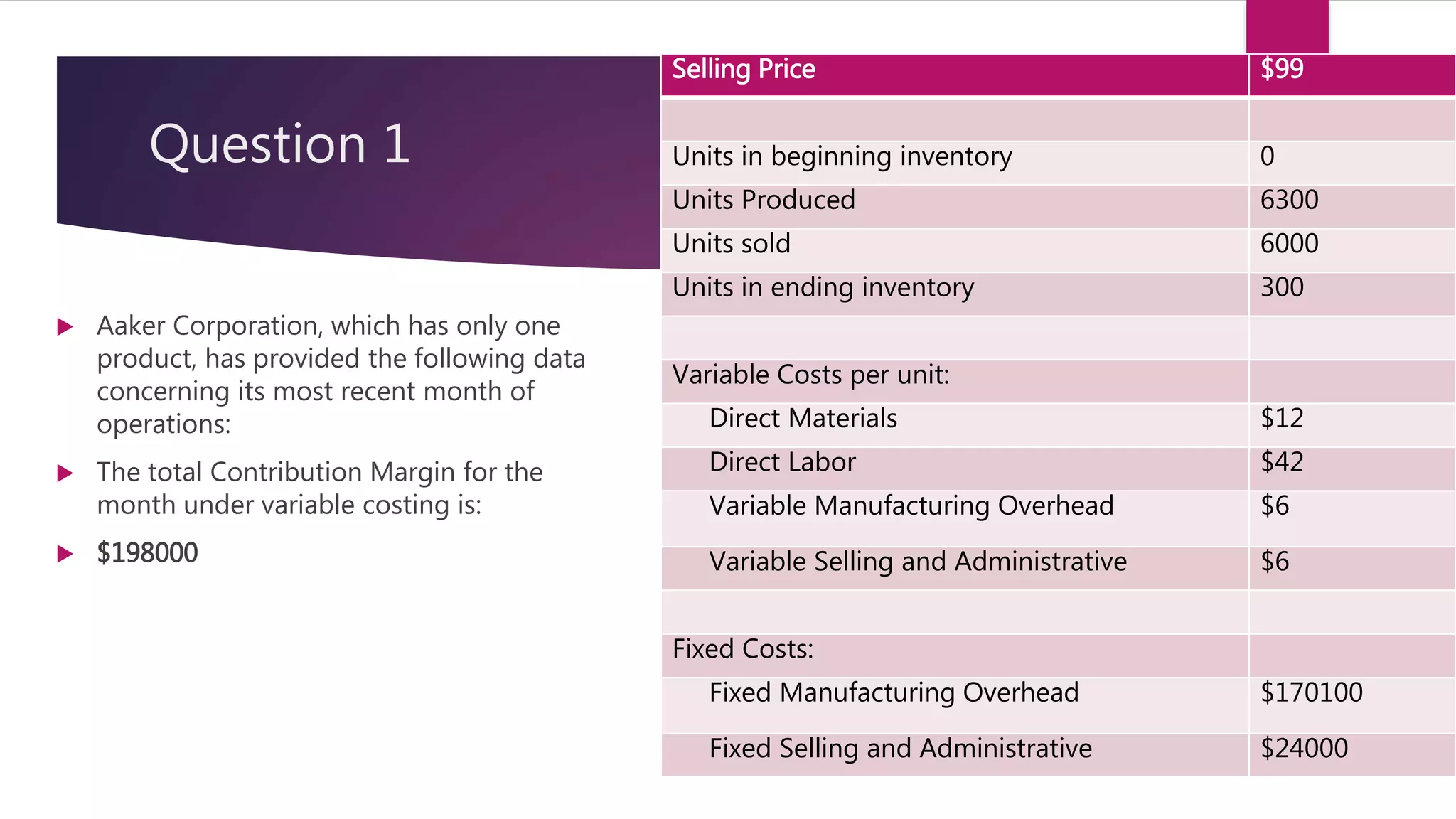
 Aaker Corporation, which has only one
product, has provided the following data
concerning its most recent month of
operations:
 The total Contribution Margin for the
month under variable costing is:
 $198000
Selling Price $99
Units in beginning inventory 0
Units Produced 6300
Units sold 6000
Units in ending inventory 300
Variable Costs per unit:
Direct Materials $12
Direct Labor $42
Variable Manufacturing Overhead $6
Variable Selling and Administrative $6
Fixed Costs:
Fixed Manufacturing Overhead $170100
Fixed Selling and Administrative $24000
Work for Question 1
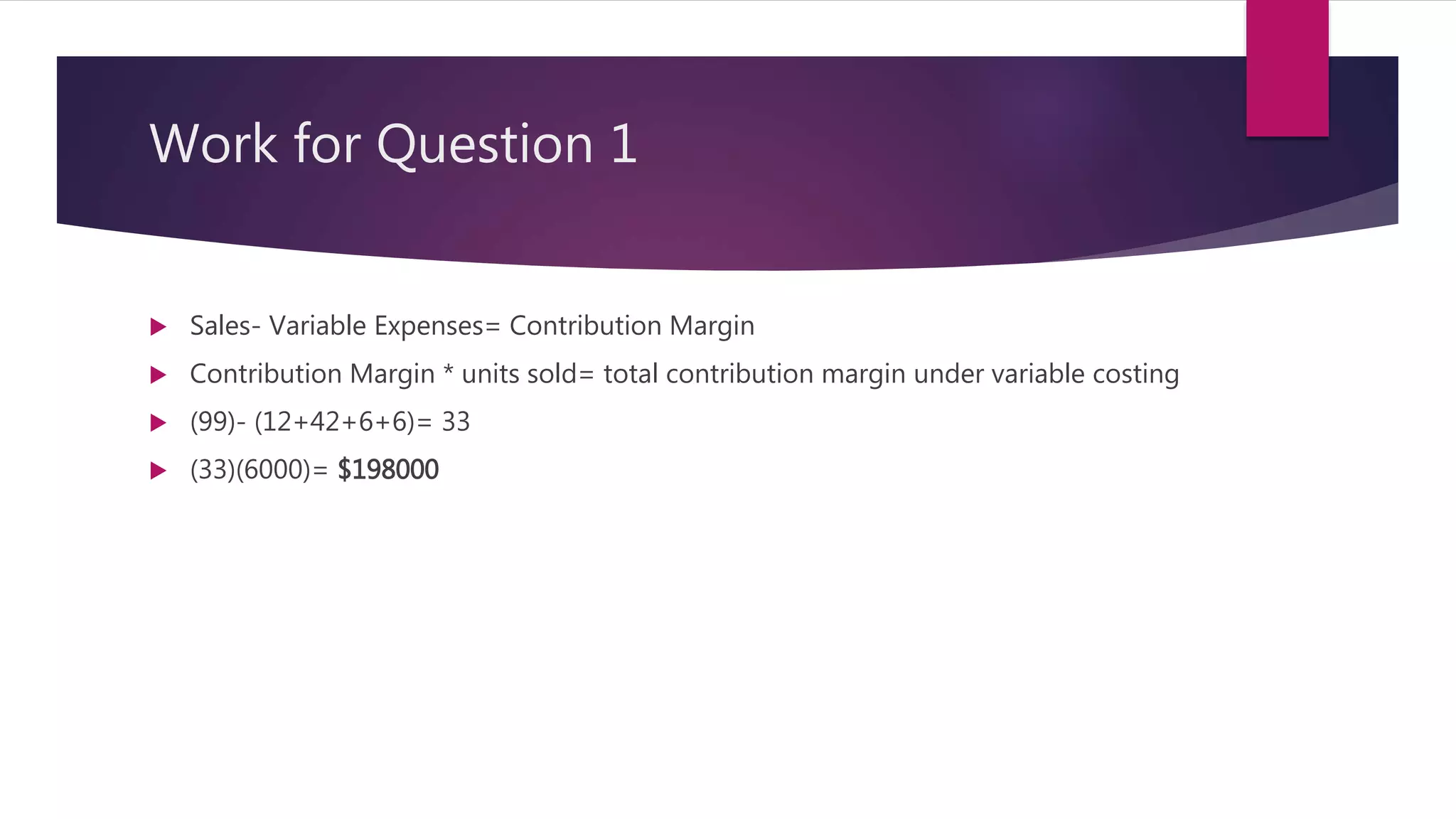
 Sales- Variable Expenses= Contribution Margin
 Contribution Margin * units sold= total contribution margin under variable costing
 (99)- (12+42+6+6)= 33
 (33)(6000)= $198000
Question 2
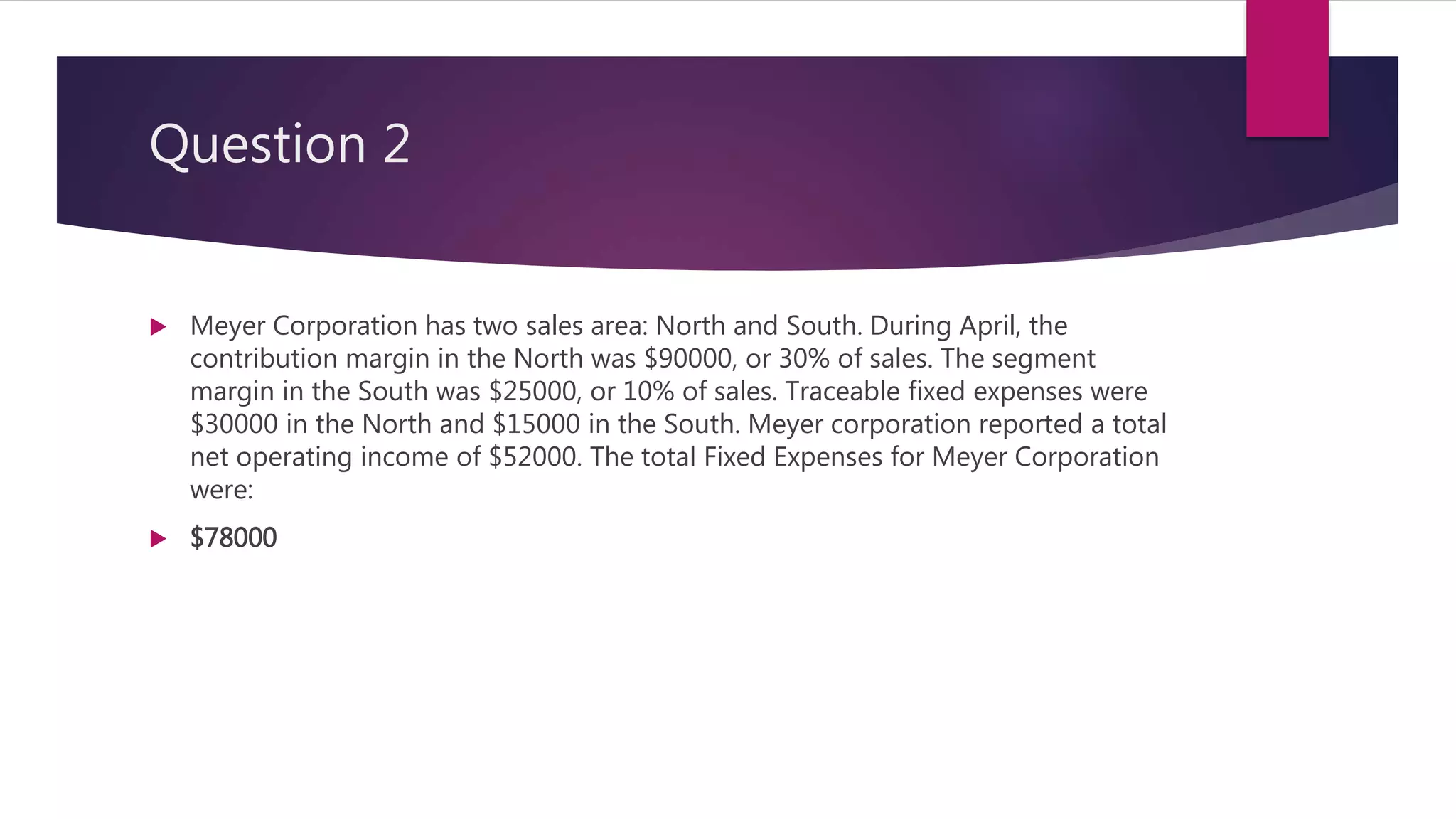
 Meyer Corporation has two sales area: North and South. During April, the
contribution margin in the North was $90000, or 30% of sales. The segment
margin in the South was $25000, or 10% of sales. Traceable fixed expenses were
$30000 in the North and $15000 in the South. Meyer corporation reported a total
net operating income of $52000. The total Fixed Expenses for Meyer Corporation
were:
 $78000
Work for Question 2
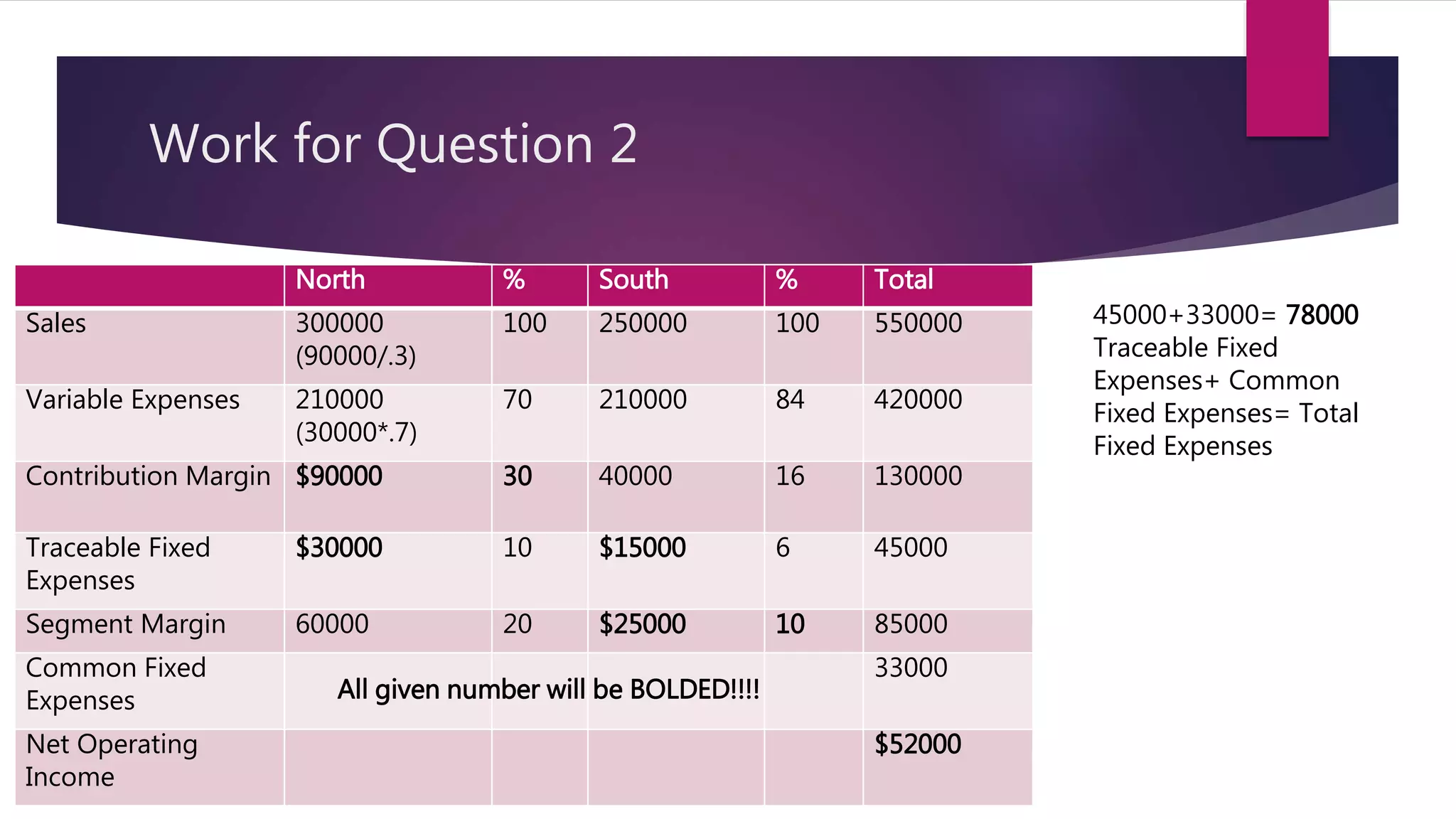
North % South % Total
Sales 300000
(90000/.3)
100 250000 100 550000
Variable Expenses 210000
(30000*.7)
70 210000 84 420000
Contribution Margin $90000 30 40000 16 130000
Traceable Fixed
Expenses
$30000 10 $15000 6 45000
Segment Margin 60000 20 $25000 10 85000
Common Fixed
Expenses
33000
Net Operating
Income
$52000
All given number will be BOLDED!!!!
45000+33000= 78000
Traceable Fixed
Expenses+ Common
Fixed Expenses= Total
Fixed Expenses
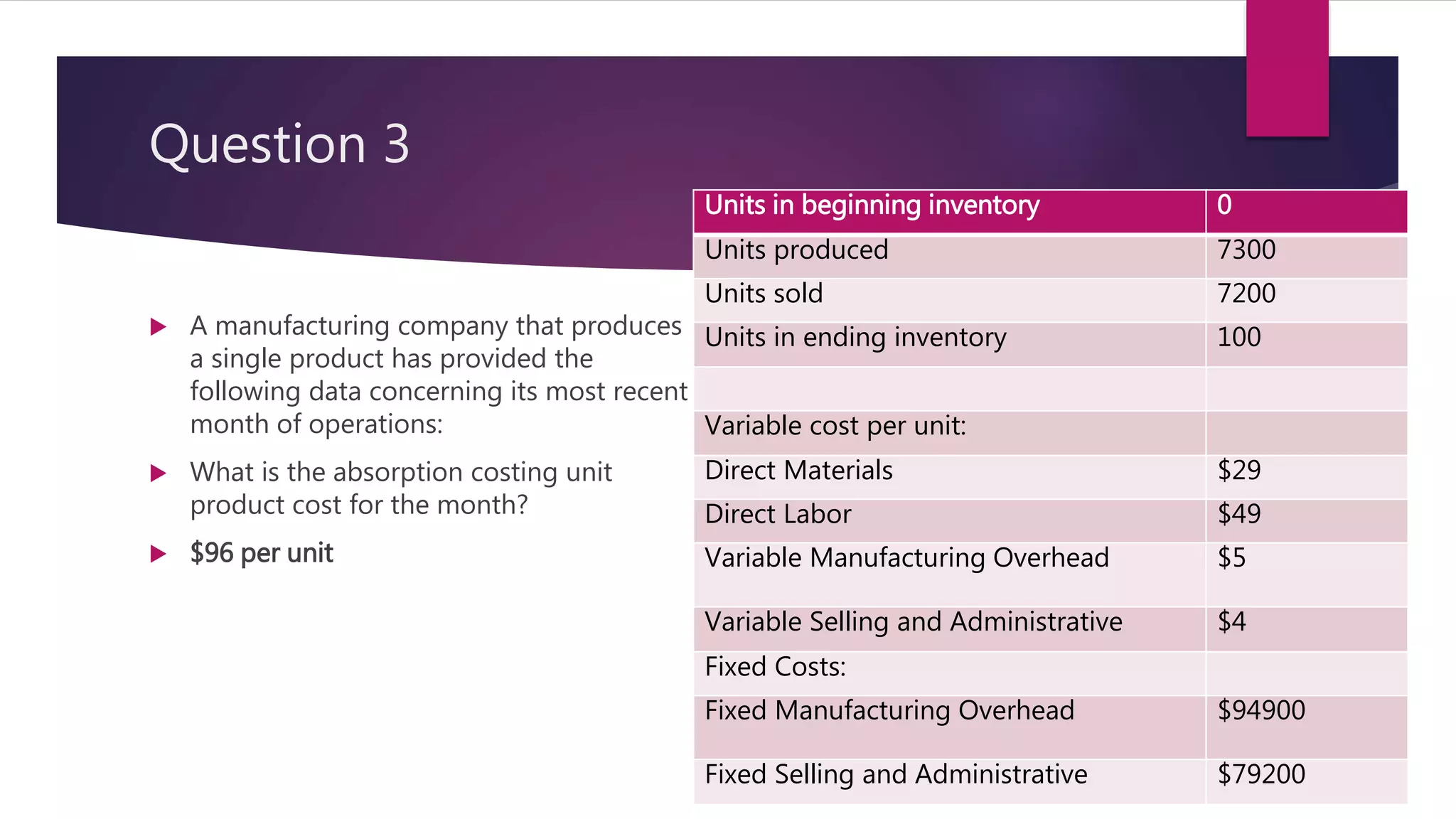
Question 3
 A manufacturing company that produces
a single product has provided the
following data concerning its most recent
month of operations:
 What is the absorption costing unit
product cost for the month?
 $96 per unit
Units in beginning inventory 0
Units produced 7300
Units sold 7200
Units in ending inventory 100
Variable cost per unit:
Direct Materials $29
Direct Labor $49
Variable Manufacturing Overhead $5
Variable Selling and Administrative $4
Fixed Costs:
Fixed Manufacturing Overhead $94900
Fixed Selling and Administrative $79200
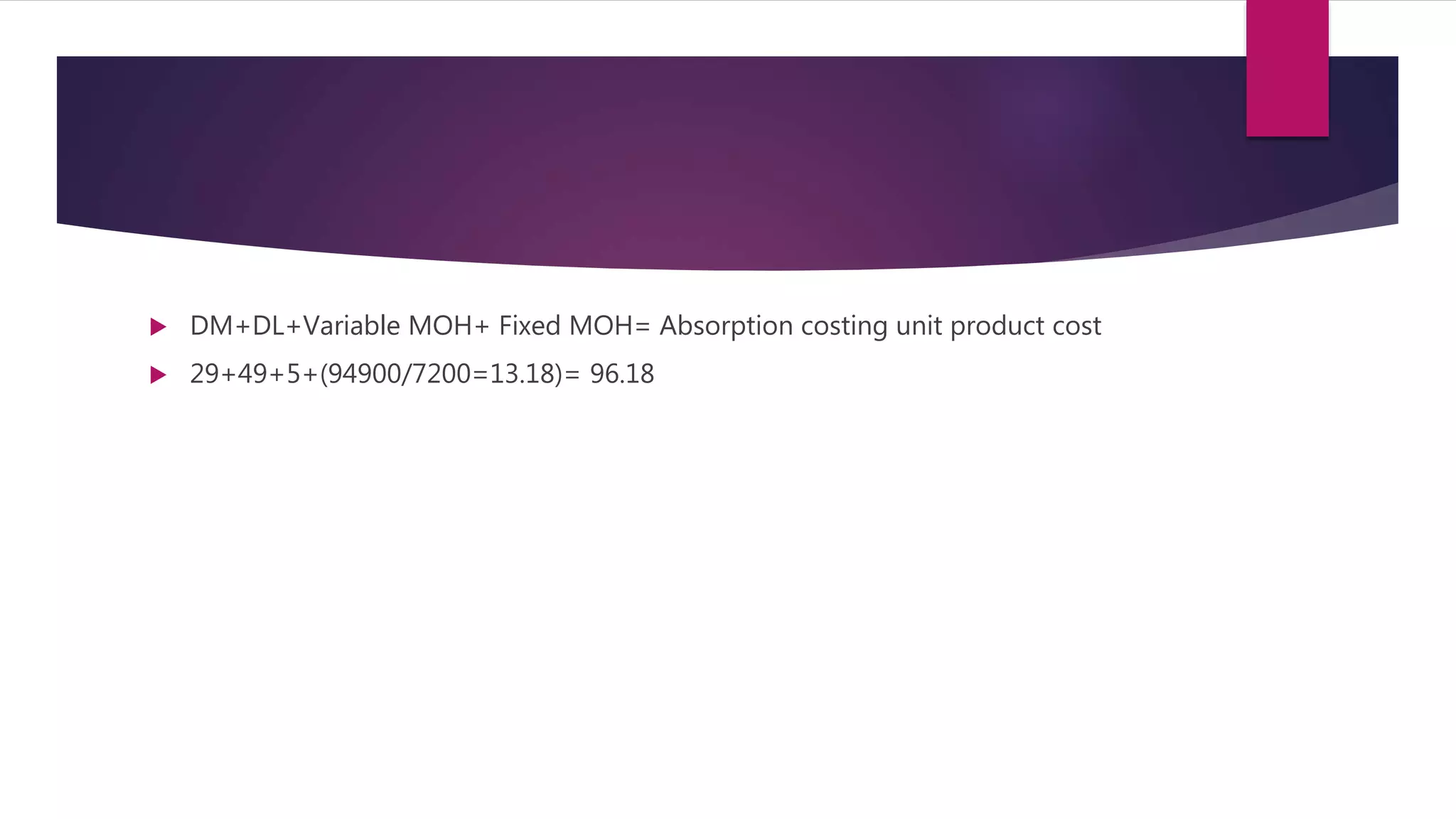
 DM+DL+Variable MOH+ Fixed MOH= Absorption costing unit product cost
 29+49+5+(94900/7200=13.18)= 96.18
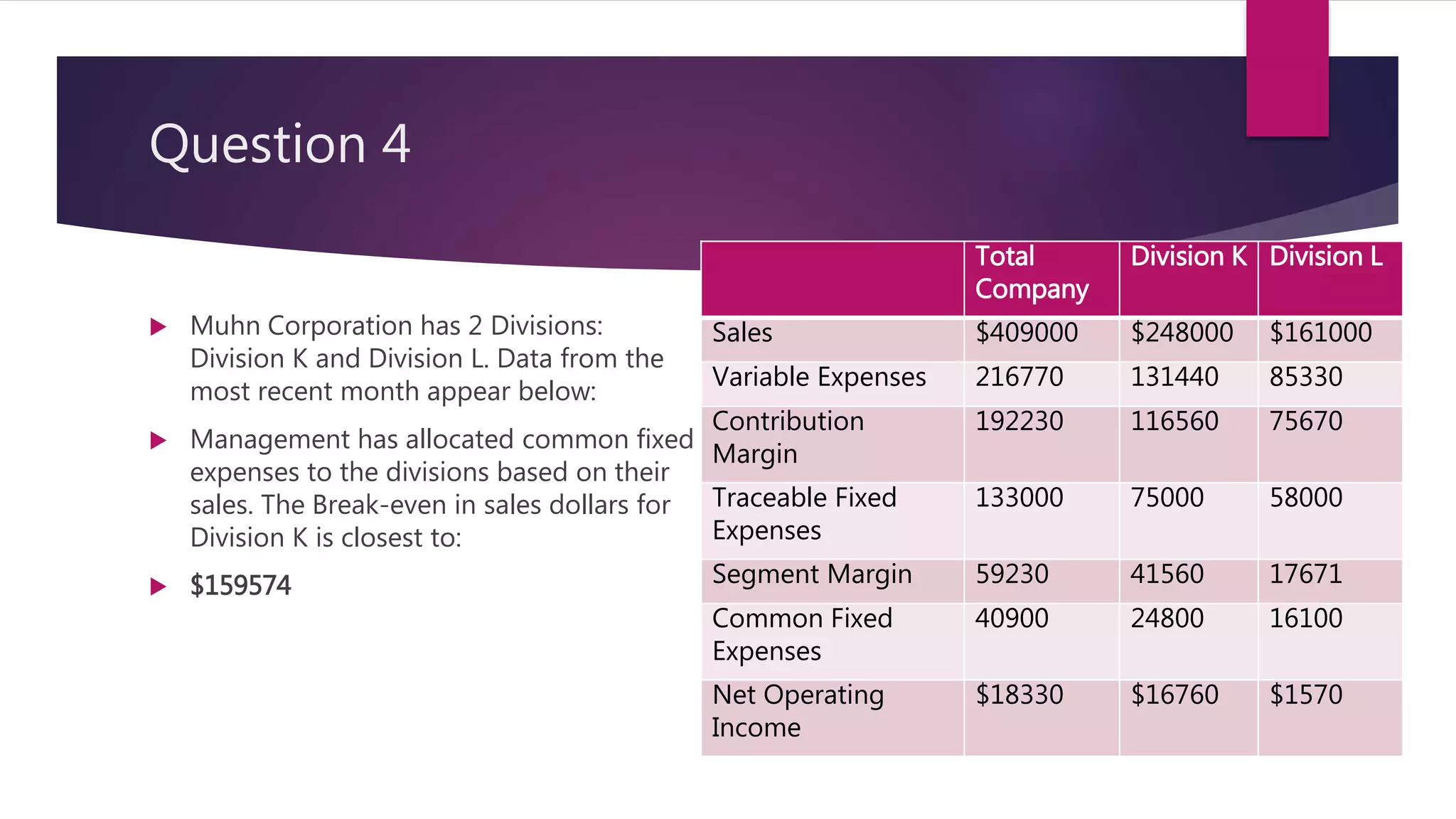
Question 4
 Muhn Corporation has 2 Divisions:
Division K and Division L. Data from the
most recent month appear below:
 Management has allocated common fixed
expenses to the divisions based on their
sales. The Break-even in sales dollars for
Division K is closest to:
 $159574
Total
Company
Division K Division L
Sales $409000 $248000 $161000
Variable Expenses 216770 131440 85330
Contribution
Margin
192230 116560 75670
Traceable Fixed
Expenses
133000 75000 58000
Segment Margin 59230 41560 17671
Common Fixed
Expenses
40900 24800 16100
Net Operating
Income
$18330 $16760 $1570
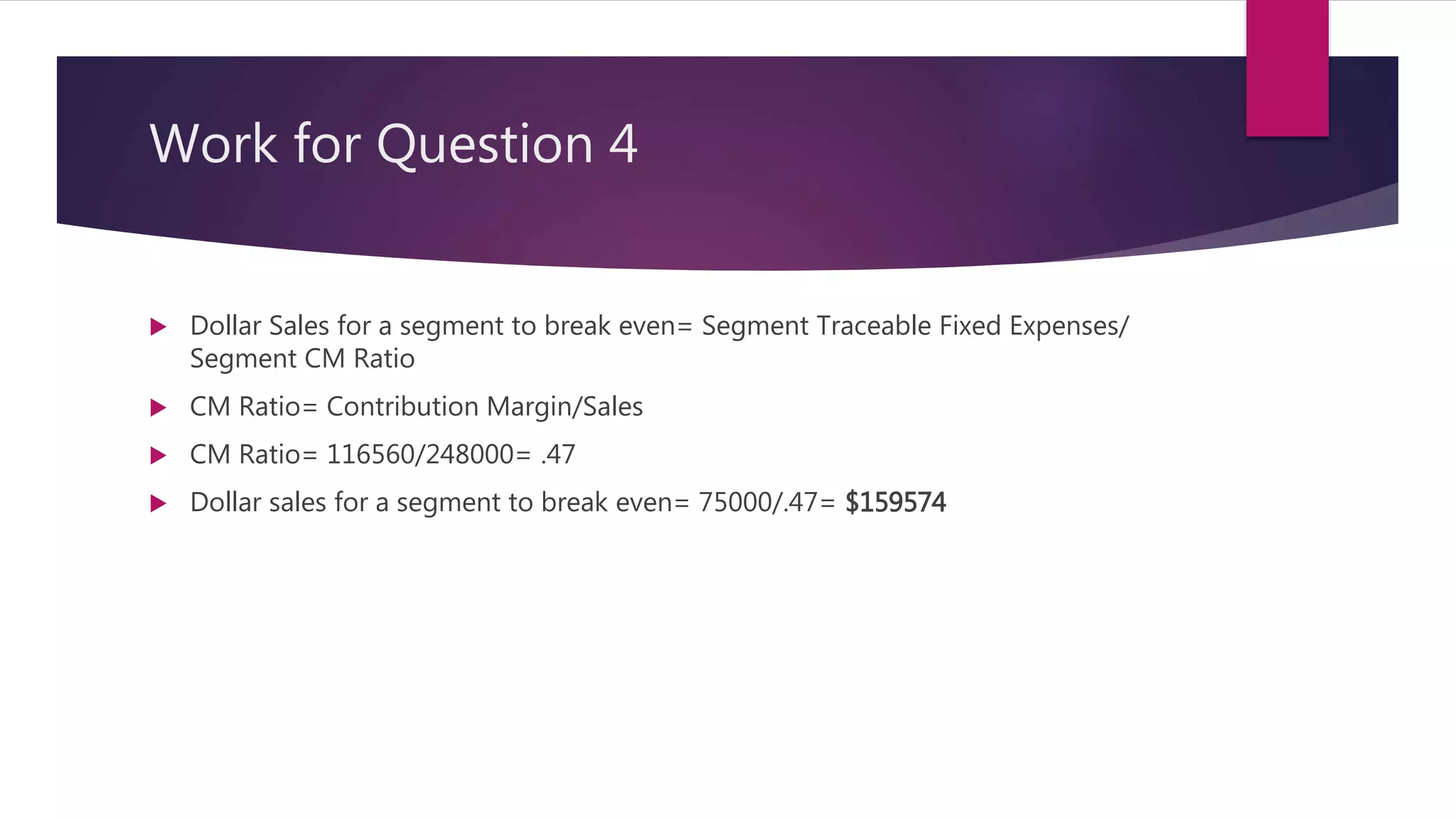
Work for Question 4
 Dollar Sales for a segment to break even= Segment Traceable Fixed Expenses/
Segment CM Ratio
 CM Ratio= Contribution Margin/Sales
 CM Ratio= 116560/248000= .47
 Dollar sales for a segment to break even= 75000/.47= $159574
Question 5
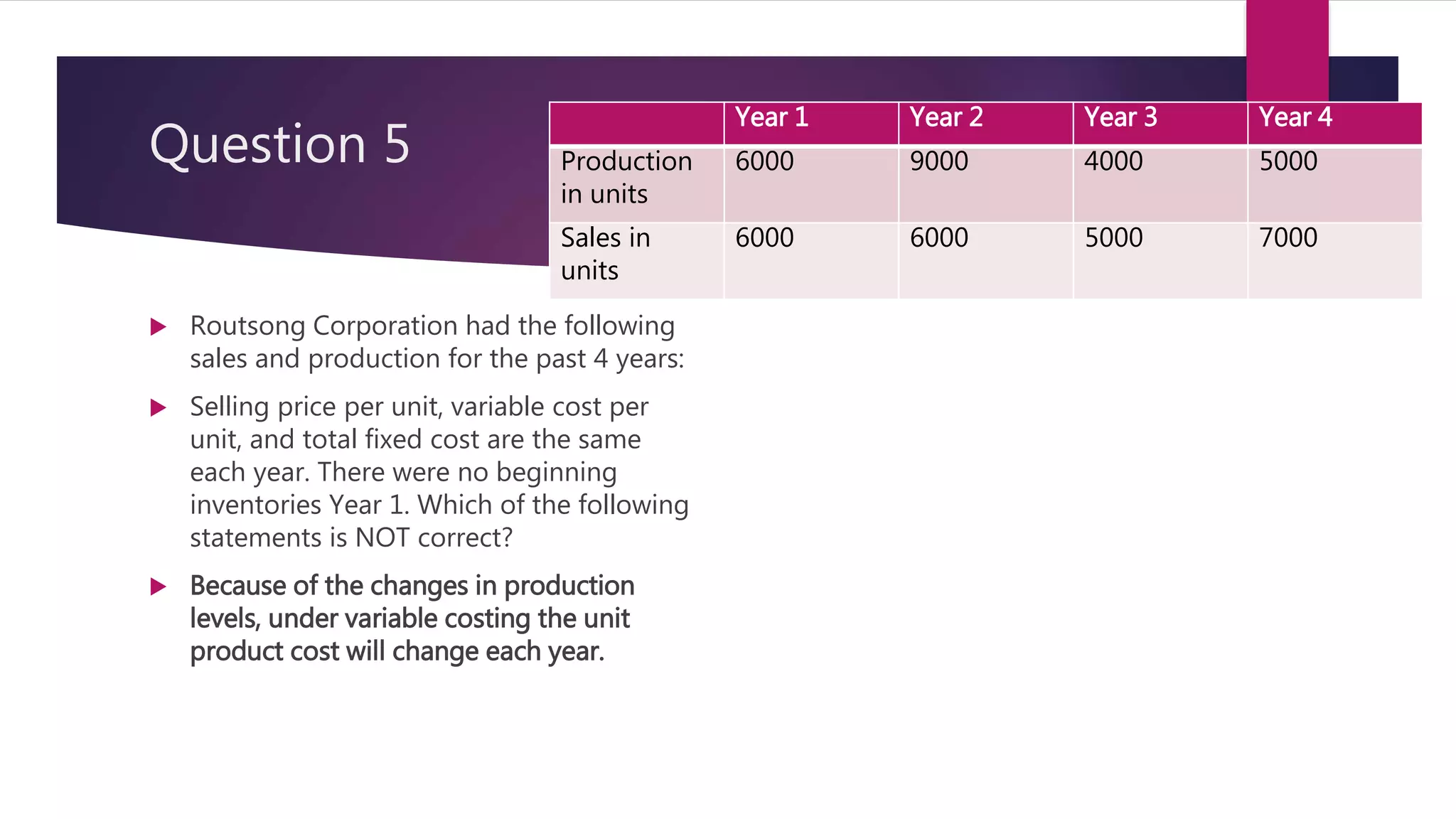
 Routsong Corporation had the following
sales and production for the past 4 years:
 Selling price per unit, variable cost per
unit, and total fixed cost are the same
each year. There were no beginning
inventories Year 1. Which of the following
statements is NOT correct?
 Because of the changes in production
levels, under variable costing the unit
product cost will change each year.
Year 1 Year 2 Year 3 Year 4
Production
in units
6000 9000 4000 5000
Sales in
units
6000 6000 5000 7000
Question 6
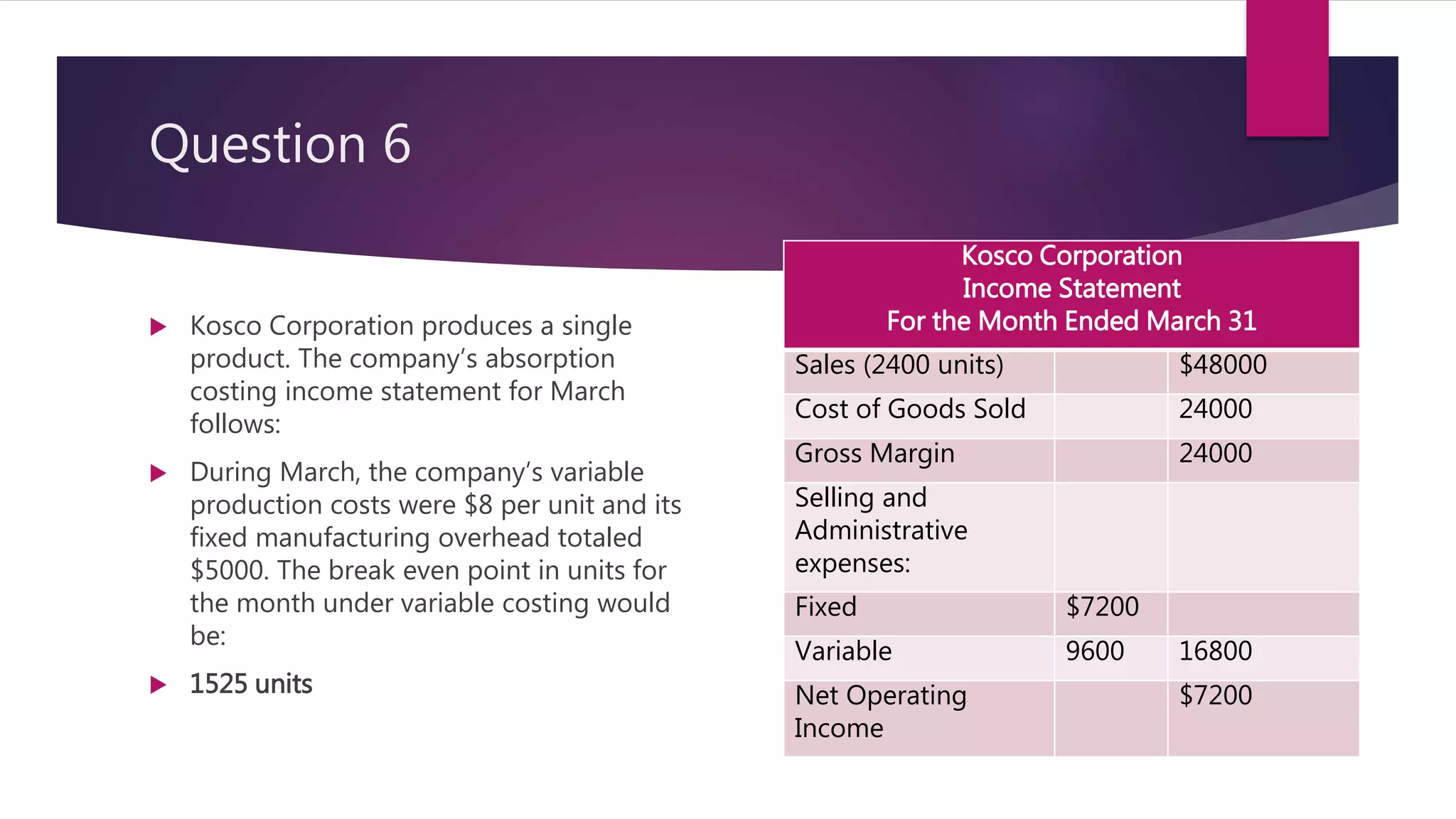
 Kosco Corporation produces a single
product. The company’s absorption
costing income statement for March
follows:
 During March, the company’s variable
production costs were $8 per unit and its
fixed manufacturing overhead totaled
$5000. The break even point in units for
the month under variable costing would
be:
 1525 units
Kosco Corporation
Income Statement
For the Month Ended March 31
Sales (2400 units) $48000
Cost of Goods Sold 24000
Gross Margin 24000
Selling and
Administrative
expenses:
Fixed $7200
Variable 9600 16800
Net Operating
Income
$7200
Work to Question 6
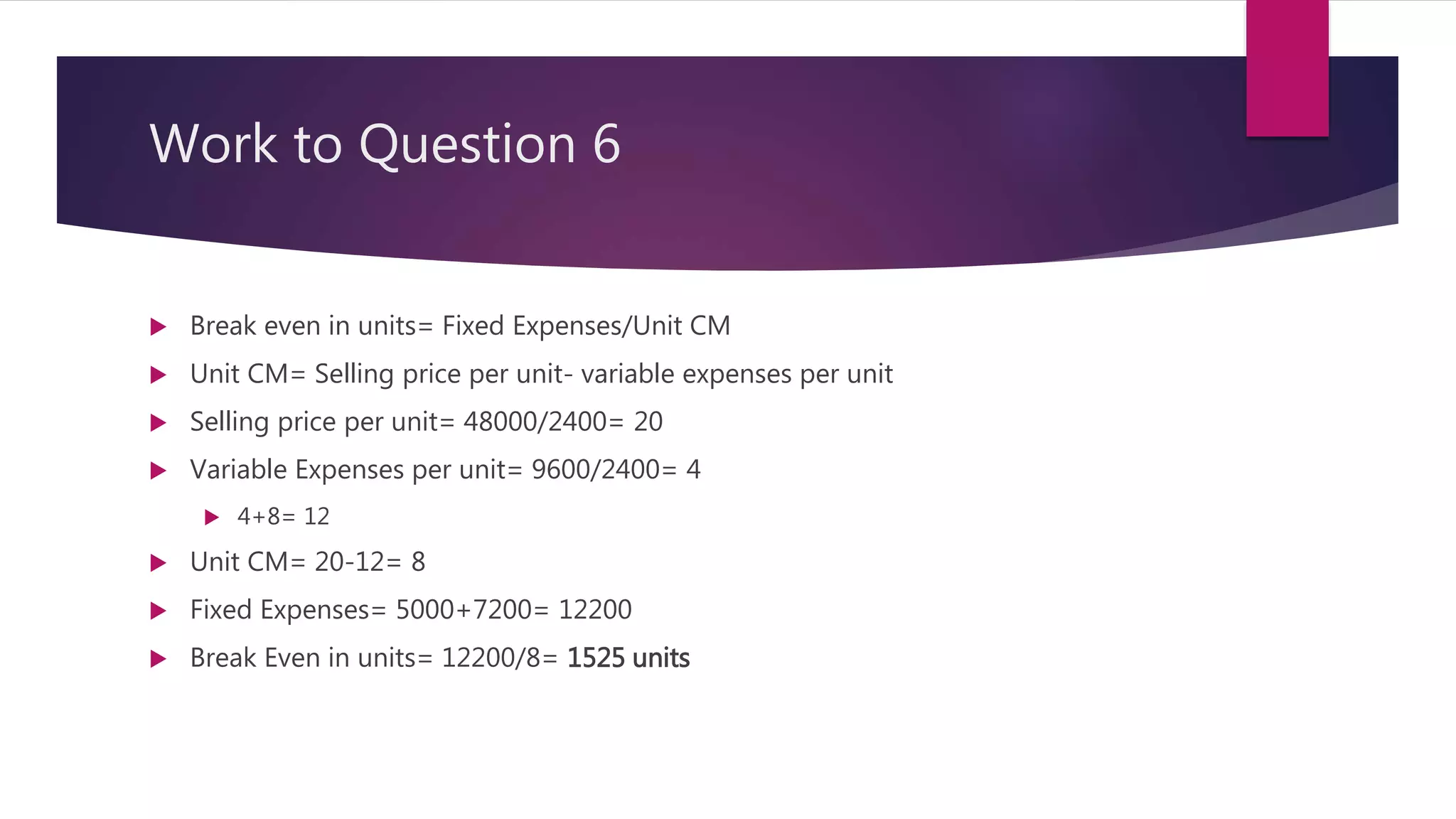
 Break even in units= Fixed Expenses/Unit CM
 Unit CM= Selling price per unit- variable expenses per unit
 Selling price per unit= 48000/2400= 20
 Variable Expenses per unit= 9600/2400= 4
 4+8= 12
 Unit CM= 20-12= 8
 Fixed Expenses= 5000+7200= 12200
 Break Even in units= 12200/8= 1525 units
Question 7
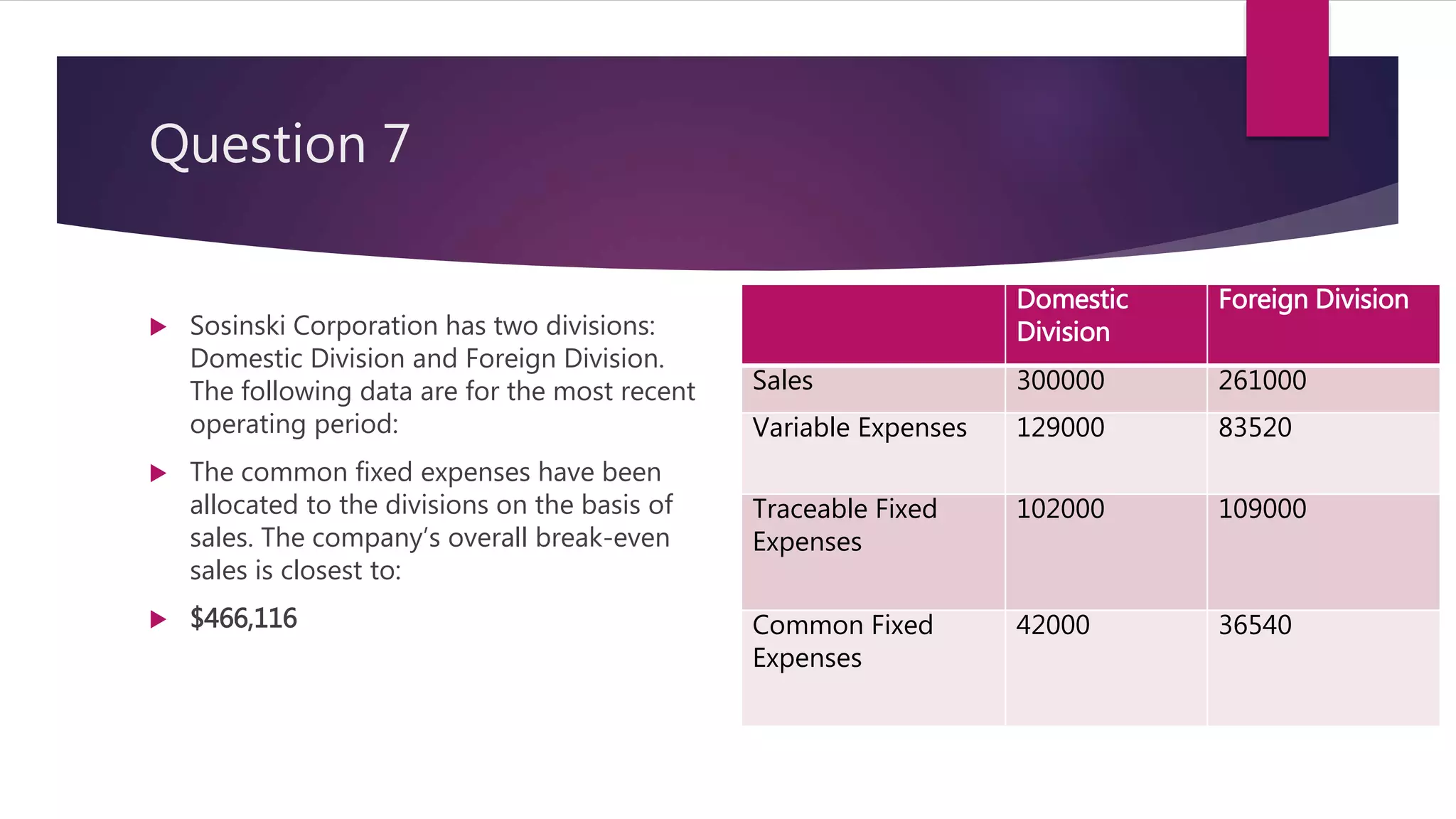
 Sosinski Corporation has two divisions:
Domestic Division and Foreign Division.
The following data are for the most recent
operating period:
 The common fixed expenses have been
allocated to the divisions on the basis of
sales. The company’s overall break-even
sales is closest to:
 $466,116
Domestic
Division
Foreign Division
Sales 300000 261000
Variable Expenses 129000 83520
Traceable Fixed
Expenses
102000 109000
Common Fixed
Expenses
42000 36540
Work to Question 7
 Dollar sales for company to Break Even=
 (Traceable Fixed Costs+ Common Fixed Costs)/Overall CM Ratio
 Overall CM Ratio= (Sales- Variable Expenses)/Sales
 Overall CM Ratio= [(300000+261000)-(129000+83520)]/(300000+261000)
 (561000-212520)/561000
 .62
 Break Even= [(102000+1090000)+(42000+36540)]/.62
 (211000+78540)/.62
 $466116
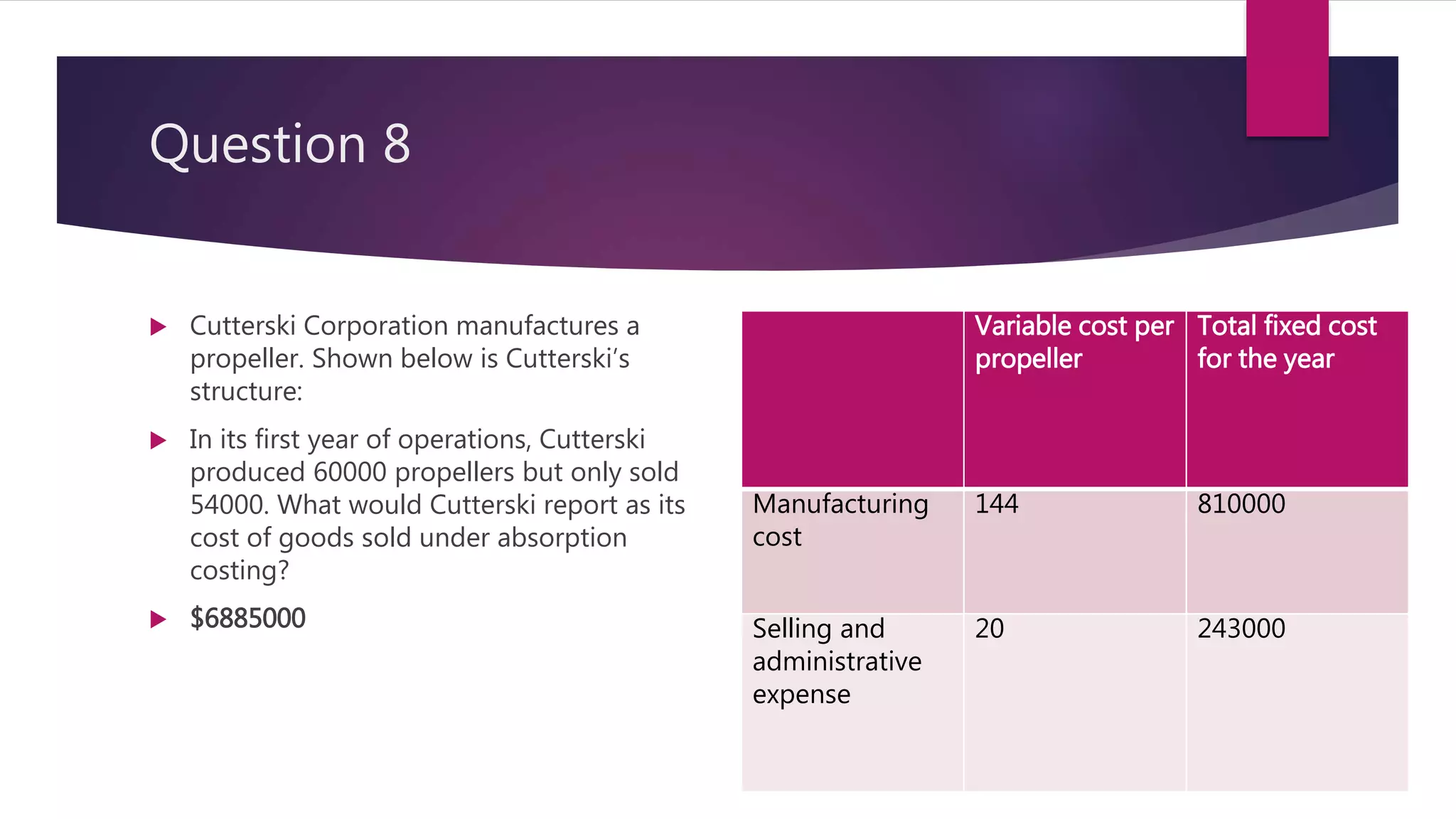
Question 8
 Cutterski Corporation manufactures a
propeller. Shown below is Cutterski’s
structure:
 In its first year of operations, Cutterski
produced 60000 propellers but only sold
54000. What would Cutterski report as its
cost of goods sold under absorption
costing?
 $6885000
Variable cost per
propeller
Total fixed cost
for the year
Manufacturing
cost
144 810000
Selling and
administrative
expense
20 243000
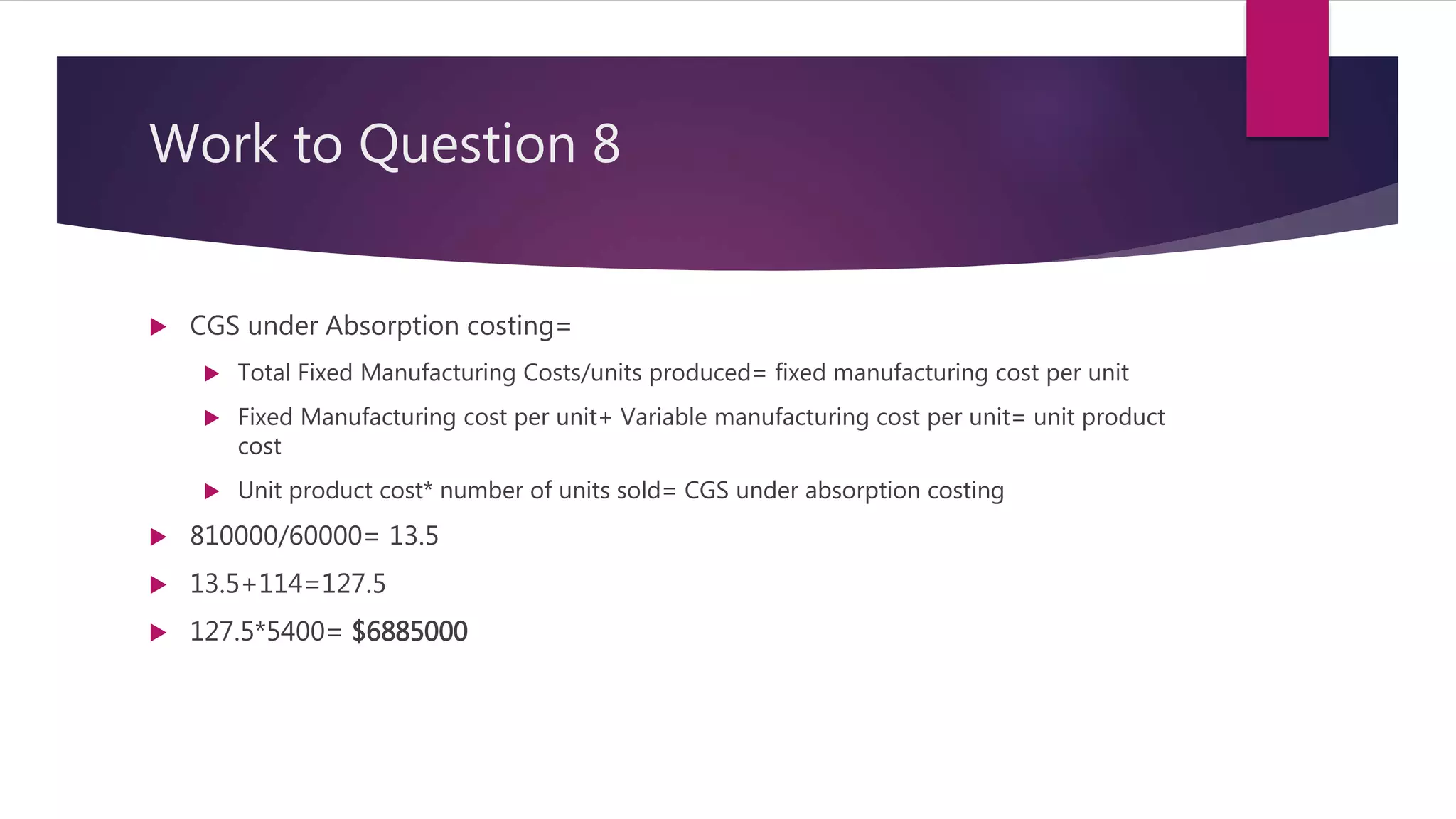
Work to Question 8
 CGS under Absorption costing=
 Total Fixed Manufacturing Costs/units produced= fixed manufacturing cost per unit
 Fixed Manufacturing cost per unit+ Variable manufacturing cost per unit= unit product
cost
 Unit product cost* number of units sold= CGS under absorption costing
 810000/60000= 13.5
 13.5+114=127.5
 127.5*5400= $6885000
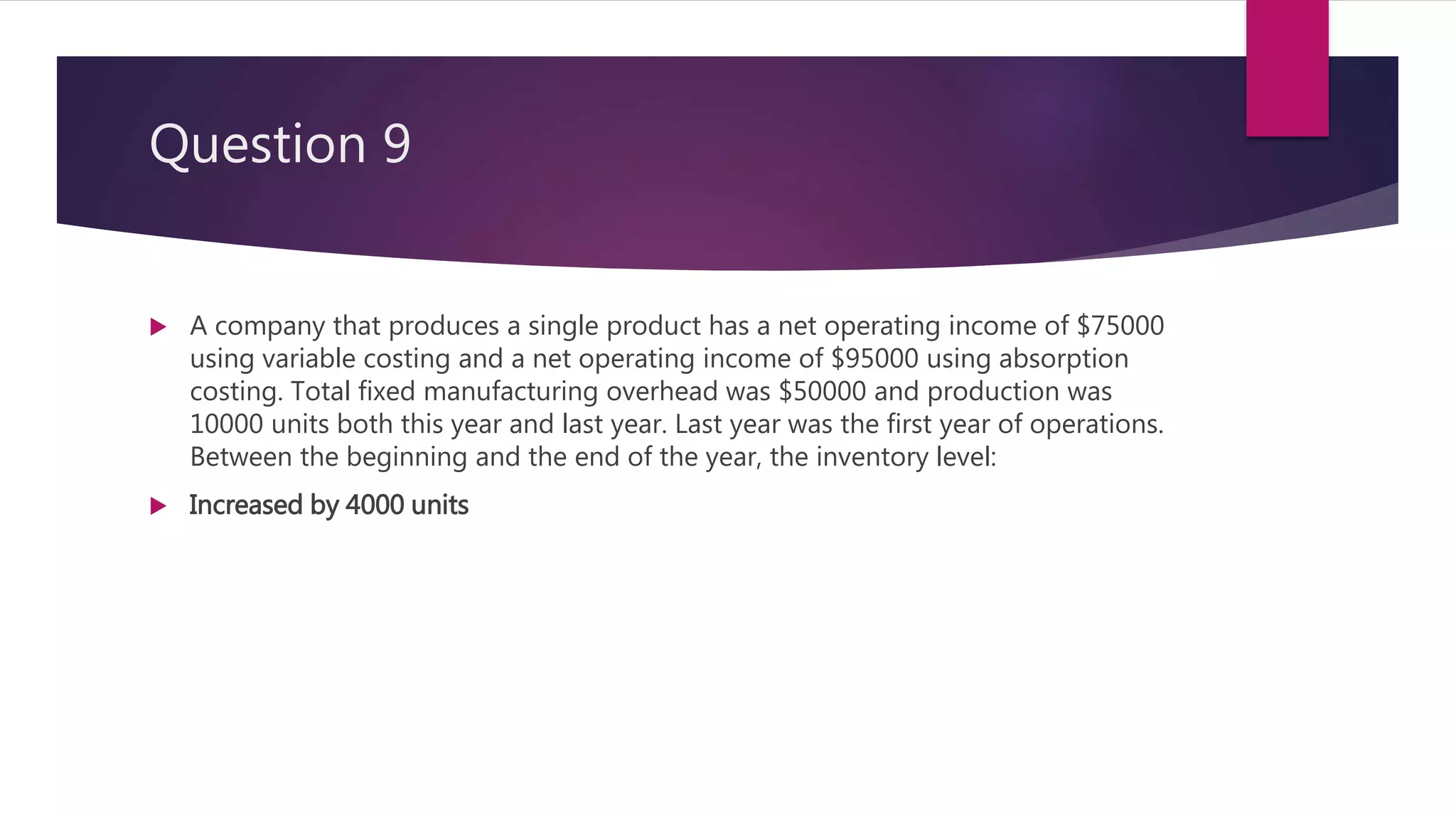
Question 9
 A company that produces a single product has a net operating income of $75000
using variable costing and a net operating income of $95000 using absorption
costing. Total fixed manufacturing overhead was $50000 and production was
10000 units both this year and last year. Last year was the first year of operations.
Between the beginning and the end of the year, the inventory level:
 Increased by 4000 units
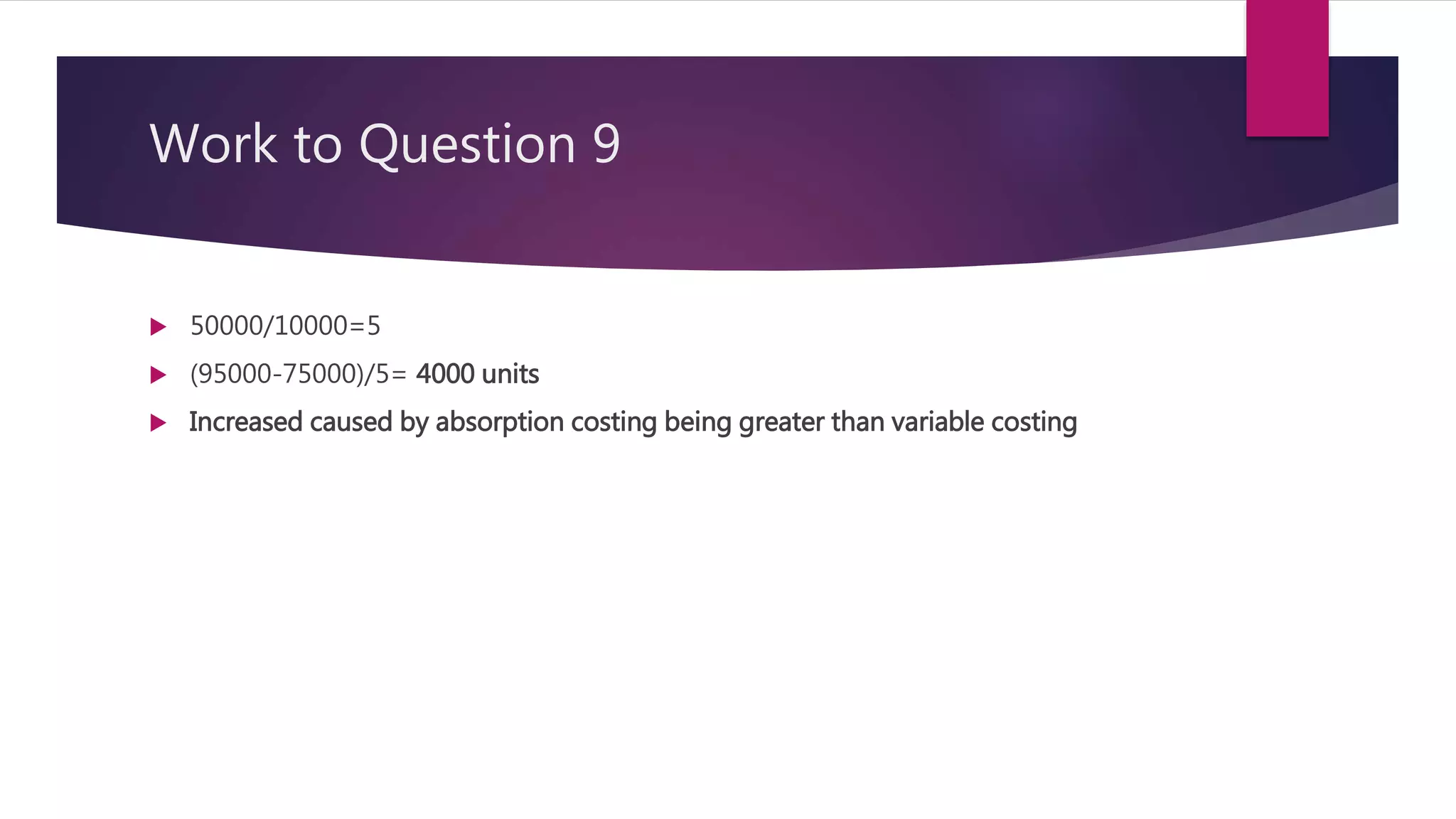
Work to Question 9
 50000/10000=5
 (95000-75000)/5= 4000 units
 Increased caused by absorption costing being greater than variable costing
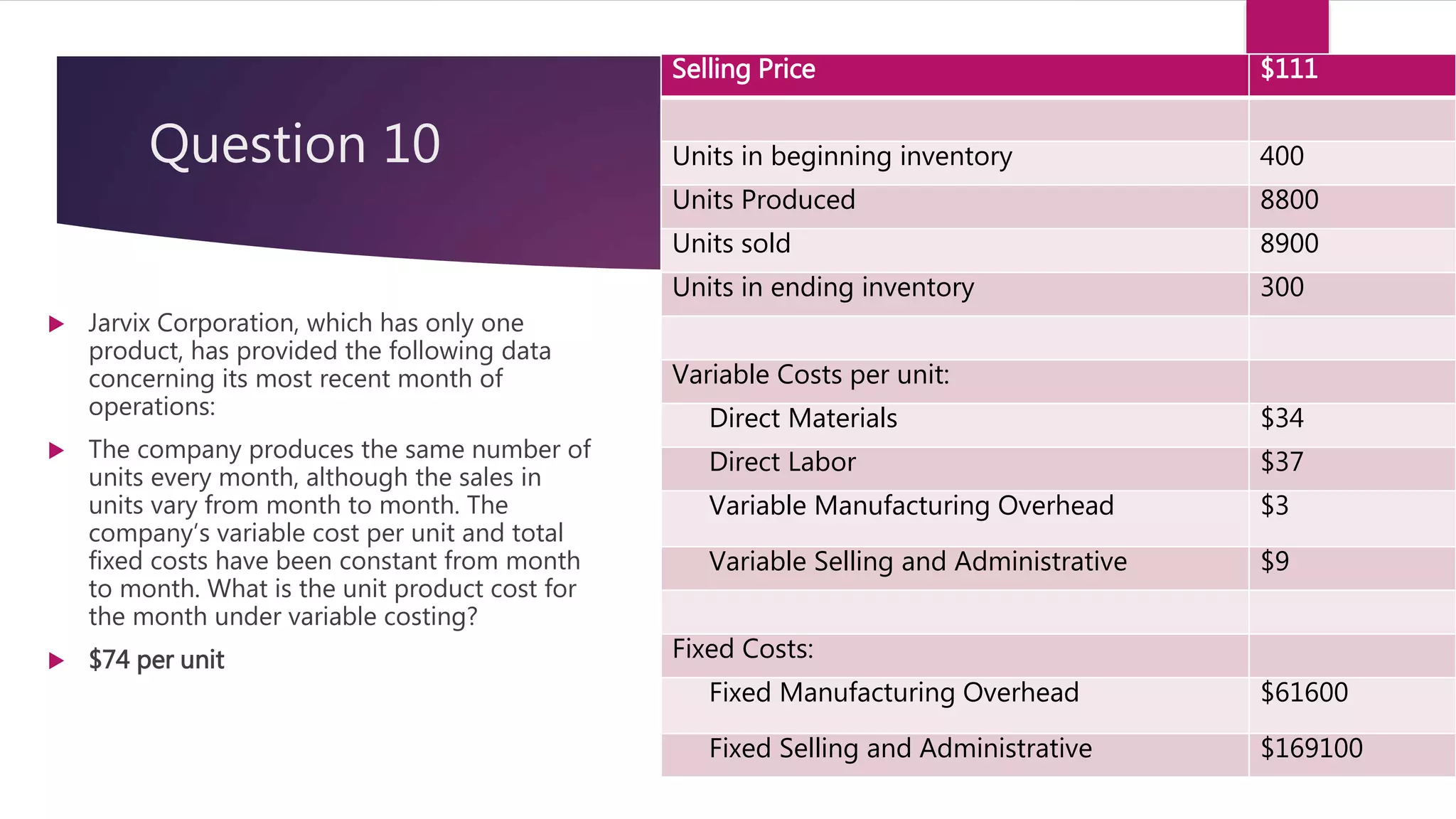
Question 10
 Jarvix Corporation, which has only one
product, has provided the following data
concerning its most recent month of
operations:
 The company produces the same number of
units every month, although the sales in
units vary from month to month. The
company’s variable cost per unit and total
fixed costs have been constant from month
to month. What is the unit product cost for
the month under variable costing?
 $74 per unit
Selling Price $111
Units in beginning inventory 400
Units Produced 8800
Units sold 8900
Units in ending inventory 300
Variable Costs per unit:
Direct Materials $34
Direct Labor $37
Variable Manufacturing Overhead $3
Variable Selling and Administrative $9
Fixed Costs:
Fixed Manufacturing Overhead $61600
Fixed Selling and Administrative $169100
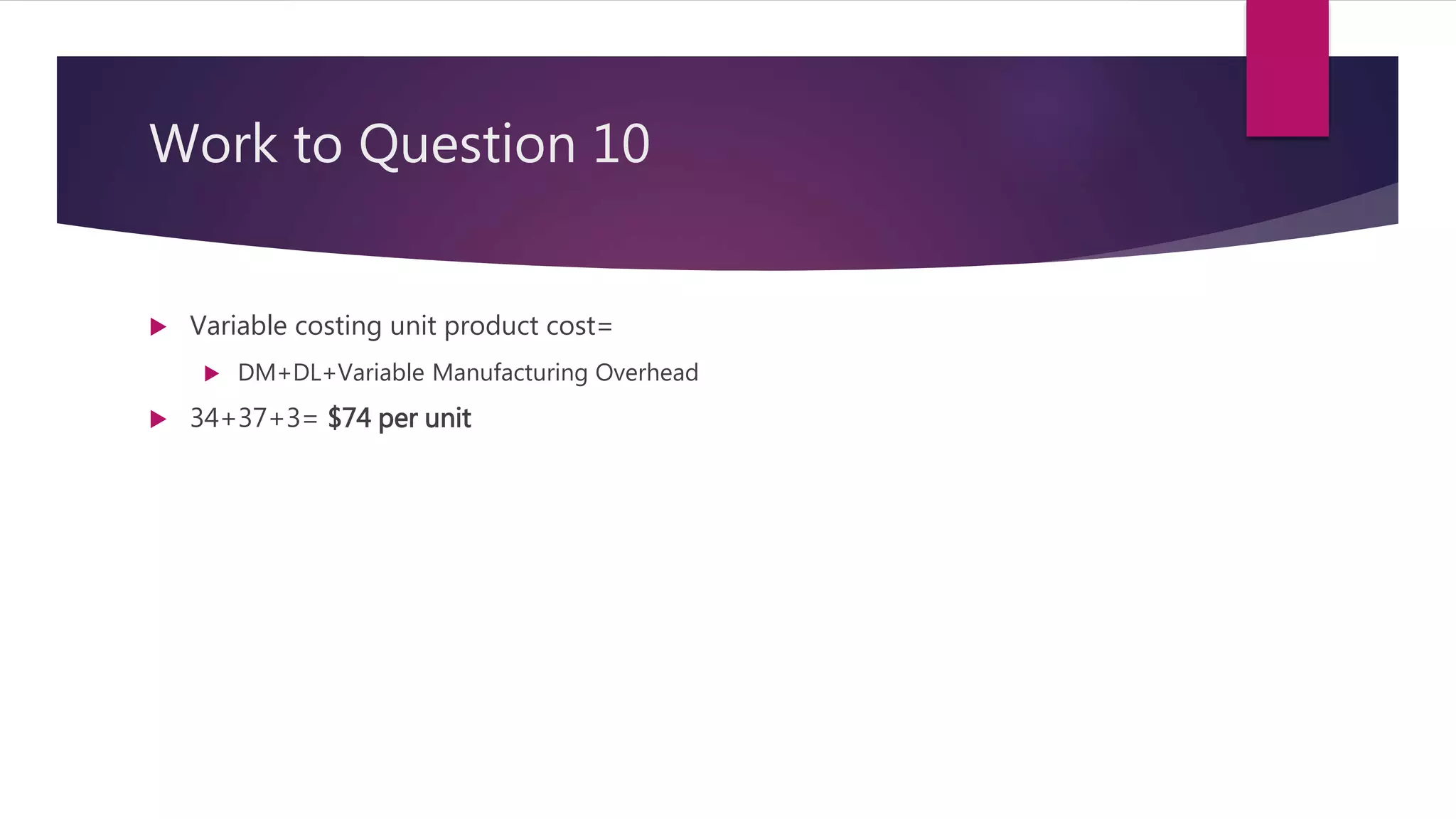
Work to Question 10
 Variable costing unit product cost=
 DM+DL+Variable Manufacturing Overhead
 34+37+3= $74 per unit

Chapter 6 Connect Quiz (Variable Costing and Segment Reporting:Tools for Management)

  • 1.
  • 2.
    Question 1  AakerCorporation, which has only one product, has provided the following data concerning its most recent month of operations:  The total Contribution Margin for the month under variable costing is:  $198000 Selling Price $99 Units in beginning inventory 0 Units Produced 6300 Units sold 6000 Units in ending inventory 300 Variable Costs per unit: Direct Materials $12 Direct Labor $42 Variable Manufacturing Overhead $6 Variable Selling and Administrative $6 Fixed Costs: Fixed Manufacturing Overhead $170100 Fixed Selling and Administrative $24000
  • 3.
    Work for Question1  Sales- Variable Expenses= Contribution Margin  Contribution Margin * units sold= total contribution margin under variable costing  (99)- (12+42+6+6)= 33  (33)(6000)= $198000
  • 4.
    Question 2  MeyerCorporation has two sales area: North and South. During April, the contribution margin in the North was $90000, or 30% of sales. The segment margin in the South was $25000, or 10% of sales. Traceable fixed expenses were $30000 in the North and $15000 in the South. Meyer corporation reported a total net operating income of $52000. The total Fixed Expenses for Meyer Corporation were:  $78000
  • 5.
    Work for Question2 North % South % Total Sales 300000 (90000/.3) 100 250000 100 550000 Variable Expenses 210000 (30000*.7) 70 210000 84 420000 Contribution Margin $90000 30 40000 16 130000 Traceable Fixed Expenses $30000 10 $15000 6 45000 Segment Margin 60000 20 $25000 10 85000 Common Fixed Expenses 33000 Net Operating Income $52000 All given number will be BOLDED!!!! 45000+33000= 78000 Traceable Fixed Expenses+ Common Fixed Expenses= Total Fixed Expenses
  • 6.
    Question 3  Amanufacturing company that produces a single product has provided the following data concerning its most recent month of operations:  What is the absorption costing unit product cost for the month?  $96 per unit Units in beginning inventory 0 Units produced 7300 Units sold 7200 Units in ending inventory 100 Variable cost per unit: Direct Materials $29 Direct Labor $49 Variable Manufacturing Overhead $5 Variable Selling and Administrative $4 Fixed Costs: Fixed Manufacturing Overhead $94900 Fixed Selling and Administrative $79200
  • 7.
     DM+DL+Variable MOH+Fixed MOH= Absorption costing unit product cost  29+49+5+(94900/7200=13.18)= 96.18
  • 8.
    Question 4  MuhnCorporation has 2 Divisions: Division K and Division L. Data from the most recent month appear below:  Management has allocated common fixed expenses to the divisions based on their sales. The Break-even in sales dollars for Division K is closest to:  $159574 Total Company Division K Division L Sales $409000 $248000 $161000 Variable Expenses 216770 131440 85330 Contribution Margin 192230 116560 75670 Traceable Fixed Expenses 133000 75000 58000 Segment Margin 59230 41560 17671 Common Fixed Expenses 40900 24800 16100 Net Operating Income $18330 $16760 $1570
  • 9.
    Work for Question4  Dollar Sales for a segment to break even= Segment Traceable Fixed Expenses/ Segment CM Ratio  CM Ratio= Contribution Margin/Sales  CM Ratio= 116560/248000= .47  Dollar sales for a segment to break even= 75000/.47= $159574
  • 10.
    Question 5  RoutsongCorporation had the following sales and production for the past 4 years:  Selling price per unit, variable cost per unit, and total fixed cost are the same each year. There were no beginning inventories Year 1. Which of the following statements is NOT correct?  Because of the changes in production levels, under variable costing the unit product cost will change each year. Year 1 Year 2 Year 3 Year 4 Production in units 6000 9000 4000 5000 Sales in units 6000 6000 5000 7000
  • 11.
    Question 6  KoscoCorporation produces a single product. The company’s absorption costing income statement for March follows:  During March, the company’s variable production costs were $8 per unit and its fixed manufacturing overhead totaled $5000. The break even point in units for the month under variable costing would be:  1525 units Kosco Corporation Income Statement For the Month Ended March 31 Sales (2400 units) $48000 Cost of Goods Sold 24000 Gross Margin 24000 Selling and Administrative expenses: Fixed $7200 Variable 9600 16800 Net Operating Income $7200
  • 12.
    Work to Question6  Break even in units= Fixed Expenses/Unit CM  Unit CM= Selling price per unit- variable expenses per unit  Selling price per unit= 48000/2400= 20  Variable Expenses per unit= 9600/2400= 4  4+8= 12  Unit CM= 20-12= 8  Fixed Expenses= 5000+7200= 12200  Break Even in units= 12200/8= 1525 units
  • 13.
    Question 7  SosinskiCorporation has two divisions: Domestic Division and Foreign Division. The following data are for the most recent operating period:  The common fixed expenses have been allocated to the divisions on the basis of sales. The company’s overall break-even sales is closest to:  $466,116 Domestic Division Foreign Division Sales 300000 261000 Variable Expenses 129000 83520 Traceable Fixed Expenses 102000 109000 Common Fixed Expenses 42000 36540
  • 14.
    Work to Question7  Dollar sales for company to Break Even=  (Traceable Fixed Costs+ Common Fixed Costs)/Overall CM Ratio  Overall CM Ratio= (Sales- Variable Expenses)/Sales  Overall CM Ratio= [(300000+261000)-(129000+83520)]/(300000+261000)  (561000-212520)/561000  .62  Break Even= [(102000+1090000)+(42000+36540)]/.62  (211000+78540)/.62  $466116
  • 15.
    Question 8  CutterskiCorporation manufactures a propeller. Shown below is Cutterski’s structure:  In its first year of operations, Cutterski produced 60000 propellers but only sold 54000. What would Cutterski report as its cost of goods sold under absorption costing?  $6885000 Variable cost per propeller Total fixed cost for the year Manufacturing cost 144 810000 Selling and administrative expense 20 243000
  • 16.
    Work to Question8  CGS under Absorption costing=  Total Fixed Manufacturing Costs/units produced= fixed manufacturing cost per unit  Fixed Manufacturing cost per unit+ Variable manufacturing cost per unit= unit product cost  Unit product cost* number of units sold= CGS under absorption costing  810000/60000= 13.5  13.5+114=127.5  127.5*5400= $6885000
  • 17.
    Question 9  Acompany that produces a single product has a net operating income of $75000 using variable costing and a net operating income of $95000 using absorption costing. Total fixed manufacturing overhead was $50000 and production was 10000 units both this year and last year. Last year was the first year of operations. Between the beginning and the end of the year, the inventory level:  Increased by 4000 units
  • 18.
    Work to Question9  50000/10000=5  (95000-75000)/5= 4000 units  Increased caused by absorption costing being greater than variable costing
  • 19.
    Question 10  JarvixCorporation, which has only one product, has provided the following data concerning its most recent month of operations:  The company produces the same number of units every month, although the sales in units vary from month to month. The company’s variable cost per unit and total fixed costs have been constant from month to month. What is the unit product cost for the month under variable costing?  $74 per unit Selling Price $111 Units in beginning inventory 400 Units Produced 8800 Units sold 8900 Units in ending inventory 300 Variable Costs per unit: Direct Materials $34 Direct Labor $37 Variable Manufacturing Overhead $3 Variable Selling and Administrative $9 Fixed Costs: Fixed Manufacturing Overhead $61600 Fixed Selling and Administrative $169100
  • 20.
    Work to Question10  Variable costing unit product cost=  DM+DL+Variable Manufacturing Overhead  34+37+3= $74 per unit