IBM Corporation Turnaround
Bharti
Bankey
Swati
Prasad
Saloni
Sanghani
Ajinkya
Thanekar
Kriti Sahu
Satyam
Gumasta
Rohit
Gupta
INDUSTRY ANALYSIS
Global
Technology
Services
Global
Business
Services
Software
System and
Technology
Global
Financing
Products And
Services
IBM Evolution
Founded in
1911 by
Charles
Ranlett Flint.
Thomas J. Watson took
over as the CEO on
1914- built a sales
powerhouse, corporate
culture and a strong
focus on research and
international sales.
In 1924 The
company was
subsequently
renamed
International
Business Machines
with the birth
Slogan of THINK.
Thomas J. Watson Jr.
took charge as the CEO
in 1956,, moved the
company into the
electronics era,
building it into the
mainframe
powerhouse.
T. Vincent
Learson -
CEO from
1971 to
1973.
Frank T. Cary -
CEO from 1973 to
1981.
John R. Opel -
CEO from 1981
to 1985.
In 1984 IBM
captured 70% of
Industry’s Profits
and became the
world’s leading IT
company.
John F. Akers —
CEO from 1985 to
1993. Joined in a
peak condition
which later ended
up the company
in deep crises.
Louis V. Gerstner — CEO
1993 to 2002. He
launched a new system
in which there were no
scattered companies.
“Going to the market as
one IBM”- Turnaround
point.
Sam Palmisano
— CEO from
2002 to 2012.
he helped
create IBM
Global Services.
Ginni Rometty
— CEO 2012
till date.
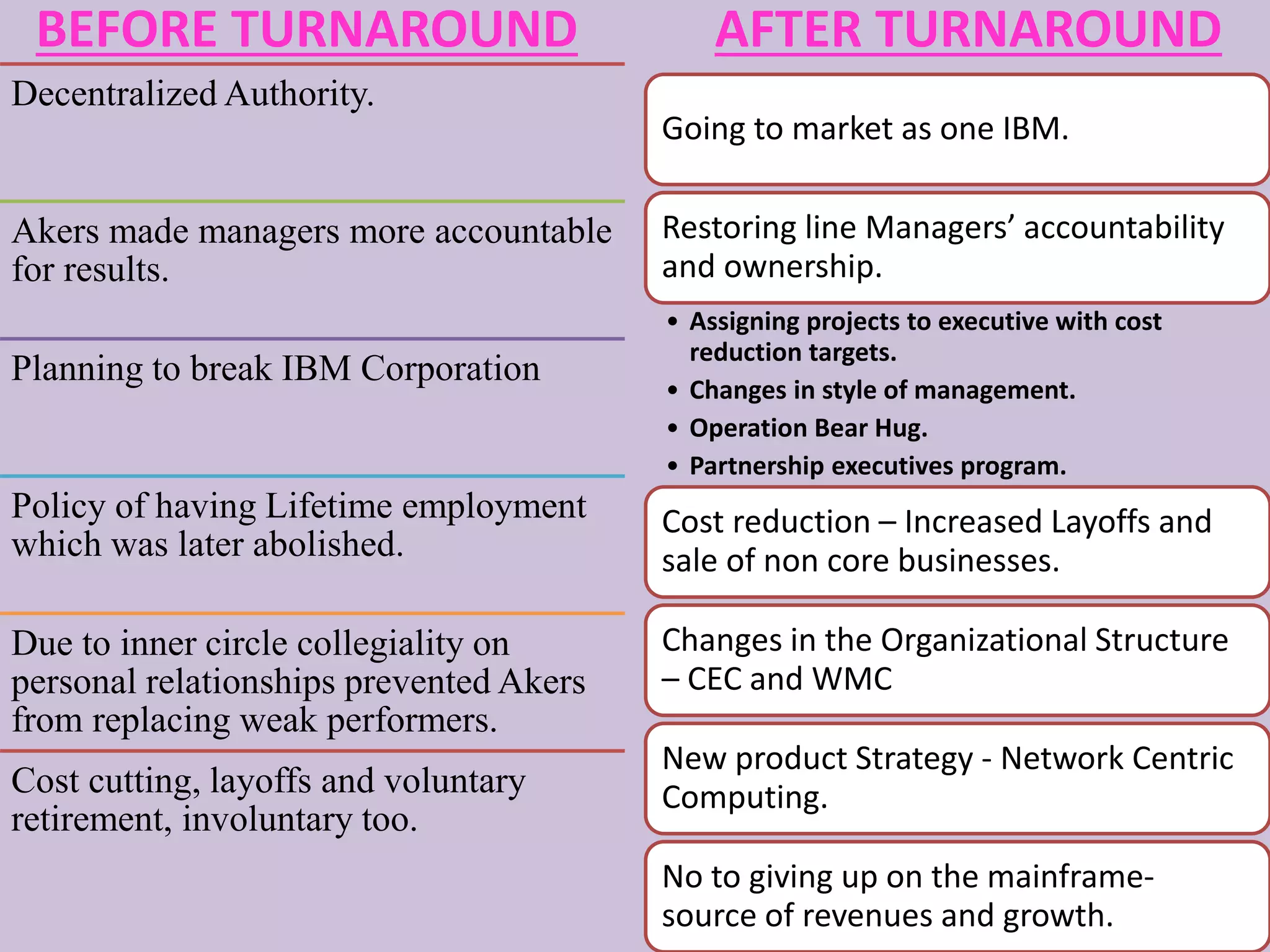
BEFORE TURNAROUND
Decentralized Authority.
Akers made managers more accountable
for results.
Planning to break IBM Corporation
Policy of having Lifetime employment
which was later abolished.
Due to inner circle collegiality on
personal relationships prevented Akers
from replacing weak performers.
Cost cutting, layoffs and voluntary
retirement, involuntary too.
AFTER TURNAROUND
Going to market as one IBM.
Restoring line Managers’ accountability
and ownership.
• Assigning projects to executive with cost
reduction targets.
• Changes in style of management.
• Operation Bear Hug.
• Partnership executives program.
Cost reduction – Increased Layoffs and
sale of non core businesses.
Changes in the Organizational Structure
– CEC and WMC
New product Strategy - Network Centric
Computing.
No to giving up on the mainframe-
source of revenues and growth.
Problems
Demand for IBM
core mainframe
was decreasing
Weak marketing
strategies and
customer
relationships
Bureaucracy
hindered decision
making
Relentless cost
cutting and low
staff morale.
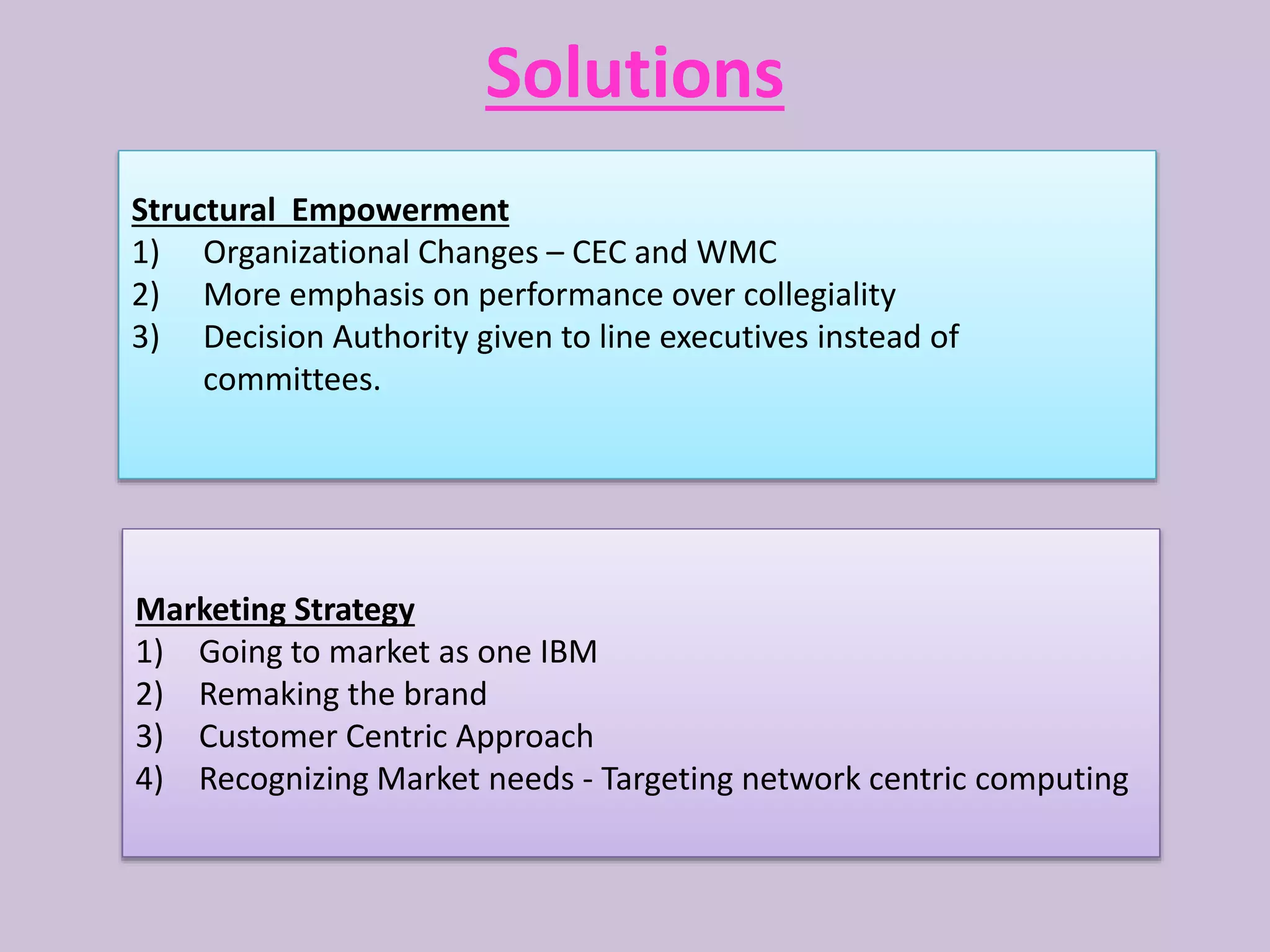
Solutions
Structural Empowerment
1) Organizational Changes – CEC and WMC
2) More emphasis on performance over collegiality
3) Decision Authority given to line executives instead of
committees.
Marketing Strategy
1) Going to market as one IBM
2) Remaking the brand
3) Customer Centric Approach
4) Recognizing Market needs - Targeting network centric computing
THANK YOU

IBM Corporation Turnaround Case study

  • 1.
  • 2.
  • 3.
    IBM Evolution Founded in 1911by Charles Ranlett Flint. Thomas J. Watson took over as the CEO on 1914- built a sales powerhouse, corporate culture and a strong focus on research and international sales. In 1924 The company was subsequently renamed International Business Machines with the birth Slogan of THINK. Thomas J. Watson Jr. took charge as the CEO in 1956,, moved the company into the electronics era, building it into the mainframe powerhouse. T. Vincent Learson - CEO from 1971 to 1973. Frank T. Cary - CEO from 1973 to 1981. John R. Opel - CEO from 1981 to 1985. In 1984 IBM captured 70% of Industry’s Profits and became the world’s leading IT company. John F. Akers — CEO from 1985 to 1993. Joined in a peak condition which later ended up the company in deep crises. Louis V. Gerstner — CEO 1993 to 2002. He launched a new system in which there were no scattered companies. “Going to the market as one IBM”- Turnaround point. Sam Palmisano — CEO from 2002 to 2012. he helped create IBM Global Services. Ginni Rometty — CEO 2012 till date.
  • 4.
    BEFORE TURNAROUND Decentralized Authority. Akersmade managers more accountable for results. Planning to break IBM Corporation Policy of having Lifetime employment which was later abolished. Due to inner circle collegiality on personal relationships prevented Akers from replacing weak performers. Cost cutting, layoffs and voluntary retirement, involuntary too. AFTER TURNAROUND Going to market as one IBM. Restoring line Managers’ accountability and ownership. • Assigning projects to executive with cost reduction targets. • Changes in style of management. • Operation Bear Hug. • Partnership executives program. Cost reduction – Increased Layoffs and sale of non core businesses. Changes in the Organizational Structure – CEC and WMC New product Strategy - Network Centric Computing. No to giving up on the mainframe- source of revenues and growth.
  • 5.
    Problems Demand for IBM coremainframe was decreasing Weak marketing strategies and customer relationships Bureaucracy hindered decision making Relentless cost cutting and low staff morale.
  • 6.
    Solutions Structural Empowerment 1) OrganizationalChanges – CEC and WMC 2) More emphasis on performance over collegiality 3) Decision Authority given to line executives instead of committees. Marketing Strategy 1) Going to market as one IBM 2) Remaking the brand 3) Customer Centric Approach 4) Recognizing Market needs - Targeting network centric computing
  • 7.