Download free for 30 days
Sign in
Upload
Language (EN)
Support
Business
Mobile
Social Media
Marketing
Technology
Art & Photos
Career
Design
Education
Presentations & Public Speaking
Government & Nonprofit
Healthcare
Internet
Law
Leadership & Management
Automotive
Engineering
Software
Recruiting & HR
Retail
Sales
Services
Science
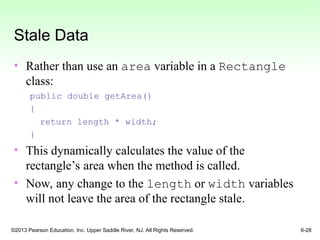
Small Business & Entrepreneurship
Food
Environment
Economy & Finance
Data & Analytics
Investor Relations
Sports
Spiritual
News & Politics
Travel
Self Improvement
Real Estate
Entertainment & Humor
Health & Medicine
Devices & Hardware
Lifestyle
Change Language
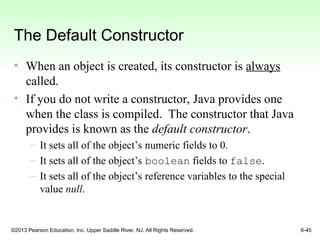
Language
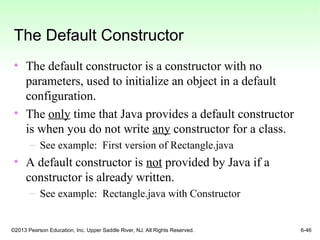
English
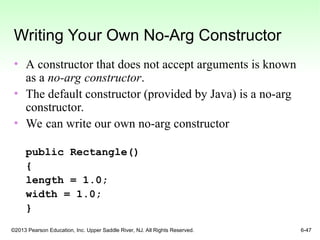
Español
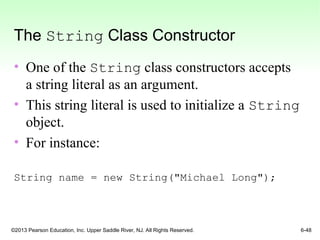
Português
Français
Deutsche
Cancel
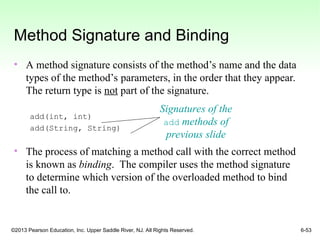
Save
EN
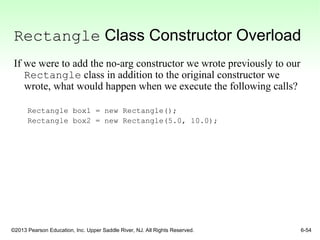
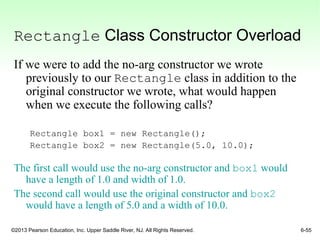
Uploaded by
xhan28m
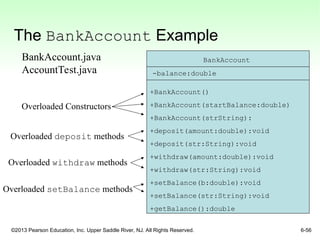
PPT, PDF
10 views
Chapter 6: A First Look at ClassesCSO_Gaddis_Java_Chapter06.ppt
Starting Out with Java: From Control Structures through Objects Fifth Edition by Tony Gaddis
Technology
◦
Read more
0
Save
Share
Embed
Embed presentation
Download
Download to read offline
1
/ 62
2
/ 62
3
/ 62
4
/ 62
5
/ 62
6
/ 62
7
/ 62
8
/ 62
9
/ 62
10
/ 62
11
/ 62
12
/ 62
13
/ 62
14
/ 62
15
/ 62
16
/ 62
17
/ 62
18
/ 62
19
/ 62
20
/ 62
21
/ 62
22
/ 62
23
/ 62
24
/ 62
25
/ 62
26
/ 62
27
/ 62
28
/ 62
29
/ 62
30
/ 62
31
/ 62
32
/ 62
33
/ 62
34
/ 62
35
/ 62
36
/ 62
37
/ 62
38
/ 62
39
/ 62
40
/ 62
41
/ 62
42
/ 62
43
/ 62
44
/ 62
45
/ 62
46
/ 62
47
/ 62
48
/ 62
49
/ 62
50
/ 62
51
/ 62
52
/ 62
53
/ 62
54
/ 62
55
/ 62
56
/ 62
57
/ 62
58
/ 62
59
/ 62
60
/ 62
61
/ 62
62
/ 62
More Related Content
PPT
Cso gaddis java_chapter6
by
mlrbrown
PPT
Cso gaddis java_chapter6
by
RhettB
PPT
Eo gaddis java_chapter_03_5e
by
Gina Bullock
PPT
Lecture 2 classes i
by
the_wumberlog
PPTX
Pi j2.3 objects
by
mcollison
PPT
JavaYDL8
by
Terry Yoast
PPT
08slide
by
Dorothea Chaffin
PDF
Introduction to java and oop
by
baabtra.com - No. 1 supplier of quality freshers
Cso gaddis java_chapter6
by
mlrbrown
Cso gaddis java_chapter6
by
RhettB
Eo gaddis java_chapter_03_5e
by
Gina Bullock
Lecture 2 classes i
by
the_wumberlog
Pi j2.3 objects
by
mcollison
JavaYDL8
by
Terry Yoast
08slide
by
Dorothea Chaffin
Introduction to java and oop
by
baabtra.com - No. 1 supplier of quality freshers
Similar to Chapter 6: A First Look at ClassesCSO_Gaddis_Java_Chapter06.ppt
PPT
Class & Object - Intro
by
PRN USM
PPTX
Classes, objects in JAVA
by
Abhilash Nair
PPTX
Chapter 4 Writing Classes
by
DanWooster1
PPTX
Object Oriented Programming_Lecture 3
by
Mahmoud Alfarra
PPT
OO Development 4 - Object Concepts
by
Randy Connolly
PPTX
Classes,object and methods java
by
Padma Kannan
PDF
M251_Meeting 3 : ( Objects ) and (Classes)
by
aashammariaziz
PPT
Threads exist in several states. Here is a general description. A thread can ...
by
yadeshvar
PPT
class01.ppt | class01.ppt|class01.ppt | class01.ppt
by
preethampreethamkj20
PPT
9 cm604.14
by
myrajendra
PPTX
2 Object-oriented programghgrtrdwwe.pptx
by
RamaDalabeh
PPTX
Object-oriented programming
by
Neelesh Shukla
PPTX
Upstate CSCI 200 Java Chapter 7 - OOP
by
DanWooster1
PPT
Object and class in java
by
Umamaheshwariv1
PPT
Lecture java continued
by
Kamran Zafar
PPTX
1707325642974_Classes fffand objects.pptx
by
nandemprasanna
PPT
Lecture java continued 1
by
Kamran Zafar
PPTX
JAVA power point presentation UNIT-2.pptx
by
drsmkb559
PPT
Object and class
by
mohit tripathi
PDF
Chapter 1 - Objects and Classes - Slides covering Introduction to Classes and...
by
OdarnocArracziv
Class & Object - Intro
by
PRN USM
Classes, objects in JAVA
by
Abhilash Nair
Chapter 4 Writing Classes
by
DanWooster1
Object Oriented Programming_Lecture 3
by
Mahmoud Alfarra
OO Development 4 - Object Concepts
by
Randy Connolly
Classes,object and methods java
by
Padma Kannan
M251_Meeting 3 : ( Objects ) and (Classes)
by
aashammariaziz
Threads exist in several states. Here is a general description. A thread can ...
by
yadeshvar
class01.ppt | class01.ppt|class01.ppt | class01.ppt
by
preethampreethamkj20
9 cm604.14
by
myrajendra
2 Object-oriented programghgrtrdwwe.pptx
by
RamaDalabeh
Object-oriented programming
by
Neelesh Shukla
Upstate CSCI 200 Java Chapter 7 - OOP
by
DanWooster1
Object and class in java
by
Umamaheshwariv1
Lecture java continued
by
Kamran Zafar
1707325642974_Classes fffand objects.pptx
by
nandemprasanna
Lecture java continued 1
by
Kamran Zafar
JAVA power point presentation UNIT-2.pptx
by
drsmkb559
Object and class
by
mohit tripathi
Chapter 1 - Objects and Classes - Slides covering Introduction to Classes and...
by
OdarnocArracziv
Recently uploaded
PDF
Constraint Collapse and Fidelity Decay in Scaled Language Models
by
Semantic Fidelity Lab | A. Jacobs
PDF
Founder & Tech Lead | Web Development & Digital Growth Consultant | Helping B...
by
Shyamal Das
PDF
Session 1/5: Enhancing Automation with Screenplay & Business Rules
by
suhanisingh58689
PDF
AI Vector Search Best Practices Multicloud Feb 2026
by
Sandesh Rao
PDF
shayk.online - Anonymous chat with Sinatra and WebSockets
by
Eleanor McHugh
PDF
Spec-Driven Development with Kiro: Elevating Software Quality, Traceability, ...
by
Haim Michael
PDF
GTM-and-Sales-Plan for a cyber security product
by
Ashish Jangir
PDF
GDG Cloud Southlake #49: Pradeep R Kumar: Implications of Agentic AI for Iden...
by
James Anderson
PPTX
CTO Strategy OS 2026: The Tech, AI & Cloud Playbook Boards Want
by
ridwansassman
PDF
Logical Optimal Actions – Towards Knowledge-based Reinforcement Learning with...
by
Michiaki Tatsubori
PDF
How AI Can Help Platform Engineers Build Better Platforms
by
All Things Open
PDF
Explaining the flow of purpose-specific BOM
by
akipii ogaoga
PDF
Security-Fails-in-the-Gaps-Between-Systems.pptx.pdf
by
OhhproJunction
PDF
UiPath Modern Automation Playbook -Session 2
by
suhanisingh58689
PDF
Bringing AI into R&D, Taking a Human-Centric Approach / Haim Yadid
by
Haim Yadid
PDF
GenerationAI_Paris_2025_Architecting_Intelligence.pdf
by
apidays
PDF
Explaining specific examples of purpose-specific BOM
by
akipii ogaoga
PDF
apidays Paris 2025 | API Layer7 Security: Real-World Use Cases (BBVA & Nexi)
by
apidays
PPTX
Critique Prompting: The Secret to High-Quality AI Outputs
by
Semantic SEO BD
PDF
How does MES(Manufacturing Execution System) work?
by
akipii ogaoga
Constraint Collapse and Fidelity Decay in Scaled Language Models
by
Semantic Fidelity Lab | A. Jacobs
Founder & Tech Lead | Web Development & Digital Growth Consultant | Helping B...
by
Shyamal Das
Session 1/5: Enhancing Automation with Screenplay & Business Rules
by
suhanisingh58689
AI Vector Search Best Practices Multicloud Feb 2026
by
Sandesh Rao
shayk.online - Anonymous chat with Sinatra and WebSockets
by
Eleanor McHugh
Spec-Driven Development with Kiro: Elevating Software Quality, Traceability, ...
by
Haim Michael
GTM-and-Sales-Plan for a cyber security product
by
Ashish Jangir
GDG Cloud Southlake #49: Pradeep R Kumar: Implications of Agentic AI for Iden...
by
James Anderson
CTO Strategy OS 2026: The Tech, AI & Cloud Playbook Boards Want
by
ridwansassman
Logical Optimal Actions – Towards Knowledge-based Reinforcement Learning with...
by
Michiaki Tatsubori
How AI Can Help Platform Engineers Build Better Platforms
by
All Things Open
Explaining the flow of purpose-specific BOM
by
akipii ogaoga
Security-Fails-in-the-Gaps-Between-Systems.pptx.pdf
by
OhhproJunction
UiPath Modern Automation Playbook -Session 2
by
suhanisingh58689
Bringing AI into R&D, Taking a Human-Centric Approach / Haim Yadid
by
Haim Yadid
GenerationAI_Paris_2025_Architecting_Intelligence.pdf
by
apidays
Explaining specific examples of purpose-specific BOM
by
akipii ogaoga
apidays Paris 2025 | API Layer7 Security: Real-World Use Cases (BBVA & Nexi)
by
apidays
Critique Prompting: The Secret to High-Quality AI Outputs
by
Semantic SEO BD
How does MES(Manufacturing Execution System) work?
by
akipii ogaoga
Chapter 6: A First Look at ClassesCSO_Gaddis_Java_Chapter06.ppt
1.
Chapter 6: A First
Look at Classes Starting Out with Java: From Control Structures through Objects Fifth Edition by Tony Gaddis
2.
©2013 Pearson Education,
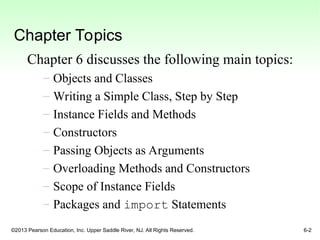
Inc. Upper Saddle River, NJ. All Rights Reserved. 6-2 Chapter Topics Chapter 6 discusses the following main topics: – Objects and Classes – Writing a Simple Class, Step by Step – Instance Fields and Methods – Constructors – Passing Objects as Arguments – Overloading Methods and Constructors – Scope of Instance Fields – Packages and import Statements
3.
©2013 Pearson Education,
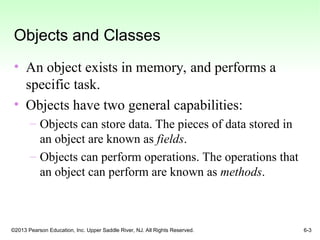
Inc. Upper Saddle River, NJ. All Rights Reserved. 6-3 Objects and Classes • An object exists in memory, and performs a specific task. • Objects have two general capabilities: – Objects can store data. The pieces of data stored in an object are known as fields. – Objects can perform operations. The operations that an object can perform are known as methods.
4.
©2013 Pearson Education,
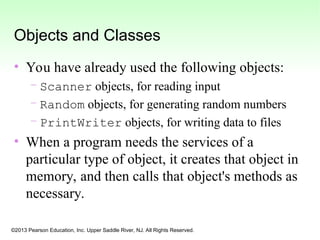
Inc. Upper Saddle River, NJ. All Rights Reserved. Objects and Classes • You have already used the following objects: – Scanner objects, for reading input – Random objects, for generating random numbers – PrintWriter objects, for writing data to files • When a program needs the services of a particular type of object, it creates that object in memory, and then calls that object's methods as necessary.
5.
©2013 Pearson Education,
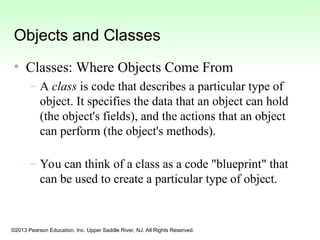
Inc. Upper Saddle River, NJ. All Rights Reserved. Objects and Classes • Classes: Where Objects Come From – A class is code that describes a particular type of object. It specifies the data that an object can hold (the object's fields), and the actions that an object can perform (the object's methods). – You can think of a class as a code "blueprint" that can be used to create a particular type of object.
6.
©2013 Pearson Education,
Inc. Upper Saddle River, NJ. All Rights Reserved. Objects and Classes • When a program is running, it can use the class to create, in memory, as many objects of a specific type as needed. • Each object that is created from a class is called an instance of the class.
7.
©2013 Pearson Education,
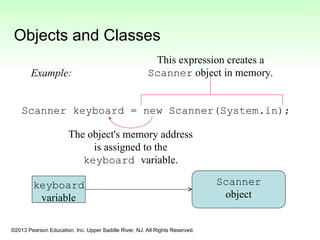
Inc. Upper Saddle River, NJ. All Rights Reserved. Objects and Classes Scanner keyboard = new Scanner(System.in); keyboard variable Scanner object This expression creates a Scanner object in memory. The object's memory address is assigned to the keyboard variable. Example:
8.
©2013 Pearson Education,
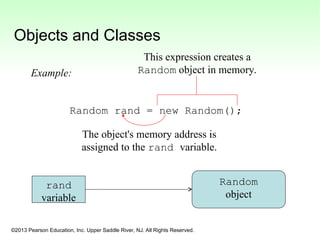
Inc. Upper Saddle River, NJ. All Rights Reserved. Objects and Classes Random rand = new Random(); rand variable Random object This expression creates a Random object in memory. The object's memory address is assigned to the rand variable. Example:
9.
©2013 Pearson Education,
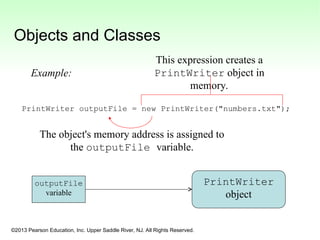
Inc. Upper Saddle River, NJ. All Rights Reserved. Objects and Classes PrintWriter outputFile = new PrintWriter("numbers.txt"); outputFile variable PrintWriter object This expression creates a PrintWriter object in memory. The object's memory address is assigned to the outputFile variable. Example:
10.
©2013 Pearson Education,
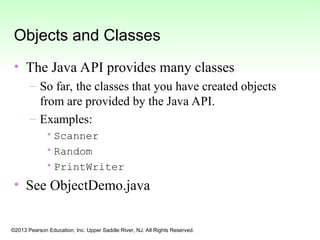
Inc. Upper Saddle River, NJ. All Rights Reserved. Objects and Classes • The Java API provides many classes – So far, the classes that you have created objects from are provided by the Java API. – Examples: •Scanner •Random •PrintWriter • See ObjectDemo.java
11.
©2013 Pearson Education,
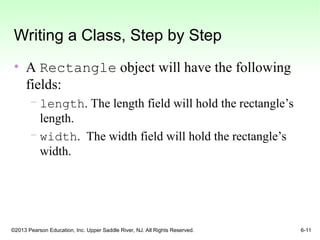
Inc. Upper Saddle River, NJ. All Rights Reserved. 6-11 Writing a Class, Step by Step • A Rectangle object will have the following fields: – length. The length field will hold the rectangle’s length. – width. The width field will hold the rectangle’s width.
12.
©2013 Pearson Education,
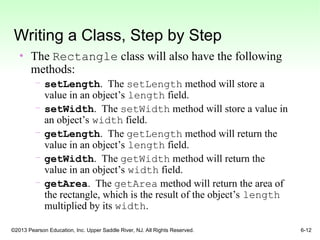
Inc. Upper Saddle River, NJ. All Rights Reserved. 6-12 Writing a Class, Step by Step • The Rectangle class will also have the following methods: – setLength. The setLength method will store a value in an object’s length field. – setWidth. The setWidth method will store a value in an object’s width field. – getLength. The getLength method will return the value in an object’s length field. – getWidth. The getWidth method will return the value in an object’s width field. – getArea. The getArea method will return the area of the rectangle, which is the result of the object’s length multiplied by its width.
13.
©2013 Pearson Education,
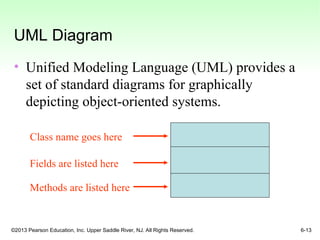
Inc. Upper Saddle River, NJ. All Rights Reserved. 6-13 UML Diagram • Unified Modeling Language (UML) provides a set of standard diagrams for graphically depicting object-oriented systems. Class name goes here Fields are listed here Methods are listed here
14.
©2013 Pearson Education,
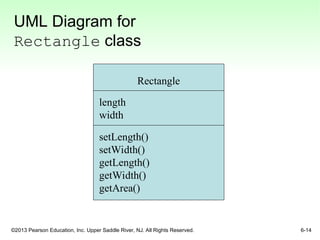
Inc. Upper Saddle River, NJ. All Rights Reserved. 6-14 UML Diagram for Rectangle class Rectangle length width setLength() setWidth() getLength() getWidth() getArea()
15.
©2013 Pearson Education,
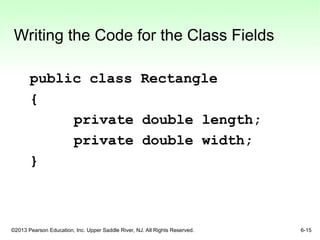
Inc. Upper Saddle River, NJ. All Rights Reserved. 6-15 Writing the Code for the Class Fields public class Rectangle { private double length; private double width; }
16.
©2013 Pearson Education,
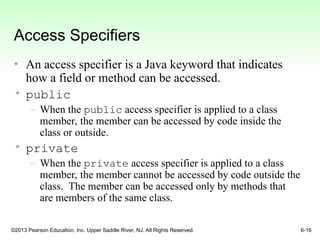
Inc. Upper Saddle River, NJ. All Rights Reserved. 6-16 Access Specifiers • An access specifier is a Java keyword that indicates how a field or method can be accessed. • public – When the public access specifier is applied to a class member, the member can be accessed by code inside the class or outside. • private – When the private access specifier is applied to a class member, the member cannot be accessed by code outside the class. The member can be accessed only by methods that are members of the same class.
17.
©2013 Pearson Education,
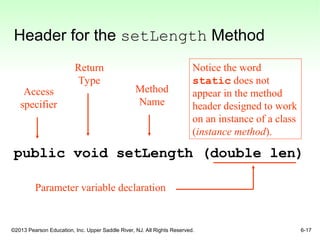
Inc. Upper Saddle River, NJ. All Rights Reserved. 6-17 Header for the setLength Method public void setLength (double len) Access specifier Return Type Parameter variable declaration Method Name Notice the word static does not appear in the method header designed to work on an instance of a class (instance method).
18.
©2013 Pearson Education,
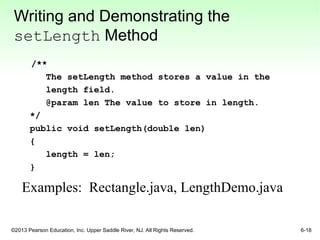
Inc. Upper Saddle River, NJ. All Rights Reserved. 6-18 Writing and Demonstrating the setLength Method /** The setLength method stores a value in the length field. @param len The value to store in length. */ public void setLength(double len) { length = len; } Examples: Rectangle.java, LengthDemo.java
19.
©2013 Pearson Education,
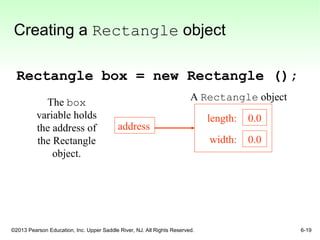
Inc. Upper Saddle River, NJ. All Rights Reserved. 6-19 Creating a Rectangle object Rectangle box = new Rectangle (); address 0.0 0.0 length: width: The box variable holds the address of the Rectangle object. A Rectangle object
20.
©2013 Pearson Education,
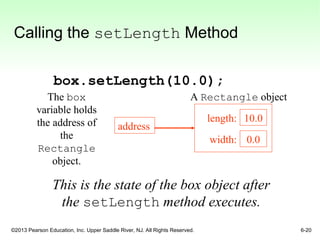
Inc. Upper Saddle River, NJ. All Rights Reserved. 6-20 Calling the setLength Method box.setLength(10.0); address 10.0 0.0 length: width: The box variable holds the address of the Rectangle object. A Rectangle object This is the state of the box object after the setLength method executes.
21.
©2013 Pearson Education,
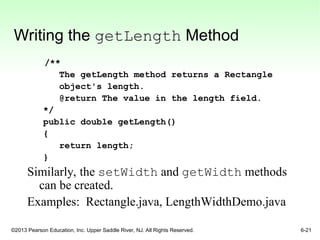
Inc. Upper Saddle River, NJ. All Rights Reserved. 6-21 Writing the getLength Method /** The getLength method returns a Rectangle object's length. @return The value in the length field. */ public double getLength() { return length; } Similarly, the setWidth and getWidth methods can be created. Examples: Rectangle.java, LengthWidthDemo.java
22.
©2013 Pearson Education,
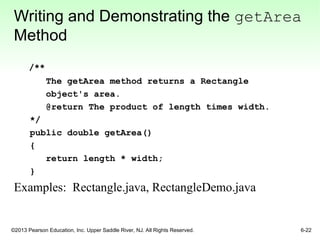
Inc. Upper Saddle River, NJ. All Rights Reserved. 6-22 Writing and Demonstrating the getArea Method /** The getArea method returns a Rectangle object's area. @return The product of length times width. */ public double getArea() { return length * width; } Examples: Rectangle.java, RectangleDemo.java
23.
©2013 Pearson Education,
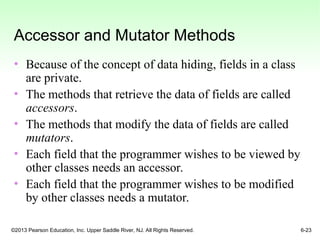
Inc. Upper Saddle River, NJ. All Rights Reserved. 6-23 Accessor and Mutator Methods • Because of the concept of data hiding, fields in a class are private. • The methods that retrieve the data of fields are called accessors. • The methods that modify the data of fields are called mutators. • Each field that the programmer wishes to be viewed by other classes needs an accessor. • Each field that the programmer wishes to be modified by other classes needs a mutator.
24.
©2013 Pearson Education,
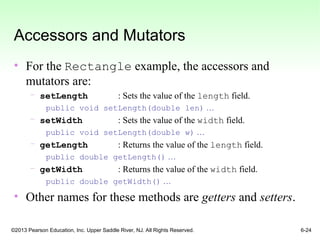
Inc. Upper Saddle River, NJ. All Rights Reserved. 6-24 Accessors and Mutators • For the Rectangle example, the accessors and mutators are: – setLength : Sets the value of the length field. public void setLength(double len) … – setWidth : Sets the value of the width field. public void setLength(double w) … – getLength : Returns the value of the length field. public double getLength() … – getWidth : Returns the value of the width field. public double getWidth() … • Other names for these methods are getters and setters.
25.
©2013 Pearson Education,
Inc. Upper Saddle River, NJ. All Rights Reserved. Data Hiding • An object hides its internal, private fields from code that is outside the class that the object is an instance of. • Only the class's methods may directly access and make changes to the object’s internal data. • Code outside the class must use the class's public methods to operate on an object's private fields.
26.
©2013 Pearson Education,
Inc. Upper Saddle River, NJ. All Rights Reserved. Data Hiding • Data hiding is important because classes are typically used as components in large software systems, involving a team of programmers. • Data hiding helps enforce the integrity of an object's internal data.
27.
©2013 Pearson Education,
Inc. Upper Saddle River, NJ. All Rights Reserved. 6-27 Stale Data • Some data is the result of a calculation. • Consider the area of a rectangle. – length × width • It would be impractical to use an area variable here. • Data that requires the calculation of various factors has the potential to become stale. • To avoid stale data, it is best to calculate the value of that data within a method rather than store it in a variable.
28.
©2013 Pearson Education,
Inc. Upper Saddle River, NJ. All Rights Reserved. 6-28 Stale Data • Rather than use an area variable in a Rectangle class: public double getArea() { return length * width; } • This dynamically calculates the value of the rectangle’s area when the method is called. • Now, any change to the length or width variables will not leave the area of the rectangle stale.
29.
©2013 Pearson Education,
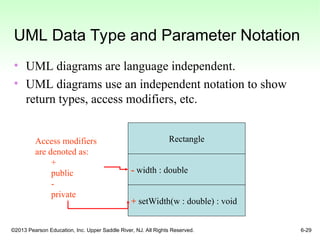
Inc. Upper Saddle River, NJ. All Rights Reserved. 6-29 UML Data Type and Parameter Notation • UML diagrams are language independent. • UML diagrams use an independent notation to show return types, access modifiers, etc. Rectangle - width : double + setWidth(w : double) : void Access modifiers are denoted as: + public - private
30.
©2013 Pearson Education,
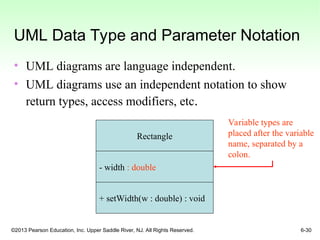
Inc. Upper Saddle River, NJ. All Rights Reserved. 6-30 UML Data Type and Parameter Notation • UML diagrams are language independent. • UML diagrams use an independent notation to show return types, access modifiers, etc. Rectangle - width : double + setWidth(w : double) : void Variable types are placed after the variable name, separated by a colon.
31.
©2013 Pearson Education,
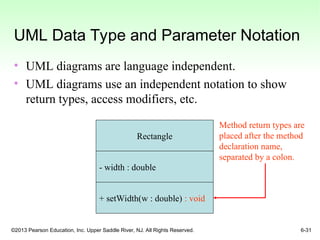
Inc. Upper Saddle River, NJ. All Rights Reserved. 6-31 UML Data Type and Parameter Notation • UML diagrams are language independent. • UML diagrams use an independent notation to show return types, access modifiers, etc. Rectangle - width : double + setWidth(w : double) : void Method return types are placed after the method declaration name, separated by a colon.
32.
©2013 Pearson Education,
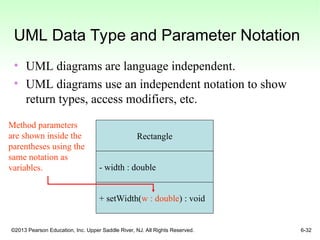
Inc. Upper Saddle River, NJ. All Rights Reserved. 6-32 UML Data Type and Parameter Notation • UML diagrams are language independent. • UML diagrams use an independent notation to show return types, access modifiers, etc. Rectangle - width : double + setWidth(w : double) : void Method parameters are shown inside the parentheses using the same notation as variables.
33.
©2013 Pearson Education,
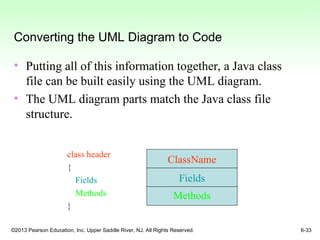
Inc. Upper Saddle River, NJ. All Rights Reserved. 6-33 Converting the UML Diagram to Code • Putting all of this information together, a Java class file can be built easily using the UML diagram. • The UML diagram parts match the Java class file structure. ClassName Fields Methods class header { Fields Methods }
34.
©2013 Pearson Education,
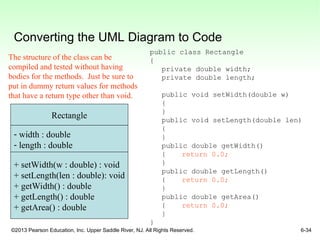
Inc. Upper Saddle River, NJ. All Rights Reserved. 6-34 Converting the UML Diagram to Code Rectangle - width : double - length : double + setWidth(w : double) : void + setLength(len : double): void + getWidth() : double + getLength() : double + getArea() : double public class Rectangle { private double width; private double length; public void setWidth(double w) { } public void setLength(double len) { } public double getWidth() { return 0.0; } public double getLength() { return 0.0; } public double getArea() { return 0.0; } } The structure of the class can be compiled and tested without having bodies for the methods. Just be sure to put in dummy return values for methods that have a return type other than void.
35.
©2013 Pearson Education,
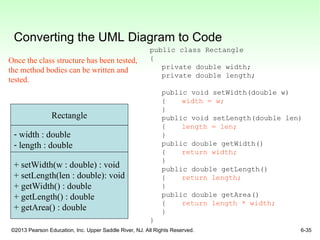
Inc. Upper Saddle River, NJ. All Rights Reserved. 6-35 Converting the UML Diagram to Code public class Rectangle { private double width; private double length; public void setWidth(double w) { width = w; } public void setLength(double len) { length = len; } public double getWidth() { return width; } public double getLength() { return length; } public double getArea() { return length * width; } } Rectangle - width : double - length : double + setWidth(w : double) : void + setLength(len : double): void + getWidth() : double + getLength() : double + getArea() : double Once the class structure has been tested, the method bodies can be written and tested.
36.
©2013 Pearson Education,
Inc. Upper Saddle River, NJ. All Rights Reserved. 6-36 Class Layout Conventions • The layout of a source code file can vary by employer or instructor. • A common layout is: – Fields listed first – Methods listed second • Accessors and mutators are typically grouped. • There are tools that can help in formatting layout to specific standards.
37.
©2013 Pearson Education,
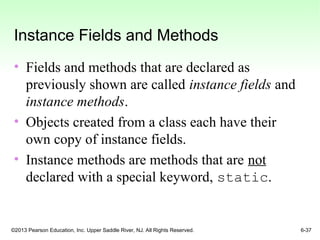
Inc. Upper Saddle River, NJ. All Rights Reserved. 6-37 Instance Fields and Methods • Fields and methods that are declared as previously shown are called instance fields and instance methods. • Objects created from a class each have their own copy of instance fields. • Instance methods are methods that are not declared with a special keyword, static.
38.
©2013 Pearson Education,
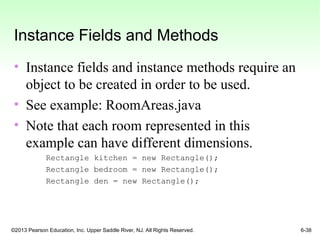
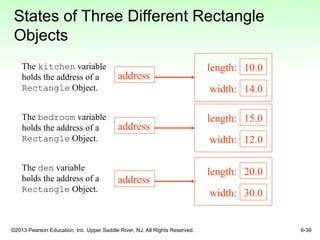
Inc. Upper Saddle River, NJ. All Rights Reserved. 6-38 Instance Fields and Methods • Instance fields and instance methods require an object to be created in order to be used. • See example: RoomAreas.java • Note that each room represented in this example can have different dimensions. Rectangle kitchen = new Rectangle(); Rectangle bedroom = new Rectangle(); Rectangle den = new Rectangle();
39.
©2013 Pearson Education,
Inc. Upper Saddle River, NJ. All Rights Reserved. 6-39 States of Three Different Rectangle Objects address 15.0 12.0 length: width: address 10.0 14.0 length: width: address 20.0 30.0 length: width: The kitchen variable holds the address of a Rectangle Object. The bedroom variable holds the address of a Rectangle Object. The den variable holds the address of a Rectangle Object.
40.
©2013 Pearson Education,
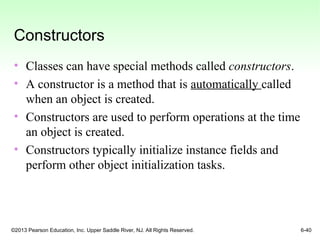
Inc. Upper Saddle River, NJ. All Rights Reserved. 6-40 Constructors • Classes can have special methods called constructors. • A constructor is a method that is automatically called when an object is created. • Constructors are used to perform operations at the time an object is created. • Constructors typically initialize instance fields and perform other object initialization tasks.
41.
©2013 Pearson Education,
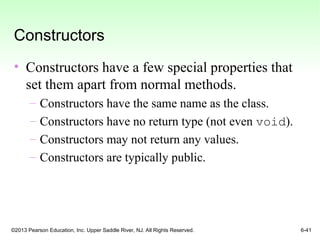
Inc. Upper Saddle River, NJ. All Rights Reserved. 6-41 Constructors • Constructors have a few special properties that set them apart from normal methods. – Constructors have the same name as the class. – Constructors have no return type (not even void). – Constructors may not return any values. – Constructors are typically public.
42.
©2013 Pearson Education,
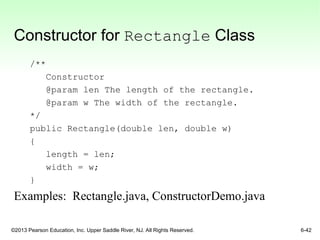
Inc. Upper Saddle River, NJ. All Rights Reserved. 6-42 Constructor for Rectangle Class /** Constructor @param len The length of the rectangle. @param w The width of the rectangle. */ public Rectangle(double len, double w) { length = len; width = w; } Examples: Rectangle.java, ConstructorDemo.java
43.
©2013 Pearson Education,
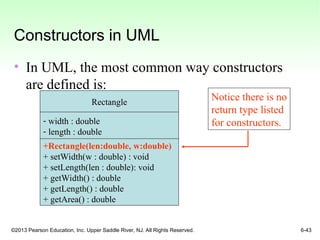
Inc. Upper Saddle River, NJ. All Rights Reserved. 6-43 Constructors in UML • In UML, the most common way constructors are defined is: Rectangle - width : double - length : double +Rectangle(len:double, w:double) + setWidth(w : double) : void + setLength(len : double): void + getWidth() : double + getLength() : double + getArea() : double Notice there is no return type listed for constructors.
44.
©2013 Pearson Education,
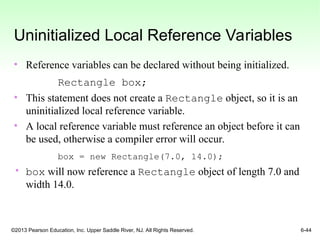
Inc. Upper Saddle River, NJ. All Rights Reserved. 6-44 Uninitialized Local Reference Variables • Reference variables can be declared without being initialized. Rectangle box; • This statement does not create a Rectangle object, so it is an uninitialized local reference variable. • A local reference variable must reference an object before it can be used, otherwise a compiler error will occur. box = new Rectangle(7.0, 14.0); • box will now reference a Rectangle object of length 7.0 and width 14.0.
45.
©2013 Pearson Education,
Inc. Upper Saddle River, NJ. All Rights Reserved. 6-45 The Default Constructor • When an object is created, its constructor is always called. • If you do not write a constructor, Java provides one when the class is compiled. The constructor that Java provides is known as the default constructor. – It sets all of the object’s numeric fields to 0. – It sets all of the object’s boolean fields to false. – It sets all of the object’s reference variables to the special value null.
46.
©2013 Pearson Education,
Inc. Upper Saddle River, NJ. All Rights Reserved. 6-46 The Default Constructor • The default constructor is a constructor with no parameters, used to initialize an object in a default configuration. • The only time that Java provides a default constructor is when you do not write any constructor for a class. – See example: First version of Rectangle.java • A default constructor is not provided by Java if a constructor is already written. – See example: Rectangle.java with Constructor
47.
©2013 Pearson Education,
Inc. Upper Saddle River, NJ. All Rights Reserved. 6-47 Writing Your Own No-Arg Constructor • A constructor that does not accept arguments is known as a no-arg constructor. • The default constructor (provided by Java) is a no-arg constructor. • We can write our own no-arg constructor public Rectangle() { length = 1.0; width = 1.0; }
48.
©2013 Pearson Education,
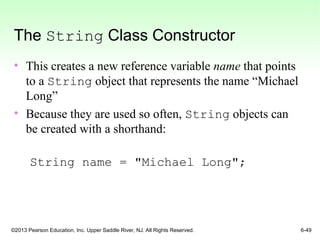
Inc. Upper Saddle River, NJ. All Rights Reserved. 6-48 The String Class Constructor • One of the String class constructors accepts a string literal as an argument. • This string literal is used to initialize a String object. • For instance: String name = new String("Michael Long");
49.
©2013 Pearson Education,
Inc. Upper Saddle River, NJ. All Rights Reserved. 6-49 The String Class Constructor • This creates a new reference variable name that points to a String object that represents the name “Michael Long” • Because they are used so often, String objects can be created with a shorthand: String name = "Michael Long";
50.
©2013 Pearson Education,
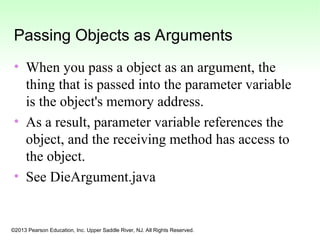
Inc. Upper Saddle River, NJ. All Rights Reserved. Passing Objects as Arguments • When you pass a object as an argument, the thing that is passed into the parameter variable is the object's memory address. • As a result, parameter variable references the object, and the receiving method has access to the object. • See DieArgument.java
51.
©2013 Pearson Education,
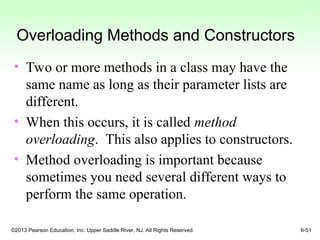
Inc. Upper Saddle River, NJ. All Rights Reserved. 6-51 Overloading Methods and Constructors • Two or more methods in a class may have the same name as long as their parameter lists are different. • When this occurs, it is called method overloading. This also applies to constructors. • Method overloading is important because sometimes you need several different ways to perform the same operation.
52.
©2013 Pearson Education,
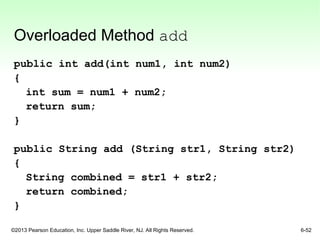
Inc. Upper Saddle River, NJ. All Rights Reserved. 6-52 Overloaded Method add public int add(int num1, int num2) { int sum = num1 + num2; return sum; } public String add (String str1, String str2) { String combined = str1 + str2; return combined; }
53.
©2013 Pearson Education,
Inc. Upper Saddle River, NJ. All Rights Reserved. 6-53 Method Signature and Binding • A method signature consists of the method’s name and the data types of the method’s parameters, in the order that they appear. The return type is not part of the signature. add(int, int) add(String, String) • The process of matching a method call with the correct method is known as binding. The compiler uses the method signature to determine which version of the overloaded method to bind the call to. Signatures of the add methods of previous slide
54.
©2013 Pearson Education,
Inc. Upper Saddle River, NJ. All Rights Reserved. 6-54 Rectangle Class Constructor Overload If we were to add the no-arg constructor we wrote previously to our Rectangle class in addition to the original constructor we wrote, what would happen when we execute the following calls? Rectangle box1 = new Rectangle(); Rectangle box2 = new Rectangle(5.0, 10.0);
55.
©2013 Pearson Education,
Inc. Upper Saddle River, NJ. All Rights Reserved. 6-55 Rectangle Class Constructor Overload If we were to add the no-arg constructor we wrote previously to our Rectangle class in addition to the original constructor we wrote, what would happen when we execute the following calls? Rectangle box1 = new Rectangle(); Rectangle box2 = new Rectangle(5.0, 10.0); The first call would use the no-arg constructor and box1 would have a length of 1.0 and width of 1.0. The second call would use the original constructor and box2 would have a length of 5.0 and a width of 10.0.
56.
©2013 Pearson Education,
Inc. Upper Saddle River, NJ. All Rights Reserved. 6-56 The BankAccount Example BankAccount.java AccountTest.java BankAccount -balance:double +BankAccount() +BankAccount(startBalance:double) +BankAccount(strString): +deposit(amount:double):void +deposit(str:String):void +withdraw(amount:double):void +withdraw(str:String):void +setBalance(b:double):void +setBalance(str:String):void +getBalance():double Overloaded Constructors Overloaded deposit methods Overloaded withdraw methods Overloaded setBalance methods
57.
©2013 Pearson Education,
Inc. Upper Saddle River, NJ. All Rights Reserved. 6-57 Scope of Instance Fields • Variables declared as instance fields in a class can be accessed by any instance method in the same class as the field. • If an instance field is declared with the public access specifier, it can also be accessed by code outside the class, as long as an instance of the class exists.
58.
©2013 Pearson Education,
Inc. Upper Saddle River, NJ. All Rights Reserved. 6-58 Shadowing • A parameter variable is, in effect, a local variable. • Within a method, variable names must be unique. • A method may have a local variable with the same name as an instance field. • This is called shadowing. • The local variable will hide the value of the instance field. • Shadowing is discouraged and local variable names should not be the same as instance field names.
59.
©2013 Pearson Education,
Inc. Upper Saddle River, NJ. All Rights Reserved. 6-59 Packages and import Statements • Classes in the Java API are organized into packages. • Explicit and Wildcard import statements – Explicit imports name a specific class • import java.util.Scanner; – Wildcard imports name a package, followed by an * • import java.util.*; • The java.lang package is automatically made available to any Java class.
60.
©2013 Pearson Education,
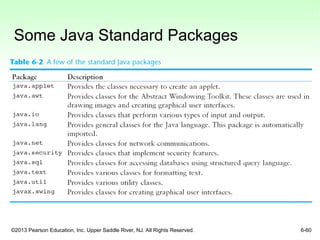
Inc. Upper Saddle River, NJ. All Rights Reserved. 6-60 Some Java Standard Packages
61.
©2013 Pearson Education,
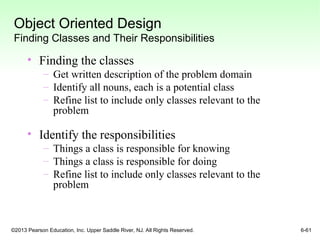
Inc. Upper Saddle River, NJ. All Rights Reserved. 6-61 Object Oriented Design Finding Classes and Their Responsibilities • Finding the classes – Get written description of the problem domain – Identify all nouns, each is a potential class – Refine list to include only classes relevant to the problem • Identify the responsibilities – Things a class is responsible for knowing – Things a class is responsible for doing – Refine list to include only classes relevant to the problem
62.
©2013 Pearson Education,
Inc. Upper Saddle River, NJ. All Rights Reserved. 6-62 Object Oriented Design Finding Classes and Their Responsibilities – Identify the responsibilities • Things a class is responsible for knowing • Things a class is responsible for doing • Refine list to include only classes relevant to the problem
Download