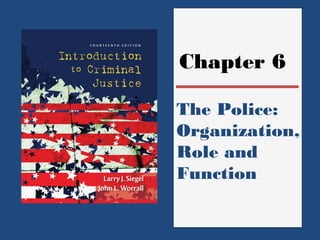
Chapter 6 
The Police: 
Organization, 
Role and 
Function
The Police Organization 
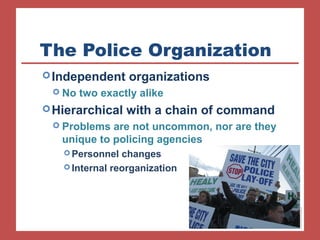
Independent organizations 
 No two exactly alike 
Hierarchical with a chain of command 
 Problems are not uncommon, nor are they 
unique to policing agencies 
Personnel changes 
Internal reorganization
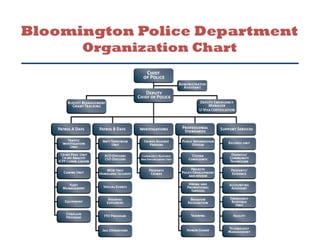
Bloomington Police Department 
Organization Chart
The Police Organization 
The time-in-rank system 
 Requires that before moving up the 
administrative ladder, an officer must 
spend a certain amount of time in the next 
lowest rank 
 Prohibits departments from allowing 
officers to skip ranks 
 Sometimes prevents them from hiring an 
officer from another department and 
awarding him/her a higher rank 
Private sector manager vs. police sergeant
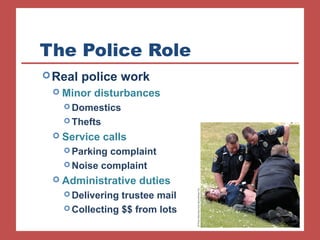
The Police Role 
Real police work 
 Minor disturbances 
Domestics 
Thefts 
 Service calls 
Parking complaint 
Noise complaint 
 Administrative duties 
Delivering trustee mail 
Collecting $$ from lots
Patrol 
Major Purpose 
Patrol Function 
Improving Patrol
The Major Purpose of Patrol 
Unlike what you see on tv, patrol officers do 
not spend their days issuing arrest warrants, 
instead they spend their days in their cars, in 
their beats handling calls for service. 
 Major Purposes of Patrol: 
Deterring crime through police presence 
Aiding individuals who cannot help themselves 
Facilitating the movement of traffic and people 
Maintaining public order 
Create a feeling of security in the community 
Identify and apprehend law violators
The Patrol Function 
Patrol officers are the most highly 
visible components of the entire 
criminal justice system 
 Patrol activities and objectives 
Deter crime 
Crime Fighting 
Respond quickly to emergencies 
While police patrol has many objectives, 
most police experts agree that the 
majority of police patrol efforts are 
devoted to Order Maintenance
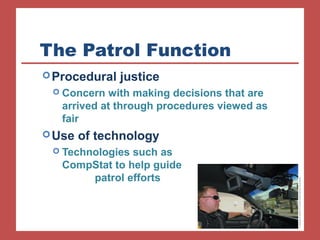
The Patrol Function 
Procedural justice 
 Concern with making decisions that are 
arrived at through procedures viewed as 
fair 
Use of technology 
 Technologies such as 
CompStat to help guide 
patrol efforts
Improving Patrol 
Proactive policing 
 An aggressive law enforcement style in 
which patrol officers take the initiative 
against crime instead of waiting for 
criminal acts to occur 
Broken windows model 
 The role of police as maintainers of 
community order and safety 
Rapid response 
 Improving police response time
Investigations 
Investigative Functions 
What Detectives Do
The Investigation Function 
Investigative work is less visible than 
patrol work 
Work closely with patrol officers to 
provide an immediate investigative 
response to crimes and incidents 
Many police departments maintain separate 
units, squads, or divisions of detectives 
who investigate crimes ranging from vice to 
homicides
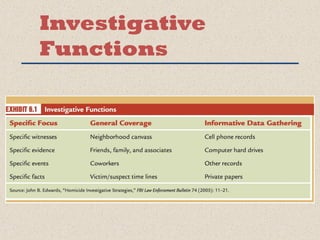
How Do Detectives 
Detect? 
Specific focus 
 Interview witnesses, gather evidence, 
record events, and collect facts 
General coverage 
 Canvass the neighborhood and makes 
observations, conduct interviews with 
friends/family/associates, contact others 
for information regarding 
victims/suspects, construct 
victim/suspect time lines to outline their 
whereabouts
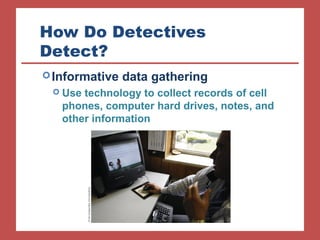
How Do Detectives 
Detect? 
Informative data gathering 
 Use technology to collect records of cell 
phones, computer hard drives, notes, and 
other information
Investigative 
Functions
The Investigation Function 
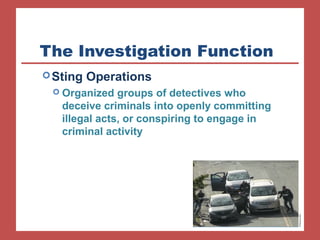
Sting Operations 
 Organized groups of detectives who 
deceive criminals into openly committing 
illegal acts, or conspiring to engage in 
criminal activity
The Investigative Function 
Undercover Work 
 Pose as criminals or as victims 
 Considered a necessary element of police 
work, although it can prove dangerous for 
the officer 
 May pose psychological problems for the 
officer
The Investigation Function 
Evaluating Investigations 
 Creates considerable paperwork and is 
relatively inefficient in clearing cases 
Improving Investigations 
 Patrol officers should have greater 
responsibility at the scene 
 Specialized units can bring expertise 
 Collection of physical evidence is 
important
Community Policing 
Community Policing 
Foot Patrol 
Key Components 
Challenges
Community Policing 
Community Policing 
 Consists of a return to an earlier style of 
policing in which officers on the beat had an 
intimate contact with the people they served 
 Can be a specific program or a philosophy 
 Foot patrol 
To form a bond with the community residents by 
acquainting them with the individual officers who 
patrolled their neighborhood.
Community Policing 
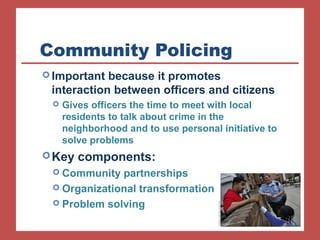
Important because it promotes 
interaction between officers and citizens 
 Gives officers the time to meet with local 
residents to talk about crime in the 
neighborhood and to use personal initiative to 
solve problems 
Key components: 
 Community partnerships 
 Organizational transformation 
 Problem solving
The Challenges of 
Community Policing 
Defining community 
Defining roles 
Changing supervisor attitudes 
Reorienting police values 
Revising training 
Reorienting recruitment 
Reaching out to every community
Problem Oriented Policing 
What is it 
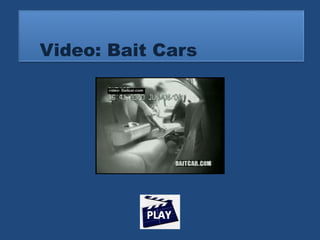
Bait Car Video 
Displacement
Problem Oriented Policing 
A style of police management that 
stresses proactive problem solving 
instead of reactive crime fighting 
 Requires police agencies to identify 
particular long-term community problems 
and to develop strategies to eliminate 
them 
Supported by the fact that a great deal of 
urban crime is concentrated in a few hot 
spots
Video: Bait Cars
Video: Discussion 
Questions 
How is the program 
discussed in the video a 
good example of Problem 
Oriented Policing? 
Would you advocate the use 
of this type of technology in 
your community? Why or why 
not?
Criminal Acts, Criminal 
Places 
Combating auto theft 
 Use of technology to reduce car thefts 
Reducing violence 
 Operation Ceasefire 
Formed to reduce youth homicide and youth 
firearms violence in Boston
Displacement 
Unintended consequences of Problem 
Oriented Policing’s “Targeting” 
 Targeting can reduce crime in one area… 
 But can also move crime to another area 
Called Displacement: 
 Displacement is when criminals move from 
an area targeted for increased police 
presence to another that is less well 
protected.
Intelligence-Led Policing 
What is it 
The processes
Intelligence-Led Policing 
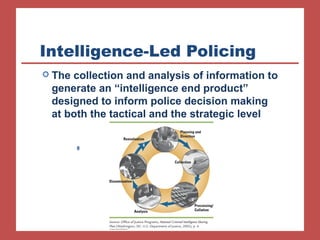
 The collection and analysis of information to 
generate an “intelligence end product” 
designed to inform police decision making 
at both the tactical and the strategic level
Intelligence-Led Policing 
Relies heavily on: 
 Confidential informants 
 Offender interviews 
 Careful analysis of crime reports and calls 
for service 
 Suspect surveillance 
 Community sources of information
Intelligence and the 
Intelligence Process 
Tactical Intelligence 
 Gaining or developing information related 
to threats of terrorism or crime and using 
this information to apprehend offenders, 
harden targets, and use strategies that will 
eliminate or mitigate the threat 
Strategic Intelligence 
 Information about the changing nature of 
certain problems and threats for the 
purpose of developing response 
strategies and reallocating resources
Intelligence-Led 
Policing 
Fusion Centers 
 Support for a range of law enforcement 
activities 
 Help for major incident operations and 
support for units charged with interdiction 
and criminal investigations 
 Provide the means for community input, 
often through “tip lines” 
 Assistance to law enforcement executives
Support / Productivity 
Support Functions 
Improving Productivity
Police Suppor t 
Functions 
Dispatch 
Training 
Citizen Police 
Interactions 
Forensics 
Planners 
Personnel Service 
Internal Affairs 
Division 
Administration 
and Control of 
Budgets 
Maintenance and 
Dissemination of 
Information
Improving Police 
Productivity 
Multiple Tasking 
Special 
Assignments 
Differential 
Police 
Responses 
Consolidation 
Informal 
Arrangements 
Sharing 
Pooling 
Contracting 
Service Districts 
Civilian 
Employees
Kansas City Patrol 
Experiment 
Overview 
The Design 
The Experiment 
Lessons Learned
Overview 
 The Kansas City preventive patrol experiment 
 A landmark experiment carried out between 1972 and 
1973 by the Kansas City Missouri Police Department 
 Designed to test the assumption that the presence (or 
potential presence) of police officers in marked cars 
reduced the likelihood of a crime being committed. 
 It was the first study to demonstrate that research into 
the effectiveness of different policing styles could be 
carried out responsibly and safely. 
 The goal of the Kansas City Patrol Study was to 
evaluate the effectiveness of different patrol models
The Design 
 The experiment was designed to answer the 
following questions: 
Do citizens notice changes in the level of patrol? 
Do different levels of visible police patrol affect 
recorded crime or the outcome of victim surveys? 
Would citizen fear of crime and change their 
behaviors as a result of differing patrol levels? 
Would the degree of satisfaction with police 
change?
The Experiment 
 The experiment took three different police beats in 
Kansas City, and varied patrol routine in them. 
 The first group received no routine patrols, instead the 
police responded only to calls from residents. 
 The second group had the normal level of patrols. 
 The third had two to three times as many patrols. 
 Victim surveys, reported crime rates, arrest data, a 
survey of local businesses, attitudinal surveys, and 
trained observers who monitored police-citizen 
interaction were used to gather data. 
 These were taken before the start of the experiment 
(September 1972), and after (October 1973), giving 
'before' and 'after' conditions for comparison.
The Results 
 The principal findings of the Kansas City Patrol Study: 
 There is little evidence to suggest that increased police 
patrol deters crime. 
 Citizens did not notice the difference in the change of patrols. 
 Increasing or decreasing the level of patrol had no significant 
effect on resident and commercial burglaries, auto thefts, 
larcenies involving auto accessories, robberies, or 
vandalism–crimes. 
 The rate at which crimes were reported did not differ 
significantly across the experimental beats. 
 Citizen reported fear of crime was not affected by different 
levels of patrol. 
 Citizen satisfaction with police did not vary.

Chapter 6

  • 1.
    Chapter 6 ThePolice: Organization, Role and Function
  • 2.
    The Police Organization Independent organizations  No two exactly alike Hierarchical with a chain of command  Problems are not uncommon, nor are they unique to policing agencies Personnel changes Internal reorganization
  • 3.
    Bloomington Police Department Organization Chart
  • 4.
    The Police Organization The time-in-rank system  Requires that before moving up the administrative ladder, an officer must spend a certain amount of time in the next lowest rank  Prohibits departments from allowing officers to skip ranks  Sometimes prevents them from hiring an officer from another department and awarding him/her a higher rank Private sector manager vs. police sergeant
  • 5.
    The Police Role Real police work  Minor disturbances Domestics Thefts  Service calls Parking complaint Noise complaint  Administrative duties Delivering trustee mail Collecting $$ from lots
  • 6.
    Patrol Major Purpose Patrol Function Improving Patrol
  • 7.
    The Major Purposeof Patrol Unlike what you see on tv, patrol officers do not spend their days issuing arrest warrants, instead they spend their days in their cars, in their beats handling calls for service.  Major Purposes of Patrol: Deterring crime through police presence Aiding individuals who cannot help themselves Facilitating the movement of traffic and people Maintaining public order Create a feeling of security in the community Identify and apprehend law violators
  • 8.
    The Patrol Function Patrol officers are the most highly visible components of the entire criminal justice system  Patrol activities and objectives Deter crime Crime Fighting Respond quickly to emergencies While police patrol has many objectives, most police experts agree that the majority of police patrol efforts are devoted to Order Maintenance
  • 9.
    The Patrol Function Procedural justice  Concern with making decisions that are arrived at through procedures viewed as fair Use of technology  Technologies such as CompStat to help guide patrol efforts
  • 10.
    Improving Patrol Proactivepolicing  An aggressive law enforcement style in which patrol officers take the initiative against crime instead of waiting for criminal acts to occur Broken windows model  The role of police as maintainers of community order and safety Rapid response  Improving police response time
  • 11.
  • 12.
    The Investigation Function Investigative work is less visible than patrol work Work closely with patrol officers to provide an immediate investigative response to crimes and incidents Many police departments maintain separate units, squads, or divisions of detectives who investigate crimes ranging from vice to homicides
  • 13.
    How Do Detectives Detect? Specific focus  Interview witnesses, gather evidence, record events, and collect facts General coverage  Canvass the neighborhood and makes observations, conduct interviews with friends/family/associates, contact others for information regarding victims/suspects, construct victim/suspect time lines to outline their whereabouts
  • 14.
    How Do Detectives Detect? Informative data gathering  Use technology to collect records of cell phones, computer hard drives, notes, and other information
  • 15.
  • 16.
    The Investigation Function Sting Operations  Organized groups of detectives who deceive criminals into openly committing illegal acts, or conspiring to engage in criminal activity
  • 17.
    The Investigative Function Undercover Work  Pose as criminals or as victims  Considered a necessary element of police work, although it can prove dangerous for the officer  May pose psychological problems for the officer
  • 18.
    The Investigation Function Evaluating Investigations  Creates considerable paperwork and is relatively inefficient in clearing cases Improving Investigations  Patrol officers should have greater responsibility at the scene  Specialized units can bring expertise  Collection of physical evidence is important
  • 19.
    Community Policing CommunityPolicing Foot Patrol Key Components Challenges
  • 20.
    Community Policing CommunityPolicing  Consists of a return to an earlier style of policing in which officers on the beat had an intimate contact with the people they served  Can be a specific program or a philosophy  Foot patrol To form a bond with the community residents by acquainting them with the individual officers who patrolled their neighborhood.
  • 21.
    Community Policing Importantbecause it promotes interaction between officers and citizens  Gives officers the time to meet with local residents to talk about crime in the neighborhood and to use personal initiative to solve problems Key components:  Community partnerships  Organizational transformation  Problem solving
  • 22.
    The Challenges of Community Policing Defining community Defining roles Changing supervisor attitudes Reorienting police values Revising training Reorienting recruitment Reaching out to every community
  • 23.
    Problem Oriented Policing What is it Bait Car Video Displacement
  • 24.
    Problem Oriented Policing A style of police management that stresses proactive problem solving instead of reactive crime fighting  Requires police agencies to identify particular long-term community problems and to develop strategies to eliminate them Supported by the fact that a great deal of urban crime is concentrated in a few hot spots
  • 25.
  • 26.
    Video: Discussion Questions How is the program discussed in the video a good example of Problem Oriented Policing? Would you advocate the use of this type of technology in your community? Why or why not?
  • 27.
    Criminal Acts, Criminal Places Combating auto theft  Use of technology to reduce car thefts Reducing violence  Operation Ceasefire Formed to reduce youth homicide and youth firearms violence in Boston
  • 28.
    Displacement Unintended consequencesof Problem Oriented Policing’s “Targeting”  Targeting can reduce crime in one area…  But can also move crime to another area Called Displacement:  Displacement is when criminals move from an area targeted for increased police presence to another that is less well protected.
  • 29.
    Intelligence-Led Policing Whatis it The processes
  • 30.
    Intelligence-Led Policing The collection and analysis of information to generate an “intelligence end product” designed to inform police decision making at both the tactical and the strategic level
  • 31.
    Intelligence-Led Policing Reliesheavily on:  Confidential informants  Offender interviews  Careful analysis of crime reports and calls for service  Suspect surveillance  Community sources of information
  • 32.
    Intelligence and the Intelligence Process Tactical Intelligence  Gaining or developing information related to threats of terrorism or crime and using this information to apprehend offenders, harden targets, and use strategies that will eliminate or mitigate the threat Strategic Intelligence  Information about the changing nature of certain problems and threats for the purpose of developing response strategies and reallocating resources
  • 33.
    Intelligence-Led Policing FusionCenters  Support for a range of law enforcement activities  Help for major incident operations and support for units charged with interdiction and criminal investigations  Provide the means for community input, often through “tip lines”  Assistance to law enforcement executives
  • 34.
    Support / Productivity Support Functions Improving Productivity
  • 35.
    Police Suppor t Functions Dispatch Training Citizen Police Interactions Forensics Planners Personnel Service Internal Affairs Division Administration and Control of Budgets Maintenance and Dissemination of Information
  • 36.
    Improving Police Productivity Multiple Tasking Special Assignments Differential Police Responses Consolidation Informal Arrangements Sharing Pooling Contracting Service Districts Civilian Employees
  • 37.
    Kansas City Patrol Experiment Overview The Design The Experiment Lessons Learned
  • 38.
    Overview  TheKansas City preventive patrol experiment  A landmark experiment carried out between 1972 and 1973 by the Kansas City Missouri Police Department  Designed to test the assumption that the presence (or potential presence) of police officers in marked cars reduced the likelihood of a crime being committed.  It was the first study to demonstrate that research into the effectiveness of different policing styles could be carried out responsibly and safely.  The goal of the Kansas City Patrol Study was to evaluate the effectiveness of different patrol models
  • 39.
    The Design The experiment was designed to answer the following questions: Do citizens notice changes in the level of patrol? Do different levels of visible police patrol affect recorded crime or the outcome of victim surveys? Would citizen fear of crime and change their behaviors as a result of differing patrol levels? Would the degree of satisfaction with police change?
  • 40.
    The Experiment The experiment took three different police beats in Kansas City, and varied patrol routine in them.  The first group received no routine patrols, instead the police responded only to calls from residents.  The second group had the normal level of patrols.  The third had two to three times as many patrols.  Victim surveys, reported crime rates, arrest data, a survey of local businesses, attitudinal surveys, and trained observers who monitored police-citizen interaction were used to gather data.  These were taken before the start of the experiment (September 1972), and after (October 1973), giving 'before' and 'after' conditions for comparison.
  • 41.
    The Results The principal findings of the Kansas City Patrol Study:  There is little evidence to suggest that increased police patrol deters crime.  Citizens did not notice the difference in the change of patrols.  Increasing or decreasing the level of patrol had no significant effect on resident and commercial burglaries, auto thefts, larcenies involving auto accessories, robberies, or vandalism–crimes.  The rate at which crimes were reported did not differ significantly across the experimental beats.  Citizen reported fear of crime was not affected by different levels of patrol.  Citizen satisfaction with police did not vary.

Editor's Notes

  • #3 Learning Objective One
  • #4 Figure 6.1 Organization of a Traditional Metropolitan Police Department
  • #5 Learning Objective Two
  • #6 Learning Objective Three - The role of the police involves activities ranging from emergency medical care to traffic control, but law enforcement and crime control are critical (and often misunderstood) elements of policing. Here, a bank robbery suspect is being subdued. The suspect was able to make it only across the street from the bank before being apprehended.
  • #8 Learning Objectives Three, Four, & Five
  • #9 Learning Objectives Three, Four, & Five
  • #10 Learning Objectives Three, Four, & Five - Technology has found its way into every avenue of police work. In-car cameras, laptop computers, radar, laser speed guns, and a variety of other devices are commonplace in the typical police cruiser.
  • #11 Learning Objectives Three, Four, & Five
  • #14 Learning Objectives Three & Six
  • #15 A detective monitors Craigslist’s now defunct “Erotic Services” category. The company decided to close its doors on erotic services following a long legal battle, prompted in part by lawsuits claiming that the ads served to facilitate prostitution. Law enforcement officials across the country continue to monitor the website closely, sometimes placing decoy ads to catch would-be customers.
  • #17 Learning Objectives Three & Six - Two men, an Algerian and a Moroccan-born U.S. citizen, are arrested after buying three pistols, ammunition, and an inert grenade from an undercover officer, concluding a seven-month sting operation. The men intended to attack synagogues, kill Jews, and blow up the Empire State Building, authorities said.
  • #19 Learning Objectives Three & Six
  • #22 One method of implementing community policing is to improve the bonds between officers and the residents who live in the neighborhoods they serve. Here, police officer Patrick Ecelberger, one of several District of Columbia officers assigned to a walking beat, chats with two neighborhood residents.
  • #23 Learning Objective Seven & Eight
  • #25 Learning Objective Nine
  • #28 Learning Objective Nine
  • #29 Learning Objective Nine
  • #31 Learning Objective Ten - Figure 6.3 The Intelligence Process
  • #34 Learning Objective Ten
  • #39 Learning Objective Ten
  • #40 Learning Objective Ten
  • #41 Learning Objective Ten
  • #42 Learning Objective Ten