1
• Sources of finance and Types of Capital
• Types of Costs
– Profit/Loss calculation
• Breakeven Analysis
• Understanding Financial Statements
• Cash flow planning
Chapter 5
Financial Management
2
Sources of finance
• The adequate provision of finance is needed to start a business
and ramp it up to profitability.
• The assessment of the fund needed by the business organization
should be done in such a way that the total amount of money
available should be neither too low nor too less.
• The determination of the right amount of capital that can be
used for the current operation of the business and the future
expansion is the very important task.
3
• Investment capital is a valuable commodity. Like
other commodities, the price of capital is
determined by the interaction between demand and
supply.
• The price of capital is the rate of return that the
supplier (the lender or investor) experts from their
investment..
4
Cont…
• The major supplies of capital include the
following
– Personal capital
– Informal investors
– Borrowing
– Retained capital
– Different business angles
– Issuing shares
– Commercial Partnership
– Government
5
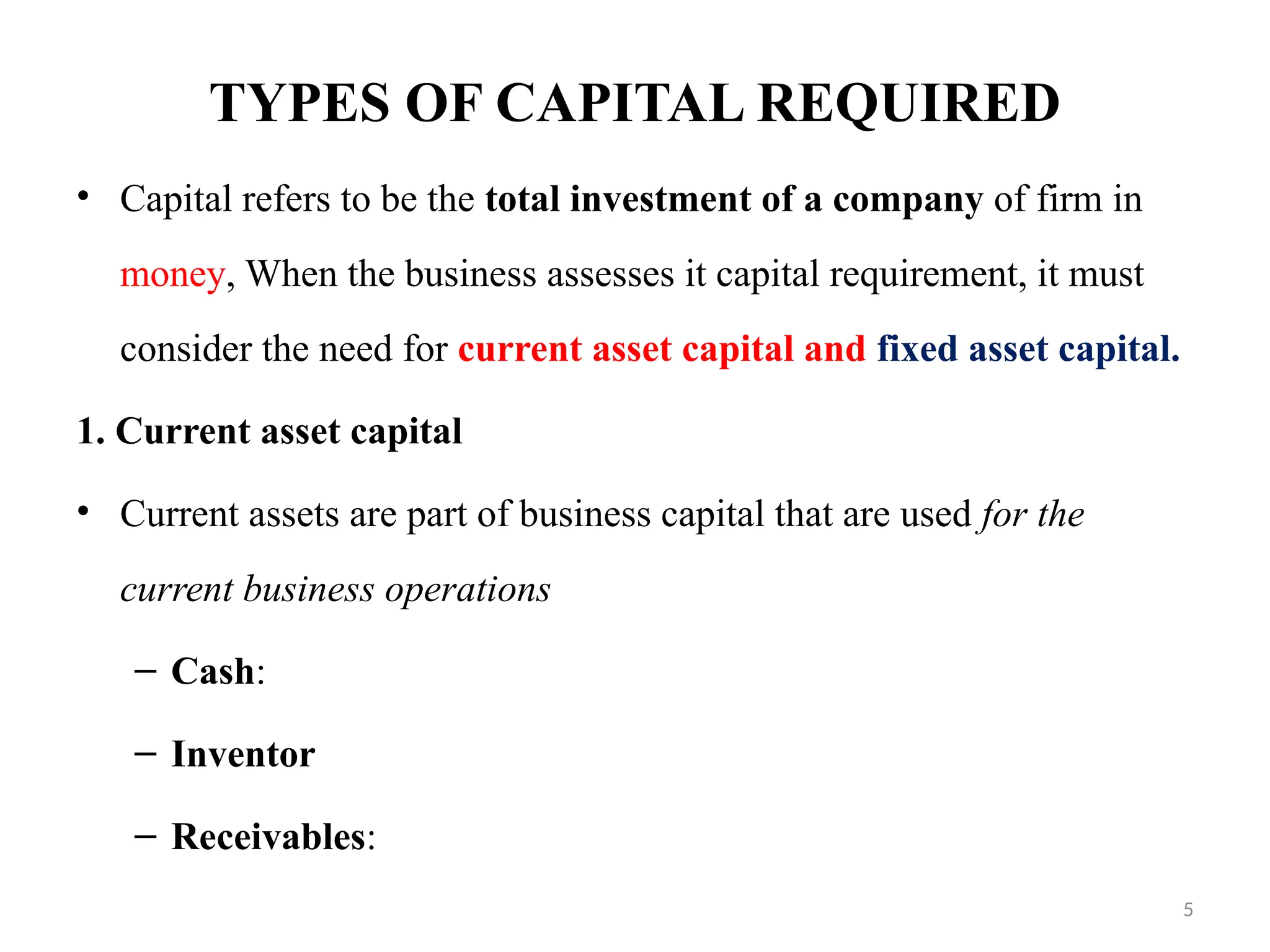
TYPES OF CAPITAL REQUIRED
• Capital refers to be the total investment of a company of firm in
money, When the business assesses it capital requirement, it must
consider the need for current asset capital and fixed asset capital.
1. Current asset capital
• Current assets are part of business capital that are used for the
current business operations
– Cash:
– Inventor
– Receivables:
6
Cont…
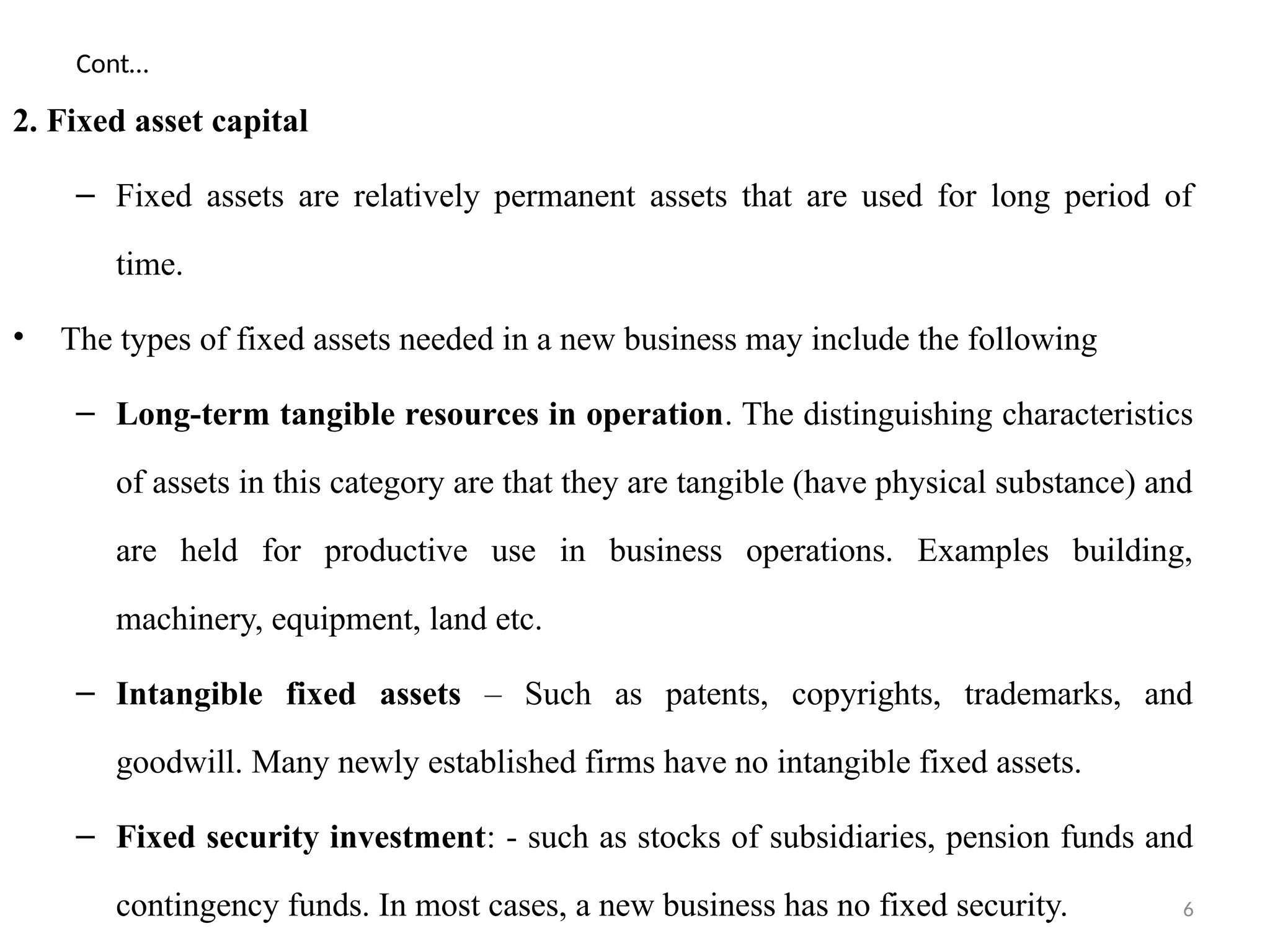
2. Fixed asset capital
– Fixed assets are relatively permanent assets that are used for long period of
time.
• The types of fixed assets needed in a new business may include the following
– Long-term tangible resources in operation. The distinguishing characteristics
of assets in this category are that they are tangible (have physical substance) and
are held for productive use in business operations. Examples building,
machinery, equipment, land etc.
– Intangible fixed assets – Such as patents, copyrights, trademarks, and
goodwill. Many newly established firms have no intangible fixed assets.
– Fixed security investment: - such as stocks of subsidiaries, pension funds and
contingency funds. In most cases, a new business has no fixed security.
7
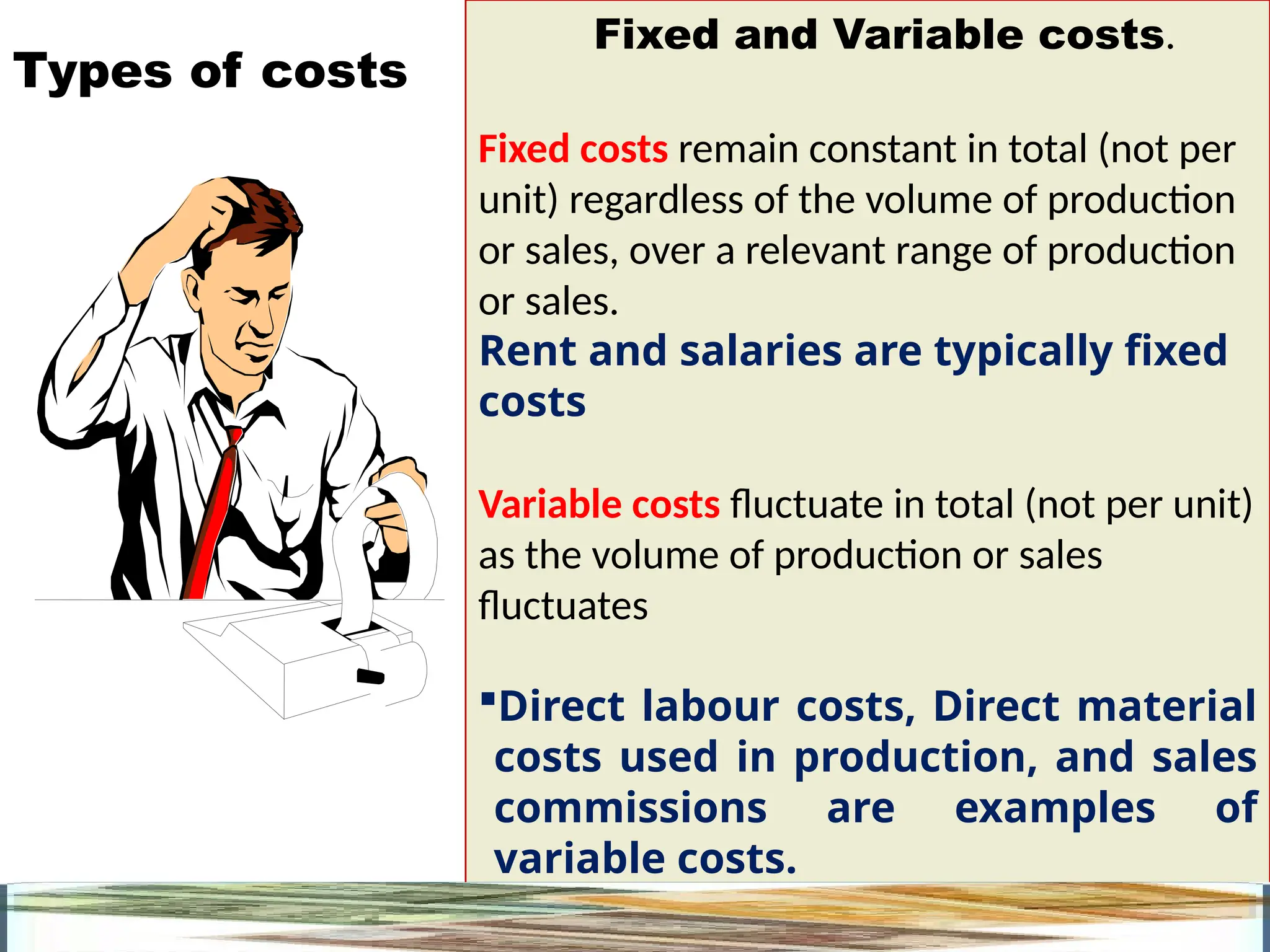
Fixed and Variable costs.
Fixed costs remain constant in total (not per
unit) regardless of the volume of production
or sales, over a relevant range of production
or sales.
Rent and salaries are typically fixed
costs
Variable costs fluctuate in total (not per unit)
as the volume of production or sales
fluctuates
Direct labour costs, Direct material
costs used in production, and sales
commissions are examples of
variable costs.
Types of costs
8
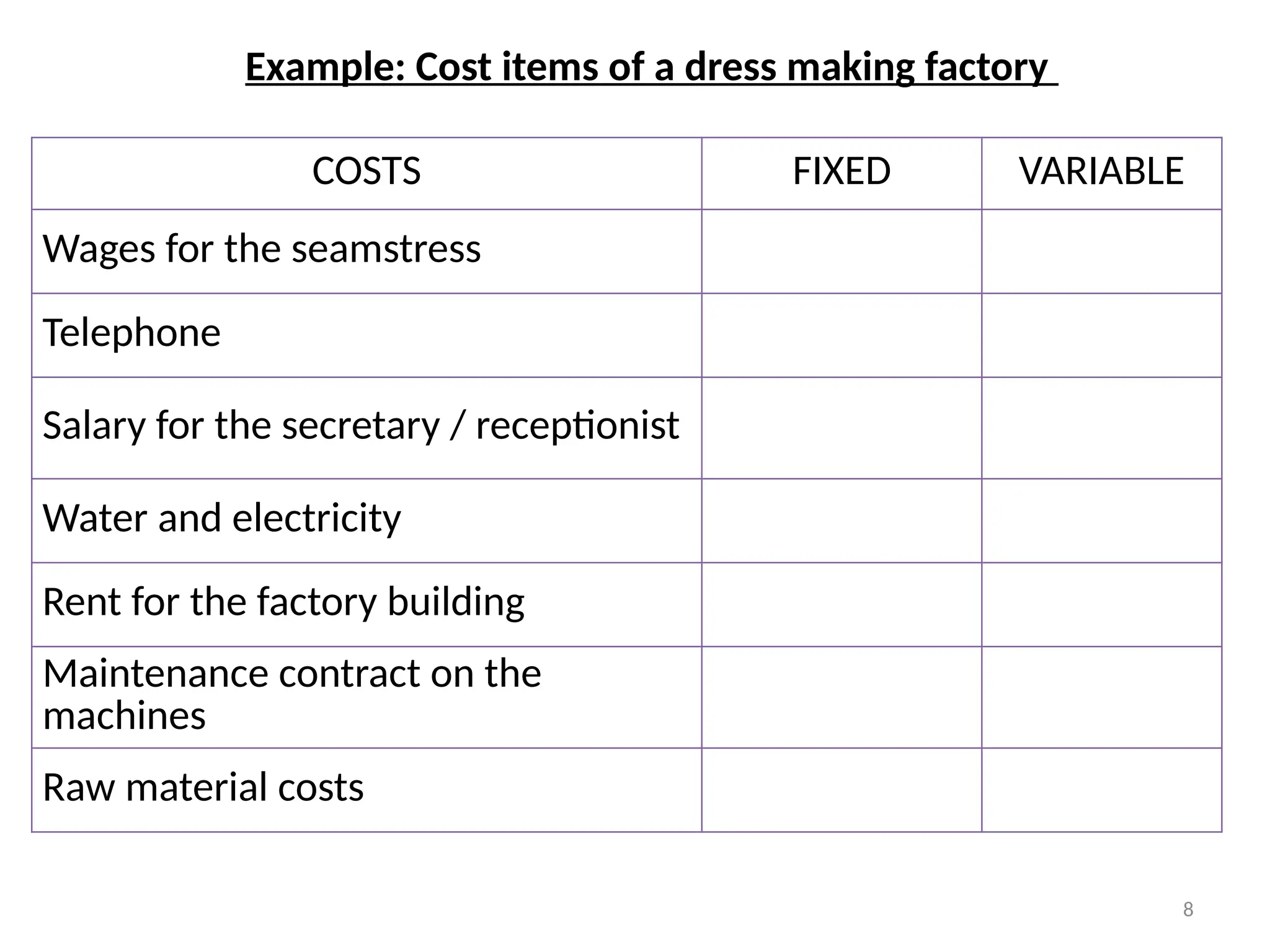
COSTS FIXED VARIABLE
Wages for the seamstress
Telephone
Salary for the secretary / receptionist
Water and electricity
Rent for the factory building
Maintenance contract on the
machines
Raw material costs
Example: Cost items of a dress making factory
9
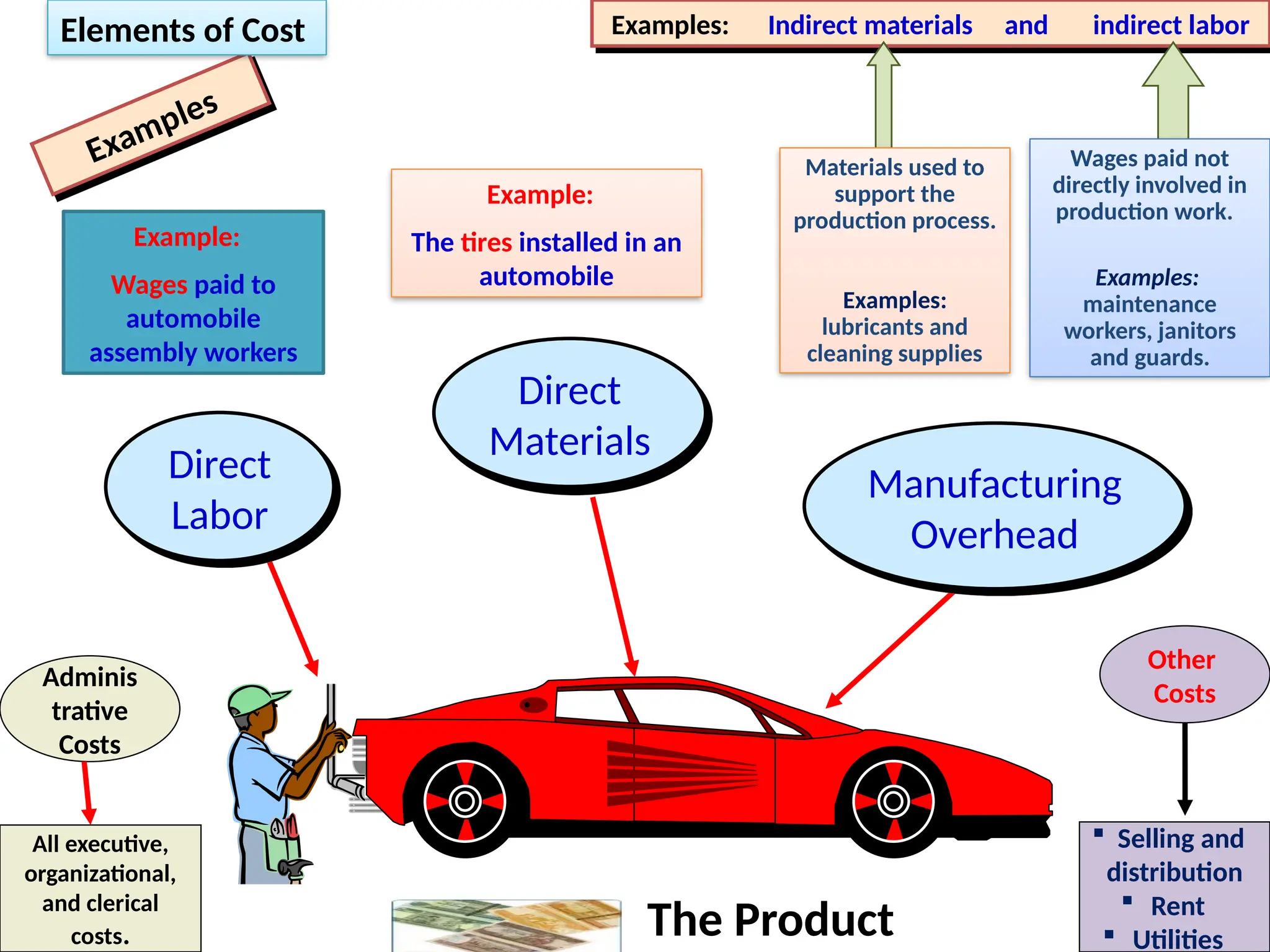
Direct
Materials
Direct
Labor
Manufacturing
Overhead
The Product
Example:
Wages paid to
automobile
assembly workers
Example:
The tires installed in an
automobile
Examples: Indirect materials and indirect labor
Wages paid not
directly involved in
production work.
Examples:
maintenance
workers, janitors
and guards.
Materials used to
support the
production process.
Examples:
lubricants and
cleaning supplies
Adminis
trative
Costs
All executive,
organizational,
and clerical
costs.
Other
Costs
 Selling and
distribution
 Rent
 Utilities
Examples
Elements of Cost
10
11
12
Calculate:
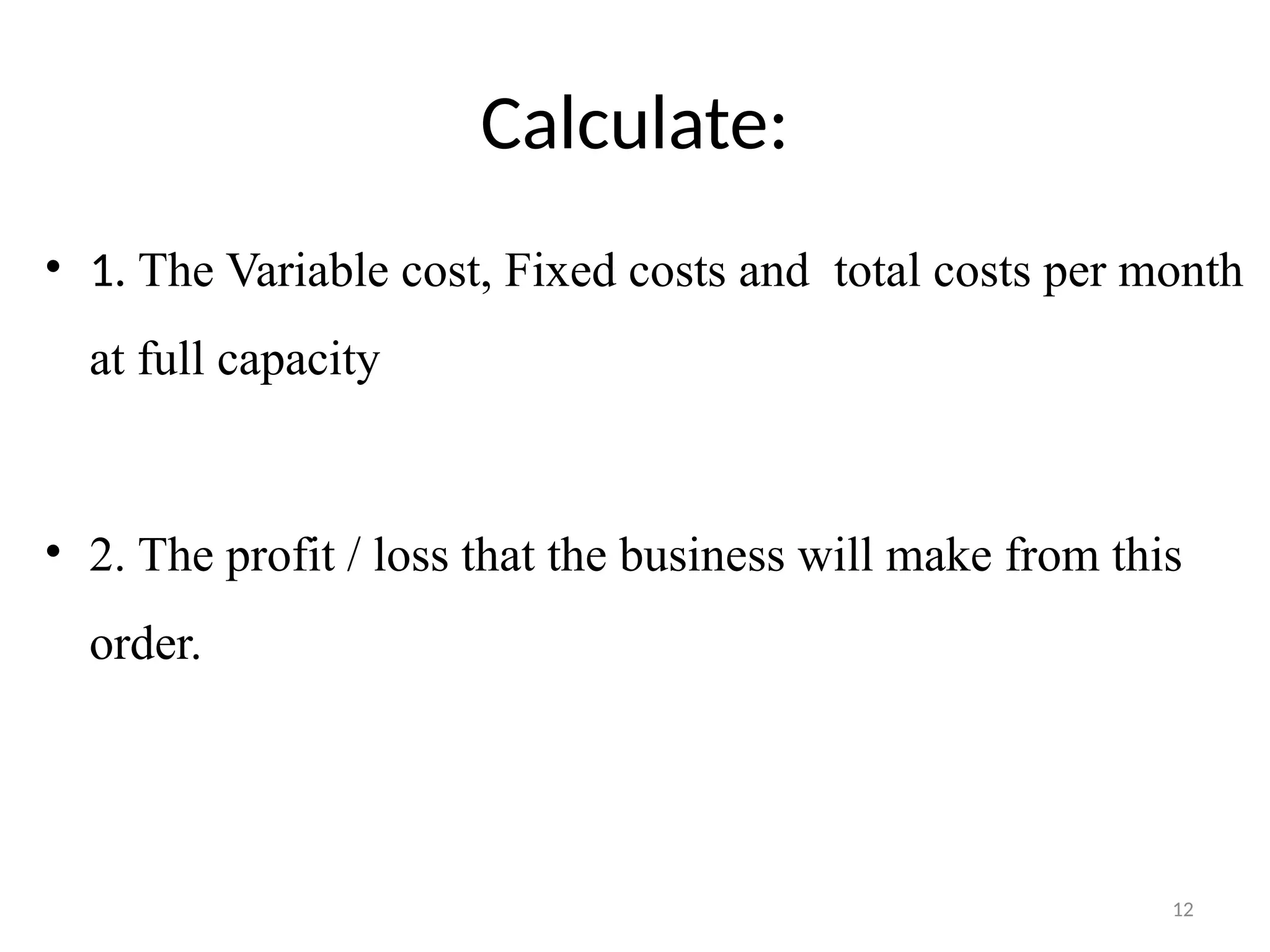
• 1. The Variable cost, Fixed costs and total costs per month
at full capacity
• 2. The profit / loss that the business will make from this
order.
13
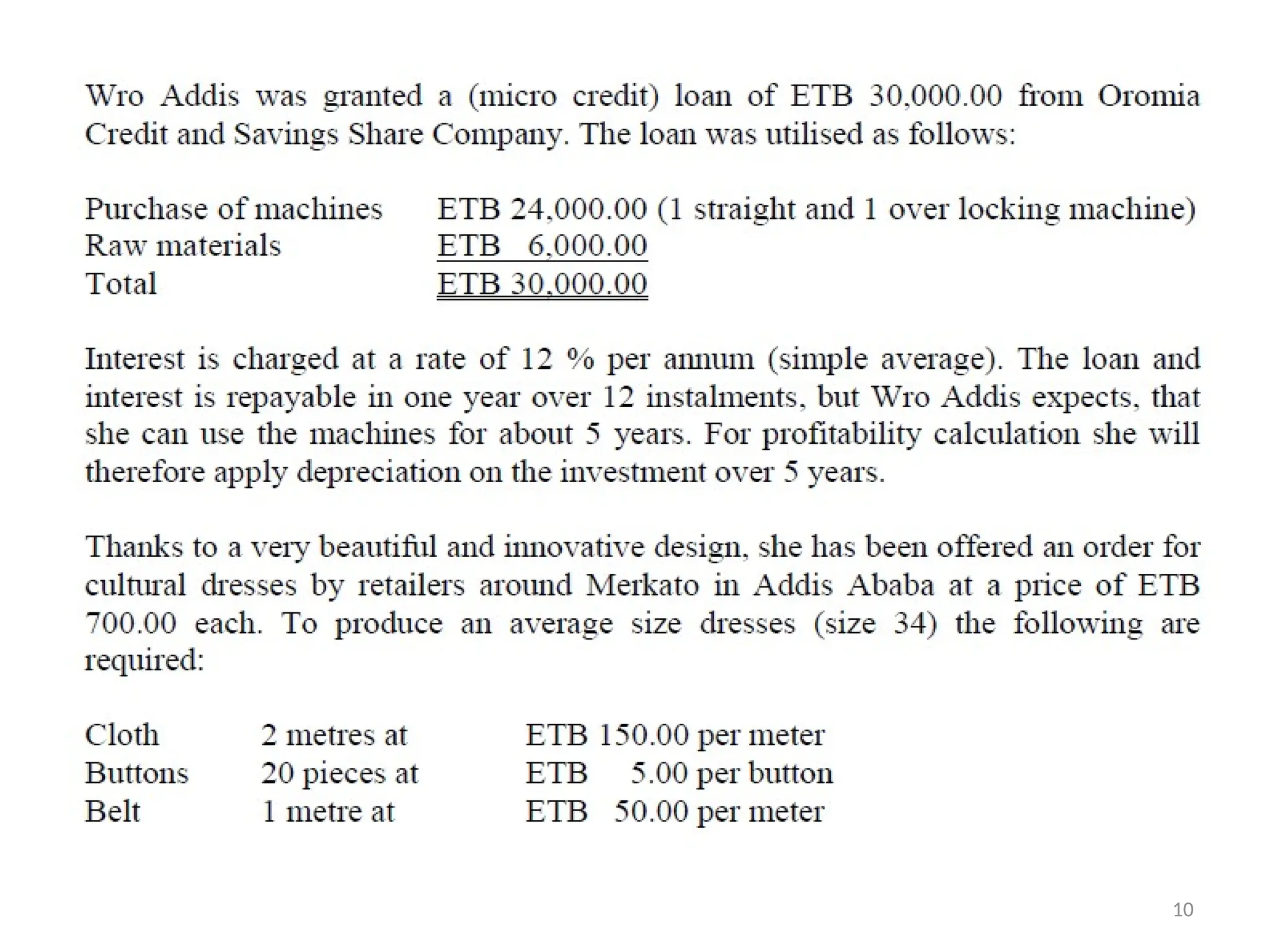
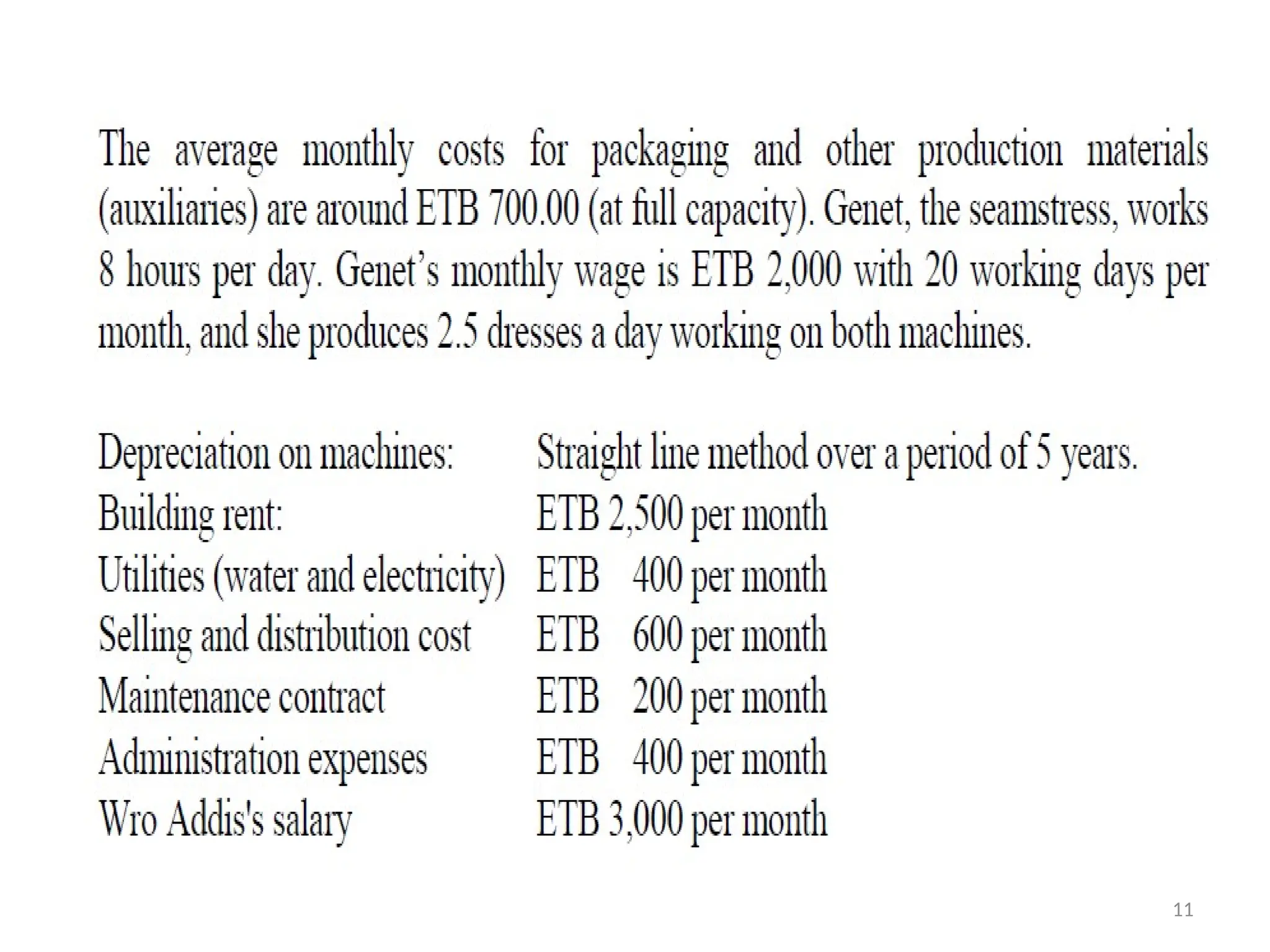
THE TAILOR SHOP of Wro Addis - COST STRUCTURE
Cost (ETB)
per month
Direct material &
expenses
[(Cloth 2x150ETB)+
(Button 20x5ETB) +(Belt
1x50 ETB)] per unit
2.5 dresses per day x
20days= 50dresses per
month
[2*150+20*5
+1*50]*50 = 22500
Variable cost 22,500
Monthly interest
[amount x int. rate x years]/month = [ETB 30,000 x 12 % x
1]/12 = 300
Depreciation: ETB 24,000 ÷ 60 months = 400
Auxiliary materials & packaging 700
Maintenance / repairs 200
Administration cost 400
Salaries (regular salaries in production) 2000
Salaries (Wro Addis) 3000
Rent 2500
Utilities 400
Selling expenses 600
Total Fixed Cost 10,500
Total cost (Variabl+ fixed) 33,000
14
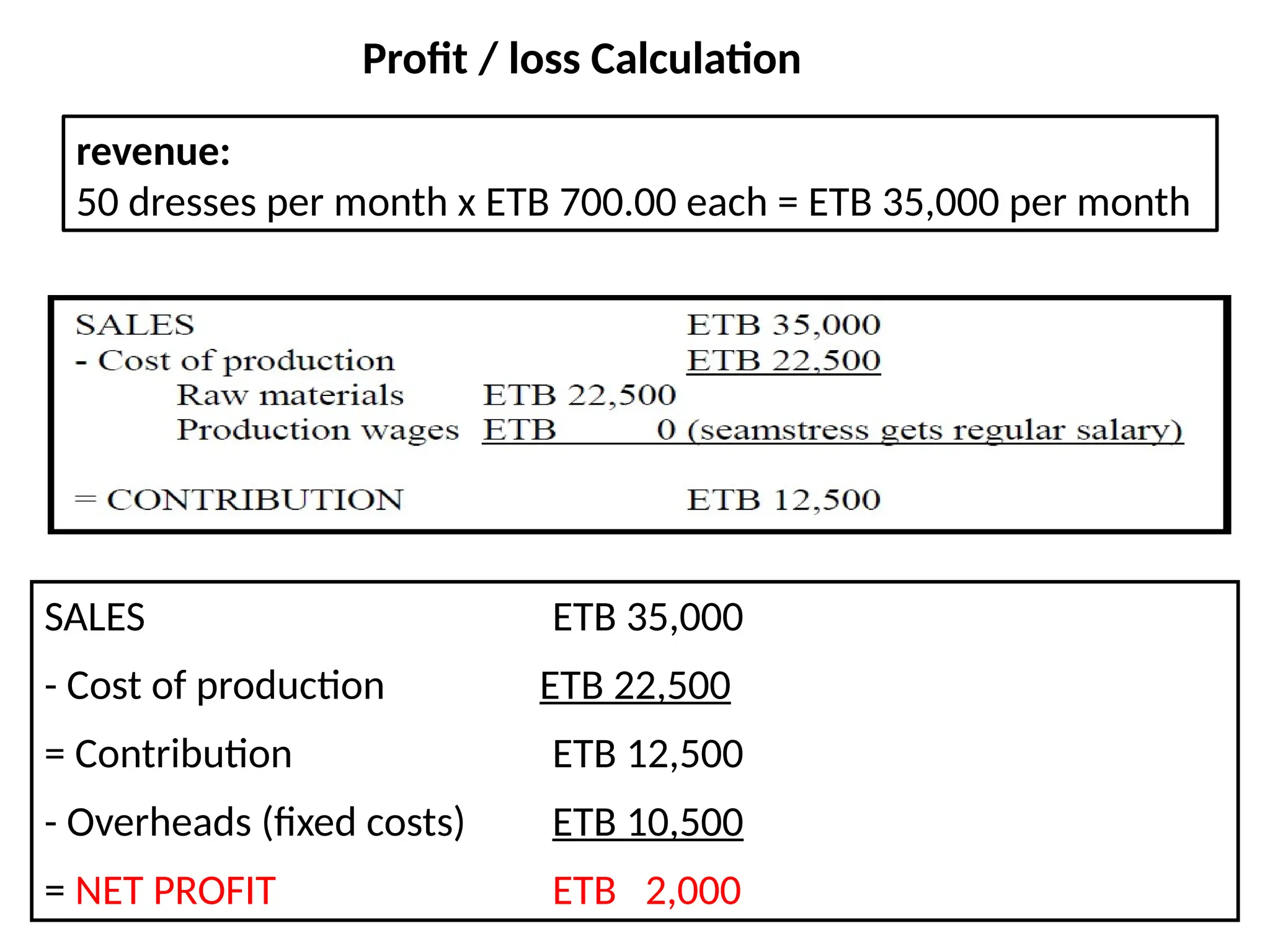
Profit / loss Calculation
SALES ETB 35,000
- Cost of production ETB 22,500
= Contribution ETB 12,500
- Overheads (fixed costs) ETB 10,500
= NET PROFIT ETB 2,000
revenue:
50 dresses per month x ETB 700.00 each = ETB 35,000 per month
15
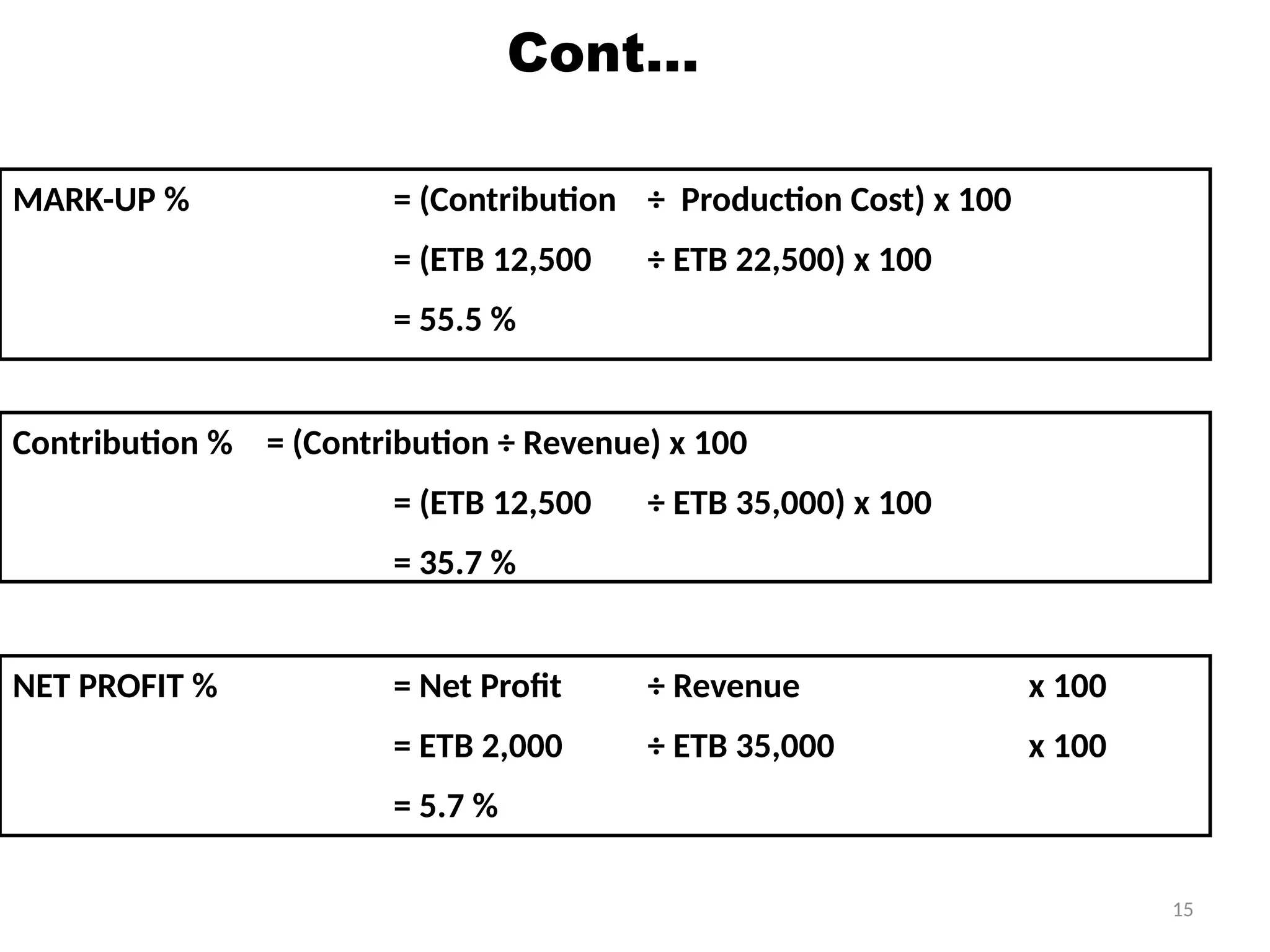
Cont…
MARK-UP % = (Contribution ÷ Production Cost) x 100
= (ETB 12,500 ÷ ETB 22,500) x 100
= 55.5 %
Contribution % = (Contribution ÷ Revenue) x 100
= (ETB 12,500 ÷ ETB 35,000) x 100
= 35.7 %
NET PROFIT % = Net Profit ÷ Revenue x 100
= ETB 2,000 ÷ ETB 35,000 x 100
= 5.7 %
16
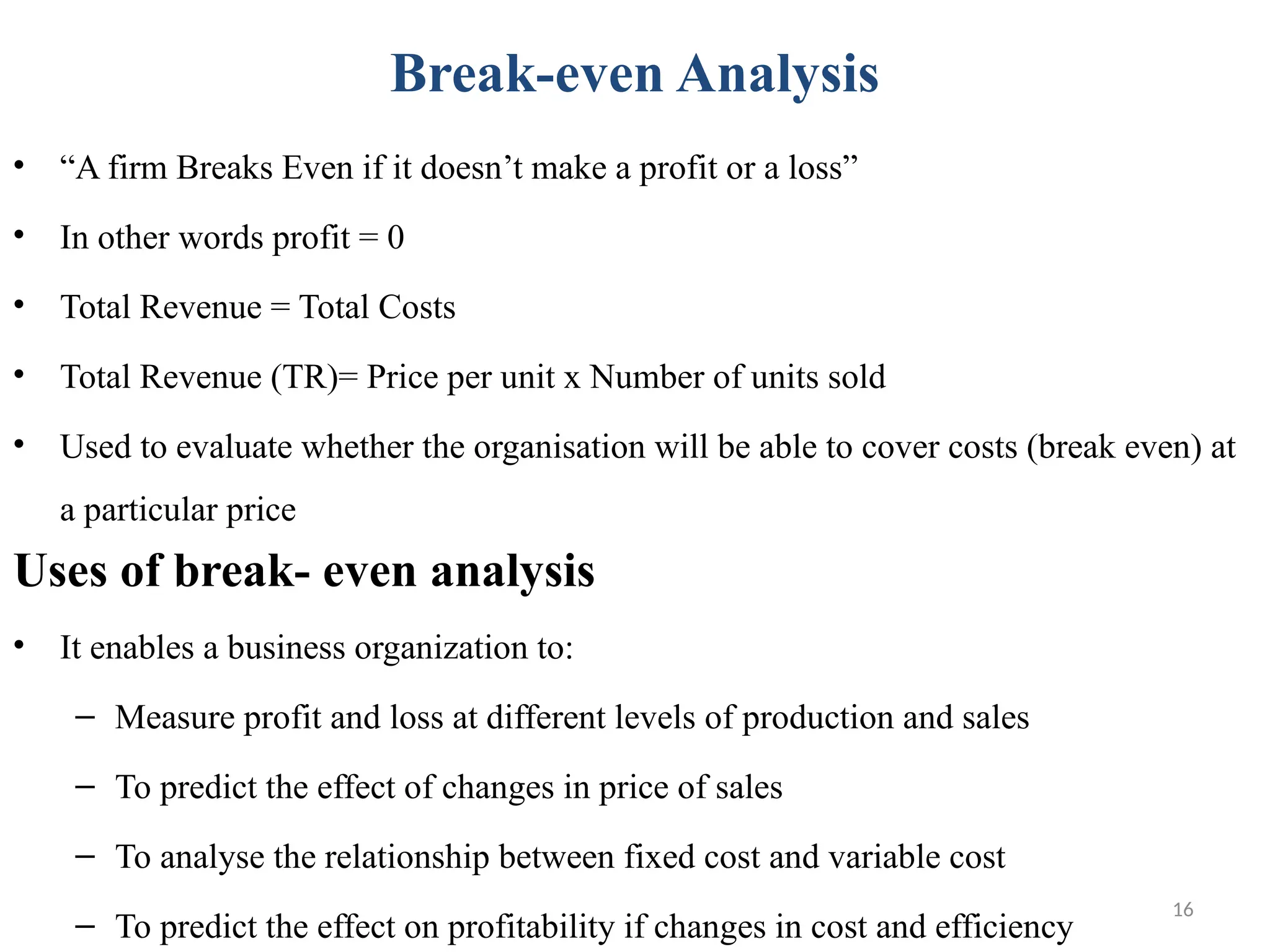
Break-even Analysis
• “A firm Breaks Even if it doesn’t make a profit or a loss”
• In other words profit = 0
• Total Revenue = Total Costs
• Total Revenue (TR)= Price per unit x Number of units sold
• Used to evaluate whether the organisation will be able to cover costs (break even) at
a particular price
Uses of break- even analysis
• It enables a business organization to:
– Measure profit and loss at different levels of production and sales
– To predict the effect of changes in price of sales
– To analyse the relationship between fixed cost and variable cost
– To predict the effect on profitability if changes in cost and efficiency
17
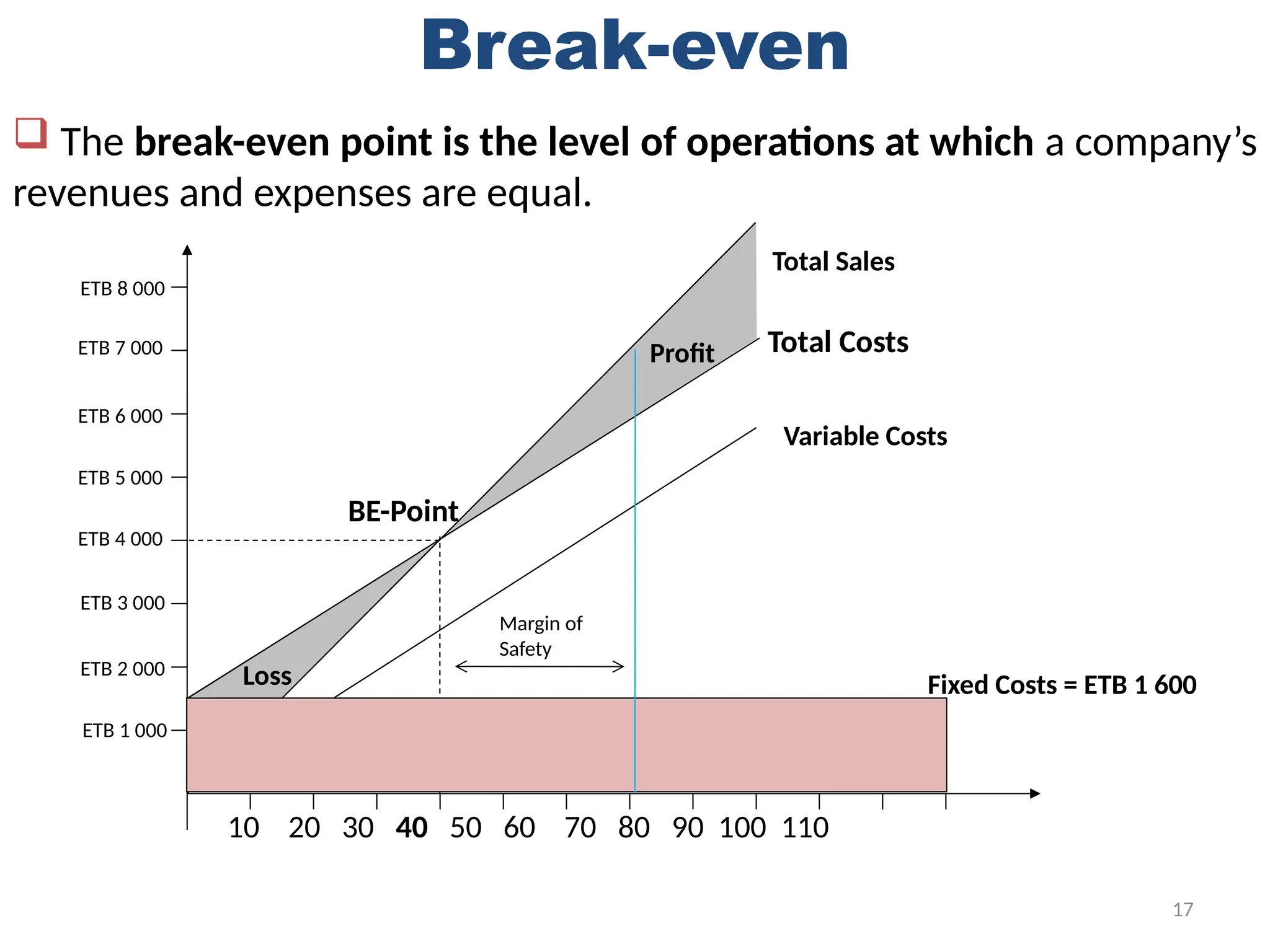
ETB 1 000
ETB 2 000
ETB 8 000
ETB 6 000
ETB 7 000
ETB 5 000
ETB 4 000
ETB 3 000
Profit
Loss
BE-Point
Total Sales
Total Costs
Variable Costs
Fixed Costs = ETB 1 600
10 20 30 40 50 60 70 80 90 100 110
Break-even
 The break-even point is the level of operations at which a company’s
revenues and expenses are equal.
Margin of
Safety
18
Cont…
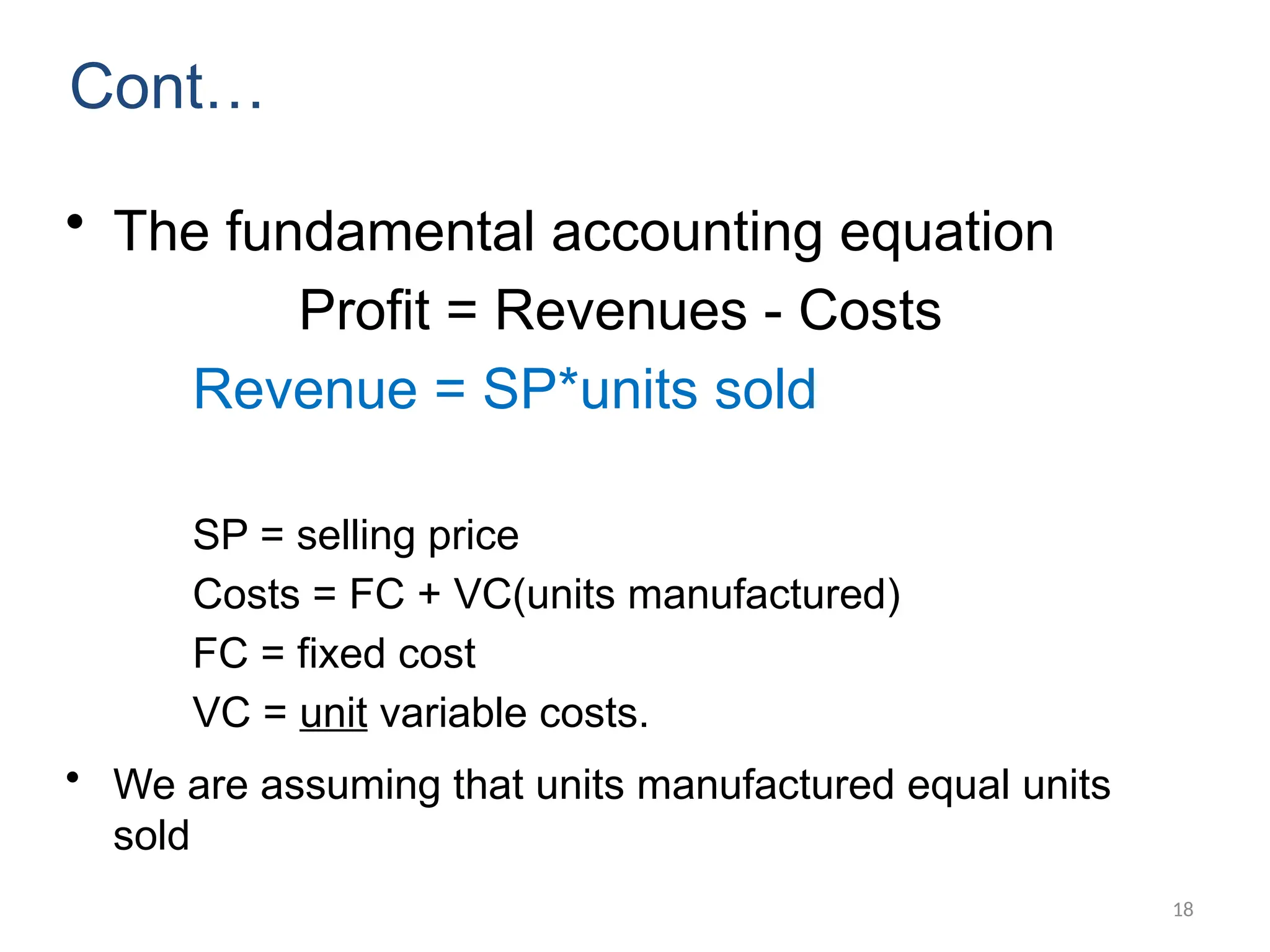
• The fundamental accounting equation
Profit = Revenues - Costs
Revenue = SP*units sold
SP = selling price
Costs = FC + VC(units manufactured)
FC = fixed cost
VC = unit variable costs.
• We are assuming that units manufactured equal units
sold
19
What if we want to know how much product
we must sell to break even?
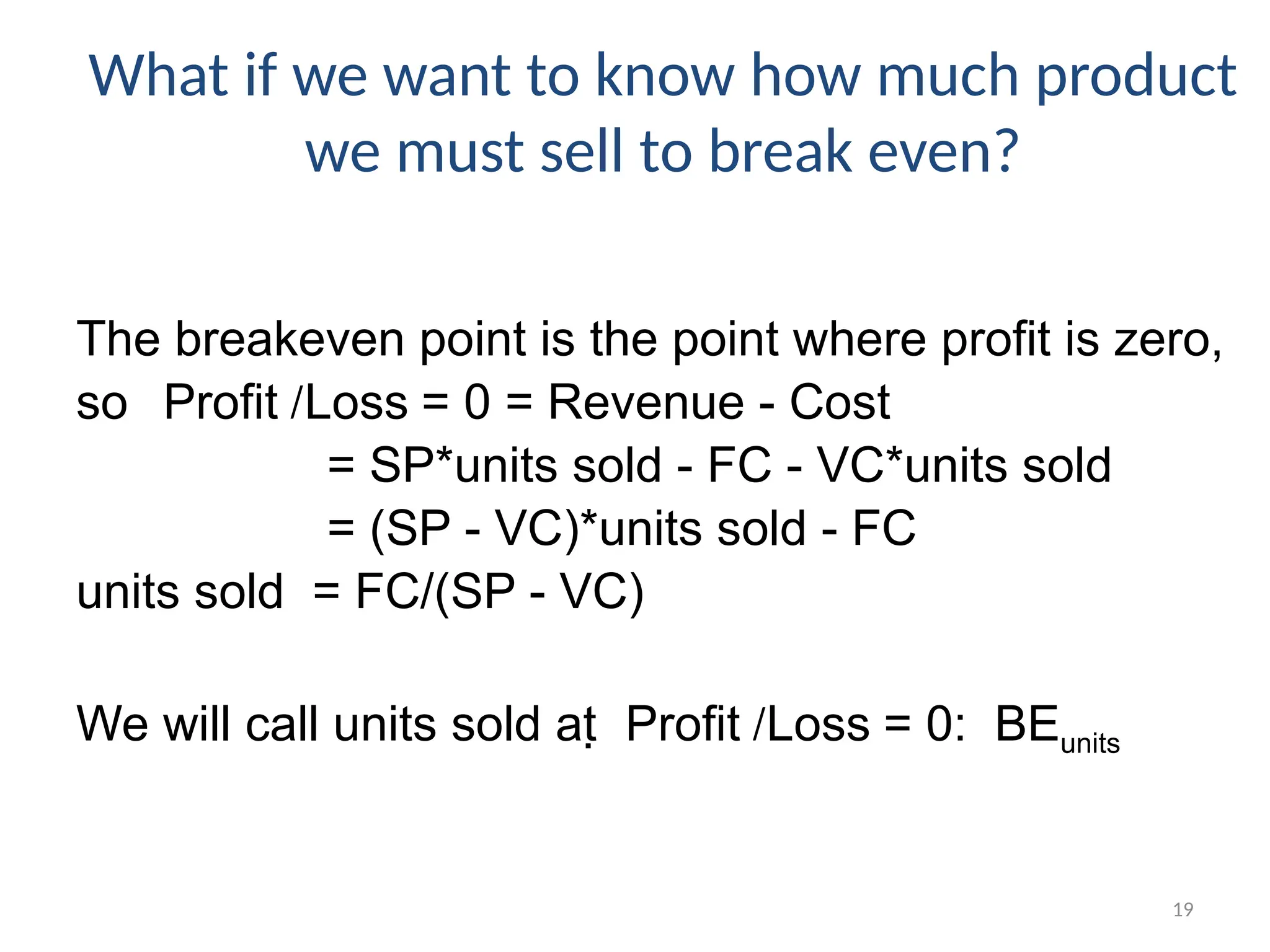
The breakeven point is the point where profit is zero,
so Profit /Loss = 0 = Revenue - Cost
= SP*units sold - FC - VC*units sold
= (SP - VC)*units sold - FC
units sold = FC/(SP - VC)
We will call units sold at  Profit /Loss = 0: BEunits
20
Breakeven revenue
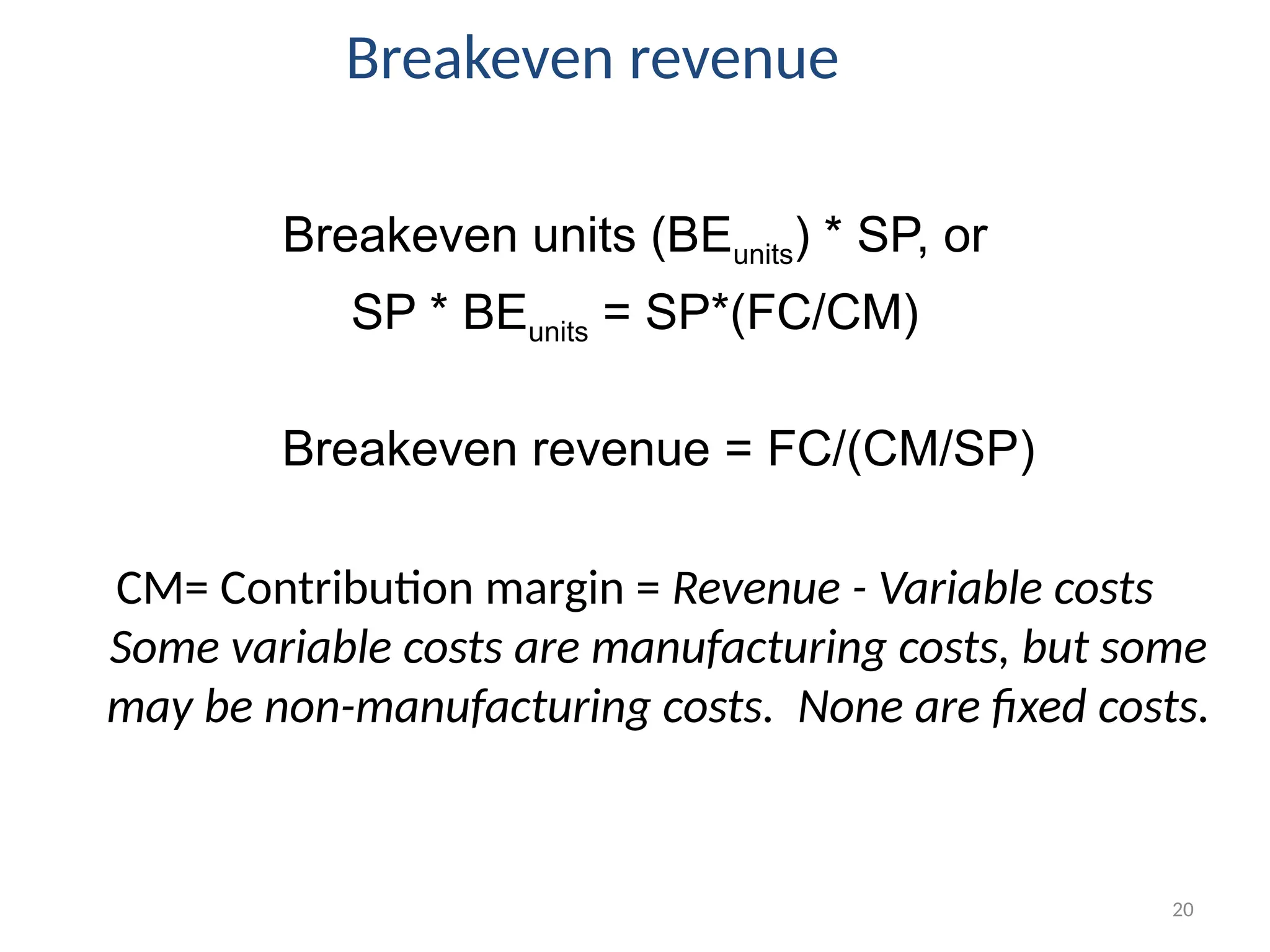
Breakeven units (BEunits) * SP, or
SP * BEunits = SP*(FC/CM)
Breakeven revenue = FC/(CM/SP)
CM= Contribution margin = Revenue - Variable costs
Some variable costs are manufacturing costs, but some
may be non-manufacturing costs. None are fixed costs.
21
Break even analysis
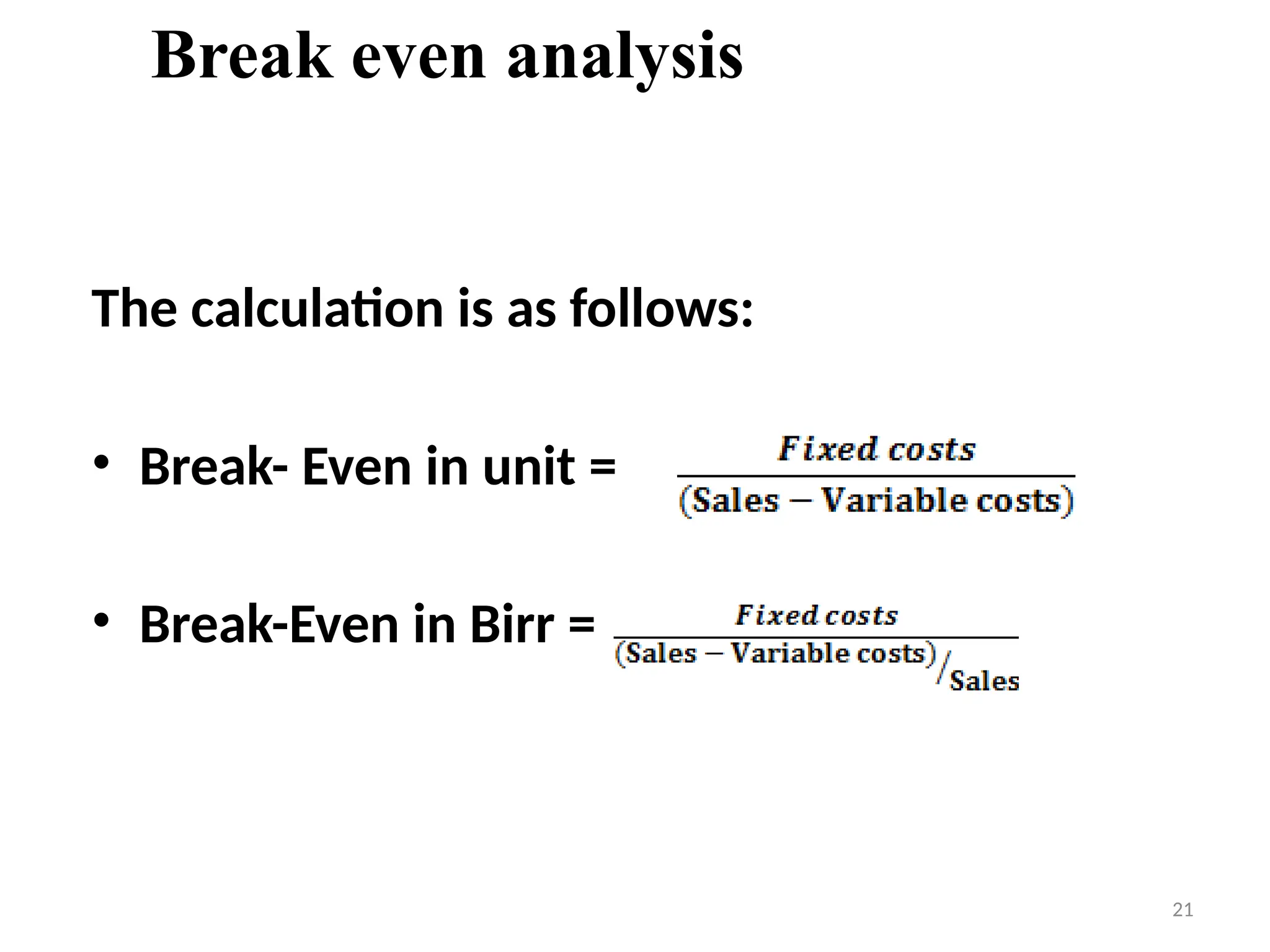
The calculation is as follows:
• Break- Even in unit =
• Break-Even in Birr =
22
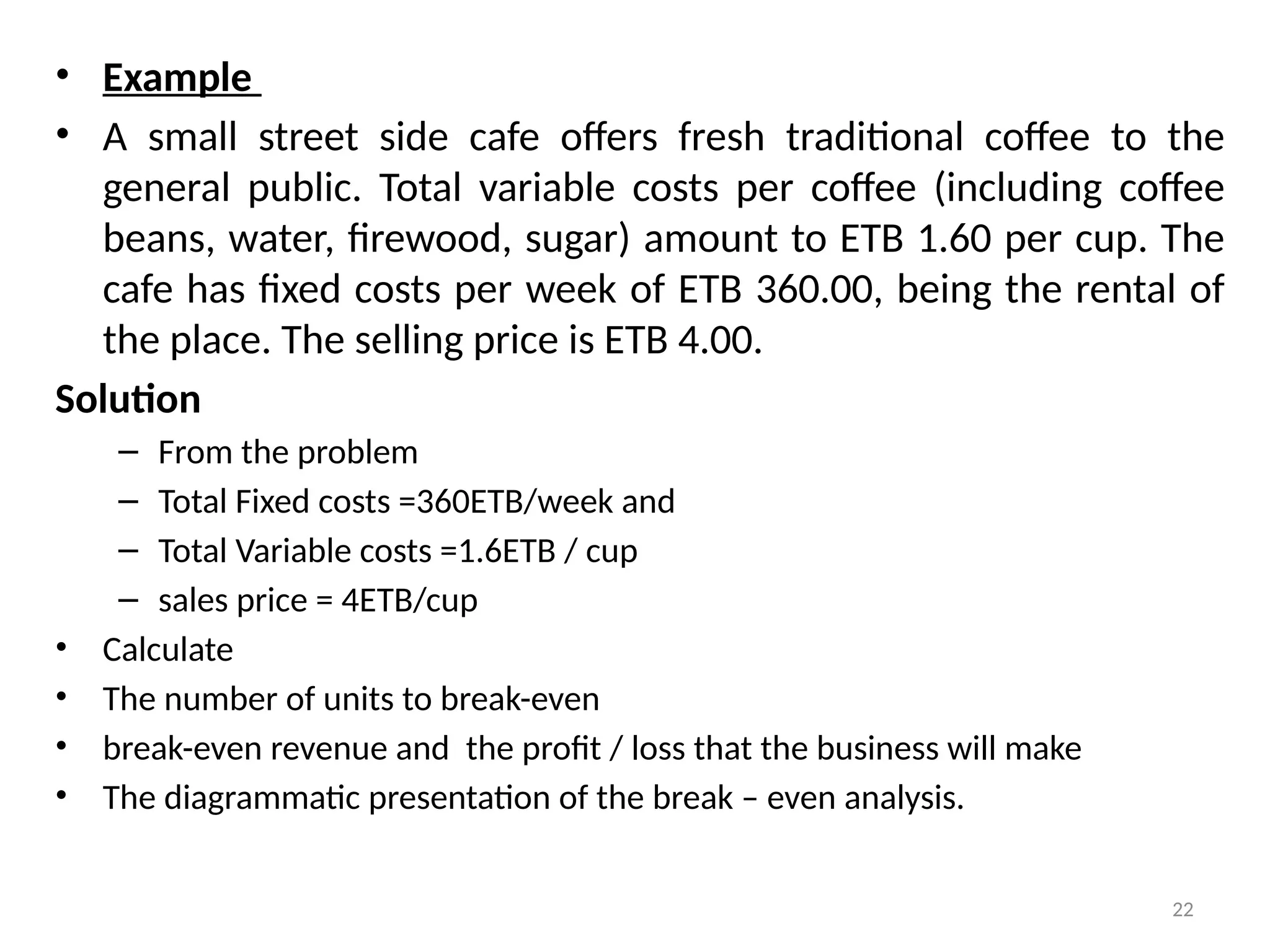
• Example
• A small street side cafe offers fresh traditional coffee to the
general public. Total variable costs per coffee (including coffee
beans, water, firewood, sugar) amount to ETB 1.60 per cup. The
cafe has fixed costs per week of ETB 360.00, being the rental of
the place. The selling price is ETB 4.00.
Solution
– From the problem
– Total Fixed costs =360ETB/week and
– Total Variable costs =1.6ETB / cup
– sales price = 4ETB/cup
• Calculate
• The number of units to break-even
• break-even revenue and the profit / loss that the business will make
• The diagrammatic presentation of the break – even analysis.
23
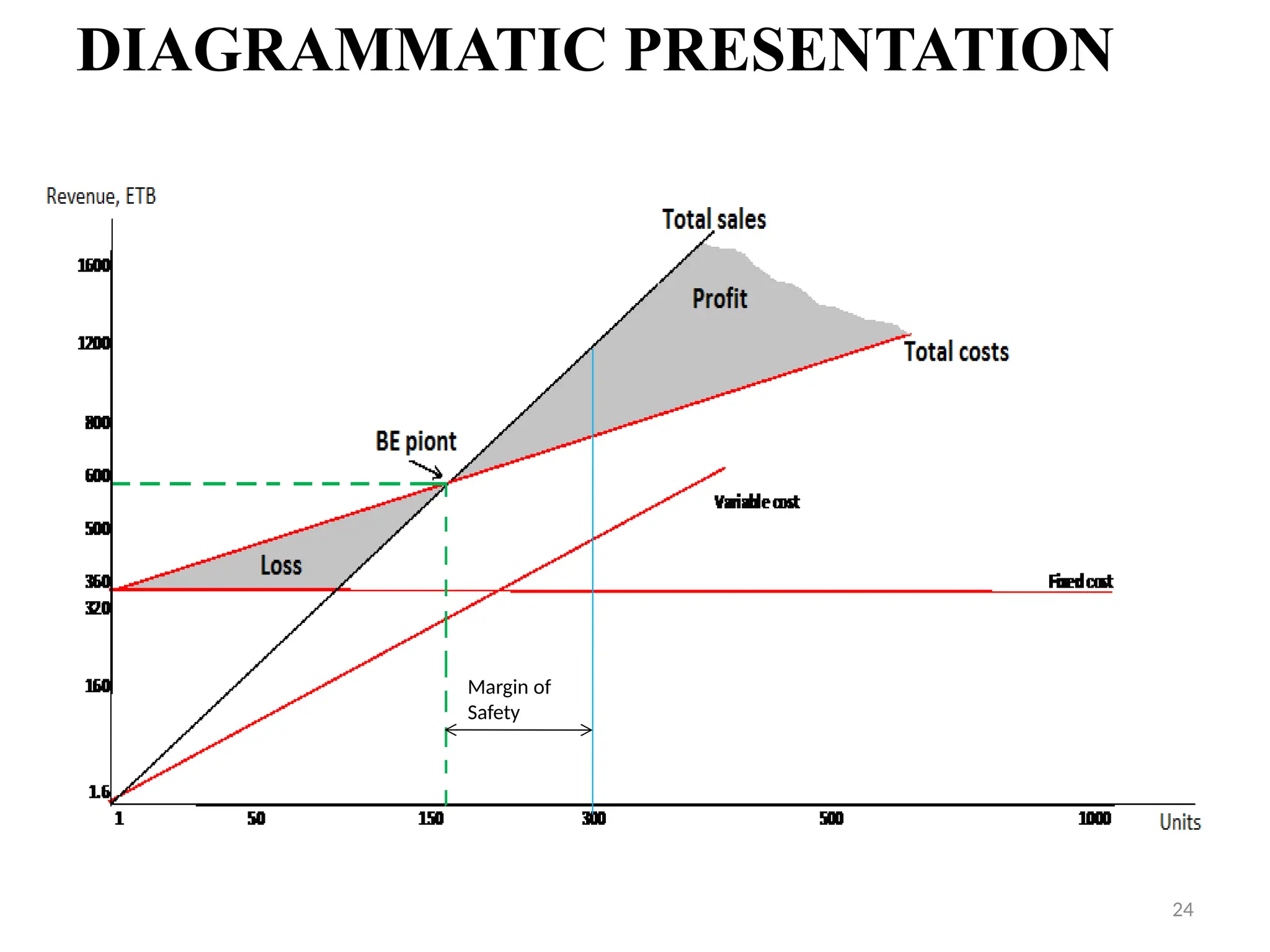
• Break- Even in unit = [fixed costs / (Sales-variable cost)]
• =[360/ (4-1.6)]= 150 units
• Therefore, the business must sell 150 cups of coffee (per week!) in order to
break-even. Let us put it to the test:
• Sales 150 x ETB 4.00 = ETB 600
• Variable costs 150 x ETB 1.60 = ETB 240
• Fixed costs = ETB 360
• Profit / loss = Sales- (fixed + variable) costs =600-(360+240) =0
• Break-Even Revenue =
= (360/[ (4-1.6)/4] = 600 or 150*4=600
• Once break-even point has been reached, a business enjoys greater
flexibility when setting prices or offering discounts.
24
DIAGRAMMATIC PRESENTATION
Margin of
Safety
25
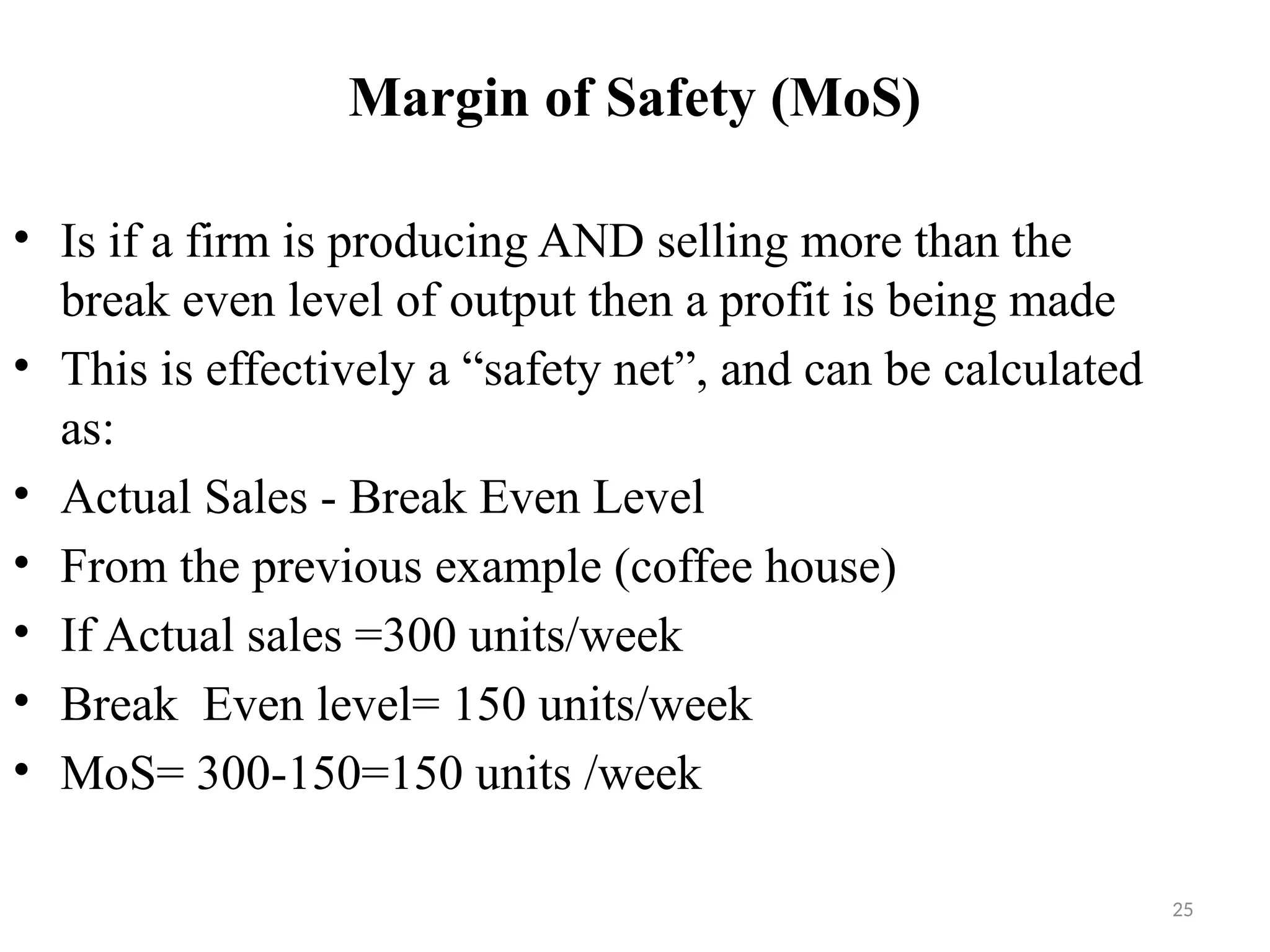
Margin of Safety (MoS)
• Is if a firm is producing AND selling more than the
break even level of output then a profit is being made
• This is effectively a “safety net”, and can be calculated
as:
• Actual Sales - Break Even Level
• From the previous example (coffee house)
• If Actual sales =300 units/week
• Break Even level= 150 units/week
• MoS= 300-150=150 units /week
26
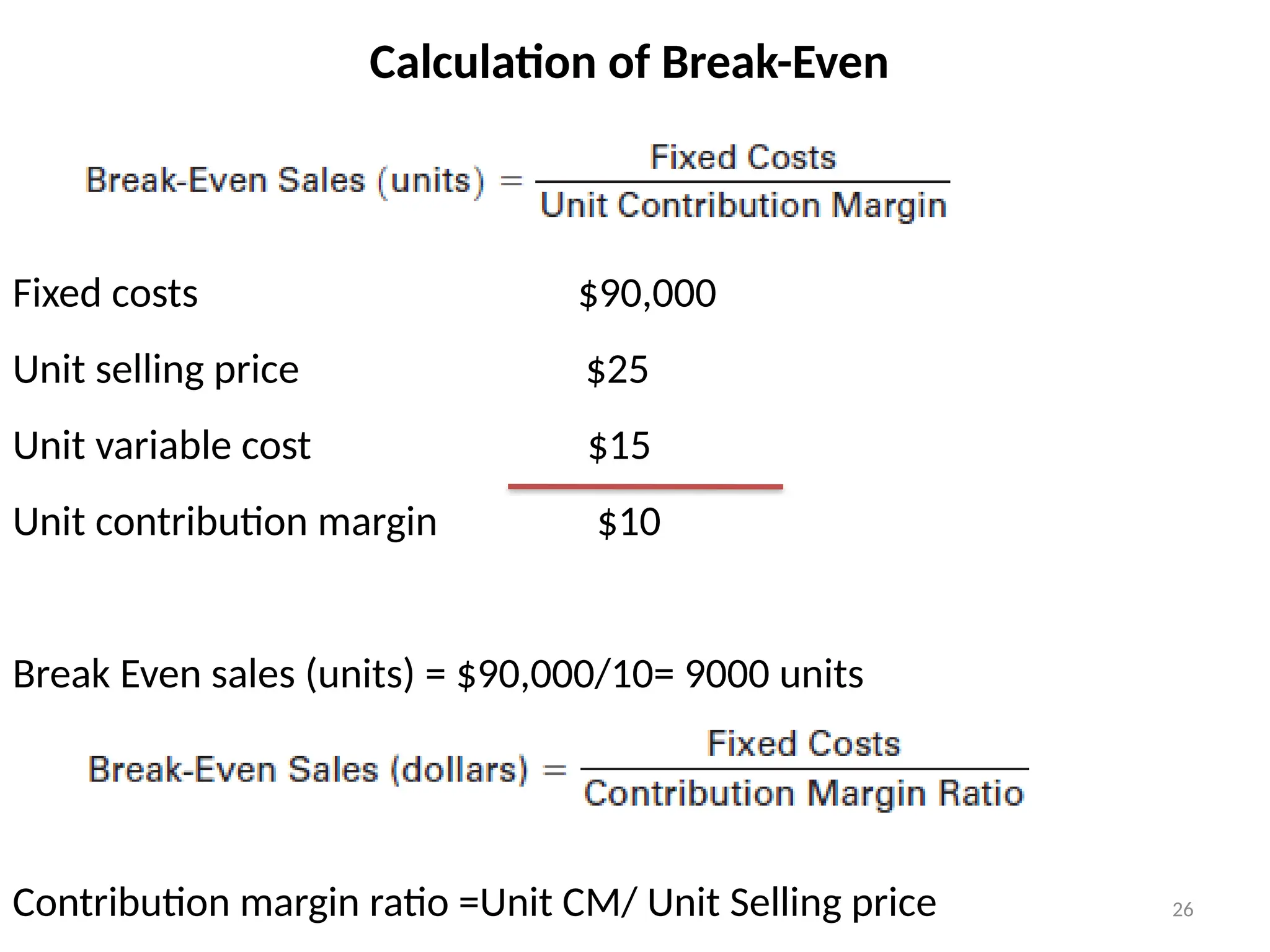
Calculation of Break-Even
Fixed costs $90,000
Unit selling price $25
Unit variable cost $15
Unit contribution margin $10
Break Even sales (units) = $90,000/10= 9000 units
Contribution margin ratio =Unit CM/ Unit Selling price
27
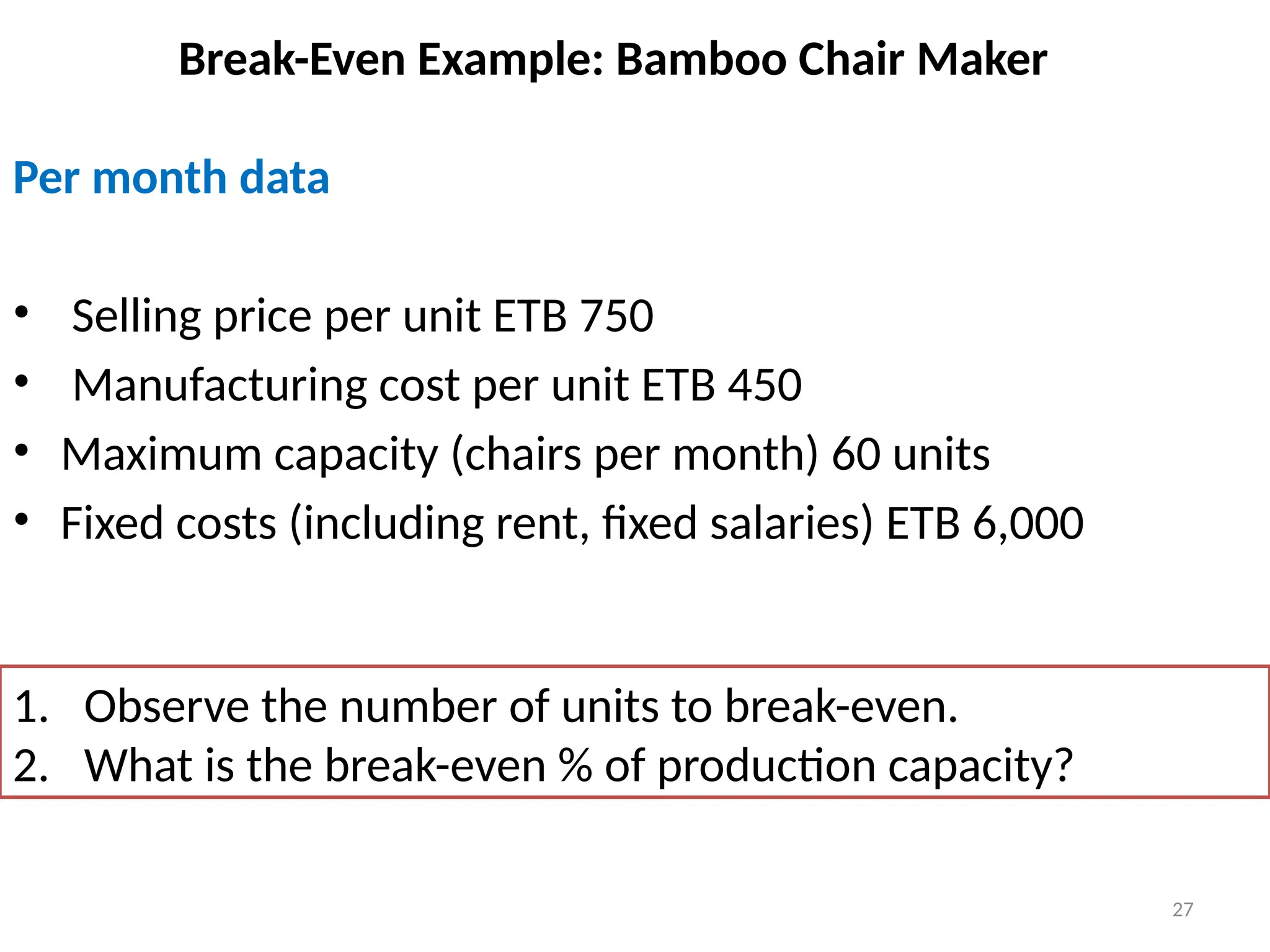
Break-Even Example: Bamboo Chair Maker
Per month data
• Selling price per unit ETB 750
• Manufacturing cost per unit ETB 450
• Maximum capacity (chairs per month) 60 units
• Fixed costs (including rent, fixed salaries) ETB 6,000
1. Observe the number of units to break-even.
2. What is the break-even % of production capacity?
28
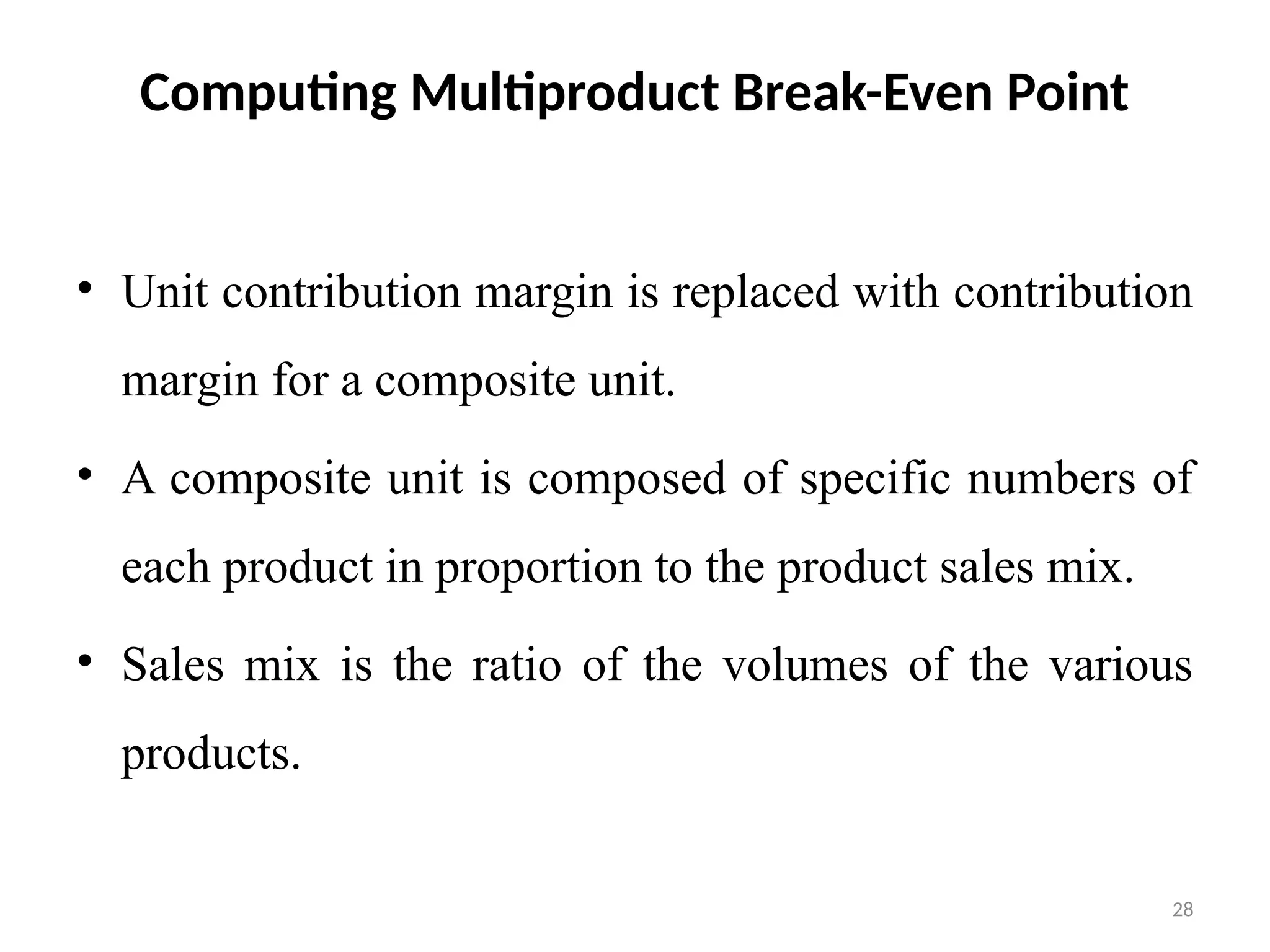
Computing Multiproduct Break-Even Point
• Unit contribution margin is replaced with contribution
margin for a composite unit.
• A composite unit is composed of specific numbers of
each product in proportion to the product sales mix.
• Sales mix is the ratio of the volumes of the various
products.
29
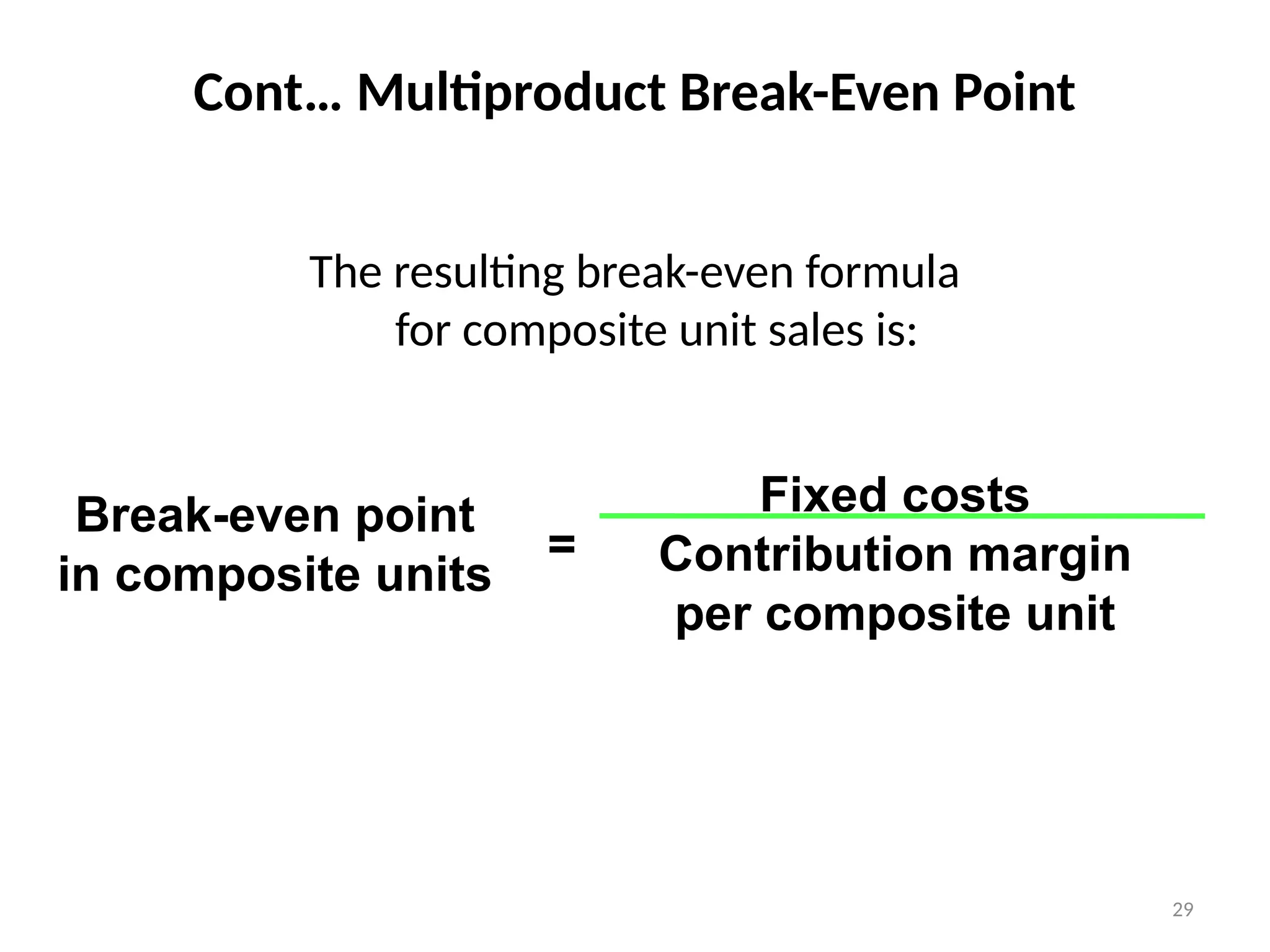
The resulting break-even formula
for composite unit sales is:
Break-even point
in composite units
Fixed costs
Contribution margin
per composite unit
=
Cont… Multiproduct Break-Even Point
30
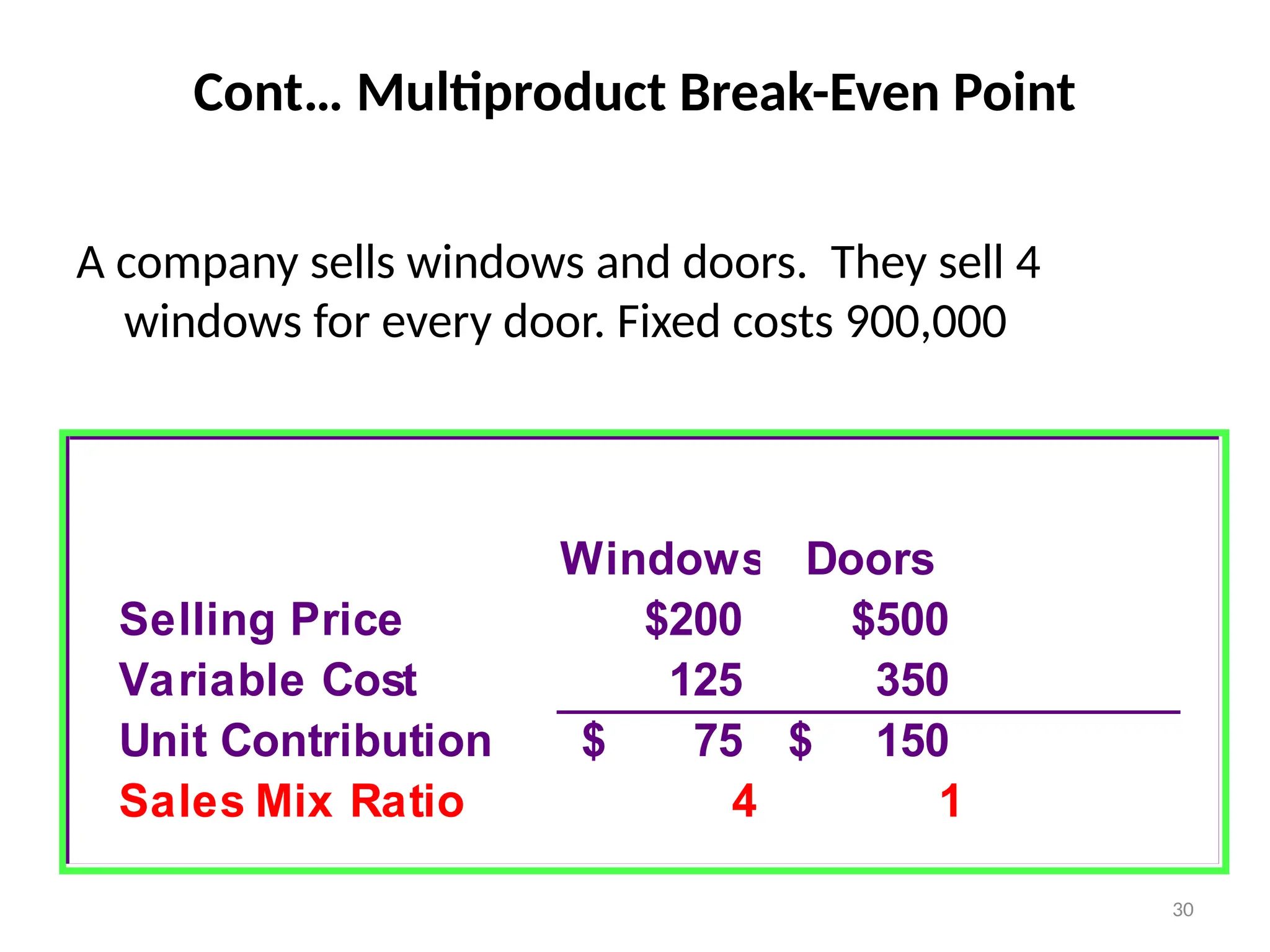
Windows Doors
Selling Price $200 $500
Variable Cost 125 350
Unit Contribution 75
$ 150
$
Sales Mix Ratio 4 1
A company sells windows and doors. They sell 4
windows for every door. Fixed costs 900,000
Cont… Multiproduct Break-Even Point
31
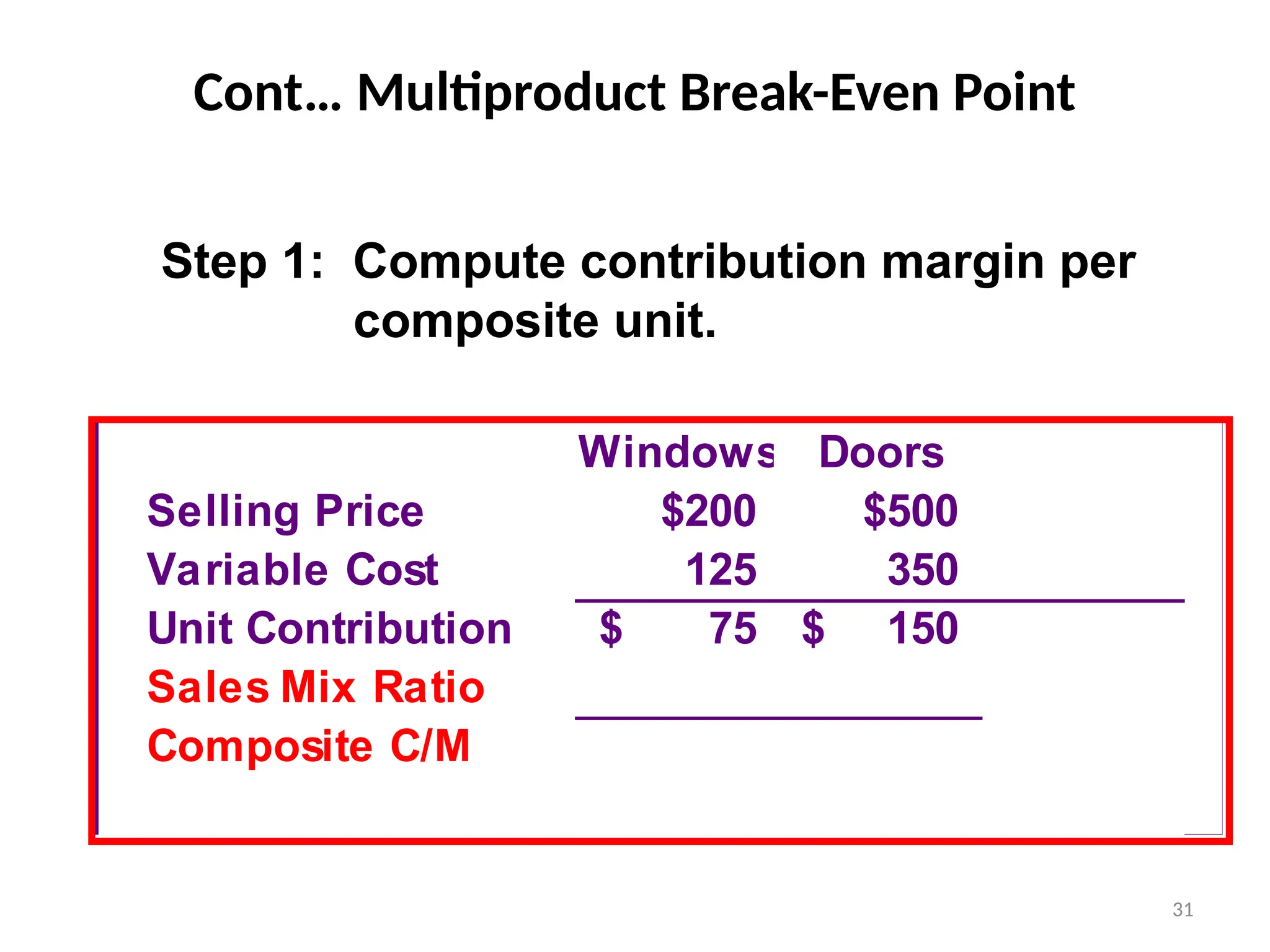
Step 1: Compute contribution margin per
composite unit.
Windows Doors
Selling Price $200 $500
Variable Cost 125 350
Unit Contribution 75
$ 150
$
Sales Mix Ratio
Composite C/M
Cont… Multiproduct Break-Even Point
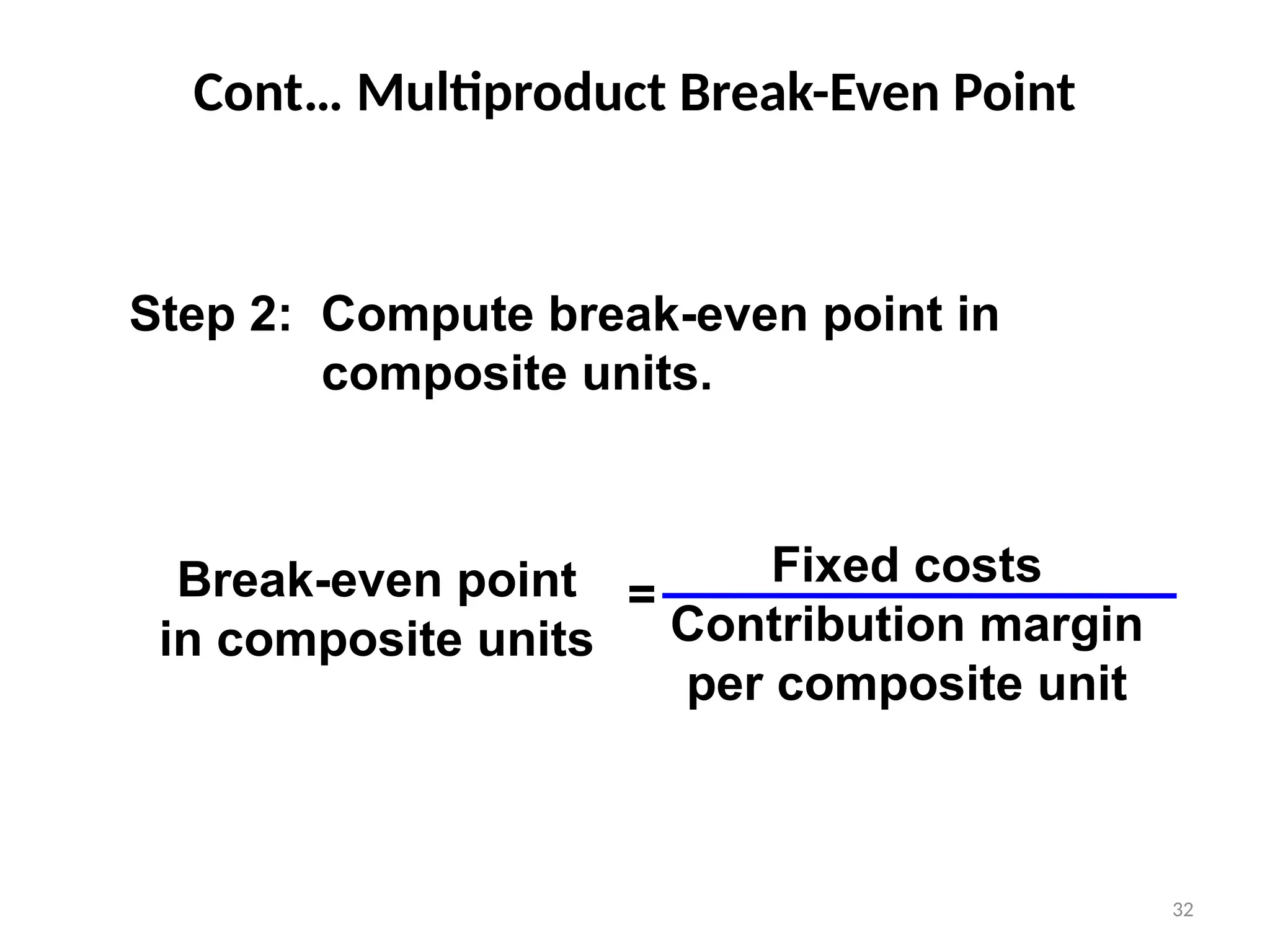
32
Break-even point
in composite units
Fixed costs
Contribution margin
per composite unit
=
Step 2: Compute break-even point in
composite units.
Cont… Multiproduct Break-Even Point
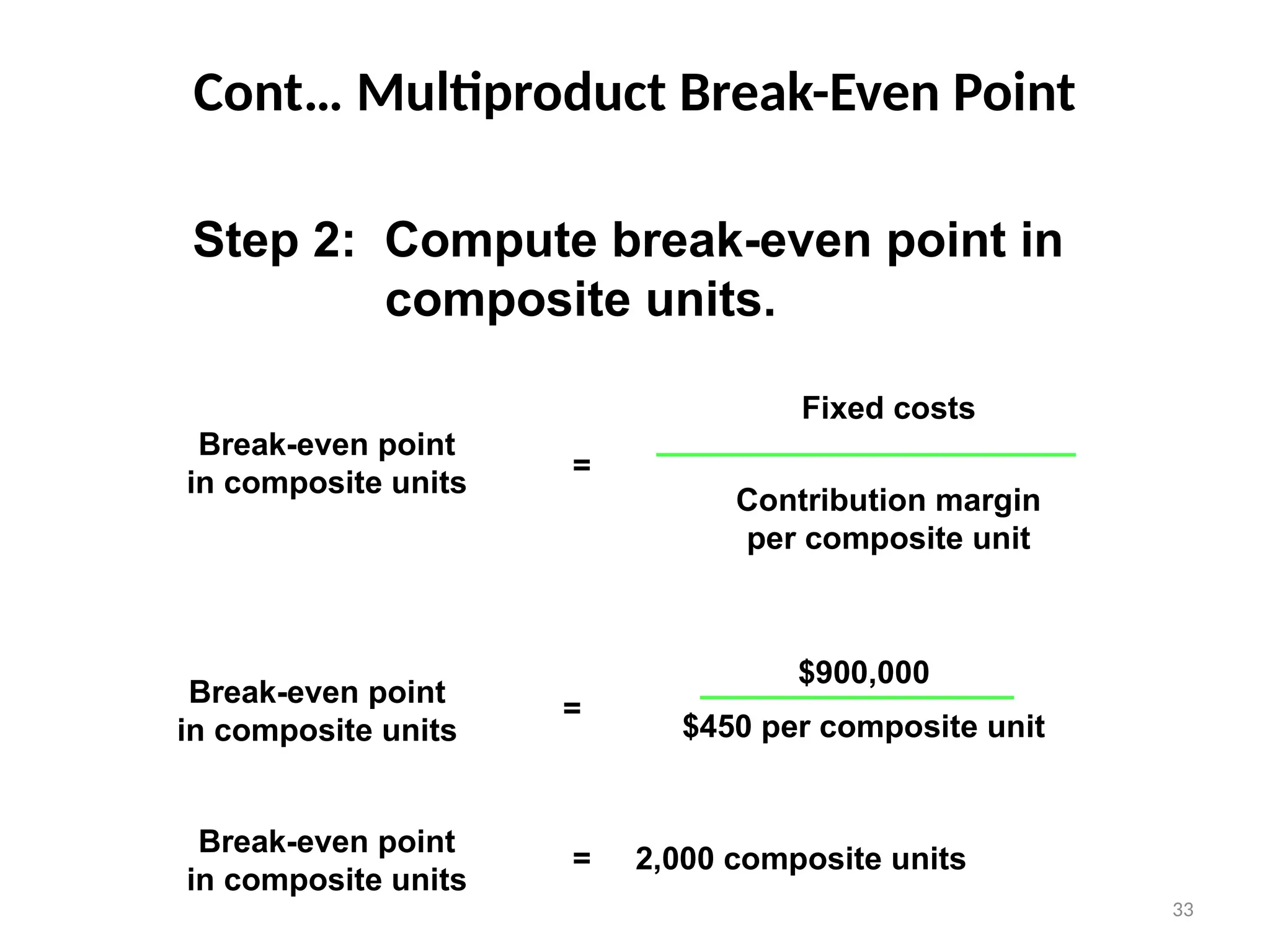
33
Break-even point
in composite units
Fixed costs
Contribution margin
per composite unit
=
Break-even point
in composite units
$900,000
$450 per composite unit
=
Step 2: Compute break-even point in
composite units.
Break-even point
in composite units
= 2,000 composite units
Cont… Multiproduct Break-Even Point
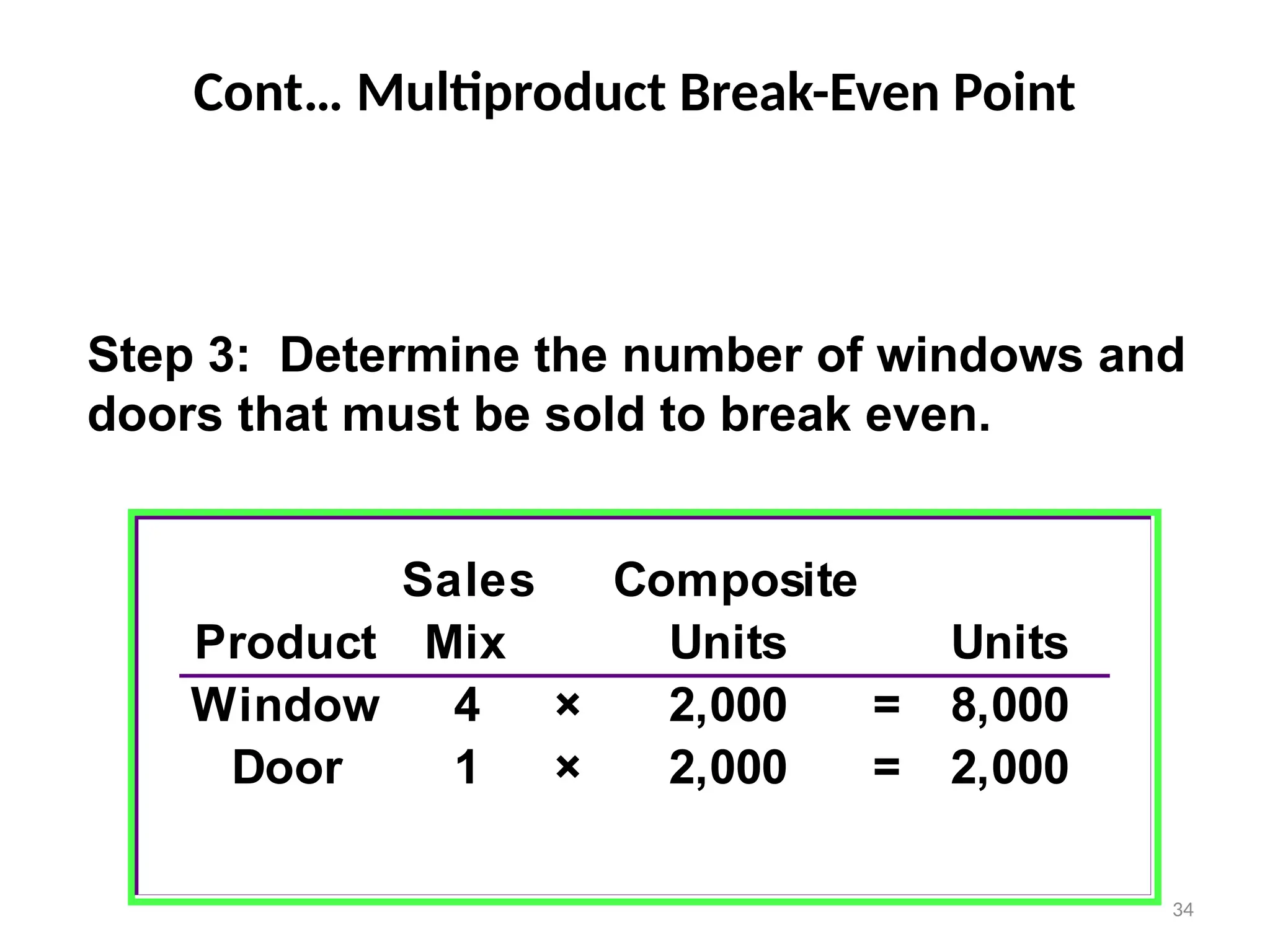
34
Sales Composite
Product Mix Units Units
Window 4 × 2,000 = 8,000
Door 1 × 2,000 = 2,000
Step 3: Determine the number of windows and
doors that must be sold to break even.
Cont… Multiproduct Break-Even Point
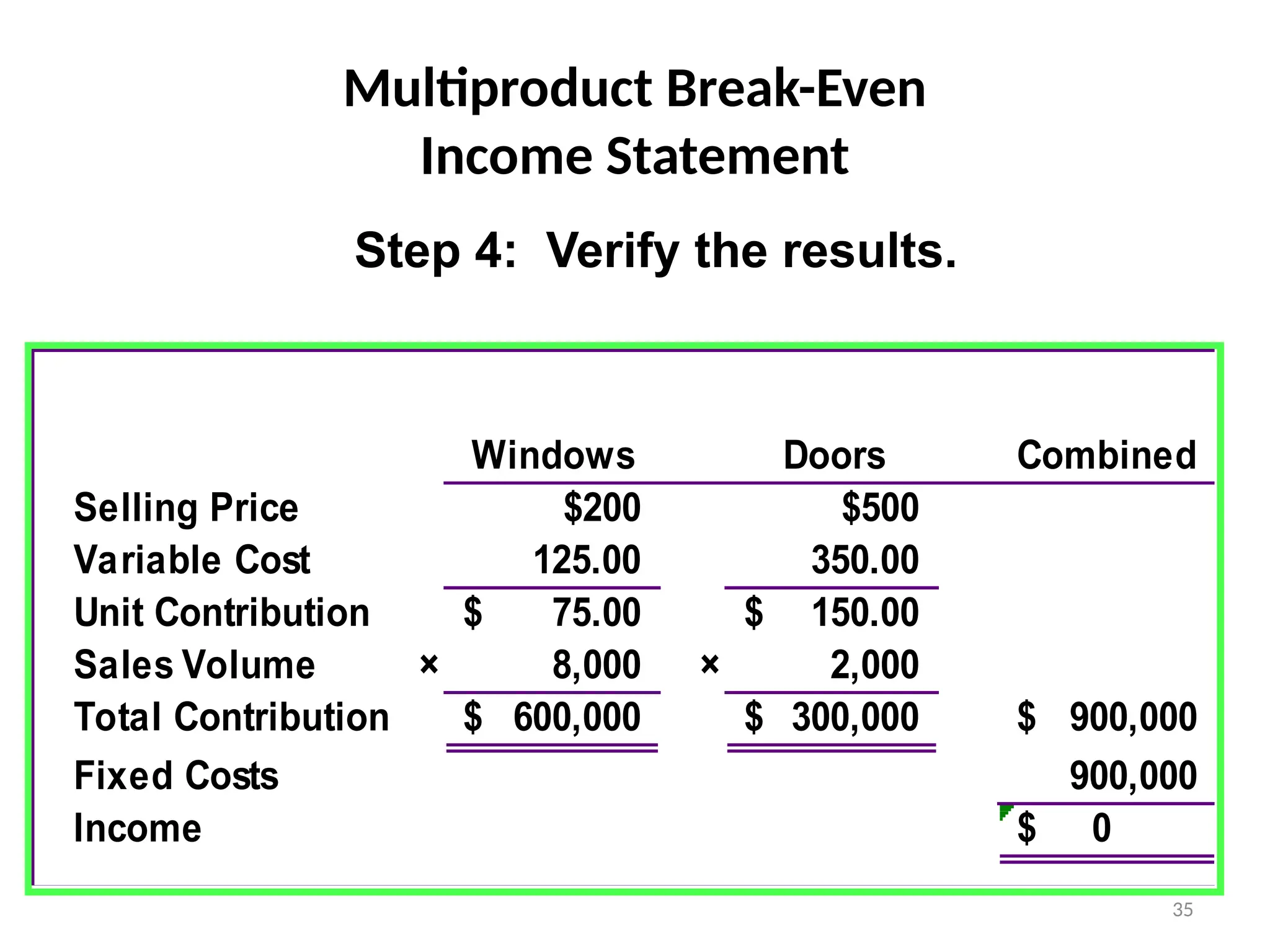
35
Windows Doors Combined
Selling Price $200 $500
Variable Cost 125.00 350.00
Unit Contribution 75.00
$ 150.00
$
Sales Volume × 8,000 × 2,000
Total Contribution 600,000
$ 300,000
$ 900,000
$
Fixed Costs 900,000
Income $ 0
Step 4: Verify the results.
Multiproduct Break-Even
Income Statement
36
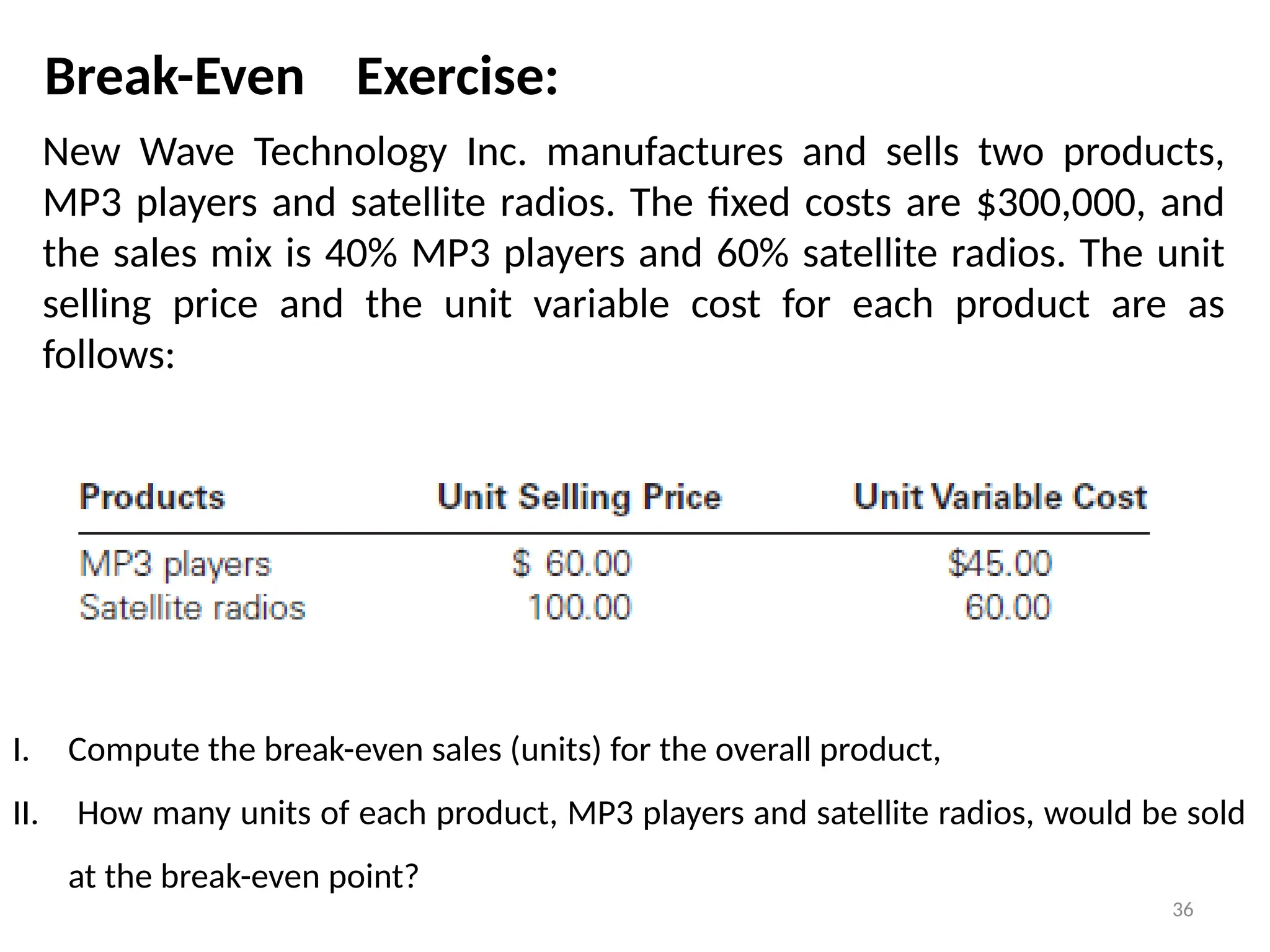
New Wave Technology Inc. manufactures and sells two products,
MP3 players and satellite radios. The fixed costs are $300,000, and
the sales mix is 40% MP3 players and 60% satellite radios. The unit
selling price and the unit variable cost for each product are as
follows:
I. Compute the break-even sales (units) for the overall product,
II. How many units of each product, MP3 players and satellite radios, would be sold
at the break-even point?
Break-Even Exercise:
37
Demerits of Break Even analysis
• It is only a forecast!
• Assumes all products are made AND sold
• Assumes that sales prices are constant at all levels of
output
• Costs may change
• It can only apply to single product or single mix of
products
38
• Sales -Cost of sales= Gross profit
• Gross profit /Sales x100=Gross profit margin (%
• Opening stock +Purchases -Closing stock=Costs
of sales
39
PROFIT FORECAST
Profit forecast tells you how much profit/loss
you make in a period
Profit and Loss is also essential in providing
information for Inland Revenue for Taxation
purposes
• A profit forecast should show what level of
profit you expect your
• business to produce at the end of the period.
40
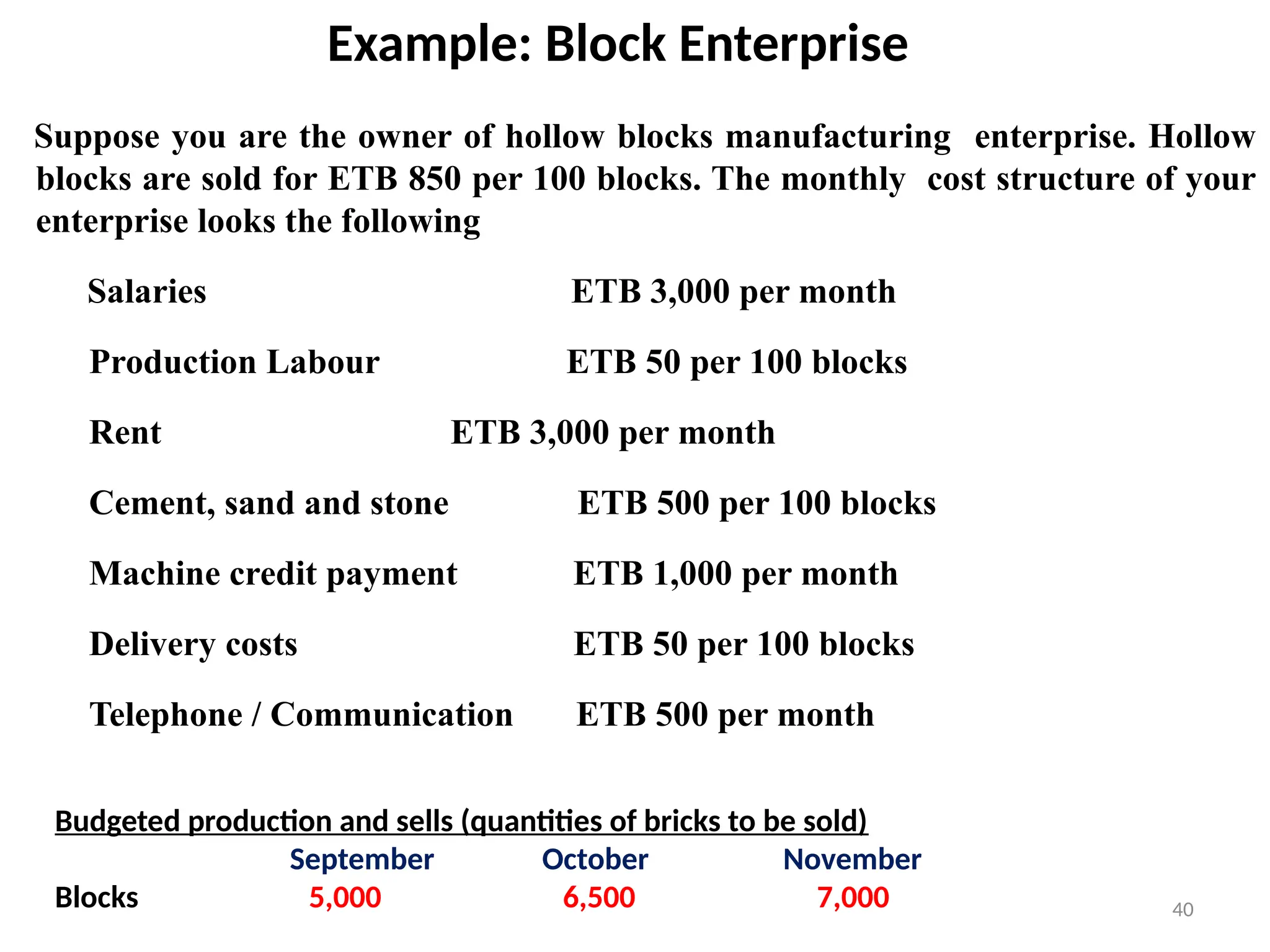
Example: Block Enterprise
Suppose you are the owner of hollow blocks manufacturing enterprise. Hollow
blocks are sold for ETB 850 per 100 blocks. The monthly cost structure of your
enterprise looks the following
Salaries ETB 3,000 per month
Production Labour ETB 50 per 100 blocks
Rent ETB 3,000 per month
Cement, sand and stone ETB 500 per 100 blocks
Machine credit payment ETB 1,000 per month
Delivery costs ETB 50 per 100 blocks
Telephone / Communication ETB 500 per month
Budgeted production and sells (quantities of bricks to be sold)
September October November
Blocks 5,000 6,500 7,000
41
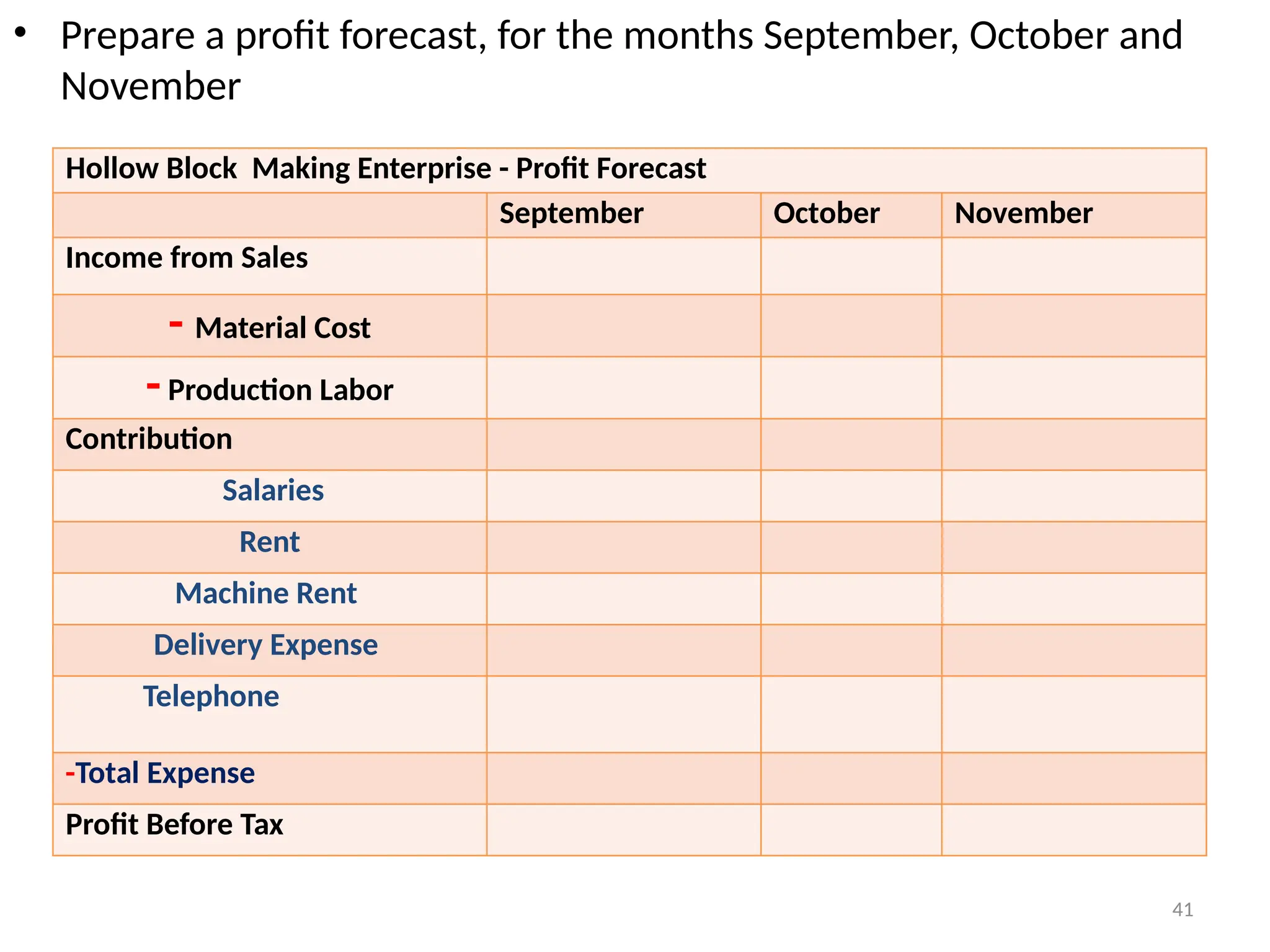
• Prepare a profit forecast, for the months September, October and
November
Hollow Block Making Enterprise - Profit Forecast
September October November
Income from Sales
- Material Cost
-Production Labor
Contribution
Salaries
Rent
Machine Rent
Delivery Expense
Telephone
-Total Expense
Profit Before Tax
42
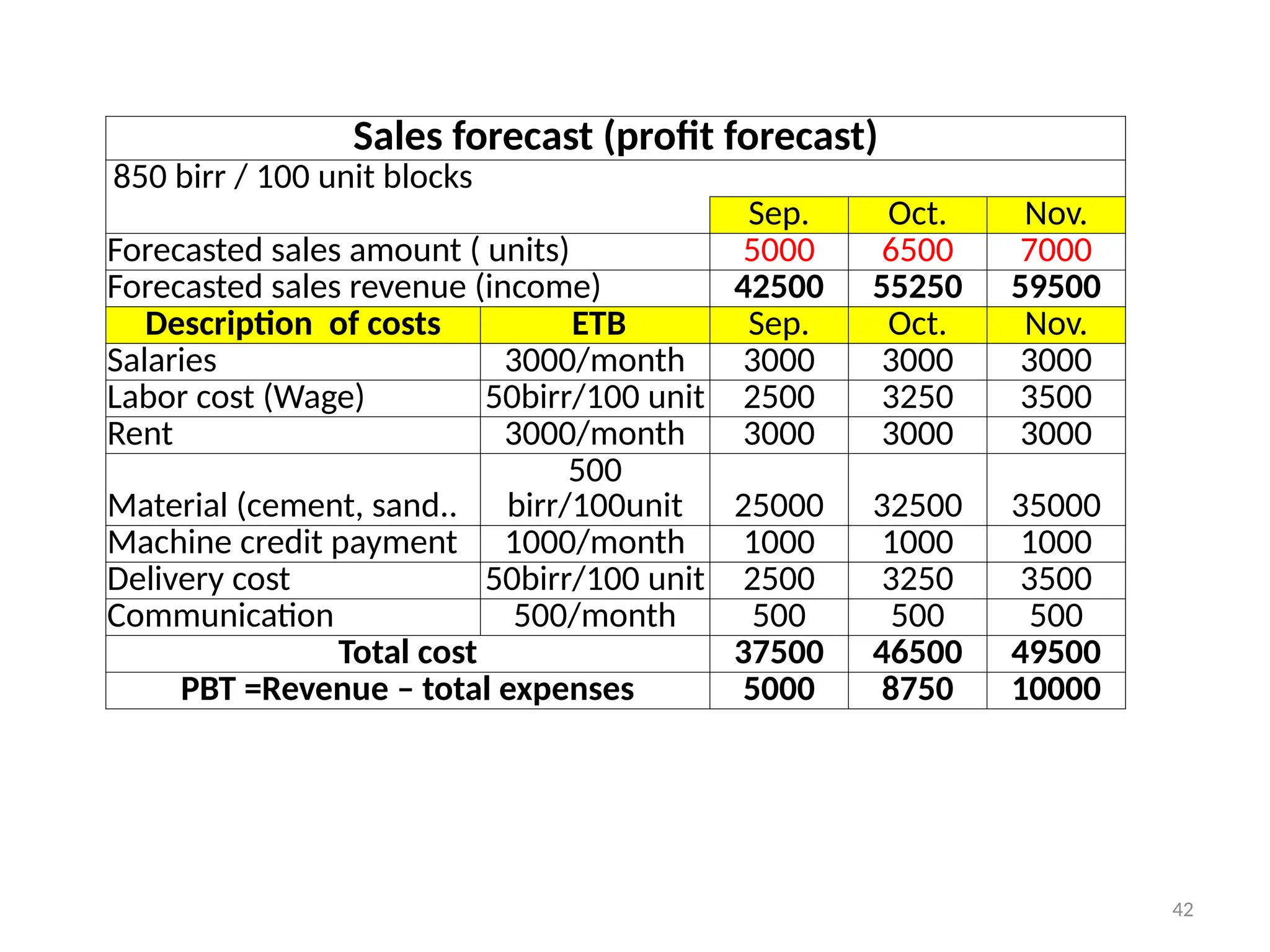
Sales forecast (profit forecast)
850 birr / 100 unit blocks
Sep. Oct. Nov.
Forecasted sales amount ( units) 5000 6500 7000
Forecasted sales revenue (income) 42500 55250 59500
Description of costs ETB Sep. Oct. Nov.
Salaries 3000/month 3000 3000 3000
Labor cost (Wage) 50birr/100 unit 2500 3250 3500
Rent 3000/month 3000 3000 3000
Material (cement, sand..
500
birr/100unit 25000 32500 35000
Machine credit payment 1000/month 1000 1000 1000
Delivery cost 50birr/100 unit 2500 3250 3500
Communication 500/month 500 500 500
Total cost 37500 46500 49500
PBT =Revenue – total expenses 5000 8750 10000
43
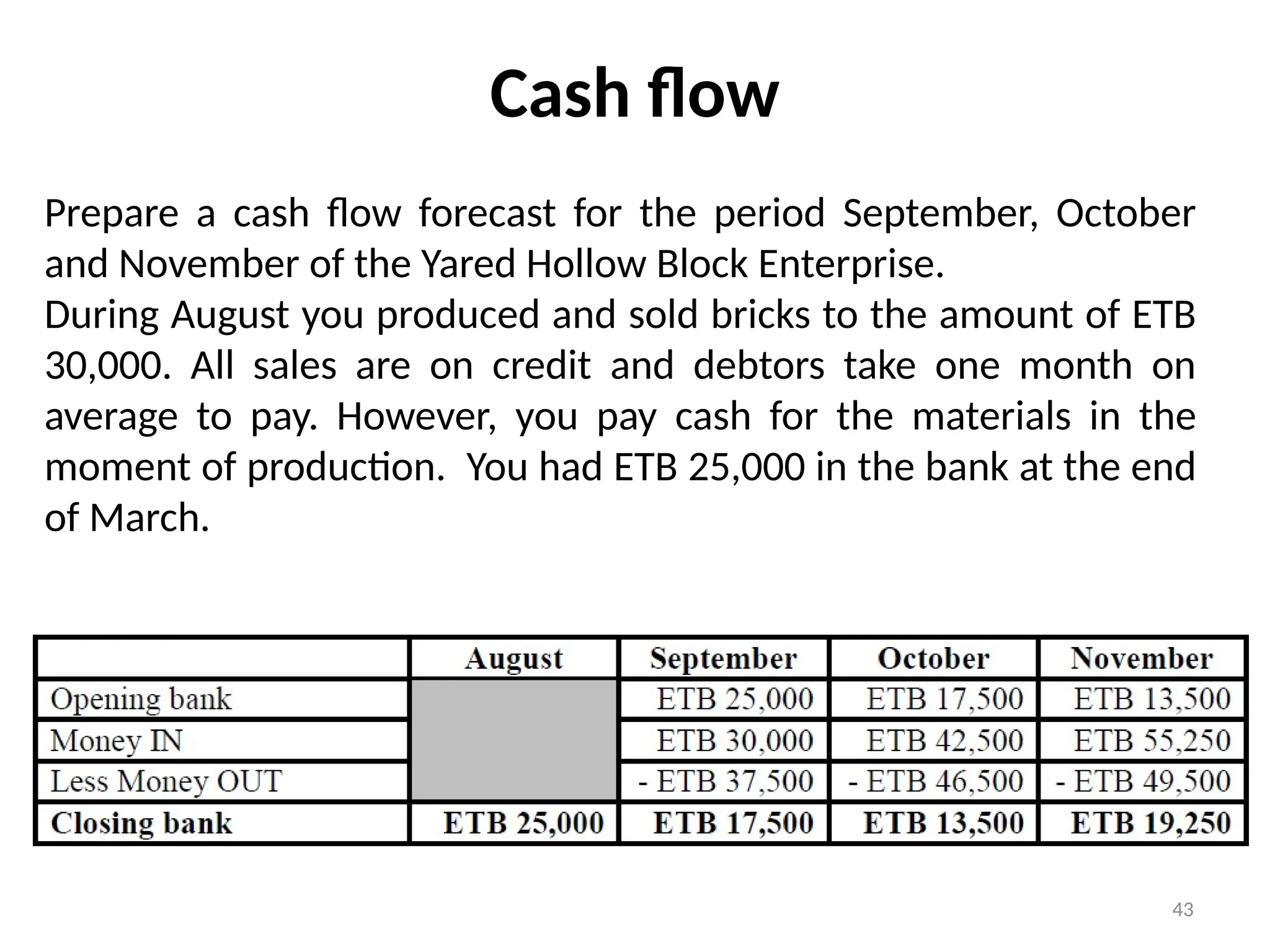
Cash flow
Prepare a cash flow forecast for the period September, October
and November of the Yared Hollow Block Enterprise.
During August you produced and sold bricks to the amount of ETB
30,000. All sales are on credit and debtors take one month on
average to pay. However, you pay cash for the materials in the
moment of production. You had ETB 25,000 in the bank at the end
of March.
44
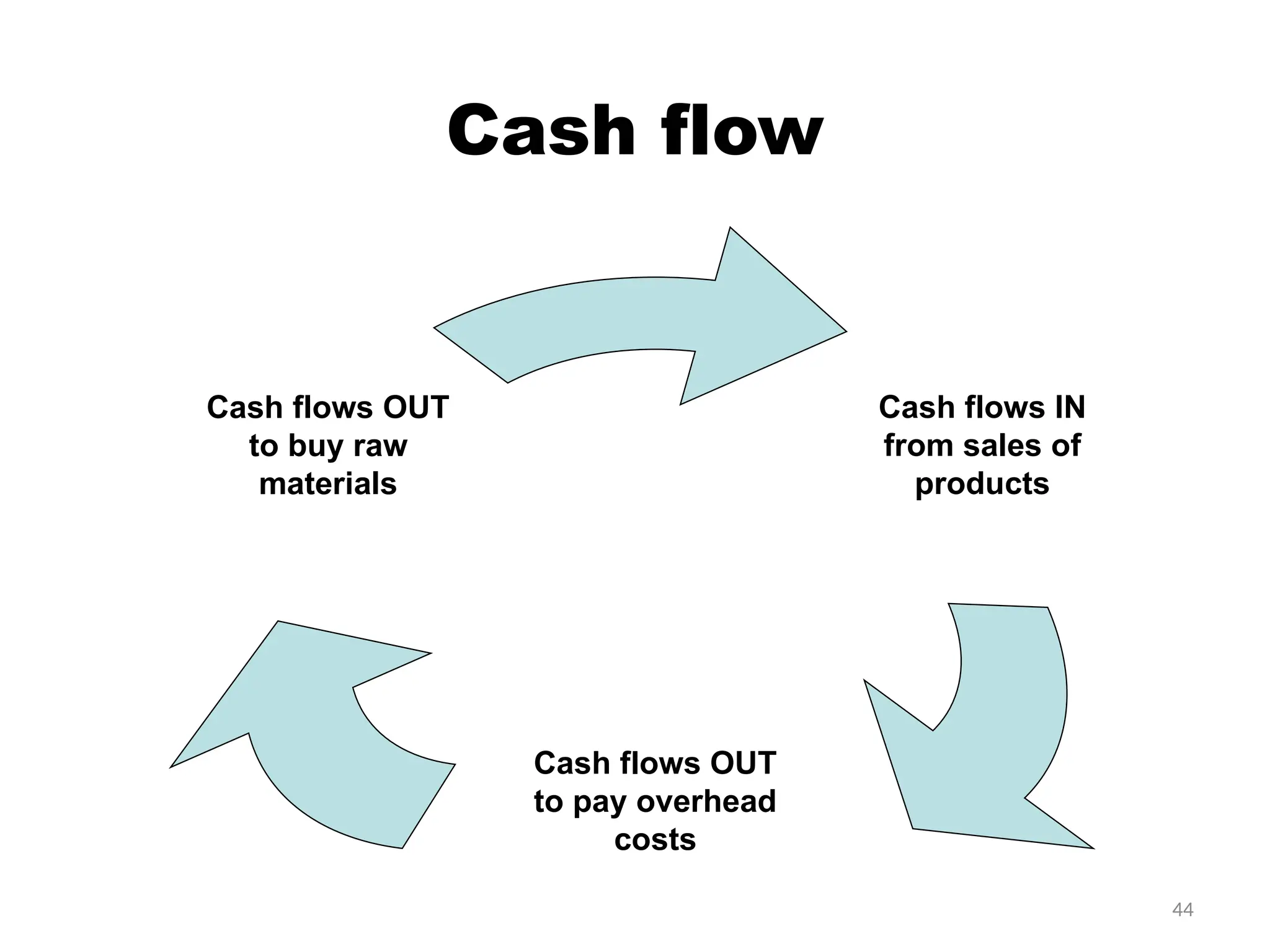
Cash flows IN
from sales of
products
Cash flows OUT
to pay overhead
costs
Cash flows OUT
to buy raw
materials
Cash flow

Chapter 5 Financial Management and Tools.pptx

  • 1.
    1 • Sources offinance and Types of Capital • Types of Costs – Profit/Loss calculation • Breakeven Analysis • Understanding Financial Statements • Cash flow planning Chapter 5 Financial Management
  • 2.
    2 Sources of finance •The adequate provision of finance is needed to start a business and ramp it up to profitability. • The assessment of the fund needed by the business organization should be done in such a way that the total amount of money available should be neither too low nor too less. • The determination of the right amount of capital that can be used for the current operation of the business and the future expansion is the very important task.
  • 3.
    3 • Investment capitalis a valuable commodity. Like other commodities, the price of capital is determined by the interaction between demand and supply. • The price of capital is the rate of return that the supplier (the lender or investor) experts from their investment..
  • 4.
    4 Cont… • The majorsupplies of capital include the following – Personal capital – Informal investors – Borrowing – Retained capital – Different business angles – Issuing shares – Commercial Partnership – Government
  • 5.
    5 TYPES OF CAPITALREQUIRED • Capital refers to be the total investment of a company of firm in money, When the business assesses it capital requirement, it must consider the need for current asset capital and fixed asset capital. 1. Current asset capital • Current assets are part of business capital that are used for the current business operations – Cash: – Inventor – Receivables:
  • 6.
    6 Cont… 2. Fixed assetcapital – Fixed assets are relatively permanent assets that are used for long period of time. • The types of fixed assets needed in a new business may include the following – Long-term tangible resources in operation. The distinguishing characteristics of assets in this category are that they are tangible (have physical substance) and are held for productive use in business operations. Examples building, machinery, equipment, land etc. – Intangible fixed assets – Such as patents, copyrights, trademarks, and goodwill. Many newly established firms have no intangible fixed assets. – Fixed security investment: - such as stocks of subsidiaries, pension funds and contingency funds. In most cases, a new business has no fixed security.
  • 7.
    7 Fixed and Variablecosts. Fixed costs remain constant in total (not per unit) regardless of the volume of production or sales, over a relevant range of production or sales. Rent and salaries are typically fixed costs Variable costs fluctuate in total (not per unit) as the volume of production or sales fluctuates Direct labour costs, Direct material costs used in production, and sales commissions are examples of variable costs. Types of costs
  • 8.
    8 COSTS FIXED VARIABLE Wagesfor the seamstress Telephone Salary for the secretary / receptionist Water and electricity Rent for the factory building Maintenance contract on the machines Raw material costs Example: Cost items of a dress making factory
  • 9.
    9 Direct Materials Direct Labor Manufacturing Overhead The Product Example: Wages paidto automobile assembly workers Example: The tires installed in an automobile Examples: Indirect materials and indirect labor Wages paid not directly involved in production work. Examples: maintenance workers, janitors and guards. Materials used to support the production process. Examples: lubricants and cleaning supplies Adminis trative Costs All executive, organizational, and clerical costs. Other Costs  Selling and distribution  Rent  Utilities Examples Elements of Cost
  • 10.
  • 11.
  • 12.
    12 Calculate: • 1. TheVariable cost, Fixed costs and total costs per month at full capacity • 2. The profit / loss that the business will make from this order.
  • 13.
    13 THE TAILOR SHOPof Wro Addis - COST STRUCTURE Cost (ETB) per month Direct material & expenses [(Cloth 2x150ETB)+ (Button 20x5ETB) +(Belt 1x50 ETB)] per unit 2.5 dresses per day x 20days= 50dresses per month [2*150+20*5 +1*50]*50 = 22500 Variable cost 22,500 Monthly interest [amount x int. rate x years]/month = [ETB 30,000 x 12 % x 1]/12 = 300 Depreciation: ETB 24,000 ÷ 60 months = 400 Auxiliary materials & packaging 700 Maintenance / repairs 200 Administration cost 400 Salaries (regular salaries in production) 2000 Salaries (Wro Addis) 3000 Rent 2500 Utilities 400 Selling expenses 600 Total Fixed Cost 10,500 Total cost (Variabl+ fixed) 33,000
  • 14.
    14 Profit / lossCalculation SALES ETB 35,000 - Cost of production ETB 22,500 = Contribution ETB 12,500 - Overheads (fixed costs) ETB 10,500 = NET PROFIT ETB 2,000 revenue: 50 dresses per month x ETB 700.00 each = ETB 35,000 per month
  • 15.
    15 Cont… MARK-UP % =(Contribution ÷ Production Cost) x 100 = (ETB 12,500 ÷ ETB 22,500) x 100 = 55.5 % Contribution % = (Contribution ÷ Revenue) x 100 = (ETB 12,500 ÷ ETB 35,000) x 100 = 35.7 % NET PROFIT % = Net Profit ÷ Revenue x 100 = ETB 2,000 ÷ ETB 35,000 x 100 = 5.7 %
  • 16.
    16 Break-even Analysis • “Afirm Breaks Even if it doesn’t make a profit or a loss” • In other words profit = 0 • Total Revenue = Total Costs • Total Revenue (TR)= Price per unit x Number of units sold • Used to evaluate whether the organisation will be able to cover costs (break even) at a particular price Uses of break- even analysis • It enables a business organization to: – Measure profit and loss at different levels of production and sales – To predict the effect of changes in price of sales – To analyse the relationship between fixed cost and variable cost – To predict the effect on profitability if changes in cost and efficiency
  • 17.
    17 ETB 1 000 ETB2 000 ETB 8 000 ETB 6 000 ETB 7 000 ETB 5 000 ETB 4 000 ETB 3 000 Profit Loss BE-Point Total Sales Total Costs Variable Costs Fixed Costs = ETB 1 600 10 20 30 40 50 60 70 80 90 100 110 Break-even  The break-even point is the level of operations at which a company’s revenues and expenses are equal. Margin of Safety
  • 18.
    18 Cont… • The fundamentalaccounting equation Profit = Revenues - Costs Revenue = SP*units sold SP = selling price Costs = FC + VC(units manufactured) FC = fixed cost VC = unit variable costs. • We are assuming that units manufactured equal units sold
  • 19.
    19 What if wewant to know how much product we must sell to break even? The breakeven point is the point where profit is zero, so Profit /Loss = 0 = Revenue - Cost = SP*units sold - FC - VC*units sold = (SP - VC)*units sold - FC units sold = FC/(SP - VC) We will call units sold at  Profit /Loss = 0: BEunits
  • 20.
    20 Breakeven revenue Breakeven units(BEunits) * SP, or SP * BEunits = SP*(FC/CM) Breakeven revenue = FC/(CM/SP) CM= Contribution margin = Revenue - Variable costs Some variable costs are manufacturing costs, but some may be non-manufacturing costs. None are fixed costs.
  • 21.
    21 Break even analysis Thecalculation is as follows: • Break- Even in unit = • Break-Even in Birr =
  • 22.
    22 • Example • Asmall street side cafe offers fresh traditional coffee to the general public. Total variable costs per coffee (including coffee beans, water, firewood, sugar) amount to ETB 1.60 per cup. The cafe has fixed costs per week of ETB 360.00, being the rental of the place. The selling price is ETB 4.00. Solution – From the problem – Total Fixed costs =360ETB/week and – Total Variable costs =1.6ETB / cup – sales price = 4ETB/cup • Calculate • The number of units to break-even • break-even revenue and the profit / loss that the business will make • The diagrammatic presentation of the break – even analysis.
  • 23.
    23 • Break- Evenin unit = [fixed costs / (Sales-variable cost)] • =[360/ (4-1.6)]= 150 units • Therefore, the business must sell 150 cups of coffee (per week!) in order to break-even. Let us put it to the test: • Sales 150 x ETB 4.00 = ETB 600 • Variable costs 150 x ETB 1.60 = ETB 240 • Fixed costs = ETB 360 • Profit / loss = Sales- (fixed + variable) costs =600-(360+240) =0 • Break-Even Revenue = = (360/[ (4-1.6)/4] = 600 or 150*4=600 • Once break-even point has been reached, a business enjoys greater flexibility when setting prices or offering discounts.
  • 24.
  • 25.
    25 Margin of Safety(MoS) • Is if a firm is producing AND selling more than the break even level of output then a profit is being made • This is effectively a “safety net”, and can be calculated as: • Actual Sales - Break Even Level • From the previous example (coffee house) • If Actual sales =300 units/week • Break Even level= 150 units/week • MoS= 300-150=150 units /week
  • 26.
    26 Calculation of Break-Even Fixedcosts $90,000 Unit selling price $25 Unit variable cost $15 Unit contribution margin $10 Break Even sales (units) = $90,000/10= 9000 units Contribution margin ratio =Unit CM/ Unit Selling price
  • 27.
    27 Break-Even Example: BambooChair Maker Per month data • Selling price per unit ETB 750 • Manufacturing cost per unit ETB 450 • Maximum capacity (chairs per month) 60 units • Fixed costs (including rent, fixed salaries) ETB 6,000 1. Observe the number of units to break-even. 2. What is the break-even % of production capacity?
  • 28.
    28 Computing Multiproduct Break-EvenPoint • Unit contribution margin is replaced with contribution margin for a composite unit. • A composite unit is composed of specific numbers of each product in proportion to the product sales mix. • Sales mix is the ratio of the volumes of the various products.
  • 29.
    29 The resulting break-evenformula for composite unit sales is: Break-even point in composite units Fixed costs Contribution margin per composite unit = Cont… Multiproduct Break-Even Point
  • 30.
    30 Windows Doors Selling Price$200 $500 Variable Cost 125 350 Unit Contribution 75 $ 150 $ Sales Mix Ratio 4 1 A company sells windows and doors. They sell 4 windows for every door. Fixed costs 900,000 Cont… Multiproduct Break-Even Point
  • 31.
    31 Step 1: Computecontribution margin per composite unit. Windows Doors Selling Price $200 $500 Variable Cost 125 350 Unit Contribution 75 $ 150 $ Sales Mix Ratio Composite C/M Cont… Multiproduct Break-Even Point
  • 32.
    32 Break-even point in compositeunits Fixed costs Contribution margin per composite unit = Step 2: Compute break-even point in composite units. Cont… Multiproduct Break-Even Point
  • 33.
    33 Break-even point in compositeunits Fixed costs Contribution margin per composite unit = Break-even point in composite units $900,000 $450 per composite unit = Step 2: Compute break-even point in composite units. Break-even point in composite units = 2,000 composite units Cont… Multiproduct Break-Even Point
  • 34.
    34 Sales Composite Product MixUnits Units Window 4 × 2,000 = 8,000 Door 1 × 2,000 = 2,000 Step 3: Determine the number of windows and doors that must be sold to break even. Cont… Multiproduct Break-Even Point
  • 35.
    35 Windows Doors Combined SellingPrice $200 $500 Variable Cost 125.00 350.00 Unit Contribution 75.00 $ 150.00 $ Sales Volume × 8,000 × 2,000 Total Contribution 600,000 $ 300,000 $ 900,000 $ Fixed Costs 900,000 Income $ 0 Step 4: Verify the results. Multiproduct Break-Even Income Statement
  • 36.
    36 New Wave TechnologyInc. manufactures and sells two products, MP3 players and satellite radios. The fixed costs are $300,000, and the sales mix is 40% MP3 players and 60% satellite radios. The unit selling price and the unit variable cost for each product are as follows: I. Compute the break-even sales (units) for the overall product, II. How many units of each product, MP3 players and satellite radios, would be sold at the break-even point? Break-Even Exercise:
  • 37.
    37 Demerits of BreakEven analysis • It is only a forecast! • Assumes all products are made AND sold • Assumes that sales prices are constant at all levels of output • Costs may change • It can only apply to single product or single mix of products
  • 38.
    38 • Sales -Costof sales= Gross profit • Gross profit /Sales x100=Gross profit margin (% • Opening stock +Purchases -Closing stock=Costs of sales
  • 39.
    39 PROFIT FORECAST Profit forecasttells you how much profit/loss you make in a period Profit and Loss is also essential in providing information for Inland Revenue for Taxation purposes • A profit forecast should show what level of profit you expect your • business to produce at the end of the period.
  • 40.
    40 Example: Block Enterprise Supposeyou are the owner of hollow blocks manufacturing enterprise. Hollow blocks are sold for ETB 850 per 100 blocks. The monthly cost structure of your enterprise looks the following Salaries ETB 3,000 per month Production Labour ETB 50 per 100 blocks Rent ETB 3,000 per month Cement, sand and stone ETB 500 per 100 blocks Machine credit payment ETB 1,000 per month Delivery costs ETB 50 per 100 blocks Telephone / Communication ETB 500 per month Budgeted production and sells (quantities of bricks to be sold) September October November Blocks 5,000 6,500 7,000
  • 41.
    41 • Prepare aprofit forecast, for the months September, October and November Hollow Block Making Enterprise - Profit Forecast September October November Income from Sales - Material Cost -Production Labor Contribution Salaries Rent Machine Rent Delivery Expense Telephone -Total Expense Profit Before Tax
  • 42.
    42 Sales forecast (profitforecast) 850 birr / 100 unit blocks Sep. Oct. Nov. Forecasted sales amount ( units) 5000 6500 7000 Forecasted sales revenue (income) 42500 55250 59500 Description of costs ETB Sep. Oct. Nov. Salaries 3000/month 3000 3000 3000 Labor cost (Wage) 50birr/100 unit 2500 3250 3500 Rent 3000/month 3000 3000 3000 Material (cement, sand.. 500 birr/100unit 25000 32500 35000 Machine credit payment 1000/month 1000 1000 1000 Delivery cost 50birr/100 unit 2500 3250 3500 Communication 500/month 500 500 500 Total cost 37500 46500 49500 PBT =Revenue – total expenses 5000 8750 10000
  • 43.
    43 Cash flow Prepare acash flow forecast for the period September, October and November of the Yared Hollow Block Enterprise. During August you produced and sold bricks to the amount of ETB 30,000. All sales are on credit and debtors take one month on average to pay. However, you pay cash for the materials in the moment of production. You had ETB 25,000 in the bank at the end of March.
  • 44.
    44 Cash flows IN fromsales of products Cash flows OUT to pay overhead costs Cash flows OUT to buy raw materials Cash flow

Editor's Notes

  • #16 Businesses must make a profit to survive To make a profit, income must be higher than expenditure (or costs)