CHAPTER 5: DROP STRUCTURES
1
0401544 - HYDRAULIC STRUCTURES
University of Sharjah
Dept. of Civil and Env. Engg.
DR. MOHSIN SIDDIQUE
ASSISTANT PROFESSOR
LEARNING OUTCOME
After taking this lecture, students should be able to:
(1). Obtain in-depth knowledge on various types of drop
structures used in open channels and their design guide
lines
(2). Identify the suitable drop structure for various flow
conditions
(3). Apply the design guide lines for the design of selected
drop structure
2
References:
Novak, A.I.B. Moffat, C. Nalluri, R. Narayanan, Hydraulic Structures, 4the Ed.
CRC Press
Santosh K. G., Irrigation Engineering and Hydraulic Structures, Khanna
Pubilshers
DROP STRUCTURES (CANAL DROPS)
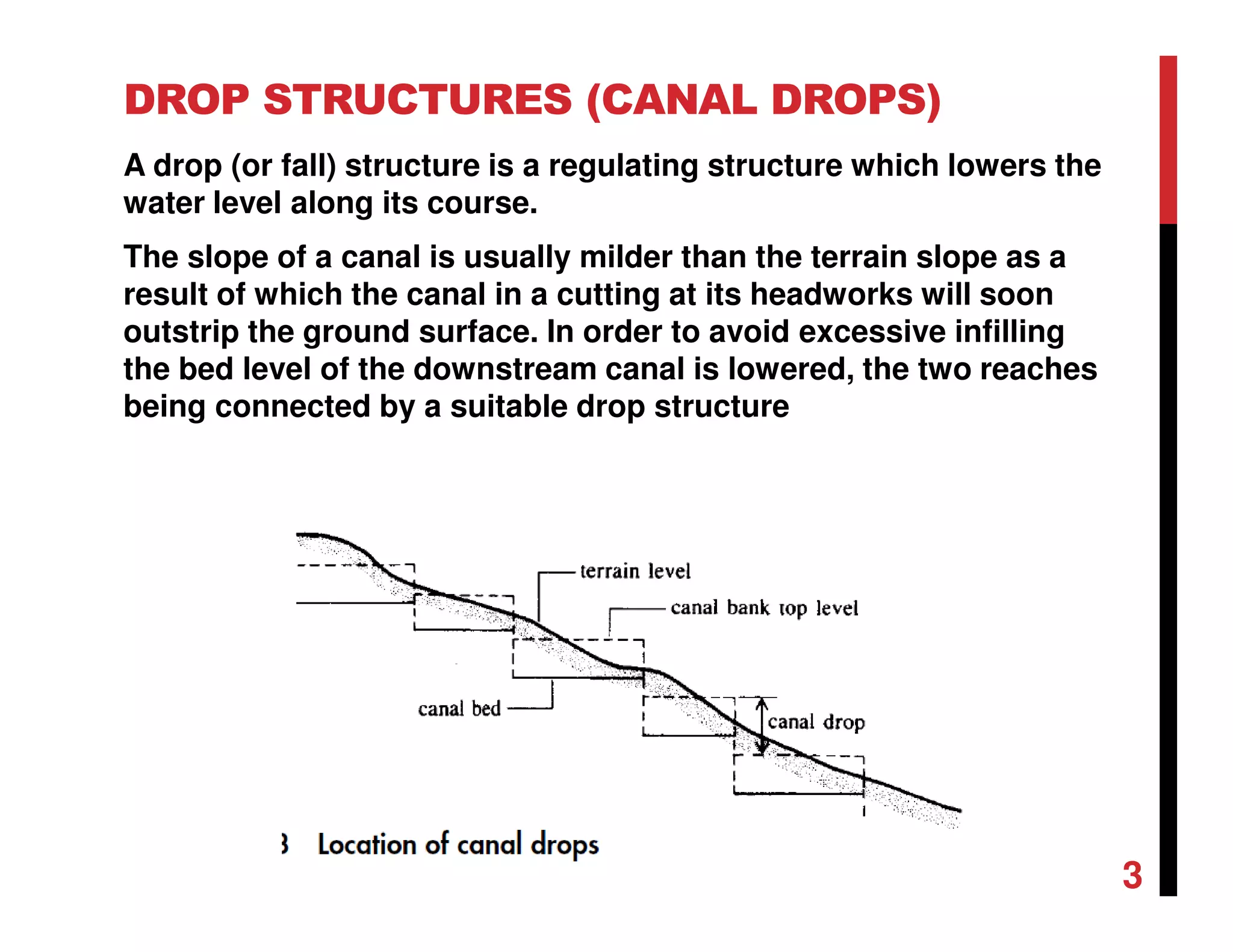
A drop (or fall) structure is a regulating structure which lowers the
water level along its course.
The slope of a canal is usually milder than the terrain slope as a
result of which the canal in a cutting at its headworks will soon
outstrip the ground surface. In order to avoid excessive infilling
the bed level of the downstream canal is lowered, the two reaches
being connected by a suitable drop structure
3
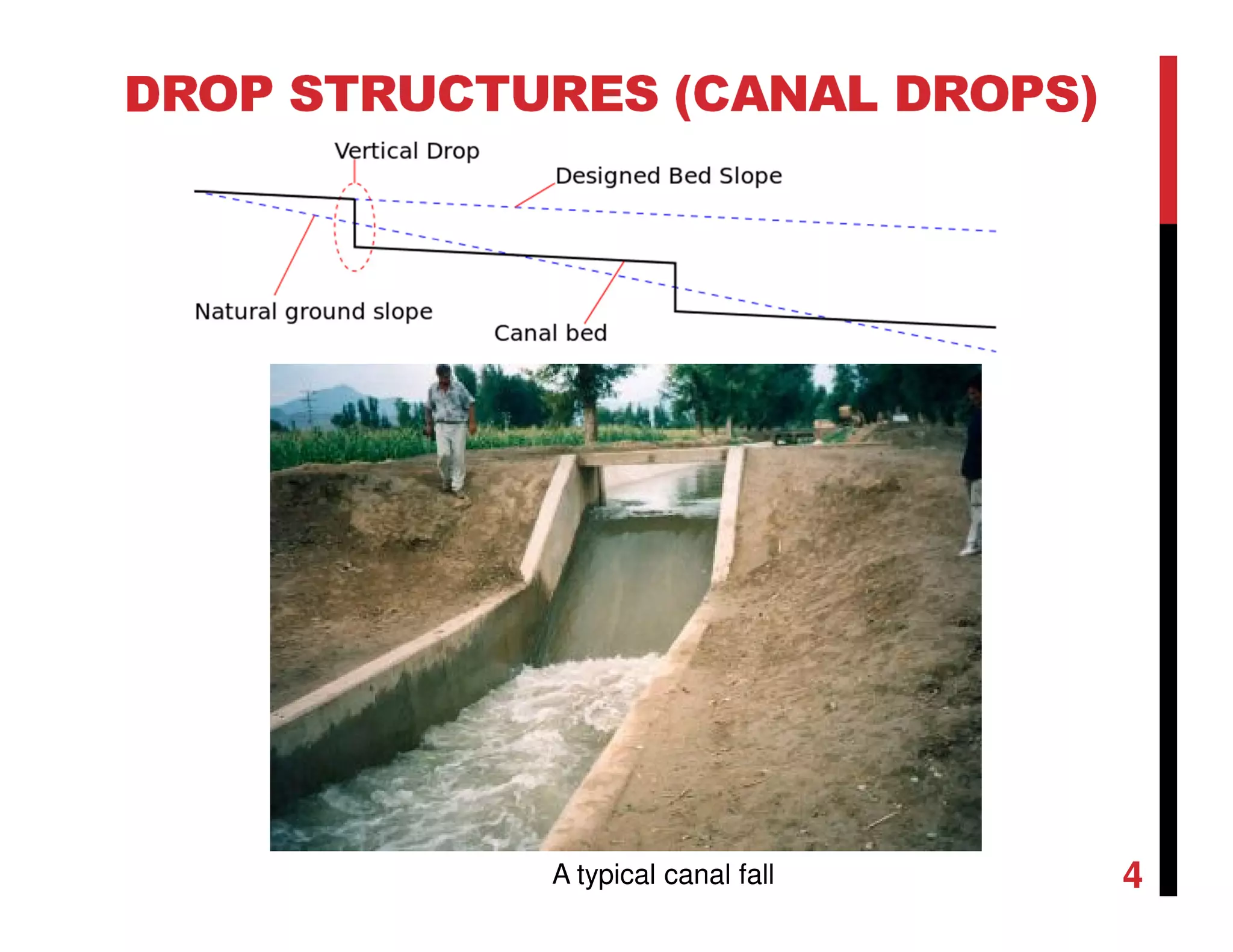
A typical canal fall 4
DROP STRUCTURES (CANAL DROPS)
TYPES OF DROP STRUCTURES
Drops are usually provided with a low crest wall and are
subdivided into the following types:
(i) the vertical drop
(ii) the inclined drop
(iii) the piped drop and
(iv) Farm drop structures
Note: The above classification covers only a part of the broad spectrum
of drops, particularly if structures used in sewer design are included; a
comprehensive survey of various types of drops has been provided,
e.g. by Merlein, Kleinschroth and Valentin (2002); Hager (1999)
includes the treatment of drop structures in his comprehensive
coverage of wastewater structures and hydraulics.
5
DROP STRUCTURES (CANAL DROPS)
TYPES OF DROP STRUCTURES
(i) the vertical drop,
(a). Common (straight) drop
(b). Sarda-type fall (India)
(c). YMGT-type drop (Japan)
(d) Rectangular weir drop with raised crest (France)
6
DROP STRUCTURES (CANAL DROPS)
TYPES OF DROP STRUCTURES
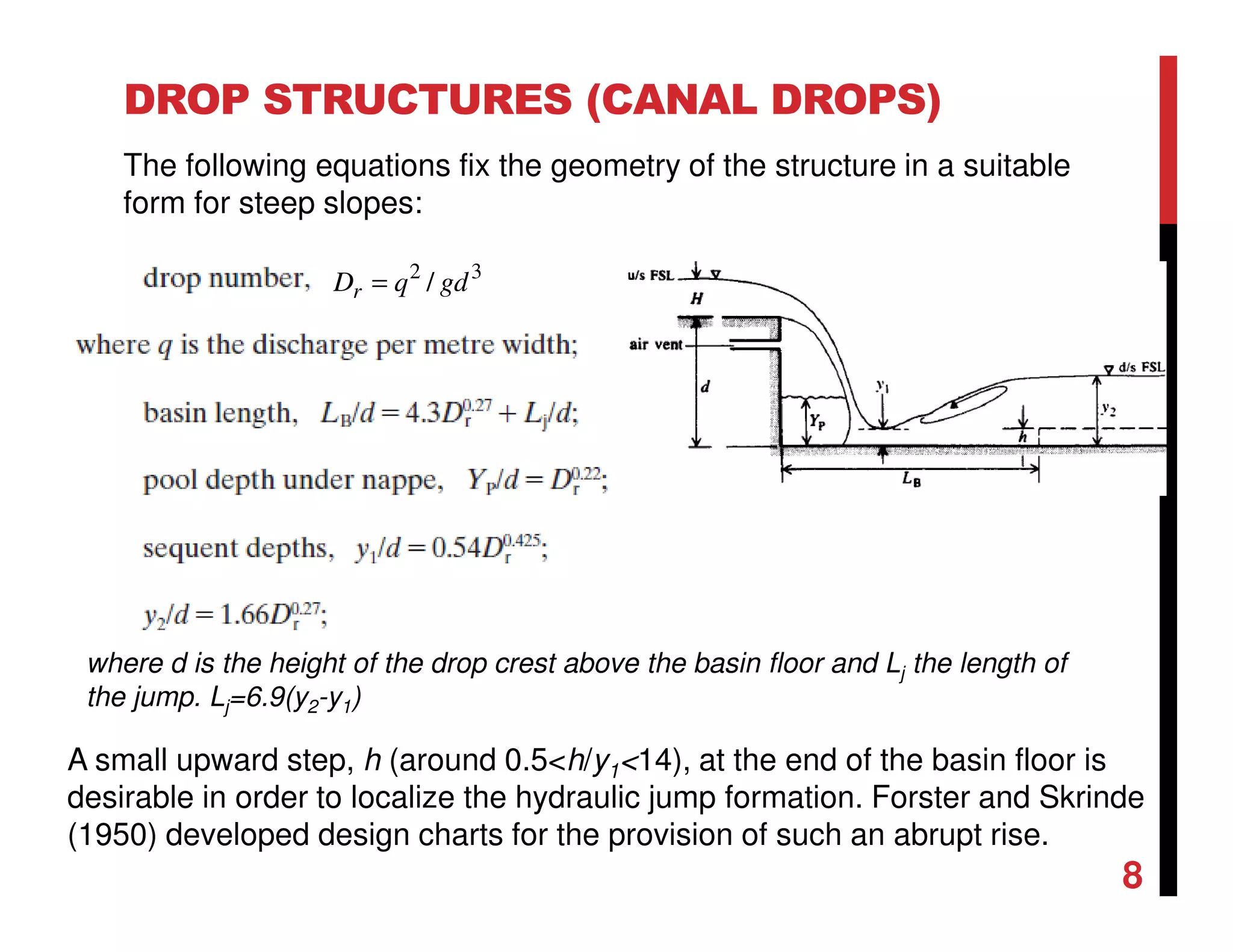
(i.a) Common (straight) drop: The common drop structure, in which
the aerated free-falling nappe (modular flow) hits the downstream basin
floor, and with turbulent circulation in the pool beneath the nappe
contributing to energy dissipation, is shown in Fig
7
DROP STRUCTURES (CANAL DROPS)
The following equations fix the geometry of the structure in a suitable
form for steep slopes:
where d is the height of the drop crest above the basin floor and Lj the length of
the jump. Lj=6.9(y2-y1)
A small upward step, h (around 0.5<h/y1<14), at the end of the basin floor is
desirable in order to localize the hydraulic jump formation. Forster and Skrinde
(1950) developed design charts for the provision of such an abrupt rise.
32
/ gdqDr =
8
DROP STRUCTURES (CANAL DROPS)
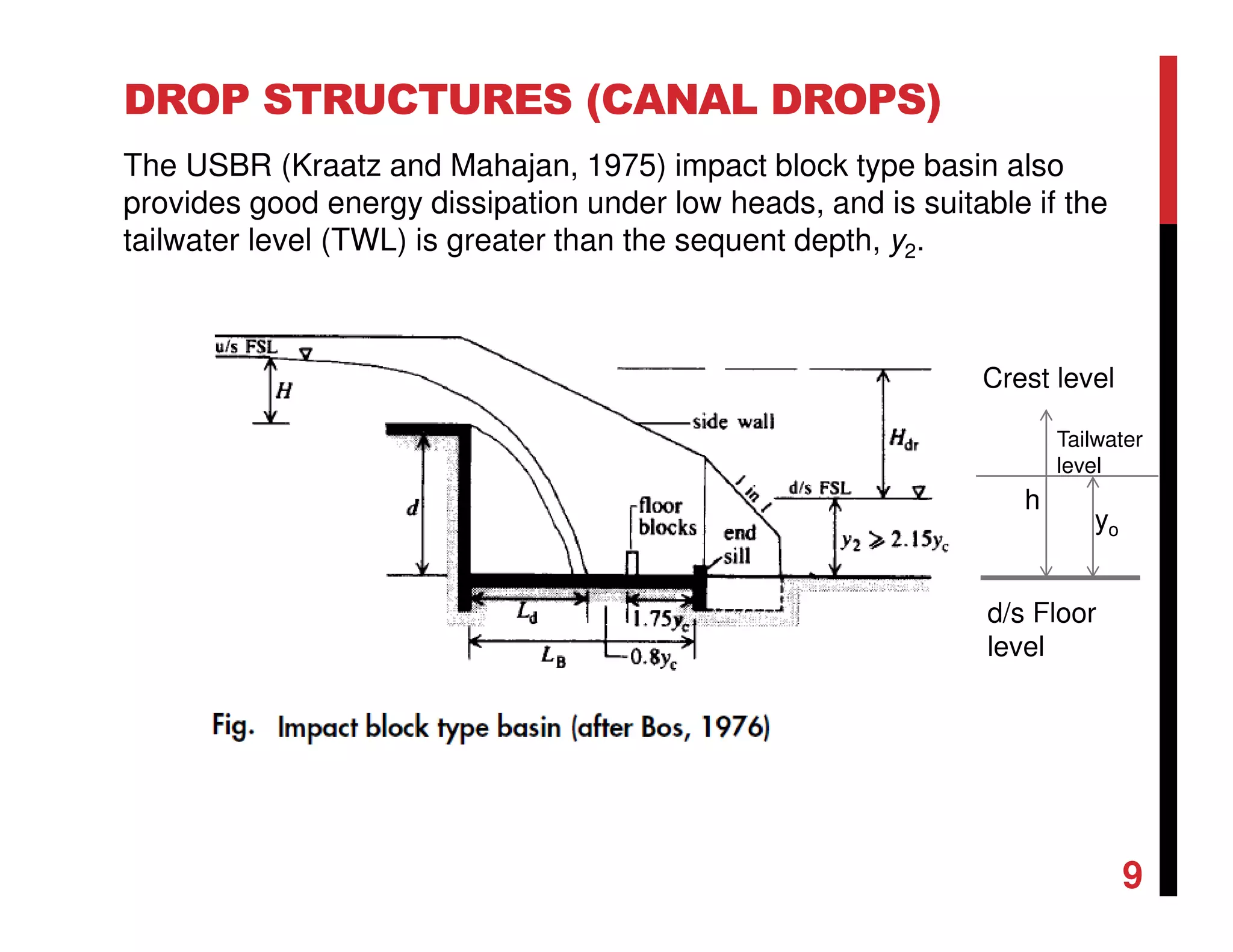
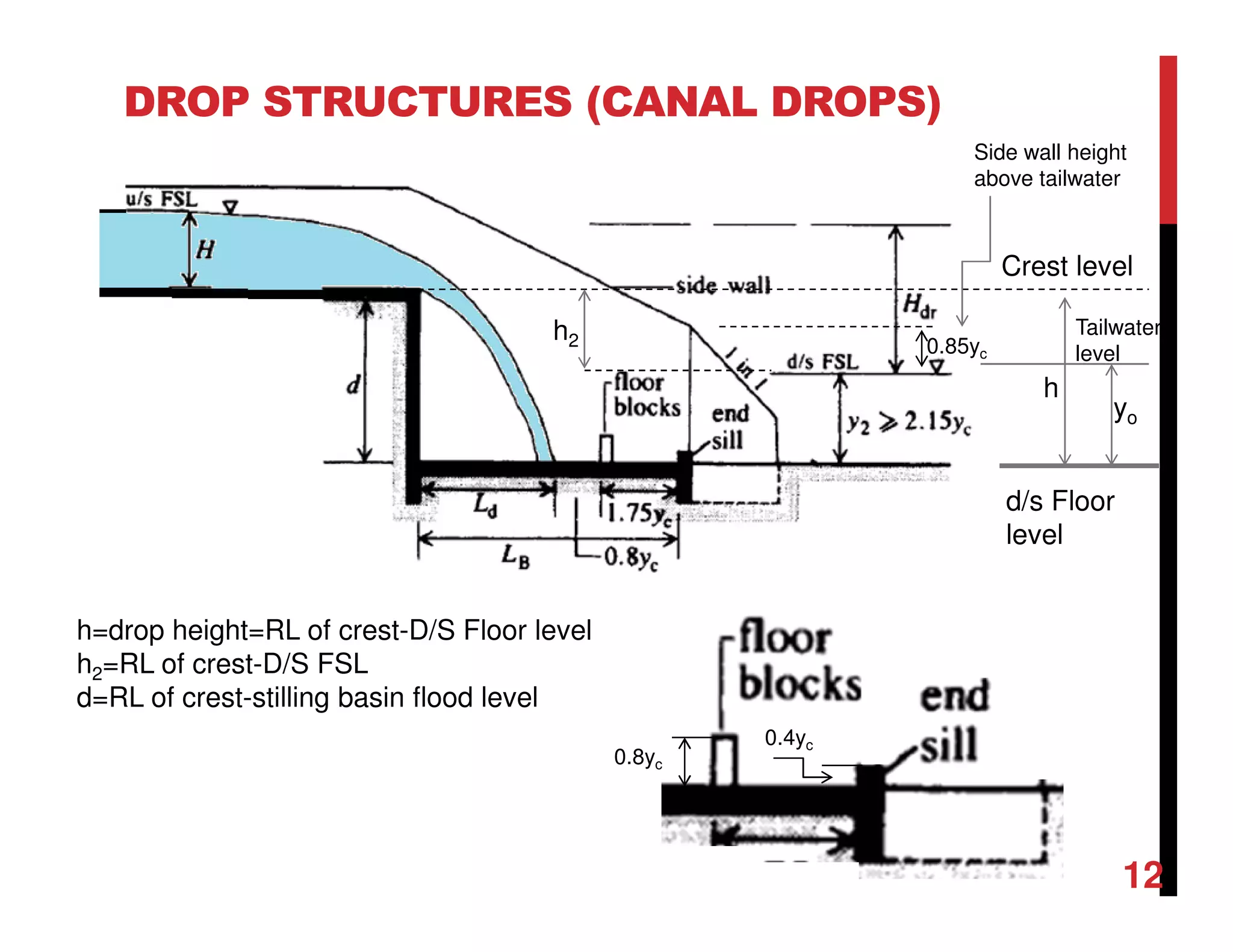
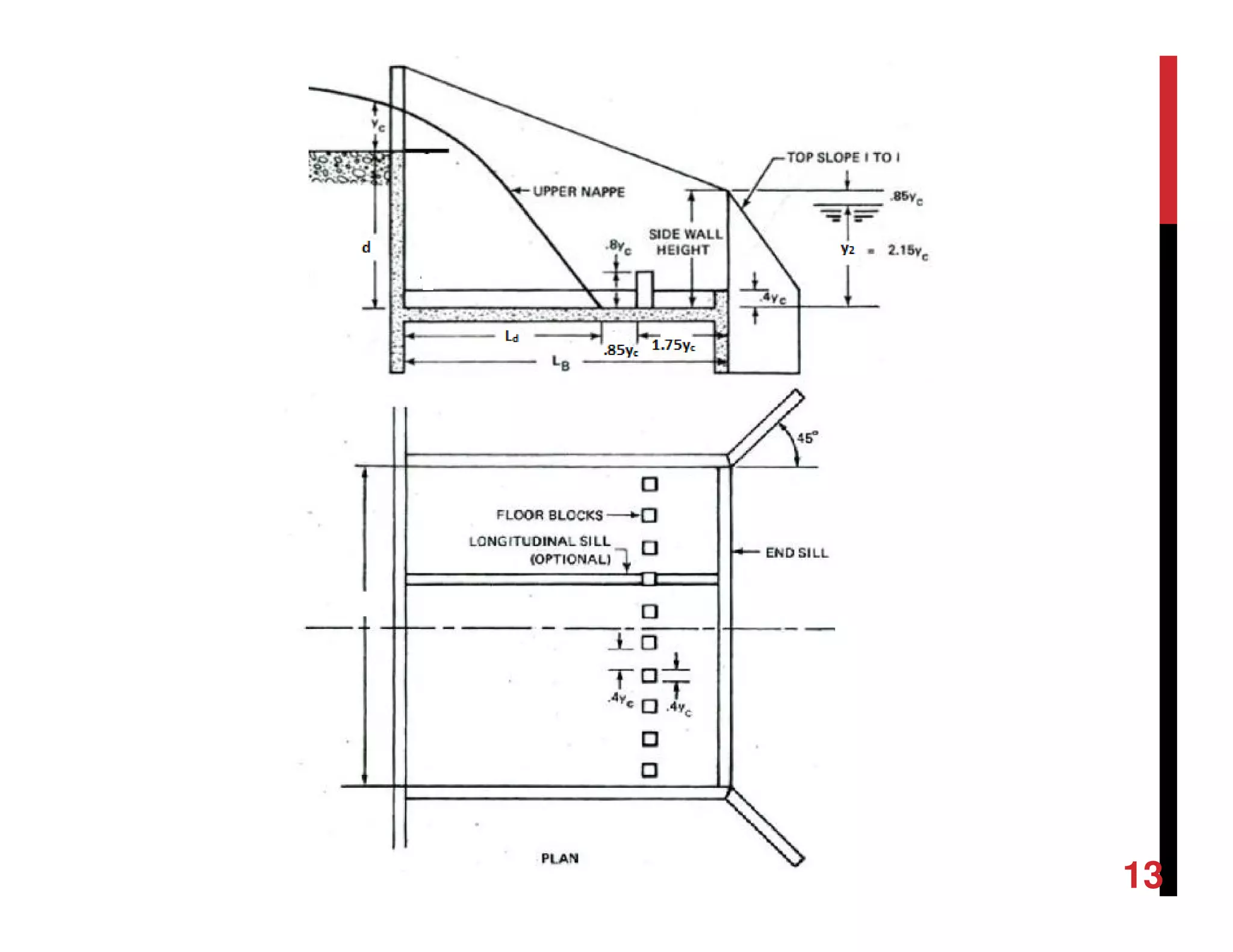
The USBR (Kraatz and Mahajan, 1975) impact block type basin also
provides good energy dissipation under low heads, and is suitable if the
tailwater level (TWL) is greater than the sequent depth, y2.
9
h
d/s Floor
level
Crest level
yo
Tailwater
level
DROP STRUCTURES (CANAL DROPS)
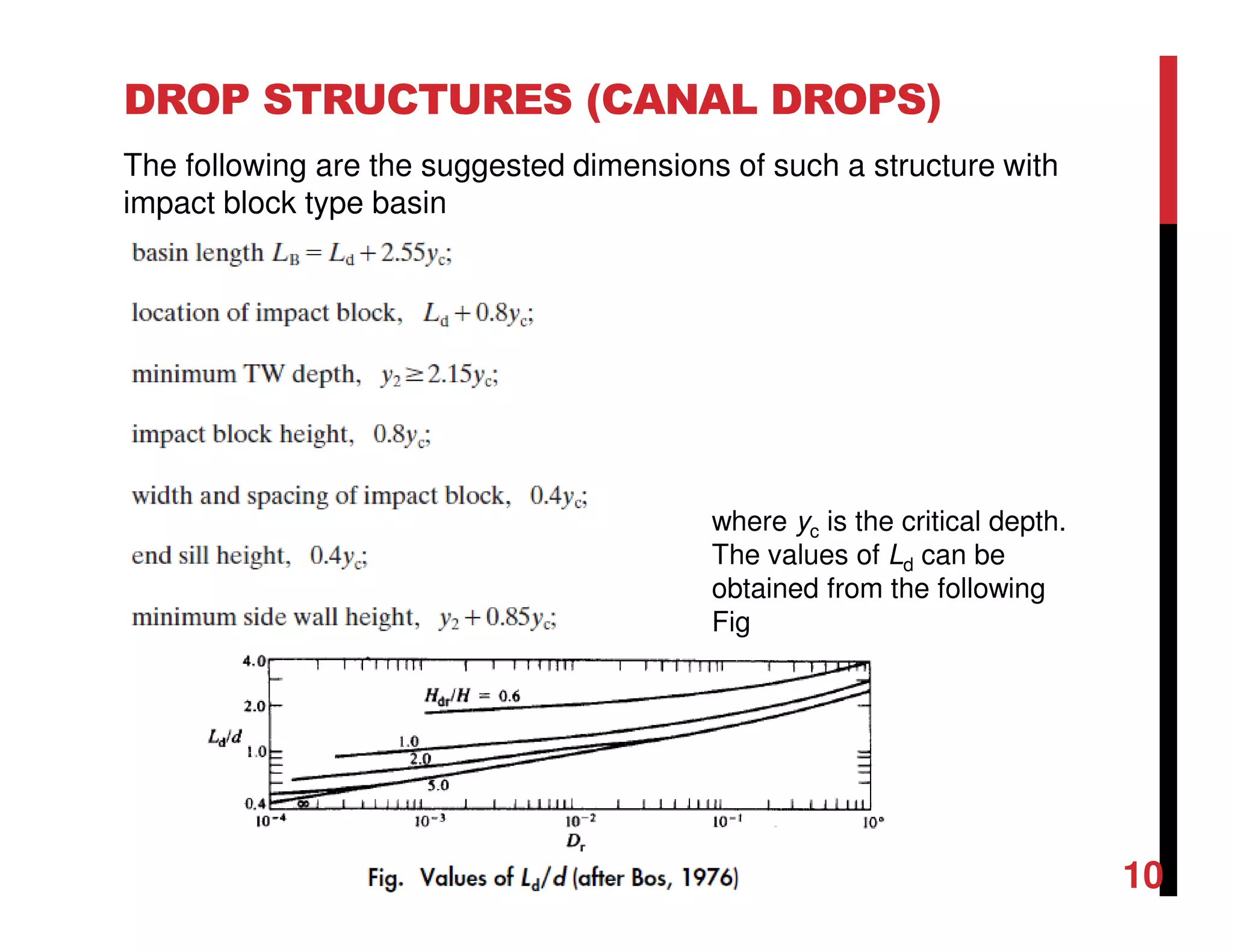
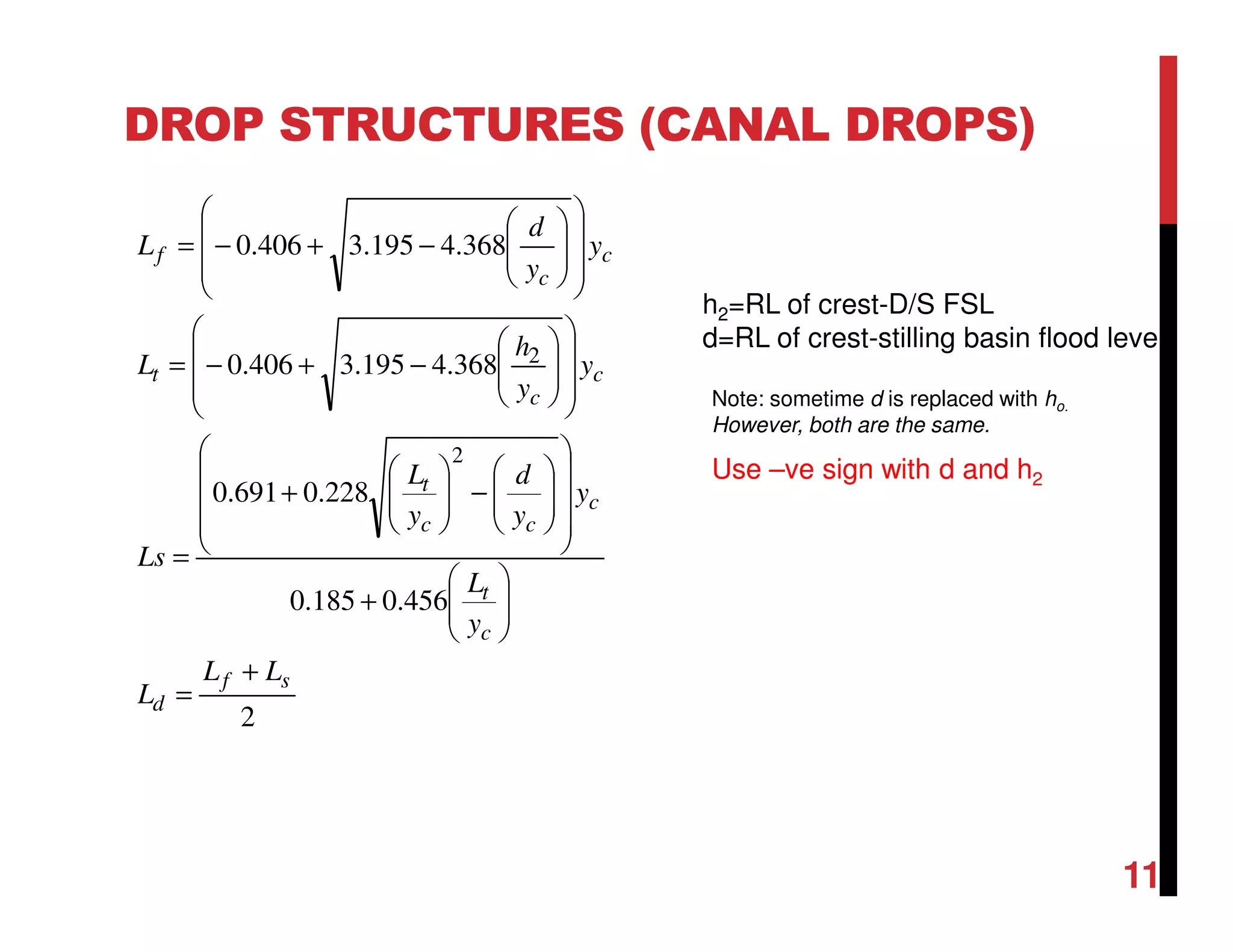
The following are the suggested dimensions of such a structure with
impact block type basin
where yc is the critical depth.
The values of Ld can be
obtained from the following
Fig
10
DROP STRUCTURES (CANAL DROPS)
2
456.0185.0
228.0691.0
368.4195.3406.0
368.4195.3406.0
2
2
sf
d
c
t
c
cc
t
c
c
t
c
c
f
LL
L
y
L
y
y
d
y
L
Ls
y
y
h
L
y
y
d
L
+
=








+


















−







+
=
















−+−=
















−+−=
Use –ve sign with d and h2
Note: sometime d is replaced with ho.
However, both are the same.
h2=RL of crest-D/S FSL
d=RL of crest-stilling basin flood level
11
0.85yc
0.8yc
0.4yc
h2
h=drop height=RL of crest-D/S Floor level
h2=RL of crest-D/S FSL
d=RL of crest-stilling basin flood level
Side wall height
above tailwater
h
d/s Floor
level
Crest level
yo
DROP STRUCTURES (CANAL DROPS)
12
Tailwater
level
13
DROP STRUCTURES (CANAL DROPS)
TYPES OF DROP
STRUCTURES
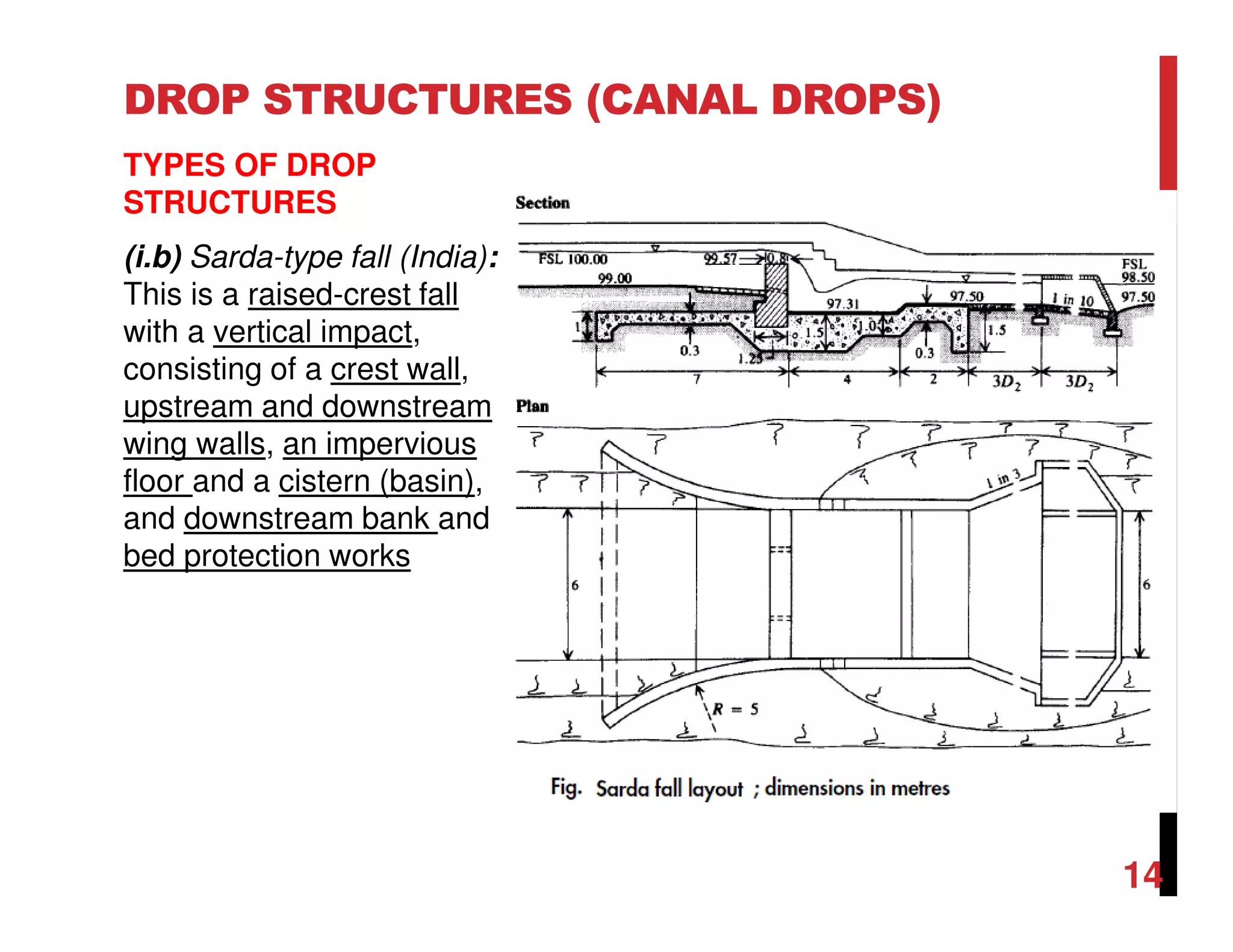
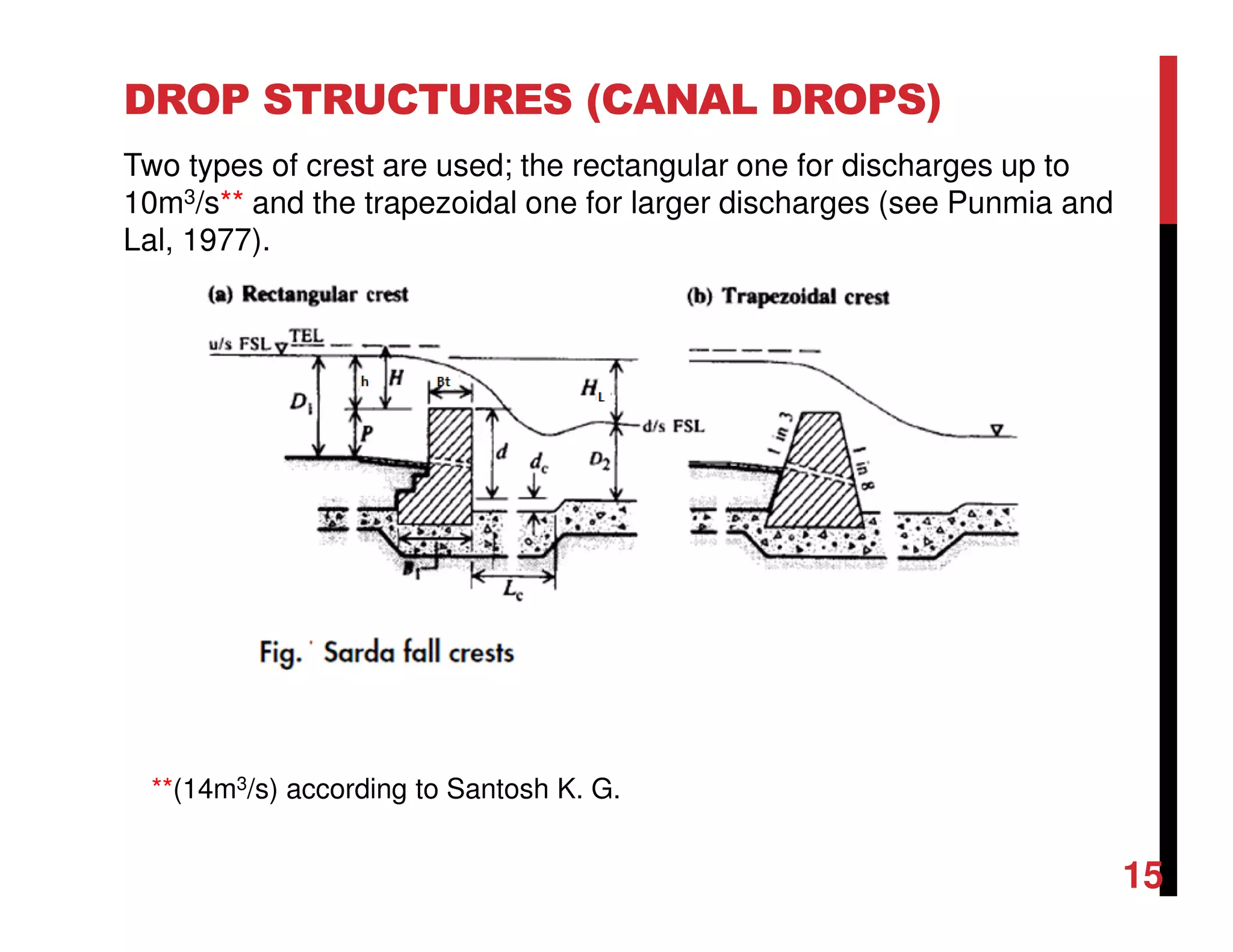
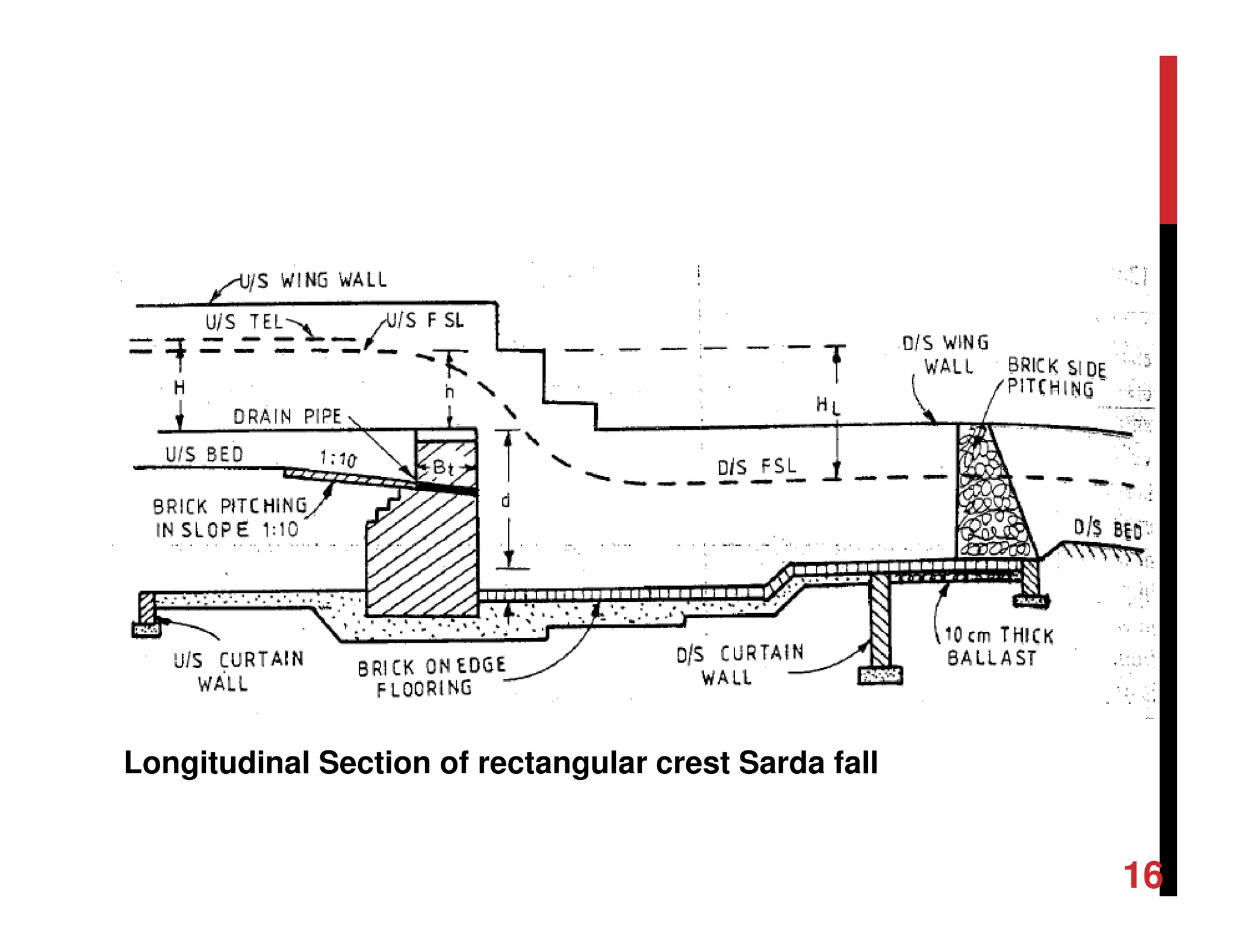
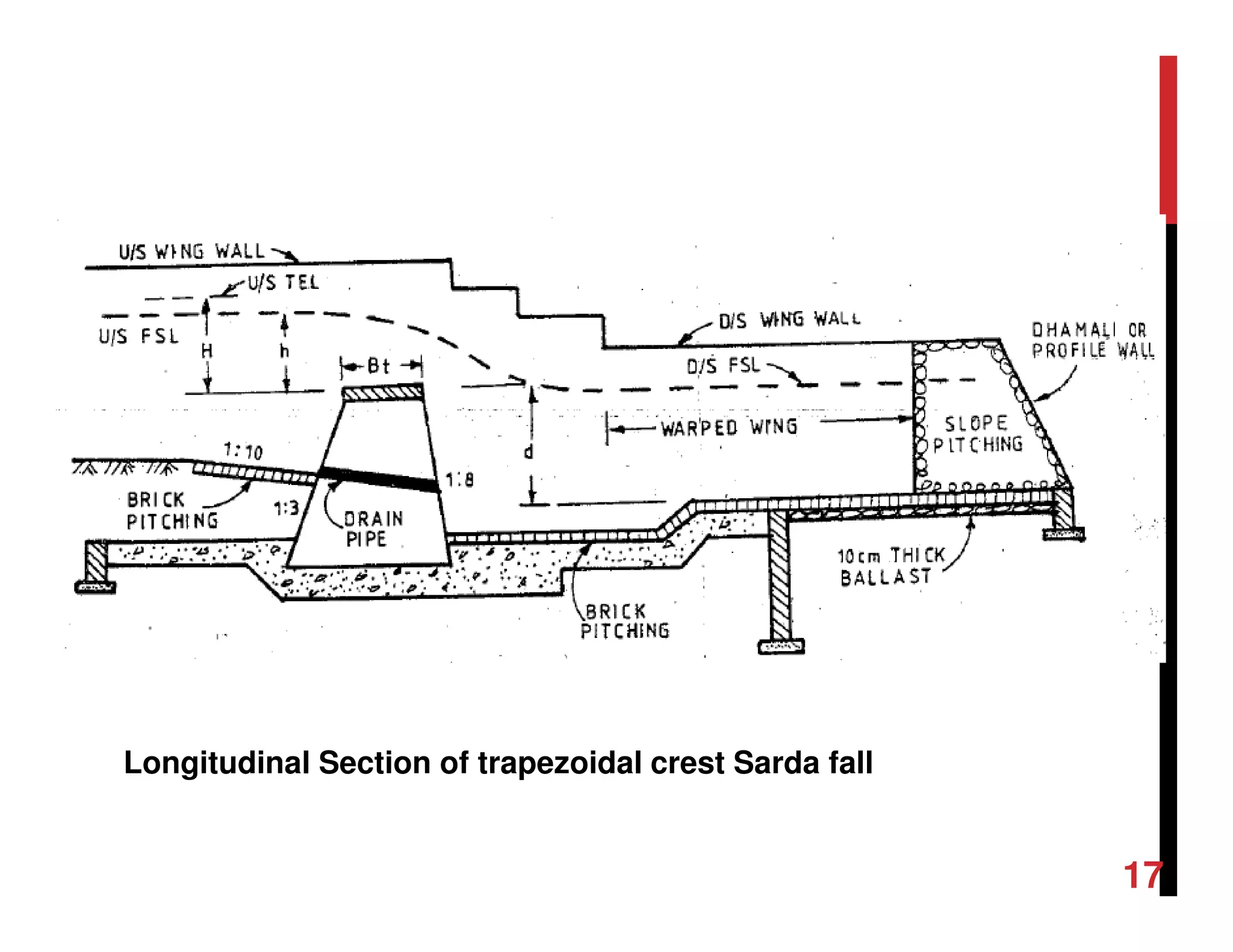
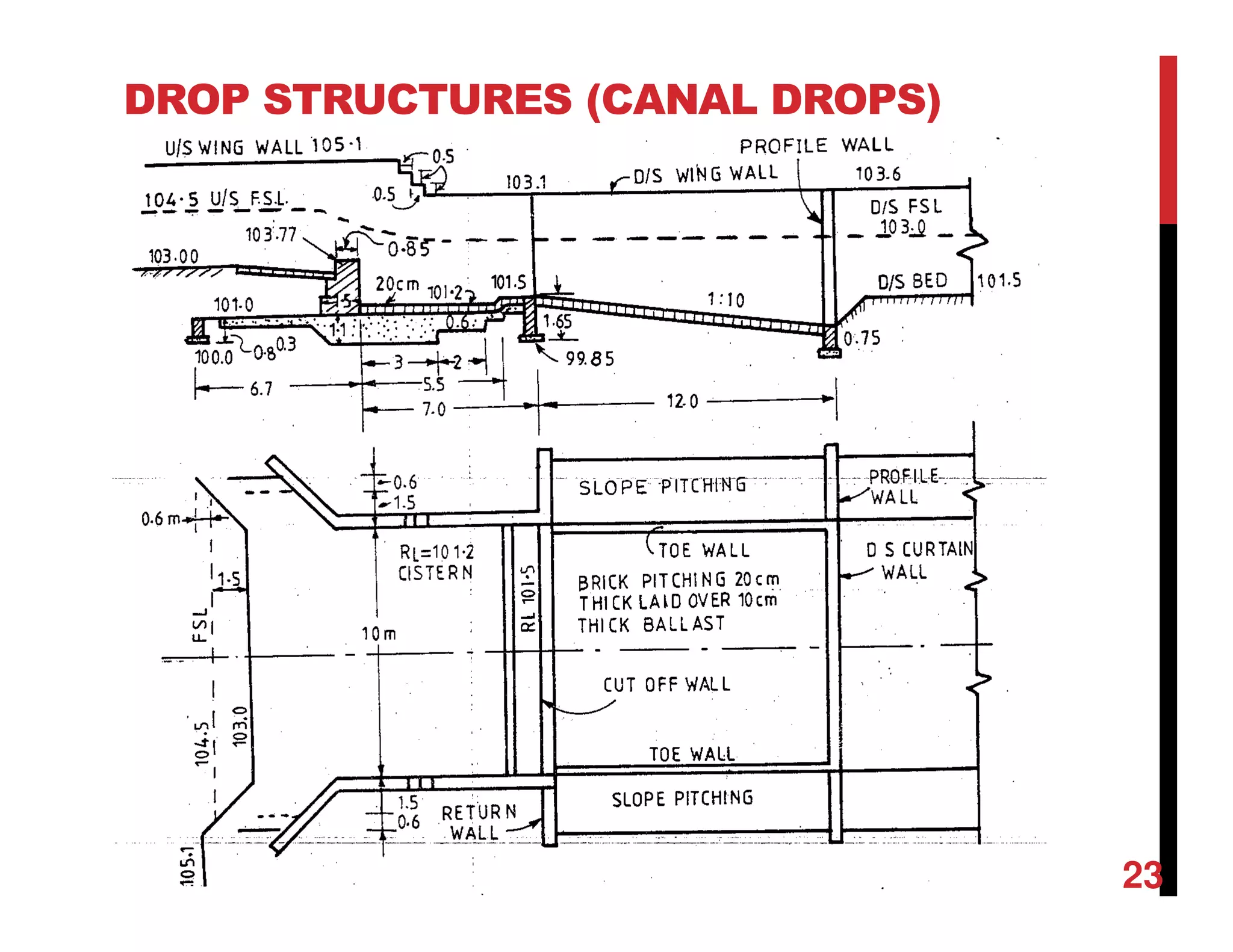
(i.b) Sarda-type fall (India):
This is a raised-crest fall
with a vertical impact,
consisting of a crest wall,
upstream and downstream
wing walls, an impervious
floor and a cistern (basin),
and downstream bank and
bed protection works
14
DROP STRUCTURES (CANAL DROPS)
Two types of crest are used; the rectangular one for discharges up to
10m3/s** and the trapezoidal one for larger discharges (see Punmia and
Lal, 1977).
**(14m3/s) according to Santosh K. G.
15
Longitudinal Section of rectangular crest Sarda fall
16
Longitudinal Section of trapezoidal crest Sarda fall
17
DROP STRUCTURES (CANAL DROPS)
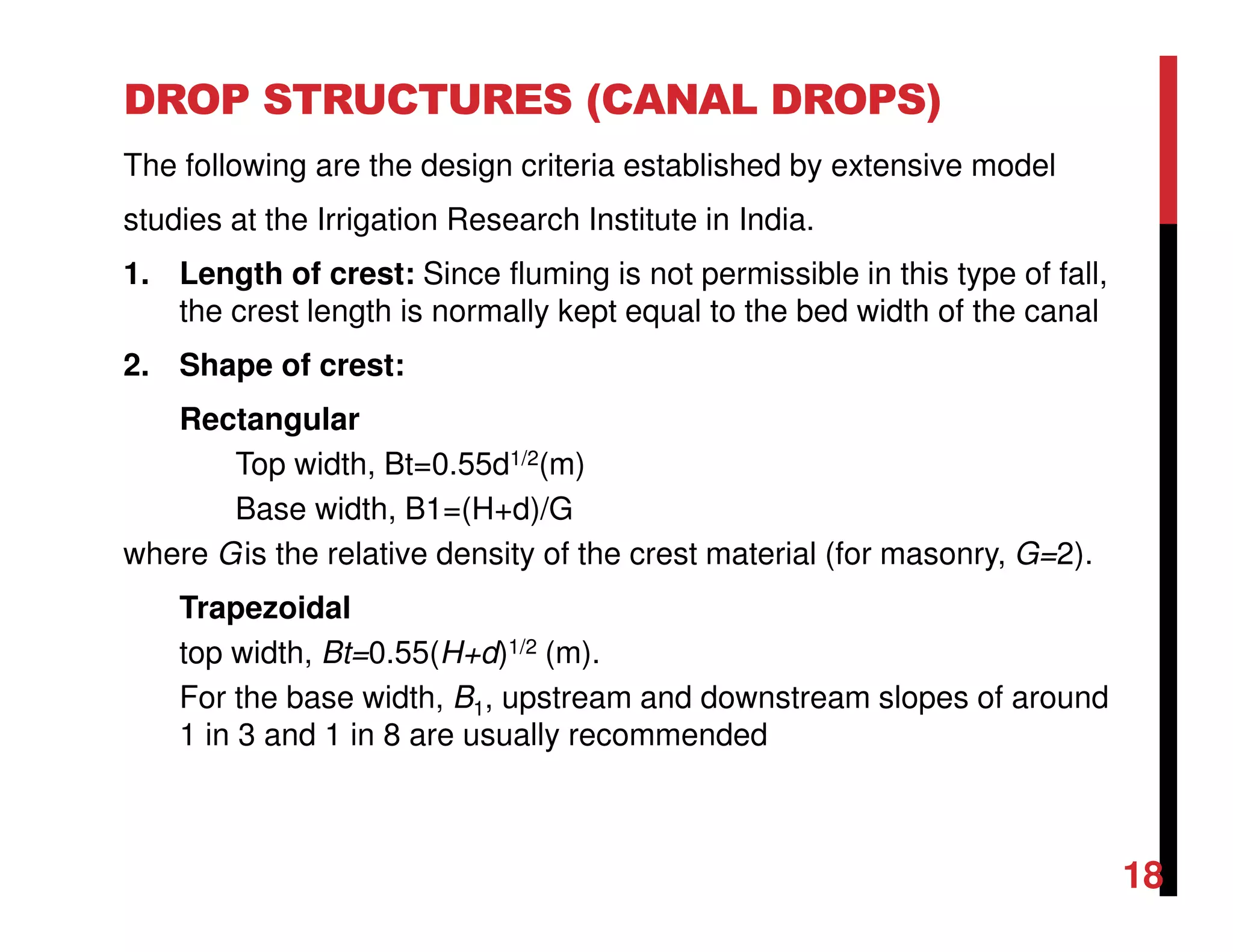
The following are the design criteria established by extensive model
studies at the Irrigation Research Institute in India.
1. Length of crest: Since fluming is not permissible in this type of fall,
the crest length is normally kept equal to the bed width of the canal
2. Shape of crest:
Rectangular
Top width, Bt=0.55d1/2(m)
Base width, B1=(H+d)/G
where Gis the relative density of the crest material (for masonry, G=2).
Trapezoidal
top width, Bt=0.55(H+d)1/2 (m).
For the base width, B1, upstream and downstream slopes of around
1 in 3 and 1 in 8 are usually recommended
18
DROP STRUCTURES (CANAL DROPS)
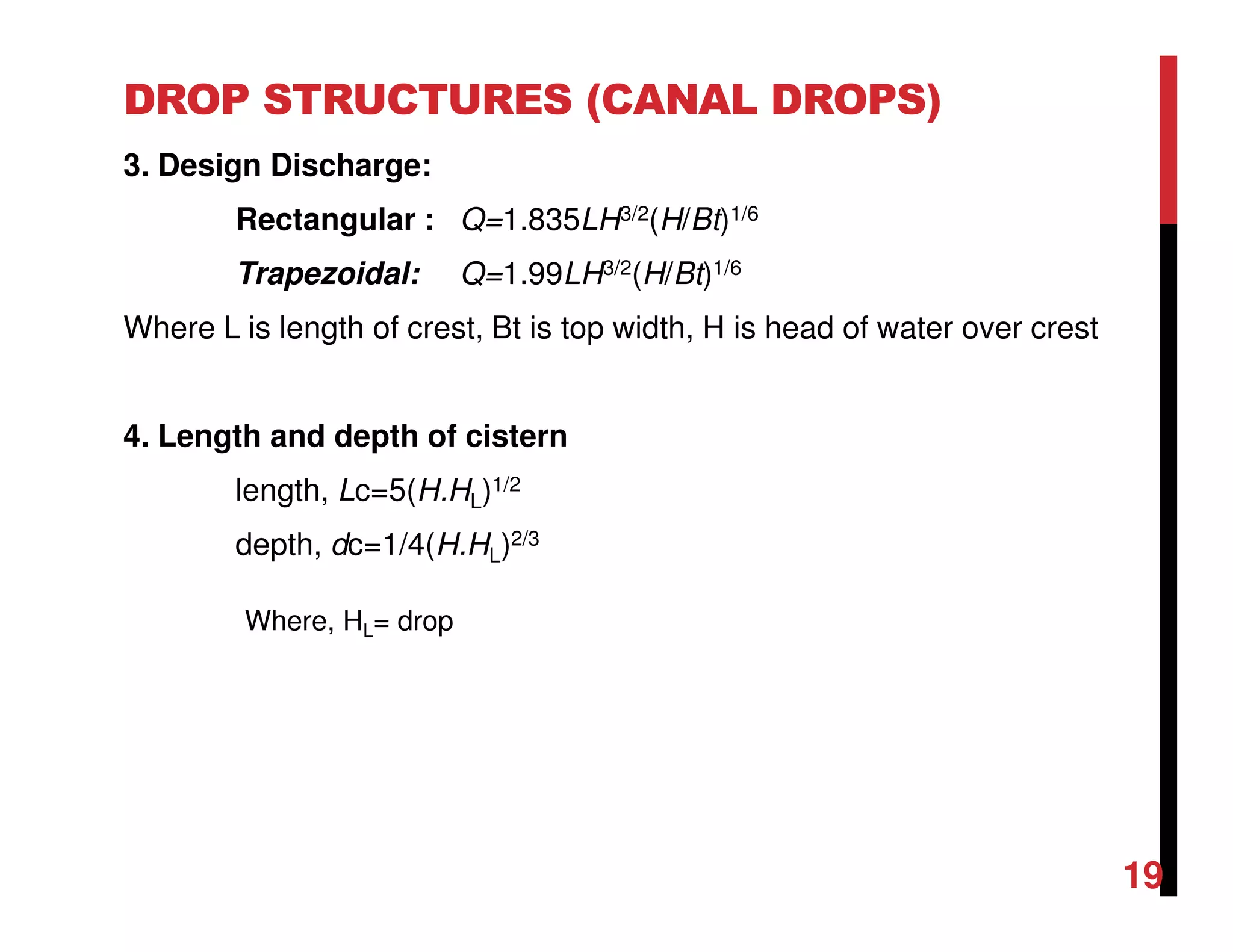
3. Design Discharge:
Rectangular : Q=1.835LH3/2(H/Bt)1/6
Trapezoidal: Q=1.99LH3/2(H/Bt)1/6
Where L is length of crest, Bt is top width, H is head of water over crest
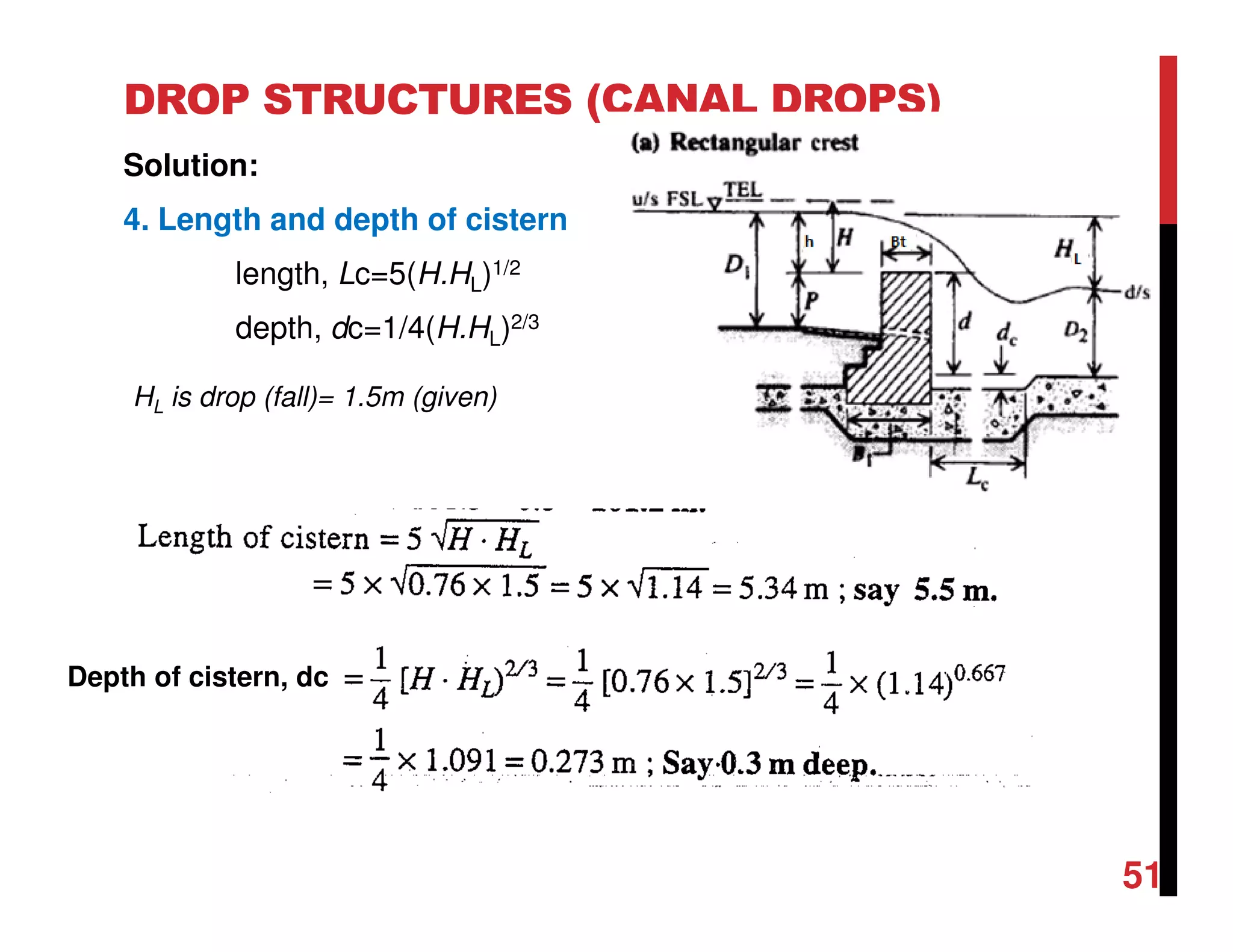
4. Length and depth of cistern
length, Lc=5(H.HL)1/2
depth, dc=1/4(H.HL)2/3
19
Where, HL= drop
DROP STRUCTURES (CANAL DROPS)
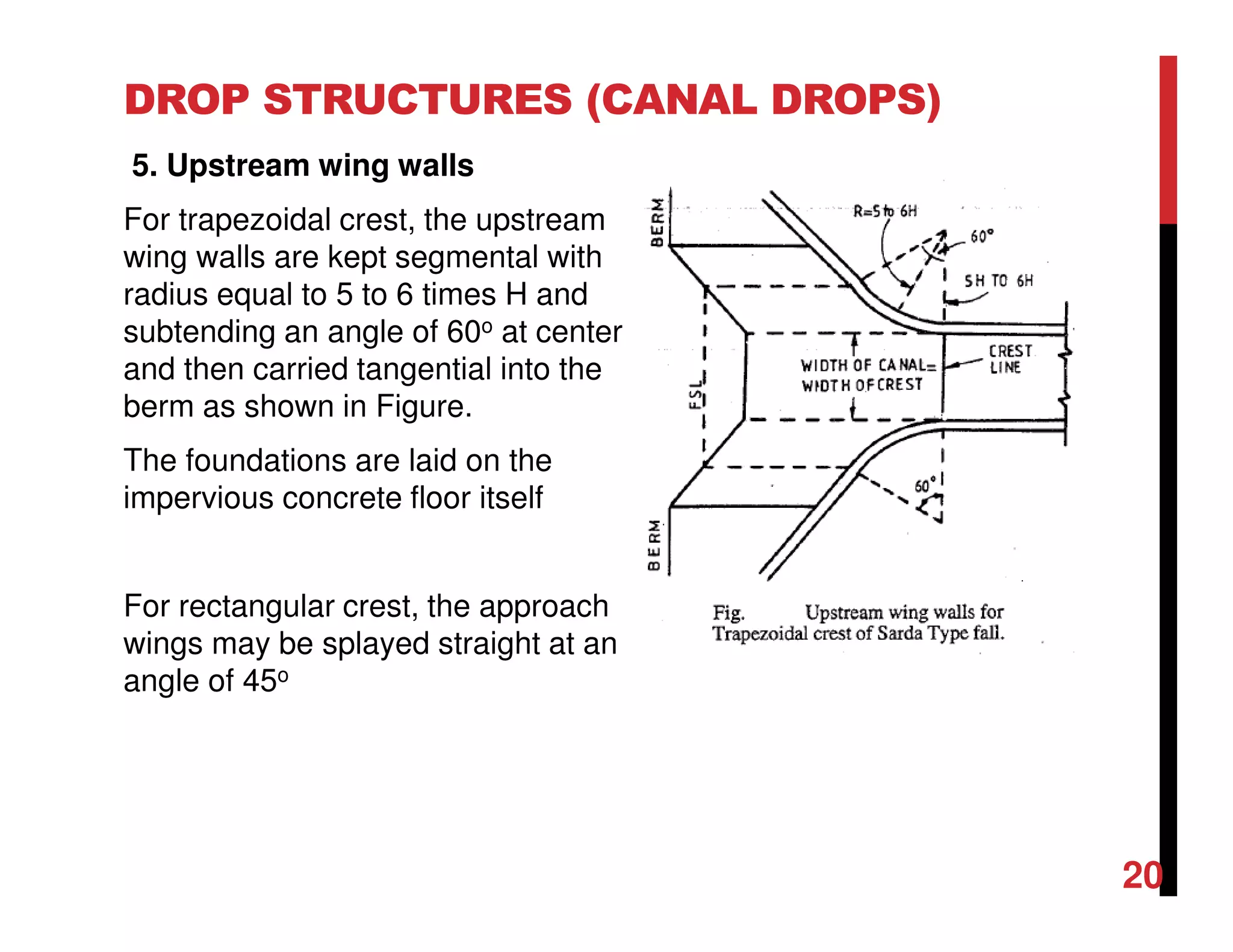
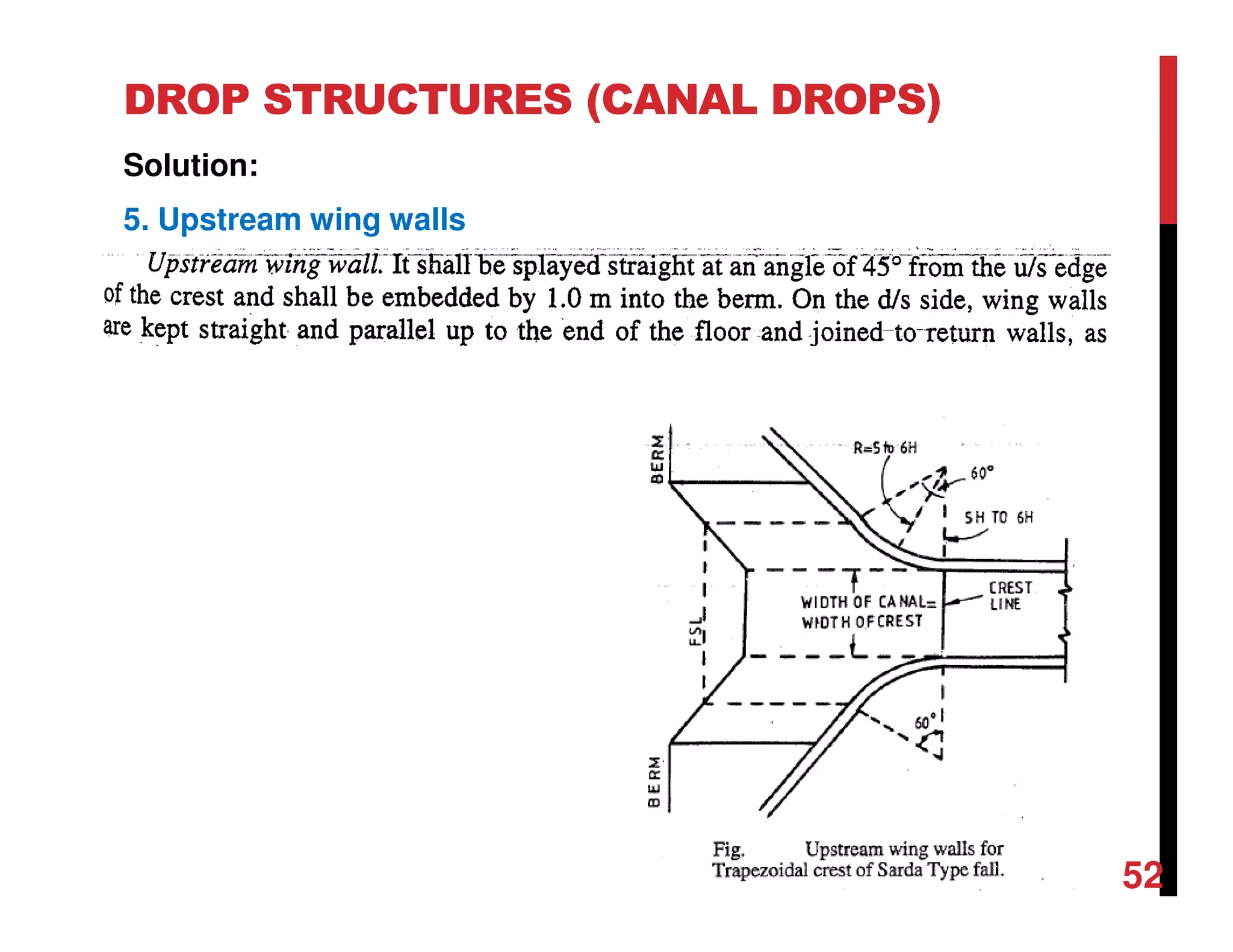
5. Upstream wing walls
For trapezoidal crest, the upstream
wing walls are kept segmental with
radius equal to 5 to 6 times H and
subtending an angle of 60o at center
and then carried tangential into the
berm as shown in Figure.
The foundations are laid on the
impervious concrete floor itself
For rectangular crest, the approach
wings may be splayed straight at an
angle of 45o
20
DROP STRUCTURES (CANAL DROPS)
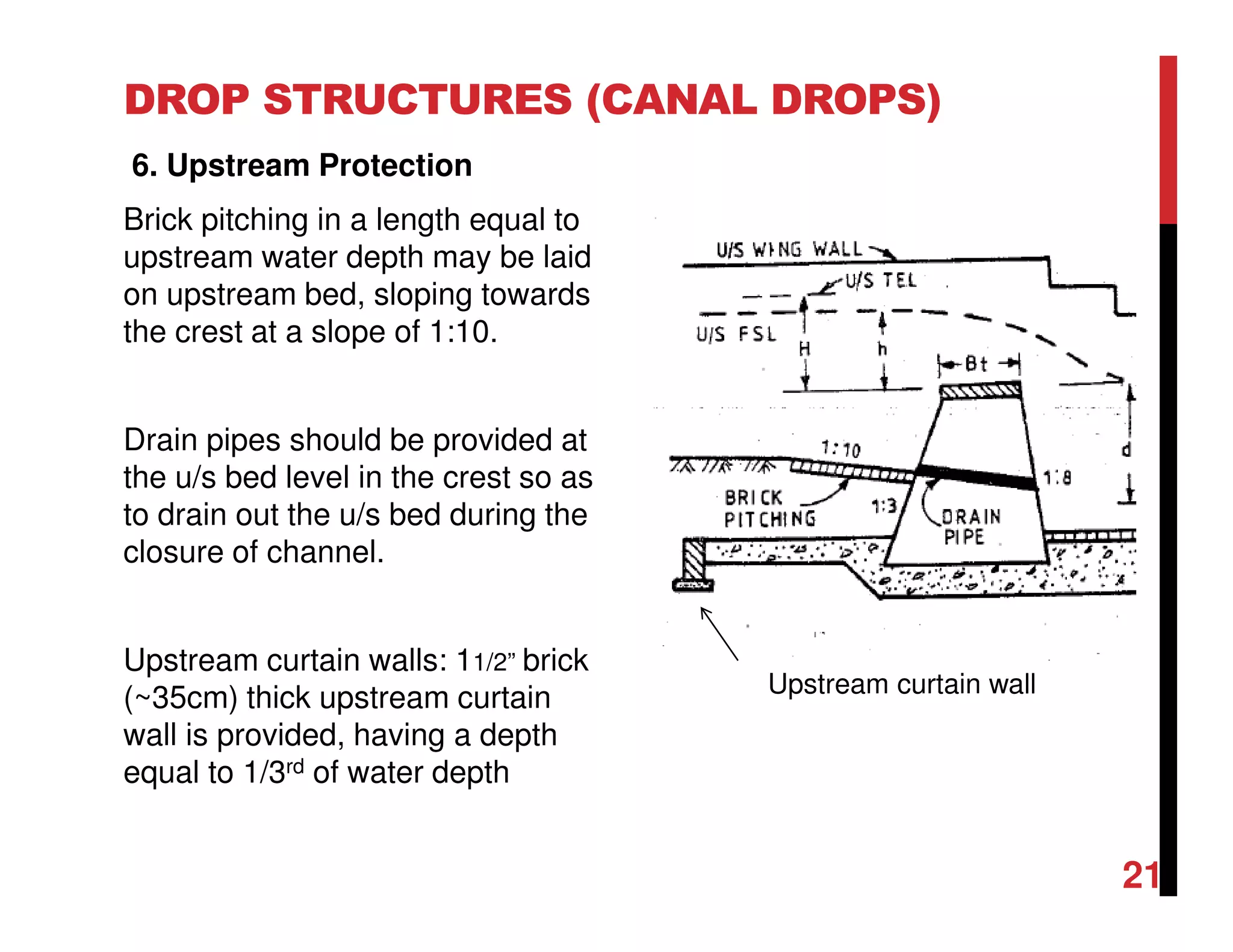
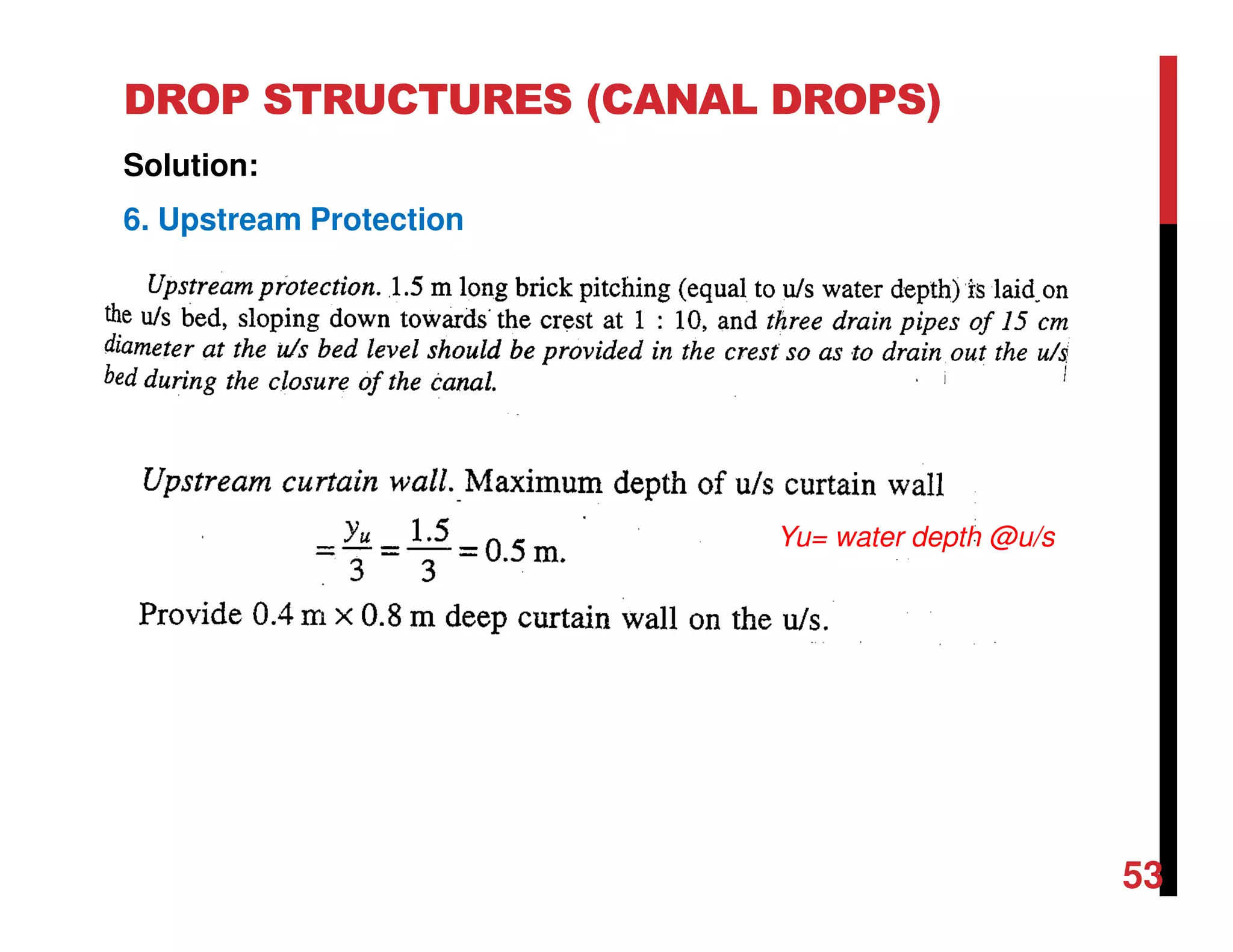
6. Upstream Protection
Brick pitching in a length equal to
upstream water depth may be laid
on upstream bed, sloping towards
the crest at a slope of 1:10.
Drain pipes should be provided at
the u/s bed level in the crest so as
to drain out the u/s bed during the
closure of channel.
Upstream curtain walls: 11/2” brick
(~35cm) thick upstream curtain
wall is provided, having a depth
equal to 1/3rd of water depth
21
Upstream curtain wall
DROP STRUCTURES (CANAL DROPS)
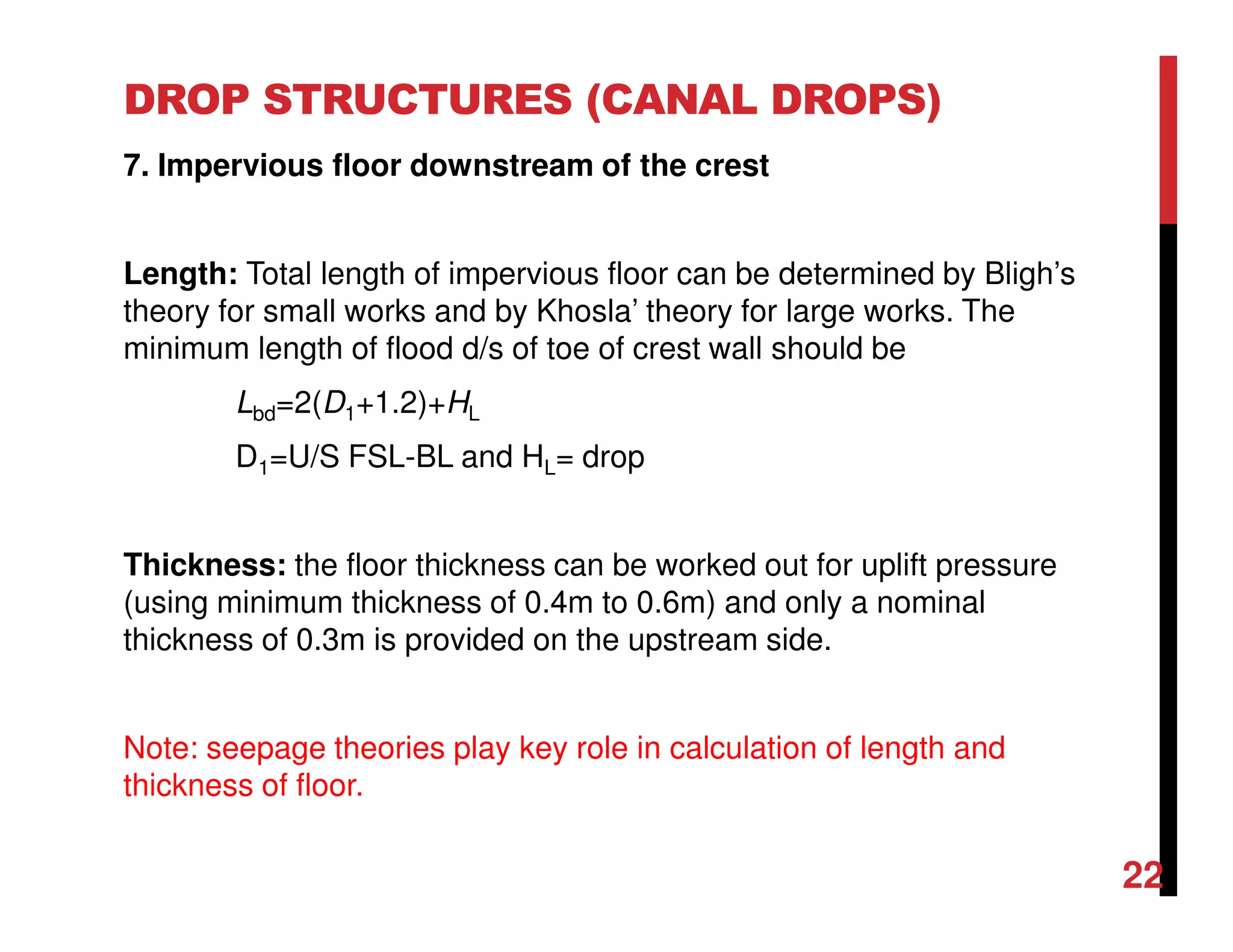
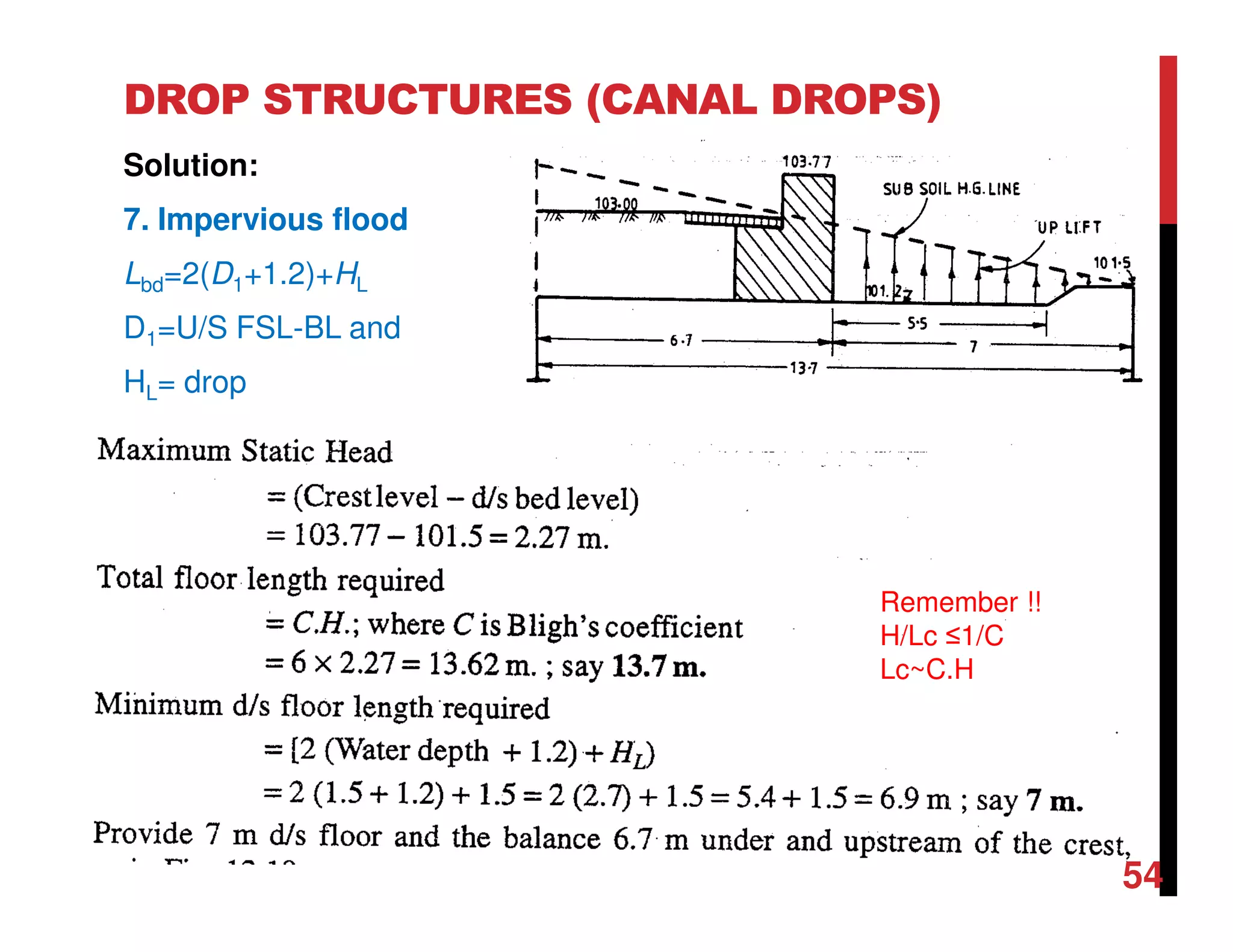
7. Impervious floor downstream of the crest
Length: Total length of impervious floor can be determined by Bligh’s
theory for small works and by Khosla’ theory for large works. The
minimum length of flood d/s of toe of crest wall should be
Lbd=2(D1+1.2)+HL
D1=U/S FSL-BL and HL= drop
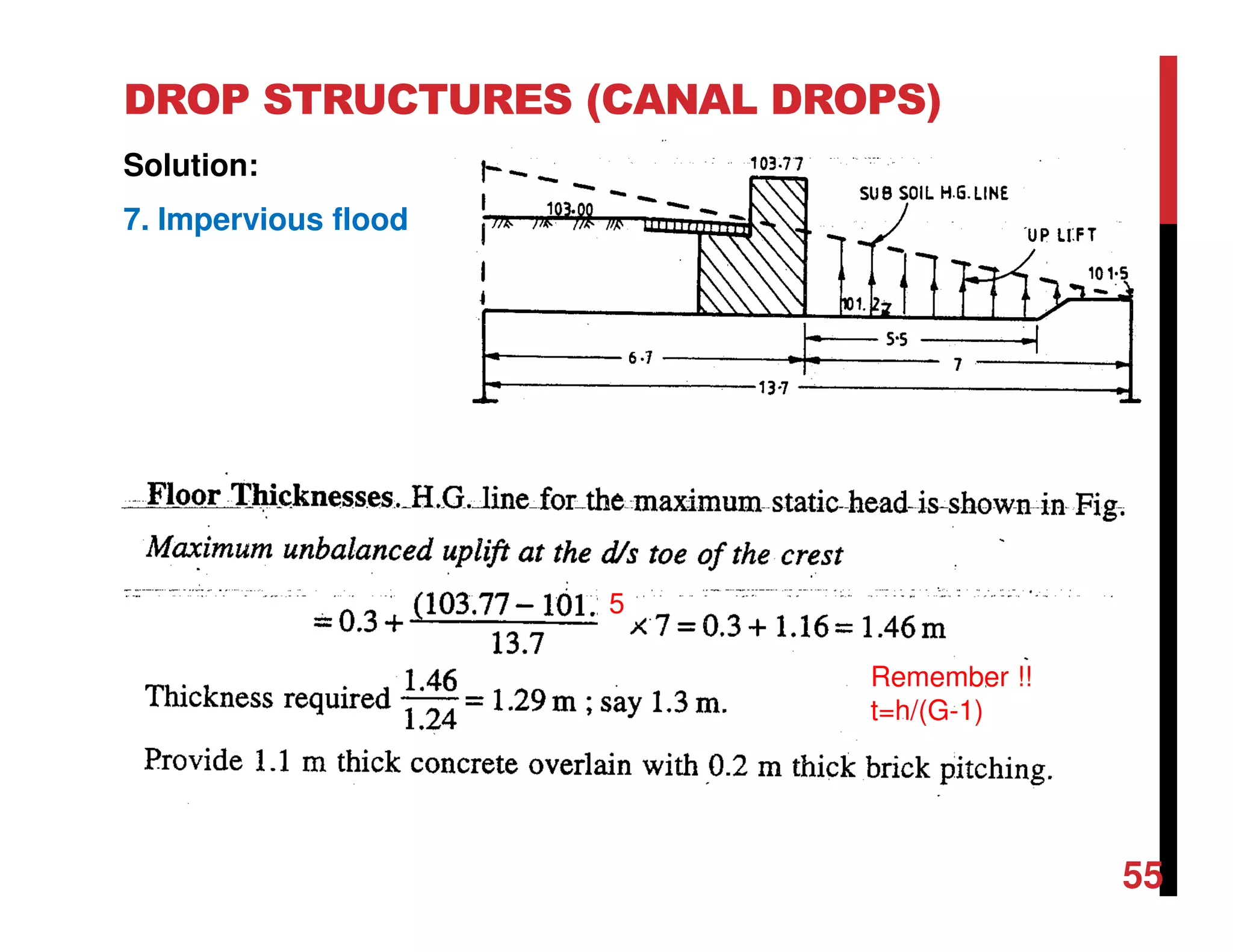
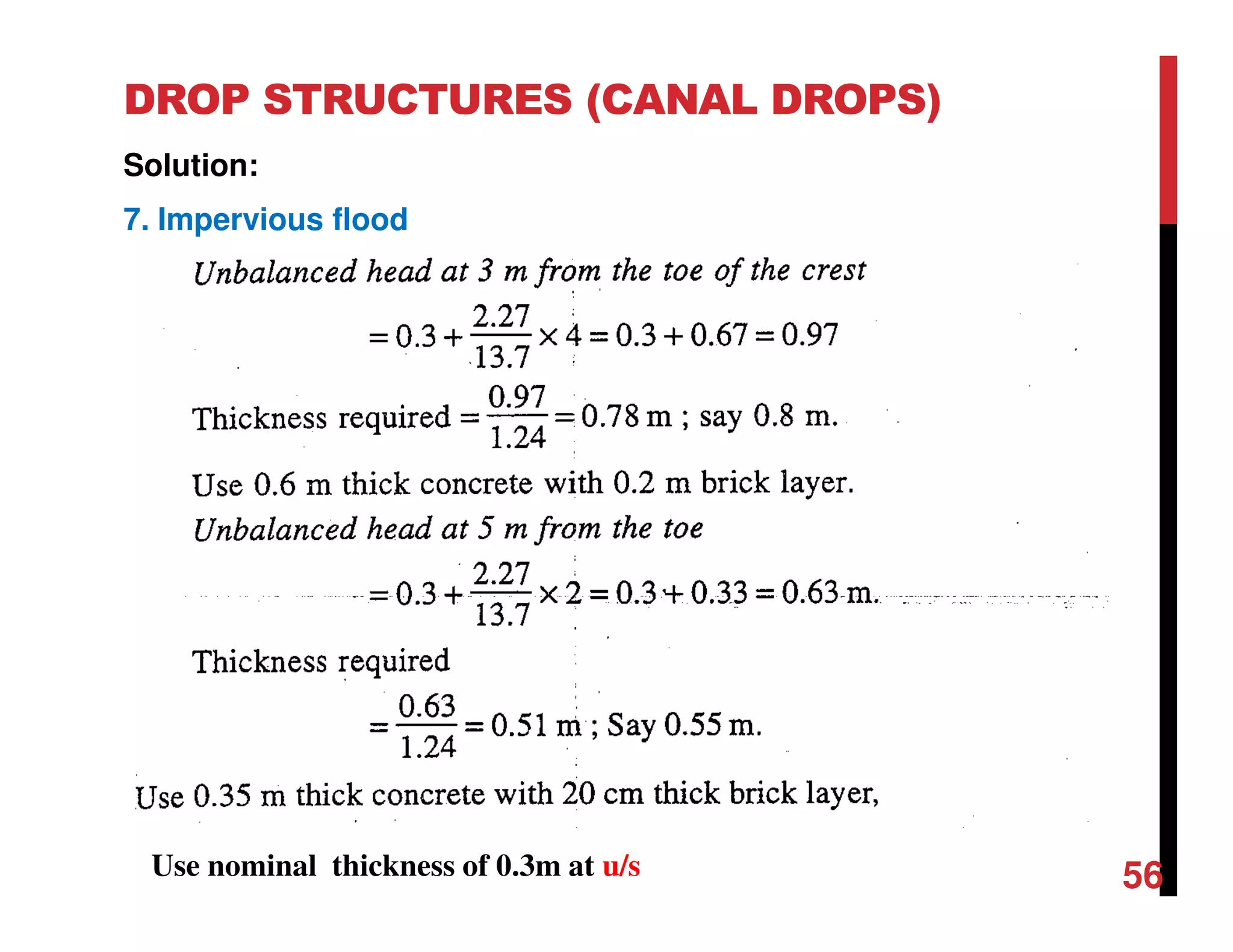
Thickness: the floor thickness can be worked out for uplift pressure
(using minimum thickness of 0.4m to 0.6m) and only a nominal
thickness of 0.3m is provided on the upstream side.
Note: seepage theories play key role in calculation of length and
thickness of floor.
22
DROP STRUCTURES (CANAL DROPS)
Solution:
7. Impervious flood
23
DROP STRUCTURES (CANAL DROPS)
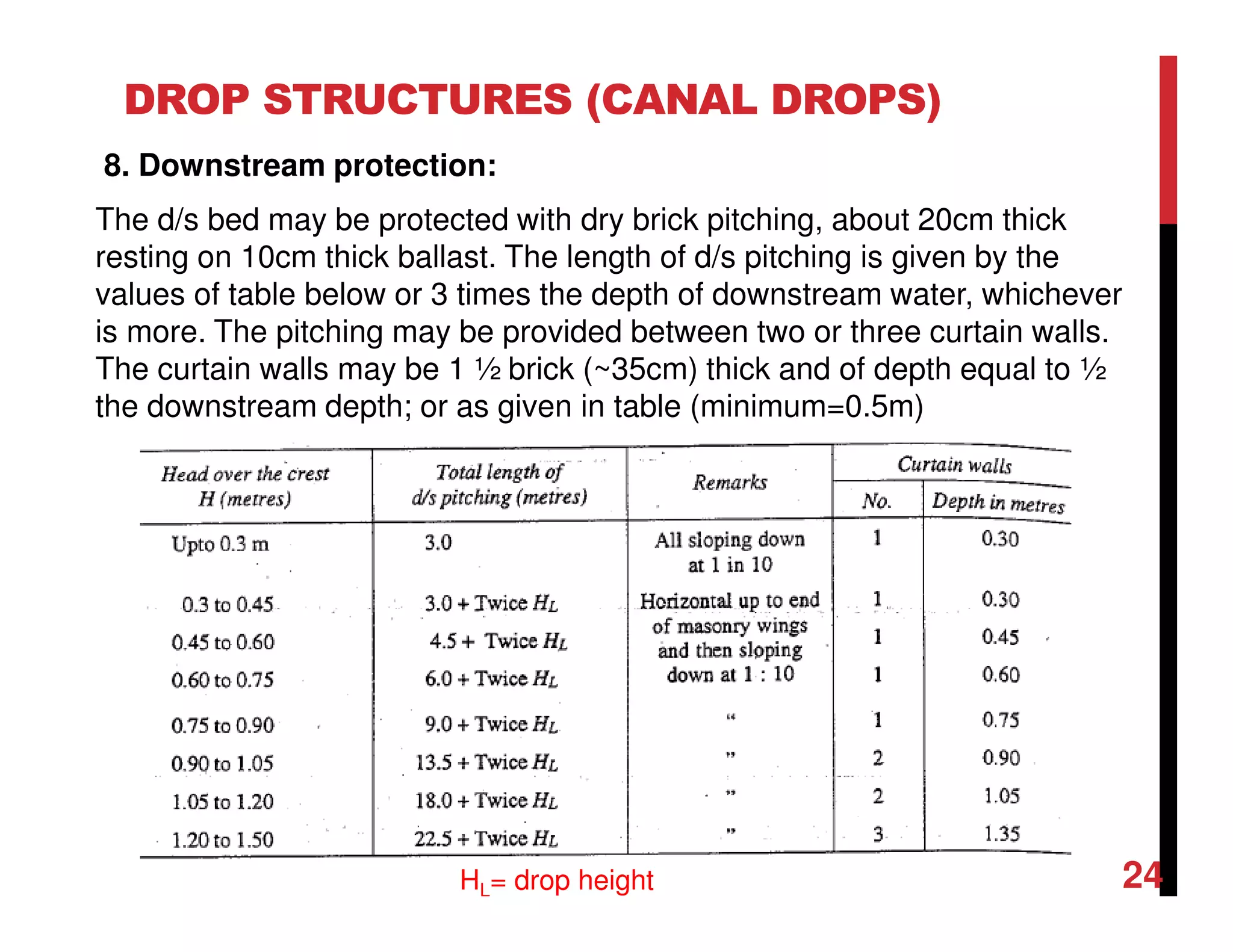
8. Downstream protection:
The d/s bed may be protected with dry brick pitching, about 20cm thick
resting on 10cm thick ballast. The length of d/s pitching is given by the
values of table below or 3 times the depth of downstream water, whichever
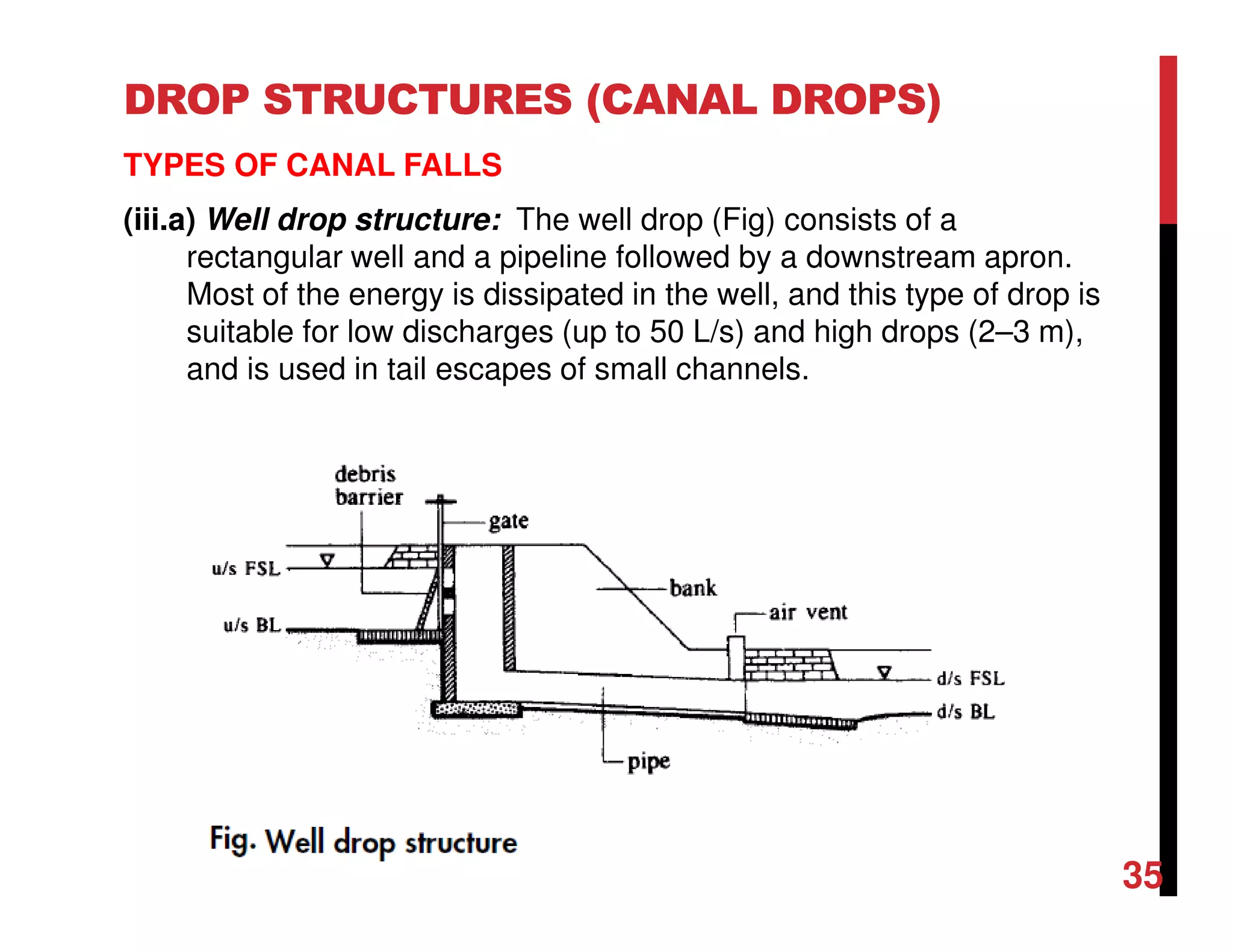
is more. The pitching may be provided between two or three curtain walls.
The curtain walls may be 1 ½ brick (~35cm) thick and of depth equal to ½
the downstream depth; or as given in table (minimum=0.5m)
24HL= drop height
DROP STRUCTURES (CANAL DROPS)
9. Slope pitching:
After the return wing, the side of the channel are pitched with one brick
of edge. The pitching should rest on a toe wall 1 ½ brick thick and of
depth equal to half the downstream water depth.
The side pitching may be curtailed at angle of 45o from the end of
pitching or extended straight from the end of bed pitching
10. Downstream wings. Downstream wings are kept straight for a
length of 5 to 8 times (H.HL)1/2 and may then be gradually wrapped.
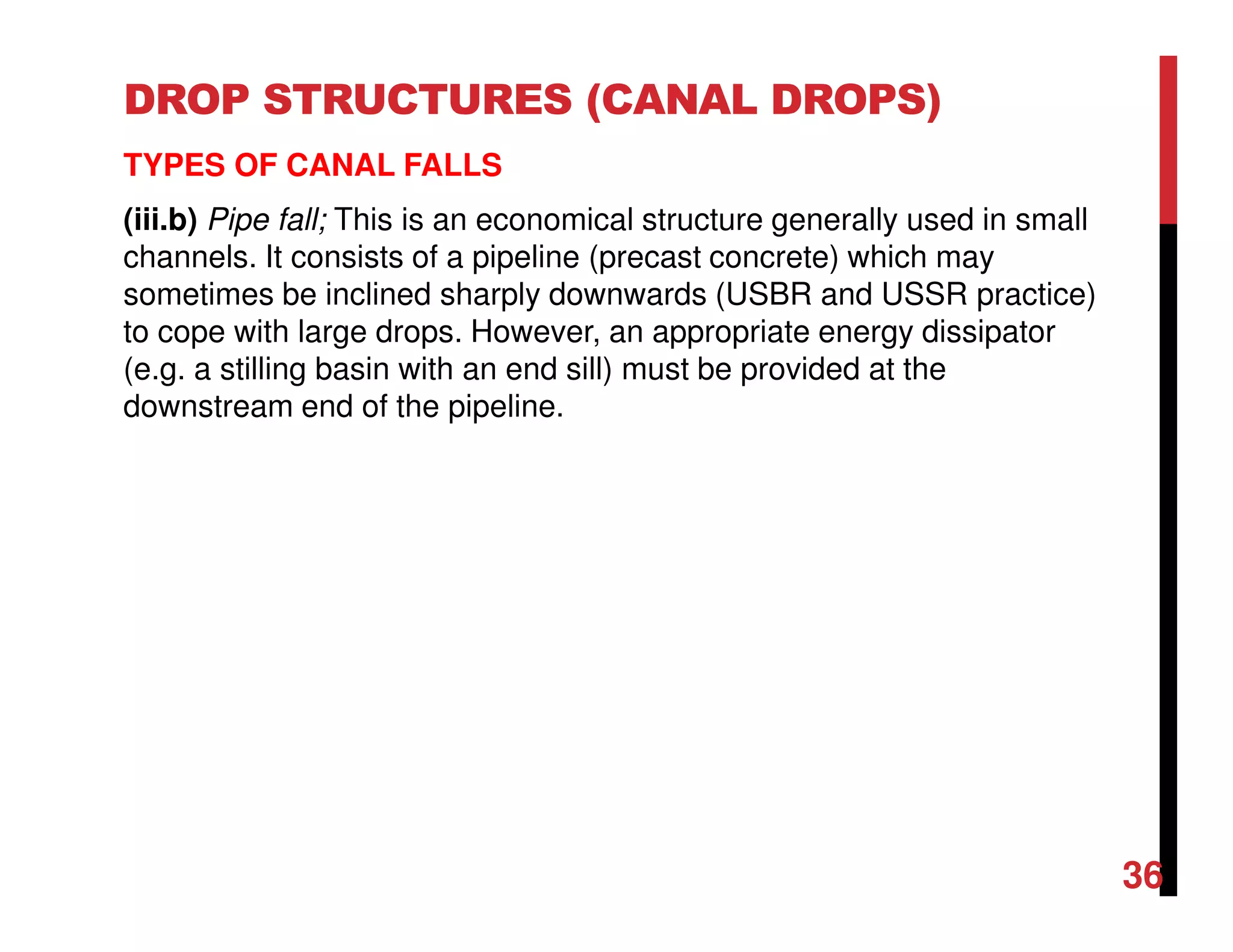
They should be taken up to the end of impervious floor.
All the wing walls must be designed as retaining walls, subjected to full
pressure of submerged soil at their back when channel is closed. Such
as wall generally has a base width equal to 1/3rd its height
25
DROP STRUCTURES (CANAL DROPS)
TYPES OF DROP STRUCTURES
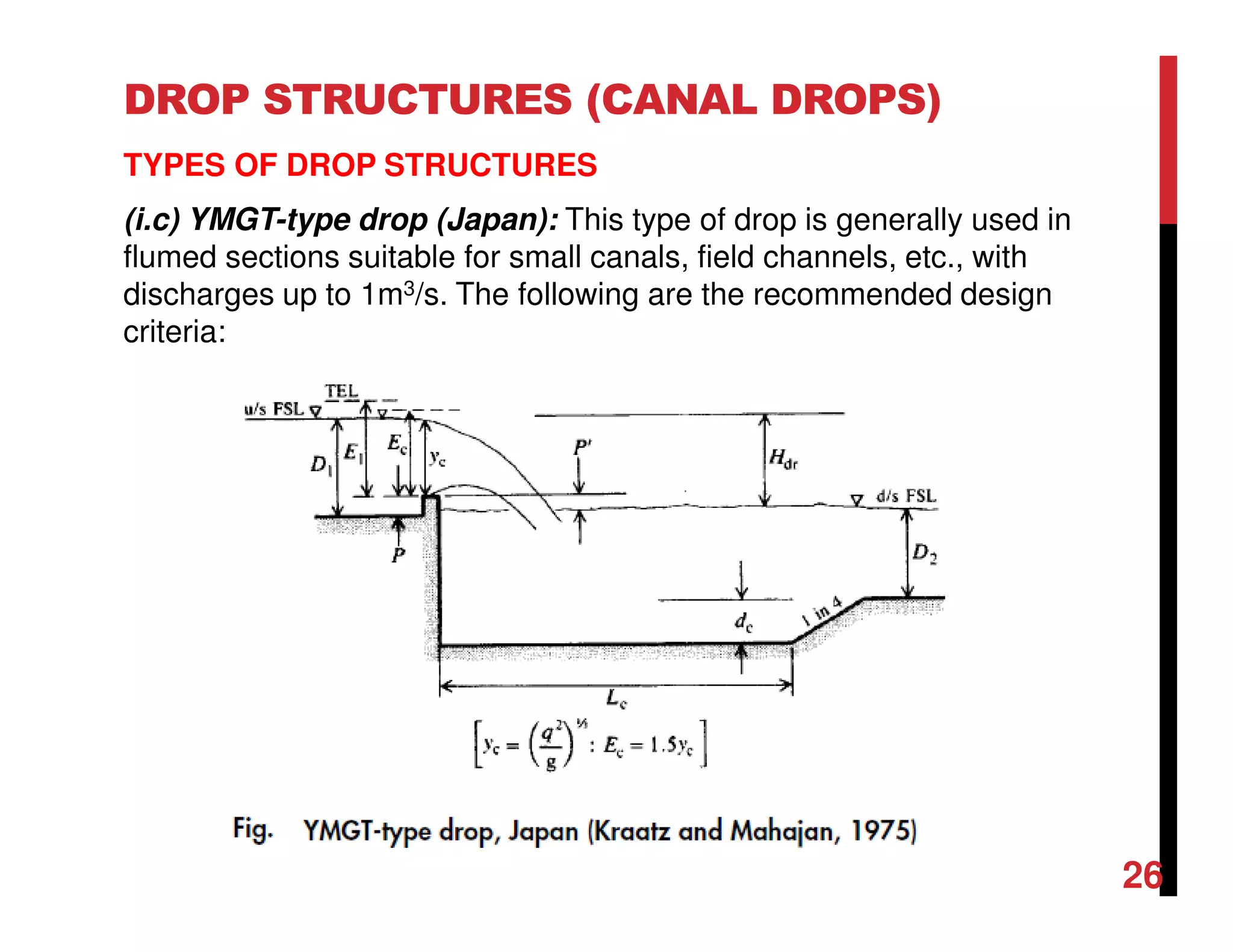
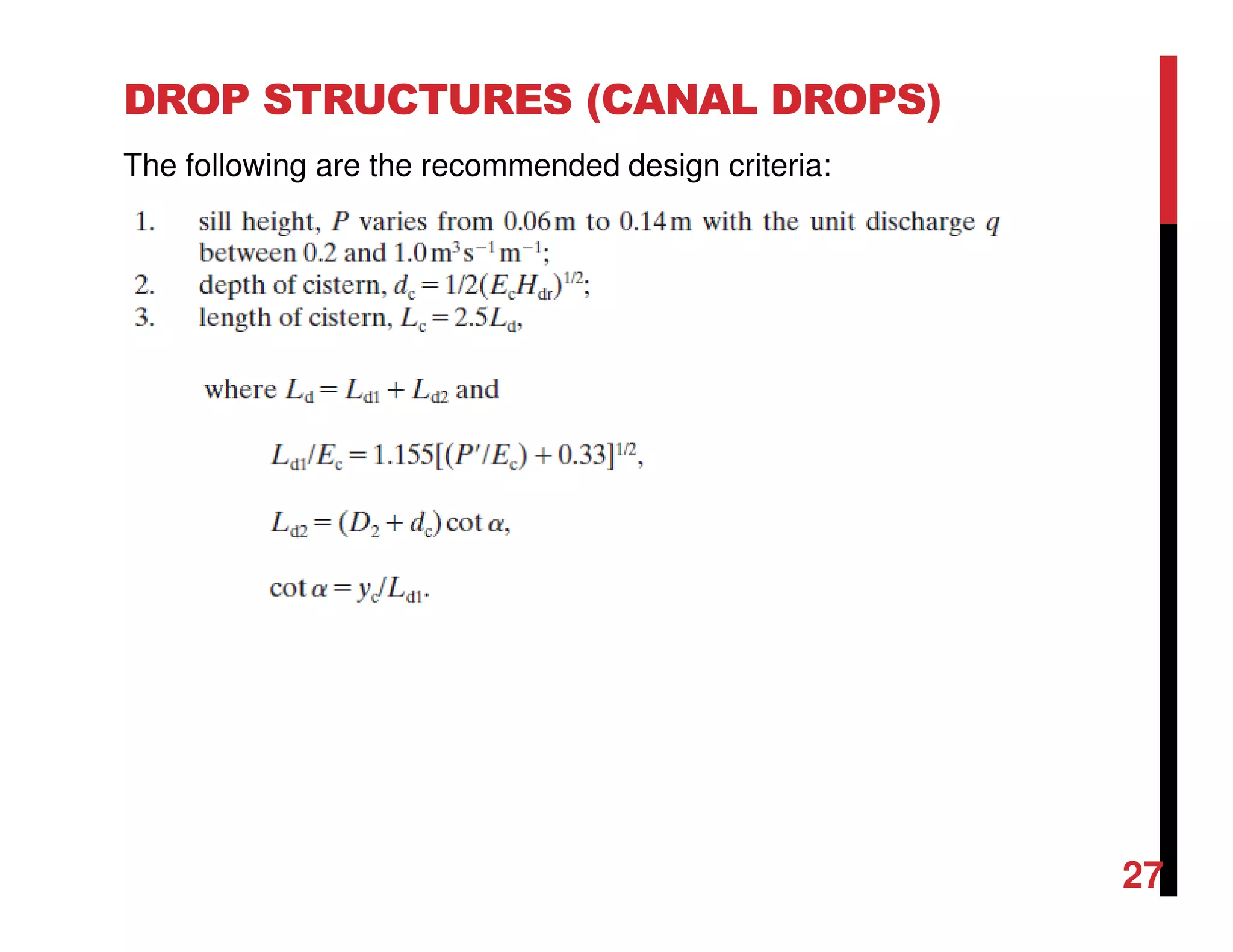
(i.c) YMGT-type drop (Japan): This type of drop is generally used in
flumed sections suitable for small canals, field channels, etc., with
discharges up to 1m3/s. The following are the recommended design
criteria:
26
DROP STRUCTURES (CANAL DROPS)
The following are the recommended design criteria:
27
DROP STRUCTURES (CANAL DROPS)
TYPES OF DROP STRUCTURES
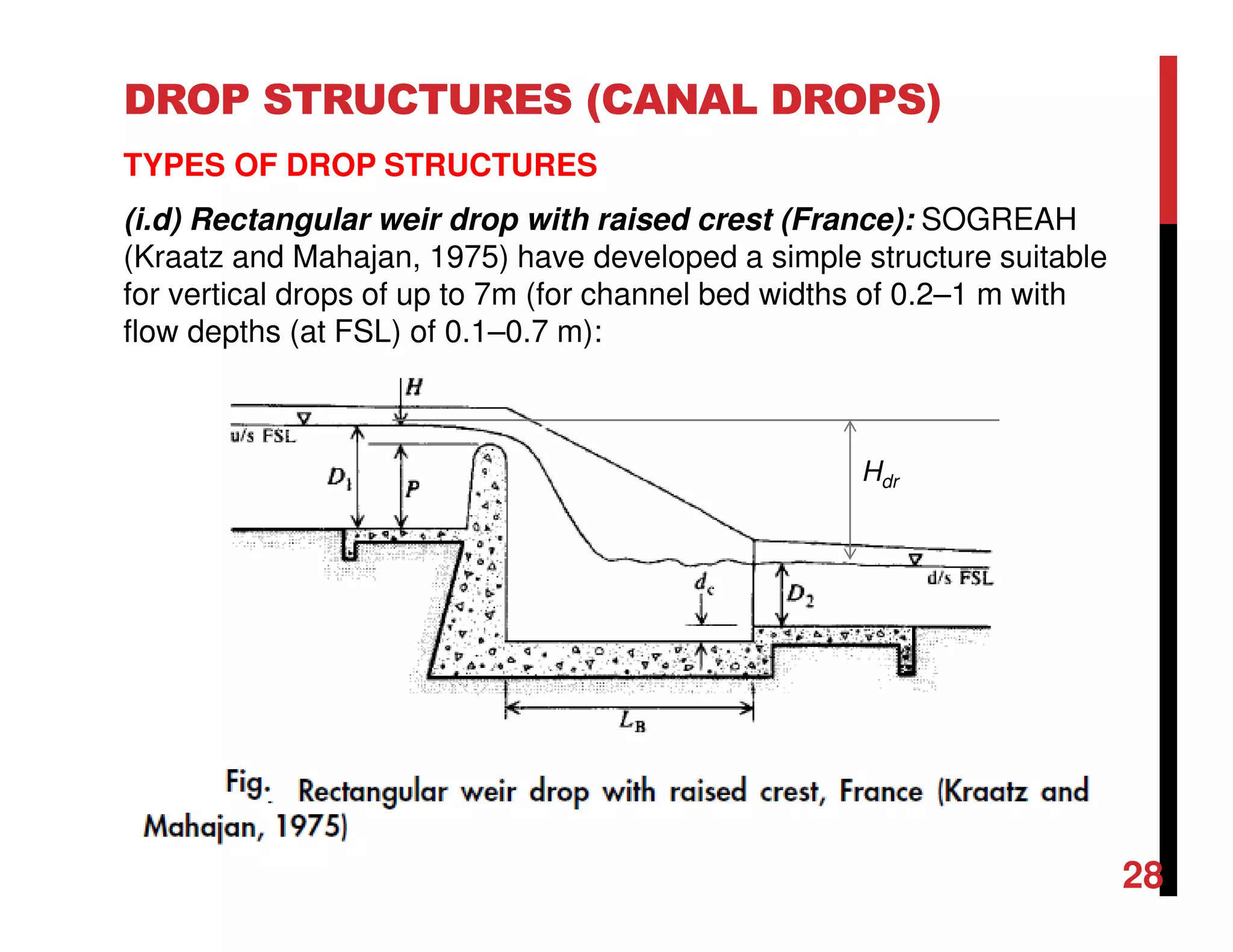
(i.d) Rectangular weir drop with raised crest (France): SOGREAH
(Kraatz and Mahajan, 1975) have developed a simple structure suitable
for vertical drops of up to 7m (for channel bed widths of 0.2–1 m with
flow depths (at FSL) of 0.1–0.7 m):
Hdr
28
DROP STRUCTURES (CANAL DROPS)
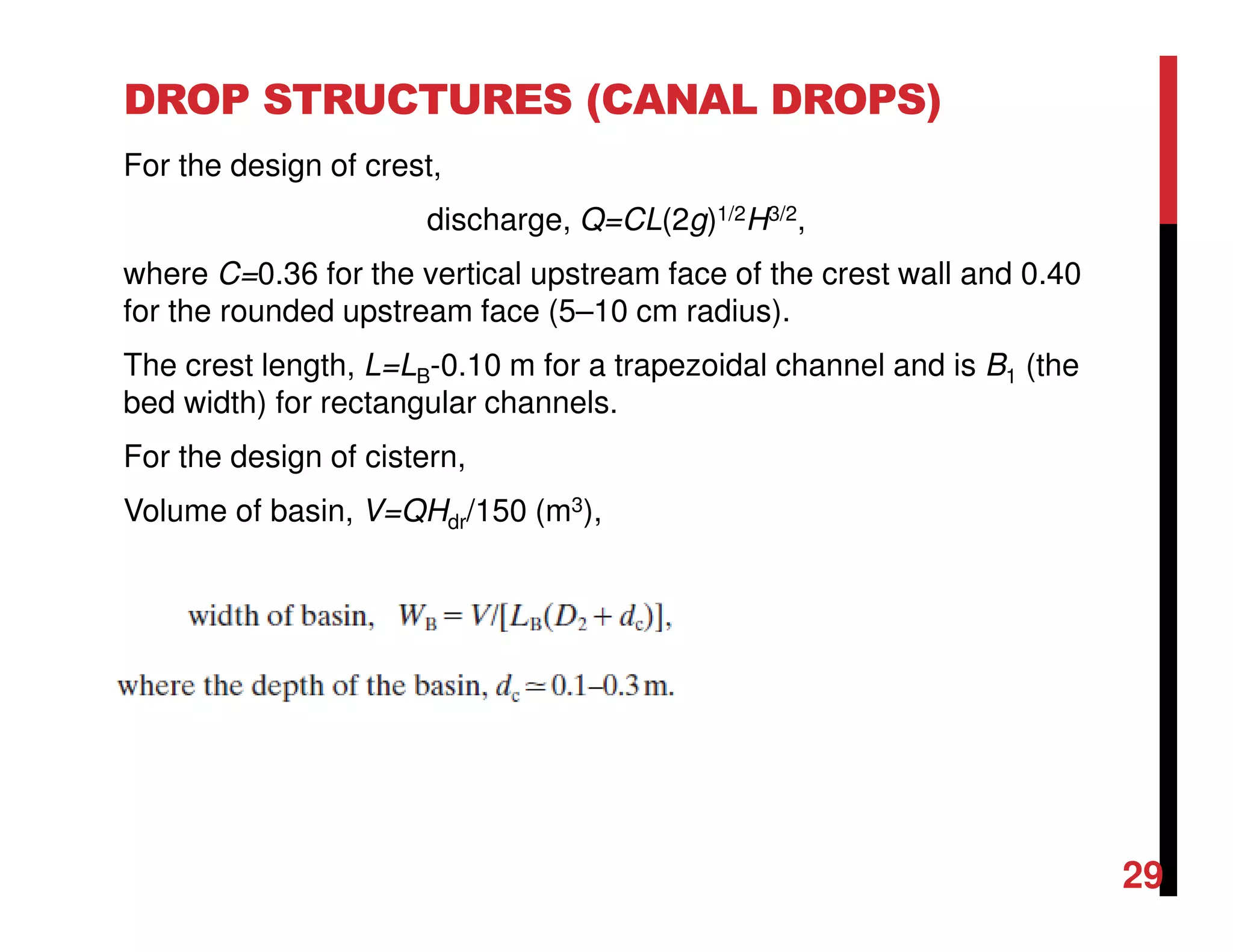
For the design of crest,
discharge, Q=CL(2g)1/2H3/2,
where C=0.36 for the vertical upstream face of the crest wall and 0.40
for the rounded upstream face (5–10 cm radius).
The crest length, L=LB-0.10 m for a trapezoidal channel and is B1 (the
bed width) for rectangular channels.
For the design of cistern,
Volume of basin, V=QHdr/150 (m3),
29
DROP STRUCTURES (CANAL DROPS)
TYPES OF DROP STRUCTURES
(ii) the inclined drop and
(a) Common chute
(b) Rapid fall type inclined drop (India)
(c) Stepped or cascade-type fall
30
DROP STRUCTURES (CANAL DROPS)
TYPES OF DROP STRUCTURES
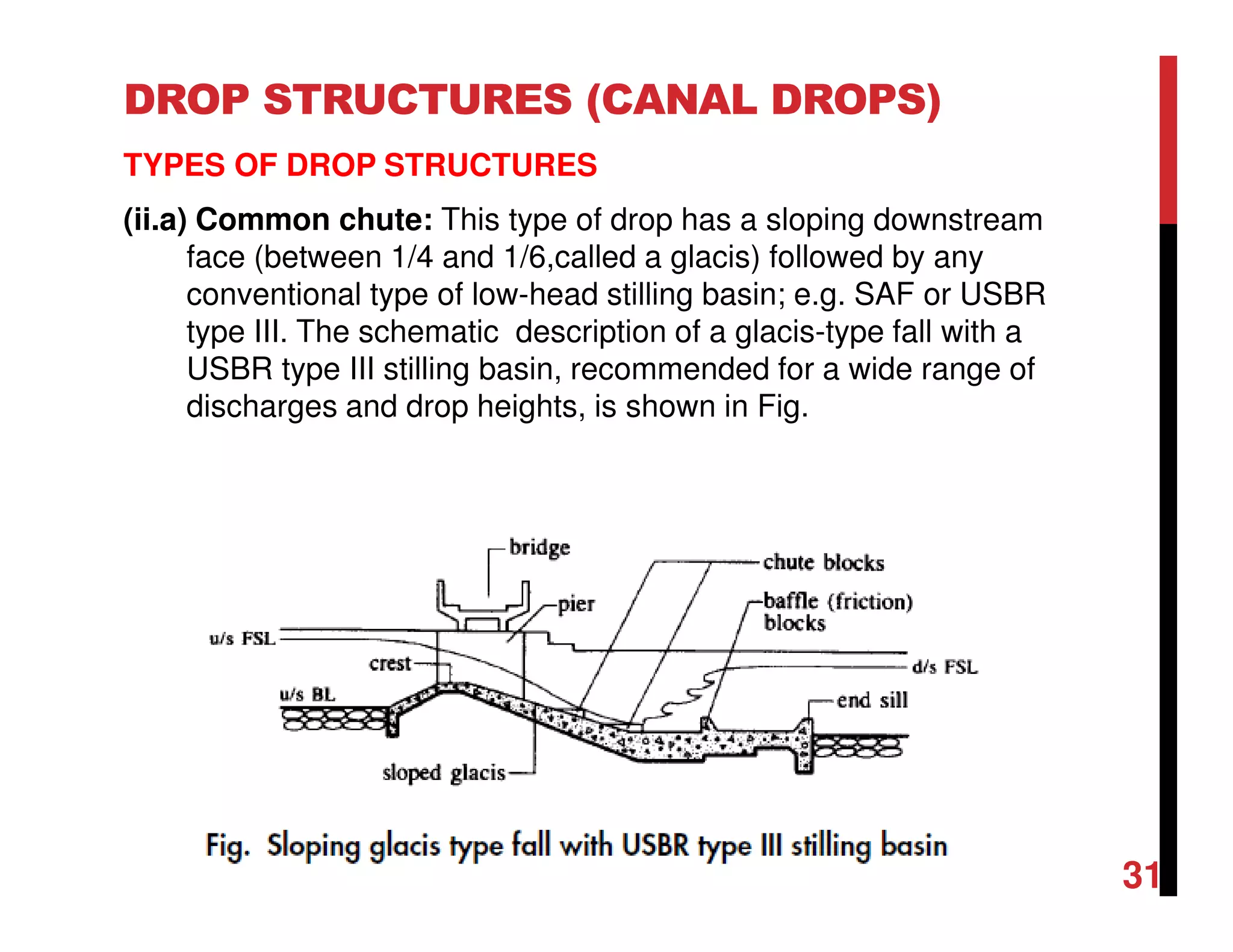
(ii.a) Common chute: This type of drop has a sloping downstream
face (between 1/4 and 1/6,called a glacis) followed by any
conventional type of low-head stilling basin; e.g. SAF or USBR
type III. The schematic description of a glacis-type fall with a
USBR type III stilling basin, recommended for a wide range of
discharges and drop heights, is shown in Fig.
31
DROP STRUCTURES (CANAL DROPS)
TYPES OF DROP STRUCTURES
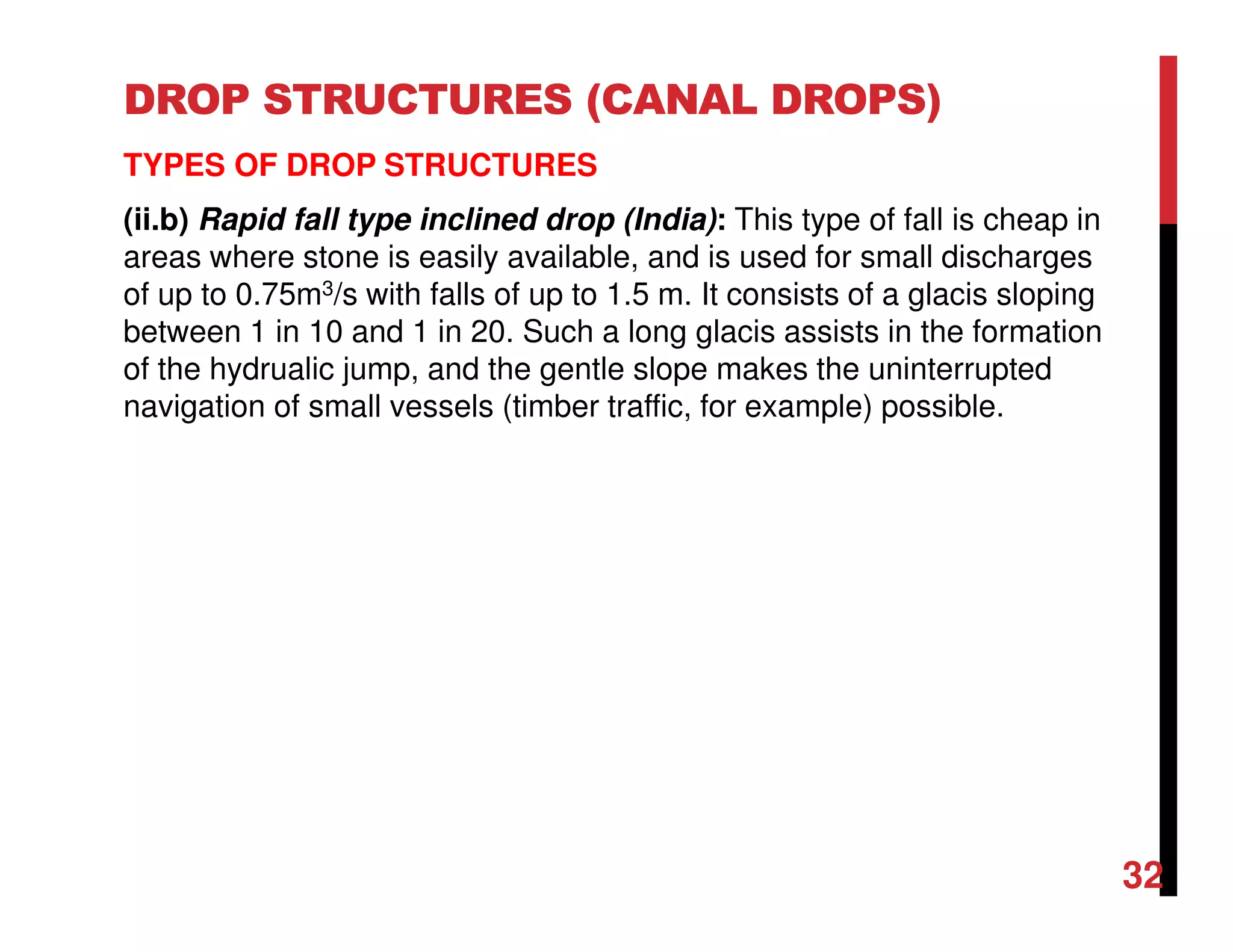
(ii.b) Rapid fall type inclined drop (India): This type of fall is cheap in
areas where stone is easily available, and is used for small discharges
of up to 0.75m3/s with falls of up to 1.5 m. It consists of a glacis sloping
between 1 in 10 and 1 in 20. Such a long glacis assists in the formation
of the hydrualic jump, and the gentle slope makes the uninterrupted
navigation of small vessels (timber traffic, for example) possible.
32
DROP STRUCTURES (CANAL DROPS)
TYPES OF DROP STRUCTURES
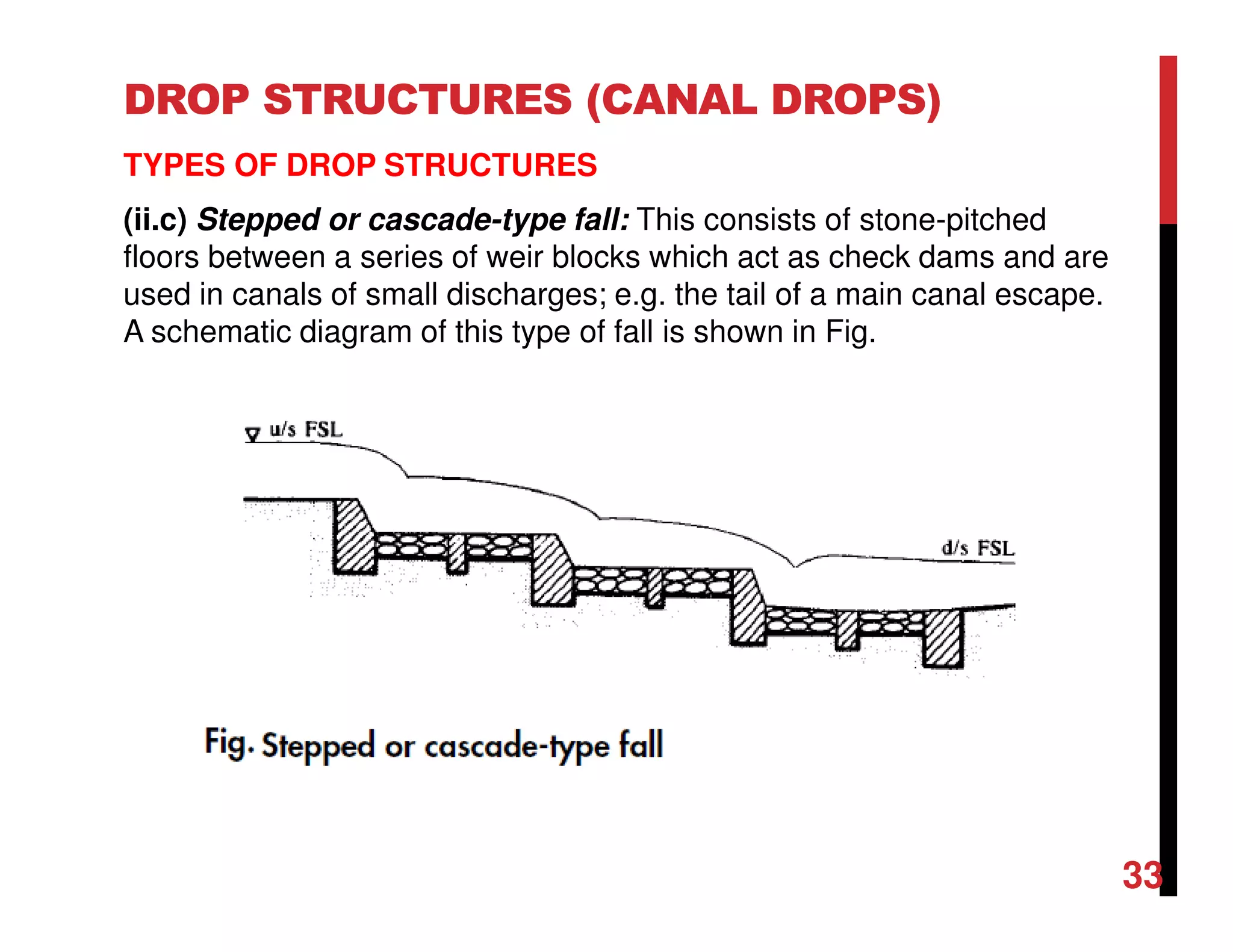
(ii.c) Stepped or cascade-type fall: This consists of stone-pitched
floors between a series of weir blocks which act as check dams and are
used in canals of small discharges; e.g. the tail of a main canal escape.
A schematic diagram of this type of fall is shown in Fig.
33
DROP STRUCTURES (CANAL DROPS)
TYPES OF CANAL FALLS
(iii) the piped drop.
A piped drop is the most economical structure compared with an
inclined drop for small discharges of up to 50 liter/s. It is usually
equipped with a check gate at its upstream end, and a screen (debris
barrier) is installed to prevent the fouling of the entrance.
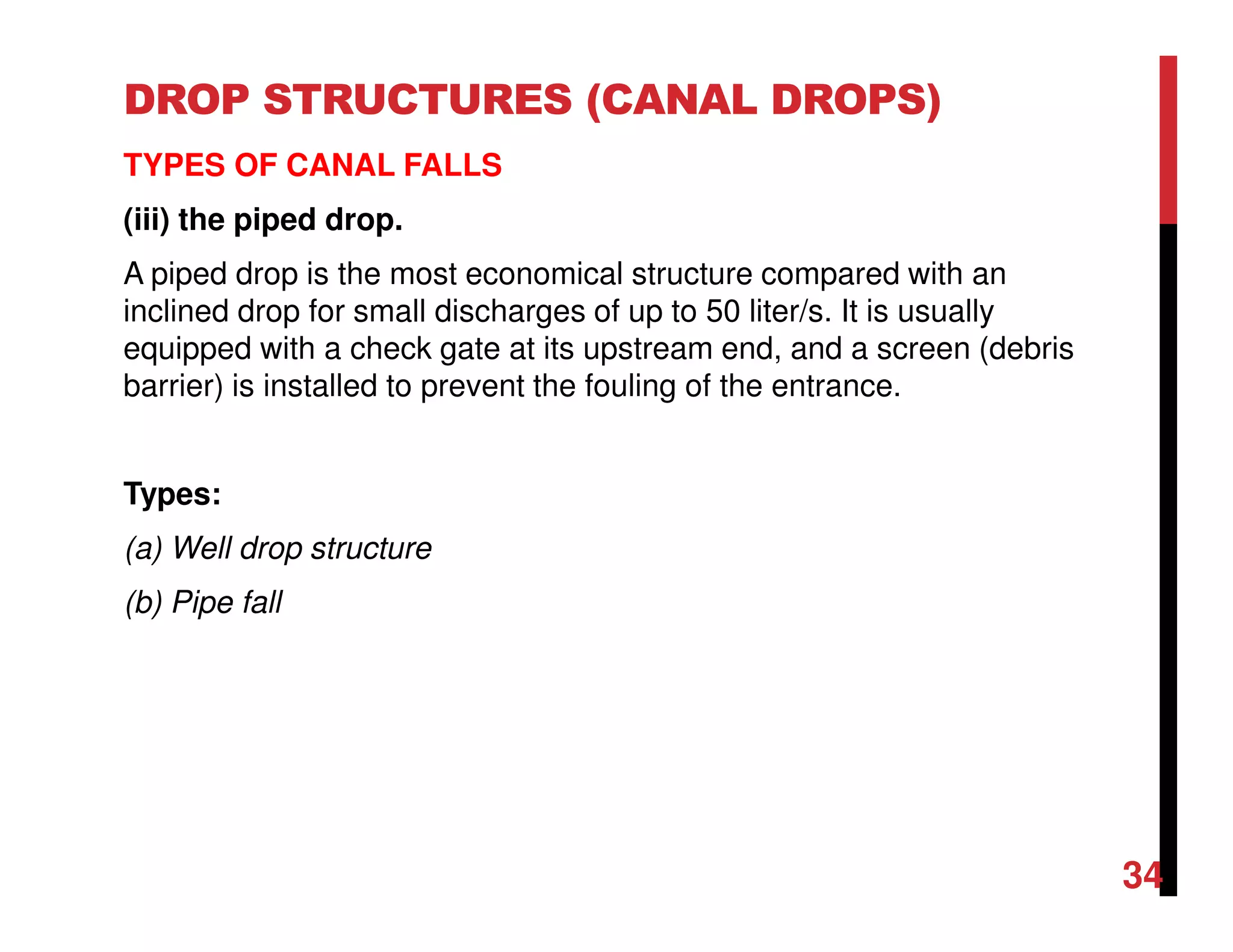
Types:
(a) Well drop structure
(b) Pipe fall
34
DROP STRUCTURES (CANAL DROPS)
TYPES OF CANAL FALLS
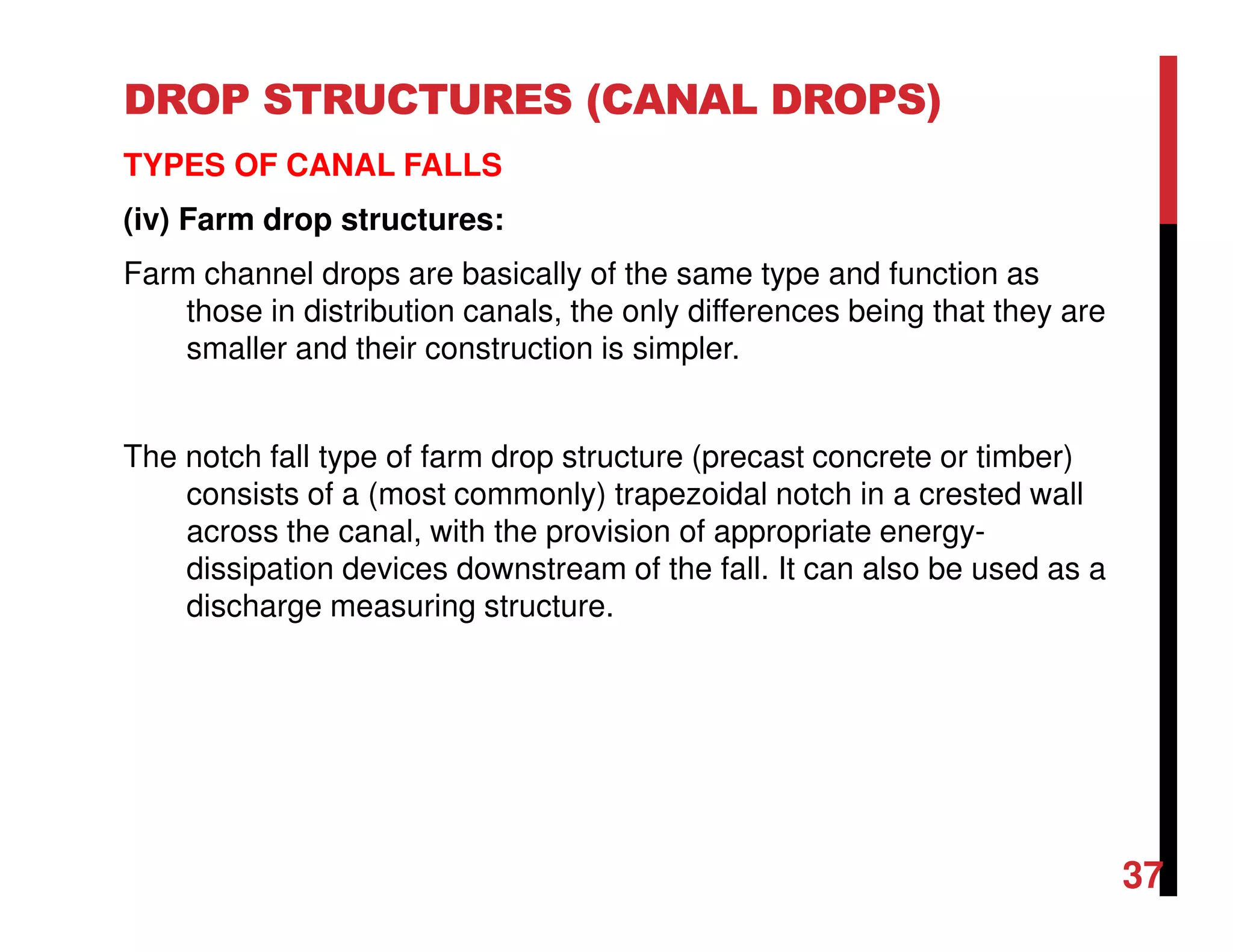
(iii.a) Well drop structure: The well drop (Fig) consists of a
rectangular well and a pipeline followed by a downstream apron.
Most of the energy is dissipated in the well, and this type of drop is
suitable for low discharges (up to 50 L/s) and high drops (2–3 m),
and is used in tail escapes of small channels.
35
DROP STRUCTURES (CANAL DROPS)
TYPES OF CANAL FALLS
(iii.b) Pipe fall; This is an economical structure generally used in small
channels. It consists of a pipeline (precast concrete) which may
sometimes be inclined sharply downwards (USBR and USSR practice)
to cope with large drops. However, an appropriate energy dissipator
(e.g. a stilling basin with an end sill) must be provided at the
downstream end of the pipeline.
36
DROP STRUCTURES (CANAL DROPS)
TYPES OF CANAL FALLS
(iv) Farm drop structures:
Farm channel drops are basically of the same type and function as
those in distribution canals, the only differences being that they are
smaller and their construction is simpler.
The notch fall type of farm drop structure (precast concrete or timber)
consists of a (most commonly) trapezoidal notch in a crested wall
across the canal, with the provision of appropriate energy-
dissipation devices downstream of the fall. It can also be used as a
discharge measuring structure.
37
DROP STRUCTURES (CANAL DROPS)
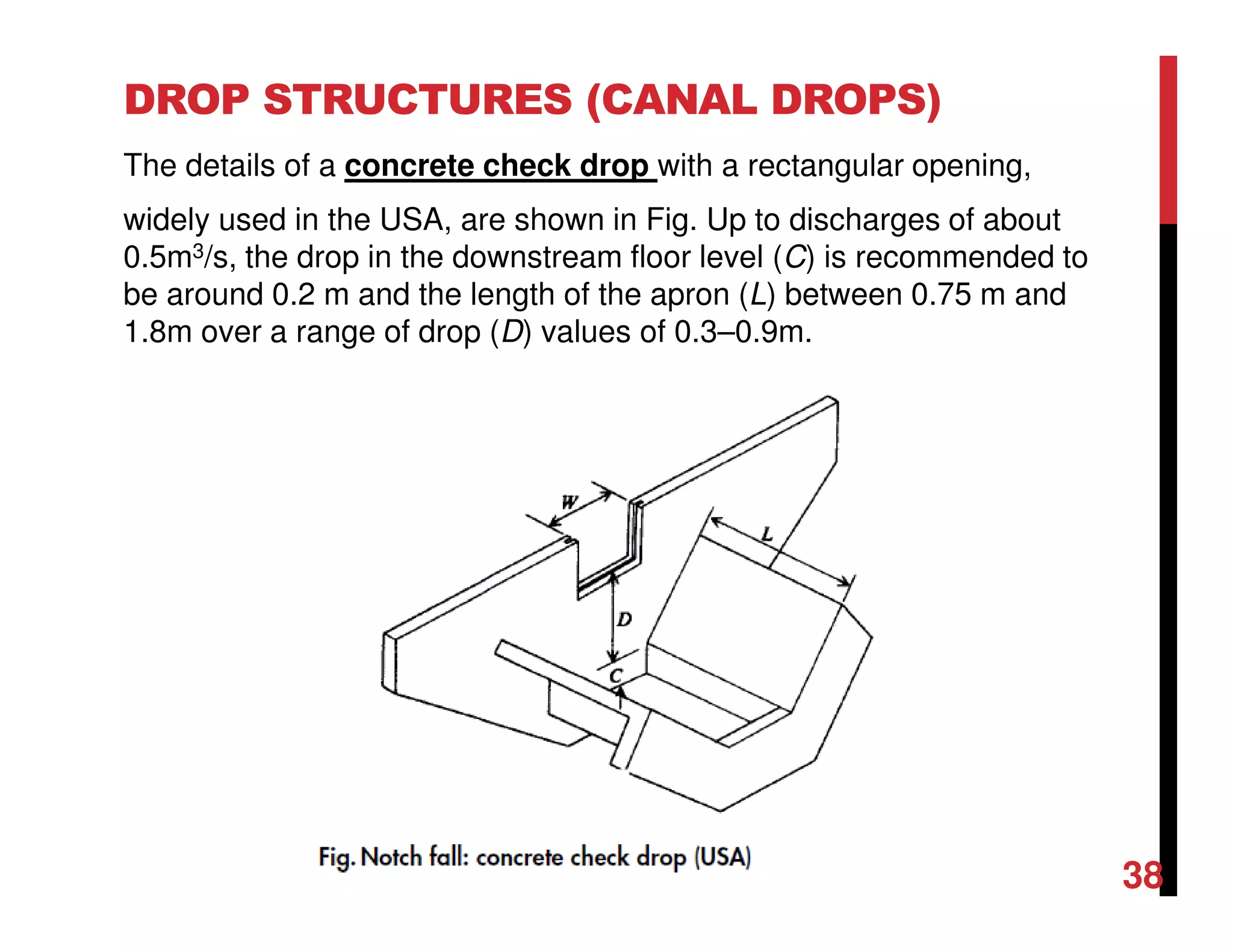
The details of a concrete check drop with a rectangular opening,
widely used in the USA, are shown in Fig. Up to discharges of about
0.5m3/s, the drop in the downstream floor level (C) is recommended to
be around 0.2 m and the length of the apron (L) between 0.75 m and
1.8m over a range of drop (D) values of 0.3–0.9m.
38
DROP STRUCTURES (CANAL DROPS)
Solved Examples
1. Common drop structure with impact
block type basin
2. Sarda type drop structure
39
DROP STRUCTURES (CANAL DROPS)
Example 1: Find the dimensions for a straight drop structure with a
impact block type basin.
Given:
• Q = 250 ft3/S (7.08m3/s)
• Drop: h = 6.0 ft. (1.93m)
(Upstream and Downstream Channel -Trapezoidal)
• B = 10.0 ft. (3.2048)
• Z = 1V:3H
• So = 0.002 (after providing for drop)
• n = 0.030
40
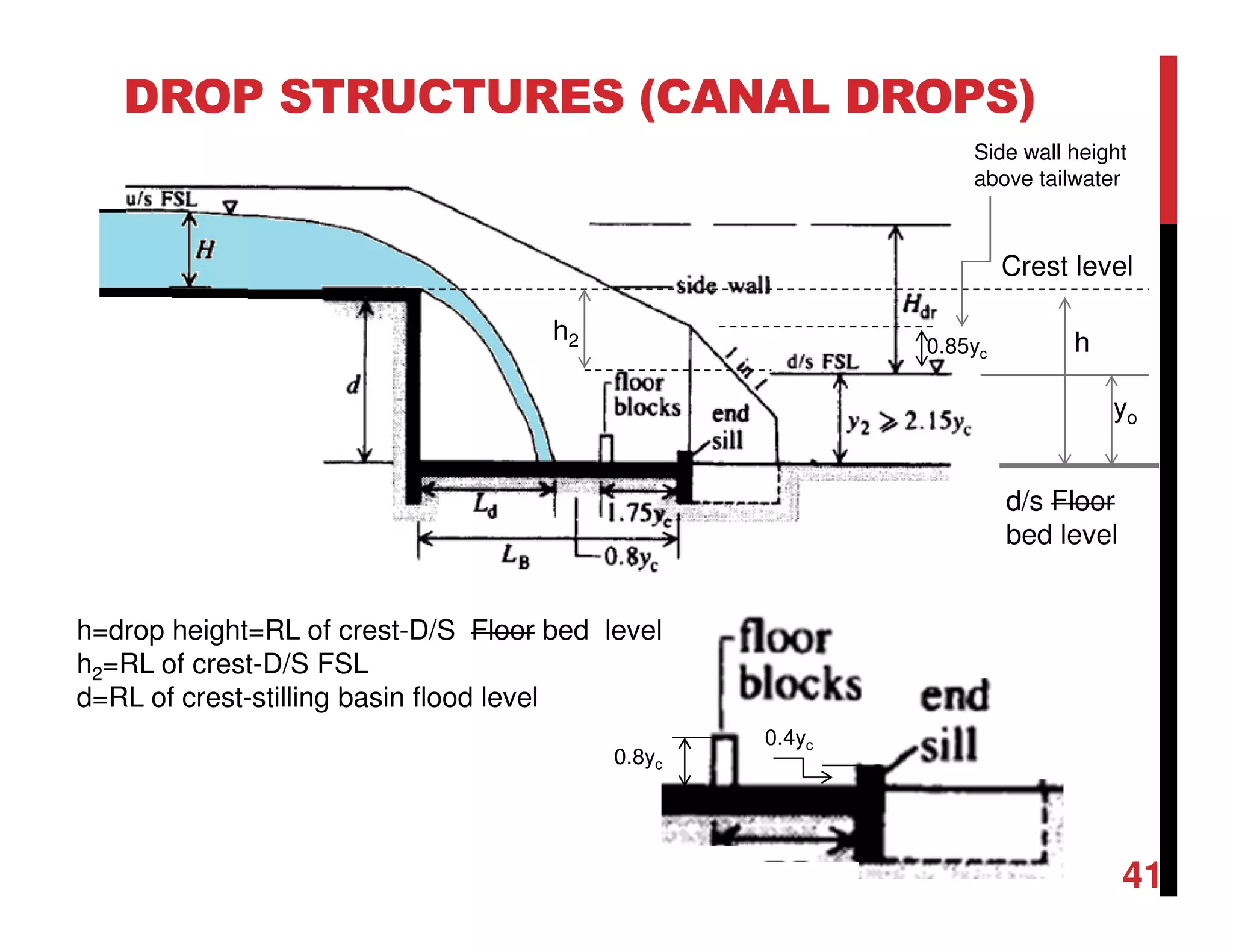
0.85yc
0.8yc
0.4yc
h2
h=drop height=RL of crest-D/S Floor bed level
h2=RL of crest-D/S FSL
d=RL of crest-stilling basin flood level
Side wall height
above tailwater
h
d/s Floor
bed level
Crest level
yo
DROP STRUCTURES (CANAL DROPS)
41
DROP STRUCTURES (CANAL DROPS)
Solution:
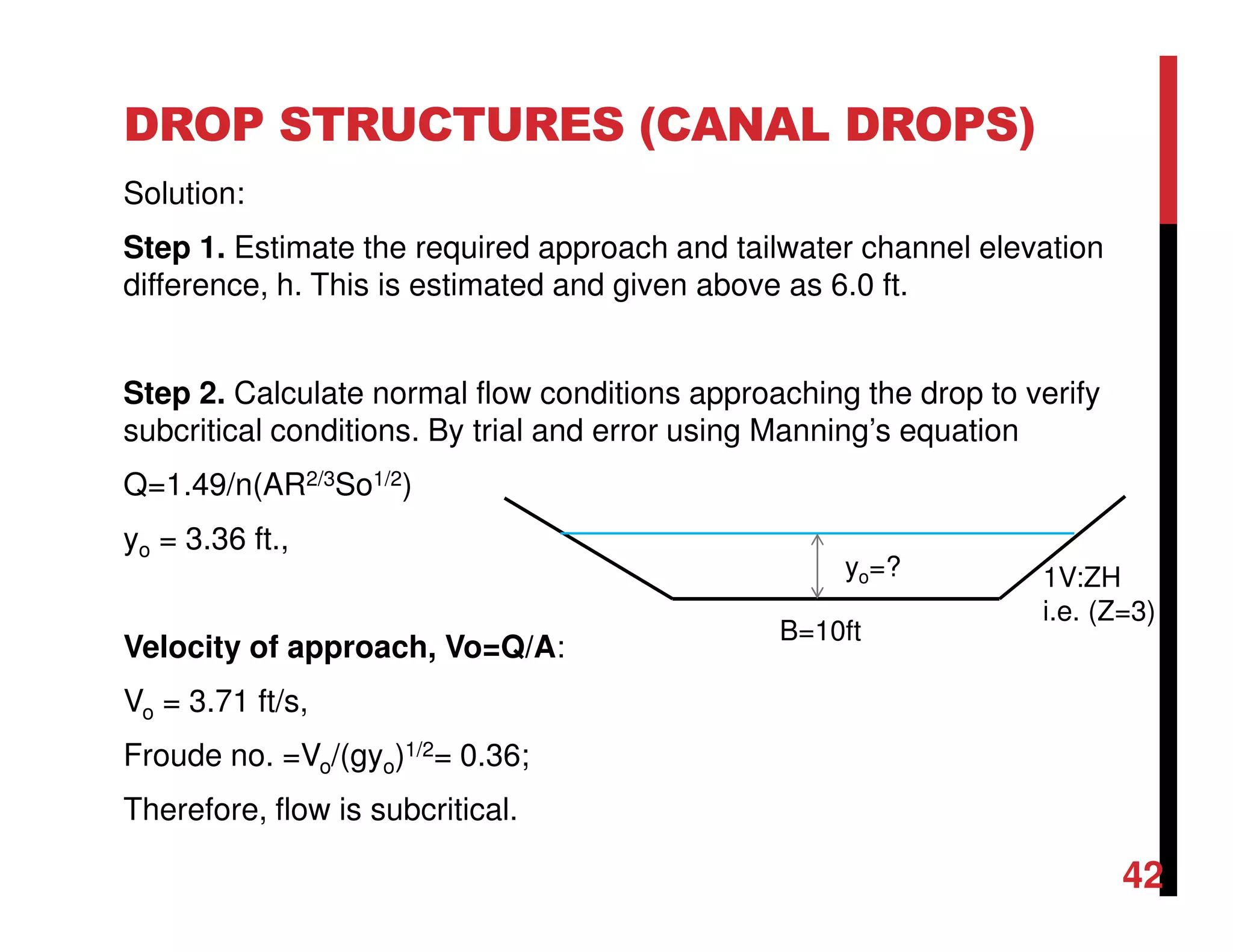
Step 1. Estimate the required approach and tailwater channel elevation
difference, h. This is estimated and given above as 6.0 ft.
Step 2. Calculate normal flow conditions approaching the drop to verify
subcritical conditions. By trial and error using Manning’s equation
Q=1.49/n(AR2/3So1/2)
yo = 3.36 ft.,
Velocity of approach, Vo=Q/A:
Vo = 3.71 ft/s,
Froude no. =Vo/(gyo)1/2= 0.36;
Therefore, flow is subcritical.
yo=?
B=10ft
1V:ZH
i.e. (Z=3)
42
DROP STRUCTURES (CANAL DROPS)
Solution:
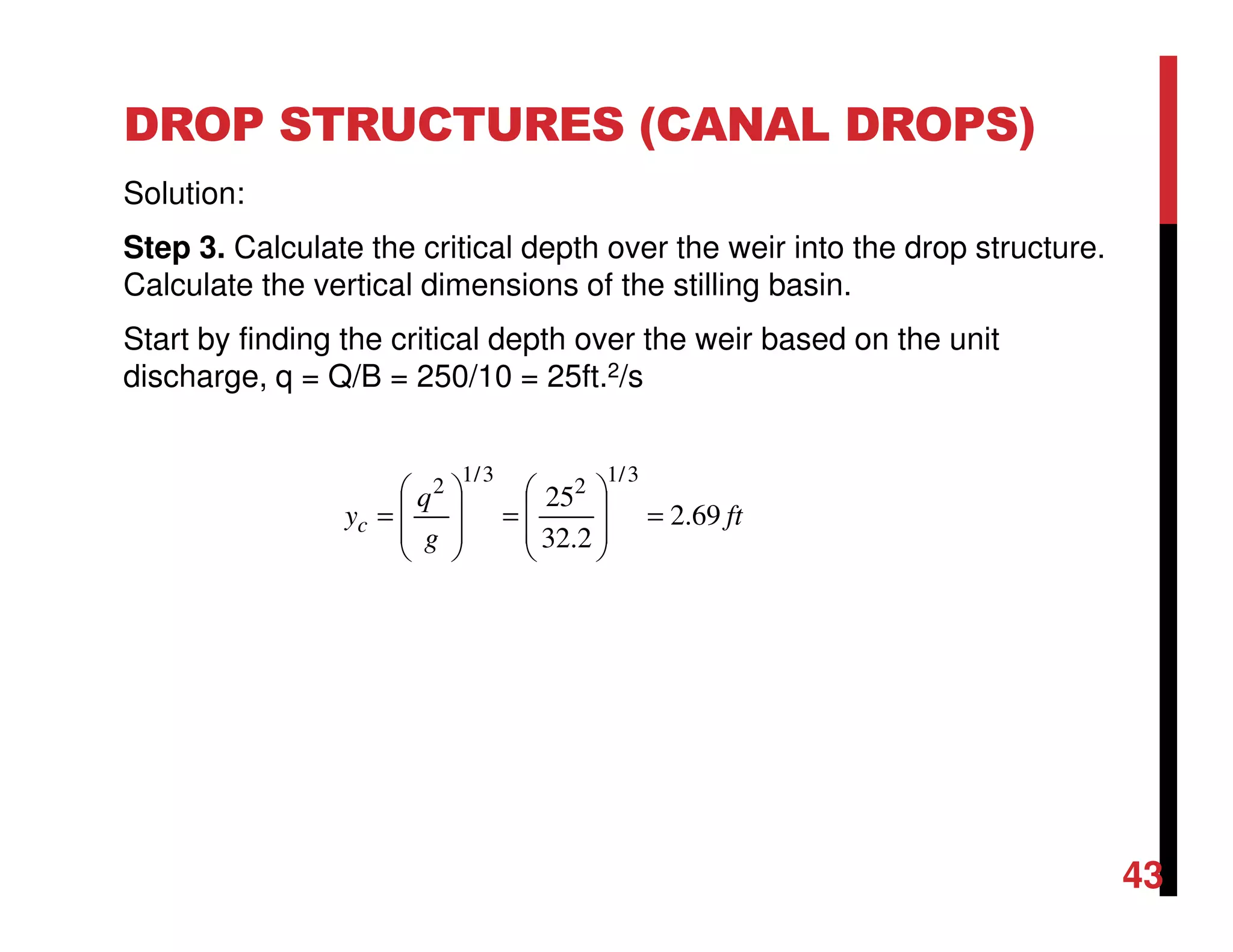
Step 3. Calculate the critical depth over the weir into the drop structure.
Calculate the vertical dimensions of the stilling basin.
Start by finding the critical depth over the weir based on the unit
discharge, q = Q/B = 250/10 = 25ft.2/s
ft
g
q
yc 69.2
2.32
25
3/1
2
3/1
2
=








=








=
43
DROP STRUCTURES (CANAL DROPS)
Solution:
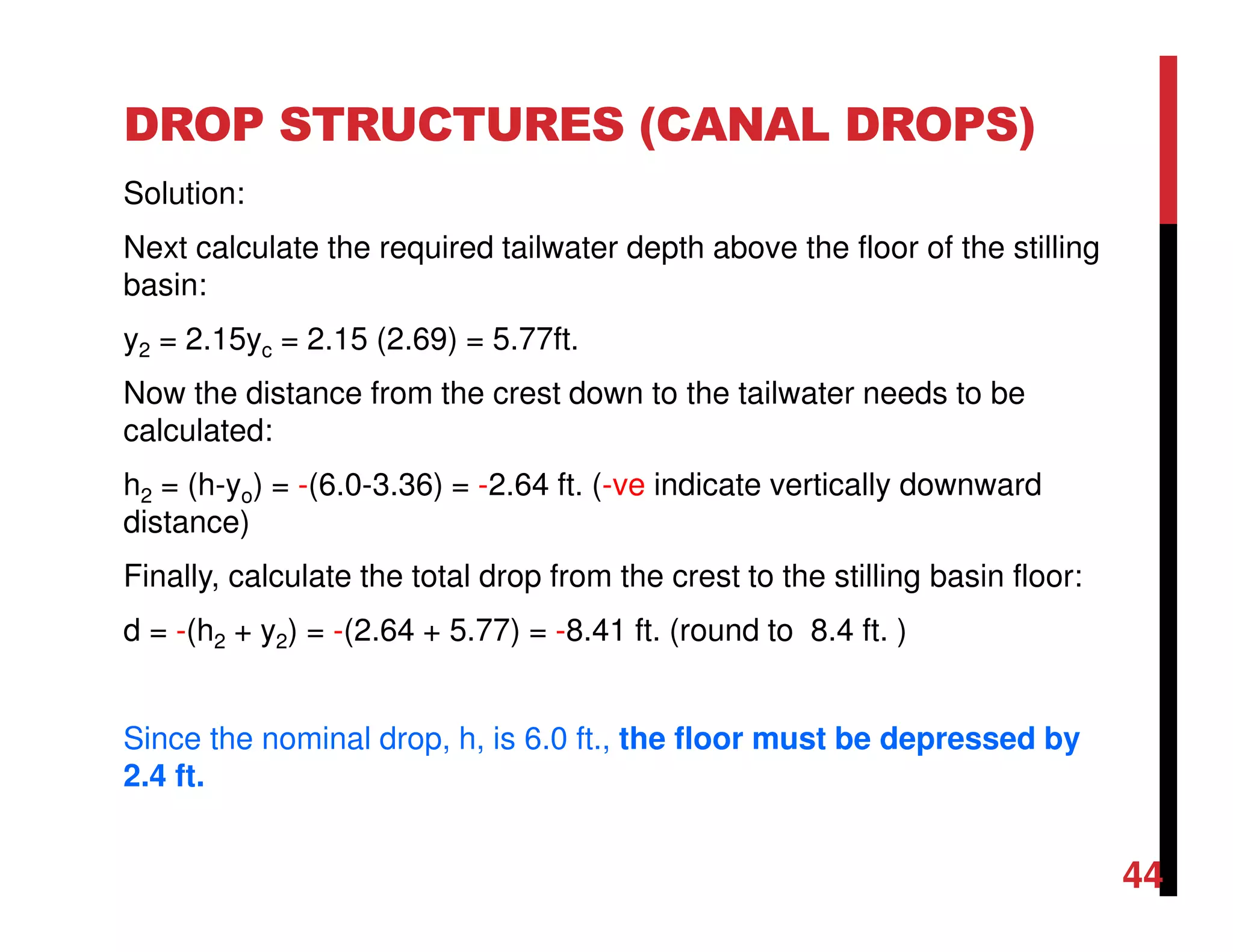
Next calculate the required tailwater depth above the floor of the stilling
basin:
y2 = 2.15yc = 2.15 (2.69) = 5.77ft.
Now the distance from the crest down to the tailwater needs to be
calculated:
h2 = (h-yo) = -(6.0-3.36) = -2.64 ft. (-ve indicate vertically downward
distance)
Finally, calculate the total drop from the crest to the stilling basin floor:
d = -(h2 + y2) = -(2.64 + 5.77) = -8.41 ft. (round to 8.4 ft. )
Since the nominal drop, h, is 6.0 ft., the floor must be depressed by
2.4 ft.
44
DROP STRUCTURES (CANAL DROPS)
Solution:
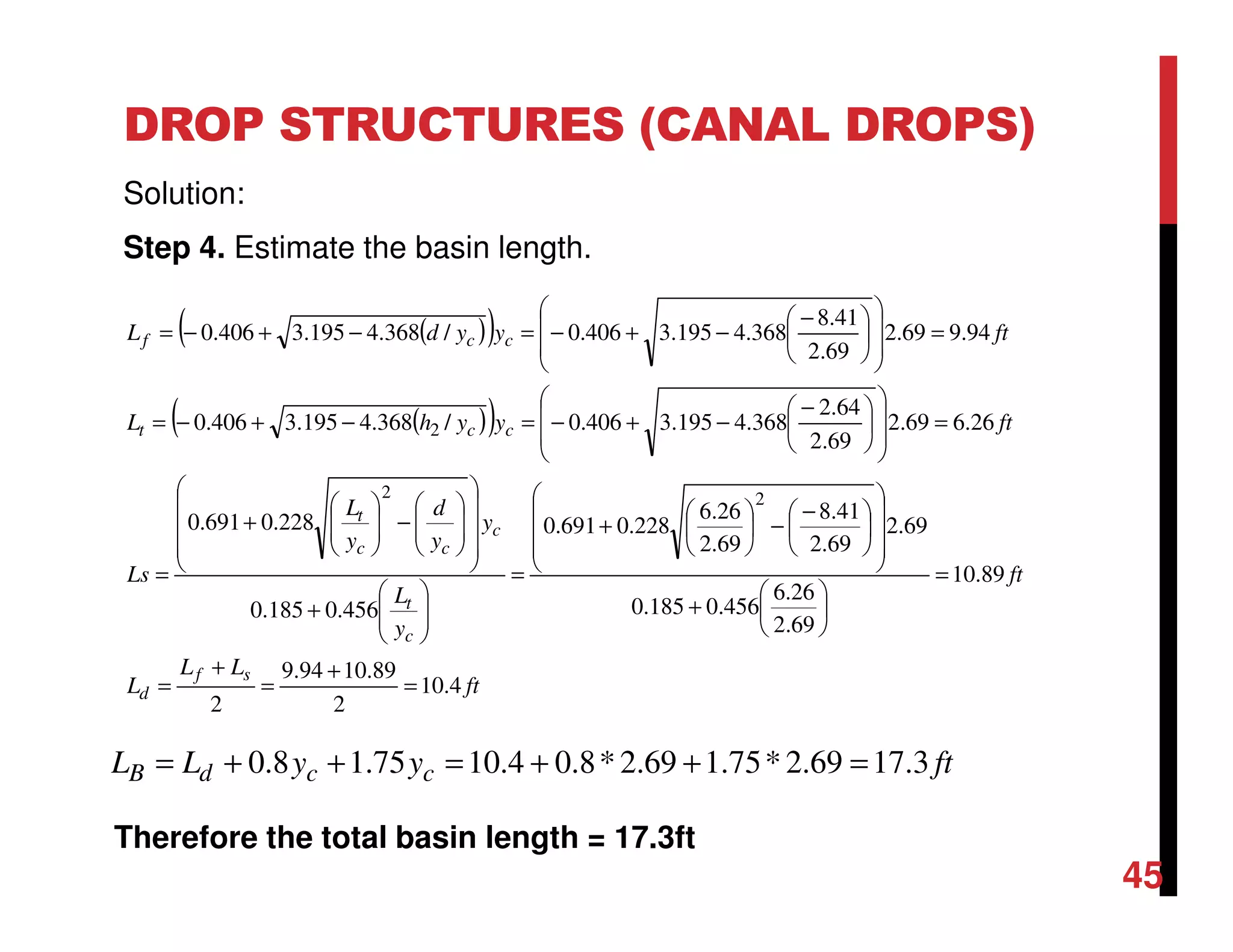
Step 4. Estimate the basin length.
( )( )
( )( )
ft
LL
L
ft
y
L
y
y
d
y
L
Ls
ftyyhL
ftyydL
sf
d
c
t
c
cc
t
cct
ccf
4.10
2
89.1094.9
2
89.10
69.2
26.6
456.0185.0
69.2
69.2
41.8
69.2
26.6
228.0691.0
456.0185.0
228.0691.0
26.669.2
69.2
64.2
368.4195.3406.0/368.4195.3406.0
94.969.2
69.2
41.8
368.4195.3406.0/368.4195.3406.0
22
2
=
+
=
+
=
=






+















 −
−





+
=








+


















−







+
=
=













 −
−+−=−+−=
=













 −
−+−=−+−=
ftyyLL ccdB 3.1769.2*75.169.2*8.04.1075.18.0 =++=++=
Therefore the total basin length = 17.3ft
45
DROP STRUCTURES (CANAL DROPS)
Solution:
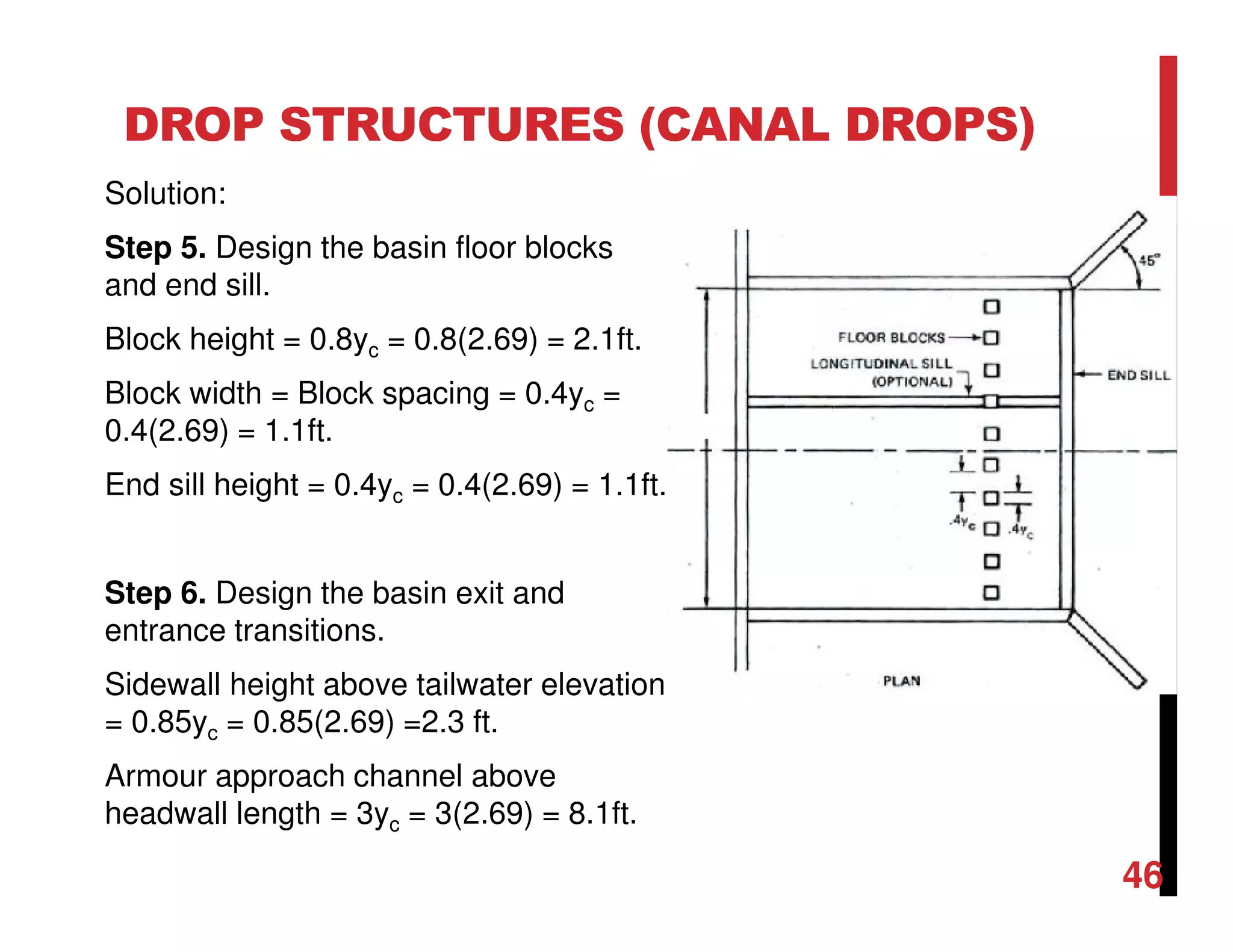
Step 5. Design the basin floor blocks
and end sill.
Block height = 0.8yc = 0.8(2.69) = 2.1ft.
Block width = Block spacing = 0.4yc =
0.4(2.69) = 1.1ft.
End sill height = 0.4yc = 0.4(2.69) = 1.1ft.
Step 6. Design the basin exit and
entrance transitions.
Sidewall height above tailwater elevation
= 0.85yc = 0.85(2.69) =2.3 ft.
Armour approach channel above
headwall length = 3yc = 3(2.69) = 8.1ft.
46
DROP STRUCTURES (CANAL DROPS)
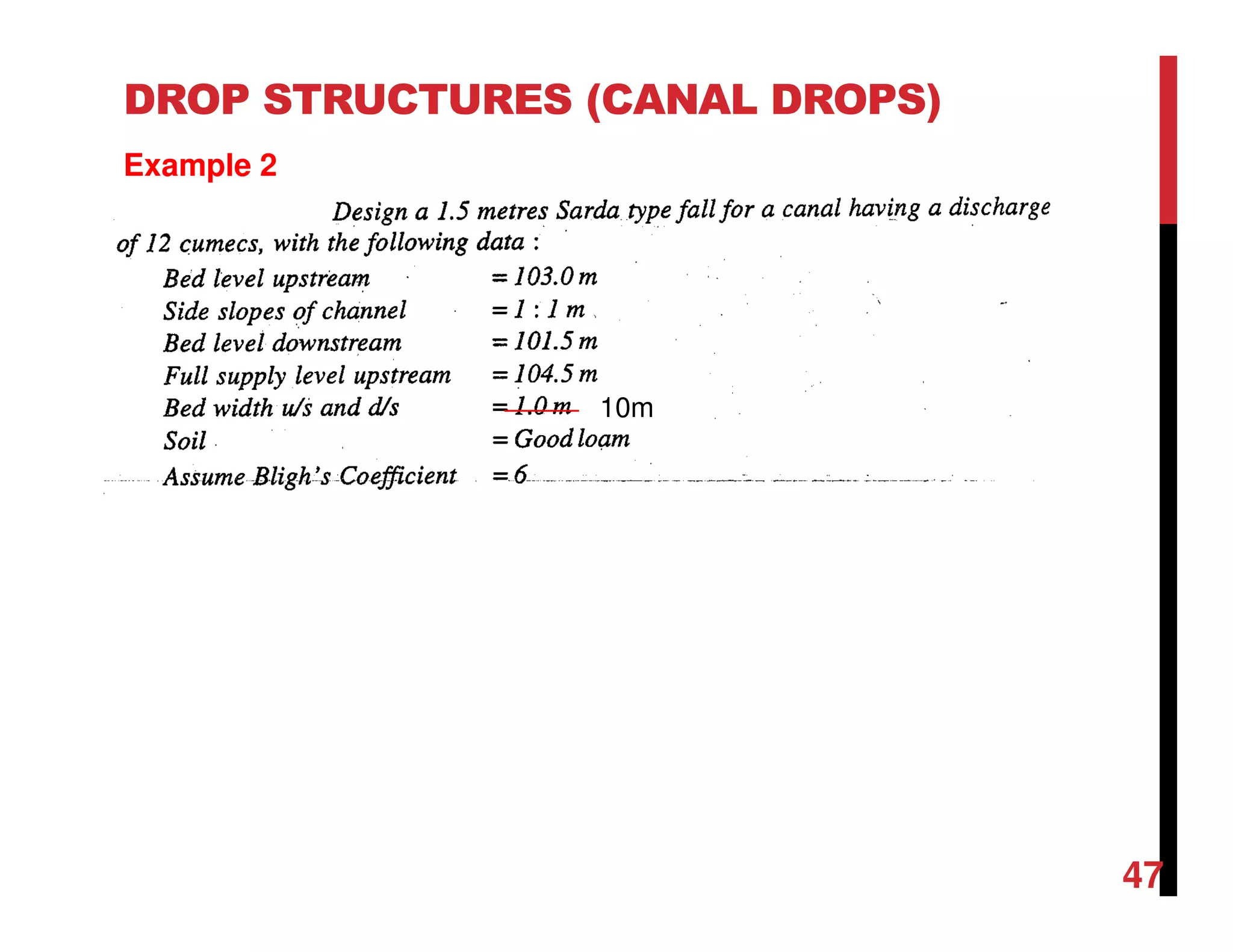
Example 2
47
10m
DROP STRUCTURES (CANAL DROPS)
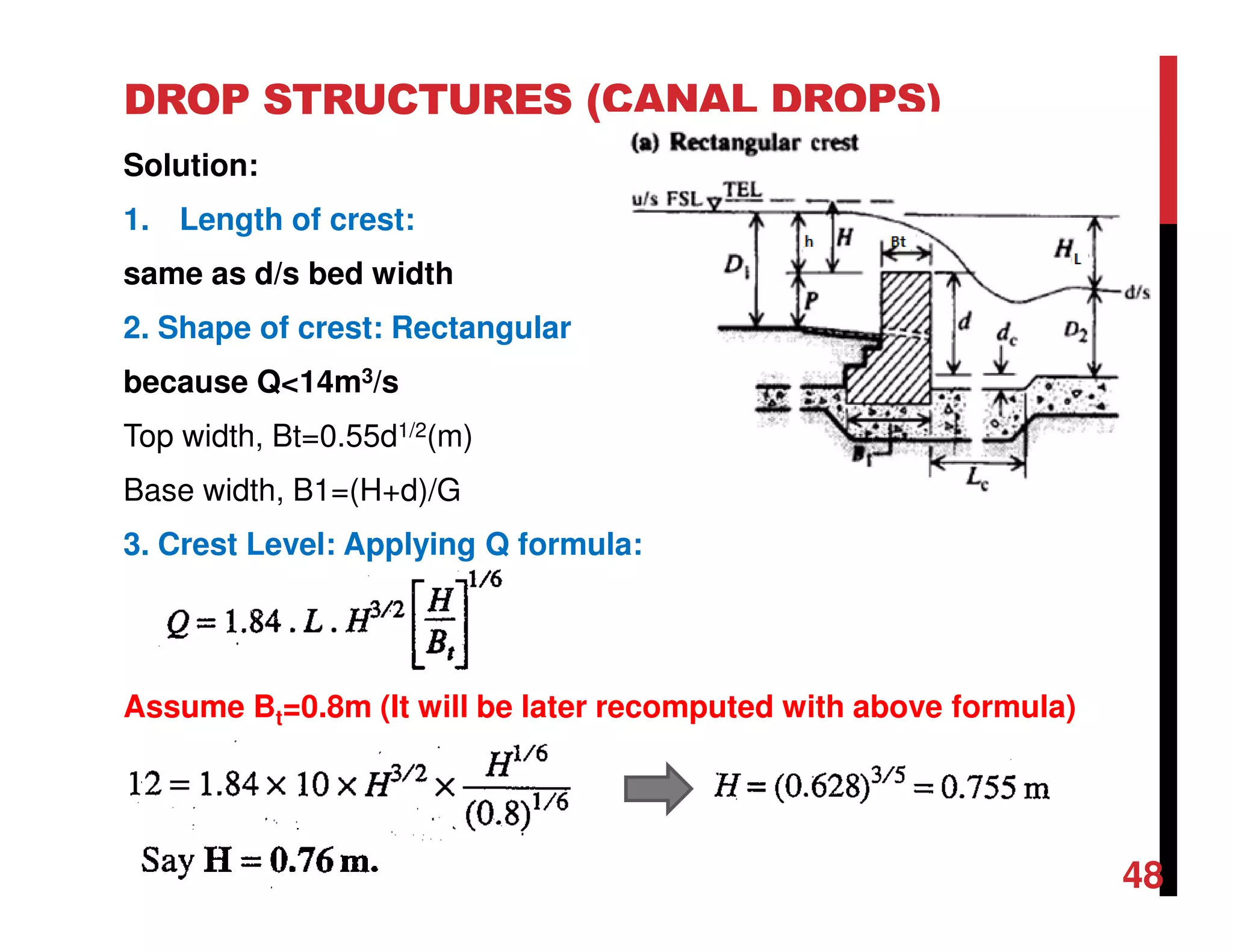
Solution:
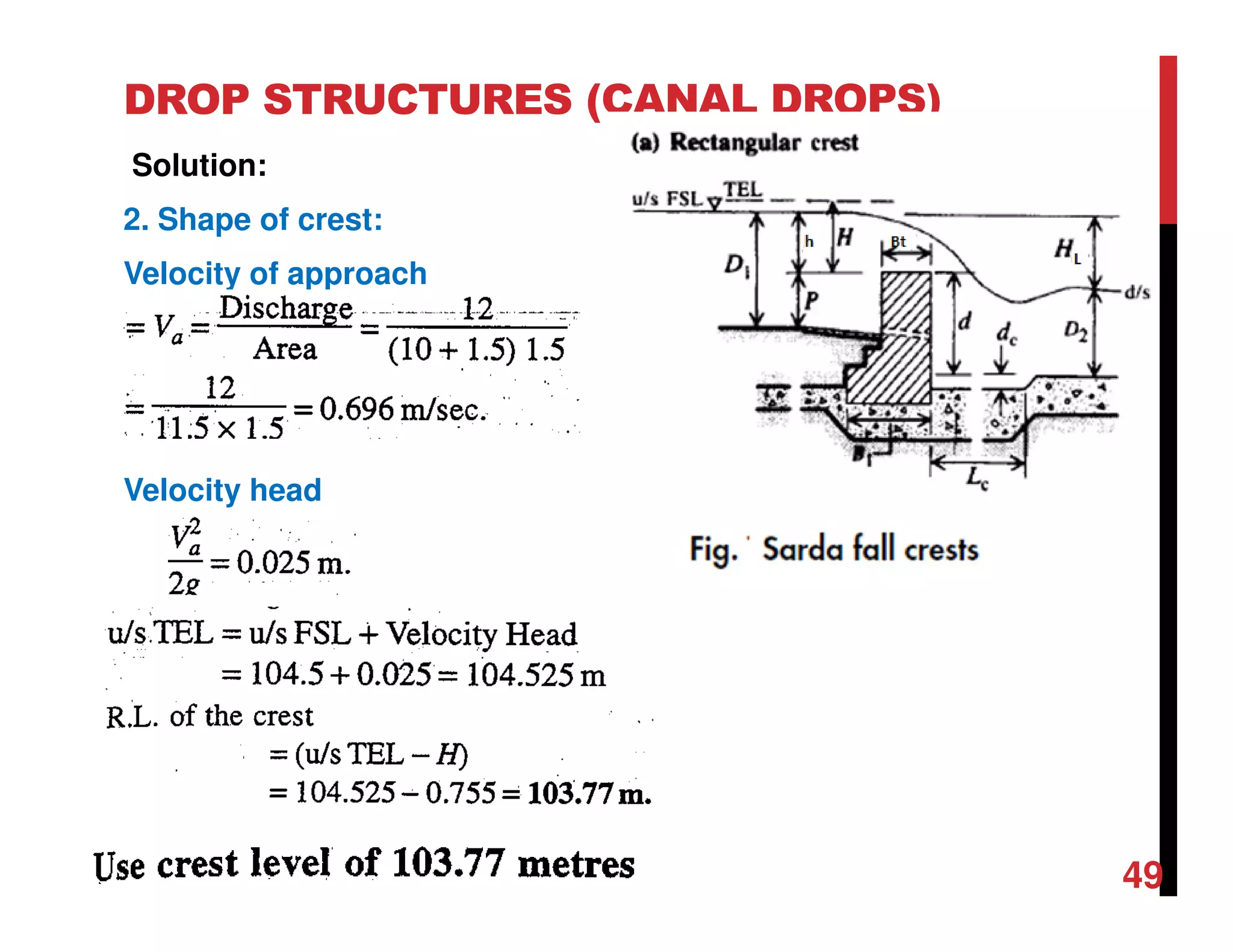
1. Length of crest:
same as d/s bed width
2. Shape of crest: Rectangular
because Q<14m3/s
Top width, Bt=0.55d1/2(m)
Base width, B1=(H+d)/G
3. Crest Level: Applying Q formula:
Assume Bt=0.8m (It will be later recomputed with above formula)
48
DROP STRUCTURES (CANAL DROPS)
Solution:
2. Shape of crest:
Velocity of approach
Velocity head
49
DROP STRUCTURES (CANAL DROPS)
Solution:
2. Shape of crest:
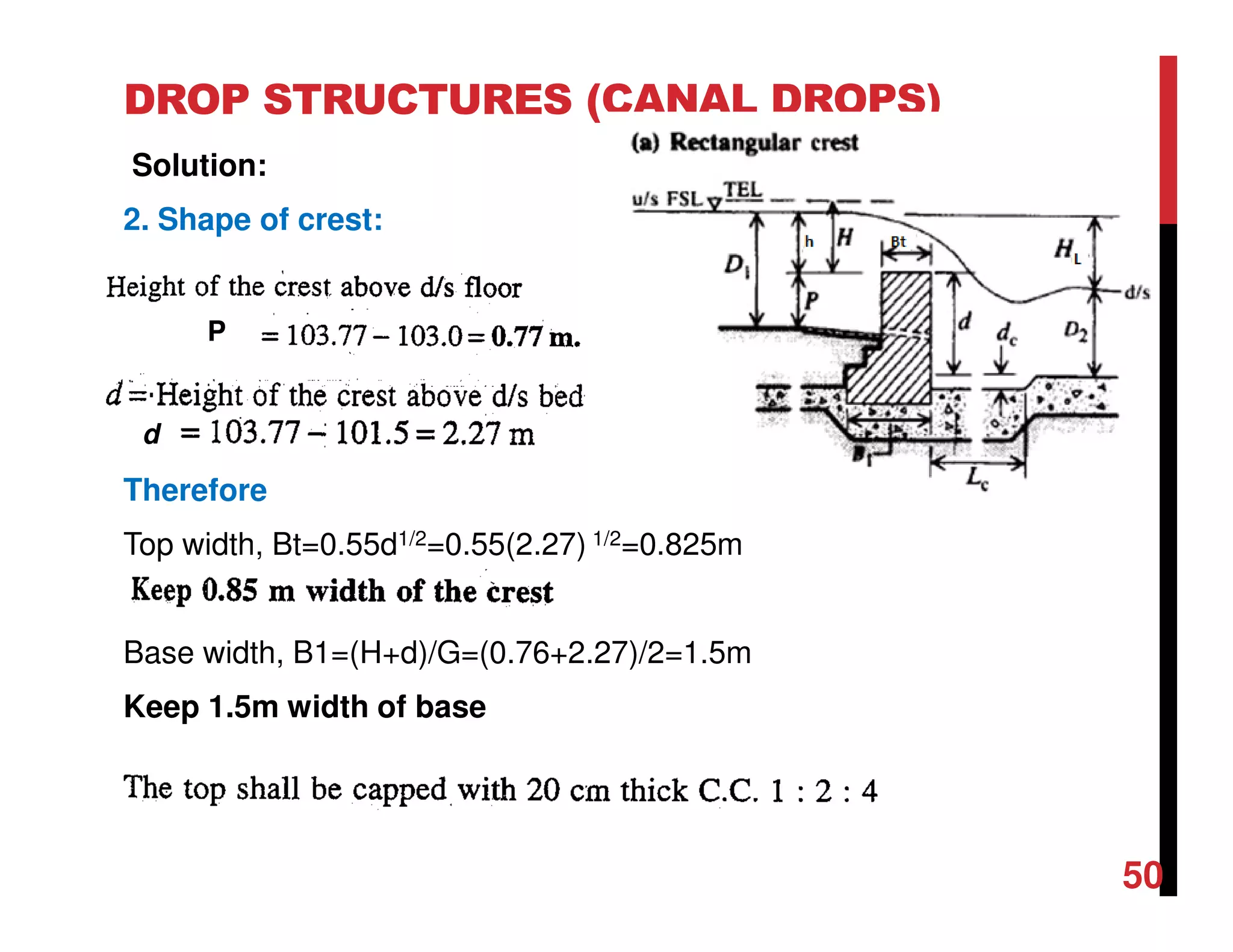
Therefore
Top width, Bt=0.55d1/2=0.55(2.27) 1/2=0.825m
Base width, B1=(H+d)/G=(0.76+2.27)/2=1.5m
Keep 1.5m width of base
P
d
50
DROP STRUCTURES (CANAL DROPS)
Solution:
4. Length and depth of cistern
length, Lc=5(H.HL)1/2
depth, dc=1/4(H.HL)2/3
Depth of cistern, dc
HL is drop (fall)= 1.5m (given)
51
DROP STRUCTURES (CANAL DROPS)
Solution:
5. Upstream wing walls
52
DROP STRUCTURES (CANAL DROPS)
Solution:
6. Upstream Protection
Yu= water depth @u/s
53
DROP STRUCTURES (CANAL DROPS)
Solution:
7. Impervious flood
Lbd=2(D1+1.2)+HL
D1=U/S FSL-BL and
HL= drop
Remember !!
H/Lc ≤1/C
Lc~C.H
54
DROP STRUCTURES (CANAL DROPS)
Solution:
7. Impervious flood
5
Remember !!
t=h/(G-1)
55
DROP STRUCTURES (CANAL DROPS)
Solution:
7. Impervious flood
Use nominal thickness of 0.3m at u/s 56
DROP STRUCTURES (CANAL DROPS)
Solution:
8. Downstream protection
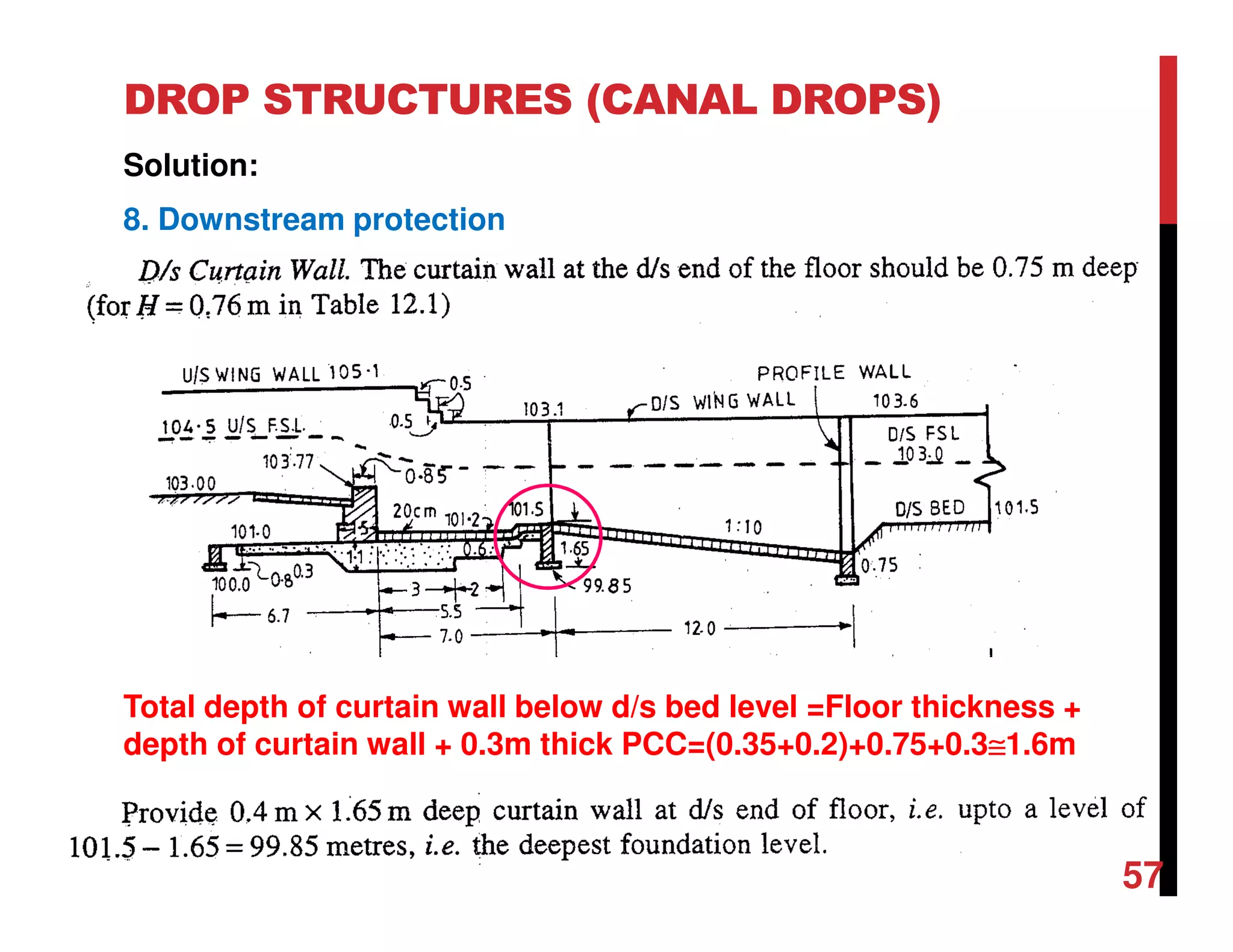
Total depth of curtain wall below d/s bed level =Floor thickness +
depth of curtain wall + 0.3m thick PCC=(0.35+0.2)+0.75+0.3≅≅≅≅1.6m
57
DROP STRUCTURES (CANAL DROPS)
Solution:
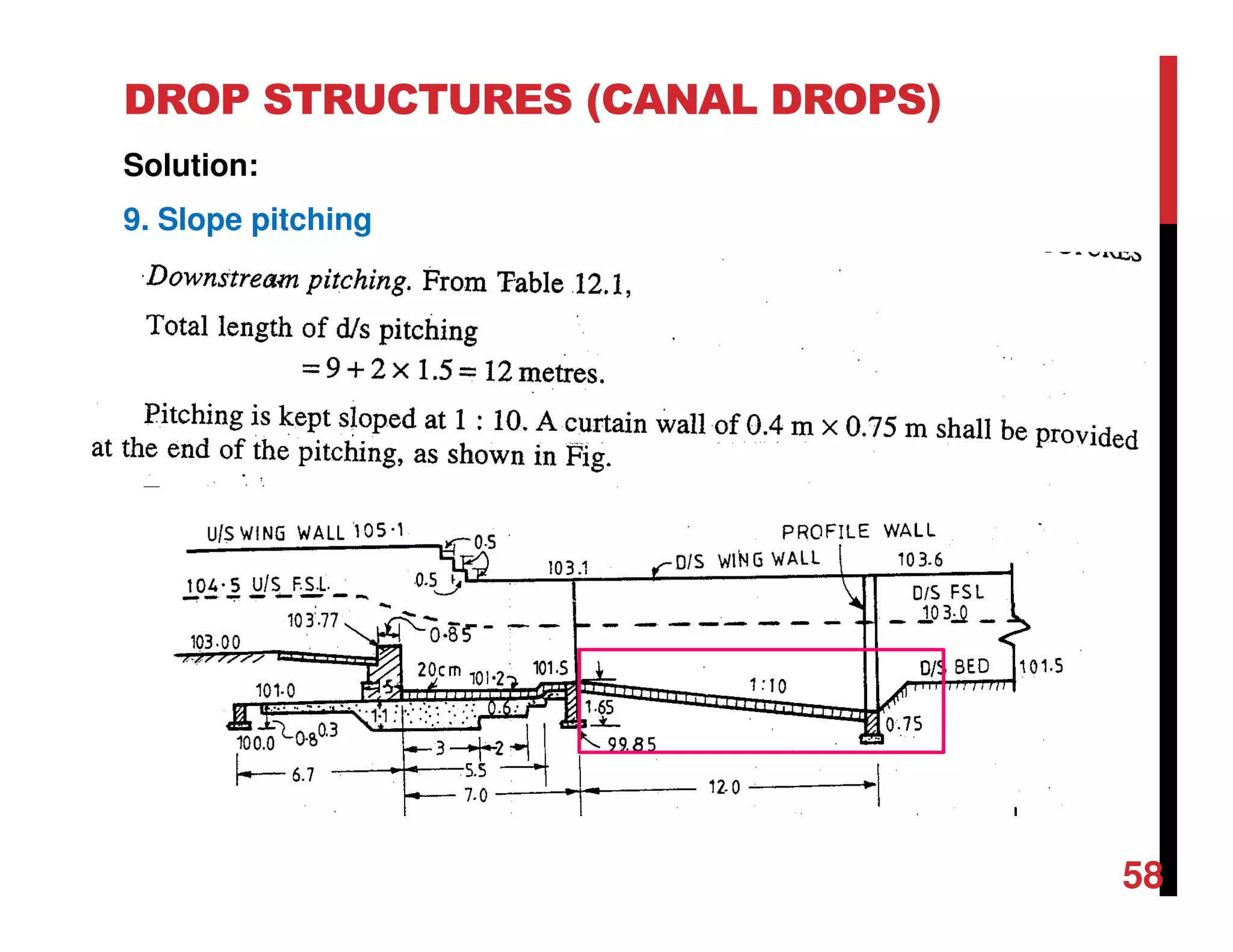
9. Slope pitching
58
DROP STRUCTURES (CANAL DROPS)
Solution:
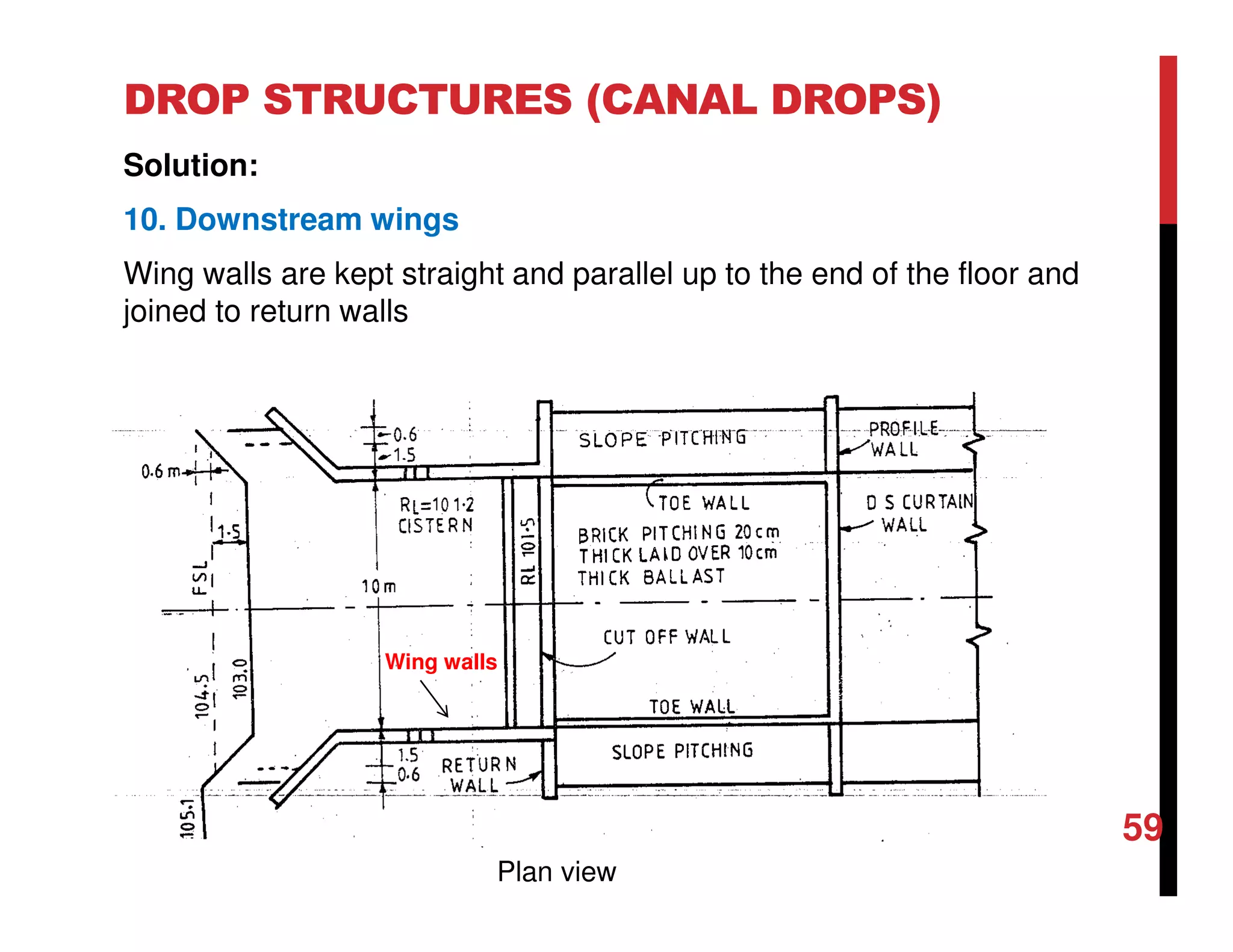
10. Downstream wings
Wing walls are kept straight and parallel up to the end of the floor and
joined to return walls
59
Wing walls
Plan view
DROP STRUCTURES (CANAL DROPS)
Solution:
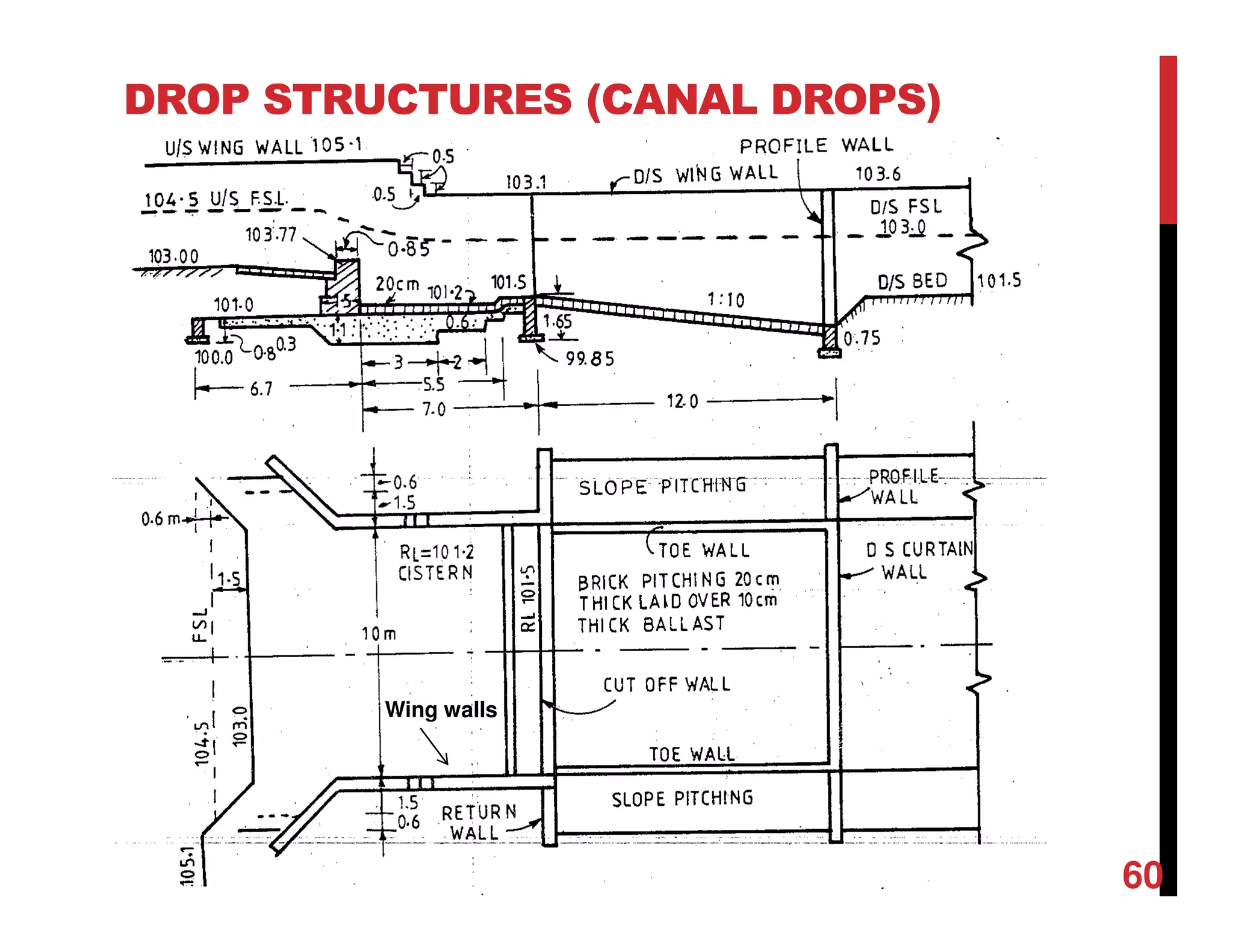
7. Impervious flood
60
Wing walls
DROP STRUCTURES (CANAL DROPS)
Problem 1: Vertical drop without blocks
The volume flow rate in a rectangular channel is 5ft3/s/ft. A vertical drop
is used to lower the channel 6.0ft. The flow is subcritical above and
below the drop structure. Determine the dimension of the drop structure
for a tailwater (d/s water) depth of 1.67ft.
Solution: q=5ft3/s/ft, d=6ft, ytw=1.67ft
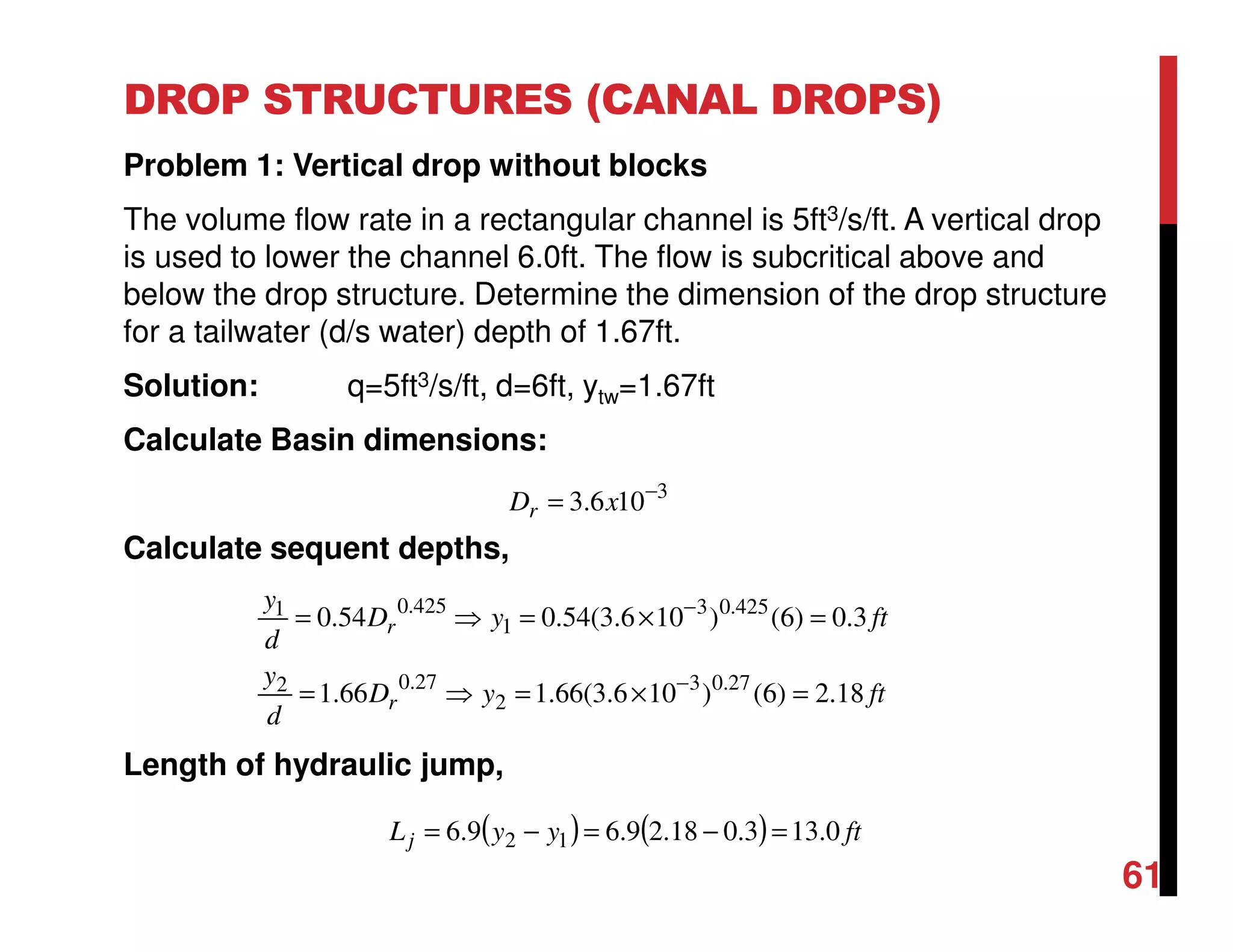
Calculate Basin dimensions:
Calculate sequent depths,
Length of hydraulic jump,
61
( ) ( ) ftyyLj 0.133.018.29.69.6 12 =−=−=
ftyD
d
y
ftyD
d
y
r
r
18.2)6()106.3(66.166.1
3.0)6()106.3(54.054.0
27.03
2
27.02
425.03
1
425.01
=×=⇒=
=×=⇒=
−
−
3
106.3 −
= xDr
DROP STRUCTURES (CANAL DROPS)
Problem 1: Vertical drop without blocks
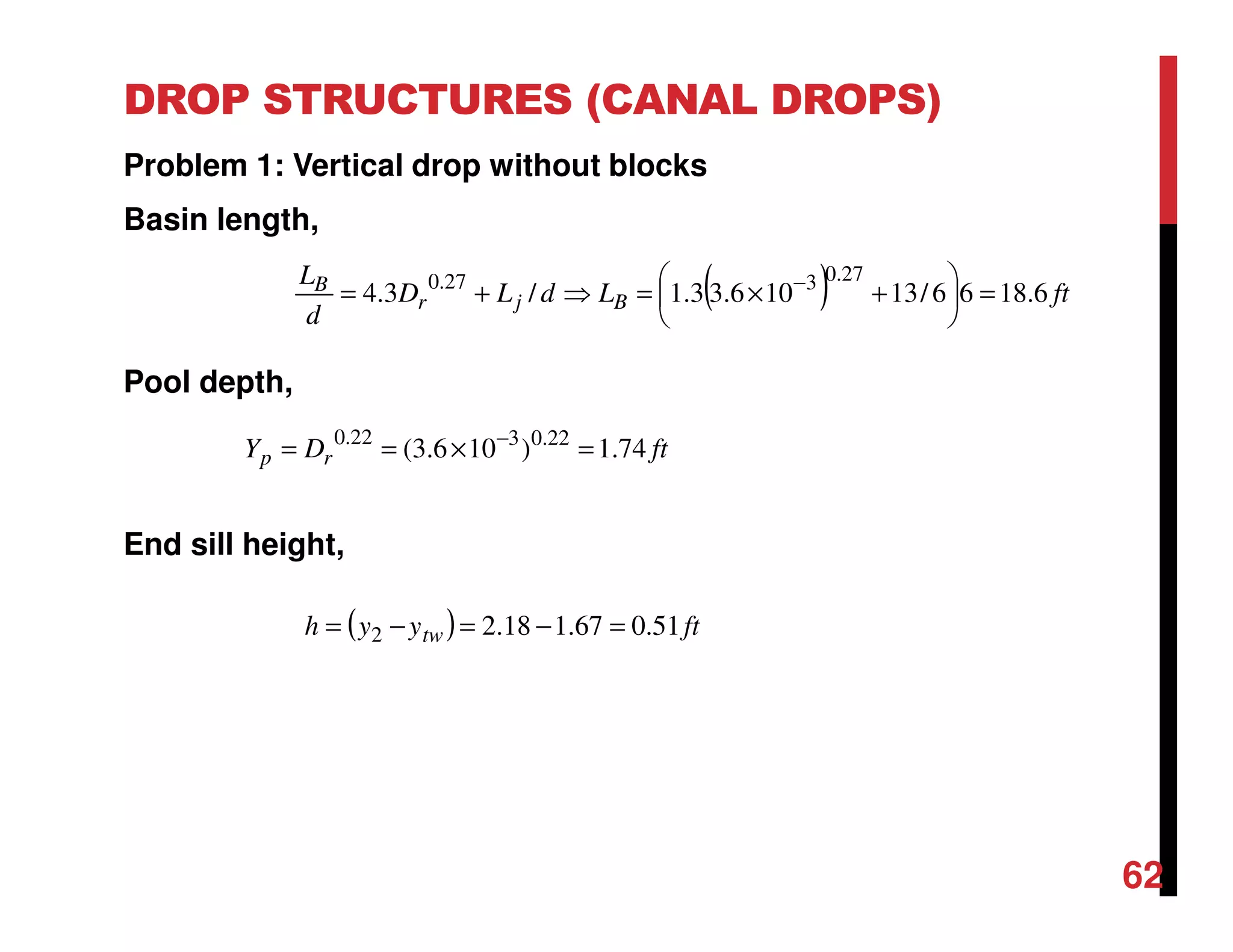
Basin length,
Pool depth,
End sill height,
62
( ) ftLdLD
d
L
Bjr
B
6.1866/13106.33.1/3.4
27.0327.0
=





+×=⇒+= −
ftDY rp 74.1)106.3( 22.0322.0
=×== −
( ) ftyyh tw 51.067.118.22 =−=−=
DROP STRUCTURES (CANAL DROPS)
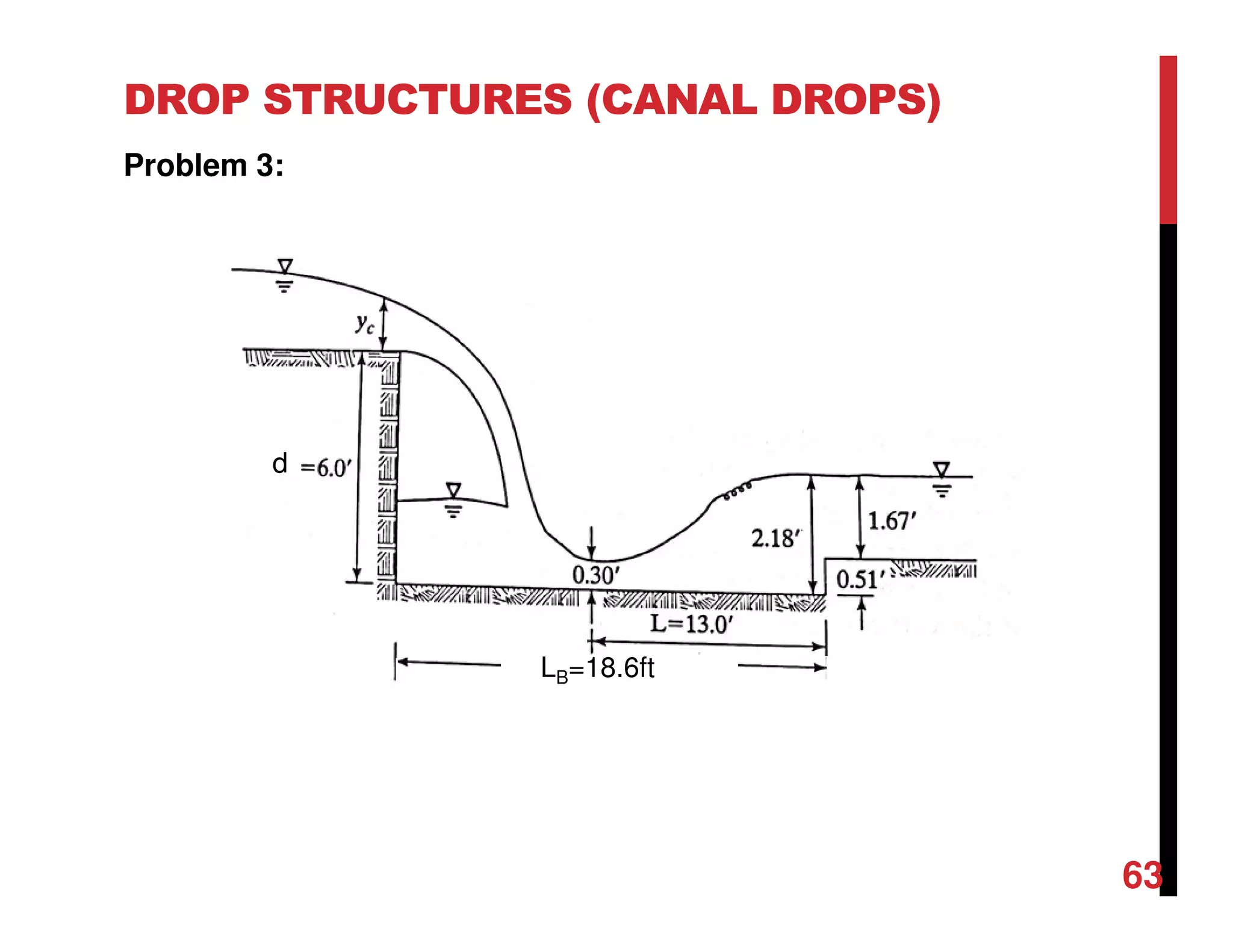
Problem 3:
63
LB=18.6ft
d
THANK YOU
64

Chapter 5 drop sturcutures

  • 1.
    CHAPTER 5: DROPSTRUCTURES 1 0401544 - HYDRAULIC STRUCTURES University of Sharjah Dept. of Civil and Env. Engg. DR. MOHSIN SIDDIQUE ASSISTANT PROFESSOR
  • 2.
    LEARNING OUTCOME After takingthis lecture, students should be able to: (1). Obtain in-depth knowledge on various types of drop structures used in open channels and their design guide lines (2). Identify the suitable drop structure for various flow conditions (3). Apply the design guide lines for the design of selected drop structure 2 References: Novak, A.I.B. Moffat, C. Nalluri, R. Narayanan, Hydraulic Structures, 4the Ed. CRC Press Santosh K. G., Irrigation Engineering and Hydraulic Structures, Khanna Pubilshers
  • 3.
    DROP STRUCTURES (CANALDROPS) A drop (or fall) structure is a regulating structure which lowers the water level along its course. The slope of a canal is usually milder than the terrain slope as a result of which the canal in a cutting at its headworks will soon outstrip the ground surface. In order to avoid excessive infilling the bed level of the downstream canal is lowered, the two reaches being connected by a suitable drop structure 3
  • 4.
    A typical canalfall 4 DROP STRUCTURES (CANAL DROPS)
  • 5.
    DROP STRUCTURES (CANALDROPS) TYPES OF DROP STRUCTURES Drops are usually provided with a low crest wall and are subdivided into the following types: (i) the vertical drop (ii) the inclined drop (iii) the piped drop and (iv) Farm drop structures Note: The above classification covers only a part of the broad spectrum of drops, particularly if structures used in sewer design are included; a comprehensive survey of various types of drops has been provided, e.g. by Merlein, Kleinschroth and Valentin (2002); Hager (1999) includes the treatment of drop structures in his comprehensive coverage of wastewater structures and hydraulics. 5
  • 6.
    DROP STRUCTURES (CANALDROPS) TYPES OF DROP STRUCTURES (i) the vertical drop, (a). Common (straight) drop (b). Sarda-type fall (India) (c). YMGT-type drop (Japan) (d) Rectangular weir drop with raised crest (France) 6
  • 7.
    DROP STRUCTURES (CANALDROPS) TYPES OF DROP STRUCTURES (i.a) Common (straight) drop: The common drop structure, in which the aerated free-falling nappe (modular flow) hits the downstream basin floor, and with turbulent circulation in the pool beneath the nappe contributing to energy dissipation, is shown in Fig 7
  • 8.
    DROP STRUCTURES (CANALDROPS) The following equations fix the geometry of the structure in a suitable form for steep slopes: where d is the height of the drop crest above the basin floor and Lj the length of the jump. Lj=6.9(y2-y1) A small upward step, h (around 0.5<h/y1<14), at the end of the basin floor is desirable in order to localize the hydraulic jump formation. Forster and Skrinde (1950) developed design charts for the provision of such an abrupt rise. 32 / gdqDr = 8
  • 9.
    DROP STRUCTURES (CANALDROPS) The USBR (Kraatz and Mahajan, 1975) impact block type basin also provides good energy dissipation under low heads, and is suitable if the tailwater level (TWL) is greater than the sequent depth, y2. 9 h d/s Floor level Crest level yo Tailwater level
  • 10.
    DROP STRUCTURES (CANALDROPS) The following are the suggested dimensions of such a structure with impact block type basin where yc is the critical depth. The values of Ld can be obtained from the following Fig 10
  • 11.
    DROP STRUCTURES (CANALDROPS) 2 456.0185.0 228.0691.0 368.4195.3406.0 368.4195.3406.0 2 2 sf d c t c cc t c c t c c f LL L y L y y d y L Ls y y h L y y d L + =         +                   −        + =                 −+−=                 −+−= Use –ve sign with d and h2 Note: sometime d is replaced with ho. However, both are the same. h2=RL of crest-D/S FSL d=RL of crest-stilling basin flood level 11
  • 12.
    0.85yc 0.8yc 0.4yc h2 h=drop height=RL ofcrest-D/S Floor level h2=RL of crest-D/S FSL d=RL of crest-stilling basin flood level Side wall height above tailwater h d/s Floor level Crest level yo DROP STRUCTURES (CANAL DROPS) 12 Tailwater level
  • 13.
  • 14.
    DROP STRUCTURES (CANALDROPS) TYPES OF DROP STRUCTURES (i.b) Sarda-type fall (India): This is a raised-crest fall with a vertical impact, consisting of a crest wall, upstream and downstream wing walls, an impervious floor and a cistern (basin), and downstream bank and bed protection works 14
  • 15.
    DROP STRUCTURES (CANALDROPS) Two types of crest are used; the rectangular one for discharges up to 10m3/s** and the trapezoidal one for larger discharges (see Punmia and Lal, 1977). **(14m3/s) according to Santosh K. G. 15
  • 16.
    Longitudinal Section ofrectangular crest Sarda fall 16
  • 17.
    Longitudinal Section oftrapezoidal crest Sarda fall 17
  • 18.
    DROP STRUCTURES (CANALDROPS) The following are the design criteria established by extensive model studies at the Irrigation Research Institute in India. 1. Length of crest: Since fluming is not permissible in this type of fall, the crest length is normally kept equal to the bed width of the canal 2. Shape of crest: Rectangular Top width, Bt=0.55d1/2(m) Base width, B1=(H+d)/G where Gis the relative density of the crest material (for masonry, G=2). Trapezoidal top width, Bt=0.55(H+d)1/2 (m). For the base width, B1, upstream and downstream slopes of around 1 in 3 and 1 in 8 are usually recommended 18
  • 19.
    DROP STRUCTURES (CANALDROPS) 3. Design Discharge: Rectangular : Q=1.835LH3/2(H/Bt)1/6 Trapezoidal: Q=1.99LH3/2(H/Bt)1/6 Where L is length of crest, Bt is top width, H is head of water over crest 4. Length and depth of cistern length, Lc=5(H.HL)1/2 depth, dc=1/4(H.HL)2/3 19 Where, HL= drop
  • 20.
    DROP STRUCTURES (CANALDROPS) 5. Upstream wing walls For trapezoidal crest, the upstream wing walls are kept segmental with radius equal to 5 to 6 times H and subtending an angle of 60o at center and then carried tangential into the berm as shown in Figure. The foundations are laid on the impervious concrete floor itself For rectangular crest, the approach wings may be splayed straight at an angle of 45o 20
  • 21.
    DROP STRUCTURES (CANALDROPS) 6. Upstream Protection Brick pitching in a length equal to upstream water depth may be laid on upstream bed, sloping towards the crest at a slope of 1:10. Drain pipes should be provided at the u/s bed level in the crest so as to drain out the u/s bed during the closure of channel. Upstream curtain walls: 11/2” brick (~35cm) thick upstream curtain wall is provided, having a depth equal to 1/3rd of water depth 21 Upstream curtain wall
  • 22.
    DROP STRUCTURES (CANALDROPS) 7. Impervious floor downstream of the crest Length: Total length of impervious floor can be determined by Bligh’s theory for small works and by Khosla’ theory for large works. The minimum length of flood d/s of toe of crest wall should be Lbd=2(D1+1.2)+HL D1=U/S FSL-BL and HL= drop Thickness: the floor thickness can be worked out for uplift pressure (using minimum thickness of 0.4m to 0.6m) and only a nominal thickness of 0.3m is provided on the upstream side. Note: seepage theories play key role in calculation of length and thickness of floor. 22
  • 23.
    DROP STRUCTURES (CANALDROPS) Solution: 7. Impervious flood 23
  • 24.
    DROP STRUCTURES (CANALDROPS) 8. Downstream protection: The d/s bed may be protected with dry brick pitching, about 20cm thick resting on 10cm thick ballast. The length of d/s pitching is given by the values of table below or 3 times the depth of downstream water, whichever is more. The pitching may be provided between two or three curtain walls. The curtain walls may be 1 ½ brick (~35cm) thick and of depth equal to ½ the downstream depth; or as given in table (minimum=0.5m) 24HL= drop height
  • 25.
    DROP STRUCTURES (CANALDROPS) 9. Slope pitching: After the return wing, the side of the channel are pitched with one brick of edge. The pitching should rest on a toe wall 1 ½ brick thick and of depth equal to half the downstream water depth. The side pitching may be curtailed at angle of 45o from the end of pitching or extended straight from the end of bed pitching 10. Downstream wings. Downstream wings are kept straight for a length of 5 to 8 times (H.HL)1/2 and may then be gradually wrapped. They should be taken up to the end of impervious floor. All the wing walls must be designed as retaining walls, subjected to full pressure of submerged soil at their back when channel is closed. Such as wall generally has a base width equal to 1/3rd its height 25
  • 26.
    DROP STRUCTURES (CANALDROPS) TYPES OF DROP STRUCTURES (i.c) YMGT-type drop (Japan): This type of drop is generally used in flumed sections suitable for small canals, field channels, etc., with discharges up to 1m3/s. The following are the recommended design criteria: 26
  • 27.
    DROP STRUCTURES (CANALDROPS) The following are the recommended design criteria: 27
  • 28.
    DROP STRUCTURES (CANALDROPS) TYPES OF DROP STRUCTURES (i.d) Rectangular weir drop with raised crest (France): SOGREAH (Kraatz and Mahajan, 1975) have developed a simple structure suitable for vertical drops of up to 7m (for channel bed widths of 0.2–1 m with flow depths (at FSL) of 0.1–0.7 m): Hdr 28
  • 29.
    DROP STRUCTURES (CANALDROPS) For the design of crest, discharge, Q=CL(2g)1/2H3/2, where C=0.36 for the vertical upstream face of the crest wall and 0.40 for the rounded upstream face (5–10 cm radius). The crest length, L=LB-0.10 m for a trapezoidal channel and is B1 (the bed width) for rectangular channels. For the design of cistern, Volume of basin, V=QHdr/150 (m3), 29
  • 30.
    DROP STRUCTURES (CANALDROPS) TYPES OF DROP STRUCTURES (ii) the inclined drop and (a) Common chute (b) Rapid fall type inclined drop (India) (c) Stepped or cascade-type fall 30
  • 31.
    DROP STRUCTURES (CANALDROPS) TYPES OF DROP STRUCTURES (ii.a) Common chute: This type of drop has a sloping downstream face (between 1/4 and 1/6,called a glacis) followed by any conventional type of low-head stilling basin; e.g. SAF or USBR type III. The schematic description of a glacis-type fall with a USBR type III stilling basin, recommended for a wide range of discharges and drop heights, is shown in Fig. 31
  • 32.
    DROP STRUCTURES (CANALDROPS) TYPES OF DROP STRUCTURES (ii.b) Rapid fall type inclined drop (India): This type of fall is cheap in areas where stone is easily available, and is used for small discharges of up to 0.75m3/s with falls of up to 1.5 m. It consists of a glacis sloping between 1 in 10 and 1 in 20. Such a long glacis assists in the formation of the hydrualic jump, and the gentle slope makes the uninterrupted navigation of small vessels (timber traffic, for example) possible. 32
  • 33.
    DROP STRUCTURES (CANALDROPS) TYPES OF DROP STRUCTURES (ii.c) Stepped or cascade-type fall: This consists of stone-pitched floors between a series of weir blocks which act as check dams and are used in canals of small discharges; e.g. the tail of a main canal escape. A schematic diagram of this type of fall is shown in Fig. 33
  • 34.
    DROP STRUCTURES (CANALDROPS) TYPES OF CANAL FALLS (iii) the piped drop. A piped drop is the most economical structure compared with an inclined drop for small discharges of up to 50 liter/s. It is usually equipped with a check gate at its upstream end, and a screen (debris barrier) is installed to prevent the fouling of the entrance. Types: (a) Well drop structure (b) Pipe fall 34
  • 35.
    DROP STRUCTURES (CANALDROPS) TYPES OF CANAL FALLS (iii.a) Well drop structure: The well drop (Fig) consists of a rectangular well and a pipeline followed by a downstream apron. Most of the energy is dissipated in the well, and this type of drop is suitable for low discharges (up to 50 L/s) and high drops (2–3 m), and is used in tail escapes of small channels. 35
  • 36.
    DROP STRUCTURES (CANALDROPS) TYPES OF CANAL FALLS (iii.b) Pipe fall; This is an economical structure generally used in small channels. It consists of a pipeline (precast concrete) which may sometimes be inclined sharply downwards (USBR and USSR practice) to cope with large drops. However, an appropriate energy dissipator (e.g. a stilling basin with an end sill) must be provided at the downstream end of the pipeline. 36
  • 37.
    DROP STRUCTURES (CANALDROPS) TYPES OF CANAL FALLS (iv) Farm drop structures: Farm channel drops are basically of the same type and function as those in distribution canals, the only differences being that they are smaller and their construction is simpler. The notch fall type of farm drop structure (precast concrete or timber) consists of a (most commonly) trapezoidal notch in a crested wall across the canal, with the provision of appropriate energy- dissipation devices downstream of the fall. It can also be used as a discharge measuring structure. 37
  • 38.
    DROP STRUCTURES (CANALDROPS) The details of a concrete check drop with a rectangular opening, widely used in the USA, are shown in Fig. Up to discharges of about 0.5m3/s, the drop in the downstream floor level (C) is recommended to be around 0.2 m and the length of the apron (L) between 0.75 m and 1.8m over a range of drop (D) values of 0.3–0.9m. 38
  • 39.
    DROP STRUCTURES (CANALDROPS) Solved Examples 1. Common drop structure with impact block type basin 2. Sarda type drop structure 39
  • 40.
    DROP STRUCTURES (CANALDROPS) Example 1: Find the dimensions for a straight drop structure with a impact block type basin. Given: • Q = 250 ft3/S (7.08m3/s) • Drop: h = 6.0 ft. (1.93m) (Upstream and Downstream Channel -Trapezoidal) • B = 10.0 ft. (3.2048) • Z = 1V:3H • So = 0.002 (after providing for drop) • n = 0.030 40
  • 41.
    0.85yc 0.8yc 0.4yc h2 h=drop height=RL ofcrest-D/S Floor bed level h2=RL of crest-D/S FSL d=RL of crest-stilling basin flood level Side wall height above tailwater h d/s Floor bed level Crest level yo DROP STRUCTURES (CANAL DROPS) 41
  • 42.
    DROP STRUCTURES (CANALDROPS) Solution: Step 1. Estimate the required approach and tailwater channel elevation difference, h. This is estimated and given above as 6.0 ft. Step 2. Calculate normal flow conditions approaching the drop to verify subcritical conditions. By trial and error using Manning’s equation Q=1.49/n(AR2/3So1/2) yo = 3.36 ft., Velocity of approach, Vo=Q/A: Vo = 3.71 ft/s, Froude no. =Vo/(gyo)1/2= 0.36; Therefore, flow is subcritical. yo=? B=10ft 1V:ZH i.e. (Z=3) 42
  • 43.
    DROP STRUCTURES (CANALDROPS) Solution: Step 3. Calculate the critical depth over the weir into the drop structure. Calculate the vertical dimensions of the stilling basin. Start by finding the critical depth over the weir based on the unit discharge, q = Q/B = 250/10 = 25ft.2/s ft g q yc 69.2 2.32 25 3/1 2 3/1 2 =         =         = 43
  • 44.
    DROP STRUCTURES (CANALDROPS) Solution: Next calculate the required tailwater depth above the floor of the stilling basin: y2 = 2.15yc = 2.15 (2.69) = 5.77ft. Now the distance from the crest down to the tailwater needs to be calculated: h2 = (h-yo) = -(6.0-3.36) = -2.64 ft. (-ve indicate vertically downward distance) Finally, calculate the total drop from the crest to the stilling basin floor: d = -(h2 + y2) = -(2.64 + 5.77) = -8.41 ft. (round to 8.4 ft. ) Since the nominal drop, h, is 6.0 ft., the floor must be depressed by 2.4 ft. 44
  • 45.
    DROP STRUCTURES (CANALDROPS) Solution: Step 4. Estimate the basin length. ( )( ) ( )( ) ft LL L ft y L y y d y L Ls ftyyhL ftyydL sf d c t c cc t cct ccf 4.10 2 89.1094.9 2 89.10 69.2 26.6 456.0185.0 69.2 69.2 41.8 69.2 26.6 228.0691.0 456.0185.0 228.0691.0 26.669.2 69.2 64.2 368.4195.3406.0/368.4195.3406.0 94.969.2 69.2 41.8 368.4195.3406.0/368.4195.3406.0 22 2 = + = + = =       +                 − −      + =         +                   −        + = =               − −+−=−+−= =               − −+−=−+−= ftyyLL ccdB 3.1769.2*75.169.2*8.04.1075.18.0 =++=++= Therefore the total basin length = 17.3ft 45
  • 46.
    DROP STRUCTURES (CANALDROPS) Solution: Step 5. Design the basin floor blocks and end sill. Block height = 0.8yc = 0.8(2.69) = 2.1ft. Block width = Block spacing = 0.4yc = 0.4(2.69) = 1.1ft. End sill height = 0.4yc = 0.4(2.69) = 1.1ft. Step 6. Design the basin exit and entrance transitions. Sidewall height above tailwater elevation = 0.85yc = 0.85(2.69) =2.3 ft. Armour approach channel above headwall length = 3yc = 3(2.69) = 8.1ft. 46
  • 47.
    DROP STRUCTURES (CANALDROPS) Example 2 47 10m
  • 48.
    DROP STRUCTURES (CANALDROPS) Solution: 1. Length of crest: same as d/s bed width 2. Shape of crest: Rectangular because Q<14m3/s Top width, Bt=0.55d1/2(m) Base width, B1=(H+d)/G 3. Crest Level: Applying Q formula: Assume Bt=0.8m (It will be later recomputed with above formula) 48
  • 49.
    DROP STRUCTURES (CANALDROPS) Solution: 2. Shape of crest: Velocity of approach Velocity head 49
  • 50.
    DROP STRUCTURES (CANALDROPS) Solution: 2. Shape of crest: Therefore Top width, Bt=0.55d1/2=0.55(2.27) 1/2=0.825m Base width, B1=(H+d)/G=(0.76+2.27)/2=1.5m Keep 1.5m width of base P d 50
  • 51.
    DROP STRUCTURES (CANALDROPS) Solution: 4. Length and depth of cistern length, Lc=5(H.HL)1/2 depth, dc=1/4(H.HL)2/3 Depth of cistern, dc HL is drop (fall)= 1.5m (given) 51
  • 52.
    DROP STRUCTURES (CANALDROPS) Solution: 5. Upstream wing walls 52
  • 53.
    DROP STRUCTURES (CANALDROPS) Solution: 6. Upstream Protection Yu= water depth @u/s 53
  • 54.
    DROP STRUCTURES (CANALDROPS) Solution: 7. Impervious flood Lbd=2(D1+1.2)+HL D1=U/S FSL-BL and HL= drop Remember !! H/Lc ≤1/C Lc~C.H 54
  • 55.
    DROP STRUCTURES (CANALDROPS) Solution: 7. Impervious flood 5 Remember !! t=h/(G-1) 55
  • 56.
    DROP STRUCTURES (CANALDROPS) Solution: 7. Impervious flood Use nominal thickness of 0.3m at u/s 56
  • 57.
    DROP STRUCTURES (CANALDROPS) Solution: 8. Downstream protection Total depth of curtain wall below d/s bed level =Floor thickness + depth of curtain wall + 0.3m thick PCC=(0.35+0.2)+0.75+0.3≅≅≅≅1.6m 57
  • 58.
    DROP STRUCTURES (CANALDROPS) Solution: 9. Slope pitching 58
  • 59.
    DROP STRUCTURES (CANALDROPS) Solution: 10. Downstream wings Wing walls are kept straight and parallel up to the end of the floor and joined to return walls 59 Wing walls Plan view
  • 60.
    DROP STRUCTURES (CANALDROPS) Solution: 7. Impervious flood 60 Wing walls
  • 61.
    DROP STRUCTURES (CANALDROPS) Problem 1: Vertical drop without blocks The volume flow rate in a rectangular channel is 5ft3/s/ft. A vertical drop is used to lower the channel 6.0ft. The flow is subcritical above and below the drop structure. Determine the dimension of the drop structure for a tailwater (d/s water) depth of 1.67ft. Solution: q=5ft3/s/ft, d=6ft, ytw=1.67ft Calculate Basin dimensions: Calculate sequent depths, Length of hydraulic jump, 61 ( ) ( ) ftyyLj 0.133.018.29.69.6 12 =−=−= ftyD d y ftyD d y r r 18.2)6()106.3(66.166.1 3.0)6()106.3(54.054.0 27.03 2 27.02 425.03 1 425.01 =×=⇒= =×=⇒= − − 3 106.3 − = xDr
  • 62.
    DROP STRUCTURES (CANALDROPS) Problem 1: Vertical drop without blocks Basin length, Pool depth, End sill height, 62 ( ) ftLdLD d L Bjr B 6.1866/13106.33.1/3.4 27.0327.0 =      +×=⇒+= − ftDY rp 74.1)106.3( 22.0322.0 =×== − ( ) ftyyh tw 51.067.118.22 =−=−=
  • 63.
    DROP STRUCTURES (CANALDROPS) Problem 3: 63 LB=18.6ft d
  • 64.