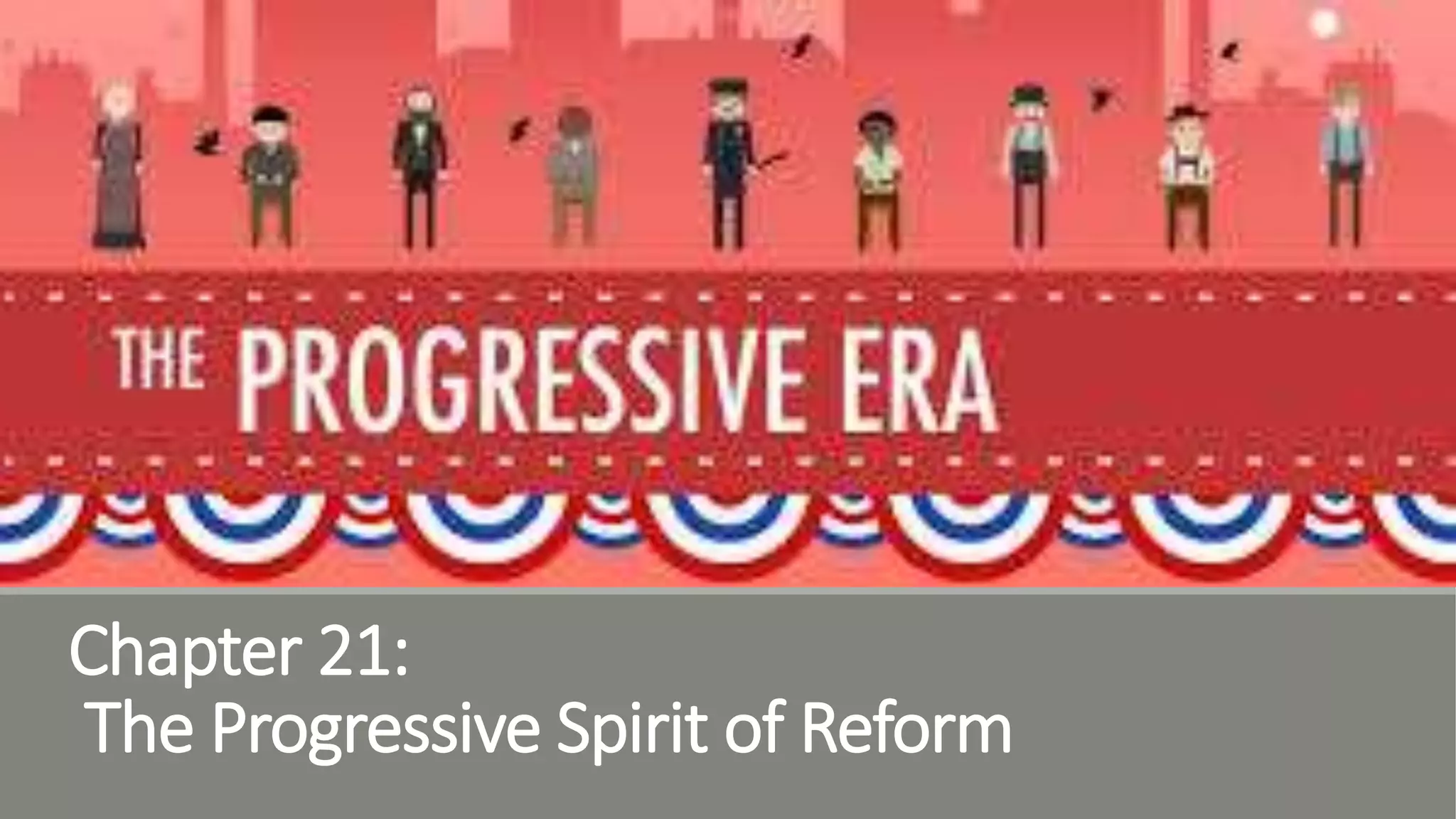
Chapter 21:
The Progressive Spirit of Reform
Section 1
THE GILDED AGE
- Nickname for the period of
the late 1800s in the U.S.
- Emphasized the difference
between the wealthy business
owners and the extremely
poor workers
Political Machines
Organizations that used both
legal and illegal methods to get
candidates elected
Run by ‘bosses’
Methods:
◦ Stuffed ballot boxes
◦ Paid for votes
◦ Bribed vote counters
The Political Machine: Bosses
Traded favors for votes
A lot of support from immigrants and
poor
◦ Provided services, jobs, social
services (e.g. fire brigade)
Tammany Hall – NYC machine
Boss, William Marcy Tweed, may
have stolen up to $200 million from
the city
Cleaning Up Corruption
Scandals happen in Congress too,
and Americans begin to doubt
their leaders
◦ Whiskey taxes
◦ Government funds for railways
Call for a change in the spoils
system
Open your books to page 664
for a closer look! You will
need to know these
presidents!
Reform from Within
Presidents Hayes and Garfield
made attempts to reform
President Chester A. Arthur
(1881-5) backed the Pendleton
Civil Service Act
◦ Required more than 10% of
government workers to pass an
exam to be hired
Working for Social Change
Progressives
Worked to improve society in the
late 1800s
Goal = to eliminate the causes of
crime, disease, and poverty
Working for Social Change
Muckrakers
Journalists who vividly described the
problems of the United States
Effects:
1. Inspired the progressives to action
2. Angered politicians and business
leaders
Video clip notes:
Galvanize – to awake awareness
or call to action
“I aimed for the public’s heart, and, by accident, I
hit it in the stomach” – Upton Sinclair
Examples of Progressive Reform Already Learned in Class
(fyi, not notes!)
The 1901 New York State Tenement House Act
Settlement Houses
Jane Addams’s Hull House
Reform Effects and Successes
1. Housing reforms
2. New Professions (city planners and civil
engineering)
3. Education
◦ Compulsory in some states
◦ 4,000 kindergartens by 1898
4. Health
◦ Mortality rates drop
◦ American Medical Association (AMA) forms,
spread information
Voting Reforms
Progressives fought the political
machines
◦ Replaced corrupt ballots with
government prepared ones
◦ Secret ballots are adopted in
some states
Voting Reforms (cont.)
The Seventeenth Amendment
◦ Americans vote directly for the
U.S. Senators
◦ Passed in 1913
Recall – unhappy citizens sign a
petition that calls for a vote to
remove a politician from office
Voting Reforms (cont.)
Initiative – voters can propose a
new law by collecting signatures
for a petition
Referendum – allows voters to
approve or reject a law passed by
the government
Government Reforms
Some governments are changed to
run like businesses, with city councils
with professional managers
Robert M. La Follette (Wisconsin) was
a city manager
◦ Decreased political machine power
◦ Used experts to write laws
◦ Made politicians voting information
public to voters
Section 2
Imagine…
You have been working in a hat factory since 1900, when you
were eight years old. Now you are experienced enough to
run one of the sewing machines. You don’t earn as much as
older workers, but you family needs every penny you bring
home. Still, the long hours make you very tired. One day you
hear that people are trying to stop children from doing
factory work. They think children should be at school or
playing.
Would you be for or against this social reform? Why?
Reforming the
Workplace
Improving Conditions for Children
In 1900, more than 1.75 million
children age 15 or under worked in
factories, mines, and mills
Some states passed laws to help with
child labor conditions and minimum
age
Some parents still have their children
work, lying about their age.
Workplace Safety
Workplace accidents were common
• In 1900, 35,000 died and 50,000
injured
In 1911, the Triangle Shirtwaist
Fire shocks the nation into passing
laws that improve factory safety
standards
Also pass workers’ compensation
laws
The Courts and Labor
Some businesses want the gov. to
“mind its own bees wax” and take it
to court
Lochner v. New York
States can not force employers and
workers into any labor agreement
Muller v. Oregon
Court upheld restrictions on women
and children’s working hours
Labor Organizations
Different labor organizations support
different economic systems
Capitalism – private businesses run
industry, competition determines prices
Socialism – government owns and operates
a country’s means of production
◦ Industrial Works of the World (IWW) led
by William “Big Bill” Haywood, wanted to
have one U.S. union that would overthrow
capitalism
Section 3:
The Rights of
Women and
Minorities
Eighteenth Amendment
National American Woman
Suffrage Association
Alice Paul
Nineteenth Amendment
Booker T. Washington
Ida B. Wells
W.E.B. DuBois
National Association for the
Advancement of Colored
People (NAACP)
Women Fight…
More women attended college in the
late 1800s. They entered social work
and education because fields like law
and medicine were dominated by
men
Many used their new education to
fight for reform.
◦ Temperance
◦ Woman suffrage
◦ Social reforms
Smith College Basketball Team - 1902
The Temperance Movement
Some blame social issues on alcohol
and want government to restrict or
even ban it
◦ Saloons are forced to shut down
The Eighteenth Amendment – 1919
◦ Bans the production, sale, and
transportation of alcohol in the U.S.
Women’s Suffrage (the right to vote)
Gains national support in the 1890s.
National American Woman Suffrage Association (NAWSA)
◦ Founded by Elizabeth Cady Stanton and Susan B. Anthony
◦ Suffrage gained in some western states
National Woman’s Party (NWP)
◦ Founded by Alice Paul
◦ Used more aggressive measures
Nineteenth Amendment- 1919
Grants women the right to vote
Booker T. Washington
Believed African
American education
would lead to the end
of racism
Ida B. Wells
Used newspaper
journalism to inform
public about lynching
and inequal education
W.E.B. DuBois
Harvard PhD recipient.
Studied and publicized
cases of racial
prejudice. Founded
NAACP z
African American Leaders against Discrimination
National Association for the
Advancement of Colored People (NAACP)
Founded in 1909 by DuBois and
others
Argued for economic and educational
equality
Used the court system to combat
racism
Reform FAILS
Assimilation
Some minorities were encouraged to
assimilate to European culture or were
merely ignored.
The Society of American Indians – 1911
Some were completely ignored...
Chinese district associations, cultural
groups, churches, temples
Chinese immigration dropped and
Mexican immigration increased
Section 4: Progressive
Presidents
Yellowstone National Park – 1872
Becomes the first national park in
the U.S.A.
President Theodore Roosevelt, 25th President
Labor Business
Consumer Environment
Roosevelt’s
“Square Deal”
William Howard Taft, 27th President
• Upset progressives because he was too cautious
with reform
• Payne-Aldrich Tariff of 1909 raised some tariffs
• Progressive Party splits republican votes and Wilson
wins the 1912 election
Woodrow Wilson, 28th President
• Wanted banking revision and tariff reform
• Sixteenth Amendment instates the income tax
• The 1913 Federal Reserve Act creates the national
bank
• Clayton Antitrust Act fought monopolies
Looking Ahead…
1/26, Monday: Practice
Test Reviewed. Review Day
1/27, Tuesday: Chapter 21
Test

Chapter 21: The Progressive Era

  • 1.
  • 2.
    Section 1 THE GILDEDAGE - Nickname for the period of the late 1800s in the U.S. - Emphasized the difference between the wealthy business owners and the extremely poor workers
  • 5.
    Political Machines Organizations thatused both legal and illegal methods to get candidates elected Run by ‘bosses’ Methods: ◦ Stuffed ballot boxes ◦ Paid for votes ◦ Bribed vote counters
  • 6.
    The Political Machine:Bosses Traded favors for votes A lot of support from immigrants and poor ◦ Provided services, jobs, social services (e.g. fire brigade) Tammany Hall – NYC machine Boss, William Marcy Tweed, may have stolen up to $200 million from the city
  • 7.
    Cleaning Up Corruption Scandalshappen in Congress too, and Americans begin to doubt their leaders ◦ Whiskey taxes ◦ Government funds for railways Call for a change in the spoils system
  • 8.
    Open your booksto page 664 for a closer look! You will need to know these presidents!
  • 9.
    Reform from Within PresidentsHayes and Garfield made attempts to reform President Chester A. Arthur (1881-5) backed the Pendleton Civil Service Act ◦ Required more than 10% of government workers to pass an exam to be hired
  • 10.
    Working for SocialChange Progressives Worked to improve society in the late 1800s Goal = to eliminate the causes of crime, disease, and poverty
  • 11.
    Working for SocialChange Muckrakers Journalists who vividly described the problems of the United States Effects: 1. Inspired the progressives to action 2. Angered politicians and business leaders Video clip notes: Galvanize – to awake awareness or call to action
  • 13.
    “I aimed forthe public’s heart, and, by accident, I hit it in the stomach” – Upton Sinclair
  • 14.
    Examples of ProgressiveReform Already Learned in Class (fyi, not notes!) The 1901 New York State Tenement House Act Settlement Houses Jane Addams’s Hull House
  • 15.
    Reform Effects andSuccesses 1. Housing reforms 2. New Professions (city planners and civil engineering) 3. Education ◦ Compulsory in some states ◦ 4,000 kindergartens by 1898 4. Health ◦ Mortality rates drop ◦ American Medical Association (AMA) forms, spread information
  • 16.
    Voting Reforms Progressives foughtthe political machines ◦ Replaced corrupt ballots with government prepared ones ◦ Secret ballots are adopted in some states
  • 17.
    Voting Reforms (cont.) TheSeventeenth Amendment ◦ Americans vote directly for the U.S. Senators ◦ Passed in 1913 Recall – unhappy citizens sign a petition that calls for a vote to remove a politician from office
  • 18.
    Voting Reforms (cont.) Initiative– voters can propose a new law by collecting signatures for a petition Referendum – allows voters to approve or reject a law passed by the government
  • 19.
    Government Reforms Some governmentsare changed to run like businesses, with city councils with professional managers Robert M. La Follette (Wisconsin) was a city manager ◦ Decreased political machine power ◦ Used experts to write laws ◦ Made politicians voting information public to voters
  • 21.
    Section 2 Imagine… You havebeen working in a hat factory since 1900, when you were eight years old. Now you are experienced enough to run one of the sewing machines. You don’t earn as much as older workers, but you family needs every penny you bring home. Still, the long hours make you very tired. One day you hear that people are trying to stop children from doing factory work. They think children should be at school or playing. Would you be for or against this social reform? Why? Reforming the Workplace
  • 22.
    Improving Conditions forChildren In 1900, more than 1.75 million children age 15 or under worked in factories, mines, and mills Some states passed laws to help with child labor conditions and minimum age Some parents still have their children work, lying about their age.
  • 23.
    Workplace Safety Workplace accidentswere common • In 1900, 35,000 died and 50,000 injured In 1911, the Triangle Shirtwaist Fire shocks the nation into passing laws that improve factory safety standards Also pass workers’ compensation laws
  • 24.
    The Courts andLabor Some businesses want the gov. to “mind its own bees wax” and take it to court Lochner v. New York States can not force employers and workers into any labor agreement Muller v. Oregon Court upheld restrictions on women and children’s working hours
  • 25.
    Labor Organizations Different labororganizations support different economic systems Capitalism – private businesses run industry, competition determines prices Socialism – government owns and operates a country’s means of production ◦ Industrial Works of the World (IWW) led by William “Big Bill” Haywood, wanted to have one U.S. union that would overthrow capitalism
  • 26.
    Section 3: The Rightsof Women and Minorities Eighteenth Amendment National American Woman Suffrage Association Alice Paul Nineteenth Amendment Booker T. Washington Ida B. Wells W.E.B. DuBois National Association for the Advancement of Colored People (NAACP)
  • 27.
    Women Fight… More womenattended college in the late 1800s. They entered social work and education because fields like law and medicine were dominated by men Many used their new education to fight for reform. ◦ Temperance ◦ Woman suffrage ◦ Social reforms Smith College Basketball Team - 1902
  • 28.
    The Temperance Movement Someblame social issues on alcohol and want government to restrict or even ban it ◦ Saloons are forced to shut down The Eighteenth Amendment – 1919 ◦ Bans the production, sale, and transportation of alcohol in the U.S.
  • 29.
    Women’s Suffrage (theright to vote) Gains national support in the 1890s. National American Woman Suffrage Association (NAWSA) ◦ Founded by Elizabeth Cady Stanton and Susan B. Anthony ◦ Suffrage gained in some western states National Woman’s Party (NWP) ◦ Founded by Alice Paul ◦ Used more aggressive measures Nineteenth Amendment- 1919 Grants women the right to vote
  • 32.
    Booker T. Washington BelievedAfrican American education would lead to the end of racism Ida B. Wells Used newspaper journalism to inform public about lynching and inequal education W.E.B. DuBois Harvard PhD recipient. Studied and publicized cases of racial prejudice. Founded NAACP z African American Leaders against Discrimination
  • 33.
    National Association forthe Advancement of Colored People (NAACP) Founded in 1909 by DuBois and others Argued for economic and educational equality Used the court system to combat racism
  • 34.
    Reform FAILS Assimilation Some minoritieswere encouraged to assimilate to European culture or were merely ignored. The Society of American Indians – 1911 Some were completely ignored... Chinese district associations, cultural groups, churches, temples Chinese immigration dropped and Mexican immigration increased
  • 35.
    Section 4: Progressive Presidents YellowstoneNational Park – 1872 Becomes the first national park in the U.S.A.
  • 36.
    President Theodore Roosevelt,25th President Labor Business Consumer Environment Roosevelt’s “Square Deal”
  • 38.
    William Howard Taft,27th President • Upset progressives because he was too cautious with reform • Payne-Aldrich Tariff of 1909 raised some tariffs • Progressive Party splits republican votes and Wilson wins the 1912 election Woodrow Wilson, 28th President • Wanted banking revision and tariff reform • Sixteenth Amendment instates the income tax • The 1913 Federal Reserve Act creates the national bank • Clayton Antitrust Act fought monopolies
  • 40.
    Looking Ahead… 1/26, Monday:Practice Test Reviewed. Review Day 1/27, Tuesday: Chapter 21 Test