Chapter 1
Overview on Entrepreneurship
Welcome to the world of
entrepreneurship
“Most of what you hear about
entrepreneurship, say America leading
management thinkers, is all wrong. It’s not
magic; it’s not mysterious; and it has
nothing to do with genes. It’s a discipline, it
can be learned.” (Peter F.Drucker)
Introduction
 According to the Global Entrepreneur
Monitor (GEM) which is a joint research
between Babson College and the London
Business School found that about 330
million or 14% of adults in it surveyed are
involved in forming new businesses.
 Many people view entrepreneurship as an
attractive career path.
 Now think about yourself…?
What is Entrepreneur?
 The word “entrepreneur” come from the
French words “entreprendre” which
describe people who ‘ take on the risk” or
who ‘undertake” a task in starting a new
venture.
What is Entrepreneur?
 An entrepreneur is a person who acts as
agent in transforming demand into supply
.( Adam Smith, 1776)
 The entrepreneur act as an economic
agent who transforms resources into
products and services. The entrepreneur
transforms and gives added values. (Carl
Menger, 1871)
What is Entrepreneurship?
 Entrepreneurship is the process by which
individuals pursue opportunities and putting
workable ideas into practice regardless of
resources they currently control.
 According to Histrich and Peter (1998),
entrepreneurship is the dynamic process of
creating incremental wealth .The wealth is
created by individuals who assume major risks
in terms of equity, time, and career commitment
or provide value for some product or service.
What is Entrepreneurship?
 Entrepreneurship as defined by Kuratko
and Hodgetts (2004) is a process of
innovation and new venture creation
through four major dimensions-individuals,
organizational, environmental and
process-that is aided by collaborative
networks in government, education, and
institution.
THE IMPORTANCE OF
ENTREPRENEURSHIP
1. Individual
2. Community
3. Company
4. Country
5. Globalization
Entrepreneurial Characteristics
 Initiative
 Opportunity orientation
 Persistence
 Information seeking
 Concern for high quality of work
 High degree of commitment
 Efficiency orientation
Entrepreneurial Characteristics
cont…
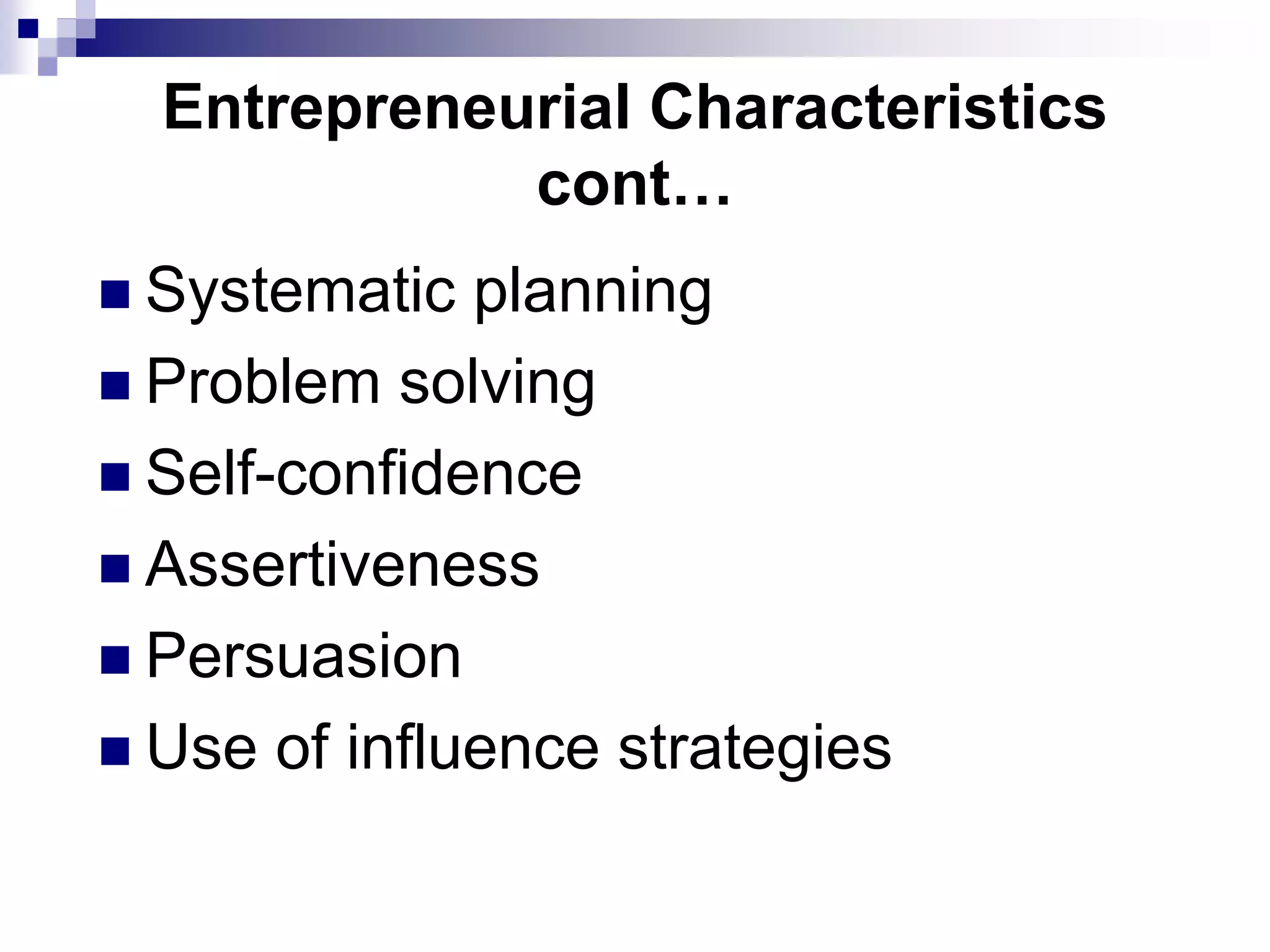
 Systematic planning
 Problem solving
 Self-confidence
 Assertiveness
 Persuasion
 Use of influence strategies
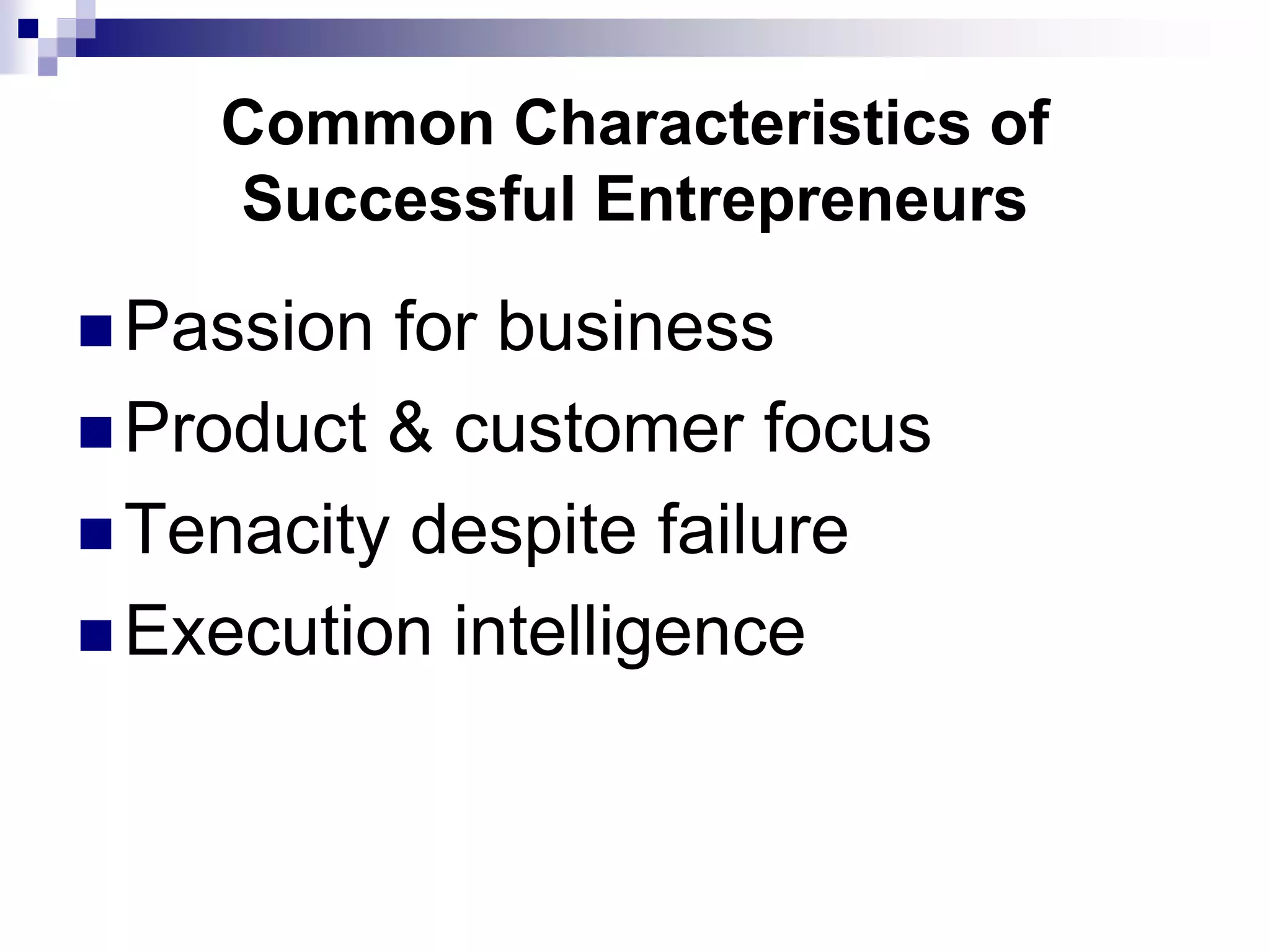
Common Characteristics of
Successful Entrepreneurs
 Passion for business
 Product & customer focus
 Tenacity despite failure
 Execution intelligence
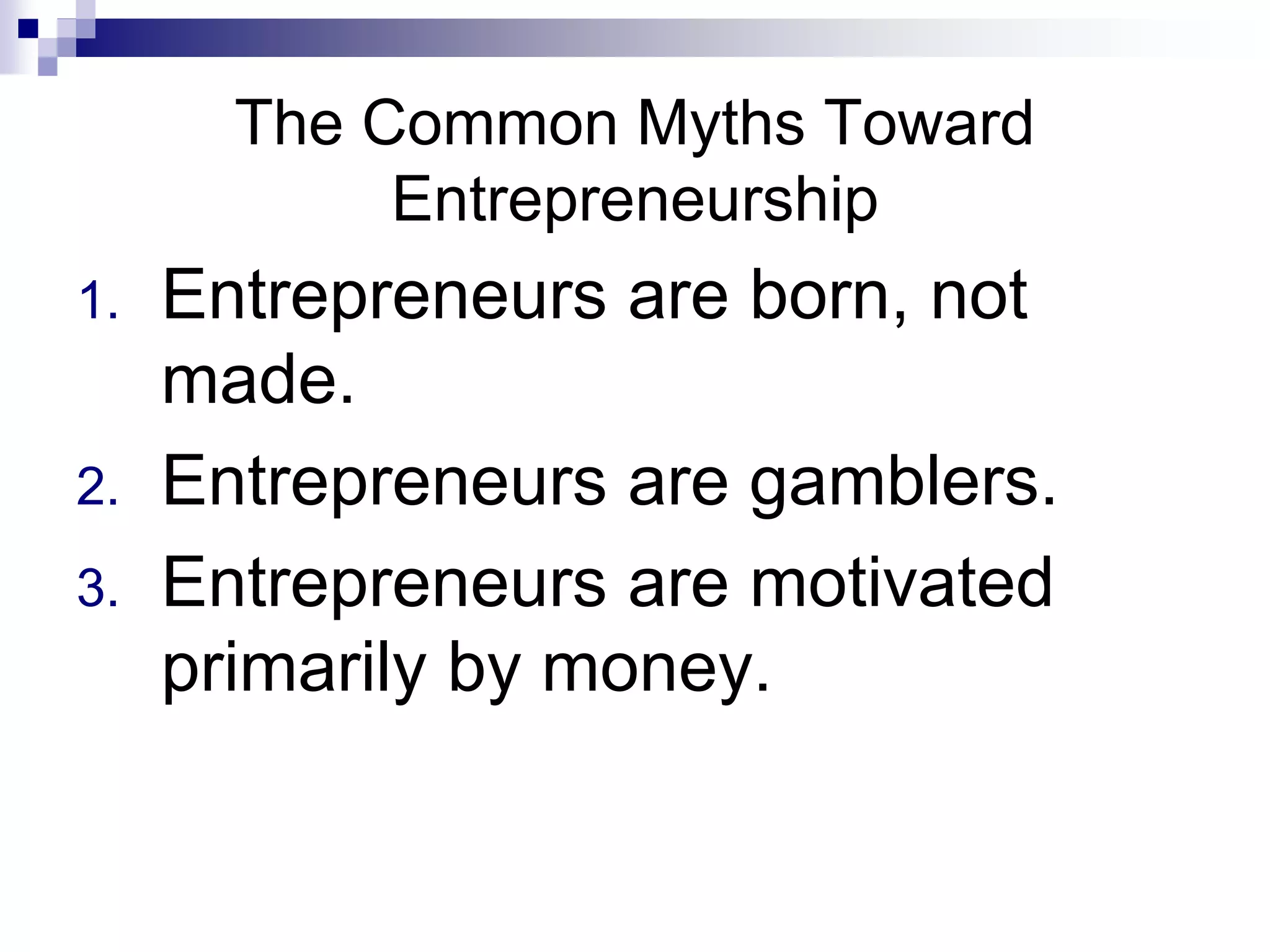
The Common Myths Toward
Entrepreneurship
1. Entrepreneurs are born, not
made.
2. Entrepreneurs are gamblers.
3. Entrepreneurs are motivated
primarily by money.
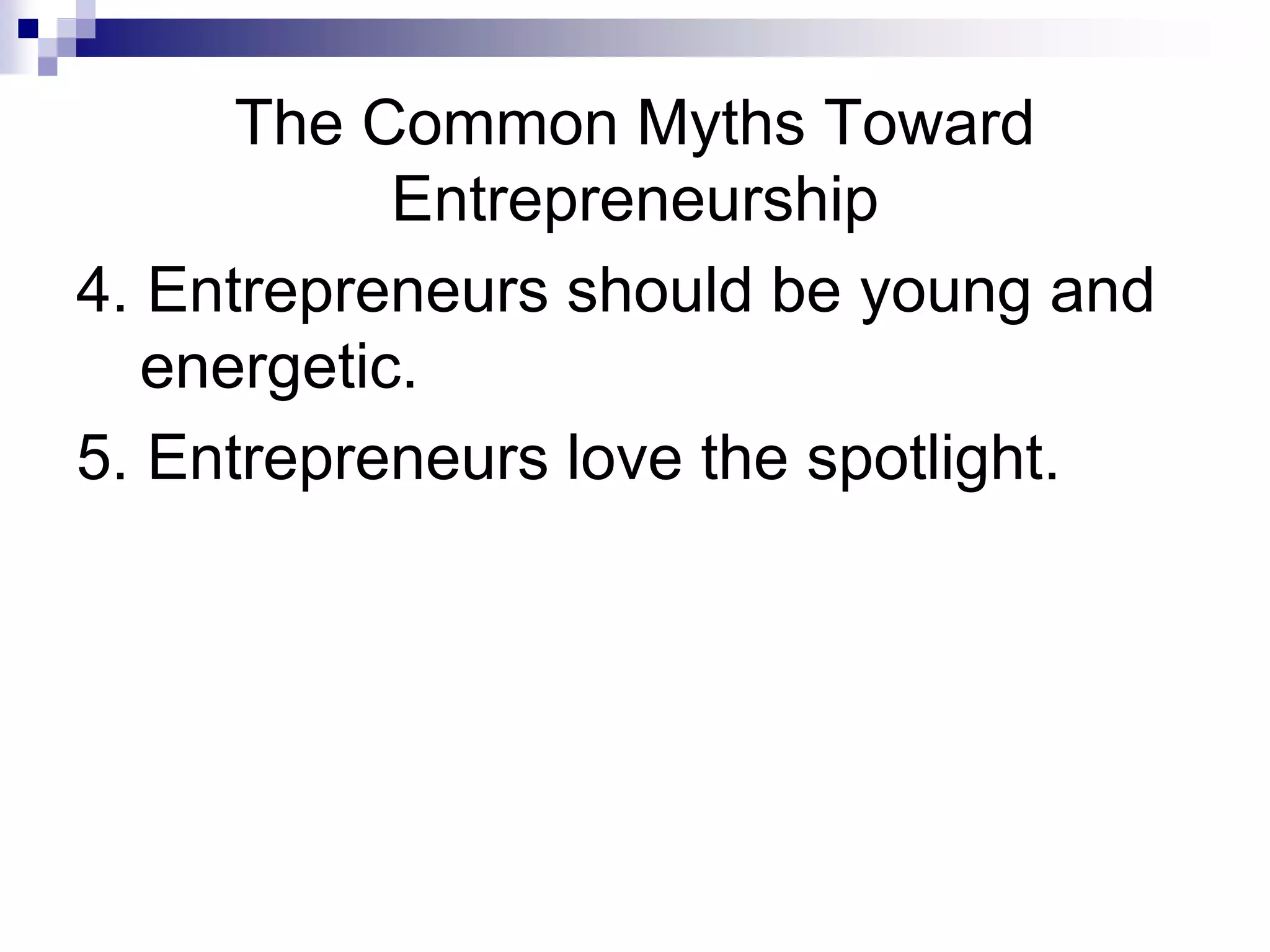
The Common Myths Toward
Entrepreneurship
4. Entrepreneurs should be young and
energetic.
5. Entrepreneurs love the spotlight.
Entrepreneurship Development in
Malaysia
 Entrepreneurship has existed in
Malaysia (Malaya) since the interaction
of Malacca with foreign traders
 when the British colonized the Malay
Peninsular, they changed the structure
of the society and practiced the “divide
and rule” system in which the Malays
were engaged in administration and
agriculture, the Chinese were engaged
in mining and business, and the Indians
were engaged in rubber plantations
Entrepreneurship Development in
Malaysia
 As a result of this system, the Chinese
society was far ahead in business
compared to the Malays and Indians.
Entrepreneurship Development in
Malaysia
 After independence, the Malaysian
Government realized the importance of
entrepreneurship to individuals, society
and the country, and how it contributes to
the nation’s prosperity. Since then, the
government has been focusing on the field
of entrepreneurship until today.
Entrepreneurship Development in
Malaysia
 The New Economic Policy (1971-
1990), the National Development
Policy (1990-2000) and Vision 2020,
all encourage and support
entrepreneurship development in
Malaysia.

CHAPTER 1.ppt

  • 1.
    Chapter 1 Overview onEntrepreneurship
  • 3.
    Welcome to theworld of entrepreneurship “Most of what you hear about entrepreneurship, say America leading management thinkers, is all wrong. It’s not magic; it’s not mysterious; and it has nothing to do with genes. It’s a discipline, it can be learned.” (Peter F.Drucker)
  • 4.
    Introduction  According tothe Global Entrepreneur Monitor (GEM) which is a joint research between Babson College and the London Business School found that about 330 million or 14% of adults in it surveyed are involved in forming new businesses.  Many people view entrepreneurship as an attractive career path.  Now think about yourself…?
  • 5.
    What is Entrepreneur? The word “entrepreneur” come from the French words “entreprendre” which describe people who ‘ take on the risk” or who ‘undertake” a task in starting a new venture.
  • 6.
    What is Entrepreneur? An entrepreneur is a person who acts as agent in transforming demand into supply .( Adam Smith, 1776)  The entrepreneur act as an economic agent who transforms resources into products and services. The entrepreneur transforms and gives added values. (Carl Menger, 1871)
  • 7.
    What is Entrepreneurship? Entrepreneurship is the process by which individuals pursue opportunities and putting workable ideas into practice regardless of resources they currently control.  According to Histrich and Peter (1998), entrepreneurship is the dynamic process of creating incremental wealth .The wealth is created by individuals who assume major risks in terms of equity, time, and career commitment or provide value for some product or service.
  • 8.
    What is Entrepreneurship? Entrepreneurship as defined by Kuratko and Hodgetts (2004) is a process of innovation and new venture creation through four major dimensions-individuals, organizational, environmental and process-that is aided by collaborative networks in government, education, and institution.
  • 9.
    THE IMPORTANCE OF ENTREPRENEURSHIP 1.Individual 2. Community 3. Company 4. Country 5. Globalization
  • 10.
    Entrepreneurial Characteristics  Initiative Opportunity orientation  Persistence  Information seeking  Concern for high quality of work  High degree of commitment  Efficiency orientation
  • 11.
    Entrepreneurial Characteristics cont…  Systematicplanning  Problem solving  Self-confidence  Assertiveness  Persuasion  Use of influence strategies
  • 12.
    Common Characteristics of SuccessfulEntrepreneurs  Passion for business  Product & customer focus  Tenacity despite failure  Execution intelligence
  • 13.
    The Common MythsToward Entrepreneurship 1. Entrepreneurs are born, not made. 2. Entrepreneurs are gamblers. 3. Entrepreneurs are motivated primarily by money.
  • 14.
    The Common MythsToward Entrepreneurship 4. Entrepreneurs should be young and energetic. 5. Entrepreneurs love the spotlight.
  • 15.
    Entrepreneurship Development in Malaysia Entrepreneurship has existed in Malaysia (Malaya) since the interaction of Malacca with foreign traders  when the British colonized the Malay Peninsular, they changed the structure of the society and practiced the “divide and rule” system in which the Malays were engaged in administration and agriculture, the Chinese were engaged in mining and business, and the Indians were engaged in rubber plantations
  • 16.
    Entrepreneurship Development in Malaysia As a result of this system, the Chinese society was far ahead in business compared to the Malays and Indians.
  • 17.
    Entrepreneurship Development in Malaysia After independence, the Malaysian Government realized the importance of entrepreneurship to individuals, society and the country, and how it contributes to the nation’s prosperity. Since then, the government has been focusing on the field of entrepreneurship until today.
  • 18.
    Entrepreneurship Development in Malaysia The New Economic Policy (1971- 1990), the National Development Policy (1990-2000) and Vision 2020, all encourage and support entrepreneurship development in Malaysia.