Chapter 18
The Federal Court
System
THE NATIONAL JUDICIARY
Section 1
Introduction
 What are the structure and function of the
national judiciary?
 The national judiciary is made up of the
Supreme Court and the inferior courts, which
include the special courts and the more
numerous constitutional courts.
 The national judiciary hears cases involving
federal law and interstate cases. It also
interprets the constitutionality of laws.
Origins of the Judiciary
 The Constitution created the Supreme Court.
 Article III gives Congress the power to create
the rest of the federal court system, which it did
in 1789.
 The states each have their own court systems
that exist side-by-side with the federal courts.
 Most cases tried each year are heard by state
courts.
Types of Federal Courts
 Congress created the inferior courts.
 Constitutional courts exercise the judicial
power of the United States and hear a wide
range of cases dealing with federal laws.
 Special courts hear specific types of cases
related to the expressed powers of Congress.
Types of Federal Courts
 The Constitution created only the Supreme
Court, giving Congress the power to create any
lower, or “inferior,” courts as needed.
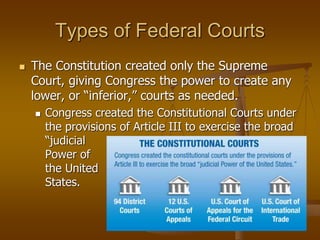
 Congress created the Constitutional Courts under
the provisions of Article III to exercise the broad
“judicial
Power of
the United
States.
Types of Federal Courts
 Congress created
the special, or
legislative, courts to
help exercise its
powers as spelled
out in Article I.
 These courts have
narrowly defined
jurisdictions.
Federal Jurisdiction
 Federal courts hear cases based upon
subject matter or the parties involved in
the cases.
 Federal courts usually try cases that only they
have authority to hear.
 Federal courts can hear any case whose
subject matter involves the interpretation
and application of a provision in the
Constitution or in a federal law or treaty.
Federal Jurisdiction
 The United States or its officers and agencies
 An official representative of a foreign
government
 One of the 50 states suing another state, a
resident of another state, or a foreign
government
 A U.S. citizen suing a citizen of another state
or a foreign government or citizen
Types of Jurisdiction
 Cases with concurrent jurisdiction can be
tried in either a federal or state court.
 The court in which a case is first heard has
original jurisdiction for that case.
 A court with appellate jurisdiction rules on
cases that were first tried in other courts.
 Appellate courts review these cases to ensure
that the law was correctly applied. They can
uphold or overturn earlier decisions.
Which Court?
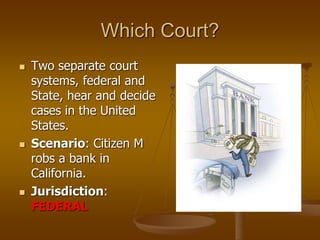
 Two separate court
systems, federal and
State, hear and decide
cases in the United
States.
 Scenario: Citizen M
robs a bank in
California.
 Jurisdiction:
FEDERAL
Which Court?
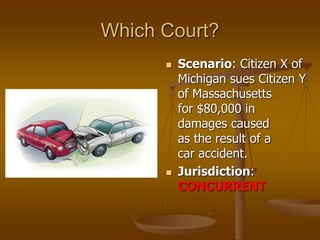
 Scenario: Citizen X of
Michigan sues Citizen Y
of Massachusetts
for $80,000 in
damages caused
as the result of a
car accident.
 Jurisdiction:
CONCURRENT
Which Court?
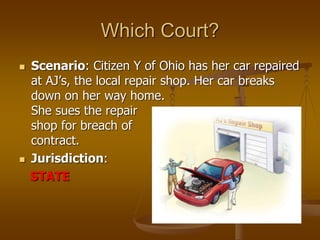
 Scenario: Citizen Y of Ohio has her car repaired
at AJ’s, the local repair shop. Her car breaks
down on her way home.
She sues the repair
shop for breach of
contract.
 Jurisdiction:
STATE
Federal Judges
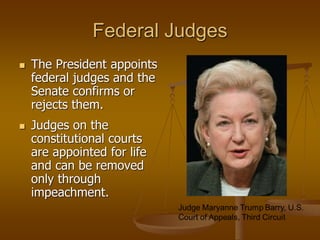
 The President appoints
federal judges and the
Senate confirms or
rejects them.
 Judges on the
constitutional courts
are appointed for life
and can be removed
only through
impeachment.
Federal Judges
 There are no constitutional qualifications
for being a federal judge.
 It is now customary for appointees to have
legal backgrounds, prior judicial experiences,
and to belong to the same political party as
the President.
Judicial Restraint
 Judges make decisions that shape public
policy.
 Judicial restraint argues that the courts
should defer to the policy decisions of the
legislative and executive branches.
 Supporters of judicial restraint believe that
judges should decide cases based upon:
 The intent of the Framers and Congress when the
law was originally written
 Precedents set by rulings in similar cases.
Judicial Activism
 Judicial activism argues that judges
should take into account how social values
and conditions may have changed over
time when they interpret the law.
 Supporters of this principle believe that
judges can and should make independent
decisions when their interpretation of law
differs from that of the legislative and
executive branches.
Court Officers
 Court officers handle the daily administration
of a court.
 Magistrates are appointed to eight-year terms
and may issue arrest warrants, hear evidence, set
bail, and try minor cases.
 U.S. Attorneys serve each federal judicial district
by prosecuting federal offenders and representing
the United States.
 U.S. marshals and deputy marshals perform
many law enforcement duties for the district
courts.
THE INFERIOR COURTS
Section 2
Introduction
 What are the structure and jurisdiction of the
inferior courts?
 District courts are federal trial courts. They are
divided into judicial districts and handle about 80
percent of federal cases.
 There are 13 courts of appeals that hear appeals
from the district courts and special courts.
 The Court of International Trade tries civil cases
related to the nation’s trade laws.
Judicial Districts
 Each state forms at least
one judicial district, with at
least two judges.
 Larger states are divided
into multiple districts and
larger districts may have
more judges.
 There are 94 district
courts, serving all 50 states
as well as U.S. territories.
 Most district cases are
heard by a single judge.
Multi-Judge Panels
 Three-judge panels try some cases involving
apportionment, civil rights, or antitrust laws.
 The Foreign Intelligence Surveillance Court
is made of 11 district court judges and issues
secret search warrants to monitor suspected
spies and terrorists.
 The Alien Terrorist Removal Court is made
up of 5 district judges and decides whether to
expel suspected foreign terrorists from the
country.
District Court Jurisdiction
 District courts have original jurisdiction over
more than 80 percent of federal criminal and
civil cases.
 Federal criminal cases include bank robbery,
kidnapping, counterfeiting, mail fraud, tax
evasion and terrorism.
 Federal civil cases include disputes involving
bankruptcy, postal, tax, and civil rights laws.
District Court Jurisdiction
 In federal criminal cases, the United
States is always the prosecutor.
 Most federal civil cases are between
private parties, but the United States may
be a plaintiff or defendant.
 Most of the decisions made in district
courts are not appealed.
 A few cases are appealed to the courts of
appeals or directly to the Supreme Court.
Courts of Appeals: Structure
 Congress created the courts of appeals
in 1891 to ease the burden on the
Supreme Court.
 There are 13 courts of appeals today.
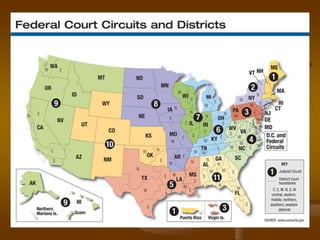
 The nation is divided into 12 circuits, each
with its own court of appeals.
 Each court of appeals hears cases on appeal
from one of the district courts within its
circuit.
Courts of Appeals: Structure
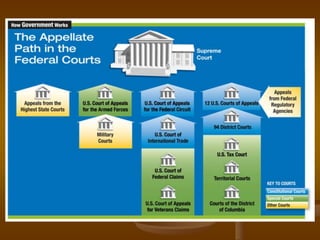
 The Court of Appeals for the Federal
Circuit has nationwide jurisdiction.
 This 13th circuit court deals with appeals
from:
 The Court of International Trade
 The Court of Federal Claims
 The Court of Appeals for Veterans Claims
 The 94 district courts if the case appealed
involves copyright or patent issues.
Courts of Appeals: Operation
 Each circuit court has from 6 to 28 judges,
who usually sit in three-judge panels.
 A justice of the Supreme Court is also
assigned to each circuit.
 They do not conduct trials or accept new
evidence.
 Instead they review the record and the
arguments of a case.
 Less than one percent of their decisions
are appealed to the Supreme Court.
Court of International Trade
 Congress created the Court of
International Trade in 1890 and made
it a constitutional court in 1980.
 The Trade Court’s nine judges sit in panels
of three and often hold jury trials in major
ports.
 The Trade Court has original jurisdiction
over all civil cases involving the nation’s
international trade and customs laws.
THE SUPREME COURT
Section 3
Introduction
 What is the Supreme Court’s jurisdiction,
and how does the Court operate?
 The Court hears few original cases.
 Most of the Court’s cases are appeals of
rulings made by lower courts. The Court may
ask to hear these cases or be asked by lower
courts to hear them.
 The Court hears oral arguments, studies
written briefs, and reaches a majority
decision.
The Court’s Influence
 The Supreme Court is the final authority
on legal questions dealing with the
Constitution, acts of Congress, and U.S.
treaties.
 This authority comes largely from the
power of judicial review, which lets the
Court interpret the meaning of the
Constitution.
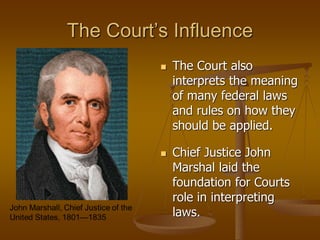
The Court’s Influence
 The Court also
interprets the meaning
of many federal laws
and rules on how they
should be applied.
 Chief Justice John
Marshal laid the
foundation for Courts
role in interpreting
laws.
Packing the Court
 The Judiciary Act of 1789 created a
Supreme Court of six justices, including
the Chief Justice.
 The Court’s size has changed over time,
reaching its present size of nine in 1869.
 In 1937, President Franklin Roosevelt
asked Congress to increase the size of the
Court.
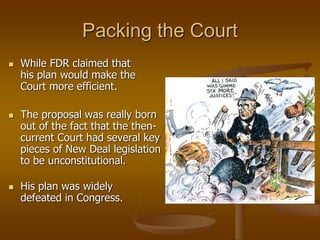
Packing the Court
 While FDR claimed that
his plan would make the
Court more efficient.
 The proposal was really born
out of the fact that the then-
current Court had several key
pieces of New Deal legislation
to be unconstitutional.
 His plan was widely
defeated in Congress.
Marbury v. Madison, 1803
 President Jefferson wanted to block William
Marbury from accepting a judgeship granted
by the outgoing President Adams.
 Jefferson asked the Supreme Court to hear the
case under the authority granted to the Court by
a recent congressional law.
 Marshall ruled that the law passed by Congress
was unconstitutional, so the Court had no
jurisdiction to hear the case.
Marbury v. Madison, 1803
 Marshall ruling affirmed the Court’s power
of judicial review, which is not stated in
the Constitution.
 Judicial review gave the judicial branch a
key role in the development of American
government.
Jurisdiction
 The Supreme Court has original jurisdiction over
cases:
 Involving two or more states
 Affecting ambassadors and public ministers
 Almost all cases come to the Court on appeal
from lower courts.
 Most cases reach the Supreme Court from the
highest state courts and the Federal Courts of
Appeals.
Choosing Cases
 More than 8,000 cases are appealed to
the Supreme Court each term, but it
accepts only a few hundred.
 At least four justices must agree to accept a
case.
 Refusing to hear a case does not mean the
Court agrees with the lower court’s decision.
 Over half of the accepted cases are
remanded—returned to a lower court without
the Court ruling on them.
Choosing Cases
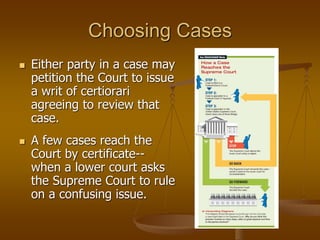
 Either party in a case may
petition the Court to issue
a writ of certiorari
agreeing to review that
case.
 A few cases reach the
Court by certificate--
when a lower court asks
the Supreme Court to rule
on a confusing issue.
Hearing Cases
 Each term of the Supreme Court lasts from the
first Monday in October to sometime the
following June or July.
 Justices receive written briefs for each case that
detail each side’s legal arguments.
 Sometimes interested parties are allowed to submit
their own amicus curiae, or friend of the courts, briefs
supporting or opposing one side in the case.
Hearing Cases
 After reading the briefs for several cases, the
justices hear oral arguments for those cases.
 Each side gets 30 minutes to present their case
and answer questions from the justices.
 The solicitor general represents the United
States in cases before the Supreme Court.
 He or she also decides what cases the
government should ask the Court to review.
Deciding Cases
 After hearing oral arguments, the justices recess
to consider the cases.
 Then they meet in conference to discuss the
cases.
 Each justice presents their own views and conclusions
in conference.
 A majority must decide which party wins or loses
a case.
 The justices are often divided in their views of a case.
Issuing Opinions
 The Court announces its decision and issues one or
more written opinions.
 The majority opinion sets out the facts of the
case and explains the decision.
 A concurring opinion agrees with the majority but
cites different reasons for the ruling.
 A dissenting opinion is written by a justice who
disagrees with the Court’s decision in a case. It does
not become precedent.
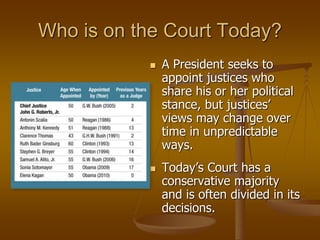
Who is on the Court Today?
 A President seeks to
appoint justices who
share his or her political
stance, but justices’
views may change over
time in unpredictable
ways.
 Today’s Court has a
conservative majority
and is often divided in its
decisions.
THE SPECIAL COURTS
Section 4
Introduction
 What are the special courts, and what are the
jurisdictions of each?
 The Military and Veterans Claims Courts deal
with the armed forces.
 The Court of Federal Claims deals with legal claims
made against the federal government.
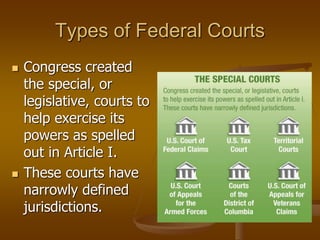
 The Territorial Courts act as local courts for federal
territories.
 The District of Columbia Courts act as federal and
local courts for the District of Columbia.
 The United States Tax Court hears civil cases
involving the nation’s tax laws.
Special Courts
 Unlike the constitutional courts, Congress
established the special courts under the
authority of Article I of the Constitution.
 This means that each special court has a
very narrow jurisdiction, hearing only
specific types of cases.
 Special court judges are appointed for
fixed terms, not for life.
Courts-Martial
 Courts-martial are military courts and
not part of the federal court system.
 They try only members of the military accused
of violating military law.
 In a courts-martial, only two-thirds of the
panel, or jury, has to agree on a verdict,
unlike the unanimous verdict required in
civilian courts.
Courts-Martial
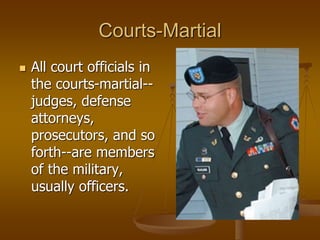
 All court officials in
the courts-martial--
judges, defense
attorneys,
prosecutors, and so
forth--are members
of the military,
usually officers.
Military Courts of Appeal
 Congress created the Court of Appeals for
the Armed Forces in 1950 to review serious
convictions of military personnel.
 This is a civilian court that hears appeals of
military court rulings.
 Congress established the Court of Appeals
for Veterans in 1988 to hear appeals of
decisions about veterans’ benefits made by
the Department of Veterans Affairs.
Military Commissions
 In 2001, President George W. Bush ordered
the creation of military commissions to try
captured “unlawful enemy combatants.”
 Most of these suspected terrorists are held in military
prison in Guantanamo Bay, Cuba.
 In 2006, the Supreme Court ruled in Hamdan v.
Rumsfeld that only Congress could approve such
military commissions, which it did with the Military
Commissions Act of 2006.
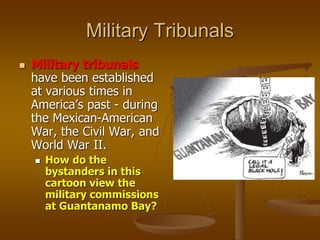
Military Tribunals
 Military tribunals
have been established
at various times in
America’s past - during
the Mexican-American
War, the Civil War, and
World War II.
 How do the
bystanders in this
cartoon view the
military commissions
at Guantanamo Bay?
Court of Federal Claims
 The United States government cannot be
sued by anyone, for any reason, in any
court, unless it agrees to be sued.
 So, Congress created the Court of
Federal Claims to allow people to sue
the federal government for damages.
Special Jurisdictions
 The Territorial Courts act as local courts
for the U.S. territories of Guam, the Virgin
Islands, and the Northern Mariana Islands.
 The District of Columbia Courts
include the trial court and court of appeals
for the District, as well as its federal
district court and court of appeals.
US Tax Court
 Congress created the United States Tax
Court in 1969 to hear civil cases involving
the nation’s tax laws.
 The Tax Court is not part of the federal court
system.
 Most of its cases come from the Internal
Revenue Service and other Treasury
Department agencies.

Chapter 18 presentation

  • 1.
  • 2.
  • 3.
    Introduction  What arethe structure and function of the national judiciary?  The national judiciary is made up of the Supreme Court and the inferior courts, which include the special courts and the more numerous constitutional courts.  The national judiciary hears cases involving federal law and interstate cases. It also interprets the constitutionality of laws.
  • 4.
    Origins of theJudiciary  The Constitution created the Supreme Court.  Article III gives Congress the power to create the rest of the federal court system, which it did in 1789.  The states each have their own court systems that exist side-by-side with the federal courts.  Most cases tried each year are heard by state courts.
  • 5.
    Types of FederalCourts  Congress created the inferior courts.  Constitutional courts exercise the judicial power of the United States and hear a wide range of cases dealing with federal laws.  Special courts hear specific types of cases related to the expressed powers of Congress.
  • 6.
    Types of FederalCourts  The Constitution created only the Supreme Court, giving Congress the power to create any lower, or “inferior,” courts as needed.  Congress created the Constitutional Courts under the provisions of Article III to exercise the broad “judicial Power of the United States.
  • 7.
    Types of FederalCourts  Congress created the special, or legislative, courts to help exercise its powers as spelled out in Article I.  These courts have narrowly defined jurisdictions.
  • 8.
    Federal Jurisdiction  Federalcourts hear cases based upon subject matter or the parties involved in the cases.  Federal courts usually try cases that only they have authority to hear.  Federal courts can hear any case whose subject matter involves the interpretation and application of a provision in the Constitution or in a federal law or treaty.
  • 9.
    Federal Jurisdiction  TheUnited States or its officers and agencies  An official representative of a foreign government  One of the 50 states suing another state, a resident of another state, or a foreign government  A U.S. citizen suing a citizen of another state or a foreign government or citizen
  • 10.
    Types of Jurisdiction Cases with concurrent jurisdiction can be tried in either a federal or state court.  The court in which a case is first heard has original jurisdiction for that case.  A court with appellate jurisdiction rules on cases that were first tried in other courts.  Appellate courts review these cases to ensure that the law was correctly applied. They can uphold or overturn earlier decisions.
  • 11.
    Which Court?  Twoseparate court systems, federal and State, hear and decide cases in the United States.  Scenario: Citizen M robs a bank in California.  Jurisdiction: FEDERAL
  • 12.
    Which Court?  Scenario:Citizen X of Michigan sues Citizen Y of Massachusetts for $80,000 in damages caused as the result of a car accident.  Jurisdiction: CONCURRENT
  • 13.
    Which Court?  Scenario:Citizen Y of Ohio has her car repaired at AJ’s, the local repair shop. Her car breaks down on her way home. She sues the repair shop for breach of contract.  Jurisdiction: STATE
  • 14.
    Federal Judges  ThePresident appoints federal judges and the Senate confirms or rejects them.  Judges on the constitutional courts are appointed for life and can be removed only through impeachment.
  • 15.
    Federal Judges  Thereare no constitutional qualifications for being a federal judge.  It is now customary for appointees to have legal backgrounds, prior judicial experiences, and to belong to the same political party as the President.
  • 16.
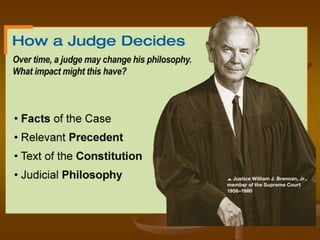
    Judicial Restraint  Judgesmake decisions that shape public policy.  Judicial restraint argues that the courts should defer to the policy decisions of the legislative and executive branches.  Supporters of judicial restraint believe that judges should decide cases based upon:  The intent of the Framers and Congress when the law was originally written  Precedents set by rulings in similar cases.
  • 17.
    Judicial Activism  Judicialactivism argues that judges should take into account how social values and conditions may have changed over time when they interpret the law.  Supporters of this principle believe that judges can and should make independent decisions when their interpretation of law differs from that of the legislative and executive branches.
  • 19.
    Court Officers  Courtofficers handle the daily administration of a court.  Magistrates are appointed to eight-year terms and may issue arrest warrants, hear evidence, set bail, and try minor cases.  U.S. Attorneys serve each federal judicial district by prosecuting federal offenders and representing the United States.  U.S. marshals and deputy marshals perform many law enforcement duties for the district courts.
  • 20.
  • 21.
    Introduction  What arethe structure and jurisdiction of the inferior courts?  District courts are federal trial courts. They are divided into judicial districts and handle about 80 percent of federal cases.  There are 13 courts of appeals that hear appeals from the district courts and special courts.  The Court of International Trade tries civil cases related to the nation’s trade laws.
  • 22.
    Judicial Districts  Eachstate forms at least one judicial district, with at least two judges.  Larger states are divided into multiple districts and larger districts may have more judges.  There are 94 district courts, serving all 50 states as well as U.S. territories.  Most district cases are heard by a single judge.
  • 23.
    Multi-Judge Panels  Three-judgepanels try some cases involving apportionment, civil rights, or antitrust laws.  The Foreign Intelligence Surveillance Court is made of 11 district court judges and issues secret search warrants to monitor suspected spies and terrorists.  The Alien Terrorist Removal Court is made up of 5 district judges and decides whether to expel suspected foreign terrorists from the country.
  • 25.
    District Court Jurisdiction District courts have original jurisdiction over more than 80 percent of federal criminal and civil cases.  Federal criminal cases include bank robbery, kidnapping, counterfeiting, mail fraud, tax evasion and terrorism.  Federal civil cases include disputes involving bankruptcy, postal, tax, and civil rights laws.
  • 26.
    District Court Jurisdiction In federal criminal cases, the United States is always the prosecutor.  Most federal civil cases are between private parties, but the United States may be a plaintiff or defendant.  Most of the decisions made in district courts are not appealed.  A few cases are appealed to the courts of appeals or directly to the Supreme Court.
  • 27.
    Courts of Appeals:Structure  Congress created the courts of appeals in 1891 to ease the burden on the Supreme Court.  There are 13 courts of appeals today.  The nation is divided into 12 circuits, each with its own court of appeals.  Each court of appeals hears cases on appeal from one of the district courts within its circuit.
  • 28.
    Courts of Appeals:Structure  The Court of Appeals for the Federal Circuit has nationwide jurisdiction.  This 13th circuit court deals with appeals from:  The Court of International Trade  The Court of Federal Claims  The Court of Appeals for Veterans Claims  The 94 district courts if the case appealed involves copyright or patent issues.
  • 30.
    Courts of Appeals:Operation  Each circuit court has from 6 to 28 judges, who usually sit in three-judge panels.  A justice of the Supreme Court is also assigned to each circuit.  They do not conduct trials or accept new evidence.  Instead they review the record and the arguments of a case.  Less than one percent of their decisions are appealed to the Supreme Court.
  • 31.
    Court of InternationalTrade  Congress created the Court of International Trade in 1890 and made it a constitutional court in 1980.  The Trade Court’s nine judges sit in panels of three and often hold jury trials in major ports.  The Trade Court has original jurisdiction over all civil cases involving the nation’s international trade and customs laws.
  • 32.
  • 33.
    Introduction  What isthe Supreme Court’s jurisdiction, and how does the Court operate?  The Court hears few original cases.  Most of the Court’s cases are appeals of rulings made by lower courts. The Court may ask to hear these cases or be asked by lower courts to hear them.  The Court hears oral arguments, studies written briefs, and reaches a majority decision.
  • 34.
    The Court’s Influence The Supreme Court is the final authority on legal questions dealing with the Constitution, acts of Congress, and U.S. treaties.  This authority comes largely from the power of judicial review, which lets the Court interpret the meaning of the Constitution.
  • 35.
    The Court’s Influence The Court also interprets the meaning of many federal laws and rules on how they should be applied.  Chief Justice John Marshal laid the foundation for Courts role in interpreting laws.
  • 36.
    Packing the Court The Judiciary Act of 1789 created a Supreme Court of six justices, including the Chief Justice.  The Court’s size has changed over time, reaching its present size of nine in 1869.  In 1937, President Franklin Roosevelt asked Congress to increase the size of the Court.
  • 37.
    Packing the Court While FDR claimed that his plan would make the Court more efficient.  The proposal was really born out of the fact that the then- current Court had several key pieces of New Deal legislation to be unconstitutional.  His plan was widely defeated in Congress.
  • 38.
    Marbury v. Madison,1803  President Jefferson wanted to block William Marbury from accepting a judgeship granted by the outgoing President Adams.  Jefferson asked the Supreme Court to hear the case under the authority granted to the Court by a recent congressional law.  Marshall ruled that the law passed by Congress was unconstitutional, so the Court had no jurisdiction to hear the case.
  • 39.
    Marbury v. Madison,1803  Marshall ruling affirmed the Court’s power of judicial review, which is not stated in the Constitution.  Judicial review gave the judicial branch a key role in the development of American government.
  • 40.
    Jurisdiction  The SupremeCourt has original jurisdiction over cases:  Involving two or more states  Affecting ambassadors and public ministers  Almost all cases come to the Court on appeal from lower courts.  Most cases reach the Supreme Court from the highest state courts and the Federal Courts of Appeals.
  • 41.
    Choosing Cases  Morethan 8,000 cases are appealed to the Supreme Court each term, but it accepts only a few hundred.  At least four justices must agree to accept a case.  Refusing to hear a case does not mean the Court agrees with the lower court’s decision.  Over half of the accepted cases are remanded—returned to a lower court without the Court ruling on them.
  • 42.
    Choosing Cases  Eitherparty in a case may petition the Court to issue a writ of certiorari agreeing to review that case.  A few cases reach the Court by certificate-- when a lower court asks the Supreme Court to rule on a confusing issue.
  • 43.
    Hearing Cases  Eachterm of the Supreme Court lasts from the first Monday in October to sometime the following June or July.  Justices receive written briefs for each case that detail each side’s legal arguments.  Sometimes interested parties are allowed to submit their own amicus curiae, or friend of the courts, briefs supporting or opposing one side in the case.
  • 44.
    Hearing Cases  Afterreading the briefs for several cases, the justices hear oral arguments for those cases.  Each side gets 30 minutes to present their case and answer questions from the justices.  The solicitor general represents the United States in cases before the Supreme Court.  He or she also decides what cases the government should ask the Court to review.
  • 45.
    Deciding Cases  Afterhearing oral arguments, the justices recess to consider the cases.  Then they meet in conference to discuss the cases.  Each justice presents their own views and conclusions in conference.  A majority must decide which party wins or loses a case.  The justices are often divided in their views of a case.
  • 46.
    Issuing Opinions  TheCourt announces its decision and issues one or more written opinions.  The majority opinion sets out the facts of the case and explains the decision.  A concurring opinion agrees with the majority but cites different reasons for the ruling.  A dissenting opinion is written by a justice who disagrees with the Court’s decision in a case. It does not become precedent.
  • 47.
    Who is onthe Court Today?  A President seeks to appoint justices who share his or her political stance, but justices’ views may change over time in unpredictable ways.  Today’s Court has a conservative majority and is often divided in its decisions.
  • 48.
  • 49.
    Introduction  What arethe special courts, and what are the jurisdictions of each?  The Military and Veterans Claims Courts deal with the armed forces.  The Court of Federal Claims deals with legal claims made against the federal government.  The Territorial Courts act as local courts for federal territories.  The District of Columbia Courts act as federal and local courts for the District of Columbia.  The United States Tax Court hears civil cases involving the nation’s tax laws.
  • 50.
    Special Courts  Unlikethe constitutional courts, Congress established the special courts under the authority of Article I of the Constitution.  This means that each special court has a very narrow jurisdiction, hearing only specific types of cases.  Special court judges are appointed for fixed terms, not for life.
  • 51.
    Courts-Martial  Courts-martial aremilitary courts and not part of the federal court system.  They try only members of the military accused of violating military law.  In a courts-martial, only two-thirds of the panel, or jury, has to agree on a verdict, unlike the unanimous verdict required in civilian courts.
  • 52.
    Courts-Martial  All courtofficials in the courts-martial-- judges, defense attorneys, prosecutors, and so forth--are members of the military, usually officers.
  • 53.
    Military Courts ofAppeal  Congress created the Court of Appeals for the Armed Forces in 1950 to review serious convictions of military personnel.  This is a civilian court that hears appeals of military court rulings.  Congress established the Court of Appeals for Veterans in 1988 to hear appeals of decisions about veterans’ benefits made by the Department of Veterans Affairs.
  • 54.
    Military Commissions  In2001, President George W. Bush ordered the creation of military commissions to try captured “unlawful enemy combatants.”  Most of these suspected terrorists are held in military prison in Guantanamo Bay, Cuba.  In 2006, the Supreme Court ruled in Hamdan v. Rumsfeld that only Congress could approve such military commissions, which it did with the Military Commissions Act of 2006.
  • 55.
    Military Tribunals  Militarytribunals have been established at various times in America’s past - during the Mexican-American War, the Civil War, and World War II.  How do the bystanders in this cartoon view the military commissions at Guantanamo Bay?
  • 56.
    Court of FederalClaims  The United States government cannot be sued by anyone, for any reason, in any court, unless it agrees to be sued.  So, Congress created the Court of Federal Claims to allow people to sue the federal government for damages.
  • 57.
    Special Jurisdictions  TheTerritorial Courts act as local courts for the U.S. territories of Guam, the Virgin Islands, and the Northern Mariana Islands.  The District of Columbia Courts include the trial court and court of appeals for the District, as well as its federal district court and court of appeals.
  • 58.
    US Tax Court Congress created the United States Tax Court in 1969 to hear civil cases involving the nation’s tax laws.  The Tax Court is not part of the federal court system.  Most of its cases come from the Internal Revenue Service and other Treasury Department agencies.