Professional Development
Ahmed Alorage
Objectives:
• 13 Professional Development
• 13.1 Characteristics of a Profession
• 13.2 DAMA Membership
• 13.3 Continuing Education and Training
• 13.4 Certification
• 13.4.1 How Do You Obtain a CDMP?
• 13.4.2 CDMP Examination Criteria
• 13.4.3 Additional CDMP Certification Criteria
• 13.4.4 CDMP Qualifying Examinations
• 13.4.5 Accepted Vendor Training Certifications
• 13.4.6 Preparation for Taking Exams
• 13.4.7 Taking CDMP Exams
• 13.4.8 Professional Development / Recertification
Objectives:
• 13.5 Professional Ethics
• 13.6 Notable Data Management Professionals
• 13.6.1 Lifetime Achievement Award
• 13.6.2 Professional Achievement Award
• 13.6.3 Government Achievement Award
• 13.6.4 Academic Achievement Award
• 13.6.5 DAMA Community Award
13 Professional Development
• Crucial for development of a data management profession.
• Not one of the ten data management functions.
• Discusses the characteristics of a data management professional
and the various components of professionalism:
• Professional organization membership
• Education and training for continuing education, certification program,
ethics, and the notable members in the data management profession.
13.1 Characteristics of a profession:
• Profession means occupy specialized knowledge and skills or feels
commitment of values and resources of specific field. “not just jobs”.
• The common features of professions:
• Society for the communal support of professionals.
• Body of knowledge “consensus publication”
• Curriculum validated by the professional society.
• Certification or mandatory licensing.
• Continuing education and an expectation of continuing skills of professionals.
• Code of ethics, with commitment to do
• Notable members, recognized for their professionalism.
• Aspiring Data management professionals are encouraged to:
• Join DAMA and participate in their Local chapter.
• Be familiar with DAMA-DMBOK guide and Dictionary.
• Attend the annual DAMA Symposium “workshops, seminars, courses”.
• Earn the certificated “CDMP” designation.
• Obtain degree in Computer science or Information Systems
• Strive to maintain the highest ethical standards of professional behavior.
13.3 DAMA Membership
• DAMA is International not-for-profit membership organization, with
over 7500 members in 40 chapter around the globe.
• DAMA seeks to mature DM profession in server way:
• In partnership with Wilshire Conferences “The enterprise Data World”.
• In partnership with ICCP, offer a professional certification program “CDMP”.
• The CDMP certification exams, developed by DAMA used by the Data
Warehouse Institute (TDWI) in their Certified Business intelligence
Professional (CBIP) program.
• DAMA education Committee’s award-winning Data Management Curriculum
Framework offers guidance on how North American colleges and universities
can teach data management as part of their IT and MIS curricula.
• In partnership with IS 2002 Model Curriculum authors.
• DAMA publish The Guidelines to implementing Data Resource Management.
• DAMA publish The DAMA Dictionary of Data Management
13.3 Continuing Education and Training
• Some data Management training is focused on developing skills
with specific technology products.
• DAMA international and other professional organizations provide
education in product-neutral concepts, methods, and techniques.
• DAMA holds annual Symposium conferences in US, UK, and Australia.
• There are plans for additional international conferences in future.
• DAMA International Chapters in over 20 countries sponsor speakers
who present educational topics at local meetings.
• Data management professional should subscribe to professional
magazines and online newsletters.
• Should be well read on data management and related topics.
13.4 Certification
• (ICCP) the Institute of Certification of Computing Professionals
have jointly constructed (CDMP) the Certified Data Management
Professional designation.
• The certification program gives data management professional opportunity to
show professional growth that can enhance their personal and career goals.
• Is coordinated with the model education curriculum and with work being
done to define job ladders for the data management field.
• DAMA International is a Part member of the ICCP, a consortium of
professional IT associations creating international standards and
certification credentials since 1973.
• The ICCP offers internationally recognized product and vendor
neutral certification programs that test stringent industry
fundamentals for the computing profession.
• The ICCP office administers the testing and recertification programs
for the CDMP.
Certification
13.4.1 How Do You Obtain a CDMP?
• The CDMP certification process is as follows:
1. Obtain information and the application ( www.dama.org or www.iccp.org).
2. Fill out the application.
3. Arrange to take the exam(s) through DAMA or ICCP. Internet testing is
available through the ICCP office.
4. Pass the IS core exam ( required).
5. Pass two specialty exams.
6. At least one of the data specialty exams taken must be form the following
list:
A. Data management
B. Data Warehousing
C. Database Administration
D. Data and Information Quality
7. Meet the experience and education qualifications.
8. Sign the ICCP code of ethics.
Certifications
13.4.2 CDMP Examination Criteria
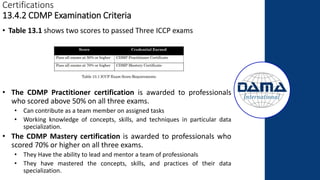
• Table 13.1 shows two scores to passed Three ICCP exams
• The CDMP Practitioner certification is awarded to professionals
who scored above 50% on all three exams.
• Can contribute as a team member on assigned tasks
• Working knowledge of concepts, skills, and techniques in particular data
specialization.
• The CDMP Mastery certification is awarded to professionals who
scored 70% or higher on all three exams.
• They Have the ability to lead and mentor a team of professionals
• They have mastered the concepts, skills, and practices of their data
specialization.
Certifications
13.4.2 CDMP Examination Criteria
• Exams may be retaken to improve your score and go from the
Practitioner to the Mastery certificate level.
• You may be able to substitute selected vendor certifications for up
to one specially exam.
Certifications
13.4.2 CDMP Examination Criteria
• Exams may be retaken to improve your score and go from the
Practitioner to the Mastery certificate level.
• You may be able to substitute selected vendor certifications for up
to one specially exam.
Certifications
13.4.3 Additional CDMP Examination Criteria
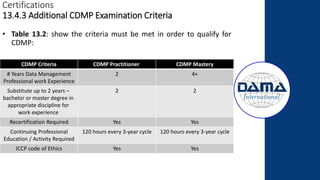
• Table 13.2: show the criteria must be met in order to qualify for
CDMP:
CDMP Criteria CDMP Practitioner CDMP Mastery
# Years Data Management
Professional work Experience
2 4+
Substitute up to 2 years –
bachelor or master degree in
appropriate discipline for
work experience
2 2
Recertification Required Yes Yes
Continuing Professional
Education / Activity Required
120 hours every 3-year cycle 120 hours every 3-year cycle
ICCP code of Ethics Yes Yes
Certifications
13.4.4 CDMP Qualifying Examinations
• CDMP certification candidates must take three qualifying
examinations:
• The IS core exam must be one of these three exams.
• The other two exams are chosen by candidates based on their work
experience.
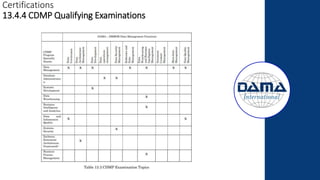
• Table 13.3 shows which Data Management Functions are covered
as topics in each specialty exam in the CDMP program.
Certifications
13.4.4 CDMP Qualifying Examinations
Certifications
13.4.5 Accepted Vendor Training Certifications
• Substituted certifications for the CDMP “candidate’s choice”:
• IBM:
• IBM Certified Database Administrator – DB2 Universal DB.
• IBM Certified Advance DB administrator – DB2 Universal DB.
• IBM Certified Solutions Expert- BD2 Universal DB.
• IBM Certified Solutions Expert- DB2 Content Manager.
• Information Engineering Services Pty Ltd:
• Certified Business Data Modeler.
• Insurance Data Management Association (IDMA):
• Certified Insurance Data Manager.
Certifications
13.4.5 Accepted Vendor Training Certifications
• Microsoft
• Microsoft Certified Database Administrator.
• NCR (Teradata):
• Teradata Certified Professional
• Oracle:
• Oracle (xx) Certified Professional
• Oracle (xx) Database Administrator Certified Professional ( for Practitioner
Level CDMP).
• Oracle (xx) Database Administrator Certified Master ( for Mastery Level
CDMP).
• Project Management Institute:
• Project Management Professional (PMP).
• Certified Associate in Project Management (CAPM).
Certifications
13.4.6 Preparation for Taking Exams
• Preparing to take the ICCP exams can be done in various ways:
• Sponsor ICCP exam Review Courses for your DAMA chapter membership.
• Refer to the exam subject outlines (at level 1 and 2) posted on
http://www.icp.org/iccpnew/outlines.html to become familiar with the
subject coverage of each exam.
• Contact the ICCP (office@iccp.org) for the CDMP study Guide, which covers all
the exams in the CDMP program and has sample exams / questions for self-
study.
• Also, ICCP sells the DAMA International Data Management Exam
Study Guide and the Data Warehousing Exam Study Guide.
Certifications
13.4.7 Taking CDMP Exams
• ICCP testing can be done anywhere in the world with an approved
ICCP proctor to verify physical identity and supervise/ monitor the
examination.
• A proctor is an individual authorized by ICCP to oversee the writing
of an exam by an ICCP exam taker.
• Must meet guidelines http://www.iccp.org/iccnpnew/testing.html
• Exams may also take via the Internet
• 110 multiple choice questions to answers
• Duration: 90 minutes
• One hundred questions are scored
• 10 question beta questions included for future test development.
• Computer based testing allows for immediate scoring after exam.
• Profile of your answers can be downloaded to show your strengths and
weakness.
Certifications
13.4.8 Professional Development / Recertification
• To Keep your CDMP current:
• You must earn 120 approved contact hours of continuing education over 3
years period.
• Many educational activities count, including DAMA Symposiums and chapter
meetings.
• For ICCP Recertification Guidelines Booklet or go to http://WWW.ICCP
.org/iccpnew/Recertification%20Guidelines2005.pdf
• Table 13.4 identified some example of how to earn these credits.
• Recertification credits can be entered online through the
professional Development Transmittal form,
http://www.iccp.org/cgi-bin/pdform.com
• Your DAMA International chapter can also keep track of meeting
attendance for the purpose of recertification and submit on a timely
basis.
• An annual maintenance free to ICCP is required for keeping track of
your recertification credits.
13.5 Professional Ethics
• Data Management Professionals should strive to maintain the
highest ethical and professional conduct:
• Information consumers expect data to posses' certain qualities (
completeness, accuracy, validities)
• Data stewards, managers, and colleague expect professional qualities of
honesty, integrity, trustworthiness, respect, maturity, courtesy, and
cooperation.
• Data management professionals play an advisory role in the ethical
use of data.
• The key topics of ethical handling of personal data are:
• Personal data (e.g. name, address, religious affiliation, sexual orientation)
• Privacy (access or restriction to this information)
• There are two types of ethics:
• Compelled ethics: are those that are part of an internal personal code of
responsibility.
• Imposed ethics: those forced on us by law or regulation.
13.5 Professional Ethics
• Criteria set down by the Federal Trade Commission (FTC) that
organizations design and implement their own privacy programs
based on it:
• Notice: Data collectors must disclose their information practices before
collecting personal information from consumers.
• Choice: Consumers must be given options with respect to whether and how
personal information collected from them may be used for purposes beyond
those for which the information was provided.
• Access: Consumers should be able to view and contest the accuracy and
completeness of data collected about them.
• Enforcement: the use of a reliable mechanism to impose sanctions for
noncompliance with these fair information practices.
• Canadian privacy law is hybrid of comprehensive regime of privacy
protection along with industry self regulation.
• PIPEDA ( Personal information Protection and Electronic Documents Act)
cover all businesses who collect, use, and disseminate personal information in
the course of commercial activities.
13.5 Professional Ethics
• The 10 Guidelines obligations that organizations must follow:
• Accountability: under its control and designate an individual to be accountable.
• Identifying Purposes: the purposes for which personal information is collected.
• Consent: obtain the knowledge and consent of the individual for the collection,
use, or disclosure of personal information, except where inappropriate.
• Limiting Collection, Use, Disclosure, and Retention: Limited by necessary for the
purposes, fair and lawful means, shall not be used or disclosed for purposes
other than those for which it was collected, shall retained only as long as
necessary for the fulfillment of those purposes.
• Accuracy: must be accurate, complete, and up-to-data
• Safeguards: must be protected
• Openness: must make specific information about its policies and practices.
• Individual Access: Upon request, informed of the existence, use and disclosure,
and shall given access to that information.
• Challenging Compliance: shall be able to address a challenge concerning
compliance
13.5 Professional Ethics
• Types of analyses that data professionals in BI actively involved:
• Who people are, including terrorist and criminal identification.
• What people do, including profiling.
• When people do it, including timing of data analysis, bias, accuracy.
• Where people do it, including profiling and corralling choices.
• How people are treated, including outcomes of analysis, such as scoring and
preference tracking, that will tag them as ultimately privileged or not for
future business.
• It is right to ask whether these activities are ethical or not, and to
explore the implications to the community before proceeding with
the work.
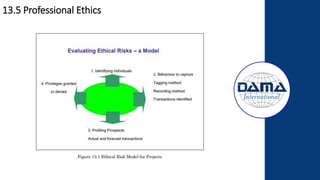
• Figure 13.1 summarize the evaluation of ethical risks.
13.5 Professional Ethics
• Traps that analyst should be aware of when ethical handling
information:
• Hunch and Search: The analyst has a hunch and wants to satisfy that hunch,
but only uses data that satisfies their hunch.
• Data Collection for Pre-defined result: The analyst is pressured to collect data
and produce results based on pre-defined desires.
• Biased use of data collected: Data is used to satisfy a chosen approach; data
is manipulated for a chosen approach.
• Business users may not be aware of “where the data comes form”.
• Automated monitoring is not sufficient protection from unethical
activities.
• Culture norms and ethics in the workplace influence corporate
behavior.
• Learn and use the ethical risk model

‏‏‏‏‏‏‏‏‏‏‏‏Chapter 13: Professional Development

  • 1.
  • 2.
    Objectives: • 13 ProfessionalDevelopment • 13.1 Characteristics of a Profession • 13.2 DAMA Membership • 13.3 Continuing Education and Training • 13.4 Certification • 13.4.1 How Do You Obtain a CDMP? • 13.4.2 CDMP Examination Criteria • 13.4.3 Additional CDMP Certification Criteria • 13.4.4 CDMP Qualifying Examinations • 13.4.5 Accepted Vendor Training Certifications • 13.4.6 Preparation for Taking Exams • 13.4.7 Taking CDMP Exams • 13.4.8 Professional Development / Recertification
  • 3.
    Objectives: • 13.5 ProfessionalEthics • 13.6 Notable Data Management Professionals • 13.6.1 Lifetime Achievement Award • 13.6.2 Professional Achievement Award • 13.6.3 Government Achievement Award • 13.6.4 Academic Achievement Award • 13.6.5 DAMA Community Award
  • 4.
    13 Professional Development •Crucial for development of a data management profession. • Not one of the ten data management functions. • Discusses the characteristics of a data management professional and the various components of professionalism: • Professional organization membership • Education and training for continuing education, certification program, ethics, and the notable members in the data management profession.
  • 5.
    13.1 Characteristics ofa profession: • Profession means occupy specialized knowledge and skills or feels commitment of values and resources of specific field. “not just jobs”. • The common features of professions: • Society for the communal support of professionals. • Body of knowledge “consensus publication” • Curriculum validated by the professional society. • Certification or mandatory licensing. • Continuing education and an expectation of continuing skills of professionals. • Code of ethics, with commitment to do • Notable members, recognized for their professionalism. • Aspiring Data management professionals are encouraged to: • Join DAMA and participate in their Local chapter. • Be familiar with DAMA-DMBOK guide and Dictionary. • Attend the annual DAMA Symposium “workshops, seminars, courses”. • Earn the certificated “CDMP” designation. • Obtain degree in Computer science or Information Systems • Strive to maintain the highest ethical standards of professional behavior.
  • 6.
    13.3 DAMA Membership •DAMA is International not-for-profit membership organization, with over 7500 members in 40 chapter around the globe. • DAMA seeks to mature DM profession in server way: • In partnership with Wilshire Conferences “The enterprise Data World”. • In partnership with ICCP, offer a professional certification program “CDMP”. • The CDMP certification exams, developed by DAMA used by the Data Warehouse Institute (TDWI) in their Certified Business intelligence Professional (CBIP) program. • DAMA education Committee’s award-winning Data Management Curriculum Framework offers guidance on how North American colleges and universities can teach data management as part of their IT and MIS curricula. • In partnership with IS 2002 Model Curriculum authors. • DAMA publish The Guidelines to implementing Data Resource Management. • DAMA publish The DAMA Dictionary of Data Management
  • 7.
    13.3 Continuing Educationand Training • Some data Management training is focused on developing skills with specific technology products. • DAMA international and other professional organizations provide education in product-neutral concepts, methods, and techniques. • DAMA holds annual Symposium conferences in US, UK, and Australia. • There are plans for additional international conferences in future. • DAMA International Chapters in over 20 countries sponsor speakers who present educational topics at local meetings. • Data management professional should subscribe to professional magazines and online newsletters. • Should be well read on data management and related topics.
  • 8.
    13.4 Certification • (ICCP)the Institute of Certification of Computing Professionals have jointly constructed (CDMP) the Certified Data Management Professional designation. • The certification program gives data management professional opportunity to show professional growth that can enhance their personal and career goals. • Is coordinated with the model education curriculum and with work being done to define job ladders for the data management field. • DAMA International is a Part member of the ICCP, a consortium of professional IT associations creating international standards and certification credentials since 1973. • The ICCP offers internationally recognized product and vendor neutral certification programs that test stringent industry fundamentals for the computing profession. • The ICCP office administers the testing and recertification programs for the CDMP.
  • 9.
    Certification 13.4.1 How DoYou Obtain a CDMP? • The CDMP certification process is as follows: 1. Obtain information and the application ( www.dama.org or www.iccp.org). 2. Fill out the application. 3. Arrange to take the exam(s) through DAMA or ICCP. Internet testing is available through the ICCP office. 4. Pass the IS core exam ( required). 5. Pass two specialty exams. 6. At least one of the data specialty exams taken must be form the following list: A. Data management B. Data Warehousing C. Database Administration D. Data and Information Quality 7. Meet the experience and education qualifications. 8. Sign the ICCP code of ethics.
  • 10.
    Certifications 13.4.2 CDMP ExaminationCriteria • Table 13.1 shows two scores to passed Three ICCP exams • The CDMP Practitioner certification is awarded to professionals who scored above 50% on all three exams. • Can contribute as a team member on assigned tasks • Working knowledge of concepts, skills, and techniques in particular data specialization. • The CDMP Mastery certification is awarded to professionals who scored 70% or higher on all three exams. • They Have the ability to lead and mentor a team of professionals • They have mastered the concepts, skills, and practices of their data specialization.
  • 11.
    Certifications 13.4.2 CDMP ExaminationCriteria • Exams may be retaken to improve your score and go from the Practitioner to the Mastery certificate level. • You may be able to substitute selected vendor certifications for up to one specially exam.
  • 12.
    Certifications 13.4.2 CDMP ExaminationCriteria • Exams may be retaken to improve your score and go from the Practitioner to the Mastery certificate level. • You may be able to substitute selected vendor certifications for up to one specially exam.
  • 13.
    Certifications 13.4.3 Additional CDMPExamination Criteria • Table 13.2: show the criteria must be met in order to qualify for CDMP: CDMP Criteria CDMP Practitioner CDMP Mastery # Years Data Management Professional work Experience 2 4+ Substitute up to 2 years – bachelor or master degree in appropriate discipline for work experience 2 2 Recertification Required Yes Yes Continuing Professional Education / Activity Required 120 hours every 3-year cycle 120 hours every 3-year cycle ICCP code of Ethics Yes Yes
  • 14.
    Certifications 13.4.4 CDMP QualifyingExaminations • CDMP certification candidates must take three qualifying examinations: • The IS core exam must be one of these three exams. • The other two exams are chosen by candidates based on their work experience. • Table 13.3 shows which Data Management Functions are covered as topics in each specialty exam in the CDMP program.
  • 15.
  • 16.
    Certifications 13.4.5 Accepted VendorTraining Certifications • Substituted certifications for the CDMP “candidate’s choice”: • IBM: • IBM Certified Database Administrator – DB2 Universal DB. • IBM Certified Advance DB administrator – DB2 Universal DB. • IBM Certified Solutions Expert- BD2 Universal DB. • IBM Certified Solutions Expert- DB2 Content Manager. • Information Engineering Services Pty Ltd: • Certified Business Data Modeler. • Insurance Data Management Association (IDMA): • Certified Insurance Data Manager.
  • 17.
    Certifications 13.4.5 Accepted VendorTraining Certifications • Microsoft • Microsoft Certified Database Administrator. • NCR (Teradata): • Teradata Certified Professional • Oracle: • Oracle (xx) Certified Professional • Oracle (xx) Database Administrator Certified Professional ( for Practitioner Level CDMP). • Oracle (xx) Database Administrator Certified Master ( for Mastery Level CDMP). • Project Management Institute: • Project Management Professional (PMP). • Certified Associate in Project Management (CAPM).
  • 18.
    Certifications 13.4.6 Preparation forTaking Exams • Preparing to take the ICCP exams can be done in various ways: • Sponsor ICCP exam Review Courses for your DAMA chapter membership. • Refer to the exam subject outlines (at level 1 and 2) posted on http://www.icp.org/iccpnew/outlines.html to become familiar with the subject coverage of each exam. • Contact the ICCP (office@iccp.org) for the CDMP study Guide, which covers all the exams in the CDMP program and has sample exams / questions for self- study. • Also, ICCP sells the DAMA International Data Management Exam Study Guide and the Data Warehousing Exam Study Guide.
  • 19.
    Certifications 13.4.7 Taking CDMPExams • ICCP testing can be done anywhere in the world with an approved ICCP proctor to verify physical identity and supervise/ monitor the examination. • A proctor is an individual authorized by ICCP to oversee the writing of an exam by an ICCP exam taker. • Must meet guidelines http://www.iccp.org/iccnpnew/testing.html • Exams may also take via the Internet • 110 multiple choice questions to answers • Duration: 90 minutes • One hundred questions are scored • 10 question beta questions included for future test development. • Computer based testing allows for immediate scoring after exam. • Profile of your answers can be downloaded to show your strengths and weakness.
  • 20.
    Certifications 13.4.8 Professional Development/ Recertification • To Keep your CDMP current: • You must earn 120 approved contact hours of continuing education over 3 years period. • Many educational activities count, including DAMA Symposiums and chapter meetings. • For ICCP Recertification Guidelines Booklet or go to http://WWW.ICCP .org/iccpnew/Recertification%20Guidelines2005.pdf • Table 13.4 identified some example of how to earn these credits. • Recertification credits can be entered online through the professional Development Transmittal form, http://www.iccp.org/cgi-bin/pdform.com • Your DAMA International chapter can also keep track of meeting attendance for the purpose of recertification and submit on a timely basis. • An annual maintenance free to ICCP is required for keeping track of your recertification credits.
  • 21.
    13.5 Professional Ethics •Data Management Professionals should strive to maintain the highest ethical and professional conduct: • Information consumers expect data to posses' certain qualities ( completeness, accuracy, validities) • Data stewards, managers, and colleague expect professional qualities of honesty, integrity, trustworthiness, respect, maturity, courtesy, and cooperation. • Data management professionals play an advisory role in the ethical use of data. • The key topics of ethical handling of personal data are: • Personal data (e.g. name, address, religious affiliation, sexual orientation) • Privacy (access or restriction to this information) • There are two types of ethics: • Compelled ethics: are those that are part of an internal personal code of responsibility. • Imposed ethics: those forced on us by law or regulation.
  • 22.
    13.5 Professional Ethics •Criteria set down by the Federal Trade Commission (FTC) that organizations design and implement their own privacy programs based on it: • Notice: Data collectors must disclose their information practices before collecting personal information from consumers. • Choice: Consumers must be given options with respect to whether and how personal information collected from them may be used for purposes beyond those for which the information was provided. • Access: Consumers should be able to view and contest the accuracy and completeness of data collected about them. • Enforcement: the use of a reliable mechanism to impose sanctions for noncompliance with these fair information practices. • Canadian privacy law is hybrid of comprehensive regime of privacy protection along with industry self regulation. • PIPEDA ( Personal information Protection and Electronic Documents Act) cover all businesses who collect, use, and disseminate personal information in the course of commercial activities.
  • 23.
    13.5 Professional Ethics •The 10 Guidelines obligations that organizations must follow: • Accountability: under its control and designate an individual to be accountable. • Identifying Purposes: the purposes for which personal information is collected. • Consent: obtain the knowledge and consent of the individual for the collection, use, or disclosure of personal information, except where inappropriate. • Limiting Collection, Use, Disclosure, and Retention: Limited by necessary for the purposes, fair and lawful means, shall not be used or disclosed for purposes other than those for which it was collected, shall retained only as long as necessary for the fulfillment of those purposes. • Accuracy: must be accurate, complete, and up-to-data • Safeguards: must be protected • Openness: must make specific information about its policies and practices. • Individual Access: Upon request, informed of the existence, use and disclosure, and shall given access to that information. • Challenging Compliance: shall be able to address a challenge concerning compliance
  • 24.
    13.5 Professional Ethics •Types of analyses that data professionals in BI actively involved: • Who people are, including terrorist and criminal identification. • What people do, including profiling. • When people do it, including timing of data analysis, bias, accuracy. • Where people do it, including profiling and corralling choices. • How people are treated, including outcomes of analysis, such as scoring and preference tracking, that will tag them as ultimately privileged or not for future business. • It is right to ask whether these activities are ethical or not, and to explore the implications to the community before proceeding with the work. • Figure 13.1 summarize the evaluation of ethical risks.
  • 25.
  • 26.
    13.5 Professional Ethics •Traps that analyst should be aware of when ethical handling information: • Hunch and Search: The analyst has a hunch and wants to satisfy that hunch, but only uses data that satisfies their hunch. • Data Collection for Pre-defined result: The analyst is pressured to collect data and produce results based on pre-defined desires. • Biased use of data collected: Data is used to satisfy a chosen approach; data is manipulated for a chosen approach. • Business users may not be aware of “where the data comes form”. • Automated monitoring is not sufficient protection from unethical activities. • Culture norms and ethics in the workplace influence corporate behavior. • Learn and use the ethical risk model