Introduction to Python Programing
By: Mikiale T.
1
Python Overview
2
3
History of Python
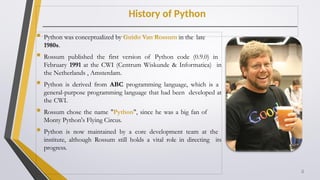
ī‚§ Python was conceptualized by Guido Van Rossum in the late
1980s.
ī‚§ Rossum published the first version of Python code (0.9.0) in
February 1991 at the CWI (Centrum Wiskunde & Informatica) in
the Netherlands , Amsterdam.
ī‚§ Python is derived from ABC programming language, which is a
general-purpose programming language that had been developed at
the CWI.
ī‚§ Rossum chose the name "Python", since he was a big fan of
Monty Python's Flying Circus.
ī‚§ Python is now maintained by a core development team at the
institute, although Rossum still holds a vital role in directing its
progress.
4
What is Scripting Language?
ī‚§ A scripting language is a “wrapper” language that integrates OS functions.
ī‚§ The interpreter is a layer of software logic between your code and the computer hardware
on your machine.
Wiki Says:
ī‚§ The “program” has an executable form that the computer can use directly to execute the
instructions.
ī‚§ The same program in its human-readable source code form, from which executable
programs are derived (e.g., compiled)
ī‚§ Python is scripting language, fast and dynamic.
ī‚§ Python is called ‘scripting language’ because of it’s scalable interpreter, but actually it is much
more than that
5
What is Python?
Python is a high-level programming language which is:
ī‚§ Interpreted: Python is processed at runtime by the interpreter.
ī‚§ Interactive: You can use a Python prompt and interact with the interpreter
directly to write your programs.
ī‚§ Object-Oriented: Python supports Object-Oriented technique of programming.
ī‚§ Beginner’s Language: Python is a great language for the beginner-level
programmers and supports the development of a wide range of applications.
6
Interpreters Vs Compilers
ī‚§ The first thing that is important to understand about Python is that it is an interpreted language.
ī‚§ There are two sorts of programming languages: interpreted ones and compiled ones. A compiled language
is what you are probably used to if you have done any programming in the past.
ī‚§ The process for a compiled language is as follows:
â€ĸ Create source file using text edit
â€ĸ Use compiler to syntax check and convert source file into binary .
â€ĸ Use linker to turn binary files into executable format.
â€ĸ Run the resulting executable format file in the operating system.
ī‚§ The biggest difference between interpreted code and compiled code is that an interpreted application
need not be “complete.”
ī‚§ You can test it in bits and pieces until you are satisfied with the results and put them all together later
for the end user to use.
7
Python Features
ī‚§ Easy to learn, easy to read and easy to maintain.
ī‚§ Portable: It can run on various hardware platforms and has the same
interface on all platforms.
ī‚§ Extendable: You can add low-level modules to the Python interpreter.
ī‚§ Scalable: Python provides a good structure and support for large programs.
ī‚§ Python has support for an interactive mode of testing and debugging.
ī‚§ Python has a broad standard library cross-platform.
ī‚§ Everything in Python is an object: variables, functions, even code. Every
object has an ID, a type, and a value.
8
More Features ...
ī‚§ Python provides interfaces to all major commercial databases.
ī‚§ Python supports functional and structured programming methods as
well as OOP.
ī‚§ Python provides very high-level dynamic data types and supports
dynamic type checking.
ī‚§ Python supports GUI applications
ī‚§ Python supports automatic garbage collection.
ī‚§ Python can be easily integrated with C, C++, and Java.
9
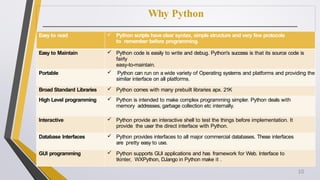
Why Python
Easy to read īƒŧ Python scripts have clear syntax, simple structure and very few protocols
to remember before programming.
Easy to Maintain īƒŧ Python code is easily to write and debug. Python's success is that its source code is
fairly
easy-to-maintain.
Portable īƒŧ Python can run on a wide variety of Operating systems and platforms and providing the
similar interface on all platforms.
Broad Standard Libraries īƒŧ Python comes with many prebuilt libraries apx. 21K
High Level programming īƒŧ Python is intended to make complex programming simpler. Python deals with
memory addresses, garbage collection etc internally.
Interactive īƒŧ Python provide an interactive shell to test the things before implementation. It
provide the user the direct interface with Python.
Database Interfaces īƒŧ Python provides interfaces to all major commercial databases. These interfaces
are pretty easy to use.
GUI programming īƒŧ Python supports GUI applications and has framework for Web. Interface to
tkinter, WXPython, DJango in Python make it .
10
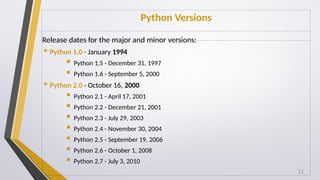
Python Versions
Release dates for the major and minor versions:
ī‚ĒPython 1.0 - January 1994
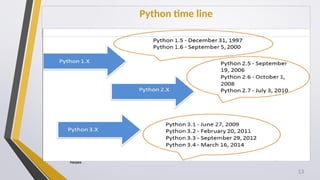
ī‚§ Python 1.5 - December 31, 1997
ī‚§ Python 1.6 - September 5, 2000
ī‚ĒPython 2.0 - October 16, 2000
ī‚§ Python 2.1 - April 17, 2001
ī‚§ Python 2.2 - December 21, 2001
ī‚§ Python 2.3 - July 29, 2003
ī‚§ Python 2.4 - November 30, 2004
ī‚§ Python 2.5 - September 19, 2006
ī‚§ Python 2.6 - October 1, 2008
ī‚§ Python 2.7 - July 3, 2010
11
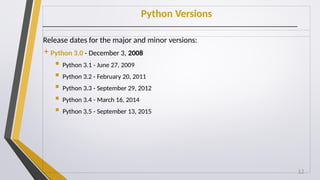
Python Versions
Release dates for the major and minor versions:
ī‚ĒPython 3.0 - December 3, 2008
ī‚§ Python 3.1 - June 27, 2009
ī‚§ Python 3.2 - February 20, 2011
ī‚§ Python 3.3 - September 29, 2012
ī‚§ Python 3.4 - March 16, 2014
ī‚§ Python 3.5 - September 13, 2015
12
By Ripal
Ranpara
Python time line
13
Key Changes in Python 3.0
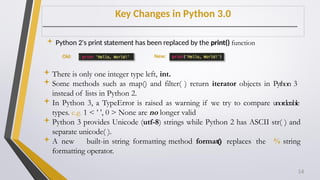
ī‚Ē Python 2's print statement has been replaced by the print() function
ī‚ĒThere is only one integer type left, int.
ī‚ĒSome methods such as map() and filter( ) return iterator objects in Python 3
instead of lists in Python 2.
ī‚ĒIn Python 3, a TypeError is raised as warning if we try to compare unorderable
types. e.g. 1 < ’ ', 0 > None are no longer valid
ī‚ĒPython 3 provides Unicode (utf-8) strings while Python 2 has ASCII str( ) and
separate unicode( ).
ī‚ĒA new built-in string formatting method format() replaces the % string
formatting operator.
Old: New:
14
Key Changes in Python 3.0
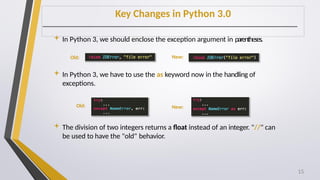
ī‚Ē In Python 3, we should enclose the exception argument in parentheses.
ī‚Ē In Python 3, we have to use the as keyword now in the handling of
exceptions.
ī‚Ē The division of two integers returns a float instead of an integer. "//" can
be used to have the "old" behavior.
Old:
Old: New:
New:
15
Python Useful Tools
īļ Python IDEs
ī‚§ PyCharm
ī‚§ Vim
ī‚§ Eclipse with PyDev
ī‚§ Sublime Text
ī‚§ Emacs
ī‚§ Komodo Edit
16
Python Useful Tools
ī‚§ Python Web Frameworks
ī‚§ Django
ī‚§ Flask
ī‚§ Pylons
ī‚§ Pyramid
ī‚§ TurboGears
ī‚§ Web2py
17
Organizations Use Python
ī‚§ Web Development :Google, Yahoo
ī‚§ Games :Battlefield 2, Crystal Space
ī‚§ Graphics :Walt Disney Feature Animation, Blender 3D
ī‚§ Science :National Weather Service, NASA, Applied Maths
ī‚§ Software Development :Nokia, Red Hat, IBM
ī‚§ Education :University of California-Irvine, SchoolTool
ī‚§ Government :The USA Central Intelligence Agency (CIA)
18
Chapter - 1.pptx introduction to python programming

  • 1.
    Introduction to PythonPrograming By: Mikiale T. 1
  • 2.
  • 3.
  • 4.
    History of Python ī‚§Python was conceptualized by Guido Van Rossum in the late 1980s. ī‚§ Rossum published the first version of Python code (0.9.0) in February 1991 at the CWI (Centrum Wiskunde & Informatica) in the Netherlands , Amsterdam. ī‚§ Python is derived from ABC programming language, which is a general-purpose programming language that had been developed at the CWI. ī‚§ Rossum chose the name "Python", since he was a big fan of Monty Python's Flying Circus. ī‚§ Python is now maintained by a core development team at the institute, although Rossum still holds a vital role in directing its progress. 4
  • 5.
    What is ScriptingLanguage? ī‚§ A scripting language is a “wrapper” language that integrates OS functions. ī‚§ The interpreter is a layer of software logic between your code and the computer hardware on your machine. Wiki Says: ī‚§ The “program” has an executable form that the computer can use directly to execute the instructions. ī‚§ The same program in its human-readable source code form, from which executable programs are derived (e.g., compiled) ī‚§ Python is scripting language, fast and dynamic. ī‚§ Python is called ‘scripting language’ because of it’s scalable interpreter, but actually it is much more than that 5
  • 6.
    What is Python? Pythonis a high-level programming language which is: ī‚§ Interpreted: Python is processed at runtime by the interpreter. ī‚§ Interactive: You can use a Python prompt and interact with the interpreter directly to write your programs. ī‚§ Object-Oriented: Python supports Object-Oriented technique of programming. ī‚§ Beginner’s Language: Python is a great language for the beginner-level programmers and supports the development of a wide range of applications. 6
  • 7.
    Interpreters Vs Compilers ī‚§The first thing that is important to understand about Python is that it is an interpreted language. ī‚§ There are two sorts of programming languages: interpreted ones and compiled ones. A compiled language is what you are probably used to if you have done any programming in the past. ī‚§ The process for a compiled language is as follows: â€ĸ Create source file using text edit â€ĸ Use compiler to syntax check and convert source file into binary . â€ĸ Use linker to turn binary files into executable format. â€ĸ Run the resulting executable format file in the operating system. ī‚§ The biggest difference between interpreted code and compiled code is that an interpreted application need not be “complete.” ī‚§ You can test it in bits and pieces until you are satisfied with the results and put them all together later for the end user to use. 7
  • 8.
    Python Features ī‚§ Easyto learn, easy to read and easy to maintain. ī‚§ Portable: It can run on various hardware platforms and has the same interface on all platforms. ī‚§ Extendable: You can add low-level modules to the Python interpreter. ī‚§ Scalable: Python provides a good structure and support for large programs. ī‚§ Python has support for an interactive mode of testing and debugging. ī‚§ Python has a broad standard library cross-platform. ī‚§ Everything in Python is an object: variables, functions, even code. Every object has an ID, a type, and a value. 8
  • 9.
    More Features ... ī‚§Python provides interfaces to all major commercial databases. ī‚§ Python supports functional and structured programming methods as well as OOP. ī‚§ Python provides very high-level dynamic data types and supports dynamic type checking. ī‚§ Python supports GUI applications ī‚§ Python supports automatic garbage collection. ī‚§ Python can be easily integrated with C, C++, and Java. 9
  • 10.
    Why Python Easy toread īƒŧ Python scripts have clear syntax, simple structure and very few protocols to remember before programming. Easy to Maintain īƒŧ Python code is easily to write and debug. Python's success is that its source code is fairly easy-to-maintain. Portable īƒŧ Python can run on a wide variety of Operating systems and platforms and providing the similar interface on all platforms. Broad Standard Libraries īƒŧ Python comes with many prebuilt libraries apx. 21K High Level programming īƒŧ Python is intended to make complex programming simpler. Python deals with memory addresses, garbage collection etc internally. Interactive īƒŧ Python provide an interactive shell to test the things before implementation. It provide the user the direct interface with Python. Database Interfaces īƒŧ Python provides interfaces to all major commercial databases. These interfaces are pretty easy to use. GUI programming īƒŧ Python supports GUI applications and has framework for Web. Interface to tkinter, WXPython, DJango in Python make it . 10
  • 11.
    Python Versions Release datesfor the major and minor versions: ī‚ĒPython 1.0 - January 1994 ī‚§ Python 1.5 - December 31, 1997 ī‚§ Python 1.6 - September 5, 2000 ī‚ĒPython 2.0 - October 16, 2000 ī‚§ Python 2.1 - April 17, 2001 ī‚§ Python 2.2 - December 21, 2001 ī‚§ Python 2.3 - July 29, 2003 ī‚§ Python 2.4 - November 30, 2004 ī‚§ Python 2.5 - September 19, 2006 ī‚§ Python 2.6 - October 1, 2008 ī‚§ Python 2.7 - July 3, 2010 11
  • 12.
    Python Versions Release datesfor the major and minor versions: ī‚ĒPython 3.0 - December 3, 2008 ī‚§ Python 3.1 - June 27, 2009 ī‚§ Python 3.2 - February 20, 2011 ī‚§ Python 3.3 - September 29, 2012 ī‚§ Python 3.4 - March 16, 2014 ī‚§ Python 3.5 - September 13, 2015 12
  • 13.
  • 14.
    Key Changes inPython 3.0 ī‚Ē Python 2's print statement has been replaced by the print() function ī‚ĒThere is only one integer type left, int. ī‚ĒSome methods such as map() and filter( ) return iterator objects in Python 3 instead of lists in Python 2. ī‚ĒIn Python 3, a TypeError is raised as warning if we try to compare unorderable types. e.g. 1 < ’ ', 0 > None are no longer valid ī‚ĒPython 3 provides Unicode (utf-8) strings while Python 2 has ASCII str( ) and separate unicode( ). ī‚ĒA new built-in string formatting method format() replaces the % string formatting operator. Old: New: 14
  • 15.
    Key Changes inPython 3.0 ī‚Ē In Python 3, we should enclose the exception argument in parentheses. ī‚Ē In Python 3, we have to use the as keyword now in the handling of exceptions. ī‚Ē The division of two integers returns a float instead of an integer. "//" can be used to have the "old" behavior. Old: Old: New: New: 15
  • 16.
    Python Useful Tools īļPython IDEs ī‚§ PyCharm ī‚§ Vim ī‚§ Eclipse with PyDev ī‚§ Sublime Text ī‚§ Emacs ī‚§ Komodo Edit 16
  • 17.
    Python Useful Tools ī‚§Python Web Frameworks ī‚§ Django ī‚§ Flask ī‚§ Pylons ī‚§ Pyramid ī‚§ TurboGears ī‚§ Web2py 17
  • 18.
    Organizations Use Python ī‚§Web Development :Google, Yahoo ī‚§ Games :Battlefield 2, Crystal Space ī‚§ Graphics :Walt Disney Feature Animation, Blender 3D ī‚§ Science :National Weather Service, NASA, Applied Maths ī‚§ Software Development :Nokia, Red Hat, IBM ī‚§ Education :University of California-Irvine, SchoolTool ī‚§ Government :The USA Central Intelligence Agency (CIA) 18