Introduction:
Every offering ofa firm and every transaction that firm has with every
customer has a price. That price may be the result of a lengthy
deliberation that includes:
Market research
Competitive dynamics
Highly researched algorithms
Intense customer negotiations
Torrid management discussions
3.
That price impactsmany functions within the firm as well as
customers and competitive dynamics outside of the firm. As such,
sales, marketing, finance, operations, and even legal will want to have a
say in pricing decisions. Somehow, people are engaged in the decision-
making. Consider the following questions:
How should prices be determined?
What should inform pricing decisions?
Who should be engaged in those pricing decisions?
4.
1. Pricing isnot just one thing. It is not just a decision done before
launching a new offering, a number that is estimated in conjunction with
a contract or the result of a client negotiation. Nor is pricing a single
technique, method of analysis, research effort, or piece of information to
gather. Pricing isn’t an event. It is a continual process.
2. Pricing cannot be done in isolation. The decisions in pricing affect
every part of the organization. They are integral to every healthy
customer relationship. They influence the competitive engagement of
the firm with its competitors.
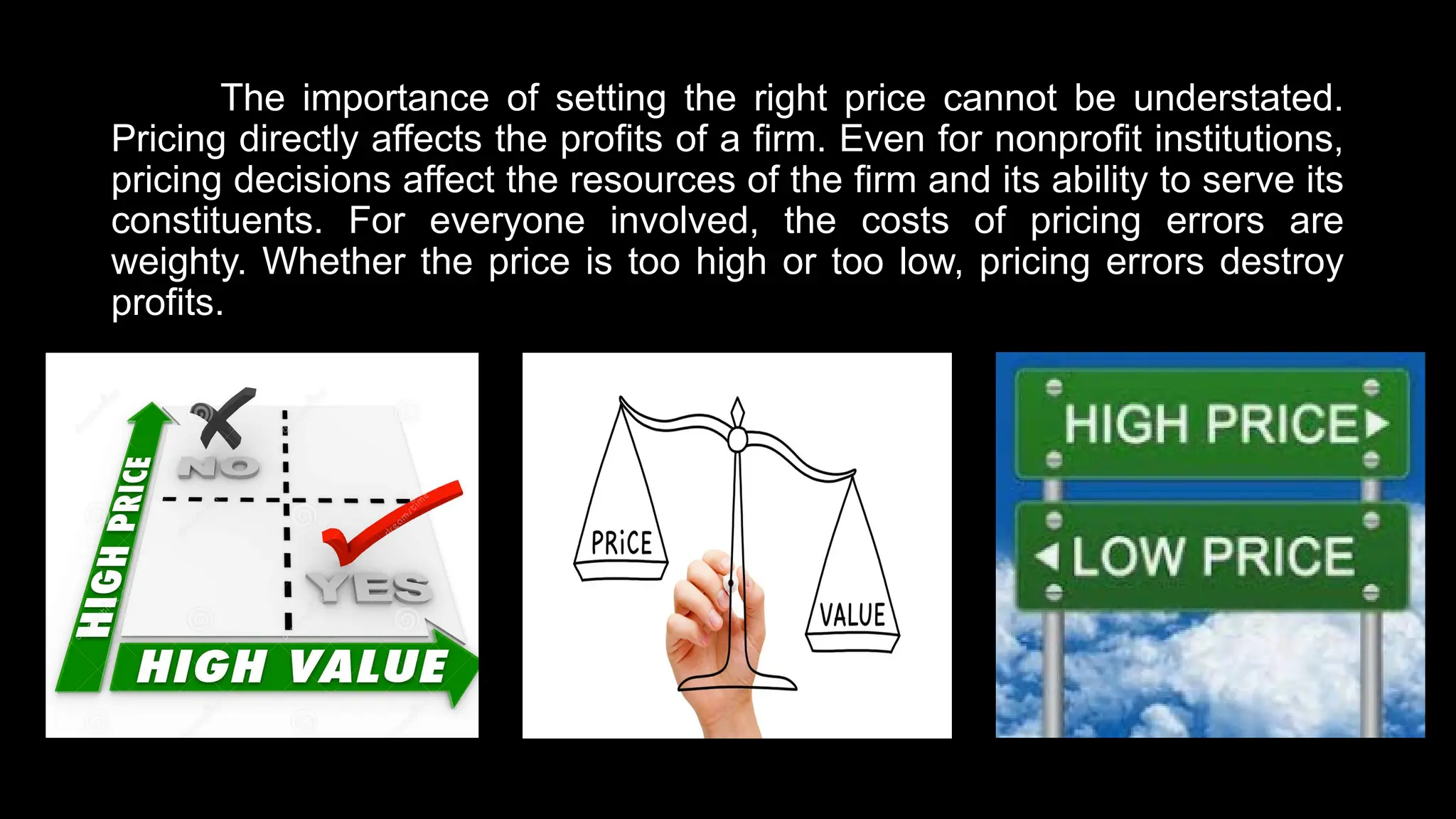
The importance ofsetting the right price cannot be understated.
Pricing directly affects the profits of a firm. Even for nonprofit institutions,
pricing decisions affect the resources of the firm and its ability to serve its
constituents. For everyone involved, the costs of pricing errors are
weighty. Whether the price is too high or too low, pricing errors destroy
profits.
•Value-based pricing itselfforms the core culture surrounding the use of the
Value-Based Pricing Framework. In value-based pricing, firms seek to set
prices according to the value customers place on the offering in comparison to
its alternative. Using the nearest competing alternative as a starting point, an
offering’s differential benefits will either add or subtract value in the minds of
customers. In value-based pricing, the prices of offerings are set in relationship
to the price of the nearest competing alternatives adjusted for the offering’s
value differential.
•When firms adapt value-based pricing, they often adopt its corollary: value
engineering. In value engineering, attributes and features are added and
subtracted to offerings according to the willingness-to-pay of customers for the
benefits those attributes and features deliver. If an attribute or feature does not
deliver benefits to the target customers more than the costs, those attributes
and features are removed. If they do, they are added. Though simple enough
to state, value engineering implies a process where innovation and pricing are
inherently connected.
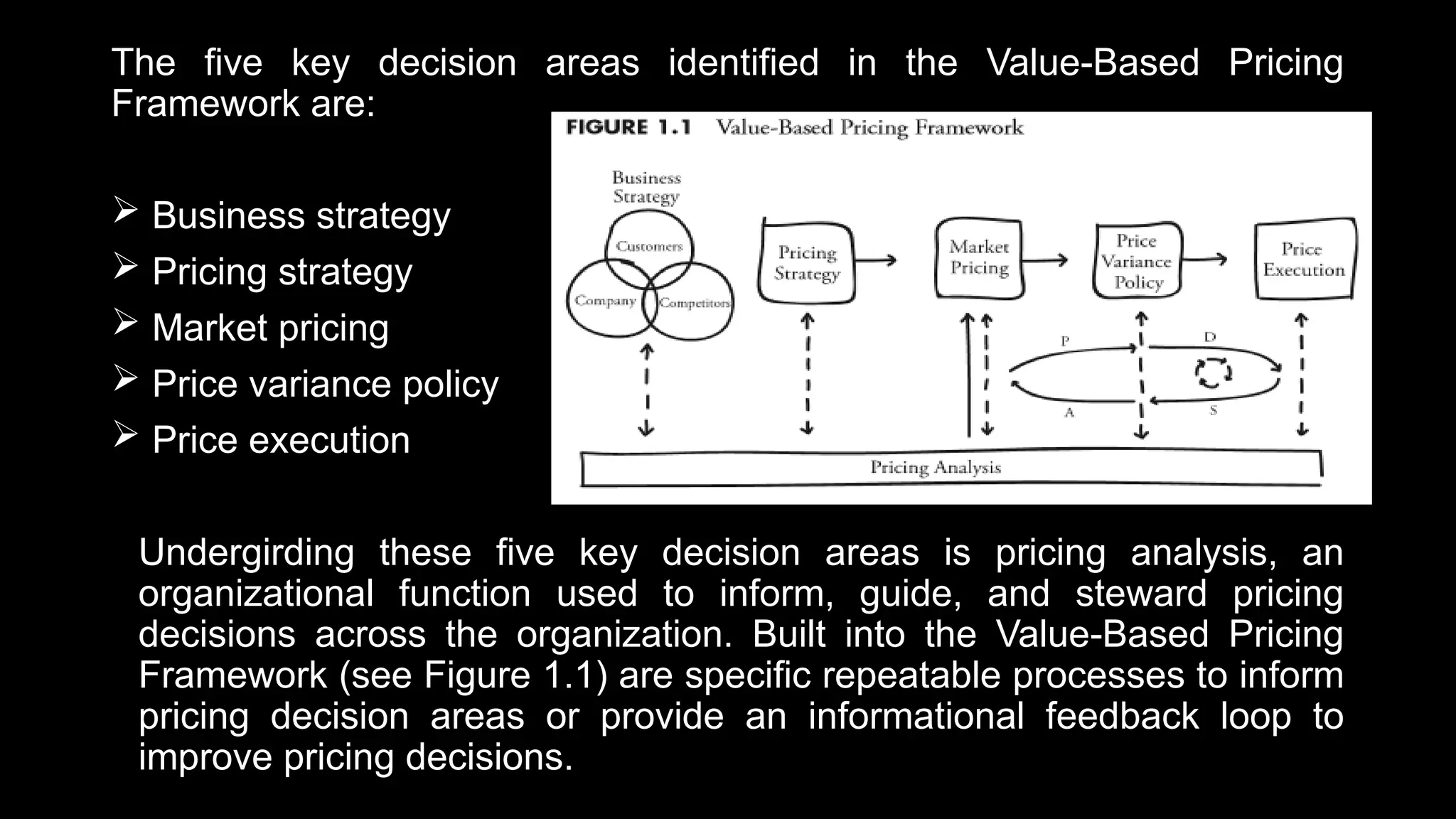
The five keydecision areas identified in the Value-Based Pricing
Framework are:
Business strategy
Pricing strategy
Market pricing
Price variance policy
Price execution
Undergirding these five key decision areas is pricing analysis, an
organizational function used to inform, guide, and steward pricing
decisions across the organization. Built into the Value-Based Pricing
Framework (see Figure 1.1) are specific repeatable processes to inform
pricing decision areas or provide an informational feedback loop to
improve pricing decisions.
11.
1. Business Strategy
Thefirst decision area within the Value-Based Pricing Framework,
comprises the choices the firm makes to differentiate itself from its competitors in a
way that results in serving its customers’ needs more profitably than competitors. It
includes the firm’s customer, competitive, and company strategies.
The firm’s customer strategy identifies the firm’s target market and market
segmentation schema. This target market selection may result in the firm choosing
to target a specific segment of customers, which its competitors are less able to
serve as well.
A firm’s competitive strategy leverages its unique and inimitable resources to
deliver a competitive advantage in attracting its chosen target market profitably.
Its company strategy refers to the investment choices the firm makes to
differentiate itself from competitors and to develop future sources of competitive
advantage.
12.
2. Pricing strategy
Thesecond decision area within the Value-Based Pricing Framework, refers to the
way firms will manage prices. More specifically, a firm’s pricing strategy includes its price
positioning plan, price segmentation plan, competitive price reaction strategy, and its
pricing capability strategy. Each of these areas of a firm’s pricing strategy is determined
within the context of the firm’s business strategy at leading firms.
Price Positioning
Refers to the choice to price an offering at either a penetration, neutral, or skim position.
Penetration pricing implies holding prices low in comparison to competing alternatives
adjusted for the offering’s differential benefits to penetrate the market and grab market
share.
Skim pricing implies holding prices high in comparison to competing alternatives adjusted
for the offering’s different benefits and is often used as a new market entry plan.
Neutral pricing implies pricing in alignment with the offering’s competing alternatives after
adjusting for its differential benefits.
13.
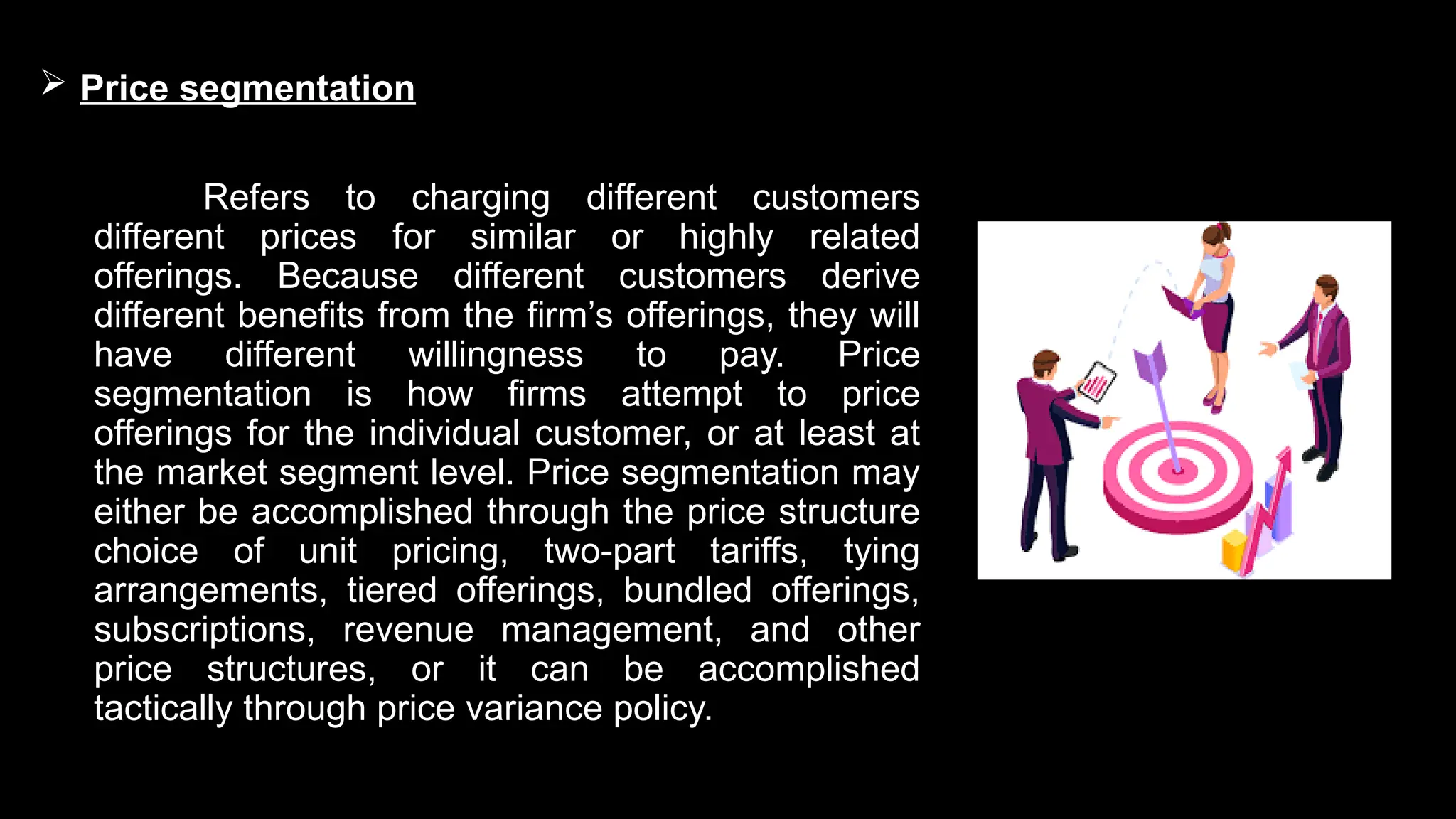
Price segmentation
Refersto charging different customers
different prices for similar or highly related
offerings. Because different customers derive
different benefits from the firm’s offerings, they will
have different willingness to pay. Price
segmentation is how firms attempt to price
offerings for the individual customer, or at least at
the market segment level. Price segmentation may
either be accomplished through the price structure
choice of unit pricing, two-part tariffs, tying
arrangements, tiered offerings, bundled offerings,
subscriptions, revenue management, and other
price structures, or it can be accomplished
tactically through price variance policy.
14.
Competitive PriceReaction Strategy
Determines how the firm will react to price changes within the
market. At times, firms should change their prices when a new
competitor enters the market or existing competitors change their prices.
At other times, firms should ignore competitive price moves. The optimal
competitive price reaction strategy will depend on the firm’s pricing power
and level of competitive advantage. If the firm has both competitive
advantage and pricing power, the firm can ignore a competitor’s price
aggression or perhaps even attack a competitor’s position. If the firm
lacks both, the firm will have to accommodate its competitor’s price
aggression by either lowering prices or ceding market share, or both.
Between these two extremes, firms have been found to be able to either
mitigate price competition by relying on the strength of the differential
benefits or defend market share with managed price reductions.
15.
Pricing Capability
Definesthe firm’s ability to manage
pricing decisions across the company.
The people, processes, and tools
engaged in managing pricing are all
strategic pricing issues. While the Value-
Based Pricing Framework provides a
template for making these decisions, it is
not expected that this template will be
implemented in the same way in every
firm. Rather, it is intended to provide
guidance to executives in determining
which pricing capabilities need to be
improved and how those improvements
would take form.
16.
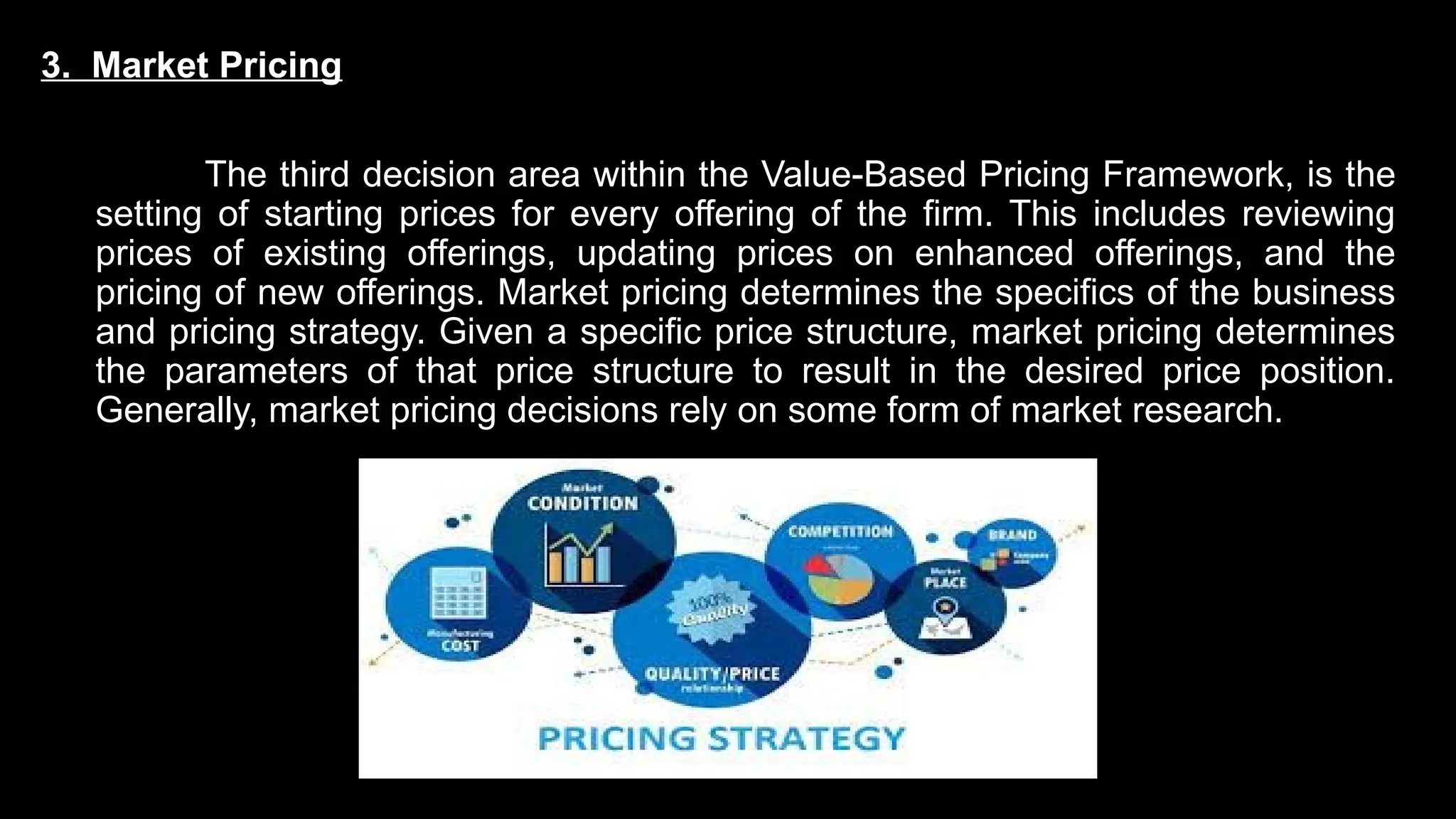
3. Market Pricing
Thethird decision area within the Value-Based Pricing Framework, is the
setting of starting prices for every offering of the firm. This includes reviewing
prices of existing offerings, updating prices on enhanced offerings, and the
pricing of new offerings. Market pricing determines the specifics of the business
and pricing strategy. Given a specific price structure, market pricing determines
the parameters of that price structure to result in the desired price position.
Generally, market pricing decisions rely on some form of market research.
17.
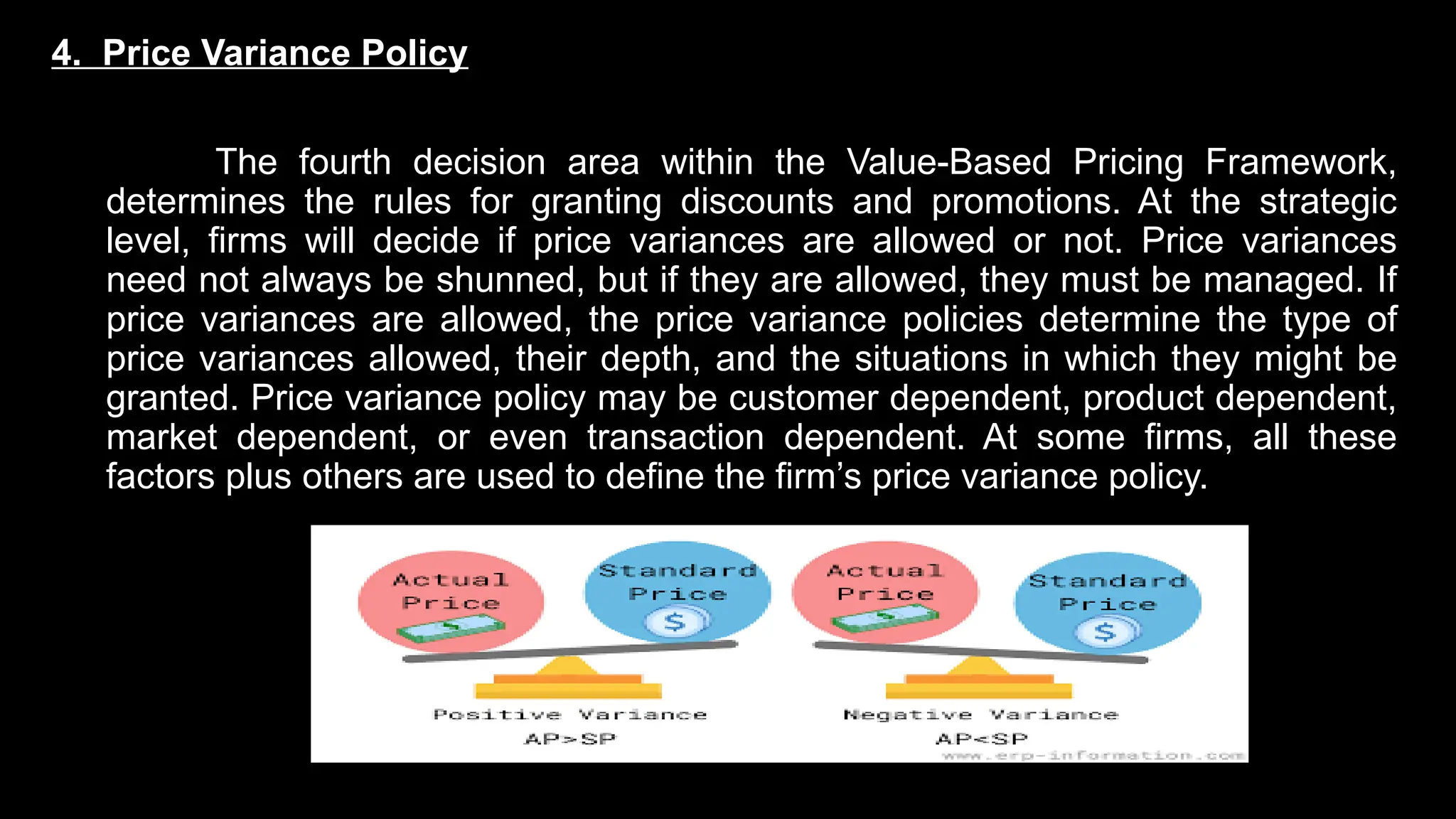
4. Price VariancePolicy
The fourth decision area within the Value-Based Pricing Framework,
determines the rules for granting discounts and promotions. At the strategic
level, firms will decide if price variances are allowed or not. Price variances
need not always be shunned, but if they are allowed, they must be managed. If
price variances are allowed, the price variance policies determine the type of
price variances allowed, their depth, and the situations in which they might be
granted. Price variance policy may be customer dependent, product dependent,
market dependent, or even transaction dependent. At some firms, all these
factors plus others are used to define the firm’s price variance policy.
18.
5. Price Execution
Thefifth decision area within the Value-Based Pricing Framework, applies
the correct prices according to the rules developed by strategic and managerial
decisions and then collects those prices from customers in a timely manner, all
with minimal errors. Because price execution is a high-frequency rule-based
decision area, much progress has been made in applying information technology
to improve the efficiency and effectiveness of this decision area. Yet, human
decisions still arise in price execution. Prices that need to be adjusted may be
reverted to the price variance policy area. Price execution that is inefficient or
ineffective may necessitate improvement efforts.
Supporting each of these five decision areas within the Value-Based Pricing
Framework is pricing analysis. Each of these decision areas is informed by some
form of analytics. While the type of analysis requirements will depend on the type
of pricing decision being made, the pricing function itself can be used to routinely
perform the required analytics and data gathering. While the pricing function may
now own pricing decisions, it can be used to meaningfully inform executive
decision-making and provide recommendations.
Three specific formsof analysis that can
be routinely executed are also identified within
the Value-Based Pricing Framework. Two of
them rely on the plan-do-study-adjust
continuous improvement process popularized
by W. Edwards Deming. The third form of
analysis that firms routinely execute is offering
innovation and pricing.
In the continuous improvement process,
executives decide and execute it in the do step,
study the results of that plan to identify whether
the results were caused by the plan or some
other exogenous factor, then adjust their
strategy going forward.
21.
Price VariancePolicy Continuous Improvement - firms review their decisions
in making price variance policy regarding the outcomes achieved in the price
execution area.
Market Pricing Continuous Improvement, firms review their market prices
considering their price variance policy and price execution.
Offering Innovation and Pricing, firms integrate pricing into their innovation
strategy to result in value-engineered offerings.
Across the phases of offering innovation, different techniques can be used to
determine theoretically whether an offering should be made or not. In the early
phases of offering innovation, models of the exchange value to customer, informed
by focus groups or executive interviews, can be used to estimate the price a new
offering would achieve in the market. As a new offering prepares to enter the
market, the uncertainty inherent in the earlier price estimates can be reduced
through either improving the qualitative research or conducting more sophisticated,
survey-based research such as conjoint analysis.
The marketing teamis engaged in pricing decisions as it is part of this
group’s core job responsibility to set offering, distribution, and communications
plans to capture their designated target market. Sales is engaged in pricing
decisions due to their direct interaction with customers and their responsibility to
capture customers within the determined pricing guidelines. Finance is engaged in
pricing decisions due to their knowledge of costs and their need to manage profit
expectations. The pricing function is called upon to coordinate the contributions of
these various roles, inform pricing decisions with solid analytics, and steward the
resulting plan through implementation.
The pricing function is made up of pricing professionals. They may report to
marketing, finance, sales, or some other department depending on the structure
and capabilities of the firm. Their role is consistently to shepherd and steward
pricing decisions. Because pricing decisions flow from business strategy to
execution, the pricing community will have both centralized and decentralized roles.
In staffing the pricing function, individuals are needed with both a strong
analytical bent and business acumen, for pricing is not just math, it is strategic.