Java Programming: From Problem Analysis to Program Design, 3e Chapter 12 Handling Exceptions and Events
Chapter Objectives Learn what an exception is See how a  try / catch  block is used to handle exceptions Become aware of the hierarchy of exception classes Learn about checked and unchecked exceptions
Chapter Objectives (continued) Learn how to handle exceptions within a program Discover how to throw and rethrow an exception Learn how to handle events in a program
Exception Definition: an occurrence of an undesirable situation that can be detected during program execution Examples Division by zero Trying to open an input file that does not exist An array index that goes out of bounds
Handling Exception within a Program Can use an  if  statement to handle an exception However, suppose that division by zero occurs in more than one place within the same block In this case, using  if   statements may not be the most effective way to handle the exception
Java’s Mechanism of Exception Handling When an exception occurs, an object of a particular exception  class   is created  Java provides a number of exception classes to effectively handle certain common exceptions such as division by zero, invalid input, and file not found  Division by zero is an arithmetic error and is handled by the  class   ArithmeticException
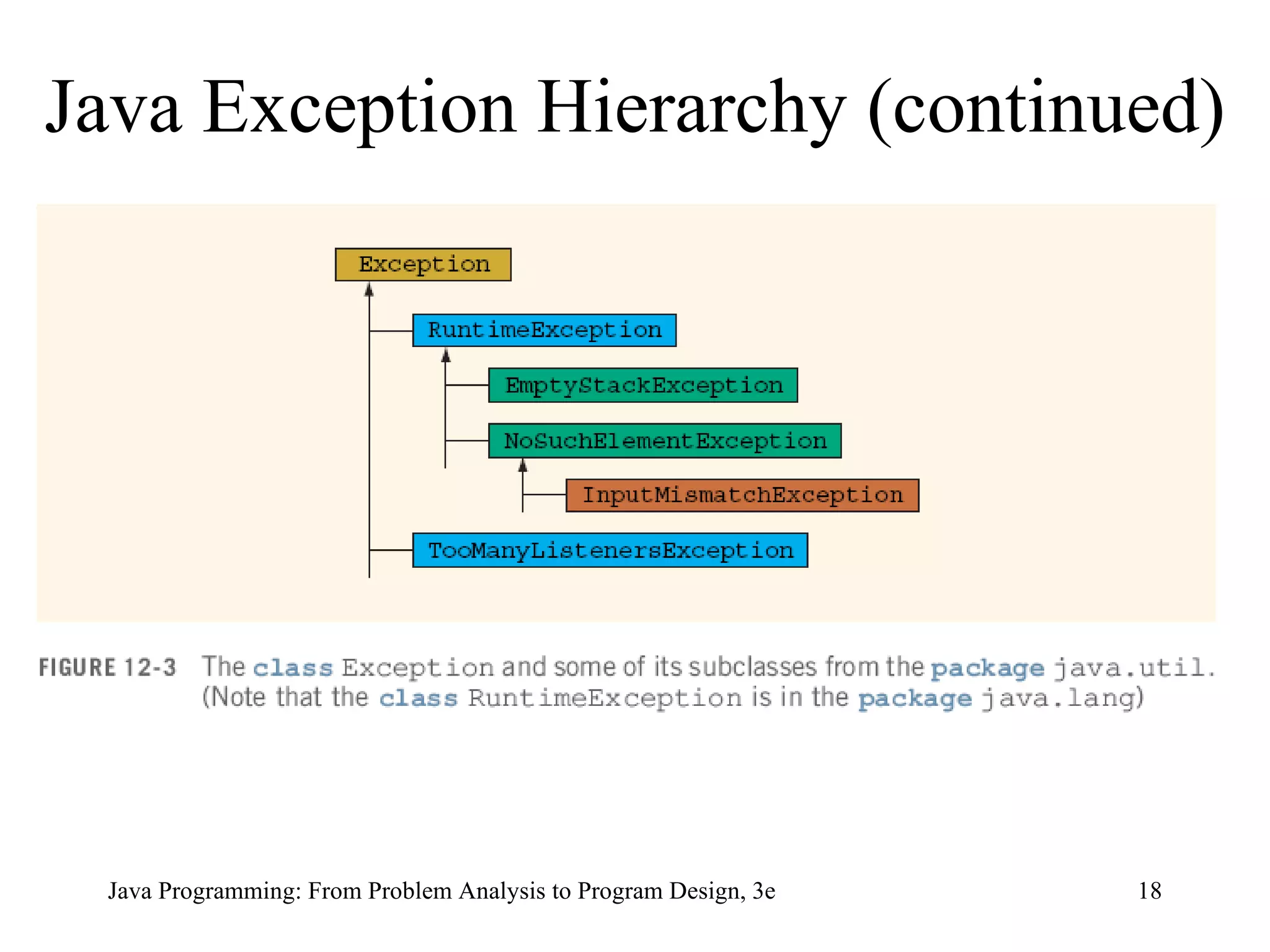
Java’s Mechanism of Exception Handling (continued) When a division by zero exception occurs, the program creates an object of the  class   ArithmeticException   When a  Scanner  object is used to input data into a program, any invalid input errors are handled using the  class   InputMismatchException   The  class   Exception  (directly or indirectly) is the superclass of all the exception classes in Java
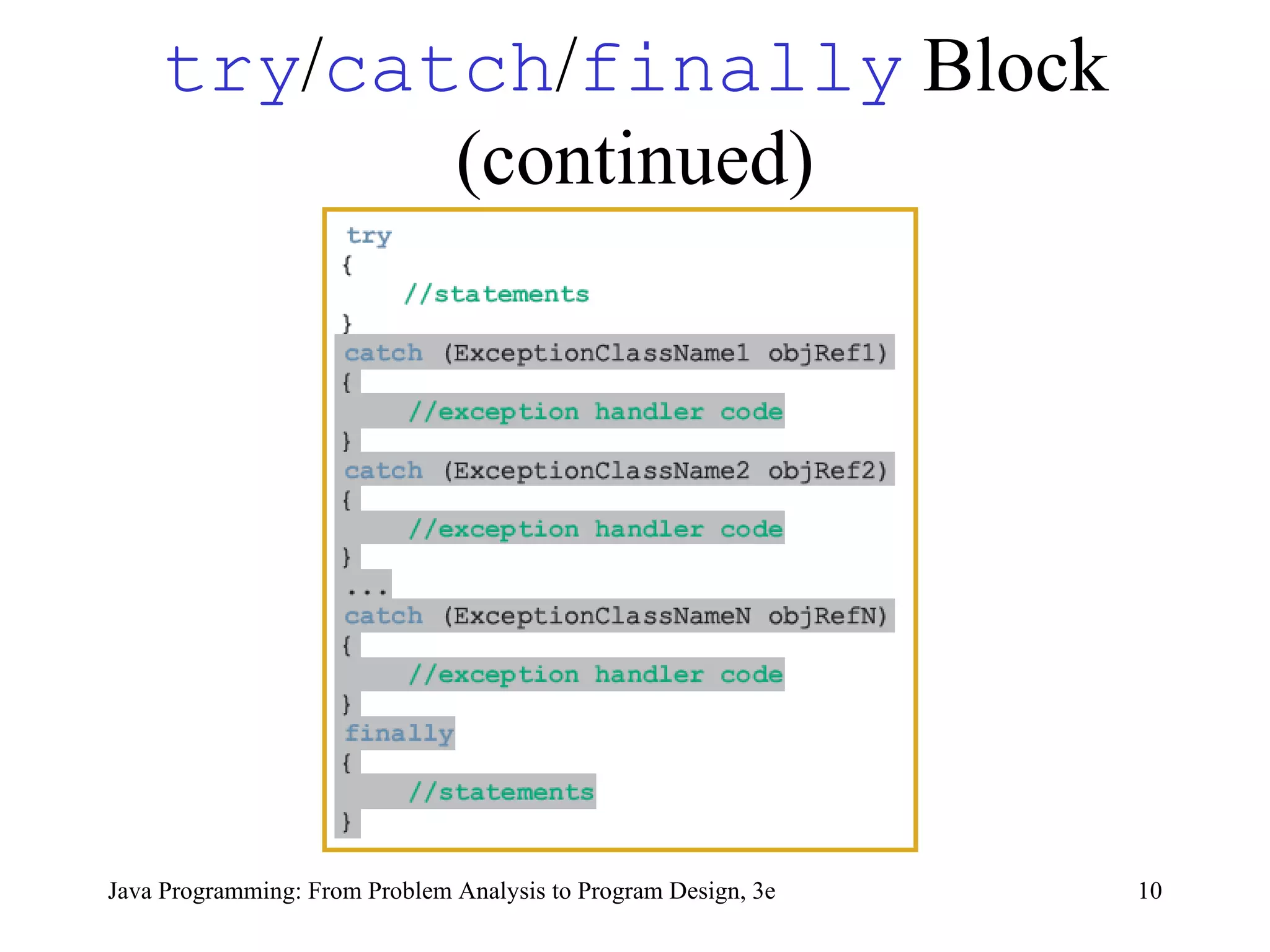
try / catch / finally  Block Statements that might generate an exception are placed in a  try   block The  try   block might also contain statements that should not be executed if an exception occurs The  try   block is followed by zero or more  catch   blocks A  catch   block specifies the type of exception it can catch and contains an exception handler
try / catch / finally  Block (continued) The last  catch   block may or may not be followed by a  finally   block  Any code contained in a  finally   block always executes, regardless of whether an exception occurs, except when the program exits early from a  try   block by calling the method  System.exit   If a  try   block has no  catch   block, then it  must  have the  finally   block
try / catch / finally  Block (continued)
try / catch / finally  Block (continued) If no exception is thrown in a  try   block, all  catch   blocks associated with the  try   block are ignored and program execution resumes after the last  catch   block If an exception is thrown in a  try   block, the remaining statements in the  try   block are ignored -  The program searches the  catch   blocks in the order in which they appear after the  try   block and looks for an appropriate exception handler
try / catch / finally  Block (continued) If the type of the thrown exception matches the parameter type in one of the  catch   blocks, the code of that  catch   block executes and the remaining  catch   blocks after this  catch   block are ignored If there is a  finally   block after the last  catch   block, the  finally   block executes regardless of whether an exception occurs
Order of  catch  Blocks The heading of a  catch   block specifies the type of exception it handles A  catch   block can catch either all exceptions of a specific type or all types of exceptions  A reference variable of a superclass type can point to an object of its subclass
Order of  catch  Blocks (continued) If in the heading of a  catch   block you declare an exception using the  class   Exception , then that  catch   block can catch all types of exceptions because the  class   Exception  is the superclass of all exception classes In a sequence of  catch   blocks following a  try   block, a  catch   block declaring an exception of a subclass type should be placed before  catch   blocks declaring exceptions of a superclass type
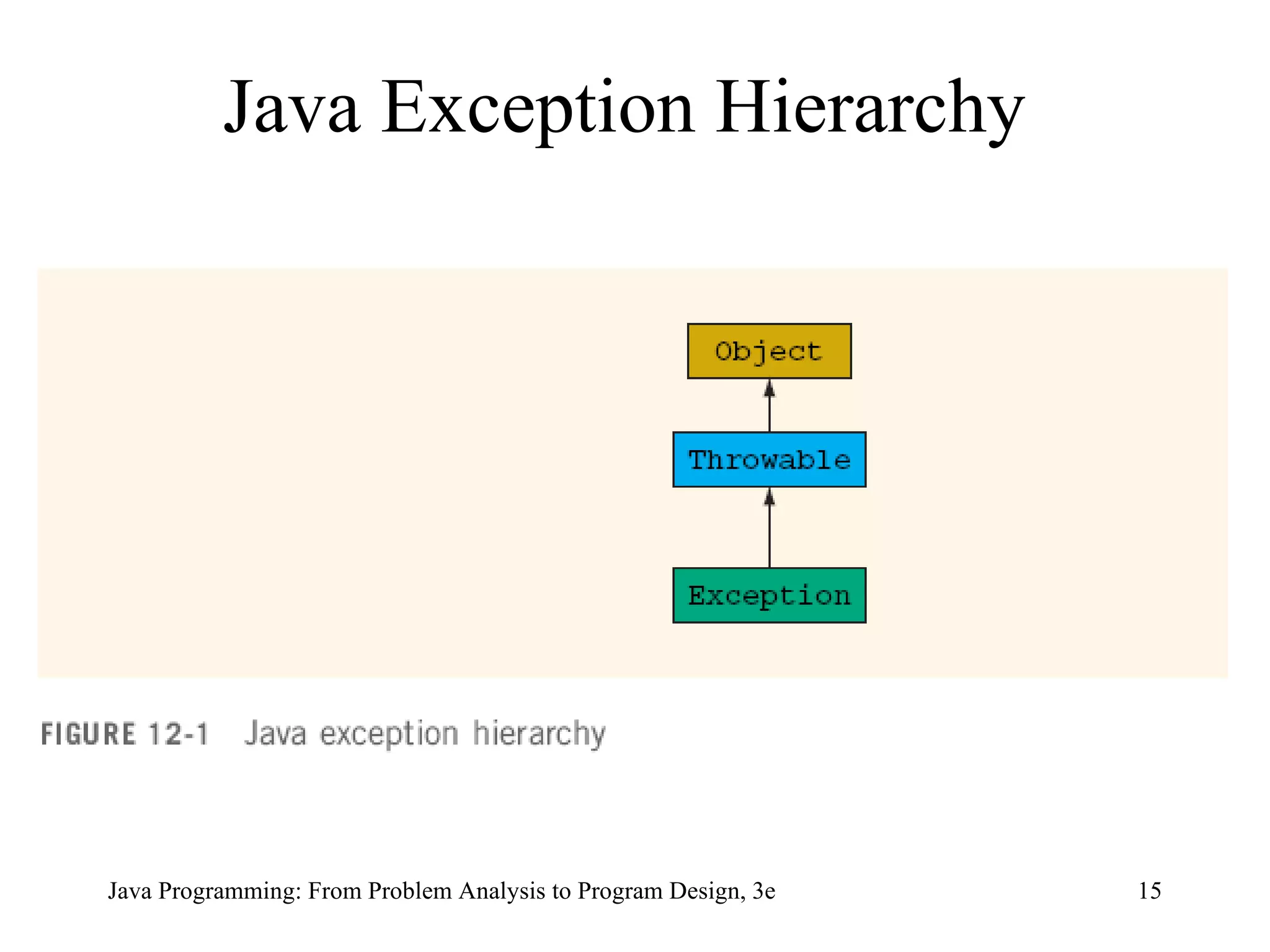
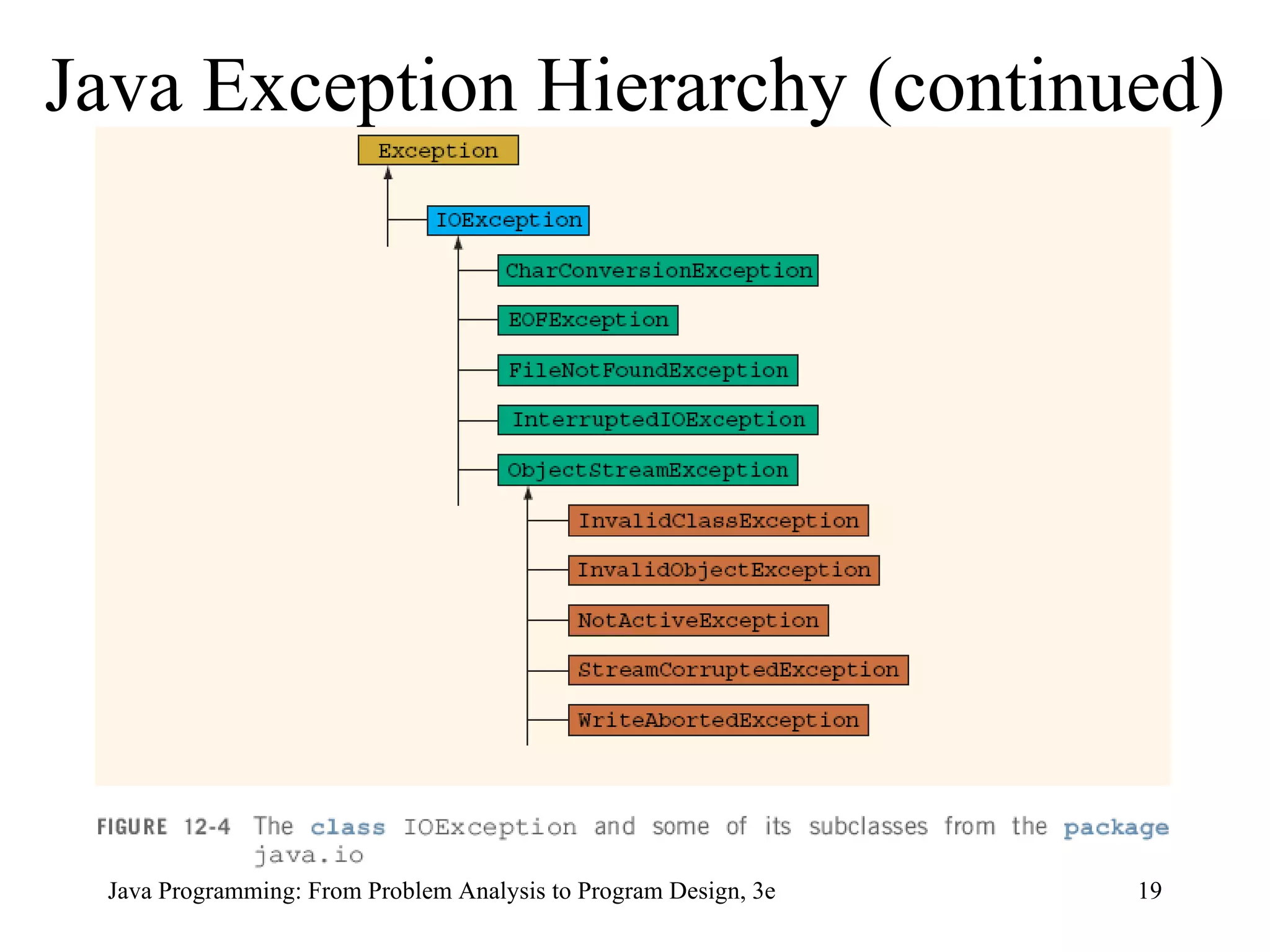
Java Exception Hierarchy
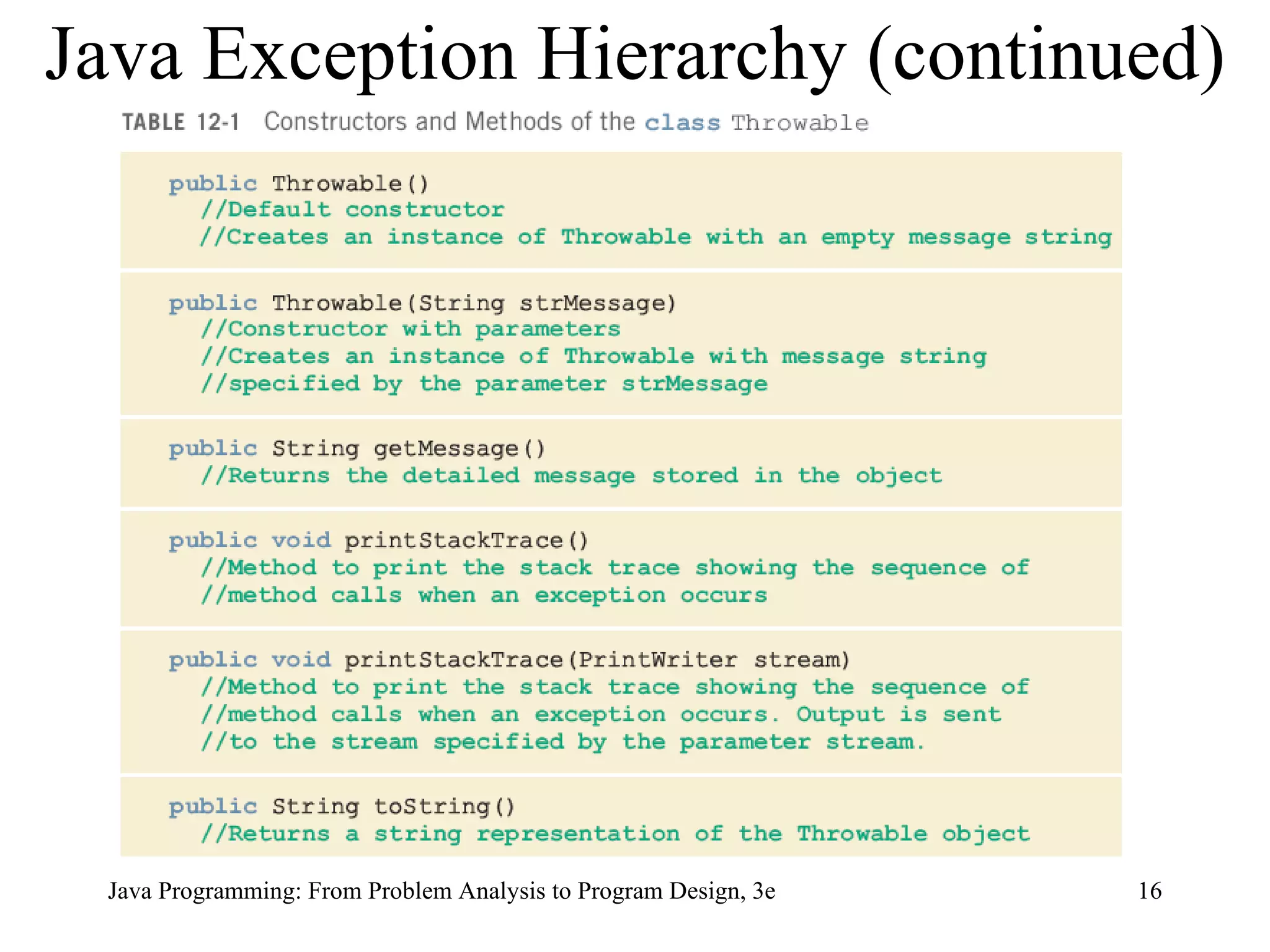
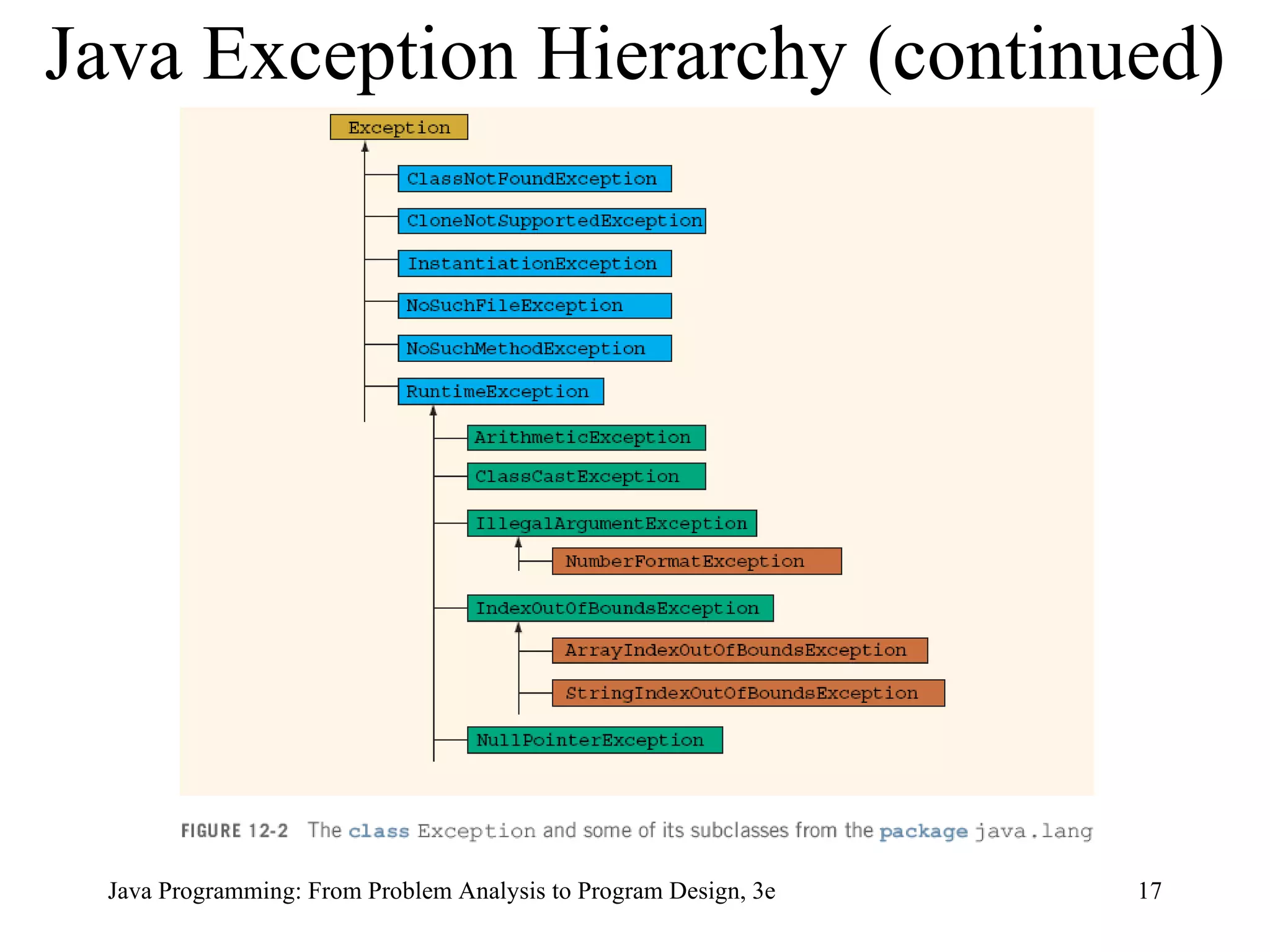
Java Exception Hierarchy (continued)
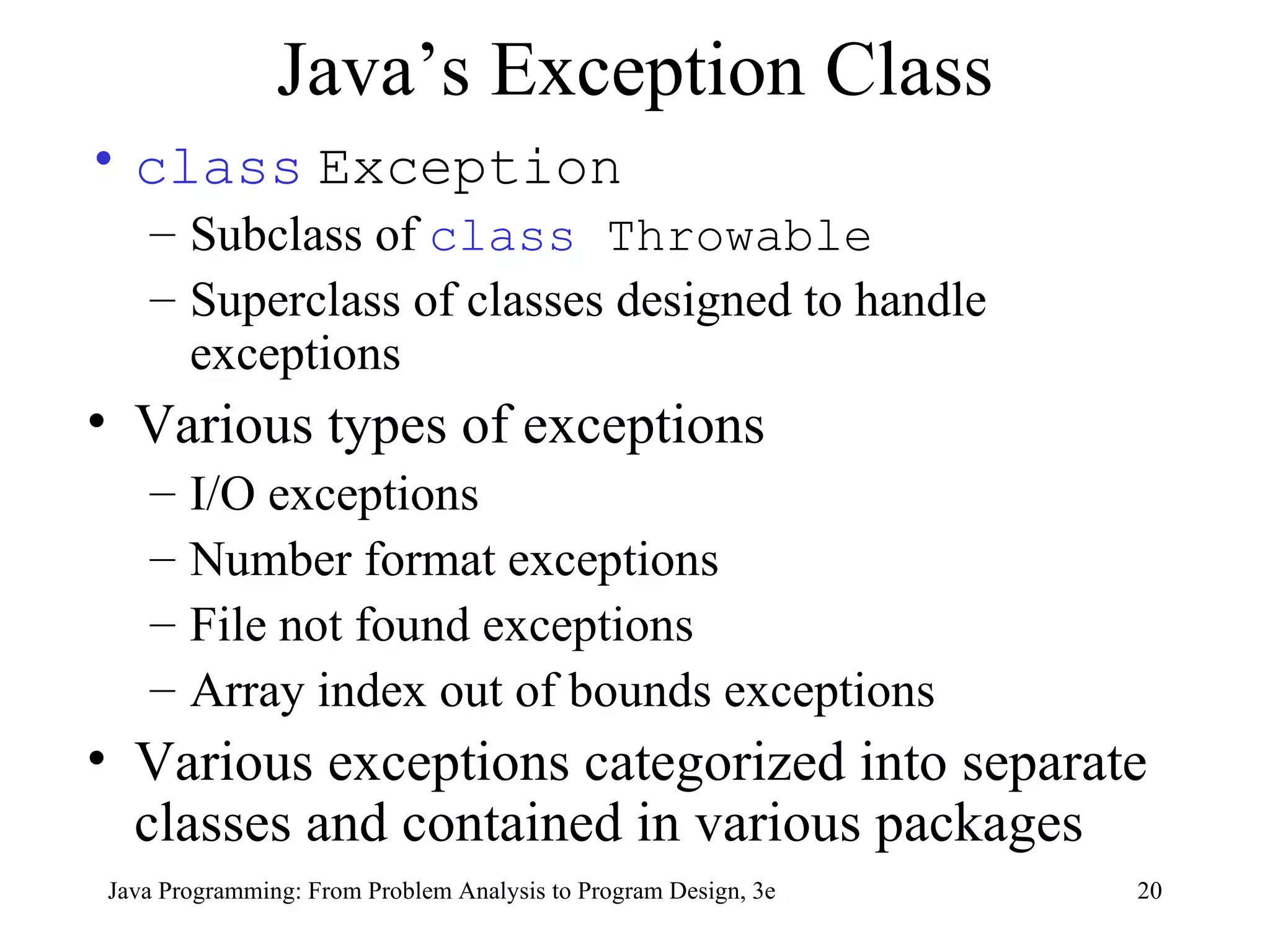
Java’s Exception Class class   Exception Subclass of  class  Throwable   Superclass of classes designed to handle exceptions Various types of exceptions I/O exceptions Number format exceptions File not found exceptions Array index out of bounds exceptions Various exceptions categorized into separate classes and contained in various packages
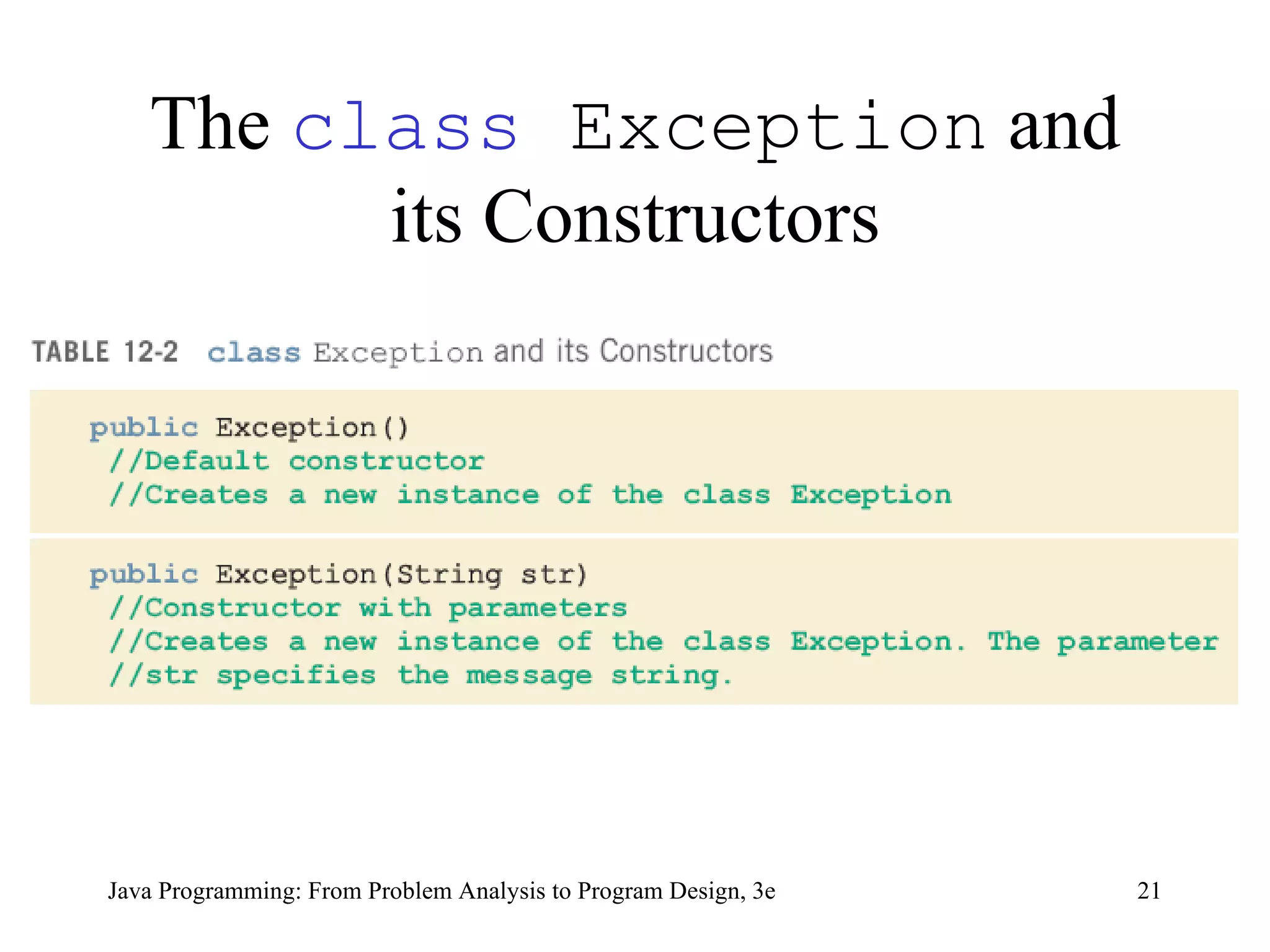
The  class  Exception  and its Constructors
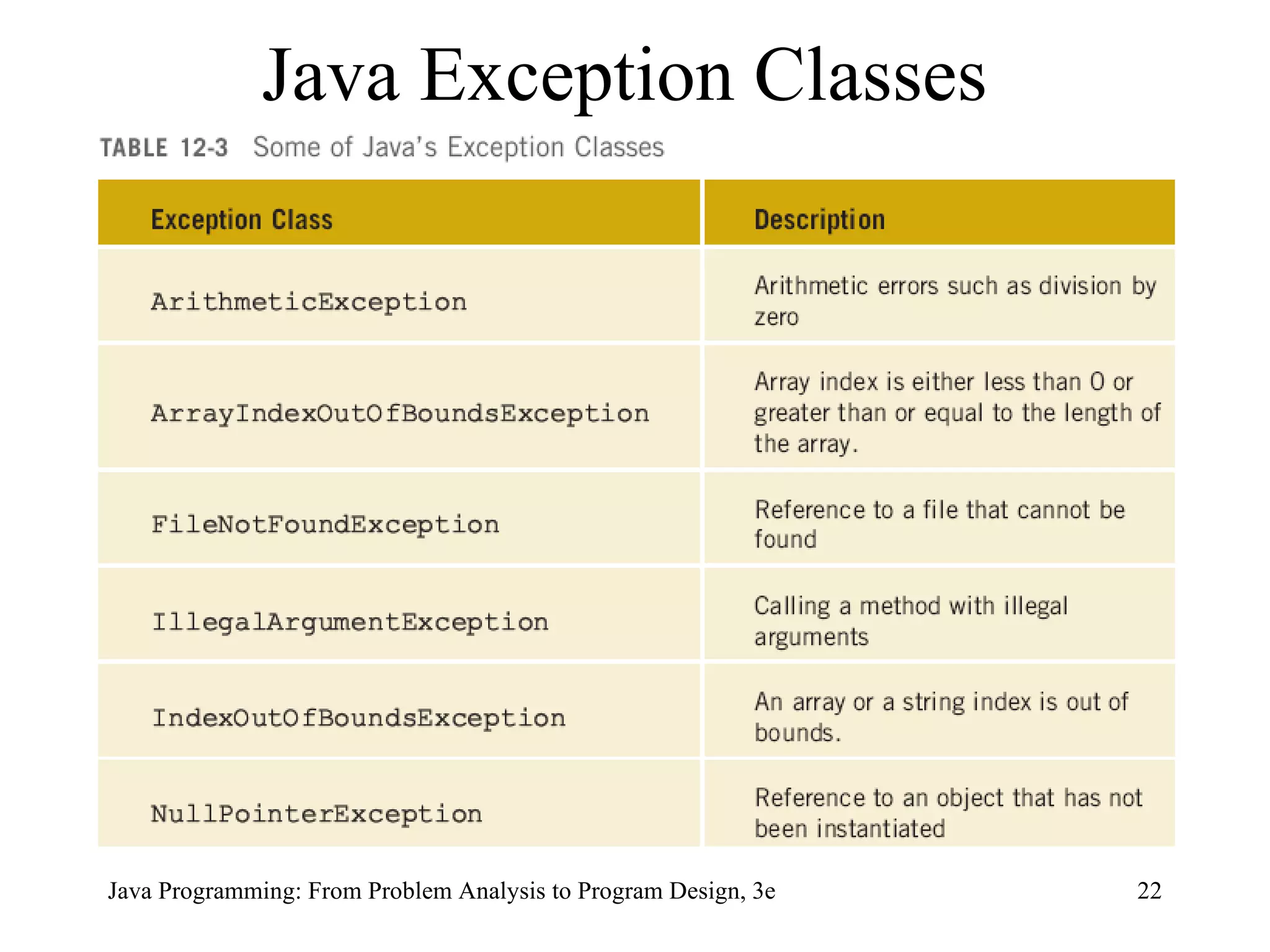
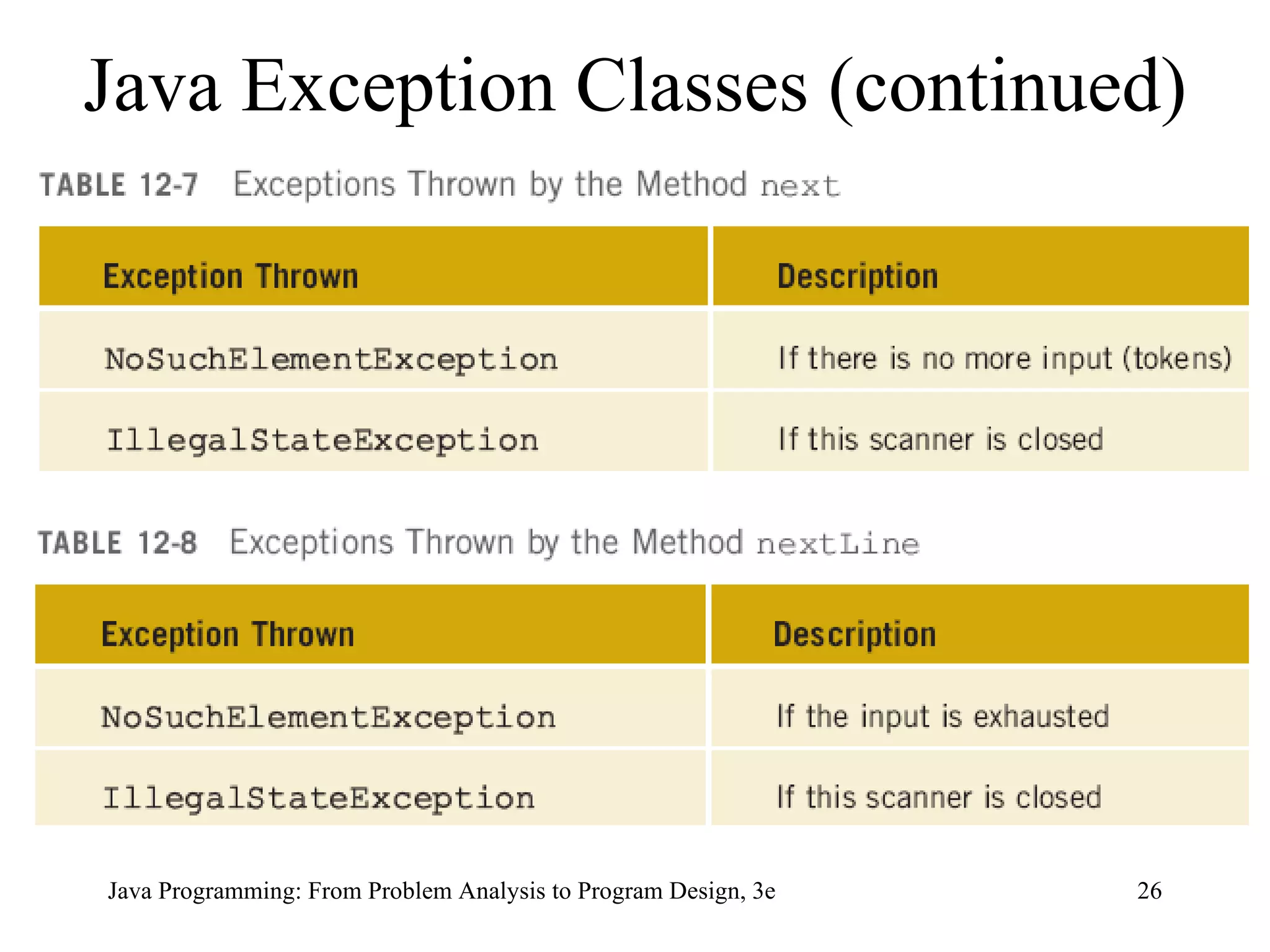
Java Exception Classes
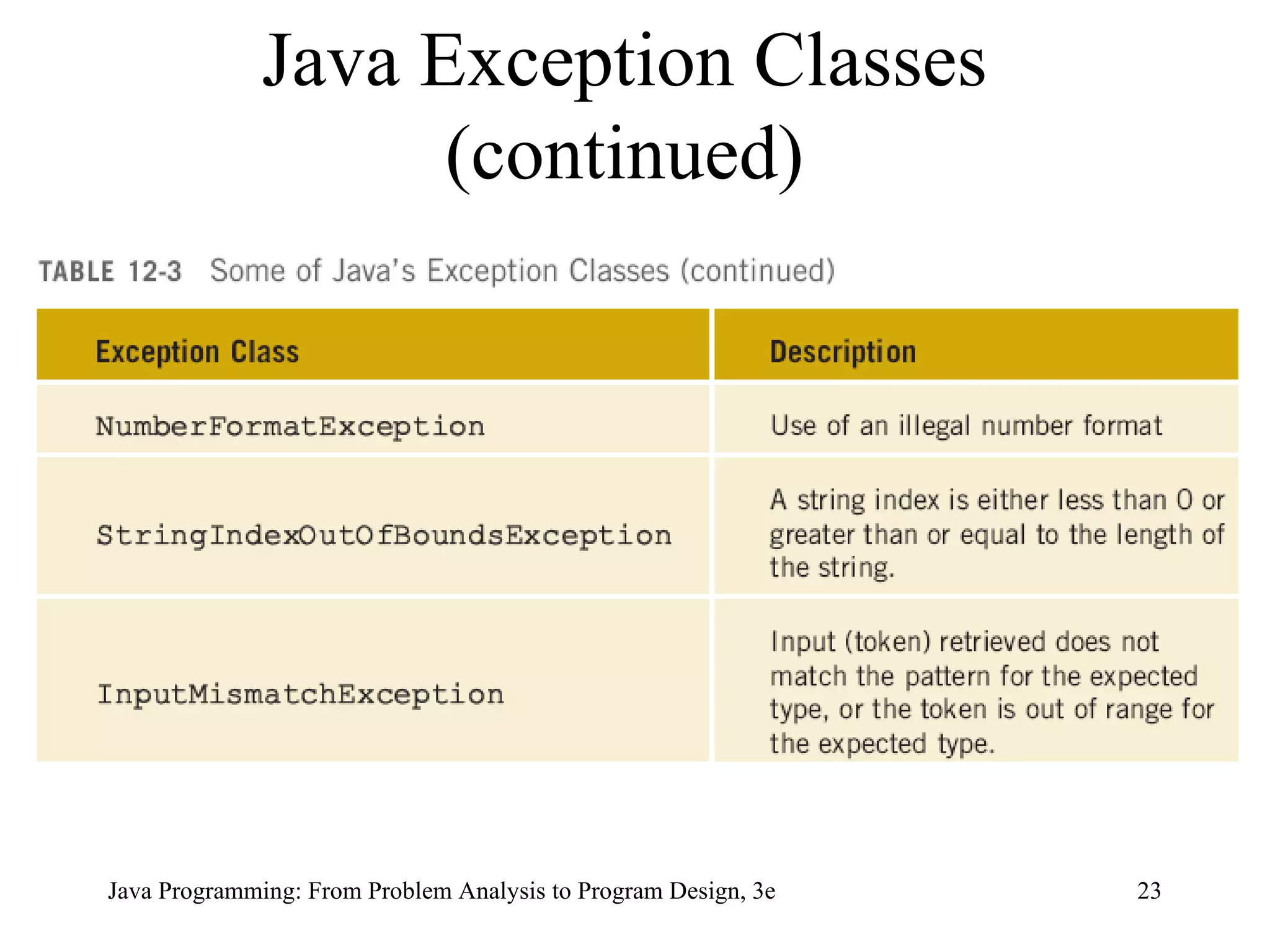
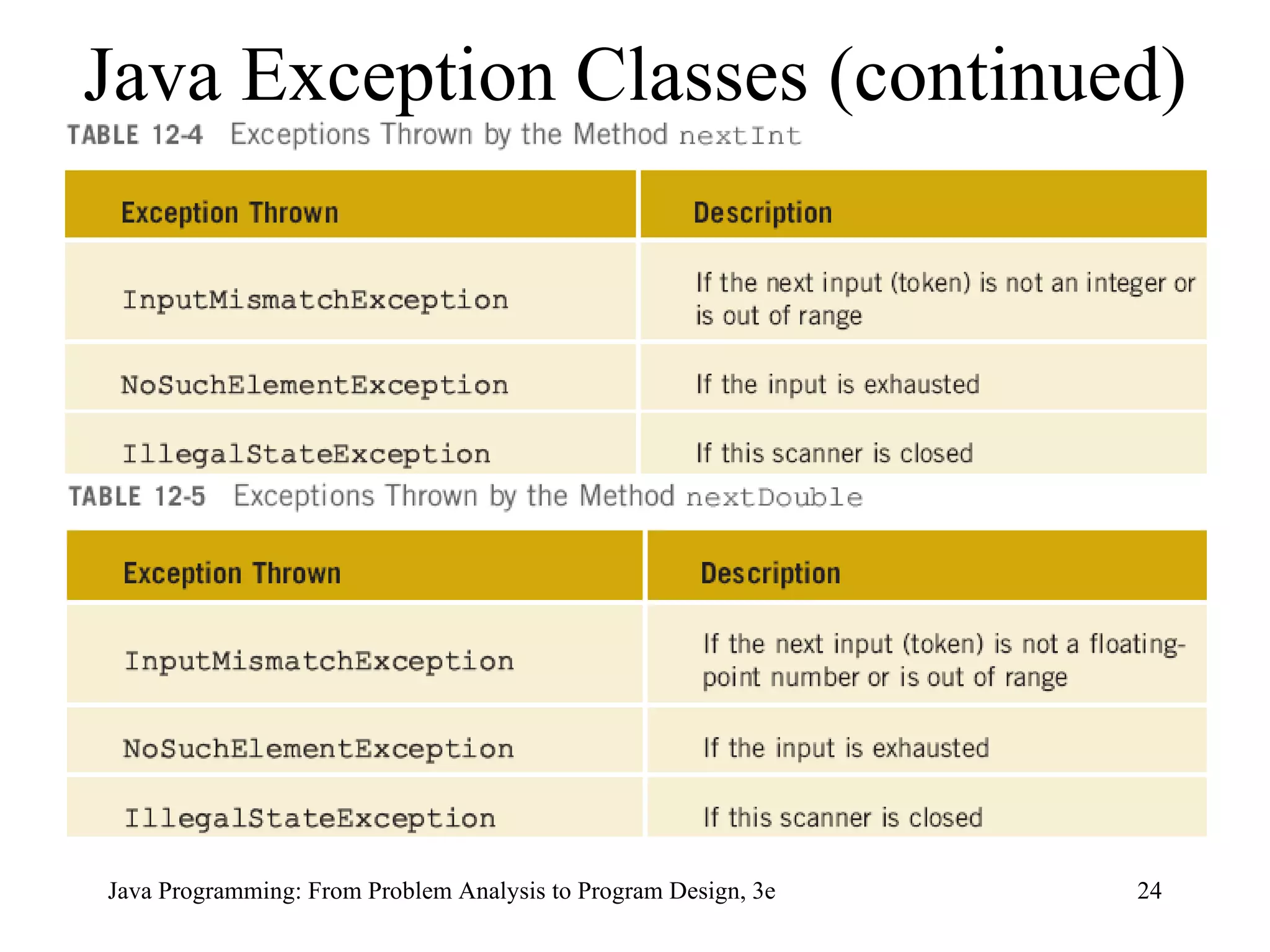
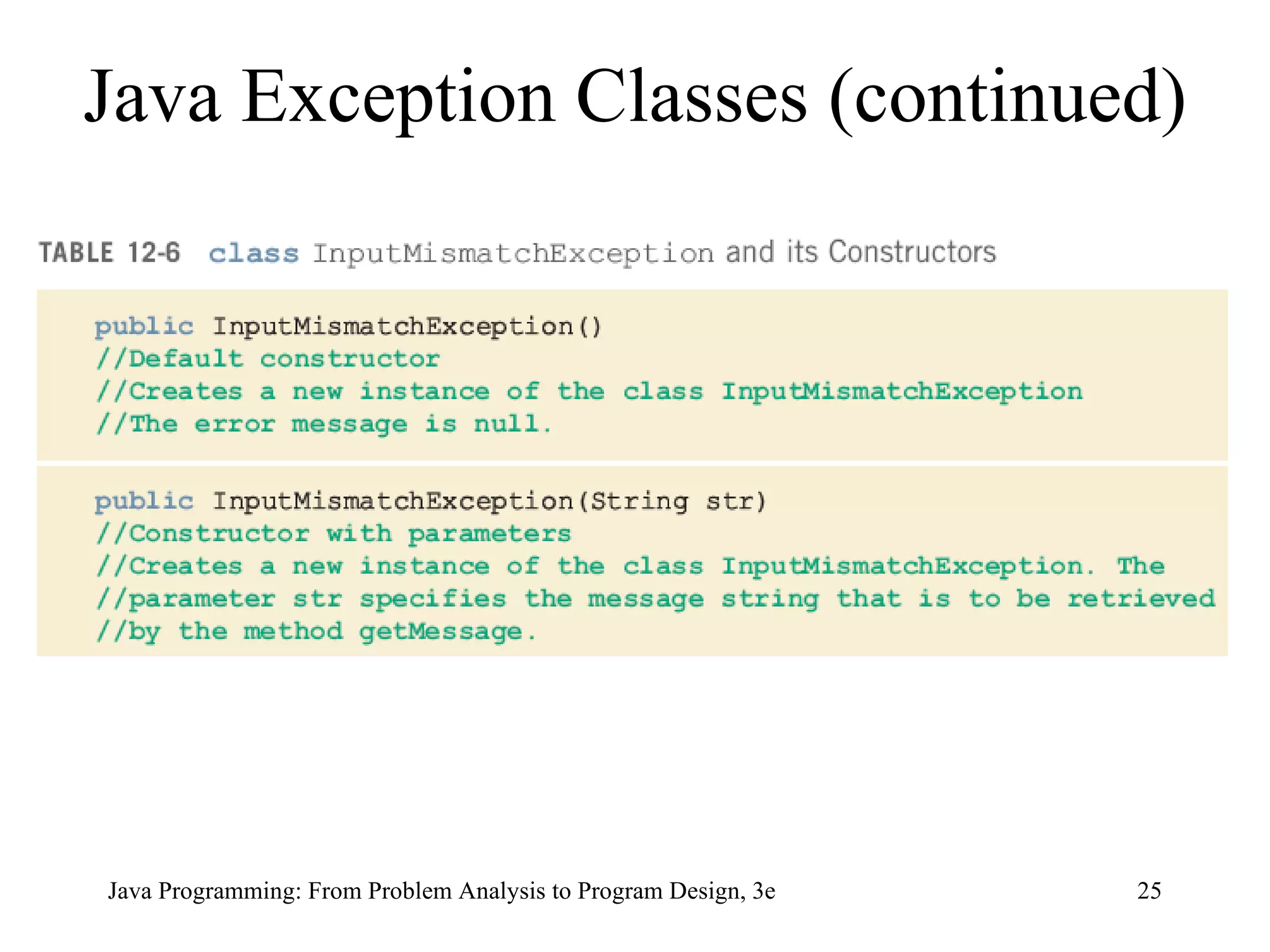
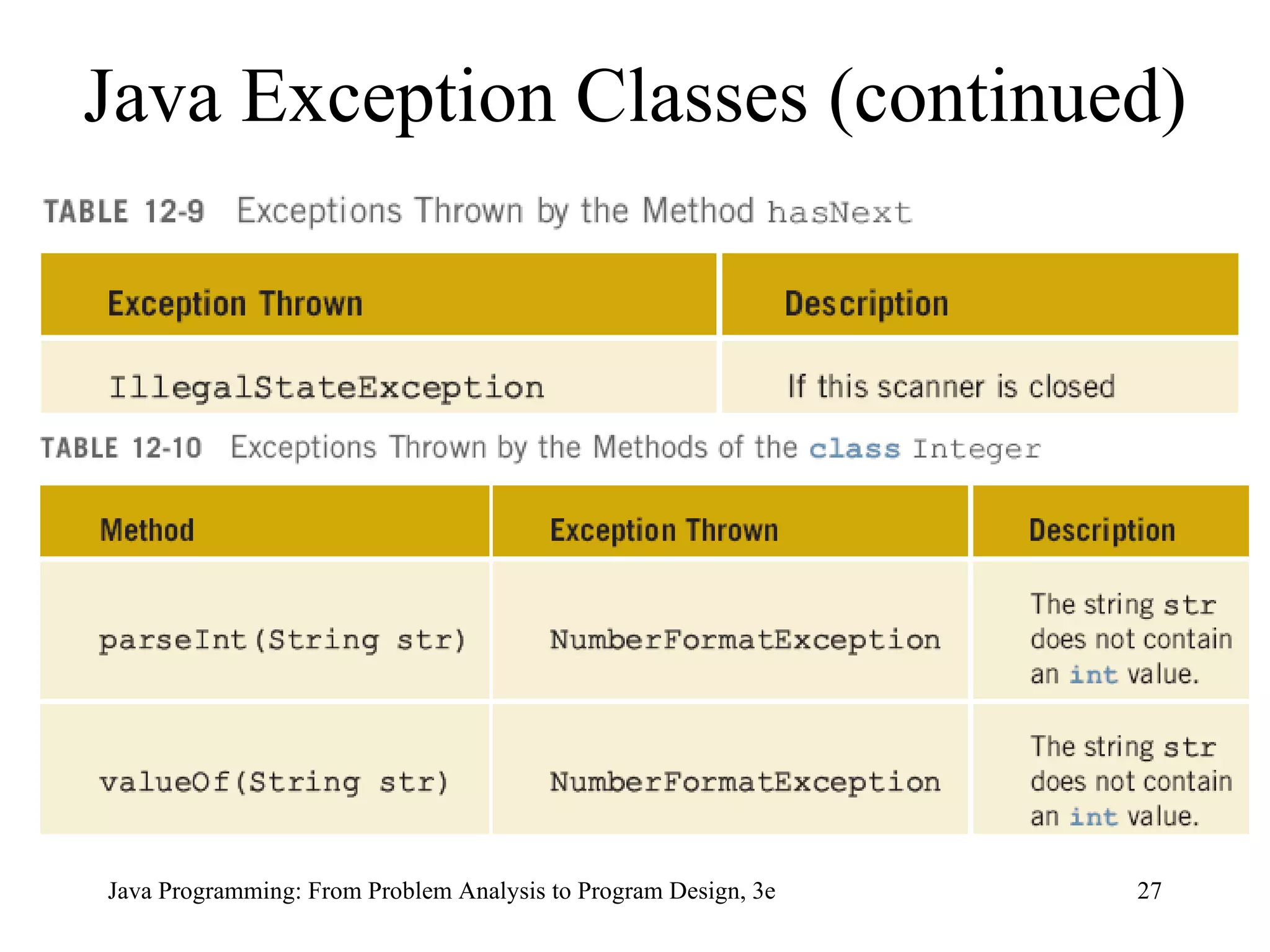
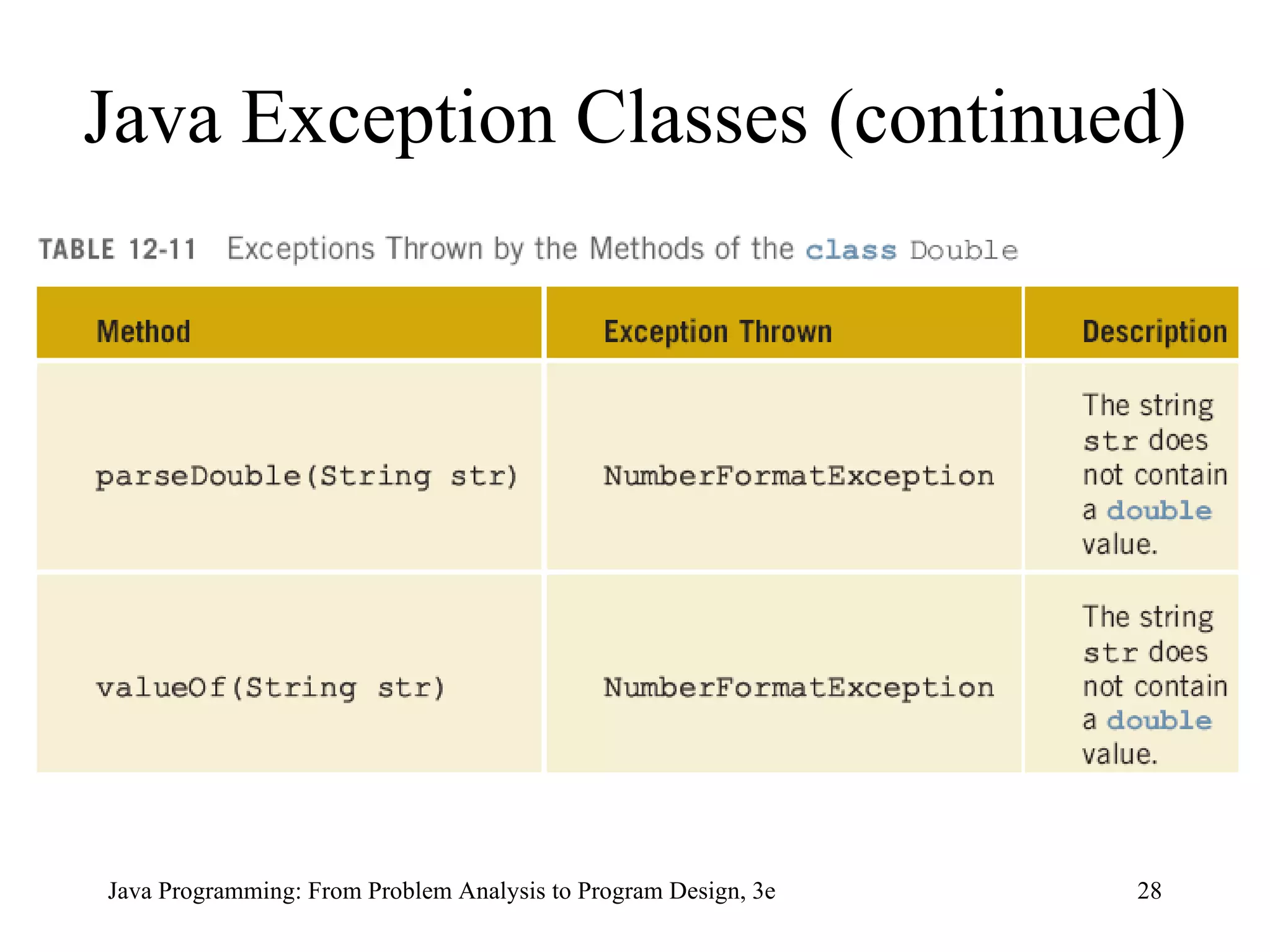
Java Exception Classes (continued)
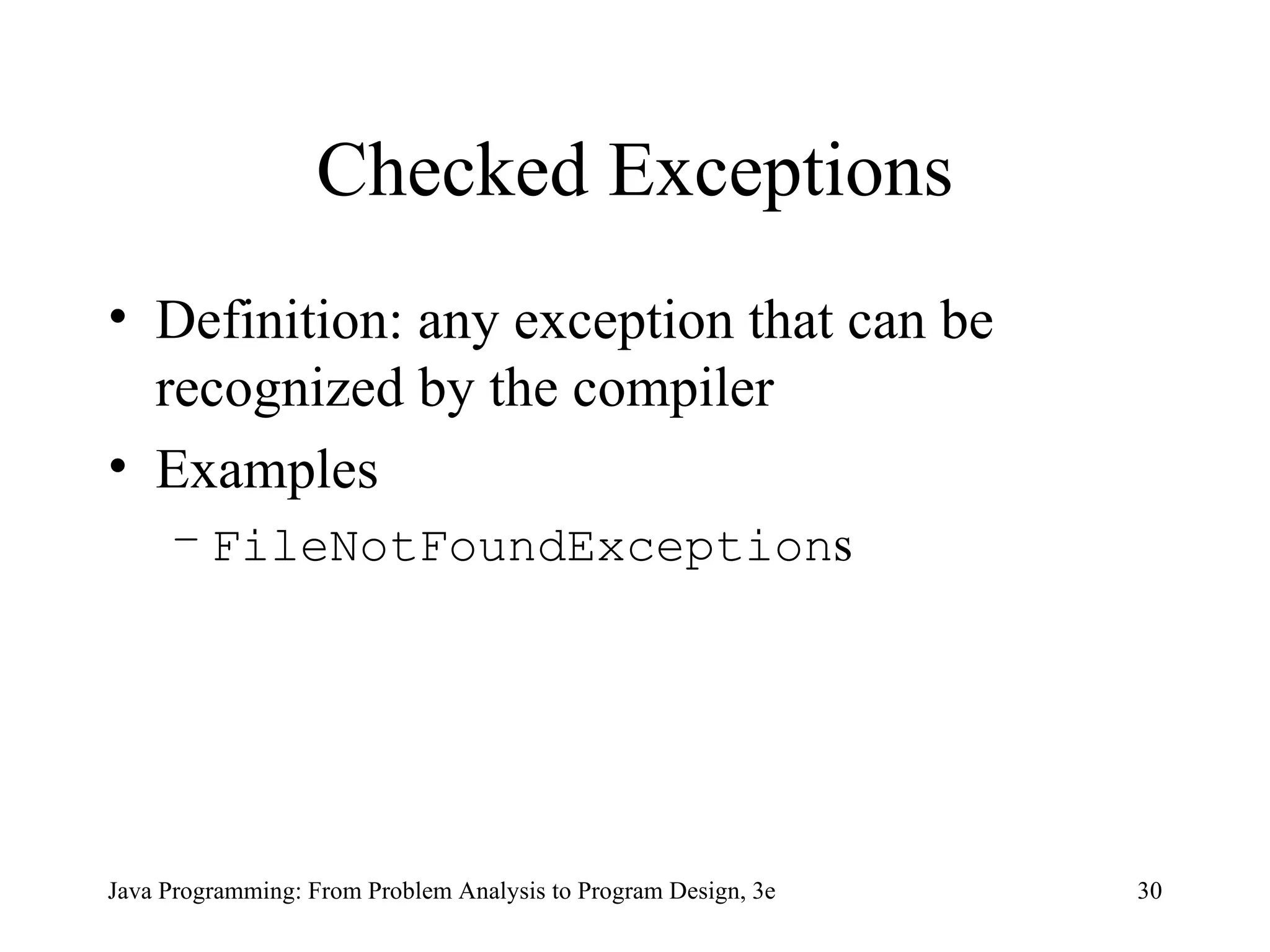
Checked Exceptions Definition: any exception that can be recognized by the compiler Examples FileNotFoundException s
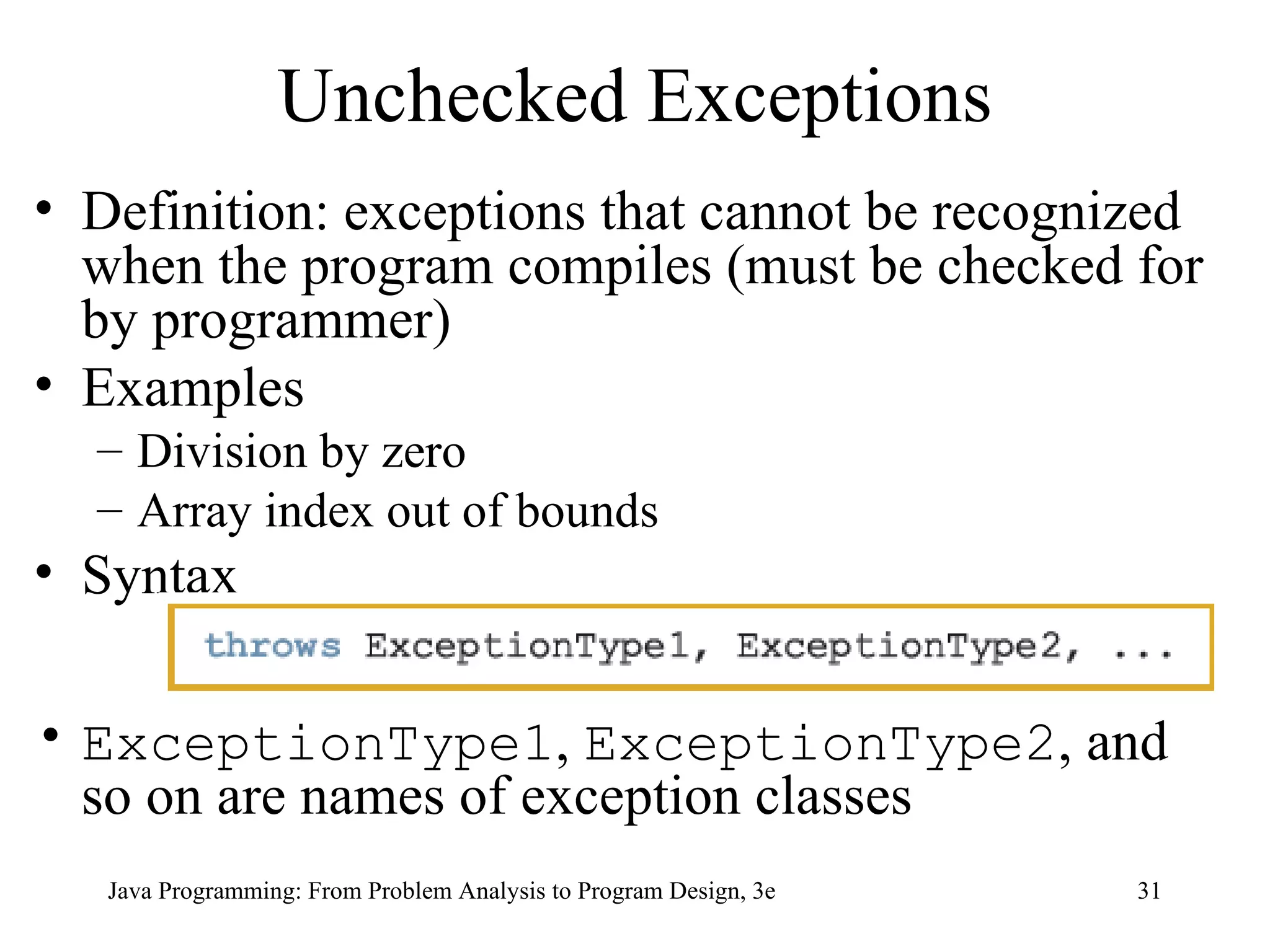
Unchecked Exceptions Definition: exceptions that cannot be recognized when the program compiles (must be checked for by programmer) Examples Division by zero Array index out of bounds Syntax ExceptionType1 ,  ExceptionType2 , and so on are names of exception classes
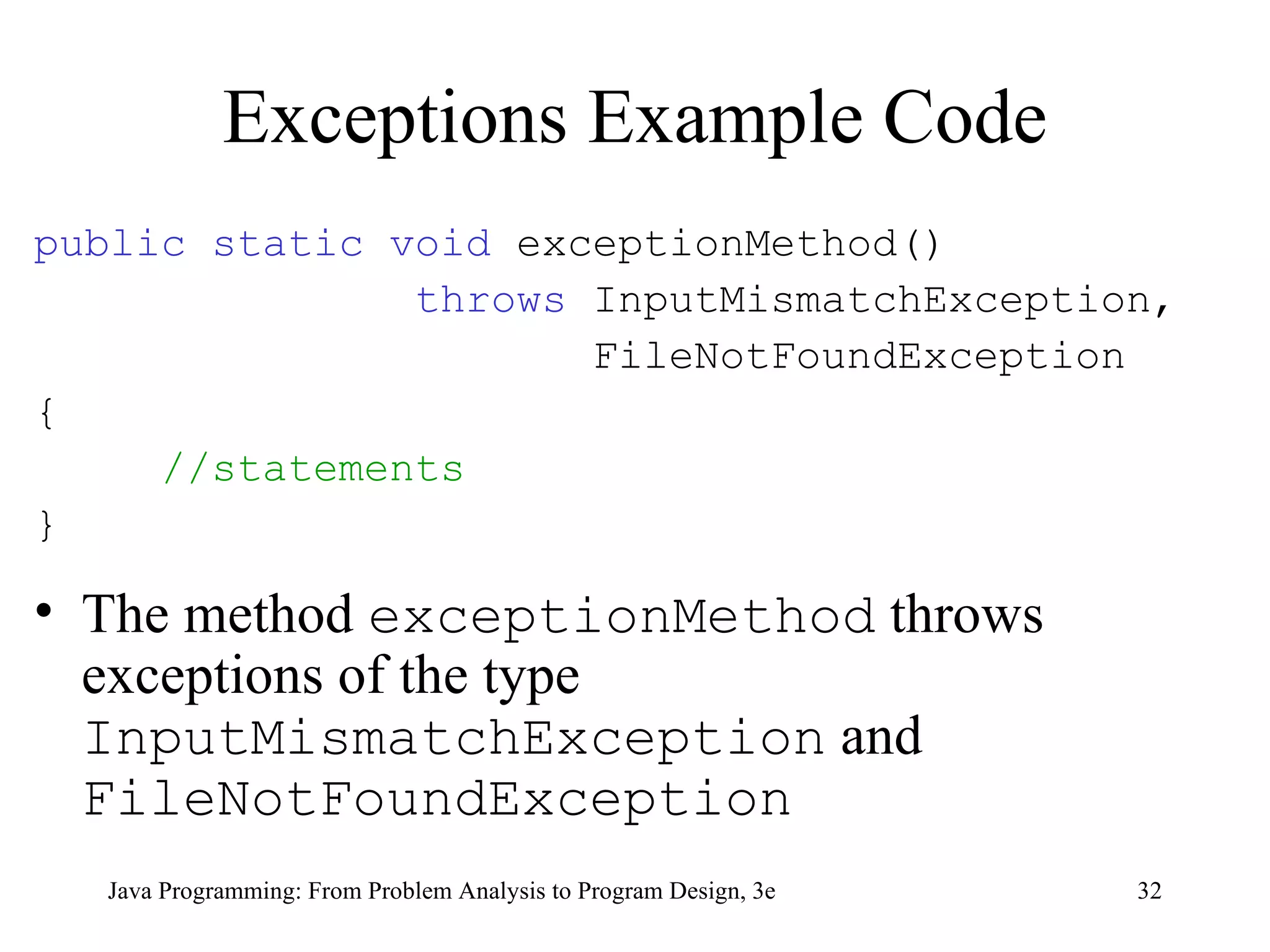
Exceptions Example Code public static void  exceptionMethod()  throws  InputMismatchException,  FileNotFoundException { //statements } The method  exceptionMethod  throws exceptions of the type  InputMismatchException  and  FileNotFoundException
The  class   Exception  and  the Operator  instanceof A reference of a superclass type can point to objects of its subclass  You can determine if a reference variable points to an object using the operator  instanceof You can combine  catch  blocks using this facility
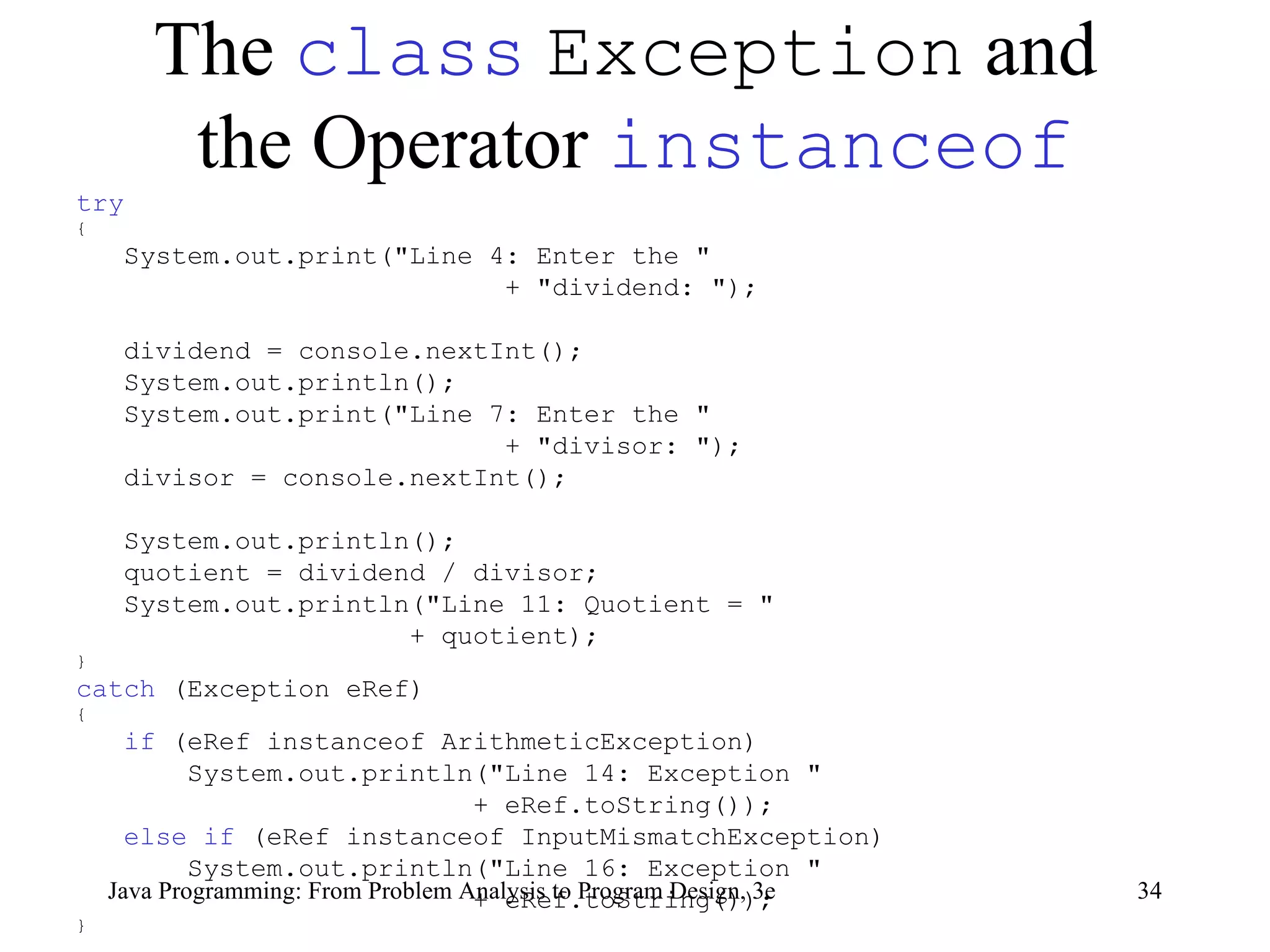
The  class   Exception  and  the Operator  instanceof try   { System.out.print("Line 4: Enter the " + "dividend: ");  dividend = console.nextInt();  System.out.println();  System.out.print("Line 7: Enter the "  + "divisor: ");  divisor = console.nextInt();  System.out.println(); quotient = dividend / divisor;  System.out.println("Line 11: Quotient = " + quotient);  } catch  (Exception eRef) { if  (eRef instanceof ArithmeticException) System.out.println("Line 14: Exception " + eRef.toString());  else if  (eRef instanceof InputMismatchException) System.out.println("Line 16: Exception " + eRef.toString());  }
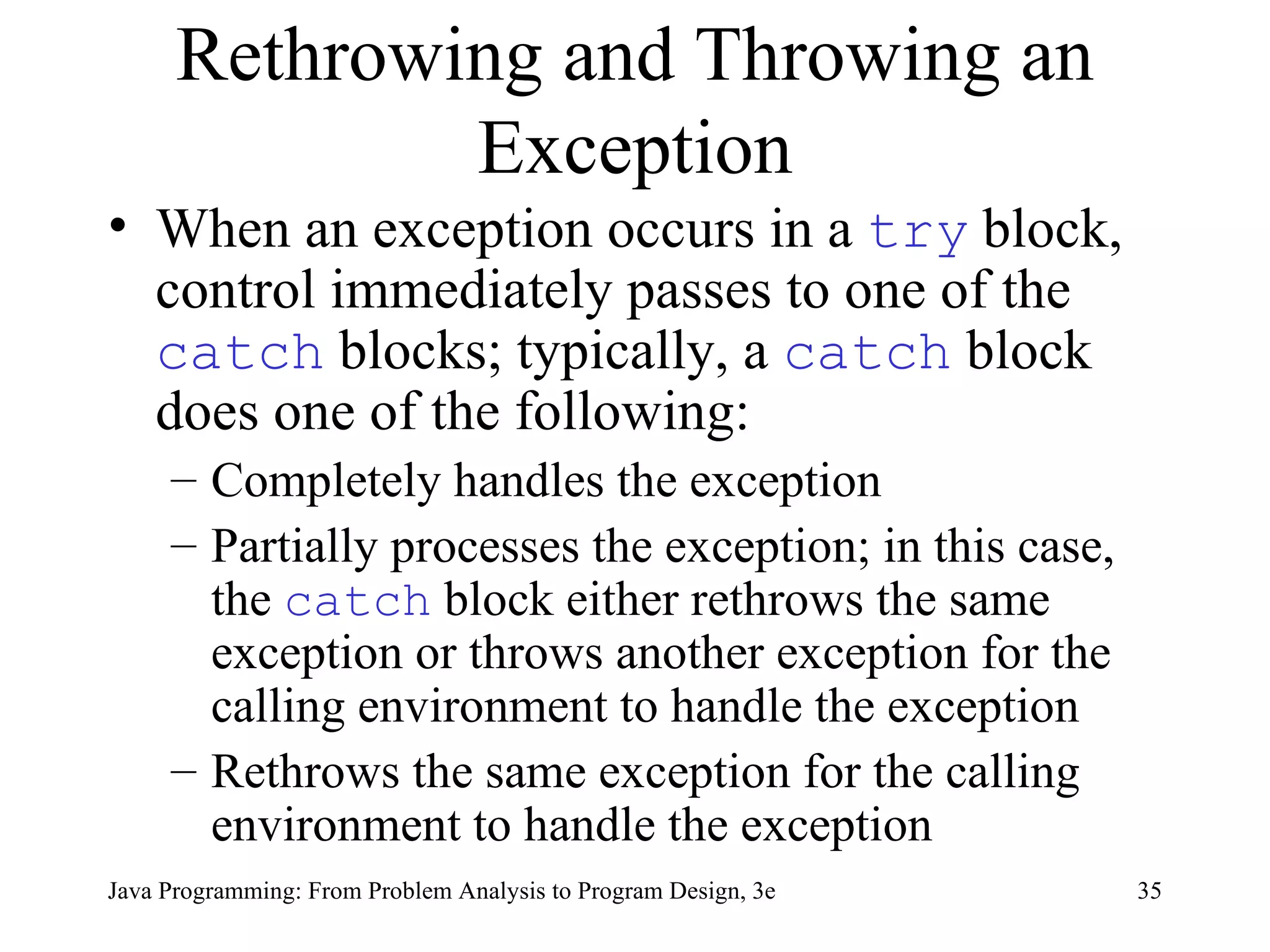
Rethrowing and Throwing an Exception When an exception occurs in a  try   block, control immediately passes to one of the  catch   blocks; typically, a  catch   block does one of the following: Completely handles the exception Partially processes the exception; in this case, the  catch   block either rethrows the same exception or throws another exception for the calling environment to handle the exception Rethrows the same exception for the calling environment to handle the exception
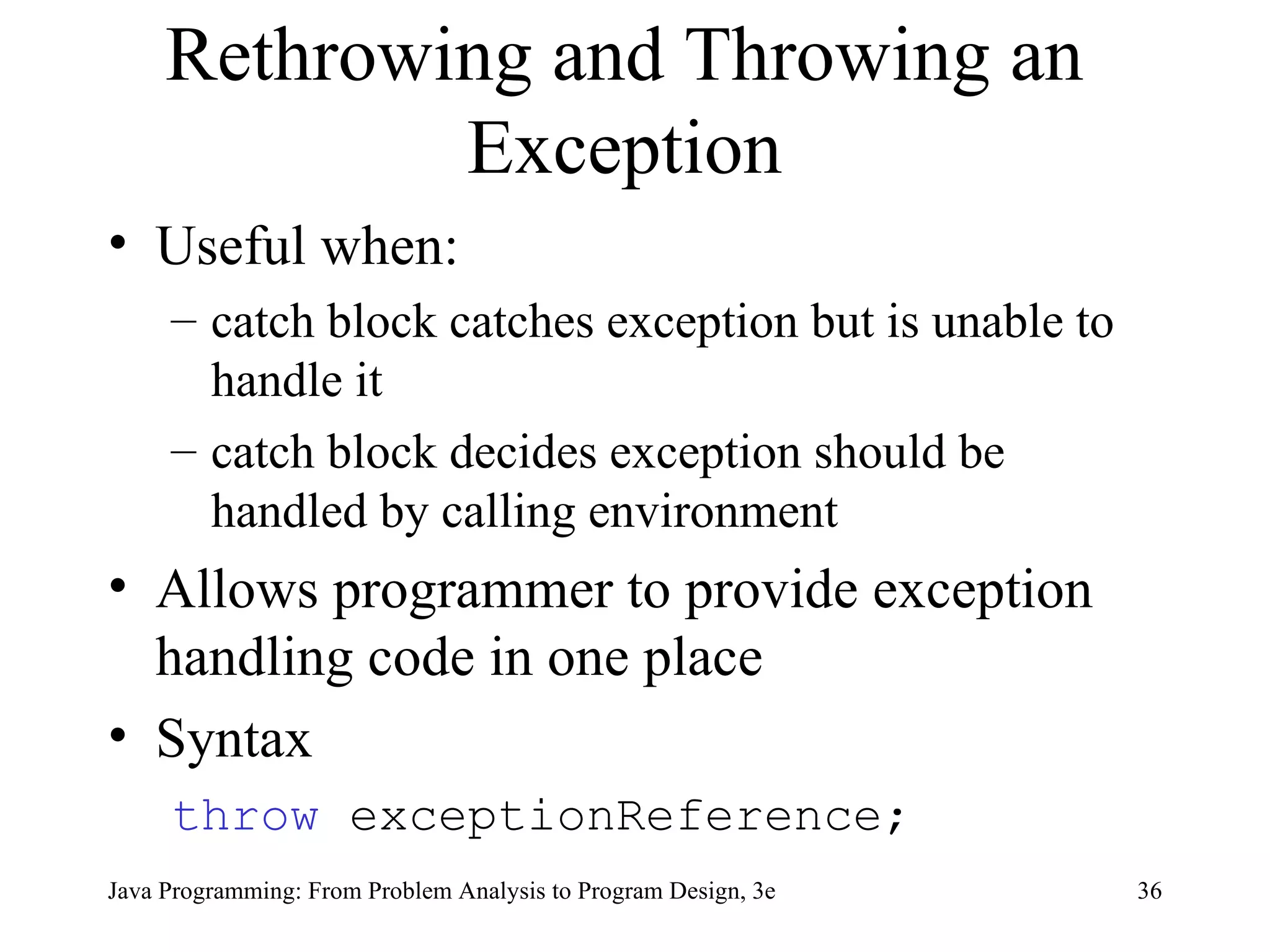
Rethrowing and Throwing an Exception Useful when:  catch block catches exception but is unable to handle it catch block decides exception should be handled by calling environment Allows programmer to provide exception handling code in one place Syntax throw  exceptionReference;
Rethrowing and Throwing an Exception (continued) import  java.util.*; public class  RethrowExceptionExmp1 { static  Scanner console =  new  Scanner(System.in); public static void  main(String[] args) { int  number;  try   { number = getNumber();  System.out.println("Line 5: number = " + number);  } catch  (InputMismatchException imeRef) { System.out.println("Line 7: Exception " + imeRef.toString()); } } }
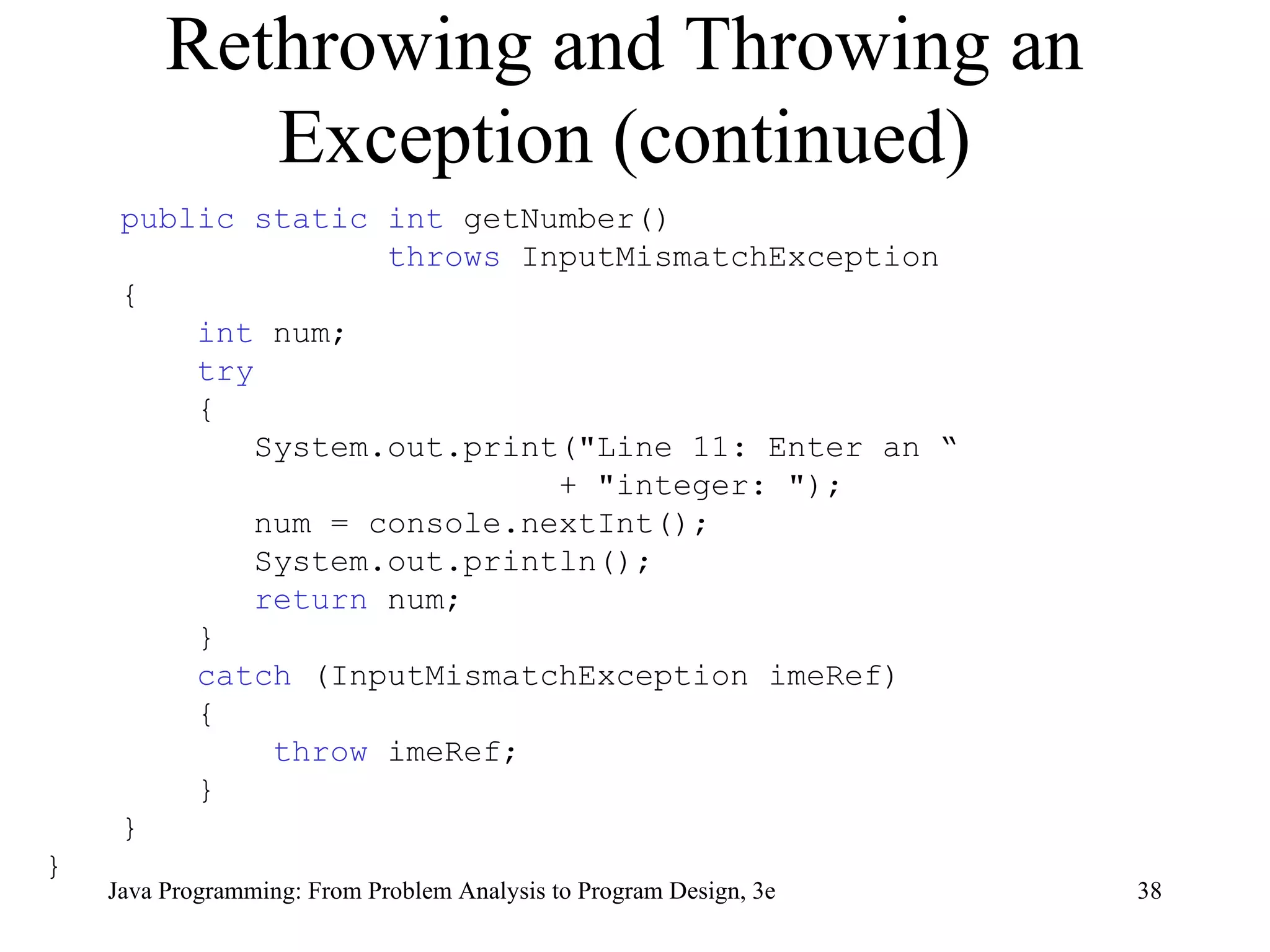
Rethrowing and Throwing an Exception (continued) public static int  getNumber() throws  InputMismatchException  { int  num; try { System.out.print("Line 11: Enter an “  + "integer: ");  num = console.nextInt();  System.out.println();  return  num;  } catch  (InputMismatchException imeRef) { throw  imeRef;  } } }
The Method  printStackTrace   Used to determine the order in which the methods were called and where the exception was handled
The Method  printStackTrace  (continued)   import  java.io.*; public class  PrintStackTraceExample1 { public static void  main(String[] args) { try { methodA(); } catch  (Exception e) { System.out.println(e.toString()  + " caught in main"); e.printStackTrace(); } }
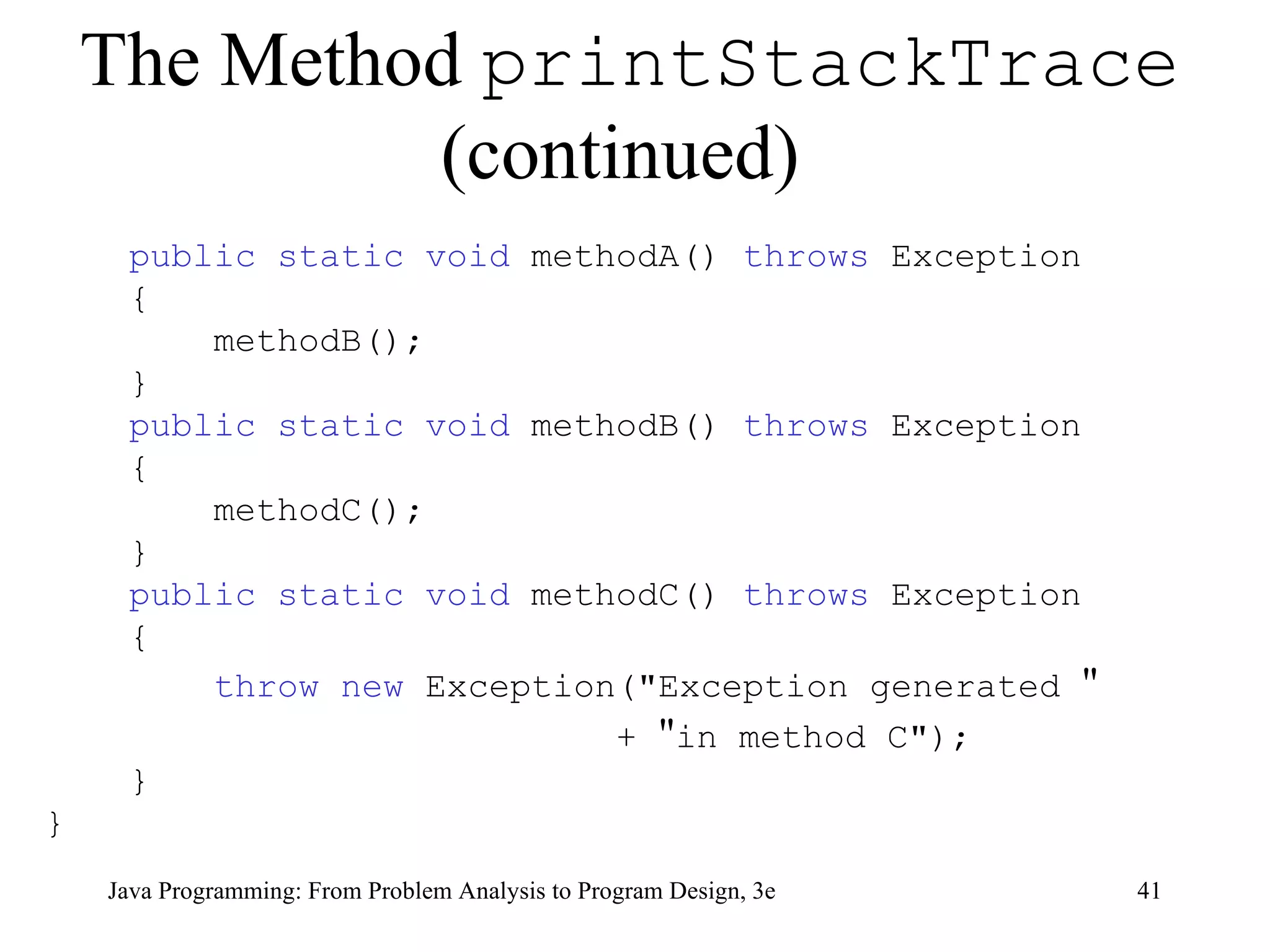
The Method  printStackTrace  (continued)   public static void  methodA()  throws  Exception { methodB(); } public static void  methodB()  throws  Exception { methodC(); } public static void  methodC()  throws  Exception { throw   new  Exception("Exception generated  " +  " in method C"); } }
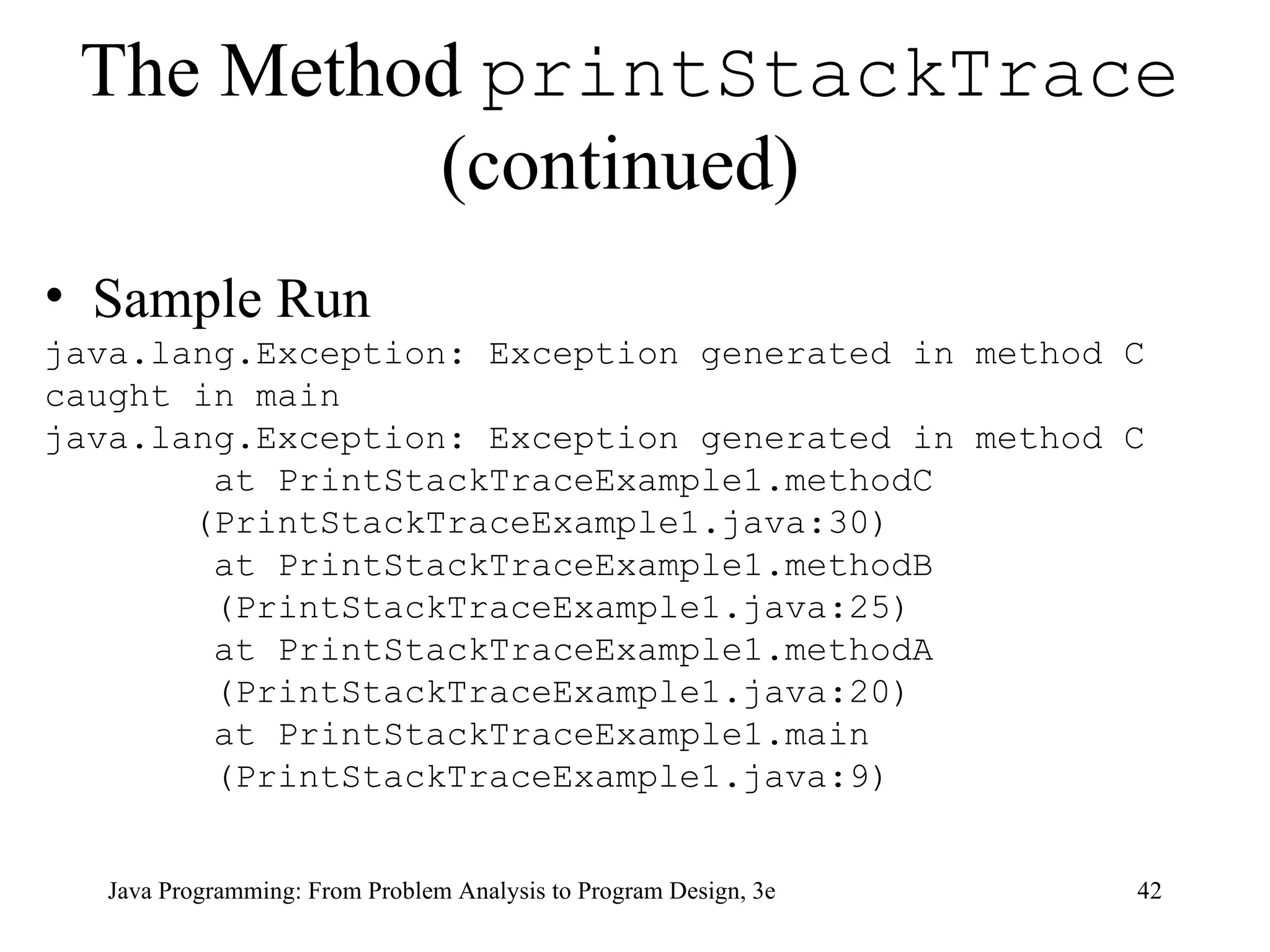
The Method  printStackTrace  (continued)   Sample Run java.lang.Exception: Exception generated in method C caught in main java.lang.Exception: Exception generated in method C at PrintStackTraceExample1.methodC (PrintStackTraceExample1.java:30) at PrintStackTraceExample1.methodB (PrintStackTraceExample1.java:25) at PrintStackTraceExample1.methodA (PrintStackTraceExample1.java:20) at PrintStackTraceExample1.main (PrintStackTraceExample1.java:9)
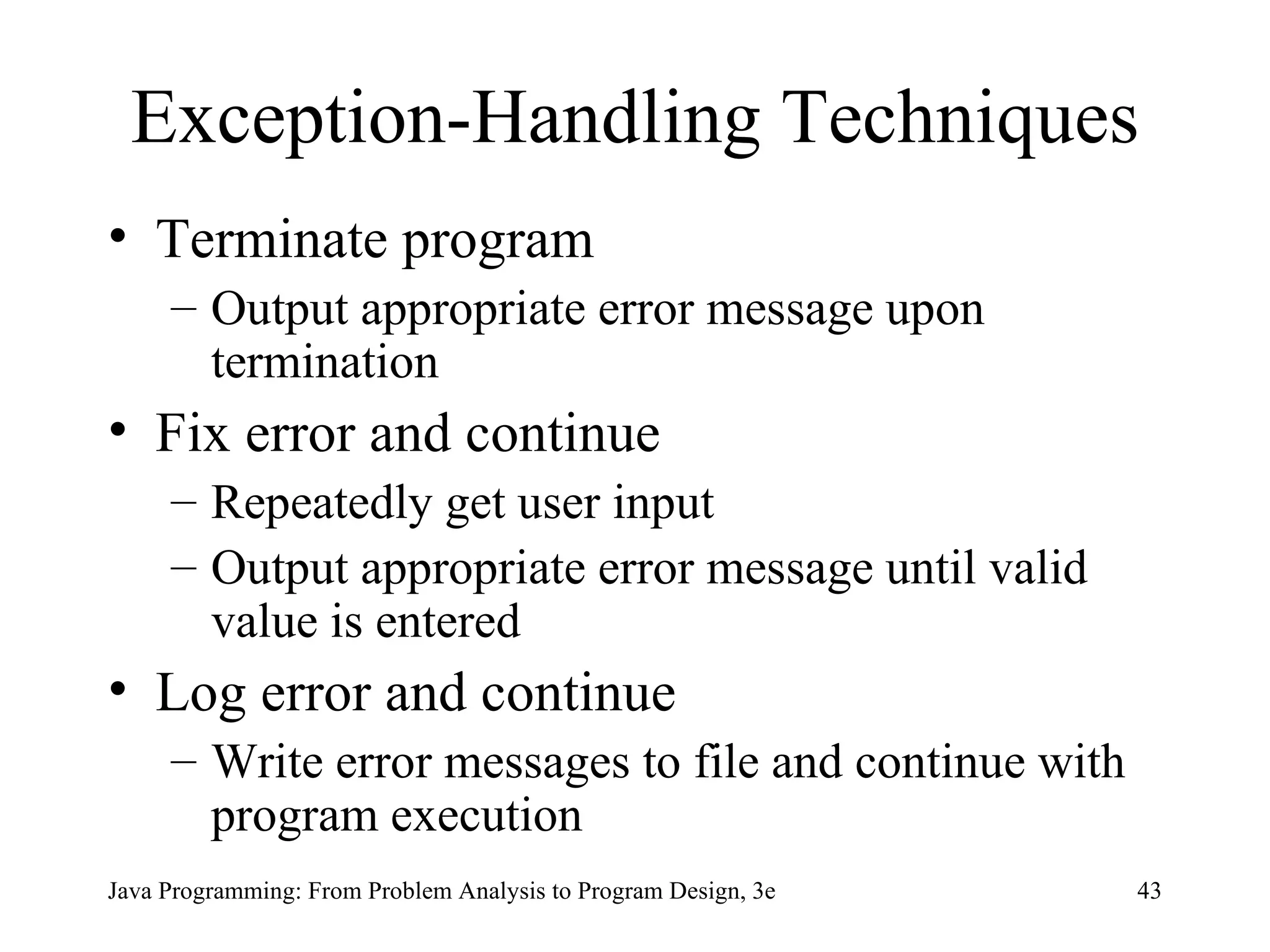
Exception-Handling Techniques Terminate program Output appropriate error message upon termination Fix error and continue Repeatedly get user input Output appropriate error message until valid value is entered Log error and continue Write error messages to file and continue with program execution
Creating Your Own Exception Classes Exception class you define extends  class  Exception or one of its subclasses Syntax to throw your own exception object: throw   new  ExceptionClassName(messageString);
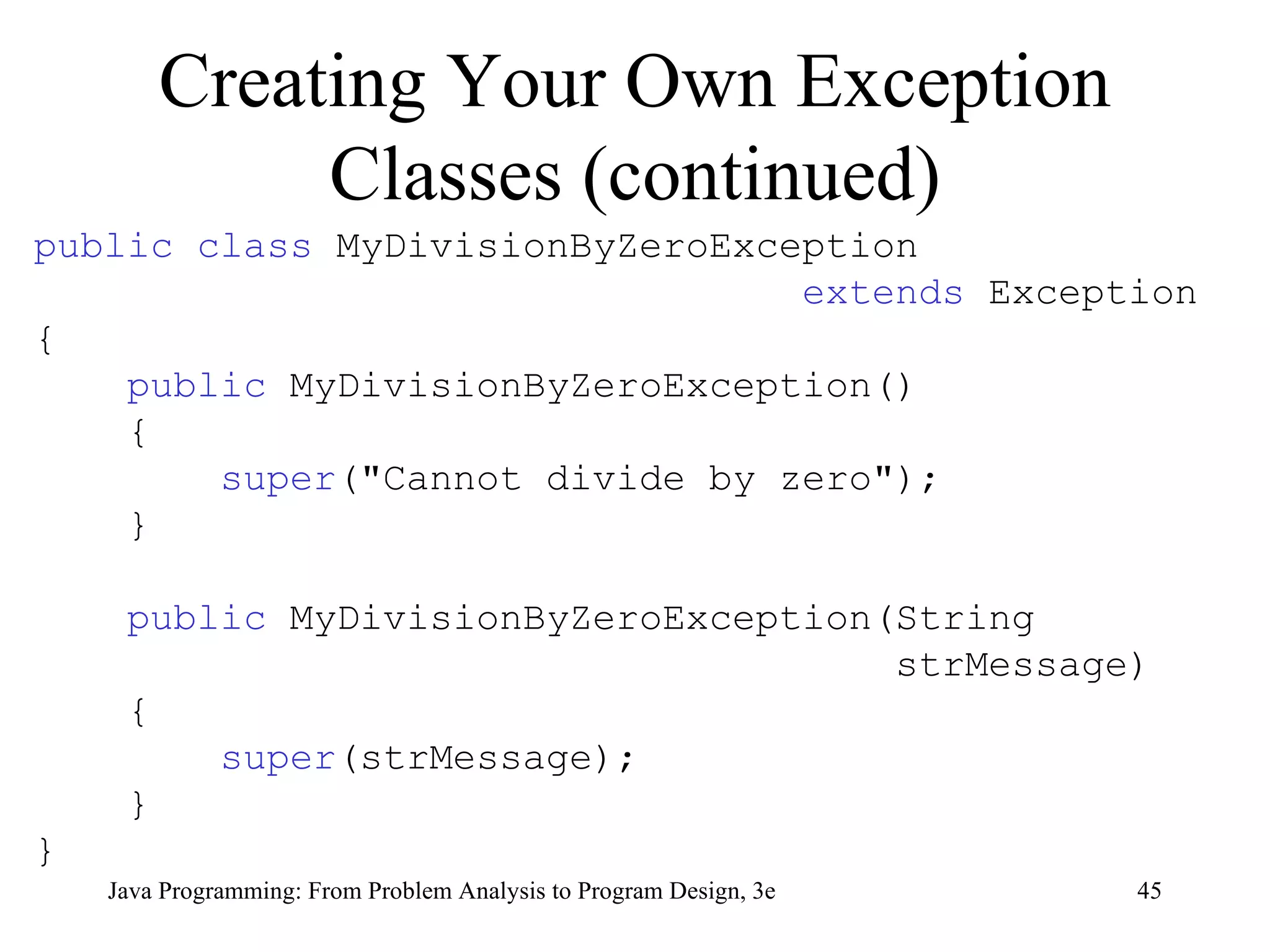
Creating Your Own Exception Classes (continued) public class  MyDivisionByZeroException  extends  Exception { public  MyDivisionByZeroException() { super ("Cannot divide by zero"); } public  MyDivisionByZeroException(String strMessage) { super (strMessage); } }
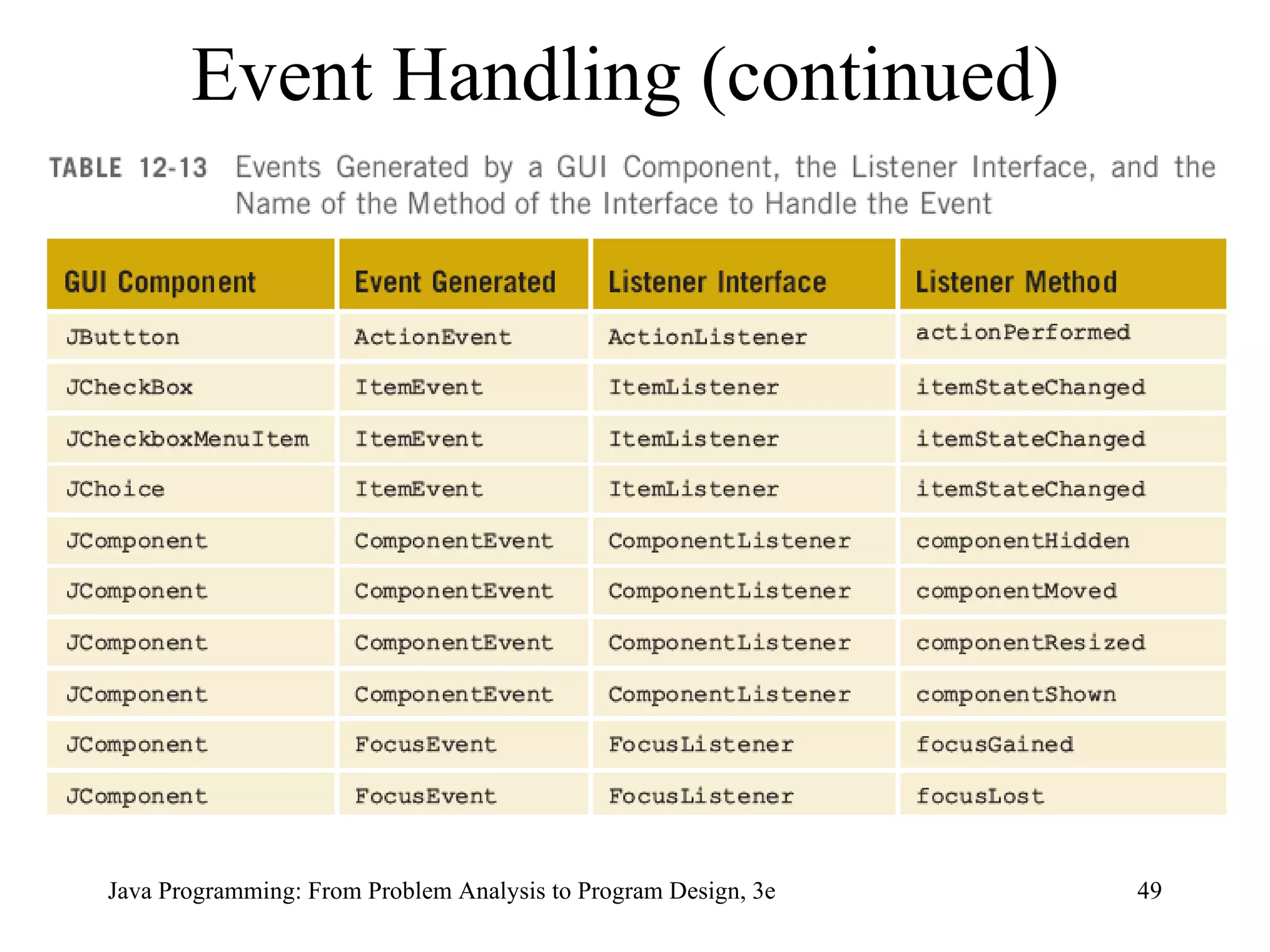
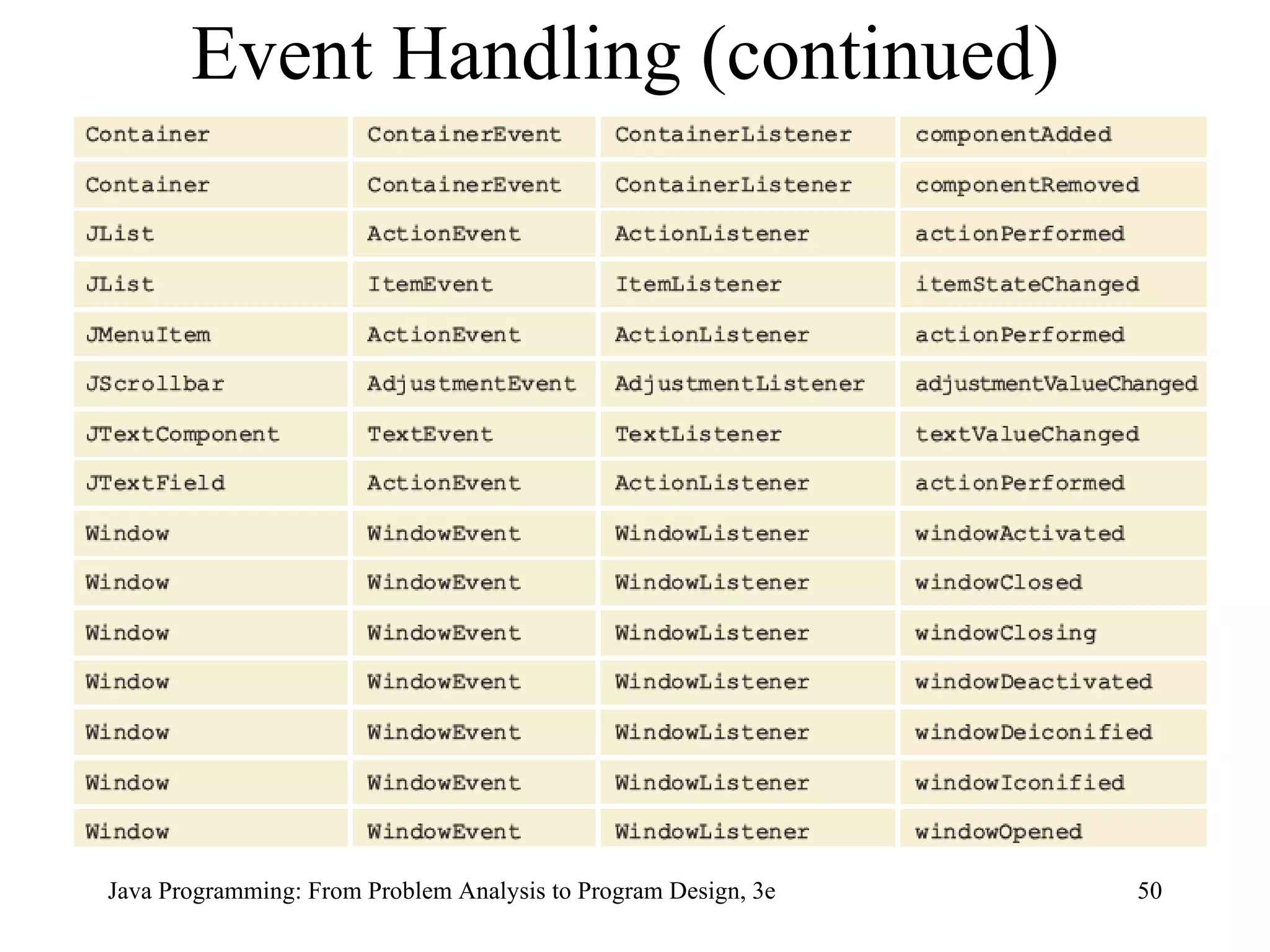
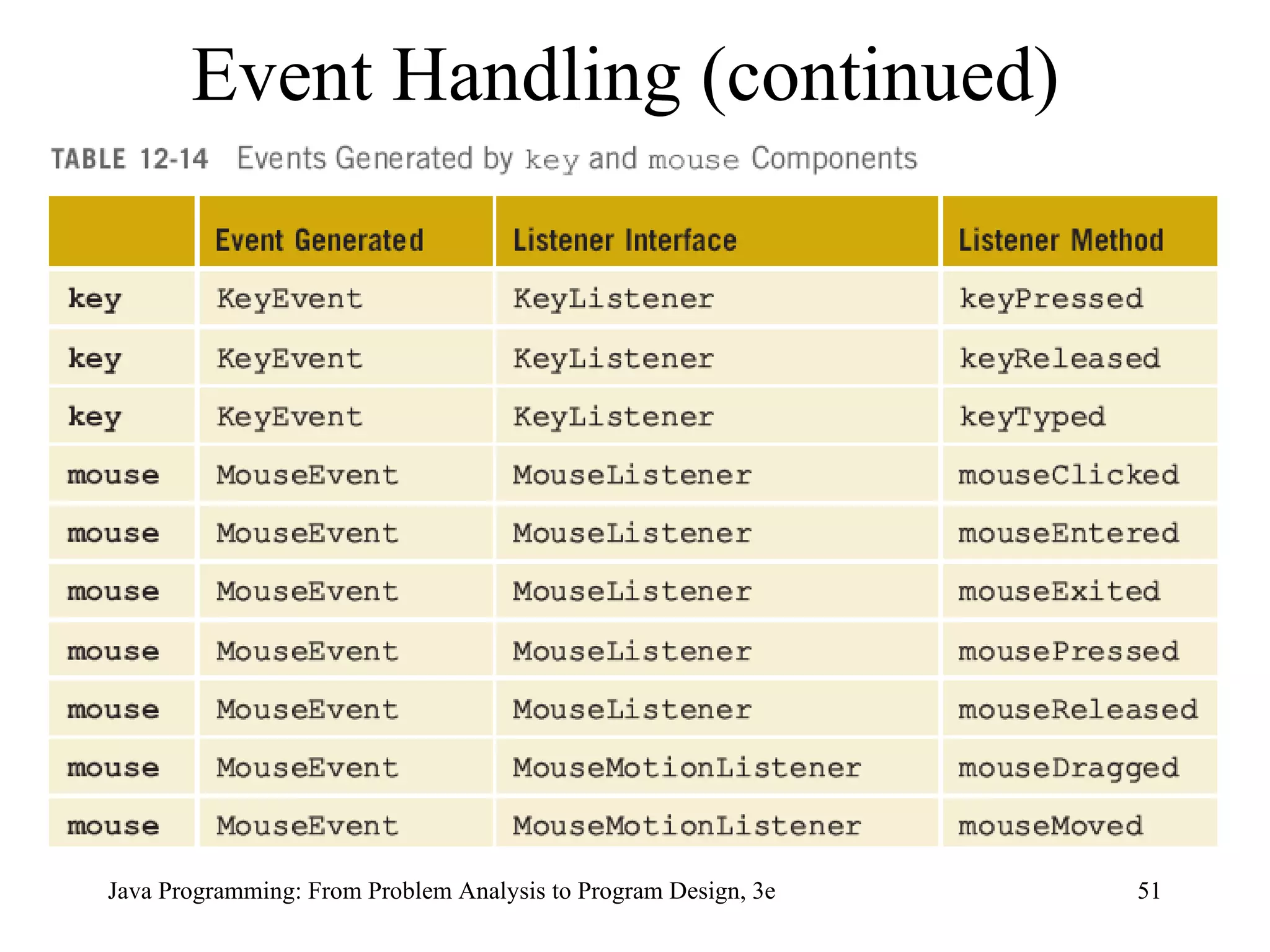
Event Handling Action events   Handled by implementing interface  ActionListener Window events   Handled by implementing interface  WindowListener Mouse events   Handled by implementing interface  MouseListener Key events   Handled by implementing interface  KeyListener
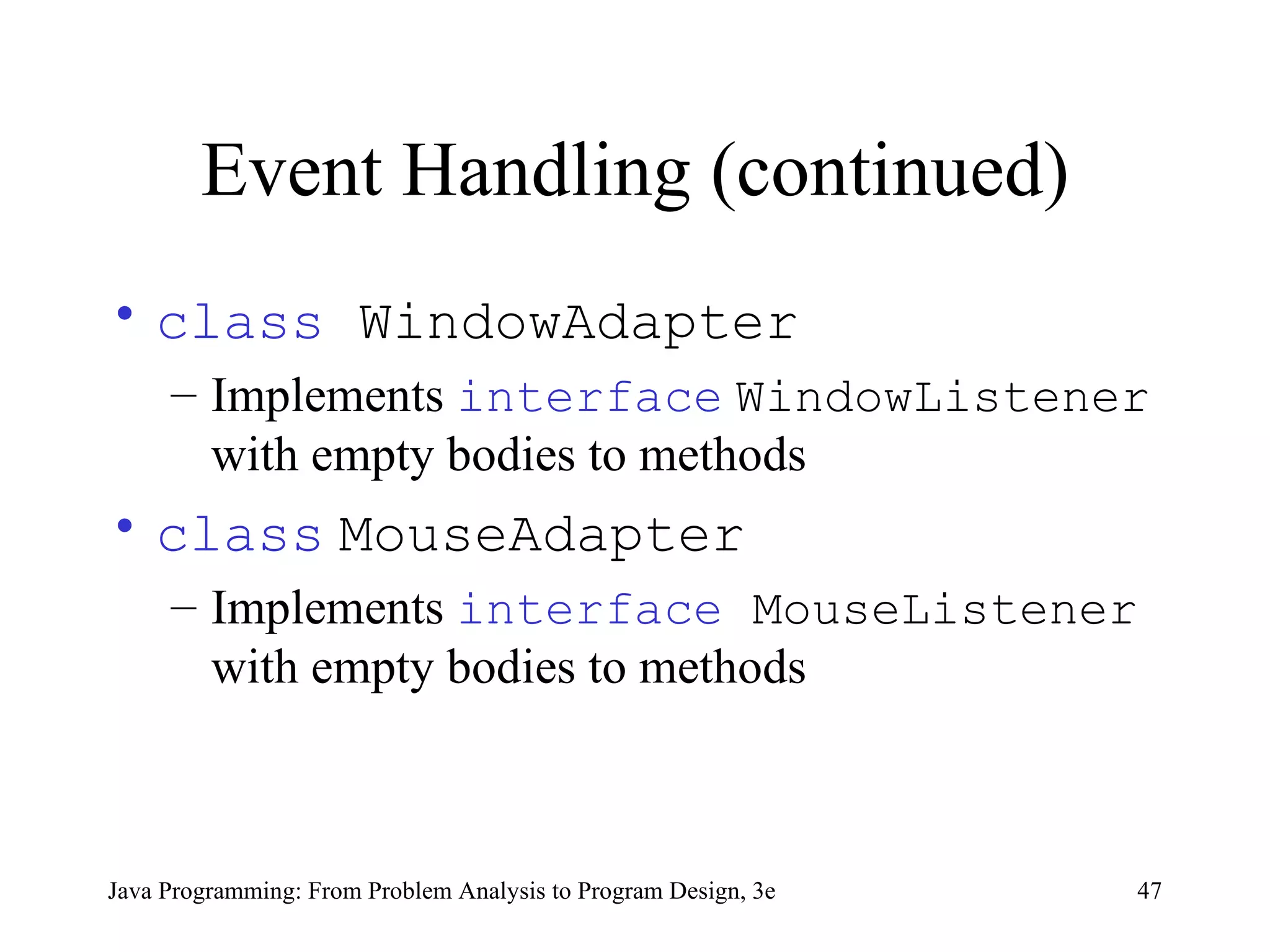
Event Handling (continued) class  WindowAdapter   Implements  interface   WindowListener  with empty bodies to methods class   MouseAdapter   Implements  interface  MouseListener  with empty bodies to methods
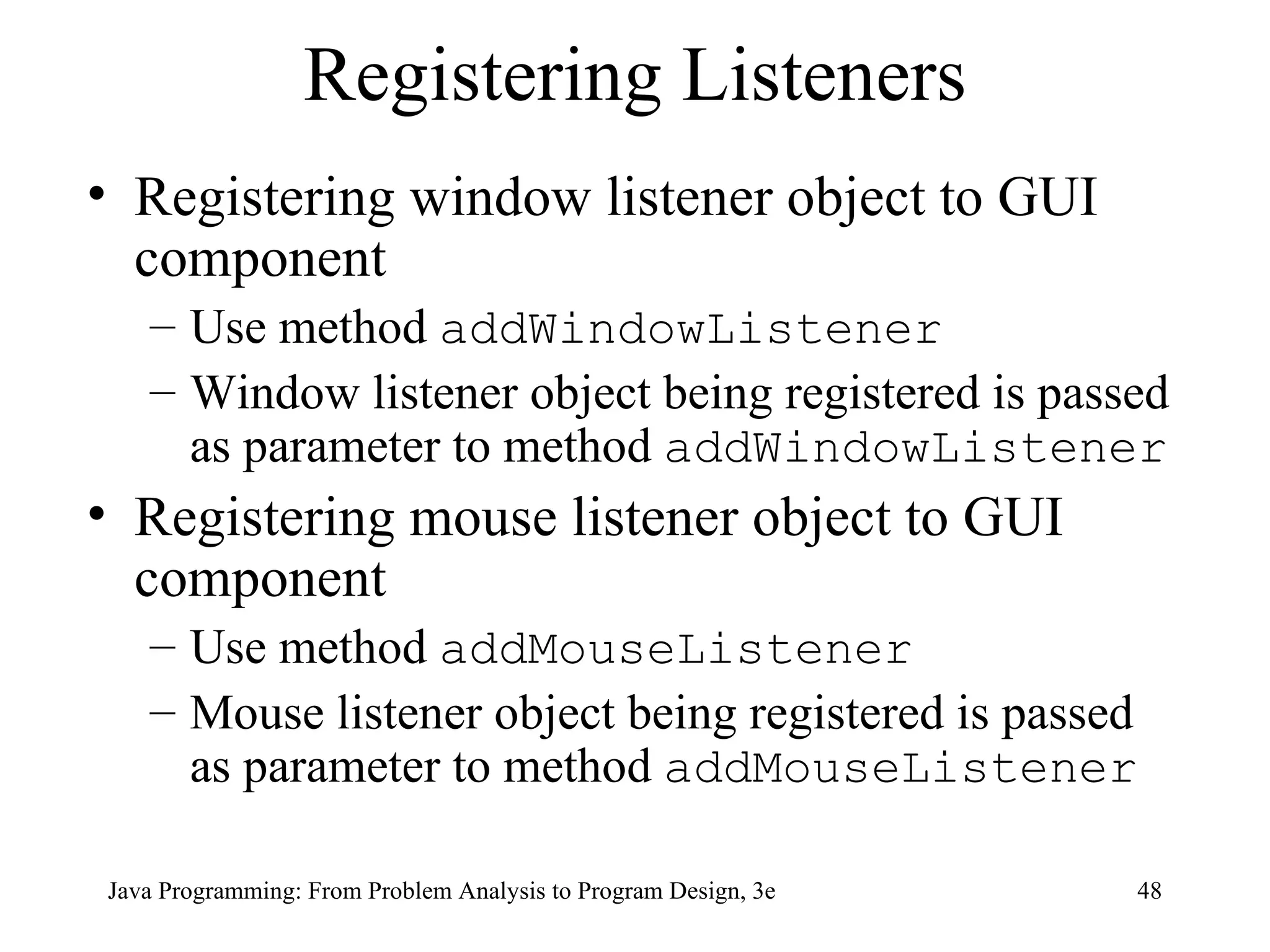
Registering Listeners Registering window listener object to GUI component Use method  addWindowListener Window listener object being registered is passed as parameter to method  addWindowListener Registering mouse listener object to GUI component Use method  addMouseListener Mouse listener object being registered is passed as parameter to method  addMouseListener
Event Handling (continued)
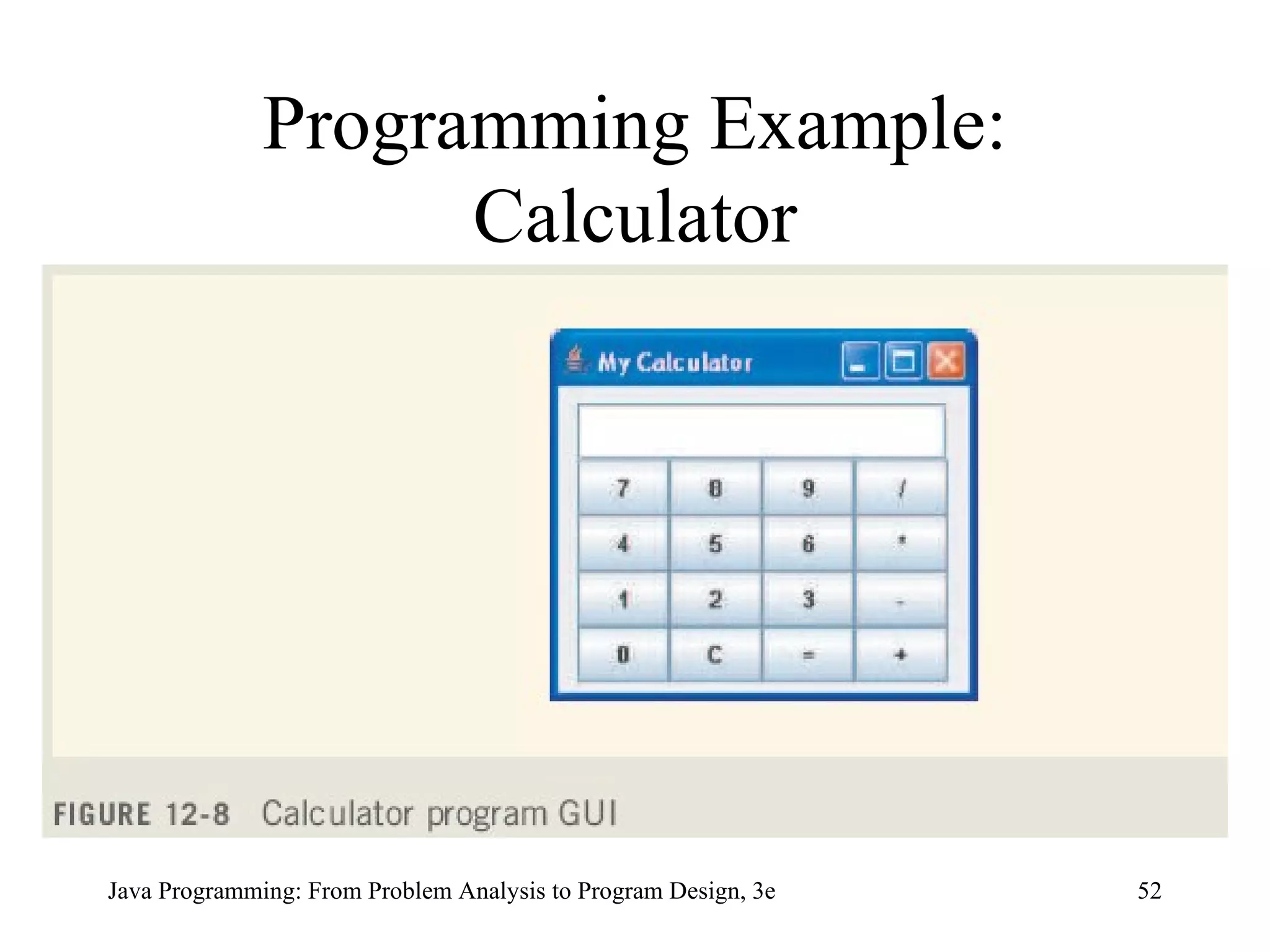
Programming Example: Calculator
Chapter Summary Exception Definition Handling exceptions within a program try / catch / finally  block Order of  catch  blocks Using  try / catch  blocks in a program The  class   Exception  and the Operator  instanceof Rethrowing and throwing an exception Exception Hierarchy  Classes
Chapter Summary (continued) Checked and Unchecked Exceptions The method  printStackTrace Exception handling techniques Terminate program Fix error and continue Log error and continue Creating your own exception classes Event Handling

Chap12

  • 1.
    Java Programming: FromProblem Analysis to Program Design, 3e Chapter 12 Handling Exceptions and Events
  • 2.
    Chapter Objectives Learnwhat an exception is See how a try / catch block is used to handle exceptions Become aware of the hierarchy of exception classes Learn about checked and unchecked exceptions
  • 3.
    Chapter Objectives (continued)Learn how to handle exceptions within a program Discover how to throw and rethrow an exception Learn how to handle events in a program
  • 4.
    Exception Definition: anoccurrence of an undesirable situation that can be detected during program execution Examples Division by zero Trying to open an input file that does not exist An array index that goes out of bounds
  • 5.
    Handling Exception withina Program Can use an if statement to handle an exception However, suppose that division by zero occurs in more than one place within the same block In this case, using if statements may not be the most effective way to handle the exception
  • 6.
    Java’s Mechanism ofException Handling When an exception occurs, an object of a particular exception class is created Java provides a number of exception classes to effectively handle certain common exceptions such as division by zero, invalid input, and file not found Division by zero is an arithmetic error and is handled by the class ArithmeticException
  • 7.
    Java’s Mechanism ofException Handling (continued) When a division by zero exception occurs, the program creates an object of the class ArithmeticException When a Scanner object is used to input data into a program, any invalid input errors are handled using the class InputMismatchException The class Exception (directly or indirectly) is the superclass of all the exception classes in Java
  • 8.
    try / catch/ finally Block Statements that might generate an exception are placed in a try block The try block might also contain statements that should not be executed if an exception occurs The try block is followed by zero or more catch blocks A catch block specifies the type of exception it can catch and contains an exception handler
  • 9.
    try / catch/ finally Block (continued) The last catch block may or may not be followed by a finally block Any code contained in a finally block always executes, regardless of whether an exception occurs, except when the program exits early from a try block by calling the method System.exit If a try block has no catch block, then it must have the finally block
  • 10.
    try / catch/ finally Block (continued)
  • 11.
    try / catch/ finally Block (continued) If no exception is thrown in a try block, all catch blocks associated with the try block are ignored and program execution resumes after the last catch block If an exception is thrown in a try block, the remaining statements in the try block are ignored - The program searches the catch blocks in the order in which they appear after the try block and looks for an appropriate exception handler
  • 12.
    try / catch/ finally Block (continued) If the type of the thrown exception matches the parameter type in one of the catch blocks, the code of that catch block executes and the remaining catch blocks after this catch block are ignored If there is a finally block after the last catch block, the finally block executes regardless of whether an exception occurs
  • 13.
    Order of catch Blocks The heading of a catch block specifies the type of exception it handles A catch block can catch either all exceptions of a specific type or all types of exceptions A reference variable of a superclass type can point to an object of its subclass
  • 14.
    Order of catch Blocks (continued) If in the heading of a catch block you declare an exception using the class Exception , then that catch block can catch all types of exceptions because the class Exception is the superclass of all exception classes In a sequence of catch blocks following a try block, a catch block declaring an exception of a subclass type should be placed before catch blocks declaring exceptions of a superclass type
  • 15.
  • 16.
  • 17.
  • 18.
  • 19.
  • 20.
    Java’s Exception Classclass Exception Subclass of class Throwable Superclass of classes designed to handle exceptions Various types of exceptions I/O exceptions Number format exceptions File not found exceptions Array index out of bounds exceptions Various exceptions categorized into separate classes and contained in various packages
  • 21.
    The class Exception and its Constructors
  • 22.
  • 23.
  • 24.
  • 25.
  • 26.
  • 27.
  • 28.
  • 29.
  • 30.
    Checked Exceptions Definition:any exception that can be recognized by the compiler Examples FileNotFoundException s
  • 31.
    Unchecked Exceptions Definition:exceptions that cannot be recognized when the program compiles (must be checked for by programmer) Examples Division by zero Array index out of bounds Syntax ExceptionType1 , ExceptionType2 , and so on are names of exception classes
  • 32.
    Exceptions Example Codepublic static void exceptionMethod() throws InputMismatchException, FileNotFoundException { //statements } The method exceptionMethod throws exceptions of the type InputMismatchException and FileNotFoundException
  • 33.
    The class Exception and the Operator instanceof A reference of a superclass type can point to objects of its subclass You can determine if a reference variable points to an object using the operator instanceof You can combine catch blocks using this facility
  • 34.
    The class Exception and the Operator instanceof try { System.out.print("Line 4: Enter the " + "dividend: "); dividend = console.nextInt(); System.out.println(); System.out.print("Line 7: Enter the " + "divisor: "); divisor = console.nextInt(); System.out.println(); quotient = dividend / divisor; System.out.println("Line 11: Quotient = " + quotient); } catch (Exception eRef) { if (eRef instanceof ArithmeticException) System.out.println("Line 14: Exception " + eRef.toString()); else if (eRef instanceof InputMismatchException) System.out.println("Line 16: Exception " + eRef.toString()); }
  • 35.
    Rethrowing and Throwingan Exception When an exception occurs in a try block, control immediately passes to one of the catch blocks; typically, a catch block does one of the following: Completely handles the exception Partially processes the exception; in this case, the catch block either rethrows the same exception or throws another exception for the calling environment to handle the exception Rethrows the same exception for the calling environment to handle the exception
  • 36.
    Rethrowing and Throwingan Exception Useful when: catch block catches exception but is unable to handle it catch block decides exception should be handled by calling environment Allows programmer to provide exception handling code in one place Syntax throw exceptionReference;
  • 37.
    Rethrowing and Throwingan Exception (continued) import java.util.*; public class RethrowExceptionExmp1 { static Scanner console = new Scanner(System.in); public static void main(String[] args) { int number; try { number = getNumber(); System.out.println("Line 5: number = " + number); } catch (InputMismatchException imeRef) { System.out.println("Line 7: Exception " + imeRef.toString()); } } }
  • 38.
    Rethrowing and Throwingan Exception (continued) public static int getNumber() throws InputMismatchException { int num; try { System.out.print("Line 11: Enter an “ + "integer: "); num = console.nextInt(); System.out.println(); return num; } catch (InputMismatchException imeRef) { throw imeRef; } } }
  • 39.
    The Method printStackTrace Used to determine the order in which the methods were called and where the exception was handled
  • 40.
    The Method printStackTrace (continued) import java.io.*; public class PrintStackTraceExample1 { public static void main(String[] args) { try { methodA(); } catch (Exception e) { System.out.println(e.toString() + " caught in main"); e.printStackTrace(); } }
  • 41.
    The Method printStackTrace (continued) public static void methodA() throws Exception { methodB(); } public static void methodB() throws Exception { methodC(); } public static void methodC() throws Exception { throw new Exception("Exception generated " + " in method C"); } }
  • 42.
    The Method printStackTrace (continued) Sample Run java.lang.Exception: Exception generated in method C caught in main java.lang.Exception: Exception generated in method C at PrintStackTraceExample1.methodC (PrintStackTraceExample1.java:30) at PrintStackTraceExample1.methodB (PrintStackTraceExample1.java:25) at PrintStackTraceExample1.methodA (PrintStackTraceExample1.java:20) at PrintStackTraceExample1.main (PrintStackTraceExample1.java:9)
  • 43.
    Exception-Handling Techniques Terminateprogram Output appropriate error message upon termination Fix error and continue Repeatedly get user input Output appropriate error message until valid value is entered Log error and continue Write error messages to file and continue with program execution
  • 44.
    Creating Your OwnException Classes Exception class you define extends class Exception or one of its subclasses Syntax to throw your own exception object: throw new ExceptionClassName(messageString);
  • 45.
    Creating Your OwnException Classes (continued) public class MyDivisionByZeroException extends Exception { public MyDivisionByZeroException() { super ("Cannot divide by zero"); } public MyDivisionByZeroException(String strMessage) { super (strMessage); } }
  • 46.
    Event Handling Actionevents Handled by implementing interface ActionListener Window events Handled by implementing interface WindowListener Mouse events Handled by implementing interface MouseListener Key events Handled by implementing interface KeyListener
  • 47.
    Event Handling (continued)class WindowAdapter Implements interface WindowListener with empty bodies to methods class MouseAdapter Implements interface MouseListener with empty bodies to methods
  • 48.
    Registering Listeners Registeringwindow listener object to GUI component Use method addWindowListener Window listener object being registered is passed as parameter to method addWindowListener Registering mouse listener object to GUI component Use method addMouseListener Mouse listener object being registered is passed as parameter to method addMouseListener
  • 49.
  • 50.
  • 51.
  • 52.
  • 53.
    Chapter Summary ExceptionDefinition Handling exceptions within a program try / catch / finally block Order of catch blocks Using try / catch blocks in a program The class Exception and the Operator instanceof Rethrowing and throwing an exception Exception Hierarchy Classes
  • 54.
    Chapter Summary (continued)Checked and Unchecked Exceptions The method printStackTrace Exception handling techniques Terminate program Fix error and continue Log error and continue Creating your own exception classes Event Handling