Copyright © 2006, The McGraw-Hill Companies, Inc.
McGraw-Hill/Irwin
11th Edition
Chapter 2
Copyright © 2006, The McGraw-Hill Companies, Inc.
McGraw-Hill/Irwin
Costs Terms, Concepts and
Classifications
Chapter Two
Copyright © 2006, The McGraw-Hill Companies, Inc.
McGraw-Hill/Irwin
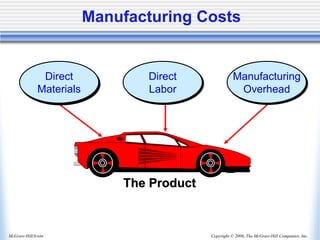
The Product
Direct
Materials
Direct
Labor
Manufacturing
Overhead
Manufacturing Costs
Copyright © 2006, The McGraw-Hill Companies, Inc.
McGraw-Hill/Irwin
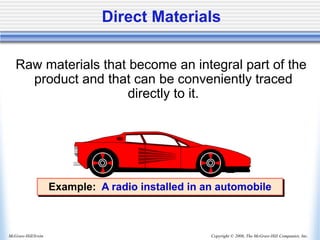
Direct Materials
Raw materials that become an integral part of the
product and that can be conveniently traced
directly to it.
Example: A radio installed in an automobile
Copyright © 2006, The McGraw-Hill Companies, Inc.
McGraw-Hill/Irwin
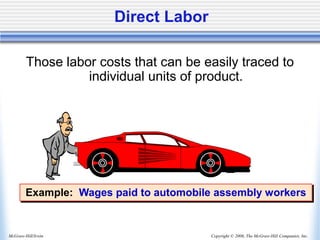
Direct Labor
Those labor costs that can be easily traced to
individual units of product.
Example: Wages paid to automobile assembly workers
Copyright © 2006, The McGraw-Hill Companies, Inc.
McGraw-Hill/Irwin
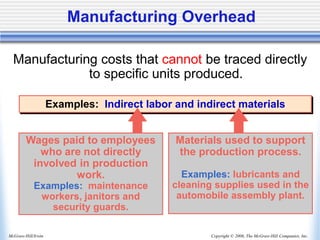
Manufacturing costs that cannot be traced directly
to specific units produced.
Manufacturing Overhead
Examples: Indirect labor and indirect materials
Wages paid to employees
who are not directly
involved in production
work.
Examples: maintenance
workers, janitors and
security guards.
Materials used to support
the production process.
Examples: lubricants and
cleaning supplies used in the
automobile assembly plant.
Copyright © 2006, The McGraw-Hill Companies, Inc.
McGraw-Hill/Irwin
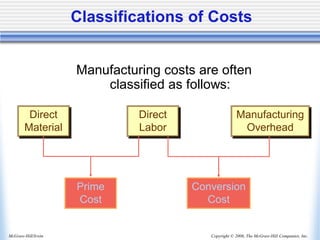
Classifications of Costs
Direct
Material
Direct
Labor
Manufacturing
Overhead
Prime
Cost
Conversion
Cost
Manufacturing costs are often
classified as follows:
Copyright © 2006, The McGraw-Hill Companies, Inc.
McGraw-Hill/Irwin
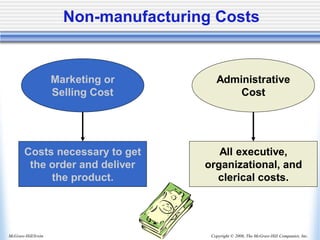
Non-manufacturing Costs
Marketing or
Selling Cost
Costs necessary to get
the order and deliver
the product.
Administrative
Cost
All executive,
organizational, and
clerical costs.
Copyright © 2006, The McGraw-Hill Companies, Inc.
McGraw-Hill/Irwin
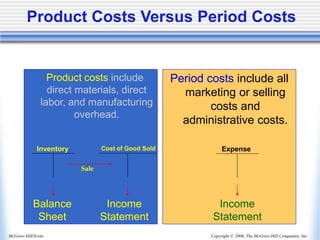
Product Costs Versus Period Costs
Product costs include
direct materials, direct
labor, and manufacturing
overhead.
Period costs include all
marketing or selling
costs and
administrative costs.
Inventory Cost of Good Sold
Balance
Sheet
Income
Statement
Sale
Expense
Income
Statement
Copyright © 2006, The McGraw-Hill Companies, Inc.
McGraw-Hill/Irwin
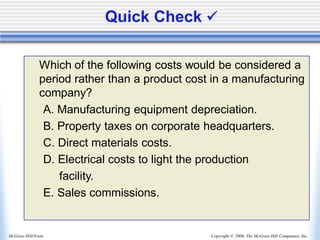
Quick Check ✓
Which of the following costs would be considered a
period rather than a product cost in a manufacturing
company?
A. Manufacturing equipment depreciation.
B. Property taxes on corporate headquarters.
C. Direct materials costs.
D. Electrical costs to light the production
facility.
E. Sales commissions.
Copyright © 2006, The McGraw-Hill Companies, Inc.
McGraw-Hill/Irwin
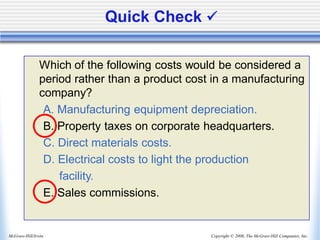
Quick Check ✓
Which of the following costs would be considered a
period rather than a product cost in a manufacturing
company?
A. Manufacturing equipment depreciation.
B. Property taxes on corporate headquarters.
C. Direct materials costs.
D. Electrical costs to light the production
facility.
E. Sales commissions.
Copyright © 2006, The McGraw-Hill Companies, Inc.
McGraw-Hill/Irwin
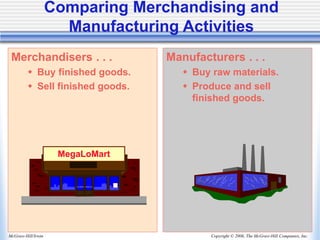
Comparing Merchandising and
Manufacturing Activities
Merchandisers . . .
 Buy finished goods.
 Sell finished goods.
Manufacturers . . .
 Buy raw materials.
 Produce and sell
finished goods.
MegaLoMart
Copyright © 2006, The McGraw-Hill Companies, Inc.
McGraw-Hill/Irwin
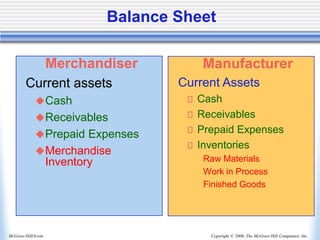
Balance Sheet
Merchandiser
Current assets
◆Cash
◆Receivables
◆Prepaid Expenses
◆Merchandise
Inventory
Manufacturer
Current Assets
Cash
Receivables
Prepaid Expenses
Inventories
Raw Materials
Work in Process
Finished Goods
Copyright © 2006, The McGraw-Hill Companies, Inc.
McGraw-Hill/Irwin
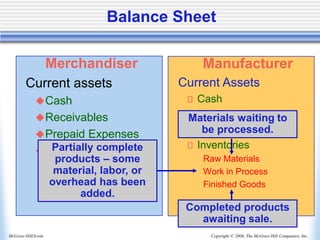
Balance Sheet
Merchandiser
Current assets
◆Cash
◆Receivables
◆Prepaid Expenses
◆Merchandise
Inventory
Manufacturer
Current Assets
Cash
Receivables
Prepaid Expenses
Inventories
Raw Materials
Work in Process
Finished Goods
Partially complete
products – some
material, labor, or
overhead has been
added.
Completed products
awaiting sale.
Materials waiting to
be processed.
Copyright © 2006, The McGraw-Hill Companies, Inc.
McGraw-Hill/Irwin
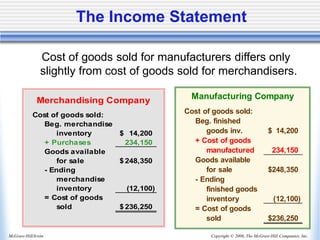
The Income Statement
Cost of goods sold for manufacturers differs only
slightly from cost of goods sold for merchandisers.
Manufacturing Company
Cost of goods sold:
Beg. finished
goods inv. 14,200
$
+ Cost of goods
manufactured 234,150
Goods available
for sale 248,350
$
- Ending
finished goods
inventory (12,100)
= Cost of goods
sold 236,250
$
Merchandising Company
Cost of goods sold:
Beg. merchandise
inventory 14,200
$
+ Purchases 234,150
Goods available
for sale 248,350
$
- Ending
merchandise
inventory (12,100)
= Cost of goods
sold 236,250
$
Copyright © 2006, The McGraw-Hill Companies, Inc.
McGraw-Hill/Irwin
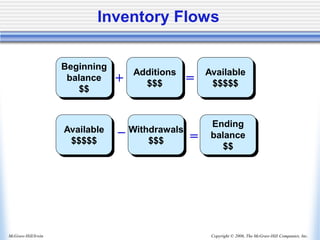
Inventory Flows
Beginning
balance
$$
Additions
$$$
+
Available
$$$$$
=
Ending
balance
$$
=
Withdrawals
$$$
_
Available
$$$$$
Copyright © 2006, The McGraw-Hill Companies, Inc.
McGraw-Hill/Irwin
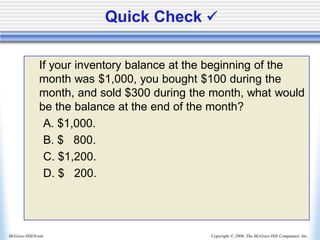
Quick Check ✓
If your inventory balance at the beginning of the
month was $1,000, you bought $100 during the
month, and sold $300 during the month, what would
be the balance at the end of the month?
A. $1,000.
B. $ 800.
C. $1,200.
D. $ 200.
Copyright © 2006, The McGraw-Hill Companies, Inc.
McGraw-Hill/Irwin
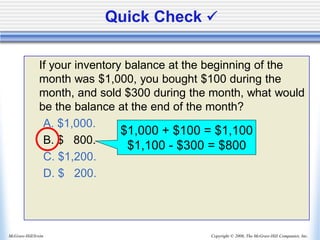
Quick Check ✓
If your inventory balance at the beginning of the
month was $1,000, you bought $100 during the
month, and sold $300 during the month, what would
be the balance at the end of the month?
A. $1,000.
B. $ 800.
C. $1,200.
D. $ 200.
$1,000 + $100 = $1,100
$1,100 - $300 = $800
Copyright © 2006, The McGraw-Hill Companies, Inc.
McGraw-Hill/Irwin
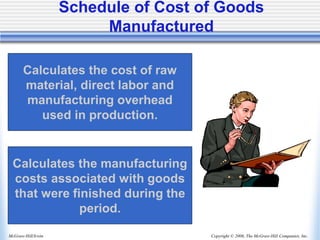
Schedule of Cost of Goods
Manufactured
Calculates the cost of raw
material, direct labor and
manufacturing overhead
used in production.
Calculates the manufacturing
costs associated with goods
that were finished during the
period.
Copyright © 2006, The McGraw-Hill Companies, Inc.
McGraw-Hill/Irwin
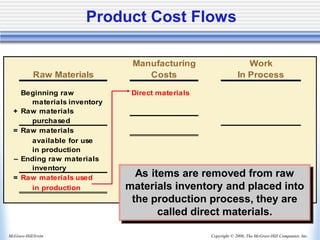
Manufacturing Work
Raw Materials Costs In Process
Beginning raw Direct materials
materials inventory
+ Raw materials
purchased
= Raw materials
available for use
in production
– Ending raw materials
inventory
= Raw materials used
in production
As items are removed from raw
materials inventory and placed into
the production process, they are
called direct materials.
Product Cost Flows
Copyright © 2006, The McGraw-Hill Companies, Inc.
McGraw-Hill/Irwin
Manufacturing Work
Raw Materials Costs In Process
Beginning raw Direct materials
materials inventory + Direct labor
+ Raw materials + Mfg. overhead
purchased = Total manufacturing
= Raw materials costs
available for use
in production
– Ending raw materials
inventory
= Raw materials used
in production
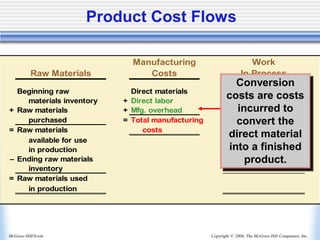
Conversion
costs are costs
incurred to
convert the
direct material
into a finished
product.
Product Cost Flows
Copyright © 2006, The McGraw-Hill Companies, Inc.
McGraw-Hill/Irwin
Manufacturing Work
Raw Materials Costs In Process
Beginning raw Direct materials Beginning work in
materials inventory + Direct labor process inventory
+ Raw materials + Mfg. overhead + Total manufacturing
purchased = Total manufacturing costs
= Raw materials costs = Total work in
available for use process for the
in production period
– Ending raw materials
inventory
= Raw materials used
in production
Product Cost Flows
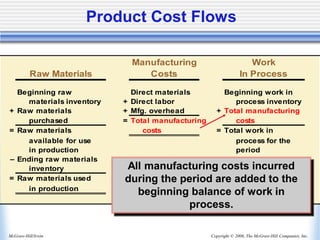
All manufacturing costs incurred
during the period are added to the
beginning balance of work in
process.
Copyright © 2006, The McGraw-Hill Companies, Inc.
McGraw-Hill/Irwin
Manufacturing Work
Raw Materials Costs In Process
Beginning raw Direct materials Beginning work in
materials inventory + Direct labor process inventory
+ Raw materials + Mfg. overhead + Total manufacturing
purchased = Total manufacturing costs
= Raw materials costs = Total work in
available for use process for the
in production period
– Ending work in
process inventory
= Cost of goods
manufactured
Product Cost Flows
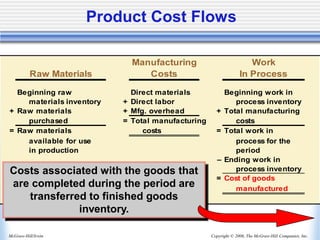
Costs associated with the goods that
are completed during the period are
transferred to finished goods
inventory.
Copyright © 2006, The McGraw-Hill Companies, Inc.
McGraw-Hill/Irwin
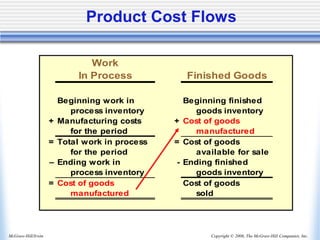
Work
In Process Finished Goods
Beginning work in Beginning finished
process inventory goods inventory
+ Manufacturing costs + Cost of goods
for the period manufactured
= Total work in process = Cost of goods
for the period available for sale
– Ending work in - Ending finished
process inventory goods inventory
= Cost of goods Cost of goods
manufactured sold
Product Cost Flows
Copyright © 2006, The McGraw-Hill Companies, Inc.
McGraw-Hill/Irwin
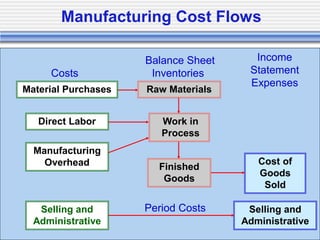
Manufacturing Cost Flows
Finished
Goods
Cost of
Goods
Sold
Selling and
Administrative
Period Costs
Selling and
Administrative
Manufacturing
Overhead
Work in
Process
Direct Labor
Balance Sheet
Costs Inventories
Income
Statement
Expenses
Material Purchases Raw Materials
Copyright © 2006, The McGraw-Hill Companies, Inc.
McGraw-Hill/Irwin
Quick Check ✓
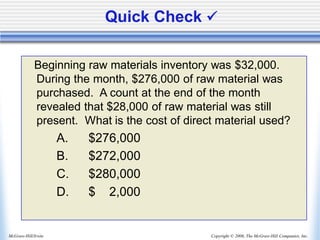
Beginning raw materials inventory was $32,000.
During the month, $276,000 of raw material was
purchased. A count at the end of the month
revealed that $28,000 of raw material was still
present. What is the cost of direct material used?
A. $276,000
B. $272,000
C. $280,000
D. $ 2,000
Copyright © 2006, The McGraw-Hill Companies, Inc.
McGraw-Hill/Irwin
Quick Check ✓
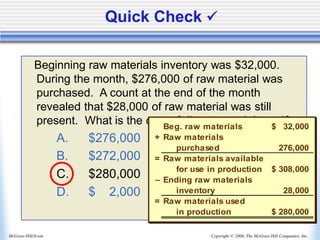
Beginning raw materials inventory was $32,000.
During the month, $276,000 of raw material was
purchased. A count at the end of the month
revealed that $28,000 of raw material was still
present. What is the cost of direct material used?
A. $276,000
B. $272,000
C. $280,000
D. $ 2,000
Beg. raw materials 32,000
$
+ Raw materials
purchased 276,000
= Raw materials available
for use in production 308,000
$
– Ending raw materials
inventory 28,000
= Raw materials used
in production 280,000
$
Copyright © 2006, The McGraw-Hill Companies, Inc.
McGraw-Hill/Irwin
Quick Check ✓
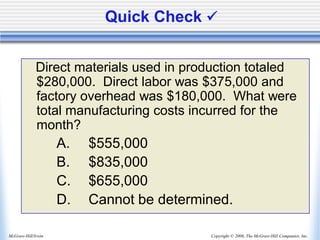
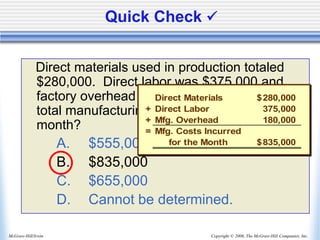
Direct materials used in production totaled
$280,000. Direct labor was $375,000 and
factory overhead was $180,000. What were
total manufacturing costs incurred for the
month?
A. $555,000
B. $835,000
C. $655,000
D. Cannot be determined.
Copyright © 2006, The McGraw-Hill Companies, Inc.
McGraw-Hill/Irwin
Direct materials used in production totaled
$280,000. Direct labor was $375,000 and
factory overhead was $180,000. What were
total manufacturing costs incurred for the
month?
A. $555,000
B. $835,000
C. $655,000
D. Cannot be determined.
Direct Materials 280,000
$
+ Direct Labor 375,000
+ Mfg. Overhead 180,000
= Mfg. Costs Incurred
for the Month 835,000
$
Quick Check ✓
Copyright © 2006, The McGraw-Hill Companies, Inc.
McGraw-Hill/Irwin
Quick Check ✓
Beginning work in process was $125,000.
Manufacturing costs incurred for the month
were $835,000. There were $200,000 of
partially finished goods remaining in work
in process inventory at the end of the
month. What was the cost of goods
manufactured during the month?
A. $1,160,000
B. $ 910,000
C. $ 760,000
D. Cannot be determined.
Copyright © 2006, The McGraw-Hill Companies, Inc.
McGraw-Hill/Irwin
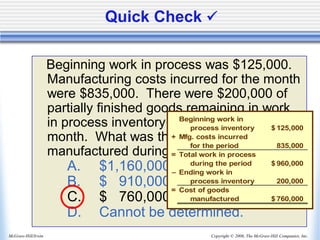
Beginning work in process was $125,000.
Manufacturing costs incurred for the month
were $835,000. There were $200,000 of
partially finished goods remaining in work
in process inventory at the end of the
month. What was the cost of goods
manufactured during the month?
A. $1,160,000
B. $ 910,000
C. $ 760,000
D. Cannot be determined.
Quick Check ✓
Beginning work in
process inventory 125,000
$
+ Mfg. costs incurred
for the period 835,000
= Total work in process
during the period 960,000
$
– Ending work in
process inventory 200,000
= Cost of goods
manufactured 760,000
$
Copyright © 2006, The McGraw-Hill Companies, Inc.
McGraw-Hill/Irwin
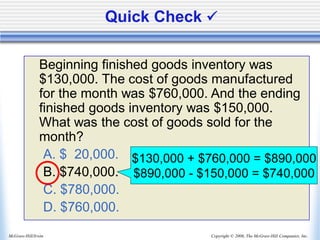
Quick Check ✓
Beginning finished goods inventory was
$130,000. The cost of goods manufactured
for the month was $760,000. And the ending
finished goods inventory was $150,000.
What was the cost of goods sold for the
month?
A. $ 20,000.
B. $740,000.
C. $780,000.
D. $760,000.
Copyright © 2006, The McGraw-Hill Companies, Inc.
McGraw-Hill/Irwin
Quick Check ✓
Beginning finished goods inventory was
$130,000. The cost of goods manufactured
for the month was $760,000. And the ending
finished goods inventory was $150,000.
What was the cost of goods sold for the
month?
A. $ 20,000.
B. $740,000.
C. $780,000.
D. $760,000.
$130,000 + $760,000 = $890,000
$890,000 - $150,000 = $740,000
Copyright © 2006, The McGraw-Hill Companies, Inc.
McGraw-Hill/Irwin
Cost Classifications for Predicting Cost
Behavior
How a cost will react to
changes in the level of
activity within the
relevant range.
 Total variable costs
change when activity
changes.
 Total fixed costs remain
unchanged when activity
changes.
Copyright © 2006, The McGraw-Hill Companies, Inc.
McGraw-Hill/Irwin
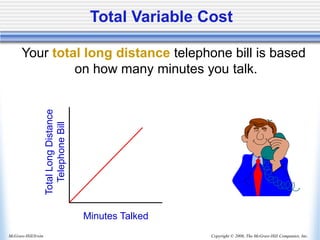
Total Variable Cost
Your total long distance telephone bill is based
on how many minutes you talk.
Minutes Talked
Total
Long
Distance
Telephone
Bill
Copyright © 2006, The McGraw-Hill Companies, Inc.
McGraw-Hill/Irwin
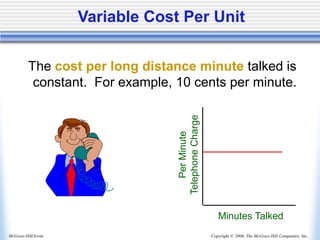
Variable Cost Per Unit
Minutes Talked
Per
Minute
Telephone
Charge
The cost per long distance minute talked is
constant. For example, 10 cents per minute.
Copyright © 2006, The McGraw-Hill Companies, Inc.
McGraw-Hill/Irwin
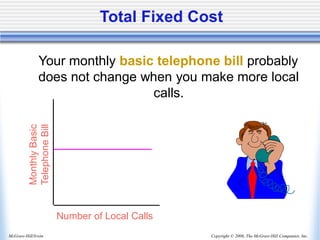
Total Fixed Cost
Your monthly basic telephone bill probably
does not change when you make more local
calls.
Number of Local Calls
Monthly
Basic
Telephone
Bill
Copyright © 2006, The McGraw-Hill Companies, Inc.
McGraw-Hill/Irwin
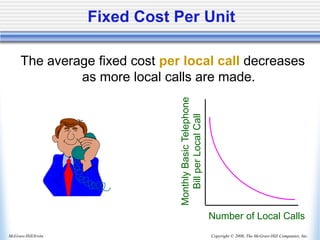
Fixed Cost Per Unit
Number of Local Calls
Monthly
Basic
Telephone
Bill
per
Local
Call
The average fixed cost per local call decreases
as more local calls are made.
Copyright © 2006, The McGraw-Hill Companies, Inc.
McGraw-Hill/Irwin
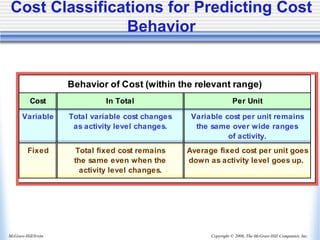
Cost Classifications for Predicting Cost
Behavior
Behavior of Cost (within the relevant range)
Cost In Total Per Unit
Variable Total variable cost changes Variable cost per unit remains
as activity level changes. the same over wide ranges
of activity.
Fixed Total fixed cost remains Average fixed cost per unit goes
the same even when the down as activity level goes up.
activity level changes.
Copyright © 2006, The McGraw-Hill Companies, Inc.
McGraw-Hill/Irwin
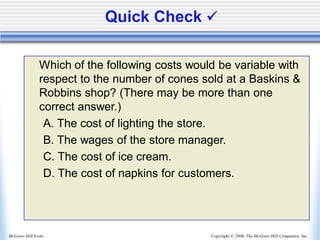
Quick Check ✓
Which of the following costs would be variable with
respect to the number of cones sold at a Baskins &
Robbins shop? (There may be more than one
correct answer.)
A. The cost of lighting the store.
B. The wages of the store manager.
C. The cost of ice cream.
D. The cost of napkins for customers.
Copyright © 2006, The McGraw-Hill Companies, Inc.
McGraw-Hill/Irwin
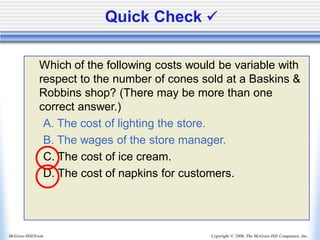
Quick Check ✓
Which of the following costs would be variable with
respect to the number of cones sold at a Baskins &
Robbins shop? (There may be more than one
correct answer.)
A. The cost of lighting the store.
B. The wages of the store manager.
C. The cost of ice cream.
D. The cost of napkins for customers.
Copyright © 2006, The McGraw-Hill Companies, Inc.
McGraw-Hill/Irwin
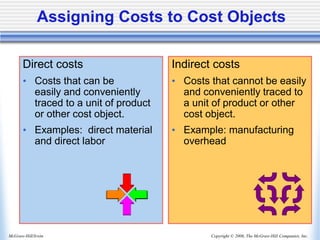
Assigning Costs to Cost Objects
Direct costs
• Costs that can be
easily and conveniently
traced to a unit of product
or other cost object.
• Examples: direct material
and direct labor
Indirect costs
• Costs that cannot be easily
and conveniently traced to
a unit of product or other
cost object.
• Example: manufacturing
overhead
Copyright © 2006, The McGraw-Hill Companies, Inc.
McGraw-Hill/Irwin
• Every decision involves a choice between at
least two alternatives.
• Only those costs and benefits that differ
between alternatives are relevant in a decision.
All other costs and benefits can and should be
ignored.
Cost Classifications for Decision
Making
Copyright © 2006, The McGraw-Hill Companies, Inc.
McGraw-Hill/Irwin
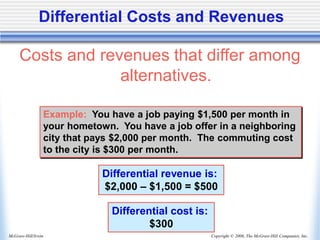
Differential Costs and Revenues
Costs and revenues that differ among
alternatives.
Example: You have a job paying $1,500 per month in
your hometown. You have a job offer in a neighboring
city that pays $2,000 per month. The commuting cost
to the city is $300 per month.
Differential revenue is:
$2,000 – $1,500 = $500
Differential cost is:
$300
Copyright © 2006, The McGraw-Hill Companies, Inc.
McGraw-Hill/Irwin
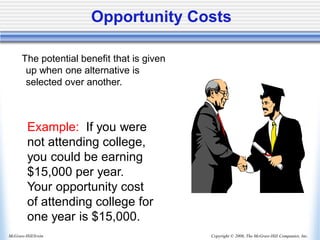
Opportunity Costs
The potential benefit that is given
up when one alternative is
selected over another.
Example: If you were
not attending college,
you could be earning
$15,000 per year.
Your opportunity cost
of attending college for
one year is $15,000.
Copyright © 2006, The McGraw-Hill Companies, Inc.
McGraw-Hill/Irwin
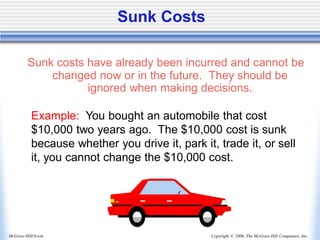
Sunk Costs
Sunk costs have already been incurred and cannot be
changed now or in the future. They should be
ignored when making decisions.
Example: You bought an automobile that cost
$10,000 two years ago. The $10,000 cost is sunk
because whether you drive it, park it, trade it, or sell
it, you cannot change the $10,000 cost.
Copyright © 2006, The McGraw-Hill Companies, Inc.
McGraw-Hill/Irwin
Quick Check ✓
Suppose you are trying to decide whether to drive
or take the train to Portland to attend a concert. You
have ample cash to do either, but you don’t want to
waste money needlessly. Is the cost of the train
ticket relevant in this decision? In other words,
should the cost of the train ticket affect the decision
of whether you drive or take the train to Portland?
A. Yes, the cost of the train ticket is relevant.
B. No, the cost of the train ticket is not relevant.
Copyright © 2006, The McGraw-Hill Companies, Inc.
McGraw-Hill/Irwin
Quick Check ✓
Suppose you are trying to decide whether to drive
or take the train to Portland to attend a concert. You
have ample cash to do either, but you don’t want to
waste money needlessly. Is the cost of the train
ticket relevant in this decision? In other words,
should the cost of the train ticket affect the decision
of whether you drive or take the train to Portland?
A. Yes, the cost of the train ticket is relevant.
B. No, the cost of the train ticket is not relevant.
Copyright © 2006, The McGraw-Hill Companies, Inc.
McGraw-Hill/Irwin
Quick Check ✓
Suppose you are trying to decide whether to drive
or take the train to Portland to attend a concert. You
have ample cash to do either, but you don’t want to
waste money needlessly. Is the annual cost of
licensing your car relevant in this decision?
A. Yes, the licensing cost is relevant.
B. No, the licensing cost is not relevant.
Copyright © 2006, The McGraw-Hill Companies, Inc.
McGraw-Hill/Irwin
Quick Check ✓
Suppose you are trying to decide whether to drive
or take the train to Portland to attend a concert. You
have ample cash to do either, but you don’t want to
waste money needlessly. Is the annual cost of
licensing your car relevant in this decision?
A. Yes, the licensing cost is relevant.
B. No, the licensing cost is not relevant.
Copyright © 2006, The McGraw-Hill Companies, Inc.
McGraw-Hill/Irwin
Quick Check ✓
Suppose that your car could be sold now for
$5,000. Is this a sunk cost?
A. Yes, it is a sunk cost.
B. No, it is not a sunk cost.
Copyright © 2006, The McGraw-Hill Companies, Inc.
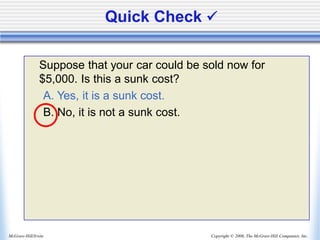
McGraw-Hill/Irwin
Quick Check ✓
Suppose that your car could be sold now for
$5,000. Is this a sunk cost?
A. Yes, it is a sunk cost.
B. No, it is not a sunk cost.
Copyright © 2006, The McGraw-Hill Companies, Inc.
McGraw-Hill/Irwin
Summary of the Types of Cost
Classifications
• Financial reporting
• Predicting cost behavior
• Assigning costs to cost objects
• Decision making
Copyright © 2006, The McGraw-Hill Companies, Inc.
McGraw-Hill/Irwin
Idle Time
The labor costs incurred
during idle time are ordinarily
treated as manufacturing
overhead.
Machine
Breakdowns
Material
Shortages
Power
Failures
Copyright © 2006, The McGraw-Hill Companies, Inc.
McGraw-Hill/Irwin
Overtime
The overtime premiums for all factory
workers are usually considered to be part
of manufacturing overhead.
Copyright © 2006, The McGraw-Hill Companies, Inc.
McGraw-Hill/Irwin
Labor Fringe Benefits
Fringe benefits include employer paid
costs for insurance programs, retirement
plans, supplemental unemployment
programs, Social Security, Medicare,
workers’ compensation and
unemployment taxes.
Some companies
include all of these
costs in
manufacturing
overhead.
Other companies treat
fringe benefit
expenses of direct
laborers as additional
direct labor costs.
Copyright © 2006, The McGraw-Hill Companies, Inc.
McGraw-Hill/Irwin
Quality of Conformance
When the overwhelming majority of
products produced conform to design
specifications and are free from
defects.
Copyright © 2006, The McGraw-Hill Companies, Inc.
McGraw-Hill/Irwin
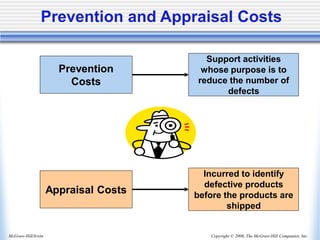
Prevention and Appraisal Costs
Prevention
Costs
Support activities
whose purpose is to
reduce the number of
defects
Appraisal Costs
Incurred to identify
defective products
before the products are
shipped
Copyright © 2006, The McGraw-Hill Companies, Inc.
McGraw-Hill/Irwin
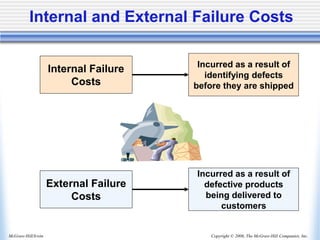
Internal and External Failure Costs
Internal Failure
Costs
Incurred as a result of
identifying defects
before they are shipped
External Failure
Costs
Incurred as a result of
defective products
being delivered to
customers
Copyright © 2006, The McGraw-Hill Companies, Inc.
McGraw-Hill/Irwin
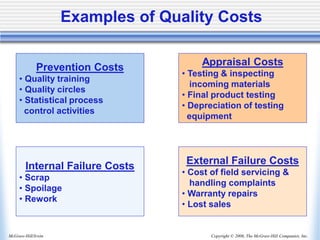
Examples of Quality Costs
Prevention Costs
• Quality training
• Quality circles
• Statistical process
control activities
Appraisal Costs
• Testing & inspecting
incoming materials
• Final product testing
• Depreciation of testing
equipment
Internal Failure Costs
• Scrap
• Spoilage
• Rework
External Failure Costs
• Cost of field servicing &
handling complaints
• Warranty repairs
• Lost sales
Copyright © 2006, The McGraw-Hill Companies, Inc.
McGraw-Hill/Irwin
Distribution of Quality Costs
When quality of conformance is low,
total quality cost is high and consists
mostly of internal and external failure.
Companies can reduce
their total quality cost by
focusing on prevention and
appraisal. The cost savings
from reduced defects
usually swamps the costs
of the additional prevention
and appraisal efforts.
Copyright © 2006, The McGraw-Hill Companies, Inc.
McGraw-Hill/Irwin
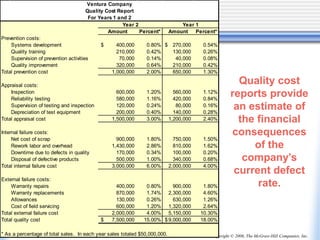
Quality cost
reports provide
an estimate of
the financial
consequences
of the
company’s
current defect
rate.
Amount Percent* Amount Percent*
Prevention costs:
Systems development 400,000
$ 0.80% 270,000
$ 0.54%
Quality training 210,000 0.42% 130,000 0.26%
Supervision of prevention activities 70,000 0.14% 40,000 0.08%
Quality improvement 320,000 0.64% 210,000 0.42%
Total prevention cost 1,000,000 2.00% 650,000 1.30%
Appraisal costs:
Inspection 600,000 1.20% 560,000 1.12%
Reliability testing 580,000 1.16% 420,000 0.84%
Supervision of testing and inspection 120,000 0.24% 80,000 0.16%
Depreciation of test equipment 200,000 0.40% 140,000 0.28%
Total appraisal cost 1,500,000 3.00% 1,200,000 2.40%
Internal failure costs:
Net cost of scrap 900,000 1.80% 750,000 1.50%
Rework labor and overhead 1,430,000 2.86% 810,000 1.62%
Downtime due to defects in quality 170,000 0.34% 100,000 0.20%
Disposal of defective products 500,000 1.00% 340,000 0.68%
Total internal failure cost 3,000,000 6.00% 2,000,000 4.00%
External failure costs:
Warranty repairs 400,000 0.80% 900,000 1.80%
Warranty replacements 870,000 1.74% 2,300,000 4.60%
Allowances 130,000 0.26% 630,000 1.26%
Cost of field servicing 600,000 1.20% 1,320,000 2.64%
Total external failure cost 2,000,000 4.00% 5,150,000 10.30%
Total quality cost 7,500,000
$ 15.00% 9,000,000
$ 18.00%
* As a percentage of total sales. In each year sales totaled $50,000,000.
Year 2 Year 1
Ventura Company
Quality Cost Report
For Years 1 and 2
Copyright © 2006, The McGraw-Hill Companies, Inc.
McGraw-Hill/Irwin
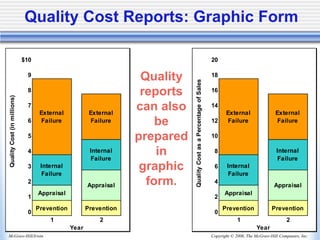
Quality Cost Reports: Graphic Form
$10
9
8
7
6
5
4
3
2
1
Appraisal
0
Prevention Prevention
1 2
Year
Quality
Cost
(in
millions)
Appraisal
Internal
Failure
External
Failure
Internal
Failure
External
Failure
20
18
16
14
12
10
8
6
4
2
Appraisal
0
Prevention Prevention
1 2
Year
Quality
Cost
as
a
Percentage
of
Sales
Appraisal
Internal
Failure
External
Failure
Internal
Failure
External
Failure
Quality
reports
can also
be
prepared
in
graphic
form.
Copyright © 2006, The McGraw-Hill Companies, Inc.
McGraw-Hill/Irwin
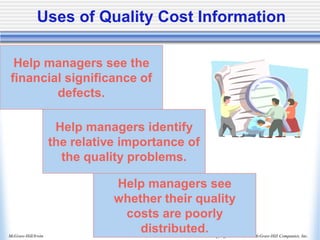
Uses of Quality Cost Information
Help managers see the
financial significance of
defects.
Help managers identify
the relative importance of
the quality problems.
Help managers see
whether their quality
costs are poorly
distributed.
Copyright © 2006, The McGraw-Hill Companies, Inc.
McGraw-Hill/Irwin
Limitations of Quality Cost Information
Simply measuring quality
cost problems does not
solve quality problems.
Results usually lag
behind quality
improvement programs.
The most important
quality cost, lost sales, is
often omitted from
quality cost reports.
Copyright © 2006, The McGraw-Hill Companies, Inc.
McGraw-Hill/Irwin
ISO 9000 Standards
ISO 9000 standards have become an
international measure of quality. To become
ISO 9000 certified, a company must
demonstrate:
1. A quality control system is in use, and the
system clearly defines an expected level of
quality.
2. The system is fully operational and is
backed up with detailed documentation of
quality control procedures.
3. The intended level of quality is being
achieved on a sustained basis.
Copyright © 2006, The McGraw-Hill Companies, Inc.
McGraw-Hill/Irwin
End of Chapter 2

chap02notes.pdf

  • 1.
    Copyright © 2006,The McGraw-Hill Companies, Inc. McGraw-Hill/Irwin 11th Edition Chapter 2
  • 2.
    Copyright © 2006,The McGraw-Hill Companies, Inc. McGraw-Hill/Irwin Costs Terms, Concepts and Classifications Chapter Two
  • 3.
    Copyright © 2006,The McGraw-Hill Companies, Inc. McGraw-Hill/Irwin The Product Direct Materials Direct Labor Manufacturing Overhead Manufacturing Costs
  • 4.
    Copyright © 2006,The McGraw-Hill Companies, Inc. McGraw-Hill/Irwin Direct Materials Raw materials that become an integral part of the product and that can be conveniently traced directly to it. Example: A radio installed in an automobile
  • 5.
    Copyright © 2006,The McGraw-Hill Companies, Inc. McGraw-Hill/Irwin Direct Labor Those labor costs that can be easily traced to individual units of product. Example: Wages paid to automobile assembly workers
  • 6.
    Copyright © 2006,The McGraw-Hill Companies, Inc. McGraw-Hill/Irwin Manufacturing costs that cannot be traced directly to specific units produced. Manufacturing Overhead Examples: Indirect labor and indirect materials Wages paid to employees who are not directly involved in production work. Examples: maintenance workers, janitors and security guards. Materials used to support the production process. Examples: lubricants and cleaning supplies used in the automobile assembly plant.
  • 7.
    Copyright © 2006,The McGraw-Hill Companies, Inc. McGraw-Hill/Irwin Classifications of Costs Direct Material Direct Labor Manufacturing Overhead Prime Cost Conversion Cost Manufacturing costs are often classified as follows:
  • 8.
    Copyright © 2006,The McGraw-Hill Companies, Inc. McGraw-Hill/Irwin Non-manufacturing Costs Marketing or Selling Cost Costs necessary to get the order and deliver the product. Administrative Cost All executive, organizational, and clerical costs.
  • 9.
    Copyright © 2006,The McGraw-Hill Companies, Inc. McGraw-Hill/Irwin Product Costs Versus Period Costs Product costs include direct materials, direct labor, and manufacturing overhead. Period costs include all marketing or selling costs and administrative costs. Inventory Cost of Good Sold Balance Sheet Income Statement Sale Expense Income Statement
  • 10.
    Copyright © 2006,The McGraw-Hill Companies, Inc. McGraw-Hill/Irwin Quick Check ✓ Which of the following costs would be considered a period rather than a product cost in a manufacturing company? A. Manufacturing equipment depreciation. B. Property taxes on corporate headquarters. C. Direct materials costs. D. Electrical costs to light the production facility. E. Sales commissions.
  • 11.
    Copyright © 2006,The McGraw-Hill Companies, Inc. McGraw-Hill/Irwin Quick Check ✓ Which of the following costs would be considered a period rather than a product cost in a manufacturing company? A. Manufacturing equipment depreciation. B. Property taxes on corporate headquarters. C. Direct materials costs. D. Electrical costs to light the production facility. E. Sales commissions.
  • 12.
    Copyright © 2006,The McGraw-Hill Companies, Inc. McGraw-Hill/Irwin Comparing Merchandising and Manufacturing Activities Merchandisers . . .  Buy finished goods.  Sell finished goods. Manufacturers . . .  Buy raw materials.  Produce and sell finished goods. MegaLoMart
  • 13.
    Copyright © 2006,The McGraw-Hill Companies, Inc. McGraw-Hill/Irwin Balance Sheet Merchandiser Current assets ◆Cash ◆Receivables ◆Prepaid Expenses ◆Merchandise Inventory Manufacturer Current Assets Cash Receivables Prepaid Expenses Inventories Raw Materials Work in Process Finished Goods
  • 14.
    Copyright © 2006,The McGraw-Hill Companies, Inc. McGraw-Hill/Irwin Balance Sheet Merchandiser Current assets ◆Cash ◆Receivables ◆Prepaid Expenses ◆Merchandise Inventory Manufacturer Current Assets Cash Receivables Prepaid Expenses Inventories Raw Materials Work in Process Finished Goods Partially complete products – some material, labor, or overhead has been added. Completed products awaiting sale. Materials waiting to be processed.
  • 15.
    Copyright © 2006,The McGraw-Hill Companies, Inc. McGraw-Hill/Irwin The Income Statement Cost of goods sold for manufacturers differs only slightly from cost of goods sold for merchandisers. Manufacturing Company Cost of goods sold: Beg. finished goods inv. 14,200 $ + Cost of goods manufactured 234,150 Goods available for sale 248,350 $ - Ending finished goods inventory (12,100) = Cost of goods sold 236,250 $ Merchandising Company Cost of goods sold: Beg. merchandise inventory 14,200 $ + Purchases 234,150 Goods available for sale 248,350 $ - Ending merchandise inventory (12,100) = Cost of goods sold 236,250 $
  • 16.
    Copyright © 2006,The McGraw-Hill Companies, Inc. McGraw-Hill/Irwin Inventory Flows Beginning balance $$ Additions $$$ + Available $$$$$ = Ending balance $$ = Withdrawals $$$ _ Available $$$$$
  • 17.
    Copyright © 2006,The McGraw-Hill Companies, Inc. McGraw-Hill/Irwin Quick Check ✓ If your inventory balance at the beginning of the month was $1,000, you bought $100 during the month, and sold $300 during the month, what would be the balance at the end of the month? A. $1,000. B. $ 800. C. $1,200. D. $ 200.
  • 18.
    Copyright © 2006,The McGraw-Hill Companies, Inc. McGraw-Hill/Irwin Quick Check ✓ If your inventory balance at the beginning of the month was $1,000, you bought $100 during the month, and sold $300 during the month, what would be the balance at the end of the month? A. $1,000. B. $ 800. C. $1,200. D. $ 200. $1,000 + $100 = $1,100 $1,100 - $300 = $800
  • 19.
    Copyright © 2006,The McGraw-Hill Companies, Inc. McGraw-Hill/Irwin Schedule of Cost of Goods Manufactured Calculates the cost of raw material, direct labor and manufacturing overhead used in production. Calculates the manufacturing costs associated with goods that were finished during the period.
  • 20.
    Copyright © 2006,The McGraw-Hill Companies, Inc. McGraw-Hill/Irwin Manufacturing Work Raw Materials Costs In Process Beginning raw Direct materials materials inventory + Raw materials purchased = Raw materials available for use in production – Ending raw materials inventory = Raw materials used in production As items are removed from raw materials inventory and placed into the production process, they are called direct materials. Product Cost Flows
  • 21.
    Copyright © 2006,The McGraw-Hill Companies, Inc. McGraw-Hill/Irwin Manufacturing Work Raw Materials Costs In Process Beginning raw Direct materials materials inventory + Direct labor + Raw materials + Mfg. overhead purchased = Total manufacturing = Raw materials costs available for use in production – Ending raw materials inventory = Raw materials used in production Conversion costs are costs incurred to convert the direct material into a finished product. Product Cost Flows
  • 22.
    Copyright © 2006,The McGraw-Hill Companies, Inc. McGraw-Hill/Irwin Manufacturing Work Raw Materials Costs In Process Beginning raw Direct materials Beginning work in materials inventory + Direct labor process inventory + Raw materials + Mfg. overhead + Total manufacturing purchased = Total manufacturing costs = Raw materials costs = Total work in available for use process for the in production period – Ending raw materials inventory = Raw materials used in production Product Cost Flows All manufacturing costs incurred during the period are added to the beginning balance of work in process.
  • 23.
    Copyright © 2006,The McGraw-Hill Companies, Inc. McGraw-Hill/Irwin Manufacturing Work Raw Materials Costs In Process Beginning raw Direct materials Beginning work in materials inventory + Direct labor process inventory + Raw materials + Mfg. overhead + Total manufacturing purchased = Total manufacturing costs = Raw materials costs = Total work in available for use process for the in production period – Ending work in process inventory = Cost of goods manufactured Product Cost Flows Costs associated with the goods that are completed during the period are transferred to finished goods inventory.
  • 24.
    Copyright © 2006,The McGraw-Hill Companies, Inc. McGraw-Hill/Irwin Work In Process Finished Goods Beginning work in Beginning finished process inventory goods inventory + Manufacturing costs + Cost of goods for the period manufactured = Total work in process = Cost of goods for the period available for sale – Ending work in - Ending finished process inventory goods inventory = Cost of goods Cost of goods manufactured sold Product Cost Flows
  • 25.
    Copyright © 2006,The McGraw-Hill Companies, Inc. McGraw-Hill/Irwin Manufacturing Cost Flows Finished Goods Cost of Goods Sold Selling and Administrative Period Costs Selling and Administrative Manufacturing Overhead Work in Process Direct Labor Balance Sheet Costs Inventories Income Statement Expenses Material Purchases Raw Materials
  • 26.
    Copyright © 2006,The McGraw-Hill Companies, Inc. McGraw-Hill/Irwin Quick Check ✓ Beginning raw materials inventory was $32,000. During the month, $276,000 of raw material was purchased. A count at the end of the month revealed that $28,000 of raw material was still present. What is the cost of direct material used? A. $276,000 B. $272,000 C. $280,000 D. $ 2,000
  • 27.
    Copyright © 2006,The McGraw-Hill Companies, Inc. McGraw-Hill/Irwin Quick Check ✓ Beginning raw materials inventory was $32,000. During the month, $276,000 of raw material was purchased. A count at the end of the month revealed that $28,000 of raw material was still present. What is the cost of direct material used? A. $276,000 B. $272,000 C. $280,000 D. $ 2,000 Beg. raw materials 32,000 $ + Raw materials purchased 276,000 = Raw materials available for use in production 308,000 $ – Ending raw materials inventory 28,000 = Raw materials used in production 280,000 $
  • 28.
    Copyright © 2006,The McGraw-Hill Companies, Inc. McGraw-Hill/Irwin Quick Check ✓ Direct materials used in production totaled $280,000. Direct labor was $375,000 and factory overhead was $180,000. What were total manufacturing costs incurred for the month? A. $555,000 B. $835,000 C. $655,000 D. Cannot be determined.
  • 29.
    Copyright © 2006,The McGraw-Hill Companies, Inc. McGraw-Hill/Irwin Direct materials used in production totaled $280,000. Direct labor was $375,000 and factory overhead was $180,000. What were total manufacturing costs incurred for the month? A. $555,000 B. $835,000 C. $655,000 D. Cannot be determined. Direct Materials 280,000 $ + Direct Labor 375,000 + Mfg. Overhead 180,000 = Mfg. Costs Incurred for the Month 835,000 $ Quick Check ✓
  • 30.
    Copyright © 2006,The McGraw-Hill Companies, Inc. McGraw-Hill/Irwin Quick Check ✓ Beginning work in process was $125,000. Manufacturing costs incurred for the month were $835,000. There were $200,000 of partially finished goods remaining in work in process inventory at the end of the month. What was the cost of goods manufactured during the month? A. $1,160,000 B. $ 910,000 C. $ 760,000 D. Cannot be determined.
  • 31.
    Copyright © 2006,The McGraw-Hill Companies, Inc. McGraw-Hill/Irwin Beginning work in process was $125,000. Manufacturing costs incurred for the month were $835,000. There were $200,000 of partially finished goods remaining in work in process inventory at the end of the month. What was the cost of goods manufactured during the month? A. $1,160,000 B. $ 910,000 C. $ 760,000 D. Cannot be determined. Quick Check ✓ Beginning work in process inventory 125,000 $ + Mfg. costs incurred for the period 835,000 = Total work in process during the period 960,000 $ – Ending work in process inventory 200,000 = Cost of goods manufactured 760,000 $
  • 32.
    Copyright © 2006,The McGraw-Hill Companies, Inc. McGraw-Hill/Irwin Quick Check ✓ Beginning finished goods inventory was $130,000. The cost of goods manufactured for the month was $760,000. And the ending finished goods inventory was $150,000. What was the cost of goods sold for the month? A. $ 20,000. B. $740,000. C. $780,000. D. $760,000.
  • 33.
    Copyright © 2006,The McGraw-Hill Companies, Inc. McGraw-Hill/Irwin Quick Check ✓ Beginning finished goods inventory was $130,000. The cost of goods manufactured for the month was $760,000. And the ending finished goods inventory was $150,000. What was the cost of goods sold for the month? A. $ 20,000. B. $740,000. C. $780,000. D. $760,000. $130,000 + $760,000 = $890,000 $890,000 - $150,000 = $740,000
  • 34.
    Copyright © 2006,The McGraw-Hill Companies, Inc. McGraw-Hill/Irwin Cost Classifications for Predicting Cost Behavior How a cost will react to changes in the level of activity within the relevant range.  Total variable costs change when activity changes.  Total fixed costs remain unchanged when activity changes.
  • 35.
    Copyright © 2006,The McGraw-Hill Companies, Inc. McGraw-Hill/Irwin Total Variable Cost Your total long distance telephone bill is based on how many minutes you talk. Minutes Talked Total Long Distance Telephone Bill
  • 36.
    Copyright © 2006,The McGraw-Hill Companies, Inc. McGraw-Hill/Irwin Variable Cost Per Unit Minutes Talked Per Minute Telephone Charge The cost per long distance minute talked is constant. For example, 10 cents per minute.
  • 37.
    Copyright © 2006,The McGraw-Hill Companies, Inc. McGraw-Hill/Irwin Total Fixed Cost Your monthly basic telephone bill probably does not change when you make more local calls. Number of Local Calls Monthly Basic Telephone Bill
  • 38.
    Copyright © 2006,The McGraw-Hill Companies, Inc. McGraw-Hill/Irwin Fixed Cost Per Unit Number of Local Calls Monthly Basic Telephone Bill per Local Call The average fixed cost per local call decreases as more local calls are made.
  • 39.
    Copyright © 2006,The McGraw-Hill Companies, Inc. McGraw-Hill/Irwin Cost Classifications for Predicting Cost Behavior Behavior of Cost (within the relevant range) Cost In Total Per Unit Variable Total variable cost changes Variable cost per unit remains as activity level changes. the same over wide ranges of activity. Fixed Total fixed cost remains Average fixed cost per unit goes the same even when the down as activity level goes up. activity level changes.
  • 40.
    Copyright © 2006,The McGraw-Hill Companies, Inc. McGraw-Hill/Irwin Quick Check ✓ Which of the following costs would be variable with respect to the number of cones sold at a Baskins & Robbins shop? (There may be more than one correct answer.) A. The cost of lighting the store. B. The wages of the store manager. C. The cost of ice cream. D. The cost of napkins for customers.
  • 41.
    Copyright © 2006,The McGraw-Hill Companies, Inc. McGraw-Hill/Irwin Quick Check ✓ Which of the following costs would be variable with respect to the number of cones sold at a Baskins & Robbins shop? (There may be more than one correct answer.) A. The cost of lighting the store. B. The wages of the store manager. C. The cost of ice cream. D. The cost of napkins for customers.
  • 42.
    Copyright © 2006,The McGraw-Hill Companies, Inc. McGraw-Hill/Irwin Assigning Costs to Cost Objects Direct costs • Costs that can be easily and conveniently traced to a unit of product or other cost object. • Examples: direct material and direct labor Indirect costs • Costs that cannot be easily and conveniently traced to a unit of product or other cost object. • Example: manufacturing overhead
  • 43.
    Copyright © 2006,The McGraw-Hill Companies, Inc. McGraw-Hill/Irwin • Every decision involves a choice between at least two alternatives. • Only those costs and benefits that differ between alternatives are relevant in a decision. All other costs and benefits can and should be ignored. Cost Classifications for Decision Making
  • 44.
    Copyright © 2006,The McGraw-Hill Companies, Inc. McGraw-Hill/Irwin Differential Costs and Revenues Costs and revenues that differ among alternatives. Example: You have a job paying $1,500 per month in your hometown. You have a job offer in a neighboring city that pays $2,000 per month. The commuting cost to the city is $300 per month. Differential revenue is: $2,000 – $1,500 = $500 Differential cost is: $300
  • 45.
    Copyright © 2006,The McGraw-Hill Companies, Inc. McGraw-Hill/Irwin Opportunity Costs The potential benefit that is given up when one alternative is selected over another. Example: If you were not attending college, you could be earning $15,000 per year. Your opportunity cost of attending college for one year is $15,000.
  • 46.
    Copyright © 2006,The McGraw-Hill Companies, Inc. McGraw-Hill/Irwin Sunk Costs Sunk costs have already been incurred and cannot be changed now or in the future. They should be ignored when making decisions. Example: You bought an automobile that cost $10,000 two years ago. The $10,000 cost is sunk because whether you drive it, park it, trade it, or sell it, you cannot change the $10,000 cost.
  • 47.
    Copyright © 2006,The McGraw-Hill Companies, Inc. McGraw-Hill/Irwin Quick Check ✓ Suppose you are trying to decide whether to drive or take the train to Portland to attend a concert. You have ample cash to do either, but you don’t want to waste money needlessly. Is the cost of the train ticket relevant in this decision? In other words, should the cost of the train ticket affect the decision of whether you drive or take the train to Portland? A. Yes, the cost of the train ticket is relevant. B. No, the cost of the train ticket is not relevant.
  • 48.
    Copyright © 2006,The McGraw-Hill Companies, Inc. McGraw-Hill/Irwin Quick Check ✓ Suppose you are trying to decide whether to drive or take the train to Portland to attend a concert. You have ample cash to do either, but you don’t want to waste money needlessly. Is the cost of the train ticket relevant in this decision? In other words, should the cost of the train ticket affect the decision of whether you drive or take the train to Portland? A. Yes, the cost of the train ticket is relevant. B. No, the cost of the train ticket is not relevant.
  • 49.
    Copyright © 2006,The McGraw-Hill Companies, Inc. McGraw-Hill/Irwin Quick Check ✓ Suppose you are trying to decide whether to drive or take the train to Portland to attend a concert. You have ample cash to do either, but you don’t want to waste money needlessly. Is the annual cost of licensing your car relevant in this decision? A. Yes, the licensing cost is relevant. B. No, the licensing cost is not relevant.
  • 50.
    Copyright © 2006,The McGraw-Hill Companies, Inc. McGraw-Hill/Irwin Quick Check ✓ Suppose you are trying to decide whether to drive or take the train to Portland to attend a concert. You have ample cash to do either, but you don’t want to waste money needlessly. Is the annual cost of licensing your car relevant in this decision? A. Yes, the licensing cost is relevant. B. No, the licensing cost is not relevant.
  • 51.
    Copyright © 2006,The McGraw-Hill Companies, Inc. McGraw-Hill/Irwin Quick Check ✓ Suppose that your car could be sold now for $5,000. Is this a sunk cost? A. Yes, it is a sunk cost. B. No, it is not a sunk cost.
  • 52.
    Copyright © 2006,The McGraw-Hill Companies, Inc. McGraw-Hill/Irwin Quick Check ✓ Suppose that your car could be sold now for $5,000. Is this a sunk cost? A. Yes, it is a sunk cost. B. No, it is not a sunk cost.
  • 53.
    Copyright © 2006,The McGraw-Hill Companies, Inc. McGraw-Hill/Irwin Summary of the Types of Cost Classifications • Financial reporting • Predicting cost behavior • Assigning costs to cost objects • Decision making
  • 54.
    Copyright © 2006,The McGraw-Hill Companies, Inc. McGraw-Hill/Irwin Idle Time The labor costs incurred during idle time are ordinarily treated as manufacturing overhead. Machine Breakdowns Material Shortages Power Failures
  • 55.
    Copyright © 2006,The McGraw-Hill Companies, Inc. McGraw-Hill/Irwin Overtime The overtime premiums for all factory workers are usually considered to be part of manufacturing overhead.
  • 56.
    Copyright © 2006,The McGraw-Hill Companies, Inc. McGraw-Hill/Irwin Labor Fringe Benefits Fringe benefits include employer paid costs for insurance programs, retirement plans, supplemental unemployment programs, Social Security, Medicare, workers’ compensation and unemployment taxes. Some companies include all of these costs in manufacturing overhead. Other companies treat fringe benefit expenses of direct laborers as additional direct labor costs.
  • 57.
    Copyright © 2006,The McGraw-Hill Companies, Inc. McGraw-Hill/Irwin Quality of Conformance When the overwhelming majority of products produced conform to design specifications and are free from defects.
  • 58.
    Copyright © 2006,The McGraw-Hill Companies, Inc. McGraw-Hill/Irwin Prevention and Appraisal Costs Prevention Costs Support activities whose purpose is to reduce the number of defects Appraisal Costs Incurred to identify defective products before the products are shipped
  • 59.
    Copyright © 2006,The McGraw-Hill Companies, Inc. McGraw-Hill/Irwin Internal and External Failure Costs Internal Failure Costs Incurred as a result of identifying defects before they are shipped External Failure Costs Incurred as a result of defective products being delivered to customers
  • 60.
    Copyright © 2006,The McGraw-Hill Companies, Inc. McGraw-Hill/Irwin Examples of Quality Costs Prevention Costs • Quality training • Quality circles • Statistical process control activities Appraisal Costs • Testing & inspecting incoming materials • Final product testing • Depreciation of testing equipment Internal Failure Costs • Scrap • Spoilage • Rework External Failure Costs • Cost of field servicing & handling complaints • Warranty repairs • Lost sales
  • 61.
    Copyright © 2006,The McGraw-Hill Companies, Inc. McGraw-Hill/Irwin Distribution of Quality Costs When quality of conformance is low, total quality cost is high and consists mostly of internal and external failure. Companies can reduce their total quality cost by focusing on prevention and appraisal. The cost savings from reduced defects usually swamps the costs of the additional prevention and appraisal efforts.
  • 62.
    Copyright © 2006,The McGraw-Hill Companies, Inc. McGraw-Hill/Irwin Quality cost reports provide an estimate of the financial consequences of the company’s current defect rate. Amount Percent* Amount Percent* Prevention costs: Systems development 400,000 $ 0.80% 270,000 $ 0.54% Quality training 210,000 0.42% 130,000 0.26% Supervision of prevention activities 70,000 0.14% 40,000 0.08% Quality improvement 320,000 0.64% 210,000 0.42% Total prevention cost 1,000,000 2.00% 650,000 1.30% Appraisal costs: Inspection 600,000 1.20% 560,000 1.12% Reliability testing 580,000 1.16% 420,000 0.84% Supervision of testing and inspection 120,000 0.24% 80,000 0.16% Depreciation of test equipment 200,000 0.40% 140,000 0.28% Total appraisal cost 1,500,000 3.00% 1,200,000 2.40% Internal failure costs: Net cost of scrap 900,000 1.80% 750,000 1.50% Rework labor and overhead 1,430,000 2.86% 810,000 1.62% Downtime due to defects in quality 170,000 0.34% 100,000 0.20% Disposal of defective products 500,000 1.00% 340,000 0.68% Total internal failure cost 3,000,000 6.00% 2,000,000 4.00% External failure costs: Warranty repairs 400,000 0.80% 900,000 1.80% Warranty replacements 870,000 1.74% 2,300,000 4.60% Allowances 130,000 0.26% 630,000 1.26% Cost of field servicing 600,000 1.20% 1,320,000 2.64% Total external failure cost 2,000,000 4.00% 5,150,000 10.30% Total quality cost 7,500,000 $ 15.00% 9,000,000 $ 18.00% * As a percentage of total sales. In each year sales totaled $50,000,000. Year 2 Year 1 Ventura Company Quality Cost Report For Years 1 and 2
  • 63.
    Copyright © 2006,The McGraw-Hill Companies, Inc. McGraw-Hill/Irwin Quality Cost Reports: Graphic Form $10 9 8 7 6 5 4 3 2 1 Appraisal 0 Prevention Prevention 1 2 Year Quality Cost (in millions) Appraisal Internal Failure External Failure Internal Failure External Failure 20 18 16 14 12 10 8 6 4 2 Appraisal 0 Prevention Prevention 1 2 Year Quality Cost as a Percentage of Sales Appraisal Internal Failure External Failure Internal Failure External Failure Quality reports can also be prepared in graphic form.
  • 64.
    Copyright © 2006,The McGraw-Hill Companies, Inc. McGraw-Hill/Irwin Uses of Quality Cost Information Help managers see the financial significance of defects. Help managers identify the relative importance of the quality problems. Help managers see whether their quality costs are poorly distributed.
  • 65.
    Copyright © 2006,The McGraw-Hill Companies, Inc. McGraw-Hill/Irwin Limitations of Quality Cost Information Simply measuring quality cost problems does not solve quality problems. Results usually lag behind quality improvement programs. The most important quality cost, lost sales, is often omitted from quality cost reports.
  • 66.
    Copyright © 2006,The McGraw-Hill Companies, Inc. McGraw-Hill/Irwin ISO 9000 Standards ISO 9000 standards have become an international measure of quality. To become ISO 9000 certified, a company must demonstrate: 1. A quality control system is in use, and the system clearly defines an expected level of quality. 2. The system is fully operational and is backed up with detailed documentation of quality control procedures. 3. The intended level of quality is being achieved on a sustained basis.
  • 67.
    Copyright © 2006,The McGraw-Hill Companies, Inc. McGraw-Hill/Irwin End of Chapter 2