CHAPTER 10 Implementing Strategy: Structure, Leadership, and Culture
Chapter Topics Structuring an Effective Organization Organizational Leadership Organizational Culture Appendix – Primary Organizational Structures and their Strategy-Related Pros and Cons
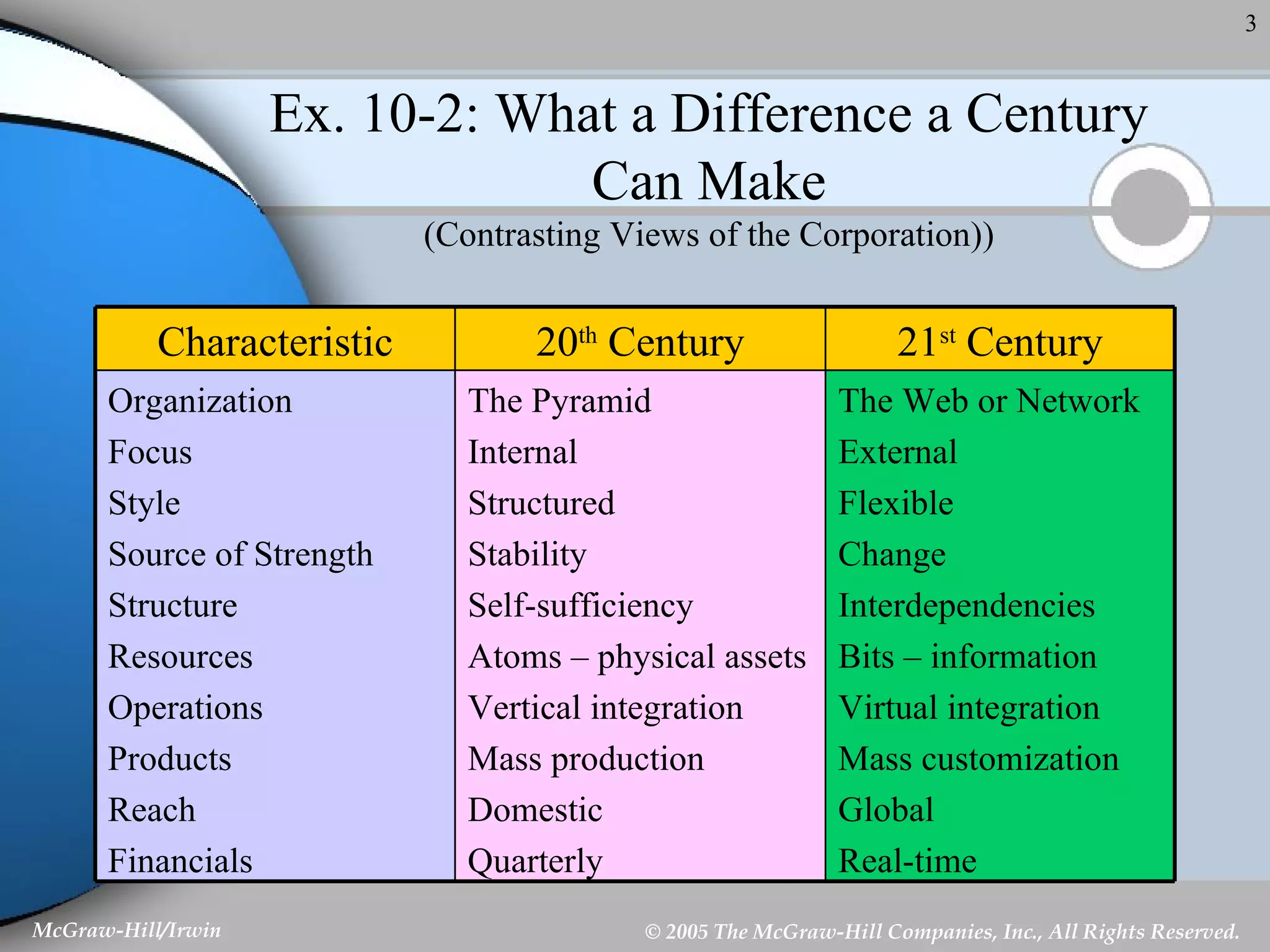
Ex. 10-2: What a Difference a Century Can Make (Contrasting Views of the Corporation)) The Web or Network External Flexible Change Interdependencies Bits – information Virtual integration Mass customization Global Real-time The Pyramid Internal Structured Stability Self-sufficiency Atoms – physical assets Vertical integration Mass production Domestic Quarterly Organization Focus Style Source of Strength Structure Resources Operations Products Reach Financials 21 st  Century 20 th  Century Characteristic
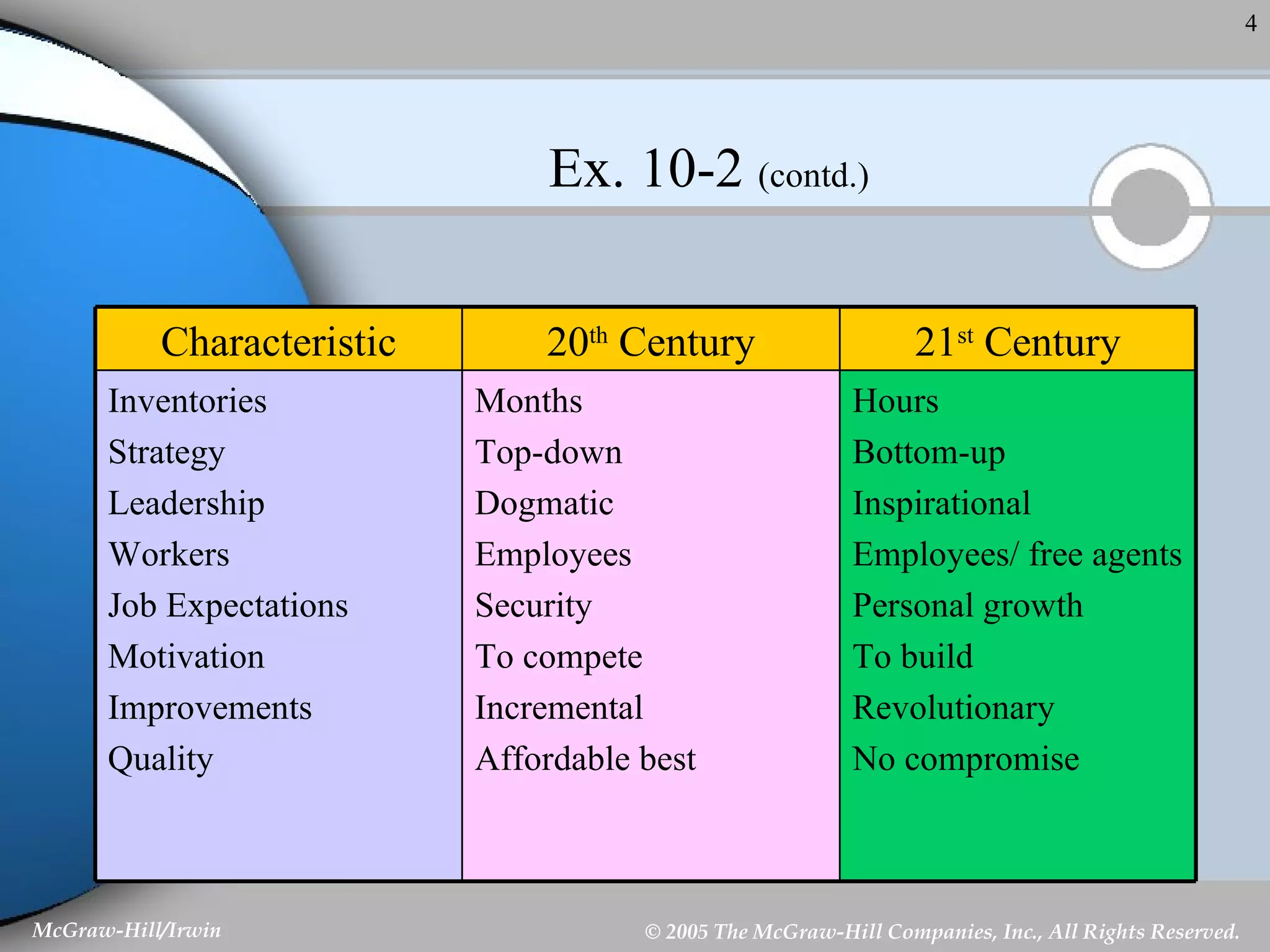
Ex. 10-2  (contd.) Hours Bottom-up Inspirational Employees/ free agents Personal growth To build Revolutionary No compromise Months Top-down Dogmatic Employees Security To compete Incremental Affordable best Inventories Strategy Leadership Workers Job Expectations Motivation Improvements Quality 21 st  Century 20 th  Century Characteristic
Trends Driving Organizational Structure Speed of Decision Making Globalization Internet
Conclusions of Research on Organizational Structure  A single-product firm or single dominant business firm should employ a functional structure A firm in several lines of business that are somehow related should employ a multidivisional structure A firm in several unrelated lines of business should be organized into strategic business units Early achievement of a strategy-structure fit can be a competitive advantage
Restructuring to Support Strategically Critical Activities Concept  – Some activities within a business’s value chain are more critical to the success of the strategy than others Considerations  in restructuring Strategically critical activities must be the central building blocks for designing the organization structure Organizational structure must be designed to help coordinate and integrate support activities to Maximize their support of strategy-critical primary activities Minimize their costs and time spent on internal coordination
Reengineering Strategic Business Processes (BPR) Concept  – Involves placing the decision making authority that is most relevant to the customer closer to the customer, in order to make the firm more responsive to the needs of the customer. Potential  outcomes  of BPR Reduces fragmentation by crossing traditional department lines Reduces overhead by compressing formerly separate tasks that are strategically intertwined in the process of focusing on the customer
Steps Involved in BPR Develop a flow chart of the total business process Try to simplify the process first, eliminating unnecessary tasks and streamlining remaining tasks Determine which parts of the process can be automated Benchmark strategy-critical activities Consider outsourcing non-critical activities Design a structure for performing remaining activities and reorganize personnel accordingly
Downsizing, Self-Management, and Outsourcing Downsizing  – Eliminating employees, particularly middle managers, in a company Self-management  – Delegating work to lower, operating levels of an organization Outsourcing  – Obtaining work previously done by employees inside a company from sources outside the company
Product-Teams The product-team structure assigns functional managers and specialists (e.g., engineering, marketing, financial, R&D, operations) to a new product, project, or process team that is empowered to make major decisions about their product
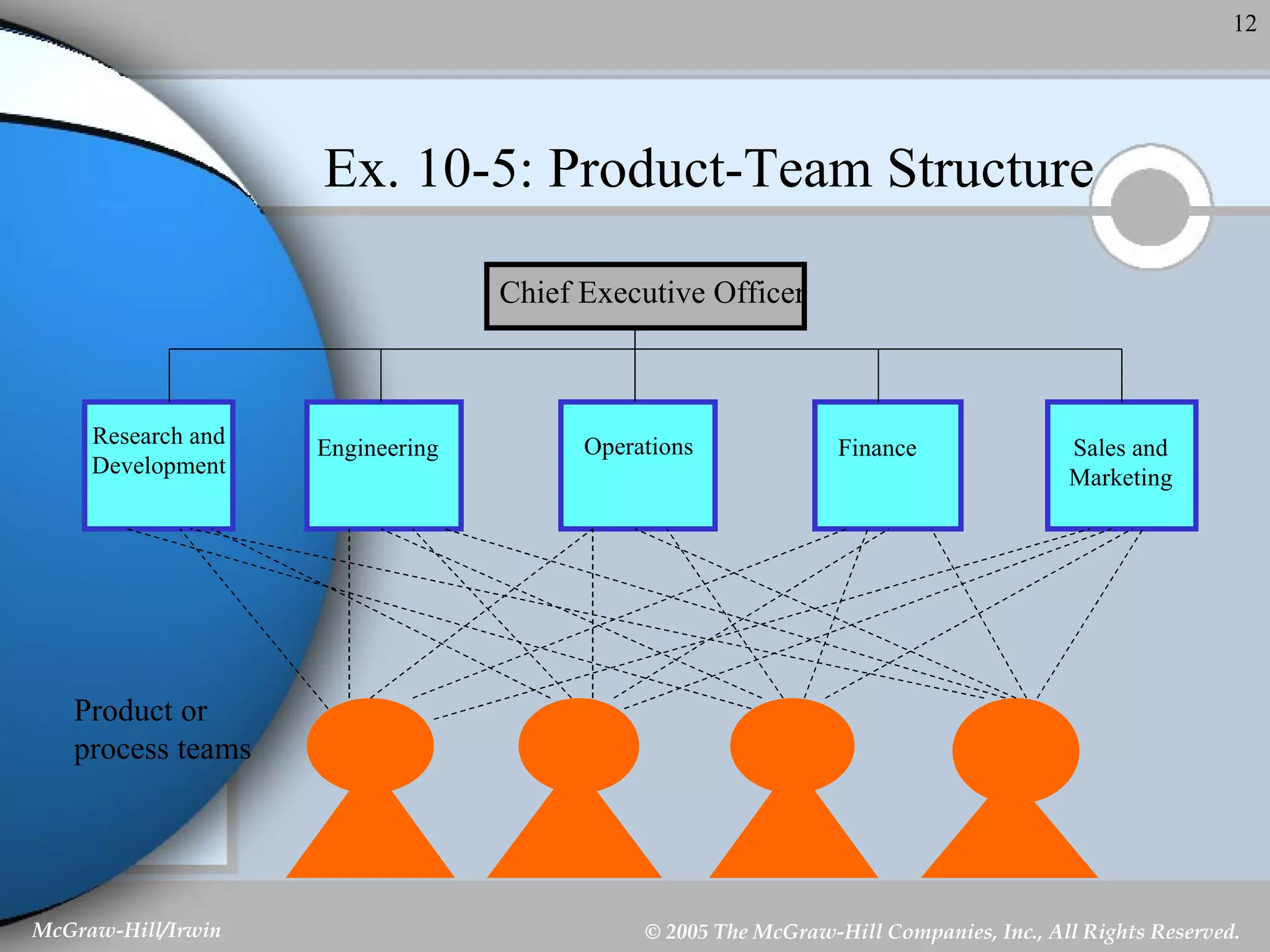
Ex. 10-5: Product-Team Structure Chief Executive Officer Research and Development Engineering Operations Finance Sales and Marketing Product or process teams
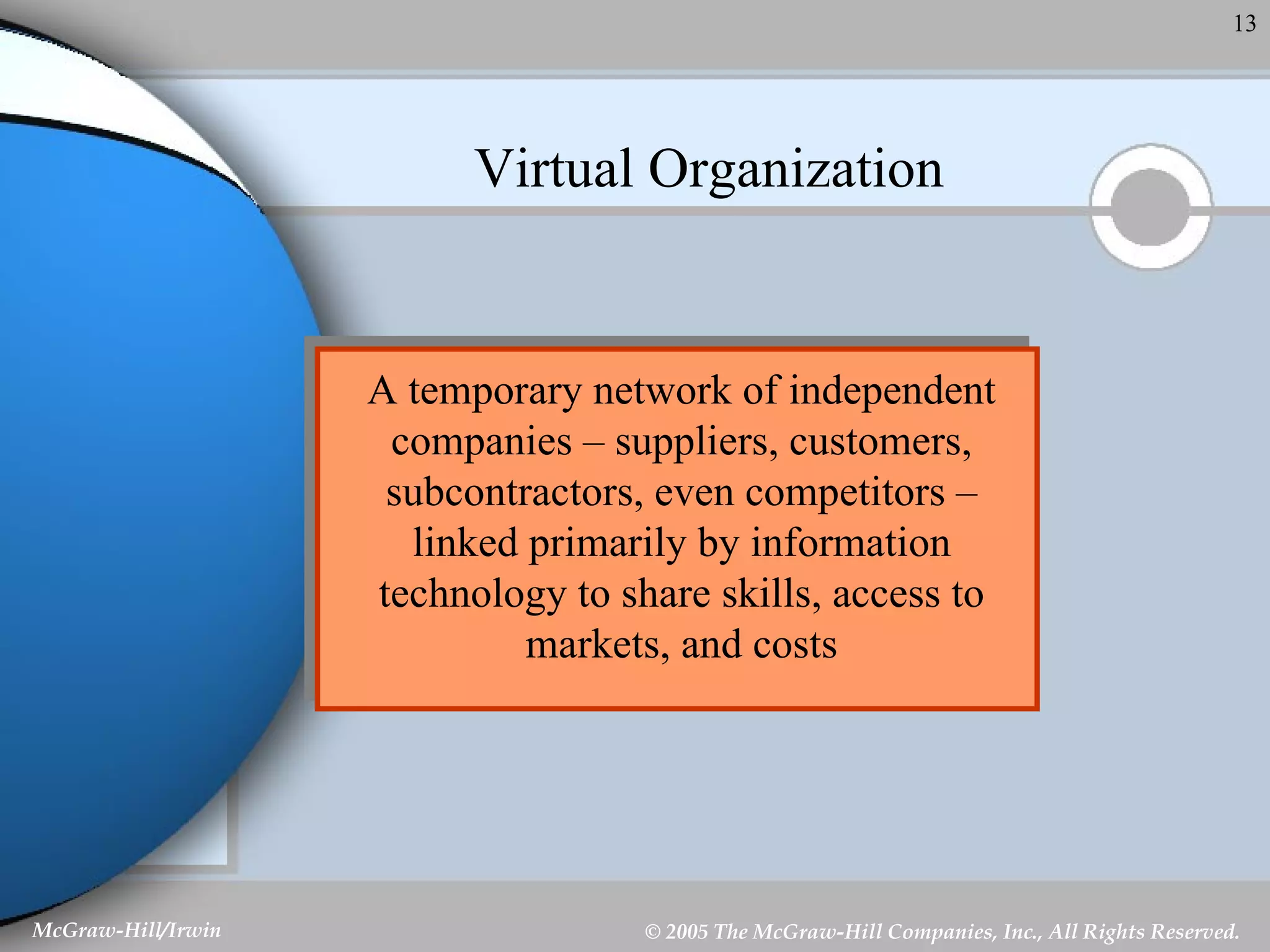
Virtual Organization A temporary network of independent companies – suppliers, customers, subcontractors, even competitors – linked primarily by information technology to share skills, access to markets, and costs
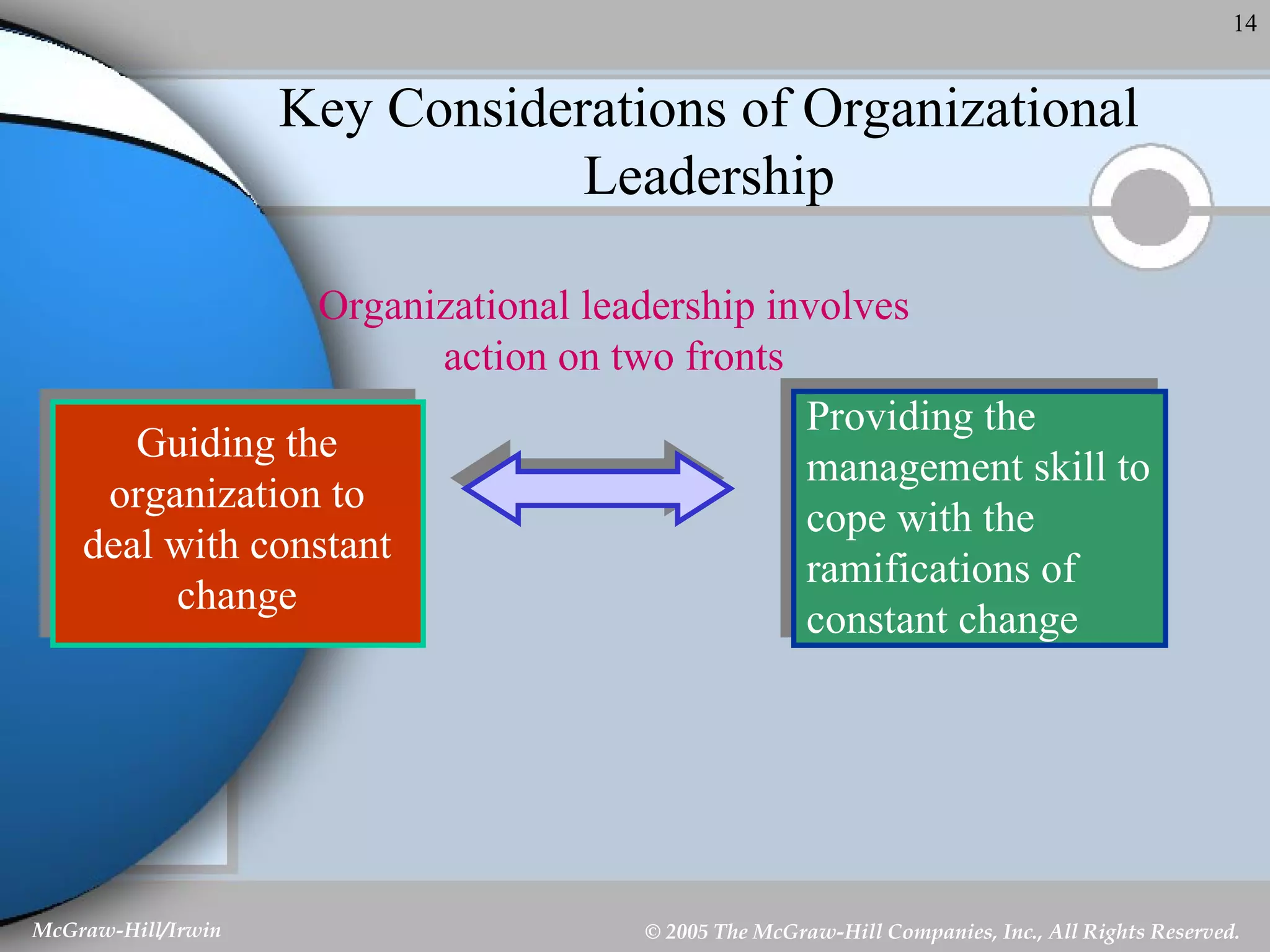
Key Considerations of Organizational Leadership Organizational leadership involves action on two fronts Guiding the organization to deal with constant change Providing the management skill to cope with the ramifications of constant change
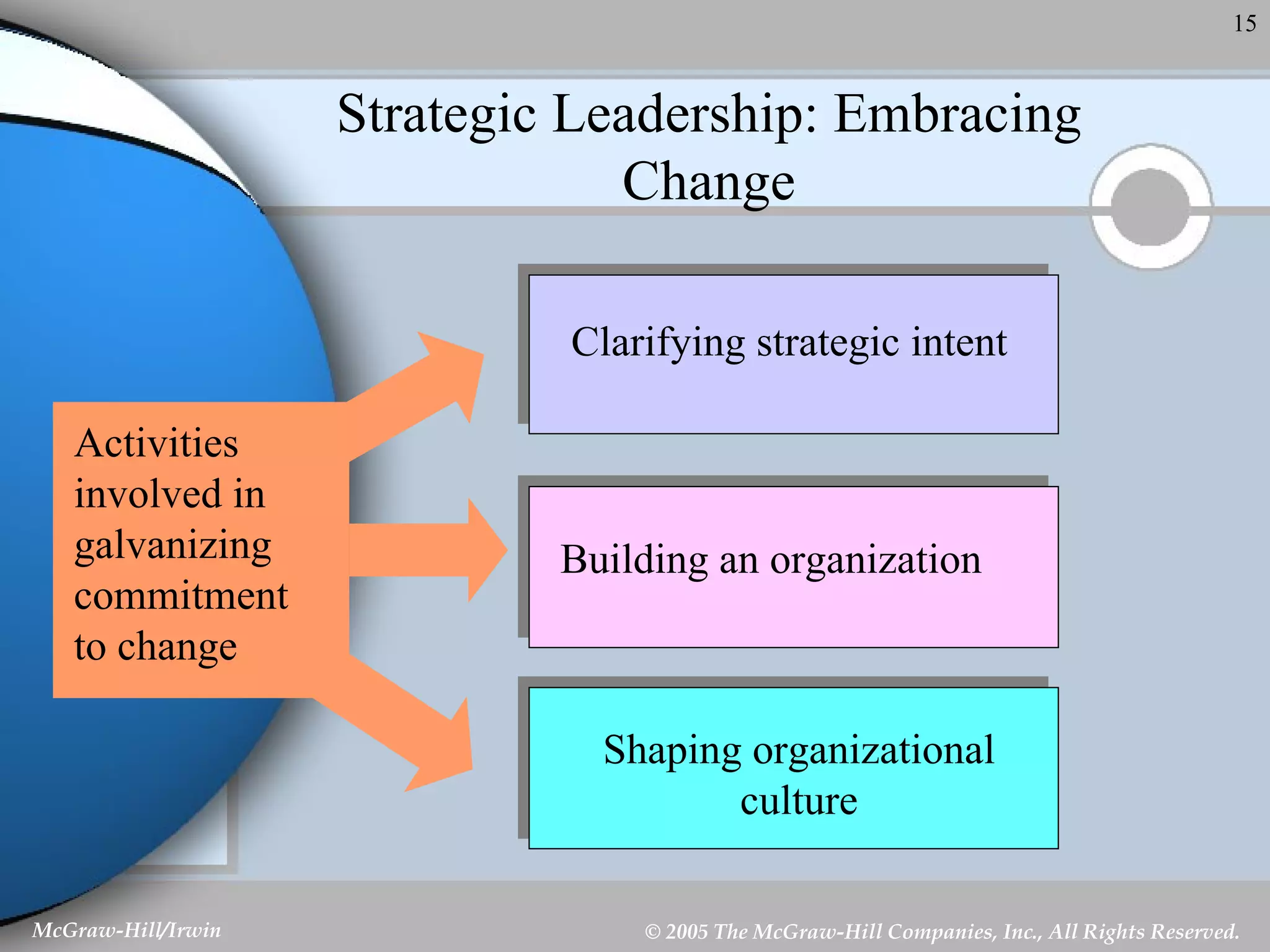
Strategic Leadership: Embracing Change Activities involved in galvanizing commitment to change Clarifying strategic intent Building an organization Shaping organizational culture
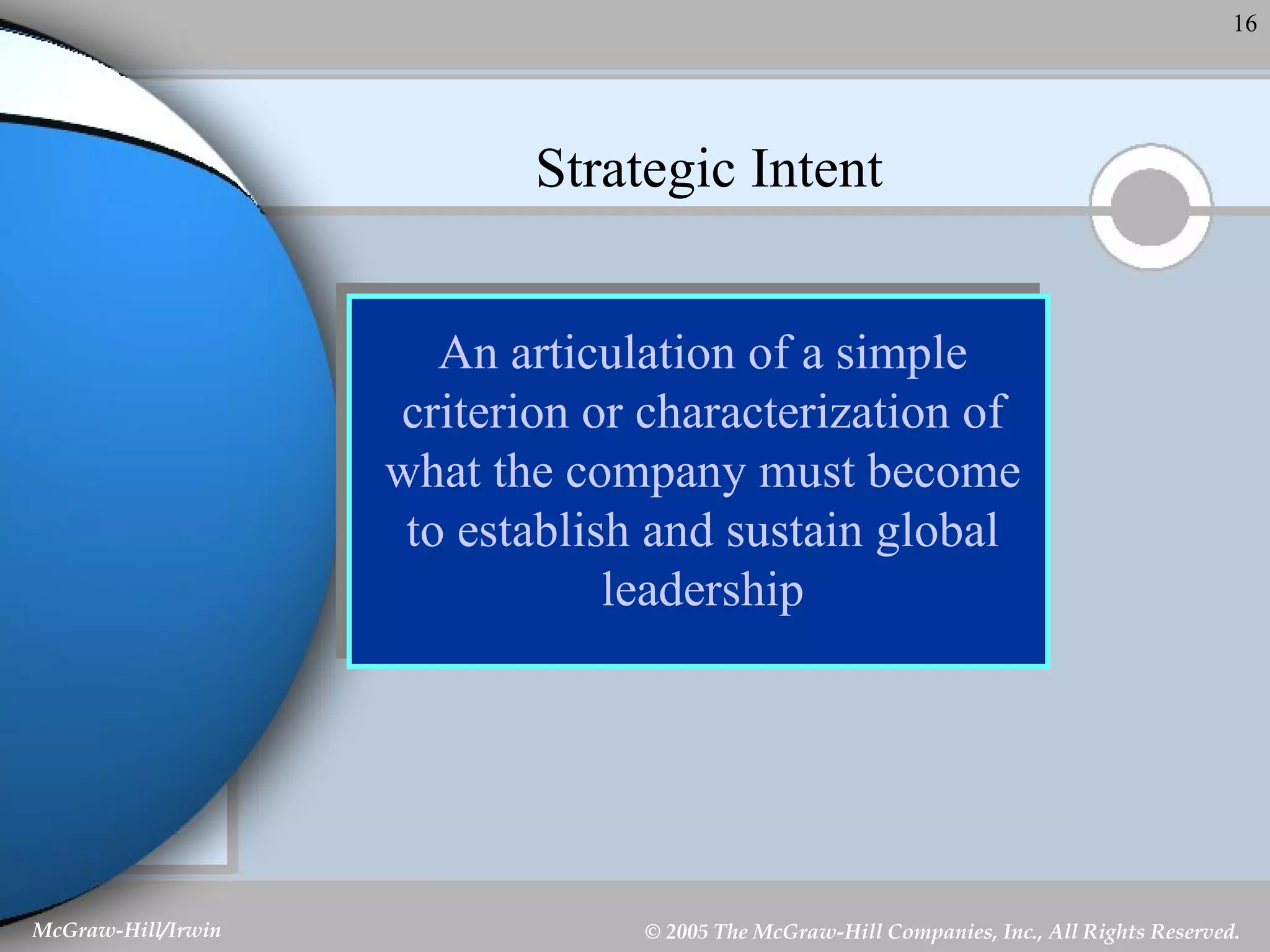
Strategic Intent An articulation of a simple criterion or characterization of what the company must become to establish and sustain global leadership
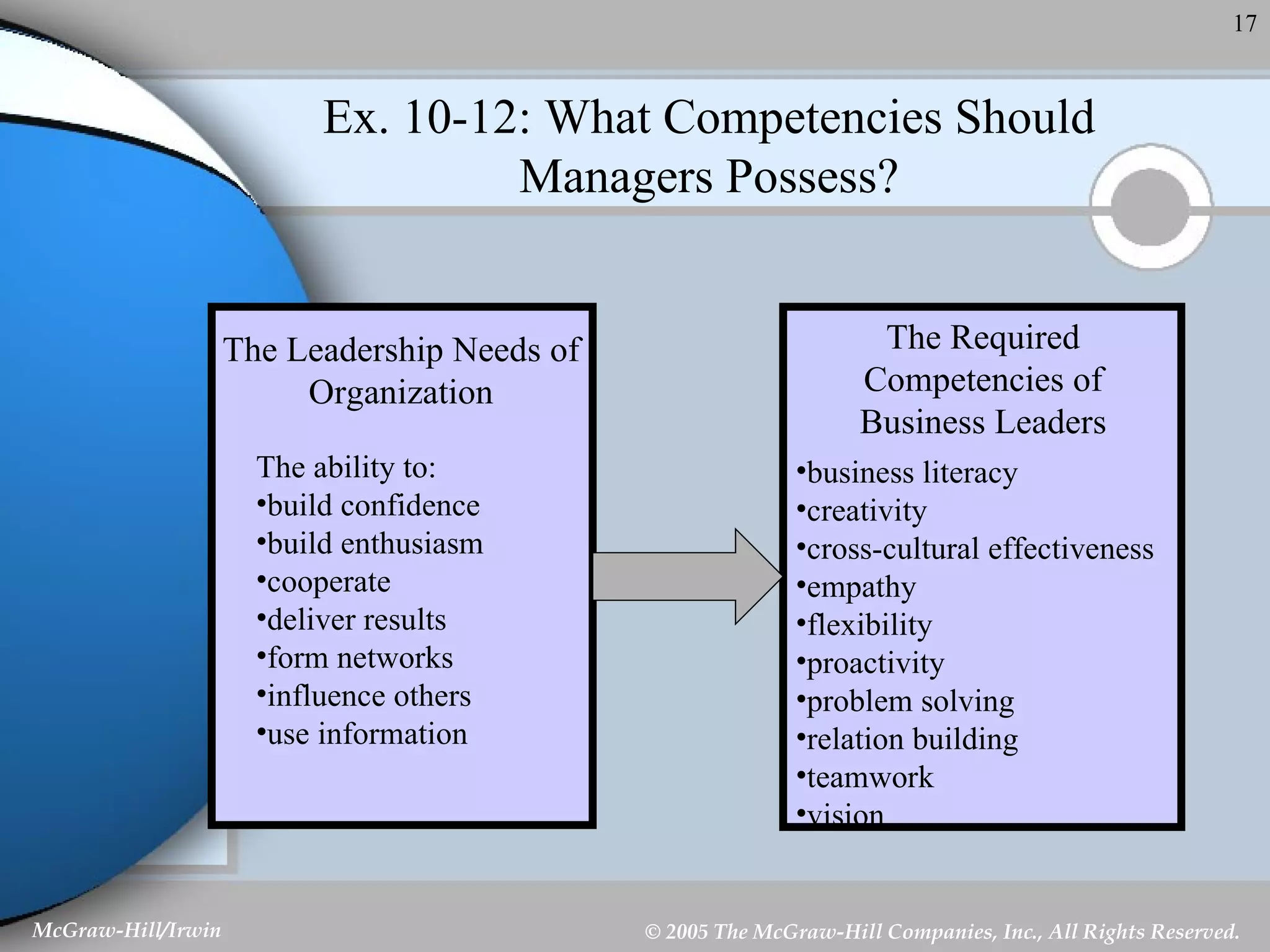
Ex. 10-12: What Competencies Should Managers Possess? The Leadership Needs of Organization The ability to: build confidence build enthusiasm cooperate deliver results form networks influence others use information The Required Competencies of Business Leaders business literacy creativity cross-cultural effectiveness empathy flexibility proactivity problem solving relation building teamwork vision
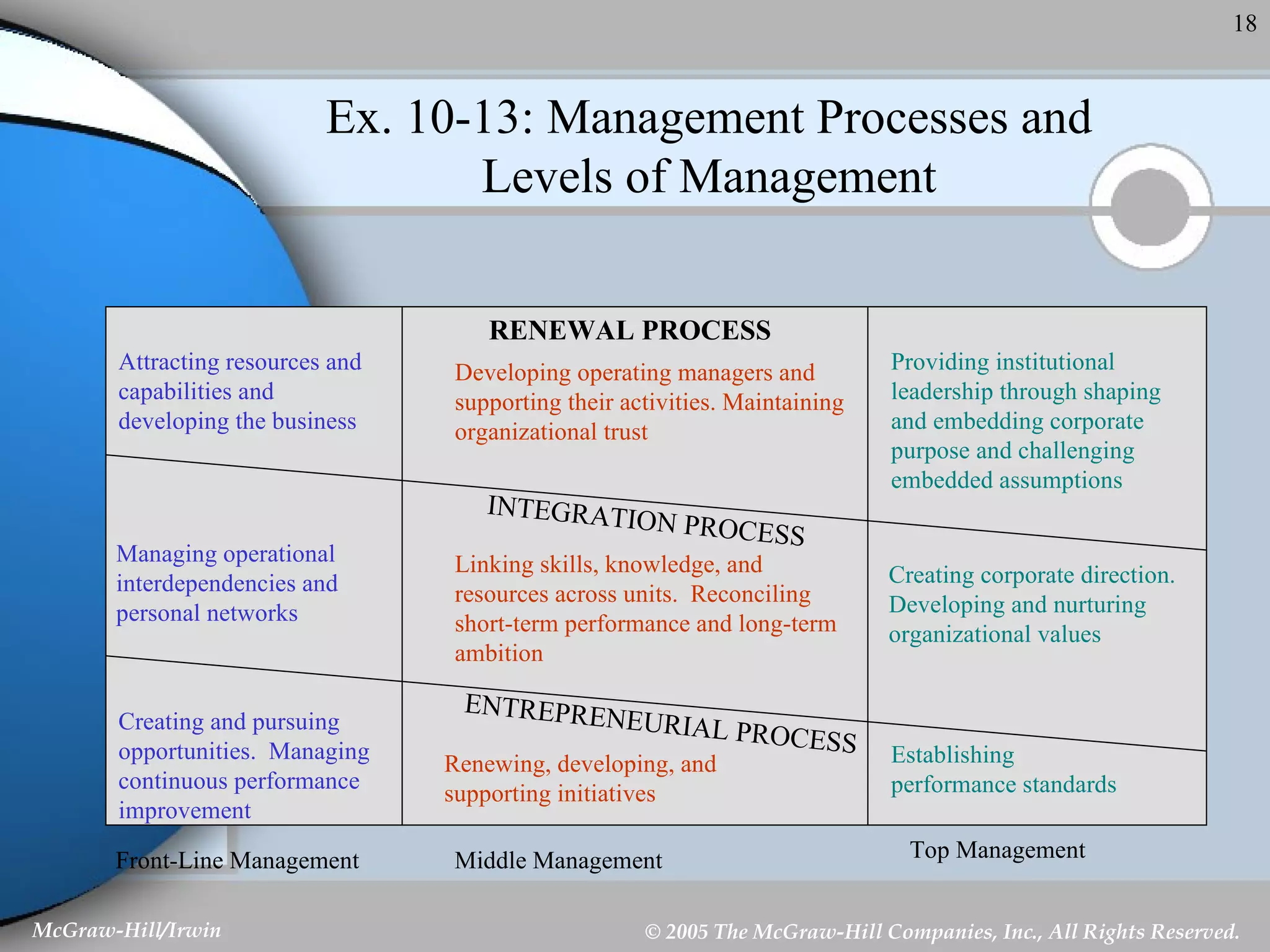
Ex. 10-13: Management Processes and Levels of Management RENEWAL PROCESS Attracting resources and capabilities and developing the business Developing operating managers and supporting their activities. Maintaining organizational trust Providing institutional leadership through shaping and embedding corporate purpose and challenging embedded assumptions INTEGRATION PROCESS Managing operational interdependencies and personal networks Linking skills, knowledge, and resources across units.  Reconciling short-term performance and long-term ambition Creating corporate direction. Developing and nurturing organizational values Creating and pursuing opportunities.  Managing continuous performance improvement Renewing, developing, and supporting initiatives Establishing performance standards ENTREPRENEURIAL PROCESS Front-Line Management Middle Management Top Management
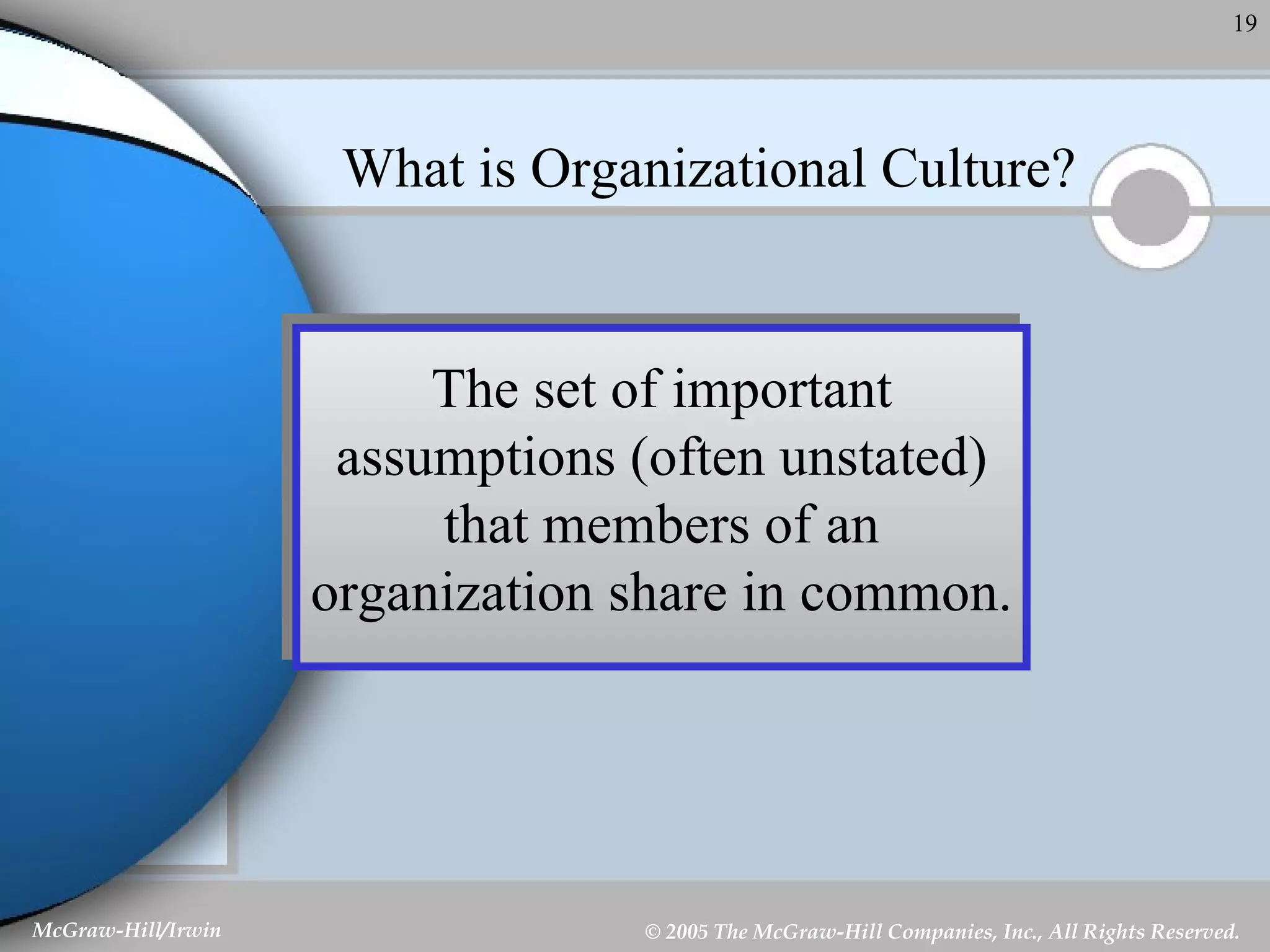
What is Organizational Culture? The set of important assumptions (often unstated) that members of an organization share in common.
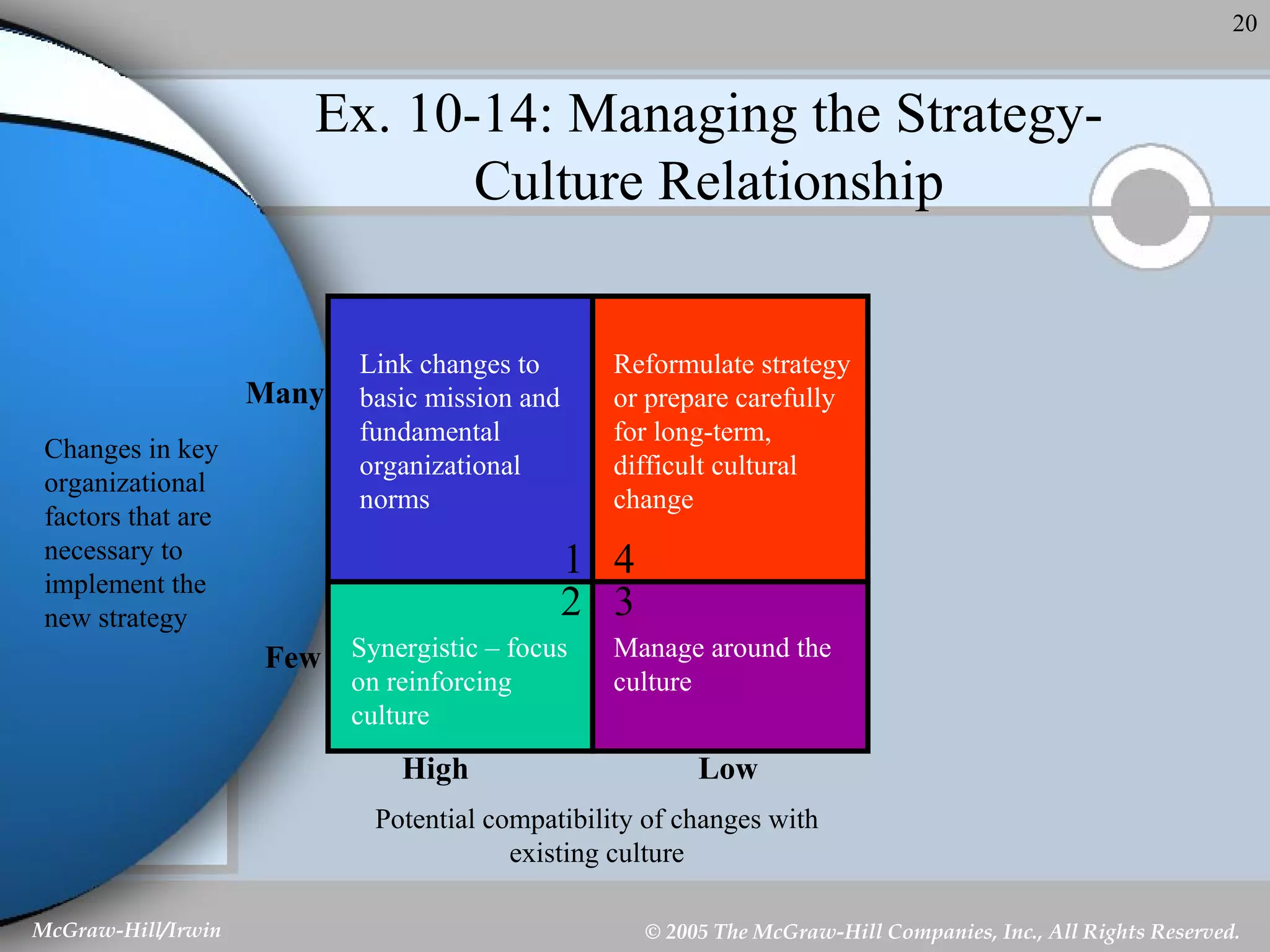
Ex. 10-14: Managing the Strategy-Culture Relationship Link changes to basic mission and fundamental organizational norms Reformulate strategy or prepare carefully for long-term, difficult cultural change Synergistic – focus on reinforcing culture Manage around the culture 1 4 2 3 High Low Many Few Potential compatibility of changes with existing culture Changes in key organizational factors that are necessary to implement the new strategy
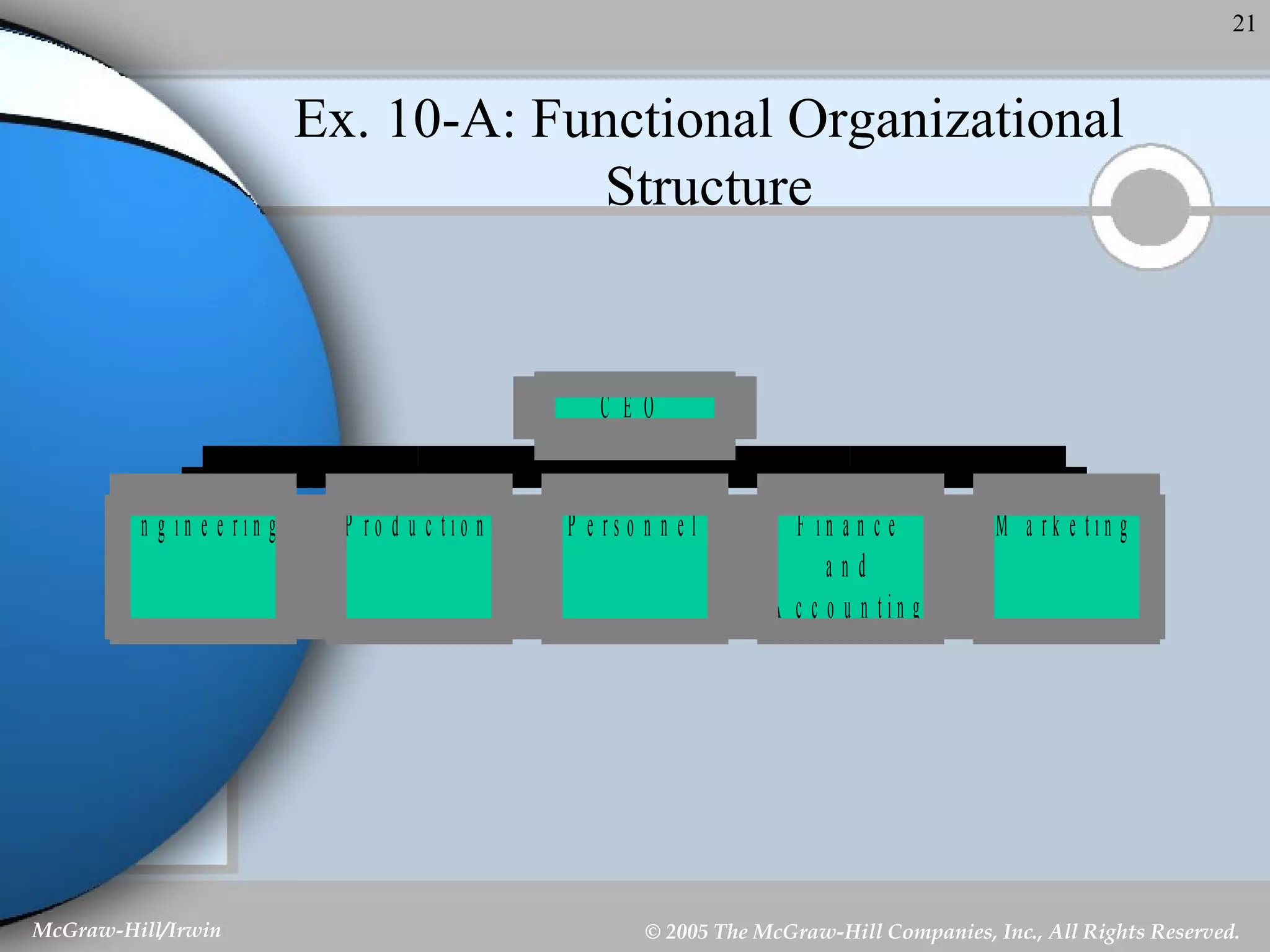
Ex. 10-A: Functional Organizational Structure
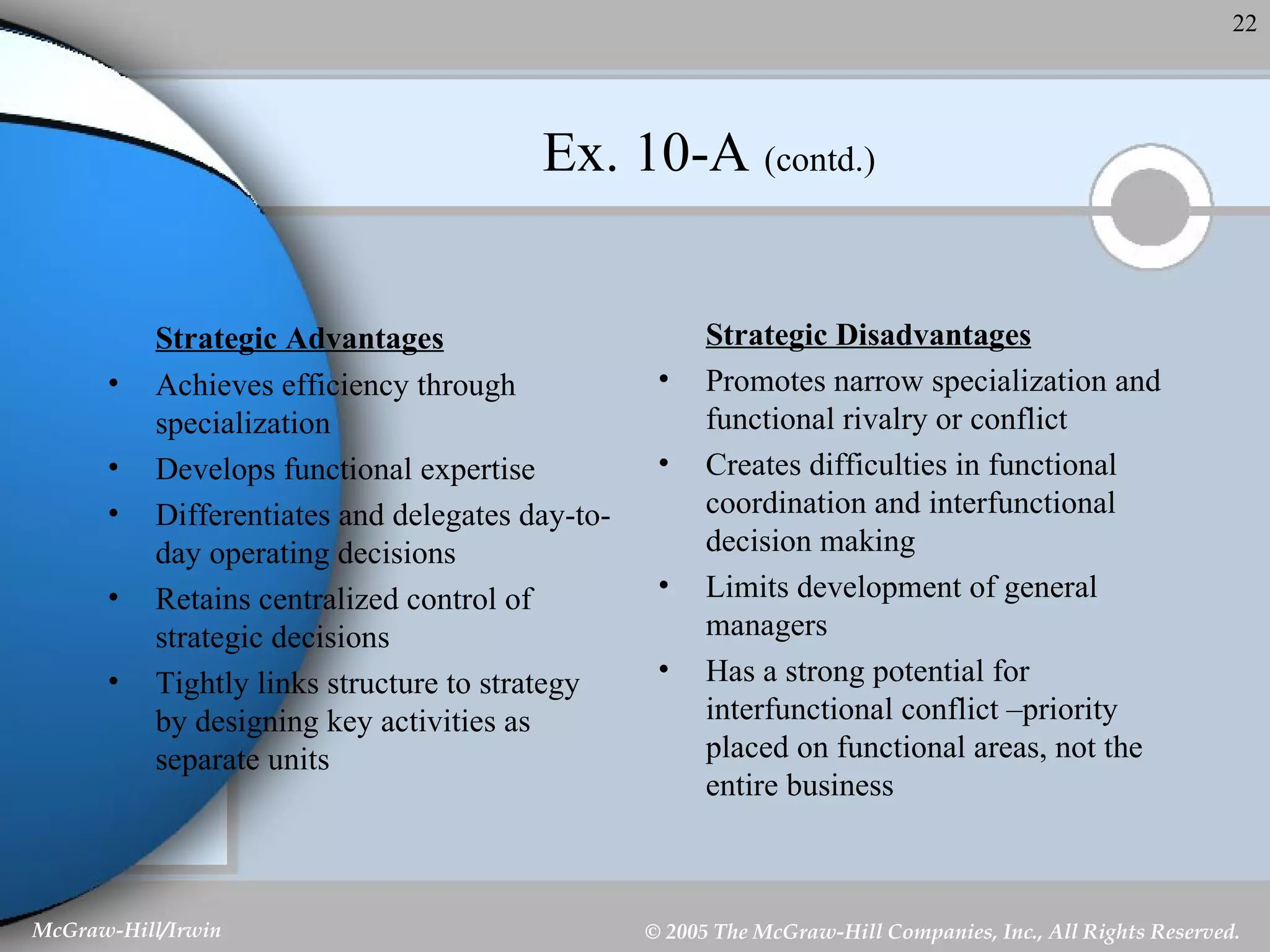
Ex. 10-A  (contd.) Strategic Advantages Achieves efficiency through specialization Develops functional expertise Differentiates and delegates day-to-day operating decisions Retains centralized control of strategic decisions Tightly links structure to strategy by designing key activities as separate units Strategic Disadvantages Promotes narrow specialization and functional rivalry or conflict Creates difficulties in functional coordination and interfunctional decision making Limits development of general managers Has a strong potential for interfunctional conflict –priority placed on functional areas, not the entire business
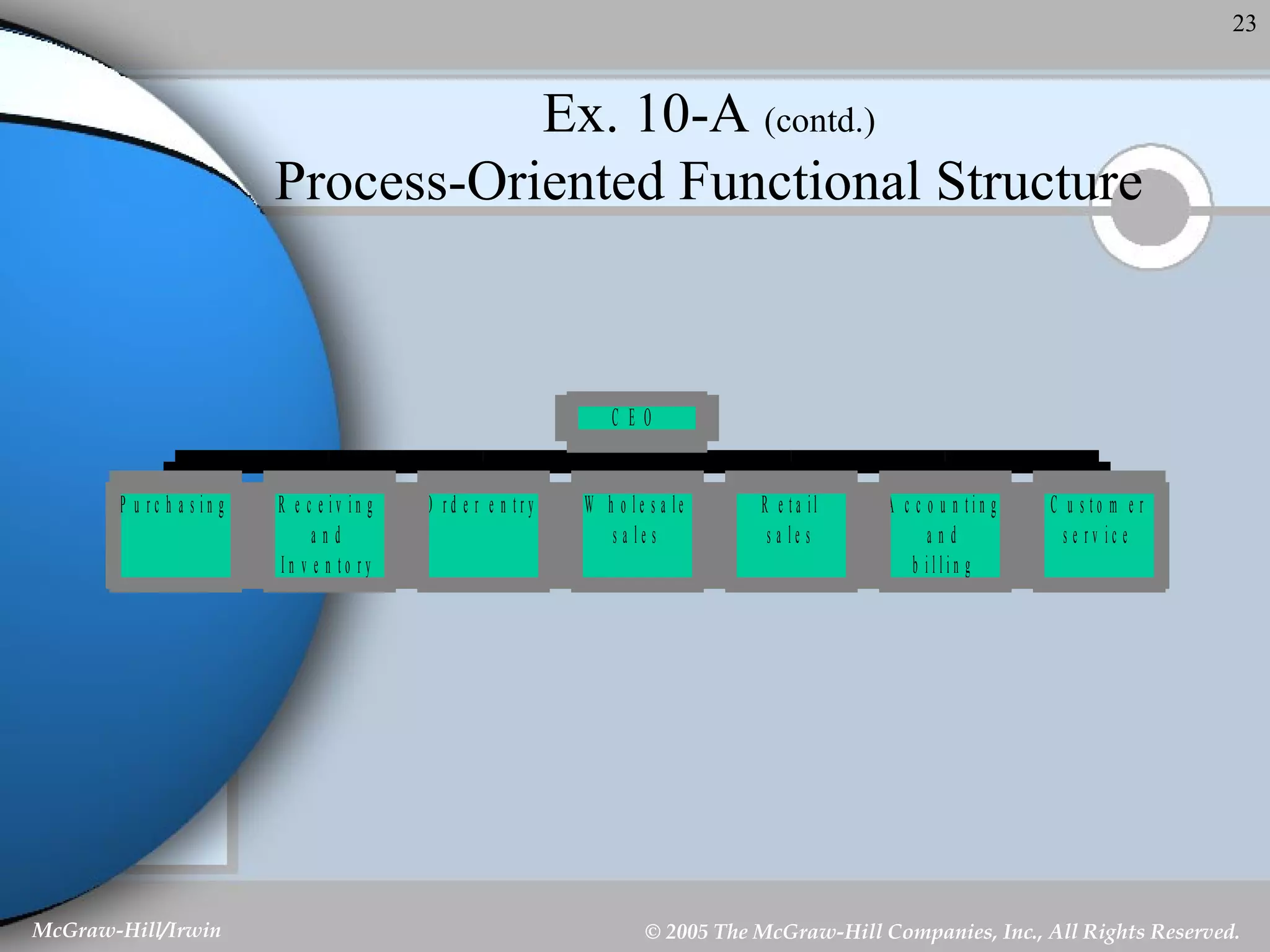
Ex. 10-A  (contd.) Process-Oriented Functional Structure
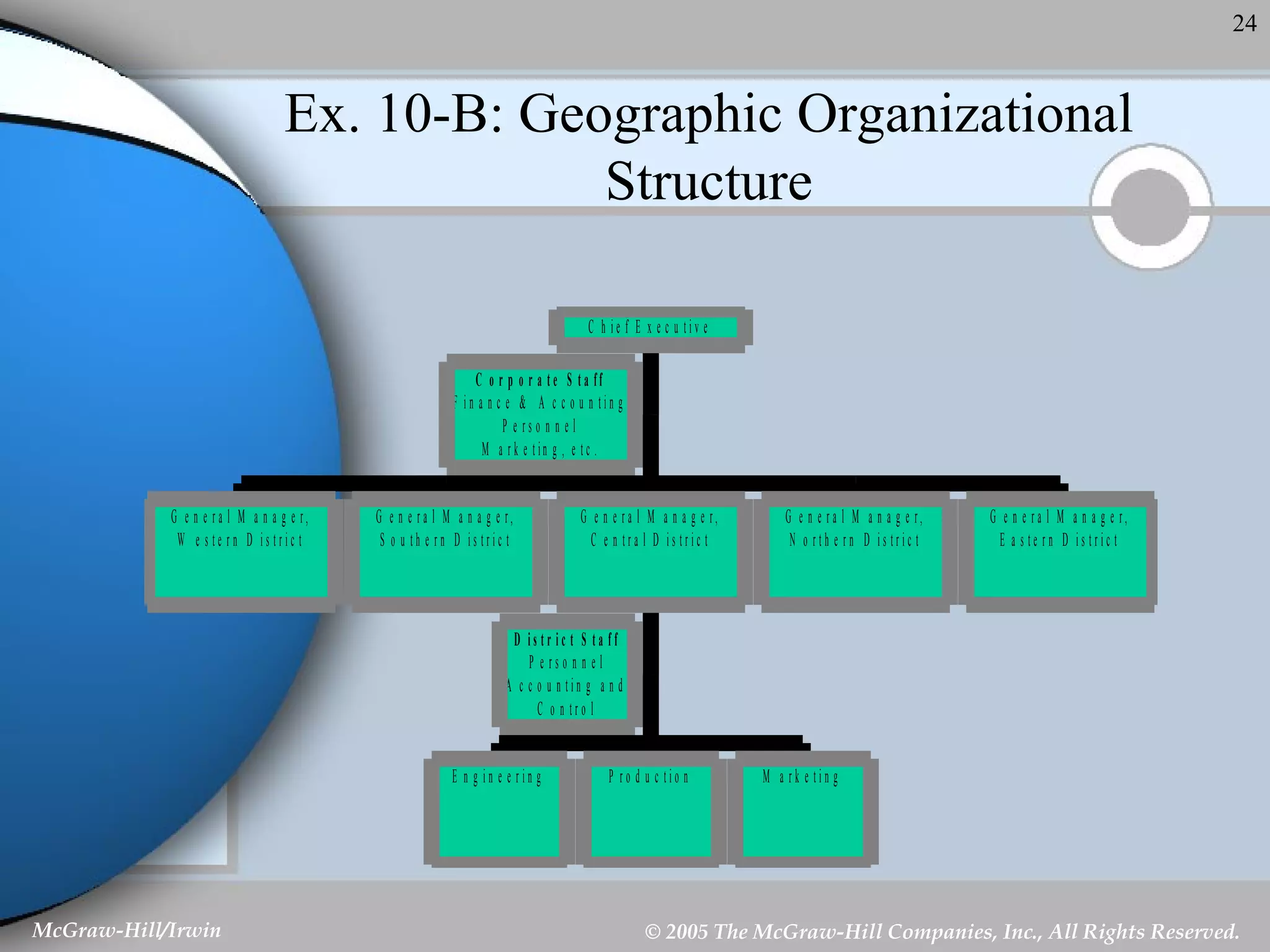
Ex. 10-B: Geographic Organizational Structure
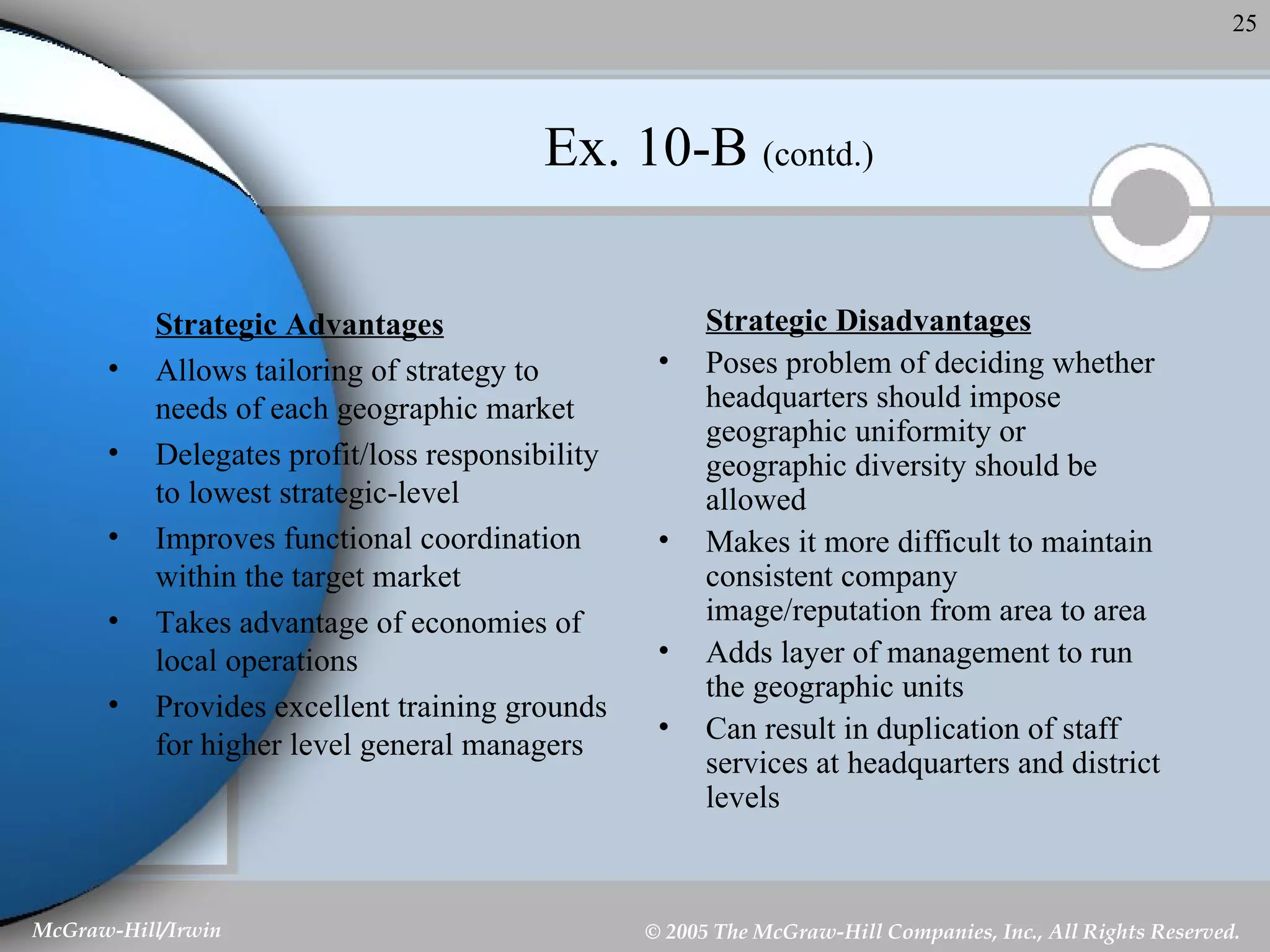
Ex. 10-B  (contd.) Strategic Advantages Allows tailoring of strategy to needs of each geographic market Delegates profit/loss responsibility to lowest strategic-level Improves functional coordination within the target market Takes advantage of economies of local operations Provides excellent training grounds for higher level general managers Strategic Disadvantages Poses problem of deciding whether headquarters should impose geographic uniformity or geographic diversity should be allowed Makes it more difficult to maintain consistent company image/reputation from area to area Adds layer of management to run the geographic units Can result in duplication of staff services at headquarters and district levels
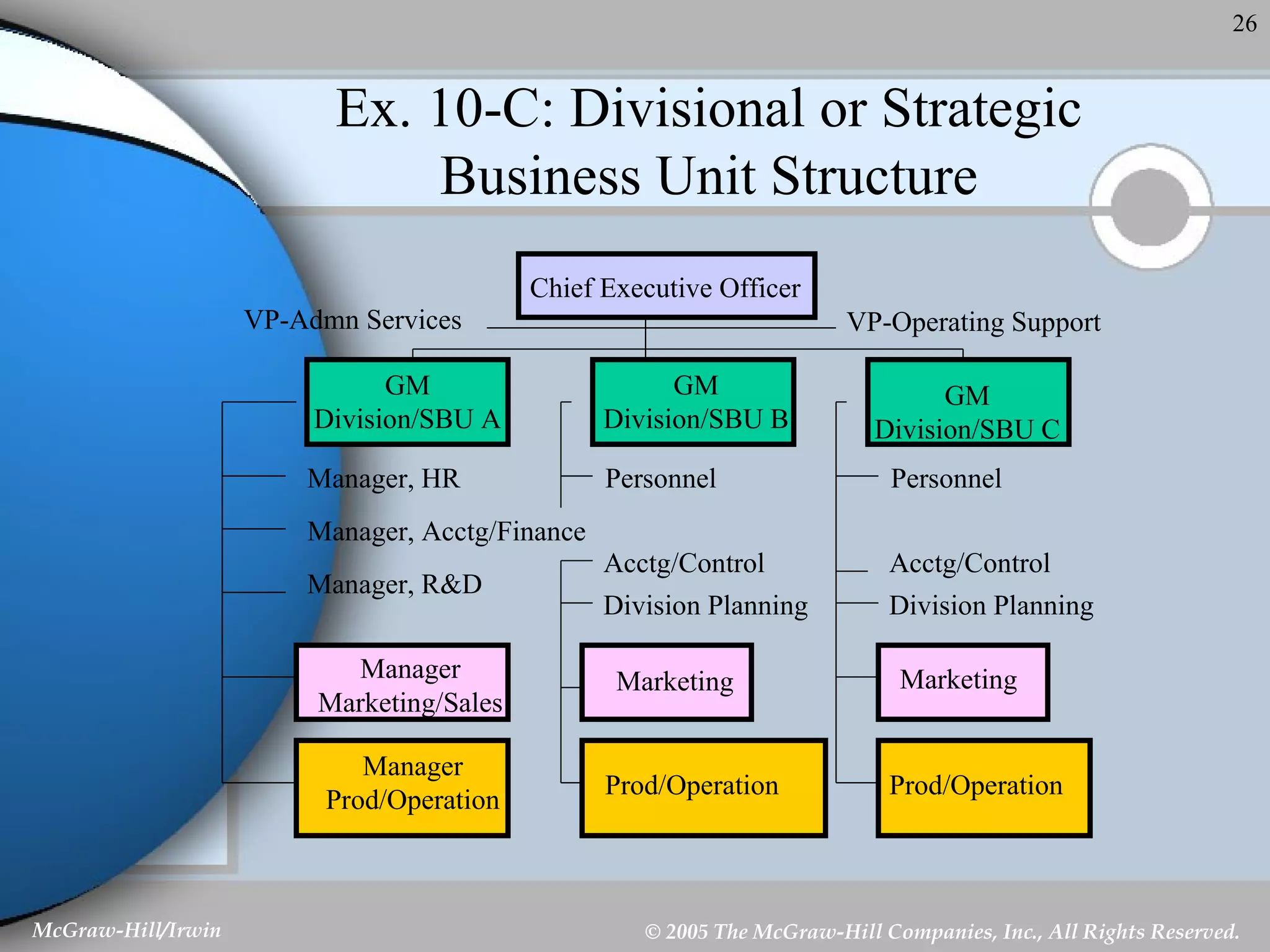
Ex. 10-C: Divisional or Strategic Business Unit Structure Manager Prod/Operation Manager Marketing/Sales Manager, HR Manager, Acctg/Finance Manager, R&D Personnel Acctg/Control Division Planning Marketing Prod/Operation Marketing Prod/Operation Personnel Acctg/Control Division Planning Chief Executive Officer GM Division/SBU A GM Division/SBU B GM Division/SBU C VP-Admn Services VP-Operating Support
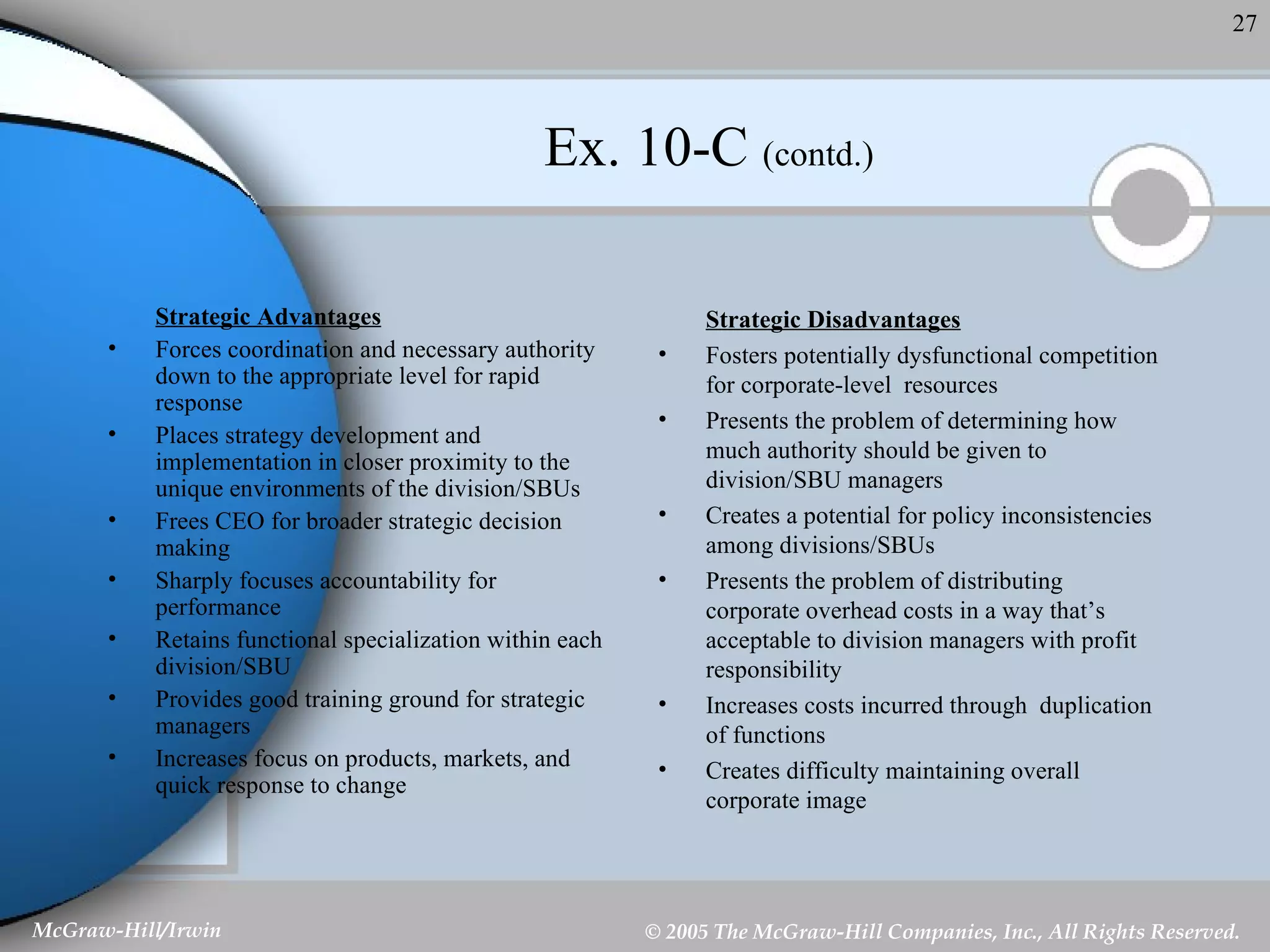
Ex. 10-C  (contd.) Strategic Advantages Forces coordination and necessary authority down to the appropriate level for rapid response Places strategy development and implementation in closer proximity to the unique environments of the division/SBUs  Frees CEO for broader strategic decision making Sharply focuses accountability for performance Retains functional specialization within each division/SBU Provides good training ground for strategic managers Increases focus on products, markets, and quick response to change Strategic Disadvantages Fosters potentially dysfunctional competition for corporate-level  resources Presents the problem of determining how much authority should be given to division/SBU managers Creates a potential for policy inconsistencies among divisions/SBUs Presents the problem of distributing corporate overhead costs in a way that’s acceptable to division managers with profit responsibility Increases costs incurred through  duplication of functions Creates difficulty maintaining overall corporate image
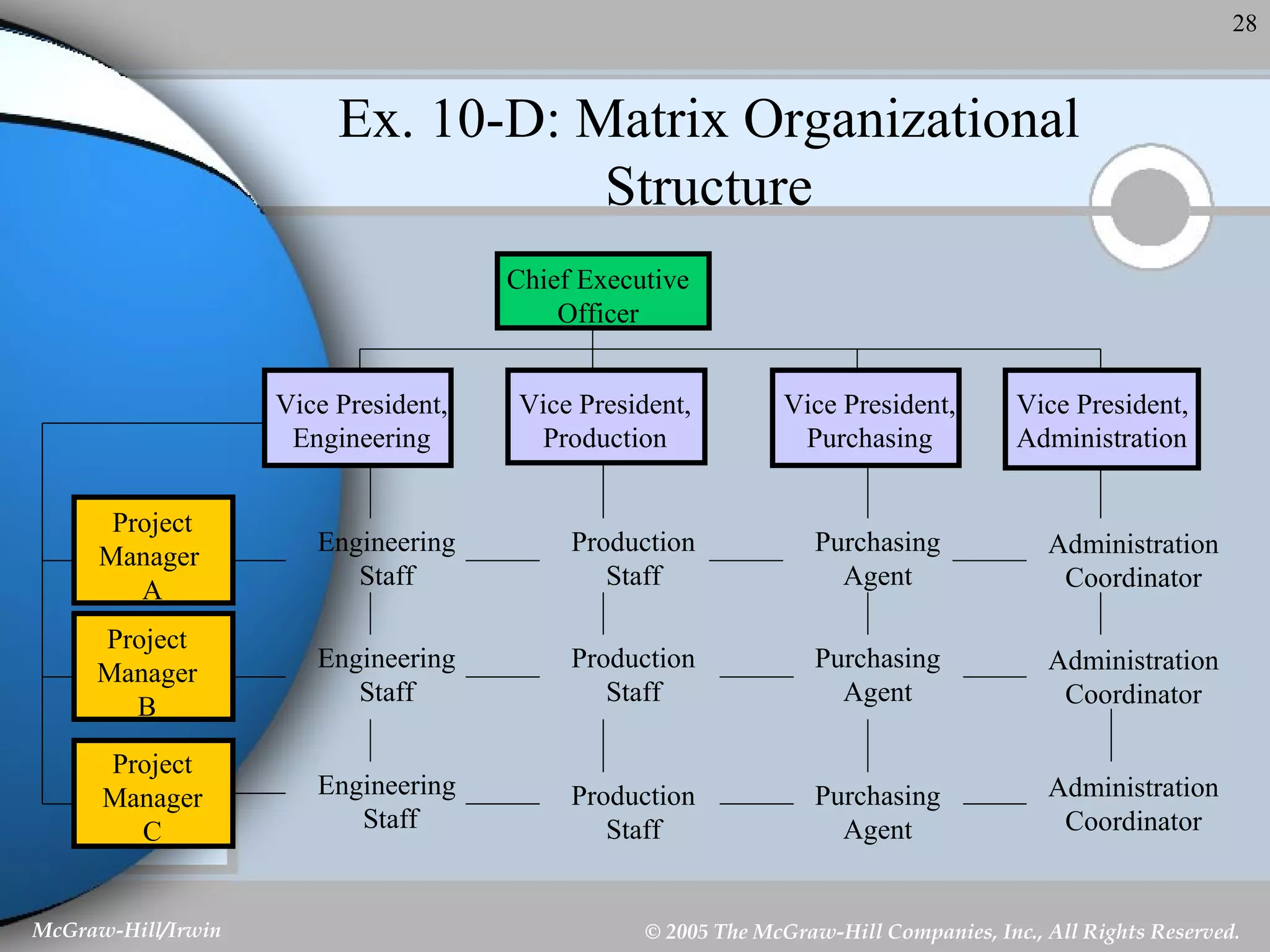
Ex. 10-D: Matrix Organizational Structure Engineering Staff Engineering Staff Engineering  Staff Production Staff Production Staff Production Staff Purchasing Agent Purchasing Agent Purchasing Agent Administration Coordinator Administration Coordinator Administration Coordinator Chief Executive Officer Vice President, Engineering Vice President, Production Vice President, Purchasing Vice President, Administration Project Manager  A Project Manager B Project Manager C
Ex. 10-D  (contd.) Strategic Advantages Accomodates a wide variety of project-oriented business activity Provides good training grounds for strategic managers Maximizes efficient use of functional managers Fosters creativity and multiple sources of diversity Gives middle management broader exposure to strategic issues Strategic Disadvantages May result in confusion and contradictory policies Necessitates tremendous horizontal and vertical coordination Can proliferate information logjams and excess reporting Can trigger turf battles and loss of accountability

Chap010

  • 1.
    CHAPTER 10 ImplementingStrategy: Structure, Leadership, and Culture
  • 2.
    Chapter Topics Structuringan Effective Organization Organizational Leadership Organizational Culture Appendix – Primary Organizational Structures and their Strategy-Related Pros and Cons
  • 3.
    Ex. 10-2: Whata Difference a Century Can Make (Contrasting Views of the Corporation)) The Web or Network External Flexible Change Interdependencies Bits – information Virtual integration Mass customization Global Real-time The Pyramid Internal Structured Stability Self-sufficiency Atoms – physical assets Vertical integration Mass production Domestic Quarterly Organization Focus Style Source of Strength Structure Resources Operations Products Reach Financials 21 st Century 20 th Century Characteristic
  • 4.
    Ex. 10-2 (contd.) Hours Bottom-up Inspirational Employees/ free agents Personal growth To build Revolutionary No compromise Months Top-down Dogmatic Employees Security To compete Incremental Affordable best Inventories Strategy Leadership Workers Job Expectations Motivation Improvements Quality 21 st Century 20 th Century Characteristic
  • 5.
    Trends Driving OrganizationalStructure Speed of Decision Making Globalization Internet
  • 6.
    Conclusions of Researchon Organizational Structure A single-product firm or single dominant business firm should employ a functional structure A firm in several lines of business that are somehow related should employ a multidivisional structure A firm in several unrelated lines of business should be organized into strategic business units Early achievement of a strategy-structure fit can be a competitive advantage
  • 7.
    Restructuring to SupportStrategically Critical Activities Concept – Some activities within a business’s value chain are more critical to the success of the strategy than others Considerations in restructuring Strategically critical activities must be the central building blocks for designing the organization structure Organizational structure must be designed to help coordinate and integrate support activities to Maximize their support of strategy-critical primary activities Minimize their costs and time spent on internal coordination
  • 8.
    Reengineering Strategic BusinessProcesses (BPR) Concept – Involves placing the decision making authority that is most relevant to the customer closer to the customer, in order to make the firm more responsive to the needs of the customer. Potential outcomes of BPR Reduces fragmentation by crossing traditional department lines Reduces overhead by compressing formerly separate tasks that are strategically intertwined in the process of focusing on the customer
  • 9.
    Steps Involved inBPR Develop a flow chart of the total business process Try to simplify the process first, eliminating unnecessary tasks and streamlining remaining tasks Determine which parts of the process can be automated Benchmark strategy-critical activities Consider outsourcing non-critical activities Design a structure for performing remaining activities and reorganize personnel accordingly
  • 10.
    Downsizing, Self-Management, andOutsourcing Downsizing – Eliminating employees, particularly middle managers, in a company Self-management – Delegating work to lower, operating levels of an organization Outsourcing – Obtaining work previously done by employees inside a company from sources outside the company
  • 11.
    Product-Teams The product-teamstructure assigns functional managers and specialists (e.g., engineering, marketing, financial, R&D, operations) to a new product, project, or process team that is empowered to make major decisions about their product
  • 12.
    Ex. 10-5: Product-TeamStructure Chief Executive Officer Research and Development Engineering Operations Finance Sales and Marketing Product or process teams
  • 13.
    Virtual Organization Atemporary network of independent companies – suppliers, customers, subcontractors, even competitors – linked primarily by information technology to share skills, access to markets, and costs
  • 14.
    Key Considerations ofOrganizational Leadership Organizational leadership involves action on two fronts Guiding the organization to deal with constant change Providing the management skill to cope with the ramifications of constant change
  • 15.
    Strategic Leadership: EmbracingChange Activities involved in galvanizing commitment to change Clarifying strategic intent Building an organization Shaping organizational culture
  • 16.
    Strategic Intent Anarticulation of a simple criterion or characterization of what the company must become to establish and sustain global leadership
  • 17.
    Ex. 10-12: WhatCompetencies Should Managers Possess? The Leadership Needs of Organization The ability to: build confidence build enthusiasm cooperate deliver results form networks influence others use information The Required Competencies of Business Leaders business literacy creativity cross-cultural effectiveness empathy flexibility proactivity problem solving relation building teamwork vision
  • 18.
    Ex. 10-13: ManagementProcesses and Levels of Management RENEWAL PROCESS Attracting resources and capabilities and developing the business Developing operating managers and supporting their activities. Maintaining organizational trust Providing institutional leadership through shaping and embedding corporate purpose and challenging embedded assumptions INTEGRATION PROCESS Managing operational interdependencies and personal networks Linking skills, knowledge, and resources across units. Reconciling short-term performance and long-term ambition Creating corporate direction. Developing and nurturing organizational values Creating and pursuing opportunities. Managing continuous performance improvement Renewing, developing, and supporting initiatives Establishing performance standards ENTREPRENEURIAL PROCESS Front-Line Management Middle Management Top Management
  • 19.
    What is OrganizationalCulture? The set of important assumptions (often unstated) that members of an organization share in common.
  • 20.
    Ex. 10-14: Managingthe Strategy-Culture Relationship Link changes to basic mission and fundamental organizational norms Reformulate strategy or prepare carefully for long-term, difficult cultural change Synergistic – focus on reinforcing culture Manage around the culture 1 4 2 3 High Low Many Few Potential compatibility of changes with existing culture Changes in key organizational factors that are necessary to implement the new strategy
  • 21.
    Ex. 10-A: FunctionalOrganizational Structure
  • 22.
    Ex. 10-A (contd.) Strategic Advantages Achieves efficiency through specialization Develops functional expertise Differentiates and delegates day-to-day operating decisions Retains centralized control of strategic decisions Tightly links structure to strategy by designing key activities as separate units Strategic Disadvantages Promotes narrow specialization and functional rivalry or conflict Creates difficulties in functional coordination and interfunctional decision making Limits development of general managers Has a strong potential for interfunctional conflict –priority placed on functional areas, not the entire business
  • 23.
    Ex. 10-A (contd.) Process-Oriented Functional Structure
  • 24.
    Ex. 10-B: GeographicOrganizational Structure
  • 25.
    Ex. 10-B (contd.) Strategic Advantages Allows tailoring of strategy to needs of each geographic market Delegates profit/loss responsibility to lowest strategic-level Improves functional coordination within the target market Takes advantage of economies of local operations Provides excellent training grounds for higher level general managers Strategic Disadvantages Poses problem of deciding whether headquarters should impose geographic uniformity or geographic diversity should be allowed Makes it more difficult to maintain consistent company image/reputation from area to area Adds layer of management to run the geographic units Can result in duplication of staff services at headquarters and district levels
  • 26.
    Ex. 10-C: Divisionalor Strategic Business Unit Structure Manager Prod/Operation Manager Marketing/Sales Manager, HR Manager, Acctg/Finance Manager, R&D Personnel Acctg/Control Division Planning Marketing Prod/Operation Marketing Prod/Operation Personnel Acctg/Control Division Planning Chief Executive Officer GM Division/SBU A GM Division/SBU B GM Division/SBU C VP-Admn Services VP-Operating Support
  • 27.
    Ex. 10-C (contd.) Strategic Advantages Forces coordination and necessary authority down to the appropriate level for rapid response Places strategy development and implementation in closer proximity to the unique environments of the division/SBUs Frees CEO for broader strategic decision making Sharply focuses accountability for performance Retains functional specialization within each division/SBU Provides good training ground for strategic managers Increases focus on products, markets, and quick response to change Strategic Disadvantages Fosters potentially dysfunctional competition for corporate-level resources Presents the problem of determining how much authority should be given to division/SBU managers Creates a potential for policy inconsistencies among divisions/SBUs Presents the problem of distributing corporate overhead costs in a way that’s acceptable to division managers with profit responsibility Increases costs incurred through duplication of functions Creates difficulty maintaining overall corporate image
  • 28.
    Ex. 10-D: MatrixOrganizational Structure Engineering Staff Engineering Staff Engineering Staff Production Staff Production Staff Production Staff Purchasing Agent Purchasing Agent Purchasing Agent Administration Coordinator Administration Coordinator Administration Coordinator Chief Executive Officer Vice President, Engineering Vice President, Production Vice President, Purchasing Vice President, Administration Project Manager A Project Manager B Project Manager C
  • 29.
    Ex. 10-D (contd.) Strategic Advantages Accomodates a wide variety of project-oriented business activity Provides good training grounds for strategic managers Maximizes efficient use of functional managers Fosters creativity and multiple sources of diversity Gives middle management broader exposure to strategic issues Strategic Disadvantages May result in confusion and contradictory policies Necessitates tremendous horizontal and vertical coordination Can proliferate information logjams and excess reporting Can trigger turf battles and loss of accountability