Intermediate Code Generation Part I Chapter 6 (1 st  ed Chapter 8) COP5621 Compiler Construction Copyright Robert van Engelen, Florida State University, 2007-2009
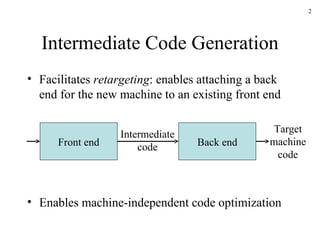
Intermediate Code Generation Facilitates  retargeting : enables attaching a back end for the new machine to an existing front end Enables machine-independent code optimization Front end Back end Intermediate code Target machine code
Intermediate Representations Graphical representations  (e.g. AST) Postfix notation : operations on values stored on operand stack (similar to JVM bytecode) Three-address code : (e.g.  triples  and  quads ) x  :=  y  op  z   Two-address code : x  := op  y which is the same as  x  :=  x  op  y
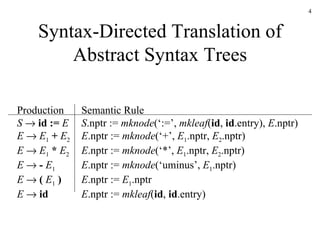
Syntax-Directed Translation of Abstract Syntax Trees Production S     id :=   E E      E 1   +   E 2 E      E 1   *   E 2 E      -   E 1 E      (  E 1  ) E      id Semantic Rule S .nptr :=  mknode (‘:=’,  mkleaf ( id ,  id .entry),  E .nptr) E .nptr :=  mknode (‘+’,  E 1 .nptr,  E 2 .nptr) E .nptr :=  mknode (‘*’,  E 1 .nptr,  E 2 .nptr) E .nptr :=  mknode (‘uminus’,  E 1 .nptr) E .nptr :=  E 1 .nptr E .nptr :=  mkleaf ( id ,  id .entry)
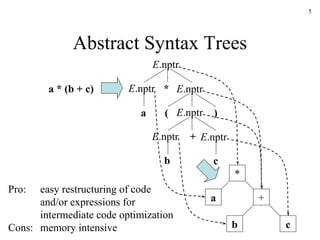
Abstract Syntax Trees E .nptr * E .nptr E .nptr a b + E .nptr * a + b c E .nptr c E .nptr ( ) a * (b + c) Pro: easy restructuring of code and/or expressions for intermediate code optimization Cons: memory intensive
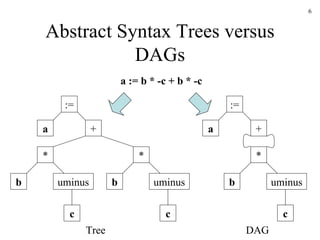
Abstract Syntax Trees versus DAGs := a + * uminus b c * uminus b c := a + * uminus b c Tree DAG a := b * -c + b * -c
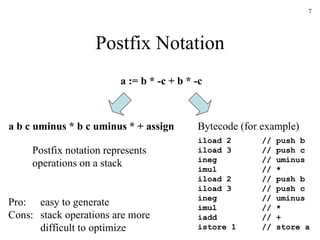
Postfix Notation a := b * -c + b * -c a b c uminus * b c uminus * + assign iload 2 // push b iload 3 // push c ineg // uminus imul // * iload 2 // push b iload 3 // push c ineg // uminus imul // * iadd // + istore 1 // store a Bytecode (for example) Postfix notation represents operations on a stack Pro: easy to generate Cons: stack operations are more difficult to optimize
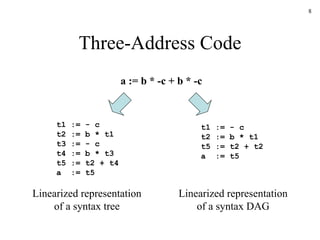
Three-Address Code a := b * -c + b * -c t1 := - c t2 := b * t1 t3 := - c t4 := b * t3 t5 := t2 + t4 a  := t5 Linearized representation of a syntax tree t1 := - c t2 := b * t1 t5 := t2 + t2 a  := t5 Linearized representation of a syntax DAG
Three-Address Statements Assignment statements:  x   :=   y op z ,  x   :=   op y Indexed assignments:  x   :=   y [ i ],  x [ i ]  :=   y Pointer assignments:  x   :=   & y ,  x   :=   * y ,  * x   :=   y Copy statements:  x   :=   y Unconditional jumps:  goto  lab Conditional jumps:  if  x relop y  goto  lab Function calls:  param  x…  call  p, n return  y
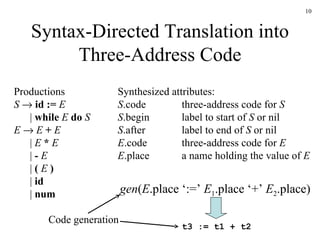
Syntax-Directed Translation into Three-Address Code Synthesized attributes: S .code three-address code for  S S .begin label to start of  S  or nil S .after label to end of  S  or nil E .code three-address code for  E E .place a name holding the value of  E Productions S      id :=  E |  while   E   do   S E      E   +   E   |  E   *   E   |  -   E   |  (   E  )   |  id   |  num gen ( E .place ‘:=’  E 1 .place ‘+’  E 2 .place) t3 := t1 + t2 Code generation
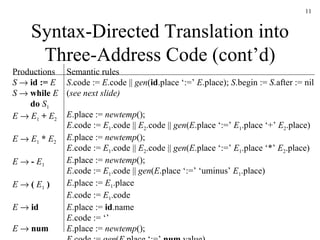
Syntax-Directed Translation into Three-Address Code (cont’d) Productions S      id :=  E S      while   E   do   S 1 E      E 1   +   E 2 E      E 1   *   E 2 E      -   E 1 E      (   E 1  ) E      id E      num Semantic rules S .code :=  E .code ||  gen ( id .place ‘:=’  E .place);  S .begin :=  S .after := nil ( see next slide) E .place :=  newtemp (); E .code :=  E 1 .code ||  E 2 .code ||  gen ( E .place ‘:=’  E 1 .place ‘+’  E 2 .place) E .place :=  newtemp (); E .code :=  E 1 .code ||  E 2 .code ||  gen ( E .place ‘:=’  E 1 .place ‘*’  E 2 .place) E .place :=  newtemp (); E .code :=  E 1 .code ||  gen ( E .place ‘:=’ ‘uminus’  E 1 .place) E .place :=  E 1 .place E .code :=  E 1 .code E .place :=  id .name E .code := ‘’ E .place :=  newtemp (); E .code :=  gen ( E .place ‘:=’  num .value)
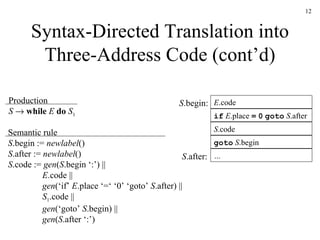
Syntax-Directed Translation into Three-Address Code (cont’d) Production S      while   E   do   S 1 Semantic rule S .begin :=  newlabel () S .after :=  newlabel () S .code :=  gen ( S .begin ‘:’) ||   E .code ||   gen (‘if’  E .place ‘=‘ ‘0’ ‘goto’  S .after) ||   S 1 .code ||   gen (‘goto’  S .begin) ||   gen ( S .after ‘:’) … if  E .place   =   0   goto  S .after S .code E .code goto  S .begin S .begin: S .after:
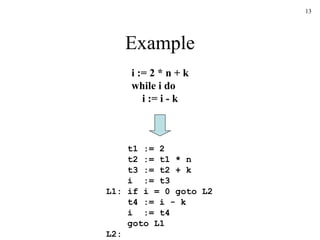
Example i := 2 * n + k while i do   i := i - k t1 := 2   t2 := t1 * n   t3 := t2 + k   i  := t3 L1: if i = 0 goto L2   t4 := i - k   i  := t4   goto L1 L2:
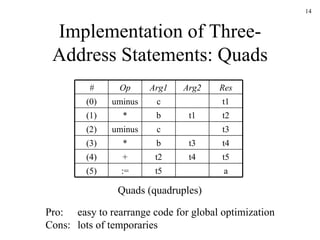
Implementation of Three-Address Statements: Quads Quads (quadruples) Pro: easy to rearrange code for global optimization Cons: lots of temporaries # Op Arg1 Arg2 Res (0) uminus c t1 (1) * b t1 t2 (2) uminus c t3 (3) * b t3 t4 (4) + t2 t4 t5 (5) := t5 a
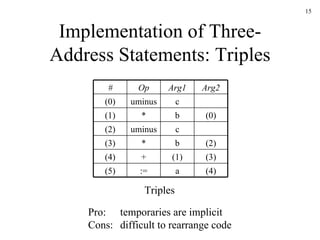
Implementation of Three-Address Statements: Triples Triples Pro: temporaries are implicit Cons: difficult to rearrange code # Op Arg1 Arg2 (0) uminus c (1) * b (0) (2) uminus c (3) * b (2) (4) + (1) (3) (5) := a (4)
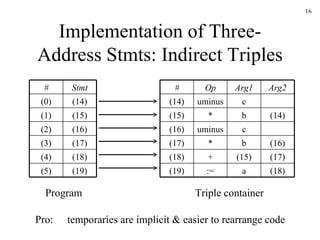
Implementation of Three-Address Stmts: Indirect Triples Triple container Pro: temporaries are implicit & easier to rearrange code Program # Op Arg1 Arg2 (14) uminus c (15) * b (14) (16) uminus c (17) * b (16) (18) + (15) (17) (19) := a (18) # Stmt (0) (14) (1) (15) (2) (16) (3) (17) (4) (18) (5) (19)
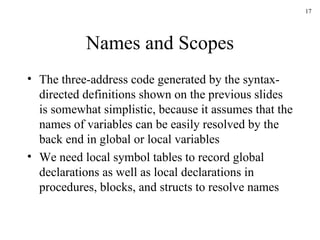
Names and Scopes The three-address code generated by the syntax-directed definitions shown on the previous slides is somewhat simplistic, because it assumes that the names of variables can be easily resolved by the back end in global or local variables We need local symbol tables to record global declarations as well as local declarations in procedures, blocks, and structs to resolve names
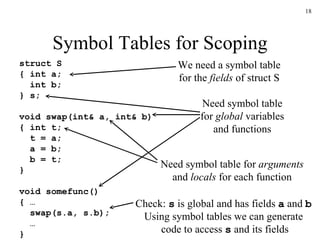
Symbol Tables for Scoping struct S { int a;   int b; } s; void swap(int& a, int& b) { int t;   t = a;   a = b;   b = t; } void somefunc() { …   swap(s.a, s.b);   … } We need a symbol table for the  fields  of struct S Need symbol table for  arguments and  locals  for each function Need symbol table for  global  variables and functions Check:  s  is global and has fields  a  and  b Using symbol tables we can generate  code to access  s  and its fields
Offset and Width for Runtime Allocation struct S { int a;   int b; } s; void swap(int& a, int& b) { int t;   t = a;   a = b;   b = t; } void somefunc() { …   swap(s.a, s.b);   … } Subroutine frame holds arguments  a  and  b  and local  t  at  offsets  0, 4, and 8 a b (0) (4) a b t (0) (4) (8) Subroutine frame fp[0]= fp[4]= fp[8]= The fields  a  and  b  of struct S are located at  offsets  0 and 4 from the start of S The  width  of S is 8 The  width  of the frame is 12
Example struct S { int a;   int b; } s; void swap(int& a, int& b) { int t;   t = a;   a = b;   b = t; } void foo() { …   swap(s.a, s.b);   … } a Trec S b s Tint Tfun swap a b t Tref prev=nil prev prev=nil prev Tfun foo swap foo globals (0) (0) (4) (8) (0) (4) Table nodes type nodes ( offset ) [ width ] [12] [0] [8] [8]
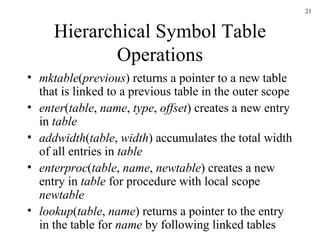
Hierarchical Symbol Table Operations mktable ( previous ) returns a pointer to a new table that is linked to a previous table in the outer scope enter ( table ,  name ,  type ,  offset ) creates a new entry in  table addwidth ( table ,  width ) accumulates the total width of all entries in  table enterproc ( table ,  name ,  newtable ) creates a new entry in  table  for procedure with local scope  newtable lookup ( table ,  name ) returns a pointer to the entry in the table for  name  by following linked tables
Syntax-Directed Translation of Declarations in Scope Synthesized attributes: T .type pointer to type T .width storage width of type (bytes) E .place name of temp holding value of  E Productions P      D  ;  S D      D   ;   D   |  id :   T   |  proc   id ;  D  ;  S T      integer   |  real   |  array [ num ] of   T   |  ^   T   |  record   D   end S      S  ;  S   |   id :=  E   |   call id (  A  ) Global data to implement scoping: tblptr stack of pointers to tables offset stack of offset values Productions  (cont’d) E      E   +   E   |  E   *   E   |  -   E   |  (   E   )   |  id   |  E  ^   |  &  E     |  E  . id A      A  ,   E   |  E
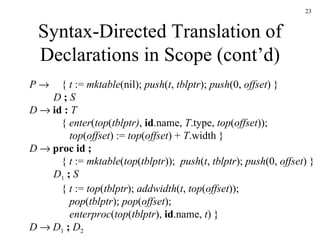
Syntax-Directed Translation of Declarations in Scope (cont’d) P    {  t  :=  mktable (nil);  push ( t ,  tblptr );  push (0,  offset ) }   D  ;  S D      id :   T {  enter ( top ( tblptr) ,  id .name,  T .type,  top ( offset ));   top ( offset ) :=  top ( offset ) +  T .width } D      proc   id ;   {  t  :=  mktable ( top ( tblptr ));  push ( t ,  tblptr );  push (0,  offset ) }   D 1  ;  S {  t  :=  top ( tblptr );  addwidth ( t ,  top ( offset ));   pop ( tblptr );  pop ( offset );   enterproc ( top ( tblptr ),  id .name,  t ) } D      D 1   ;   D 2
Syntax-Directed Translation of Declarations in Scope (cont’d) T      integer {  T .type := ‘ integer’ ;  T .width := 4 } T      real {  T .type := ‘ real’ ;  T .width := 8 } T      array [ num ] of   T 1 {  T .type :=  array ( num .val,  T 1 .type);   T .width :=  num .val *  T 1 .width } T      ^   T 1 {  T .type :=  pointer ( T 1 .type);  T .width := 4 } T      record {  t  :=  mktable (nil);  push ( t ,  tblptr );  push (0,  offset ) }   D   end {  T .type :=  record ( top ( tblptr ));  T .width :=  top ( offset );   addwidth ( top ( tblptr ),  top ( offset ));  pop ( tblptr );  pop ( offset ) }
Example s: record   a: integer;   b: integer;   end; proc swap;   a: ^integer;   b: ^integer;   t: integer;   t := a^;   a^ := b^;   b^ := t; proc foo;   call swap(&s.a, &s.b); a Trec b s Tint Tfun swap a b t Tptr prev=nil prev prev=nil prev Tfun foo swap foo globals (0) (0) (4) (8) (0) (4) Table nodes type nodes ( offset ) [ width ] [12] [0] [8] [8]
Syntax-Directed Translation of Statements in Scope S      S  ;  S S      id :=  E {  p  :=  lookup ( top ( tblptr ),  id .name);   if   p  = nil  then   error ()   else if   p .level = 0  then  // global variable   emit ( id .place ‘:=’  E .place)   else  // local variable in subroutine frame   emit (fp[ p. offset] ‘:=’  E .place) }   s x y (0) (8) (12) Globals a b t (0) (4) (8) Subroutine frame fp[0]= fp[4]= fp[8]= …
Syntax-Directed Translation of Expressions in Scope E      E 1   +   E 2 {  E .place :=  newtemp ();   emit ( E .place ‘:=’  E 1 .place ‘+’  E 2 .place) } E      E 1   *   E 2 {  E .place :=  newtemp ();   emit ( E .place ‘:=’  E 1 .place ‘*’  E 2 .place) }   E      -   E 1   {  E .place :=  newtemp ();   emit ( E .place ‘:=’ ‘uminus’  E 1 .place) }   E      (   E 1   ) {  E .place :=  E 1 .place } E      id   {  p  :=  lookup ( top ( tblptr ),  id .name);   if   p  = nil  then  error ()   else if   p .level = 0  then  // global variable   E .place :=  id .place   else  // local variable in frame   E .place := fp[ p .offset] }
Syntax-Directed Translation of Expressions in Scope (cont’d) E      E 1  ^ {  E .place :=  newtemp ();   emit ( E .place ‘:=’  ‘ *’  E 1 .place) }   E      &  E 1 {  E .place :=  newtemp ();   emit ( E .place ‘:=’  ‘ &’  E 1 .place) }   E      id 1  . id 2 {  p  :=  lookup ( top ( tblptr ),  id 1 .name);   if   p  = nil  or   p .type != Trec  then   error ()   else   q  :=  lookup ( p .type.table,  id 2 .name);   if   q  = nil  then  error()   else if  p .level = 0  then  //  global variable   E .place :=  id 1 .place[ q .offset]   else  //  local variable in frame   E .place := fp[ p .offset+ q .offset] }

Ch8a

  • 1.
    Intermediate Code GenerationPart I Chapter 6 (1 st ed Chapter 8) COP5621 Compiler Construction Copyright Robert van Engelen, Florida State University, 2007-2009
  • 2.
    Intermediate Code GenerationFacilitates retargeting : enables attaching a back end for the new machine to an existing front end Enables machine-independent code optimization Front end Back end Intermediate code Target machine code
  • 3.
    Intermediate Representations Graphicalrepresentations (e.g. AST) Postfix notation : operations on values stored on operand stack (similar to JVM bytecode) Three-address code : (e.g. triples and quads ) x := y op z Two-address code : x := op y which is the same as x := x op y
  • 4.
    Syntax-Directed Translation ofAbstract Syntax Trees Production S  id := E E  E 1 + E 2 E  E 1 * E 2 E  - E 1 E  ( E 1 ) E  id Semantic Rule S .nptr := mknode (‘:=’, mkleaf ( id , id .entry), E .nptr) E .nptr := mknode (‘+’, E 1 .nptr, E 2 .nptr) E .nptr := mknode (‘*’, E 1 .nptr, E 2 .nptr) E .nptr := mknode (‘uminus’, E 1 .nptr) E .nptr := E 1 .nptr E .nptr := mkleaf ( id , id .entry)
  • 5.
    Abstract Syntax TreesE .nptr * E .nptr E .nptr a b + E .nptr * a + b c E .nptr c E .nptr ( ) a * (b + c) Pro: easy restructuring of code and/or expressions for intermediate code optimization Cons: memory intensive
  • 6.
    Abstract Syntax Treesversus DAGs := a + * uminus b c * uminus b c := a + * uminus b c Tree DAG a := b * -c + b * -c
  • 7.
    Postfix Notation a:= b * -c + b * -c a b c uminus * b c uminus * + assign iload 2 // push b iload 3 // push c ineg // uminus imul // * iload 2 // push b iload 3 // push c ineg // uminus imul // * iadd // + istore 1 // store a Bytecode (for example) Postfix notation represents operations on a stack Pro: easy to generate Cons: stack operations are more difficult to optimize
  • 8.
    Three-Address Code a:= b * -c + b * -c t1 := - c t2 := b * t1 t3 := - c t4 := b * t3 t5 := t2 + t4 a := t5 Linearized representation of a syntax tree t1 := - c t2 := b * t1 t5 := t2 + t2 a := t5 Linearized representation of a syntax DAG
  • 9.
    Three-Address Statements Assignmentstatements: x := y op z , x := op y Indexed assignments: x := y [ i ], x [ i ] := y Pointer assignments: x := & y , x := * y , * x := y Copy statements: x := y Unconditional jumps: goto lab Conditional jumps: if x relop y goto lab Function calls: param x… call p, n return y
  • 10.
    Syntax-Directed Translation intoThree-Address Code Synthesized attributes: S .code three-address code for S S .begin label to start of S or nil S .after label to end of S or nil E .code three-address code for E E .place a name holding the value of E Productions S  id := E | while E do S E  E + E | E * E | - E | ( E ) | id | num gen ( E .place ‘:=’ E 1 .place ‘+’ E 2 .place) t3 := t1 + t2 Code generation
  • 11.
    Syntax-Directed Translation intoThree-Address Code (cont’d) Productions S  id := E S  while E do S 1 E  E 1 + E 2 E  E 1 * E 2 E  - E 1 E  ( E 1 ) E  id E  num Semantic rules S .code := E .code || gen ( id .place ‘:=’ E .place); S .begin := S .after := nil ( see next slide) E .place := newtemp (); E .code := E 1 .code || E 2 .code || gen ( E .place ‘:=’ E 1 .place ‘+’ E 2 .place) E .place := newtemp (); E .code := E 1 .code || E 2 .code || gen ( E .place ‘:=’ E 1 .place ‘*’ E 2 .place) E .place := newtemp (); E .code := E 1 .code || gen ( E .place ‘:=’ ‘uminus’ E 1 .place) E .place := E 1 .place E .code := E 1 .code E .place := id .name E .code := ‘’ E .place := newtemp (); E .code := gen ( E .place ‘:=’ num .value)
  • 12.
    Syntax-Directed Translation intoThree-Address Code (cont’d) Production S  while E do S 1 Semantic rule S .begin := newlabel () S .after := newlabel () S .code := gen ( S .begin ‘:’) || E .code || gen (‘if’ E .place ‘=‘ ‘0’ ‘goto’ S .after) || S 1 .code || gen (‘goto’ S .begin) || gen ( S .after ‘:’) … if E .place = 0 goto S .after S .code E .code goto S .begin S .begin: S .after:
  • 13.
    Example i :=2 * n + k while i do i := i - k t1 := 2 t2 := t1 * n t3 := t2 + k i := t3 L1: if i = 0 goto L2 t4 := i - k i := t4 goto L1 L2:
  • 14.
    Implementation of Three-AddressStatements: Quads Quads (quadruples) Pro: easy to rearrange code for global optimization Cons: lots of temporaries # Op Arg1 Arg2 Res (0) uminus c t1 (1) * b t1 t2 (2) uminus c t3 (3) * b t3 t4 (4) + t2 t4 t5 (5) := t5 a
  • 15.
    Implementation of Three-AddressStatements: Triples Triples Pro: temporaries are implicit Cons: difficult to rearrange code # Op Arg1 Arg2 (0) uminus c (1) * b (0) (2) uminus c (3) * b (2) (4) + (1) (3) (5) := a (4)
  • 16.
    Implementation of Three-AddressStmts: Indirect Triples Triple container Pro: temporaries are implicit & easier to rearrange code Program # Op Arg1 Arg2 (14) uminus c (15) * b (14) (16) uminus c (17) * b (16) (18) + (15) (17) (19) := a (18) # Stmt (0) (14) (1) (15) (2) (16) (3) (17) (4) (18) (5) (19)
  • 17.
    Names and ScopesThe three-address code generated by the syntax-directed definitions shown on the previous slides is somewhat simplistic, because it assumes that the names of variables can be easily resolved by the back end in global or local variables We need local symbol tables to record global declarations as well as local declarations in procedures, blocks, and structs to resolve names
  • 18.
    Symbol Tables forScoping struct S { int a; int b; } s; void swap(int& a, int& b) { int t; t = a; a = b; b = t; } void somefunc() { … swap(s.a, s.b); … } We need a symbol table for the fields of struct S Need symbol table for arguments and locals for each function Need symbol table for global variables and functions Check: s is global and has fields a and b Using symbol tables we can generate code to access s and its fields
  • 19.
    Offset and Widthfor Runtime Allocation struct S { int a; int b; } s; void swap(int& a, int& b) { int t; t = a; a = b; b = t; } void somefunc() { … swap(s.a, s.b); … } Subroutine frame holds arguments a and b and local t at offsets 0, 4, and 8 a b (0) (4) a b t (0) (4) (8) Subroutine frame fp[0]= fp[4]= fp[8]= The fields a and b of struct S are located at offsets 0 and 4 from the start of S The width of S is 8 The width of the frame is 12
  • 20.
    Example struct S{ int a; int b; } s; void swap(int& a, int& b) { int t; t = a; a = b; b = t; } void foo() { … swap(s.a, s.b); … } a Trec S b s Tint Tfun swap a b t Tref prev=nil prev prev=nil prev Tfun foo swap foo globals (0) (0) (4) (8) (0) (4) Table nodes type nodes ( offset ) [ width ] [12] [0] [8] [8]
  • 21.
    Hierarchical Symbol TableOperations mktable ( previous ) returns a pointer to a new table that is linked to a previous table in the outer scope enter ( table , name , type , offset ) creates a new entry in table addwidth ( table , width ) accumulates the total width of all entries in table enterproc ( table , name , newtable ) creates a new entry in table for procedure with local scope newtable lookup ( table , name ) returns a pointer to the entry in the table for name by following linked tables
  • 22.
    Syntax-Directed Translation ofDeclarations in Scope Synthesized attributes: T .type pointer to type T .width storage width of type (bytes) E .place name of temp holding value of E Productions P  D ; S D  D ; D | id : T | proc id ; D ; S T  integer | real | array [ num ] of T | ^ T | record D end S  S ; S | id := E | call id ( A ) Global data to implement scoping: tblptr stack of pointers to tables offset stack of offset values Productions (cont’d) E  E + E | E * E | - E | ( E ) | id | E ^ | & E | E . id A  A , E | E
  • 23.
    Syntax-Directed Translation ofDeclarations in Scope (cont’d) P  { t := mktable (nil); push ( t , tblptr ); push (0, offset ) } D ; S D  id : T { enter ( top ( tblptr) , id .name, T .type, top ( offset )); top ( offset ) := top ( offset ) + T .width } D  proc id ; { t := mktable ( top ( tblptr )); push ( t , tblptr ); push (0, offset ) } D 1 ; S { t := top ( tblptr ); addwidth ( t , top ( offset )); pop ( tblptr ); pop ( offset ); enterproc ( top ( tblptr ), id .name, t ) } D  D 1 ; D 2
  • 24.
    Syntax-Directed Translation ofDeclarations in Scope (cont’d) T  integer { T .type := ‘ integer’ ; T .width := 4 } T  real { T .type := ‘ real’ ; T .width := 8 } T  array [ num ] of T 1 { T .type := array ( num .val, T 1 .type); T .width := num .val * T 1 .width } T  ^ T 1 { T .type := pointer ( T 1 .type); T .width := 4 } T  record { t := mktable (nil); push ( t , tblptr ); push (0, offset ) } D end { T .type := record ( top ( tblptr )); T .width := top ( offset ); addwidth ( top ( tblptr ), top ( offset )); pop ( tblptr ); pop ( offset ) }
  • 25.
    Example s: record a: integer; b: integer; end; proc swap; a: ^integer; b: ^integer; t: integer; t := a^; a^ := b^; b^ := t; proc foo; call swap(&s.a, &s.b); a Trec b s Tint Tfun swap a b t Tptr prev=nil prev prev=nil prev Tfun foo swap foo globals (0) (0) (4) (8) (0) (4) Table nodes type nodes ( offset ) [ width ] [12] [0] [8] [8]
  • 26.
    Syntax-Directed Translation ofStatements in Scope S  S ; S S  id := E { p := lookup ( top ( tblptr ), id .name); if p = nil then error () else if p .level = 0 then // global variable emit ( id .place ‘:=’ E .place) else // local variable in subroutine frame emit (fp[ p. offset] ‘:=’ E .place) } s x y (0) (8) (12) Globals a b t (0) (4) (8) Subroutine frame fp[0]= fp[4]= fp[8]= …
  • 27.
    Syntax-Directed Translation ofExpressions in Scope E  E 1 + E 2 { E .place := newtemp (); emit ( E .place ‘:=’ E 1 .place ‘+’ E 2 .place) } E  E 1 * E 2 { E .place := newtemp (); emit ( E .place ‘:=’ E 1 .place ‘*’ E 2 .place) } E  - E 1 { E .place := newtemp (); emit ( E .place ‘:=’ ‘uminus’ E 1 .place) } E  ( E 1 ) { E .place := E 1 .place } E  id { p := lookup ( top ( tblptr ), id .name); if p = nil then error () else if p .level = 0 then // global variable E .place := id .place else // local variable in frame E .place := fp[ p .offset] }
  • 28.
    Syntax-Directed Translation ofExpressions in Scope (cont’d) E  E 1 ^ { E .place := newtemp (); emit ( E .place ‘:=’ ‘ *’ E 1 .place) } E  & E 1 { E .place := newtemp (); emit ( E .place ‘:=’ ‘ &’ E 1 .place) } E  id 1 . id 2 { p := lookup ( top ( tblptr ), id 1 .name); if p = nil or p .type != Trec then error () else q := lookup ( p .type.table, id 2 .name); if q = nil then error() else if p .level = 0 then // global variable E .place := id 1 .place[ q .offset] else // local variable in frame E .place := fp[ p .offset+ q .offset] }