Chapter Fifteen
Market Demand
From Individual to Market Demand
Functions
 Think

of an economy containing n
consumers, denoted by i = 1, … ,n.
 Consumer i’s ordinary demand
function for commodity j is
x*i (p1 , p 2 , mi )
j
From Individual to Market Demand
Functions
 When

all consumers are price-takers,
the market demand function for
commodity j is

n *i
X j ( p1 , p 2 , m ,, m ) = ∑ x j (p1 , p 2 , mi ).
i= 1
1

 If

n

all consumers are identical then
X j ( p1 , p 2 , M) = n × x* ( p1 , p 2 , m)
j

where M = nm.
From Individual to Market Demand
Functions
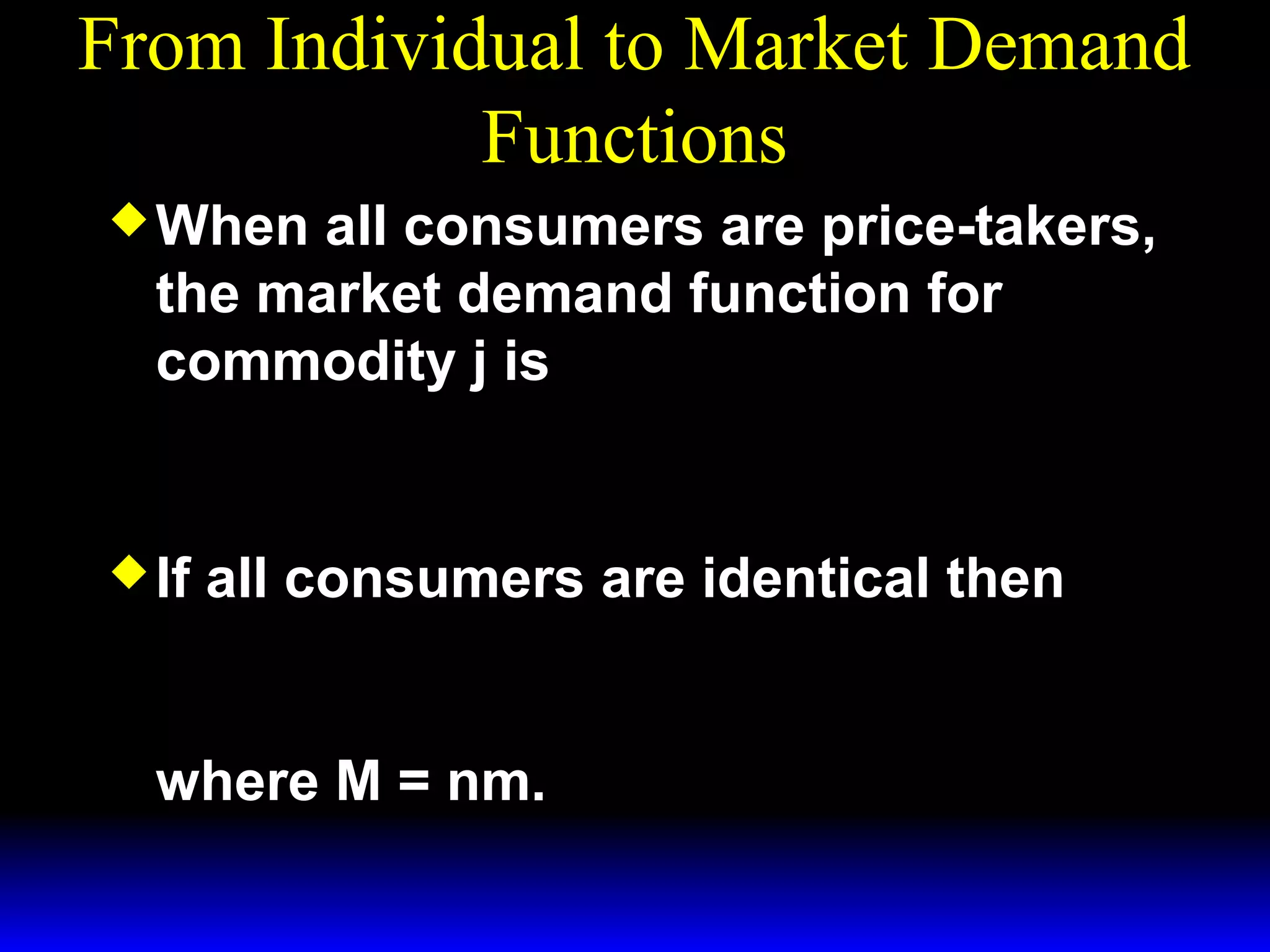
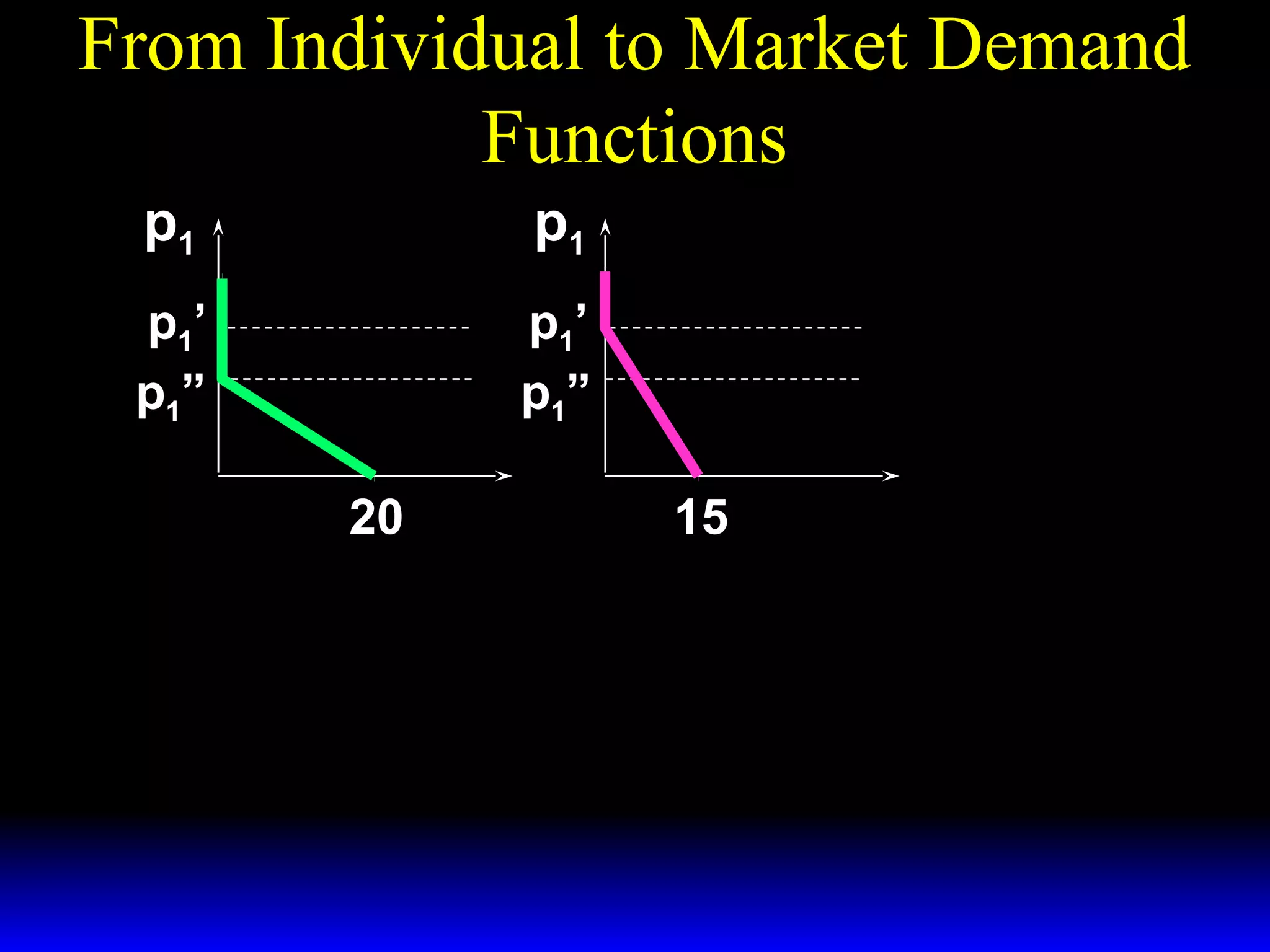
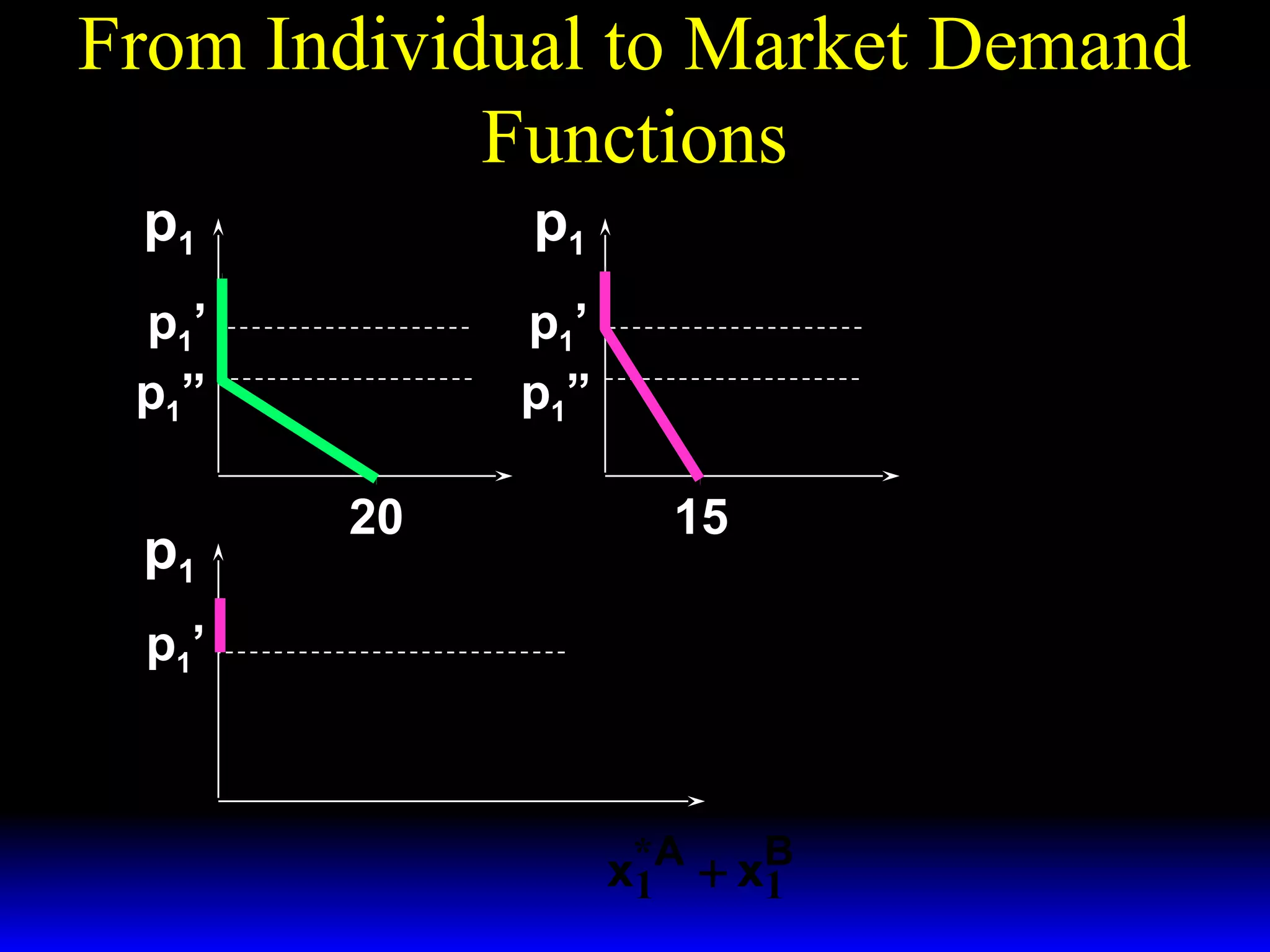
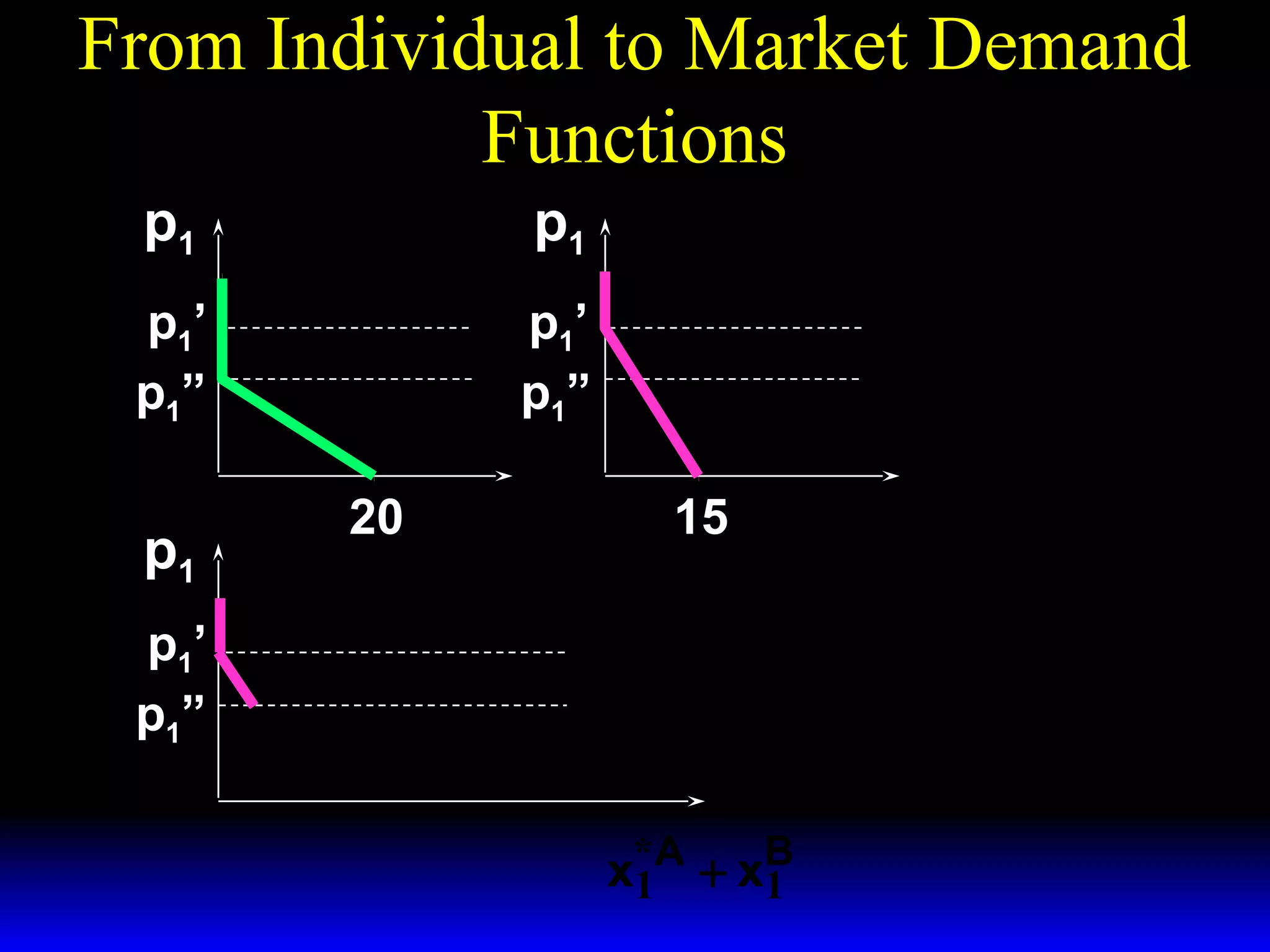
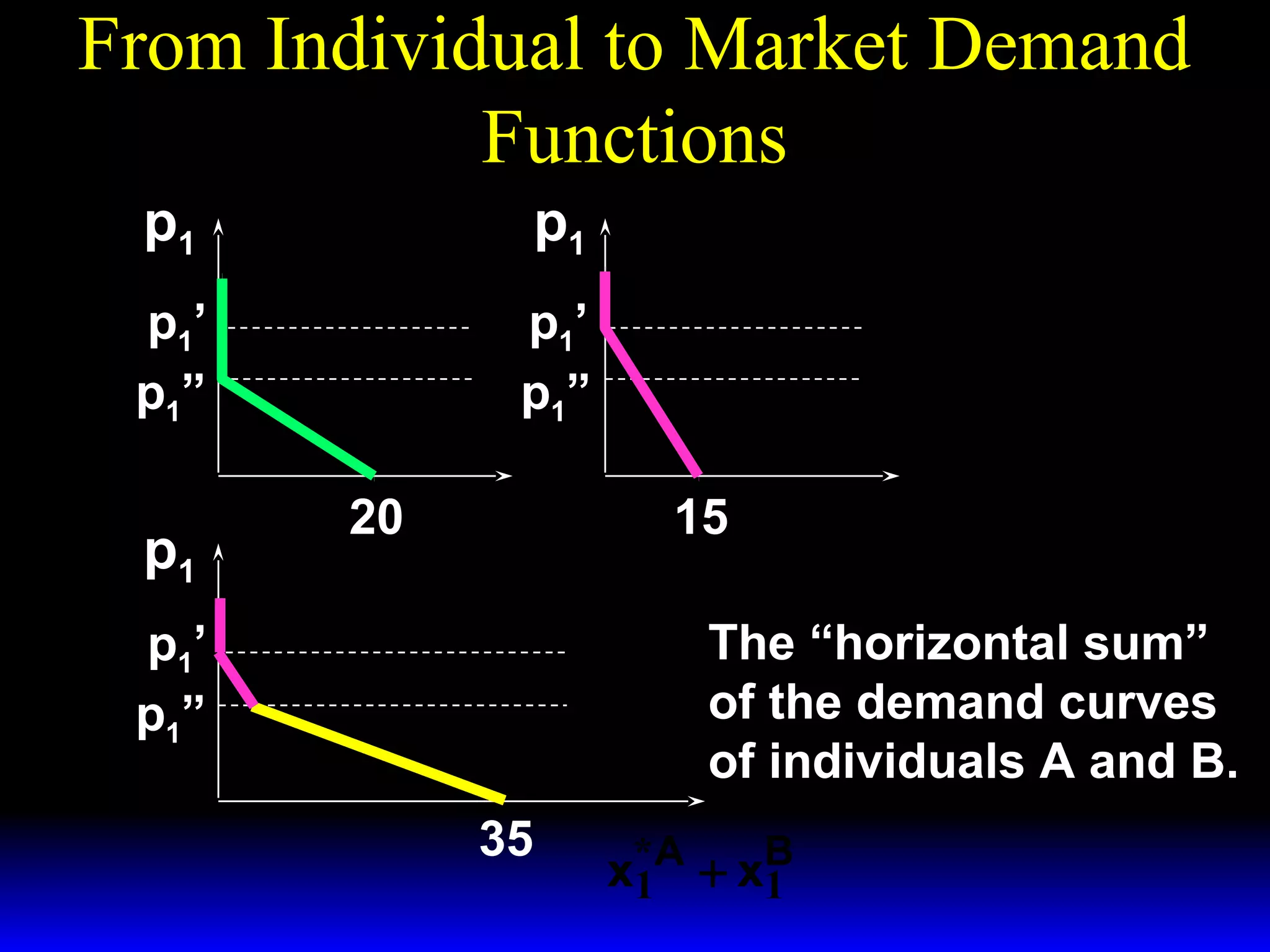
 The

market demand curve is the
“horizontal sum” of the individual
consumers’ demand curves.
 E.g. suppose there are only two
consumers; i = A,B.
From Individual to Market Demand
Functions
p1

p1

p1’
p1”

p1’
p1”
20 x*A
1

15

x*B
1
From Individual to Market Demand
Functions
p1

p1

p1’
p1”

p1’
p1”

p1

20 x*A
1

15

p1’

x*A + xB
1
1

x*B
1
From Individual to Market Demand
Functions
p1

p1

p1’
p1”

p1’
p1”

p1

20 x*A
1

15

p1’
p1”
x*A + xB
1
1

x*B
1
From Individual to Market Demand
Functions
p1

p1

p1’
p1”

p1’
p1”

p1

20 x*A
1

15

x*B
1

The “horizontal sum”
of the demand curves
of individuals A and B.

p1’
p1”
35

x*A + xB
1
1
Elasticities
 Elasticity

measures the “sensitivity”
of one variable with respect to
another.
 The elasticity of variable X with
respect to variable Y is

% ∆x
ε x,y =
.
% ∆y
Economic Applications of Elasticity
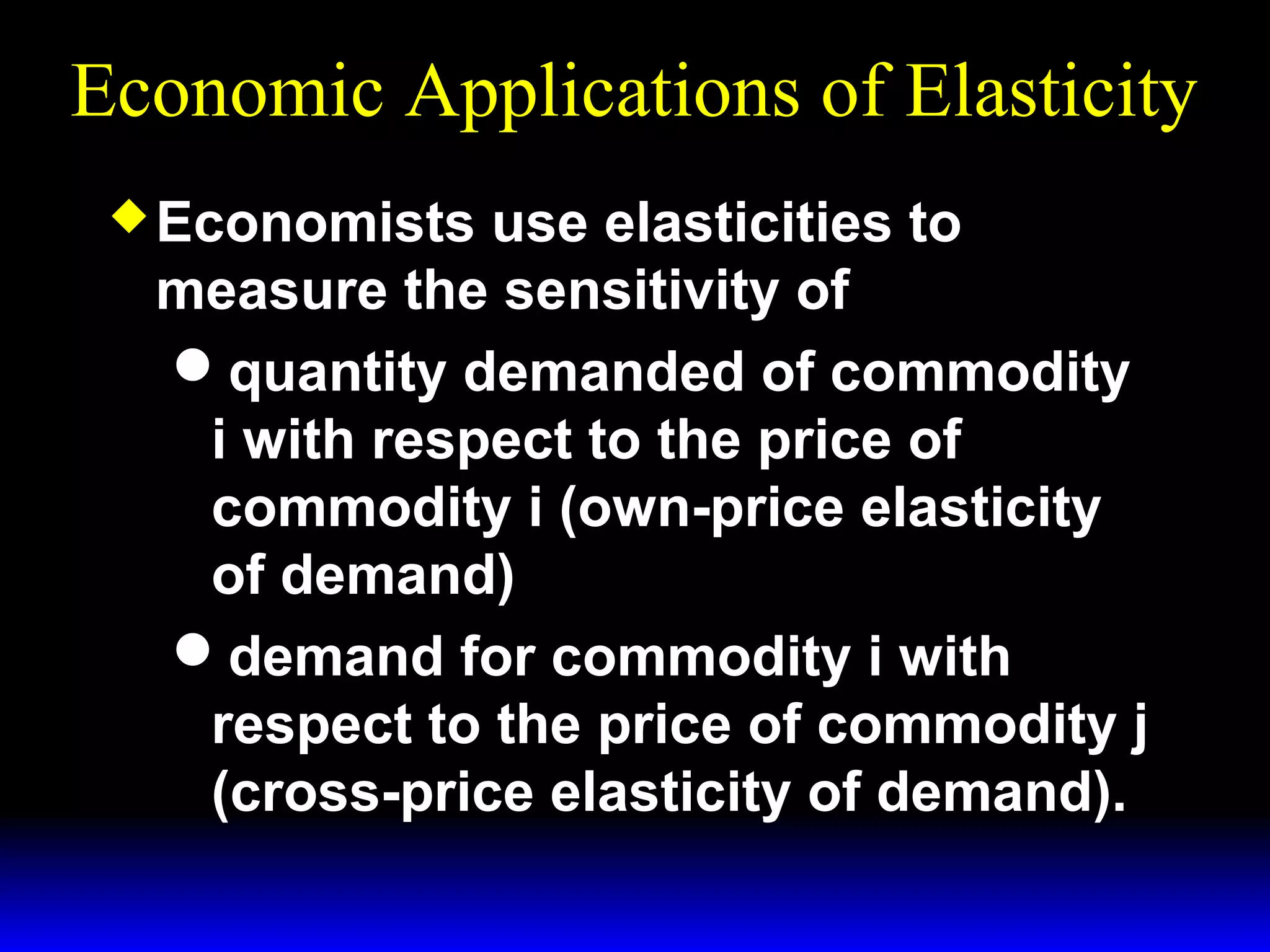
 Economists

use elasticities to
measure the sensitivity of
quantity demanded of commodity
i with respect to the price of
commodity i (own-price elasticity
of demand)
demand for commodity i with
respect to the price of commodity j
(cross-price elasticity of demand).
Economic Applications of Elasticity
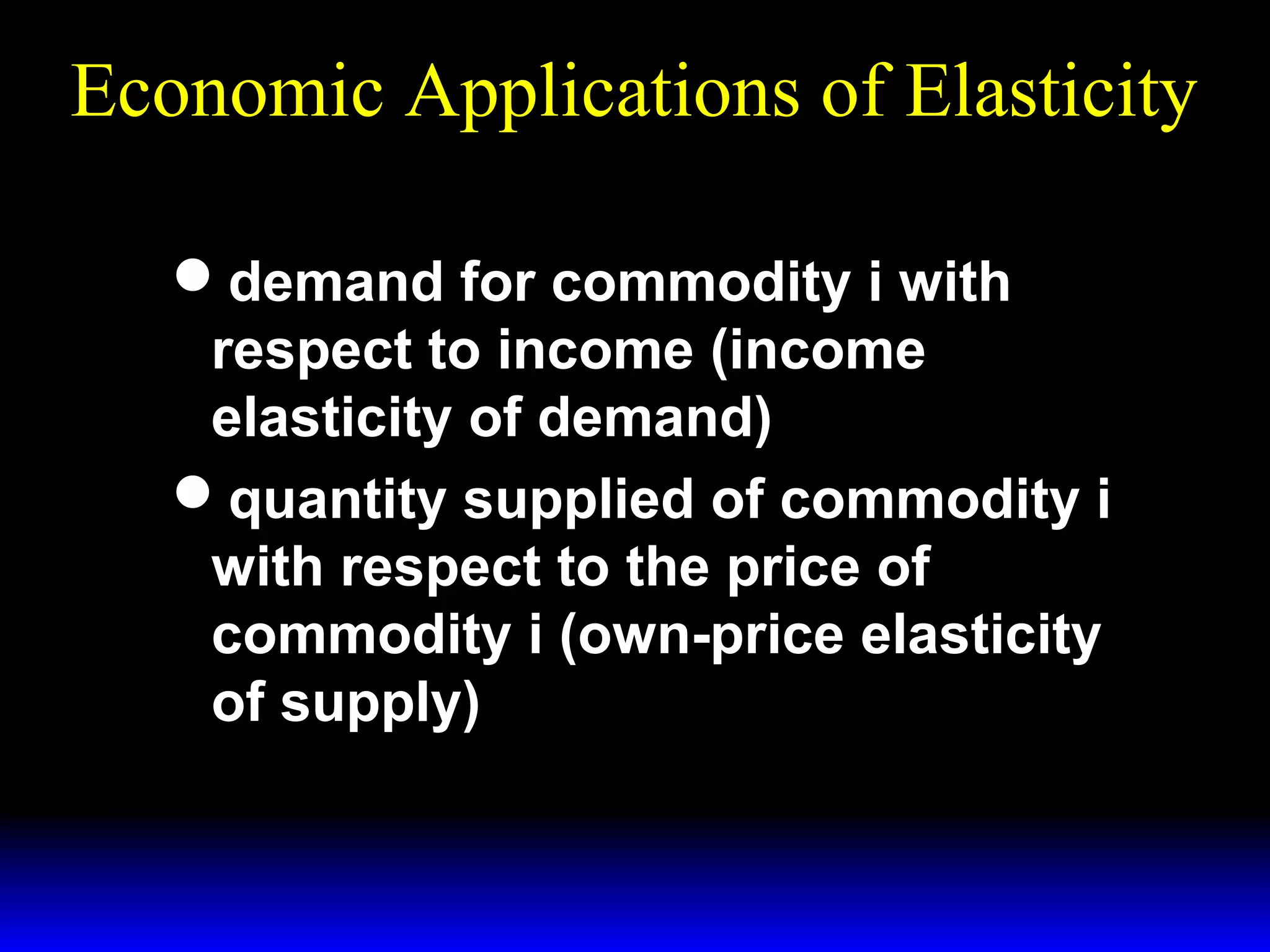
demand for commodity i with
respect to income (income
elasticity of demand)
quantity supplied of commodity i
with respect to the price of
commodity i (own-price elasticity
of supply)
Economic Applications of Elasticity
quantity supplied of commodity i
with respect to the wage rate
(elasticity of supply with respect to
the price of labor)
and many, many others.
Own-Price Elasticity of Demand
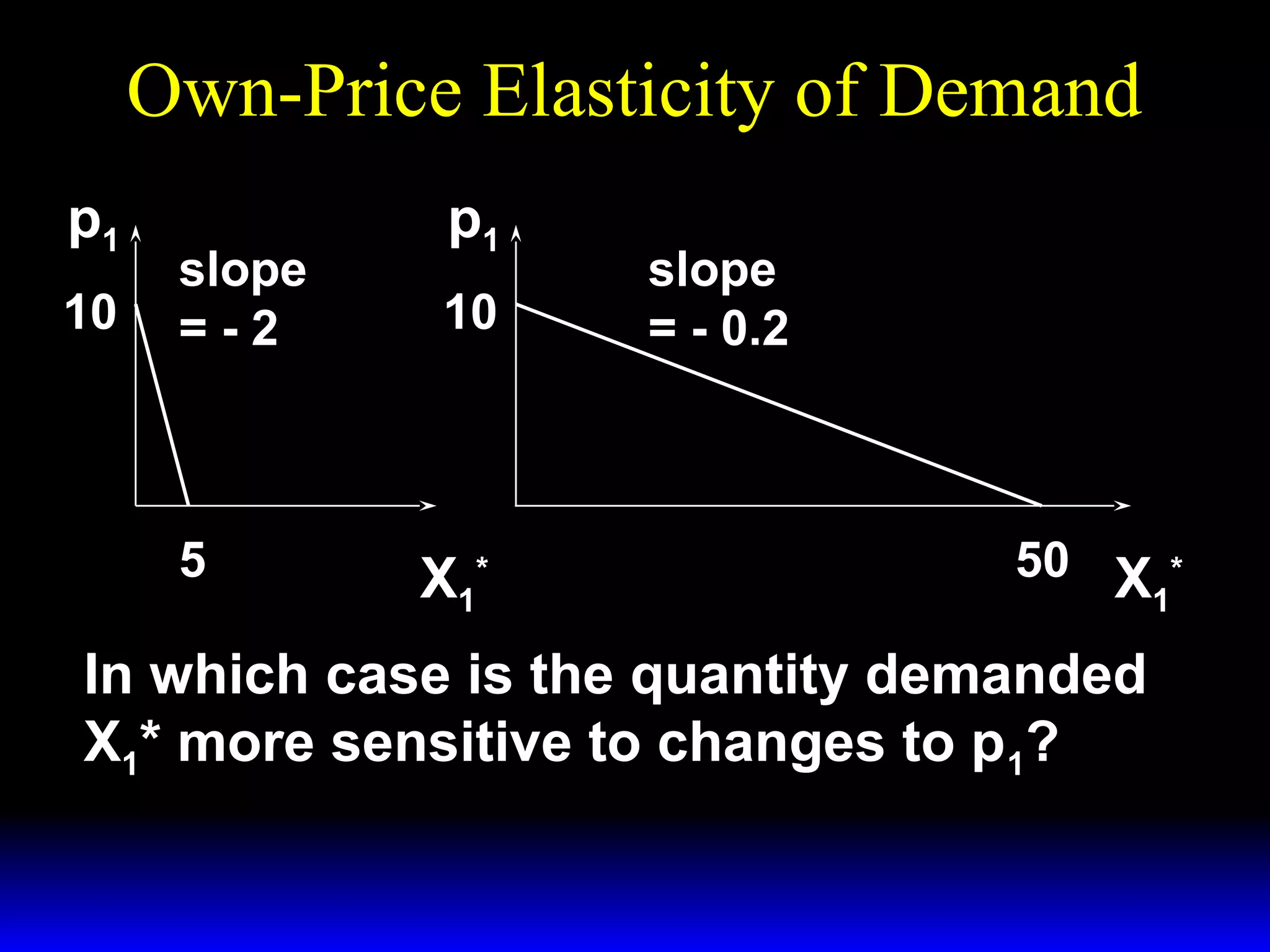
 Q:

Why not use a demand curve’s
slope to measure the sensitivity of
quantity demanded to a change in a
commodity’s own price?
Own-Price Elasticity of Demand
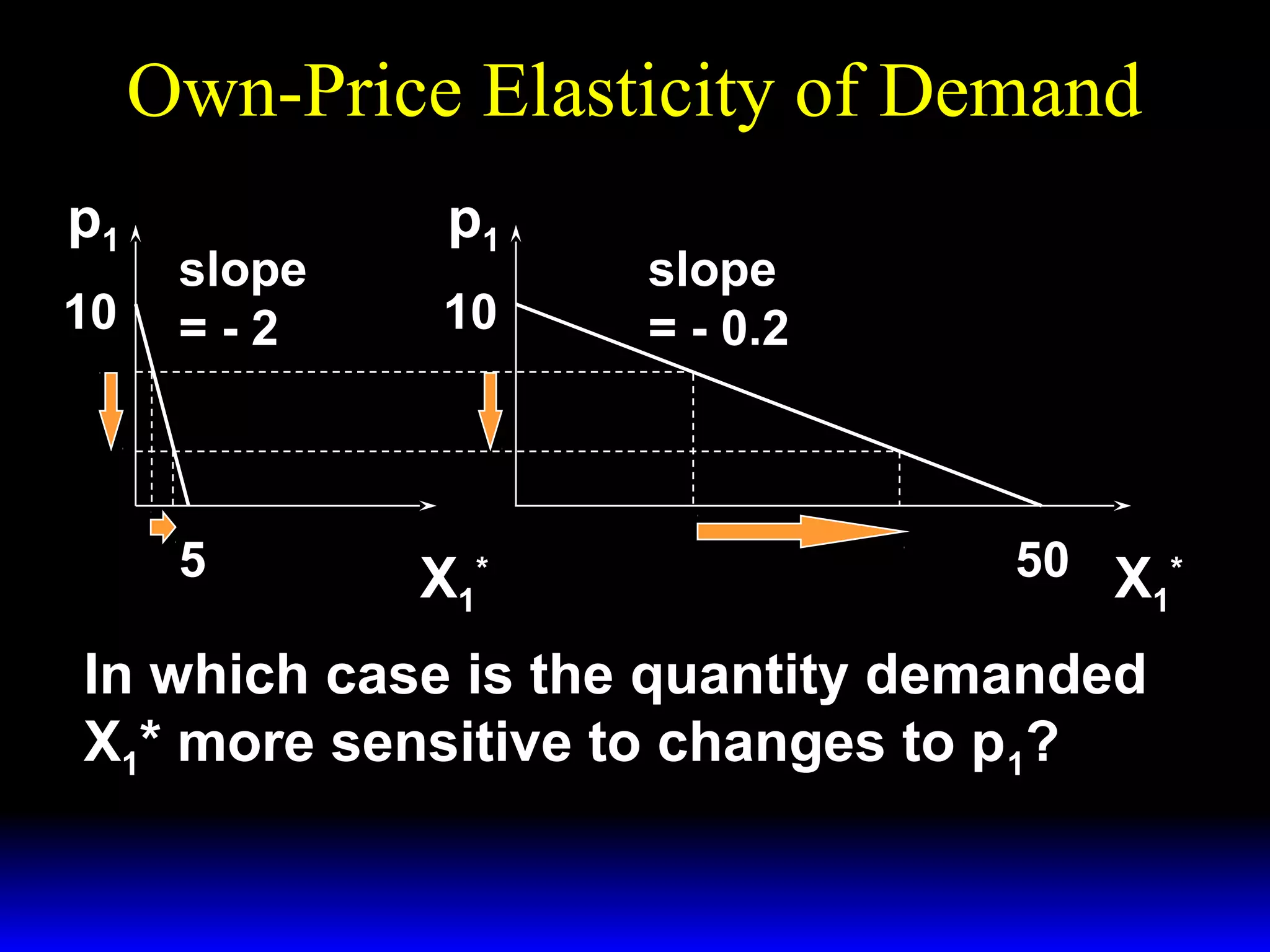
p1
10

slope
=-2

5

p1
10

X1*

slope
= - 0.2

50 X *
1

In which case is the quantity demanded
X1* more sensitive to changes to p1?
Own-Price Elasticity of Demand
p1
10

slope
=-2

5

p1
10

X1*

slope
= - 0.2

50 X *
1

In which case is the quantity demanded
X1* more sensitive to changes to p1?
Own-Price Elasticity of Demand
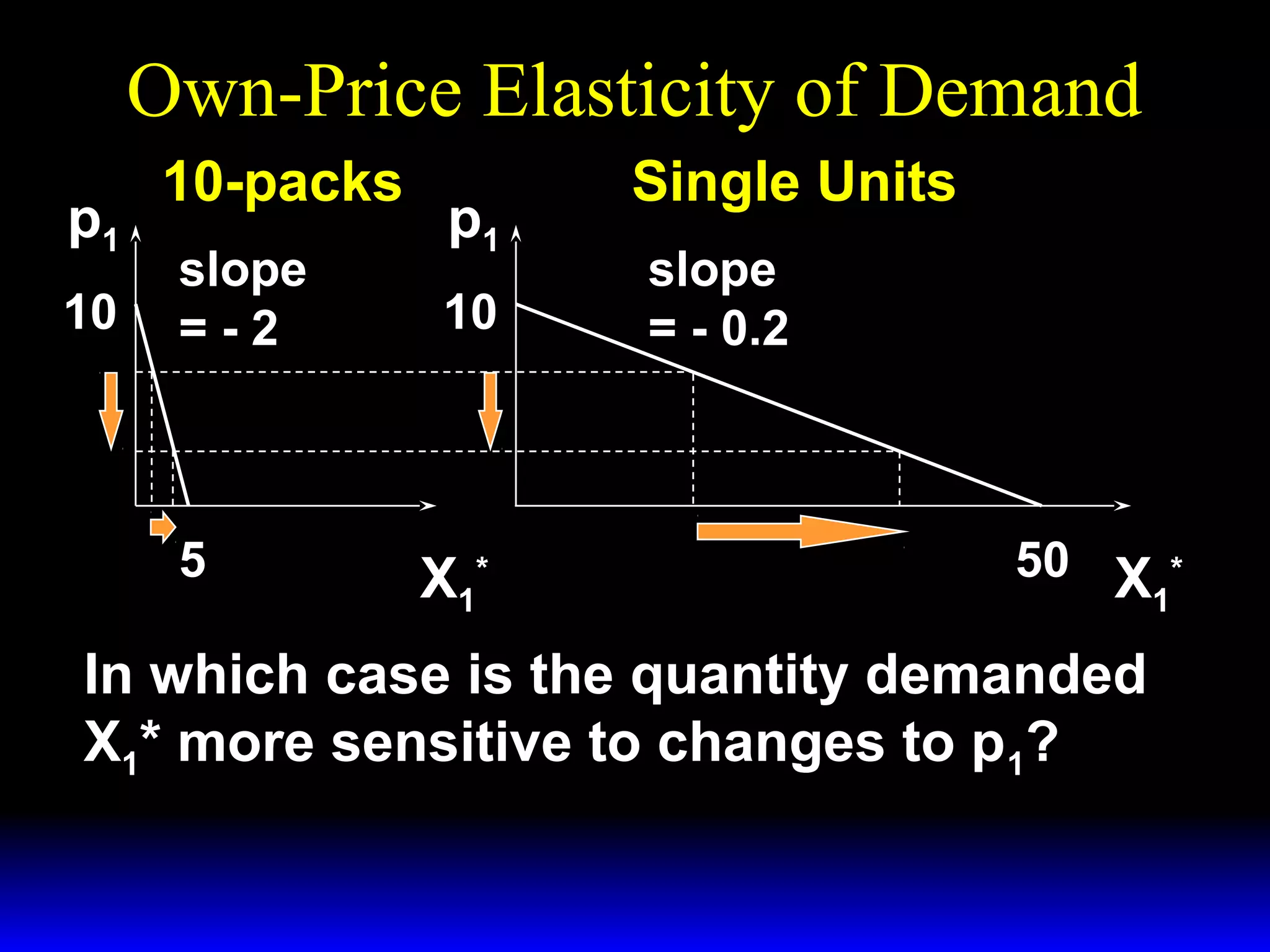
p1
10

10-packs
slope
=-2

5

p1
10

X1*

Single Units
slope
= - 0.2

50 X *
1

In which case is the quantity demanded
X1* more sensitive to changes to p1?
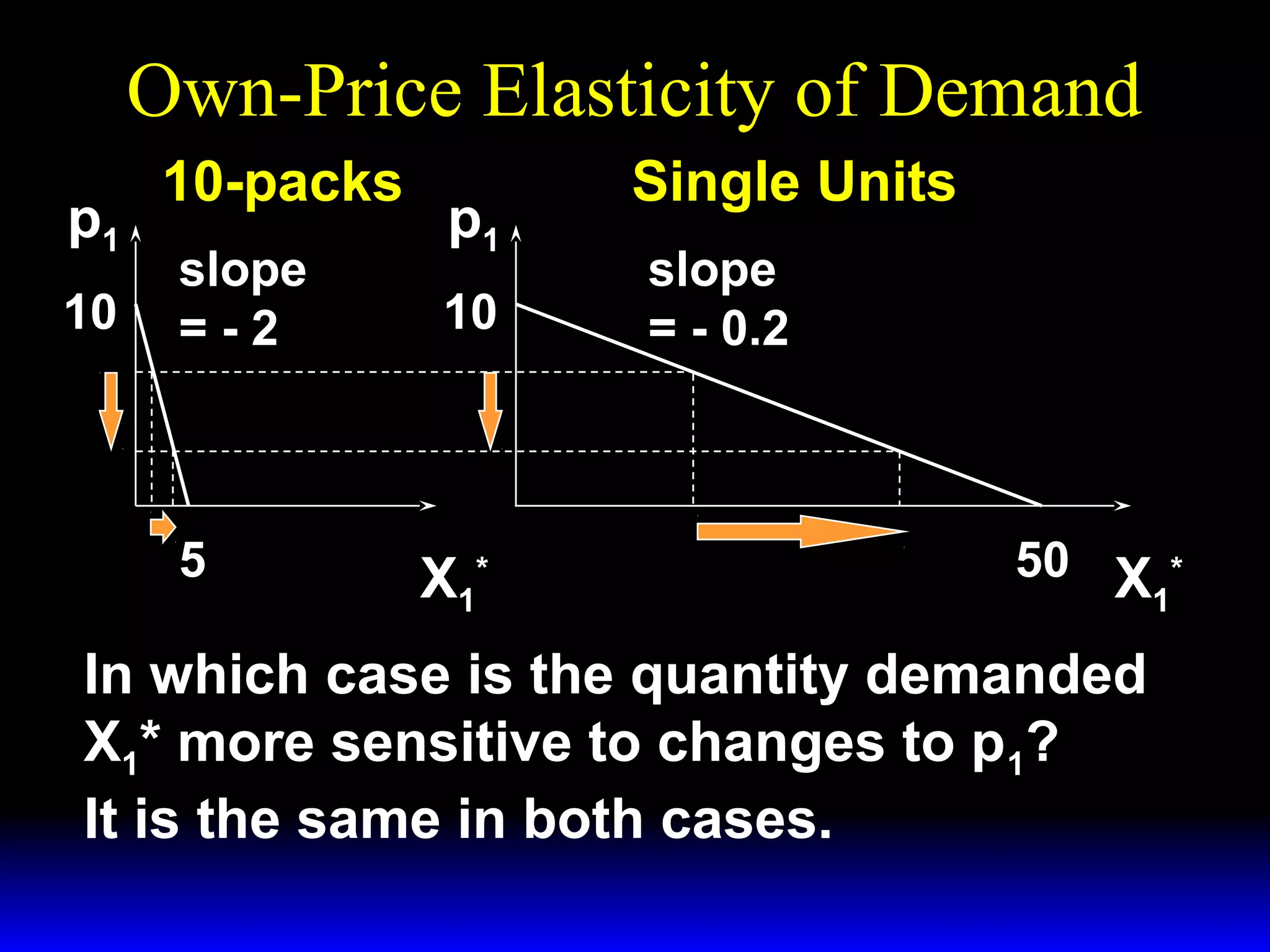
Own-Price Elasticity of Demand
p1
10

10-packs
slope
=-2

5

p1
10

X1*

Single Units
slope
= - 0.2

50 X *
1

In which case is the quantity demanded
X1* more sensitive to changes to p1?
It is the same in both cases.
Own-Price Elasticity of Demand
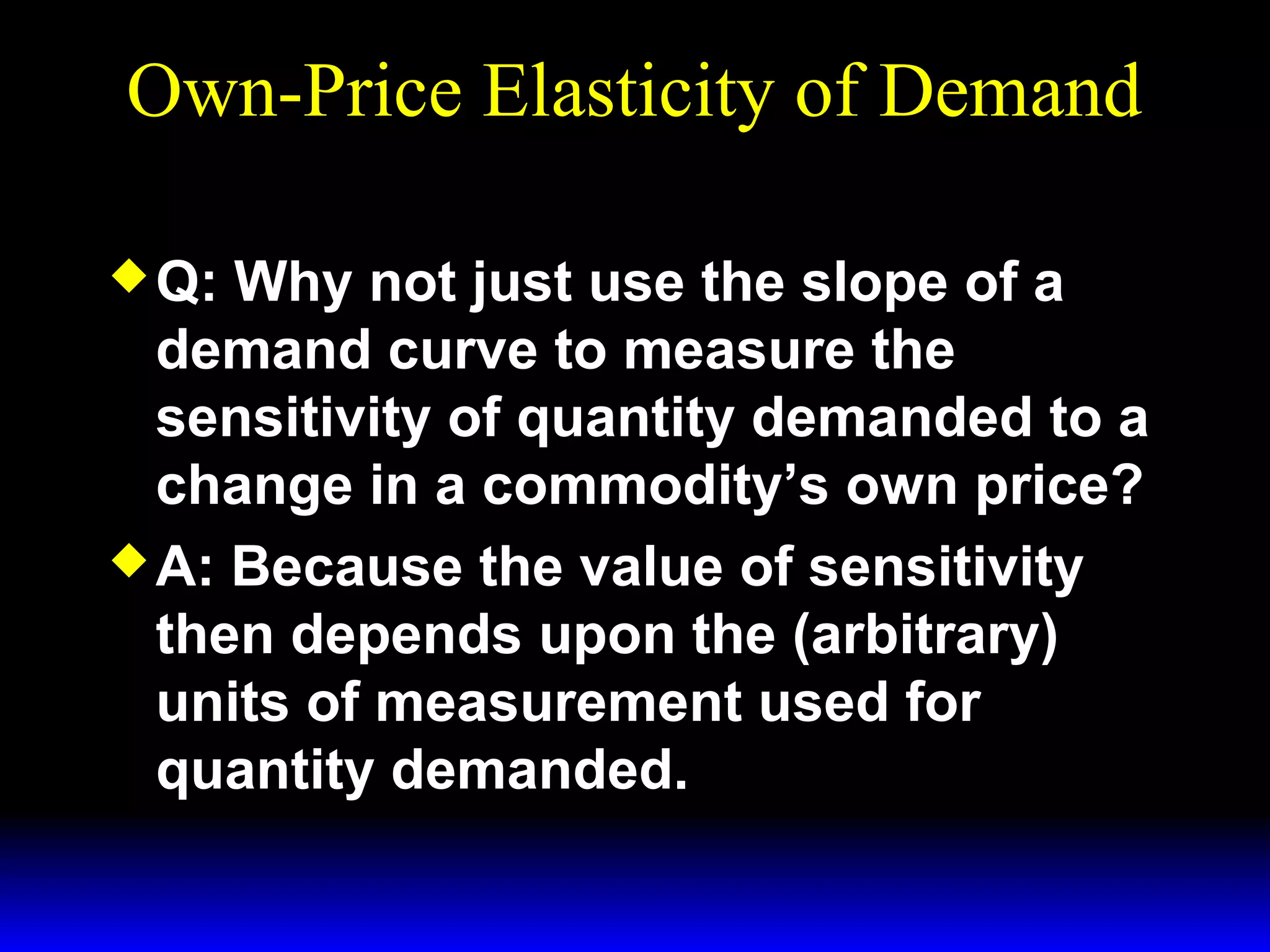
 Q:

Why not just use the slope of a
demand curve to measure the
sensitivity of quantity demanded to a
change in a commodity’s own price?
 A: Because the value of sensitivity
then depends upon the (arbitrary)
units of measurement used for
quantity demanded.
Own-Price Elasticity of Demand
*
% ∆ x1
ε *
=
x1 ,p1 % ∆p
1
is a ratio of percentages and so has no
units of measurement.
Hence own-price elasticity of demand is
a sensitivity measure that is independent
of units of measurement.
Arc and Point Elasticities
 An

“average” own-price elasticity of
demand for commodity i over an
interval of values for pi is an arcelasticity, usually computed by a
mid-point formula.
 Elasticity computed for a single
value of pi is a point elasticity.
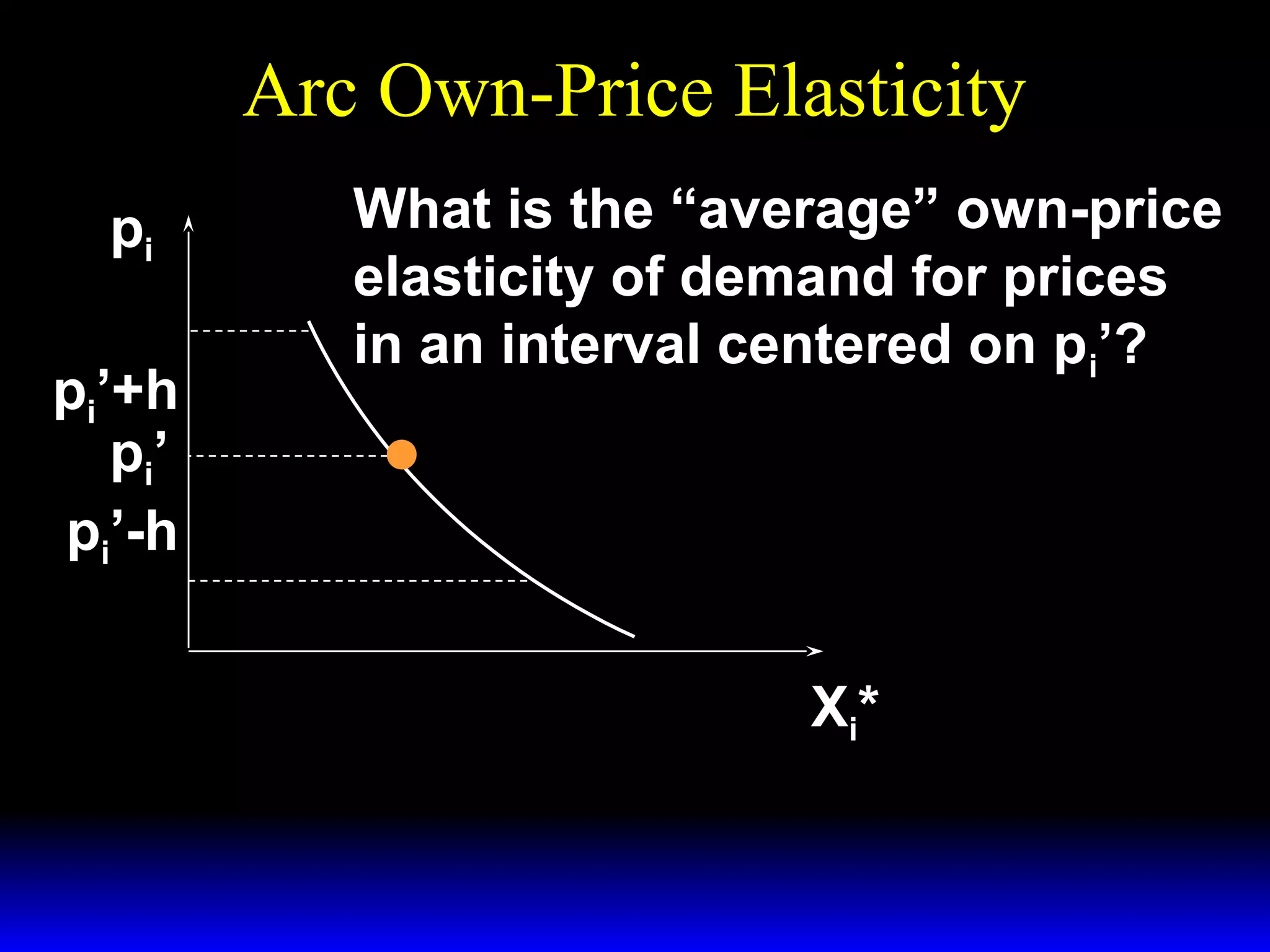
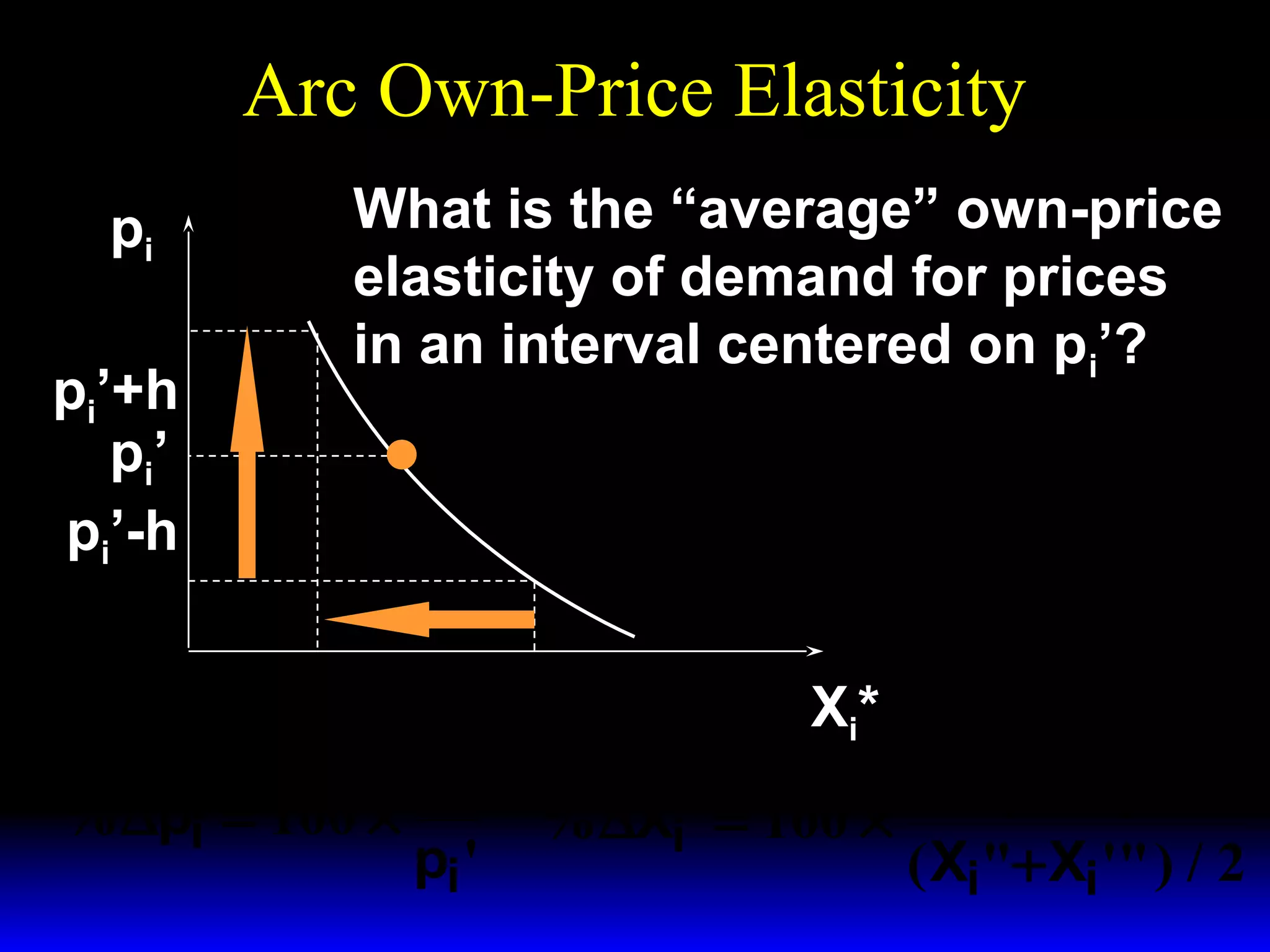
Arc Own-Price Elasticity
pi
pi’+h
p i’
pi’-h

What is the “average” own-price
elasticity of demand for prices
in an interval centered on pi’?

X i*
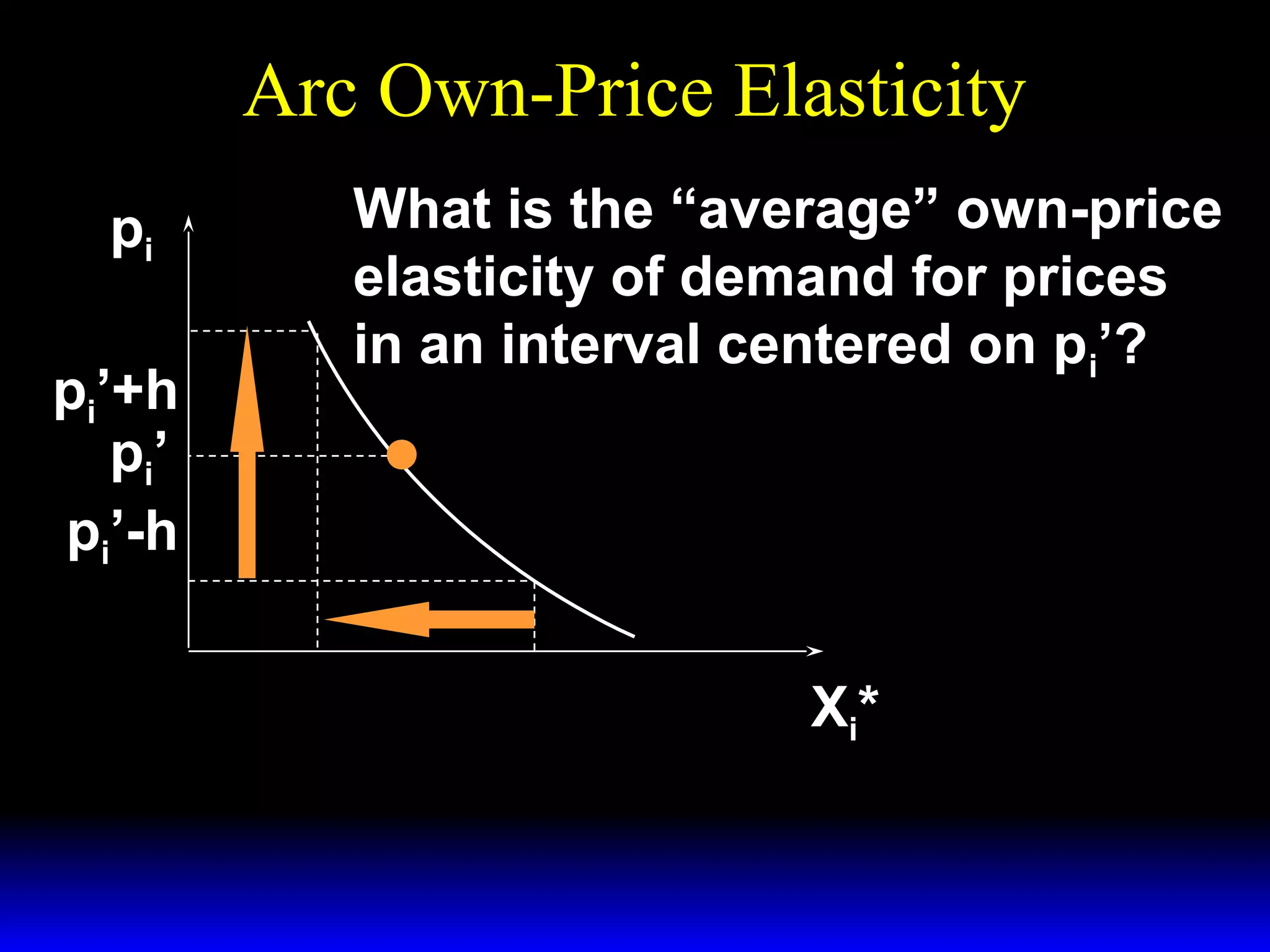
Arc Own-Price Elasticity
pi
pi’+h
p i’
pi’-h

What is the “average” own-price
elasticity of demand for prices
in an interval centered on pi’?

Xi"

Xi '"

X i*
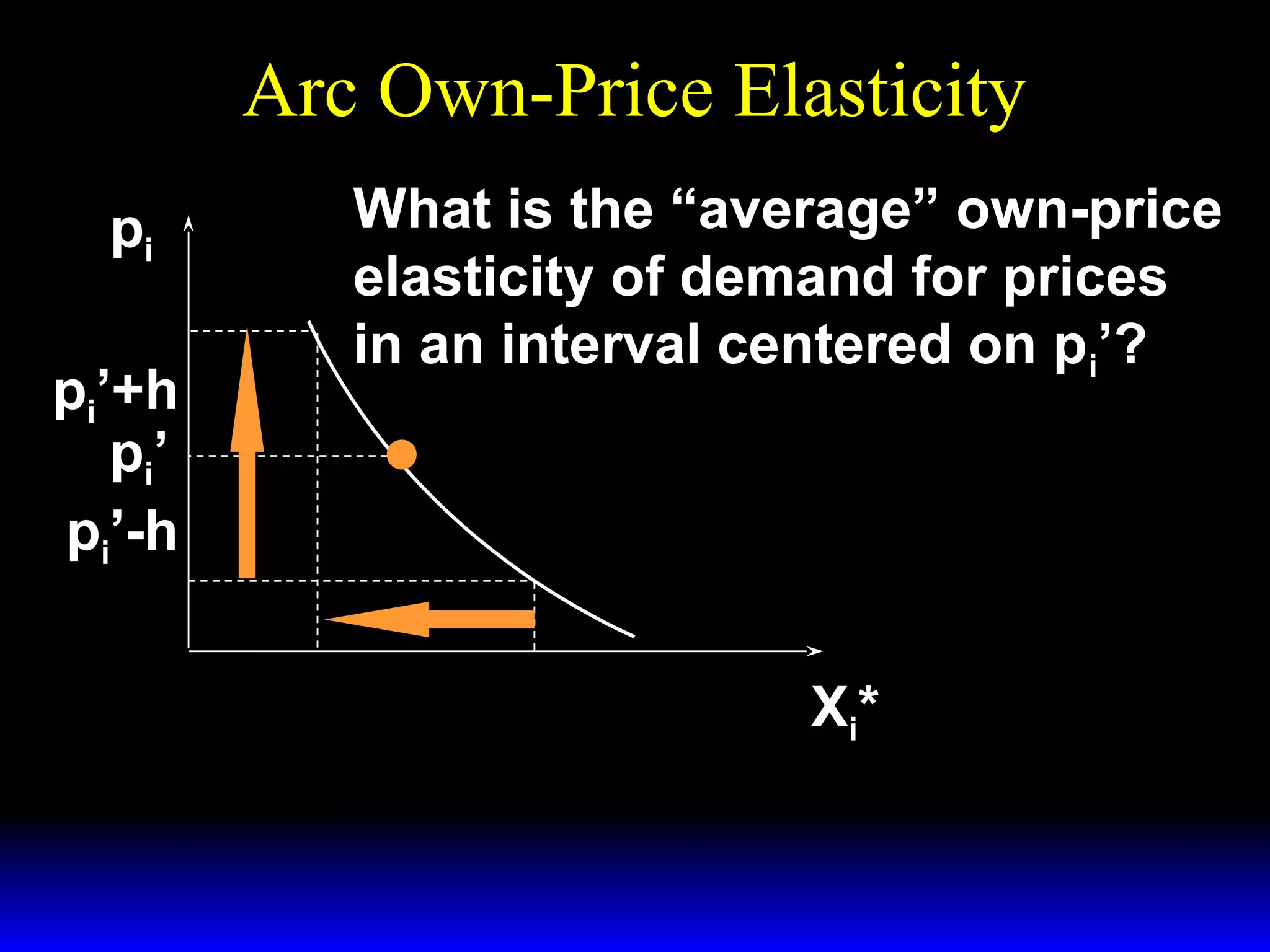
Arc Own-Price Elasticity
pi
pi’+h
p i’
pi’-h

What is the “average” own-price
elasticity of demand for prices
in an interval centered on pi’?

% ∆X*
i
ε * =
Xi ,pi
% ∆pi

Xi"

Xi '"

X i*
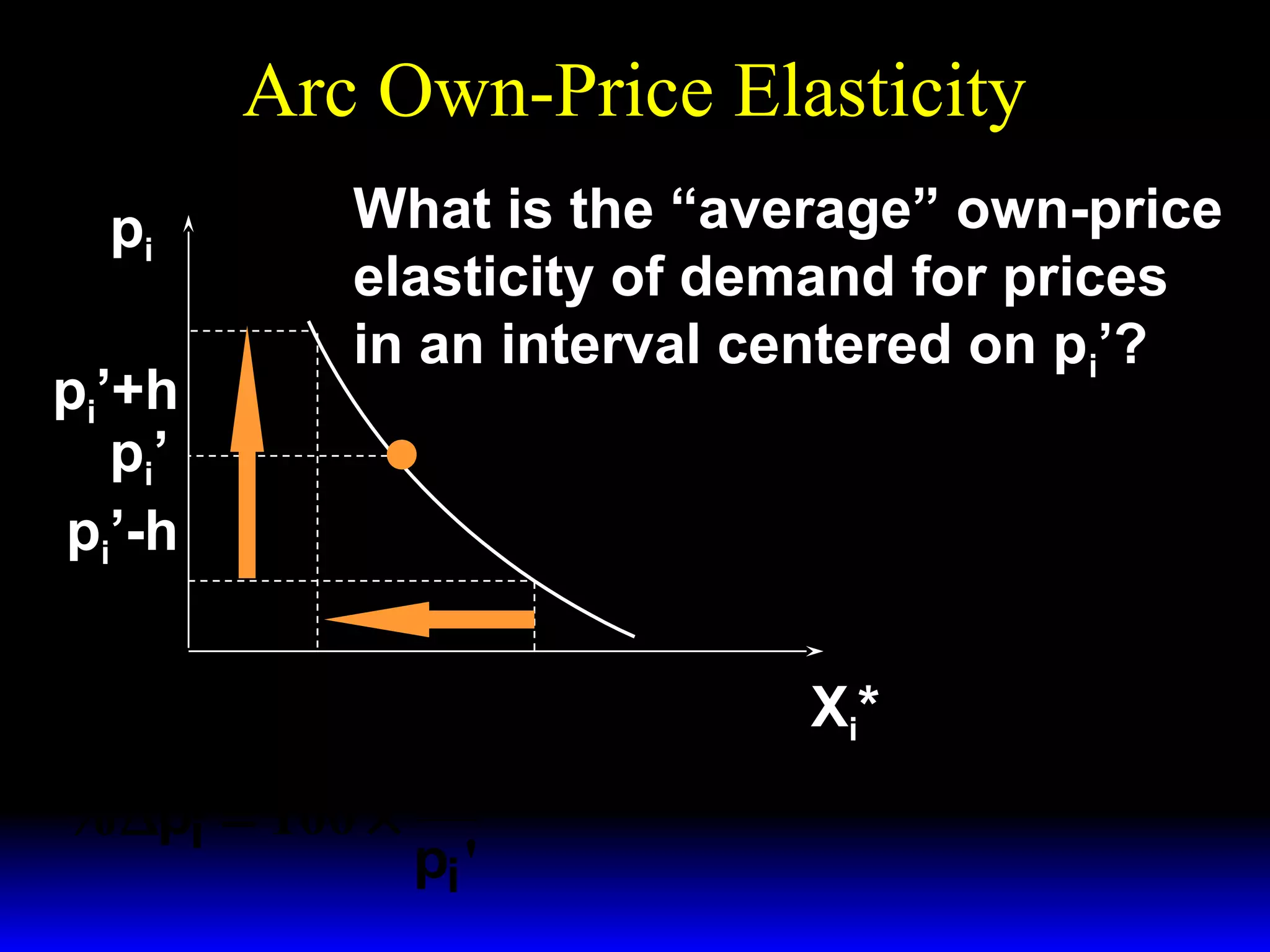
Arc Own-Price Elasticity
pi
pi’+h
p i’
pi’-h

What is the “average” own-price
elasticity of demand for prices
in an interval centered on pi’?

% ∆X*
i
ε * =
Xi ,pi
% ∆pi

Xi"
2h
% ∆pi = 100 ×
pi '

Xi '"

X i*
Arc Own-Price Elasticity
pi
pi’+h
p i’
pi’-h

What is the “average” own-price
elasticity of demand for prices
in an interval centered on pi’?

% ∆X*
i
ε * =
Xi ,pi
% ∆pi

Xi"
2h
% ∆pi = 100 ×
pi '

Xi '"

X i*

% ∆X* = 100 ×
i

( Xi"− Xi '")
( Xi"+ Xi '") / 2
Arc Own-Price Elasticity
*
% ∆Xi
ε * =
Xi ,pi
% ∆pi

2h
% ∆pi = 100 ×
pi '
% ∆X* = 100 ×
i

( Xi"− Xi '")
( Xi"+ Xi '") / 2
Arc Own-Price Elasticity
*
% ∆Xi
ε * =
Xi ,pi
% ∆pi

2h
% ∆pi = 100 ×
pi '
% ∆X* = 100 ×
i

( Xi"− Xi '")
( Xi"+ Xi '") / 2

So
%∆X*
pi '
( Xi "− Xi '" )
i =
ε X* ,p =
×
.
i i
%∆pi ( Xi "+ Xi '" ) / 2
2h

is the arc own-price elasticity of demand.
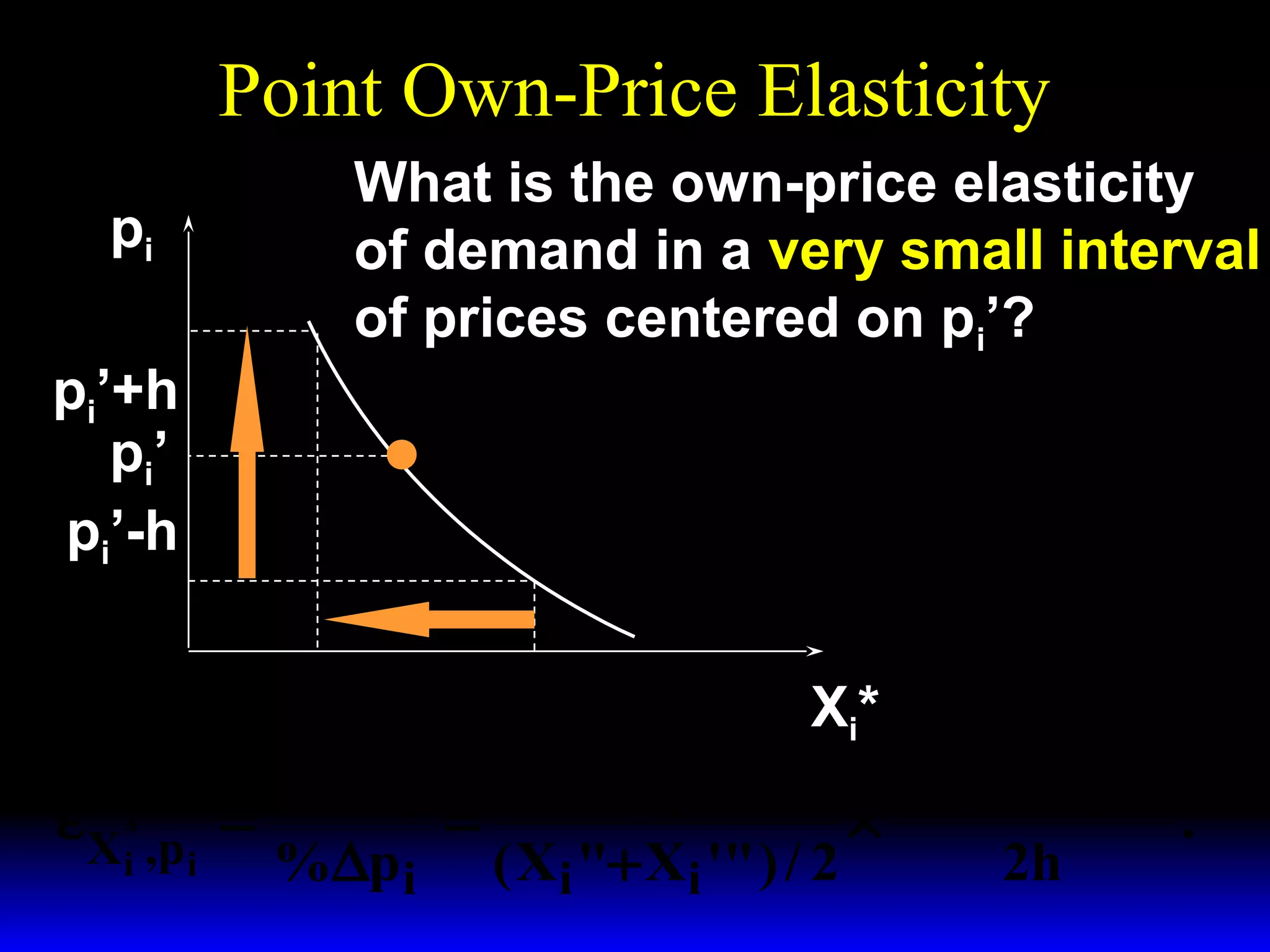
Point Own-Price Elasticity
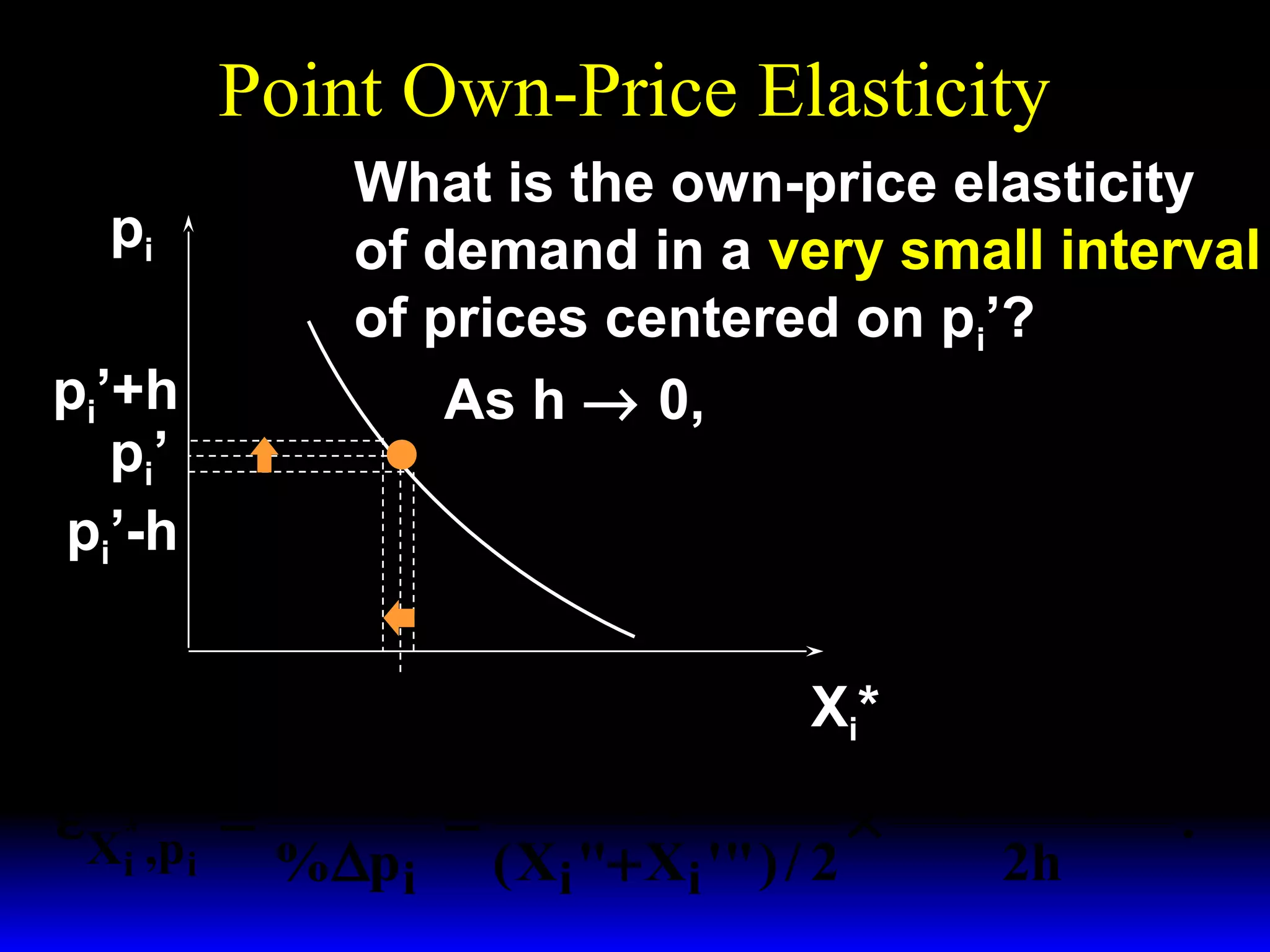
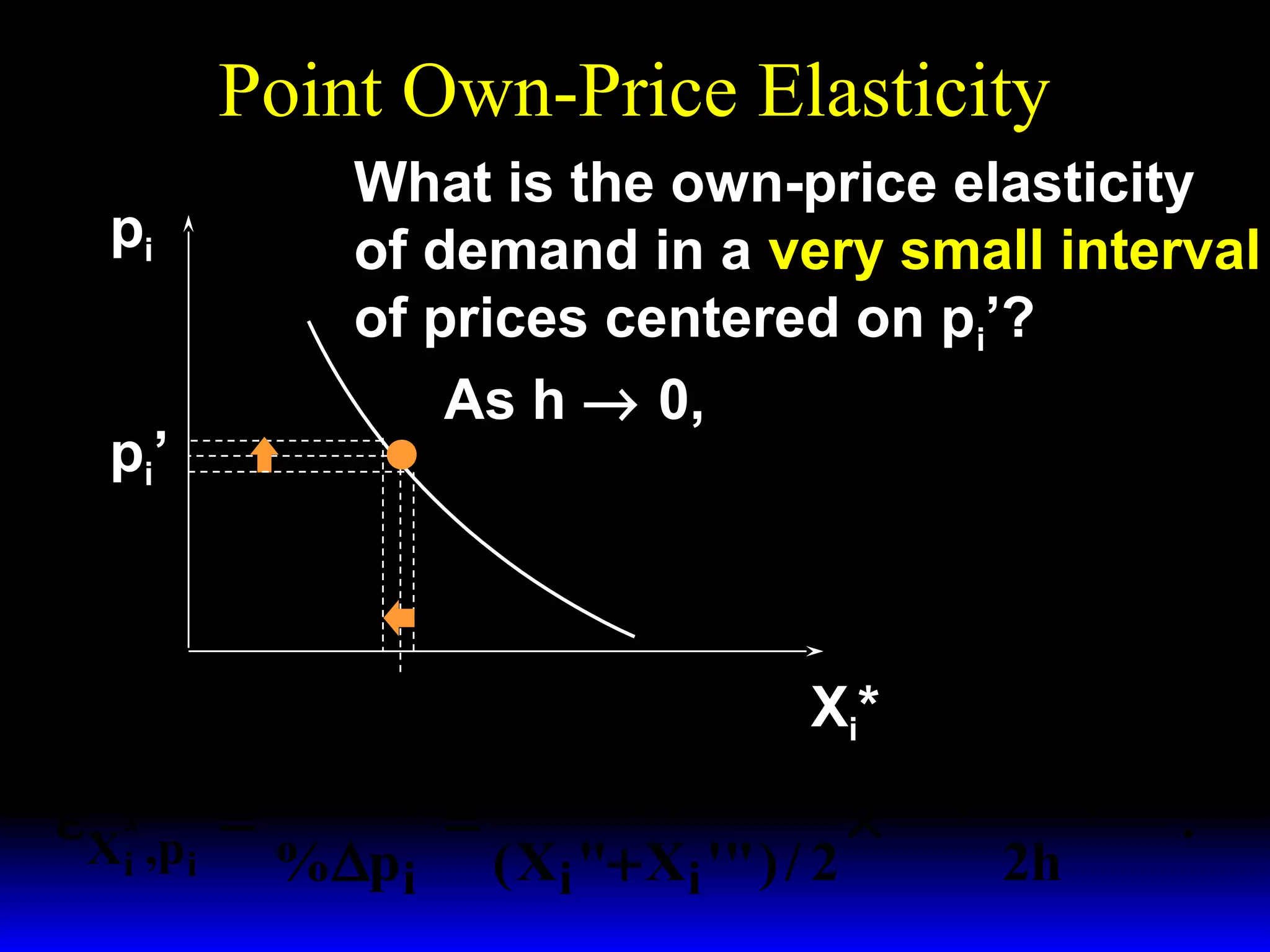
What is the own-price elasticity
of demand in a very small interval
of prices centered on pi’?

pi
pi’+h
p i’
pi’-h

Xi"

Xi '"

X i*

%∆X*
pi '
( Xi "− Xi '" )
i =
ε X* ,p =
×
.
i i
%∆pi ( Xi "+ Xi '" ) / 2
2h
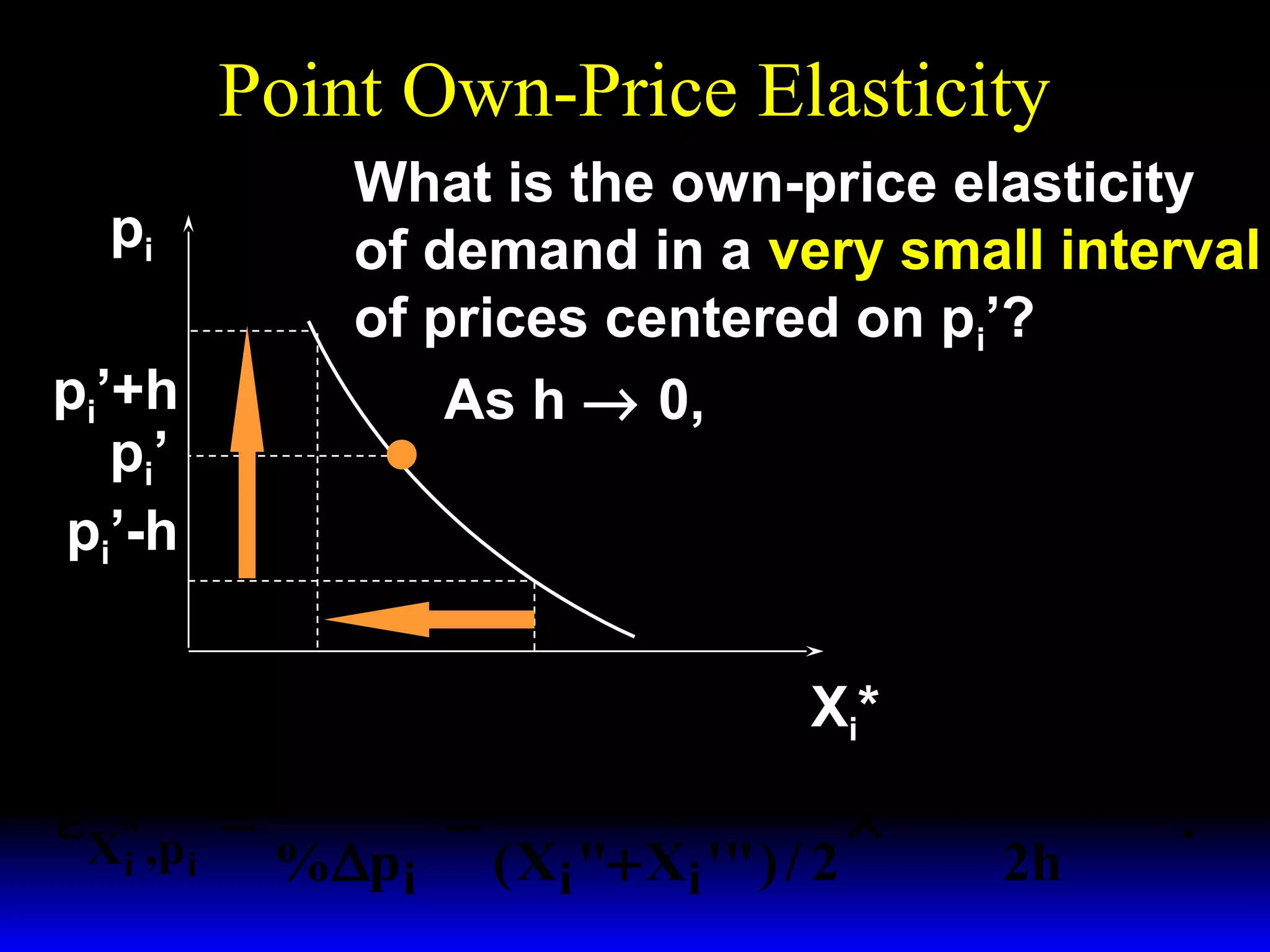
Point Own-Price Elasticity
What is the own-price elasticity
of demand in a very small interval
of prices centered on pi’?
As h → 0,

pi
pi’+h
p i’
pi’-h

Xi"

Xi '"

X i*

%∆X*
pi '
( Xi "− Xi '" )
i =
ε X* ,p =
×
.
i i
%∆pi ( Xi "+ Xi '" ) / 2
2h
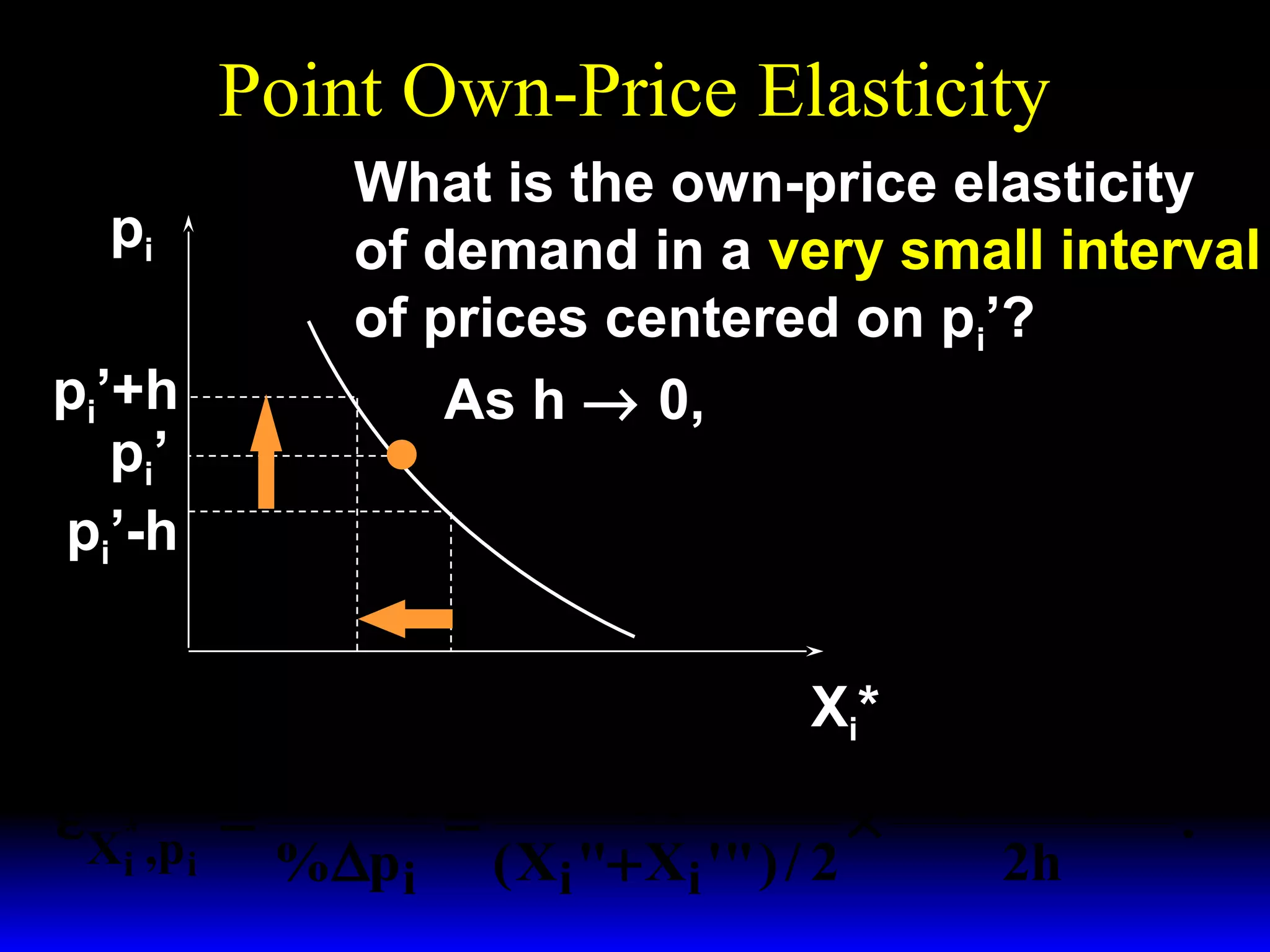
Point Own-Price Elasticity
pi
pi’+h
p i’
pi’-h

What is the own-price elasticity
of demand in a very small interval
of prices centered on pi’?
As h → 0,

Xi" Xi '"

X i*

%∆X*
pi '
( Xi "− Xi '" )
i =
ε X* ,p =
×
.
i i
%∆pi ( Xi "+ Xi '" ) / 2
2h
Point Own-Price Elasticity
pi
pi’+h
p i’
pi’-h

What is the own-price elasticity
of demand in a very small interval
of prices centered on pi’?
As h → 0,

Xi '

X i*

%∆X*
pi '
( Xi "− Xi '" )
i =
ε X* ,p =
×
.
i i
%∆pi ( Xi "+ Xi '" ) / 2
2h
Point Own-Price Elasticity
pi

p i’

What is the own-price elasticity
of demand in a very small interval
of prices centered on pi’?
As h → 0,
pi ' dX*
i
ε * →
×
Xi ,pi
Xi ' dpi

Xi '

X i*

%∆X*
pi '
( Xi "− Xi '" )
i =
ε X* ,p =
×
.
i i
%∆pi ( Xi "+ Xi '" ) / 2
2h
Point Own-Price Elasticity
pi

p i’

What is the own-price elasticity
of demand in a very small interval
of prices centered on pi’?
*
pi ' dXi
ε * =
×
Xi ,pi
Xi ' dpi
is the elasticity at the
point ( Xi ', pi ' ).

Xi '

X i*
Point Own-Price Elasticity
dX*
i
ε * =
×
Xi ,pi
X* dpi
i
pi

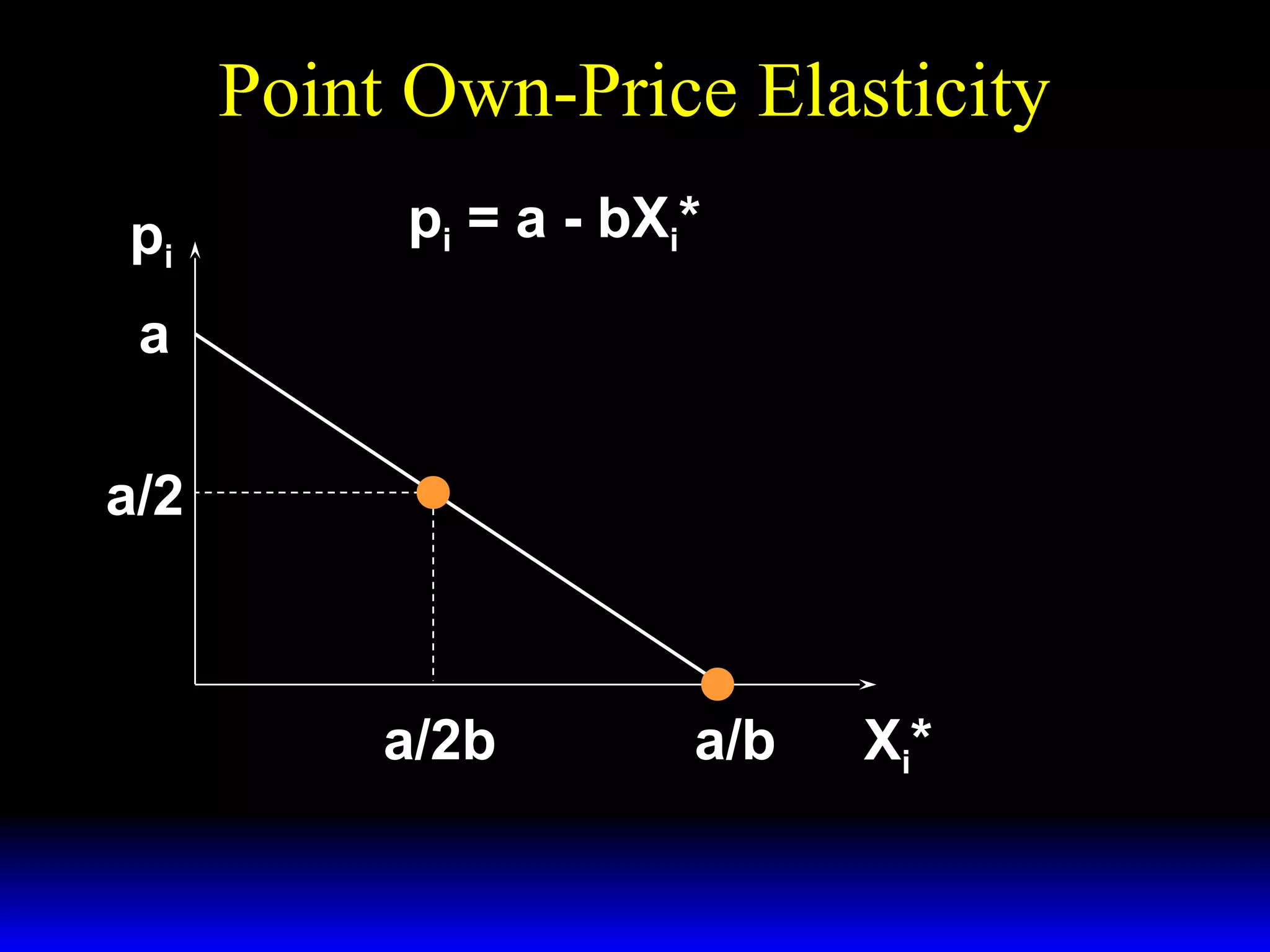
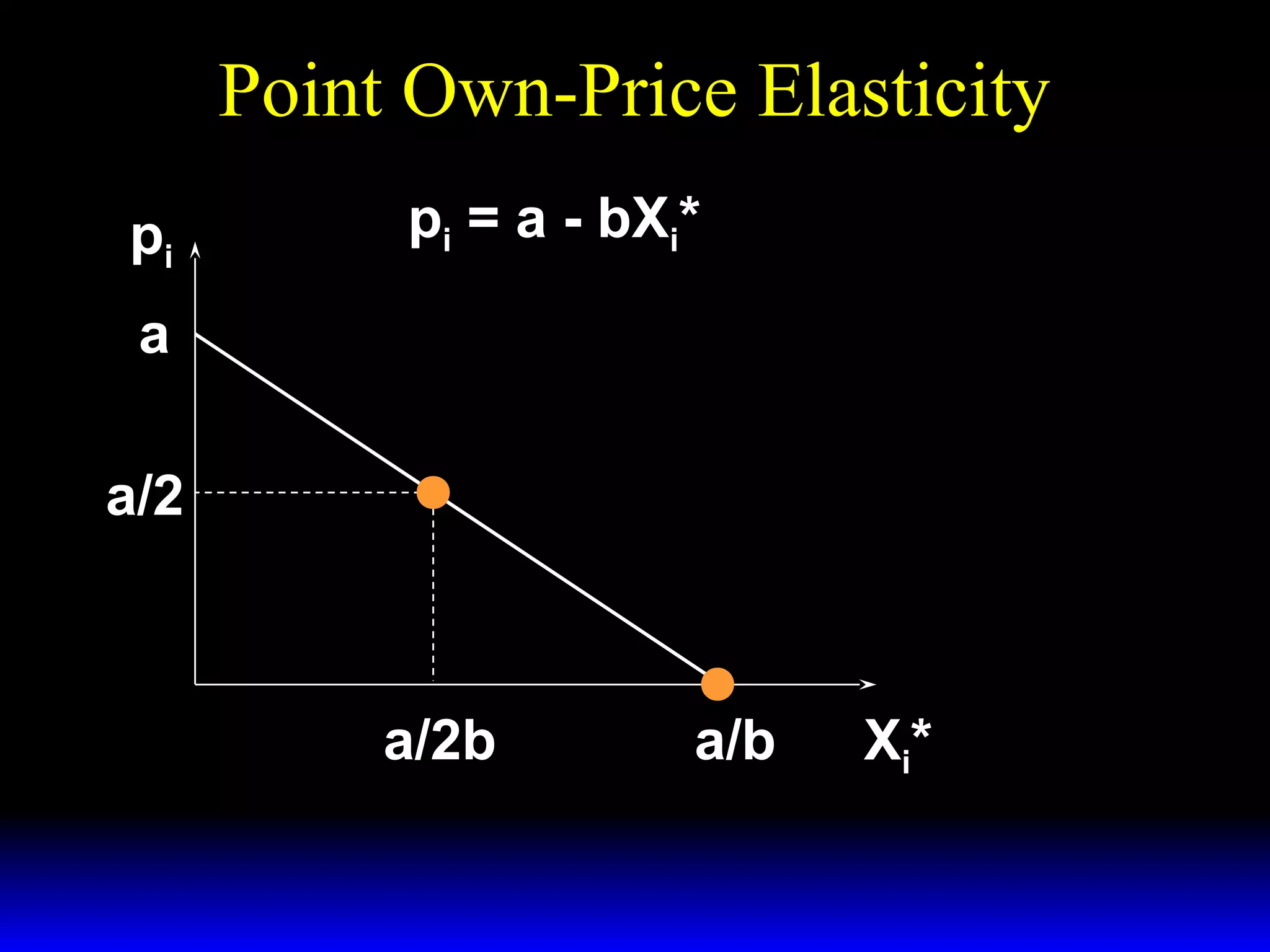
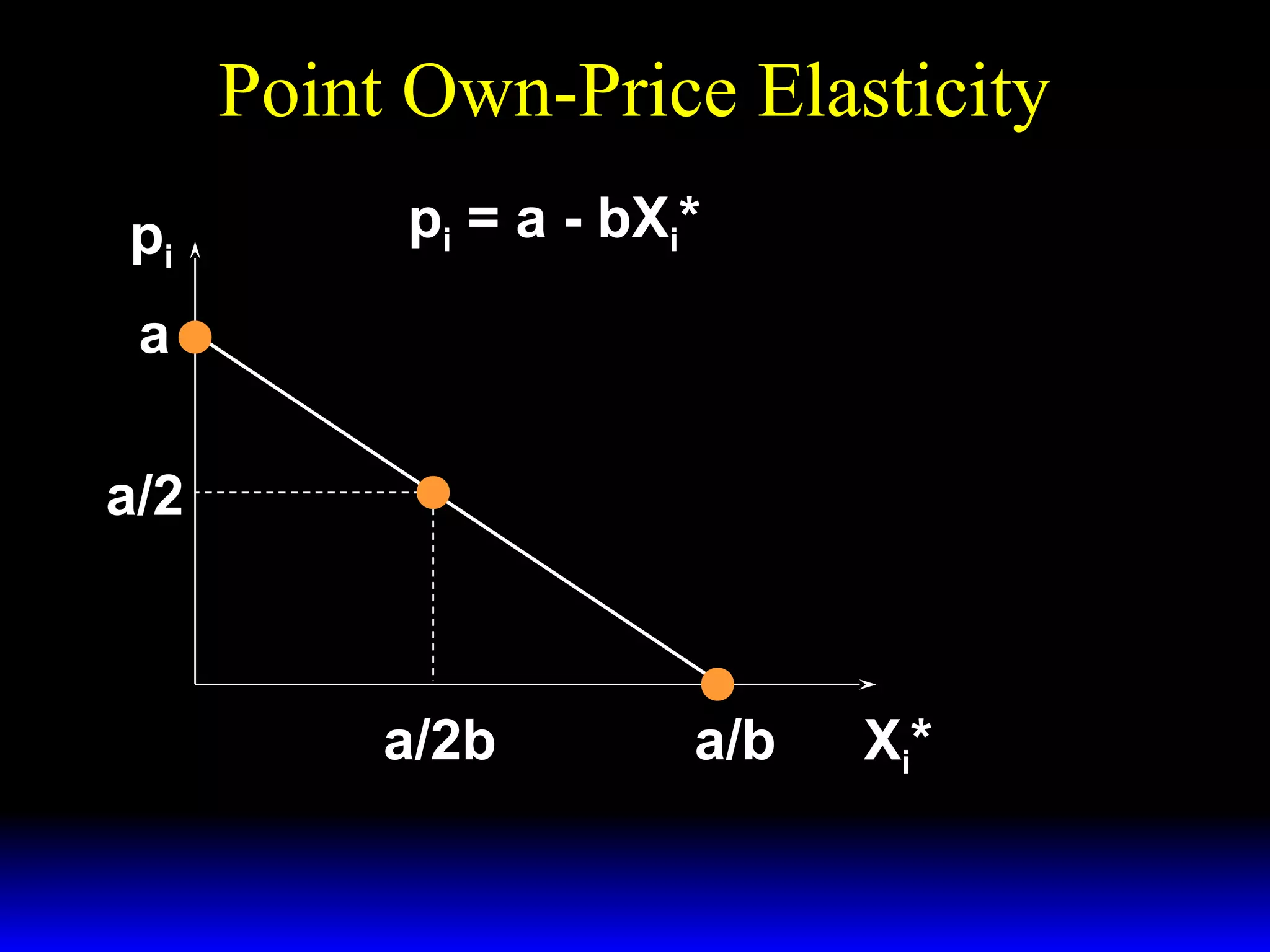
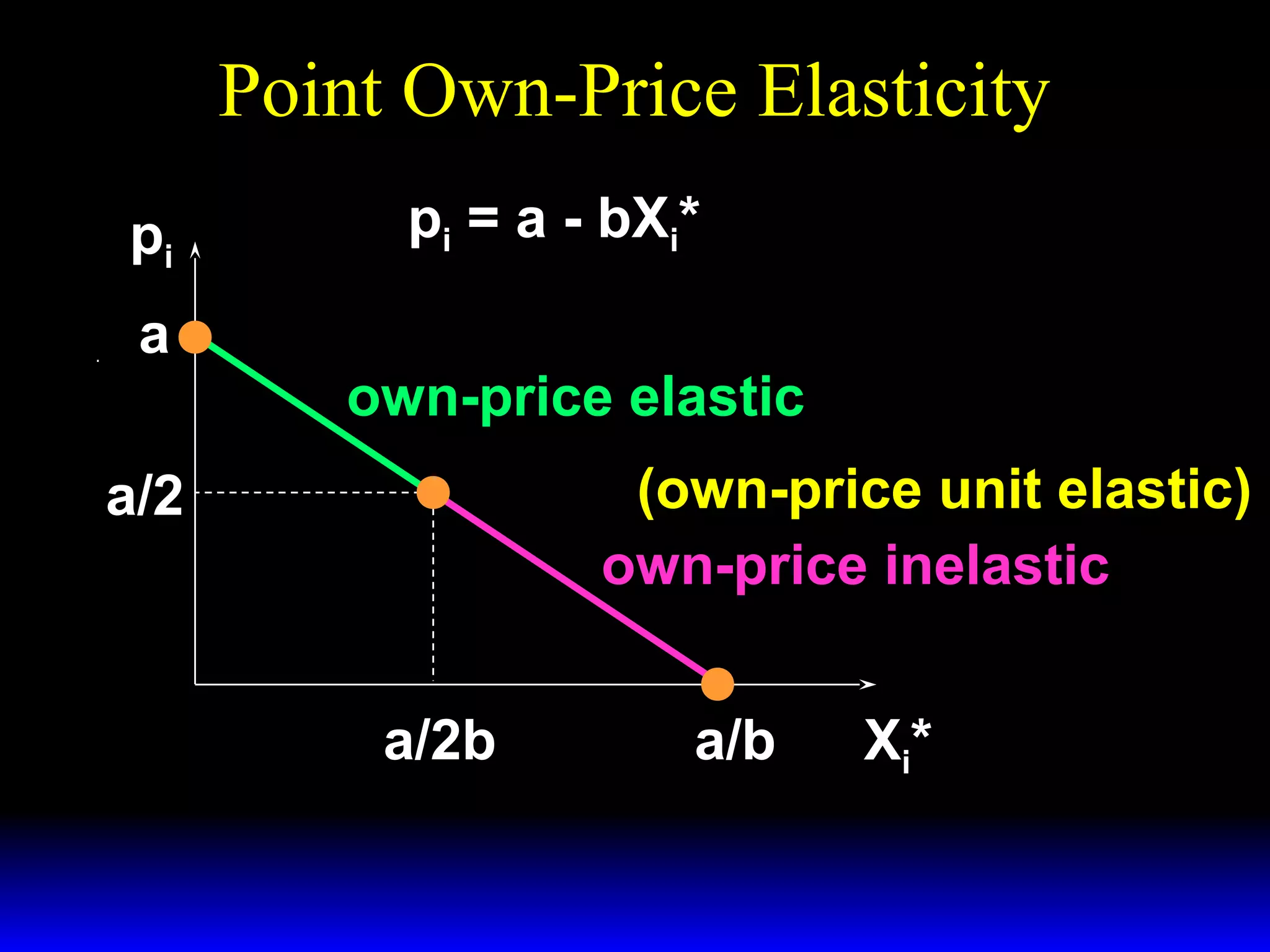
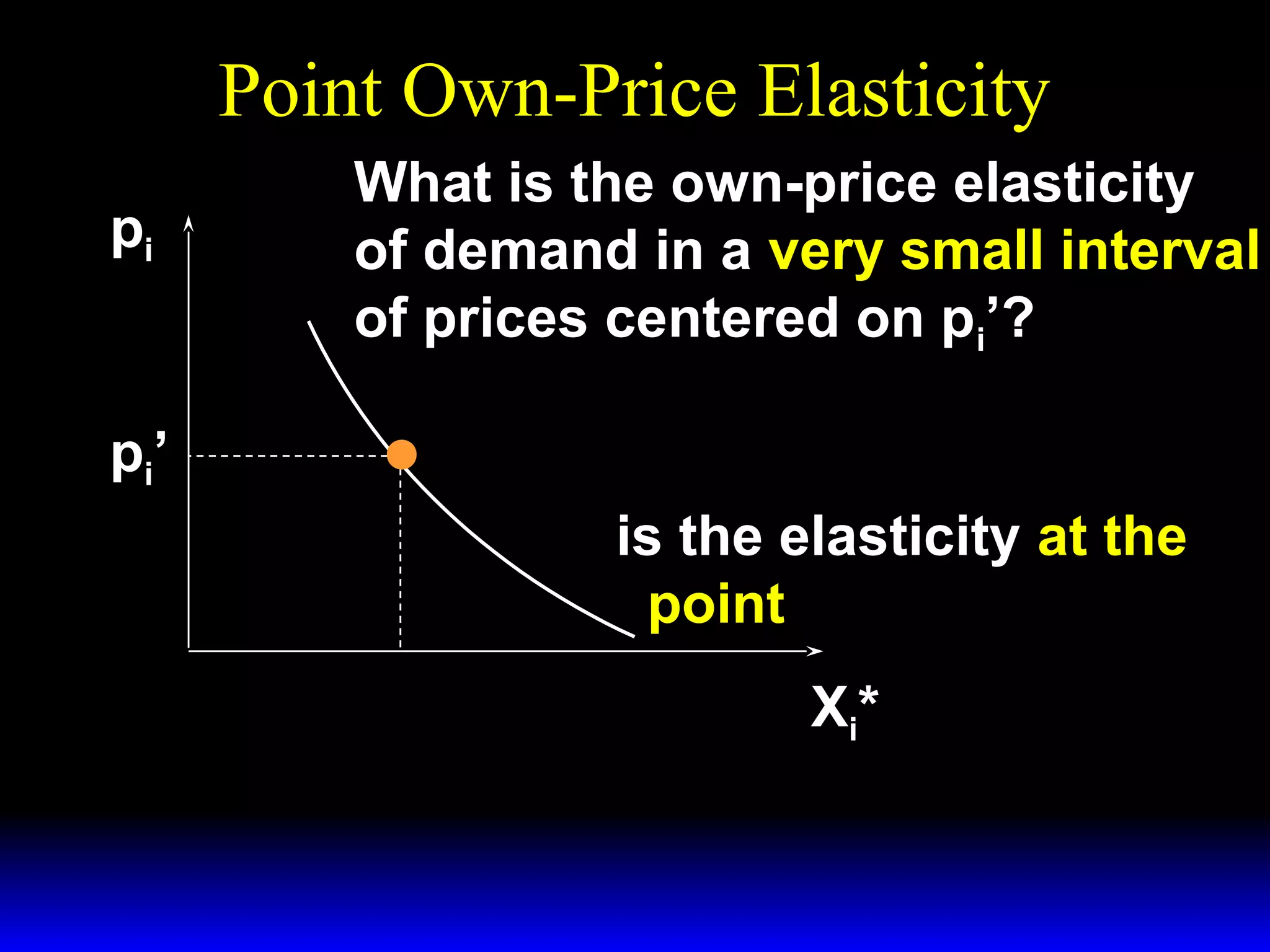
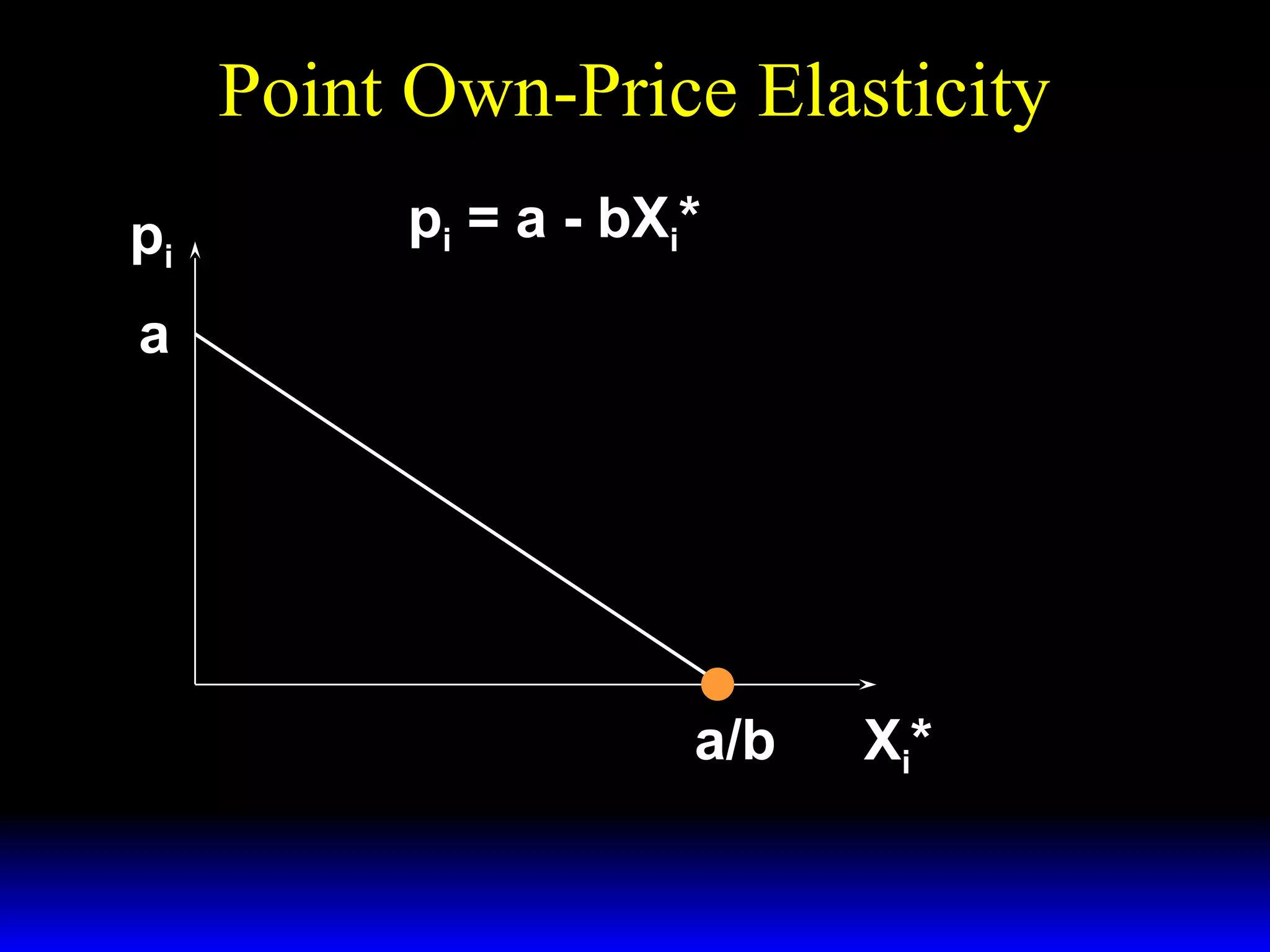
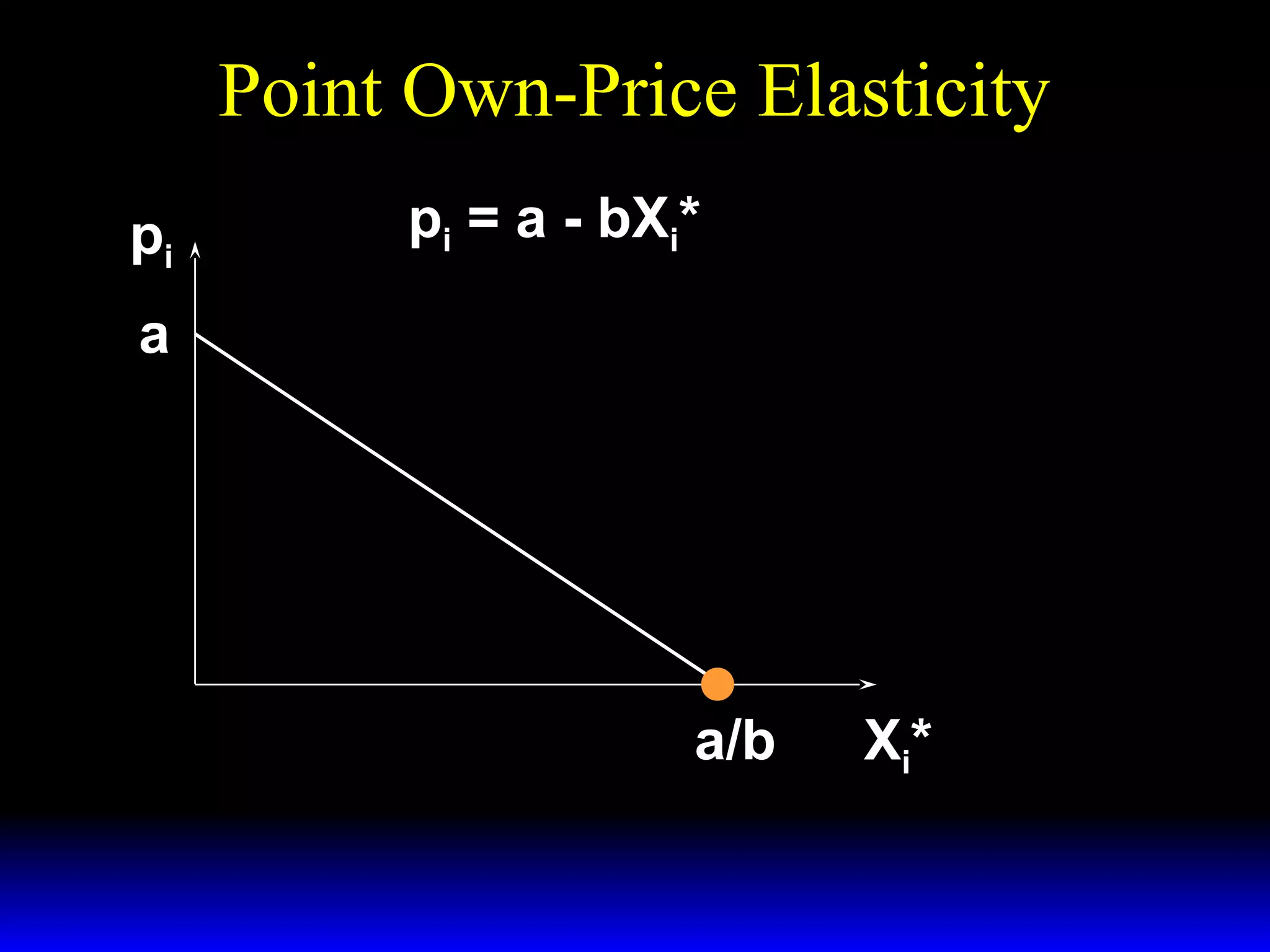
E.g. Suppose pi = a - bXi.
Then Xi = (a-pi)/b and
*
dXi

1
= − . Therefore,
dpi
b

pi
 − 1  = − pi .
εX* ,p =
×

i
i
( a − pi ) / b  b
a − pi
Point Own-Price Elasticity
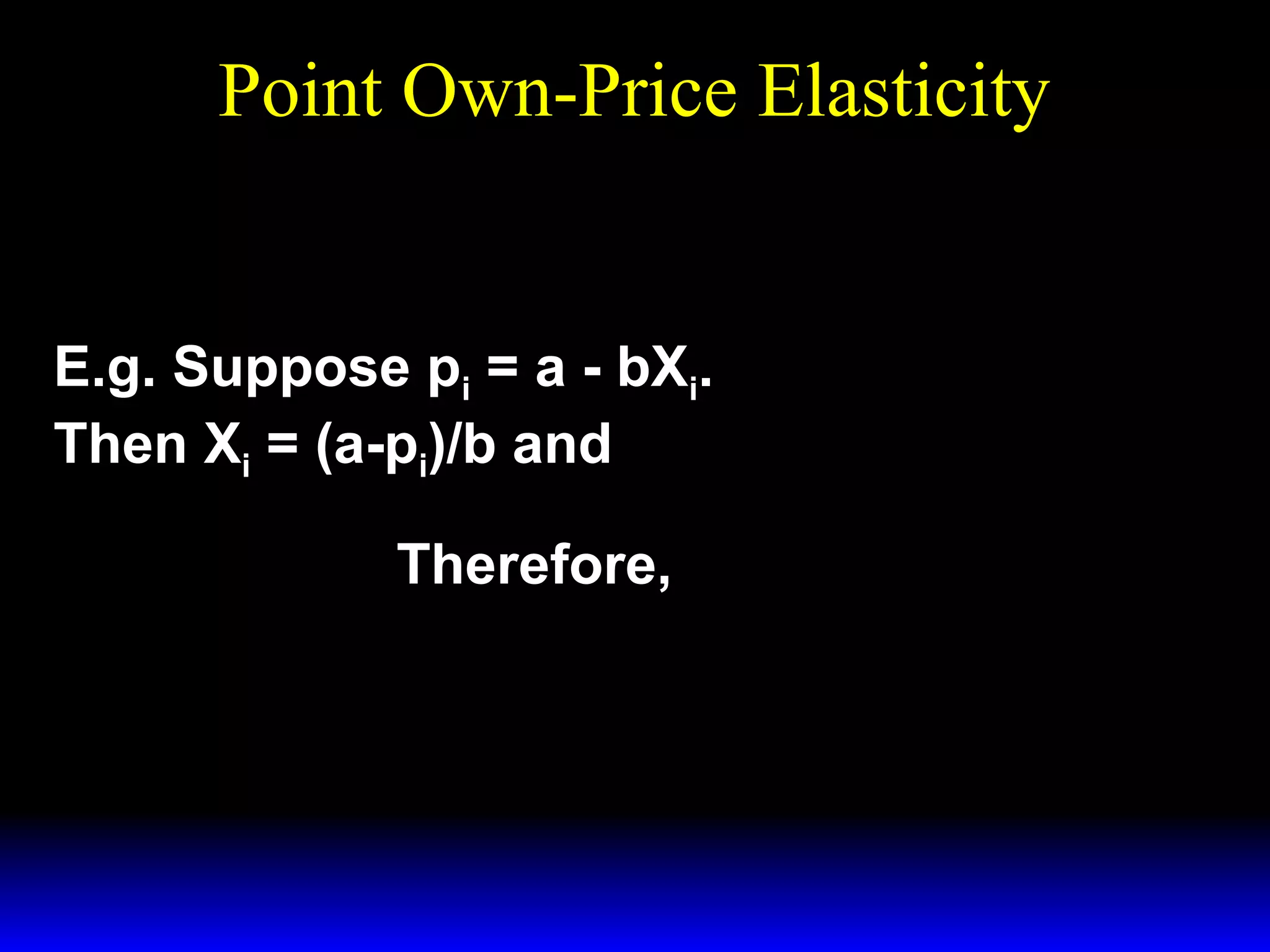
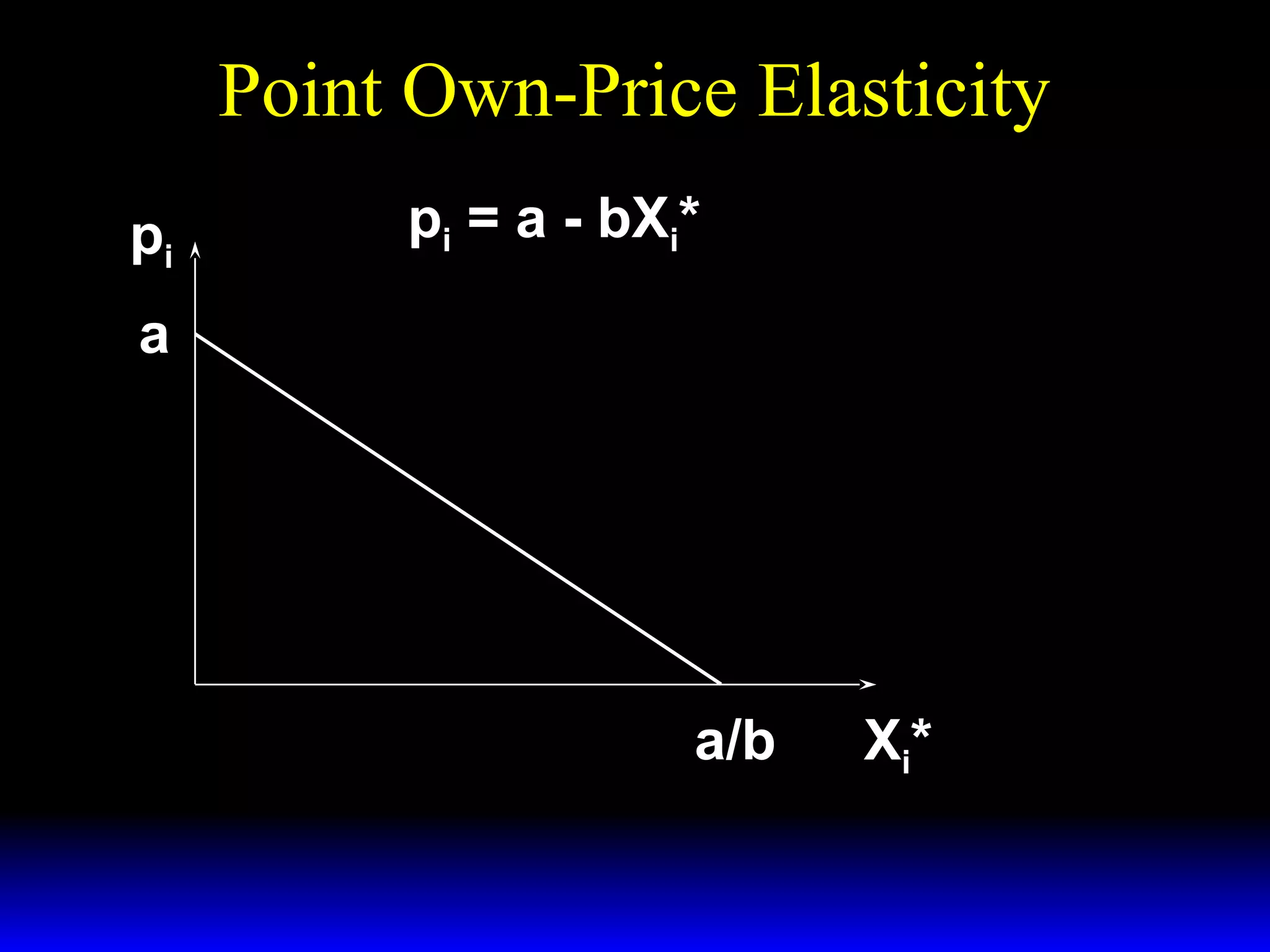
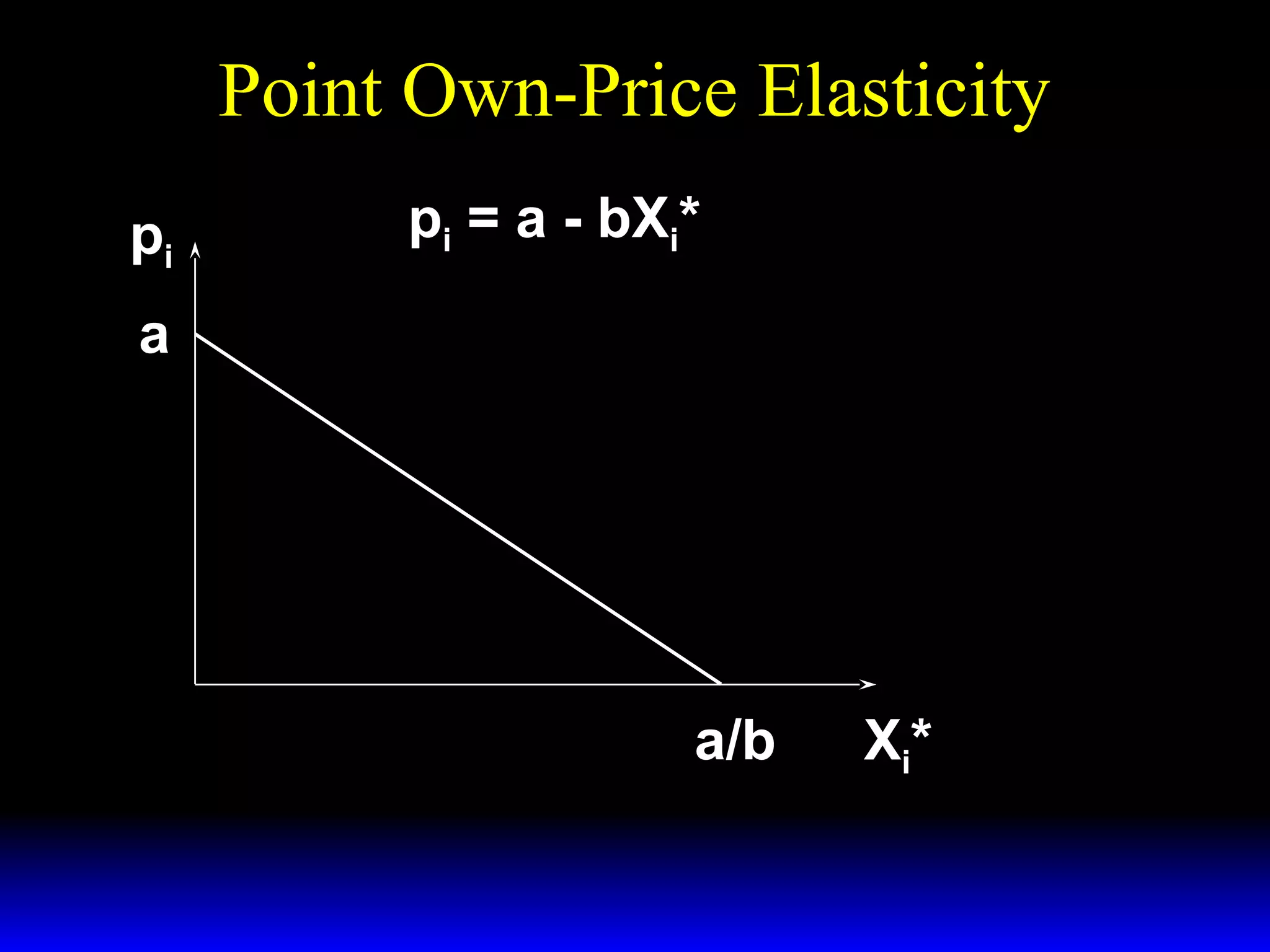
pi

pi = a - bXi*

a

a/b

Xi*
Point Own-Price Elasticity
pi

pi = a - bXi*

pi
εX* ,p = −
i
i
a − pi

a

a/b

Xi*
Point Own-Price Elasticity
pi
a

pi = a - bXi*

pi
εX* ,p = −
i
i
a − pi

p = 0 ⇒ε = 0

a/b

Xi*
Point Own-Price Elasticity
pi
a

pi
εX* ,p = −
i
i
a − pi

pi = a - bXi*
p = 0 ⇒ε = 0

ε =0

a/b

Xi*
Point Own-Price Elasticity
pi
a

pi
εX* ,p = −
i
i
a − pi

pi = a - bXi*

a
a/2
p = ⇒ε = −
= −1
2
a −a / 2

ε =0

a/b

Xi*
Point Own-Price Elasticity
pi
a
a/2

pi
εX* ,p = −
i
i
a − pi

pi = a - bXi*

a
a/2
p = ⇒ε = −
= −1
2
a −a / 2
ε = −1

ε =0

a/2b

a/b

Xi*
Point Own-Price Elasticity
pi
a
a/2

pi
εX* ,p = −
i
i
a − pi

pi = a - bXi*

a
p = a ⇒ε = −
= −∞
a −a
ε = −1

ε =0

a/2b

a/b

Xi*
Point Own-Price Elasticity
pi = a - bXi*

pi
a ε = −∞
a/2

pi
εX* ,p = −
i
i
a − pi

a
p = a ⇒ε = −
= −∞
a −a
ε = −1

ε =0

a/2b

a/b

Xi*
Point Own-Price Elasticity
pi

pi
εX* ,p = −
i
i
a − pi

pi = a - bXi*

a ε = −∞
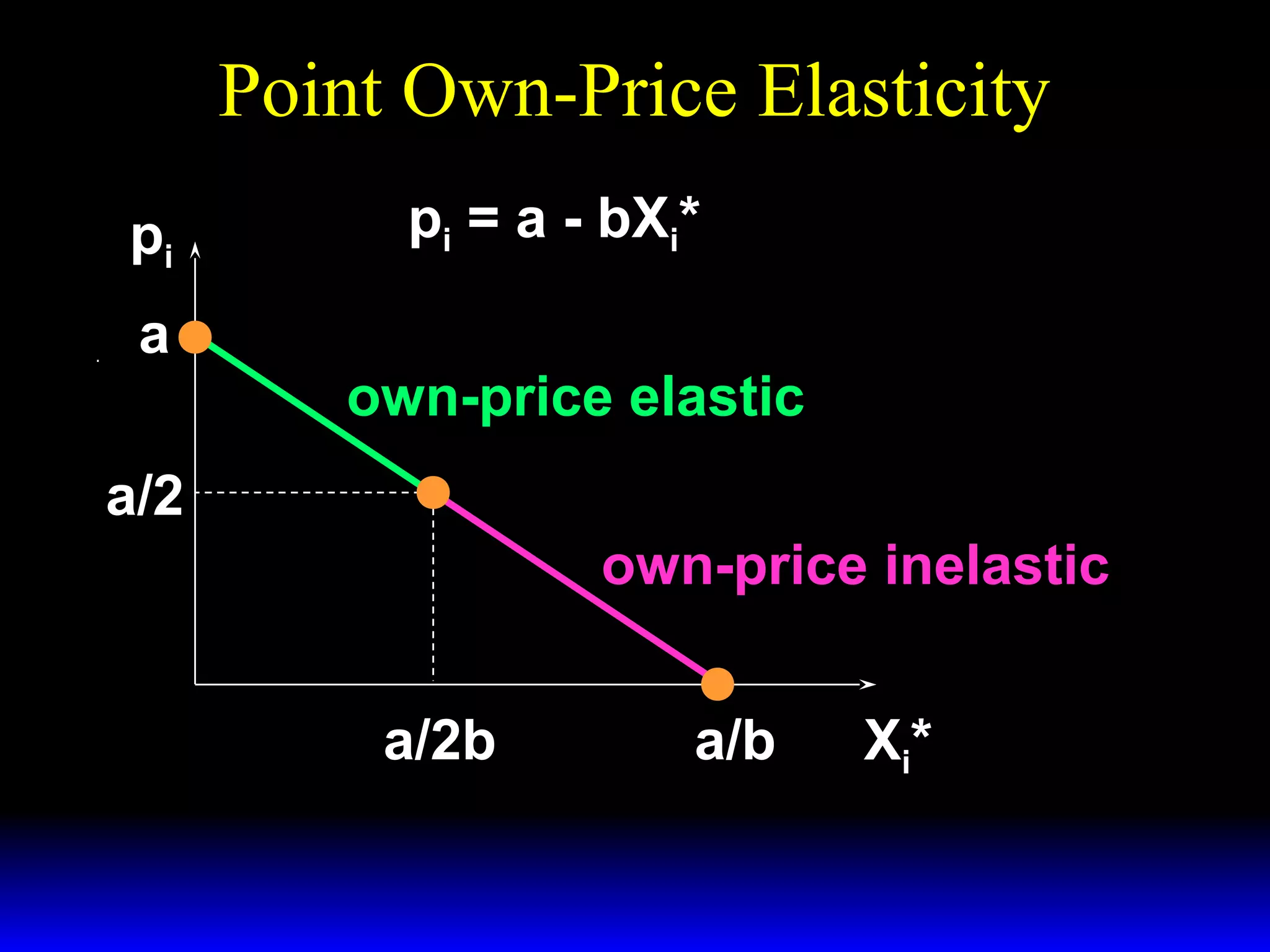
own-price elastic
a/2

ε = −1

own-price inelastic
ε =0

a/2b

a/b

Xi*
Point Own-Price Elasticity
pi

pi
εX* ,p = −
i
i
a − pi

pi = a - bXi*

a ε = −∞
own-price elastic
a/2

ε = −1 (own-price unit elastic)

own-price inelastic
ε =0

a/2b

a/b

Xi*
Point Own-Price Elasticity
dX*
i
ε * =
×
Xi ,pi
X* dpi
i
pi

E.g.
so

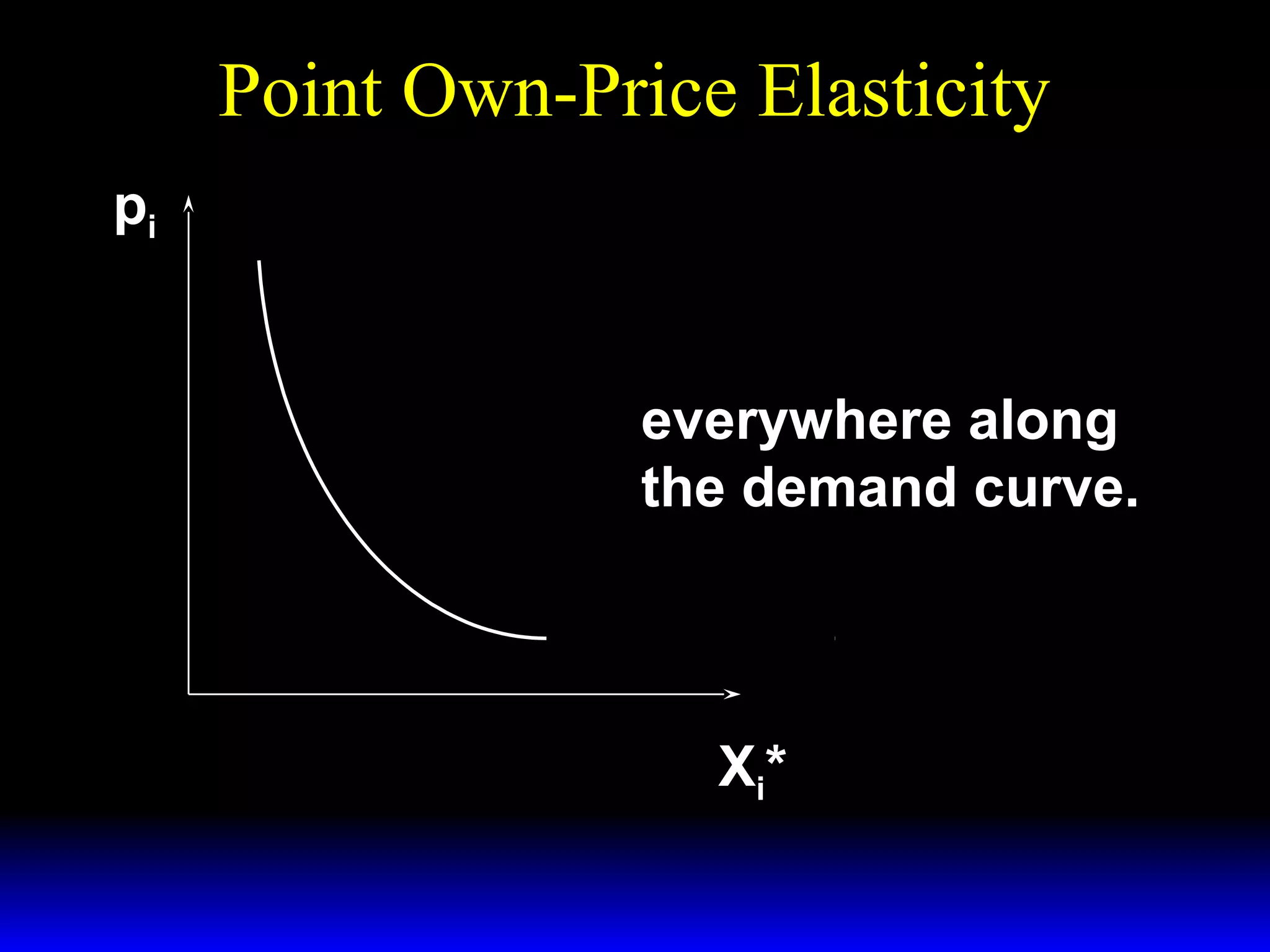
X* = kpia .
i

Then

dX*
i = apa −1
i
dpi

a
pi
pi
a −1
εX* ,p = a × kapi
=a
= a.
a
i
i
kpi
pi
Point Own-Price Elasticity
pi

k
*
a
−2
Xi = kpi = kpi =
2
pi

ε = −2 everywhere along
the demand curve.

X i*
Revenue and Own-Price Elasticity of
Demand
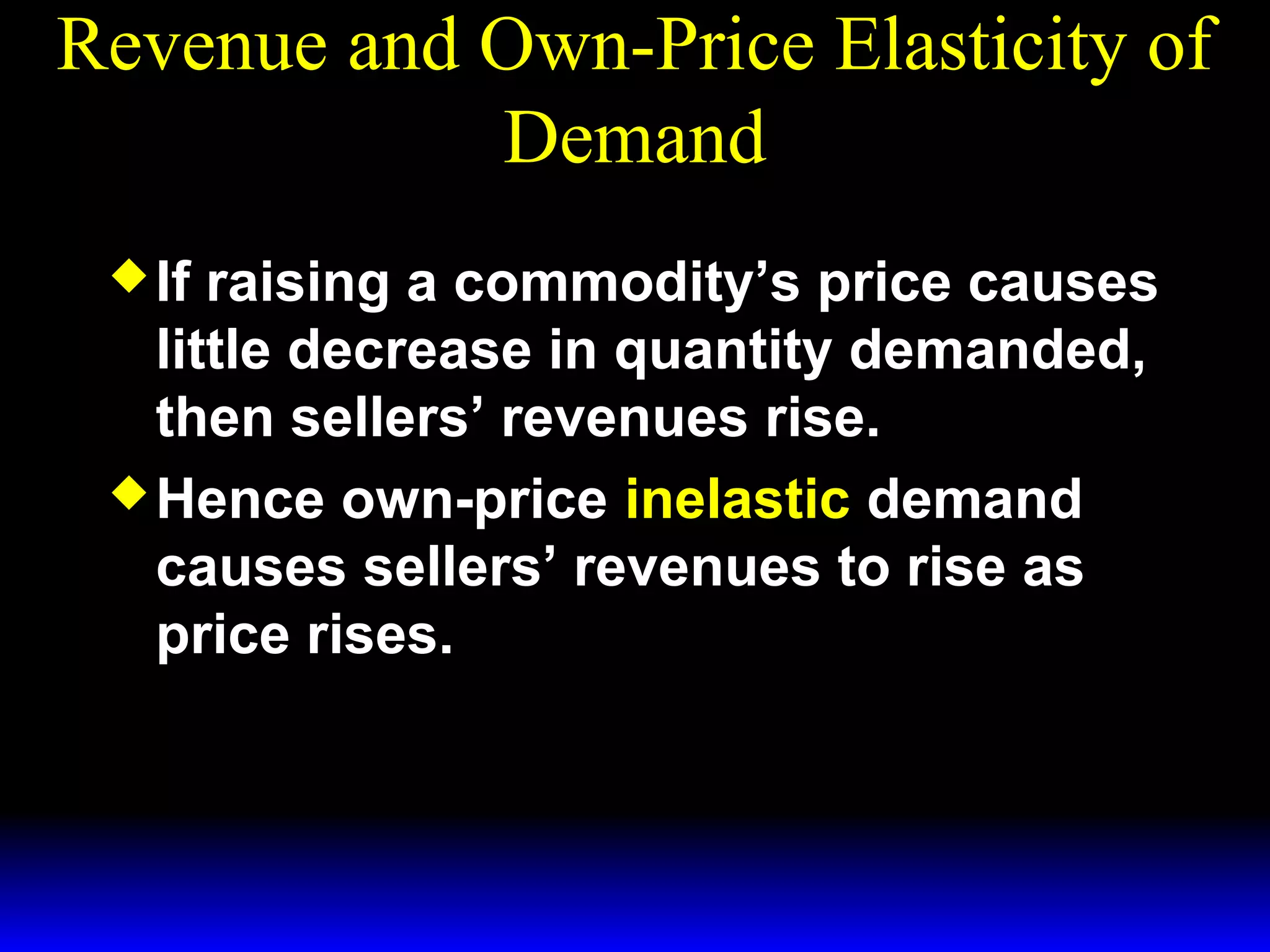
 If

raising a commodity’s price causes
little decrease in quantity demanded,
then sellers’ revenues rise.
 Hence own-price inelastic demand
causes sellers’ revenues to rise as
price rises.
Revenue and Own-Price Elasticity of
Demand
 If

raising a commodity’s price causes
a large decrease in quantity
demanded, then sellers’ revenues
fall.
 Hence own-price elastic demand
causes sellers’ revenues to fall as
price rises.
Revenue and Own-Price Elasticity of
Demand
R( p ) = p × X* (p ).
Sellers’ revenue is
Revenue and Own-Price Elasticity of
Demand
R( p ) = p × X* (p ).
Sellers’ revenue is
dR
dX*
So
= X* (p ) + p
dp
dp
Revenue and Own-Price Elasticity of
Demand
R( p ) = p × X* (p ).
Sellers’ revenue is
dR
dX*
So
= X* (p ) + p
dp
dp
*

p dX
*
= X (p )1 +

*
 X (p ) dp 


Revenue and Own-Price Elasticity of
Demand
R( p ) = p × X* (p ).
Sellers’ revenue is
dR
dX*
So
= X* (p ) + p
dp
dp
*

p dX
*
= X (p )1 +

*
 X (p ) dp 



= X* (p )[ 1 + ε ] .
Revenue and Own-Price Elasticity of
Demand
dR
= X* (p )[ 1 + ε ]
dp
Revenue and Own-Price Elasticity of
Demand
dR
= X* (p )[ 1 + ε ]
dp

so if ε = −1

then

dR
=0
dp

and a change to price does not alter
sellers’ revenue.
Revenue and Own-Price Elasticity of
Demand
dR
= X* (p )[ 1 + ε ]
dp
dR
>0
but if − 1 < ε ≤ 0 then
dp

and a price increase raises sellers’
revenue.
Revenue and Own-Price Elasticity of
Demand
dR
= X* (p )[ 1 + ε ]
dp

And if

ε < −1

dR
<0
then
dp

and a price increase reduces sellers’
revenue.
Revenue and Own-Price Elasticity of
Demand
In summary:
Own-price inelastic demand; − 1 < ε ≤ 0
price rise causes rise in sellers’ revenue.
Own-price unit elastic demand; ε = −1
price rise causes no change in sellers’
revenue.
Own-price elastic demand; ε < −1
price rise causes fall in sellers’ revenue.
Marginal Revenue and Own-Price
Elasticity of Demand
A

seller’s marginal revenue is the rate
at which revenue changes with the
number of units sold by the seller.
dR( q)
MR( q) =
.
dq
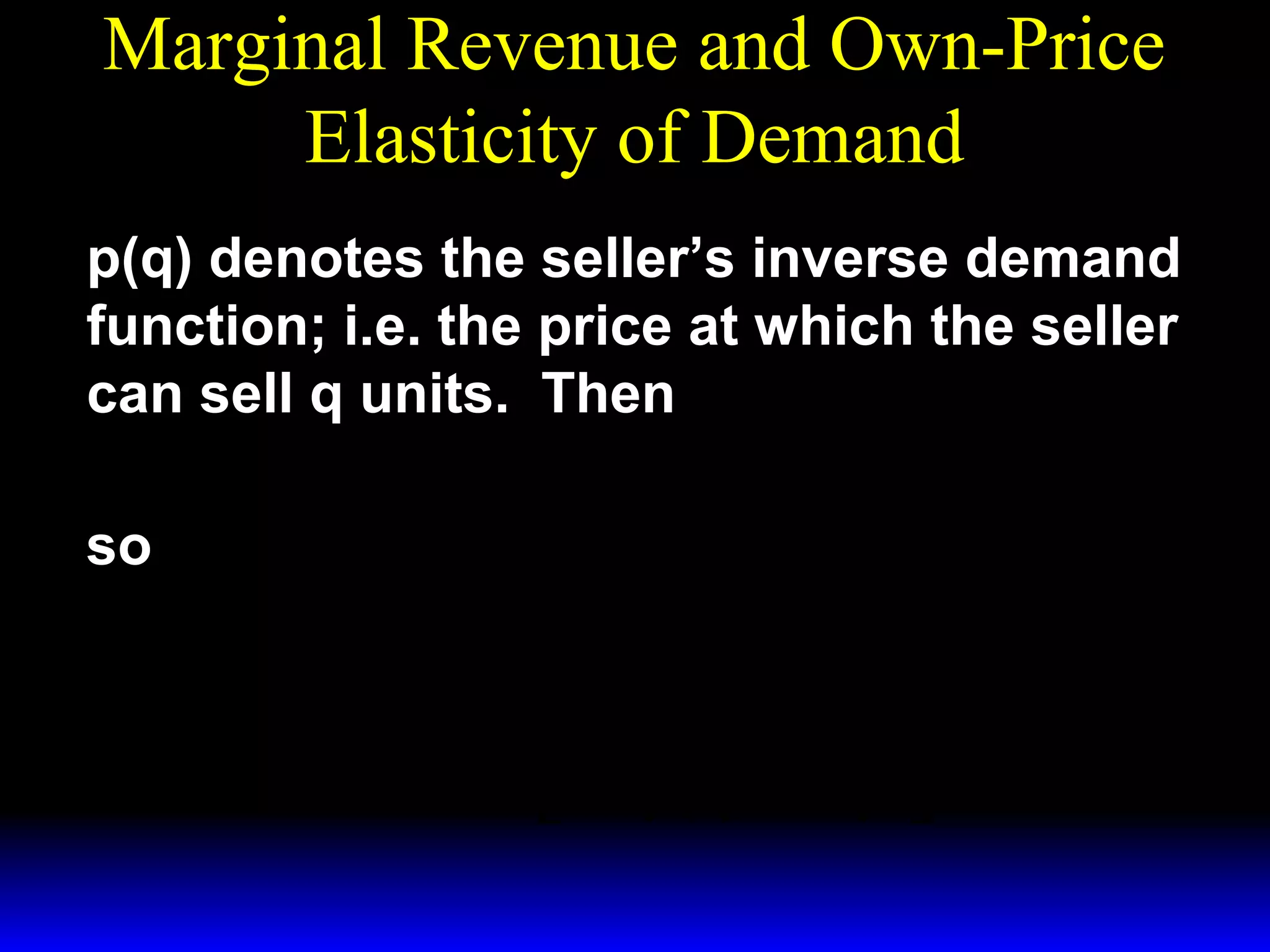
Marginal Revenue and Own-Price
Elasticity of Demand
p(q) denotes the seller’s inverse demand
function; i.e. the price at which the seller
can sell q units. Then
R ( q) = p( q) × q
so
dR( q) dp( q)
MR( q) =
=
q + p( q)
dq
dq
q dp( q) 

= p( q) 1 +
.
 p( q) dq 
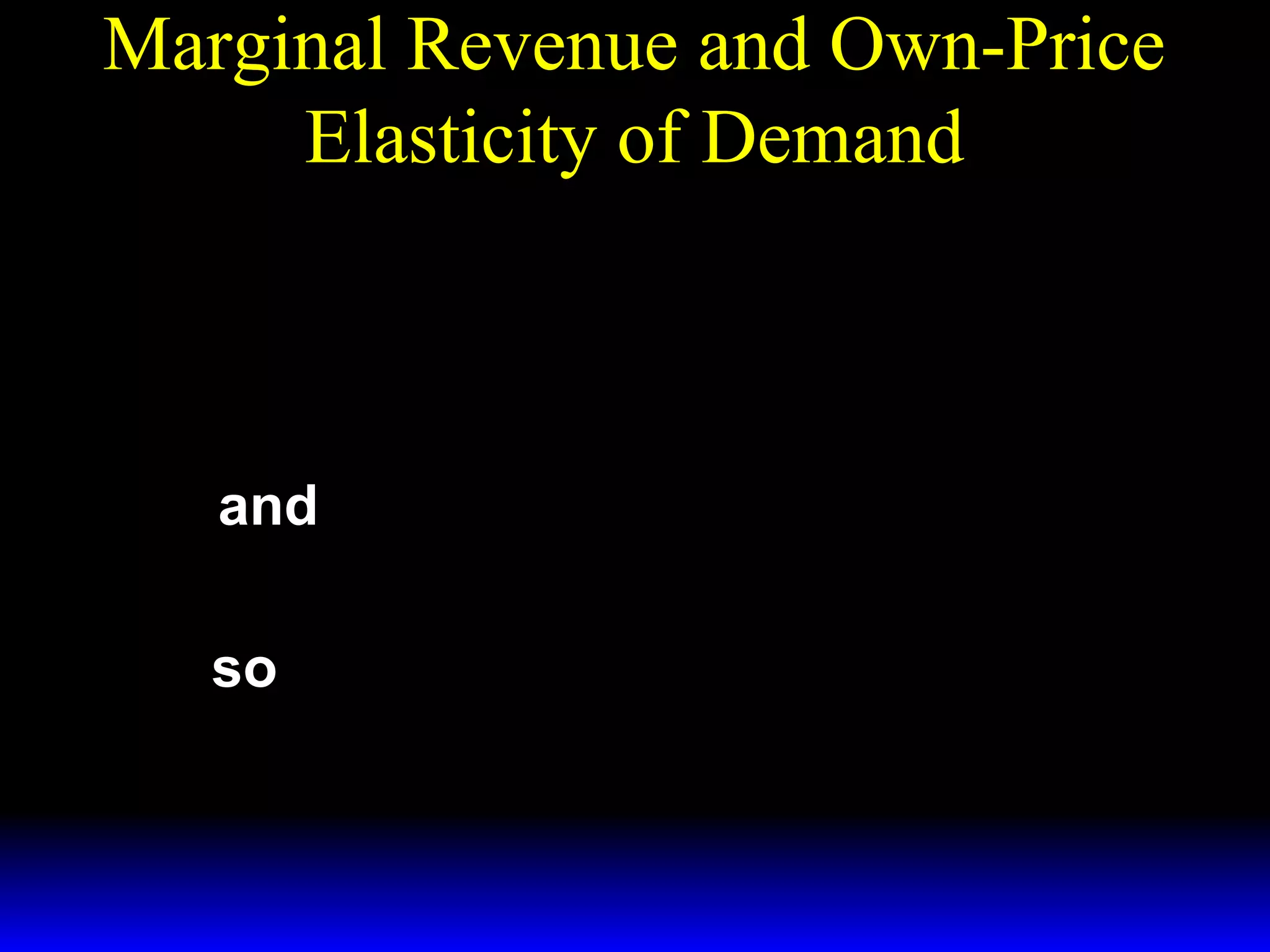
Marginal Revenue and Own-Price
Elasticity of Demand
q dp( q) 

MR( q) = p( q) 1 +
.
 p( q) dq 

and
so

dq p
ε=
×
dp q

1 + 1  .
MR( q) = p( q) 
ε


Marginal Revenue and Own-Price
Elasticity of Demand
1 + 1 
MR( q) = p( q) 
ε



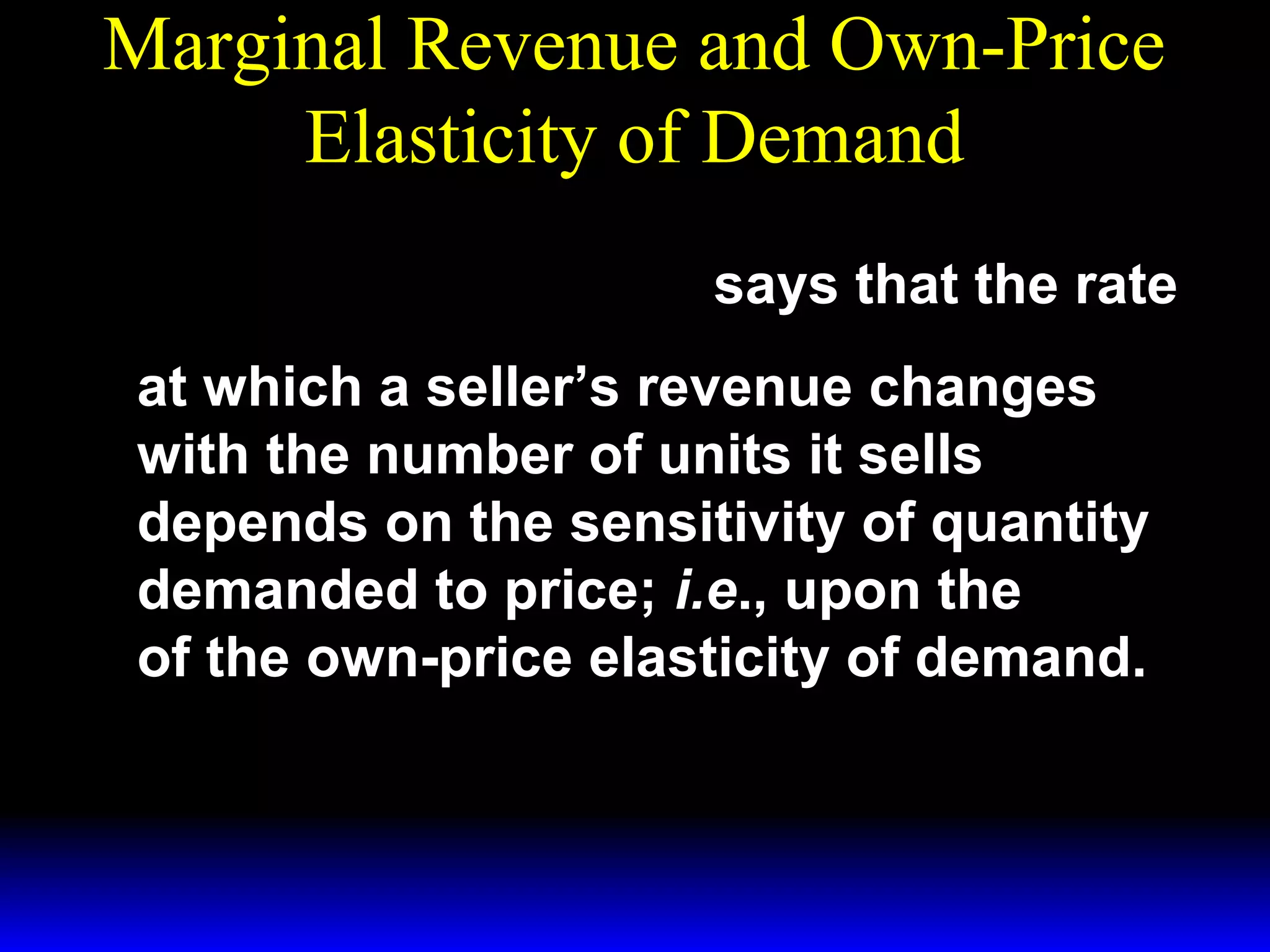
says that the rate

at which a seller’s revenue changes
with the number of units it sells
depends on the sensitivity of quantity
demanded to price; i.e., upon the
of the own-price elasticity of demand.
Marginal Revenue and Own-Price
Elasticity of Demand
1 + 1
MR(q) = p(q)
 ε

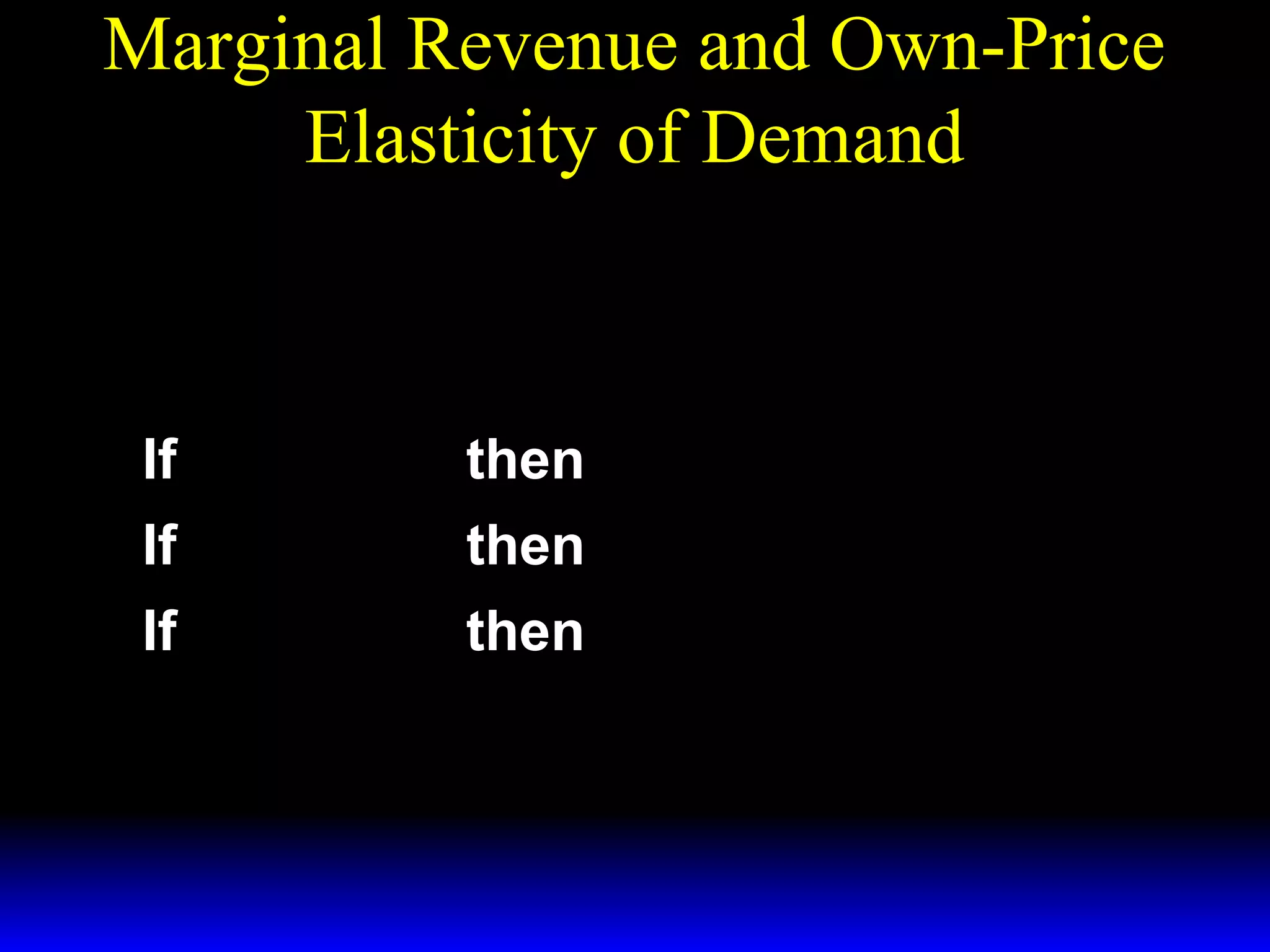
If ε = −1
then MR( q) = 0.
If − 1 < ε ≤ 0 then MR( q) < 0.
If ε < −1
then MR( q) > 0.
Marginal Revenue and Own-Price
Elasticity of Demand
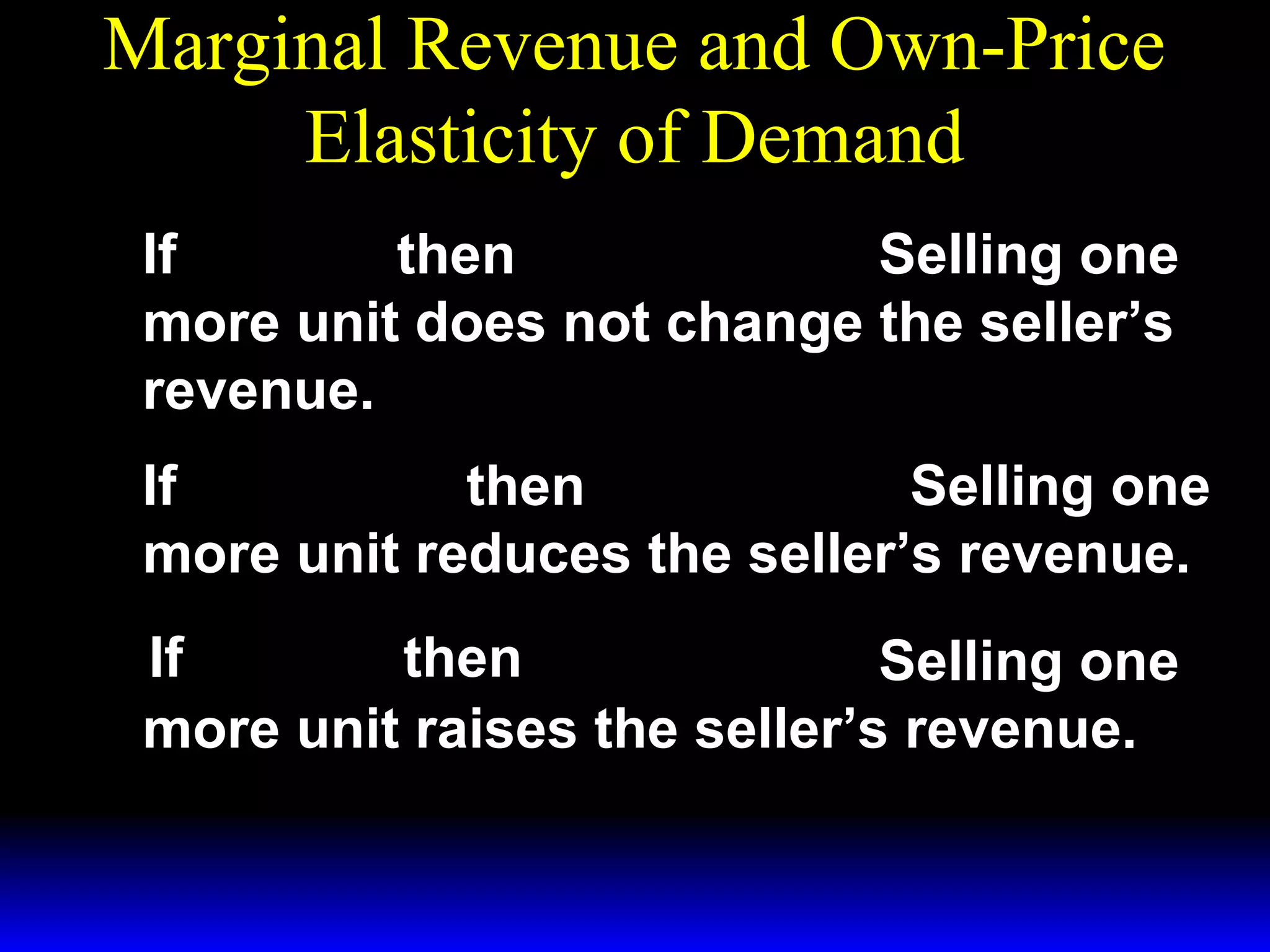
If ε = −1 then MR( q) = 0. Selling one
more unit does not change the seller’s
revenue.
If − 1 < ε ≤ 0 then MR( q) < 0. Selling one
more unit reduces the seller’s revenue.
If ε < −1 then MR( q) > 0. Selling one
more unit raises the seller’s revenue.
Marginal Revenue and Own-Price
Elasticity of Demand
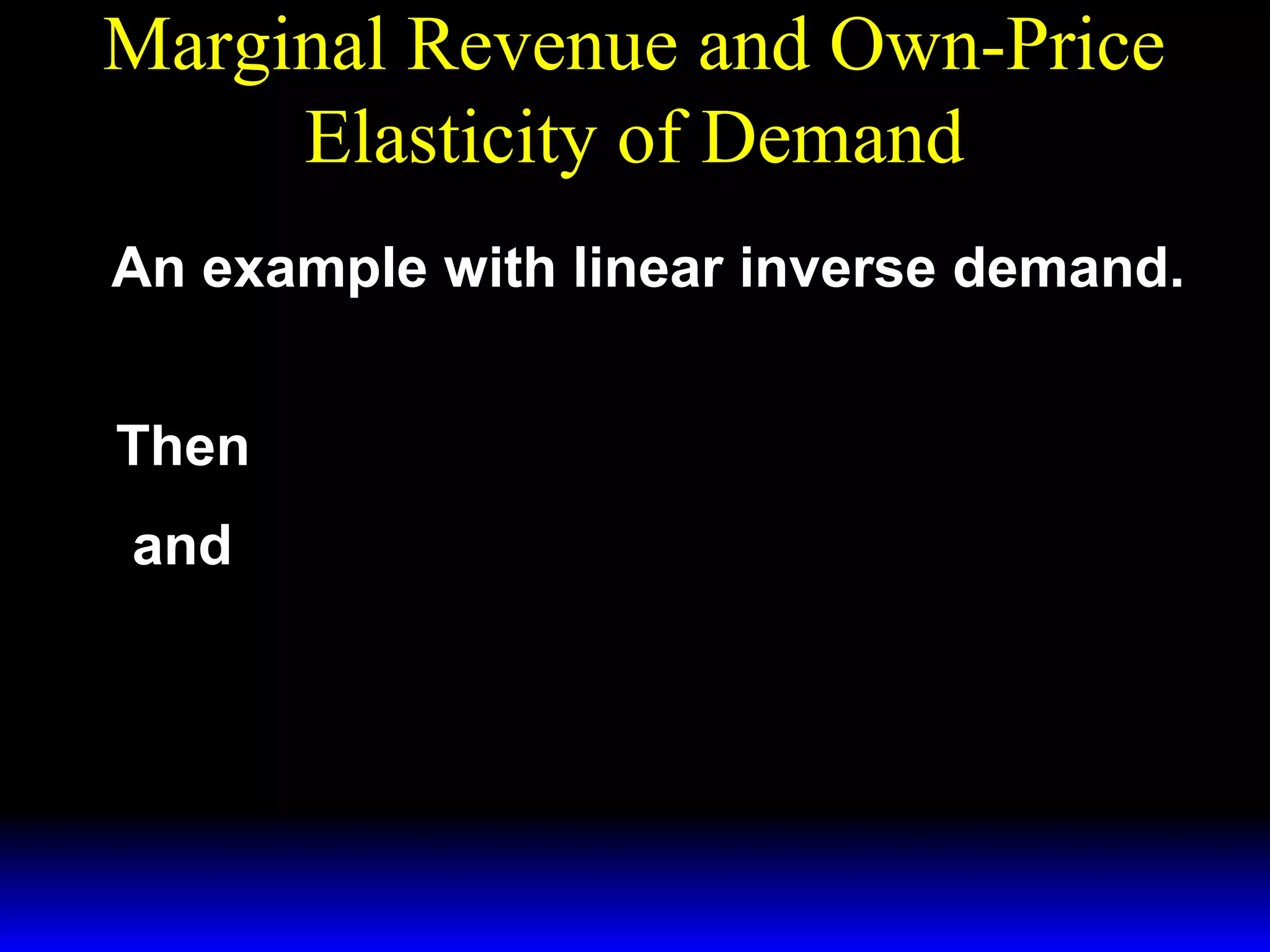
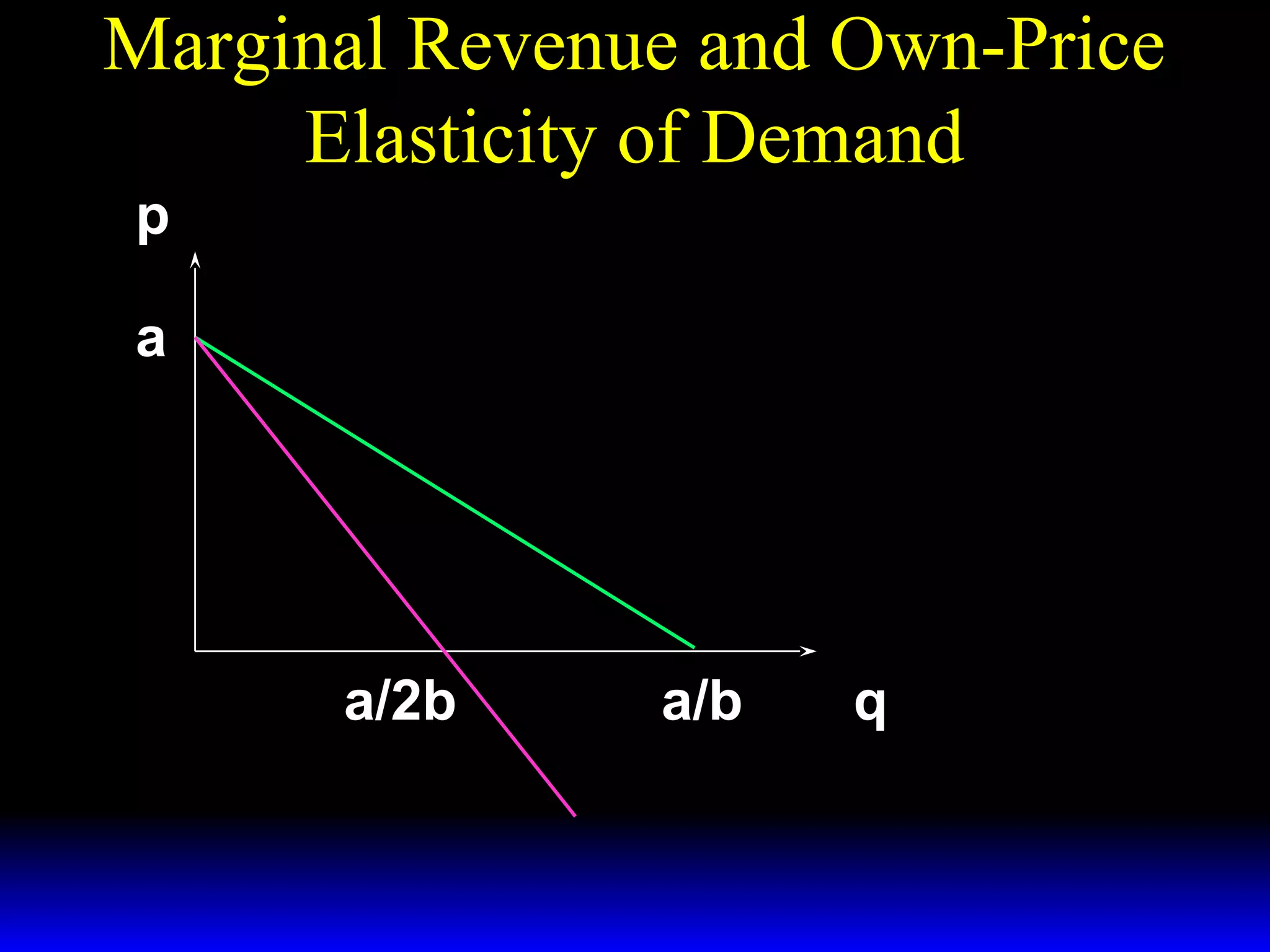
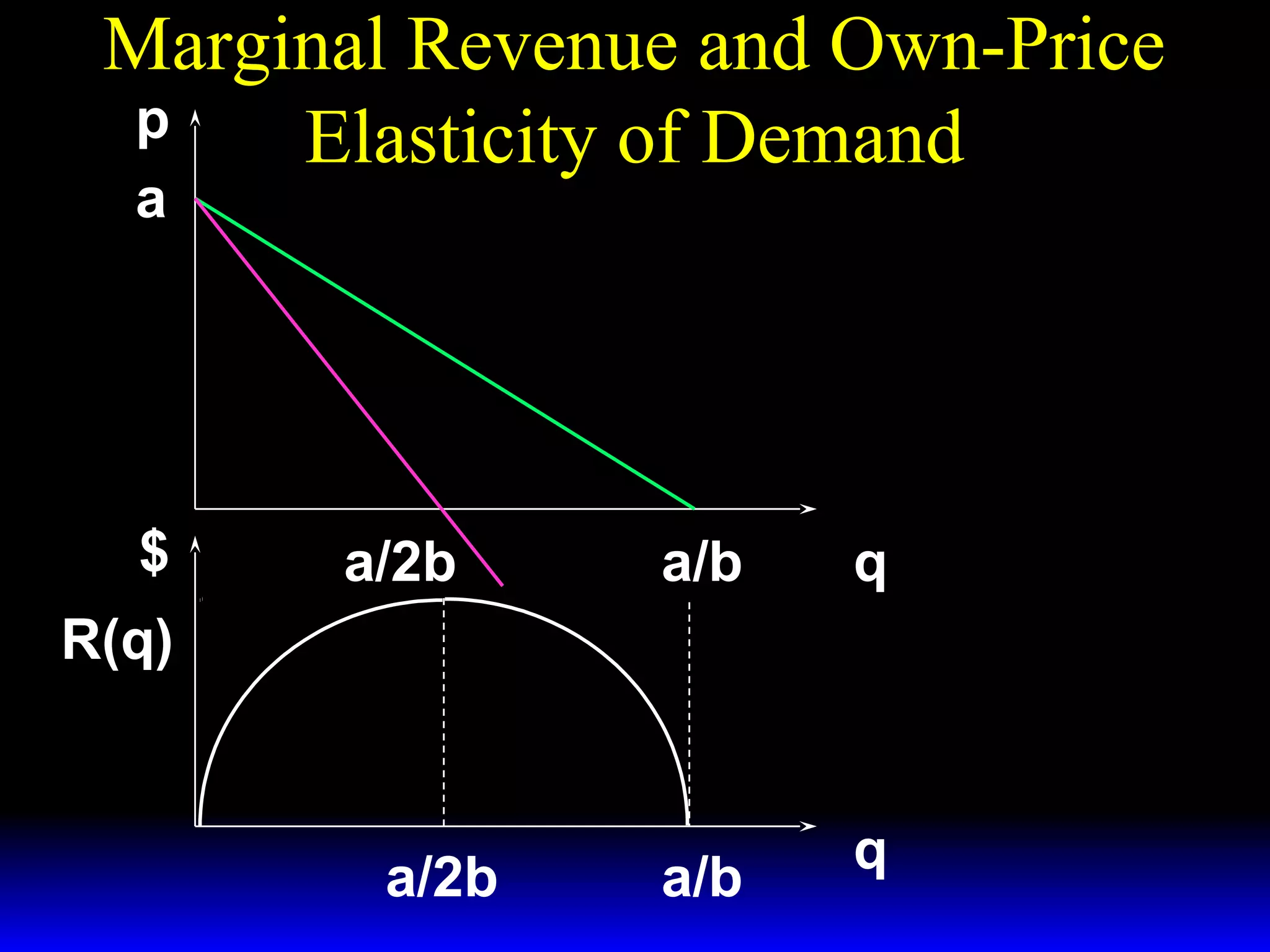
An example with linear inverse demand.
p( q) = a − bq.

Then R( q) = p( q)q = ( a − bq)q
and

MR( q) = a − 2bq.
Marginal Revenue and Own-Price
Elasticity of Demand
p
a
p( q) = a − bq

a/2b

a/b

q

MR( q) = a − 2bq
Marginal Revenue and Own-Price
p
Elasticity of Demand
a

MR( q) = a − 2bq

p( q) = a − bq

$

a/2b

a/b

q

a/b

q

R(q)

a/2b

Ch15

  • 1.
  • 2.
    From Individual toMarket Demand Functions  Think of an economy containing n consumers, denoted by i = 1, … ,n.  Consumer i’s ordinary demand function for commodity j is x*i (p1 , p 2 , mi ) j
  • 3.
    From Individual toMarket Demand Functions  When all consumers are price-takers, the market demand function for commodity j is n *i X j ( p1 , p 2 , m ,, m ) = ∑ x j (p1 , p 2 , mi ). i= 1 1  If n all consumers are identical then X j ( p1 , p 2 , M) = n × x* ( p1 , p 2 , m) j where M = nm.
  • 4.
    From Individual toMarket Demand Functions  The market demand curve is the “horizontal sum” of the individual consumers’ demand curves.  E.g. suppose there are only two consumers; i = A,B.
  • 5.
    From Individual toMarket Demand Functions p1 p1 p1’ p1” p1’ p1” 20 x*A 1 15 x*B 1
  • 6.
    From Individual toMarket Demand Functions p1 p1 p1’ p1” p1’ p1” p1 20 x*A 1 15 p1’ x*A + xB 1 1 x*B 1
  • 7.
    From Individual toMarket Demand Functions p1 p1 p1’ p1” p1’ p1” p1 20 x*A 1 15 p1’ p1” x*A + xB 1 1 x*B 1
  • 8.
    From Individual toMarket Demand Functions p1 p1 p1’ p1” p1’ p1” p1 20 x*A 1 15 x*B 1 The “horizontal sum” of the demand curves of individuals A and B. p1’ p1” 35 x*A + xB 1 1
  • 9.
    Elasticities  Elasticity measures the“sensitivity” of one variable with respect to another.  The elasticity of variable X with respect to variable Y is % ∆x ε x,y = . % ∆y
  • 10.
    Economic Applications ofElasticity  Economists use elasticities to measure the sensitivity of quantity demanded of commodity i with respect to the price of commodity i (own-price elasticity of demand) demand for commodity i with respect to the price of commodity j (cross-price elasticity of demand).
  • 11.
    Economic Applications ofElasticity demand for commodity i with respect to income (income elasticity of demand) quantity supplied of commodity i with respect to the price of commodity i (own-price elasticity of supply)
  • 12.
    Economic Applications ofElasticity quantity supplied of commodity i with respect to the wage rate (elasticity of supply with respect to the price of labor) and many, many others.
  • 13.
    Own-Price Elasticity ofDemand  Q: Why not use a demand curve’s slope to measure the sensitivity of quantity demanded to a change in a commodity’s own price?
  • 14.
    Own-Price Elasticity ofDemand p1 10 slope =-2 5 p1 10 X1* slope = - 0.2 50 X * 1 In which case is the quantity demanded X1* more sensitive to changes to p1?
  • 15.
    Own-Price Elasticity ofDemand p1 10 slope =-2 5 p1 10 X1* slope = - 0.2 50 X * 1 In which case is the quantity demanded X1* more sensitive to changes to p1?
  • 16.
    Own-Price Elasticity ofDemand p1 10 10-packs slope =-2 5 p1 10 X1* Single Units slope = - 0.2 50 X * 1 In which case is the quantity demanded X1* more sensitive to changes to p1?
  • 17.
    Own-Price Elasticity ofDemand p1 10 10-packs slope =-2 5 p1 10 X1* Single Units slope = - 0.2 50 X * 1 In which case is the quantity demanded X1* more sensitive to changes to p1? It is the same in both cases.
  • 18.
    Own-Price Elasticity ofDemand  Q: Why not just use the slope of a demand curve to measure the sensitivity of quantity demanded to a change in a commodity’s own price?  A: Because the value of sensitivity then depends upon the (arbitrary) units of measurement used for quantity demanded.
  • 19.
    Own-Price Elasticity ofDemand * % ∆ x1 ε * = x1 ,p1 % ∆p 1 is a ratio of percentages and so has no units of measurement. Hence own-price elasticity of demand is a sensitivity measure that is independent of units of measurement.
  • 20.
    Arc and PointElasticities  An “average” own-price elasticity of demand for commodity i over an interval of values for pi is an arcelasticity, usually computed by a mid-point formula.  Elasticity computed for a single value of pi is a point elasticity.
  • 21.
    Arc Own-Price Elasticity pi pi’+h pi’ pi’-h What is the “average” own-price elasticity of demand for prices in an interval centered on pi’? X i*
  • 22.
    Arc Own-Price Elasticity pi pi’+h pi’ pi’-h What is the “average” own-price elasticity of demand for prices in an interval centered on pi’? Xi" Xi '" X i*
  • 23.
    Arc Own-Price Elasticity pi pi’+h pi’ pi’-h What is the “average” own-price elasticity of demand for prices in an interval centered on pi’? % ∆X* i ε * = Xi ,pi % ∆pi Xi" Xi '" X i*
  • 24.
    Arc Own-Price Elasticity pi pi’+h pi’ pi’-h What is the “average” own-price elasticity of demand for prices in an interval centered on pi’? % ∆X* i ε * = Xi ,pi % ∆pi Xi" 2h % ∆pi = 100 × pi ' Xi '" X i*
  • 25.
    Arc Own-Price Elasticity pi pi’+h pi’ pi’-h What is the “average” own-price elasticity of demand for prices in an interval centered on pi’? % ∆X* i ε * = Xi ,pi % ∆pi Xi" 2h % ∆pi = 100 × pi ' Xi '" X i* % ∆X* = 100 × i ( Xi"− Xi '") ( Xi"+ Xi '") / 2
  • 26.
    Arc Own-Price Elasticity * %∆Xi ε * = Xi ,pi % ∆pi 2h % ∆pi = 100 × pi ' % ∆X* = 100 × i ( Xi"− Xi '") ( Xi"+ Xi '") / 2
  • 27.
    Arc Own-Price Elasticity * %∆Xi ε * = Xi ,pi % ∆pi 2h % ∆pi = 100 × pi ' % ∆X* = 100 × i ( Xi"− Xi '") ( Xi"+ Xi '") / 2 So %∆X* pi ' ( Xi "− Xi '" ) i = ε X* ,p = × . i i %∆pi ( Xi "+ Xi '" ) / 2 2h is the arc own-price elasticity of demand.
  • 28.
    Point Own-Price Elasticity Whatis the own-price elasticity of demand in a very small interval of prices centered on pi’? pi pi’+h p i’ pi’-h Xi" Xi '" X i* %∆X* pi ' ( Xi "− Xi '" ) i = ε X* ,p = × . i i %∆pi ( Xi "+ Xi '" ) / 2 2h
  • 29.
    Point Own-Price Elasticity Whatis the own-price elasticity of demand in a very small interval of prices centered on pi’? As h → 0, pi pi’+h p i’ pi’-h Xi" Xi '" X i* %∆X* pi ' ( Xi "− Xi '" ) i = ε X* ,p = × . i i %∆pi ( Xi "+ Xi '" ) / 2 2h
  • 30.
    Point Own-Price Elasticity pi pi’+h pi’ pi’-h What is the own-price elasticity of demand in a very small interval of prices centered on pi’? As h → 0, Xi" Xi '" X i* %∆X* pi ' ( Xi "− Xi '" ) i = ε X* ,p = × . i i %∆pi ( Xi "+ Xi '" ) / 2 2h
  • 31.
    Point Own-Price Elasticity pi pi’+h pi’ pi’-h What is the own-price elasticity of demand in a very small interval of prices centered on pi’? As h → 0, Xi ' X i* %∆X* pi ' ( Xi "− Xi '" ) i = ε X* ,p = × . i i %∆pi ( Xi "+ Xi '" ) / 2 2h
  • 32.
    Point Own-Price Elasticity pi pi’ What is the own-price elasticity of demand in a very small interval of prices centered on pi’? As h → 0, pi ' dX* i ε * → × Xi ,pi Xi ' dpi Xi ' X i* %∆X* pi ' ( Xi "− Xi '" ) i = ε X* ,p = × . i i %∆pi ( Xi "+ Xi '" ) / 2 2h
  • 33.
    Point Own-Price Elasticity pi pi’ What is the own-price elasticity of demand in a very small interval of prices centered on pi’? * pi ' dXi ε * = × Xi ,pi Xi ' dpi is the elasticity at the point ( Xi ', pi ' ). Xi ' X i*
  • 34.
    Point Own-Price Elasticity dX* i ε* = × Xi ,pi X* dpi i pi E.g. Suppose pi = a - bXi. Then Xi = (a-pi)/b and * dXi 1 = − . Therefore, dpi b pi  − 1  = − pi . εX* ,p = ×  i i ( a − pi ) / b  b a − pi
  • 35.
  • 36.
    Point Own-Price Elasticity pi pi= a - bXi* pi εX* ,p = − i i a − pi a a/b Xi*
  • 37.
    Point Own-Price Elasticity pi a pi= a - bXi* pi εX* ,p = − i i a − pi p = 0 ⇒ε = 0 a/b Xi*
  • 38.
    Point Own-Price Elasticity pi a pi εX*,p = − i i a − pi pi = a - bXi* p = 0 ⇒ε = 0 ε =0 a/b Xi*
  • 39.
    Point Own-Price Elasticity pi a pi εX*,p = − i i a − pi pi = a - bXi* a a/2 p = ⇒ε = − = −1 2 a −a / 2 ε =0 a/b Xi*
  • 40.
    Point Own-Price Elasticity pi a a/2 pi εX*,p = − i i a − pi pi = a - bXi* a a/2 p = ⇒ε = − = −1 2 a −a / 2 ε = −1 ε =0 a/2b a/b Xi*
  • 41.
    Point Own-Price Elasticity pi a a/2 pi εX*,p = − i i a − pi pi = a - bXi* a p = a ⇒ε = − = −∞ a −a ε = −1 ε =0 a/2b a/b Xi*
  • 42.
    Point Own-Price Elasticity pi= a - bXi* pi a ε = −∞ a/2 pi εX* ,p = − i i a − pi a p = a ⇒ε = − = −∞ a −a ε = −1 ε =0 a/2b a/b Xi*
  • 43.
    Point Own-Price Elasticity pi pi εX*,p = − i i a − pi pi = a - bXi* a ε = −∞ own-price elastic a/2 ε = −1 own-price inelastic ε =0 a/2b a/b Xi*
  • 44.
    Point Own-Price Elasticity pi pi εX*,p = − i i a − pi pi = a - bXi* a ε = −∞ own-price elastic a/2 ε = −1 (own-price unit elastic) own-price inelastic ε =0 a/2b a/b Xi*
  • 45.
    Point Own-Price Elasticity dX* i ε* = × Xi ,pi X* dpi i pi E.g. so X* = kpia . i Then dX* i = apa −1 i dpi a pi pi a −1 εX* ,p = a × kapi =a = a. a i i kpi pi
  • 46.
    Point Own-Price Elasticity pi k * a −2 Xi= kpi = kpi = 2 pi ε = −2 everywhere along the demand curve. X i*
  • 47.
    Revenue and Own-PriceElasticity of Demand  If raising a commodity’s price causes little decrease in quantity demanded, then sellers’ revenues rise.  Hence own-price inelastic demand causes sellers’ revenues to rise as price rises.
  • 48.
    Revenue and Own-PriceElasticity of Demand  If raising a commodity’s price causes a large decrease in quantity demanded, then sellers’ revenues fall.  Hence own-price elastic demand causes sellers’ revenues to fall as price rises.
  • 49.
    Revenue and Own-PriceElasticity of Demand R( p ) = p × X* (p ). Sellers’ revenue is
  • 50.
    Revenue and Own-PriceElasticity of Demand R( p ) = p × X* (p ). Sellers’ revenue is dR dX* So = X* (p ) + p dp dp
  • 51.
    Revenue and Own-PriceElasticity of Demand R( p ) = p × X* (p ). Sellers’ revenue is dR dX* So = X* (p ) + p dp dp *  p dX * = X (p )1 +  *  X (p ) dp   
  • 52.
    Revenue and Own-PriceElasticity of Demand R( p ) = p × X* (p ). Sellers’ revenue is dR dX* So = X* (p ) + p dp dp *  p dX * = X (p )1 +  *  X (p ) dp    = X* (p )[ 1 + ε ] .
  • 53.
    Revenue and Own-PriceElasticity of Demand dR = X* (p )[ 1 + ε ] dp
  • 54.
    Revenue and Own-PriceElasticity of Demand dR = X* (p )[ 1 + ε ] dp so if ε = −1 then dR =0 dp and a change to price does not alter sellers’ revenue.
  • 55.
    Revenue and Own-PriceElasticity of Demand dR = X* (p )[ 1 + ε ] dp dR >0 but if − 1 < ε ≤ 0 then dp and a price increase raises sellers’ revenue.
  • 56.
    Revenue and Own-PriceElasticity of Demand dR = X* (p )[ 1 + ε ] dp And if ε < −1 dR <0 then dp and a price increase reduces sellers’ revenue.
  • 57.
    Revenue and Own-PriceElasticity of Demand In summary: Own-price inelastic demand; − 1 < ε ≤ 0 price rise causes rise in sellers’ revenue. Own-price unit elastic demand; ε = −1 price rise causes no change in sellers’ revenue. Own-price elastic demand; ε < −1 price rise causes fall in sellers’ revenue.
  • 58.
    Marginal Revenue andOwn-Price Elasticity of Demand A seller’s marginal revenue is the rate at which revenue changes with the number of units sold by the seller. dR( q) MR( q) = . dq
  • 59.
    Marginal Revenue andOwn-Price Elasticity of Demand p(q) denotes the seller’s inverse demand function; i.e. the price at which the seller can sell q units. Then R ( q) = p( q) × q so dR( q) dp( q) MR( q) = = q + p( q) dq dq q dp( q)   = p( q) 1 + .  p( q) dq 
  • 60.
    Marginal Revenue andOwn-Price Elasticity of Demand q dp( q)   MR( q) = p( q) 1 + .  p( q) dq  and so dq p ε= × dp q 1 + 1  . MR( q) = p( q)  ε  
  • 61.
    Marginal Revenue andOwn-Price Elasticity of Demand 1 + 1  MR( q) = p( q)  ε   says that the rate at which a seller’s revenue changes with the number of units it sells depends on the sensitivity of quantity demanded to price; i.e., upon the of the own-price elasticity of demand.
  • 62.
    Marginal Revenue andOwn-Price Elasticity of Demand 1 + 1 MR(q) = p(q)  ε  If ε = −1 then MR( q) = 0. If − 1 < ε ≤ 0 then MR( q) < 0. If ε < −1 then MR( q) > 0.
  • 63.
    Marginal Revenue andOwn-Price Elasticity of Demand If ε = −1 then MR( q) = 0. Selling one more unit does not change the seller’s revenue. If − 1 < ε ≤ 0 then MR( q) < 0. Selling one more unit reduces the seller’s revenue. If ε < −1 then MR( q) > 0. Selling one more unit raises the seller’s revenue.
  • 64.
    Marginal Revenue andOwn-Price Elasticity of Demand An example with linear inverse demand. p( q) = a − bq. Then R( q) = p( q)q = ( a − bq)q and MR( q) = a − 2bq.
  • 65.
    Marginal Revenue andOwn-Price Elasticity of Demand p a p( q) = a − bq a/2b a/b q MR( q) = a − 2bq
  • 66.
    Marginal Revenue andOwn-Price p Elasticity of Demand a MR( q) = a − 2bq p( q) = a − bq $ a/2b a/b q a/b q R(q) a/2b