ORGANIZATIONAL BEHAVIOR
                                      S T E P H E N P. R O B B I N S
                                          WWW.PRENHALL.COM/ROBBINS

                                            T    E   N   T   H   E   D   I   T   I   O   N


© 2003 Prentice Hall Inc. All rights reserved.                                           PowerPoint Presentation by Charlie Cook
O B J E C T I V E S
                       AFTER STUDYING THIS CHAPTER,
                       YOU SHOULD BE ABLE TO:

                        1. Identify the five dimensions of trust.
                        2. Define the qualities of a charismatic leader.
                        3. Contrast transformational with transactional
L E A R N I N G


                           leadership.
                        4. Identify the skills that visionary leaders
                           exhibit.
                        5. Explain how framing influences leadership
                           effectiveness.
                        6. Identify four roles that team leaders perform.
                      © 2003 Prentice Hall Inc.
                      All rights reserved.                             12–2
O B J E C T I V E S (cont’d)
                                AFTER STUDYING THIS CHAPTER,
                                YOU SHOULD BE ABLE TO:

                                 7. Explain the role of a mentor.
                                 8. Describe how on-line leadership differs from
                                    face-to-face leadership.
                                 9. Identify when leadership may not be
                                    necessary.
                                 10. Explain how to find and create effective
L E A R N I N G


                                     leaders.


                               © 2003 Prentice Hall Inc.
                               All rights reserved.                             12–3
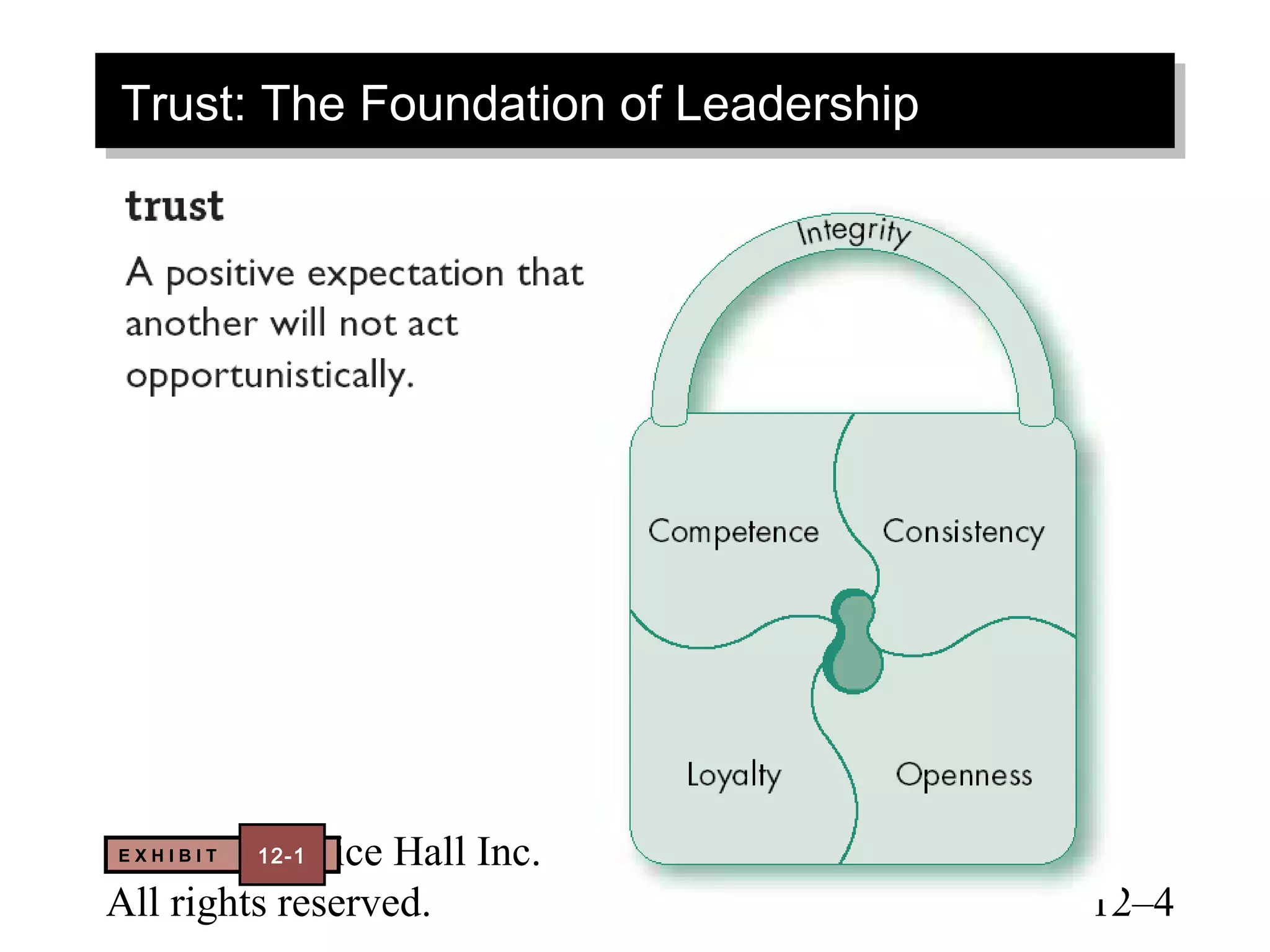
Trust: The Foundation of Leadership


©X 2003 Prentice Hall Inc.
E HIBIT  12-1

All rights reserved.                  12–4
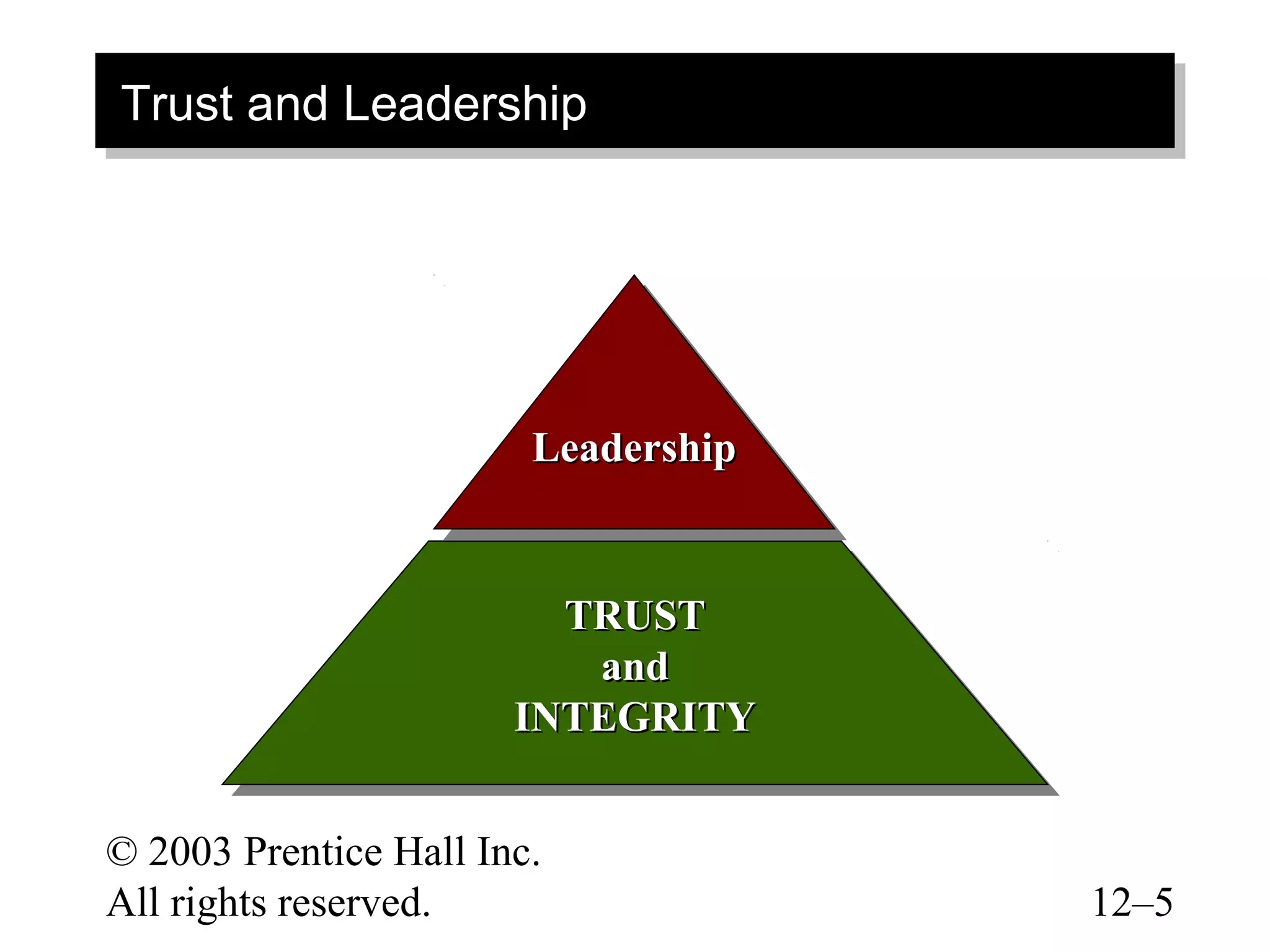
Trust and Leadership


                        Leadership
                        Leadership


                          TRUST
                          TRUST
                           and
                            and
                       INTEGRITY
                        INTEGRITY

© 2003 Prentice Hall Inc.
All rights reserved.                 12–5
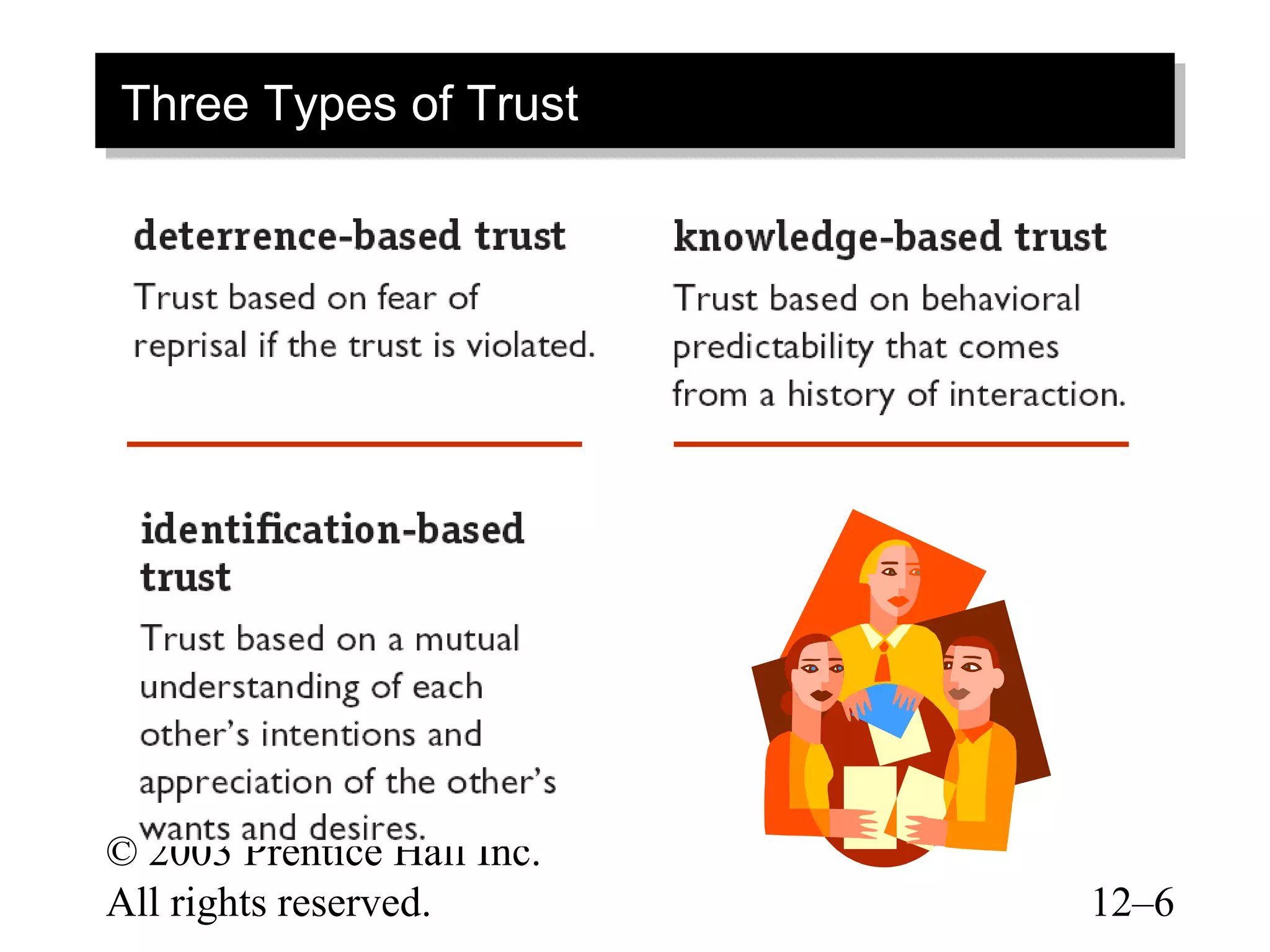
Three Types of Trust


© 2003 Prentice Hall Inc.
All rights reserved.        12–6
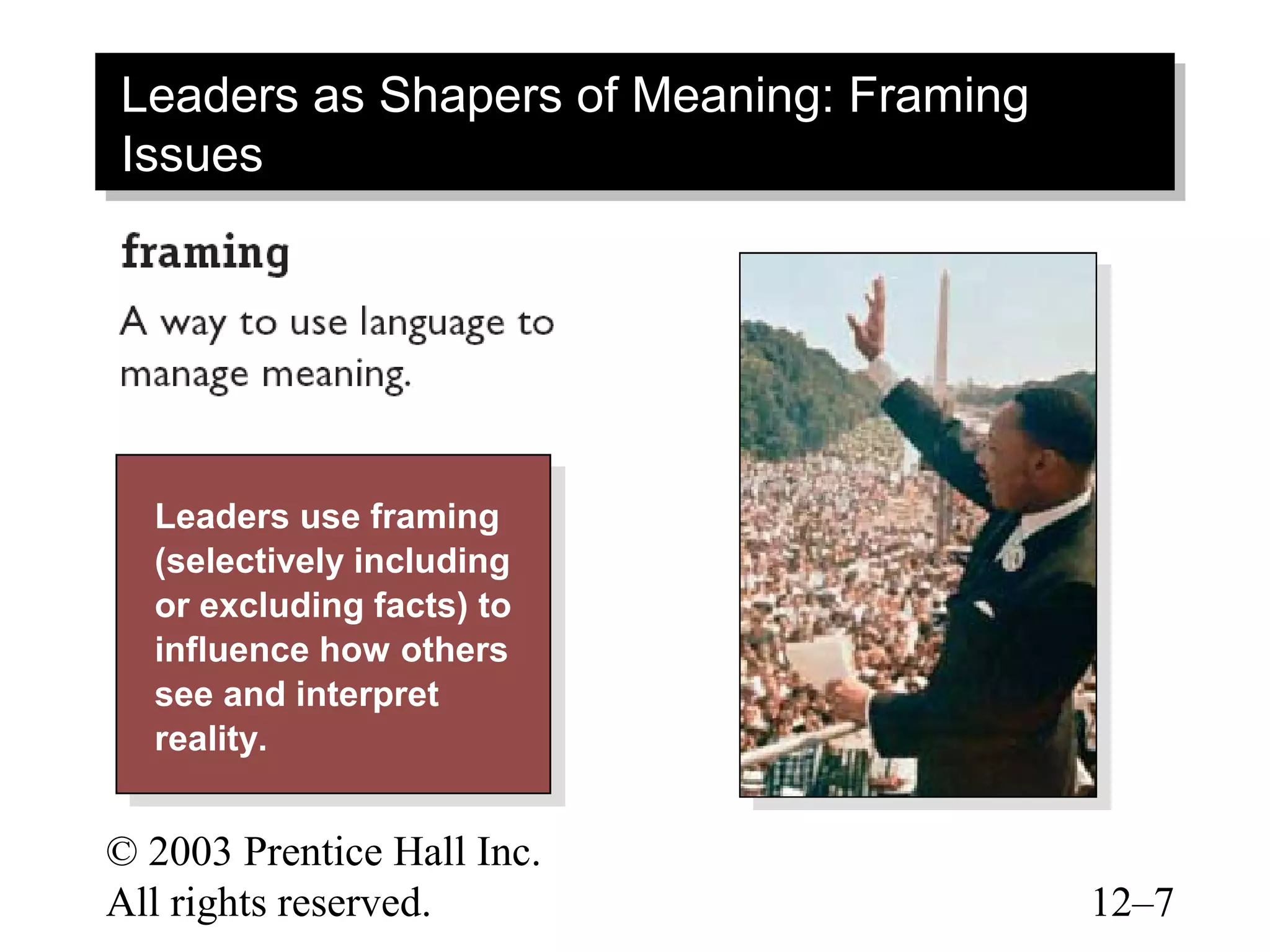
Leaders as Shapers of Meaning: Framing
 Leaders as Shapers of Meaning: Framing
Issues
 Issues


  Leaders use framing
   Leaders use framing
  (selectively including
   (selectively including
  or excluding facts) to
   or excluding facts) to
  influence how others
   influence how others
  see and interpret
   see and interpret
  reality.
   reality.

© 2003 Prentice Hall Inc.
All rights reserved.                      12–7
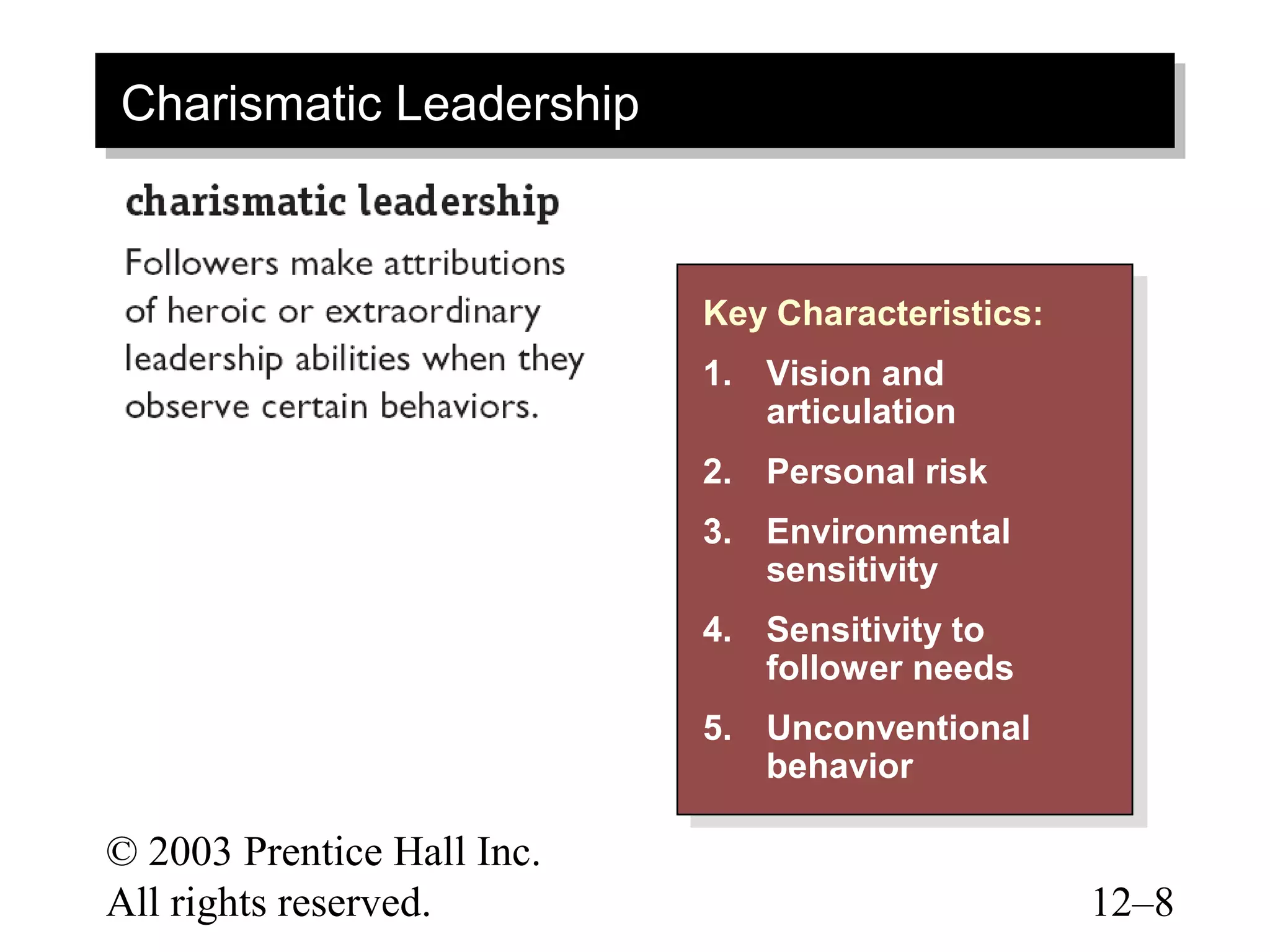
Charismatic Leadership


                            Key Characteristics:
                             Key Characteristics:
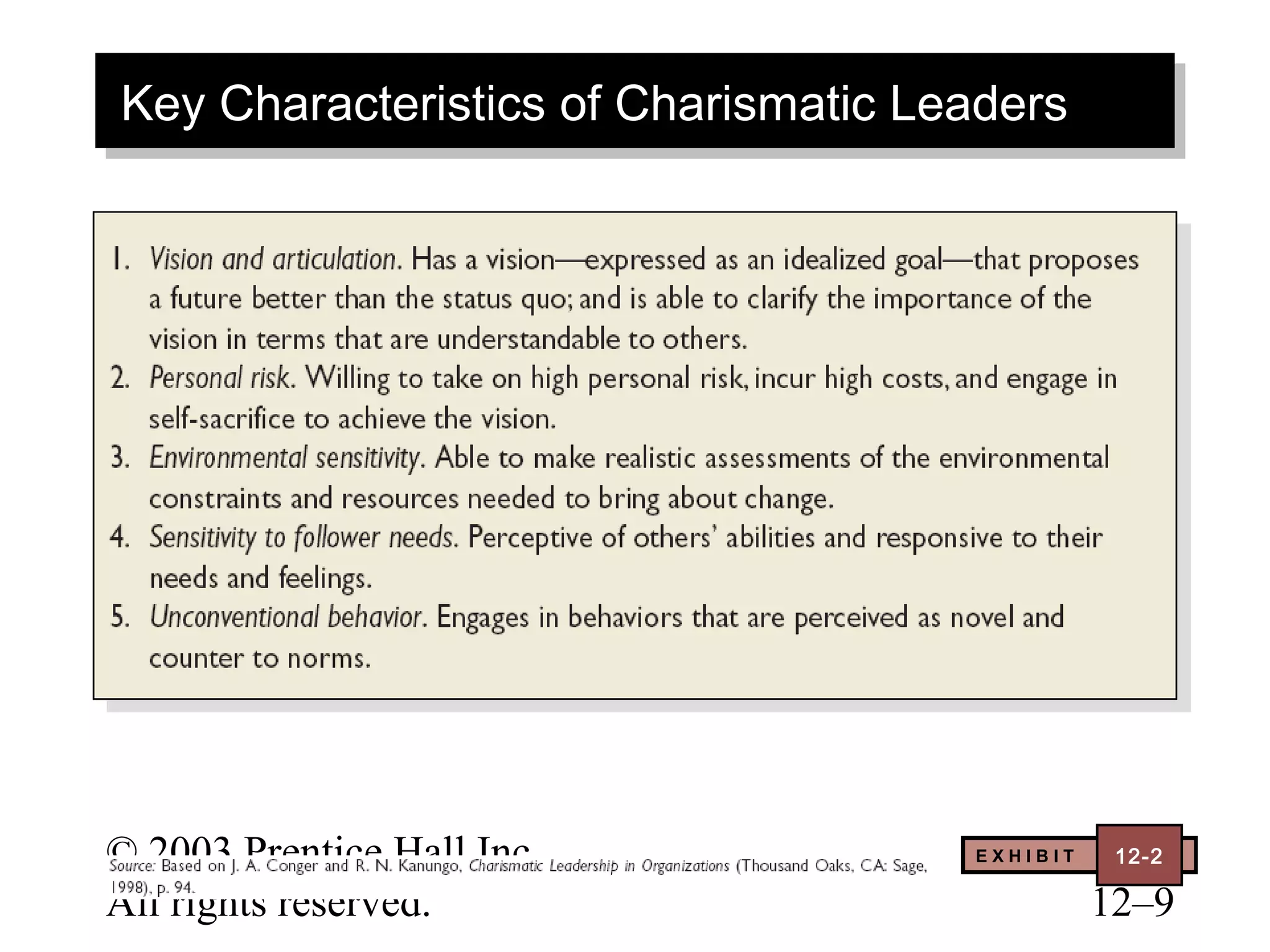
                            1. Vision and
                             1. Vision and
                                articulation
                                 articulation
                            2. Personal risk
                             2. Personal risk
                            3. Environmental
                             3. Environmental
                                sensitivity
                                 sensitivity
                            4. Sensitivity to
                             4. Sensitivity to
                                follower needs
                                 follower needs
                            5. Unconventional
                             5. Unconventional
                                behavior
                                 behavior

© 2003 Prentice Hall Inc.
All rights reserved.                                12–8
Key Characteristics of Charismatic Leaders


© 2003 Prentice Hall Inc.            EXHIBIT    12-2

All rights reserved.                           12–9
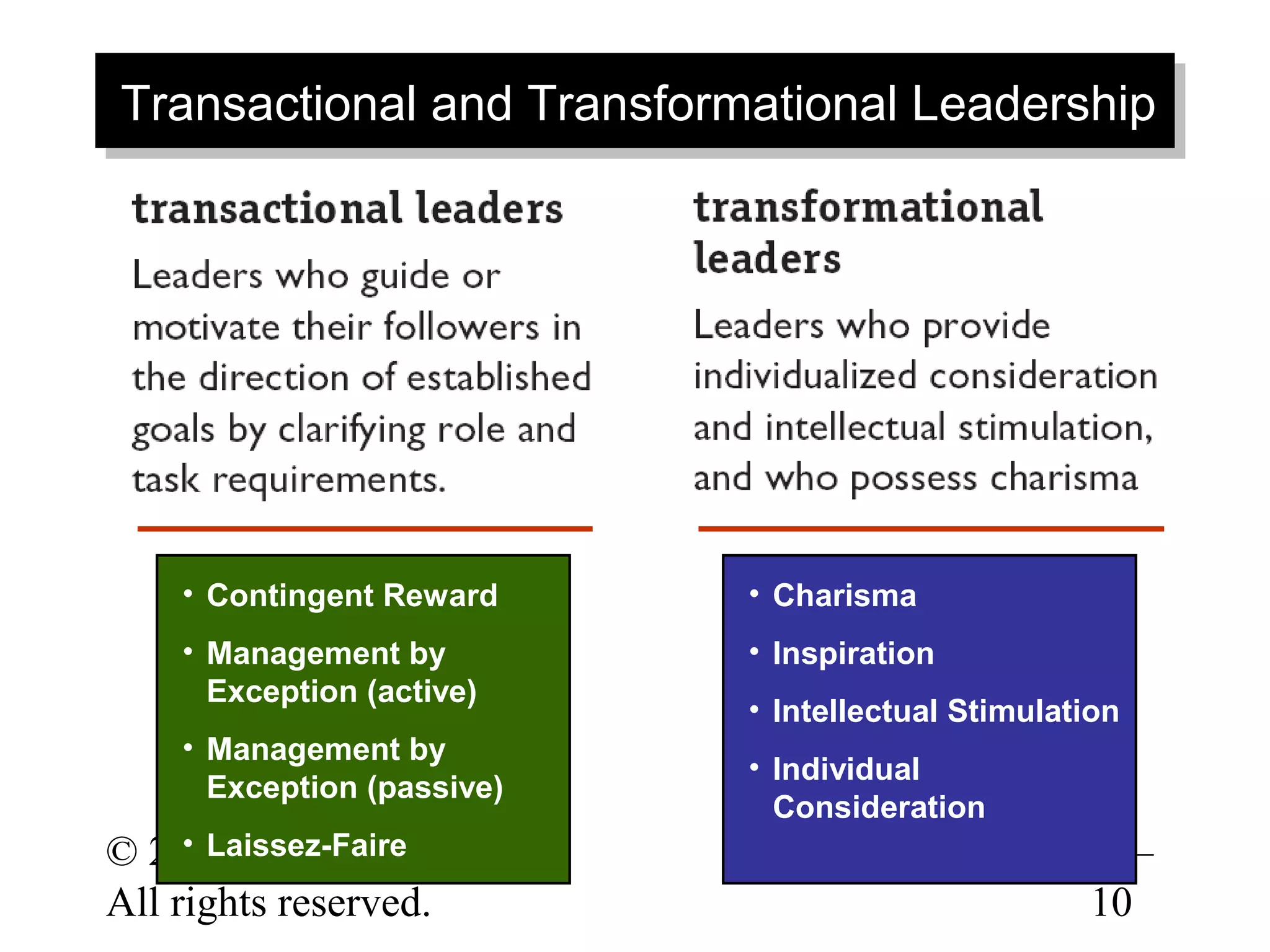
Transactional and Transformational Leadership


    • Contingent Reward     • Charisma
    • Management by         • Inspiration
      Exception (active)
                            • Intellectual Stimulation
    • Management by
                            • Individual
      Exception (passive)
                              Consideration
     • Laissez-Faire
© 2003 Prentice Hall Inc.                          12–
All rights reserved.                               10
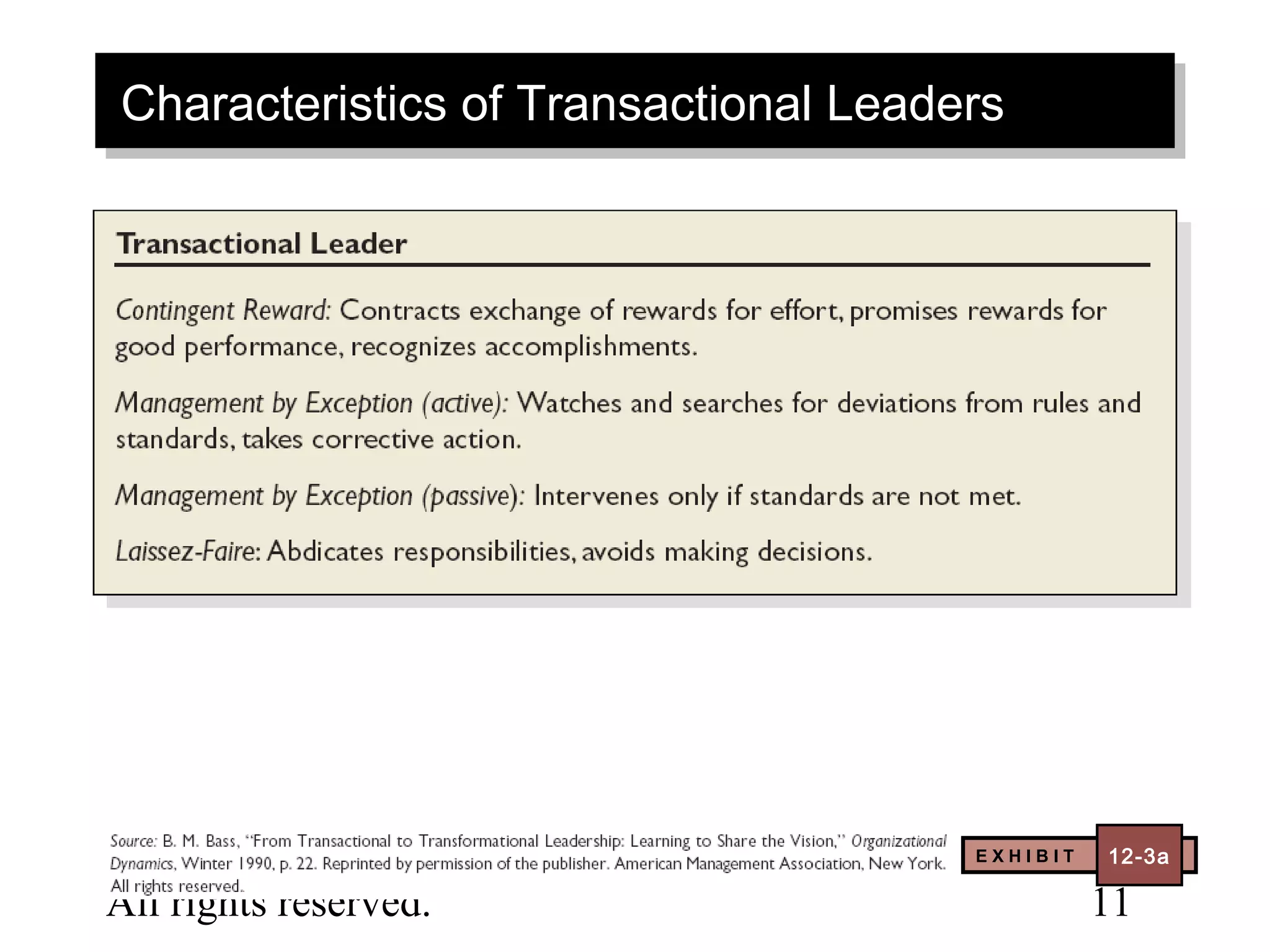
Characteristics of Transactional Leaders


© 2003 Prentice Hall Inc.             EXHIBIT   12–
                                                 12-3a

All rights reserved.                            11
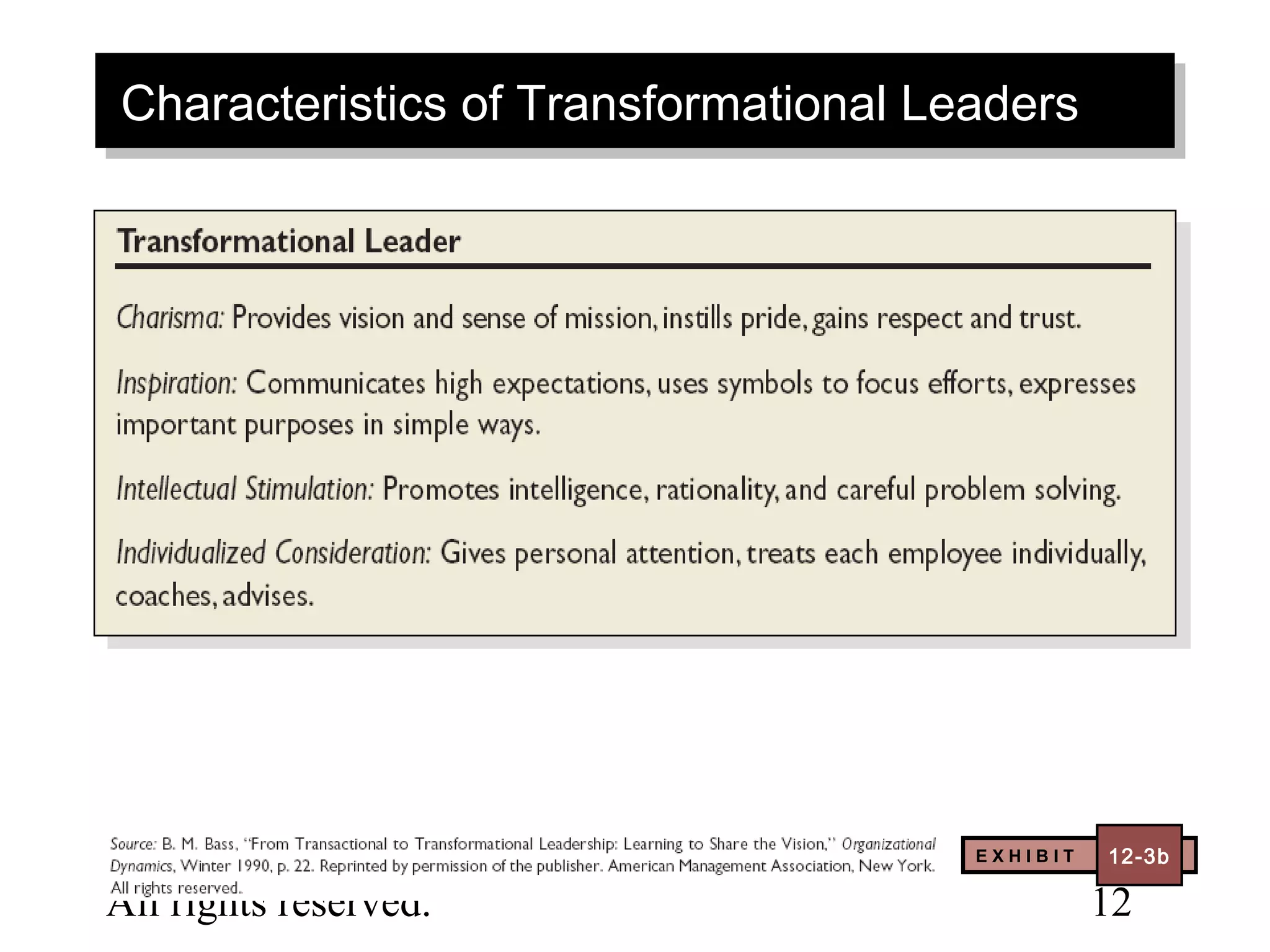
Characteristics of Transformational Leaders


© 2003 Prentice Hall Inc.            EXHIBIT   12–
                                                12-3b

All rights reserved.                           12
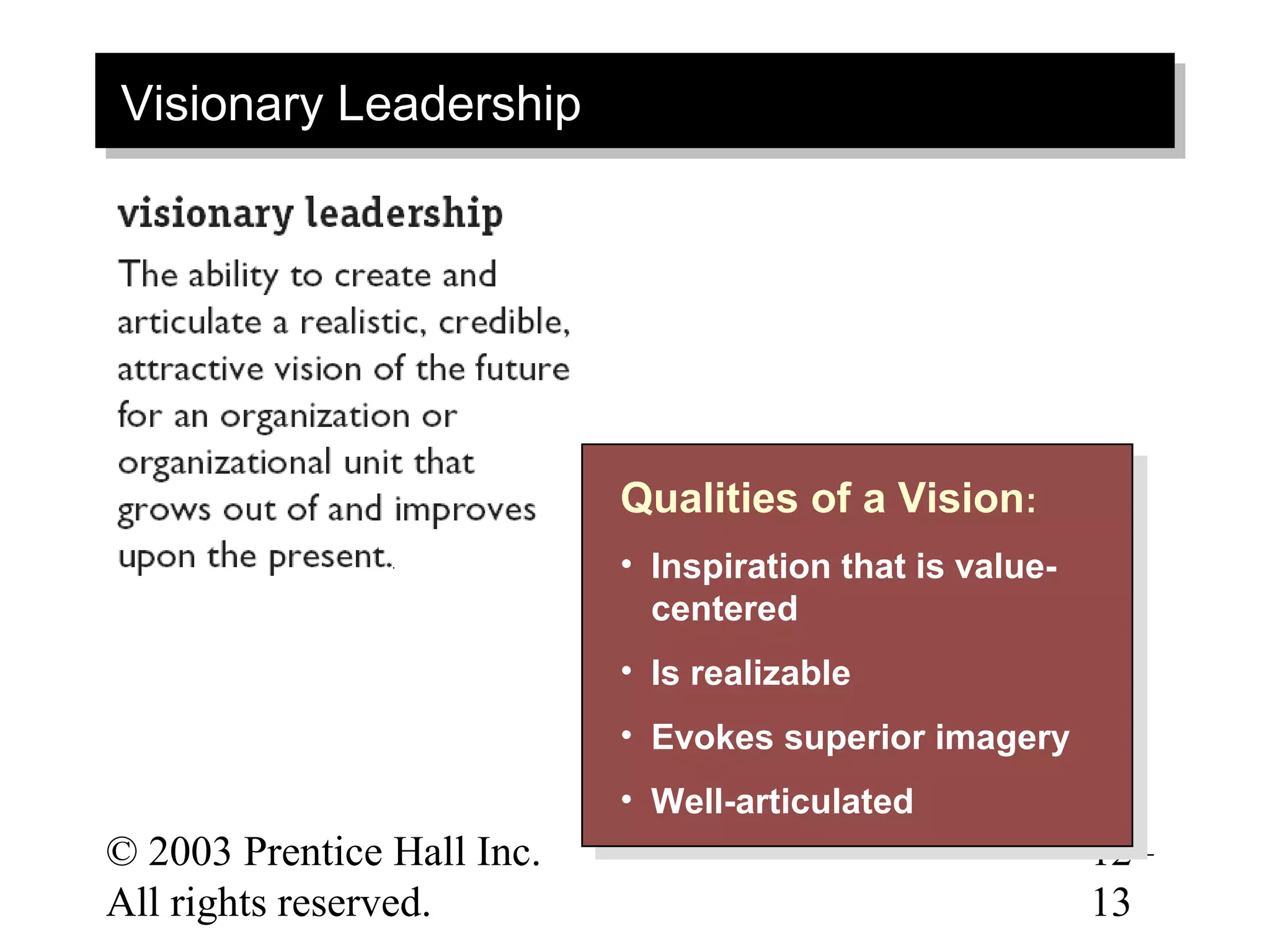
Visionary Leadership


                            Qualities of a Vision: :
                            Qualities of a Vision
                            • • Inspiration that is value-
                                 Inspiration that is value-
                                centered
                                 centered
                            • • Is realizable
                                 Is realizable
                            • • Evokes superior imagery
                                 Evokes superior imagery
                            • • Well-articulated
                                Well-articulated
© 2003 Prentice Hall Inc.                                     12–
All rights reserved.                                          13
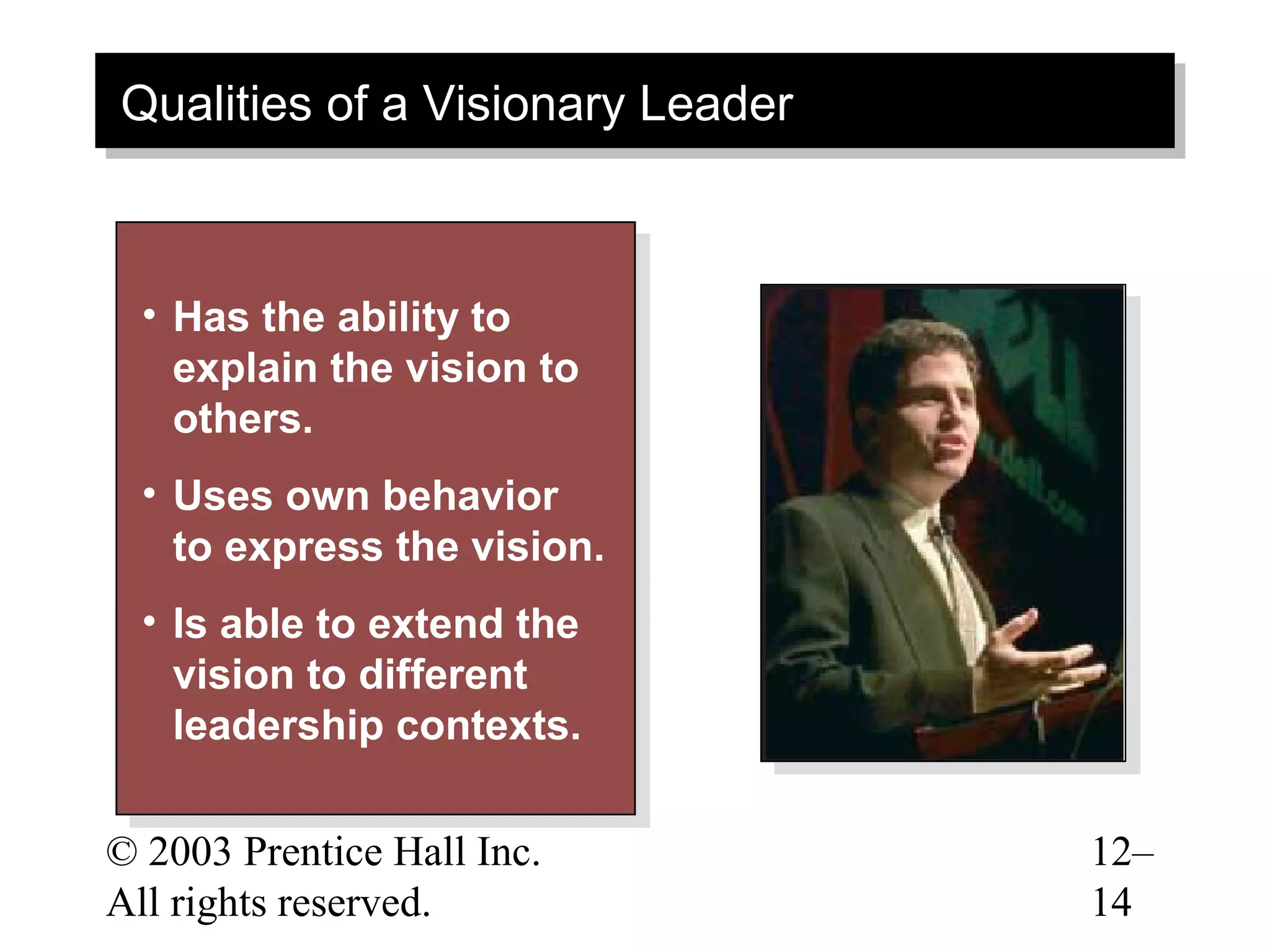
Qualities of a Visionary Leader


  •• Has the ability to
      Has the ability to
     explain the vision to
      explain the vision to
     others.
      others.
  •• Uses own behavior
      Uses own behavior
     to express the vision.
      to express the vision.
  •• Is able to extend the
      Is able to extend the
     vision to different
      vision to different
     leadership contexts.
      leadership contexts.

© 2003 Prentice Hall Inc.         12–
All rights reserved.              14
Emotional Intelligence and Leadership
Effectiveness
Effectiveness


                Elements of Emotional
                 Elements of Emotional
                Intelligence: :
                 Intelligence
                ••Self-awareness
                   Self-awareness
                ••Self-management
                   Self-management
                ••Self-motivation
                   Self-motivation
                ••Empathy
                   Empathy
                ••Social skills
                   Social skills
© 2003 Prentice Hall Inc.                12–
All rights reserved.                     15
Contemporary Leadership Roles: Providing
Team Leadership
Team Leadership


             Team Leadership Roles: :
              Team Leadership Roles
             •• Act as liaisons with
                 Act as liaisons with
                external constituencies.
                 external constituencies.
             •• Serve as troubleshooters.
                 Serve as troubleshooters.
             •• Manage conflict.
                Manage conflict.


© 2003 Prentice Hall Inc.                    12–
All rights reserved.                         16
Contemporary Leadership Roles: Mentoring


                            Mentoring Activities: :
                             Mentoring Activities
                            •• Present ideas clearly
                                Present ideas clearly
                            •• Listen well
                                Listen well
                            •• Empathize
                                Empathize
                            •• Share experiences
                                Share experiences
                            •• Act as role model
                                Act as role model
                            •• Share contacts
                                Share contacts
                            •• Provide political
                                Provide political
                               guidance
                                guidance
© 2003 Prentice Hall Inc.                           12–
All rights reserved.                                17
Contemporary Leadership Roles:
Self-Leadership
Self-Leadership


                            Creating self leaders: :
                            Creating self leaders
                            • • Model self-leadership.
                                Model self-leadership.
                            • • Encourage employees to
                                 Encourage employees to
                                create self-set goals.
                                 create self-set goals.
                            • • Encourage the use of self-
                                 Encourage the use of self-
                                rewards.
                                 rewards.
                            • • Create positive thought
                                 Create positive thought
                                patterns.
                                 patterns.
                            • • Create aaclimate of self-
                                 Create climate of self-
                                leadership.
                                 leadership.
                            • • Encourage self-criticism.
                                 Encourage self-criticism.
© 2003 Prentice Hall Inc.                                12–
All rights reserved.                                     18
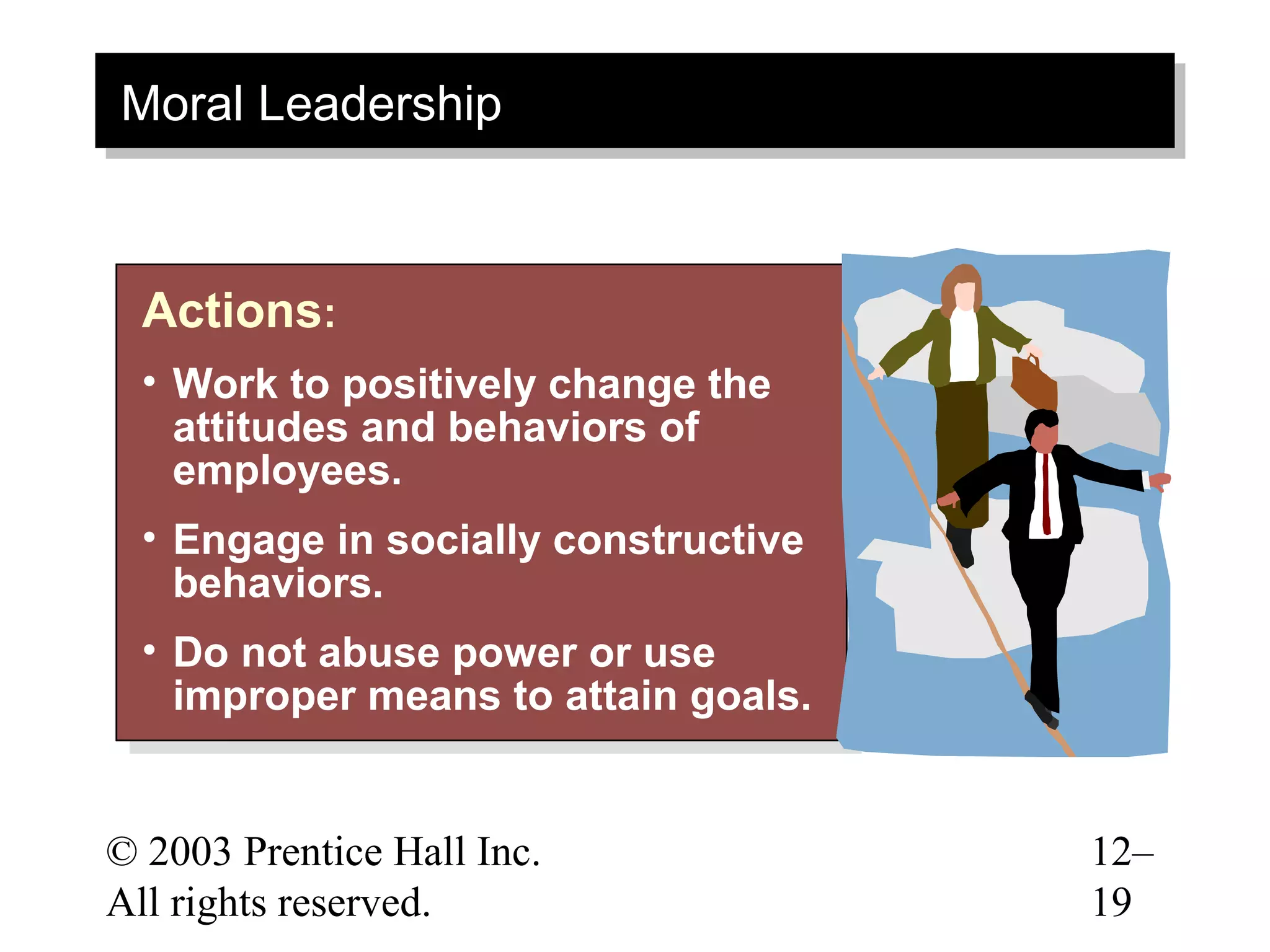
Moral Leadership
Moral Leadership


  Actions::
  Actions
  •• Work to positively change the
      Work to positively change the
     attitudes and behaviors of
      attitudes and behaviors of
     employees.
      employees.
  •• Engage in socially constructive
      Engage in socially constructive
     behaviors.
      behaviors.
  •• Do not abuse power or use
      Do not abuse power or use
     improper means to attain goals.
      improper means to attain goals.


© 2003 Prentice Hall Inc.               12–
All rights reserved.                    19
Leadership as an Attribution


                            Qualities attributed to
                            Qualities attributed to
                             leaders: :
                              leaders
                            • • Leaders are intelligent,
                                 Leaders are intelligent,
                                outgoing, have strong
                                 outgoing, have strong
                                verbal skills, are aggressive,
                                 verbal skills, are aggressive,
                                understanding, and
                                 understanding, and
                                industrious
                                 industrious
                            • • Effective leaders are
                                 Effective leaders are
                                perceived as consistent and
                                 perceived as consistent and
                                unwavering in their
                                 unwavering in their
                                decisions.
                                 decisions.
                            • • Effective leaders project the
                                 Effective leaders project the
                                appearance of being aa
                                 appearance of being
                                leader.
                                 leader.
© 2003 Prentice Hall Inc.                                 12–
All rights reserved.                                      20
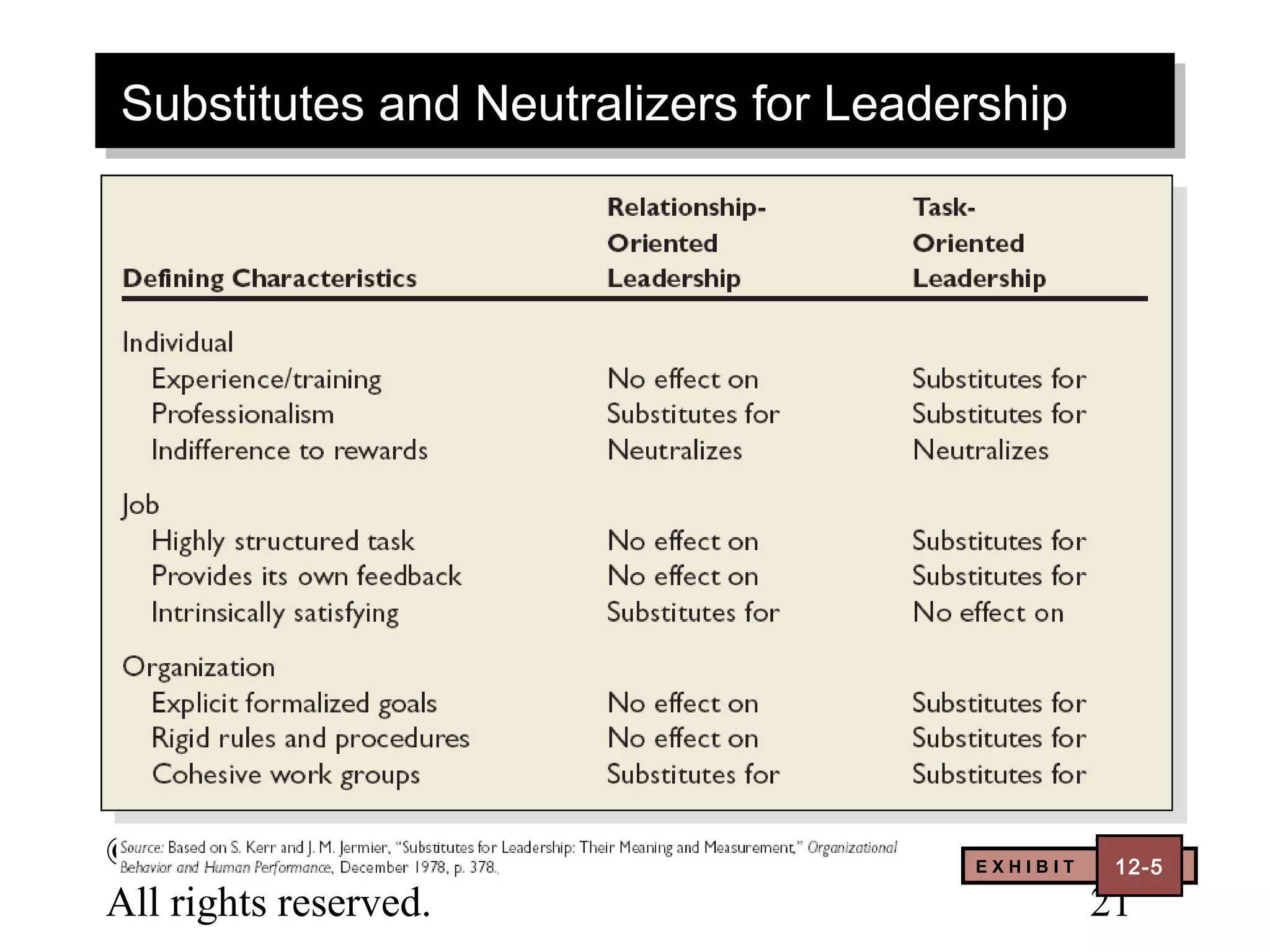
Substitutes and Neutralizers for Leadership


© 2003 Prentice Hall Inc.             EXHIBIT   12–
                                                 12-5
All rights reserved.                            21
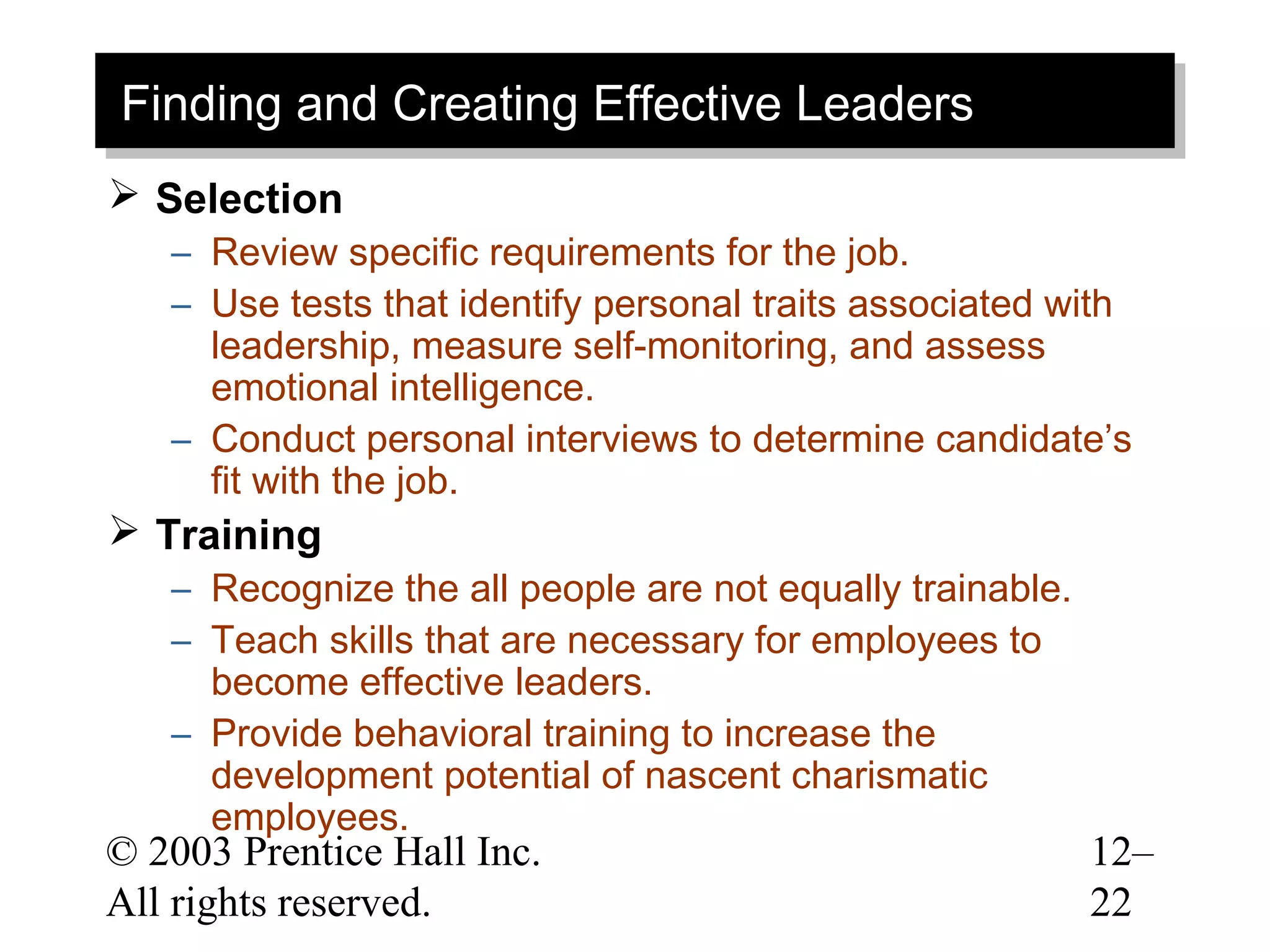
Finding and Creating Effective Leaders
 Selection
   – Review specific requirements for the job.
   – Use tests that identify personal traits associated with
     leadership, measure self-monitoring, and assess
     emotional intelligence.
   – Conduct personal interviews to determine candidate’s
     fit with the job.
 Training
   – Recognize the all people are not equally trainable.
   – Teach skills that are necessary for employees to
     become effective leaders.
   – Provide behavioral training to increase the
     development potential of nascent charismatic
     employees.
© 2003 Prentice Hall Inc.                                  12–
All rights reserved.                                       22

Ch12

  • 1.
    ORGANIZATIONAL BEHAVIOR S T E P H E N P. R O B B I N S WWW.PRENHALL.COM/ROBBINS T E N T H E D I T I O N © 2003 Prentice Hall Inc. All rights reserved. PowerPoint Presentation by Charlie Cook
  • 2.
    O B JE C T I V E S AFTER STUDYING THIS CHAPTER, YOU SHOULD BE ABLE TO: 1. Identify the five dimensions of trust. 2. Define the qualities of a charismatic leader. 3. Contrast transformational with transactional L E A R N I N G leadership. 4. Identify the skills that visionary leaders exhibit. 5. Explain how framing influences leadership effectiveness. 6. Identify four roles that team leaders perform. © 2003 Prentice Hall Inc. All rights reserved. 12–2
  • 3.
    O B JE C T I V E S (cont’d) AFTER STUDYING THIS CHAPTER, YOU SHOULD BE ABLE TO: 7. Explain the role of a mentor. 8. Describe how on-line leadership differs from face-to-face leadership. 9. Identify when leadership may not be necessary. 10. Explain how to find and create effective L E A R N I N G leaders. © 2003 Prentice Hall Inc. All rights reserved. 12–3
  • 4.
    Trust: The Foundationof Leadership Trust: The Foundation of Leadership ©X 2003 Prentice Hall Inc. E HIBIT 12-1 All rights reserved. 12–4
  • 5.
    Trust and Leadership Trustand Leadership Leadership Leadership TRUST TRUST and and INTEGRITY INTEGRITY © 2003 Prentice Hall Inc. All rights reserved. 12–5
  • 6.
    Three Types ofTrust Three Types of Trust © 2003 Prentice Hall Inc. All rights reserved. 12–6
  • 7.
    Leaders as Shapersof Meaning: Framing Leaders as Shapers of Meaning: Framing Issues Issues Leaders use framing Leaders use framing (selectively including (selectively including or excluding facts) to or excluding facts) to influence how others influence how others see and interpret see and interpret reality. reality. © 2003 Prentice Hall Inc. All rights reserved. 12–7
  • 8.
    Charismatic Leadership Charismatic Leadership Key Characteristics: Key Characteristics: 1. Vision and 1. Vision and articulation articulation 2. Personal risk 2. Personal risk 3. Environmental 3. Environmental sensitivity sensitivity 4. Sensitivity to 4. Sensitivity to follower needs follower needs 5. Unconventional 5. Unconventional behavior behavior © 2003 Prentice Hall Inc. All rights reserved. 12–8
  • 9.
    Key Characteristics ofCharismatic Leaders Key Characteristics of Charismatic Leaders © 2003 Prentice Hall Inc. EXHIBIT 12-2 All rights reserved. 12–9
  • 10.
    Transactional and TransformationalLeadership Transactional and Transformational Leadership • Contingent Reward • Charisma • Management by • Inspiration Exception (active) • Intellectual Stimulation • Management by • Individual Exception (passive) Consideration • Laissez-Faire © 2003 Prentice Hall Inc. 12– All rights reserved. 10
  • 11.
    Characteristics of TransactionalLeaders Characteristics of Transactional Leaders © 2003 Prentice Hall Inc. EXHIBIT 12– 12-3a All rights reserved. 11
  • 12.
    Characteristics of TransformationalLeaders Characteristics of Transformational Leaders © 2003 Prentice Hall Inc. EXHIBIT 12– 12-3b All rights reserved. 12
  • 13.
    Visionary Leadership Visionary Leadership Qualities of a Vision: : Qualities of a Vision • • Inspiration that is value- Inspiration that is value- centered centered • • Is realizable Is realizable • • Evokes superior imagery Evokes superior imagery • • Well-articulated Well-articulated © 2003 Prentice Hall Inc. 12– All rights reserved. 13
  • 14.
    Qualities of aVisionary Leader Qualities of a Visionary Leader •• Has the ability to Has the ability to explain the vision to explain the vision to others. others. •• Uses own behavior Uses own behavior to express the vision. to express the vision. •• Is able to extend the Is able to extend the vision to different vision to different leadership contexts. leadership contexts. © 2003 Prentice Hall Inc. 12– All rights reserved. 14
  • 15.
    Emotional Intelligence andLeadership Emotional Intelligence and Leadership Effectiveness Effectiveness Elements of Emotional Elements of Emotional Intelligence: : Intelligence ••Self-awareness Self-awareness ••Self-management Self-management ••Self-motivation Self-motivation ••Empathy Empathy ••Social skills Social skills © 2003 Prentice Hall Inc. 12– All rights reserved. 15
  • 16.
    Contemporary Leadership Roles:Providing Contemporary Leadership Roles: Providing Team Leadership Team Leadership Team Leadership Roles: : Team Leadership Roles •• Act as liaisons with Act as liaisons with external constituencies. external constituencies. •• Serve as troubleshooters. Serve as troubleshooters. •• Manage conflict. Manage conflict. © 2003 Prentice Hall Inc. 12– All rights reserved. 16
  • 17.
    Contemporary Leadership Roles:Mentoring Contemporary Leadership Roles: Mentoring Mentoring Activities: : Mentoring Activities •• Present ideas clearly Present ideas clearly •• Listen well Listen well •• Empathize Empathize •• Share experiences Share experiences •• Act as role model Act as role model •• Share contacts Share contacts •• Provide political Provide political guidance guidance © 2003 Prentice Hall Inc. 12– All rights reserved. 17
  • 18.
    Contemporary Leadership Roles: ContemporaryLeadership Roles: Self-Leadership Self-Leadership Creating self leaders: : Creating self leaders • • Model self-leadership. Model self-leadership. • • Encourage employees to Encourage employees to create self-set goals. create self-set goals. • • Encourage the use of self- Encourage the use of self- rewards. rewards. • • Create positive thought Create positive thought patterns. patterns. • • Create aaclimate of self- Create climate of self- leadership. leadership. • • Encourage self-criticism. Encourage self-criticism. © 2003 Prentice Hall Inc. 12– All rights reserved. 18
  • 19.
    Moral Leadership Moral Leadership Actions:: Actions •• Work to positively change the Work to positively change the attitudes and behaviors of attitudes and behaviors of employees. employees. •• Engage in socially constructive Engage in socially constructive behaviors. behaviors. •• Do not abuse power or use Do not abuse power or use improper means to attain goals. improper means to attain goals. © 2003 Prentice Hall Inc. 12– All rights reserved. 19
  • 20.
    Leadership as anAttribution Leadership as an Attribution Qualities attributed to Qualities attributed to leaders: : leaders • • Leaders are intelligent, Leaders are intelligent, outgoing, have strong outgoing, have strong verbal skills, are aggressive, verbal skills, are aggressive, understanding, and understanding, and industrious industrious • • Effective leaders are Effective leaders are perceived as consistent and perceived as consistent and unwavering in their unwavering in their decisions. decisions. • • Effective leaders project the Effective leaders project the appearance of being aa appearance of being leader. leader. © 2003 Prentice Hall Inc. 12– All rights reserved. 20
  • 21.
    Substitutes and Neutralizersfor Leadership Substitutes and Neutralizers for Leadership © 2003 Prentice Hall Inc. EXHIBIT 12– 12-5 All rights reserved. 21
  • 22.
    Finding and CreatingEffective Leaders Finding and Creating Effective Leaders  Selection – Review specific requirements for the job. – Use tests that identify personal traits associated with leadership, measure self-monitoring, and assess emotional intelligence. – Conduct personal interviews to determine candidate’s fit with the job.  Training – Recognize the all people are not equally trainable. – Teach skills that are necessary for employees to become effective leaders. – Provide behavioral training to increase the development potential of nascent charismatic employees. © 2003 Prentice Hall Inc. 12– All rights reserved. 22