Learning Objectives (1of 2)
• Explain the benefits of pseudocode over natural
language or a programming language
• Represent algorithms using pseudocode
• Identify algorithm statements as sequential,
conditional, or iterative
• Define abstraction and top-down design, and
explain their use in breaking down complex
problems
3.
Learning Objectives (2of 2)
• Illustrate the operation of algorithms for:
– Multiplication by repeated addition
– Sequential search of a collection of values
– Finding the maximum element in a collection
– Finding a pattern string in a larger piece of text
4.
Introduction
• Everyday algorithms,such as hair washing, may
not be suitable for computers to perform (as in
Chapter 1).
• Algorithmic problem solving focuses on algorithms
suitable for computers such as searching lists and
matching patterns.
• Pseudocode is a tool for designing algorithms but
does not run on a computing device.
• This chapter will use a set of problems to illustrate
algorithmic problem solving, including those with
conditional statements and loops.
5.
Representing Algorithms (1of 5)
• Natural language is:
– Expressive and easy to use
– Verbose, unstructured, and ambiguous
• Programming languages are:
– Structured and designed for computers
– Grammatically fussy and cryptic
• Pseudocode lies somewhere between these two
and is used to design algorithms prior to coding
them
6.
Representing Algorithms NaturalLanguage
(1 of 2)
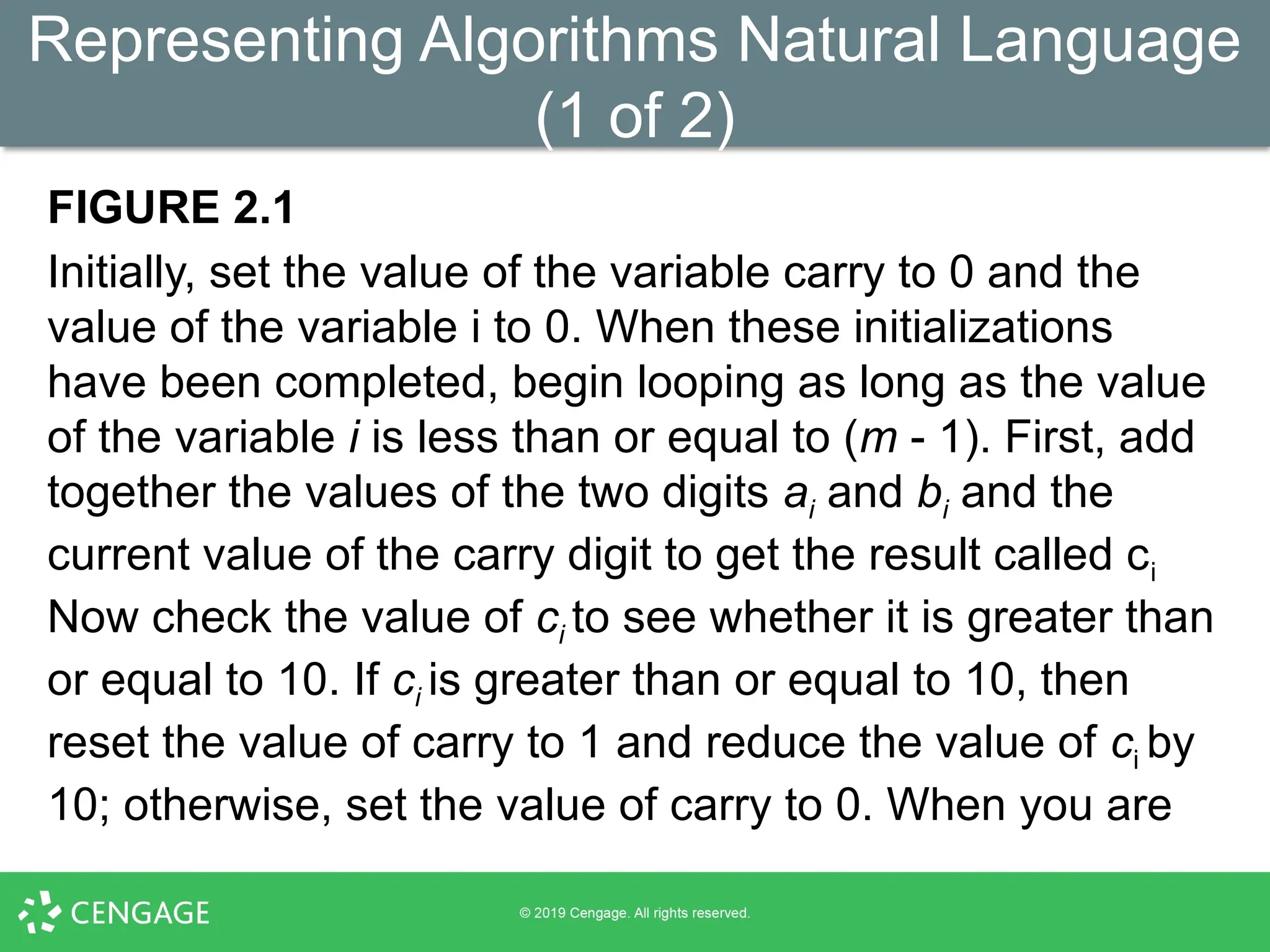
FIGURE 2.1
Initially, set the value of the variable carry to 0 and the
value of the variable i to 0. When these initializations
have been completed, begin looping as long as the value
of the variable i is less than or equal to (m - 1). First, add
together the values of the two digits ai and bi and the
current value of the carry digit to get the result called ci
Now check the value of ci to see whether it is greater than
or equal to 10. If ci is greater than or equal to 10, then
reset the value of carry to 1 and reduce the value of ci by
10; otherwise, set the value of carry to 0. When you are
7.
Representing Algorithms NaturalLanguage
(2 of 2)
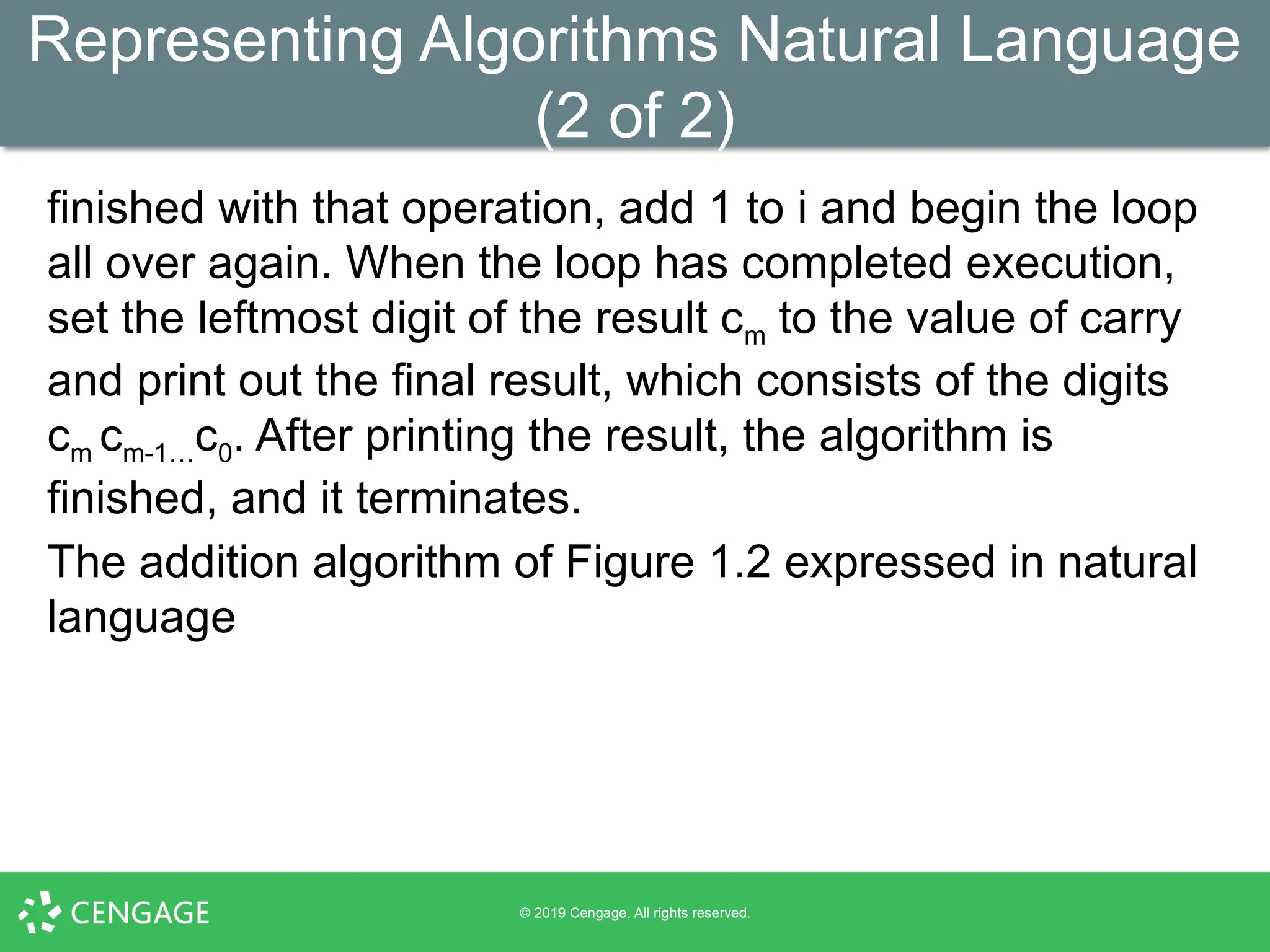
finished with that operation, add 1 to i and begin the loop
all over again. When the loop has completed execution,
set the leftmost digit of the result cm to the value of carry
and print out the final result, which consists of the digits
cm cm-1…c0. After printing the result, the algorithm is
finished, and it terminates.
The addition algorithm of Figure 1.2 expressed in natural
language
Representing Algorithms (2of 5)
• Sequential operations perform a single task
• The three basic sequential operations:
– Computation: a single numeric calculation
– Input: gets data values from outside the algorithm
– Output: sends data values to the outside world
• A sequential algorithm is made up only of sequential
operations
• A variable is a named storage location to hold a data
value
• Example: computing average miles per gallon
10.
Representing Algorithms Sequential
Algorithm
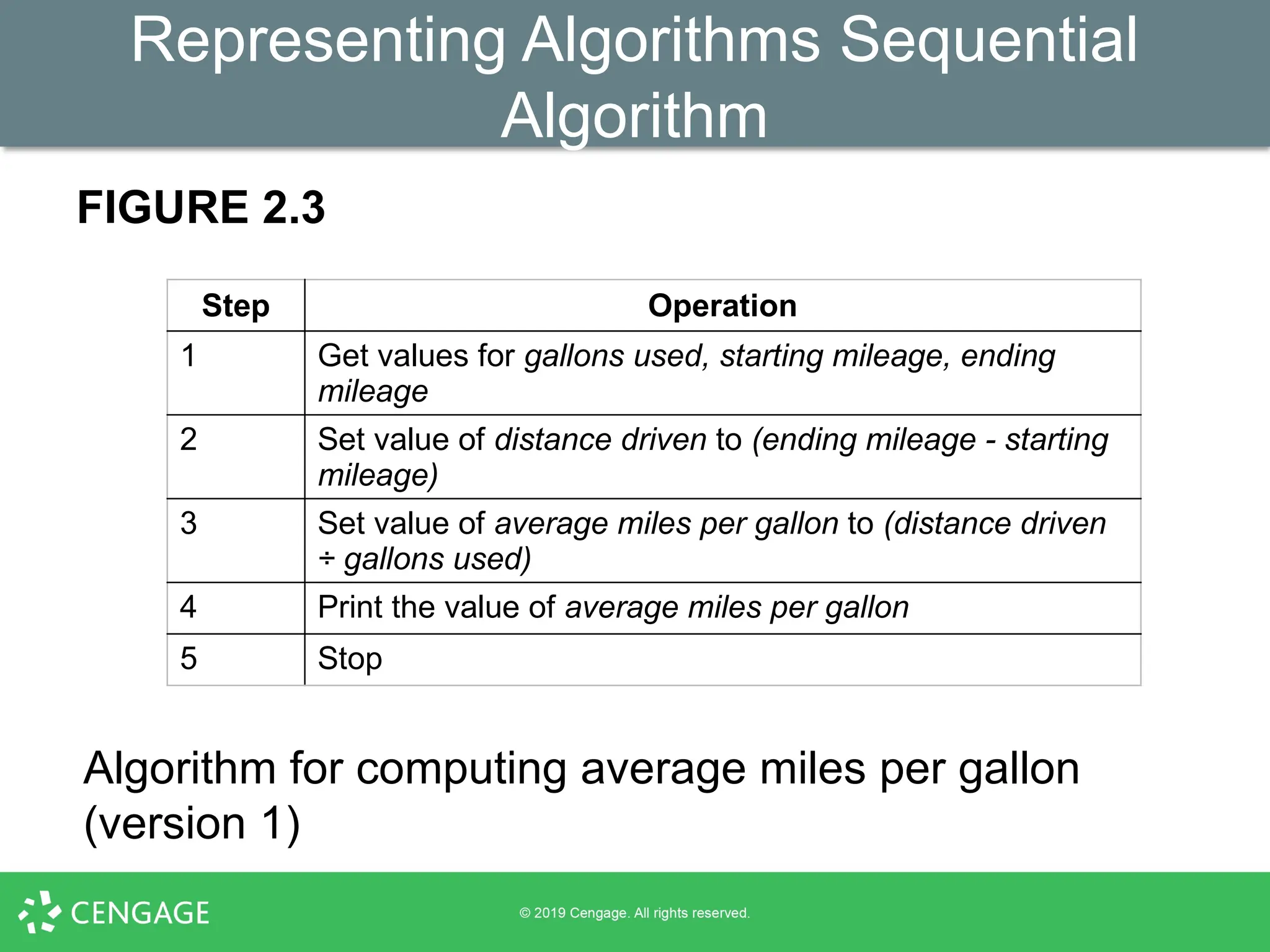
FIGURE2.3
Step Operation
1 Get values for gallons used, starting mileage, ending
mileage
2 Set value of distance driven to (ending mileage - starting
mileage)
3 Set value of average miles per gallon to (distance driven
÷ gallons used)
4 Print the value of average miles per gallon
5 Stop
Algorithm for computing average miles per gallon
(version 1)
11.
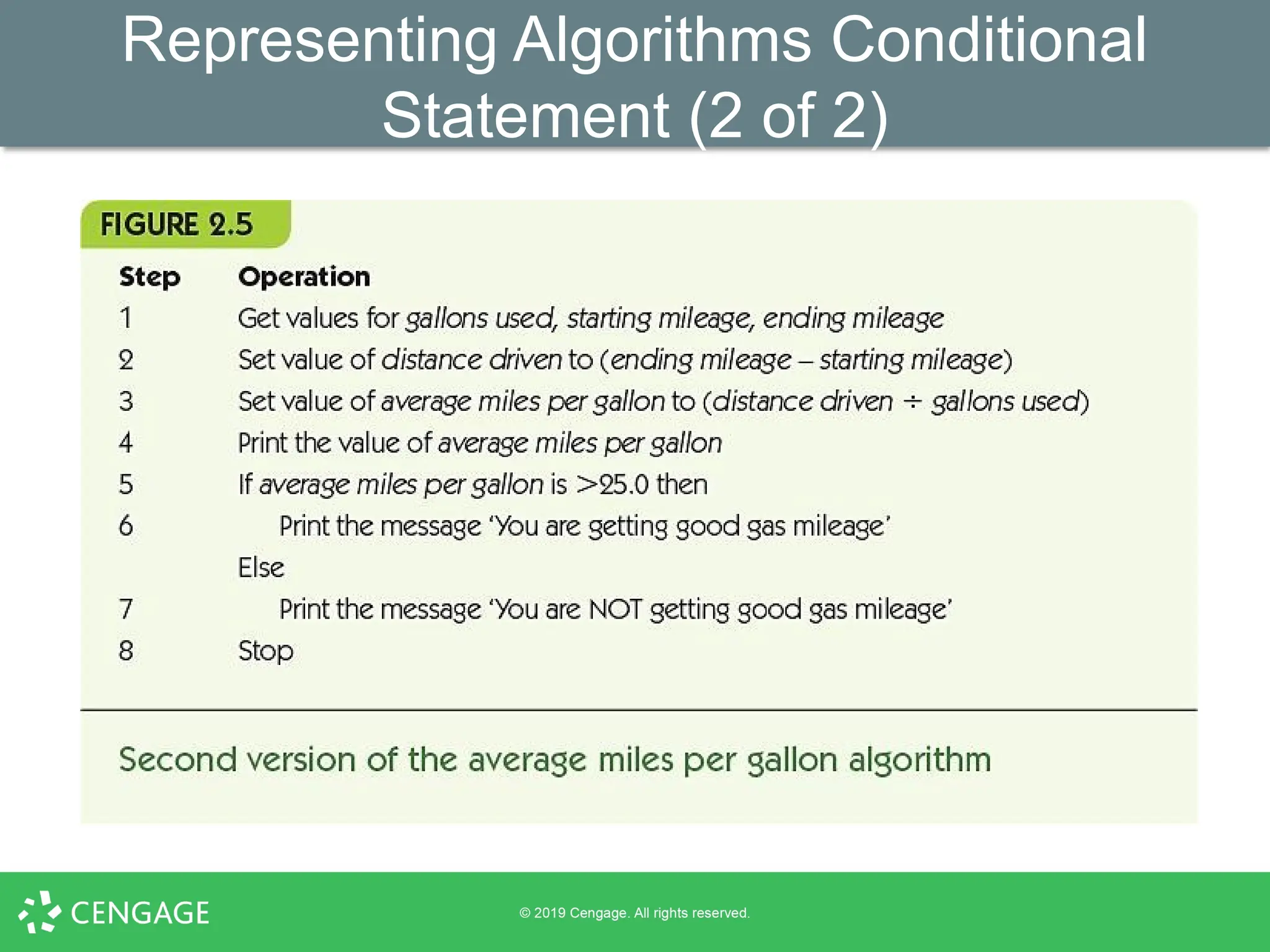
Representing Algorithms (3of 5)
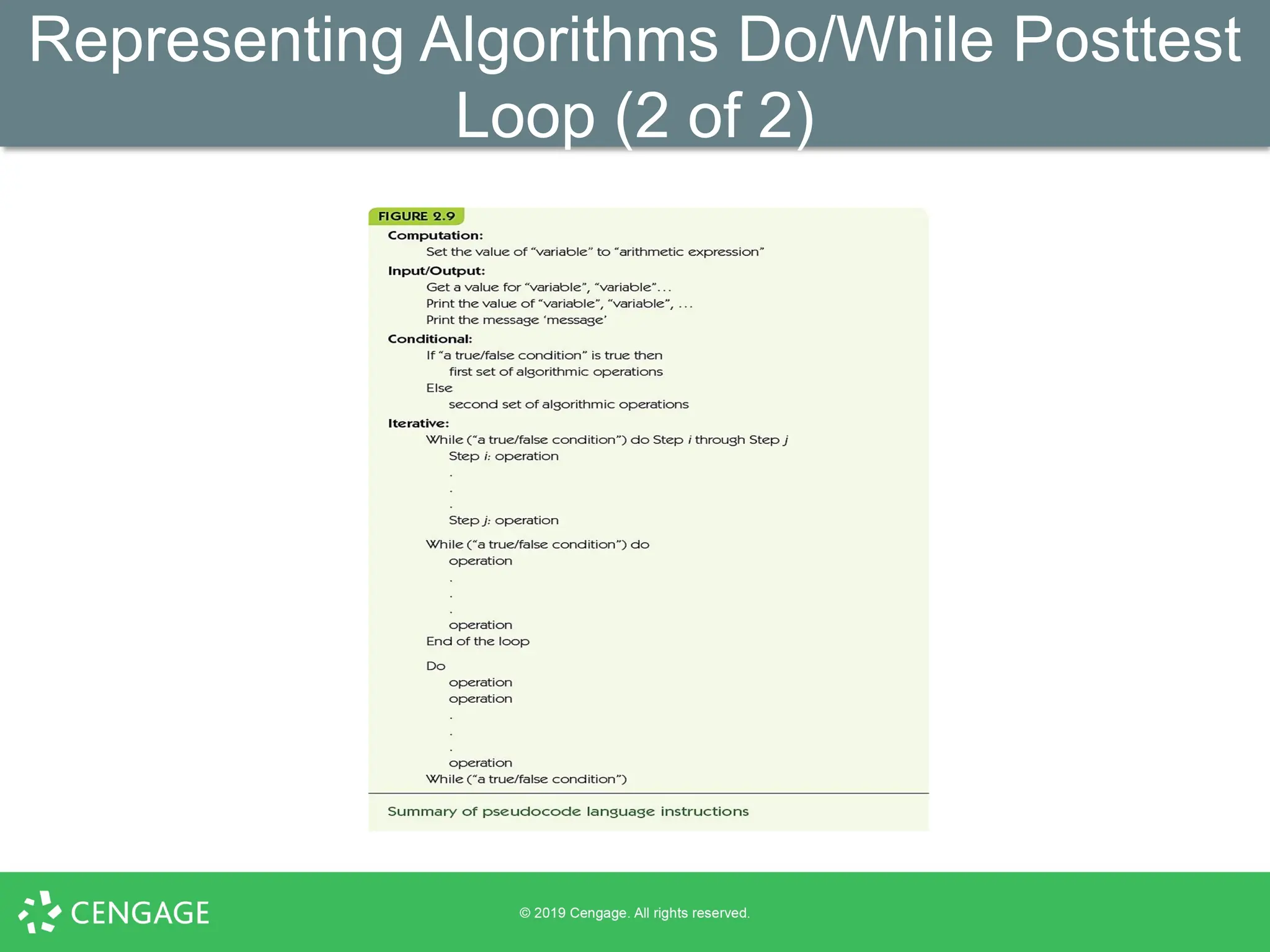
• Control operation: changes the normal flow of
control
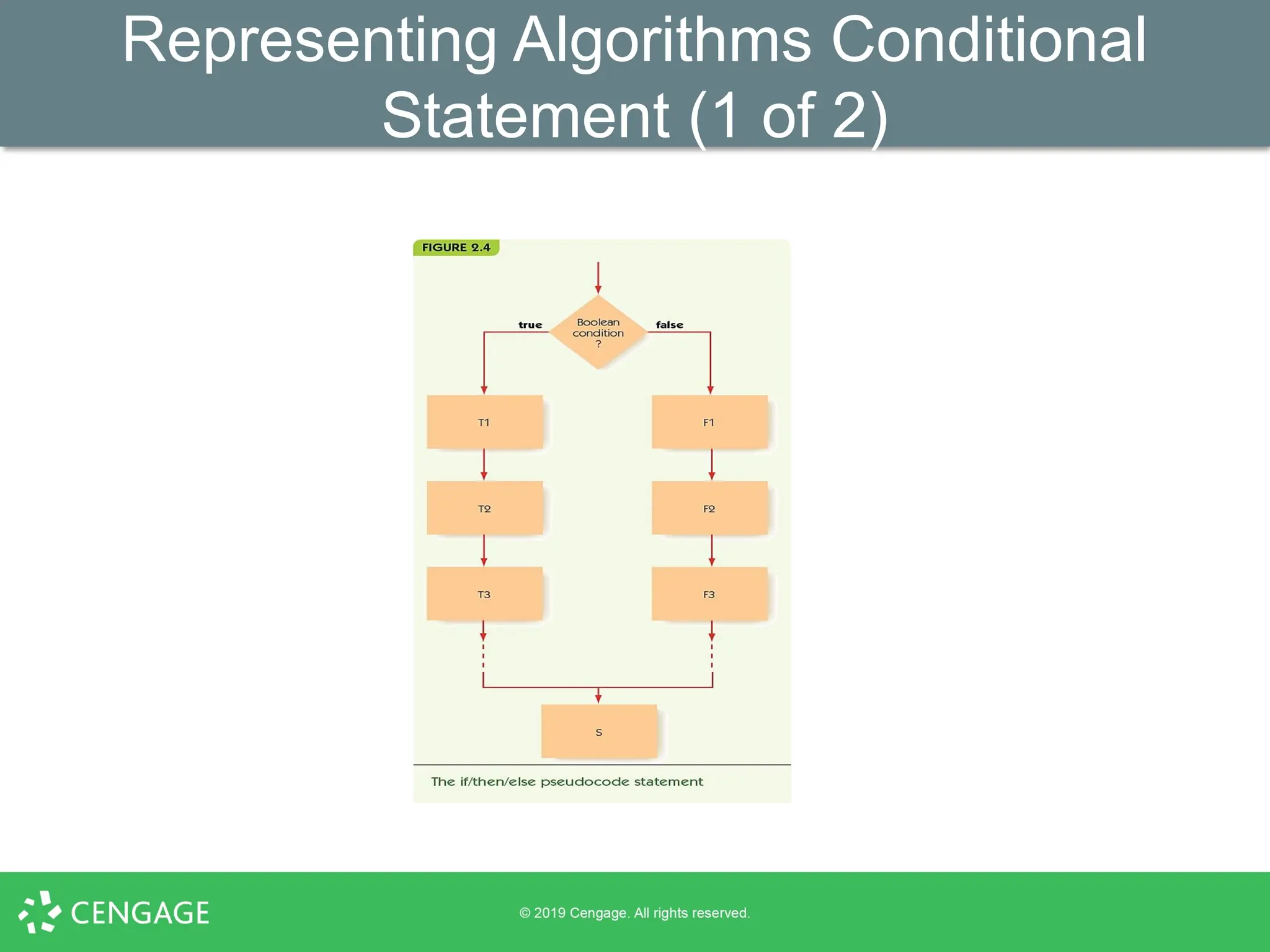
• Conditional statement: asks a question and selects
among alternative options:
1. Evaluate the true/false condition
2. If the condition is true, then do the first set of
operations and skip the second set
3. If the condition is false, skip the first set of
operations and do the second set
• Example: check for good or bad gas mileage
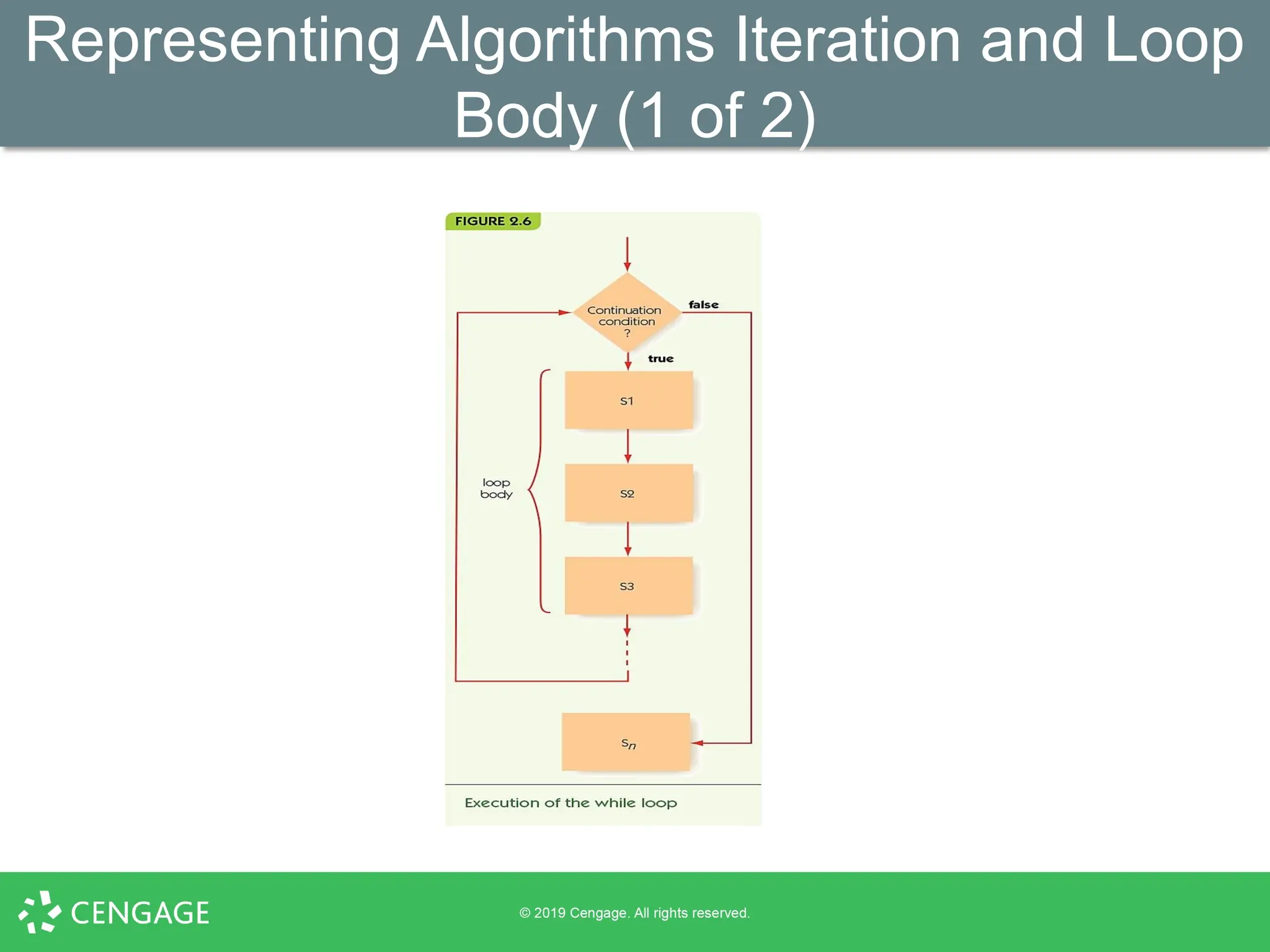
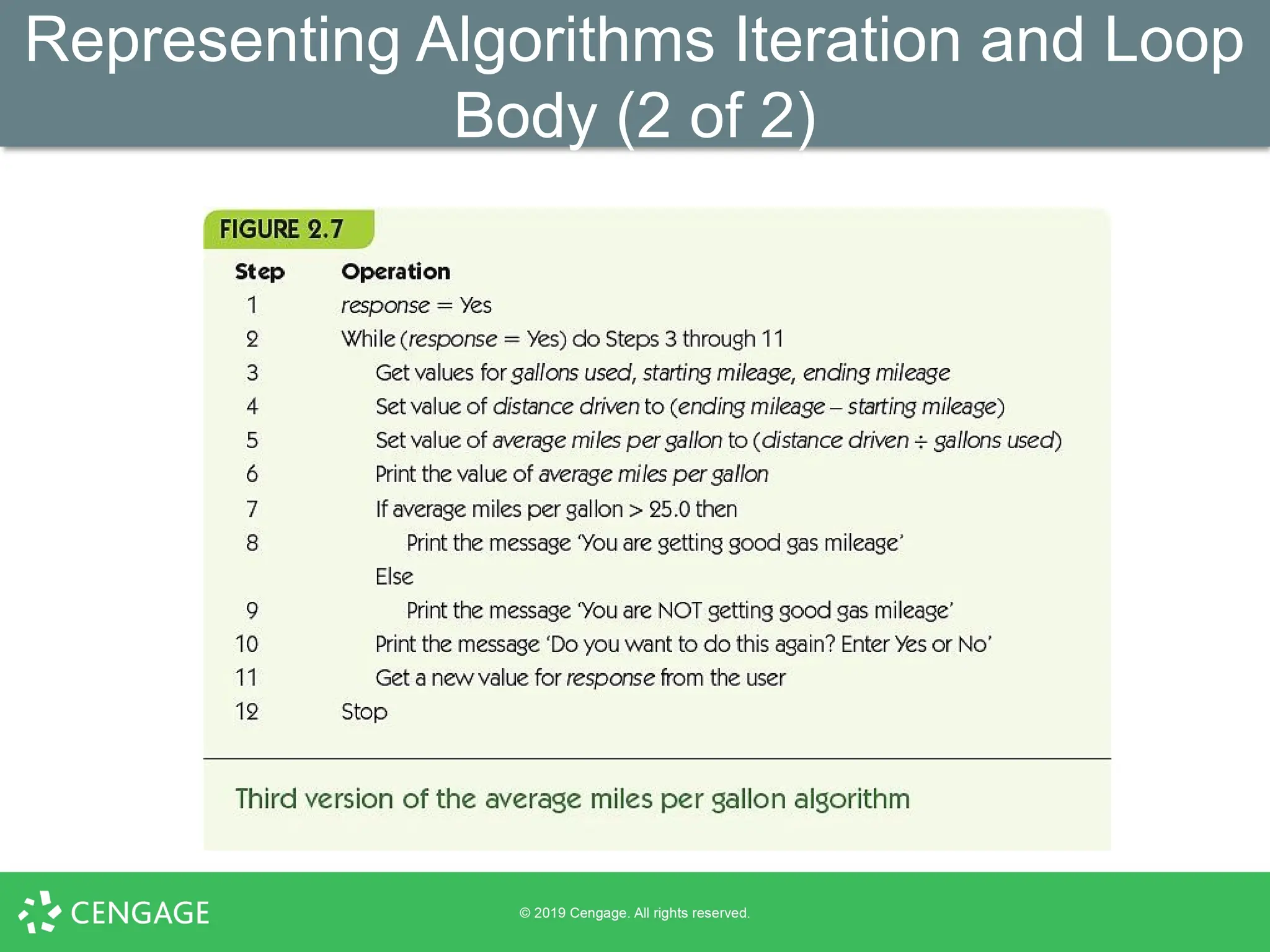
Representing Algorithms (4of 5)
• Iteration: an operation that causes looping, repeating
a block of instructions
• While statement repeats while a condition remains
true
– Continuation condition: a test to see if while loop
should continue
– Loop body: instructions to perform repeatedly
• Example: repeated mileage calculations
Representing Algorithms (5of 5)
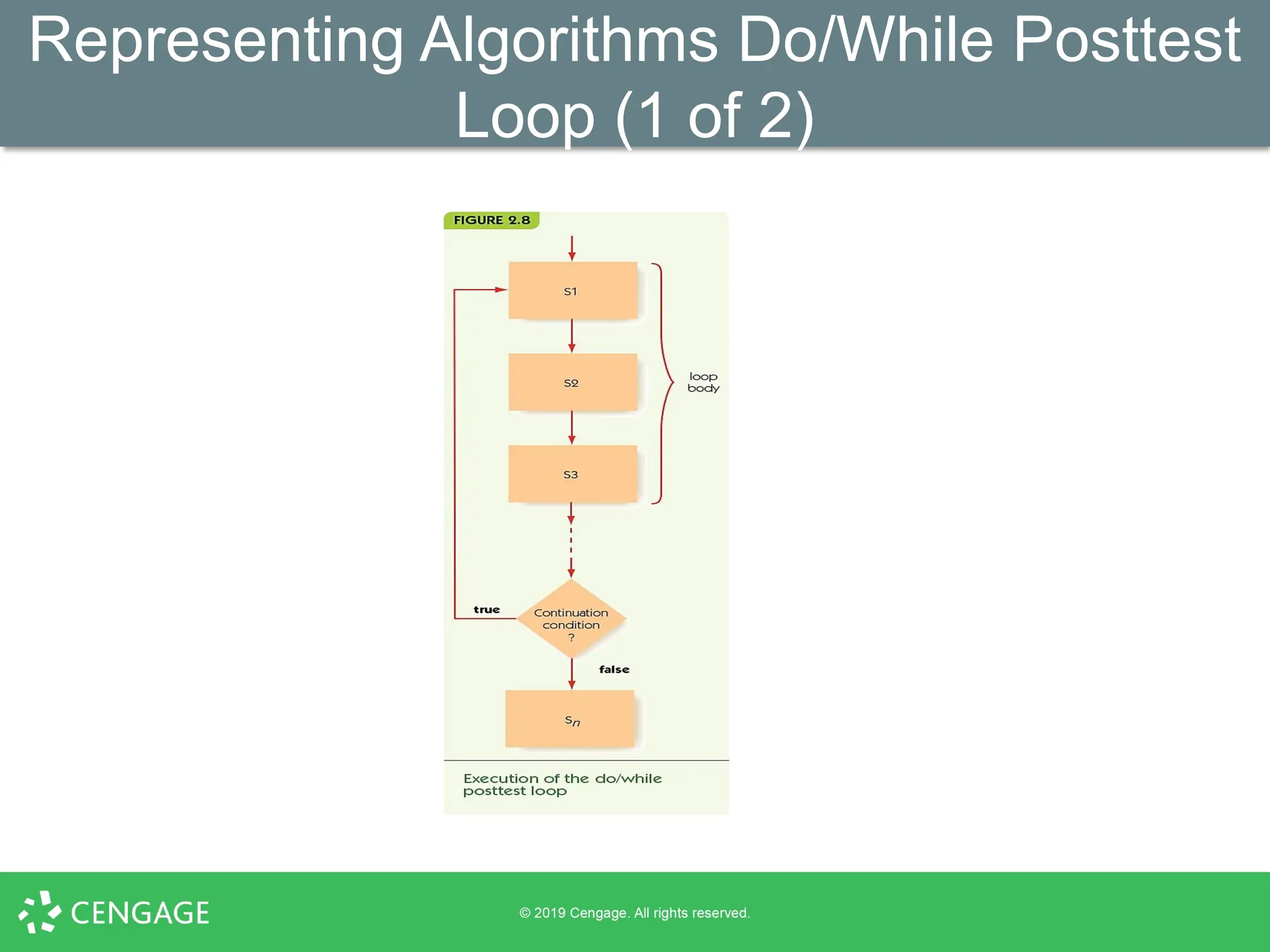
• Do/while, alternate iterative operation
– Continuation condition appears at the end
– Loop body always performed at least once
• Primitive operations: sequential, conditional, and
iterative are all that is needed
Examples of AlgorithmicProblem Solving
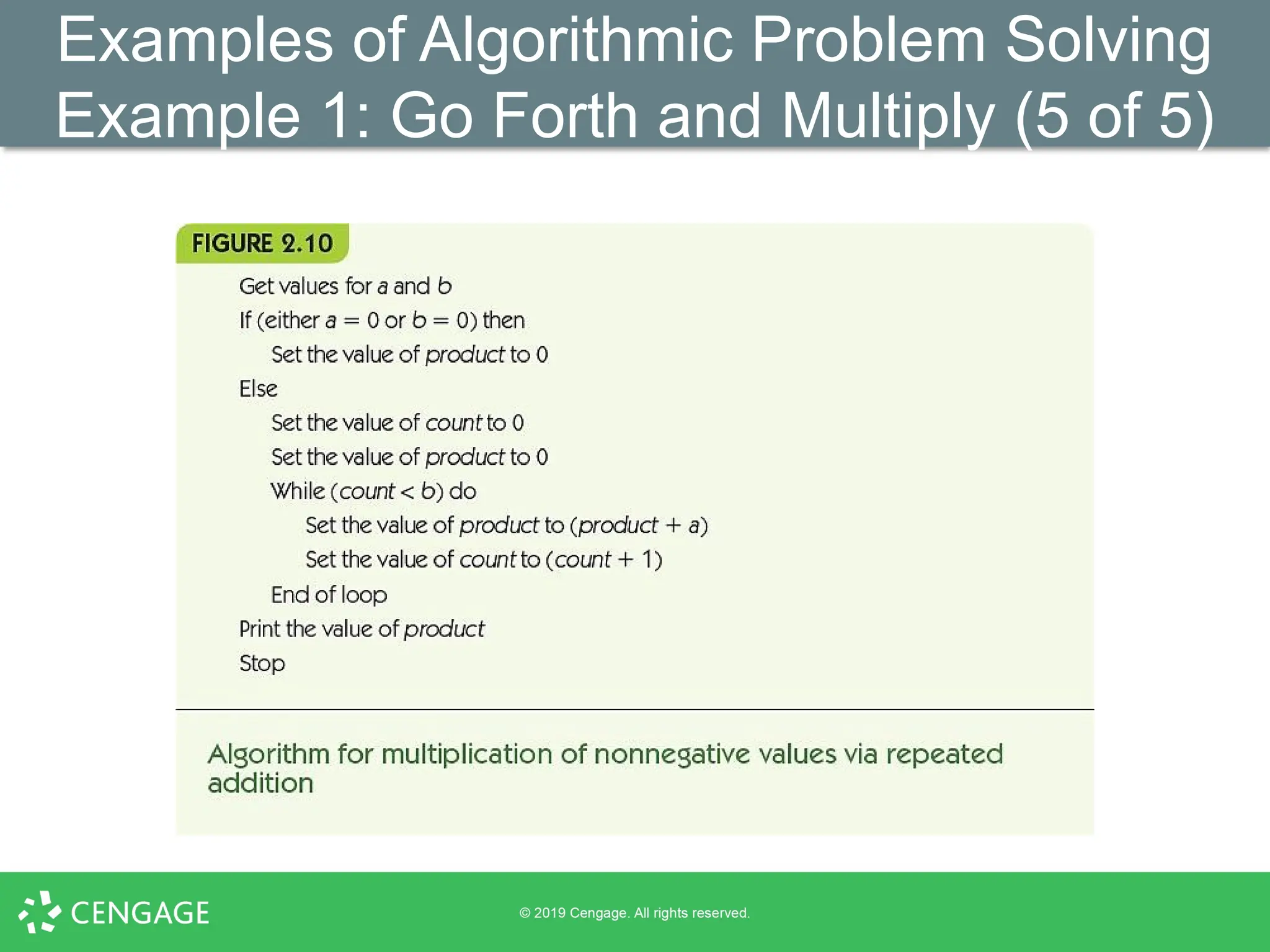
Example 1: Go Forth and Multiply (1 of 5)
Given two nonnegative integer values, a ≥ 0, b ≥ 0,
compute and output the product (a × b) using the
technique of repeated addition. That is, determine the
value of the sum a + a + a + … + a (b times).
21.
Examples of AlgorithmicProblem Solving
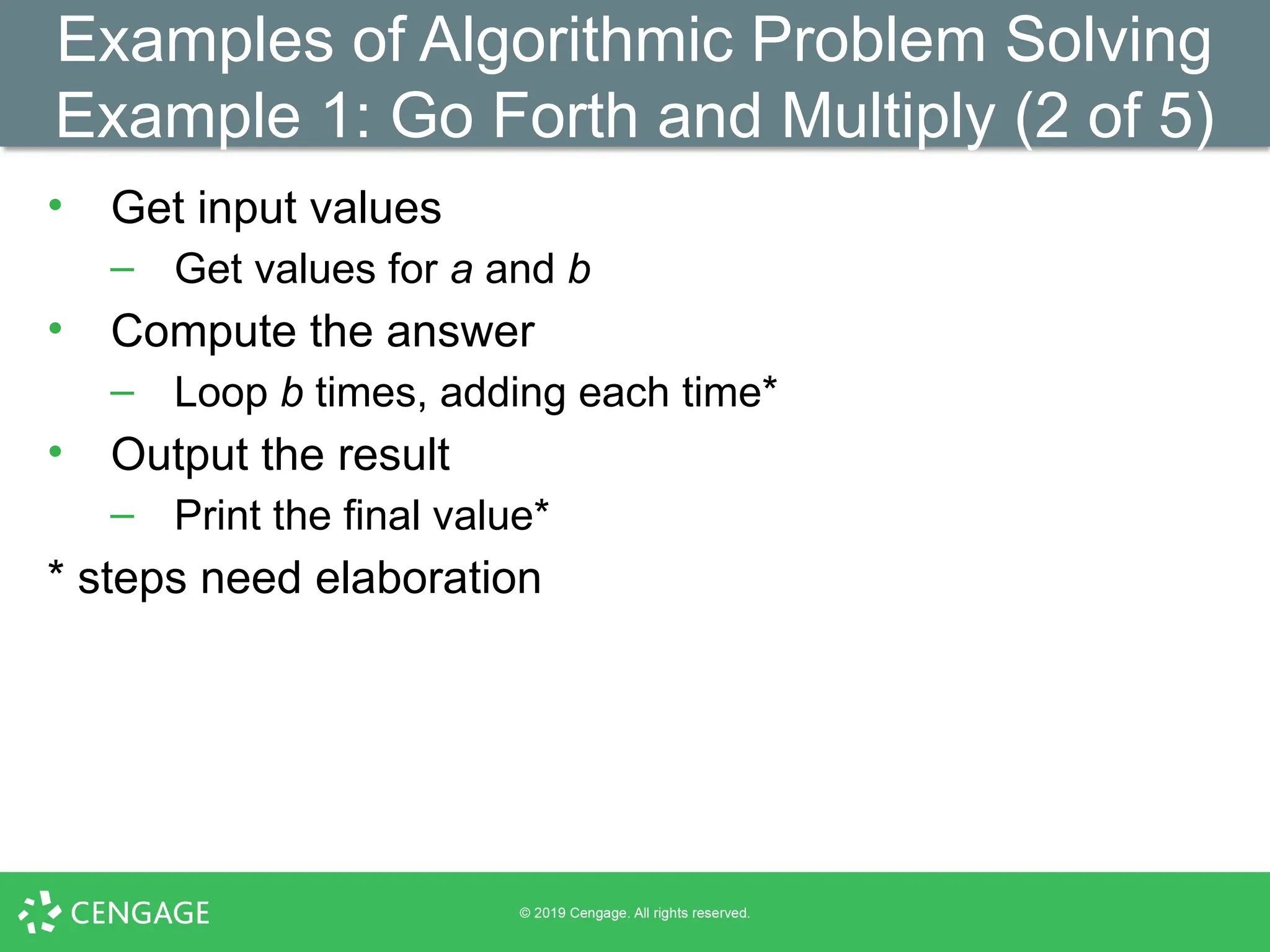
Example 1: Go Forth and Multiply (2 of 5)
• Get input values
– Get values for a and b
• Compute the answer
– Loop b times, adding each time*
• Output the result
– Print the final value*
* steps need elaboration
22.
Examples of AlgorithmicProblem Solving
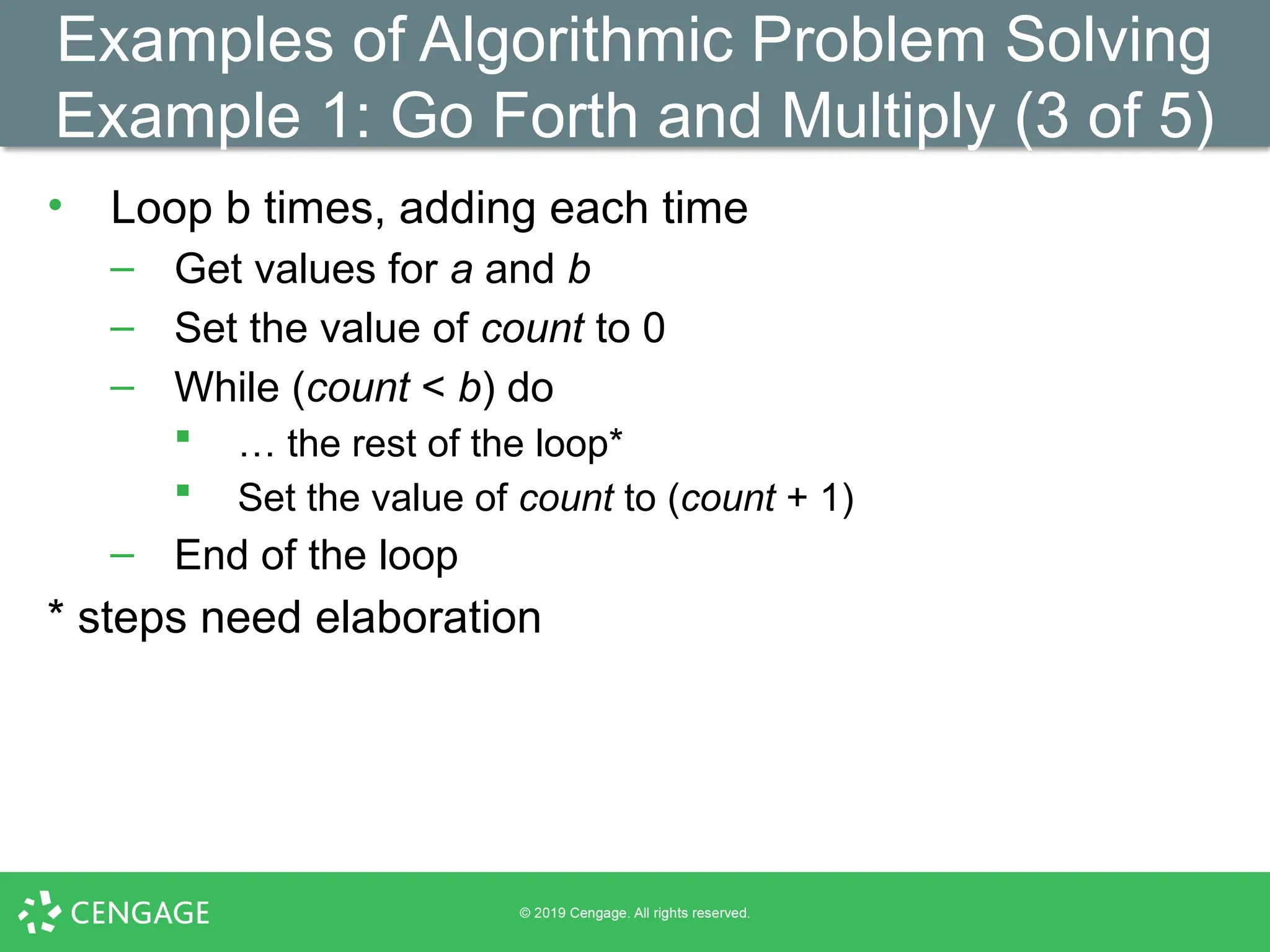
Example 1: Go Forth and Multiply (3 of 5)
• Loop b times, adding each time
– Get values for a and b
– Set the value of count to 0
– While (count < b) do
… the rest of the loop*
Set the value of count to (count + 1)
– End of the loop
* steps need elaboration
23.
Examples of AlgorithmicProblem Solving
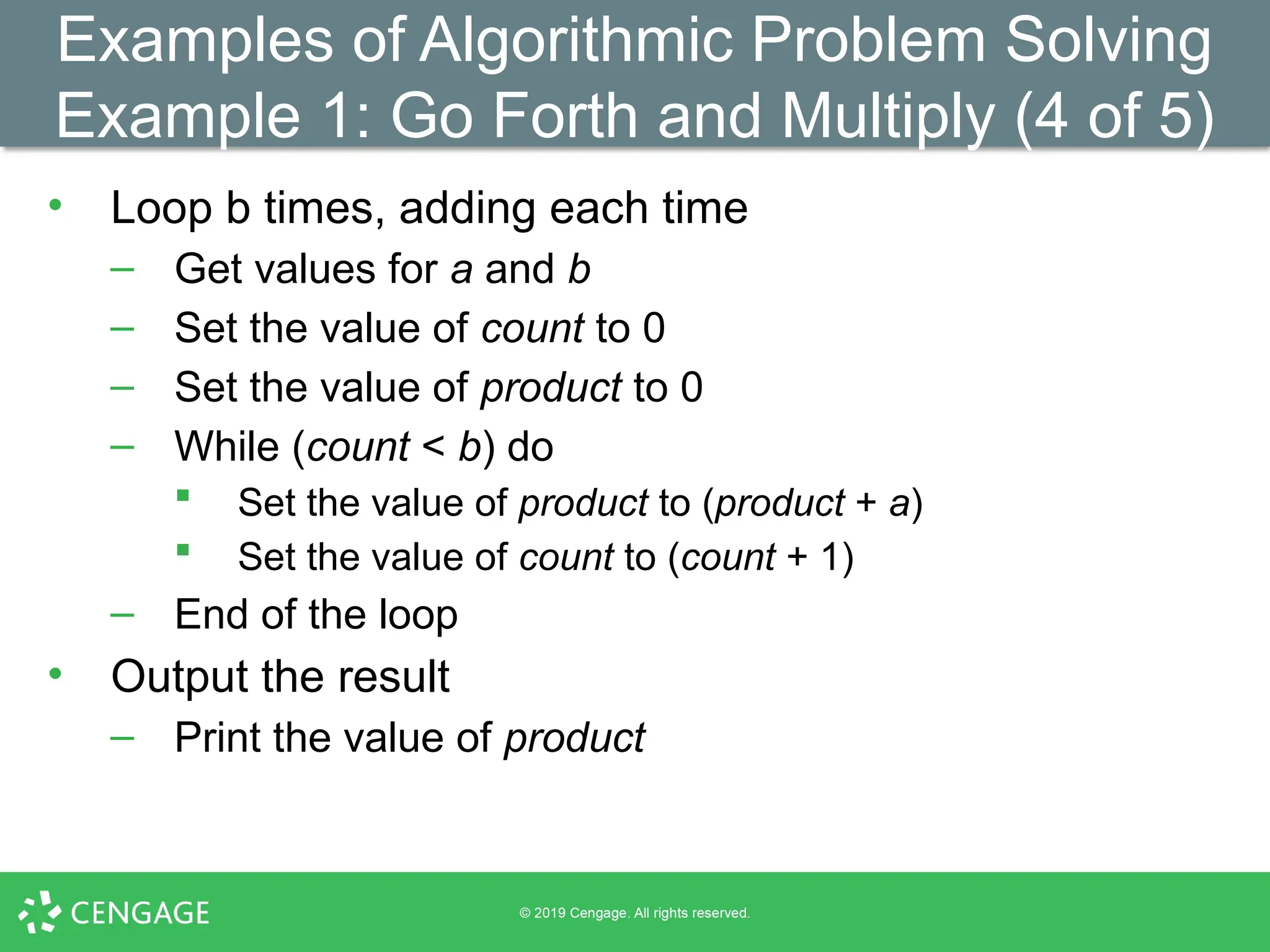
Example 1: Go Forth and Multiply (4 of 5)
• Loop b times, adding each time
– Get values for a and b
– Set the value of count to 0
– Set the value of product to 0
– While (count < b) do
Set the value of product to (product + a)
Set the value of count to (count + 1)
– End of the loop
• Output the result
– Print the value of product
Examples of AlgorithmicProblem Solving
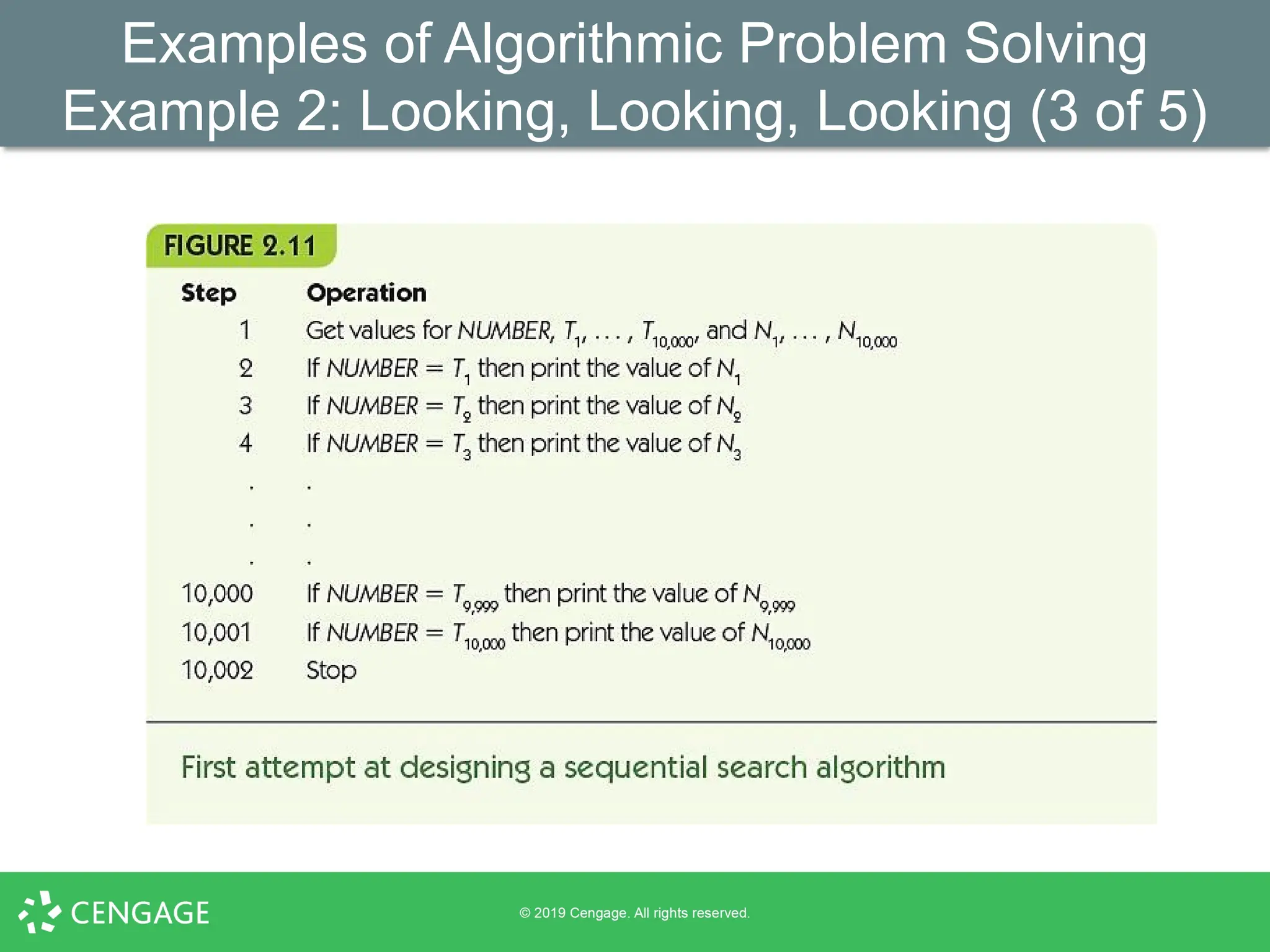
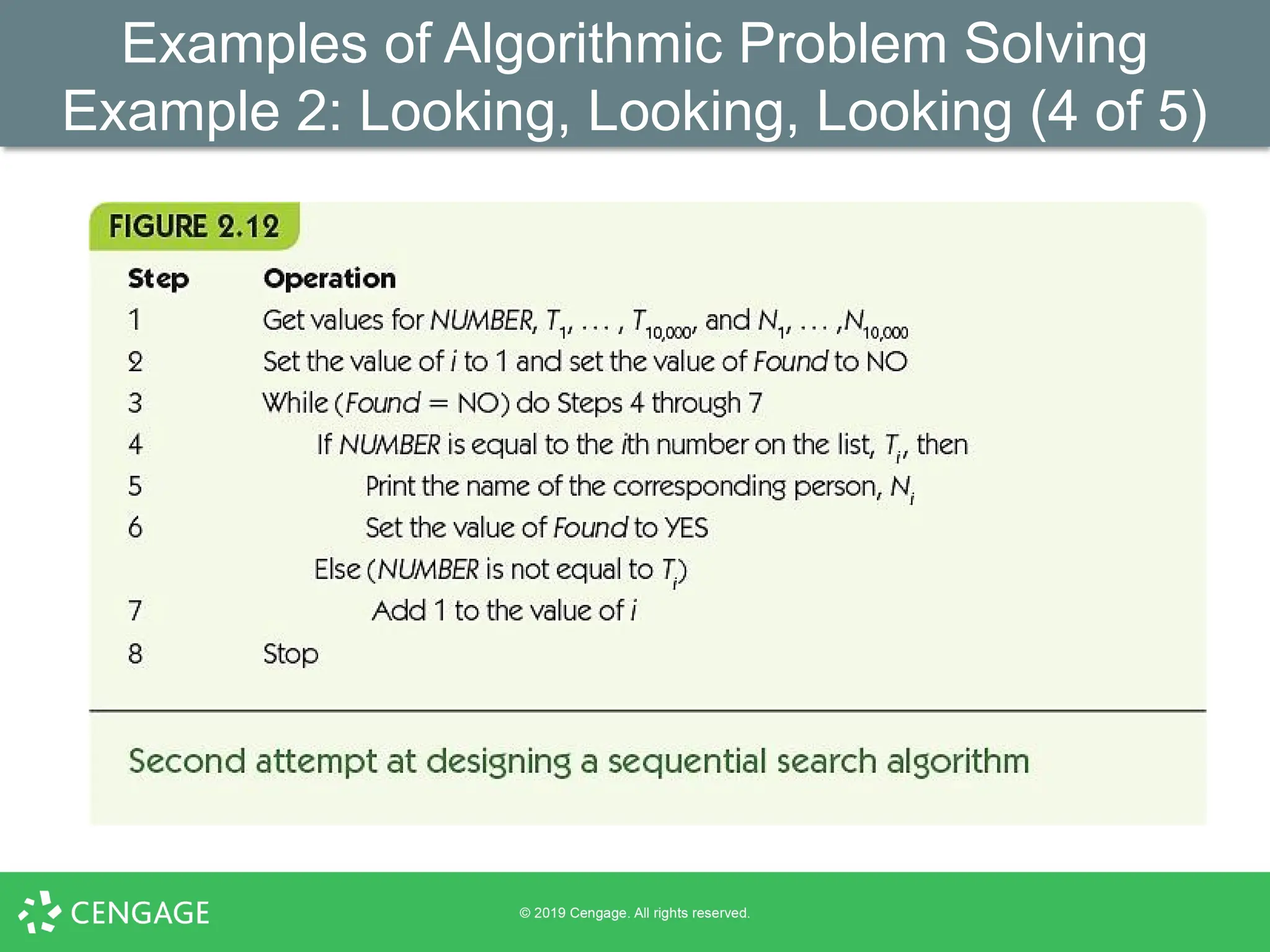
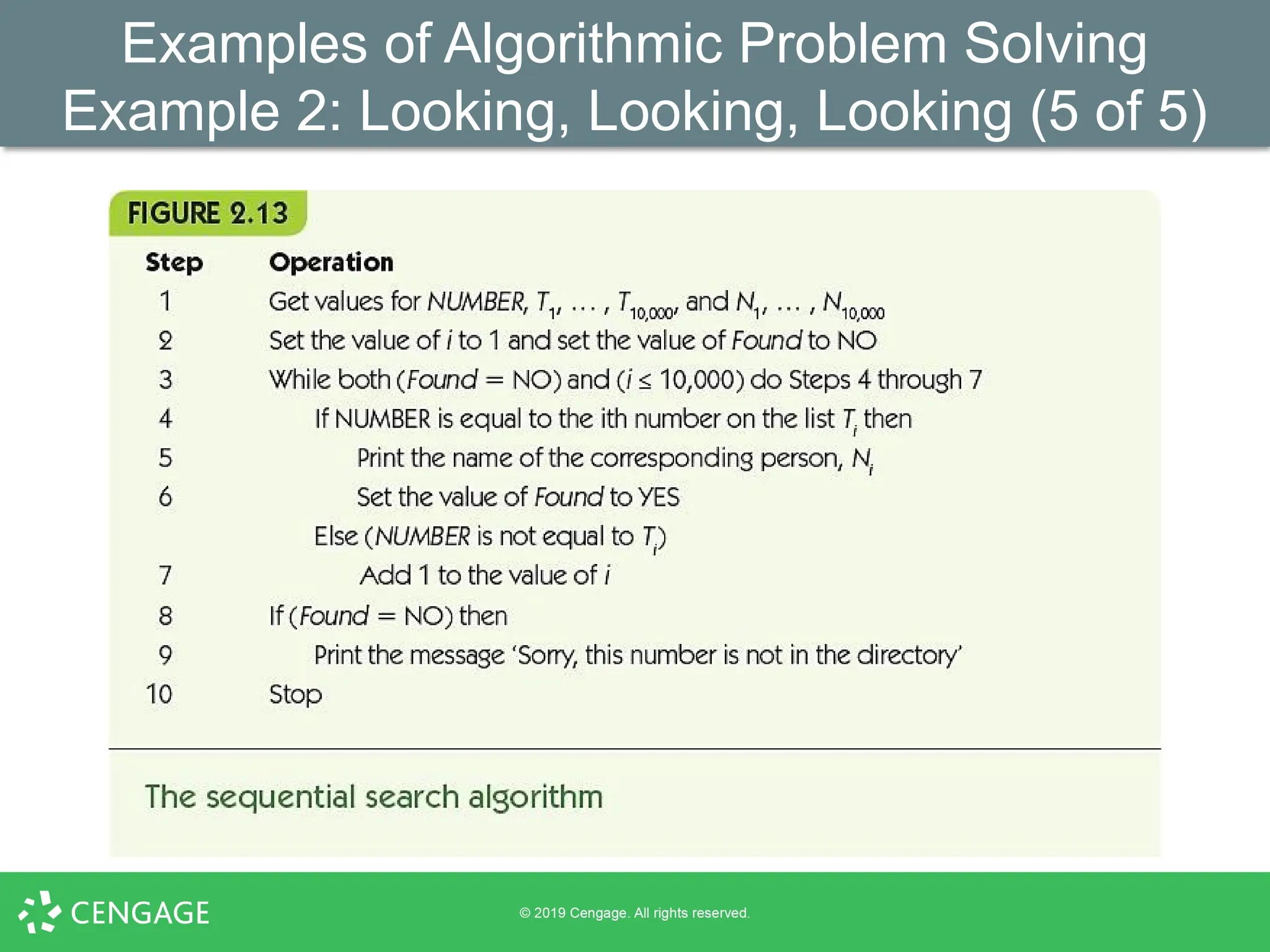
Example 2: Looking, Looking, Looking (1 of 5)
Assume that we have a list of 10,000 names that we
define as N1, N2, N3, … , N10,000, along with the 10,000
telephone numbers of those individuals, denoted as T1,
T2, T3, … , T10,000. To simplify the problem, we initially
assume that all names in the book are unique and that
the names need not be in alphabetical order.
26.
Examples of AlgorithmicProblem Solving
Example 2: Looking, Looking, Looking (2 of 5)
• Three versions here illustrate algorithm discovery,
working toward a correct, efficient solution:
– A sequential algorithm (no loops or conditionals)
– An incomplete iterative algorithm
– A correct algorithm
Examples of AlgorithmicProblem Solving
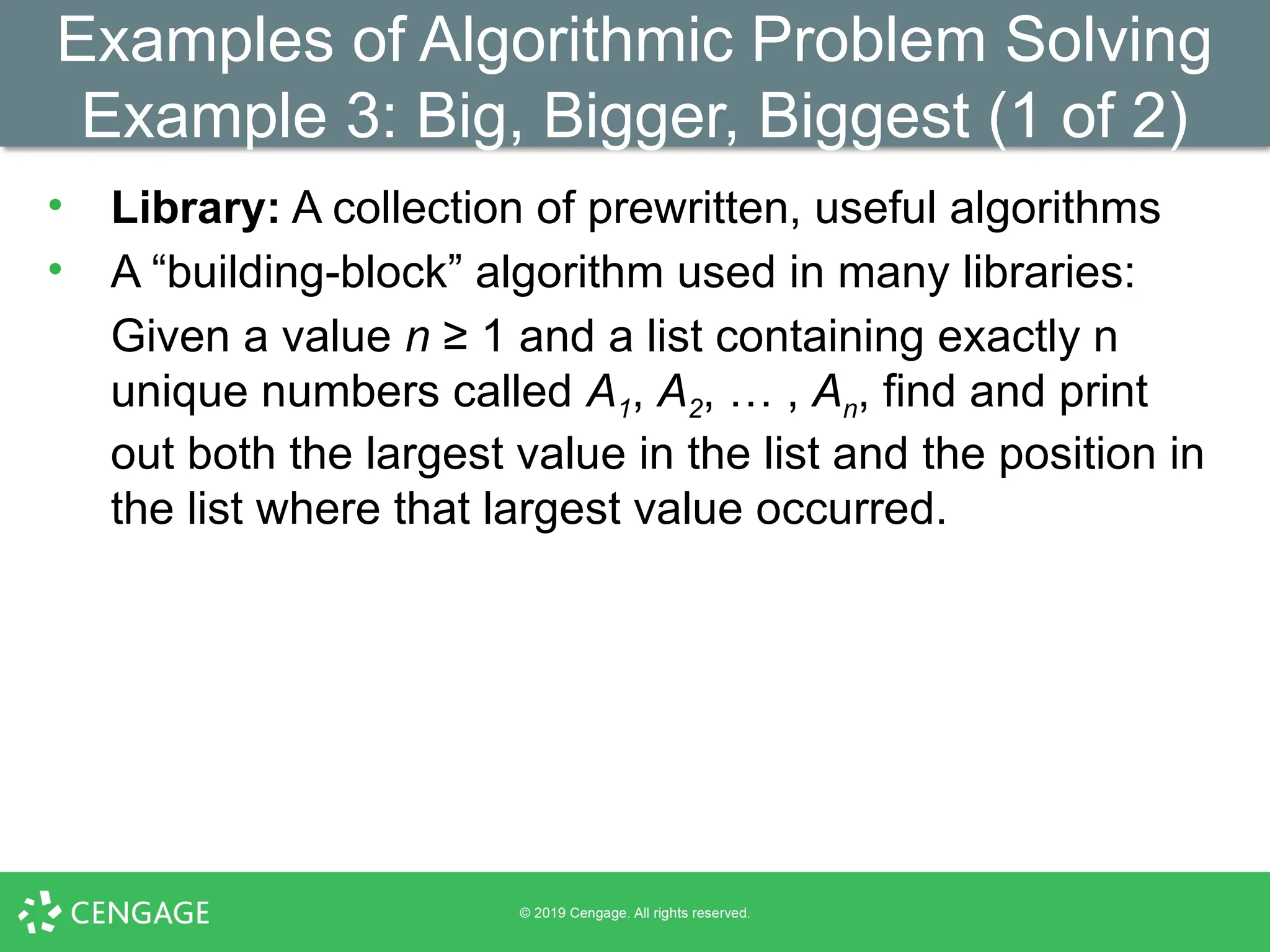
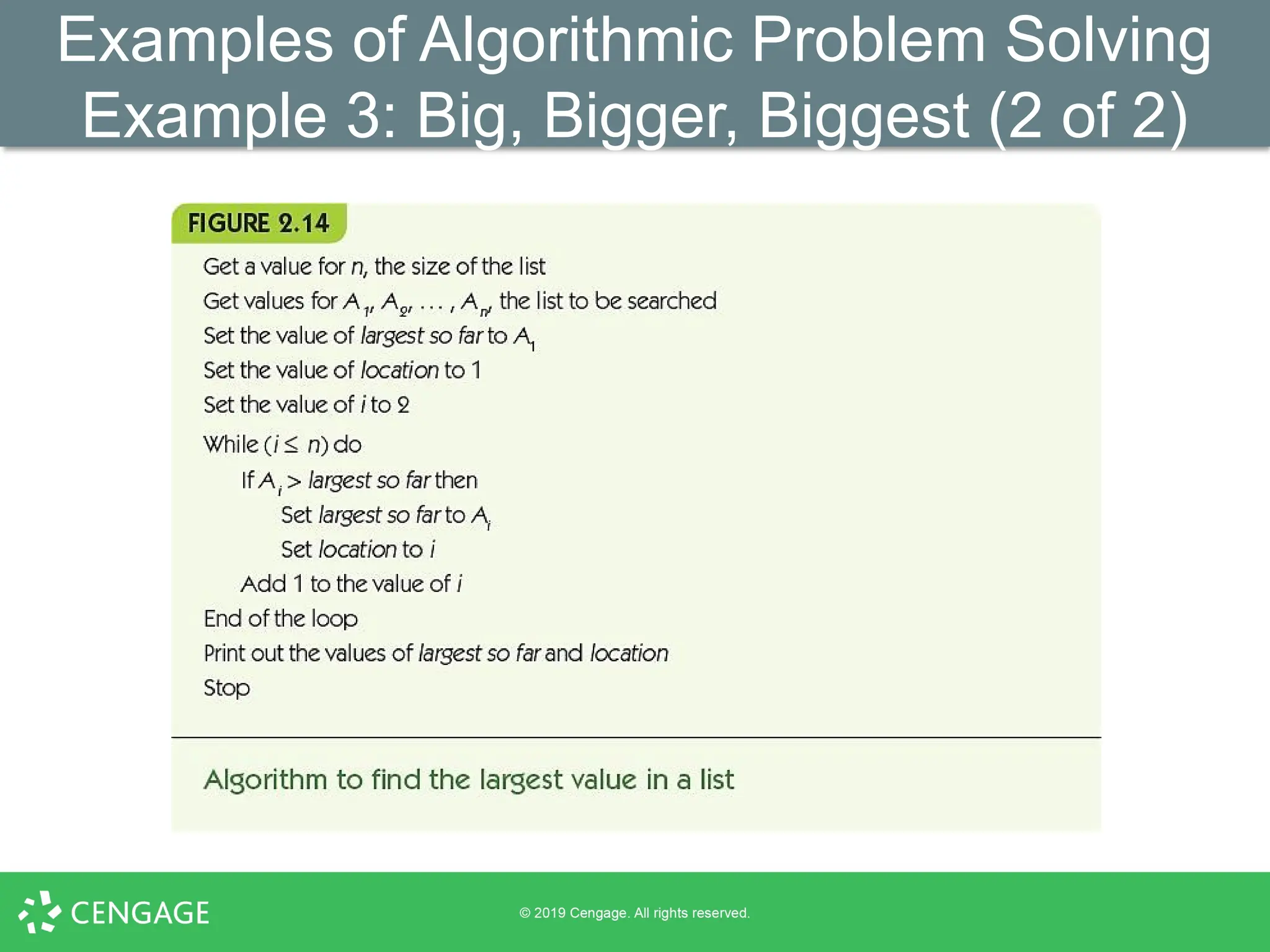
Example 3: Big, Bigger, Biggest (1 of 2)
• Library: A collection of prewritten, useful algorithms
• A “building-block” algorithm used in many libraries:
Given a value n ≥ 1 and a list containing exactly n
unique numbers called A1, A2, … , An, find and print
out both the largest value in the list and the position in
the list where that largest value occurred.
Examples of AlgorithmicProblem Solving
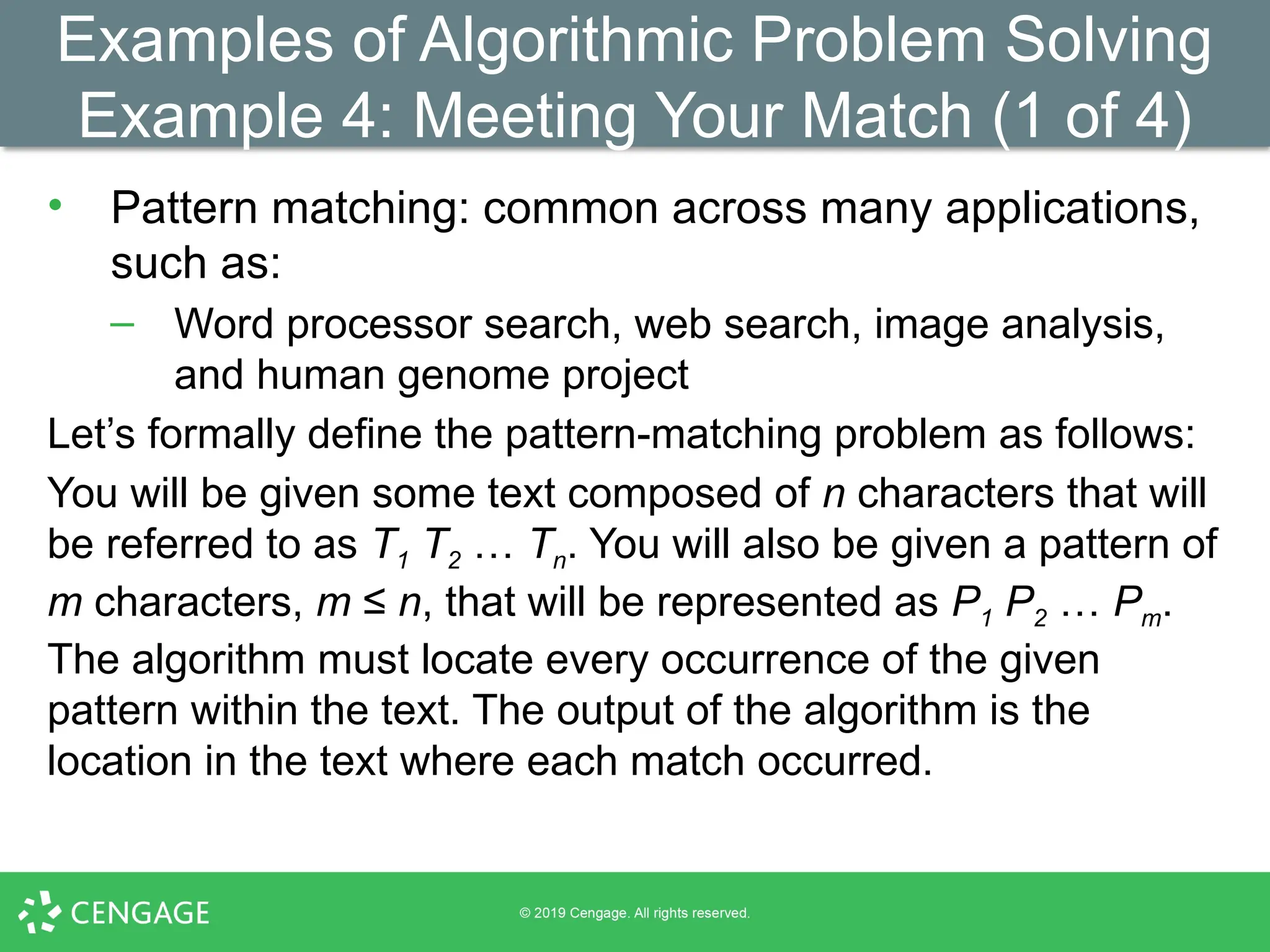
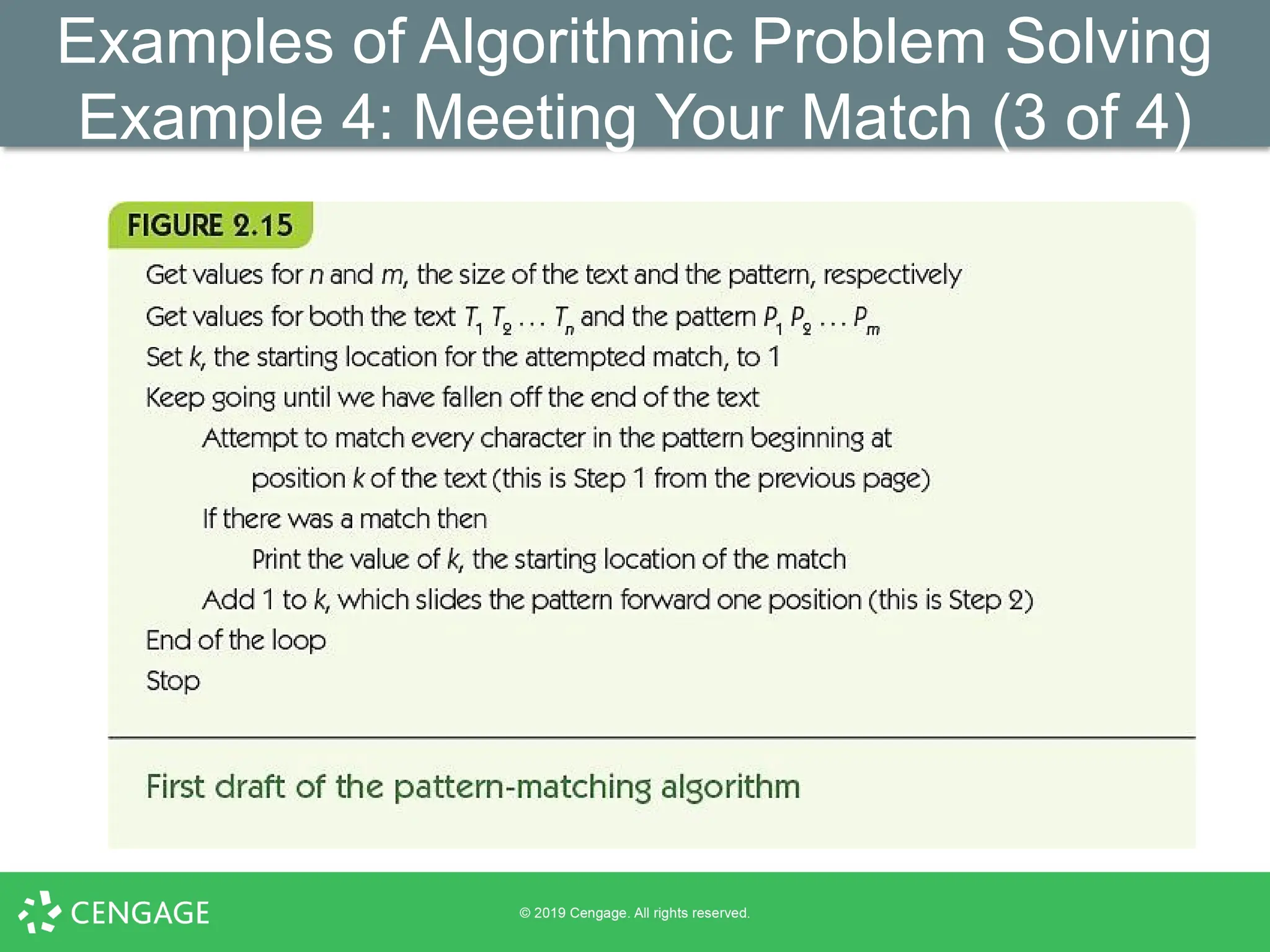
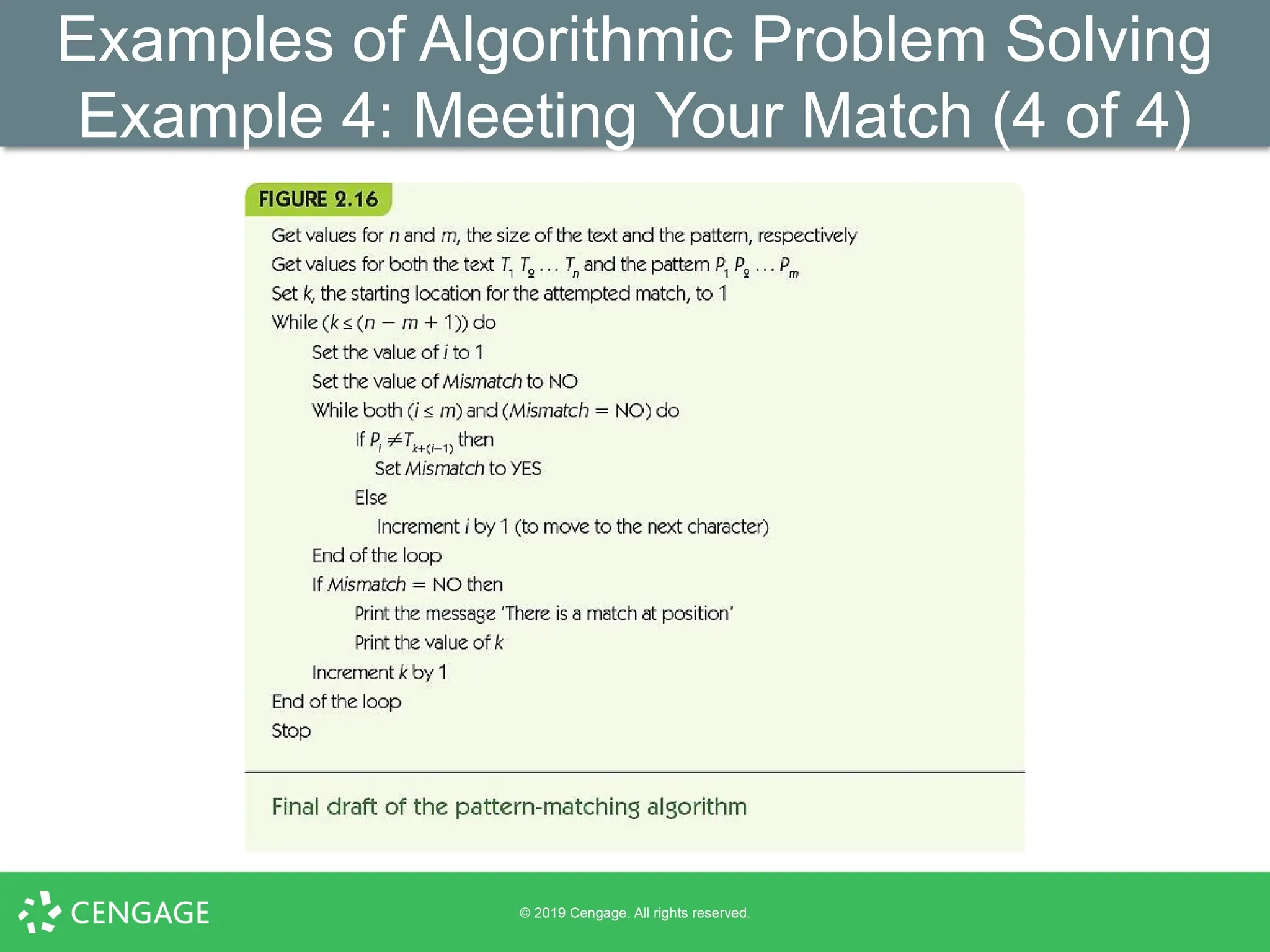
Example 4: Meeting Your Match (1 of 4)
• Pattern matching: common across many applications,
such as:
– Word processor search, web search, image analysis,
and human genome project
Let’s formally define the pattern-matching problem as follows:
You will be given some text composed of n characters that will
be referred to as T1 T2 … Tn. You will also be given a pattern of
m characters, m ≤ n, that will be represented as P1 P2 … Pm.
The algorithm must locate every occurrence of the given
pattern within the text. The output of the algorithm is the
location in the text where each match occurred.
33.
Examples of AlgorithmicProblem Solving
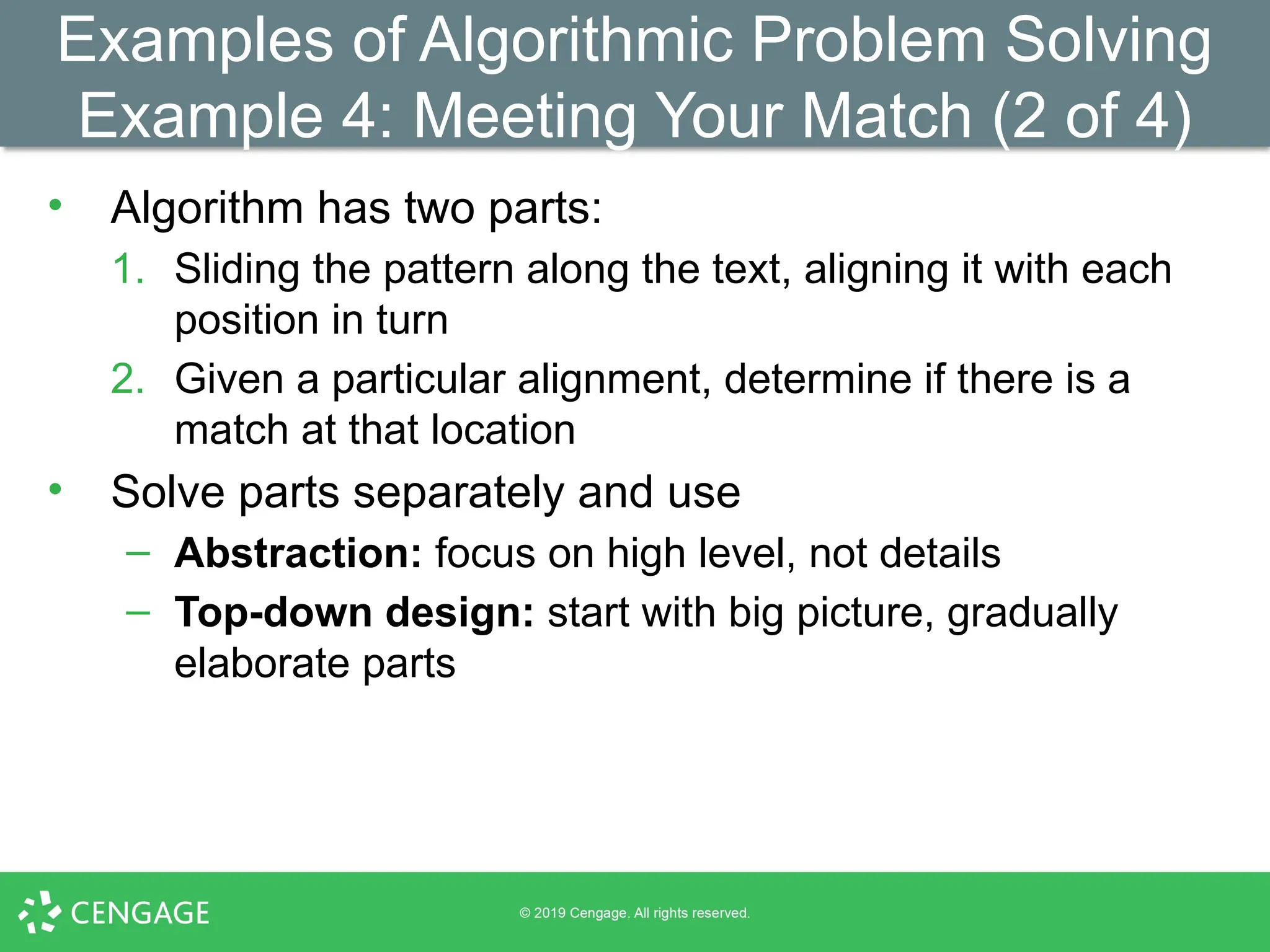
Example 4: Meeting Your Match (2 of 4)
• Algorithm has two parts:
1. Sliding the pattern along the text, aligning it with each
position in turn
2. Given a particular alignment, determine if there is a
match at that location
• Solve parts separately and use
– Abstraction: focus on high level, not details
– Top-down design: start with big picture, gradually
elaborate parts
Summary
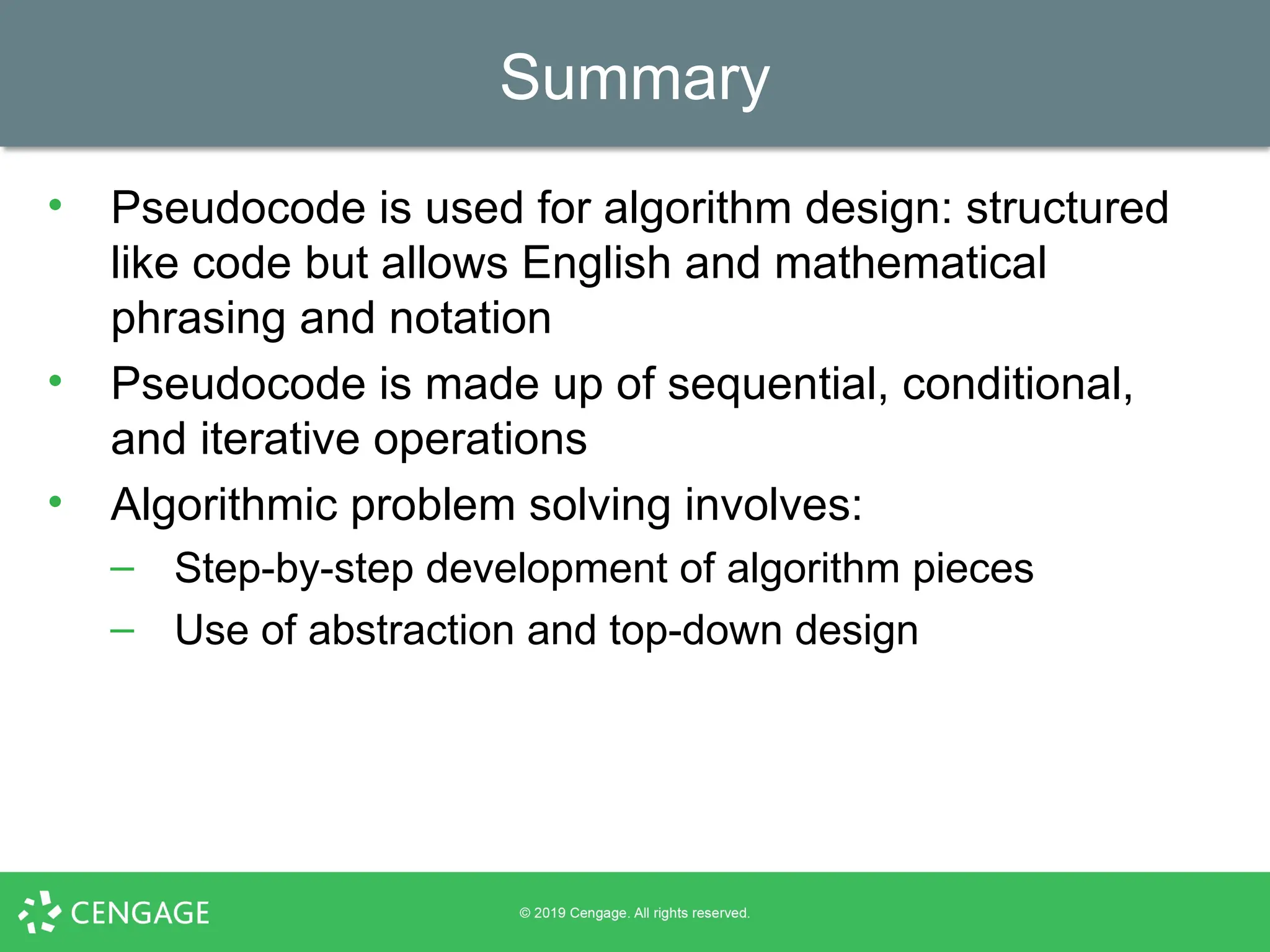
• Pseudocode isused for algorithm design: structured
like code but allows English and mathematical
phrasing and notation
• Pseudocode is made up of sequential, conditional,
and iterative operations
• Algorithmic problem solving involves:
– Step-by-step development of algorithm pieces
– Use of abstraction and top-down design


![Vibe Coding vs. Spec-Driven Development [Free Meetup]](https://cdn.slidesharecdn.com/ss_thumbnails/vibecodingvsspecdrivendevelopment-251209105622-43f455e7-thumbnail.jpg?width=640&height=640&fit=bounds)


