© 2002 Prentice Hall Business Publishing© 2002 Prentice Hall Business Publishing Principles of Economics, 6/ePrinciples of Economics, 6/e Karl Case, Ray FairKarl Case, Ray Fair
CHAPTERCHAPTER 22
Prepared by: FernandoPrepared by: Fernando
Quijano and Yvonn QuijanoQuijano and Yvonn Quijano
The Economic Problem:The Economic Problem:
Scarcity and ChoiceScarcity and Choice
© 2002 Prentice Hall Business Publishing© 2002 Prentice Hall Business Publishing Principles of Economics, 6/ePrinciples of Economics, 6/e Karl Case, Ray FairKarl Case, Ray Fair
What is Production?What is Production?
• ProductionProduction is the process by which resourcesis the process by which resources
are transformed into useful forms.are transformed into useful forms.
• ResourcesResources, or, or inputsinputs, refer to anything, refer to anything
provided by nature or previous generationsprovided by nature or previous generations
that can be used directly or indirectly to satisfythat can be used directly or indirectly to satisfy
human wants.human wants.
• Capital resourcesCapital resources
• Human resourcesHuman resources
• Natural resourcesNatural resources
© 2002 Prentice Hall Business Publishing© 2002 Prentice Hall Business Publishing Principles of Economics, 6/ePrinciples of Economics, 6/e Karl Case, Ray FairKarl Case, Ray Fair
Three Basic QuestionsThree Basic Questions
• The mechanics of decision making in a larger economyThe mechanics of decision making in a larger economy
are more complex, but the type of decisions that mustare more complex, but the type of decisions that must
be made are nearly identical.be made are nearly identical.
• All societies must decide:All societies must decide:
• WhatWhat will be produced?will be produced?
• HowHow will it be produced?will it be produced?
• WhoWho will get what is produced?will get what is produced?
© 2002 Prentice Hall Business Publishing© 2002 Prentice Hall Business Publishing Principles of Economics, 6/ePrinciples of Economics, 6/e Karl Case, Ray FairKarl Case, Ray Fair
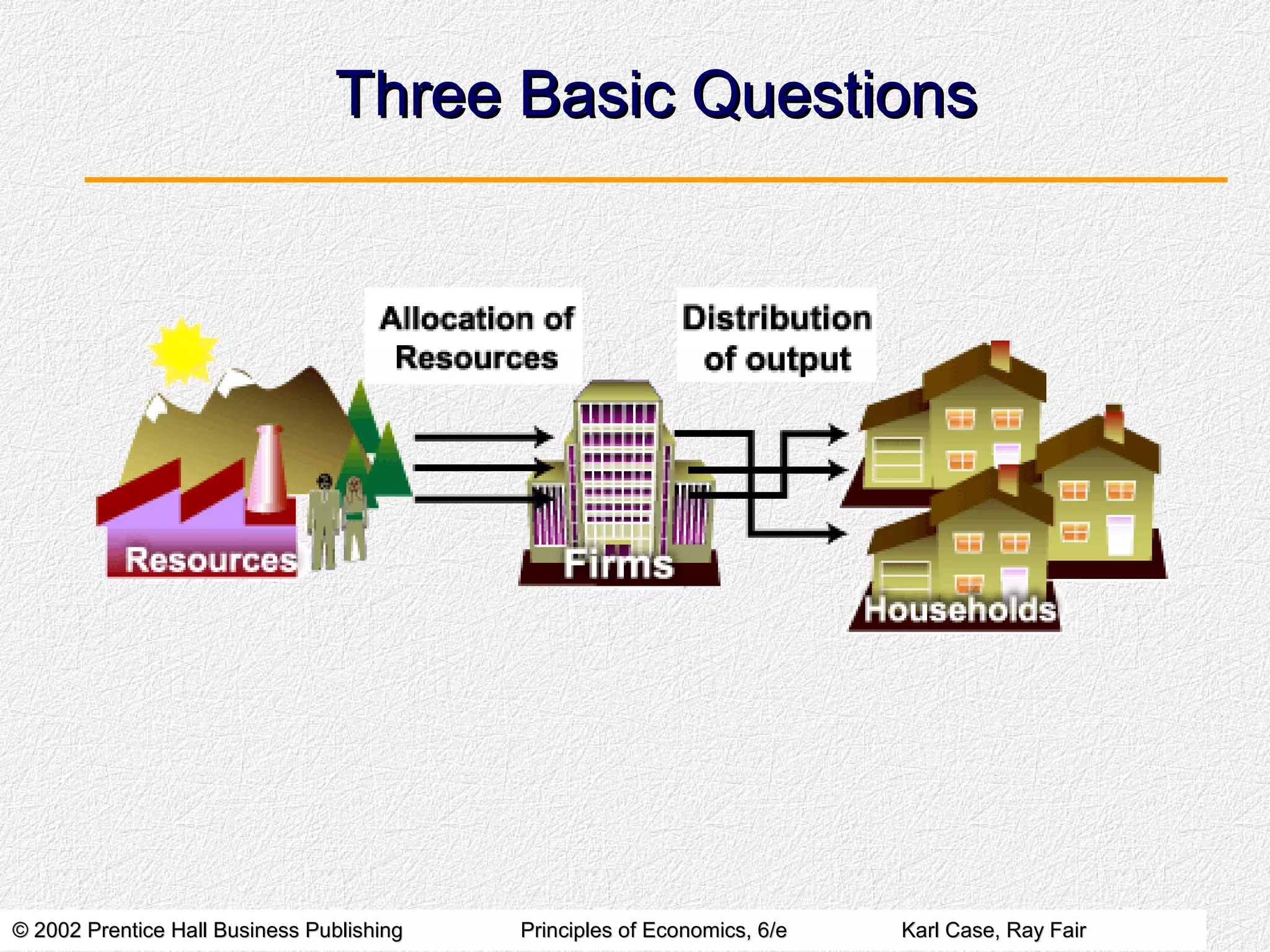
Three Basic QuestionsThree Basic Questions
© 2002 Prentice Hall Business Publishing© 2002 Prentice Hall Business Publishing Principles of Economics, 6/ePrinciples of Economics, 6/e Karl Case, Ray FairKarl Case, Ray Fair
Specialization, Exchange andSpecialization, Exchange and
Comparative AdvantageComparative Advantage
• David Ricardo developed theDavid Ricardo developed the theory oftheory of
comparative advantagecomparative advantage to explain theto explain the
benefits of specialization and free trade.benefits of specialization and free trade.
The theory is based on the concept ofThe theory is based on the concept of
opportunity cost:opportunity cost:
• Opportunity costOpportunity cost is that which we giveis that which we give
up or forgo, when we make a decision orup or forgo, when we make a decision or
a choice.a choice.
© 2002 Prentice Hall Business Publishing© 2002 Prentice Hall Business Publishing Principles of Economics, 6/ePrinciples of Economics, 6/e Karl Case, Ray FairKarl Case, Ray Fair
Specialization, Exchange andSpecialization, Exchange and
Comparative AdvantageComparative Advantage
• According to theAccording to the theory oftheory of
competitive advantage,competitive advantage,
specialization and free trade willspecialization and free trade will
benefit all trading parties, evenbenefit all trading parties, even
those that may be absolutely morethose that may be absolutely more
efficient producers.efficient producers.
© 2002 Prentice Hall Business Publishing© 2002 Prentice Hall Business Publishing Principles of Economics, 6/ePrinciples of Economics, 6/e Karl Case, Ray FairKarl Case, Ray Fair
Absolute Versus Comparative AdvantageAbsolute Versus Comparative Advantage
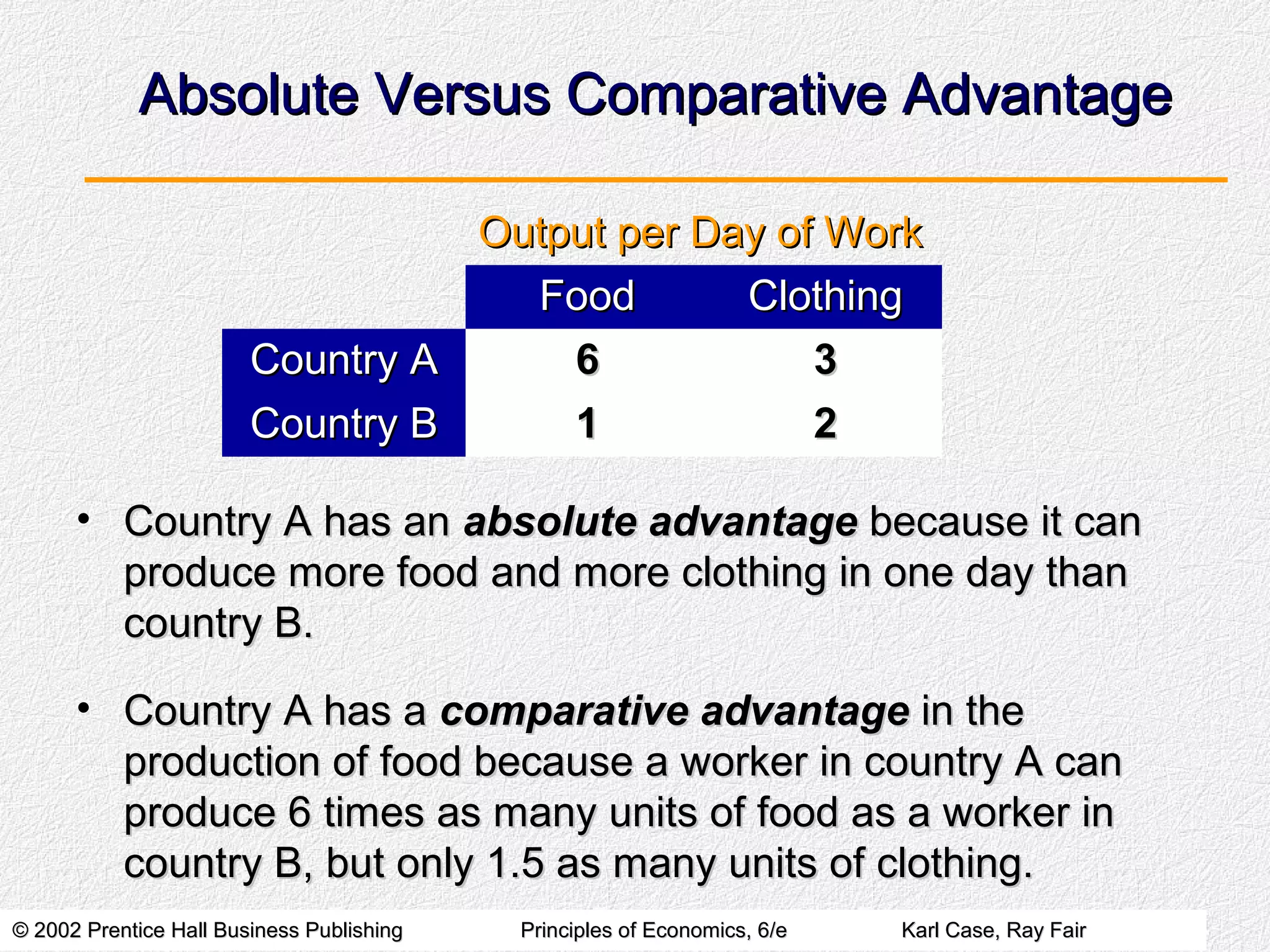
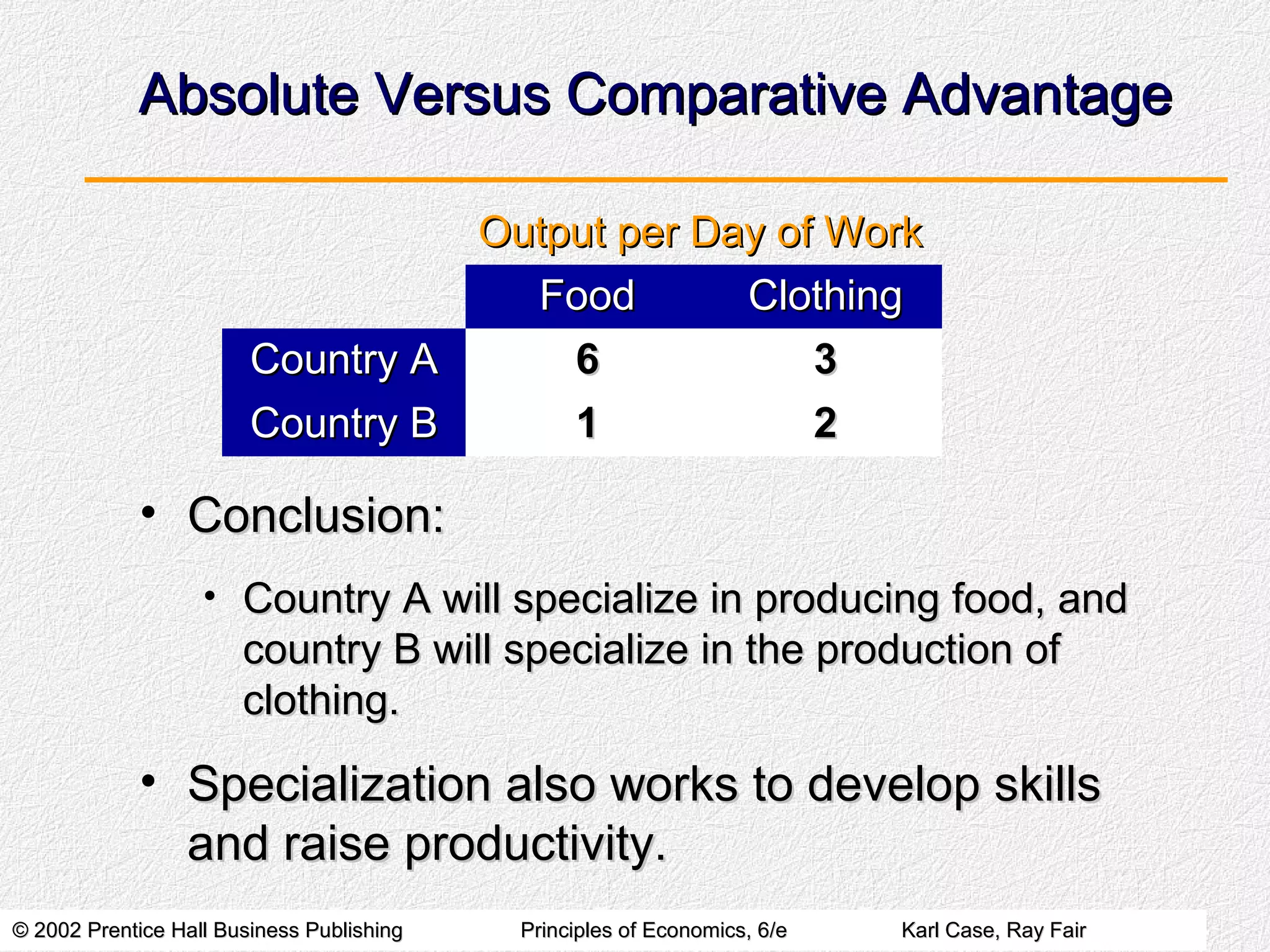
• Country A has anCountry A has an absolute advantageabsolute advantage because it canbecause it can
produce more food and more clothing in one day thanproduce more food and more clothing in one day than
country B.country B.
• Country A has aCountry A has a comparative advantagecomparative advantage in thein the
production of food because a worker in country A canproduction of food because a worker in country A can
produce 6 times as many units of food as a worker inproduce 6 times as many units of food as a worker in
country B, but only 1.5 as many units of clothing.country B, but only 1.5 as many units of clothing.
Output per Day of WorkOutput per Day of Work
FoodFood ClothingClothing
Country ACountry A 66 33
Country BCountry B 11 22
© 2002 Prentice Hall Business Publishing© 2002 Prentice Hall Business Publishing Principles of Economics, 6/ePrinciples of Economics, 6/e Karl Case, Ray FairKarl Case, Ray Fair
Absolute Versus Comparative AdvantageAbsolute Versus Comparative Advantage
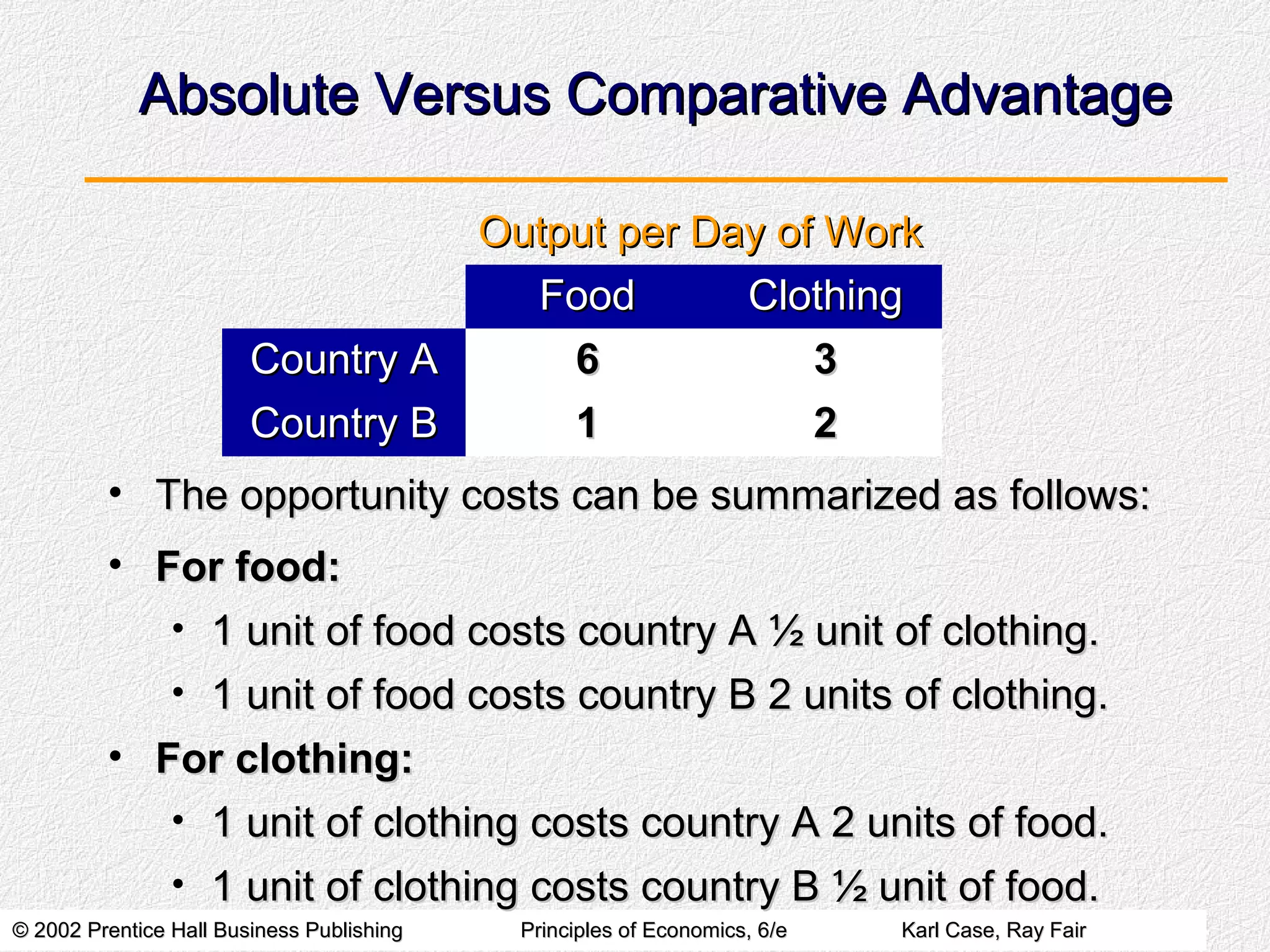
• The opportunity costs can be summarized as follows:The opportunity costs can be summarized as follows:
• For food:For food:
• 1 unit of food costs country A ½ unit of clothing.1 unit of food costs country A ½ unit of clothing.
• 1 unit of food costs country B 2 units of clothing.1 unit of food costs country B 2 units of clothing.
• For clothing:For clothing:
• 1 unit of clothing costs country A 2 units of food.1 unit of clothing costs country A 2 units of food.
• 1 unit of clothing costs country B ½ unit of food.1 unit of clothing costs country B ½ unit of food.
Output per Day of WorkOutput per Day of Work
FoodFood ClothingClothing
Country ACountry A 66 33
Country BCountry B 11 22
© 2002 Prentice Hall Business Publishing© 2002 Prentice Hall Business Publishing Principles of Economics, 6/ePrinciples of Economics, 6/e Karl Case, Ray FairKarl Case, Ray Fair
Absolute Versus Comparative AdvantageAbsolute Versus Comparative Advantage
• Conclusion:Conclusion:
• Country A will specialize in producing food, andCountry A will specialize in producing food, and
country B will specialize in the production ofcountry B will specialize in the production of
clothing.clothing.
• Specialization also works to develop skillsSpecialization also works to develop skills
and raise productivity.and raise productivity.
Output per Day of WorkOutput per Day of Work
FoodFood ClothingClothing
Country ACountry A 66 33
Country BCountry B 11 22
© 2002 Prentice Hall Business Publishing© 2002 Prentice Hall Business Publishing Principles of Economics, 6/ePrinciples of Economics, 6/e Karl Case, Ray FairKarl Case, Ray Fair
Weighing Present and Expected FutureWeighing Present and Expected Future
Costs and BenefitsCosts and Benefits
• InvestmentInvestment is the process of usingis the process of using
resources to produce new capital.resources to produce new capital.
Capital is the accumulation of previousCapital is the accumulation of previous
investment.investment.
• Because resources are scarce, theBecause resources are scarce, the
opportunity cost of every investment inopportunity cost of every investment in
capital is forgone present consumption.capital is forgone present consumption.
© 2002 Prentice Hall Business Publishing© 2002 Prentice Hall Business Publishing Principles of Economics, 6/ePrinciples of Economics, 6/e Karl Case, Ray FairKarl Case, Ray Fair
Capital Goods and Consumer GoodsCapital Goods and Consumer Goods
• Consumer goodsConsumer goods are goodsare goods
produced for presentproduced for present
consumption.consumption.
• Capital goodsCapital goods are goods usedare goods used
to produce other goods orto produce other goods or
services over time.services over time.
© 2002 Prentice Hall Business Publishing© 2002 Prentice Hall Business Publishing Principles of Economics, 6/ePrinciples of Economics, 6/e Karl Case, Ray FairKarl Case, Ray Fair
The Production Possibility FrontierThe Production Possibility Frontier
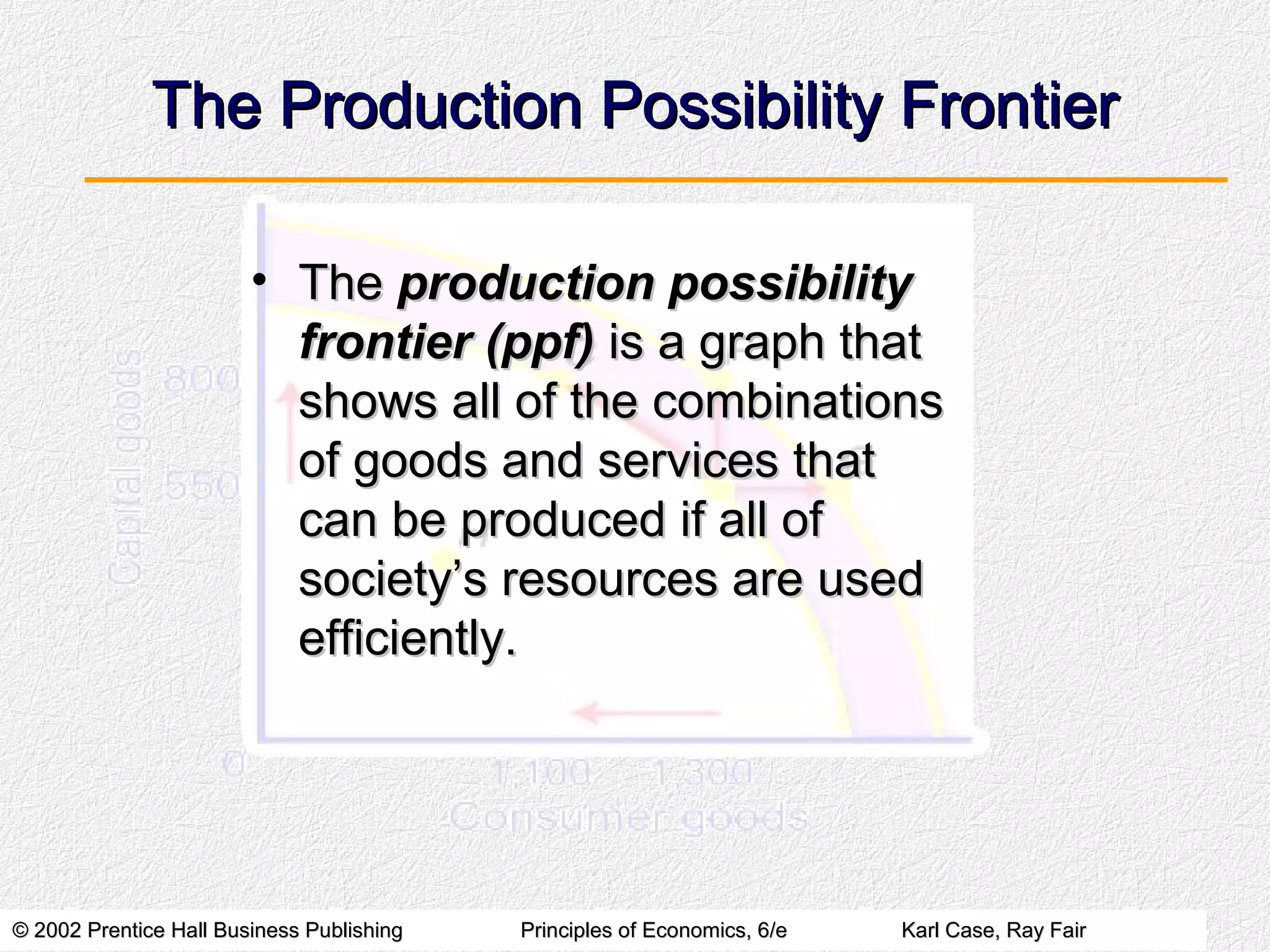
• TheThe production possibilityproduction possibility
frontier (ppf)frontier (ppf) is ais a graph thatgraph that
shows all of the combinationsshows all of the combinations
of goods and services thatof goods and services that
can be produced if all ofcan be produced if all of
society’s resources are usedsociety’s resources are used
efficiently.efficiently.
© 2002 Prentice Hall Business Publishing© 2002 Prentice Hall Business Publishing Principles of Economics, 6/ePrinciples of Economics, 6/e Karl Case, Ray FairKarl Case, Ray Fair
The Production Possibility FrontierThe Production Possibility Frontier
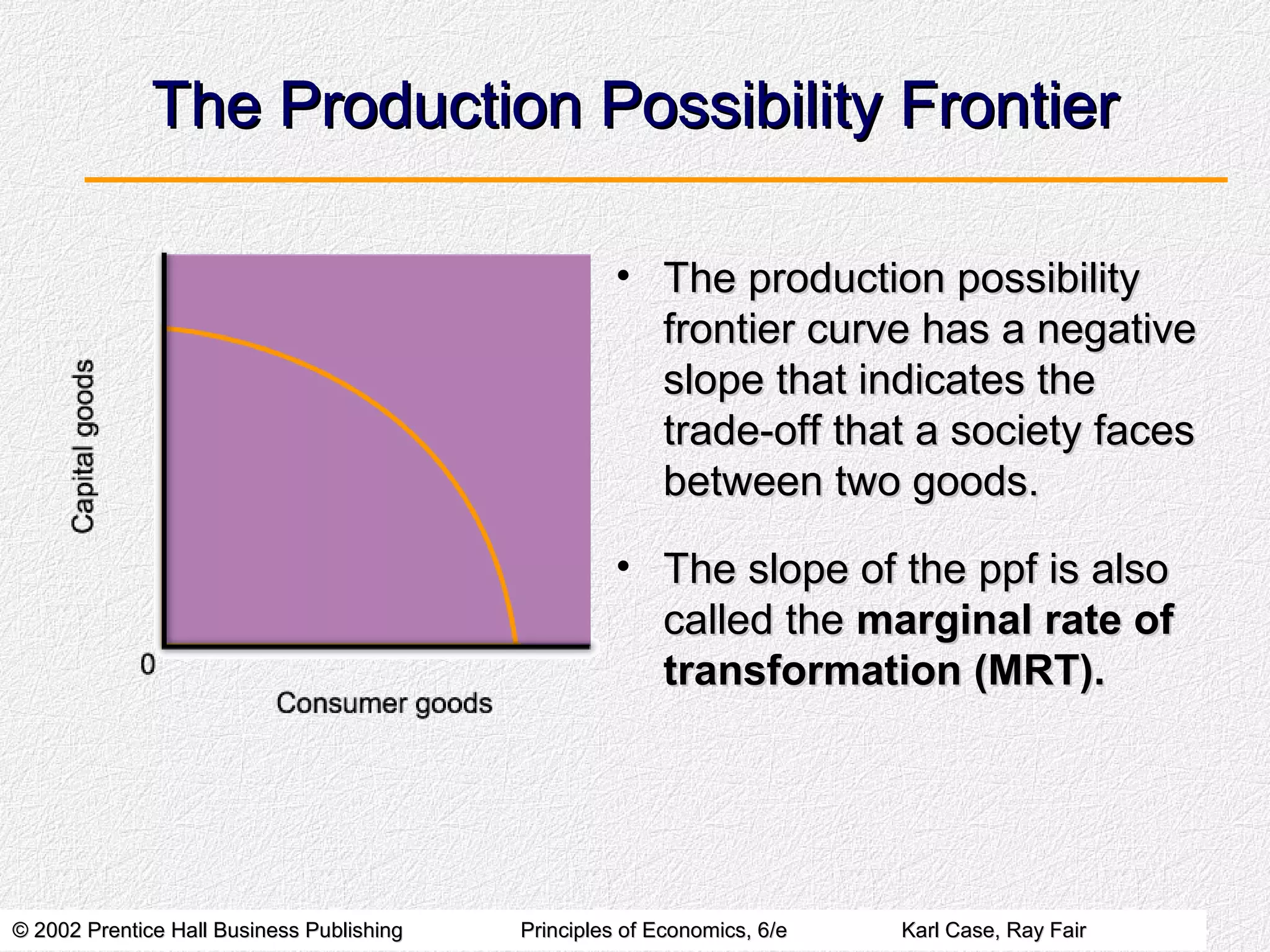
• The production possibilityThe production possibility
frontier curve has a negativefrontier curve has a negative
slope that indicates theslope that indicates the
trade-off that a society facestrade-off that a society faces
between two goods.between two goods.
• The slope of the ppf is alsoThe slope of the ppf is also
called thecalled the marginal rate ofmarginal rate of
transformation (MRT).transformation (MRT).
© 2002 Prentice Hall Business Publishing© 2002 Prentice Hall Business Publishing Principles of Economics, 6/ePrinciples of Economics, 6/e Karl Case, Ray FairKarl Case, Ray Fair
The Production Possibility FrontierThe Production Possibility Frontier
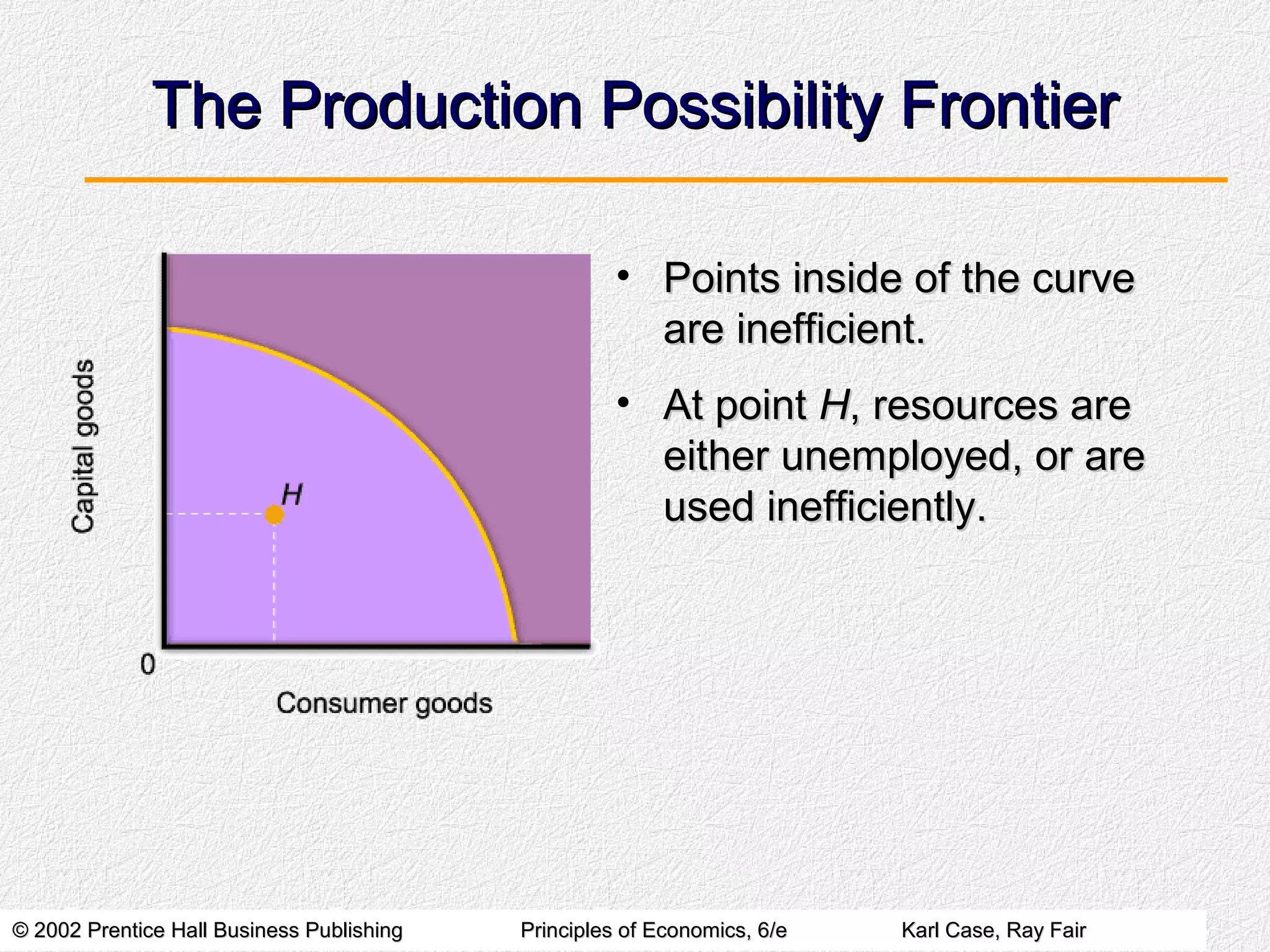
• Points inside of the curvePoints inside of the curve
are inefficient.are inefficient.
• At pointAt point HH, resources are, resources are
either unemployed, or areeither unemployed, or are
used inefficiently.used inefficiently.
© 2002 Prentice Hall Business Publishing© 2002 Prentice Hall Business Publishing Principles of Economics, 6/ePrinciples of Economics, 6/e Karl Case, Ray FairKarl Case, Ray Fair
The Production Possibility FrontierThe Production Possibility Frontier
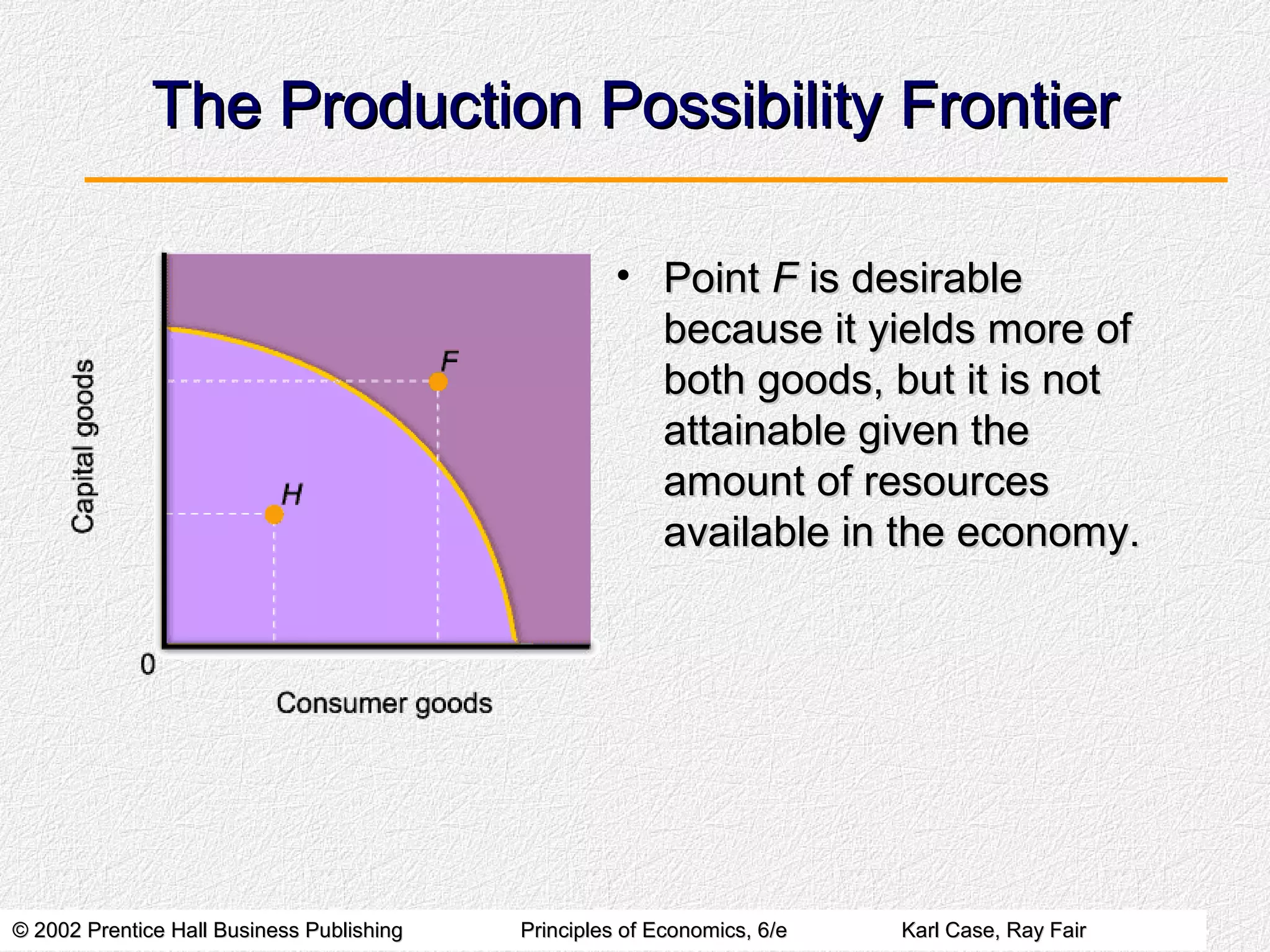
• PointPoint FF is desirableis desirable
because it yields more ofbecause it yields more of
both goods, but it is notboth goods, but it is not
attainable given theattainable given the
amount of resourcesamount of resources
available in the economy.available in the economy.
© 2002 Prentice Hall Business Publishing© 2002 Prentice Hall Business Publishing Principles of Economics, 6/ePrinciples of Economics, 6/e Karl Case, Ray FairKarl Case, Ray Fair
The Production Possibility FrontierThe Production Possibility Frontier
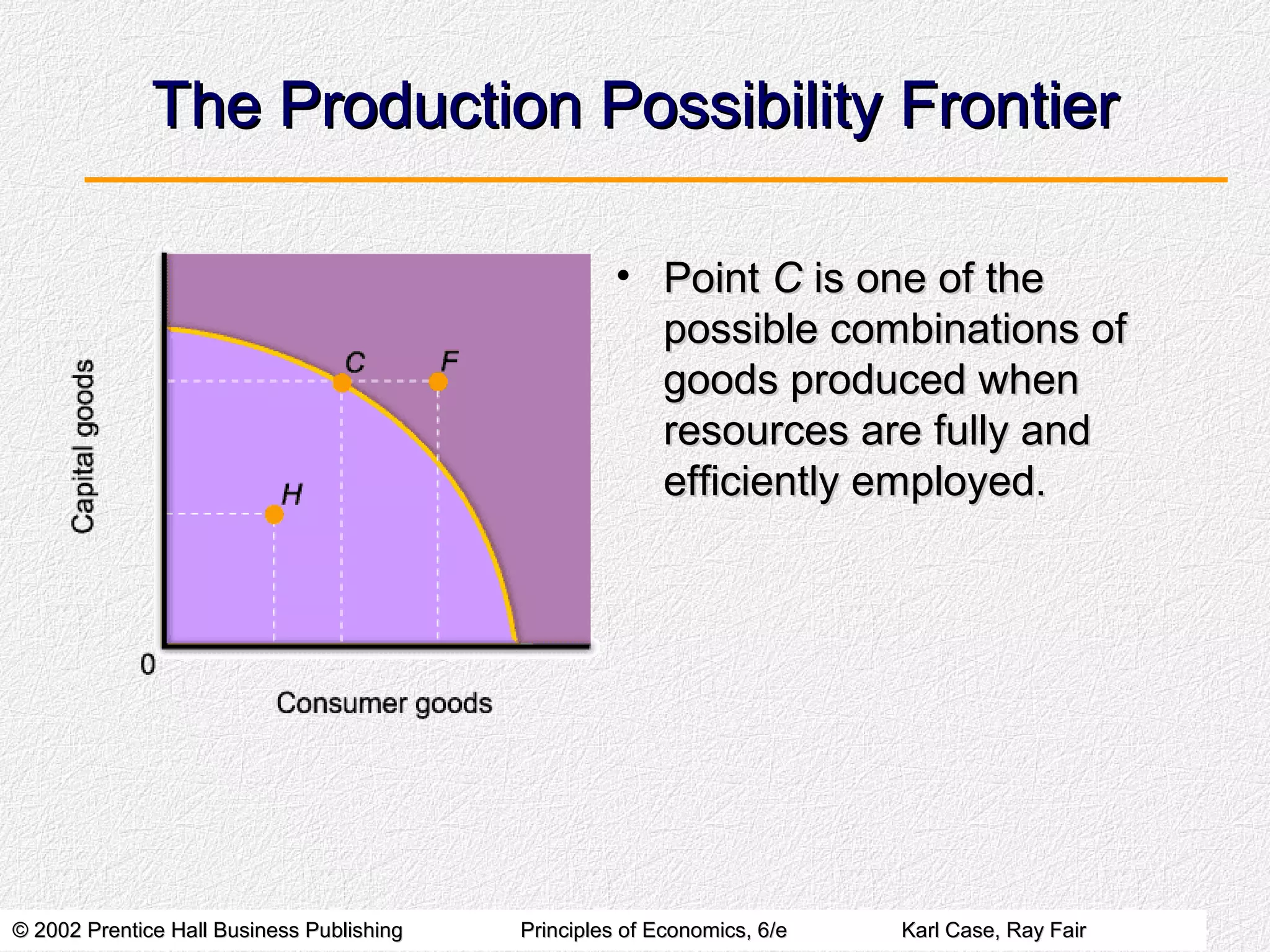
• PointPoint CC is one of theis one of the
possible combinations ofpossible combinations of
goods produced whengoods produced when
resources are fully andresources are fully and
efficiently employed.efficiently employed.
© 2002 Prentice Hall Business Publishing© 2002 Prentice Hall Business Publishing Principles of Economics, 6/ePrinciples of Economics, 6/e Karl Case, Ray FairKarl Case, Ray Fair
The Production Possibility FrontierThe Production Possibility Frontier
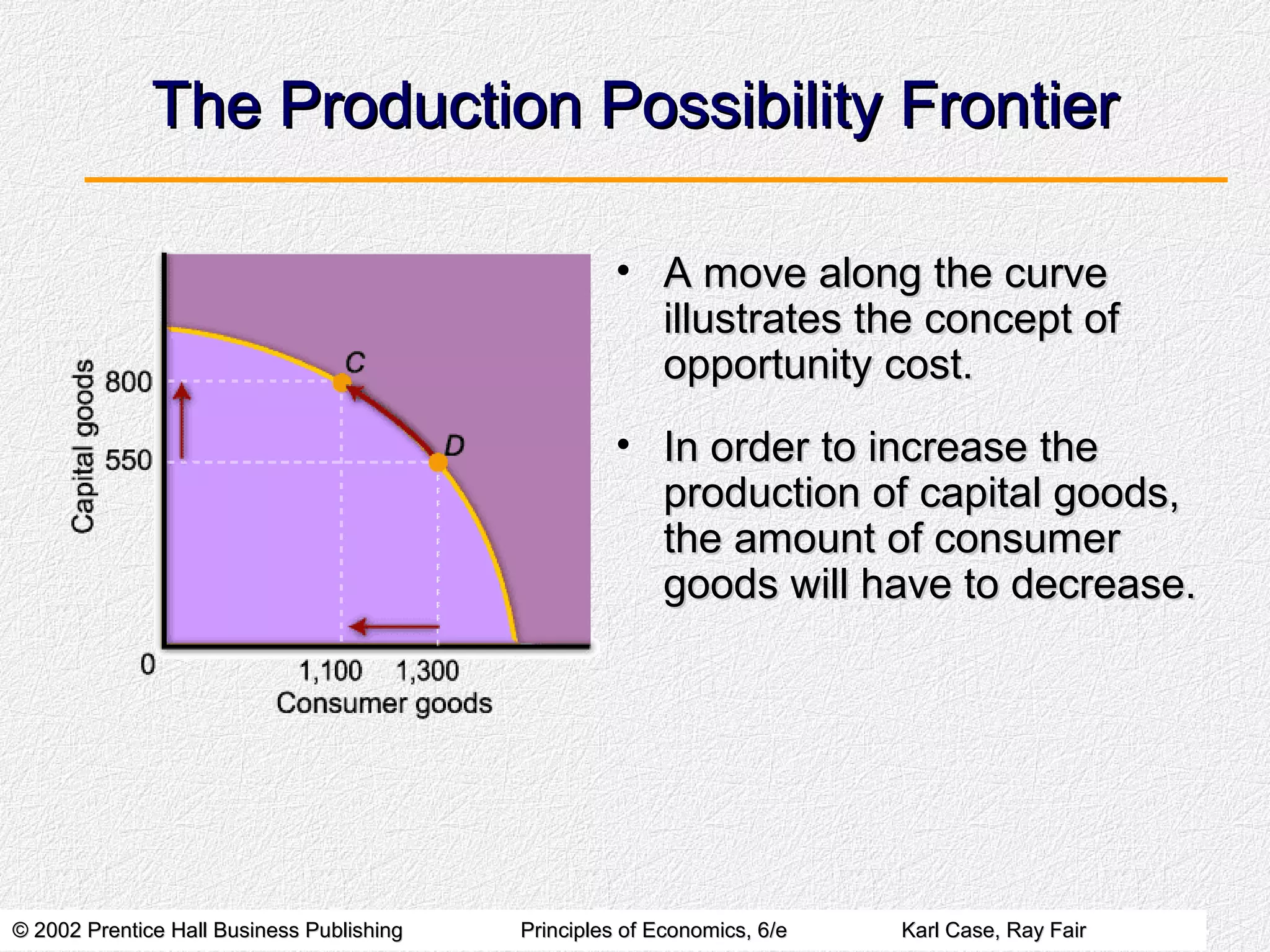
• A move along the curveA move along the curve
illustrates the concept ofillustrates the concept of
opportunity cost.opportunity cost.
• In order to increase theIn order to increase the
production of capital goods,production of capital goods,
the amount of consumerthe amount of consumer
goods will have to decrease.goods will have to decrease.
© 2002 Prentice Hall Business Publishing© 2002 Prentice Hall Business Publishing Principles of Economics, 6/ePrinciples of Economics, 6/e Karl Case, Ray FairKarl Case, Ray Fair
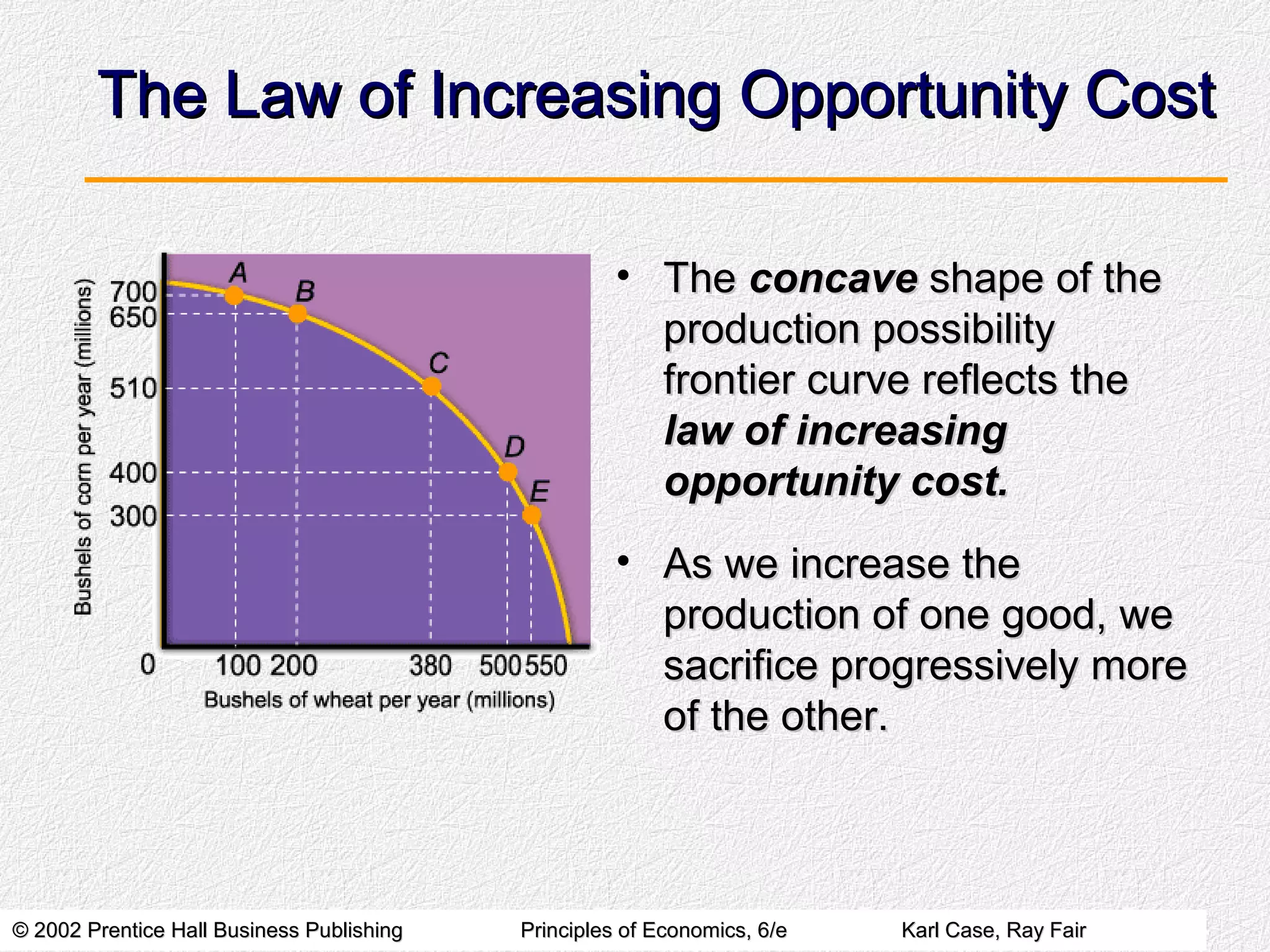
The Law of Increasing Opportunity CostThe Law of Increasing Opportunity Cost
• TheThe concaveconcave shape of theshape of the
production possibilityproduction possibility
frontier curve reflects thefrontier curve reflects the
law of increasinglaw of increasing
opportunity cost.opportunity cost.
• As we increase theAs we increase the
production of one good, weproduction of one good, we
sacrifice progressively moresacrifice progressively more
of the other.of the other.
© 2002 Prentice Hall Business Publishing© 2002 Prentice Hall Business Publishing Principles of Economics, 6/ePrinciples of Economics, 6/e Karl Case, Ray FairKarl Case, Ray Fair
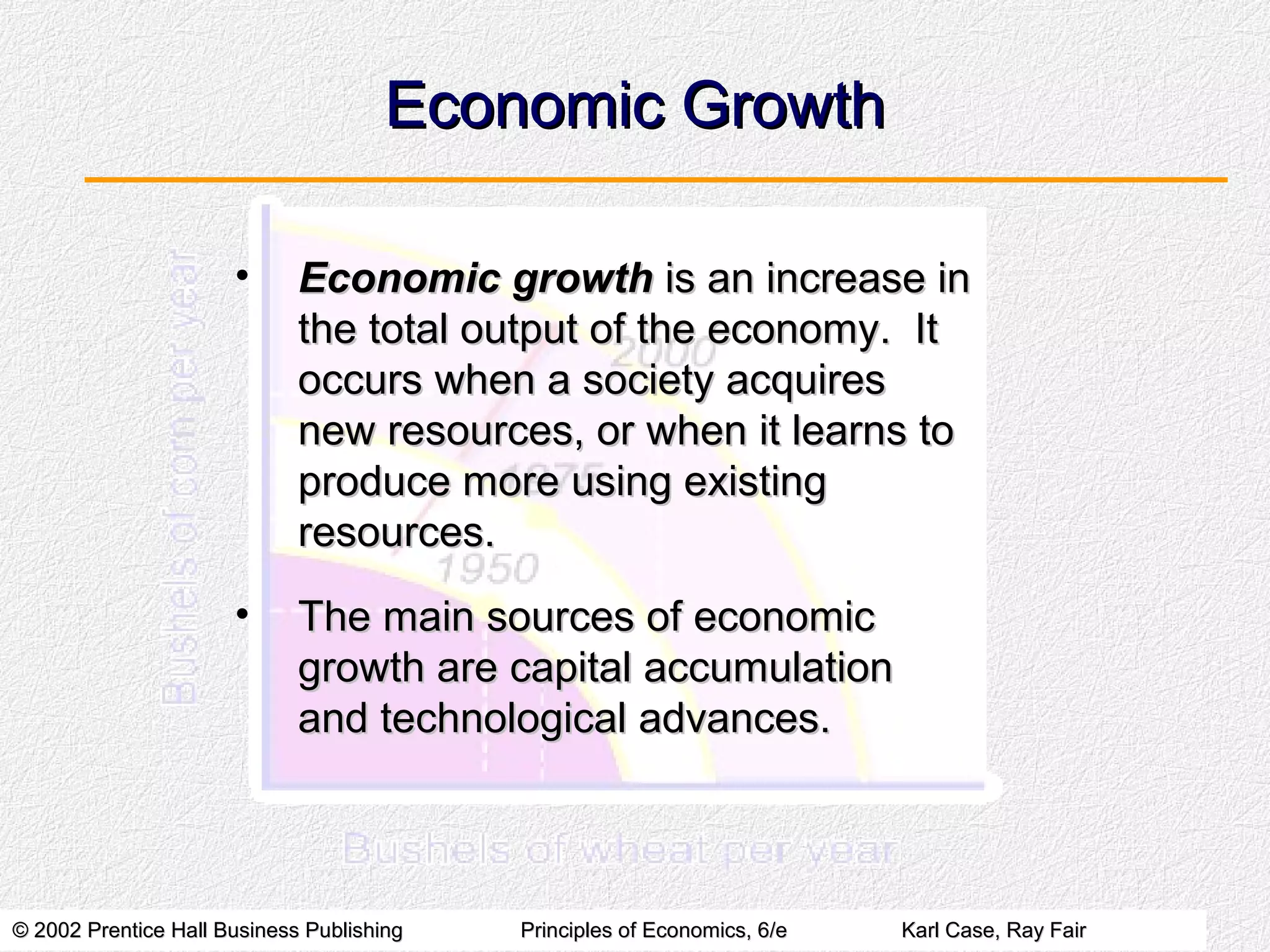
Economic GrowthEconomic Growth
• Economic growthEconomic growth is an increase inis an increase in
the total output of the economy. Itthe total output of the economy. It
occurs when a society acquiresoccurs when a society acquires
new resources, or when it learns tonew resources, or when it learns to
produce more using existingproduce more using existing
resources.resources.
• The main sources of economicThe main sources of economic
growth are capital accumulationgrowth are capital accumulation
and technological advances.and technological advances.
© 2002 Prentice Hall Business Publishing© 2002 Prentice Hall Business Publishing Principles of Economics, 6/ePrinciples of Economics, 6/e Karl Case, Ray FairKarl Case, Ray Fair
Economic GrowthEconomic Growth
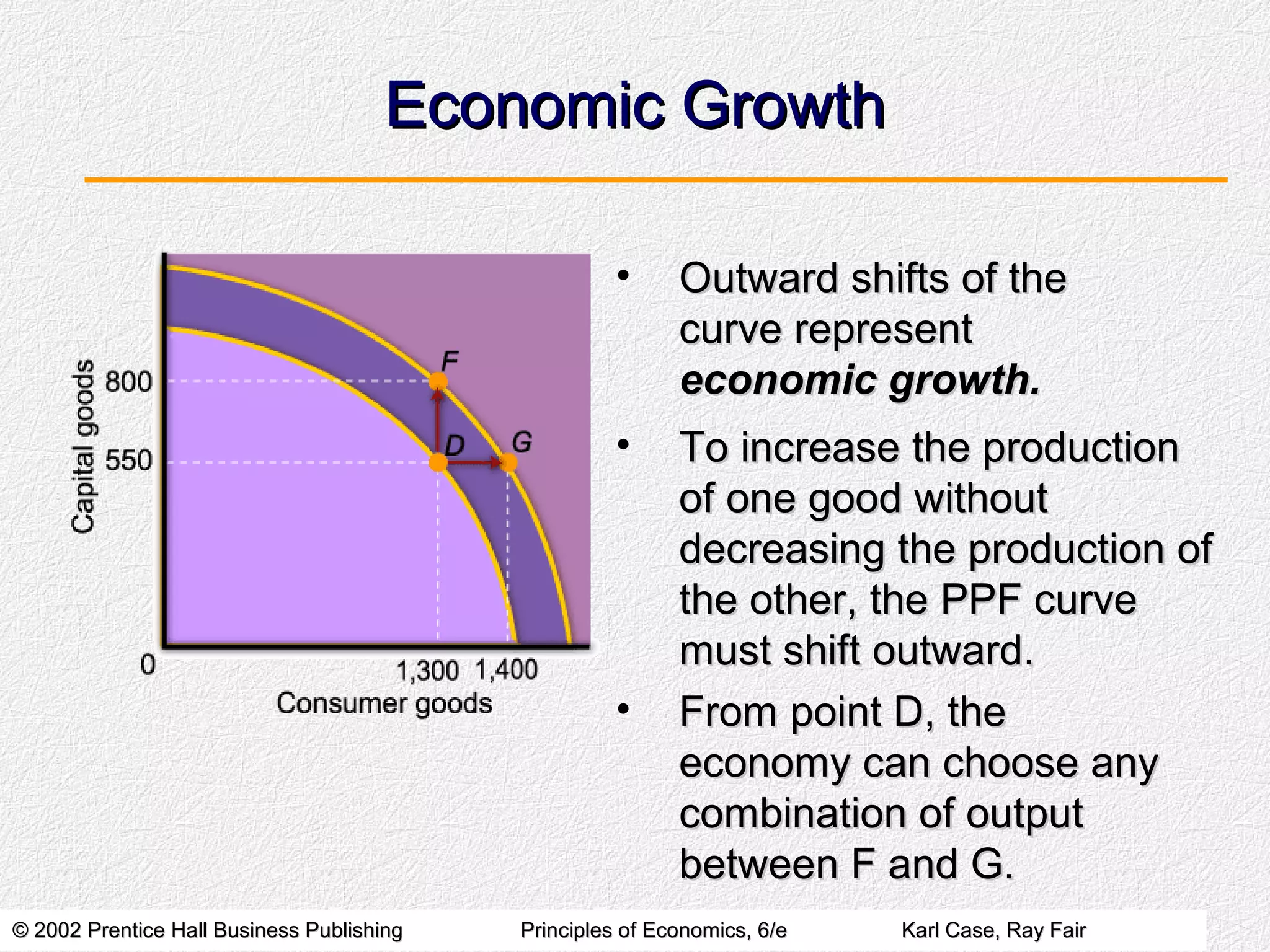
• To increase the productionTo increase the production
of one good withoutof one good without
decreasing the production ofdecreasing the production of
the other, the PPF curvethe other, the PPF curve
must shift outward.must shift outward.
• From point D, theFrom point D, the
economy can choose anyeconomy can choose any
combination of outputcombination of output
between F and G.between F and G.
• Outward shifts of theOutward shifts of the
curve representcurve represent
economic growth.economic growth.
© 2002 Prentice Hall Business Publishing© 2002 Prentice Hall Business Publishing Principles of Economics, 6/ePrinciples of Economics, 6/e Karl Case, Ray FairKarl Case, Ray Fair
Economic GrowthEconomic Growth
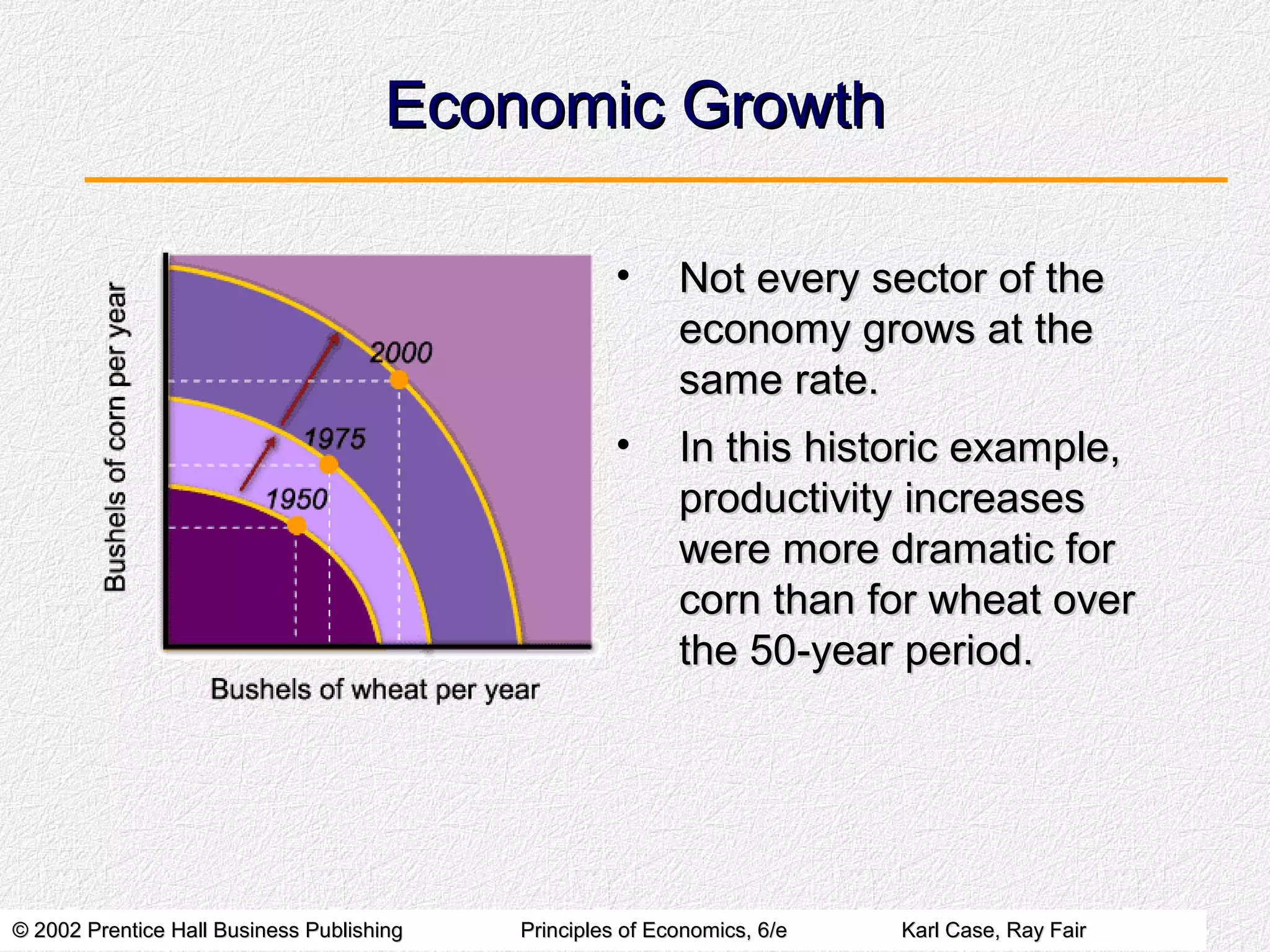
• Not every sector of theNot every sector of the
economy grows at theeconomy grows at the
same rate.same rate.
• In this historic example,In this historic example,
productivity increasesproductivity increases
were more dramatic forwere more dramatic for
corn than for wheat overcorn than for wheat over
the 50-year period.the 50-year period.
© 2002 Prentice Hall Business Publishing© 2002 Prentice Hall Business Publishing Principles of Economics, 6/ePrinciples of Economics, 6/e Karl Case, Ray FairKarl Case, Ray Fair
The Economic ProblemThe Economic Problem
• The economic problem:The economic problem: Given scarce resources,Given scarce resources,
how, exactly, do large, complex societies go abouthow, exactly, do large, complex societies go about
answering the three basic economic questions?answering the three basic economic questions?
• Economic systemsEconomic systems are the basic arrangementsare the basic arrangements
made by societies to solve the economic problem.made by societies to solve the economic problem.
They include:They include:
• Command economiesCommand economies
• Laissez-faire economiesLaissez-faire economies
• Mixed systemsMixed systems
© 2002 Prentice Hall Business Publishing© 2002 Prentice Hall Business Publishing Principles of Economics, 6/ePrinciples of Economics, 6/e Karl Case, Ray FairKarl Case, Ray Fair
The Economic ProblemThe Economic Problem
• In aIn a command economycommand economy, a central government either, a central government either
directly or indirectly sets output targets, incomes, anddirectly or indirectly sets output targets, incomes, and
prices.prices.
• In aIn a laissez-faire economylaissez-faire economy,, literally from the French:literally from the French:
“allow (them) to do,” individual people and firms“allow (them) to do,” individual people and firms
pursue their own self-interests without any centralpursue their own self-interests without any central
direction or regulation. The central institution of adirection or regulation. The central institution of a
laissez-faire economy is thelaissez-faire economy is the free-market systemfree-market system..
• AA marketmarket is the institution through which buyers andis the institution through which buyers and
sellers interact and engage in exchange.sellers interact and engage in exchange.
© 2002 Prentice Hall Business Publishing© 2002 Prentice Hall Business Publishing Principles of Economics, 6/ePrinciples of Economics, 6/e Karl Case, Ray FairKarl Case, Ray Fair
Laissez-Faire Economies:Laissez-Faire Economies:
The Free MarketThe Free Market
• Consumer sovereigntyConsumer sovereignty is the idea thatis the idea that
consumers ultimately dictate what will beconsumers ultimately dictate what will be
produced (or not produced) by choosing whatproduced (or not produced) by choosing what
to purchase (and what not to purchase).to purchase (and what not to purchase).
• Free enterprise:Free enterprise: under a free marketunder a free market
system, individual producers must figure outsystem, individual producers must figure out
how to plan, organize, and coordinate thehow to plan, organize, and coordinate the
production of products and services.production of products and services.
© 2002 Prentice Hall Business Publishing© 2002 Prentice Hall Business Publishing Principles of Economics, 6/ePrinciples of Economics, 6/e Karl Case, Ray FairKarl Case, Ray Fair
Laissez-Faire Economies:Laissez-Faire Economies:
The Free MarketThe Free Market
• TheThe distribution of outputdistribution of output is also determinedis also determined
in a decentralized way. The amount that anyin a decentralized way. The amount that any
one household gets depends on its incomeone household gets depends on its income
and wealth.and wealth.
• The basic coordinating mechanism in a freeThe basic coordinating mechanism in a free
market system is price.market system is price. PricePrice is the amountis the amount
that a product sells for per unit. It reflects whatthat a product sells for per unit. It reflects what
society is willing to pay.society is willing to pay.
© 2002 Prentice Hall Business Publishing© 2002 Prentice Hall Business Publishing Principles of Economics, 6/ePrinciples of Economics, 6/e Karl Case, Ray FairKarl Case, Ray Fair
Mixed Systems, Markets, andMixed Systems, Markets, and
GovernmentsGovernments
Markets are not perfect, and governments play aMarkets are not perfect, and governments play a
major role in all economic systems in order to:major role in all economic systems in order to:
• Minimize market inefficienciesMinimize market inefficiencies
• Provide public goodsProvide public goods
• Redistribute incomeRedistribute income
• Stabilize the macroeconomyStabilize the macroeconomy
• Promote low levels of unemploymentPromote low levels of unemployment
• Promote low levels of inflationPromote low levels of inflation

Ch02

  • 1.
    © 2002 PrenticeHall Business Publishing© 2002 Prentice Hall Business Publishing Principles of Economics, 6/ePrinciples of Economics, 6/e Karl Case, Ray FairKarl Case, Ray Fair CHAPTERCHAPTER 22 Prepared by: FernandoPrepared by: Fernando Quijano and Yvonn QuijanoQuijano and Yvonn Quijano The Economic Problem:The Economic Problem: Scarcity and ChoiceScarcity and Choice
  • 2.
    © 2002 PrenticeHall Business Publishing© 2002 Prentice Hall Business Publishing Principles of Economics, 6/ePrinciples of Economics, 6/e Karl Case, Ray FairKarl Case, Ray Fair What is Production?What is Production? • ProductionProduction is the process by which resourcesis the process by which resources are transformed into useful forms.are transformed into useful forms. • ResourcesResources, or, or inputsinputs, refer to anything, refer to anything provided by nature or previous generationsprovided by nature or previous generations that can be used directly or indirectly to satisfythat can be used directly or indirectly to satisfy human wants.human wants. • Capital resourcesCapital resources • Human resourcesHuman resources • Natural resourcesNatural resources
  • 3.
    © 2002 PrenticeHall Business Publishing© 2002 Prentice Hall Business Publishing Principles of Economics, 6/ePrinciples of Economics, 6/e Karl Case, Ray FairKarl Case, Ray Fair Three Basic QuestionsThree Basic Questions • The mechanics of decision making in a larger economyThe mechanics of decision making in a larger economy are more complex, but the type of decisions that mustare more complex, but the type of decisions that must be made are nearly identical.be made are nearly identical. • All societies must decide:All societies must decide: • WhatWhat will be produced?will be produced? • HowHow will it be produced?will it be produced? • WhoWho will get what is produced?will get what is produced?
  • 4.
    © 2002 PrenticeHall Business Publishing© 2002 Prentice Hall Business Publishing Principles of Economics, 6/ePrinciples of Economics, 6/e Karl Case, Ray FairKarl Case, Ray Fair Three Basic QuestionsThree Basic Questions
  • 5.
    © 2002 PrenticeHall Business Publishing© 2002 Prentice Hall Business Publishing Principles of Economics, 6/ePrinciples of Economics, 6/e Karl Case, Ray FairKarl Case, Ray Fair Specialization, Exchange andSpecialization, Exchange and Comparative AdvantageComparative Advantage • David Ricardo developed theDavid Ricardo developed the theory oftheory of comparative advantagecomparative advantage to explain theto explain the benefits of specialization and free trade.benefits of specialization and free trade. The theory is based on the concept ofThe theory is based on the concept of opportunity cost:opportunity cost: • Opportunity costOpportunity cost is that which we giveis that which we give up or forgo, when we make a decision orup or forgo, when we make a decision or a choice.a choice.
  • 6.
    © 2002 PrenticeHall Business Publishing© 2002 Prentice Hall Business Publishing Principles of Economics, 6/ePrinciples of Economics, 6/e Karl Case, Ray FairKarl Case, Ray Fair Specialization, Exchange andSpecialization, Exchange and Comparative AdvantageComparative Advantage • According to theAccording to the theory oftheory of competitive advantage,competitive advantage, specialization and free trade willspecialization and free trade will benefit all trading parties, evenbenefit all trading parties, even those that may be absolutely morethose that may be absolutely more efficient producers.efficient producers.
  • 7.
    © 2002 PrenticeHall Business Publishing© 2002 Prentice Hall Business Publishing Principles of Economics, 6/ePrinciples of Economics, 6/e Karl Case, Ray FairKarl Case, Ray Fair Absolute Versus Comparative AdvantageAbsolute Versus Comparative Advantage • Country A has anCountry A has an absolute advantageabsolute advantage because it canbecause it can produce more food and more clothing in one day thanproduce more food and more clothing in one day than country B.country B. • Country A has aCountry A has a comparative advantagecomparative advantage in thein the production of food because a worker in country A canproduction of food because a worker in country A can produce 6 times as many units of food as a worker inproduce 6 times as many units of food as a worker in country B, but only 1.5 as many units of clothing.country B, but only 1.5 as many units of clothing. Output per Day of WorkOutput per Day of Work FoodFood ClothingClothing Country ACountry A 66 33 Country BCountry B 11 22
  • 8.
    © 2002 PrenticeHall Business Publishing© 2002 Prentice Hall Business Publishing Principles of Economics, 6/ePrinciples of Economics, 6/e Karl Case, Ray FairKarl Case, Ray Fair Absolute Versus Comparative AdvantageAbsolute Versus Comparative Advantage • The opportunity costs can be summarized as follows:The opportunity costs can be summarized as follows: • For food:For food: • 1 unit of food costs country A ½ unit of clothing.1 unit of food costs country A ½ unit of clothing. • 1 unit of food costs country B 2 units of clothing.1 unit of food costs country B 2 units of clothing. • For clothing:For clothing: • 1 unit of clothing costs country A 2 units of food.1 unit of clothing costs country A 2 units of food. • 1 unit of clothing costs country B ½ unit of food.1 unit of clothing costs country B ½ unit of food. Output per Day of WorkOutput per Day of Work FoodFood ClothingClothing Country ACountry A 66 33 Country BCountry B 11 22
  • 9.
    © 2002 PrenticeHall Business Publishing© 2002 Prentice Hall Business Publishing Principles of Economics, 6/ePrinciples of Economics, 6/e Karl Case, Ray FairKarl Case, Ray Fair Absolute Versus Comparative AdvantageAbsolute Versus Comparative Advantage • Conclusion:Conclusion: • Country A will specialize in producing food, andCountry A will specialize in producing food, and country B will specialize in the production ofcountry B will specialize in the production of clothing.clothing. • Specialization also works to develop skillsSpecialization also works to develop skills and raise productivity.and raise productivity. Output per Day of WorkOutput per Day of Work FoodFood ClothingClothing Country ACountry A 66 33 Country BCountry B 11 22
  • 10.
    © 2002 PrenticeHall Business Publishing© 2002 Prentice Hall Business Publishing Principles of Economics, 6/ePrinciples of Economics, 6/e Karl Case, Ray FairKarl Case, Ray Fair Weighing Present and Expected FutureWeighing Present and Expected Future Costs and BenefitsCosts and Benefits • InvestmentInvestment is the process of usingis the process of using resources to produce new capital.resources to produce new capital. Capital is the accumulation of previousCapital is the accumulation of previous investment.investment. • Because resources are scarce, theBecause resources are scarce, the opportunity cost of every investment inopportunity cost of every investment in capital is forgone present consumption.capital is forgone present consumption.
  • 11.
    © 2002 PrenticeHall Business Publishing© 2002 Prentice Hall Business Publishing Principles of Economics, 6/ePrinciples of Economics, 6/e Karl Case, Ray FairKarl Case, Ray Fair Capital Goods and Consumer GoodsCapital Goods and Consumer Goods • Consumer goodsConsumer goods are goodsare goods produced for presentproduced for present consumption.consumption. • Capital goodsCapital goods are goods usedare goods used to produce other goods orto produce other goods or services over time.services over time.
  • 12.
    © 2002 PrenticeHall Business Publishing© 2002 Prentice Hall Business Publishing Principles of Economics, 6/ePrinciples of Economics, 6/e Karl Case, Ray FairKarl Case, Ray Fair The Production Possibility FrontierThe Production Possibility Frontier • TheThe production possibilityproduction possibility frontier (ppf)frontier (ppf) is ais a graph thatgraph that shows all of the combinationsshows all of the combinations of goods and services thatof goods and services that can be produced if all ofcan be produced if all of society’s resources are usedsociety’s resources are used efficiently.efficiently.
  • 13.
    © 2002 PrenticeHall Business Publishing© 2002 Prentice Hall Business Publishing Principles of Economics, 6/ePrinciples of Economics, 6/e Karl Case, Ray FairKarl Case, Ray Fair The Production Possibility FrontierThe Production Possibility Frontier • The production possibilityThe production possibility frontier curve has a negativefrontier curve has a negative slope that indicates theslope that indicates the trade-off that a society facestrade-off that a society faces between two goods.between two goods. • The slope of the ppf is alsoThe slope of the ppf is also called thecalled the marginal rate ofmarginal rate of transformation (MRT).transformation (MRT).
  • 14.
    © 2002 PrenticeHall Business Publishing© 2002 Prentice Hall Business Publishing Principles of Economics, 6/ePrinciples of Economics, 6/e Karl Case, Ray FairKarl Case, Ray Fair The Production Possibility FrontierThe Production Possibility Frontier • Points inside of the curvePoints inside of the curve are inefficient.are inefficient. • At pointAt point HH, resources are, resources are either unemployed, or areeither unemployed, or are used inefficiently.used inefficiently.
  • 15.
    © 2002 PrenticeHall Business Publishing© 2002 Prentice Hall Business Publishing Principles of Economics, 6/ePrinciples of Economics, 6/e Karl Case, Ray FairKarl Case, Ray Fair The Production Possibility FrontierThe Production Possibility Frontier • PointPoint FF is desirableis desirable because it yields more ofbecause it yields more of both goods, but it is notboth goods, but it is not attainable given theattainable given the amount of resourcesamount of resources available in the economy.available in the economy.
  • 16.
    © 2002 PrenticeHall Business Publishing© 2002 Prentice Hall Business Publishing Principles of Economics, 6/ePrinciples of Economics, 6/e Karl Case, Ray FairKarl Case, Ray Fair The Production Possibility FrontierThe Production Possibility Frontier • PointPoint CC is one of theis one of the possible combinations ofpossible combinations of goods produced whengoods produced when resources are fully andresources are fully and efficiently employed.efficiently employed.
  • 17.
    © 2002 PrenticeHall Business Publishing© 2002 Prentice Hall Business Publishing Principles of Economics, 6/ePrinciples of Economics, 6/e Karl Case, Ray FairKarl Case, Ray Fair The Production Possibility FrontierThe Production Possibility Frontier • A move along the curveA move along the curve illustrates the concept ofillustrates the concept of opportunity cost.opportunity cost. • In order to increase theIn order to increase the production of capital goods,production of capital goods, the amount of consumerthe amount of consumer goods will have to decrease.goods will have to decrease.
  • 18.
    © 2002 PrenticeHall Business Publishing© 2002 Prentice Hall Business Publishing Principles of Economics, 6/ePrinciples of Economics, 6/e Karl Case, Ray FairKarl Case, Ray Fair The Law of Increasing Opportunity CostThe Law of Increasing Opportunity Cost • TheThe concaveconcave shape of theshape of the production possibilityproduction possibility frontier curve reflects thefrontier curve reflects the law of increasinglaw of increasing opportunity cost.opportunity cost. • As we increase theAs we increase the production of one good, weproduction of one good, we sacrifice progressively moresacrifice progressively more of the other.of the other.
  • 19.
    © 2002 PrenticeHall Business Publishing© 2002 Prentice Hall Business Publishing Principles of Economics, 6/ePrinciples of Economics, 6/e Karl Case, Ray FairKarl Case, Ray Fair Economic GrowthEconomic Growth • Economic growthEconomic growth is an increase inis an increase in the total output of the economy. Itthe total output of the economy. It occurs when a society acquiresoccurs when a society acquires new resources, or when it learns tonew resources, or when it learns to produce more using existingproduce more using existing resources.resources. • The main sources of economicThe main sources of economic growth are capital accumulationgrowth are capital accumulation and technological advances.and technological advances.
  • 20.
    © 2002 PrenticeHall Business Publishing© 2002 Prentice Hall Business Publishing Principles of Economics, 6/ePrinciples of Economics, 6/e Karl Case, Ray FairKarl Case, Ray Fair Economic GrowthEconomic Growth • To increase the productionTo increase the production of one good withoutof one good without decreasing the production ofdecreasing the production of the other, the PPF curvethe other, the PPF curve must shift outward.must shift outward. • From point D, theFrom point D, the economy can choose anyeconomy can choose any combination of outputcombination of output between F and G.between F and G. • Outward shifts of theOutward shifts of the curve representcurve represent economic growth.economic growth.
  • 21.
    © 2002 PrenticeHall Business Publishing© 2002 Prentice Hall Business Publishing Principles of Economics, 6/ePrinciples of Economics, 6/e Karl Case, Ray FairKarl Case, Ray Fair Economic GrowthEconomic Growth • Not every sector of theNot every sector of the economy grows at theeconomy grows at the same rate.same rate. • In this historic example,In this historic example, productivity increasesproductivity increases were more dramatic forwere more dramatic for corn than for wheat overcorn than for wheat over the 50-year period.the 50-year period.
  • 22.
    © 2002 PrenticeHall Business Publishing© 2002 Prentice Hall Business Publishing Principles of Economics, 6/ePrinciples of Economics, 6/e Karl Case, Ray FairKarl Case, Ray Fair The Economic ProblemThe Economic Problem • The economic problem:The economic problem: Given scarce resources,Given scarce resources, how, exactly, do large, complex societies go abouthow, exactly, do large, complex societies go about answering the three basic economic questions?answering the three basic economic questions? • Economic systemsEconomic systems are the basic arrangementsare the basic arrangements made by societies to solve the economic problem.made by societies to solve the economic problem. They include:They include: • Command economiesCommand economies • Laissez-faire economiesLaissez-faire economies • Mixed systemsMixed systems
  • 23.
    © 2002 PrenticeHall Business Publishing© 2002 Prentice Hall Business Publishing Principles of Economics, 6/ePrinciples of Economics, 6/e Karl Case, Ray FairKarl Case, Ray Fair The Economic ProblemThe Economic Problem • In aIn a command economycommand economy, a central government either, a central government either directly or indirectly sets output targets, incomes, anddirectly or indirectly sets output targets, incomes, and prices.prices. • In aIn a laissez-faire economylaissez-faire economy,, literally from the French:literally from the French: “allow (them) to do,” individual people and firms“allow (them) to do,” individual people and firms pursue their own self-interests without any centralpursue their own self-interests without any central direction or regulation. The central institution of adirection or regulation. The central institution of a laissez-faire economy is thelaissez-faire economy is the free-market systemfree-market system.. • AA marketmarket is the institution through which buyers andis the institution through which buyers and sellers interact and engage in exchange.sellers interact and engage in exchange.
  • 24.
    © 2002 PrenticeHall Business Publishing© 2002 Prentice Hall Business Publishing Principles of Economics, 6/ePrinciples of Economics, 6/e Karl Case, Ray FairKarl Case, Ray Fair Laissez-Faire Economies:Laissez-Faire Economies: The Free MarketThe Free Market • Consumer sovereigntyConsumer sovereignty is the idea thatis the idea that consumers ultimately dictate what will beconsumers ultimately dictate what will be produced (or not produced) by choosing whatproduced (or not produced) by choosing what to purchase (and what not to purchase).to purchase (and what not to purchase). • Free enterprise:Free enterprise: under a free marketunder a free market system, individual producers must figure outsystem, individual producers must figure out how to plan, organize, and coordinate thehow to plan, organize, and coordinate the production of products and services.production of products and services.
  • 25.
    © 2002 PrenticeHall Business Publishing© 2002 Prentice Hall Business Publishing Principles of Economics, 6/ePrinciples of Economics, 6/e Karl Case, Ray FairKarl Case, Ray Fair Laissez-Faire Economies:Laissez-Faire Economies: The Free MarketThe Free Market • TheThe distribution of outputdistribution of output is also determinedis also determined in a decentralized way. The amount that anyin a decentralized way. The amount that any one household gets depends on its incomeone household gets depends on its income and wealth.and wealth. • The basic coordinating mechanism in a freeThe basic coordinating mechanism in a free market system is price.market system is price. PricePrice is the amountis the amount that a product sells for per unit. It reflects whatthat a product sells for per unit. It reflects what society is willing to pay.society is willing to pay.
  • 26.
    © 2002 PrenticeHall Business Publishing© 2002 Prentice Hall Business Publishing Principles of Economics, 6/ePrinciples of Economics, 6/e Karl Case, Ray FairKarl Case, Ray Fair Mixed Systems, Markets, andMixed Systems, Markets, and GovernmentsGovernments Markets are not perfect, and governments play aMarkets are not perfect, and governments play a major role in all economic systems in order to:major role in all economic systems in order to: • Minimize market inefficienciesMinimize market inefficiencies • Provide public goodsProvide public goods • Redistribute incomeRedistribute income • Stabilize the macroeconomyStabilize the macroeconomy • Promote low levels of unemploymentPromote low levels of unemployment • Promote low levels of inflationPromote low levels of inflation