www.ijemr.net ISSN (ONLINE): 2250-0758, ISSN (PRINT): 2394-6962
325 Copyright © 2016. Vandana Publications. All Rights Reserved.
Volume-6, Issue-5, September-October 2016
International Journal of Engineering and Management Research
Page Number: 325-331
On Your Own: An Oyo Story A Case Study
Dr. Subodh Kesharwani1
, Vivek Kumar2
1
Reader, School of Management, Indira Gandhi National Open University, New Delhi, INDIA
2
Research Scholar, AIMA, New Delhi, INDIA
Statement of Originality
The case study is the author’s own work and has
not already been presented, published or submitted for
presentation or publication.
ABSTRACT
The objective of the case is to tell a tale of OYO
room as objectively as possible from the perspective of a
‘situation case’. An effort has been to provide a sufficiently
large pool of information, required to analyze the reasons
behind present success of OYO rooms in particular and an
Indian enterpreneual pattern emerging out of the innovative
use of technology and marketing principals, in general.
The case brings the success story of Ritesh
Aggarwal about how he used hospitality idea and initiated
budgeted hotels arousing lot of investment in this segment.
The attention of investors has prompted for tourism and
hospitality.
Government in action is also concentrated on
“Make in India” which means that entrepreneurs like Ritesh
Aggarwal shall be promoted and supported. There is a need
to create comfort zone for young minds so that they come
forward as successful businessmen thereby leading to
country’s economic growth.
Keywords--- FIT, OYO, CEO
I. INTRODUCTION
Prime Minister Narendra Modi’s call on “Make In
India” initiated a lot of changes in the manufacturing
landscape of India. Although it is worthwhile to focus on
manufacturing led trade export model for sustainable
economic growth, it is high time that we also celebrate the
rise of new breed of entrepreneur who are demographically
aligned to a youthful company. The Indian entrepreneur
has begun taking advantage of the opportunities that are
becoming available as hundreds of millions of netizens
come to a common place virtual market through their
smart phones and other hand held devices.
Ritesh Aggarwal’s OYO rooms were among the
first to spot the opportunity to fix the problem of
predictability and standardization by branding the India’s
unbranded budget hotel segment, which is estimated to be
worth 88,000 crores. Aggarwal’s true innovative use of
technology in hospitality industry, has not only won him
high accolades, but also brought huge investment in the
sector.
India has no more remained a legendary land of
snake charmers, confiding tourism to traditional sectors
comprising mainly of Himalayas, Agra, Rajasthan, Kerala,
North East and Varanasi alone. The fast evolving travel
and tourist markets are highly fragmented in terms of
demographics and cultural norms. This shift in the
emerging segment is marked by ‘individualism’ and ‘use
of technology’. The members of this segment are self
managed and prefer to search for best prices vis-à-vis
experiences. The segment includes ‘visit friend and
relative travels’, ‘the frequent independent traveler’ as
opposed to group travelers ( FIT ), Business travels,
pilgrims, medical tourists to name a few. Therefore, it is
high time that travel and tourism industry wakes up to the
call and redesign itself to meet the challenges and grab the
opportunities, thrown open to them by these plethora of
changes in the macro economic scenario.
II. CASE BODY
On 15th
This was an occasion for self reflection as well as
nostalgia, especially for Ritesh who at 21 was considered
to be youngest CEO in India. His mind was flashed with
July 2015, Ritesh Aggarwal, Abhinav
Sinha and their entire team were in party mood at their
Sohna Road corporate office in Gurgoan. They had just
raised $100 million ( 630 crore ) from Soft Bank
Corporation and other investors. This was the biggest
investment they had received so far after $25 million from
Greenoaks Capital, Sanfrancisco and Sequoia, DSG
consumer partners and light speed ventures.
www.ijemr.net ISSN (ONLINE): 2250-0758, ISSN (PRINT): 2394-6962
326 Copyright © 2016. Vandana Publications. All Rights Reserved.
the memories of past. Ritesh was born at Bissam, Cuttak a
village in Rayagada district of Odisha. His childhood was
very different from the other children of his age as he was
not much of a social person who had immense love for
nature, particularly for mountains. At the age of 8 Ritesh
started coding software to respond to his inner
entrepreneual callings. The journey never stopped and he
used each opportunity that came in his way like selling sim
card at his native place. Eventually Ritesh became part of
the Asians Science Camp held at Tata Institute of
Fundamental Research (TIFR) , Mumbai for pre-collegiate
students aimed at promoting discussion for betterment of
science in the region.
His voyage brought him to North India for his
tutelage at Indian School of Business and Finance, Delhi.
Ritesh , formed a company during his Delhi days, called
Worth Growth partners and became youngest CEO. He
also authored a bestselling book ‘Encyclopedia of Indian
Engineering college’ at the age of 17.
During his stay in Delhi, Ritesh Started travelling
extensively across Himachal Pradesh, Jammu & Kashmir,
Rajasthan and chanced upon staying into various kinds of
budget bed & breakfast places. It was during this phase,
Ritesh now 18, launched Orawel Stays in 2011. Orawel
was basically an Indian version of peer to peer lodging
website Airbub. However, Ritesh’s search for a one time
online ‘product – market fit’ solution for bed and breakfast
travel segment was still on. By now he was almost broke
having had exhausted all his funds in travelling and
exploring experiences of various B&B places.
The major break came in the same year when at
the age of 19 he was chosen for the Theil Fellowship
started by Peter Theil – a venture capitalist also Paypal co-
founder and Facebook investor offering $1,00,000 over
two year together with guidance and other resources aimed
at creating a start-up by 20 under 20 college dropouts.
Ritesh felt “This was amazing, that you get paid for no to
go to college”.
Back to business at 19 with the fellowship fund
and learning Ritesh who had already had a hands-on
experience of having stayed at 100 bed and breakfast
rooms while running Orawel found that ‘ Discoverability’
is not the problem rather it is predictability and
standardization of experiences that the customer are
missing.
With a vision to bridge the gap he offered ‘OYO
– rooms experience’ to every human, Leisure and pilgrim
traveler across 100 cities through a network of 10000
hotels. The group started in 2013 was based on technology
leverage and partnered with Greenoaks , Sequoia capital ,
lightspeed India and DSG . They invested in the company
to “help build and scale the company”. Oyo rooms are a
network of tech enabled budget hotel. The company is an
aggregate of these hotels like ola in to their cabs. Pay less
live long for free wifi , air conditioned , technology driven
, Hassel free check in /check out designed especially for
the back packers most of who, are mainly foreigners .The
name and virtual branding of the accommodation is such
that it brings together similar kind of people .
OYO rooms was among the first to identify the
opportunity to initiate the process of branding the domestic
budget hotel segment, in the price range of Rs 1000 to Rs
3000.The electronic presence of this segment, earlier was
very vague, the quality and standards seldom met the
promised parameters. The pictures of the rooms,
bathrooms, beds, on the website fell short to keep the
intended imagery; it created in the minds of customers.
OYO – is an inventory light booking site offering clean, air
conditioned, wi-fi enabled places to stay with breakfast.
Today chain of this branded hotel that starts with a price
tag of Rs. 999/- only has its presence in across 70 Indian
cities with an inventory of 12000 plus rooms. OYO doesn't
own any of these properties, instead invests in marketing
and management of quality improvement for the hotels
under its fold. It's a win-win for OYO and the hotels, many
of who just don't have the network, knowledge or the
budget for smart marketing, which is why, they run empty.
OYO helps them improve their yields. OYO needed to up
its scale from the current 60 properties and 1200 rooms,
though Ritesh Agrawal envisages to have 400+ hotels
under its brand by the end of 2015 They work with small
hotel entrepreneur, to standardize offerings, conduct
physical quality checks every three to seven days, and train
the staff on etiquette with a provision of cash benefits
when customers give them good ratings. Their technology
platforms handle the inventory, predicting and generating
demand and adjusting prices accordingly. And for all this
the firms charges between 15% to 20% as commission on
every booking.
The economy in stays segment is a large
unorganized and fragmented and OYO brings a new,
scalable and customer friendly approach to address this
opportunity. Ritesh and Abhinav , have forged a strong
partnership to build OYO, investors look forward to help
them in fulfilling their mission of building the world’s
largest technology enabled hotel network.
Ritesh is very clear about his target users as he
puts it succinctly “our vision is to provide a standard
experience – The OYO experience to anyone, anywhere
looking for a place to stay when not at home.’’
Ritesh, is very passionate about his love’s labour
and says “we are extremely encouraged by our growth and
at a current run rate of 4, 00,000 booked per nights per
month. The biggest addition to our room rate has come
from our app. It’s revolutionary in its own way as it’s the
first time globally that there is n app for hotel managers
(no check in happens in without the hotel app) similar to
the Uber driver app.”
His belief is that he is building a mobile first
company using more than 10 business enabling apps such
as such as hotel verification, standardization audit, quality
audit reconciliation and property performance tracers etc
www.ijemr.net ISSN (ONLINE): 2250-0758, ISSN (PRINT): 2394-6962
327 Copyright © 2016. Vandana Publications. All Rights Reserved.
that is geo-location mapped , by means of which, one can
on real time identify and fix issues at a room, by room
level. This has been achieved on the app with more than
6,00,000 downloads just within 3 months since launch.
The apps are successfully running across 12,000 plus
rooms.
It was about 8:30 in the evening, most of the team
member had left now leaving the duo behind. Ritesh, who
was still fiddling with his tab inattentively, was suddenly
shaken by Abhinav. They had an association of last 12
months, which brought complimentary skills to work front.
Abhinav COO of OYO room is basically a chemical
engineer from IIT Kharagpur with a MBA from Harvard
with 10 year experience across product and Service
Company. He was initially interested even in politics
which made him try his potentials in campaign
management for a political party during 2009 elections in
India. A little senior to Ritesh, he is not only a work
partner but also great pal.
They together are firm that Indian hospitality
industry has a great future and may surpass even China
because of the language advantage (English Speaking
ability) of Indians. Ritesh and Abhinav both felt today that
OYO must start attempting to create a pan Indian
presence,now. As on today OYO is getting major traffic
from Delhi NCR, Bangaluru, Pune, Mumbai and
Hydrabad. Traditionally OYO advertizing was confined to
the digital domain. It has a Facebook presence of 2-7 lacks
together with Twitter following of with 8000 followers,
besides 1.5 millions app downloads with a large number of
active users. They started shuffling the copy of report
submitted by Anshul Sinha CEO of another advertising
start-up ‘Boring Brands’.
OYO has been earlier reaching out the people
through short videos and films, like Jai Hind, Father’s day
celebration and IPL final virtual contest. However in order
to reach out to tier three cities and to popularize the brand
with elderly people for whom the hotel bookings are done
by children, OYO now chose to barge on the mass media
with their campaign title “ Aur kya chahiye ? ”. The
campaign is supported by digital radio and print medium.
Recently, OYO has targeted on an all women
space as well with their new property called “OYO-We”.
This segment of customer consists of single woman
traveler or women who are traveling to other cities for
office work and contribute nearly 40% of OYO room’s
frequent independent travelers (FIT). In addition to this,
OYO has already ventured out to the premium segment
providing luxury rooms to the customers.
When asked about his future plans Ritesh says
“OYO is a product that has never been built or attempted
before anywhere in the world. “ It’s a ‘make in India’
initiative. That we take pride in “ He further adds “ our
long term plan is to be present in 250 cities across the
country with 5,00,000 rooms extending our dominance in a
market pioneered by us with a massive $ 100 million
investment in demand, supply, technology and customer
experience initiatives. At present OYO is concentrating
over the huge domestic potential available and might go
international when the “time is right”. OYO has recently
shown an appetite for expanding into neighboring ASIAN
country.
OYO is not a standalone company in the market.
It is facing competition from Zo rooms and Treebo. The
segment has to consolidate in future but market is going to
get bigger, keeping in mind current economic growth rate
and rise in purchasing power of the customers.
Ritesh and Abhinav resumed their evening by
sharing their much loved dream about how will they take
OYO to 250 cities across the country with 5,00,000 rooms
extending their dominance in a market pioneered by a
massive $ 100 million investment in demand & supply,
technological and customer experience initiatives.
III. QUESTIONS
1. Is the app based model of OYO rooms
competitively relevant and profitably
sustainable, especially during consolidation
phase?
2. How does OYO room fit into the concept of
content marketing?
3. Suggest an alternative advertisement strategy to
reach out to the tier three customers?
4. Evaluate the influence of social media marketing
in the success of OYO rooms?
5. What pattern of Entrepreneurship style emerges
from the story of Ritesh Aggarwal?
REFRENCES
[1] Essay on History and Evolution of Hospitality Industry
in India – Deepti Verma
[2] World Travel and Tourism Councils Economic Impact
2015 – Ministry of Tourism, Tech Sci Research
[3] References - Media reports, Ministry of Tourism,
Department of Policy and Promotion( DIPP ) Govt. of
Inida.
[4] Indian Hospitality – Shasank Gavalee
[5] Platform for Budget Hotels, OYO rooms raises $25
million from Sequoia, others – Your Strory/Business
Standard.
[6] Ritesh Agarwal Interview : Aims to do 1000 K booking
nights per month
[7] TIMES OF INDIA: Wednesday,30th
Sept.2015
[8] What OYO rooms gain from its debut mass media
campaign : Devender Gupta, 24th
Sep 2015.
[9] Will Real Ritesh Aggarwal please stand up : Live Mint,
27th
[11] Marketing Management: Philip Kotler.
Oct 2013.
[10] Zero to Product/Market fit : Andrew chan.
www.ijemr.net ISSN (ONLINE): 2250-0758, ISSN (PRINT): 2394-6962
328 Copyright © 2016. Vandana Publications. All Rights Reserved.
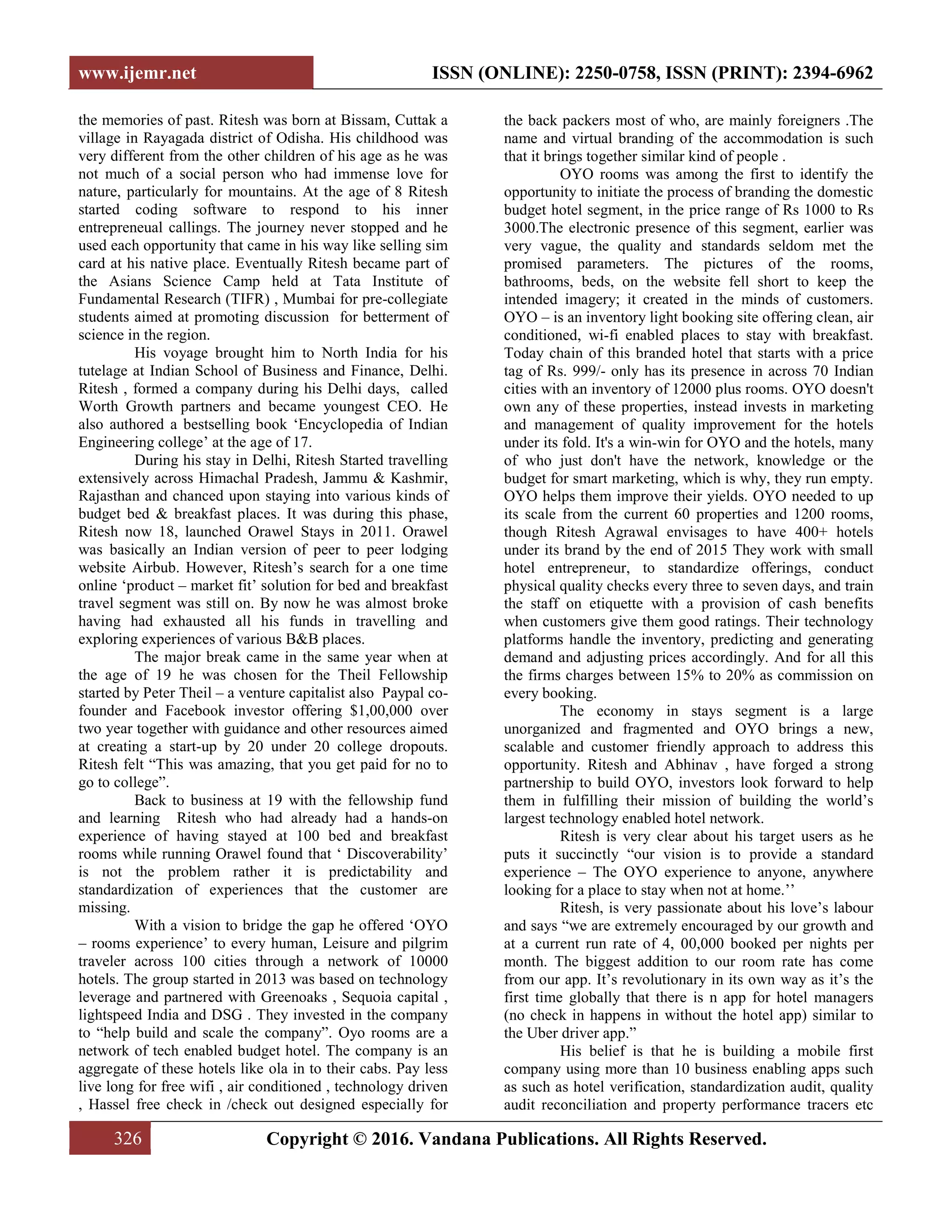
ANNEXURE 1
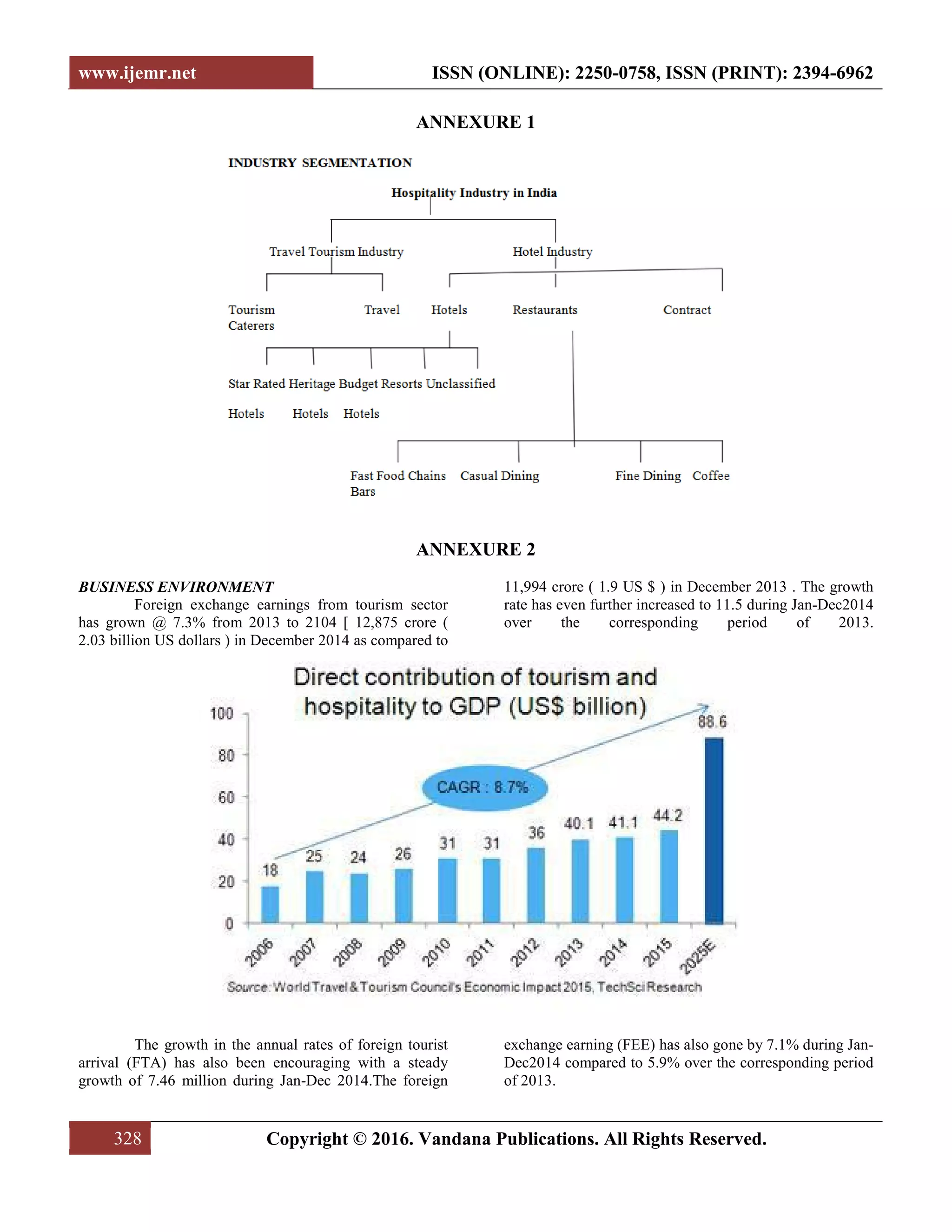
ANNEXURE 2
BUSINESS ENVIRONMENT
Foreign exchange earnings from tourism sector
has grown @ 7.3% from 2013 to 2104 [ 12,875 crore (
2.03 billion US dollars ) in December 2014 as compared to
11,994 crore ( 1.9 US $ ) in December 2013 . The growth
rate has even further increased to 11.5 during Jan-Dec2014
over the corresponding period of 2013.
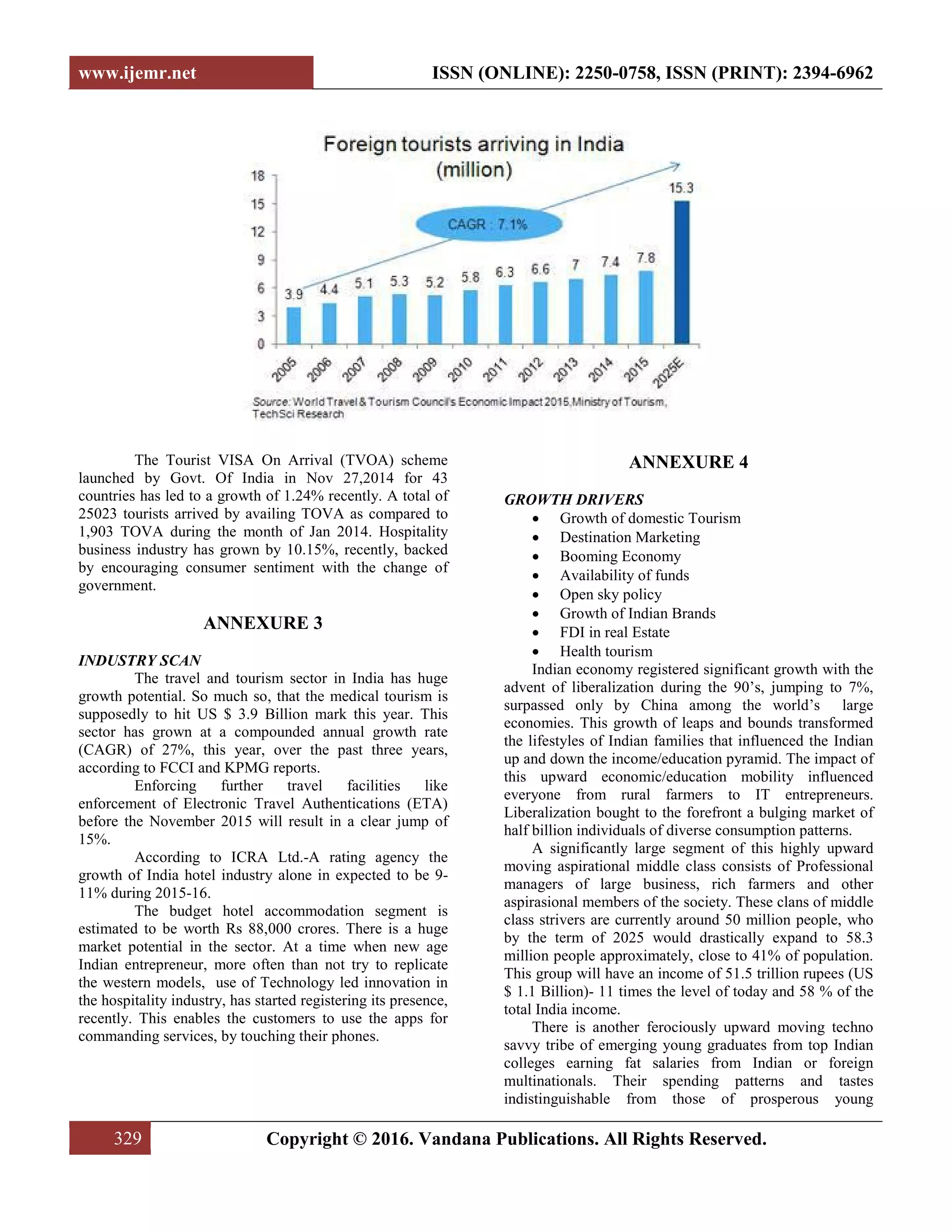
The growth in the annual rates of foreign tourist
arrival (FTA) has also been encouraging with a steady
growth of 7.46 million during Jan-Dec 2014.The foreign
exchange earning (FEE) has also gone by 7.1% during Jan-
Dec2014 compared to 5.9% over the corresponding period
of 2013.
www.ijemr.net ISSN (ONLINE): 2250-0758, ISSN (PRINT): 2394-6962
329 Copyright © 2016. Vandana Publications. All Rights Reserved.
The Tourist VISA On Arrival (TVOA) scheme
launched by Govt. Of India in Nov 27,2014 for 43
countries has led to a growth of 1.24% recently. A total of
25023 tourists arrived by availing TOVA as compared to
1,903 TOVA during the month of Jan 2014. Hospitality
business industry has grown by 10.15%, recently, backed
by encouraging consumer sentiment with the change of
government.
ANNEXURE 3
INDUSTRY SCAN
The travel and tourism sector in India has huge
growth potential. So much so, that the medical tourism is
supposedly to hit US $ 3.9 Billion mark this year. This
sector has grown at a compounded annual growth rate
(CAGR) of 27%, this year, over the past three years,
according to FCCI and KPMG reports.
Enforcing further travel facilities like
enforcement of Electronic Travel Authentications (ETA)
before the November 2015 will result in a clear jump of
15%.
According to ICRA Ltd.-A rating agency the
growth of India hotel industry alone in expected to be 9-
11% during 2015-16.
The budget hotel accommodation segment is
estimated to be worth Rs 88,000 crores. There is a huge
market potential in the sector. At a time when new age
Indian entrepreneur, more often than not try to replicate
the western models, use of Technology led innovation in
the hospitality industry, has started registering its presence,
recently. This enables the customers to use the apps for
commanding services, by touching their phones.
ANNEXURE 4
GROWTH DRIVERS
• Growth of domestic Tourism
• Destination Marketing
• Booming Economy
• Availability of funds
• Open sky policy
• Growth of Indian Brands
• FDI in real Estate
• Health tourism
Indian economy registered significant growth with the
advent of liberalization during the 90’s, jumping to 7%,
surpassed only by China among the world’s large
economies. This growth of leaps and bounds transformed
the lifestyles of Indian families that influenced the Indian
up and down the income/education pyramid. The impact of
this upward economic/education mobility influenced
everyone from rural farmers to IT entrepreneurs.
Liberalization bought to the forefront a bulging market of
half billion individuals of diverse consumption patterns.
A significantly large segment of this highly upward
moving aspirational middle class consists of Professional
managers of large business, rich farmers and other
aspirasional members of the society. These clans of middle
class strivers are currently around 50 million people, who
by the term of 2025 would drastically expand to 58.3
million people approximately, close to 41% of population.
This group will have an income of 51.5 trillion rupees (US
$ 1.1 Billion)- 11 times the level of today and 58 % of the
total India income.
There is another ferociously upward moving techno
savvy tribe of emerging young graduates from top Indian
colleges earning fat salaries from Indian or foreign
multinationals. Their spending patterns and tastes
indistinguishable from those of prosperous young
www.ijemr.net ISSN (ONLINE): 2250-0758, ISSN (PRINT): 2394-6962
330 Copyright © 2016. Vandana Publications. All Rights Reserved.
westerns. High-end and luxury cars , designer outfits, full
time domestic help, comfortable world class lodging
facilities for their work trips and regular vacations are
some of the items that tops their list. by 2025 there would
be 9.5 million Indian in this class and would spend nearly
14.1 trillion rupees – 20% of total Indian consumption.
ANNEXURE 5
INVESTMENTS
Tourism has been among the top 15 sectors in
India to attract foreign direct Investment (FDI) during the
period April 2000-Feb 2015. This sector attracted around
US $ 7,862.08 million of FDI.
ITC is planning to invest about 9000 crore ( US $
1.42 billion ) in the next three or four year to expand its
portfolio of hotels . ITC will launch five other hotels in
Mahabalipuram, Kolkata, Ahemdabad , Hydrabad and
Colambo by 2018.
Golden Sachi – a US based multinational
investment banking fund has invested Rs 255 crore ( US $
40.37 Million ) in Vatika hotels.
Another US based vantage hospitality group has
signed a franchise agreement with India based Miraya
hotel management to establish mid market banks in the
country.
Onyx hospitality – a Thai hospitality firm has set
up a joint venture (JV) with Kings Bridge, India to open
seven hotels in the country by 2018, with an investment of
US $ 100 million.
Dharampal Satyapal has invested close to Rs.300
crore (US $ 47.51 million ) in Carlbon Rezidor Hotel of
Gwauthati., for which they will get around 30 crore ( US $
4.75 Million )
TEACHING NOTES
OVERVIEW
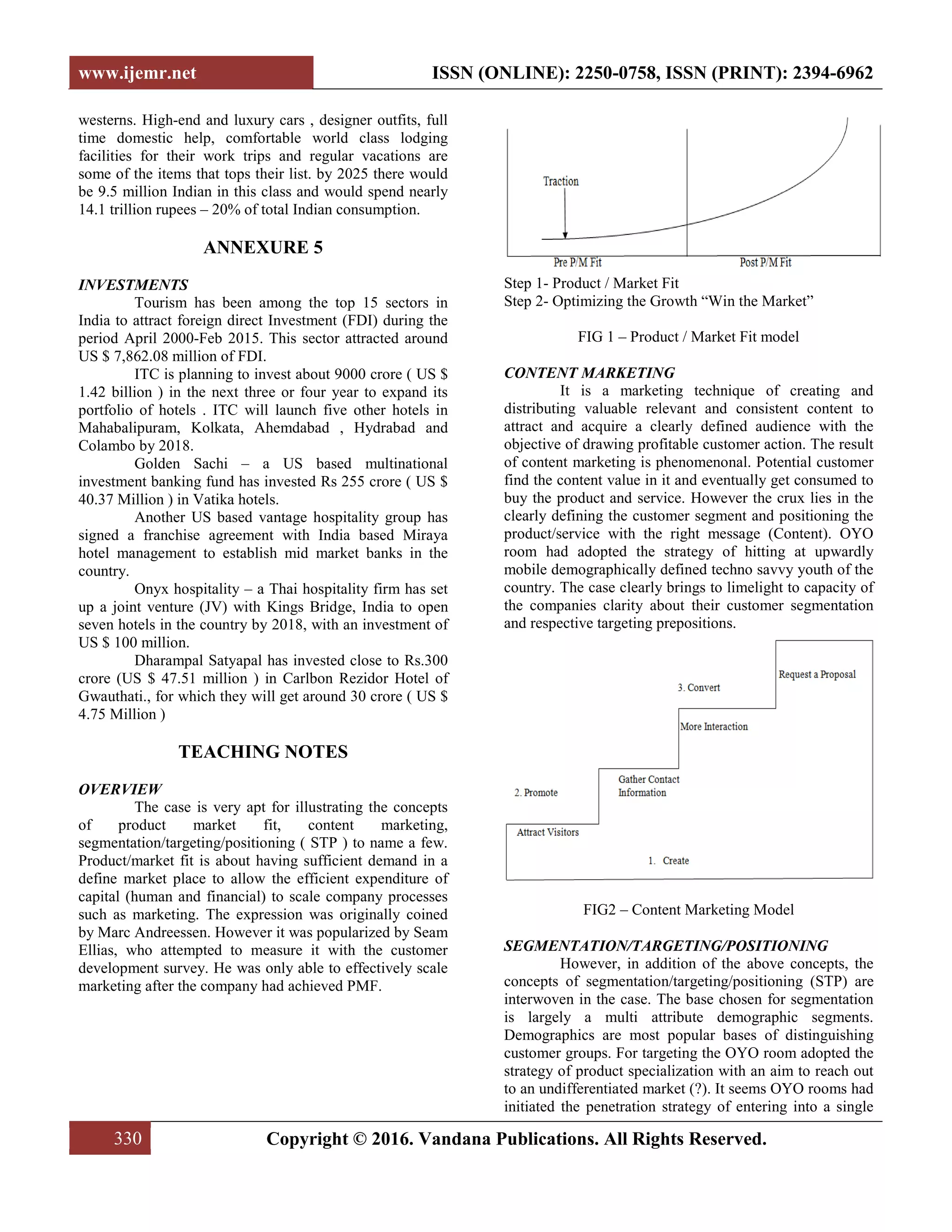
The case is very apt for illustrating the concepts
of product market fit, content marketing,
segmentation/targeting/positioning ( STP ) to name a few.
Product/market fit is about having sufficient demand in a
define market place to allow the efficient expenditure of
capital (human and financial) to scale company processes
such as marketing. The expression was originally coined
by Marc Andreessen. However it was popularized by Seam
Ellias, who attempted to measure it with the customer
development survey. He was only able to effectively scale
marketing after the company had achieved PMF.
Step 1- Product / Market Fit
Step 2- Optimizing the Growth “Win the Market”
FIG 1 – Product / Market Fit model
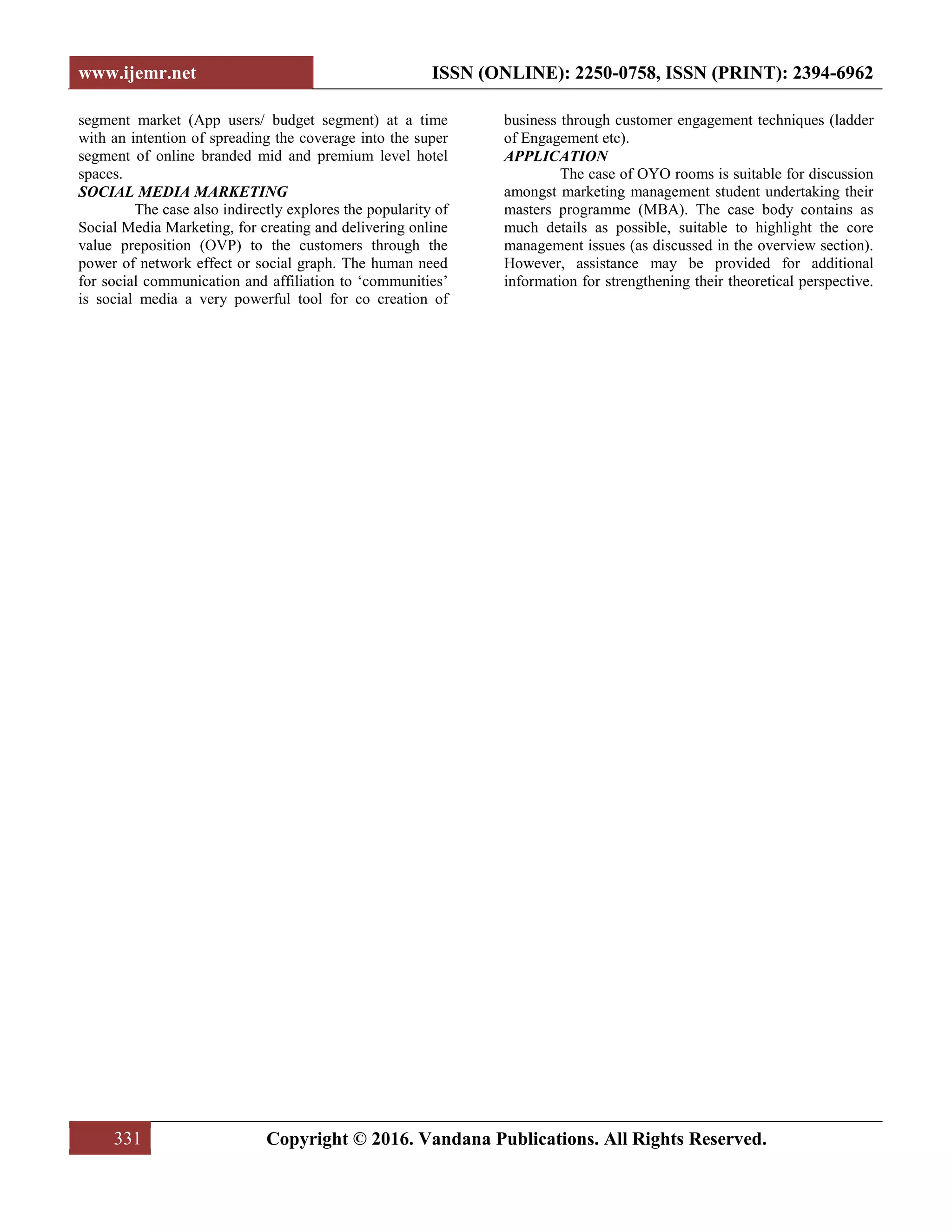
CONTENT MARKETING
It is a marketing technique of creating and
distributing valuable relevant and consistent content to
attract and acquire a clearly defined audience with the
objective of drawing profitable customer action. The result
of content marketing is phenomenonal. Potential customer
find the content value in it and eventually get consumed to
buy the product and service. However the crux lies in the
clearly defining the customer segment and positioning the
product/service with the right message (Content). OYO
room had adopted the strategy of hitting at upwardly
mobile demographically defined techno savvy youth of the
country. The case clearly brings to limelight to capacity of
the companies clarity about their customer segmentation
and respective targeting prepositions.
FIG2 – Content Marketing Model
SEGMENTATION/TARGETING/POSITIONING
However, in addition of the above concepts, the
concepts of segmentation/targeting/positioning (STP) are
interwoven in the case. The base chosen for segmentation
is largely a multi attribute demographic segments.
Demographics are most popular bases of distinguishing
customer groups. For targeting the OYO room adopted the
strategy of product specialization with an aim to reach out
to an undifferentiated market (?). It seems OYO rooms had
initiated the penetration strategy of entering into a single
www.ijemr.net ISSN (ONLINE): 2250-0758, ISSN (PRINT): 2394-6962
331 Copyright © 2016. Vandana Publications. All Rights Reserved.
segment market (App users/ budget segment) at a time
with an intention of spreading the coverage into the super
segment of online branded mid and premium level hotel
spaces.
SOCIAL MEDIA MARKETING
The case also indirectly explores the popularity of
Social Media Marketing, for creating and delivering online
value preposition (OVP) to the customers through the
power of network effect or social graph. The human need
for social communication and affiliation to ‘communities’
is social media a very powerful tool for co creation of
business through customer engagement techniques (ladder
of Engagement etc).
APPLICATION
The case of OYO rooms is suitable for discussion
amongst marketing management student undertaking their
masters programme (MBA). The case body contains as
much details as possible, suitable to highlight the core
management issues (as discussed in the overview section).
However, assistance may be provided for additional
information for strengthening their theoretical perspective.

Ch 5 A Oyo Case Study.pdf

  • 1.
    www.ijemr.net ISSN (ONLINE):2250-0758, ISSN (PRINT): 2394-6962 325 Copyright © 2016. Vandana Publications. All Rights Reserved. Volume-6, Issue-5, September-October 2016 International Journal of Engineering and Management Research Page Number: 325-331 On Your Own: An Oyo Story A Case Study Dr. Subodh Kesharwani1 , Vivek Kumar2 1 Reader, School of Management, Indira Gandhi National Open University, New Delhi, INDIA 2 Research Scholar, AIMA, New Delhi, INDIA Statement of Originality The case study is the author’s own work and has not already been presented, published or submitted for presentation or publication. ABSTRACT The objective of the case is to tell a tale of OYO room as objectively as possible from the perspective of a ‘situation case’. An effort has been to provide a sufficiently large pool of information, required to analyze the reasons behind present success of OYO rooms in particular and an Indian enterpreneual pattern emerging out of the innovative use of technology and marketing principals, in general. The case brings the success story of Ritesh Aggarwal about how he used hospitality idea and initiated budgeted hotels arousing lot of investment in this segment. The attention of investors has prompted for tourism and hospitality. Government in action is also concentrated on “Make in India” which means that entrepreneurs like Ritesh Aggarwal shall be promoted and supported. There is a need to create comfort zone for young minds so that they come forward as successful businessmen thereby leading to country’s economic growth. Keywords--- FIT, OYO, CEO I. INTRODUCTION Prime Minister Narendra Modi’s call on “Make In India” initiated a lot of changes in the manufacturing landscape of India. Although it is worthwhile to focus on manufacturing led trade export model for sustainable economic growth, it is high time that we also celebrate the rise of new breed of entrepreneur who are demographically aligned to a youthful company. The Indian entrepreneur has begun taking advantage of the opportunities that are becoming available as hundreds of millions of netizens come to a common place virtual market through their smart phones and other hand held devices. Ritesh Aggarwal’s OYO rooms were among the first to spot the opportunity to fix the problem of predictability and standardization by branding the India’s unbranded budget hotel segment, which is estimated to be worth 88,000 crores. Aggarwal’s true innovative use of technology in hospitality industry, has not only won him high accolades, but also brought huge investment in the sector. India has no more remained a legendary land of snake charmers, confiding tourism to traditional sectors comprising mainly of Himalayas, Agra, Rajasthan, Kerala, North East and Varanasi alone. The fast evolving travel and tourist markets are highly fragmented in terms of demographics and cultural norms. This shift in the emerging segment is marked by ‘individualism’ and ‘use of technology’. The members of this segment are self managed and prefer to search for best prices vis-à-vis experiences. The segment includes ‘visit friend and relative travels’, ‘the frequent independent traveler’ as opposed to group travelers ( FIT ), Business travels, pilgrims, medical tourists to name a few. Therefore, it is high time that travel and tourism industry wakes up to the call and redesign itself to meet the challenges and grab the opportunities, thrown open to them by these plethora of changes in the macro economic scenario. II. CASE BODY On 15th This was an occasion for self reflection as well as nostalgia, especially for Ritesh who at 21 was considered to be youngest CEO in India. His mind was flashed with July 2015, Ritesh Aggarwal, Abhinav Sinha and their entire team were in party mood at their Sohna Road corporate office in Gurgoan. They had just raised $100 million ( 630 crore ) from Soft Bank Corporation and other investors. This was the biggest investment they had received so far after $25 million from Greenoaks Capital, Sanfrancisco and Sequoia, DSG consumer partners and light speed ventures.
  • 2.
    www.ijemr.net ISSN (ONLINE):2250-0758, ISSN (PRINT): 2394-6962 326 Copyright © 2016. Vandana Publications. All Rights Reserved. the memories of past. Ritesh was born at Bissam, Cuttak a village in Rayagada district of Odisha. His childhood was very different from the other children of his age as he was not much of a social person who had immense love for nature, particularly for mountains. At the age of 8 Ritesh started coding software to respond to his inner entrepreneual callings. The journey never stopped and he used each opportunity that came in his way like selling sim card at his native place. Eventually Ritesh became part of the Asians Science Camp held at Tata Institute of Fundamental Research (TIFR) , Mumbai for pre-collegiate students aimed at promoting discussion for betterment of science in the region. His voyage brought him to North India for his tutelage at Indian School of Business and Finance, Delhi. Ritesh , formed a company during his Delhi days, called Worth Growth partners and became youngest CEO. He also authored a bestselling book ‘Encyclopedia of Indian Engineering college’ at the age of 17. During his stay in Delhi, Ritesh Started travelling extensively across Himachal Pradesh, Jammu & Kashmir, Rajasthan and chanced upon staying into various kinds of budget bed & breakfast places. It was during this phase, Ritesh now 18, launched Orawel Stays in 2011. Orawel was basically an Indian version of peer to peer lodging website Airbub. However, Ritesh’s search for a one time online ‘product – market fit’ solution for bed and breakfast travel segment was still on. By now he was almost broke having had exhausted all his funds in travelling and exploring experiences of various B&B places. The major break came in the same year when at the age of 19 he was chosen for the Theil Fellowship started by Peter Theil – a venture capitalist also Paypal co- founder and Facebook investor offering $1,00,000 over two year together with guidance and other resources aimed at creating a start-up by 20 under 20 college dropouts. Ritesh felt “This was amazing, that you get paid for no to go to college”. Back to business at 19 with the fellowship fund and learning Ritesh who had already had a hands-on experience of having stayed at 100 bed and breakfast rooms while running Orawel found that ‘ Discoverability’ is not the problem rather it is predictability and standardization of experiences that the customer are missing. With a vision to bridge the gap he offered ‘OYO – rooms experience’ to every human, Leisure and pilgrim traveler across 100 cities through a network of 10000 hotels. The group started in 2013 was based on technology leverage and partnered with Greenoaks , Sequoia capital , lightspeed India and DSG . They invested in the company to “help build and scale the company”. Oyo rooms are a network of tech enabled budget hotel. The company is an aggregate of these hotels like ola in to their cabs. Pay less live long for free wifi , air conditioned , technology driven , Hassel free check in /check out designed especially for the back packers most of who, are mainly foreigners .The name and virtual branding of the accommodation is such that it brings together similar kind of people . OYO rooms was among the first to identify the opportunity to initiate the process of branding the domestic budget hotel segment, in the price range of Rs 1000 to Rs 3000.The electronic presence of this segment, earlier was very vague, the quality and standards seldom met the promised parameters. The pictures of the rooms, bathrooms, beds, on the website fell short to keep the intended imagery; it created in the minds of customers. OYO – is an inventory light booking site offering clean, air conditioned, wi-fi enabled places to stay with breakfast. Today chain of this branded hotel that starts with a price tag of Rs. 999/- only has its presence in across 70 Indian cities with an inventory of 12000 plus rooms. OYO doesn't own any of these properties, instead invests in marketing and management of quality improvement for the hotels under its fold. It's a win-win for OYO and the hotels, many of who just don't have the network, knowledge or the budget for smart marketing, which is why, they run empty. OYO helps them improve their yields. OYO needed to up its scale from the current 60 properties and 1200 rooms, though Ritesh Agrawal envisages to have 400+ hotels under its brand by the end of 2015 They work with small hotel entrepreneur, to standardize offerings, conduct physical quality checks every three to seven days, and train the staff on etiquette with a provision of cash benefits when customers give them good ratings. Their technology platforms handle the inventory, predicting and generating demand and adjusting prices accordingly. And for all this the firms charges between 15% to 20% as commission on every booking. The economy in stays segment is a large unorganized and fragmented and OYO brings a new, scalable and customer friendly approach to address this opportunity. Ritesh and Abhinav , have forged a strong partnership to build OYO, investors look forward to help them in fulfilling their mission of building the world’s largest technology enabled hotel network. Ritesh is very clear about his target users as he puts it succinctly “our vision is to provide a standard experience – The OYO experience to anyone, anywhere looking for a place to stay when not at home.’’ Ritesh, is very passionate about his love’s labour and says “we are extremely encouraged by our growth and at a current run rate of 4, 00,000 booked per nights per month. The biggest addition to our room rate has come from our app. It’s revolutionary in its own way as it’s the first time globally that there is n app for hotel managers (no check in happens in without the hotel app) similar to the Uber driver app.” His belief is that he is building a mobile first company using more than 10 business enabling apps such as such as hotel verification, standardization audit, quality audit reconciliation and property performance tracers etc
  • 3.
    www.ijemr.net ISSN (ONLINE):2250-0758, ISSN (PRINT): 2394-6962 327 Copyright © 2016. Vandana Publications. All Rights Reserved. that is geo-location mapped , by means of which, one can on real time identify and fix issues at a room, by room level. This has been achieved on the app with more than 6,00,000 downloads just within 3 months since launch. The apps are successfully running across 12,000 plus rooms. It was about 8:30 in the evening, most of the team member had left now leaving the duo behind. Ritesh, who was still fiddling with his tab inattentively, was suddenly shaken by Abhinav. They had an association of last 12 months, which brought complimentary skills to work front. Abhinav COO of OYO room is basically a chemical engineer from IIT Kharagpur with a MBA from Harvard with 10 year experience across product and Service Company. He was initially interested even in politics which made him try his potentials in campaign management for a political party during 2009 elections in India. A little senior to Ritesh, he is not only a work partner but also great pal. They together are firm that Indian hospitality industry has a great future and may surpass even China because of the language advantage (English Speaking ability) of Indians. Ritesh and Abhinav both felt today that OYO must start attempting to create a pan Indian presence,now. As on today OYO is getting major traffic from Delhi NCR, Bangaluru, Pune, Mumbai and Hydrabad. Traditionally OYO advertizing was confined to the digital domain. It has a Facebook presence of 2-7 lacks together with Twitter following of with 8000 followers, besides 1.5 millions app downloads with a large number of active users. They started shuffling the copy of report submitted by Anshul Sinha CEO of another advertising start-up ‘Boring Brands’. OYO has been earlier reaching out the people through short videos and films, like Jai Hind, Father’s day celebration and IPL final virtual contest. However in order to reach out to tier three cities and to popularize the brand with elderly people for whom the hotel bookings are done by children, OYO now chose to barge on the mass media with their campaign title “ Aur kya chahiye ? ”. The campaign is supported by digital radio and print medium. Recently, OYO has targeted on an all women space as well with their new property called “OYO-We”. This segment of customer consists of single woman traveler or women who are traveling to other cities for office work and contribute nearly 40% of OYO room’s frequent independent travelers (FIT). In addition to this, OYO has already ventured out to the premium segment providing luxury rooms to the customers. When asked about his future plans Ritesh says “OYO is a product that has never been built or attempted before anywhere in the world. “ It’s a ‘make in India’ initiative. That we take pride in “ He further adds “ our long term plan is to be present in 250 cities across the country with 5,00,000 rooms extending our dominance in a market pioneered by us with a massive $ 100 million investment in demand, supply, technology and customer experience initiatives. At present OYO is concentrating over the huge domestic potential available and might go international when the “time is right”. OYO has recently shown an appetite for expanding into neighboring ASIAN country. OYO is not a standalone company in the market. It is facing competition from Zo rooms and Treebo. The segment has to consolidate in future but market is going to get bigger, keeping in mind current economic growth rate and rise in purchasing power of the customers. Ritesh and Abhinav resumed their evening by sharing their much loved dream about how will they take OYO to 250 cities across the country with 5,00,000 rooms extending their dominance in a market pioneered by a massive $ 100 million investment in demand & supply, technological and customer experience initiatives. III. QUESTIONS 1. Is the app based model of OYO rooms competitively relevant and profitably sustainable, especially during consolidation phase? 2. How does OYO room fit into the concept of content marketing? 3. Suggest an alternative advertisement strategy to reach out to the tier three customers? 4. Evaluate the influence of social media marketing in the success of OYO rooms? 5. What pattern of Entrepreneurship style emerges from the story of Ritesh Aggarwal? REFRENCES [1] Essay on History and Evolution of Hospitality Industry in India – Deepti Verma [2] World Travel and Tourism Councils Economic Impact 2015 – Ministry of Tourism, Tech Sci Research [3] References - Media reports, Ministry of Tourism, Department of Policy and Promotion( DIPP ) Govt. of Inida. [4] Indian Hospitality – Shasank Gavalee [5] Platform for Budget Hotels, OYO rooms raises $25 million from Sequoia, others – Your Strory/Business Standard. [6] Ritesh Agarwal Interview : Aims to do 1000 K booking nights per month [7] TIMES OF INDIA: Wednesday,30th Sept.2015 [8] What OYO rooms gain from its debut mass media campaign : Devender Gupta, 24th Sep 2015. [9] Will Real Ritesh Aggarwal please stand up : Live Mint, 27th [11] Marketing Management: Philip Kotler. Oct 2013. [10] Zero to Product/Market fit : Andrew chan.
  • 4.
    www.ijemr.net ISSN (ONLINE):2250-0758, ISSN (PRINT): 2394-6962 328 Copyright © 2016. Vandana Publications. All Rights Reserved. ANNEXURE 1 ANNEXURE 2 BUSINESS ENVIRONMENT Foreign exchange earnings from tourism sector has grown @ 7.3% from 2013 to 2104 [ 12,875 crore ( 2.03 billion US dollars ) in December 2014 as compared to 11,994 crore ( 1.9 US $ ) in December 2013 . The growth rate has even further increased to 11.5 during Jan-Dec2014 over the corresponding period of 2013. The growth in the annual rates of foreign tourist arrival (FTA) has also been encouraging with a steady growth of 7.46 million during Jan-Dec 2014.The foreign exchange earning (FEE) has also gone by 7.1% during Jan- Dec2014 compared to 5.9% over the corresponding period of 2013.
  • 5.
    www.ijemr.net ISSN (ONLINE):2250-0758, ISSN (PRINT): 2394-6962 329 Copyright © 2016. Vandana Publications. All Rights Reserved. The Tourist VISA On Arrival (TVOA) scheme launched by Govt. Of India in Nov 27,2014 for 43 countries has led to a growth of 1.24% recently. A total of 25023 tourists arrived by availing TOVA as compared to 1,903 TOVA during the month of Jan 2014. Hospitality business industry has grown by 10.15%, recently, backed by encouraging consumer sentiment with the change of government. ANNEXURE 3 INDUSTRY SCAN The travel and tourism sector in India has huge growth potential. So much so, that the medical tourism is supposedly to hit US $ 3.9 Billion mark this year. This sector has grown at a compounded annual growth rate (CAGR) of 27%, this year, over the past three years, according to FCCI and KPMG reports. Enforcing further travel facilities like enforcement of Electronic Travel Authentications (ETA) before the November 2015 will result in a clear jump of 15%. According to ICRA Ltd.-A rating agency the growth of India hotel industry alone in expected to be 9- 11% during 2015-16. The budget hotel accommodation segment is estimated to be worth Rs 88,000 crores. There is a huge market potential in the sector. At a time when new age Indian entrepreneur, more often than not try to replicate the western models, use of Technology led innovation in the hospitality industry, has started registering its presence, recently. This enables the customers to use the apps for commanding services, by touching their phones. ANNEXURE 4 GROWTH DRIVERS • Growth of domestic Tourism • Destination Marketing • Booming Economy • Availability of funds • Open sky policy • Growth of Indian Brands • FDI in real Estate • Health tourism Indian economy registered significant growth with the advent of liberalization during the 90’s, jumping to 7%, surpassed only by China among the world’s large economies. This growth of leaps and bounds transformed the lifestyles of Indian families that influenced the Indian up and down the income/education pyramid. The impact of this upward economic/education mobility influenced everyone from rural farmers to IT entrepreneurs. Liberalization bought to the forefront a bulging market of half billion individuals of diverse consumption patterns. A significantly large segment of this highly upward moving aspirational middle class consists of Professional managers of large business, rich farmers and other aspirasional members of the society. These clans of middle class strivers are currently around 50 million people, who by the term of 2025 would drastically expand to 58.3 million people approximately, close to 41% of population. This group will have an income of 51.5 trillion rupees (US $ 1.1 Billion)- 11 times the level of today and 58 % of the total India income. There is another ferociously upward moving techno savvy tribe of emerging young graduates from top Indian colleges earning fat salaries from Indian or foreign multinationals. Their spending patterns and tastes indistinguishable from those of prosperous young
  • 6.
    www.ijemr.net ISSN (ONLINE):2250-0758, ISSN (PRINT): 2394-6962 330 Copyright © 2016. Vandana Publications. All Rights Reserved. westerns. High-end and luxury cars , designer outfits, full time domestic help, comfortable world class lodging facilities for their work trips and regular vacations are some of the items that tops their list. by 2025 there would be 9.5 million Indian in this class and would spend nearly 14.1 trillion rupees – 20% of total Indian consumption. ANNEXURE 5 INVESTMENTS Tourism has been among the top 15 sectors in India to attract foreign direct Investment (FDI) during the period April 2000-Feb 2015. This sector attracted around US $ 7,862.08 million of FDI. ITC is planning to invest about 9000 crore ( US $ 1.42 billion ) in the next three or four year to expand its portfolio of hotels . ITC will launch five other hotels in Mahabalipuram, Kolkata, Ahemdabad , Hydrabad and Colambo by 2018. Golden Sachi – a US based multinational investment banking fund has invested Rs 255 crore ( US $ 40.37 Million ) in Vatika hotels. Another US based vantage hospitality group has signed a franchise agreement with India based Miraya hotel management to establish mid market banks in the country. Onyx hospitality – a Thai hospitality firm has set up a joint venture (JV) with Kings Bridge, India to open seven hotels in the country by 2018, with an investment of US $ 100 million. Dharampal Satyapal has invested close to Rs.300 crore (US $ 47.51 million ) in Carlbon Rezidor Hotel of Gwauthati., for which they will get around 30 crore ( US $ 4.75 Million ) TEACHING NOTES OVERVIEW The case is very apt for illustrating the concepts of product market fit, content marketing, segmentation/targeting/positioning ( STP ) to name a few. Product/market fit is about having sufficient demand in a define market place to allow the efficient expenditure of capital (human and financial) to scale company processes such as marketing. The expression was originally coined by Marc Andreessen. However it was popularized by Seam Ellias, who attempted to measure it with the customer development survey. He was only able to effectively scale marketing after the company had achieved PMF. Step 1- Product / Market Fit Step 2- Optimizing the Growth “Win the Market” FIG 1 – Product / Market Fit model CONTENT MARKETING It is a marketing technique of creating and distributing valuable relevant and consistent content to attract and acquire a clearly defined audience with the objective of drawing profitable customer action. The result of content marketing is phenomenonal. Potential customer find the content value in it and eventually get consumed to buy the product and service. However the crux lies in the clearly defining the customer segment and positioning the product/service with the right message (Content). OYO room had adopted the strategy of hitting at upwardly mobile demographically defined techno savvy youth of the country. The case clearly brings to limelight to capacity of the companies clarity about their customer segmentation and respective targeting prepositions. FIG2 – Content Marketing Model SEGMENTATION/TARGETING/POSITIONING However, in addition of the above concepts, the concepts of segmentation/targeting/positioning (STP) are interwoven in the case. The base chosen for segmentation is largely a multi attribute demographic segments. Demographics are most popular bases of distinguishing customer groups. For targeting the OYO room adopted the strategy of product specialization with an aim to reach out to an undifferentiated market (?). It seems OYO rooms had initiated the penetration strategy of entering into a single
  • 7.
    www.ijemr.net ISSN (ONLINE):2250-0758, ISSN (PRINT): 2394-6962 331 Copyright © 2016. Vandana Publications. All Rights Reserved. segment market (App users/ budget segment) at a time with an intention of spreading the coverage into the super segment of online branded mid and premium level hotel spaces. SOCIAL MEDIA MARKETING The case also indirectly explores the popularity of Social Media Marketing, for creating and delivering online value preposition (OVP) to the customers through the power of network effect or social graph. The human need for social communication and affiliation to ‘communities’ is social media a very powerful tool for co creation of business through customer engagement techniques (ladder of Engagement etc). APPLICATION The case of OYO rooms is suitable for discussion amongst marketing management student undertaking their masters programme (MBA). The case body contains as much details as possible, suitable to highlight the core management issues (as discussed in the overview section). However, assistance may be provided for additional information for strengthening their theoretical perspective.