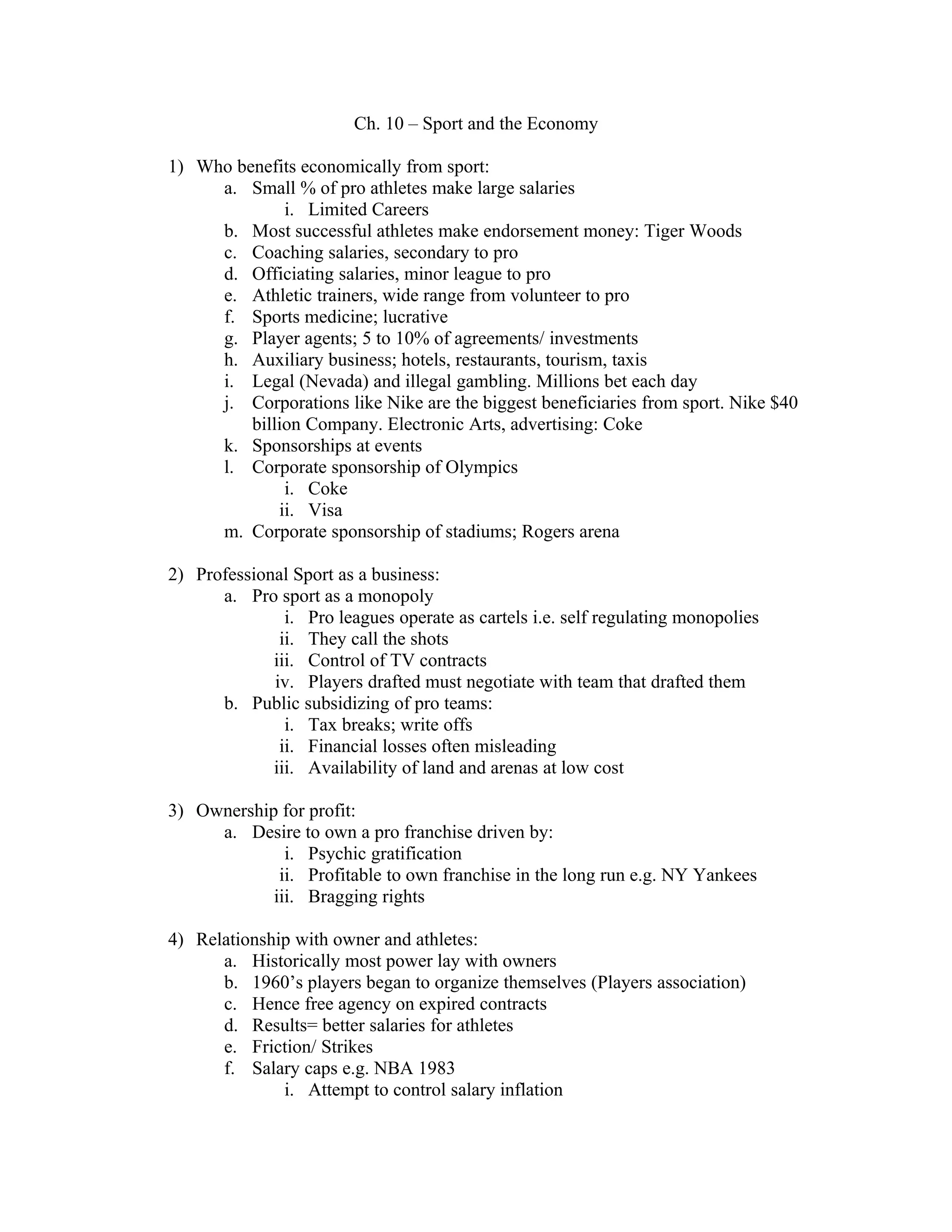
Ch. 10 – Sport and the Economy

1) Who benefits economically from sport:
     a. Small % of pro athletes make large salaries
              i. Limited Careers
     b. Most successful athletes make endorsement money: Tiger Woods
     c. Coaching salaries, secondary to pro
     d. Officiating salaries, minor league to pro
     e. Athletic trainers, wide range from volunteer to pro
     f. Sports medicine; lucrative
     g. Player agents; 5 to 10% of agreements/ investments
     h. Auxiliary business; hotels, restaurants, tourism, taxis
     i. Legal (Nevada) and illegal gambling. Millions bet each day
     j. Corporations like Nike are the biggest beneficiaries from sport. Nike $40
         billion Company. Electronic Arts, advertising: Coke
     k. Sponsorships at events
     l. Corporate sponsorship of Olympics
              i. Coke
             ii. Visa
     m. Corporate sponsorship of stadiums; Rogers arena

2) Professional Sport as a business:
      a. Pro sport as a monopoly
               i. Pro leagues operate as cartels i.e. self regulating monopolies
              ii. They call the shots
             iii. Control of TV contracts
             iv. Players drafted must negotiate with team that drafted them
      b. Public subsidizing of pro teams:
               i. Tax breaks; write offs
              ii. Financial losses often misleading
             iii. Availability of land and arenas at low cost

3) Ownership for profit:
     a. Desire to own a pro franchise driven by:
              i. Psychic gratification
             ii. Profitable to own franchise in the long run e.g. NY Yankees
            iii. Bragging rights

4) Relationship with owner and athletes:
      a. Historically most power lay with owners
      b. 1960’s players began to organize themselves (Players association)
      c. Hence free agency on expired contracts
      d. Results= better salaries for athletes
      e. Friction/ Strikes
      f. Salary caps e.g. NBA 1983
              i. Attempt to control salary inflation
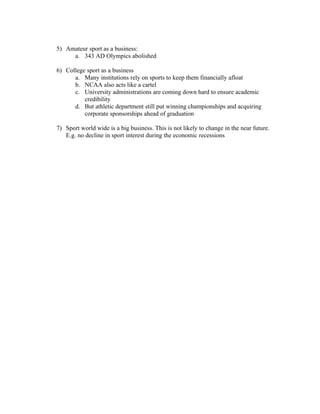
5) Amateur sport as a business:
     a. 343 AD Olympics abolished

6) College sport as a business
      a. Many institutions rely on sports to keep them financially afloat
      b. NCAA also acts like a cartel
      c. University administrations are coming down hard to ensure academic
          credibility
      d. But athletic department still put winning championships and acquiring
          corporate sponsorships ahead of graduation

7) Sport world wide is a big business. This is not likely to change in the near future.
   E.g. no decline in sport interest during the economic recessions

Ch 10

  • 1.
    Ch. 10 –Sport and the Economy 1) Who benefits economically from sport: a. Small % of pro athletes make large salaries i. Limited Careers b. Most successful athletes make endorsement money: Tiger Woods c. Coaching salaries, secondary to pro d. Officiating salaries, minor league to pro e. Athletic trainers, wide range from volunteer to pro f. Sports medicine; lucrative g. Player agents; 5 to 10% of agreements/ investments h. Auxiliary business; hotels, restaurants, tourism, taxis i. Legal (Nevada) and illegal gambling. Millions bet each day j. Corporations like Nike are the biggest beneficiaries from sport. Nike $40 billion Company. Electronic Arts, advertising: Coke k. Sponsorships at events l. Corporate sponsorship of Olympics i. Coke ii. Visa m. Corporate sponsorship of stadiums; Rogers arena 2) Professional Sport as a business: a. Pro sport as a monopoly i. Pro leagues operate as cartels i.e. self regulating monopolies ii. They call the shots iii. Control of TV contracts iv. Players drafted must negotiate with team that drafted them b. Public subsidizing of pro teams: i. Tax breaks; write offs ii. Financial losses often misleading iii. Availability of land and arenas at low cost 3) Ownership for profit: a. Desire to own a pro franchise driven by: i. Psychic gratification ii. Profitable to own franchise in the long run e.g. NY Yankees iii. Bragging rights 4) Relationship with owner and athletes: a. Historically most power lay with owners b. 1960’s players began to organize themselves (Players association) c. Hence free agency on expired contracts d. Results= better salaries for athletes e. Friction/ Strikes f. Salary caps e.g. NBA 1983 i. Attempt to control salary inflation
  • 2.
    5) Amateur sportas a business: a. 343 AD Olympics abolished 6) College sport as a business a. Many institutions rely on sports to keep them financially afloat b. NCAA also acts like a cartel c. University administrations are coming down hard to ensure academic credibility d. But athletic department still put winning championships and acquiring corporate sponsorships ahead of graduation 7) Sport world wide is a big business. This is not likely to change in the near future. E.g. no decline in sport interest during the economic recessions