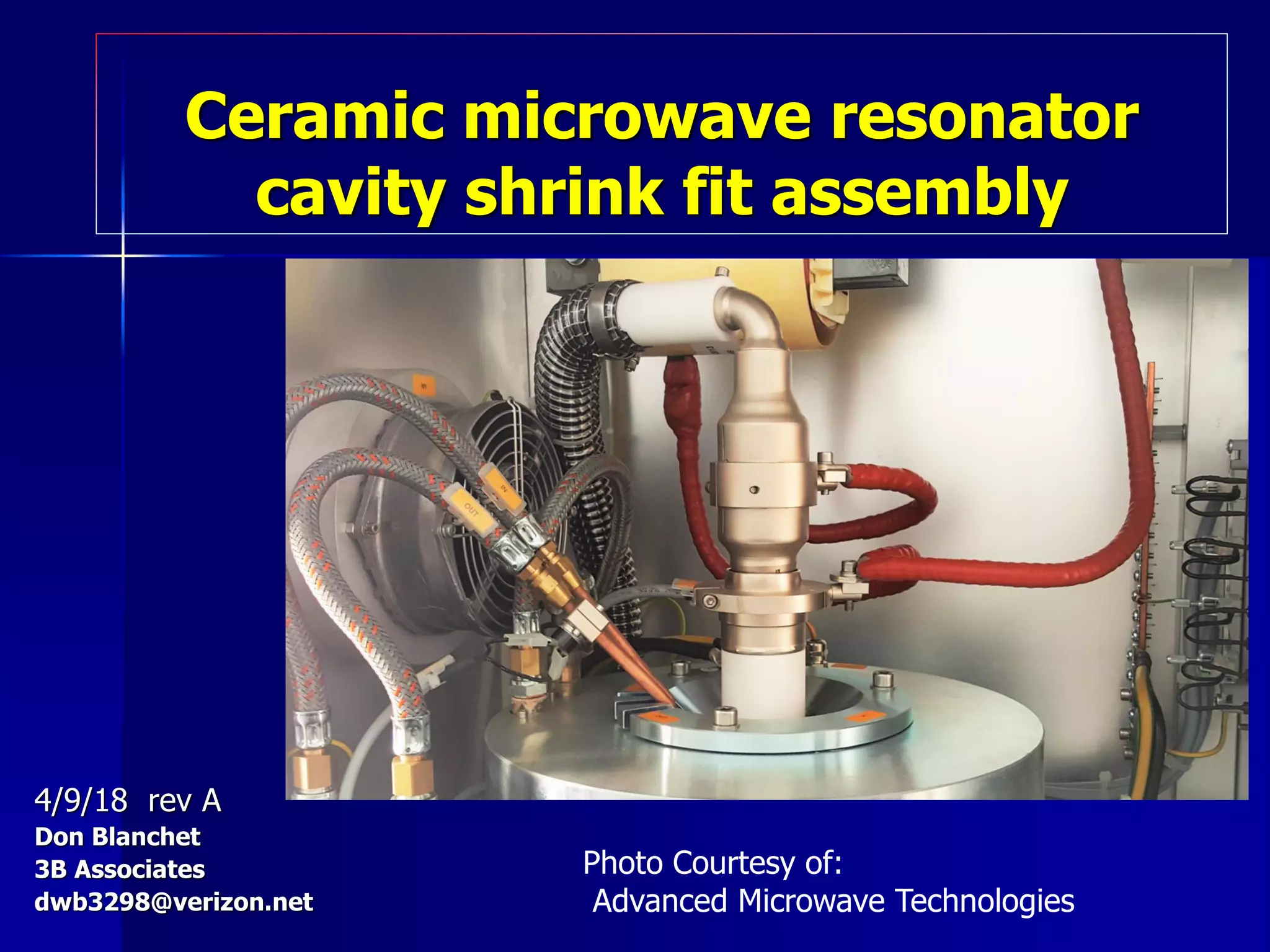
Ceramic microwave resonator
cavity shrink fit assembly
4/9/18 rev A
Don Blanchet
3B Associates
dwb3298@verizon.net
Photo Courtesy of:
Advanced Microwave Technologies
Component Assembly
 Aluminum housing
 Cylindrical Ceramic resonator puck
 Heat housing in fixture
 Insert puck using alignment fixture
 Cool to room temperature
 Shrink fit established
– Puck in compression
– Housing in radial tension
HOUSING ID Expansion
 Δ𝑙 = 𝛼𝐿Δ𝑇 = 2.3𝑒 − 05 𝑥 1 𝑥 50
 50C rise = .00115 inch
 100C rise = .00230 inch
 200C rise = .00460 inch
 250C rise = .00575 inch
Aluminum Melting point 593 C
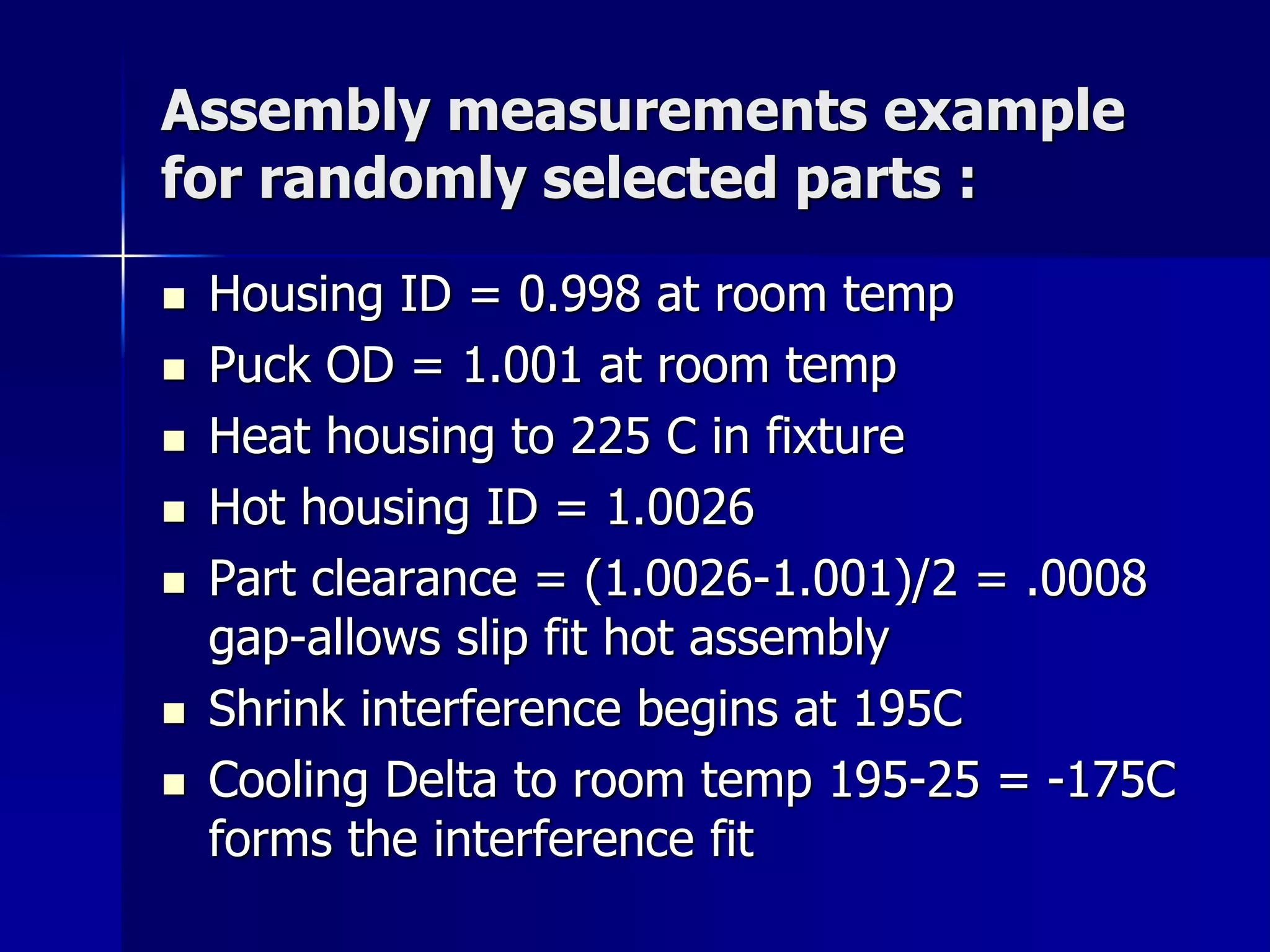
Assembly measurements example
for randomly selected parts :
 Housing ID = 0.998 at room temp
 Puck OD = 1.001 at room temp
 Heat housing to 225 C in fixture
 Hot housing ID = 1.0026
 Part clearance = (1.0026-1.001)/2 = .0008
gap-allows slip fit hot assembly
 Shrink interference begins at 195C
 Cooling Delta to room temp 195-25 = -175C
forms the interference fit
Main Questions ?
 Does the residual tensile stress in the
aluminum housing exceed the yield
point ?
 Is the residual compressive stress in
the dielectric ceramic puck safely
below the compressive fracture
strength ?
Linear FEA Results puck
in compression
80,000psi/25,550 = 3.1
FACTOR OF SAFETY
Linear housing in tension
aluminum yield strength exceeded
–permanent deformation
Max applied stress = 93,440 psi
Yield strength = 60,000 psi
2014-T6
Maximum permanent deformation after cooling = .003 inch
Exaggerated deformation shown 50X
Conclusions
 Ceramic dielectric puck does not
fracture.
 A shrink fit is established with .003
inch of permanent plastic deformation
in the aluminum housing.
 These calculations must be performed
for each pair of parts to be assembled.

Ceramic cavity resonator

  • 1.
    Ceramic microwave resonator cavityshrink fit assembly 4/9/18 rev A Don Blanchet 3B Associates dwb3298@verizon.net Photo Courtesy of: Advanced Microwave Technologies
  • 2.
    Component Assembly  Aluminumhousing  Cylindrical Ceramic resonator puck  Heat housing in fixture  Insert puck using alignment fixture  Cool to room temperature  Shrink fit established – Puck in compression – Housing in radial tension
  • 3.
    HOUSING ID Expansion Δ𝑙 = 𝛼𝐿Δ𝑇 = 2.3𝑒 − 05 𝑥 1 𝑥 50  50C rise = .00115 inch  100C rise = .00230 inch  200C rise = .00460 inch  250C rise = .00575 inch Aluminum Melting point 593 C
  • 4.
    Assembly measurements example forrandomly selected parts :  Housing ID = 0.998 at room temp  Puck OD = 1.001 at room temp  Heat housing to 225 C in fixture  Hot housing ID = 1.0026  Part clearance = (1.0026-1.001)/2 = .0008 gap-allows slip fit hot assembly  Shrink interference begins at 195C  Cooling Delta to room temp 195-25 = -175C forms the interference fit
  • 5.
    Main Questions ? Does the residual tensile stress in the aluminum housing exceed the yield point ?  Is the residual compressive stress in the dielectric ceramic puck safely below the compressive fracture strength ?
  • 6.
    Linear FEA Resultspuck in compression 80,000psi/25,550 = 3.1 FACTOR OF SAFETY
  • 7.
    Linear housing intension aluminum yield strength exceeded –permanent deformation Max applied stress = 93,440 psi Yield strength = 60,000 psi 2014-T6
  • 8.
    Maximum permanent deformationafter cooling = .003 inch Exaggerated deformation shown 50X
  • 9.
    Conclusions  Ceramic dielectricpuck does not fracture.  A shrink fit is established with .003 inch of permanent plastic deformation in the aluminum housing.  These calculations must be performed for each pair of parts to be assembled.