CEMENT
GENERALLY CEMENT CAN BE
DESCRIBED AS :
 The product obtained by intimately mixing
together calcareous (calcium carbonate or lime)
and argillaceous (alumina) or other silica and
iron oxide bearing materials, burning them at a
clinkering temperature and grinding the resulting
clinker.
 When it is mixed with water it forms a paste
which hardens and binds aggregates (sand,
gravel and/or crushed rock) together to form a
hard durable mass called concrete.
 FOR CONSTRUCTION PURPOSE THE
TERM CEMENT IS CONFINED TO THE
BONDING MATERIALS USED WITH
STONE, BRICKS, BUILDING BLOCKS,
ETC.
The functions of cement:
 To bind the sand and coarse aggregate
together
 To fill the voids in between sand and
coarse aggregate particles to form a
compact mass
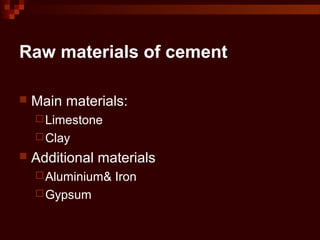
Raw materials of cement
 Main materials:
Limestone
Clay
 Additional materials
Aluminium& Iron
Gypsum
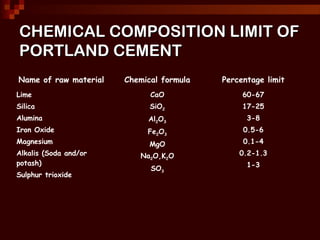
CHEMICAL COMPOSITION LIMIT OFCHEMICAL COMPOSITION LIMIT OF
PORTLAND CEMENTPORTLAND CEMENT
Name of raw material Chemical formula Percentage limit
Lime
Silica
Alumina
Iron Oxide
Magnesium
Alkalis (Soda and/or
potash)
Sulphur trioxide
CaO
SiO2
Al2O3
Fe2O3
MgO
Na2O,K2O
SO3
60-67
17-25
3-8
0.5-6
0.1-4
0.2-1.3
1-3
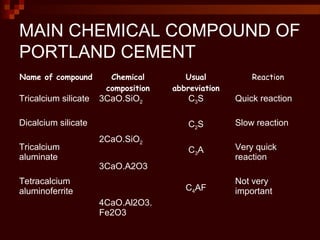
MAIN CHEMICAL COMPOUND OF
PORTLAND CEMENT
Name of compound Chemical
composition
Usual
abbreviation
Reaction
Tricalcium silicate
Dicalcium silicate
Tricalcium
aluminate
Tetracalcium
aluminoferrite
3CaO.SiO2
2CaO.SiO2
3CaO.A2O3
4CaO.Al2O3.
Fe2O3
C3S
C2S
C3A
C4AF
Quick reaction
Slow reaction
Very quick
reaction
Not very
important
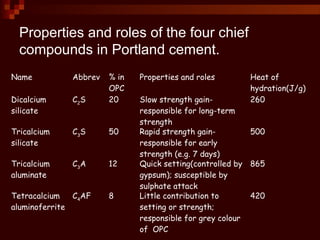
Properties and roles of the four chief
compounds in Portland cement.
Name Abbrev % in
OPC
Properties and roles Heat of
hydration(J/g)
Dicalcium
silicate
C2
S 20 Slow strength gain-
responsible for long-term
strength
260
Tricalcium
silicate
C3
S 50 Rapid strength gain-
responsible for early
strength (e.g. 7 days)
500
Tricalcium
aluminate
C3
A 12 Quick setting(controlled by
gypsum); susceptible by
sulphate attack
865
Tetracalcium
aluminoferrite
C4
AF 8 Little contribution to
setting or strength;
responsible for grey colour
of OPC
420
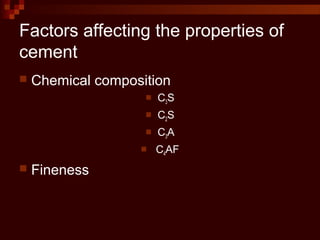
Factors affecting the properties of
cement
 Chemical composition
 C3S
 C2S
 C3A
 C4AF
 Fineness
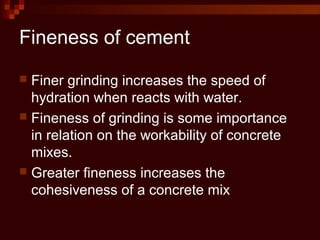
Fineness of cement
 Finer grinding increases the speed of
hydration when reacts with water.
 Fineness of grinding is some importance
in relation on the workability of concrete
mixes.
 Greater fineness increases the
cohesiveness of a concrete mix
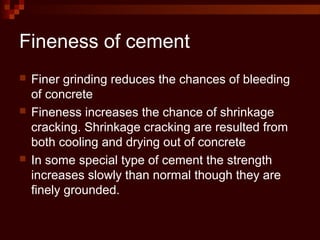
 Finer grinding reduces the chances of bleeding
of concrete
 Fineness increases the chance of shrinkage
cracking. Shrinkage cracking are resulted from
both cooling and drying out of concrete
 In some special type of cement the strength
increases slowly than normal though they are
finely grounded.
Fineness of cement
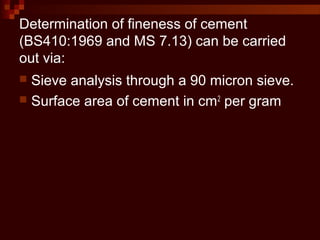
Determination of fineness of cement
(BS410:1969 and MS 7.13) can be carried
out via:
 Sieve analysis through a 90 micron sieve.
 Surface area of cement in cm2
per gram
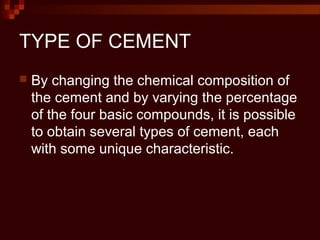
TYPE OF CEMENT
 By changing the chemical composition of
the cement and by varying the percentage
of the four basic compounds, it is possible
to obtain several types of cement, each
with some unique characteristic.
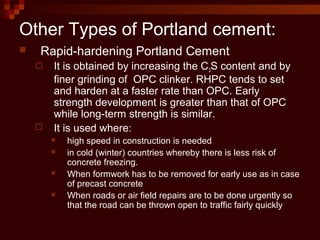
Other Types of Portland cement:
 Rapid-hardening Portland Cement
 It is obtained by increasing the C3S content and by
finer grinding of OPC clinker. RHPC tends to set
and harden at a faster rate than OPC. Early
strength development is greater than that of OPC
while long-term strength is similar.
 It is used where:
 high speed in construction is needed
 in cold (winter) countries whereby there is less risk of
concrete freezing.
 When formwork has to be removed for early use as in case
of precast concrete
 When roads or air field repairs are to be done urgently so
that the road can be thrown open to traffic fairly quickly
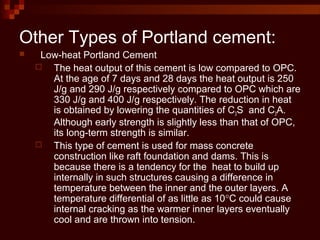
 Low-heat Portland Cement
 The heat output of this cement is low compared to OPC.
At the age of 7 days and 28 days the heat output is 250
J/g and 290 J/g respectively compared to OPC which are
330 J/g and 400 J/g respectively. The reduction in heat
is obtained by lowering the quantities of C3S and C3A.
Although early strength is slightly less than that of OPC,
its long-term strength is similar.
 This type of cement is used for mass concrete
construction like raft foundation and dams. This is
because there is a tendency for the heat to build up
internally in such structures causing a difference in
temperature between the inner and the outer layers. A
temperature differential of as little as 10°C could cause
internal cracking as the warmer inner layers eventually
cool and are thrown into tension.
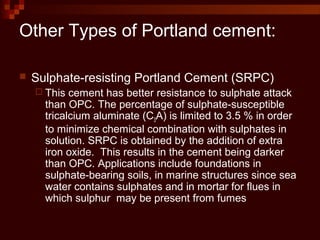
Other Types of Portland cement:
 Sulphate-resisting Portland Cement (SRPC)
 This cement has better resistance to sulphate attack
than OPC. The percentage of sulphate-susceptible
tricalcium aluminate (C3A) is limited to 3.5 % in order
to minimize chemical combination with sulphates in
solution. SRPC is obtained by the addition of extra
iron oxide. This results in the cement being darker
than OPC. Applications include foundations in
sulphate-bearing soils, in marine structures since sea
water contains sulphates and in mortar for flues in
which sulphur may be present from fumes
Other Types of Portland cement:
 Portland blast-furnace cement
 This cement (PBFC) comprises a mixture of OPC
and ground blast-furnace slag, the proportion of the
latter not exceeding 65% of the total. The slag
contains mainly lime, silica and alumina (in order of
decreasing amounts). These exhibit hydraulic action
in the presence of calcium hydroxide liberated by
the Portland cement on addition of water. Early
strength is lower than that of OPC but PBFC
generates less heat than OPC and produces better
sulphate resistance. Ultimate strength is similar to
that of OPC.
Other Types of Portland cement:
 Pulverised fuel ash(PFA) in cements
 PFA is a by-product of coal-powered power
stations and is an example of a pozzolanic
material- one which, in the presence of
lime(liberated by Portland cement) has
hydraulic (cementing) properties. It can be
incorporated in cement during
manufacturing.
Other Types of Portland cement:
MANUFACTURE OF PORTLAND CEMENT
 The process of manufacture of cement
consists essentially of:
 Grinding the raw materials (treatment of raw
materials)
 Mixing them intimately in certain proportions
 Burning in a large-rotary kiln at a temperature of
approximately 1300°C to 1400°C when the
materials are partially fused into balls known as
clinker.
 Then the clinker is cooled and ground to a fine
powder with some gypsum added. The resulting
product is the commercial Portland Cement so
widely used throughout the world
Details of manufacture of Cement:
 The mixing of raw materials can be done
either in water or in a dry condition. They
are called ‘wet’ and ‘dry’ processes. The
actual manufacture also depends on the
nature of the raw materials used.
Definitions which are involved in the process
of manufacturing cement:-
 Wash Mill
 This is circular pit with revolving radial arms carrying rakes,
which breaks up the lumps of solid raw materials
 Ball mill
 A ball mill is a mill where coarse materials are grounded to
fine particles
 Slurry
 The slurry is a liquid of creamy assistance with water content
of between 35% and 50% and only a fraction of the material
about 2% - larger than a 90µm (No. 170) B.S sieve size. The
slurry is kept in a storage tanks such as:
 soda ash Na C2O3 (Sodium Carbonate) to reduce viscosity
 Sodium Silicate Na2SiO3 is used to reduce moisture
Definitions which are involved in the process
of manufacturing cement:-
 Rotary Kiln
 This large steel cylinder lined with fire bricks or
called refractory lined. This is 2m to 5m in diameter
and about 100m to 150m long. The thickness of
steel sheeting is 20mm. The cylinder is slightly
inclined to the horizontal and rotates about it’s axis
at a speed of 1 – 2 times in 2 minutes.
 Clinker
 Clinker is the product of slurry inside a rotary kiln
where slurry undergoes chemical changes due to
high temperature and lime, silica and alumina
recombine mass the fuses into ball of 3 to 25mm
Grinding and Mixing
 When chalk is used it is broken up and
dispersed in water in a wash mill. The clay is
also broken up and mixed with water in a similar
wash mill. The two mixtures are now pumped,
mixed in predetermined proportions (normally
chalk or stone to clay) and passed through a
series of screens. The coarse materials are
passed through a ball mill for secondary
crushing and re-screened. The resulting cement
slurry is then pumped into the large storage
tanks. In the storage tanks the sedimentation of
the suspended solid is prevented by mechanical
stirrers or bubbling by compressed air.
 If limestone is used, it has to be blasted with
explosives, quarried and crushed in primary and
secondary crushers. This may be stored in silos.
The crushed limestone is then mixed with clay
slurry all fed into a ball-grinding mill, which is wet
because of the presence of clay slurry). Here the
crushing of limestone is grounded to the
fineness of flour, and the resultant cement slurry
is pumped into storage tanks. From here
onwards the process is the same regardless of
the original nature of the raw materials.
 Burning in rotary kiln
 The slurry is then passed into a rotary kiln. The kiln
rotates about its’ axis at a speed of 1 to 2 times in 2
minutes. The rotation is controlled by the inclination
of the kiln and by the speed of rotations.
 The slurry is fed at the upper thus end of the rotary
kiln raising the temperature inside the kiln. The
temperature raises from1400°C to 1500°C. The
coal, which should not have too high a ash content,
deserves a special mention because up to 350 kg
of coal is used to make a ton of cement. Oil or
natural gas can also be used instead of coal.
 The slurry in its’ movement down the kiln,
encounters a progressively higher temperature:
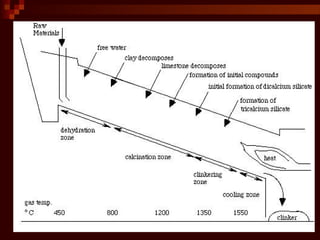
 At 100°C – all water is driven off
 At 500°C – there is an evolution of combined water
 At 900°C – limestone decomposes, CaCO3
CaO + CO2 (endothermic reaction) CO2 is
swept away by current of air.
 Between 900C and 1200C – the main reaction
between lime and clay takes place (exothermic
reaction)
 At 1250°C – there is formation of a liquid
 1400°C – some 20% to 30% of the material
becomes liquid and lime, silica and alumina
recombine in the formation of calcium silicates
(C2S, C3S) and calcium aluminates (C3A,
C4AF) (endothermic reaction). The mass then
fuses into greenish block or grey coloured balls
to 25mm (1/8 to 1) in diameter. This is known as
clinker.
Cooling or Grinding
 The clinker is dropped into a cooler situated
below the kiln. The cool clinker is
characteristically black, glistering and hard.
 It is grounded with gypsum (2% - 5%) in order to
prevent flash setting of the cement. The grinding
is done in a ball mill consisting of several
compartments progressively smaller steel balls
to a size of 44 microns. The cement discharged
by the mill is passed through a separator, and
then fine particles being removed to a storage
silo by air current while the coarser particles are
passed through the mill once again.
Manufacturing Process (Dry)
 In the dry and semi dry process, the correct
proportion of raw materials are crushed and fed
into a grinding mill where they are dried and
reduced in size to a fine powder. This dry
powder is called ‘raw meal’. The raw meal is
pumped to a blending silo where final
adjustment in requisite proportions of materials
required for manufacture of cement is made. To
obtain a uniform and intimate mixture the raw
meal is blended by means of compressed air.
Cement
Cement
Cement

Cement

  • 1.
  • 2.
    GENERALLY CEMENT CANBE DESCRIBED AS :  The product obtained by intimately mixing together calcareous (calcium carbonate or lime) and argillaceous (alumina) or other silica and iron oxide bearing materials, burning them at a clinkering temperature and grinding the resulting clinker.  When it is mixed with water it forms a paste which hardens and binds aggregates (sand, gravel and/or crushed rock) together to form a hard durable mass called concrete.
  • 3.
     FOR CONSTRUCTIONPURPOSE THE TERM CEMENT IS CONFINED TO THE BONDING MATERIALS USED WITH STONE, BRICKS, BUILDING BLOCKS, ETC.
  • 4.
    The functions ofcement:  To bind the sand and coarse aggregate together  To fill the voids in between sand and coarse aggregate particles to form a compact mass
  • 5.
    Raw materials ofcement  Main materials: Limestone Clay  Additional materials Aluminium& Iron Gypsum
  • 6.
    CHEMICAL COMPOSITION LIMITOFCHEMICAL COMPOSITION LIMIT OF PORTLAND CEMENTPORTLAND CEMENT Name of raw material Chemical formula Percentage limit Lime Silica Alumina Iron Oxide Magnesium Alkalis (Soda and/or potash) Sulphur trioxide CaO SiO2 Al2O3 Fe2O3 MgO Na2O,K2O SO3 60-67 17-25 3-8 0.5-6 0.1-4 0.2-1.3 1-3
  • 7.
    MAIN CHEMICAL COMPOUNDOF PORTLAND CEMENT Name of compound Chemical composition Usual abbreviation Reaction Tricalcium silicate Dicalcium silicate Tricalcium aluminate Tetracalcium aluminoferrite 3CaO.SiO2 2CaO.SiO2 3CaO.A2O3 4CaO.Al2O3. Fe2O3 C3S C2S C3A C4AF Quick reaction Slow reaction Very quick reaction Not very important
  • 8.
    Properties and rolesof the four chief compounds in Portland cement. Name Abbrev % in OPC Properties and roles Heat of hydration(J/g) Dicalcium silicate C2 S 20 Slow strength gain- responsible for long-term strength 260 Tricalcium silicate C3 S 50 Rapid strength gain- responsible for early strength (e.g. 7 days) 500 Tricalcium aluminate C3 A 12 Quick setting(controlled by gypsum); susceptible by sulphate attack 865 Tetracalcium aluminoferrite C4 AF 8 Little contribution to setting or strength; responsible for grey colour of OPC 420
  • 9.
    Factors affecting theproperties of cement  Chemical composition  C3S  C2S  C3A  C4AF  Fineness
  • 10.
    Fineness of cement Finer grinding increases the speed of hydration when reacts with water.  Fineness of grinding is some importance in relation on the workability of concrete mixes.  Greater fineness increases the cohesiveness of a concrete mix
  • 11.
     Finer grindingreduces the chances of bleeding of concrete  Fineness increases the chance of shrinkage cracking. Shrinkage cracking are resulted from both cooling and drying out of concrete  In some special type of cement the strength increases slowly than normal though they are finely grounded. Fineness of cement
  • 12.
    Determination of finenessof cement (BS410:1969 and MS 7.13) can be carried out via:  Sieve analysis through a 90 micron sieve.  Surface area of cement in cm2 per gram
  • 13.
    TYPE OF CEMENT By changing the chemical composition of the cement and by varying the percentage of the four basic compounds, it is possible to obtain several types of cement, each with some unique characteristic.
  • 14.
    Other Types ofPortland cement:  Rapid-hardening Portland Cement  It is obtained by increasing the C3S content and by finer grinding of OPC clinker. RHPC tends to set and harden at a faster rate than OPC. Early strength development is greater than that of OPC while long-term strength is similar.  It is used where:  high speed in construction is needed  in cold (winter) countries whereby there is less risk of concrete freezing.  When formwork has to be removed for early use as in case of precast concrete  When roads or air field repairs are to be done urgently so that the road can be thrown open to traffic fairly quickly
  • 15.
     Low-heat PortlandCement  The heat output of this cement is low compared to OPC. At the age of 7 days and 28 days the heat output is 250 J/g and 290 J/g respectively compared to OPC which are 330 J/g and 400 J/g respectively. The reduction in heat is obtained by lowering the quantities of C3S and C3A. Although early strength is slightly less than that of OPC, its long-term strength is similar.  This type of cement is used for mass concrete construction like raft foundation and dams. This is because there is a tendency for the heat to build up internally in such structures causing a difference in temperature between the inner and the outer layers. A temperature differential of as little as 10°C could cause internal cracking as the warmer inner layers eventually cool and are thrown into tension. Other Types of Portland cement:
  • 16.
     Sulphate-resisting PortlandCement (SRPC)  This cement has better resistance to sulphate attack than OPC. The percentage of sulphate-susceptible tricalcium aluminate (C3A) is limited to 3.5 % in order to minimize chemical combination with sulphates in solution. SRPC is obtained by the addition of extra iron oxide. This results in the cement being darker than OPC. Applications include foundations in sulphate-bearing soils, in marine structures since sea water contains sulphates and in mortar for flues in which sulphur may be present from fumes Other Types of Portland cement:
  • 17.
     Portland blast-furnacecement  This cement (PBFC) comprises a mixture of OPC and ground blast-furnace slag, the proportion of the latter not exceeding 65% of the total. The slag contains mainly lime, silica and alumina (in order of decreasing amounts). These exhibit hydraulic action in the presence of calcium hydroxide liberated by the Portland cement on addition of water. Early strength is lower than that of OPC but PBFC generates less heat than OPC and produces better sulphate resistance. Ultimate strength is similar to that of OPC. Other Types of Portland cement:
  • 18.
     Pulverised fuelash(PFA) in cements  PFA is a by-product of coal-powered power stations and is an example of a pozzolanic material- one which, in the presence of lime(liberated by Portland cement) has hydraulic (cementing) properties. It can be incorporated in cement during manufacturing. Other Types of Portland cement:
  • 19.
    MANUFACTURE OF PORTLANDCEMENT  The process of manufacture of cement consists essentially of:  Grinding the raw materials (treatment of raw materials)  Mixing them intimately in certain proportions  Burning in a large-rotary kiln at a temperature of approximately 1300°C to 1400°C when the materials are partially fused into balls known as clinker.  Then the clinker is cooled and ground to a fine powder with some gypsum added. The resulting product is the commercial Portland Cement so widely used throughout the world
  • 20.
    Details of manufactureof Cement:  The mixing of raw materials can be done either in water or in a dry condition. They are called ‘wet’ and ‘dry’ processes. The actual manufacture also depends on the nature of the raw materials used.
  • 21.
    Definitions which areinvolved in the process of manufacturing cement:-  Wash Mill  This is circular pit with revolving radial arms carrying rakes, which breaks up the lumps of solid raw materials  Ball mill  A ball mill is a mill where coarse materials are grounded to fine particles  Slurry  The slurry is a liquid of creamy assistance with water content of between 35% and 50% and only a fraction of the material about 2% - larger than a 90µm (No. 170) B.S sieve size. The slurry is kept in a storage tanks such as:  soda ash Na C2O3 (Sodium Carbonate) to reduce viscosity  Sodium Silicate Na2SiO3 is used to reduce moisture
  • 22.
    Definitions which areinvolved in the process of manufacturing cement:-  Rotary Kiln  This large steel cylinder lined with fire bricks or called refractory lined. This is 2m to 5m in diameter and about 100m to 150m long. The thickness of steel sheeting is 20mm. The cylinder is slightly inclined to the horizontal and rotates about it’s axis at a speed of 1 – 2 times in 2 minutes.  Clinker  Clinker is the product of slurry inside a rotary kiln where slurry undergoes chemical changes due to high temperature and lime, silica and alumina recombine mass the fuses into ball of 3 to 25mm
  • 23.
    Grinding and Mixing When chalk is used it is broken up and dispersed in water in a wash mill. The clay is also broken up and mixed with water in a similar wash mill. The two mixtures are now pumped, mixed in predetermined proportions (normally chalk or stone to clay) and passed through a series of screens. The coarse materials are passed through a ball mill for secondary crushing and re-screened. The resulting cement slurry is then pumped into the large storage tanks. In the storage tanks the sedimentation of the suspended solid is prevented by mechanical stirrers or bubbling by compressed air.
  • 24.
     If limestoneis used, it has to be blasted with explosives, quarried and crushed in primary and secondary crushers. This may be stored in silos. The crushed limestone is then mixed with clay slurry all fed into a ball-grinding mill, which is wet because of the presence of clay slurry). Here the crushing of limestone is grounded to the fineness of flour, and the resultant cement slurry is pumped into storage tanks. From here onwards the process is the same regardless of the original nature of the raw materials.
  • 25.
     Burning inrotary kiln  The slurry is then passed into a rotary kiln. The kiln rotates about its’ axis at a speed of 1 to 2 times in 2 minutes. The rotation is controlled by the inclination of the kiln and by the speed of rotations.  The slurry is fed at the upper thus end of the rotary kiln raising the temperature inside the kiln. The temperature raises from1400°C to 1500°C. The coal, which should not have too high a ash content, deserves a special mention because up to 350 kg of coal is used to make a ton of cement. Oil or natural gas can also be used instead of coal.  The slurry in its’ movement down the kiln, encounters a progressively higher temperature:  At 100°C – all water is driven off  At 500°C – there is an evolution of combined water
  • 26.
     At 900°C– limestone decomposes, CaCO3 CaO + CO2 (endothermic reaction) CO2 is swept away by current of air.  Between 900C and 1200C – the main reaction between lime and clay takes place (exothermic reaction)  At 1250°C – there is formation of a liquid  1400°C – some 20% to 30% of the material becomes liquid and lime, silica and alumina recombine in the formation of calcium silicates (C2S, C3S) and calcium aluminates (C3A, C4AF) (endothermic reaction). The mass then fuses into greenish block or grey coloured balls to 25mm (1/8 to 1) in diameter. This is known as clinker.
  • 28.
    Cooling or Grinding The clinker is dropped into a cooler situated below the kiln. The cool clinker is characteristically black, glistering and hard.  It is grounded with gypsum (2% - 5%) in order to prevent flash setting of the cement. The grinding is done in a ball mill consisting of several compartments progressively smaller steel balls to a size of 44 microns. The cement discharged by the mill is passed through a separator, and then fine particles being removed to a storage silo by air current while the coarser particles are passed through the mill once again.
  • 29.
    Manufacturing Process (Dry) In the dry and semi dry process, the correct proportion of raw materials are crushed and fed into a grinding mill where they are dried and reduced in size to a fine powder. This dry powder is called ‘raw meal’. The raw meal is pumped to a blending silo where final adjustment in requisite proportions of materials required for manufacture of cement is made. To obtain a uniform and intimate mixture the raw meal is blended by means of compressed air.