1.What is cement ?
2.History.
3.Overveiw of Cement
Manufacturing process.
4.Overveiw of Kiln process.
5.Why burn wastes ?
Portland Cement
. A hydraulic cement made by finely
powderising the clinker produced by
calcining to incipient fusion a
mixture of argillaceous and
calcareous materials.
.Portland cement is a powder that is the
active ingredient in concrete.
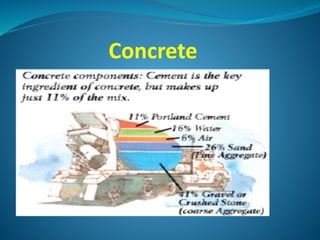
Concrete
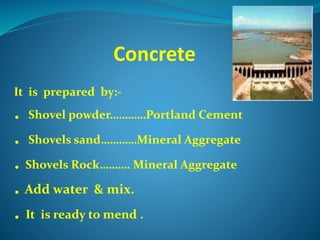
It is prepared by:-
. Shovel powder…………Portland Cement
. Shovels sand…………Mineral Aggregate
. Shovels Rock………. Mineral Aggregate
. Add water & mix.
. It is ready to mend .
Concrete
Concrete
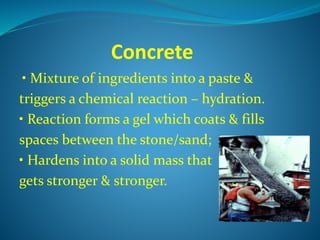
• Mixture of ingredients into a paste &
triggers a chemical reaction – hydration.
• Reaction forms a gel which coats & fills
spaces between the stone/sand;
• Hardens into a solid mass that
gets stronger & stronger.
Concrete
• The world’s most widely used building
material.
• Global production is 5 billion cubic yards
per year (using approximately 1.25 billion
tons of cement).
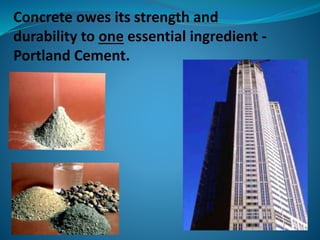
Concrete owes its strength and
durability to one essential ingredient -
Portland Cement.
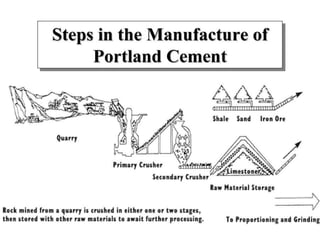
Portland Cement
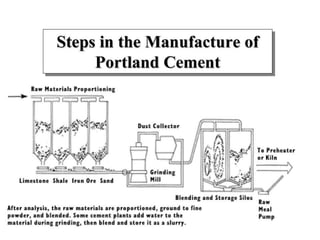
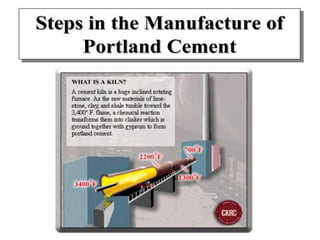
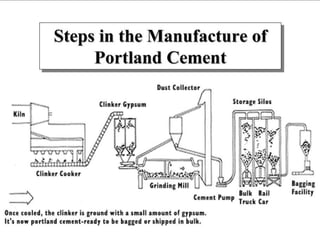
• Limestone + Shale/Clay + Heat = Clinker +
CKD + Exit Gas.
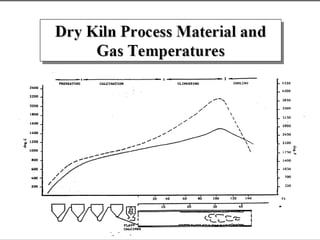
• Material Temperatures Exceed 2700 degrees F
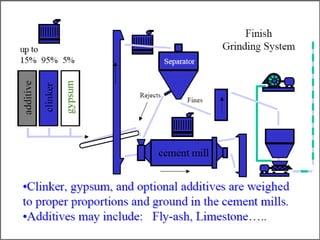
• Pulverized Clinker + Gypsum = Portland
Cement.
• Cement is powder so fine that one pound
contains 150 billion grains.
Portland Cement (cont’d)
• Basic Chemical Components of Portland Cement:
– Calcium (Ca)
– Silicon (Si)
– Aluminum (Al)
– Iron (Fe)
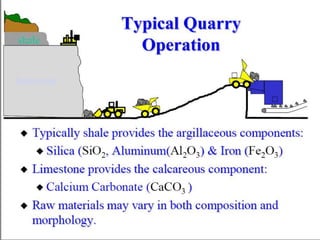
• Typical Raw Materials:
– Limestone (CaCO3)
– Sand (SiO2)
– Shale, Clay (SiO2, Al2O3, Fe2O3)
– Iron Ore/Mill Scale (Fe2O3)
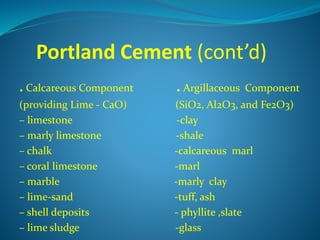
Portland Cement (cont’d)
. Calcareous Component . Argillaceous Component
(providing Lime - CaO) (SiO2, Al2O3, and Fe2O3)
– limestone -clay
– marly limestone -shale
– chalk -calcareous marl
– coral limestone -marl
– marble -marly clay
– lime-sand -tuff, ash
– shell deposits - phyllite ,slate
– lime sludge -glass
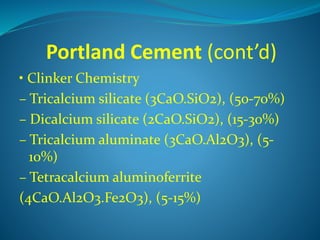
Portland Cement (cont’d)
• Clinker Chemistry
– Tricalcium silicate (3CaO.SiO2), (50-70%)
– Dicalcium silicate (2CaO.SiO2), (15-30%)
– Tricalcium aluminate (3CaO.Al2O3), (5-
10%)
– Tetracalcium aluminoferrite
(4CaO.Al2O3.Fe2O3), (5-15%)
Portland Cement (cont’d)
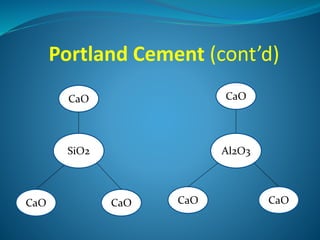
SiO2
CaO CaO
CaO CaO
CaO CaO
Al2O3
History of Portland Cement
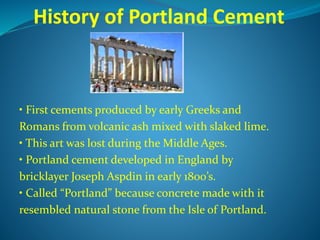
• First cements produced by early Greeks and
Romans from volcanic ash mixed with slaked lime.
• This art was lost during the Middle Ages.
• Portland cement developed in England by
bricklayer Joseph Aspdin in early 1800’s.
• Called “Portland” because concrete made with it
resembled natural stone from the Isle of Portland.
History of Portland Cement
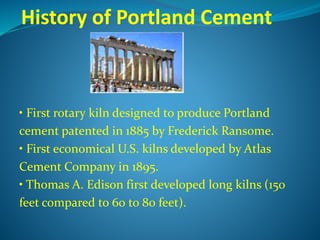
• First rotary kiln designed to produce Portland
cement patented in 1885 by Frederick Ransome.
• First economical U.S. kilns developed by Atlas
Cement Company in 1895.
• Thomas A. Edison first developed long kilns (150
feet compared to 60 to 80 feet).
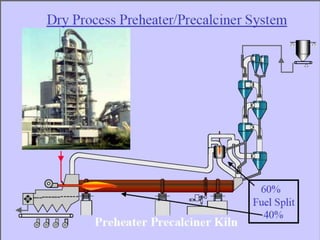
Types of Cement Processes
• Wet Process.
• Dry Process - 74% of cement produced.
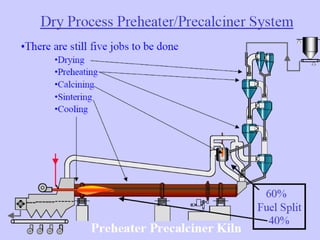
• Preheater/Precalciner Process.
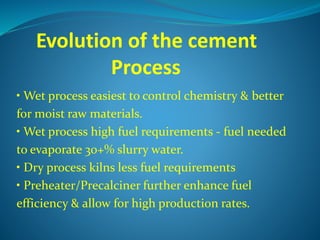
Evolution of the cement
Process
• Wet process easiest to control chemistry & better
for moist raw materials.
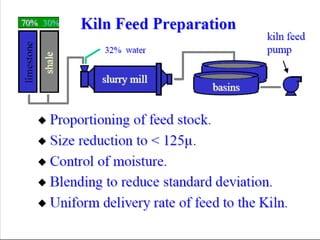
• Wet process high fuel requirements - fuel needed
to evaporate 30+% slurry water.
• Dry process kilns less fuel requirements
• Preheater/Precalciner further enhance fuel
efficiency & allow for high production rates.
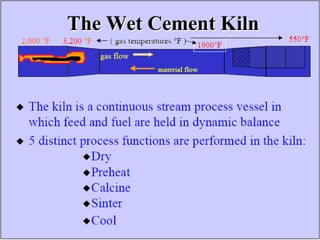
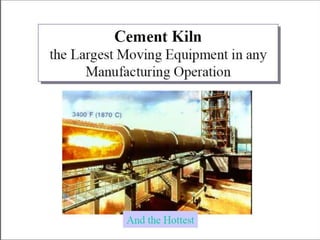
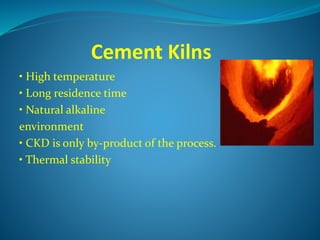
Cement Kilns
• High temperature
• Long residence time
• Natural alkaline
environment
• CKD is only by-product of the process.
• Thermal stability
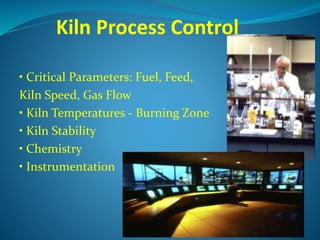
Kiln Process Control
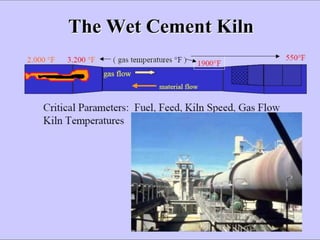
• Critical Parameters: Fuel, Feed,
Kiln Speed, Gas Flow
• Kiln Temperatures - Burning Zone
• Kiln Stability
• Chemistry
• Instrumentation
Why Burn Wastes?
A cement kiln is a proven technology for
recycling by beneficial REUSE of solid and
hazardous wastes.
The benefits are:
– energy recovery
– material recovery
– economics
– environmental preservation
Federal State Established Priorities
for Industrial Waste Disposal
• Reduction at the source.
• Recycling
• Energy recovery
• Incineration
• Stabilization
• Landfill
Benefits of a recycling
Program
• Allows for reuse of waste materials.
• Conserves virgin fuels & raw materials.
• Regulated stringently for Environmental
Protection.
Waste Recycling Process
• Waste fuels are destroyed, releasing heat,
water and carbon dioxide.
• Solid materials are physically and
chemically combined in the clinker product.
Cement Kilns Excellent Environment
for Destroying &Recycling Wastes
A Cement Kiln Provides:
• 3,000degreeF + Flame
• Long retention times of gasses and
materials.
• Stability of a large dependable industrial
process.
• Many inherent safeguards.
A Cement Kiln Is A Proven
Technology For Beneficial REUSE of
Otherwise Waste Materials
The Benefits are:
• Energy Recovery
•Material Recovery
Recycling Programs
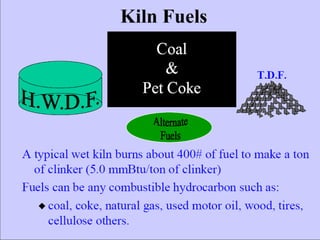
Energy Replacement for Coal/Coke.
• Liquid fuels.
• Solid fuels.
Material Replacement for Raw Materials
(Limestone, Shale and Sand).
• Solids/sludge slightly contaminated with metals.
• Solids/sludge slightly contaminated with
Organics.
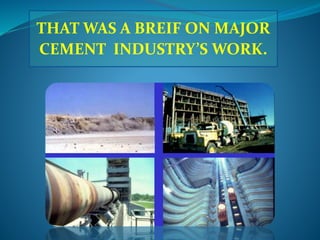
THAT WAS A BREIF ON MAJOR
CEMENT INDUSTRY’S WORK.
K.SHREENATH
BOHRA

Cement manufacturing process

  • 1.
    1.What is cement? 2.History. 3.Overveiw of Cement Manufacturing process. 4.Overveiw of Kiln process. 5.Why burn wastes ?
  • 2.
    Portland Cement . Ahydraulic cement made by finely powderising the clinker produced by calcining to incipient fusion a mixture of argillaceous and calcareous materials. .Portland cement is a powder that is the active ingredient in concrete.
  • 3.
    Concrete It is preparedby:- . Shovel powder…………Portland Cement . Shovels sand…………Mineral Aggregate . Shovels Rock………. Mineral Aggregate . Add water & mix. . It is ready to mend .
  • 4.
  • 5.
    Concrete • Mixture ofingredients into a paste & triggers a chemical reaction – hydration. • Reaction forms a gel which coats & fills spaces between the stone/sand; • Hardens into a solid mass that gets stronger & stronger.
  • 6.
    Concrete • The world’smost widely used building material. • Global production is 5 billion cubic yards per year (using approximately 1.25 billion tons of cement).
  • 7.
    Concrete owes itsstrength and durability to one essential ingredient - Portland Cement.
  • 8.
    Portland Cement • Limestone+ Shale/Clay + Heat = Clinker + CKD + Exit Gas. • Material Temperatures Exceed 2700 degrees F • Pulverized Clinker + Gypsum = Portland Cement. • Cement is powder so fine that one pound contains 150 billion grains.
  • 9.
    Portland Cement (cont’d) •Basic Chemical Components of Portland Cement: – Calcium (Ca) – Silicon (Si) – Aluminum (Al) – Iron (Fe) • Typical Raw Materials: – Limestone (CaCO3) – Sand (SiO2) – Shale, Clay (SiO2, Al2O3, Fe2O3) – Iron Ore/Mill Scale (Fe2O3)
  • 10.
    Portland Cement (cont’d) .Calcareous Component . Argillaceous Component (providing Lime - CaO) (SiO2, Al2O3, and Fe2O3) – limestone -clay – marly limestone -shale – chalk -calcareous marl – coral limestone -marl – marble -marly clay – lime-sand -tuff, ash – shell deposits - phyllite ,slate – lime sludge -glass
  • 11.
    Portland Cement (cont’d) •Clinker Chemistry – Tricalcium silicate (3CaO.SiO2), (50-70%) – Dicalcium silicate (2CaO.SiO2), (15-30%) – Tricalcium aluminate (3CaO.Al2O3), (5- 10%) – Tetracalcium aluminoferrite (4CaO.Al2O3.Fe2O3), (5-15%)
  • 12.
    Portland Cement (cont’d) SiO2 CaOCaO CaO CaO CaO CaO Al2O3
  • 13.
    History of PortlandCement • First cements produced by early Greeks and Romans from volcanic ash mixed with slaked lime. • This art was lost during the Middle Ages. • Portland cement developed in England by bricklayer Joseph Aspdin in early 1800’s. • Called “Portland” because concrete made with it resembled natural stone from the Isle of Portland.
  • 14.
    History of PortlandCement • First rotary kiln designed to produce Portland cement patented in 1885 by Frederick Ransome. • First economical U.S. kilns developed by Atlas Cement Company in 1895. • Thomas A. Edison first developed long kilns (150 feet compared to 60 to 80 feet).
  • 15.
    Types of CementProcesses • Wet Process. • Dry Process - 74% of cement produced. • Preheater/Precalciner Process.
  • 16.
    Evolution of thecement Process • Wet process easiest to control chemistry & better for moist raw materials. • Wet process high fuel requirements - fuel needed to evaporate 30+% slurry water. • Dry process kilns less fuel requirements • Preheater/Precalciner further enhance fuel efficiency & allow for high production rates.
  • 28.
    Cement Kilns • Hightemperature • Long residence time • Natural alkaline environment • CKD is only by-product of the process. • Thermal stability
  • 29.
    Kiln Process Control •Critical Parameters: Fuel, Feed, Kiln Speed, Gas Flow • Kiln Temperatures - Burning Zone • Kiln Stability • Chemistry • Instrumentation
  • 35.
    Why Burn Wastes? Acement kiln is a proven technology for recycling by beneficial REUSE of solid and hazardous wastes. The benefits are: – energy recovery – material recovery – economics – environmental preservation
  • 36.
    Federal State EstablishedPriorities for Industrial Waste Disposal • Reduction at the source. • Recycling • Energy recovery • Incineration • Stabilization • Landfill
  • 37.
    Benefits of arecycling Program • Allows for reuse of waste materials. • Conserves virgin fuels & raw materials. • Regulated stringently for Environmental Protection.
  • 38.
    Waste Recycling Process •Waste fuels are destroyed, releasing heat, water and carbon dioxide. • Solid materials are physically and chemically combined in the clinker product.
  • 39.
    Cement Kilns ExcellentEnvironment for Destroying &Recycling Wastes A Cement Kiln Provides: • 3,000degreeF + Flame • Long retention times of gasses and materials. • Stability of a large dependable industrial process. • Many inherent safeguards.
  • 40.
    A Cement KilnIs A Proven Technology For Beneficial REUSE of Otherwise Waste Materials The Benefits are: • Energy Recovery •Material Recovery
  • 41.
    Recycling Programs Energy Replacementfor Coal/Coke. • Liquid fuels. • Solid fuels. Material Replacement for Raw Materials (Limestone, Shale and Sand). • Solids/sludge slightly contaminated with metals. • Solids/sludge slightly contaminated with Organics.
  • 42.
    THAT WAS ABREIF ON MAJOR CEMENT INDUSTRY’S WORK.
  • 43.