Cell: The
Fundamental Unit
of Life
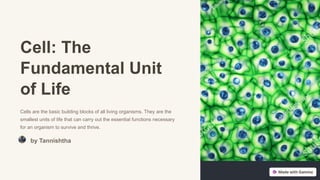
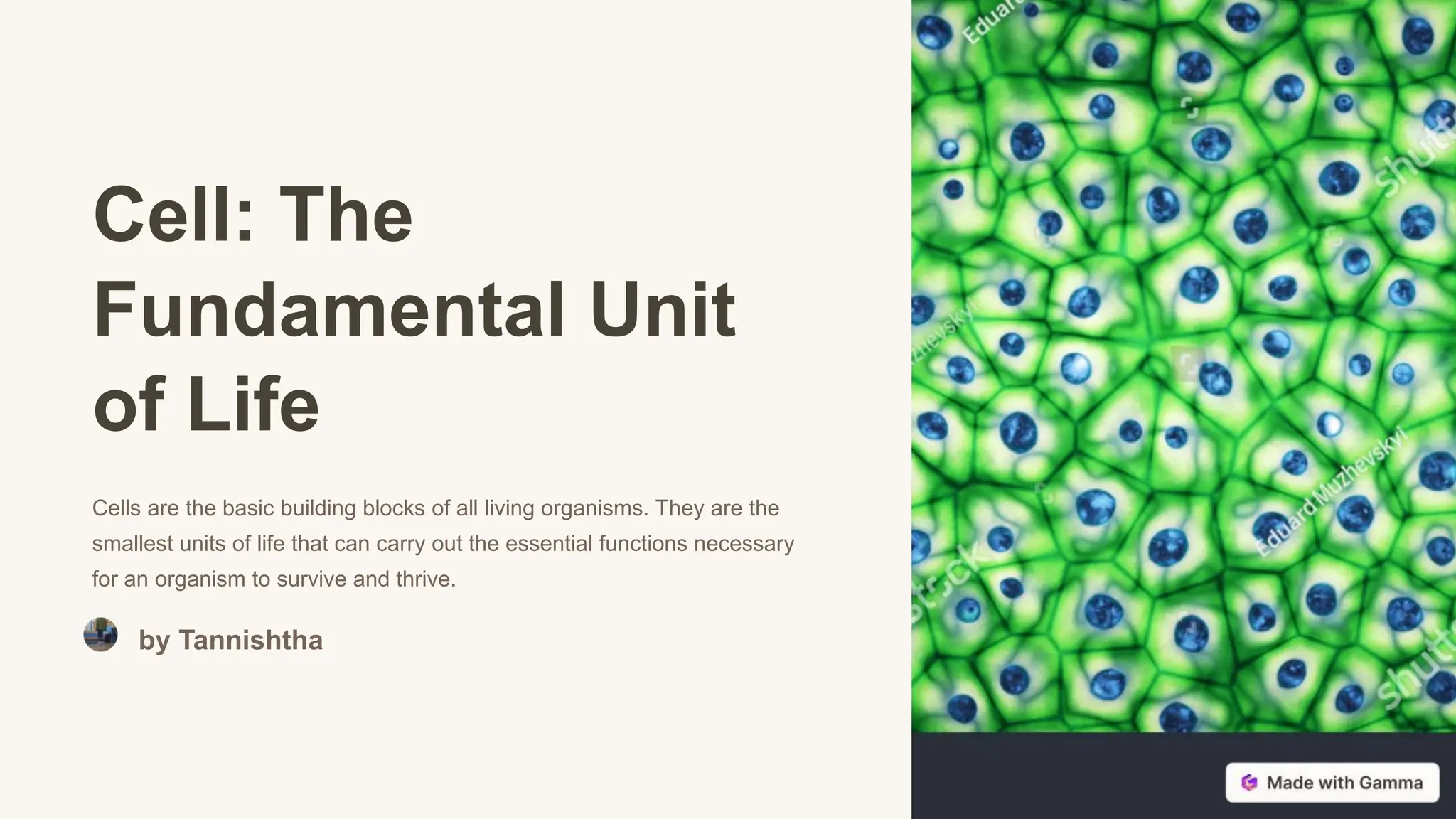
Cells are the basic building blocks of all living organisms. They are the
smallest units of life that can carry out the essential functions necessary
for an organism to survive and thrive.
by Tannishtha
The Discovery of Dead
Cells By Robert Hooke
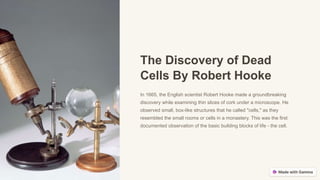
In 1665, the English scientist Robert Hooke made a groundbreaking
discovery while examining thin slices of cork under a microscope. He
observed small, box-like structures that he called "cells," as they
resembled the small rooms or cells in a monastery. This was the first
documented observation of the basic building blocks of life - the cell.
Cell Theory
1. The cell theory, proposed by Theodor Schwann and Matthias
Schleiden, states that all living organisms are composed of one or
more cells.
2. Cells are the fundamental units of structure and function in all
living organisms.
3. All cells come from pre-existing cells through the process of cell division.
Cell Structure and Its
Organisation
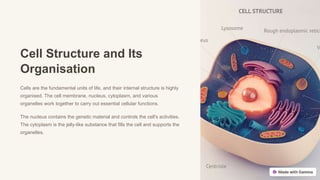
Cells are the fundamental units of life, and their internal structure is highly
organised. The cell membrane, nucleus, cytoplasm, and various
organelles work together to carry out essential cellular functions.
The nucleus contains the genetic material and controls the cell's activities.
The cytoplasm is the jelly-like substance that fills the cell and supports the
organelles.
Plasma Membrane Or Cell Membrane
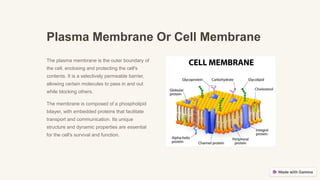
The plasma membrane is the outer boundary of
the cell, enclosing and protecting the cell's
contents. It is a selectively permeable barrier,
allowing certain molecules to pass in and out
while blocking others.
The membrane is composed of a phospholipid
bilayer, with embedded proteins that facilitate
transport and communication. Its unique
structure and dynamic properties are essential
for the cell's survival and function.
Cell Wall
Structure of Cell Wall
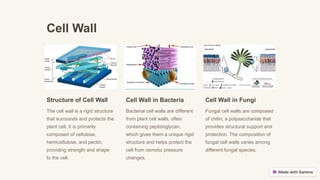
The cell wall is a rigid structure
that surrounds and protects the
plant cell. It is primarily
composed of cellulose,
hemicellulose, and pectin,
providing strength and shape
to the cell.
Cell Wall in Bacteria
Bacterial cell walls are different
from plant cell walls, often
containing peptidoglycan,
which gives them a unique rigid
structure and helps protect the
cell from osmotic pressure
changes.
Cell Wall in Fungi
Fungal cell walls are composed
of chitin, a polysaccharide that
provides structural support and
protection. The composition of
fungal cell walls varies among
different fungal species.
Nucleus and Genetic Material
1 Location
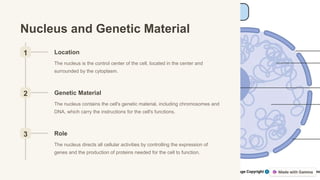
The nucleus is the control center of the cell, located in the center and
surrounded by the cytoplasm.
2 Genetic Material
The nucleus contains the cell's genetic material, including chromosomes and
DNA, which carry the instructions for the cell's functions.
3 Role
The nucleus directs all cellular activities by controlling the expression of
genes and the production of proteins needed for the cell to function.
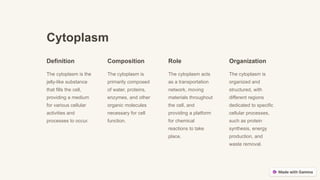
Cytoplasm
Definition
The cytoplasm is the
jelly-like substance
that fills the cell,
providing a medium
for various cellular
activities and
processes to occur.
Composition
The cytoplasm is
primarily composed
of water, proteins,
enzymes, and other
organic molecules
necessary for cell
function.
Role
The cytoplasm acts
as a transportation
network, moving
materials throughout
the cell, and
providing a platform
for chemical
reactions to take
place.
Organization
The cytoplasm is
organized and
structured, with
different regions
dedicated to specific
cellular processes,
such as protein
synthesis, energy
production, and
waste removal.
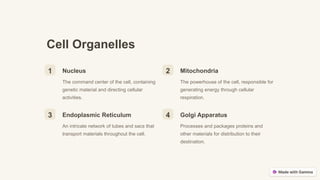
Cell Organelles
1 Nucleus
The command center of the cell, containing
genetic material and directing cellular
activities.
2 Mitochondria
The powerhouse of the cell, responsible for
generating energy through cellular
respiration.
3 Endoplasmic Reticulum
An intricate network of tubes and sacs that
transport materials throughout the cell.
4 Golgi Apparatus
Processes and packages proteins and
other materials for distribution to their
destination.
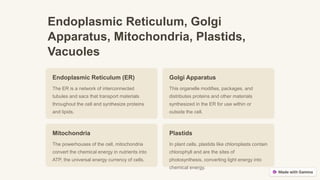
Endoplasmic Reticulum, Golgi
Apparatus, Mitochondria, Plastids,
Vacuoles
Endoplasmic Reticulum (ER)
The ER is a network of interconnected
tubules and sacs that transport materials
throughout the cell and synthesize proteins
and lipids.
Golgi Apparatus
This organelle modifies, packages, and
distributes proteins and other materials
synthesized in the ER for use within or
outside the cell.
Mitochondria
The powerhouses of the cell, mitochondria
convert the chemical energy in nutrients into
ATP, the universal energy currency of cells.
Plastids
In plant cells, plastids like chloroplasts contain
chlorophyll and are the sites of
photosynthesis, converting light energy into
chemical energy.

Cell-The-Fundamental-Unit-of-Life..(Basic coverage)

  • 1.
    Cell: The Fundamental Unit ofLife Cells are the basic building blocks of all living organisms. They are the smallest units of life that can carry out the essential functions necessary for an organism to survive and thrive. by Tannishtha
  • 2.
    The Discovery ofDead Cells By Robert Hooke In 1665, the English scientist Robert Hooke made a groundbreaking discovery while examining thin slices of cork under a microscope. He observed small, box-like structures that he called "cells," as they resembled the small rooms or cells in a monastery. This was the first documented observation of the basic building blocks of life - the cell.
  • 3.
    Cell Theory 1. Thecell theory, proposed by Theodor Schwann and Matthias Schleiden, states that all living organisms are composed of one or more cells. 2. Cells are the fundamental units of structure and function in all living organisms. 3. All cells come from pre-existing cells through the process of cell division.
  • 4.
    Cell Structure andIts Organisation Cells are the fundamental units of life, and their internal structure is highly organised. The cell membrane, nucleus, cytoplasm, and various organelles work together to carry out essential cellular functions. The nucleus contains the genetic material and controls the cell's activities. The cytoplasm is the jelly-like substance that fills the cell and supports the organelles.
  • 5.
    Plasma Membrane OrCell Membrane The plasma membrane is the outer boundary of the cell, enclosing and protecting the cell's contents. It is a selectively permeable barrier, allowing certain molecules to pass in and out while blocking others. The membrane is composed of a phospholipid bilayer, with embedded proteins that facilitate transport and communication. Its unique structure and dynamic properties are essential for the cell's survival and function.
  • 6.
    Cell Wall Structure ofCell Wall The cell wall is a rigid structure that surrounds and protects the plant cell. It is primarily composed of cellulose, hemicellulose, and pectin, providing strength and shape to the cell. Cell Wall in Bacteria Bacterial cell walls are different from plant cell walls, often containing peptidoglycan, which gives them a unique rigid structure and helps protect the cell from osmotic pressure changes. Cell Wall in Fungi Fungal cell walls are composed of chitin, a polysaccharide that provides structural support and protection. The composition of fungal cell walls varies among different fungal species.
  • 7.
    Nucleus and GeneticMaterial 1 Location The nucleus is the control center of the cell, located in the center and surrounded by the cytoplasm. 2 Genetic Material The nucleus contains the cell's genetic material, including chromosomes and DNA, which carry the instructions for the cell's functions. 3 Role The nucleus directs all cellular activities by controlling the expression of genes and the production of proteins needed for the cell to function.
  • 8.
    Cytoplasm Definition The cytoplasm isthe jelly-like substance that fills the cell, providing a medium for various cellular activities and processes to occur. Composition The cytoplasm is primarily composed of water, proteins, enzymes, and other organic molecules necessary for cell function. Role The cytoplasm acts as a transportation network, moving materials throughout the cell, and providing a platform for chemical reactions to take place. Organization The cytoplasm is organized and structured, with different regions dedicated to specific cellular processes, such as protein synthesis, energy production, and waste removal.
  • 9.
    Cell Organelles 1 Nucleus Thecommand center of the cell, containing genetic material and directing cellular activities. 2 Mitochondria The powerhouse of the cell, responsible for generating energy through cellular respiration. 3 Endoplasmic Reticulum An intricate network of tubes and sacs that transport materials throughout the cell. 4 Golgi Apparatus Processes and packages proteins and other materials for distribution to their destination.
  • 10.
    Endoplasmic Reticulum, Golgi Apparatus,Mitochondria, Plastids, Vacuoles Endoplasmic Reticulum (ER) The ER is a network of interconnected tubules and sacs that transport materials throughout the cell and synthesize proteins and lipids. Golgi Apparatus This organelle modifies, packages, and distributes proteins and other materials synthesized in the ER for use within or outside the cell. Mitochondria The powerhouses of the cell, mitochondria convert the chemical energy in nutrients into ATP, the universal energy currency of cells. Plastids In plant cells, plastids like chloroplasts contain chlorophyll and are the sites of photosynthesis, converting light energy into chemical energy.