1
All organisms, including humans, are composed of cells.
A cell is the basic unit of life
Most cells are small and can be seen only under a microscope.
They are measured using the smaller units called micrometer
(μm).
A micrometer is 1/1.000 millimeter.
What Is a Cell?
Cell Theory
Differences between cells
cells differ from other cells by:
1. The shape : flattened ‫مسطح‬, cuboidal ‫مكعب‬,
spherical ‫كروي‬, and columnar ‫عمودي‬.
2. The size : few cells can be seen by naked eye
like: Frog’s egg and the majority can be seen by
the microscope, like in most of
bacteria(between1-10 Mm in size).
3. Location and function: cells differ markedly in
the form and structure according to their location
and functional activities. Like WBC.
:
• Unicellular organisms (the simplest form of
life) consist of one cell that reproduce by
dividing into two cells such as, protozoa,
bacteria and blue green algae.
• Multicellular organisms are made up of
many cells perform specialized functions that
are linked together by complex system of
communication.
How Cells Are Organized.
Cells can be classified into two broad
categories—the prokaryotes and eukaryotes. The
prokaryotic group includes the bacteria and
Archea; the eukaryotic group consists of animals,
plants, fungi, and some single-celled organisms
(Yeast and green Algae.
Table 1: Comparison of features of prokaryotic and
eukaryotic cells
Prokaryotes Eukaryotes
Organisms Bacteria, Archea fungi, plants, animals
Typical size Small Large
nucleus Absent Present with nuclear membrane
DNA circular (usually) linear molecules (chromosomes) with
histone proteins
Mitochondria None Yes
Organization Usually single cell single cells, colonies, higher multicellular
organisms with specialized cells
Cell division Binary fission (simple division) mitosis (fission or budding)
Meiosis
Cell walls Generally present, complex
chemical composition
Present in some types, absent in others,
simple chemical composition
Ribosomes Smaller than eukaryotic
ribosomes, free in cytoplasm
Larger than prokaryotic ribosomes,
bound to membranes
Section 7-2
Figure 7-5 Plant and Animal Cells
Go to
Section:
Animal Cell
Nucleus
Nucleolus
Rough
Endoplasmic
Reticulum
Smooth
Endoplasmic
Reticulum
Cell Membrane
Cytoplasm
Ribosomes
COMPOSITION OF ANIMAL CELL
• The plasma membrane.
• Mitochondria.
• Endoplasmic reticulum.
• Golgi complex.
• Lysosomes.
• Nucleus
The Plasma Membrane and How Substances
Cross It:
• Animal cells, like all cells, is surrounded by an outer
plasma membrane.
• The plasma membrane marks the boundary between
the outside and the inside of the cell.
• The plasma membrane is a phospholipid bilayer with
attached or embedded proteins.
• A phospholipid molecule has a polar head and
nonpolar tails
• Phospholipids form a lipid bilayer in which their
hydrophilic (attracted to water) head areas
spontaneously arrange to face the aqueous cytosol and
the extracellular fluid,
• while their hydrophobic (repelled by water) tail areas
face away from the cytosol and extracellular fluid.
11
Cell Membrane: PHOSPHOLIPIDS
Each phospholipids has a
HYDROPHOBIC and
HYDROPHILIC end
•HYDRO = means water
•PHOBIC = means afraid
•PHILIC = means loving
12
Plasma Membrane Functions :
• It keeps a cell intact
• It is selective barrier regulate passage
molecules and ions to the cell.
• It keeps the intracellular milieu constant.
• It is also important in the recognitions.
• Plays important role in the interactions of
the cell with its environment.
• During endocytosis, plasma membrane
invagintaes, or forms a pouch ‫كيس‬, to
envelop a substance and fluid. Then the
membrane pinches off ‫يتضيق‬ to form an
endocytic vesicle inside the cell.
• Some WBS are able to take up pathogens
(disease-causing agents) by endocytosis.
Here the process is given a special name:
phagocytosis.
• During exocytosis, a vesicle fuses with the
plasma membrane as secretion occurs.
The cytoplasm:
Cytoplasm is the space between the
plasma membrane and nucleus. The space
is fill with organelles and matrix.
• Mitochondria .
• Endoplasmic reticulum .
• Golgi apparatus .
• lysosomes.
The Endomembrane System:
The endomembrane system consists of the nuclear
envelope, the endoplasmic reticulum, the Golgi apparatus
and lysosomes.
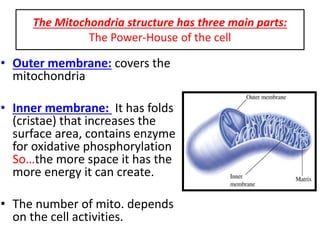
The Mitochondria structure has three main parts:
The Power-House of the cell
• Outer membrane: covers the
mitochondria
• Inner membrane: It has folds
(cristae) that increases the
surface area, contains enzyme
for oxidative phosphorylation
So…the more space it has the
more energy it can create.
• The number of mito. depends
on the cell activities.
18
MATRIX: a fluid that has water,
proteins , DNA, three type of RNA
and granules rich in calcium.
The important OF Mitochondria
• The mitochondria convert the chemical
energy of the metabolites into energy that
is easily accessible to the cell.
• KEEP cytosolic concentration of calcium.
• The endoplasmic reticulum (E.R) is a network
of membrane, has enclosed tubules and sacs
(cisterna) that extend from nuclear membrane
through the cytoplasm .
• The entire E.R is enclosed by a continuous
membrane is the largest organelles of most
eukaryotic cells.
The Endoplasmic Reticulum:
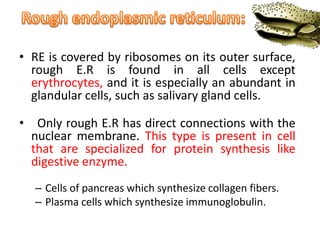
• RE is covered by ribosomes on its outer surface,
rough E.R is found in all cells except
erythrocytes, and it is especially an abundant in
glandular cells, such as salivary gland cells.
• Only rough E.R has direct connections with the
nuclear membrane. This type is present in cell
that are specialized for protein synthesis like
digestive enzyme.
– Cells of pancreas which synthesize collagen fibers.
– Plasma cells which synthesize immunoglobulin.
Functions of rough E.R:
• Has a role in the synthesis of proteins to be
exported outside the cell.
• Modification of newly formed polypeptides.
• Assembly of multichain proteins.
• Initial glycosylation of glycoprotein which
mean addition of glucose to the protein.
• Synthesis phospholipids for cell membranes.
• The smooth E.R is not associated with ribosomes and it is less
common than rough E.R.
Function of smooth E.R:
• it is abundant in the liver and intestinal epithelium and seen to
be involved in detoxification mechanisms of certain substances
like alcohol toxins .
• smooth E.R is also responsible for glycogen break down in the
liver cells and utilizing glucose.
• responsible for lipid and cholesterol metabolism .
• involved in biosynthesis of steroid hormones (adrenal gland).
• Smooth E.R also participated in the contraction process of
muscle cells.
• Synthesis phospholipids for cell membranes.
• Nickname: The shippers ‫الشاحنون‬
• The Golgi apparatus is named for
Camillo Golgi, who discovered its
presence in cells in 1898.
• The Golgi apparatus is smooth
membrane –limited cisternae,
26
Golgi apparatus
• Completes posttranslational modification and
packages and places an address on products that
have been synthesized by the cell.
• For example, proteins and lipids received from the ER
are modified. A chain of sugars may be added to them.
This makes them glycoproteins and glycolipids,
molecules often found in the plasma membrane.
• Vesicles that leave the Golgi apparatus move to other
parts of the cell.
Lysosomes
• Lysosomes, spherical membranous sacs produced by RER
and subsequently transfer to the Golgi apparatus where
the enzyme modified and package .
• Lysosomes contain more than 40 hydrolytic enzymes.
• Lysosomes are found in all cells of the body
• When a lysosome fuses with endocytic vesicle, its
contents, work together to produce, modify, secrete and
digest proteins and lipids.
• When membrane is digested by lysosomal enzymes this
process called autodigestion, parts of a cell may be broken
down by the lysosomes. Some human diseases are caused
by the lack of a particular lysosome enzyme.
1. The lysosomal enzyme can break all types of macromolecules
example : carbohydrates into simple sugar and proteins into
peptides and amino acids.
2. Lysosomes are responsible for the removal of unwanted tissue and
waste product.
3. Digestion of extracellular materials ex: during bone development
osteoclasts ((which are one type of cells present in bone tissue))
release enzyme of secondary Lysosomes by exocytosis to remolding
the bone.
4. The acrosome of the sperm is a special type of lysosomes which
plays an important role in the differentiation of the sperm.
5. Lysosomes in the white blood cells and macrophages are essential
in the defense against bacteria and viruses.
Function of Lysosomes
The Nucleus:
The “brain” of the cell
Controls all of the cellular activities.
DNA is inside the nucleus.
Does not produce proteins.
• The nucleus, a prominent structure in cells, stores genetic
information
• Every cell in the body contains the same genes. Genes are segments
of DNA that contain information for the production of specific
proteins.
• Each type of cell has certain genes turned on and others turned off.
• DNA, with RNA acting as an intermediary, specifies the proteins in
a cell.
• Proteins have many functions in cells, and they help determine a
cell’s specificity.
The nucleus is separated from the cytoplasm
by a double membrane known as the nuclear
envelope. This is continuous with the
endoplasmic reticulum (ER).
It has nuclear pores of sufficient size to
permit the passage of ribosomal subunits out
of the nucleus and proteins into the nucleus.
33
CHROMOSOMES-
Chromosomes –
carry the information that
determines what traits a living
thing will have
are found inside
the nucleus
Nucleus
Chromatin
is the combination of DNA molecules and proteins that make
up the chromosomes.
Chromatin can coil tightly to form visible chromosomes
during meiosis (cell division that forms reproductive cells in
humans) and mitosis (cell division that duplicates cells).
Most of the time, however, the chromatin is uncoiled.
Individual chromosomes cannot be distinguished and the
chromatin appears grainy in electron micrographs of the
nucleus.
35
NUCLEOLUS
The dark area in
the nucleus
Like a tiny nucleus
inside the nucleus.
36
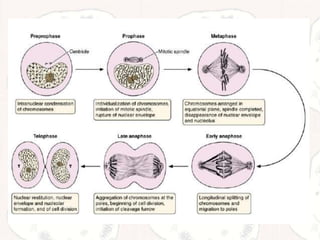
Cell cycle is divided
into two major
phase :-
1- inter phase
2- mitosis
Interphase
Mitosis
• Eukaryotes divide by a more complicated system called Mitosis
This is because:
1. They have a nucleus which must be broken up and then
reformed
2. They have their DNA “packaged” in the form of
Chromosomes
3. Chromosomes are composed of Chromatin. Made of DNA
Strands & Proteins
4. Also contain Nucleosomes containing Histones - Proteins the
DNA is wrapped ‫ملفوف‬ around Name for the DNA/Protein
complex is Chromatin
5. They usually have more than 1 chromosome (Humans have 23
pairs)
6. They have numerous organelles to equally share
cell.pptx
cell.pptx

cell.pptx

  • 1.
  • 2.
    All organisms, includinghumans, are composed of cells. A cell is the basic unit of life Most cells are small and can be seen only under a microscope. They are measured using the smaller units called micrometer (μm). A micrometer is 1/1.000 millimeter. What Is a Cell?
  • 3.
  • 4.
    Differences between cells cellsdiffer from other cells by: 1. The shape : flattened ‫مسطح‬, cuboidal ‫مكعب‬, spherical ‫كروي‬, and columnar ‫عمودي‬. 2. The size : few cells can be seen by naked eye like: Frog’s egg and the majority can be seen by the microscope, like in most of bacteria(between1-10 Mm in size). 3. Location and function: cells differ markedly in the form and structure according to their location and functional activities. Like WBC.
  • 5.
    : • Unicellular organisms(the simplest form of life) consist of one cell that reproduce by dividing into two cells such as, protozoa, bacteria and blue green algae. • Multicellular organisms are made up of many cells perform specialized functions that are linked together by complex system of communication.
  • 6.
    How Cells AreOrganized. Cells can be classified into two broad categories—the prokaryotes and eukaryotes. The prokaryotic group includes the bacteria and Archea; the eukaryotic group consists of animals, plants, fungi, and some single-celled organisms (Yeast and green Algae.
  • 7.
    Table 1: Comparisonof features of prokaryotic and eukaryotic cells Prokaryotes Eukaryotes Organisms Bacteria, Archea fungi, plants, animals Typical size Small Large nucleus Absent Present with nuclear membrane DNA circular (usually) linear molecules (chromosomes) with histone proteins Mitochondria None Yes Organization Usually single cell single cells, colonies, higher multicellular organisms with specialized cells Cell division Binary fission (simple division) mitosis (fission or budding) Meiosis Cell walls Generally present, complex chemical composition Present in some types, absent in others, simple chemical composition Ribosomes Smaller than eukaryotic ribosomes, free in cytoplasm Larger than prokaryotic ribosomes, bound to membranes
  • 8.
    Section 7-2 Figure 7-5Plant and Animal Cells Go to Section: Animal Cell Nucleus Nucleolus Rough Endoplasmic Reticulum Smooth Endoplasmic Reticulum Cell Membrane Cytoplasm Ribosomes
  • 9.
    COMPOSITION OF ANIMALCELL • The plasma membrane. • Mitochondria. • Endoplasmic reticulum. • Golgi complex. • Lysosomes. • Nucleus
  • 10.
    The Plasma Membraneand How Substances Cross It: • Animal cells, like all cells, is surrounded by an outer plasma membrane. • The plasma membrane marks the boundary between the outside and the inside of the cell. • The plasma membrane is a phospholipid bilayer with attached or embedded proteins. • A phospholipid molecule has a polar head and nonpolar tails • Phospholipids form a lipid bilayer in which their hydrophilic (attracted to water) head areas spontaneously arrange to face the aqueous cytosol and the extracellular fluid, • while their hydrophobic (repelled by water) tail areas face away from the cytosol and extracellular fluid.
  • 11.
    11 Cell Membrane: PHOSPHOLIPIDS Eachphospholipids has a HYDROPHOBIC and HYDROPHILIC end •HYDRO = means water •PHOBIC = means afraid •PHILIC = means loving
  • 12.
  • 13.
    Plasma Membrane Functions: • It keeps a cell intact • It is selective barrier regulate passage molecules and ions to the cell. • It keeps the intracellular milieu constant. • It is also important in the recognitions. • Plays important role in the interactions of the cell with its environment.
  • 14.
    • During endocytosis,plasma membrane invagintaes, or forms a pouch ‫كيس‬, to envelop a substance and fluid. Then the membrane pinches off ‫يتضيق‬ to form an endocytic vesicle inside the cell. • Some WBS are able to take up pathogens (disease-causing agents) by endocytosis. Here the process is given a special name: phagocytosis. • During exocytosis, a vesicle fuses with the plasma membrane as secretion occurs.
  • 15.
    The cytoplasm: Cytoplasm isthe space between the plasma membrane and nucleus. The space is fill with organelles and matrix.
  • 16.
    • Mitochondria . •Endoplasmic reticulum . • Golgi apparatus . • lysosomes. The Endomembrane System: The endomembrane system consists of the nuclear envelope, the endoplasmic reticulum, the Golgi apparatus and lysosomes.
  • 17.
    The Mitochondria structurehas three main parts: The Power-House of the cell • Outer membrane: covers the mitochondria • Inner membrane: It has folds (cristae) that increases the surface area, contains enzyme for oxidative phosphorylation So…the more space it has the more energy it can create. • The number of mito. depends on the cell activities.
  • 18.
    18 MATRIX: a fluidthat has water, proteins , DNA, three type of RNA and granules rich in calcium.
  • 19.
    The important OFMitochondria • The mitochondria convert the chemical energy of the metabolites into energy that is easily accessible to the cell. • KEEP cytosolic concentration of calcium.
  • 20.
    • The endoplasmicreticulum (E.R) is a network of membrane, has enclosed tubules and sacs (cisterna) that extend from nuclear membrane through the cytoplasm . • The entire E.R is enclosed by a continuous membrane is the largest organelles of most eukaryotic cells. The Endoplasmic Reticulum:
  • 22.
    • RE iscovered by ribosomes on its outer surface, rough E.R is found in all cells except erythrocytes, and it is especially an abundant in glandular cells, such as salivary gland cells. • Only rough E.R has direct connections with the nuclear membrane. This type is present in cell that are specialized for protein synthesis like digestive enzyme. – Cells of pancreas which synthesize collagen fibers. – Plasma cells which synthesize immunoglobulin.
  • 23.
    Functions of roughE.R: • Has a role in the synthesis of proteins to be exported outside the cell. • Modification of newly formed polypeptides. • Assembly of multichain proteins. • Initial glycosylation of glycoprotein which mean addition of glucose to the protein. • Synthesis phospholipids for cell membranes.
  • 24.
    • The smoothE.R is not associated with ribosomes and it is less common than rough E.R. Function of smooth E.R: • it is abundant in the liver and intestinal epithelium and seen to be involved in detoxification mechanisms of certain substances like alcohol toxins . • smooth E.R is also responsible for glycogen break down in the liver cells and utilizing glucose. • responsible for lipid and cholesterol metabolism . • involved in biosynthesis of steroid hormones (adrenal gland). • Smooth E.R also participated in the contraction process of muscle cells. • Synthesis phospholipids for cell membranes.
  • 25.
    • Nickname: Theshippers ‫الشاحنون‬ • The Golgi apparatus is named for Camillo Golgi, who discovered its presence in cells in 1898. • The Golgi apparatus is smooth membrane –limited cisternae,
  • 26.
  • 27.
    • Completes posttranslationalmodification and packages and places an address on products that have been synthesized by the cell. • For example, proteins and lipids received from the ER are modified. A chain of sugars may be added to them. This makes them glycoproteins and glycolipids, molecules often found in the plasma membrane. • Vesicles that leave the Golgi apparatus move to other parts of the cell.
  • 28.
    Lysosomes • Lysosomes, sphericalmembranous sacs produced by RER and subsequently transfer to the Golgi apparatus where the enzyme modified and package . • Lysosomes contain more than 40 hydrolytic enzymes. • Lysosomes are found in all cells of the body • When a lysosome fuses with endocytic vesicle, its contents, work together to produce, modify, secrete and digest proteins and lipids. • When membrane is digested by lysosomal enzymes this process called autodigestion, parts of a cell may be broken down by the lysosomes. Some human diseases are caused by the lack of a particular lysosome enzyme.
  • 29.
    1. The lysosomalenzyme can break all types of macromolecules example : carbohydrates into simple sugar and proteins into peptides and amino acids. 2. Lysosomes are responsible for the removal of unwanted tissue and waste product. 3. Digestion of extracellular materials ex: during bone development osteoclasts ((which are one type of cells present in bone tissue)) release enzyme of secondary Lysosomes by exocytosis to remolding the bone. 4. The acrosome of the sperm is a special type of lysosomes which plays an important role in the differentiation of the sperm. 5. Lysosomes in the white blood cells and macrophages are essential in the defense against bacteria and viruses. Function of Lysosomes
  • 30.
    The Nucleus: The “brain”of the cell Controls all of the cellular activities. DNA is inside the nucleus. Does not produce proteins.
  • 31.
    • The nucleus,a prominent structure in cells, stores genetic information • Every cell in the body contains the same genes. Genes are segments of DNA that contain information for the production of specific proteins. • Each type of cell has certain genes turned on and others turned off. • DNA, with RNA acting as an intermediary, specifies the proteins in a cell. • Proteins have many functions in cells, and they help determine a cell’s specificity.
  • 32.
    The nucleus isseparated from the cytoplasm by a double membrane known as the nuclear envelope. This is continuous with the endoplasmic reticulum (ER). It has nuclear pores of sufficient size to permit the passage of ribosomal subunits out of the nucleus and proteins into the nucleus.
  • 33.
    33 CHROMOSOMES- Chromosomes – carry theinformation that determines what traits a living thing will have are found inside the nucleus Nucleus
  • 34.
    Chromatin is the combinationof DNA molecules and proteins that make up the chromosomes. Chromatin can coil tightly to form visible chromosomes during meiosis (cell division that forms reproductive cells in humans) and mitosis (cell division that duplicates cells). Most of the time, however, the chromatin is uncoiled. Individual chromosomes cannot be distinguished and the chromatin appears grainy in electron micrographs of the nucleus.
  • 35.
    35 NUCLEOLUS The dark areain the nucleus Like a tiny nucleus inside the nucleus.
  • 36.
  • 37.
    Cell cycle isdivided into two major phase :- 1- inter phase 2- mitosis
  • 38.
  • 39.
    Mitosis • Eukaryotes divideby a more complicated system called Mitosis This is because: 1. They have a nucleus which must be broken up and then reformed 2. They have their DNA “packaged” in the form of Chromosomes 3. Chromosomes are composed of Chromatin. Made of DNA Strands & Proteins 4. Also contain Nucleosomes containing Histones - Proteins the DNA is wrapped ‫ملفوف‬ around Name for the DNA/Protein complex is Chromatin 5. They usually have more than 1 chromosome (Humans have 23 pairs) 6. They have numerous organelles to equally share