CELL
STRUCTURE AND
FUNCTIONS
CELL STRUCTURE
CELLS
• Determine the form and functions
of the human body.
• Basic living unit of all organisms.
• Are complex living structures.
• Are specialized to perform
specific functions.
CELL STRUCTURE
ORGANELLES
- Specialized structures
within cells.
- Perform specific
functions.
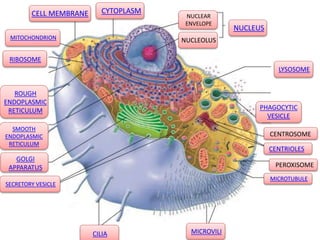
CELL MEMBRANE CYTOPLASM
NUCLEAR
ENVELOPE
NUCLEOLUS
NUCLEUS
LYSOSOME
PHAGOCYTIC
VESICLE
CENTROSOME
CENTRIOLES
PEROXISOME
MICROTUBULE
MICROVILICILIA
SECRETORY VESICLE
GOLGI
APPARATUS
SMOOTH
ENDOPLASMIC
RETICULUM
ROUGH
ENDOPLASMIC
RETICULUM
RIBOSOME
MITOCHONDRION
CELL STRUCTURE
CELL MEMBRANE
- selectively permeable to ions and organic molecules and
controls the movement of substances in and out of cells.
CYTOPLASM
- The living material surrounding the nucleus.
NUCLEUS
- Contains genetic material of cell (DNA) and nucleoli; site
of RNA synthesis and ribosomal subunit assembly.
LYSOSOME
- Contains enzymes that digest material taken into the cell.
CELL STRUCTURE
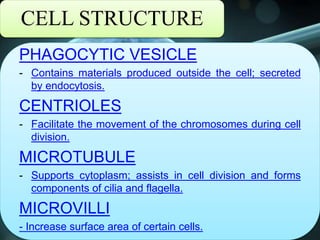
PHAGOCYTIC VESICLE
- Contains materials produced outside the cell; secreted
by endocytosis.
CENTRIOLES
- Facilitate the movement of the chromosomes during cell
division.
MICROTUBULE
- Supports cytoplasm; assists in cell division and forms
components of cilia and flagella.
MICROVILLI
- Increase surface area of certain cells.
CELL STRUCTURE
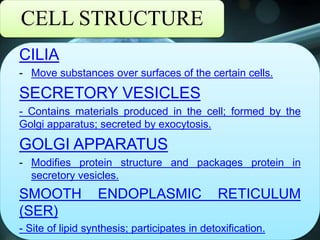
CILIA
- Move substances over surfaces of the certain cells.
SECRETORY VESICLES
- Contains materials produced in the cell; formed by the
Golgi apparatus; secreted by exocytosis.
GOLGI APPARATUS
- Modifies protein structure and packages protein in
secretory vesicles.
SMOOTH ENDOPLASMIC RETICULUM
(SER)
- Site of lipid synthesis; participates in detoxification.
CELL STRUCTURE
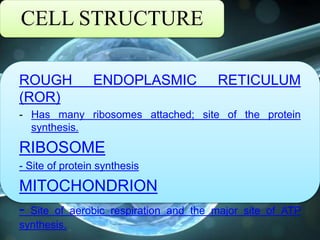
ROUGH ENDOPLASMIC RETICULUM
(ROR)
- Has many ribosomes attached; site of the protein
synthesis.
RIBOSOME
- Site of protein synthesis
MITOCHONDRION
- Site of aerobic respiration and the major site of ATP
synthesis.
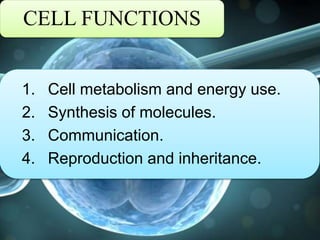
CELL FUNCTIONS
1. Cell metabolism and energy use.
2. Synthesis of molecules.
3. Communication.
4. Reproduction and inheritance.
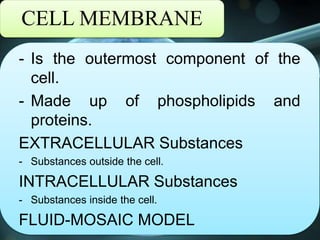
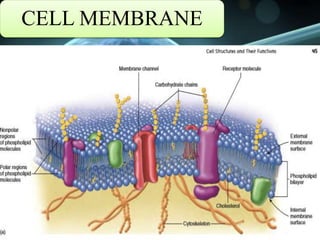
CELL MEMBRANE
- Is the outermost component of the
cell.
- Made up of phospholipids and
proteins.
EXTRACELLULAR Substances
- Substances outside the cell.
INTRACELLULAR Substances
- Substances inside the cell.
FLUID-MOSAIC MODEL
CELL MEMBRANE
MOVEMENT THROUGH THE
CELL MEMBRANE
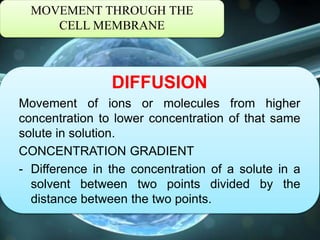
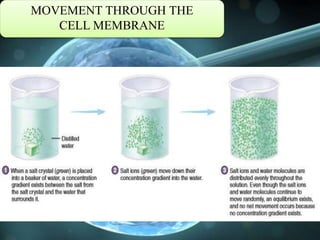
DIFFUSION
Movement of ions or molecules from higher
concentration to lower concentration of that same
solute in solution.
CONCENTRATION GRADIENT
- Difference in the concentration of a solute in a
solvent between two points divided by the
distance between the two points.
MOVEMENT THROUGH THE
CELL MEMBRANE
MOVEMENT THROUGH THE
CELL MEMBRANE
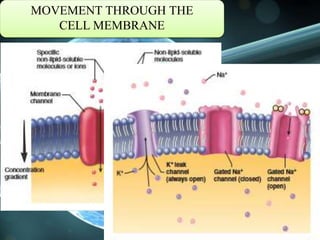
CELL MEMBRANE CHANNELS
- Consist of large protein molecules that extend
one surface of cell membranes to the other.
1. Leak Channels- constantly allow ions to
pass through.
2. Gated Channels- limit the movement of
ions across the membrane by opening and closing.
MOVEMENT THROUGH THE
CELL MEMBRANE
MOVEMENT THROUGH THE
CELL MEMBRANE
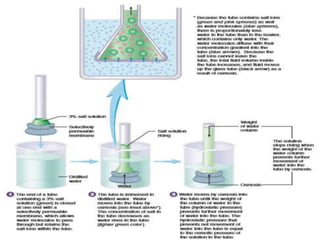
OSMOSIS
- Is the diffusion of water across a selectively
permeable membrane.
- From higher water concentration to one of lower
water concentration.
- Occurs when the cell membrane is less
permeable, selectively permeable or not
permeable to solutes and a concentration
gradient for water exists across the cell
membrane.
MOVEMENT THROUGH THE
CELL MEMBRANE
OSMOTIC PRESSURE
- Is the force required to prevent the movement of
water across a selectively permeable
membrane.
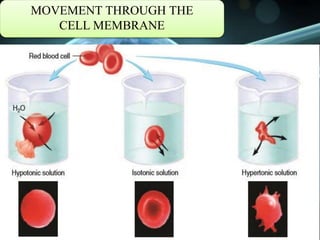
HYPOTONIC- Solution usually has a lower
concentration of solutes and higher concentration of water.
- Solution has less tone or osmotic pressure than cell.
- The cell will SWELL.
- The cell can rupture a process called Lysis.
MOVEMENT THROUGH THE
CELL MEMBRANE
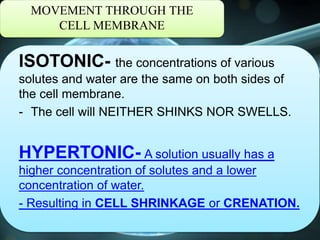
ISOTONIC- the concentrations of various
solutes and water are the same on both sides of
the cell membrane.
- The cell will NEITHER SHINKS NOR SWELLS.
HYPERTONIC- A solution usually has a
higher concentration of solutes and a lower
concentration of water.
- Resulting in CELL SHRINKAGE or CRENATION.
MOVEMENT THROUGH THE
CELL MEMBRANE
MOVEMENT THROUGH THE
CELL MEMBRANE
MOVEMENT THROUGH THE
CELL MEMBRANE
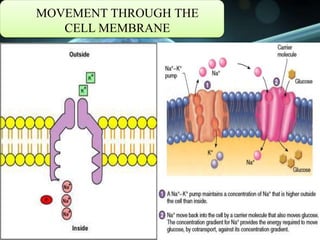
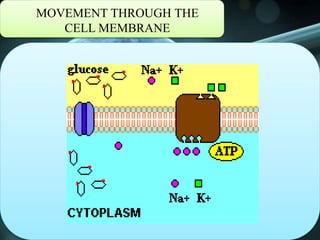
CARRIER-MEDIATED
TRANSPORT MECHANISM
Facilitated Diffusion
Active Transport
Secondary Active Transport
MOVEMENT THROUGH THE
CELL MEMBRANE
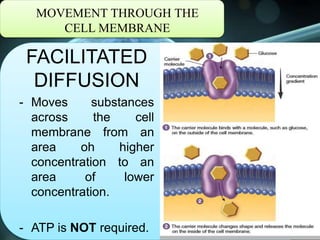
FACILITATED
DIFFUSION
- Moves substances
across the cell
membrane from an
area oh higher
concentration to an
area of lower
concentration.
- ATP is NOT required.
MOVEMENT THROUGH THE
CELL MEMBRANE
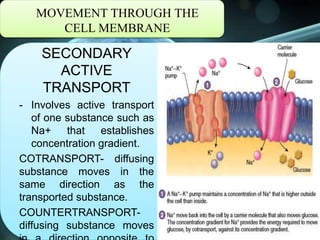
SECONDARY
ACTIVE
TRANSPORT
- Involves active transport
of one substance such as
Na+ that establishes
concentration gradient.
COTRANSPORT- diffusing
substance moves in the
same direction as the
transported substance.
COUNTERTRANSPORT-
diffusing substance moves
MOVEMENT THROUGH THE
CELL MEMBRANE
MOVEMENT THROUGH THE
CELL MEMBRANE
MOVEMENT THROUGH THE
CELL MEMBRANE
MOVEMENT THROUGH THE
CELL MEMBRANE
MOVEMENT THROUGH THE
CELL MEMBRANE
ENDOCYTOSIS AND
EXOCYTOSIS
VESICLES- Membrane bound sacs.
ENDOCYTOSIS- uptake of material
through the cell membrane by the
formation of a vesicle.
MOVEMENT THROUGH THE
CELL MEMBRANE
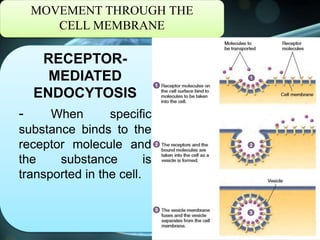
RECEPTOR-
MEDIATED
ENDOCYTOSIS
- When specific
substance binds to the
receptor molecule and
the substance is
transported in the cell.
MOVEMENT THROUGH THE
CELL MEMBRANE
MOVEMENT THROUGH THE
CELL MEMBRANE
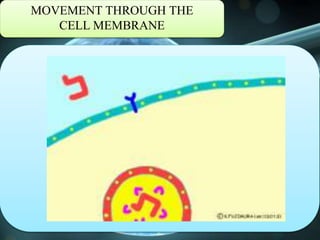
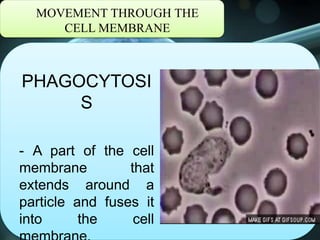
PHAGOCYTOSI
S
- A part of the cell
membrane that
extends around a
particle and fuses it
into the cell
MOVEMENT THROUGH THE
CELL MEMBRANE
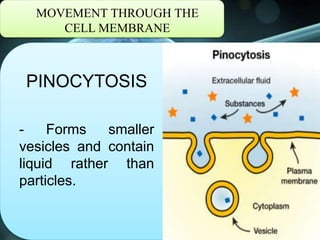
PINOCYTOSIS
- Forms smaller
vesicles and contain
liquid rather than
particles.
MOVEMENT THROUGH THE
CELL MEMBRANE
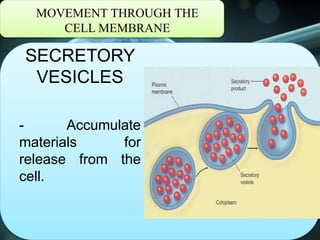
SECRETORY
VESICLES
- Accumulate
materials for
release from the
cell.
MOVEMENT THROUGH THE
CELL MEMBRANE
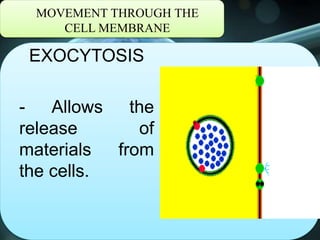
EXOCYTOSIS
- Allows the
release of
materials from
the cells.
CELL ORGANELLES
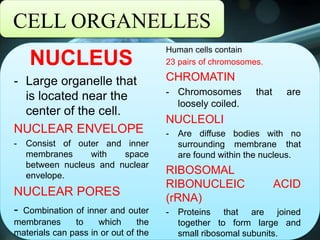
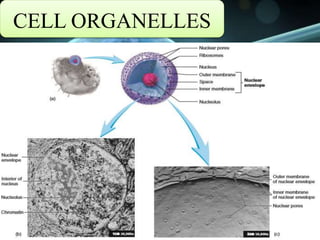
NUCLEUS
- Large organelle that
is located near the
center of the cell.
NUCLEAR ENVELOPE
- Consist of outer and inner
membranes with space
between nucleus and nuclear
envelope.
NUCLEAR PORES
- Combination of inner and outer
membranes to which the
materials can pass in or out of the
Human cells contain
23 pairs of chromosomes.
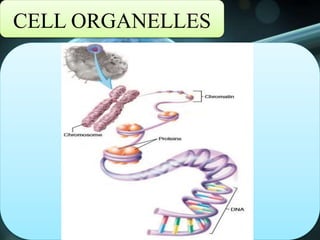
CHROMATIN
- Chromosomes that are
loosely coiled.
NUCLEOLI
- Are diffuse bodies with no
surrounding membrane that
are found within the nucleus.
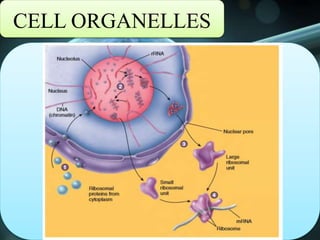
RIBOSOMAL
RIBONUCLEIC ACID
(rRNA)
- Proteins that are joined
together to form large and
small ribosomal subunits.
CELL ORGANELLES
CELL ORGANELLES
CELL ORGANELLES
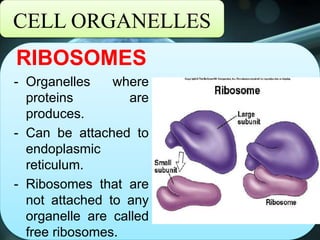
RIBOSOMES
- Organelles where
proteins are
produces.
- Can be attached to
endoplasmic
reticulum.
- Ribosomes that are
not attached to any
organelle are called
free ribosomes.
CELL ORGANELLES
CELL ORGANELLES
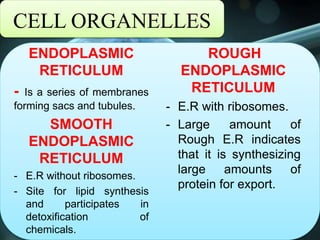
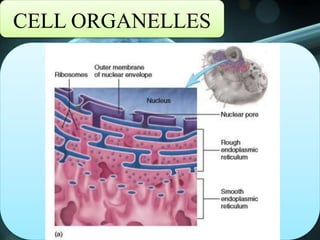
ENDOPLASMIC
RETICULUM
- Is a series of membranes
forming sacs and tubules.
SMOOTH
ENDOPLASMIC
RETICULUM
- E.R without ribosomes.
- Site for lipid synthesis
and participates in
detoxification of
chemicals.
ROUGH
ENDOPLASMIC
RETICULUM
- E.R with ribosomes.
- Large amount of
Rough E.R indicates
that it is synthesizing
large amounts of
protein for export.
CELL ORGANELLES
CELL ORGANELLES
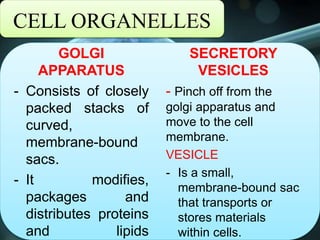
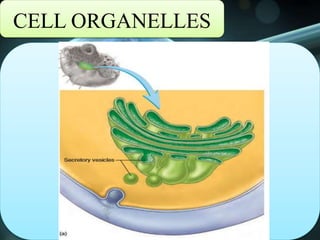
GOLGI
APPARATUS
- Consists of closely
packed stacks of
curved,
membrane-bound
sacs.
- It modifies,
packages and
distributes proteins
and lipids
SECRETORY
VESICLES
- Pinch off from the
golgi apparatus and
move to the cell
membrane.
VESICLE
- Is a small,
membrane-bound sac
that transports or
stores materials
within cells.
CELL ORGANELLES
CELL ORGANELLES
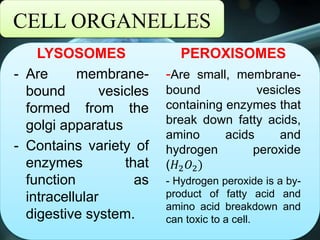
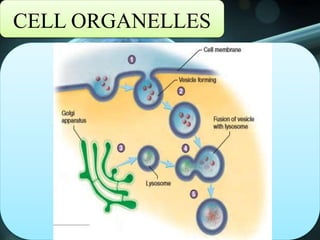
LYSOSOMES
- Are membrane-
bound vesicles
formed from the
golgi apparatus
- Contains variety of
enzymes that
function as
intracellular
digestive system.
PEROXISOMES
-Are small, membrane-
bound vesicles
containing enzymes that
break down fatty acids,
amino acids and
hydrogen peroxide
(𝐻2 𝑂2)
- Hydrogen peroxide is a by-
product of fatty acid and
amino acid breakdown and
can toxic to a cell.
CELL ORGANELLES
CELL ORGANELLES
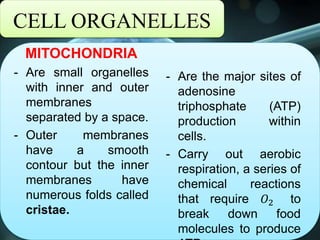
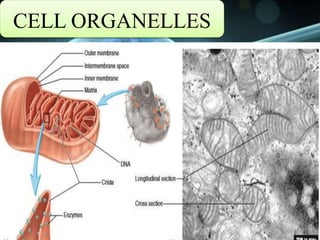
MITOCHONDRIA
- Are small organelles
with inner and outer
membranes
separated by a space.
- Outer membranes
have a smooth
contour but the inner
membranes have
numerous folds called
cristae.
- Are the major sites of
adenosine
triphosphate (ATP)
production within
cells.
- Carry out aerobic
respiration, a series of
chemical reactions
that require 𝑂2 to
break down food
molecules to produce
CELL ORGANELLES
CELL ORGANELLES
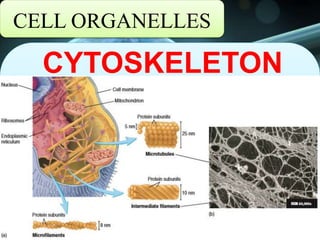
CYTOSKELETON
- Consists of proteins that support the cell,
hold organelles in place and enable the cell
to change shape.
- These protein structures are:
Microtubules
Microfilaments
Intermediate filaments
CELL ORGANELLES
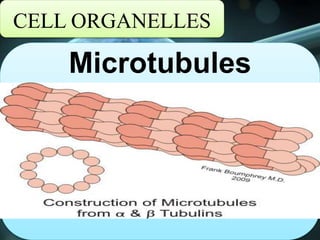
Microtubules
- Are hollow structures formed from protein
subunits.
FUNCTIONS:
1. Helps to support the cytoplasm of cells.
2. Assisting in cell division.
3. Forming essential components of certain
organelles such as cilia and flagella.
CELL ORGANELLES
Microtubules
CELL ORGANELLES
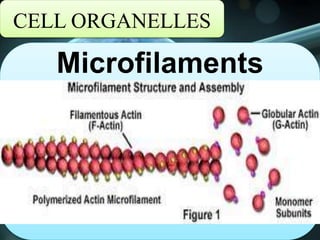
Microfilaments
- Are small fibrils from protein subunits that
structurally support the cytoplasm.
FUNCTIONS:
1. Some microfilaments are involved with cell
movement.
CELL ORGANELLES
Microfilaments
CELL ORGANELLES
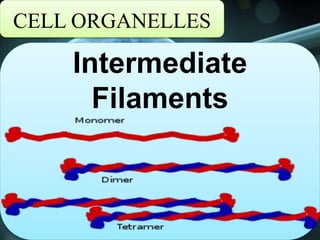
Intermediate
Filaments
- Are fibrils formed from protein subunits that
are smaller in diameter than microtubules
but larger in diameter than microfilaments.
FUNCTIONS:
1. Provide mechanical support to the cell.
CELL ORGANELLES
Intermediate
Filaments
CELL ORGANELLES
CYTOSKELETON
CELL ORGANELLES
CENTRIOLES
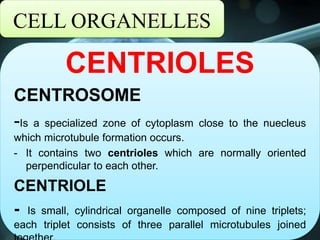
CENTROSOME
-Is a specialized zone of cytoplasm close to the nuecleus
which microtubule formation occurs.
- It contains two centrioles which are normally oriented
perpendicular to each other.
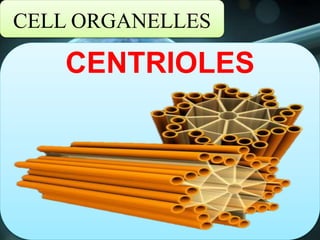
CENTRIOLE
- Is small, cylindrical organelle composed of nine triplets;
each triplet consists of three parallel microtubules joined
CELL ORGANELLES
CENTRIOLES
CELL ORGANELLES
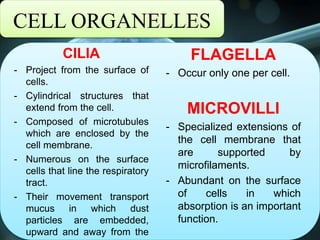
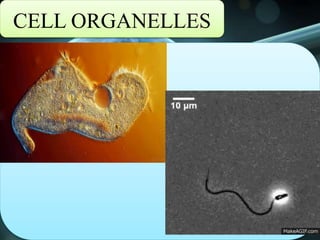
CILIA
- Project from the surface of
cells.
- Cylindrical structures that
extend from the cell.
- Composed of microtubules
which are enclosed by the
cell membrane.
- Numerous on the surface
cells that line the respiratory
tract.
- Their movement transport
mucus in which dust
particles are embedded,
upward and away from the
FLAGELLA
- Occur only one per cell.
MICROVILLI
- Specialized extensions of
the cell membrane that
are supported by
microfilaments.
- Abundant on the surface
of cells in which
absorption is an important
function.
CELL ORGANELLES
CELL ACTIVITY
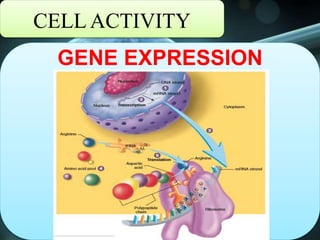
GENE EXPRESSION
- DNA contains the information that directs protein synthesis.
- DNA also influences the structural and functional characteristics
of the entire organism.
- DNA molecule is consist of nucleotides joined together to form
two nucleotide strands.
- NUCLEOTIDES function as chemical “letters” that form chemical
“words”.
GENE
- Is a sequence of nucleotides that provides a chemical set of
instructions for making a specific protein.
CELL ACTIVITY
GENE EXPRESSION
Involves two steps:
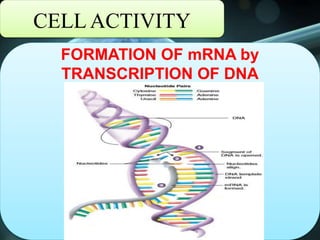
1. Transcription
- the cell makes a copy of the gene
necessary to make a particular protein.
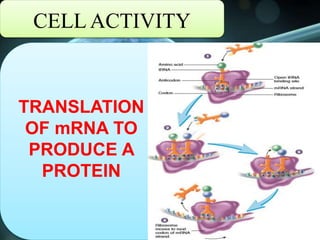
2. Translation
- converting the copied information
into a protein.
CELL ACTIVITY
GENE EXPRESSION
CELL ACTIVITY
FORMATION OF mRNA by
TRANSCRIPTION OF DNA
CELL ACTIVITY
TRANSLATION
OF mRNA TO
PRODUCE A
PROTEIN
CELL ACTIVITY
CELL LIFE CYCLE
Includes two major phases:
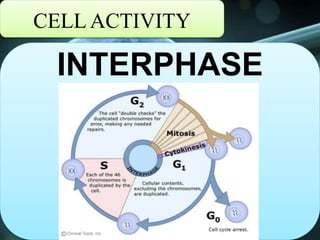
1. Non-dividing phase called
INTERPHASE
2. CELL DIVISION
CELL ACTIVITY
INTERPHASE
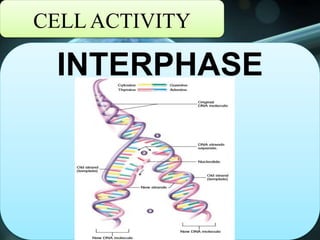
- The DNA is replicated; two strands of
DNA separate from each other and
each other serves as a template for the
production of a new strand of DNA
- At the end of interphase, a cell has two
complete sets of genetic material
CELL ACTIVITY
INTERPHASE
CELL ACTIVITY
INTERPHASE
CELL ACTIVITY
CELL DIVISION
- Is the formation of daughter cells from
a single parent cell.
- Growth and tissue repair are formed
through MITOSIS.
- Sex cells undergo MEIOSIS necessary
for reproduction.
CELL ACTIVITY
CELL DIVISION
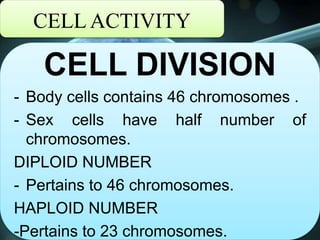
- Body cells contains 46 chromosomes .
- Sex cells have half number of
chromosomes.
DIPLOID NUMBER
- Pertains to 46 chromosomes.
HAPLOID NUMBER
-Pertains to 23 chromosomes.
CELL ACTIVITY
MITOSIS
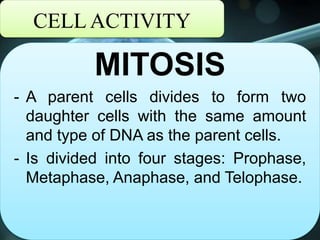
- A parent cells divides to form two
daughter cells with the same amount
and type of DNA as the parent cells.
- Is divided into four stages: Prophase,
Metaphase, Anaphase, and Telophase.
CELL ACTIVITY
MITOSIS
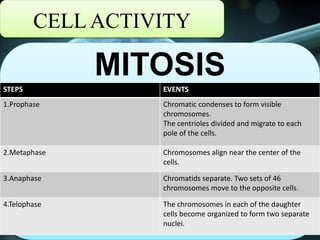
STEPS EVENTS
1.Prophase Chromatic condenses to form visible
chromosomes.
The centrioles divided and migrate to each
pole of the cells.
2.Metaphase Chromosomes align near the center of the
cells.
3.Anaphase Chromatids separate. Two sets of 46
chromosomes move to the opposite cells.
4.Telophase The chromosomes in each of the daughter
cells become organized to form two separate
nuclei.
CELL ACTIVITY
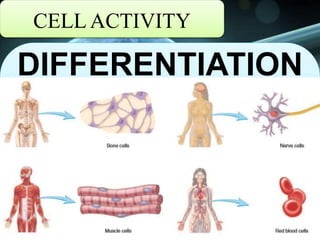
DIFFERENTIATION
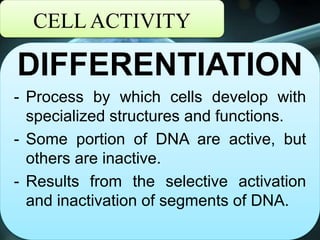
- Process by which cells develop with
specialized structures and functions.
- Some portion of DNA are active, but
others are inactive.
- Results from the selective activation
and inactivation of segments of DNA.
CELL ACTIVITY
DIFFERENTIATION
CELL ACTIVITY
APOPTOSIS
- Programmed cell death
- Normal process by which cell numbers
within various tissues are adjusted and
controlled.
- Eliminates excess cells to maintain constant
numbers of cells within the tissue.
- Damaged or potential dangerous cells,
virus-infected cells and potential cancer
CELL ACTIVITY
CELLULAR ASPECTS OF
AGING
1. Cellular clock – after a certain passage of
time or a certain number of cell division,
results in the death of a given cell line.
2. Death Genes – Turn late in life or
sometimes prematurely, causing cells to
deteriorate and die.
3. DNA damage – Resulting in cell
degeneration and death.
CELL ACTIVITY
CELLULAR ASPECTS OF
AGING
4. Free radicals – DNA is also susceptible to
direct damage, resulting in mutations. Free
radicals are atoms and molecules with an
unpaired electron.
5. Mitochondrial damage – May results in loss
of proteins critical to mitochondrial functions.
“A cell is regarded as the true
biological atom?
- George Lewes

Cell structure and functions

  • 1.
  • 2.
    CELL STRUCTURE CELLS • Determinethe form and functions of the human body. • Basic living unit of all organisms. • Are complex living structures. • Are specialized to perform specific functions.
  • 3.
    CELL STRUCTURE ORGANELLES - Specializedstructures within cells. - Perform specific functions.
  • 4.
    CELL MEMBRANE CYTOPLASM NUCLEAR ENVELOPE NUCLEOLUS NUCLEUS LYSOSOME PHAGOCYTIC VESICLE CENTROSOME CENTRIOLES PEROXISOME MICROTUBULE MICROVILICILIA SECRETORYVESICLE GOLGI APPARATUS SMOOTH ENDOPLASMIC RETICULUM ROUGH ENDOPLASMIC RETICULUM RIBOSOME MITOCHONDRION
  • 5.
    CELL STRUCTURE CELL MEMBRANE -selectively permeable to ions and organic molecules and controls the movement of substances in and out of cells. CYTOPLASM - The living material surrounding the nucleus. NUCLEUS - Contains genetic material of cell (DNA) and nucleoli; site of RNA synthesis and ribosomal subunit assembly. LYSOSOME - Contains enzymes that digest material taken into the cell.
  • 6.
    CELL STRUCTURE PHAGOCYTIC VESICLE -Contains materials produced outside the cell; secreted by endocytosis. CENTRIOLES - Facilitate the movement of the chromosomes during cell division. MICROTUBULE - Supports cytoplasm; assists in cell division and forms components of cilia and flagella. MICROVILLI - Increase surface area of certain cells.
  • 7.
    CELL STRUCTURE CILIA - Movesubstances over surfaces of the certain cells. SECRETORY VESICLES - Contains materials produced in the cell; formed by the Golgi apparatus; secreted by exocytosis. GOLGI APPARATUS - Modifies protein structure and packages protein in secretory vesicles. SMOOTH ENDOPLASMIC RETICULUM (SER) - Site of lipid synthesis; participates in detoxification.
  • 8.
    CELL STRUCTURE ROUGH ENDOPLASMICRETICULUM (ROR) - Has many ribosomes attached; site of the protein synthesis. RIBOSOME - Site of protein synthesis MITOCHONDRION - Site of aerobic respiration and the major site of ATP synthesis.
  • 9.
    CELL FUNCTIONS 1. Cellmetabolism and energy use. 2. Synthesis of molecules. 3. Communication. 4. Reproduction and inheritance.
  • 10.
    CELL MEMBRANE - Isthe outermost component of the cell. - Made up of phospholipids and proteins. EXTRACELLULAR Substances - Substances outside the cell. INTRACELLULAR Substances - Substances inside the cell. FLUID-MOSAIC MODEL
  • 11.
  • 12.
    MOVEMENT THROUGH THE CELLMEMBRANE DIFFUSION Movement of ions or molecules from higher concentration to lower concentration of that same solute in solution. CONCENTRATION GRADIENT - Difference in the concentration of a solute in a solvent between two points divided by the distance between the two points.
  • 13.
  • 14.
    MOVEMENT THROUGH THE CELLMEMBRANE CELL MEMBRANE CHANNELS - Consist of large protein molecules that extend one surface of cell membranes to the other. 1. Leak Channels- constantly allow ions to pass through. 2. Gated Channels- limit the movement of ions across the membrane by opening and closing.
  • 15.
  • 16.
    MOVEMENT THROUGH THE CELLMEMBRANE OSMOSIS - Is the diffusion of water across a selectively permeable membrane. - From higher water concentration to one of lower water concentration. - Occurs when the cell membrane is less permeable, selectively permeable or not permeable to solutes and a concentration gradient for water exists across the cell membrane.
  • 17.
    MOVEMENT THROUGH THE CELLMEMBRANE OSMOTIC PRESSURE - Is the force required to prevent the movement of water across a selectively permeable membrane. HYPOTONIC- Solution usually has a lower concentration of solutes and higher concentration of water. - Solution has less tone or osmotic pressure than cell. - The cell will SWELL. - The cell can rupture a process called Lysis.
  • 18.
    MOVEMENT THROUGH THE CELLMEMBRANE ISOTONIC- the concentrations of various solutes and water are the same on both sides of the cell membrane. - The cell will NEITHER SHINKS NOR SWELLS. HYPERTONIC- A solution usually has a higher concentration of solutes and a lower concentration of water. - Resulting in CELL SHRINKAGE or CRENATION.
  • 19.
  • 20.
  • 21.
    MOVEMENT THROUGH THE CELLMEMBRANE CARRIER-MEDIATED TRANSPORT MECHANISM Facilitated Diffusion Active Transport Secondary Active Transport
  • 22.
    MOVEMENT THROUGH THE CELLMEMBRANE FACILITATED DIFFUSION - Moves substances across the cell membrane from an area oh higher concentration to an area of lower concentration. - ATP is NOT required.
  • 23.
    MOVEMENT THROUGH THE CELLMEMBRANE SECONDARY ACTIVE TRANSPORT - Involves active transport of one substance such as Na+ that establishes concentration gradient. COTRANSPORT- diffusing substance moves in the same direction as the transported substance. COUNTERTRANSPORT- diffusing substance moves
  • 24.
  • 25.
  • 26.
  • 27.
  • 28.
    MOVEMENT THROUGH THE CELLMEMBRANE ENDOCYTOSIS AND EXOCYTOSIS VESICLES- Membrane bound sacs. ENDOCYTOSIS- uptake of material through the cell membrane by the formation of a vesicle.
  • 29.
    MOVEMENT THROUGH THE CELLMEMBRANE RECEPTOR- MEDIATED ENDOCYTOSIS - When specific substance binds to the receptor molecule and the substance is transported in the cell.
  • 30.
  • 31.
    MOVEMENT THROUGH THE CELLMEMBRANE PHAGOCYTOSI S - A part of the cell membrane that extends around a particle and fuses it into the cell
  • 32.
    MOVEMENT THROUGH THE CELLMEMBRANE PINOCYTOSIS - Forms smaller vesicles and contain liquid rather than particles.
  • 33.
    MOVEMENT THROUGH THE CELLMEMBRANE SECRETORY VESICLES - Accumulate materials for release from the cell.
  • 34.
    MOVEMENT THROUGH THE CELLMEMBRANE EXOCYTOSIS - Allows the release of materials from the cells.
  • 35.
    CELL ORGANELLES NUCLEUS - Largeorganelle that is located near the center of the cell. NUCLEAR ENVELOPE - Consist of outer and inner membranes with space between nucleus and nuclear envelope. NUCLEAR PORES - Combination of inner and outer membranes to which the materials can pass in or out of the Human cells contain 23 pairs of chromosomes. CHROMATIN - Chromosomes that are loosely coiled. NUCLEOLI - Are diffuse bodies with no surrounding membrane that are found within the nucleus. RIBOSOMAL RIBONUCLEIC ACID (rRNA) - Proteins that are joined together to form large and small ribosomal subunits.
  • 36.
  • 37.
  • 38.
    CELL ORGANELLES RIBOSOMES - Organelleswhere proteins are produces. - Can be attached to endoplasmic reticulum. - Ribosomes that are not attached to any organelle are called free ribosomes.
  • 39.
  • 40.
    CELL ORGANELLES ENDOPLASMIC RETICULUM - Isa series of membranes forming sacs and tubules. SMOOTH ENDOPLASMIC RETICULUM - E.R without ribosomes. - Site for lipid synthesis and participates in detoxification of chemicals. ROUGH ENDOPLASMIC RETICULUM - E.R with ribosomes. - Large amount of Rough E.R indicates that it is synthesizing large amounts of protein for export.
  • 41.
  • 42.
    CELL ORGANELLES GOLGI APPARATUS - Consistsof closely packed stacks of curved, membrane-bound sacs. - It modifies, packages and distributes proteins and lipids SECRETORY VESICLES - Pinch off from the golgi apparatus and move to the cell membrane. VESICLE - Is a small, membrane-bound sac that transports or stores materials within cells.
  • 43.
  • 44.
    CELL ORGANELLES LYSOSOMES - Aremembrane- bound vesicles formed from the golgi apparatus - Contains variety of enzymes that function as intracellular digestive system. PEROXISOMES -Are small, membrane- bound vesicles containing enzymes that break down fatty acids, amino acids and hydrogen peroxide (𝐻2 𝑂2) - Hydrogen peroxide is a by- product of fatty acid and amino acid breakdown and can toxic to a cell.
  • 45.
  • 46.
    CELL ORGANELLES MITOCHONDRIA - Aresmall organelles with inner and outer membranes separated by a space. - Outer membranes have a smooth contour but the inner membranes have numerous folds called cristae. - Are the major sites of adenosine triphosphate (ATP) production within cells. - Carry out aerobic respiration, a series of chemical reactions that require 𝑂2 to break down food molecules to produce
  • 47.
  • 48.
    CELL ORGANELLES CYTOSKELETON - Consistsof proteins that support the cell, hold organelles in place and enable the cell to change shape. - These protein structures are: Microtubules Microfilaments Intermediate filaments
  • 49.
    CELL ORGANELLES Microtubules - Arehollow structures formed from protein subunits. FUNCTIONS: 1. Helps to support the cytoplasm of cells. 2. Assisting in cell division. 3. Forming essential components of certain organelles such as cilia and flagella.
  • 50.
  • 51.
    CELL ORGANELLES Microfilaments - Aresmall fibrils from protein subunits that structurally support the cytoplasm. FUNCTIONS: 1. Some microfilaments are involved with cell movement.
  • 52.
  • 53.
    CELL ORGANELLES Intermediate Filaments - Arefibrils formed from protein subunits that are smaller in diameter than microtubules but larger in diameter than microfilaments. FUNCTIONS: 1. Provide mechanical support to the cell.
  • 54.
  • 55.
  • 56.
    CELL ORGANELLES CENTRIOLES CENTROSOME -Is aspecialized zone of cytoplasm close to the nuecleus which microtubule formation occurs. - It contains two centrioles which are normally oriented perpendicular to each other. CENTRIOLE - Is small, cylindrical organelle composed of nine triplets; each triplet consists of three parallel microtubules joined
  • 57.
  • 58.
    CELL ORGANELLES CILIA - Projectfrom the surface of cells. - Cylindrical structures that extend from the cell. - Composed of microtubules which are enclosed by the cell membrane. - Numerous on the surface cells that line the respiratory tract. - Their movement transport mucus in which dust particles are embedded, upward and away from the FLAGELLA - Occur only one per cell. MICROVILLI - Specialized extensions of the cell membrane that are supported by microfilaments. - Abundant on the surface of cells in which absorption is an important function.
  • 59.
  • 60.
    CELL ACTIVITY GENE EXPRESSION -DNA contains the information that directs protein synthesis. - DNA also influences the structural and functional characteristics of the entire organism. - DNA molecule is consist of nucleotides joined together to form two nucleotide strands. - NUCLEOTIDES function as chemical “letters” that form chemical “words”. GENE - Is a sequence of nucleotides that provides a chemical set of instructions for making a specific protein.
  • 61.
    CELL ACTIVITY GENE EXPRESSION Involvestwo steps: 1. Transcription - the cell makes a copy of the gene necessary to make a particular protein. 2. Translation - converting the copied information into a protein.
  • 62.
  • 63.
    CELL ACTIVITY FORMATION OFmRNA by TRANSCRIPTION OF DNA
  • 64.
  • 65.
    CELL ACTIVITY CELL LIFECYCLE Includes two major phases: 1. Non-dividing phase called INTERPHASE 2. CELL DIVISION
  • 66.
    CELL ACTIVITY INTERPHASE - TheDNA is replicated; two strands of DNA separate from each other and each other serves as a template for the production of a new strand of DNA - At the end of interphase, a cell has two complete sets of genetic material
  • 67.
  • 68.
  • 69.
    CELL ACTIVITY CELL DIVISION -Is the formation of daughter cells from a single parent cell. - Growth and tissue repair are formed through MITOSIS. - Sex cells undergo MEIOSIS necessary for reproduction.
  • 70.
    CELL ACTIVITY CELL DIVISION -Body cells contains 46 chromosomes . - Sex cells have half number of chromosomes. DIPLOID NUMBER - Pertains to 46 chromosomes. HAPLOID NUMBER -Pertains to 23 chromosomes.
  • 71.
    CELL ACTIVITY MITOSIS - Aparent cells divides to form two daughter cells with the same amount and type of DNA as the parent cells. - Is divided into four stages: Prophase, Metaphase, Anaphase, and Telophase.
  • 72.
    CELL ACTIVITY MITOSIS STEPS EVENTS 1.ProphaseChromatic condenses to form visible chromosomes. The centrioles divided and migrate to each pole of the cells. 2.Metaphase Chromosomes align near the center of the cells. 3.Anaphase Chromatids separate. Two sets of 46 chromosomes move to the opposite cells. 4.Telophase The chromosomes in each of the daughter cells become organized to form two separate nuclei.
  • 73.
    CELL ACTIVITY DIFFERENTIATION - Processby which cells develop with specialized structures and functions. - Some portion of DNA are active, but others are inactive. - Results from the selective activation and inactivation of segments of DNA.
  • 74.
  • 75.
    CELL ACTIVITY APOPTOSIS - Programmedcell death - Normal process by which cell numbers within various tissues are adjusted and controlled. - Eliminates excess cells to maintain constant numbers of cells within the tissue. - Damaged or potential dangerous cells, virus-infected cells and potential cancer
  • 76.
    CELL ACTIVITY CELLULAR ASPECTSOF AGING 1. Cellular clock – after a certain passage of time or a certain number of cell division, results in the death of a given cell line. 2. Death Genes – Turn late in life or sometimes prematurely, causing cells to deteriorate and die. 3. DNA damage – Resulting in cell degeneration and death.
  • 77.
    CELL ACTIVITY CELLULAR ASPECTSOF AGING 4. Free radicals – DNA is also susceptible to direct damage, resulting in mutations. Free radicals are atoms and molecules with an unpaired electron. 5. Mitochondrial damage – May results in loss of proteins critical to mitochondrial functions.
  • 78.
    “A cell isregarded as the true biological atom? - George Lewes