Cells, Tissues,
Organs, and
Organ Systems of
Animals
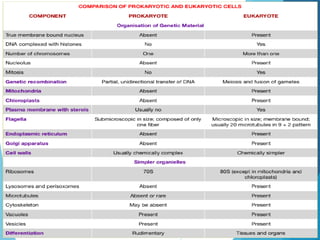
What are Cells?
 Functional unit of life
 A l l chemical reactions necessary for the maintenance
a
n
dreproduction of life take place
 Basic Types
 Prokaryotes
Archea and Eubacteria
 Eukaryotes
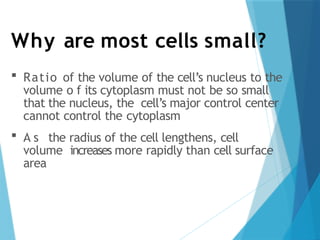
Why are most cells small?
 Ratio of the volume of the cell’s nucleus to the
volume o f its cytoplasm must not be so small
that the nucleus, the cell’s major control center
cannot control the cytoplasm
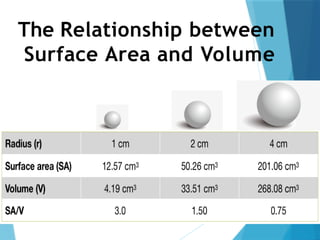
 A s the radius of the cell lengthens, cell
volume increases more rapidly than cell surface
area
The Relationship between
Surface Area and Volume
Structure and
Function of Cellular
Components
Cell membranes
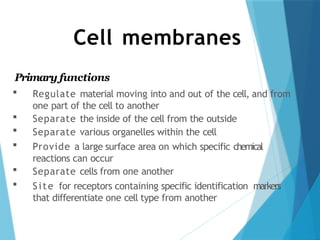
Primary functions
 Regulate material moving into and out of the cell, and from
one part of the cell to another
 Separate the inside of the cell from the outside
 Separate various organelles within the cell
 Provide a large surface area on which specific chemical
reactions can occur
 Separate cells from one another
 Site for receptors containing specific identification markers
that differentiate one cell type from another
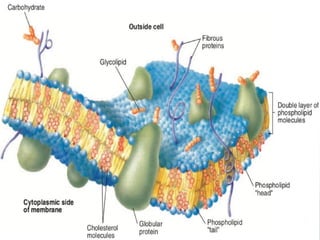
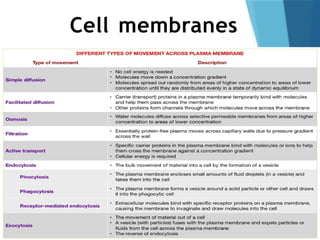
Cell membranes
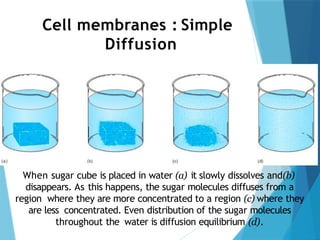
Cell membranes : Simple
Diffusion
When sugar cube is placed in water (a) it slowly dissolves and(b)
disappears. As this happens, the sugar molecules diffuses from a
region where they are more concentrated to a region (c) where they
are less concentrated. Even distribution of the sugar molecules
throughout the water is diffusion equilibrium (d).
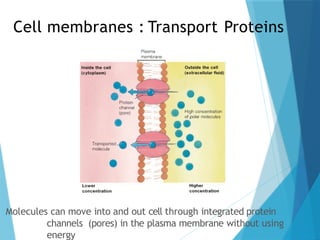
Cell membranes : Transport Proteins
Molecules can move into and out cell through integrated protein
channels (pores) in the plasma membrane without using
energy
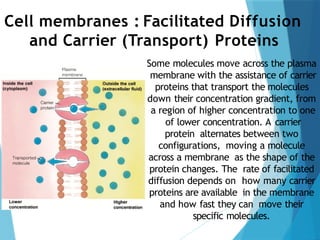
Cell membranes : Facilitated Diffusion
and Carrier (Transport) Proteins
Some molecules move across the plasma
membrane with the assistance of carrier
proteins that transport the molecules
down their concentration gradient, from
a region of higher concentration to one
of lower concentration. A carrier
protein alternates between two
configurations, moving a molecule
across a membrane as the shape of the
protein changes. The rate of facilitated
diffusion depends on how many carrier
proteins are available in the membrane
and how fast they can move their
specific molecules.
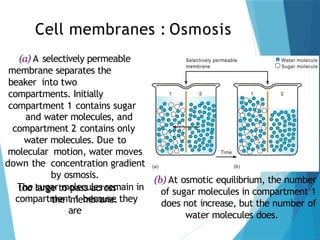
Cell membranes : Osmosis
(a) A selectively permeable
membrane separates the
beaker into two
compartments. Initially
compartment 1 contains sugar
and water molecules, and
compartment 2 contains only
water molecules. Due to
molecular motion, water moves
down the concentration gradient
by osmosis.
The sugar molecules remain in
compartment 1 because they
are
too large to pass across
the membrane.
(b) At osmotic equilibrium, the number
of sugar molecules in compartment 1
does not increase, but the number of
water molecules does.
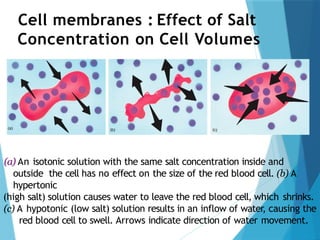
Cell membranes : Effect of Salt
Concentration on Cell Volumes
(a) An isotonic solution with the same salt concentration inside and
outside the cell has no effect on the size of the red blood cell. (b) A
hypertonic
(high salt) solution causes water to leave the red blood cell, which shrinks.
(c) A hypotonic (low salt) solution results in an inflow of water, causing the
red blood cell to swell. Arrows indicate direction of water movement.
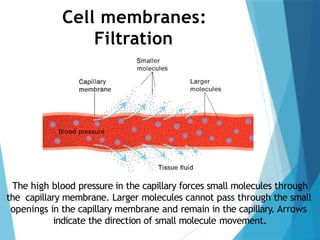
Cell membranes:
Filtration
The high blood pressure in the capillary forces small molecules through
the capillary membrane. Larger molecules cannot pass through the small
openings in the capillary membrane and remain in the capillary. Arrows
indicate the direction of small molecule movement.
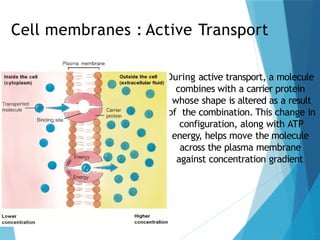
Cell membranes : Active Transport
During active transport, a molecule
combines with a carrier protein
whose shape is altered as a result
of the combination. This change in
configuration, along with ATP
energy, helps move the molecule
across the plasma membrane
against concentration gradient.
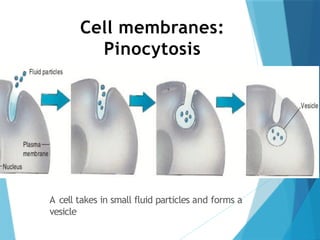
Cell membranes:
Pinocytosis
A cell takes in small fluid particles and forms a
vesicle
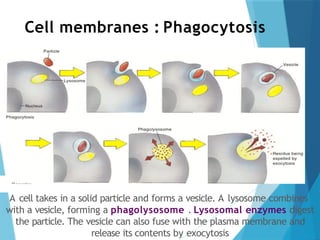
Cell membranes : Phagocytosis
A cell takes in a solid particle and forms a vesicle. A lysosome combines
with a vesicle, forming a phagolysosome . Lysosomal enzymes digest
the particle. The vesicle can also fuse with the plasma membrane and
release its contents by exocytosis
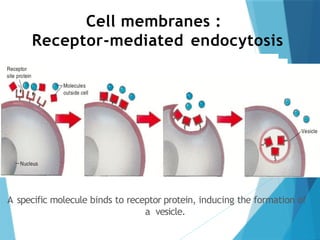
Cell membranes :
Receptor-mediated endocytosis
A specific molecule binds to receptor protein, inducing the formation of
a vesicle.
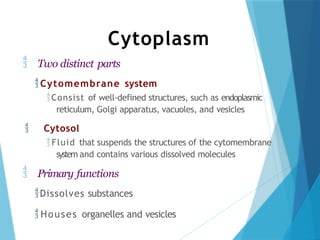
Cytoplasm
 Two distinct parts
Cytomembrane system
Consist of well-defined structures, such as endoplasmic
reticulum, Golgi apparatus, vacuoles, and vesicles
 Cytosol
 Fluid that suspends the structures of the cytomembrane
system and contains various dissolved molecules
 Primary functions
Dissolves substances
 Houses organelles and vesicles
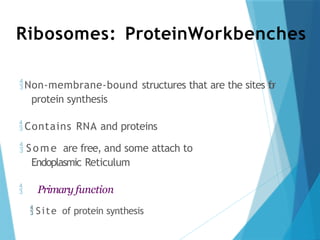
Ribosomes: ProteinWorkbenches
Non-membrane-bound structures that are the sites f
o
r
protein synthesis
Contains RNA and proteins
 So m e are free, and some attach to
Endoplasmic Reticulum
 Primary function
 Site of protein synthesis
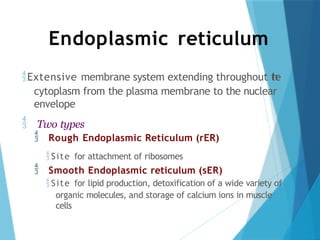
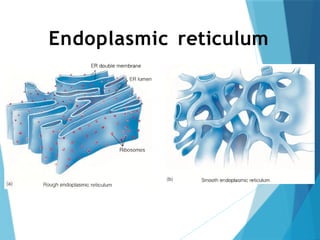
Endoplasmic reticulum
Extensive membrane system extending throughout t
h
e
cytoplasm from the plasma membrane to the nuclear
envelope
 Two types
 Rough Endoplasmic Reticulum (rER)
 Site for attachment of ribosomes
 Smooth Endoplasmic reticulum (sER)
 Site for lipid production, detoxification of a wide variety of
organic molecules, and storage of calcium ions in muscle
cells
Endoplasmic reticulum
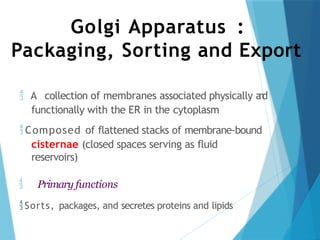
Golgi Apparatus :
Packaging, Sorting and Export
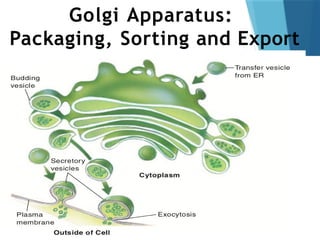
 A collection of membranes associated physically a
n
d
functionally with the ER in the cytoplasm
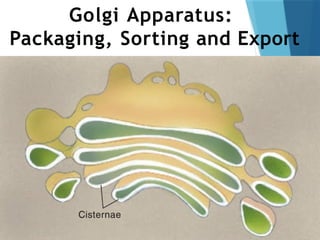
Composed of flattened stacks of membrane-bound
cisternae (closed spaces serving as fluid
reservoirs)
 Primary functions
Sorts, packages, and secretes proteins and lipids
Golgi Apparatus:
Packaging, Sorting and Export
Golgi Apparatus:
Packaging, Sorting and Export
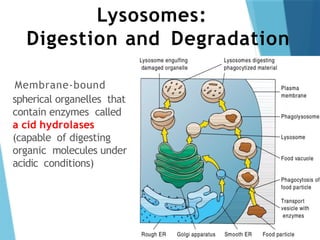
Lysosomes:
Digestion and Degradation
Membrane-bound
spherical organelles that
contain enzymes called
a cid hydrolases
(capable of digesting
organic molecules under
acidic conditions)
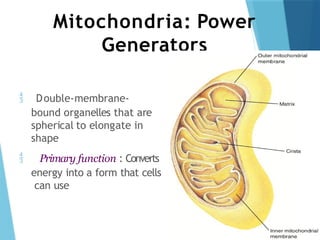
Mitochondria: Power
Generators
 Double-membrane-
bound organelles that are
spherical to elongate in
shape
 Primary function : Converts
energy into a form that cells
can use
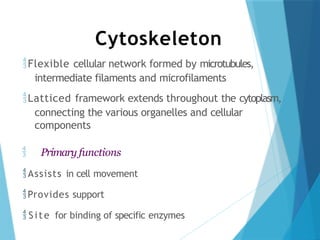
Cytoskeleton
Flexible cellular network formed by microtubules,
intermediate filaments and microfilaments
Latticed framework extends throughout the cytoplasm,
connecting the various organelles and cellular
components
 Primary functions
Assists in cell movement
Provides support
 Site for binding of specific enzymes
Cytoskeleton



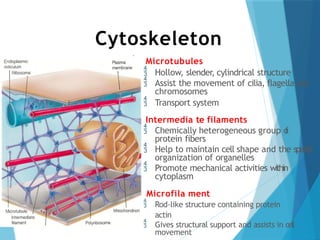
Microtubules
 Hollow, slender, cylindrical structure
 Assist the movement of cilia, flagella and
chromosomes
 Transport system
Intermedia te filaments
 Chemically heterogeneous group o
f
protein fibers
 Help to maintain cell shape and the spatial
organization of organelles
 Promote mechanical activities within
cytoplasm
Microfila ment
 Rod-like structure containing protein
actin
 Gives structural support and assists in cell
movement
Cytoskeleton
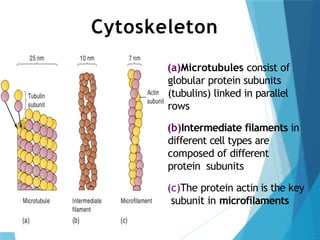
(a)Microtubules consist of
globular protein subunits
(tubulins) linked in parallel
rows
(b)Intermediate filaments in
different cell types are
composed of different
protein subunits
(c)The protein actin is the key
subunit in microfilaments
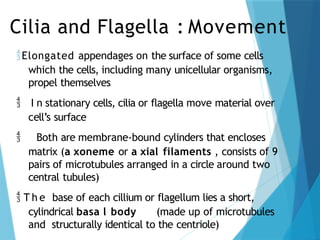
Cilia and Flagella : Movement
Elongated appendages on the surface of some cells
which the cells, including many unicellular organisms,
propel themselves
 I n stationary cells, cilia or flagella move material over
cell’s surface
 Both are membrane-bound cylinders that encloses
matrix (a xoneme or a xial filaments , consists of 9
pairs of microtubules arranged in a circle around two
central tubules)
 T h e base of each cillium or flagellum lies a short,
cylindrical basa l body (made up of microtubules
and structurally identical to the centriole)
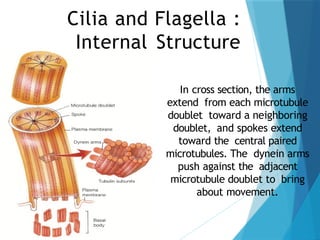
Cilia and Flagella :
Internal Structure
In cross section, the arms
extend from each microtubule
doublet toward a neighboring
doublet, and spokes extend
toward the central paired
microtubules. The dynein arms
push against the adjacent
microtubule doublet to bring
about movement.
Centrioles
Located within microtubule-organizing center
Contains nine triple microtubules
 Primary function
Functions in mitotic spindle formation
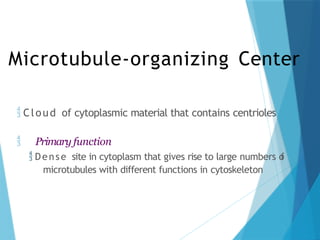
Microtubule-organizing Center
 Cloud of cytoplasmic material that contains centrioles
 Primary function
 Dense site in cytoplasm that gives rise to large numbers o
f
microtubules with different functions in cytoskeleton
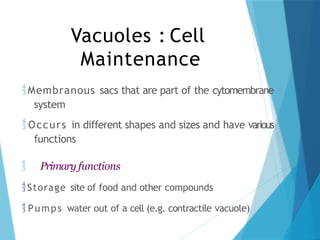
Vacuoles : Cell
Maintenance
Membranous sacs that are part of the cytomembrane
system
 Occurs in different shapes and sizes and have various
functions
 Primary functions
Storage site of food and other compounds
 Pumps water out of a cell (e.g. contractile vacuole)
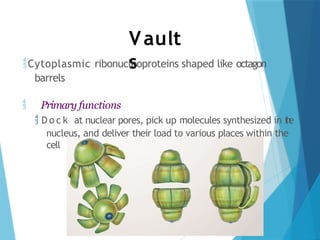
Vault
s
Cytoplasmic ribonucleoproteins shaped like octagon
barrels
 Primary functions
 D o c k at nuclear pores, pick up molecules synthesized in t
h
e
nucleus, and deliver their load to various places within the
cell
Nucleus: Information Center
• Spherical structure surrounded by a nuclear
envelope
• Primary functions
• Contains DNA that controls cell’s genetic program a
n
d
metabolic activities
Nuclear Envelope :
Gateway to the Nucleus
• Membrane that separates the nucleus from the
cytoplasm and is continuous with the endoplasmic
reticulum
• Primary functions
 I t has pores that allow the entry and exit of materials
 T h e size of the pores prevents the DNA from leaving the
nucleus but permits RNA to be moved out
 G a v e the nucleus a direct contact with the endoplasmic
reticulum
Chromosomes: Genetic
Containers
 M a d e up of nucleic acid (DNA) and protein
• Primary functions
Controls heredity and cellular activities
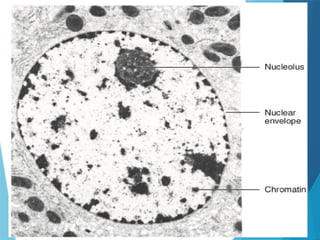
Nucleolu
s
 Rounded mass within nucleus
Contains RNA and protein
 Primary functions
Preassembly point for ribosomes
Cell Structure and Cellular Components.pptx

Cell Structure and Cellular Components.pptx

  • 1.
  • 2.
    What are Cells? Functional unit of life  A l l chemical reactions necessary for the maintenance a n dreproduction of life take place  Basic Types  Prokaryotes Archea and Eubacteria  Eukaryotes
  • 6.
    Why are mostcells small?  Ratio of the volume of the cell’s nucleus to the volume o f its cytoplasm must not be so small that the nucleus, the cell’s major control center cannot control the cytoplasm  A s the radius of the cell lengthens, cell volume increases more rapidly than cell surface area
  • 7.
  • 8.
    Structure and Function ofCellular Components
  • 9.
    Cell membranes Primary functions Regulate material moving into and out of the cell, and from one part of the cell to another  Separate the inside of the cell from the outside  Separate various organelles within the cell  Provide a large surface area on which specific chemical reactions can occur  Separate cells from one another  Site for receptors containing specific identification markers that differentiate one cell type from another
  • 11.
  • 12.
    Cell membranes :Simple Diffusion When sugar cube is placed in water (a) it slowly dissolves and(b) disappears. As this happens, the sugar molecules diffuses from a region where they are more concentrated to a region (c) where they are less concentrated. Even distribution of the sugar molecules throughout the water is diffusion equilibrium (d).
  • 13.
    Cell membranes :Transport Proteins Molecules can move into and out cell through integrated protein channels (pores) in the plasma membrane without using energy
  • 14.
    Cell membranes :Facilitated Diffusion and Carrier (Transport) Proteins Some molecules move across the plasma membrane with the assistance of carrier proteins that transport the molecules down their concentration gradient, from a region of higher concentration to one of lower concentration. A carrier protein alternates between two configurations, moving a molecule across a membrane as the shape of the protein changes. The rate of facilitated diffusion depends on how many carrier proteins are available in the membrane and how fast they can move their specific molecules.
  • 15.
    Cell membranes :Osmosis (a) A selectively permeable membrane separates the beaker into two compartments. Initially compartment 1 contains sugar and water molecules, and compartment 2 contains only water molecules. Due to molecular motion, water moves down the concentration gradient by osmosis. The sugar molecules remain in compartment 1 because they are too large to pass across the membrane. (b) At osmotic equilibrium, the number of sugar molecules in compartment 1 does not increase, but the number of water molecules does.
  • 16.
    Cell membranes :Effect of Salt Concentration on Cell Volumes (a) An isotonic solution with the same salt concentration inside and outside the cell has no effect on the size of the red blood cell. (b) A hypertonic (high salt) solution causes water to leave the red blood cell, which shrinks. (c) A hypotonic (low salt) solution results in an inflow of water, causing the red blood cell to swell. Arrows indicate direction of water movement.
  • 17.
    Cell membranes: Filtration The highblood pressure in the capillary forces small molecules through the capillary membrane. Larger molecules cannot pass through the small openings in the capillary membrane and remain in the capillary. Arrows indicate the direction of small molecule movement.
  • 18.
    Cell membranes :Active Transport During active transport, a molecule combines with a carrier protein whose shape is altered as a result of the combination. This change in configuration, along with ATP energy, helps move the molecule across the plasma membrane against concentration gradient.
  • 19.
    Cell membranes: Pinocytosis A celltakes in small fluid particles and forms a vesicle
  • 20.
    Cell membranes :Phagocytosis A cell takes in a solid particle and forms a vesicle. A lysosome combines with a vesicle, forming a phagolysosome . Lysosomal enzymes digest the particle. The vesicle can also fuse with the plasma membrane and release its contents by exocytosis
  • 21.
    Cell membranes : Receptor-mediatedendocytosis A specific molecule binds to receptor protein, inducing the formation of a vesicle.
  • 22.
    Cytoplasm  Two distinctparts Cytomembrane system Consist of well-defined structures, such as endoplasmic reticulum, Golgi apparatus, vacuoles, and vesicles  Cytosol  Fluid that suspends the structures of the cytomembrane system and contains various dissolved molecules  Primary functions Dissolves substances  Houses organelles and vesicles
  • 23.
    Ribosomes: ProteinWorkbenches Non-membrane-bound structuresthat are the sites f o r protein synthesis Contains RNA and proteins  So m e are free, and some attach to Endoplasmic Reticulum  Primary function  Site of protein synthesis
  • 24.
    Endoplasmic reticulum Extensive membranesystem extending throughout t h e cytoplasm from the plasma membrane to the nuclear envelope  Two types  Rough Endoplasmic Reticulum (rER)  Site for attachment of ribosomes  Smooth Endoplasmic reticulum (sER)  Site for lipid production, detoxification of a wide variety of organic molecules, and storage of calcium ions in muscle cells
  • 25.
  • 26.
    Golgi Apparatus : Packaging,Sorting and Export  A collection of membranes associated physically a n d functionally with the ER in the cytoplasm Composed of flattened stacks of membrane-bound cisternae (closed spaces serving as fluid reservoirs)  Primary functions Sorts, packages, and secretes proteins and lipids
  • 27.
  • 28.
  • 29.
    Lysosomes: Digestion and Degradation Membrane-bound sphericalorganelles that contain enzymes called a cid hydrolases (capable of digesting organic molecules under acidic conditions)
  • 30.
    Mitochondria: Power Generators  Double-membrane- boundorganelles that are spherical to elongate in shape  Primary function : Converts energy into a form that cells can use
  • 31.
    Cytoskeleton Flexible cellular networkformed by microtubules, intermediate filaments and microfilaments Latticed framework extends throughout the cytoplasm, connecting the various organelles and cellular components  Primary functions Assists in cell movement Provides support  Site for binding of specific enzymes
  • 32.
    Cytoskeleton    Microtubules  Hollow, slender,cylindrical structure  Assist the movement of cilia, flagella and chromosomes  Transport system Intermedia te filaments  Chemically heterogeneous group o f protein fibers  Help to maintain cell shape and the spatial organization of organelles  Promote mechanical activities within cytoplasm Microfila ment  Rod-like structure containing protein actin  Gives structural support and assists in cell movement
  • 33.
    Cytoskeleton (a)Microtubules consist of globularprotein subunits (tubulins) linked in parallel rows (b)Intermediate filaments in different cell types are composed of different protein subunits (c)The protein actin is the key subunit in microfilaments
  • 34.
    Cilia and Flagella: Movement Elongated appendages on the surface of some cells which the cells, including many unicellular organisms, propel themselves  I n stationary cells, cilia or flagella move material over cell’s surface  Both are membrane-bound cylinders that encloses matrix (a xoneme or a xial filaments , consists of 9 pairs of microtubules arranged in a circle around two central tubules)  T h e base of each cillium or flagellum lies a short, cylindrical basa l body (made up of microtubules and structurally identical to the centriole)
  • 35.
    Cilia and Flagella: Internal Structure In cross section, the arms extend from each microtubule doublet toward a neighboring doublet, and spokes extend toward the central paired microtubules. The dynein arms push against the adjacent microtubule doublet to bring about movement.
  • 36.
    Centrioles Located within microtubule-organizingcenter Contains nine triple microtubules  Primary function Functions in mitotic spindle formation
  • 37.
    Microtubule-organizing Center  Cloudof cytoplasmic material that contains centrioles  Primary function  Dense site in cytoplasm that gives rise to large numbers o f microtubules with different functions in cytoskeleton
  • 38.
    Vacuoles : Cell Maintenance Membranoussacs that are part of the cytomembrane system  Occurs in different shapes and sizes and have various functions  Primary functions Storage site of food and other compounds  Pumps water out of a cell (e.g. contractile vacuole)
  • 39.
    Vault s Cytoplasmic ribonucleoproteins shapedlike octagon barrels  Primary functions  D o c k at nuclear pores, pick up molecules synthesized in t h e nucleus, and deliver their load to various places within the cell
  • 40.
    Nucleus: Information Center •Spherical structure surrounded by a nuclear envelope • Primary functions • Contains DNA that controls cell’s genetic program a n d metabolic activities
  • 41.
    Nuclear Envelope : Gatewayto the Nucleus • Membrane that separates the nucleus from the cytoplasm and is continuous with the endoplasmic reticulum • Primary functions  I t has pores that allow the entry and exit of materials  T h e size of the pores prevents the DNA from leaving the nucleus but permits RNA to be moved out  G a v e the nucleus a direct contact with the endoplasmic reticulum
  • 42.
    Chromosomes: Genetic Containers  Ma d e up of nucleic acid (DNA) and protein • Primary functions Controls heredity and cellular activities
  • 43.
    Nucleolu s  Rounded masswithin nucleus Contains RNA and protein  Primary functions Preassembly point for ribosomes