AN OPEN DATA EXCHANGE
FOR CELL MIGRATION RESEARCH
paola masuzzo
@pcmasuzzo
paola.masuzzo@vib-ugent.be
computational omics and systems biology group
VIB / Ghent University, Ghent, Belgium
CC BY-SA 4.0
MULTIMOT: towards global exchange
of cell migration data
CellMissy: a ‘little but fierce’ software
for cell migration data
Open science: why you should speak it
and how to learn it
CC BY-SA 4.0
MULTIMOT: towards global exchange
of cell migration data
CellMissy: a ‘little but fierce’ software
for cell migration data
Open science: why you should speak it
and how to learn it
CC BY-SA 4.0
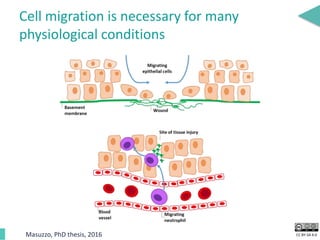
Cell migration is necessary for many
physiological conditions
Masuzzo, PhD thesis, 2016
CC BY-SA 4.0
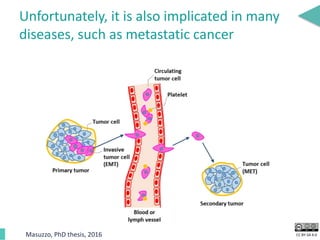
Unfortunately, it is also implicated in many
diseases, such as metastatic cancer
Masuzzo, PhD thesis, 2016
CC BY-SA 4.0
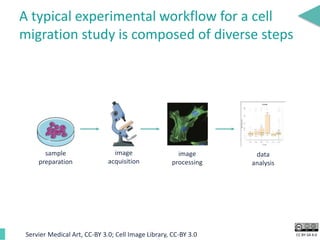
A typical experimental workflow for a cell
migration study is composed of diverse steps
Servier Medical Art, CC-BY 3.0; Cell Image Library, CC-BY 3.0
sample
preparation
image
acquisition
image
processing
data
analysis
CC BY-SA 4.0
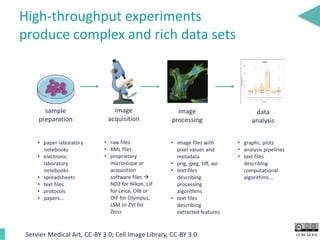
High-throughput experiments
produce complex and rich data sets
sample
preparation
image
acquisition
image
processing
data
analysis
• paper laboratory
notebooks
• electronic
laboratory
notebooks
• spreadsheets
• text files
• protocols
• papers...
• raw files
• XML files
• proprietary
microscope or
acquisition
software files 
ND2 for Nikon, LIF
for Leica, OIB or
OIF for Olympus,
LSM or ZVI for
Zeiss
• image files with
pixel values and
metadata
• png, jpeg, tiff, avi
• text files
describing
processing
algorithms
• text files
describing
extracted features
• graphs, plots
• analysis pipelines
• text files
describing
computational
algorithms...
Servier Medical Art, CC-BY 3.0; Cell Image Library, CC-BY 3.0
CC BY-SA 4.0
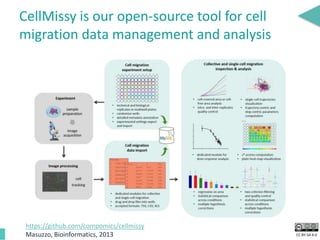
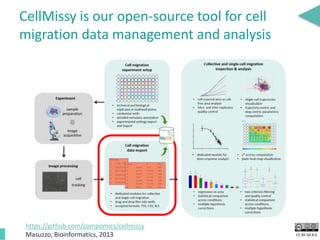
CellMissy is our open-source tool for cell
migration data management and analysis
https://github.com/compomics/cellmissy
Masuzzo, Bioinformatics, 2013
CC BY-SA 4.0
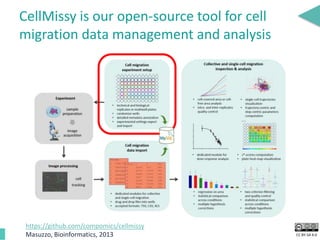
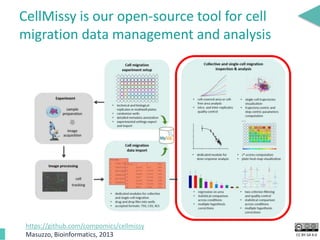
CellMissy is our open-source tool for cell
migration data management and analysis
https://github.com/compomics/cellmissy
Masuzzo, Bioinformatics, 2013
CC BY-SA 4.0
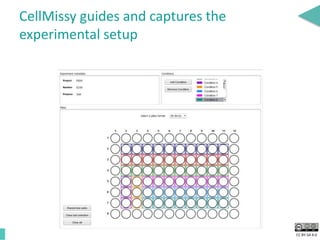
CellMissy guides and captures the
experimental setup
CC BY-SA 4.0
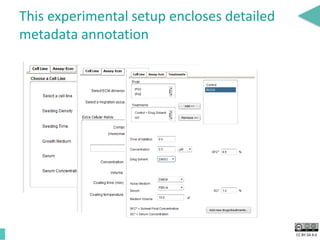
This experimental setup encloses detailed
metadata annotation
CC BY-SA 4.0
CellMissy is our open-source tool for cell
migration data management and analysis
https://github.com/compomics/cellmissy
Masuzzo, Bioinformatics, 2013
CC BY-SA 4.0
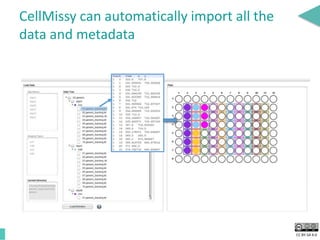
CellMissy can automatically import all the
data and metadata
CC BY-SA 4.0
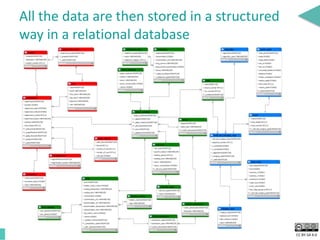
All the data are then stored in a structured
way in a relational database
CC BY-SA 4.0
CellMissy is our open-source tool for cell
migration data management and analysis
https://github.com/compomics/cellmissy
Masuzzo, Bioinformatics, 2013
CC BY-SA 4.0
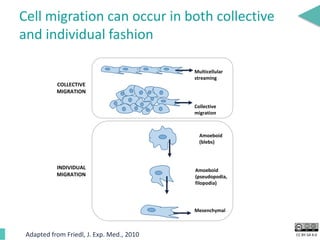
Cell migration can occur in both collective
and individual fashion
Collective
migration
Multicellular
streaming
Mesenchymal
Amoeboid
(blebs)
Amoeboid
(pseudopodia,
filopodia)
INDIVIDUAL
MIGRATION
COLLECTIVE
MIGRATION
Adapted from Friedl, J. Exp. Med., 2010
CC BY-SA 4.0
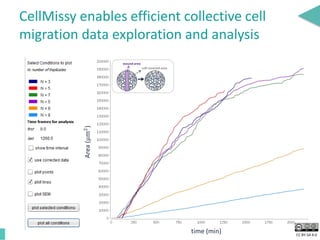
CellMissy enables efficient collective cell
migration data exploration and analysis
time (min)
Area(μm2
)
wound area
cell-covered area
CC BY-SA 4.0
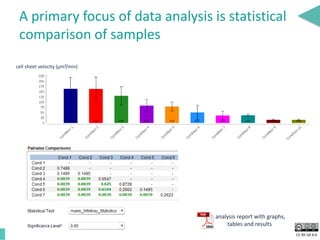
A primary focus of data analysis is statistical
comparison of samples
analysis report with graphs,
tables and results
cell sheet velocity (µm²/min)
CC BY-SA 4.0
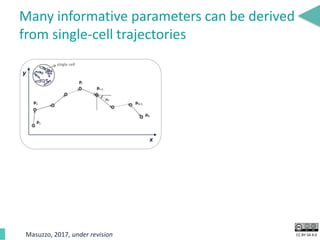
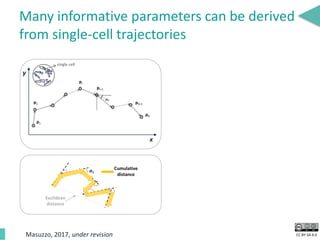
Many informative parameters can be derived
from single-cell trajectories
x
y
single cell
Masuzzo, 2017, under revision
CC BY-SA 4.0
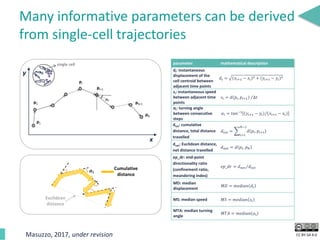
Many informative parameters can be derived
from single-cell trajectories
Euclidean
distance
Cumulative
distance
x
y
single cell
Masuzzo, 2017, under revision
CC BY-SA 4.0
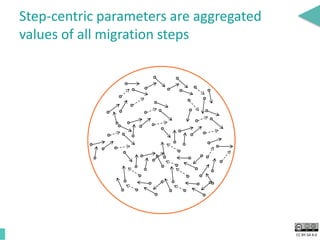
Many informative parameters can be derived
from single-cell trajectories
Euclidean
distance
Cumulative
distance
x
y
single cell parameter mathematical description
di: instantaneous
displacement of the
cell centroid between
adjacent time points
𝑑𝑖 = 𝑥𝑖+1 − 𝑥𝑖
2 + 𝑦𝑖+1 − 𝑦𝑖
2
si: instantaneous speed
between adjacent time
points
𝑠𝑖 = 𝑑(𝑝𝑖, 𝑝𝑖+1) ∆𝑡
αi: turning angle
between consecutive
steps
𝛼𝑖 = 𝑡𝑎𝑛−1 𝑦𝑖+1 − 𝑦𝑖 𝑥𝑖+1 − 𝑥𝑖
dtot: cumulative
distance, total distance
travelled
𝑑 𝑡𝑜𝑡 =
𝑖=1
𝑁−1
𝑑 𝑝𝑖, 𝑝𝑖+1
dnet: Euclidean distance,
net distance travelled
𝑑 𝑛𝑒𝑡 = 𝑑 𝑝1, 𝑝 𝑁
ep_dr: end-point
directionality ratio
(confinement ratio,
meandering index)
𝑒𝑝_𝑑𝑟 = 𝑑 𝑛𝑒𝑡 𝑑 𝑡𝑜𝑡
MD: median
displacement
𝑀𝐷 = 𝑚𝑒𝑑𝑖𝑎𝑛 𝑑𝑖
MS: median speed 𝑀𝑆 = 𝑚𝑒𝑑𝑖𝑎𝑛 𝑠𝑖
MTA: median turning
angle
𝑀𝑇𝐴 = 𝑚𝑒𝑑𝑖𝑎𝑛 𝛼𝑖
Masuzzo, 2017, under revision
CC BY-SA 4.0
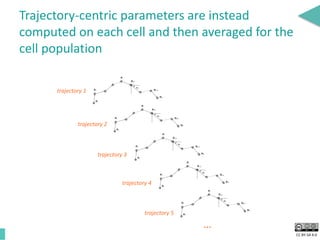
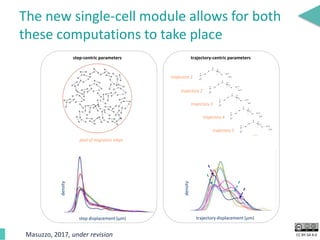
Step-centric parameters are aggregated
values of all migration steps
CC BY-SA 4.0
Trajectory-centric parameters are instead
computed on each cell and then averaged for the
cell population
...
trajectory 1
trajectory 2
trajectory 3
trajectory 4
trajectory 5
CC BY-SA 4.0
The new single-cell module allows for both
these computations to take place
...
trajectory 1
trajectory 2
trajectory 3
trajectory 4
trajectory 5
trajectory-centric parameters
trajectory displacement (µm)
density
step displacement (µm)
density
pool of migration steps
step-centric parameters
Masuzzo, 2017, under revision
CC BY-SA 4.0
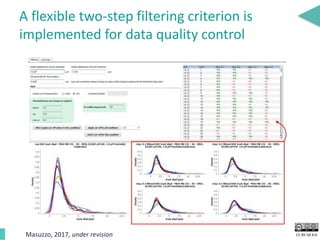
A flexible two-step filtering criterion is
implemented for data quality control
Masuzzo, 2017, under revision
CC BY-SA 4.0
MULTIMOT: towards global exchange
of cell migration data
CellMissy: a ‘little but fierce’ software
for cell migration data
Open science: why you should speak it
and how to learn it
CC BY-SA 4.0
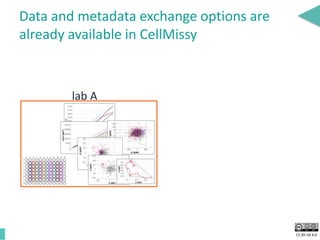
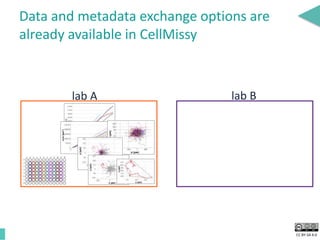
Data and metadata exchange options are
already available in CellMissy
lab A
CC BY-SA 4.0
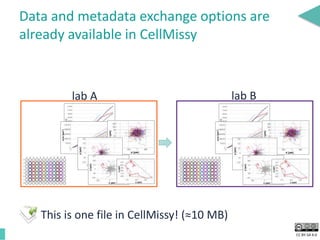
Data and metadata exchange options are
already available in CellMissy
lab A lab B
CC BY-SA 4.0
Data and metadata exchange options are
already available in CellMissy
lab B
This is one file in CellMissy! (≈10 MB)
lab A
CC BY-SA 4.0
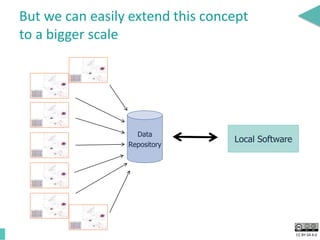
But we can easily extend this concept
to a bigger scale
Data
Repository
Local Software
CC BY-SA 4.0
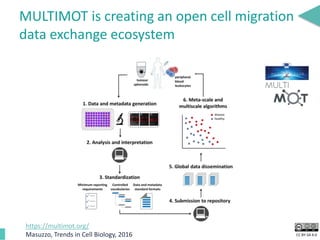
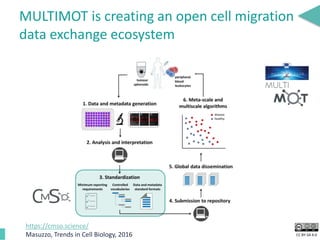
MULTIMOT is creating an open cell migration
data exchange ecosystem
https://multimot.org/
Masuzzo, Trends in Cell Biology, 2016
CC BY-SA 4.0
MULTIMOT is creating an open cell migration
data exchange ecosystem
https://cmso.science/
Masuzzo, Trends in Cell Biology, 2016
CC BY-SA 4.0
MULTIMOT: towards global exchange
of cell migration data
CellMissy: a ‘little but fierce’ software
for cell migration data
Open science: why you should speak it
and how to learn it
CC BY-SA 4.0
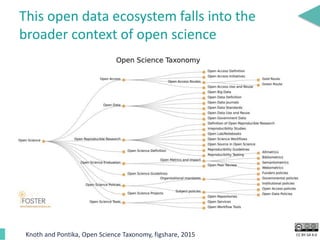
This open data ecosystem falls into the
broader context of open science
Knoth and Pontika, Open Science Taxonomy, figshare, 2015
CC BY-SA 4.0
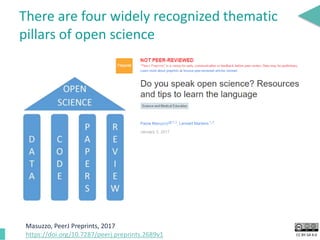
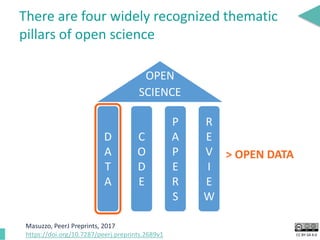
There are four widely recognized thematic
pillars of open science
Masuzzo, PeerJ Preprints, 2017
https://doi.org/10.7287/peerj.preprints.2689v1
CC BY-SA 4.0
There are four widely recognized thematic
pillars of open science
Masuzzo, PeerJ Preprints, 2017
https://doi.org/10.7287/peerj.preprints.2689v1
OPEN
SCIENCE
D
A
T
A
C
O
D
E
P
A
P
E
R
S
R
E
V
I
E
W
> OPEN DATA
CC BY-SA 4.0
Open data means freedom to access, use
and re-use for any purpose
http://opendefinition.org/od/
CC BY-SA 4.0
Open data means freedom to access, use
and re-use for any purpose
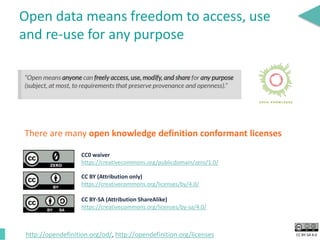
There are many open knowledge definition conformant licenses
CC0 waiver
https://creativecommons.org/publicdomain/zero/1.0/
CC BY (Attribution only)
https://creativecommons.org/licenses/by/4.0/
CC BY-SA (Attribution ShareAlike)
https://creativecommons.org/licenses/by-sa/4.0/
http://opendefinition.org/od/, http://opendefinition.org/licenses
CC BY-SA 4.0
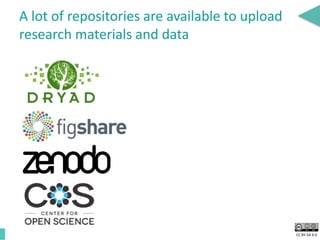
A lot of repositories are available to upload
research materials and data
CC BY-SA 4.0
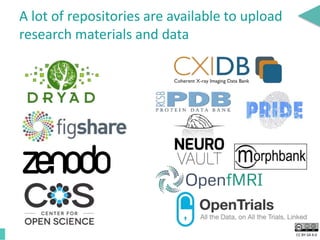
A lot of repositories are available to upload
research materials and data
CC BY-SA 4.0
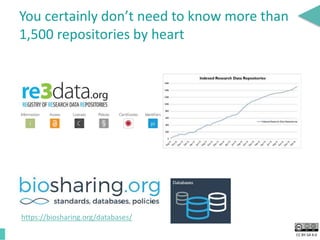
You certainly don’t need to know more than
1,500 repositories by heart
https://biosharing.org/databases/
CC BY-SA 4.0
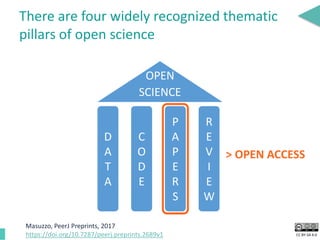
There are four widely recognized thematic
pillars of open science
Masuzzo, PeerJ Preprints, 2017
https://doi.org/10.7287/peerj.preprints.2689v1
OPEN
SCIENCE
D
A
T
A
C
O
D
E
P
A
P
E
R
S
R
E
V
I
E
W
> OPEN ACCESS
CC BY-SA 4.0
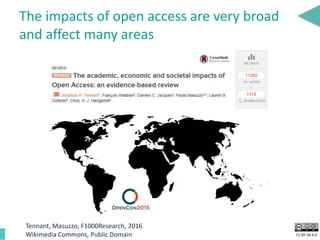
The impacts of open access are very broad
and affect many areas
Tennant, Masuzzo, F1000Research, 2016
Wikimedia Commons, Public Domain
CC BY-SA 4.0
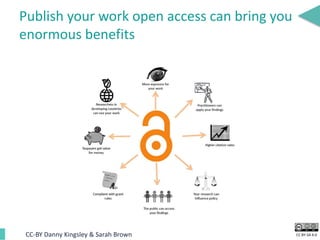
Publish your work open access can bring you
enormous benefits
CC-BY Danny Kingsley & Sarah Brown
CC BY-SA 4.0
Do you want to engage with Open Science?
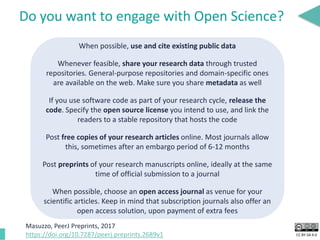
When possible, use and cite existing public data
Whenever feasible, share your research data through trusted
repositories. General-purpose repositories and domain-specific ones
are available on the web. Make sure you share metadata as well
If you use software code as part of your research cycle, release the
code. Specify the open source license you intend to use, and link the
readers to a stable repository that hosts the code
Post free copies of your research articles online. Most journals allow
this, sometimes after an embargo period of 6-12 months
Post preprints of your research manuscripts online, ideally at the same
time of official submission to a journal
When possible, choose an open access journal as venue for your
scientific articles. Keep in mind that subscription journals also offer an
open access solution, upon payment of extra fees
Masuzzo, PeerJ Preprints, 2017
https://doi.org/10.7287/peerj.preprints.2689v1
CC BY-SA 4.0
www.compomics.com
@compomics

Cell migration open data and open science

  • 1.
    AN OPEN DATAEXCHANGE FOR CELL MIGRATION RESEARCH paola masuzzo @pcmasuzzo paola.masuzzo@vib-ugent.be computational omics and systems biology group VIB / Ghent University, Ghent, Belgium
  • 2.
    CC BY-SA 4.0 MULTIMOT:towards global exchange of cell migration data CellMissy: a ‘little but fierce’ software for cell migration data Open science: why you should speak it and how to learn it
  • 3.
    CC BY-SA 4.0 MULTIMOT:towards global exchange of cell migration data CellMissy: a ‘little but fierce’ software for cell migration data Open science: why you should speak it and how to learn it
  • 4.
    CC BY-SA 4.0 Cellmigration is necessary for many physiological conditions Masuzzo, PhD thesis, 2016
  • 5.
    CC BY-SA 4.0 Unfortunately,it is also implicated in many diseases, such as metastatic cancer Masuzzo, PhD thesis, 2016
  • 6.
    CC BY-SA 4.0 Atypical experimental workflow for a cell migration study is composed of diverse steps Servier Medical Art, CC-BY 3.0; Cell Image Library, CC-BY 3.0 sample preparation image acquisition image processing data analysis
  • 7.
    CC BY-SA 4.0 High-throughputexperiments produce complex and rich data sets sample preparation image acquisition image processing data analysis • paper laboratory notebooks • electronic laboratory notebooks • spreadsheets • text files • protocols • papers... • raw files • XML files • proprietary microscope or acquisition software files  ND2 for Nikon, LIF for Leica, OIB or OIF for Olympus, LSM or ZVI for Zeiss • image files with pixel values and metadata • png, jpeg, tiff, avi • text files describing processing algorithms • text files describing extracted features • graphs, plots • analysis pipelines • text files describing computational algorithms... Servier Medical Art, CC-BY 3.0; Cell Image Library, CC-BY 3.0
  • 8.
    CC BY-SA 4.0 CellMissyis our open-source tool for cell migration data management and analysis https://github.com/compomics/cellmissy Masuzzo, Bioinformatics, 2013
  • 9.
    CC BY-SA 4.0 CellMissyis our open-source tool for cell migration data management and analysis https://github.com/compomics/cellmissy Masuzzo, Bioinformatics, 2013
  • 10.
    CC BY-SA 4.0 CellMissyguides and captures the experimental setup
  • 11.
    CC BY-SA 4.0 Thisexperimental setup encloses detailed metadata annotation
  • 12.
    CC BY-SA 4.0 CellMissyis our open-source tool for cell migration data management and analysis https://github.com/compomics/cellmissy Masuzzo, Bioinformatics, 2013
  • 13.
    CC BY-SA 4.0 CellMissycan automatically import all the data and metadata
  • 14.
    CC BY-SA 4.0 Allthe data are then stored in a structured way in a relational database
  • 15.
    CC BY-SA 4.0 CellMissyis our open-source tool for cell migration data management and analysis https://github.com/compomics/cellmissy Masuzzo, Bioinformatics, 2013
  • 16.
    CC BY-SA 4.0 Cellmigration can occur in both collective and individual fashion Collective migration Multicellular streaming Mesenchymal Amoeboid (blebs) Amoeboid (pseudopodia, filopodia) INDIVIDUAL MIGRATION COLLECTIVE MIGRATION Adapted from Friedl, J. Exp. Med., 2010
  • 17.
    CC BY-SA 4.0 CellMissyenables efficient collective cell migration data exploration and analysis time (min) Area(μm2 ) wound area cell-covered area
  • 18.
    CC BY-SA 4.0 Aprimary focus of data analysis is statistical comparison of samples analysis report with graphs, tables and results cell sheet velocity (µm²/min)
  • 19.
    CC BY-SA 4.0 Manyinformative parameters can be derived from single-cell trajectories x y single cell Masuzzo, 2017, under revision
  • 20.
    CC BY-SA 4.0 Manyinformative parameters can be derived from single-cell trajectories Euclidean distance Cumulative distance x y single cell Masuzzo, 2017, under revision
  • 21.
    CC BY-SA 4.0 Manyinformative parameters can be derived from single-cell trajectories Euclidean distance Cumulative distance x y single cell parameter mathematical description di: instantaneous displacement of the cell centroid between adjacent time points 𝑑𝑖 = 𝑥𝑖+1 − 𝑥𝑖 2 + 𝑦𝑖+1 − 𝑦𝑖 2 si: instantaneous speed between adjacent time points 𝑠𝑖 = 𝑑(𝑝𝑖, 𝑝𝑖+1) ∆𝑡 αi: turning angle between consecutive steps 𝛼𝑖 = 𝑡𝑎𝑛−1 𝑦𝑖+1 − 𝑦𝑖 𝑥𝑖+1 − 𝑥𝑖 dtot: cumulative distance, total distance travelled 𝑑 𝑡𝑜𝑡 = 𝑖=1 𝑁−1 𝑑 𝑝𝑖, 𝑝𝑖+1 dnet: Euclidean distance, net distance travelled 𝑑 𝑛𝑒𝑡 = 𝑑 𝑝1, 𝑝 𝑁 ep_dr: end-point directionality ratio (confinement ratio, meandering index) 𝑒𝑝_𝑑𝑟 = 𝑑 𝑛𝑒𝑡 𝑑 𝑡𝑜𝑡 MD: median displacement 𝑀𝐷 = 𝑚𝑒𝑑𝑖𝑎𝑛 𝑑𝑖 MS: median speed 𝑀𝑆 = 𝑚𝑒𝑑𝑖𝑎𝑛 𝑠𝑖 MTA: median turning angle 𝑀𝑇𝐴 = 𝑚𝑒𝑑𝑖𝑎𝑛 𝛼𝑖 Masuzzo, 2017, under revision
  • 22.
    CC BY-SA 4.0 Step-centricparameters are aggregated values of all migration steps
  • 23.
    CC BY-SA 4.0 Trajectory-centricparameters are instead computed on each cell and then averaged for the cell population ... trajectory 1 trajectory 2 trajectory 3 trajectory 4 trajectory 5
  • 24.
    CC BY-SA 4.0 Thenew single-cell module allows for both these computations to take place ... trajectory 1 trajectory 2 trajectory 3 trajectory 4 trajectory 5 trajectory-centric parameters trajectory displacement (µm) density step displacement (µm) density pool of migration steps step-centric parameters Masuzzo, 2017, under revision
  • 25.
    CC BY-SA 4.0 Aflexible two-step filtering criterion is implemented for data quality control Masuzzo, 2017, under revision
  • 26.
    CC BY-SA 4.0 MULTIMOT:towards global exchange of cell migration data CellMissy: a ‘little but fierce’ software for cell migration data Open science: why you should speak it and how to learn it
  • 27.
    CC BY-SA 4.0 Dataand metadata exchange options are already available in CellMissy lab A
  • 28.
    CC BY-SA 4.0 Dataand metadata exchange options are already available in CellMissy lab A lab B
  • 29.
    CC BY-SA 4.0 Dataand metadata exchange options are already available in CellMissy lab B This is one file in CellMissy! (≈10 MB) lab A
  • 30.
    CC BY-SA 4.0 Butwe can easily extend this concept to a bigger scale Data Repository Local Software
  • 31.
    CC BY-SA 4.0 MULTIMOTis creating an open cell migration data exchange ecosystem https://multimot.org/ Masuzzo, Trends in Cell Biology, 2016
  • 32.
    CC BY-SA 4.0 MULTIMOTis creating an open cell migration data exchange ecosystem https://cmso.science/ Masuzzo, Trends in Cell Biology, 2016
  • 33.
    CC BY-SA 4.0 MULTIMOT:towards global exchange of cell migration data CellMissy: a ‘little but fierce’ software for cell migration data Open science: why you should speak it and how to learn it
  • 34.
    CC BY-SA 4.0 Thisopen data ecosystem falls into the broader context of open science Knoth and Pontika, Open Science Taxonomy, figshare, 2015
  • 35.
    CC BY-SA 4.0 Thereare four widely recognized thematic pillars of open science Masuzzo, PeerJ Preprints, 2017 https://doi.org/10.7287/peerj.preprints.2689v1
  • 36.
    CC BY-SA 4.0 Thereare four widely recognized thematic pillars of open science Masuzzo, PeerJ Preprints, 2017 https://doi.org/10.7287/peerj.preprints.2689v1 OPEN SCIENCE D A T A C O D E P A P E R S R E V I E W > OPEN DATA
  • 37.
    CC BY-SA 4.0 Opendata means freedom to access, use and re-use for any purpose http://opendefinition.org/od/
  • 38.
    CC BY-SA 4.0 Opendata means freedom to access, use and re-use for any purpose There are many open knowledge definition conformant licenses CC0 waiver https://creativecommons.org/publicdomain/zero/1.0/ CC BY (Attribution only) https://creativecommons.org/licenses/by/4.0/ CC BY-SA (Attribution ShareAlike) https://creativecommons.org/licenses/by-sa/4.0/ http://opendefinition.org/od/, http://opendefinition.org/licenses
  • 39.
    CC BY-SA 4.0 Alot of repositories are available to upload research materials and data
  • 40.
    CC BY-SA 4.0 Alot of repositories are available to upload research materials and data
  • 41.
    CC BY-SA 4.0 Youcertainly don’t need to know more than 1,500 repositories by heart https://biosharing.org/databases/
  • 42.
    CC BY-SA 4.0 Thereare four widely recognized thematic pillars of open science Masuzzo, PeerJ Preprints, 2017 https://doi.org/10.7287/peerj.preprints.2689v1 OPEN SCIENCE D A T A C O D E P A P E R S R E V I E W > OPEN ACCESS
  • 43.
    CC BY-SA 4.0 Theimpacts of open access are very broad and affect many areas Tennant, Masuzzo, F1000Research, 2016 Wikimedia Commons, Public Domain
  • 44.
    CC BY-SA 4.0 Publishyour work open access can bring you enormous benefits CC-BY Danny Kingsley & Sarah Brown
  • 45.
    CC BY-SA 4.0 Doyou want to engage with Open Science? When possible, use and cite existing public data Whenever feasible, share your research data through trusted repositories. General-purpose repositories and domain-specific ones are available on the web. Make sure you share metadata as well If you use software code as part of your research cycle, release the code. Specify the open source license you intend to use, and link the readers to a stable repository that hosts the code Post free copies of your research articles online. Most journals allow this, sometimes after an embargo period of 6-12 months Post preprints of your research manuscripts online, ideally at the same time of official submission to a journal When possible, choose an open access journal as venue for your scientific articles. Keep in mind that subscription journals also offer an open access solution, upon payment of extra fees Masuzzo, PeerJ Preprints, 2017 https://doi.org/10.7287/peerj.preprints.2689v1
  • 46.

Editor's Notes

  • #17 collective: building and remodeling tissues, cancer invasion, wound healing single: immune processes, but also cancer invasion
  • #18 2D conditions are together, 3D conditions much slower
  • #19 statistical comparison of the median cell sheet velocity across biological conditions: from control + drug solvent to different concentrations of latrunculin (important for dose response analysis) latrunculin -- from 65.2 µM to 750.0 µM latrunculin -- disruption of the actin filaments of the cytoskeleton Inhibition of actin polymerization by latrunculin A disrupts actin filament formation, cytoskeletal organization, cell migration, and chemotaxis15,38.
  • #20 Representation in 2D Euclidean space of single-cell trajectory -- define the parameters in the table. In particular, the turning angle between two points, the ED, and the CD.
  • #21 Representation in 2D Euclidean space of single-cell trajectory -- define the parameters in the table. In particular, the turning angle between two points, the ED, and the CD.
  • #22 Representation in 2D Euclidean space of single-cell trajectory -- define the parameters in the table. In particular, the turning angle between two points, the ED, and the CD.
  • #39 people who use the data must credit whoever has published or generate the data (attribution) copies or adaptations of the data must be released similarly as open data (share-alike)