CEH Cheat Sheet: Essential Terms and Concepts for the
Certified Ethical Hacker Exam
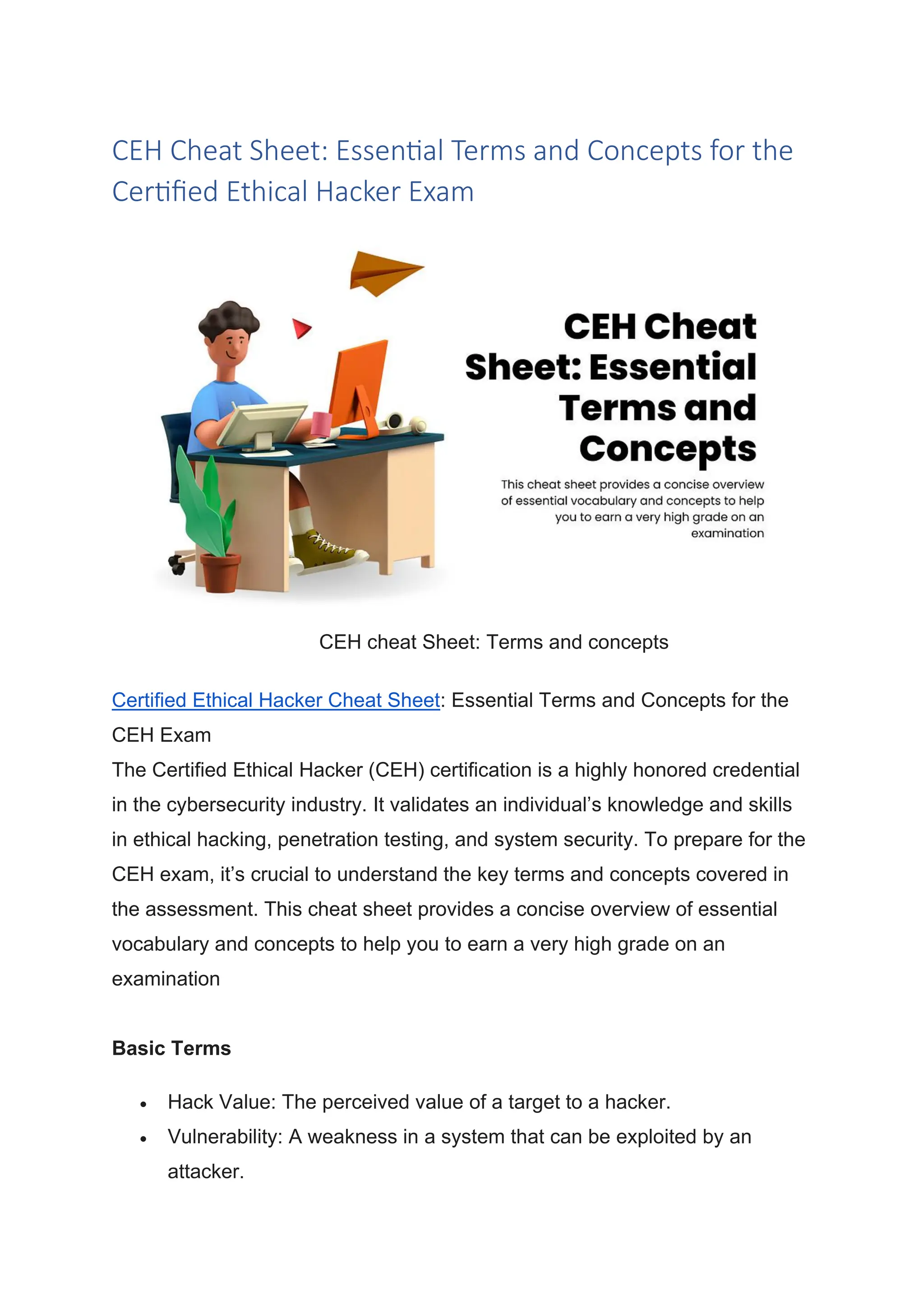
CEH cheat Sheet: Terms and concepts
Certified Ethical Hacker Cheat Sheet: Essential Terms and Concepts for the
CEH Exam
The Certified Ethical Hacker (CEH) certification is a highly honored credential
in the cybersecurity industry. It validates an individual’s knowledge and skills
in ethical hacking, penetration testing, and system security. To prepare for the
CEH exam, it’s crucial to understand the key terms and concepts covered in
the assessment. This cheat sheet provides a concise overview of essential
vocabulary and concepts to help you to earn a very high grade on an
examination
Basic Terms
• Hack Value: The perceived value of a target to a hacker.
• Vulnerability: A weakness in a system that can be exploited by an
attacker.
• Exploit: A method used to take advantage of a vulnerability.
• Payload: The malicious code that is delivered to the victim’s system
through an exploit.
• Zero-day Attack: An attack that exploits a newly discovered vulnerability
for which there is no patch available.
• Daisy-chaining: A technique where an attacker gains access to one
system and uses it to access other systems on the same network.
• Doxing: The act of publicly revealing private or identifying information
about an individual or organization.
• Bot: A software program designed to perform automated tasks.
Elements of Information Security
• Confidentiality: Ensuring that information is only accessible to
authorized individuals.
• Integrity: Maintaining the accuracy and consistency of information.
• Availability: Ensuring that authorized users have access to information
and resources when needed.
• Authenticity: Verifying the identity of individuals and ensuring the origin
of information.
• Non-repudiation: Providing proof of a communication or transaction,
ensuring that the sender or receiver cannot deny it.
Phases of Penetration Testing
1. Reconnaissance: Gathering information about the target system or
network.
2. Scanning and Enumeration: Identifying active systems, open ports, and
vulnerabilities.
3. Gaining Access: Exploiting vulnerabilities to establish unauthorized
access to the target system.
4. Maintaining Access: Establishing persistent access to the target system
for future operations.
5. Covering Tracks: Hiding evidence of the intrusion to avoid detection
Types of Threats
• Network Threats: Attacks targeting communication channels to steal
information or disrupt network operations.
• Host Threats: Attacks directed at individual systems to gain access to
data or compromise system integrity.
• Application Threats: Exploits of vulnerabilities in software applications to
gain unauthorized access or execute malicious code.
Types of Attacks
• OS-Level Attacks: Targeting the operating system of the victim’s
system.
• Application-Level Attacks: Exploiting vulnerabilities in specific software
applications.
• Shrink Wrap Attacks: Targeting unpatched libraries or frameworks used
in applications.
• Misconfiguration Attacks: Exploiting weaknesses in system
configuration or security settings.
here are some additional tips to help you ace the CEH exam:
1. Understand the exam format and objectives
The CEH exam is a multiple-choice exam with 70 questions. You will have
four hours to complete the exam. The exam covers a wide range of topics,
including ethical hacking principles, vulnerability assessment and penetration
testing, malware analysis, and attack prevention.
2. Study the official CEH exam guide
The official CEH exam guide is the most comprehensive resource available for
preparing for the exam. It covers all of the topics that are covered on the exam
in detail.
3. Take practice exams
There are a number of practice exams available online and in bookstores.
Taking practice exams will help you familiarize yourself with the exam format
and question types.
4. Join a CEH study group
Joining a CEH study group can be a great way to stay motivated and to learn
from other people who are preparing for the exam.
5. Get hands-on experience
The best way to learn ethical hacking is to get hands-on experience. There
are a number of resources available online and in bookstores that can help
you get started.
6. Attend a CEH training course
There are a number of CEH training courses available online and in person.
These courses can be a great way to learn the material in a more structured
setting.
7. Stay up-to-date on the latest security threats
The cybersecurity landscape is constantly changing, so it is important to stay
up-to-date on the latest threats. There are a number of resources available
online and in the news that can help you stay informed.
8. Get enough sleep and eat healthy foods
It is important to be well-rested and to eat healthy foods on the day of the
exam. This will help you to focus and to perform your best.
9. Don’t give up
If you don’t know the answer to a question, don’t dwell on it. Move on and
come back to it later if you have time.
• Make sure you have a good understanding of networking basics.
• Be familiar with different types of malwares and how they work.
• Know how to use a variety of tools for penetration testing.
• Be able to think like a hacker and identify potential vulnerabilities.
• Be able to stay calm under pressure.
I hope these tips help you get a good score on the CEH exam!
CEH Cheat Sheet.pdf

CEH Cheat Sheet.pdf

  • 1.
    CEH Cheat Sheet:Essential Terms and Concepts for the Certified Ethical Hacker Exam CEH cheat Sheet: Terms and concepts Certified Ethical Hacker Cheat Sheet: Essential Terms and Concepts for the CEH Exam The Certified Ethical Hacker (CEH) certification is a highly honored credential in the cybersecurity industry. It validates an individual’s knowledge and skills in ethical hacking, penetration testing, and system security. To prepare for the CEH exam, it’s crucial to understand the key terms and concepts covered in the assessment. This cheat sheet provides a concise overview of essential vocabulary and concepts to help you to earn a very high grade on an examination Basic Terms • Hack Value: The perceived value of a target to a hacker. • Vulnerability: A weakness in a system that can be exploited by an attacker.
  • 2.
    • Exploit: Amethod used to take advantage of a vulnerability. • Payload: The malicious code that is delivered to the victim’s system through an exploit. • Zero-day Attack: An attack that exploits a newly discovered vulnerability for which there is no patch available. • Daisy-chaining: A technique where an attacker gains access to one system and uses it to access other systems on the same network. • Doxing: The act of publicly revealing private or identifying information about an individual or organization. • Bot: A software program designed to perform automated tasks. Elements of Information Security • Confidentiality: Ensuring that information is only accessible to authorized individuals. • Integrity: Maintaining the accuracy and consistency of information. • Availability: Ensuring that authorized users have access to information and resources when needed. • Authenticity: Verifying the identity of individuals and ensuring the origin of information. • Non-repudiation: Providing proof of a communication or transaction, ensuring that the sender or receiver cannot deny it. Phases of Penetration Testing 1. Reconnaissance: Gathering information about the target system or network. 2. Scanning and Enumeration: Identifying active systems, open ports, and vulnerabilities. 3. Gaining Access: Exploiting vulnerabilities to establish unauthorized access to the target system. 4. Maintaining Access: Establishing persistent access to the target system for future operations.
  • 3.
    5. Covering Tracks:Hiding evidence of the intrusion to avoid detection Types of Threats • Network Threats: Attacks targeting communication channels to steal information or disrupt network operations. • Host Threats: Attacks directed at individual systems to gain access to data or compromise system integrity. • Application Threats: Exploits of vulnerabilities in software applications to gain unauthorized access or execute malicious code. Types of Attacks • OS-Level Attacks: Targeting the operating system of the victim’s system. • Application-Level Attacks: Exploiting vulnerabilities in specific software applications. • Shrink Wrap Attacks: Targeting unpatched libraries or frameworks used in applications. • Misconfiguration Attacks: Exploiting weaknesses in system configuration or security settings. here are some additional tips to help you ace the CEH exam: 1. Understand the exam format and objectives The CEH exam is a multiple-choice exam with 70 questions. You will have four hours to complete the exam. The exam covers a wide range of topics, including ethical hacking principles, vulnerability assessment and penetration testing, malware analysis, and attack prevention. 2. Study the official CEH exam guide The official CEH exam guide is the most comprehensive resource available for preparing for the exam. It covers all of the topics that are covered on the exam in detail. 3. Take practice exams
  • 4.
    There are anumber of practice exams available online and in bookstores. Taking practice exams will help you familiarize yourself with the exam format and question types. 4. Join a CEH study group Joining a CEH study group can be a great way to stay motivated and to learn from other people who are preparing for the exam. 5. Get hands-on experience The best way to learn ethical hacking is to get hands-on experience. There are a number of resources available online and in bookstores that can help you get started. 6. Attend a CEH training course There are a number of CEH training courses available online and in person. These courses can be a great way to learn the material in a more structured setting. 7. Stay up-to-date on the latest security threats The cybersecurity landscape is constantly changing, so it is important to stay up-to-date on the latest threats. There are a number of resources available online and in the news that can help you stay informed. 8. Get enough sleep and eat healthy foods It is important to be well-rested and to eat healthy foods on the day of the exam. This will help you to focus and to perform your best. 9. Don’t give up If you don’t know the answer to a question, don’t dwell on it. Move on and come back to it later if you have time. • Make sure you have a good understanding of networking basics. • Be familiar with different types of malwares and how they work. • Know how to use a variety of tools for penetration testing. • Be able to think like a hacker and identify potential vulnerabilities. • Be able to stay calm under pressure. I hope these tips help you get a good score on the CEH exam!