AN INTRODUCTION TO
ALICE PROGRAMMING AS A
STEAM ENGAGEMENT
TOOL: TUTORIAL
KARINA ASSITER
CCSC RM 2015 OCTOBER 1-2.
Outline
 Motivation
 Background
 What is Alice?
 Getting your feet wet:
 Download Alice
 Opening Alice
 Opening and creating Projects
 Creating objects
 References
Motivation
 Attracting under-represented groups into STEAM pipeline top priority
 Even more important as population becomes increasingly diverse
 According to US censes, by 2044, more than half of all Americans are projected to belong to minority group.
 General agreement: we must start early
 Elementary or middle school.
 Strategies (see references)
 Numerous tools/environments
 Workshops, summer and after school programs aimed at both kids and K-12 teachers
What is Alice?
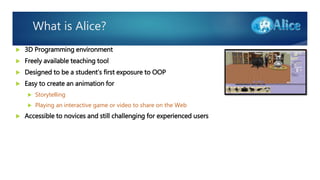
 3D Programming environment
 Freely available teaching tool
 Designed to be a student’s first exposure to OOP
 Easy to create an animation for
 Storytelling
 Playing an interactive game or video to share on the Web
 Accessible to novices and still challenging for experienced users
Background
 Annual 1 day WIT SWE girl-scout event
 CS faculty teach 1 hour workshop (4 x )
 This year, Alice
 Tremendous success, expressed in this parent’s email:
THANK YOU for the February 7th STEM event! Zoe loved the STEM
event she took at Wentworth. … So far she has spent hours on ALICE
and has eagerly shown her family all her Alice projects. I am thrilled
with the knowledge and exposure it has provided to Zoe. I am also
thankful for GS and Wentworth for hosting STEM events- please
continue! Zoe is eagerly looking forward to the next STEM event so
keep me on any distribution list for future events.
..and surveys,
of course.
Example – Quick Demo
Lets get started... THE FUN PART.
Downloading & Installing
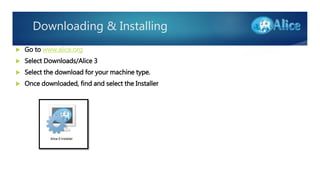
 Go to www.alice.org
 Select Downloads/Alice 3
 Select the download for your machine type.
 Once downloaded, find and select the Installer
Starting Alice
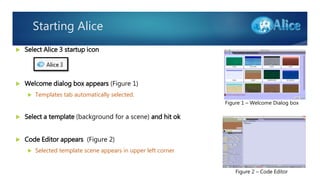
 Select Alice 3 startup icon
 Welcome dialog box appears (Figure 1)
 Templates tab automatically selected.
 Select a template (background for a scene) and hit ok
 Code Editor appears (Figure 2)
 Selected template scene appears in upper left corner
Figure 1 – Welcome Dialog box
Figure 2 – Code Editor
Add objects
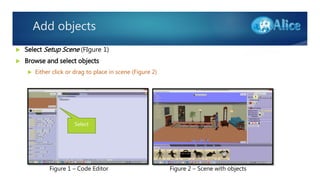
 Select Setup Scene (FIgure 1)
 Browse and select objects
 Either click or drag to place in scene (Figure 2)
Figure 2 – Scene with objectsFigure 1 – Code Editor
Select
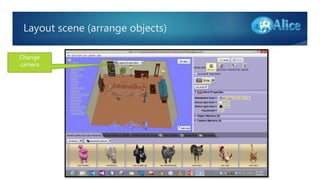
Layout scene (arrange objects)
Change
camera
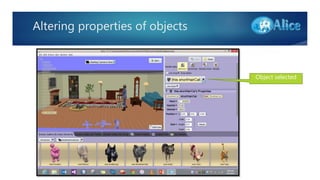
Altering properties of objects
Object selected
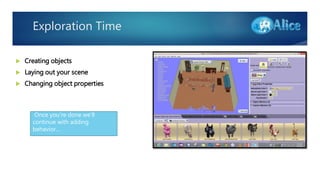
Exploration Time
 Creating objects
 Laying out your scene
 Changing object properties
Once you’re done we’ll
continue with adding
behavior…
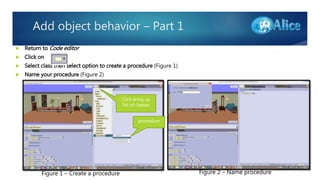
Add object behavior – Part 1
 Return to Code editor
 Click on
 Select class then select option to create a procedure (Figure 1)
 Name your procedure (Figure 2)
 .
Figure 1 – Create a procedure Figure 2 – Name procedure
Click bring up
list of classes
procedure
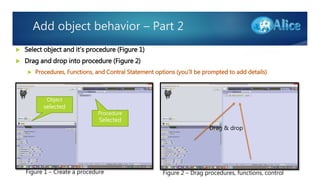
Add object behavior – Part 2
 Select object and it’s procedure (Figure 1)
 Drag and drop into procedure (Figure 2)
 Procedures, Functions, and Contral Statement options (you’ll be prompted to add details)
Figure 1 – Create a procedure
Object
selected
Procedure
Selected
Drag & drop
Figure 2 – Drag procedures, functions, control
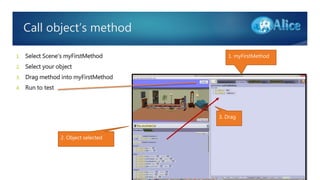
Call object’s method
1. Select Scene’s myFirstMethod
2. Select your object
3. Drag method into myFirstMethod
4. Run to test
1. myFirstMethod
2. Object selected
3. Drag
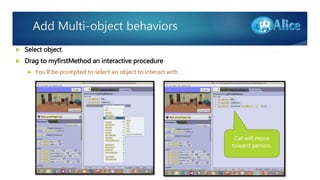
Add Multi-object behaviors
 Select object
 Drag to myfirstMethod an interactive procedure
 You’ll be prompted to select an object to interact with .
Cat will move
toward person.
Exploration Time
 Adding object behavior
Exploration Time
 Adding object behavior
 No more formal instruction
 I’ll help you individually as needed
 Maybe you’ll even learn something and show me  as the girl scouts did in their workshop…
Thanks for attending!
REFERENCES FOLLOW
References
 Adams, J.C., Alice : Middle Schooler's & the Imaginary Worlds Camps. Proceedings SIGCSE, 307-311, 2007.
 Alice, http://www.alice.org (accessed June 2015).
 Alice Tutorials, http://www.cs.duke.edu/csed/alice09/tutorials.php (accessed September 2015)
 Colby, Sandra L., and Jennifer M. Ortman. Projections of the Size and Composition of the US Population: 2014 to 2060.
Current Population Reports, Washington, DC: US Census Bureau, 2014.
 Etoys, http://www.squeakland.org/.
 GameFront, http://gamefroot.com/.
 Girl Scouts Research Institute, Generation STEM: What girls say about Science, Technology, Engineering and Math. New
York, NY: Girl Scout Research Institute, 1-39, 2012.
 Lifelong Kindergarden Group @ MIT Media Lab. Scratch, https://scratch.mit.edu/ (accessed July 10, 2015).
 MIT Education Arcade. StartLogo TNG, http://education.mit.edu/portfolio_page/starlogo-tng/
 Peluso, E M, and E Mauch,Incorporating Alice into a Summer Math and Science Outreach Program, Alice Symposium,
Durham, NC , 2009.
 Werner, L, S Campe, and J Denner. Children Learning Computer Science Concepts via Alice Game-Programming, SIGCSE
2012. Raleigh, NC: ACM

CCSC RM Alice Tutorial

  • 1.
    AN INTRODUCTION TO ALICEPROGRAMMING AS A STEAM ENGAGEMENT TOOL: TUTORIAL KARINA ASSITER CCSC RM 2015 OCTOBER 1-2.
  • 2.
    Outline  Motivation  Background What is Alice?  Getting your feet wet:  Download Alice  Opening Alice  Opening and creating Projects  Creating objects  References
  • 3.
    Motivation  Attracting under-representedgroups into STEAM pipeline top priority  Even more important as population becomes increasingly diverse  According to US censes, by 2044, more than half of all Americans are projected to belong to minority group.  General agreement: we must start early  Elementary or middle school.  Strategies (see references)  Numerous tools/environments  Workshops, summer and after school programs aimed at both kids and K-12 teachers
  • 4.
    What is Alice? 3D Programming environment  Freely available teaching tool  Designed to be a student’s first exposure to OOP  Easy to create an animation for  Storytelling  Playing an interactive game or video to share on the Web  Accessible to novices and still challenging for experienced users
  • 5.
    Background  Annual 1day WIT SWE girl-scout event  CS faculty teach 1 hour workshop (4 x )  This year, Alice  Tremendous success, expressed in this parent’s email: THANK YOU for the February 7th STEM event! Zoe loved the STEM event she took at Wentworth. … So far she has spent hours on ALICE and has eagerly shown her family all her Alice projects. I am thrilled with the knowledge and exposure it has provided to Zoe. I am also thankful for GS and Wentworth for hosting STEM events- please continue! Zoe is eagerly looking forward to the next STEM event so keep me on any distribution list for future events. ..and surveys, of course.
  • 6.
  • 7.
    Lets get started...THE FUN PART.
  • 8.
    Downloading & Installing Go to www.alice.org  Select Downloads/Alice 3  Select the download for your machine type.  Once downloaded, find and select the Installer
  • 9.
    Starting Alice  SelectAlice 3 startup icon  Welcome dialog box appears (Figure 1)  Templates tab automatically selected.  Select a template (background for a scene) and hit ok  Code Editor appears (Figure 2)  Selected template scene appears in upper left corner Figure 1 – Welcome Dialog box Figure 2 – Code Editor
  • 10.
    Add objects  SelectSetup Scene (FIgure 1)  Browse and select objects  Either click or drag to place in scene (Figure 2) Figure 2 – Scene with objectsFigure 1 – Code Editor Select
  • 11.
    Layout scene (arrangeobjects) Change camera
  • 12.
    Altering properties ofobjects Object selected
  • 13.
    Exploration Time  Creatingobjects  Laying out your scene  Changing object properties Once you’re done we’ll continue with adding behavior…
  • 14.
    Add object behavior– Part 1  Return to Code editor  Click on  Select class then select option to create a procedure (Figure 1)  Name your procedure (Figure 2)  . Figure 1 – Create a procedure Figure 2 – Name procedure Click bring up list of classes procedure
  • 15.
    Add object behavior– Part 2  Select object and it’s procedure (Figure 1)  Drag and drop into procedure (Figure 2)  Procedures, Functions, and Contral Statement options (you’ll be prompted to add details) Figure 1 – Create a procedure Object selected Procedure Selected Drag & drop Figure 2 – Drag procedures, functions, control
  • 16.
    Call object’s method 1.Select Scene’s myFirstMethod 2. Select your object 3. Drag method into myFirstMethod 4. Run to test 1. myFirstMethod 2. Object selected 3. Drag
  • 17.
    Add Multi-object behaviors Select object  Drag to myfirstMethod an interactive procedure  You’ll be prompted to select an object to interact with . Cat will move toward person.
  • 18.
  • 19.
    Exploration Time  Addingobject behavior  No more formal instruction  I’ll help you individually as needed  Maybe you’ll even learn something and show me  as the girl scouts did in their workshop…
  • 20.
  • 21.
    References  Adams, J.C.,Alice : Middle Schooler's & the Imaginary Worlds Camps. Proceedings SIGCSE, 307-311, 2007.  Alice, http://www.alice.org (accessed June 2015).  Alice Tutorials, http://www.cs.duke.edu/csed/alice09/tutorials.php (accessed September 2015)  Colby, Sandra L., and Jennifer M. Ortman. Projections of the Size and Composition of the US Population: 2014 to 2060. Current Population Reports, Washington, DC: US Census Bureau, 2014.  Etoys, http://www.squeakland.org/.  GameFront, http://gamefroot.com/.  Girl Scouts Research Institute, Generation STEM: What girls say about Science, Technology, Engineering and Math. New York, NY: Girl Scout Research Institute, 1-39, 2012.  Lifelong Kindergarden Group @ MIT Media Lab. Scratch, https://scratch.mit.edu/ (accessed July 10, 2015).  MIT Education Arcade. StartLogo TNG, http://education.mit.edu/portfolio_page/starlogo-tng/  Peluso, E M, and E Mauch,Incorporating Alice into a Summer Math and Science Outreach Program, Alice Symposium, Durham, NC , 2009.  Werner, L, S Campe, and J Denner. Children Learning Computer Science Concepts via Alice Game-Programming, SIGCSE 2012. Raleigh, NC: ACM

Editor's Notes