Causatives
Arranged by Aswarini S.
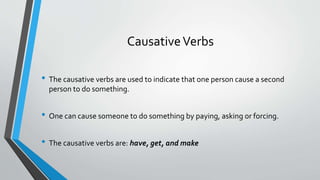
CausativeVerbs
• The causative verbs are used to indicate that one person cause a second
person to do something.
• One can cause someone to do something by paying, asking or forcing.
• The causative verbs are: have, get, and make
Have/Get
• Have and get can be followed by active and passive form
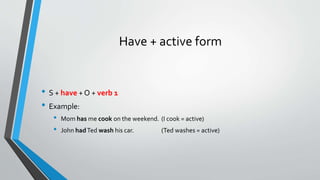
Have + active form
• S + have + O + verb 1
• Example:
• Mom has me cook on the weekend. (I cook = active)
• John hadTed wash his car. (Ted washes = active)
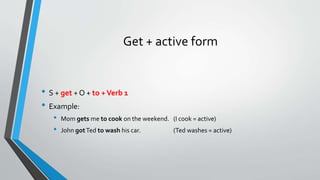
Get + active form
• S + get + O + to +Verb 1
• Example:
• Mom gets me to cook on the weekend. (I cook = active)
• John gotTed to wash his car. (Ted washes = active)
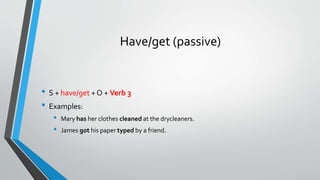
Have/get (passive)
• S + have/get + O + Verb 3
• Examples:
• Mary has her clothes cleaned at the drycleaners.
• James got his paper typed by a friend.
What’s the difference?
• James had his friend type his paper.
• James had his paper typed by his friend.
Exercise
1. The teacher had the class ………………… a research paper. (write)
2. Mrs. Crane had her house ………………… (paint)
3. We had a photographer ………………… pictures us.(take)
4. I need to get my suit ………………… (clean)
5. I got Mary ………………… me some money. (lend)
Make
• Make can only be followed by active form
• Make is stronger than have/get. It means force
Make + active form
• S + make + O + Verb 1
• Examples:
• The teacher makes the children stay in their seats.
• Johnny made his brother be quiet in the theater.
LET
• Let is actually added to the list of causative verbs. It is not actually a
causative verb. It means allow or permit.
LET
• S + have + O + verb 1
• Example:
• The teacher let the students leave class early.
• We are going to let her write the letter.
HELP
• Help is not actually a causative verb either, but is generally considered as
causative verbs in grammar textbooks. It is usually followed by the simple
form, but can be followed by the infinitive in some cases. It means assist.
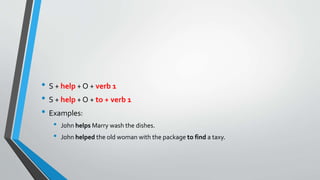
• S + help + O + verb 1
• S + help + O + to + verb 1
• Examples:
• John helps Marry wash the dishes.
• John helped the old woman with the package to find a taxy.
• Source: Cliff’sTOEFL Preparation Guide

Causatives.pptx

  • 1.
  • 2.
    CausativeVerbs • The causativeverbs are used to indicate that one person cause a second person to do something. • One can cause someone to do something by paying, asking or forcing. • The causative verbs are: have, get, and make
  • 3.
    Have/Get • Have andget can be followed by active and passive form
  • 4.
    Have + activeform • S + have + O + verb 1 • Example: • Mom has me cook on the weekend. (I cook = active) • John hadTed wash his car. (Ted washes = active)
  • 5.
    Get + activeform • S + get + O + to +Verb 1 • Example: • Mom gets me to cook on the weekend. (I cook = active) • John gotTed to wash his car. (Ted washes = active)
  • 6.
    Have/get (passive) • S+ have/get + O + Verb 3 • Examples: • Mary has her clothes cleaned at the drycleaners. • James got his paper typed by a friend.
  • 7.
    What’s the difference? •James had his friend type his paper. • James had his paper typed by his friend.
  • 8.
    Exercise 1. The teacherhad the class ………………… a research paper. (write) 2. Mrs. Crane had her house ………………… (paint) 3. We had a photographer ………………… pictures us.(take) 4. I need to get my suit ………………… (clean) 5. I got Mary ………………… me some money. (lend)
  • 9.
    Make • Make canonly be followed by active form • Make is stronger than have/get. It means force
  • 10.
    Make + activeform • S + make + O + Verb 1 • Examples: • The teacher makes the children stay in their seats. • Johnny made his brother be quiet in the theater.
  • 11.
    LET • Let isactually added to the list of causative verbs. It is not actually a causative verb. It means allow or permit.
  • 12.
    LET • S +have + O + verb 1 • Example: • The teacher let the students leave class early. • We are going to let her write the letter.
  • 13.
    HELP • Help isnot actually a causative verb either, but is generally considered as causative verbs in grammar textbooks. It is usually followed by the simple form, but can be followed by the infinitive in some cases. It means assist.
  • 14.
    • S +help + O + verb 1 • S + help + O + to + verb 1 • Examples: • John helps Marry wash the dishes. • John helped the old woman with the package to find a taxy.
  • 16.
    • Source: Cliff’sTOEFLPreparation Guide