Causal Inference:
Short Introduction
Serhii Kushchenko, Bratislava, 16.09.2019
https://www.linkedin.com/in/kushchenko/
Problem with Traditional Regression
Y = k * X + b ⇨
⇨ X = 1/k * Y - b/k
Which variable is a cause
and which is an effect here?
We can not tell without
knowing the context.
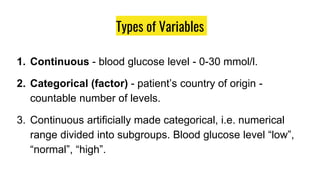
Types of Variables
1. Continuous - blood glucose level - 0-30 mmol/l.
2. Categorical (factor) - patient’s country of origin -
countable number of levels.
3. Continuous artificially made categorical, i.e. numerical
range divided into subgroups. Blood glucose level “low”,
“normal”, “high”.
Correlation ≠ Causation
Categorical variable
or continuous variable,
artificially made
categorical
In Russia, violent crime is strongly correlated
with salted cucumbers consummation. Why?
≈
Things Are Not Always as They Seem First
Color allows
you to display
information
about the third
categorical
variable
Causal Inference: Structures - 1
Causal Inference: Structures - 2
Causal Inference: Structures - 3
Causal Inference Ladder
Differences Between Traditional Statistics and CI
Recommended Books
1. The Book of Why by Judea Pearl and Dana Mackenzie
2. Causal Inference in Statistics: A Primer by Judea Pearl
and others + Solution Manual
3. Mostly Harmless Econometrics by Joshua D. Angrist
and Jörn-Steffen Pischke
4. R packages: dagitty (structural causal models)
and lavaan (structural equation modeling).

Causal Inference: Short Introduction