CARCINOMA MEDULAR DE TIROIDES
FUCSMIGUEL  ÁNGEL  LOZANO  ARIASINFORMATICA NIVEL MEDIOBOGOTA D.C.2011
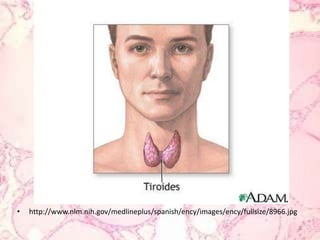
LA GLANDULA TIROIDES“the thyroid is one of the largest of the endocrine organs, weighing approximately 15 to 20 g.  The normal thyroid is made up of two lobes joined by a thin band of tissue, the isthmus, which is approximately 0.5 cm thick, 2 cm wide, and 1 to 2 cm high. The individual lobes normally have a pointed superior pole and a poorly defined, blunt inferior pole that merges medially with the isthmus. Each lobe is approximately 2.0 to 2.5 cm in thickness and width at its largest diameter, and it is approximately 4.0 cm in length.” 1
http://www.nlm.nih.gov/medlineplus/spanish/ency/images/ency/fullsize/8966.jpg
CANCER MEDULAR DE TIROIDES“Es un cáncer de la glándula tiroides que comienza en un tipo de células, denominadas células "C", que liberan una hormona llamada calcitonina.”2,7,8.
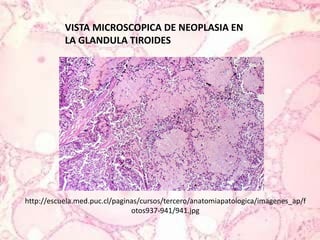
VISTA MICROSCOPICA DE NEOPLASIA EN LA GLANDULA TIROIDEShttp://escuela.med.puc.cl/paginas/cursos/tercero/anatomiapatologica/imagenes_ap/fotos937-941/941.jpg
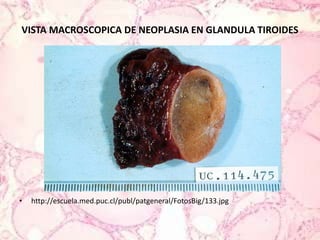
VISTA MACROSCOPICA DE NEOPLASIA EN GLANDULA TIROIDEShttp://escuela.med.puc.cl/publ/patgeneral/FotosBig/133.jpg
CAUSAS“La causa del carcinoma medular tiroideo (CMT) se desconoce.A diferencia de otros tipos de cáncer de la tiroides, es menos probable que este tipo de carcinoma sea causado por radioterapia al cuello aplicada para tratar otros cánceres durante la infancia.”6
CLASES DE CMT“Hay dos formas de carcinoma medular tiroideo:Carcinoma medular tiroideo esporádico, el cual no se transmite de padres a hijos. La mayoría de estos carcinomas son esporádicos. Esta forma afecta principalmente a los adultos mayores.Carcinoma medular tiroideo hereditario, el cual se transmite de padres a hijos.”2
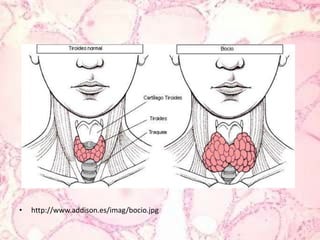
http://www.addison.es/imag/bocio.jpg
FACTORES DE RIESGO“Un antecedente familiar de este tipo de carcinomaAntecedentes familiares de neoplasia endocrina múltiple (NEM)Historia previa de feocromocitoma, neuromas de la mucosa o hiperparatiroidismo”4
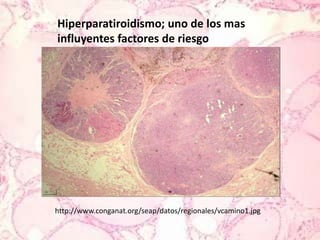
Hiperparatiroidismo; uno de los mas influyentes factores de riesgohttp://www.conganat.org/seap/datos/regionales/vcamino1.jpg
SÍNTOMAS“Problemas respiratorios debido al estrechamiento de las vías respiratoriasTosTos con sangreDiarreaBocio (agrandamiento de la tiroides)Tumor en la glándula tiroides”2
BOCIOhttp://genesis.uag.mx/salud/articulos/anteriores/images/bocio.jpg
SIGNOS Y EXÁMENES“El médico llevará a cabo un examen físico. Los ganglios linfáticos en el cuello pueden presentar hinchazón. Las pruebas de la función tiroidea generalmente son normales; sin embargo, un examen de la tiroides puede revelar nódulos (tumoraciones) solitarios o múltiples.
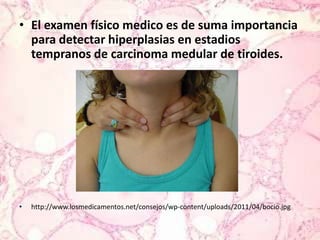
El examen físico medico es de suma importancia para detectar hiperplasias en estadios tempranos de carcinoma medular de tiroides.http://www.losmedicamentos.net/consejos/wp-content/uploads/2011/04/bocio.jpg
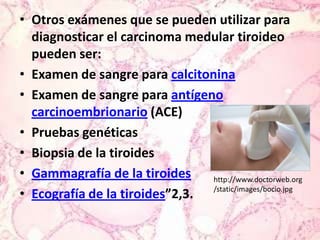
Otros exámenes que se pueden utilizar para diagnosticar el carcinoma medular tiroideo pueden ser:Examen de sangre para calcitoninaExamen de sangre para antígeno carcinoembrionario (ACE)Pruebas genéticasBiopsia de la tiroidesGammagrafía de la tiroidesEcografía de la tiroides”2,3.http://www.doctorweb.org/static/images/bocio.jpg
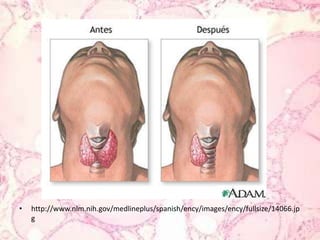
OPCIONES DE TRATAMIENTO “Cirugía: con frecuencia es necesario efectuar una traqueotomía. Si la enfermedad está limitada a un área local, lo cual es poco común, se justifica la realización de una tiroidectomía total para reducir los síntomas que causa la masa tumoral.”3,9.
http://www.nlm.nih.gov/medlineplus/spanish/ency/images/ency/fullsize/14066.jpg
Radioterapia: Se puede usar la irradiación de haz externo en los pacientes que no son idóneos para la cirugía o cuyo tumor no puede extirparse quirúrgicamente.Quimioterapia: el cáncer anaplásico de la tiroides no responde al tratamiento con I131; se observa que el tratamiento con monofármacos anticancerosos produce remisiones parciales en algunos pacientes. Aproximadamente 30% de los pacientes logran una remisión parcial con la doxorrubicina. La combinación de doxorrubicina y cisplatino parece ser más activa que la doxorrubicina sola y se ha observado que produce más respuestas completas.
“Targeted systemic radiotherapy of pheochromocytoma and medullary thyroid cancer.Divgi C.SourceColumbia University, New York, NY.AbstractTargeted systemic radiotherapy constitutes the systemic administration of a radioactive agent that targets a molecule expressed preferentially on cancer cells. The archetypal such therapy is 131-iodine ((131)I) therapy for differentiated thyroid cancers. Radiotherapy typically delivers a calculated radiation-absorbed dose to tumor that takes into account (contiguous) normal tissue. Systemic radiotherapy development currently uses schema more analogous to chemotherapy-a radioactivity estimate that does not cause any irreversible toxicity. Historically, arbitrary amounts of radioactivity shown to be effective, on the basis of retrospective review, were used for thyroid cancer therapy with (131)I as well as for neuroendocrine tumor therapy with (131)I-labeled meta-iodo-benzylguanidine (MIBG). Their established safety record has led to adaptations that include repeat therapies with nontoxic amounts of radioactivity. There remains, however, a lack of clear understanding of the safety limits of systemic targeted radiotherapy. This is probably most true in systemic therapy with MIBG in adult neuroendocrine tumors. Bone marrow is the primary critical organ for most targeted systemic radiotherapy; second organ involvement may be renal, as with MIBG and targeted radiopeptide therapy, or pulmonary, as with radioimmunotherapy. Most therapies have tended toward multiple administrations of subtoxic amounts of radioactivity. Therapy with MIBG in pheochromococytoma as well as targeted radiopeptide therapy in medullarythyroid cancer has followed this model. Radioimmunotherapy appears very promising; a definitive Phase 2 study needs completion. All therapy has shown promise in extending disease survival (as compared with historical controls), with few major structural (or biochemical) responses. This review will attempt to compliment the excellent existing literature by providing an overall systemic therapeutic approach to this promising endeavor.”11.
Este articulo es realmente interesante ya que plantea una mejora en el tratamiento con radioterapia para pacientes con cáncer medular de tiroides; los estudios que aquí presentan, demuestran que la mejora del tratamiento se ve reflejada en el aumento de la expectativa de vida de los pacientes tratados con el nuevo método frente a los tratados con el método tradicional.
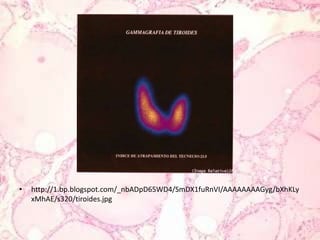
http://1.bp.blogspot.com/_nbADpD65WD4/SmDX1fuRnVI/AAAAAAAAGyg/bXhKLyxMhAE/s320/tiroides.jpg
“Current role of metaiodobenzylguanidine in the diagnosis of pheochromocytoma and medullary thyroid cancer.Ilias I, Divgi C, Pacak K.SourceDepartment of Endocrinology, E. Venizelou Hospital, Athens, Greece.AbstractDespite early reports of excellent diagnostic characteristics of [(131)I]/[(123)I]-metaiodobenzylguanidine (MIBG) in the evaluation of pheochromocytomas/paragangliomas (PHEOs/PGLs) or medullarythyroid cancer as experience with it was accumulated, the sensitivity dropped. Nevertheless, this modality is still useful in the diagnostic work-up of PHEOs/PGLs because it is widely available, and in case of positive scans it might indicate patients who are potential candidates for [(131)I]MIBG therapy.Published by Elsevier Inc.”12
El medicamento que referencia el articulo medico se encuentra ampliamente difundido y es esta la principal ventaja del este fármaco. Aun faltan bastantes estudios, el articulo deja muchos interrogantes.
“Ann AcadMedSingapore. 2011 Jun;40(6):300-2.Melanocyticvariant of medullarythyroid carcinoma in a previouslytreatedpapillary carcinoma patient.Mohamad I, Zainuddin N, Zawawi N, Naik VR.SourceDepartment of Otorhinolaryngology - Head & Neck Surgery.”13
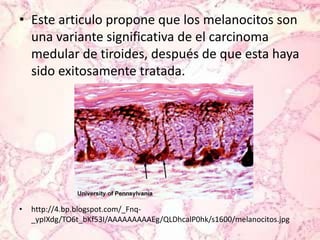
Este articulo propone que los melanocitos son una variante significativa de el carcinoma medular de tiroides, después de que esta haya sido exitosamente tratada.http://4.bp.blogspot.com/_Fnq-_ypIXdg/TO6t_bKf53I/AAAAAAAAAEg/QLDhcalP0hk/s1600/melanocitos.jpg
“Breast metastasis by medullary thyroid carcinoma detected by FDG positron emission tomography.Nofech-Mozes S, Mackenzie R, Kahn HJ, Ehrlich L, Raphael SJ.SourceDepartment of Anatomical Pathology, Sunnybrook Health Sciences Center, Toronto, ON, Canada M4N 3M5.AbstractMedullary thyroid carcinoma (MTC) is an uncommon thyroid cancer comprising 5% to 8% of thyroid neoplasms. In contrast to common thyroid tumors, this tumor originates from the calcitonin-producing C cells. Regional metastases to cervical lymph nodes occur early in the disease, whereas distant metastasis occurs late. Common metastatic sites include the liver, bone, brain, and adrenal medulla. We present a case of MTC metastatic to the breast. We report on this case for the following reasons: (1) metastasis to the breast is an extremely rare occurrence and could be easily confused clinically and pathologically with a primary breast neoplasm and (2) this is the first reported case of detection of breast metastasis by an MTC using FDG ((18)F-fluoro-2-deoxy-D-glucose) positron emission tomography with an accompanying histologic description.”14
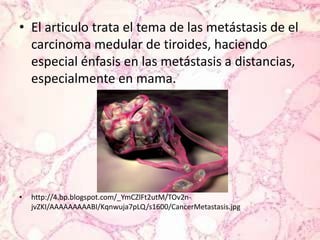
El articulo trata el tema de las metástasis de el carcinoma medular de tiroides, haciendo especial énfasis en las metástasis a distancias, especialmente en mama.http://4.bp.blogspot.com/_YmCZlFt2utM/TOv2n-jvZKI/AAAAAAAAABI/Kqnwuja7pLQ/s1600/CancerMetastasis.jpg
“Cytology of hyalinisingtrabecular adenoma-like variant of medullary thyroid carcinoma.Santosh KV, Raychaudhuri S, Subramanya H, Naveen Kumar BJ.SourceDepartment of Pathology, Vydehi Institute of Medical Sciences and Research Center, Bangalore, India.AbstractMedullarythyroid carcinoma is a rare thyroid neoplasm that can be either sporadic or familial. It occurs in adults, presenting as a solitary cold nodule on thyroid scan. Most are solid, firm, and non-encapsulated, and occur in the mid portion or upper half of the thyroid gland, corresponding to areas with greater numbers of C cells. We present a case of a 36-year-old female with a swelling in the front of her neck for six years. Fine needle aspiration done elsewhere revealed spindle cells, suggestive of a 'spindle cell neoplasm'. The histopathology of the thyroidectomy specimen showed features of a hyalinizingtrabecular adenoma-like variant of medullarycarcinoma. Subsequently, we performed aspiration on the received specimen and studied the cytological findings. The cytological diagnosis of this variant requires identification of the dual spindle and ovoid cell population and the granular neuroendocrine chromatin.”15
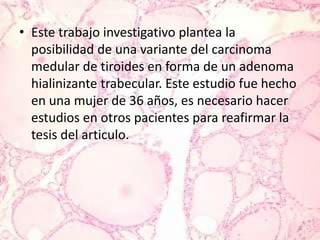
Este trabajo investigativo plantea la posibilidad de una variante del carcinoma medular de tiroides en forma de un adenoma hialinizantetrabecular. Este estudio fue hecho en una mujer de 36 años, es necesario hacer estudios en otros pacientes para reafirmar la tesis del articulo.
BIBLIOGRAFÍA1) http://biblioteca.fucsalud.edu.co:2052/books/page.do?eid=4-u1.0-B978-1-4377-0324-5..00011-0--s0030&isbn=978-1-4377-0324-5&uniqId=270438322-2#4-u1.0-B978-1-4377-0324-5..00011-0--f00152)http://www.nlm.nih.gov/medlineplus/spanish/ency/article/000374.htm
3)Goldman JM, Goren EN, Cohen MH, et al.: Anaplasticthyroid carcinoma: long-termsurvivalafter radical surgery. J SurgOncol 14 (4): 389-94, 1980.  [PUBMED Abstract]4)Aldinger KA, Samaan NA, Ibanez M, et al.: Anaplastic carcinoma of thethyroid: a review of 84 cases of spindle and giantcell carcinoma of thethyroid. Cancer 41 (6): 2267-75, 1978.  [PUBMED Abstract]5)Carling T, Udelsman R: Thyroidtumors. In: DeVita VT Jr, Hellman S, Rosenberg SA, eds.: Cancer: Principles and Practice of Oncology. Vols. 1 & 2. 8th ed. Philadelphia, Pa: Lippincott Williams & Wilkins, 2008, pp 1663-82. 
6)Shimaoka K, Schoenfeld DA, DeWys WD, et al.: A randomized trial of doxorubicin versus doxorubicin plus cisplatin in patientswithadvancedthyroid carcinoma. Cancer 56 (9): 2155-60, 1985.  [PUBMED Abstract]7)Haigh PI, Ituarte PH, Wu HS, et al.: Completelyresectedanaplasticthyroid carcinoma combinedwithadjuvantchemotherapy and irradiationisassociatedwithprolongedsurvival. Cancer 91 (12): 2335-42, 2001.  [PUBMED Abstract]8)De Crevoisier R, Baudin E, Bachelot A, et al.: Combinedtreatment of anaplasticthyroid carcinoma withsurgery, chemotherapy, and hyperfractionatedacceleratedexternalradiotherapy. Int J RadiatOncolBiolPhys 60 (4): 1137-43, 2004.  [PUBMED Abstract]
9) http://www.cancer.gov/espanol/pdq/tratamiento/tiroides/HealthProfessional/page810)http://biblioteca.fucsalud.edu.co:2079/dynamed/detail?vid=10&hid=110&sid=4895cac3-c780-4f0c-9aeb-db9349e23b93%40sessionmgr104&bdata=JnNpdGU9ZHluYW1lZC1saXZlJnNjb3BlPXNpdGU%3d#db=dme&AN=113756&anchor=Prevention-and-Screening
11)http://www.ncbi.nlm.nih.gov/pubmed/2180318712)http://www.ncbi.nlm.nih.gov/pubmed/2180318613)http://www.ncbi.nlm.nih.gov/pubmed/21779621
14)http://www.ncbi.nlm.nih.gov/pubmed/1816442015)http://www.ncbi.nlm.nih.gov/pubmed/21768710

Carcinoma medular de tiroides

  • 1.
  • 2.
    FUCSMIGUEL ÁNGEL LOZANO ARIASINFORMATICA NIVEL MEDIOBOGOTA D.C.2011
  • 3.
    LA GLANDULA TIROIDES“thethyroid is one of the largest of the endocrine organs, weighing approximately 15 to 20 g. The normal thyroid is made up of two lobes joined by a thin band of tissue, the isthmus, which is approximately 0.5 cm thick, 2 cm wide, and 1 to 2 cm high. The individual lobes normally have a pointed superior pole and a poorly defined, blunt inferior pole that merges medially with the isthmus. Each lobe is approximately 2.0 to 2.5 cm in thickness and width at its largest diameter, and it is approximately 4.0 cm in length.” 1
  • 4.
  • 5.
    CANCER MEDULAR DETIROIDES“Es un cáncer de la glándula tiroides que comienza en un tipo de células, denominadas células "C", que liberan una hormona llamada calcitonina.”2,7,8.
  • 6.
    VISTA MICROSCOPICA DENEOPLASIA EN LA GLANDULA TIROIDEShttp://escuela.med.puc.cl/paginas/cursos/tercero/anatomiapatologica/imagenes_ap/fotos937-941/941.jpg
  • 7.
    VISTA MACROSCOPICA DENEOPLASIA EN GLANDULA TIROIDEShttp://escuela.med.puc.cl/publ/patgeneral/FotosBig/133.jpg
  • 8.
    CAUSAS“La causa delcarcinoma medular tiroideo (CMT) se desconoce.A diferencia de otros tipos de cáncer de la tiroides, es menos probable que este tipo de carcinoma sea causado por radioterapia al cuello aplicada para tratar otros cánceres durante la infancia.”6
  • 9.
    CLASES DE CMT“Haydos formas de carcinoma medular tiroideo:Carcinoma medular tiroideo esporádico, el cual no se transmite de padres a hijos. La mayoría de estos carcinomas son esporádicos. Esta forma afecta principalmente a los adultos mayores.Carcinoma medular tiroideo hereditario, el cual se transmite de padres a hijos.”2
  • 10.
  • 11.
    FACTORES DE RIESGO“Unantecedente familiar de este tipo de carcinomaAntecedentes familiares de neoplasia endocrina múltiple (NEM)Historia previa de feocromocitoma, neuromas de la mucosa o hiperparatiroidismo”4
  • 12.
    Hiperparatiroidismo; uno delos mas influyentes factores de riesgohttp://www.conganat.org/seap/datos/regionales/vcamino1.jpg
  • 13.
    SÍNTOMAS“Problemas respiratorios debidoal estrechamiento de las vías respiratoriasTosTos con sangreDiarreaBocio (agrandamiento de la tiroides)Tumor en la glándula tiroides”2
  • 14.
  • 15.
    SIGNOS Y EXÁMENES“Elmédico llevará a cabo un examen físico. Los ganglios linfáticos en el cuello pueden presentar hinchazón. Las pruebas de la función tiroidea generalmente son normales; sin embargo, un examen de la tiroides puede revelar nódulos (tumoraciones) solitarios o múltiples.
  • 16.
    El examen físicomedico es de suma importancia para detectar hiperplasias en estadios tempranos de carcinoma medular de tiroides.http://www.losmedicamentos.net/consejos/wp-content/uploads/2011/04/bocio.jpg
  • 17.
    Otros exámenes quese pueden utilizar para diagnosticar el carcinoma medular tiroideo pueden ser:Examen de sangre para calcitoninaExamen de sangre para antígeno carcinoembrionario (ACE)Pruebas genéticasBiopsia de la tiroidesGammagrafía de la tiroidesEcografía de la tiroides”2,3.http://www.doctorweb.org/static/images/bocio.jpg
  • 18.
    OPCIONES DE TRATAMIENTO“Cirugía: con frecuencia es necesario efectuar una traqueotomía. Si la enfermedad está limitada a un área local, lo cual es poco común, se justifica la realización de una tiroidectomía total para reducir los síntomas que causa la masa tumoral.”3,9.
  • 19.
  • 20.
    Radioterapia: Se puedeusar la irradiación de haz externo en los pacientes que no son idóneos para la cirugía o cuyo tumor no puede extirparse quirúrgicamente.Quimioterapia: el cáncer anaplásico de la tiroides no responde al tratamiento con I131; se observa que el tratamiento con monofármacos anticancerosos produce remisiones parciales en algunos pacientes. Aproximadamente 30% de los pacientes logran una remisión parcial con la doxorrubicina. La combinación de doxorrubicina y cisplatino parece ser más activa que la doxorrubicina sola y se ha observado que produce más respuestas completas.
  • 21.
    “Targeted systemic radiotherapyof pheochromocytoma and medullary thyroid cancer.Divgi C.SourceColumbia University, New York, NY.AbstractTargeted systemic radiotherapy constitutes the systemic administration of a radioactive agent that targets a molecule expressed preferentially on cancer cells. The archetypal such therapy is 131-iodine ((131)I) therapy for differentiated thyroid cancers. Radiotherapy typically delivers a calculated radiation-absorbed dose to tumor that takes into account (contiguous) normal tissue. Systemic radiotherapy development currently uses schema more analogous to chemotherapy-a radioactivity estimate that does not cause any irreversible toxicity. Historically, arbitrary amounts of radioactivity shown to be effective, on the basis of retrospective review, were used for thyroid cancer therapy with (131)I as well as for neuroendocrine tumor therapy with (131)I-labeled meta-iodo-benzylguanidine (MIBG). Their established safety record has led to adaptations that include repeat therapies with nontoxic amounts of radioactivity. There remains, however, a lack of clear understanding of the safety limits of systemic targeted radiotherapy. This is probably most true in systemic therapy with MIBG in adult neuroendocrine tumors. Bone marrow is the primary critical organ for most targeted systemic radiotherapy; second organ involvement may be renal, as with MIBG and targeted radiopeptide therapy, or pulmonary, as with radioimmunotherapy. Most therapies have tended toward multiple administrations of subtoxic amounts of radioactivity. Therapy with MIBG in pheochromococytoma as well as targeted radiopeptide therapy in medullarythyroid cancer has followed this model. Radioimmunotherapy appears very promising; a definitive Phase 2 study needs completion. All therapy has shown promise in extending disease survival (as compared with historical controls), with few major structural (or biochemical) responses. This review will attempt to compliment the excellent existing literature by providing an overall systemic therapeutic approach to this promising endeavor.”11.
  • 22.
    Este articulo esrealmente interesante ya que plantea una mejora en el tratamiento con radioterapia para pacientes con cáncer medular de tiroides; los estudios que aquí presentan, demuestran que la mejora del tratamiento se ve reflejada en el aumento de la expectativa de vida de los pacientes tratados con el nuevo método frente a los tratados con el método tradicional.
  • 23.
  • 24.
    “Current role ofmetaiodobenzylguanidine in the diagnosis of pheochromocytoma and medullary thyroid cancer.Ilias I, Divgi C, Pacak K.SourceDepartment of Endocrinology, E. Venizelou Hospital, Athens, Greece.AbstractDespite early reports of excellent diagnostic characteristics of [(131)I]/[(123)I]-metaiodobenzylguanidine (MIBG) in the evaluation of pheochromocytomas/paragangliomas (PHEOs/PGLs) or medullarythyroid cancer as experience with it was accumulated, the sensitivity dropped. Nevertheless, this modality is still useful in the diagnostic work-up of PHEOs/PGLs because it is widely available, and in case of positive scans it might indicate patients who are potential candidates for [(131)I]MIBG therapy.Published by Elsevier Inc.”12
  • 25.
    El medicamento quereferencia el articulo medico se encuentra ampliamente difundido y es esta la principal ventaja del este fármaco. Aun faltan bastantes estudios, el articulo deja muchos interrogantes.
  • 26.
    “Ann AcadMedSingapore. 2011Jun;40(6):300-2.Melanocyticvariant of medullarythyroid carcinoma in a previouslytreatedpapillary carcinoma patient.Mohamad I, Zainuddin N, Zawawi N, Naik VR.SourceDepartment of Otorhinolaryngology - Head & Neck Surgery.”13
  • 27.
    Este articulo proponeque los melanocitos son una variante significativa de el carcinoma medular de tiroides, después de que esta haya sido exitosamente tratada.http://4.bp.blogspot.com/_Fnq-_ypIXdg/TO6t_bKf53I/AAAAAAAAAEg/QLDhcalP0hk/s1600/melanocitos.jpg
  • 28.
    “Breast metastasis bymedullary thyroid carcinoma detected by FDG positron emission tomography.Nofech-Mozes S, Mackenzie R, Kahn HJ, Ehrlich L, Raphael SJ.SourceDepartment of Anatomical Pathology, Sunnybrook Health Sciences Center, Toronto, ON, Canada M4N 3M5.AbstractMedullary thyroid carcinoma (MTC) is an uncommon thyroid cancer comprising 5% to 8% of thyroid neoplasms. In contrast to common thyroid tumors, this tumor originates from the calcitonin-producing C cells. Regional metastases to cervical lymph nodes occur early in the disease, whereas distant metastasis occurs late. Common metastatic sites include the liver, bone, brain, and adrenal medulla. We present a case of MTC metastatic to the breast. We report on this case for the following reasons: (1) metastasis to the breast is an extremely rare occurrence and could be easily confused clinically and pathologically with a primary breast neoplasm and (2) this is the first reported case of detection of breast metastasis by an MTC using FDG ((18)F-fluoro-2-deoxy-D-glucose) positron emission tomography with an accompanying histologic description.”14
  • 29.
    El articulo tratael tema de las metástasis de el carcinoma medular de tiroides, haciendo especial énfasis en las metástasis a distancias, especialmente en mama.http://4.bp.blogspot.com/_YmCZlFt2utM/TOv2n-jvZKI/AAAAAAAAABI/Kqnwuja7pLQ/s1600/CancerMetastasis.jpg
  • 30.
    “Cytology of hyalinisingtrabecularadenoma-like variant of medullary thyroid carcinoma.Santosh KV, Raychaudhuri S, Subramanya H, Naveen Kumar BJ.SourceDepartment of Pathology, Vydehi Institute of Medical Sciences and Research Center, Bangalore, India.AbstractMedullarythyroid carcinoma is a rare thyroid neoplasm that can be either sporadic or familial. It occurs in adults, presenting as a solitary cold nodule on thyroid scan. Most are solid, firm, and non-encapsulated, and occur in the mid portion or upper half of the thyroid gland, corresponding to areas with greater numbers of C cells. We present a case of a 36-year-old female with a swelling in the front of her neck for six years. Fine needle aspiration done elsewhere revealed spindle cells, suggestive of a 'spindle cell neoplasm'. The histopathology of the thyroidectomy specimen showed features of a hyalinizingtrabecular adenoma-like variant of medullarycarcinoma. Subsequently, we performed aspiration on the received specimen and studied the cytological findings. The cytological diagnosis of this variant requires identification of the dual spindle and ovoid cell population and the granular neuroendocrine chromatin.”15
  • 31.
    Este trabajo investigativoplantea la posibilidad de una variante del carcinoma medular de tiroides en forma de un adenoma hialinizantetrabecular. Este estudio fue hecho en una mujer de 36 años, es necesario hacer estudios en otros pacientes para reafirmar la tesis del articulo.
  • 32.
  • 33.
    3)Goldman JM, GorenEN, Cohen MH, et al.: Anaplasticthyroid carcinoma: long-termsurvivalafter radical surgery. J SurgOncol 14 (4): 389-94, 1980.  [PUBMED Abstract]4)Aldinger KA, Samaan NA, Ibanez M, et al.: Anaplastic carcinoma of thethyroid: a review of 84 cases of spindle and giantcell carcinoma of thethyroid. Cancer 41 (6): 2267-75, 1978.  [PUBMED Abstract]5)Carling T, Udelsman R: Thyroidtumors. In: DeVita VT Jr, Hellman S, Rosenberg SA, eds.: Cancer: Principles and Practice of Oncology. Vols. 1 & 2. 8th ed. Philadelphia, Pa: Lippincott Williams & Wilkins, 2008, pp 1663-82. 
  • 34.
    6)Shimaoka K, SchoenfeldDA, DeWys WD, et al.: A randomized trial of doxorubicin versus doxorubicin plus cisplatin in patientswithadvancedthyroid carcinoma. Cancer 56 (9): 2155-60, 1985.  [PUBMED Abstract]7)Haigh PI, Ituarte PH, Wu HS, et al.: Completelyresectedanaplasticthyroid carcinoma combinedwithadjuvantchemotherapy and irradiationisassociatedwithprolongedsurvival. Cancer 91 (12): 2335-42, 2001.  [PUBMED Abstract]8)De Crevoisier R, Baudin E, Bachelot A, et al.: Combinedtreatment of anaplasticthyroid carcinoma withsurgery, chemotherapy, and hyperfractionatedacceleratedexternalradiotherapy. Int J RadiatOncolBiolPhys 60 (4): 1137-43, 2004.  [PUBMED Abstract]
  • 35.
  • 36.
  • 37.