Saturday 29 November 
14.00–16.00 
Captivating calligraphy 
Come and watch a free demonstration in 
the Great Court by Dr Haruhisa Handa. 
A display of the finished works will be on view 
in the Great Court until Monday 1 December. 
Supported by IFAC UK
Welcome 
On behalf of the Department of Asia, it is a great honour to welcome Dr Haruhisa Handa to the British Museum to perform the art of Japanese calligraphy. A man of many extraordinary talents, Dr Handa’s skill in the art of writing characters 
is widely appreciated. Dr Handa uses a free 
and playful range of styles, and is not limited 
to a single approach, subject matter or material. Dr Handa is an Adviser to the Modern Japanese Calligraphers Association, Chairman of the International Calligraphy Research Institute 
and author of several books on calligraphy. 
A display of the finished works will be on 
view until Monday 1 December. 
Timothy Clark, Head of the Japanese Section, Department of Asia, British Museum 
Running order 
14.00 Introduction by Timothy Clark 
14.05 Q&A with Dr Handa 
14.10 Introduction of instruments 
14.25 Small paintings demonstration by Dr Handa 
14.55 Q&A with Dr Handa 
15.00 Large calligraphy demonstration by Dr Handa 
15.05 Q&A and object handling with Dr Handa 
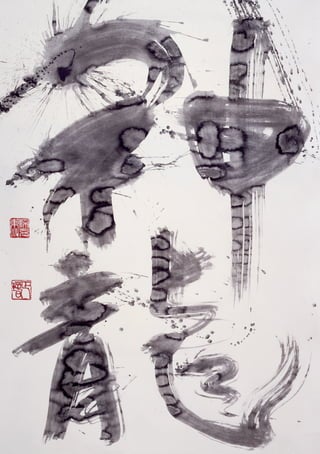
This beautiful piece of calligraphy by Dr Handa means ‘Sacred Dragon’. 
The calligraphy shown 
on the front cover means ‘Sacred Snake’. Both 
works are very large, 
each measuring 4.1metres high by 2.4 metres wide.
What is Japanese calligraphy? 
Japanese calligraphy is a form of writing using a brush. Each written character represents a sound in the language. Calligraphy is a highly respected art form in Japan. Japanese calligraphy can be traced back to the Qin (pronounced chin) dynasty in ancient China, from around 221–207 BC. Two 
main styles were adopted by Japanese calligraphers around 
AD 500. These were semi-cursive ‘running style’ (gyōsho) 
and cursive ‘grass script’ (sōsho). 
If you were a calligrapher you would need to memorise several thousand of these characters. You would usually keep your brush in a writing box called a suzuri-bako. Inside would be two brushes and a solid piece of sumi ink. This ink is made of a mixture of charcoal or soot and animal glue. The ink is then ground onto a stone called a suzuri. Drops of water are added to make a liquid using a suiteki (water dropper). 
‘Grass script’ (sōsho) is a creative style, allowing the calligrapher to change the shape of the characters depending on the content and context. A challenging style to read, it is more 
about the artistic look. 
This character, Myō, 
means superb, excellent, miraculous or mysterious, 
or to be skilful.
‘Running style’ (gyōsho) has less sharp angles and more rounded shapes. Characters can run into one another 
like joined-up writing. This character, Kami, means divine god. 
Try tracing these lines 
in numbered order with 
your finger to write the character. Can you do 
it in the air from memory? 
1 
2 
3 
4 
6 
7 
8 
9 
10 
5
What materials does Dr Handa use? 
Dr Handa will use an enormous brush made of horsehair with a bamboo handle. The scroll and paper have been made in Japan. His sumi ink has been carefully prepared for this demonstration. The brush alone weighs over 3kg and so both hands are needed to lift, move and control the brush. The work will take 24 hours to dry completely. 
Dr Handa creating large-scale calligraphy.
Dr Haruhisa Handa uses an 
enormous brush to create his 
calligraphy. Explore the British 
Museum to find other examples 
of calligraphy and the tools 
used. Look at examples from 
Japan (Room 93), China (Room 
33), the Islamic world (Room 
34) and Europe (Room 46). 
Go to Room 93 and find this 
beautifully crafted writing 
box (see picture below). Look 
carefully at the container and 
think about what kind of a 
person might have owned or 
used one of these. The quality 
of the craftwork reflected the 
status of the owner. There is an 
ink stone in the middle similar 
to that used by Dr Handa. 
Go to Room 33 and find Case 
35. Look for ink-cakes from 
China (see above left) in a 
variety of shapes. Ink-cakes 
were made from wood soot 
mixed with animal oil and 
glue, which was moulded into 
a cake and dried. The cakes 
were ground by hand on an 
inkstone and mixed with water 
to make the ink. 
If you want to see another 
brush from the Ming dynasty 
make your way up to Room 
95 and look in Case 57 
(below left). 
Go to Room 34 and find 
Case 7, look at the different 
styles of script. How are they 
similar and different to the 
others you have found? Can 
you spot any calligraphy on 
any of the other objects in 
the gallery? 
Go to Room 46 to find 
examples of European 
calligraphy. Use your finger 
– or maybe even another 
part of your body, like your 
nose – to trace the shapes 
created. How would you 
describe them? 
If you want to find out 
more about family activities, 
visit the Families Desk 
in the Great Court. 
Ink cake, China, 
Ming dynasty, 1621. 
Writing brush. 
China, Ming dynasty, 
1573–1620. 
Writing box and lid, 
Japan, 18th century. 
Calligraphy in the collection: short trail
Dr Haruhisa Handa 
Dr Haruhisa Handa (also known as Toshu Fukami) is an entrepreneur and international businessman who runs more than a dozen companies, both in Japan and overseas. He is also a multi-talented artist who is a qualified tea master, creates flower arrangements, calligraphy and is an accomplished painter, poet and opera singer. Dr Handa has exhibited his art works widely in Japan and internationally and has received numerous awards. He was nominated as an Honorary Artist by the City of Perth and in 2002, received First Grade Master of Fine Arts accreditation from the Chinese Academy of Arts. 
As of June 2014, he has painted some 2,648 works. 
In addition to the arts, Dr Handa actively supports sport and welfare activities as well as scholarly and international governance symposia across the world. He is a dedicated philanthropist and serves as Chairman of International Foundation for Arts and Culture, Vice-President of the UK’s RNIB (Royal National Institute of Blind People), President of the International Shinto Foundation (United Nations ECOSOC), Director of World Faiths Development Dialogue (WFDD), and Founder and Vice-Chairman of the Sihanouk Hospital, a 24-hour free emergency hospital in Cambodia. Dr Handa is committed to helping the people of Cambodia and serves as advisor to the Prime Minister of the Kingdom of Cambodia. 
For more information about the International Foundation 
for Arts and Culture go to ifac-global.org 
The British Museum 
Great Russell Street, London WC1B 3DG 
Tottenham Court Road, Holborn 
+44 (0)20 7323 8000 
britishmuseum.org 
© The Trustees of the British Museum 11/2014