Semiotic Tradition
Keny, 2660656
Classifications
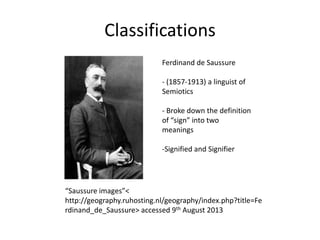
Ferdinand de Saussure
- (1857-1913) a linguist of
Semiotics
- Broke down the definition
of “sign” into two
meanings
-Signified and Signifier
“Saussure images”<
http://geography.ruhosting.nl/geography/index.php?title=Fe
rdinand_de_Saussure> accessed 9th August 2013
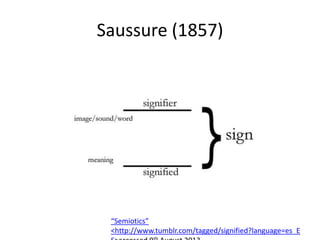
Saussure (1857)
“Semiotics”
<http://www.tumblr.com/tagged/signified?language=es_E
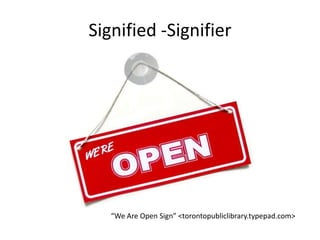
Signified -Signifier
“We Are Open Sign” <torontopubliclibrary.typepad.com>
Saussure (1857)
• Saussure concentrated more on written and
spoken language ,
• The connection between the Signified and the
Signifier is arbitrary.
• Though the language structure is arbitrary,
language usage is not. It needs ‘established
conventions’ (LittleJohn and Foss 2008, p. 107).
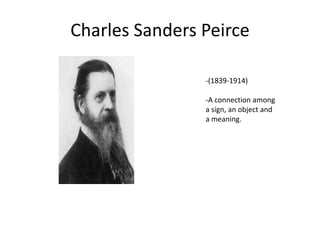
Charles Sanders Peirce
-(1839-1914)
-A connection among
a sign, an object and
a meaning.
Icons
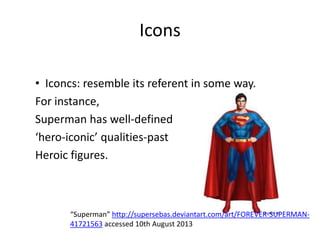
• Iconcs: resemble its referent in some way.
For instance,
Superman has well-defined
‘hero-iconic’ qualities-past
Heroic figures.
“Superman” http://supersebas.deviantart.com/art/FOREVER-SUPERMAN-
41721563 accessed 10th August 2013
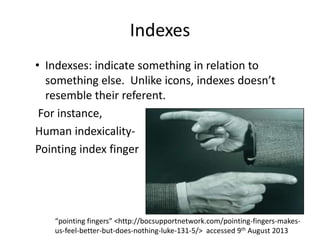
Indexes
• Indexses: indicate something in relation to
something else. Unlike icons, indexes doesn’t
resemble their referent.
For instance,
Human indexicality-
Pointing index finger
“pointing fingers” <http://bocsupportnetwork.com/pointing-fingers-makes-
us-feel-better-but-does-nothing-luke-131-5/> accessed 9th August 2013
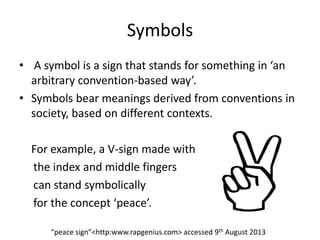
Symbols
• A symbol is a sign that stands for something in ‘an
arbitrary convention-based way’.
• Symbols bear meanings derived from conventions in
society, based on different contexts.
For example, a V-sign made with
the index and middle fingers
can stand symbolically
for the concept ‘peace’.
“peace sign”<http:www.rapgenius.com> accessed 9th August 2013
Semantics, Syntactics and Pragmatics
• Semantics looks at how signs relate to their
referent.
• Syntactics focuses the connections between
signs.
• Pragmatics observes how signs are practiced
and impacted on social life.
Scope and Limitations
• It supports in understanding ‘what goes into a
message’. For example, a speech
• It also helps understand ‘how the message
comes to have meaning’ (Littlejohn and Foss
2008, p. 105).
• But, it narrowly focuses on sign and its
functions.
Question
How does Semiotic tradition apply to our daily
communication?
Reference
• Littlejohn, S and Foss, K. 2008, Theories of
Human Communication, Waveland Press, Inc.;
9 edition. USA

Keny Jia Wen Foo

  • 1.
  • 2.
    Classifications Ferdinand de Saussure -(1857-1913) a linguist of Semiotics - Broke down the definition of “sign” into two meanings -Signified and Signifier “Saussure images”< http://geography.ruhosting.nl/geography/index.php?title=Fe rdinand_de_Saussure> accessed 9th August 2013
  • 3.
  • 4.
    Signified -Signifier “We AreOpen Sign” <torontopubliclibrary.typepad.com>
  • 5.
    Saussure (1857) • Saussureconcentrated more on written and spoken language , • The connection between the Signified and the Signifier is arbitrary. • Though the language structure is arbitrary, language usage is not. It needs ‘established conventions’ (LittleJohn and Foss 2008, p. 107).
  • 6.
    Charles Sanders Peirce -(1839-1914) -Aconnection among a sign, an object and a meaning.
  • 7.
    Icons • Iconcs: resembleits referent in some way. For instance, Superman has well-defined ‘hero-iconic’ qualities-past Heroic figures. “Superman” http://supersebas.deviantart.com/art/FOREVER-SUPERMAN- 41721563 accessed 10th August 2013
  • 8.
    Indexes • Indexses: indicatesomething in relation to something else. Unlike icons, indexes doesn’t resemble their referent. For instance, Human indexicality- Pointing index finger “pointing fingers” <http://bocsupportnetwork.com/pointing-fingers-makes- us-feel-better-but-does-nothing-luke-131-5/> accessed 9th August 2013
  • 9.
    Symbols • A symbolis a sign that stands for something in ‘an arbitrary convention-based way’. • Symbols bear meanings derived from conventions in society, based on different contexts. For example, a V-sign made with the index and middle fingers can stand symbolically for the concept ‘peace’. “peace sign”<http:www.rapgenius.com> accessed 9th August 2013
  • 10.
    Semantics, Syntactics andPragmatics • Semantics looks at how signs relate to their referent. • Syntactics focuses the connections between signs. • Pragmatics observes how signs are practiced and impacted on social life.
  • 11.
    Scope and Limitations •It supports in understanding ‘what goes into a message’. For example, a speech • It also helps understand ‘how the message comes to have meaning’ (Littlejohn and Foss 2008, p. 105). • But, it narrowly focuses on sign and its functions.
  • 12.
    Question How does Semiotictradition apply to our daily communication?
  • 13.
    Reference • Littlejohn, Sand Foss, K. 2008, Theories of Human Communication, Waveland Press, Inc.; 9 edition. USA