What Is aPrice?
From a marketing viewpoint, price (P) is the money or other considerations (including other
products and services) exchanged for the ownership or use of a product or service. The practice
of exchanging products and services for other products and services rather than for money is
called barter (trueque).
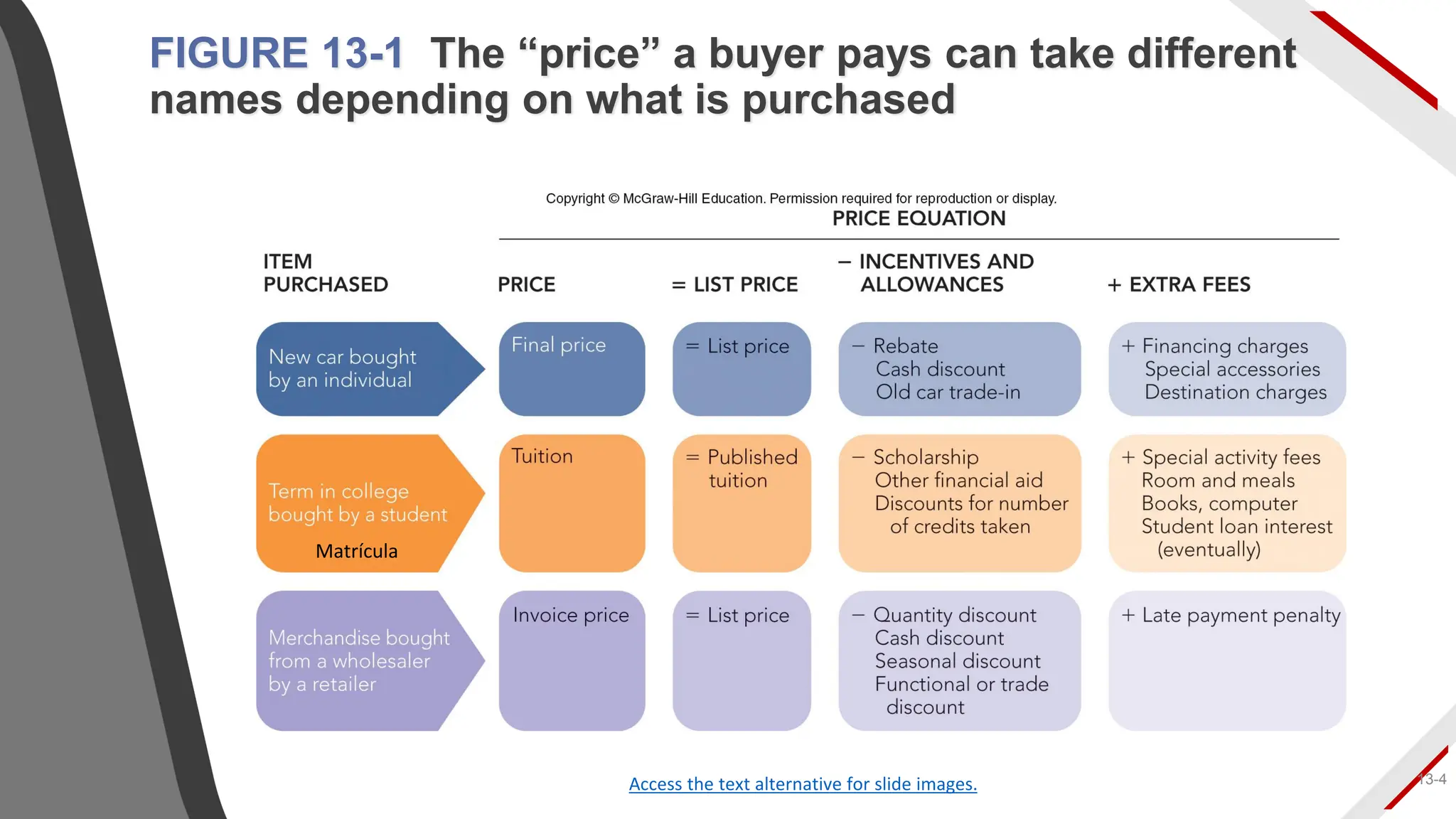
The Price Equation For most products, money is exchanged. However, the amount paid is not
always the same as the list, or quoted, price because of discounts, allowances, and extra fees.
Today’s pricing tactic involves using “special fees” and “surcharges.” This practice is driven by
consumers’ zeal for low prices combined with the ease of making price comparisons on the
Internet. Buyers are more willing to pay extra fees than a higher list price, so sellers use add-on
charges as a way of having the consumer pay more without raising the list price.
4.
Access the textalternative for slide images.
FIGURE 13-1 The “price” a buyer pays can take different
names depending on what is purchased
13-4
Matrícula
5.
Price Is Whata Consumer Pays, Value Is What a Consumer Receives
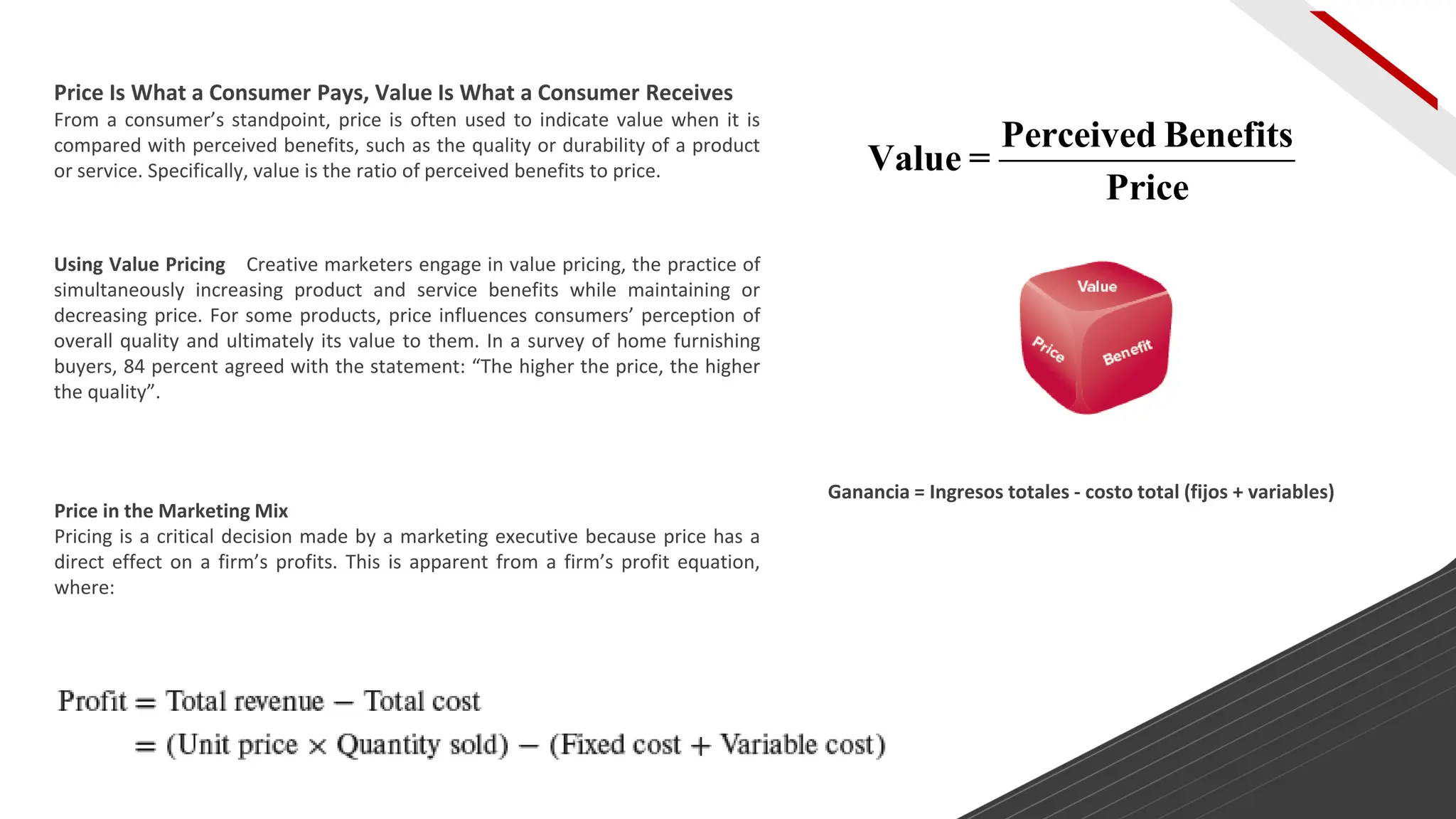
From a consumer’s standpoint, price is often used to indicate value when it is
compared with perceived benefits, such as the quality or durability of a product
or service. Specifically, value is the ratio of perceived benefits to price.
Using Value Pricing Creative marketers engage in value pricing, the practice of
simultaneously increasing product and service benefits while maintaining or
decreasing price. For some products, price influences consumers’ perception of
overall quality and ultimately its value to them. In a survey of home furnishing
buyers, 84 percent agreed with the statement: “The higher the price, the higher
the quality”.
Price in the Marketing Mix
Pricing is a critical decision made by a marketing executive because price has a
direct effect on a firm’s profits. This is apparent from a firm’s profit equation,
where:
Ganancia = Ingresos totales - costo total (fijos + variables)
Perceived Benefits
Value =
Price
6.
Profit equation
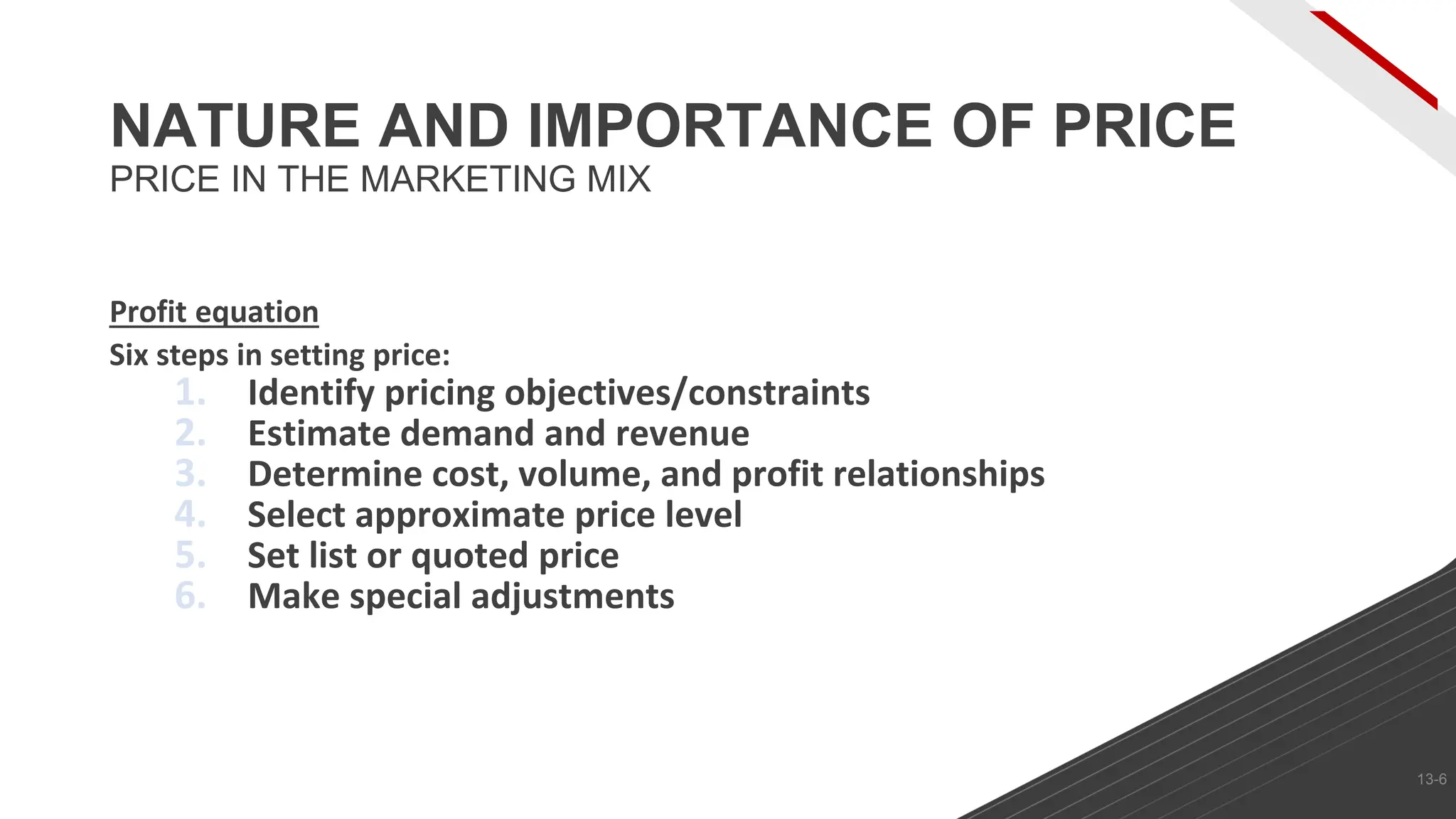
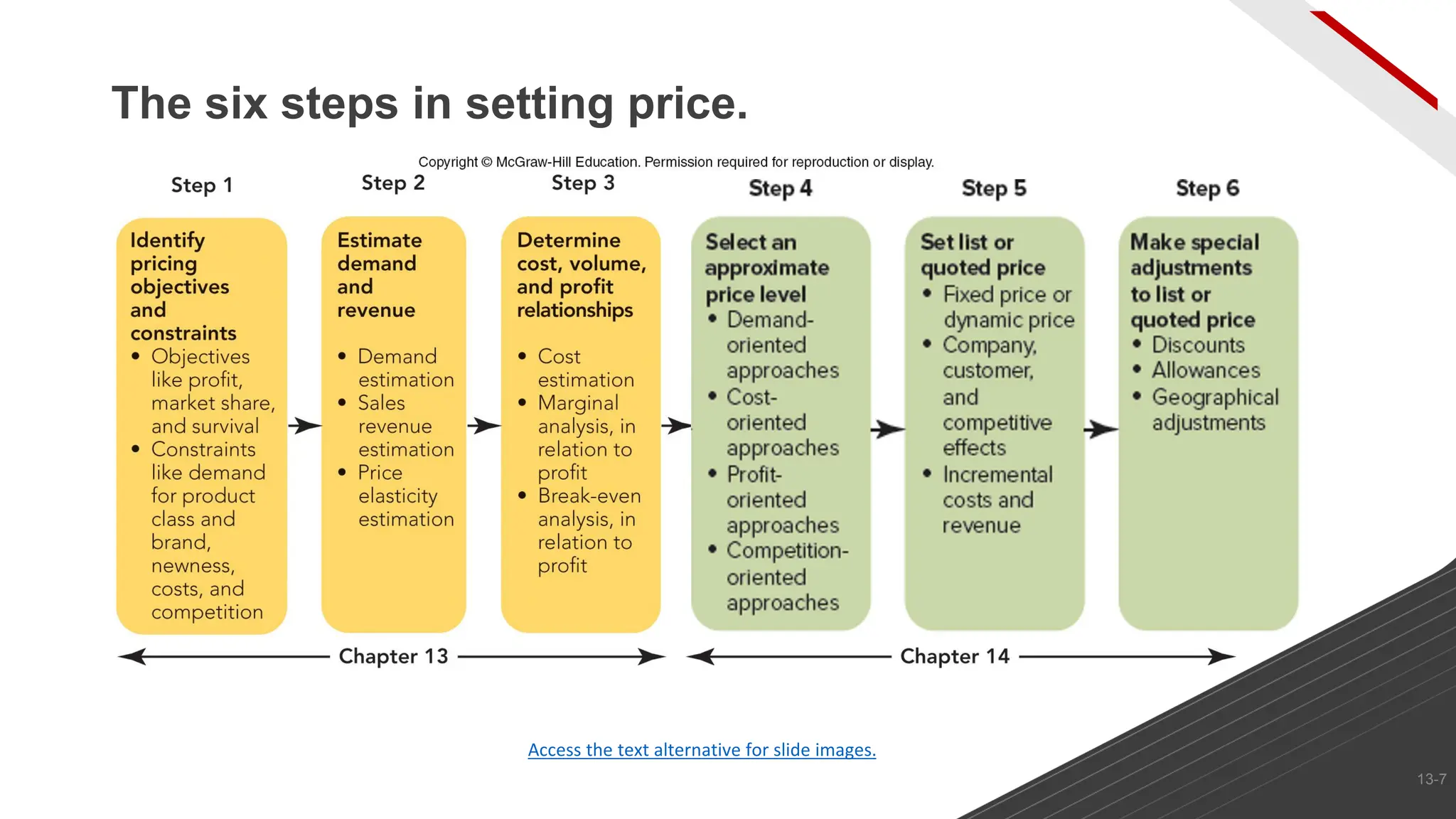
Six stepsin setting price:
1. Identify pricing objectives/constraints
2. Estimate demand and revenue
3. Determine cost, volume, and profit relationships
4. Select approximate price level
5. Set list or quoted price
6. Make special adjustments
NATURE AND IMPORTANCE OF PRICE
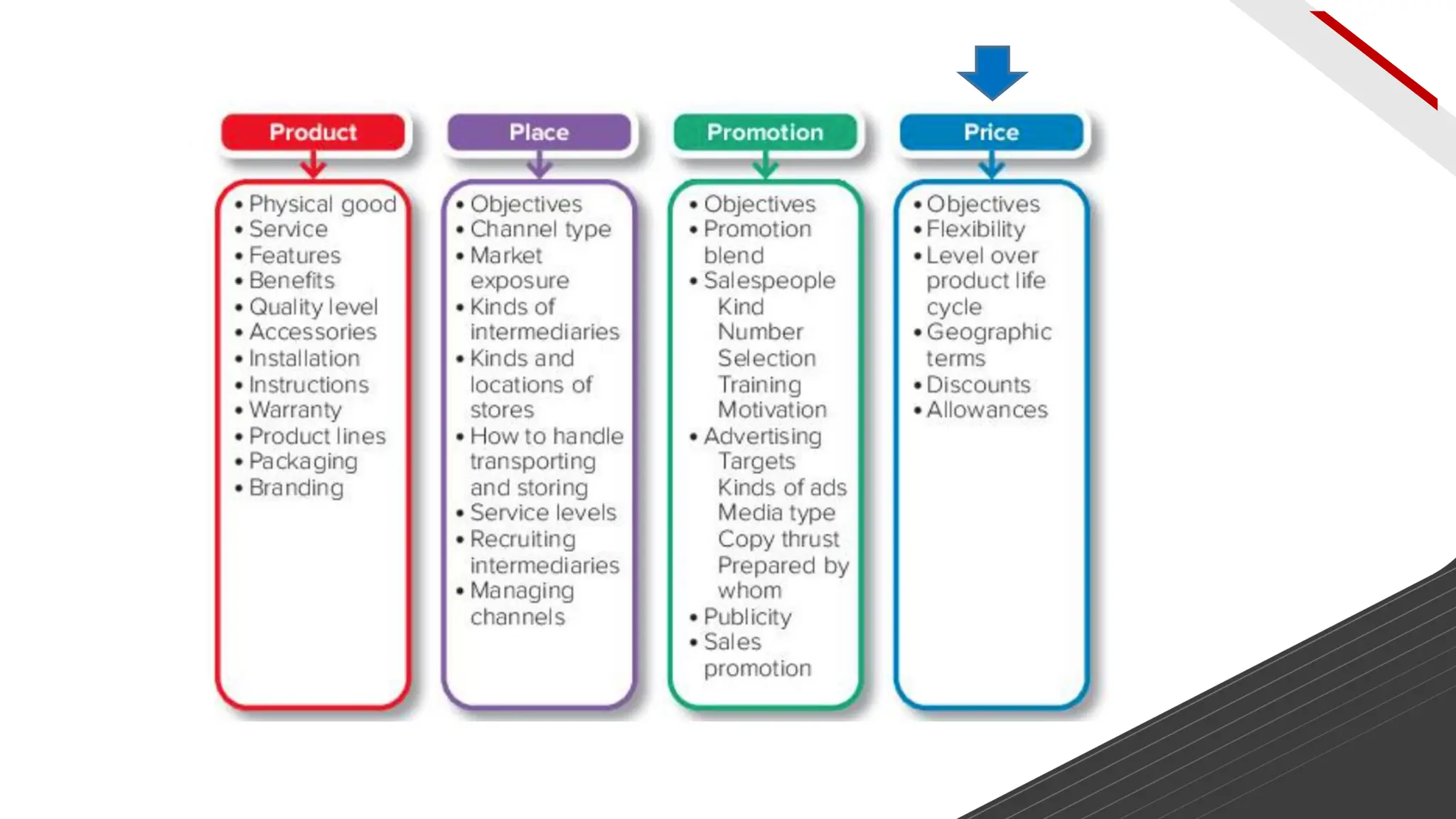
PRICE IN THE MARKETING MIX
13-6
7.
Access the textalternative for slide images.
The six steps in setting price.
13-7
8.
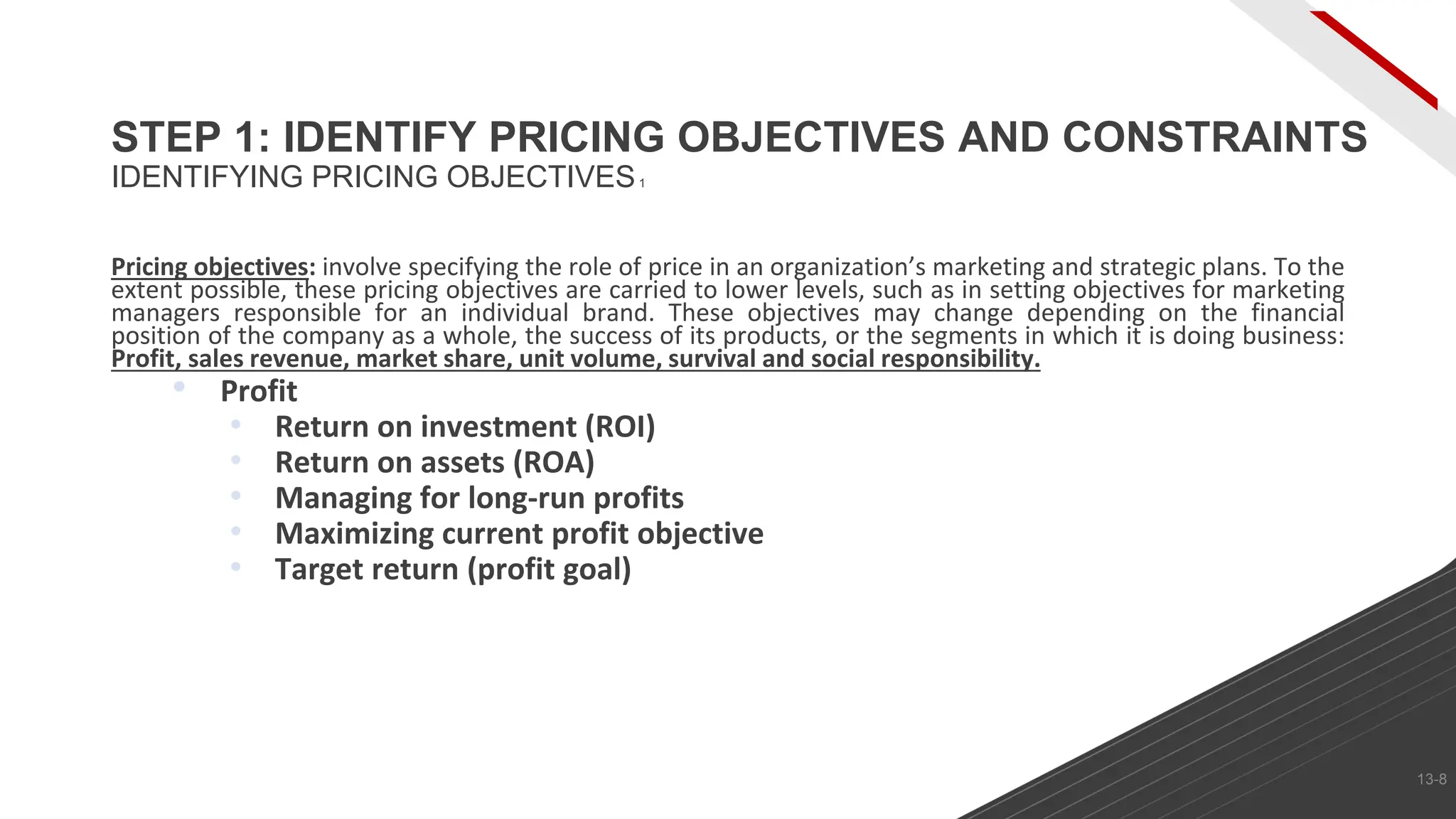
Pricing objectives: involvespecifying the role of price in an organization’s marketing and strategic plans. To the
extent possible, these pricing objectives are carried to lower levels, such as in setting objectives for marketing
managers responsible for an individual brand. These objectives may change depending on the financial
position of the company as a whole, the success of its products, or the segments in which it is doing business:
Profit, sales revenue, market share, unit volume, survival and social responsibility.
• Profit
• Return on investment (ROI)
• Return on assets (ROA)
• Managing for long-run profits
• Maximizing current profit objective
• Target return (profit goal)
STEP 1: IDENTIFY PRICING OBJECTIVES AND CONSTRAINTS
IDENTIFYING PRICING OBJECTIVES1
13-8
9.
STEP 1: IDENTIFYPRICING OBJECTIVES AND CONSTRAINTS
Identifying Pricing Objectives
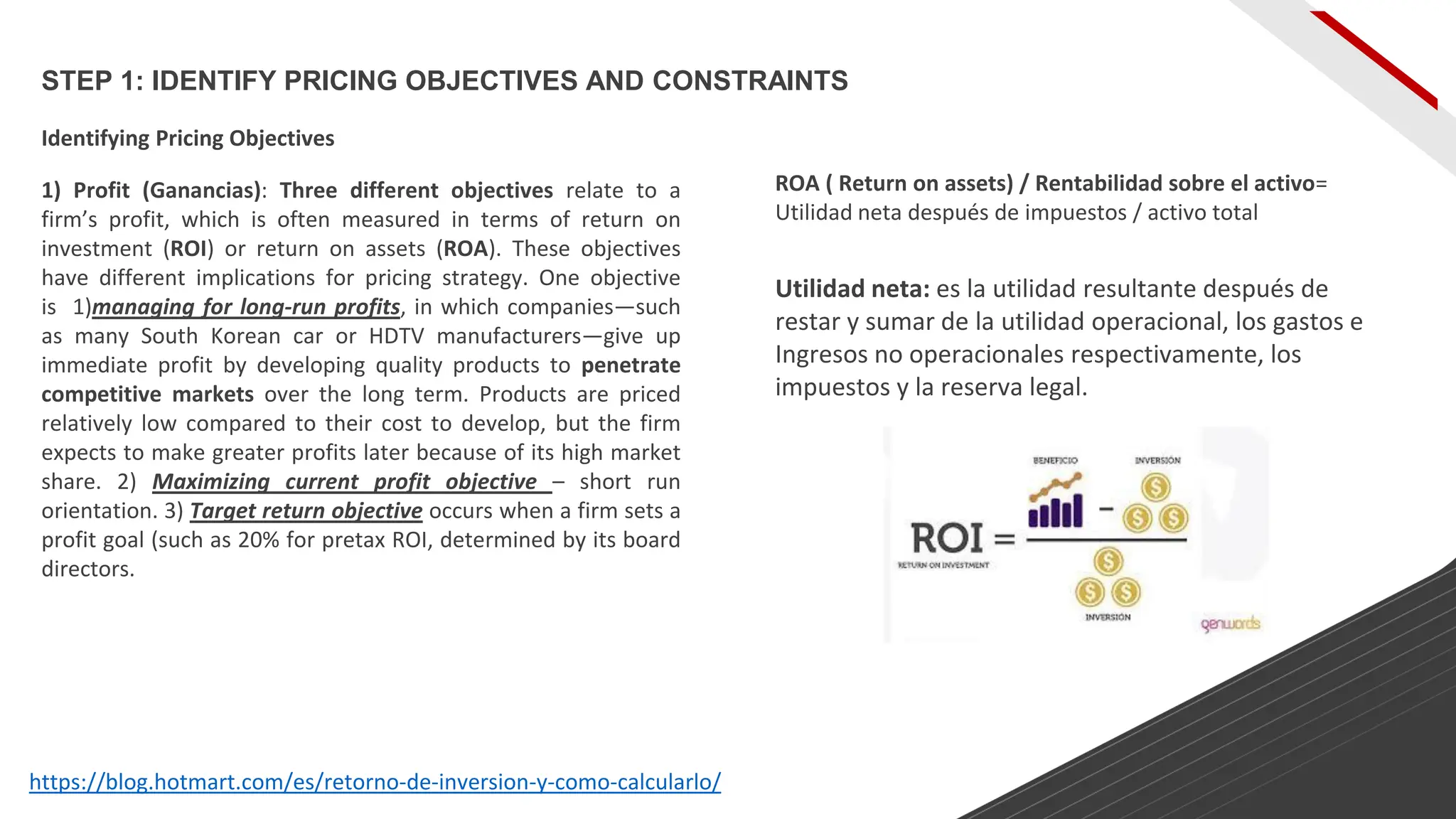
1) Profit (Ganancias): Three different objectives relate to a
firm’s profit, which is often measured in terms of return on
investment (ROI) or return on assets (ROA). These objectives
have different implications for pricing strategy. One objective
is 1)managing for long-run profits, in which companies—such
as many South Korean car or HDTV manufacturers—give up
immediate profit by developing quality products to penetrate
competitive markets over the long term. Products are priced
relatively low compared to their cost to develop, but the firm
expects to make greater profits later because of its high market
share. 2) Maximizing current profit objective – short run
orientation. 3) Target return objective occurs when a firm sets a
profit goal (such as 20% for pretax ROI, determined by its board
directors.
https://blog.hotmart.com/es/retorno-de-inversion-y-como-calcularlo/
ROA ( Return on assets) / Rentabilidad sobre el activo=
Utilidad neta después de impuestos / activo total
Utilidad neta: es la utilidad resultante después de
restar y sumar de la utilidad operacional, los gastos e
Ingresos no operacionales respectivamente, los
impuestos y la reserva legal.
10.
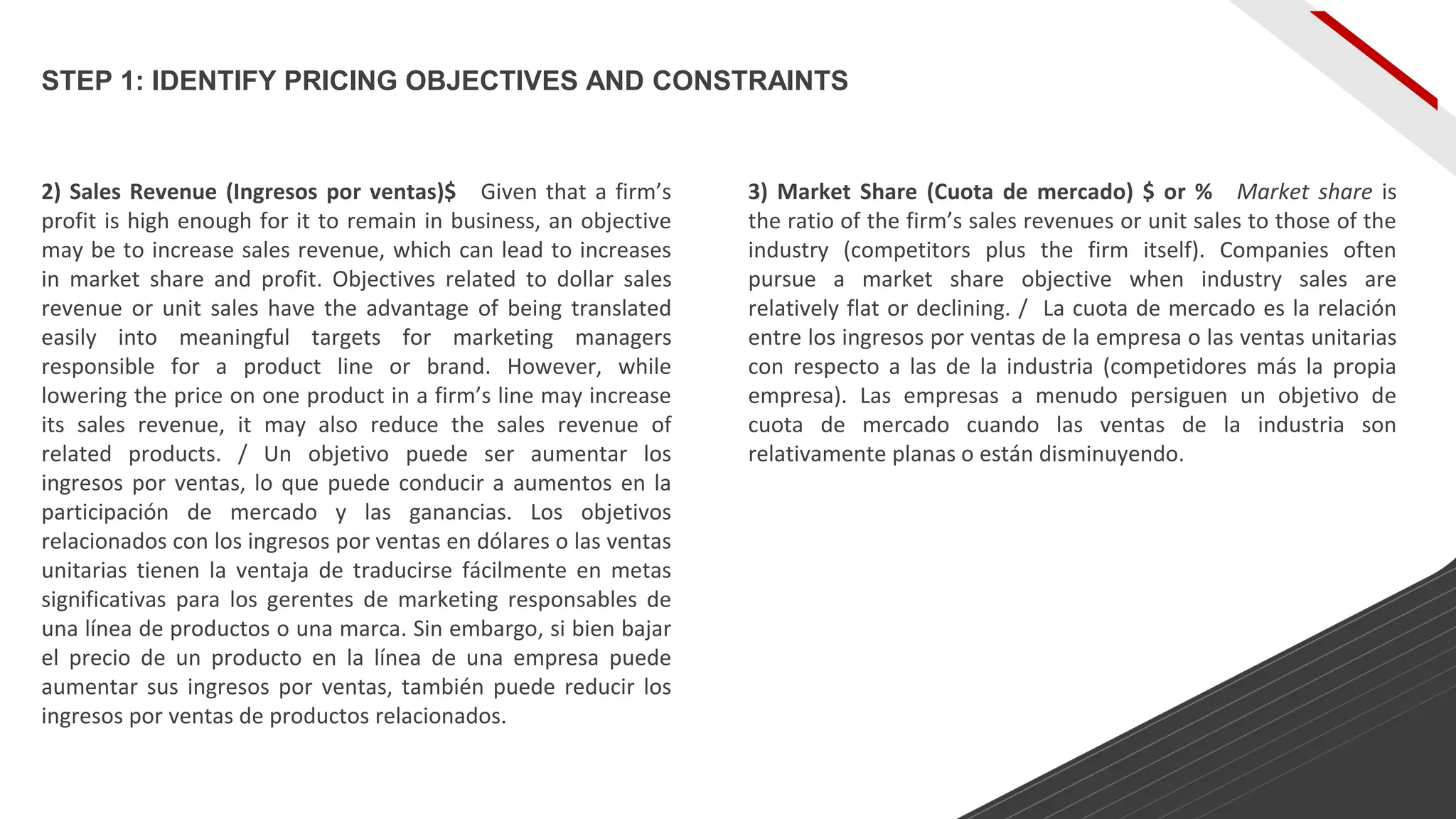
2) Sales Revenue(Ingresos por ventas)$ Given that a firm’s
profit is high enough for it to remain in business, an objective
may be to increase sales revenue, which can lead to increases
in market share and profit. Objectives related to dollar sales
revenue or unit sales have the advantage of being translated
easily into meaningful targets for marketing managers
responsible for a product line or brand. However, while
lowering the price on one product in a firm’s line may increase
its sales revenue, it may also reduce the sales revenue of
related products. / Un objetivo puede ser aumentar los
ingresos por ventas, lo que puede conducir a aumentos en la
participación de mercado y las ganancias. Los objetivos
relacionados con los ingresos por ventas en dólares o las ventas
unitarias tienen la ventaja de traducirse fácilmente en metas
significativas para los gerentes de marketing responsables de
una línea de productos o una marca. Sin embargo, si bien bajar
el precio de un producto en la línea de una empresa puede
aumentar sus ingresos por ventas, también puede reducir los
ingresos por ventas de productos relacionados.
3) Market Share (Cuota de mercado) $ or % Market share is
the ratio of the firm’s sales revenues or unit sales to those of the
industry (competitors plus the firm itself). Companies often
pursue a market share objective when industry sales are
relatively flat or declining. / La cuota de mercado es la relación
entre los ingresos por ventas de la empresa o las ventas unitarias
con respecto a las de la industria (competidores más la propia
empresa). Las empresas a menudo persiguen un objetivo de
cuota de mercado cuando las ventas de la industria son
relativamente planas o están disminuyendo.
STEP 1: IDENTIFY PRICING OBJECTIVES AND CONSTRAINTS
11.
4) Unit Volume(Unidad de volumen)# Many firms use unit
volume, the quantity produced or sold, as a pricing objective.
These firms often sell multiple products at very different prices
and need to match the unit volume demanded by customers with
price and production capacity. Using unit volume as an objective
can be counterproductive if a volume objective is achieved, say,
by drastic price cutting that drives down profit.
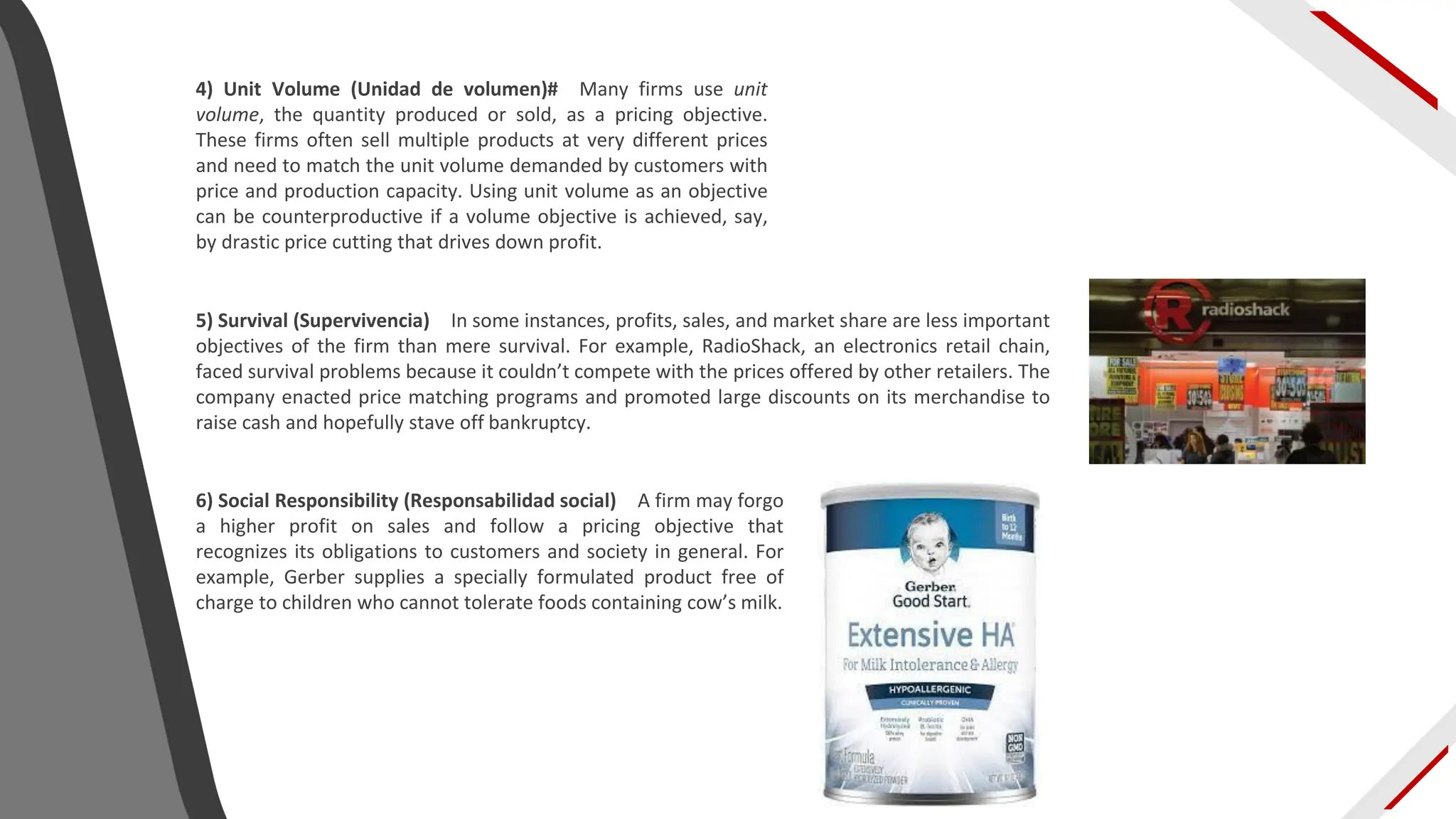
5) Survival (Supervivencia) In some instances, profits, sales, and market share are less important
objectives of the firm than mere survival. For example, RadioShack, an electronics retail chain,
faced survival problems because it couldn’t compete with the prices offered by other retailers. The
company enacted price matching programs and promoted large discounts on its merchandise to
raise cash and hopefully stave off bankruptcy.
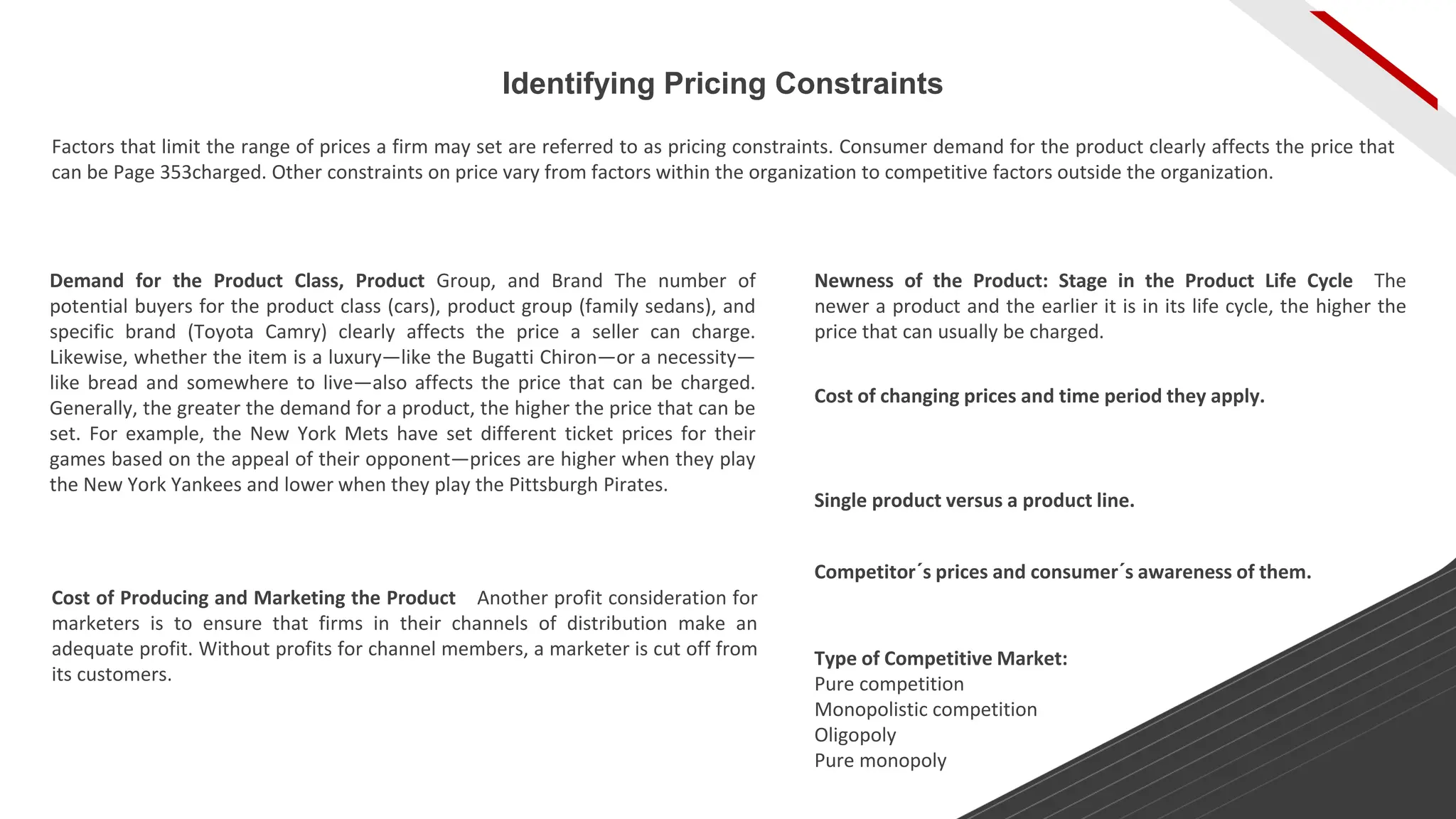
6) Social Responsibility (Responsabilidad social) A firm may forgo
a higher profit on sales and follow a pricing objective that
recognizes its obligations to customers and society in general. For
example, Gerber supplies a specially formulated product free of
charge to children who cannot tolerate foods containing cow’s milk.
12.
Identifying Pricing Constraints
Factorsthat limit the range of prices a firm may set are referred to as pricing constraints. Consumer demand for the product clearly affects the price that
can be Page 353charged. Other constraints on price vary from factors within the organization to competitive factors outside the organization.
Demand for the Product Class, Product Group, and Brand The number of
potential buyers for the product class (cars), product group (family sedans), and
specific brand (Toyota Camry) clearly affects the price a seller can charge.
Likewise, whether the item is a luxury—like the Bugatti Chiron—or a necessity—
like bread and somewhere to live—also affects the price that can be charged.
Generally, the greater the demand for a product, the higher the price that can be
set. For example, the New York Mets have set different ticket prices for their
games based on the appeal of their opponent—prices are higher when they play
the New York Yankees and lower when they play the Pittsburgh Pirates.
Newness of the Product: Stage in the Product Life Cycle The
newer a product and the earlier it is in its life cycle, the higher the
price that can usually be charged.
Cost of Producing and Marketing the Product Another profit consideration for
marketers is to ensure that firms in their channels of distribution make an
adequate profit. Without profits for channel members, a marketer is cut off from
its customers.
Cost of changing prices and time period they apply.
Single product versus a product line.
Competitor´s prices and consumer´s awareness of them.
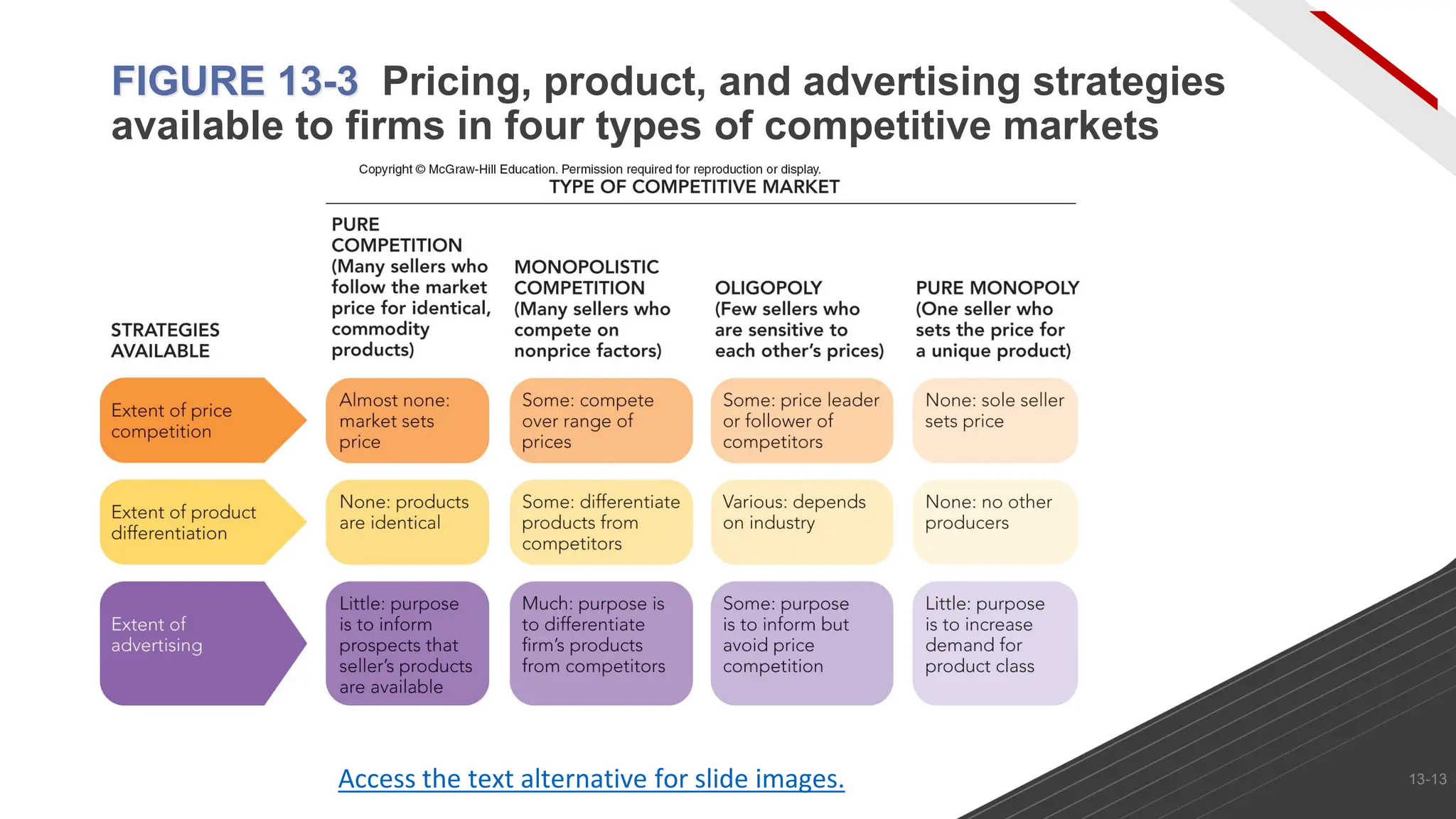
Type of Competitive Market:
Pure competition
Monopolistic competition
Oligopoly
Pure monopoly
13.
Access the textalternative for slide images.
FIGURE 13-3 Pricing, product, and advertising strategies
available to firms in four types of competitive markets
13-13
14.
STEP 2: ESTIMATEDEMAND AND REVENUE
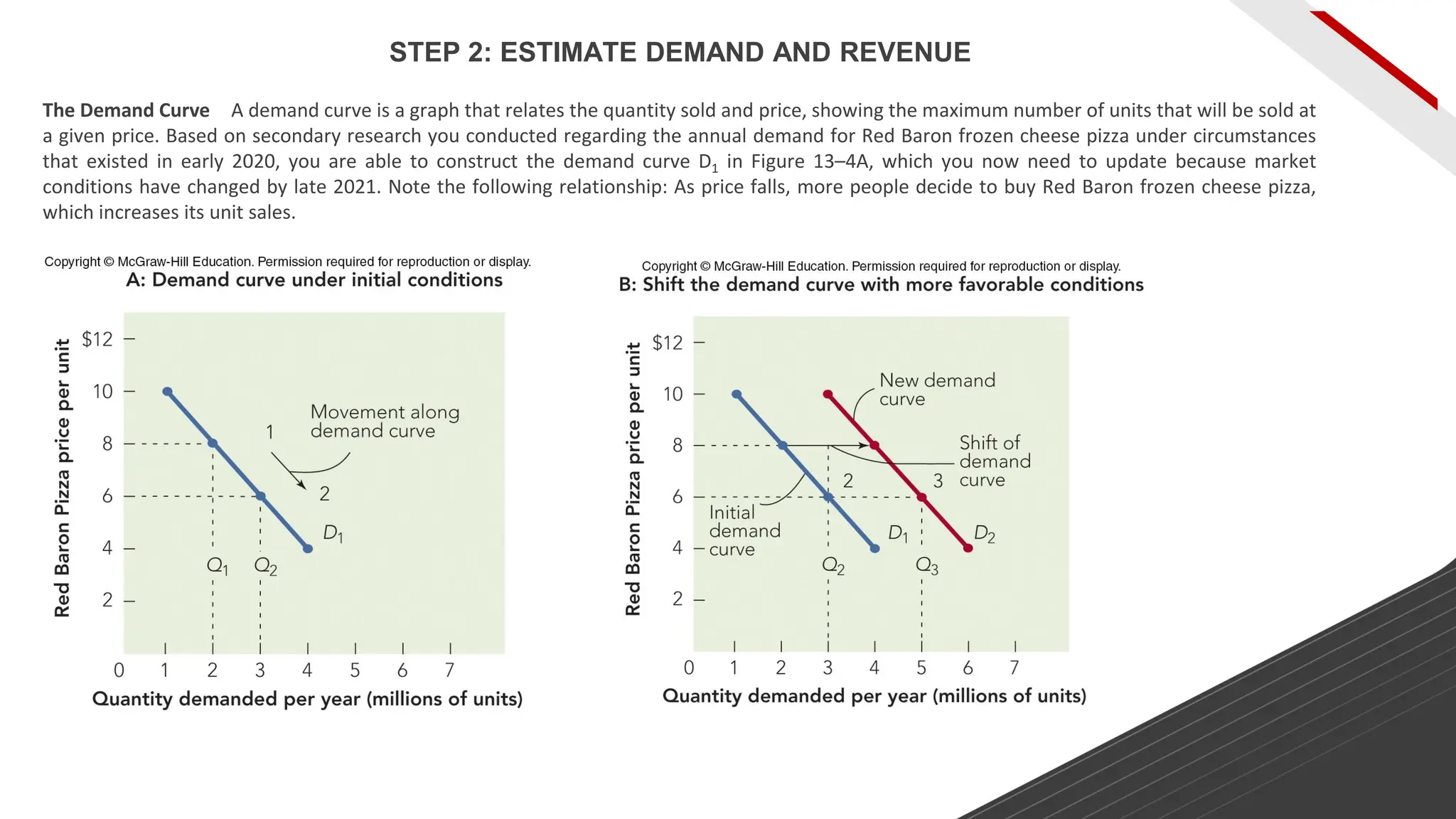
The Demand Curve A demand curve is a graph that relates the quantity sold and price, showing the maximum number of units that will be sold at
a given price. Based on secondary research you conducted regarding the annual demand for Red Baron frozen cheese pizza under circumstances
that existed in early 2020, you are able to construct the demand curve D1 in Figure 13–4A, which you now need to update because market
conditions have changed by late 2021. Note the following relationship: As price falls, more people decide to buy Red Baron frozen cheese pizza,
which increases its unit sales.
15.
But price isnot the complete story when estimating demand. Economists emphasize three other key factors that influence
demand for a product:
1.Consumer tastes: these depend on many forces such as demographics, culture, and technology. Because consumer tastes can
change quickly, up-to-date marketing research is essential to estimate demand. For example, if research by nutritionists concludes
that some pizzas are healthier (because they are now gluten-free or vegetarian), demand for them will probably increase.
2.Price and availability of similar products. If the price of a competitor’s pizza that is a substitute for yours—like
Tombstone pizza—falls, more people will buy it; its demand will rise and the demand for Red Baron pizza will fall. Other low-priced
dinners are also substitutes for pizza. For example, if you want something fast so you can study, you could call Domino’s or a local
Chinese restaurant and order a meal for home delivery. So, as the price of a substitute falls or its availability increases, the demand
for your Red Baron frozen cheese pizza will fall.
3.Consumer income. In general, as real consumers’ incomes increase (allowing for inflation), demand for a product will also
increase. So, if you get a scholarship and have extra cash for discretionary spending, you might eat more Red Baron frozen cheese
pizzas and fewer peanut butter and jelly sandwiches to satisfy your appetite.
Demand factors:
STEP 2: ESTIMATE DEMAND AND REVENUE
16.
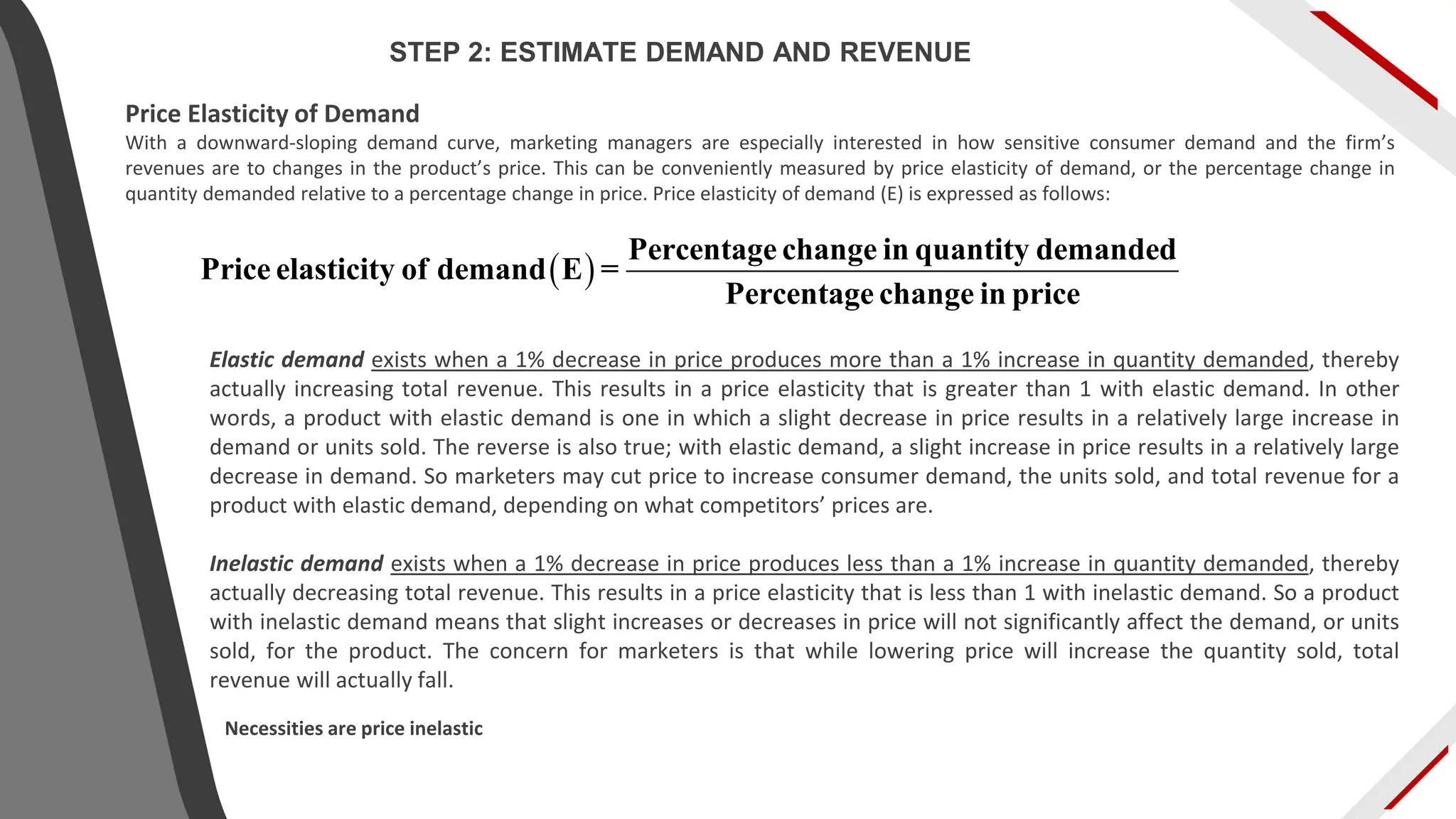
Price Elasticity ofDemand
With a downward-sloping demand curve, marketing managers are especially interested in how sensitive consumer demand and the firm’s
revenues are to changes in the product’s price. This can be conveniently measured by price elasticity of demand, or the percentage change in
quantity demanded relative to a percentage change in price. Price elasticity of demand (E) is expressed as follows:
Elastic demand exists when a 1% decrease in price produces more than a 1% increase in quantity demanded, thereby
actually increasing total revenue. This results in a price elasticity that is greater than 1 with elastic demand. In other
words, a product with elastic demand is one in which a slight decrease in price results in a relatively large increase in
demand or units sold. The reverse is also true; with elastic demand, a slight increase in price results in a relatively large
decrease in demand. So marketers may cut price to increase consumer demand, the units sold, and total revenue for a
product with elastic demand, depending on what competitors’ prices are.
Inelastic demand exists when a 1% decrease in price produces less than a 1% increase in quantity demanded, thereby
actually decreasing total revenue. This results in a price elasticity that is less than 1 with inelastic demand. So a product
with inelastic demand means that slight increases or decreases in price will not significantly affect the demand, or units
sold, for the product. The concern for marketers is that while lowering price will increase the quantity sold, total
revenue will actually fall.
( )
Percentage change in quantity demanded
Price elasticity of demand E =
Percentage change in price
Necessities are price inelastic
STEP 2: ESTIMATE DEMAND AND REVENUE
17.
Fundamentals of EstimatingRevenue
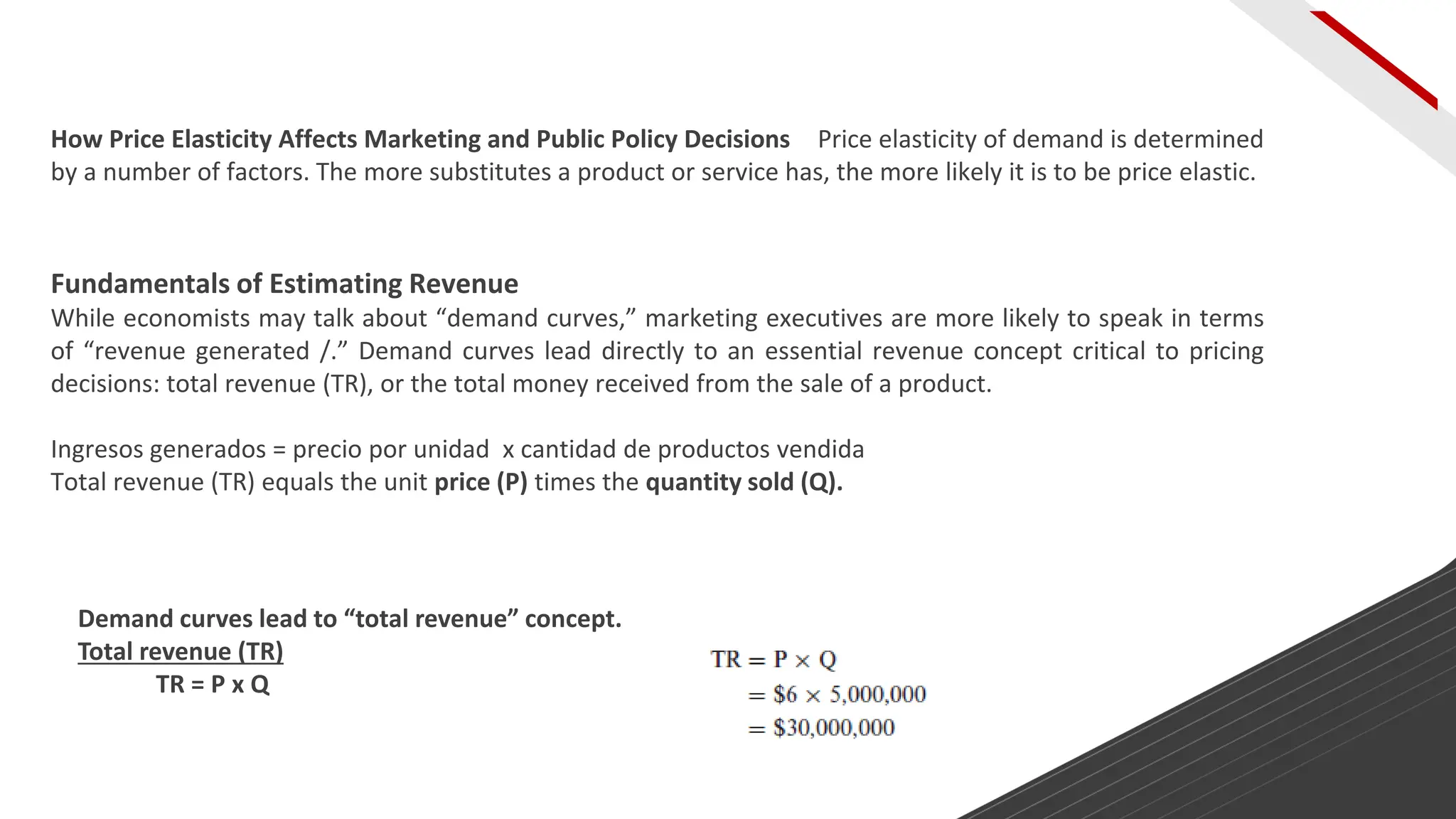
While economists may talk about “demand curves,” marketing executives are more likely to speak in terms
of “revenue generated /.” Demand curves lead directly to an essential revenue concept critical to pricing
decisions: total revenue (TR), or the total money received from the sale of a product.
Ingresos generados = precio por unidad x cantidad de productos vendida
Total revenue (TR) equals the unit price (P) times the quantity sold (Q).
How Price Elasticity Affects Marketing and Public Policy Decisions Price elasticity of demand is determined
by a number of factors. The more substitutes a product or service has, the more likely it is to be price elastic.
Demand curves lead to “total revenue” concept.
Total revenue (TR)
TR = P x Q
18.
Total Cost (TC)
Fixedcost (FC) / Costos fijos
Variable cost (VC) / Costos variables
Unit variable cost (UVC) / Costo variable unitario
Contribution margin (CM) / Margen de contribución
STEP 3: DETERMINE COST, VOLUME, AND PROFIT
RELATIONSHIPS
THE IMPORTANCE OF CONTROLLING COSTS AND MARGINS
13-18
19.
FIGURE 13-5 Fundamentalcost concepts
Total cost (TC) The total expense incurred by a firm in producing and marketing a product. Total cost
is the sum of fixed cost and variable cost. / El costo total es la suma del costo
fijo y el costo variable.
Fixed cost (FC) The sum of the expenses of the firm that are stable and do not change with the
quantity of a product that is produced and sold. Examples of fixed costs are rent on
the building, executive salaries, and insurance. / La suma de los gastos de la
empresa que son estables y no cambian con la cantidad de un producto que se
produce y vende.
Variable cost (VC) The sum of the expenses of the firm that vary directly with the quantity of a product
that is produced and sold. / La suma de los gastos de la empresa que varían
directamente con la cantidad de un producto que se produce y vende. For example,
as the quantity sold doubles, the variable cost doubles. Examples are the direct labor
and direct materials used in producing the product and the sales commissions that
are tied directly to the quantity sold. As mentioned above, TC = FC + VC
Unit variable cost
(UVC)
Expressed on a per unit basis, UVC = VC ÷ Q
Contribution margin
(CM)
Expressed o a per unit basis as the difference between unit selling price (P) and unit
variable cost (UVC), or as a percent:
CM = [UVC ÷ P] x 100
Diferencia entre el precio de venta unitario (P) y el costo variable unitario. 13-19
20.
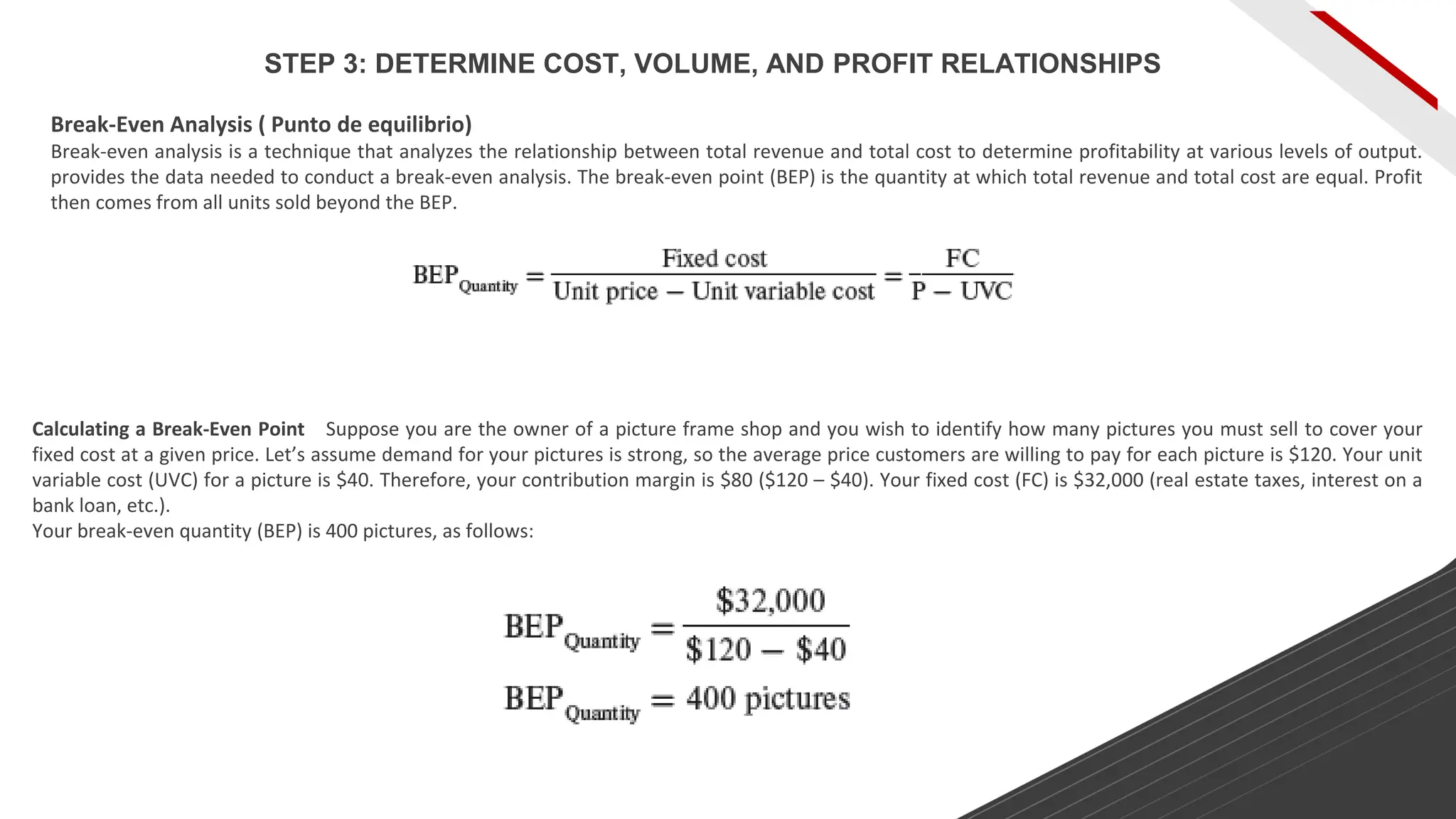
Break-Even Analysis (Punto de equilibrio)
Break-even analysis is a technique that analyzes the relationship between total revenue and total cost to determine profitability at various levels of output.
provides the data needed to conduct a break-even analysis. The break-even point (BEP) is the quantity at which total revenue and total cost are equal. Profit
then comes from all units sold beyond the BEP.
Calculating a Break-Even Point Suppose you are the owner of a picture frame shop and you wish to identify how many pictures you must sell to cover your
fixed cost at a given price. Let’s assume demand for your pictures is strong, so the average price customers are willing to pay for each picture is $120. Your unit
variable cost (UVC) for a picture is $40. Therefore, your contribution margin is $80 ($120 – $40). Your fixed cost (FC) is $32,000 (real estate taxes, interest on a
bank loan, etc.).
Your break-even quantity (BEP) is 400 pictures, as follows:
STEP 3: DETERMINE COST, VOLUME, AND PROFIT RELATIONSHIPS
21.
Access the textalternative for slide images.
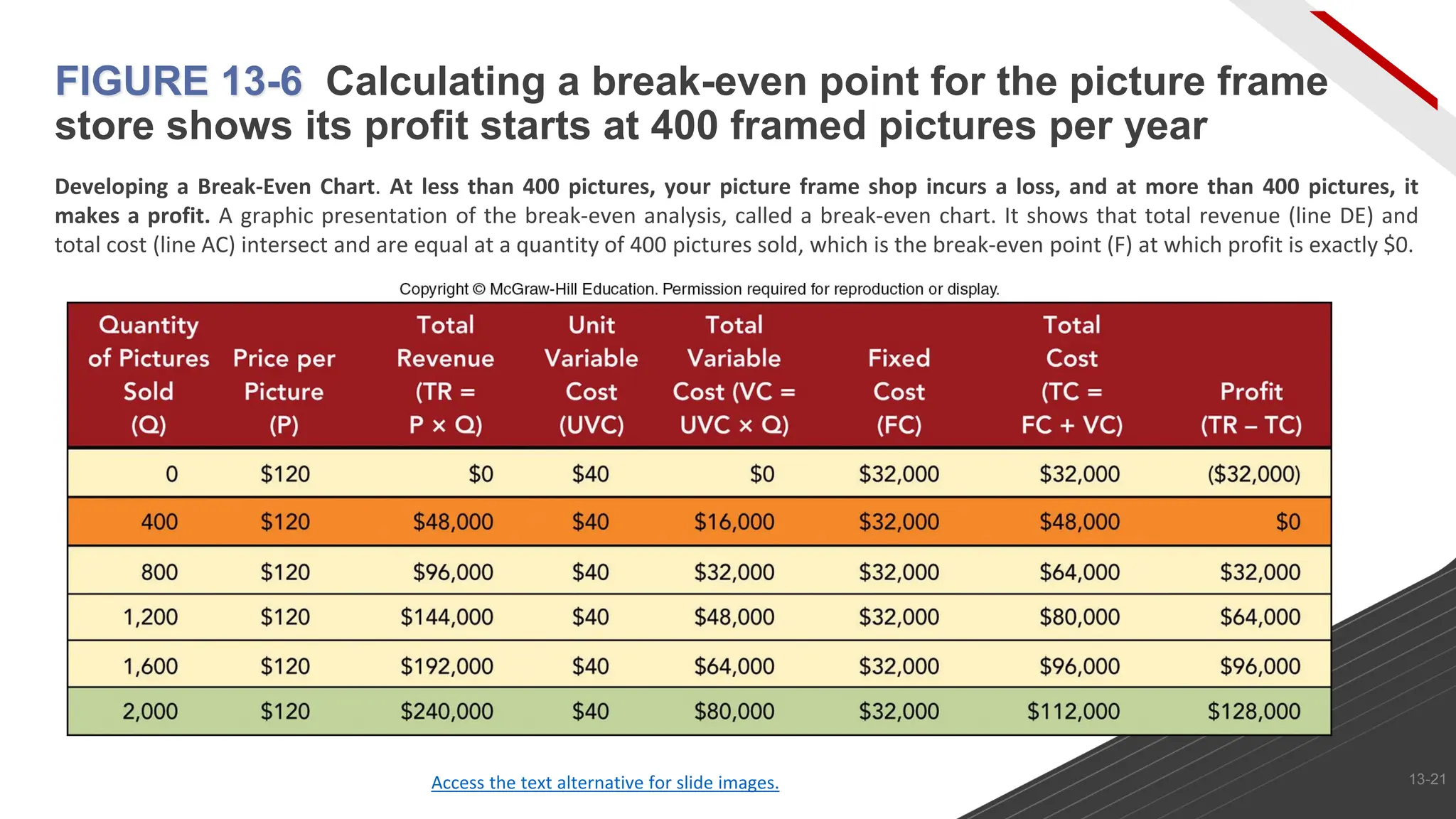
FIGURE 13-6 Calculating a break-even point for the picture frame
store shows its profit starts at 400 framed pictures per year
13-21
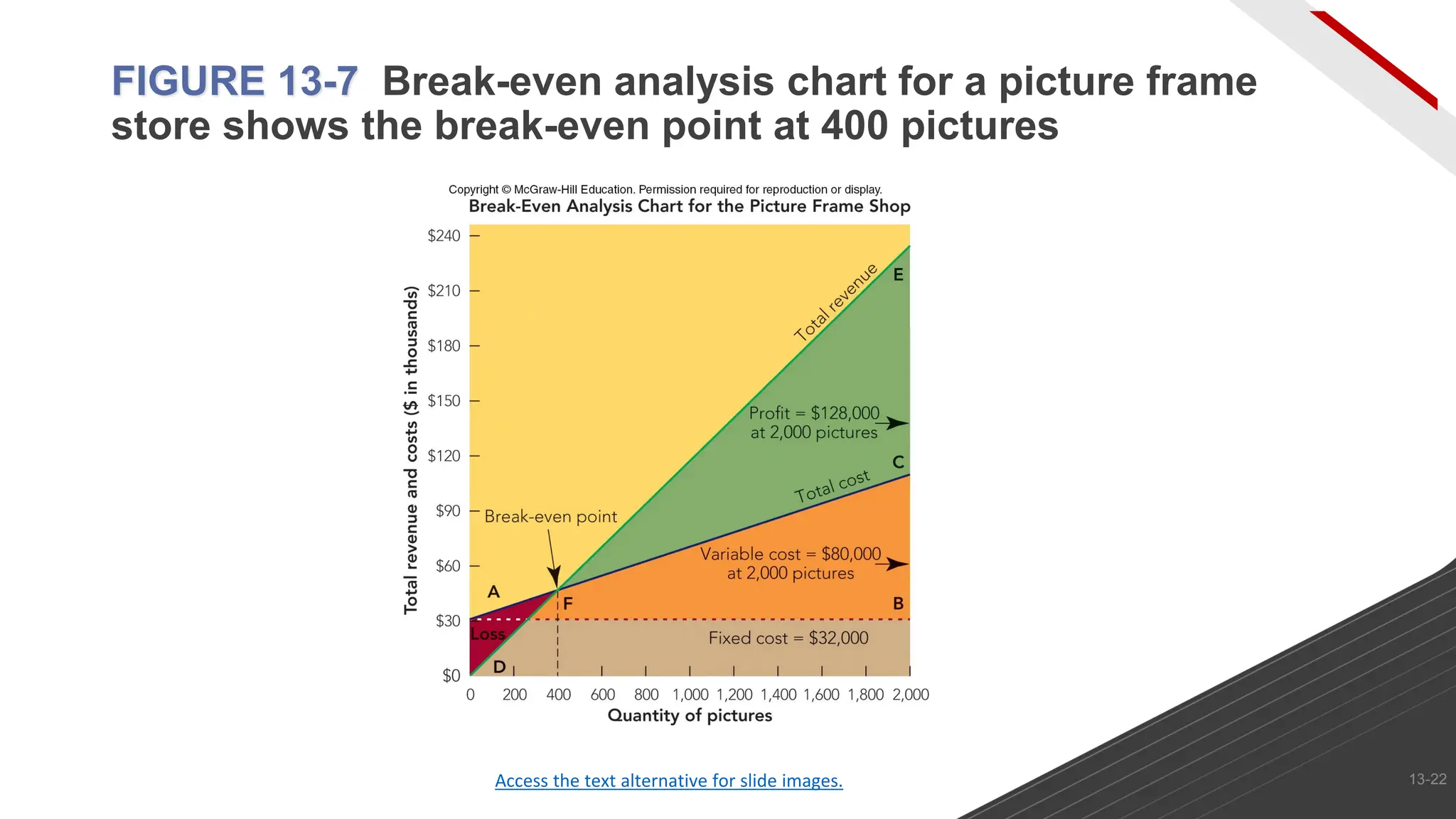
Developing a Break-Even Chart. At less than 400 pictures, your picture frame shop incurs a loss, and at more than 400 pictures, it
makes a profit. A graphic presentation of the break-even analysis, called a break-even chart. It shows that total revenue (line DE) and
total cost (line AC) intersect and are equal at a quantity of 400 pictures sold, which is the break-even point (F) at which profit is exactly $0.
22.
Access the textalternative for slide images.
FIGURE 13-7 Break-even analysis chart for a picture frame
store shows the break-even point at 400 pictures
13-22
23.
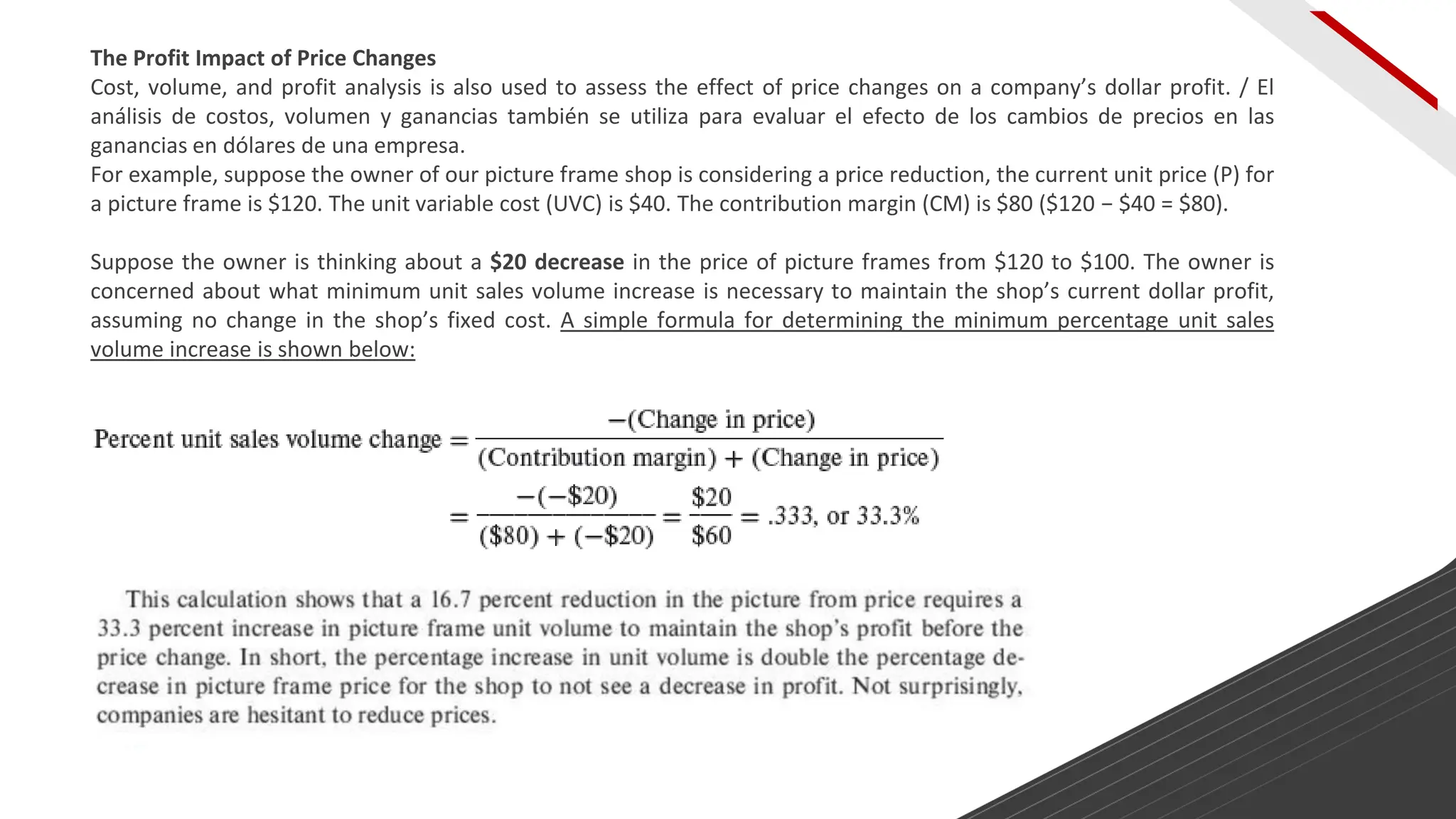
The Profit Impactof Price Changes
Cost, volume, and profit analysis is also used to assess the effect of price changes on a company’s dollar profit. / El
análisis de costos, volumen y ganancias también se utiliza para evaluar el efecto de los cambios de precios en las
ganancias en dólares de una empresa.
For example, suppose the owner of our picture frame shop is considering a price reduction, the current unit price (P) for
a picture frame is $120. The unit variable cost (UVC) is $40. The contribution margin (CM) is $80 ($120 − $40 = $80).
Suppose the owner is thinking about a $20 decrease in the price of picture frames from $120 to $100. The owner is
concerned about what minimum unit sales volume increase is necessary to maintain the shop’s current dollar profit,
assuming no change in the shop’s fixed cost. A simple formula for determining the minimum percentage unit sales
volume increase is shown below:
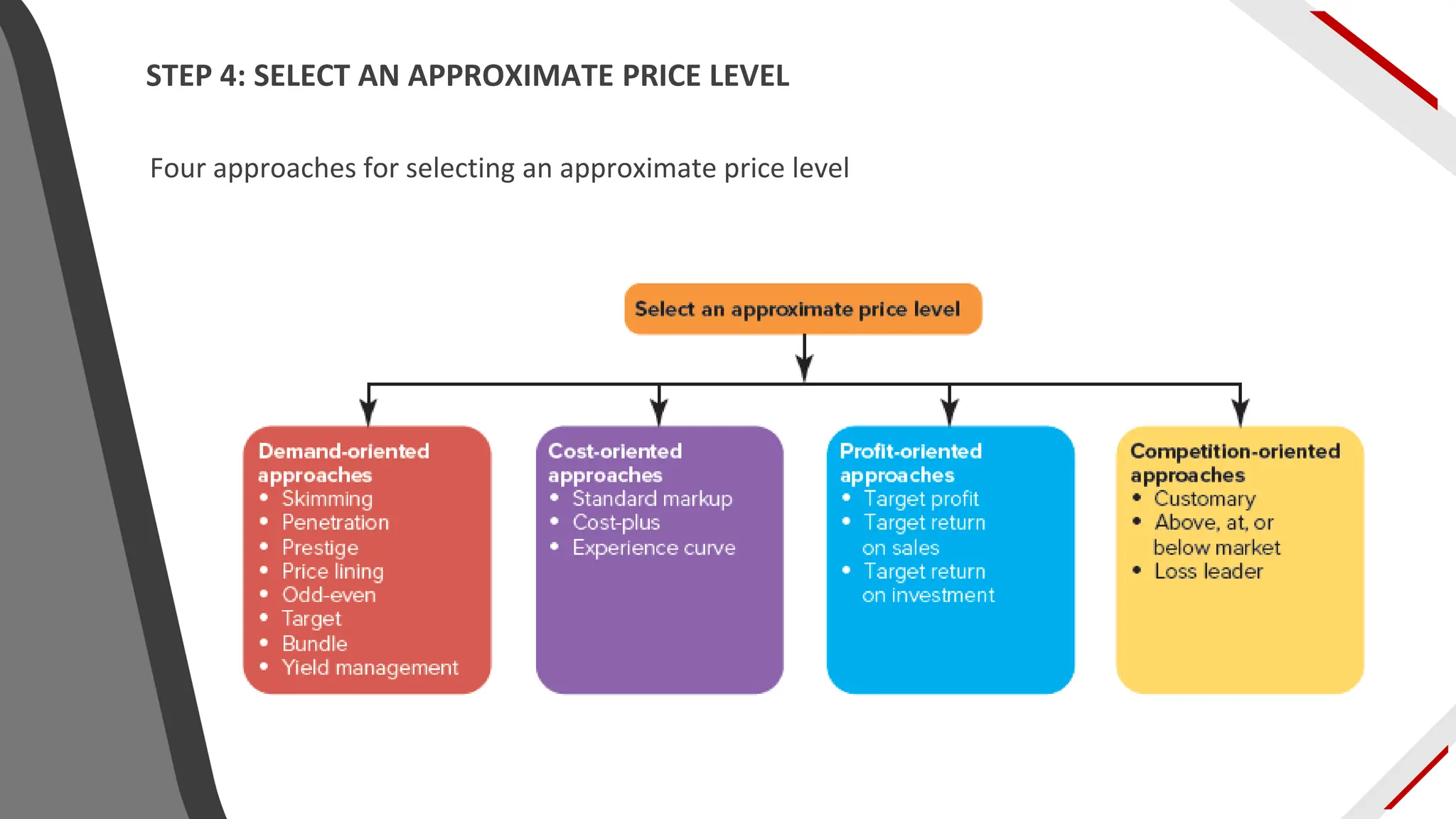
24.
Four approaches forselecting an approximate price level
STEP 4: SELECT AN APPROXIMATE PRICE LEVEL
25.
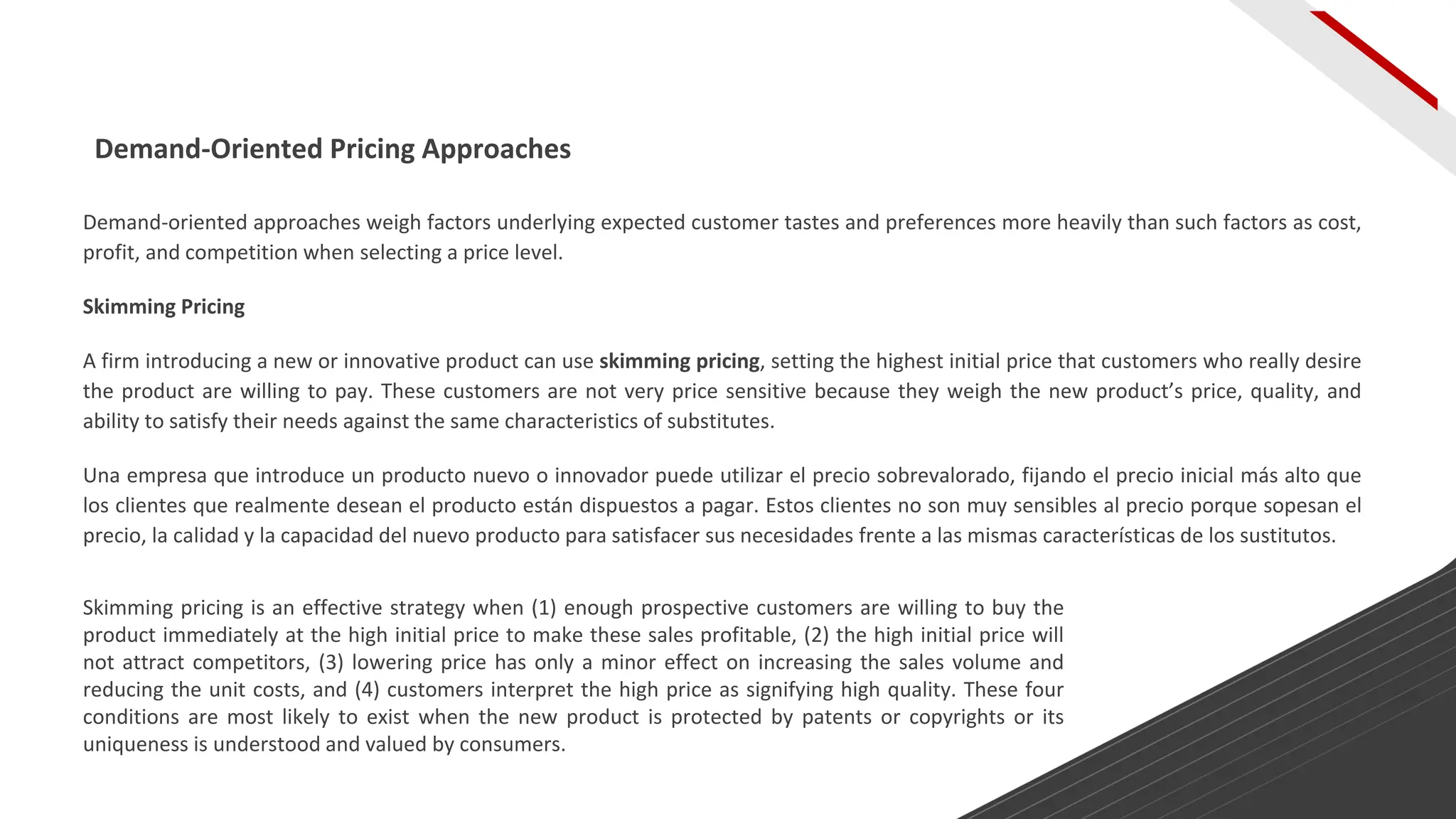
Demand-oriented approaches weighfactors underlying expected customer tastes and preferences more heavily than such factors as cost,
profit, and competition when selecting a price level.
Skimming Pricing
A firm introducing a new or innovative product can use skimming pricing, setting the highest initial price that customers who really desire
the product are willing to pay. These customers are not very price sensitive because they weigh the new product’s price, quality, and
ability to satisfy their needs against the same characteristics of substitutes.
Una empresa que introduce un producto nuevo o innovador puede utilizar el precio sobrevalorado, fijando el precio inicial más alto que
los clientes que realmente desean el producto están dispuestos a pagar. Estos clientes no son muy sensibles al precio porque sopesan el
precio, la calidad y la capacidad del nuevo producto para satisfacer sus necesidades frente a las mismas características de los sustitutos.
Demand-Oriented Pricing Approaches
Skimming pricing is an effective strategy when (1) enough prospective customers are willing to buy the
product immediately at the high initial price to make these sales profitable, (2) the high initial price will
not attract competitors, (3) lowering price has only a minor effect on increasing the sales volume and
reducing the unit costs, and (4) customers interpret the high price as signifying high quality. These four
conditions are most likely to exist when the new product is protected by patents or copyrights or its
uniqueness is understood and valued by consumers.
26.
Penetration Pricing: Settinga low initial price on a new product to appeal immediately to the mass market is
penetration pricing, the exact opposite of skimming pricing. / Fijar un precio inicial bajo en un nuevo producto
para atraer inmediatamente al mercado de masas es la fijación de precios de penetración, justo lo contrario de
la fijación de precios de sobrevalorado.
The conditions favoring penetration pricing are the reverse of those supporting skimming pricing: (1) many
segments of the market are price sensitive, (2) a low initial price discourages competitors from entering the
market, and (3) unit production and marketing costs fall dramatically as production volumes increase. A firm
using penetration pricing may (1) maintain the initial price for a time to gain profit lost from its low
introductory level or (2) lower the price further, counting on the new volume to generate the necessary profit.
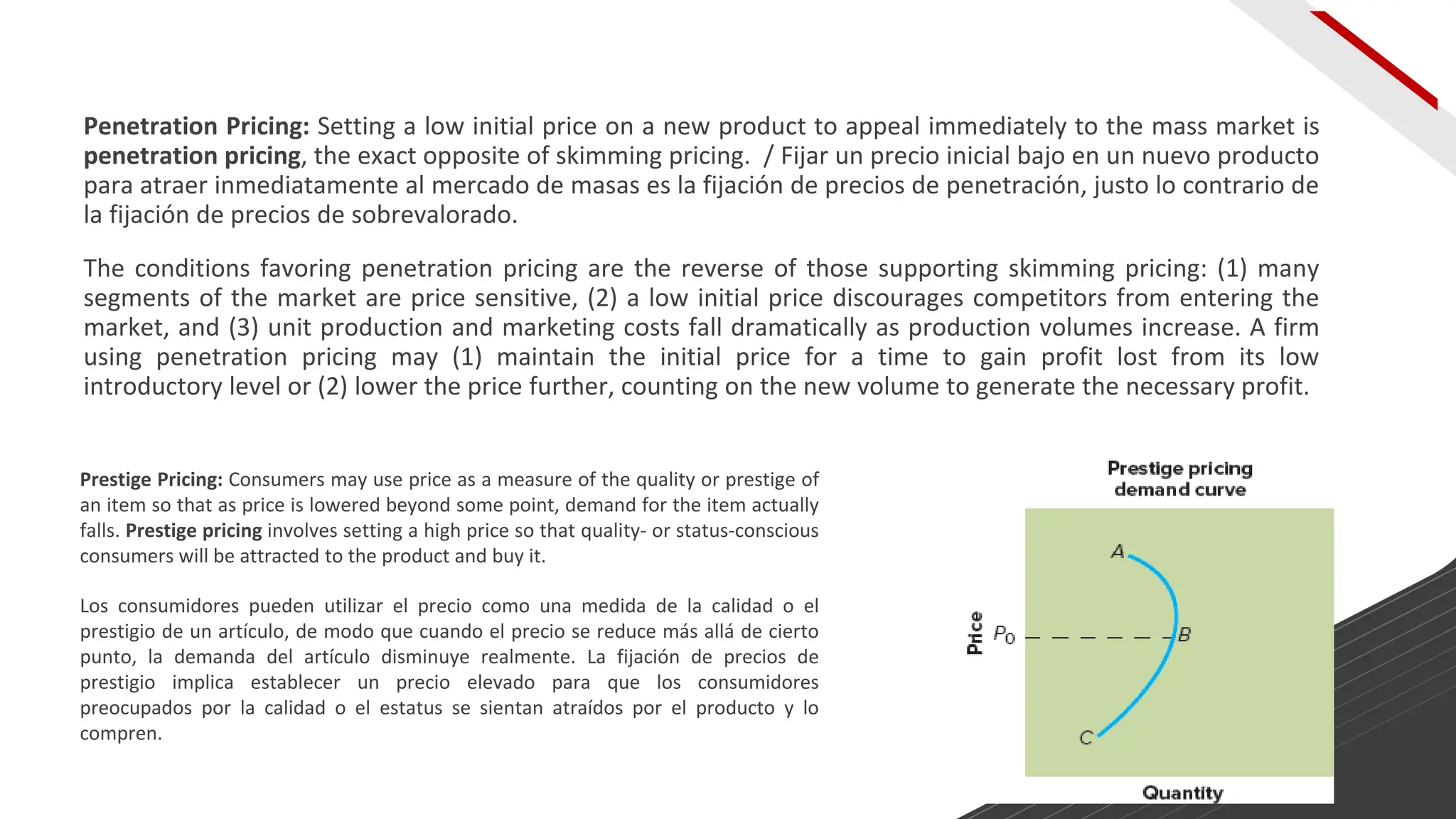
Prestige Pricing: Consumers may use price as a measure of the quality or prestige of
an item so that as price is lowered beyond some point, demand for the item actually
falls. Prestige pricing involves setting a high price so that quality- or status-conscious
consumers will be attracted to the product and buy it.
Los consumidores pueden utilizar el precio como una medida de la calidad o el
prestigio de un artículo, de modo que cuando el precio se reduce más allá de cierto
punto, la demanda del artículo disminuye realmente. La fijación de precios de
prestigio implica establecer un precio elevado para que los consumidores
preocupados por la calidad o el estatus se sientan atraídos por el producto y lo
compren.
27.
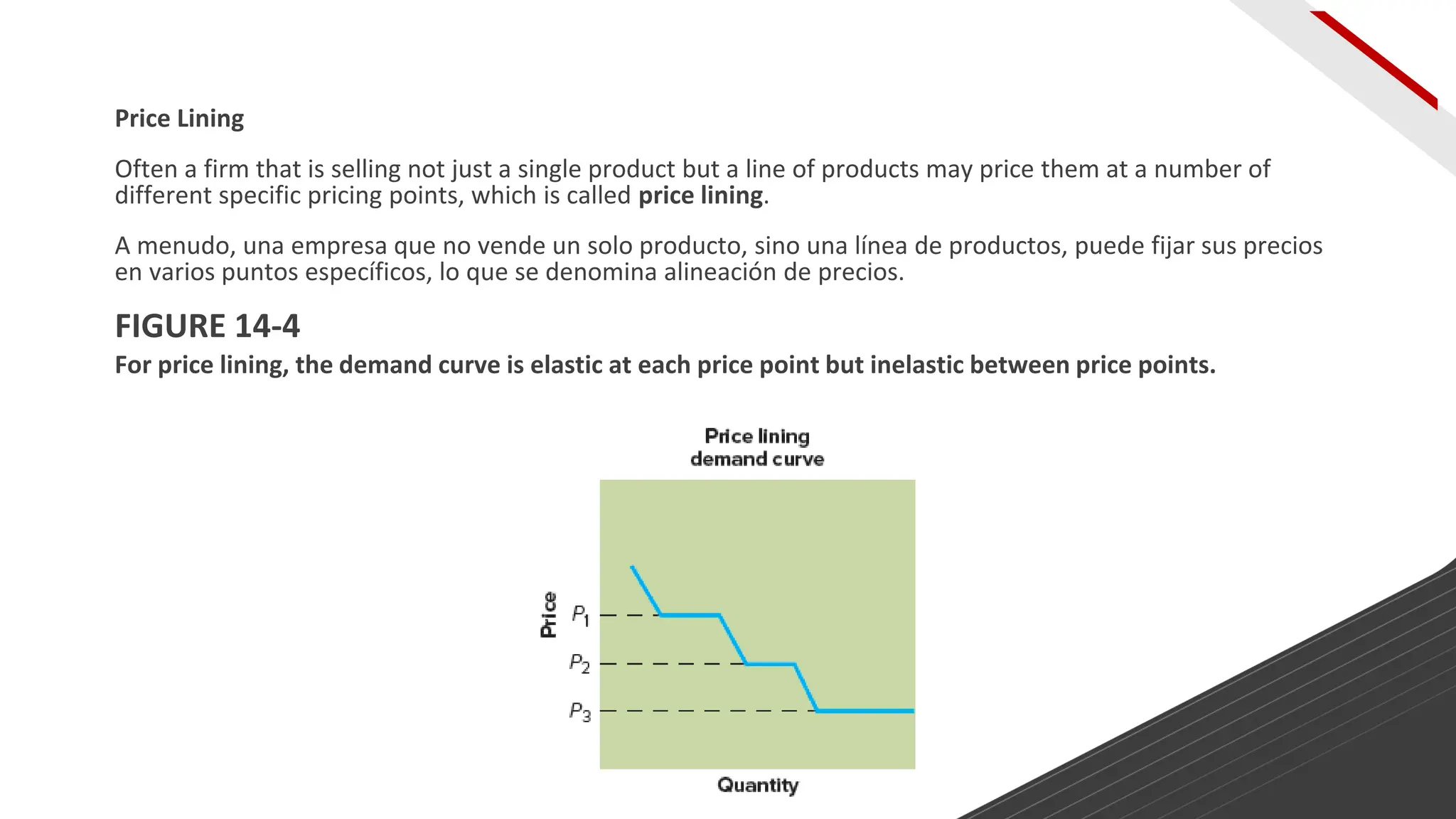
Price Lining
Often afirm that is selling not just a single product but a line of products may price them at a number of
different specific pricing points, which is called price lining.
A menudo, una empresa que no vende un solo producto, sino una línea de productos, puede fijar sus precios
en varios puntos específicos, lo que se denomina alineación de precios.
FIGURE 14-4
For price lining, the demand curve is elastic at each price point but inelastic between price points.
28.
Odd-Even Pricing: Applepriced its iPhone 11 model at $699, Lowe’s offers a DeWalt radial saw for $599.99, and
the suggested retail price for the Gillette Fusion shaving system is $11.99. Why not simply price these items at
$1,000, $600, and $12, respectively? These firms are using odd-even pricing, which involves setting prices a few
dollars or cents under an even number.
La fijación de precios pares o impares consiste en fijar los precios unos pocos dólares o céntimos por debajo de
un número par.
Target Pricing: Manufacturers will sometimes estimate the price that the ultimate consumer would be willing to
pay for a product. They then work backward through markups taken by retailers and wholesalers to determine
what price they can charge wholesalers for the product. This practice, called target pricing, results in the
manufacturer deliberately adjusting the composition and features of a product to achieve the target price to
consumers.
En ocasiones, los fabricantes calculan el precio que el consumidor final estaría dispuesto a pagar por un
producto. A continuación, trabajan de forma retrospectiva a través de los márgenes de beneficio aplicados por
los minoristas y los mayoristas para determinar el precio que pueden cobrar a los mayoristas por el producto.
Esta práctica, denominada precio objetivo, hace que el fabricante ajuste deliberadamente la composición y las
características de un producto para conseguir el precio objetivo para los consumidores.
29.
Bundle Pricing: Afrequently used demand-oriented pricing practice is bundle pricing—the marketing of two or
more products in a single package price.
Una práctica de fijación de precios orientada a la demanda que se utiliza con frecuencia es la fijación de precios
por paquetes, es decir, la comercialización de dos o más productos en un único precio por paquete.
Yield Management Pricing
Have you noticed seats on airline flights are priced differently within coach class? This is yield management
pricing—the charging of different prices to maximize revenue for a set amount of capacity at any given time.
Se trata de un sistema de gestión de la rentabilidad, es decir, el cobro de diferentes precios para maximizar los
ingresos por una cantidad determinada de capacidad en un momento dado.
Yield management pricing is a complex approach that continually matches demand and supply to customize the
price for a service.
30.
Choose a PricePolicy
Choosing a price policy is important in setting a list or quoted price. Two options are
common—a fixed-price policy or a dynamic pricing policy.
Fixed-Price Policy
Most companies use a fixed-price policy. A fixed-price policy, also called a one-price
policy, is setting one price for all buyers of a product or service.
Una política de precio fijo, también llamada política de precio único, consiste en
establecer un único precio para todos los compradores de un producto o servicio.
STEP 5: SET THE LIST OR QUOTED PRICE
31.
Dynamic Pricing Policy
Incontrast, a dynamic pricing policy, also called a flexible-price policy, involves setting different prices for
products and services in real time in response to supply and demand conditions. A dynamic pricing policy
gives sellers considerable discretion in setting the final price in light of demand, cost, and competitive
factors. Yield management pricing described earlier is a form of dynamic pricing because prices vary by an
individual buyer’s purchase situation, company cost considerations, and competitive conditions.
Una política de precios dinámica, también llamada política de precios flexibles, consiste en fijar diferentes
precios para productos y servicios en tiempo real en respuesta a las condiciones de la oferta y la demanda.
Una política de precios dinámicos otorga a los vendedores una considerable discrecionalidad a la hora de
fijar el precio final en función de la demanda, el coste y los factores competitivos. La fijación de precios de
gestión de la rentabilidad descrita anteriormente es una forma de fijación de precios dinámica porque los
precios varían en función de la situación de compra de un comprador individual, de las consideraciones de
costes de la empresa y de las condiciones de la competencia.
STEP 5: SET THE LIST OR QUOTED PRICE
32.
1) Descremado: elprecio inicial más alto a un nuevo producto en el mercado.
2) Penetración de mercado: ofertas de lanzamiento y las compañías optan, comúnmente, por establecer un precio muy bajo,
para alcanzar al mayor número de público objetivo y penetrar más fácilmente en segmentos de todos los estratos económicos.
3) Status quo (competencia): observan muy de cerca el comportamiento de las empresas de su mismo sector de actividad y que
ofrecen productos similares. Establecen precios para alinearse con las estrategias existentes y captar al mismo público.
Estrategias de fijación de precios
Consideraciones:
+Estrategia de liderazgo de Porter: En precio bajo, Diferenciación, Enfoque y combinaciones.
- Naturaleza del producto y Mercado meta.
-Precios dinámicos: Es una estrategia flexible en la que los precios fluctúan de acuerdo con el mercado y la
demanda del shopper. Mediante algoritmos, las empresas utilizan precios dinámicos considerando el precio de la
competencia, la demanda y otros factores.
-Zona geográfica: Importaciones y Exportaciones.
33.
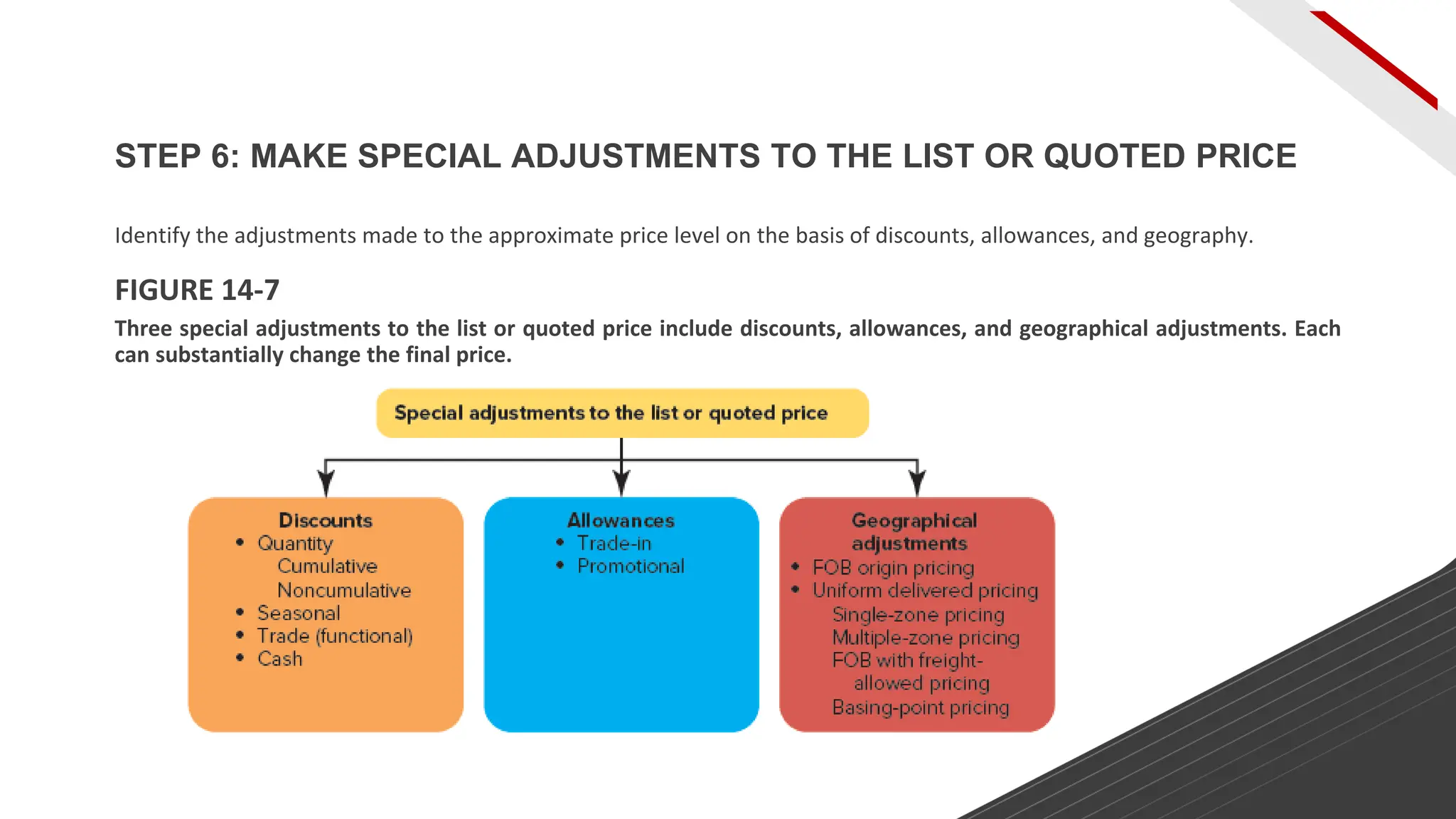
Identify the adjustmentsmade to the approximate price level on the basis of discounts, allowances, and geography.
FIGURE 14-7
Three special adjustments to the list or quoted price include discounts, allowances, and geographical adjustments. Each
can substantially change the final price.
STEP 6: MAKE SPECIAL ADJUSTMENTS TO THE LIST OR QUOTED PRICE
34.
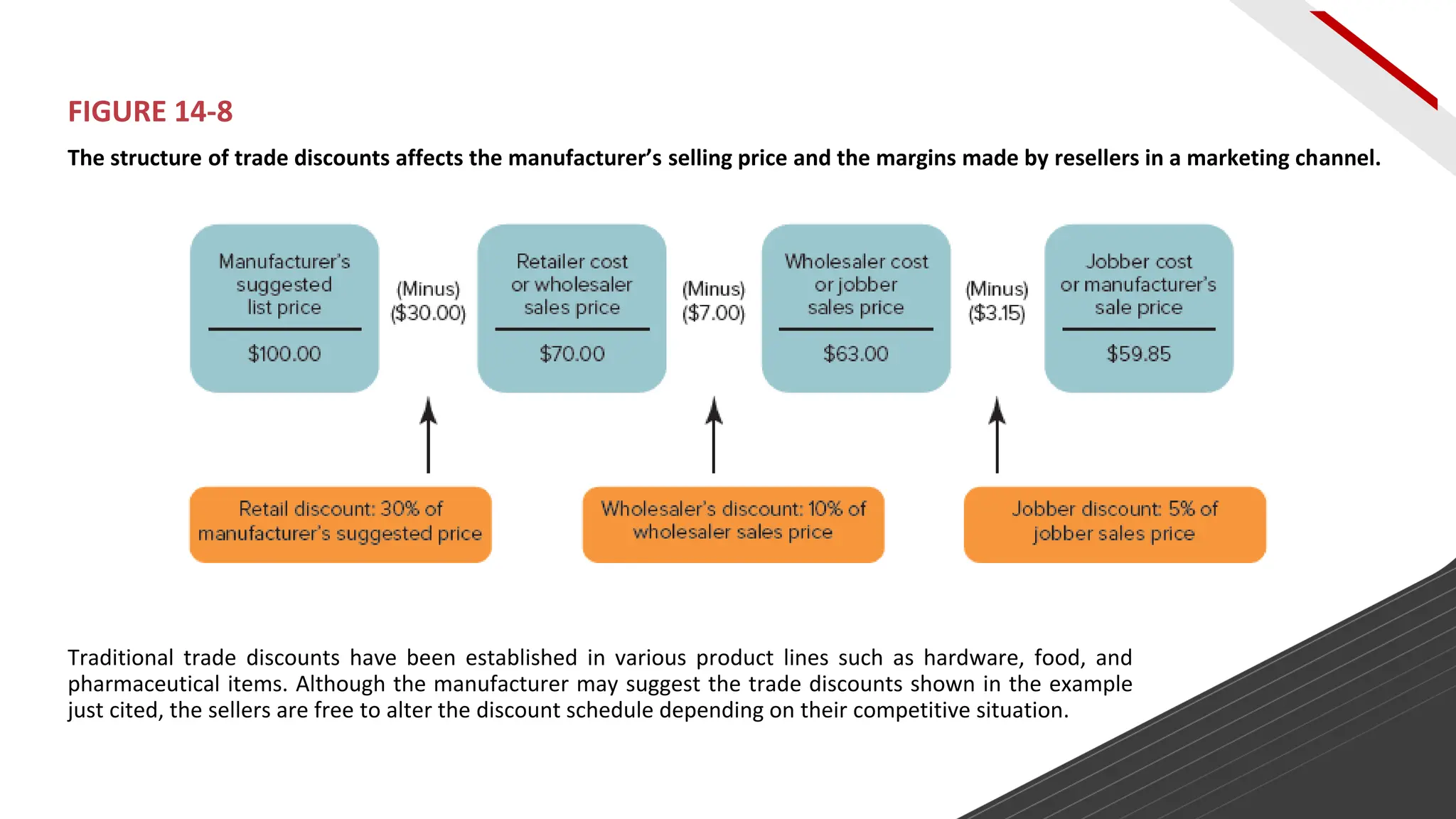
Traditional trade discountshave been established in various product lines such as hardware, food, and
pharmaceutical items. Although the manufacturer may suggest the trade discounts shown in the example
just cited, the sellers are free to alter the discount schedule depending on their competitive situation.
FIGURE 14-8
The structure of trade discounts affects the manufacturer’s selling price and the margins made by resellers in a marketing channel.
35.
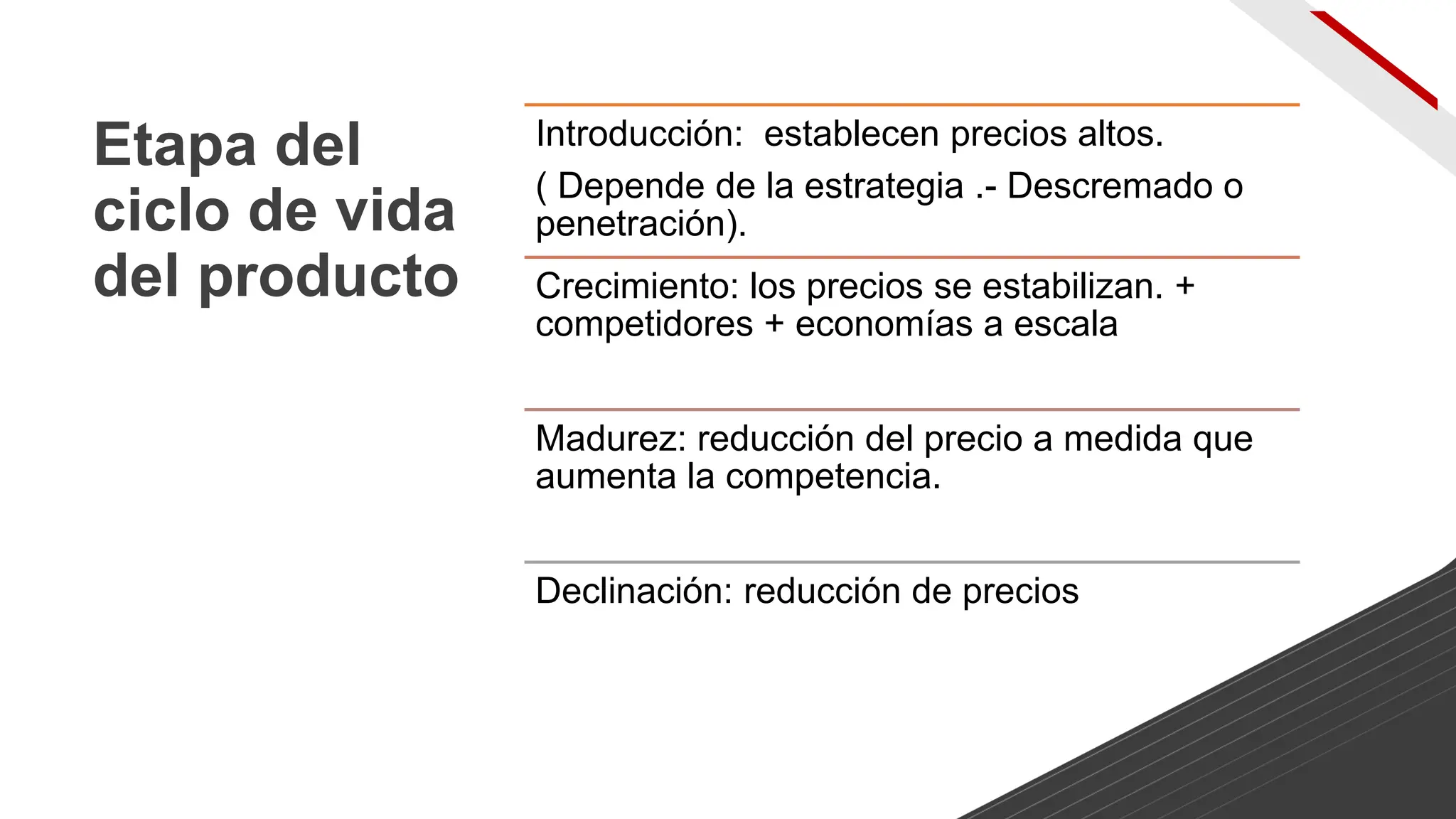
Etapa del
ciclo devida
del producto
Introducción: establecen precios altos.
( Depende de la estrategia .- Descremado o
penetración).
Crecimiento: los precios se estabilizan. +
competidores + economías a escala
Madurez: reducción del precio a medida que
aumenta la competencia.
Declinación: reducción de precios

![FIGURE 13-5 Fundamental cost concepts
Total cost (TC) The total expense incurred by a firm in producing and marketing a product. Total cost
is the sum of fixed cost and variable cost. / El costo total es la suma del costo
fijo y el costo variable.
Fixed cost (FC) The sum of the expenses of the firm that are stable and do not change with the
quantity of a product that is produced and sold. Examples of fixed costs are rent on
the building, executive salaries, and insurance. / La suma de los gastos de la
empresa que son estables y no cambian con la cantidad de un producto que se
produce y vende.
Variable cost (VC) The sum of the expenses of the firm that vary directly with the quantity of a product
that is produced and sold. / La suma de los gastos de la empresa que varían
directamente con la cantidad de un producto que se produce y vende. For example,
as the quantity sold doubles, the variable cost doubles. Examples are the direct labor
and direct materials used in producing the product and the sales commissions that
are tied directly to the quantity sold. As mentioned above, TC = FC + VC
Unit variable cost
(UVC)
Expressed on a per unit basis, UVC = VC ÷ Q
Contribution margin
(CM)
Expressed o a per unit basis as the difference between unit selling price (P) and unit
variable cost (UVC), or as a percent:
CM = [UVC ÷ P] x 100
Diferencia entre el precio de venta unitario (P) y el costo variable unitario. 13-19](https://image.slidesharecdn.com/cap9-250821222035-4f9398d0/75/CAP-9-Building-the-Price-Foundation-pdf-19-2048.jpg)