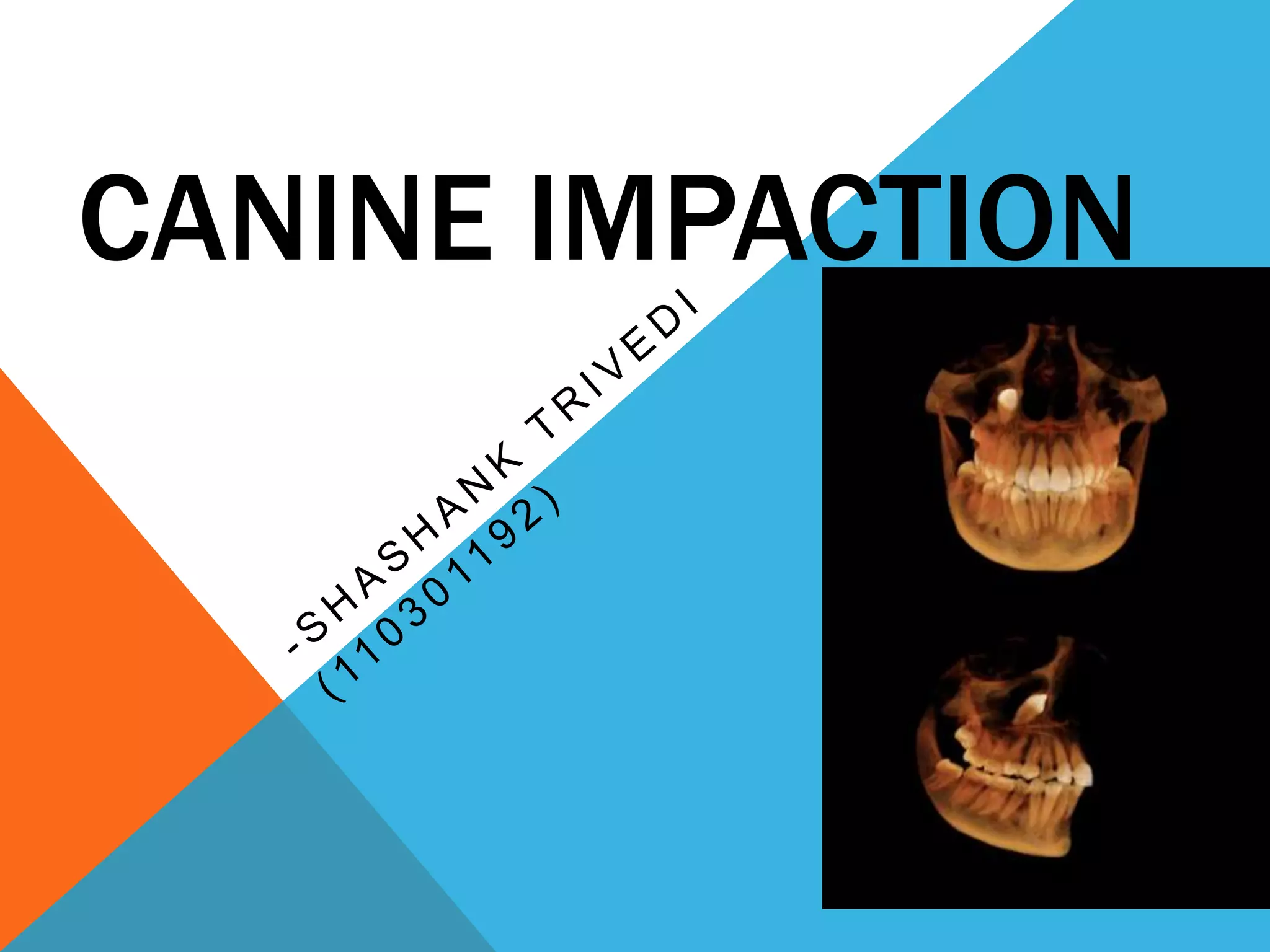
CANINE IMPACTION
WHAT IS AN IMPACTION?
• An impacted tooth is one that fails to erupt
into the dental arch within the specific
time.
• The most common teeth to become
impacted are the wisdom teeth.
• They are the last teeth to emerge, usually
between the ages of 17 and 21.
Causes:-
An impacted tooth remains stuck in gum
tissue or bone for various reasons:
1. The area is overcrowded and there's no room
for the teeth to emerge. For example, the jaw
may be too small to fit the wisdom teeth.
2. Teeth may also become twisted, tilted, or
displaced as they try to emerge, resulting in
impacted teeth.
IMPACTED CANINES
• Canines are the most commonly impacted teeth,
second only to third molars.
• Maxillary canine impaction occurs in approximately
2% of the population and is twice as common in
females as it is in males.
• The incidence of canine impaction in the maxilla is
more than twice that in the mandible.
• Of all patients who have impacted maxillary
canines, 8% have bilateral impactions.
• Arch length discrepancy is thought to be a primary
etiologic factor for labially impacted canines.
ETIOLOGY
Several etiologic factors for canine
impactions have been proposed:
1. Localized factors
2. Systemic Factors
3. Genetic Factors
LOCALIZED FACTORS
• Tooth size-arch length discrepancies.
• Failure of the primary canine root to resorb.
• Prolonged retention or early loss of the primary
canine
• Ankylosis of the permanent canine.
• Cyst or neoplasm.
• Dilaceration of the root.
• Absence of the maxillary lateral incisor.
• Variation in root size of lateral incisor (Peg
Shaped lateral incisor)
• Variation in timing of lateral incisor root
formation.
• Iatrogenic factors.
SYSTEMIC FACTORS
• Endocrine deficiencies
• Febrile diseases
• Irradiation
GENETIC FACTORS
• Heredity
• Malposed Tooth germ
• Presence of an alveolar cleft
Guidance Theory:
It proposes that the canine
erupts along the root of
the lateral incisor, which
serves as a guide, and if
the root of the lateral
incisor is absent or
malformed, the canine
will not erupt.
Genetic Theory:
It points to genetic factors
as a primary origin of
palatally displaced
maxillary canines and
includes other possibly
associated dental
anomalies, such as
missing or small lateral
incisors.
TWO MAJOR THEORIES ASSOCIATED WITH PALATALLY
DISPLACED MAXILLARY CANINES ARE:-
NOTE:It has been reported that palatally impacted maxillary canines are
genetically reciprocally associated with anomalies such as enamel hypoplasia,
infraocclusion of primary molars, aplasia of second premolars, and small
maxillary lateral incisors.
SEQUELAE OF CANINE IMPACTION
1. Labial or lingual malpositioning of the impacted
tooth,
2. Migration of the neighbouring teeth and loss of arch
length,
3. Internal resorption,
4. Dentigerous cyst formation,
5. External root resorption of the impacted tooth, as
well as the neighbouring teeth,
6. Infection particularly with partial eruption, and
7. Referred pain and combinations of the above
sequelae.
CLINICAL EVALUATION
It has been suggested that the following clinical
signs might be indicative of canine impaction:
• Delayed eruption of the permanent canine or
prolonged retention of the deciduous canine
beyond 14–15 years of age
• Absence of a normal labial canine bulge
• Presence of a palatal bulge
• Delayed eruption, distal tipping, or migration
(splaying) of the lateral incisor.
For an accurate diagnosis, the clinical
examination should be supplemented with a
Although various
radiographic exposures
including occlusal films,
panoramic views, and lateral
cephalograms can help in
evaluating the position of the
canines, in most cases,
periapical films are uniquely
reliable for that purpose.
PERIAPICAL FILMS
A single periapical film provides the clinician with a two-dimensional
representation of the dentition. In other words, it would relate the
canine to the neighboring teeth both mesiodistally and
superoinferiorly. To evaluate the position of the canine
buccolingually, a second periapical film should be obtained by one of
the following methods:
1. Tube-shift technique or Clark's rule or (SLOB) rule
Two periapical films are taken of the same area, with the horizontal angulation of the
cone changed when the second film is taken. If the object in question moves in the
same direction as the cone, it is lingually positioned. If the object moves in the
opposite direction, it is situated closer to the source of radiation and is therefore
buccally located.
2. Buccal-object rule
If the vertical angulation of the cone is changed by approximately 20° in two
successive periapical films, the buccal object will move in the direction opposite to the
source of radiation. On the other hand, the lingual object will move in the same
direction as the source of radiation. The basic principle of this technique deals with the
foreshortening and elongation of the images of the films.
OCCLUSAL FILMS
They help to determine the buccolingual
position of the impacted canine in
conjunction with the periapical films,
provided that the image of the impacted
canine is not superimposed on the other
teeth.
EXTRAORAL FILMS
1. Frontal and lateral cephalograms
These can sometimes aid in the determination of the position
of the impacted canine, particularly its relationship to other
facial structures (e.g., the maxillary sinus and the floor of the
nose).
2. Panoramic films
These are also used to localize impacted teeth in all three
planes of space, as much the same as with two periapical films in
the tube-shift method, with the understanding that the source of
radiation comes from behind the patient; thus, the movements
are reversed for position.
INTERCEPTIVE TREATMENT
• When the clinician detects early signs of ectopic
eruption of the canines, an attempt should be made
to prevent their impaction and its potential
sequelae.
• Selective extraction of the deciduous canines as
early as 8 or 9 years of age has been suggested as
an interceptive approach to canine impaction in
Class I uncrowded cases.
• It has been suggested that removal of the
deciduous canine before the age of 11 years will
normalize the position of the ectopically erupting
permanent canines in 91% of the cases if the
canine crown is distal to the midline of the lateral
incisor. On the other hand, the success rate is only
64% if the canine crown is mesial to the midline of
TREATMENT ALTERNATIVES
Each patient with an impacted canine must undergo a comprehensive
evaluation of the malocclusion. The clinician should then consider the
various treatment options available for the patient, including the following:
1. No treatment if the patient does not desire it. In such a case,
the clinician should periodically evaluate the impacted tooth
for any pathologic changes.
2. Autotransplantation of the canine.
3. Extraction of the impacted canine and movement of a first
premolar in its position.
4. Extraction of the canine and posterior segmental osteotomy
to move the buccal segment mesially to close the residual
space.
5. Prosthetic replacement of the canine.
6. Surgical exposure of the canine and orthodontic treatment
EXTRACTION OF AN IMPACTED
CANINE
• It should be emphasized that extraction of
the labially erupting and crowded canine,
unsightly as this tooth may look, is
contraindicated.
• Such an extraction might temporarily
improve the esthetics, but may complicate
and compromise the orthodontic treatment
results, including the ability to provide the
patient with a functional occlusion.
THE EXTRACTION OF THE CANINE, ALTHOUGH SELDOM
CONSIDERED, MIGHT BE A WORKABLE OPTION IN THE
FOLLOWING SITUATIONS:
1. If it is ankylosed and cannot be transplanted,
2. If it is undergoing external or internal root resorption,
3. If its root is severely dilacerated,
4. If the impaction is severe (e.g., the canine is lodged between
the roots of the central and lateral incisors and orthodontic
movement will jeopardize these teeth),
5. If the occlusion is acceptable, with the first premolar in the
position of the canine and with an otherwise functional
occlusion with well-aligned teeth,
6. If there are pathologic changes (e.g., cystic formation,
infection),
7. If the patient does not desire orthodontic treatment.
CONCLUSION
• The management of impacted canines is important in terms of esthetics and
function.
• Clinicians must formulate treatment plans that are in the best interest of the patient
and they must be knowledgeable about the variety of treatment options.
• When patients are evaluated and treated properly, clinicians can reduce the
frequency of ectopic eruption and subsequent impaction of the maxillary canine.
• The simplest interceptive procedure that can be used to prevent impaction of
permanent canines is the timely extraction of the primary canines. This procedure
usually allows the permanent canines to become upright and erupt properly into the
dental arch, provided sufficient space is available to accommodate them.
• The proper management of these teeth, however, requires that the appropriate
surgical technique be used and that the clinician be able to apply measured forces
in a favorable direction.
• This allows for complete control in efficient correction of the impaction and for
avoidance of damage to adjacent teeth.
• Careful selection of surgical and orthodontic techniques is essential for the
successful alignment of impacted canines.
BIBLIOGRAPHY
• Impacted canines: Etiology,
diagnosis, and orthodontic
management
Ranjit Manne, ChandraSekhar Gandikota, Shubhaker Rao
Juvvadi, Haranath Reddy Medapati Rama, and Sampath Anche
(Published in August 2012 in Journal of Pharmacy and Bioallied
sciences)
• google.com(image courtesy)
Canine impaction

Canine impaction

  • 1.
  • 2.
    WHAT IS ANIMPACTION? • An impacted tooth is one that fails to erupt into the dental arch within the specific time. • The most common teeth to become impacted are the wisdom teeth. • They are the last teeth to emerge, usually between the ages of 17 and 21.
  • 3.
    Causes:- An impacted toothremains stuck in gum tissue or bone for various reasons: 1. The area is overcrowded and there's no room for the teeth to emerge. For example, the jaw may be too small to fit the wisdom teeth. 2. Teeth may also become twisted, tilted, or displaced as they try to emerge, resulting in impacted teeth.
  • 4.
    IMPACTED CANINES • Caninesare the most commonly impacted teeth, second only to third molars. • Maxillary canine impaction occurs in approximately 2% of the population and is twice as common in females as it is in males. • The incidence of canine impaction in the maxilla is more than twice that in the mandible. • Of all patients who have impacted maxillary canines, 8% have bilateral impactions. • Arch length discrepancy is thought to be a primary etiologic factor for labially impacted canines.
  • 6.
    ETIOLOGY Several etiologic factorsfor canine impactions have been proposed: 1. Localized factors 2. Systemic Factors 3. Genetic Factors
  • 7.
    LOCALIZED FACTORS • Toothsize-arch length discrepancies. • Failure of the primary canine root to resorb. • Prolonged retention or early loss of the primary canine • Ankylosis of the permanent canine. • Cyst or neoplasm. • Dilaceration of the root. • Absence of the maxillary lateral incisor. • Variation in root size of lateral incisor (Peg Shaped lateral incisor) • Variation in timing of lateral incisor root formation. • Iatrogenic factors.
  • 8.
    SYSTEMIC FACTORS • Endocrinedeficiencies • Febrile diseases • Irradiation
  • 9.
    GENETIC FACTORS • Heredity •Malposed Tooth germ • Presence of an alveolar cleft
  • 10.
    Guidance Theory: It proposesthat the canine erupts along the root of the lateral incisor, which serves as a guide, and if the root of the lateral incisor is absent or malformed, the canine will not erupt. Genetic Theory: It points to genetic factors as a primary origin of palatally displaced maxillary canines and includes other possibly associated dental anomalies, such as missing or small lateral incisors. TWO MAJOR THEORIES ASSOCIATED WITH PALATALLY DISPLACED MAXILLARY CANINES ARE:- NOTE:It has been reported that palatally impacted maxillary canines are genetically reciprocally associated with anomalies such as enamel hypoplasia, infraocclusion of primary molars, aplasia of second premolars, and small maxillary lateral incisors.
  • 11.
    SEQUELAE OF CANINEIMPACTION 1. Labial or lingual malpositioning of the impacted tooth, 2. Migration of the neighbouring teeth and loss of arch length, 3. Internal resorption, 4. Dentigerous cyst formation, 5. External root resorption of the impacted tooth, as well as the neighbouring teeth, 6. Infection particularly with partial eruption, and 7. Referred pain and combinations of the above sequelae.
  • 12.
    CLINICAL EVALUATION It hasbeen suggested that the following clinical signs might be indicative of canine impaction: • Delayed eruption of the permanent canine or prolonged retention of the deciduous canine beyond 14–15 years of age • Absence of a normal labial canine bulge • Presence of a palatal bulge • Delayed eruption, distal tipping, or migration (splaying) of the lateral incisor. For an accurate diagnosis, the clinical examination should be supplemented with a
  • 13.
    Although various radiographic exposures includingocclusal films, panoramic views, and lateral cephalograms can help in evaluating the position of the canines, in most cases, periapical films are uniquely reliable for that purpose.
  • 14.
    PERIAPICAL FILMS A singleperiapical film provides the clinician with a two-dimensional representation of the dentition. In other words, it would relate the canine to the neighboring teeth both mesiodistally and superoinferiorly. To evaluate the position of the canine buccolingually, a second periapical film should be obtained by one of the following methods: 1. Tube-shift technique or Clark's rule or (SLOB) rule Two periapical films are taken of the same area, with the horizontal angulation of the cone changed when the second film is taken. If the object in question moves in the same direction as the cone, it is lingually positioned. If the object moves in the opposite direction, it is situated closer to the source of radiation and is therefore buccally located. 2. Buccal-object rule If the vertical angulation of the cone is changed by approximately 20° in two successive periapical films, the buccal object will move in the direction opposite to the source of radiation. On the other hand, the lingual object will move in the same direction as the source of radiation. The basic principle of this technique deals with the foreshortening and elongation of the images of the films.
  • 15.
    OCCLUSAL FILMS They helpto determine the buccolingual position of the impacted canine in conjunction with the periapical films, provided that the image of the impacted canine is not superimposed on the other teeth.
  • 16.
    EXTRAORAL FILMS 1. Frontaland lateral cephalograms These can sometimes aid in the determination of the position of the impacted canine, particularly its relationship to other facial structures (e.g., the maxillary sinus and the floor of the nose). 2. Panoramic films These are also used to localize impacted teeth in all three planes of space, as much the same as with two periapical films in the tube-shift method, with the understanding that the source of radiation comes from behind the patient; thus, the movements are reversed for position.
  • 18.
    INTERCEPTIVE TREATMENT • Whenthe clinician detects early signs of ectopic eruption of the canines, an attempt should be made to prevent their impaction and its potential sequelae. • Selective extraction of the deciduous canines as early as 8 or 9 years of age has been suggested as an interceptive approach to canine impaction in Class I uncrowded cases. • It has been suggested that removal of the deciduous canine before the age of 11 years will normalize the position of the ectopically erupting permanent canines in 91% of the cases if the canine crown is distal to the midline of the lateral incisor. On the other hand, the success rate is only 64% if the canine crown is mesial to the midline of
  • 20.
    TREATMENT ALTERNATIVES Each patientwith an impacted canine must undergo a comprehensive evaluation of the malocclusion. The clinician should then consider the various treatment options available for the patient, including the following: 1. No treatment if the patient does not desire it. In such a case, the clinician should periodically evaluate the impacted tooth for any pathologic changes. 2. Autotransplantation of the canine. 3. Extraction of the impacted canine and movement of a first premolar in its position. 4. Extraction of the canine and posterior segmental osteotomy to move the buccal segment mesially to close the residual space. 5. Prosthetic replacement of the canine. 6. Surgical exposure of the canine and orthodontic treatment
  • 22.
    EXTRACTION OF ANIMPACTED CANINE • It should be emphasized that extraction of the labially erupting and crowded canine, unsightly as this tooth may look, is contraindicated. • Such an extraction might temporarily improve the esthetics, but may complicate and compromise the orthodontic treatment results, including the ability to provide the patient with a functional occlusion.
  • 23.
    THE EXTRACTION OFTHE CANINE, ALTHOUGH SELDOM CONSIDERED, MIGHT BE A WORKABLE OPTION IN THE FOLLOWING SITUATIONS: 1. If it is ankylosed and cannot be transplanted, 2. If it is undergoing external or internal root resorption, 3. If its root is severely dilacerated, 4. If the impaction is severe (e.g., the canine is lodged between the roots of the central and lateral incisors and orthodontic movement will jeopardize these teeth), 5. If the occlusion is acceptable, with the first premolar in the position of the canine and with an otherwise functional occlusion with well-aligned teeth, 6. If there are pathologic changes (e.g., cystic formation, infection), 7. If the patient does not desire orthodontic treatment.
  • 24.
    CONCLUSION • The managementof impacted canines is important in terms of esthetics and function. • Clinicians must formulate treatment plans that are in the best interest of the patient and they must be knowledgeable about the variety of treatment options. • When patients are evaluated and treated properly, clinicians can reduce the frequency of ectopic eruption and subsequent impaction of the maxillary canine. • The simplest interceptive procedure that can be used to prevent impaction of permanent canines is the timely extraction of the primary canines. This procedure usually allows the permanent canines to become upright and erupt properly into the dental arch, provided sufficient space is available to accommodate them. • The proper management of these teeth, however, requires that the appropriate surgical technique be used and that the clinician be able to apply measured forces in a favorable direction. • This allows for complete control in efficient correction of the impaction and for avoidance of damage to adjacent teeth. • Careful selection of surgical and orthodontic techniques is essential for the successful alignment of impacted canines.
  • 25.
    BIBLIOGRAPHY • Impacted canines:Etiology, diagnosis, and orthodontic management Ranjit Manne, ChandraSekhar Gandikota, Shubhaker Rao Juvvadi, Haranath Reddy Medapati Rama, and Sampath Anche (Published in August 2012 in Journal of Pharmacy and Bioallied sciences) • google.com(image courtesy)