CANINE IMPACTION
AND ITS
MANAGEMENT
BY
MALA. M
2ND MDS
DEPT. OF OMFS
GUIDED BY
Dr. SANTOSH A NANDIMATH
CONTENTS
 Introduction
 Developmental considerations
 Aetiology
 Prevalence
 Sequelae
 Classification
 Diagnosis
 Management
Maxillary canine
Mandibular canine
 Conclusion
INTRODUCTION
 An impacted maxillary canine is usually diagnosed
during a routine dental examination.
 Disturbance in the eruption of permanent maxillary
canines can cause problems in the dental arch and
adjacent teeth, which require special care and attention.
Therefore, clinicians should be capable of dealing with
this clinical situation to deliver optimal treatment.
 Canines are the most common impacted tooth,
following the third molars.
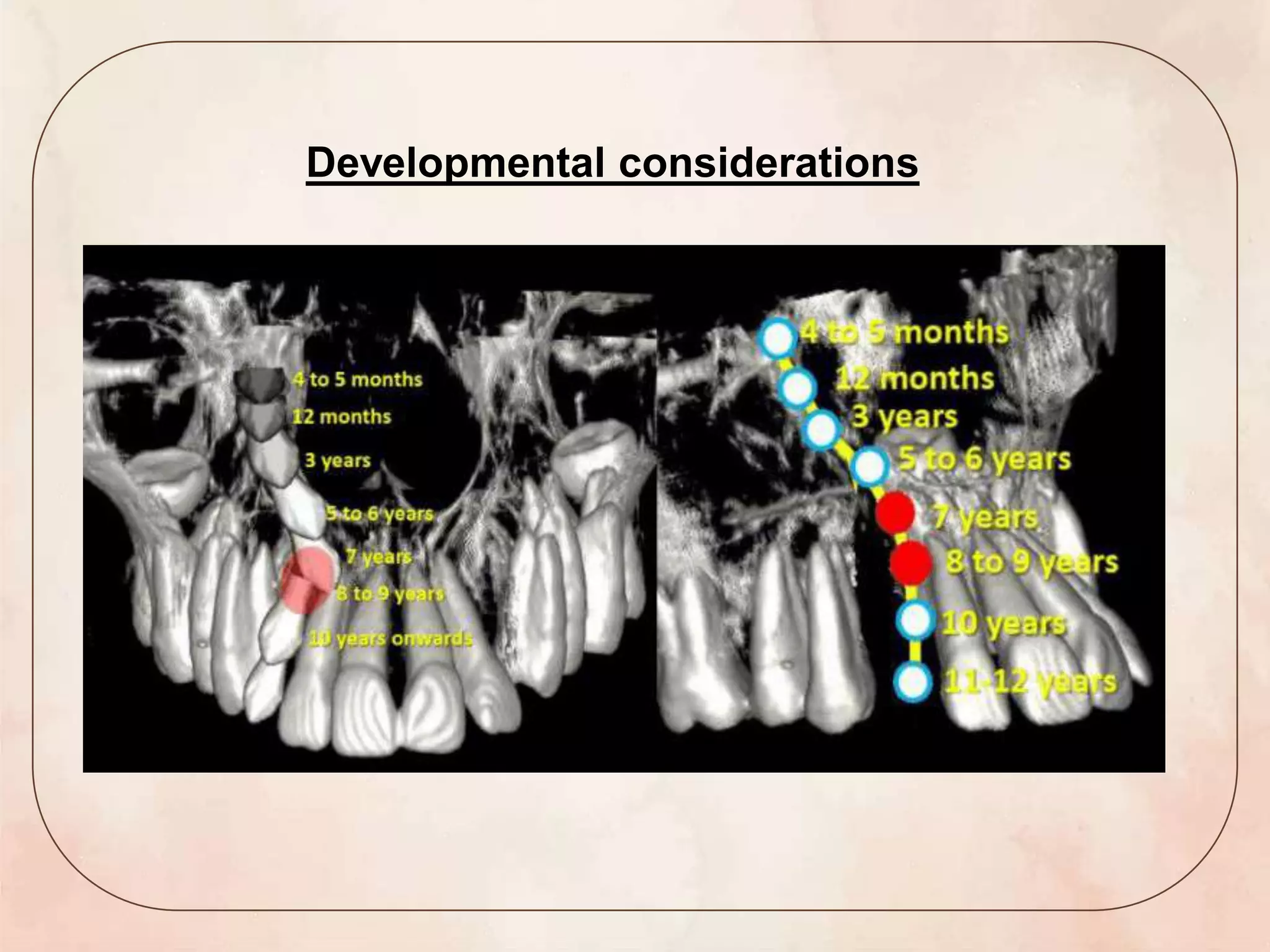
Developmental considerations
Etiologic factors
Two major theories associated with palatally
displaced maxillary canines
1. The guidance theory
2. Genetic theory
>
>
EPIDEMIOLOGY
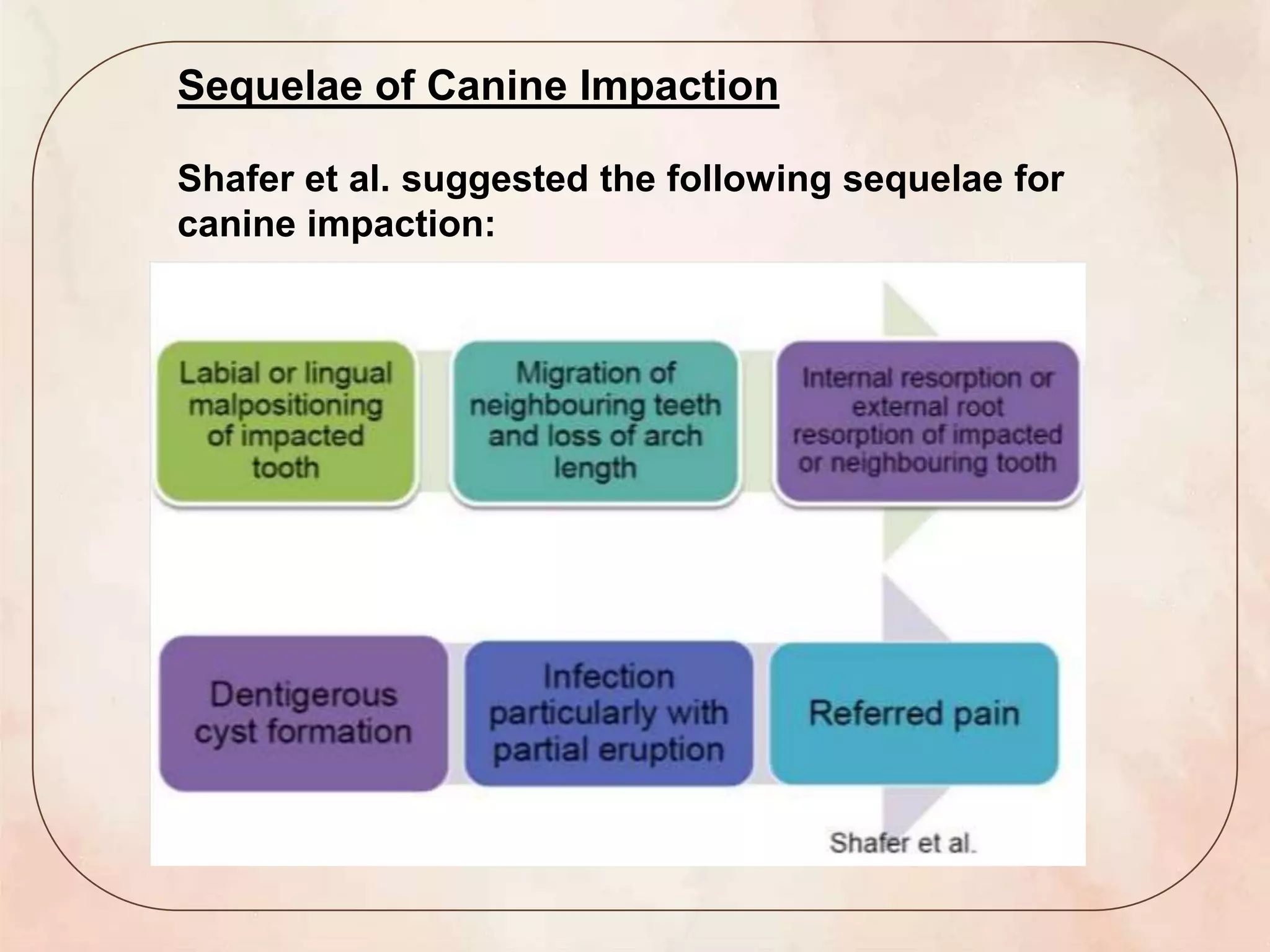
Sequelae of Canine Impaction
Shafer et al. suggested the following sequelae for
canine impaction:
Classifcation of Impacted Maxillary Canines
Classifcation Suggested by Archer (1975)
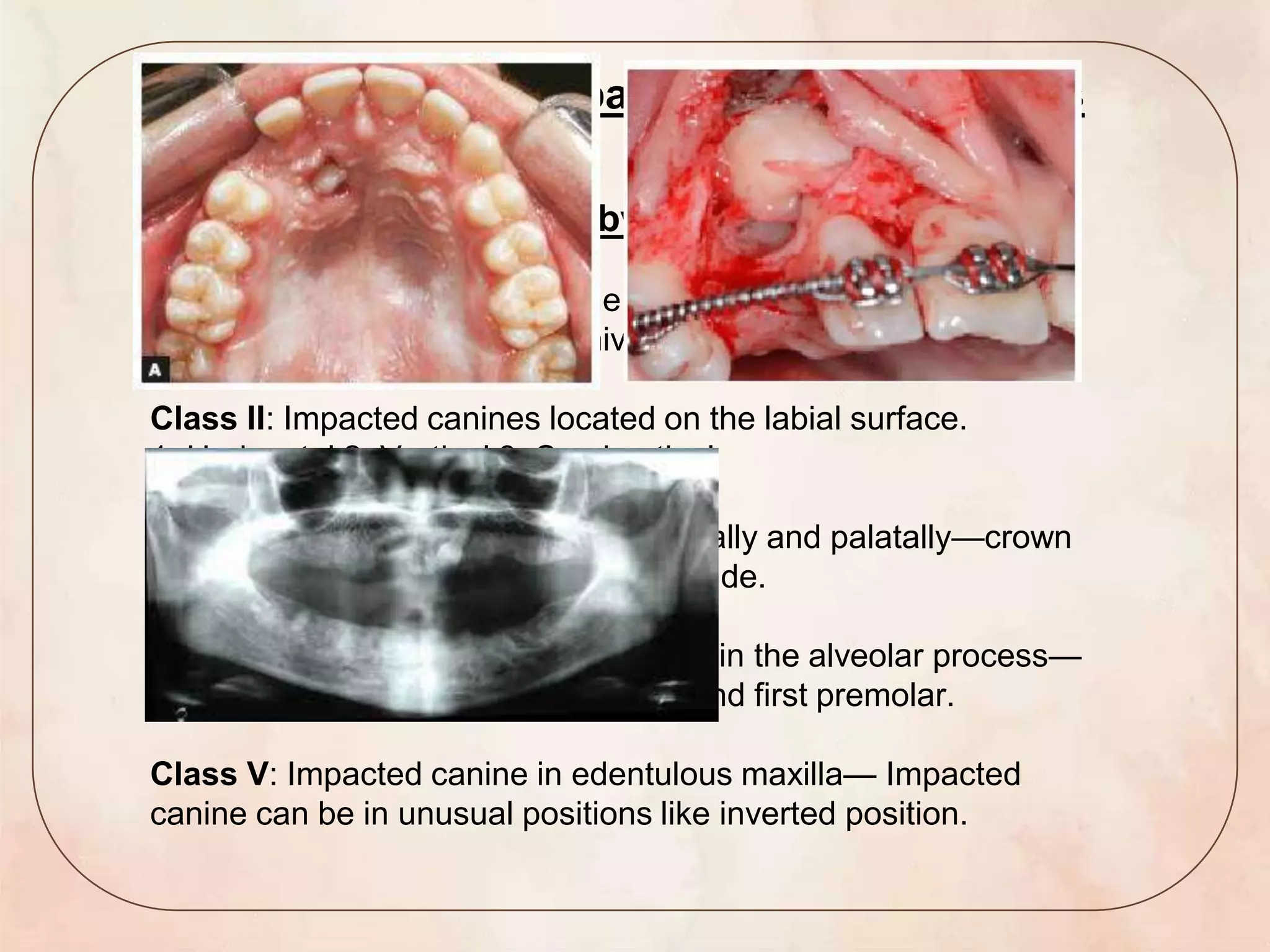
Class I: Impacted canines in the palate.
1. Horizontal 2. Vertical 3. Semivertical
Class II: Impacted canines located on the labial surface.
1. Horizontal 2. Vertical 3. Semivertical
Class III: Impacted canine located labially and palatally—crown
on one side and the root on the other side.
Class IV: Impacted canine located within the alveolar process—
usually vertically between the incisor and first premolar.
Class V: Impacted canine in edentulous maxilla— Impacted
canine can be in unusual positions like inverted position.
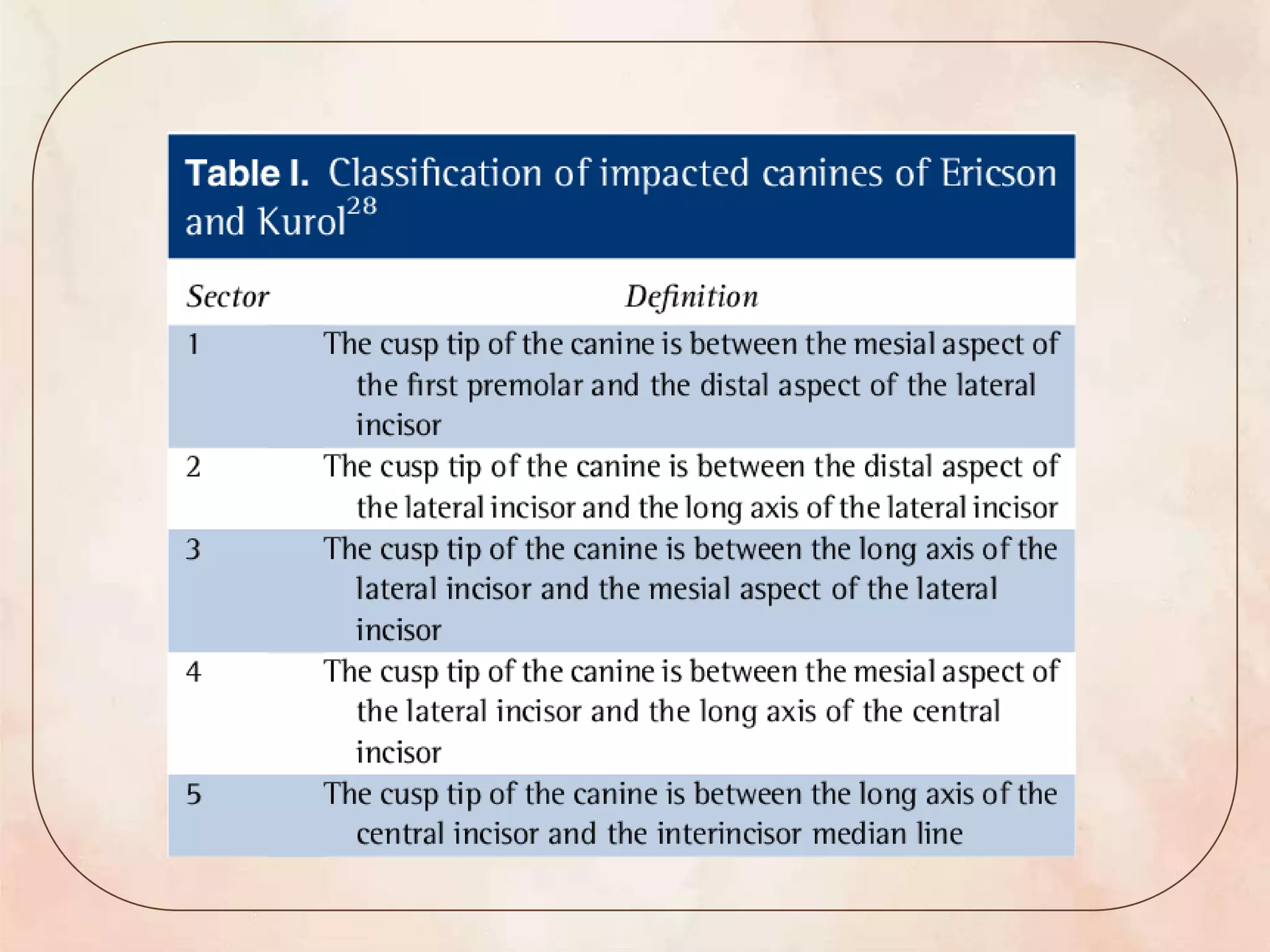
Ericson and Kurol in 1988.
• Sector 1: If the cusp tip of the canine is
between the inter incisor median line and the
long axis of the central incisor
• Sector 2: If the cusp tip of the cuspid is
between the major axis of the lateral and
central
• Sector 3: If the cusp tip of the cuspid is
between the major axis of the lateral and the
first premolar.
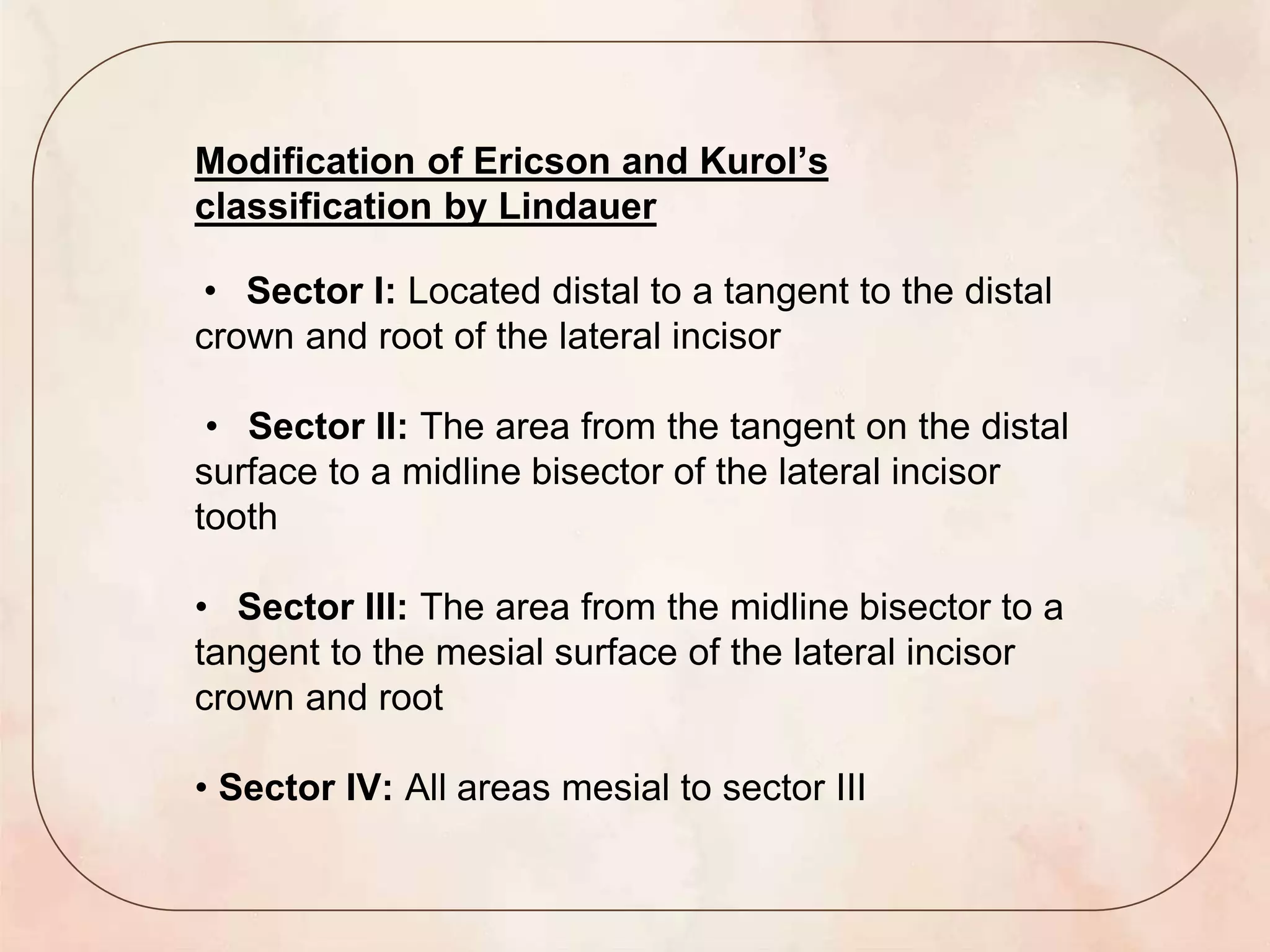
Modification of Ericson and Kurol’s
classification by Lindauer
• Sector I: Located distal to a tangent to the distal
crown and root of the lateral incisor
• Sector II: The area from the tangent on the distal
surface to a midline bisector of the lateral incisor
tooth
• Sector III: The area from the midline bisector to a
tangent to the mesial surface of the lateral incisor
crown and root
• Sector IV: All areas mesial to sector III
The Yamamoto et al. [9] seven subtypes
classification
Field and Ackerman (1935) Classifcation
Maxillary Canines 1. Labial position •
Crown in intimate relation with incisors. •
Crown well above apices of incisors. 2.
Palatal position • Crown near surface. •
Crown deeply embedded in close
relation to apices of incisors. 3.
Intermediate position • Crown between
lateral incisor and first premolar roots. •
Crown above these teeth with crown
labially placed and root palatally placed
or vice versa. 4. Unusual position • In
nasal or antral wall. • In infraorbital
region.
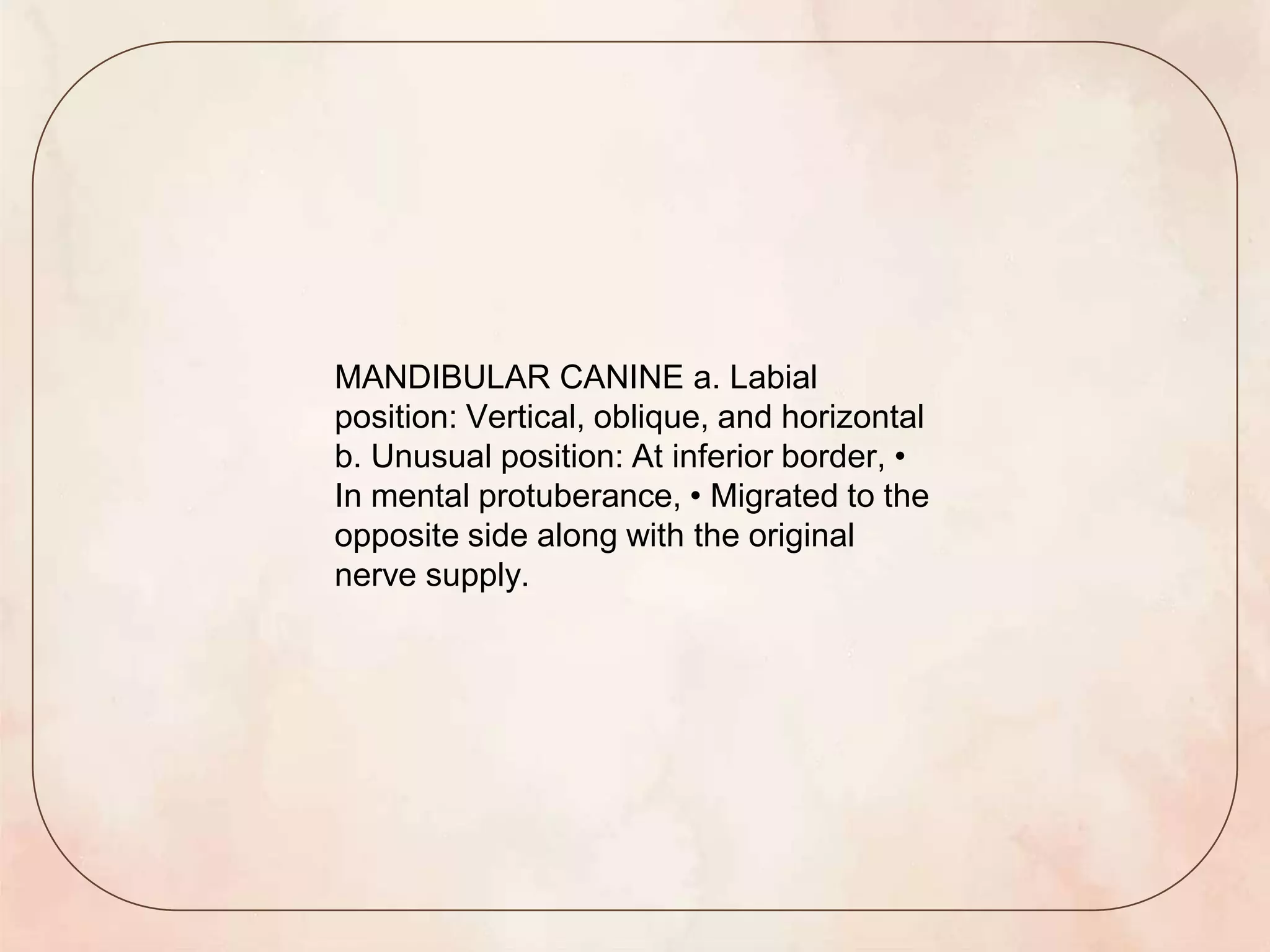
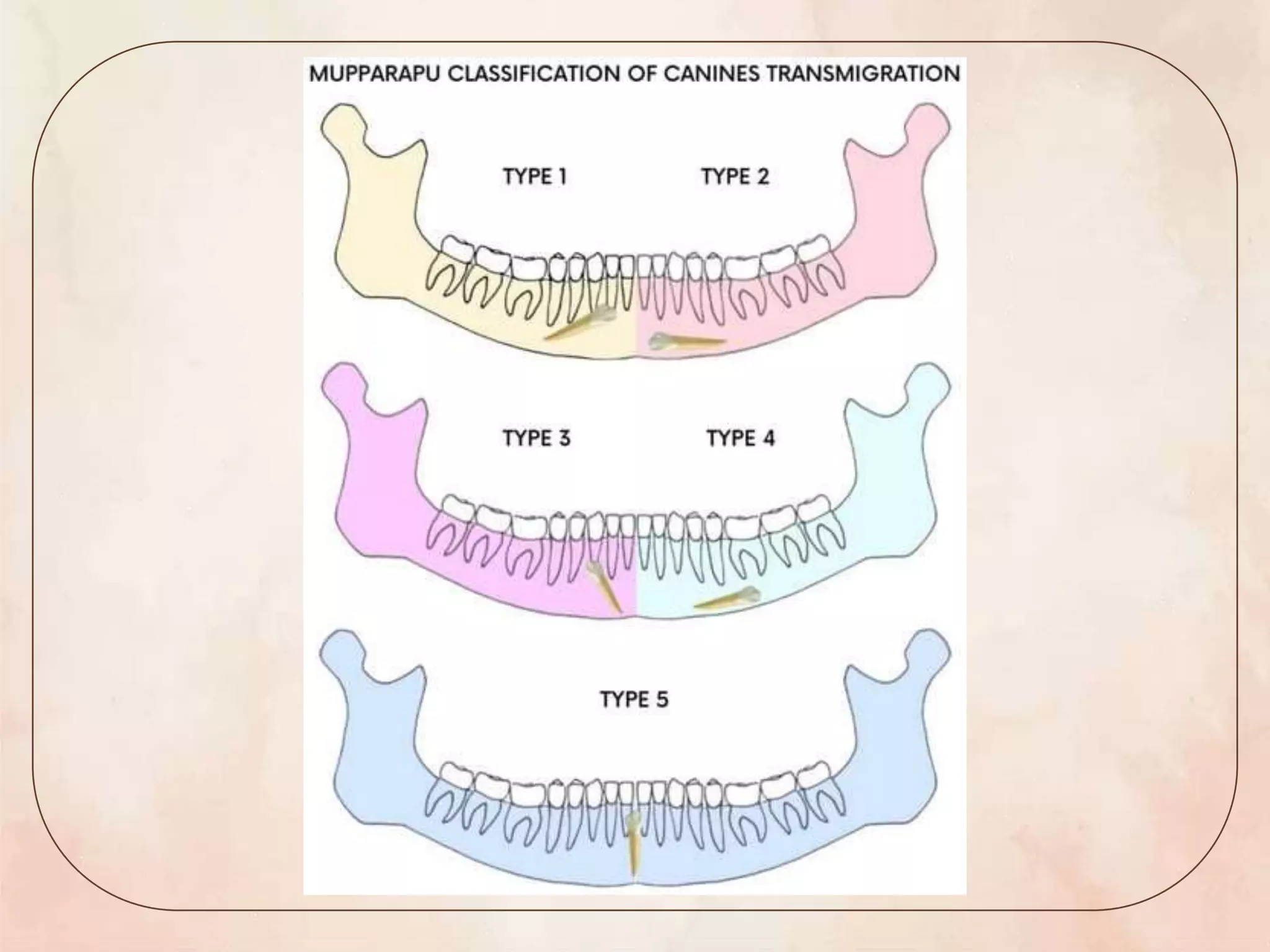
MANDIBULAR CANINE a. Labial
position: Vertical, oblique, and horizontal
b. Unusual position: At inferior border, •
In mental protuberance, • Migrated to the
opposite side along with the original
nerve supply.
DIAGNOSIS i. Clinical assessments ii.
Radiographic assessments.
Clinical assessments Impacted canine
teeth can be detected as early as the
age of 8 years. It is done with two
methods: Clinical inspection and
palpation [Figure 2].[2,3] Inspection
Clinical examination includes overall arch
inspection. Mobility or the absence of
primary canines past its eruption age.
Persistent median diastema, abnormality
or missing lateral incisor, ectopic
deviation of lateral incisor from its
position may all be signs of canine
impaction. Clinical examination for the
presence of bulge in the canine region
deep in the vestibule should be done
buccally as well as palatally
Palpation In the absence of canine,
palpation by finger deep in the vestibule
above the deciduous canine should be
done palatally/buccally above the
deciduous canine 2–3 years before its
eruption. It should be palpated deep
above attached gingiva in the sulcus
where mucosa reflects. Deciduous
canine should be checked for mobility.
The presence of bulge provides a
positive sign of impacted canine.
However, it should be noted that the
absence of bulge does not prove the
absence of impacted canine. When there
is a clinical presence of any of these
signs, radiographic examination should
be performed to confirm the diagnosis
Radiographic Localization of Impacted
Canine
Radiographic examinations may include
periapical X-ray, occlusal radiography,
anteroposterior and lateral radiographic
views of maxilla, OPG, CBCT, CT scan.
Periapical films A single periapical film
provides the clinician with a
twodimensional representation of the
dentition. In other words, it would relate
the canine to the neighboring teeth both
mesiodistally and superoinferiorly. To
evaluate the position of the canine
buccolingually, a second periapical film
should be obtained by one of the
following methods. Tube-shift technique
or Clark’s rule or (SLOB) rule
Buccal-object rule
Occlusal Films Also help to determine
the buccolingual position of the impacted
canine in conjunction with the periapical
films, provided that the image of the
impacted canine is not superimposed on
the other teeth.
Extraoral films Frontal and lateral
cephalograms These can sometimes aid
in the determination of the position of the
impacted canine, particularly its
relationship to other facial structures
(e.g., the maxillary sinus and the floor of
the nose).
Panoramic films These are also used to
localize impacted teeth in all three planes
of space, as much the same as with two
periapical films in the tube-shift method,
with the understanding that the source of
radiation comes from behind the patient;
thus, the movements are reversed for
position.
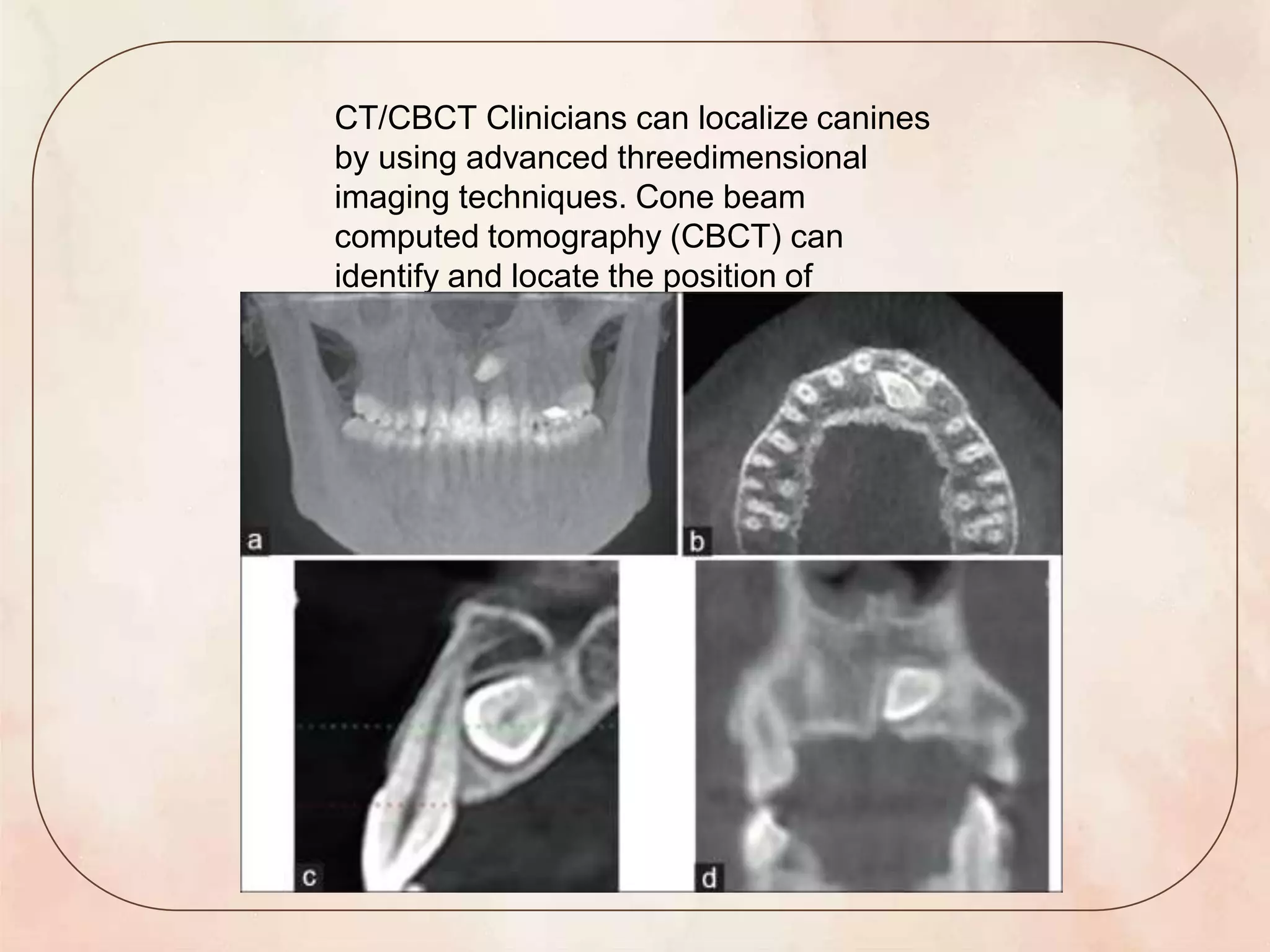
CT/CBCT Clinicians can localize canines
by using advanced threedimensional
imaging techniques. Cone beam
computed tomography (CBCT) can
identify and locate the position of
impacted canines accurately. By using
this imaging technique, dentists also can
assess any damage to the roots of
adjacent teeth and the amount of bone
surrounding each tooth. However,
increased cost, time, radiation exposure,
and medicolegal issues associated with
using CBCT limit its routine use. The
proper localization of the impacted tooth
plays a crucial role in determining the
feasibility of as well as the proper access
for the surgical approach and the proper
direction for the application of orthodontic
forces.
Treatment options
1. No treatment
2. Interceptive treatment
3. Extraction of the impacted canine
4. Auto transplantation of the canine
5. Surgical exposure and orthodontic
alignment
CANINE IMPACTION 1.pptx

CANINE IMPACTION 1.pptx

  • 1.
    CANINE IMPACTION AND ITS MANAGEMENT BY MALA.M 2ND MDS DEPT. OF OMFS GUIDED BY Dr. SANTOSH A NANDIMATH
  • 2.
    CONTENTS  Introduction  Developmentalconsiderations  Aetiology  Prevalence  Sequelae  Classification  Diagnosis  Management Maxillary canine Mandibular canine  Conclusion
  • 3.
    INTRODUCTION  An impactedmaxillary canine is usually diagnosed during a routine dental examination.  Disturbance in the eruption of permanent maxillary canines can cause problems in the dental arch and adjacent teeth, which require special care and attention. Therefore, clinicians should be capable of dealing with this clinical situation to deliver optimal treatment.  Canines are the most common impacted tooth, following the third molars.
  • 4.
  • 5.
  • 6.
    Two major theoriesassociated with palatally displaced maxillary canines 1. The guidance theory 2. Genetic theory
  • 7.
  • 8.
    Sequelae of CanineImpaction Shafer et al. suggested the following sequelae for canine impaction:
  • 9.
    Classifcation of ImpactedMaxillary Canines Classifcation Suggested by Archer (1975) Class I: Impacted canines in the palate. 1. Horizontal 2. Vertical 3. Semivertical Class II: Impacted canines located on the labial surface. 1. Horizontal 2. Vertical 3. Semivertical Class III: Impacted canine located labially and palatally—crown on one side and the root on the other side. Class IV: Impacted canine located within the alveolar process— usually vertically between the incisor and first premolar. Class V: Impacted canine in edentulous maxilla— Impacted canine can be in unusual positions like inverted position.
  • 10.
    Ericson and Kurolin 1988. • Sector 1: If the cusp tip of the canine is between the inter incisor median line and the long axis of the central incisor • Sector 2: If the cusp tip of the cuspid is between the major axis of the lateral and central • Sector 3: If the cusp tip of the cuspid is between the major axis of the lateral and the first premolar.
  • 11.
    Modification of Ericsonand Kurol’s classification by Lindauer • Sector I: Located distal to a tangent to the distal crown and root of the lateral incisor • Sector II: The area from the tangent on the distal surface to a midline bisector of the lateral incisor tooth • Sector III: The area from the midline bisector to a tangent to the mesial surface of the lateral incisor crown and root • Sector IV: All areas mesial to sector III
  • 14.
    The Yamamoto etal. [9] seven subtypes classification
  • 15.
    Field and Ackerman(1935) Classifcation Maxillary Canines 1. Labial position • Crown in intimate relation with incisors. • Crown well above apices of incisors. 2. Palatal position • Crown near surface. • Crown deeply embedded in close relation to apices of incisors. 3. Intermediate position • Crown between lateral incisor and first premolar roots. • Crown above these teeth with crown labially placed and root palatally placed or vice versa. 4. Unusual position • In nasal or antral wall. • In infraorbital region.
  • 16.
    MANDIBULAR CANINE a.Labial position: Vertical, oblique, and horizontal b. Unusual position: At inferior border, • In mental protuberance, • Migrated to the opposite side along with the original nerve supply.
  • 18.
    DIAGNOSIS i. Clinicalassessments ii. Radiographic assessments.
  • 19.
    Clinical assessments Impactedcanine teeth can be detected as early as the age of 8 years. It is done with two methods: Clinical inspection and palpation [Figure 2].[2,3] Inspection Clinical examination includes overall arch inspection. Mobility or the absence of primary canines past its eruption age. Persistent median diastema, abnormality or missing lateral incisor, ectopic deviation of lateral incisor from its position may all be signs of canine impaction. Clinical examination for the presence of bulge in the canine region deep in the vestibule should be done buccally as well as palatally
  • 20.
    Palpation In theabsence of canine, palpation by finger deep in the vestibule above the deciduous canine should be done palatally/buccally above the deciduous canine 2–3 years before its eruption. It should be palpated deep above attached gingiva in the sulcus where mucosa reflects. Deciduous canine should be checked for mobility. The presence of bulge provides a positive sign of impacted canine. However, it should be noted that the absence of bulge does not prove the absence of impacted canine. When there is a clinical presence of any of these signs, radiographic examination should be performed to confirm the diagnosis
  • 22.
    Radiographic Localization ofImpacted Canine Radiographic examinations may include periapical X-ray, occlusal radiography, anteroposterior and lateral radiographic views of maxilla, OPG, CBCT, CT scan.
  • 23.
    Periapical films Asingle periapical film provides the clinician with a twodimensional representation of the dentition. In other words, it would relate the canine to the neighboring teeth both mesiodistally and superoinferiorly. To evaluate the position of the canine buccolingually, a second periapical film should be obtained by one of the following methods. Tube-shift technique or Clark’s rule or (SLOB) rule Buccal-object rule
  • 24.
    Occlusal Films Alsohelp to determine the buccolingual position of the impacted canine in conjunction with the periapical films, provided that the image of the impacted canine is not superimposed on the other teeth.
  • 25.
    Extraoral films Frontaland lateral cephalograms These can sometimes aid in the determination of the position of the impacted canine, particularly its relationship to other facial structures (e.g., the maxillary sinus and the floor of the nose).
  • 26.
    Panoramic films Theseare also used to localize impacted teeth in all three planes of space, as much the same as with two periapical films in the tube-shift method, with the understanding that the source of radiation comes from behind the patient; thus, the movements are reversed for position.
  • 27.
    CT/CBCT Clinicians canlocalize canines by using advanced threedimensional imaging techniques. Cone beam computed tomography (CBCT) can identify and locate the position of impacted canines accurately. By using this imaging technique, dentists also can assess any damage to the roots of adjacent teeth and the amount of bone surrounding each tooth. However, increased cost, time, radiation exposure, and medicolegal issues associated with using CBCT limit its routine use. The proper localization of the impacted tooth plays a crucial role in determining the feasibility of as well as the proper access for the surgical approach and the proper direction for the application of orthodontic forces.
  • 28.
    Treatment options 1. Notreatment 2. Interceptive treatment 3. Extraction of the impacted canine 4. Auto transplantation of the canine 5. Surgical exposure and orthodontic alignment

Editor's Notes

  • #7 The guidance theory proposes that the canine erupts along the root of the lateral incisor, which serves as a guide, and if the root of the lateral incisor is absent or malformed, the canine will not erupt.[8] The genetic theory points to genetic factors as a primary origin of palatally displaced maxillary canines and includes other possibly associated dental anomalies, such as missing or small lateral incisors.[9] Baccetti[10] reported that palatally impacted maxillary canines are genetically reciprocally associated with anomalies such as enamel hypoplasia, infraocclusion of primary molars, aplasia of second premolars, and small maxillary lateral incisors.
  • #10 The results of Jacoby’s[6] study showed that 85% of palatally impacted canines had sufficient space for eruption, whereas only 17% of labially impacted canines had sufficient space. Therefore, arch length discrepancy is thought to be a primary etiologic factor for labially impacted canines. Labial or lingual malpositioning of the impacted tooth, Migration of the neighboring teeth and loss of arch length Internal resorption Dentigerous cyst formation, External root resorption of the impacted tooth, as well as the neighboring teeth Infection particularly with partial eruption Referred pain and combinations of the above sequelae.
  • #23 Bilaterally impacted maxillary canine causing proclination and spacing of incisors. (a) Frontal view, (b) Occlusal view, (c) OPG showing impacted canines (yellow circle)
  • #25 Two periapical films are taken of the same area, with the horizontal angulation of the cone changed when the second film is taken. If the object in question moves in the same direction as the cone, it is lingually positioned. If the object moves in the opposite direction, it is situated closer to the source of radiation and is therefore buccally located. If the vertical angulation of the cone is changed by approximately 20° in two successive periapical films, the buccal object will move in the direction opposite to the source of radiation. On the other hand, the lingual object will move in the same direction as the source of radiation. The basic principle of this technique deals with the foreshortening and elongation of the images of the films.