Name of
presentation
Company name
Contents
I. Brief Background
II. Overview of Cambodia Economy
III. Innovation System in Cambodia
Brief Background
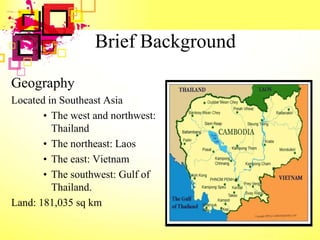
Geography
Located in Southeast Asia
• The west and northwest:
Thailand
• The northeast: Laos
• The east: Vietnam
• The southwest: Gulf of
Thailand.
Land: 181,035 sq km
Brief Background
• Name: Kingdom of Cambodia
• Capital: Phnom Penh
• Population: 15.33 million (World Bank, 2014)
• Major group: Khmer
• Minor and ethnic group: Cham (Khmer Muslim), Chinese, Vietnamese,
Indian, Thai, Phnorng, Kuoy, Stieng, Tamil, etc.
• Official language: Khmer
• Religion: Theravada Buddhism (Official), Islam, Christianity, Hinduism
• Literacy rate: 77.2% (CIA, 2015)
• Currency: Riel
• Exchange Rate: 4,080.3 Riel= 1 US Dollar (2015 est.)
• Population below poverty line: 20% (2012 est.)
• Political System: Multiparty democracy under a constitutional monarchy
Overview of Cambodia
Economy
o Cambodia GDP
o GDP per capita
o GDP per capita in PPP
o Cambodia’s GDP by sector
o Export
o Import
o Inflation
o Dollarization
o Rectangular Policy
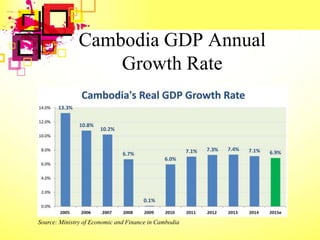
Cambodia GDP Annual
Growth Rate
Source: Ministry of Economic and Finance in Cambodia
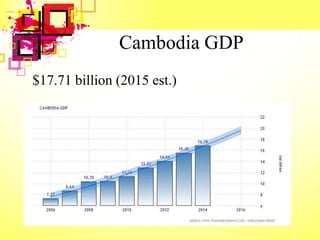
Cambodia GDP
$17.71 billion (2015 est.)
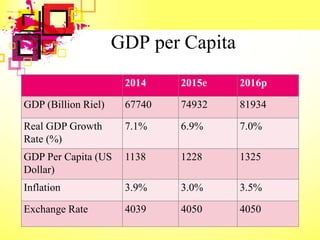
GDP per Capita
2014 2015e 2016p
GDP (Billion Riel) 67740 74932 81934
Real GDP Growth
Rate (%)
7.1% 6.9% 7.0%
GDP Per Capita (US
Dollar)
1138 1228 1325
Inflation 3.9% 3.0% 3.5%
Exchange Rate 4039 4050 4050
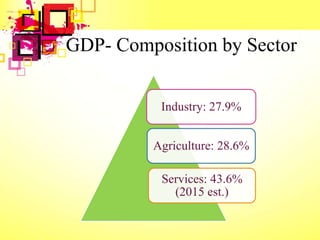
GDP- Composition by Sector
Industry: 27.9%
Agriculture: 28.6%
Services: 43.6%
(2015 est.)
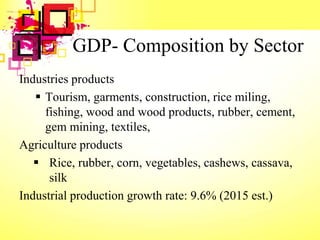
GDP- Composition by Sector
Industries products
 Tourism, garments, construction, rice miling,
fishing, wood and wood products, rubber, cement,
gem mining, textiles,
Agriculture products
 Rice, rubber, corn, vegetables, cashews, cassava,
silk
Industrial production growth rate: 9.6% (2015 est.)
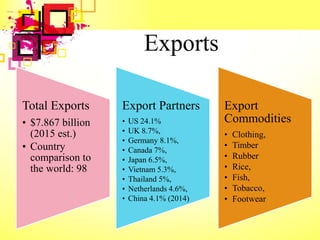
Exports
Total Exports
• $7.867 billion
(2015 est.)
• Country
comparison to
the world: 98
Export Partners
• US 24.1%
• UK 8.7%,
• Germany 8.1%,
• Canada 7%,
• Japan 6.5%,
• Vietnam 5.3%,
• Thailand 5%,
• Netherlands 4.6%,
• China 4.1% (2014)
Export
Commodities
• Clothing,
• Timber
• Rubber
• Rice,
• Fish,
• Tobacco,
• Footwear
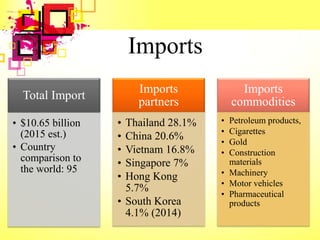
Imports
Total Import
• $10.65 billion
(2015 est.)
• Country
comparison to
the world: 95
Imports
partners
• Thailand 28.1%
• China 20.6%
• Vietnam 16.8%
• Singapore 7%
• Hong Kong
5.7%
• South Korea
4.1% (2014)
Imports
commodities
• Petroleum products,
• Cigarettes
• Gold
• Construction
materials
• Machinery
• Motor vehicles
• Pharmaceutical
products
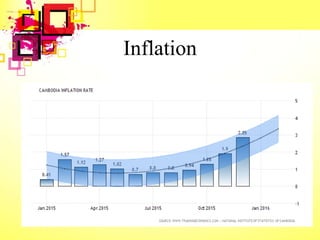
Inflation
Impact of Dollarization in
Cambodia
• The use of the dollar has accounted for 90% of the
currency in circulation today and 97% of banking
deposits.
• The dollarization is happening in financial sector and in
urban cities.
• The home currency (the Riel) is commonly used by
small and medium-sized enterprises and outside of urban
areas.
Advantages of Dollarization
• Allowed the public to switch from using gold to banknotes for
transactions and to store wealth.
• Prevented capital flight and promoted financial deepening.
• Lowered the risk of currency devaluation.
• Promoted awareness by policymakers of the need to avoid bank
financing of public deficits.
• Facilitated the integration process of Cambodian trade in the
international economy.
Disadvantages of Dollarization
• Undermines the effective conduct of monetary
policy
• The income from seignorage is minimized (No
interest rate).
• The effect of global financial crisis in 2008 to
Cambodia.
De-dollarization Policies
• Maintain macroeconomic policies, aimed at
keeping exchange rate and price stability
• Create incentives to use the national currency.
o All prices of goods and services should be indicated
in riel.
o The government may expand its riel requirement to
the collection of non-tax revenue.
o Bank intermediation in local currency needs to be
developed (MFI).
Rectangular Strategy Phase III
Overarching environment for the implementation of the
strategy
o Peace, Political Stability, Security and Public Order
o Favorable Macroeconomic and Financial Conditions; and
Environmental Sustainability
o Partnership in Development
o Deepening Cambodia’s Integration into the Region and the
World
Rectangular Strategy Phase III
The Core of the Rectangular Strategy—Good
Governance
o Fighting corruption
o Legal and Judicial Reforms
o Public Administration Reform
o Reform of Armed Forces
Rectangular Strategy Phase III
The Four Strategic Rectangles and Respective sides
o Rectangle I: Promotion of Agriculture Sector
o Rectangle II: The Development of Physical
Infrastructure
o Rectangle III: Private Sector Development and
Employment
o Rectangle IV: Capacity Building and Human Resource
Development
References
• About Cambodia
<http://www.tourismcambodia.org/contents/about_cambodia/index.php?view=language#comp>
• Budget in Brief Fiscal Year 2016
<http://www.mef.gov.kh/documents/shares/budget/BUDGET_IN_BRIEF_Fiscal_Year_2016.pdf>
• Cambodia GDP
<http://www.tradingeconomics.com/cambodia/gdp/forecast>
• Cambodia
<http://data.worldbank.org/country/cambodia>
• CIA Cambodia Economy
<https://www.cia.gov/library/publications/the-world-factbook/geos/cb.html>
• Cambodia GDP and Economic Data
<https://www.gfmag.com/global-data/country-data/cambodia-gdp-country-report>
• Dollarization in Cambodia
<http://www.nbc.org.kh/download_files/publication/others_eng/NoteMD117-
14_article_dollarization.pdf>
References
• Rectangular Strategy III
<http://www.cambodiainvestment.gov.kh/content/uploads/2013/11/2013-Rectangular-Strategy-III-
En8.pdf>
• The Impact of Dollarization in Cambodia: Executive Senior Research Fellow Ken Odajima
Gives Presentation at IMF-JICA Conference
<http://jica-ri.jica.go.jp/topic/post_179.html>
• The World Factbook
<https://www.cia.gov/library/publications/the-world-factbook/fields/2103.html>

Cambodia-Eco-and-Innovation-system

  • 1.
  • 2.
    Contents I. Brief Background II.Overview of Cambodia Economy III. Innovation System in Cambodia
  • 3.
    Brief Background Geography Located inSoutheast Asia • The west and northwest: Thailand • The northeast: Laos • The east: Vietnam • The southwest: Gulf of Thailand. Land: 181,035 sq km
  • 4.
    Brief Background • Name:Kingdom of Cambodia • Capital: Phnom Penh • Population: 15.33 million (World Bank, 2014) • Major group: Khmer • Minor and ethnic group: Cham (Khmer Muslim), Chinese, Vietnamese, Indian, Thai, Phnorng, Kuoy, Stieng, Tamil, etc. • Official language: Khmer • Religion: Theravada Buddhism (Official), Islam, Christianity, Hinduism • Literacy rate: 77.2% (CIA, 2015) • Currency: Riel • Exchange Rate: 4,080.3 Riel= 1 US Dollar (2015 est.) • Population below poverty line: 20% (2012 est.) • Political System: Multiparty democracy under a constitutional monarchy
  • 5.
    Overview of Cambodia Economy oCambodia GDP o GDP per capita o GDP per capita in PPP o Cambodia’s GDP by sector o Export o Import o Inflation o Dollarization o Rectangular Policy
  • 6.
    Cambodia GDP Annual GrowthRate Source: Ministry of Economic and Finance in Cambodia
  • 7.
  • 8.
    GDP per Capita 20142015e 2016p GDP (Billion Riel) 67740 74932 81934 Real GDP Growth Rate (%) 7.1% 6.9% 7.0% GDP Per Capita (US Dollar) 1138 1228 1325 Inflation 3.9% 3.0% 3.5% Exchange Rate 4039 4050 4050
  • 9.
    GDP- Composition bySector Industry: 27.9% Agriculture: 28.6% Services: 43.6% (2015 est.)
  • 10.
    GDP- Composition bySector Industries products  Tourism, garments, construction, rice miling, fishing, wood and wood products, rubber, cement, gem mining, textiles, Agriculture products  Rice, rubber, corn, vegetables, cashews, cassava, silk Industrial production growth rate: 9.6% (2015 est.)
  • 11.
    Exports Total Exports • $7.867billion (2015 est.) • Country comparison to the world: 98 Export Partners • US 24.1% • UK 8.7%, • Germany 8.1%, • Canada 7%, • Japan 6.5%, • Vietnam 5.3%, • Thailand 5%, • Netherlands 4.6%, • China 4.1% (2014) Export Commodities • Clothing, • Timber • Rubber • Rice, • Fish, • Tobacco, • Footwear
  • 12.
    Imports Total Import • $10.65billion (2015 est.) • Country comparison to the world: 95 Imports partners • Thailand 28.1% • China 20.6% • Vietnam 16.8% • Singapore 7% • Hong Kong 5.7% • South Korea 4.1% (2014) Imports commodities • Petroleum products, • Cigarettes • Gold • Construction materials • Machinery • Motor vehicles • Pharmaceutical products
  • 13.
  • 14.
    Impact of Dollarizationin Cambodia • The use of the dollar has accounted for 90% of the currency in circulation today and 97% of banking deposits. • The dollarization is happening in financial sector and in urban cities. • The home currency (the Riel) is commonly used by small and medium-sized enterprises and outside of urban areas.
  • 15.
    Advantages of Dollarization •Allowed the public to switch from using gold to banknotes for transactions and to store wealth. • Prevented capital flight and promoted financial deepening. • Lowered the risk of currency devaluation. • Promoted awareness by policymakers of the need to avoid bank financing of public deficits. • Facilitated the integration process of Cambodian trade in the international economy.
  • 16.
    Disadvantages of Dollarization •Undermines the effective conduct of monetary policy • The income from seignorage is minimized (No interest rate). • The effect of global financial crisis in 2008 to Cambodia.
  • 17.
    De-dollarization Policies • Maintainmacroeconomic policies, aimed at keeping exchange rate and price stability • Create incentives to use the national currency. o All prices of goods and services should be indicated in riel. o The government may expand its riel requirement to the collection of non-tax revenue. o Bank intermediation in local currency needs to be developed (MFI).
  • 18.
  • 19.
    Rectangular Strategy PhaseIII Overarching environment for the implementation of the strategy o Peace, Political Stability, Security and Public Order o Favorable Macroeconomic and Financial Conditions; and Environmental Sustainability o Partnership in Development o Deepening Cambodia’s Integration into the Region and the World
  • 20.
    Rectangular Strategy PhaseIII The Core of the Rectangular Strategy—Good Governance o Fighting corruption o Legal and Judicial Reforms o Public Administration Reform o Reform of Armed Forces
  • 21.
    Rectangular Strategy PhaseIII The Four Strategic Rectangles and Respective sides o Rectangle I: Promotion of Agriculture Sector o Rectangle II: The Development of Physical Infrastructure o Rectangle III: Private Sector Development and Employment o Rectangle IV: Capacity Building and Human Resource Development
  • 22.
    References • About Cambodia <http://www.tourismcambodia.org/contents/about_cambodia/index.php?view=language#comp> •Budget in Brief Fiscal Year 2016 <http://www.mef.gov.kh/documents/shares/budget/BUDGET_IN_BRIEF_Fiscal_Year_2016.pdf> • Cambodia GDP <http://www.tradingeconomics.com/cambodia/gdp/forecast> • Cambodia <http://data.worldbank.org/country/cambodia> • CIA Cambodia Economy <https://www.cia.gov/library/publications/the-world-factbook/geos/cb.html> • Cambodia GDP and Economic Data <https://www.gfmag.com/global-data/country-data/cambodia-gdp-country-report> • Dollarization in Cambodia <http://www.nbc.org.kh/download_files/publication/others_eng/NoteMD117- 14_article_dollarization.pdf>
  • 23.
    References • Rectangular StrategyIII <http://www.cambodiainvestment.gov.kh/content/uploads/2013/11/2013-Rectangular-Strategy-III- En8.pdf> • The Impact of Dollarization in Cambodia: Executive Senior Research Fellow Ken Odajima Gives Presentation at IMF-JICA Conference <http://jica-ri.jica.go.jp/topic/post_179.html> • The World Factbook <https://www.cia.gov/library/publications/the-world-factbook/fields/2103.html>