The Call of the Wild
Jack London
Introduction
Background
Discussion Starters
Menu
The Call of the Wild
Jack London
The Call of the Wild: Introduction
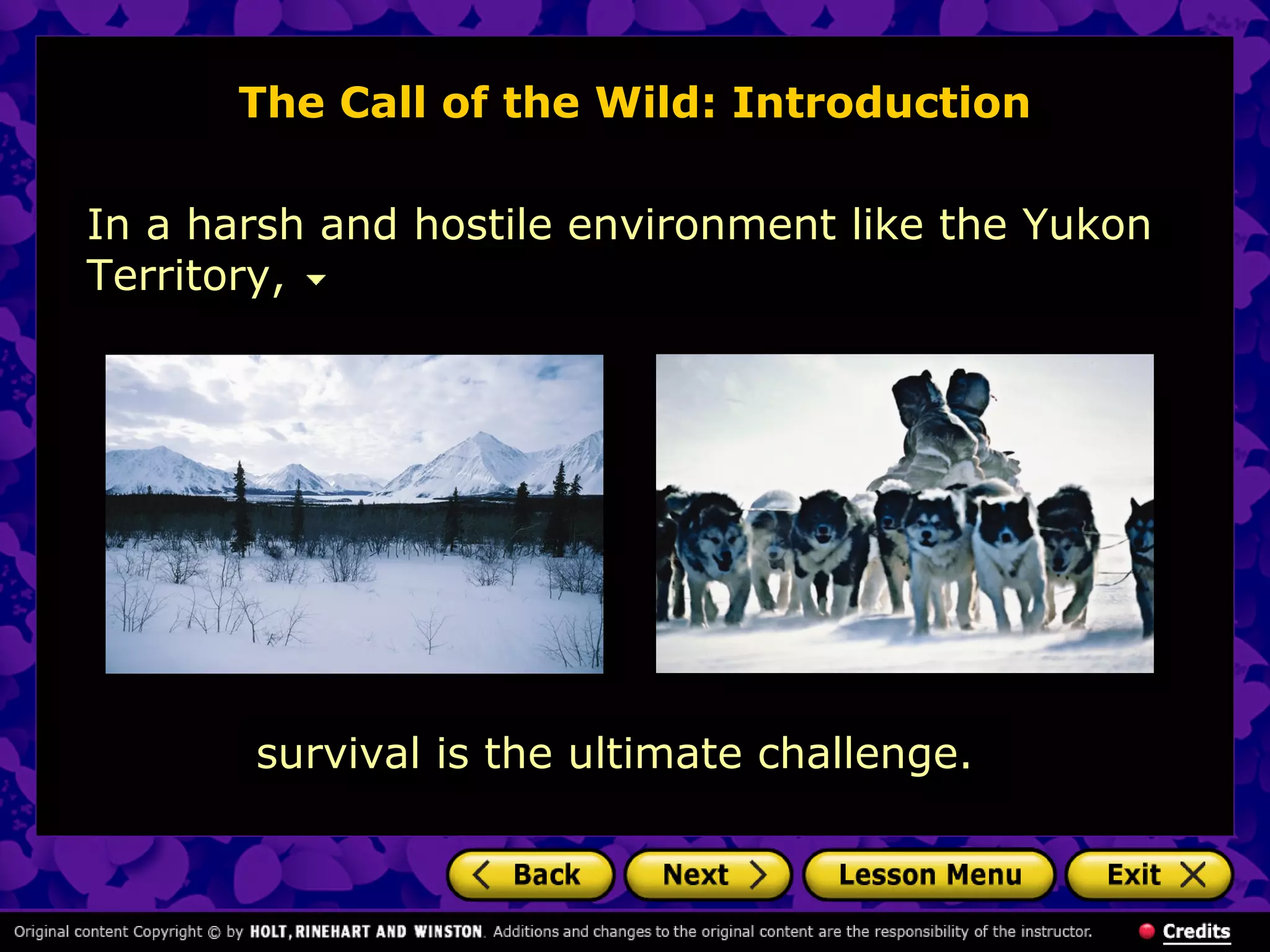
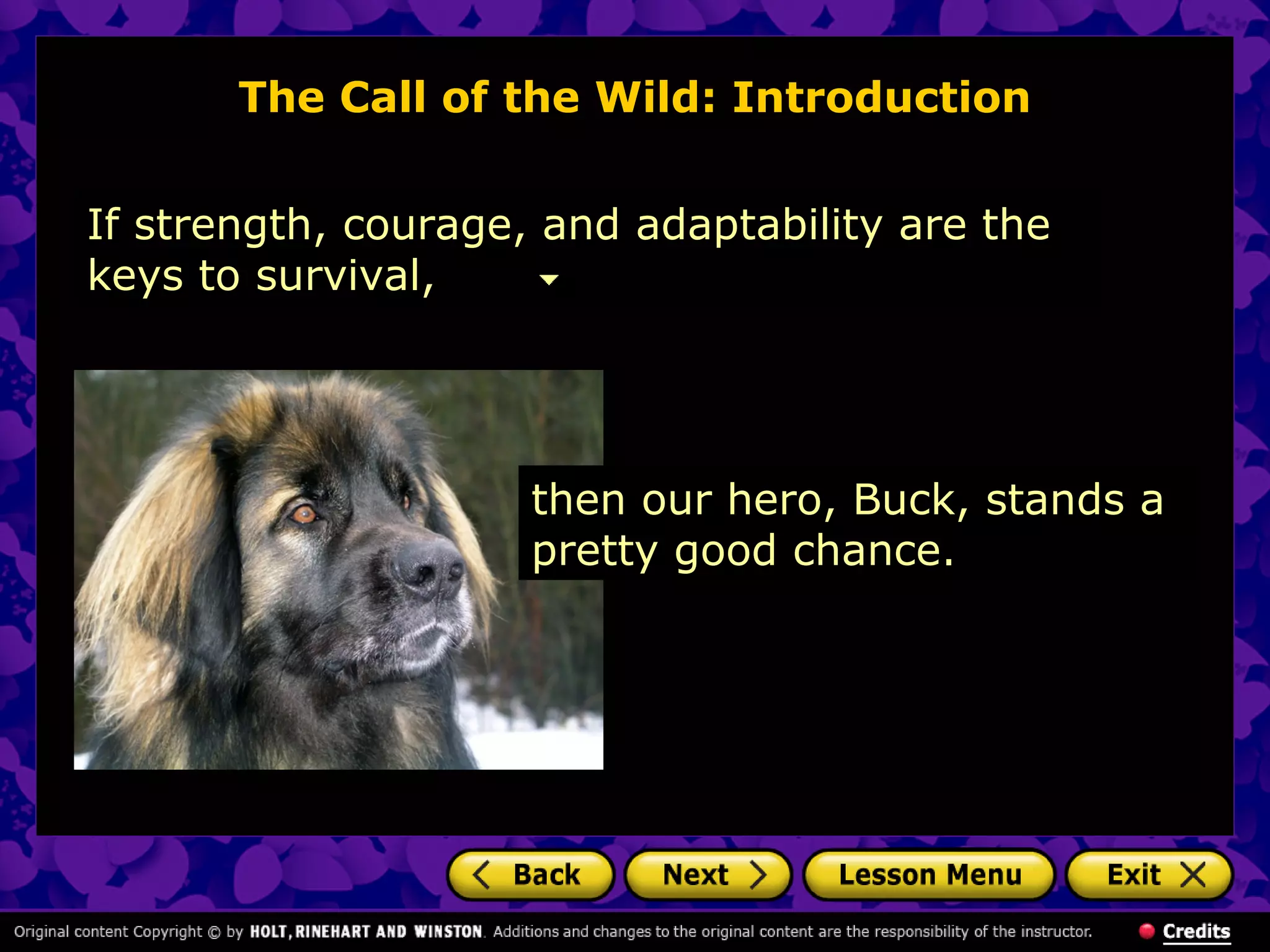
In a harsh and hostile environment like the Yukon
Territory,
survival is the ultimate challenge.
The Call of the Wild: Introduction
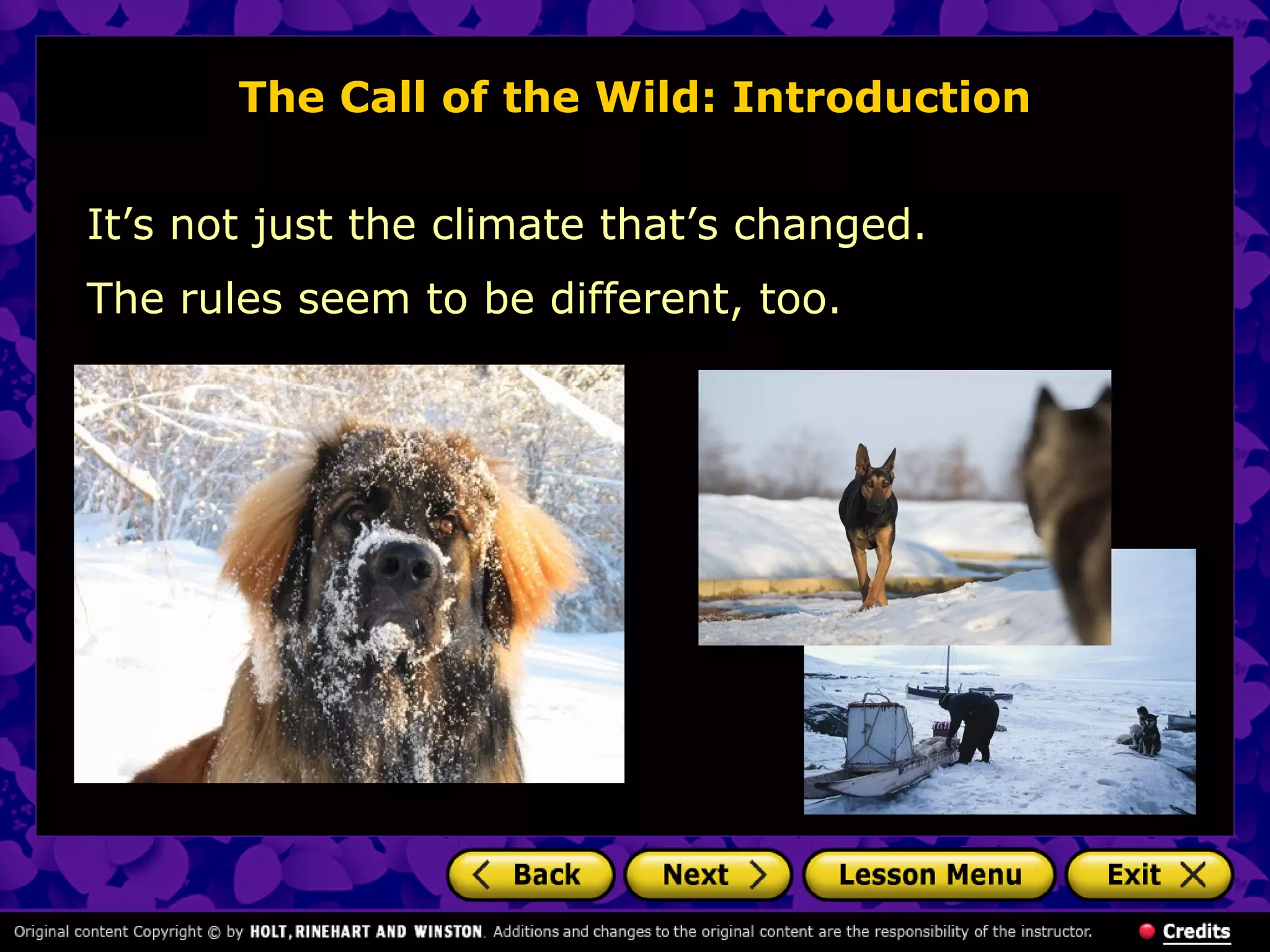
If strength, courage, and adaptability are the
keys to survival,
then our hero, Buck, stands a
pretty good chance.
The Call of the Wild: Introduction
When Buck is
stolen from his
comfortable home
in California and
sold as a sled dog,
he ends up working
in the bitter cold of
Alaska and Canada.
The Call of the Wild: Introduction
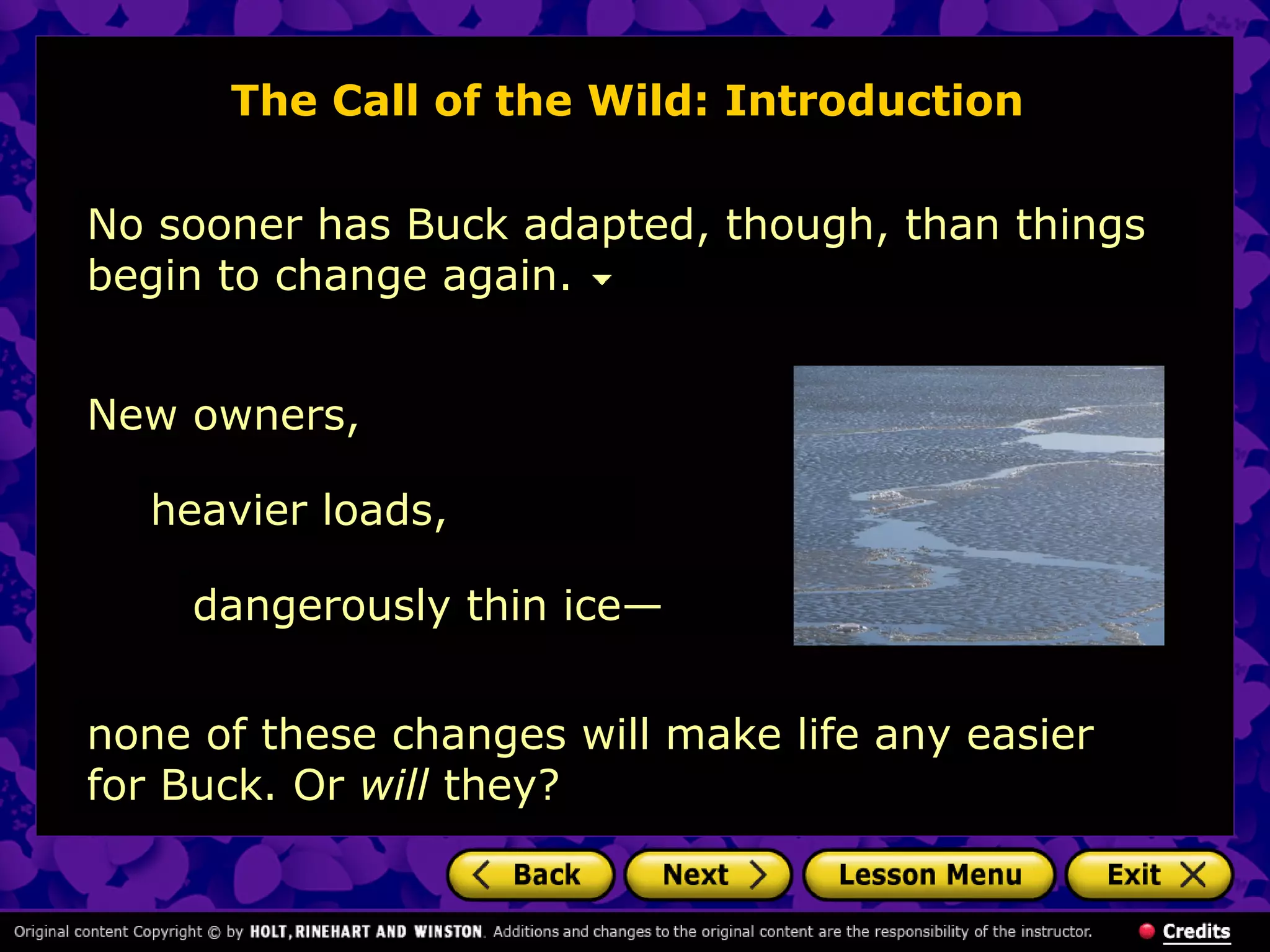
It’s not just the climate that’s changed.
The rules seem to be different, too.
The Call of the Wild: Introduction
In this new environment, Buck has to change the
way he
• sleeps
• eats
• relates to humans
• interacts with other
dogs
The Call of the Wild: Introduction
Buck is smart, tough, and alert.
He even challenges Spitz, the lead dog.
He learns quickly how to survive as a sled dog.
The Call of the Wild: Introduction
No sooner has Buck adapted, though, than things
begin to change again.
heavier loads,
New owners,
dangerously thin ice—
none of these changes will make life any easier
for Buck. Or will they?
The Call of the Wild: Background
In August 1896, gold—and lots
of it—was discovered in Rabbit
Creek in the Yukon Territory of
western Canada.
The Call of the Wild: Background
When news of the find reached the United States,
the Klondike gold rush was on.
The Call of the Wild: Background
The gold prospectors, known as “Klondikers,” faced
harsh conditions:
• temperatures 20 degrees below zero
• starvation and
malnutrition
• long journeys on foot
• hundreds of pounds of
supplies to transport
The Call of the Wild: Background
The indigenous people of Alaska and Canada
began using sled dogs more than 1,000 years ago.
They depended on
these dogs for
• protection
• transportation
• hunting
• companionship
The Call of the Wild: Background
In the late 1800s, settlers and explorers started
using the dogs to help them explore remote areas,
deliver mail, and look for gold.
The Call of the Wild: Background
Certain purebred dogs are commonly used as sled
dogs.
Alaskan malamutes
Siberian huskies
Samoyeds
The Call of the Wild: Background
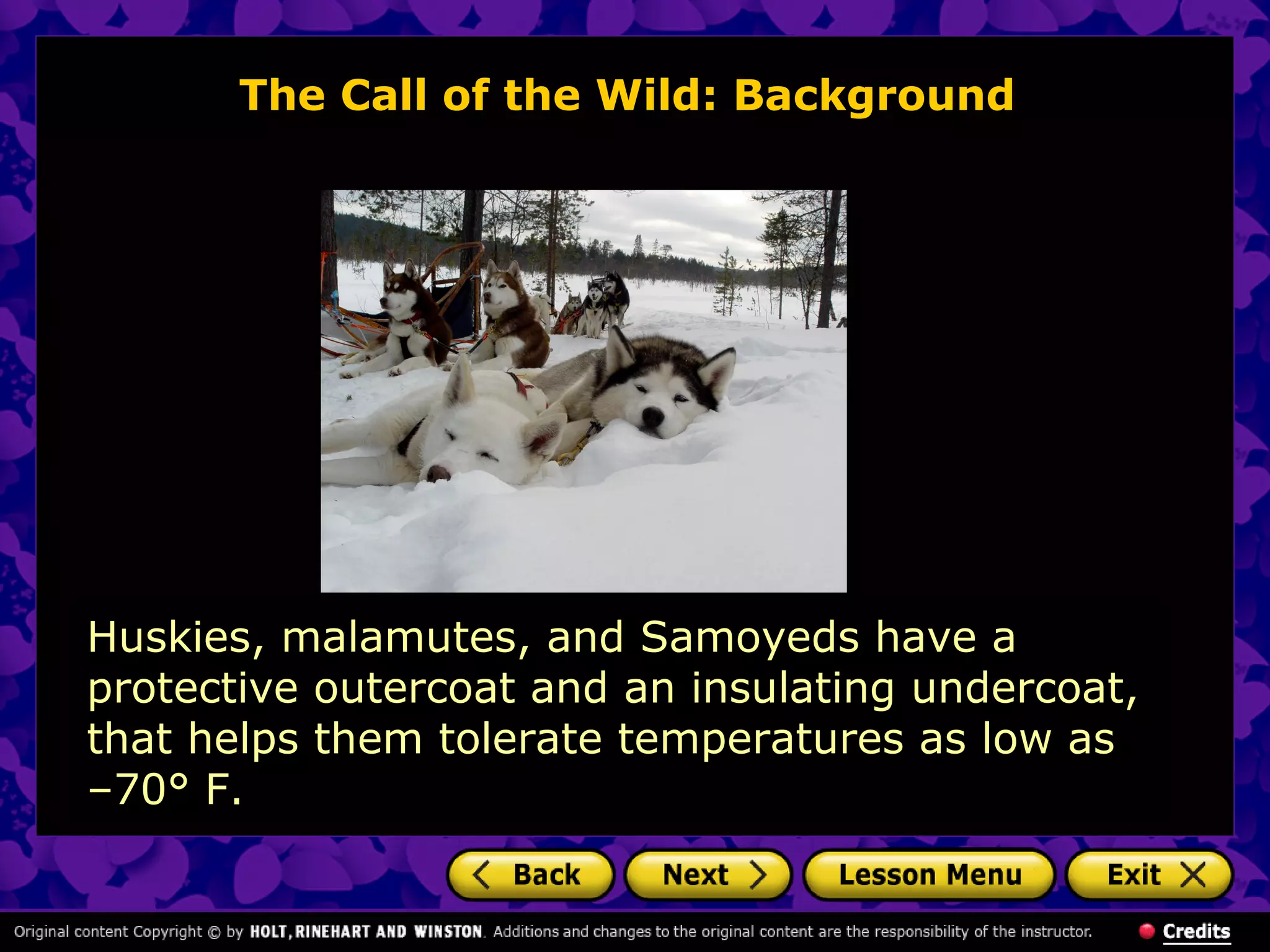
Huskies, malamutes, and Samoyeds have a
protective outercoat and an insulating undercoat,
that helps them tolerate temperatures as low as
–70° F.
The Call of the Wild: Discussion Starters
Discuss (1)
The Call of the Wild is an unusual book because it
is told from the point of view of a dog.
• How do you think dogs view the world?
• How does a dog’s perspective differ from a
human’s? In what ways are the perspectives
similar?
The Call of the Wild: Discussion Starters
Discuss (2)
As Buck’s primitive, animal nature becomes
stronger, he feels a longing to live as a wild animal
instead of as a domesticated one.
• Do humans, like dogs, sometimes hear “the call
of the wild”?
• What do you do when you feel the need to get
closer to nature?

Callofthewild

  • 1.
    The Call ofthe Wild Jack London Introduction Background Discussion Starters Menu
  • 2.
    The Call ofthe Wild Jack London
  • 3.
    The Call ofthe Wild: Introduction In a harsh and hostile environment like the Yukon Territory, survival is the ultimate challenge.
  • 4.
    The Call ofthe Wild: Introduction If strength, courage, and adaptability are the keys to survival, then our hero, Buck, stands a pretty good chance.
  • 5.
    The Call ofthe Wild: Introduction When Buck is stolen from his comfortable home in California and sold as a sled dog, he ends up working in the bitter cold of Alaska and Canada.
  • 6.
    The Call ofthe Wild: Introduction It’s not just the climate that’s changed. The rules seem to be different, too.
  • 7.
    The Call ofthe Wild: Introduction In this new environment, Buck has to change the way he • sleeps • eats • relates to humans • interacts with other dogs
  • 8.
    The Call ofthe Wild: Introduction Buck is smart, tough, and alert. He even challenges Spitz, the lead dog. He learns quickly how to survive as a sled dog.
  • 9.
    The Call ofthe Wild: Introduction No sooner has Buck adapted, though, than things begin to change again. heavier loads, New owners, dangerously thin ice— none of these changes will make life any easier for Buck. Or will they?
  • 10.
    The Call ofthe Wild: Background In August 1896, gold—and lots of it—was discovered in Rabbit Creek in the Yukon Territory of western Canada.
  • 11.
    The Call ofthe Wild: Background When news of the find reached the United States, the Klondike gold rush was on.
  • 12.
    The Call ofthe Wild: Background The gold prospectors, known as “Klondikers,” faced harsh conditions: • temperatures 20 degrees below zero • starvation and malnutrition • long journeys on foot • hundreds of pounds of supplies to transport
  • 13.
    The Call ofthe Wild: Background The indigenous people of Alaska and Canada began using sled dogs more than 1,000 years ago. They depended on these dogs for • protection • transportation • hunting • companionship
  • 14.
    The Call ofthe Wild: Background In the late 1800s, settlers and explorers started using the dogs to help them explore remote areas, deliver mail, and look for gold.
  • 15.
    The Call ofthe Wild: Background Certain purebred dogs are commonly used as sled dogs. Alaskan malamutes Siberian huskies Samoyeds
  • 16.
    The Call ofthe Wild: Background Huskies, malamutes, and Samoyeds have a protective outercoat and an insulating undercoat, that helps them tolerate temperatures as low as –70° F.
  • 17.
    The Call ofthe Wild: Discussion Starters Discuss (1) The Call of the Wild is an unusual book because it is told from the point of view of a dog. • How do you think dogs view the world? • How does a dog’s perspective differ from a human’s? In what ways are the perspectives similar?
  • 18.
    The Call ofthe Wild: Discussion Starters Discuss (2) As Buck’s primitive, animal nature becomes stronger, he feels a longing to live as a wild animal instead of as a domesticated one. • Do humans, like dogs, sometimes hear “the call of the wild”? • What do you do when you feel the need to get closer to nature?