CA Capability Model
Update August 2019
© Chartered Accountants Australia and New Zealand 2018
The Capability Model will deliver:
• a more strategic view on the capabilities required of a future
accounting professional incorporating mindsets, personal
attributes, behaviours as well as technical competencies
• a consistent framework that can be applied end-to-end across our
member offering
• a “thought leadership” position –what we believe are the
capabilities required for the Chartered Accountant of the future.
Capability Model
© Chartered Accountants Australia and New Zealand 2018
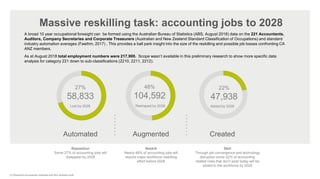
Massive reskilling task: accounting jobs to 2028
A broad 10 year occupational foresight can be formed using the Australian Bureau of Statistics (ABS, August 2018) data on the 221 Accountants,
Auditors, Company Secretaries and Corporate Treasurers (Australian and New Zealand Standard Classification of Occupations) and standard
industry automation averages (Faethm, 2017) . This provides a ball park insight into the size of the reskilling and possible job losses confronting CA
ANZ members.
As at August 2018 total employment numbers were 217,900. Scope wasn’t available in this preliminary research to show more specific data
analysis for category 221 down to sub-classifications (2210, 2211, 2212).
Reposition
Some 27% of accounting jobs will
disappear by 2028
Skill
Through job convergence and technology
disruption some 22% of accounting
related roles that don’t exist today will be
added to the workforce by 2028
Automated Augmented Created
27%
58,833
Lost by 2028
48%
104,592
Reshaped by 2028
22%
47,938
Added by 2028
Reskill
Nearly 48% of accounting jobs will
require major workforce reskilling
effort before 2028
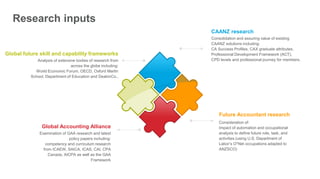
CAANZ research
Consolidation and assuring value of existing
CAANZ solutions including:
CA Success Profiles, CAX graduate attributes,
Professional Development Framework (ACT),
CPD levels and professional journey for members.
Future Accountant research
Consideration of:
Impact of automation and occupational
analysis to define future role, task, and
activities (using U.S. Department of
Labor’s O*Net occupations adapted to
ANZSCO)
Global future skill and capability frameworks
Analysis of extensive bodies of research from
across the globe including:
World Economic Forum, OECD, Oxford Martin
School, Department of Education and DeakinCo.,
Global Accounting Alliance
Examination of GAA research and latest
policy papers including:
competency and curriculum research
from ICAEW, SAICA, ICAS, CAI, CPA
Canada, AICPA as well as the GAA
Framework
Research inputs
© Chartered Accountants Australia and New Zealand 2018
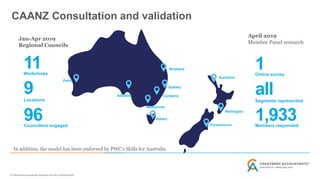
allSegments represented
1Online survey
1,933Members responded
April 2019
Member Panel research
Auckland
Christchurch
Perth
Brisbane
Sydney
Canberra
Hobart
Adelaide
Melbourne
Wellington
Jan-Apr 2019
Regional Councils
9Locations
11Workshops
96Councillors engaged
CAANZ Consultation and validation
In addition, the model has been endorsed by PWC’s Skills for Australia
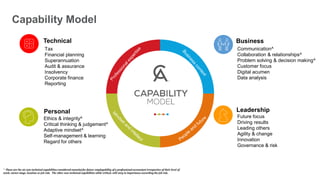
Tax
Financial planning
Superannuation
Audit & assurance
Insolvency
Corporate finance
Reporting
Technical
Ethics & integrity^
Critical thinking & judgement^
Adaptive mindset^
Self-management & learning
Regard for others
Personal
Communication^
Collaboration & relationships^
Problem solving & decision making^
Customer focus
Digital acumen
Data analysis
Business
Future focus
Driving results
Leading others
Agility & change
Innovation
Governance & risk
Leadership
Capability Model
^ These are the six non-technical capabilities considered essential for future employability of a professional accountant irrespective of their level of
work, career stage, location or job role. The other non-technical capabilities while critical, will vary in importance according the job role.
© Chartered Accountants Australia and New Zealand 2018
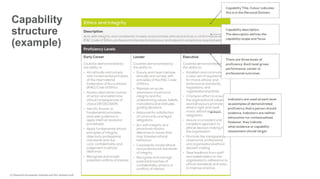
Capability
structure
(example)
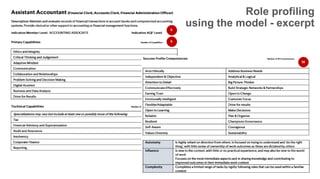
Role profiling
using the model - excerpt
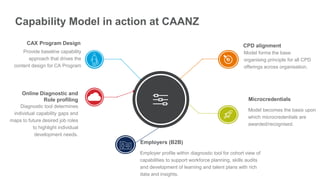
Online Diagnostic and
Role profiling
Diagnostic tool determines
individual capability gaps and
maps to future desired job roles
to highlight individual
development needs.
Capability Model in action at CAANZ
CAX Program Design
Provide baseline capability
approach that drives the
content design for CA Program
CPD alignment
Model forms the base
organising principle for all CPD
offerings across organisation.
Employers (B2B)
Employer profile within diagnostic tool for cohort view of
capabilities to support workforce planning, skills audits
and development of learning and talent plans with rich
data and insights.
Microcredentials
Model becomes the basis upon
which microcredentials are
awarded/recognised.
Simon Hann
Group Executive, Education & Learning
DDI +61 2 9290 5678 M +61 403 530 489
simon.hann@charteredaccountantsanz.com
END

CA ANZ Capability Model

  • 1.
  • 2.
    © Chartered AccountantsAustralia and New Zealand 2018 The Capability Model will deliver: • a more strategic view on the capabilities required of a future accounting professional incorporating mindsets, personal attributes, behaviours as well as technical competencies • a consistent framework that can be applied end-to-end across our member offering • a “thought leadership” position –what we believe are the capabilities required for the Chartered Accountant of the future. Capability Model
  • 3.
    © Chartered AccountantsAustralia and New Zealand 2018 Massive reskilling task: accounting jobs to 2028 A broad 10 year occupational foresight can be formed using the Australian Bureau of Statistics (ABS, August 2018) data on the 221 Accountants, Auditors, Company Secretaries and Corporate Treasurers (Australian and New Zealand Standard Classification of Occupations) and standard industry automation averages (Faethm, 2017) . This provides a ball park insight into the size of the reskilling and possible job losses confronting CA ANZ members. As at August 2018 total employment numbers were 217,900. Scope wasn’t available in this preliminary research to show more specific data analysis for category 221 down to sub-classifications (2210, 2211, 2212). Reposition Some 27% of accounting jobs will disappear by 2028 Skill Through job convergence and technology disruption some 22% of accounting related roles that don’t exist today will be added to the workforce by 2028 Automated Augmented Created 27% 58,833 Lost by 2028 48% 104,592 Reshaped by 2028 22% 47,938 Added by 2028 Reskill Nearly 48% of accounting jobs will require major workforce reskilling effort before 2028
  • 4.
    CAANZ research Consolidation andassuring value of existing CAANZ solutions including: CA Success Profiles, CAX graduate attributes, Professional Development Framework (ACT), CPD levels and professional journey for members. Future Accountant research Consideration of: Impact of automation and occupational analysis to define future role, task, and activities (using U.S. Department of Labor’s O*Net occupations adapted to ANZSCO) Global future skill and capability frameworks Analysis of extensive bodies of research from across the globe including: World Economic Forum, OECD, Oxford Martin School, Department of Education and DeakinCo., Global Accounting Alliance Examination of GAA research and latest policy papers including: competency and curriculum research from ICAEW, SAICA, ICAS, CAI, CPA Canada, AICPA as well as the GAA Framework Research inputs
  • 5.
    © Chartered AccountantsAustralia and New Zealand 2018 allSegments represented 1Online survey 1,933Members responded April 2019 Member Panel research Auckland Christchurch Perth Brisbane Sydney Canberra Hobart Adelaide Melbourne Wellington Jan-Apr 2019 Regional Councils 9Locations 11Workshops 96Councillors engaged CAANZ Consultation and validation In addition, the model has been endorsed by PWC’s Skills for Australia
  • 6.
    Tax Financial planning Superannuation Audit &assurance Insolvency Corporate finance Reporting Technical Ethics & integrity^ Critical thinking & judgement^ Adaptive mindset^ Self-management & learning Regard for others Personal Communication^ Collaboration & relationships^ Problem solving & decision making^ Customer focus Digital acumen Data analysis Business Future focus Driving results Leading others Agility & change Innovation Governance & risk Leadership Capability Model ^ These are the six non-technical capabilities considered essential for future employability of a professional accountant irrespective of their level of work, career stage, location or job role. The other non-technical capabilities while critical, will vary in importance according the job role.
  • 7.
    © Chartered AccountantsAustralia and New Zealand 2018 Capability structure (example)
  • 8.
    Role profiling using themodel - excerpt
  • 9.
    Online Diagnostic and Roleprofiling Diagnostic tool determines individual capability gaps and maps to future desired job roles to highlight individual development needs. Capability Model in action at CAANZ CAX Program Design Provide baseline capability approach that drives the content design for CA Program CPD alignment Model forms the base organising principle for all CPD offerings across organisation. Employers (B2B) Employer profile within diagnostic tool for cohort view of capabilities to support workforce planning, skills audits and development of learning and talent plans with rich data and insights. Microcredentials Model becomes the basis upon which microcredentials are awarded/recognised.
  • 10.
    Simon Hann Group Executive,Education & Learning DDI +61 2 9290 5678 M +61 403 530 489 simon.hann@charteredaccountantsanz.com END